- Advertisement -
Home Blog Page 63

Reservation agents are your front line: How to coach a winning team with Michelle Marquis

0
Coaching for reservations

By Michelle Marquis, NAVIS VP Marketing and Strategic Initiatives

Good coaching brings out the best in your “players.” I revealed NAVIS’ BIG THREE secrets to supercharged call conversions last month. Even with these proven strategies, you need an inspired team to carry them out successfully. How can you motivate reservation agents to aim high every time they take a potential guest’s call?


Commit to coaching rather than training.

training session gives your team a shot in the arm, but it’s a short-term learning experience. Coaching provides ongoing feedback for a constant improvement process. It means you set goals, monitor progress, and adjust according to trends. Then you’re ready for…


5 Best Practices for Coaching Success


1.  Outline specific expectations.
Coach to call mechanics (The 7 Non-Negotiables) rather than results (increased call conversion).  Do your agents position product before price?  Do your agents give personal recommendations?  Do they ask for the sale?  These are the activities that agents can control and choose to perform.


2.  Monitor an agent’s progress by listening to calls.
NAVIS recommends five calls per coaching session, with two sessions per month.  This gives you enough data to know what your agents need coaching on and where they are having success, as well as enables you to see what changes have been made.


3.  Collect accurate, real-time data on agent performance.
This goes beyond call conversion figures to encompass how often the agent complies with call mechanics. 80% compliance is the NAVIS gold standard.


4.  “Keep, Stop, Start”
In other words, reinforce your agents’ strengths, identify and eliminate undesirable actions, and set new goals. This is especially important once an agent hits the 80% mark on a particular activity.


5.  Find what works to inspire team members.

  • A coaching session with role play and/or scripts can clarify how to apply solutions in the real world.
  • Peer-to-peer coaching can be less intimidating.
  • Self-scoring and brainstorming can encourage agents more than one-way sessions.


Of course, coaching requires reliable, up-to-date data. NAVIS’ Reservation Sales System and the NAVIS Marketing Automation Platform (MAP) create the hospitality industry’s most robust and most complete solution to optimize your sales and marketing, backed by our Client Advocate Consulting Team. We help you coach reservation agents to capture bookings that drive your leisure revenue.

Once you’ve coached that team into top form, what’s the next step in encouraging maximum performance? Check in next month for fresh ideas on incentives that support success.


Michelle Marquis, NAVIS VP Marketing and Strategic Initiatives


Turnkey Vacation Rentals makes Austin’s A-List of the Hottest Startups

0

Austin, TX –Last week at the 2014 State of Innovation event, Turnkey Vacation Rentals, an Austin-based vacation rental marketing and management company, was recognized as one of the top startups on the Austin A-List by the Greater Austin Chamber of Commerce and South by Southwest.

The A-List recognizes 12 of the most promising Austin-area startup companies in the key sectors of enterprise data, entertainment, health, social, wearable tech, innovative world tech, and CPG. With over 250 nominated companies, the A-List selection process was particularly competitive this spring. The prestigious A-List recognizes Austin’s most innovative and scalable emerging, growth, and scale stage startups.

Turnkey Vacation Rentals Makes Austin A-ListThe primary goal of the A-List is to increase visibility of Austin’s hottest innovators to help recruit additional venture capital investment and top talent to Austin. To date, there has been a combined $348,720,000 million in investment for all A-List honorees since the inception of the awards program in 2011.

“In a city with such a great startup scene, it is a tremendous honor for everyone at TurnKey to be picked among the hottest startups,” said Turnkey founder and CEO John Banczak. “The previous Austin A-list companies have gone on to do great things and we hope to continue that tradition as we expand.”

TurnKey is a marketing and professional-management solution for individual vacation rental owners.  Located in Austin, TX, founded by former HomeAway, Expedia, BedandBreakfast.com and Limos.com executives, and funded by an all-star cast of angel investors, including the CEOs of Orbitz, and Zillow, and the founders or co-founders of TripIt, Hotwire, Expedia, Zillow and Glassdoor.

VDS launches loyalty program for vacation rentals

0
Rewards program for vacation rentals

For years other industries including hotels/resorts, rental car companies, airlines, supermarkets and restaurants have implemented loyalty and guest retention programs while the vacation rental industry has lagged behind. That appears to be changing. Visual Data Systems (VDS) recently launched GuestAdVantage, which provides the ability to manage the complete guest lifecycle from inquiry, to booking, to stay, and to their eventual return. It is designed to help vacation rental companies maximize their loyalty and guest retention while also improving efficiencies for staff and guests.

For an exclusive look at the features of the new program, click on this link and use the password: VRMintel (Password is case-sensitive).

Rewards Program for Vacation Rentals
Password: VRMintel


According to the VDS website, some of the components of this loyalty marketing tool are:

  • Members-only portal where members can plan and manage their entire vacation experience.
  • The ability for vacationers to invite other members of their party to join in on the planning of their vacation. Now you can capture information from everyone staying in the property and not just the reservation owner.
  • Saved shopping carts and searches for easy access.
  • Vacation planning tools such as shared calendar, tasks, and to-do lists. All customized specifically for your company.
  • Automated Emails: Pre-stay, post-stay, abandoned shopping cart, reminders.
  • Custom coupon development to provide members with exclusive offers. Save them to their smartphone directly or print it out and use traditionally.
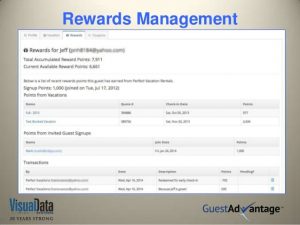
  • Rewards program – Set your business apart from your competitors by giving your guests the ability to earn points to be cashed in for Vacation Rewards. The Guest Advantage interface automates this procedure to keep it simple and easy to manage.

    Rewards Program Management for Vacation Rentals
    Password: VRMintel (case-sensitive)
  • Communication tools – Following the social communication model, allow everyone in your party the ability to comment on their favorite properties, share task lists, pay as a group and much more.
  • Custom Reporting
  • Ongoing consultation and a Pay-For-Performance pricing model


In the near future we can also expect to see:

  • Mobile Website Integration
  • iOS and Android APPS
  • Concierge Integration
  • SMS Texting Capabilities


The vacation rental industry has been slow to embrace loyalty marketing. For many years, vacation rental managers assumed that people would come back to them year after year. With increased online competition and rising marketing costs, vacation rental managers are more likely to explore the implementation of loyalty programs as a way to differentiate themselves from the competition.


Resort Realty acquires Hatteras Island’s Colony Realty VR operations

0
Vacation Rental Vacation Guides and Travel Planners

When Resort Realty’s CEO Mike Harrington expanded operations to Hatteras Island in February of this year, he recognized the opportunity saying, “We feel there is a growing demand for an owner-centric property management program on Hatteras Island, and that is our business.”

Resort Realty OBX Expands to Hatteras IslandLast Friday, we learned that Resort Realty has further increased its presence in the Hatteras community with its acquisition of the vacation rental operations of Colony Realty, adding approximately 70 vacation properties to its inventory.

With this recent additional expansion into Hatteras Island, Resort Realty currently operates six offices and manages approximately 600 properties in Corolla, Duck, Kitty Hawk, Nags Head and Hatteras.

What is a virtual tour, floor plan tour, 360 tour, etc.?

0
websites for vacation and holiday rentals

Virtual tours, 360’s, Panoramas, floor plan tours…the terminology used to describe ways to showcase properties online can be unclear and confusing. VRM Intel decided to investigate the options, figure out the differences and look at examples so you can decide which option works for your vacation rental or real estate listings.

What is a Virtual Tour?

Technically, a virtual tour is any simulation of an existing location, usually composed of a sequence of videos or still images. It may also use other multimedia elements such as floor plans, sound effects, music, narration, and text. To simplify the definition for accommodations and real estate industries: a virtual tour is an online tour of a property. There are several types of virtual tours which are popular ways to showcase properties:

  • 360/Panoramic Tours
  • Video Tours
  • Floor Plan Tours
  • Still Photo Tours


360 or Panoramic Tours

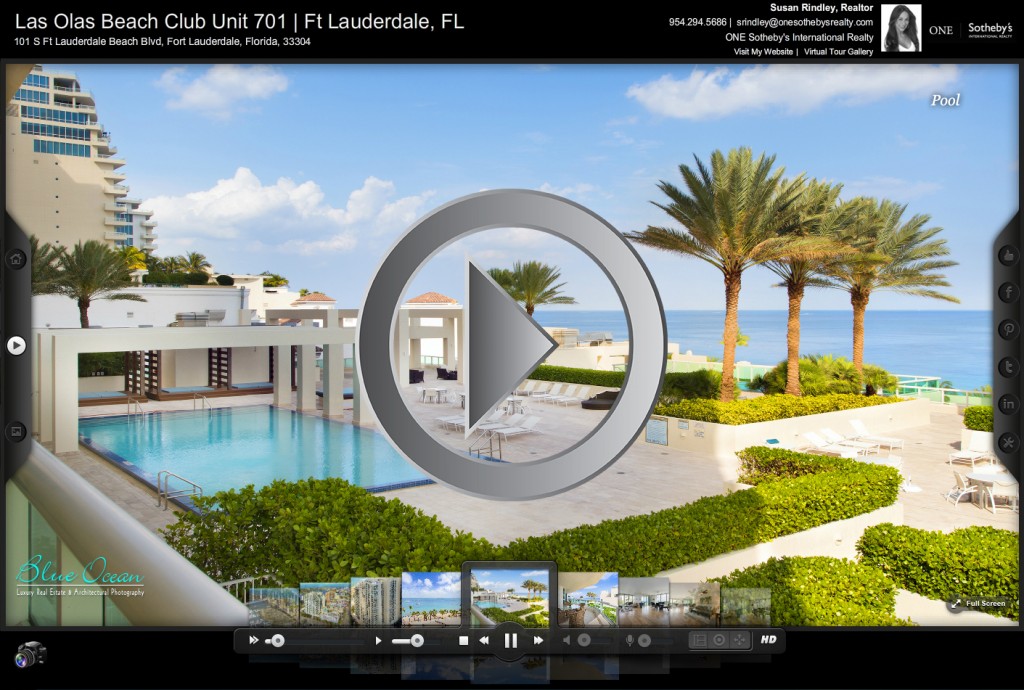
Panorama indicates an unbroken view, since a panorama can be either a series of photographs or panning video footage. However, the phrases “panoramic tour” and “360 virtual tour” have mostly been associated with virtual tours created using still cameras. The Panoramic virtual tours are made up of a number of shots taken from a single vantage point. The camera and lens are rotated around what is referred to as a no parallax point (the exact point at the back of the lens where the light converges). Key Advantages: Shows the entire 360 view of the area Key Disadvantages: Slow load time, ineffective on mobile devices, lack of viewing control The following example added music overlay which can also be distracting to the visitor.   360 Virtual Tour

Interactive Floor Plan Tour

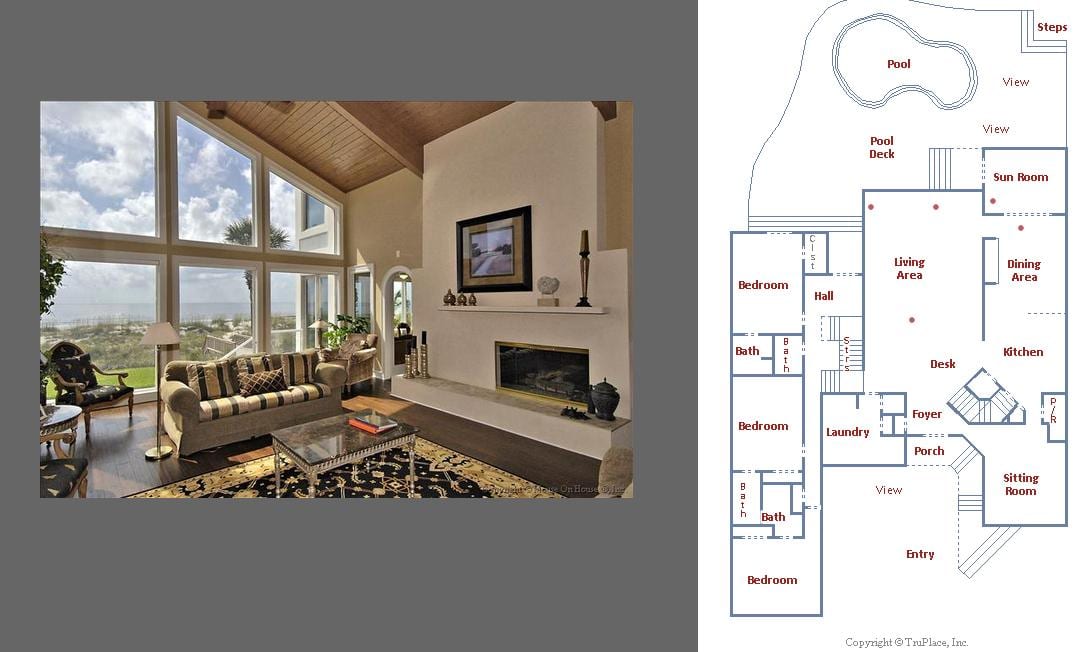
An interactive floor plan tour combines still photography with an architectural floor plan of the entire property so that the visitor can have a high level view and navigate through the home. Key advantages: Fast load time, viewer control, gives visitor overall feel for size and layout of the property, mobile friendly Key disadvantages: Doesn’t give a 360 view of each room The following is a link to examples of interactive floor plan tours.   Interactive Floor Plan Tour

Video Tours

A video tour is a full motion video of a location. Unlike the 360 virtual tour’s static wrap-around feel, a video tour is as if you were walking through a location. Using a video camera, the location is filmed while moving from place to place. Video tours are continuous movement taken at a walking pace. Most video tours also include music, narration, and/or text overlay. Key advantages: Mobile friendly Key disadvantages: Load time, lack of viewing control Here is example of a video tour.


Still Photo Tour, aka Photo Gallery

The most common way people choose to display their properties is through a Still Photo Tour or a Photo Gallery like those used on VRBO.com. Key advantages: Fast load time, viewer control Key disadvantages: One dimensional view, doesn’t give the visitor a feel of the property, lacks an overall view of room size and layout Here is a link to a VRBO.com photo gallery.

Conclusion

To optimize your rental or real estate listings it is important to provide a way for your customers to tour your properties online. When making a decision about how to best display your homes, here are a few considerations.

  • What information does your customer need to make a faster decision about buying from you?
  • What are common questions your agents get via phone calls which could be answered by an online tour?
  • Which type of tour works best on your website?
  • Is your customer likely to use a mobile device in their search?

Related articles: Do Interactive Floor Plan Tour Increase Bookings Surf or Sound Realty Launches New Vacation Rental Website   By Amy Hinote

Employee IT Use & Abuse Policy – Retain Control, Reduce Liability

0

By Tom K

Your IT Resources are valuable tools used to operate and propel your business. If you want these tools to be respected, you need to ensure your employees understand “Acceptable Use” and sign off on this understanding. Unacceptable use can lead to wasted resources, reduced productivity and, if no Use and Abuse Policy is in place, lawsuits directed towards you and your business.

I just returned from a road trip where I found that a large number of businesses I visited had no IT Use and Abuse Policy in place. Like bad passwords, this is so important, so dangerous, and so easy to correct, I’m pushing IT Use & Abuse Policies ahead of this month’s scheduled topic.

In this month’s newsletter I discuss why an IT Use and Abuse Policy is so important, what the policy needs to include, and how to insure your staff acknowledges they have read and understand the policy.


Why you need an IT Use and Abuse Policy

The first purpose of the IT Use and Abuse Policy is to educate your staff as to what constitutes Acceptable Use of company IT resources, as well as what is considered Unacceptable. You can have no compliance expectations if you don’t educate.

The second purpose of the IT Use and Abuse Policy, once you have established companywide understanding, is to make the best, most efficient use of your IT Resources. If your staff complies with the policy you’ll be able to stretch your resources (no server storage wasted on iTunes and personal photos), reduce your expenses (no need to increase your Internet bandwidth if they stop downloading movies and stop streaming radio), and increase productivity (eliminate non-company emails, facebook, and twitter).

The third purpose of the IT Use and Abuse Policy is to provide the basis to be able to discipline staff who refuse to comply, and to protect your business from lawsuits arising from illegal or immoral activity originating from within your business IT environment. You effectively eliminate the “I didn’t know… I wasn’t allowed to send out 40,000 pieces of sexist emails” defense, and you protect your business from the liability associated with 40,000 unacceptable emails leaving your mail server.


What your IT Use and Abuse Policy should include

The policy should begin with an introduction describing the purpose of the policy, and the employees’ responsibility to comply with the policy.

The policy body should specifically state what is acceptable use of your company’s IT Resources, as well as what is unacceptable, in easily understandable and unambiguous language. It should also discuss the user’s expectation of privacy (there is none) and explicitly state your rights as the owner of the resources. It should close with a clear message that non-compliance is not tolerated and will result in disciplinary action.

Topics that should be discussed in terms of both acceptable and unacceptable use include:

  • Company email
  • Personal email
  • Facebook and Twitter
  • Instant Messaging
  • Internet browsing
  • Internet downloads
  • Internet streaming (audio and video)
  • Using a Secure Password
  • Divulging network credentials
  • Installing unauthorized applications on computers
  • Installing remote access applications on computers
  • Storing personal data (pictures, music, etc) on PCs or Servers
  • Downloading software
  • Connecting any personal device (Laptop, PC, Tablet, Phone) to the Private Business Network
  • Connecting any device (Laptop, PC, Tablet, Phone) to the Private Wireless Network
  • Unauthorized transfer or copying company proprietary or confidential information
  • Connecting any personal storage device (USB Drive, Thumb Drive) to a company computer
  • Copyright infringement
  • Manner and content of all communications originating on company devices
  • Running, authorizing, or assisting with security scans on the infrastructure
  • Any form of harassment
  • Any illegal activity

The policy should also include the very clear statement that all IT Resources are the property of the company, and everything stored, processed, transferred, received, or transmitted by these resources are the property of the company. The company reserves the rights to access, inspect, and monitor all information stored or processed by their resources. As such, an employee should have no expectation to privacy regarding this information.

Additionally, the policy should clearly state that all company data and information is the exclusive property of the company and is considered very confidential. Copying it, removing it from the premises, or divulging it in any way to non-company persons is strictly prohibited. This should be reinforced through the use of Non-Disclosure Agreements (NDAs), signed by every employee.

Finally, the policy should highlight that all IDs, Passwords, electronic Keys, and codes are business confidential and must be kept private. Divulging any of these to unauthorized persons is strictly prohibited and will result in immediate termination.


All employees must sign off on the IT Use and Abuse Policy

I strongly recommend that you have all employees sign a statement that they have read and understand the company’s published IT Use and Abuse Policy every year, and that this statement be filed in each employee’s Personnel folder. Annual signing precludes the “I didn’t know you added THAT!” defense.

We advise our clients to include the IT Use and Abuse Policy as part of their Employee Handbook, and have every employee sign off on reading the handbook as part of the annual review process.

This is also a good time to have the employee sign and review their annual NDA, which also goes in their Personnel folder.


The Extras

While not directly associated with company IT Resources, this is a good platform to discuss use of personal smart phones while on the clock. Many of our clients now prohibit personal tweets, email, texting, phone calls, and facebook interaction during working hours, so we discuss this in an addendum to the IT Use and Abuse Policy.

We’ll often add a Frequently Asked Questions (FAQ) section to the end of the policy to clarify the topics, and to help simplify the topics. One really nice thing about the FAQ – it is a simple matter to add new questions and answers as your staff presents them.


If you have any questions or comments concerning this article, or would like assistance developing an IT Use and Abuse Policy for your company, I’d be happy to discuss this with you at your convenience. Feel free to contact me at TomK@TomKConsulting.com, or via my cell 443.310.5110.


About Tom K

Tom K has spent the last 28 years working with company leaders to develop their technology strategies and create IT environments that will best serve their business goals, optimize the use of their computing resources, maximize their systems up-time, and get the most out of their IT investment.

Tom K’s experience was developed as a Director and lead consultant with three respected technology firms, one servicing Vacation Rental Management companies across the country, and two servicing NYC Clients in the banking, finance, and manufacturing industries. Tom also served as CTO for an e-Commerce Web Consultation firm and as IT Director for an international consumer testing company. He holds senior technical certifications from Cisco, Microsoft, Citrix, HP, and Intel.

Tom K brought his expertise from Wall St. to the Vacation Rental and Real Estate industry in 2003. Through his technical skills and business acumen, Tom has helped numerous companies effectively utilize technology to realize their business goals, increase productivity, and improve their bottom line.

Tom K’s extensive experience as both consultant and IT Director provides him with an in-depth understanding of the needs and expectations of his Clients, from both the business and the technical prospective. This knowledge allows Tom to consistently provide the solutions and exceptional levels of service required to exceed those expectations.


 

Tom K technology consulting for vacation rental managers


RateCoaster releases dynamic rate tool for the vacation rental industry

0
Rate parity for vacation rentals

RateCoaster produces Demand-Driven Pricing that automatically updates suppliers’ management systems and in turn publishes to their own website and channels like Airbnb and Homeaway, generating substantial new revenues for owners, managers and channels.

Seattle, WA and Denver, CO (PRWEB) May 07, 2014 –“At RateCoaster, we are focused on helping the entire Vacation Rental ecosystem perform better,” stated Eric Mason, co founder. RateCoaster analyzes market conditions including demand trends in a particular destination or a specific region then calculates new retail pricing based on those trends. The result is managers and suppliers get the highest rate possible for their highly perishable product while converting a prospect into a coveted guest. “RateCoaster has revolutionized the pricing process for Vacation Rental Managers,” Mason adds.

Jordan Allen, president of Stay Alfred Vacation Rentals stated, “As a vacation rental management company, we had looked for a solution for a long time to help us adjust rates to capture the highest possible rate for our products. Since we implemented RateCoaster, we have generated an extra $150,000 in revenue since December alone. We’ve been blown away by it.”

Micah C. Berg, CEO, RealJoy Vacations, stated, “I absolutely love RateCoaster! It has finally created a way to almost completely automate rate adjustments and rate management. We’ve seen an incredible incremental $400,000 in gross rental income since starting to use RateCoaster in December. It’s the easiest ROI story of any platform we’ve seen.”

RateCoaster has offices located in Seattle, WA and Denver, CO. Mason stated, “RateCoaster has had clients using the platform since December of last year and there are more than 2,000 properties using it today. We’ve already successfully established several interfaces with industry leading Property Management Systems including Bookt/InstaManagerCiirusReservationSoftware,WebChalet and many others following shortly. It’s really a platform developed by the industry, for the industry.”

RateCoaster is led by a group of serial entrepreneurs focused on the development and delivery of business changing solutions and services.

Please visit us at http://www.ratecoaster.com and see what managers are saying. Or call us at 866-570-9973 or email us at sales@ratecoaster.com.

Turnkey Vacation Rentals acquires Coastline Adventures

1
Turnkey acquires Coastline in Port Aransas

AUSTIN, TX, May 5, 2014 — TurnKey Vacation Rentals today announced its acquisition of Coastline Adventures, a long-time Port Aransas, TX-based vacation rental manager.

With this acquisition, TurnKey continues to expand its market offering of better, smarter vacation rental management. “We’re dedicated to building the largest and most geographically diverse vacation rental management company,” says John Banczak, Executive Chairman of TurnKey, “and the acquisition of Coastline Adventures enables us to expand our tech-enabled management solution more quickly to Port Aransas owners who are interested in higher revenue, lower costs, and a better management service.”

TurnKey Vacation Rentals was founded by an experienced Internet travel team based in Austin, TX. TurnKey currently serves the Austin, Port Aransas, TX and Santa Barbara, CA areas with plans to expand into several more markets in 2014. TurnKey was founded with the belief that the experience of booking and staying at a short-term rental should be better than a hotel.

TurnKey aims to grow the vacation rental market by improving homeowner and guest experience with better, less expensive management tools for owners, and a more consistent, easier to use vacation rental experience for consumers.

Coastline Adventures was founded by Beverly Gilbreath, an experienced vacation rental manager and long-time resident of the Port Aransas area. She will continue to be head of TurnKey’s operations in Port A bringing with her a great portfolio of properties and a tremendous amount of vacation rental operations experience. “The transition into TurnKey has been seamless for employees, owners, and guests. TurnKey’s model has enormous benefits for owners – from day one my previous owners were amazed how much TurnKey invested into their properties – new photo’s, new electronic locks, a Samsung table in every home, extensive website advertising and promotion, 24/7 email and phone support – all at lower commissions!”

With the increased exposure, refreshed listings and photos and guest experience, reservations have already jumped. “The TurnKey team told me they were going to impress me by increasing revenue – and they have delivered. Our homes have never produced so much revenue.”

Prior to the acquisition, TurnKey had built out an advanced platform for tech-enabled vacation rental management and had already begun to grow the Austin and Santa Barbara markets. Moving forward TurnKey will continue to actively seek additional market-based acquisitions and launch new markets on their own. The TurnKey platform enables more exposure and higher income to owners at lower commissions, and uses advanced logistics and dispatch to enable a smoother owner and enhanced guest experience. Terms of the deal were not disclosed.


About TurnKey:
TurnKey is a marketing and professional-management solution for individual vacation rental owners. Located in Austin, TX, founded by former HomeAway, Expedia, BedandBreakfast.com and Limos.com executives, and funded by an all-star cast of angel investors, including the CEOs of Orbitz, and Zillow, and the founders or co-founders of TripIt, Hotwire, Expedia, Zillow and Glassdoor.

http://turnkeyvr.com/aboutus.


TripAdvisor Acquires Vacation Home Rentals

0
TripAdvisor buys VacationHomeRentals

NEWTON, Mass., May 1, 2014 — TripAdvisor, Inc. (NASDAQ: TRIP), today announced it has acquired Vacation Home Rentals, a Massachusetts-based vacation rentals website. Vacation Home Rentals features more than 14,000 properties around the world.

http://photos.prnewswire.com/prnvar/20080902/TRIPADVISORLOGO

“We’re thrilled to welcome Vacation Home Rentals to the TripAdvisor (TRIP) family,”commented Dermot Halpin, president, TripAdvisor Vacation Rentals. “The team delivers a great experience for both homeowners and travelers and the inventory is a valuable addition to our fast-growing business.”

This acquisition is the second for the TripAdvisor Vacation Rentals group in the last year. In May 2013, TripAdvisor acquired Niumba, a leading vacation rentals website in Spain.  TripAdvisor now features more than 550,000 rental properties around the world.

The terms of the acquisition will not be disclosed.


About TripAdvisor
TripAdvisor ® is the world’s largest travel site*, enabling travelers to plan and have the perfect trip. TripAdvisor offers trusted advice from real travelers and a wide variety of travel choices and planning features with seamless links to booking tools. TripAdvisor branded sites make up the largest travel community in the world, reaching more than 260 million unique monthly visitors** in 2013, and more than 150 million reviews and opinions covering more than 3.7 million accommodations, restaurants and attractions. The sites operate in 39 countries worldwide, including China under daodao.com. TripAdvisor also includes TripAdvisor for Business, a dedicated division that provides the tourism industry access to millions of monthly TripAdvisor visitors.

TripAdvisor, Inc. (NASDAQ: TRIP) manages and operates websites under 20 other travel media brands: www.airfarewatchdog.com, www.bookingbuddy.com, www.cruisecritic.com, www.everytrail.com, www.familyvacationcritic.com, www.flipkey.com, www.gateguru.com, www.holidaylettings.co.uk, www.holidaywatchdog.com, www.independenttraveler.com, www.jetsetter.com, www.niumba.com,  www.onetime.com, www.oyster.com, www.seatguru.com, www.smartertravel.com, www.tingo.comwww.travelpod.com, www.virtualtourist.com, and www.kuxun.cn.


Source: PRNewswire

The big 3 secrets to supercharged call conversions with Michelle Marquis

0
Call conversions for vacation retntal sales

The buzz at our annual leadership conference was all about data, and data is king. When it comes to data’s roll in reservation call conversions, the formula is simple–

By Michelle Marquis, NAVIS


What gets measured gets done!

But first things first. To get crunch-worthy numbers, begin with people. In the case of call conversion, the reservation agents make or break the booking. They are the meeters and greeters of your potential guests. Boosting reservation productivity begins with this question:


What three actions make the biggest difference in driving leisure revenue? At NAVIS, we call them…


The Big Three


1.  Interactive dialog
The way you make the sale is to earn the right to ask for it. Earning that right means you’ve built a mini-relationship with the caller. If you think that a few quick questions (travel dates? number of adults and kids?) and a price quote will capture the booking, think again. You’ll get a “no” most of the time.


2.  Product before price
Price is an influencer, of course, but it’s likely not what sells your property. Use the information from interactive dialogs with potential guests to tailor an offer based on their needs. Is the caller traveling with a baby? The agent might suggest that spacious, comfortable first-floor condo within short walking distance of parking and the pool. Suddenly, the caller places herself on vacation at your property. That puts your agent in perfect position to…


3.  Ask for the sale
It seems that agents skip this step two thirds of the time! Our upbringing teaches us that it’s not polite to talk about money. Your reps need training with the right tools and performance measurements to encourage closing the sale.


Did you know that lack of proper training is the biggest reason reservation agents don’t practice THE BIG THREE?

We help you master the secrets to success with NAVIS Narrowcast–the hospitality industry’s only complete solution to reservations productivity, backed by our technology, data and Client Advocate Consulting Team. Forget complex logic trees and lengthy, hard-to-remember checklists. We help you build a strong reservations team with proven techniques that capture bookings (see the February 2014 blog for The 7 Non-Negotiables) that will drive your leisure revenue.


That brings me back full circle to King Data. Coaching alone cannot ensure sustainability; you need to have the data to track what’s changing over time. The NAVIS Way delivers this, and also includes:

  A baseline conversion analysis for your property.

  Measurement tools based on real-time data to determine staff performance.

  Scoring and coaching templates that capture training notes and monitor individual agent scores.
You can target each reservation agent’s training based on what is or isn’t working for that person.

  Options to route your calls to us for after-hours and overflow (NAVIS RezForce), luxury properties
(NAVIS RezForce LUX), and our full-service call center (NAVIS RezCast).

What results can you expect?

Right now, you probably need 10 inbound calls to book 3 reservations. What if you needed only 5 or 6 calls to book 3 reservations? Imagine what that could do for your bottom line.

Apply effective training and let your reservation agents soar to rock star status. Tune in next month, when I’ll discuss scoring, coaching, training, and setting goals to inspire your staff.

Meanwhile, here’s to data…long live the king!

By Michelle Marquis, NAVIS VP Marketing and Strategic Initiatives

FVRMA backed House bill passes Senate, now to Governor

0
Rick Scott revuews HB 883 regulating vacation rentals

Vacation rental owners appear to have fought off efforts to allow cities and counties in Florida once again to ban some types of short-term rentals.

The Florida House of Representatives passed a bill Wednesday that gives local governments limited control over rentals but not the regulatory power many were seeking.

City and county officials have supported a Senate version that would give local governments greater latitude to crack down on the rentals. But the House bill seems likely to win out in the final two days of the legislative session.

Nightly and weekly vacation home and condominium rentals have been a hot-button issue in some Southwest Florida beach communities, including Venice, Anna Maria and Holmes Beach. Full-time residents often complain about trash, noise and parking problems.

But many House members staunchly opposed restoring the ability of local governments to impose minimum-stay requirements or ban short-term rentals altogether, an authority that was revoked by the Legislature in 2011 after rental owners raised concerns about the increasing number of local regulations.

Even the watered-down House version of the rental oversight bill continued to draw criticism Wednesday, although it cleared the chamber by a comfortable 90-27 margin. The legislation allows local governments to adopt ordinances targeted specifically at rental properties, such as an inspection program or trash rules.

But unlike the Senate bill — which was amended to protect weekly rentals while allowing prohibitions on nightly or weekend rentals — no minimum-stay requirement could be imposed under the House legislation. That was enough to win over some property rights advocates.

Rep. Mike La Rosa, R-St. Cloud, said he was originally a strong opponent of the legislation but believes the House bill eventually found the “right balance.”

Another bill supporter, Sarasota Republican Rep. Ray Pilon, said if local governments go too far with rental restrictions residents can vote them out, but “this is a case where we should not be preempting those locals who are responsible to their local citizens. Government closest to the people is the best.”

City and county officials have been working to repeal the 2011 law that banned all local vacation rental regulations since it was enacted, but the effort gained a powerful ally this year in Sen. John Thrasher, a St. Augustine Republican.

He represents a community where rentals have been particularly controversial.

While the Florida League of Cities prefers Thrasher’s bill, lobbyist Casey Cook said the House legislation is a step in the right direction.

“We are happy that the Legislature has acknowledged that vacation rentals are causing problems for cities in Florida and has given us back the authority to regulate these properties,” Cook wrote in an email.

Holmes Beach City Commissioner Jean Peelen also expressed qualified support for the House bill. Peelen wanted lawmakers to completely repeal the 2011 law, but she said the House bill is better than nothing.

“At least some regulation of vacation rentals has been returned to the cities,” she said.

Cook predicted that Thrasher would support the House bill to get something passed this session. The senator could not be reached for comment Wednesday.

The Florida Vacation Rental Managers Association also backs the House bill.

“Today’s vote in the House looks to be a fair compromise for all property owners,” association president Paul Hayes said in a statement. “This approach strikes a needed balance that we hope will protect Florida’s vital, $31 billion-per-year vacation rental economy.”


By ZAC ANDERSON, HALIFAX MEDIA SERVICES

Seaside Vacation Rentals Acquires JoHank Rentals

0
Seaside Vacation rentals

Seaside Vacation Rentals on the Southern Coast of Maine announced its acquisition of JoHank Rentals, located in Wells, Maine.

JoHank Rentals has a long standing history of providing quality vacation rentals and service to owners and guests, since being formed 20 years ago.  “The leadership, operational experience and vast marketing resources provided by Seaside Vacation Rentals will continue meeting the goals we have set as well as creating increased value to our owners and adding to the overall vacation experience offered to our guests”, said Bill Haskell owner  of JoHank Rentals.

Seaside Vacation Rentals underscored its commitment to high professional standards and values as well as growth as it seeks to further expand its business in Southern Maine.

“As the newest member to the Seaside Family of Companies, JoHank Rentals has cultivated an impressive portfolio of vacation rentals with the kind of service and ethics we believe is essential to running any business,” said Maureen Regan, President and co-owner of The Seaside Group, Inc and Seaside Vacation Rentals.  Maureen and her daughter, Jennifer Thibodeau, are co-owners of Seaside.   “We’re excited about extending the relationships we have with the JoHank vacation homeowners and guests and to be able to offer more properties in the ever-popular Wells and Ogunquit areas.”

Seaside Vacation Rentals has been offering vacation rental services to customers since 1983, creating a boutique style of vacation rental management dedicated to exceeding the expectations of owners and guests alike.   Seaside Vacation Rentals has consistently been the leader in the southern Maine vacation rental market year after year, having been voted the best of the best vacation rental company in the area for 5 years in a row, as well as being the recipient of awards from the Maine Tourism Association and the Maine Governor’s Conference plus numerous awards for their contributions to Maine tourism, entrepreneurism, performance, and for their programs geared to giving back.  Their “Heroes” program has offered vacations in Seaside’s rental properties to survivors and first responders of the 9/11/2001 World Trade Center bombing and to returning veterans and their families.   This year they will again sponsor families of fallen Boston Firemen.

Johank RentalsAccording to Jennifer Thibodeau, COO of Seaside Vacation Rentals, “We love the southern Maine area and see it as a fantastic vacation rental market in which to operate and to live in.  Our focus will be to deliver local, personalized management and service that differentiates us from the competition, ultimately creating value and loyalty amongst our owners and guests.  This focus has been a cornerstone in Seaside Vacation Rentals brand since inception, adding to our strong reputation of putting customers first.”


The Seaside Group of Companies offers market leading vacation rentals, condo management services and an affiliated real estate service.   The Seaside Group companies are comprised of Seaside Vacation Rentals, a full service vacation rental company with cleaning, maintenance and many other services (www.SeasideRentals.com); Seaside Condo Management, a full service condo management company which specializes in managing all areas of condo rental management, hotel management, cleaning and maintenance (SeasideCondoManagement.com) and an affiliated company, Regan Real Estate, a full service real estate company specializing in the second home market (www.ReganRealEstate.com).  The Seaside Group, Inc business model integrates vacation rentals and real estate sales with a “white glove” approach to customer service. The combined efforts of these companies allow homeowners and investors all of the conveniences necessary to maximize return on investment, while enjoying impeccable customer service at every level.

Hotel industry plans attack on vacation rentals

1
Hotels come together to battle vacation rentals

Over the last decade the vacation rental industry’s share of the lodging market rose from 8% to 20%, and online vacation rental bookings jumped from just 12% of the overall market in 2007 to 24% in 2012 (PhoCusWright).

Industry observers wondered how long the hotel industry would sit on the sidelines as a spectator watching the rise of the vacation rental industry before making a cohesive attempt to derail its success.


Apparently, not much longer.

According to Tnooz, the American Hotel and Lodging Association (AH&LA) announced Tuesday plans to attack the current practices of the U.S. vacation rental industry with a campaign to:

“highlight the bad, unfair and in some cases unlawful business practices employed by short-term online rental companies and the lack of parity between safety, security, tax, and other requirements for hotels and short-term online rentals.” 


The campaign against vacation rentals is largely centered around two issues: 1) taxation & legality, and 2) health and safety.

Tnooz provides the following excerpts from the AH&LA communications:

  • In many markets, Airbnb and similar short-term online rental marketplaces are technically illegal, but lax enforcement of existing laws has allowed these entities to grow exponentially in size.
  • Their increasing popularity, together with unclear regulatory structures, has prompted many local governments to examine new ways to tax and regulate these companies.
  • Airbnb has led aggressive outreach programs in several cities, engaging local officials, agreeing to collect and pay some taxes, and pushing for favorable rewrites of local planning law.

To counter these actions, AH&LA is working to drive the short-term rental company debates. Our plan includes:

  • Together with our partner states, identifying target cities and localities where we can engage in select tax, safety, and health fights at the council level to pre-empt other deals being sought by short-term online rental companies
  • Creating a feedback loop at the federal level between Congress and federal agencies, and pushing legislation ensuring laws regulating hotels are applied equally to short-term online rental companies
  • Highlighting the tremendous innovation within the hotel sector
  • Raising enforcement concerns regarding the lack of compliance by short-term online rental companies with areas including provisions of the Americans with Disabilities Act, safety, occupancy rules, and tax reporting.


“We agree that short-term rentals should be in compliance with all local codes and tax requirements,” said VRMA Executive Director Mark McSweeney. “However, we are concerned with the broad strokes with which many of these statements paint the short-term vacation rental industry.  The fact is, when managed by established and traditional vacation rental professionals, short-term vacation rentals create benefits to local economies via tax dollars and tourism revenue, generate jobs, and ensure safety and security for their guests and surrounding communities.”

McSweeney added, “Regulations that create blanket limitations on short-term rentals unnecessarily inhibit local economies and the success of legitimate businesses like those of the members of VRMA. When legally zoned for hospitality business, established and traditional vacation rental professionals follow all regional tourism standards and tax requirements, much like a hotel would, which is best for everyone – travelers, homeowners, neighboring businesses and local governments.”


Taxation and Legality

Wyndham weighs in on hotel attack on vacation rentalsAlthough taxation and legality have long been issues in the vacation rental space, Airbnb has recently pushed the envelope on these issues in New York, San Francisco and Portland.

HomeAway approaches the market with a less adversarial tone.

“HomeAway welcomes partners who seek to help communities create fair and appropriate regulations for vacation rentals, and would agree with the premise that clear, community focused regulations are required.” said Carl Shepherd, co-founder and Chief Strategy and Development Officer at HomeAway. “Outright bans of the activity, however, make no sense at all. While there is some crossover, HomeAway’s vacation rentals appeal primarily to families and groups traveling together, who want privacy, more space, kitchens, and locations and experiences that hotels don’t provide, just as the average short term rental may not meet the needs of travelers seeking the accessibility, location, and extras (maid and room service, spas, restaurants and other amenities) that hotels excel at delivering.”

Shepherd continued, “In the end, history shows us that attempting to ban an industry may seem easier than adapting to address changing competition, but in the long run, the former has always failed, and the latter most often proves to be the winning strategy.”

Steve Trover, president and CEO of All Star Vacation Homes which operates in Florida, California and Idaho, sees an opportunity to work with the AH&LA to create a fair competitive environment. “It is my opinion that we as professional managers should reach out to the AH&LA via the VRMA (Vacation Rental Managers Association) to align ourselves with the hotel industry where we can.”

“Professional managers abide by zoning and tax laws and should be on the legal side of this argument,” Trover continued. “We should encourage the AH&LA to further understand and embrace the professional side of vacation rentals while they rightly look to level the playing field where laws are ignored. We should encourage enforcement of existing tax and zoning laws and advocate for laws that are logical and allow for a robust but professional vacation rental industry.”


Health and Safety

Over the last 15 years, a few vacation rental industry leaders and organizations worked to proactively establish standards for professionally managed vacation rentals. The Vacation Rental Housekeeping Professionals (VRHP) was formed in 1999 to put housekeeping standards and certifications in place to promote and maintain lodging safety and health among professional managed vacation rentals.

The VRMA and the CFVRMA also initiated certification programs designed to proactively give the vacation rental management industry a stronger ethical foundation and to provide guests with assurance that safety, health and legal guidelines had been met. The VRMA even explored the idea of working with the AH&LA to incorporate standards for their certification program but subsequently decided to keep the program independent.

However, the industry has been slow to adopt any self-imposed regulations.

New associations have popped up to to fill the gap, such as VRIA and OPMA. In addition, large software companies are providing user conferences aimed at education for professional vacation rental managers.


Benefits of the AH&LA Campaign


Despite its intention, the campaign provides notable benefits for the professionally managed vacation rental industry.


1. Further legitimizes the industry

The main benefit from AH&LA’s anti-short-term-rental campaign is that it serves to provide conclusive legitimacy of vacation rentals as a viable lodging alternative to hotels.

“The Hotel Association campaign reflects a general trend of recognition by the traditional lodging industry that vacation rentals are more than a viable alternative to hotels,” said Kirby Winfield, CEO at Dwellable. “As professionally managed vacation rental companies build meaningful brands, provide hotel-class cleaning, check-in, and concierge services, and market themselves through ‘VR OTA’s’ like Dwellable, they’re aggressively taking market share from traditional hotels.”


2. Brings the taxation issue to the forefront

The campaign serves to provide additional education and awareness of the distinction between professionally managed and owner managed rentals, and helps to discourage owner managed vacation rentals from staying in the shadows, not paying taxes, disobeying government regulations, and harming the industry as a whole.


3. Encourages the industry to come together

“The campaign does highlight the relative lack of organization and lobbying clout on the part of a fragmented VRMC category,” said Winfield.

With increased awareness comes an increased need to work together as an industry, put health and safety guidelines in place, and join forces to further increase gains in lodging market share. The AH&LA campaign serves to encourage vacation rental managers to proactively band together in their association(s) before they find themselves in a reactionary position.

“When legally zoned for hospitality business, established and traditional vacation rental professionals follow all regional tourism standards and tax requirements, much like a hotel would, which is best for everyone – travelers, homeowners, neighboring businesses and local governments,” said McSweeney.


By Amy Hinote


HomeAway Q1: 8 things we learned from HomeAway’s earnings call

0
HomeAway Stock Performance

HomeAway’s stock price fell April 28 to $32.60, down from $48.90 in February of this year. However in last week’s earnings call HomeAway reported a 33% year-over-year increase in revenue, a 20% growth in adjusted EDITDA, and a 28% increase in listings (now at 952,000).

In addition, last quarter HomeAway’s sites had 245 million visits (up 18%), and in March they completed a convertible debt offering with proceeds of $344 million bringing cash and short-term investments to $770 million.

Further evidence that HomeAway is well positioned in the market came from a recent study conducted by HomeAway and the National Association of Realtors reporting 47% growth in US vacation home sales between 2011 and 2013, with 89% of vacation homebuyers indicating an intention to rent their homes.


8 takeaways from last week’s earnings call


1. Pay Per Booking Model

At the end of Q1 HomeAway had 224,000 e-commerce enabled listings. “Once again, driving this increase in adoption was both the addition of online bookable PPB (pay-per-booking) listings as well as continued adoption of payments and online booking on subscription listings,” said CEO Brian Sharples.

In the first quarter HomeAway added approximately 35,000 performance-based listings with the “majority being PPB listings from large property managers.”

Listings from property managers currently make up 36% of total listings, up from 35% last quarter.

With increasing interest in the PPB product, HomeAway has shifted focus to improving the quality and conversion rate of existing PPB listings. By testing and optimizing the PPB listing performance and functionality, they have been able to improve conversion rates.

“We’ve also identified distinct requirements to make these listings successful on our websites and have implemented initiatives aimed at improving these attributes, many rolling out as we speak,” said Sharples. “For example, many property managers have fairly rigid rules regarding check-in and checkout dates, and we can improve conversion and traveler satisfaction by modifying our platforms to prominently display and utilize this information.”

Sharples added, “We’re still early in the launch of our integrated PM PPB product but are pleased with the initial wins on conversion and the team is firing on all cylinders to drive further improvement in the coming quarters. Keep in mind though that in general our expectation is that these listings will have less calendar availability compared to listings from individual owners and that combined with their still relatively low placement and sort order will mean they will not perform at the same level as their platform counterparts.”


2. Mobile

HomeAway has been working to roll out its responsive design on its sites and has acquired mobile guest management tool Glad to Have You (GTHY).

The questions was raised –is HomeAway looking to integrate third-party marketplaces which provide restaurant reservations, delivery and transportation services?

“Right now we’re focused on getting it (GTHY) integrated into the HomeAway app and we’re going to try to use it to create an awesome experience for travelers when they’re in market primarily so that we can embed our brand into their brain for the next time and they go to purchase vacation rental travel,” said Sharples. “That said, the platform is absolutely built to accommodate those kind of things, it already allows for owners to put in reviews of restaurants and recommend things and places to do. So yes, at some point, it’s a natural bridge to your offering coupons or simply distributing other services, maybe with some kind of percentage take rates, that capability doesn’t fully exist today but it’s in the long-term plan for sure.”


3. Expedia Integration

“Both HomeAway and Expedia would like to add greater volume of listings to this program, so we are accelerating internal development work to enable this sooner than we had originally planned and outside of Expedia we continue to make product investments to enable broader distribution of our listings in the future,” said Sharples.


4. Other Revenue

Other revenue (17.4% of total revenue), which includes ancillary revenues, advertising, software and other items, grew 46.8% year-over-year.

“Our value-added services product which include insurance, product and revenue share for payment processing are key area of focus and continue to demonstrate robust growth,” said CFO Lynn Atchinson. “We are also pleased that both advertising and software contributed to the growth of the business.”


5. Response Time and Updated Calendars

One of the ways HomeAway is looking to improve is by encouraging owners to respond quickly to inquiries and maintain updated calendars.

“If our travelers could go to the sites and know that every calendar on our site was fully up-to-date and accurate, then the number of visits to secure a booking would go down by orders of magnitude, which would look really crappy on the traffic front but would be 100% the right thing to do for our business,” said Sharples. “So we are in fact very hard at work to make that a reality, and in the end what we’ve really got to do is create an incentive for our customers to keep their calendars up-to-date and create an incentive for them to respond quickly to travelers. So we are getting said in the coming quarters to roll out a new measurement system that does in fact measure and report owner responsiveness on our site so that travelers will be able to see specifically not only how quickly somebody responds but how accurate their calendar is. So if somebody consistently when their calendar says they are open, responds and says they are not open, that’s a negative thing that we’re going to start measuring and I think very quickly we’re going to create an incentive system that improves that experience dramatically and that’s going to be a very big deal and we’re excited about it.”


6. Closed Loop Communications

HomeAway has recently brought communications in-house through a secure platform which allows HomeAway to monitor communications, track response time, look at how many times calendars are incorrect, and provide incentives.

“And this is — we didn’t have that capability last year, this capability comes from us taking all the communications and bringing them in-house with our HomeAway secure communications platform,” said Sharples. “You may recall we did that primarily as a trust and safety measure to help stave off phishing but the real benefit of us now being able to monitor all communications is that we can now track these things, report these things, create an incentive structure, so people fix these things and it’s going to be a vast, vast improvements to our sites.”


7. Search Engine Marketing

“There is no question that somebody like Booking.com spends a lot more money in SEM than we do,” said Sharples. “Now we are also highly advantaged in our category and that we are the SEO leader by far. But so we may not have to spend as much as a percentage as competitors might have to in the category. But you’ll certainly see us ramp up that spending over the next several years.”


8. Future Acquisitions

“The primary purpose of this financing (convertible debt offering) was to provide firepower for additional acquisitions and investments we may wish to make in the coming years,” said Sharples. “While we don’t discuss specific targets, it is reasonable for investors to assume that our past behavior informs our choice of future and target businesses that can open up new markets and geographies or provide us with complementary products and services to enhance our marketplace remain attractive to us.”

Train Staff, Increase Team Spirit

0
Tom K Lunch and Learn

By Tom K

In my last article I mentioned the Lunch & Learn. Properly used, this little gem can help you train your staff and increase team spirit with almost no expense.

In this month’s newsletter (a quick but valuable read), I describe how we’ve used this tool at several companies with excellent results.


The Lunch

The concept is pretty simple. You get your staff together for regularly scheduled lunches, they spend 15 minutes together chatting and bonding while getting the lunch you’ve provided, and then someone presents a 30 – 45 minute session. The lunches are simple, inexpensive, convenient for the purpose, and should be easy clean-up; pizza, party subs, family style Chinese, sodas.

Depending on the size of your organization, you may need to break the lunches up by division, department, or function. Some clients have split the companies/departments down the middle so there is always coverage during each Lunch and Learn.


The Learn

The topics can be anything – security, safety, guest relations, new features in your PM software, changes to the Employee Handbook, changes in the Health Care offering, etc. Focus on things that can best improve your company’s success or reduce its liabilities. Those who have instituted this tool have never been at a loss for a topic, there is always something out there that can benefit your staff and your company.

The presenters can be internal staff or external partners. I’ve done several of these while traveling. I’ve also helped client staff prepare their sessions when asked. It is not at all difficult to put together a 30 minute session. Just try to keep it entertaining (or at least interesting) as well as informative.

And reserve some time at the end of the session for a group discussion of the material. You’ve hired intelligent folks; it’s amazing how much additional learning can be gained after the structured presentation.


The Benefits

You get to engage and educate your staff for an hour, on their time, at minimal expense. This improves your company’s position and, due to the low cost, the ROI is exceptional.

Your staff sees this as a perk rather than just another boring meeting. They get a nice lunch.

And, your staff gets to bond with their coworkers in a relaxed environment.


The Keys

The keys to the success of the Lunch and Learn are to keep it interesting/informative, and its regular schedule. It should always be at the same time on the same day, i.e. 12:30 PM on the second Tuesday of every month. Your staff will look forward to it and plan on it.

Once it is established (and you’re appreciating its ROI), consider expanding to twice per month. But always keep it consistently scheduled.

Since the schedule is static (and the food is ALWAYS there on time), tardiness is rarely an issue. But, if you need to address folks coming in late, consider a gentle penalty like anyone arriving after 12:30 PM brings in doughnuts Friday morning.

If you have any questions about any of the info in this article, or if there is anything I can do to help you with ideas for your own Lunch and Learns, please don’t hesitate to contact me at TomK@TomKConsulting.com, or via my cell 443.310.5110.

Next month I’ll start a two part overview of the Payment Card Industry Data Security Standard (PCI DSS). Every company that accepts or processes credit cards, or touches a credit card transaction in any manner, must comply with this standard. Pretty serious stuff…


About Tom K

Tom K has spent the last 28 years working with company leaders to develop their technology strategies and create IT environments that will best serve their business goals, optimize the use of their computing resources, maximize their systems up-time, and get the most out of their IT investment.

Tom K’s experience was developed as a Director and lead consultant with three respected technology firms, one servicing Vacation Rental Management companies across the country, and two servicing NYC Clients in the banking, finance, and manufacturing industries. Tom also served as CTO for an e-Commerce Web Consultation firm and as IT Director for an international consumer testing company. He holds senior technical certifications from Cisco, Microsoft, Citrix, HP, and Intel.

Tom K brought his expertise from Wall St. to the Vacation Rental and Real Estate industry in 2003. Through his technical skills and business acumen, Tom has helped numerous companies effectively utilize technology to realize their business goals, increase productivity, and improve their bottom line.

Tom K’s extensive experience as both consultant and IT Director provides him with an in-depth understanding of the needs and expectations of his Clients, from both the business and the technical prospective. This knowledge allows Tom to consistently provide the solutions and exceptional levels of service required to exceed those expectations.

 

Tom K technology consulting for vacation rental managers


VRM Implements BookEasy Responsive Design

0
White Realty

White Realty, a long-time Virtual Resort Manager client, has launched a new website built on the VRM’s Responsive Web Design platform. The new site design is equally functional on desktop, tablet, and smart phone browsers, eliminating the need for a separate mobile website with its inherent problems.

White Realty

“This is the fourth RWD site that we’ve launched in the past several weeks,” says Connie Hutchins, VRM’s Director of Marketing. “We’re excited about the functionality contained in these new sites, and the fact that they perform so well. It’s the wave of the future.”

White is a small family operated firm which manages approximately 150 properties in the Grand Strand market. Virtual Resort Manager is one of the industry’s leading SaaS (software as a service) providers, supplying clients with enterprise-level back end software, websites, marketing, and related products and services.

For further information  e-mail Pete Wenk, or call him at 252 241-9533.

Is rate parity coming to the vacation rental industry?

0
Rate parity for vacation rentals

What is rate parity?

In short, “rate parity” is offering the same rate with the same conditions for a particular room type, regardless of the distribution channels used for booking.

In the hotel industry, rate parity generally refers to agreements in which hotels and OTAs agree to make sure there is consistent pricing across channels so that consumers see the same rate for the same hotel room on an OTA as they do on a hotel chain’s own site.

In the vacation rental industry, rate parity agreements do not currently exist between distribution channels and vacation rental providers. Consequently, VRMs can (and do) offer varying rates over multiple channels and on their own website.


The OTF Decision

The subject of rate parity has been a heated issue in the hotel industry as the UK Office of Fair Trading (OTF) recently closed its 3 yr. hotel/OTA booking investigation into contracts under which Expedia and Booking.com had agreed not to offer rooms at rates lower than the rates set day-by-day by hotel companies.

The OFT’s decision confirmed that restrictions on discounting were designed to limit price competition between OTAs and between OTAs and hotels and were likely to increase barriers to entry for new OTAs.

The OTF closed its investigation with no finding of infringement after Expedia and Booking.com agreed that parties will be free (subject to certain conditions) to offer discounts on room rates set by the hotels to members of so-called “closed groups”, and hotels will be able to offer discounts off their room rates to members of “closed groups” without triggering the consequences of price parity clauses agreed with OTAs.


Is rate parity good for the VRM?

Several experts argue that rate parity is price fixing and should be illegal in the US under antitrust legislation.

According to Alex Dietz, Principal Industry Consultant, SAS Institute, rate parity has not served their best interests of hotel properties. “This is because rate parity, by its very definition, is restricting the property from managing price – reducing prices to attract price-sensitive segments, while leaving pricing higher for price-insensitive segments,” said Dietz.

And, while some hotels prefer to implement rate parity as their own strategy, many hotels run into rate parity as a consequence of dealing with OTAs, who require it as part of their distribution agreements.

The channel which is producing the most demand is theoretically the party with the most leverage to dictate price, and for vacation rentals, this varies by market. However in the vacation rental industry, the enforcement of rate parity would be costly and laborious due to product differentiation and disjointed technology.


Is rate parity good for the consumer?

“While I have heard arguments that rate parity serves the consumer by reducing shopping complexity and confusion, I also do not believe that rate parity serves their best interests, either,” said Dietz, adding that in the long run, the consumer is best served by efficiency. By this he means, lowering the costs of services over time, and rewarding the most effective provider of services.

According to Dietz, rate parity distorts both of these effects in the distribution market, distorting competition (by eliminating the ability to differentiate on price) and thereby reducing the effectiveness of the market to drive efficiency.

Ricky Ang, VP, sales and marketing, Hotel Equatorial Group also sees the downside for the customer. “From the consumer’s perspective, especially the savvy ones, it makes no sense to them that they have to pay the same amount when they book directly to a hotel versus when they book via a third-party retail source. The consumers know that hotels pay commissions to these third-party players and cannot logically fathom why these `commission savings’ are not passed down to them,” said Ang.


Rate parity vs rate integrity

While rate parity helps the guest avoid confusion over your price, so far, distribution channels are not requiring parity from vacation rental providers.

In the vacation rental space, rate integrity may be a better term for a VRM pricing strategy. The idea of rate integrity falls in a grey area but could be thought of as “simply trust in the fair price of your room.” If a VRM determines that the price of a property “coincides with the level of cleanliness, customer service, location and available amenities of the property, then he or she is practicing rate integrity.”

According to Jean Francois Mourier, CEO, REVPAR GURU, “Rate integrity is also identified as justifying price discounts to ensure a hotel isn’t slashing rates for no reason. When a property effectively controls rate parity, rate integrity is assured, as not only is there a fair ground among the hotel and its partnering travel agencies, online companies, distribution partners, and franchisors, the consumer can also be confident he or she is getting a fair price and won’t be afraid of booking only to find there was a better rate through another channel they were not aware of. ”

Keeping rate integrity at the forefront when setting rates, applying rate parity, justifying discounts, or a combination of strategies, it is important for VRMs to have a rational rate structure which they use consistently throughout their business plan.


Exit strategy: Ensuring top dollar for your vacation rental management company

1
Selling a Vacation Rental Management Company

Over the last decade, vacation rental managers (VRM) have been directly impacted by a multitude of economic conditions including a deep recession, real estate market volatility, government regulations, a surge in rent-by-owner models, and unforeseen weather-related events. In addition, the industry has seen technology and marketing expenses escalate with ecommerce, third party distribution, and marketing automation.

However, in spite of industry changes, vacation rental managers have flourished.

Vacation rentals have prevailed as a mainstream accommodations alternative, and the vacation rental industry is experiencing high levels of growth and –consequently- investment interest and opportunities, as evidenced by Wyndham’s recent purchase of Hatteras Realty, All Star Vacation Homes’ acquisition of Southern California Vacation Rentals and Vacasa’s purchase of Utah Vacation Homes.

With numerous vacation rental management company owners also nearing retirement age, the subject of exit strategy is becoming increasingly prevalent in industry circles.

Ben Edwards Transaction AdvisorVRM Intel reached out to transaction advisor and industry veteran Ben Edwards to learn more about how to successfully navigate the sale of a vacation rental management company. Ben Edwards is president of Weatherby Consulting LLC, heads up business development for Newman-Dailey Resort Properties in Destin, FL, serves as president of the Vacation Rental Managers Association, and has directly worked on over 40 purchase and sale transactions in the vacation rental, resort and real estate industries.


Why do owners sell?

While a few transactions involve distressed companies, according to Ben Edwards, the most common reason vacation rental managers explore selling their company in today’s environment is a desire to monetize their business at the peak of the market.

“In the last couple of years, our industry has experienced a huge turnaround,” said Edwards. “While some companies were fundamentally resistant to change and experienced a decline in inventory and revenue, the majority of managers are seeing tremendous growth.”

“As you recognize the opportunities in the market, the best time to explore your options is when you are doing well,” said Edwards.


What steps can a vacation rental management company owner take to ensure top dollar for their company? In our interview with Edwards, we identified seven tangible actions a VRM can take to formulate a sound exit strategy.


7 steps to ensure success in selling a vacation rental management company:


1. Plan ahead

To maximize the selling price, Edwards advises to plan for the transaction. “While a VRM can sell at any time, in order to get top dollar, an owner would benefit greatly from planning ahead.”

Although current investment interest is strong, Edwards believes the best time to monetize a VRM business is likely over the next three to four years, which makes now the ideal time to begin articulating the exit plan.

“A VRM business has a lot of moving parts, so time is a contributing factor,” said Edwards. “The more lead time you have to work with a transaction advisor, the more you can expect to maximize the selling price.”


Exit strategies for vacation rental maangers2. Keep it confidential

When you are planning for your exit, it is tempting to want to discuss it with others. Edwards warns against broadcasting your plans to the market. “Confidentiality is key,” said Edwards. “You do not want the market to know you are looking to sell. Once you get to the table, the objective is to sell and sell quickly.”


3. Get help

The experienced outside perspective of a transaction advisor is critical in a business transaction and could add as much as 20% to the selling price in the negotiation process.

“What a transaction advisor brings to the table is the experience and understanding to help prepare and articulate the key attributes of the business, ensuring maximum value is realized,” said Edwards. “For example, a nominal accounting misclassification can impact the selling price by hundreds of thousands of dollars. It doesn’t matter how healthy your business is, there are always a few tweaks that can be made in any business which can result in big gains to the selling price.”


4. Tell a compelling story

“When selling a VRM company, the goal is to tell the success story of your accomplishments,” said Edwards. “A transaction advisor/consultant is tasked with telling your story on paper, in every report. Your story is what makes a buyer compelled to pay top dollar for the company.”


5. Demonstrate the health of your company

In doing research about planning for an exit, we heard a lot of advice about how to boost profitability on paper by slashing expenses. Edwards advises against this. “No buyer wants to see where you have starved the business,” said Edwards.

“For the most part, the buyer is going to want to see a healthy percentage of revenue going straight to the bottom line depending on your business model,” said Edwards.


6. Put together a top tier financial package

“In order to get top dollar for a VRM, the owner needs to strategically invest money and manage the business in an effort to maximize sustainable profits for the long-term success of the company,” said Edwards.

A few components include:

  • Comprehensive financial reporting
  • Progressive revenue growth
  • Solid trend of direct operating expenses in relation to revenue that depict effective management
  • Strict management of general administrative expenses
  • Long term rental contracts

Edwards emphasized, “A premium financial package leads to a premium selling contract.”


7. Manage expectations and avoid trying to monetize future revenues

We asked Edwards, “Is there a standard multiple or formula a VRM should be looking for in a transaction?”

“This is what everyone asks, and there really isn’t a standard,” said Edwards. “There are a myriad of purchase models for VRMs (e.g., asset purchase, stock purchase, asset purchase with unfunded liability, stock purchase with excessive operating cash, etc). In addition, there are several variables which significantly impact the transaction. For example, some managers have large offices and check in locations, while others have remote operations. There are too many variables to simply answer the question, ‘What is the multiple of earnings?’ But typically you will see multiples somewhere in the neighborhood of 3-5 times earnings. If you see a company in this market sell below 3 times earnings, typically it is a distressed company.”

In addition, Edwards recommends focusing on historic performance and not future, unrealized revenue streams. “Buyers don’t want to hear about potential future revenues,” said Edwards. “They are more interested in the historical performance and what the seller has accomplished. The goal is to tell your individual story in a compelling way.”


For VRMs who are not yet ready to start the process, it is a good idea to go through the exercise of examining the health of the business and taking a look at how the company story would be told if the VRM was selling today.

“It is like renovating and redecorating a vacation home,” said Edwards. “It is always difficult to do a full refurbishment all at once, but if you can do a little over time, it will continually protect the investment value over time and help you generate a higher rate of return.”


By Amy Hinote


Surpassing the competition, LiveRez’s Tracy Lotz remains committed to independence

0
New LiveRez Offices

802.

802 is the number of vacation rental management companies who have purchased LiveRez’s vacation rental management software platform as of April 9, 2014. Vacation rental software veterans understand all too well the importance of the number because it has surpassed the number of vacation rental management companies utilizing any other single property management software system in the U.S..

Tracy Lotz hits another milestone wth LiveRez

Tracy Lotz, president and CEO of LiveRez, launched the software company in 2008 in Eagle, ID. Ten years prior to its launch, Lotz had been working on 1st Choice Vacation Rentals when he met Steve Trover, president of All Star Vacation Homes. Together, they built All Star’s vacation rental website. In 2002, Lotz added the online booking component, and by 2005, he was building rental websites for other vacation rental managers. Over the next two years Lotz’s tech team worked with Trover’s property management company to build a multi-user, full-scale, end-to-end property management technology solution.

In 2008, LiveRez went to market with its web-based vacation rental software platform and surpassed its competition in just six years.

And at 53, Tracy Lotz isn’t looking towards retirement or an exit strategy any time soon.


Remaining independent

In the current vacation rental technology environment, it has become common to seek outside investment to grow the business. In the last two years, over $500 million in institutional funding has been raised by technology based companies in the vacation rental industry.

But “common” isn’t a word people use to describe Tracy Lotz.

Despite many opportunities to accept institutional funding, Lotz has remained independent. “If I take venture capital to build the business, I’m accountable to venture capitalists. Right now, I am accountable to the property managers who are using our software,” said Lotz. “I’m not in the let’s-make-a VC-some-money business. I am in the let’s-make-the-property-manager-successful business.”

In addition, Lotz is adamant that he isn’t looking to sell the company. “We have resources, and I am not in the position that I need to sell. I am much more interested in building and operating LiveRez,” said Lotz. “The juice for me comes from building something that makes our partners successful.”


Partnership approach

At LiveRez, clients are referred to as “partners,” and the entire staff is trained to treat them accordingly. “One of the reasons we have been successful in sales is that we are selling more than software. We are selling a partnership,” said Lotz. “When a new company is looking to purchase LiveRez, we have hundreds of real people for them to talk to who will testify that our partnership approach is not just a sales line. We are committed to it.”


Continuing development

At the VRMA Regional Seminar in Orlando, FL, LiveRez announced the launch of several development projects including the LiveRez mobile app, a technology partnership with home automation provider PointCentral, iVacationRentals, a customer-facing distribution website for LiveRez’s 50,000 properties, and even Google Glass based housekeeping functionality.

In addition, LiveRez recently added e-learning and non-profit expert Doug Covey to its team to provide educational tools, forums and networking events to help property managers increase standards, build best practices and establish high levels of professionalism in their vacation rental organizations.

And according to Lotz, there is much more on the road map (e.g. call tracking, smart home integration, etc.). “If someone had told me in January 2008 that going on 2014 we would still be working on this (LiveRez functionality), I would have said, ‘You’re crazy. We’re going to be done in six months.’ It is clear now that this is ever-evolving.”


Data protection

Just like every technology creator, Lotz has taken his share of criticism –most notably for his all-in approach and his almost religious commitment to protecting client data.

The LiveRez solution is an end-to-end system which includes functionality for calendar management, housekeeping scheduling, work order tracking, owner management, website building, search engine optimization, and more. However, what LiveRez doesn’t have is an open API interface to integrate with the ever increasing multitude of distribution channels and third party vendors.

“It is very important to me to make sure that we protect the data that is entrusted to us,” said Lotz. “Anytime you pass guest data and owner data to a third party, there is an enormous risk. As we continue to grow, we are committed to protecting the data integrity of our partners and their customers.”

Lotz added, “One of my biggest challenges is that I can’t afford to make a mistake. If I make the decision to build on the wrong technology or integrate with a company who compromises data, it impacts all of our partners. I take that responsibility very seriously.”


The future

Tracy Lotz and the LiveRez team are not anticipating a slow-down in their growth pace. Along with the addition of Doug Covey, Lotz named Steve Trover as Chief Strategy Officer, and the team of 30+ employees recently expanded into new offices in Eagle, ID.

“With as fast as we are growing as a company, we knew we had to think long-term and invest in a space that could accommodate our current and future employees,” said Lotz. “Our new 11,000 sq ft headquarters not only will support our planned growth, but also offers our employees a better environment to come to each day.”

LiveRez has also announced it is heading to Destin, Maui and Kauai for its Summit Series, the company’s ongoing series of educational seminars for vacation rental managers.

Lotz added, “We are builders, and we are committed to working every day to make sure we are developing everything a manager needs to successfully and professionally manage and market their vacation homes. We believe vacation rental managers are the best marketers of their vacation rental properties, so our goal is to provide them with the highest quality tools to do that.”

Mountain Travel Symposium: Panel discusses rentals-by-owners

0
Taxing vacation rentals

By Lauren Glendenning

Websites like VRBO.com and Airbnb.com are giving discerning travelers an alternative to resort lodging in mountain destinations, but they’re also creating some controversy — and even a bit of tension — within the travel resort industry.

That tension was evident at a Saturday afternoon panel discussion at the Mountain Travel Symposium in Breckenridge, a conference that brings everyone from marketers to hospitality professionals together once a year to discuss mountain travel issues and trends. Panelists for the “For Rent By Owner: Tension, Taxes and Technology” session included Breckenridge town manager Tim Gagen, Larry Mashaw of The Resort Company in Steamboat Springs, and Carl Shepherd of the online vacation rental marketplace HomeAway.

Gagen has been facing the challenges of vacation rentals by homeowners for years from a revenue and regulatory standpoint, and not in a good way. In addition to tax collection challenges, the rental-by-owner market can and often does cause disturbances within communities.

Gagen said the town was finding that many out-of-town owners who rented out their properties without a local contact or property manager, issues ranging from trash disposal to parking to rental units becoming party houses arose.

The town has had to write regulations around the growing rental-by-owner industry, as well as put a lot of scrutiny on the local homeowners who are renting their homes out without paying the proper taxes.

But Shepherd said the focus shouldn’t be on legislating what people can or can’t do with their properties, it should be on making it easier for them to comply with regulations.

“The biggest challenge we find when we talk to owners when they’re not complying with regulations is because they can’t understand them. … All you’re doing is encouraging an underground economy,” Shepherd said.

Gagen said the laws, at least in Breckenridge, are up front and easy to comply with. The town has information packets and would love to pass them out, but they don’t always know where to deliver them.

“We reached out to HomeAway to figure out ways we could partner,” Gagen said. “The answer was, ‘We can’t help you because of the privacy.’”

He was referring to the privacy that companies like HomeAway provide to homeowners. The town of Breckenridge wanted to know who was listing rentals so it could check to see if those owners were complying with tax laws, but Shepherd said personal information provided by its customers is private.

“We’re not saying HomeAway should be collecting (taxes). We said it would be nice to know who their clients are so we can help them comply,” Gagen said. “That’s all we’re trying to do is level the playing field.”

Instead, town governments have to spend more time looking for homeowners who are bypassing the system. It’s something that town governments can choose to go after or not, Mashaw said.

Mashaw, who is in the property management business, also has a dog in the fight against the rental-by-owner market, but it’s not as competitive as you might think.

Property managers want to keep vacation rentals at the top-of-mind for potential customers, so they have to be careful not to “bash the owners,” he said.

And while Shepherd said the rental-by-owner market is getting more professions, he thinks homeowners who are renting out their properties are still being shunned within their communities.

“Stop seeing owners as an enemy and embrace them,” he said. “Invite them into your community, invite them to join your hotel associations.”

Mashaw has seen that effort fail in Steamboat Springs, however. Homeowners who have entered into the industry are withdrawn and are often afraid of being called out, he said.

Gagen said that generally speaking the issue has become less of a problem in Breckenridge — that most homeowners are now complying, but the work never ends.

“We have to keep at it,” he said.

That’s good news for towns who spend their lodging tax dollars on things like destination marketing, or in Steamboat Springs’ case, on funding flights into the local airport. But one voice from the audience — Vail Valley Partnership president and chief Executive officer Chris Romer — added slightly more tension to the discussion.

“I find it fascinating that we’re here talking about destinations and travel and visitors and increasing visitation to our areas, and you guys have been sitting up there for 30 minutes and no one once has talked about guests, and what’s best for guests,” Romer said. “No one once has talked about guests and if this model is actually beneficiary to our visitors.”

Editorial Projects Manager Lauren Glendenning is covering the Mountain Travel Symposium in Breckenridge for Colorado Mountain News Media. She can be reached at lglendenning@cmnm.org or 970-777-3125.


Vacasa acquires Utah Vacation Homes

0
Vacasa buys Utah Vacation Homes

Portland, OR based property management company Vacasa Rentals recently purchased Utah Vacation Homes. Founded in 2009, fast-growing Vacasa manages over 700 vacation homes in the western U.S., from laid-back beach cottages along the Oregon Coast to luxury ski chalets in Vail, CO. Vacasa is home to 200 employees located in 7 offices in Oregon, California and Idaho.

The acquisition of Utah Vacation Homes adds approximately 60 properties and two office locations in the Park City and Salt Lake City areas of Utah to Vacasa’s portfolio. Former Utah Vacation Homes owner Tristan Webb will be joining the Vacasa team and currently serves as a member of the Vacation Rental Managers Association Board of Directors.

“As we currently manage homes in Oregon, California, Washington, Colorado, and Idaho, expanding to Utah was an obvious choice,” said Vacasa CEO Eric Breon. “Utah Vacation Homes has a long history in the Park City market, and we are excited to benefit from Tristan Webb’s experience and vision for the industry.  We will continue to build upon UVH’s portfolio as we expand throughout Utah.”


Utah Vacation Homes acquired by Vacasa


By Amy Hinote


Creating a Beautiful Bed -Vacation Rental Housekeeping

0
Vacation rental linens

By Eva Whitney, Vacation Rental Home and Guest
I joined the military right out of high school, and I learned very quickly how to make a bed, military style with hospital corners. I am not a morning person, (getting up at 4:00 or so) so that I didn’t have to make the bed each morning I would sleep on top of it 🙂 However, once you get the hang of it, it’s not difficult.

When I started managing my first VR I was surprised how quickly it came back to me. I personally don’t care for the sheets tucked in, as it feels so tight, I like the George Costanza style….untucked 🙂

But we aren’t talking about George’s style or our own personal style, this is all about the first perception, the guest’s first glance into the bedroom, and you’ll want to create a beautifully made bed.


Made bedWhat you will need

  • A set of linens with a high enough thread count that fits into your budget and creates a comforting experience for your guests. If you can have your linens laundered and pressed that would be ideal.
  • Fitted/flat sheet
  • Pillowcases
  • Thin blanket
  • Duvet and or comforter
  • Pillow shams
  • Decorative pillows

Below are a few tips on how to make up your bed: Here is a link on how to create “Hospital Corners” which also includes a video on making a military style bed with hospital corners.


How to Make a Bed

Fitted Sheet

  • Place on the mattress
  • Tighten and tuck to create a smooth look with no visable wrinkles

Top Sheet

  • Place on the mattress upside down, when it’s folded over you want it will display the design or border to match the pillowcase or decorative pillows, etc
  • Leave about 12 inches at the head of the bed to fold over
  • The material that hangs over each side should be even
  • Tuck the bottom of the sheet under the mattress, creating hospital corners at a 45 degree angle on each side of the bottom http://www.wikihow.com/Make-a-Hospital-Corner
  • Tuck the rest of the sheet in all around the bed, leaving the top slightly loose to tuck over the blanket
  • Continually smooth with your hand to eliminate any wrinkles

Blanket (if you use one)

  • Add a blanket (thin) over the flat sheet, making sure the material is even on both sides
  • Again tuck in at the bottom of the bed adding the hospital corners
  • Fold it over at the head of the bed about twelve inches. Fold your top sheet over twelve inches on top of the blanket
  • Tuck the blanket in tightly around the rest of the bed
  • Continually smooth with your hand to eliminate any wrinkles

Duvets & Comforters

  • Place the duvet or comforter over the sheets (or blanket)
  • Buttons and tags at the bottom, so they aren’t in the guests face
  • Smooth with your hand to eliminate wrinkles
  • Lay flat with each side even or fold over half-way to display the beautifully made bed
  • If you have a comforter (in addition to a duvet) you can display this neatly and fold evenly at the bottom of the bed (tucking the seams under so they aren’t shown)
  • You can also get creative with the comforter and fold in half on top of the bed and then another fold over about 12 inches. (hiding the seams for a neat fold)

Pillows

  • Fluff the pillows
  • Smooth the cases with your hand to eliminate wrinkles, ironed is optional
  • Place the pillows that match the linens in the back, against the headboard with the open edges folded over toward inside, and the closed edges on the outside for a neater look
  • Next the pillows in the shams, that match your comforter or duvet
  • Lastly the decorative pillows in the front


Read more about Eva Whitney

Eva Whitney


Do Interactive Floor Plans Impact Bookings?

0

TruPlace, the vacation rental industry’s leading provider of interactive floor plans, recently commissioned VRM Intel to conduct a 3rd party study designed to determine the actual impact of utilizing floor plan tours on reservations.

Data was retrieved from companies using floor plan tours on partial sets of their vacation rental inventory. We analyzed all guest reservations in 2013. The reservation metrics analyzed were: number of reservations, revenue per stay, number of nights, and booking lead time. These reservation metrics were cross referenced with property data including location and number of bedrooms, along with company-specific data criteria which was confidentially supplied to the participating companies.

Interactive Floor Plans for Vacation Rentals

The results were definitive.

Properties using floor plan tours on average booked 20% more reservations, 16% more nights, and 13% faster than properties without tours. In each subcategory analyzed the results were consistently higher, regardless of property type, size or location.

Interactive Floor Plan Tours Increase Reservations

TruPlace Floor Plan Tours Reservations


Floor Plans increase revenue for vacation rentals


By Amy Hinote

HomeAway: Over $40M Sold -HomeAway execs Sharples, Shepherd, Buhrdorf, Hale et al. sell shares for $40M+

0
HomeAway Listing Quality Score

Updated: April 11, 2014

HomeAway CEO Brian Sharples has another significant chunk of stock for at least the fourth time in the past five weeks. Sharples acquired 28,645 shares as stock options on Tuesday and sold them the same day for more than $1 million.


Updated: April 2, 2014

Carl Shepherd unloaded 60,000 more shares of the stock  on the open market in a transaction that occurred on April 1st. The shares were sold at an average price of $38.49, for a total transaction of $2,309,400.00. Following the completion of the sale, Shepherd now directly owns 153,996 shares of the company’s stock, valued at approximately $5,927,306.

March 25: Updated info below:

HomeAway Execs Sell Shares

Mar 20, 2014 —HomeAway CEO Brian Sharples sold 28,645 shares of the stock on the open market Monday, Mar 17 at an average price of $43.14, for a total of $1,235,745.30. Sharples now directly owns 57,446 shares, valued at approximately $2,478,220.

Just prior to Sharples’s transaction, it was reported that Chief Strategy and Development Officer Carl Shepherd unloaded more than 22% of his shares, according to a Securities and Exchange Commission filing. In all, Shepherd sold 60,000 shares in multiple transactions averaging $45.54 per share on March 11, worth more than $2.7 million. Shepherd still owns roughly 214,000 shares, worth more than $9.7 million.

Shepherd’s move occurred one day after HomeAway CTO Ross Buhrdorf, sold 179,357 shares worth $8.1 million.

In addtion, Tom Hale, Chief Product Officer sold an additional 1,041 shares –which combined with the 64,824 shares he sold a few weeks ago added up to just under $3 million.

HomeAway traded up 1.25% during mid-day trading on Tuesday, hitting $43.61. 482,686 shares traded hands. HomeAway has a one year low of $27.27 and a one year high of $48.90. The stock’s 50-day moving average is $43.27 and its 200-day moving average is $36.85. The company has a market cap of $4.030 billion and a price-to-earnings ratio of 215.35.

March 25: Updated info below:

HomeAway Execs Sell Shares