- Advertisement -
Home Blog Page 541

5 Ways Vacation Rental Managers Can Increase Direct Bookings

1
vacation rental direct bookings

On the second #BookDirect Day in 2019, over 5 million travelers received emails with a social reach of 50 million+. about the advantages of booking vacation rentals directly with an owner or manager instead of through a third-party channel. As awareness increases among consumers about the advantages of booking direct, it is well worth your time to invest in assets that drive more bookings to your site.

1. Accept direct bookings on your website

Many vacation rental companies have websites, but they lack the capability to accept direct bookings or inquiries on their site. In 2019, consumers expect frictionless transactions online across all device types, including mobile and tablet. Building a website with these features on your own is a costly endeavor, and thankfully, there are plenty of out-of-the-box solutions to easily launch your own branded booking site.

Most of these solutions are part of a larger vacation rental property management system, so your inventory, pricing, photos, availability etc. are already available when you launch your own branded site. 

Tip: I’d recommend to speaking to several before moving forward with a provider.

For more reviews and comparisons of these options, Capterra has a comprehensive list of vacation rental software providers.

2. Search engine optimization (SEO)

Search engine optimization (SEO) is the practice of increasing traffic to your website from search engines, primarily Google. SEO is a long-term investment, and it takes time to improve your rankings in organic search. In the vacation rental space, the large OTAs dominate search traffic; however, there are independent brands that have broken through.

In Savannah, for instance, Googling “Savannah Vacation Rental,” two of the top five organic results are local players Southern Belle Vacation Rentals and Lucky Savannah. These sites employ two of the top strategies we see have the most success for increasing search rankings:

  • Increasing the number of high-quality backlinks to your site.
  • Frequently updating your site with new content.

High-quality backlinks are when websites with authority in the relevant space and a good amount of traffic link to your site. Publishing content that links to your site on these websites increases the number of backlinks on your “SEO score.” Some of the ways you can generate quality links to your vacation rental site include:

  • Partner with local events like marathons, conferences, and music festivals to get listed on their site as a provider of accommodations.
  • Reach out to the local tourism authority to get listed on their site.
  • Work with local bloggers and publications to get reviewed on their site or to exchange guest posts.

In addition, search engines favor sites that constantly have new content added. Two of the best ways to keep adding fresh new content on your site are:

  • Allow guest reviews on your site.
  • Start a blog or newsletter and update it at least once a week.

SEO is a long-tail strategy, and you can’t expect results overnight. Build a few hours into your week to reach out to sites that will link to your site and to write a blog post.

Tip: If you don’t have time, use a site like Upwork to find a freelancer that can help execute these SEO tactics.

3. Build an email marketing list

A robust email list is one of the most valuable assets you can leverage to drive more direct bookings. Unfortunately, many of the OTAs make it complicated for vacation rental managers to collect emails from the booker of their properties. Furthermore, getting access to the names and emails of the other guests in the home can be nearly impossible.

An easy first step to start collecting emails is to add email collection to your website. This can be especially effective if you provide a discount code in return for signing up for your email newsletters.

It is more challenging to do this for guests coming from third-party channels. StayFi offers a unique and seamless solution to collect contact information from all your guests during their stay. They set up a branded WiFi splash page that guests use to access the WiFi system with their name and email. This solution not only solves the issue of collecting emails, but also is an easy way to increase your brand awareness to guests whenever they log on to the WiFi in your homes.

They also offer marketing services to help you build/manage your email list and scale your marketing campaigns.

Tip: You can eventually generate additional revenue through affiliate networks like VigLink by building a valuable email list.

4. Deploy email marketing automation

“Marketing automation” is industry jargon for having a series of automated messages sent without human intervention. With the right email service provider, setting up marketing automation is easier than ever. Providers like MailChimp and Constant Contact have tools to set up different types of automated campaigns without any special technical skills.

The most basic type of campaign is a welcome series that sends out a series of emails spaced out over a set time-frame after an individual joins your email list. For instance, if someone joins your email list in exchange for a 10 percent discount, you can set up a welcome series email campaign with the following logic:

Time Action
Immediately Send a welcome email with the 10% discount code and brief introduction to your brand.
+2 Hours If the previous email was not opened, send a similar one.
+2 Days Send an email with highlights of your top six homes.
+14 Days Send an email with the top three reasons to visit one of your destinations.
Every 30 Days Send an email about your homes, destinations, or brand that reminds the email subscriber about their 10% discount code.

Tip: The more you can personalize and customize these emails based on how and when you collected the email, the better results you will achieve.

5. Include your brand on OTAs

It may seem like a simple idea, but you would be surprised about how many vacation rental managers aren’t doing it. Sites like HomeAway allow rental managers to list their brand under the property manager section. Consumers like to comparison shop on the web and don’t be surprised if they Google your company name once they see it on an OTA.

Offering a discount in exchange for signing up for your email list on your website may be just what you need to convert this traffic into a direct booking.

3 Building Blocks for Creating a Sustainable Business

0

We arrived at the Vacation Rental Women’s Summit (VRWS) with a clear goal: to give people our perspective on the right way to build a sustainable business. The alternative accommodations space has dozens of conferences per year and we didn’t think this one would be particularly different. However, to our surprise, it was. The VRWS was a conference focused on inclusion and collaboration which are two ideals that set it apart from other conferences and can make your business just as unique.

Creating any successful venture requires coordination. A conference is an endeavor which is built almost entirely on logistics. People come from far off places to network and hear speakers who must also travel from somewhere, so it becomes a question of foundation. Do you have all the proper pieces in place to allow your conference to flourish?

A sustainable business works the same way. At Rented.com, we believe there are three core principles that serve as the building blocks for a business to have sustained growth: alignment, articulation, and assessment.

  • The idea behind alignment is simple.When every person and every process in your business is moving in the same direction, you’ll spend far less effort to get where you want to be. Define your big picture goal, your “North Star”. 
  • Now comes articulation. The definition of the goal is useless if your team doesn’t understand it. Clearly explain how each segment of your business contributes to the overall vision.
  • Lastly, there’s assessment. Analyze what strengths and weaknesses your business already has then hire based on your assessment. If you hire the right people and build the right environment, you’ll be held accountable for the other building blocks we’ve previously defined.

Hiring well and building a community that fosters diverse ideation is an investment in human capital. It’s you, as a business owner, committing yourself to the team primarily and being confident in that team’s ability to steer the ship where you want it to go. This investment is, in many ways, the very same one made by the VRWS. From our perspective, the VRWS committed to inclusion, engagement, and empowerment. Like many vacation rental conferences, it was a great place to network and meet new people, but it stands out due to its collaborative environment. It felt comfortable to chat with others and the conversation was always uplifting without any power struggles.

The environment also pushed us towards looking into how interpersonal relationships are paramount in business, especially vacation rentals. After all, this is, first and foremost, a hospitality industry. We’re here to create lasting experiences for guests, and the first step toward that goal is interpersonal connection. That commitment to connection is the breeding ground for collaboration. We experienced this phenomenon at the VRWS and you can experience it in your business too.

We came with the goal of doing what we do at every conference: learn, teach, buy, sell, network, repeat. But we received so much more from 2019’s Vacation Rental Women’s Summit. We’re now recommitted to focusing on interpersonal relationships in business and otherwise. If you missed the summit this time, have no fear. You can still dedicate yourself to building a successful business that’s bedrocked in strong relationships. Remember to align, articulate, and assess. Build a community that values inclusion and empowers people to push forward and speak their minds. Follow all of these steps and you’ll be well on your way toward a sustainable business.


This article is also written by Amber Knight, Sr. Sales Operations Manager, Rented.com. 


Amber is an award-winning, results-driven Growth Leader with success in building cohesive, high-performing sales teams that drive explosive revenue growth through channel partnerships. She is highly skilled in managing pipeline, forecasting sales, and increasing operations in non-traditional markets, and she has a proven track record of maximizing acquisition revenue while minimizing downtime.

Making the case for Condo Hotels: Condo Hotels Seek Their Own Category

2
condo hotel

By John Dalton

Only a small percentage of the traveling public knows condo hotels exist. Many tourism insiders are unaware of the category, while others seem to totally ignore it or group it with hotels, condos, or vacation rentals.

That is why our group, the Onsite Property Management Association (OPMA), and its membership are knocking on as many doors as possible to show everyone why condo hotels should be recognized as an individual category.

The objective is twofold:

  1. To reduce the confusion experienced by travelers seeking condo-type accommodations with onsite hotel-like service
  2. To level the playing field for condo hotel management companies listing on online travel agencies (OTAs)

The Definition of a Condo Hotel

A condo hotel is defined as a multiunit property legally classified as a condominium, in which each unit is individually deeded.

Generally, units are collectively placed into transient hotel rental operations, offering most of the services of a hotel, such as front desk operations and maid service. Condominium units are usually larger than hotel rooms, ranging in size from studios to four bedrooms, with fully equipped kitchens and laundry facilities. They are geared for transient use of thirty days or less.

What makes condo hotels different? And why should they have their own category?

  • They provide the spaciousness of vacation rental condos or homes with full kitchens and separate bedrooms and bathrooms.
  • They provide an onsite 24/7 service on behalf of unit owners to serve the guests.
  • They provide the onsite amenities and operating functions of hotels.
  • When checking in, guests experience the convenience of a front desk on the property.

This offers the best of both lodging worlds. Furthermore:

  • Condo hotel properties average 1,105 units—far more than the average number of rooms in a hotel.
  • Hotels are limited in their ability to expand to multiple rooms. Space is limited.
  • Condos do not have the managerial ability and resources within their properties to offer guests a wide variety of amenities and services onsite.
  • In the most frequently visited vacation destinations in North America, there are more condo units than hotel rooms.
  • Condo management companies create jobs in these destinations.
  • In the market, condo hotels generate more taxes than other lodging companies to support the local economy.
  • Condo hotels abide by the safety standards established within each community.

Playing such a leadership role in the most-visited markets differentiates the condo business model from almost every other type of lodging offered. The management companies’ contributions need to be recognized by all stakeholders in the communities where condo hotels operate.

Advertising Condo Hotels

There is another major concern: condo hotels are not being advertised to the traveling public as much as other accommodations.

When travelers go online to seek accommodations, there are a variety of categories from which to choose. They may select one of the following, each having its own definition: hotels, motels, homes, condos, timeshares, cottages, lodges, cabins, townhouses, RV parks, bed-and-breakfasts, apartments, and, yes, even single rooms. Condo hotels are rarely identified in the accommodation options.

In a Google search for “types of accommodations” or any other search that does not mention a specific type, you will find results that exclude condo hotels. Veesko lists fifty-seven types of accommodation, and condo hotels are not among them. Vacayholics shares definitions for fifteen types and makes no reference to condo hotels. A search for “vacation rentals” yields several types, but condo hotels are nowhere to be found. Keep searching, and you will see how many sites do not consider condo hotels a category. This is why OPMA wants to help the tens of millions of vacationers annually who already stay at condo hotel properties and the millions who are still seeking the best of both worlds.

Without using the words “condo hotel,” these consumers are finding it very difficult or almost impossible to book the accommodations that best suit their lifestyles. This leads me to another Google search. If I enter “condo hotel accommodations Myrtle Beach, SC” and then select the list “The 10 Best Condo Hotels in Myrtle Beach,” I find that Sleep Inn, Quality Inn, Fairfield Inn, Red Roof Inn, Courtyard by Marriott, and even Super 8 and Knight’s Inn are masquerading as condo hotels. In fact, the list contains more than 200 properties, and only a handful are true condo hotels. This is only one example of why vacationers and condo hotel companies are frustrated by not having a specific condo hotel category.

Whose site did I access in that web search? TripAdvisor’s. As you know, it provides reviews along with its listings. The reviews next to several of the hotels listed under “The 10 Best Condo Hotels in Myrtle Beach” were anything but complimentary. This leads consumers to believe condo hotels are not providing the services they promise. Nor do the hotels provide the spaciousness, kitchens with full-size refrigerators, and multiple TVs that condo hotels do, which is what the prospective vacationers are seeking.

Condo Hotels and OTAs

Which leads me to the second objective OPMA needs to achieve: leveling the playing field for condo hotel management companies in OTA listings.

Annually, OTAs spend millions of dollars on marketing to attract travelers to their sites. The marketing messages are focused on providing the lowest price. The moment prospective travelers touch a mouse and begin to browse, they are preconditioned to seek those prices.

Not having their own category, condo hotels are lumped in with hotel listings on one side and vacation rentals on the other. As consumers scroll through the hotel listings, the condo hotel rates are higher than the hotels. Few consumers realize that the hotel price is based on one room, while the condo hotel price is based on a studio or two bedrooms with a full kitchen and multiple TVs.

On the vacation rental side, the condo hotel rates are higher than those of off-site condos and other properties. Most consumers have no idea that the condo hotels rates include front desk check-in, 24/7 onsite maintenance and security, housekeeping, and other amenities not provided by facilities in many of the other categories.

There is no “apples to apples” comparison. It is more like “oranges to bananas” and “figs to grapefruits.” Now is the time to start making it easier for people to book vacation rentals by being more specific in the online listings. No wonder so many people are saying they spend endless hours online planning their vacations.

Condo hotel pricing is all about value. The pricing represents management teams that have combined the hotel and condo operations into one. That is why we say that OPMA is more than a collection of properties—it is a collection of minds.

The management teams at condo hotels have mastered the complexities that both hotel and off-site companies encounter. The onsite services delivered each day are self-contained and not outsourced, providing a more immediate response to guests’ requests. This justifies the higher rates they charge and explains why condo hotel guests say the rates are worth it.

Choosing Cleaning Products for Vacation Rentals

3
cleaning products vacation rental homes

A housekeeper’s world is a dangerous world! There are all sorts of nasty microbes that need to be eradicated from the property as it is cleaned. Having the most effective cleaning products is imperative to the effectiveness and speed of the cleaning professional. When choosing cleaning products, I consider the following items:

No rinsing required

The products should only need to be wiped off the surface. A product that needs to be rinsed off before the surface is dried takes extra housekeeper time.

Dwell time

The product should be doing all the “heavy lifting” so to speak. As the product is sitting on the surface, it should be breaking down the soap scum, hard water deposits, and oils. There should be very little elbow grease required from the cleaning professional.

Deadly to microbes

Not all cleaning products kill all microbes or kill them quickly. Some products can take up to 10 minutes to kill Staph, which is unacceptable! When evaluating a product, ask for a list of microbes the product kills and how long it takes to kill them. The product should kill the microbes in a short dwell time, if not instantly.

Sustainable

The product must be sustainable. Many natural cleaners are not effective at killing microbes and breaking down soap scum and body oils.

Easily delivered

Not all products can be delivered easily. Make sure the vendor or supplier can handle your volume and delivery requirements.

Bottle labels

Labels must be provided for free to you as a purchaser of the product; you should not have to purchase labels. Every bottle must have a label on the outside of the bottle that matches the product on the inside.

Number of products

Cleaning professionals have enough to lug around without being required to carry an absurd number of products with them as they clean. Four or five cleaning agents are generally enough to clean all the surfaces they will encounter.

Concentrates

With very few exceptions, products should be available as concentrates. This allows the vendor to ship more product with less water, bringing down the shipping cost and reducing the cost per ounce needed create the correct dilution ratio. The dispensing system or product makeup needs to be able to handle different water chemistry to be effective and create the desired result. Not all water is created equal.

Section 8 of the SDS

Section 8 of the Safety Data Sheet describes the personal protective equipment (PPE) needed to use the product. If the SDS says you need chemical-resistant impervious gloves and a face shield, cease using the product immediately! Many products are available that will do the job without cumbersome PPE.

Everyday use or deep clean

What is the primary purpose of the product? Is it designated only for everyday use, or is it to be used on a deep clean? Furniture polish is a product that, in general terms, is only needed when deep cleans are performed. If it is a deep-clean-only item, it is important to consider how it will be stored and who will receive training on how to use the product.

Always be testing

New products and dispensing systems come out all the time. Every department should be testing new products to see how they work and whether they make the cleaning process faster.

Choosing the correct cleaning products is vital to the success of the cleaning professional. Ensuring that they are cost effective, safe, and sustainable and require little elbow grease to be effective is the responsibility of the department manager.

Using the right cleaning products will improve productivity, efficiency, and cleanliness of the property.


Distribution Strategies—The Big Picture

0
house stand out vacation rental merchandising

I once spoke at VRMA conferences about the changes, expense, and reality of OTAs coming into the vacation rental industry. Now we look back and ask what happened to the good ole days of having the same guests year after year, printing a brochure, and waiting for people to call. Property managers now have to think about distribution. What has the vacation rental industry become? A product sitting on a shelf? Well, unfortunately in some instances, yes. The way you merchandise the product is key to having a well-rounded distribution strategy. This does not mean your business cannot stand apart both from a merchandising and service point of view, but the ways guests find their vacation rentals have changed in a big way.

For those new to the vacation industry, we now need to consider distribution as how to get the “product” in front of more eyeballs.

Distribution strategies are complicated. If you think about it, you are merchandising and distributing your product across many different platforms and reaching many different possible guests—it’s important to get the product in front of the right person at the right price at the right time.

The hotel industry has been doing this for years and frankly still struggles a bit in deciding how to allocate its business mix.

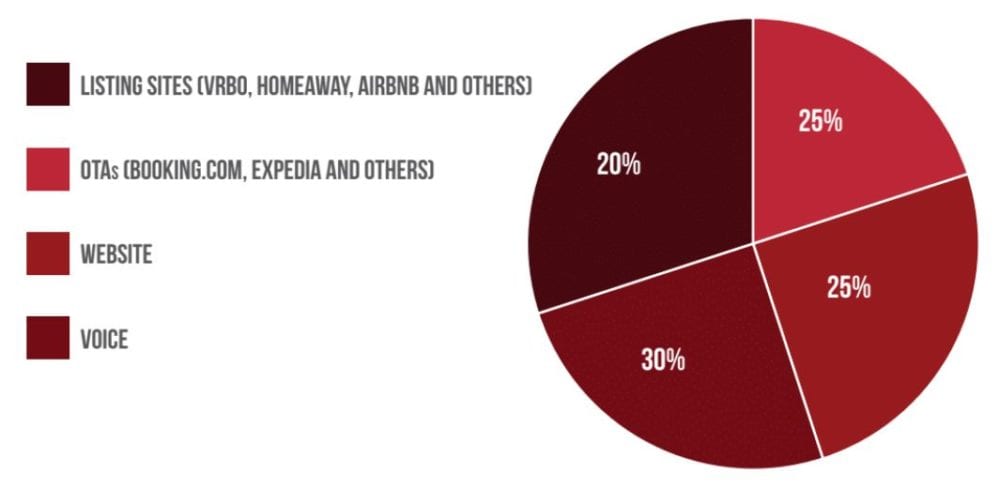
Focusing on overall distribution strategies, property managers will want to plan in advance which distribution avenues are right for the business and then be strategic about implementing the strategy. For example, one might target the following channel mix:

When it is time to write the budget, managers need to plan how much of each channel they wish to target. Each has a different acquisition cost, so everything must be taken into consideration.

The different channels for bookings are:

  • OTAs: OTAs can bring a lot of value to the booking mix. Although they tend to have higher outright commissions, they also bring several key benefits, such as the widest traveler reach, improved low-season occupancy, synergies with air travel, and, last but not least, the billboard effect.
  • Website: How many bookings do you want from your website? How many lookers (unique sessions) does it take to get a booking? Measure this now, holding your web provider responsible for measuring and improving on this metric.
  • Voice: True, voice has gone down, but it will never be reduced like it was in the hotel industry. Why? Because a vacation rental stay is a high consideration purchase. This means it is important, complicated, and expensive. Converting by voice is also the highest converting marketing avenue, and normally the booking value is higher as well.
  • Listing Sites (HomeAway, VRBO, Airbnb, and other listings): As with OTAs, you need to evaluate the cost of doing business on this channel. These are fantastic channels as far as eyeballs go, but because of their opaque model (the consumer does not have the ability to see who the accommodation is being booked with), the consumer will never know it is you. Additionally, many of these sites have introduced service fees directly to the guest that effectively increase the overall price of the booking. When comparing channel commission costs, be careful to compare apples to apples, factoring in traveler-direct service fees for those channels that include or exclude this concept.

Each of these channels has a different strategy to make it as effective as possible. Don’t play hide and seek. If you decide to use a channel, do it with the full intention of maximizing your strategy.

OTA Channels

The number of channels one’s inventory is listed on is not as important as performance on the preferred channels. Establishing preferred channels would be a great way to start. This can be discussed with the account manager at the channel partner.

We believe focusing on all electronic channels at once is a spray-and-pray strategy—being jack of all trades and master of none. If every channel a property is displayed on has a mediocre listing, every guest who views the properties will see something mediocre, and no one wants a mediocre vacation. Conversion matters. It’s better to do one channel in an excellent fashion than to do 20 in a mediocre way, even though it may sound counterintuitive from someone in the channel management business to say “less is more.”

How to have the BEST listings

  • Photos: The old adage “a picture says a thousand words” is really true in our industry. Quality, high-resolution photos form the number-one factor that will make a home or condo stand out. Hiring a professional to take the photos will really make a difference in quality. Focusing on good photos helps with listing quality and lets you take advantage of the algorithms the OTAs use, which boosts rankings. People want to see the inside of the home or condo to see how it is decorated, and they want to make sure they have their own private bathroom and that the kitchen looks big enough for the entire family. High-quality photos of amenities, such as the pool, will help guests envision themselves there, enjoying it.
  • Know yourself and know your competition: Use competitive analysis tools to understand the market around you and to make sure the price is right. If you have better reviews than your competitors and lower pricing, you could use that information to increase your rates.
  • Bird in the hand: Resist the temptation to mark up rates based on channel commission. There is a simple economic law, similar to the law of gravity, called the law of one price, that states that one product should have one price in the marketplace to optimize supply and demand. Marking up inventory by 10 percent for OTA X and seven percent for OTA Y or 12 percent for a listing site causes price confusion in the marketplace and ultimately reduces the demand for a property. If you believe your product could stand an increase, increase your rack rate—then you can discount for direct bookings. This takes solid homeowner agreements and communication about rate strategies in today’s market. And inconsistent rates hurt the brand in general—imagine how you would feel if you booked on Airbnb and then found out that you would have paid $100 less had you booked direct. Who would you be mad at? The property manager, that’s who. This can affect reviews as well.
  • Stay on top of your listings!
    • Availability: When availability is not up to date, you can end up with an overbooking or miss out on bookings during a much-needed period. This may seem obvious, but many people fail to stay on top of availability, whether because of attempts to allocate inventory strategically, forgotten blackouts that never get lifted, or accidentally leaving a long minimum length of stay on a listing. This is an ongoing process that needs to be reviewed every few days.
    • Fees and taxes: Update and double-check fees and taxes regularly. Sometimes there may be a listed cleaning fee of $100 that has since increased to $150 in the PMS. There is no faster way to lose a possible repeat customer than by charging a higher fee than expected when they booked or by having higher costs on a direct channel. The hotel industry does this all the time.
    • Policies: When you change a check-in or cancellation policy, make sure you follow through on all the channels so guests aren’t waiting for hours in the lobby when they thought they could check in.
    • Reviews: Guests are constantly leaving reviews. Not responding to a review makes it look like you don’t care about the guests, and you are also punished on your OTA rankings for not responding. Compare your reviews to those of your competitive set. Higher review rankings equal higher rates.
  • Merchandising:
    • Airbnb, Expedia, HomeAway, and Booking are retailers, just as there is a difference between shopping at Walmart and Nieman Marcus. Check your listings like you would if you were a consumer. Make sure the listing you see is what you are hoping the guest will see. Not all channel managers deliver the same quality content on the distribution sites.
    • Quality content: Quality content means the right description in the right area, such as the right photos where it makes sense to have photos. Not all PMS data tiles are the same, so working with a channel manager who does good quality content management is key to having a well-placed product.
    • Slow is fast: Many players succumb to the idea of a landgrab. But a property manager’s job is to protect the sanctity of the property and its identity, so don’t allow your inventory to become a zombie listing with no effectiveness.
  • Prune the tree: Get rid of or update and clean up underperforming listings.
  • Embrace the operational: Do not enter into any OTA or channel management relationship imagining that it won’t require manual and operational work. Overlooking the impact of this channel’s operational cost is setting the organization up for failure.

By Michelle Marquis, Chief Revenue Officer at Lexicon: Michelle Marquis is a leader in innovation, strategy, and best practices surrounding the vacation rental industry. She has been instrumental in successfully building other innovative technology-related businesses in this industry for well over a decade. 

Safety in Vacation Rentals Should be an Expectation, Not an Option

3

When it comes to accommodations options, vacation rentals lag behind hotels in one important area: safety.

Based on our recent research, over two-thirds of private accommodations still use traditional keys in order to grant access to a property, while hotels moved to disposable key cards decades ago, and many even allow guests to unlock their rooms with a smartphone app. In addition, hotels commonly use exterior cameras, which help guests feel more comfortable when entering the property and leaving their cars overnight.

The lack of such safety features in private rentals is not lost on travelers. According to new research from Morgan Stanley, 13 percent of people who do not use Airbnb cite safety as their primary reason for avoiding that accommodations service. Teresa, a private accommodation traveler I talked to for this piece, put it this way:

“That property I recently stayed at used an old lockbox with the same code for everyone to get the key out of. Mortified by how many people had access to—and could have potentially copied—the same key, I asked [the owner] if she ever thought of switching to a smart lock. She almost bit my head off because, apparently, sharing a lockbox code to a key that can be copied is much safer than a ‘smart lock that can be hacked.’ I truly was mortified to hear that.”

Until the recent gains in awareness of rentable private accommodations, driven primarily by Airbnb and online travel agencies, this niche industry didn’t consider itself to be in direct competition with hotels. That mindset is changing. Travelers today view private accommodations in the same search sessions as chain hotels, and they expect certain features, like safety, to be standard in both types of lodging. Even in standing out from hotels, vacation rentals need to offer a comparable level of security.

If you think online travel agencies and rental platforms will cover any safety-related claims, you may be in for a shock. Properties are independent of the platforms, and thus the latter can avoid liability claims related to safety breaches.

Thus far, many property owners and managers have swept safety concerns under the rug, calling them unavoidable or too costly to correct. But with the growth in safety awareness among guests, that attitude is changing. Fortunately, property managers and owners can put consumers’ minds at ease without introducing new problems such as hacking.

Install Keyless Locks

To create more secure properties, start with the easiest step: installing keyless locks. The right locks should only allow the right person to enter the right property at the right time. They also give the property manager the ability to revoke or grant access at a moment’s notice. Deadbolts carry a slight advantage over lever locks, given lever locks’ greater vulnerability to forced break-ins.

Proper keyless locks should enable control of the lock in a secure, encrypted manner, which provides a far more secure experience than a lockbox and a mechanical key. Customers are assured that no one with a copied key will break in while they occupy the property. At the same time, property managers are spared the hefty cost (around $150 per instance) of rekeying the lock every time the property turns over.

Increase Visibility

Exterior cameras, such as driveway and doorbell cameras, are another feature that can add extra security to your property. These devices notify you when someone arrives at a property that should be unoccupied, thereby helping to deter theft. In addition, visible cameras—outside only, of course—provide more cautious guests with a sense of comfort.

You can also use plug-in modules and light switches to simulate occupancy in an unoccupied residence by having lights turn on and off automatically. Door and window sensors can ensure that entryways aren’t left open when guests leave.

Smart home devices like these are rapidly becoming more common, so guests will continue to grow more comfortable with their presence. Coldwell Banker reports that the implementation of smart home tech increased by 33 percent in 2017, and more growth is on the way. If the vacation rental industry intends to survive in a more competitive vacationer market, property owners must adopt more secure technology to assure travelers that their hosts take safety seriously.


Sean Miller is president of PointCentral, a subsidiary of Alarm.com and the leader in smart home automation solutions for long-term and short-term managers of single-family and multifamily rental properties. Outside of having a lifelong passion for technology, Mr. Miller has almost ten years of professional experience with B2B and B2C IoT/home automation technology, having previously led global sales and business development for Wemo, Belkin’s home automation business unit, and launched Mobile Link, a cellular-based internet connectivity service for generators, at Generac Power Systems.


Maximize Revenue with Transactional Content

0
maximize revenue transactional content

Content can often feel overwhelming to produce, but when written with intent, vacation rental managers have the incredible opportunity to boost their brand, integrate their marketing efforts, and grow their businesses.

When planning and creating content, you may feel like you’re already behind. Instead, take a step back and focus on serving a purpose. To do that, consider why you’re writing a particular piece. Are you trying to generate reservations, attract new travelers who may not know your brand, or connect with past guests? Once you decide on the goals, consider how travelers will find your website on search engines and then tailor content to achieve this goal and appeal to searching travelers.

There are three types of queries travelers may use to find your website on Google and Bing, and you have the opportunity to structure your strategy around each:

  1. Transactional Queries drive direct-bookings, so they are the most important. For example, when people search, “cape cod beachfront rentals,” they are looking to rent a home on Cape Cod. Because transactional queries are vital to your business, you’ll want to focus your efforts first and foremost on creating content for these types of queries: your homepage, property category pages, specials, etc.
  2. Informational Queries connect with potential guests when they are looking for things to do in the area. A traveler might search, “Cape Cod Labor Day.” By creating content that connects with their search, you are broadening the amount of exposure for your brand.
  3. Navigational Queries are branded queries. If travelers already know who you are, they will type your business name into Google. In this case, your Google My Business page, your site links, your title, and your meta descriptions are places where navigational queries can have an impact. A lot of search queries on Google are navigational and they develop brand recognition.

Writing with Intent Case Study: Martha Murray Real Estate and Vacation Rentals has been independent and locally owned for 35+ years with over 300 properties on Cape Cod. This past year, they have revamped their content strategy and aimed at transactional and informational search queries to drive reservations. They chose to create clear and concise landing pages, including one for beachfront properties, that are true to their brand while also focusing on their goals.

By the end of the year, they were the second listing when users searched “Cape Cod Beachfront Rentals” on Google and their beachfront page became one of their highest volume pages with a 600 percent increase in new users year over year.

Additionally, they created “Martha Murray’s Beachfront Events Pages.” Over the course of the year, there have been 17,000 page views from the search query, “Cape Cod Events,” a great example of increasing results with quality content. Events pages made for informational content can lead to transactions, yet events are interesting because they are timely when travelers are often visiting your destination for concerts, festivals, sports, holidays, etc.

For example, Martha Murray’s landing page for “Cape Cod Labor Day” ranks number two in Google search. This page goes the extra mile by providing the schedule of events and useful information for travelers. Another example is the search query, “Cape Cod Barnstable Fair 2018,” which is a large event located right near Dennis, MA. Martha Murray created a page for this event and it ranks number one in Google search with valuable information like a schedule for travelers.

Summary: Focus on building content with three considerations in mind, to reach travelers searching for lodging, those searching for experiences, and those who know your brand. Initially create content that drives reservations, such as homepage, property category pages, specials and promotions, or other landing pages that promote specific properties. From there, expand the strategy to include informational content based on search queries for activities, events, and things to do in your area. This strategy will accelerate year-over-year website traffic, conversions, and revenue. In the competitive vacation rental landscape, it can be challenging to compete against OTAs and their enormous budgets, yet vacation rental managers can extend their presence, leverage their local expertise, and grow their brand with qualified content.

About Bluetent:
Bluetent is a digital agency with a passion for reaching travelers, inspiring guests, and attracting owners. Our team firmly believes in providing vacation rental managers with effective online marketing strategies to elevate their businesses. Rezfusion, our eCommerce platform, delivers a seamless user experience with direct-booking websites, distribution solutions, guest experience tools, and marketing services. The robust platform currently supports 250+ vacation rental providers and generates $400 million in annual online reservations. Rezfusion fully integrates with leading property management software, is PCI-compliant, and is designed to motivate travelers to book. With a growing team of 80+ individuals who inspire our culture, we’re  Outside Magazine’s “Best Place to Work” seven  years running and we strive to efficiently evolve travel and hospitality businesses to generate sustainable growth for our clients.

Unlocking Travel for All: How VillaKey is Making Vacations Accessible for Families with Autism

1
villakey autism accessible travel

“I got an opportunity just a couple weeks ago to spend some time with one of our families in Orlando,” said Alice Horn, founder and CEO of Miami-based VillaKey. “It was really kind of emotional for me. The mom was walking around telling me how much it had meant to her son and her whole family to have a vacation experience and make vacation memories just like any other family. The little boy was over-the-moon excited that there was a Mickey-themed room and a movie theater.”

While this may seem like an average vacation rental guest story, this experience was special: the little boy, Jason Lanza, has autism spectrum disorder (ASD). ASD is a developmental disability that encompasses a range of conditions that can cause behavioral, social, and communication challenges. A report published last year by the Centers for Disease Control found that the prevalence of autism in children is about one in 59.

According to the Autism Society, more than 3.5 million Americans live with an autism spectrum disorder. Travel is particularly difficult for many families with autistic children because they may have trouble adapting to change in their surroundings and routines, can become quickly overwhelmed by sensory input, can wander off in an unfamiliar location, and experience other issues.

Lanza and his family stayed in one of VillaKey’s Orlando homes specially designed to help address these challenges and to make travel easier for families like his. The home is a part of VillaKey’s autism-friendly collection, a selection of 200 properties and growing.

The company works with homeowners and property managers to identify and upgrade homes with the following criteria:

  • Quiet location
  • Soft lighting, soft or neutral colors, soft sheets, and fragrance-free cleaning products to minimize stimulation
  • Pet-friendliness is strongly recommended because many kids with ASD have service pets
  • Alarms on exit doors to alert caregivers if a family member with ASD wanders off
  • Security fence around a pool
  • Full kitchens so parents can cook specialized meals because kids with ASD often have allergies and other dietary sensitivities

Although it manages a small number of properties, VillaKey is primarily a marketing platform and currently lists about 1,000 total properties across Orlando, Miami, and Colorado. The company is working with professional property managers to expand its autism-friendly collection and its wider portfolio in clusters around attractions and destinations that are appealing to families with ASD, including additional Florida beach communities, San Diego, Pigeon Forge, and Myrtle Beach.

Vacation rentals, private homes by nature, also add a layer of comfort for guests. “In the vacation rental industry, we have the opportunity to control the environment for a family much more so than in a hotel,” Horn said. “When you walk into a crowded hotel lobby, there’s a lot of people, noise, stimulation, and sensory input for a family and a child, and that can be a tough start to a vacation,” she said. “But when you walk into a home, its welcoming, calm, and familiar. A lot of kids have trouble with change, but a home environment makes it much easier for the whole family.”

Many of the families who VillaKey staff members speak with have never traveled before because of how difficult travel can be, and one of the biggest challenges is trust. “It’s really important for them to know that this is a solid opportunity and that the team behind VillaKey cares enough to learn about their needs, and part of that means certification,” Horn said.

Last fall, VillaKey became the first vacation rental company to become certified in autism travel by the International Board of Credentialing and Continuing Education Standards (IBCCES). The company is now a Certified Autism Center (CAC), and its staff are Certified Autism Travel Professionals (CATP), both of which enable the company to adequately serve the needs of families with autistic travelers young and old.

“Our program competencies are based on the training content as it relates to various settings, so applicants have a broad-based view of not only what autism is, some common signs or needs individuals on the spectrum have, and ways they can enhance the travel experience,” said Meredith Tekin, president of IBCCES. “We want our professionals to understand their clients’ needs and follow an evidence-based program so that they can use their existing knowledge of the travel industry along with their new autism-specific training to ensure an amazing experience for all families.”

IBCCES helps promote its Certified Autism Centers to a market it values at $262 billion. Certified companies receive badges, press releases, and listings on IBCCES’s online directory and AutismTravel.com, which reaches 5.6 million parents, therapists, and teachers globally. VillaKey is now featured among 36 certified autism centers around the world, including zoos, resorts, schools, hair salons, and other businesses.

Additionally, VillaKey helps extend a comfort level and trust well before guests arrive. The company partnered with the University of Miami – Nova Southeastern University Center for Autism and Related Disabilities, to develop pre-arrival materials to help educate parents and children. One is a checklist with things such as test runs to practice what it will be like to stay in a vacation rental and packing reminders for autism-specific items, including sensory-friendly toys and the child’s favorite sheets. Another is an e-book about going on a trip and staying in a vacation home that parents and kids can read together to familiarize themselves with the journey.

Another barrier to travel for autism families is cost. According to Autism Speaks, care for a child with autism costs an estimated $60,000 per year through childhood. Care for a person with an intellectual disability costs on average $2.3 million over a lifetime, compared to $1.4 million for someone without an intellectual disability. Vacations aren’t always in the financial cards.

VillaKey embraced this market by helping to break down this barrier too. Last April, it launched VillaKey Cares, a program that donates 10 percent of net profits from every reservation to help support travel expenses for families affected by autism who have limited resources. The Lanzas were the first family hosted through this program.

“As a team, we all believe that it’s important for any business to have a social component and a mission beyond the bottom line,” Horn said. Because the number of kids with ASD is growing so rapidly, “It’s going to be incredibly important, not just for the travel industry but for all industries and business, to adapt and think about how to take care of the needs of this population,” she said.

Beyond all the social good VillaKey is doing for an underserved traveler segment, pursuing niche markets is simply savvy business. “We all need to find some way to set ourselves apart with commodification of the industry . . . Having some kind of uniqueness is incredibly important,” Horn said. “To be able to do that in a way that’s benefiting families and society is an added bonus.”

Related Article: VillaKey Becomes First Certified Autism Center VR Company

Related Article: The Opportunities In Between: Capturing the Niche Markets Others Don’t


Fireside Chat: Breezeway and Durk Johnson

0
fireside chat breezeway ben firn durk johnson vrhp

After nearly 20 years in the vacation rental industry, Durk Johnson has seen it all. From his accidental transition into the business with Deer Valley Lodging in 2001 to his executive roles at the Housekeeping Solutions Team and Vacation Rental Housekeeping Professionals (VRHP), Durk has cemented himself as a leading figure within the industry. Durk may not be in the nitty-gritty of managing physical properties anymore, but he spends his days giving property managers the secret sauce for better property operations.

That is why Ben Firn, head of marketing at Breezeway, asked Durk to stop by the headquarters in Boston. What transpired was an enlightening chat about the shifting landscape of housekeeping in the vacation rental industry.


Ben: Why do you think quality property care has become a focal point for vacation rental property managers?

Durk: Vacation rentals are more mainstream than they were a decade ago. Airbnb, VRBO, and HomeAway catapulted the industry forward and empowered guests to demand more. Quality property care is critical to the short-term rental business because if a guest has an issue due to housekeeping or maintenance, their stay is practically ruined. In fact, the guest could have an excellent reservation experience and a great front desk experience, but they could show up and find hair in the bathroom or dried spaghetti sauce on the kitchen ceiling, and at that point, the property manager has lost that customer’s loyalty.

Ben: Today, it only takes one cleanliness or housekeeping issue to ruin the guest experience, which leads to bad reviews, decreased referral business, and no return stays.

Durk: Absolutely. These vacation rental guests are time impoverished. When they finally get a chance to relax at a great location that they’ve been looking forward to, their expectations are high. If their first impression of a vacation rental doesn’t meet these expectations, guest complaints start to flow from there.

Ben: Time on vacation is precious, so guests expect an impeccable experience. Let’s not forget that travelers are younger and more demanding than prior generations were, which leads to higher expectations about the physical space—not only its cleanliness but also its intangibles like thoughtfully arranged décor, character, and concierge services.

Durk: People are starting to care more and more about the character of vacation rentals. Guests want to stay at a home away from home and want to feel completely comfortable during the stay.

Vacation rentals were chasing hotels for the longest time, but now, the luxury and amenities of the two hospitality types are almost on par. Ten years ago, guests would call down and tell the hotel front desk that someone left a bathrobe in their room (the response was “no sir or ma’am, we left that for you to use”). Now, guests call down and demand extra bathrobes. And these types of amenities are in vacation rentals too.

 Ben: And have you seen higher expectations from property owners too?

Durk: Absolutely. I think it’s great to have educated owners as long as they aren’t misinformed. But even though expectations are higher, it’s difficult for the property manager to educate the owner with respect to the things he or she does for the guest and the property. This is where platforms like Breezeway come in so that the property manager can easily share reports that detail all the attention they’ve given to each property. I think it’s a good thing that owner expectations are rising because now everybody can elevate the standard of property care.

Ben: Which should lead to changes in property operations.

Durk: I think it already has. I look at how companies are now operating, and it’s much more efficient than it was 15 years ago.

I read an article recently that compared hotels to vacation rentals. When hotels miss a revenue number, they’ve got 52 weeks to catch up to their number. But when a vacation rental misses their weekly number during busy season, there’s no catching up. Vacation rental managers must be on their A game to make sure everything is accurate and running smoothly—staffing, housekeeping, maintenance, and much more.

Ben: This push for quality is real, and it’s putting pressure on vacation rental managers to acquire and maintain better inventory.

Durk: Therein lies one of the big issues for the property manager. Regardless of who you are—whether you own the property yourself or you’re managing it for someone else—people often delay upgrading inventory. Sometimes the owner is unwilling to spend money renovating or replacing furniture, and sometimes he or she holds too much sentiment. Either way, an unwillingness to upgrade quality is disadvantageous to business growth.

I think failing to replace an old mattress is a major taboo in the hospitality world. The industry cares about two things: safety and a good night’s rest. If your mattress is 20 years old, then that good night’s rest left the building 15 years ago.

Ben: What do you think matters more: condition or cleanliness?

Durk: Some people don’t care whether the property’s condition feels or looks old. These folks are after a nice cheap rate in the location they want. For most people though, cleanliness always matters.

That said, if you’re looking to maximize occupancy and revenue, then renovating becomes necessary. Most guests are looking for cutting-edge technology in the homes they spend time in. I always recommend that vacation rental management companies flush out a bottom-end property for every high-end property they add to their portfolio. This way, property managers continually improve the quality of their brand. This is akin to renovating your inventory—mini upgrades every year.

Ben: But it’s not just about the physical rental itself, right? Dependability and service can be a big part of a vacation rental manager’s brand.

Durk: The role a property manager plays is very much tied to the company’s brand. Think of the phone call that happens at two in the morning when an inebriated guest is locked out. The property owner is six hours away from the property and now needs to unlock it through smart home technology or assistance from a local housekeeper or caretaker. The property manager exists to work through these problems and to ensure that the guest and the property are taken care of.

I know many industry professionals think branding is slowly dying, but I couldn’t disagree more. I think companies that make the effort to get to know and connect with the guest will see their brands thrive. For companies that rely on OTAs for reservations and never connect with guests, their brands will slowly deteriorate.

Ben: Because back-office operations play such an outsized role in property management, managerial strategy is a key piece of running a great housekeeping operation. In your experience, what is the biggest mistake that rental managers make in their approach to managing their housekeeping department?

Durk: That’s a great question. I would say their biggest mistake is undervaluing the housekeeper and how he or she contributes to their operation.

Most management companies spend their disposable income on things like a new website or marketing campaign. And yet the housekeeping department is still working on computers that are 15 years old. They’re driving the rust buckets of vehicles, and they’re tucked back in the corner where nobody can see them. But at the end of the day, the housekeeping department has an enormous role in shaping the brand because it’s the housekeeper that cleans the interior, leaves the brochures and pens, and stages the property.

If you’re an owner who is disgruntled with your current management company and you keep seeing this housekeeper next door show up in a clean shirt and with a bucket of cleaning products, you’re going to want to know what’s going on and compare notes with your neighbor. In this case, your housekeeping operation serves as an additional tool for owner acquisition.

Ben: Parting shot—are smart home devices overhyped or are they the future of housekeeping and guest concierge?

Durk: Whether they are the future of guest concierge, I don’t know. There’s a place for them, and in fact, I’m looking at installing several devices in my own house to control light switches and outlets from my smartphone. Not an Amazon Echo; I have one of those, and I hate it—sorry, Amazon! I’ve also heard of a device that can detect and stop water leaks in a house. There are some cool gadgets out there that I think will be involved in the future of property management.

Vacation Rental Professionals of Maine Select Fetch My Guest to Power NortheastStays.com

0
Vacation Rentals Northeast

Coming off of the successful launch of the NorthwestStays Marketplace for professional vacation rental hosts, Fetch My Guest and the Vacation Rental Professionals of Maine (VRPOMe) are pleased to announce the pre-launch of NortheastStays.com.

NortheastStays.com will be the premier marketplace where travelers can engage professional vacation rental brands in Maine, New Hampshire, Rhode Island, Massachusetts, Connecticut, Vermont and Maryland.

“Our VRPOMe mission from the beginning has been to provide support and leadership for the Maine vacation rental industry, as well as the rest of the Northeast, through effective collaborative influence in the marketplace while promoting professional standards for our members. One of our guiding principles is a promise to our guests to deliver quality service and value to the public. By creating the NortheastStays Marketplace, powered by Fetch My Guest, we will be able to promote our individual vacation rental brands while still working together to promote our unique destination and professional expertise.

The NortheastStays marketplace will allow our customers to #bookdirect. This opens the doors of communication and connection between the guests and the vacation professional manager. The guest will be free of excessive booking fees coming from OTAs, while the vacation rental professional will once again have open access to their customer’s information so that they are able to connect with them directly and share their local expertise.” said Heather Allen, President of Vacation Rental Professionals of Maine.

“Fetch My Guest is pleased to be partnering with VRPOMe in amplifying our network of professional brands to the vacation rental traveler community who are searching for a clear alternative to the OTAs.  Extending marketplaces, such as NortheastStays, NorthwestStays and CaliStays throughout North America is an important step in the continued efforts to educate and encourage the traveler to always #bookdirect with the professional host for the best rate and service..” said, Vince Perez, Fetch My Guest.

Embracing the end-to-end guest experience: How Leslie Preston built Bachcare, New Zealand’s largest property management company

0
bachcare vacation rental holiday home new zealand bach

In 2003, Leslie Preston bought a vacation rental home in Hahei, New Zealand, a small beach community in the Coromandel region. When she began looking for a property manager, she was surprised to find a lack of national companies that could meet the needs of both homeowners and guests. So, she created her own. “And we’ve never looked back,” Preston said. “We’ve been clear on our purpose since then and continue forward on that original path.”

leslie preston bachcareBy staying pointed toward her true north, Preston has grown her company, Bachcare, into the largest property manager in New Zealand and Australasia, with 2,000 properties, more than 150 locations, and 150,000 guests a year. (Bach, pronounced “batch,” is the New Zealand colloquialism for vacation or holiday home, similar to “bachelor pad.”) Much of this growth has been organic, with no shortage of baches in the country, but the company has recently forayed into acquisitions too, including its October acquisition of Te Anau Holiday Homes.

However, the success Preston and Bachcare have reached are just a milestone on the way to bigger goals. “Scale is incredibly important in our industry, more so than ever. Even though we are the largest company in New Zealand and in Australasia, we are still a fraction of the size we can be,” she said—20 percent, to be exact, and her sights are set on reaching 10,000 properties.

Regardless of which destination or bach guests choose, and regardless of how many they have to choose from, guests know they are staying with Bachcare thanks to its “brand DNA,” which codes every piece of the company’s anatomy. The DNA replicates across every touch point with the promise and empowering directive, “Find your happy place.”

Looking through Bachcare’s inventory, it is easy for guests and homeowners to find happy places in every corner of the country, including Preston’s start in Hahei, along the northern coast by Hot Water Beach; the lakeside Te Anau cottages in the south; and the stylish penthouse apartments in Christchurch and other major cities. Originally from New York, Preston found her happy place in New Zealand after she moved there with her kiwi husband, Stefan, whom she met while attending the Stanford University Graduate School of Business.

Hammock and view at Preston's original holiday home in Hahei, which she no longer owns
Hammock and view at Preston’s original holiday home in Hahei, which she no longer owns

About 100 community property managers and the company’s 50 full-time staff members in the Auckland corporate office make sure every step of the guest journey is filled with happiness—for example, booking on the cheery and playful Bachcare.com or sharing a cheeky wine meme on social media. Even loading pages on its website surprise and delight with an animated sketch of a smiling sun rising over the mountains to say, “One moment, please.”

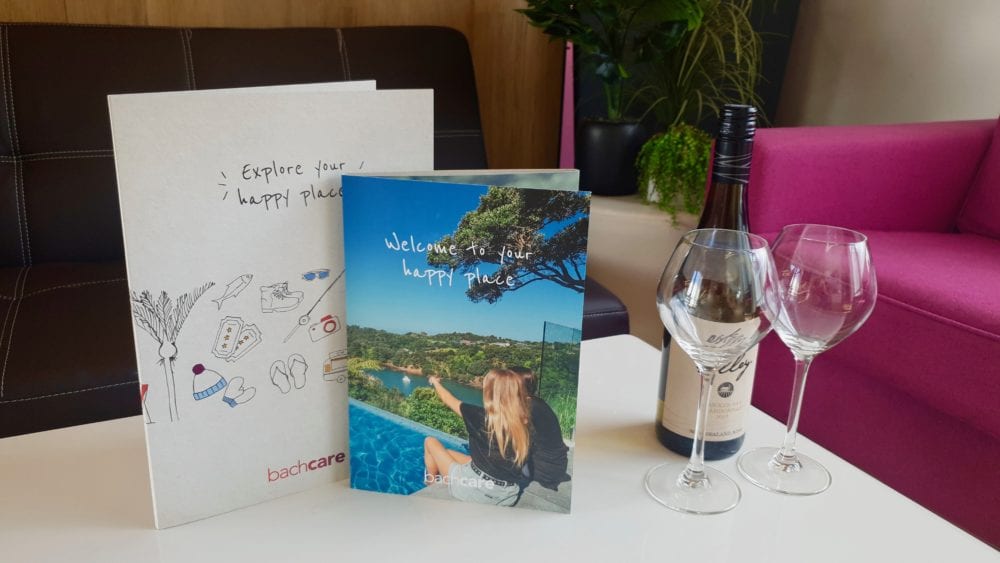
Bachcare packs happiness into other unsuspecting places too, like its in-home guest welcome materials, employee training manuals, and proprietary software. Having this cellular-level brand DNA gives the distributed team a consistent nature and singular voice on and offline, but it also leaves room to leverage individuality and the unique characteristics of their varied locations.

Happy Place guest welcome materials

Preston calls this owning the end-to-end guest experience to deliver the same personalized, on-the-ground, branded experience it did with just one home 15 years ago. “We want our guests to have a fully integrated and highly Bachcare-branded experience, from the moment they enter our website, through making a booking, arriving at our property, to our after-stay feedback process. It’s always been part of our DNA, and to be honest, always will.”

Owning the end-to-end guest experience plays a large role in the company’s selective use of OTAs.

Ian Bishop, Bachcare’s head of marketing, said, “One of the key things with Bachcare is that building a strong brand presence has been at the core of the company since way before my time (hats off to Leslie for driving the importance of that from day one.) The result means we have no dependence on the OTAs, which enables us to use them strategically as and when it seems to benefit and augment our already strong position, which year over year is around 75 percent direct bookings and shows no sign of any change.”

Due to the strength of the brand, Bachcare can drive direct bookings. One way it does so is through smart calendar management. “Of our properties on OTAs, we’ll often block important dates on those external sites because we know there is a very high chance the booking for key dates will come via our direct channel,” Bishop said.

The team also looks closely at domestic versus international travel and consumer behavior to decide whether and how to use OTAs. Although the brand is strong and well known in New Zealand, it must appeal to international inbound travelers through careful and focused spending overseas. This includes more OTA use for properties in areas popular with international tourists, such as Queenstown. The same applies to cities like Auckland and Wellington, where urban travelers are more likely to use OTAs.

140-year-old stone Gothic church converted to a luxury holiday home in Cromwell

However, it ultimately comes down to the owner. “Above all, we are constantly listening to our owners and what their rental goals are, which may therefore provide more sway for listing on some or all the OTAs we work with. The blend of all the above points helps us make calculated decisions to deliver the best outcome for our owners and the business,” Bishop said.

He added, “To be honest, it is the result of 15 years of dedication in building a strong brand that is trusted in the marketplace that enables all the above. I am simply in the privileged position of being the current guardian of that brand and continuing to drive it at a super interesting time for the VRM industry!”

This house-by-house, partner-by-partner strategy keeps OTAs at a healthy distance. It has served Bachcare well through HomeAway’s acquisition of the Kiwi platform BookaBach in 2013 and Airbnb’s rollout of experiences and Airbnb Plus in the country in 2018. One Stuff.co.nz article called Bachcare, “The Kiwi firm taking on Airbnb in its own game.” At 75 percent direct booking, Bachcare is winning.

In that same article, Preston called the competition with OTA giants both “a David and Goliath battle” and fun that keeps them on their toes. Fun is not a take-it-or-leave-it bonus for Preston—it is a requirement. In addition to a supportive family and sufficient capital to grow and weather the storms, Preston credits the company’s success to perseverance, resilience, hard work, and a lot of stubbornness. “Add in a bit of fun!” she added. “We’ve never lost sight of our founding purpose, principles, and values. It has been our guiding light since inception, and it continues to burn bright.”

Carrying the Torch: 5 Generations of Vacation Rental Hospitality

3
Cabins for YOU vacation rental gatlinburg tennessee georgia

When Walt Plimpton was 10 years old, his job was to tow a little red wagon from cabin to cabin collecting trash bins and dirty sheets. He brought the sheets home where his mother, Miriam Plimpton, washed them, hung them out to dry, and ran them through a mangle to smooth any wrinkles. Walt then trucked the clean and crisp linens back to the cabins where his older brother, Donald, made the beds.

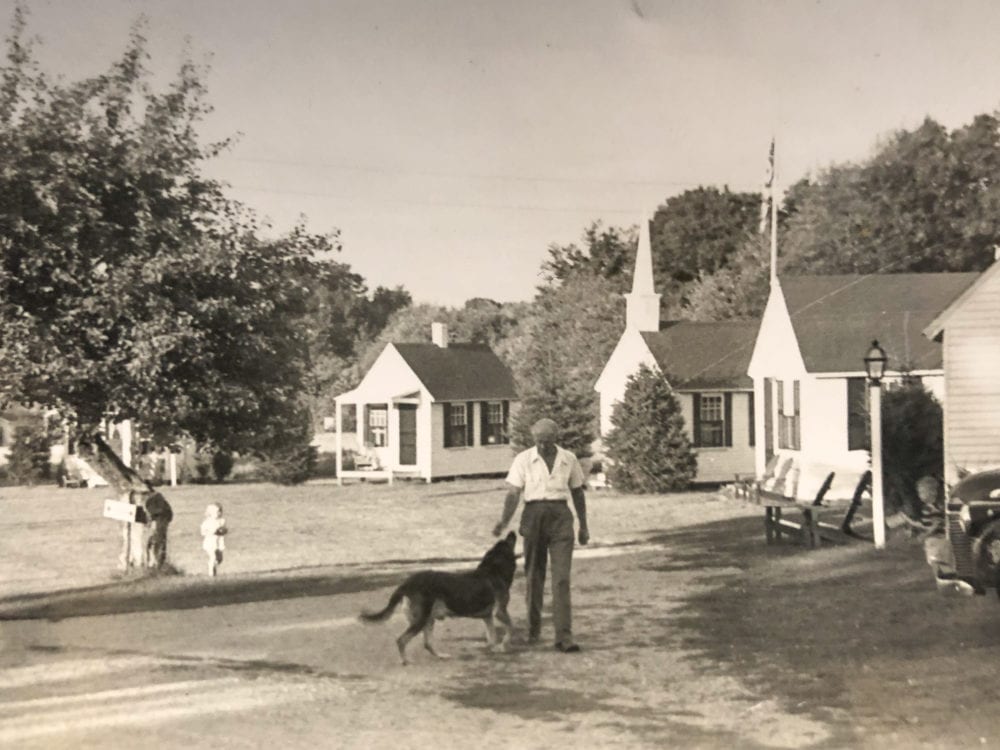
“We didn’t have maids, we cleaned ourselves,” Walt said. This was 1940. Miriam and Walt’s father, Herbert Plimpton, had just opened New England Village in Hampton Falls, New Hampshire. The collection of little “overnight homes,” as they were called then, were arranged like a miniature town. Some were even themed as Main Street mainstays. One was built to look like a church, another like a school, and a third like a doctor’s office.

Herbert Plimpton playing with a dog in front of New England Village

This wasn’t the family’s first venture into overnight homes. In fact, Walt was a third-generation property manager. His maternal grandmother, Eva Peterson, opened Peterson’s Cabins along Route 1 in Wells, Maine, in 1922. They had no plumbing, no running water, and no electricity. She charged $0.75 per person, per night. She housed her oldest daughter and her eight kids in a big farmhouse nearby, and they helped clean and take care of the cabins in return.

Miriam and Herbert Plimpton in front of New England Village

By the time the Plimptons opened New England Village, just after the Great Depression, the going rate had increased to $1.25 per person, per night, and electricity was more common. The big trend back then was to have a radio in the house—soon to be followed by three-channel televisions.

Despite the recovering economy, Walt made sure to seek additional revenue sources. When his wagon wasn’t full of laundry, he collected the little green glass Coca Cola and ginger ale bottles left behind by guests—then 7 cents apiece—and towed them down to the local country store to turn them in for a nickel each. On good days, he earned as much as 70 or 80 cents a haul.

He laughed as he remembered those days. The day before we spoke he had gone to see his barber, who was running a $10 haircut special. “I don’t have that much hair anymore,” he said, “but I remember when my mom would hand me two quarters to go get a haircut as a kid, and I had a lot more hair back then!”

Walt is now 88. He has spent nearly eight decades in the vacation rental industry, and he remembers every minute of it. He has watched as motor courts evolved into motels; as resort towns sprang up along Route 1, up and down the East Coast, and then moved west; and as various destinations succeeded and failed in their attempts to grow tourism.  

During the mandatory nightly blackouts along the coast during World War II, his dad would skirt the rule against outdoor lights by cutting out “OVERNIGHT CABINS” from their cabins’ roll-down shades so people driving by could still see them. His mom would visit their competitors’ houses in the dark and count the cars in the driveway to track occupancy.

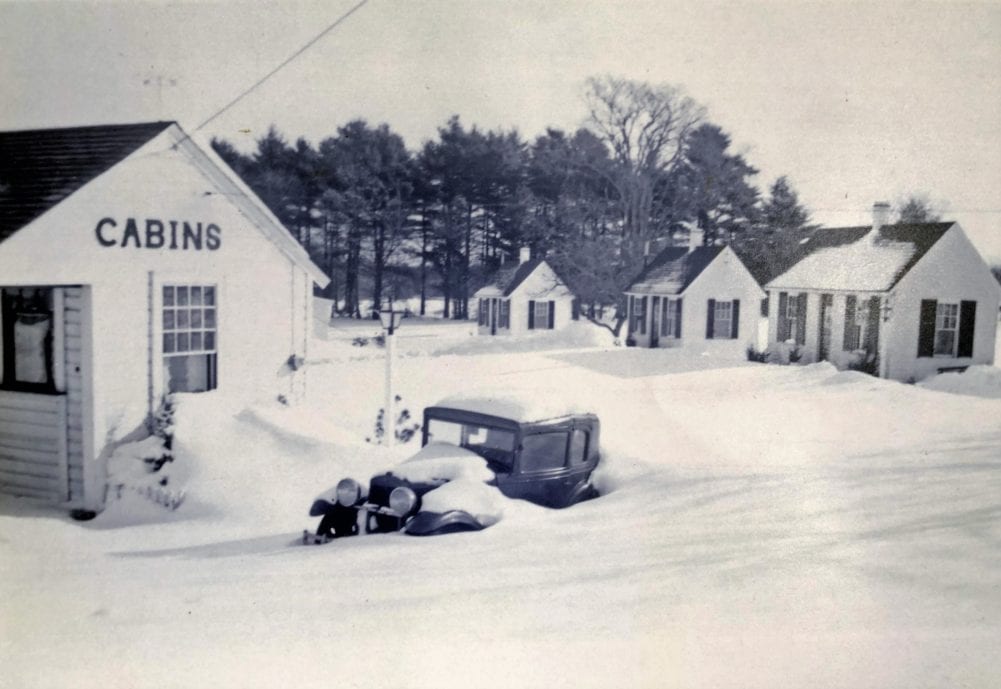
New England Village cabins covered in snow

After Herbert passed away in the early 1950s and her kids were off at college, Miriam began to rent out four rooms in her own home to New Hampshire state troopers. At the time, the state didn’t have local offices, so she housed them, and they helped keep her safe. She called them “her boys,” and they called her their “state trooper mom.” She was later recognized with an award from the department.

Walt and Joanne Plimpton

Walt has carried the hospitality gene with him ever since. When he and his wife, Joanne, honeymooned in Orange Beach, Alabama, in 1957, there were only a handful of old cabins there. “No stores, no restaurants, and none of the tourism development guests find there today,” Walt said.

In the 1960s, they bought their own vacation rental in the area. After it was destroyed twice by hurricanes, most recently Hurricane Ivan in 2004, the home was rebuilt anew with six bedrooms and building codes to withstand today’s storms. It books solid most of the year.

“He hasn’t gone without a rental in his 88 years,” said Greg Plimpton, Walt’s son, who helps take care of the home now.

Greg also takes care of hundreds of other homes around Gatlinburg and Pigeon Forge, Tennessee, with Cabins for YOU, the vacation rental management company he started with his wife, Debbie, in 2001. On their 20th anniversary, the two visited Gatlinburg from their home in Georgia and decided to purchase three vacation rental homes of their own. At the time, there were about 160 property management companies in the Smoky Mountains, and Cabins for YOU was the smallest.

Today, nearly a century away from his great grandmother Eva’s plumbing-free cabins in Maine, Cabins for YOU is now one of the top five management companies in the region. The company has 330 homes, 70 employees, 50 housekeepers, and 25,000 reservations a year. Most of their guests are families in the summer, honeymooners, and nearly everyone in the fall for leaf season.

Cabins for YOU vacation rental home smoky mountains

Greg and Debbie manage the company from their Georgia office near their home in Cartersville, where they have lived for 15 years. True to Plimpton fashion, the company is now a fifth-generation family business. Greg and Debbie’s oldest daughter, Jessica Dewberry, is head of finance and human resources, and her husband, Marc Dewberry, is their chief marketing officer. Their second daughter, Emily Crumpler, does consulting for them to recruit new homeowners and owns seven homes herself.

Their fourth daughter, Rachel Shadle, works in owner care, and her husband, Matthew, handles their IT as well as the building and grounds management of all three offices and all family-owned real estate. Their youngest child, Seth Plimpton, is a finance major at Auburn University, and he says he wants to get back into the business after he graduates. He currently works on the company’s website from campus.

The Plimpton family at Rachel's wedding
The Plimpton family at Rachel’s wedding

Even with the large staff and support of their family and management team, Greg and Debbie are active in every area of the business. Debbie handles operations while Greg covers legal, marketing, and other areas.

Altogether, they focus intently on the needs of their owners. “Every decision we make points back to the real client—and that’s not the guest,” Greg said. “We respond to owners 24 hours a day. An owner gives us 65 bookings a year. A guest gives us one.”

Even with four full-time owner reps to serve their needs, Greg loves interacting with owners directly. “Owners energize you because they want investment advice, decorating advice, and sometimes they have legitimate complaints that you can help with.” His advice to other property managers is to find out what owners want and need, and communicate, communicate, communicate.

His advice has been tested over the past two years since the Gatlinburg fire in November of 2016. One of the largest natural disasters in the history of the state, the fire burned more than 21,000 acres and wiped out more than 2,000 buildings, many of which were vacation rental homes. Cabins for YOU lost 38 to the fire and another 32 that were purchased by residents after their own homes were destroyed.

The region is still recovering. There are burned out streets, and guests still cancel their reservations because they don’t want to stay next door to charred lots. The losses cost Cabins for YOU about $2 million in 2017, but this year they have regained about 12 percent of their lost inventory.

Greg credits much of the company’s resiliency and long-term success to its competitiveness. “If we see anyone doing anything that makes sense, we have a meeting about it.” They attend conferences and listen intently, take notes, and participate in discussions. Generally they take the lead with better flash sales, better contests, and other strategies. “If you want a successful business, hire very competitive people. They don’t come to work to just do the job.”

When they need to recharge their batteries, Greg and Debbie take time away to head to their own vacation rental or visit their third daughter, Simone Puccinelli. She’s the only one of their kids who is forging a path wildly different from property management, and her parents love what she does. She founded Simone’s Kids, a nonprofit organization in Uganda that supports orphaned and poverty-stricken children who are unable to afford an education. They try to visit her there at least once a year.

Rachel (Plimpton) Shadle and her daughter, Ava

Retirement isn’t on the horizon just yet for the Plimptons, but they are hopeful that when it is, they’ll pass the torch to the next generation—not just their children but their five grandchildren. If they stay in the family business, they will be sixth-generation property managers and great great great grandchildren to Eva Peterson’s cabins.

However, they will have to wait a while to find out if that will happen. In 2022, on the 100th anniversary of the original cabins, the youngest of the sixth generation, Ava, will be just four years old.

The Opportunities In Between: Capturing the Niche Markets Others Don’t

10
niche target marketing

There’s an old Irish blessing that goes, “May the holes in your net be no larger than the fish in it” (or so the internet says). Real or not, many vacation rental managers are in a perpetual effort to “cast a wider net” for guests. But with the breakneck pace of VR tech innovation, the arrival of vacation rentals as a mainstream lodging option, and the ever-blurrier lines between accommodation types—all showing no signs of slowing down in 2019—it may be time for property managers to reevaluate whether their nets are getting too big and letting valuable fish get through their holes.

Perhaps now is the time to cast smaller nets to catch the millions of fish others miss.

I’m speaking, of course, about niche markets, narrowly carved subgroups based on interests, values, geographic fences, and micro demographics. It’s the difference between theme-park seekers visiting Orlando vs millennial parents taking young kids specifically to the Wizarding World and all things Harry Potter, or snowbirds vs. active retirees who want to spend a month in warm weather doing yoga, hiking, and being wined and dined all day with no kids around.

It’s understandable that some property managers may fear the idea of going after smaller groups, but serving niche markets opens the door to new traveler sets, smaller but more lucrative markets, groups with a ton of demand but very little supply, or all of the above. Focusing on one niche or a few niches also has the potential to supercharge marketing ROI as tactics become simultaneously cheaper and more effective with less competition.

The same applies to owners and properties as well. Serving a niche provides an opportunity to tailor inventory selection, more mindfully selecting the right homes and the right owners rather than simply taking anything and everything.

And just as property managers already have a huge upper hand on OTAs by being experts in their local markets, they can also create a major advantage for themselves by being the expert for a niche group of travelers. As we saw in 2018, OTAs are doubling down on being everything to everyone. Booking Holdings and TripAdvisor both bought tours and experiences companies. Airbnb bought French property management company Luckey Homes and introduced Backyard, among other investments in and out of the travel industry. The wider they get, the more independent property managers can go deep in capturing highly targeted audiences and driving direct bookings.

Take GoLocal Suites, for example, a new line of short-term rentals from Northeast Suites in Boston. GoLocal properties are stocked with 100 percent American-made products, from the furniture to the linens to the paper towel holder, and every item can be purchased from the company’s app and website. This patriotic niche does double duty as an additional revenue stream.

There are less intensive ways VRMs can pivot toward a corner of the market or create new product lines within their inventories. Some niche markets we hear about regularly, like ecotourism, gastro-tourism, or wellness travel. Others are more often overlooked, some even taboo. Here we explore five niche markets chosen for a combination of factors: a large underserved market, a lack of competition in vacation rentals or the broader accommodations space, and a higher degree of spending and/or loyalty.

Read more: Niche Vacation Rental Listing Sites

Micro Geographies

OTAs boast that they reach millions of travelers with millions of properties for millions of booked nights. Translation: Guests and property managers must machete through a jungle to reach each other.

VRMs can cut a faster path to the right guests by zooming in closer on the geographic distribution of their marketing efforts. For example, rather than pushing Facebook ads to entire states or regions, vacation rental marketers can target ads to specific zip codes popular among existing guest records.

The best way to start here is to take a deep dive into your historic guest data and identify not only where most guests come from – down to the zip code or even neighborhood level – but to spot trends in feeder markets growing more or less popular. A more tech- and cost-heavy option is to hire a firm to do mobile GPS tracking research. Companies like Buxton can virtually geofence an area, such as a destination or nearby attractions, tag every mobile device that enters that fence, then track where those devices go inside and outside of the fence through their satellite pings. The data collected is anonymous but generates in-depth geographic and behavioral profiles of all visitors to an area, not just your guests, that can help laser focus target marketing.

Another option is to opt for regional or destination-specific listing sites, specifically those that feed direct bookings rather than hijacking the guest.

“While national websites like HomeAway and Airbnb deliver exceptional booking experiences and raise overall industry awareness, the hyper-relevant nature of geo-targeted niche sites is better equipped to deliver additional demand for specific localized markets,” said David Angotti, co-founder of SmokyMountains.com. “For example, high-quality video content that highlights a destination, combined with paid amplification through Facebook, can raise awareness for a specific market. This delivers additional demand and visitors that likely would not have visited the region absence this marketing approach. Smaller, niche websites excel at geo-local strategies like this. In addition to increased demand, the niche website increases the overall distribution health of a brand through channel and lead diversification.”

Many of these sites also give property managers more control over their listings and better opportunities to be the local expert. “VRMs want to be able to participate in the direction of their online booking sites by having more control over terms and conditions, data, fee structure, marketing, privacy, etc.,” said John Wellborn of Rent30A and a growing list of destination listing sites. “Regional and hyper-local sites afford this to the VRM while giving guests access to the two things they want most: access to all of the properties and the personal touch that only locals can give.”

Physical and Cognitive Disability

According to DisabilityStatistics.org from Cornell University, 12.8 percent of the US population has some form of a disability (hearing, visual, ambulatory, cognitive, self-care, or inability to live independently). That’s more than 319 million people for whom travel isn’t always an option. Unfamiliar locations, mobility limitations, lack of accessible spaces, distance from necessary medical facilities or providers, less disposable income due to high costs of care, and many other factors often keep would-be guests from traveling as much as they’d like or at all.

Most VRMs are probably already mindful of physical disabilities and mobility issues, particularly those in destinations with an aging traveler group. Step-free entries, elevators, roll-in and adapted showers, and wide doorways are all increasingly desirable if not must-have amenities. Airbnb recognized the value of and the need for this market too in its late 2017 acquisition of Accomable, an accessible short-term rental platform founded by two travelers with spinal muscular atrophy.

Tailoring vacation rentals for guests with cognitive disabilities, such as Alzheimer’s or autism spectrum disorder (ASD), or those with visual or hearing impairments isn’t discussed as often, but it’s equally important and doable. Orlando-based VillaKey began actively catering to travelers with ASD last year with its certification in autism travel from the International Board of Credentialing and Continuing Education Standards and a growing collection of autism-friendly properties. These homes must meet certain requirements, including quiet location, soft lighting and colors, alarms on exit doors, full kitchens for cooking specialized meals, and pet-friendliness because many kids with ASD have service animals.

Plenty of opportunities exist for property managers to appeal to this underserved market, such as incorporating braille, installing strobing fire alarms for the hearing-impaired, and having someone on staff available to assist the families of guests with Alzheimer’s. One of the best things property managers can do is also one of the easiest: understand what guests with disabilities need; then provide thorough information on accessibility and relevant home features (including detailed photos) on their websites.

tree house limited edition vacation rental

Limited Edition

In the fall 2018 issue of VRM Intel, Matt Landau shared his Theory of Limited Edition, which posits that independent vacation rental managers can differentiate themselves with exceptional things that don’t scale, such as having the only penthouse in a building. He likened this to the world of collectors’ items.

Coincidentally (or perhaps not), Landau’s theory aligns perfectly with the ever more powerful rise of millennials in travel. We’ve all heard it before: millennials seek unique experiences. As a window into this market myself, I seek superlatives when traveling: the firsts, onlys, last remainings, biggests, smallests, etc. In Ireland, for example, my husband and I didn’t want to go to any old pub; we sought the oldest pub in the country, the Brazen Head. When hiking historic fishing villages in Italy’s Cinque Terre, we stayed in a 500-year-old fisherman’s cottage.

Airbnb stats confirm this. Perennially among its most sought-after properties are those you don’t find just anywhere: off-grid cabins, tiny homes and refurbished Airstreams, open-air bamboo cottages, and treehouses. Converted properties, too, are gems for limited editions.

Property managers of any size can find ways to incorporate limited editions into their programs. Consider tapping local real estate agents to identify one-off convertible properties with a story to tell, like decommissioned lighthouses, firehouses, barns, factories, or mills. Or for those developing new, purpose-built inventory, there may be overlooked opportunities for some nontraditional listings.

In one development it’s building out, VTrips is incorporating treehouses and possibly glamp grounds (luxury camping properties). VTrips CEO Steve Milo said the purpose is twofold: to maximize lots on which traditional homes can’t be built and to have a variety of offerings that appeal to different guests. “It’s not taking one product over the other,” he said. “It’s creating an assortment of products so that you can allow a variety of different guests to visit. So, you have larger properties, smaller properties, niche properties all mixed together in an offering.”

Social Good and Corporate Social Responsibility

Consumers and travelers increasingly seek and value companies that demonstrate corporate social responsibility (CSR) or a focus on the triple bottom line: profits, people, and planet. Travel research company Skift published Balancing Purpose and Profit: Why Doing Good Is a Competitive Advantage in the Travel Industry in July, exploring this ever more important trend. In it, several key stats from Skift’s 2018 Experiential Travel Survey emerged:

  • 59 percent of respondents said they agreed or strongly agreed that the destinations they visit say a lot about who they are, supporting the link between travel experiences and personal identity.
  • 40 percent of respondents said they either agreed or strongly agreed that they were willing to pay higher rates or fares to use travel service providers that demonstrate environmental responsibility.

Additionally, a Tourism Cares study cited in the report said that 81 percent of millennials volunteered, 78 percent donated cash, and 83 percent gave in-kind when traveling during the past two years.

Using a CSR initiative is one way to corner a niche, but the challenge with leveraging goodwill in marketing to guests, niche groups or mass market, is authenticity. A brand has to eat, sleep, and breathe its purpose or its mission; otherwise, guests can sniff out a shallow marketing ploy. Done well and full-heartedly, CSR initiatives will inspire guests to want to spend more, engage with the brand, share its mission, become a loyal customer, or all of the above.

One way to demonstrate true commitment to a cause is to become a B-certified corporation. B Corps must go through a rigorous evaluation to earn the exclusive status of being a certified socially responsible company. Tour company Intrepid Travel became one of the travel industry’s first B-Corp certified companies in 2018. The B Corp directory lists 32 travel companies, but in the hospitality category, there are just five hotels or lodges. That category is just itching for a VRM to become the “first B-Corp certified vacation rental company in the world.”

Of course, B-Corp certification isn’t the only way to demonstrate CSR. Summit Mountain Rentals launched its own foundation, the SMR Foundation, and created a program for homeowners to donate a portion of revenue to the foundation that Summit Mountain Rentals would match up to 3 percent. In August, the company hit a $50,000 fundraising milestone for the foundation, which is dedicated to supporting four pillar needs in its community: outdoor maintenance, adult education, animal well-being, and workforce housing.

If you’re not sure what cause is important to your guests, there are some creative ways to find your perfect niche match, like the “World’s Tiniest Airbnb” campaign from Miniatur Wunderland in Hamburg, Germany, this past holiday season. In the bite-size model town of Knuffingen, you’ll find a classic German home decked out in tiny working Christmas lights, a glowing pink “A” logo, and a four-centimeter Christmas tree. Unless they’re ants, guests can’t actually stay there, but it’s available “for rent” for a $10 per night donation to Hanseatic Help, a German nonprofit that supplies clothes, shoes, and hygiene products to refugees and others in need of support in Hamburg. VRMs anywhere can use this model to “rent” dollhouses, sandcastles, igloos, gingerbread houses, Lego homes, or any number of things to support a local cause.

Read more: Is it Time to Update Your Social Impact Strategy?

Cannabis Travel

One of the latest budding sectors (pun intended) of the travel economy is cannabis tourism. As the legalization of medical and recreational marijuana proliferates, so too do 420-friendly tours, shops, and accommodations. In April 2018, Forbes reported that Colorado cannabis tourism had grown 51 percent since 2014, attracting 6.5 million tourists in 2016 alone and raking in more than $5.2 billion in cannabis sales since the state legalized the drug in January 2016. In 2017, marijuana sales outpaced alcohol sales in Aspen.

niche target marketing vacation rentals

Meanwhile, online competition for cannabis tourism traffic is relatively low. As Skift reported last year, DMOs and tourism boards generally aren’t promoting the sector, and travel platforms aren’t allowing some pot-related listings, partly because of complex advertising rules and partly out of sensitivity around the topic of marijuana use.

Still, travel industry members from every sector are getting in on the “green rush” now while demand is high and competition is low. Glowing Goddess Getaway is a social club for women that hosts cannabis retreats around the country: three days of socializing, classes, workshops, activities, and unlimited cannabis. Cannabis Tours offers wine and weed bus tours among many other experiences around the Bay Area. The Herbal Chef in LA delivers cannabis-infused fine-dining catering and private meals.

Vacation rentals may very well have the best competitive advantage here. Even in areas where marijuana is legal, many travelers have difficulty finding accommodations because marijuana use is still limited to private homes and facilities. Capture their search traffic by specifically identifying properties as “marijuana-friendly” or “420-friendly” and list on sites like BudandBreakfast.com. Go even further by offering infused gifts or reservation add-ons for cannabis tours, private cannabis chefs, or an edibles sampler set. Basically, anything wine or winery-themed can be done with weed products.

Cannabis tourism may not be your cup of tea or in your market yet, but experts predict the entire US will eventually legalize recreational marijuana within the next decade, so it’s something to think about in the years ahead. Of course, consult legal counsel on all the regulations in your area before jumping in.

Once you decide whether specializing in niche travel is right for your company and you know which segment you’d like to serve, check out Amy Hinote’s article Examining the Traveler’s Decision Process: Who, What, When, Where, Why, How Much? for a head start on how to catch those guests.

Niche Vacation Rental Listing Sites

10
niche target marketing vacation rentals

As a landslide of new technology and OTA expansion barrels down the slopes of the vacation rental industry, some opportunities for growth become buried along the way. Vacation rental marketers who leave no stone unturned will find some of those opportunities in niche markets, narrowly carved subgroups based on interests, values, geographic fences, and micro-demographics.

Serving such tightly defined groups opens the door to new traveler sets, smaller but more lucrative markets, groups with a ton of demand but very little supply, or all of the above. It can supercharge marketing ROI as tactics become simultaneously cheaper and more effective with less competition, and it affords property managers the ability to more mindfully tailor inventory and owner selection for the best fit. Furthermore, zeroing in on a niche can also create a major advantage for property managers in driving direct bookings by being the expert for a niche group of travelers where OTAs can’t. 

But, serving a niche only works when its members can easily find and book the properties and experiences that meet their needs, so VRM Intel has compiled the following list of niche vacation rental listing sites. This list is not comprehensive and suggested additions are welcome in the comments. Don’t forget to connect with associations and travel agencies that specialize in your niche, too.

Read More: The Opportunities In Between: Capturing the Niche Markets Others Don’t

By Geographic Market:

30AHomeRentals.com

AlabamaVacationHomeRentals.com

AlaskaRentalPlaces.com

AZVR.com

CaliStays.com

CapeCodVacationRentals.com

CarolinaVacationHomeRentals.com

COVacationHomes.com

EmeraldCoastByOwner.com

FloridaRentalbyOwners.com

GeorgiaRentbyOwner.com

GLRBO.com

HawaiianIslandsVacationRentals.com

HawaiiChee.com

MDRBO.com

NevadaRBO.com

NewYorkRentalbyOwner.com

NJBookDirect.com

NortheastStays.com

NorthwestStays.com

Rent30A.com

RentDestinFL.com

RentFortWalton.com

RentGulfShoresAL.com

RentMichiganCabins.com

RentMinnesotaCabins.com

RentMontanaCabins.com

RentNewYorkCabins.com

RentOrangeBeachAL.com

RentPanamaCityBeach.com

RentPensacola.com

RentTennesseeCabins.com

RentWisconsinCabins.com

RentSkiBreckenridge.com

RentSkiSteamboat.com

SmokyMountains.com

SmokyMountainsbyOwners.com

StJohn-VillaRentals.com

TexEscapes.com

TNRBO.com

USVIVacationHomes.com

UTRBO.com

VacationNewEngland.com

VAVacationRentals.com

VHRDirect.com

WeNeedaVacation.com (Cape Cod, Martha’s Vineyard, Nantucket)

By Value/Interest Market:

Autism Travel: AutismTravel.com

Boat-Friendly Travel: BoatFriendly.com

Business Travel: CorporateHousingbyOwner.com

Cannabis Travel: BudandBreakfast.com, GreenTripz.com, 420TravelSpots.com

Disability Travel: WheelchairTraveling.com

Family Travel: Clanventure.com

Gay and Lesbian Travel: MisterBandB.com, GayHomestays.com, IGLTA.org

Healthcare Travel: TravelingHealthcareRentals.com

Luxury Travel: DreamExoticRentals.com, Boutique-Homes.com, TimeandPlace.com

Multiple Niches: NicheEscapes.com, TheVacationRentalGuide.com, VillaRental.com

Pet-Friendly Travel: BringFido.com, PetsWelcome.com, TripsWithPets.com, PetsPyjamas.com

Social Responsibility: BCorporation.net

Sports Travel: TripMVP.com, SpringTrainingVacationHomes.com, RentLikeAChampion.com

Is Wyndham Destinations getting ready to spin off Wyndham Vacation Rentals North America?

1

Last year, as Wyndham Worldwide split into two publicly traded companies, Wyndham Hotel and Resorts (NYSE: WH) and Wyndham Destinations (NYSE: WYND), and announced that it had sold its market-leading European vacation rental businesses for $1.3 billion, industry observers wondered how long it would take before the company would search for a strategic alternative for its North American vacation rental business.

The answer? One year.

“We announced this morning that we are exploring strategic alternatives for our vacation rental business, the leader in professionally managed vacation rentals in North America,” said Michael Brown, president and CEO, Wyndham Destinations, in today’s earnings call.

Brown continued, “This is a great business with a collection of distinctive brands and a diversified national footprint. This opportunistic review is intended to allow us, over time, to more fully focus on other aspects of our company that are at the core of Wyndham Destinations’ identity. We will not be commenting in detail today on the next steps other than noting it is a full review of all value-creation alternatives. We hope to have more to share in the near future.”

Wyndham’s North American vacation rental business is the second largest vacation rental management provider in the US and includes 9,000 units in traditional vacation rental destinations, including beach communities in Delaware, North Carolina, South Carolina, Florida, and Alabama, and mountain communities in Colorado, British Columbia, Utah, Idaho, and Tennessee.

Just two months ago at the Phocuswright Conference, we asked Wyndham Vacation Rentals vice president Lino Maldonado, “What do you think you learned from the European sale, and do you think that we will see a spin off of the North American Vacation Rental businesses, as well?

Maldonado replied, “That is a loaded question for a number of different reasons that, unfortunately, I can’t get too deep into. Our European business was a very different model than the US model. It’s more like a listing model in many cases, and the public-facing statements on why this spin off occurred have spoken for themselves. What happens in the US?  Consolidation is absolutely prime right now. We’ve been in a different sort of focus mode with separating one large company to two publicly-traded separate companies. We’re just coming out of the dust settling from that.”

When asked if Wyndham Vacation Rentals would be more acquisitive in 2019, Maldonado responded, “We have quite the pipeline. That’s one of my areas of responsibility at the company, and we have quite a good pipeline sitting on the desk ready to get into our next mode.”

Wyndham Vacation Rentals letter to employees, February 26, 2019

Fast forward to today’s announcement when Brown was asked about what prompted the review of the vacation rental segment, he replied, “The reality is prior to the separation we began to just talk about what’s the best way to integrate this into Wyndham Destinations. We began to really look at where the synergies could lie not only cost synergies but revenue synergies. And again, with three huge transactions happening together, La Quinta, European Rentals, and the separation of the two entities, it wasn’t the right time to make a thoughtful decision.”

Brown continued, “So we’ve actually been looking at what was the right strategic fit for the vacation rental business for almost a year now. It’s only in the last few months that we’ve decided to put it through a strategic review alternatives to really look at how to maximize the value of this business. And we’ll see where that review takes us. But it’s a great business. It’s that 9,000 units in North America. And the timing of it simply is a matter of when–as the new Wyndham Destinations, we felt coming out of the gate, it was the right time to do that proper review.”

Wyndham CFO Michael Hug also weighed in, “I do really like this business. And if you were to go back to our separation with three large transactions happening at the same time (we have the separation of the company, the acquisition of La Quinta and the sale of the European rental business), we really wanted the opportunity to evaluate all strategic alternatives post spin, because there are some real natural synergies between the vacation ownership and exchange business and the vacation rental business. And that’s why we wanted to have a thoughtful chance to evaluate it instead of in a rush fashion. And that’s really the process that we are in at the moment.”

Hug added, “We will review all strategic alternatives and make the right decision at the end of our process to determine what ultimate action we’re going take. This is an opportunistic review and we think it’s the right time early in Wyndham Destinations’ life cycle to have this review.”

Potential Alternatives

Last year, while looking for a buyer for Wyndham’s European vacation rental businesses, in addition to Platinum Equity (who won the bid), there were at least two other qualified buyers at the table who had performed due diligence and had put together plans for the transition and long-term success. According to multiple sourcesAirbnb was a part of one bid for the company, while another included an equity-backed team of seasoned vacation rental operators, experts and analysts.

And then there is Vacasa, which has been teasing an IPO. Keeping in mind that former Wyndham Vacation Rentals president Bob Milne currently serves as COO at Vacasa, could we see a Wyndham-Vacasa-mashup IPO? Or even a PE-funded Wyndham-Vacasa-TurnKey roll up?

Let the speculation begin.

The 2019 Vacation Rental Management Web Store

1
2025 vacation rental e-commerce website web store marketing

Vacation rental management websites have come a long way in the past decade. The addition of quotable rates, professional photos, advanced filtering, comparison shopping, mobile-friendly design, new security requirements, and live chat have turned rental websites into dynamic, fully integrated e-commerce platforms.

Few people in the vacation rental industry know more about creating conversion-based, relevant websites than Bluetent president Peter Scott, InterCoastal Net Designs (ICND) owner Brandon Sauls, Bizcor CEO Josh Guerra, and Q4 Launch founder Matt Bare.

We reached out to these industry leaders for their recommendations on must-have elements to help vacation rental managers ensure their websites are meeting the needs of consumers in 2019, from functionality to content to building trust and thought leadership.

Source: Ashley Harbaugh, 14 E-Commerce Website Requirements

Functionality

As property managers review their company websites, these leaders advise not forgetting to incorporate the following functional elements.

Mobile for Browsing versus Booking

With more and more traffic and booking originating via mobile devices, it is critical in 2019 that websites are optimized for mobile for both browsing and booking. Bluetent’s Peter Scott asks his clients, “Now that most of your visitors are on mobile, how often do you test the booking experience? And users can browse your site on mobile devices, but is your site ready for mobile bookings?”

Scott added, “Next step in 2019 is preparing for mobile transactions.”

Cart Abandonment

“We see it often, guests browse websites for the perfect rental, get distracted, and leave the booking page or website altogether,” ICND’s Brandon Sauls said. “This provides a crucial marketing opportunity for vacation rental companies: cart abandonment. With a website footer bar or email campaign, guests can easily be reminded to complete their vacation booking. While cart abandonment marketing isn’t new to the industry, these products remain a website must-have in 2019 because they generate revenue that would otherwise go untapped.”

Calculated Pricing in Results

According to Bizcor’s Josh Guerra, displaying total calculated pricing eliminates confusion and expedites the customer path through the booking process. “Instead of showing ‘starting from’ or ‘average nightly rates,’ show total out-the-door price if dates are entered,” he said. “It will reduce the feeling of being deceived, if you have extra fees or if the original dates selected fall within two seasons.”

Websites Calculated Pricing

Remind Me to Book

Incorporating a “remind me to book” option allows guests to set their own reminder so that your company doesn’t fall out of the decision funnel. “The majority of website traffic tends to come from mobile device users,” Sauls said. “More traffic is great, but oftentimes mobile users can be distracted or not ready to complete a purchase. Our Remind Me to Book feature allows guests to schedule a reminder email, which will then prompt them to return and complete the booking. This feature provides a great opportunity to increase direct online bookings, lead captures, and overall brand awareness.”

Upcoming SEO Changes in 2019

Q4 Launch’s Matt Bare advises, “Be prepared for a lot of Google change.”

“We’re expecting some big changes in search engine optimization in 2019,” he said. “Our customers see 50 percent of their direct bookings coming from Google organic search, so it’s a huge thing to pay attention to. Continuing to evolve your website and improve your user experience will be key to succeeding in 2019. Additionally, we’re making a big push for Google My Business reviews.”

Website Content

Much of what makes a vacation rental management website a relevant, user-friendly conversion machine does not require any new technology at all. It is content.

2019’s most successful vacation rental websites need professional content, and lots of it, including photos, descriptions, eye-catching property titles, searchable amenities, reviews and area information.

Revisit Your Brand Story and Website Content

To differentiate your company in today’s ultra-competitive vacation rental world, consumers need to understand and connect with your brand,” Bare said. “Yet most vacation rental managers we talk to are not telling their brand story with their website and have not updated their core website content in years! Our content team has driven considerable success increasing our customers e-commerce conversion rate by rewriting a lot of core content with a fresh perspective.”

Photos and Reviews

“Reviews, reviews, reviews, and some fresh photos, “said Bluetent’s Tom Kenyon, vice president of product. “It’s ironic with so much talk around cutting-edge technology and features, that reviews and photos are still what matters most to your guests. 2019 is the year for guest-centric features, not bells and whistles.”

Photos and reviews make more of an impact than any other feature on a website. Kenyon recommends that property managers ask themselves the following:

  • When was the last time you updated your photos?
  • How often are you checking reviews?
  • Do you engage with reviews? Are you responding to all quickly and thoughtfully?
  • What is your review generation strategy?

Amenities and Features

In each market, amenities and home features are key factors for travelers as they choose a vacation rental that meets their needs. Guerra shared that communicating property features and amenities using advanced filtering options is critical, and property managers can boost conversions using property tags and ribbons in on-site search results. “Using property tags and ribbons, you can quickly identify amenities that mean the most to prospective guests,” he said.

Website Ribbons

Marketing and Value Proposition

Our experts said a successful vacation rental web store should communicate what sets the company apart and why consumers should trust the company. Scott suggests asking the following questions:

  • Are you communicating why travelers should book with you?
  • Content strategy: Are you blogging valuable content that doesn’t bounce people?
  • Are you truly creating content people want to consume and inspiring them to dive further into your website?
  • Are you considering your value proposition in all your marketing initiatives?
  • Are you letting people know how much they can save by booking direct?

Guests are Important, but Don’t Forget Homeowners

Vacation rental management websites have two customers: guests and homeowners. While much attention is placed on the guest-facing elements of the website, these experts were unanimous in that websites must also sell a company’s thought leadership and management services to homeowners.

“Gone are the days of boring informational pages,” Sauls said. “If your property management page includes text and contact information only, it’s time for an upgrade. Property owners need to know why they should work with your company and the unique experience you offer. Statistics, images, videos, and testimonials are all strong selling points to include on your property management page. Succinct messaging and an eye-catching design may just be the push you need for stronger homeowner acquisition.”

Guerra agrees and believes it is important to use search marketing campaigns to reach homeowners. “If you plan to run on aggressive online marketing campaign in the vacation rental industry, then it’s vital to develop a landing page dedicated to owner acquisition.” He also recommended more value-added content to drive leads from owners and improve on-site inventory acquisition efforts (i.e., how to make more money on your vacation home, property care checklists and best practices, market statistics, and industry/company reporting).

Owner-targeted content designed to provide resources and education for homeowners helps companies build a position of thought leadership, demonstrates knowledge and transparency, aids in paid online marketing efforts, and has an added benefit of improving search engine visibility.

Security and Trust

Our experts also told us that online security and trust in vacation rental management websites are must-haves in 2019.

Bluetent asks property managers, “Are you building security and trust with your guests? Does your website meet accessibility standards and standards of the American Disabilities Act? Is your booking engine PCI compliant and are you accredited?”

“We’ve seen a strong influence in Google’s E-A-T principle as it pertains to organic rankings,” Sauls said. “E-A-T stands for Expertise-Authority-Trustworthiness. What changes can be made directly on your website to reflect this? A strong ‘About Us’ page. Your vacation rental company has a story. Use your website to convey your unique team and history to instill trust in your visitors.”

Looking to the Future

According to our experts, building a website that is adaptable for the future is one of the main things a property manager can do to achieve long-term success.

“Think for the future,” Bare said. “With the pace of change in technology right now, most websites are outdated the day they launch. We believe websites need to evolve and function more like software where they are consistently getting new features, updates, and fixes without the vacation rental manager having to think about it or ask for it. Driven by a strategic look into the future, your website continually gets better and is never out of date again.”

Self-Care in an Industry of Service

0
self care hospitality vacation rental management

Having grown up in the hospitality industry, I was taught to always put the guest’s needs first. This mindset eventually led me to put everyone’s needs before my own and included positive communication skills, such as watching my tone and words to ensure that I was never offending anyone. Examples included not saying “you should” or “you need to” when talking with people. After all, who likes to be told what to do?

This also led to working too hard to ensure guests’ expectations were surpassed. Early in my career, I observed that many coworkers were moving to new companies every few years because of burnout. In parallel, my efforts to ensure everyone else was taken care of first meant that I forgot how to take care of myself. Obviously, I am capable of simple hygiene and ensuring that I appear professional, especially in guests’ eyes. However, I am talking about emotional care. Many years later, after repeatedly hearing staff members share that they cried because of the way customers talked to them, I knew that I needed to give them some tools to help prevent them from repeating the cycle I went through early in my career, when I had to leave great organizations because I burned out quickly.

The first area I want to focus on is not taking things personally when encountering a challenging customer or someone else who decides to take a bad day out on the next person he or she encounters. For years I had been beating myself up, wondering what I could have done differently to ensure people liked me, just like the employees.

In the end, it wasn’t about me. I think it is easy for us pleasers to fall into this mindset. I have found, during recent years of coaching team members, that the world of hospitality attracts givers and high-functioning empaths like myself. We want to make people happy. We believe that doing so makes us happy, and yet conversely, when things don’t go positively, we feel we are failing. Twenty-plus years into my career, I have decided to take care of myself first, so I can set boundaries and be okay with not pleasing everyone. After all, if you have worked with people long enough, you know that not everyone will be happy 100 percent of the time.

A book I have found to support my efforts at both ensuring self-care and giving top-notch service to everyone is one I use as the basis of my work in the hospitality industry. This oldie-but-goodie book by Don Miguel Ruiz is called The Four Agreements. The agreements include the following:

Be Impeccable with Your Word

Speak with integrity. Say only what you mean. Avoid using words to speak against yourself or to gossip about others. Use the power of your words in pursuit of truth and love.

Brene Brown touches on this concept when discussing building trust in relationships. Some people think gossiping is a way of connecting. This is not the case. Gossiping builds the opposite of trust.

Don’t Take Anything Personally

Nothing others do is directed wholly at you. What others say and do is often a projection of their own reality, their own dream. When you are immune to the opinions and actions of others, you won’t be the victim of needless suffering.

We are in a challenging world right now, and people are more distraught than ever. A recent article I read stated that empathy has been on the decline since 2000, when technology started to become more prevalent.

Don’t Make Assumptions

Find the courage to ask questions and to express what you really want. Communicate with others as clearly as you can to avoid misunderstandings, sadness, and drama. With just this one agreement, you can completely transform your life.

I have indicated in service points for salespeople, as well as for guest and owner service staff, that it is best to ask two questions. One question isn’t enough. Two questions make people feel you care and want to understand their needs or their situations completely.

Always Do Your Best

Your best is going to change from moment to moment; it will be different when you are healthy from the way it is when you are sick. Under any circumstance, simply do your best and you will avoid self-judgment, self-abuse, and regret.

Often employees will create negative self-talk because they weren’t able to get to all their responsibilities that day. I suggest they focus more on connecting with their customers in meaningful ways, letting that drive good feelings when they leave at the end of the day.

Ruiz’s book has been the base of relationship building in the work I do today. I have found that people who are quick to judge others are often truly hardest on themselves. Once I was able to have empathy for others, I was able to stop judging them as well as myself. Since I have been practicing the Four Agreements daily, as well as having empathy for people, for the last five years, I have felt emotionally healthy and confident that I am giving the highest level of service I can give. I believe that service is a way of life and that we can share our service through our work in the hospitality industry and our everyday actions.

Another book by Don Miguel Ruiz is called The Mastery of Love. It has changed my life and has formed one of my values, which I call “all actions out of love, not fear.”

This can be practiced by having honest conversations, even when it feels scary. I recently had a coaching session with a guest services representative for whom it was early in the coaching process. In our session, I could feel her pushing back against the scoring methods as well as the recommended communication techniques. It was not going well, and so I said, “I want to ensure our time spent together is valuable to you. Is there anything I can do to ensure you look forward to our coaching sessions and are open to the communication techniques we discuss?”

She said she didn’t feel she was prepared because she didn’t get her homework done. I empathized with her, and I understood that being prepared is important to her. I still felt the disconnect between us, and I reminded myself that I was still building trust, so I should be patient with the process. Later that day, she sent me an email apologizing for her anxiety and frustration at the beginning of our coaching session, explaining that it had nothing to do with me. If I hadn’t acted out of love and asked her what I could do, that email might never have been sent, and she wouldn’t have been vulnerable enough to allow us to build trust.

Being in the hospitality industry requires a good amount of energy and a giving nature, so it is crucial that we are mindful of how we are feeling and communicating because the body keeps score. If you are getting sick often or feeling bouts of depression, here are some methods I suggest.

  • Define self-care more broadly. Understand what you need to be your most constructive, effective, and authentic self. This might include setting healthy boundaries.
  • Take out the word “should.” Let self-care flow from the intention to stay connected to oneself and one’s overall mission.
  • Operationalize self-care in your day-to-day work.
    1. Cut yourself a break.
    2. Value time, money, and resources.
    3. Take a victory lap.
    4. Surround yourself with good people.
    5. Update your workspace.
    6. Recharge and reboot.

Self-care is a constant practice. When you notice you are slipping, revisit those self-care tools that helped you originally. Another favorite practice I personally perform is gratitude journaling. When I notice myself getting negative about life, I write something I am grateful for every day, for 30 days. It is said that gratitude journaling can have the same effect as taking an anti-depressant. Research shows it is searching for something to be grateful for that makes the mind shift. I will say that if I am not diligent about doing this every day, I don’t reap the same rewards. If I am disciplined about the practice, it is like a reset button, and I look at everything with appreciation and gratitude.

“Self-care is a priority and necessity, not a luxury, in the work we do.” — Unknown

How to Sign More New Homeowners… and Keep the Ones You Already Have!

4
sign new homeowners property management

As I often say in on-site workshops, “If you want to get as much business as everyone else gets, then do the things that everyone else does.” Until recently, that approach ensured that any given vacation rental (VR) company would get its fair share of the market. To find new owners, all one had to do was check real estate transaction reports, send postcards to solicit new owners, and bribe top realtors into forwarding their leads. Likewise, keeping existing owners was fairly easy; just return phone calls and emails reactively, and keep a revenue stream coming in that at least covered the owner’s mortgage payment.

However, like most other industries, the VR business experienced a significant and sudden disruption in the marketplace. Suddenly, long-term owners of top-tier inventory were giving notice of exiting, while responses from new owners to the old marketing efforts slowed to a trickle. Established companies have found their legacy models disrupted by new start-ups purchasing existing VR companies. These disruptors are backed by seemingly unlimited venture capitalist funding, enabling guaranteed rental streams and lower commission structures. If you are not yet experiencing disruption, it is only because they have not found their way into your market just yet, but they are coming one day soon.

What can locally branded companies do to fight back? The following are some of the best practices that I recommend for our VR client companies.

How to Sign New Homeowners

  • Personalize correspondence. Rather than a generic postcard, reference something special and specific about the new home. Reference the names and addresses of other homes you represent nearby.
  • Sell the advantages of being a local brand. Include a picture of a property manager(s) and a group shot of your operations team. If you have in-house maintenance, laundry, or housekeeping, mention that too.
  • Be diligent and timely with follow-up. Rather than sending one postcard, use a drip-style campaign, again personalizing the messaging. Continue even if they sign elsewhere.
  • When homeowners inquire about changing but do not switch, stay in touch with personalized messages every two or three months. Vary the media used from handwritten notes to emails to video emails and camera phone pics, but when the season draws to a close, place a phone call.

How to Keep Existing Homeowners

  • Organize a process for connecting with every homeowner every four months. Start by entering all homeowners into a lead tracking system. If necessary, start with an Excel or Google Docs spreadsheet, or use one of many excellent cloud-based CRM tools. (I like ZoHo.com, which runs about $12 per month.) Trace each owner for a four-month follow-up. If you end up connecting sooner, retrace them after another four months. Vary the medium; for example, first make a phone call, next an email, then a handwritten note, and so on. The message should be brief but personalized. For example, comment on how well an upgrade or improvement is being received; share a recent positive review; give an update on their community or neighborhood. Rather than sending birthday messages to owners, how about sending an anniversary card of the date they joined the program?
  • Close the loop on upgrades and repairs. When a major replacement or repair is complete, have maintenance take a picture. For upgrades, look through recent reviews for comments relevant to the change. (This can count as one of your four-month touches.)
  • Convey that you are personally engaged with their home. Most VR companies seem to use an annual inspection checklist; be sure to share it with the owners. While in their home, take a picture or send a video email message to let the owners actually see their main contact there.
  • Let owners know your company is working on their behalf. Let them see pictures of your staff at educational sessions, training workshops, and industry conferences. Share “frontline hero” stories during which your maintenance and operations staff resolved difficult guest situations and emergencies. Talk about new tech you are implementing.
  • Make annual reviews more engaging. Make them easy to schedule by using an online tool (I like Calendly.com, which is about $10 a month.) Once scheduled, ask the owners to be by a computer if possible so you can use an online meeting tool and screen share to show what you are covering, such as guest reviews, contract terms, revenue reports, and so on. Use a highlighter tool to circle or underline key points discussed. Have your owner relations rep share his or her webcam; ask the owners to share theirs too. Even if they decline, this makes for a more personally engaging conversation. Sort through reviews to find those that are actionable and tied to improvements that can help increase rents. (Copy and paste actionable reviews into your CRM as the year progresses for quick access.)
  • Send personalized thank-you notes and messages. Finally, when despite all your best efforts an owner still leaves, be helpful with the transition. Send a thank-you note or personalized message (again a picture or video email). Then put the owner back in your trace system, and reach out again every four to six months to invite him or her back.

Is it Time to Update Your Social Impact Strategy?

0
social impact strategy

When a guest is considering renting a vacation home, purpose, cost, and location remain top considerations.

Increasingly, however, guests, owners, prospective employees, and regulators are also interested in how your company contributes to the community and makes the world a better place. A recent Cone Communications survey revealed that 87 percent of Americans will purchase a product because a company supports an issue they care about.[1]

Have you considered developing a well-defined social impact strategy that resonates with your guests, owners, and employees? According to a study by Deloitte, having one can help you accomplish the following:

  • Create new market opportunities.
  • Transition regulatory relationships from reactive to proactive.
  • Attract and retain top talent.
  • Enhance brand value with key stakeholders.
  • Build resilient, sustainable supply chains.[2]

What if you partnered with a local environmental group to help resolve a pressing issue in your community? Could that open an entirely new market of potential guests and owners who care passionately about the environment?

If you helped Rent by Owners (RBOs) address noise-related complaints, could you reduce the risk of angry neighbors lobbying for rent restrictions? What if you decided to focus your efforts on low-income owners who are not direct competitors? Could you be viewed as a company that works to alleviate poverty?

Prospective and current employees want to work for a purpose-driven company. As Deloitte and others make clear, millennials, baby boomers, retirees, and Generation Xers are increasingly seeking opportunities to pursue social impact work in the corporate sector. This isn’t just a millennial issue. In a tight labor market, or even one that isn’t that tight, providing meaningful work is important. Do you have purpose-driven initiatives that truly engage current and prospective employees?

Is your supply chain socially responsible? If you give your owners and guests gifts, are the gifts locally sourced? Are your linens and cleaning products environmentally sustainable?

If you’re seriously interested in developing a social impact strategy, it’s important to understand that yesterday’s community support isn’t today’s social impact.

The History of Social Impact

For many business owners, social impact has evolved from a pure public relations play, in which a company might make a one-time charitable donation, to an important part of business strategy aimed at protecting the company.[3] Recently, social impact has also embraced the establishment of “social first” companies that at the outset, are designed to “do good” but also make money.

Charity

We all understand charitable giving. It usually takes the form of a donation of money or time. Donating money to United Way or volunteering to help clean up a local beach are examples of charitable giving.

Corporate Social Responsibility (CSR)

CSR has its roots in the financial crisis of 2008, the Take Back Wall Street Movement, and large-scale environmental disasters.

In response to calls for greater accountability, transparency, and a more positive contribution to society, companies have embraced the concept of sustainable economic, social, and environmental development, particularly in the communities where they conduct business. Some companies, for example, have started paying higher wages through fair trade agreements, whereas others have developed new technologies to reduce their environmental footprint. Companies such as Coca Cola have launched programs to ensure clean water, in part to ensure continued success and in part to support the need for clean water in communities around the world. CSR has become a strategy for conducting a company’s core business in a more socially responsible way. Decisions about where to invest CSR dollars have been closely aligned with a company’s overall business strategy.

Social Enterprises

The latest addition to the mix is social enterprises. These companies launch with the explicit goal of solving a social problem while making money. They’re a blend of social and for-profit, with profits reinvested to scale the business to serve more people. One company commonly cited is Patagonia. The company’s mission is to “build the best product, cause no unnecessary harm, and use business to inspire and implement solutions to the environmental crisis.”

“Social first” companies, as well as many companies pursuing CSR strategies, are addressing a wide variety of issues, many of them aligned with the United Nations’ Sustainable Development Goals.

UN sustainable development goals

Figure 1: The United Nations’ 17 Sustainable Development Goals for 2030

Social Impact Investing

Alongside social enterprises and CSR, a social impact investment sector has developed. This sector attracted $114 billion in 2017 to invest in social enterprises and companies engaged in CSR, a clear indication that people are interested in supporting businesses that contribute to solving social and environmental problems.[4] By comparison, charitable giving reached $390 billion last year. Although charitable giving still outweighs social impact investing, new approaches are gaining traction.

What’s Happening in the Vacation Rental Industry?

In some respects, it’s hard to tell. An analysis of 130 randomly selected websites owned by VRMA members around the world found that only four had anything to say about their social or community involvement.[5]

We have, however, seen some recent social impact initiatives promoted in the vacation rental and accommodations industry.

  • In 2016, Airbnb established a partnership with the Self-Employed Women’s Association (SEWA) in India, a nonprofit organization of poor, self-employed women. Airbnb is committed to helping SEWA provide training and support for low-income women interested in hosting travelers. Working with the Indian government, Airbnb signed a Memorandum of Understanding (MOU) that clearly signals a commitment to inclusive job creation and to working in partnership with government officials. Airbnb is also working with low-income communities in Cape Town and other communities in rural, underdeveloped locations to expand tourism opportunities. This aligns with its goal to expand its cadre of new owners (hosts) and open new locations for travelers to explore.
  • In 2017, Booking.com announced a Booster Accelerator Program for start-up businesses. This competition supports the scaling of any new businesses making a positive contribution to sustainable tourism. The winner that year was Backstreet Academy, whose CEO, Jamon Mok, I interviewed in Singapore last year. Jamon started Backstreet Academy to connect low-income artisans in Southeast Asia to travelers interested in local experiences, such as learning how to make a copper bracelet or a bamboo bicycle. One of this year’s top winners of Booking.com’s competition is Sakha Consulting Wings: Women on Wheels. This is a social enterprise that offers safe transport solutions for women by women. These competitions raise Booking.com’s profile, expand activities for travelers seeking local experiences, and address pressing social issues.
  • In the United States, some vacation rental companies are helping rent-by-owners (RBOs), some of whom are low-income accommodation providers, improve their operations. The primary goal is to reduce neighbor complaints and regulatory pressure on the industry.
  • Purpose-driven initiatives are also being launched that can enhance brand recognition and employee engagement, such as the Feed North Carolina (NC) Project. This project, supported by Topsail Realty, Bluewater, Sloane Realty Vacations, Outer Banks Blue, Resort Realty, and Intracoastal Vacation Rentals, collects nonperishable food products left behind by guests and distributes them to food charities.[6]

Developing a Social Impact Strategy

Deciding on a social impact initiative that aligns with your business strategy isn’t easy. Many well-intentioned initiatives have reached train-wreck status because the extent of the commitment was underestimated, an internal champion at the senior level of the company was not onboard, too few resources were allocated, employees weren’t given the time and space they needed, communication strategies were not well defined, and the development of new partnerships was poorly understood or nonexistent.

Along the way, however, some best practices have evolved.

  1. Start with an assessment of your strategic challenges. Are you facing rental regulations or hoping to prevent them from gaining momentum? Has your owner growth stalled at a time when you’re trying to grow? Are you having a difficult time attracting and retaining good employees? Is a key natural resource you depend on under threat, or are natural disasters increasingly threatening your community?

Because you want your social impact initiative to inspire your entire workforce, along with potential owners and guests, seek input from others about the challenges they are facing. Document and prioritize your challenges. Pick one that is critical to your continued success.

  • Ask, “How might we develop or participate in a social impact initiative that also helps us overcome this challenge?” Generate as many ideas as possible.
  • Select one idea to review in detail. Assess whether your company has the leadership commitment, skills, resources, and partnerships to engage in the social impact initiative you have identified. Leadership from the top is essential, even if the initiative is driven by others. Choosing a social issue that is totally outside your area of expertise, even if it’s an important one, is risky. Also, check your assumptions about those you are hoping to help. Interview community members and subject experts. Use human-centered design strategies developed by organizations, like IDEO and Acumen. Keep selecting ideas to review until you find one that is a good fit.
  • If you partner with other organizations, clearly understand their goals, and make sure they understand yours. In writing, outline the goal of the initiative, resource requirements, roles and responsibilities, and the deliverables and timeframes.
  • Decide how you will evaluate your initiative. Measuring social impact can be tricky, so it’s important to set specific goals and identify three to five quantifiable, high-level metrics. Focus on measuring the one thing you are seeking to accomplish. Measure outcomes, not inputs.
  • Implement your strategy.
  • Evaluate your results and make changes, as necessary.
  • Revise your marketing to include your commitment to social impact.

When All Is Said and Done

Developing a social impact strategy can make good business sense. Perhaps more importantly, it’s the right thing to do. As this year’s President Club winner, Tim Cafferty, shared, “Members of VRMA make so many positive contributions to their communities. They are truly wonderful people who are committed to helping others.” People need to know what you stand for. Developing a social impact strategy will make it clear.

Notes

1. M. Peretz, “Want to Engage Millennials? Try Corporate Social Responsibility,” Forbes, September 2017. See also “Corporate Responsibility: Losing Faith in Business,” Harvard Business Review, November–December 2018. The authors report on a survey of 10,455 millennials in 36 countries who have increasing doubts about whether businesses are really helping society, and fewer than half of respondents think companies behave ethically.

2. “Driving Corporate Growth through Social Impact,” Deloitte Consulting LLP, 2015.

3. “Driving Corporate Growth.”

4. “How Impact Investing Can Put a Profitable Spin on Charity,” Forbes, December 13, 2017.

5. Park City Lodging has a section on social responsibility that includes nonprofit partnerships and sustainability initiatives on its website under About Us. La Jolla Vacation Rentals also has information about the charities they support under About Us. Island Realty has a community outreach link on their home page, and Cobblestone Creek has a home page section called Cobblestone in the Community.

6. Involving employees in social causes has been shown to enhance employee retention and morale. See, for example, Kathleen Kelly Janus, “Employees Will Stay Longer If You Involve Them in Social Causes,” Quartz at Work, January 16, 2018.

Coming to a City near You: As vacation rentals grow in popularity, so do the regulations to stop them

1
short-term vacation rentals regulations

The 2018 legislation season brought the vacation rental industry some high highs, low lows, and everything in between. Cities that had been embattled for years made big moves, communities issued bigger petitions and bigger votes, and they all made one thing clear: the war is not lost, and the battle is only heating up.

“The regulatory landscape has become a tale of two cities: those that have embraced fair and effective policies and those that have turned their back on logic in order to appease special interests,” said Philip Minardi, director of policy communications for Expedia Group, which owns HomeAway. “The industry—platforms, managers, owners, travelers, and partner businesses—has shown more this year than ever before what can be accomplished when we work together. We should take pride in our efforts to win at the ballot box in Palm Springs, California, and in building a coalition to push back against, and eventually overturn, the San Diego ban.” He also highlighted the ordinance the Seattle City Council approved at the tail end of 2017 and the policy San Antonio passed in November.

Despite these bright spots, there has been an increasing tide of proposed bans or effective bans, Minardi said. “Cities like Los Angeles and Las Vegas have passed policies not based in compromise or compliance, but in capitulation to anti-vacation rental voices.”

Here are some of the biggest stories from 2018 and what the industry is watching in the year ahead.

Key Moments in 2018

States Protect Short-Term Rentals

Last spring, Indiana became the fourth state to protect short-term rental owners’ property rights at the state level, joining Idaho, Florida, and Arizona. Indiana’s new regulations prevent municipalities from banning short-term rentals but allow them to regulate noise, safety, permitting, and other things at the local level. Tennessee followed shortly with a bill that protects existing short-term rentals in municipalities but does not stop cities, towns, or counties from banning future rentals. Nebraska would have joined the group too, but its governor vetoed the bill.

On the other end of the spectrum, New Hampshire and Maryland considered bills to give municipalities more power to restrict short-term rentals, but neither was moved forward.

What to watch in 2019:

Texas: The state senate passed a preemption bill in the spring of 2017 but it stalled in a house committee. The topic is expected back on the docket in the next legislative session.

Georgia: A bill to prevent localities from regulating or banning vacation rentals has surfaced in the state house before, and some expect it could make the rounds again in 2019. With the session starting January 14, there won’t be any changes before Atlanta hosts the Super Bowl on February 3, but the event could play a role in the debate. The Super Bowl has been a popular weekend for new hosts to list their homes on Airbnb for the first time, generating $1,000+ nightly rates. According to data from Airbnb in December, it estimates hosts on the platform will house 3,829 guests and earn $1.35 million between January 27 and February 3.


Palm Springs Voters Struck Down Vacation Rental Ban

On June 5, Palm Springs, California, voters turned down Measure C, a proposition to phase out vacation rentals in single-family neighborhoods in the city over the next two years. The measure was brought forth by the Palm Springs Neighbors for Neighborhoods group. It was struck down by a wide margin, with 6,764 votes (69 percent) against it. The victory has been held up as a model of what vacation rental markets can accomplish.


New Orleans Halts VR Permitting and Heads Toward Vacation Rental Ban

In April 2017, News Orleans passed strict regulations around short-term and vacation rentals. One year later, the council issued a moratorium on new permits in most districts while it tried to figure out whether the ordinance was working. Affordable housing advocates and the hotel lobby claim it is not. A city planning commission study released in September recommended a ban of nonowner-occupied short-term rentals (STRs) in all noncommercial districts. Councilmember Kristen Gisleson Palmer released a proposal endorsing just that as the clock wound down on the year.

What to watch in 2019: The council will consider Palmer’s proposal in January.

Related Article: New Orleans City Council Advances Vacation Rental Ban

San Diego City Council Passes Vacation Rental Ban, But a Petition Overturns It

In July, the San Diego City Council adopted regulations allowing a host to be issued one short-term rental license for a primary residence and one additional license for an accessory dwelling unit on the same lot as the primary residence, effectively banning the traditional second-home vacation rental in which the owner does not live on site. Following a referendum petition led by Share San Diego, HomeAway, and Airbnb that collected 62,000 signatures, the city council was forced to either put the issue on the ballot in 2020 or rescind the ordinance. They voted 8–1 to rescind it in October.

What to watch in 2019: The San Diego City Council will head back to the drawing board. Meanwhile, Councilmember Lorie Zapf, the only no vote in rescinding the ordinance, called for “enforcement to begin robustly and in earnest immediately.”


San Antonio Passes What Many Consider Model Legislation

On November 1, the San Antonio City Council voted 8–2 to pass regulations on short-term rentals in the city. The ordinance went into effect immediately and includes licensing, density limits, tax collection, and other rules based on two types: hosted rentals in which the owner or occupant remains on site during the guests’ stays are Type I, and unhosted rentals are Type II. Both types are allowed in most zoning districts, including residential areas, but Type II STRs will be limited in density to one property per eight per block face. Several prominent short-term rental advocates consider this fair and balanced legislation that can be successfully modeled in other cities.


South Lake Tahoe Becomes Known as the “City of $1,000 Parking Tickets,” then Bans Vacation Rentals

South Lake Tahoe was already one of the most strictly regulated markets in the country prior to a petition calling for a ban of vacation rentals outside the tourist core, a move that would eliminate 75 percent of the city’s 1,800 rentals by 2021. Under the previous rules, violations of things like parking or hot-tub use carried minimum $1,000 fines to both the guest and owner or property manager, leading the popular destination to become known as the “city of $1,000 parking tickets.” Just months after the tightened rules had been put in place, the Tahoe Neighborhoods Group certified a petition to put the ban on the ballot. It passed by just 58 votes. On December 18, a group of local property and business owners filed a lawsuit against the city stating that Measure T is unconstitutional and unenforceable.

What to watch in 2019: The case will be heard January 24. In the meantime, the city has hit pause on implementing the measure.


The Vacation Rental Industry Loses Ballot Initiatives around the Country on Election Day

In addition to South Lake Tahoe, Pacific Grove, California; South Portland, Maine; and Maui County, Hawaii, all lost ballot initiatives. In Pacific Grove, Measure M received more than 58 percent of the vote to ban and phase out short-term rentals in residential areas outside the coastal zone within 18 months. In South Portland, residents voted to uphold an ordinance passed by the city council last summer to ban unhosted short-term rentals in residential areas. Though there are fewer than 300 short-term rentals in South Portland, its ordinance could influence legislation for 750 short-term rentals in Portland, the state’s largest city and a popular tourist destination that sits just across the Fore River.

In Hawaii, Maui County residents voted on an initiative to amend the county charter on penalties. Nearly 52 percent of voters favored increasing the fines of operating a transient accommodation unit without a permit from $1,000 to up to $20,000 plus $10,000 per day the operation continues. Heavy penalties like these have popped up elsewhere in Hawaii, including Honolulu Mayor Kirk Caldwell’s proposal that includes fines from $25,000 to $100,000 per day, which even he calls “draconian.”


Massachusetts Enacts Statewide Short-Term Rental Registration and Taxes

On the last working day of the year, Massachusetts Governor Charlie Baker signed Bill H.4841 requiring short-term rental operators to register with the state and pay state excise tax in addition to local taxes and fees, among other regulations. Licensed properties will be listed in a public, searchable online registry. The law will go into effect July 1, 2019.

Related Article: Massachusetts Lawmakers Approve Revised Short-Term Rental Bill


What Else to Watch in 2019: Your Backyard

Short-term rentals are coming into focus for legislators around the globe. From little-known corners like Cook County, Minnesota, which is considering taxing generations-long family vacation homes as commercial properties, to nationwide urban bans like Ireland’s to address its affordable housing shortage, new vacation and short-term rental legislation lands on council and commission agendas almost daily. And although it may seem insignificant or too far away to matter, every new ordinance is a domino teetering over onto another . . . and another, and another.

David Krauss, short-term rental advocate and cofounder of Noiseaware, sees a negative pattern emerging. “Unfortunately, the pendulum is swinging away from pro-short-term rental regulatory outcomes,” he said. “I believe this is an indication that communities and elected officials, at this point in time, do not yet view short-term rentals are compatible with their vision of their neighborhoods. Paradoxically, the consumer demand and satisfaction with short-term rentals as an accommodation option continues to increase.”

Looking ahead, Krauss sees a more data-driven, sophisticated conversation happening. “Much of the debate these days is emotionally and anecdotally driven,” he said. “Strict ordinances and ‘bans’ will start to get their report cards in 2019, and I don’t think they will get a passing grade. Elected officials will have to ask themselves, ‘Did the legislation we passed achieve the intended outcome?’ If the answer is ‘no’ then they will have to look into an approach that is more focused on regulating, monitoring, and enforcing reasonable rules versus prohibition as a strategy.”

“I think 2019 will be another year of limbo and uncertainty,” he added. “I think it will be two or three more years before there is a generally accepted, effective framework for regulating short-term rentals.”

His top advice for property managers is to go to city hall and meet elected officials ASAP. “You will be facing them at some point,” he said, “and the battle lines will be drawn by the time the topic of STRs is on the docket. In cities where there has been an engaged, organized STR community, the regulatory outcomes have been better. It’s easier for the opposition to rally around fear and NIMBYism, so getting a head start is the best option. A good offense is the best defense and we, as an industry, are on defense by and large.”

Minardi believes getting involved in public policy is a critical way property managers can protect their businesses. “If you think someone else will do it for you, you’re wrong,” he said. “If you think bans or onerous rules won’t impact your city or business, you’re wrong. If you think your voice won’t matter, you’re wrong.”

Journey Mapping: Attract and Retain Employees by Mapping the Employee Experience

0
employee journey mapping vacation rental property management

In today’s economy, when unemployment is at a 30-year low, the biggest challenge employers face is just how hard it is to attract the right people. Then when they do find them, the prospects end up ghosting the company—agreeing to interviews but failing to show up, never to be heard from again. Candidates are pickier than ever. To attract the right people, it’s important to revisit employee experiences to be confident they accurately reflect the value of working for your business.

From employees’ first interactions with the employer brand through their exit from the company, understanding their experience is key. When culture and employee experience come into sync, property managers will see a positive impact on engagement, business results, and recruitment. This typically starts with identifying the gaps between what the employer promises and what the employee expects. One way to start is to apply principles from homeowner and customer experience strategies to human resources practices. Marketing and operations teams have this nailed down.

Employee experiences should be designed around what motivates and drives the person, not simple demographics and generalizations based on job title, rank, department, or location. This is important because not everyone wants the same development opportunities, benefits, or recognition. To learn more, I suggest thinking about staff members in groups differentiated by their experiences. See the following examples:

  • Employee engagement: detractors, observers, participants, and promoters
  • Generational diversity: traditionalists, baby boomers, Generation X, Generation Y (aka Millennials), and Generation Z

Each of these groups has different needs employers can reach with targeted initiatives and programs designed to improve their experience, and employers can use their insights to improve key points across the employment life cycle.

One tool that companies are starting to use more frequently in human resources to uncover these insights is journey mapping. Just as we can map out homeowner and guest experiences, employee journey mapping creates a visual of each stage of an employment life cycle:

employee journey mapping

The purpose of mapping the different stages is to identify the gaps between what the employer promises and what the employee expects. It helps validate that a company is spending resources wisely on what truly matters to its team. Additionally, it provides the following:

  • An appreciation for what each person is doing, thinking, feeling, needing, and wanting
  • A better understanding of how to help employees in each stage of the process
  • Steps to improve the employee experience

Journey mapping provides clear, tangible benefits. A brand that does what it promises attracts better talent and increases employee engagement and retention. It’s a challenging task and requires a lot of effort, but the rewards are too tempting to ignore.

So how do you get started?

  1. Define the stages of the employee experience at your company. An example might be recruitment, onboarding, engaging, and separating. Recognize that within each stage of the journey, there will be cascading stages to identify on the journey map.
  2. Map it out. For each stage, describe the process the employees go through. Then describe what they are doing, thinking, feeling, needing, and wanting to strengthen their connection to the company.
  3. Identify the gaps and come up with solutions. Once a whole picture is formed, employers can identify ways to improve the employee experience.

The following example shows an onboarding stage of the journey map. At a high level, each stage identifies the processes new hires go through and what they are seeking from the company along the way.

Sample Employee Journey: Onboarding

  1. Completes new-hire paperwork: Employers introduce company policies, the handbook, I-9s, and payroll forms. New hires want to get through this “painful” process quickly.
  2. Goes through orientation: Employees learn about the company and are excited to be there. New hires want to obtain the information they need so they can feel confident their skills are valued.
  3. Meets the team: Employees meet the team and formulate their own views about the company and their coworkers. New hires want to feel welcome and understand what is expected of them.
  4. Receives training: Employees learn about their responsibilities, how to do their jobs, available resources, and how to be successful. New hires feel overwhelmed at this point and are looking for encouragement and clear direction.
  5. Completes new hire survey: Employees provide feedback on their new-hire onboarding experience. New hires need assurance that all feedback is welcome. When answering questions, they may feel pressured to be more polite than honest depending upon the survey mode (anonymous versus face to face).

The last phase in this employee journey mapping exercise is to identify steps to improve the new-hire experience during onboarding. Based on the example above, I have listed potential improvements at this stage to build stronger connections with the company:

  • Providing new hires with electronic forms, the employee handbook, and other company policies to review and complete before the first day can lessen the “pain” of spending several hours completing new-hire paperwork on site.
  • Mix up the delivery of information during orientation. Using welcome videos and bringing in key leaders to share more about the culture, vision, and purpose of the company broadens the employees’ experiences during orientation.
  • Assign coworkers times to meet with new hires to explain their roles in the department and how they will work together.
  • Provide a variety of training resources (e.g., video, policies, and on-the-job training (OJT)) including mentors to help ensure the new hires feel encouraged and not overwhelmed.
  • Identify the frequency of surveying new hires face to face or anonymously. Thirty, 60, and 90 days seem to be the most common frequencies for gathering new-hire feedback.

Understanding the importance of personnel engagement is one thing, but knowing how to go about it is another. That’s why journey mapping is effective. It helps create empathy and greater understanding of how staff might be feeling, the challenges they face, and how this affects their employment with you. Remember, as culture and employee experience come into sync, you will see a positive impact on engagement, business results, and recruitment.

Everyone is dealing with low unemployment, a hyper-competitive job market, and increased levels of productivity. It is now more important than ever to take time to learn more about your employer brand and how employees actually feel about working for your company. Here’s to becoming the employer of choice in your marketplace—the one that is attracting the right people.

Ascent Processing Inc. Launches Vacation Loan Product: ASCENTpay powered by Uplift

0
ascent processing ascentpay uplift

Ascent Processing Inc., the 22-year leader in vacation rental/lodging payment processing in North America, today announced the official release of their consumer travel loan product called ASCENTpay powered by Uplift.  The company, which prides itself on being the originator of vacation rental specific payment processing, has partnered with Uplift, the provider of short-term travel financing software, to develop ASCENTpay powered by Uplift, a cost-effective financing product specifically tailored for the short-term vacation rental market.

“We are thrilled to have partnered with Uplift to bring this innovative payment option to the vacation rental industry,” said vice president, business development and partner programs, Dawn Yeskulsky. “Our expertise in the VR payments industry, coupled with Uplift’s technology, has allowed us to create a game-changing payment alternative that solves a multitude of issues for property managers and lodging providers while providing a new payment option to guests. Instant financing is a widely accepted payment alternative in the retail and e-commerce markets. We worked behind the scenes for months talking with property managers to find out what they wanted and needed in a product like this. What we discovered was for instant financing to work for Ascent, we needed to create a solution that would remove liability for chargebacks and fraud from our property managers, while significantly increasing both direct bookings and revenue, which we are able to do by partnering with Uplift.  The fact that we pay our property managers 100 percent of the full amount of the total reservation immediately at the time of the booking, that is just an added bonus.”

The company will be revealing ASCENTpay powered by Uplift to the industry at the Vacation Rental Women’s Summit tomorrow, Wednesday, Feb 20th at 10:15 am CST in New Orleans, LA. Yeskulsky added, “Being a women-owned company, we believed the Women’s Summit was the perfect venue to announce ASCENTpay powered by Uplift, a product designed by women.” The presentation will also be livestreamed via the VRM Intel Facebook page starting at 10:15 a.m. CST.

“Ascent is a leader in payment processing for lodging and rentals, and our partnership will provide an immediate positive impact for the company’s property managers throughout North America,” said Tom Botts, chief commercial officer at Uplift. “We’re thrilled to deliver instant financing within Ascent’s own offering, which enables the company to increase their value to their property managers within a seamless customer experience.”

Ascent Processing Inc. will add ASCENTpay powered by Uplift to its established merchant service offerings. “The response from our industry partners has been nothing short of amazing. We are very excited to have already contracted with many of the VR industry tech companies, such as Bizcor, ICND, RealVoice, Bluetent, and Janiis, that will be offering the service to their clients, with more partners being added weekly,” Yeskulsky said.

To learn more about the product or inquire about a partnership feel free to visit www.ascent-pay.com.

In the Eye of the Storm: Lessons Learned in the Wake of Hurricanes Florence, Michael, and Others

0
Destruction in Canal Park in Mexico Beach, Florida on October 26, 2018, two weeks after Hurricane Michael made landfall

Hurricane Florence

Hurricane Florence made landfall near Wilmington, North Carolina, on Friday, September 14, then inched its way west into South Carolina as a tropical storm later that day. By Saturday morning, more than a million people were without power across NC and SC. The immense size and slow speed of the storm dropped a record 33.9 inches of rain on areas around the Carolinas over the next few days.

Flooding continued nearly a week later as some rivers had yet to crest, and 750 roads remained closed, including sections of I-40 and other major thoroughfares. Wilmington remained largely waterlocked by the Cape Fear River, thousands of its residents left without power. Meanwhile, the floodwaters swept dangerous bacteria and toxins out to sea, causing several beaches to issue swimming advisories for poor water quality.

All along the Carolinas’ coastlines, unclear timelines in the effort to restore power, water, and other utilities had many property managers unsure of when they could reopen, and, in some cases, if they’d even have rentable properties to return to. News coverage and drone footage of the hardest-hit areas showed roof damage, flattened oceanfront dunes, and splintered decking.

Beachfront home in Topsail, NC damaged in Hurricane Florence

Kure, Wrightsville, and Carolina Beach began recovery slightly faster than Wilmington, and access reopened to the public throughout the week after the storm, but according to many of their updates, property managers were still in the dark.

South of Wilmington, Oak Island Accommodations was among the companies that had to close without any idea of when they could reopen. Its September 19 website update read:

Our entire office building was flooded during Florence and at this time we have less than 10 staff members in the area. There is a shortage of food and gas on Oak Island and surrounding areas, which is also delaying efforts to begin assessing homes.

Those staff members who have been able to return from evacuation areas worked today to begin the clean up process in our office. As soon as we have an operational office and our full staff are able to return after rivers have crested and routes are less hazardous, we will begin the assessment process. Once the assessment process is complete we will reach out to guests by email with further updates.

Oak Island Accommodations vice president Melaney Robbins said, “We are working remotely in all corners of the state, updating our Facebook pages, website, OwnerWeb, and answering voicemails and emails as best we can.” She evacuated her family to Boone, NC, and as of Tuesday the 18th, she had not yet been able to return to the island.

Sewer service was fully restored on September 28, the swimming advisory was lifted on October 2, and Oak Island’s guest services team was able to begin taking check-ins back in the main office on October 17.

Areas farther away from Wilmington, including the Outer Banks and Myrtle Beach, were spared the brunt of the storm. Sloane Realty Vacations in Ocean Isle Beach and Sunset Beach, about 30 miles west of Oak Island near the NC-SC border, reopened after a seven-day evacuation. “Due to the significant flooding and road closures, some guests were unable to return or arrive immediately after the storm passed. However, we are fortunate that many guests were able to find open routes to our area to enjoy their vacation,” said Whitney Sauls, the company’s general manager.

Moody’s Analytics estimated that Florence caused $17–$22 billion in damages.

Hurricane Michael

Less than a month later, Hurricane Michael struck the Florida Panhandle as one of the strongest storms ever to hit the United States. The fast-moving category 4 storm carved a path of destruction through Mexico Beach and Panama City, wiping out entire neighborhoods before moving into Georgia as a category 3 storm and into the Carolinas, where it dumped more rain on still-soaked ground. As many as 1.2 million people in the Southeast lost power, and the widespread damage is estimated to have cost $14.6 billion.

hurricane michael florida panhandle panama city mexico beach

As Thanksgiving approached a month later, VRM Intel spoke with Annie Holcombe, director of account management for BookingPal and a Panama City resident. At the time, the power grid still hadn’t been fully restored, and cell connectivity was hard to come by. She hadn’t yet been able to reach any of her property management clients.

Holcombe was one of the lucky residents, having moved into a newly built neighborhood the year before that withstood the brunt of the storm. Others weren’t as fortunate; some residents were living in tents or cars because their homes had been condemned or razed off the map entirely. Although it had been weeks since Michael made landfall, FEMA was quick to leave and contractors were slow to arrive—crews were still working to clear roads and stabilize power lines. With every day that passed, more homes were condemned, leaving families with no place to store their belongings. The community rallied around its members, and Holcombe initiated a bin drive to help those families store their treasured belongings.

By November 12, she had helped more than 50 families and distributed more than 400 bins, each one coming with a mandatory hug. “I’ve hugged more total strangers in the last month than I could have ever imagined. I’m getting as much out of it with just a hug as they are with bins,” Holcombe said.

Six weeks after we spoke, Holcombe and other members of the hardest-hit communities were still posting daily with recovery questions, needs, and bits of positive news to keep spirits up. In Mexico Beach, three restaurants had reopened with limited capacity, a temporary welcome center had opened next to its original office, and crews were focused on structural repairs rather than stabilization.

In early January, nearby St. George Island was mostly cleaned up. “Overall our local market fared relatively well, especially given the disastrous impact on our neighbors to the west,” said Cutler Edwards, marketing director for Resort Vacation Properties of St. George Island. “Most of the damage to inventory in the area was relatively minor: roofs, soffit, vinyl siding, windows and doors, staircases, and flooding in ground-level rooms and homes, or sand underneath that had to be removed. There were only a few homes that experienced catastrophic structural damage. We were very lucky here.” About 80 percent of their inventory is available for rent, and they expect the majority of the remaining 60 properties to be ready for spring break guests.

“The island itself is quite resilient,” Edwards said. “One local landmark, Harry A’s, is still rebuilding with a target of opening in March, but the other restaurants and shops are all back open. Cleanup is largely complete, and the Dr. Julian G Bruce State Park, an important part of the Island, is making great progress to reopen in early February. Our neighboring communities of Apalachicola and Eastpoint, although not without damage of their own, are back in full swing too, with fresh seafood on the tables, cold drinks pouring, and boutiques and galleries open.”

Still, recovery just a few miles west in Mexico Beach and Panama City will be long and slow. At the time this article goes to press, Holcombe may still be waiting on her roof repairs.

Lessons Learned

Hurricanes are nothing new in many coastal vacation rental markets. But as vacation rental managers and DMOs learn new lessons with each storm, the industry’s response in the aftermath evolves.

Missy Zak, marketing and account manager at Ascent Payment Processing, was in property management with Meyer Vacation Rentals when Hurricane Ivan hit Florida and Alabama in 2004. The company had emergency management protocols in place to assess and handle damages as well as keep as many new and existing reservations as possible, but losing 400 homes in the storm was a significant blow. In the company’s efforts to get revenue coming in again, the timing of marketing messages may have been clouded by perspective.

Because we saw the damage from ‘ground zero’ on a daily basis, any improvement was noted by us—the locals,” Zak said. “So, when infrastructure started getting reestablished, we started renting to construction and FEMA workers. As more progress was made in the first few months after the storm, we were so excited, as locals, to welcome our guests back. In our eyes, it was such an improvement that even with steady construction we thought the area was ready to receive guests. I believe we were a bit premature with marketing that the beaches and area were ready to host guests—because it looked like such an improvement to us but still looked like a construction site or war zone to others.”

The effects of this lasted for years. Zak said that even as they tried to accommodate as many of the loyal snowbirds as they could, they didn’t set the right expectations. In the years following, the company noticed that the same group of visitors tended to split their time between multiple destinations. “We learned quickly that we needed to paint the most accurate picture possible.”

In addition to not letting a numbness to reconstruction impair your assessment of whether or not the area is truly ready to host guests, Zak advises property managers now to be the resource. “Communicate with your owners, your guests, the media, the community, but most importantly, your team. Provide scripts and update as needed, depending on the status of your inventory. You must all be on the same page and tell the same story as accurately as possible.”

Mike Harrington, founder of Carolina Retreats, is in the midst of this process now in Topsail, NC. While the local businesses and government entities bounced back relatively quickly after Florence, home repairs remain ongoing. “Overall, everyone is taking it one step at a time with an eye toward being back at full strength by next spring,” he said. This time of year, most of the inquiries they get are no longer about area conditions, so now his company’s focus is on painting the right picture for the season ahead. “The vast majority of our guests understand the process, and we are only marketing properties at this time that we know will be in tip-top shape by the time the season rolls around.”

Harrington’s takeaway from Florence is about minimizing risk ahead of time. “While market diversification was always in the back of my mind, this has revealed a real case for not having all your eggs in one basket,” he said. “Since the storm, we have expanded to an adjacent market about an hour away through a couple of acquisitions. That market did not see anywhere near the damage Topsail Island saw during Florence. It goes to show that with hurricanes, which are our main natural threat, 30 to 40 miles between markets can have an enormous difference with potential damage. Our take, especially now, is that finding ways to spread inventory around through adjacent or semi-adjacent markets is a new reality in risk management for our business in the long run.”

For the team at Resort Vacation Properties of St. George Island, Hurricane Michael reinforced the importance and strength of their existing disaster response protocol, but also gave them an eye-opening look at how much worse the disaster could have been. “Hurricane Michael largely reinforced things we already knew and confirmed the importance of the disaster response protocols we have in place, but nothing we had in place would have been effective had the eye come 25 miles closer. We will be developing scaled responses based on strength and impact for our upcoming storm season,” Edwards said.

He noted the importance of proper preparation, not just of property management teams and processes, but of homeowners and vendors, too. “Working with property owners ahead of time to keep up-to-date information on insurance policies and agents, and whether an owner wants RVP to coordinate repairs or will handle it personally, gets recovery happening much more quickly. We did not have in our plans who would coordinate the repairs after the storm. This will now be added,” he said. “Of course, it’s important to nurture strong relationships with contractors and vendors so that when everyone in the area is clamoring for help and repairs, we can rely on our trusted partners.  And for homeowners – get storm shutters installed and have them serviced twice a year.”

Edwards also stressed properly prioritized communications. “It’s also crucial to have clear, consistent communication with both owners and guests throughout the storm, and email, phones, and social media all play a role. Change your messages and web site daily with updates, but don’t feel you have to start answering your phones unless you are ready. Owners have to be taken care of first and will need a direct line to call in on to reach you. Guests can wait. Only worry about guests who are due in right away, and call or email them. Direct everyone else to your website. We tried to take care of everyone at the same time and that just does not work. You need to be in control, not your owners and guests.”

Herb Malone, president and CEO of Gulf Shores and Orange Beach Tourism, has seen hurricane recovery play out in cycles since Hurricane Frederic hit the Alabama–Mississippi line in 1979. At the time, he was on a local volunteer fire department, but when Ivan hit, he had been the head of the tourism organization for 15 years.

Typically, hurricane recovery is a four-year process, he said. “You get hit in year one. Year two, you rebuild. It’s year three before the destination is fully open for business and the tourists start to come back…You can say in year four, ‘We’re back bigger and better than ever before.’”

His long-term view lends itself to optimism. He sees storms as a “mass urban renewal” as older homes get wiped out and replaced by new and modern properties with better values and better yield. He’s watched as communities have been strengthened more by reconstruction than by tourism, and he’s seen a net population gain as contractors and other workers who came temporarily decide to stay permanently.

Malone’s lesson is simply to be open to lessons. “We always do a critique afterward. We know there will always be a next storm; we just don’t know when. Develop disaster plans—operational and marketing. Plans have to be fluid because there’s always something new that you didn’t dream would happen, but it happens.”

Podcast Roundup: VRMs Light Up the Airwaves with Direct Booking Discussions

1
podcast book direct vacation rental management

Although the Second Annual #BookDirect Guest Education Day is winding to a close, vacation rental managers, homeowners, and industry influencers are keeping the discussion going year-round. New resources pop up daily to help property managers build or maintain their OTA independence.

Among those resources are podcasts, many of which are becoming a popular primary source of continuing education for industry professionals. Here, VRM Intel rounded up several of these series and a selection of their episodes focused on driving direct bookings. All of them can be found on most podcast apps or directly on the websites listed in this article.

Unlocked

In the Unlocked podcast series, host Matt Landau of VRMB interviews property managers and other industry professionals in short episodes on one stand-out strategy or practice or longer episodes that dive deeper into the guts of their businesses. In episode 17 released today, Landau interviews Jeremiah Gall of Breezeway, a property care software. Gall also founded FlipKey and sold it to TripAdvisor, giving him an exclusive take on OTA independence. As Landau says in the episode introduction, “I got the chance to challenge Jeremiah with a pointed question that I had always sort of dreamed of asking a listing site executive. True to form, his answer flipped the next steps – the ‘where do we go from here’ – back on me.”

Listen to the episode here.

Vacation Rental Ninjas

One of the newest podcasts on the block is Vacation Rental Ninjas produced by ICND. Co-hosted by Paul Hanak, director of marketing, and David Thompson, director of social media, the series covers marketing, SEO, social media, website development, and other topics for vacation rental managers in half-hour segments. Episode two focuses on strategies to drive more direct bookings. One of their top recommendations (of many) is to focus on booking engine interface and interaction.

“This is probably the best tool you have in your arsenal for booking direct,” Thompson wrote in his show notes for VRM Intel. “You want the booking process to be as streamlined and easy as possible for the consumer. If you want to check out how well your booking engine works, get on your phone or computer and try and book a property. Or have someone else do it. See what steps you have to complete and ask yourself if the consumer would understand these steps.”

Listen to the full episode here.

Sarah and T

Sarah Bradford and Tim Cafferty have discussed marketing and distribution in several of the half-hour episodes in their podcast Sarah and T, but one episode from season one is entirely dedicated to four OTA independence strategies. At the time the podcast was recorded, Cafferty, who owns Outer Banks Blue in NC’s Outer Banks and Sandbridge Blue in Virginia Beach, said his OTA use was virtually nonexistent, whereas Bradford, who owns Winter Park Lodging Company and Steamboat Lodging Company in Colorado, was getting around 30 to 40 percent of reservations from OTAs. Together they provide balanced viewpoints on why driving more direct bookings is important for managers at any level of OTA independence. In this episode, they go through four main strategies:

  • Identify your independence or dependence by taking a close look at your data and non-OTA marketing strategy effectiveness
  • Encourage OTA leads to book directly with you by leveraging the branding opportunities the OTAs allow
  • Create a “book direct for lowest rate” campaign
  • Don’t let guests return to the OTAs and create loyalty

Listen to the complete episode here.

Related Article: Drop the Mic: A look behind the scenes with VRM podcasters Sarah Bradford and Tim Cafferty

Vacation Rental Success

Many of Heather Bayer’s Vacation Rental Success podcast hour-long episodes cover marketing and distribution strategies to help drive direct reservations, including episode 271 released today. In this episode, she speaks with Annie Switzer of the Say No to VRBO Service Fee Facebook group and Joe Godar of ivacationonline.com vacation rental software and regional listings sites Emerald Coast by Owner (ECBYO.com) and DestinFlorida.com. Together they discuss ways to reduce reliance on OTAs, such as focusing on making the direct booking process as easy as possible.

Additionally, the previous episode 270 covers seven alternative ways to promote a vacation rental business. Though they cater more to small or new property managers and individual homeowners, Bayer tips and ideas can serve large professional managers well, such as how to start their own podcasts.

Listen to both episodes on VacationRentalFormula.com.