- Advertisement -
Home Blog Page 17

A Cotswold Welcome: Down-Home UK Hospitality with Andy and Sarah Smith, Honeypot Cottages

0

November in jolly olde England. Cold. Drizzly. Gray. But, with a bit of luck, an occasional pop of sunshine. During a recent month-long stay, while the weather was chilly, the welcome I received from my property manager was consistently warm.

England’s beautiful Cotswold region is located approximately 75 miles northwest of London. From Heathrow Airport, a visitor is whisked from the hectic, traffic-laden outskirts of London back in time to an idyllic countryside worthy of any Jane Austen novel. Bright green hills roll by, broken only by narrow lanes bordered by stone fences, picturesque villages, and plentiful white, fuzzy sheep.

Even with the addition of central heating, historic cottages, crafted centuries ago from the plentiful golden stone of the Cotswold region, can be less than comfy by twenty-first-century standards.

Late one afternoon, I came in from a brisk walk down the fairy-tale lanes of Chipping Campden and noticed the cottage was less than warm. After boosting the thermostat a bit, I set about building my daily fire. By evening, I had upped the heat twice more but realized that the cozy living room was not getting any warmer and the kitchen was downright cold.

Edging my chair closer to the fire, I sent a text to Honeypot Cottages’ property manager, Andy Smith. Straightaway, he replied that it sounded like the boiler was out and needed to be “topped off.” He offered to come that night, but I assured him I would be fine. The cozy English comforters are toasty warm! He promised to be there first thing the next morning. My bedroom was upstairs, and I had stayed up late listening to the intense Alabama versus LSU game, online. I told Andy I would most likely sleep in and he could let himself into the cottage the following morning.

I woke the next day, dressed, came downstairs, and was welcomed by the crackling of a roaring fire in the fireplace. The large wood basket had been replenished with logs and kindling.

It felt like Christmas morning!

Andy had left a note asking me to call, explaining the problem was the boiler, and telling me he would need to go up to the third floor to “top it off.” He didn’t want to do that while I was sleeping for fear he might frighten me.

As soon as I texted him, Andy returned immediately, got the heater back on, and stayed to chat a while about my trip, his family, the business, and the magical Cotswold area itself. He even offered to drive me to nearby Dover’s Hill so I could get some good photographs of the rolling hills. Not only did I have a great property manager, I felt as if I had made a new friend.


Decades of Booking Direct

Over 40 years before I heard the term or learned its definition, booking direct was simply the way our family traveled. Summer vacations on the private, sugar-white sands of Fort Morgan, Alabama. Autumn canoeing trips to the Buffalo River. Laid-back weekends in Georgia’s Blue Ridge mountains. Spur-of-the-moment visits to New Orleans, Nashville, Natchez, and more.

When we began to plan a vacation, I would pick up the phone—and, later, after searching online—and talk directly with the property management company. I’ve always appreciated the personal contact and the relationship built with property managers from the early stages of vacation planning.

Now, as a woman traveling alone, I value the assurance that the person on the other end of the phone or email will not only be my host but also someone with whom I’ve made personal contact and can call on in an emergency or in an unfamiliar location.


Honeypot Cottages: Badger’s End, Cidermill, Kissing Gate, The Thatch, Silk Mill, and More

Andy Smith and his lovely wife Sarah, cofounders of Honeypot Cottages, were introduced by a mutual friend and, within a year, found themselves married and putting together a business plan. They currently manage 16 unique, individually-owned holiday (British for “vacation”) cottages in Chipping Campden, a centuries-old market town at the northern end of the Cotswolds, and in nearby hamlets Paxford and Ebrington.

The Honeypot Cottages themselves include a delightful array of storybook cottages with appealing names: Badger’s End, Cidermill, Kissing Gate, The Thatch, Silk Mill, and—you guessed it—The Honeypot! The cottage names are posted on each property using plaques that fit the time period the cottages were built, making them easy to find—both in person and online.

During November 2019, one of the Smiths’ properties became my home away from home. Sansons Cottage, conveniently located on Chipping Campden’s bustling High Street, is located less than a three-block stroll from the butcher, the baker, and the candlestick maker as well as welcoming pubs filled with hearty conversation and inviting fireplaces, tearooms, restaurants, shops, bakeries, and delicious “takeaway meals.” While there, I had only to mention a need or raise a question to Andy or Sarah to have it immediately answered.

Their special brand of hospitality was on display from the start. I had fallen in love with the cottage after seeing photos on their Facebook page. And I knew I wanted to stay a month. Midway during the month of November, they already had a three-night booking for the home I was already calling “mine.” Andy reached out to the guests who had previously booked the cottage and persuaded them to switch to another home, just around the corner, to allow me to have a full-month’s stay.

Upon my arrival, I discovered a welcome-to-Chipping-Campden bottle of wine in the refrigerator. Sarah arrived the next morning, bearing a hamper filled with breakfast items: eggs, bacon, milk, bread, jam, and cheese. I learned this was a holiday special they were running for their guests. Just perfect!

Each Friday morning, Sarah and one of her helpers arrived to bring fresh linens, change the beds, clean the bathrooms, chat for a bit, and offer any help I might need.

Because it was November and I am a “fireplace person,” my little woodshed in the garden was depleted twice during my stay. A quick call to Andy brought firewood, stacked in the woodshed and replenished in the inside basket. When I ran out of kindling, Sarah showed up at the door with a fresh bag within minutes of my call. If I needed to go to another village or even the closest city, Cheltenham, to shop, they were available to take me.

I had an opportunity to sit down with the Smiths and talk about their business venture.

With a warm smile, Andy explained the beginnings of the business. “When we married, Sarah was working for an agency here in this area, managing and cleaning other people’s second homes and holiday cottages. We bought our first cottage, The Honeypot, in 2007, completely ripped everything out, and started over. It wasn’t long before the word spread, and we were being asked to do the same thing for other people.”

“We began with The Honeypot, a holiday cottage in the heart of Chipping Campden, and, before we knew it, the business had grown into Honeypot Cottages,” he continued. “I handle the bookings and management. Sarah Smith Cleaning & Management looks after the rest. Sarah has three or four helpers, all self-employed, who work for her. Our three daughters pitch in and help too.”

Andy added, “A couple of our properties are on the market now, and we constantly have second-home owners contacting us to take on their properties. In addition to caring for our cottages, Sarah’s cleaning service also manages several other second homes.”


Q&A with Andy and Sarah Smith, Honeypot Cottages

Ren Hinote (RH): This was my second time staying in one of your cottages. Initially, I remember finding Honeypot Cottages online. How do you use third-party channels to get new guests? And how do you get them to come back, like I did?

Andy Smith (AS): We like to use third-party channels to get ourselves out there along with the big booking sites. However, it’s a real challenge getting noticed because they often have the top spots on Google. We also use other, smaller national agencies that give us opportunities to offer free “late deals,” which helps a lot. Everyone’s looking for a bargain. We believe the best way to get guests to return is to offer fabulous service in the first place, including good, clear communication, and offers of help for the duration of a guest’s stay. We want our guests to have a holiday that is carefree as well as memorable.


RH: Sarah, you have wonderful linens in your homes. How did you choose the brand, and how do you work with your homeowners to get them to use your linens and towels?

Sarah Smith (SS): When we began, our homeowners supplied their own linens—one set on, one in the wash, and one to spare. Originally, we did all the laundry from our home in Chipping Campden. As the business grew, so did the amount of laundry! We found ourselves spending a huge amount of our spare time washing, drying, ironing, and folding linens. We would get bits done between running the children to after-school clubs, preparing meals, and other things. We often found ourselves up until 2:00 a.m. doing laundry, to make sure there wasn’t a backlog, and stuffing linens into bags for the following day’s changeovers. We soon began shipping the linen out to local ironing people and eventually moved to a local linen company four years ago. We’ve changed linen companies since then, when the standards of the first company dropped. We’re happy with the linen company we currently use. They’re based in Stratford-upon-Avon, and they supply a few hotels and businesses locally.


RH: Having stayed in two of your cottages in the last three years, it appears that you have a standard kitchen package . . . similar plates, glassware, and other items. Is that correct? If so, how did you decide to standardize kitchenware, and how do you work with homeowners on this?

SS: We try to go along with our owners’ wishes when it comes to plates, glasses, and other kitchen essentials. Breakages or lost items can be a challenge. If a cottage allows the space, we try to keep a few spares in the cupboards so that we can quickly replace items. Because we’re located in a country village, we often have to travel to Stratford, Evesham, or Stow-on-the-Wold to purchase replacements, and restraints on our time can make that impossible. If a cottage happens to have breakages, we have to make do with what we can find locally. Consequently, we sometimes supply our cottages with crockery, glasses, or more obscure items, like a cafetiere [a French press coffee maker] from our own kitchen! We’re often missing an item from our home, only to find it in one of the cottages at a later date.


RH: What are some of the challenges you face today that you didn’t face when you started the business?

AS: Competition! When we began, there were only a few other local agencies, but now everyone seems to be in the holiday leasing business, especially with the advent of Airbnb, which gives people the option of advertising their own space in their own homes. We’ve heard more than a few horror stories. Guests need to be careful and do their research as much as possible. If guests can locate the owner or agent and talk with him or her directly, it reduces the risk of booking a cottage that isn’t available or a home that doesn’t meet their needs. We much prefer taking bookings over the telephone, but we understand that many guests want to book online.

That’s fine with us, but we like people to know they can ask us any questions at any point in the booking process, straight through to departure.


RH: What challenges do you think vacation/holiday home rental managers will face during the next decade?

AS: Definitely competition from the big agencies offering online booking, taking the first page of Google, and Airbnb. They make it so easy for people to rent their own homes.


RH: What do you love most about your business?

AS: Simply put, we love working with people, knowing they’re planning a special holiday—or just a weekend away—and making sure they have a fabulous stay. We like to offer our support without being underfoot or in people’s faces. We completely enjoy the personal touch. Several of our returning guests call and ask us to meet them at one of our local pubs, The Volunteer Inn, for a drink or a meal. That particular pub and Toke’s (wine, cheese, and delicious homemade takeout foods) offer discount “tokens” to our guests as a special incentive to stop in.

It’s truly a small world, and we love discovering “people coincidences.” Often, when talking with potential guests, we learn that we know some of the same people and places. We have an interesting story about two couples, one from Canada and the other from Australia, who met in a restaurant line in London. They began chatting and learned that one couple had recently stayed in one of our cottages and the other was booked to stay with us in the very same cottage! These two couples have kept in touch and meet in their travels around the world. And it all began when they stayed with us at Honeypot Cottages.

Andy and Sarah Smith have found a way to offer a super helping of down-home hospitality in the middle of England’s beautiful and historic Cotswolds. As for this traveler, and I am certain many others, I’ve discovered the “honeypot” of gold in the center of one of the most magical locations on the globe!


SEO/SEM Disrupted: How Google Travel is Shaking up the Marketing Funnel

0
Google Disruption

Our only certainty in the vacation rental industry is change, and 2019 did disappoint those who enjoy the adrenaline rush of disruption.

Google Travel is not just another channel; it will continue to cause the convergence of organic search engine strategies, pay-per-click advertising, channel/distribution management, and revenue management more so than any other new opportunity in our space during the last decade.

This topic is broad, complicated, and evolving faster than we can likely get to print, so I have taken a research point of view while trying to simplify the landscape as much as possible.

For those of you taking a “device break,” or if you just have not looked at search results for your destination in a while, there is a new, bold box of vacation rentals showing up where you might have seen individual listings on Google Maps even a few weeks ago.


Organic vs. Google Travel Placements

Not to be controversial here, but I have seen several articles label traffic from the Google Travel module on the search results page as “organic” traffic. This is incorrect for many reasons, even if the traffic to this content is “free” as of now.

Organic placement means showing up based on Google bots querying available content, indexing it, and deeming it relevant for search results related to specific queries.

Google Travel is curated through inventory fed from a handful of early integration partners that are sending Google property content, availability, and pricing through the Google Hotels application programming interface (API) feed. So yes, as of now, this traffic is “free,” but it is certainly not “organic.”

Organic ranking strategies are generally handled by search engine optimization (SEO) teams. In contrast, you need distribution/ channel management, pay-per-click advertising, and revenue management teams to tackle Google Travel.


The Changing Anatomy of Google Search Results

There are at least three different versions of a Google Search Engine Results Page (SERP) for queries that contain “destination + vacation rentals,” and it largely depends on whether the destination has inventory being fed through the Google Travel API or via one of the authorized integration partners.

Google started with partners that could provide the largest sets of inventory so it could spread across the map as fast as possible and be as relevant as possible.

The reality is OTAs have the most aggregated inventories, so Google started there and has been working down the food chain ever since as it continues to test and iterate the experience for the traveler in search results.


1. Google SERP Format 1—Legacy/No Google Travel Module

As I am writing this article, “Sea Island, Georgia Vacation Rental” queries still produce search results consistently without Google Travel.

There are several key elements to these pages that are likely to be few and far between—if not completely extinct by this time next year—but offer the most organic real estate on the page.

Listing Placements in Legacy/No Google Travel Page Format Module

Google Business listing in the right gutter

Three AdWords results at the top of the page

Eight organic search result listings

One AdWords result at the bottom of the page

In the Legacy SERP format, of the available space on the first page of search results, approximately 25 percent of the page is paid listings versus 75 percent organic content.


2. Google SERP Format 2—Vacation Rental Organizations Call-Out Box

This is an interesting version of Google search results that I was surprised to stumble upon in my research on organic results across the industry and the impact of Google Travel. This query for “Palm Springs Vacation Rentals” shows what looks like regular paid and organic search results, except that it has a call-out box labeled “Vacation Rental Organizations” toward the bottom of the page, which contains the logos of several different vacation rental companies.

Listing Placements in Page Format with Vacation Rental Organizations Call-Out Box
Vacation Rental Organizations
Call-Out Box

No Google Business listings in the right gutter—it is left blank

Four AdWords listings at the top of the page

Eight organic listings

Three AdWords listings at the bottom of the page

“Vacation Rental Organizations” logo box

It is not clear how Google chooses which brands to show in this vacation rental organizations box, but it does not look like there has been much time spent on it because the logos are mostly cut off or outdated. Not all of the partner logos showing are integrated directly into Google Travel, so it might be pulling from business listings, but it is not clear.

Regardless, if you click a logo in this box, it actually takes you to another Google SERP with the brand as the query parameter. I would not be surprised if this box was created by accident, and someone forgot to take it down; it is utterly useless, poorly designed, and loosely related to my original query.

This layout provides about 40 percent paid ad space and 60 percent organic listings on the first page.


3. Google SERP Format 3—*New* with Google Travel Module

For destinations where Google Travel integration partners are actively feeding inventory, the first page of Google SERPs for most queries for “[destination] + vacation rentals” returns a page with a new “Vacation Rentals” travel module that displays right below the AdWords listings at the top of the page and before any organic search results.

Listing Placements in *New* Google Travel Page Format

No Google Business results in right gutter

Three or four AdWords listings at the top of the page

Google Travel module with four search results based on prefilled dates

Seven organic listings

Three AdWords listings at the bottom of the page

With this layout, the first page of Google search results is 60 percent paid or API generated versus 40 percent organic listings.


Consumer Experience on Google Travel

Although this is incredibly rich content that is being fed through the Google Hotel API—and it is certainly an attractive module in search results—and much better than the original map listing view that rolled out—the click journey to research rentals on Google Travel can be a bit confusing and inconsistent, depending on the integration partner feeding the content.

Search Experience

For every destination that I searched, the same arrival and departure dates were prefilled in the Google Travel module, basically three weeks from today for a three-night stay.

If a consumer tries to update the arrival dates in the box, it opens a new tab with full search results on the Google Travel website and does not update the results on the original search results page.

The Google Travel search results page looks like a simplified OTA layout with dates, occupancy, and filterable search options such as amenities across the top and visible listings on a map in the right gutter that highlight as you click or scroll.

Listings have a hero image with a per-night pricing call-out box, a property title, average star rating with the number of reviews, the logo of the Google Travel inventory feed provider, the number of bedrooms, and max occupancy.

This all seems pretty simple and straightforward until you realize that Google has a lot to learn related to search filters, and partners must update amenity mapping for individual listings.

No matter which destination I searched across the globe, Google Travel used the same 12 amenities to filter for every destination. This makes for a poor consumer experience, and some of the amenities are irrelevant based on the destination.

Available amenities for filtering rental results are as follows:

Free Wi-Fi

Air Conditioned

Pool

Hot tub

Patio or deck

Crib

Fitness center

Kid friendly

Pet friendly

Kitchen

Outdoor grill

Fireplace

Here is an example for Gulf Shores, Alabama, on Google Travel and what happens if a consumer tries to use these filters.

Original Query: January 18 arrival/January 21 departure; two guests = 4,746 rental results

Refined Query: January 18 arrival/January 21 departure; two guests + Air Conditioned = 3,626 rental results

Refined Query: January 18 arrival/January 21 departure; two guests + Kitchen = 3,219 rental results

Refined Query: January 18 arrival/January 21 departure; two guests + Crib = 9 rental results

If you have been to Orange Beach in July or August, you probably share my skepticism that there are really over 1,100 rentals that do not have air conditioning, 1,500 that do not have a kitchen, or just nine rentals for the entire destination that have a crib available.

Oddly, there is no refinement option for property type, such as condo or vacation home, and as you can imagine, there are other refinements that are much more relevant than air conditioning at ski and winter destinations; many winter destinations have heat but no air conditioning, and most travelers are eager to refine their search by proximity to ski lifts.


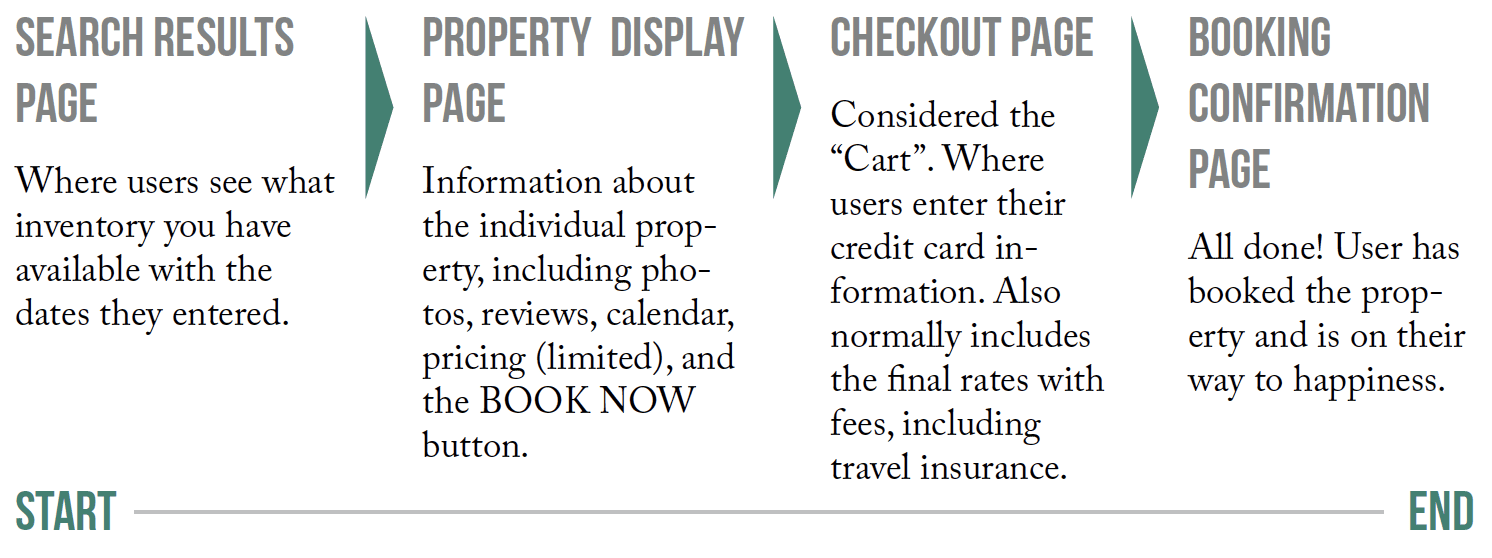
Sample Booking Experiences

When you click on a specific rental on the Google Travel search results page, you come to a Google Travel version of a property details page.

This page is a simplified version of what you might see on any vacation rental website and contains an image gallery, reviews, pricing, an oddly titled “about” tab (which is the property description), and a photos tab with all available images at a glance.

Original search parameters carry over to this property details page so that calculated pricing displays with a “Book Now” button in blue. This is where the consistent Google Travel experience ends. Depending on the integration partner feeding the inventory, clicking “Book Now” leads you away from Google Travel to a landing page from the inventory partner in a new tab.


Following the Book Now Button

VRBO and Airbnb

Inventory being fed from VRBO and Airbnb yield similar experiences after you click “Book Now.” A new tab opens and lands you on a search results page instead of a similar property details page where you can complete the booking.

The search results page has the property that you were reviewing on Google Travel highlighted as the first result, but then it has dozens of property listings below under a heading that leads you to believe that there are many more similar properties to review if you actually are not ready to book.

I found this experience the most confusing because most consumers click “Book Now” to either start the reservation confirmation process or to see further booking details like cancellation policies, terms and conditions, or other information relevant to making a decision.

My assumption is that both VRBO and Airbnb are trying to treat the traffic like organic traffic and drive consumers to use their platforms for additional research and clicks/ engagement rather than just a landing page to finalize a transaction.

I think there could be a better hybrid approach that allows the consumer to get the details they are looking for when they press “Book Now” while also giving them more options since booking funnels have notoriously high abandonment pages.

Conversions on Airbnb and VRBO that originate on Google Travel are subject to channel commissions, and the brand of the individual property manager was not visible.


Red Awning

Red Awning has a slight variation on the experience that VRBO and Airbnb provide in that after the consumer clicks “Book Now” on a property detail page on Google Travel, the new tab opens to a Red Awning property detail page obstructed by a modal urging the consumer to complete the booking process.

This is less c o n f u s i n g than landing on a search results page, but it felt a bit intrusive. Also, the modal lacks any branding, which makes it feel more like a phishing pop-up window.

Consumers cannot tell they have been brought to a Red Awning landing page until they close the booking modal and review the property details page, which has the Red Awning branding clearly visible.

However, dates and rates pass over to the Red Awning website and match what was displayed on Google Travel, making it simple to continue booking.


TripAdvisor/HolidayLettings

TripAdvisor and HolidayLettings have a similar approach to Red Awning without the modal pop-up, so once a consumer clicks “Book Now” on Google Travel, a new tab opens that lands the guest on a property details page from the respective aggregator website with TripAdvisor or HolidayLettings branding.

For my research, I searched for “San Diego vacation rentals” from the warmth of my home in Bend, Oregon, and, oddly, a US-based property manager listing was listed by HolidayLettings (a UK website). If I were ready to escape the cold and head south to sunny San Diego, I would not book on a UK website, so I am not sure this is the ideal channel to list this property for an American consumer.

This slight variation in experiences leads me to believe that Google Travel is still figuring out how to dedupe properties that may be in multiple integration partner feeds and choose the one ideal for driving conversion.


Rentals United

Rentals United had a unique experience: a landing page opens up after a consumer clicks “Book Now” for one of its listings on Google Travel.

Instead of providing a Rentals United–branded landing page, the tab opens a property details page with the arrival/departure parameters prefilled, pricing that matches that shown on Google Travel, the individual property manager brand in the upper-right corner, and messaging that the booking page is powered by Rentals United at the bottom.

This is clearly a win for the property manager because the actual hospitality company brand is hidden on Airbnb and VRBO listings throughout the entire journey. Consumers can finalize their booking or review more details on the Rentals United–powered property details page.

In this example of a potential consumer journey, the traffic from the original Google query never reaches an individual property manager’s website, but there is brand attribution and a clear path for the consumer to finalize booking.

Rentals United and other channel managers taking a similar approach have yet to determine a pricing or commission structure for these bookings, and, as of now, they are free. But because they control the booking experience, it will be interesting to see when and if these bookings are made subject to a commission like other marketing channels.


NextPax, BookingPal, & Other Direct Integrations

The next version of the consumer journey and booking experience was similar for distribution clients of NextPax and BookingPal. NextPax and BookingPal are opaque partners on Google Travel, meaning the individual property manager brand shows on Google Travel throughout the experience instead of NextPax or BookingPal. Those channel managers are just powering the technology to feed the inventory but are not portraying themselves as consumer brands (in contrast to Red Awning).

This is an ideal setup for most property managers who want their brands front and center. The example I used for NextPax in this article was for the query “Denmark Vacation Rentals,” and NextPax client Novasol was front and center in the Google Travel search results.

NextPax does not provide an intermediary, cobranded landing page and sends the traffic from Google Travel via “Book Now” to the property details page with the dates and prices prefilled on the property manager’s individual brand website.

I can hear everyone cheering for this type of integration, but there were some challenges I did not experience during the previously outlined customer journeys.

For example, Google Travel knew I was in the United States and spoke English, and it used American dollars to display pricing, even though I was using incognito browsing for this research. Once NextPax passed me to the Novasol booking engine, I was brought to a page in German with pricing in Euros that did not match the page.

Because both BookingPal and NextPax rely on the technology of the individual property manager websites, they cannot ensure a seamless experience once the consumer is on the brand website. This responsibility falls to the individual property manager, so this experience is best for those who have invested in modern booking engines.

Tracking conversions on individual property manager websites and attributing revenue to Google Travel and your channel manager may be challenging under this model, and conversion rates will vary significantly based on the design and modernization of the individual property manager websites.


Cancellations, Booking Changes, and Issues

A model that charges commission per booking means there must be a path forward to address cancellations, changes, refunds, and other issues. As we all know, this is one of the most challenging aspects when using any channel management strategy. A great deal of manual work goes into cancelling bookings in your property management system (PMS) and on the channel to ensure refunds are processed. Ultimately, guests who are booking through Google Travel must cancel with the property manager or OTA directly because Google is just sending traffic. Rest assured that it is unlikely Google wants to get into the hospitality customer service business any time soon, which leaves that fun up to the pros, who are likely exploring a pay-per-click model that would allow for a much simpler path forward for everyone.


Getting Ready to Participate

Here are four key things to start thinking about as the Google Travel/vacation rental platform continues to evolve:

  1.  Organizationally, it has never been more important for your e-commerce/digital marketing and revenue management/ channel management teams to be on the same page. In the near future, I predict they will work together to optimize listing placements on Google Travel.
  2. Do you have a pay-per-click budget? How do you recognize those costs versus channel costs? Many property managers pay commissions to OTAs and intermediary channel managers before they split revenue with the owners, but they often eat the cost of their pay-per-click budget. With this channel likely to drive a tremendous amount of web traffic and revenue for eager participants, start working on a strategy to handle this with your finance team.
  3. Do you have a team member who is up to speed on the latest pay-per-click strategies? If not, then you must start interviewing potential professional partners or candidates for an internal search engine marketing specialist.
  4. There has never been a better time to make sure your property images are high resolution, professional, and in the right order. Nothing jumps out like a bad photo on the first page of Google search results.

If the predictions come true and Google Travel ends up using a pay-per-click model, the opportunities are endless to use this channel to boost new and struggling properties and minimize costs on high-performing rentals. You will need to be dynamic on this channel and not just with your pricing. It will not be “set it and forget it” like other OTAs that charge a flat commission per booking (at least not if you are smart and capitalize on the opportunity).


Getting Listed on Google Travel

You have probably already seen some of your rentals on Google Travel via VRBO or Airbnb, but if you are eager to list your rentals directly, there are a handful of channel managers that are partnering with Google, most of which I have detailed above.

Rentals United, NextPax, Red Awning, and BookingPal all have integration with Google Travel, but all of them are at different stages in the partnership. Most of them have stated they are testing a few key markets with key clients before they onboard new clients.

Rentals United was the only company I spoke with that openly agreed to onboard new clients to Google Travel.

It is worth speaking to each one about its Google Travel program and understanding costs, the consumer experience it plans to offer (directing traffic to your website versus an intermediary booking page), and its timeline before you make any final decisions.

It is likely that PMS platforms will also start building integrations to Google Travel shortly, including PMS systems with integrated, direct channel manager modules such as MyVR, Guesty, Streamline, and Direct.io.

Google is already on the third version of the Google Travel API and is clearly investing in the short-term/alternative accommodations space. It is trying to optimize its revenue potential while delivering rich, relevant search results to consumers.

There is still much to learn for the Google Travel team, and it will continue to iterate to optimize conversion. I believe each of the potential guest journeys on Google Travel has merit, and it is in the best interest of consumers/travelers to know what brand will be checking them in, hosting their stays, and addressing issues that arise. The only way this will be the evolution of Google Travel is if individual property managers invest in their brand websites, optimize the mobile booking experience, and iterate on their booking engines to maximize conversion.

Now is the time to invest in your people and partnerships and reorganize your teams for the future by breaking down internal silos and ensuring you have one revenue-generating team that is on the same page, makes decisions based on consistent data, and optimizes all of your channels.

To take a deeper dive into how Google Travel is shaking up the marketing funnel. Amber will be speaking on this topic at the upcoming VRM Intel Live events in Destin (January 23) and Gatlinburg (Feb 26).

The Wild West and the Vacation Rental Industry

1

The 2020s: This new decade will establish law, order, and professionalism for the vacation rental industry.

The vacation rental industry is like the Wild West.

Over the past 15 years working in the sector, I’ve heard this comparison hundreds of times in articles, discussions, and presentations.

Like many of you, I’ve been asked for 2020 predictions, and each time the question was posed, this comparison between our industry and the Wild West kept replaying in my head. So, like the nerd I am, I researched and watched over a dozen documentaries about US westward expansion over the holidays.

And it is true. There are startling similarities between the vacation rental industry’s progression and that of the Wild West. Let’s take a look at some of the stages of westward expansion, the parallels we see in our industry, and—yes—a prediction about where we are heading in this new decade.


Early Explorers and Pioneers

Like the Wild West, the vacation rental industry began with early explorers and pioneers.


The Birth of the American Vacation

the early 1800s, the idea of the “American vacation” took a big leap forward in 1869, when Pastor William H.H. Murray published one of the first guidebooks to the Adirondack Mountains. According to Smithsonian Magazine, “Murray broached the then-outrageous idea that an excursion into raw nature could actually be pleasurable.

Before that date, most Americans considered the country’s primeval landscapes only as obstacles to be conquered. But Murray’s self-help opus . . . suggested that hiking, canoeing and fishing in unsullied nature were the ultimate health tonic for harried city dwellers whose constitutions were weakened by the demands of civilized life.”

“The scions of New York City took to declaring that they would ‘vacate’ their city homes for their lakeside summer retreats, and the term ‘vacation’ replaced the British ‘holiday’ in common parlance.” (“Where Was the Birthplace of the American Vacation?” by Tony Perrottet, Smithsonian Magazine)


Vacation Rental Pioneers

As railroads made destinations easier to access, the idea of “vacating” the city gained in popularity, and developers built roadside camps, then cabins and hotels. Local attractions emerged, and popular destinations saw increased traffic from car travel. For example, in 1916, around 30,000 visitors traveled to Yellowstone National Park, the majority coming by train, but by 1936, 409,000 people were traveling to the park in automobiles. (“How American Tourism Began” by Livia Gershon, JSTOR Daily)

In 1922, Eva Peterson, one of the vacation rental industry’s early pioneers, opened Peterson’s Cabins in Wells, Maine. With no plumbing, running water, or electricity, Eva charged 75 cents per person per night. Her oldest daughter and eight grandchildren helped clean and take care of the cabins.

By 1940, Eva’s daughter Miriam and son-in-law Herbert Plimpton were following in her footsteps, opening New England Village in Hampton Falls, New Hampshire. Their collection of “overnight homes” was arranged like a miniature town. Some buildings were themed as Main Street mainstays with one built like a church, another like a school, and a third like a doctor’s office. Walt Plimpton, Miriam and Herbert’s 10-year-old son, towed a little red wagon from cabin to cabin collecting trash bins and dirty sheets. He brought the sheets home where Miriam washed them, hung them out to dry, and ran them through a mangle to smooth out any wrinkles. Walt then trucked the clean and crisp linens back to the cabins where his older brother, Donald, made the beds.

Herbert Plimpton playing with a dog in front of New England Village

By World War II, the idea of vacationing was gaining in popularity. During mandatory nightly blackouts along the coast, Herbert would skirt the rule against outdoor lights by cutting out “OVERNIGHT CABINS” from their cabins’ roll-down shades so people driving by could find them.

Rental activity increased in the postwar years. The growth of car ownership, rising middle-class wealth, newly established paid vacation benefits for union workers, and the introduction of air travel contributed to the tourism boom. Miriam would visit competitors’ houses in the dark and count the cars in the driveway to track occupancy.

In June of 1955—900 miles south of the Plimpton’s New England Village—Rae and George Sloane packed up their children and drove onto a ferry with what little they had to start a new life as the only full-time residents on an idyllic North Carolina barrier island called Ocean Isle Beach. Their job was to sell oceanfront lots for Rae’s Uncle Odell, and the Sloanes used money they had inherited after George’s mother’s death to build a house on the island. “When we started, we were selling lots for $500,” said Rae. “Odell paid us 2 percent, and we sold hundreds of them.”

Rae Sloane and kids

Travelers began building and renting vacation homes along the Carolina shores, and by 1965, the Sloanes had built an inn and were managing 25 newly built vacation home rentals. “We had a well with a pump in the backyard,” Rae told us. “I did all the laundry, and I would fold the sheets when they were still a little damp so they would look like they were ironed. You learn to do whatever you can to make it work. I primed many water pumps and scrubbed many bathrooms.”

Across the US, pioneering families like the Petersons, Plimptons, and Sloanes built vacation rental businesses in seasonal areas that attracted families vacating their normal lives to embrace the vacation as part of the fabric of the American dream.


Old West Speculators

Looking back to the Wild West, as large numbers of pioneers ventured westward to build new lives throughout the territories, speculators entered the race, buying up tracts of land and developing towns and dynasties.


Vacation Rental Destination Developers

In the same way, from the 1960s to the 1980s, real estate developers in leisure destinations began accumulating land and building vacation homes and commercial properties for sale and rent. These developers amassed wealth and family fortunes, creating leisure meccas that attracted a multitude of middle-class travelers. Many of these developers not only built homes, they also opened large real estate companies and then built rental businesses to manage the homes as short-term rentals.

From Maine to Florida, along the Gulf Coast, and in lake and mountain destinations throughout the US, developers kept building, and Americans kept buying. Second home ownership exploded as the idea of taking vacations cemented itself in the American psyche.

Many of these development/real estate/rental businesses continue to thrive and remain enormously influential in leisure vacation rental destinations across the country.


Completion of the Transcontinental Railroad

The most critical factor contributing to the explosive westward expansion was the construction of the Transcontinental Railroad connecting the east to the west; and competition was fierce between the Central Pacific and Union Pacific Railroad Companies, who raced toward each other from Sacramento, California, on the one side to Omaha, Nebraska, on the other.

Accessibility was the key to growth.

Explorers and pioneers had previously traveled by wagon, but the railroad provided easier access. Settlers followed the rails by the tens of thousands—and then millions—building cities along the way. Additional railways branched out from the Transcontinental lines, and once-unexplored territories turned into thriving townships. By 1890, the US Census Bureau announced the end of the frontier, meaning there was no longer a discernible frontier line in the west, nor any large tracts of land unbroken by settlement.

Accessibility via Vacation Rental Listing Websites and OTAs

Following the analogy, vacation rental websites and OTAs were our industry’s Transcontinental Railroad, giving mainstream travelers easy access to millions of vacation rental properties.

Between 1994 and 2009, OTAs and vacation rental websites (i.e., Vrbo, FlipKey, Airbnb, and hundreds of regional and niche websites) were built and then consolidated. (You can find a more detailed timeline at vrmintel.com/third-party-distribution-channels/)

In 2010, only 8 percent of travelers had stayed in vacation homes, but after these websites gained steam, that number grew to 33 percent by 2015. (Phocuswright)

With the increased accessibility these websites provided, short-term rentals spread outside of traditional leisure destinations to cities and residential areas in every corner of the US.


Gunslingers, Outlaws, and Brothels

Westward growth was swift, towns sprouted almost overnight, and law enforcement was slow to catch up. Stories of lawlessness inspired folklore that endures today, including tales of gunfights, stagecoach robberies, bank holdups, bounty hunters, and brothels.

In the early settlements, governments did not have a legal monopoly on keeping order. Instead, “private agencies provided the necessary basis for an orderly society in which property was protected and conflicts were resolved . . . they included such organizations as land clubs, cattlemen’s associations, mining camps, and wagon trains.” (“The Culture of Violence in the American West” by Thomas J. DiLorenzo, 2010)

We later learned that many of the folktales were fiction.

According to journalist Laurie L. Dove, “During a 15-year period in the late 1880s, there was an average of only three murders a year in Abilene, Caldwell, Dodge City, Ellsworth and Wichita— the five Kansas cities that served as significant railroad stops.

 This was far lower than murder rates in the eastern cities of New York, Baltimore or Boston at the time. 

(The city with the most murders of the five was Dodge City, which had 17 over nine years, less than two murders per year.) 

Bank heists were a rarity (about eight bank robberies were recorded in the Wild West from 1859 to 1900) and most people didn’t carry around a loaded six-shooter. In fact, few people carried sidearms at all.” (“Ridiculous History: The Wild, Wild West Was Really the Mild, Mild West” by Laurie L. Dove, 2015)

Yet the stories continued to spread.


Vacation Rental Outlaws

As previously mentioned, OTAs and vacation rental websites provided more accessibility for guests, and the practice of staying in home rentals expanded well beyond traditional leisure destinations. Short-term rentals have sprung up in every major city and in residential areas where there were no existing laws to address home rentals. As a result, municipal officials are struggling with the best way to regulate this new rental activity.

In addition, fast growth has allowed multidestination business models and rental sites operating as merchants of record to emerge with a focus on short-term gains with little to no contribution to destination growth, sustainable tourism, sensible regulations, the establishment of best practices, or escrow-account protections for homeowners.

Admittedly, our industry has seen instances of illegal, speculative activity in the growing short-term rental industry in the form of online scams, companies that misuse guest funds (i.e., LeisureLink), and rental providers who do not follow regulations.

But, like the Wild West, much of the reported lawlessness in the vacation rental industry is fiction or based on isolated activity exploited by AHLA lobbyists, residents fearful of an influx of tourism activity, and homeowners opposed to having short-term renters in their neighborhoods.

Today, the industry recognizes that sensible regulations are important for the vacation rental industry to thrive, but city officials have been reacting to fear and folklore instead of methodically analyzing challenges and creating a regulatory environment that benefits all stakeholders.


Law and Order for Established Cities and Townships throughout the West

Western towns matured and grew into cities. Private agencies turned into governments, and laws were established to protect citizens and property rights. Businesses were professionalized, and interstate commerce grew.

A new generation of Americans was born, reared, and educated in areas that only a few decades before had been uninhabited. These children born in the Wild West built careers, lives, and legacies.

The Wild West was tamed.

Between 1859 and 1912, the US added 16 states to the union, including (in order) Oregon, Kansas, West Virginia, Nevada, Nebraska, Colorado, North Dakota, South Dakota, Montana, Washington, Idaho, Wyoming, Utah, Oklahoma, New Mexico, and Arizona.


The 2020s: A New Decade for Thriving, Professionalized Vacation Rental Management Companies

Like the Wild West, the vacation rental industry had its early explorers and speculators. Mainstream accessibility arrived with the proliferation of vacation rental websites and OTAs; and with rapid growth, the industry has its share of bad actors and businesses/investors looking for get-rich-quick opportunities.

But through all of this, the professional vacation rental industry, especially at the local level, has matured and proven itself as a sustainable, valuable, and thriving sector of travel.


So here is my prediction

This next decade—the 20s—will establish professionalism and bring sensible and sustainable regulations to the vacation rental industry. And those panning for gold and looking for easy ways to make quick fortunes will eventually move to more tempting pastures. The hotel and lodging industry will bring short-term rentals under its umbrella as new standards are adopted to meet guest expectations, and true asset management models will emerge to maximize second home investments. While it won’t happen in the exact year 2020, over this new decade, the vacation rental industry will stabilize and grow with profit-driven, professionalized business models.

As for our two industry pioneers, the Plimptons and the Sloanes?

Today, nearly a century after his great-grandmother Eva Peterson began managing her plumbing-free cabins in Maine, Greg Plimpton and his wife Debbie own and operate Cabins for YOU, one of the top five management companies in the Gatlinburg area. The company manages 330 homes with 70 employees, 50 housekeepers, and 25,000 reservations a year. Two of Eva’s great-great-grandchildren serve in leadership positions in the company. If their children stay in the family business, they will be sixth-generation vacation rental managers. But we will have to wait a bit to find out if that will happen. In 2022, on the 100th anniversary of Eva’s original cabins, the youngest of the sixth generation, Ava, will be just four years old.

As for Ocean Isle Beach’s first full-time residents? Sloane Realty Vacations is still thriving with George and Rae’s children, grandchildren, and now great-grandchildren operating and working in the business. Today, Sloane Realty Vacations has 35 year-round employees and manages over 150 long-term rentals and 375 vacation rental properties from Ocean Isle Beach to Sunset Beach. The company is now co-owned by Rae’s children, Tripp Sloane and Debbie Sloane Smith. Debbie is also now serving her 16th year as mayor of Ocean Isle Beach. Most of Rae’s 15 grandchildren and 14 great-grandchildren still live in the area, and three of her grandchildren—Whitney, Chris, and Leah—are also working in the business.

Across the country, the descendants of the pioneers, developers, and innovators of this industry will tell the folklore of billion-dollar valuations, gamblers who walked away with fortunes, and speculators who crashed.

But what a time it was!

Three-Year Vacation Rental Performance: Average Daily Rate, Adjusted Occupancy, Adjusted RevPAR, and Average Booking Window across 12 Key Vacation Rental Regions

0

Now that vacation rental managers and destinations are contributing source data, we are beginning to get a factual view of actual performance over the past three years.

The following key performance indicators (KPIs) were provided by Key Data Dashboard and represent data compiled from 12 key vacation rental markets through December 31, 2019. It is important to note that Key Data Dashboard obtains information directly from property management systems instead of compiling self-reported data or data scraped from OTA calendars.

Reviewing annual data allows us to identify year-over-year trends in booking activity. For example, contrary to what we’ve been told, the average length of stay (ALOS) across these markets has seen little change over the past three years, but it is also not increasing in any of the markets we analyzed.

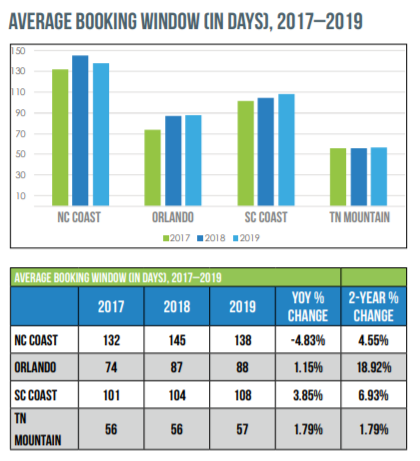
In addition, as you review the average booking window (the number of days between the date the reservation was made and the date of arrival), you will see that the Western regions and Southwest Florida saw a moderate decline in the average booking window, while the other markets experienced guests booking further out on average.

In the following pages, we have used adjusted occupancy and RevPAR KPIs. As you read in the fall issue of VRM Intel Magazine, the adjusted paid occupancy percentage accounts for owner stays and maintenance holds, considering only nights available to guests. Although the traditional occupancy rate may be an additional helpful KPI to compare, the adjusted paid occupancy percentage allows property managers to view occupancy from an angle that excludes factors beyond their control. Because the rates of owner stays and maintenance holds vary greatly from property to property, the adjusted paid occupancy percentage is useful for comparing similar inventories and is essential when benchmarking performance against competitors.

When calculated using adjusted paid occupancy percentage, adjusted RevPAR becomes a vacation rental-specific KPI. A critical KPI for measuring revenue performance, adjusted RevPAR accounts for both average daily rate and the paid occupancy percentage.

At the upcoming VRM Intel Live events and the Data and Revenue Management Conference, we will take a deeper dive into year-over-year reservation activity and booking pace in 2020.

*Data provided by Key Data Dashboard


Eastern Regions, 3-Year Performance 

North Carolina Coast, Orlando, South Carolina Coast, and Tennessee Mountains


Gulf Coast Regions, 3-Year Performance

Alabama Gulf Coast, Florida Panhandle, Southwest Florida, and Texas Gulf Coast


Western Regions, 3-Year Performance

Colorado Mountains, Hawaiian Islands, Lake Tahoe Region, and Oregon


Click here to download these charts.

Setting Your Company Apart: Differentiating your vacation rental company from the competition with E.P.I.C. Hospitality™

0

Train hospitality through the heart and not the head by focusing on concepts such as empathy, patience, intuition, and compassion (EPIC).

As I often say in my conference presentations and private workshops, conveying authentic and genuine hospitality during guest interactions is the single most important task that any lodging company can do to stand out from the competition.

This is especially true in the vacation rental (VR) sector, when traditional differentiating factors such as location, décor, and amenities fail to separate you from your competitors. In other words, your competitors are renting accommodations of a similar size and style, appointed with the same amenities, in the very same neighborhood, development, or building. Because of new technologies, their homes are likely priced similarly, and guests are booking on the same OTA and receiving the same automated text messages on arrival.

In this increasingly homogeneous industry, what can one company do to stand out from all of the others? Too many VR managers think the key is to “out-tech” the competition or to put more company-branded gift items in a logoed tote bag.

The reality is that the best way to stand out is to obsess about people and not just process.

Touching the hearts of guests ensures repeat business and converts otherwise anonymous guests into social media apostles. This is especially true in the VR side of lodging, where the number one objective of virtually every guest is to create memories that will echo through time as children grow up, couples grow old together, and Facebook memories pop up on the home page five or ten years down the road.

Although connection opportunities are decreasing in frequency, many opportunities exist for VR companies who truly understand and embrace the heart of hospitality—human kindness, especially to strangers.


Let your competition be in the “unit rental” business. Make sure your staff knows your company is in the vacation-memory-creation business.

After 30 years of training frontline staff on the essentials of guest service, I intuitively knew it was time for a new approach to conveying this concept, especially to a new generation that was not yet born the year I started my first training company. So I picked up on the favorite word of many young people these days, including my own Generation Z children, which is the word EPIC.

Before creating E.P.I.C., I came to realize that too many guest service training programs approach teaching hospitality as if it were merely a series of communication techniques. Perhaps this is because hotel-rating services such as Forbes and AAA put a great deal of weight on specific, scripted phrases, to the point that many staff members are so nervous about using these rigid, standardized phrases that they sound insincere.

Yet when you teach only politeness and obsess too much about rigid scripting of guest conversations, the result is fake, disingenuous service. Therefore, I decided it was time for a new model of training through the heart and not the head.

E.P.I.C. Hospitality is a philosophy about how all vacation rental staff members touch the hearts of everyone they encounter. Yes, the end game is how your staff interacts with guests, but authentic, memorable guest hospitality is rooted in intercompany culture.

E.P.I.C. Hospitality begins when we greet our first coworker each shift and continues on through every connection we make, with everyone we encounter, whether that person is a colleague, coworker, homeowner, vendor, or contractor.

My mentor and friend, Howard Feiertag, who recently had the Virginia Tech School of Hospitality renamed in his honor at the age of 91, said at his acceptance speech, “Hospitality is simply making people feel good.”

Conrad Hilton, the iconic founder of Hilton Worldwide, said it more formally: “It has been, and continues to be, our responsibility to fill the earth with the light and warmth of hospitality.”

Perhaps the great poet laureate Maya Angelou said it best in her famous quote: “I have learned that people will forget what you said, people will forget what you did, but people will never forget how you made them feel.”

To paraphrase her, I’ll just say this: Guests will forget the text message you sent on arrival, the amenity you delivered, and the automated email you sent after check-out, but they will never forget how your maintenance worker or welcome-center staffer showed interest in their child, dog, or aged grandparent.


Here are five train-the-trainer ideas you can use as a road map for training your own staff during in-house meetings.

  1. Rehumanize your guests. Often, frontline workers in the VR space may not have experienced personally the vacation situations that those who are planning and paying for the vacation are experiencing. Therefore, find creative ways to help staff members imagine the guest stories playing out every day in your homes. One fun activity is to select pictures that represent your guests; you can use actual guest photos taken from social media or those purchased for media use. Assign staff members to work in pairs and pass out pictures representative of different demographics (for example, traditional families, couples groups, friends getaways, and extended families). Have them come up with stories behind the travelers’ plans that explain why this vacation is so particularly important (for example, last trip with the high school senior, first trip with the baby, possibly the last vacation ever because of terminal illness, or first reunion in 10 years).
  2. Assign staff members to write up their own definitions of empathy and share them with the group; then show definitions from Google. Ask half of the group to think of guests they have encountered who had mean, harsh personalities. Ask the other half to think of guests they have met who were going through difficult personal challenges. Ask the groups to alternate sharing their examples. Is it possible there is a backstory behind that difficult guest
  3. Search Facebook for user groups with words such as kindness and compassion in their names, and then subscribe to their feeds. When you come across meaningful memes, download them as images and share them during your hospitality discussions.
  4. Search YouTube for videos about empathy, patience, intuition, and compassion (E.P.I.C) and share the good ones.
  5. Create a reporting system whereby staff members can identify heartfelt gestures and actions taken by coworkers and colleagues. Then, celebrate these occurrences on intercompany social media (such as a company Facebook group) or in a celebratory email.

VRM Intel Magazine Winter 2020 is Here!

0

The Winter 2020 issue of VRM Intel Magazine is here. From the top of the marketing funnel to the gunk of deep cleans, this winter issue covers professionalism, changes at Google, true hospitality, performance data, technology connectivity, property care, industry context, and much more. 


The term vacation rental has taken some hits over the past few years—but even more so in 2019.

Although it’s probably unfair, I still blame Phocuswright for introducing the terms alternative accommodations and private accommodations in its research, lumping new rental segments (i.e., shared housing and urban rentals) with traditional vacation rentals under one umbrella. But it wasn’t just Phocuswright; consumers did the same thing organically, calling everything an Airbnb. I get it. It is difficult to find an easy way to describe a lodging segment that includes apartments, beach houses, cabins, chalets, condos, townhouses, treehouses, spare bedrooms, and air mattresses. For consumers, telling friends, “I’m staying in an Airbnb,” is much simpler.

But, in 2019, after attending dozens of conferences, viewing over 30 startup pitch decks, talking to investors and analysts, and commiserating with hundreds of property managers, I’m a little peeved and perplexed—particularly about the viewpoints comparing urban short-term rentals and leisure vacation rentals. Over a billion dollars have been invested in the urban short-term rental sector, including $400M in Sonder, $180M in Lyric, $116M in Domio, and $62M in Stay Alfred. Although we see opportunities for the urban segment, we also see the risks. These models execute strategies that include master leases, facilities management, complete furnishings, reliance on distribution, and a volatile regulatory environment. It may be risky, but this urban rental segment is fast-growing and likely to find its way under hotel flags, giving its investors and founders the potential for astronomical exits. With big risk comes big reward.

So why am I peeved? First, the influx of urban rentals has precipitated a contagion of regulatory issues that have spread to leisure destinations. Second, the consistent year-over-year, decade-over-decade growth in the leisure side of the vacation rental industry is being misrepresented as old and fragmented, and in need of a consolidated overhaul. Third, if the considerable risks these newcomers are taking don’t pan out, I’m concerned that the vacation rental industry’s reputation will suffer from guilt by association.

I personally believe that the two segments, urban short-term rentals and leisure vacation rentals, need to be looked at differently in the minds of investors, owners, guests, and municipalities, as well as in the media. As a result, at VRM Intel, we have made a decision to primarily focus on leisure vacation rentals and have created new events and initiatives to improve the narrative about our industry. For example, we are launching the Second Home Investment and Rental Show (page 53) and are creating a widespread PR initiative (page 104).

In addition, this issue is filled with information supporting vacation rental managers with performance data and articles about the importance of professionalism, the evolution of property management companies into hospitality companies, strategies to address changes at Google, ways to improve site conversion, and the improvement of call center performance. In addition, we address deep cleans, inspections, and housekeeping profitability.

I hope you find this issue helpful for your team and your company. I strongly believe this new decade will be game-changing for the professionally managed vacation rental industry, and I am grateful to each of you for allowing me the opportunity to contribute to and chronicle its success.

Using Data to Make Better Business Decisions

0

Data can be a vacation rental management company (VRMC)’s best friend. However, it’s only useful if you’re looking at the right data for the problem at hand. Too much data can be overwhelming, but too little can lead to incorrect assumptions and uninformed decisions. There’s no such thing as information overload, only filter failure— so here’s a look at how to best analyze and understand data to avoid potential business mistakes.


Using Data to Drive RevPAR

Imagine the average daily rate (ADR) in your market is up, but occupancy is down. Based on this information, it might be tempting to assume a price drop will lead to higher occupancy. But lowering rates isn’t a decision to be taken lightly; you should have confidence in your understanding, based on data, of what the market can tolerate. Sure, certain markets are pushing back against aggressive rates, but rate resistance is just one of many reasons a guest might not book with you. Understanding why your leads booked elsewhere is essential to driving revenue per available night (RevPAR).

Although dropping your rates may seem like a simple solution to increase occupancy, it will only work if you are in fact losing leads due to rate resistance. But what if rate resistance only accounts for a small percentage of lost nights? If you could see what caused lost revenue, you could make more informed decisions. For example, if the majority of nights lost were not due to rate resistance, you could be lowering your rates for no reason. Besides that, lowering rates would be unlikely to drive additional bookings, meaning your ADR, occupancy, and RevPAR would all suffer.

When looking at the unconstrained demand for rentals in the Outer Banks for July 2019 versus July 2018, we found that although ADR was up and occupancy was down, rate resistance accounted for less than 4 percent of lost nights. Company policies—such as deposit and cancellation rules—were responsible for a much higher percentage of lost revenue. When companies had access to this information, they could alter policies that were discouraging leads from booking. After all, although you can’t control what the market is doing, you can control your policies. You’re never going to know why 100 percent of unbooked guests didn’t book, but if you know a statistically relevant percentage of reasons, it can help you make better decisions.


Considering All Revenue Channels

The previous example is just one of myriad ways in which data can be misleading if not used strategically. Imagine that, when looking at data from your pay-per-click (PPC) campaigns, you notice the online booked revenue for a campaign is barely higher than the total cost. Clearly you should pause this campaign and divert that money to a different one that’s driving more bookings—right? Not necessarily. If you can’t see offline inquiries and bookings in addition to online bookings, you’re not looking at the full picture.

It’s essential to consider all booking avenues when analyzing a campaign’s success. Otherwise, you could pause a campaign that’s driving many of your company’s phone leads and bookings. A 360-degree view of your PPC spends with revenue attribution for all channels allows you to make more informed and more effective marketing decisions. Employ actionable analytics, then act.


Leveraging a Hospitality CRM Platform

Although leisure demand has been strong, it won’t continue to thrive indefinitely, and VRMCs need to be prepared for unpreventable situations such as recessions and natural disasters. All signs say a recession is coming—this isn’t an “if ” but a “when.” Launching data-based strategies now will empower VRMCs to manage this inevitable downturn.

Homeowner Communications: Delivering and Communicating Deep Service Value to Homeowners

2

Vacation rental managers have two distinct customers: guests and homeowners. The identity of a manager continues to evolve into that of a hospitality provider, and the industry is adapting to the idea that professionals not only manage properties, they also shape the guest experience.

I’ve spent 15 years examining the interplay of marketing, operations, and software in the vacation rental industry. We’ve built our business on the premise that elevating the brand experience is the future of the industry, and I’m confident that more attention will be devoted to the homeowner portion of this experience.

Let’s discuss the importance of delivering deeper service and look at ways to effectively communicate this value to property owners.


The True Significance of Deep Service Value

For homeowners, there are many options for facilitating the rental process. First, you can manage the entire process on your own: list the property on platforms such as Airbnb and Vrbo and hire cleaners and contractors to handle turnovers and maintenance repairs. A second option is to use an agency model—for example, Evolve — where owners receive marketing and OTA assistance but rely on a network of their own for cleaning, maintenance, and guest services. Finally, there is the full-service option of hiring a vacation rental property manager. This is particularly attractive for the top end of the market—when the owner is time constrained or doesn’t live locally—and nearly 44 percent of owners select the full service option.

As platforms such as Airbnb lower the barriers for owners to choose self-management and more professionals compete in vacation rental markets, owner expectations have risen. Homeowners are looking for top-to-bottom asset management, which includes preventative maintenance, clear communication on services delivered, time spent caring for properties, VIP concierge service, and guest communication.

Managers who don’t deliver hospitality-like service will lose their clients to alternative management options or other property managers in their markets.


Showcasing the Full Value of Your Work

When a homeowner makes the purposeful decision to employ a manager, he or she expects that manager to deliver value commensurate to the management fee (which is typically around 25 percent but depends on the market and on services provided). The manager takes on the responsibility of effectively communicating with the homeowner, which is instrumental in building trust and transparency in the relationship.

Of course, the idea of homeowner relations is not a novel one. As the industry has matured, however, owners are demanding greater detail and more frequent reports. Property management has evolved into a much more service-oriented business (i.e., it’s no longer just about maintaining property but also about maintaining guests), and managers have become saddled with heavier workloads. The increased owner-facing responsibility comes second to that of meeting guests’ service and quality expectations, but it is still critical.

With 76 percent of guests expecting a personalized rental experience, property managers are forced to do a significant amount of behind-the-scenes work during each reservation. This work extends well beyond property care and readiness prior to each check-in (e.g., cleanings, inspections, and maintenance repairs) and includes both reactive and proactive guest attention.

In fact, managers are spending an average of 200 hours of work at each unit per year, but owners are aware of approximately 20 percent of it.

Demonstrating service level takes time and resources, which is why many managers don’t consistently relay information regarding level of service to property owners. It’s not enough to simply say your team is accomplishing X, Y, and Z on a daily basis. Managers need compelling data to convey value, and they need to showcase the data to owners. This is where some of the disconnect lies. Managers often lack the time and software resources needed to meticulously track the frequency, details, and results of their work; and manual tracking activity takes time that managers simply don’t have.

Despite their best intentions, managers often fall prey to reactively relaying information to homeowners. However, this makes it all the more important to have a positive working relationship with homeowners so that when there is an emergency, or when a costly repair arises, owners are more receptive because trust has already been established.


Actionable Methods to Convey Service

Making a good first impression is the foundation of a robust owner relationship. Building strong rapport leads to a better understanding of owners’ idiosyncrasies related to the items in their rentals, their styles of communication, and the overarching goals of your service. Building trust from day one sets the tone for a positive relationship, which often affords you more flexibility when it comes to maximizing rental income.

There are many ways to foster owner relationships, from personalized preventative maintenance plans to consistent and reliable communication.

By leveraging data, managers can easily provide concrete evidence of work completed at the home (e.g., the number of visits made to the property; the amount of time spent on cleanings, inspections, and maintenance repairs; the frequency of performance for each task; the length of time required to complete various tasks; the number of service calls made to the property; and the frequency of guest communication). Consider how these metrics would easily translate into a comprehensive view for owners that could be shared on a weekly, monthly, or quarterly basis and could supplement existing meetings by phone or in person.

Although many owners expect to be kept in the loop regarding the above metrics, not many understand the full value of preventative maintenance and asset management.

Tracking and reporting information such as appliance downtime, number of repairs per appliance, running age of each appliance, and quarterly inspection reports will impress many owners and prove that you can quickly diagnose issues, prevent emergency repairs, extend appliance lifespans, and drive more predictive property management — all of which demonstrates how indispensable you are to the homeowner.

Another best practice when conveying value is outlining service standards that are tailored to each property. No two properties are exactly the same, and each therefore requires a specific level of service. This fact may require you to implement different service measures that contribute to the success of each rental property (e.g., more than one property manager to oversee the property, thoroughly customized checklists, and preventative maintenance plans).


Suggestions for Homeowner Reporting


Making homeowners aware of the extra (and customized) measures taken to make sure their properties are well maintained will go a long way toward ensuring you retain your owners for years to come.


Benefits of More Service Offerings and Effective Communication

Embracing the service side of the business and constantly looking for growth opportunities is the future of property management. Managers who deliver quality services will be given more work and responsibility. (Note: increased operational load can be offset through smart partnerships and adding service staff.) Upselling owners with added services such as landscaping, mildew removal, snow cleanup, and pest control increases your owners’ lifetime value by helping you generate more revenue in the short term, as well as develop longer-lasting relationships.

Today’s consumers hold fellow consumers’ reviews in high regard. Homeowners researching property management companies in their markets want reassurance that the services they receive will be top notch. Happy owners who feel they are getting more value than the fees they’ve paid are much more inclined to refer your services to others. As we know, the best form of marketing in this industry is word-of-mouth referral.


Conclusion

Providing hospitality-level service for both guests and owners is one of the strongest trends in today’s vacation rental market. Delivering on this service isn’t quite enough, though, and managers are now expected to take the necessary steps to effectively communicate all the work they do. Those who are able to leverage deep property data to execute on prescriptive service plans will be able to adapt to this new service-provider role and will more quickly differentiate themselves from the growing number of managers in the market.

What Is My Company Worth? A Back-of-the Napkin Analysis

2

We are currently in an interesting time in the vacation rental industry for M&A transactions. From VC-backed companies to private equity (PE) firms, hotels, OTAs, and traditional short-term rental companies, there is no shortage of buyers for short-term rental management companies.

We get asked this question at least once a week: “How much can I get for my company?”

The short answer is, “It depends.”

Let’s start with the easy part—your financials.


Objective Part (It isn’t completely objective, but it’s close.)

  • Figure out your trailing twelve-month (TTM) earnings before interest, taxes, depreciation, and amortization (EBITDA).
  • Adjust by taking out all expenses associated with owners of the company (payroll, benefits, perks, one-time outlier fees, etc.). These can be subjective and are often negotiated.
  • If you do not already have a general manager (GM) in place, add back in a “market rate” expense for replacing the owners/management team, upcoming minimum wage hikes, rent expense (if not charging market rent), etc. Once again, these expenses can be subjective and may be negotiated.

This should give you an adjusted EBITDA for your company.

Now that you have come this far, what’s next?


The Subjective Part (The “Fun” Part)

Put a multiple on this adjusted EBITDA (AE) number. The current range of multiples is somewhere between 3.5 and 5.5 times AE, with some acquisitions falling lower or higher. Currently, however, most deals are closing within this range.

Why are some companies valued at 3.5x and others at 5.5x? Consider these questions:

Q: Are you located in a “hot” market or not?

  • Does your market have long peak seasons?
  • Is the management fee in your market higher than that in other markets?
  • Are local regulations lax?

Q: How is your company’s TTM EBITDA compared to its trailing 36-month EBITDA ?

  • Are you growing or regressing? This can be defined as revenue, EBITDA, or inventory.

Q: What is the length of time the majority of your homeowners have been on your program?

  • What is your inventory’s yearly churn (attrition) rate?

Q: What is your advance bookings report, as of today, compared to the “as of today” from one year ago?

Q: Do any assets come with the deal?

  • Office, real estate, facilities, vehicles, etc.

Q: Is there already a GM in place, and how much are the owners involved in the day-to-day operations?

  • Is the owner of the company also involved in homeowner relations? Note: This can affect your valuation when trying to sell.

Q: How much of the EBITDA is from a real estate brokerage operation?

  • Real estate brokerages traditionally trade at a lower multiple.

Q: What does the company culture/staff look like?

  • Do the buyer and seller have similar company cultures and philosophies?

Q: What terms of the deal are you willing to accept? This can change your valuation wildly. Buyers are often willing to offer higher multiples for more agreeable purchase terms.

  • Are you willing to accept a large amount of seller financing?
  • Are you willing to stay with the company for x number of months/years?
  • Is your entire staff staying on with the new company?


Each buyer has his or her own subjective reasoning that affects the multiple, and there are many more questions in addition to those above. Each buyer treats each factor differently as well.

Every deal is different.

If you use this cheat sheet to determine your AE and are realistic in your multiple for your company, then you can figure out a range of what your company is actually worth. As I have stated several times, every deal is different, depending on the buyer’s and seller’s priorities in the plethora of factors and issues.


About the Authors

C2G Advisors is an M&A consulting firm with more than 35 years in the short-term rental industry. The company predominantly advises buyers by helping them expand through acquisition. However, whether you are a buyer or a seller, Jim Olin and Jacobie Olin at C2G Advisors would love to work alongside you to help you get the best deal at the right time.

Five Best Practices to Drive Direct Bookings

1

To truly develop your brand requires building direct bookings. It’s critical for a vacation rental property management company to maintain a professional looking website, and all of your marketing efforts should work in alignment to drive traffic to your branded site. Here are five best practices you can use to accomplish the goal of driving direct bookings.

Website Optimization

Your website should define your brand, allow guests to make inquiries, offer value to drive conversions, and answer questions your guests have. Here are key elements to include on your website to help accomplish your goal:

  • Professional photography
  • Well-written unit descriptions
  • Location information
  • Key factors—price and offers
  • User reviews
  • Online booking capabilities
  • Speed and accessibility
  • Functionality across all devices
  • Blogging


Email Marketing

One of the most important marketing assets you have is the email list of prospects who inquire about your properties and your former guests. Email marketing is one of the most effective ways to build long-term relationships with guests.

  • Build your subscriber list
  • Encourage readers to engage
  • Make it personal
  • Keep your email out of spam folders
  • Make sure your emails are clean and crisp
  • Include links and calls to action
  • Make it easy to unsubscribe
  • Make email mobile friendly


Social Media Marketing

When properly utilized, channels such as Facebook, Instagram, Pinterest, and LinkedIn can be great sources for adding names to your email list, driving traffic to your website, and increasing direct bookings.

  • Have a plan
  • Determine which platforms suit you
  • Get to know your target audience
  • Market your properties via social media
  • Use photos, videos, and graphics
  • Prioritize quality over quantity
  • Work with the right tools
  • Follow conversations and respond


Paid Search

Use paid search (i.e. Adwords) to promote special events and offers, book slow rental periods, or drive traffic to your website. Unlike the low- or no-cost options, you will need to establish a budget first.

  • Understand how PPC works
  • Have defined conversion goals
  • Select your PPC channel
  • Perform detailed keyword research
  • Determine your PPC budget
  • Create compelling ad copy
  • Make sure your landing pages are relevant
  • Continue to test and optimize


Organic Search

It’s a marathon, not a sprint!

  • Identify your target keywords/keyword phrases
  • Perfect your on-page optimization
  • Develop your content strategy
  • Attract high-quality links
  • Monitor performance
  • Continue to optimize your SEO efforts

Acting on and implementing these five best practices can help you to build an effective marketing strategy and drive direct bookings for your properties. Most of these best practices can be accomplished for low or no cost and a small commitment of your time. The result, whether you choose to do it yourself or hire staff or third-party contractors, will be to drive direct booking and increase your revenues!

For more details and to read the full-length article, visit partner. xplorie.com/direct-bookings

Relationship Building: Creating Cultures That Build Trust in Relationships

0

The vacation rental industry has an amazing foundation, one built on relationships and communication, which is why I was drawn to the industry and continue to enjoy working in it; the industry complements my hospitable spirit.

I watch how company owners and leaders connect. They are quick to offer help to one another and give advice on technology and new projects. The real struggle I see is facilitating the relationship-building mind-set for the company’s both internal and external customers. The key takeaway is that relationship building takes focus and time. As we navigate this fast-paced world where everyone wants everything now, it becomes more challenging to slow down and work on our business instead of in it.

When I work with companies that want a relationship-building culture, I often see that the key challenge is a lack of communication and direction for employees. This relates to employees’ lack of trust, as they often lack motivation to build relationships internally or externally. Because of this, communication and direction require the most focus time from company leaders.

I recommend beginning with the building blocks of trust. We can break this down to a simple formula that speaks to internal and external trust building, which includes frequent communication, openness, warmth, truth, and confidence, as Ron Zemke outlines in his book Delivering Knock Your Socks Off Service.

Once teams understand the main concepts of trust building, I like to bring in values, either personal or professional. I share my values of transparency, integrity, the platinum rule (treating others the way they want to be treated), respect, passion, and love. Discussing values also reveals what doesn’t align for employees, which can create potential friction and take away from relationship building.

Then, we talk about their values and what emotional triggers they might have. I had an employee share that she struggled with being yelled at. She said she didn’t know how to handle being yelled at and would feel upset and not know what to do. I explained, when people are upset, their IQ can decrease by up to 50 percent. When they act emotionally, they do not act as their best selves, and this has nothing to do with the service provider. I often feel that I am part therapist when coaching, but this is necessary because employees need to understand why they feel these emotions before they can use the right tools to change the situation.

All of us have different emotional triggers. Being mindful of those triggers allows us to acquire more tools for working through the friction that arises when we are triggered.

The next step is bringing in behavioral assessments. I recommend the StrengthsFinder model and its top five strengths; this model helps illuminate the areas where employees thrive and focus attention on those areas. It also assists an employer in looking at other departments in the company that could be a better fit for an employee.

Another favorite is the DISC assessment. This creates conversations on the behavior types that can be unsettling for some individuals. Using both assessments allows for team building because they help people understand others as well as their own strengths and weaknesses, which can create trust in internal relationships.

Once we have a solid sales team in place, I like to recommend a detailed sales IQ assessment that shows 16 areas in which employees are either highly developed or require development. These areas include preparing for sales, connecting with the head or the heart, collaborating with the buyer, and managing oneself.

During this assessment time, we also score employees during reservation sales, opportunity calls, and guest and owner services calls. We have one-on-one webcam coaching sessions to enhance their skills, and monthly employee-wide interactive relationship-building topics and a focus article or video supplement this.

Individuals revert to old behaviors after two weeks, and they usually retain only 20 percent of what they learn; therefore, I am a fan of providing additional focused content on a specific goal an employee is working on. I also suggest they self-score a call between coaching sessions so they can hear how they sound and where opportunities for improvement lie.

When creating change, it is essential to have the people being coached own and drive their change instead of have a supervisor tell them what to do. Sometimes an employee will ask for guidance, however, and I will make recommendations. When they say, “Just tell me what to do,” I have a conversation about their growth mind-set and their buy-in to the process.

Years ago, my good friend Sue Jones of HR4VR said to me: “I can coach skill, yet I cannot coach will.”

We cover various relationship-building sales skills. One specific skill is checking in with callers and asking if they have time to review different homes instead of assuming that they are too busy or want to have home links sent via email. We also discuss the importance of asking a minimum of two open-ended questions, which offers potential areas for relationship building through sharing commonalities and creates an emotional picture of how callers will experience their time in the area.

It is important that we understand why the guest is visiting, not make assumptions. For example, we wouldn’t build relationships if we talked about how much fun they would have at the home because it is next to a beach or ski mountain if they were coming for a celebration or business trip.

We should focus on hospitality and makes booking easy for clients by offering to call them back; this way, they don’t have to worry about calling us when they are living busy lives. I often hear, “I am not comfortable offering to call them back because I don’t like callbacks.” This is when we cover the platinum rule. The golden rule is about treating others the way we would like to be treated, whereas the platinum rule is treating others the way they would like to be treated.

A better technique is to ask the prospective client the following: “When are you looking to make a decision? If I don’t hear from you before then, can I call you?” Relationship building is soft and focuses on offerings, not hard pushes. We separate ourselves from third-party marketing sites by showing our gratitude because we recognize that our clients have many booking options.

By holding monthly interactive, company-wide webcasts, we allow multiple departments to learn about how their coworkers think about concepts such as showing empathy, building relationships through hospitality, practicing conflict transformation, and creating buyers by empowering self-care in a service industry. When we offer duplicate presentations, most supervisors like to attend both because they learn so much about their team members through those members’ questions and comments.

The goal is to bring all employees in for education and team building in a way that learning can happen and employees can connect internally. My goal is to have employees later approach each other about topics for support and to enable friendships that might not have otherwise happened. A happy and fun work environment motivates employees to stay at the company and continue to grow with it.

A relationship-building culture comes from within the company. First, we offer employees the tools and education they yearn for, although sometimes they don’t even realize they want it until they experience it. Relationship building then flows to guests, who hear and see it in the company during their stay, and this makes them want to return year after year because something about their interactions with the company feels good and creates a sense of belonging.

The leadership team requires mindfulness to continue internal development efforts. Possible options include mixing things up by bringing in a financial coach to share how to reduce debt and save for retirement or inviting a dream coach who can teach employees how to accomplish their goals. Other options could be creating book clubs or a platform where employees can share their successes. When building trust in relationships, the common theme throughout is communication.

“Clear is kind.” — Brené Brown

Average Length of Stay for Vacation Rentals Remains Largely Unchanged Over Last 3 Years

3

Experts have been telling us for years that vacation rental guests are taking shorter vacations and that the average length of stay is shrinking. As you may have read in the article, “18 Months in Review,” we haven’t seen data supporting this claim, but we haven’t had access to actual data spanning a multiple-year window to prove—or disprove—the theory . . . until now. 

Today, Key Data Dashboard provided end-of-year data for our report, “3 Years of Vacation Rental Performance (2017 – 2019),” which will be published in the upcoming issue of VRM Intel Magazine

Subscribe to VRM Intel Magazine here. 

In the markets we analyzed, there has been almost no change in the overall length of stay for professional vacation rental managers. 

Average Length of Stay, 2017 – 2019 (in days)

Source data provided by Key Data Dashboard, January 2, 2020

With minor exceptions in North Carolina’s coastal destinations between 2018 and 2019, and the South Carolina coast and Lake Tahoe regions between 2017 and 2018, the average length of stay has remained unchanged over the last three years. 

The findings are important because vacation rental managers in these markets have been told (erroneously, at least in these markets) that new policies should be implemented to address the trend of vacationers taking shorter vacations, including reducing or eliminating minimum stay requirements.

Look for the report “3 Years of Vacation Rental Performance (2017 – 2019),” in the next magazine. The report will also provide ADR, occupancy rate, RevPAR, and booking window trends in these markets. 

Pricing Decisions for VRMs: Considering Levers and Constraints when Adjusting Pricing for Vacation Rentals

0

Most people in the vacation rental industry are comfortable with the idea that prices and availability settings for vacation rentals should change depending on the season, days of the week, length of stay, lead time, and whether there’s a big holiday coming up. This is because year-round demand for vacation rentals fluctuates widely. Furthermore, in some cases, even demand for serving different needs varies depending on seasons and days of the week.

There are two major principles involved in deciding how to change your prices.

1)  Matching demand with supply

For example, if your area or portfolio is getting completely booked during high season and is 30 percent occupied in low season, that indicates seasonal prices can be adjusted more drastically than what’s being done currently. Of course, there is sometimes no way to fix this with prices alone. It’s quite possible that in low season your occupancy won’t exceed 30 percent unless you drop to an unacceptably low rate.

2. Segmentation

Depending on location, larger family groups are likely to book longer vacations in high season, while in low season, smaller families and couples book shorter weekend getaways. Once you smaller booking window than longer stays, you can cater to both audiences based on how far out they book.

Although the basic principles of revenue management for vacation rentals mirror similar industries (think hotels and airlines), practicing revenue management in vacation rentals is significantly more complex.

> Uniqueness

Each rental is unique and not identical to the one next door, unlike hotels with multiple rooms that are exactly the same.

> Portfolio optimization vs. equitable distribution

In most cases, each rental is owned by a different entity that wants its property to do as well as others being managed by you (or someone else). Unlike hotels, which only care about total revenue made by all the units in the property—and in some cases across all properties in an area—you have to worry about individual owners being happy.

> Highly fragmented supply

Vacation rentals managed by multiple companies and owners are all competing for limited demand in the area, especially during low seasons. If the occupancy is only going to be 30 percent, you want your rentals to be in that 30 percent. This starts a race to lower prices that might not always be fruitful.

> Owner restrictions

Owners of the rentals you’re managing might not give you complete freedom to do what you think is going to maximize revenue for them. This is not to say the owners are wrong, just that they may have their own concerns. But these concerns add additional constraints on your strategies.

Complexities aside, even in industries where the practice of revenue management has matured, pricing is still is one of the more rewarding problems to solve, both intellectually and monetarily.

When thinking about revenue management strategies to implement for your vacation rentals, it is important to understand what levers you can pull and what constraints you have to operate within.

The most commonly used levers tend to be the nightly rates, minimum length of stay (LOS), LOS discounts, and fees. When working with any of these levers, it is important to be aware of any constraints and the effect the levers might have on them.

> Owner restrictions

Owners of the rentals you’re managing might not give you complete freedom to do what you think is going to maximize revenue for them. This is not to say the owners are wrong, just that they may have their own concerns. But these concerns add additional constraints on your strategies.

Complexities aside, even in industries where the practice of revenue management has matured, pricing is still is one of the more rewarding problems to solve, both intellectually and monetarily.

When thinking about revenue management strategies to implement for your vacation rentals, it is important to understand what levers you can pull and what constraints you have to operate within.

The most commonly used levers tend to be the nightly rates, minimum length of stay (LOS), LOS discounts, and fees. When working with any of these levers, it is important to be aware of any constraints and the effect the levers might have on them.

Nightly Rates

There are a few well-established frameworks that different managers use, varying in complexity with respect to both analytical capabilities and execution.

> Fixed rates

Many rental managers set or adjust rates for the next year or two at one point in the year, and then change them again for next year after the high season is over. This was fairly common when active revenue management wasn’t as popular as it is today, and distribution constraints didn’t allow for changing rates too often. While these are easy on distribution, you run the risk of not reacting to changes in demand trends as well.

> Dynamic rates

Many vacation rental companies have people on their teams who monitor portfolio performance, watching for abnormal booking patterns, and adjust rates accordingly.

> Automated dynamic rates

In the past few years, the use of automated dynamic pricing has become fairly common. Property managers set up a system, provide certain guidelines to make sure the prices don’t go outside a comfort zone, and the system changes prices daily based on supply and demand trends.

> “Supervised” dynamic rates

While automated dynamic pricing is beneficial, it is recommended that you don’t “set and forget” because human oversight is a key ingredient when using automated systems, which might not know some things you know based on experience. While every revenue manager has a standard set of reports, some common things to keep an eye on are discussed toward the end of this article.

Minimum-Stay Requirements

Minimum-stay restrictions greatly influence your revenue strategy but are also constrained by owner preferences and distribution strategy. Some common frameworks are listed below, and they’re all about allowing you to segment demand to meet supply.

> Saturday-to-Saturday weekly rentals

These are more common in traditional leisure vacation rentals than in urban short-term rentals and are based on behavior from repeat guests who book week-long stays from Saturday to Saturday. This system prevents short gaps in your calendar and provides a sense of operational certainty because you know there won’t be turnovers on days other than Saturday. But with vacation rentals going more mainstream, there is significant demand for shorter stays and stays that don’t start on a Saturday, which you would be completely ignoring with this strategy.

> Segmentation by season, or having different minimum stays for different times of the year

This strategy is probably the most common among vacation rentals that better understand the value of segmenting their customers. Longer stays are still required in high seasons but without the Saturday check-in restrictions, and shorter stays are granted for the shoulder and off seasons, realizing that there still are people visiting during these seasons for quick getaways.

> Dynamic minimum stay, or segmentation by booking window

This strategy takes segmentation up a notch by recognizing that people who book last minute generally tend to book shorter stays. With this in mind, you could start with your usual LOS requirements for each season but lower them as the dates get closer and there are vacancies remaining.

> Dynamic minimum-stay plus, or unlocking vacant but unbookable supply

There are times when your minimum stay is five nights, but you have a four-night gap sitting between two bookings that no one can book. Adjusting minimum-stay requirements to match what’s available (either manually or automatically) is a great way to make sure these availabilities end up filled. If your constraints allow, this is a great way to increase revenue.

LOS Pricing

Having incentives to book longer stays reduces your average daily rate but might increase midweek occupancy and is easier on your operations. On the flip side, not having those incentives will result in a greater number of shorter stays (as long as your minimum-stay strategies allow for it) and be operationally expensive.

The most common frameworks that let you slide along this scale to help find the right place include the following:

> Weekly or monthly discounts to encourage longer stays

> “Short-break” pricing where guests can book one or two nights as long as they pay the price for three nights

> Complete LOS pricing/discounts plus premiums for shorter stays and discounts for longer stays

Monitoring Your Revenue Management Strategy

Whether you go with manual or automated revenue management frameworks, it is important to monitor the way your rentals are performing and take corrective action if needed. Some basic reports used by revenue managers include the following:

> Year-over-year booking curve, ADR, and Revenue per Available Night (RevPAN) reports.

It is good to be aware of how key metrics for your business are shaping up for the upcoming month compared to last year. Year-over-year booking curve, ADR, and RevPAN reports help you understand if a corrective action should be taken, regardless of whether it’s because of your pricing strategy or changes in underlying demand.

These reports are usually run at an aggregated level, both for a timeframe and a segment of your portfolio that behaves similarly (e.g., four-bedroom beach-facing homes in September) and shows how the chosen metrics are trending compared to a similar time last year.

Suppose we’re 15 weeks away from September, and you want to know how things look compared to last year. Knowing the final occupancy rate for September last year is useful, but only after September has ended this year as well; before that point, you’re not able to make any corrective changes. The following chart demonstrates that knowing how occupied your rentals were for the month of September around the same time last year allows you to be proactive.

The booking curve suggests that we’re trailing compared to last year. This might seem bad, but without similar reports/charts for ADR and RevPAN, we don’t see a complete picture. Let’s also look at similar charts for ADR and RevPAN.

These suggest something more nuanced. Though we’re trailing on occupancy, the ADR has been higher, and in terms of RevPAN, we’re almost even with last year. And we have more left to sell in the last few weeks; this is a much better position to be in! Comparing metrics year-over-year doesn’t mean that last year was the best you could do and is what you should be repeating; the data should be used as a guideline to see if your revenue is on track to be similar or better than last year.

The reports also illustrate market behaviors that might have nothing to do with your pricing strategy. Suppose you’re trailing on both occupancy and ADR (and as a result, RevPAN) compared to last year. This suggests that there may be less demand than last year because even though you’re selling for a lower price, you’re not selling more. You can try finding out if it’s softness in demand everyone is experiencing or if it’s something only you’re seeing. Either way, the solution now seems to lean toward demand stimulation rather than pricing.

> Future-looking occupancy and pickup rates

These reports can show how the demand for future dates is shaping up and if there’s a date-level pricing adjustment that can help. The chart below shows the current occupancy outlook and which of those bookings were made in the past week. This will identify peak demand periods, which will be high overall, or periods that are not yet highly occupied but may become so (where the bookings in the last week are particularly strong).

There isn’t enough space here to cover everything seasoned revenue managers look at, but if you aren’t using these reports yet, these, along with some unit-level reports, might be considered. Though we’ve included the reports in this segment about pricing, it is important to note that other levers (minimum stay, LOS pricing, etc.) influence these in an equally meaningful way.

Practicing Revenue Management

Now that you know the frameworks that can be used to pull the various levers you have available and understand the metrics you should be monitoring, it is important to identify where you are currently placed and see what constraints are stopping you from experimenting and finding out if there’s something better you can do. Revenue management is a continuous improvement process. Even airlines, which are considered pioneers of the field and started five decades ago, are still innovating on this front. With that in mind, even if just for a few of your properties, experiment!

Connecting Systems: APIs in the Vacation Rental Industry

1

By definition, an application programming interface (API) is a set of routines, protocols, and tools for connecting software applications.

Simply put, in the vacation rental industry, an API is the communication protocol that allows your technology systems to connect and interact with each other. For example, think about your software system, website, and keyless lock system. Information in your property management software/system (PMS) is pushed out to your website and keyless lock system, and information from your website and keyless lock system is pushed back into your PMS.

This connectivity is accomplished via APIs, and each PMS has a different API specification. Your PMS company provides this API documentation to your other tech providers, and each of your other technology providers “writes to” this API to connect with your PMS.

Examples of third-party technology companies that use APIs to connect with your PMS include the providers of your website, customer relationship management (CRM) system, keyless locks, smart home platform, property care/housekeeping/maintenance scheduling, comparative data, revenue management, channel management, third-party booking websites, document signing, SMS messaging, travel insurance, and credit card processing.

We reached out to 25 technology executives to learn more about API usage and where the industry is heading in 2020 regarding connectivity between systems.


APIs Create a Significant Barrier to Entry for Third-Party Tech Companies

Because APIs are not standardized, the complexity, learning curve, and expense of implementing and maintaining API-driven connections with software systems create a significant barrier to entry for emerging third-party technology companies.

For example, Brandon Sauls, founder and CEO of InterCoastal Net Designs (ICND), told us that ICND is currently connected to 20 software companies through APIs, and, as mentioned above, each one is different.

As a VRM, how many times have you ventured through a conference exhibit area exploring new technology offerings and asked a vendor, “Do you connect to (or integrate with) my software/PMS?”

This is the first question VRMs ask because they know that—if the answer is no—they cannot use the new solution; any technology purchased that doesn’t have an integration with their software requires prohibitive manual and duplicate entry of the data that would otherwise be pushed/pulled via an API.

“Most PMSs have their own structure for how they consume and provide data in their API,” said Anurag Verma, founder and CEO of PriceLabs, “This is very understandable, since each PMS was designed differently in how they store data and how they develop their API; but [it] creates connection and maintenance challenges.”

In the absence of standardization, there are three key reasons that APIs create a barrier for new technology companies that want to enter the vacation rental industry.

1. API integration requires clients, and clients require API integration.

API connectivity requires time and resources from both the PMS provider and the new technology provider. The PMS company doesn’t want to invest valuable development resources into connecting with a new technology provider unless they have mutual clients who want the solution, and clients don’t want to buy a solution that isn’t connected to the PMS. Without client demand for the new solution, the process is slow because there is no urgency for the PMS provider.

2. “Writing to” APIs requires in-depth, working knowledge of the vacation rental industry.

Dozens of new technology solutions for VRMs are being introduced each year, and most of these new tech company founders are coming into the sector from an outside industry. Vacation rental PMS intricacies and eccentricities can trip up the savviest of developers. While the idea of connecting to 10 to 20 PMSs can seem simple at the surface level, the reality of building these integrations requires more than just talent and coding knowledge. Fully understanding how data is entered into and utilized in each PMS requires time, effort, and a certain level of humility that many new third-party developers do not immediately embrace.

One technology startup founder lamented, “The fact that the APIs differ isn’t the issue. The issue is that not all of them agree on the basics, like what a booking actually means—is the booking tied to a property, a person or a group of people? What is a room? What is a property? The basics of the English language don’t match.”

3. Connecting a new solution to a PMS via an API can be costly.

Budgeting and planning for the costs associated with API integrations are often ignored or miscalculated by new third-party tech startups. In the same way that each PMS has its own API documentation, each PMS also has its own fee structure. Although some software companies do not charge new vendors for API connectivity, most report having a mix of fee structures, including flat up-front connectivity fees, revenue-sharing agreements, transactional fees, or per-unit fees. Dozens of new technology companies have failed by not understanding the costs associated with API integrations with software systems.


Who Pays for API Access and Usage?

Creating and maintaining seamless integrations requires valuable development resources. Consequently, software companies have different policies for API access and usage fees.

When deciding how to charge vendors, PMS providers consider the demand from VRMs for the third-party solution, revenue models, and the potential that an integration with the third-party solution will help sell more software.

PMS companies typically implement an API fee structure that includes one or more of the following:

  1. Flat up-front fee
  2. Revenue share
  3. Transactional fee
  4. Per-unit fee
  5. Tiered monthly fee

According to HomeAway Software general manager, Ryan Hutchings, “We have various types of integrations and connections with third-party companies and Escapia. We do not have a standard ‘API fee’ for connecting to our APIs. Instead, we have individual commercial contracts depending on how the partner is using our API and services, and we have an initial fee to get an account set up. In some cases, it’s a revenue-share agreement; in others, it is a block plan based on properties accessed. Most of the programs have tiered pricing structures with larger volumes being discounted.”

While most software companies have a partner fee structure in place, some have decided not to charge vendors for API service and usage, including TRACK and Maxxton.

“We don’t currently charge vendors for access to our API. We do this to keep costs low for vendors and our software customers,” said TRACK’s Matt Renner. “We are an API-first software—our architecture is built this way. So whether you are using TRACK for all of your business operational needs or you want to connect with a third-party application, we are open.”

Maxxton’s Chris Connar echoed the sentiment: “We do not charge any fees to third parties connecting to our PMS via API. An open API is essential to exceed the increasingly important IT landscape for VRMs.”

However, Barefoot CEO Ed Ulmer pointed out that the client ultimately pays. “We either charge our clients, the partner, or both. In reality, the client is paying one way or the other, but it is typically hidden by most of our competitors,” said Ulmer. “We try to be transparent. As one of the innovators of API and partner programs in this industry, we continue to look at ways to cover our costs and keep it simple and, most importantly, transparent.”

Ulmer also brought up an interesting point that the entire burden of connectivity currently rests on the PMS provider. “I sat in the VRMA session about open APIs, and we were reflecting how best to move forward. One of the questions I put back to the committee is that these third parties should also have an open API so that their info flows back into our system—so will they do that for free? Also, with this flow, how do we protect for GDPR issues, which are expensive to monitor?”

As more new tech startups enter the industry, third-party providers are pushing back on some of the higher API fees being introduced into the market by software providers.

“Some [PMSs] are trying to charge as high as 20 percent—i.e., their businesses seem to be building their product on the backs of their partners rather than building their own products,” said one startup CEO. “I would prefer to move to a referral program and instead focus on improving the integrations for our clients. Drawing off so much revenue makes for stagnation on the product development side. Who wants to grow a shared product that takes so much and gives so little?”

Virtual Concierge Service founder Dana Young added, “We’re not opposed to the monetization of APIs, but moderate ‘pay-per-use’ models are the way they should be done. Look at the way tech industry leaders like Google handle their APIs—pricing is based on monthly usage of requests, with a certain number for free, and volume pricing at high utilization rates. We think that is fair and the way the VR industry players should be structuring their models.”


Challenges Third-Party Tech Companies Face Working with PMS Companies

For emerging third-party technology providers, working with software APIs presents multiple hurdles.

“The challenge starts with the sheer number of integrations, given the fragmentation of the market and number of PMS players,” said Young. “Compound that with no standards in place so every integration is custom. Then throw in the navigation of the policies and approval processes involved before you can even get to the technical work.”

Another technology provider added: “The legacy systems take sometimes three to five times longer to integrate than the newer systems. Their APIs are just rarely, if ever, updated so everything is a workaround.”

There are some security considerations with API connectivity, as well. “Having the ability to make certain API calls has helped tremendously with troubleshooting API-related issues,” said another technology provider. “However, one thing that could improve is accessibility to different API calls and functions. We’ve seen that access to some API developer environments are ‘all or nothing,’ meaning that you either have access to all the tools and info that an API offers or no access at all. Sometimes, certain API calls lead to sensitive information becoming accessible and also the ability to manage reservations. As you might imagine, this access could be risky if someone troubleshooting is not properly trained and tries to use certain API calls, such as accidentally deleting a reservation; especially since there may not be an audit of which specific person [or company] sent the API call.”

Support Challenges

Accessing API support from PMS companies can also be a challenge. ICND’s Brandon Sauls explained that while several PMS companies provide his team phone support for API issues, others require them to use a support email that “just lends to a turn in circles trying to resolve issues.”

“You have to think—you’ve got three parties involved: our web development team, the client, and the PMS,” Sauls said. “The client does not care who the problem is—they just want it resolved. We catch the brunt end of it often because we are always available and here to take the call.”


Open API Connectivity Is a Priority, But Software Providers Are Still Looking to Build All-In-One Solutions

Among vacation rental technology providers, there is widespread agreement that the demand for open and accessible APIs will increase in importance for two reasons: 1) VRMs want to use third-party tech solutions to augment their service offerings and streamline their businesses, and 2) much of the current innovation in technology is being driven by emerging third-party providers.

“We look at APIs as a vital part of our strategy moving forward. We do not take the position that we can be everything to everyone,” said HomeAway Software’s Hutchings. “APIs allow third parties to offer alternative solutions for our customers. We also recognize that choice is important to our customers for many services that they use. In many cases, our customers want to choose between multiple options, and we try to offer choice through our API integrations. In order to be flexible for customer needs, we think it’s important to provide API access to your data in order to allow them to customize their business. We want a technology platform that enables growth and innovation. This can come from third parties, too.”

All-In-One Software Platforms

While software providers are enhancing their APIs to provide more choice for VRMs, they are also actively building all-in-one solutions. Their goal is to provide comprehensive functionality that supports the core aspects of the business while still giving clients the ability to work with the third parties of their choice—as long as integration can be accomplished in a way that aligns with their own business objectives.

“At Guesty, we are working on building an all-in-one platform, and yet we still understand we can’t accommodate all types of requests and use cases,” explained Amiad Soto, cofounder and CEO at Guesty. “We want to offer the best products available for our customers but also allow them to choose [a third-party solution] if they prefer or substitute some functionality with external offerings—including their own. We currently offer tools in our marketplace that compete directly with some of our offerings, and that is okay with us.”

Renner told us that most of their clients solely use their system without a need for third-party solutions. “We have over 20 endpoints and over 70 connections currently, and vendors love working with our team and our technology. However, most of our customers—unlike many other so called ‘all-in-one’ solutions—do just use TRACK. They are not typically using core third-party applications.”

According to Connar, “Maxxton believes in the best-of-breed approach; the PMS should still offer most of the functionality and be the center of the organization to decrease complexity versus working with many third-party solutions.”

PriceLab’s Anurag Verma predicts a more open API landscape moving forward. “We think that more and more PMSs will start providing open APIs (it’s already a lot more prevalent than five years ago). It only makes sense, because even if the software is all-in-one, there are going to be power users who require specific functionality that third-party providers can provide to improve everyone’s experience.”


Technology Predictions: Software Executives Discuss the Future of Connectivity

When researching API policies, we asked PMS company executives, “Looking toward the next decade, what are your predictions on how vacation rental managers will use their software and third-party tech companies?”

Amiad Soto, Guesty

Our bet is that property management platforms (PMP, and not PMS) will become the key technological piece of software property managers use, and all third parties will need to be accessible from that platform. Staff won’t like to be trained on—and use—20 different tools on a daily basis, so controlling external products and using them from the PMP is going to save hours at a time and create more efficient and successful management companies.


Ryan Hutchings, HomeAway Software

In the next decade, we envision more integration and more API usage overall. We also envision software being the “hub of the wheel” in their (PMs’) strategy of working with third-party tech companies. More PMs are creating their own solutions and/or hiring developers to create products that meet their needs. It is still a large investment of time and resources to develop solutions, so individual PMs must rely on a PMS or other third-party tech platforms to provide solutions and options.


Matt Renner, Travelnet Solutions (TRACK)

We are seeing consolidation in the PMS space, and this is a good thing. Many just-OK options are being whittled down to a few good, sustainable ones. I think we will see the same thing for third-party middleware providers. The thing about software is, if you provide a great solution that offers true value to the customer and with great service, you should be able to create a niche, and I think it is important for the PMS providers to allow customers to choose the solution that is best for their business.

We do, however, see the PMS handling most of the core functionality specifically in the short-term vacation rental space, with certain disciplines creating opportunities for larger third-party players, such as pricing/revenue management systems (RMS). We’ve seen this in the hotel industry where the PMS handles the core of the business, and the RMS is not just seen as software but as a functional discipline and nonnegotiable for hotels (i.e., certified revenue management executives [CRMEs]). So I think this is one function that could live outside the PMS due to the complexities and the service-level layer.

Where it gets really interesting is in this convergence of hotel-style inventory and key-level (unit vs. unit type) inventory living in the same system. That is what we’ve been working on in TRACK. What you are going to see is more and more vacation rental companies owning hotel-style inventory and vice versa. These companies are not going to want to have two PMS systems. So you are going to see vacation rental software in the enterprise need to move into the hotel world and that will bring an entirely new set of requirements for connecting systems—including points of sale (POS) and other traditional hotel functions.


Ed Ulmer, Barefoot

At its core, there will be little change. PMs will always need strong trust accounting and a platform. As there is now, there will continue to be innovation generated by new players. Existing players will try to duplicate success and will struggle to be as good as someone who is singularly focused.

Google, Zillow, and Amazon will all move the industry further and radically change the experience—with even more focus on attracting the individual homeowner because there is more money to be made that way. Asset management by the PMs will be necessary to maintain inventory.

There will also be a need for the PM to focus deeper on niche—which is a trend that occurs as any industry matures. A PM who is the local expert both in managing the property and the full vacation (concierge) will be more trusted and successful. Social media is already swinging toward niche connections. A guest review is no longer trusted, but a review from a friend or a friend of a friend is powerful. Those who sit in or control your social circles will become more powerful. For example, a Netflix subscriber who watches Last Kingdom would be more willing to book a vacation to the English countryside if the offer is provided during the viewing. Add a points program to that offer and it becomes strong. Another example is booking your entire vacation out west through your EPIC, IKON, or Mountain Collective Pass. You trust your pass, and thus you trust its partners. PMs will need to look at their niches and connect with mediums that have similar messages.


Chris Connar, Maxxton

We expect PMSs to consolidate to a certain extent and the number of third-party technology solutions to increase and slowly be incorporated into PMS solutions.

These third-party technology companies will be an important driver for innovation.


Measure what Matters: Analytics Planning for 2020

0

We are all drowning in data, and most of us do not want to admit out loud that we aren’t quite sure where to start or even what data matters most. Don’t worry, everyone is in the same boat, and the truth is that there are new data opportunities all the time, so your data strategy should be focused but flexible and constantly evolving.

Web analytics are a great place to start when taking a fresh look at what is going on with your business. Google has many different products these days and has rebranded its platform as the Google Marketing Suite, including both its enterprise (paid) and free versions of Analytics, Tag Manager, Survey, Optimize, and Data Studio.

One of the most powerful sets of data you can analyze going into the 2020 season is your website booking funnel. Hopefully your webmaster has set up a goal in Analytics to track the different pages encompassing an online booking, but even if that is not set up, all is not lost.

On average, most vacation rental websites convert less than one percent of website traffic into online bookings. That is not a typo, and the number becomes even more alarming when you segment mobile traffic to less than .5 percent of traffic that converts on a mobile device.

A great goal for your 2020 website is to double online conversions on both full-size browsers and mobile devices. That may seem like a stretch, but it is achievable and something that your revenue-generating teams can work on together that is measurable and highly impactful for your brand and guest experience.

Here is a list of items to analyze related to the booking process that can get your team thinking about a website conversion strategy heading into 2020. Remember, the booking process starts on your property details page. Given that most vacation rental websites present the full price on the property details page, that is the first page of your booking funnel and probably where you are losing 80 percent–plus of your opportunity.

[su_list icon=”icon: arrow-right” icon_color=”#333333″ indent=”0″ class=””]

  • Do your fees have clear descriptions with tool tips that help explain why they are being charged? No one wants to pay random, unexplained fees.
  • If you show the entire price on the property details page, do you also display the amount required to book online today? If not, then most consumers will assume that you expect full payment when booking online.
  • Are cancellation policies hidden in the terms and conditions? Being clear about your cancellation policy is so critical in driving online conversion that some OTAs even put the cancellation policy for each property in the search results. Burying your policies in a long, legalese terms and conditions box can make even excited buyers hesitate.
  • Are you hiding the company phone number in the booking process to try to drive more online bookings? Stop doing that immediately. Even Google has emphasized that making the booking process as easy as possible will drive the highest conversion. Why do you care if the booking occurs online or over the phone, as long as you get the booking? And for most of you, your phone channel converts at over 30 percent, so if you can get them interested in a property and on the phone with an agent, the likelihood of converting the lead will be much higher than it would be if you leave them doubtful and confused on your website.

[/su_list]

Google has added a lot of functionality during the last year to both Analytics and Optimize. Optimize is a tool that your team may not be using, but it’s free and incredibly powerful! In the past, Optimize was only an A/B testing tool allowing you to measure the effectiveness of different page designs to help measure messaging or design changes that would lead to better landing pages or higher goal conversion.

Optimize can now be used to provide a personalized site experience! That’s right, you can segment traffic and show different personalized content on your website, such as specific promotions based on geographic location or marketing source. The code is simple to install, especially if your webmaster uses Tag Manager. Once you have the code installed on your website, your team can get creative with testing personalized content without expensive third-party tools. A 2017 study commissioned by Salesforce showed highly promising results whereby personalized recommendations and content increased conversion by as much as four times.

In the world of Analytics, there is so much more to the tool than the out-of-the-box reports most of us are familiar with when we review website benchmarks. One of the most underused free tools in Analytics is called Custom Dimensions & Metrics. Free accounts can set up 20 custom dimensions and 20 custom metrics.

Here are some examples of what can be measured with Custom Dimensions & Metrics to get your team thinking about what to ask your webmaster:

  1. What are the dates and length of stay being searched on my website?
  2. How many properties am I returning in search results for different queries?
  3. How many different searches/dates do my prospective guests usually search before entering the booking funnel?
  4. How many properties do my prospective guests usually review before entering the booking funnel?

Depending on how high your website traffic is annually or how many dimensions and metrics you want to measure, consider upgrading to the paid version of Analytics so that you are not getting results from a limited data set.

Once you have this data in hand, the questions your team can answer are endless. Instead of only knowing what dates are being booked (conversion data), you will have the dates being searched (demand data) to help you make more proactive revenue management and marketing decisions.

If I had to pick just one thing to tell all of you to implement as soon as possible that would have a huge impact on your business going into 2020, it would be to try shopping cart abandonment (with a twist). It’s called shopping cart abandonment because it was developed in the online retail industry to drive conversion from the high number of “abandoned carts.” In the travel space, we generally just have a booking flow and not a true “cart” experience, but the premise is the same. We want to take the consumers that enter your booking funnel but do not complete the entire booking process and remarket to them to help drive conversion. Considering that more than 97 percent of the prospective guests entering your booking flow probably abandon, this is a huge opportunity to capture lead data that would otherwise remain anonymous, engaging your entire revenue-generating team (revenue management, sales/call center, and marketing) to drive conversion.

The one caveat to retail is that to truly optimize your abandoned cart strategy, you also need to have a property details page abandonment element. Given that we show the full pricing on the property details page, a large percentage of abandonment occurs there instead of in the booking funnel, and if you don’t have a strategy to capture abandonment on the property details page, you are losing a large percentage of leads. Property detail page abandonment performs at 10x or more of cart abandonment in the vacation rental space, although data is limited, based on the small number of managers who implement this solution.

Once you have the abandoned property details page and cart data, your marketing team can set up remarketing email and social media campaigns, your reservations team can perform highly effective targeted outbound campaigns, and your revenue managers will have invaluable data they can use to spot patterns with conversion issues.

Abandoned cart leads in the vacation rental space convert at approximately 35 percent or more when teams are cross-functionally engaged.

Don’t take my word for it on all these suggestions. Do the math on what would happen if you doubled online booking conversion and if you supplied your reservations team with more leads from traffic you are already generating. The return on the investment is huge, and these are all highly actionable strategies.

Opinion: Beverly Serral—I Went to Skift’s Short-Term Rental Summit and Here’s What Happened

1

By Beverly Serral, cofounder and CEO of BESTNEST

Attendee 1: I hope I hear a lot about master leases.

Attendee 2: I hope I hear a lot about tech.

Me: I hope I hear a lot about the traditional resort market and what’s in store for second-home/vacation rental owners and managers.

Two out of three of us were not disappointed.

OK, well, I was not disappointed, exactly. The first-ever Skift-produced Short-Term Rental Summit, held earlier this month in New York City, was nothing if not enlightening. And educational. And heavily skewed toward the urban rental market.

Looking back, I suppose the fact that the conference title did not include the word vacation might have been my first clue. And I will cut to the chase and just tell you that the venture capital money seems to be focused on only this segment of the market—just in case you were wondering.

Unfortunately, the first presentation of the day, provided by the firm Transparent, set the tone and gave a markedly slanted analysis of the urban vs. resort market inventory by stating the number of short-term rental units in “top markets.”

According to Transparent’s Drew Patterson, the number of units in US urban markets—including Los Angeles, San Diego, Atlanta, Austin, Miami, and Seattle—totaled 273,000. In contrast, Transparent claimed there are only 217,000 total short-term rentals in leisure destinations with over 50 rentals.

Right off the bat, the mostly citified audience nodded in approval—as if they were the new (and perhaps only?) game in town.

The problem? There are not more TOTAL urban short-term rental units than leisure vacation rentals. There just aren’t. But you wouldn’t have known any different—especially after slide 2—unless you were a part of the resort vacation rental market, which a handful of us were/are.

But we listened on because, surely, there was more good stuff to come regarding the entire industry. However, because the groundwork had been erroneously laid, the error went forward, and the conference (not coincidentally cosponsored by the four leading brands in urban short-term rentals, Sonder, Lyric, Domio, and Stay Alfred) moved ahead.

Skift is known for gathering and presenting relevant speakers with timely messages, and its foray into the short-term rental conference sphere was no exception. Here are some snapshots of speakers and their missives.


Francis Davidson, Cofounder and CEO of Sonder

Buzz: $360M raised so far; 3,500 units with 10,000 in the pipeline; hospitality brand led by tech; takes only days to make a property guest-ready; let tech lead the guest experience and keep things efficient and affordable; master leases of entire properties are attractive to developers; long-term vision; make provisions for economic changes; in-house dynamic pricing; not looking at acquisition of traditional PMs; building a true hotel in Miami; spending 0 marketing dollars—all channels.

Takeaway: Sonder seeks to become a globally recognized brand that operates hotels/vacation rentals/apartments, using all things tech, a master lease or ownership model, and risk management approach to business.


Jennifer Hsieh, VP of Homes and Villas, Marriott

Buzz (mostly an answer to why Marriott would enter the VR market at all): 27 percent of Marriott guests are leaving hotels to rent a VR; pain points for travelers include too much choice in VR properties, uncertainty of product, and anxiety from booking to arrival; Marriott will work with PMs (not acquire PMs); three-layer process to partner with PM: (1) look at the PM operations and financials, (2) look at every property, and (3) robust quality audits; backbone of the model is housekeeping and cleanliness; guests can use Bonvoy points; 5,000 properties in the portfolio; property profile is three+ BR, five+ nights; 90 percent loyalty members; poised for growth mainly in beach and ski locales.

Takeaway: Marriott looks to keep its guests loyal to the brand while maximizing the Bonvoy program.


TJ Clark, Cofounder and President of TurnKey, and Jordan Allen, CEO and Cofounder of Stay Alfred

Buzz: TurnKey saw a fragmented resort market and uses tech to help ensure a consistent guest experience; uses HomeAway software but built its own digital lock; monitors noise and uses Ring doorbell and iPads with guest info; looks to add inventory in resort markets. Stay Alfred built its own tech; hot on the master lease model; targeting properties specifically designed for VR; seeking more urban inventory; has 31 percent repeat guest rate. Both agree the word luxury is tired (moving to adjectives such as upscale) and see lines blurring between hotel and VR.

Takeaway: Guest-facing tech and consistent experience are the future in all markets.


Vered Schwarz, COO of Guesty

Buzz: Millennials are not buying homes and don’t even want long-term leases; business travelers’ needs/wants also changing; guests prefer experience/space/brand; Guesty chatbots soon will do 70 percent of guest communications.

Takeaway: Um, more tech looming as we boomers fade into the sunset?


Olivier Gremillon, VP of Global Segments, Booking.com

Buzz: 39 percent of travelers prefer VR over hotel; 70 percent of travelers would be keen to book an eco-friendly accommodation; Booking.com not buying PMs.

Takeaway: No one much wants to buy a traditional PM.


Andrew Kitchell, CEO and Cofounder of Lyric

Buzz: STR market shifting from “alternatives” to “new norm”; Lyric investing in quality (space, custom furnishings) and community (partnering with local vendors); don’t hit the guest with tech; 500 current units; keep it consistent.

Big Buzz: Steve Hafner, CEO of Kayak, joined onstage to announce that Lyric will be Kayak’s first partner in Premium Experiences. Guest can use the Kayak app to check in with Lyric. Steve noted that the travel market is big enough to absorb all niches.

Takeaway: A little less on tech and more on guest experience but still high on master lease and urban market.


Jay Roberts, CEO and Cofounder of Domio

Buzz: Domio founded to be a branded home manager (72 percent of hotels are branded, while 1 percent of VRs are branded); travel has exploded as it has become more affordable; VR = wild card, inconsistent, larger spaces, and hotel = small spaces, expensive, branded; Domio opened its own apartment hotel in New Orleans, which is ranked #1 in NOLA on TripAdvisor; has moved from 20 to 60 percent direct bookings; adding 1,000 units per MONTH in 2020; started with homes, moved into master leases, and, now, signing only apartment hotels.

Takeaway: Brand, urban, explosive growth.


Laurence (LT) Tosi, Founder and Managing Partner of WestCap and former CFO of Airbnb

Buzz (here goes because LT is a fast talker): We are in the late cycle of real estate market; large-scale, multifamily developers weighing STR as a way to fill units; urban market hotter than resort market; urban to be more consistent; resort market will always be fragmented; master leases attractive to investors; STR can be efficient and margins higher than hotels; of the urban STR brands, only a few will remain; lines crossing as Airbnb buys Hotel Tonight; brands must control the guest experience because the marketplace is unstructured; brand that offers consistent product wins; WestCap invested in Sonder; need to integrate guest services such as Shipt, DoorDash, etc.; no one wants to call the “front desk”; most owner hosts are still unprofessional; tech moves the needle; necessary for success are (1) scale, (2) tech, and (3) operations.

Takeaway: Heavy on tech and scale and no mention of actual accommodations or hospitality, but then, again, this was a VC presentation.


All in all, the Skift STR Summit was a hugely informative, if somewhat perplexing, day. The first such type symposium I attended was the 2018 Phocuswright Conference, and, while short-term or vacation rental was only a small part of the overall focus there, the industry was represented by and inclusive of urban and resort rentals as well as the subscription-style vacation model; phrases such as “guest experience,” “consistency of product,” “branding,” and “professionalization of the industry” were part of almost every presentation.

And, while all these topics were mentioned at Skift, I must say that, when they were directed at the resort markets, it was almost in a lost-cause sort of way. It got me thinking—how can we in the resort markets, with collectively hundreds of thousands of properties, better tell our own story? And if recession is looming and travel patterns change, which will travelers give up: a long weekend in Austin or a week at the beach?

My personal takeaway? Don’t write off the resort markets. I lived and worked through the worst years in real estate, and what looked to the buyer to be a little “tired” in the glitz and glam of 2005 was suddenly “comfortable, stable, and secure” in 2010.

Go forth with tech and branding, but keep a little historical perspective.

Building for a Niche Audience: Three Vacation Rental Entrepreneurs Purpose-Design Vacation Rentals to Meet Unique Travel Needs

0

What do a collection of homes on golf courses in Alabama, a 10-bedroom mansion in Branson, Missouri, and a sun-drenched villa on the island of Cyprus have in common?

Each was purposefully built with a rental demographic in mind.

In 2005, Rick Oster—a former advertising executive—sat down with a blank sheet of paper and asked himself a single question: “If I were to design a home specifically for groups on a golf trip, what would that look like?”

Rick, an avid golfer, had been to vacation houses near golf courses in the past and had been disappointed at the lack of thought that went into their design and presentation.

“They just weren’t set up for the average group that travels on golf getaways—usually six to eight buddies or three to four couples. Instead, we were faced with the decisions—who would have the master bedroom with the en suite bathroom and who got the bottom bunks in the kid’s room. The guy who planned the trip was the lucky one—the others took potluck.”

If they went to a hotel instead, they would be guaranteed an en suite room with two guys to a room but would likely be scattered across the property. Then there were issues with where they could meet collectively to play a game of cards or watch a football game. There was no good way of hanging out together.

It seemed no one had given a great deal of thought to what these groups would do outside of playing golf. On top of all that, the accommodations were expensive. At one property Rick stayed in, the charge was $1,600 per night for average accommodations. Oster mulled this over and figured, “If I combined the two concepts—all the amenities of a hotel built into a custom home—built it twice as big, and charged half as much, I’d have a pretty good business.”

What followed was the blueprint for Oster Golf Houses, a collection of purpose-built homes designed with a specific type of person in mind.

Whereas some golfers travel with their partners, many travel in groups of players; the “guys’ weekend” springs to mind. They have some very specific needs, and Rick outlined these on the back of the proverbial napkin as his first blueprint. He knew his golfing guests would want the following:

  • A large, open-concept living area with a
    large-screen plasma TV and large flat-screen
    TVs in each bedroom
  • A game room with a pool table and an additional
    card table to seat at least eight people
  • Four master suites, each with two queensized
    beds with top-of-the-range mattresses
  • En suite bathrooms with large walk-in
    showers and wide vanities with double sinks
  • Space for storing and cleaning clubs
  • Stainless steel grills

[su_carousel source=”media:19998,19997,19996,19995″ limit=”20″ link=”lightbox” target=”self” width=”600″ height=”200″ responsive=”yes” items=”2″ scroll=”1″ title=”no” centered=”yes” arrows=”yes” pages=”no” mousewheel=”yes” autoplay=”5000″ speed=”600″ class=””]

Two years later, Oster’s first golf house was built on a course in Oregon, and the response was immediate and strong. However, it was fairly short-lived as a business venture. The golf course resort made policy changes that curtailed the benefits to those golfers who stayed in private accommodation and made that choice less appealing than staying in resort lodgings.

Having proven the concept, Rick started looking for locations that were friendlier to private ownership and rentals and discovered the Robert Trent Jones Golf Trail (RTJG) in Alabama. RTJG is a collection of 26 golf courses in 11 locations, which made it a perfect home for Oster Golf Houses. Rick has built five properties with a sixth currently under construction, and they all follow his original design.

He says the development process is not for the faint of heart because it involves searching for land, learning about running utilities, engineering, building driveways, and so forth, before the actual build even commences; he continues to learn all the time.

He didn’t use an architect—he simply took his rough drawings to a designer, who created the plans for around $3,000, then sourced a reliable contractor who understood his goals and ideas.

Rick is rueful about some of the mistakes he made with his earlier projects: “In the first houses, I installed carpeting in the bedrooms and economized a little on furniture. Now I know that the properties get some hard use, so I‘ll put in hardwood flooring throughout and buy more robust pieces that will stand up to rental use.” His advice to anyone looking to purpose build for a niche: “Choose something you are passionate about, something you know and love. That would be the easiest way to guarantee success.”

Making the Mediterranean Accessible

At around the same time Rick Oster was jotting down notes on a napkin, 6,500 miles away, in the tiny village of Maroni on the idyllic island of Cyprus, an ex-firefighter was just beginning plans for his luxury villa.

Andy and Niki Renals had long dreamed of building in Cyprus, and their goals were finally coming together when they renewed contact with an old college friend of Andy’s. David Croft had been an outstanding athlete when his life was suddenly changed by an accident that left him tetraplegic, and when he heard about the plans for the villa, he told Andy how much he would like to visit.

Villa Carpe Diem, Cyprus

For the Renals, that was a turning point—if they were going to build from scratch, why not
make it accessible for people like David? And not just for people in wheelchairs, but for all those with more complicated needs?

For David, a member of the Spinal Injuries Association, this was the opportunity to share the needs of those with physical disabilities and to explain what a great vacation would look like in a rental property if it were accessible.

The result is a three-level villa with a swimming pool, of which two levels and the outdoor space are fully accessible via ramps, slopes, lifts, and hoists.

On the lower floor, the accessible suite has two bedrooms, a large wet room, and a kitchen. “If you’ve got one person in a group needing accessible accommodation, there will typically be four or five others traveling with them. Most have a personal assistant or caretaker, so it’s important to have a second bedroom closely located to the disabled person on one floor,” says Andy.

The other bedrooms are on the upper level, which is accessed by stairs.

[su_carousel source=”media:19987,19986,19985,19984″ limit=”20″ link=”lightbox” target=”self” width=”600″ height=”200″ responsive=”yes” items=”2″ scroll=”1″ title=”no” centered=”yes” arrows=”yes” pages=”no” mousewheel=”yes” autoplay=”5000″ speed=”600″ class=””]

“We listened to David and talked to others who have visited, and subsequently built up a large range of equipment as part of the overall package,” says Andy.

From electric profiling beds to a manual hoist for access to the swimming pool to a fully adapted vehicle, the villa has just about everything a person with complex disabilities would require to enjoy a great vacation.

Andy recognized early on that to offer accessible accommodation on an island where guests arrive by air, he would have to research the means by which they could get there. He realized that without specific equipment, some of his potential guests wouldn’t be able to disembark from their airplanes at Larnaca Airport. In 2016, after working with a range of stakeholders, Andy was rewarded with the news that an Eagle Passenger Lifter had been purchased by the airport authority. This meant access was opened up to many more guests, and, in a market that Andy says is “surprisingly large and underserved,” it was a boom for business.

Creating a great vacation isn’t limited to providing accessible accommodation. The owners of Villa Carpe Diem partner with other island providers to offer a wider experience of Cyprus for guests with disabilities, and one such experience in particular is dear to Andy’s heart.

Thanks to Andy’s partnership with Freedom Divers Cyprus, guests can visit the island on a diving holiday and experience the perfect combination of accessible accommodations, adapted vehicles, and the means of learning a new activity that few would have thought possible.

Tapping into the large-group market

An understanding of group size in the potential visitor demographic is central to purpose-building a home for a niche rental market. Just as Rick Oster settled on eight as the ideal group size for his golf houses, and Andy Renals had a slightly smaller group in mind, back across the Atlantic, Tyann Marcink has her sights set on far larger numbers.

As community manager for the digital guest guide Touch Stay, Tyann is fully immersed in the guest experience, and the success of her small-town businesses, Missouri Haus and Branson Family Retreats, shows that she walks the walk.

The latest addition to her growing property portfolio is a 10-bedroom, 10½-bathroom house in Branson, Missouri, that should be completed in early 2020.

Branson is a town of 10,000 people centrally located in the United States and easily accessed by car. Known as the live entertainment capital of the world, it hosts nearly 8 million visitors each year and is the second most popular destination in the US for group travel. With a popular theme park, a renowned Christmas lights display, and a major convention center, Branson attracts visitors year round, so Tyann has no doubt her third property will be another success story.

[su_carousel source=”media:20009,20008,20005,20004,20003,20002,20001″ limit=”20″ link=”lightbox” target=”self” width=”600″ height=”200″ responsive=”yes” items=”3″ scroll=”1″ title=”no” centered=”yes” arrows=”yes” pages=”no” mousewheel=”yes” autoplay=”5000″ speed=”600″ class=””]

“When people think about group travel to a vacation rental, they have in mind families of 15 -20. In Branson, a typical group can be 60–100, and every part of the town caters for these numbers, including the restaurants and entertainment venues,” explains Tyann. With the size of the new house only constrained by budget, Tyann has designed the property to accommodate up to 32 guests. This means doubling up on all kitchen appliances, creating enough dining space for all guests to sit and eat together, and ensuring there is ample parking available on the property.

“All the properties in the area are vacation rentals, and building plans incorporate sufficient parking areas outside each home,” adds Tyann.

She’s also considered the access requirements of her typical guest group, which often includes older and less mobile family members, and has installed ramps and wheelchair-accessible areas. Friendliness to short-term rentals is integral to Tyann’s portfolio plans, and her first stop in a new town is the local Chamber of Commerce. In Branson, where tourism is a primary part of any location’s business plan, new building projects are encouraged and supported, and the Chamber also provides a wealth of information about what guests are looking for.

Tyann suggests joining the Chamber early in the process and getting to know the staff.

“Get friendly with the person who meets the travelers who walk through the door—this is the one who is going to recommend your place,” she says.

The target market for the new property is wide, from family reunions and celebrations to church groups, military groups, corporate retreats, and attendees of conferences at the nearby convention center. Tyann is fortunate because her parents and brother own several large properties nearby, so larger groups can rent two or more places and still be close to each other.

Like Rick and Andy, Tyann stresses the importance of knowing what prospective guests want in a rental home. This in-depth knowledge extends to understanding the optimum length of stay.

Whereas a trip to Cyprus usually lasts a week or more, group travelers to Branson and golfers in Alabama tend to book for shorter periods.

From a marketing perspective, purpose-built niche properties lend themselves to booking directly and not relying on OTAs to deliver their guests.

All three owners have comprehensive websites that appeal to their target markets. Villa Carpe Diem provides a lengthy access statement that describes every aspect of the property, from the height of each bed to floor coverings and lighting types. Oster Golf Houses includes drone videos covering every hole on each golf course where the homes are located. And Branson Family Retreats offers information on all the activities and events taking place in the area.

Each drives traffic to its respective site from targeted marketing in niche-specific forums and groups and in partnerships with local organizations.

Building a property designed to meet the needs of a specific niche audience is not done on a whim. Such a project requires thorough research, attention to detail, and deep understanding of the chosen market. Rick Oster, Tyann Marcink, and Andy Renals have achieved success following these principles.

A final word of advice from Tyann: “You have to know the numbers—projected income and expenses plus extra for the things you’ll forget. Know what your definition of success is, and if the numbers don’t get you there, think again.”

Predicting a recession? Historically, vacation rentals in domestic leisure destinations perform well during recession periods

1

While no one wishes for a recession, it is hard to ignore multiple predictions that one is coming. As we look at travel sectors that flourish during a recession period, historically vacation rentals in domestic leisure markets have seen notable growth during down markets.


Reasons Vacation Rentals in US Leisure Destinations Perform Well During a Recession


1. Second home owners who don’t normally rent their homes, put them in the rental pool

With a lack of home buyers in the marketplace and mortgages that need to be paid, owners of vacation properties have historically added their second homes to the rental market to supplement lost income from other investments. In the last recession, US leisure markets also saw an increase in the number of property management service providers and in the number of homeowners deciding to rent-by-owner instead of using a property manager.

 
2. Leisure markets in the U.S. are fed by repeat travelers and drive-to markets

When making vacation decisions during a recession, travelers sought out ease, comfort, and value. Leisure vacation rental markets checked these boxes. Destinations that are familiar, are easily accessible, provide relaxation and comfort, and offer a more affordable vacation option experienced increased popularity during past recession periods.


3. Domestic travel upstages international travel

Historically in recession periods, leisure travelers in the US have opted for domestic travel over international travel. As a lower cost alternative, domestic leisure vacations were preferred over overseas travel between 2008 and 2010.


4. In the last recession, travelers gravitated to family travel in vacation homes

While the industry hasn’t performed adequate research on the subject, there appeared to be a psychological phenomenon during the last recession that drove vacationers to opt for family travel. One of the largest growth periods in the vacation rental industry occurred between 2006 and 2012 as second home owners entered the rental market, and many turned professional and built vacation rental management companies on their own. Besides the growth in local destinations, Airbnb was founded in 2008, and Vacasa was founded in 2009.


5. Vacation rental management companies have asset-light business models

As service businesses, vacation rental management companies in leisure markets do not operate with heavy assets. As a result, vacation rental management companies have the ability to pivot as consumer needs shift.

According to Deloitte, “The hotel companies that outperformed the rest of their industry in the last downturn didn’t ramp up their capital investments in tangible property as the top-performing airlines did. Instead, they embraced an asset-light strategy that made them less dependent on discretionary consumer spending and made their fee revenue more stable and recurring. Other hotels that had a more asset-intensive strategy took the brunt of the financial cycle as asset prices fell, liquidity dried up, and risk aversion tightened.”


Will Urban Short-term Rental Markets Thrive in a Recession as Leisure Markets Have?

Are urban short-term rental markets at risk during a recession?

In short, we do not know. It has been over a decade since the last recession, and a significant amount of venture capital has been invested in unproven urban short-term rental providers over the last five years.

For urban rental providers who rely on business travel, historically, business travel activity declines sharply during a recession period; and in 2020, businesses have an increased ability to meet remotely instead of spending on costly face-to-face meetings and conferences. And many of these urban providers are locked into guaranteed lease models which increase exposure in a down market.

In addition, with the rising popularity of city centers, it remains to be seen if leisure travelers will continue to gravitate to major cities for vacation activity during a recession period.

“Leaders whose companies went through the last downturn can take a specific, explicit look at what steps the companies took then and evaluate the results that ensued,” according to Deloitte. “The principle that ‘not every play from back then will work now’ is a strong general case. But the specific case of your own company’s experience can make it stronger.”

VRM Intel Live! coming to Destin, January 23, 2020

0

VRM Intel Live! is coming to Sandestin’s Baytowne Wharf Conference Center, January 23, 2020, with 20 educational sessions and workshops for professional vacation rental managers.

The early registration fee for vacation rental managers is $129 ($199 after January 5) and will run all day from 8:00 – 5:00, with a cocktail party sponsored by Beyond Pricing to follow. Space is limited. 

If you are staying at Baytowne, the room rate is $139, and you can book accommodations by contacting the toll-free group reservations line at 800-320-8115 using code 2499PQ for room reservations.

Register Now for VRM Intel Live! Sandestin.


VRM Intel Live! Sandestin Sessions (4 more coming)


General Sessions


2019 Panhandle Performance and the 2020 Forecast

Key Data and VRM intel take a deep dive into actual YOY performance in the region, from the Alabama Gulf Coast to Panama City Beach. Which beaches saw YOY growth? Are we seeing migration of guests across destinations? Did we see notable swings in ADR, Occupancy, and RevPAR? Get the answers to these questions and more as we examine 2019 activity and look at year-to-date booking activity for 2020.  


A New Decade in Vacation Rental Management

Across panhandle destinations, vacation rental management companies are witnessing a shifting landscape with an influx of new faces, business models, and customer behavior. Industry leaders will be on stage to discuss regional changes, Vacasa’s purchase of Wyndham, new franchise models, preserving our destinations, and the future of vacation rental management in this new decade.  


Marketing Track


SEO/SEM Disrupted: Google Shakes Up the Funnel

Changes at Google are disrupting traditional SEO and SEM strategies. How are these changes affecting marketing efforts, and how can VRMs navigate the new search format? Amber will demonstrate what has changed at Google, how channel managers and OTAs are working with Google’s new booking platform, and what strategies VRMs can implement to get in front of the coming disruption. Amber Carpenter


Strategically Working with OTAs in 2020

People talk about strategic use of OTAs, but what does it actually mean? This session covers when to use OTAs, maximizing real estate on listing pages, and pricing strategies. Plus, does the billboard effect still exist and, if so, how does a VRM plant brand info into listings. Michelle Marquis


Could You be Losing Guests in the Booking Process?

Once a guest finally chooses one of your rentals, are you losing them in the booking process? Identify and create a user-friendly online booking process while keeping guests excited about booking their vacation as they finalize reservations. Analyze abandoned shopping cart activity, examine rental policy formats, and ensure an easy contract signing process. Brandon Sauls and Vanessa Humes


Building the Relationship with Guests Before, During and After the Vacation

With more guests going straight to the property, it is increasingly difficult to build a trusting relationship with them that keeps them coming back year after year. Using email and SMS/text messaging, we’ll discuss how to connect and interact with guests, provide information that communicates trust, and ensure that guests’ expectations are set and met.


Proactive Homeowner Acquisition

Competition for new homeowners has sharply increased with the influx of new and aggressive multi-destination companies. Pfautz discusses how homeowners are making decisions about choosing a VRM in 2020 and how to tell your story and set your company apart from the competition. With a focus on data and performance, VRMs can identify unique strategies and practices for targeting homeowners with the right message at the right time. Brooke Pfautz


Put Your Stamp on It

What do you do for guests that no one else does? What is your USP? Let’s take a look at some unique initiatives that managers in other destinations across the country are doing for guests to set themselves apart from the competition. Amy Hinote


Operations and Strategy Track


The 2020 Vacation Rental Regulatory Environment

A panel discussion on the market conditions, drivers precedent to and subsequent action behind regulation along the Emerald Coast, Tiffany Edwards and City Councilman Parker Destin


Experience and Professionalism: Why it Matters in the Vacation Rental Industry

With new entrants in the vacation rental industry, the level of professionalism has seen a decline across the US. How is this lack of experience and diminished focus on best practices affecting the industry? Edwards will discuss the importance of professionalism and how VRMs can raise the bar to create a higher expectation for homeowners, in our destinations, and in the industry. Ben Edwards


Revenue Management Infrastructure

Now that the vacation rental industry is getting destination-level performance data, we have the ability to create data-driven revenue management processes and practices. With a background in hotel revenue management, Saylor will show VRMs how hoteliers determine and implement pricing strategies by combining technology (including PMS software, pricing tools, and data sources), and how these processes compare and contrast with the vacation rental industry. Ryan Saylor


Data-driven Business Strategy

VRMs now have access to a ton of data, including destination data, performance data, website analytics, call center data, property data, and more. But how do managers combine all of this data to make business decisions about growth, staffing, pricing, and marketing? Each piece of data tells a small part of the business story, and when taken out of context, it can be misleading. But when the pieces are combined, VRMs can use these data sources to boost performance and maximize growth opportunities. Brise Carpenter


Making Safety a Top Priority at Your Agency

It is important to address safety in your vacation rentals to prevent harm to guests, avoid lawsuits and improve marketability. How do you go about doing that? In this session, Ford discusses establishing the role of a safety manager(s) and establishing protocols, procedures and demonstrated best practices that will help ensure your company is doing all it can do to address the safety of your guests. Justin Ford


Lessons Learned: Technology, Hiring, Owners, Guests, Laundry, Linens and More

Experience is the best teacher, and some lessons are learned the hard way. Milo will candidly discuss some of these lessons he has learned over the last 15 years in vacation rental management, including implementing technology, hiring, working with homeowners, dealing with guests who want to blackmail you, battling regulations, facing new competition, and more. Steve Milo


HR 411: What you need to know in 2020

Description Coming Soon, Sue Jones


Key Data Workshop

Become a performance and destination data expert and identify KPIs that are important to your business. Learn to use the Key Data Dashboard to create reports that help drive business decisions, pricing and marketing strategy. Create your own dashboard views, and learn to quickly pull individual homeowner performance. Now that we have the data, let’s learn how to use it. 

Owners and 3rd Party Channels: Convincing Homeowners to Pursue New Guests using Expedia and Booking.com

1

The way guests book vacation rentals (VRs) has changed dramatically in the past five years.

One of our Gulf Coast clients with 200 properties experienced this firsthand. Just three years ago, they were booking 60 percent of their guests by phone. This year, they’re booking 75 percent online, thanks to listings on Expedia, Booking. com, Airbnb, and Vrbo.

Why the shift? “Because more people book online now!” exclaimed their operating partner. And he’s right. According to Phocuswright, 70 percent of all VR bookings were expected to be made through online partners rather than directly with property managers last year.

As we all know, Vrbo was the original listing site for short-term rentals, but hotel-style online travel agencies have gotten in on the action. New entrants and changing listing terms at Vrbo (and HomeAway) over the past few years have created five VR marketplaces, each operating in similar ways but each with their own pros and cons.

Vrbo and Airbnb are native VR sites—visitors expect to book at a VR and are the same guests who look for short-term rentals year after year. This is a good market, but much smaller than the audience looking for lodging options on Expedia and Booking.com.

You can certainly fight it out for a bigger slice of the pie, but why not add a newer and much larger pie? There are millions of new potential VR guests loyal to Expedia and Booking.com you need to get in front of.

From my conversations around the United States, I hear property managers acknowledge this trend, but they hesitate because of the higher price the hotel-style channels charge and the resistant homeowners’ voice.

In this article, I’d like to share a few data points to help you convince your homeowners they are missing out big-time by not promoting their homes on Expedia and Booking.com. These crucial points will help you explain to them why paying higher commissions makes sense.


Largest Audience

My mom always said there’s safety in numbers, and this definitely applies to occupancy. The key to maximizing rental income is promoting your property to the largest pool of potential guests.

According to SimilarWeb, Booking.com and Expedia have more than four times the number of monthly US-based site visits of Vrbo and HomeAway combined.


New Guests are Worth More

Repeat guests are important, but attracting new guests is essential for rental income growth. Without a purposeful strategy to attract and book new guests, your business will unfortunately decline over time through attrition.

Fortunately, now is a fantastic time to be seeking new vacation rental guests. According to Skift, demand for nonhotel accommodations is rising 30 percent to 40 percent faster than for hotels. And for good reason: The value of short-term rentals is undeniable.

Earlier this year, Booking.com released news that only 20 percent of its revenue is from alternative accommodations. However, 35 percent of its bookers say they want to stay in a home. That means millions of potential new guests are looking for a home but have yet to stay in one.


Free Exposure

Your home’s exposure is the key to attracting new guests. Listing your property for millions to view costs nothing, because you only pay when it’s booked. And making an impression is the surest way to be remembered when guests begin planning their travel. This is an excellent way to build your brand and awareness of your home with millions of potential guests.


Booking Safety Net

Each of these online channels is used by slightly different guests. Some channels cater to those who book long weekends more frequently than week-long stays. Some cater to millennials more than to baby boomers. Some are used more frequently by last-minute shoppers than by those who book six months in advance.

My point is that the surest way to maximize occupancy is to list your home for all these potential guest types to see. Last-minute cancellation? No problem. You’re already visible to other last-minute shoppers. Slower shoulder season? When the weather’s good, and people want to plan a getaway, you’re already there.


An Advantage for First Movers Who Get It Right

Expedia and Booking.com built huge businesses as hotel-specific listing sites. As you know, they’ve been adding vacation rentals to their platforms for the past several years. Expedia’s $3.9 billion acquisition of HomeAway is Exhibit A in this market shift.

Although some VRs have been listed on these sites for several years now, many struggle to create listings that perform. Translating the added complexity of a VR home’s additional amenities into these platforms is difficult.

There’s a big opportunity to list your homes on these platforms as traditional hotel guests continue to shift to looking for higher-value homes for the first time. You want these guests to find your homes the first time they look; this gives you the best chance of building lifelong, loyal guests.


Acquiring New Guests Costs More

A senior executive at a large VR company recently told me that its PPC costs have increased 190 percent in the past 18 months. Acquiring new guests has never been so expensive, while property manager commissions get smaller and smaller.

The biggest complaint I hear about Expedia and Booking.com is that their commission rates are too high. However, when you evaluate these commission rates in light of today’s true costs of acquiring new guests, many property managers are finding OTAs are in fact cost effective in this new reality.

So, in summary—a quick review of the incremental value of listing on Expedia, Booking.com, and all of their affiliates:

1)  Four Times the Audience

There’s no substitute for promoting your homes to the largest pool of qualified consumers in the United States. Fish where the fishing is good!

2)  New Guests

They’re more costly to acquire, but they’re your source of growth. Shoot for at least 40 percent new guests each year, and you’ll have a very healthy, growing business.

3)  Booking Safety Net

You’ll fill more of your availability by promoting your home to more kinds of potential guests, particularly in shoulder and off-seasons. Neutralize some of your risk by listing on all the major platforms.

4)  Free Exposure

Millions will see your listing, but you only pay when bookings are made. Imagine paying for traditional media ads this way? The “Billboard Effect” is alive and well.


Four Options for Handling Higher Commission Rates

If these higher costs still give you pause, property managers have a few options for offsetting the higher commission rates. Here are four I’ve encountered across the United States. I think your risk tolerance is key to selecting the right option for you and your business.

1)  Increase the management fee by x percent.

Adding x percent to your overall management fee effectively amortizes incremental acquisition costs across all bookings. This smaller incremental fee per booking pays for costs associated with actively managing the optimal revenue mix and ensures consistency across your book of business. Competitive pressures in your market may render this option a nonstarter, so please consider the value you deliver vis-à-vis your competitors’ management fees. (And some of you need to stop rolling your eyes.)

2)  Deduct the commission rate before the revenue split.

This is the most common approach I’ve encountered and is what I used as a property manager. A more precise cost attribution model, this method applies the incremental costs to each booking. This ensures you pay the appropriate fee for each booking. In this model, the property manager and homeowner effectively share the acquisition cost.

3)  Add the rental fee (or boost rent) to cover incremental costs.

Increase each property’s rent for any given period by the amount of the incremental commission paid. This is the surest way to recover these incremental costs, but be careful: Conversion rate may suffer if the resulting price outpaces the market rate. At some point, rate parity may become a problem, but as of now, you need to make sure you have rate parity across your channels.

4)  Use a pay-to-play opt-in for homeowners.

A few property managers have offered homeowners the option to list, but with an upcharge for these new external marketing costs.

There’s never been a better time to build your business, as an increasing number of traditional hotel guests look for higher-value short-term rentals.

Our industry continues to flourish, in large part due to this guest migration. Now is the time to get your homes in front of these first-time guests, and the best way to get them there is to list your homes on Expedia and Booking.com.

Revenue Management: Who’s in Your Driver’s Seat

0

At the recent Inaugural VRM Intel Data & Revenue Management Conference in Atlanta, the first day largely focused on “setting the table.” This meant getting everyone on the same page in terms of terminology, focus, past, present, and an exciting-if at times overwhelming-look into the future. With that context, the second day then dug into more tactical recommendations and action items attendees could take with them when they returned to their business later that week.

In this “table setting” exercise, Ralf Garrison was expertly positioned to kick off the conference. Ralf took us all through the evolution of the vacation and short-term rental industry in general and of the sophistication of the data collection and management process as well as revenue management in particular. In discussing what revenue management means and should mean in our space today, Ralf made an analogy to autonomous vehicles. Yes, there is software out there today that allows artificial intelligence to drive your car for you, but as the number of lawsuits against Tesla for driver deaths increases, are you ready to put your life blindly into a machine’s hands?

Revenue performance for your company is as critical as breathing is for you as an individual. If you are not prepared to trust the machine for one, are you prepared to blindly trust the machine for the other? Better understanding what revenue management means, and should mean, is helpful on this front.

To begin, there are many who conflate dynamic pricing with full-blown revenue management. For the former, there are some great technology companies out there like PriceLabs and BeyondPricing, and even some of the larger listing sites have their own tools that can help.

For the latter, when you start to think of revenue management as a discipline rather than just periodic rate adjustment, as was constantly discussed at the conference, no technology alone is a viable option today.

Given where our industry is, and the ecosystem around it, much more manual work is required than many realize or want to believe. On top of that, as Sarah Franzen of Natural Retreats said during a panel discussion I was invited to moderate, “Anyone who is trying to tell me how to price my home—who has an interest elsewhere—I’m probably not going to take that recommendation.”

That being the case, how can and should you as a vacation rental manager navigate this ever-evolving space today and going forward? As with so much else in our industry, every single business is different; but there are many commonalities across companies. My own experience at Rented.com might be informative, and I offer it here to help you avoid the mistakes we made.

Some of you might know Rented.com through our former Fixed Rent Guarantees. This is where we would partner with local managers to offer homeowners a guaranteed, fixed monthly payment on their homes. We would then work with managers, on a commission, to rent the home, in the process splitting the upside between Rented.com and the manager in question. With this business model, revenue optimization is obviously critical—that is where all the money is made. And so as we partnered with more and more managers all over the world, building a portfolio of ~1,000 properties worldwide, we became big proponents of dynamic pricing and the technology companies that support it.

And yet the longer we operated the units, and the more we added to our portfolio, the more we realized that technology alone, and dynamic pricing as an activity, did not offer the full solution. One reason is that while each technology company has its own merits, the quality of each varies dramatically by geography and property type. There simply is no one-size-fits-all answer.

Additionally, as so many of you realize, knowing the right price for a property at the right time is only a small piece of the puzzle. Given our complex ecosystem of property management systems, listing sites, company sites, phone reservations, etc., getting those prices updated to every relevant spot in a timely manner is never easy, and it is sometimes seemingly unfeasible given other priorities of your team.

And finally, we began to see that having the right price in the right place was not even the be-all and end-all we had imagined. Truly managing revenue, and thus maximizing it, means far more than just price. It also has to do with what you are pricing (unit mix and strategy), where you are pricing it (channel strategy), how you are positioning it (listing strategy, listing attributes, minimum stay requirements, etc.), and so much more.

All of these factors ultimately lead to the conclusion that you can only get the price that people are willing to pay for that specific unit at that specific time on the channels it is marketed on, with the attributes of those listings—such as reviews—being paramount to whether someone will book it.

While technology could and can help with a component of this, we found more was needed. At the same time, the managers we were working with simply did not have the internal capacity to take on all of the work that was needed on this front to maximize revenue. And so, given our portfolio size, we began to build it internally. We assembled a team of experts with diverse backgrounds in revenue management—from destination and urban vacation rentals as well as airlines and large-chain hotels in major cities. These experts began holistically performing what we now understand is actual revenue management. They began balancing the relevance of the available data with technology to understand the market and the comparative sets for each property. This team was then able to dig into the nuance of individual unit pricing to account for positive and negative attributes and listing qualities of those properties.

As we put in place a team of experts who were dedicated full time to this practice of revenue management, a funny thing began to happen. The revenue performance on our units went up dramatically. In some cases by greater than 2x, and across the board by 20–30 percent.

This surprised us and the managers we worked with, but in retrospect it shouldn’t have. In most vacation rental markets, the best manager from an owner and guest’s perspective is the manager who knows that market best; the manager who lives in that market and who has for years. It is a very rare owner or guest who asks how many other properties the manager manages around the world, or how much money that company has raised. Even of those few who do, a larger amount is not always the answer they want to hear. That puts the local manager at a distinct advantage when compared to the goliaths of our industry.

At the same time, due to the vast number of properties those goliaths manage and all of the money they have raised, these companies in turn have distinct advantages when it comes to nonlocal activities and services. They have the scale to invest in and build technology and tools a local manager cannot afford. They can hire armies of teams for things, like revenue management, that most managers do themselves or that are just one part of an already overstretched employee’s job. The issue is that there are certain tasks too critical to the success of your business to be part-time jobs. As the lifeblood of your business, revenue performance—and thus revenue management—is one of these.

At the end of the day, equating dynamic pricing to revenue management is like thinking a car’s cruise control is the same as driving. Sure, the cruise control can set the right speed and maintain your momentum, but who is setting the direction? Who is dodging the reckless drivers around you? Who is slowing down as traffic piles up? Yes, maybe one day it will be technology through autonomous driving, but today, like with revenue management, it still requires a focused and dedicated driver.

In a car, your life is on the line. With revenue management, it is the life of your business. In both cases, it is critical to have the best answer possible when you’re in the driver’s seat.

Scaling Your Business: 5 Focus Areas For Human Resource Managers

0

In the vacation rental industry, we frequently hear chatter about scaling businesses. The topic of scaling is a nebulous idea that may leave some business owners perplexed about where to begin, whereas others are eager to focus their attention on it. The first rule of scaling is this: Business owners must have the desire to scale.

Often business owners confuse the difference between growth and scaling their business. It’s easy to misunderstand. The phone is ringing off the hook, the email accounts are blowing up, and everyone feels the sales growth. The increased revenue certainly supports this story line. At this juncture, business owners have a decision to make: Do we hire another employee to handle more work, or can we afford to wait and design a strategic plan to scale?

The trick is finding the sweet spot between increasing your revenue and keeping costs low with an effective operations plan for staffing. When business owners are prepared to scale operations, they are equipped to handle a growing volume of sales in a cost-effective and efficient method of continuing to be competitive in the marketplace. Scaling your operations with a strategic plan for staffing is a specific component of the process.


People Systems


1)  Design a Strategic Plan

Good plans have a one-, two-, and five-year strategic outlook with correlating operational tactics. In addition, a strong plan will allow your business to fully utilize technology and automation, identify your competitive edge, draw your attention to the right things at the right times, focus on the right people (homeowners, guests, and employees), and build your network.

If you are in the weeds and practicing a hands-on approach—processing details and managing employees—it can be difficult to zoom out to the 30,000-foot level to think and plan, especially to identify patterns and execute visionary work.

Part of the scaling process is to identify methods for automation to free up your time and that of key staff. Research from the World Economic Forum predicts that 42 percent of workplace tasks will rely on some form of artificial intelligence or automation by 2022. Business owners and employees have opportunities to build trust during this phase through delegation of responsibilities for certain necessary tasks. Focus on how best to use technology to free up your time and build confidence in your employees’ knowledge and skills.


2)  Know Your Competitive Edge

Know what separates your business from your competitors and what separates your business in the eyes of your homeowners, guests, employees, and applicants. Take this one step further— know what separates your employment model and culture from your competitors so you are the employer of choice for attracting and retaining talent.

Growing and scaling are both exciting and stressful times for employees. When you understand the core strengths of your business from multiple perspectives, you are ready to build your plan while keeping your competitive edge top of mind.

Define your service brand and roles for each functional area of your business and how they relate to business owners, employees, homeowners, guests, and vendors. Your business will need functional and structural organizational charts for each year of the strategic plan.

The functional chart is your road map: where you’re going and how your plan will work broadly. This living document may change every year or more during the scaling period. Your structural organizational chart shows how you’ll get to your goals through process workflow. It allows you to plug in position titles, build roles and responsibilities, create supervisory and direct reporting systems, and develop current and future job descriptions.

Being flexible and dealing with growth simultaneously can prohibit your ability to see the big ideas. Use organizational charts, flow charts, and other organizers to get out of the weeds. Going back and forth between graphical organizers and visuals, writing and reading documents, and talking in small groups can support a team that is stuck or indecisive. Be cautious of rigid thinking or a sticking-with-the-plan attitude.

The strategic plan needs to be replicable and agile enough to be responsive to changes in real time. Businesses that are successful with scaling are flexible, responsive, and realistic as time goes by.


3)  Manage Performance, Not Behaviors

Why is performance management important? It’s simple. Happy employees mean happy owners and guests. When reflecting on your performance management process, evaluate the answers to these key questions:

  • Are your performance reviews driving the behaviors needed for your employees to succeed?
  • Are you focusing on past performance or coaching toward future performance?
  • Are your employees meeting and exceeding their goals?
  • Are your employees provided with timely and relevant information regarding internal promotions and succession planning?

Managers and supervisors in all industries need to become more agile when managing performance. Agility allows you to rethink your company’s process. In the past, performance management has been a planning-based approach governed by goals and a scoring system that rates performance with a score or sometimes on a scale. And it has happened annually—once a year.

Research tells us that this performance model has become antiquated in some ways. The structure and results are fine, even helpful. The issue is that employees desire to grow. They crave real-time feedback on performance. They want to know when something was off or if their work produced erroneous results.

Employees have accountability when given the chance to correct performance sooner rather than waiting for an annual review. Involving your employees in managing their performance will drive their accountability, ownership, and engagement. They also want to know when they did well, so be specific and accurate.

The truth is not all of your employees will be on board with scaling your business. That’s OK. Don’t be afraid to let people go with integrity. People who are not behind the changes and your vision will harm your company with negativity. They will affect internal morale and attitudes. Some of this negativity could reach your guests or affect your brand. Employees, especially leaders, must be aligned with the company vision and serve as cheerleaders of the strategic plan and its tactics for scaling.


4)  Invest in Training and Development

When rolling out scaling plans internally, inform your staff of your mission, and gain their trust and support in advance. It takes time and doesn’t happen after one or two big group meetings. Making time for consensus-building conversations and planning meetings, be they company-wide, in department groups, or one-on-ones, is critical to managing change. Don’t rush this process. When you are open, transparent, and honest with your employees, they will appreciate your approach to keeping them informed and will work with you to support your plans.

Your organizational culture becomes critical at this point. Ensure your culture, processes, and communications are consistent across all touch points—from employees to homeowners and guests and from existing employees to new hires.

Focus on the right people. As the unemployment rate in local markets challenges employers to find talent, start focusing on the talent you have in the workplace today. How can you best invest in their training to develop their skill sets to meet future business needs? How do you invest in transforming employees into managers and leaders?

Developing talent from within your company will free up entry- to mid-level and seasonal positions to attract new talent. At the same time, current employees have opportunities to grow their careers and develop their knowledge and skills.

Retain your talent. Find ways to engage and retain those employees who know your systems and internal processes, understand your brand, and represent key competence in the following areas:

  • Adaptability—can they maintain focus and a positive attitude under pressure?
  • Customer service—how well do they interact with homeowners, guests, and their internal customers (employees)?
  • Emotional intelligence—how well do they manage their emotions and the emotions of others?
  • Problem-solving—how adept are they at assessing situations and fixing small problems?
  • Communication skills—how well do they express themselves one-on-one or in groups?

Train your leaders on expectations and operations, and then train your people. Consistency through this procedure during the onboarding of new hires is critical. Pair a new hire with a mentor; mentors will grow while reinforcing their own rediscovery of the business and gain confidence from being a mentor through the scaling period.

Develop a strong, consistent, and documented onboarding experience for new hires. Have the first day of employment planned well—seriously. Write out a task analysis for the first day, and identify key indicators to gauge the onboarding process for the first week through the 30-, 60-, and 90-day benchmarks. At 90 days, conduct a stay interview. Find out what you’re doing well and not so well. Adjust the new hire process based on information gained, and ensure adjustments are aligned with strategic goals.


5)  Focus on Team Building

A cohesive team will meet or outperform your expectations consistently. When you train your leaders from within and recruit for company culture and fit, your guests, homeowners, and employees will experience stellar customer service and feel valued within your business model. You are creating a win-win situation for all parties.

Core employees execute their essential duties flawlessly most of the time. But when employees make mistakes, teams can pick up the slack and correct the errors with almost no detection from a customer. Every guest service touch point is important; if your employees make mistakes, let the team correct the situation. It’s an opportunity for the employee who made the mistake and the team member who corrected it to learn more about your brand and delivery of services and products. Let them learn together, and avoid micromanaging the small stuff.

Find opportunities to be together as a team outside of work. Some business leaders take their employees to a local favorite establishment for happy hour, whereas others plan small hikes and pack picnic lunches to show appreciation for employees’ contributions. Whatever you choose to do, keep it lighthearted and appreciative.


Keep Your Company’s Soul

Scaling a business is complicated. Keeping the feeling of your company—its brand, service style, business model, intent, and mission—needs much thought and planning.

You’ve already identified what your company does well and your competitive edge. You have the right people and systems in place to support scaling. The elusive piece of the puzzle is how to do this while keeping your company’s soul.

The truth is that you’ve done most of the work. Your brand, systems, and people are the soul of your company. Your brand can scale, and your systems are responsive to growth and demand. Your employees have scaled by learning new software and building new processes. You’ve attracted, recruited, trained, reskilled, and retained employees. You’re working smarter rather than harder.

What’s the first rule of scaling? Business owners must have the desire to scale. The fact that you’re concerned about the soul of your company shows intent. Follow your instincts. Although you might not be able to maintain the exact model of your company before you scaled, you can maintain its soul with instinct, intention, and effort.

Brands are not static, and you should expect your company to evolve over the years. As your brand matures, be the architect of customer service and culture. Be accountable for internal and external forces that pull your company in the right or wrong directions, and make corrections quickly. Keep your company’s core values visible and practiced. Not only will you increase your revenue and ensure repeat guests; you will retain your talent and the soul of your company.

18 Months in Review: A Look at Actual ADR, Occupancy, Length of Stay, and Booking Window Across Key Vacation Rental Markets

0

While the concept has taken time to catch on, vacation rental managers and DMOs are beginning to value and utilize comparative data platforms that provide source data originating directly from property management systems. Until recently, benchmark data platforms only provided self-reported data from property managers or “scraped” data displaying data points from third-party websites such as Airbnb and Vrbo. Now, with source benchmark data platforms through which data are compiled and aggregated in an apples-to-apples manner, the vacation rental industry is beginning to get a clearer picture of actual performance over time.

The data and KPIs displayed were provided in partnership with Key Data Dashboard and provide a look at the average daily rate (ADR), available occupancy, average length of stay, and average booking window.

We pulled together data a few key markets, including:

  • Mountain markets (Jackson Hole, Park City, Telluride, the Lake Tahoe region, and the Gatlinburg area)
  • Beach markets (Hawaiian Islands, Hilton Head, the Florida– Alabama Panhandle, and North Carolina’s Outer Banks)
  • Charleston, SC
  • Orlando, FL

As you comb through these KPIs, some interesting points jump out.

Across markets, ADRs are generally higher in 2019 than in 2018 with a few interesting exceptions. The ADR in April 2019 was lower across all the mountain markets we examined. However, in April, occupancy in these same mountain markets was considerably higher, averaging 25 percent across the markets.

In the stateside beach markets (Hilton Head, the Florida–Alabama Panhandle, and the Outer Banks), March brought a drop in ADR and an increase in available occupancy for Hilton Head and the panhandle, but the Outer Banks still saw a 14 percent decline in available occupancy.

We often hear industry experts say, “Stays are shorter, and guests are booking more last minute.” But are they?

As we look at the average length of stay and the average booking window over the past 18 months, that theory starts to fall apart. In the mountain markets the average length of stay was either higher or the same year over year with a few exceptions. Jackson Hole saw a slightly lower length of stay in the winter, whereas Park City and the Lake Tahoe region experienced a more significant drop in stay length in the summer.

In the beach markets, the average stay length was also either higher or flat over 2018 with the exception of the Outer Banks, which saw a notable year-over-year drop in length of stay from January through April. Looking at the booking window, while there are mixed results among destinations and across seasons, when we look across markets, the average booking window did not change significantly year over year—with a handful of exceptions in 2019; in Telluride in January (down 28 percent), in Park City in April and May (down 27 and 37 percent), and Lake Tahoe in January (down 25 percent). In all these cases, available occupancy during these months was up 9 to 39 percent.

NOTE: if you hover over the image, you can scroll through and zoom in on all the data presented. 

[su_image_carousel source=”media: 20149, 20148, 20147, 20146″ limit=”1″ slides_style=”photo” controls_style=”dark” crop=”none” columns=”1″ adaptive=”yes” spacing=”yes” align=”center” max_width=”75%” captions=”no” arrows=”yes” dots=”yes” link=”image” target=”blank” autoplay=”5″ speed=”medium” image_size=”large” outline=”yes” class=””]


Now that we are seeing actual aggregated transactional data coming directly from professional property managers, we are able to challenge theories and analyze actual performance locally, nationally, and soon globally, to better understand vacation rental performance.

Looking for that special family Christmas gift? 5 reasons to give the gift of time with a family vacation (plus booking tips)

6

Choosing the right Christmas presents for family members can be challenging. We look for gift ideas that are meaningful, create joy, build lasting memories, build us to be better people, and make us stronger as a family. To cover all these bases, consider giving the gift of a family vacation this year.

There are significant advantages to choosing a vacation as a Christmas gift, and while this is not an exhaustive list, here are five reasons to give the gift of a family vacation (plus travel planning tips).  


1. Vacations Provide Quality Time with Family

If one of your 2020 New Year resolutions is to spend more quality time with family, giving the gift of a vacation is a great way to force yourself to do it.

A study of 2,000 parents with school-aged children across the country found the extent to which hectic routines take a toll during the work week with the families polled managing less than 45 minutes all together on a typical weekday (“American families barely spend quality time together,” New York Post).

A family vacation provides dedicated, quality time with the family that builds relationships and creates stronger family units.


2. Vacations Create Lasting Memories that Children Cherish Throughout their Lives

Think about your own favorite childhood memories. If any of these include vacations with your own family, it is easy to see anecdotally why family vacations build memories children will take with them throughout their lives, but research proves it. Multiple studies affirm the power that family vacations have in creating lasting, positive memories.

“Family holidays are valued by children, both in the moment and for long afterward in their memory,” psychologist and best-selling author Oliver James explained to The Telegraph. “It’s all about talking nonsense with your parents, sharing an ice cream and moments of time in which your interests are genuinely taken into account.”

What kind of memories with you are your family members taking into the future? 


3. Vacations improve childhood and adolescent development

Traveling with children is also beneficial to brain development. “An enriched environment offers new experiences that are strong in combined social, physical, cognitive, and sensory interaction,” says child psychotherapist Dr. Margot Sunderland. “Think: family together in the pool, walking together through the forest, touching long tall grasses waving in the wind, toasting marshmallows on campfire, hanging out together under warm sun, feeling sand between the toes.”


4. Connecting across generations and miles

Christmas gift ideas for familyThe advantages of giving vacations as gifts are not just limited to parents. Grandparents, aunts, uncles, and cousins find vacations to be extremely valuable in deepening connections with family members across generations and across geographical distances. As difficult as it is to build in quality time with our nuclear families, it is even more difficult to plan for time with extended family members; and maintaining these connections is critical in building strong families. According to AARP, “With so many grandparents living hundreds of miles from their grandchildren, some are turning to a fun way to bridge the distance: vacationing together. About 40 percent of grandparents say they travel with their grandchildren, according to a new ‘Grandparents Today’ survey from AARP Research.”

The survey also found that 75 percent of grandparents had traveled with three or more generations in the past year, while others chose “skip-gen” travel—vacationing with the grandkids alone, minus the middle generation. About one-third of grandparents have taken their grandchildren on skip-gen trips.


5. The Joy in Anticipation

The upside of a giving the gift of a vacation is that the happiness it brings starts well before packing. According to Healthy Set Go, “Research shows the biggest boost in happiness comes from planning the vacation. A person can feel the effects up to eight weeks before the trip.”

Having something to look forward to with the family provides weeks of fun before the trip actually starts. “Those who are waiting to go on a holiday are much happier with their life as a whole, experience less negative or unpleasant feelings, and thus enjoy an overall net positive effect or pleasant feelings,” according to David Gilbert and Junaida Abdullah of University of Surrey.

“The holiday-taking group are also happier with their family, economic situation, and health.”


Tips for planning a Christmas vacation gift

When considering giving a family vacation as a Christmas gift, here are some tips for getting the most bang for your buck.


1. Leisure destinations can offer maximum connection for less money

While planning a trip to a major city has a lot to offer in sightseeing, staying in vacation rentals in beach, mountain, lake, and recreational areas provides more space and time for family groups. Hotels are great, but in vacation homes—with living rooms, kitchens, outdoor spaces, and everyone under one roof—families have more space to gather for family time while still having separate bedrooms. Plus, the full kitchens provide additional savings by not having to eat each meal out, and not having the big sightseeing admission costs lowers the overall expense of the vacation. 


2. Visualize where your family can connect, and think about what they like to do

Can you see your family splashing around the ocean and spending evenings relaxing on a beachfront deck listening to the waves crash? Or skiing, snowboarding and sitting in front of the fire at night? Or boating, kayaking around the lake, and singing and telling stories around the fire pit at night? Visualizing where your family will be most relaxed can help you decide where to go.


3. Save by choosing destinations within a day’s drive or look for direct flight specials

Flying can be expensive for large groups, and when adding in the cost of a rental car, the total bill starts to quickly rise. By driving, you can save money and plan in some quirky side stops along the way. 


4. Book directly with the vacation home manager or owner

The big sites like Vrbo and Airbnb have additional traveler fees, so you can often get a better deal when you book directly. Plus, you have a one-on-one contact that will make sure that everything goes smoothly. In addition, the managers/owners can help with any individual needs you have, things you want to do, or gifts you want to add in the home to make things even more special. Vrbo and Airbnb are great sites to explore to get ideas, but booking directly has a ton of advantages. 


5. If possible, book in off-peak times

If the children in your family are not in the 10-18 range, you may have a ton of flexibility in when you go on vacation. Avoiding the major peak seasons can help save money and avoid traffic and big crowds. Each destination is different. For example, in US beach vacations, avoiding the three weeks before and after July 4th can significantly decrease the cost of the vacation.


In today’s environment, for many of us, giving more devices, video games, and more ways to disconnect from each other can feel a little shallow. So if you’re struggling to find the right gift, a family vacation may be the perfect present for your family this year. It sounds cliché to say that you will “build memories that last a lifetime,” but it is cliché for a reason. Your future family will thank you. 

Check out some Christmas vacation specials in the comments below.