- Advertisement -
Home Blog Page 539

NAVIS Helps VRMA Raise $33,670 for Vacation Rental Government Relations

0
Arthur Chapin, VP Expedia at vacation rental conference

The Vacation Rental Managers Association (VRMA), an international trade association representing professional property managers of traditional short-term vacation rentals, raised nearly $34,000 at the 2016 VRMA National Conference via live and silent auctions. The events, which featured entertainment sponsored by NAVIS, far exceeded the goal to raise more than previous years, with funds going to support the association’s government relations and advocacy efforts.

Over 50 companies donated items for the auctions including vacation home stays in over twenty different destinations, services that help professional vacation rental managers improve their businesses, gift baskets filled with items representing popular vacation areas, plus items such as electronics and bottles of alcohol.

VRMA has been focused on increased advocacy efforts as part of its strategic plan, to assist members in fighting restrictive regulations at the state and local level. The VRMA advocacy program includes government affairs and advocacy staff, local and state issue tracking and online advocacy tools. The funds raised by these auctions will allow VRMA to invest in more engagement tools and public relations efforts to support and protect the vacation rental management industry.

“We are extremely pleased with the turnout at this year’s National Conference,” said Mike Copps, VRMA’s executive director. “The enthusiasm of our speakers, exhibitors, and attendees significantly contributed to our success. That energy also carried over to the auction; we were very pleased with the participation and proceeds that will support our government relations efforts nationwide. Heather Weiermann and NAVIS really helped push this auction to the next level; Heather’s fundraising efforts and NAVIS’ sponsorship of the evening’s entertainment helped everything come to fruition.We look forward to continued growth and innovation in the years to come.”

NAVIS, the most trusted reservation sales and marketing platform for vacation rentals, hotels, and resorts, partnered with VRMA to support, plan and execute the two auctions and provided on-site assistance throughout the event to help increase the event’s success.

“The fight to protect our communities from restrictive regulations is not an issue that relates directly to the ways NAVIS supports our clients, but it is easily one of the most important matters facing our industry today,” explains Heather Weiermann, NAVIS system consultant, and auction committee chairperson. “I was overwhelmed by the generosity of the donors and response we received when soliciting for contributions. We work with amazing people and when we come together, great things happen. I am proud to say that the money raised from these auctions will continue to strengthen our association’s voice and be used to help us work together to protect our industry.”

Kyle Buehner, CEO of NAVIS adds, “We are thrilled by the extraordinary success of the event and can’t thank VRMA enough for all they do on behalf of members and the industry. It’s a great partnership, and we look forward to working with them on future initiatives.”

This 2016 annual conference was held from October 16th– 19th, at the Sheraton Wild Horse Pass in Chandler, Arizona and featured over 50 educational sessions as well as an impressive Vendor Showcase hosting more than 70 industry-leading companies.

San Diego City Council Votes Against Ban on Vacation Rentals

0

The San Diego City Council members voted 7-2 to reject a proposal by council President Sherri Lightner that would have prohibited short-term vacation rentals in neighborhoods zoned for single-family homes. Councilwoman Lorie Zapf was the only colleague to support her plan. In addition, the city council directed staff to develop a comprehensive set of regulations governing vacation rental properties in San Diego, and bring them back for consideration within four months.

According to Matt Landau, “This HUGE news for the people of San Diego and anyone else in a short term rental hot zone.”

Landau summarized the meeting (below) and what it means to other cities looking to regulate vacation rentals.


Meeting Summary

Today was an enormous win for STRASD members. After more than 5 hours of public comment, the Lightner proposal to ban home-sharing & rentals was shot down by a vote of 7 to 2. We are encouraged by the Council’s level-headedness, and their sincere desire to bring about a future fair ordinance to regulate Short Term Rentals for all San Diegans.


Outcomes

Some highlights from Council’s debate on the dais:

  • Councilmember Todd Gloria thought that Lightner’s Ban proposal put the City in a very precarious legal position with the Coastal Commission. (We agree.) He also reminded everyone that over 500 days ago he asked the Mayor’s office to investigate what kind of budget would be needed for a strong Code Enforcement program to help enforce good guest behaviors….
  • Councilmember Cole did not realize her district was affected by the STR issue, so big thanks to all of her constituents who have met with or written to her office to help educate her. She seemed touched by the testimony of home-sharers in her district.
  • Councilmember Kersey noted that recently the Council had voted to allow expansion of start-up home businesses, begging the question how could they support home businesses, but not STRs. Good question!
  • Councilmember Cate released his own STR ordinance yesterday. While we haven’t had a chance to review how it differs from his original ordinance, we have long supported his original, and we continue to be grateful for his support and efforts to bring about fair regulation. He and his staff have produced excellent work in this area, and we are eager to review it.
  • Councilmember Sherman reminded everyone that the Coastal Commission has said, ‘No Bans in the coastal zone’, and he wondered how the City would have fared on a path with them had we banned STRs today. He also reminded everyone how a basic pillar of our freedom is the constitutional right to home-ownership — and a ban on STRs would not support that!
  • Councilmember Alvarez reiterated some of the above, but his big winning statement came when he reminded the audience that everyone deserves to live in good neighborhoods, not just those in single family neighborhoods! Yes, thank you Alvarez for pointing out that life abounds beyond SFRs.
  • Councilmember Emerald wanted to ensure home-sharing is protected going forward, and said we have an opportunity to set a nationwide example on how to manage STRs.

Does it get any better than this? This was stellar work from our electeds today!

But wait, there’s more.


What’s Next

Todd Gloria was THE super star. He proposed an alternative motion: the Mayor’s office should work out a budget for Code Enforcement; that DSD, Planning, and the Mayor’s office work on an ordinance framework to regulate STRs; and then run the whole process through the Smart Growth and Land Use committee for the public to weigh in.

Sherman seconded it.

Lightner wanted to know if it could include a rapid response for complaints/enforcement.(This seems like a good idea.)

After a little more debate, and with some input from City staff, the council was assured that we could likely review an ordinance within 3-4 months. Gloria’s motion passed 7-2.

So, what this means is that early next year, we will be looking at an ordinance to regulate STRs!


What You Can Do

A big win today thanks to your tremendous turnout is not a total victory. Short Term Rentals remain in a precarious position in San Diego and a long road lies ahead. So STRASD leadership is asking for your help. If you are interested in taking a more active role in the STR debate please respond to this message and let us know! We’re looking for additional organizing board members and appreciate anyone willing to lend a hand.

For more information, go to: http://www.vacationrentalmarketingblog.com/inner_circle_digest/

By Matt Landau


The Fight Over Noise: Can Noise Monitoring Quiet Protests Against Vacation Rentals? 

0

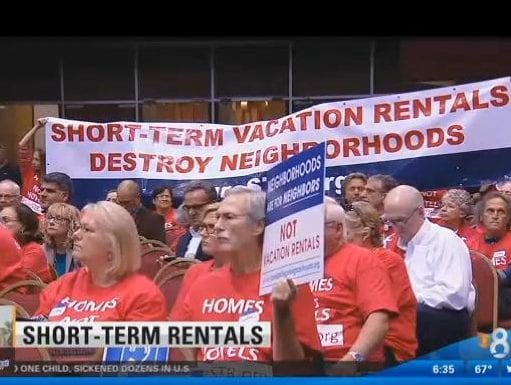
In regulatory battles over vacation rentals, there is a lot of noise about noise. While there are legitimate concerns over issues such as tax compliance, occupancy, trash, and parking; complaints about noise often incite the loudest objections. Yet these grievances are largely anecdotal and lack evidence or data to substantiate their validity, which leaves vacation rental managers and owners with little defense.

“The issue of noise elicits the most emotional and hyperbolized arguments by those opposing short-term rentals,” said Matt Curtis, senior director of global government affairs and public policy for HomeAway. “In city council meetings, vacation rental opponents approach the podium with enthusiastic complaints about perceived parties that may or may not have even occurred. We are not having discussions about noise based on hard data.”

This absence of noise-related data has given city council members and representatives few options when talking to enraged constituents about parties at short-term rental (STR) properties. However, with recent innovations in technology, vacation rental providers now have access to a much-needed monitoring solution to address the issue of noise.


What Is Noise Monitoring?

Until recently, property managers have had a limited set of options to monitor the noise levels at their properties. Typical solutions can be expensive as they utilize human resources rather than technology, e.g., roaming beach walkers and staff drive-bys. While these types of analog noise monitoring methods may have been sufficient in yesteryear, in today’s era of heightened scrutiny and activated anti-STR groups, there is an obvious need for reliable, scalable noise monitoring solutions to address both perceived and real noise issues.

Effective noise monitoring accomplishes the following:

  • Tracks the noise level at rentals in real-time
  • Protects a guest’s privacy by not recording content
  • Provides managers with the ability to customize noise level thresholds, which when breached generates instant notifications directly to staff
  • Keeps the noise level history after the fact, which is helpful information in instances of falsely and legitimately reported noise complaints
  • Integrates into existing management software and smart home control systems
  • Is scalable for portfolios of all sizes


Why Is Noise Monitoring Important?

Noise Monitoring for Vacation RentalsAt the end of the day, noise issues are neighbor and community issues. Without noise monitoring technology in place, managers are reliant on neighbors and police to be their de facto noise monitors. When a manager finds out about their loud, partying guests after the disturbance has already angered neighbors or 911 has been called, then the consequences can be devastating.

No one knows this better than NoiseAware Co-Founder David Krauss. In early 2015, Krauss suffered a loss of over $30,000 from a single noise complaint. David rented his property to a couple who claimed they were in town for a quiet weekend. It was not until two days after the guests checked out that David received a letter from his HOA’s lawyers informing him of the police report generated by his not-so-quiet guests’ “mini-Coachella” party.

Neighbor relations soured badly, and he ultimately sold the property. Determined to protect himself from a repeat nightmare at his remaining short-term rental, David searched online for a noise monitoring solution but found nothing.

“I then teamed up with Andrew Schulz, a brilliant electrical and software engineer, to build a solution to my problem,” said Krauss. “A few months later, we installed the first prototype in my rental property. I quickly realized two things. First, it was a huge relief to be able to remotely verify that it was actually quiet during quiet hours, and secondly, I could finally relax knowing that if a noise violation did occur, the automatic text message alerts would ensure that I was the first to find out, not the last.”


How Noise Issues Affect Regulations

In a growing number of cities, the “noise issue” is cited as the number one driving force behind punitive short-term rental ordinances and bans. In February 2016 in HomeAway’s hometown of Austin, Texas, the Austin City Council voted to ban Type 2 short-term rentals—homes not occupied by the owner. That same month, HomeAway launched its “Stay Neighborly” program, which features a zero tolerance policy for disruptive behavior of short-term home rental owners and travelers.

Carl Shepherd, co-founder of HomeAway, is confident that noise monitoring technology, and the hard data that it creates, will be significant in defending mischaracterizations in the future.

“Anecdotes and stories about ‘party houses’ played a major role in Austin’s fight over short-term rentals,” said Shepherd. “We knew that the anti-STR crowd’s claims were exaggerated and the city’s own records of 311 and 911 complaints showed that. If we could have walked into those public hearings with data showing the anecdotes were false, I know it would have made a difference.”

As part of the Stay Neighborly program, HomeAway has partnered with NoiseAware to perform noise audit studies to collect anonymized noise data from short-term rentals in Charleston, Nashville, and Seattle.

“It is difficult to deny that this is the perfect way to deal with this issue,” said Matt Curtis. “In every one of our conversations, elected officials do not have a principled objection to vacation rentals as an accommodations alternative. In most cases, these representatives regularly use vacation rentals for lodging on their own vacations. We just need, as an industry, to continue to find tools such as NoiseAware that offer real solutions to the concerns their constituents have about short-term rentals.”


Noise Monitoring Is a Long-Term Solution for ShortTerm Rentals

The growing number of short-term rentals in previously residential-only neighborhoods has brought about highly publicized protests, an increase in STR regulations, and in many cases the implementation of rental bans. If the industry can find technology solutions that address hot-button issues of residents in the same way that noise monitoring addresses noise complaints, perhaps the anti-STR tide can be reversed.

Tom Hale, former COO of HomeAway and current NoiseAware advisor takes the long view. “In the last few years at HomeAway, the perception that vacation rentals were riddled with noise issues became a top-tier concern,” said Hale. “Innovative technology like NoiseAware will reorient the conversation to focus on effective solutions, not just perceived problems.”

Hale added, “More critical for the industry in the long run, I expect noise monitoring will become the norm, guests that otherwise may produce noise nuisance issues will adjust behavior, and the use of data—not just anecdotes—will provide objective information to help cities create more sensible and enforceable ordinances.”

By Amy Hinote

Time for an Update: Convincing Owners to Upgrade Home Furnishings and Décor

0

Vacation rental managers (VRMs) are tasked with maximizing rental income for property owners and ensuring a safe and comfortable stay for guests. To accomplish this, VRMs strive to ensure that the décor, furniture, and flooring for each rental property are kept up to date.

“If the property is dated and furnished with worn furniture, bedding, flooring, appliances, light fixtures, cabinets, and counter tops, or is in need of fresh paint inside, there is no amount of cleaning that will convince the customer that a property is worth what they have paid,” wrote Elliott Realty Beach Rentals, based in North Myrtle Beach, in a letter to homeowners. “Often times, poor condition is the cause of customer complaints, not poor cleaning. A poor cleaning can be corrected rather quickly at the beginning of a customer’s stay. Poor condition cannot be corrected as easily or quickly, causing the customer to feel misled and highly disappointed about the property they’ve rented.”

Even though poor customer satisfaction, bad reviews, and lack of repeat stays have a proven negative impact on rental income, convincing owners to update their interior design and furnishings is an ongoing, uphill struggle for vacation rental managers. It is common to get responses from homeowners such as:

  • But we just bought that sofa in 2002.”
  • “The wicker furniture is more beachy!”
  • “We just replaced the mattresses right after Katrina.”

The conversation would be easier if home décor came marked with an expiration date. According to a study sponsored by the website Apartment Therapy, 54 percent of US consumers think furniture should last 20 years or more. While this flawed expectation is surprising enough in a private residence, in a vacation rental environment, it can be damaging to rental income and your company’s reputation.

All furnishings and home décor should be evaluated using at least three factors: safety, cleanliness, and appearance. Let’s look at few items that are frequently debated between managers and homeowners.


Mattresses

Unlike vacation rentals, hotel operators place significant attention on the lifecycle of a mattress to improve guest satisfaction and reduce expenses. Regular flipping of mattresses helps to increase a mattress’s life span. One manager advised, “In May and November, flip them end to end, and in February and August, flip them side to side, but still plan on replacing them every five to eight years or so.”

While flipping, rotating and cleaning mattresses on a regular basis extends the lifespan, ten years is about as long as even a well-maintained mattress can last. As a result, mattresses that were purchased before 2006 are in need of a serious assessment.


Carpet

Most vacation rentals have a mix of flooring in each property, including but not limited to tile, wood, engineered wood, and vinyl; each type and brand has its own recommended longevity.

For example, let’s look at carpet, which is expected to need replacing every five to fifteen years, depending on quality and usage. In the hotel industry, operators often choose carpet over other options for many reasons. Carpets help to limit noise, which is a primary concern in accommodations. In addition, it is cheaper to clean carpets; things break more easily when dropped on hard floor surfaces; gouges in hardwood are far harder to fix than a spot on a carpet; and it is less expensive and time-consuming to replace carpet than other types of flooring. For vacation rentals, replacing flooring is a matter of when, not if, so the ease and cost of changing is a key factor in flooring selections.


Sofas

Who hasn’t encountered a vacation rental marked by a sofa that’s clearly past its prime? If stains cannot be removed, the fabric is torn, the frame is sagging, or the cushions or springs have lost their support, it is time to replace the sofa or sectional. As the center point of living rooms, a sofa is generally the most used piece of furniture so it is best to keep it comfortable and clean. Vacation rental owners should expect to replace their sofa at least every 7 to 15 years.


And more…

A lot of attention is given to mattresses, flooring, and sofas, but other items require ongoing evaluation.

Shower curtain liners: Because they are regularly exposed to water, shower liners are prone to mold and mildew. For this reason, it is best to replace them every four to twelve months.

Pillows: Replacing pillows is also often overlooked. Most knowledgeable hotel industry professionals will tell you that with regular usage and cleaning, pillows should be replaced every two years.

Bath, door, and kitchen mats: These mats endure a lot of wear and tear during each stay, so replacing them every one to two years will keep the space feeling fresh and clean.

Accessories: Like major furnishings, accessories should be assessed based on safety, cleanliness, and appearance. New throw pillows and area rugs go a long way toward freshening the appearance of a rental. When replacing accessories, keep in mind that some home décor items, such as lamps with intricate designs, wall sculptures, and silk plants require more time dusting. In addition, styles and color palettes change in popularity. Comment cards, surveys and reviews often reveal when a vacation rental’s décor is past its prime.


New Technology for Communicating with Homeowners

Communicating interior design needs with homeowners is both challenging and time-consuming, but one vacation rental owner and technology entrepreneur seeks to change that.

Sarah Honaker and her husband purchased a vacation home in northwest Florida that was in dire need of a design overhaul. She quickly discovered that redecorating a rental property from several states away was incredibly difficult as she struggled to keep track of purchase decisions and the total project cost.

“I kept thinking there had to be an app that does this,” said Honaker. But there wasn’t, so she set out to create one. The result is a technology platform called Design Made Easy.

In September, Honaker launched a new tablet application aimed at helping property owners and managers communicate easily when updating and decorating vacation rental properties.

design-made-easy-app-for-vacation-rentalsThe Design Made Easy (DME) app eliminates the need for VRMs to send images via multiple texts or emails with suggested interior design changes to owners. With DME, homeowners have access through the platform to select inventory in categories such as home furniture, decor, accessories, kitchenware, appliances, and flooring. In addition, all communications sent to the vacation rental owner from DME appear from the VRM’s company brand under a private-label approach.

DME’s proprietary, patent-pending suite of tools includes a VRM-branded mobile app with a custom-built company profile and recommended inventory, so that interior design choices are appropriate and add value to the vacation rental. The DME central application tool is designed around projects created for rooms with collections to choose from and connections to share with the vacation rental homeowners for timely collaboration. Each step in the process allows collaboration, tracking of all design choices and costs, and allows vacation rental owners to reach decisions faster by choosing from virtual interior design boards—thus saving time and money.

360 Blue Properties, based in Santa Rosa Beach, Florida, has had success in using the platform. “The application has been very beneficial in assisting owners in how to visualize how different styles of furniture and decor can enhance the interior appearance of their home,” said 360 Blue’s Kim Catellier.

John Martin of Berkshire Hathaway Home Services in Watercolor, Florida also recommends the platform. “The app makes it easy to see rooms with new furniture, paint colors and pricing to redesign,” said Martin. “This tool has been a valuable resource.”

“Having a clear, simple way to communicate and track the costs of interior design projects took hours off the process of decorating our family’s vacation rental, and we want to provide the same capabilities for owners and managers,” said Honaker.

By using advancements in technology, such as Honaker’s DME app, VRMs can streamline the process of communicating design challenges and updates with homeowners.

VRMs know there is frequently a gap between the guests’ and owners’ perceptions of what is considered worn and outdated. Creating a replacement schedule for common items and performing regular evaluations of home décor and furnishings based on safety, cleanliness, and appearance improves customer satisfaction, builds trust with owners, and increase revenues for years to come.

By Amy Hinote, VRM Intel

Social Betrayal: Tips to Ensure Appropriate Social Media Use by Employees 

0

This article was submitted by a coastal vacation rental manager who requested anonymity in order to be able to openly discuss an event that occurred at her company in August.

Need to find a new job that doesn’t require me to listen to people who complain that 75 degrees is hot. Shut the frick up, get in bed with no clothes on. I honestly don’t give a rats ass about any guests anymore. Not after 8pm.

 When I read the words on the screen of my smartphone, I didn’t understand what I was looking at, and I certainly didn’t understand what it had to do with me.

The Facebook post had been forwarded to me by a business colleague. Like the dozens of texts I receive every day, I opened and scanned it quickly, searching for a piece of information or a bit of news, and I was poised to move on.

My friend had written, “I thought you’d want to know.”

Know what? I was puzzled.

I studied the picture next to the words and realized that I was staring at the face of one of my employees. I was looking at a post from her personal Facebook page.

I quickly logged on to Facebook and found her profile page. Our company name and her job title were listed next to her name and picture.

Over the next few days, as I contemplated what to do, I felt angry, shocked, hurt, and vulnerable. I never dreamed that one of our employees would have posted a comment such as this. Most surprising, this employee consistently rated highest on guest reviews, and she had advanced quickly over her three years with our company.

I admit there were days when I wanted to ignore the post and pretend I had never read it. Then I’d reach for my phone and read it again. Each time I read it, I did more research and came closer to a decision.

First, I studied our company’s employee handbook. The social media policy had been written several years earlier and it was broad, but fortunately, it covered the situation:

No employee or relative of an employee may maintain a website, social media site, blog or podcast on any computer, whether COMPANY’S or otherwise, which mentions, comments on, or relates in any manner to the employee’s work at COMPANY or COMPANY itself without obtaining prior approval from COMPANY Management for the website, social media site, blog or podcast. Any Employee who fails to comply with these requirements is subject to disciplinary action up to and including termination.

Our Code of Conduct contained another relevant provision:

The following are examples of behavior and conduct that COMPANY considers inappropriate and which can lead to disciplinary action up to and including termination:

1. Failure to cooperate, assist, and promote teamwork among coworkers, vendors, clients, homeowners, and/or guests.


I discussed the situation with our Human Resources consultant and weighed my options: disciplinary action or termination.

At the same time, I combed the Internet for stories about employees who had violated company social media policies. I found numerous examples:  the elementary school teacher who posted a selfie smoking a joint; the waitress who complained about the tipping habits of specific customers; the sales manager who attacked a political activist with violent, racist tweets; and the travel agent who posted homophobic remarks.

In each case, identities and workplaces were traced and exposed. Employers became embroiled in the negative publicity. All the employees were fired.

I also thought about the costs of exposure, including:

  • Guests would question our commitment to them.
  • Homeowners would lose faith in our company.
  • Undoubtedly, our reputation would suffer.

The harsh consequences of negative social media had already hit close to home. In early June, a major local attraction was the target of a false post about health and safety. The post went viral in three hours with more than 152,000 views. It consumed the time and resources of the business, its parent company, the local medical center, and our tourism officials. The rumors sparked by that one post continue to this day. The attraction’s business plummeted and never recovered.

In mid-June, a diabetic man went wade fishing in the bay. He had an open wound on his leg that was exposed to a naturally occurring, always-present bacteria, Vibrio Vulnificus. The bacteria flourished while he waited four days before seeking treatment, and doctors had to amputate his leg. Relatives called a news station and posted their story online. The headline on July 2: Flesh-Eating Bacteria Causes Leg Amputation. Hotel and vacation rental cancellations skyrocketed, and our area had the slowest holiday weekend in memory. We still get questions about water quality to this day.

Contemplating these events, I realized that I would never trust this employee again. She was unfit to be taking care of guests and homeowners; she was a threat to our reputation in the community; and she was a drag on the morale of other employees. The bottom line was that her post threatened the livelihoods of dozens of employees, hundreds of homeowners, and our numerous vendors.

I hadn’t fired anyone in many years; that task had long ago fallen to our managers, who hired, fired, and supervised employees. But in this case, the offense was deeply personal. This employee’s actions had extended far beyond expressing her frustrations online.

The termination meeting was brief. She acknowledged the post with a shrug. I asked her to delete the post, her job title, and company affiliation, and she did it all in front of me.

I reviewed the company policies that had been violated, and she was indifferent. I knew then that termination was the right decision.

A week later, I was even more certain of my decision when I read her unemployment application:

FIRED. The company said that I broke company policy with a social media post, but I couldn’t find anything in my handbook. I was just writing what I felt about my job that night.


Writing  Your Social Media Policy


  • CHECK: Check your social media policy, and update it if necessary. (I have updated mine, listing more specifics so there is less chance for confusion or misunderstandings.)
  • CREATE:  If you don’t have a social media policy, create one.
  • COMPARE AND RESEARCH:  Discuss your needs with business colleagues, HR professionals, and labor lawyers. There are plenty of good examples online.
  • BE SPECIFIC:  Whom and what should your policy cover? Homeowners? Guests? Employees? Their families? Vendors? Competitors? The company reputation and its services? Company strategy and confidential information? Illegal activities? Incitement to violence? Harassment? Discriminatory remarks about race, religion, nationality, gender, sexual preference, and so on? Obscenities? Are employees allowed to list company affiliation on social media sites? Which ones? (We allow LinkedIn only.)  Will your policy provide a “take-down” provision? If your vacation rental company is also a real estate company, consider the Code of Ethics and state and federal laws.
  • THE BASIC CONCEPT:  A social media policy is about risk management and setting clear policy. It should simply outline easy-to-understand common sense rules for employees.
  • WHY IT’S IMPORTANT:  Employers must take disciplinary action when they learn about posts containing language attacking people for their race, sexual orientation, gender, or religion, according to employment attorneys. If the employee isn’t disciplined or fired, employers run the risk of being sued under federal and state antidiscrimination laws for allowing a hostile environment to exist in their companies.
  • TAKE CARE:  When creating your policy, be careful not to venture into Labor Review Board regulations that allow employees to discuss workplace conditions.
  • REVIEW AGAIN AND AGAIN: Every January, review employee handbooks with all employees and, specifically, discuss social media policies. It’s important that employees fully understand the policy.
  • SIGN AND DATE:  At every annual review, employees should acknowledge in writing that they have received, reviewed, and understand their employee handbooks.


Discussing Your Social Media Policy

  • DON’T DELAY:  Don’t wait for something to happen. Be proactive and meet with your employees as soon as possible.
  • BRANDING VS. ONLINE JOURNALING:  Don’t underestimate the power and importance of these discussions. Many people are used to sharing much of their personal life online, and companies are spending significant resources on online branding and image. There is plenty of room for conflict. (At our meetings, employees relayed their own experiences with social media conflicts—at previous workplaces, their kids’ schools, their churches, within their families, etc.)
  • A REAL THREAT:  Explain that negative social media posts are a direct and very real threat to the company and to everyone whose livelihood is connected to it. Use examples.
  • ZERO TOLERANCE:  Let everyone know that offensive/negative posts will not be tolerated.
  • SOCIAL MEDIA LITERACY:  Individual exposure to social media platforms varies widely. Stress that Facebook, Twitter, Instagram, Pinterest, SnapChat, LinkedIn, personal websites, and blogs, as well as Yelp and Google reviews, must be managed and used with care. Your employees can help fill in the gaps and drive the discussion.
  • PRIVACY:  Explain that there is no privacy on the Internet. Identities are easily traced via names, nicknames, e-mail addresses, relatives’ names, photo tags, face recognition software, phone numbers, reverse phone number searches, workplace identifiers, simple Google searches, organization and club memberships, and through the social media accounts of friends, coworkers, and relatives, to name a few.
  • PERMANENCY:  Talk about the fact that once something is posted, it stays, and it attracts comments and attention. Screen shots ensure that a post lives on long after it has been deleted.
  • EMPLOYEE RESPONSIBILITY:  Tell employees that to comment on an offensive post is to condone it, and ask them to report violations they see. Stress confidentiality.
  • NEW EMPLOYEES:  Discuss your social media policy in orientation. Don’t assume that new employees will read and understand the policy.
  • CONSISTENCY: Year-round communication and consistent enforcement of the social media policies will avoid claims that employees were unaware of the policies.
  • VIOLATIONS:  If the policy is violated, take action as quickly as possible.
  • CONSULT:  If there is a violation, your HR professional or company lawyer will guide and advise you about the right steps, the correct words to use, and which actions to take, all of which will protect your company.

Vacasa Acquires 5 More Vacation Rental Companies and Expands to Costa Rica

0

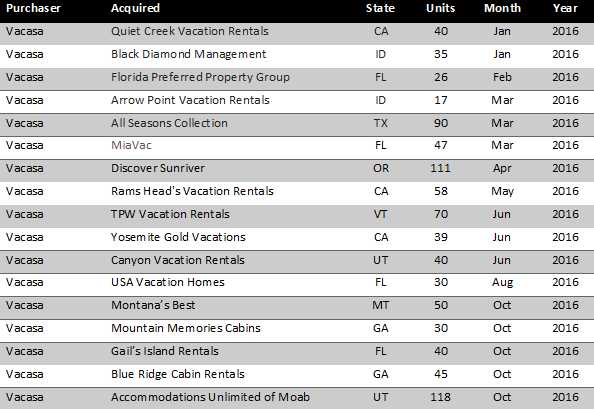
Vacasa recently announced the acquisition of five vacation rental management companies including: Accommodations Unlimited of Moab in Moab, Utah; Montana’s Best in Whitefish, Montana; Mountain Memories Cabins in Ellijay, Georgia; Gail’s Island Rentals in Key Colony Beach, Florida; and Blue Ridge Cabin Rentals in Helen, Georgia.

In addition, Vacasa announced its expansion into Costa Rica with the hiring of Lisle Head as Costa Rica country manager. Head has been a vacation rental consultant in Costa Rica for the past four years. Before that, he owned a Coldwell Banker franchise, which was named number one in the country for three years in a row. Since launching in the country, the local team has already signed 23 homes in Jacó. This is their fifth international destination after Italy, Spain, Belize and Chile.

The recent expansion brings the company’s total home count under management to more than 4,000, and it is currently the second largest vacation rental management company in the U.S. behind Wyndham Vacation Rentals.

According to Montana’s Best owner Adam Mercer, technology is what made his decision to sell the business.

“Vacasa has built what I believe to be the most dynamic technological infrastructure in the vacation rental industry to date, and that’s really what made me decide to work with them,” says Mercer, who has owned Montana’s Best since 2012. “Having this technology available in-house means that our homeowners are provided the most lucrative opportunities for renting their homes, without sacrificing the excellent local care they’ve come to expect.”

Vacasa began aggressive expansion in 2015. Following a recent injection of $35 million in Series A funding, Vacasa CEO Eric Breon announced that the company would use the additional capital to continue pursuing increased market share in every vacation market in the world, with the ultimate goal of ubiquity.


2016 Vacasa Acquisitions of Vacation Rental Management Companies

2016-vacasa-acquisitions-of-vacation-rental-management-companies

Expedia Execs Discuss HomeAway Performance

0

Last week, as part of its Q3 2016 earnings call, Expedia CEO Dara Khosrowshahi and CFO Mark Okerstrom provided an update on HomeAway’s recent activity.

“Our listing count continues to increase at close to 20%,” said CEO Dara Khosrowshahi. “So the engagement of the supplier communities, so to speak, within the HomeAway marketplace continues to be very healthy. So we’re pretty happy to see that.”

Mark Okerstrom added, “In terms of owners and managers adopting online bookings and online payments, listen, we’re really happy with what we’re seeing so far. We’ve got now nicely north of 1 million properties who are signed up and online bookable.”

dara-khosrowshahi-and-mark-okerstrom-talk-about-homeaway-resultsHere are 10 key takeaways related to HomeAway’s performance.

  • Q3 Revenue Growth
  • Increase in Number of Listings
  • New HomeAway CEO: John Kim
  • The Impact of the Traveler Fee
  • Subscription Revenue to Drop as Transactional Revenue Increases
  • Integrating HomeAway Inventory onto the Expedia Platform
  • Online Booking
  • On the Competition (and it is not TripAdvisor)
  • Drop in Google Free and Paid Search
  • Looking to the Future


1. Q3 HomeAway Revenue Growth

Mark D. Okerstrom: On a standalone basis, HomeAway revenue grew 61% and adjusted EBITDA grew 85% in Q3. We were quite pleased with these results and as such continue ramping up investments in selling and marketing and in product and technology as we move forward into 2017. Looking forward, these investments combined with the phasing out of tiered subscription fees and lapping the rollout of the consumer fee next year will result in slower adjusted EBITDA growth for HomeAway beginning in Q4 compared to what you saw here in Q3. Progress to date combined with the investments we are making give us continued confidence in our ability to deliver our targeted $350 million of adjusted EBITDA at HomeAway in 2018.


2. Increase in Number of Listings

Dara Khosrowshahi: Our listing count continues to increase at close to 20%. So the engagement of the supplier communities, so to speak, within the HomeAway marketplace continues to be very healthy. So we’re pretty happy to see that.


3. New HomeAway President: John Kim

Dara Khosrowshahi: A special thanks to co-founder, Brian Sharples, who recently stepped away from his role as CEO, while remaining chairman of HomeAway to continue to help us navigate through a complex transformation. Brian and team created a terrific company that we plan to build on with long-time Expedia executive, John Kim, who has been at HomeAway since early 2016, now stepping into the role of company president. We’re focused on hitting our long-term growth goals, while aggressively ramping up our investment in product, technology, marketing and customer service to build a very best marketplace for homeowners, property managers and travelers alike. And though we’re pleased with the progress, we’re still early in HomeAway’s transition into scale global leader in the alternative accommodation market.


4. The Impact of the Traveler Fee

Dara Khosrowshahi: As far as HomeAway goes, the transactional revenue has been very strong in Q3 as we’ve rolled it out on a global basis and as the teams now are optimizing much more aggressively on the conversion front. And so while the transactional fee initially caused a dip in conversion, the teams there are really building out their e-commerce capabilities and muscles, and conversion is a very nice positive factor for us.


5. Subscription Revenue to Drop as Transactional Revenue Increases

Dara Khosrowshahi: I think that as you move into Q4 and especially next year, you’re going to see some of the subscription premium revenue that we have stopped selling start coming down. So the transactional revenue essentially has to scale up faster in order to make up for some of the subscription revenue growth coming down. It’s something that we expected.

…Generally the subscription renewals are spread throughout the year. As a reminder, we basically eliminated the tiers last quarter, the beginning of last quarter; grandfathered in a number of the premium players. And those subscriptions that were at premium will essentially start rolling off here on a go-forward basis. And once they roll off, they will either reset at the close to $500 per year subscription or the lower price we’ve set for online bookable properties. And so you’ll essentially see the subscription revenue start to become a more negative headwind as we move through Q4, and then Q1 and Q2, and then you’ll really start to annualize it in Q3 of next year.

Mark D. Okerstrom: I absolutely meant to say that top line growth rates will slow down from this point forward. And really the driver here, particularly in Q4, is that the subscription revenue will start to be a drag as essentially the monetization model shifts over to either pay per booking or online booking fees and also as we start to roll off some of the premium tiered subscription revenue. And then there will be additional factors that will kick in towards the end of Q1 and then again at the end of Q2 of next year as we lap over the booking fee implementation that we had this year.


6. Integrating HomeAway Inventory onto the Expedia Platform

Dara Khosrowshahi: The engineering teams are hard at work doing it. As a reminder, we have tested with HomeAway previously. There’s a vacation rental tab on Expedia, for example, now, but that wasn’t a full integration. That was essentially a link off into HomeAway search results. And what we are talking about is a much more fundamental integrated experience where someone who comes to an Expedia or Hotels.com and is searching for hotels, depending on length of stay, depending on weekday, weekend, et cetera, they are going to get a complementary mix of hotel search results and/or vacation rental results based on a number of different presentations and logic. We expect to be piloting that experience sometime in Q4, and based on the results of those pilots, I think we will be making it a bigger part of our experience late this year and certainly going to next year.

And I think it’s a great benefit both for Expedia and Hotels.com consumers because they’re going to get more breadth and depth of inventory in market, especially in some of the markets where HomeAway is very strong. And then I think for HomeAway, our partner is there, the homeowners, the property managers, they are going to get a significant boost of demand from these terrific travel brands, especially in urban destinations. So we think it’s a win for the consumer, and it’s a win for our marketplace, and we’re pretty excited about the potential here.


7. Online Booking and Online Payments  

Mark D. Okerstrom: We’re not going to disclose the online gross bookings number at this point. It is something we were thinking about disclosing in the future. We’re not going to disclose it at this point. I will tell you that booked transactional revenue for the quarter was up north of 250% year over year. Again, it’s pretty easy comps. So that’s the number. And on a sales basis as opposed to recognized revenue, subscription revenues started to decline double digits. So I would expect that to continue and accelerate a bit as we move here into 2017.

Mark D. Okerstrom: To be honest, we’re not too focused on looking at what the total platform derived bookings are at this point. What we’re very focused on is taking the booking number that is actually happening on platform and growing it as fast as we possibly can. To do that, of course we’re getting properties online and we’re now well over a million properties that are online bookable. Then we’re very much focused next on making sure that the online bookable listings are actually driving transactions on the platform as opposed to off the platform. And so far, results have been very good. Conversion rates are up pretty nicely year over year. Progress is pretty good.

Mark D. Okerstrom: In terms of owners and managers adopting online bookings and online payments, listen, we’re really happy with what we’re seeing so far. We’ve got now nicely north of 1 million properties who are signed up and online bookable. A lot of them are taking advantage of the online payment platform that we’ve got. We’re actually looking at ways that we can possibly leverage some of the payments capabilities that we have here at the mothership of Expedia, Inc., which could potentially add some more different payment options than they’re offering right now. So, so far we’re happy with the traction. Again, it’s still early and there’s lots of work to do, but so far so good.


8. On the Competition (and it is not TripAdvisor)

Dara Khosrowshahi: And I think I just want to make sure that our investors understand the perspective that there are two big players in this space, and arguably a third coming with Booking.com and their activity. But the big player, Airbnb, has a private market cap of over $30 billion. And so we see this HomeAway opportunity as a very, very large opportunity, and we are going to invest behind it as that kind of an opportunity. This is not an incremental project for us. This is a big project for us.


9. Performance in Google Free and Paid Search

Dara Khosrowshahi: Traffic continues to build, although Google free search continues to be weak. But on balance, we like what we’re seeing, and you see it in the results.

Also note that as we integrate the HomeAway inventory into Expedia and Hotels.com, Expedia and Hotels.com and Orbitz and Travelocity will also be able to bid more effectively for the vacation rental keywords as well. Who will be the winner, will it be more efficient for HomeAway to bid on those keywords or Hotels.com, that remains to be seen, and we will be testing and learning our way there. But I think it will be a bigger factor next year versus any time in the next couple of quarters.


10. Looking to the Future

Dara Khosrowshahi: And then of course some of the investments that we’re making in marketing and technology, et cetera, are also going to show. So I think the team on HomeAway likes where we are, but we know that we’ve got a big lift ahead of us and the slope is going to get a little tougher, but I think the teams are up for it.

Mark D. Okerstrom: 2017 I will just tell you is not a year where we will be as focused on adjusted EBITDA growth as we are in just building the capability, and that’s for HomeAway specifically. And we expect that once we build up particularly the product and tech team to where the size we want it to be, we’ll be able to leverage that nicely as revenue growth and ultimately marketing contribution growth continues into 2018. And again, we feel very comfortable with our $350 million adjusted EBITDA number for 2018, but the path there will be one of investment in 2017 and realization in 2018 from a bottom line perspective.

Delta Adds Airbnb to SkyMiles Rewards Program

0

Delta Airlines and Airbnb announced a partnership that grants bonus miles through its SkyMiles rewards program to guests and new hosts who use the Airbnb marketplace. For travelers, Delta’s SkyMiles members who are existing Airbnb guests can earn 1 mile per $1 (US dollars or its foreign equivalent) spent on all Airbnb stays all over the world. In addition, SkyMiles members who open an account on Airbnb could get a $25 credit off their first qualifying Airbnb stay, 1 mile per $1 spent on qualifying stays, and up to 1,000 bonus miles for a first stay (total of at least $50). These offers are only valid when booked through deltaairbnb.com, the partnership portal website created for SkyMiles members.

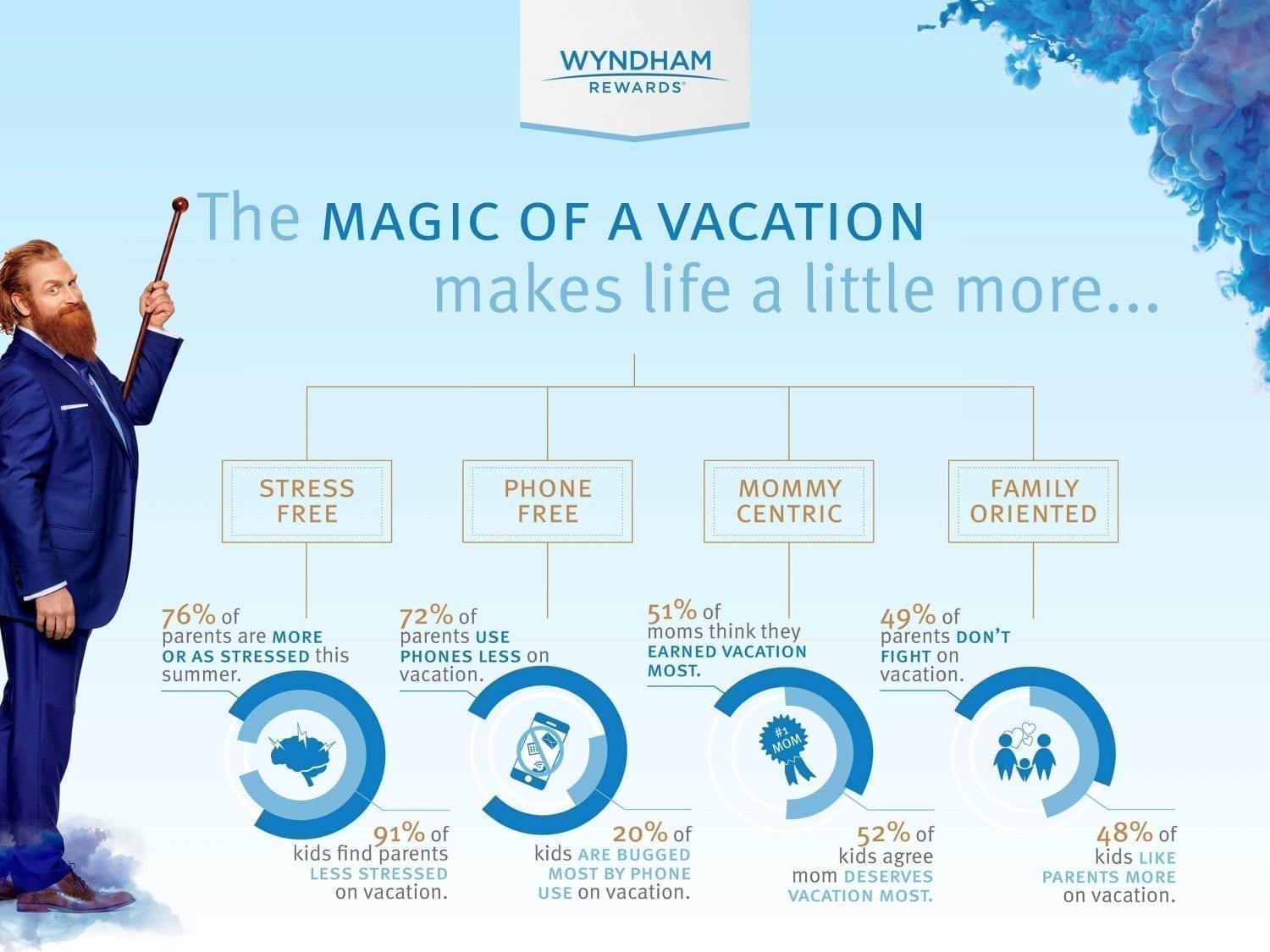
The news came just days after Wyndham’s announcement that it is expanding the Wyndham Rewards program to include its vacation rental inventory.  Both Delta and Wyndham cited the traveler’s desire to choose private home accommodations for vacations as a motivating factor for adding short term rentals, the fastest growing sector of travel, to their rewards program offerings.

However, the Delta-Airbnb partnership is unique in that, in addition to granting members bonus miles based on stays, Delta is also issuing rewards to hosts who sign up to rent their home through Airbnb.

To qualify for the Airbnb/Delta Host Offer, Hosts may receive up to 25,000 bonus miles by earning Host Earnings. The offer is valid only for new Airbnb Hosts. New Airbnb Hosts must:

  • Create a New Listing
  • Click “List Your Space” after navigating from deltaairbnb.com to airbnb.com
  • Complete the Verified ID process
  • Accept and complete reservation(s) in order to reach the following earn thresholds to receive up to 25,000 bonus miles.

A New Listing must be new and not previously activated or duplicated from another Airbnb listing, and it must be associated with a Host who has never hosted on Airbnb previously. Airbnb Host Offer expires October 31, 2017.

“This industry leading partnership enables us to provide a unique benefit to our SkyMiles members, enabling us to reward them for their lifestyle choices through the SkyMiles loyalty program.” said Sandeep Dube, Delta Vice President – Customer Engagement & Loyalty. “This partnership brings together two innovative brands focused on delivering superior travel experiences across the globe to customers.”

“We are excited to partner with Delta and offer their travelers the opportunity to earn Delta miles when staying and hosting on Airbnb, while creating memorable moments with friends and family,” said Lex Bayer, Head of Business Development, Airbnb. “SkyMiles members can now enjoy the additional benefits of living like a local with authentic travel experiences on Airbnb in all global destinations that Delta services.”

All SkyMiles Members can earn miles with Airbnb by booking directly through delta.com/airbnb. Customers who are not already enrolled in the SkyMiles program can sign up for free through the partner page or delta.com/enroll to become eligible.

Beyond the partnership, Airbnb has signed Delta as one of its preferred airline suppliers to transport its employees travelling on company business. Additionally, Delta has signed on to be the exclusive airline sponsor of the annual Airbnb Open event, held in Los Angeles, beginning on Nov. 17. As an event partner, Delta is providing exclusive airfare discounts for thousands of global attendees and hosting a branded lounge space.

Wyndham Rewards Expands Loyalty Program to Include More Than 17,000 Vacation Rental Properties

0

Recognizing guests’ needs to travel differently from trip to trip, Wyndham Rewards unveiled plans to expand its award-winning program across one of the world’s largest hospitality companies, Wyndham Worldwide, starting with the immediate addition of more than 17,000 condos and homes to the program’s nearly 8,000 hotel redemption portfolio.

The move is an industry-first both in terms of scale and global impact. With more than 120,000 properties across 100 countries spanning hotels, vacation ownership and professionally managed vacation rentals, Wyndham Worldwide offers travelers something no other provider can: the opportunity to experience travel the way they want regardless of location or type of accommodation. Now, Wyndham Rewards members can enjoy the unique and authentic vacation experience that comes from staying in a private accommodation – from a stone cottage nestled near Bordeaux & Toulouse in France; to a slope-side retreat in Park City, Utah; to an architectural dream home in Palm Springs, Calif.

“Hotel goers have long been rewarded for their loyalty, it’s time for guests of vacation ownership and vacation rentals to be rewarded too,” said Wyndham Rewards head of loyalty Noah Brodsky. “We’re changing the game and doing so with unprecedented scale. Wyndham Worldwide is like no other hospitality company in the world, and with this expansion, we’re complementing our hotel portfolio by giving members access to some of our most aspirational vacation ownership and vacation rental properties.”

Wyndham Rewards members can now choose from 25,000 hotels, condos and vacation homes around the world to redeem their hard-earned points for a free night by visiting www.WyndhamRewards.com/RedeemA free night at any Wyndham Rewards hotel can be redeemed for just 15,000 points, while a free night across the new 17,000 options in the portfolio can be redeemed for just 15,000 points per bedroom, per night.

Added Brodsky, “This is a monumental, industry-defining shift for Wyndham Rewards. We know our members stay longer and they spend more. And now, with more redemption options than five of our biggest competitors combined, we’re opening a world of new experiences for members, giving them the ability to travel where and how they want based on their individual needs. This is about unlocking the full potential of Wyndham Rewards while providing unparalleled value to our members, owners, and partners alike.”

Over the course of the next two years, Wyndham Rewards will continue adding properties from the Wyndham Worldwide portfolio while also incorporating the ability for members to earn points on condo and home stays. The ability to earn points on stays is expected to be available as early as summer of 2017 on the initial 17,000 condos and homes and new options will be gradually added as new properties come online. The program anticipates integration across the majority of Wyndham Worldwide’s hotel, vacation ownership and vacation rental portfolio by the end of 2018.

The Fall Issue of VRM Intel Magazine is Here!

0

subscribe-to-vrm-intel-magazineThe 2016 VRM Intel Fall issue is officially in the mail and heading your way. With over 30 original articles, this magazine includes our exclusive interview with Phocuswright’s Douglas Quinby, and examination of the market share between Airbnb and HomeAway, and the VRM Intel Best VRM Websites Awards, Also, there are some amazing articles written by Vince Perez, Claire Reiswerg, Heather Weiermann, Sue Jones, Doug Kennedy, Ben Edwards, Steve Craig, Josh Guerra, Matt Curtis, Dan Rourke, and more.
If you are a U.S. resident and are not already receiving this publication in the mail, sign up below and we will mail you a copy. For non-U.S. residents, we will send the digital issue.

Enjoy!

Company Logo

Join our email and mailing list for the latest vacation rental news


My Information:

I wish to receive:
(VRM Intel Magazine in only available in the US and requires Mailing Address to be completed above)
I am:

LiveRez Adds Integration to 3rd Party Channels

0

LiveRez.com, the most widely used cloud-based software for professional vacation rental managers, announced this past week at its annual Partner Conference that it is developing a revolutionary new channel management system for professional vacation rental managers.

The system includes an internal marketing network that will allow professional managers using LiveRez to advertise their inventory on other managers’ websites, create regional co-op listing sites and refer bookings to other partners. This will allow properties to be marketed exponentially across the entire network, which at this time includes more than 1,000 websites.

“Our new channel manager is designed to put control back into the hands of professional managers,” said LiveRez CEO Tracy Lotz. “It not only allows our property manager partners to work together, but also allows us to use the negotiating power of the entire network to ensure fair distribution agreements with listing sites. Nothing like this has ever been seen before in this industry.”

As part of the announcement, LiveRez said it would begin to allow third-party listing sites to build into its API, provided they agreed to certain guidelines put in place to protect the interests of professional managers.

“Leveraging the entire network of partners enables us to lock arms and get third-party sites to commit to policies that protect professional managers and their brands,” Lotz said.

To date, the only listing site to forge a distribution agreement with LiveRez has been Airbnb, which chose LiveRez as its first North American software integration partner last year. Before forging that partnership, LiveRez worked with Airbnb to create policies geared to professional vacation rental managers, and Airbnb was quick to respond.

Lotz said additional listing sites will need to agree to make similar changes if they plan to build into LiveRez’s API.

“The professional property manager must be protected and have complete control if we are going to allow access into our API,” Lotz explained.

Company leaders said partner feedback and the lack of quality independent channel management systems in the industry both factored highly into the decision to build its channel management system.

In 2012, LiveRez’s Chief Strategy Officer, Steve Trover, led the charge to develop an industry-controlled distribution network during his tenure as President of the Vacation Rental Managers Association (VRMA). LiveRez staunchly supported the “Switch” project until it was killed in 2013 after the contract between hotel distribution company Pegasus and VRMA was terminated.

“Building an avenue for professional managers to fairly distribute their inventory to listing sites has been incredibly important to me,” Trover said. “Although we couldn’t get it built at VRMA, we will absolutely get it done at LiveRez.”

Third-party listing sites that are interested in integrating with LiveRez can email the company at Channels@LiveRez.com.


About LiveRez.com

LiveRez.com is a complete online vacation rental property management solution that is focused on making vacation rental property managers fully operational online which thereby increases their bookings. LiveRez.com offers an all-in-one cloud-based platform featuring best-in-class websites optimized for online bookings, a full-featured reservation and property management system, a robust CRM system, an exclusive connection to QuickBooks for trust accounting and a unique “Pay-for-Performance” approach which provides a mutually beneficial partnership between LiveRez.com and its vacation rental manager partners.

To learn more about LiveRez.com, please call (800) 343-2891 or visit LiveRez.com. And, to receive timely updates from the company, follow LiveRez.com on Facebook, Twitter (@LiveRez) and Google+, or visit the company’s vacation rental software blog. LiveRez.com is a proud Gold Sponsor of the Vacation Rental Manager’s Association (VRMA).

Phocuswright’s Douglas Quinby Discusses Recent Research on Vacation Rental Industry with VRM Intel

1

By Amy Hinote –One in three leisure travelers has stayed in a private accommodation in the last year, up from one in ten in 2011, and almost 40 percent of those travelers booked online, up from 12 percent in 2008. We know this—and much more—about the vacation rental industry because of the research being conducted by Douglas Quinby and his team at Phocuswright, the travel industry’s research authority on how travelers, suppliers, and intermediaries connect.

Prior to joining Phocuswright, Quinby, senior vice president of research, led his own firm, which provided strategic research, communications, and marketing services to travel technology companies. Shortly after he joined Phocuswright in 2004, he began examining the vacation rental industry.

“We did a short analysis in 2004–2005 when HomeAway began rolling up URLs,” Quinby said. “At the time, there were a bunch of startups besides HomeAway, including LeisureLink and Zonder, who were working towards facilitating online booking on aggregated marketplaces.”

Phocuswright’s research in the vacation rental industry began to take shape in 2008 with its landmark study, Phocuswright’s Vacation Rental Marketplace: Poised for Change, which revealed the size and scope of the sector. Consequently, investment capital poured in, building up HomeAway, Airbnb, OneFineStay, HouseTrip, Zonder, Tripping, and more. Phocuswright’s follow-up study, U.S. Vacation Rentals 20092014, shed even more light on the industry as a $23 billion market with an online booking rate that had doubled in just a few years.
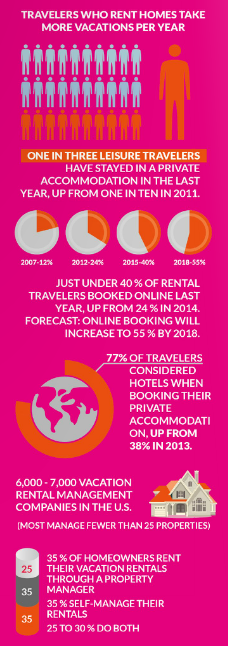
vacation-rental-industry-statsQuinby and his Phocuswright team have continued qualitative and quantitative research on the vacation rental industry, which has helped the broader travel market to segment and size the market and forecast consumer behavior in this high-growth and rapidly evolving segment of the travel industry.

Over the summer, VRM Intel partnered with Phocuswright to conduct a survey of businesses that manage vacation homes, condos, and other short-term rentals for travelers. This fall, Phocuswright published Phocuswright’s A Market Transformed: Private Accommodations in the U.S., which takes a 360-degree look at the current state of private accommodation rentals in the U.S.

I had the opportunity to interview Quinby to find out more about the growth in the vacation rental industry, his findings from Phocuswright’s most recent study, and what he expects to see in the category in the coming years.


AH: Phocuswright is now using the term “private accommodations” in its recent research instead of “vacation rentals” or “short-term rentals.” What does that term include?

DQ: For us, a private accommodation is any type of rental where the renter is staying for travel purposes, and it includes vacation rentals, new-generation rentals, and shared spaces.


AH: Since you’ve been researching the industry, there has been a huge shift in investment and interest from Wall Street and the broader travel industry. What is driving the escalation?

DQ: The industry has gone from one in ten travelers staying in private accommodations in 2011, to one in three in 2016. This kind of growth in a vertical category is unprecedented. To have a category explode like this into the marketplace and into the traveler consciousness is significant. Also, the big OTAs are under threat from hotels increasing their direct bookings and from enormous shareholder pressure to continue to grow, and they are looking for the next big, new category to drive that growth. The category has arrived. For years, it had been framed as “alternative accommodations,” but we are now at the end of that era. These “alternative accommodations” are no longer a nontraditional category. We are seeing the mainstreaming of private accommodations.


AH: From your perspective, what have been the major milestones or turning points that have shaped the industry?

DQ: There is no doubt that HomeAway played a huge role in the development of the space. HomeAway brought profound disruption to the industry. By nailing down “shopping and discovery,” HomeAway took us to a place where they successfully aggregated supply and demand. As a result, property managers found themselves having to compete with homeowners, putting downward pressure on management commissions. This also forced property managers to up their game—by making properties more attractive to online consumers and to become more engaged with owners and guests.

While HomeAway had a soft approach to supply with a subscription model, Airbnb had online booking baked in from the beginning because that is what consumers want, just like they want reviews. When it came to online booking and traveler reviews, HomeAway fell behind. Airbnb showed us that online booking does work.


AH: Comparing HomeAway’s performance with Airbnb’s performance in the professionally managed space, which company seems to have the advantage?

DQ: In terms of sites used, HomeAway.com and the HomeAway family of sites are far and away the most important for property managers. The vast majority list on HomeAway, but Airbnb has grown quite significantly. If you speak to the Airbnb guys, they did not consider traditional vacation rental accommodations to be part of their core business. They were supplemental to their core business, which was urban supply. They came later to vacation rentals as an obvious area of growth and revenue.  In our most recent research, we found that the percentage of property managers listing on Airbnb increased from 7 percent in 2012 to 47 percent in 2016. The overall impact of Airbnb has been incredibly positive.


AH: We’ve heard reports from property managers that Airbnb’s approach is hurting the industry, especially with its impact on regulations. Are you seeing any resistance from property managers in listing their vacation homes on Airbnb?

DQ: In the course of the study we are doing, we are not seeing that as a big issue, and I think that reflects the maturation of the industry over the last decade. There is a realization by property managers that there are other models that are here to stay, and they need to adapt. And there is a recognition by the industry that these changes are going to come. Any animosity towards Airbnb is being driven by the hotel associations and by residents in certain communities.


AH: As you know, HomeAway and TripAdvisor recently adopted Airbnb’s revenue model by adding a traveler/service fee for bookings. In a recent interview with VRM Intel, Booking.com’s David Mau said that this model is not sustainable. In your view, is the shift to this revenue model of having a consumer fee sustainable?

DQ: I think it is still early days for the debate over the business model because there is still enough disparity of supply among the channels, so there is not as much of an issue. It may become more of an issue as there is increasingly more overlap across the major channels.

We did see in the latest study that, among property managers, one in three are seeing and forecasting a drop in rentals from listing sites like HomeAway and VRBO, and we attribute that to the change in the business model. That being said, half of property managers are reporting that their business from third-party online channels is growing.


AH: Is there room for another player in the OTA/intermediary space?

DQ: There is always room for great product and innovation, and there is always room for creating something customers want. There has been significant consolidation, and two online giants—Expedia and Priceline—have what many consider to be a duopoly. But then three guys without a lick of travel industry experience got together to create Airbnb, a company that is now the third-largest online seller of accommodations worldwide and is probably the fourth-largest online travel intermediary by gross bookings. So who says you can’t build an online travel company today? It doesn’t mean it is going to be easy, and it is going to require rolling up the sleeves, but it can certainly be done.


AH: With the increase in the number of new travelers choosing private accommodations, are you seeing customers having higher hotel-like expectations for their accommodations?

DQ: It really hasn’t been an issue. When travelers want a hotel experience, they stay in a hotel. Even with the influx of new rental travelers, guest satisfaction has remained consistent. However, it does favor the RBO side slightly over property managers. While travelers who stay in professionally managed rentals say they have access to more services, those who stay in owner-managed rentals report higher levels of guest satisfaction, driven by increased interaction with the host or owner.

Airbnb is the most standout example of this, as they have made the host the linchpin in selling of the property. The traveler is not just buying the place; they are buying the host. Property managers that are moving to a virtually managed experience with no interaction with the guest may want to reconsider by finding opportunities for personalization. If you are not interacting personally with guests, you might want to consider finding ways to make guests feel welcome. Personalized interaction does have a positive impact on guest satisfaction.


AH: What trends are you seeing in the homeowners’ decision to self-manage their vacation rentals or work with a professional property manager?

DQ: Owners who self-manage, we see, start out managing their rental by themselves, and after one or two years, they realize the time and expense, and they start to work with professionals.

We estimate that there are between 6,000 and 7,000 vacation rental management companies in the US, and most manage fewer than 25 properties. 35 percent of homeowners rent their vacation rentals through a property manager, 35 percent self-manage their rentals, and 25 to 30 percent do both.

There is a full spectrum of services needed to manage a vacation rental, and homeowners choose a service level that falls somewhere along that spectrum. The RBO versus PM debate is so five years ago. There is no more “us and them.” Technology has broken all of that down, so that now property managers are competing on service. Looking forward, property managers should ask themselves if they are offering all of the services that their competitors are offering, including both homeowners and other property managers.


AH: Looking ahead over the next two years, what do you predict will cause the biggest shift in the marketplace?

DQ: There has been substantial growth in online booking, which we expect to increase from just under 40 percent this year to 55 percent by 2018, being propelled by growth at Airbnb, changes at HomeAway, and adoption by property managers. But the big shift we are forecasting in the market is the increase in the number of bookings going through intermediaries. Rental sites and travel agencies will account for 70 percent of online bookings by 2018.


Phocuswright’s A Market Transformed: Private Accommodations in the U.S. can be purchased on the company’s website. Douglas Quinby will be speaking at the VRMA National Conference in Chandler, Arizona, on October 19, at the ARDA Fall Conference on November 11 in Washington D.C., at the Phocuswright Conference, held November 14–17 in Los Angeles, and at the Airbnb Open in Los Angeles on November 18-21.

VRM Intel Magazine’s Best VRM Websites of 2016

1

We are excited to announce the winners of VRM Intel’s Best Vacation Rental Management Websites of 2016. With more than three dozen entries, the competition was intense, and the bar was set high. This year, we increased the judging criteria from 20 to 34 factors, including categories in design, on-site search functionality, property display, booking paths, area information, search engine ranking, site errors, speed, and lead generation.

All of the Websites submitted were launched in the last 12 months, and their quality is outstanding: all entries have a responsive design, large home page images, and simple online booking paths. In addition, most have a detailed refined search option and professional photographs of their rentals.

Many of this year’s entries have followed some of the best practices being utilized by major online travel agencies (OTAs) and have included a map view in their search results, the ability to search with flexible dates, and urgency marketing techniques.

At VRM Intel, we want to congratulate all of the vacation rental managers who submitted sites this year. The level of professionalism in design and functionality is a testament to the commitment of both the management companies and their developers and evidence of a maturing industry.

And the winner is…


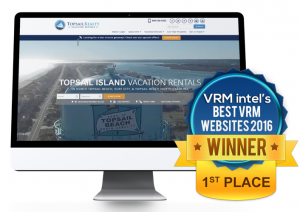
1st Place: vrm-intel-magazine-best-website-1st-place-topsail-realtyTopsail Realty Vacations 

Topsail Beach, North Carolina

Developed by ICND

Topsail Realty Vacations met all the major judging criteria with flying colors. The overall design is incredibly sharp and has a heavy focus on e-commerce with an Airbnb-type feel that also markets the destination and vacation lifestyle. The smart calendars and responsive design functionality perform well on tablets and other mobile devices, and professional photos, well-written descriptions, and an easy-to-understand rate table help to communicate trust and credibility.

In addition, the Topsail Realty Vacations Website contains additional features that moved its ranking from great to exceptional. The site has urgency marketing calls to action, video tours, a split-payment option, a unique designation for properties that offer specials, and an attractive lead capture form that appears when the user is trying to exit the booking path. The ability to search for monthly rentals along with well-designed and well-written owner acquisition pages also stood out in their overall score.

There is also a feature on the site’s property listing pages that allows visitors to submit a question about the property that subsequently creates a consumer-facing FAQ knowledge base for each home. In short, Topsail Realty Vacations got it right.


2nd Place: Island Realty

vrm-intel-best-websites-2016www.islandrealty.com

Isle of Palms, South Carolina

Developed by Bluetent, Island Realty’s unique Website design is as attractive as it is functional. Its flexible arrival option in the search process and smart calendars prevent selecting dates under its minimum stay requirement. Island Realty also offers live chat to visitors and urgency marketing messages to encourage booking decisions.

In addition, the layout of the property pages scored incredibly high in usability and design. The property photo slider contains full-screen, professional images that communicate expertise and trust, and its one-screen display of property information follows the proven design of the large OTAs. Detailed reviews contribute to providing an easy decision-making path for guests. Island Realty also offers online add-ons, including golf, fishing, and beach equipment rentals.


3rd Place: Vacation Homes of Hilton Head

vrm-intel-best-websites-2016-hilton-headwww.vacationhomesofhiltonhead.com

Hilton Head, South Carolina

Vacation Homes of Hilton Head launched a beautiful site this year, but beyond its clean design, the Website contains a bundle of added features, including videos, floor plans, professional photography, and push-to-chat/talk functionality. Its responsive design, developed by Bluetent, scored exceptionally well in mobile usability as well as other technical criteria. Vacation Homes of Hilton Head also paid attention to the lead photos that display in the search results, making each property more likely to be selected.

In addition, Vacation Homes of Hilton Head does an extraordinary job of marketing the destination and using site real estate to partner with area businesses, establishing itself as a trusted source of destination information.


4th Place: Jackson Hole Resort Lodging

best-vacation-rental-management-websites-jackson-hole-resort-lodgingwww.jhrl.com

Teton Village, Wyoming

Jackson Hole Resort Lodging’s new Website, developed by Bluetent, has a destination-focused design, high usability scores across devices, and a ton of bells and whistles, including site search, webcams, and page translation options for international visitors.

The property pages have well-written descriptions, mostly large professional photographs, and a simplified rate table. The Website also has an enormous amount of area information and add-on options that give guests the ability to purchase lift tickets and packages to plan their entire vacation.


5th Place: Oregon Beach Vacations 

vrm-intel-best-websites-2016-oregon-beach-vacationswww.oregonbeachvacations.com

Seaside and Lincoln City, Oregon

Developed by ICND, the Oregon Beach Vacations Website scored very high in technical categories with a fast, highly functional, responsive design that performs well on smartphones and tablets. Its search process contains urgency marketing calls to action, easy-to-navigate mapping, and detailed refine search options.

Its property pages have an easy-to-navigate, one-page format, a simple rate display, easy social sharing, and the same open Q&A functionality also seen in other ICND designs.


What Our Winners Did Better than the Rest:

  • Site Speed/Performance – Our top Websites loaded quickly and scored well on Google’s Page Insights test.
  • Simple/Smart Site Search Experience – The Websites with the highest scores had intuitive refined searches or advanced search capabilities with a display of the number of rentals associated with each attribute. With an optimal search filter, when the user selects an attribute, the results automatically refresh to ensure that the user doesn’t choose a combination of attributes or amenities that would show zero results.
  • Smart Availability Calendars – Smart availability calendars appear when the user enters travel dates on the individual property detail pages. We encountered a few sites that did a fine job of ensuring that users could only choose arrival and departure dates that were valid; the industry has seen a marked improvement in the capabilities of smart calendars.
  • Beautiful Websites – When clients have large, professional, beautiful images, you can really tell that the web designers were inspired to create photojournalistic experiences throughout the web design.
  • Trust, Professionalism, and Credibility – This year’s submissions did an excellent job of inspiring trust and communicating professionalism with added features such as well-written descriptions, area information, add-ons, social sharing, detailed reviews, mapping, videos, and floor plans. In addition, these new sites provide smooth booking paths, secure payment processing, and travel insurance options that allow guests to feel safe, comfortable, and confident in their booking decisions.

Don’t Skip Annual “Deep Cleans”

5

The Importance of an Annual “Deep Clean” for Vacation Rental Properties

By Stephen Craig, Pro Resort Housekeeping

I am often asked to explain why an annual deep cleaning of a rental property is critical to the success of a Vacation Rental Management (VRM) Company.

Many VRMs have excellent executive housekeepers and staff, but they have let homeowners persuade them to delay –or even forgo –an annual deep clean. Honestly, this is a critical error for both the company and the property owner.


Why Should Annual Cleans Be Required?

During the busy rental season, housekeeping is necessary and is done in a way that combines a reasonable level of quality with the necessity of expediency. Why is that?


  • To do a deep clean after every checkout would be so time-consuming and would require so many staff members that no VRM would be able to recruit enough people, especially in tight labor markets.
  • Even if a VRM wanted to perform a deep clean between stays, there isn’t enough time. Check out time is usually 10:00 AM, with a likely check-in time of 4:00 PM the same day or, in some cases, even sooner. Let me assure you, a unit not ready at 4:00 PM will do more to infuriate an arriving guest than anything. In actuality, many renters are sitting on the doorstep of the unit they booked well before 4:00 PM.
  • Even if we could assemble the people to do all of this detailed cleaning, and if we had the time to get the cleaning completed by the check-in time, the cost would be prohibitive. Neither the homeowner nor the renter would agree to pay for the service. Many property owners balk at paying for a deep clean once per year, let alone after every departure.


Therefore, all vacation rental companies –every single one –sets standards. They have a process that cleans those items that are most important to the guest’s health and satisfaction and defers all of the other deeper cleaning tasks to a later date.


Between-Stay Cleaning and Deep Cleaning

There is a marked difference between the cleaning done between stays and the cleaning done during a “deep clean.”

For example, during a cleaning of a home between stays, the items that are crucial to the cleaning process include detailed cleaning of the bathrooms, floors, and kitchens.

Areas likely not to undergo cleaning after each stay include the areas behind heavy items of furniture, the floors under beds, sofa sleepers, couches, ceiling fans, hidden areas (especially those high up on the cathedral ceiling), windows, screens, cleaning behind kitchen appliances (refrigerator/stove), shelves inside all kitchen cabinets, and blind slats. These items should undergo a thorough cleaning between rental seasons, or the long-term accumulation of soil and abuse is something that one cannot evade with a regular checkout clean.

The deep clean should include an annual carpet extraction, upholstery cleaning, and cleaning of all windows and screens.


Homeowners should also be aware of the following:


  • No company has exceptional housekeeping quality that doesn’t require at least one annual deep clean. I’ve not seen one yet!
  • Many companies require two deep cleans each year.
  • There is also a trend for the owner to pay for “mini-deeps” or “periodic cleaning” every six or seven renters so that the unit does not look worn and shabby by the end of the rental season.


I like to explain that it is no different than periodic oil changes in your car to “eliminate the filth in the primary operating system.” If you never change the oil in your vehicle, the performance will ultimately diminish.

The first thing guests look for in the fulfillment of the house is “whether it is clean. In every survey about a VRM’s performance ever taken by either a guest or homeowner, quality housekeeping is their number one concern.

To guarantee a professionally managed vacation rental experience, a VRM must require an annual deep clean in every home. In fact, it should raise a red flag to homeowners about the legitimacy of a VRM’s program if it is not part of the contract.


Don’t Let Owners Do Deep Cleaning

Not only should an annual deep clean be required per the Property Management Agreement, it should be done by the in-house staff and not by the homeowner.

Without a doubt, some homeowners can do an excellent deep clean, but that is extremely rare. Having the VRM’s professional in-house staff do the work also eliminates the need for a great deal of unnecessary, time-consuming communications with homeowners about authorization and scheduling.

It also prevents an embarrassing confrontation with the owner. Inspecting and evaluating the work of an owner to make sure all the cleaning is standard, and then having to point out how bad the work was done, doesn’t help in your relationship with the owner.

If you have the right staff, standards and processes in place and the housekeeping still isn’t being completed at the acceptable level, only the VRM is responsible.

Regarding deep cleans, in summary: Deep cleans must be done at least annually – no exceptions, and your in-house housekeeping staff should do the deep cleaning. If you allow the owner to do the deep cleaning, you either must have it inspected by your housekeeping manager in the presence of the proprietor. Or – if the owner does not wait for the inspection – your housekeeping team must have the authorization to make any needed corrections automatically and to bill the owner a flat rate per hour for doing so.

Repeat Bookings on the Decline? Train Your Team to Convert First Time Guests  

0
Doug Kennedy - Kennedy Training Network


By Doug Kennedy — More so than any other segment of the lodging industry, vacation rental companies have been able to count on a solid base of business from loyal, repeat guests. Often, it is the same family calling to book the same home or condo for the same week as the previous years. Many of my clients report repeat bookings as comprising 65 percent of their annual bookings, with some clients far exceeding even that percentage.

With this level of return guests calling in, it is easy for reservations sales agents to become complacent.  Being in the reservations mystery shopping business, my staff of mystery callers hears this playing out every day. When we sign up new clients whose agents have not yet been trained, and when our KTN mystery shoppers reply “No” when asked if they have stayed with us before, we nearly always hear disappointment in the agent’s tone of voice.

Also, most agents send our mystery shoppers back online to view property photos and virtual tours. It seems clear to me that most rental sales agents are biased towards the repeat callers and therefore have an “order-taking” vs. “order-making” paradigm.

Reservations sales agents in the vacation rental space need to be trained to know that the first-time caller is thebest opportunity to truly impact the long-term viability of operations. Sure, these callers require more assistance and it takes more time to convince them to book, but the ability to close sales from new guests is truly the lifeblood of the vacation rental industry.

Unlike the Baby Boomers and Gen X-ers before them, Millennials, in particular, are fond of seeking new adventures when they travel. This is why they are the most likely age group to utilize traditional travel agents. According to the American Society of Travel Agents (ASTA) President Zane Kerby, “Millennials are leading the way in travel agent usage” and “30 percent have used a travel agent in the last 12 months.”

These days, all generations seem to be increasingly interested in trying out new vacation experiences.

“In 2015, only 26 percent of U.S. leisure travelers chose their destination based on a prior experience, down five points from 2014,” according to the U.S. Consumer Travel Report Eighth Edition, a new report from travel industry research authority, Phocuswright. “This dip means travelers are looking for new places to visit and unique experiences to check off the bucket list. This shift can be attributed to several factors, like bigger budgets, traveler age, and the impact of social media on trip motivation.”

Therefore, as our existing guests move on, our challenge is to convert more bookings from first-time guests. While those guests might not come back the very next year, they will be making social media postings while visiting that will influence their friends and family. Even if these trends are not yet showing up in your company’s booking patterns, the time is now to prepare for the inevitable changes in traveler interests.

Here are some training tips:

  • Train your reservations sales agents to be on the lookout for these first-time callers. Emphasize how important they are to the future of the company.
  • Consider an incentive or contest for converting first-time bookers.
  • Provide destination training on local area attractions, restaurants, excursions and entertainment so that the agents can sell the authentic and genuine local experiences that today’s travelers covet.
  • Today’s consumers love “local insider’s tips.” Often the competitor is not another local rental property, but instead in a completely different destination.
  • Encourage agents to ask more and better questions rather than reading off the same list of features that callers have likely already seen online. The most important question is, “As I’m checking rates, are there any questions I can answer for you about the location or amenities?”
  • Having used investigative questions to discover “the story” behind the caller’s plans, direct your sales agents to use needs-based recommendations, suggestions and endorsements to help callers commit rather than to go back online.

Doug Kennedy is President of the Kennedy Training Network, Inc. a leading provider of customized training programs and telephone mystery shopping services for the lodging and hospitality industry. Doug continues to be a fixture on the industry’s conference circuit for hotel companies, vacation rental management companies, brands and associations, as he has been for over two decades. Visit KTN at www.kennedytrainingnetwork.com or email him directly at doug@kennedytrainingnetwork.com.

Top 10 Website Mistakes

1
websites for vacation and holiday rentals

Mistakes Can Hurt Your Website RevenueRegardless Of How Much You Love Your Design

By Vikram Singh

Website design, like any kind of design, is subjective. Nothing is more painful than a website design “discussion” where stakeholders talk for hours about colors, content, and photos. For every extra person added to these meetings, more useless things are added to the website and useful things are taken out. By the end of it, you have a website that is not usable for potential guests, which hurts your conversion rate and more importantly your revenue.

So let’s worry less about design and more about usability by looking at mistakes that can hurt your website revenue, regardless of how much you love your website design.


1. Missing Location and Phone Number

Give website visitors your location and phone number right at the top of your home page. This is more important than your home page slider and even that oh-so-trendy moving video on loop that you recently added. Assuming that your phone number and location only matter on mobile is flawed thinking.

Sometimes people want to call you. When they are calling you there’s a good chance they’re going to book with you. Before they book they are very likely to search for information about your location. Travel research is still happening on larger screens. You have to make it easy for potential visitors to discover your exact location and even easier to contact you.

Don’t bury this information in your footer. Would you wear your name tag on your shoe? Mic drop. Next.


2. Fluffy Homepage Text and Taglines

Vacation rental management (VRM) websites are notorious for fluffy descriptive taglines. I am not sure where this trend started, but it really has to stop. Your home page is prime real estate for you to talk about who you are, what you do, and where are you located. Marketing is not stuffing text like “extraordinary, blissful, memories that last a lifetime, etc.” on your home page. Providing the right information up front will lead your visitors deeper into your website for discovery and not on an expedition to try to find simple answers about who you are, where you are, and what you offer. You have a few seconds to keep a new visitor on your website. Let’s not use that time to bombard them with fluff.


3. Music (Can you not?)

This is a public service announcement: please don’t put music on your website.

Anything (music, videos) that automatically plays on a website is a conversion death trap. The majority of bookings happen Monday through Friday from 9 a.m. to 5 p.m. People are at work, and nothing is more disastrous than suddenly having your office laptop broadcast the sounds of singing whales, crashing waves, or romantic piano music while you are trying to book your vacation—especially while your boss is waiting on that TPS report.


4. Cannibalizing Your Own Traffic

VRMs often make the mistake of overusing tactics that actually drive visitors away from their website. Social media traffic is useful only when it’s pointing people to your website! I am always surprised to see social media exit signs all over these websites. Do you think anyone leaving your website to go to YouTube is ever coming back? I refer to it as the black hole of the Internet universe. If you’re using YouTube to embed videos on your website, then you can easily fall victim to this form of traffic cannibalization.


5. Poorly Embedded Videos

Videos can do wonders for your website engagement. I am always thrilled when an accommodation website utilizes videos. YouTube is a great place to host videos that you can embed into your website but beware of one small setting that can wreak havoc: suggested videos. This totally defeats the purpose of having video embedded on your website as people are now sucked directly from your site back into the Internet black hole of cat videos! What’s even worse than that? When your competitors’ videos start showing up! Now that is really embarrassing.

When you are embedding YouTube videos on your website, make sure you follow these easy steps:

  • Copy your video embed code.
  • Select the “show more” option.
  • Uncheck the “show suggested videos when the video finishes” box.
  • Copy and paste the new code into your website.


6. Bad Photography

Photos make or break a VRM’s website. Still, many companies do not invest in photography at the level they should. I have seen some amazing website design themes ruined by bad photos. The importance of unique, high-quality photos is not limited to your website. They need to be used for every online travel agency (OTA) that you work with. Instead of updating photos once every five or ten years, make a plan to regularly update property photos and organize a seasonal photo shoot to cover the full spectrum of your location and seasonality.


7. Press Releases

Some find it hard to believe and even find this notion offensive, but I’ll say it anyway: a press release is not real content. Let me elaborate. A press release does not fall into any real content category people are using these days. Current news can be found on Twitter or on an actual news website. Topical discussions and viewpoints are offered in blogs and podcasts. Having a press release page on your website does not help educate your audience. You need to convert that information into useful content that potential visitors can use. A beautiful press kit available for download will run circles around any effort and money spent on press releases. News about new properties, area events, company sponsorships, and awards needs to be broadcast live on your vacation rental blog.


8. One Call to Action

With a heavy emphasis on direct booking, it seems like every website has become a big “BOOK NOW AND SAVE” destination. Your website needs to be a part of the larger travel booking conversation. If the only thing you are yelling is “BOOK NOW!” then you are not distinguishing yourself from the hundreds of other websites that are doing the exact same thing. You have to do better.

Diversify your calls to action. Ask visitors to interact with you in other ways. Maybe your guests are still researching their options and trying to understand your location and value proposition. Make it easy for them to contact you by requiring very limited information in your contact form: “Give us your name and email, and we’ll get right back to you.” Help with the journey first, and the odds of visitors booking with you go up tremendously.

Pro Tip: The number of questions asked in a contact form is inversely proportional to the number of people who will fill out that form and convert.


9. Ignoring Reviews

The OTAs know that travelers are much more likely to book when they see credible reviews and ratings. There was a time when travelers used to fret over whether they’d made the right choice with their accommodations, but the explosion of online reviews means travelers can now make reasonably informed decisions and have confidence in their booking decision with a healthy number of positive reviews. In fact, studies suggest that 95 percent of travelers now read reviews before booking, and 70 percent of them look at up to 20 reviews in the planning phase according to Tnooz (2016).

As a result, 59 percent of accommodation owners said they will invest more money in online reputation management in 2016. Are you part of that 59 percent?


10. Bad Booking Engines

Booking engines deserve their own very special usability article, which I will get to in the near future. For now know this: For your guest, the booking engine is a part of your website. They do not know or care that you are licensing this cart from a provider that has been making booking engines since 1989 or from a guy in his garage. When you confuse your visitors with a bad booking experience, then you are doing two things:

  • Tanking all the marketing budget you spent to drive these people to your website.
  • Training guests not to waste time with you, and instead use an OTA that lets them book a room more efficiently.

Your website is your storefront. There is NO point in having all the great photography, content, ambience, and offerings with a broken cash register at the end of the experience.

Conclusion

Yes, make a beautiful website! It should be modern, aesthetically pleasing and inviting and show off your properties, but also remember to avoid the pitfalls I have highlighted above. Start making your website perform. It’s hard to remember that these small things can matter more than the expensive design things, but do not give in to marketing peer pressure. Usability beats trends. Make sure your most profitable revenue channel is more than just a pretty face. Stay Woke.

Attn: NC, SC: Take a Break to Collaborate

0

Matthew…Smathhew…VRM Intel Live! is still coming to Wilmington on October 26 at the Hilton Wilmington Riverside from 8-5.

We at VRM Intel, along with the other presenters and sponsors know that taking the time out of the office and the field to come to VRM Intel Live! on October 26 may be difficult as you face recovery efforts up and down Carolina’s coasts.

However, we did not want to cancel the seminar. Since many of us have faced extreme storm recovery ourselves (with storms such as Ivan and Katrina), in the wake of a storm, the last thing most destinations want to see is the cancelling of events that are scheduled for the area. In addition, we (VRM Intel, presenters and sponsors) all would like to take the opportunity to show you that our thoughts and prayers are with you and your team during this time of recovery.

As a result, we are changing up the format a little:

  • Added a Benefit Cocktail Reception at the Hilton Wilmington Riverside, October 25, from 5-7 to raise money and awareness of the ongoing recovery efforts.
  • Added a panel discussion to focus on the storm recovery process, including travel insurance, marketing efforts, staffing, operations and expenses.
  • The individual sessions are being tweaked to address your post-storm questions and concerns.
  • We’ve extended the early registration deadline through Oct 24.

So if you can make it, we would love to see you there. Here is the registration link.


Keynote Sessions

  • 30 Years in Vacation Rentals: Experience is the Best Teacher by Park Brady, President, Park Brady Consulting, Former CEO of ResortQuest, Former CEO, The St. Joe Company
  • Training For Hospitality Excellence at Every Phase of “The Customer Circle of Life” by Doug Kennedy, CEO, Kennedy Training Network
  • Surviving Matthew: Panel Discussion and Q&A moderated by Amy Hinote, Founder and Editor-in-Chief, VRM Intel
  • Legislative Updates with Mike Harrington, Owner and President, Topsail Realty Vacation, President, North Carolina VRMA


Management Sessions

  • Profitability: Rolling Up Your Sleeves and Working Smarter with Ben Edwards, President, Weatherby Consulting, President, Vacation Rental Managers Association (VRMA)
  • Software and Recovery by Doug Macnaught, Founding Member, The VRM Consultants, Former President and Co-founder, Instant Software an TomK, TomK Consulting and Founding Member, The VRM Consultants
  • Team SWOT Analysis: Do You Have the Right People on Your VRM Team? by Sue Jones, President KLS Group
  • Are You Maximizing Profits? Why Travel Insurance and Payment Processing Are “Hot” Topics.” by Laird Sager, President, Red Sky Insurance and Regina Ebert, President, Ascent Processing
  • Measuring Housekeeping Performance by Durk Johnson, Executive Director, Vacation Rental Housekeeping Professionals (VRHP), Founder, Housekeeping Solutions Team


Marketing Sessions

  • Owner’s Guide to Managing an Expert Marketing Team by Trent Blizzard, Owner, BlizzardPress
  • Get More Bookings – Website Design & Usability Tactics That Drive Conversions by Brandon Sauls, Founder and Owner, ICND
  • Planning Your Digital Marketing Budget for 2017 by Alissa Holmes, Bluetent
  • Establishing Your Brand in a Competitive Landscape by Vince Perez, Founder of Fetch My Guest, Partner, Beach House Rentals
  • Taking control of Local and National SEO: The lines between search and social have completely blurred. Heather Weiermann, Former CEO SoCal Vacation Rentals, Former VRMA President, Head of Client Solutions, NAVIS


Sponsored By:

  • Red Sky Travel Insurance
  • NAVIS
  • TruPlace
  • LSI
  • Ascent
  • Kaba
  • BookingPal
  • Bluetent
  • PointCentral
  • LiveRez
  • Streamline
  • ICND`
  • Lynnbrook
  • NCVRMA


Book your room using the following rate codes:

Hilton Wilmington Riverside, Rate Code: VRM

LeisureLink Ceases Operations, Leaving Many VRMs Unpaid for Reservations

4

Today, LeisureLink announced that it is ceasing operations and discontinuing use of its platform, leaving dozens of property managers unpaid for completed reservations due to homeowners.

Earlier this year, LeisureLink raised a $17 million round of growth funding. The capital, provided by Clearstone Ventures, Kinderhook Industries, and Escalate Capital Partners, was intended to be used to scale company operations “to meet the rapidly expanding demand for LeisureLink’s services.”

However, LeisureLink began laying off employees in late spring and implementing spending freezes by early summer. By July, it was common knowledge to industry insiders that LeisureLink had been looking for a buyer.

In August, Leisurelink announced the sale of a portion of its business to Ski.com, and the remainder was rumored to be acquired by RealVoice and BookingPal. However, the respective deals both struggled to close, leaving LeisureLink out of cash and unable to continue operations.

According to a letter sent to clients, “While LeisureLink attracted considerable interest from many strategic buyers and investors, management has determined that none of these parties are likely to complete a transaction before late Q4 of 2016.  This timing and the continuing cash needs of the Company has created a liquidity deficit which prevents the Company from continuing its daily operations.”

The letter continued, “As a result, we have no choice but to stop operations and not process any new bookings as of September 27, 2016. At this time, all employees of LeisureLink are being terminated and the platform turned off.”

For vacation rental managers who have not been paid, LeisureLink has agreed to undertake an Assignment for Benefit of Creditors (“Assignment”), which is a process designed to manage an orderly disposition of the Company’s assets and to distribute those proceeds to creditors according to their legal rights and priorities.  As required by law, the Assignee will be mailing notices of the Assignment to all creditors in the next 30 days, providing further information about the Assignment and providing creditors with a proof of claim form through which creditors can file a claim for any obligations due.

Brian Sharples Steps Down as HomeAway CEO

1

Brain Sharples, president and CEO at HomeAway, announced today his resignation from the company he co-founded 12 years ago, took public in 2011, and sold to Expedia in November 2015.

The news came as a surprise to vacation rental managers who last week attended Rezfest, HomeAway Software’s user conference, which ended on Friday. It was expected that Sharples would remain at the helm for a full year after the purchase.

He will be replaced by John Kim, HomeAway’s current chief e-commerce officer, who will lead the company as President.

In a letter to customers, Sharples wrote, “While it’s never easy to hand over the reins of something you built, I believe now is the right time to empower the next generation of leadership to take HomeAway to new heights. John is already an incredible driving force for the growth of our company. I’m very comforted in knowing we have someone of his caliber with rich experience in product development and innovation to lead our mission and strategy.”

Sharples continued, “As the vacation market grows, so does the expectation of customers to have a superior online experience. John’s proven ability to transform web and mobile sites will help HomeAway build the right customer experience to attract even more travelers to your properties.”

Sharples will continue to serve as chairman until January.

Sea to Sky Rentals Acquires Mysty Mountain Properties

0

Sea to Sky Rentals has announced the acquisition of Mysty Mountain Properties, an experienced vacation rental company in the North Cascades. Their inventory of vacation rental homes in Washington state now totals over 80 properties in the Seattle, Stevens Pass, and Leavenworth areas. With a variety of locations and amenities, Sea to Sky has a vacation home designed to meet every Washington traveler’s needs.

Sea to Sky Rentals and Mysty Mountain Properties, having shared an office and key employees for the past two years, find a natural partnership in their mutual emphasis on a personal, caring approach to the Washington vacation rental experience.

Sea to Sky owner Michelle Acquavella said, “Over time it became apparent that there were additional efficiencies to be gained by combining the businesses. Both businesses focused on specific areas in Washington state, and by acquiring Mysty Mountain Properties, Sea to Sky could mitigate the risks associated with operating solely in one urban area.”

Acquavella is a long-standing vacation rental trailblazer and advocate. She started her vacation rental business in 2001 when she became the second Seattle owner to list a home on the vacation rental website, VRBO.com. Since then, she has grown Sea to Sky Rentals to be an innovative powerhouse in the emerging vacation rental industry. With Michelle focused on national vacation rental leadership and policy, Business Director Heidi Stuber is now at the helm of Sea to Sky Rentals. Heidi has overseen the company’s stratospheric growth over the past three years and headed the acquisition process.

According to Stuber, “Acquiring Mysty Mountain Properties was a natural extension of our growth over the last three years. Sea to Sky Rentals is now the premier Washington state vacation rental company and we find ourselves in the unique position of being able to offer luxury vacation rentals with a view of Elliott Bay, next door to Pike Place Market, on the Skykomish River, or  overlooking Mt. Baring.”

Bluetent Launches Rezfusion Cloud For Startups and Small Vacation Rental Professionals

0

Bluetent recently announced that they are launching a new tier of Rezfusion, designed for startups and small vacation rental professionals.

Rezfusion Cloud will provide vacation rental managers an enterprise-level point-of-sale solution that appropriately aligns with smaller budgets and fewer resources. The Rezfusion platform historically offered two tiers: Rezfusion Pro which is ideal for medium sized property managers requiring a solution appropriate for their ambitious business goals without requiring custom design and development, and Rezfusion Custom, intended for large organizations requiring a unique solution designed for their specific needs from both a branding and functionality perspective. Both Rezfusion Pro and Rezfusion Custom will remain excellent solutions offered on the platform. In 2016, Rezfusion is on track to complete $170MM in online bookings, represents 15,000+ professionally managed units, and supports 125+ professional vacation rental managers.

Bluetent plans to offer the Rezfusion platform, and all three tiers, to all vacation rental management companies as a way to increase conversions, drive more direct online bookings, strengthen brand awareness, and help the vacation rental industry further progress in technology. All three tiers, Cloud, Pro, and Custom, include PCI-Compliant bookings, full integration with the leading property management software, and 24/7/365 domesticate support.

“We are thrilled to add Rezfusion Cloud to our eCommerce Travel Platform. We believe innovative technology should be available to all vacation rental managers to help advance the overall industry, and we are passionate about providing the best user experience,” says Peter Scott, President of Bluetent. “This is a significant opportunity for vacation rental managers to continue creating sustainable growth. We see Cloud as a tool that every professional needs to add to their sales and marketing efforts to ultimately drive more direct business at a lower cost to both the renter and the professional manager.”

If you’re attending Rezfest, Bluetent’s Product Manager will be conducting demos of the platform. Please sign up for time on his schedule to see if Rezfusion is the solution for your business: http://www.bluetent.com/rezfest-2016/

If you are not attending Rezfest but would still like to learn more, please visit: http://www.bluetent.com/the-rules-change/ and set up a time to connect.

Marketing the Experience: A New Strategy for Property Managers

0

One of the most difficult questions any property manager has to answer is this: “How do I separate myself from the crowd?” Even with a variety of marketing strategies at your disposal, crowded marketplaces and a lack of differentiation hold even the most creative marketers back. After all, you may have a beautiful beachfront condo in the heart of San Diego, just moments away from everything that the city has to offer; but, chances are, you’ll find ten more like it just down the street. Because of this, property managers often get stuck in price wars, amenity battles, and simply hoping that their SEO team can get their properties in front of more eyes than the next guy. Luckily, there is a smarter way.

Though most property managers do all they can to market what their properties offer, few remember that the real reason people travel isn’t for the top of the line flat screen TV in every room, complimentary internet, or even that gorgeous walk-in shower in the master bath; it’s the experience itself. Fortunately, Xplorie makes marketing that experience easier than ever before.


Marketing What Travelers Actually Desire

Xplorie has been around for twenty years; but when you think about what they offer, you’d almost think they were brand new. By giving travelers customized activity programs with their stay, and by giving property managers the ability to offer these activity programs complimentary with each rental, Xplorie underlines the primary question that property managers should have been asking in the first place: Why do people really travel?

In reality, travelers don’t always spend a ton of time in their posh vacation home, even though that’s what vacation accommodation providers are oftentimes marketing. They are out exploring, enjoying the ocean air, deep sea fishing, skiing, golfing, and experiencing the surroundings that are new to them. This is what Xplorie is providing – complimentary passes to all these activities and more – and this is what makes Xplorie a true ace in the hole for any property management company.


Why Property Managers Should Care?

Without a doubt, finding a way to really differentiate your properties can be hard; so, why not market the experience with the help of Xplorie? The ability to tell all your prospective renters that, with their stay, they get complimentary passes to the region’s most popular attractions is more than enough to drive bookings, increase call conversions, and make sure your properties are occupied throughout the season. Better yet, all of this can be done without steep cost cutting measures and promotions that are normally a property manager’s go-to last resort. In many ways, this is the marketing strategy that you have been looking for!

Of course, direct bookings and revenue aren’t the only reason Xplorie can help. Guests remember the fun times, the experiences, and the memories they make on a successful vacation, and being able to provide them that goes further toward guest loyalty and return occupancy than any other guest service strategy at your disposal! If they love you, they will return – and maybe even leave some positive business reviews; this is the power of $250.00 worth of free activities every day!


Xplorie Makes Traveling Fun Again

Are you a property manager looking for an incredible marketing strategy – rather than those piddling 10% or 20% discounts offered by your standard concierge program? Or are you a traveler, looking to experience horseback riding, snorkeling, skiing, and more for free? Either way, Xplorie has what you’re looking for. This unique platform is here to change the face of travel forever, and is almost certainly a game changer in the vacation rental industry.

Study Shows Traveler Concerns Over Booking Directly From Homeowners

1
A survey by Wyndham Vacation Rentals reveals nine in ten (89%) vacationers who have never rented a vacation home would consider doing so. But fears associated with renting from a do-it-yourself homeowner stop many from trying. (PRNewsFoto/Wyndham Vacation Rentals)

Wyndham Vacation Rentals recently sponsored a study conducted by Kelton Global designed to gauge traveler sentiment about renting private accommodations from a professional vacation rental manager or booking directly from a homeowner. Here are key findings from the study:

  • 88% of do-it-yourself hosts dread dealing with travelers’ top concerns — filthy rooms, lack of service and safety issues
  • Nearly 70% of travelers who have tried renting from a professional manager over renting directly from an owner prefer the peace of mind that comes with renting from a professional manager.
  • 89% of vacationers who have never rented a vacation home would consider doing so, but fears associated with renting from a do-it-yourself homeowner stop many from trying.
  • 62% of all vacationers worry about not being able to get problems solved quickly.
  • 46% percent are not confident that they’ll get what they anticipate when renting directly from an owner.
  • 45% of all vacationers worry about the safety of an owner-managed property.
  • 49% of all vacationers look for a name they can trust when booking accommodations.
  • 68% who have stayed in a professionally managed vacation rental and one managed by the owner prefer the managed option.
  • 99% who stayed in a professionally managed home had a positive experience during their last visit.
  • 95% of vacationers can think of at least one reason why they would choose to rent from a management company over the owner. Top reasons included the company resolving issues quickly and providing a 24/7 contact.
  • Nearly half of all vacationers would choose a professionally managed rental over owner-managed because it provides greater peace of mind.

“The survey underscores that travelers want to know their vacation is in the hands of someone they can trust,” said Gail Mandel, CEO, Wyndham Vacation Rentals. “Being a homeowner doesn’t necessarily make you qualified nor interested in running a bed and breakfast. The reality is most homeowners don’t have the time to adequately meet guest expectations when it comes to safety, cleanliness and assistance, and as a result they find the tasks daunting.”

A survey by Wyndham Vacation Rentals reveals nine in ten (89%) vacationers who have never rented a vacation home would consider doing so. But fears associated with renting from a do-it-yourself homeowner stop many from trying. (PRNewsFoto/Wyndham Vacation Rentals)

HomeAway Hires Rover Tech Vet to Retain and Grow Homeowner Base

0

By Kurt Schlosser – Matt Gamboa, a 10-year veteran of the Seattle tech scene, is leaving Rover, the network for pet sitters and dog walkers, after 2 1/2 years as a product manager and relocating to Austin, Texas, for a job with HomeAway.

Gamboa says he drove several dog owner efforts during his time at Rover, including improving the search experience, launching the RoverGO and Rover Match products, improving the Q&A Community and integrating it better into operations, overseeing the smooth release of the dog owner fee and increasing customer satisfaction by improving Rover’s user experience.

homeaway-hires-to-retain-homeownersHe previously co-founded QThru, which raised $3.5 million in 2012, and Modbox, and was heavily involved in Startup Weekend as a coach, organizer and facilitator. Gamboa also led the organization of Seattle’s first B2B Startup Weekend with 9Mile Labs.

At HomeAway, Gamboa will be part of a product management team focused on helping vacation rental owners and managers thrive.

“I’ll be using my knowledge I gained at Rover.com to help grow and retain a homeowner base of over 1 million listings,” Gamboa said, adding that he thinks Rover “is the best company to work for in Seattle and I’m sad to leave at this stage.”

But Gamboa is confident that the Austin tech scene is on the verge of exploding much like Seattle did six years ago.

“It’s 2016’s fastest growing city and a lot of that is due to techies moving in,” Gamboa said. “It’s a bubbling of new startups and entrepreneurs with great ideas. I’m really excited to experience this.”