- Advertisement -
Home Blog Page 1320

Airbnb purchases Luxury Retreats

3

Airbnb moved into the luxury vacation realm Thursday, saying it’s acquired high-end vacation rental company Luxury Retreats. Airbnb declined to disclose the financial terms of the deal, but according to Bloomberg, Canada-based Luxury Retreats is said to be worth about $300 million in cash and stock.

Airbnb has gone from a website for couch surfers to having a massive online presence in the just under a decade. It lists roughly 3 million homes for rent in more than 50,000 cities. Over the past year, the company has started expanding from being solely a home-rental service into a full travel agency by letting travelers book day trips and excursions through its site.

“From airbeds in an apartment to castles to villas, Airbnb has always been focused on providing a broad range of amazing experiences and trips,” Airbnb co-founder and CEO Brian Chesky said in a statement. “I’m excited to work with the Luxury Retreats team to serve more travelers.”

Luxury Retreats, headquartered in Montreal, has more than 4,000 homes in 100 locations worldwide, such as Tuscany and Paris. It caters to the affluent crowd, with upscale villas and a concierge service.

“Brian’s vision, values and approach mirror what Luxury Retreats has been focused on in the luxury market since 1999,” Joe Poulin, Luxury Retreats founder and CEO, said of Chesky. “Airbnb has revolutionized global hospitality, connecting a vibrant community of hosts and guests to deliver a tremendous amount of unique travel experiences.”

Airbnb has been on a buying spree over the past few weeks. It bought a stake in restaurant reservation startup Resy in January and it’s said to be in buyout talks for the payment app Tilt. Airbnb will continue to engage in these types of investments, a source close to the company told CNET last month.

Investors have been impressed with Airbnb’s potential. The company has raised a total of $3.1 billion in venture backing, which makes it the fourth highest-valued venture-backed company in the world, with an estimated valuation of $30 billion.

Currently, Luxury Retreats will remain in Montreal and continue to act as a standalone brand, Airbnb said. But over time the luxury company’s listings will be integrated and highlighted on Airbnb’s platform.

Creating Repeat Business: What Really Drives Guests to Want to Vacation with Your Company Annually?

0

The Enjoyable Experience

My husband and I found a vacation rental on the McKenzie River in Oregon that we have been enjoying for six years now. We love it because of the rushing water that you can hear at all times of the day, the outside lounging area where we watch and listen to the river, and the large stone fireplace inside that we sit by and play games. We have taken friends and family there over the years and always look forward to our next visit. However, a large part of the reason we continue to frequent this rental is the caretaker Randy Morrow. He has a way about him that makes us feel relaxed and comfortable, like when he tells us stories about the home, about his mother’s antique collection stored there, or about how the home offers a retreat for him whenever he needs a fishing fix. Each time we visit, I am amazed by his demeanor, and I always tried to pinpoint what it is about him that just makes us feel so “at home.”

Finally, after a few visits, I came to realize that what keeps us coming back year after year is his soft tone and his choice of words that makes him so authentic. Each time we arrive for a visit, Randy welcomes us with open arms (despite his hour commute, he always insists on being there for our arrival) and a warm fire. When we go through the initial walk-through, he reminds us of the quirks of the 1924 home. When he talks to us, he uses phrases such as, “If you choose to enjoy the hot tub, the temperature stays warmest when the cover is on during times that it isn’t in use.” He doesn’t use phrases like “you must,” “you need to,” or “you have to.” His tone is gentle and his words are calming and respectful. He also extends our check-in and checkout time if no other vacationers have reserved the home on our arrival and departure days.


The Underwhelming Experience

The vacation rental experience that we had in New Orleans, however, was a stark contrast to our experiences with the home in Oregon. We rented a nice apartment on the edge of the French Quarter with easy access to the attractions we wanted to experience. Here, we had spotty Wi-Fi and multiple hardline policies. We were told (yes, told) about the policies and about what we could and could not do; nothing was suggested to us in the manner that Randy uses. We did not have any parking options, we could not check in earlier than 4:00 p.m., we had to arrive at 4:00 p.m. sharp to meet the housekeeper (who didn’t speak any English, so we weren’t able to ask questions we had regarding the apartment), and we had to be out of the property by 10:00 a.m. sharp. These firm policies were communicated at the time of booking, a week prior to our arrival, and on the days of check-in and check-out. Although the apartment itself was nice, the repeated mentioning of the policies and the lack of hospitality was not nice at all. Since then, we have not gone out of our way to suggest this place to friends and family, and if we return to New Orleans, we won’t go out of our way to rent from this particular vacation homeowner again. The firm policies set in place and reinforced time and time again affected our vacation as well as our overall experience in New Orleans.


Little Things Make a Big Difference

For both guests and employees, little nuisances make a big difference in perceptions of and experience with a company or organization. It is important to pay attention to the words you choose. You can either use warm words or cold words. Randy doesn’t use cold words such as “you must,” “you need to,” or “you have to.” Instead, he uses warm words such as “if you choose,” “if you’d like,” and “would you please.” After all, no one really likes to be told what to do.

I have noticed that when employees are new, they tend to focus on making sure they know the company policies and are quick to state and reinforce them. After employees learn these policies, the next level of their education and training should be to outline the gray areas of the policies and to refer to them as guidelines, using soft and gentle tones, when speaking to guests. When can guidelines be bent or broken? How can you turn someone’s bad experience into a good experience with the little things that make people smile? The gray area in customer service is very large.

Another cold word I hear often is “property.” This word is like nails on a chalkboard. Going on vacation is supposed to be an enjoyable experience. Vacation rental managers are selling private home accommodation to people for a couple of days and even up to a couple of months, and guests want it to feel like it is their home for that time period.

The tips in Start Your Own Business, a book where the staff of Entrepreneur Media Inc. outlines the importance of focusing on repeat business, tell how to keep your business at the top of the customer’s mind by doing the following:

Ø  Let customers know what you are doing for them to ease their worries.

Ø  Write personal, handwritten notes—frequently—to stay in contact.

Ø  Keep it personal by picking up the phone to talk instead of relying on email.

Ø  Send cards for special occasions such as birthdays, anniversaries, or other holidays.

Ø  Pass on the information you think they will value, such as an interesting article or book.

Ø  Consider follow-up calls to be business development calls for leads on new business.

Notice that of these six points, half are personal touches. We are in changing times with a new generation that is quicker to text rather than pick up a phone and struggle with relationship building, as pointed out by Simon Sinek in his video Millennials in the Workplace. That is why it is important to educate this generation on the importance of customer service and relationship building. And although millennials are the up-and-coming generation of customers, there are still multiple generations of consumers who want the personal touch and prefer to do business with people, not companies.

The main challenge for front-line service staff is making an emotional connection with potential guests. Having been in customer service for over 28 years, I was raised with the mindset of relationship building and emotionally connecting with customers to build trust and long-term relationships. I use different techniques to impart my knowledge to my employees, educating them on why it is important and what emotionally connecting with a consumer sounds and looks like. It can be as simple as bonding over owning the same breed of dog or growing up in the same small town.

Technology has made it easy for us to track customer preferences and their rental history. But it’s so much more important to simply slow down, take time with customers, and genuinely care about their needs and desires. This is an important tool to build successful businesses as well as to make positive connections and feel good about experiences with people. A good interview question for your front-line service staff is, “Describe a customer service experience where you feel you really connected with a customer and created loyalty?” If you hear and see them get excited when they share their story with you, it’s a good indication that they understand the value of great customer service and should be your newest employee.

Here is an example of eight positive reviews an owner of a small vacation rental company shared with me where her staff was highlighted:

 Dream come true! A special thank you to Faye. She went above and beyond all expectations. Thanks to Faye, we will have a memory that will always be cherished, recommended, and told to friend’s future kids.J Love the beautiful Sandy River home and plan on going back once a year!

Notice the customer didn’t mention the company name; she used the employee’s name and referred to the home, not the property. This is what real customer loyalty sounds and looks like. After all, people enjoy doing business with actual people and want to feel special. Imagine what your company would look like if a high percentage of your customers who rent from you year after year received the same personal touches and attention.


Ali Cammelletti of Cammelletti Consulting has more than twenty-eight years of experience in the hospitality industry. She has served in many capacities within the industry, from the front-lines in restaurant and lodging services to the creation and management of a successful event planning business to, now, running a consulting company. She currently coaches and trains front-line staff as well as managers to grow their leadership skills. Visit www.cammelletticonsulting.com for more details.  

RedAwning Upgrades Vacation Rentals with 24/7 Hotel-Like Guest Support

0

Today, RedAwning announced “RedAwning Complete Reservations & Marketing,” a service for helping Property Managers of all sizes to better manage their entire rental booking businesses. The new service provides continuously updated distribution and technical integration across the largest network of leading Online Travel Agencies (OTAs), vacation rental booking websites, metasearch channels and exclusive RedAwning owned channels; complete 24/7 customer service and management throughout the entire rental experience; and the industry’s most robust data analytics platform for optimizing rental listings.

“Our goal is to take the hassle out of renting a vacation rental property – and elevate the entire experience to that of a hotel-booking. Property Managers can now offer hotel-like service to their customers at no extra cost to them. And they can now achieve the greatest results from online marketing without having to understand all of the new algorithms and requirements of every online channel.  We’ve centralized the entire rental process for them so they can better compete in what has quickly become a much more complex, global travel marketplace,” stated Tim Choate, CEO for RedAwning.

“Guests often expect a hotel-like experience when they book an online property rental. If the pool is cold, the A/C isn’t working, or your guests are locked out, who are you going to call in the middle of the night? RedAwning enables us to provide a level of customer service on par with a high-end hotel booking – so that we can consistently exceed the expectations of our guests,” stated, Melissa Gade, Property Manager for Big Bear Vacations.

“Our bookings literally doubled in 2016 to over $500K in revenue after participating in RedAwning’s beta service. Typically, more bookings require proportionally more work, but that has not been the case – thanks to RedAwning’s help across the board,”  stated Jill Huschke, Reservations Manager, at Chasen Rainbows in Hawaii.

RedAwning’s new service enables Property Managers of all sizes to centrally manage all of the details for their property listings and rentals, including:

  • Centralized customer support
    • 24/7 guest support by phone, email, live chat, and text messaging
    • Instant bookings for all properties on all channels
    • Complete payment processing and contracts management
    • Accidental property damage coverage up to $3,000 included with every stay
  • Marketing across the largest global network for private property rentals
    • Automatically list and maintain properties on all the major travel websites with just one contract; efficient publishing of property information, calendars, and rates; automatic delivery of reservations
    • Expert channel marketing with unparalleled access to performance data across 100,000 properties
    • Exclusive distribution channels reaching 100,000s of thousands of vacation rental guests, travel agents and tour operators.
  • Integration with all leading OTAs
    • Industry’s largest data analytics engine deployed to competitively rank properties on major travel sites
    • Dynamic and seamless integration with PMS systems; speeds updates and eliminates double bookings

For more details about RedAwning’s new service, please visit: https://www.redawning.com/complete-Reservation-and-Marketing-Service

NAVIS Sets Record in 2016: $138M in Client Booked Revenue through RezForce®

0

NAVIS today announced that 2016 was a record-breaking year in direct-booked revenue for their RezForce clients.

A call-center service exclusively for the hotel and vacation rental industry, RezForce generated $138 million in client bookings and an additional $34 million in sales through outbound lead follow-up campaigns. More than $1 million came through the service on Cyber Monday alone, a single-day sales record for the company.

“Knowing that the market was trending more toward phone calls and that our clients were likely to require more overflow and after-hours support than ever before, we strategically positioned the operation to capture the opportunity,” said Matt Juarez, NAVIS’ vice president of operations. “As a result, conversions are up, and revenue per call is being maximized.”

According to NAVIS, an increasing number of mobile users opt to call directly from a mobile search, contributing significantly to growing call volume. Travelers interested in high-consideration stays tend to call when booking. Many properties, knowing that phone reservations typically bring in more revenue than digital, successfully drive prospective guests to pick up the phone through targeted promotions.

“The past year has again validated the RezForce sales-driven approach to converting existing levels of phone inquiries into whole new levels of revenue,” said NAVIS CEO Kyle Buehner. “We’ve long known that covering the phones 24/7 with sales-focused professionals is a necessity for clients committed to maximizing revenue from the direct channel.”

To learn why leading lodging companies trust NAVIS to help them take full advantage of sales and marketing opportunities that lead to more business, please visit TheNavisWay.com or call 866-712-3439.

Market Your Secret Weapon: Your Vacation Rental Housekeeping Department

2

The performance of a vacation rental manager’s (VRM’s) housekeeping department is more important to vacation home owners and guests than ever before. Owners and guests are on the two sides of your business model equation, so for both of these customer groups, trusting in your commitment to housekeeping excellence is a key factor in their decisions to choose to work with your company.

On the owner side, vacation home owners want and need to know about the quality of your housekeeping department, and they want to believe their big real estate investment is being cared for by the best.

On the guest side, according to a research study carried out by Emprise, 97 percent of guests agreed that a clean establishment was the most important booking factor, and a negative online review lost the business of 30 customers on average. With increased competition in the industry, guests are looking for ways to differentiate between properties when making their vacation rental booking decisions. The more assurance VRMs provide about the level of cleanliness guests can expect in the homes, the more comfortable guests will be in making reservations.

VRM marketers are beginning to realize that by tweaking their marketing content to promote housekeeping excellence, they can yield an enormous boost in customer acquisition and retention.

Steve Craig, founder and president at Pro Resort Housekeeping, has compiled a list of ideas to promote the quality of your housekeeping quality to your customers.


Marketing Housekeeping Excellence to Owners

 When Owners Shop for a VRM

  • Create and send press releases to your local media that show off your housekeeping department. Here are a few examples:
    • “Meyer Vacation Rentals Employee Gwen Polk Receives National Vacation Rental Housekeeping Professionals Award”
    • “Mountain Vacation Rentals Housekeepers Receive National Certifications”
    • “Lakefront Vacation Homes Gets Top Marks for Housekeeping Excellence from Spring Break Families”
  • Use blogs and social media to promote housekeeping awards, certifications (e.g., training, accolades, etc.), and key stats that show excellence in performance.
  • Use search engine optimization (SEO) techniques to optimize your website for prospective owners who are searching for VRMs focused on housekeeping quality.
  • Provide uniforms. Your housekeepers in the field are more of a marketing tool for your business than you realize; their appearance and behavior are direct reflections of your company’s commitment to quality. Your prospective homeowners will notice.


In Marketing Materials for Owners

  • Include the Vacation Rental Housekeeping Professionals (VRHP) membership logo (if applicable) on your site and include additional writing, e.g., “XYZ Vacation Rentals is a proud member of VRHP, and we follow strict standards to ensure a clean and safe environment for your family.”
  • Add materials in owner acquisition packets that outline your excellent departure cleaning standards and training programs.
  • Promote your process for screening housekeeping staff, including background checks, if applicable.
  • Add testimonials about housekeeping from other homeowners to your website and printed marketing materials.


To Retain Owners

  • Send results from guest surveys, comment cards, and reviews to homeowners.
  • Use emails and newsletters to communicate both positive news about and achievements of your housekeeping team. Consider including information about training completion, attendance at conferences/seminars, improvement in performance, relationships with new vendors, switches to supplies that are more safe and green, etc.
  • Send each property owner an email with a picture and short bio of your housekeeping manager and/or the assigned housekeeper and inspector.
  • Show before and after photos of deep cleans (annual cleans).
  • People are less likely to criticize other people when they know them personally. Find ways to personalize the relationship between homeowners and your housekeeping team (e.g., notes from the housekeeping manager left in the home for owner stays or personal meetings before or after deep cleans).


Marketing Housekeeping Excellence to Guests

When Guests are Shopping Online for a Vacation Rental

  • Provide language in your property listing descriptions that promotes your housekeeping guarantee(s) or commitment to excellence. Here are two examples:
    • “We are committed to housekeeping excellence and provide you our Island Housekeeping Guarantee so you can rest assured that your vacation rental will be clean and safe upon your arrival.”
    • “Our professionally trained and certified housekeeping team and inspectors are dedicated to making sure your stay is comfortable and stress-free.”
  • Add a photo and/or photo caption to listings to depict your commitment to providing clean and safe accommodations.
  • Use social media to promote your housekeeping team’s achievements, high ratings, and exceptional guest reviews.


On Your Website and in Email Marketing to Guests

  • Provide statistics from your guest surveys (e.g., 98 percent of guests rated our properties as “very clean” or “exceptionally clean”).
  • Communicate your use of safe and environmentally-friendly (and pet-friendly, if applicable) chemicals and supplies.
  • Promote that each vacation rental is cleaned with a strict set of standards and inspected for cleaning quality before each arrival.
  • If you have staff on call 24/7, make sure your prospective guests know that.
  • In the same way that you market to owners, include the VRHP membership logo (if applicable) on your site and include additional writing, e.g., “XYZ Vacation Rentals is a proud member of VRHP, and we follow strict standards to ensure a clean and safe environment for your family.”


To Improve Guest Retention

The number one thing you can do to encourage guest retention is to provide a safe, clean rental that meets or exceeds your guests’ expectations, but there are a few extra measures that can help create a good first impression. Here are a few examples:

  • Open the toilet paper, fold it to a point, and put on a sticker with the company logo. This adds a touch of class and style.
  • Put cards on beds promoting your laundry commitment.
  • If your guest is arriving after dark, leave a couple of lights on. No guest likes walking into a strange, dark house at night.
  • If you are on the water, leave window treatments open so that guests focus on the view before the cleanliness of the room.
  • Leave a note upon each arrival, including housekeeper and inspector names, a phone number, and a generic email address to the housekeeping department.
  • Call guests after arrival to make sure they are happy with the cleanliness of their vacation rental. You want them to tell you before they tell the world online.


Cleanliness is very important to your customers, so it only makes sense to promote your housekeeping team’s performance in your marketing efforts. Focus on your team’s strengths and get creative. A little housekeeping promotion will go a long way toward acquiring and retaining owners and guests.

Airbnb’s Lack of Safety Concern is a Danger to All 

0

On January 22, Airbnb posted a photo on its internationally viewed Facebook page showing a large stone staircase with no railings and a child relaxing with his dad underneath. Even though the property is located in Es Llombards, Illes Balears, Spain, the message comes into the international vacation rental industry like a flaming torch. The property is being touted by Airbnb as a great home to stay in when traveling with families and little ones. While it isn’t known what the local building codes are in Es Llombards, the fact that without railings, this house, by anyone’s common sense, isn’t safe for a child to stay in is problem enough. One of the world’s largest OTAs has chosen to use this property and photo to illustrate a good travel destination which is disturbing.

Airbnb, like other OTAs, claims that they are concerned about safety. They have posted on their website:

Your Airbnb experience begins the moment you embrace adventure. That’s only possible when you trust this community and feel safe. As a result, safety is our first priority—we require that you refrain from endangering or threatening anyone.

However, this statement falls incredibly short. On their safety page for property owners, Airbnb makes no mention of making sure local building codes are addressed. Not one comment is made about common sense safety items like making sure that stairs have railings or that there are working smoke detectors in the homes. Airbnb’s own Preparing Your Home for Guests checklist makes no mention of safety items at all.

Unsafe properties in Spain aren’t the only ones that Airbnb’s sharing with the traveling public. Here in the US, it only takes seconds of browsing through their properties to find others that aren’t up to basic building codes. One property in Maine has a lead photo that shows its deck (which is three steps high) with no railing around the deck or on the steps. Yet another rental, an apartment in Oregon, shows the same thing: a deck, not up to code, overlooking the ocean. Within minutes, I was able to find 20 properties on Airbnb that are being advertised and aren’t up to national building code standards.

People are, indeed, getting hurt in Airbnb vacation rentals that are not up to building codes. Last month, Michael Venci filed suit against Airbnb in New Orleans for alleged spine injuries he incurred after falling down stairs that didn’t meeting building code. Both Airbnb and the property owner are being accused of failing to maintain proper lighting, failing to provide a guardrail, and failing to use reasonable care in the vacation rental. Venci is seeking $75,000 in compensation.

So what? Why are properties that aren’t up to building code standards advertised on Airbnb or other OTAs like HomeAway, VRBO, and FlipKey?

This is a serious problem for the vacation rental industry.

A quick Google search reveals that hundreds of towns and cities around the US are cracking down on vacation rentals. The number one focus of most local governments is on basic home safety. The most recent locality to put forth a referendum is the City of Palm Springs, California. Officials in Palm Springs said, ”the proposed safety initiative would require short-term vacation rentals to comply with similar health, safety, accessibility, building, and insurance requirements that small motels and hotels are required to follow in the event the new ordinance is overturned.”

The key points of this statement are highly common. The hotel industry is aggressively pushing for the vacation rental industry to be required to follow the same safety standards that they are required to follow. This is their most useful tool to combat the potential takeover of the lodging industry by vacation rentals.

In order for Airbnb and the rest of the vacation rental industry to move forward successfully, it must embrace safety. Cool houses like one on Airbnb’s website located in Yucca Valley, California may be what’s helping attract new vacation renters to our industry. But if someone walks off of the concrete patio that is over three feet high, we will all end up paying for increased oversight and regulations. Airbnb, other OTAs, professional vacation managers, and RBOs need to set a standard that, unless their rentals meet national building code standards, they shouldn’t be offered as vacation rentals.

I reached out to Airbnb and asked them to remove their post. Despite replying to others who commented on the post, and despite many others pointing out the irony of the property being advertised as a good property for children, the post remained “live” for at least 24 hours past post time.


Justin Ford is the owner of On the Water in Maine vacation rentals in Maine. He has a background in safety that goes back to a four-year tour in the US Coast Guard where he participated in fishing vessel safety enforcement in Alaska. Later, he joined his local fire department where he is the training officer. Justin is also the Vice President of the Vacation Rental Professionals of Maine and presents regularly on safety for the VRMA. Justin also produces a Facebook community page on Vacation Rental Safety at https://www.facebook.com/Vacation-Rental-Safety-811465988927504

Setting up an in-house laundry facility with Joe Refosco

2

Setting up an in-house laundry facility is a big commitment in terms of finances, resources, and management. And it can be a daunting task, but in the long run, it is worth every penny. An in-house laundry facility can reduce your costs by 50 percent or more per pound, and it gives you control over the quality of linens you provide.


It All Starts with Research

Connect with fellow Vacation Rental Managers (VRMs) who already have in-house laundry facilities and attend industry events to learn about best practices. You will find that many VRMs are happy to share what they have learned about managing laundry in-house laundry and will even let you and your team train with them. I cannot stress that enough. I spent time with five different vacation rental companies and spent over a year researching linens and chemical suppliers before I started my first facility.


What You Will Need

Not only do you need to learn how facilities are run in the industry and how equipment works, but you also need to have an itemized breakdown of equipment you will need. From washers and dryers to totes and carts, there are numerous items that are necessary to get the job done.

At Taylor-Made Deep Creek Vacations, we started our laundry facility with one 70-pound capacity washer and one 125-pound capacity dryer to service up to 70 properties. We then expanded our operation into a larger space. The equipment listed below is what we currently use and is adequate for servicing about 300 homes:

  • Three 60-pound capacity washers
  • Three 75-pound capacity dryers
  • One commercial ironer
  • One commercial laundry shrink wrapping machine
  • Instant hot water
  • One 1,000-gallon storage tank

As our company has recently grown to manage over 350 properties, we have plans to replace some of our current equipment with three 100-pound washers and three 175-pound dryers.

I suggest investing in a commercial ironer when purchasing equipment. It reduces drying time, requires only two staff members for operation, and creates that crisp, clean look that guests love. We also chose to invest in a shrink wrap machine that keeps sheet sets together and free of dust while easing transport.

Also, keep in mind that this list does not include other costly items like office furniture, signage, tile work, wiring, computers, phones, etc. And, if you are not on city water, you may also need to budget for water treatment equipment and service. Water that has too much iron can discolor your linens. So be sure to consider all of this in your budget as well.


The Right Location

Finding the right space to house your facility is a critical piece of the puzzle. Your warehouse space needs to include an area that can act as a dedicated folding room and storage room for clean linens. You never know when you might go from managing 250 homes to 350 homes overnight like we did this year. I suggest about 1,200–1,500 square feet for a facility that services approximately 350 homes.

Hindsight is twenty-twenty, and looking back, there are some things I would have definitely done differently. While our warehouse space has plenty of room throughout most of the year, during the busy summer season, when we have a lot of back-to-back reservations, I have to rent a storage space for dirty linens. Don’t underestimate how much space you will need just for linen storage—both clean and dirty.

At Taylor-Made, our laundry facility meshes well with our housekeeping department. To help keep costs low, our housekeepers transport linens back and forth from our laundry facility. Everything is bagged and wrapped, and linens and towels are packaged separately so that they can be efficiently distributed throughout a home.

When housekeepers are doing deep cleans, they are able to bring comforters and blankets back to our laundry facility instead of taking them to a laundromat. This is a big timesaver that aids in completing a thorough cleaning of a home more efficiently.

While this may seem like a lot of information, I have barely scratched the surface of all of the detail involved in an endeavor as large as adding an in-house laundry facility. But, I can tell you that what may seem like a major investment can quickly become a profit center for your company. For example, the current industry average cost per pound is about 55 cents, but by optimizing our in-house laundry facility, we are able to operate at an average of 6 cents below that.

At the risk of repeating myself, I hope that if you take away any piece of advice from this article, it is that you should make sure to do your homework—and do it well—before you make any financial commitments. Utilize the experience that others have had in this same arena and take advantage of educational opportunities at industry events. Fellow vacation rental managers tend to be generous with sharing their experiences in order for you to learn the do’s and don’ts and pros and cons of bringing laundry in-house.


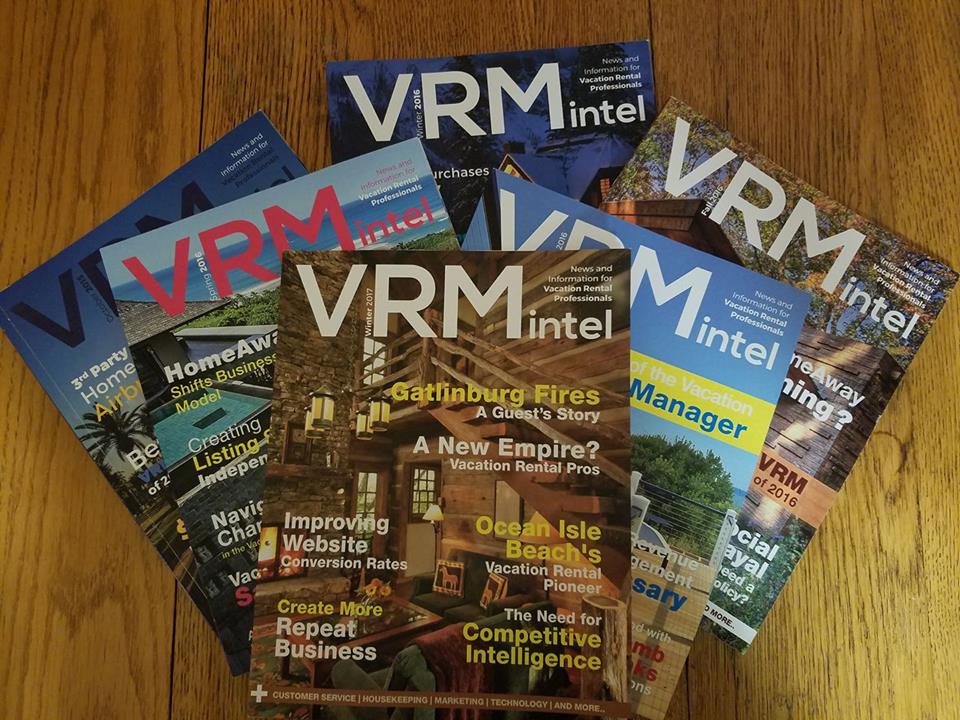
The 2017 Winter Issue of VRM Intel Magazine is Here

0

As vacation rental managers, you have numerous hats to wear in order to be successful. Consequently, in this winter issue, we decided to shift the focus away from OTAs and towards the internal functions within vacation rental management companies. While there are still major changes occurring among the mammoth OTA booking channels, as industry veteran George Volsky is famous for saying, “This industry is still about cleaning toilets and taking care of the screaming guests.”

In the pages that follow, you will read about guest reviews, organizational structure, vacation rental safety, increasing repeat business, following up with leads, and building an in-house laundry facility. You will also find a series of website marketing articles to help increase your online visibility and convert more visits into bookings.


We had the privilege of interviewing one of the industry’s first vacation rental management company founders, Rae Sloane Cox, who started Sloane Realty Vacations in 1955, and is a true pioneer in the industry. We also sat down with Steve Milo, founder and managing director at Vacation Rental Pros, who has recently acquired several large property management companies and is rapidly extending his footprint across the US.

Additionally, there are some new things going on at VRM Intel. Here at VRM Intel, we launched a new website, created a job board for our industry, began hosting VRM Intel Live! events across the country, and started building a reporting tool called VI Reports which provides unbiased competitive market reports to help VRMs make fact-based revenue management and marketing decisions (You can read more about this tool on page 89).

While doing this, we observed a noteworthy shift in the way in which technology providers are internally viewing your data. While some are continuing to provide you with high levels of data protection and choice in whom you wish to work with, some large software providers (one in particular) are beginning to limit those options and start collecting your data within their larger platform to help homeowners and hotels compete with your properties. As we move forward in 2017, I believe we will see an important conversation arise about vacation rental software companies and their agendas regarding your customer and booking data. Stay tuned.

Jon Gray, Mariano Dima Leave HomeAway

5

As of Monday, HomeAway’s chief revenue officer Jon Gray and chief marketing officer Mariano Dima are no longer with the company, indicating a change by Expedia in the trajectory for HomeAway’s vacation rental marketplace.

Last week, during Expedia’s Q4 2016 earnings conference call, CEO Dara Khosrowshahi said, “We’ve actually brought in some excellent talent to really build up the [HomeAway] team, some talent from within the company.”

Khosrowshahi added, “And I think that HomeAway, as it’s transitioning from a business that whose economics were based on subscriptions and subscription renewals, and there is a certain marketing strategy to drive subscription renewals, to a business and strategy that’s based on driving transactions, that’s our bread and butter as it relates to our OTA brands.”

Jon Gray joined HomeAway in 2004 as the third employee at the company before its landmark purchase of VRBO.com in 2006. Gray served the company in many leadership capacities over the years, and in April of 2015, Gray was named as the company’s chief revenue officer. In this position, he was responsible for the delivery of global revenue and managed the business development, sales and regional business teams.

“After more than 12 years with HomeAway and starting his career as our third employee, Chief Revenue Officer Jon Gray decided it is time to pursue new opportunities,” said Jordan Hoefar, corporate communications manager at HomeAway. “We are incredibly thankful to Jon and all his contributions during his tremendous tenure.”

In July of 2014, former Visa Europe CMO Mariano Dima was named chief marketing officer for HomeAway.

In this position, London-based Dima oversaw all global marketing, corporate communications and brand initiatives and was responsible for the “Whole Vacation” marketing campaign that guided HomeAway’s messaging and simultaneously differentiated the company from both hotels and Airbnb. Mariano also spearheaded the Eiffel Tower vacation rental giveaway campaign about which Dima said, ““We had a big idea to create a HomeAway where no one would believed would be possible, and now it’s here.”

Hoefar added, “Similarly, Chief Marketing Officer Mariano Dima decided it is time to leave HomeAway to pursue new opportunities. We appreciate Mariano’s vision for the HomeAway brand and his leadership as the company invested in and grew the marketing organization.”

In addition, several organizational changes are being reported within HomeAway’s software division. However, HomeAway’s Hoefar said, “There aren’t any significant org changes in our HomeAway Software division to report.”

Updated 4:36 ET, Feb, 15, 2017 with comments from Jordan Hoefar, HomeAway’s corporate communications manager.

Vacation Rental Pros Steve Milo Talks Acquisitions and Growth Strategy

1

In 2002, Steve Milo, founder and managing director of Vacation Rental Pros Property Management LLC, purchased his first vacation rental home in Venice, Florida, and struggled to find a competent property management company in the area. He decided to self-manage and explore the opportunity in the market. By 2006, with a background in eCommerce, Milo owned or co-owned ten vacation rentals and was having great success renting the properties on his website. Seeing the opportunity in the marketplace, he decided to launch Vacation Rental Pros. By the end of 2006, he was managing 25 properties.

Milo’s initial growth was organic. “I started the business in a recession. Many property managers had stopped taking new homes because they were having trouble getting bookings. In hindsight, the recession was an opportunity. It allowed us to take advantage of a tougher playing field. By running a lean organization, we were able to be profitable, and we used that profit for marketing. We ended up having more bookings than units.”

Only ten years later, Florida-based Vacation Rental Pros now employs 120 and manages over 2,200 properties in 17 markets in the US with plans to grow to more than 2,500 by the end of the quarter. Milo’s company is currently one of the largest vacation rental management companies in the US with no plans of slowing its growth trajectory in the near future.

“We run a tight G&A,” said Milo. “This doesn’t happen by accident. It happens because management buys into the philosophy of keeping expenses low and having productive employees.”

Armed with what Milo calls the “Vacation Rental Pros System,” the company has established a formula that provides a level of efficiency and profitability across multiple destinations on a large scale that the vacation rental industry has been slow to replicate.


Acquisitions

In the last two years, Vacation Rental Pros has acquired 15 companies, including Five Star Vacation Homes in Orlando, Hilton Head Rentals & Golf in South Carolina, Jackson Mountain Homes and the vacation rental contracts from SmokyMountains.com in Gatlinburg, Waterfront Vacation Rentals in St. Petersburg, Condotel and Kokopelli Property Management in New Mexico, and Maui Condo and Car in Hawaii.

With his experience in acquiring companies and bringing them into the Vacation Rental Pros platform, Milo has had the opportunity to learn some valuable lessons along the way including more closely examining the market potential and the company’s viability. “The first thing we’re looking for is the ability for the market to continue to grow,” said Milo. “So any time we look at the market or a company within the market, we’re looking at how much potential is there to grow beyond the book of business we acquired. After that we’re looking at the company itself, its adjusted income, its overall operational efficiency, and any areas where we can create efficiencies from the Vacation Rental Pros model, as well as where we can create a revenue.”

Milo also prefers to complete acquisitions at the end of a market’s season or before the beginning of the season so that they can move the acquired inventory into the Vacation Rental Pros platform. “Our platform is really the critical component of our success and its capability separates us from most of the other companies in the space as we are able to work from the centralized platform and being able to gain the efficiencies of our central office and our satellite offices working on the same platform, and leveraging the talent within the entire organization.”

When Milo acquires a new company, he generally expects to see a 10 to 15 percent attrition in the transition. “We are realistic with the fact that Vacation Rental Pros has a little bit of a different model, and that model may not work for every single property owner. Our model is much less touchy-feely than some companies provide, and there’s going to be an element of owners with—as important as revenue is—they also value this touchy-feely component of being able to talk to a principle that knows their life history.”

Milo added, “What we can do is provide a layer of professionalism to the organization that they may have previously not seen. We have a robust owner portal, detailed owner confirmations, and smart locks that we’re paying for as company. We have much more robust marketing and integration to OTAs that lends itself to drive to significant incremental revenue, and we have much more robust rate management. So we do expect some attrition, but in each market we’ve gained a significant number of new owners by the process of opening up solicitations to new property owners to offer our services, and we tend to believe that by having a local office and combining it with the items that Vacation Rental Pros does extraordinary well, we can be the best of breed in the market we enter.”


Vacation Rental Pros Secures $27 Million

To support its future growth, Vacation Rental Pros announced the completion of $27 million in bank debt. In late 2016, Fifth Third Bank approved $20 million in commercial bank debt for Vacation Rental Pros, and Gladstone Capital invested $7 million in the company through secured second lien debt to support the company’s continued growth and expansion into new markets.

According to Milo, the ability of the company to raise a large debt round shows the strength of his business model. “While several of our high profile competitors continue to raise equity, Vacation Rental Pros is able to raise market rate commercial debt based on the strength of our financial statements,” said Milo. “The strength of our business model is what separates us in the industry. We are able to achieve both growth and profitability at the same time. As a result, we have been able to avoid equity partners and warrants and have all the options open to us for future growth.”


Business Model

When examining the Vacation Rental Pros business model, the fact that Milo sought commercial financing, in an industry driven by equity funding, stands out. “The reason why Vacation Rental Pros business model is little different than some other high profile companies that are completing acquisitions is that we are inherently profitable,” said Milo. “And we’ve been inherently profitable from day one. When you make money—and you make money consistently—it allows you a lot of options in terms of how you grow your company. So, Vacation Rental Pros has not had to take on equity partners. We’ve been able to grow using our operating cash, and then we’ve also been able to get financing through commercial banks at commercial rates.

Milo continued, “In order to borrow money from commercial banks, it means that you have to have a balance sheet that works within leverage and ratios that commercial banks find acceptable to risk their capital. And that also mean that you typically have audited statements and quality earnings reports. The fact that Vacation Rental Pros has operated in a profitable manner, has avoided having to go after equity, and has been able to get bank financing, should tell owners and other potential companies out there that it is possible to run a profitable business of scale in this industry, if you do it the right way.”

As evidence of its lean organizational structure, Vacation Rental Pros has performed in an optimal manner of running profitable business while also growing 65 percent per a year, and that growth rate is increasing. Milo continues to invest money in technology that adds to the company’s efficiency and profitability margin.

“It takes a platform, management, discipline, and leadership to drive a profitable business, and management needs to be numbers oriented, performance driven, and have the ability to really think through problems as opposed to throwing bodies at that problem, said Milo.” We tend to be very methodical about thinking through challenges, options, and solutions, and we avoid simply hiring a massive amount of people to attempt to solve the issues we face in our business. It’s a culture that starts from the top, and then spreads throughout the organization. And it’s one of the reasons why it is tougher to be an employee at Vacation Rental Pros, because we have higher standards, and we have higher expectations. But it is also one of the reasons why the people that are at Vacation Rental Pros, are extraordinary in terms of its productivity because the employee culture itself is one of excelling and buying into standards and performance.”

Historically, Milo has not always retained all of the employees at the companies he has acquired. “When we get into a market where employees don’t feel that they have to work at the level and at the standards we expect, or simply do not want to align themselves with the Vacation Rental Pros process and procedures that we are expect from our employees, we make the decision to centralize the functions out of our corporate office,” explained Milo. “It is not the first option that we would prefer. We would prefer instead to continue to manage the properties with the local staff that is in place, but with our model, we have an option to simply reduce the local staff level. And we’ve done it at two locations, and it’s worked extraordinarily well.”

Milo continued, “The vacation rental industry is interesting in that it is so fragmented, with many different companies and many different ways that people operate. In some cases, there’s a lack of talent in the industry as a whole because, in resort markets, you have limited options for resources. What some companies have done is overcompensate either by hiring more people than they need or by retaining and overpaying individuals who have a lot of legacy knowledge in their head but are inefficient. We’ve been able to enter those resort markets and disrupt some of these G&A issues by being efficient.”

Milo attributes much of the company’s profitability to the creation of a hybrid model, “On one hand, we’re able to grow revenue by being smart about fees, smart about margin, really dialed into OTAs and online bookings, and all of that different technology that really can move the needle in terms of revenue management and yield management,” said Milo. “In addition, we’re extremely good at managing G&A. Not just employees, not just salary structures, but also really looking at the underlining aspects of the business including housekeeping, maintenance and even the process for how those services are delivered, and ultimately how they billed back to the unit owner. And so, by doing all of those things, and doing them well, and having a platform that truly can scale, we’re able to grow our profits in a way with that margins continue to increase.”


The Vacation Rental Pros Marketing Strategy

One of the unique aspects of Milo’s business plan is his approach to marketing. Milo uses a group of specialized freelancers to execute the Vacation Rental Pros marketing plan. These expert independent contractors have worked under the Vacation Rental Pros system for years and manage user interface, organic search, paid search, email marketing, CRM, and more. “Almost all of our marketing is actually external,” said Milo. “It’s a model we prefer as we think that the best specialized marketing talent are freelancers who have done this for a living in across multiple clients and across different industries.”

He has found that the most effective marketing channel is email marketing. “There are two aspects of email marketing. First, there is acquisition marketing which would be to induce people who haven’t booked with you. We continue to mail them in hopes that they will eventually book with you.”

He continued, “Then there are the guests who have previously booked with you. And that obviously produces the best ROI for marketing. Everything else is going to increase in cost from there. Some of channels are far more efficient than others.”

With third-party distribution channels, Milo tracks his performance closely. “I think HomeAway has publicly indicated that they believe their average advertising expense as a percentage of revenue is in the five percent range. We certainly have found that’s the case using a subscription model.”

“There are other companies out there like Airbnb that have a three percent fee, but there is a high manual component in operating on them,” Milo added. “Then, other distribution companies have a much higher fee. It requires discipline when building an OTA strategy.”

Milo also advises VRMs to closely monitor their spending on paid search strategies. “Paid search is really the area where companies have to be extremely careful because there are giant multibillion dollar companies that are competing in our markets,” he said. “HomeAway, Airbnb, Priceline, and even TripAdvisor are all spending money on AdWords in the vacation rental market. If you are not careful and smart, you could see your cost for distribution [reach] as high as 25 to 30 percent. You have to really be smart, you have to really target long-tail keywords and stay away from broader terms that are very expensive and provide low conversion rates.”

Milo also addressed Vacation Rental Pros’s SEO strategy: “We have spent lot of time and lot of money on content, photography, copy, and even captions for photos in an effort to better market our homes and provide better information to our guests about the properties they want to book. The additional benefit is that this content really helps with the search engines. We hope, at some point, that Google will start to recognize local and regional firms, as opposed to international OTAs, for some of these organic keywords.”


Revenue Management

Steve Milo has also developed an internal revenue management system that has helped Vacation Rental Pros out-perform the market in pricing. “I have not found an external solution that can replace what I do right now,” said Milo. “We have built a platform where we are able to manage a number of different regions. It is extremely powerful and gives us a competitive edge in every single market we enter because we can price per week, per day, and per weekend, in contrast to what we’ve seen in most platforms in our industry doing more flat pricing, low-level pricing, and less variable pricing.”

Milo added, “We typically excel in being able to outperform, or out-yield, our competitors during the season; and during the off-season, we typically come in a little lower than [our competitors] which allows us to drive high occupancy. This is an area of opportunity, and it’s really been an area where we excel.”


Growth

“We manage over 2,200 properties right now, and we’d like to be around 2,500 properties, by the end of the first quarter,” said Milo. “However, unit count is the least important metric of growth because I think it is a little misleading, but it is one that most property managers and owners can relate to. We have a number of deals under a letter of intent and contracts that should close at the beginning of 2017. We’re looking to integrate these companies quickly into Vacation Rental Pros and our platform, so that we can enjoy a full 2017 of revenue.”

According to Milo, the acquisition environment was buyer friendly from 2008 to 2013, and seller friendly from 2014 to 2016. Entering into 2017, he sees headwinds for sellers with an increased risk of natural disaster, the devaluation of currencies against the dollar, and the fact that there are some economic models that indicate the US may be headed into an economic slowdown.

“One thing that sellers need to think through is that it is not always a good idea to just wait and think that the market will continue to increase the valuation of their company. There is a cycle for everything,” said Milo. “That is one of the biggest things we see when we’re talking with potential seller. In some cases they think they can work another year or two and the value of the company will continue to increase. That is not always the case, and in the markets with the natural disasters, that will not be the case, and we’ll actually see the reduction of the revenue in 2017. So we think that 2017 will be a year where it will probably start to move more to buyer market than a seller market.”


Looking to the Future

Milo predicts that the industry will see more acceleration on the distribution level for the vacation rental industry as OTA companies open the vacation rental business up to more of the mass consumer.

“We believe that the OTA space is another area where Vacation Rental Pros is uniquely qualified to accelerate its revenue and its occupancy over competitors,” said Milo. “There is a large digital divide in terms of the OTAs because so many of the OTA aspects require advanced knowledge and expertise for configuration in database management. It is not as simple as turning on a feed. It requires a lot of set up, database structure, and then configuration. Vacation Rental Pros is really dialed in on these aspects.”

Milo has found when he acquires new companies that they often have not had the staff or resources to set up and manage OTA distribution well. “I don’t think it’s reasonable to expect your staff in your local office to be able to understand complex configuration, setup and database aspects to maximize yield management on the OTA channels. That is not a reasonable expectation,” said Milo. Because we’re in an immature environment for OTA setup, and one that’s extremely fluid, you need to have an advanced level of setup and configuration to be able to succeed.”

Milo also offered other VRMs some advice in understanding OTAs and how to best work with them. “I think any property manager who doesn’t believe [OTAs] have their own agenda should probably start to process of selling their business now. OTAs definitely have their own agenda, and they definitely are going to tell you what they think is in their best interest, which may or may not be in your best interest. You have to be careful, you have to be prudent, and you have to look at the data they provide you and really use common sense. Does it make sense to relax your booking rules for your primary season? The answer is no. Does it make sense to relax or test your booking rules, your cancelation policies, and your deposit policies for the off-season? The answer is yes.”

Milo added, “Doing business with OTAs is not as easy as everybody think it is because some of them are challenging to work with. Some have significant technical issues, some want to be the merchant of record, which causes tremendous heartburn because they control all the money, and some have policies that supersede your own policies, and may ultimately cause you to lose your entire revenue because you may have, for example, an Airbnb caseworker who provides a refund your guest at their sole discretion. Property managers really need to think through where and how they’re going to distribute their inventory.”

Over the next two years, we can expect to see Vacation Rental Pros begin to leverage its growth, scalability, and sustainability by entering into strategic partnerships. “Where we’re heading into the future is that we’re looking at a number different ways to continue to differentiate Vacation Rental Pros,” said Milo. “Part of that is looking at strategic partnerships. In 2017, I’m looking forward to a number of conversations with strategic partners, who now view Vacation Rental Pros as a national player and who are starting to hear about us from others within the industry as a company that has their act together and is going to be around for a long haul. Companies that are strategic want to do business with the companies that are going to be in business a long term, and those doors are starting to open to Vacation Rental Pros.”

We’ve kept all of our options open for how we will best move forward in 2017 and 2018, partly because we don’t answer to equity partners, we have a clean slate, and we have an ability to map out the paths that are in the best interests of the company and our guests and our owners.

Southwest Florida Man Accused of Vacation Rental Fraud Using VRBO.com

0

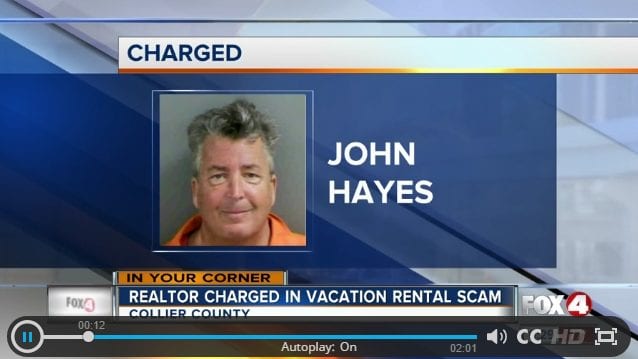
BONITA SPRINGS, Fla. – The Collier County Sheriff’s Office arrested a man over the weekend who they say victimized three people in a rental fraud scheme.

57-year-old John Joseph Hayes of Bonita Springs faces fraud charges after the victims reported that they paid him thousands of dollars in advance for the same rental unit during the same time period, between January and April.

The three women, each from a different state, found a seasonal vacation condo at Glen Manor on Fourth Street in Bonita Springs on the web site VRBO.com. VRBO stands for Vacation Rentals By Owner.


In one case, the victim told investigators that Hayes didn’t tell her the unit would be unavailable until three days before her arrival date, after she emailed him about how to get the key.

The other women were told that the unit would be unavailable due to a dispute between Hayes and the HOA for Glen Manor. According to Hayes’ arrest report, the three women paid him a total of $26,649.

Realtor Todd Gridley of Naples said that sites like VRBO.com screen the rental owners who advertise with them, so he recommends calling their customer service and checking that the owners are who they say they are.

“Once you hand over the money, the fees could be gone,” Gridley said. “So it’s always better to do your due diligence, and deal with someone that knows that market.”

According to the arrest report, all three women want to press charges against Hayes. Attorney Mike Chionopoulos said victims in a case such as this have a better chance at recouping their money in a criminal case rather than filing civil suits.

“The victims have to ensure that by going to the state’s attorney…and saying ‘we want any (plea) deal to include restitution, and we want him to stay on probation until his restitution is complete,'” Chionopoulos said.

Hayes has been released from jail on a $10,000 bond.

VRM Intel Live! and VRHP Housekeeping Seminar Coming to Outer Banks, February 22 & 23

0

VRM Intel Magazine is coming live to North Carolina’s Outer Banks with advanced level education and information for vacation rental managers.

register-now-for-vrm-intel-liveVRM Intel Live! will be held on February 22 at the Hilton Garden Inn Outer Banks/Kitty Hawk with a powerful, high-level lineup of speakers that includes industry leaders, experts and many of your favorite VRM Intel Magazine writers. The early registration cost is $100 per person and increases to $130 per person after February 10. For registration information, go to vrmintellive.com. Join us for great education, intel, food, networking and fun!

Ascent Processing and VRM Intel are also sponsoring a reception for VRMs on February 21 at Kelly’s Restaurant and Tavern from 6-8, and VRHP is conducting their OBX Housekeeping Seminar on Feb 23 from 8-4:30.

Tickets are selling fast, and space is limited, so don’t delay. Hope to see you there!


Here is the agenda for VRM Intel Live!:

GENERAL SESSIONS

  • 2017 OTA Update – An unfiltered look at change in third party distribution with Steve Milo, founder, Vacation Rental Pros
  • Revenge of the Property Manager with Amy Hinote, Founder and Editor-in-Chief, VRM Intel
  • Forget Booking Channels. What are the Real Challenges and Opportunities for 2017? A Discussion with Steve Trover, CEO, All Star Vacation Homes


MANAGEMENT SESSIONS

  • 2017 Guide to Mergers and Acquisition in Vacation Rentals with Ben Edwards, President, Weatherby Consulting, Past President, Vacation Rental Managers Association (VRMA)
  • Compliance Issues Facing Seasonal Employers presented by Sabrina Hanson, regional sales director, TASC
  • New Software: An Answer To Prayers Or Your Worst Nightmare? with Doug Macnaught, Founding Member, The VRM Consultants, Former President and Co-founder, Instant Software
  • Upper Level Housekeeping Management in 2017 with Joe Refosco, co-owner, Taylor-Made Deep Creek Vacations and president VRHP, and Durk Johnson, Meredith Hospitality and executive director, VRHP
  • Operational Updates: Smart Locks, Travel Insurance, Credit Card Processing, Technology, Panel


MARKETING SESSIONS

  • Get More Bookings – Website Design & Usability Tactics That Drive Conversions with Brandon Sauls, Founder and Owner, ICND
  • Using Online Marketing to Compete with the Big Dogs with Susan Blizzard, CEO, Blizzard Internet Marketing
  • Successful Niche Marketing – make your email campaigns profitable! with Lynell Eady and Scott Leggatt, LSI Tools
  • Taking Control Of Local And National SEO with Conrad O’Connell, founder, 91 Digital
  • 5 Ways to Grow Revenue with Existing Demand and What You Think Is A Full Calendar with Heather Weiermann, NAVIS


Bluetent Hires HomeAway’s Tom Clark as Support Manager

3

Bluetent has bolstered its support team with the addition of industry veteran Tom Clark as Support Manager. Before joining Bluetent, Clark spent over 5 years managing HomeAway Software’s V12 and over 10 years leading the FRS and ISI Support Teams. This addition to the support team solidifies Bluetent’s dedication to providing the highest level of customer service.

Clark will pioneer a team of three support engineers and two senior developers. He is passionate about increasing transparency and communication with clients, improving forecasting and lead time for development updates, maintenance, and customer requests, and strengthening Bluetent’s relationships with third party vendors.

Clark has been a respected partner of Bluetent for more than ten years, and his unsurpassed depth of knowledge and extensive experience has energized Bluetent’s support and product team . As Support Manager, Clark is responsible for improving the quality of customer service at Bluetent, as well as managing infrastructure updates that will increase transparency and client communication. Additionally, Clark will help guide the development of new processes and systems to maximize Bluetent’s efficiencies and decrease response time.

“For years, Tom and I have worked together as partners, but I am thrilled to officially bring him on to our team as the Support Manager,” said Peter Scott, President of Bluetent.  “Tom brings a wealth of knowledge and a thoughtful understanding of customer service that will no doubt prove highly effective in helping our clients achieve further growth in years to come.”

A native of Ames, Iowa and a graduate of the University of Iowa, Clark holds a bachelor’s degree in Marketing. Clark spent ten years in manufacturing, including a stint as the master scheduler of a gummy bear plant. In 1997, Clark moved to Colorado when his wife accepted a position as a developer at Colorado Mountain College. This move spearheaded his career in the vacation rental industry as a software support technician for First Resort Software. In 2004, Clark took over as manager of the First Resort Software Support team. And in 2007, Clark was appointed to manager of the ISILink API. It was during this period that Clark and Bluetent first partnered together on API integration from HomeAway Software to Bluetent’s front-facing client eCommerce websites. In 2010, Clark took over as manager of V12.NET’s support team. Bluetent is honored and thrilled that Tom Clark has joined the agency and welcomes the opportunities that his expertise brings to the entire team.

Properly launches housekeeping technology for vacation rental providers

0

In the professionally managed vacation rental industry, operational tools for property managers designed to facilitate cleaning and turnover management have not kept pace with the growth and professionalization of the industry. The development of technology in the industry has been largely focused on channel management, guest communications and integration between providers, but housekeeping and maintenance management has been an area that has seen very little development.

Alex Nigg hopes to change that with today’s market launch of Properly.

Properly is a mobile-first application founded by Nigg and built specifically for the vacation rental industry and provides tools that allow VRMs to schedule and monitor cleaning and turnover operations at every listing in real time, to deliver the personalized service that today’s travelers expect, and to demonstrate the value of their stewardship to asset owners.

“As a vacation rental provider, I experienced first-hand the challenges of cleaning and turnover management with my listing,” said Nigg. “Talking to vacation rental property managers confirmed that they shared my challenge but at even greater scale, with the added complexity of hundreds of listings and the responsibility of satisfying both guests and property owners.  Properly solves this problem, enabling property managers to scale their businesses and raise their service levels.”



Properly’s text and visual checklists (iOS and Android) give cleaners simple, step-by-step instructions, regardless of their language skills or proficiency. And Properly translates instructions into any language, so cleaners can follow along in their native tongue. Because checklists are based on listing photography, VRMs are able to ensure staging is exactly what the guest expects.

Thanks to real time photo capture and cleaner tracking, VRMs can monitor cleans and turnovers in real time, are alerted if a cleaner is late to arrive at a job, and can remotely follow along with their cleaner’s progress. Photo capture provides a record of the listing prior to each guest’s arrival and integrated damage reports document issues and make it easy to retain a deposit or file a claim.

Official API interfaces with Airbnb, HomeAway, and numerous PMS ensure scheduling stays aligned with bookings, and reporting tools provide a record of each cleaner’s activity to make invoicing and billing easier for VRMs.

According to Emily Benkert, founder and CEO at Guesthop in San Francisco, “Properly helps Guesthop convey the very special requirements of a hospitality turnover job to our cleaners. It also eliminates any language barriers, and saves us time in scheduling and communication”

Following a year of development with beta customers, Properly is launching into the mass market with offices in San Francisco and Wellington, New Zealand, and with over 7,000 property managers and hosts representing approximately 21,000 listings in over 50 countries.

Conversion Goals and Tracking

1

If you want to go the extra mile and prove to yourself that your email marketing strategies are working, configuring Google Analytics to track goals may be exactly what the doctor ordered. With Google’s extensive suite of conversion and goal tracking capabilities, you can see exactly how much money your email marketing strategies are making. You just need to ensure that analytics is set up correctly.

Here is a quick guide to setting up conversion tracking with Google Analytics:


1. Log in to Google Analytics

2. Click Admin at the Top

3. Configure a Conversion Path

Are you already tracking bookings using Google Analytics? If not, it is easier than you think. Use your content management system (CMS) to create an automatic “Thank You” page redirect post-checkout. Make sure only users who have booked a reservation can access this page. Also, if you are creating other types of conversions, it is a good idea to create these “Thank You” pages as well (for example, if you have an “Inquire” function on your site, you can create a custom “Thank You” page that users are redirected to upon completion of the email form).

4. Create the Conversion in Analytics

  • Click on Goals

  • Click on +New Goal

  • Name Your Goal.
  • Choose “Destination” as your Goal Type, then hit Continue

  • Enter the “Thank You” page URL in the Destination field (Make sure it is “Equals To”)
  • Hit Save

  • Repeat for all goals you may be tracking (inquiries, bookings, forms filled out, etc.)

5. Test to Make Sure Conversions are Working

You can also utilize these goals to track events (such as clicking a button on your site) by following these directions here. Both of these forms of goal tracking will let you track all your conversions done through your site. However, if you wish to track only conversions received via email marketing, it can take a bit more work. Fortunately, most email marketing platforms offer Google Analytics integration; just talk with your provider and see what they can do to help you get this configured.


Discount Code Tracking

Remember, if you use a discount code in your email blasts and wish to track conversions made from that specific discount code, you need to make sure to only use that code for email marketing. Do not let your sales reps use it on the phone; this way, you can truly track conversions of the email blast using that specific code.

Email marketing can become one of the most powerful marketing and public relations tools at your disposal. Just one blast can be the difference between a good month and a month for the record books. Just take the time to follow the steps above, configure your campaigns correctly, and put some TLC into your marketing message.

Marketer’s Resource Guide: Online Tools to Manage Marketing With Ease and Success

0

In order to keep up with increasing competition, marketing expectations for 2017 and beyond are astonishingly high in the vacation rental management (VRM) industry. Today’s marketing managers are charged with being web developers, SEO/SEM experts, copywriters, marketing technology and automation specialists, graphic designers, media buyers, social media professionals, public relations experts, email strategists, and marketing analysts. In addition, marketing budgets are shrinking making it very difficult to accomplish all that you need to do as an in-house vacation rental marketer.

The truth is that you can’t do it all. Here are a few tools that can help you accomplish your objective, wow your team, and focus on the areas of your strengths.

Canva.com

It is expensive and time-consuming to have to hire a graphic designer every time you need an image with text overlay for an email, an infographic for an email to owners, or a postcard campaign. Canva is a free online design tool that lets you create professional, branded social media graphics, email designs, flyers, brochures, posters, infographics and more. Using drag and drop functionality and professionally designed templates, it is easy to create designs with professional results even if you don’t have any graphic design experience. Canva also has an extensive library of fonts, photos, illustrations, charts, and graphics.

Freelancer.com

From logo creation to data scrapping, connect with freelancers to help with your projects for a fraction of the cost of using an agency. Simply post your project and watch the bids come in. You will be surprised at the pricing. If you can think of it, there is a freelancer on this site who can make it happen. You can also run contests for design work. And you never know who you will meet. VRM Intel Magazine’s own director of design and production, Donato Berbelja, and I met on Freelancer.com working on a postcard campaign.

ProofreadingPal.com

My fellow VRM marketers will nod in agreement that finding people to proofread your content is a constant challenge. It is difficult to edit and proofread your own writing and even harder to find other people you can trust with the task. VRM marketers manage a lot of content, including ad copy, property descriptions, blogs, press releases, newsletters, marketing materials, and more. ProofreadingPal is a lifesaver. Upload your file, pay online, and check a box for when you need it back. They can even turn it around in thirty minutes if you are under the gun. Every document is proofread by two editors to correct grammatical errors including punctuation, capitalization, verb tense, spelling, and sentence structure. Your document is also checked for clarity.

Buffer

Buffer is a free tool that saves a ton of time on social media marketing by scheduling posts ahead of time for your social profiles. You can batch the social media marketing process: do all your curating and composing at one time and then spread those updates throughout the next day or week. The free plan at Buffer lets you connect a profile from each network (Facebook, Twitter, etc.) and schedule ahead ten posts for each network.


Wistia

Once you’ve created an amazing video to share on your website or social media, where will you post it? YouTube is easy, but you want to avoid ads and suggested videos. Wistia keeps people on your page—or sends them precisely where you want them to go next. Once you’ve uploaded your video, you can go to the dashboard and add things like call-to-action buttons or email capture at the end of the video. Wistia also shows how long people view your video and when they pause or click out of it.


SEO Book’s Free Spider Test Tool

See what Google sees when they crawl your webpages. This search engine indexing simulator tool shows the source code of a page, all outbound links on the page, and common words and phrases found in the page copy. You can also compare pages and check keyword density.


Google Search Console

Formerly known as Webmaster Tools, Google Search Console gives you advanced website tracking with detailed reports on your search traffic, click-through rates, and mobile vs. desktop traffic. Through the Search Analytics Report, you can group, filter, and compare your data to tweak your overall digital strategy and maximize website performance. The alerts feature will notify you of any website errors that might affect your rank in search results. Google Search Console can provide your business with the tools to get an extra edge against your competition in search results.


These are a few of my favorite tools, but there are many more out there to help you accomplish your goals. New tools are being created every day, so if you can dream up a new marketing idea, chances are there is now an online tool that can help you make it happen.

Streamline Your Vacation Rental Business with RealTimeRental’s Suite of Technology Products

0

RealTimeRental paved the way as the first web-based vacation rental software on the market in the year 2000. Since then our clients have used RTR to book and manage over 2.3 million vacation rentals. Always striving to stay ahead of the curve with technology, RealTimeRental continues to develop and enhance the software while creating partnerships with leading tech companies.

“Our clients are always looking for new ways to use technology to enhance their guests’ experience. We are very excited to introduce RealTimeRental clients to Parakeet’s suite of home automation products,” said Sherry Tomasso, co-founder at RealTimeRental.

Parakeet’s smart home automation technology allows vacation rental property managers to have remote access control to door locks, garage doors, thermostats, and more.

“One of our favorite Parakeet features is the keyless entry system that integrates with our software,” said Tomasso. “When you create a booking in RealTimeRental, Parakeet will generate a disposable electronic key code for a keyless entry.”

Keyless entry saves time for the rental property management company, as there is no need for rental guests to stop at an office to pick up keys. The Parakeet key codes are automatically sent to the rental guests’ cell phone or email and are only active for the duration of the booking. The keycodes expire at the end. 


SIMPLIFY COMMUNICATION WITH PROPERTY OWNERS AND RENTAL GUESTS

Save time with RealTimeRental’s newest feature, Automated Emails. Schedule tasks such as notifying property owners when you create a booking on their home, send pre-check-in welcome messages, send post-check-out follow-up, send late payment reminders, and more. The automated emails are customized for each client and logos.

“We created the automated emails as a way to help our property management and real estate companies save time,” said Tomasso. “Since everything is automated, offices don’t need to worry about forgetting to notify a property owner of a booking, or sending a late payment reminder to a tenant.”

The automated emails are generated and sent out based on specific triggering types of emails have if there is a problem with the recipient’s email address.

“Today’s traveler is accustomed to accessing their vacation rental information online. RealTimeRental makes it easy for rental offices to provide online access to their rental guests with the Tenant Portal,” said Tomasso.

Portal to which they can view their booking information, property details including photos and amenities, send reservation requests on properties rented in the past, and more. Rental guests can even make credit card and E-Check payments online via the Tenant Portal.

Property owners can sign in to their individual Owner Portal accounts and view availability calendars and bookings made on theOwners can create their owner reservations and guest of owner reservations right on the portal.


ENHANCE MARKETING AND AUTOMATE TASKS WITH NFC CHIP TECHNOLOGY

RealTimeRental’s partner T.A.P. Tag Technologies is utilizing NFC chip technology in exciting new ways in the vacation rental and real estate industry. T.A.P. Tags are a small NFC chip-enabled item (think key chains, stickers, business cards, and much more) that can display a custom message on customers’ phones with just a simple tap of an NFC-capable smartphone.

“Our partnership with RealTimeRental allows property management companies to use NFC chip technology to automate tasks and market directly to rental guests on their smartphones,” said David Berroa, T.A.P. Tag Technologies.

T.A.P. Tags and RealTimeRental have a fully integrated platform, meaning that T.A.P. Tags can display rental property information directly from the software, and automate simple tasks such as notifying the cleaning crew when guests have checked out of a rental property.

“T.A.P. Tags can display virtually any URL, making them a simple and easy way to get future customers looking at your company’s message on their NFC-capable smartphones,” said Berroa, “so T.A.P. Tags can be used for multiple marketing campaigns.”

To learn more about RealTimeRental vacation rental software and its suite of technology products, please visit www.RealTimeRental.com.

HomeAway sues Portland

0

The vacation rental website HomeAway filed a pair of lawsuits against the city of Portland this week, opening a new round in its battle with the city over hotel taxes.

HomeAway, which helps match travelers with homeowners with rooms for rent, has been at loggerheads with the city for years over whether it should have to collect lodging taxes on behalf of its users.

The latest suits attempt to block the city from enforcing various parts of its ordinances against HomeAway, including the lodging tax collection.

The lawsuits argue Portland doesn’t have the authority to impose lodging taxes on the company and various regulations on the vacation rental industry.

“HomeAway has sought to open lines of communication with city officials,” the company said in a statement. “Unfortunately, those requests have gone largely unanswered. We welcome the opportunity to explore a policy solution that addresses the concerns of all stakeholders and is evenly applied to all platforms.”

The city sued the company for $2.5 million in 2015 over alleged violations of its vacation rental laws.  Portland legalized short-term rentals in private homes in 2014, requiring homeowners to undergo an inspection and secure a permit. A permanent resident must also live in the home at least nine months of the year.

The city also required sites that facilitate the rentals, like HomeAway, to start collecting the transient lodging taxes typically paid by traditional hotels. The city expected to collect $1.2 million a year, which the City Council agreed to put toward affordable housing.

The city in 2015 slapped HomeAway with a $326,500 fine for failing to collect the taxes. The city’s revenue bureau said it would continue to assess fines until the company complies by the city’s rules.

HomeAway argued at the time that it wasn’t like competitor Airbnb, which handles all payments for its users and is therefore in a better position to collect the lodging taxes. HomeAway said many of its users don’t accept online payments, and those that do use HomeAway Payments, which HomeAway described as a separate company.

The city then sued HomeAway for $2.5 million, but its case highlighted some shortcomings in its code, including various references that didn’t appear to address intermediary websites. The lawsuit was initially dismissed, but an amended complaint is still pending.

The Portland City Council passed various revisions to its code in December to address those shortcomings. Those revisions went into effect Friday, prompting HomeAway’s latest lawsuits.

The lawsuit filed Thursday in Multnomah County Circuit Court argues that Portland doesn’t have the authority under its charter or state law to levy lodging taxes against HomeAway.

Another lawsuit filed Friday in U.S. Circuit Court in Portland argues the city’s requirements to register the names and addresses of individuals posting their homes for rental prohibits free speech and commerce online. It also said the city’s ordinance violated its customers’ rights because it doesn’t give “affected customer the opportunity to obtain review by a neutral decision maker.”

Portland attorneys declined to comment.

HomeAway is a subsidiary of the travel company Expedia, which is based in Bellevue, Washington. It also owns the vacation rental website VRBO, which has also faced fines from the city.

— Elliot Njus

enjus@oregonian.com
503-294-5034
@enjus

Communicating Success to Owners Using Revenue Per Available Night: The Most Important Metric

0

It is up to you to demonstrate your value to homeowners. By choosing the right metrics, educating your owners and providing consistent reporting, you can quickly earn their trust and loyalty.

There are two common—yet problematic—choices for metrics which you communicate to your homeowners: Occupancy Rate and Average Daily Rate.

Occupancy Rate is the percentage of nights you have rented. For example, if you rent out a unit for 20 nights in August, its occupancy rate is 65 percent for the month.

Average Daily Rate (ADR) is the average nightly price for which you rent out a unit. If you have two reservations for August, one for five nights at $123 per night, and the second for three nights at $179 per night, your average daily rate is $144 per night.

Your owners might have a sense for historical occupancy rates and average daily rates for each season. A common pitfall is to try to increase these values year over year, often at the encouragement of the owner.

But neither metric determines revenue, which is the measure of your business.

Increasing occupancy rates could lower revenue if you’re discounting too much to get those higher occupancy rates. And increasing average daily rates could lower revenue if you lose too many bookings because of your higher prices.

Why not just measure revenue? Because revenue does not account for owners stays. If last August you had 31 nights available to rent out, but this year the owner has reserved 14 of them, revenue will have decreased for the month, even if you have improved. Do measure total revenue, but do not make it your top metric when speaking with your owners.

The solution is Revenue Per Available Night (RevPAN). RevPAN is the amount of money you have collected each night that a property is available to rent out.

The hotel industry uses a similar term, Revenue Per Available Room (RevPAR). But as a vacation property often has multiple rooms, the hotel term is confusing.

In the vacation rental industry, it is optimal to stick with the RevPAN metric. You can measure the performance of a single property or your whole inventory, and you can easily compare this metric for the current year against the previous year(s) or this month against last month.

RevPAN Formula

What is an Available Night?

Available nights are all the nights you are allowed to rent out in a specified time period. Take the total number of nights for a given period and subtract the off-market nights. The most common off-market nights are owner stays.

Available Nights=Total Nights—Off-Market Nights.

Protip: Should you count “out of order” days? Typically, you should count changeover days as available. That’s the standard set by the hotel industry. But if a property is undergoing maintenance, marking those nights as off-market will help you communicate to the homeowner that you are not responsible for renting them out.

Example: Let’s calculate the number of available nights in May for a single property. “Total nights” is 31. The owner has reserved seven nights in May, and there will be roof repairs for two nights after that. The total number of off-market nights is nine. This leaves 22 available nights.

(31 Total Nights—9 Off-Market nights=22 Available Nights.)

What number should I use for Revenue?

You are demonstrating your value to your owners, so only include rental revenue (the rental revenue that you use to calculate your commission). Exclude additional guest fees that you keep (i.e. cleaning, pool heating and pets).

Example: Let’s go back to the May example above, with 22 available nights. We’ve gotten three reservations for the month:

Protip: When calculating your RevPAN for your owners, you should not include additional guest fees. But when you’re calculating it for your business, you should. These fees are an important part of your company’s revenue.

How do you calculate RevPAN?

Here’s the formula again:

RevPAN equals Rental Revenue divided by Available Nights.

Continuing with our example, we have $3,150 in rental revenue and 22 available nights, so RevPAN is $143 per night.

Let’s compare that against average daily rate, which is $210. RevPAN is significantly more useful because it combines both average daily rate and occupancy rate. It is a more comprehensive and indicative metric of your company’s performance, and unlike the total revenue for the month, you’re not penalized for the nine off-market nights.

Reporting RevPAN to a Homeowner

When we bring on a new customer at Smart Host, the first thing we do is send them a revenue report. It includes RevPAN, Occupancy Rate, Average Daily Rate and Total Revenue. Break out those metrics both monthly and annually to establish a baseline.

Each month, compare your performance to the previous year’s numbers, typically as a year-over-year percentage change.

Using our example, let’s say the previous year’s May RevPAN was $122 per night. We would report that May 2016 RevPAN is $143 per night and has a 17% year-over-year increase.

Now, let’s fill out a few more details of our example to see why RevPAN is the best performance metric.

Example:

Was 2016 an improvement over 2015? Yes! The manager was more effective.

Even though they had four fewer available nights available to rent, they earned the same revenue. This win is reflected in the RevPAN growth of 17 percent.

It is much more difficult to see this positive change by looking at Occupancy Rate and Average Daily Rate alone. Did ADR go up by enough to make up for the decrease in occupancy rate? You’d have to compare percentages to find out. Instead, just look at RevPAN.


As a vacation rental manager, there are many variables you don’t control: owner stays, weather, repairs and travel trends. As you respond to these variations, many metrics—occupancy rates, average daily rates, total revenue—will only hide the success of your work.

Make RevPAN the first metric your team uses to demonstrate performance. You’ll make more money and your homeowners will know it.

VaycayHero Suspends Operations

3

VaycayHero, previously known as Zaranga, is suspending operations as of February 28, 2017, and has notified its vacation rental suppliers that it will not take any bookings past January 31.

To date, VaycayHero has raised approximately $4.8 million from angel investors and VCs, including a $836k investment from FundersClub just seven months ago.

In 2011, Zaranga was founded by Amitav Chakravartty and Anirban Bardalaye with the goal of providing a B2C marketplace that would connect guests with professionally managed, verified vacation rentals.

In 2012,  Zaranga joined the Y-combinator class and began to develop the concept of dynamic pricing for professionally managed short term rentals. On Zaranga, like Priceline, guests could enter the price they were willing to pay for a vacation rental by clicking on the “Make an Offer” option. At the time, Bardlaye said, “There is no dynamic pricing in the vacation rental market, even though it is extremely common in the rest of the travel industry.”

However, the vacation rental marketplace was not yet ready for this type of functionality as the overall connectivity and communication between the listing sites and property managers was slow to develop and competition among listing sites was fierce. In addition, travelers were just beginning to discover vacation rentals for the first time, and marketplace usability was not yet normalized or trusted enough to introduce a “Make an Offer” process to consumers.

In 2013, Zaranga rebranded to VaycayHero as a more pure form of an OTA focused on online booking for professionally managed vacation rentals. They raised a $2.8 million seed round from Alexis Ohanian, Garry Tan, Scott Banister, Microventures, Tamarisc, Stucture Capital, and others. VaycayHero said it planned to use the capital to bring on more workers, expand into more markets, and continue growing the overall business.

In 2015, VacayHero raised an additional $550k and operated under a closed business model in which all listings were instantly online bookable only, and fees were collected from the traveler instead of the supplier.

VacayHero follows LeisureLink in shutting its doors, with a half dozen venture funded companies in the vacation rental industry expected to also suspend operations by the end of the year.

In the comments on Tnooz’s article about LeisureLink ceasing operations, VaycayHero says it is helping customers. A few months later, VaycayHero also suspends operations.

Smart Home Technology Proven Invaluable for Vantage Resort Realty Growth Strategy

0

Vantage Resort Realty has developed a strong appreciation for Smart Home technology. This advanced technology not only helps our operations, homeowners, and guests but also aligns with our strategic growth plans for the Vantage Resort Realty brand.

Established in 2007, Vantage Resort Realty is best known for high-end luxury vacation rental properties in Ocean City, Maryland. Thanks to our investment in Smart Home, we have extended “the Vantage experience” to New Jersey and Myrtle Beach.

Smart Home Value to Owners and Guests

Everyone is finding value in our Smart Home investment. Both of our customer groups, homeowners and guests, are benefiting from this home-automation technology.

PointCentral gives us the ability to continue to drive toward the goal of providing revenue for our owners while protecting their properties. We are up front with our owner benefits, displaying a forward-thinking approach and saying, “Here are all the things we’re doing for you—we’re keeping your utility bills low and your systems in check, and you’re going to be able to monitor your property in the off season.”

This approach translates to the guests, who always, at a minimum, expect the property to have what they have at home. With Smart Home, we are able to take that guest experience to the next level. For example, if a guest has an issue with a door lock, we can unlock it remotely. Instant gratification and speedy solutions make for positive guest experiences.

Operational Control

PointCentral has made a tremendous difference in our 24/7 Client Services department. For example, when we get a plumbing call and need to send a contractor to the property, we use our PointCentral online system to generate a unique user code for the contractor (which is only valid for a specified period of time). The minute that code is used, we receive an alert informing us that the contractor is at the property. This has helped strengthen our partnerships with our vendors. It’s a win–win situation because contractors don’t have to go to the office to pick up or drop off keys, and we don’t have to worry about access issues. Operationally, the visibility that we’ve gotten from our PointCentral Smart Home system has been outstanding.

Using the PointCentral dashboard, we can see when a property was most recently cleaned and inspected. We can even use one of the codes to find out when we changed the air filters; which, again, pushes value back to the owner.

Thermostats are most valuable when we transition between seasons. When it started getting warmer in Ocean City, we found that the air conditioning systems were set either on “auto” or on “heat.” Thus, we were inundated with calls to the effect that the air conditioning wasn’t coming on. With our PointCentral Smart Home system, our team was able to get into the system for the property in question, click on the thermostat, and change its setting to “cool”—easily and efficiently solving the problem. The guest feedback we receive when we handle something on the first call has been positive, which is our ultimate goal from a customer-service standpoint.

Why Did I Choose PointCentral?

It started with the people. Adam and I jumped off to a fantastic start. Stan and Laura have been awesome. When I have questions, Adam is there. We text at random times and bounce ideas off each other all the time. It’s a great relationship.

With the way we’re pushing forward, we are on a path to success that continues to increase our excitement and positive client feedback each and every day.

Vacation Rental Pros expands in US and finalizes $27 million in bank capital

0
Vacation Rental Pros Steve Milo Raises 27 million

Vacation Rental Pros Property Management, LLC, one of the vacation rental industry’s fastest growing management companies, reached an agreement to acquire three additional vacation rental companies in New Mexico and Tennessee.

The move adds an additional 500 vacation rental properties to the management portfolio of Vacation Rental Pros, giving the company over 2,100 total properties under exclusive management contract.

Vacation Rental Pros enters the New Mexico market with the acquisition of Condotel in Ruidoso New Mexico, and Kokopelli with locations in Angel Fire, Taos and Sante Fe New Mexico. The company also announced the purchase of the post-wildfire owner contracts of SmokyMountains.com in Gatlinburg.

To support its future growth, Vacation Rental Pros announced the completion of $27 million in bank debt. On December 28, 2016, Fifth Third Bank approved $20 million in commercial bank debt to Vacation Rental Pros Property Management, LLC (“VRP”).

On December 28, 2016, Gladstone Capital invested $7.0 million in VRP through secured second lien debt to support the company’s continued growth and expansion into new markets.

According to Steve Milo, the owner, founder and managing member of Vacation Rental Pros, the ability of the company to raise a large debt round shows the strength of Vacation Rental Pros business model. “While several of our high profile competitors continue to raise equity, Vacation Rental Pros is able to raise market rate commercial debt based on the strength of our financial statements. The strength of our business model is what separates us in the industry. We are able to achieve both growth and profitability at the same time. As a result, we have been able to avoid equity partners and warrants and have all the options open to us for future growth.”

Vacation Rental Pros AcquisitionsVacation Rental Pros is a growing and innovative property management and rental reservation system which leverages a proprietary technology platform to maximize occupancy and revenue. As a result of the Company’s integration platform and marketing expertise, the company is successfully expanding through both acquisition and organic growth into its new markets. The acquisition of Kokopelli, Condotel, and Smoky Mountains are the sixth major acquisition in 12 months for Milo’s company which forecast’s growth of 70% in 2017.
According to Steve Milo, there will be additional acquisitions in 2017 with several more to be announced in the early 1st quarter which is the off season for some property management companies in North America.

“Vacation Rental Pros is getting approached by more and more sellers as the vacation rental market gets more and more complex due to technology and the significant changing business models with online travel sites,” said Milo. “Vacation Rental Pros has built the best technology platform model in the industry to expand in both a scaleable and sustainable manner. We have built this platform through a focus on technical and operational efficiency which translates nicely to expanding incremental profitability. We have a powerful mix of robust growth, profit and no dilution of equity.”

Hiring in the Vacation Rental Industry? New Resource Can Help.

0

As human resource managers know, finding experienced candidates in the vacation rental industry is challenging. Currently, hospitality degrees focused on vacation rental accommodations do not exist, and there are no accreditation or training programs being offered to prepare individuals seeking a career in private accommodations.

As a result, VRM Intel has created ProVRM.com, a job board and career planning resource for job seekers and hiring managers in the fast growing vacation rental industry.

“At VRM Intel, you will hear us say often in 2017, ‘We can’t get there tomorrow if we don’t start today,'” said founder Amy Hinote. “As the industry continues to grow, we anticipate an even greater need to have a hub for vacation rental career opportunities and training. We built ProVRM as a first step in establishing a place for candidates and hiring managers to meet and for job seekers to find training resources.”

ProVRM.com provides a job search tool through which hiring managers and companies in the vacation rental industry can post jobs and job seekers can search for opportunities. Candidates can also post resumes and reach out to recruiters.

“Our hope is to connect experienced, trained candidates with growing companies in the vacation rental industry so that our space is able to leverage its existing knowledge base to help build future products, services and opportunities,” said Hinote.


The Economics of Really Knowing Your Vacation Rental Guests

0

We put many price tags on guests. How much is a guest worth? How much did that guest cost? When guests become names with a dollar sign attached, we lose sight of hospitality—and of human nature—but, ironically, it is by understanding human nature that we’re able to increase the value of the dollar sign.

The human brain is bigger than other animals with similar body sizes because we are social creatures. We exist to have relationships of all different kinds—from a nod and a smile to a very best friend. Scientists know that humans with more social connections are happier. In fact, economists have put a price tag on relationships to demonstrate this, and the act of volunteering weekly is equivalent to increasing your annual income from $20,000 to $75,000. Having a friend you see most days is like earning $100,000 per year.[1]

This is how important connection is. And it’s important to guests, too. Of course, most guests don’t want to hang out and chat all afternoon, but they do want to feel welcome. Like they belong. They will do business with people they like—because, again, we are fundamentally social creatures.

When asked about their guest database, many vacation rental managers (VRMs) will reply with a number (e.g., our database has 45,000 names). This means very little because it doesn’t matter how many guest names are in a database. What matters is the depth of the relationship with those guests. How much information is there about those 45,000 guests? The more information about the guest that’s included signifies that a connection was made. An agent or a front desk manager was listening and engaging, and walked away with knowledge of a person, a guest.

So how does understanding the guest increase guest value? Creating relationships increases conversions for all the reasons above, but it also offers the opportunity to truly personalize guest outreach. To better understand your guests, find out their interests—whether they have children or are traveling with friends, whether they prefer a big kitchen for gatherings or intimate cabins, when and how they like to travel—this is where personalization happens.

For instance, if the agent documents the inquiry fully and knows that a guest who didn’t book on the first call is traveling with two daughters, wants to attend the sandcastle-building event the weekend before school starts, and is coming from a town 125 miles away, this information can be used to personalize an outbound call. During such a call, an agent could offer the family’s ideal-sized property on the appropriate weekend with access to the beach so the family can walk to the event rather than hassle with parking. A call of this kind creates trust that your staff understands what the guest is looking for, and this trust is where a lifetime guest can begin.

Let’s look at the economics. If a property has 6,750 unbooked leads and begins a personalized outbound sales program with a 2 percent conversion rate, this equates to 135 new outbound bookings. With an average stay value of $2,800, an outbound sales program would yield $378,000.

6,750 unbooked leads

x          2% conversion rate   

=          135 new bookings

x          $2,800 average stay value

=          $378,000 in untapped revenues

Further, the level of guest information that was collected above allows for true segmentation, which opens the door to automated, personalized marketing. With NAVIS Reach LifeCycle, VRMs can segment based on a depth of information to create email marketing programs that actually speak to what the guest cares about. Knowing that a return guest tends to start shopping in November but books a summer vacation for their family of twelve in January—after the holidays—and they always want a big outdoor space with room and enough seating for large family dinners, an email can be crafted that will speak to that guest’s interests and needs, going much further than name personalization and instead becoming truly effective marketing.

While the point is that we have to go beyond dollar signs when we think about and engage with guests in order to grow real relationships, the benefit is that, when we do this, we substantially increase the opportunity for revenue. The trick is to not only be aware of the economics but also care about more than just the bottom line, to genuinely care about serving the guest, and to connect and create an experience that is just right for their needs. To explore the value of going deeper with guest personalization and find out how much money is waiting in your pipeline, try out NAVIS’s Competitive Edge Calculator. https://www.thenavisway.com/calculator


[1] Emily Esfahani Smith, “Social Connection Makes a Better Brain,” Atlantic. October 2013.