- Advertisement -
Home Blog Page 573

Sea to Sky Rentals Acquires Mysty Mountain Properties

0

Sea to Sky Rentals has announced the acquisition of Mysty Mountain Properties, an experienced vacation rental company in the North Cascades. Their inventory of vacation rental homes in Washington state now totals over 80 properties in the Seattle, Stevens Pass, and Leavenworth areas. With a variety of locations and amenities, Sea to Sky has a vacation home designed to meet every Washington traveler’s needs.

Sea to Sky Rentals and Mysty Mountain Properties, having shared an office and key employees for the past two years, find a natural partnership in their mutual emphasis on a personal, caring approach to the Washington vacation rental experience.

Sea to Sky owner Michelle Acquavella said, “Over time it became apparent that there were additional efficiencies to be gained by combining the businesses. Both businesses focused on specific areas in Washington state, and by acquiring Mysty Mountain Properties, Sea to Sky could mitigate the risks associated with operating solely in one urban area.”

Acquavella is a long-standing vacation rental trailblazer and advocate. She started her vacation rental business in 2001 when she became the second Seattle owner to list a home on the vacation rental website, VRBO.com. Since then, she has grown Sea to Sky Rentals to be an innovative powerhouse in the emerging vacation rental industry. With Michelle focused on national vacation rental leadership and policy, Business Director Heidi Stuber is now at the helm of Sea to Sky Rentals. Heidi has overseen the company’s stratospheric growth over the past three years and headed the acquisition process.

According to Stuber, “Acquiring Mysty Mountain Properties was a natural extension of our growth over the last three years. Sea to Sky Rentals is now the premier Washington state vacation rental company and we find ourselves in the unique position of being able to offer luxury vacation rentals with a view of Elliott Bay, next door to Pike Place Market, on the Skykomish River, or  overlooking Mt. Baring.”

Bluetent Launches Rezfusion Cloud For Startups and Small Vacation Rental Professionals

0

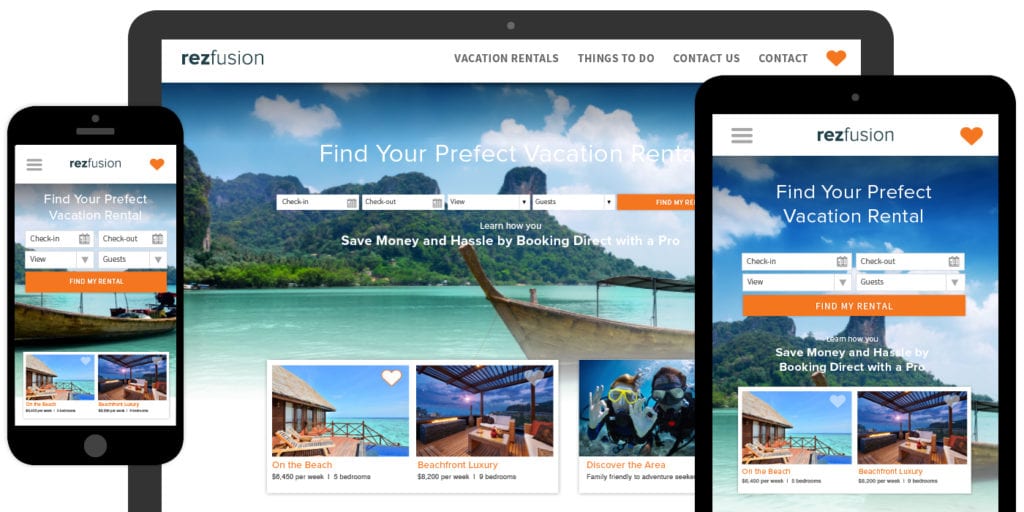
Bluetent recently announced that they are launching a new tier of Rezfusion, designed for startups and small vacation rental professionals.

Rezfusion Cloud will provide vacation rental managers an enterprise-level point-of-sale solution that appropriately aligns with smaller budgets and fewer resources. The Rezfusion platform historically offered two tiers: Rezfusion Pro which is ideal for medium sized property managers requiring a solution appropriate for their ambitious business goals without requiring custom design and development, and Rezfusion Custom, intended for large organizations requiring a unique solution designed for their specific needs from both a branding and functionality perspective. Both Rezfusion Pro and Rezfusion Custom will remain excellent solutions offered on the platform. In 2016, Rezfusion is on track to complete $170MM in online bookings, represents 15,000+ professionally managed units, and supports 125+ professional vacation rental managers.

Bluetent plans to offer the Rezfusion platform, and all three tiers, to all vacation rental management companies as a way to increase conversions, drive more direct online bookings, strengthen brand awareness, and help the vacation rental industry further progress in technology. All three tiers, Cloud, Pro, and Custom, include PCI-Compliant bookings, full integration with the leading property management software, and 24/7/365 domesticate support.

“We are thrilled to add Rezfusion Cloud to our eCommerce Travel Platform. We believe innovative technology should be available to all vacation rental managers to help advance the overall industry, and we are passionate about providing the best user experience,” says Peter Scott, President of Bluetent. “This is a significant opportunity for vacation rental managers to continue creating sustainable growth. We see Cloud as a tool that every professional needs to add to their sales and marketing efforts to ultimately drive more direct business at a lower cost to both the renter and the professional manager.”

If you’re attending Rezfest, Bluetent’s Product Manager will be conducting demos of the platform. Please sign up for time on his schedule to see if Rezfusion is the solution for your business: http://www.bluetent.com/rezfest-2016/

If you are not attending Rezfest but would still like to learn more, please visit: http://www.bluetent.com/the-rules-change/ and set up a time to connect.

Marketing the Experience: A New Strategy for Property Managers

0

One of the most difficult questions any property manager has to answer is this: “How do I separate myself from the crowd?” Even with a variety of marketing strategies at your disposal, crowded marketplaces and a lack of differentiation hold even the most creative marketers back. After all, you may have a beautiful beachfront condo in the heart of San Diego, just moments away from everything that the city has to offer; but, chances are, you’ll find ten more like it just down the street. Because of this, property managers often get stuck in price wars, amenity battles, and simply hoping that their SEO team can get their properties in front of more eyes than the next guy. Luckily, there is a smarter way.

Though most property managers do all they can to market what their properties offer, few remember that the real reason people travel isn’t for the top of the line flat screen TV in every room, complimentary internet, or even that gorgeous walk-in shower in the master bath; it’s the experience itself. Fortunately, Xplorie makes marketing that experience easier than ever before.


Marketing What Travelers Actually Desire

Xplorie has been around for twenty years; but when you think about what they offer, you’d almost think they were brand new. By giving travelers customized activity programs with their stay, and by giving property managers the ability to offer these activity programs complimentary with each rental, Xplorie underlines the primary question that property managers should have been asking in the first place: Why do people really travel?

In reality, travelers don’t always spend a ton of time in their posh vacation home, even though that’s what vacation accommodation providers are oftentimes marketing. They are out exploring, enjoying the ocean air, deep sea fishing, skiing, golfing, and experiencing the surroundings that are new to them. This is what Xplorie is providing – complimentary passes to all these activities and more – and this is what makes Xplorie a true ace in the hole for any property management company.


Why Property Managers Should Care?

Without a doubt, finding a way to really differentiate your properties can be hard; so, why not market the experience with the help of Xplorie? The ability to tell all your prospective renters that, with their stay, they get complimentary passes to the region’s most popular attractions is more than enough to drive bookings, increase call conversions, and make sure your properties are occupied throughout the season. Better yet, all of this can be done without steep cost cutting measures and promotions that are normally a property manager’s go-to last resort. In many ways, this is the marketing strategy that you have been looking for!

Of course, direct bookings and revenue aren’t the only reason Xplorie can help. Guests remember the fun times, the experiences, and the memories they make on a successful vacation, and being able to provide them that goes further toward guest loyalty and return occupancy than any other guest service strategy at your disposal! If they love you, they will return – and maybe even leave some positive business reviews; this is the power of $250.00 worth of free activities every day!


Xplorie Makes Traveling Fun Again

Are you a property manager looking for an incredible marketing strategy – rather than those piddling 10% or 20% discounts offered by your standard concierge program? Or are you a traveler, looking to experience horseback riding, snorkeling, skiing, and more for free? Either way, Xplorie has what you’re looking for. This unique platform is here to change the face of travel forever, and is almost certainly a game changer in the vacation rental industry.

Study Shows Traveler Concerns Over Booking Directly From Homeowners

1
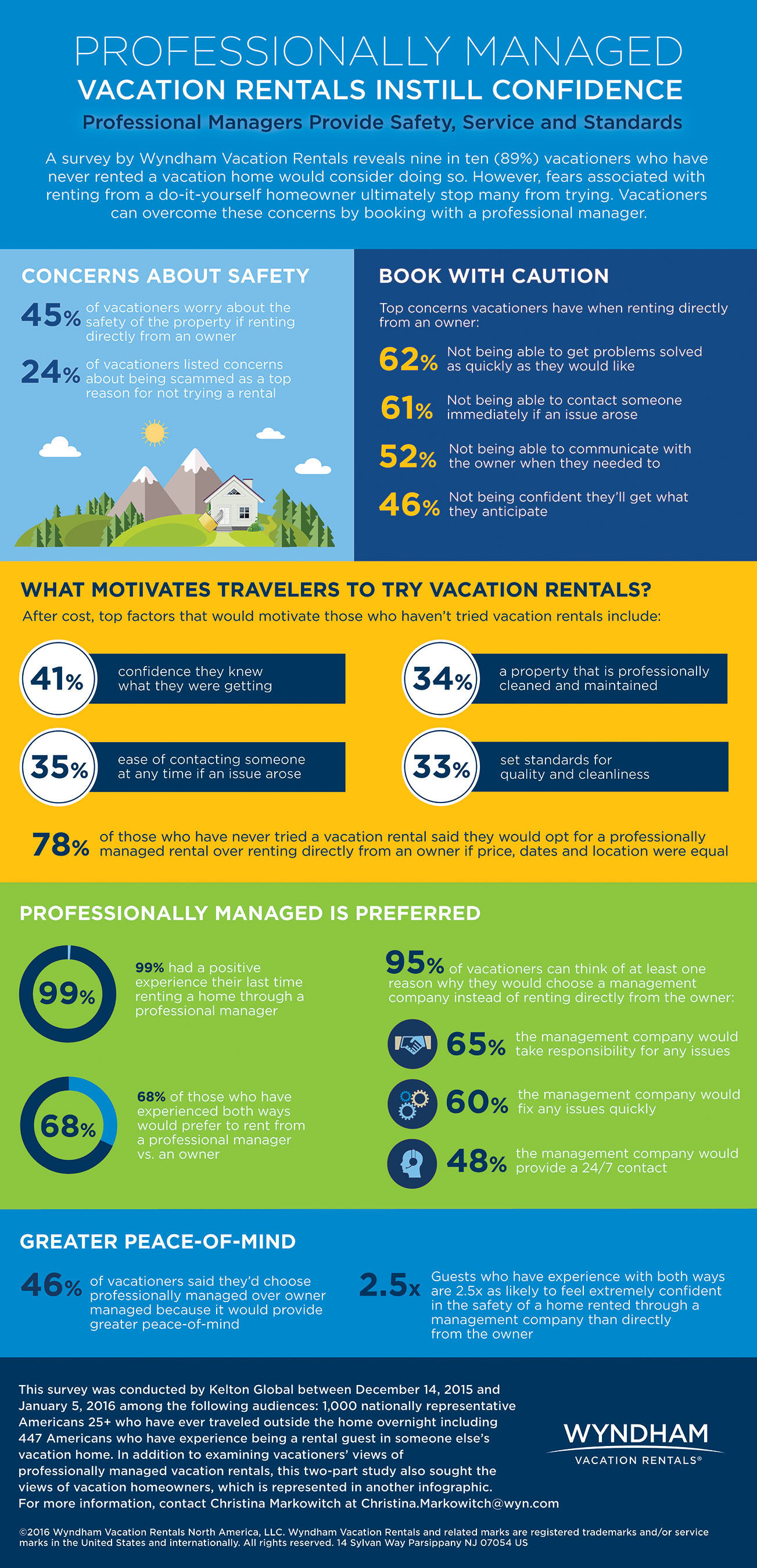
A survey by Wyndham Vacation Rentals reveals nine in ten (89%) vacationers who have never rented a vacation home would consider doing so. But fears associated with renting from a do-it-yourself homeowner stop many from trying. (PRNewsFoto/Wyndham Vacation Rentals)

Wyndham Vacation Rentals recently sponsored a study conducted by Kelton Global designed to gauge traveler sentiment about renting private accommodations from a professional vacation rental manager or booking directly from a homeowner. Here are key findings from the study:

  • 88% of do-it-yourself hosts dread dealing with travelers’ top concerns — filthy rooms, lack of service and safety issues
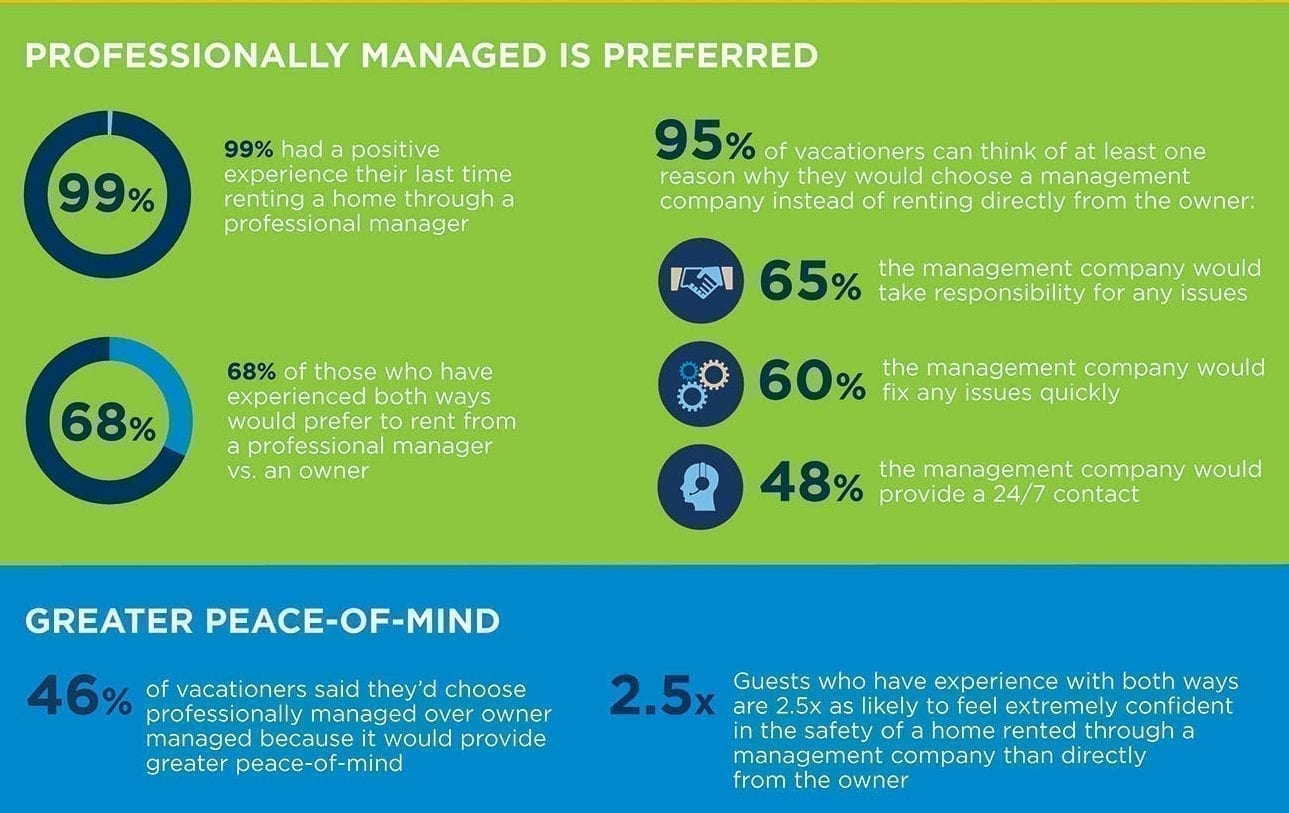
  • Nearly 70% of travelers who have tried renting from a professional manager over renting directly from an owner prefer the peace of mind that comes with renting from a professional manager.
  • 89% of vacationers who have never rented a vacation home would consider doing so, but fears associated with renting from a do-it-yourself homeowner stop many from trying.
  • 62% of all vacationers worry about not being able to get problems solved quickly.
  • 46% percent are not confident that they’ll get what they anticipate when renting directly from an owner.
  • 45% of all vacationers worry about the safety of an owner-managed property.
  • 49% of all vacationers look for a name they can trust when booking accommodations.
  • 68% who have stayed in a professionally managed vacation rental and one managed by the owner prefer the managed option.
  • 99% who stayed in a professionally managed home had a positive experience during their last visit.
  • 95% of vacationers can think of at least one reason why they would choose to rent from a management company over the owner. Top reasons included the company resolving issues quickly and providing a 24/7 contact.
  • Nearly half of all vacationers would choose a professionally managed rental over owner-managed because it provides greater peace of mind.

“The survey underscores that travelers want to know their vacation is in the hands of someone they can trust,” said Gail Mandel, CEO, Wyndham Vacation Rentals. “Being a homeowner doesn’t necessarily make you qualified nor interested in running a bed and breakfast. The reality is most homeowners don’t have the time to adequately meet guest expectations when it comes to safety, cleanliness and assistance, and as a result they find the tasks daunting.”

A survey by Wyndham Vacation Rentals reveals nine in ten (89%) vacationers who have never rented a vacation home would consider doing so. But fears associated with renting from a do-it-yourself homeowner stop many from trying. (PRNewsFoto/Wyndham Vacation Rentals)

HomeAway Hires Rover Tech Vet to Retain and Grow Homeowner Base

0

By Kurt Schlosser – Matt Gamboa, a 10-year veteran of the Seattle tech scene, is leaving Rover, the network for pet sitters and dog walkers, after 2 1/2 years as a product manager and relocating to Austin, Texas, for a job with HomeAway.

Gamboa says he drove several dog owner efforts during his time at Rover, including improving the search experience, launching the RoverGO and Rover Match products, improving the Q&A Community and integrating it better into operations, overseeing the smooth release of the dog owner fee and increasing customer satisfaction by improving Rover’s user experience.

homeaway-hires-to-retain-homeownersHe previously co-founded QThru, which raised $3.5 million in 2012, and Modbox, and was heavily involved in Startup Weekend as a coach, organizer and facilitator. Gamboa also led the organization of Seattle’s first B2B Startup Weekend with 9Mile Labs.

At HomeAway, Gamboa will be part of a product management team focused on helping vacation rental owners and managers thrive.

“I’ll be using my knowledge I gained at Rover.com to help grow and retain a homeowner base of over 1 million listings,” Gamboa said, adding that he thinks Rover “is the best company to work for in Seattle and I’m sad to leave at this stage.”

But Gamboa is confident that the Austin tech scene is on the verge of exploding much like Seattle did six years ago.

“It’s 2016’s fastest growing city and a lot of that is due to techies moving in,” Gamboa said. “It’s a bubbling of new startups and entrepreneurs with great ideas. I’m really excited to experience this.”

HomeAway Sued for Discrimination

0

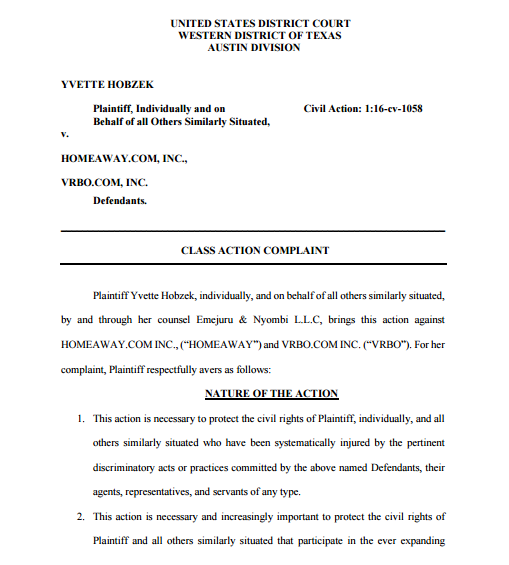
Yvette Hobzek, a Seattle-area real estate broker, filed suit against HomeAway this week, alleging racial discrimination.

Hobzek claims she was denied the ability to book a vacation rental in New York through VRBO.com because of her race. Hobzek is African-American.

According to the complaint filed in the U.S. District Court, Western District of Texas, 49-year-old Hobzek was traveling to New York City to visit her 87-year-old mother and to celebrate landmark birthdays of her children who were turning 50, 65 and 70.
Hobzek found a townhome that would work for the family, and filled out the form on VRBO.com. According to the calendar, the property was available for her dates. After she did not receive a response, Hobzek went back to VRBO.com and attempted to use the “Instant Book” option.

Later that day, she received a notice that the property was unavailable, even though it still showed open availability on the VRBO calendar. Hobzek called customer service to find out why she was unable to book, and the VRBO representative told her to contact the homeowner/manager.

The homeowner/manager (it is unclear from the complaint if the brownstone townhome was professionally managed or owner managed). The homeowner/manager “indicated to Ms. Hobzek that he did not rent to ‘[her] kind'”.

The VRBO calendar for the rental continued to show availability for her requested dates.

A month later, to add insult to injury, Hobzek received an email remarketing solicitation for vacation rentals in New York City for her dates, and the “featured property” was the one was denied the right to book.

Hobzek brought the Class Action under Rule 23 of the Federal Rules of Civil Procedure and seeks seeks to represent the class of all persons who, in the past, present and future, are unable to secure public accommodations through VRBO.com

The proposed class action suit accuses the company of violating the Civil Rights Act of 1964, which “explicitly prohibits discrimination in places of public accommodation, such as hotels, motels, restaurants, movie theatres and sports arenas.”

Hobzek is also suing for several other discrimination-related counts, including violation of the Fair Housing Act.


Read the full complaint below.

Hobzek v. HomeAway

Vacation rental discrimination-suit-against-homeaway

By Amy Hinote, VRM Intel Magazine

Do you change sheets on beds in your vacation rental that do not appear to have been slept in?

0

The thought of sleeping in a hotel bed with dirty sheets is completely gross, but that’s exactly the dirty secret INSIDE EDITION exposes when we checked in at certain hotels. In an investigation airing on Tuesday, INSIDE EDITION puts hotels to the test – the program came up with a unique way to find out whether you may be sleeping on dirty sheets – and the results might make you think twice before getting under the covers.

The program booked rooms at nine different hotels and each time sprayed a harmless and washable fluorescent paint onto the bed sheet, using a stencil that reads, “I Slept Here.” The paint is invisible to the naked eye – you can only see what’s on the sheets by turning on a ultra-violet light.

At The Candlewood Inn & Suites in Manhattan, INSIDE EDITION checked out leaving the dirty sheets with the invisible message. But were the sheets changed? The next day, INSIDE EDITION booked the exact same room – but under a different name. When we examined the sheets under the UV light, shockingly, the same message – ‘I Slept Here’ – appeared. The sheets hadn’t been changed between guests.

When INSIDE EDITION asked the manager why the sheets weren’t changed, she replied, “I expect them to be changed every day, and that is a policy of our property.”

Was this just a simple mistake or a common occurrence – a dirty secret widespread in the hotel industry?

At a La Quinta Inn & Suites not far from Central Park, INSIDE EDITION again sprayed ‘I Slept Here’ on the bed sheets. When they returned the next day under a new reservation, INSIDE EDITION again found that the sheets were not changed.

When INSIDE EDITION asked to speak with the manager, he arrived to the room with a maid. She claimed she cleaned the sheets, but when the program showed them the ‘I Slept Here’ message from the previous day, they both apologized.

The manager said, “I mean, there’re no words for me to say. We expect the housekeepers to change the sheets.”

At a Residence Inn by Marriott, a hotel rated one diamond by the AAA, INSIDE EDITION spray painted the word, ‘Yuck,’ on the top of the sheet and ‘I Slept Here’ on the bottom sheet. Sure enough, when they checked in to the same room under a different name the following day, the UV lights revealed the words ‘Yuck’ and ‘I Slept Here’ still there – the sheets had not been changed.

The manager didn’t want to speak with INSIDE EDITION at first, but then stated, “We make it a custom to change every check out room sheet. However, I do not know what happened in this situation.” The Marriott Corporation apologized for what happened.

All of the hotels where INSIDE EDITION found dirty sheets stated that they take this issue seriously and took immediate action to ensure this does not recur, all saying they take great pride in the high standards of cleanliness throughout their hotels.

All in all, INSIDE EDITION checked into nine different hotel rooms, and three did not change the sheets.

For INSIDE EDITION’s full report, tune in on Tuesday, September 13. Check local listings for stations and times at www.insideedition.com.

VRM Intel Live! Speaker and Session Lineup

0

VRM Intel Magazine is hosting VRM Intel Live! Wilmington on October 26, and VRM Intel Live! Destin on November 30, and we just finalized this jammed-packed lineup of true industry experts who are coming together for a full day of relevant, current and advanced-level education for vacation rental managers.

To register and learn more about VRM Intel Live! go to vrmintellive.com.


General/Keynote Sessions

  • 30 Years In Vacation Rentals by presented by Park Brady, President Park Brady Consulting, Former CEO of ResortQuest and The St. Joe Company
  • Lunchtime Legislative Updates with Mike Harrington in NC and FVRMA’s Denis Hanks in FL
  • Training For Hospitality Excellence At Every Phase Of “The Customer Circle of Life” by Doug Kennedy, Kennedy Training Network


Management Sessions

  • Profitability: Rolling Up Your Sleeves and Working Smarter, Ben Edwards, President of Weatherby Consulting, VRMA President
  • New Software: An Answer to Prayers or Your Worst Nightmare? By Doug Macnaught, Founding Member of The VRM Consultants or former co-founder, Instant Software
  • Are You Maximizing Profits? Why Travel Insurance and Payment Processing Are “Hot” Topics. Presented by Laird Sager, President, Red Sky Insurance and Regina Ebert, President, Ascent Processing
  • Team SWOT Analysis: Do You Have the Right People on Your VRM Team? presented by Sue Jones, President KLS Group
  • Measuring Housekeeping Performance presented by Durk Johnson, Executive Director, Vacation Rental Housekeeping Professionals (VRHP)


Marketing Sessions

  • Owner’s Guide to Managing an Expert Marketing Team with Trent Blizzard, Owner, BlizzardPress (Wilmington) OR 2016 OTA Updates – An Unfiltered Look at Changes in Distribution, presented by Steve Milo (Destin)
  • Get More Bookings – Website Design & Usability Tactics That Drive Conversions, Brandon Sauls, Owner at ICND
  • Planning Your Digital Marketing Budget for 2017 by Peter Scott, President at Bluetent
  • Establishing Your Brand in a Competitive Landscape, By Vince Perez, Founder of Fetch My Guest and Partner, Beach House Rentals
  • Taking Back Control of Your Local and National SEO: The Lines Between Search and Social have Completely Blurred, with Amber Mayer, VP of Product, NAVIS, Former CMO at The St Joe Company and Vice President of eCommerce at Wyndham Vacation Rentals


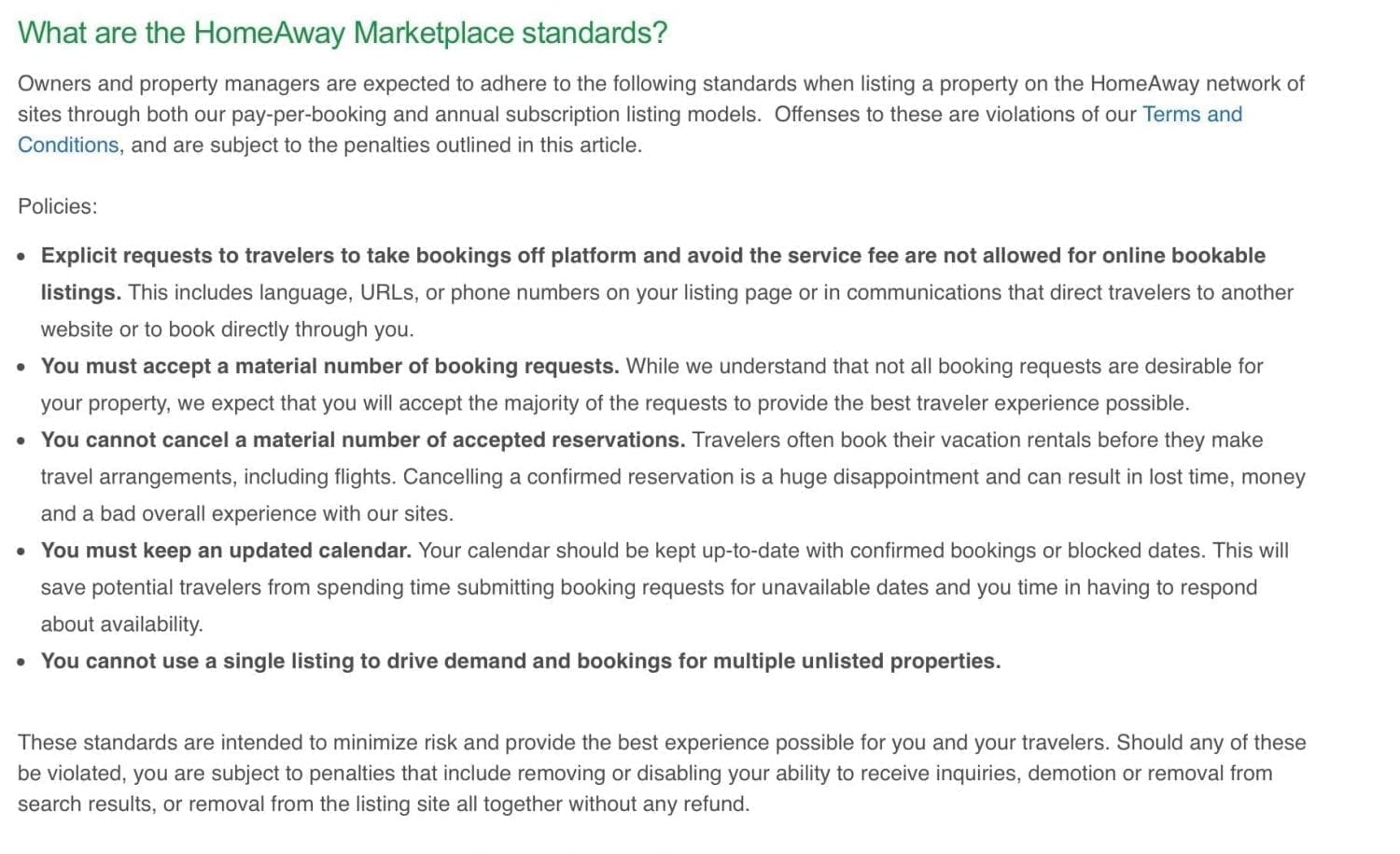
HomeAway Cracks Down On Language in Vacation Rental Listings

13

Vacation rental managers and owners who have listings on HomeAway’s sites are reporting that HomeAway is cracking down on content in vacation rental listings that provides information to guests about how to contact the owner or manager directly to avoid paying HomeAway’s service/traveler fee.

In an email to customers, HomeAway said, “We will deactivate listings that contain messaging indicating that travelers are encouraged to pay outside of our reservation system.”

New listings on HomeAway are being closely checked against HomeAway’s “Marketplace Standards.” One manager who has other listings on HomeAway recently added a new group of listings and included an office photo to all the listings — both old and new. The photo was removed from the new listings, but not the existing ones.


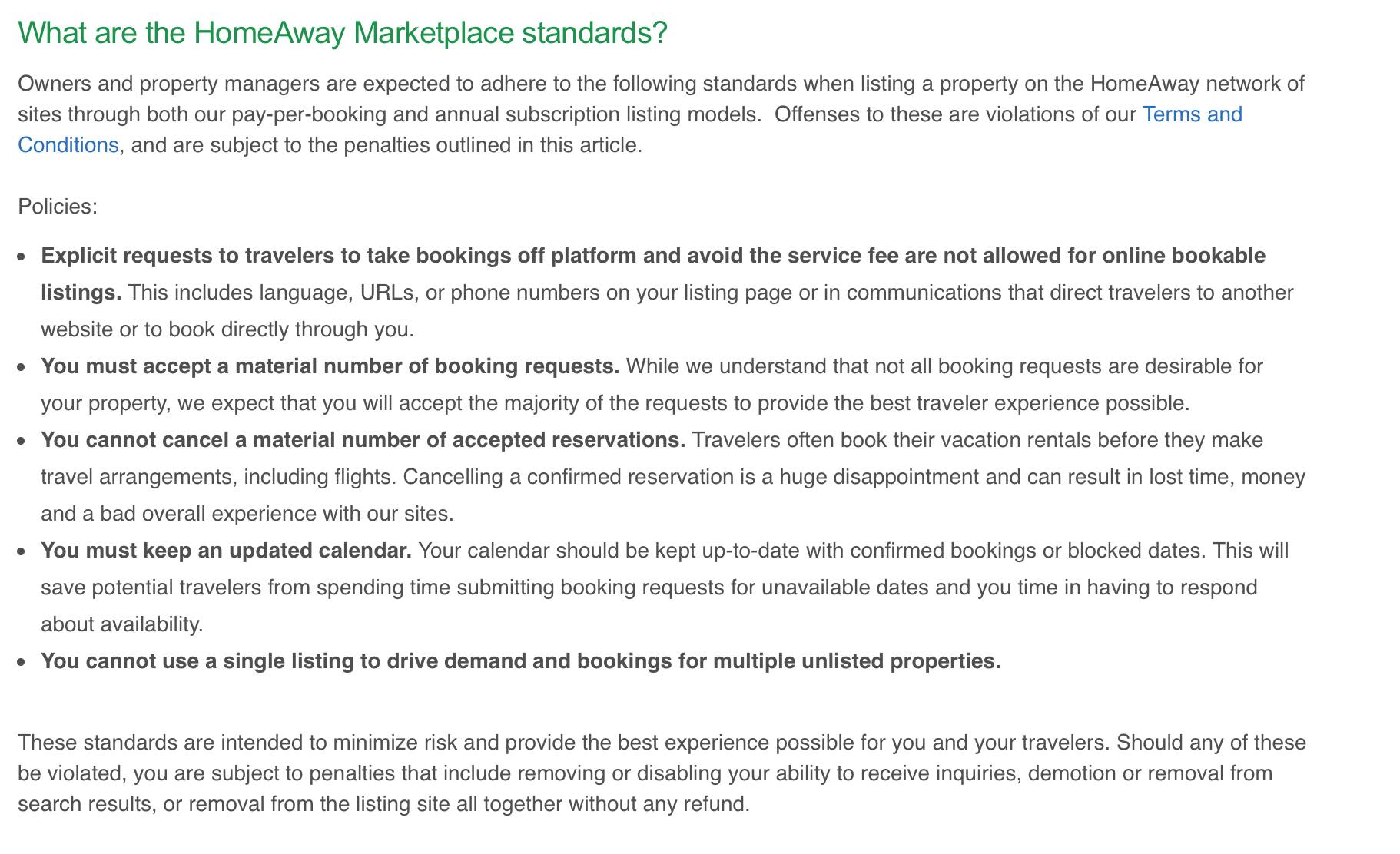
homeaway-market-standards

However, individual owners are beginning to report changes to existing listings. It appears that HomeAway has initiated an effort to comb through existing listings searching for language, photo captions, URLs and phone numbers than lead travelers to contact managers directly.

HomeAway’s Terms and Conditions state, “Members agree not to encourage or advise a traveler to avoid or circumvent the service fee charged by HomeAway.”

We reached out to HomeAway to find out if there has been a change in processes for enforcement but have not yet received a response.

Online User Experience: What You Can Learn From OTAs

1

Listings sites such as HomeAway, Airbnb and Booking.com are continually investing in refining the user experience (UX), and there is much that both vacation rental managers and independent hotels can learn by closely watching UX improvements made by OTAs.

The following information was written by John Kearney, Director of Hotelient and Hotel Sales & Consultancy Specialist.


With OTA´s investing heavily in user experience across multi-platforms along with their huge budgets in online advertising spend, how can an independent hotel compete with this?

Here´s some helpful pointers to get you going in the right direction:


Booking Engine

This is where the OTA´s have invested heavily in the user experience. There is a reason that OTAs do not offer extras or added-value like roses or champagne during the booking process. Users want the final price in the fewest clicks. You will have plenty of time once you receive the reservation to promote these automatically, and the client will be much more receptive too!

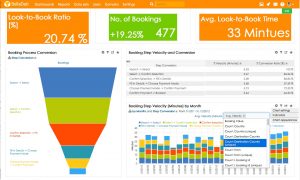
bookingfunnelotaIt is also critically important that your booking engine is visually great and easy to use for your guests. Sounds obvious, I know, but view your properties from a client’s perspective. Notice how OTAs sell to guests and how they make it easy to complete a reservation, then look for a supplier that best replicates this. Also, you need to make sure that your booking engine backend can provide you with good analytical data, such as: How many visitors are coming to your booking engine? Where are they from? What dates are they searching for? How many days in advance are they looking to book and from which websites are they visiting you from? With this, you will be able to determine the right promotions at the right time to optimize your online conversions.

Note: Also, are you able to track how many searches (and what search parameters) are yielding zero results? How many error messages are being displayed?


Cart Abandonment

A re-engagement strategy can be what makes the difference. An email campaign shouldn’t bombard or annoy customers; it should be treated as an extension of your customer service. It is perfectly legitimate when users have left your booking engine to send them an e-mail (even without completing a reservation) with a personalized follow-up message.

This demonstrates an appreciation of their interest, shows users that you value them as a customer and that yours is a property worth booking. Promo codes and incentives can stimulate impulse buying. However, this is not always necessary, as the email itself demonstrates that you value their business. It can also serve as a helpful reminder and quick route back to a home they had seen earlier and liked.


Website

Users tend to visit around 20 websites before making a reservation, so being the first website they find is not necessarily the best. What is important though is creating a bigger marketing database in which to target and to convert into potential future business booking directly.

  • Invest to get guests to visit your website
  • Gain their contact information
  • Target them afterwards

If your company has 15,000 visits per month to your website, how great would it be that even a mere 10 percent of those visitors is leaving their details with you. That´s 1,500 more people per month that you are connecting with, which is 18,000 more people in a year than you are contacting today. Asking potential clients to provide you with their email address will allow you to reconnect with them automatically, making the investment you are doing in online advertising offer better value and increase your online conversions. As Google is evolving to become the new OTA online, not only is it important to understand what you need to do to maximize your visibility, you also have to capture the clients once they get to your website


Reputation Marketing

In 2016, just monitoring your reviews by TripAdvisor and other review sites is not enough with management products largely becoming redundant. Users seek out independent reviews before making a reservation, with 95 percent claiming to read reviews before booking. OTAs understand this, so they make customer ratings and feedback a prominent part of the shopping process, offering millions of reviews directly on the site, so it is incredibly important that you are actively asking for feedback from your guests on channels that are important to your business.


Book Now

Now, doing the above is going to help your direct bookings but a good percentage of your guests will still come from OTAs no matter how good your digital marketing strategy is, so here are a few more cost-effective ideas that will help you connect with your guests and allow you to understand their requirements to further personalize your marketing message to attract more guests to book directly.

  • Social Wifi

Allow your guests to connect to your free Wifi using their social media channels. This is a great way for you to connect with everyone visiting, not just one guest per reservation. You will also increase your Social media fan base as well as your marketing database. (Note: Companies like Silicon Travel can help with this.)

  • Upselling

This is a great way not only increase your revenue but also learn what kind of experience your guests want, which will help you personalize even further. Having a PMS (Property Management System) or CRM (Customer Relationship Management) software that records buying habits will allow you also to customize your marketing messaging.

  • Guest APP

Make it easy for your guest to interact with you. Apart from promoting your services, apps can offer loyalty programs that provide your guests value and provide you with a great new marketing technique – Push Notifications & GPS Marketing.


None of the above are going to break your budget and will help set you on the path to increasing one of your most profitable reservations channels.  OTA´s are constantly improving their user experience, it is about time that we focus on this too.

Train your staff when to ask guests for online reviews

0

While it’s important to measure the performance of service and hospitality at your properties via online guest reviews, make it a priority to train your staff the appropriate moments to solicit an online review.

By Doug Kennedy | doug@kennedytrainingnetwork.com

As an insider to the business side of the hospitality industry, I certainly understand how important online guest reviews are to financial performance. While having positive customer feedback is vital to any business, it is especially important for a service business that is selling an intangible experience such as a vacation.

Yet as a guest, I find that when employees solicit guest reviews at the improper time, or use the wrong approach in doing so, it diminishes the joys and pleasures of experiencing authentic, sincere hospitality and that warm fuzzy feeling both parties get from the exchange.

I was recently the guest of a brand-new, extended-stay hotel in the Bronx, which I booked in order to take my daughter to freshman orientation at a nearby university. Both mornings of my stay, I was so impressed by the warm and welcoming hospitality that I saw the breakfast attendant giving each and every guest, especially how she took the time to learn our reason for visiting. Besides tipping her generously both days, on the second day I pulled her aside and said, “I just wanted to thank you for your amazing hospitality to make us feel so welcome here.” Rather than first thanking me, her immediate response was to ask me to post a review on TripAdvisor, which greatly diminished the joy of the moment.

Still, I was so impressed with her service, and also with the front-desk colleague who commented on the momentous occasion for us, that when I received an automated “thank you for staying” message after my departure I replied with a highly detailed, personalized “thank you” message directly to the manager. Yet the reply I received read like an automated response, since it did not reference any of my specific comments and instead used generic wording to ask me to post a review and also to “like” the hotel on its social media pages.

During another recent stay, I was traveling with my wife for a staycation in Miami. When we pulled up under the porte cochère, we were greeted by a doorman who welcomed us warmly and pulled our luggage. Yet his next comment ruined the moment when, as we were first entering the lobby, he handed us his business card with the TripAdvisor logo on the back and asked us to post a review about him. How can a guest be asked to review a vacation they have yet to experience?

I certainly do not blame the employees in these situations. I can imagine that they are only doing what they have been asked to do by the management in a quest for positive reviews. I remember when I started my career as a bellman at Marriott’s 125th hotel our managers always reminded us of the importance of guest comment cards. Back then, all the comment cards first went to the corporate office and Mr. Marriott himself responded to many of them. Our managers rewarded us when our names were mentioned. So like the staff members I interacted with, I’m sure I, too, was overzealous in soliciting responses.

It is up to managers to properly train the vacation rental staff on how and when to solicit guest reviews and social media posts. Most guests understand how important online reviews are to any business; chances are they might even work in a business that lives or dies by its own reviews. If done properly, not only will VRMs be able to avoid diminishing the warm feeling people get when they have experienced authentic, genuine hospitality, but also increase the likelihood that the guest will follow through with their posting.


Here are some training tips:

  • First, train the staff on the timing of their request for reviews. Guests should never be asked to post reviews upon arrival or during check-in.. Instead, ask later during a long stay or ideally towards the end.
  • Encourage staff to first sincerely solicit honest feedback. Rather than asking “How was your stay, good?” ask an open-ended question to let them know you truly want to know, such as “So tell me, what did you think of your vacation rental and service?”
  • When guests offer negative feedback, train the team to take notes to demonstrate how seriously we are about learning from the experience.
  • When guests offer positive feedback, train your employees to first and foremost sincerely welcome their compliments before soliciting reviews. They should use their own commentary to thank the guest in a personalized way.
  • Your employees should most definitely solicit reviews and postings, but they should be sure to do so with humility and gratitude. For example: “I don’t know if you consulted online reviews in planning your stay, but they sure are very important these days. We would be grateful if you were comfortable posting one to let others know the thoughts you just shared.”

With some effective guidance and a bit of training, your staff can foster positive guest experiences while also encouraging the online reviews and social media postings that are so vital to a VRM’s success.


Doug Kennedy is President of the Kennedy Training Network, Inc. a leading provider of customized training programs and telephone mystery shopping services for the lodging and hospitality industry. Doug continues to be a fixture on the industry’s conference circuit for hotel companies, vacation rental management companies, brands and associations, as he has been for over two decades. Visit KTN at www.kennedytrainingnetwork.com or email him directly.

Airbnb tries to fight racism with rule changes

0

By Tracey Lien — Accused of doing too little to thwart discrimination on its short-term home rental platform, Airbnb announced policy changes Thursday that are intended to educate and punish hosts who don’t follow its rules and protect guests.

In a 32-page report written by former American Civil Liberties Union director Laura Murphy, Airbnb detailed new policies such as voluntary anti-bias training for those who list their homes on the service, and suspensions for those who violate its code of conduct.

The San Francisco start-up will offer 24/7 personalized support to guests who cannot book a listing because they have been discriminated against, and give users quick and easy ways to report discrimination. Airbnb also pledged to diversify its workforce.

Brian Chesky, Airbnb’s co-founder and chief executive, wrote on the company’s website: “Discrimination is the opposite of belonging, and its existence on our platform jeopardizes this core mission. Bias and discrimination have no place on Airbnb, and we have zero tolerance for them.”

The moves come as diversity, discrimination and the social responsibility of firms that operate peer-to-peer platforms have become issues du jour in the technology industry.

The news drew mixed responses from observers, who were split between applauding the new policies and calling the effort too little too late.

“There are parts of it that make me feel optimistic, and there are parts that are almost laughable,” said Rohan Gilkes, the founder of Innclusive, an alternative to Airbnb that is slated to launch next month.

Gilkes, 40, said he liked a new feature that bars a host who has turned down a prospective guest from accepting a different guest on the same dates. The feature hits close to home for Gilkes, who penned an essay this year titled “I’m a black man — here’s what happened when I booked an Airbnb.” In the essay, he wrote about a host telling him that certain dates were unavailable only to later accept a booking from his Caucasian friend for those very dates.

Although he thinks that the date-blocking feature is a step in the right direction, Gilkes believes that Airbnb needs to go further by implementing blind booking. Hosts and guests can currently see information such as a person’s first name, a short bio and a profile picture.

“If you look at what Uber did, you don’t get to see the person’s name or photo until after you’ve been matched with them,” he said. “It doesn’t solve the problem of someone canceling a booking once it’s been made, but at least it lets you gather data, you can isolate the issue and you can take action.”

In Airbnb’s report, Murphy said information such as user photos “are essential to Airbnb’s overall mission of building a community.” Instead of introducing blind booking, it will experiment with reducing the prominence of a user’s profile picture.

But even that move drew criticism.

“I feel like that takes away from the community aspect and makes things less transparent,” said Stefan Grant, 27, the co-founder of Noirbnb, a black-owned competitor to Airbnb that rolled out this summer.

Grant and Noirbnb’s co-founder, Ronnia Cherry, made news last year when, while they were staying at an Airbnb home, neighbors called the police assuming that they were burglarizing the house. Their story was one of several prominent case studies showing the challenges that people of color face when using the service.

“People shouldn’t have to hide who they are because other users are prejudiced,” Grant said.

Blind booking would tackle discrimination on the platform to some extent, but the problem reaches far beyond that, according to business strategy and branding experts.

That’s because racial, gender and sexual identity discrimination aren’t procedural problems, they’re human problems, and companies can’t create a feature that will make them go away while also hanging onto lofty notions of community, said John Paolini, partner and executive creative director of brand engagement firm Sullivan.

A major hotel chain can establish hard-and-fast rules to halt discrimination among its staff, but Airbnb can’t come across as too heavy-handed if it wants to retain hosts. It must strike a balance to retain the “sense of community,” Paolini said.

“Ultimately Airbnb is a de facto hotel, even if it doesn’t want to be,” Paolini said. “While it may have begun as a community between hosts and guests when its base was smaller, the platform is now just too widely used to maintain that sense of community.”

Other business experts think that it’s possible for Airbnb to nudge its users into better behavior, but it will take more than new policies.

“We have to think of it in layers,” said Bernice Ledbetter, a professor of faculty organizational theory and management at Pepperdine University. “We can’t legislate morality through laws and guidelines. We can corral behavior, but we can’t change attitudes. I think Airbnb is trying to change attitudes and the way people think by talking about discrimination.”

In that sense, Airbnb finds itself in the same boat as other tech companies whose users have discriminated against each other on their platforms.

Instead of retroactively suspending users for their actions, these companies are trying to proactively educate and prevent discrimination in the first place. After being criticized for not doing enough to curb racism on its platform, neighborhood social networking site Nextdoor implemented a feature this year that required users — when reporting a crime or suspicious character — to describe a person’s dress in addition to his or her race.

Business strategists believe that moves like this are important first steps and their effectiveness will have to be measured over time.

Airbnb won’t be alone in figuring out its discrimination problems.

“This challenge is particularly endemic to the digital world,” Paolini said. “The Internet has created the illusion that we have no responsibility for each other’s humanity, and this is something the Internet is going to struggle with for a very long time.”

By Tracey Lien, tracey.lien@latimes.com

Vacasa Acquires An Flamand’s USA Vacation Homes

0

Vacasa announced its sixth Orlando­-area partnership in two years, bringing the company’s total Florida home count to more than 300. USA Vacation Homes, which has operated in the Orlando area for more than 15 years, transfers its vacation home contracts to Vacasa management as part of the deal, but will retain the real estate side of its business, Orlando Vacation Realty. All employees will remain with the company.

vacasa-raises-35mVacasa began aggressive expansion in the Florida market in 2015. Following a recent injection of $35 million in Series A funding, Vacasa CEO Eric Breon announced that the company would use the additional capital to continue pursuing increased market share in every vacation market in the world, with the ultimate goal of ubiquity. Vacasa has recently invested in several aspect of its business, including 31 acquisitions and implementation of Matterport Spaces technology across all of its listings.

“Expanding our inventory in Florida is a key priority for us, but we are also careful to grow strategically and thoughtfully,” says Vacasa CEO Eric Breon. “Both Vacasa and USA Vacation Homes operate on a foundation of delivering excellent results, and we are proud to partner with this proven business to provide homeowners and guests with the Vacasa experience.”

USA Vacation Home was founded by owners An and Danny Flamand in late 2000 and has since earned an A+ rating from the Better Business Bureau. The Flamands first connected with Vacasa in March, and have since been in talks with the company to transfer the vacation rental side of their business to concentrate on real estate.

Vacasa currently employs more than 1,000 people. USA Vacation Homes customers who have now been moved to Vacasa will now benefit not only from on-­the-­ground housekeeping, maintenance and management, but also from headquarters-­based listing management, search engine optimization and marketing, security, legal services, customer service and more.


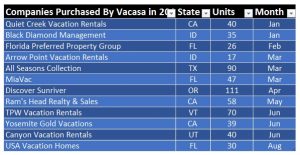
Vacasa’s Acquisitions in 2016

vacasa-acquisitions-in-2016

TruPlace Inks Agreement With Xplorie To Be Exclusive Provider of Interactive Floor Plans to Their Vacation Rental Management Clients  

0

TruPlace, the largest provider of interactive floor plans and professional photos for the vacation rental industry, today announced they have been selected by Xplorie LLC, Destin, Fla., to be the exclusive provider of interactive floor plans and photos for their vacation rental management clients.

As part of the agreement, qualifying Xplorie activity programs for both present and future Xplorie participating properties will receive TruPlace’s interactive floor plans and photos complimentary for each of their units. “This strategic partnership, together with Xplorie’s industry leading activity programs will ensure that our participating properties continue to differentiate themselves from the competition and exceed the expectations of both their owners and guests,” said Darrell Blanton, founder of Xplorie.

In addition, the new partnership extends exclusive opportunities to existing TruPlace clients who are seeking to be able to offer a customized Xplorie activity program to their guests as part of their stay. “Xplorie recognizes the added value that our interactive floor plans and photos provide,” said Suzi Cusack, vice president at TruPlace. “The combination of complementary guest activities, floor plans, and photos should be a very attractive offering to vacation rental managers.”


About TruPlace

TruPlace, headquartered in Germantown, Md., develops Interactive Floor Plans for the vacation rental management industry in the U.S. and the real estate sales market in the Washington DC/Baltimore area. TruPlace provides clients with professional, high-resolution TruHDR photographs of the inside, outside and amenities of properties that are digitally linked to a detailed floor plan of the property. This combination provides a prospective guest or buyer with a quick and easy way to tour a property and get the most accurate view of what that property actually looks like.


About Xplorie

Xplorie is the nation’s leading provider of “Free to Guest” activity programs for the vacation industry. Through its network of vacation rental managers and traditional lodging providers, Xplorie’s activity programs provide individuals and families with a unique vacation experience by extending, inclusive with every stay, free passes to the most popular local activities and attractions, while also providing its lodging partners with a point of differentiation against their competition.

RemoteLock 5i WiFi Smart Lock for Rentals, Home and Office Access Management

0

LockState has recently released RemoteLock 5i, a WiFi controlled smart lock available in deadbolt or lever options. The keypad door lock is the perfect solution for vacation rental properties, multi-family and residential properties, or office buildings.

RemoteLock 5i is the second generation of the LockState IoT connected WiFi door locks for these markets. Using Ayla Networks IoT platform and cloud services, RemoteLock 5i delivers many new upgrades and features to manage properties remotely.

Working directly with the property’s existing WiFi (no gateway required), doors can be monitored and managed through the web portal or smart phone apps.


RemoteLock Works Directly With Airbnb

LockState’s smart locks are one of the first solutions to be available to hosts on the Airbnb Host Assist program. Remotely manage one or many rental properties through the direct integration between Airbnb booking and the LockState Connect device management platform. Thousands of guest codes have been created by existing RemoteLock users to manage short-term rentals on platforms like Airbnb, HomeAway/VRBO, and other booking sites.


Multi-Family/Multi-Use Properties

The RemoteLock 5i is already in use at multiple apartment buildings and vacation rental properties. Property owners and management companies monitor and assign access through a keyless environment using the permissions options through the LockState Connect web portal.

RemoteLock users can provide codes for multiple doors throughout their property including: permanent or temporary access to resident/guest units; common areas like pools, gyms, or laundry rooms; and front door entry ways using cloud-based RemoteLock ACS Systems from LockState.


Office Buildings and Small Business

RemoteLock 5i allows users to lock or unlock doors remotely, know when people use doors, and receive text alerts when codes are used. Issue new codes or delete codes through a computer or phone via the LockState Connect web portal. Give temporary codes to service or office personnel. Even set schedules with times that certain staff can use the doors.

RemoteLock also works with Ring Video Doorbells so businesses can see who is at their door with Ring and conveniently open the smart lock with LockState’s app.


Feature of the RemoteLock 5i


  • Available in multiple colors and body styles
  • WiFi enabled lock connects directly to existing routers
  • One-touch lock button to quickly lock door on the way out
  • Up to 1000 user codes or guest codes available to store in its memory
  • View access history in real time from online account
  • Add or delete users and lock or unlock your door remotely
  • Set scheduled access times for users (Eg. M-F, 9-5)
  • Choose between passage or storehouse mode
  • Set schedules to passage mode, or even lock or unlock door automatically at scheduled times
  • Set to privacy mode to temporarily disable all user codes
  • Lockout functionality (after 5 incorrect attempts)
  • Two emergency override keys included
  • Heartbeat method for managing power usage
  • No bridge needed, works off standard WiFi networks
  • Integrates with the RemoteLock ACS cloud-based access control system
  • Works with Airbnb Host Assist Program
  • Works with Ring Video Doorbells


See the RemoteLock 5i and More LockState Products at Fall Events.

LockState is a member of CEDIA and Vacation Rental Management Association (VRMA) and will be exhibiting at both associations annual events this fall.


About LockState — The Leading WiFi Door Lock Company
LockState has provided over half a million door locks over the last decade. Since 2013, the company has been providing WiFi door locks to the market. There are over 10,000 owners and management companies who using the smart locks to generate over a half million guest and temporary codes annually. The locks are in use in over 50 countries around the world. RemoteLock products and LockState Connect platform bring the power of the Internet and remote control to door locks and physical access control systems so that property and business owners can centrally and remotely manage property access from anywhere.

Design Made Easy Launches Interior Design App for Vacation Rental Management Companies

1

Design Made Easy (DME) announced the launch of its mobile application platform that allows Vacation Rental Management (VRM) companies to work easily and quickly with homeowners to update their vacation rental’s interior design.

As VRMs know, interior updates increase occupancy rates and repeat stays, but communicating interior design needs with homeowners is both challenging and time-consuming.

This new app allows VRMs to work directly with homeowners to remotely identify items that need to be updated, provide recommendations, and let owners select and purchase replacement items.

Under a private white-label agreement, this proprietary, patent-pending suite of tools includes a VRM-branded B2B app with a custom-built company profile and recommended inventory, so that interior design choices are appropriate and add value to the vacation rental. DME also includes a unique marketing video specific for the VRM company to use with their property owners, detailing the interior design services.


“The application has been very beneficial in assisting owners in how to visualize how different styles of furniture and decor can enhance the interior appearance of their home, said Kim Catellier of 360 Blue Properties based in Santa Rosa Beach, Florida. “What a great concept to use when working within a budget.”


How the DME Mobile App Works

No longer does a vacation property owner or vacation rental manager have to send images via text or email to communicate suggested interior design changes. With DME, homeowners have access through the platform to select inventory such as home furniture, decor, accessories, kitchenware, appliances, and flooring. In addition, all communications sent to the vacation rental owner from DME appear from the VRM company’s brand under this private-label approach.
 

Interior Design App for Vacation Rentals


If the vacation rental homeowner would like custom interior design, they can sign up for DME’s concierge service. DME’s trained interior design staff then works virtually with the vacation rental owner to create and select home décor purchases for their vacation rentals to increase rental and occupancy rates.

The DME central application tool is designed around projects created for rooms with collections to choose from and connections to share with the vacation rental homeowners for timely collaboration.

Each step in the process allows collaboration and tracking of their choices with costs and allows vacation rental owners to reach decisions faster by choosing from virtual interior design boards saving time and money.

The app allows for:

  • Insertion of the actual dimensions of rooms;
  • Design project and tags items to be changed in a given room;
  • Interior design boards and web links that shows selected items for purchase;
  • Digital design boards, where notes and shares occur to make final choices while tracking costs.


According to Sarah Honaker, DME Founder and a vacation home owner herself, “”I started Design Made Easy in an effort to create order and organization for our own room projects in our vacation home, and then expanded on the concept for others overseeing the updates needed for vacation rental properties.”

Honaker continued, “Having a clear, simple way to communicate and track costs of interior design projects took hours off the process of decorating our family’s vacation rental, and we want to provide the same capabilities for owners and managers.”

Aaron Drake, DME’s Chief Information Technology Officer, and Bhaskar Sanga, DME’s IT director, said that it is extremely rewarding to be part of a product that helps people improve their living spaces and properties.

Drake said, “As a software developer it has been fun to move outside of the world of bits and bytes and into creative living spaces.”

DME is excited to be attending both the HomeAway RezFest Conference, September 21-23 in Orlando, Florida, and the VRMA National Conference, October 16-19 in Chandler, Arizona.


About DME

Design Made Easy, DME is a cutting edge mobile interior design company that communicates interior design ideas in real time for the vacation homeowners of vacation management companies. The DME interior design team uses a proprietary, patent- pending central application platform to provide interior design solutions to their clients, to gain consensus and purchase selected items. Please visit Design Made Easy or call 1-866-DME-APP3 for more information.

Storms Plague Holiday Weekend for Vacation Rental Managers…Again. Promos and Hot Deals Are In the Works.

0

The Summer of ’16 is shaping out to be relatively disappointing for the majority of vacation rental owners and managers.

Vacation Rental Managers (VRMs) in beach destinations on the East Coast and Gulf Coast have reported Year Over Year (YOY) declines of 3 – 6 percent to VRM Intel.

Just as vacation rental providers were anticipating a late season boost during Labor Day weekend, weather forecasters are capitalizing on tropical activity with the economic consequence of deterring travelers from booking last minute beach stays.

Unfortunately, the summer beach season began on Memorial Day weekend much the same way as storms covered South Florida and Tropical Storm Bonnie impacted the East Coast.

Memorial Day Storms Affect Vacation Rentals on East Coast

Marketers in affected destinations are now challenged to recover deficits by finding new ways to bring in off-season travelers in October, November, and during the holiday season.

(Note: What is missing are marketing plans by distribution channels to address the lack of revenue.)

We expect to see vacation rental marketers innovate to create content and promotions (i.e. email marketing, press releases, articles, blogs, social media) targeted to the increasing number of travelers who have the flexibility to vacation outside of the parameters of the K-12 school year.

Here are some of the deals we have seen from VRMs:

  • Hot Deals for Long Weekends (i.e., Columbus Day and Veterans Day)
  • Promotions to Feeder Markets with School Fall Breaks
  • Pet Deposit Waivers
  • Late Check-In/Check-Out
  • Gift Certificates For Area Restaurants
  • Tickets and Promotion for Fall and Winter Events and Concerts
  • Extreme Savings on Mid-Week Stays
  • Increased Promotion and Visibility of Monthly Stays
  • Promos for Properties with Football Game/Theater Rooms
  • Romantic Getaways Targeted to Couples
  • Avoid-The-Crowds-And-Save Promotions Targeted to Families with Small Children
  • Senior/Retiree Discounts and Promotions
  • Wi-Fi Properties for Work-At-Homers Looking for Discounted Vacation Opportunities

Pro Tip: Use Promo Language in Headings on Distribution Channels

If you have ideas, please share!

By Amy Hinote

Benefits of Taking a Family Vacation

0

By Jill L. Ferguson  — (Attn: VRMs, feel free to you use on your blog) Most Americans who are given paid vacation by their companies don’t take all of it.

In two separate surveys, one reported on by Forbes that was conducted by Glassdoor and Harris Interactive showed that only 25 percent of Americans take all of the their paid vacation days. and one conducted by Skift said that nearly 42 percent of Americans do not take any vacation days. (The Glassdoor-Harris Interactive survey also showed that 61 percent of work while on vacation.

According to Forbes the workplace benefits of employees taking vacation time include: higher productivity, stronger workplace morale, greater employee retention, and significant health benefits. But what exactly are those health benefits?


Reduces Stress

Centers –tone, a not-for-profit community-based behavioral health healthcare network, says, “Vacation helps shrink stress and anxiety while boosting the mental and physical health of the entire family.”


Helps Your Heart Stay Healthy

Taking an annual vacation has also been linked to a decrease in heart disease. The Journal of the American Medical Association published an article titled “Multiple Risk Factor Intervention Trial: Risk Factor Changes and Mortality Results” in which a study found that men who take frequent annual vacations were 32 percent less likely to die from heart disease than their counterparts who forwent vacations.

Similar results were found in the Framingham Heart Study which found negative effects on the heart when women do not take vacations. In a 20-year study, researchers found that women who took vacation once every six years or less were almost eight times more likely to develop coronary heart disease or have a heart attack than women who took at least two vacations per year.


Improves Your Mental Health

A survey of almost 1400 participants in studies on breast cancer, cardiovascular disease and other conditions, conducted by the University of Pittsburgh Mind-Body Center, found that “Leisure, including vacations, contributed to more positive emotions and fewer negative feelings and depression,” as reported by NPR.

This finding is also supported by the Jessica de Bloom and her colleagues at Radboud University in the Netherlands, in a paper titled “Vacation (after-) Effects on Employee Health and Well-Being, and the Role of Vacation Activities, Experiences and Sleep“ published in Journal of Happiness Studies. De Bloom studied the effects of long (more than two weeks) vacations and found that people felt less tense and healthier while on vacation, with higher energy levels and more life satisfaction.


Improves Your Relationships

A five-year study of women in rural Wisconsin published in the Wisconsin Medical Journal showed that women who take vacations at least twice per year are “less likely to become tense, depressed, or tired, and are more satisfied with their marriages,” and that the “odds of marital satisfaction decreased as the frequency of vacations decreased.”

These findings were similar to those in the studies conducted by Purdue University’s Xinran Letho, as published in the Journal of Hospitality & Tourism Research. Letho found families who vacation together undergo shared experience, communication and togetherness, escape and relaxation and experiential learning, all which contribute positively to well-being and to relationships.

And I can attest to many of these benefits, as my husband and I just returned from a two-week vacation, where we intentionally did almost no work, and we are feeling more connected, refreshed and content.


Follow Jill L. Ferguson on Twitter: www.twitter.com/JLFerg

Diversifying Your Marketing Efforts: Vacation Rental Managers Can No Longer Afford to Put All of Their Eggs in the OTA Basket 

1

By Heather Weiermann — If you’ve ever heard the phrase “Don’t put all of your eggs in one basket,” you will probably understand the idea of diversification and why it is so important for protecting your assets. The same concept applies to your source of business in the vacation rental industry – specifically where your guests find you.

Diversification is simply the “act of introducing variety.” Although it can be applied to a number of areas within your business, the concept absolutely must be applied to your marketing strategy and generating leads. Just like your financial investment efforts, diversification of your marketing strategy reduces risk and ensures that your revenue goals are not derailed by the unexpected.

A lot has been said recently about new fees and policy changes implemented by various online travel agencies (OTAs) and listing sites. As the online giants like Expedia and Priceline move further into the vacation rental space, the market is heading toward consolidation with a few large players dominating, all with very high rates and potentially poor service (some might argue that we’re already there).

There is no denying that vast majority of guests are shopping online. Vacation rental managers now have some choices to make. The result of these choices will determine who holds the power in our industry and your business moving forward.

  • Where do you invest your marketing dollars– in OTA and listing sites or in your own brand?
  • When is it beneficial for you to pay a commission fee to secure a booking and when are you just giving away margin?


The path of least resistance is always the most expensive. You can put all your eggs in the OTA/listing site basket and rely on them to generate all your business demand, or you can invest in driving consumers to your brand.com to book direct via your website or via phone.

If you don’t own the marketing channel you are using, you are beholden to their whims – you not only have to pay the fees the sites are charging, but your business will always have to conform to their policies (cancellation, refunds, payment processing, etc.). You will always be at the mercy of their decision making, which will ultimately be in the best interest of their company, not yours.

Growing commission rates, coupled with the fact that many OTAs are bidding on and competing for your property’s brand search keywords, makes the OTAs’ relationship with vacation rental managers anything but a partnership. Granted, for many small companies with restricted marketing budgets it is a necessary lifeline for getting your properties in front of potential guests early in the buying cycle.

It is important to keep in mind, however that OTAs and listing sites do not create the demand for your business. As we review year over year “lead volume” with VRMs who use OTAs, we aren’t seeing growth in volume but rather lead numbers simply shifting over to a channel that reduces your margin. In other words OTAs and listing sites are simply spending more on marketing that you can and in many cases are injecting themselves between you and your guests.

Why diversify your marketing? When considering your strategy for generating leads, you may only think of one thing — how many? However, that’s certainly not the only aspect that matters when it comes to how your leads will convert into bookings and the net revenue generated by each lead. How much will you spend to get the leads? How high of a commission you are paying? Will you have to pay a credit card processing fee? Is upselling ancillary services possible? How high is the demand for the dates you are trying to book? Plus a number of other factors can make the same number of bookings look very different when it boils down to the net revenue generated.

Too many vacation rental managers rely on OTA sites for far too much of their booking demand. Even the companies succeeding with in-house bookings could benefit by chipping away at their OTA percentage. There are a few relatively simple things you can do to diversify your marketing and move some of your eggs out of the OTA and listing site baskets. These changes will make an impact on your net revenue, grow your guest database and improve guest satisfaction. Implement these and I guarantee you’ll find your OTA percentage drop while occupancy grows!


1. Create Value with Exclusive Incentives

At the end of the day your guest will make the decision that is best for them. As we look at guest sentiment in the hospitality industry, we see a growing desire by guests to book through your website because they feel they can trust your business compared to a large booking engine, help support this growing preference. If your guests perceive real value or receive an advantage when booking direct, then they’re more likely to do so. This not only reinforces the value to your current direct bookings, but also incentivizes your guests who book via OTA sites to make a better choice in the future. It’s not hard to think of an incentive that’s going to cost you less than the three to ten percent OTA commission while also providing more value to the guest. I have seen the following be very effective at driving direct bookings:


2. Compete Head to Head With Rate

One of the most important strategies you can implement to drive direct bookings is to have the best rates. Give your guests a sense of security knowing they made the best choice with a “Best Rate Guarantee.” This can be as simple as a price match or a discount that is less than the commission potentially paid to the OTA. The only way to qualify for the guarantee though is for the guest to book direct. Here’s the most important part…make sure everyone knows about it! Promote your guarantee on your website, in your marketing materials, via social media, in your email messaging and wherever else you are marketing.

You’d be amazed by how many guests give you the chance to book them direct by calling your business even while they are online perusing listing sites. We hear it day in and day out as we help our clients listen to their call recordings and coach their reservation agents.  Make sure your reservations team understands the critical importance of winning business that is contacting you directly, and incentivize your team to help them book direct.


3. Offer Late Checkout

Sure, this may have an impact on operations. But, if you can make it work, adding an hour to the check-out time for direct bookings is a big incentive. You can do this either by extending the check-out time for your direct bookings or by changing the check-out times for your OTA bookings to an earlier time.


4. Just Ask

It’s really that simple. People will do what you ask if you take the time to ask them. Your reservations team, your website and all your email communications should educate potential guests on the value of booking direct. Make sure they see and hear your promise of “Lowest Rates Guaranteed” or “Best Rate Guarantee” each time they interact with your brand.

Ask guests to book direct and explain the benefits for them if they do. Reinforce the personal touch and develop a relationship with your guests to demonstrate how important their vacation experience and their business is to you. If you can make it personal and make it genuine, the guest will want to book direct to ensure that same level of service is provided during their stay.


5. Collect and Use Guest Information

These are your guests. If they have a great experience, they are likely to stay with you again and share their personal vacation storied with their network of family and friends. You should be building your guest database, not just with your past guest data, but with the data from every lead you receive. At a minimum, make sure you are collecting a name, email address and phone number from each prospective guest.

However, to build meaningful relationships and to truly personalize your marketing messages, you need to collect more than just the basics. It’s not difficult. Your reservations and guest service team members are already learning many things about your guests just by talking to them. However, if you do not have a way to capture this data and record it in a usable format, this valuable information will slip right through your fingers. With no guest data of your own to use for remarketing purposes, you will always be paying for more leads. Why not reuse the leads you already paid for as a supplementary source of direct booking opportunities?

Knowing your guests will make them feel as if they know you. The OTAs are collecting your guest data. They use it to remarket their site and your competitor’s homes to prospective guests. Your primary goal when a guest inquires via an OTA site should be to make sure you have the ability to communicate directly with them and develop an ongoing relationship with your brand. You can do this through personalized messages and strategic touch points prior to their next planned stay in your market.


6. Recycle Leads With Post-Stay Targeting Messaging 

Keep in touch with every lead in your database regardless if they stayed with you or not. I don’t mean adding them to your newsletter database though. In order to build strong, lasting relationships and earn their business, the messages you send should be personalized based on their interactions with your brand and the personal details you know about them.

We have worked with several property managers who have begun targeted email campaigns to “not booked” guests after their stay dates have passed. These guests are sent a special message 60 days prior to their initial inquiry anniversary to convert them to direct bookings on their next stay. This is just one of the remarketing strategies proven to be very effective at triggering OTA guests to change their behavior and book direct.


7. Know How Each Marketing Dollar Performs, Down to the Penny

If you don’t know how each spent marketing dollar performs, how can you make informed decisions about changes needed in your marketing strategy? OTAs use the fees you pay them to bid on your market and brand keywords on the major search engines in order to intercept your guests as they are looking for your homes.

It is almost impossible to compete with the enormous marketing budgets of an OTA or listing site. That is, of course, unless you are tracking and measuring your marketing return on investment (ROI) for each marketing strategy you have deployed. It is not enough to know how many impressions, clicks and click throughs your dollars generate. If your tools and technology cannot track your marketing spend back to the bookings generated, every dollar you spend is just like throwing a dart at a dart board.

If you’re going to implement a new marketing strategy, make sure you are able to track results and understand your average cost per guest acquisition. This reveals just how effective and valuable the new strategy is from a business objective standpoint. Based on results, further refinement of your marketing program is possible which allows you to focus on the strategies that perform the best for you.

Tracking true ROI requires an inter-connected system that tracks both online and offline (phone) responses and ties actual booked revenue to specific online, e-marketing, social media and traditional marketing campaigns. You should be managing the details of each marketing strategy, recording costs and analyzing conversion and booked revenue to validate ROI and justify your marketing spend.


8. Invest in Your Reservations Team

An exceptional reservation sales team is far and away one of the best investments you can make. By training and coaching your reservation sales team members who directly interact with your guests, you can emphasize how to build a lasting guest relationship, sell the experience of staying with your brand and earn the right to ask for the booking. By doing so you will achieve higher conversion rates and unmatched guest experience. At a minimum, you should be listening to your reservations calls in order to provide your agents constructive feedback and training to help them improve their skills and assess agent performance.

Incentivize your agents on more than just total revenue booked. Encourage and pay them when they successfully build a relationship with the guest and collect more than just the basic guest data. Provide your agents with the tools to perform proactive, personalized and timely follow-up calls and emails with potential guests rather than waiting for the guest to call back.


Summary

Yes, the OTAs can, and most likely will, play an important role in your overall marketing strategy. However, ensuring you are diversified and not dependent on just one source for leads is becoming even more important than ever before. To protect your business, your goal should be to convert every guest to a direct booking guest, if not for their initial stay with you, then for all future stays.

In short, make the effort to diversify the eggs in your marketing basket. If you are successful, you will not only grow your business, but unpleasant changes by one channel are more likely to be offset by positive results in another. This will deliver a stronger position in the market for your brand and more retained revenue for your bottom line.


About Heather Weiermann

Heather WeiermannAfter growing up on the beaches of San Diego, Heather graduated from the University of California, Santa Cruz with a Community Studies degree. Directly out of college, Heather built a consulting business for non-profit organizations. During this time Heather began marketing and managing vacation homes in 1999 as a favor to a friend who owned a beautiful home in La Jolla, California.

Over the course of 14 years, Heather’s business, Southern California Vacation Rentals, grew to become one of San Diego’s leading vacation rental companies. In 2013 Heather sold her company to a prominent East Coast company that wanted to build a West Coast presence. After helping with the transition of ownership, Heather knew immediately she wanted to help other vacation rental managers realize the same results she found after implementing The NAVIS Way at her own business.

Throughout her tenure, Heather has supported the vacation rental industry and other vacation rental managers by volunteering on local, state and national tourism and vacation rental committees and advisory councils. Heather served on the Board of Directors and as an Executive Committee Member of the Vacation Rental Managers Association (www.VRMA.com) from 2010 – 2014. Heather also founded the California Vacation Rental Managers Alliance (CAVRMA.org) and the San Diego Vacation Rental Managers Alliance (SDVRMA.org). Both organizations were created to bring a much needed voice and public awareness to the region’s vacation rental industry.

In her personal time, Heather loves being outside, traveling with her husband Mark and their dog Willard, and finding adventure in every turn. If they are not staying in a vacation home, they can be found somewhere out in the wilderness in their off-road camper.

Winning with Google: Vacation Rental Managers Take Advantage of Google’s Changes to SERPs to Beat the Competition

2

Vacation Rental Managers (VRMs) have waited a long time for good news related to Google Search. For several years, OTAs and big-name listing sites have been able to outperform VRMs for organic positioning on Google’s Search Engine Results Pages (SERPs). Prominent VRMs watched helplessly as their rankings slipped further down SERPs in spite of costly SEO initiatives.

However, the game has changed.

Google has made significant changes to their SERPs which are now allowing savvy VRMs to take back their rightful place on Page 1.

With a renewed and expanded emphasis on local search results, Google’s changes have caused OTAs and listing sites to scramble to improve visibility and explain substantial decreases in traffic to investors and shareholders.

As a result, VRMs have a much awaited chance to take advantage of these changes and beat the OTAs in organic search, but proactive action needs to be taken. According to Google, there are specific steps you can take to quickly push up your rankings.

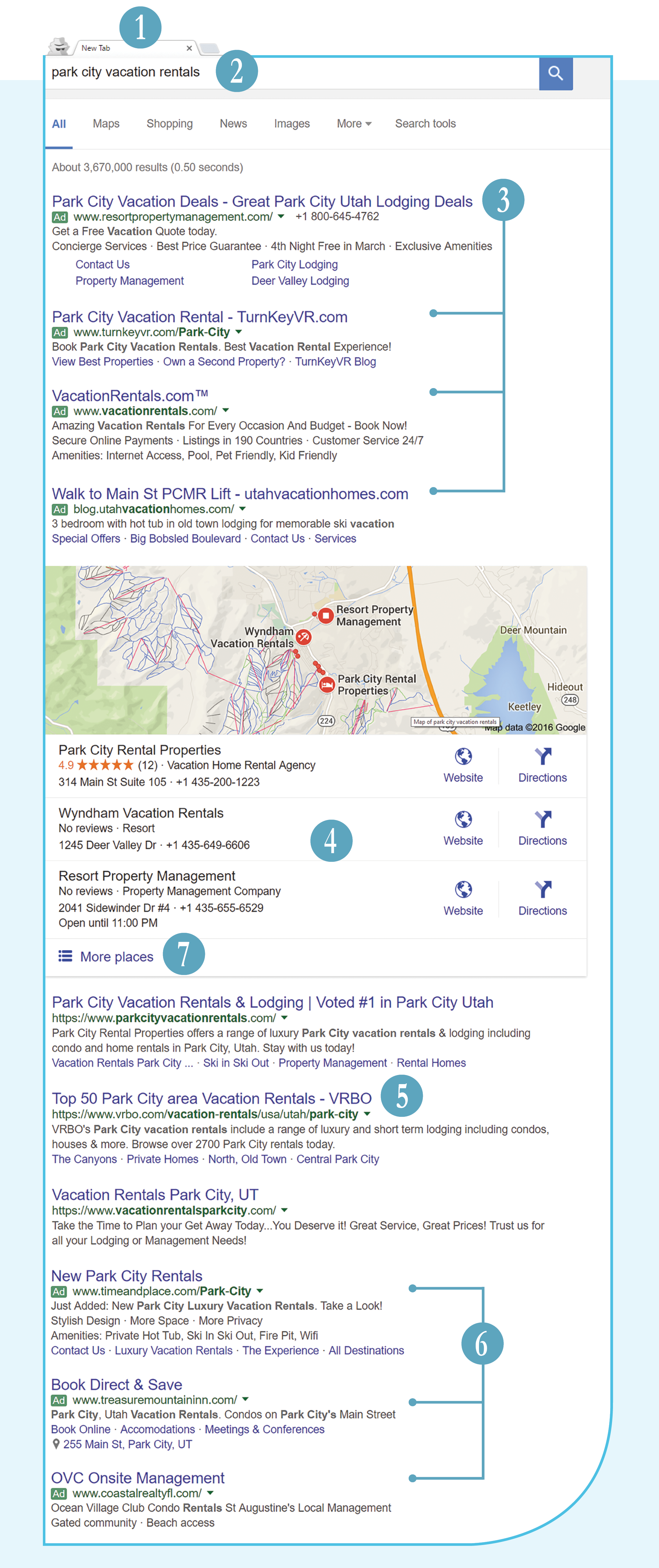
First, assess your current visibility. Here is a step-by-step guide to see what users see in the new Google SERP format:

Pic1

1. Go Incognito. Right click on the Chrome browser icon, and open “New Incognito Window.”


2. Search for “[Your Destination] Vacation Rentals” (Repeat these steps for your top keyword phrases).


3. Note the company listings that show up as an “Ad.” The companies that are displayed here are bidding for these search phrases using Google AdWords. Google recently eliminated the right column of ads and is now only displaying three to four ads in this section, which has resulted in an increase in costs. (See Marketing Mix for a recommended AdWords budget).


4. Below the ads, you will see a Google Map with Local Listings. Your primary goal is to work your way into the top three spots displayed.


5. Under the map and local listings, you will see another group of results that are based on the Google search algorithm with which you are more familiar. We previously referred to these results as the Top 10 Organic Results.


6. Below the Top 10 Organic Results, you will also see three or four more ads from Google AdWords.


7. Scroll back up to the map, and click on “More Places.” This will link to a map that shows local vacation rental company listings.


8. The criteria for ranking higher in this section is entirely under your control. Optimizing this area will allow you to improve your visibility and quickly gain more conversions from Google Search than ever before. Take a look at the information displayed here.

  • Reviews
  • Address
  • Phone number
  • Hours

According to Google, these Local results appear for people who search for vacation rentals near their specified location, and you can improve your business’s local ranking by using Google My Business.


5 Ways to Improve your Local Ranking on Google SERPS


1. Can’t Find Your Business? Improve your Info.

Providing and updating business information in Google My Business can help local ranking on Google and enhance your presence in Search and Maps. Local results favor the most relevant results for each search, and VRMs with complete and accurate information are easier to match with the right searches. Make sure to enter all of your business information in Google My Business so customers know more about what you do, where you are, and when they can contact you. Provide information like (but not limited to) the physical address, local phone number and category.


2. Verify Location(s)

Verify your business location(s) for the best opportunity to appear for users across Google products, like Maps and Search. Prioritize the location that is closer to the actual location of your rentals.


3. Post Accurate Hours 

If you provide 24/7 service, add it. While conducting research, you can easily see the phrase “Closed now” on many local listings. If you are open for extended hours for calls and/or service, make sure travelers on Google see it. Entering and updating your hours lets potential customers know when you’re available and gives them confidence that when they travel to your location, it will be open.


4. Manage and Respond to Reviews

Google has added a section on its reviews page that highlights reviews from other websites such as Booking.com, among others. For VRMs, this is an area that is rapidly advancing. Spreading out reviews over Google, TripAdvisor and HomeAway will provide enormous dividends in the very near future. Google’s goal in adding third party reviews to their search results solves the problem of travelers searching for reviews from multiple websites. And this new feature is linked with Google maps, which offers multiple benefits.

Interact with customers by responding to the reviews, across all channels, that they leave about your business. Responding to reviews shows that you value your customers and the feedback they leave about your business. High-quality, positive reviews from your customers will improve your business’s visibility and increase the likelihood that a potential customer will visit your location.


5. Add Professional Photos

Adding photos helps travelers see the type of homes you offer. Accurate and appealing pictures show potential customers you are professional and that your business offers what they’re searching for.


How Google Determines Local Ranking

According to Google, local results are based primarily on relevance, distance and prominence. These factors are combined to help find the best match for a search. The following information is provided by Google.


Relevance

Relevance refers to how well a local listing matches what someone is searching for. Adding complete and detailed business information can help Google better understand your business and match your listing to relevant searches.


Distance

Just like it sounds – how far is each potential search result from the location term used in a search? If a user doesn’t specify a location in their search, Google will calculate distance based on what’s known about their location.


Prominence

Prominence refers to how well-known a business is. Some places are more prominent in the offline world, and search results try to reflect this in local ranking. Adding your proximity and partnerships with local landmarks or well-known brands that are familiar to many people can improve your prominence.

Prominence is also based on information that Google has about a business from across the web (like links, articles, and directories). Google review count and score are factored into local search ranking: more reviews and positive ratings can improve a business’s local ranking. Your position in web results is also a factor, so SEO best practices also apply to local search optimization.


For the first time in years, Google has made changes that favor the local VRM. With just a few steps, you can reclaim your rightful spot in organic search results.


By Amy Hinote, Editor-In-Chief, VRM Intel

How To Grow Your Vacation Rental Business With Data And KPIs

0

By Matt Renner –Test Your Knowledge. Here’s a quick test, see if you can answer these acronyms without Googling them.

What is your CAC? LTV? ACV? ROR? ROA? Negative churn? CHS?

Do you know these for your B2B business as well as your B2C business? Do you know how they directly impact your top and bottom line revenue? Can you pull up a dashboard and share it with your entire leadership or executive team right now?

If you know what these acronyms stand for and why they are important then you are already one step ahead of your competition.

If you do not know what they stand for, why they are important, why you should pay attention or how they directly affect your top and bottom line, well…I would say, “Houston, you have a problem.”

Of course, if your name is Houston, then I would just say that you have a problem.

But if your name is Houston and you know all of this, then I apologize.

More on acronyms later.


Know Your Situation

In any business, smart decisions are driven from having a clear vision and mission, experience, discipline or operating system and data. Today, business owners have access to more data than ever before (thanks Captain Obvious) and sometimes this can be paralyzing. It is amazing to me how many business owners and operators do not know critical data points regarding the drivers of the biggest revenue channels in their businesses. They don’t know their internal core Key Performance Indicators (KPIs) to determine the health of their own rental portfolios and things of this nature.

When I hear this, I will sometimes challenge them a little bit, asking why they don’t focus on these things and if they feel their business deserves better. Then they’ll start to open up and ask what data they should I focus on, which KPIs are most important, what levers should be pulled and how to align compensation with the most important KPIs or objectives.

To that I would say, “It’s not about how many, it’s really about which ones you choose and how often you review them.” What’s important is you do actually choose your KPIs, create a repeatable operating system and review them with extreme focus and discipline.


An Idea

Maybe you have been running your business for many years and you’ve done well, but are now under attack by the onslaught of startups, guarantees, technology, marketplaces, platforms and changing consumer behavior…or the sheer energy of the millennial and next generations. Or maybe you are the next generation millennial (myself included here) and are trying to compete with those who have been there, done that and figured all this stuff out. Whoever you are and whatever your situation is, I think a smart idea to consider is to model your KPIs off an industry that has significant benchmarking data and proven success metrics in place…that are publicly available.

Just an idea, but what if you started thinking about your business KPIs like a SaaS business?

SaaS stands for Software as a Service. Think Salesforce, Box, TRACK. These are SaaS. Cloud-based software delivered via the internet. Why should you consider this?

Try This Experiment

Go to Google and type “acceptable churn rate of vacation rental homes” or something to that effect.

I did this and I couldn’t find anything in the top ten results that even had a graph or a chart of relevant, up-to-date data on this. There was nothing. Does that mean no one is talking about it? That’s what it signals to me.

Now go to Google and type “acceptable churn rate of SaaS.”

There are at least three pages of acceptable benchmarking, up-to-date studies by numerous SaaS companies and thought leaders who share the acceptable churn rate of SaaS businesses. In fact, the only thing I saw in the SERPs that was remotely close to property management was a Quora question that was asking what the acceptable churn rate was for property management SaaS companies.

Yikes!

I don’t know what your numbers should be. I don’t know what’s good or bad in your area. I am, in fact, not an expert at retention of homeowners at a property management company. I am, however, somewhat of an expert in the subscription marketplace and SaaS business arena and I think they parallel each other. After all, if you land a homeowner and that home is worth $30,000 a year to your business and if you keep that homeowner from leaving your business for ten years, 90% of your revenue is going to be made after the first year.

The same can be said for marketplace and SaaS business. After all, aren’t they all subscription businesses? Isn’t the owner subscribing to your services?

So why not model yourself after an industry that clearly has the customer acquisition and churn model figured out? Couldn’t you apply these concepts to your business to get clarity around which levers you need to pull and how to prioritize the most important tasks or objectives in your business to focus on…like reducing owner churn?

I think the answer is yes. Now let’s talk about how to do this in a practical, methodical way. Remember, these things don’t change overnight, but with thoughtful reflection, detailed planning, dashboarding and transparency, and a willingness to hold and be held for an accountable, testing and selective focus, you can create repeatable systems – with great data – to improve your business and achieve sustained growth.


Select Your KPIs

Think of your mission, vision and core values as the destination. Think of KPIs as the GPS to that destination. If you choose the wrong route, data and KPIs to focus on, you will have to recalculate more frequently. Choose the right route and you will arrive at your destination faster, with less wear on your tires and with more gas in your tank. (I feel my metaphor game is strong right now.)

As the chief sales hacker for a marketplace (ResortsandLodges.com) and SaaS company (TRACK Hospitality Software) for the better part of eight years, I’ve had the privilege of working with many of you, as well as many resorts, hotels and lodging companies outside of the VR space — 99% of which I would say are independent small businesses. There are some common things I typically see in the best run independent companies and vice versa — commonalities I see in companies that are struggling to survive.

One of the main commonalities of top performing companies is they identify the key KPIs that are core to the success of their business, they align their objectives around them and they display them and review them with ferocious discipline and tenacity.

Here are some KPIs around which you might want to build your internal operating system. You may want to change the actual nomenclature of the acronym if it doesn’t make sense for you, but I think the concepts are the most important pieces to take from this. I’m focusing on B2B, which in your case is your business relationship with your inventory suppliers, aka your homeowners.


ROR

Renewal of Revenue (ROR) tracks the retention of your revenue. It is arguably your most important metric if you have traction in Monthly Recurring Revenue (MRR). If you only have five homes, retention may not be as important a factor as new customer acquisition. Think of it this way, if you retain 80% of your revenue per year, you are churning $2 million on every $10 million. It should be easier to close a contract renewal than to close a contract for a new customer if you are doing your job right in customer success. Put a keen eye on ROR and put repeatable processes in place to be able to predict the health of your revenue base. Then track your ROR like a hawk. This really goes hand-in-hand with bookings, of course, but you can apply it in multiple ways when thinking of your owner renewals and repeat guests.

Tips for ROR Reporting and Dashboarding

  • Segment the revenue channels of your business
  • Determine your baseline goals for ROR
  • Dashboard and review daily, weekly, monthly, quarterly and annually
  • Align compensation with your goals and objectives
  • Perform frequent performance reviews with your Owners. Develop a process, train it into your people and stick with it for best performance. If you can, force compliance.


ROA (Renewal of Accounts)

In the SaaS business, we look at, not only ROR, but also Renewal of Accounts (ROA). This metric means different things for different businesses. For example, we work with a company that purposely shed several hundred homes and condos that were not very profitable, drove down their Average Daily Rate (ADR) and were problem owners. But once they got to the number they wanted, they focused on driving higher revenue and expansion on this smaller number of homes, retaining these accounts (owners/homes/condos) and acquiring new owners with similar properties to the highly successful ones they wanted to retain.

Too many whales, not enough fish…An ocean needs a healthy mix of both. So do most businesses.

You can add new properties and big earners to your inventory — a great idea. But if you add one home that brings in $40,000 per year and lose ten homes that collectively bring in $40,000 a year, you have decreased your inventory quite significantly even though you maintained the $40k. You might think “no big deal, we didn’t lose any money.” But If you fail to retain the one property for $40,000 the next year, you no longer have the ten to make up that revenue. Having a good mix of whales and fish is generally a good idea.

Again, it depends on your objectives, but if your goal is to not churn your owners, then you need to make ROA a core KPI.

Tips for ROA Reporting and Dashboarding

  • Segment homes/owners and report on them together and separately
  • Determine your baseline goal for ROA
  • Dashboard and review weekly, monthly, quarterly and annually
  • Consider making this a selling point with new owners if the results are outstanding
  • Align compensation to your goals and objectives (not just for your executives)


ACV, CAC and LTV

What is your Average Contract Value (ACV) today? If you’ve been in business more than a year or two and have over $1 million in Annual Recurring Revenue (ARR), you likely have found your ACV sweet spot. Get focused and go after it…or change your model if it’s not working and go upstream or downstream.

If you know your ACV, and you know with predictability the following KPIs, your Customer Acquisition Cost (CAC), ROR and ROA, then you should be able to predict with some level of confidence what the Lifetime Value (LTV) of your customer is and how long it will take to payback a new customer acquisition. This will guide you in making compensation decisions with your sales and customer success teams who will be aligned with these goals and numbers. It all works together.

If you can pay back your customer acquisition cost in SaaS in twelve months, you generally have a scalable business that you can grow organically. If you pay it back in six months, you are going to grow faster, and if you can pay it back in three to four months, then you should be in hyper-growth mode. What are these metrics for your business?

Again, set goals, benchmark, report, review and align compensation across your company to these goals and objectives.

If you want to know more about these things, I recommend following @saastr on Twitter.

While you’re at it go ahead and give me a follow too @socialmattr.


CHS

Do you know if your customers are healthy? How do you know? How do you proactively find out? Is it a system that can be trained and repeated by your people? One idea you should consider is creating a Customer Health Score (CHS). An owner with a low CHS is less likely to renew. Wouldn’t you want to know if four months into a one-year contract, an owner is experiencing issues with one of your customer success agents? Or if they don’t think their expectations are being met? Of course you want to know this, but it can’t be done ad-hoc. You need to create a system around this and drive compliance. It’s to everyone’s benefit, both internally and externally.

Tips for Creating a CHS

  • Identify what a healthy customer looks like, what are the factors?
  • Review all the reasons customers haven’t renewed in the past
  • Rank the reasons in importance
  • You can apply weight to these factors if some are more important than others or keep them all equal in weight.
  • Perform regular account reviews and record the CHS in a software program like your ERP/PMS or CRM.
  • Find out what CHS score leads to the highest retention and lowest churn rates
  • Set your goals for where you want the customers to be health-wise
  • Identify customers with a low health score and perform tasks to increase these
  • Dashboard, review and report on this daily, weekly, monthly, quarterly and annually


Negative Churn

This might sound bad, but it’s not. It’s actually good. If you have negative churn that means you’re growing more than you’re shrinking. (Captain Obvious strikes again.)

The way you achieve negative churn is quite simple. Here is a brief math equation:

  • $1,000,000 Gross Revenue Business
  • $100,000 Revenue Churned
  • $300,000 New Revenue Acquired

In this case your Negative Churn is 20%.

In layman’s terms you grew $200,000, because even though you lost $100,000 you added $300,000 in new business. (For more information on negative churn and why it is a powerful KPI, I would recommend following @ttunguz on twitter.) What you want to do is track negative churn on gross revenue, cash and accounts. You may want to apply this KPI to your B2B and your B2C business.

If you don’t have negative churn, your business is contracting. Businesses are like beautiful flowers (harp playing in the background), if they’re not growing they’re dying, and we don’t want that, so get your numbers figured out, establish a baseline of where you are today and where you want to go tomorrow.

Tips for Creating Negative Churn

  • Set your growth goals
  • Identify your key KPIs…I like the ones I’ve just described
  • Each KPI should have very specific tasks that need to be executed consistently and at a high level to come together and achieve the ultimate goal of negative churn, or in other words, growth. Use tasks like account reviews, product reviews, in-person meetings, performance reviews, etc.
  • Dashboard, review and report on this daily, weekly, monthly, quarterly and annually. The more you review it, the more it becomes a part of your daily routine. If it isn’t visible, then your people won’t be thinking about it and executing on it.


Conclusion

These are some ideas for KPIs based on what we track and report on daily, weekly monthly, quarterly and annually in our own business. They are the same KPIs used by some of the largest, most successful SaaS companies in the world. Since implementing these key KPIs, internally, to achieve our goals several years ago (along with aligning our compensation plans, job descriptions and seats on the bus), we have seen over a 20% net increase in our own retention rates and have been experiencing record growth.

Perhaps these concepts will work for you and help you keep more of your owners, grow your relationships and confidently invest in new objectives. Maybe they’ll help you launch your rental business like a rocket into hyper growth!

Matt RennerHouston. Rocket. See what I did there? See how I tied that back together from the beginning? See how I pointed out the obvious again? Aren’t KPIs a little obvious too?  Well, in that case, I think we all need to be captains.

Ahoy.

By Matt Renner, VP Sales/Partner, TRACK Hospitality Software and ResortsandLodges.com

 

Booking.com: “Charging travelers is neither optimal for the customer, nor sustainable as a long-term business model.”

6

An Inside Look at Booking.com: David Mau, Director of Product at Booking.com, talks to VRM Intel about their growth, pricing model, regulations and the importance of professionally managed vacation rentals.

This year, the online vacation rental marketplace has experienced numerous changes to the landscape including new pricing models, the addition of fees to travelers, changes in sort criteria and cancellation fees, and an industry-wide transformation to a transactional marketplace.

But while the conversation is revolving around the supplier angst at HomeAway and the regulatory chaos caused by Airbnb’s hosts, Booking.com is quickly and stealthily building its inventory of vacation rental listings, growing over 30 percent in the last year.

Besides the increase in the number of listings, what makes the vacation rental inventory of Booking.com unique is that it is verified, instantly bookable and largely professionally managed. In addition, Booking.com has not adopted a traveler (or service) fee to their pricing model.

We reached out to David Mau, Director of Product at Booking.com, to find out more about Booking.com’s:

  • Growth Attribution
  • Working with Property Managers vs Individual Homeowners
  • “Vetting” properties
  • Online Booking
  • Traveler Fees
  • Vacation Rental Software
  • Regulations


Q: Booking.com has seen a 30 percent growth in vacation rental listings since last year. To what do you attribute this growth, and is it in line with Booking.com’s expectations?

DM: At Booking.com, our aim is to connect travelers from all over the world with their ideal stay in the most seamless and enjoyable way possible, whether it’s a five-star hotel in New York City, a vacation home in Florida or a cozy apartment in San Francisco. As with every move we make to improve our product offering, we listen to our customers. In recent years, we’ve seen the demand for vacation rentals, homes and apartments steadily continue to grow. To make sure we’re providing the best possible range of options, we’ve been busy building relationships with as many different kinds of accommodation providers as possible and adjusting our platform to meet all of their unique needs. To that end, as of today, we offer more than 460,000 vacation rentals on Booking.com that have over 2 million bookable rooms. In fact, more than 70 percent of the accommodation options we feature on our website are something other than a traditional hotel. Our customers are hungry for choice and new experiences – and that’s great news for the vacation rental industry. We’re definitely pleased with the growth that we’ve seen on our platform, and we keep building new partnerships so that we can continue to inspire our customers with the diversity of choice they demand.

Vacation Rental Number of Listings Airbnb - Expedia-HomeAway - TripAdvisor -Priceline-Booking


Q: Booking.com is seeing much of its growth in professionally managed listings. In your earnings call last quarter, CFO Daniel Finnegan said, “We’ve got teams of people at Booking.com that are continuing to innovate and grow (vacation rental) business. Right now, it’s mostly through property managers.” Can you share some of your objectives in working with property managers?

DM: We believe that the best way to scale the growth of vacation rentals, homes and apartments on our website, and thus scale what we offer to consumers globally, is to keep a dedicated effort on professionally managed properties. This helps to ensure a seamless, professionalized experience, rather than the constant unknowns of dealing with individual property owners who may not be as well-versed in the vacation rental business.

As with all of our accommodation partners, our primary objective with the professionally managed sector is to make sure that our working relationships run as smoothly as possible so that our partners can continue to deliver great stay experiences to travelers and grow their businesses through Booking.com. We want to make it as easy as possible for them to sign up and manage multiple listings with us, so we work hard to provide the flexibility and insights that will help them grow their businesses. Managing a portfolio of several vacation homes with different owners can come with a unique set of challenges. We get that and so we are innovating our interface to better meet those needs, including the addition of a more robust system to help facilitate payments for those partners that require it, as well as a messaging system that allows partners to quickly and easily chat with their guests to arrange key pick-ups or special requests from their mobile phone in one handy interface.


Q: As you add more vacation rental homes to your sites, do you see differences in working with property managers vs. individual homeowners?

DM: We’ve learned over the years that a one-size-fits-all approach doesn’t work for every partner, but investing time in understanding their different needs does. One of the things we know from working with property managers is that they’re typically industry professionals who are doing this full time. Because they’re managing multiple properties, we see a lot of synergies in terms of the scalability of their processes and an understanding of e-commerce and online travel booking. The key is to align our processes and provide solutions which make their management of multiple properties on our platform as easy as possible. While we also work with lots of super savvy individual homeowners who’ve been in the business for years, we also find that many people who are renting out a single apartment or vacation home for the first time aren’t doing this as a full-time job. They simply have another set of needs and require a different level of support. Meeting all these different, unique needs is certainly challenging, but it’s also one of the aspects of our work at Booking.com that drives us to keep innovating.


Q: With all of the discussion about regulations involving vacation rentals, how does Booking.com “vet” homes as they are added to the site? Do they need to be legal or registered?

DM: When accommodation providers sign up to list with Booking.com and agree to our terms and conditions, we ask them to verify that they are operating in full compliance with local laws and requirements. We will immediately remove any property that is found not to be in compliance. Further to that, we have very robust measures and dedicated teams in place to guarantee that only legitimate properties are allowed to list on our site.


Q: Do you require all homes to be instantly bookable? How do you handle varying cancellation policies?

DM: As our goal is to make booking any type of accommodation anywhere in the world online as seamless and as easy as possible, providing our customers with instant confirmation for all bookings is the cornerstone of our product offering. Our customers love this about Booking.com, and it’s one of the key features that sets us apart from other companies operating in the vacation rental space. This ease of booking translates directly into more bookings for our property partners, so we think it’s a win-win-win.

From our point of view, this all has to do with customer expectations, which are constantly evolving. With the leaps forward in technology over the past decade, we’re all getting more and more used to being able to shop online and get instant confirmation of our purchases no matter whether it’s groceries, a TV or an upcoming vacation. We believe that having to engage in a discussion with a property before ever confirming the stay is something that adds friction to the travel experience. We’re committed to a more streamlined experience for customers.

With regards to varying cancellation policies, this is something we have been managed from the very beginning of our business. We’ve purposefully built up our tooling over the years to be able to accommodate a wide range of unique cancellation policies over which our partners are in total control. Our goal is to enable our partners to run their businesses as they see fit and to make sure that these policies are crystal clear to our customers at every stage in the booking process so that there are no surprises later on.


Q: HomeAway, Airbnb and TripAdvisor have implemented traveler (aka service) fees while Booking.com is continuing with a commission model. Is Booking.com considering a traveler fee? And do you believe that this pricing model of charging travelers is optimal and/or sustainable?

DM: At Booking.com we have never charged a booking fee to customers for our service, and this is something we are extremely proud of. From our point of view, charging travelers is neither optimal for the customer, nor sustainable as a long-term business model. We believe that a  commission-based model, which we have used for the past 19+ years, is not only fair for our partners who can choose to list on our website or not, but also results in total transparency for consumers. We are an extremely cost-efficient marketing channel for properties, connecting them with customers from all over the world for a fee that is far, far smaller than other marketing channels like, say, TV advertising. Important to note, we only collect commission when a guest stays at their property. This means that partners only pay for our services when it results in additional business for them – and travelers can continue to book with us with the confidence of knowing that there are no hidden booking fees and that we offer a best price guarantee.

Our vision is simple – offer the widest possible choice of stays in the world and make it easy for people to find, book and experience the properties that are right for them, whether it’s a hotel, vacation rental or any other type of property. Our current model enables us to do just that. We view charging booking fees as a deterrent for consumers. Why would you pay a booking fee for a vacation home when the resort down the street doesn’t charge one? We understand that this is not how the vacation rental industry has traditionally operated, but we do believe that it is the way forward. Empowering customers with the same ease of experience they’ve grown accustomed to in booking traditional hotels is what will help the vacation rental industry continue to grow and prosper well into the future. We’re looking forward to continuing to innovate our business together with our vacation rental partners to do just that.


Q: When Expedia purchased HomeAway, Expedia took on HomeAway’s software division that provides property management software to vacation rental managers. Historically, EXPE hasn’t gotten into leveraging software, but PCLN has. Do you believe having vacation rental property management software provides an OTA with a competitive advantage in this space? Are you considering other acquisitions in the vacation rental industry?

DM: Different partners have different needs. While some partners don’t rely on software, or have their own processes and solutions, we do see many that find it more convenient to have a one-stop-shop solution to leverage to run their businesses smartly and efficiently. Many properties prefer not to work with several different companies to get all of the tools they need to operate on a day-to-day basis. We invest in understanding the varying needs of our partners and take a customer-focused approach to creating tools that best meet these needs. For these partners, providing them with access to property management software does bring extra value to our working relationship and makes their lives easier. At the end of the day, that’s simply our goal.


Q: In light of the volatile regulatory and technology environment for vacation rental managers, are there any industry trends or predictions that you see in the coming two years for vacation rental managers?

DM: We see a huge appetite from consumers around the world to explore a wide variety of accommodation experiences. More and more travelers are seeking out local and authentic experiences at a lower cost and with more freedom and enhanced privacy. Vacation rentals fill this niche perfectly. In general, we find that vacation rentals are growing in popularity with travelers from a wide variety of profiles, but especially with families, couples of all ages and groups of friends who are travelling or going on holiday together. As technology brings us all closer together and it gets easier and easier to travel, we believe that the vacation rental industry is only going to continue to grow, but that also means that some changes and innovation will be required. Yes, there are some regulatory questions underway, but this is a natural part of the emergence of any new marketplace. Ultimately, we believe these will work out because consumers demand this product, vacation rental owners benefit from the industry’s growth, and local governments benefit from increased tourism in their regions. In the end, we believe that smart partnerships and the right technologies make the next two years and beyond look very bright.


By Amy Hinote, VRM Intel

Microbes: Unseen Dangers in Vacation Rental Housekeeping

0

A housekeeper’s world is more dangerous than it appears. In preparation for the next occupant’s arrival, housekeepers are the front-line defense to sanitizing and cleaning a rental after a previous guest’s visit. Some of the microbes that a housekeeper must kill and remove can create flu-like symptoms, while other types of microbes, in some cases, can be as life-threatening as HIV.

Here are several microbes that vacation rental housekeepers should be aware of:

Escherichia Coli Bacterium (E-Coli) 

  • E-coli currently exists in our intestines.
  • It comes from undercooked ground beef.
  • In ideal conditions, one cell can regenerate into one billion cells within ten hours.
  • Most strains are harmless.
  • Some strains can cause diarrhea, while others can cause urinary tract infections, respiratory illness, pneumonia and other illnesses. (1)

Salmonella 

  • Salmonella is transmitted through unclean surfaces.
  • Infections occur about 6-36 hours after ingestion.
  • It is very common.
  • Symptoms include diarrhea, fever and abdominal cramps. (2)

Staphylococcus Aureus (Staph) 

  • Staphylococcus lives on our skin and can enter through a cut, hair follicle or crack in the skin.
  • Washing with soap is generally sufficient to protect against staph.
  • Staphylococcus may cause “food poisoning” symptoms, Toxic Shock Syndrome (TSS) and pneumonia
  • 30 percent of people carry Staph in their noses. (3)

Multiple-Resistant Staphylococcus Aureus (MRSA) 

  • MRSA occurs naturally in the environment and is resistant to many antibiotics.
  • MRSA lives on the skin and can be prevented by good hygiene.
  • It is currently a major problem in the healthcare industry.
  • Most MRSA infections are skin infections. (4)

Hepatitis B or “The Housekeeper’s Disease” 

  • Hepatitis B infection is transmitted through exposure to blood and other potentially infectious materials (OPIM), as defined in the OSHA Bloodborne Pathogens standard, 29 CFR 1910.1030. Proper personal protection and cleaning products.
  • Hepatitis B can also be transmitted through needles and razors.
  • Symptoms include: fever, fatigue, jaundice, dark urine, vomiting and abdominal pain. (5)


The proper cleaning products must be used in order for our housekeepers to sanitize properties properly. If you are unsure about your cleaning products’ ability to neutralize certain microbes then ask your vendor for a list of what each product will terminate. If the cleaning products you are using do not serve their purpose then change your products immediately.

Also, please make sure that your housekeepers are utilizing their personal protective equipment (PPE). Disposable gloves are a housekeeper’s best friend. Consistent use of disposable gloves is imperative in creating a protective barrier so that microbes (transmitted by touch) do not make contact with the skin. Gloves should also be removed in a precise manner in order to abstain from potential contamination. For more information on proper glove removal, please visit www.youtube.com/watch?v=A9ikC338BJc.

A little knowledge goes a long way in establishing and maintaining a sanitized and protected environment for our housekeepers and guests.

Be Safe, Be Clean, Be Happy!


Sources: 

http://www.cdc.gov/ecoli/

2 http://www.cdc.gov/salmonella/

3 http://www.cdc.gov/HAI/organisms/staph.html

http://www.cdc.gov/mrsa/

http://www.cdc.gov/hepatitis/hbv/bfaq.htm#overview


By: Durk V. Johnson, Industry Consultant and Executive Director, Vacation Rental Housekeeping Professionals


Managing The Washing Machine For Vacation Rental Pros: Is it merely science or is it also an art?

0


By Durk Johnson — The best part about working in housekeeping and maintenance is being able to learn so many things. One of my favorite learned trades is in laundry chemistry, taught to me by a laundry soap vendor. He taught me that washing sheets and towels is as much science as it is art. While the chemistry portion is in how the time, water temperature, mechanical action and chemicals work together, the art comes into play when any of the four components are adjusted. Any slight change can create an imbalance that has to be leveled. Being able to properly correct the components becomes like an art form.

I won’t bring up the terrible memories of high school chemistry, but below is a general guide on each of the four factors that directly affect wash loads and cleaning linen. In order for linen to come clean, each one of these must be in balance.


Time

There are many steps that add to the total wash time. Each step has a specific purpose and may be used several times.

  • Initial Flush is used to wet and raise the temperature of the laundry load and rinse any loose soil from the drum.
  • Break (suds) are used to break soil from the fabric. Alkalies and/or detergents are added to loosen and suspend soil from the textile.
  • Carryover provides additional mechanical action.
  • Flush(es) are used to remove suspended soils and washing chemicals from the load.
  • Bleach removes stains, whitens and creates hygienically clean fabric, and is usually used when there is no loose soil in the drum.
  • Rinse(es) reduce drum temperature, remove residual chemicals and prepare the load for removal.
  • Antichlor is added to deactivate any residual chlorine bleach in the drum as to not damage the textile.
  • Sour is designed to neutralize alkalinity in the drum and leave the product slightly acidic, leaving the linen more compatible with the skin.


Temperature

When deciding which temperature is best to use in the wash cycle, the following items need to be taken into account.

  • Chemicals
  • Soil Type
  • Soil Quantity
  • Operation Type
  • Operation pH Levels
  • Operation Time
  • Fabric Care

For instance, if you are washing linen that has protein-based stains, the initial flush should be 95-105 degrees Fahrenheit (approximately body temperature) to help loosen the protein. Suggested temperature ranges include:

Sheets/Pillow Cases:  120-140 degrees

Towels/Wash Cloths:  120-140 degrees

Diapers:  160-170 degrees

Polyester/Cotton Uniforms:  140-150 degrees


Mechanical Action

This is performed by dropping the product in the drum, forcing the water and chemicals through the textile. There are several factors that affect the mechanical action:

  • If the water level is too high and there are too many suds then the linen will float and not have enough dropping action.
  • Loading the drum with too much linen will not allow the linen to drop because there is no room to do so. On the other hand, if the drum is under loaded then the product will not fall and stay against the wheel, reducing the mechanical action. Depending on drum size, there should be enough space (either the size of a football or basketball) to fit from the back to the front of the drum when it is fully loaded.
  • The drum design and number of ribs affects how the linen falls in the drum.
  • Rotational speed is how quickly the drum turns affect the dropping of the linen. Also, if the drum pauses between rotations then it will decrease the effectiveness of the mechanical action.


Chemical Action

This is the proper use of chemicals in each stage of the wash cycle. The wash cycle depends completely on what is being washed. Different fabrics have different chemical formulas. It is important to remember that chemical action is defined as the interrelation of the chemicals, time, temperature and other mechanical action and must be used in connection with each other in order for the chemical action to work. Here are two examples:

  • If the operation time is increased, the beating action will go up, increasing mechanical action.
  • If a cold water valve is stuck open, water will continue to fill the drum, diluting the chemical and reducing the water temperature which will reduce mechanical action.

Managing a washing machine and cleaning laundry is not only a science, but an art. It requires a certain skill set that can’t be found in just anyone. You must be able to not only have all the scientific facts of how and why these components work together, but you also have to have artful mind in order to be able to adjust what could be a disaster and create a perfect balance.