
















- Advertisement -
Home Blog Page 546

The Great Talent Shift

0

“In the middle of difficulty lies opportunity.”

—Albert Einstein

In these uncertain times, there is one thing the vacation rental management (VRM) industry can count on: We are on the brink of the greatest talent shift in modern history. This presents an incredible opportunity for vacation rental companies to identify and hire the best talent using the right strategy and plan of action.

For industry professionals who are now on the hunt for a new employer, this shift provides an opportunity to work with a strong company that has made it through what may just be the biggest challenge to date.

A short time ago, the single biggest challenge our firm identified for this industry was an unprecedented talent shortage. In an industry that is completely reliant on people to provide exceptional service, this talent shortage was a significant problem for most VRMs. We constantly heard that applicant flow was anemic, with those applying for the many open positions lacking the experience and capabilities to properly fill the roles. With unemployment recently at a record low, managers were forced in many cases to hire individuals to be placed in the wrong seats. In most cases, there were no measures taken to validate that these candidates were a good fit for the roles.

What a difference a couple of months can make.

At the time of this writing, it is clear that an unemployment rate of 20 percent or more is in the cards in the COVID-19 era. While many expect this to be short-lived relative to previous recessions, the sheer scope of this increase in unemployment is without comparison.

consensus that as this crisis passes, vacation rentals will be one of, if not the most, attractive travel option. Before we had significant competition from cruise lines and large hotels. However, as the new normal unfolds, the privacy, security, and safety a vacation rental offers will be more desired than ever before. After being cooped up for what feels like forever, families will look to get away with these assurances in place. Consequently, the combination of the return of rental demand and the talent shift will open up a significant opportunity for both businesses and individuals.

Where before it was exceptionally challenging to identify and hire top talent, there are more qualified people in play than ever before. For talented and passionate professionals, this is an opportunity to find a position with an organization that has weathered the greatest storm of our lifetime and is ready to take advantage of a period of growth like we have never seen before.

To take advantage of this opportunity, organizations need a talent acquisition plan.

Most vacation rental companies have a multifaceted rental marketing plan. They have allocated a budget and have a well thought-out document compiled of tried-and-true marketing practices, along with new concepts used to attract new customers and retain existing ones.

What we find with most companies in our space is that their talent acquisition plans consist of online ads and postings of open positions on their websites. The selection process focuses on the resume, and the interviews are typically unstructured. In many cases, the person or persons responsible for hiring juggle this role along with many other competing responsibilities. This creates a lack of focus and allows for other distractions to deter them from allocating the right time to the process. Therefore, the hiring manager will hire who they think will be the right fit based on subjectivity and their own biases. In some cases, the hiring manager himself may be in the wrong seat.

Companies must move swiftly to create comprehensive talent acquisition plans, leverage people analytics, and assign a point person to ensure consistency and effectiveness. These three steps coupled with a structured interview process will ensure a strong fit for your team.


Increasing the talent pool through people marketing

In rental marketing, we typically see a multifaceted strategy that includes a mix of search engine optimization, search engine marketing, social marketing, distribution, and more. People marketing should be done in a similar fashion.

One job posting is not enough. Put together a plan to distribute your job ads across multiple ad platforms such as LinkedIn, Indeed, ZipRecruiter, and CareerBuilder. Consider having a professional and polished looking career page on your website where all open positions are posted and include an email sign-up for job alerts.

Utilizing your team to get the word out is also an effective strategy. Incentivize this by paying a referral bonus to those who refer candidates that you successfully hire. Be sure to post any job openings on your social media outlets, paying special attention to LinkedIn, which according to Social Media Today, is the fastest growing social network. The ultimate goal of your people marketing plan should be to significantly boost applicant flow, so you have a strong candidate pool to select from.


Narrowing the applicant pool using people analytics

With an effective marketing campaign and increased applicant flow, narrowing the candidate pool down to the best potential hires is key. As Predictive Index certified partners, our firm utilizes behavioral profiling in the hiring process, for example. Leveraging a highly accurate, but simple and quick-to-administer behavioral survey gives you the ability to understand the job applicant’s behavioral traits. Prior to collecting these surveys, a job target is set by internal stakeholders based on the role. For example, are you looking for a reservations agent? What traits lend themselves to success for the role, according to those who interact most with that position? From this quick analysis, a behavioral target is set. Then all candidates are filtered through the process with the intent of identifying the applicants who closest match the desired behavioral profile.

As a next step, we recommend a cognitive test. Cognitive tests have been shown to be a high predictor of job success and are simple to administer. A cognitive test tells you how quickly this person will get up to speed with new concepts and necessary training. In most cases, the new hire will need to learn software platforms and systems they are not familiar with. It is crucial that they have the ability to ramp up quickly. The more technical the role the higher the cognitive requirements become. In the vacation rental industry, we often find ourselves interviewing applicants with little or no industry experience. Applicants with a higher cognitive score have a shortened learning curve and become more productive faster.

The combination of having a candidate with the right behavioral drives and cognitive abilities has been shown to be a collective 51 percent predictor of job performance.


Reducing subjectivity through the use of structured interviews

Another helpful predictor of job performance (26 percent) is a structured interview. A structured interview is a standardized way of interviewing candidates based on the specific needs of the role they are applying for. Candidates are asked the same questions in the same order and responses are compared on the same scale. The key is to take the job description and build a group of interview questions that can properly access whether a candidate has what it takes to execute the job functions. This enables you to rate each candidate objectively and can greatly reduce hiring misfires.


The accountability chart

Hiring the right person and placing them in the right seat feels like quite an achievement at this point; however, do not overlook the foundation of defining roles for your entire team. Organizational charts should be deleted and replaced with accountability charts. This reporting structure is said to be an organizational chart on steroids because it takes problem-solving and production to a higher level of performance. When employees know exactly what is expected of them and there is transparency within an organization, the business plan is carried out in a much more effective way than simply showing employees a chart of titles and direct reports.


Onboarding is more than paperwork

Once you do the hard work of identifying the best players for your team, it is critical to set new hires on the right track. Research by Glassdoor found that organizations with a strong onboarding process improve new hire retention by 82 percent and productivity by over 70 percent. On top of that, Gallup found that only 12 percent of employees strongly agree their organizations do a great job of onboarding new employees.

Most organizations stop the onboarding process after one week. But the best onboarding processes are no less than 90 days with some extending a full year, depending on the nature of the role. It is critical that the talent acquisition plan encompasses a structured process that ensures the new hire feels welcome, receives a proper introduction to the culture, and has access to the tools and knowledge they will need for long-term success at the company.


In closing

In the vacation rental industry, the best teams win. It’s not the company with the best marketing person or housekeeping manager. It’s the company that has a cohesive group of professionals all rowing in the same direction to lead the team and the company to success.

The Great Talent Shift is an opportunity like no other to identify, hire, and retain the very best team. You may be simply missing a few pieces or need to build an entire leadership team as we come out of this challenging time. I would encourage you to focus on the talent acquisition strategy of your company and take advantage of the greatest pool of available talent in our lifetimes.


Recession-Proof Your Brand: Key Strategies to Boost Revenues During Recovery

0

Build loyalty, leads, and a resilient brand with these revenue management and marketing strategies.


As travel restrictions and social distancing jolt vacation rentals, savvy leaders should ready their technology and data strategies for an inevitable market recovery. Now is the time to focus on ways to attract new guests and rebook existing reservations.

While COVID-19 reactions are challenging, recessionary periods are nothing new for our industry. Downturns are part of the travel industry rhythm-and they can be weathered.

In times like these, it’s natural for VRMs to get defensive; but wholesale cuts in promotions, pricing, and staff may have more far-reaching consequences than a recession itself. Instead of engaging in a price war, consider tactics for optimizing systems, building relationships, boosting loyalty, and preserving long-term guest value. As you face the tough times ahead, consider proven strategies employed by NAVIS customers.


Turn to technology

With the right technology, companies can grow lead numbers (guests who have previously enquired but do not have an existing reservation), add efficiency, support a remote workforce, and create future direct booking opportunities. They can also reduce knee-jerk pricing strategies with data-driven decisions.

Here are five ways to harness and nurture direct demand to improve operations.

1) Reach out to past guests.

Understand what drives loyalty in repeat guests. Brand and property differentiators need to be emphasized during a slowdown. Appeal to your most loyal segments through the experiences guests love about your property, and leave rates out of the conversation. Kick off the conversation by speaking to their hearts, not their wallets.

2) Make policies “people first”.

Rigid policy enforcement sets the wrong tone, especially in a downturn set off by illness and CDC recommendations. Ideally, vacation rentals accommodate cancellation requests while securing future bookings. In response to COVID-19, one NAVIS client allows for cancellations with a held deposit toward a future stay. Another now holds funds for a calendar year and encourages travelers to rebook. Your company can also consider backfilling cancellations with outreach to past Not Booked, No Availability leads.

Forbes reports that 62 percent of guests are more bothered by unfriendly staff than subpar amenities. Stressful times exacerbate sensitivities for both guests and staff. Adopting “more human” policies can ease tensions and create goodwill. Remember: Your biggest asset in the future is the relationships you develop today.

3) Give attention to your local market.

Yes, travelers are canceling flights and travel. But weary prospects and cooped-up families will need a break, especially after travel restrictions and illness concerns pass. Consider ways to leverage your “drive-market” and close feeder markets to stimulate local leisure business and energize demand once things clear.

4) Grow-don’t shrink – your marketing investment.

A popular adage says, “When times are good you should advertise. When times are bad you must advertise.”

Studies show the advantage of maintaining or increasing marketing budgets in weak economies. The reasons: competitive noise drops, cost of advertising declines, and mind share for future sales is up for grabs. Don’t miss this opportunity to rise above the noise and position your brand for future success.

5) Avoid an ADR plunge.

Whatever marketing or loyalty call-to-action you choose, avoid reliance on price cuts. Published discounts may displace years of competitive positioning and erode brand equity. Instead, compete on quality of service or other incentives that resonate with specific segments. Resist the urge to reduce rates and continue to tell your brand story.

Times are tough – and they may get tougher. But when the outbreak ends, consumers will regain confidence. As VRMs anticipate this recovery, creating and converting demand with technology, service, and brand improvements is vital. For more resources to help aid in your recovery, visit naviscrm.com/recovery.

Lasting Impact: Leveraging Professionalism to Meet the New Traveler Persona

0

I’m writing this from quarantine in Pawleys Island, South Carolina, a market where vacation rentals have been on hold this spring and where the industry’s summer season also faces uncertainty. We are still deep in the COVID-19 storm, and many people around the world are hurting from the economic and social effects of the pandemic. Yet, we still have to plan for the future and believe we will travel again.

When we started Breezeway in 2016 and began speaking with industry leaders about operations, we often got a sideways look. The editor of this publication wanted to understand, “Of all the areas that you could focus on, why pick service and operations?” Over the past three years, we have written a handful of articles in these pages discussing parts of this story, including the following: the push for quality in traveler experience, the shifting identity of vacation rental operators, and communicating the full value of property care and service to homeowners. The theme is consistent: increased attention to the preparation of and service at properties is the critical point determining success or failure of professional hospitality providers. In fact, this is the overwhelming factor that identifies a “professional” operator.

Now more than ever, as we open our homes again in a world that has been so severely impacted by the COVID-19 pandemic, professional managers have a unique opportunity to meet the demands of a new traveler persona. They must drive a wedge between their product and the “hobby vacation rental owner” and restart their gains in market share.


The New Traveler Persona Emerges

Travel will resume at some point this year. People will emerge from shelter-in-place orders with an itch to move around, explore, and reconnect. According to a March 18 article in Forbes, 58 percent of Americans are planning to travel between May and September, provided their destinations are not still subject to restrictions. Data from companies like Key Data Dashboard support this trend and suggest a steadying of cancellation rates and a healthy number of reservations through the summer.

As bookings return, they will come with an altered guest psyche. Guests will have a heightened sensitivity to hygiene and safety, changing how they interact with physical space.

Guests have assumed that the property was prepared and cleaned. Now, this assumption will be tested, and the property will be scrutinized on arrival with increased concern for health and hypervigilance about property preparation and maintenance. This includes, during check-in, familiarizing themselves with the layout, ensuring that every high-touch surface is clean, identifying how to communicate with the property manager, and accessing amenities. Travelers will be more detail-oriented than ever, pushing already elevated expectations even higher.

We soon will see the lines between safety, cleanliness, and quality blur.

Before, the concept of “quality space” centered around the property’s brand—how guests felt when they entered the property. A property’s character encompassed aspects such as predictable amenities and services, artwork, décor, and thoughtfully arranged furniture and lighting. Our current climate gives “quality space” a new meaning. Managers will need to help guests feel more confident about their stay, taking every precaution to ensure that hygiene and safety have been accounted for.

These new expectations will shape travel’s “new normal” over the next year and beyond. According to Phocuswright, the growth of vacation rental market share and awareness ceased in 2019 for the first time since they began tracking this aspect. Now we have the opportunity to push that awareness and regain more of the travel market.

The cruise industry is in trouble, and ships will not be sailing at capacity for some time. Tightened borders, travel restrictions, and expensive ticket prices will curtail international travel. As social distancing continues, leisure travel to many urban markets will be less desirable. The majority of us will have been cooped up for two to three months and will be eager—bordering on desperate—for a change of scenery. Plunging oil and gas prices have prepared people for a summer season wherein they are open to hit the road. Consumers will be more comfortable traveling in their own cars than alongside large groups in airports or mass transportation. All of this should set the stage for a summer travel season dominated by trips to lower-density locations like beaches, lakes, and mountains in drive-to markets.


Vacation Rentals Are Well-Positioned for Changing Demand

Shifting travel expectations and behaviors present an opportunity for professional managers to acquire market share. When stacked up against hotels, professionally managed vacation rentals often win out in cost, size, amenities, and quality. These advantages are historically amplified during economic downturns, making vacation rentals the most attractive travel option over the next year.

The factors mentioned above are all considerations we’ve seen in the past, but none are more important now than the expectation of quality space.

Vacation homes offer guests an entire single-family home or condo, promoting social distancing with decreased proximity to other guests. Furthermore, the self-check-in process for vacation rentals often involves the use of smart locks, lockboxes, and key drops.

Another advantage is that vacation rentals have a longer average length of stay than that of hotels. In fact, 67 percent of travelers stay at least a week at a vacation rental, compared to an average of just 1.83 days in a hotel. This difference translates to significantly fewer reservations per unit in a vacation rental, and subsequently fewer guests, property managers, and service partners entering and exiting the premises. Less foot traffic helps guests feel more confident that their rental is clean and that they will remain safe and healthy to fully enjoy their vacations. These market dynamics have left many operators optimistic about activity in drive-to-market destinations.


Leaning into Professionalism to Take Action Now

When travel resumes, guests will favor trusted vacation rental brands over hosts renting spare rooms with shared areas. Guests have always wanted professional, predictable, and safe places for travel.

This means now is the time for managers to audit property operations, review internal protocols, and brand standards and reconsider how they coordinate remote staff. “Today’s climate serves as an opportunity for us to rededicate ourselves to best practices,” says Ashley Hamm, President of 360 Blue. “Our property care is foundational to the guest experience, so we’re spending extra time educating our teams so that everyone understands exactly how to perform their work at each property.”

For managers who already leverage “professionalized” housekeeping programs for different event types (e.g., back-to-backs, owner stays, and standard departure), there are still calibrations that can be made to ensure an airtight process. For example, providers could increase the frequency at which they “deep clean” a property (although our clients average 2.4 deep cleans per year, many are considering performing these more regularly going forward).

Professionals could also consider taking extra precautions to supplement housekeeping checklists and protocols (e.g., wiping down high-touch surfaces, swapping in CDC-recommended cleaning products, replacing reusable supplies). This decision might add to the operational burden, but doing so will give brands an advantage and build more confidence that guests will experience a sanitized, clean, and disinfected space when they walk through the front door.

Professional managers have been stringently cleaning their units for some time now, but communicating this level of comprehensive service to guests and owners is more important than ever. Customer service is a core competency in the vacation rental business, and the expectations for proactive client communication become heightened in times of uncertainty. What guests and owners really care about is what has been done to ensure the property’s quality, safety, and cleanliness.

The programmatic communication of cleaning procedures reassures guests and helps demonstrate the full value of the services provided to them. Strategic client communication separates professional managers from the rest of the pack and is critical to reinforcing a trustworthy brand.


Expectation for Professional Management Demands Tighter Processes

Traveler needs are changing, and that is nothing new to the vacation rental industry. Although COVID-19 has created extraordinary circumstances, hospitality providers have always demonstrated the ability to adapt and meet guest expectations. Professional managers should use the coming months to audit their operational processes, housekeeping protocols, and remote work coordination because doing so will enable them to accommodate the “new normal” and gain market share.

Be a Contrarian: Now Is the Best Time to Grow Your Inventory

0

Great things can come out of a plague.

In 1606, a plague swept England, quarantining Shakespeare at his home. During that time, he wrote Macbeth, King Lear, and Antony and Cleopatra. Later that century, Cambridge University closed for a year because of the Great Plague of London. One of its students, a young chap named Isaac Newton, was sent home, where he discovered calculus and refined the ideas that later became his theory of gravity. The proverbial apple that fell onto his head did so under the restriction of isolation, not the familiar comfort of continuity. What many would have seen as a great inconvenience was the spark that inspired Newton to formulate one of the greatest theories of all time.

It makes me wonder . . . what great opportunities will come out of this crisis?


BEING A CONTRARIAN CAN PAY OFF

“Be fearful when others are greedy. Be greedy when others are fearful.” —Warren Buffett

Making strategic decisions that defy conventional wisdom can often pay large dividends. Earlier this year, hedge fund manager Bill Ackman believed the coronavirus pandemic was a massive risk for the United States, its economy, and global financial markets. He invested $27 million in hedges, which turned into $2.6 billion in less than a month. He then took most of those gains and bought the beaten down stocks of companies like Starbucks, Berkshire Hathaway, Hilton, and Lowe’s—stocks that were available at “fire sale” prices, yet they will most certainly go up in the long run. Some people have already called this the greatest trade of all time! He was a contrarian and saw the opportunity: This is why he is a billionaire.

At the absolute height of the 2008 financial crisis, when markets were tumbling amid a wave of bankruptcy filings, Warren Buffett penned an op-ed in The New York Times urging investors that it was the right time to buy American stocks. He followed through on his own recommendations and purchased equities in many American companies, including Goldman Sachs. Ten years later, his advice proved to be correct. The S&P 500 was up 130 percent, and Goldman’s stock had jumped by approximately 196 percent. Both Buffett and Ackman demonstrate the immense benefits of going against the grain.


ONCE-IN-A-LIFETIME OPPORTUNITY

“Whenever there is change, whenever there is uncertainty, there is opportunity.” Mark Cuban

I believe we are at the beginning of a once-in-a-lifetime opportunity in our industry. More vacation rental inventory will be spawned out of this crisis, and during the next 6–12 months, we will see more management contracts change hands than we’ve seen over the past decade. Second homes that have never rented before will begin renting. “Rent by owners” who were frustrated by cancellations and dealing with irate guests will be happy to turn their properties over to professional management companies.

Unfortunately, some management companies will not be able to make it through this crisis. Vacation rental managers who seize the opportunity of this inevitable wave will be poised to grow exponentially and will be well positioned on the other side of this pandemic.

A study by management consulting company McKinsey & Company found that when the economy took a downturn, as it inevitably does, the most successful companies looked for opportunities to expand. These companies increased their valuations by more than 38 percent over those companies that simply battened down the hatches.

The most successful companies found opportunities and pressed their advantages. As companies today look to weather this storm, they should consider that managing risk does not mean avoiding it altogether. Echoing this sentiment, a 2008 article from the Harvard Business Review talks about Steve Jobs’ strategy around capitalizing on the opportunity of doubling down during recessions: “. . . We would be ahead of our competitors when the downturn was over. And that’s exactly what we did. And it worked. And that’s exactly what we’ll do this time.”


WHERE WILL ALL THIS INVENTORY COME FROM?

Our agency Vintory specializes in helping vacation rental managers grow their inventory. One of the steps in our sales and marketing strategy is to create and define personas of potential inventory targets. There are several personas that I feel will be changing hands in the current state of affairs:

  • First-Time Frank
  • Home-Watch Hannah
  • RBO Ruby
  • Upset Ulysses
  • Venture-Backed Victor
  • Shut-Down Sheldon

I will go into more detail on each persona below.


First-Time Frank

During the Great Recession of 2007/2008, my business partner at Vantage Resort Realty and I were targeting just about every property owner in Ocean City, Maryland. As we started signing up new properties, we found an interesting phenomenon: about 25 percent of the owners we were signing up were “First-Time Franks,” second home owners who had never rented out their homes before. They were forced to begin renting their personal vacation homes, their prized possessions, due to their personal financial situation related to the downturn in the economy. Given the deep financial impact the coronavirus has already had in just a short period, I am predicting we will see a similar situation to the Great Recession in which countless homeowners will be forced to rent out their homes, whereas previously they would never have considered it.


Home-Watch Hannah

With many markets completely shut down and lack of oversight within most vacation properties, there has never been a better opportunity to expand into home watch services. This is a great supplementary business model where you can generate predictable, recurring revenue that can cover much of your overhead, especially during these low or non-existent rental periods. In addition, by leveraging the principle of “small incremental commitments” highlighted in Dr. Robert Cialdini’s book Influence: The Psychology of Persuasion, these low-risk, high-conversion sales will be a great farm system of future leads for your vacation rental program in the upcoming months.


RBO Ruby

RBO Ruby has been self-managing for several years now. She lists her home on Vrbo and Airbnb, and times have been good to RBO Ruby. She casually does this on the side while taking care of her two school-age children. However, recent events have changed how Ruby feels. The wave of cancellations, wrestling and arguing with guests over refund policies, and the loss of thousands of dollars pulled directly from her account have all left a bad taste in her mouth. Now, Ruby’s cleaner has stopped cleaning, leaving her in a pinch. She desperately seeks reliable, professional management. Ruby will be a prime candidate for your services.


Upset Ulysses

Justified or not, Upset Ulysses has been extremely frustrated with his current management company. He feels that they have given “his money” back to guests. He does not understand that, in some cases, it was out of the company’s control and dictated by the online travel agency (OTA). Ulysses is also upset over the lack of communication from his current management company. Ulysses has already started calling other management companies looking to make a move.


Venture-Backed Victor

Venture-Backed Victor is listed with a large, venture-backed, national conglomerate. He was impressed with their slick marketing and claims of technology. However, Victor’s management company has experienced sweeping layoffs and furloughs, leaving Victor unable to communicate with anyone. He has called and emailed dozens of times with zero response. His primary contact is no longer there. Even his secondary contact has been laid off. He feels vulnerable about the status of his home. He just wants answers; therefore, Victor will most certainly be looking for new local management.


Shut-Down Sheldon

There is a new persona that we have never defined previously, but he will most certainly come into play in the near future: “Shut- Down Sheldon.” Shut-Down Sheldon is a homeowner who is left without a manager after his management company has stopped paying homeowners, faltered, and gone under. This is an unfortunate consequence of our current situation. I feel great sorrow and pain for the companies that inevitably will have to close their doors due to this black swan event. Nonetheless, it is inevitable, and as a result there will be many Shut-Down Sheldons looking for new management.

A well laid-out plan to get in front of these personas is essential right now; time is of the essence. Clearly defining each profile and segmenting your data by persona will make your marketing much more effective. Ideally, you can customize your messaging based on each persona’s pain points and show how each of your unique selling propositions solves those pain points.


CONCLUSION

There has never been a better time to step on the gas and grow. As counterintuitive as it seems, do not hunker down. If the forward-thinking manner of Bill Ackman, Warren Buffet, Steve Jobs, and even Sir Isaac Newton can teach us anything, it is that great results can come out of a time of chaos and uncertainty. By using the unique circumstances we are all facing to your advantage, you can come out the other side in a fantastic position that could even set you up for years to come. This is a once-in-a-lifetime opportunity—don’t miss out!

You can find us (and a bunch of free advice) at Comparent.com or Vintory.com 

Brooke@Vintory.com


Australia, New Zealand, and Southeast Asia: How are vacation rental managers in Oceania and Southeast Asia adapting to COVID-19?

0

This week, Rental Scale-Up founder Thibault Masson is taking a deep dive into how COVID-19 is affecting holiday home rentals in Southeast Asia and Oceania, including Australia and New Zealand. 

On May 28 and 29, Masson is hosting a free online conference, gathering 15 short-term rental managers and industry leaders to discuss market conditions, marketing strategies, cleaning protocols, and preparations for recovery.
One of the few positives we are experiencing from COVID-19 is an expansion in online learning, and Masson’s event provides short-term rental managers across the globe an inside look into how Southeast Asia and Oceania markets are performing, what property managers are thinking, and new strategies they are implementing.

During this online conference, attendees will view new data reports and discuss changes in booking patterns, marketing initiatives, and operational changes. 

Regardless of where you call home, this chance to take in a broader view of the global short-term rental industry is an opportunity not to be missed. 

Here is a partial list of presenters:

Click here to register for Rental Scale-Up’s Southeast Asia and Oceania COVID-19 Impact Online Event

What the Data Shows: Crafting digital strategies for COVID-19 and beyond

3

For many vacation rental companies, stability and routine flew out the window in mid-March—along with a significant portion of their income. Proven digital marketing strategies became obsolete in just days.

In the wake of these dramatic changes in the industry, data analysts like Jack Scherrer, Bluetent’s analytics manager, began tracking traveler behavior. Scherrer’s findings show that a travel rebound is underway. This data and other valuable insights can provide vacation rental managers with a basis for adjusting their digital marketing strategies both now and in the future.

Scherrer’s analysis includes data aggregated from 400 direct-booking vacation rental websites. In the first graphic below, you can see that 2020 bookings hit a low point on April 5. After an upward trend, 2020 bookings actually began to surpass those of 2019 on April 27—illustrating the pent-up demand for travel after the recent COVID-19 lockdowns.

In the second graphic, Scherrer tracks arrival dates for bookings made in the last two weeks of April. Surprisingly, the largest spike in arrival dates is on May 1, showing that many travelers are ready for vacation immediately. Another worthwhile note: these bookings were made by travelers from every one of the 50 states. 

The data reinforces Bluetent’s belief that our industry is uniquely positioned to capture travelers before other tourism industries see a rebound. “Travelers still want to preserve a certain amount of social distance, even though stay-at-home orders and distancing requirements are relaxed. They’re going to want drive-to vacations where they can spend time with family in a private space, cook meals in their own kitchen, and stay apart from the masses,” asserts Bluetent’s president, Peter Scott.

To address this new traveler persona, Brynn Flaherty, Bluetent’s director of marketing services, says, “Of course, targeting drive-to markets is essential right now. But you should also consider loosening cancellation policies and accommodating longer stays in order to keep your brand in the running for bookings.”

Flaherty and her team are helping vacation rental brands adjust their messaging to focus on a continued concern for safety. “Travelers are looking for places where they can vacation responsibly. Creating and sharing content that addresses your cleaning policies, lists local restaurants offering take-out, or highlights socially distant recreation options can go a long way toward building trust—not only with potential guests but also within your community.”

Scherrer’s data even has encouraging news for those vacation rental companies not yet experiencing a rebound: travelers are researching future vacation dates in all markets. “We see this as evidence that travelers are still hopeful—and so are we,” Flaherty states. “Our advice to clients still waiting for bookings to restart is: Don’t completely pull the plug on your digital marketing efforts. Keeping your brand in front of potential travelers and giving them the confidence to book with you when the time is right is incredibly important. Once restrictions are lifted, travelers will be very ready to take a vacation. It’s just a matter of time.”


Want more data? The digital version of this article on VRMIntel.com will include a link to updated, interactive booking data provided by Bluetent. Looking for help crafting a digital strategy designed to set your vacation rental company up for success after COVID-19? Our experts are here to help. Contact Bluetent at 970.704.3240.

This article is not intended to be a substitute for professional medical advice. We expressly disclaim, and you acknowledge and agree, that we and our affiliates will have no liabilities or obligations to you in any way in connection with this information.

Q&A with Vrbo’s Lisa Chen: “We’ve started seeing encouraging improvement in U.S. traveler demand.”

1

While the vacation rental industry faces challenges related to COVID-19, property managers and homeowners are having to work directly with third-party booking providers—including Vrbo and Airbnb—to meet their mutual customers’ needs. 

Between these companies, responses to pandemic-related challenges could not have been more different. In short, with its inventory based in traditional vacation rental markets, Vrbo made the decision to place significant trust in its second-home owners and managers; in contrast, Airbnb demonstrated it did not trust its “host” community and stepped in and make decisions for them.

Although Airbnb’s actions have grabbed media headlines over the last two months, Vrbo remains the primary third-party channel utilized by US leisure-based vacation rental management companies. Consequently, we reached out to Vrbo’s Lisa Chen, vice president of global business for property managers, to ask the most pressing questions we’ve received about the company’s actions related to COVID-19.


Q&A with Vrbo’s Lisa Chen

How did Vrbo decide to handle COVID-19-related cancellations and concerns from travelers?

Our policy was driven by an effort to do what was right by everyone involved and by our trust that property managers would find the best solution—and so many did! It was important to us to try to balance partner and traveler needs to find the fairest way to handle a nearly impossible situation. By rewarding those who went above and beyond their cancellation policies to offer refunds or to provide a travel credit, we are encouraging property managers and owners to take care of travelers while giving them the agency to do what is needed. 

A couple years ago, we created a team dedicated to property managers and their needs to continually learn and consider the nuances of how their business operates. By understanding things like legal obligations to homeowners; the need to pay contractors, vendors, and employees at various times; and accounting requirements, we made the decision to give managers the flexibility to do what is necessary based on their business processes, realizing there are likely many other things we’re unaware of or didn’t consider.

Most important, the relationships we’ve developed with so many property managers over the years gave us confidence that their kindness and hospitality would lead them to go above and beyond for travelers whenever possible. We’re incredibly thankful that the vast majority of owners and managers went outside of their policies to reach a resolution.


What has been the reaction from the homeowners and property managers (PMs)?

Goodness, it has been (and will continue to be) a journey. I’ve observed property managers handle the situation much as I and our teams would have: At first, it’s a shock to the system with maybe a little bit of denial. Then we take stock and move to action. And we probably shed some tears along the way—I know I have. The whole experience has been humbling.

Despite the hardship the pandemic has brought, it’s been heartwarming to see so many in the vacation rental industry come together and help. For example, we are inspired by Danielle Dirks, a Vrbo partner in Detroit who has opened her vacation homes to medical personnel working long shifts at the local hospital. In addition to giving these hardworking heroes a place to relax and recharge, she’s been able to keep her housekeeping and cleaning staff employed and help local businesses in her community. And there are so many other property managers and owners who are doing similar things.

We also have heard about acts of kindness from travelers—for example, when one Vrbo partner reached out to their guest to assure them that they’d receive a full refund without penalty, the traveler’s response moved them to tears:

“My husband and I could do nothing but cry in emotional gratitude. While we thought we were doing our best in the interest of our guests, our guests had a plan of their own to donate to our cause when we needed it most.”

 I’m proud of how the vacation rental community has responded and honored to be part of it all.


How has Vrbo’s years of experience given the company a competitive advantage during this time?

We call property managers “partners” for a reason. Only by working together and understanding their needs can we continue to help families everywhere take the best vacations of their lives.

Despite social distancing, our team is still carrying on with feedback forums in virtual settings, like Rise and Shines and Customer Advisory Board meetings. From our front line agents, to myself and Jeff Hurst, president of Vrbo, everyone at Vrbo is prioritizing ongoing, open, and honest conversations.

Historically, we’ve used feedback from partners to build tools like MarketMaker and Win/Loss Cards that provide actionable insights on destination trends and competition. Meanwhile, we’ve configured our team to more rapidly provide tips and resources in different formats that help partners be more successful. We anticipate these product features and resources will prove even more valuable as we navigate the uncertainties of recovering from a pandemic. 


Are there any new features you’ve added directly as a result of COVID-19?

Many of the features mentioned previously, which were already on our roadmap and have begun rolling out, should prove helpful as travelers and property managers navigate COVID-19. Importantly, we are seeing travelers have higher expectations for flexible cancellation policies. Vrbo is launching new ways for partners to merchandise their flexible policies and giving them tools to process cancellations and modifications more easily and efficiently.

Travelers are also concerned about cleaning procedures, and this is an area where we are focusing sharply on education. Many vacation rentals are already professionally cleaned, and we believe property managers have an opportunity to highlight this value to travelers.


What features and functionality has Vrbo added that may have gone under the radar with the current events?

One of our main areas of focus continues to be price consistency and the features it unlocks (and don’t forget that managers see an average of 10 percent improvement in conversion after upgrading). For property managers who integrate through software, we’ve introduced the ability to include fees in the total nightly rate that travelers see, so that a consistent price is shown from search to the property page to checkout. When travelers select dates and search for a property, they will see the total price for the stay in addition to the average nightly rate.

We’ve also introduced the ability for property managers to accept bookings with a length of stay longer than 32 days, up to 180 days, as well as more flexible cancellation policies and the ability for travelers to initiate a cancellation or change request, streamlining communication efforts and resolution.

While every new feature is not yet available through all our software partners, our team is working with everyone to accelerate availability. 


Are there changes to your payments policy and/or relationship with Yapstone?

For partners who process payments through Vrbo’s platform, we recently completed the migration of all partners from Yapstone to our in-house payment platform. We built our payment platform on three principles: security, reliability and choice. These are foundational, no matter the situation, and will guide our actions and policies ongoing. Property managers can continue using software to process their payments as we continue to work with Yapstone.

As it did for many other operations, COVID-19 created unprecedented disruptions to payment flows, prompting Vrbo to temporarily delay refunds and payouts. These delays enable the teams to accurately process refunds by sending the correct dollar amount to the correct place and helps avoid scenarios where payouts are sent to partners only to turn around and have their account debited because a traveler quickly cancelled.

We continuously monitor and analyze booking and payments data, which informs how we evolve our processes and policies—not only to address the current situation, but also to adapt to future needs.


Are there actions Vrbo has taken to support PMs in this time?

Yes, the first action our team took was to reach out to property managers—to see how they were doing personally and to understand how their business has been impacted. I’ve noticed the pandemic is bringing everyone closer together, both professionally and personally. We are talking to even more property managers these days in a desire to connect, commiserate, share ideas, and just be there for one another.

These conversations have reinforced the rationale behind our COVID-19 policy and underscored the importance of continuing to give property managers the flexibility and agency needed to operate their businesses in this challenging environment.

In addition to casual conversations, we’ve simultaneously increased the formal ways in which we gather feedback and investments through more educational resources and content.

Specifically, we’ve continuously updated our COVID-19 resource page on Discovery Hub, created a resource center for Escapia customers, and launched educational webinars for topics like applying for economic relief. We’ll continue to add resources on topics like cleaning guidelines, with webinars and updates from leaders throughout Vrbo and Expedia Group.

The Expedia Group government relations team also helped vacation rental managers and owners share their stories through more than 25,000 emails, calls and tweets that were shared into Congressional offices, highlighting the challenges property managers face and emphasizing their need to access economic relief programs. Days later Congress passed the CARES Act providing relief for managers across the nation.

Property managers should continue to check Vrbo’s Discovery Hub for ongoing updates.


What features have been added to Escapia that will help PMs navigate this situation?

In response to previous natural disasters, Escapia has always prioritized tracking and reporting. To provide even more tools and data during the pandemic, we will soon be releasing custom cancellation policies. We have already introduced automated email communications with travelers, the ability to customize fees by channel, and expanded length-of-stay options that will help Escapia partners adapt more easily to traveler needs, keeping pace with a rapidly changing environment as travel begins to recover.

In an effort to save partners countless hours or even days when tracking how COVID-19 is impacting their business, the Escapia team quickly launched a comprehensive cancellation report that includes all important data, such as associated revenue and guest information. The cancellation report may also prove helpful as property managers apply for loan forgiveness and other government relief programs.

Escapia customers can also use the Performance Dashboard to stay up to date with real-time pacing for bookings compared to previous time periods. The dashboard also includes a new option to see the number of cancellations via the bookings tab. Some property managers have already used the custom cancellation reports and Performance Dashboard data to justify business losses and apply for the Paycheck Protection Program and SBA loans. We’re grateful for the partnership and feedback from Escapia customers, and we look forward to continuing to work with them as we make even more investments to build the best platform for property managers.


Looking at booking activity, what are you seeing in traveler behavior or intent? What are your predictions for travel this summer in drive-to leisure destinations? Do you think the industry will see more aggressive pricing this summer?

Beginning in mid-April we started seeing encouraging improvement in U.S. traveler demand, especially for longer trips during the end of summer. Google search data also support these trends, revealing that interest in vacation rentals and Vrbo are beginning to increase from their lows.

Meanwhile, almost three-fourths of travelers we surveyed indicated they are willing to stay in a vacation rental this year. As social distancing becomes the new norm (in the near term, at least), travelers may be more attracted to private vacation rentals with the space and amenities that allow them to take extra precautions.

The data also show that travelers who are dreaming about vacations are interested in traveling close to home, are curious about local recommendations for grocery pick-up and restaurant delivery options, and are seeking out listings with flexible and clearly stated cancellation policies. Specifically,

  • Over three-fourths of travelers are more likely to book a rental with flexible cancellation policies
  • Almost half of travelers consider a flexible cancellation policy extremely important
  • Travelers are filtering out less flexible policies (i.e., using the “free cancellation” filter)
  • Listings with relaxed cancellation policies see more bookings
  • 31 percent of travelers expect to book closer to their travel date

None of us know exactly what the near future holds, as health experts debate possible scenarios that are dependent on governments, consumers, treatments and that will vary by region. In the face of uncertainty, the one thing we are certain about is that flexibility and real-time information will be more important than ever. This has certainly been true for my husband and I as we—counter to our usual last-minute travel habits—are planning vacations far into the future, focusing on vacation rentals with flexible policies.

But the skies will clear and families will want to travel again. Vrbo will do everything possible to help property managers be there with open arms to provide spaces to reconnect and recharge.

Florida opens panhandle’s vacation rentals 72 hours before Memorial Day Weekend kick off. See approved short-term rental plans.

3

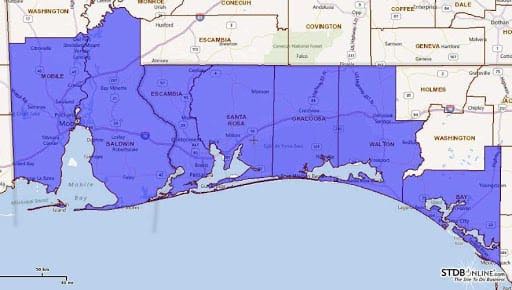
Today, Florida Governor Ron DeSantis’ office approved the reopening of vacation rentals in panhandle counties: Escambia, Santa Rosa, Okaloosa, Walton, Bay, Gulf, Franklin, and Wakulla (county plans below).

“We are happy to see county approvals coming through to reopen vacation rentals,” said Dennis Hanks, executive director, Florida Vacation Rental Management Association (FVRMA). “The panhandle openings are a great start. We are continuing to work with local governments statewide on plans and procedures to get state approvals. With dozens still pending on the governors desk we are hopeful for a pre-holiday announcement of more county reopen plans.”
 

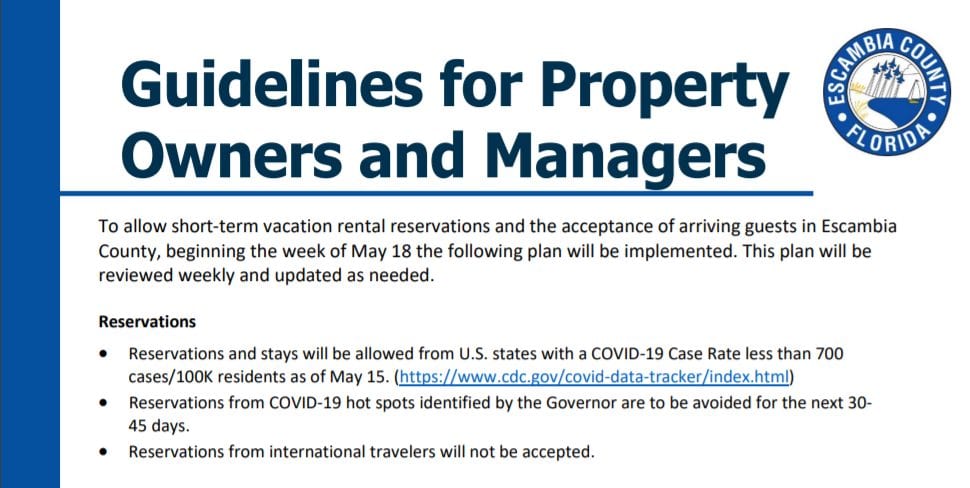
Each of these counties submitted plans that met Florida’s Department of Business and Professional Regulatons (DBPR) guidelines. These plans included a variety of restrictions and guidelines. For example, Escambia County’s plan says, “Reservations and stays will be allowed from U.S. states with a COVID-19 Case Rate less than 700cases/100K residents as of May 15.”

These restricted states include, Louisiana, Connecticut, Illinois, Massachusetts, Michigan, New Jersey, New York. 

Other restrictions in county plans prohibit international visitors, and “reservations from COVID-19 hot spots identified by the Governor are to be avoided for the next 30-45 days.”

Additional cleaning and safety guidelines were included. Here are links to the approved short-term rental plans submitted by Florida counties:

Vacation rental companies along the northern Gulf Coast are currently taking reservations. 

On the Gulf Coast, Alabama gained a first-mover advantage for first part of the summer while Florida’s vacation rentals were closed. 

Alabama’s tourism economy benefits from Florida Governor DeSantis’ shutdown of vacation rentals

0

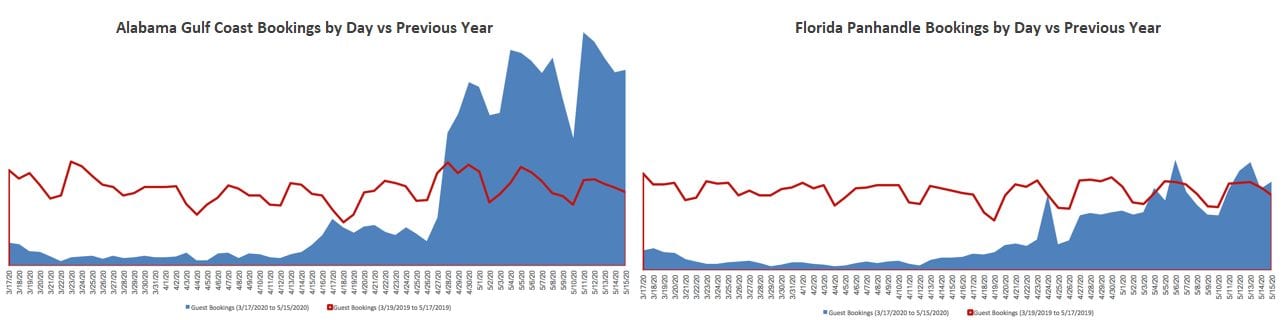
Alabama’s tourism economy is getting a boost from Florida’s continued shutdown of vacation rentals as travelers who are unable to stay in vacation homes in the Florida Panhandle cross the state line for their beach vacations. 

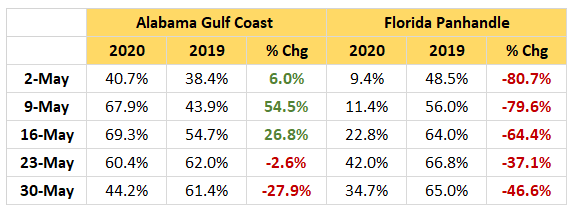
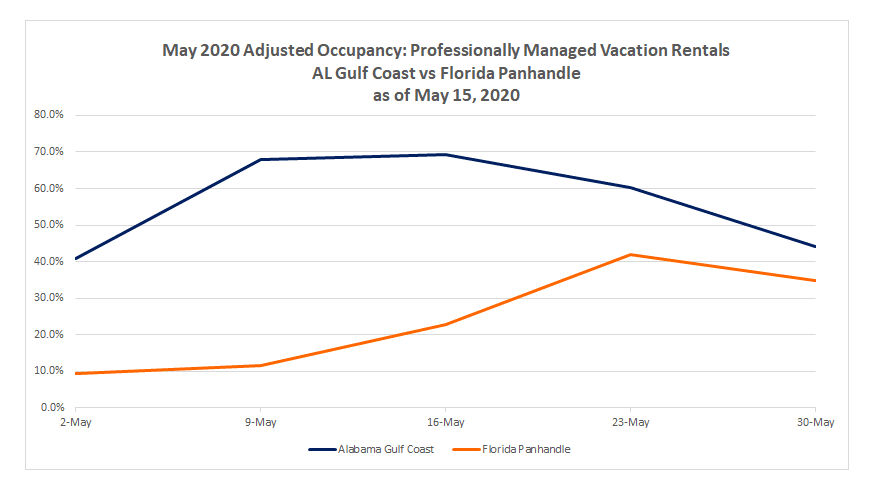
Last week, adjusted paid occupancy on the Alabama Gulf Coast increased 54 percent year over year, while Florida vacation rental businesses lost almost 80 percent of their bookings due to continued government restrictions on leisure travel in short-term rentals, according to data provided by Key Data.

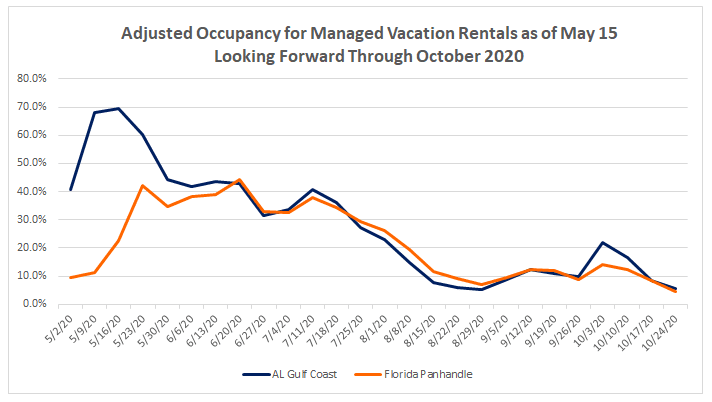
May 2020 Adjusted Occupancy Year Over Year for Vacation Rentals in the Florida Panhandle and AL Gulf Coast, as of May 15

“We are seeing short stays and last minute bookings,” Alabama-based Meyer Vacation Rentals president Michelle Hodges said during the recent Skift Forum on Short-term Rentals, “For us the (Alabama/Florida) state line is almost seamless, so it’s an interesting dynamic . . . we are picking up people who don’t want to give up their vacation and can’t get into their Florida property.”

Jason Sprenkle, cofounder of Florida-based 360 Blue Vacation Rentals and CEO at Key Data Dashboard, “We were in this ‘we’re all in this together’ phase, and now we are in the ‘haves and have nots’ phase.”

“You see some states that are making a full recovery while others are left out, and the recovery is not being driven by demand; it’s being driven by government regulation,” Sprenkle continued. “For example, the demand in the (FL) panhandle has been at least as strong as the demand in Alabama, but they were able to experience the recovery, and in Florida, we were not.”

Here is a look at how reservation activity was affected from March 1 through May 15. 

Vacation rental companies in Florida have been reaching out to Governor Ron DeSantis with pleas to reopen vacation rentals. DeSantis shut down short-term rentals in an executive order in March while keeping B&Bs, timeshares, motels, resorts, and hotels open. On Friday, the governor provided his reasoning for the first time, saying, “Some of them (vacation rental companies) are upset because we never shut down hotels in Florida. But part of the thing is I’ve got all these national guard that I have to put up— I’ve got other people I’ve got to put up. So we needed to have an ability to have hotels–it’s a little bit different situation.”

Watch DeSantis Answer Question on Short-term Rentals at Friday’s Press Conference (1:04 minute mark)

Looking forward, Alabama’s early-mover advantage lasts through the latter half of June as the average booking window has decreased significantly due to COVID-19’s impact on traveler behavior. 

Data provided by Key Data. The spike in October reflects Alabama’s popular Annual Shrimp Festival. 


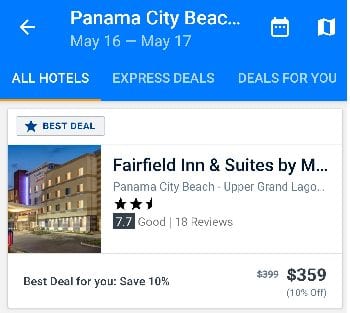
Alabama’s vacation rentals are not the only beneficiary of DeSantis’ short-term rental shutdown. Florida’s hotels in the panhandle are also benefiting. As of May 16, only one Panama City Beach 2.5-star hotel showed availability for the weekend, and this non-beachfront budget hotel was priced at $359 per night. 

Vacation rental professionals expected DeSantis to open vacation rentals on Friday. Instead the governor said counties could submit plans for reopening, saying, “What we are doing is telling counties, if you want short-term rentals, you request it to be authorized through the state and provide your safety plan. If you tell me you’re going to rent ’em out to people from NYC, I’m probably not going to approve that, okay? If you’re saying that you are going to rent it out to people in other parts of FL or something that would be manageable, or if there are ways in there that clearly you have an eye on safety, then I’m fine.”

Some counties have already submitted their plans to the state while others are expected to send theirs on Monday. All counties are hoping to be open in time to take bookings for Memorial Day Weekend which kicks off in less than a week.

Sprenkle added, “People are sitting outside waiting come in, but the destinations that unlock the doors first are reaping the benefits.” 

Florida Governor to Counties: Submit a plan for short-term rentals

42

Today Florida Governor Ron DeSantis announced, beginning Monday, the state would move into a “full Phase One,” and short-term rentals can reopen if counties submit a plan for opening safely. DeSantis added, “If your plan says you’re going to accept guests from New York City, I’m probably not going to accept that.”

Throughout Florida’s shutdown, DeSantis has kept timeshares, resorts, hotels, motels, and inns open. He gave his reason for that today saying that he needed to have places to “put up” national guard if needed. 

DeSantis’ message to counties: “For the vacation rentals, what we’re doing is telling counties, if you want short-term rentals—if you want them to be open—you submit your plan and you can show how they are going to be safe.”

Bars and movie theaters also remain closed, but like vacation rentals, amusement parks can submit plans to the state show they plan to reopen safely. 

In addition, DeSantis further opened restaurants and retail, effective Monday to 50 percent.

Airbnb reaches out to city officials to influence “transitional travel reopening plans”

3

Airbnb’s Chris Lehane, vice president of global policy and communications, is reaching out to city officials to influence COVID-19-related reopening policies to “work together to restore safety and rebuild our local economies in the smartest, most sustainable, and healthy way possible.”

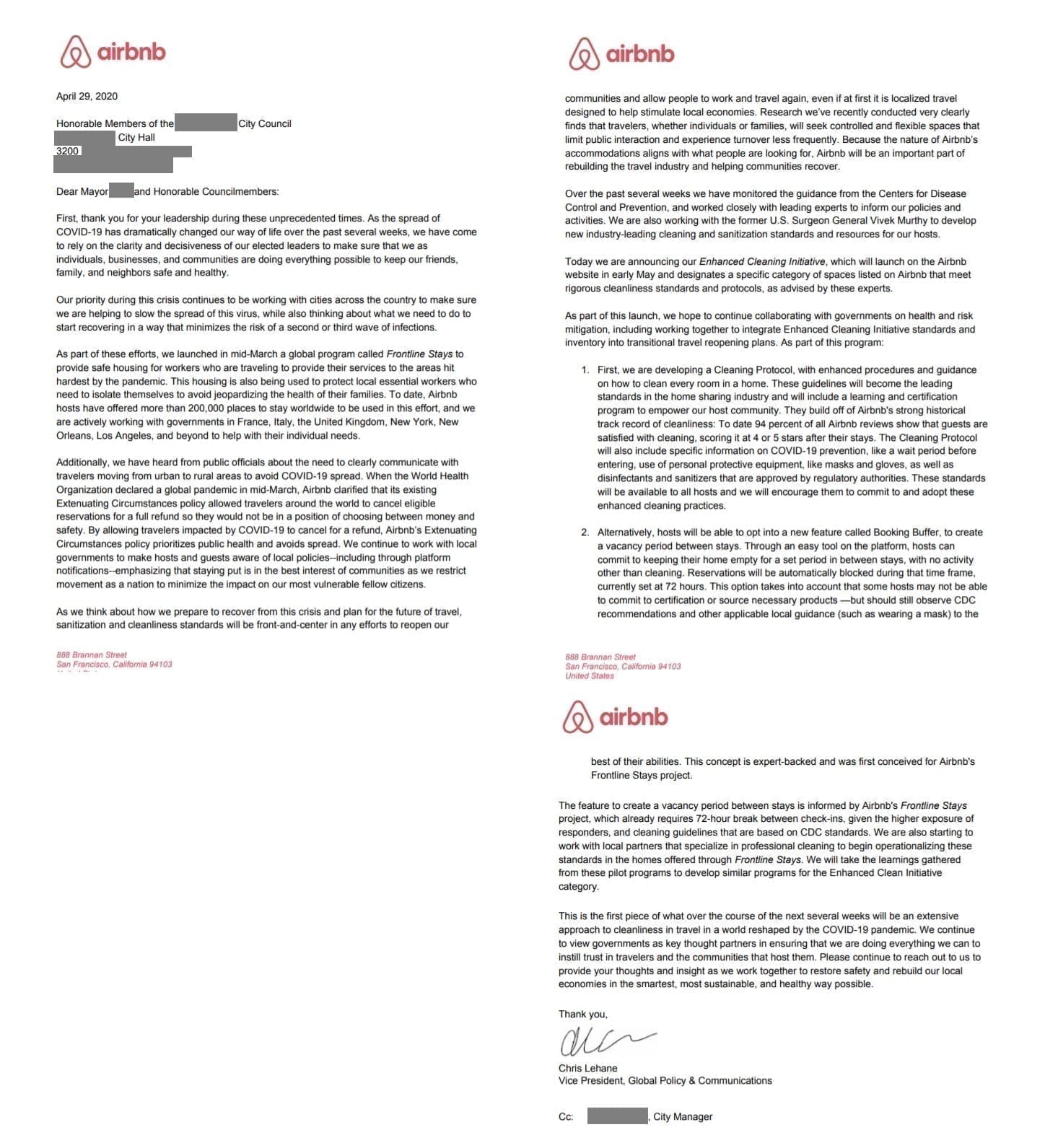
In a letter obtained by VRM Intel to municipal officials on April 29, Airbnb’s Lehane suggests that the company is currently and actively working with governments to address pandemic-related issues, stating, “Our priority during this crisis continues to be working with cities across the country to make sure we are helping to slow the spread of this virus, while also thinking about what we need to do to start recovering in a way that minimizes the risk of a second or third wave of infections.”

Read the entire letter. 

Airbnb’s letter seeks to influence short-term rental regulations during “transitional travel reopening plans.”

In a recent address to its host community,  CEO Brian Chesky said, “Government officials and policy makers are also focused on our cleaning practices, and we anticipate more regulation,” so this initiative comes with little surprise. However, Lehane’s letter provides more insight into how Airbnb intends to use this crisis in discussions with policymakers. Here are key points from Airbnb’s letter to governments, municipal officials, and city managers:

1. Refund Policy

“When the World Health Organization declared a global pandemic in mid-March, Airbnb clarified that its existing Extenuating Circumstances policy allowed travelers around the world to cancel eligible reservations for a full refund so they would not be in a position of choosing between money and safety. By allowing travelers impacted by COVID-19 to cancel for a refund, Airbnb’s Extenuating Circumstances policy prioritizes public health and avoids spread. We continue to work with local governments to make hosts and guests aware of local policies- including through platform notifications–emphasizing that staying put is in the best interest of communities as we restrict movement as a nation to minimize the impact on our most vulnerable fellow citizens.”

2. Announcement of Enhanced Cleaning Initiative (ECI)

“Today we are announcing our Enhanced Cleaning Initiative, which will launch on the Airbnb website in early May and designates a specific category of spaces listed on Airbnb that meet rigorous cleanliness standards and protocols, as advised by these experts.”

3. Call to Action: Airbnb Asks City Officials to Integrate its ECI into their “transitional travel reopening plans”

“As part of this launch, we hope to continue collaborating with governments on health and risk mitigation, including working together to integrate Enhanced Cleaning Initiative standards and inventory into transitional travel reopening plans.”

“. . . The Cleaning Protocol will also include specific information on COVID-19 prevention, like a wait period before entering, use of personal protective equipment, like masks and gloves, as well as disinfectants and sanitizers that are approved by regulatory authorities.”

4. Promotion to City Officials of a 72-hour “Waiting” or “Buffer” Period as Part of Plan

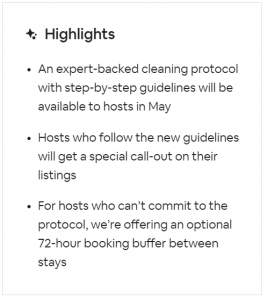
“. . . hosts will be able to opt into a new feature called Booking Buffer, to create a vacancy period between stays. Through an easy tool on the platform, hosts can commit to keeping their home empty for a set period in between stays, with no activity other than cleaning. Reservations will be automatically blocked during that time frame, currently set at 72 hours.”


Regulatory Influence 

Lehane’s letter demonstrates that Airbnb is proactively reaching out to government officials and city managers to:

  1. Boast that Airbnb fully refunded travelers;
  2. Persuade officials to include Airbnb’s new Enhanced Cleaning protocols into government transitional travel reopening plans; and
  3. Promote a 72-hour buffer/waiting period between stays as a regulatory solution. 

Airbnb’s strategy of influencing government policy to promote its agenda is not new. One of the company’s primary hurdles on its road to an IPO was getting its listings legalized in municipalities. To meet this objective, Airbnb caused significant industry disruption in many vacation rental communities by pushing for legalization in homes/apartments in which the primary resident is present while promoting a ban and/or 30-day rental restrictions for traditional second-home/whole-home vacation rentals.

However, both travelers and city officials are learning that Airbnb is a only a website that lists short-term rentals. Airbnb does not own vacation rentals, does not manage these rentals, does not clean these rentals, and does not service these rentals. It is more like a Craigslist with a great brand image and a payment processor. 

Although the policies Airbnb is promoting to governments are designed to promote Airbnb as a friend to the city, these policies are being offered on the backs of its rental providers. For example, Airbnb refunded hosts’ money with no notice and by overriding their existing cancellation policies. 

And the 72-hour “buffer” time?

Currently, there is no evidence that a 72-hour waiting period (or even a 24-hour period) between bookings provides additional safety for guests; and at this time, Airbnb does not have a way to enforce this policy. Many of its listings’ booking calendars are fed to Airbnb via connections with external software systems, and Airbnb has no control over these. Its only recourse is to 1) penalize noncompliant listings with a lower rank in search on the site, or 2) prohibit noncompliant rentals from listing on the site.

Related: How 72-hour waiting periods between stays affect revenue for hosts

Airbnb demonstrates lack of strategic thinking in response to COVID-19

12

Only time will tell how the industry will assimilate the behavior of Airbnb during the COVID-19 pandemic. As the youngest major OTA at the table, Airbnb has proven it is prepubescent at best. Emotionally reactive, inexperienced, and proud, Airbnb turned the volatile COVID-19 pandemic into a deceitful public relations game that ensured no winners.

Mercurial strategies litter the timeline of communications and policy announcements from early March to date. As the timeline suggests, the initial pro-guest policy of offering 100 percent cash refunds quickly deteriorated into a convoluted maze of qualifications a guest had to navigate to seek relief.

“Hosts” have consistently been left out to dry, as Airbnb quickly tried to quell the onslaught of cash refunds and overnight began pushing travel credits.

Related: Amber Carpenter joins VRM Intel’s Amy Hinote to discuss Airbnb’s coronavirus-related decisions over the last 60 days on Wed, May 13, 3:00 pm ET / 11:00 pm PT 

Timeline (Not exhaustive, but here are the highlights)

  • March 11: Airbnb updates the original Extenuating Circumstances Policy, changing vague wording from “endemic” to “epidemic” reasons for canceling.  
  • March 13: Airbnb updates its Extenuating Circumstances Policy to indicate that guests could cancel reservations without penalty due to COVID-19 for arrivals between March 14 and April 13, 2020.
  • March 14: After pushback, Airbnb announces this new policy with additional language that states that the refund will also cover all service fees in addition to the standard rent amounts.
  • March 30: Airbnb updates the COVID-19 policy, again, to include the option for guests to receive either a travel credit or a full refund.
  • March 30: Airbnb extends the eligible cancellation window to include arrival dates through May 31 and adds “proof” verbiage to its COVID-19 refund policy, stating the following: “In order to cancel under the policy, you will be required to attest to the facts of and/or provide supporting documentation for your extenuating circumstance.”
  • March 30: Airbnb announces the $250 Million Host Fund on a live webinar for Hosts with Brian Chesky. Verbiage regarding the 25 percent payout for cancellations is vague during the webinar, and Hosts (and homeowners who were listening) leave the webinar thinking Airbnb will pay 25 percent of the full reservation amount. The Airbnb web page for the Host Fund clarifies that Airbnb is only going to pay out 25 percent of what should have been paid under the original cancellation policy.
  • March 31: Airbnb, again, changes its policy, adding a new clause to its COVID-19 cancellation policy that states the following: “Cancellations will be handled according to the extenuating circumstances coverage in effect at the time of submission.” Guests have no reasonable way to know which policy was in place when they originally requested the refund unless they had a screen capture of the Extenuating Circumstances COVID-19 page from Airbnb.com on the day of their original request.
  • April 9: Airbnb updates a clause in the COVID-19 cancellation policy to read, “Cancellations will be handled according to the extenuating circumstances coverage in effect at the time of submission, and reservations that were already canceled will not be reconsidered.”
  • April 27: Airbnb announces its “opt-in” Enhanced Cleaning Initiative for the Future of Travel via press release, which offers an option to “buffer” arrivals and departures, either by a 24-hour period if Hosts adhere to Airbnb’s suggested cleaning protocol or by a 72- hour period if the Host cannot meet those standards. Professional hosts scramble to figure out how to operationalize these new requirements and evaluate their revenue impact.
  • April 29: Airbnb starts sending letters from Chris Lehane, VP of Global Policy and Communications, to community leaders around the country outlining their cleanliness suggestions for Hosts.
  • April 30: Eligible hosts are finally notified of their pending 25 percent payment under the $250 Million Host Fund.
  • May 1: Airbnb extends the COVID-19 cancellation window for arrivals through June 15, 2020, although Airbnb also announced it will not be paying 25 percent of those cancellations under the $250 Million Host Fund.
  • May 4: Airbnb still has not operationalized the new Enhanced Cleaning Initiative. An account representative at Airbnb states that the ability to opt in to one of the two programs should be available within the next two weeks.

The irony is that experienced hosts around the world were offering travel credits from the beginning, only to be blindsided by Airbnb’s heavy-handed and short-lived campaign to win the hearts of guests with 100 percent cash refunds. This initial move by Airbnb turned property managers’ gracious offers of travel credits into heated debates with guests who claimed that the “right thing to do would be to give a full refund.”

Confused guests who could not get through to Airbnb were attacking property managers through any means possible and demanding the full refund that Airbnb promised, although the hosts did not have any of their funds. Guests who had cancellation requests that did not meet the constantly evolving Airbnb criteria were left in limbo, trying to navigate the complex process of initiating a special refund request on the Airbnb platform. Property managers who dared to try to intervene on their guests’ behalf were turned away and told that only guests could initiate a special refund request. 

Travel Credit Applies to Any Airbnb-Listed Property

But the true atrocity against hosts is buried in the details. When Airbnb cancels a reservation with the host and issues a travel credit to the guest, the guest is able to use that travel credit for any property or experience on the Airbnb platform. So the original host is left with $0, and Airbnb is able to book the transaction as 100 percent deferred, or unearned, revenue until a new reservation occurs or until the travel credit expires. 

Why is this egregious?

Because in the history of gift cards and credits, there have never been 100 percent redemption rates. There has always been what is known as “breakage,” which is part of what creates profitability for businesses dealing in prepaid gift cards, casino games, lottery games, etc. A certain percentage of customers will never redeem their credit. On the date that the travel credit expires, Airbnb gets to convert the unearned revenue to earned revenue on its P&L, thereby adding to its profits without ever paying the host.  

The FAQ on Airbnb’s site explaining why it is issuing generic travel credits for the Airbnb platform instead of for the specific host who lost the revenue reads as follows:

FAQ: Why aren’t you providing Guests with credit toward a future booking specifically for one of my listings?

We considered this, but there are several scenarios where it might not work for you or your Guests. For instance, a Guest may not be able to book when you can host or may not be returning to your area. This credit provides added flexibility for both of you.


Sigh. Airbnb thinks it is doing us a favor.

Enhanced Cleaning Initiative and 24-hour Buffer Time

If the offenses detailed above were not enough to solidify Airbnb’s place as COVID-19’s most tone-deaf travel organization so far, it had the audacity to announce to the world that it was rolling out the most comprehensive housekeeping program for short-term rentals. And yet, Airbnb has never checked in a guest, let alone cleaned a short-term rental. As a consolation prize for Hosts, compliant partners will be rewarded with a new badge on their listing and better rankings for future bookings (that may or may not get cancelled, regardless of your cancellation policy).

As VRM Intel has previously reported, these new policies that Airbnb proposed will cost the individual host thousands of dollars a year in revenue opportunity, not to mention operational costs because property management software systems (PMSs) do not come with a “buffer” setting. How this new 24- to 72-hour “buffer” setting will work is not yet clear. As of the writing of this article, there is no way to select either option, and no one knows how the reservation will be entered into the PMS software. Will the “buffer” book a five-day reservation in the PMS as a seven-day reservation with only five days of revenue? Will we all be scrambling to figure out the actual arrival and departure dates versus the day we can go in and clean? How will this “buffered” reservation show up in confirmation emails and other automated communications? Will our homeowners expect and understand that only five days of revenue will be paid out?  

Maybe Brian Chesky and his team could follow through with their promise to collaborate more with their partners, the “hosts,” to create actionable plans that are mutually beneficial. Until then, remember that working with Airbnb—or any other partner that is the merchant of record—is a risk, and the revenue associated with the reservation is not guaranteed until the money is in the bank.  

Related Links

What is the cost of Airbnb’s recommended 24- to 72-hour “buffer” time between stays?

14

Across the vacation rental industry, companies, associations, governments, and destination marketing organizations are proactively assessing new standards and augmented cleaning protocols to ensure guest safety and build consumer confidence in short-term rentals. Some of these changes include new safety procedures and personal protective equipment (PPE) for cleaners and inspectors, disinfecting products, new kitchen packages, professionally laundered linens, the elimination of bedspreads in favor of hospitality blankets/duvets/top covers, and new messaging for guests.

Airbnb announced its Enhanced Cleaning Initiative on April 28, 2020.

More controversially, the industry is discussing the addition of a 24- to 72- hour “buffer” or “safe time” between stays.

Last week, Airbnb introduced its Enhanced Cleaning Initiative. As part of this opt-in program, “hosts will commit to a 24-hour window between bookings,” and Airbnb is expected to add acceptance of this new program to its ranking algorithm, rewarding compliant managers and homeowners with higher placement in search. For hosts who do not want to adhere to the new cleaning protocol, Airbnb has created a tool that automatically blocks three days after each booking. According the website, “Simply opt in to the tool and we’ll automatically create a 72-hour booking buffer between each stay.”

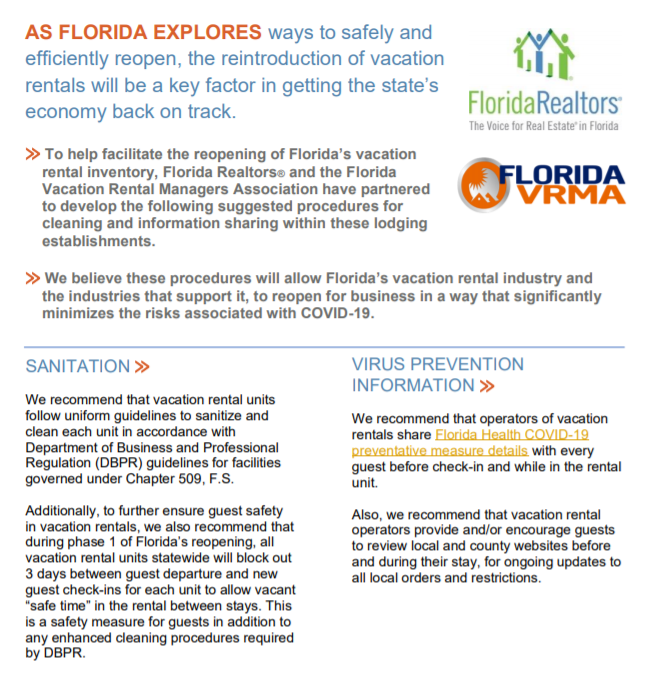
In addition, Florida’s Reopen Florida Task Force is recommending in Phase 2 that vacation rental operators should “Maintain 72 hours between guest check-ins to allow for effective cleaning and disinfecting of the rental unit.” And the Vacation Rental Management Association said that “24 hours between the last exit and next entry is reasonable.”


Potential Cost of a 24- to 72-hour “buffer” between stays

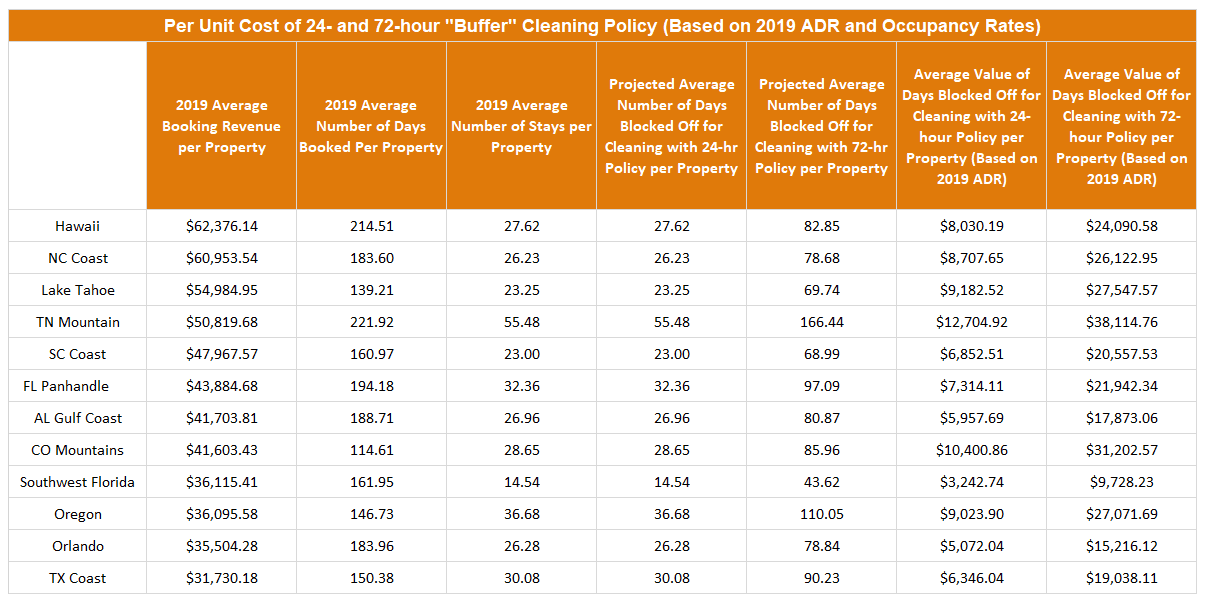
What could the mass adoption of a 24- to 72-hour window between reservations cost vacation rental managers and homeowners? Using 2019 data provided by Key Data and published in January’s VRM Intel Magazine, we calculated the potential impact on revenue.  

The following chart demonstrates the average value of days lost per property with a 24- and 72-hour “buffer” between stays.

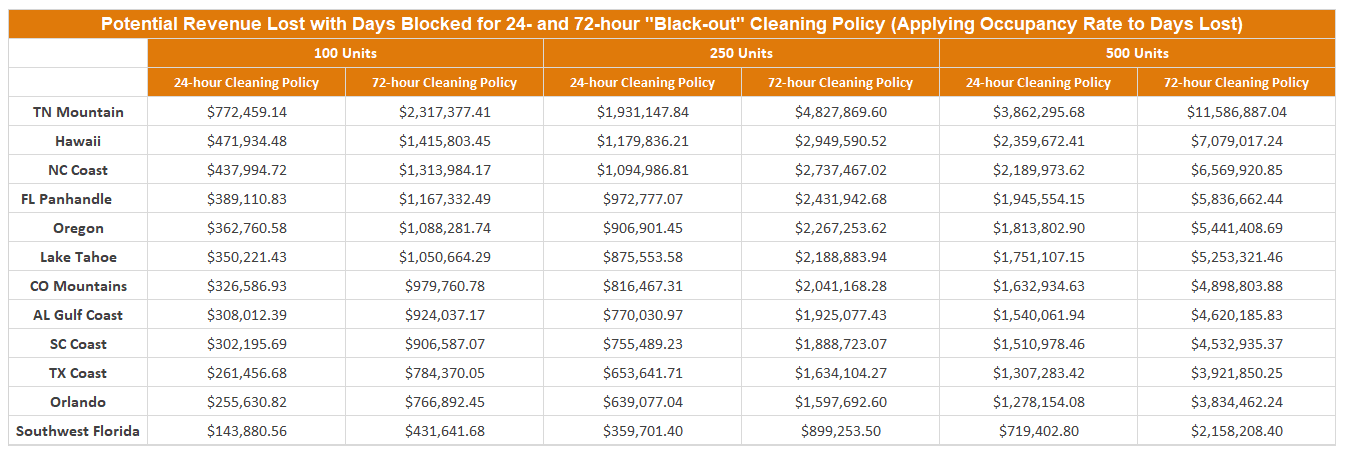
When we apply the Adjusted Paid Occupancy rate for each destination to the total number days that would be blocked off in the recommended buffer periods, the chart below demonstrates the projected loss in revenue for a company managing 100, 250, and 500 units.

The potential loss of revenue for a vacation rental management company is significant, and explaining this adjustment in income to homeowners could prove to be difficult if expectations are not properly set.


Regulatory Consequences

Besides the potential loss in revenue, there are serious concerns that future regulations will mandate a buffer between bookings. On April 28, as Airbnb announced the Enhanced Cleaning Initiative, CEO Brian Chesky said, “Government officials and policy makers are also focused on our cleaning practices, and we anticipate more regulation in different parts of the world.”

Airbnb has considerable power to influence local policy—as witnessed in many destinations where Airbnb worked with city officials to legalize rentals in primary residences while banning rentals in second homes.

If Airbnb decides that a 24- to 72-hour buffer between stays helps meet its IPO-driven objectives in municipalities, vacation rental management companies and homeowners may be negatively impacted. With additional support from associations (VRMA and FVRMA)—and adoption from large companies (TurnKey, Acme, Carolina Mornings, Moving Mountains, etc.)—this recommendation gain momentum and turn into a requirement very quickly as local and state governments seek ways to show they are “doing something” to make guests safer. In this reactive time we are in, this 24- to 72-hour buffer time has the potential to become a self-inflicted wound for the vacation rental sector—one that comes at a high cost. 


Additional considerations in leaving a home unchecked for 24 to 72 hours

There are additional considerations for vacation rental managers and homeowners when waiting 24+ hours before entering the property after a departure. Did the guest leave any entry points to the home unlocked? Was a grill, oven, or appliance left on? Were heating or cooling thermostats set to non-optimal temperatures? Did the guest leave a kitchen full of unwashed pots, pans, and dishes attracting ants or animals? Or as many on the coast have experienced, was a pile of seafood left on the counter leaving a stench that is difficult to remove? Was garbage left in the property or on porches/patios? If the guest knows that no one is entering the property for one to three days, do they really need to leave at checkout time? Is this waiting period going to be upheld after owner stays, as well?

Smart home technology can help address many of these issues, and further investment in these systems will become even more critical with the adoption of Airbnb’s Enhanced Cleaning Protocol or similar recommendations.


Are these 24- and 72-hour recommended “buffer” days necessary?

The real question is: Will a waiting period between stays make guests safer?

According to World Health Organization (WHO), “The virus that causes COVID-19 is mainly transmitted through droplets generated when an infected person coughs, sneezes, or speaks. These droplets are too heavy to hang in the air. They quickly fall on floors or surfaces.”

There is still substantial uncertainty about how long COVID-19 remains on surfaces. WHO’s website states, “The most important thing to know about coronavirus on surfaces is that they can easily be cleaned with common household disinfectants that will kill the virus.”

The American Hotel and Lodging Association (AHLA) is expected to launch its guidelines this week.

To date, the 24- to 72-hour recommendations are not requirements for any government or platform, and we currently do not have any evidence that shows guests need this buffer to be in place in order to feel comfortable booking.

However, as Airbnb and other companies implement these recommendations and advertise the practice, guests and municipalities may be prompted to consider it. The cost for vacation rental providers is high, so we expect to see managers invest in products and processes that eliminate the need for the “buffer” time.

Jeff Paglialonga on FL Vacation Rental COVID-related ban: “We need your support to rectify what I believe is to be the illegal taking of property from Florida vacation rental owners.”

3

This letter was sent to Florida Governor Ron DeSantis and Attorney General Ashley Moody and arrived at their office April 29, 2020.

On that same day, Governor DeSantis issued Executive Order 20-112, which continues the prohibition of vacation rentals in perpetuity.

There is no set duration, end date, or object standard for expiration. Our property rights are conditioned on the subjective whims of one man. As a vacation rental manager managing over 360 properties and an owner of eight short term rental units ourselves, I was appalled at the singling out of our industry in the Executive Order.

What reasoning did DeSantis use to shut down vacation rentals and allow hotels and timeshares to continue to operate–while at the same time FEMA, along with other state agencies and counties, were contacting vacation rental managers to place COVID-19 positive guests in our units?

We need your support to rectify what I believe is to be the illegal taking of property from Florida vacation rental owners.

We estimate we will need $100,000 to pay a deposit to a law firm to file a lawsuit. The minimum for those owners who wish to join us is $500. This would mean we need 200 owners participating to raise the $100,000. Our ideal Plaintiff would be an investor vacation rental owner who has more than one property and lost considerable income during the taking period. We have set up a gofundmepage to facilitate the raising of the capital for the initial deposit we believe is needed to initiate a lawsuit.

We do not know where the venue would be for a lawsuit. We believe the case would need to be brought in a county with a history of protecting property owner rights. This will need to be researched. If the court decides in our favor the State would most likely appeal. The case would likely move to the State or Federal Appellate Court, and then on to the Florida Supreme Court or U.S. Supreme Court.

We would most likely plan on asking the Coalition for Property Rights and the National Association of Independent Businesses (NFIB)  to write Amicus Brief. Amicus briefs are legal documents filed in appellate court cases by non-litigants with a strong interest in the subject matter. The briefs advise the court of relevant, additional information or arguments that the court might wish to consider on our behalf.

To be transparent, the Florida Vacation Rental Management Association (FVRMA), is not supportive of our actions. To our dismay, they even suggested to the state that STR’s have a mandatory 3 day waiting period between reservations (email attached)! I am not sure who the FVRMA thinks they are representing, but they certainly are not representing my business interests.

This email is coming from me and there is no agreement in place from any attorney other than to evaluate our options. I am now just trying to gauge interest and whether we have enough support to raise at least $100,000 as the legal fees and expenses will be a lot to handle a case of this magnitude and I realize there is no way to predict how the case will turn out at this point.

The $500 payment towards the litigation would be 100% refundable if we do not get to our goal of $100,000 or if you decide you do not want to move forward under whatever engagement agreement is proposed when we get to that point. 

To engage an attorney, we would have to comply with all Florida Bar ethical rules which is why I am sending this on my own to gauge interest. To start the process please visit our page on https://www.gofundme.com/florida-vacation-rental-owners-illegal-taking-fl a $500 payment towards the goal.

Contact Jeff Paglialonga at jeff@teemingvr.com.

FL Governor DeSantis Receives Demand Letter in Response to Decision to Prohibit Vacation Rentals While Keeping Hotels, Resorts, Timeshares Open

94

As President Trump continues to hand over decision-making power to individual states during the COVID-19 crisis, US governors find themselves with more executive control than they anticipated. And, as the saying goes, with great power comes great responsibility—along with a healthy dose of feedback, criticism, and protests from both residents and business owners. Consequently, governors are facing significant backlash for executive orders to open—or not open—parts of the economy.

For example, Florida Governor Ron DeSantis grabbed national headlines on April 14 after he declared professional wrestling an essential service, saying people are “starved” for new entertainment, and “we are watching reruns from like the early 2000s.”

But greenlighting WWE wasn’t DeSantis’ only recent head-shaking executive action. When considering the travel industry’s lodging sector, as the governor weighed opening/closing hotels, B&Bs, vacation rentals, and timeshares, DeSantis crafted an executive order (20-87) to prohibit stays in vacation rentals while keeping hotels, motels, inns, resorts, and timeshares open for business.

The order now has been twice extended, and the vacation rental industry is reacting with a spectrum of activity that, as of yesterday, escalated to vacation rental managers issuing a Demand Letter to the governor, a necessary first step toward a widespread legal challenge to the orders. 


Timeline: DeSantis’ Anti-Vacation Rental Actions

  • March 27: Florida Governor Ron DeSantis issued Executive Order Number 20-87. This order suspended vacation rental operations for 14 days and prohibited vacation rentals from making new reservations or checking in new guests for the duration of the order. Hotels, motels, inns, resorts, and timeshares were allowed to remain open. 
  • April 10: Governor DeSantis issued Executive Order Number 20-103, extending the vacation rental ban until April 30, 2020. The ban on vacation rentals was later extended through May 4, when the next directive goes into effect. 
  • April 29: Governor DeSantis issued Executive Order 20-112 outlining “Phase 1: Safe. Smart. Step-by-Step. Plan for Florida’s Recovery.” which opens restaurants, retail, museums, libraries, and elective procedures (with limitations), but keeps vacation rentals closed for the duration of the order–which begins May 4 and is open-ended. As in previous orders, hotels, motels, inns, resorts, and timeshares remain open.
  • According to Florida’s FAQ page about the duration of the order, Phase 2 will begin “Once the Governor determines it is suitable to continue re-opening and after fully considering medical data in consultation with state health officials.” 

Governor DeSantis provided no explanation for the continued closure of vacation rentals, even though—as lodging options—vacation homes are more conducive to the state’s social distancing recommendations than the other lodging types he has allowed to remain open, including hotels, inns, and timeshares. 


Reaction from the vacation rental industry

Vacation rental managers have expressed anger and frustration about DeSantis’ decision to keep vacation rentals closed while allowing every other lodging type to remain open. With news of beach openings in neighboring states, Georgia and Alabama, pressure is mounting. 

Yesterday, Orlando-based law firm Fasset, Anthony, and Taylor sent a Demand Letter to Governor DeSantis on behalf of Florida vacation rental property owners, saying, “The purpose of this letter is to protest any extension of the Governor’s ban on vacation rentals and formally demand just compensation for property destroyed and taken by the state under Executive Order Numbers 20-87 and 20-103.”

The letter, initiated by Jeff and Gina Paglialonga, vacation home owners and founders of Teeming Vacation Rentals, states: “These executive orders have forced vacation rental owners to refund all guests scheduled to check in during the banned period under the threat of vacation rental license forfeiture. The executive orders also require vacation rental owners to let their properties sit idle during the peak of the rental season in Florida. Together, these state actions constitute unprecedented and historic destruction and taking of private property held by vacation rental owners. The state’s destruction and taking of private property necessitate just compensation under the Fifth Amendment to the U.S. Constitution (applied to the states through the Fourteenth Amendment), Article X, Section 6(a) of the Florida Constitution, and Section 252.43, Florida Statutes.”

VRM Intel also obtained a brief on legal precendent and analysis related to moving forward with a legal challenge to DeSantis’ order, which recommends, “To streamline the takings on behalf of all vacation rental owners in Florida, a representing entity, such as the VRMA should pursue a class action claim against the state on behalf of all vacation rental owners.”

While some vacation rental managers are exploring legal options, the Florida Vacation Rental Management Association (FVRMA) and Florida Realtors joined forces to try to negotiate with the governor’s office to open vacation rentals by proposing a three-day “safe time” between stays, a move that would reduce overall occupancy for Florida vacation rentals by 25 to 30 percent during the affected time period. To date there is no evidence that a three-day waiting period between stays leads to a lower rate of COVID-19 transmission. 

In addition, there are other dangers in letting a rental property sit empty after a stay for three days before a cleaner, inspector, or manager enters the home (i.e. unlocked entry points, appliances left on, fireplaces or grills left on, spoiled food, mildewed towels, doors left open, unreported property damage, etc). 


What is DeSantis’ Motivation?

Why is DeSantis discriminating against vacation rental lodging while continuing to prop up hotels, inns, resorts, and timeshares? In talking to several vacation rental managers, no one seems to have a definitive answer. Most professional vacation rental companies believed DeSantis was reasonable in his approach to vacation rentals before COVID-19.

Some of the guesses about the “why” behind the governor’s actions include:

  • Influence from the state’s powerful hotel lobbying arm;
  • Embarrassment and negative feedback over images appearing in national media of overcrowded Florida beaches during shelter-in-place orders;
  • Lingering animosity with rental listing site Airbnb over the company’s removal of listings on the West Bank and after DeSantis ordered state officials to refrain from using Airbnb when conducting state business (an order that was later rescinded);
  • A belief that local residents are more comfortable with travelers staying in hotels instead of vacation rentals;
  • Unsubstantiated fear that vacation rentals will be populated with “diseased New Yorkers” (which wouldn’t explain why timeshares are still open);
  • Or simply that DeSantis is in over his head with the magnitude of reopening decisions.

According to Jeff Paglialonga, vacation home owner and founder of Teeming Vacation Rentals, “As a vacation rental manager managing hundreds of rental lodging options, I was appalled at the singling out of our industry for personal retribution by an Executive Order of Governor DeSantis.”

In Florida, vacation rentals have been an established and popular lodging type in the state for a century.
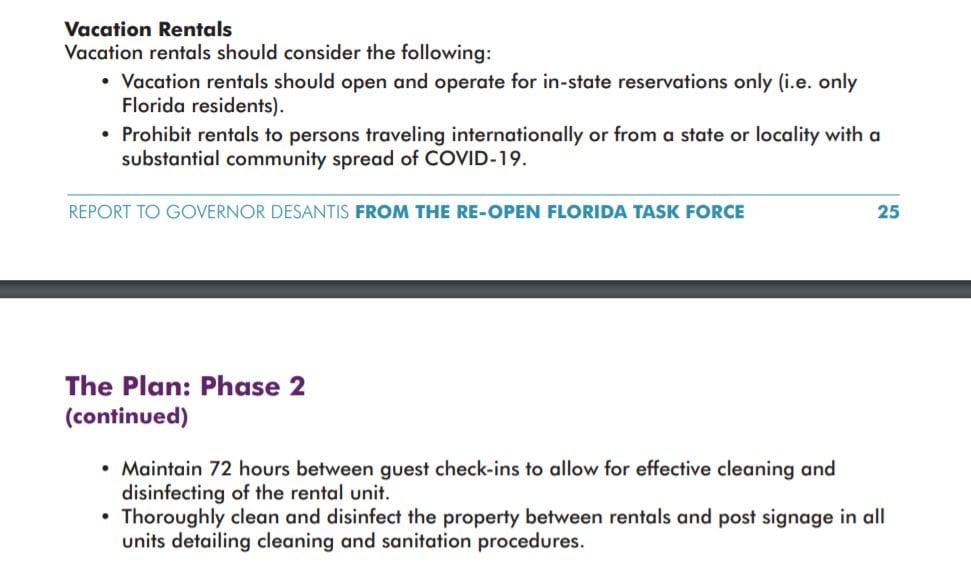


As DeSantis knows, according to a recent UCF research study, “The 2018 economic impact of Florida’s vacation home rental industry represents $16.6 billion in direct spending and $10.8 billion in indirect spending, totaling $27.4 billion.”

In 2018, the total amount of tourists staying in vacation rental homes in Florida was 14,233,274, which equates to 11.2 percent of the total 127 million tourists that came to Florida in 2018.

The report adds that “The direct spending amounts to nearly $46 million a day and approximately $1.9 million every hour . . . and the direct spending supports roughly 115,000 jobs.”

According to Palm Beach’s WPTV, on April 20, “New numbers Monday show Florida has paid out only about 6.2 percent of the 1.5 million unemployment claims submitted since March 15.”

The state’s Department of Economic Opportunity dashboard says they have processed 162,039 of the claims but only 40,193 have been paid so far.

Related: Phase 2 Plan for Florida Recovery

Florida’s Phase 2 of reopening adds cumbersome regulations for vacation rentals.

The Professional Vacation Rental Manager’s Crisis Playbook

0

An emerging piece of any professional rental manager’s value proposition is the professional organization’s ability to operate in an environment with a high degree of uncertainty. Coupled with the many other layered demands of successful rental management, this crisis component can be physically daunting and emotionally exhausting. The character of our organizations is revealed more rapidly in a crisis than at any other time, and as such, the stakes are high.  

While each crisis is unique, there are a few principles in an ambiguous environment that can be the bedrocks of a path forward for your stakeholders. In a situation where so much is unknown—whether that’s a natural disaster, global contagion, financial conflagration, or simply man-made problems—it’s useful to have a simple, understandable, and uncomplicated group of guideposts to help move the team forward together.

Trust

In any crisis, trust is the coin of the realm—to be heard, you must first be trusted. Research by the Kellogg School of Management suggests that to build trust organizations need to relentlessly share four main attributes; experience, expertise, empathy, and consistency. Check your content in every direction—internal and external—for each of these things. Make it personal to your team as well in every interaction they have with a stakeholder.

Communication

Sharing just a few principles within your organization and with your customers is key; sharing more than a few becomes tedious to execute and confusing to communicate. For example, during our recent series of named storms our team worked to simply be three things both to each other and our customers—quickly accessible, consistent across platforms, and candid in our guidance.  

  • We share status updates across media platforms at regular planned intervals.  
  • We work to be clear and simple in our challenges within our office teams.
  • We do not propose, in a crisis, to always agree with our customers; we do, however, as a core belief, propose to make every last effort to understand their perspective.  
  • We focus on what we are and don’t try to be things we are not; we aren’t a law firm, a medical provider, or elected officials. We can guide you to those things, of course, but we are a hospitality company–that’s what we do best.
  • It is the role of senior leadership, in a time when many concerns are uniquely personal, to ensure that each and every voice is heard across the organization. Take some extra time in all communications and forums to make these avenues clear. Doing so builds trust.

Leadership

As a leader within an organization, there will always be hunger for clarity where none exists–that vacuum is why leadership prevails. In these moments of self-doubt, it’s useful just to have a bedrock compass of action; for example, in our current COVID challenges we simply say to ourselves that 1) we’re going to do what’s right and 2) we’re going to do the best we can.

That’s all we can do, if we’re honest, but it’s enough to get through the day.

Forecasting

Managing time horizons is also key–the higher the uncertainty, the closer at hand the time horizons that can be managed. It’s key to have a destination–a planted flag in the future–but to be credible that flag has to be both achievable and realistic and that means sometimes it’s enough to have it planted next week, rather than six months out. If nothing else, move to a future goal and share that goal in every direction. Military professionals call this commander’s intent.

Management

Make sure you have a team (better yet a nerve center) that is empowered to make day-to-day decisions and make sure they understand the *small* number of decisions that senior leadership reserves the right to make. This team will make mistakes; watch how well the team surfaces and corrects them. Monitoring this ability is a key job of leadership. Resist entirely the urge to make the majority of decisions. Make sure the credit goes to the front-line and the blame goes to the top.

In any crisis, anything that’s longer than one page is too long and this article is no different–work the goals and processes, empower your team, believe in your people, and lead yourself as you would your team. Work fast, work honest, and maintain your perspective–fast forward in your mind by one year and ask yourself how well you did. 

Slow is smooth and smooth is fast.

Hosts launch legal fund for collective action against Airbnb for unilateral refunds and inciting travelers to cancel reservations

10

Airbnb’s home suppliers, or “hosts” using the Airbnb label, are beginning to use legal channels to hold Airbnb accountable for “unilaterally, and in violation of hosts cancellation policies, refunding guests who booked reservations” and for inciting travelers to cancel their reservations.

On March 13, Airbnb announced the company would be overriding its hosts’ cancellation policies by adjusting the terms of its Extenuating Circumstances policy and by issuing full refunds to guests for stays between March 14 and March 31. While the company refunded the cost of the rental, Airbnb did not initially refund its service fee. However, on March 14, after significant push back from its suppliers, Airbnb decided to also refund its service fee. Later, Airbnb extended the dates for refunds through May 31. The series of events led to significant hardship for its home suppliers who were working with guests directly to change stay dates before Airbnb stepped in an overturned their efforts. 

As a result, hosts began discussing whether Airbnb had the legal right to take this action launching forums and groups such as Twitter’s Airbnb Host Class Action

This week, Traverse Legal, led by managing partner, litigation attorney and Airbnb host, Enrico Schaefer, is taking things a step further by launching a fundraising campaign to pursue a collective action against the company, saying “collective action by Airbnb hosts is critical to effect change.”

“This fund is about bringing fragmented voices together,” Schaefer wrote. “It is about creating leverage and sending a collective message demanding change. Our attorneys are already working on the right legal strategy for group action. Our attorneys have dug deep into the terms of service, the extenuating circumstances policy, the arbitration mandate, the class action waiver and other contract issues.”

According to Shaefer, “There are hundreds of thousands of Airbnb hosts globally asking Airbnb to uphold their end of the bargain. Airbnb’s lack of transparency and lack of accountability are breaches of their contractual obligations to hosts. Now is a time for collective action.   Hosts are making substantial capital investments directly tied to the Airbnb platform. They require predictability, follow through by Airbnb, transparency and accountability.”


The following text is taken from Traverse Legal’s website:

Airbnb unilaterally, and in violation of hosts cancellation policies, refunded guests who booked reservations between the dates March 14th and May 31st. Our analysis of the contract terms, relevant law and facts has led to the conclusion that Airbnb hosts have a viable breach of contract case against Airbnb:

  • Why did Airbnb refund guests? Airbnb recently relied on the “extenuating circumstances clause” of its standard terms / agreement with property owners and guests to justify its first and second round of guest cancellations and refunds due. Airbnb concluded that the Covid-19 / coronavirus was an extenuating circumstance.
  • Key Issue: Does a pandemic fall within the language of Airbnb’s extenuating circumstances clause?
  • Do hosts have legal claims against Airbnb? As you will read below, our attorneys represent Airbnb hosts and have determined that Airbnb may be in breach of its platform agreement with hosts as a result of providing traveler refunds in response to coronavirus. Stated another way, guests were arguably NOT entitled to refunds under the rental agreement and Airbnb’s standard terms and policies.
  • What can hosts do about the forced refund? Airbnb could be liable for money damages to hosts for allowing booking cancellations and providing refunds. The terms of service contain a mandated arbitration clause for all disputes. This arbitration clause may, or may not, be enforceable. A possible class action is being analyzed as the class action waiver clause could also be considered unreasonable under California law or if the class action waiver is determined a violation of public policy.
  • What should you do if you are a Airbnb Host who was affected by the cancellation and refund decision? Contact one of our litigation attorneys representing hosts. We are on the front line of the factual and complicated legal analysis for hosts. While this virus has taken the world by surprise, unexpected circumstances are drafted into your hosting agreement with Airbnb. In short, a pandemic is one of the contingencies which was foreseen and the risk that was adjusted under the extenuating circumstances policy. Airbnb should follow those policies and terms. Instead, Airbnb has diverted what appears to be one billion dollars in host revenue by allowing cancellations for traveler reservations between April 1 and May 31. While Airbnb has pledged 250 million to hosts, that leaves hundreds of millions in damages to be pursued by property owners. As any hosts point out, travelers have the option of buying insurance against these types of events. Hosts do not.

Learn more about the legal fund. 

10-year anniversary of the BP-Deep Horizon Oil Spill brings comparisons to COVID-19

3

As the vacation rental industry faces challenges related to the spread of COVID-19, managers on the Gulf Coast are remembering another unanticipated, debilitating event that began 10 years ago today — the BP-Deep Horizon Oil Spill

On April 20, 2010, high-pressure methane gas ignited and exploded on the Deep Water Horizon drilling rig, engulfing the platform. Eleven missing workers were never found and are believed to have died in the explosion. 94 crew members were rescued by lifeboat or helicopter, and the Deepwater Horizon sank on April 22.

The oil leak was discovered on the afternoon of April 22, when a large oil slick began to spread at the Deepwater Horizon site. For months, CNN displayed ongoing footage from an underwater camera showing oil gushing into the Gulf waters (in the same way the network is now showing coronavirus cases and deaths).

The oil flowed for 87 days, leaking approximately 4.9 million barrels of oil directly into the Gulf of Mexico, until the well was capped on July 15 and was finally declared sealed on September 19, 2010. BP promised to make individuals and businesses “whole” and created processes through which businesses and individuals applied for and received money from the company for lost revenue and wages. 

Estimates of lost tourism dollars were projected to cost the Gulf coastal economy up to 22.7 billion.

As we seek to learn from the past, there are a few parallels between 2010’s BP Oil Spill and the current pandemic crisis as it affects leisure vacation rental destinations. 


1. Unanticipated Shock

In 2010, travel was rebounding from the 2008 recession, and vacation rental managers located in Gulf states were anticipating their strongest summer on record. In the same way, in 2020, booking activity was up approximately 15 percent, and the vacation rental industry was looking forward to an exceptional year before shutdowns related to the spread of COVID-19 began. And, like the 2010 BP Oil Spill, no vacation rental business had listed “global pandemic” on their 2020 SWOT analysis. 

“They were both unexpected,” said Michelle Hodges, COO, Meyer Vacation Rentals. “We, being on the coast, were accustomed to handing emergencies; and our definition of that, up until 2010, was a tropical event. We had become experts in these. You know when they are coming, You can anticipate how strong they are going to be, and you know about what your recovery time is going to be. But in 2010, we were taken aback by the first man-made disaster we had to get through. It was frustrating . . . I don’t think six months or even six weeks ago, we could have anticipated something so unknown disrupting our businesses to this degree, In terms of shock factor, they are similar.”

An unanticipated event, such as the oil spill or this coronavirus, is not easily or quickly processed.


2. Public Health vs Economic Interests

Oil from the BP-Deepwater Horizon oil spill approaches the coast of Mobile, Alabama, May 6, 2010

Another parallel between the BP Oil Spill and COVID-19 is the difficulty in reconciling responses to a health crisis with responses to an economic crisis. 

While full-time residents along the Gulf Coast were concerned about the health issues, businesses — epecially vacation rental companies — were focused on preserving summer revenue. The inaugural Hangout Beach Festival was held directly on the beach on May 14–16, 2010, with headliners John Legend and Zac Brown, but health concerns were mounting. 

By July 2010, symptoms were being reported, primarily by those involved in the cleanup effort, as chemicals from the oil and dispersants were believed to be the cause, a claim that proved to be true years after the event. 

Two years after the spill, a 2012 survey of the health effects of the spill on cleanup workers reported “eye, nose and throat irritation; respiratory problems; blood in urine, vomit and rectal bleeding; seizures; nausea and violent vomiting episodes that last for hours; skin irritation, burning and lesions; short-term memory loss and confusion; liver and kidney damage; central nervous system effects and nervous system damage; hypertension; and miscarriages.” Dr. James Diaz, writing for the American Journal of Disaster Medicine, said these ailments appearing in the Gulf reflected those reported after previous oil spills, like the Exxon Valdez. Diaz warned that “chronic adverse health effects, including cancers, liver and kidney disease, mental health disorders, birth defects and developmental disorders should be anticipated among sensitive populations and those most heavily exposed”. Diaz also believed neurological disorders should be expected.


3. The locals weren’t having it

While vacation rental companies and destination marketers were trying to keep guests coming, the locals protested that conditions were not safe and states were not doing enough to protect the beaches, seafood, ecology, and the environment. 

In 2010, social networks were not as prevalent as they are today, but they did exist, And these platforms were widely used, as full-time residents took to forums on Facebook, LinkedIn, Reddit, Twitter, and even TripAdvisor to alert potential guests about health and safety and to raise awareness among politicians.

Simultaneously, tourism promoters stepped up efforts to keep guests coming, even as officials prohibited people from entering the Gulf of Mexico to swim, surf, or fish. Alabama Gulf Coast destination marketers placed anchor Rebecca Wilson front and center. Wilson walked the beach every day telling guests that beaches were open (even though the water was not), and the daily videos outraged locals.


One Gulf Shores resident, David Crosby, began creating spoofs of the CVB videos, mocking the area’s attempts to bring visitors into a situation that many felt was unhealthy. 


The animosity between the locals and destination promoters lasted through 2011, although long-lasting consequences to residents’ health and to the environment remained a concern through 2013.  


4. Financial Assistance

For both the oil spill and COVID, travel insurance did not pay out for cancellations. However, during the oil spill, BP eventually took responsibility for the situation, and on June 16, BP established the Gulf Coast Claims Facility (GCCF), a $20 billion fund to settle claims for “natural resource damages, state and local response costs, and individual compensation.” The GCCF was administrated by attorney Ken Feinberg. The facility began accepting claims on August 23, and a new profession was born on the Gulf Coast: getting money from BP. More than one million claims of 220,000 individual and business claimants were processed and more than $6.2 billion was paid out from the fund. The GCCF and Feinberg were heavily criticized about the amount and speed of payments as well as a lack of transparency. Eric Holder announced an independent audit of the GCCF, which found that 7,300 claimants were wrongly denied or underpaid. As a result, about $64 million of additional payments was made.

Comparing the event to today’s COVID-related economic response, the US government is in the early stages of compensating individuals and small business owners for lost wages and revenue, as it took four months for individuals and businesses to receive cash to help offset losses due to the oil spill. 


5. Heavy Discounting

If there is a prediction about future pricing, we are likely to see vacation rental managers and owners get aggressive on pricing. Through the remainder of 2010 and in 2011, vacation rentals on the Gulf Coast were heavily discounted for guests. Development of new condominium complexes came to a halt, and many planned building developments never came to be. Others took years to break ground and be completed. 

BP-funded PR campaigns and events were created in additional efforts to bring guests back including concerts performed by Jimmy Buffet, Brad Paisley and Bon Jovi. The following video was released by BP in December 2011, sixteen months after the oil spill began. 


6. The vacation rental industry will survive

As we take a moment to look back ten years to the BP Oil Spill, we know the vacation rental industry will survive this pandemic and will eventually thrive. People will travel again; and today, few remember (or have chosen to block out) how difficult this time was along the Gulf Coast. Today’s anniversary provides a brief reminder of the devastation from the oil spill and the challenges our destinations faced. People have short memories, and by 2012, vacation rental activity began to rebound and then began to exceed tourism levels pre-oil spill.

With Hurricane Ivan in 2004, Hurricane Katrina in 2005, the recession in 2008, and the oil spill of 2010, things were not easy for Gulf Coast vacation rental managers.

However, the companies and small business owners who were committed to their businesses and to the destination found a way to make it through, and they were rewarded for their perseverance.

This too shall pass . . . eventually. 

VRM Intel Live Online 2-Day Conference for Vacation Rental Managers, April 16 – 17

0

VRM Intel Live Online, a virtual conference for vacation rental managers, is being held April 16 -17, 2020 with 14 live sessions over the two days, along with 40 prerecorded sessions to which attendees will have ongoing access.

With COVID-19 disruption, we had to stop our in-person regional VRM Intel Live conferences, so we decided to bring this content to vacation rental managers in an online format

We also reduced the price for this to $48 from $198. Use the promo code VIP to get this price while seats are available.

With your registration, you will get:

  • 2-day LIVE Conference, April 16 – 17
  • Ongoing access to all session videos and presentations (50+ sessions and panel discussions)
  • *Plus, 2019 Data and Revenue Management Conference Sessions

Throughout this conference, we will discuss current events including executive strategy, performance data, demand marketing, pricing & revenue management, Airbnb & Vrbo, Google, cancellations, risk management, property care, owner communications, and much more.

Here is a look at the live sessions on April 16 – 17:

April 16 VRM Intel Live Online Sessions

A Macro View of the Impact of COVID-19 on the Vacation Rental Industry with Simon Lehmann, CEO AJL Consulting; Cliff Johnson, COO, Rented; Thibault Masson, founder Rental Scale-Up (formerly RentalPreneurs; Jason Sprenkle, CEO Key Data

How Multi-Destination Vacation Rental Management Companies are Handling the Impact from Coronavirus and How They are Looking at the Future with John Banczak, Chairman, TurnKey Vacation Rentals; Bob Milne, COO, Vacasa; Tobias Wann, Global CEO, OYO Vacation Homes

Selling Your Business in a Post-Pandemic World with Ben Edwards, CEO, Weatherby Consulting

The Near-Term Future of Consolidation in the Vacation Rental Industry: Mergers and Acquisitions with Kevin Groff, Senior Vice President, U.S. Bank; J.R. Matthews, Managing Director Tregaron Capital Co.; Jim Olin, CEO, C2G Advisors

Crisis Management vs Opportunity Magagement with Clark Twiddy, president, Twiddy and Co., Josh Marquis, president, Retreatia; Scott Bunce, COO, Cabins for YOU

Answering Your Questions: Employees, Cancellations, Trust Accounts, Assistance, and More with Sarah Bradford, CEO, Winter Park and Steamboat Lodging Company, Tim Cafferty, CEO, Outer Banks Blue and Sandbridge Blue, Michelle Hodges, President, Meyer Vacation Rentals

COVID-19 and Australia and New Zealand Holiday Rental Markets with Rebecca Cribbin, founder and owner, Holiday Rental Specialists; Leslie Preston, founder and former CEO, Bachcare; Pete Smith, founder and CEO, Weekenda Holiday Properties


April 17 VRM Intel Live Online Sessions

How to Grow and Retain Inventory through Owner Marketing and Communications with David Angotti, co-founder at StaySense, Brooke Pfautz, founder & CEO of Vintory, CJ Stam, Managing Partner, Southern Comfort Cabins

A Hard Reset for the Vacation Rental Industry: What PMs Aren’t Saying Out Loud with Matt Landau, VRMB and the Vacation Rental Show; Heather Bayer, founder, CottageLINK Rental Management and host Vacation Rental Success Podcast, and Amy Hinote, VRM Intel

How Destination Marketing Organizations (DMOs) are Looking to Generate Demand and How PMs Can Work with DMOs to Bring Guests Back with Herb Malone, President and CEO, Alabama Gulf Coast Convention and Visitors Bureau Joanie Flynn, Vice President Marketing at Gulf Shores & Orange Beach Tourism; Kelly de Schaun, Executive Director, Galveston Island Park Board of Trustees; Mark Adams, president and CEO, Gatlinburg Convention & Visitors Bureau

When, Where and How to Reboot the Marketing Machine with Amber Carpenter, founder, ProTravelTech

From Riches to Rags: Navigating Your Online Presence Both Now & Later with What You Have with Brandon Sauls, CEO, ICND; and Vanessa Humes, ICND

Key Recovery Indicators: Finding Insights in the Data with Jennifer Mucham, founder and president, Arrived Now; Jim DeVos, president, Best Beach Getaways; Julie Brinkman, COO, Beyond Pricing.

Using Forward-Looking KPIs to Measure Future Demand and Make Pricing Adjustments with Scott Shatford, CEO, AirDNA


. . . Plus over 50 sessions recorded over the last two weeks, from VRM Intel Live Sandestin and Gatlinburg, and the Data and Revenue Management Conference. 

To register, use promo code VIP at https://vrmintellive.com/

Vacation Rental Occupancy Drops for Summer as Coronavirus-Related Shut Down Continues

0

The economic effects of COVID-19 on vacation rental bookings are being felt across key leisure destinations as shelter-in-place orders, travel restrictions, and beach/ski closings continue across the US. As of April 7, according to market data provided by Key Data, year-over-year (YOY) adjusted occupancy declined as much as 79 pecent for April and 57 percent for May in Hawaii alone.

The table below demonstrates YOY booking pace activity for Hawaii, Oregon, California, Colorado, the Gulf Coast, and the SE Atlantic Beaches.

Each region is followed by an “as of” date (for example, “Hawaii: As of April 7”). This means the Adjusted Occupancy rate represents reservations on the books as of April 7, 2020, compared to reservations on the books as of April 7, 2019. Adjusted Occupancy measures paid occupancy (or nights available to rent) and excludes owner stays and maintenance holds.

The data sets compare booking pace for 2019 and 2020 as of March 5, March 13, March 23, and April 7. 

Download the pdf.

COVID‐19 and Vacation Rental Payment Risk: THE BIG PICTURE

3

ASCENT has been helping merchants take credit card payments in the Vacation Rental (VR) industry for more than 20 years. We are, therefore, uniquely positioned to provide some perspective on what is happening in the payments industry during the COVID‐19 pandemic. The VR Industry will get through this crisis, but not without some potentially serious introspection and infrastructure changes in some areas to create a more solid financial foundation. If you are in this space for the long haul, read on.

Credit Card Processors, OTA’s, and Payment Facilitators are holding funds at an unprecedented rate at a time when cash flow is desperately needed by many short‐term and medium‐term rental property managers. Within days of the stock market plunge, reports surfaced of large processors putting an immediate hold on all travel‐related monetary distributions, including valid credit card transactions. Well known OTA’s in the Short‐Term Rental (STR) space made unprecedented policy changes to refund rental payments to guests who had not yet completed their stays, while others chose to discontinue their “early payout” programs. To understand why these decisions were made, and how the players in the VR space are being affected, let’s take a look at how the banks that process credit cards look at risk and the impact of consumer’s rights in the U.S throughout the payment system.


How Acquiring Banks Calculate Vacation Rental (VR) Risk

The credit card companies (card brands) and acquirers (processing banks) tend to lump VR under a generic “T&E” (travel and entertainment) category, along with airlines, cruise lines, and hotels. Scrutiny of these businesses is extremely high, especially at this time. The federal government is working on getting bailout funds to the airlines due to how hard they’ve been hit by the coronavirus causing halts on air travel. Every airline has an acquiring bank behind them who processes their credit card payments and is responsible for covering the millions and millions in risk. Acquirers look at VR in a similar light.

Acquirers underwriting a vacation rental property management company must have knowledge regarding both the VR ecosystem in general and how the management company operates in specific. From a processing bank’s perspective, the farther in advance a property manager takes rental deposits, the longer they need to count on the PM to stay in business, stay fiscally sound, and to continue to provide the service at the level the guests expect. The more volume a PM processes on credit cards, and the longer in advance before providing the guest with the exact experience they expected, the higher the processor’s risk grows.

The risk is held at the acquirer/processor level because if anything goes wrong with the PM or the service they are providing, the processing bank is required to step in on the PM’s behalf and make it right for the cardholder. What can go wrong?

  • the house doesn’t look like the photos the guest saw online
  • the house is no longer available to rent
  • natural disaster wipes out access or homes themselves
  • PM goes out of business

In these situations, the guest can exercise their legal right to dispute the transaction in the form of a chargeback. Chargebacks are an annoyance when they come in one at a time to a healthy PM, but when they come in by the hundreds (or thousands) due to a serious issue, risk mitigation quickly becomes a high priority. Processing banks take on millions of dollars of risk with each approval of large property managers. A quick and dirty calculation of how much risk the bank is taking on YOUR account is to take your monthly credit card volume and multiply it by how many months in advance you accept rental deposits. What happens if you don’t have enough funds in the bank to cover all those advanced payment refunds in a crisis? The processing bank is required to cover it on your behalf.

All merchant processors, whether Payment Facilitator, MSP (Merchant Service Provider), or local bank, have risk policies designed to monitor and identify potential losses before they occur (or sometimes, as they are occurring). In one monitoring process, the acquirer will conduct a periodic account review (often annually, in normal times). They will analyze the processing history of the account, including refunds and chargebacks, and ask for updated financial information for the business to verify the business’ liquidity and financial stability.

Acquirers also have systems in place to analyze processing on a transaction by transaction basis. If there are any changes or anomalies, the transactions will be flagged and often investigated. One example of this would be abnormally large sales and/or refunds: if a donut bakery ran a $100,000 sale, they might reasonably pull that transaction aside and check in with the bakery before sending the transaction through the financial settlement system. Was it an employee error, a fraudulent charge, or a valid sale to a Simpson’s convention? (mmmmm donuts…)

Acquirers also look at unusual refund and chargeback velocity. Refunds with no previous offsetting sale can be a fraudulent way for crooks to steal money. With high refunds occurring due to the COVID‐19 cancellations, the acquirers are also needing to verify that merchants have the funds to cover the refunds they are processing. Which brings us to one of the biggest factors in risk and business health within the vacation rental ecosystem.

In the STR industry, it can be difficult during normal times for a processor with millions of dollars at risk with each merchant account to know which merchants are going under and which are financially sound. In the middle of a global pandemic, it is even harder. One of the strongest indicators is whether the property manager holds the advanced deposit funds until the stay occurs. Those who do, have strong reserves to meet unanticipated demands. Those who don’t, or those who feel the need to “borrow from escrow” to pay operational expenses likely do not have the liquidity to make it through a crisis. Regardless of what your own state’s real‐estate regulations require, thinking of your guests’ rental deposits as your GUEST’S money – and therefore untouchable until the promised services have been delivered – is not only wise, it’s the only way vacation rental property managers are going to make it through this crisis.

ALL payments providers in this space – whether OTAs, payment facilitators, banks, or processors – are looking at the travel merchants right now and trying to determine how to best limit billions of dollars in potential losses. Property Managers should expect to hear from their payments provider and should be prepared to provide financial documentation that can support cash on hand relative to current exposure based on the payments they’ve accepted for bookings that haven’t happened yet. It’s important now, more than ever, to have a payments partner that can advocate for you, tell your story, and help keep your cash flow flowing. The property managers that are utilizing trust/escrow accounts are going to be the ones that get through the crisis we’re facing today and will be prepared for whatever the next one is.


How Consumer Rights affect VR Risk

Years ago, consumer rights were governed by Federal Regulation Z (Truth in Lending), which provided consumers the right to a full refund on transactions they claimed they were “not satisfied” with. Today, similar consumer rights are governed at the U.S. federal level under the Fair Credit Billing Act, as detailed here: https://www.consumer.ftc.gov/articles/0219‐disputing‐credit‐card‐charges .

The card brands (Visa, MasterCard, American Express, Discover) further regulate the process as it pertains their payment method. Each company has hundreds of pages outlining what a consumer/cardholder must do in order to invoke these rights after paying with a credit card, and what a merchant must do in order to prove that the payment is valid and should be honored.

Given the cardholder’s federally mandated rights, and because the card brands maintain that they are not a collection service but instead a payment method with which to transfer funds between two willing parties, the responsibility ultimately falls on the merchant’s shoulders to prove:

  • the cardholder authorized the payment
  • the cardholder read and agreed to all relevant policies
  • the services were provided on time and match what the cardholder expected

In the VR industry, where payments are taken in advance and generally not in person, proving these things can be complicated.


How to Protect Yourself

1. Proactively communicate with your guests
2. Have your documentation in order:

  • We recommend that each guest who is paying is required to physically sign the lease agreement or a receipt and return it to your office.
  • Guest signature and/or initials should be within one inch of the cardholder agreement, the total due, and any policies you want to protect – especially your cancellation policy.
  • If the guest did stay, you’ll need to provide the date services were completed and prove that the customer acknowledged receipt. Consider having guests sign a document when they arrive and depart.

3. Process refunds due in a timely manner

  • If you receive a chargeback where you agree that a credit is due, and you have already issued a refund, provide proof that the refund was issued, along with a brief explanation and timeline of the transaction to avoid refunding the guest twice.
  • If you received a chargeback where you agree that a credit is due but you did not yet issue a refund, we recommend you accept the chargeback because the cardholder has already been credited.

4. Make sure you are the Merchant of Record (MOR)

    • Payment Facilitators (like Stripe and Yapstone) and Channel Managers (like Expedia and Airbnb) bundle your transactions together with your competitor’s transactions to submit them through the processing system. They receive your funding from the card‐ issuing banks and place them in accounts that are not necessarily FDIC insured before they send the funds to your financial institution. Payment accounts through Payment Facilitators (Payfacs) and channel managers often require you to sign over control to them in areas such as cancellation policies and dispute negotiations. It’s difficult to advocate for your own best practices when someone else has control of your money, your terms, and your policies.
    • Processors and Merchant Service Providers provide individual merchant relationships directly with the acquirers and, instead of making up their own rules about your money, are required to enforce card brand regulations as they apply to risk, chargebacks, and security. The card brand regulations rely on clear documentation from individual merchants to help them enforce the payment of transactions and rental terms. If a Property Manager with an MOR account has a rental agreement that says no refunds, and the PM got the (actual) cardholder’s signature or initials next to that policy, the card brands, the processor, and the MSP will help support that agreement throughout the chargeback system. The MOR always has the latitude to give a refund or a partial refund as they see fit, but that decision will not be made for them as long as they supply the correct documentation within the chargeback cycle.

A note about the (actual) cardholder signature mentioned above: In cases of fraud, including someone using a stolen credit card number or a spouse “borrowing” a card number, different rules apply. And it is in these cases, as well as the cases where the cardholder claims the property is not what they expected (dirty, broken hot tub, etc.), that being the MOR is not enough. Here you need a Processor/MSP who is not only experienced in applying chargeback regulations in general, but also in the vacation rental space in particular.

5. Ensure you have the Consultative Support you need

There are over 120 different chargeback reason codes, and each reason code applies differently to each industry type. Make sure you choose a processor who knows how to interpret the 869 page Visa chargeback regulations and how to apply those requirements to the VR space, who can offer guidance on the verbiage to use in your rental agreement that best protects your business, and who will take the time to provide personal analysis and counsel for each dispute you may receive.


Updated Chargeback Information Relating to COVID‐19

As of 4/6/2020, the card brands have not made any adjustments to the chargeback rules or timeframes to accommodate the COVID‐19 pandemic. They maintain that merchants are ultimately responsible for issuing a refund to the cardholder when the merchant has cancelled the service. Merchants can offer a credit or voucher for future use if that is acceptable to the cardholder but should process a refund promptly if the cardholder declines the merchant’s offer.

Outlined below are the two most common chargeback codes used to‐date by issuing banks to justify COVID‐19 cancellation disputes, and how you can best protect yourself against them:

Cancelled Services/Credit not Received

  • Used when the guest cancelled and is expecting a refund, even if they were in violation of your cancellation policy.
  • Best chance of reversal will PROVE the guest agreed to your cancellation policy and cancelled outside of it.
    • Guest signatures and/or initials are within 1” of your cancellation policy
    • Proof the guest had to click to agree to your cancellation policy online to complete the booking
    • Documentation showing the date the guest attempted to cancel

Services not Rendered/Provided

  • Used when the guest participated in the transaction then claims they did not receive the services because the merchant was unwilling or unable to provide it.
  • Best chance of reversal will PROVE the guest completed their stay or agreed to your cancellation policy and cancelled outside if it.
    • Guest signatures and/or initials are within 1” of your cancellation policy
    • Proof the guest had to click to agree to your cancellation policy online to complete the booking
    • Documentation showing the date the guest attempted to cancel

In anticipation of these chargebacks increasing due to COVID‐19 cancellations, Visa recognizes the significant burden on the merchants, and has issued a statement regarding their intent to resolve disputes fairly and with consideration given to the unprecedented situation merchants find themselves. Without technically changing chargeback regulations, they’ve recommended the following:

  1. If a cardholder purchased services and the merchant cancels due to a government prohibition of providing the service paid for, the cardholder should not have a right to dispute the transaction and receive a refund.
  2. If a cardholder is unwilling or unable to use the services made available by the merchant, who has fulfilled its obligations to provide the service and has properly disclosed its terms and conditions, the cardholder should not have a right to dispute the transaction and received a refund.

While we are very early stages of the fallout of this pandemic, it appears Visa is attempting to clarify that if a merchant cancels the reservation, funds should be returned to the cardholder. However, if the cancellation is due to government access prohibition, no refund should be due. Ascent Processing is

hopeful that this will indeed prove to be the case, become a permanent adjustment to the Visa regulations, and be adopted by MasterCard, American Express, and Discover. Please note that it is still the merchant’s responsibility to respond to each dispute received with the pertinent information and documentation to prove their case.

With estimates of an upcoming 20% or higher unemployment rate due to the current medical and financial conditions, one can only imagine how many cardholders will attempt to dispute otherwise valid transactions in order to reduce their own debt and monthly expenditures. In anticipation of this, Visa has modified their processes to include velocity tracking of chargebacks coming from individual issuing banks across all merchant types. Their intent is to intercept as many invalid chargebacks as possible before they get to the merchant, but their ability to manage this on a case‐by‐case basis is limited.


BOTTOM LINE:

To maintain the most control over your payments during this extraordinary time, be flexible and offer your guests solutions that satisfy their needs.

Stay safe out there, friends.

Airbnb to pay $250M to hosts for canceled bookings: “We want to fix this.”

8

In a call today, Airbnb CEO Brian Chesky apologized to its hosts/suppliers for abruptly canceling March bookings in response to COVID-19 with no notice to its host community. “I’m sorry that we didn’t consult you as partners,” said Chesky. “We want to fix this.”

However Airbnb also announced it will allow guests to receive full refunds for trips starting on or before May 31 that were booked prior to March 14 as the company continues to struggle through the coronavirus’ impact on the travel industry. 

Along with the apology, Chesky announced four actions Airbnb is taking to provide relief for its hosts/suppliers.

1. $250M Host Relief Fund

Airbnb has created a $250 million USD Host Relief Fund to pay hosts for reservations that Airbnb canceled with no notice, saying, “Airbnb will pay 25% of what you would’ve received for a cancellation based on your cancellation policy.According to the Airbnb community page, here is how it works:

For a reservation to be eligible under our extenuating circumstances policy, it must have been booked on or before March 14 with a check-in between March 14 and May 31, 2020. If a reservation is covered:

  • Guests will be able to cancel for a full refund for COVID-19-related circumstances.
  • From our $250 million USD Host Relief Fund, Airbnb will pay 25% of what you would’ve received for a cancellation based on your cancellation policy. For example, if you would normally receive $400 USD through your cancellation policy, we’ll pay you 25% of that—or $100 USD.
  • We’ll send an email with more details in early April to hosts who are getting a payout. Future payments from the fund will be made on a monthly basis to hosts with qualifying cancellations.
  • This policy will also apply retroactively, including any cancellations you may have had since March 14.

For reservations booked on or before March 14 with a check-in after May 31, we recognize there may still be uncertainty. In the coming weeks, we’ll be asking hosts and guests to revisit these reservations and choose to either cancel or re-commit to the reservation.

Finally, for any reservations booked after March 14, your cancellation policy will be in effect as usual and COVID-19-related extenuating circumstances will not apply.

You may be wondering about the importance of March 14. In response to the WHO declaring the disease a global pandemic, that’s the date we announced coverage under our extenuating circumstances policy for situations related to COVID-19.

2. $10M Superhost Relief Grants

This Superhost Relief fund started with Airbnb employees and provides grants, up to $5K.

“Because communities support each other in times like these, Airbnb’s employees have donated $1 million from their own pockets to kickstart a fund for hosts struggling to make ends meet. Airbnb’s founders are also personally contributing $9 million. We’re here to help you weather the storm, and we’ll get through it together. If you meet the eligibility criteria, we’ll invite you to apply and start sending out grants in late April 2020.”

3. Guests will be able to send Hosts a Personal Contribution

Starting in April, Airbnb is creating a way for previous guests to send financial help to hosts. They can send hosts a note and attach a contribution if they would like to show appreciation for hospitality and help out hosts they’ve stayed with in the past. 

“Just a few weeks ago, our global community was bringing more than 2 million people together every day. Collectively, you’ve made many millions of people feel at home. And thousands of them have told us how grateful they are for your flexibility—so we’re making it easy for them to help. We’ll reach out to guests who’ve stayed with you recently and left 5-star reviews to ask if they want to send a note and a contribution in connection with a previous reservation. You will receive 100% of any guest contributions.”

4. For US hosts, Provisions in the government stimulus bill

Language in the CARES act that allows hosts to take advantage of relief through small business loans and grants. 

“This is just a start,” Chesky added, saying that Airbnb is working on “building a number of new programs, new ways to drive demand to you to help you build your business.” 

For example, he said that a team is looking at travel insurance options.

Understanding Aid Available through the Paycheck Protection Program for Vacation Rental Managers

8

A Simple Guide to Help Vacation Rental Managers Understand Aid Available through the Paycheck Protection Program

Undeniably, the vacation rental industry has been absolutely shaken as a result of the spread of COVID-19. Companies are hurting badly, and I’m seeing it first-hand. Many are furloughing or laying off employees; some have gone dormant; and others have already closed their doors. If the restrictions and lockdowns on travel continue, many more vacation rental businesses will not survive. Fortunately, the government has come together to approve several aid packages to help small businesses in our industry.

These programs include the Economic Injury Disaster Loan (EIDL), the Families First Coronavirus Relief Act (Families First), the Coronavirus Aid, Relief, Economic Security (CARES Act), and state-based programs.

By far, the most impactful aid for vacation rental managers is a section within the CARES Act: the Paycheck Protection Program.


What is the Paycheck Protection Program?

The Paycheck Protection Program (PPP), formed under the CARES act, is a $349 billion program that provides small businesses with cash-flow assistance through 100-percent federally-guaranteed loans. The best part . . . all or part of the loan may be forgiven.

Highlights

  • Businesses can borrow money for payroll, health care benefits, employee compensation, mortgage interest, rent, utilities, and interest on debt.
  • All or a portion of loans may be forgiven as part of a process that incentivizes companies to retain employees.
  • Loan amounts up to $10 million
  • No collateral required
  • No personal guarantee required
  • Interest rate not to exceed 4 percent (Treasury Dept currently has it listed at 1.0%!)
  • Loan term up to 2 years (no prepayment penalty)
  • Payments can be deferred from 6 months to 1 year
  • Not taxed on forgiveness
  • Free to apply

Who Qualifies?

Pretty much everyone in the vacation rental industry qualifies. PPP loans are available for businesses with no more than 500 employees, and companies must have been in operation as of February 15th, 2020. 

Borrowers do not need to demonstrate actual economic harm in order to qualify. Instead, they simply need to make a series of good-faith certifications, principally that current economic conditions necessitate the loan to support ongoing business operations, and that the funds will be used to maintain payroll and address other covered expenses.

What can I use the funds for?

The main idea behind the PPP is to retain employees. The funds can be used for payroll and commission payments, group health care benefits/insurance premiums, mortgage, rent, utilities, and interest on any other debt obligations that were incurred before the covered period.

How much can I get?

Businesses can receive roughly 2.5 months of payroll costs.

Payroll costs in this case are defined as salaries, sick leave, separation agreements, insurance premiums, retirement benefits or payment of state or local tax assessed on the compensation of employees.  For example, if you average $500,000/year in the payroll costs above, you can receive a loan for just over $100,000 ($500,000 / 12 = $41,667 x 2.5 = $104,167).

I’ve created an online calculator to help calculate the amount you can get and how much will be forgiven.

Click here to try it for yourself.

Can I get some or all of my loan forgiven?

Yes. There is a component in the PPP that businesses would be eligible for forgiveness on portions of their loans if used for certain costs like payroll, mortgage, rent, and utilities that are incurred during an 8-week period starting on the loan’s origination date. The amount of forgiveness is based on the number of workers retained (or rehired) vs. the same period previously.

However, it is important to note that the amount of loan forgiveness will be reduced if salary cuts exceed 25 percent.

What about the SBA Economic Injury Disaster Loan (EIDL)?

EIDL Loans are provided directly from the Small Business Administration (SBA), and loans are available up to $2M. Rates are 3.75 percent, and terms are available up to 30 years.

EIDL Loans require:

  • Pledged collateral for loans in excess of $25,000
  • SBA-acceptable credit history 
  • SBA-determined ability to repay
  • Personal financial disclosure and tax returns
  • Please note . . . it is still unclear at this time if you can take loans under both EIDL and CARES PPP. We are waiting for guidance from the SBA

How do you apply?

Loans will be available immediately through SBA 7(a) certified lenders, which include banks, credit unions, and other financial institutions. The deadline to apply for the Paycheck Protection Program is June 30th, 2020.

SBA Lenders will begin taking applications for businesses and sole proprietorships April 3rd and for independent contractors and self-employed individuals April 10th. 

For more information, contact Brooke Pfautz, founder and CEO, Vintory at Brooke@Vintory.com or 410.458.3900. You can find us (and a bunch of free advice) at Comparent.com or Vintory.com 


Resources

PPP Application

PPP Information Sheet from Treasury Department

Treasury’s Website for CARES Act

Treasury Interim Final Rule

SBA Webpage Dedicated to the PPP

SBA Webpage Related to COVID-19

US Chamber of Commerce Summary of PPP

US Senate Committee on Small Business & Entrepreneurship – Guide to the CARES Act

CARES Act – Click here to read the bill in its entirety 

List of the 100 most active SBA 7(a) Lenders

USBank Paycheck Protection Loan Program Inquiry Form

To Apply for SBA’s Economic Injury Disaster Loan (EIDL) Program 

SBA Paycheck Protection Program Online Calculator

Monthly Revenue Scenarios across Vacation Rental Markets as Travel Restrictions Extend

1

How financially exposed are vacation rental managment companies to travel interruption caused by the spread of COVID-19? The answer varies across vacation markets and depends on how long disruption continues.

The leisure-based vacation rental industry is characterized by its seasonality. For example, ski markets were approaching the end of their season, while beach markets were just beginning theirs. With Spring Break and Easter holidays, many markets were heavily exposed during March and April. However, May represents only 1 to 11 percent of total annual revenue across all vacation rental markets. 

The following tables show the percentages of 2019’s total annual revenue realized during the following periods: 

  • March through May
  • March through June
  • March through July
  • March through August

The longer travel is disrupted, the more significant the impact will be. According to the following data, most vacation rental markets will be able weather interruption through June. If travel is further disrupted through July and August, we can expect to see a changed landscape across the vacation rental industry.

The following data sets were provided by Key DataDownload the pdf with all monthly percentages for vacation rental markets listed below. 

Revenue as a Percentage of 2019 Total Revenue: March through May, June, July, and August


Beach Vacation Rental Markets

Mountain Vacation Rental Markets

Urban and Resort Vacation Rental Markets

Click here to see the entire data set.