- Advertisement -
Home Blog Page 19

A Basic Primer on Short-term Rentals with a Cheat Sheet and Checklist of Considerations for City Officials

5

An increasing number of municipalities are looking for the best way to regulate short-term rental regulations, and elected officials are understandably confused about how to work with short-term rentals in their communities. 

While we wish it was possible, there is not a one-size-fits-all strategy for regulating rental activity. Each state, region, destination, municipality, and neighborhood faces its own unique challenges and has varying resident sentiment about short-term rentals.

Noise, parking, trash, taxes, and affordable housing top the list of concerns resulting from short-term rental activity. However, the first challenge city officials encounter is simply understanding the broad scope short-term rental industry. For city council members—or anyone looking to have a discussion about the short-term rental industry—here is a simplified breakdown of the industry with definitions and a basic background of rental types that have found themselves lumped into the short-term rental category, along with a checklist of considerations for city officials. 


Short-term rentals, private accommodations, alternative accommodations, Airbnbs . . . What are they?

The short-term rental industry is a broad heading for a multitude of non-hotel lodging options.

Generally, there are four types of rentals that fall under the short-term rental umbrella:

  1. Traditional leisure vacation rentals
  2. Short-term urban rentals
  3. Primary residential and shared home rentals
  4. Other: houseboats, campers, tree houses, RVs, etc.


But first, as city officials, you are not regulating “Airbnbs”

Airbnb is a company, not a type. Airbnb is a website that lists short-term rentals—and now hotels. But the company is a marketing site, not a rental provider . . . yet.  

We get it. We all “Uber” instead of “ride share” when we actually might be using Lyft—in the same way that we reach for a Kleenex, bandage a cut with a Band-Aid, and make notes on Post-Its using Sharpies.

Calling a short-term rental “an Airbnb” helps consumers simplify the activity in conversation, as the user doesn’t have to explain if it is an apartment, a house, a guest room, a condo, or a camper. And for some travelers, it just sounds cooler.

However, for city officials and regulators, labeling the entire short-term rental industry as “Airbnbs” is dangerously inaccurate. 

Without getting too deep into the “other” category (houseboats, campers, tree houses, RVs), here is a better explanation of the top three types of short-term rentals:


1. Traditional Leisure Vacation Rentals

Rental Types: Whole-home lodging options in tourist areas, such as beach houses, condos, cabins, chalets, condo-hotels located in leisure—and often seasonal—destinations

Suppliers: Traditional leisure vacation rentals are typically individually-owned vacation homes (a.k.a., second homes), and are either professionally managed (rented through a property management company) or owner managed (rented directly from the second home owner). Traditional vacation rentals are rented on a short-term basis in destinations that attract leisure travelers (i.e., beaches, mountains, lakes, or near national parks/theme parks).

Background: In Europe, these vacation (or “holiday”) home rentals have been popular for centuries. In the US, vacation rentals date back over 100 years and became popular in vacation markets 1) in which families look for multi-bedroom lodging options, and 2) in seasonal markets where hotels could not achieve the 65% occupancy requirements needed to be profitable.

Vacation rentals provide whole-home lodging options with kitchens, separate living areas, and washers/dryers for families and groups in vacation areas. In traditional vacation rental destinations, vacation rentals are more popular than hotels—as there are not enough hotels to accommodate seasonal travelers visiting the area; and hotels require occupancy for over two-thirds of the year in order to meet profitability margin requirements. In many of these markets, vacation rentals are the largest driver of revenue and jobs, and the vacation rental industry enables these destinations to support a year-round population.

Looking at the downside—with the transient nature of seasonal destinations—condominium complexes and developments have “busy seasons” that can make it annoying for long-term residents to deal with the large number of travelers during peak seasons. However, in these seasonal markets, there likely was never a reasonable expectation that tourism would cease.  

NIMBY (not in my backyard): In traditional vacation rental markets, vacation home guests become vacation home owners. In some cases, these new owners want to shut the door behind them. For example, a couple will vacation in a destination for years and then decide to buy a second home in which they intend to retire. Once they retire and move to the destination, they no longer want tourism there and begin to complain to city officials about tourism activity. As this homeowner is now a resident—who votes—this dynamic puts pressure on elected city officials. 


2. Short-Term Urban Rentals

Rental Types: Apartment-style short-term rentals in cities (i.e. New York, San Francisco, Seattle, Miami, Chicago, etc.)

Suppliers: Often rented under long-term leases by management companies, these apartment-style rentals are subleased as short-term rentals and booked via online marketplaces, such as Airbnb, Booking.com, and Expedia. In many cases, a group of apartments or even an entire apartment building is leased by a management company and subsequently designed, marketed, and operated as a short-term rental operation. When you hear the term “illegal hotel,” these short-term urban apartment-style rentals are what people are referring to. 

Background: Short-term urban rentals became popular as a direct result of Airbnb. Airbnb provided an online marketplace for these lodging options, and they initially became popular among millennials who wanted to “live like a local” in city centers. However, in recent years, short-term urban rentals have become mainstream among business travelers and guests who seek apartment-type lodging with kitchens, separate living areas, and washers/dryers.

Disadvantage: These short-term urban rentals are often in buildings that might otherwise have been available to long-term renters. Some residents and city planners claim that the existence of these short-term urban rentals contributes to housing shortages in popular downtown areas. 


3. Primary Residential and Shared Short-term Rentals

Rental Types: Short-term rentals in residential areas; short-term rentals that are primary residences; room rentals (extra bedrooms/guest houses) in which the primary resident is present; and homes that are available for rent during special events (sporting events, music festivals, political conventions, etc.), These rentals could be anywhere, and as a result of the Airbnb marketplace, they have sprouted all over the world. 

Suppliers: These rentals are supplied by hosts, a term coined by Airbnb instead of homeowner because a significant number of these residential rental providers are not homeowners, but are actually long-term renters themselves. The rental provider could be a long-term renter or a homeowner. In many cases, the host rents out part of the home as a rental or moves out of the home during the rental period. These rentals generally are not second home rentals; they are primary residences available—in part or in whole—based on demand.  

Background: Like short-term urban apartment-style rentals, residential short-term rentals are relatively new lodging options made possible by Airbnb. Airbnb created a marketplace for primary residents to supplement their income by renting out their homes on a short-term basis, and these residential short-term rentals are now available anywhere and everywhere.  

Advantages: Gives consumers affordable lodging options, lets travelers experience a town “like a local,” and opens up primary residences as lodging alternatives during peak periods (i.e. music festivals, sporting events, or political conventions) or for specialized lodging needs (i.e. weddings, graduations, funerals, etc.).

Disadvantages: Brings short-term rental guests into residential areas not accustomed to the in-and-out activity of rental guests. Criticisms also include noise, trash, and parking complaints from neighbors. However, the complaints often stem from neighbors who do not like having a stream of short-term visitors in their residential sphere. 


Before You Regulate: Checklist for City Officials before passing new short-term rental regulations

Making the decision to create and enforce new regulations and requirements is a difficult undertaking and one that can have far-reaching consequences. We’ve seen a number of legal challenges, lawsuits against cities, and statewide legislation overriding municipal regulations that legislators deem harmful to the state’s overall economy. 

Here is a checklist for city officials as they consider regulations:


1. All short-term rental activity is not the same. What kind of rental activity do you have in your municipality? How many units/homes/properties by rental type are in your city?

  • Traditional vacation rentals (second homes/vacation homes in tourist areas)
  • Short-term urban apartment rentals
  • Primary residential and/or shared rentals (rentals in residential areas)


2. If there are complaints from residents, which type of short-term rental is causing the most issues or complaints? And what types of complaints are you receiving? How many? 


3. Can any of the identified problems be resolved by working directly with Home Owners Associations (HOAs), Condo Owners Associations (COAs), or Property Owner Associations (POAs) without writing new legislation?

In many municipalities, complaints are isolated to handful of residential neighborhoods and/or subdivisions. If officials can resolve issues and complaints by working hand-in-hand with HOAs, COAs, or POAs, it will save an enormous amount of hardship down the road. 


4. If facing complaints from constituents, how many formal complaints are there? Have you engaged the police department in identifying responses to complaints about short-term renters vs long-term renters?

Having actionable data from the police department has been helpful for other city officials in examining regulations and in talking to residents about the actual vs perceived issues. In addition, documenting police responses to activity that results from short-term renters vs responses to activity that results from long-term renters can shed some light into where problems are actually occurring. 


5. What is the economic impact to the municipality from rental activity (lodging tax revenue, rental and restaurant activity, attractions, direct jobs, related service jobs (home service providers, landscapers, Realtors, professional services)?

If the economic impact from rental activity in your city has not been measured, this is the most responsible place to start. Regulating activity without understanding the adverse consequences has put more than one city council in a difficult position that resulted in legal challenges, lawsuits, and involvement on the state level. Studies can be commissioned using companies such as Smart City Policy Group.


6. Has your city tried implementing solutions that do not overly regulate businesses? Are you enforcing laws already on the books?

For example, when addressing noise complaints, requiring local 24/7-on-call staff/contacts for rentals or implementing noise monitoring systems could solve most issues. For parking, increasing parking ticket fines from $38 to $200 can offer a huge incentive for owners and rental management companies to notify guests of penalties. Have you required that property management companies and owners post and have guests sign off on “good neighbor” requirements in rental contracts? While trying to find a quick fix may seem attractive, exploring some business-friendly solutions can help your city avoid in costly legal challenges. 


 7. Examine your city planning strategy. 

If the problem is with traditional vacation rentals, the culprit may not be the vacation rentals themselves, but the city’s development strategy. If the city is seeking to limit rental activity while simultaneously passing out new building permits like Halloween candy to developers, the current nuisances likely will not be solved by passing more rental regulations.


Just another note about Airbnb, Vrbo, and other websites

Websites like Airbnb, Vrbo, Booking.com, TripAdvisor, HomeAway, etc. are online aggregators who only list short-term rentals for consumers (like Zillow in the real estate sector).  They do not currently manage these rentals. These websites operate largely on a commission model which “takes” a percentage of the booking total. This percentage is referred to as their “take rate,” and is now totaling between 10 to 20 percent depending on the website and agreement with the supplier (management company, homeowner, primary renter, host).

Example: Mary is planning a beach vacation for her family. She searches on Airbnb and Vrbo to find a condo to rent. She books the condo on Airbnb, pays on Airbnb, but the reservation is actually passed to XYZ Vacation Rentals who manages the home for a John and Ann, who live in Atlanta and who bought the condo as a vacation spot for their families. If there are noise or parking issues, Airbnb will not be the one to respond to a call from the city. Airbnb, Vrbo, Booking.com, TripAdvisor, HomeAway, etc. do not own or manage the condo. They are simply websites that list available rentals. 

Note: Airbnb has made several acquisitions indicating a couple of moves into managing short-term rentals. However, Airbnb is still primarily an online marketplace. When city officials attempt to regulate “Airbnbs,” it is important to know that Airbnb is not the provider of the rental, they simply advertise and facilitate the transaction.

When Airbnb lobbies city officials to influence regulatory activity, city officials will find it useful to recognize that Airbnb’s primary goal is legalizing its core business, and in many areas that translates to working to promote the short-term urban rental and the primary/shared residential rental types. Discerning these sites’ motivations will help in weeding out potential conflicts of interests. 

Win 2 VIP Tickets to the Vacation Rental World Summit in Lake Como, October 5-6 by Sharing Your Best #BookDirect Strategy

1

We are looking for innovative and/or proven strategies property managers and hosts are using get more direct bookings.

Share your best tactic, idea, or strategy to get direct bookings from new or repeat guests, and enter to win two (2) VIP tickets to Antonio Bortolotti’s Vacation Rental World Summit in stunning Lake Como, Italy, October 5th and 6th, 2019. 

The value of the tickets is €974, and benefits include exclusive VIP box seats, access to all sessions and networking, and unlimited access to all recordings after the event. (*Travel expenses not included.)

Check out the Vacation Rental World Summit speakers and sessions

Related Link: Why you should attend the Vacation Rental World Summit

*This contest has been closed.

A “Speedometer” for Housekeeping Performance

0

Last fall I spent some quality daddy–daughter time with my daughter driving her back to college for her junior year. It was a long trip, and I was constantly looking at the speedometer to know how fast I was going. My speed depended on the traffic, weather, and how anxious we were to arrive at our next stop.

We were on the last leg of our journey and within 120 miles of our destination. We were tired of being in the car and ready to walk on land. Because of this, the needle on the speedometer occasionally read more than the speed limit sign—oops! I would notice this and slow down. Later, down the road, I would check again and realize that I had unconsciously increased the speed again. This yo-yo effect continued for the next 90 miles. As we came over a tall hill (on the high end of the yo-yo speed cycle), we spotted a patrol car in the median. Just then I checked my speed and saw I was going too fast. I slowed down, but alas, it was too late. The officer had clocked my speed at 12 mph over the speed limit. He happily wrote me a ticket, and 45 days later I paid the fine and was $260 poorer. Ugh! (Insert unhappy wife scowl right here—I enjoyed my few days in the doghouse.)

When we drive, the speedometer’s only job in the vehicle is to provide continuous feedback. It doesn’t factor in rain, school zones, or the officer on the other side of the hill. It simply states how fast the vehicle is going. It is up to the driver to look at the road conditions, follow the speed limit, and monitor traffic congestion to decide when to adjust speed.

Housekeepers and cleaning professionals need continuous feedback to know how they are performing. They need a “speedometer” of sorts to provide information. If you think about it, the cleaning staff, for the most part, usually receives only negative feedback. What is the ratio of negative comments to positive—1 to 1, 5 to 1, or 30 to 1? This is tough on housekeepers! Their day is full of cleaning up other people’s messes, which may include pee, poop, or vomit. Fun!

All cleaning professionals need to have scoreboards or scorecards that show how they are performing. The scorecard items might include the following:

  • Punch-in and punch-out times compared to the schedule
  • Actual clean time compared to the projected clean time
  • Number of back-to-backs started on time
  • Guest comment card scores for the properties they’ve cleaned
  • Inspector evaluations of cleanings the housekeeper’s performed

The scorecard can be old-school pen and paper or compiled in the latest and greatest app. It does not matter how it is done as long as it shows how the individuals and departments are doing.

For many staff members and departments, this is going to be a huge cultural shift. There will be anxiety, fear, and tears as they encounter feedback (positive and negative) on a more frequent basis.

Remember, just as the speedometer provides information about a vehicle’s speed, the scorecard or scoreboard will do the same for your staff. Knowing their work performance scores will help them be able to make adjustments successfully to meet the standards the company has set. When staff anxiety and stress subside over this new system, they will begin to understand and appreciate its great value, and you will hit another level of success in your business. 

Vacation Rental Software Advisory Group (VSAG) Addresses Technology Needs for Enterprise-Level Property Management Companies

0

Recently, dozens of large vacation rental managers and technology providers gathered before the second day of the Data and Revenue Management Conference for an early morning technology discussion and presentation from the recently formed Vacation Rental Software Advisory Group (VSAG).

The VSAG originated as a collective effort among property managers and technology providers to examine the need for API standards and open connectivity and to address the diminishing number of viable enterprise software options available to large vacation rental management companies.

Related: Purchase the Vacation Rental Data and Revenue Conference Video Package

While the VSAG formed before the announcement that HomeAway Software will be shutting down V12, one of the most widely used enterprise-level property management software solutions, the VSAG meeting saw increased interest and attendance as a result of the news.

VSAG’s membership contracted with Tom Leddy and Lynn Thurston to gather and analyze the technology needs of its membership and began to lay out a road map for technology providers outlining enterprise-level software requirements. During the morning meeting, they presented findings and discussed how best to move forward.

In case you missed it, here is the video from the VSAG meeting.


Vacation Rental Software Advisory Group Meeting from VRM Intel Live on Vimeo.

For more information about the VSAG, contant Lynn Thurston at lynnmthurston@gmail.com.

2019 Vacation Rental Data and Revenue Management Conference Photos and Videos

0
The first Vacation Rental Data and Revenue Management Conference is in the books, and we wanted to share some photos from the event along with an opportunity for those who missed itt to purchase the videos. 
[ngg src=”galleries” ids=”4″ display=”basic_slideshow”]
 
Throughout the two days—we were hoping to find out where our industry stands regarding data and revenue management, and to be able to differentiate between the offerings of new and established tech providers. I think by the end of the show, we were able to accomplish these objectives. We also wanted to get on the same page with the metric definitions and KPI labels, and I think we are getting closer there, too. 
 
Click here to purchase the video package ($450), which includes the following sessions:
 
  • Welcome and Introductions with Emcee Simon Lehmann
  • Mapping the State of Data-driven Tools and Technologies in Today’s Vacation Rental Industry with Ralf Garrison
  • Getting on the Same Page: Data and revenue management terminology, KPIs, and data types for vacation rental managers with Cliff Johnson (Rented) and Jason Sprenkle (Key Data)
  • Revenue Management Principles: Theories, practices and applications in the vacation rental industry panel Panelists: Chad Blankenship (General Manager of Revenue and Business Intelligence, Southern Vacation Rentals), Scott Breon (Chief Analytics Officer & Head of Revenue, Vacasa), Josh Marquis (President, Retreatia and Great Western Lodging), John DeRoulet, (Senior Director of M&A, Stay Alfred) moderated by Ben Edwards(Weatherby),
  • VRMs Review Data Comparative Data Tools, Q&A by: Mike Harrington (Carolina Retreats Vacation Rentals), C.j. Stam III (Southern Comfort Cabin Rentals), Travis Wilburn (Stay Charlottesville)
  • The Pricing Technology Process: How hoteliers combine internal, external, and market data with pricing tools, PM software and revenue management services and where how this works currently in the vacation rental industry with Ryan Saylor (Beyond Pricing)
  • Smoke and Mirrors: Removing bias from data analysis with Lynell Eaddy (LSI) and Jack Newkirk (NAVIS)
  • Advanced Revenue Management: Putting the “how-to” after the “why” with Anurag Verma (PriceLabs)
  • Smarter Pricing with Human and Artificial Intelligence with Tom Caton (AirDNA)
  • Comparing and Contrasting Vacation Rental Revenue Management with Other Industries with Mike Bohmer (TurnKey)
  • Turning Data into Insights: Examining the wider accommodations landscape with data from hotels and short-term rentals as well as consumer trends in leisure and urban markets with Lyse Perrigo and Jessica Haywood (STR)
  • How Revenue Management Strategies in Other Industries Translate to the VR Industry: Panel to discuss the reality of hands-on data management and revenue management in vacation rentals: Cameron Felton (Director of Revenue Management, Evolve), Sarah Franzen (Director of Revenue Management, Natural Retreats), Sam Makaryan, (Cofounder and CEO, Hosteeva), Yohannes Semere (Vice President Revenue Management & Analytics, BookingPal), moderated by Andrew Mcconnell (Rented)
  • VRMs Review Pricing and Revenue Management Tools/Services Q&A by Mike Harrington (Carolina Retreats Vacation Rentals), CJ Stam (Southern Comfort Cabin Rentals), Travis Wilburn (Stay Charlottesville)
  • Completing the Story with Other Data Sources: Demand data, property data, website and analytics data, and OTA data with Jeremiah Gall(Breezeway), Paul Hanak (ICND), Ned Lucks (Bluetent), and Matthew David Renner (TRACK)
  • Vacation Rental Software: How consolidation and innovation are changing VR software, and a look at integrations with pricing tools in systems with Jim Olin (C2G), Brett Parry (Streamline), Matt Renner (TRACK), Lynn Thurston (VSAG)

The Evolution of Property Management Software by Amber Leto

0

I’m ashamed (or maybe proud?) to admit it, but I’ve been around the property management industry long enough to remember the magic of “ONLV”—the keyboard shortcut to the change log in First Resort Software (FRS),  a DOS-based program that was so reliable, so useful, and so extensive that it spent 30 years dominating the marketplace and had to be pried out of the hands of most property managers by the time HomeAway Software stopped supporting it a few years ago.

The basis of FRS—and the loyalty from decades-old customers—did not come from blazing fast innovation and shiny new features but rather from a consistent and reliable software platform that provided reporting that could be trusted and peace of mind to accountants. Over the years, online booking and other functionality were added, but the platform lasted well beyond anyone’s expectation.  

Although the needs of property managers have changed drastically since FRS was launched in 1984, there are always lessons from history that, if embraced, become a hallmark for greater success. Today’s property managers still need accounting functionality and data they can trust, and most of them are not willing to forgo those two pillars of doing business for new shiny features.

In the last decade, a plethora of companies calling themselves property management software (PMS) providers have entered the market. Yet, if you were to compare them side by side, you would notice that many of them have more in common with web marketing agencies and channel managers than with traditional PMS systems.

Almost every PMS uses a version of a tagline that reads “All-In-One Vacation Rental Software,” but there are basically two categories of PMS systems: traditional (PMS), and a new breed more accurately defined as property management marketing systems (PMMS). Ironically, both categories will check many of the same features boxes—but they diverge greatly in terms of how they started, how data is treated, and how their product road maps continue to evolve.

It is important to evaluate more than just the cost of the property management software and consider the costs of the additional platforms you will need to run your business. Both PMS and PMMS systems require integration with third parties to solve different, specialized problems as the needs of your business grow or the competition in your market tightens.

Traditional PMS platforms began as operationally centric software systems and provide extensive native functionality to run the day-to-day vacation rental business. Property setup, traditional booking flows, accounting, housekeeping, and maintenance were the core functionality at launch, with smaller feature sets in regard to guests and marketing tools. These systems are incredible at handling booking details, cash flow, and room-cleaning prioritization without third-party integration. The APIs for these systems typically are tightly held and available only to carefully chosen strategic partners.

Traditional PMS platforms have been around longer than PMMS systems and are generally stable technology, with fewer bugs and headaches. But because they focus on building everything natively, their development and support costs are higher and they are slower to innovate. 

Using a traditional PMS system means you have to clean up your guest data, find a solution for lead management and marketing automation, and choose a channel manager to automate bookings from different online travel agencies like HomeAway, Airbnb, and Booking.com, and you need a web agency to build your website to drive direct bookings.   

There are many options in the marketplace to solve for the lack of direct channel integrations, and there are many different flavors in that space as well.  

“Channel management requires significant continuous investments to keep up with all the ongoing channel innovations. It is very synergistic for PMS providers to leverage the investments and development that channel managers are making in supporting the major players as well as the long tail of distribution channels,” said Alex Aydin, CEO and founder of BookingPal.

Marketing automation and website development have stagnated over the past few years because of consolidation or a lack of clear opportunity for new players in the space, but there are established companies that can help. As more property managers recognize the value of their guest databases and direct marketing channel opportunities, this space will flourish again.

PMMS turned this software category on its head. It started with a marketing-first approach, and natively included robust and modern booking flows, lead management systems, CRM functionality, marketing automation, integrated channel management, modern website development tools, and an open API to connect to third-party marketing channels, as well as specialized operations applications to solve accounting, housekeeping, maintenance, home automation, and revenue management. These software companies have product road maps that focus on features that drive additional revenue and enable more sophisticated marketing strategies while leveraging integration with best-in-class technology partners for back-of-the-house needs.

PMMS systems are generally newer platforms that offer a more modern user experience that resembles online booking engines rather than the tape charts of the past, minimizing the learning curve for new staff. However, new functionality breeds new bugs, and these systems are in the early stages of evolution. Finding the right balance of innovation and bringing new features to market while spending the right amount of time getting a feature to completion is a constant battle for any company trying to win market share. 

Amiad Soto, co-founder and CEO of the short-term rental property management platform Guesty, said, “The fast-moving short-term rental ecosystem is incredibly fragmented, which makes it harder to be efficient and grow. This is why we’ll see increased consolidation of software tools into platforms in the next year. Many platforms are trying to be the jack-of-all-trades, which requires a lot of capital in order to successfully create an end-to-end solution where property managers can manage all aspects of their business in one environment.”

Jonathan Murray, CEO and co-founder of MyVR, believes that a sales- and marketing-centric PMS solution is the wave of the future for the short-term rental space. “Property managers want to grow, and that starts with being incredible marketers with powerful websites and direct booking strategies as well as a balanced and integrated approach to leveraging the OTAs and booking channels to gain market share. In order to do that effectively, the PMS needs to be the source of truth for prospect, guest, and booking data.”

Of course, there are a few hybrids in the marketplace that are trying to do it all. It’s an aggressive approach to the market that has had growing pains but has pushed providers in all categories to play at the top of their game. 

“It is very exciting to see how much automation remains to be done in the vacation rental industry. We will see more intelligent revenue management techniques built into the PMS, automated occupancy maximizing techniques, faster mobile websites, and more focus on accounting. Home automation will be taken to a whole new level,” said Carlos Corzo, founder and CEO of Streamline Software.

Choosing the right solution for your company really depends on your pain points. If your primary goal is to grow and drive more revenue, a PMMS might be the right place to start. If your marketing and channel management strategy is solid but you are struggling operationally, then a traditional PMS might be your best solution.

Remember, there is no such thing as bug-free software, so before you choose a new platform for your business, make sure you are setting realistic expectations and clear goals. Software transitions are disruptive regardless of which platform you choose, so take your time and evaluate each vendor for features and cost as well as for reputation and support. Ask to speak with both happy and less-than-thrilled current clients, or use social media to talk to former clients before you are wooed by flashy marketing and stellar sales techniques. Almost every company will check off all the features on your requirements list, either natively or via integration. It is the context in which the features work (or whether they only work in certain scenarios) that will be the key to choosing the right partner.  

Takeaways from the 2019 Vacation Rental Data and Revenue Management Conference

3

Last week’s inaugural Vacation Rental Data and Revenue Management Conference provided a giant first step for the industry in utilizing comparative data, discussing optimal pricing strategies, and looking at new technology for this emerging discipline for vacation rental managers. 

First, I want to say thank you to the conference sponsors for making this happen, to the speakers for bringing their A game, to the VRM Intel team (Kelly Mutual, Connie Carlisle, and Rebecca Chapman, you rock!), and to the attendees for showing up ready to share their experiences and engage with others to grow the industry. The event had an energy I wish I could bottle, and everyone there contributed to the dynamic.

If you were not able to attend the conference, we are offering a video package that includes all sessions.  

The objective of this conference was to bring together the smartest minds in the vacation rental industry to 1) determine where we are as an industry regarding data and revenue/yield management, 2) differentiate technology offerings, 3) try to find common ground with KPI calculations and labels, and 4) discover opportunities for vacation rental managers to move the needle by using comparative data, pricing tools, and revenue management strategies.

Andrew McConnell did a great job of sharing his takeaways, and I would like to build on what he wrote.

Here are my additional takeaways from the conference:


Early Innings

We are clearly in early innings in implementing tried-and-true pricing and revenue management strategies, and we are even earlier in creating yield management strategies. We learned hoteliers have property-specific revenue managers who combine internal data with comparative data sources and established competitive (comp) sets to determine pricing strategies. These hotel revenue managers analyze third-party channels (i.e. OTAs), create yield rules, and utilize pricing tools in combination with their reservation software to implement these strategies. They evaluate performance and market conditions and adjust regularly. There is human touch required, and they do not rely solely on algorithms to meet objectives.    

We learned that there will be no silver bullet for vacation rental managers.

Dynamic pricing and revenue management strategies are still in their infancy in the vacation rental industry, but tools and strategies are evolving at a more rapid pace than in the hotel industry. With Wyndham’s sale of its vacation rental operations, all the companies in the industry are currently privately held. The vacation rental industry has a unique ability to pivot on a dime, while publicly-traded hotel companies move more slowly; and the vacation rental industry’s relationship with OTAs is evolving. It was apparent at this conference that—even though the vacation rental industry may have been “behind” the hotel industry—technology and data sources are new-gen and adapting quickly. However, human guidance will continue to be necessary.


OTA Bookings vs Direct Bookings

There are marked differences between the strategies implemented by companies/destinations that are heavily (if not solely) reliant on OTAs and companies/destinations whose reservation activity is not dependent on OTAs. For vacation rental companies dependent on OTAs, price is everything, as they operate on an assumption that occupancy is the primary driver. For independent companies, preserving the value of the home, mitigating risk, controlling operational costs, and allowing for varying homeowner objectives are also factors that require consideration.


RevPAR and other KPIs

While we came to the conclusion that the popular hotel metric RevPAR (revenue per available room) can be translated to revenue per available unit/home, technology providers all offer additional variations of this metric.

Andrew McConnell, CEO at Rented.com, wrote, “The nuances of these KPIs are also important to recognize. Is it pure occupancy that matters, or ‘normalized’ occupancy, meaning only the occupancy rate for those nights that are truly rentable (e.g., excluding unbookable owner holds). Is it really RevPAR that is important for our industry, or rather than room should we be thinking about Revenue per Available Night (RevPAN) for that property and similar properties? And when you bring these together, is it pure RevPAN/RevPAR or ‘normalized’ RevPAN/RevPAR we should be tracking?”

As an industry, we took baby steps forward in establishing common KPIs, but we still have yards to go before getting to uniformity. 

Related Link: Revenue Management Glossary for Vacation Rental Managers


Peaks and Valleys

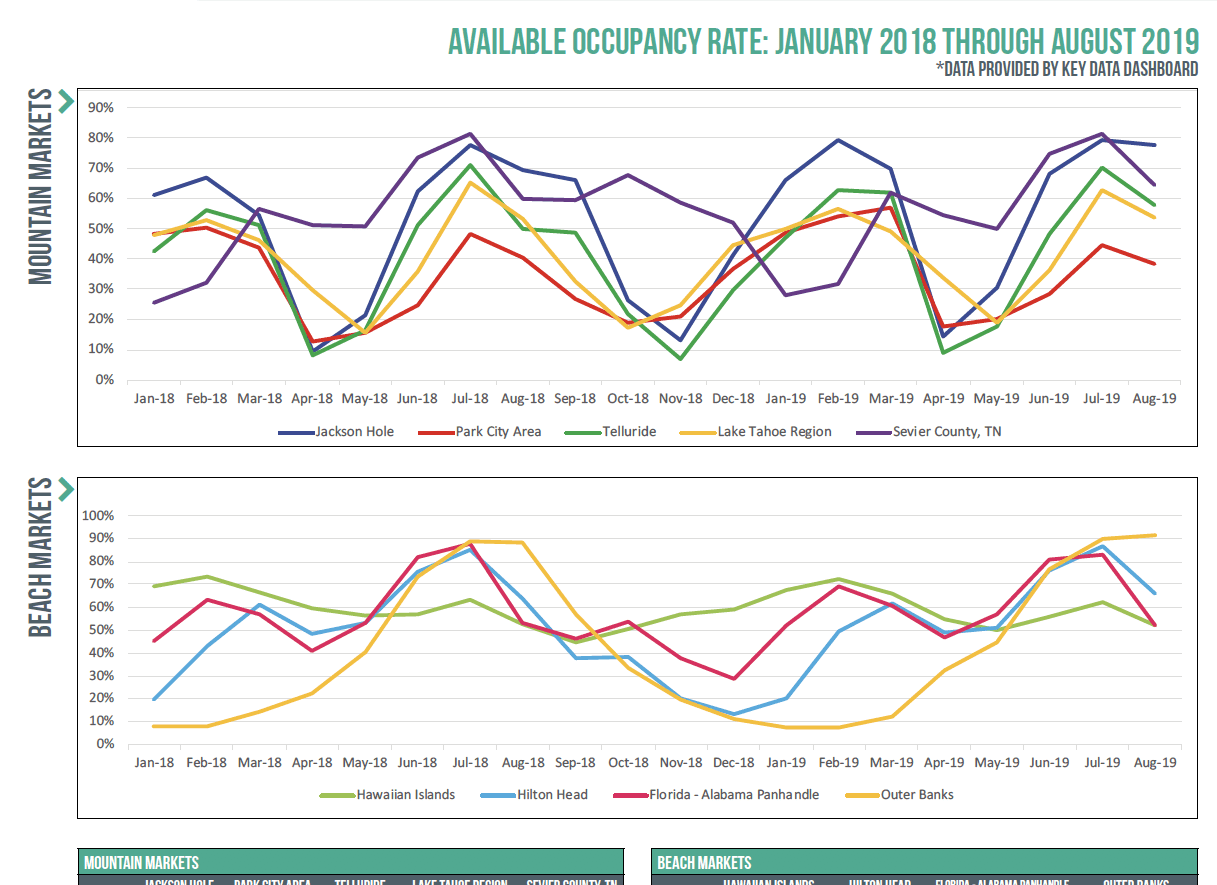
As we looked at hotel performance against vacation rental performance, it was startling to see the peaks and valleys in occupancy in the vacation rental industry versus the more rounded-out reservation performance of hotels. There will be more to come on this, but the all-or-nothing approach of realizing 100 percent occupancy for 2 to 4 weeks out of the year—compared to under 10 percent occupancy in other weeks—is unique to our industry.

Ralf Garrison, Destimetrics founder and godfather of comparative data in our industry, introduced a philosophical discussion that is likely to gain attention in the coming years, if not months: Is 100 percent occupancy a good thing?

While many property managers in traditional leisure destinations feel the need to book all homes in peak periods, what are the consequences? For example, does 100 percent occupancy during a handful of weeks each year contribute to over-tourism, traffic difficulties, and hard-to-find temporary staff/contractor needs? Would owners, property managers, and destinations be better served pricing to reduce occupancy in peak weeks while working collectively to create more stays in off-peak times? This discussion led many attendees to initiate a broader conversation around the idea of pricing for profitability, a topic I’m not going to pretend to have my head around yet.


Technology for Comparative Data and Pricing Tools

This conference was a who’s who in data and pricing technology. It is safe to say that every company committed to providing solid data and pricing tools for US vacation rentals was represented here. These companies demonstrated to attendees how they are approaching solutions, and they were candid in discussing their business models, their strengths, and their limitations.

Property managers were able to look at all the leading tools available today and see what they do. While there is some overlap, each of these companies have a competitive advantage. On the data side, we were able to differentiate between source (or authoritative) data and scraped data. (Note: Source/authoritative data comes directly from actual reservation activity from property management software [PMS] systems. In contrast, “scraped” data is aggregated using tools that “scrape” data from OTAs such as Airbnb, Vrbo, and Booking.com.)

For pricing tools, we saw how PMs can use DIY tools or work with full-service providers.


Third-party predictive pricing recommendations (Airbnb’s Smart Pricing, HomeAway’s MarketMaker, etc.)

In looking at predictive rate suggestions from Airbnb’s Smart Pricing, HomeAway’s Market Maker, and others, there was discussion about how these tools are moving past human interaction using machine learning to provide better pricing recommendations. While there may be some useful information in these predictive tools, it is apparent that vacation rental revenue managers are not currently using these tools as guides for pricing. As Sarah Franzen from Natural Retreats summarized, “Anyone who is trying to tell me how to price my home—who has an interest elsewhere—I’m probably not going to take that recommendation.”


There is Much More to Learn for Vacation Rental Professionals

To say we learned a lot last week is an understatement. The clouds cleared, and we now know the basic strategies PMs are using for pricing. In addition, we heard from the leading data and pricing technology providers and what their expertise is in the industry; we learned the differences between authoritative/source data and scraped data; and now we know the difference between a pricing tool and a revenue management service. But it was apparent that we still have a lot to learn. Here are some of the areas that are still murky for me:


End-User Pricing

One thing I hoped to learn—that we did not discuss—was how to optimize for the end price that the guest sees. As mentioned above, we finally got to a place that we can agree what RevPAR is for our industry (with variations specific to property managers in leisure markets), but we did not talk about how the vacation rental industry differs from the hotel industry in weighing the gap between rental rates and the end-user price. With the sliding scale of guest fees on Airbnb, Vrbo, and TripAdvisor, I still do not fully understand how property managers create solid pricing strategies when they don’t know what price the end user is seeing.

In addition, rate parity requirements currently are unenforceable in the vacation rental industry. Should the end-user price be optimized on a “per channel” basis? If so, how?


Booking Window

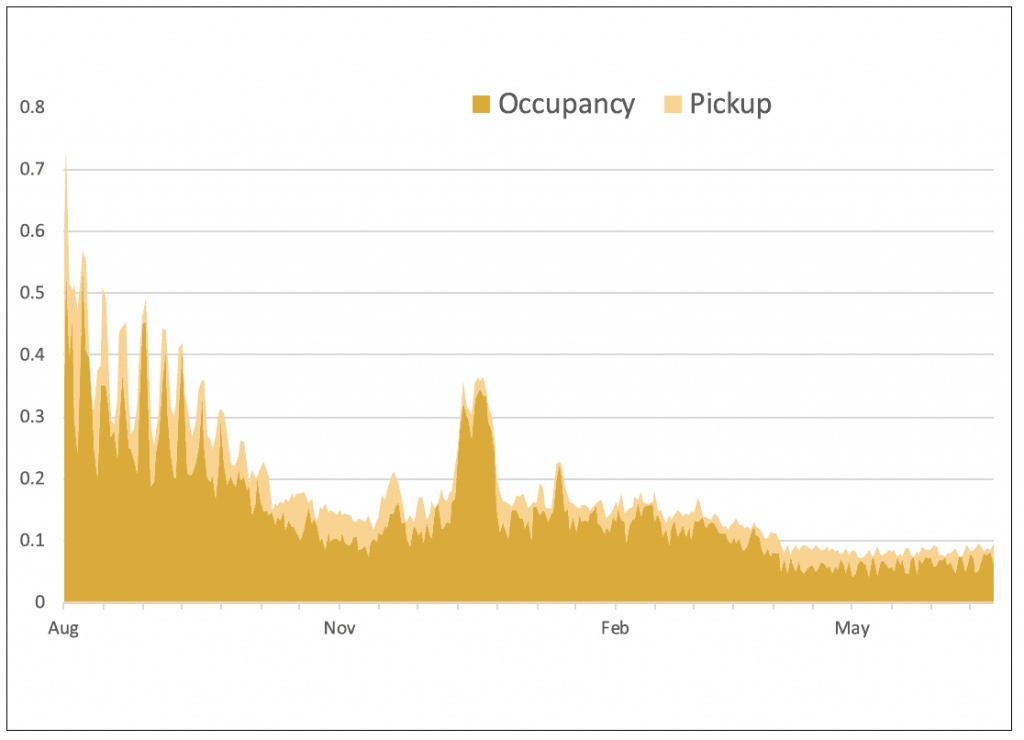
At the conference, we took a deep dive into how other industries are accomplishing revenue management. In particular, we learned how hoteliers are integrating comparative data and pricing tools with their PMS, and how revenue managers are using the combination of the tools available. However, we did not discuss how the booking window influences these strategies. In markets that have a large booking window, how do these strategies apply?

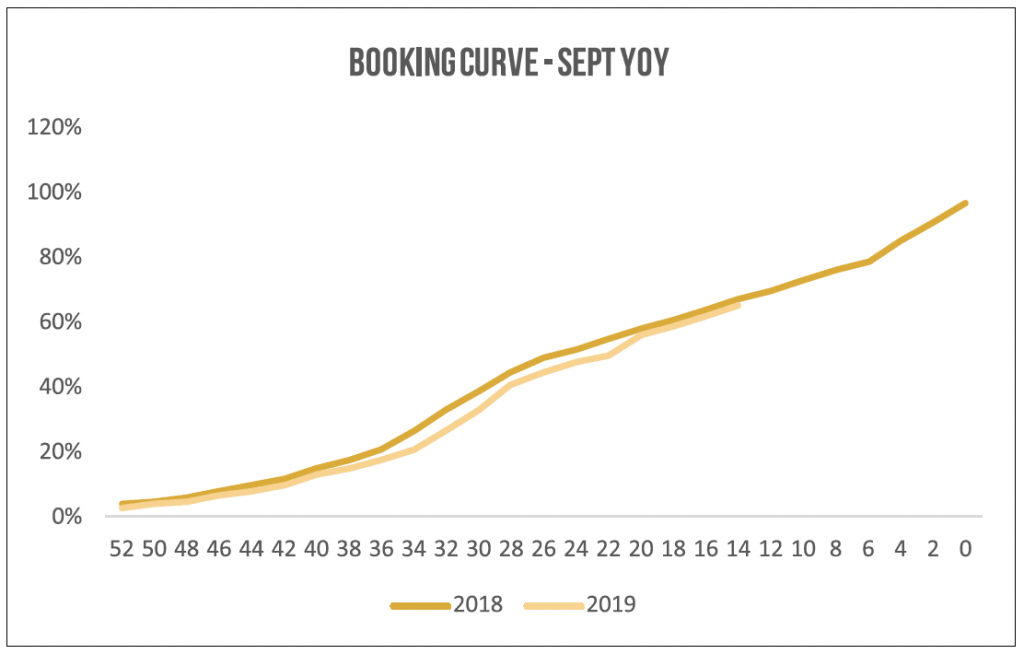
For example, in the chart below, in destinations whose booking window in 90+ days, does adjusting pricing 7 to 14 days out move the needle?


How-to?

We knew that this first Data and Revenue Management Conference would be an important first step in discussing the KPIs, looking at base strategies, comparing our industry to others, and finding some commonality. In early feedback, some property managers were hoping for more how-to instructions. The truth is that we don’t have a how-to curriculum yet; and after this conference, I can say with confidence that it does not exist yet. There are a lot of theories, and a lot of strategies being vetted—but I would be very cautious of any company who says that that they fully understand revenue/yield management in traditional leisure markets. It was clear that we are in a test-and-learn phase in the vacation rental industry. The tech providers at this conference are actively and admittedly working hand-in-hand with property managers to build these algorithms; but even in the hotel space, human interaction is still necessary to optimize pricing strategies. 


Summary

This event was an amazing learning experience, and being a part of the groundbreaking discussions that happened here was exciting. We wanted to get the smartest minds in VR data and revenue management together, and I think we came really close to having all of the best of the best.

If you were not able to make it, definitely get the videos.

The foundation was laid here, and it will be fascinating to see how quickly this discipline evolves.

For property managers, the vacation rental industry is in a unique place in time that we must come together in a few meaningful ways to preserve it for decades to come. Having accurate and collective benchmarking data is critical to the industry’s growth, and your participation is important.

I need to give Simon Lehmann, founder at AJL Consulting, a huge shout out! As emcee of this conference, his knowledge and passion for the vacation rental industry carried us through, and he made the whole event more fun for all of us. Simon, this event wouldn’t have been the same without you, and we are all grateful. 

10 Inexpensive Vacation Rental Upgrades Under $100

1

We used to talk about the “wow” factor and what we could do to elicit that superlative response. That may have been fresh flowers, music playing softly in the background, a personalized greeting, and maybe the offer of some type of concierge service. It wasn’t difficult to surprise and delight because few owners and managers were doing it.

It worked for a long time in those early days of reviews.

Then expectations began to rise, and it seemed the more we worked at making the vacation memorable, the harder it became. Guests were sharing all the special touches and what they loved most about a property, and in readers’ eyes, those qualities made up the norm. In our mission to be the best, we’ve been educating guests to expect the highest standards, and yet we still anticipate they will see the hard work as something extra to be applauded.

As this has happened, margins have become tighter, and it’s challenging to provide those extras without hitting the bottom financially.

So is it possible to still make guests happy without breaking the bank?

Yes.

It may not be the one-off event that captures their hearts and their iPhone cameras—instead, today’s methods of keeping the five-star reviews coming tend to involve consistency of service, alleviating frustrations, staying up to date with the basic needs guests have, and anticipating what drives people’s contentment on vacation.

The following list is drawn from guest experiences and reviews in which they’ve mentioned little things that made their vacations enjoyable and trouble-free. Mostly they’re simple additions, all priced under $100. 


1. USB chargers

Picture the family arriving to a property after a long journey. They’ve realized halfway that they forgot to bring any chargers (unlikely, maybe, but not outside the realm of possibility). Not to worry, they assure the kids—there will be at least one or two USB chargers at the vacation home.

The last thing they want to do is to kick off their stay by searching for somewhere to plug in their devices. The outlet should be simple enough to locate, but it also should not be placed so that the guest has to crawl under a bed to find it.

The argument that these chargers are the most likely item to disappear is valid, and the expenses add up if they have to be replaced on each changeover. The simple solution is to create a permanent charging station—a space where all devices go to be juiced up.

Then the answer is to ditch the old clock radios—yes, there are still a lot of them out there—and replace them with bedside clocks/USB chargers, making sure there is one for each bedroom, too.

Here’s a bonus tip. Put the Wi-Fi user details in a PERSPEX® card holder on a bedside table in each bedroom—your guests will love that too.


2. Motion sensing night-lights

Most accidents happen in vacation rentals in the first 24 hours of a stay, and it’s often due to unfamiliarity with the space. Guests often arrive late in the day—they are tired, hungry, and in need of a first cold drink. It’s unlikely they will spend much time getting the family oriented to the layout of the home before they all fall into bed for a welcome sleep.

Naturally, someone is going to get up in the night for a comfort break. They fumble around in the dark, trying to find a light switch, and then they stumble, half-asleep, down a dark hallway.  It’s an accident waiting to happen that could be easily prevented with the use of mobile motion-sensing night-lights. Whether using a battery powered stick plugged in or holding it in your hand, this simple and effective remedy will show you are thoughtful and have your guests’ safety in mind.


3. Hairdryer in every bathroom

Inequality in sleeping accommodations is one area that gives hotels an edge over vacation rentals. Unless they are custom-built, most homes will have just one master bedroom with an en-suite bathroom, creating that “who gets the best room” decision when guests have arrived.

Knowing there are already mildly dissatisfied guests who are in the queen (not king) room and have to share a bathroom, you have to do your utmost to build up their satisfaction. The simple act of supplying a hairdryer in all bathrooms in the home may not propel them into the super-fulfilled category, but at least it won’t add to the “and another thing” list.


4. Instant pot

For those who remember Grandma’s old pressure cooker, you’ll recall the loud hissing, the wobbling weight valve that sat on the top, and the fear it was going to blow up at any moment.  The thought of having one of those in a vacation rental might be enough to make an owner revisit the liability clause on an insurance policy and create a plan for reinforcing the kitchen ceiling!

Like everything else, however, the pressure cooker has seen monumental changes, and the current popularity of the Instant Pot is a testament to its quiet performance and amazingly quick results. It’s no wonder it holds positions #1, #2, and #3 in the “Most Gifted Small Appliances” list on Amazon with three of its top-selling models.

A ranking as one of the most popular small appliances across the US means that the majority of homes will probably have one. Because we strive to deliver a property that is as good as or better than a guest’s home, this is a great addition to the kitchen set-up. Give your property a gift, and your guests will love you.

The basic model does just what the more costly models do, but without Bluetooth. Come on . . . who needs Bluetooth on a pressure cooker anyway?!


5. Portable Bluetooth speaker

The days of the boom box are over. Guests are bringing music on their devices and a Spotify account, not on CDs. Many people will pack their own Bluetooth speaker, but to be on the safe side and happify the ones who forget, providing this small extra shows you have gone the extra mile.


6. Plug adaptors

Most guests traveling internationally will think ahead and bring their own adapters to convert the power from UK/European voltage to US voltage. Providing a couple of these will endear you to those who haven’t.


7. Hey Google!

Earlier this year, Amazon revealed that more than 100 million devices with Alexa on board have been sold. This figure includes more than 150 products with Alexa built in, more than 28,000 smart home devices that work with Alexa made by more than 4,500 different manufacturers, and over 70,000 Alexa skills. And that’s just Amazon’s figure for their Alexa brand.

Google is likely to have equally impressive numbers.

Why is that important to us? Because our guests are used to talking to voice-activated devices. They want a recipe, a reminder of the internal temperature of a roasted chicken, a weather check, and some suggestions for local restaurants. They are on vacation and quite rightly lazy, so if you can make it better for them by delivering what they are used to at home, they will reward you with a great review.


8. Large bath towels

Setting your properties apart from hotels means doing what they don’t do. Easy, right? Doing this means investing a little more in the amenities understood to be standard in a hotel, like towels. You have to be quite close to the luxury brand of hotel to get a bath towel that will wrap an ample rump and come together at the front. That should not hold true in any self-respecting vacation rental. Costco regularly has sales of bath towels that are generous enough to cover the modesty of the majority of guests, so give them a treat that will make them say, “This is why I don’t stay in hotels.”


9. Plentiful ice trays

This sounds like a no-brainer, but it’s a common complaint that there was no ice available when a group arrived at a property.

In a hotel, the ice maker is down the hallway—just fill the bucket, and you’re on the way to having a cold drink. Now imagine arriving at a rental home to find there’s either no ice at all or two tiny ice trays that came with the fridge that will serve up enough ice for a couple of drinks but will also melt in minutes.

Perhaps you have ice-makers and that’s great. Problem solved. Otherwise you will need to make sure ice is in plentiful supply—at least one tray per person. Add a task to your turnover list: the trays need to be emptied into a freezer box and refilled. Just one minor addition that will ensure a satisfied customer!


10. Emergency supplies box

There’s been a theme to much of this list. Guests forget things. With the best will in the world and great organizational skills, something will still get left behind. You can send them a packing list, which is a nice touch, but that won’t guarantee they’ll remember the one thing that will make their stay problem free.

Using a tackle box, fill it with travel-sized and single-use items—anything your guests might forget. Include an inventory with a pen and checklist, and ask guests to check off any items they have used. Use a zip tie to lock the box, and let guests know they can only access the box by clipping the zip tie. That means your cleaner will be able to do a quick check to see if anything has been used.

Here’s some ideas of what you could put in the box.

  • Band-aids
  • Toothpaste
  • Disposable razors
  • Toothbrushes
  • Tampons
  • Hair mousse
  • Hair spray
  • Condoms
  • Hair elastics
  • Mouthwash
  • Chapstick
  • Lint roller


This is not an exhaustive list. There’s probably many other things you can think of to make your guests’ stay smooth and trouble-free. And while each of these on their own might not solicit a “wow” reaction, the combined outcome of a memorable vacation with nothing missing could be just what is needed for that five-star review.

Five Keys to Responding to a Negative Online Review

1

In a time where social media has given us all a channel to be heard, the tone of our digital engagements seems to also be deteriorating. Negative online reviews can run the spectrum from perfectly valid and well-considered to more harm-focused and frankly caustic. In responding to each, here are a few keys we’ve found over the years to try to make some progress for each and every review.


Make it Prompt

This principle is very important with the idea being that progress and speed beat perfection.  A short and prompt response beats a delayed but flawless one. A prompt response also does not allow a potential fiction to become a potential fact in that it was responded to and discussed quickly.


Make it Personal

As the review was written by a person, it’s important that it’s responded to by a person. I’d suggest a person and place (for example, Mary J. in Corolla) and a picture, if possible, of the responder. I’d also suggest personal ownership. For example:

Instead of this: Someone in our guest services team will reach out to you. (Good if prompt, too mechanical if late.)

Try this: I’ll walk over to our leadership group this morning and either Jim H. or a member of his team will reach out to you. (Key words: I/walk/leader/reach/you).


Make it Audience Focused

Remember, you have two important audiences here—the most obvious (but I would argue potentially less important depending on the tone of the review) is the author of the review. The second and more important is the reading/learning public looking for trust-building and credible customer engagement.

Build trust by doing four things in every response—show expertise, commitment, transparency, and empathy.

Don’t get bogged down (and lose time) in the details of the first audience—readers don’t have those details either and can’t make a judgment (think of it as an inside joke—you can’t laugh if you don’t know the story). Stay focused on trust and promptness.


Mirror

Repeat their specific words to prove in the response a personal connection and find, in every response, at least one area of agreement. For example:

Review: I’ve been staying with X for 10 years and this home was disgusting. I loved being on the oceanfront, but this home was disappointing.

Reply: I would like to thank you for choosing us to host your vacation for those ten years, and while I’m happy to hear about the great location of your home, I’m sorry to hear about the condition of your home. On occasion, despite our best practices, we do get things wrong and it sounds like we did here. I’ll walk over to our leadership group in just a moment and ask Jill or a member of her team to reach out to you about how we can make this right and earn your business for another ten years. (Note as well the repeated theme of the response is the key words I/you.)

Mirroring is a Jedi mind trick—don’t lose an opportunity to prove to a guest that we are actively listening.


Avoid Being Polarized

Don’t let a review polarize (create a separation between what we say and what we do) our values to customers—meaning don’t let a “gotcha” moment happen around the business and its customers.  Work to close the gap with the reviewer and the reading public by finding agreement on principles—the more disagreement there is, the more important highlighting even small agreements becomes. For example:

Review: While all the Company X staff members I met were professional, the Company X has gotten too big to care about people. My house was late to check-in and dirty when I walked in. I called and no one responded. Managers haven’t called me back either—I would never recommend them again. (Note: There are multiple disagreements here and only one agreement—highlight the agreement in the response.)

Reply: I (not we . . . take ownership) want to respond to you quickly on your comments. While I am happy to hear about our professionalism in person, I share (no polarization) your disappointment about your stay. For 22 years, any success we’ve had has only been a reflection of your personal experience and it sounds like we got it wrong this time. I’ve worked full-time here for several years now, and after I write this I’m going to walk over to our leadership team and share your thoughts with them. Bonnie or a member of her team will reach out to you and we look forward to learning what we can do to make this right for you quickly.


Summary

The above isn’t perfect by any means, but it’s a starting spot. In the end, 1) speed beats perfection and 2) mirror the guest. If just those two things are done consistently, the business will be ahead of the game. On a personal note, I always treat the review/reply interaction as a chess or poker game as a way to not take it personally—we each have cards and simply have to play them in the right order. 

Revenue Management Glossary for Vacation Rentals

3
Learn the key terms of revenue management in the vacation rental industry

Revenue Management in the vacation rental industry is a discipline that is growing and developing at a fast pace. At VRM Intel, we collaborated with industry leaders, including Jason Sprenkle and Cliff Johnson, to identify key terms and metrics utilized in the vacation rental industry. As comparative data and revenue management tools continue to mature, establishing a base line of vocabulary will help us advance as an industry. The following glossary is a first step at establishing a common understanding of the terminology necessary for successful revenue management for vacation rentals.


Download the VR Acronym Cheat Sheet

Advertised Price             

The nightly price that a vacation rental manager (VRM) is presenting to the consumer.


Algorithm

A series of repeatable steps for carrying out a certain type of task with data. As with data structures, people studying computer science learn about different algorithms and their suitability for various tasks. Specific data structures often play a role in how certain algorithms get implemented.


Application Programming Interface (API)

API is the acronym for Application Programming Interface, which is a software intermediary that allows two applications to talk to each other. Each time you use an app like Facebook, send an instant message, or check the weather on your phone, you’re using an API.


Artificial Intelligence (AI)

Refers to the simulation of human intelligence in machines that are programmed to think like humans and mimic their actions. The term may also be applied to any machine that exhibits traits associated with a human mind such as learning and problem-solving.


Availability, Rates & Inventory (ARI)      

The minimum data set that is required to be synchronized between a VRM and a distribution channel to enable online booking (a.k.a. ARRI, which also includes restrictions).


Available Nights

Also known as Room Supply or Nights Available. The total number of nights that the VRM is authorized to rent out. Typically, this is the total number of nights less owner reservations and maintenance-related down-time.


Available Occupancy

Calculates the percentage of guest nights out of the total nights available for guests to book. By comparison, occupancy, the traditional hospitality KPI, calculates the percentage of guest nights out of the total nights in the period, without considering the owner nights and hold nights. Because owner reservations and hold nights take up some of the nights typically, Available Occupancy is helpful to how well you’ve filled up the properties from the nights that were available for you to fill with guests.


Average Booking Window

Represents the average number of days between when the reservation is made by the guest and the check-in date. Average Booking Window is calculated as the average number of days the property is booked in advance of arrival for the selected period. Understanding the expected booking window for a property or group of properties helps you know when to adjust pricing by demonstrating when you should expect the property to book for certain seasons. Larger properties that sleep more people may have longer booking windows since they take more planning. Smaller properties typically have shorter booking windows. Booking windows are also different for different times of the year, and differ between markets.


Average Daily Rate (ADR)           

The calculated average nightly rate for a property or group of properties. Calculated by dividing the total rental revenue by total nights sold. It is one of the most common financial indicators to measure performance in the vacation rental industry.


Average Length of Stay (ALOS)

Calculated by dividing the total number of nights by the number of stays in a property or group of properties during a specified time period.


Average Rate Index (ARI)

A vacation rental KPI that measures the performance of a VRM’s ADR compared to a competitive set during a specified time period.


Best Available Rate (BAR)

The lowest available unqualified rate, representing the fair market value for a property for each day.


Best Rate Guarantee (BRG)

The promise that the unit price a consumer receives when booking directly with the VRM is the best rate offered in the marketplace. VRMs implement a Best Rate Guarantee (BRG) policy to drive consumers to book direct.


Billboard Effect

The theory that accommodations listed on third-party distribution sites gain a reservation benefit in addition to direct sales. That benefit, coined the “billboard effect,” claims a boost in reservations due to the property being listed on an OTA website. Would-be guests gain information about the property from its OTA listing, but then opt to book directly through a channel controlled by the VRM.


Booking Curve 

A tool that visually displays bookings over a certain period of time (e.g. room pickup, bookings, and availability). Data is displayed in a graph which shows how bookings develop over time. The data needed to create a booking curve is usually taken from a Property Management System (PMS).


Booking Engine

An application which helps support an online reservation. For VRMs, the Booking Engine commonly refers to the application included on a VRM’s website which facilitates online booking through an API connection to the Property Management System (PMS).


Booking Pace    

The rate at which reservations are made for a property or group of properties over a specified time period, usually compared to another specified time period. Many VRMs also collect competitive booking pace data for a set of like-type properties. 


Booking Window

The number of days between when the reservation is made by the guest and the check-in date.


Cancellation Rate

The percentage of reservations that canceled during a period.


Canceled Stays

The number of guest stays for check-ins during a given period that canceled prior to arrival.


Channel Fee, or Channel Host Fee           

Fee charged by a distribution channel, channel manager, or marketplace. Typically, this fee is deducted from the payment before the VRM collects it.


Channel Manager           

An intermediator that provides connectivity between a VRM and third-party distribution channels. The channel manager keeps ARI in sync between the PMS and the third-party systems (a.k.a. Switch, Dumb Pipe, EDI).


Closed to Arrival (CTA) 

A yield tool used to close days out from reservations arriving on a particular day. This yield practice originated from the airlines and is not considered a good practice in VR revenue management.


Competitive Set, or “Comps”    

A defined group of competitive properties that have a similar type, target market, location, and/or concept.


Complex             

A building or community with multiple units (e.g. Condo-hotel, Condominiums, or Townhomes) usually managed by a Home Owners Association (HOA). Individual units are often managed by multiple VRMs.


Condo-Hotel    

Also known as a Hotel-condo or a Condotel. A building which is legally a condominium, but which is operated similar to a hotel with a front desk and onsite staff and services.


Confidence Interval

The probability that a value will fall between an upper and lower bound of a probability distribution. Data Scientists use confidence intervals to measure uncertainty. A higher probability associated with the confidence interval means that there is a greater degree of certainty that the parameter falls within the bounds of the interval. Therefore, a higher confidence level indicates that the parameters must be broader to ensure that level of confidence.


Conversion Rate              

The percentage of users who take a desired action. Also known as the Look-to-Book Ratio.


Custom Fees     

Additional fees unique to a property or a group of properties.


Data Integrity

The accuracy and consistency (validity) of data over its lifecycle.


Data Science

A multi-disciplinary field that uses scientific methods, processes, algorithms, and systems to extract knowledge and insights from structured and unstructured data.


Data Scraping

A technique in which a computer program extracts data from human-readable output coming from another program.


Data Warehouse

A system used to do quick analysis of business trends using data from many sources.


Depth of Inventory        

The number of like-kind units available in a similar region or complex. Inventory can be rolled up onto Representative-Level channels or broken out for Key-Level channels. Example: There are 8 x 2BR/2BA Ocean View units (a.k.a., Key-Level w/Depth.)


Direct Booking 

Direct bookings happen when a customer books directly through the VRM and not through a third-party channel.


Dynamic Pricing

Dynamic pricing is a customer or user billing mode in which the price for a product frequently rotates based on market demand, growth, and other trends.


Global Distribution System (GDS)            

A network that enables automated transactions between VRMs and third-party distribution channels.


Gross Revenue, Gross Booking Revenue (GBR) 

Total revenue the VRM collects, including Guest Fees.


Guest Fees        

Fees that the VRM charges the guest and are not part of the Rental Revenue (e.g. Cleaning, Booking, Pet, Parking, and Pool).


Hold Nights

The number of nights unavailable for booking due to a hold (i.e. maintenance).


Key Performance Indicators (KPI)            

A business metric used to evaluate factors crucial to the success of an organization (e.g. ADR, Occupancy Rate, Conversion Rate, and RevPAN).


Key-Level Listing, or Key-Level 

A unit-specific listing that represents an exact vacation rental unit. Example: Emerald by the Sea—Unit 312. This is a corner unit on the third floor with a view of the ocean. Individual homes are merchandised as Key-Level Listings (a.k.a., By the Door, Unit Specific).


Machine Learning

Machine learning is an application of artificial intelligence (AI) that provides systems the ability to automatically learn and improve from experience without being explicitly programmed. Machine learning focuses on the development of computer programs that can access data and use it to learn for themselves.


Managed Distribution  

A service that helps VRMs optimize online distribution. This includes channel managers and additional service providers such as consolidated contracting, consolidated accounting and reporting, additional content syndication services, revenue and yield management tools with consulting, analytics, transaction processing, and payment services.


Merchant Channel

A distribution channel that charges the traveler’s credit card and sends the supplier a net rate (e.g. Expedia, Orbitz, Priceline).


Merchant of Record (MOR)

The party that charges the traveler’s credit card. 


Minimum Length of Stay, Minimum Night Stay (MLOS)

A restriction dictating the lowest number of nights a guest can stay at a property.


Net Rate

The total amount received from a merchant distribution channel which is the amount the traveler paid minus the commissions and/or fees charged by the third-party distribution channel.


Occupancy Rate (OCC)

1) The percentage of total available nights that have been rented for a property or a group of properties over a specified time period. 2) The percentage of all rental units that are occupied or rented at a given time.


Open Nights

Nights that remain open for guest stays, that are not otherwise already booked by guests (Nights Sold), owners (Owner Nights), or blocked off. This is useful for quickly determining the opportunity remaining for a given period. When combined with ADR for a period of similar rates it can also be useful in calculating the revenue opportunity remaining, or money still “left on the table.”


OTA Search Ranking

The order in which your property is listed on the OTA channel search results page.


Owner Revenue              

The revenue the property owner receives. Calculated by subtracting the VRM’s Commission from Rental Revenue.


Promotions, or Specials

A discounted rate or an extra bonus when booking, such as “4th Night Free.”


Property

In the vacation rental industry, a “property” refers to a vacation unit or home of any type.


Property Group

For revenue managers and channel managers, this is a group of similar properties in a VRM’s inventory that are priced together.


Rack Rate

The full price at which units are sold to customers before discounts.


Rate Parity

Defined as maintaining consistent rates for the same property across all channels.


Representative Style Listing, or Rep-Level

A listing that represents a certain lodging type in a multi-unit building or complex. This listing might have “Depth of Inventory” and different unit types. Example: 2BR/2BA Ocean View (a.k.a. Hotel Style Listings, By Unit Type, Allocate on Arrival).


Return on Investment (ROI)

The benefit (or return) of an investment is divided by the cost of the investment, and the result is expressed as a percentage or a ratio. For VRMs, typically calculated by dividing the rental revenue generated from a source by the cost of the source.


Revenue Management

The application of disciplined analytics that predict consumer behavior at the micro-market level, optimize product availability, and price to maximize revenue growth.


Revenue Per Available Bedroom (RevPAB)

RevPAR broken down by bedroom, calculates the amount of Unit Revenue earned per bedroom per night. Because RevPAR offers diminishing value when comparing different property types, RevPAB normalizes the data to allow comparisons across properties with different numbers of bedrooms. This allows you to directly compare the rental revenue per bedroom over the number of available nights for 10-bedrooms vs 2-bedrooms. It also provides a more meaningful KPI for comparing the traditional RevPAR across all properties when benchmarking against other companies, as well as for comparing all your properties against one another.


Revenue per Available Night (RevPAN)

The revenue collected each night that a property is available to rent out. RevPAN is calculated by dividing rental revenue by the number of available nights for a property or group of properties.


Revenue per Available Room (RevPAR)

A performance metric in the hotel industry that is calculated by multiplying a hotel’s ADR by its occupancy rate. A critical KPI for measuring revenue performance, RevPAR takes into account both the ADR at which you booked the property and percentage of number of nights it was booked (Occupancy). This provides a better indicator of overall performance when compared to looking at the ADR or the Occupancy alone. Compared to ADR or Occupancy as stand-alone metrics, RevPAR provides a more complete measure of your company’s success by giving you an overall picture of both rental revenue and occupancy.

In a single figure, RevPAR helps you understand how well your company has filed its properties both in the off-season when demand is low even though rates are also low, and in the high-season when demand is high and rates are also high. Be mindful that in vacation rentals a 10-bedroom is likely to have a significantly higher ADR, and thus RevPAR, than a 2-bedroom property.

For this reason, VRMs are careful to use filters to draw appropriate conclusions when benchmarking RevPAR. For example, a comparison of RevPAR for 3-bedroom properties in a similar location vs other 3-bedroom properties in the same location may prove more insightful than a benchmarking of total RevPAR for a period inclusive of all property types.


Rent Per Available Sleeps (RevPAS)

RevPAR broken down by the number a property sleeps, calculates the amount of Unit Revenue per unit of sleeping capacity per night. Because RevPAR offers diminishing value when comparing different property types, RevPAS normalizes the data to allow comparisons across properties with different sleeping capacity. This allows you to directly compare the rental revenue per the sleeping occupancy over the number of available nights for properties that sleep 14 and properties that sleep 2.


System of Record (SOR)

A system of record (SOR) is an ISRS (information storage and retrieval system) that is the authoritative source for a particular data element in a system containing multiple sources of the same element. To ensure data integrity, there must be one—and only one—system of record for a given piece of information. This is typically a vacation rental manager’s PMS in the vacation rental industry. 


Third-Party Distribution

External channels such as OTAs (e.g. Vrbo, Airbnb and Booking.com). Third-Party Distribution channels also include Tour Operators, Wholesalers, and GDS.


Total Revenue Per Available Rental Night (TrevPAR)

Total revenue by the amount of available nights for a selected time period. For hoteliers, this metric is referred to as Total Revenue Per Available “Room” (TrevPAR) and typically includes total revenue for the period included food and beverage and all other revenue. Because most vacation rentals do not have F&B revenue and concierge revenue is still not widespread, TrevPAR only includes unit revenue and other revenue over the total nights in a given period.


Total Revenue Per Occupied Rental Night (TrevPOR)

Total Revenue divided by the total guest nights for a selected time period.


Traveler Fee

The fee charged directly to the consumer by an OTA which raises the total rate paid above the rate charged by the VRM or homeowner. Also called the “Service Fee” by HomeAway, Airbnb, and TripAdvisor.


VRM Commission

A predetermined fee charged by the VRM to the homeowner, as a percentage of rental revenue.


Yield Management

See Revenue Management. The process and discipline of making frequent adjustments in the price of a property in response to certain market factors, such as demand or competition.


NoiseAware Announces their Best Vacation Rentals of the Summer

0
NoiseAware's top 10 vacation rentals of the summer

The Best Vacation Rental of 2019

Envizzo and aBundle partnered with NoiseAware to hold a sweepstakes from July 8-29 in order to find the best vacation rental of the summer. Judges for the contest included Eric Moeller, Co-Host of Mastery Summit, Kristie Fenning of Envizzo, Alanna Schroeder of The Distinguished Guest, and Christine Saba, David Krauss, and Madison Perry of NoiseAware.

First place received the title of Best VR of the Summer with a badge for the listing, a free property photo and video shoot, NoiseAware Indoor Noise Monitoring for life at the property, a luxury sofa courtesy of Envizzo, and a $150 store credit courtesy of aBundle.

These winnings total over $5000 worth of products and publicity! 


And the Winner is . . .

#1 Phillip Cun — Palm Springs, CA


Let’s not forget to give a round of applause to the other contestants who made the top 10

#2 Annie Jackson — Jackson Hole, WY

#3 Greta Hunold — Long Beach, CA

#4 Joann Sweiven — Joshua Tree, CA

#5 James Repp — Bermuda Dunes, CA

#6 Don Redlinger — Steamboat Springs, CO

#7 Micah Jeppsen — San Francisco, CA

Industrial chic loft with a private roof deck with great views of the city. Perfect for rooftop weddings

#8 Chris Davis — Breckenridge, CO


#9 Genise Fulton — Atlanta, GA

#10 Devon Miller — Afton, OK


HomeAway Software Consolidates Software Systems: Migrating V12 and YesBookIt Users to Escapia

2
Migrating V12 and YesBookIt users to Escapia

This week, HomeAway Software announced to its property management (PM) software clients that it plans to migrate users to one common system, as the company is consolidating V12.NET, Australia-based YesBookit, and Escapia property management platforms and will move users to “a new, improved version of Escapia.”

Today’s release from HomeAway Software (aka Vrbo) states, “With these changes, V12.NET (V12) and YesBookit (YBI) will continue to work as they do today, but Vrbo will no longer add new features to these technologies. V12 and YBI users who transition to Escapia will benefit from new features and functionality that will result in opportunities to increase revenue and grow their business, new automation and integration capabilities, and valuable insights into market trends.”

In the US, V12 is one of the leading software systems used by large vacation rental management companies, such as Vtrips, TowneBank, and Wyndham Vacation Rentals.

This is not the first time HomeAway Software has shuttered a software system. Earlier this year, the company shut down PropertyPlus, another one of its enterprise-level software systems, after spending two years transitioning PropertyPlus users to V12 (although a number of V12 users moved to other software providers, including Streamline, LiveRez, and Virtual Resort Manager—all of which have recently been picked up in a private equity-funded rollup led by GSV). In addition, in May, HomeAway Software discontinued support for Escapia websites that the company had been providing for PMs. 

Additional Information:


Lisa Chen and Ryan Hutchings Offer Insight into Vrbo’s Decision

Yesterday, we talked to Lisa Chen, vice president of Vrbo’s Global Business for Integrated Property Managers, and Ryan Hutchings, general manager for HomeAway Software, to learn more about HomeAway Software’s decision regarding its property management software consolidation.

According to Lisa Chen, after speaking to approximately 2,000 vacation rental managers, she received feedback that PMs wanted to use their software to more easily manage rates, do a better job serving homeowners, and automate different areas of their businesses that are “painful for them and highly manual.”   

Chen said, “We looked internally at our technology, and what we realized is that we couldn’t run as fast as could and we couldn’t be agile in the way that we were operating three software products. Now we have a vision for what we want to do and where we want to go.”

“We want to create the best software product—such that property managers never have to think about using any other software ever again,” Chen added. “Basically, we want to start using AI and machine learning to help them achieve their goals.”

Ryan Hutchings added, “We took a lot of time and [received] a lot of input from customers and research and studies and put that all together and [asked ourselves] what would be the best solution for our customers. As we look forward, we think we have the opportunity to do something big for them [PMs] and that solves a lot of their pain points. We want to be best in class, but we also want to take advantage of all the technology we have at our fingertips that we have here at Expedia Group and Vrbo, and integrate that to provide a better solution for the property manager.”

We asked Hutchings when they made the decision to stopped selling V12. He replied, “We don’t have any specific dates. I can tell you that, when we announced last year that we’re investing in software with the broader group, that all of these decisions were a series of events. As we looked at the strategy, we said we’re investing in software—and we started that last year—and our goal was how do we find the best solution and where should we put that investment. It’s been a rolling decision throughout that time of various considerations.”

We also asked how many HomeAway Software customers are currently on V12 and YBI. Hutchings said, “We can’t share exact numbers, but I can tell you that when you look at size of customers, Escapia is by far our largest solution for property managers compared to the other two. Both V12 and YBI have a customer base that’s very specific in the way that we sold it to them as far as their solution. Escapia is still the market leader as far as the volume of property managers using it.”


Impact for HomeAway Software Users and Technology Partners

V12 and YBI software users will now decide if they are going to migrate to Escapia or find another software solution.

Hutchings said, “We’ve gone to great lengths to consider the impact that this has on customers. We don’t take that lightly. We know that any transition, regardless of what system it is from or to, is impactful for PMs. We are also considering that, because of this solution that we are providing, we have other considerations and concessions we are offering for our customers; and that can range anywhere from additional support and trainings to waiving our implementation and initial setup fees so none of that will be included when they make this transition.”

However, according to Lynell Eaddy, founder and president at LSI Tools, the fees associated with implementation and setup are only part of the equation. “At LSI, we have spent the past 30 months converting PropertyPlus clients to V12 and other software choices, and we just finished our last conversion in May,” Eaddy said. “The conversion process to a new property management system is always painful and expensive for property managers. The costs associated with the staff time required to research available options, to configure their new system, and the training required for their entire staff is generally twice the cost of purchasing their new software. For those companies that switched to V12 over the past two years, they are now faced with the difficult choice of which PMS to move to and budgeting the time as well as expenses associated with a new cost center that was not projected to occur again for a decade.”

Eaddy also pointed out that PMs are not the only ones affected by HomeAway Software’s decision.

“As a vacation industry software provider, I understand why HomeAway would want to move to a single PMS platform rather than supporting multiple products and continuous development. It makes sense for them internally from a cost perspective and strategically. However, suppliers and HomeAway’s Channel Partners are particularly impacted, especially so for those companies that provide customizable solutions which take extensive time to configure and code for each client. These are costs that are not always recoverable from the client and in some cases will amount to hundreds of thousands of dollars before the process is complete. The PropertyPlus demise forced many companies to reinvent themselves. They now face putting aside other strategic objectives to repeat the process yet again.”

In talking about PM concerns, Lisa Chen said, “What we are doing is ensuring that this is the last [software] transition PMs will ever have to do. That is because everybody will get the value that they need for their businesses with better features and automation that will help them be more effective at their job. Ultimately, we want to help them be successful from a top line, but we also want them to get home for dinner and not have to be thinking about what their software couldn’t do for them that day. So we are looking at this as this is the last transition that they will ever have to make.”

Hutchings added, “From our standpoint we hope that they [PMs] see that we are investing in our software division, and that represents long-term commitment. For something like this transition, we know it takes time. We also know that where we are investing—which is in the software, the technology, the support, and what’s coming—it takes a major investment and a major long term commitment to do so. We know that the customers will see that; when they see this road map and see everything we are putting into it, they will appreciate the additional support and the additional technology and the solutions that we will provide because it is important to us that they understand where we are putting our money and how we are going to invest in those areas for them.”

We asked Chen and Hutchings, “Isn’t this what PMs thought they were getting when they moved to V12 from PropertyPlus?”

Hutchings replied, “I would say absolutely. They definitely transitioned to V12 understanding that—at the time—HomeAway Software was investing in V12, and we continued to do so, just as we were investing in all our products. The difference now is we are actually saying that we are going to invest more into one solution. We still had multiple products at the time. It split resources and time and efforts internally, and that did not provide the best solution for the customer. So now we have an opportunity to do even better and that means that all the investment is going to one place instead of to multiple places—and that’s a new solution for the customer.

The primary question that V12 users have is: When do I need to transition? (More FAQs below)

HomeAway Software said: “We know this is disruptive to your business. We’ll work with you to make the transition as seamless as possible and ensure that it fits a schedule that works for your business. We’re building tools and teams to help support with making this as easy as possible. Eventually, V12/YBI will be shutting down. We anticipate this process will be complete in approximately 24 months. In the past, we told you we would try to give you 24 months notice and we want to accommodate that. Our goal is to find the soonest time that works for your business to transition so that you can take advantage of the great tools we’re building on Escapia. From now until V12 shuts down, we will continue to fix high priority defects, and all new features will be added directly to Escapia.”

Lisa Chen added, “The good news is that there aren’t a lot of people who recently switched [from PropertyPlus] to V12. Most of the people on V12, frankly, have been on it for a really long time. So when they [PMs] looked at Escapia, it probably wasn’t anywhere close to the Escapia that exists today. As we have continued to add features and functionality over time, we’ve been doing so across platforms. So one thing that is important to remember is that their perception of Escapia doesn’t necessarily match what the product actually can do.”

Ali Breaux, president at Sun Realty in the Outer Banks—and V12 user—said, “The vacation rental management software industry has evolved considerably over the past ten years. There are a lot of exciting developments in software and ancillary support tools, aimed at enhancing and streamlining operations. My team and I are excited about researching modern and robust platforms that will offer greater flexibility, power, and room to grow and evolve with our company.”

HomeAway Software is hosting a webinar, August 22, at 2:00 pm ET to give customers more information about the changes. 


HomeAway Software FAQs About Software Changes


Q: What is happening?

A: HomeAway Software is consolidating its three property management software (PMS) products — YesBookit, V12.NET and Escapia — into one software system that will deliver faster technological innovation and twice as many customer support hours to property managers. V12.NET and YesBookit customers will be asked to transition to the new version of Escapia.


Q: What is the platform this new technology will be built on?

A: We evaluated all three of our software products to review which code base is best to build upon. And while we understand each is unique, we determined the Escapia code base to be the best to build on to quickly create the most robust technology for all of our PM Partners. While Escapia and V12 were traditionally meant for different types of PMs, as new features have been added and these products have evolved, they’ve become increasingly similar.


Q: How does this impact me?

A: V12 and YBI will continue to perform as they do today; however, all new features will be added on the Escapia platform. Your business will be asked to transition from V12/YBI to Escapia, and we’ll work with you to decide if Escapia is right for business.


Q: Why is HomeAway Software making this change?

A: Over the years, we’ve been investing in new features on V12 and Escapia. While these products were traditionally meant for different types of PMs, as new features have been added and these products have evolved, they got increasingly similar. When we took a step back, it made sense for everyone to get the benefit of being on one system. That’s why we’re consolidating our three software products. You’ll have the best of three PMS products with features that are important to you, plus more robust tools using modern technology. The benefits of all customers being on one platform are faster delivery times, more modern technology with innovative features that can help you grow your business, and even more support hours.


Q: What happens to V12/YBI?

A: Eventually, V12/YBI will be shutting down. We anticipate this process will be complete in approximately 24 months.  In the past, we told you we would try to give you 24 months notice and we want to accommodate that. Our goal is to find the soonest time that works for your business to transition so that you can take advantage of the great tools we’re building on Escapia. From now until V12 shuts down, we will continue to fix high priority defects, and all new features will be added  directly to Escapia.


Q: How does Escapia work? I’ve always thought V12 and Escapia were so different. Does Escapia have the features I need to run my business? 

A: Escapia and V12 are both designed to support you to operate your business. As we’ve made the adjustments you’ve asked us for, these systems have become more and more similar. There are a lot of features in both systems that look a lot alike. We’ve developed some videos to show you how it works and how you can accomplish day-to-day tasks that are important to you in Escapia.


Q: What is the cost of this transition and will my fees increase?

A: Your monthly/annual fees will not increase, and you may end up paying less. For transition and implementation, remote training, regional classroom training, data migration, and support will be included at no cost.


Q: When do I need to transition?

A: We know this is disruptive to your business. We’ll work with you to make the transition as seamless as possible and ensure that it fits a schedule that works for your business. We’re building tools and teams to help support with making this as easy as possible. Eventually, V12/YBI will be shutting down. We anticipate this process will be complete in approximately 24 months. In the past, we told you we would try to give you 24 months notice and we want to accommodate that. Our goal is to find the soonest time that works for your business to transition so that you can take advantage of the great tools we’re building on Escapia. From now until V12 shuts down, we will continue to fix high priority defects, and all new features will be added directly to Escapia.


Q: How will HomeAway Software support me through the transition process?

A: We know how disruptive a transition is to your business, and we’re going to do everything we can to make it as seamless as possible. We have put a lot of thought into how to do this well, what the specific impacts are to your business, and how we mitigate those. We plan to do as much of the heavy lifting as we possibly can. We’ve built tools and teams to support you through the transition. Once you start your transition, you’ll be assigned a project manager who’ll be dedicated to making this transition seamless, including moving your data for you. We’re going to improve the transition experience greatly from where it currently exists and have the support in place to help every customer with a timely transition.


Q: Where can I go to learn more?

A: The best place to learn more and to see Escapia in action is at Rezfest, especially Escapia & V12.NET User Day on Friday, September 27. Sign up here, and be sure to select the ‘Rezfest + Escapia & V12.NET User Day (9/24-9/27)’ item at checkout.


Vrbo Press Release

HomeAway Software to consolidate property management software suite and launch new AI-rich features
Investment behind single software solution to boost efficiency for property managers and maximize their revenue

AUSTIN, Texas – JULY 31, 2019 – Vrbo®, Expedia Group’s global vacation rental business, announced today that it is making updates to its suite of software solutions, known as HomeAway Software, to deliver faster technological innovation and extended customer support hours for property managers (PMs). The changes will consolidate the YesBookit, V12.NET and Escapia property management tools to one software system, a new, improved version of Escapia, to enable faster delivery times and provide the best features most important to PMs that help them operate their businesses more efficiently and maximize revenue.

“The vacation rental industry is continuously changing and property managers from around the world have told us they need modern software tools that will help them excel in this competitive environment,” said Lisa Chen, vice president of global business for property managers at Vrbo. “Vrbo is investing behind one property management software to accelerate development and deliver an industry-leading solution leveraging artificial intelligence (AI) and machine learning that lets PMs grow and scale their businesses.”

With these changes, V12.NET and YesBookit will continue to work as they do today, but Vrbo will no longer add new features to these technologies. V12.NET and YesBookit users who transition to Escapia will benefit from new features and functionality that will result in opportunities to increase revenue and grow their business, new automation and integration capabilities, and valuable insights into market trends.

Vrbo will work closely with customers making the transition to minimize disruption to their business. In addition to extending support hours, Vrbo will help PMs evaluate the best time to transition and offer one-on-one business consultations, dedicated transition project managers, customer-specific transition tools and in-depth demos for the Escapia product to make the transition seamless as possible. With these software changes, property managers can:

  • Optimize revenue through new insights and rate opportunity tools that leverage automation and machine learning paired with data from the property manager and the Expedia Group platform
  • More effectively manage their day-to-day operations and see how their business is performing year-over-year

“The changes to our software strategy will allow property managers to spend less time juggling tasks like updating rates, managing reservations and everything in between, and more time keeping owners happy and delighting guests who stay in their properties,” said Ryan Hutchings, general manager of HomeAway Software at Vrbo. “Escapia’s new AI-driven features will save property managers time and surface valuable insights that will help them set optimal rates.”

Vrbo will reveal the vision for Escapia and its new features at Rezfest 2019, Vrbo’s annual conference for property managers that will take place Sept. 24-27 in Las Vegas. Learn more about the changes to HomeAway Software here.


About Vrbo

In 1995, Vrbo introduced a new way for people to travel together, pairing homeowners with families and friends looking for places to stay. We were grounded in one purpose: To give people the space they need to drop the distractions of everyday life and simply be together. Since then, we’ve grown into a global community of homeowners and travelers, with unique properties in 190 countries around the world. Vrbo makes it easy and fun to book cabins, condos, beach houses and every kind of space in between.

Vrbo is part of Expedia Group and offers homeowners and property managers exposure to over 750 million visits to Expedia Group sites each month. To learn more, visit www.vrbo.com.

Workforce Development 2019 and Beyond

0
Vacation Rental Industry Workforce Development

One thing is for sure. In the coming years, as business owners you will need to become more flexible with your workforce to ensure that your business continues to adapt and thrive. The most important conversations among business leaders today focus on the future of work, what the workforce will look like, and the challenge to attract, engage, and retain top talent. Think about the changes in the vacation rental industry and how your workforce may need to adapt.

  • Have you considered how the high speed and pace of technology change may affect your current workforce?
  • What are you doing today to prepare for your future workforce?
  • What is your strategy to remain relevant in your marketplace?

As you consider your answers, it’s important to understand today’s employment landscape, and what you as employers can do to get ahead of this curve. Scanning the environment is key to understanding the employment climate.  

While the economy is still thriving, there is a labor shortage for all industries across the spectrum. Record low unemployment (May’s unemployment rate of 3.6 percent is the lowest rate since December 1969) combined with tighter immigration policies is making it challenging for employers to attract and retain the right talent.

Although unemployment remains low, there are still many jobs available. The problem for employers is that there isn’t a skilled workforce to fill all the open positions. A study by Bloomberg and Workday found that college graduates are not bringing enough technical or soft skills to the job market; in fact, only 35 percent of employers feel that college graduates are sufficiently ready to join the workforce. 

Hiring talent remains a top concern for CEOs. As reported in the most recent Conference Board annual survey, CEOs stated that the failure to attract and retain top talent is the number one issue on their minds. The Conference Board found that business leaders view the unavailability of talent and skills as the biggest threat to their business and that they recognize how the high cost of outside hiring may affect their business decisions.

Business leaders are focusing their attention on people analytics (data analytics for your workforce) so that they have the data they need to make strategic human resources decisions. There is a lot of talk about data analytics in the vacation rental industry, but the focus has been on finance, marketing, and sales. Imagine making a business decision to change your PMS software without using financial reports and other data analytics to guide your decision. Most business leaders would not make that decision without fully understanding their ROI. Yet this is exactly what most people do when making key decisions that affect their human resources. People analytics has the ability to touch every aspect of managing your human resources, from calculating the cost of turnover to measuring the productivity and engagement of your workforce. Now is the time to focus on people analytics and the largest expense line—your labor. 

Employee demographics are shifting. For the first time, there are five generations in the workplace, and this requires a new way of doing business. Companies are bracing themselves for an influx of millennials. Millennials are now the most prevalent generation in the workplace and are on track to make up 50 percent of the workforce by 2020. Generation Z is following in their footsteps. These two youngest generations will comprise nearly 70 percent of your employees in the next few years. What are you doing now to prepare for this generational shift?

With five generations in the workplace, it means that the solutions you currently have in place for attracting, engaging, and retaining talent can no longer be deployed as a one-size-fits-all approach. Engaging five generations in the workplace side by side requires you to actively seek out and value diversity and inclusion. Focusing on creating a more diverse workplace and workforce at all levels in your business is a competitive advantage. It’s important to not dwell on differences. Dwell instead on how to best engage this diverse workforce. 

Start building collaborative relationships, finding ways to encourage more diverse thinking. Creating opportunities for employees of different generations to interact in both work- and nonwork-related settings can help to build relationships and minimize misunderstandings, creating opportunities for cross-generational mentoring. Don’t automatically assume that younger generations will be mentored by older generations. All age groups have opportunities to learn from one another. Consider the different life paths of your employees. Critical points for engaging them are understanding where your employees are at in their lives, learning their personal preferences, and recognizing how they expect to be compensated.

Technological advances, including AI, continuously change the employment landscape. Today jobs are not necessarily disappearing, but they are being augmented by technology. As technology becomes more affordable and mainstream throughout the vacation rental industry, it is changing the very nature of how we do our work. 

Automation is now reaching into the office, making the way we work today look nothing like it did a few years ago. As machines take over mundane tasks, employers are expecting more complex, creative, and varied functions from their employees. Continuously review your technology solutions and automation to apply new technologies to streamline repetitive tasks. Online collaboration tools, shared drives, videos, YouTube, Facetime, Skype, Zoom, etc. are changing the ways employees get their work done.

The ever-changing nature of the employment landscape puts more pressure on employers when it comes to attracting and retaining employees. With increased competition and online reviews, customer expectations are going up, resulting in your customers seeking an authentic customer experience. They are shying away from generic customer service responses. Today’s customer expectations require your employees to deliver an authentic product and service experience. The focus now is on deciding how to best use AI to help your employees do their jobs better.

Scanning the environment is key to understanding emerging workforce trends. Listed below are several things that you as employers can do now to get ahead of this curve.


1. Create a compelling employee experience that attracts talent

Today millennials are looking for more than stability, competitive wages, and benefits to be committed to a company. They are driven by a sense of shared purpose. Understanding their part in the bigger picture is what drives them to bring their best to the workplace. By 2020, employee experience will be as important as any other factor for your company’s success. Figuring out the gap between what the millennial workforce expects and what your workplace has to offer is important. Millennials are all about convenience, connectivity, and functionality. Start by incorporating tools and technologies that enable their productivity.


2. Become the employer of choice in your marketplace

Employers of choice know what their competition is doing and how they stack up against the competition when it comes to attracting, engaging, and retaining talent. Today, employees are looking for a healthy workplace culture, opportunities for learning and growth, more interesting or challenging work, a variety of tasks, and of course more competitive pay, benefits, and incentives. To remain competitive you need to be offering more benefits, such as health insurance, 401(k) or savings plans, time off to volunteer, flexible schedules, and an ability to work remotely. Think about your business and focus on what will differentiate you as an employer of choice in your marketplace.


3. Embrace automation

Focus now on deciding how best to use technology to assist your employees with doing their jobs better. The World Economic Forum predicts that 42 percent of workplace tasks will rely on some form of AI or automation by 2022, although technology will play a big role in your team’s productivity, Deloitte’s 2018 Global Human Capital Trends report states that the most sought-after talents of future employees won’t be purely technical skills like coding or cybersecurity. They will be “essentially human” soft skills like creativity, communication skills, and complex problem solving. Embracing automation and using technology more effectively will free up your workforce to spend more time on innovation, collaboration, and business planning. 


4. Train now for trending skills

By 2022 no less than 54 percent of all employees will require significant retraining or reskilling. Of these employees, 35 percent could require training for up to six months. Skills continuing to grow in prominence are emotional intelligence, analytical thinking, and innovation, followed by active learning and learning strategies. With the advancement of technology and AI in the workplace, employers will see a decline in roles that require skills such as manual dexterity, quality control, coordination, and time management and technology use (monitoring and control).


5. Assess your managers’ emotional intelligence (EQ)

Soft skills training is essential to developing your workforce, and at the top of the list is EQ. As Marcus Buckingham says, “People don’t leave bad companies, they leave bad managers.” Providing more training for your managers on soft skills, such as how to give effective feedback, setting smart goals, and dealing with conflict will go a long way toward improving your employee engagement and retention. Set your managers up for success. Your managers have the greatest impact on engaging and retaining your workforce.


6. Develop the talent you can’t find

The best employees are made, not found. Given the war for talent, you have to think differently about what the job is and who is going to fill it. Businesses no longer have the luxury of finding individuals with the skill sets and the talent key to their business, so retraining and reskilling current employees is on the upswing, focusing on the skills that are in high demand. Start by identifying the skills you need and the employees who are interested in learning them; then provide employees with the education assistance (and the time) to obtain the skills. The cost of reskilling is considerably lower than the cost of firing and hiring. Back to people analytics.

Understanding your cost of hiring and terminating is vital to developing your talent. For example, it may cost $6,000 to hire an employee or $3,000 to provide additional training and education for a current, engaged employee—to reskill that person so as to bring more relevant skills to your business. Investing in your employees’ development is a win–win. 


7. Tapping into diverse recruitment pools is a must

Looking for talent outside of your normal channels and pipelines is important for successfully hiring talent in today’s economy. There are several disadvantaged groups to focus on, such as veterans (and military spouses), remote workers, disabled workers, family members reentering the workforce, and individuals with criminal records. Employers are now widening their search for applicants to consider candidates with criminal histories, as one in three adults (70 million Americans) currently have a criminal record. What types of criminal records are you as an employer willing to overlook? According to the Society for Human Resources and the Charles Koch Institute, employers are more likely to hire people with a criminal record of substance-related felonies and misdemeanors than those who have committed financial crimes or violent or sexual felonies. Employers are willing to consider candidates with criminal histories if they have good references, a solid performance record, and training in skills the employer is seeking, according to the report. Several states are starting to offer certificates of rehabilitation. Currently Arizona, California, Illinois, Nevada, New Jersey, and New York offer rehabilitation certificates or something similar. 

To harness the potential of this future workforce, start by incorporating tools and technologies that will assist your employees in doing their jobs better. Focus on engaging and retraining or reskilling your current workforce. Developing a workforce culture that creates a sense of community—a sense of belonging and purpose—is essential to attracting and retaining talent today. Set your managers up for success with soft skills training. Providing training for your managers on soft skills has a direct correlation to business profitability, increased ROI, and engaging and retaining your workforce.

Message to Vacation Rental Management Companies: Don’t Give Up

11
Dont give up even though the vacation rental industry is changing

The vacation rental industry may be changing, but now is not the time to give up

At VRM Intel, we receive regular emails and calls from company owners and executives who are feeling burnt out, overwhelmed, and fearful about the future. The vacation rental industry is experiencing another wave of consolidation and change, and I don’t know many company owners (VRMs or vendors) who haven’t at least entertained the idea of selling their companies in the near future.

However, after taking a deep dive into market conditions affecting the vacation rental industry, we can say with confidence that the future of the vacation rental industry is indeed bright. Yes, there is a wave of consolidation and acquisitions, but it isn’t the first one we’ve seen, and it won’t be the last. The opportunities in our industry are huge. If you have a second (or third) wind in you, now is not the time to give up.


Burnout and Fear: Where Is it Coming From?

Feelings of burnout and fear in today’s entrepreneurial climate are not exclusive to the vacation rental industry. Burnout is now a legitimate medical diagnosis, according to the World Health Organization.

With mass consolidation and a lack of antitrust or online oversight, large corporations have been given free rein to create structures and policies that are harmful to entrepreneurs.

However, in the vacation rental industry, we have additional challenges.


Four Primary Factors Causing Burnout and Fear for VRMs


1. Technology Changes

While the introduction of new technology-enabled business models is changing the fabric of the vacation rental industry, the biggest struggle for managers actually lies with the core property management software system (PMS) as selecting software is the primary cause of operational angst as reported by VRM Intel’s readers. Changing software is arguably the most painful challenge a vacation rental management company (VRMC) faces through the course of its business, and with the current wave of consolidation (including GSV’s tech rollup and HomeAway’s recent software news), property managers are struggling to find software solutions they feel confident they can invest in over the long term. Additionally, new technology products and distribution channels present opportunities for VRMCs, but seamless and affordable integration between systems has historically been a challenge for the industry, making it difficult to use new technology offerings.


2. Margin Compression

On the expense side, rising costs for technology, staffing, and marketing—along with the costs associated with meeting higher customer expectations—are contributing to margin compression for VRMCs. On the revenue side, there is downward pressure on rental commissions and the additional fees VRMCs can charge because of competition from emerging business models and aggregation on OTAs. Managers are expected to do more for less, leading to fears about long-term sustainability.


3. Workforce Instability and Productivity

Sue Jones writes about labor shortages and difficulties in developing, training, and motivating today’s workforce. The cost of hiring, training, and maintaining a consistent hospitality team is higher than it has ever been, and today’s workforce requires a new generation of management skills and constant recruitment, contributing to many founders’ feelings of frustration and burnout.


4. Overall Wave of Consolidation and Fear of Missing Out (FOMO)

Main street small retailers were pushed aside in favor of big box stores (i.e., Walmart, Home Depot, Best Buy), and now the big box chains are losing out to online retailers. Almost every local bank, grocery store, and pharmacy has been purchased or pushed out, and more and more independent boutique hotels are now operating under large hotel flags. The vacation rental industry is also experiencing a wave of consolidation, leading VRMCs to wonder if they are fighting a losing battle to remain independent. As a result, company owners in the vacation rental industry, both VRMCs and vendors, are demonstrating fear of missing out (FOMO), in regard to their opportunity to sell their companies at a high multiple. For example, today’s news that Vacasa agreed to purchase Wyndham Vacation Rentals for $162M makes the thought of selling now even more enticing.

There are many signs that now is not the right time to sell, but with fatigue about margin compression, technology, and staffing, as well as an influx in solicitations from prospective buyers, the idea of a quick exit is appearing more attractive.


Opportunities for Independent Vacation Rental Management Companies

Even with the challenges, the vacation rental industry has seem significant growth, and there are still big opportunities for independent VRMCs. Although it is true that a handful of multi-destination VRMCs are expanding, there are market conditions that favor growth for destination-specific VRMCs. Here are six areas of opportunity for in-market management companies. 


1. Consumer Awareness

To be fair, OTAs and listing sites like Airbnb, Expedia, and Booking.com have helped to increase consumer awareness of vacation homes as viable lodging alternatives. Although the industry has not had a reputable consumer market study in years, Phocuswright reported, “In 2015, nearly one in three US travelers used private accommodation, up from fewer than one in ten in 2010.”

As a disclaimer—in 2010—“private accommodation” did not include the shared-home or short-term urban inventory that Phocuswright included in 2015. However, for leisure destinations, what the industry does have now is a new generation of travelers for whom the idea of staying in homes for lodging is mainstream.


2. VRMCs’ Strengths vs Weaknesses

At the VRMA Executive Summit in June, attendees were asked to write down their strengths and weaknesses. Interestingly—when articulating their weaknesses—rental managers said their greatest challenges relate to workforce development, technology, competition for inventory from new multi-destination companies, and regulations.

In contrast, among their strengths VRMs listed experience, leadership, fiscal responsibility, meaningful brand equity, dedication to the community, guest and owner relations, customer retention, customer service delivery, company culture, team building, online marketing, property care, and relationships.

Of the ingredients necessary to manage second homes effectively and provide safe and secure vacations to guests, the strengths articulated by independent VRMCs are much more critical to operational success than the challenges they are facing.

“While our industry seems to be changing faster than ever, and more competition from larger players is entering our markets, I think this opens the doors for new opportunities,” said Mike Harrington, founder and CEO at Carolina Retreats Vacation Rentals. “The value we provide is on a one-to-one basis with our clients/property owners. We are in a service business. I’ve long been a proponent of more innovation on the homeowner servicing side, which can help build that ‘moat’ around your business and make it much more difficult for disruptors looking for a quick buck to cast you aside. We’re starting to see some of this through operations technology like Breezeway, Properly, TRACK, etc. I’m also a big believer that the companies that will continue to be successful will not and cannot be all things to all people.”

Harrington added, “Focus on what you do best, and double down. Look for new ways to diversify your revenue stream within your current operations setup. What services are you currently not providing that can help with either the guest or owner experience? These can be simple things like bringing laundry and linen and towel service in-house, partnering with a contractor or design firm to offer turnkey renovation and upgrading services, offering monthly services to nonrental homeowners in your area (inspections, cleaning services, general maintenance), or something else.”


3. Vacation Rental Management as a Service

As Harrington stated, “We are in a service business.”

The business of caring for second homes and offering these homes to guests as safe and secure lodging is primarily a service business—one that is more effectively managed locally.

Local VRMCs have several advantages over multi-destination companies. For guests, local managers have relevant knowledge of the destination, the homes they manage, and the ancillary services provided. For homeowners, local managers provide asset management, guest management, accountability, and individual property care that multi-destination managers cannot provide at the same level at scale. For employees, local managers provide a connection to the community and a more meaningful team experience.

“Building a vacation rental business with my sister over the last twenty years has been a marathon, and while we have enjoyed great successes along the way, having the determination to stick with it is not always easy,” said Amy Gaster, president and cofounder of Tybee Vacation Rentals. “This business is hard and stressful and complicated. We have grown to be the largest vacation rental company in our region, and we take that job very seriously. Having a capable staff and management team in place has been one of the keys to our success. We push forward in our mission for the sake of protecting our owners’ investments, serving our guests, [and] caring for our employees, and for the responsibility we have to our community.”


4. New Technology Solutions

Although there is pain in change in technology today, streamlined innovation is coming.

New property care, smart home, CRM, data, pricing, and marketing tech products are being introduced, and interfaces between these platforms and PMSs are being ironed out. Recently, a VRM-led software advisory group was formed to address current integration challenges. It is petitioning technology companies in the industry for a common API to allow VRMCs to establish a more open plug-and-play technology environment and decrease reliance on the core PMS.

An advisory group is petitioning to allow a common API (Application Program Interface)in the vacation rental industry.“I think it’s such a fun time right now,” said Matt Renner, SVP Business Development, TRACK (TravelNet Solutions). “I’d rather be in an industry experiencing massive growth than in a stagnant industry without much innovation. Transformation isn’t easy, and this business isn’t for the faint of heart, that’s for sure, but we are super optimistic about where the vacation rental industry is heading. Technology is getting better, and the category is getting a massive lift from the huge investments pouring in. Long term, we see winners in this space from a PM perspective as being the ones who invest in ways to improve the end-to-end customer experience and who are able to leverage technology to strengthen and own the guest relationship. Creating demand for a product and then delivering a great customer experience is a fundamental formula that works regardless of time or industry.”

Renner added, “Those who bow out now are going to look back and wonder what they missed out on and why they jumped off the ride so early.”


5. Vacation Rentals as a Considered Purchase

Vacation rentals are more of a considered purchase than hotel stays, meaning that consumers search for more information and spend more time considering clicking the “book now” button for a multi-night stay in a vacation home than they do when booking one or two nights at a hotel chain.

The idea of a considered purchase is problematic for OTAs, whose model requires commoditizing this uncontrollable product that is so varied by nature that it does not break down easily into a hotel-room-sized thumbnail.

Independent VRMs have an increased ability to provide high-quality listing information, to staff more knowledgeable call center agents, and to build guest relationships that lead to repeat stays.

“For smaller VRMCs, they need to think of themselves as boutique vacation rental companies,” said Betsy LaBarge, owner of Mt Hood Vacation Rentals. “Find a niche and stick to it. We cannot play the way the large multi-destination providers play. We need to know our brand, work to its advantages, and develop relationships with guests, owners, team members and vendors to maintain loyalty and trust. Unfortunately, that may mean we need to spend proportionally more for our website, SEO, SEM, email marketing, social media marketing, photography, and a reliable PMS. In my opinion, smaller VRMCs that go all in with OTAs and skip using a good PMS and integrated marketing will find it to not be sustainable over time. Those companies will never build good repeat business, so they will find themselves constantly having to acquire new customers.”

Further, homeowners find value in working with local managers who have owner-friendly cancellation policies, damage coverage procedures, and travel insurance offerings.


6. The Value of the Independent VRMC Within the Community

Local VRMCs have done more to promote leisure destinations than any other sector. Although there is significant in-market competition between lodging providers, competition is even more fierce among destinations. For example, between the Alabama coast and the markets in the Florida Panhandle, competition among destinations for guests searching for their favorite Gulf Coast vacation spots is intense. The same dynamic exists in ski markets, along the Atlantic Coast, and across Hawaii. Consumers have choices, and communities must pool resources to ensure that a destination stays top of mind among their core consumers.

Emerging multi-destination VRMCs have been largely unengaged within the communities in which they operate and have been content to ride the coattails of local marketing efforts, picking up their spoils on OTAs and listing sites. They leave the heavy lifting of marketing these destinations to the independent local companies who are invested in their communities.

Destination marketing organizations (DMOs)––such as Convention and Visitors Bureaus (CVBs) and tourism boards––rely heavily on independent VRMCs for support in market promotion, legislative agendas, and consumer awareness; and these local VRMCs understand the importance of their role within their communities.

“The city trusts local managers to partner with them to manage guest impact in residentials neighborhoods,” said Amy Gaster. “If we were to ‘sell out,’ we would not only be risking the balance in our community but also risking hundreds of employees and their families by potentially eliminating their no-longer-needed jobs––especially the professional middle class positions in sales, marketing, finance, guest services, and operations that are often performed at nonlocal corporate offices.”

Gaster continued, “A sense of responsibility and determination to succeed, and doing the best job possible is what built our business. Abandoning those principles to exit our business doesn’t really make sense. In the ever-changing atmosphere of our industry, having a perfect exit strategy is tricky; and in the current political climate, selling to a mega manager does not seem right to us.”

Claire Reiswerg echoed the importance of community involvement, “Our marketing focuses on the fact that we are local. We participate in every aspect of our community––from serving on tourism boards and legislative action committees to donating money to local events and community charities like Meals on Wheels. We remain fiercely loyal and dedicated to our community and to the tens of thousands of guests we welcome to our vacation homes each year.”

If mass consolidation wins out, the result will leave DMOs and CVBs without the support they require to promote and sustain local tourism. Consequently, destinations would see a drop in the number of guests and a decrease in property values for homeowners.


Will Consolidation Force Independent VRMCs Out?

The short answer is no.

In addition to maximizing short-term rental revenue, second-home owners require property managers who are able to care for the property, provide on-the-ground 24/7 service, preserve the value of the property as an asset, reduce liability and risks, and care for guests for the entirety of their stay.

The business model for multi-destination VRMCs is built on the ability to scale its services, and it thrives under the assumption that every homeowner is solely focused on maximizing occupancy. This assumption falls apart when property managers understand that many homeowners do not have the primary objective of maximizing occupancy. A significant percentage of vacation homeowners value property care and asset appreciation as much, if not more, than booking a few extra nights. With the individual nature of second homes and the varied long-term objectives among homeowners, the ability to consolidate and scale the majority of the vacation rental industry is a pipedream.

It is worth noting that most founders of multi-destination VRMCs are not looking to consolidate the majority of the industry. They are just looking to create the perception that they can. The goal is to cash out, not to spend the rest of their careers leading vacation rental management companies. If they can prove a growth model, then they can sell the company at a high multiple and sail off into the sunset with their winnings.


For Most VRMs, Now is Not the Time to Give Up

“I’ve never met a VRM who at one moment or the other wasn’t ready to throw in the towel, myself included,” said Travis Wilburn, founder and managing partner at Stay Charlottesville. “Most of us are self-made, pushed through economic downturns, and had no choice but to create our market. We built our own systems and processes, defined our various jobs and titles, and ultimately developed our own product.”

VRMs like Wilburn are finding ways to join forces to leverage their strengths. “I’ve been doing this for over ten years and ultimately decided I couldn’t do it alone anymore,” said Wilburn. “We’re working on a solution to provide the best for the VRM so we don’t get ‘Amazoned’ like boutique retail. We know that we’re creating rare partnerships that actually help both the top line and the bottom line.”

The truth is that VRMCs are just now beginning to tap into their potential as second-home asset managers, and the value of the VRMC is changing as management companies begin to understand their data and provide and market services that go far beyond maximizing rental income. The industry is growing and morphing. The abilities to vet guests and build the value of second homes as investments are gaining traction.

Additionally, the number of guests who know about and want to stay in vacation rentals is higher than ever before; and the need for families and groups to escape, travel, and stay together in a home instead of a hotel to connect in a meaningful way could not be greater.

What I can say to you is the opportunity in caring for homes for owners and providing vacation rentals to guests is astronomical.

You give families memories that they remember and hold dear for their entire lives (and it needs to be said that these are memories that they wouldn’t have in a hotel). Remember the weddings, family reunions, golf groups, ski trips, and friendship getaways that you have facilitated. Remember the stories you have received from the guests you have had the privilege of serving.

But it’s more than that. You provide jobs, and you connect your employees and their families to the community. . . to the beauty and value of your destination. You give back and work tirelessly in your city/town/village to make it better. You enable homeowners realize their dream of owning a vacation home in their favorite place to be in the world.

The value you provide is real, and the industry opportunities are enormous. Now is not the only time to sell, and the game is not over.

A second wind is coming for you.

Vacasa CEO Eric Breon Discusses Plans to Purchase Wyndham VR for $162M

4

Vacasa and Wyndham Destinations announced today that they have entered into an agreement under which Vacasa will purchase Wyndham Vacation Rentals for approximately $162 million, adding 9,400 exclusive units to bring its total inventory to over 23,000 homes. The transaction is expected to close this fall, and the senior leadership at Wyndham Vacation Rentals will join Vacasa’s senior leadership team.

According to its press release, “Vacasa will finance the acquisition through a combination of cash and equity. The sale will be comprised of $45 million cash at closing, up to $30 million of Vacasa equity, and the remaining balance in either seller financing or cash at closing. Vacasa expects to complete the full integration with Wyndham Vacation Rentals by fall 2020.”

We reached out to Vacasa CEO Eric Breon to find out more about the acquisition and to get an inside look at Vacasa’s future plans.


Interview with Vacasa CEO Eric Breon 

AH: The obvious question is—can we expect to see a Vacasa IPO soon?

Eric Breon, CEO: I don’t think this changes our timeline on the IPO. We had to scale with or without [this acquisition]. I don’t think it is an urgent thing for us, but it is something that is available to us when the time is right.


AH: In looking at how this acquisition stacks up to your previous acquisitions, at face value, this seems like a high-multiple acquisition based on what we believe Wyndham Vacation Rentals’ EBITDA to be. When you look at the cost of this acquisition versus what you could have accomplished to get 9,000 units through lower cost purchases, why did you decide to go this route?

Breon: EBITDA wasn’t necessarily indicative of the potential of the portfolio here. When you look at it on a revenue-multiple basis, and you look at the average revenue per unit, it is attractive inventory. When you look at that as the valuation construct, as opposed to EBITDA of this specific deal, it is much more reasonably priced.

According to Skift, Wyndham Vacation Rentals accounted for $237.5 million of revenue.

           $162M / $237.5M = 0.68 net revenue multiple. 
           $237 / 9,400 units = $25k in net revenue per unit 


AH: Will this slow your other acquisition efforts?

Breon: No. We will continue our momentum on our other acquisition efforts.


AH: How big do you want to be?

Breon: 40% market share.

If you think about the $160 billion industry, or whatever estimate you currently believe, I think—long term—there is always going to be room for other players, and there is always going to be room for rent by owners, But I believe there is a big opportunity for one company to truly benefit from scale and reinvest the proceeds from that scale to become stronger and stronger in terms of the value proposition we can offer for guests and owners.


AH: How are you looking at consolidating the teams?

Breon: The Wyndham portfolio has a lot of great inventory, but also a lot of great people. A lot of the leading management talent in the [vacation rental] industry is within Wyndham, along with so many people that we are excited to bring onto our team and get them disciplined with our technology to take things to the next level.  

In general, we are more about hiring post-acquisition than firing. In the markets where we overlap—where we now have significant presence—you will see us merging those operational structures where appropriate. But at the same time, there is plentiful need and opportunity on the talent side.


AH: Do you expect inventory attrition?

Breon: I would expect attrition to be in line with historic trends for Wyndham, and they have strong retention. If anything, we expect attrition to slow. I think that is even more true with the Wyndham acquisition than our others. Wyndham’s owners are getting everything they had, plus more revenue generation. In the single-owner companies we’ve acquired, it’s a pretty big change when the company owner sells. When you look at Wyndham, their homeowners are already part of a large public company, and from that perspective there is very little change as they become part of the Vacasa family. Plus, homeowners will make more money, so we expect attrition to be low.


AH: Wyndham has a lot of assets. Do you think you will sell some of these?

Breon: Our general understanding is that most of their assets are key to the continuity of the operations, and in those cases, we will retain those assets. But if there are assets that we believe to not be essential to the ongoing operations, we would look at selling those.


AH: Vacasa’s guest acquisition strategy has been heavily channel/OTA-based, while Wyndham has done a lot of brand marketing. Do you believe Airbnb, Booking, and Expedia will continue to drive the majority of your marketing spend, or do you expect to spend more effort on the brand?

Breon: We are still going to be very focused on our channel partnerships. We have great relationships with all the major channels, as—for us—we’ve found it better to work with them rather than compete with them. That said, the Wyndham business comes with a high percentage of loyal repeat customers, so we will see an uptick in direct traffic from that.


AH: Earlier today in the earnings call, WYND CEO Michael Brown indicated that there would be additional partnership levels between you companies. Does that include accessing Wyndham’s loyalty program?

Breon: I don’t believe we will be extending the Wyndham loyalty program [to our inventory]. We are not licensing the brand. We are not continuing the Wyndham brand. But we are looking for ways we can partner together and support each other’s businesses.


AH: Bob Milne, your COO, served as president of Wyndham Vacation Rentals until five years ago. Did having him on board help in the discovery?

Breon: It’s been great having his background and knowledge of the company, and he’ll be a huge part of moving this forward. Bob knows all the senior managers quite well, so I’m excited about the opportunity to build on those relationships to hit the ground running.


AH: We’ve been looking at VR company valuations and the differences between exclusive and nonexclusive listings. What are the advantages of exclusivity for a vacation rental manager?

Breon: When you are doing as much business as we are, the exclusivity is essential. You need to manage rate parity across channels; you need to manage local operations and guest experience; and if you are going to provide the level of service that we do for the homeowners, you have to be there for every reservation.


AH: Efforts to build a large national brand (i.e. ResortQuest) in vacation rentals have historically proven to be unsuccessful. How will Vacasa succeed where others have failed?

Breon: I think there are a few reasons. First, we are very much based in technology, and that wasn’t the case previously. Second, we have a dominant approach. Vacasa is the acquirer in all our growth. In contrast, a merger of equals is a very hard thing to pull off. That was one of the big problems. There wasn’t a clear path forward or a single direction. Anytime you try to manage by committee, it is just that much more challenging. And third, the fact that we figured out the business model organically before we started doing acquisitions was key. We learned that when we bring new companies into the fold, we need to get them fully integrated instead of leaving them to operate outside of our technology.


AH: Wyndham retained some of the brands (i.e. Kaiser Realty, Hatteras Realty, and ResortQuest). Will you rebrand all the companies under Vacasa, or will you keep some of these brands alive?

Breon: We do retain some brands that we acquire so I think that decision to cobrand will be made on a case-by-case basis, We will do that where the brand position is relevant.


Additional Insight from Wyndham Destinations CEO Michael Brown

In today’s WYND earnings call, CEO Michael Brown offered insight into Wyndham’s decision-making process, “As we went through the strategic review, we felt that we could retain a lot of that strategic relationship as Vacasa takes over ownership and one of the major reasons we wanted to continue to have an equity stake.”

Click here to see Wyndham’s letter to homeowners.

Brown continued, “Vacasa is a great company. It’s been in business for a decade now and has been a strategic in this space with expertise and really technology driven revenue generation. They do a phenomenal job on the demand side of the equation. They’ve got great scale and this only adds to the strength of what I consider as I’ve got to know their management team, their business model and their direction for the future, as we are the industry leader in vacation ownership and exchange. We believe Vacasa is the right buyer because we believe that they are the right leader for the vacation rental space and have done a great job over the last decade building their model and growing it and putting themselves in a position to make this type of transaction.”

Brown also indicated that Wyndham would continue to work with Vacasa to grow its business: “I think there’s a lot of strategic relationship opportunities that we can have with Vacasa, both in our Vacation Clubs and exchange business that warrants both of us staying very engaged together to help grow each other’s business mutually.”

The purchase increases the company’s portfolio to more than 23,000 homes, spanning North America, Central and South America, Europe, and Africa. Signature Wyndham Vacation Rentals regional and local brands under the new Vacasa umbrella will include Hatteras Realty, ResortQuest, ResortQuest Whistler, Smoky Mountains Property Management, Kaiser Realty, Corolla Classic Vacations, and Vacation Palm Springs.

In the next 12 months, Vacasa shared that it expects to achieve more than $1 billion in gross bookings and an excess of $500 million in net revenue.


Independent Vacation Rental Managers: Beat the Disruptors by Playing Your Game

4

Play to Your Strengths as a Local Vacation Rental Brand

Like virtually all industries these days, the vacation rental (VR) business is experiencing a period of extreme disruption. For so many years, this lodging industry niche was overlooked by large corporations and travel distribution companies. I remember when I spoke at my first VRMA conference in 1996 when I was expanding my hotel training company into the VR space. Back then, the hotel industry was suddenly being severely disrupted by a number of factors, such as the emergence of hotel mega-brands, new pricing, revenue-management data (STR Reports), and a tidal wave of new distribution models, now known as OTAs.

Yet the VR space seemed immune to these changes and remained a relatively simple business for many more years. Attempts at creating the first large national brand (ResortQuest) fell short. Revenue trend-reporting companies like STR showed no interest in the VR space, probably because they saw the complexities of aggregating the data (too many nonstandardized unit types and attributes and far more PMS systems than the hotel side). Most VR companies continued to thrive as locally owned “mom-and-pop” business models, a large percentage of which were truly owned by a mom and a pop!

During this time, there was a change in the VRMA board leadership, and I took a break from a 10-year run as a conference speaker, skipping five straight years, and instead focused on training in the traditional hotel and resort industry. When I returned to VRMA as a speaker in 2015, I was absolutely amazed at how much had changed. Now it seemed the VR industry was suddenly facing a level and pace of disruption even beyond what I had seen happen to traditional hotels.

These changes included the following:

  • Emergence of enabling technologies for “by owner” rentals
    • This included “smart homes,” remote key access, and of course owner-friendly distribution websites such as Vrbo and Airbnb.
  • Established national brands (hotels and others) entering the VR market
  • OTAs promise to create new demand
    • OTAs promise to expose new clients to the concept of vacation rentals, but they charge significant fees to do so, possibly inserting themselves between the company and its existing direct-booking repeat guests.
  • Data and revenue management
    • Tech companies are offering data and systems for dynamic pricing and better revenue management.


Yet when I speak with our numerous KTN vacation rental training clients, it seems that by far the biggest disruptor of all is the proliferation of national (and international) VR focused mega-brands entering the market, backed by seemingly unlimited private equity venture capitalist funding. These companies are buying up local brands and syphoning off inventory by offering guaranteed rents and seemingly lower commissions while cutting operational costs by pushing guests to use apps and by outsourcing operations.

Certainly, these companies will continue to experience some degree of success, just as the mega-brands have in the hotel space. However, there is plenty of market space open for local brands in the VR space, just as the independent “boutique” and “lifestyle” niche lodging has continued to thrive. (In fact, in recent years independent hotels have shown a significantly higher growth in ADR and RevPAR than branded hotels.)

Since the vacation rental business is by definition about vacations, which are very personalized travel experiences, local brands can be especially successful if they play to their strengths when selling and servicing guests. Similarly, most owners of VR homes have a personal connection to their place. Therefore, if local brands find new and better ways to engage with owners, they can also out-service the mega brands to protect inventory.

In summary, here’s my message to the locally owned vacation rental leaders: rather than trying to fight the latest disruptors by playing their game, beat the disruptors by playing your game really well! Here are some suggestions:


Encourage human interactions with guests

Be accessible when they need you the most. Mega VR brands seem to be doing everything possible to push guests away. Perhaps it is because they buy in to what I call the “millennial tech myth” and truly believe guests prefer full automation, but I also suspect it is to reduce labor costs. Instead, go the opposite direction and take advantage of having in-house, on-site experts.

  • Post your phone number prominently on your website, especially on your mobile website.
  • Add text next to the number that says something like “Call our local area experts” or “Call our in-house vacation planners.”
  • Provide online click-to-chat, but train your staff to offer to call the guest right away if the exchange gets complicated. If the guest is asking for opinions on which property to book, or if their words start to indicate frustration or dissatisfaction, click a note that says, “May I call you right now to better assist?”
  • Post after-hours numbers prominently in the rental accommodations so that guests can reach someone with a quick question at a critical moment.


Empower your frontline staff

Guests are more likely to experience problems and quandaries during a stay in a VR home than in a hotel room for many reasons. The accommodations are larger and have more moving parts. Larger and more diverse age-group parties stay as guests, and guests spend more hours of the day in their accommodation than they would at a hotel. Being local and having actual employees on the ground, as opposed to VR brands who have to rely on less-loyal contractors, allows for empowerment of the frontline staff.

Push decision-making power down the organizational chart to your company’s “first responders,” who are closest to the guests. Responding promptly and reacting with creative solutions can generate goodwill out of what would otherwise result in a stinging review. Similarly, empowered colleagues who go above and beyond for guests’ special needs can turn indifferent guests into social media promoters.


Put names and faces on your local brand, literally!

Buy business cards for all guest contact staff, including maintenance and housekeeping supervisors. Include head shots in email signatures. Post pictures of support staff, such as a group picture on the “about us” company page and photos of key players who service owners. Make sure your website tells the story of your company’s founders or owners. Today’s guests crave local, authentic experiences and want a “feel good factor” when spending their discretionary funds with small businesses. If your company owners are up for it, make them as visible as possible. Otherwise, promote a key leader as the local face of the company.


Train your staff to proactively offer local insider’s tips and to volunteer information beyond what is asked for

Encourage your rental sales staff to sell vacation experiences and your on-site operations people to volunteer helpful ideas during conversations. This might require you to conduct a bit of local area familiarization training to bring your staff up to date on local attractions and events, as locals often are too busy to do what tourists do.


Embrace both high-tech and “high-touch” business practices

Find ways to use tech to increase a sense of “touch!” (People of all ages and cultures appreciate this!) Reservations agents should use screen sharing to walk guests through online images instead of sending them links or directing them back online. They should also send camera phone pictures when guests have specific questions. If you ask me, the biggest opportunity right now is to use personalized, individual video email to engage prospective guests, connect with in-house guests, and personalize communications with homeowners. For two years now I have been sharing this concept in my VRMA conference presentations and private on-site trainings, yet the adoption rate has been very low. If you are interested in this, just shoot me an email (doug@kennedytrainingnetwork.com), and I will respond with a sample message. I recommend a particular app that can be used on any smartphone to quickly and easily send personalized messages such as the following:

  • Personal video welcome messages (at least for those booking higher-priced homes, multiple units, or longer stays). This takes less than two minutes, so not having enough time is no excuse.
  • Sending all in-house guests a welcome message of the week with insider’s tips provided by staff.
  • Video messages to homeowners and prospective homeowners still in the funnel.

This is a concept that I do not see mega-branded VR companies ever embracing, and, even if they tried, it would be difficult to personalize from a remote location. Your staff, on the other hand, can easily work this into their day-to-day business practices because it takes even less time than sending a guest a personalized email or text.


In summary, the vacation rental industry is at a fork in the road. Mega companies are headed in one direction, which is to rent out units as if they were a commodity like an airline seat. They will end up homogenizing the VR business to some extent, just as mega hotel brands have done. Today, if you book a room at a full-service Hilton, Marriott, or Intercontinental hotel, your room will be essentially the same. A Hilton Garden Inn feels identical to a Courtyard Marriott or Holiday Inn Express, and they all serve the same free breakfast. Yet boutique and lifestyle hotels reflect a fast-growing niche, where rooms command a higher ADR. Surely, national VR brands will succeed at what they do best, and some guests and owners will give them a try. However, if local brands do what they do well and do it with pride and passion, they can continue as viable businesses for many years to come.

New payment option helps guests pay for their vacation rentals over time

1

A Win-Win for VRMs and Modern Travelers

Vacation costs can burden guests’ finances, regardless of their budgets. Paying up front for accommodations and transportation can result in abandoned carts and lost bookings. Ascent Processing, an independently owned payment provider with deep roots in the vacation rental/lodging industry, recently revealed a new consumer travel finance product called AscentPay, powered by Uplift, that helps guests pay for their vacation rentals over time.

Tom Talley, VP of credit products at Visa USA, spoke to card-issuing banks about Visa’s extensive research on Gen Z and millennial buyers. Their research shows these buyers want 1) everything in real time instantly, 2) personalized services, 3) transparency and control, and 4) to stay engaged through experiences. Millennial spending habits tend to reflect the generation’s priorities: convenience, a focus on experience (travel) rather than things, and a delayed start to home ownership and starting a family. According to Forbes.com, traditional lenders are tightening their requirements for loans and credit extensions, so helping these guests leave their existing credit open for experiences and other vacation expenses not only solves these issues in real time, but it allows vacation rental managers to capture the additional revenue increased bookings provide.

Skeptics such as Amrita Jayakumar, author at NerdWallet, argue that financing a trip may be more expensive than charging it to a credit card, saving up ahead of time for vacation, or going on a more affordable trip.

But according to Gui Costin, author at Forbes.com, the majority of millennials, currently the largest generation with 83.1 million young people positioned as our economy’s next big spenders, have an average of less than $1,000 in their bank accounts, and more than 65 percent do not have a credit card. Millennials, roughly defined as those born between 1981 and 1996, do want to travel, so guest-financing products like AscentPay are well-positioned for this generation to take advantage of the new experiences and travel they crave with a payment plan they can handle.

“Buy now, pay later” technology is changing the e-commerce payment landscape, according to Grace Cary, author at SmarterCX.com. AscentPay is the first product designed specifically for the short-term rental industry. Guests get the instant gratification of booking a trip now and paying it off later, while property managers get paid in full at the time of booking and can rest easy knowing they are not liable for chargebacks or fraud. The vacation loan, issued instantly at the time of booking, indemnifies both property managers and homeowners against these risks.

The #BookDirect movement shows that providing benefits to guests that encourage booking directly is important to virtually every property manager. Often the OTA or channel manager with access to the technology brings new and innovative options to guests. AscentPay allows property managers to keep firm control of their own revenue, with direct access available for large property managers and access for small-to-mid-scale PMs available through partnerships with VR web-hosting industry leaders.

To further support independent growth in the industry, AscentPay was designed to be processor agnostic, working seamlessly with the property manager’s existing credit card processor.

Ascent partnered with Uplift, the premier provider of short-term travel financing, to develop the vacation loan service specifically tailored for the short-term vacation rental market. Here is what spurred Ascent to design a completely different payment option for our industry:

“We are thrilled to have partnered with Uplift to bring this modern payment option to the vacation rental industry,” says Dawn Yeskulsky, vice president of business development and partner programs. “Our expertise in the VR payments industry, coupled with Uplift’s technology, has allowed us to create a game-changing payment alternative that solves a multitude of issues for property managers and lodging providers. Instant financing is a widely accepted payment alternative in the retail and e-commerce markets, and we knew that this option would be just as widely embraced by alternative lodging guests as it would be by the property managers looking to offer state-of-the-art booking solutions. After consulting with many of our trusted property management partners, we concluded that any new payment solution we brought to the market must include reduced liability for chargebacks and fraud in addition to tools to help significantly increase direct bookings and revenue. The fact that we pay property managers 100 percent of the total reservation immediately at the time of the booking was an added bonus.”

“Ascent is a leader in payment processing for lodging and rentals, and our partnership will provide an immediate positive impact for the company’s property managers throughout North America,” said Tom Botts, chief commercial officer at Uplift. “We’re thrilled to deliver instant financing within Ascent’s own offering, which enables the company to increase their value to their property managers within a seamless customer experience.”

Property managers and lodging providers also like the impact on average reservation dollars. In similar lodging markets, Uplift has seen lodging providers enjoy an average revenue increase of 26 percent thanks to a pay-monthly option from upgraded trips and longer stays. Guests book their stays further in advance and add more upgrades and other ancillary services. For example, Uplift has seen a 50 percent increase in consumers choosing travel insurance protection with the pay-monthly planning in similar markets. Seeing their monthly payment change by only a few dollars as they add on additional services is more palatable to guests and their monthly budgets.

Moreover, because guests are only required to make their first vacation loan payment before check-in, they don’t have to come up with as much money up front. Guests are more comfortable booking sooner, which explains the 41 percent earlier average booking window identified at Uplift.

Ken Willis, COO of Peace Vacations, decided to offer this new payment alternative. “This is by far one of the most innovative ideas to come to the vacation rental industry in a very long time, and it makes perfect sense,” Willis said. “I can now offer my guests a payment plan that allows them to book nicer properties and extend their payments past their departure date. Plus, no prepayment penalty! And then I found out that I have no risk for chargebacks or fraud, and they pay us the full booking amount immediately after booking, I thought it was too good to be true. What was the catch? No catch. I love this product.”

“I am excited about AscentPay being part of our company,” said Patricia Denny, owner of Holiday Isle Properties. “I feel the added payment option to guests will be an industry first and will drive more conversions than ever before. It also allows me to have a more stable revenue forecast as I know I am getting paid upfront and not having to deal with chargebacks or fraud,”

Property managers may be concerned about offering payment options that could be considered predatory, for good reason: as of June 5, 2019, the average annual percentage rate (APR) on new credit card offers inched even higher, according to the CreditCards.com Weekly Credit Card Rate Report. The national APR recently climbed back to 17.73 percent. But not to worry—the average APR through AscentPay comes in around 15 percent and can go as low as 4.99 percent with good credit. This is a simple interest fixed-rate loan that has no prepayment penalties.

While not all vacation rental managers enforce the same terms, Ascent finds that the most common reservation requirement is a 50 percent deposit, due at booking, with the remaining balance due 30 days before check-in, leaving most companies locking up their property availability having received only 50 percent of the income. In states such as North Carolina, where disbursements to owners are allowed before guest check-in, this only leaves more risk of guest cancellations or chargebacks. AscentPay pays the PM or lodging provider the full amount of the total booking immediately, regardless of when the stay occurs.

Ascent’s partnerships with website development, rental software, and listing site companies such as Bizcor, Blizzard Internet Marketing, ICND, and Bluetent have facilitated this technology’s entrance into the vacation rental market. Brandon Sauls, CEO of Intercoastal Net Designs (ICND), said, “It was a no-brainer for us to offer this to our client base. It’s a powerful solution that benefits both vacation rental managers and guests. The product is a valuable match in that both ICND and AscentPay work to drive direct bookings and increase revenue for our clients. We bumped this to the top of our development queue as we knew this would be in high demand from our vacation rental clients.”

Peter Scott, president of Bluetent, added, “The ability to give guests an option to finance their trip was something many of our partners wanted to include with their services. So many professional managers are working to grow their brand and offer a unique way to do business. We see this option as one of those bricks in ‘brand building,’ and we are excited to see this roll out.”

Software and web development companies that integrate AscentPay are adding a feature that will differentiate them from their competition. There is already strong demand from property managers who want to make ethical vacation loans easily accessible to their guests and to partner with the software and development companies who agree with them.

Riding the Next Wave of Vacation Rental Consolidation

1
Riding the Wave of Consolidation in the Vacation Rental Industry

As the industry hits its third wave of maturity, there’s a renewed focus on consolidation. Vacasa continues acquiring vacation rental managers at a rapid clip, and Airbnb has heavily invested in brands and a variety of new property managers. The recent news of the technology “rollup” has property managers questioning the future of rental property management software and its implications for the industry’s ability to continue innovation and growth.

Believe it or not, consolidation isn’t a novel theme for the vacation rental industry. If we turn the clock back 20 years, we’ll find similar stories. ResortQuest acquired dozens of vacation rental managers as it pushed to build a publicly traded multi-destination vacation rental brand before it eventually sold to Gaylord, then Leucadia, and then to Wyndham Vacation Rentals. Instant Software folded together multiple technology platforms to create the industry’s largest software provider before selling to HomeAway. Speaking of HomeAway, it also went on a buying spree, acquiring the top listing sites to create the largest vacation rental marketplace.

Many operators, both on the vendor and the property management sides, have been in this business long enough to see multiple waves of changes to the vacation rental sector. Shifting dynamics will continue, and the two core disciplines of the business will further evolve. Here’s a hot take on consolidation and how to roll with the changes and ride the next wave of vacation rental growth.


Dominant Acquisition Channels Move Marketing Opportunities Downstream

As vacation rentals gain awareness and market share in the travel industry, the effects of consolidation are forcing a renewed approach to marketing. For operators in most destinations, spending on major online travel agent platforms has grown to dominate marketing budgets. With just 59 seconds to grab a guest’s attention at booking, platforms have adopted more targeted strategies to focus on rich information (e.g., location, amenities, and proximity to local attractions) to optimize the shopping experience and surface the best choices that match the prospective guest’s needs. As the online travel agents (OTAs) layer in more advanced pricing algorithms, they will continue to dominate search results and the top-funnel marketing landscape (i.e., potential renters looking to book a vacation rental).

To some extent, OTAs level the playing field for a large portion of top-funnel marketing. If the platforms control access to the majority of new travelers, then there isn’t much room to build in an advantage (putting search engine optimization aside). The real competitive advantage is moving down funnel and leveraging product marketing to deliver positive brand awareness and property services to ultimately drive guest loyalty. Generating repeat guests requires fewer marketing resources than that of attracting new ones, and improving your customer retention by just 5 percent can increase profit by a whopping 75 percent.

Vacation rentals have always had a healthy multigenerational audience—travelers head back to the same spot (sometimes the same property) year after year. As generational families live farther apart, the resulting macro effect should see fewer repeat guests. Combine this with higher marketing costs to attract new guests, and the value of every repeat guest increases.

Managers can earn repeat guests through better product marketing that addresses how the guest interacts with the property and with the service. Vacation rental managers are not property managers; they are hospitality providers. This requires a rededication to serving the hospitality needs of guests to deliver exceptional service. That’s the hard, local work that can’t be consolidated away at the top.

Managers must take active steps and create ways for branded touchpoints throughout the stay. Yes, this includes all of those details, like how welcome packages await the guests, how the towels are folded, and whether the curtains are open or closed in the living room. These details may seem small, but they combine to form the brand standards that define the experiences guests have when they walk through the door.

But the marketing investment shouldn’t pause in between guest arrival and checkout. Cultivate the brand, engage with the guests during their stay, and offer value-added services to make their vacations more noteworthy. Heavily investing in reengagement campaigns (e.g., retargeting ads, surveys, thank you gifts, etc.) elevates your brand exposure beyond your competition and contributes to a more meaningful relationship with the guest. 


Consolidated Inventory Drives Quality Standards and Deeper Service Engagement

The second core discipline is management. Management in this context is property services—all the industrious work that goes into preparing a property for guests and providing asset management for the owner. Operations has always been the backbone of property management, from cleaning and property prep to inspections and maintenance—both preventative and unexpected repairs. For short-term rentals, these functions require a generous dose of human coordination to keep rental properties serviceable and clean before a guest arrives.

Note: Lately, I’ve been beating the drum on operations (you may have even heard me speak about them at a conference the last few years). Maintaining the highest-quality property conditions, branding the guest’s experience, and delivering more concierge services will define each manager’s success in the future of the vacation rental industry. This plays a role in the consolidation conversation.

As much as consolidation may bring new standardization to the market, so much of the work requires local knowledge. Managers can control this piece of the business effectively by fostering deep relationships. In fact, the local nature of the business and the existing fragmentation (i.e., there are significantly more vacation rental operators than hotel operators) shield managers from many of the competitive effects of inventory consolidation. That said, growth of national vacation rental brands, such as Vacasa and Turnkey, has downstream implications for all managers.

Today’s workload has never been heavier and has forced managers to adopt a smarter approach to property care. Guests and owners are demanding more service, particularly with millennials and Generation Zs traveling more frequently than other generations do, and they don’t put up with even the most minor mistakes. Larger brands have invested in these processes to match the quality and standardization that guests want. Predictable, high-quality experiences must become the norm. With vacation rentals and hotels moving closer together, quality and safety are emerging as top trends. Larger managers are investing in these processes accordingly, and the industry should expect more regulations on this front.


Software Consolidation Leads to Better Tools and Technology

Twenty years ago, vacation rental managers had limited choices as to which software to adopt. Systems were complex, and property managers gravitated to all-in-one solutions to operate their businesses.

Now hundreds of property management software platforms and an ecosystem of ancillary technology enable vacation rental managers to work better. Unless you believe that the role of the vacation rental manager is going to magically get easier, this dynamic will continue: more technology to drive additional value and efficiency to the business.

Property management and hospitality is a complicated business that requires diverse skill sets, software, and technology to be successful. Using different tools for different business functions is optimal. These technologies have a more singular focus and can afford to devote resources toward building incredibly deep functionality. Their products are purpose-built for the vacation rental industry, making for easier internal adoption, implementation, and a more user-friendly experience.

When effective, software adds tremendous value to business operations. As the segment matures, more intelligent solutions are coming to the market. Deeper functionality requires considerable investment, and with so much value left to be delivered to managers, innovation will undoubtedly continue. The software consolidation will have a trickle-down effect of additional investment and will lead to even better technology solutions for managers.


Conclusion

Consolidation is a sign of the vacation rental industry’s maturity. Although we’ve seen this behavior in the past, the rollups feel poised for more success this time. Perhaps the intervening years have provided enough awareness that this wave of entities can capture synergies and value from their largess. Growth and innovation shouldn’t slow. Rather the identity of the rental manager will continue to evolve as a hospitality provider and expand the focus on delivering the best customer experience. The customer experience is the real business we’re in—helping travelers find, enjoy, and relish the memories of their vacations.


Vacation Rental Data and Revenue Management Conference to be held in Atlanta, August 6-7

0

Update: We just added a few more seats to the previously sold out inaugural Vacation Rental Data and Revenue Management Conference at the Atlanta Airport Marriott, August 6-7.

With the creation of comparative data and pricing tools, the science of revenue management for the vacation rental industry is quickly evolving and has become a hot-button topic for VRMs in 2019. As a result, VRM Intel is bringing together revenue management experts, vacation rental professionals, and technology providers for a two-day educational conference designed to identify best practices and professionalize the industry’s understanding of comparative data and revenue management strategies. 

VRM Intel’s Data and Revenue Management Conference will be held August 6-7 at the Atlanta Airport Marriott, and is being supported by leading sponsors, Key Data, AirDNA, Rented.com, PriceLabs, C2G Advisors, Streamline, Beyond Pricing, Track, STR Global, AJL ConsultingLSI, Weatherby Consulting, NEC Display Solutions, BookingPal, Lynnbrook, NAVIS, Red Sky Travel Insurance, Generali/CSA Travel Insurance, Bluetent, ICND, Lexicon Travel Technologies, and TouchStay.

Note: This conference is sold out, but we are offering video packages here. 

Conference Objectives

The Data and Revenue Management Conference is an educational conference with classroom sessions, panel discussions, product demonstrations, and key data findings with the following objectives:

  1. Bring together industry experts and VRMs who are looking to understand and implement data-oriented revenue management strategies.
  2. Provide a foundation for industry understanding of market-driven data analytics and the role that revenue management plays in profitability and asset management. 
  3. Discuss fundamentals, key glossary terms, metrics, and KPIs.
  4. Identify and articulate revenue management strategies.
  5. Examine existing data tools, pricing tools, and how they work with PMSs.
  6. Compare and contrast hotel and VR revenue management. 
  7. Demonstrate how to implement pricing strategies—internally and across channels.
  8. Take a first step toward helping VRMs identify best practices and professionalizing understanding of the value of comparative data and revenue management strategies. 

TurnKey Vacation Rentals raises $48M and looks to package and sell its technology to vacation homeowners and small property managers

0
Co-Founder of TurnKey, John Banczak standing in front of TurnKey logo

TurnKey Vacation Rentals announced today it has secured $48 million in funding, bringing the total amount of capital raised to date to $120 million. TurnKey plans to use the injection to expand into new US markets and to package its technology for homeowners and small vacation rental managers.

This latest round was led by current investor Altos Ventures with participation from Adams Street Partner.

The news comes just days after short-term rental provider Sonder announced it pulled in $225 million to grow its current portfolio of urban short-term rentals.

“This is our largest funding round ever and the third time our current investors have led the effort,” said TurnKey Chairman and CEO John Banczak. “TurnKey will hit the million-guest milestone this year, delivering industry-leading hospitality on the most sophisticated technology platform in the business. We’re grateful for our investors’ continued confidence as we deliver the smarter way to vacation rental.”

Just six years after launching, TurnKey, with a business model that offers below-market commission rates, will hit key company milestones, including its one millionth guest, surpassing 5,000 homes, and more than $400 million in gross checkout value.

Along with the funding announcement, TurnKey also announced that TJ Clark will now serve as President and Chief Development Officer, John Banczak will continue as Chairman and will also serve as CEO, and CFO Jen Ford will also assume the role of Chief Commercial Officer.


TurnKey to Package its Technology for Homeowners and Small Managers

According to the company’s release, Clark will lead development of major partnerships, as well as the productization of TurnKey’s proprietary technology platform. TurnKey’s technology automates the time-consuming property management tasks for vacation rental owners by integrating its smart locks, decibel monitors, FieldSync housekeeping scheduler and HomeDroid tablets to drive a consistent owner and guest experience.

“We’re now positioned to help the growing market of individual vacation rental owners–or for-rent-by-owners–and smaller property managers elevate their hospitality standards by providing them with our core TurnKey technology services,” Clark said. “We’ve also seen how our recent partnerships like Homes & Villas by Marriott International further established TurnKey as the preferred hospitality and management brand for luxury and premium vacation homes in the US. I’m excited to spearhead these major growth initiatives.”

In her expanded role, Ford will operationalize the strategic vision of the CEO and leadership team to drive commercial success by developing financial plans, cultivating cross-functional alignment, driving key performance metrics, and attracting and retaining top talent. Her responsibilities will include overseeing Finance, Accounting, Business Intelligence, Human Resources and Revenue Management, as well as the organization’s strategic planning process.

“We’re seeing our industry driven by a convergence of service, technology, and personal touch, requiring close coordination among our teams,” Ford said. “I’m thrilled to continue working with our executives and department leadership to drive TurnKey’s evolution as we realize our vision to transform the vacation rental experience for guests and owners.”

Summer 2019: Vacation Rental Performance in NC, SC, AL and FL Panhandle

5

Average Daily Rates Are Up, But Overall Occupancy Rates Are Down

At VRM Intel, we have been a long-time strong advocate for comparative data in the vacation rental industry and believe that having access to objective, reliable market data is critical to making informed business decisions for the vacation rental management company (VRMC) of the future—and these business decisions don’t just include using data for revenue management. Comparative market data sets allow VRMCs to authoritatively communicate with homeowners, help in targeting new inventory, reveal opportunities VRMCs may not have seen otherwise, and equip destinations with ammunition to compete more effectively with other markets.

The data sets in the article were provided by Key Data Dashboard.

There are two types of data being offered by comparative vacation rental data companies: source data and scraped data. Source data sets originate directly from VRMCs’ property management systems and represent real performance by professional management companies. In contrast, scraped data sets are extracted from readable pricing and calendar information on OTA websites and listing websites (i.e., Vrbo, Airbnb, Booking.com). Scraped data sets are broader and include homeowner performance, but they are less accurate. Key Data Dashboard is a source data provider.

The information below represents aggregated information from the following markets: the Alabama Gulf Coast, the Florida Panhandle, North Carolina’s Outer Banks, South Carolina’s Coastal Areas, and Tennessee’s Sevier County (Gatlinburg/Pigeon Forge area). The key performance indicators (KPIs) we are examining below are as follows: Average Daily Rate, Occupancy Rate, Average Length of Stay, and Average Booking Window.

Note: Click on each table to view in larger scale. 


Average Daily Rate (Source: Key Data Dashboard)


Occupancy Rate (Source: Key Data Dashboard)


Average Length of Stay (Source: Key Data Dashboard)


Average Booking Window (Source: Key Data Dashboard)


Year-over-Year (YOY) Performance, Summer 2019 (Source: Key Data Dashboard)

YP

In June 2019, across these markets, ADR increased while occupancy rates declined. Additionally, in most of the markets, guests booked sooner, not later. As a result, VRMCs may have seen an overall increase in revenue, but individual home performance may have suffered.

Full disclosure: At VRM Intel, we are not revenue managers. However, at first glance, the data sets suggest that prices were too high at the time of booking, and last-minute bookings didn’t fill in the gaps. For markets that rely heavily on OTAs, keep in mind that sites like Airbnb and Vrbo were charging guest fees, and consumers may have seen an even greater increase in the total booking amount. 

The decrease in 2019 occupancy rates is a cause for concern, but a bright spot in the data is the booking window. We have been hearing that consumers are booking more last minute. However, Key Data’s data sets indicate that this assumption may not be accurate; alternatively, if consumers are booking later, they are not choosing properties from independent VRMCs. There could also be a trend of more owners staying in their own properties during the summer.

Now that the industry is getting accurate source data, VRMCs are able to take a deeper dive into their company performance versus the market. For example, more insight would be gained by examining the following:

  • KPIs for guests coming from core feeder markets
  • Performance by property type (houses vs condos)
  • Performance by property size (number of bedrooms, sleeping capacity)
  • Performance by property location and amenities (beachfront, pools, hot tubs, etc.)
  • YOY booking pace

Note: These KPIs are available in the Key Data Dashboard.

Local VRMs are also considering market conditions such as weather, traffic patterns, regulatory issues, and construction activity as factors in performance. Working with destination marketing organizations such as convention and visitors bureaus will help in identifying market conditions that could be affecting occupancy.

For VRMs wanting to learn more about data sources and pricing strategies, VRM Intel is hosting a Vacation Rental Data and Revenue Management Conference in Atlanta on August 6–7. While the conference is sold out, video packages are available. The objectives behind the conference are to take a deeper dive into comparative data products and pricing tools, get on the same page in regard to identifying common industry terms and KPIs, examine revenue management practices, and find new uses for both internal and market data.

Smart City Policy Summit 2019

1

Inaugural Short-term Rental Regulations Forum Coming to Austin, August 16

When I was coming up in local politics, a community leader would hold meetings throughout the day with people from opposing sides of any issue. Those meetings could be chaotic at times, with people representing different positions sitting together and outlining their separate points.

He seemed to bring many opposing sides together this way because they would find some common ground on which to build a solution.

He said to me, “I believe if you get them in the room and put them around a table together, the answers will find themselves. The groups will learn about each other, understand their various positions, and find an answer to their shared problem.”

Cities and towns of all sizes have been troubled for the past ten years with a shared problem: how to create effective regulations of vacation rentals (or short-term rentals) that work and achieve compliance.

On August 16, in Austin, Texas, a first-of-its-kind summit will bring together the three core groups who have been working to address this issue—tourism boards, local government, and vacation rental leaders.

The goal is simple: learn from one another about how to communicate better and create local rules that address management, registration, inspection, auditing, accounting, tax remittance, safety, quality of life, and more.

We want to get the biggest group of tourism, city, and vacation rental leaders together and find solutions to their challenges.

As the old community leader told me, “Get them around the table.”

Our firm has held dozens of these conversations around the world over the past two years, but none were so enlightening as the most recent in Sonoma, California. There, on a gorgeous spring day, we assembled representatives from local townships, the regional travel association, and vacation rental managers.

I threw out questions and posed topics to address the standard challenges that each side faces, and the attendees began to answer. At first their answers came slowly and only to me, but eventually they began to look at one other and converse.

Before I knew it, they were sitting around the table and finding answers to their problems.

For the travel industry leaders, problems seemed to revolve around questions about safety and quality of the local experience for travelers. They also cared about creating regulations to ensure any applicable taxes are paid.

The city leaders, including planning department and code enforcement staff, had questions about how to communicate and educate operators about new regulations, how to fully understand the industry so that they could appropriately write land use rules, and how to regulate inspections and quality of life rules so travelers’ safety could be guaranteed.

The vacation rental managers wanted to work with the travel and city leaders to educate them on new trends and demands of family visitors, to let each group know what they were already doing to ensure compliance, and to discuss how they were operating legal vacation rentals in a professional manner that maintained a high degree of safety and accounting precautions.

As the conversation continued, the three groups began to understand the concerns—and the solutions—each group brought to the table. They began asking one another questions, and my occasional moderation merely kept the conversation flowing toward solutions. By the end of the discussion, the three groups seemed to find an understanding on key issues.

For questions about travel trends and family demands, the vacation rental managers were able to point to important data and show that the average length of stay was longer than the length of hotel stay. They were able to show that the typical family size for rental stays was much larger than that for hotel stays, and they were able to point to survey information showing that travelers insisted on homes with certain amenities to make their stays enjoyable.

For questions about registration and concerns about quality of life, the city leaders expressed their desire to see homes and operators enter a simple registration program; this would allow local authorities to more easily communicate with operators and maintain a comfort level in knowing rules were being followed. The city leaders were able to show they had legitimate concerns regarding quality of life issues, such as inspections and records maintenance.

For questions about tax remittance and marketing, the travel industry leaders heard from vacation rental managers that safeguards are in place to collect and remit all necessary taxes. The managers also expressed an equal level of desire to assure every operator remits these taxes—they understood that the success of the local economy depends on these tax obligations.

All three sides articulated their wish to maintain the highest visitor experience satisfaction levels so that the region could be successfully marketed as a travel destination for years to come.

The three different groups found agreement on these issues and others. They worked together to find a level of understanding regarding each other’s concerns and the ability for each to help address those concerns.

The Sonoma summit was a success, and the long-term goal is to see successful regulations created from that conversation in each of the areas.

On August 16 in Austin, Texas, we will test the model for a larger global summit. This summit will bring together concerned stakeholders worldwide with travel, city, and vacation rental backgrounds; and the effort to bring them “around the table” will focus on solutions.

Sessions will include conversations with code directors and city leaders who have faced the most difficult discussions on vacation rental (or short-term rental) regulations. These sessions will focus on gaining an understanding of code and planning departments’ concerns to help them navigate the nuances of the industry and find solutions that can help them achieve their goals.

Other sessions will include discussions with lawyers who have battled state legislation, courtroom debates, and tax law. They will educate attendees on how judges and state actions typically address vacation rental activity and what laws apply to tax remittance.

Other sessions will include vacation rental managers and travel leaders, who will discuss the benefits they bring to communities, the challenges as seen by those in the travel fields, and how communities can benefit from a robust array of accommodations that include professionally managed vacation rental properties.

The audience will learn about new trends in urban environments and vacation destinations and how these trends rapidly change—this constantly evolving industry is seeing the latest online technology features make it easy for some travelers to find desired properties and add activities to their trips.

This summit—A Conference on Short-Term Rental Regulations—will occur on the last day of a major government conference and the day before a major travel industry conference, so this is a once-in-a-lifetime opportunity to be fully surrounded by interested stakeholders.

Getting these stakeholders around the table helps. It helps cities to discover whether their existing regulations achieve compliance and to create regulations that work for issues they have yet to address. It helps travel industry leaders get the best from their entire spectrum of travel options, and it helps vacation rental managers avoid the unnecessary anxiety of burdensome, ineffective regulations or bans.

We hope to bring the different sides together and help them find solutions.

As the old community leader said, “Get them around the table and the answers will find themselves.”

Visit www.SmartCityPolicySummit.com for more information.

Conflict Management: Are You Asking the Right Questions?

0

Like many guests, after waking up way too early, I arrived at my vacation rental in South Lake Tahoe tired from traveling and ready to put down my luggage and relax. I felt grateful for the detailed information on the helpful app I downloaded from RnR Vacation Rentals. From booking to arrival, everything had gone extremely smoothly.

I marveled at the keyless entry with a simple, easy-to-remember, personalized code. Connecting to Wi-Fi was a piece of cake. As I toured my beautifully appointed townhouse, I continued to be impressed with the welcoming feel and attention to detail. It was well equipped, immaculate, and all mine for the next several days.

Technology and automation have indeed made our lives and businesses more streamlined and, in many ways, simpler. In the hospitality industry, we all enjoy those days when everything seems to run smoothly, guests are happy, and the staff is functioning at peak performance level. Homeowners are grateful for your hard work.

Still there are those days, despite the latest technology and automation, when we are painfully reminded of the often-unpredictable human element. Conflicts arise. The day takes a sudden turn. After all, you are dealing with human beings, and some team members have strong personalities (which you admired when you hired them because it looked like courage). Often, there are guests or homeowners whose expectations have become increasingly demanding. With more choices than ever, wowing them is sometimes difficult, despite your best efforts.

If conflict, sometimes leading to difficult conversations, is inevitable, is there a way you can automate your response for greater effectiveness—with something more systematic? Sadly, major conflicts often involve highly emotional reactive responses. For example, a guest with unmet expectations can become a bully over the phone, unsettling any normally confident guest service representative.

My heart goes out to the unfortunate housekeeper who, confronted by an early arrival or a late checkout, may not be well equipped to handle grumpy, sometimes rude guests.

I am continually impressed by the genuine, caring individuals in this industry, each sincerely wanting to give guests “the trip of a lifetime.” Equipped with the right attitude, when managing conflict, these valued team members may appear polite and helpful on the outside even if they are less than resourceful on the inside.

While a positive attitude can be a great starting place, adding some core beliefs may take you and your team even further.

In my early days of studying neuro-linguistic programming (NLP), I heard, “The meaning of your communication is the response you elicit.” Was I suddenly responsible for everyone’s success in tough conversations? No. Did my flexibility improve as I adopted this mindset? Yes, absolutely. Simply put, I alone am responsible for my communication.

I like to think of it this way: I am responsible for whatever falls out of my mouth. Furthermore, if I do not get the response I am looking for, it is up to me to try something different and keep trying until I reach my desired outcome. No more waiting for others to get on board with my way of thinking—I need to join their way of thinking.

Even after becoming much more proficient practicing empathy over time, I still felt I needed more tools.

The late Dr. Stephen Covey, author of The 7 Habits of Highly Effective People, added some key pieces: Be proactive. Exercise your power, freedom, and ability to choose your response regardless of external circumstances. Think win–win even in situations where others play win–lose. These mindsets allowed me to take a deeper level of responsibility for my communications.

I admit it was easier said than done. While continuing to study the factors affecting success in communication, I was struck by the crucial role of language and our use of words. You may be familiar with the statement, “It’s not what you said; it’s how you said it!” And although body language, tone of voice, and volume play roles, I often find what I say can make all the difference.

The work of the late Dr. Marshall B. Rosenberg, founder of The Center for Nonviolent Communication, may well hold the key to dramatically improving the way you and your team resolve conflicts and create the best possible guest experience we all strive for.

He called his approach nonviolent communication (NVC), using the term nonviolence as Gandhi used it—referring to our natural state of compassion when violence has subsided from the heart. Although we may not consider the way we or others talk to be “violent,” words often lead to hurt and pain whether for others or ourselves. The process I am describing is also known as compassionate communication.

Compassionate communication is founded on language and communication skills that strengthen our ability to remain caring human beings even under trying conditions. The intent is to remind us of what we already know: As humans we are designed to relate to one another, to experience and demonstrate compassion, and to work together.

Through its emphasis on deep listening—to ourselves as well as to others—NVC fosters respect, attentiveness, and empathy. I find that with its use, the quality of information I receive greatly improves, giving me more likelihood of getting the response or solution I am searching for.

The form is simple yet powerfully transformative.

There are four components of the NVC model:

  1. Observation
  2. Feelings
  3. Needs (values)
  4. Requests (solutions)

Observation: First, we observe what is happening in a situation. The trick is to be able to articulate this observation without introducing any judgment or evaluation. For example, the statement “You should have told us you needed a late checkout” is a judgement and is not likely to lead to cooperation.

Think about a surveillance camera. It captures actual footage only of what occurs in front of it. The camera does not judge what happened or make assumptions. It is only capable of video and audio recording.

We begin, then, with a simple statement we can all agree on. For example, “Our housekeeper has arrived and tells me you and your family are . . . (in the pool, etc.).”

Feelings: Next, we state how we feel when we observe this action: Are we surprised, sad, disappointed, or irritated?

“I feel surprised. Your contract states checkout is 11:00 a.m. Your housekeeper is feeling uneasy because she is not sure she can have the home ready for our upcoming check-in at 3:00 p.m.”

Needs (Values): And third, we say what needs of ours are connected to the feelings we have identified. In this step, consider what is important and what it is you value.

“I need your consideration and cooperation, please.”

Requests (Solutions): This fourth component addresses what we want from the other person. We make a specific request, starting with “Would you be willing to . . .”

“Would you be willing to partner with me to find a solution to benefit all parties?”

Obviously, this is a starting place, and the guest will most likely interrupt with comments, excuses, or perhaps even solutions.

A few different word choices here could make a big impact.

“Next time, or in the future, if you let us know, we would be happy to arrange a late checkout. I regret we are not able to offer it to you and your family today.”

“I can offer you help packing” is more effective than “I can’t give you more time because another guest is arriving soon.”

“I wish we could offer you more time” sounds more compassionate than “There’s nothing we can do.”

Note that, in the examples above, there is no genie in a bottle granting wishes. The guest still needs to pack and go. This approach is more likely to get cooperation than continued argument.

When speaking to team members, tell people what you want rather than what you don’t want.

For example, avoid saying, “Don’t be late tomorrow. We are meeting with a new homeowner.” You have just, by the power of suggestion, increased the likelihood that they will checkout late.

Say, “Please arrive a few minutes early tomorrow when we meet with a new homeowner.”

This one shift is amazing. Don’t believe me? Don’t think about pink rabbits. Can you? The phrase “pink rabbits” puts pink rabbits in your head. Think about who you want to try this with first. Would you be willing to test these approaches?

With each interaction, we have the opportunity to feed into the conflict with our own judgements and negative emotions or create cooperation through compassion.

As compassionate communication replaces our old patterns of defending, withdrawing, or attacking in the face of conflict and criticism, we come to perceive ourselves and others as all wanting the same outcomes: harmony, joy, connection, and happy times.

As I said goodbye to my new friends at RnR, I shared this advice from another favorite mentor, Jim Rohn. Jim said, “Don’t wish it was easier; wish you were better. Don’t wish for fewer problems; wish for more skills. You can cut down a tree with a hammer, but it takes about thirty days. If you trade the hammer for an ax, you can cut it down in about thirty minutes. The difference between thirty days and thirty minutes is in the skills.”

Building Innovative Teams

2

Have you ever encountered someone who exuded passion about his or her career, hobbies, family, or even the beauty of life in general? I had the privilege of meeting such a person named Paresh on my recent plane ride home from Peru. The conversation started after Paresh volunteered to switch seats so our families could sit together. I remember talking about family, where we were both traveling to and from (my family was on the way home from Peru, and he and his family were visiting potential colleges), and then about our line of work.

Of all of the people I could have been seated next to, it turned out to be Paresh Shah, who is a keynote speaker, the founder of Lifter Leadership, and a partner in The Non-Obvious Company. We connected about topics such as the women’s movement, trust in the workplace, creating innovation through Non-Obvious thinking techniques, amazing new approaches to effective leadership, and my favorite topic, gratitude.

At the end of the flight, he gifted me a little bracelet and his card, sharing his TEDxYouth talk on Lifter Leadership with me. After being drawn to this simple purple bracelet with little whales on it and continuing to wear it each day, I realized I needed to watch his talk. That is when I understood his message completely.

TEDxYouth invited Paresh to come to Hong Kong and present his Lifter talk to the youth of the region because they believe the younger generation will start to create change in our world very soon. They felt so strongly that young people needed to hear his powerful message that his talk was streamed live to elementary, secondary, and high schools. I, too, resonate deeply with the four “Mindshifts” that organizations must make to embrace Lifters Leadership and realize the power it has to engage today’s workers, drive innovation, build trust with customers, and change the world.

What struck me was how the Lifter Leadership approach was universal, so relevant to today’s times of broken leadership and the ways it could resonate with all people, young or old, men or women, senior leaders or frontline workers, and people from all cultures. When Paresh shared the inspiring stories of Lifters he met on the road, he lit up like fireworks at 30,000 feet, knowing his Lifter message was changing the hearts and minds of CEOs, governments, line workers, and youth everywhere—he was a man on a mission to change the world. A Harvard MBA and leadership guru, well-versed in mindfulness, yoga, and ancient wisdom—was now shepherding a message, along with practical methodology, on how positivity, purpose, compassion, and creativity were not only compatible with success, they were essential to success and survival.  

This reminds me of a story recently shared by a client. A vendor in the vacation rental industry told a homeowner how lucky he was to work with Bennington Properties, the company that manages his home. He said, “I would follow the owner of this company into a burning house.” Why? Knowing Robert Bennington, I knew exactly why! It is because he is a Lifter! His leadership team and employees are so loyal and appreciative of him. He uplifts his employees, his customers, his partners, and his community. They will follow his lead anywhere, knowing his integrity and intentions are always positive. Many members of his team have worked there for decades.

Lifter Leadership can help solve the five biggest problems companies face:

I personally see each of these challenges in companies I coach. It is real, and it takes a toll on employees, leaders, company performance, and all of their futures.

I am watching middle managers struggle with the stress and how to manage each of these areas. Many managers want a quick fix, which is common in today’s world. However, progressive leaders understand that working through these challenges takes a systematic approach, inner reflection, a consistent message, patience, and a desire to make a difference and be purpose-driven.

After hearing that 70 percent of our workforce in 2020 will be millennials and Gen Z, the need for this major shift becomes even more apparent. As Paresh points out in an entertaining and endearing dig at his Indian father, “Older generations have always criticized younger people, and much of the criticism of new, younger workers is misguided and unfair because we are leading them with outdated approaches . . . This generation wants to work with companies with strong Lifter cultures that have purpose, positivity, authenticity, and integrity—they simply won’t stand for less any longer and they really shouldn’t.”

We cannot do things the way we have in the past because it no longer works, and we must embrace this change now. The Lifter Leadership model our new frequent flyer friend shared with us is the first holistic, teachable way to address all five challenges above. Solving these problems will not happen overnight, but the Lifter principles and skills make sense, and many practices can be conveyed in a short hop from Los Angeles to Seattle with time left over for some Netflix.

Lifter Leadership creates engaged, innovative, loyal ambassadors for your organization by applying the Four Lifter Mindshifts. Paresh says, “Mindsets often can be too rigid. People get fixated and rigid, when, in fact, we need to adapt and evolve. Society is rapidly going through a major transformation. Just look at the contrast and chaos in the world. It’s a clear indication that the world is shifting into a new era, a whole new world.

We need to evolve the way we think, speak, and behave, and it doesn’t happen overnight. Like anything new, it takes practice. The “Four Lifter Leadership Mindshifts” Paresh shared reminded me one of my favorite books, which I use as the foundation of relationship-building sales: The Four Agreements by Don Miguel Ruiz. The Four Lifter Mindshifts are these: The Hunt is Over, Tune or Consequences, Be a Yes AND Leader, and Take Invictus Action. Here’s my take on them:


#1: The Hunt is Over

In the outgoing model, much of business has been about exerting power over others (customers, employees, suppliers, competitors). Lifters move beyond being transactional to bring purpose and positivity to serve those around them, rather than seeing them as prey to hunt.

Robert Bennington recently proposed the following purpose for his leadership team, asking for their feedback: “Change people’s lives, make dreams come true, and live lives of abundant, overflowing joy.” He shared that he is working to have a full-time coach on staff to work with his leadership team on aligning their individual purpose with a corporate purpose.

Decades ago, few executives would have been as bold as Bennington. Today such boldness is more commonplace and not so far-fetched, from a bottom-line perspective. Newsweek recently published an article explaining that people with a sense of purpose live longer. The article defined purpose as “a self-organizing life aim that stimulates goals, promotes healthy behaviors, and gives meaning to life.” Who wouldn’t want that in a company they work for? Scientists aren’t able to identify the exact link between living longer and having a purpose. Some people suspect it could be due to preventing genes linked to inflammation, a major factor in disease, pain, and workplace absenteeism and presentism.  


#2: Tune or Consequences

This second Lifter Mindshift is all about embodying authenticity and integrity in every aspect of your business—your products, marketing, internal processes, and treatment of others. Paresh talked about how sensitive today’s younger generation is to inauthenticity and how attuned it is to authenticity. These young workers have no tolerance for companies Instagramming pictures of their executives doing “socially responsible” deeds while treating workers unethically across the globe or dumping toxins in the environment. Customers and workers will proactively, or often subconsciously, move toward companies they feel are authentic and shy away from those they feel are dishonest. I have been working with Robert and his team to discuss the company values and how his leadership team can embody them during 2019 as a goal for the company. We have been digging into how employees are living the values and what it looks like when the values are compromised. The goal is to celebrate successes and coach employees on opportunities, striving to live the values in all ways.


#3: Be a YES AND Leader

This is one of my favorite Mindshifts and speaks straight to my heart. In the outgoing model, organizations would box people into specific role types and stereotypes—front-line cooks and cleaners, quantitative people, salespeople, operational people, etc. Jobs would be defined in a constrained way that left little room for people to express their unique creativity.

Who wants that?

With so many organizations struggling with diversity and innovation, the Lifter Mindshift gives people permission to express their “Yes AND” gifts and skills. It helps organizations recognize, tap into, and skill up to benefit from encouraging their team members to align their own passions, interests, and uniqueness with their responsibilities. Part of the reason so many workers are disengaged is that they feel they are treated like automata who do not think. 

When Lifter leaders help employees apply their unique gifts to their jobs, even in the smallest of ways, they unlock a treasure trove of commitment, innovation, passion, and drive that they never saw before. When I look at Robert’s “Yes AND,” I see a business owner and father of six who homeschools his children and takes his boys sailing to learn about math, physics, geography, oceanography, government, and marine biology. His leadership team is constantly in awe of him and his dedication to the business and his family.


#4: Take Invictus Action

Lifters take action in compassionate ways and seek ways to help everyone win, not just a few people. One of the skills taught under this Mindshift of Taking Invictus Action is “Redefining victory.” For many business owners, having a thriving business is a victory. For Robert, supporting and growing the people who make his business thrive is victory. This action, in turn, creates a leadership team that does the same with its members, in their individual departments. The members then flow this same purposeful action into their everyday encounters with coworkers, guests, suppliers, the community, and even so-called competitors they cooperate with to serve customers if needed. Everybody wins!

This Mindshift was inspired by Nelson Mandela’s campaign to forge unity in the divided country of South Africa—creating true beauty, harmony, and victory of a new kind.

This is a high-level overview of the Lifter Leadership approach and the Four Lifter Mindshifts Paresh shared with us. What resonates most with me about these Mindshifts, is that they apply to all employees, from owners to front-line staff. Each Mindshift has specific teachable and learnable skills and teams enjoy practicing them. We know the Lifters in our lives and workplaces. They make things better, and people are drawn to them.

“It’s a whole new world being created, and Lifters are the new leaders of this world.”—Paresh Shah