Home Blog Page 8

VTrips Receives “Significant” Equity Investment. Will Use $250M+ to Buy More Vacation Rental Management Companies

4

One of the US’s largest vacation rental management companies, Florida-based VTrips, received a “significant minority equity investment” from Hudson Hill Capital. According to the company, “all capital will be funded to the balance sheet,” and VTrips will leverage the investment to speed up its acquisition strategy and further strengthen its technology offering.

With this injection, VTrips expects to spend over $250 million to acquire attractive vacation rental management companies in the near future.

Founded in 2002 by CEO Steve Milo, VTrips offers full-service vacation rental management with most of its current inventory located in the Southeast US. Steve Milo, founder and CEO of VTrips, shared, “Our new investors have placed a significant vote of confidence in our vision, our people, and our technology that will further enhance the customer experience. This investment, combined with Hudson Hill’s track record of scaling businesses like ours will help us extend our market leadership through a carefully designed acquisition strategy that will further build our category defining technology and service offering. VTrips possesses a very promising future.”

Related: Video clip from panel discussion with VRM Intel, May, 2021. Steve Milo: “We’re a unicorn, too; and we’re set to actually scale and be sustainable. . . . Profitability matters.”

According to Eric Rosen, managing partner of Hudson Hill Capital (HHC), “Steve has built VTrips into the leading independent vacation rental management platform and one of only a select number of operators with a multi-state footprint. Perhaps more notable about VTrips is its proven ability to operate effectively and profitably over multiple decades. HHC is excited to partner with Steve during the company’s next phase of growth and to use our collective experience to help build the company’s footprint both organically and through M&A, capitalizing on the tailwinds within the growing vacation rental market.”

Milo added, “This significant investment represents another key milestone for our company as the vacation rental resort market in North America continues to boom, especially in drive-to markets. There is far more demand than supply which has resulted in a more than 20 percent increase in average daily rates (ADRs) in many markets. COVID-19 accelerated the adoption of vacation rentals over hotels, and the sector also benefited significantly from social distancing, remote work. and remote learning which allows more flexibility for travel.”

VTrips has already completed three acquisitions in the first half of 2021, most recently acquiring Panama City, Florida-based Resort Collection with close to 800 units. The Resort Collection deal follows several other acquisitions in the Southeast region, including Distinctive Vacation Rentals in Ft Myers Beach and Resort Properties in Tennessee. The company has completed over 20 acquisitions since its founding.

According to Milo, owners of local property management companies are increasingly concerned about whom they sell to. “We are encountering more and more sellers who want a buyer that will hire all their staff, take care of their brand and legacy, and allow them to live in their community with pride. With this capital infusion, we are poised to accelerate our activity as a buyer and represent a unique landing place for an independent vacation rental operator.”

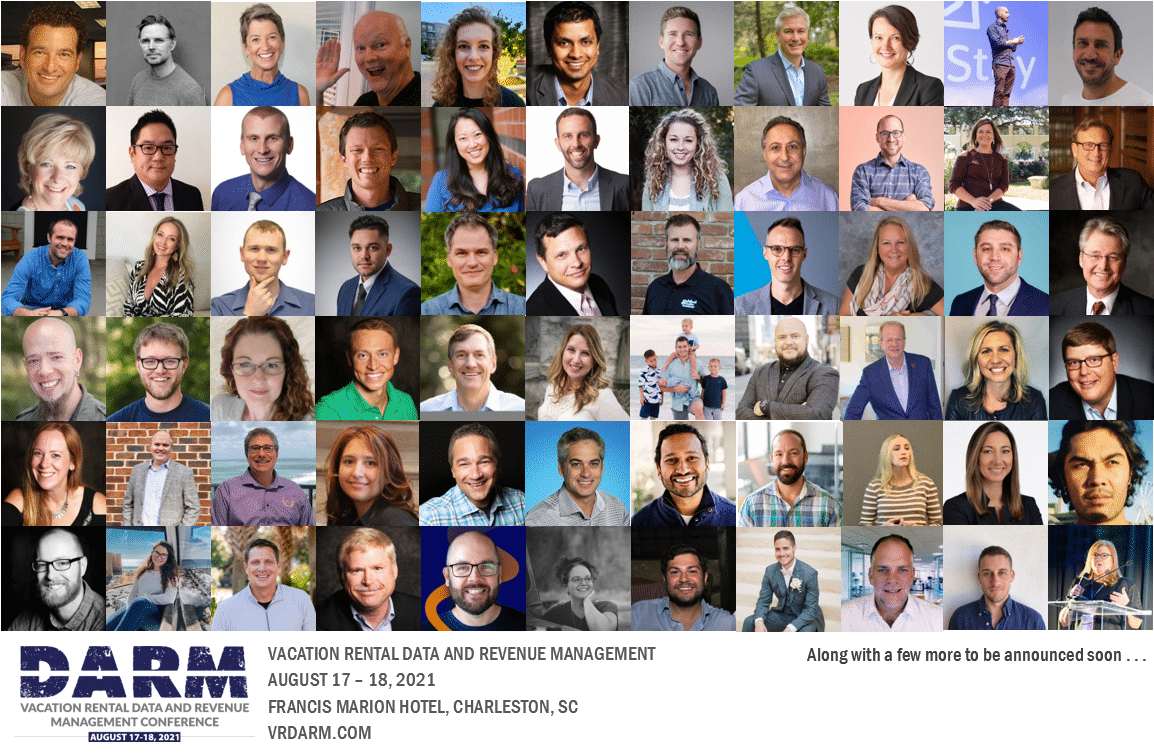
Milo will be speaking next week at the Vacation Rental Data and Revenue Management (DARM) Conference in Charleston, SC, Aug 17 – 18. 

Vacasa Acquires Meyer Vacation Rentals, Doubles Footprint on Alabama Gulf Coast

4

Vacasa has purchased Meyer Vacation Rentals and Meyer Services from SH Enterprises, doubling its short-term rental footprint along the Alabama Gulf Coast. Starr Textiles and Meyer Real Estate will remain under the SH Enterprises umbrella and will be managed by president Michelle Hodges and CEO Les Williams.

Founded in 1967, Meyer began as a real estate company and moved into vacation rentals as the Gulf Coast witnessed an explosion in development in the late 70s. Meyer Vacation Rentals was the largest property management company in the area for decades, managing 2,200 homes and condos at its height before 2008’s recession. Increased competition slowly eroded its market share along Alabama’s Gulf Coast, and Vacasa reported today that it is acquiring 980 units at Meyer. 

Founder Sheila Hodges had recently transferred ownership to her daughter and Les Williams in March of this year. 

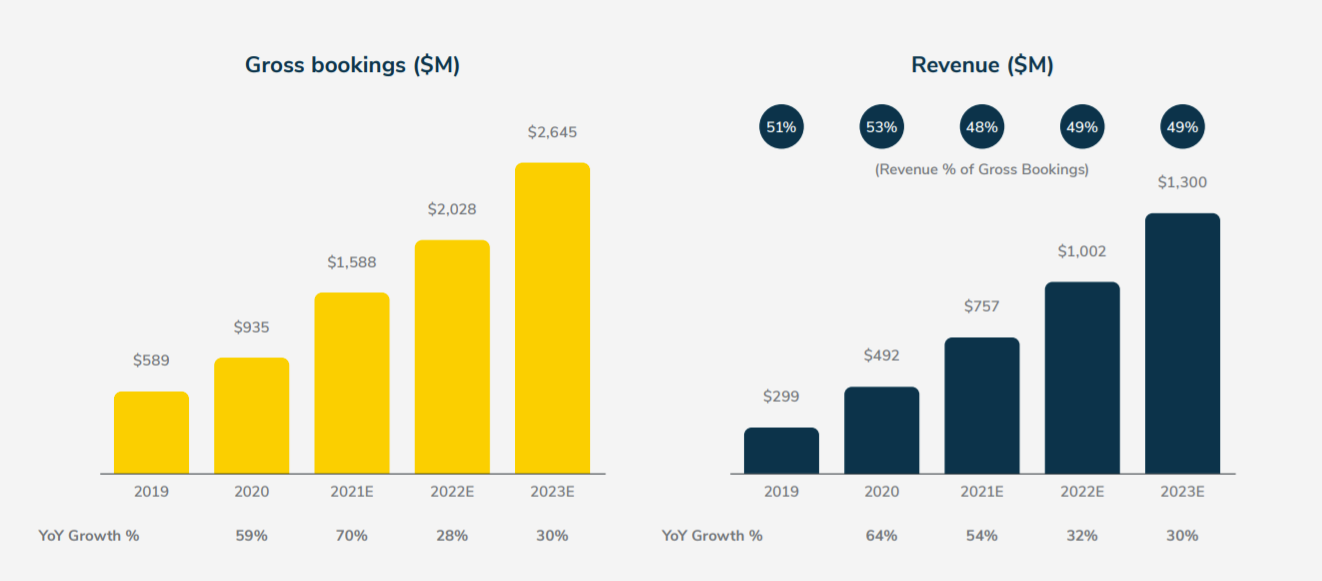
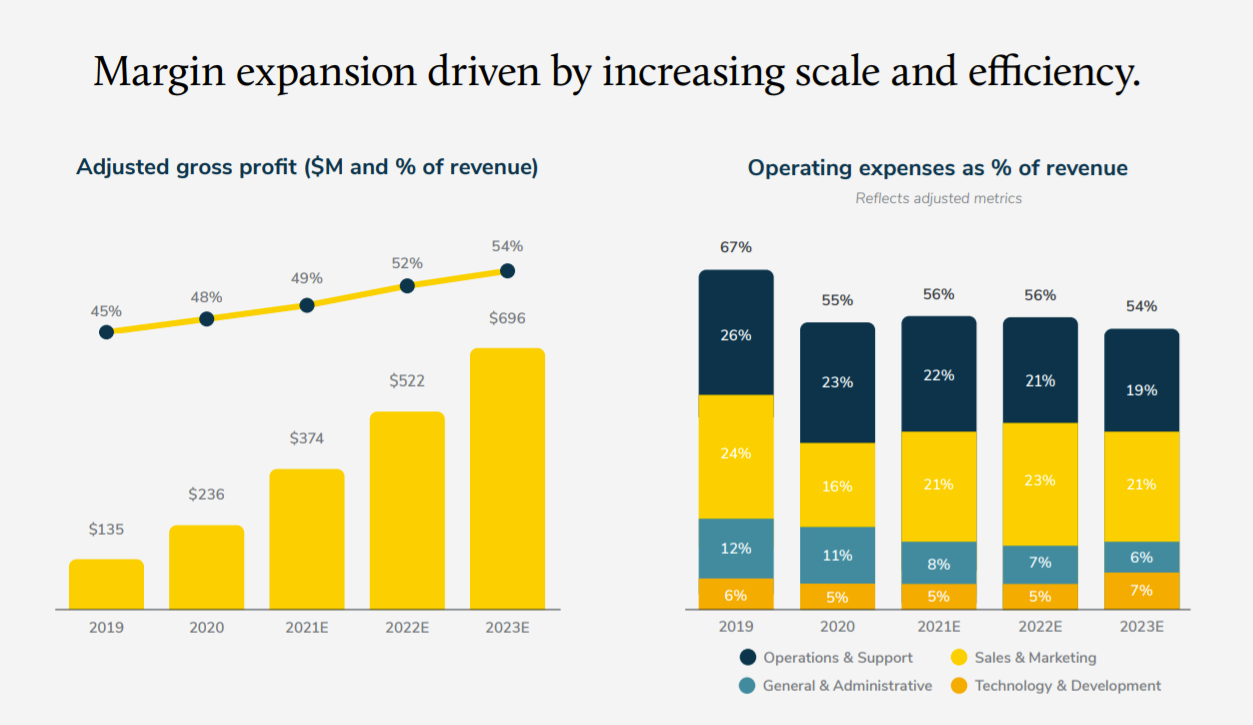
Based in Portland, Oregon, Vacasa is set to go public this fall through a merger with TPG Pace Solutions, a special purpose acquisition company (SPAC), with a $4.5 billion valuation. Company information presented with the SPAC announcement (source: Skift) shows that Vacasa receives a 30% commission on rentals and then adds a number of fees resulting in a 49% take rate (fees and commissions that the company collects on gross rental revenue).


According to SH Enterprises president Michelle Hodges, “While l appreciate everyone’s kind words about me and especially Sheila (Hodges), what makes this team special are the people that get up every day and come to work. That’s not going to change, they are what makes Meyer special, they are the team that just landed us as one of the best companies in Alabama. They will also be what makes Vacasa special; it may be another name but they are the ones that Make It Happen. Those aren’t just words. Truly Vacasa could have acquired a few smaller property managers to pick up inventory but they chose this team and fought for it, and I believe the reason is the talent and professionalism of a world-class group of professionals who know vacation rental operations like no one else.”

With previous acquisitions of TurnKey, Wyndham Vacation Rentals, and Mandoki Hospitality, Vacasa already has a large operation in the Gulf Shores and Orange Beach area outside of Meyer Vacation Rentals, and the company touts its ability to create synergies for scalability and efficiency. For example, when Vacasa purchased Wyndham Vacation Rentals, the company let go a significant number of Wyndham’s employees in Alabama within months following the acquisition. 


Impact to the Destination

The leadership at Meyer Vacation Rentals has served in critical roles with the state tourism department and the Alabama Gulf Coast Convention and Visitors Bureau, consistently advocating for promotional funding for the destination, beach renourishment projects, workforce development programs, and development of conference facilities and the airport. The company is a key supporter for shoulder-season events that bring people to the area, including Hangout Festival, Shrimp Festival, concerts series, fishing tournaments, and nation-wide youth and collegiate sports. In addition, Meyer Vacation Rentals funds area charities, schools, and community events and initiatives. Vacasa, historically, hasn’t invested as heavily in the destinations or communities it enters. 

According to Glen Kaiser, broker and partner at Kaiser Vacation Rentals, “When you begin to think about all the influence Shelia (Hodges) and Meyer have had in the community through her passion and entrepreneurship you can’t help but wonder how losing that presence will affect the business and community.”

Kaiser’s vacation rental division sold to Wyndham Vacation Rentals in 2013, and Vacasa purchased Wyndham Vacation Rentals in 2019. Earlier this year, Leonard and Glen Kaiser reentered vacation rental management with the relaunch of Kaiser Vacation Rentals

“Change is inevitable,” Kaiser said. “Those who are left after a change are left with a responsibility to ensure that whatever the change affects will result in a positive outcome. We at Kaiser Vacation Rentals have experienced and learned from the effects of change like this sale of Meyer, so we work every day to ensure our actions are dedicated to reach positive outcomes. Our approach to business is what has been the cornerstone of how Shelia and the other pillars of the industry in our community—Kaisers, Bodenhamers, Bretts, Robinsons, Bollers—work toward, and that cornerstone is relationships and family-friendly business practices. So change such as this can be a little concerning that we don’t lose what has been worked so hard for and for so many years.”

Kaiser continued, “I guess I’m being a bit nostalgic, but I am proud of our community and of the reputation this community is known for.  My hope is those of us still in the field working never lose what people like Shelia have worked so hard for so many years to build.”

According to Vacasa’s press release, “To support the portfolio expansion and continuation of service levels, Vacasa will maintain the Meyer Vacation Rentals Gulf Shores office and the Meyer Services office in Foley, Alabama, in addition to welcoming more than 200 employees to its field and management team.”

Vacasa expects that Meyer Vacation Rentals’ homes will be fully integrated and bookable on Vacasa.com by October 2021, with Florida units to be managed by Vacasa LLC and Alabama units to be managed by licensed subsidiary Vacasa Alabama LLC. 

Upcoming battleground puts a spotlight on revenue management technology in the short-term rental sector

0

Over the last two years, the short-term rental (STR) industry has exploded with increased consumer demand and a large amount of media attention resulting from Airbnb’s IPO, Expedia and Booking.com’s focus on vacation rentals, and industry-wide consolidation. Further, high growth and lucrative exits are attracting significant outside investment. The vacation rental industry is undisputedly the hottest sector of travel, with many vacation rental companies seeing 50%+ increases in gross revenue in 2021. 

As a result, professional STR management companies are swiftly becoming more advanced, technology-enabled, and efficient as they compete for both homeowner contracts and guests. In the traditional leisure-based vacation rental industry, older independent operators are weighing selling their companies as investment buyers flood into the sector seeking to capture market share via acquisitions. And the emergence of SPACS have allowed companies that haven’t achieved profitability (e.g., Sonder and Vacasa) to move toward public offerings with less scrutiny. 

Looking to the hotel industry as an example, short-term rental management companies have discovered revenue management strategies to help them take advantage of the influx of demand. No longer holding to static seasonal nightly and weekly rates, companies in the sector are quickly transitioning to dynamic revenue management strategies that mirror other travel verticals. However, the percentage of STR companies using tech solutions for revenue management is still small, and technology companies are racing to meet this emerging industry need. 

In Charleston, SC, next week, nine of these technology companies are entering an arena to introduce new functionality for STR companies at the Vacation Rental Data and Revenue Management (DARM) Conference Battleground sponsored by RevPARTY. Expedia Group is keeping an eye on the new industry dynamics and reached out to sponsor award recognitions at the conference, which will include a 2021 Innovation Award and a People’s Choice DARM Battleground Award. The DARM Battleground will be held on Aug 17 and 18, at the Francis Marion Hotel in Charleston. In addition to the battleground, Expedia Group is sponsoring the 2021 DARM Pioneer Award and the 2021 Vacation Rental Revenue Manager of the Year. 

DARM Battleground Presentations

Below is a preview of what attendees and judges will be viewing during the upcoming DARM Battleground sponsored by RevPARTY.

Art, Rented’s Automated Rate Tool with Andrew McConnell

Rented provides technology, tools, and services to help vacation rental pros optimize their portfolio of properties. Art, Rented’s Automated Rate Tool, is the only dynamic pricing software built for and by professional short-term rental revenue managers. With Art, your in-house specialists are empowered to set the right price for every property with intelligent rate recommendations and easy custom adjustments. For companies that need hands-on support, our Revenue Management Service provides a dedicated revenue manager who specializes in handling every detail: setting prices, monitoring performance, and making custom adjustments.

DemandIQ by Key Data with Melanie Brown

DemandIQ by Key Data is the lodging industry’s first product for capturing true, real-time, forward-looking traveler demand data. To date, we have all relied upon booking data to reflect traveler demand. While this tells the picture of the demand you captured, it doesn’t tell the full story about the demand you failed to capture or the market-level demand that never made it your way. With this new product, we will be able to offer clear insights into the full demand picture.                 

MarketMinder by AirDNA with Scott Shatford

AirDNA is presenting MarketMinder, its flagship platform for short-term rental data and analytics. In addition to its market intelligence tools, this battleground session will focus on two aspects of MarketMinder: My Properties, a tool where vacation rental hosts and managers can onboard properties, create custom comp sets, and benchmark themselves against the competition; and Smart Rates, a new tool to push automated pricing to their listings. 

Portfolio Analytics by PriceLabs with Oliver Marczynski

Portfolio Analytics by PriceLabs provides a convenient way to visualize internal booking data and helps identify opportunities to increase revenue. Intuitive charts make it easy to see portfolio and group performance at a glance without losing track of individual listings which might require additional attention. Pair Portfolio Analytics with our Market Dashboards to compare your booking trends against similar listings in the market and automate pricing adjustments to respond to patterns in bookings with our Dynamic Pricing tool for a full revenue management solution. Connect via our 50+ PMS partners or internal API and unlock actionable booking trends in minutes, free of charge.

RevMax with Desiree Garcia and Maureen Shilling

RevMax partners with data experts to offer market and business intelligence to help with pricing strategies. RevMax offers distribution channel management, nightly minimum management, as well as automated incremental revenue generation. Along with all of the tools to build an effective pricing strategy, the experienced RevMax team also offers consulting services for those companies that need some help to capitalize on the tools. RevMax is now open to non-Streamline clients, so it’s the perfect time to talk to the team to find out how they can help increase the bottom line.  

Shopping Cart Abandonment by NAVIS with Amir Rashid

The NAVIS Shopping Cart Abandonment (SCA) tool works behind the scenes capturing stay and contact details entered by guests as they search and explore options on your booking engine. Once a guest enters their email, all previously entered stay and contact data are sent to the lead form, even if the reservation isn’t made. With up to 80% of guests abandoning their shopping carts, SCA brings the lead data back to the vacation rental company and allows them to convert up to 30% of their abandoned web traffic leveraging highly personalized outbound emails and calling from captured data.    

Track Property Management Software with Michelle Marquis

Effective revenue management is about more than just unit pricing. In addition to giving PMs the ability to flexibly set and configure unit pricing and integrate with third-party dynamic-pricing providers, TRACK provides tools to optimize fees―the second largest revenue driver for most PMs. TRACK’s fee configurability gives PMs the power to overcome competitor commission-rate threats in retaining homeowners, package fees optimally to work within each channel’s limitations, and insulate against one our industry’s biggest negatives―being “fee’d to death” after choosing a home on rent alone. Once fees are built in Track, PMs establish business rules for automatically mass-applying them by unit type, location, reservation types, channels, etc., eliminating much of the manual work typically required to optimize this important revenue source. 

Trip Manager by LMPM with Sean Raftree

LMPM is next-generation property management software for vacation rentals. LMPM’s powerful Trip Manager can boost your revenue management strategy so you’re measuring RevPOR, not just RevPAR. Supplement your rate strategy by including additional services and experiences to generate ancillary revenue before and during the stay, monetize owner stays, and provide merchandizing benefit on channels.

Wheelhouse Pro with Andrew Kitchell

Wheelhouse will be introducing a few features from their newest platform, Wheelhouse Pro. Wheelhouse’s goal is to bring transparency and auditability to pricing engines in the accommodations space. Their newest toolset will demonstrate that ambition and illustrate the power and control that revenue managers can have with more transparency around how a pricing engine is working.

The Industry Needs Your Feedback in Phocuswright’s 2021 Short-Term Rental Survey

1

Short-term rentals in the US have been on a steady growth trajectory over the past decade. Since 2013, Phocuswright, a leading travel industry research firm, has conducted several pioneering research studies to size the market, analyze consumer and industry trends, and explore the rise of digitalization in this segment. 

 Click Here to Take the Survey


Phocuswright’s most recent study, “Here to Stay: U.S. Short-Term Rentals Move Mainstream,” showed that gross bookings increased at a CAGR of nearly 6 percent from $31B in 2017 to $34B in 2019. Furthermore, online bookings grew at nearly double the pace of the total industry. 

COVID-19 upended nearly all travel in 2020, and short-term rentals also felt the impact. Some companies operating in the sector shut down, while others downsized. 

Homeowners and hosts pivoted to serving long-term renters, taking short-term inventory off the market. 

But as the year wore on and travelers sought to get out and about while avoiding high-traffic areas to stay safe, they turned to vacation rental properties with social distancing baked-in. Short-term rental demand recovered as summer travel skewed toward rural, less-crowded destinations and drive trips. 

With vaccines on the way and an expected recovery in travel to follow, will short-term rentals continue to prosper and outpace the greater lodging market? Will short-term rentals benefit from the behavioral changes the pandemic has wrought? Which trends are holding up? What new trends are emerging? 

Phocuswright is conducting a 15-minute survey of US-based short-term rental property managers to understand the marketplace and study key trends among PMs who offer their properties to travelers. 


The study will answer key questions, including the following: 

 What was the impact of the COVID-19 pandemic on revenues, and how is the short-term rental industry projected to recover through 2025? 

  How satisfied were travelers with how brands handled the COVID-19 pandemic? 

  How have travelers shifted their preferences in a post-pandemic world? 

  How are homeowners and property managers evolving in a post-pandemic world? 

  Which trends will be short-lived and which will be here to stay? 

  Which technologies will be most important as the market matures? 

  What impact will short-term rentals have on the future of lodging? 


What’s in it for you? If you qualify for and complete the survey, Phocuswright will share the results of the study with you. 

Click Here to Take the Survey.

All responses will be kept strictly confidential and will be used only to determine trends. 


IMPORTANT EDITOR’S NOTE FROM VRM INTEL

From Amy Hinote to VRM/PMC owners and GMs: 

It is incredibly important for you to complete this survey, as many significant investment decisions in our industry are based on this particular research presented by Phocuswright. 

Our professionally managed vacation rental sector has been lumped under the broader short-term rental umbrella, and your participation is critical to ensure that Phocuswright is not hearing from other sectors disproportionally, (e.g., urban rentals, individual hosts, marketing platforms, and shared accommodations). 

If our sector is not accurately represented, then subsequent investment decisions will be flawed, bringing a continued and substantial influx of capital injected into bad business models. 

When investors continue to pour money into bad business models, it makes it harder for all of us—VRMs, tech companies, and service providers—to compete as we are unfairly competing head to head with under-performing companies propped up by outside investment. And we’re not the only ones who suffer; guests and homeowners suffer from these poor business models as well. 

The professionally managed vacation rental sector needs to be heard, recognized, and represented in this study. 

I implore you to have someone in your company accurately complete this survey. Your participation is critical and will directly help the entire industry. 


Why Your Business Should Have an In-House Information Technology Leader at the Table

0

Technology growth and consolidation in the vacation rental industry have exploded over the past five years. In a market where there were only five to ten core property management system (PMS) providers, there are now over a hundred. Some older players have left the market, while others were acquired or sunset. There are also multiple providers who offer only pieces of the comprehensive functionality that legacy enterprise PMSs provided in the past. 

What the current systems do (or do not do) is diverse and complicated. Understanding how all the different solutions integrate and knowing who to call when something is not working is no easy task. 

With technology playing an increasingly strategic role in the vacation rental marketplace, it is important that companies make the right technology decisions. 

Many companies grew with a core team of operators and made their technology decisions along the way based on what was available at that time rather than on a long-term business and technology plan. Hiring an IT lead as a permanent member of your business team is an important and strategic decision that can help your company grow to the next level. 

An issue for small- and mid-sized businesses is whether they are making the right technology decisions and making the best use of their current technologies to grow their business while increasing efficiencies and improving employee, owner, and guest experiences. Growing technologies like mobile, cloud, robotic process automation and artificial intelligence can provide opportunities to serve customers in new ways—and those opportunities are easier to spot with an IT person embedded on your team. 

An IT leader who understands your business, not just technology, is imperative. They need to be part of the budgeting process, involved in developing your strategic plans, engaged in marketing and business development projects, and fully versed in how your business operates day-to-day. They should map the entire customer journey (guest and owner) and work with you to determine the areas for improvement. 

A dedicated IT leader can help you navigate all the options and work with cloud providers, vendors, and outside contractors. Someone once told me that their PMS system took only 1 percent of their time to support but 100 percent of their time when problems arose. 

Are you willing to step away from running your business and serving your guests to fix an outage? An IT leader will know how to negotiate a contract with a cloud service provider that includes all the uptime, redundancy, failover, and security requirements to support your operations with penalties for outages or breaches. 


How much should a property manager spend on technology? 

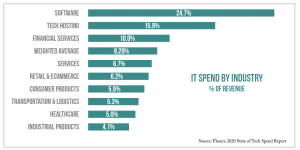
According to a Flexera 2020 survey, the average IT spend across all industries is 8.2 percent of revenue, with an average of 18 percent of that spent on cloud-based technologies. Compare that to your spend to see if you are investing enough in your company’s success.


What Type of Role Should You Hire? 

IT has almost as many disciplines as medicine. When you are sick, do you need a general practitioner, a physical therapist, or an orthopedic surgeon, and how do you know? 

Your business might require the assistance of these technology roles: end-user support, help desk technician, network technician, network engineer, systems administrator, systems engineer, database administrator, telecommunications technician, developer, cybersecurity engineer, IT manager, and more. A senior lead on your team will know which type of support your company needs and who to contract or bring onto your team. 


Suggestions for Finding the Right Leader 

Hire Someone Who Speaks Both Languages 

A pure information technologist will not understand your business. Someone who has worked in the vacation rental industry in technology or technology consulting will be a better fit. 


Hire a Senior Role 

The position needs to have an equal voice on the management team. They should be able to communicate well and explain technology in a non-technical manner, including the benefits your operations will gain. They need to be able to negotiate with vendors, maintain strong vendor relationships, and possess a strong customer service mentality. Hiring someone in the $40–$50K salary range, depending on your location, is not going to get you the skills you need. Use Salary Monster or other online hiring tools to find the appropriate salary range for your market. If this level position is not in your budget, consider a part-time role that still sits at the executive level. This is sometimes called a virtual CIO. 


Check Their References 

This is so simple but people often forget to do this. An IT résumé may look impressive, but the reality may be different. Talk to prior employers or customers. Technologists can be great on systems but hard to integrate into a team. Look for experience in both areas. 


Give Them Some Rope 

Even a seasoned professional will need to learn your unique business model and operations. They need time to watch and learn. If you can, put them through a two-week boot camp during which they work a few days in each department. Do not expect big results immediately. 


Measure What Matters 

Each department has different goals. IT is not going to have a business development goal. Track project successes, on-time or under-budget delivery, cost savings, and new efficiencies. How they control and contribute to change management (which is a whole other article) should be a priority. Employee satisfaction with IT services is a good measure as well. 

Strategic leaders at growing companies know the challenges they face and the outcomes they hope to achieve, but they may not know all the options for getting there. Technology is now central to building a strong company, but the technologies themselves have become more complex and difficult to understand. To keep pace with fast-moving solutions, you need a technology leader on your business team. 


Providing Guests with a Catered Travel Experience: Big Brands Collection of Zero-Party Data

0

What day of the week is it again? With so many of us staying home because of the pandemic, it can be hard to keep track. A change of scenery to a tropical destination, a winter wonderland, or a temperate weekend getaway sounds pretty nice right about now. 

Recent vacation rental booking activity shows that quarantine has given travelers a bit of cabin fever. Families are dreaming about their next big trip, and many are looking to plan a safe, stress-free getaway sooner rather than later. 

Recently, Vrbo tapped Wyng to help keep its customers engaged during the pandemic and learn more about their future travel intentions. Enter the new Vrbo Vacay Finder, a micro experience built on the Wyng platform that provides individualized vacation destination recommendations based on a traveler’s personal preferences. 


VACATION IDEAS FOR EVERYONE’S NEEDS 

Vrbo’s Vacay Finder, facilitated by Wyng, is a single-page quiz that starts with a series of four questions to gather personal travel preferences, including: 

  Regional location within the US 

  Desired season for a vacation 

  Type of destination (city, beach, etc.) 

  The ideal level of activity 


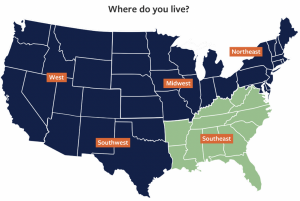
The experience features unique answer displays, including both images and text to highlight answer choices. For example, the quiz starts with a map graphic of the US, with the names of each region overlaid on top. 

The visual aesthetic makes answering the questions less of a chore and more like a game. 


As travelers answer questions, Vrbo gets a deeper understanding of their unique travel preferences and interests which then enables Vrbo to provide highly relevant, personalized trip recommendations both in the moment and in future interactions. 


After finishing the quiz, users are asked to provide their names and email addresses and to opt-in to receive marketing email messages. 


The footer beneath the form is clear and easy to understand, and it includes a link to the Vrbo privacy policy. 

Finally, the results page outlines a user’s personalized vacation recommendations based on how they answered the quiz questions. They can then share their outcome with friends and family via Facebook, Twitter, or email. 

The results page also includes a dynamic “Trip Board” section that allows friends and family to collaborate to create a vacation itinerary together. It then hyperlinks out to the Vrbo website, so users can finalize their travel plans and begin booking their trip. 


As travelers scroll down the results page, they find a gallery containing all potential destination results. This allows users to explore other destinations without having to retake the quiz. Users can select filters or click on destination images for more vacation idea inspiration. 

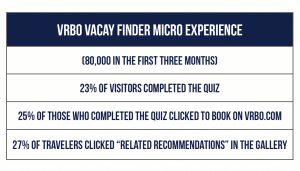
The clickable tags facilitate a continuous journey of discovering more local vacation opportunities. This unique section proved powerful, as the results showed that, on average, users explored two additional vacation experiences before leaving the page. 


IMPACT AND THE FUTURE 

Vrbo found that Vacay Finder resonated with would-be travelers during the pandemic as nearly 80,000 consumers took the quiz in the first three months. 

The key to a successful quiz strategy is to continue to optimize, learn from the data, adjust to evolving restrictions, and adapt to the ever-changing digital consumer. 

Micro experiences like this allow brands to get to know their consumers better and provide them with the best possible experiences at each interaction. 


THE ZERO-PARTY DATA (ZDP) OPPORTUNITY FOR HOSPITALITY BRANDS 

Data deprecation is a hot topic for marketers in hospitality. Waves of privacy regulations (like GDPR in 2018, CCPA in 2020, and CPRA, which takes effect in 2023) and tech platform restrictions (like the demise of third-party cookies and Apple’s IDFA) are cutting off traditional sources of data and disrupting widespread marketing practices. 

Vacay Finder points to a privacy-friendly solution: zero-party data (ZPD). Generally, ZPD is all of the consent-based personal context data—preferences, interests, tastes, favorites, plans, etc.—that customers intentionally and proactively share with a brand to improve their experience with it. 

By engaging travelers directly and asking them for their personal preferences and interests, along with consent, Vrbo obtains the data it needs to personalize customer interactions. 

Forrester Research’s 2020 report, An Illustrated Guide to Collecting Zero-Party Data, stated, “ZPD gives brands a unique opportunity to not only learn more about a customer but also folds that customer’s input directly into her immediate and long-term experience. Tellingly, 49 percent of marketers say zero-party data is their most favored solution to data deprecation risk, according to Econsultancy.” 

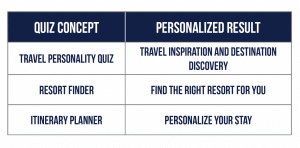
With the Vrbo quiz in mind, here are a few quiz idea starters for vacation rental companies: 

Depending on the concept, quizzes can reveal ZPD like who is actively planning travel, when they are looking to book, who will be traveling, the purpose of the stay, and preferred destinations and activities. Some of the data may be long-lived (e.g., the number of family members), while other data may be short-lived (e.g., timing for a family vacation). 

Hospitality companies can collect ZPD by creating quizzes, surveys, preference centers, and other interactive experiences—and then use the ZPD to provide highly relevant and personalized content, recommendations, and offers to customers. 


COVID-19’s Silver Lining: Growth of Property Technology in the Vacation Rental Industry

0

The COVID-19 pandemic has placed hardships on many throughout our society over the past year. Yet some of us might admit in hushed tones that there has been a silver lining in how we now see the world. 

The simplification of life at home has driven an appreciation for what is most important in life and at work. This focus allows us to move forward with improvements that might otherwise have languished in procrastination or denial. We have learned to do more with less, at a distance, and by using more technology than ever before to deliver and delight our guests as they seek respite from the new reality. 

As the property technology, or PropTech, boom continues to reverberate through our industry, we can apply these principles of simplification and focus on the most important outcomes to drive better results, guest satisfaction, and profitability with our vacation rental properties. 


Expectations Have Increased 

During the pandemic, many future vacationers took advantage of the time at home to invest in their own primary residences. For many, that included installing home automation products such as smart locks, digital thermostats, security services, and sensors of various sorts. These same homeowners will expect similar amenities at vacation rentals. Properties perceived as technologically outdated will suffer reputational decline and unfavorable online reviews in the same way that dated décor, frayed carpets, or poor wall coverings can detract from the guests’ satisfaction. 


Rival Properties Are Stepping Up 

Just as primary homeowners are investing in automation, so are your competitors. Guests expect a digital property book, updated physical and Wi-Fi access codes, local information, and other details on their phones before they arrive. They will consider having to call the front desk an intolerable inconvenience and a sign of the property manager’s indifference. 


Labor Shortage Is Real 

Although reported nationwide unemployment is still high because of COVID-19 shutdowns, many vacation areas are desperately short of labor. Effective property managers will be looking for technology solutions that allow for the efficient deployment of labor throughout the property. Time spent by the front desk, maintenance, or housekeeping traveling to units across town or to other floors constitutes hours not spent on more important customer-facing interactions. A modern, unified property management platform will give the property managers real-time access to asset and personnel status, saving multiple person-days every week. 


Distance Has Been Reduced 

During COVID-19, people have grown accustomed to using technology to bridge distance and time. Video calls have moved from the exotic to daily occurrences. Hopping in a car or golf cart to check a unit’s HVAC, locks, or other statuses makes little sense when one can access the same information from anywhere. 


Cobbled-Together Point Solutions Are So 2019 

Guests expect technology to work seamlessly and in a coordinated manner. Having a different computer program for discrete functions is inefficient and frustrating. Accustomed to using programs that work together as one experience, such as the Microsoft Office Suite, property employees and guests alike will resist using standalone or poorly integrated systems for discrete purposes. 


Seize Opportunities to Enhance Revenue 

With a modern, unified property management platform, revenue enhancement opportunities can be automated to include early- and late-checkout offers, upsell discretionary amenities, sell mid-stay cleans, and offer additional nights to bridge orphan nights between reservations. As we all recover from the COVID-19 recession, most property managers are eager to maximize every opportunity to grow revenue per stay. 


Openness and Flexibility Is Key 

As 2020 began, who could have foreseen the challenges that the rest of the year would bring? We learned that flexibility and the ability to develop and execute contingency plans is vital. We must avoid getting boxed into one technology. A modern, open, and unified property management platform will grow with a client’s property so that new software tools and hardware products can be seamlessly integrated when the time is right. This season’s project may be adding smart locks and digital thermostats. Next year, the property might add leak and noise detectors. Closed systems require management commitment in such an inflexible manner that they are an anathema in the face of uncertainty. Unprecedented times require flexible systems that grow with opportunity and respond to change. 

Everyone knows that technology boosts revenue and drives efficiency. The COVID-19 experience has taught us that simplicity, focus, and flexibility can be harnessed to make the achievement of those goals both possible and probable. “Life is short” is a cliché for a reason. Now is the time to take the steps to secure the future, whether we return to a new normal or continue to live in crazy but interesting times. 


Financial Planning: Connecting Your Business Ownership with Your Personal Goals

0

Most successful business owners have a plan for their business, and quite often they have a mission statement. Mission statements usually spell out a business’s core values, its purpose, and vision for how employees and customers should be treated. In many cases, this statement is a guide for employees and spells out expectations as to how they should perform their duties. Future goals are often expressed so that employees and customers know how the business hopes to develop over time. The mission statement and the business plan help drive the direction of the business moving forward. 

However, we often find that while owners have a vision for their business, in many cases, they lack planning that ties their business to their personal financial goals. We have interviewed many VRM owners, and a common theme we hear is that they are so focused on running the business and making sure the rooms are cleaned, repairs are made, and amenities are in order that they neglect personal financial planning. Therefore, there is no plan in place to help them understand how to one day unwind their business ownership when all their personal goals can easily be met. 

The formation of a personal financial plan starts with a conversation that will help your advisor understand you, your situation, and what is important to you. How much monthly income will you need in retirement to live the life you want to live? Are there children or grandchildren you want to benefit from your success, and if so what is the best way to structure? Many businesses are tremendous supporters of their communities. If it is important for this legacy to continue, have plans been made? If selling to a third party, are there key employees you would like to protect or to benefit from a sale? If transitioning to family members or key employees, when should the process start? 

All these questions can be addressed with planning. In many cases, the best strategies take years to implement. The earlier that goals are identified, the better the odds that strategic moves can be made to accomplish these goals. 

One of the most important areas of personal planning is understanding future retirement income needs. At the end of your career, you want to maintain the lifestyle you have been accustomed to or even increase spending with extra time for travel and fun. Having a clear understanding of your income goal can help you identify how much you will need from the sale of your business. Industry experts tell us that many sales are missed because owners don’t understand what the other side of a sale will look like. They aren’t sure what their needs will be or how much income can be safely produced from the proceeds of an offer. This fear of the unknown can cause paralysis, and if this occurs at the top of a business cycle, it might cause the owner to miss the best offer they could hope to receive. 

Understanding retirement cash flow goals can also help you identify which areas of the business you might not want to sell. For example, if the business owns income-producing property, you might want to negotiate to keep it and rent it to the new owners if that helps you meet your income needs. 

Knowledge is power, and the more you understand about what it will take to meet your goals, the better position you will be in to negotiate. 

Last, identifying your goals can motivate you to make adjustments so the business is more attractive to prospective buyers. This can be the difference between running a business that you “live out of ” versus managing the business for eventual sale. In other words, you should manage your business in a way that will increase the multiple you receive when your business is sold. A higher multiple could be a game-changer during the golden years! 

It all boils down to having a plan that ties your business ownership to your personal goals. When you identify what you want to achieve and create a written plan that will be monitored and adjusted along the way, your odds of achieving your goals will dramatically increase. You worked too hard not to stack the odds in your favor. 


3rd Annual Vacation Rental Data and Revenue Management Conference: Session Descriptions by Time (Data, Revenue Management, Marketing, and Executive)

0

3rd Annual Vacation Rental DARM Conference (vrdarm.com)

August 16 – 18, 2021

Francis Marion Hotel, Charleston, SC 

Click here for a printable PDF on the DARM Conference Descriptions.

Tuesday, August 17, 2021   |  Wednesday, August 18, 2021


Monday, August 16

5:00 – 6:00

Inhabit IQ’s DARM Welcome Happy Hour


Tuesday, August 17

8:00 – 9:00

Registration and Breakfast Pickup and Meetup, Colonial Ballroom (Lobby Level)


9:00 – 10:15

2021 DARM Welcome with Sarah and T and Keynote Daniel Levine, C19 Trends Aftermath & the 2022 Travel World, Carolina Ballroom (Meeting Level)


10:30 – 11:10

Key Performance Indicators (KPIs): Which metrics matter and how are they calculated and compared across vacation rental systems?

Presenter: Cliff Johnson, Vice President, New Homes, Realtor.com

Successful revenue management not only requires access to comparative data, but it also requires a comprehensive understanding of the data, including definitions, equations, and why they matter. Cliff Johnson will take us through the terminology and KPI equations used by revenue managers to craft, implement, and evaluate effective pricing strategies.


Rate Strategy: Building revenue management strategies in the new travel landscape

Presenter: Natalia Sutin, VP, Revenue Management, Vacasa

Dynamic pricing is nothing new for vacation rental operators, but the strategies behind it are shifting to adapt to the new travel landscape. What key market indicators should revenue managers be looking for to signal rate adjustment? How can an effective revenue approach support local operations—and deliver results for homeowners—during peak seasons or, conversely, fill gaps in the booking calendar while maintaining price integrity? During this presentation, attendees will get answers to all those questions and more from Vacasa’s vice president of revenue management Natalia Sutin. Sutin will address how strategies shifted during the pandemic, as well as the fresh pricing challenges that emerged, and which trends she expects to hold as the travel industry continues to rebound.


The Theory of Limited Edition 2.0: Leveraging the things that do NOT scale as your superpower to growth and happiness

Presenter: Matt Landau, Founder, VRMB and Unlocked Podcast

Matt Landau believes every independent vacation rental manager is sitting on a goldmine of unique selling attributes that differentiate from the bigger, richer, flashier competition. But that without some very intentional sculpting of these attributes, those same managers can easily slip into a commodity price race to the bottom. After several years on the road documenting some of the world’s most profitable and sustainable vacation rental brands, Landau reveals the common denominators of their stealthy positioning and the direct impact it has on data, revenue, and lifestyle design.


Long-Term Value Building: For executives, building value in your business to accomplish long-term goals and exit strategies

Presenter: Cynthia Odell, Senior Wealth Planning Strategist, Wells Fargo

You are busy building your business, but are you building the value of your business? Understanding the fundamentals of business value is the key to creating a valuable enterprise that you can convert to personal wealth, funding your lifestyle, retirement, or family legacy goals. Beyond the basics, Odell will review VRM market trends and valuation dynamics which can inform your value creation strategy, examine the impact of risk, answer your question regarding ownership transition options, and discuss best practices successfully used by other company owners, as they prepare for their future.


11:20 – 12:00

Rentals Recovery Roadmap: What industry trends will prevail?

Presenter: Jamie Lane, VP of Research, AirDNA

Since the onset of the COVID-19 pandemic, the US economy—specifically, the hospitality industry—has gone through an unprecedented contraction and recovery. Jamie Lane, vice president of research at AirDNA will outline how government stimulus, easing lockdowns and travel restrictions, and pent-up demand for travel allowed certain sectors and markets of the vacation rental industry to recover and outperform other segments of the US lodging industry. He will present an updated economic forecast and outlook of the VR industry for a variety of U.S. locations.

Lane will then provide an overview of industry trends including historical and future demand pacing, how record occupancy is impacting ADRs, and where supply is growing fastest. Other topics include a review of the host wars (how successful Airbnb and VRBO have been at attracting new hosts), how exclusivity of supply has changed over time, the overlap between platforms by location type, and if/when international travel will return.


Revenue Strategy Levers: Pricing levers vacation rental revenue managers pull to influence booking activity

Presenter: Anurag Verma, Founder and CEO, PriceLabs

Revenue managers have more than rate at their disposal to impact reservation activity. PriceLabs founder and CEO Anurag Verma will define and explain industry pricing levers including minimum night requirements, booking window, promotions, channel policies, fees, cancellation policies, and more. In addition, he’ll give examples of how each lever can influence booking activity across channels and discuss different strategies involving a combination of levers and channels.


Generating Bookings with a Comprehensive Digital Advertising Strategy

Presenter: Conrad O’Connell, Founder, BuildUp Bookings

In this presentation, O’Connell will talk about the data-driven strategy and tactics behind his company’s managed ad spend (over $1.5M in the last 12 months) across Google Ads, Facebook, Instagram & more. He will share best practices in targeting, reporting, measurement, and budget allocation, and share how you can spend effectively no matter what your monthly ad spend is. O’Connell will also cover updates around the iOS 14.5 updates and the future of ad tracking for vacation rental managers.


2022 Forecasting: Predicting revenue when historical performance is unreliable

Panel Discussion: Mike Bohmer, Turnkey/Vacasa; Scott Bunce, Cabins for You; CJ Stamm, Southern Comfort Vacation Rentals; Ben Edwards, Weatherby Consulting; and Moderated by Amy Hinote, VRM Intel

Year-over-year (YOY) data sets are unreliable in today’s current environment. In addition, 2021 was an extraordinary year for many property managers. Looking ahead to rental projections and budgets in 2022, how can vacation rental managers predict revenue and set expectations for homeowners? We’ll discuss how companies are looking at the upcoming competitive environment and planning for the future when recent historic data may be an anomaly.


12:00 – 1:15           

Farmer’s Market Lunch and 2021 DARM Battleground (Part 1), Carolina Ballroom (Meeting Level)


1:30 – 2:10

PMS Data: Finding data and business answers hidden in your property management system (PMS)

Presenters: Patrick Power, Solution Architect, TRACK; Chad Blankenship, CTO, Southern Vacation Rentals

Hidden inside your PMS software are many of the answers you need to accelerate your company’s growth and provide better guest, owner, and staff experiences. Getting to these insights typically requires connecting data that most systems don’t provide out of the box. In this session, we’ll showcase ways to unlock insights like how to rate and incent house cleaners using guest satisfaction scores, data that helps you pull the different distribution channel levers that maximize occupancy and profitability, and smart methods for segmenting guests to boost marketing performance.


Optimizing Listings and Pricing on Vrbo/Expedia

Panel Discussion: Expedia/Vrbo Revenue Team and Cameron Felton, Director of Revenue Management, Evolve; Sarah Franzen, Director of Revenue Management, Natural Retreats; and Jordan Locke, CEO, RevPARTY

Expedia’s revenue team for lodging and vacation rentals will join a panel of revenue managers to discuss how PMs can optimize their listings and pricing display on Vrbo and Expedia, and they will answer questions about how to execute the latest strategies and maximize and monitor performance.


How Search Engine Optimization (SEO) REALLY Works for the Vacation Rental Industry

Presenter: Paul Hanak, Director of Marketing, ICND

SEO is always referred to as a “dark art” due to its technical nature and the years of knowledge and experience required to master. For this reason, property managers often rely on outsourced SEO companies for prime placement in the search engines. The cold hard truth? Many SEO companies don’t focus on what really matters. Audits and scores from online tools don’t rank your site better, but the methods in this presentation do. Geared toward both beginner and advanced technical levels, Hanak will explain what’s important for search engines in the vacation rental sector and how to stop the wool from being pulled over your eyes from outside agencies. Join a twenty-year SEO veteran as he walks you through some eye-opening myths about the SEO game and what a property manager can keep an eye out for to make sure they are getting the best bang for their buck.


Margins Matter: Benchmarks across 100s of P&Ls that lead to profitability

Presenter: Ben Edwards, President, Weatherby Consulting

In a world in which well-funded multi-destination short-term rental companies are buying growth with zero attention to margins, it is becoming increasingly difficult to remain both profitable and competitive. We’re being told that an EBITDA of 5 – 8% is normal. However, leading managers are bringing well over 20% to the bottom line. Margins are critically important for both long-term growth and when buying and selling companies. Having reviewed—in-depth—hundreds of P&Ls, Edwards will shed light on what property managers are spending in key areas as a percentage of revenue and will discuss how to increase profitability in the current and future competitive environment.


2:20 – 3:00

Data-Driven Property Managers: How to set up your benchmark metrics for success in your Key Data Dashboard

Presenters: Jennifer Talbert, Revenue Management Consultant, and Taylor Hill, Business Development Manager, Key Data

Like all well-run companies, property management companies should be data-driven at their core. With so many different software platforms that don’t all integrate together, this can be hard. The best companies are still finding a way. We will discuss how to identify, measure, collect, report on, and―most importantly―act on your data. Companies making clear data-driven decisions are leading our industry and will continue to do so. Jennifer and Taylor will walk through how to set up and monitor metrics in your dashboard, how to build reporting, and how to identify ways your company can start improving today.


Optimizing Listings and Pricing on Airbnb

Panel Discussion: Airbnb Team and John de Roulet, Wheelhouse; Tim Speicher, Buoy; Doug Truitt, Rentals United

Airbnb will join a panel of revenue managers to discuss how VRMs can optimize their listings on Airbnb and will answer questions about how to execute the latest strategies and maximize and monitor performance.


Play Bigger: Tips & Tricks to Drive Direct Bookings

Presenter: Tim Schutts, Vice President, TravelNet Solutions‘ Atlas Digital Marketing

Not all clicks are created equal. Conversion is still king, but clicks at every stage of the guest journey are critical to overall direct booking success. We’ll explain how different channels drive clicks that boost overall traffic, and how implementing specific digital marketing tactics at each guest journey stage can dramatically improve your booking performance. Attendees will learn how to deploy a full-funnel digital marketing method that increases direct bookings. They’ll learn tools and tactics for increasing traffic and conversions, how to effectively measure ROI for decision making at each stage, and the measurable business results that Property Managers and Hoteliers are experiencing by using this more effective approach.


The VRM Technology Mix: Pros and cons of a company’s “tech stack” when buying and selling companies

Panel Discussion: Jakob Dwyer, President, Realjoy Vacations; Steve Milo, CEO, VTrips; Zac Monahan, VP, M&A, Vacasa; and moderated by Jacobie Olin, President, C2G Advisors

The theme of this panel is to learn what components of a seller’s “tech stack” are important to buyers. We will also hear of common pitfalls that have happened in the past and ways to avoid them in the future.


3:00 – 3:30

Fruit, Cheese, Caffeine, and Chocolate Break, Colonial Ballroom (Lobby Level)


3:30 – 4:10

Driving Results with People Data: Using data to identify job candidates and put your team members in the right seats

Presenter: Steve Trover, Cofounder, Better Talent by Laveer & Co.

What is people data and how can you use people data to measure behavioral drives and cognitive abilities while taking into consideration the total person when evaluating candidates and leading team members? This session will present ways to collect and utilize people’s data to improve overall company results. You will learn how to identify, hire, and inspire your company’s most important (and costly) asset―your team.


Channel Management Checklist

Presenter: James Burrows, CEO, Rentals United

If you have a direct connection through your PMS, why would you need a channel manager? Rentals United cofounder and CEO James Burrows will discuss what channel management features you need to look out for to drive ROI. Along with case studies with customers from around the globe, Burrows will answer questions from revenue managers about how they can optimize existing channels and new opportunities with Google Vacation Rentals.


Merchandise Properties and Maximize Bookings on Your Own Website

Presenters: Braeden Flaherty, Bluetent; Josh Guerra, Bizcor; and Ben Ollic, Q4 Launch with Photography Expert Rebecca Lombardo, TruPlace

Across enterprise-level vacation rental management companies, over 50% of bookings are coming directly . . . not through third-party channels. Too often when looking at revenue management, we neglect our own websites. This panel will discuss how to merchandise property listings, optimize sort algorithms, display pricing and policies, use strike-through and urgency pricing, and maximize promotions on your own website to increase online bookings and keep guests on your site.


Mitigating Risk: A Roundtable Discussion about the “T” (threats) in a VRM’s SWOT analysis

Panel Whiteboard Discussion: Moderated by Jim Olin, C2G Advisors, with Eric Thibodeaux, Laird Sager, Andrew Kitchell, and Andrew McConnell

In a SWOT analysis, the T stands for threats. In an uncertain environment, PMs are finding it necessary to perform a solid risk assessment and strategize to mitigate these risks. In this open discussion, we’ll sit down with executives, identify these threats facing both the industry and individual companies, and discuss how PMs can plan for the future.


4:20 – 5:15              

The Future of VR Data and Revenue Management, Carolina Ballroom (Meeting Level)

Vivek Bhogaraju, GM, Revenue, Lodging and VR, Expedia Group; Steve Milo, CEO, VTrips; Scott Shatford, CEO, AirDNA; Anurag Verma, CEO, PriceLabs  

Moderated by Amy Hinote, Sarah Bradford, and Tim Cafferty


Wednesday, August 18

8:00 – 9:00             

Lowcountry Breakfast, Colonial and Carolina Ballrooms


9:00 – 10:15           

Welcome Back with Sarah and T, and Keynote with Shaun Stewart, The Interconnected World of VR in 2021, Carolina Ballroom (Meeting Level)


10:15 – 10:45           

In-Case-You-Stayed-Out-Too-Late Refueling Break, Colonial Ballroom (Lobby Level)


10:45 – 11:25

Analyzing Operations and Property Data: What’s changed (and hasn’t) in the last 18 months

Presenter: Jeremy Gall, Founder and CEO, Breezeway

The growth of the short-term rental category is well documented―not only with respect to the number of rentable homes and management companies, but also the identity, challenges, and priorities of vacation rental operators. In this presentation, Breezeway’s founder and CEO Jeremy Gall will reflect on this growth by presenting three different sources of internal data: operations survey data from spring 2020 and 2021 (e.g. biggest property care challenges, plans to differentiate their business, frequency of client communication, number of software tools in use, etc.), and data on five million property care tasks from the Breezeway platform (average length of cleans/inspections/repairs, most frequently repaired items, most urgent guest requests, etc.). Jeremy will discuss different trends that the data reveal and share his perspective on what challenges and opportunities lie ahead for industry operators.


Hotel Revenue Management Strategies: When to use, when to adapt, and when to toss

Panel Discussion: Scott Bunce, COO, Cabins for You; Dwight Yang, Partner, Richer Logic; and Michelle Marquis, VP, Revenue, Travelnet Solutions

As more hotel-trained revenue managers enter the short-term rental sector, hotel revenue management strategies are being tested and evaluated for vacation rentals. What are the similarities and differences between the two lodging sectors? This panel will explore what attributes are the same, what is different, which strategies translate, and which do not.


The Battle for Direct Bookings Is Hand-to-Hand Combat, Not Aerial Strafing

Presenter: Doug Kennedy, Founder, Kennedy Training Network

Doug Kennedy will show us how to secure more direct bookings via textual selling, in-platform messaging (on OTA’s), and via every guest/staff conversation. Participants in this session will walk away with a list of specific training tips to help their companies secure more direct bookings and reduce their reliance on costly third-party channels that can also be a barrier to return bookings. While the war for direct bookings does require “aerial strafing” (digital marketing), the most important battles in VR distribution occur through human and not digital interactions.  Whether by phone, chat, email, or a random in-person conversation with a maintenance tech, it is the people that make the difference. 


Building a 2022 Revenue Optimization Team: What does the org chart look like for a high-performing team (sales, marketing, distribution, and revenue management)

Panel Discussion: Amber Carpenter, CMO, Acme Vacation Rentals; Amy Gaster, CEO, Tybee Vacation Rentals; John de Roulet, Wheelhouse; Doug Truitt, Rentals United

Whether big or small, how are your sales, distribution, revenue, and marketing efforts working together?  Revenue in general is always a top-line goal and KPI for companies. In this panel, we will have industry experts discussing how these four areas collaborate together successfully in order to reach top-line revenue goals/KPI’s.


11:35 – 12:15

How to Hold a Revenue Strategy Meeting

Presenter: Heather Richer, Richer Logic

Richer Logic’s Heather Richer will discuss how to construct an effective agenda for a revenue strategy meeting, including who should be there, what KPIs are monitored, how revenue managers are being held accountable, and how marketing and data teams fit in. Whether your team is in-house or outsourced, holding regular and effective meetings will keep everyone on the same page and on track.


Length of Stay (LOS) Strategies: Using LOS tactics to manage channel performance and optimize occupancy and revenue

Presenters: Jeff Paglialonga, CEO, Teeming Vacation Rentals; and Desiree Garcia and Maureen Schilling, Streamline

One of the primary levers used by revenue managers is the length of stay (LOS). Jeff Paglialonga, CEO, Teeming Vacation Rentals, was able to fast-track revenue growth using LOS strategies. In this case study, Jeff will discuss his objectives and then demonstrate with his software provider, Streamline, how he executed the strategies and was able to get ahead of his competition.


Increasing Repeat Business: Converting guests into repeat customers

Panel Discussion: Tyann Marcink, David Angotti, and Matt Landau with Arthur Colker and Suneel Goud

Looking ahead to what could be a highly competitive 2022, having confirmed reservations on the books is worth gold. What are PMs doing to increase repeat business, and how are they converting OTA travelers into loyal guests? Tyann, David, and Matt will lead this discussion on building repeat business and will talk about tech ideas with StayFi’s Arthur Colker and NEC’s Suneel Goud.


VRM Staffing Challenges Abound: Addressing the #1 challenge for vacation rental managers

Presenters: Sue Jones, CEO, HR4VR, and Ari Eryorulmaz, CEO, Extenteam

Finding, compensating, and retaining staff are some of the biggest challenges facing industry professionals today. Property managers have learned that finding and retaining employees takes creativity with compensation and flexibility with schedules. No longer does a one-size-fits-all approach work. Remote workforces have opened up staffing alternatives across the US and internationally. Join Sue and Ari for a lively discussion on ways to approach your staffing needs.


12:15 – 1:45           

Taste of Carolina Lunch and 2021 DARM Battleground (Part 2), Carolina Ballroom

2:00 – 2:40

Rental Inventory and Homeowner Metrics: A guide to measuring and improving what really matters for your inventory

Presenter: Brooke Pfautz, CEO, Vintory

After speaking with hundreds of VRMs, Vintory CEO Brooke Pfautz quickly realized that most professional property managers are in the dark when it comes to understanding the key metrics of inventory growth. Join Brooke in this session for an insider’s look at metrics and data never presented in our industry before. Quickly become an expert in running growth numbers and calculating the ROI of a new property for your program. See where you stand vs your colleagues and competitors. Metrics for metrics sake are not very useful so we’ll move beyond the numbers and get to the bottom line―what leadership must focus on to drive a successful vacation rental business. 


Channel Technology: Implementing revenue management strategies across all channels using channel managers, PMSs, and direct connections (Part 1)

Panel Discussion: Jim Barsch, NextPax; James Burrows, Rentals United; Braeden Flaherty, Bluetent; and Matt Gurley, BookingPal with Revenue Managers

Revenue managers have questions for channel managers, and this panel has answers. In this discussion, vacation rental managers will have the floor to ask questions about connectivity and strategy execution, hear about their roadmaps, talk more about the Google Vacation Rental platform, and suggest new functionality.  


Gold In Plain Sight: Email marketing strategies to grow revenue

Presenter: Amir Rashid, NAVIS

With inventory filling fast this year, too many email marketing strategies got put on the backburner. Covering tactics around automation, crafting personalized messages, and more, learn how your email strategy is key to building guest loyalty, keeping units filled, homeowners happy, and getting the most revenue per booking.


Executives Look Ahead to 2022 and Beyond: Revenue optimization, consolidation, competition, and homeowner retention

Panel Discussion: Moderated by Andrew McConnell, CEO, Rented, with Sarah Bradford, Winter Park, and Steamboat Lodging Company; Tim Cafferty, Outer Banks, and Sandridge Blue; Max Schuster, Stay Marquis; and Steve Milo, CEO, VTrips

For company owners and stakeholders, Andrew McConnell will moderate this important discussion with industry leaders about what the future holds in the vacation rental industry in the areas of revenue optimization, industry consolidation, the upcoming competitive environment, and homeowner retention, communications, and loyalty. 


2:40 – 3:10              

Ice Cream Social, Colonial Ballroom (Lobby Level)

3:10 – 3:50

Traveler Demand: Why you need the data now!

Presenter: Amber Carpenter, CMO, Acme House Company and founder, Demand IQ

To date, we have all relied upon booking data to reflect traveler demand. While this tells the picture of the demand you captured, it doesn’t tell the full story about the demand you failed to capture, or the market-level demand that never made it your way. This session will help you understand Demand Data: What is it? Why are you losing money if you’re not using it? And how do you get started putting it to work for you?


Advanced Revenue Management Roundtable Discussion: Revenue managers sit down tech providers (Part 2)           

Panel Discussion: Cameron Felton, Evolve; Sarah Franzen, Natural Retreats; Natalia Sutin, Vacasa; Emily Pattillo, Casiola, with the Industry’s Technology Providers

Today’s revenue managers are struggling to execute pricing strategies using available technology and connectivity. Many managers have built their own technology as a result. This panel will discuss what they’re able to accomplish in proprietary tech vs what the PMSs, channel managers, and pricing tools are able to.


Building Competitive Sets: Developing comp sets and tools available     

Presenters: Tim Speicher, Buoy; Jamie Lane, AirDNA; and Jennifer Talbert, Key Data

Building competitive sets, aka comp sets, is challenging but necessary in building rate strategies. After last year’s DARM Conference, we realized that revenue managers were in need of a tool for comp sets. As a result, AirDNA and Key Data set out to help. In this panel, revenue managers will meet up with comp-set-tool providers to talk about what factors are used in building comparable comp sets and will discuss how to use technology to monitor competitive performance.


The Future of VR Technology: How are technology companies approaching the future? A panel with tech leaders about future plans, consolidation, and connectivity

Panel Discussion: Eric Broughton, CSO, Inhabit IQ; Ryan Bailey, CEO, TravelNet Solutions; James Burrows, CEO, Rentals United; and Jeremy Gall, CEO Breezeway; and Moderated by Amy Hinote, VRM Intel

During this panel discussion led by Amy Hinote, we’ll learn more about what the VR tech environment is going to look like in the coming years. We’ve assembled a panel of C-level tech executives in our sector to discuss private equity, consolidation, road maps, and how we’ll connect in the future.


4:00 – 5:00

General Session: The State of the Vacation Rental Industry with Key Data’s Melanie Brown and Closing with Sarah and T, Carolina Ballroom


 

Third-Party Distribution Channels: Are OTAs Your Foe, Friend, or Frenemy?

0

My experience on this topic began with a foundation in the hotel industry where I saw distribution, revenue management, and use of online travel agencies (OTAs) become a big part of how we planned revenue. 

When joining the vacation rental industry, I brought that experience with me. Initially, I ran my revenue budgeting and planning very similarly as I did when I was a hotelier because I simply did not know any different. However, I soon discovered the things I had learned from my hotel days also worked really well for vacation rentals. 

One of the biggest lessons that transferred was thinking about distribution as not just how much business is “allowed” from each channel but at what price and when. To create an effective revenue plan, distribution is a necessary part of that plan. 


In general, distribution channels include: 

  Voice 

  Your branded website 

  SMERF – not little blue people, but an acronym for Social, Military, Educational, Religious and Fraternal groups and refers to group business that falls into a social category

  OTAs – including several platforms and models (although we will only cover two) 


Hotel-Style and Industry-Specific OTAs 

All OTAs are marketing platforms; they market your products to consumers who might not otherwise find you. In addition to the reservations made through the OTA, property managers will also see a lift in direct bookings if they market and brand properly on these platforms. 

Traditional OTAs include Expedia, Booking.com, and TripAdvisor—let’s call them hotel-style OTAs. This is not an inclusive list, and many of the other OTAs are owned by one of these larger entities. Hotel-style OTAs charge a 15–25 percent commission. 

What I like most about using these platforms for vacation rentals is that you can access exposure to new guests because the shoppers on these sites are typically hotel guests, meaning that the product is in front of someone new to the category of vacation rentals. 

In our industry, the industry-specific OTAs that we are most familiar with are Vrbo and Airbnb. Vrbo started as a listing site that delivered leads for guest stays, and then converting those leads was up to you. Some PMs still use this model with Vrbo, but most of the industry has transformed to a commission model where you pay part of the commission, and the guest pays part of the commission (via a fee). It is no secret that both Vrbo and Airbnb have started rolling out a commission fee of 12–15 percent to be paid by the property manager. What was once a very low acquisition cost is rapidly increasing. 

I am unsure about whether these platforms bring new guests who were not already interested in vacation rentals; however, with their brands being so strong, it is imperative to include them. Luckily, these marketing platforms are fairly inexpensive (for now). Understanding acquisition costs related to OTAs is both essential to the business and to understand the rest of this article. 

The last year has been an “E” ticket for the vacation rental industry. 

Approximately one year ago, I had conversations with a PM who believed that they were going to lose the business they loved. Many companies laid off team members they considered family and loyal employees, which meant that marketing budgets were slashed not only for PMs but also for OTAs. 

During the pandemic, travelers felt more comfortable driving someplace and staying in a vacation rental home or condo, which resulted in phones ringing off the hook with much of the industry seeing record-setting occupancy rates. Because most hotel-style OTAs’ revenue is derived from the hotel industry, they could not invest in marketing to the levels that they had invested previously. 

This was a coup for the vacation rental industry. The year 2020 was very profitable for rental managers in drive-to destinations that were allowed to have visitors, which led to record business combined with lower acquisition costs. 

Bookings for vacation rentals in 2021 continue to outpace those in any previous year. Demand is higher than available supply in many markets (for various reasons, including more owner use), which leads us to wonder how property managers continue to capitalize from this environment. The answer is that PMs can capitalize in two ways: more inventory and lower costs (specifically, acquisition costs). 


A Good Time to Shift-Share 

Acknowledging that obtaining more inventory takes time, PMs must do something I call “shift-share.” Shift-share means focusing on shifting from a more expensive channel, such as some of the more expensive OTAs, to a less expensive channel. I will admit that this is a slippery slope because many OTAs offer benefits for having availability year around. 

Strategic channel management will help keep inventory year-round but lower conversion on those sites by increasing rates for those channels. Shift-sharing allows PMs to shift attention and marketing dollars to the most profitable channel(s). 

The vacation rental industry also has another headwind; Expedia, Airbnb, and Vrbo specifically have returned to investing in marketing—including performance marketing and TV advertising—taking the lead position on where to book vacation rentals. The foot race to own the vacation rental category is ongoing, and the budgets of these brands are substantial. 

Part of their advantage is that they—Vrbo and Airbnb—understand their audience (your guests) even better than most of us do. Millennials want to stay in vacation rentals but also want to have an easy way to search, compare, and book. Their selection is larger, and their websites (including mobile sites and apps) are easier to use. 

The vacation rental industry is unique. Every destination is different, and in most cases, every home is unique, which is not something that can easily be commoditized. We do have the upper hand regarding our product and brand. 


So how does a professionally managed vacation rental company compete with Goliath? 

1. Plan in advance how much from each channel you want to capture. Understand your true costs for each channel. 

2. When you list with OTAs, ensure you are branded at every opportunity. 

3. Once guests from a channel stay with you, own them for all future stays. 

4. Own your brand in your market. Most vacation rental destinations are in drive markets, which means you can carefully target (without huge expense) those potential guests. Ensure you are well represented at your brand and destination levels. 

5. What does conversion look like on your website? What can you do to increase that? Does your marketing company work with you on strategies to improve conversion? 

6. If you are still not mobile-friendly (not mobile-first), you will lose bookings. Make mobile search and booking easy. 

7. When you are investing in PPC, ensure that you truly understand how you are investing every dollar. Dig into each campaign, and make sure you are not overspending on keywords that are not converting. This is an ongoing effort. 


Many destinations are already full for summer, so ensure that you are utilizing, targeting, and booking through the most profitable channels for any remaining inventory. Next, start working on the future. I hope 2022 is another record-breaking year for all of us, but I suggest that everyone look at their channel costs this year to make sure next year is as profitable as possible by participating in shift-share. 


Thinking Outside the (In)box: Using Email Marketing to Drive Bookings in Today’s Economic Climate

0

The world of travel is opening again. With COVID-related restrictions lifting and vaccine distribution expanding, the public is hungry for travel—and they’re booking vacation rentals. Our industry is seeing record numbers of reservations. To ensure your brand is in front of today’s eager audience, you need a strong marketing strategy. But to address our new economic climate, you also need to shift your marketing message. 

Ryan Austin, Bluetent’s Director of Email Marketing, and his expert team have helped clients successfully pivot their email strategy for the new challenges presented in 2021. Austin has identified two marketing concepts that all vacation rental brands should consider implementing for the summer—and beyond. 


Shift your focus to book remaining inventory and promote engagement. 

In recent months, Austin’s team has worked with many managers whose inventory is almost fully sold out. Often the remaining inventory has been lower tier: properties that aren’t particularly photogenic or suitable to feature in an email newsletter. However, having only little (and possibly unattractive) inventory left to book doesn’t mean you should stop sending emails; it’s important to continually keep your brand in front of potential guests. 

With a slightly different approach, one concentrating on experience and amenities instead of on actual inventory, Austin’s team has developed email campaigns that have garnered reservations for his clients’ remaining available properties. Instead of typical monthly e-newsletters, the team has launched single-message postcard emails playing to the fear of missing out (aka FOMO). “Book Now, Inventory is Filling Fast” and “Summer 2021 Vacation Alert” emails are driving bookings successfully, regardless of their listing desirability. And although it sounds outrageous, emails promoting future vacations—for the 2021 holiday season and even into spring 2022—are yielding transactions. 

Another email strategy to drive engagement and keep your brand in front of travelers is to revisit the inspirational messaging that proved so successful in 2020. Invoke nostalgia or excitement with email postcards featuring rich photo and video content that reminds potential guests that “the beach is waiting” or “the mountains are calling.” Educate travelers about the beauty and recreational opportunities in your region by linking to in-depth articles or blog posts. Encourage subscribers to “give the gift of travel” with special offers and rewards. Run a photo contest. The possibilities are endless, so be creative! 


Drive owner acquisition efforts with automated email campaigns. 

Given the current popularity of vacation rentals and the scarcity of inventory, Bluetent’s client base is increasingly turning its marketing efforts to acquiring more properties. A successful owner acquisition campaign starts with driving traffic to the property management page on your vacation rental website, but it certainly doesn’t end there. Capturing homeowner contact information comes next, and most importantly, capturing their attention must follow. 

Capturing homeowner information can be as simple as including a contact form link on your property management web page. However, Austin and his team have seen consistently higher conversion rates by using carefully deployed “pop-ups” to request contact information. Although frequently disparaged, pop-ups can be incredibly effective when used thoughtfully. Ensuring your pop-up doesn’t interrupt users who are actively viewing your site is key. Providing relevant content—a pop-up associated with your property management page might offer additional information about partnering with your brand—increases the likelihood that a user will provide their email address. 

After the email address is collected via a form or pop-up, an automated email journey kicks in to capture homeowner interest. Although every campaign is different, Austin’s team recommends an initial confirmation email followed by a series of educational emails (sent at regular intervals) that highlight your value as a property manager. This is your time to shine. Each email’s content should reflect your professionalism and feature one clear value in terms of partnering with your unique brand. 

The opportunity to connect directly is a critical component to include in each email. Provide a link to schedule time with a company representative—and remember, the easier it is to schedule an appointment, the higher your conversion rate will be. Note that scheduling a conversation should stop the homeowner’s automated email journey. 

The automated campaign not only captures the homeowner’s attention but also provides you with essential data for refining future campaign messaging. A review of engagement via open and click rates for each email yields information regarding which of your value propositions are most important for potential homeowners. 


Keep engaging! 

Remember—building your subscriber list will always be of utmost importance. Cultivating and nurturing an audience that sees you as a trusted advisor and inspirational host will never go out of style. 

Are you interested in fine-tuning your email marketing strategy? Our experts are here to help. Contact Bluetent at 970-340-4400. 


NAVIS Purchased in Private Equity Rollup under Hotel Marketing Platform Revinate

0

In an email to its clients today, NAVIS announced that it has been purchased by Serent Capital as part of a rollup under the hotel guest marketing platform Revinate. According to the release, “As a combined company, Revinate will continue to focus on delivering innovative and market-leading direct revenue and profit-generating solutions to the hospitality industry.”

Lance Fenton, Partner at Serent Capital, stated, “NAVIS and Revinate are two platforms that provide a tremendous amount of value to their customers. By tightly integrating Revinate’s leading guest data platform with NAVIS’ leading voice channel conversion platform, we see the opportunity to bring exceptional direct booking performance to the hospitality industry.”

NAVIS CEO Kyle Buehner—who will be leaving the company—wrote, “As part of our continued commitment to this  mission, I am pleased to share that we will be joining forces with Revinate, an award-winning guest data platform. Together, as part of Revinate, our combined direct booking solutions will enable you to be even more effective at maximizing profits from the direct channel while providing a superior guest experience.” 
 
Buehner added, “As we evaluated Revinate, I’ve gotten to know their founder, Marc Heyneker, as well as many of his team. I’m impressed with their people, their reputation and with what they have accomplished as the global leader in guest data management and intelligence. It became clear to me that the marriage of our two companies would bring significant additional value to our collective client base.  

The purchase price was not disclosed. 

Stand Out from the Crowd by Teching Up Your Rental Property

0

We’ve seen a rising wave of professionalization sweep across the vacation rental industry in recent months as property managers and owners have responded to traveler demand for heightened operational standards. The pandemic has undoubtedly pushed the notion of smart tech even further up the short-term rental management agenda, resulting in accelerated levels of technology adoption. 

Innovative developments in smart property automation, revenue management, CRM systems, PMS programs, and property operations can help property managers function more efficiently and effectively. 

Now is undoubtedly a good time to tech up your properties, get up to speed operationally, and impress your guests with smart home features. 


Smart home tech benefits 

Smart tech has a broad range of applications for the vacation rental market, from keyless access and leak detection to noise monitoring, thermostat controls, and operational tasks such as knowing when cleaners enter and exit a home. According to Phocuswright’s 2020 report, 46 percent of property managers have integrated some type of smart technology into their properties. 

Applied correctly, smart tech can be an effective traveler experience differentiator. Today’s guests are digitally connected and demand a higher level of digital functionality throughout their booking journeys and stays. Direct-to-home check-in, keyless entry, and controlled thermostats are features expected by modern travelers, and they’re willing to pay for them. 

Furthermore, tech can help address heightened guest safety concerns that have emerged during the pandemic and will continue to resonate as travel reopens. Automated and verified cleaning processes and contactless stays can go a long way toward reassuring guests that everything is being done to create safe, hygienic environments. 

Adoption of appropriate tech solutions also means greater operational efficiency. Savings of up to 23 percent on heating and cooling are achievable with the appropriate systems in place. Considering the asset protection that tech affords in terms of monitoring and reporting HVAC overuse, water damage, and protection of the property during the off-season, the benefits of teching up become clear. 


Standing out from the crowd 

This past year has been plagued with travel restrictions and has been challenging for all property managers. Many drive-to destinations have experienced solid demand, but operators were hesitant to (or couldn’t) bring back full staff. Interestingly, tech has come into its own in this situation because managers have been able to run operations remotely and still meet (and often exceed) their guests’ needs. Operators with fewer than 25 properties have needed tech even more than before because they typically don’t have big support staffs. 

What does this tell us? Enterprising property managers can use exactly the same smart tech stack that larger, multi-destination companies use to great effect. Size, in this instance, is irrelevant. In fact, tech can give you the edge as an operator whether you have 20 properties or 20,000. Your guests are demanding a contactless experience regardless (e.g., for check-in or grocery deliveries). 


How to build the perfect tech stack 

As with any purchase, it’s always wise to do your homework. Choosing the right tech can seem bewildering at first, but here is a shopping list to consider: 

Essentials: 

 Keyless front door locks: Direct-to-home check-ins save time and money and improve safety. 

 Connected thermostats: Smart thermostats make properties comfortable for guests’ arrivals and save owners money. 


Nice to haves: 

 Pool control: Run the pool and spa heating system only when there is a paying guest in the property. 

 Water sensors: Devices can prevent costly flooding. 

 Noise monitors: Receiving noise alerts can help keep community relations friendly. 

 Monitored life safety sensors: Sensors protect the property and guests from burglary, smoke, and carbon monoxide threats. 

 Garage door controller: Remotes ensure guests can access the garage easily. 

 Lighting control: A connected porch light can add a nice welcome when a guest shows up after dark. 

 Voice assistant/connected speakers: Connected tech will delight digitally savvy guests. 


New operating standards 

As managers of all sizes start building their own tech stacks, the bar for operational standards in the sector continues to rise. This can only be a positive development. The past year has shown that tech has the potential to improve your bottom line as well as your guest reviews—whether you have a small, growing portfolio or a bigger business. Tech is a great leveler in this respect; anyone can jump on board and reap the benefits. 


New Vacation Rental Data Standards in a Post-Pandemic World

0

Experts in many fields, from economics to health care, have referred to COVID-19 as an accelerator that escalated shifts in societal behavior. The pandemic has certainly accelerated the growth and maturation that was already happening within the vacation rental industry. 

The pandemic also sped up the sector’s increasing dependency on vacation rental performance data. VRM Intel’s first Data and Revenue Management (DARM) conference in 2019 marked a significant change in the industry’s reliance on and attitude toward data. In March 2020, vacation rental managers realized that access to comparative benchmark data is essential. The increasing use of data in important business decisions means data providers must reliably provide actionable and high-quality information. Using examples from around the United States, below are the new standards for vacation rental data. 


1. Updated daily 

Until recently, hospitality data sets were reported on a weekly or monthly basis. But when travel advisories, local regulations, and renter sentiment change overnight, the five-day wait before your next data update seems like an eternity. One example is how quickly reservation activity for Gulf Shores and Orange Beach, Alabama, changed when the beaches reopened on May 1, 2020. New reservations immediately spiked for the following weekend. For the first weekend of May in 2019, the average time between a guest making a reservation and arriving was 57 days. For the same weekend in 2020, that window dropped to 12 days. This influx of bookings caused the weekend’s paid occupancy rate to increase by 11 percent in just three days. 

When performance changes this quickly, you need up-to-date data as soon as you sit down at your desk in the morning. 


2. Insight into actual occupancy rates 

Old-school vacation rental revenue management tended to prioritize high occupancy rates. Now, most revenue managers have shifted to balancing the Big Three: occupancy, average daily rate (ADR), and revenue per available rental (RevPAR). 

The pandemic also accelerated the need to have a deeper understanding of what “occupancy” means. Calendar occupancy shows how many nights are unavailable to book. What it fails to show, however, are the non-revenue-generating nights such as owner stays, nights blocked for maintenance, orphan nights between stays, or even cancellations. 

During the pandemic, historically safe assumptions about how often a unit would be used by the owner, hold nights, or cancellations are no longer relevant. 

During April and May of 2020, the owner-occupancy rate in Big Bear, California, was 41 percent, up from 14 percent the previous year. Hold occupancy rates in Telluride, Colorado increased from 20 percent to 47 percent. The number of canceled nights in Nashville increased from 20 percent in 2019 to 79 percent in 2020. 

If you intend to use market-level performance data to benchmark your inventory against your competitors or create revenue estimates for potential owners, make sure your data source considers the nuances of the overall occupancy rate. 


3. Market segmentation 

The past year has reminded us that just because one segment of the market is performing well does not mean that every segment is. As the perception of risk, group size and composition, and destination activities have evolved, the variation in performance between types of units has grown. 

One of the most acute examples of performance differences in segments of the market can be seen between single-family homes and condominiums. During the early stages of the pandemic, booking activity for condos was much lower than for houses. Most likely, this was caused by renters assuming that single-family houses reduce the amount of contact with other people. In Florida, between June and July, RevPAR increased by 6 percent for houses and decreased by 2 percent for condos and apartments compared to the previous year. Overall statewide RevPAR increased by 3 percent. 

If your inventory is primarily condos, looking at data for the entire market could lead to false expectations for your units’ performance and to poor revenue management decisions. Your data provider should give you the ability to look at market data by segment or even by custom competitive sets. 


4. Hyperlocal data 

Similar to performance differences between unit types, performance differences between markets have also increased. Local regulations, changes in travel preferences, and shifts in traveler activities have benefited some destinations while harming others. Even for similar markets within 20 miles of each other, year-over-year changes in performance vary considerably. 

Breckenridge, Keystone, and Vail are all relatively close together in Colorado. However, their changes in ADR versus last year are quite different. For December through February, the ADR for rentals in Breckenridge was $15 higher than the prior year. Keystone increased even more, by $32. But in Vail, the ADR declined by $14. Although it might be tempting to group all three markets together (which would show an increase of $21 for the region), that would not reveal the dramatic differences between the destinations. 

To help you stay competitive and make informed revenue management decisions, you should be able to track data at a number of different levels, including your own town or neighborhood. 

As the vacation rental industry continues to become more sophisticated and make headlines, so should our expectations of our data providers. At a minimum, expect your reporting tools to include daily updates, insight into types of occupancy, market segmentation, and hyperlocal data. If they don’t, you won’t have the information you need to stay at the top of your game in an ever-changing environment. 


Professional Vacation Rental Marketers are Heading to Charleston for a Post-Covid Look into the Future, Aug 17 – 18

1

Professional vacation rental marketers looking to the future are predicting a rapidly changing competitive landscape. After hearing from these executives, a substantive marketing track has been added to Charleston’s 2021 Data and Revenue Management (DARM) Conference with a surprising amount of new information and education about direct marketing.

By definition, revenue management is about delivering the right product to the right consumer at the right time at the right price on the right channel. Revenue management is essentially a marketing function. Consequently, it didn’t make sense to deliver this year’s DARM conference without addressing the biggest marketing challenges the vacation rental industry is facing—including direct marketing. 

As a result, this conference has a high-level direct marketing track that addresses the many shifts in vacation rental and online marketing for professional vacation rental managers. Although many of the other sessions about data and revenue management are also marketing functions, here are the direct marketing topics we’ll be discussing:

  • Your “Limited Edition” Unique Selling Proposition (USP) with Matt Landau, founder, VRMB and Unlocked Podcast
  • How Search Engine Optimization REALLY Works for the Vacation Rental Industry with Paul Hanak, director of marketing, ICND
  • Generating Bookings With A Comprehensive Digital Advertising Strategy with Conrad O’Connell, founder, BuildUp Bookings
  • Social Campaigns: Optimizing Social Channels the Right Way with Greg Minor, founder and CEO, Vacations4you
  • Optimizing Brand.com: An In-depth Look at Merchandizing Properties on Your Own Website with Braeden Flaherty (Bluetent), Ben Ollic (Q4 Launch), and Josh Guerra (Bizcor)
  • #BookDirect and Your Call Center: The Battle for Direct Bookings is Hand-to-Hand Combat with Doug Kennedy, Kennedy Training Network
  • 2022 Email Marketing Strategies: Email Marketing Strategies and Tactics as a Key Component of the Revenue Optimization Strategy with Amir Rashid, NAVIS
  • Talking to Homeowners: Communicating Revenue Management and Marketing Initiatives with Homeowners, Panel
  • Traveler Demand: Measuring and Comparting Consumer Demand with Amber Carpenter, CMO, Acme House Company and founder, Demand IQ
  • Building Repeat Business: Converting Direct and Third-Party Guests into Repeat Customers with Tyann Marcink, David Angotti, Matt Landau, Suneel Goud, and Arthur Colker
  • Play Bigger: Tips & Tricks to Drive Direct Bookings with Tim Schutts, vice president, TravelNet Solutions’ Atlas Digital Marketing

Register for the 3rd Annual 2021 Vacation Rental Data and Revenue Management (DARM) Conference, Aug 17 – 18, Francis Marion Hotel, Charleston, SC. 

Looking at vacation rental distribution, the DARM conference includes additional pro vacation rental marketers will find valuable, including:

  • Rate Strategy: Building revenue management strategy in the new travel landscape
  • Revenue Strategy Levers: Pricing levers revenue managers pull to move the needle
  • Length of Stay (LOS) Strategies: Using LOS tactics to manage channel performance and optimize occupancy
  • Hotel Revenue Management Strategies: When to use, when to adapt, and when to toss
  • Optimizing Listings and Pricing on OTAs: Vrbo, Airbnb, and other Channels
  • Channel Loyalty: Are all your eggs in too few baskets?
  • API Connections: Implementing revenue management strategies on channels using channel managers, PMSs, and direct connections
  • C19 Trends Aftermath: The World in 2022
  • The Future of Vacation Rental Revenue Optimization
  • Building a 2022 Revenue Optimization Team: What does the org chart look like for a high-performing team ( sales, marketing and revenue management)
  • Key Performance Indicators (KPIs): Which metrics matter and how are they calculated and compared across vacation rental systems?
  • PMS Data: Finding business answers hidden in your PMS data
  • Holding a RM Meeting: How to conduct a revenue strategy meeting
  • Channel Management Profitability Checklist: Features that drive profitability
  • Data-Driven Property Managers: How to set up your benchmark metrics for success in your Key Data Dashboard
  • Rentals Recovery Roadmap: Which short-term rental industry trends will prevail?
  • Building Competitive Sets: Developing comp sets and tools available
  • Rental Inventory and Homeowner Metrics: A guide to measuring and improving what really matters for your inventory
  • Measuring Channel Performance: Channel metrics, incremental and A/B testing, and what to do when API connections fail
  • 2022 Forecasting: Forecasting when historical performance is obsolete

There is a lot here, so we are recording all of it—and attendees will receive a video package of all the sessions.

If you can’t make it to Charleston, we’re also allowing VRMs to purchase the recordings (which will be available on September 8). 

OTAs: The End of Property Management as We Know It

2


A $70 Billion Difference 

A manager at one of the three big global listing platforms recently told me, “There is no doubt that rent-by-owner has become much easier during the last 10 years.” On the face of it, it’s an obvious statement: Without the help of a property manager, 10 years ago, I would have been largely relegated to market my property on my own, and I would have struggled. Today, in a few minutes, I can list on Airbnb, Vrbo, or Booking.com, which collectively generated about $70 billion in bookings in 2019. 

The listing platforms have been responsible for much of the value creation in our industry in the last decade, and much of that was due to Airbnb’s success. Today, Airbnb’s brand supports a market cap of more than $100 billion. That market cap is also supported by a belief that Airbnb alone will add another $60 billion in bookings in the next five years while also significantly improving its own economics. 

Crudely simplified, this can be good or bad for property managers (PMs). If those incremental bookings drastically shift the mix of direct versus indirect bookings for PMs, thus making PMs less relevant, it would decrease their appeal and their take rate. 

Also, if the listing platforms improving their own economics is a zero-sum game shifting take rate from PM to the listing platforms, then over time the economics will deteriorate for PMs. The industry will continue to be massively fragmented, with small PMs increasingly eking out a living in the shadow of the listing platforms. 

If, on the other hand, the listing platforms drive the growth of the entire market rapidly, then worsening unit economics for PMs might well be more than made up for by the increase in volume. 

Our industry is thus at an interesting juncture: Does the rising tide lift all boats, or are PMs relegated to wane in influence and take an increasingly smaller commission for their services as more bookings come from the listing platforms? 


Which Model Is Winning? 

The market has been abundantly clear about which model it favors: Airbnb and its peers trade at a much higher multiple than PMs. 

The largest vacation rental (VR) business in the world, Wyndham’s European portfolio (today Awaze), with some 110,000 listings, was sold in 2018 for a reported $1.3 billion. Stripping out other businesses included in the sale, the VR segment at the time likely generated about $200 million in sales. Assuming a 35 percent commission, this would imply gross bookings of about $600 million. Skift reported that the entire business sold for 10 times Earnings Before Interest, Taxes, Depreciation, and Amortization (EBITDA), and assuming Wyndham’s VR business generated an EBITDA of 15 percent of revenues, the VR business would have been valued at $300 million, or 0.5 times gross booking value. These are rough estimates. 

Conversely, Airbnb is today valued at approximately three times its 2021 forecast gross booking value, and that’s despite the fact that Airbnb’s current take rate is less than half that of a typical PM, and Airbnb is not profitable yet. So clearly, the market believes that Airbnb and other listing platform’s business models are superior to that of a PM, likely on three counts. 


1. Scale versus Size 

Listing platforms have demonstrated they can scale. Conversely, PMs have largely been hyperlocal businesses that struggle to develop economies of scale beyond local markets. 

Indeed, successful PMs typically run highly local businesses that thrive because of the dominance of a local market and favorable local economics due to local density. They tend to have a large percentage of direct bookings from returning guests and from local feeder markets where they have built a local brand often over decades. 

Exceptions to this rule are few and fall into two categories. First, there are those that grew by acquisition and strung together collections of hyperlocal markets. However, it’s unclear they derive any scale effects beyond these local markets. Arguably, they have achieved size but not scale. Even large PMs tend to hit a “sound barrier” at 20,000 listings. AJL’s Simon Lehmann attributes this “natural law” to the founder of Interchalet, who decades ago observed that PMs struggle to grow beyond 20,000 units. It will be interesting to see if this law applies to Vacasa after its purchase of Turnkey. 

Contrastingly, there are those that have partially or fully let go of the non-scalable local parts of the business and focus on marketing and guest support, leaving the on-site operations to the owner or partners. Arguably, the latter looks more like listing platforms than PMs and might well scale, but the proverbial proof is in the pudding, and their long-term success will be defined by what percentage of bookings they generate directly and whether their unit economics improve as they grow. 

Listing platforms, in comparison, clearly scale, which is reflected in improving unit economics as they grow. Analysts expect Airbnb’s gross booking value to sustain a compound annual growth rate of more than 20 percent over the next 5 years; critically, this growth is organic. 


2. Shifting Take Rate 

When listing platforms generate tens of billions of dollars of bookings and add tools to make it ever easier for owners to list directly with them, this will shift the take rate from PMs to listing platforms. Many industry observers agree that PM commissions will continue to be challenged. 

This effect will, of course, differ by market. As former PM Richard Vaughton points out, the effect will be much more pronounced in urban markets—that exist because of the listing platforms—than in traditional VR markets where listing platforms are still less important as a source of bookings. But due to powerful global brands, billions of dollars invested in digital marketing, an increasing share of business from millennials that grew up with the listing platforms, and an increased ability to leverage hotel traffic for VR, these effects of scale will increasingly be felt in traditional VR, too. 

Urban markets may be interesting case studies of what’s to come. As science fiction writer William Gibson said, “The future is already here—it’s only unevenly distributed.” Urban managers that depend largely, or exclusively, on one or two listing platforms have in general not fared well. They very much depend on the listing platforms, and although the listing platforms may see them as attractive enablers to get an owner listed (until the listing platform builds better DIY tools), it’s unclear how much long-term value they hold to the listing platform. What is generally clear is who holds the better cards in that relationship and who will extract more value from the guest over time.

PMs fundamentally do three things: they put heads into beds, they manage guest relationships, and they turn and maintain properties. Interestingly, some European PMs charge the same commission whether the homeowner chooses to deal with turns and maintenance or whether the PMs manage those. This is a clear indication of where they see the value: Although there clearly is value in dispatching cleaners and maintenance, a future of “glorified housekeepers” and erosion or disintermediation of the guest relationship is probably not in PMs’ interest. 

As marketing power and more pieces of the guest relationship transition to the listing platform, the take rate will shift with it. Analysts expect Airbnb’s take rate to increase from 13–15 percent to 21 percent in the next few years, and it’s unlikely that this will come out of the owner’s pocket: Everyone needs supply to grow. A manager at a listing platform said to me years ago, “PMs take too much money for what they actually do.” 


3. Profitability 

Not all listing platforms are profitable today, but all have clearly shown the ability to be drastically more profitable than PMs. 

It is estimated that hyperlocal PMs typically generate an EBITDA of around 7–25 percent of revenues. Conversely, analysts expect Airbnb to reach an EBITDA of about 45 percent by 2030 because it benefits from scale. This might seem like a pipe dream given that Airbnb has only ever achieved profitability once in its 10-year history, but it is not far-fetched at all given that the more mature Booking.com has demonstrated achieving EBITDA in excess of 40 percent already, and Airbnb looks even more scalable than Booking.com. 

Can the “wave of consolidation” that we have so long expected make PMs drastically more profitable? 

It is unlikely if consolidation continues to simply string together local markets without clear economies of scale. 

As Sykes’s Graham Donoghue commented to Phocuswire’s Jill Menze on the Vacasa–Turnkey deal, “The key will be value creation and the road to efficiencies—you can’t just keep collecting stuff as eventually you’ll get found out.” 

Evolve in the US and Sykes and several others in Europe are pursuing models that resemble the listing platforms more than US full-service PMs. If they achieve a high percentage of direct bookings and exclusivity on listings, this model seems to be more profitable over time than a traditional PM. 


A Red Herring? 

So, in summary, if PMs can’t scale, if their commissions erode, and if they slowly become less profitable (from an already low base), what will become of them? 

The future is likely not as bleak as the above suggests; we are also in a period of unparalleled optimism about our industry. Several industry observers expect Vacasa’s unstoppable streak of acquisition to drive toward a SPAC or IPO at revenue multiples comparable to Airbnb—even if their economics and business models couldn’t be more different. 

This optimism might be based on one of three factors. First, the rising tide lifts all boats, and the growth created by Airbnb and the other listing platforms as well as pent-up demand will either negate or more than compensate for any deterioration in unit economics. Second, the market believes that the “tech-enabled PM” indeed provides for superior economics. Third, Vacasa and Airbnb share at least one major investor, so before long, Vacasa, too, may well look more like Airbnb, or it may add highly scalable, unbundled services to its portfolio. 


So What? 

So what’s a PM to do? Whichever way one looks at the future of our industry, it’s highly likely that the pace of change will accelerate, which will require adjustments for all industry participants. 


1. Focus on inventory acquisition. 

Supply acquisition will be the key battle of this year and the years to come, and being local, PMs have a competitive advantage (more so than with guests). So every owner of a PMC should spend as much of their time as they can on inventory acquisition. 

The RBO market (i.e., the 50 percent of homeowners/hosts who don’t currently use a PM) is more attractive than just poaching homeowners from your competitors, but you have to be creative on how to attract those who don’t want full service (yet). The homeowner relationship is the key asset of a local PM. 

As Steve Milo of VTrips notes, as opposed to anyone else in the ecosystem, PMs have an exclusive relationship with owners, and once that’s in place, it’s a defensible competitive advantage. 


2. Get a piece of as many homeowners as you can rather than getting all of a few. 

The vast majority of the US market is focused exclusively on the full-service model. This is an unusual characteristic of the US market and is not shared with the rest of the world. Evolve has built a successful, scalable model unbundling this offering. Their success, and the experience in Europe, suggests that there is plenty of room for other models. 

Why not offer owners a wide range of services and thus leverage the core local strength in owner acquisition across a wider menu of á la carte services? For example, you could offer 1 percent for a DIY (white-labeled) owner tool and 3 percent for some basic remote services, offer access to unbundled housekeeping at a subscription fee plus a per-job charge, offer unbundled marketing and guest management at 10–15 percent, and then upsell all the way to full-service management. 

But each additional customer—even if it’s just a piece of full service—builds your local dominance and creates local scale on as much of the guest relationship as you can. 


3. Diversify your channels; focus on the ones that matter. 

In a world where increasingly more bookings come from channels, you should at least ensure you keep your channel mix diverse. In practice, focus on the ones that matter, and when practical, favor the challenger. If you are in Destin, give Booking and Airbnb a try; if you are in Tahoe, in addition to Airbnb, also list on Vrbo and Booking. 

Expect an all-out war to break out because Vrbo and Booking. com, as well as the entire hotel industry, are salivating over Airbnb’s market cap as a public company. The opening shots in this battle have already been fired, with Vrbo taking the fight to Airbnb and Booking.com chasing Vrbo. There will be pressure on each to serve up bookings to newly signed listings, which should create an opportunity to diversify a PM’s channel mix. 

In addition, consider new entrants. Homes & Villas by Marriott International has by all counts been highly successful. Their success will likely inspire other traditional lodging providers to throw their hats in the ring (as well as other travel providers, such as airlines). In the past, these offerings have had mixed success, but Marriott seems to have cracked the code, and others will likely follow. Successful regional or niche listing platforms may also round out your mix. 

And then there’s Google. This currently requires more work, and success very much depends on where you are. But reaching your customers via Google may be more cost-effective for some, and doing do certainly diversifies your channel mix. 


Conclusion 

So, will property management really end? PMs provide highly valuable services to many homeowners, and that won’t change. But short-term rental property management as we know it may well change drastically over the next few years. 

This article might sound odd this year, which promises to be the best on record for many PMs. Not only is the industry likely to benefit from both pent-up demand and longer-term favorable dynamics in 2021, but this year, at last it seems the power balance between PMs and listing platforms is shifting in favor of PMs. Many PMs are booked out, with some of the highest levels of direct bookings ever, and listing platforms are competing ferociously to woo PMs. PMs barely have time this year to consider the deals listing platforms are throwing at them. 

But this year is likely to be an exception, and shrewd industry observers are setting their sights on 2022, when the battle for both guests and owners will escalate. 

The biggest surprise of the last 10 years has been just how slow change in this industry has been for traditional PMs in traditional VR areas. 

The pace of change is likely to accelerate sharply over the next few years. 

Urban managers have seen this change more than their colleagues in traditional leisure VR. Although these two markets have fundamentally different dynamics, urban managers are an interesting case study of a market with high dependence on listing platforms. 

There are few certainties other than that the pace of change will continue to accelerate. If I had to bet money, I’d bet that those PMs that get good at acquiring and retaining owners while maintaining a high percentage of direct bookings will fare the best. 


How to Avoid Making Costly Mistakes When Selling Your Vacation Rental Business

0

With many of us experiencing a pandemic rebound, operating cash and earnings are at all-time highs. 

Each of us would be lucky to “go out” on top. Historically, that was a primary driver in determining whether to sell your vacation rental business. More recently, multiple external implications and industry dynamics have generated a flurry of questions for our M&A team. Of course, selling a business for maximum value is paramount, but other considerations are becoming increasingly material. We’ve been working through vacation rental transactions for more than 20 years, and this has been one of the most interesting years ever. 

With unprecedented earnings recognized in many operations, determining a reasonable valuation has been difficult in recent years. Company owners obviously want to use 2020 earnings, but buyers are looking for more of an average or weighted average. It’s important to note that nearly all transactions are based on a multiple of earnings (if you’re considering a sale of the business where a market valuation method is not being used, you should be asking “Why not?”). 

If the sale of your business is based on a multiple of four-times earnings, prospective buyers are looking to realize similar earnings each year moving forward, hopefully over the next four years. However, if your business has had an extraordinary increase in performance, like many of us had in 2020, it would be difficult to model a successful investment in your business. 

It also appears that 2021 will be a banner year, but will 2022 or 2023? This is where a reasonable, weighted average of net income is a solid middle ground and may be the difference in finalizing a successful transaction. 

Other factors influencing the sale of businesses domestically were recently announced. The current administration has proposed an over 100 percent increase in the federal capital gains tax rate, and while it remains to be seen whether business households making less than $400,000 per year will pay more in taxes, those exceeding $400,000 per year are expected to receive a tax increase. 


So, what does this mean for me as a VR business owner? 

For starters, it means less free cash flow. In the event you are considering exiting the business, I would strongly encourage you to look at selling in the 2021 tax year. While it’s not guaranteed that all these proposed tax increases will get passed, certain taxes will increase. The government will be forced to raise taxes to offset the increase in spending and programs being proposed. So, when you think about going out on top, don’t consider only the purchase price—think about the timing and tax consequences that may come into effect. 

Another material consideration to the rising taxes and slowing economy is inflation. If the capital gains tax increase comes into play and inflation rises, we as business owners will expend more cash for the same goods and services. And if this is happening in your business, you can bet this is happening with each family that stays with your rental operation. 

Be mindful of changes on the horizon. There are major shifts at play that could dramatically affect your decision-making and/or business in 2021. Understanding the true cost of selling your business will help ensure the sale of your vacation rental operation is a success. The same is true for generating a material profit. 

If you have questions about preparing your business for sale, are curious about your vacation rental operation’s value, or have questions about increasing your company’s profitability, please do not hesitate to contact Ben Edwards with Weatherby Consulting via phone at (850) 496-7360 or email at Ben@WeatherbyConsulting.com. 


The Value of Asking Questions to the Guest Experience, Your Work Environment & Beyond

0

Questions are a critical foundation of all relationships that we experience in life. They are said to create learning or liking, and, in the end, they accomplish both. 

At a young age, we are groomed to either embrace question-asking or have it shut down. I think of my younger sister at three years old; we referred to it as the “why” age. At 13 years old, I probably gave inappropriate responses to my curious sister or begged her to stop asking by repeatedly answering, “because.” I am now experiencing the “why” age with my own daughter, and we have learned to ask Google when we do not know, because I no longer pretend to know everything, and she has a knack for remembering everything. 

If we are shut down at a young age, sometimes that phenomenon carries over into our adult lives (not counting the teenage years, when the majority purport to know it all!). I remember being scared to ask questions early in my career because I thought my leadership team believed that I should have all the answers; isn’t that why they hired me? 

When we discuss how best to build professional relationships in sales or guest services, I spend a good deal of time talking about the importance of asking two open-ended questions. Asking open-ended questions makes for the exchange of more information more efficiently than moving through a long list of yes-or-no and other types of questions that aren’t open-ended. 

Pro Tip: A great exercise to conduct with teams is called “Sell Me This Pen.” It really helps teams appreciate the power of open-ended questions. 


Some of my favorite open-ended questions for sales and guest services include: 

 What brings you to the area? 

 What is most important to you? 

 What did you previously enjoy most? 

 What would help you most during this time? 

 How do you feel about the price? 

 Can you share more details about what exactly happened? 

 How would you envision this being resolved? 


The key is to build on the first question and then ask another open-ended question. 

A few years ago, I was working with and getting to know a physical therapist who was new to me. I asked if he had kids. He shared that he had two boys, both 13 years old. It would have been easy for me to assume that they were twins. But I went in for the second question and asked, “How is that?” He opened up and shared with me the most amazing adoption story, including the fact that he adopted his boys in the same city where my adopted daughter’s birth mother is from. I felt an instant connection to him, and it allowed for deep conversations about open adoption and the vulnerability it requires. 

I will always go for the second question and steer away from making assumptions. It would have been easy for me to assume he had twin boys, in which case I would have missed out on a story that felt validating and brought me to tears. 

Another time, I had been researching material about “asking questions” and came across a good amount of information asserting that people like you better if you ask questions. I decided to put that notion into play at an industry conference. Instead of focusing on making connections based on similarities, I asked questions and in just 10 minutes learned so much about the person with whom I spoke. At the end, this person knew my name and had my business card yet didn’t know much else. As we parted, I received a hug from this person who just minutes before was a complete stranger. I had a huge smile on my face as I thought, “Wow!” 

The articles I had read were absolutely correct! People do like you better if you ask questions. People enjoy talking about themselves. All we need to do is ask. 

Another approach I use: When I start to feel like I am being critical of someone, I instead channel my energy into curiosity. Maybe the person has made a statement that I find offensive or misaligned with my values, but if I cut short my inclination to judge the person and instead ask the person for more information, I can better understand the context for such a statement and, ultimately, better understand the person. This technique promotes more generous thoughts about others and leads to more compassion for people who feel differently than ourselves. 

Asking questions is the key to the difference between coaching and training. What I believe sets my coaching apart is that I am not afraid to ask, “why is that?” 

I remember meeting someone who had been a leadership coach for over more than 40 years. She was very passionate about not going to the “why.” However, I believe that when we understand why we behave as we do, it sparks our mindset and enables us to change our patterns of behavior and perception and perhaps understand their deep roots. 

I had a one-on-one coaching session with an employee who was struggling with an interpersonal relationship in the organization. She had many judgments about this person and shared with me that she felt anxious when going to work and knowing that she was going to be working with the person. I felt sad for this employee because she was so triggered by this peer. I asked her what she did not like about the person. She ran through a huge list of criticisms, and then I asked if she had ever had someone else in her life who was similar. It took a bit of time for her to recall, and then she exclaimed, “Oh my!” It turned out that this peer reminded her of her foster mother, for whom she had unresolved feelings. When we have such experiences, it is a reminder that we have work to do in this area. Unless and until we dig in and do the personal work, we will continue to experience such situations. 


Now, when it comes to coaching others, a few favorite questions I use include: 

 What do you want to make sure we cover today? 

 What do you mean by that? 

 Why is that? 

 Can you tell me more about that? 

 What do you believe is creating this behavior? 

 What is getting in your way? 

 What is your vision, and how are you going to get there? 

 What is one thing you took away from our time together today? 


There are several different beliefs about why people do not ask questions, such as being egocentric, which is wanting to impress others with their own ideas. For some it is apathy, not even caring enough to ask, or they believe that the answers will bore them. And sometimes it is because they believe that they already know the answers. On the other hand, some people do not ask questions because they feel it will reflect badly on them because the very fact that they’re asking shows that they don’t know the answers. 

Once you have mastered the asking of questions and understand your obstacles, it is important to make sure you are actively listening. I will always remember a conversation I once had with someone who had been a salesperson for their entire career. This person asked me a question and then scanned the room looking over my head the entire time I was answering. If you are going to ask questions, it is critical to listen to what is being said and really demonstrate your interest. 


As Dale Carnegie advocated in his book How to Win Friends and Influence People, make sure that the questions you ask are the questions that others enjoy answering. When asking questions, try not to guess or assume what the answer might be and what you will say next; such anticipation gets in the way of true listening. 

I encourage you to go beyond the superficial and get curious by asking questions to learn more and create connections in our world, which has suffered so much from disconnection over the past year. 


Purpose-Built Vacation Rental Neighborhood Discovery Heights Providing Solutions for High Rental Demands

1

At the south end of the Long Beach peninsula lies a large basalt headland consisting of forested hilltops and magnificent capes overlooking the Pacific Ocean. The breathtaking views will have you drawn in the second you lay your eyes on the property that will become Discovery Heights.

A sunset over vast waters, an open-air breeze from your boat rental, and the feeling of riding horseback along the beach, a vacation in Discovery Heights will have you feeling like you just stepped out of your favorite movie. The imagery is just too incredible to describe – you have to see it for yourself.

But there’s just one problem – this development doesn’t exist yet.


In today’s vacation rental market, one thing seems to be on everyone’s mind – the demand for new vacation rental properties. 

At a time post-pandemic when, thankfully, many property managers and homeowners seem to have no issues booking their vacation rental properties, the focus has turned toward homeowner acquisition and the purchase of new rental properties.

But where is this inventory going to come from?

See Related: VRBO is Looking For More Supply
See Related: Airbnb CEO Acknowledges Vacation Rentals in Last Week’s Earnings Call
See Related: Now is the best time to Grow Your Inventory


The Solution

Florida, Texas, South Carolina, and Tennessee – all are states where vacation rental properties are happily invited to exist within existing residential zoning. In places like these, finding new inventory for vacation rentals faces little difficulty.

However, this isn’t the case in most places.

States like Oregon and Washington face the challenge of local towns and counties restricting the growth of vacation rentals.

So in this time when we are turning our focus to the growth of the vacation rental industry, new purpose-built vacation rental resorts are a solution to our problem. 

From a marketing perspective, purpose-built niche properties lend themselves to booking directly and less reliance on OTAs to attract guests.

These properties are purposefully built with you in mind. With the goal of providing new vacation rentals, the building of a purpose-built property requires thorough research, attention to detail, and deep understanding of the chosen market.

See Related: Building for a Niche Audience: Three Vacation Rental Entrepreneurs Purpose-Design Vacation Rentals to Meet Unique Travel Needs


Enter Discovery Heights

With a magnificent combination of location, history and demographics coupled with one gorgeous piece of property, Discovery Heights is ready to become an extraordinary vacation rental resort – a purpose-built development.


Weston Roberts Discovery Drive Listing from Reflective Films on Vimeo.


Located between two booming Portland and Seattle metropolitan areas lies this resort development that will house around 450 luxury units. The acreage of Discovery Heights lies just along Lewis & Clark National Park, and amenities include breathtaking ocean views, two local lighthouses, world-renowned trails for hiking, and popular Cape Disappointment State Park. The current owners of the Discovery Heights acreage all have personal ties to the local communities going back to the 1800s and have dreamt of and encouraged the development of a large-scale resort at the site.

The owners of Discovery Heights have been inspired by other successful purpose-built neighborhoods, like Seabrook, WA,  to develop this impeccable piece of land into a place for all of us to enjoy. 

Envision yourself at this destination development enjoying breathtaking ocean views, lighthouse walks, quick access to miles of coastal rainforest and protected state parks, sunset horse rides and enjoying a quintessential beach trip experience all right outside your back door.


Discovery Heights the Solution to Our Industry Challenges?

We in the vacation rental industry are in need of new vacation rental properties as the demand for bookings only continues to grow. Purpose-built properties just may be the answer. 

Perhaps Airbnb, VRBO, and the significant number of private equity firms pouring capital into VRMs will take a detour and help create new inventory on the Washington coast.

You too can become a part of the solution of this purpose-built development. Learn more and get involved today.

Remote Controls: The Property Manager’s Ultimate Frenemy

1

How can something so small be so infuriating? No, we’re not talking about mosquitos. At least you can kill those. 

Remote controls are the ultimate frenemy of the vacation rental manager. Not unlike mosquitos, they continue to multiply, controlling not just televisions and cable boxes, but spa heaters, ceiling fans, air conditioners, garage doors, and even window shutters. 

“Why can’t we just have one gigantic remote that controls everything?” lamented Katie Bien, director of business at Chattanooga Vacation Rentals. 

These tiny bars of plastic torment property managers and guests alike, and solutions remain hit-or-miss. 

“I almost get anxiety,” said Stephanie Coughlin, broker at SMS Realty Group who manages 20 vacation rentals in the Las Vegas area and takes calls personally from guests. “I may not know how to resolve this problem, and I can’t just call my handyman because he’s not tech-savvy either.” 

Welcome book instructions? Check  

Labels on the remotes? Check  

Instructional videos? Check  

Laminated sheets with arrows showing which buttons to push? Check  

Went over it in person with the guest at check-in? Check  


Nice try. Cue the property manager’s phone ringing. 

“’I can’t get the TV to work!’” exclaims Gail Boisclair, mimicking the typical guest phone call. Gail is the owner of Perfectly Paris and has managed properties in France for 20 years. “‘Is it on the right source?’ I ask. It’s almost always related to the source button. ‘Well, I didn’t change the source!’ the guest will say. ‘Maybe you accidentally hit the button? Maybe a child playing with the remote control accidentally hit the button?’ Let’s blame it on somebody else. Because it’s almost always related to the source button.” 

Several managers said Roku remotes are a particular horror because they are so small and also slippery. Guests often end up inadvertently putting one in their suitcase. Or, they get “eaten up” in the depths of a sofa. Bien said that when she found herself ordering a new Roku remote each week, she turned to housekeeping to help solve the problem. 

“I asked housekeeping to tip over the sofa,” Bien said. “Four Roku remotes came out! I knew they were in there, but we just couldn’t get to them!” 

Now, Bien has ordered a clever cover for all Chattanooga Vacation Rentals’ Roku remotes. They’re not just colorful and silicone (making them less slippery), but they also glow in the dark and have a long “tail” attached. This inexpensive solution has helped keep the remotes in plain sight—and out of couches and suitcases. 

Managers can find similar covers for Apple TV remotes, which are even smaller and slipperier than Roku remotes and, as Al Thompson points out, cost $50 to replace. 


“They are very tiny and very sensitive, and if you’ve never used one before, well, it could be a nightmare for someone over 70,” said Thompson, who manages a handful of his own rentals in New York City. “They are pretty slick. A little too slick.” 

Thompson has the interesting perspective of being on the other side of the remote control battle because in addition to managing his properties, he spends several months a year living in vacation rentals. He estimates he’s stayed in at least a dozen in the past two years. He said he tried to be a good guest at one property and replace the batteries for a spa remote because the remote was not working. 

“I took it to Home Depot because I didn’t know what battery it used,” Thompson said. “So the guy uses a tool to open it and everything was corroded. It was still wet inside—someone had dropped it in the pool or spa. Come to find out those spa remotes run $200 bucks. How do you create a spa remote that isn’t waterproof?” 

Coughlin confirmed firsthand experience with the wet spa remote trauma, so she’s started mounting these remotes, and others such as fan remotes, on the wall. She has found that wall-mounted remotes have solved many of her woes. However, she still does not have a solution for the sports bar TV setup one of her owners created in his vacation rental. 

“There are four TVs mounted on the wall,” she explained. “One of the TVs has cable, and the other three just have Roku. We have four different remotes . . . It was a cool idea, but the execution is not so easy. Needless to say, we don’t have multiple TVs on one wall at any of our other houses.” 

Coughlin also added that they’ve stopped providing garage remotes to guests because too many of them ended up being returned with the guests’ rental cars. Putting a sticker on the back of the garage remote with a phone number may help locate the remote with a rental car company after the guest has checked out, managers said. 

Another pain point is the mysterious loss of the small plastic panel that covers the batteries on the back of the remote. This issue also results in having to purchase a replacement remote. Two managers mentioned wrapping remotes in fresh plastic for each guest to avoid losing that part and in hopes of keeping the remotes clean. It also prevents guests from removing the batteries to use in another device and never replacing them. 

Apparently some homeowners have even attempted to remove remotes altogether, which is not a very convenient solution, according to Thompson. He stayed at a property where he had to ask the host to turn on the spa remotely when he wanted to use it, which became rather inconvenient. 

“You’re up late with your lady, you’ve got a bottle of Prosecco, and you say ‘Hey, let’s go in the hot tub!’” Thompson said. “But you feel bad, and you don’t want to bother them. ‘Sorry for waking you, but can you turn the spa on please?’” 

And while one might imagine remotes are a problem money can solve, it turns out even luxury rentals suffer from the same dilemmas. Laik LePera, director of operations for Village Realty in North Carolina, which manages more than 650 vacation rental properties, said that problems only escalate with fancy home theaters and integrated sound systems. He had a tech-savvy maintenance staff member overhaul the setup in one property, but he also had to get the owner’s approval to spend approximately $1,200 to do so. 

“We concentrate on trying to simplify [the theater systems],” he said. “We provide instructions, and that brings the calls down a little. Does it solve it completely? No. But when we reduce remotes, we have reduced options.” 

At the end of the day, Coughlin may have found the easiest overall solution: Rent to families. 

“I never have questions about remote controls or Wi-Fi when the guests have kids with them,” she said. “I think the kids figure it out and show the adults how to work it.” 


Will this Ever End: Yet Another Canadian Government Shutdown Has Property Managers Feeling like Groundhog Day

0

Someone once told me that, to the majority of our US friends, Canada is like the attic in their homes. They know it’s up there, but very few people actually know what’s in it. 

So, as Canadian property managers, here we were with cottage rentals banned for six weeks, with caution tape around playgrounds and recreational areas, patio areas closed, and lines outside grocery stores extending around the block. The not-in-my-backyard (NIMBY) full-time residents were complaining that property owners should not be visiting their places at all, let alone advertising them for rent. 

That was late April to early June 2020 in Ontario, Canada, and we were juggling the repercussions of all of this for our 170 properties. 

Like everyone else in the vacation rental business, it was a tough time to be a property manager, and there were big decisions to make. Which staff should be furloughed, and how would they manage? What should we do about cancellations and the fear that was driving them? Could we survive without a summer rental season when the bank reserves would need to tide us over a full year until the next travel season? 

Then June 5 arrived, and the province reopened. We celebrated, brought our staff back, and commenced the busiest summer season ever—at one point with more than 1,000 families on a waiting list. 

It was a story that echoed across the US, with less fortunate exceptions in Hawaii and in urban areas. But in general, it felt good, and we had the highest revenue in our 18-year history. 

Over the next six months, there was a lot of fallout. We lost nearly 25 percent of our inventory as homeowners took advantage of soaring real estate prices for lakefront homes and cashed out. Other homeowners, fatigued by neighbors’ attitudes and the fear and wariness triggered by media accounts of “city folk” bringing sickness to their rural idyll, decided not to rent anymore. 


Then along came Groundhog Day. 

Do you remember that movie? The one where the jaded weatherman is forced to cover the emergence of Punxsutawney Phil, the celebrated Pennsylvania groundhog, as he predicted when winter would end. After a blizzard forces him to stay in town overnight, Phil Connors, the presenter (played by Bill Murray), wakes up to a time loop and experiences the same 24-hour period over and over again. 

When Phil realizes he is destined to stay in the time loop forever, he begins to play with it—acting out—as he realizes whatever he does in that 24-hour period will have no future impact because he’ll wake up to the refrains of “I Got You Babe” every day anyway. After committing suicide on multiple occasions and attempting to drive himself and the poor groundhog off of a cliff, Phil accepts the inevitability of his situation and begins to use his knowledge of the time loop as a blessing instead of a curse and an opportunity to foster positive change. 

So when Boxing Day (December 26, 2020) arrived and we were forced into another six-week lockdown, it felt like Groundhog Day. We’d been there and done that, and we used the knowledge gained from the earlier experience to ride it out. 

We dutifully canceled all those wonderful winter rentals that pay for things like staffing and monthly expenses. We absorbed the costs of cancellations and the ire of guests who couldn’t understand why their trip to cottage country to live in splendid snowy isolation was so darn risky. 

Then for a few glorious weeks in March, as we were able to reopen, it really looked like we were back on track and out of the woods. At 100 percent occupancy for July and August and around 70 percent occupancy for June, it almost seemed safe to look back on the long year of COVID-19 and see it receding into the distance. 

But that wasn’t to be. 

Canada’s COVID numbers rose, ICU capacity diminished, infection rates soared, and expressions such as “variant of concern” became common. 

Regions were given color codes; and your color determined whether you could go into a store, eat out on a patio, play a game of golf, or – you guessed it – rent a cottage. 

Properties in gray and red were canceled again, and those in orange and green were OK until someone sneezed and they changed once more. 

It was a dizzying time of reacting each day to changing notifications. 

Until Groundhog Day came around again, it was almost comforting to at least know that a complete province-wide lockdown had some consistency. We may have entered a Stockholm Syndrome situation. 

So here we are in April 2021, with cottage rentals banned for yet another six weeks, caution tape around playgrounds and recreational areas, patio areas closed, and lines outside the grocery stores extending around the block. The not-in-my-backyard (NIMBY) full-time residents are complaining that property owners should not be visiting their places at all, let alone advertising them for rent. 


Like the determined Phil Connors, we’re looking for something positive and doing some outside-the-box thinking. We’ve decided to capitalize on our travel agents’ designation and look for other products to sell that are not so regulated. 

Oddly enough, while you cannot book a short-term rental, it’s okay to rent a houseboat on one of our waterways, so guests can now go to our website and rent a cruiser in Ontario and maybe look ahead for a cruising vacation in Europe. 

We haven’t furloughed staff this time. They all have projects to keep them busy, so when we do put this behind us, we’ll come out swinging. 

We hope that June 5 will roll around again and allow rentals to proceed for another summer. 

If they don’t, you might find me on a cruiser on the Rideau Canal! 


The Importance of SEO to Your Vacation Rental Website and Marketing Strategy

9

When I tell people I’m a search engine optimization (SEO) specialist, I see their eyes glaze over. I often resort to a short response of, “I get companies to show up at the top of Google.” We all know SEO is a vital part of every vacation rental company’s marketing strategy, but due to its technical nature, it is often left out of the water cooler conversations. Cut down to its basics, SEO is the discipline that increases your website’s visibility in search engines for terms that are relevant to your product. When executed properly, it will increase qualified organic traffic, which will contribute to a higher click-through rate and more conversions. 

With over 3.5 billion Google searches per day, we know SEO is important. We know it drives traffic to your website “naturally.” However, the mystery is the how. SEO is not an exact science. It’s a compilation of experience, algorithms, and adapting to feed Google the right information so it favors your website. There are many misconceptions about SEO, and I’m here to answer the how (and how not) for vacation rental companies to help you evaluate your marketing efforts, both internally and externally. 


You Can’t Rely on Tools to Do Your SEO 

The vacation rental industry is a unique niche when it comes to proper SEO practices. It does not follow the same road map as, say, a clothing company or restaurant, because the product being purchased is more of an experience than a tangible good, and its value is more heavily reliant on the demand of the consumer rather than the value of the product itself. 

However, no matter what type of product you have, we consistently see PMs and other agencies rely on “scores” scores for page speed, scores for site audits, and scores from Google Search Console. These scores are guides. That’s all they are. They won’t make you rank better. 

Site auditing tools are extremely valuable to help you pinpoint your website’s strengths and weaknesses. However, fixing errors alone cannot make your site rank better. They should be used as a helpful guide, nothing more. It’s the interpretation of that data by a seasoned SEO specialist and the application of those methods to your website that increases your rankings. 

Think of it this way: you are improving your “score” in order to pass a test. However, that “score” may only constitute 20 percent of your overall “grade” with Google. There are many important items to work on to rank. 

This website, with all its “errors” and issues, is one of the highest-ranking websites in our arsenal for a very highly competitive area. It not only ranks in the top three positions for the destination itself (many number-one rankings), but it also ranks for individual communities, condo complexes, and other areas—aka the money keywords, as we call them. 

Action Item: Challenge your agency when they are solely working on “getting you a better audit score.” These are vanity metrics. Solely increasing your score is a waste of time and money. While audits are important, chances are, SEO pros should be working on something else to better your ranking unless they can specifically tell you why that particular item is important. For more info, check out http://www.icnd.net/scaretactics. 


The Old Tactics Still Work 

When optimizing a vacation rental website, there are three key factors: content, links, and accessibility but it all starts with keywords. 


Define a Goal, and Start with Keywords 

The first question to ask yourself is this: What is the intent behind my website? For vacation rental companies, it is to see conversions through bookings. The second question is this: How do I achieve this goal? The answer is by defining your audience, developing a strategy to attract them, and making sure your site is set up to allow for a seamless booking transaction when they do find you. 

Although “rentals” or “vacation rentals” may be the biggest terms, they are market-dependent. For example, if you have a rental property with a water view on the Gulf Coast, it’s a “beachfront rental.” If it’s on the east coast or west coast, it’s an “oceanfront rental.” What about finding a rental in the mountains? That term is “lodging.” More quaint mountain town? “Cottage.” Let’s not forget about “cabin.” Are you Australian or trying to appeal to the Australian market? You use “accommodation” as opposed to “vacation rental.” 

Each of those terms has a different intent behind it, and each term has a different conversion rate. Finding the right one for your niche is vital. 

These seem like small changes, but if your primary audience is searching for an “Oceanfront Beach Condo,” and you’re optimizing for “Beachfront Villa,” you will miss out on that traffic because you have it labeled differently. Yes, these terms all mean “vacation rental,” but keep in mind that the way travelers search largely depends on both the destination and where THEY are from. 

Finding the perfect group of keywords to optimize your site for is potentially the most important component in your SEO strategy. 

When your marketing agency provides you with a list of keywords, make sure they are focused on your audience and what your brand is selling and not just your brand name. 


Long-Tail Keywords 

For smaller companies, the best strategy is to find a specific niche in the market (also known as long-tail keywords) that you can rank for, rather than focusing on broad, highly competitive words. 

Once the niche is defined, create a dedicated landing page on your site. As an example, if you have several houses with private pools, build a page dedicated to that. Use tools like SEM Rush, Ahrefs, and Keywords Everywhere to create a list of long-tail specific keywords that carry a high search volume. 

For example, “large vacation rentals that sleep 30 or more” is extremely specific, but it has as much volume as some of the broader terms and optimizing for these keyword phrases will get yield high conversion rates. 

When creating site content and doing keyword research, consider both desktop and mobile users. Long-tail keywords are becoming more valuable as speech-to-text technology becomes more popular. 

Action Item: Ask your agency what keywords they are focusing on and “why.” Are they going after any long-tail keywords? Ask them to research those you think would be good and report back with the search volume and your brand’s current position. 


Link Building: External and Internal 

In the world of SEO, the one thing that shows a search engine crawler the value of your website is links from other high-power authority sites pointing back to your site. Each quality link counts as a “vote.” The more quality “votes,” the higher you will rank. Creating diversified backlinks from various websites can sound like a grueling task, but it is not impossible. 

External Linking: A great way to build domain authority and increase your Google ranking is to develop relationships with local businesses. Find local businesses where your content and audiences overlap, such as attractions, shops, restaurants, and so forth. Reach out to them to establish a mutually beneficial relationship where both websites and audiences benefit from the exchange of an external link. Your SEO agency should be working on establishing links to your website from other avenues such as articles and large publications, but local external link building can be done in-house and is extremely beneficial for your website’s growth. 

Internal Linking: Internal linking is vital to show search engines what content on your website is valuable. It is also important to keep users clicking around on your site, which increases session times and helps with ranking. With the right internal linking strategy, you can guide Google and your site users to your most important pages. In addition, interlinking can also increase the SEO value of pages. Many times the homepage of a website carries the highest link weight because it has the majority of backlinks. When you add internal links to a page that has a high link value, that value is shared between all the links found on that page, and the link value inherited from that page will then be shared with all the links on the next page. Interlinking helps search engines (like Google) and users navigate your website to find the most valuable content. 


EAT 

In the era of misinformation, EAT is quickly becoming a top-ranking factor in the Google Algorithm. EAT stands for “expertise, authoritativeness, and trustworthiness” and is referenced in the Google Rater Guidelines numerous times. 

Satisfy “expertise” by creating quality content users want and need. Answer all the questions they may have about your company or your rentals. 

Satisfy “authoritativeness” by building internal and external links. Remember, these links count as votes. The more votes you have, the more authority you have. 

Satisfy “trustworthiness” by getting reviews on your website, reviews on Google, reviews everywhere you can! Diversify your review portfolio as well. 


Properties Themselves Need SEO Love, Too 

“Because it is MY name!” Arthur Miller, The Crucible 

This is crucial and can make or break a booking. First things first: naming the vacation rental home. Over the past two years, we’ve seen an increase in property pages as organic landing pages. This happens when potential guests type the property name into Google. Consumers are learning to Google the home names they see on Airbnb, Vrbo, and other OTAs. The #bookdirect education is working, and it’s important to leave breadcrumbs within your OTA listings to help potential leads find that book-direct connection. 

Action Item: Google the names of your properties (with and without your destination name) and see where you stand. Your property pages should always be first. If they aren’t, you may need to structure those pages better or work with your agency to get them to rank better. URLs, meta titles, and page content (and plenty more) all play a role in ranking your property pages. Discuss these with your agency. 


OG (Open Graph) Tags Optimize Your Social Channels 

OG tags are specifically important for property description pages because they are shared on social media. These tags can be found in the source code and control how URLs are displayed when shared on social media. Have you ever shared something and seen the wrong photo come up or that the title is incorrect? That’s because the OG tags on the page are misconfigured or just plain missing. When you share a property page through your social channels, and the preview image pops up, showing consumers the content in an eye-catching glance, that is due to the proper OG tags. Without OG tags on your property pages, there is a good chance that an unrelated image will appear when your website is shared on social channels or that the description will be inaccurate, decreasing your click-through rate. 

If you want to test your OG tags, you can use the Facebook debugger tool: https://developers.facebook.com/tools/debug/.


Proper Niche Keywords with Property Results Pages 

If done correctly, custom property results search pages within your website will become your main source of organic traffic. To rank for anything, you need to have a dedicated landing page. Remember how it all starts with keywords? Creating dedicated pages for popular search terms like “Pet Friendly,” “Oceanfront,” and “Ski-In Ski- Out” will not only strengthen your site for those keywords but also give your website more authority as a whole. 

Creating multiple search results pages for high-volume keywords is the ideal strategy to rank higher organically for those high-volume keywords. For example, if you have a lot of pet-friendly homes, you should have a dedicated search results page geared specifically to pet-friendly homes. Within this page, you will want to create pet-friendly specific content and link out to other popular amenity pages or helpful pet-friendly vacation landing pages you have created on your website. 

Action Item: Make sure you have dedicated pages with related content for your top keyword variations. 


Not All Traffic Is Created Equal 

We’ve seen agencies in the past tout the increased traffic numbers they have achieved, sometimes doubling or even tripling the organic traffic from the previous year. An increase in traffic does not always mean an increase in conversions. Ranking for “Best Ice Cream Shops in <your area>” or “Weather in <your area>” is great, but it does not bring in qualified leads to your website or increase your conversions, which is the goal. Think of the user who is searching for these queries: they are likely already in your destination and don’t need a vacation rental. It is important to create content for your guests’ experience, but keep in mind that this type of traffic does not equal more bookings. 

More site traffic doesn’t always equal better rankings. In 2021, all traffic is up everywhere. Evaluate your traffic-to-conversion ratio to determine how qualified and engaged your traffic is with your product. 

Blog posts are an excellent source of traffic and help build up authority, but looking at bounce rates and conversions, they aren’t breadwinners. If you look at the property search results pages for condo rentals and oceanfront, you will notice a higher conversion rate. 

There is also an argument out there that “content is king,” and having a lot of it strengthens your website as a whole. This is true; however, it needs to be the correct content. If your blog posts are primarily about attractions, for example, you are sending mixed signals to Google. We once removed an entire blog for a client as it was filled with short blog posts that weren’t related to the rental industry. Without any other work, within a few weeks, rankings started improving for rental-related terms. The website “as a whole” is more about rentals now. 

Action Item: Ask for a year-over-year (YOY) landing pages report, or get it yourself in Google Analytics. Head over to Behavior > Site Content > Landing Pages. Look through what is there. You will see a mixture of blog posts (with no bookings) and your top search results pages (with bookings). You can do a YOY comparison as well. If most of your traffic comes from blog posts, look at the transactions you received from those posts and decide if it’s worth the effort. 


Does Having More Inventory and Availability Affect Your Ranking? 

This is a great question, and like most SEO questions, the answer is, “It depends.” 

Post-COVID-19 travel has shaken up the vacation rental industry, and we can see those changes firsthand within the search engine results pages (SERPs). Every search engine has unique algorithms, but they all revolve around the same ideal, which is to provide the most accurate and actionable results to a searcher using their platform. Pogo-sticking is a coined marketing term that refers to a searcher quickly hopping back and forth between the SERP and the results it provides. 

In 2018, this ranking metric was debunked, but more recently, UX, or user experience, has surfaced as one of the top-ranking factors for 2021. One way for Google to quantitatively measure this metric is by collecting data on whether the user’s query has been successfully met by measuring how many times the user returned to the SERP to find a better source. 

A recent trend we are seeing within the industry is volatility within the SERPs, which could be due in part to a rapid shift in rental availability on vacation rental websites. Google’s crawlers are not intuitive enough to know if your calendars are full, but they are intuitive enough to use contextual clues to determine if you have low inventory. This means if a consumer clicks on the link in the SERP to go to your website and hits the back button to go back to the search results page to continue searching, Google records that interaction as one wherein the “content/products” on your page did not satisfy that searcher’s query. We see this primarily in larger, competitive markets. The underlying ranking factors are still there and play a large role, however; with users bouncing back and forth between sites constantly, the “intent” algorithm is shaking things up. 

Although we can’t say that having more inventory will affect your rank on Google, we can say that longer session times and satisfying the searchers’ query do contribute to your rank. 

It’s important to keep this in mind when looking at your data. If you have a large amount of organic traffic coming to your website but no conversions, first look at your availability. If everything is booked, do some comparative analysis with your competitors to isolate the variables. 

Action Item: Make sure your marketing agency is focused on both prongs of your business from generating vacation rental leads to property management leads. Work on optimizing your site for UX; these action items include page speed, a variety of well-organized inventory, an easy online booking experience, and an interactive live calendar that shows availability. Think of ways to keep them on the site, rather than pogo-sticking. 


Google My Business and Maps 

Google My Business can be the first impression a consumer has of your brand, which makes it an extremely valuable tool. Optimizing your business listing on Google should be in the top five in the “How to Optimize Your Vacation Rental Website” handbook. To optimize your Google My Business listing, add geotagged photos, fill out all your information, post regular updates, and use keywords when possible. Google My Business is often overlooked but can increase your ranking to page 1 by earning a spot in the local map pack. 


Reviews 

If you have reviews that use keywords you’re trying to rank for, you will show up higher in the map pack. Solicit Google reviews by adding links in your email exchanges with previous guests. 


The Technical Stuff 

We have only scratched the surface of SEO, but trying to explain the following items would require a much larger article. 

Here are just a few technical items that your SEO specialist should apply in the strategy: 

XML sitemaps 

Canonical tags 

Crawl budgets 

Thin content 

Site architecture 

Core web vitals 

Structured data 

301s, 302s, and 404s 

JavaScript rendering 

Toxic backlinks 

If I’ve already lost you, that’s okay; these things are boring, and you don’t need to know how to fix them, but your marketing agency should. We have seen websites tank due to one single line of code on a page that made Google think twice about its decision to serve it up as a top result. 


SEO Is Like an Onion 

SEO has many layers, from creative to technical. Each business is unique, with multiple variables that affect its success online, which is why there is no one-size-fits-all digital marketing strategy. 


Pro-Tips

Don’t let a site audit that emphasizes one small negative aspect of your site scare you. It’s perfectly fine to have errors (as long as the important ones are corrected). 

Question everything from every angle and more importantly, ask why. Why is the traffic like that? Why did you change that? Why do we need to focus on x instead of y? 

Want to vet your potential marketing company? Ask them how much time they spend in Google Webmaster Tools (Google changed its name to Search Console a few years ago). Veterans in the industry should know that. 

If your agency doesn’t allow you access to your own data, that is a red flag! 


There are multiple factors that play a role in the optimization of a website, including website health, page speed, keyword usage, useability, location, linking, meta tags, site structure, and domain authority. A good marketing agency will handle all aspects of optimization from the technical to the creative. 


The Bottom Line 

Everyone wants to show up on page one of Google, but as the market grows more saturated, that goal becomes more difficult to achieve. 

By knowing these basic SEO tips and knowing what to ask your marketing agency, you increase your chances and give your prime audience a better chance at finding your products. 


Taxes for Vacation Rentals: Six Ways You Can Help Cut Your Homeowner’s Taxes

0

Property managers get all kinds of questions from homeowner clients, and sometimes these are tax and financial questions. Homeowners may share tax-relevant information with you. Listening for a few key topics or phrases may help guide them to a much better financial result—and that is what great property management is all about. 

This guide introduces a few critical and advanced tax topics that often affect vacation rental owners. Vacation rentals are particularly complex from a tax perspective, so be sure you or your clients engage a CPA or other qualified professional for advice specific to their situation. This introduction is intended to help recognize potential opportunities and initiate a discussion rather than reach any conclusions or recommendations. 

The article is written from the perspective of individuals who own property directly or through a single-member LLC (including LLCs owned by married couples). Partnership tax often has similar implications, but partnership taxation is even more complex, beyond the scope of this article. S corporations are not covered because, as you will read, real estate should (almost) never be held in an S corporation. 


1. Should they be taxed as a business or as an investment? 

Believe it or not, property managers often make decisions and set policies that cause a vacation rental to be classified as a business instead of an investment. The tax implications for the owner can be substantial. A rental will be considered a business, and it will be filed on Schedule C in the following situations. Otherwise, they will be taxed as an investment using Schedule E. (See IRS Publication 925 for more). 


Generally, vacation rental owners will fall under the 7-day rule or 30-day rule. The open rule typically will not apply to vacation rentals. Property managers can affect the tax treatment their homeowners face by setting the average rental duration to be over or under seven days. They may also adjust the service bundle to be significant or not. Generally speaking, owners of a property operating at a loss will prefer to be taxed as a business, whereas those reporting a profit will prefer to be taxed as a rental or investment. The difference can be substantial. 


2. Help Them Qualify For a 20% QBI deduction 

The 2017 Tax Cuts and Jobs Act created a significant 20 percent deduction for most income generated by entities other than C corporations. Rental real estate considered a “trade or business” qualifies for QBI, assuming the other general requirements are met. However, as discussed above, determining if a vacation rental is a trade or business is not always easy. 

In 2018, the IRS published regulations clarifying a QBI Safe Harbor that, if met, allows most vacation rentals to receive the QBI deduction. The safe harbor requires the following: 

 The taxpayer (your client or you on their behalf) must keep separate books and records of income and expenses. 

 250 or more hours of rental services are performed annually, by the owner or someone working on the owners’ behalf—such as housekeeping, property management, supervision, maintenance work, billing, booking, or collection of payment. 

 The 250 hours must be documented with contemporaneous records showing hours of service, description of service(s), the dates of service, and the person(s) who performed the service. 

 Hours may be aggregated across multiple properties that have been designated in advance as a group by the taxpayer. 

The QBI reduces taxable income by 20 percent. That’s a big deal for most people. 

Consider helping your homeowners cut their tax bill using the QBI Real Estate Safe Harbor rules by documenting the hours spent on their property. This “extra mile” service might attract and retain clients, making it worth an extra fee in some cases. 


3. Avoid S Corporations 

The best form of business for rental or investment real estate is frequently debated. Many owners of single properties or smaller portfolios hold them directly. Although direct ownership does not afford the same liability protection as an LLC or other legal entity, insurance products can mitigate that concern. 

LLCs are the most popular legal entity for holding vacation rental property. Any LLCs with one owner (or one owner plus a spouse) is called a “disregarded entity” by the IRS and taxed the same as sole proprietorships on Schedule C (or E). Any LLCs with additional owners will be taxed as partnerships by default. Any of these might be a good option for holding real estate. 

The owner(s) of an LLC may elect to be taxed as a C or S corporation. Disregarded entities are also entitled to take a C or S corporation election. Usually the C corporation is a bad move because income will be taxed twice. And S corporations are never a good idea for rental real estate. There are four reasons why: 

 With extremely limited exceptions, appreciated property cannot be distributed from an S corporation without triggering capital gains taxes. 

 Tax-free exchanges under Section 1031 are complicated and may not be able to achieve the desired result. 

 Losses in basis step up upon the death of an owner. 

 There will be a loss of tax shield for the owner’s loans against the property. 

If your clients are considering what form of business to use for their vacation rentals, and especially if they are considering an S corporation, send them to a tax professional for guidance. 


4. Eliminate Capital Gains Tax 

Many investors have a simple rule: “Never sell real estate!” That is probably good advice, but sometimes people have good reasons to sell. In some cases, listing and selling might be a good way to exit. For appreciated property, a 1031 tax-free exchange can be a smart move because it defers tax on the appreciation of the property (capital gains tax). This is particularly relevant in 2021 and beyond, given that real estate and other asset classes have appreciated quite rapidly. 

But what if I told you there was a way not only to delay capital gains tax but to completely avoid it forever? For estates worth less than $11.4 million, appreciated assets, including appreciated vacation rental property, pass tax-free to heirs. And even better, the tax basis of bequeathed property is adjusted upward to the current market value. This means the heirs can sell it the next day at the current market value without owing a penny in capital gains tax. Yes, even if the bequeathed property was fully depreciated and carried at zero basis by the parent, spouse, or other benefactor, the sale of the inherited property is untaxed. Selling can cause the property owner to miss out on what may be the single greatest tax loophole in the entire US tax code: don’t sell! 

Property managers can share this nugget of information to help homeowner clients (or their heirs) who are considering selling appreciated and/or depreciated real estate save a bundle on taxes and keep a property under management in the process. 


5. Help Them Book “Paper Losses” 

Ahhh, paper losses are those wonderful tax deductions that you get but without spending any cash out of pocket (well, at least not that year). The biggest driver of paper losses in vacation rental real estate is depreciation. Generally, the cost of the improvements, but not the land, is divided by 27.5 years, with the resulting amount taken as depreciation each year. In some situations, it may be advantageous to separately depreciation equipment like ovens, range hoods, fans, and refrigerators. (If classified as a business, these costs and related depreciation will reduce taxability in the current year, including W-2 income.) 

Note: The IRS requires that property used as a rental be depreciated: if it is not depreciated, the error can cause higher tax liabilities when the property is subsequently sold. 

In some cases, repairs, restorations, and refurbishments, such as new carpet or replacement appliances, can be expensed in the year they are purchased. In other cases, these costs must be added to the original cost of the property and depreciated. 

Mistakes in depreciation (such as not taking it), can be fixed by filing Form 3115 to notify the IRS of a change in accounting methods. 

Property managers who help clients with maintenance and repairs can provide good records not only of the amounts spent but also of whether the expenditures were upgrades, or maintenance; they can then ask homeowner clients if they are taking appropriate depreciation. 


6. Avoid Using the Rental as a Residence 

One of the best things about owning vacation rental property is the prospect of using it yourself. Of course, that not only can displace billable rental revenue but it can also change the tax treatment of the rental. Here are the thresholds and the implications of each option:


This is primarily relevant to homeowners who are booking paper losses and wish to use them to offset current income (e.g., average rental days less than seven). Property managers can alert clients who are booking more personal time than these limits allow that they may forgo some short-term tax benefits by doing so. 


Jeremy Gall Discusses Challenges & Opportunities: Where Is Vacation Rental Management Heading?

0

When we started Breezeway in 2016, few companies in the vacation rental ecosystem were talking about property care and operations. Managers were focused on maximizing bookings and acquiring owners as they were rightfully swept up in the rapid growth of the industry. “Property operations” wasn’t a well-known concept, which became clear to us from our conversations at industry conferences. 

The growth of the short-term rental category over the past five years is well documented—not only with respect to the number of rentable homes and management companies, but also the identity of the operator and the pain points and priorities that come with them. The pandemic accelerated the importance of property operations (now a ubiquitous term and distinct category within the business), changing processes and restructuring the daily lives of most vacation rental professionals. 

This was the impetus for hosting ELEVATE, the industry’s first-ever conference dedicated to property preparation that Breezeway held in March. Our mission for the summit was to strengthen the dialogue about operations, so we brought a variety of leading voices under one roof—voices from local housekeeping supervisors to leaders of multinational brands. Some 800 registrants listened as those experts shared insights and experiences about numerous topics that included the convergence of rental supply, new technology trends, and coping with more work and less time to do it. 

In this article, I share my perspective on where vacation rentals are headed. I’ll discuss how the current expectations of guests, owners, and regulators are creating new challenges and opportunities for professional managers, and why navigating the demands of each persona is critical for the industry’s future. 


Expectations for Industry Growth 

Short-term rentals are no longer perceived as “alternative accommodations.” Instead, they are a preferred lodging category. The industry has been building toward this state for decades, and now travelers are embracing it. According to Key Data, bookings per rental have more than doubled since 2019, and occupancy rates in such vacation-rental-dominated markets as the Outer Banks and Cape Cod have risen more than 20 percent. 

Although attributes such as more privacy, ample space, and family-friendly amenities have positioned vacation rentals well amidst the pandemic, the expectation for elevated quality will be key to the industry’s sustained growth. “As companies build their brands, and are known for more quality, then we’ll reach new markets,” said Merliee Karr, founder and CEO of UnderTheDoormat. “There are new customers coming into our market, and whether we like it or not, we are going to be competing with hotels. Eleven percent of consumers are more likely to book a short-term rental coming out of COVID than they were going into it. This is our opportunity.” 


For Consumers, It’s All About the Experience 

Travelers continue to demand more personalized and premium vacation rental experiences. Lingering sensitivity about safety and cleanliness are steering consumers toward rentals that deliver professionalism, a sentiment that 71 percent of operators believe will remain indefinitely, according to Breezeway’s 2021 Operations Survey. At the same time, millennials and younger generations are projected to account for 75 percent of travelers by 2025, a cohort of consumers that, according to Airbnb Report, holds higher standards for service and convenience. 

Operators are taking this “experience first” approach for their guests, from booking all the way through checkout, in innovative ways that have much more of a “hospitality” feel. 

ALTIDO, for example, has implemented new services to deliver a more predictable and concierge-like experience. “We’ve started to offer guests a virtual tour of the property with a walk-in experience that gives them a great indication of how the property will look and feel,” said Anthony Lee, head of operations in London. “Expectations are as high as ever, and it’s all about convenience and experience. We offer pre-check as well as grocery delivery so that the fridge is stocked up upon arrival.” 

The challenge extends beyond property preparation and doesn’t end after the guest checks in to the property. Expectations for in-stay experiences, such as mid-stay cleaning, late checkout, and surrounding amenities and recommendations, have stretched managers by increasing both the scope and depth of their work. Purposeful communication has become a core tenet of the job, a necessary means of facilitating VIP guest experiences so they can enjoy the property to its fullest extent. 

For Ashley Kubiszyn, CEO of River Ridge Rentals, the key to resolving issues and delivering service in a timely matter is tying property operations and guest communication programs together: “As soon as our team is on the way [to fix the issue], we mark the task as in process, and the guest gets that update. Then, we close the loop with an ‘it’s been completed’ text, as this is so important.” 


“Managing Up” to Homeowner Clients 

There are competing macroeconomic factors that have shifted the supply and demand of property management services. First, the low-interest-rate environment has catalyzed purchases of second homes, increasing the number of available vacation rentals for managers to compete for. But the number of homeowners interested in management services has leveled because the software ecosystem offers platforms and tools that have lowered the barrier for self-management, and that has increased the variance in the quality of vacation rentals. The playing field for marketing also has leveled, driving acquisition costs higher. 

Simply put, owner relations—both fostering existing relationships for higher retention as well as efficiently acquiring inventory—remains a challenge for vacation rental managers. Owners expect more visibility into how their assets are (and will be) managed. Such companies as Berkshire Hathaway Homeservices in Vail, Colorado, are addressing this challenge upfront by showcasing their process to prospective clients. “When I meet with new owners, I put technology forward and show them our operations platform,” says vice president and general manager Jon Eskin. “More than anything, owners want to see how you run your operations, so we show them how we do inspections, and they love that.” 

Detailed attention to and communication with homeowners shouldn’t be a one-time thing. Providing consistent visibility into asset management programs leads to healthier owner relationships that, in turn, drives higher retention, glowing testimonials, and word-of-mouth referrals. Each owner and property is unique, and many professional managers customize their method and frequency of communication to the personality and preference of each homeowner. Doing so creates a heavier operational burden, but the coming years should prove that managers are up to the task to monetize more service and deliver more client value. 

Embracing property services is a huge growth opportunity for managers, but it can be a double-edged sword because it challenges operators to cope with more work and less time. The intersection between property operations and owner relations might just be the key to unlocking internal efficiency and controlling the narrative with owner clients. 

“We use technology to update owner liaisons whenever there’s a maintenance issue, and within minutes we can notify the owner and deal with it internally,” said Eskin. 

Taking good care of a rental is one thing but, without communication, owners won’t know the full value you provide. Sharing property data and service interactions with owners will help highlight your professionalism and assure your clients that their home is in good hands. 


What About Regulation? 

The growth in vacation rentals has caught the eye of municipal policymakers, increasing scrutiny and restrictive policies. But, according to Philip Minardi, head of public affairs at Expedia, the pandemic has altered the trend in regulation. Last year underscored the economic value that vacation rentals bring to the table, creating a unique opportunity for operators and cities to further the conversation about fair and effective policies. 

“Consumer demand is driving the dialogue forward, and the industry recognizes the importance of putting our best foot forward, being proactive, and engaging in these discussions before they get vitriolic,” said Minardi. 

As an industry, we need to come together to promote responsible hosting practices and minimize disturbances within our communities. A clear and cost-efficient way to achieve this aim is to use best-in-breed technology that delivers travelers more predictable and higher-quality experiences. If recovery continues to unify regulators and operators, then regulation shouldn’t hamper growth but, rather, elevate the professionalism of the entire industry.