- Advertisement -
Home Blog Page 551

Kitchen Essentials Debate for Vacation Rental Homes

2

A recent video about how to stock a vacation rental kitchen for holiday guests prompted us to reach out to Housekeeping expert Steve Craig about equipping a vacation rental kitchen professionally. Allana Schroeder-Millar, founder of The Distinguished Guest (one of our favorite blogs for exceeding guest expectations in vacation rentals), posted the video below about how to stock a vacation rental kitchen for holiday travelers.


We sent the video to ProResort Housekeeping CEO Steve Craig asking if this was normal in the professional vacation rental management industry.

“A well-stocked vacation rental should have most of this, but very few will have the potato ricer, meat thermometer, and turkey baster,” said Craig. “And most of all almost none will have a roasting pan. There are companies like Brindley Beach that put a free aluminum pan in each unit over both Thanksgiving and Christmas holidays.”

–Note: When I worked at Kaiser Realty, we also included roasting pans with with the Kaiser’s favorite holiday recipe for holiday rentals.

Steve Craig sent the following list of minimum standard kitchen inventory for vacation rentals.

“The way I use it is to pass out a copy to all with input (Head of Housekeeping, property managers, owner of the company), and they add or delete. We then get together and debate and come up with a final plan,” said Craig.


Minimum Standard Kitchen Inventory


Dinnerware:  1.5 per occupant: dinner plate, salad plate, coffee mug, soup bowl

Flatware:

  • 1.5  per occupant: dinner fork, salad fork, teaspoon, soup spoon, dinner knife
  • 1.5 per occupant: water glass, rocks glass, wine glass
  • 1.0 per occupant:   steak knives
  • Set of 6 various sized cutting knives

Utensils (1 each): 

  • Bottle opener
  • Corkscrew, wing type
  • Vegetable peeler
  • Pancake turner
  • Colander
  • Measuring cup (2-cup size), glass


General:

  • Kitchen scissors
  • Measuring spoon set
  • Cutting board (not wooden). Lexan preferred
  • 6 various sized food storage containers with lids
  • Dish drainer/dish rack
  • Wooden spoons (2)
  • Mixing bowls: 3 various sizes, metal or glass or plastic
  • Large solid spoon
  • Large slotted spoon
  • Spatula
  • Cookie sheet
  • Hand can opener
  • Ice trays (minimum 4) if no ice maker
  • 2 quart juice pitcher w/lid


Cookware:

  • 4 various sized saucepans with lids, stainless steel only. No aluminum allowed
  • 1 small skillet with lid (stainless steel)
  • 1 large skillet with lid (stainless steel)
  • 1 quality non-stick skillet with lid for eggs.
  • Tea kettle, whistle type, not aluminum
  • 1 broiler pan
  • 2 glass/ceramic casserole dishes with lids
  • Blender with glass carafe
  • 4 slot Wide slot toaster. 2 if occupancy exceeds 10
  • Drip coffeemaker with auto timer and auto shutoff, minimum 12 cups. Two if occupancy exceeds 10


Other:

  • Kitchen size waste basket
  • Broom, dust pan, mop, mop bucket


Prohibited:     Toaster ovens


Here is the entire house inventory list: Minimum Standard Inventory Vacation Rentals


By Amy Hinote


Under the Hood with Taylor-Made Deep Creek Vacations and Sales

0
Deep Creek Property Management

Founded in 2008, Taylor-Made Deep Creek Vacations and Sales is one of the top vacation rental management companies in the Deep Creek Lake area in Western Maryland. Owned and operated by Jodi and Joe Refosco and Chad Taylor, Taylor-Made manages over 225 vacation homes in a destination known for having four seasons of traffic and high-touch property management.


The Beginning


It is hard to talk about Taylor-Made Deep Creek Vacations and Sales without reflecting on how they got started. First, the story is just too good not to tell –and second, the secret ingredients that make Taylor-Made so successful are rooted in the foundation of the owners’ growth in the vacation rental industry.

For years Railey Mountain Lake Vacations was the largest vacation rental company in the Deep Creek Lake region in Western Maryland.  The company was owned and operated through a partnership between Nancy Railey and Zack and Linda Taylor. The Taylors had a passion for the vacation rental industry which was evidenced by their relationships in the community and with their homeowners, Zack’s volunteer time serving as vice president of the Vacation Rental Managers Association (VRMA), and their children’s participation in the family business.

Zack and Linda’s children, Chad, Karie and Jodi along with Jodi’s husband Joe all worked for Railey.

Jodi Taylor Refosco acted as GM of Property Services, and her husband Joe Refosco served as head of laundry, linens, hot tubs and pools. Their son Chad Taylor worked with Railey as their network administration and IT guru, and their daughter Karie worked as Director of Marketing.  Zack, Linda, Karie, Chad, Jodi and Joe were using their individual talents in the best way they could to grow the business and grow the industry.

https://www.vrmintel.com/revenue-yield-management-overcoming-challenges-unique-vacation-rental-industry/

However, like many business arrangements, the partnership between Nancy Railey and Zack and Linda Taylor dissolved, leaving Jodi (eight and a half months pregnant), Joe, Chad and Karie with the difficult decision of how to move forward with their lives and careers.

Jodi, Chad and Karie had essentially grown up in the vacation rental industry. How could they not love it with enthusiastic industry veterans Zack and Linda Taylor as parents? And hospitality guru Joe Refosco, whose father was the popular high school principal and who had owned and managed several local restaurants before jumping into the family business, was deeply rooted in the community.

Karie, with her marketing acumen –a skill which was in high demand –started her own direct mail and promotional company while Jodi, Joe and Chad considered the possibilities.

They all wanted to continue to work in the vacation rental industry and stay in the area so an obvious viable alternative was to start a company of their own.

“I was 8 1/2 months pregnant and had been in the vacation rental industry since I was 18. I loved the area and my stepson lived here,” said Jodi Refosco, co-owner of Taylor-Made. “It was a no-brainer. I wanted to stay and do something I loved in an area I loved with both my brother and husband.”

The more they thought about it, the more feasible the idea seemed.

However, parents Zack and Linda would no longer be able to help in their venture in any way due to stringent non-compete agreements resulting from the dissolution of the partnership with Railey. This would mean that Mom and Dad would have to watch their children’s triumphs and challenges without weighing in and without helping financially.

While opening the new business without a parental safety net was scary, Joe, Chad and Jodi knew they had the skills, relationships and work ethic to succeed.  “Between the three of us, in addition to knowing we could rely on Karie’s marketing talent, we had every skill set and expertise needed to start and run a vacation rental company,” said Jodi.

They also relied on advice from mentors like Doug Brindley of Brindley Beach Vacations. “I sat in Doug’s house in the Outer Banks with Joe and Chad – 8 1/2 months pregnant -and decided that not only will we start a company, we were going to name it after the family, do a play on words, and roll with it like we owned it!” said Jodi.

They launched their vacation rental company from their basement in 2008, naming it Taylor-Made Deep Creek Vacations to honor their family’s investment in the community and in the vacation rental business.

“Holy cow! We were jumping blind and hoping to God we landed with both feet!” said Jodi. “Not only did we land with both feet, we started off with rocket fire. And it has not slowed down since.”


Hard work and relevant skills

In the first couple of years, Jodi, Joe and Chad all worked two jobs to support their families and get the business off the ground. With a new baby, fast growth and not enough time in the day, the first months were challenging, but the three owners never wavered in their belief that they would be successful.

“Starting a business isn’t the same as running a business,” said Jodi. “Developing the contracts was the toughest for me, along with having to wear so many hats to cover all of the bases. We started by identifying how we wanted to do business –that we wanted to focus on the owner relationship by decreasing maintenance costs and increasing the number of bookings.”

“When we started our company, through our relationships in the VRMA, we had a big help from other companies in the industry that helped us since our parents could not help, nor advise, nor consult. So others stepped up in their place, including Doug Brindley, Alex Risser of Outer Beaches Realty and Linda Thurston of Finger Lakes Premier,” said Jodi. “Doug told us, ‘Walk like you’ve got a lot of money. Show people that you are confident and know this business.’ He showed us that even though we were new at owning a vacation rental business, we weren’t new to the vacation rental business.”


Fast growth

The combination of the three owners’ skill sets complemented perfectly to contribute to Taylor-Made’s fast growth. “I’m the spender, Chad is the budgeter and Joe provides the service component and brings out the local aspect of the company,” said Jodi.

With years of in-market experience, Jodi, Joe and Chad had a competitive advantage in that they already knew who they wanted to recruit and hire in different stages of their growth, and they even had a “wish list” of employees they wanted to add to their team.

“In a small community, it is all about relationships,” said Jodi. “We didn’t want employees who were only going to be there a year. For us, it is not worth it to train. We don’t mass hire, and we work hard to provide year-round work to keep our people employed and decrease turnover. ”

Taylor-Made moved into their first offices in May of 2008 and in a few years found that they were outgrowing their facilities. A developer they knew had built a gorgeous spec house in a prime location on the main highway which also included a design showroom in the back, and he was looking to lease the property.

 

Deep Creek Property Management


“We were not planning to move into such a prime location until we were a little bigger, but it was something we couldn’t refuse,” said Joe. “The rent on this location was less than what we were currently paying, so it was a no-brainer for us. The only problem was that we had five days to get in, repurpose it for our needs and get open for Memorial Day weekend. It was tough, but we did it.”


In-house laundry

Taylor-Made converted part of the showroom facilities into an in-house laundry facility.

“Joe had been the one to set up Railey’s laundry facility, so he knew what to expect,” said Jodi. “We knew it would be beneficial at about 150 homes, and we talked with a few other companies to come up with that number. When we moved into the new building we had 125 homes in our inventory. It was a little early, but we had the facilities so we brought it in-house and would never turn back.”

Jodi added, “Two things we learned from our past experience: 1) Do not buy used equipment, and 2) Always plan on growing.”


Owner relationships are number one

What sets Taylor-Made apart is their focus on the homeowner, and Jodi handles all of the homeowner recruiting, sales and negotiations personally.

“Homeowners want to be able to talk to the owner of the company personally,” said Jodi. “When we started we knew we were going to run an owner-focused vacation rental company. We decided to prioritize personalization and communication and decided not to nickel and dime our owners. We train our staff to care about the homes as if they were their own, be detailed with their inspections and communicate with the homeowners promptly on issues and frequently.”

Jodi added, “The other piece I can toss in is myself, my brother, and my husband. Our owners know they can always speak with the owner of the company and none of our competitors have that.”

The Taylor-Made team also provides unique marketing tools for homeowners. “This business is all about relationships, and that includes personalized relationships with guests,” said Jodi.

Taylor-made created business cards “taylored” to the homeowners with a photo of the home, the owner’s name and Taylor-Made’s contact information. They also offered personalized Christmas cards mailed to the property’s past guests thanking them for staying in their home.


Working with family

While working closely with family can have its challenges, the Taylor/Refosco clan does a remarkably good job at staying focused. “I love working with my brother and husband,” said Jodi. “The biggest thing is that we respect one another. We do argue, which makes our company great. We come at things from different angles, and then we come down to a mutually agreed upon solution. With three of us, there is always a deciding vote.”

Jodi added, “I was also very lucky to marry a man who had the same work ethic that my family does.”


Marketing and technology

“Technology is a tool that helps make you successful, but it isn’t the reason you are successful,” said Jodi. “Our keyless locks, for example, are great for security, automatic check-ins and for decreasing costs due to lock-outs. Before, we were responding to at least two lock-outs per week.”

“The growth that Taylor-Made Deep Creek Vacations & Sales has achieved in our market and industry is attributed to our incredible staff,” said Chad Taylor. “Our jobs as owners, is to give all the tools available to help them succeed.  To succeed, Taylor-Made Deep Creek Vacations & Sales encourages change and aggressively seeks out new technology.”

With marketing initiatives, Taylor-Made is diversifying their efforts in 2014/2015. “When we started the company we did all distribution, but now we are scaling back and looking at what is working, focusing our money there and diversifying our marketing efforts,” said Jodi.

Chad and Jodi’s sister Karie Taylor is still very hands-on in the marketing arena and heads up all of their print and promotional marketing efforts.


Company Culture

“The ‘A-team’ – that is exactly how I would describe our team,” said Jodi. “We all know and understand the different spokes of the wheel, we respect one another, and we even cross train in other departments to help out when needed.”

“We do soup cook-offs, wiffle ball and corn hole tournaments, throw a nice Christmas party, and more. We also believe in investing in our staff and taking them to conferences and having them involved in webinars so they can understand the whole industry and vacation rental trends.”

Deep Creek Vacation Rental Management


“We don’t ask our employees to do anything we don’t do or haven’t done ourselves,” said Joe. “As owners we help out with making beds, cleaning houses, inspecting homes, making reservations, whatever is needed to help keep our processes to flow smoothly and our staff knows no job is too big or too small for even the owners to take on.”


Giving back

Joe and Jodi both volunteer their time in the vacation rental industry. Joe serves as President of the Vacation Rental Housekeeping Professionals and Jodi –like her dad did before her –serves on the Board of Directors for the VRMA.

“Since I received endless help from industry leaders when I needed it the most, I want to give back to others and help them,” said Jodi. “I have worked every job imaginable from top to bottom, and I know the sweat and understand the sacrifice. I can at least give my knowledge and experience to others. I have helped numerous companies with ideas, policies, procedures, and so on. I believe in giving back and helping the next one that follows. I also believe no matter how long you are in this industry you will always learn something new as long as you listen. I want to listen, I want to learn, I want to be better – no, I want to be the best!”


Looking to the future

We asked Jodi and Joe about what they see coming for Taylor-Made in the next few years. “Taylor-Made Deep Creek Vacations sees a 25% growth annually as they fine tune the rental properties they manage. We see for this to increase in the next few years due to strong marketing campaigns and the use of cutting edge technology,” said Jodi. “Trends change frequently – and we expect to see a huge change in the distribution sites and how we market on Google and other search engines. We have to be smart and knowledgeable and stay on top of the ever changing tides with these items, and we need to align ourselves with technology products that will help us get there.”

Jodi added, “Deep Creek is only getting bigger, and Taylor-Made is growing not only as a rental company but as a real estate company. We want to strengthen our inventory with high revenue properties balanced with economical valued homes to be able to hit all niches, and we also want to streamline processes and make us more efficient. But in the end we want to be able to say we can service your home at whatever number just like we did when we had 25 homes.”


Proud father

At the recent VRHP conference in Charleston, Zack Taylor –who now owns and operates WhipSmart with his other daughter Karie providing promotional materials for vacation rental companies – talked about how proud he was of his children’s success and how difficult it was to remain hands-off.

“It was tough. Because of our agreements, we couldn’t help in any way,” said Zack. “We were determined to act with integrity and honor the papers we had signed.”

Zack laughed, “However, it may have been a good thing! There were several times I thought they were making a decision that I wouldn’t have made, but it turned out to be the right one! They were probably better off!”


By Amy Hinote

Related: Read about the road trip to Deep Creek.

More Under the Hood articles:


Revenue and Yield Management: Overcoming Challenges Unique To The Vacation Rental Industry

1

By Doug Kennedy -As sales trainer for lodging companies of all types, my career allows me to peek behind the scenes at virtually all types of lodging facilities.  I have trained the world’s largest hotel at 7,000+ rooms along with upscale inns of less than 20.  I’ve trained all-inclusive resorts, theme park hotels, National Park lodges, airport hotels and convention center properties; branded properties and independents ranging from five star luxury to economy lodging.

I’ve also provided training for vacation rental companies in all types of destinations, from the beach to the mountains, ranging in size from 20 to 2,000+, some renting only condos and some renting only luxury homes.

Interestingly, when it comes to sales and guest service excellence, most of the same training concepts apply regardless.

For example, sales always requires listening interactively, asking the right investigative questions to discover “the story behind the call,” and providing descriptions that allure and entice versus listing and informing.  Providing excellent service always comes down to making emotional connections, anticipating needs, and bringing out the best in the guest’s personality.

As I often say in my workshops, the Motel 6 is someone’s Ritz-Carlton; creating loyalty always comes down to exceeding expectations.

Yet there is one lodging business process that is significantly different when it comes to the vacation rental space versus the traditional hotel industry; the process of revenue and yield management.  There are some fundamental reasons why managing revenue and maximizing yield is very different and much more challenging in the vacation rental space:

  • In a hotel, the main tool for benchmarking performance (until recently) has been RevPAR, which is revenue per available room night. In short, this is basically the total revenue for any given time period (such as one night) divided by the total number of rooms for that time period.  Whereas a hotel always has the same number of available rooms, in the VR industry a) the number of rental units varies from one year to the next based on owners joining or leaving the rental pool, and b) the availability of the units in the rental pool varies each time period according to owner’s own usage.


  • Also, for many companies, there is a huge variance in the revenues generated by some top-tier properties versus the lowest-rated accommodations. (For example, inventory might include five bedroom beach houses along with one bedroom condos.)  So the revenue per available rental night (RevPARN) would be greatly skewed by having significantly more higher-rated homes rented or not rented.


  • Similarly, since VR companies work on a commission basis, the commissions (and thus revenue stream) can often vary by accommodation type. In other words some companies negotiate lower commissions for homes with higher rents.  If you only look at RevPARN you cannot effectively measure how well you are actualizing company profits.


  • Next, whereas most hotels make the majority of their revenues from the room rentals, most vacation rental companies have a significant portion of their income coming from booking fees and other fees. (Some resorts and a few hotels do charge a per night resort fee but the revenue stream is minimal compared to rooms revenue.)  Also, the formula by which fees are allocated between the owner and the rental manager oftentimes vary from one owner agreement to the next and certainly from one company to another.


  • Full-service hotels and especially resorts have a huge “revenue per guest” opportunity beyond the room revenues, such as food & beverage, golf, skiing, and spa charges. This is why the hotel industry is increasing focusing Revenue Per Guest or RevPAC (Revenue Per Available Customer) even more so than RevPAR.  While some luxury rental companies do generate revenues such as rentals of beach amenities, rental cars, and commissions on the resale of excursion or attraction tickets, this is generally far less than rental income.


  • For many markets, the VR industry is highly seasonal. There is a lack of price elasticity. Whereas hotels can sometimes generate new demand by dropping rates during periods of low demand to steal market share from competitors, there is no reasonable rate low enough to encourage someone to come to the Carolina Beaches for a week long vacation in the middle of January or to visit a ski destination during mud season in November and April.

These above factors combine to make it more challenging for VR managers to practice revenue and yield management.


Yet there are even greater challenges for those who want to practice the profession of revenue and yield management in the VR space; a lack of data, and a lack of technology systems to process the data into actionable information.

For example, the biggest single factors that enabled the hotel industry to evolve to the next level, starting in the early 1990’s, was a) the debut of the STR Report and b) the introduction of technology-based systems for tracking booking pace.

In 1988 a guy named Randy Smith, who had recently founded a small business called Smith Travel Research, started a report called the STAR report.  Having previously worked at a top-tier hospitality industry financial consulting company, Randy had enough credibility and contacts to convince most of the major hotel brands to report on a monthly basis their ADR (Average Daily Rate) and Occupancy.  He then blended the results from a self-selected list of competing hotels in an area or region and reported back to each subscriber the performance data as a blended number.

Put simply, if you were a Holiday Inn and your main competitors were the Sheraton, Hilton, Marriott, Hyatt, and Radisson, you would receive back a report showing how your hotel performed in these metrics against the combined numbers of all five of the “comp set,” with STR maintaining  the confidentiality of the performance of any single competitor.


There were other reports that debuted about that time, such as the Phaser, Hotelligence  and TIMS reports that provided hotels with a snapshot of how the booking pace of their competitors was doing in the GDS (Global Distribution Systems that travel agents use), in the CRS (central reservations systems), and other insights on historical performance and future pricing trends.

Simultaneously another guy named Eric Orkin was among the first to create the formulas needed to program technology systems to help hotels turn all this new data into usable information.

Yet the vacation rental industry has been held back because of a few missing links.  Although some have tried, there is yet to be any company I am aware of to offer a report similar to STR on a large enough scale for the majority of VR companies of all sizes to know comp-set performance in the recent past, and since few VR accommodations are booked in the GDS’s, no reports available for purchase about the comp-set bookings looking forward.

Further, until recently, the majority of PM systems were not set-up to allow VR managers to easily change rates up or down by a set percentage with one key stroke; instead the rates for each had to be changed manually.  The PM systems also have a limited ability to export the data on booking pace to peripheral systems that could potentially support revenue and yield management automation.

Thankfully, it appears that the vacation rental industry is starting to have options for overcoming these many unique challenges so that its revenue and yield management practices can evolve to the efficiency of what the hotel industry has in place.

As an outside observer, when I see how things are evolving in the VR space it is like watching the rerun of the movie I saw in the hotel industry.

  • Finally, there is a credible company with the knowledge, the integrity and the properly structured systems that is now offering a report on “comp-set” performance for destinations with more vacation rentals than hotels, and that is DestiMetrics. They have so far been hugely successful in creating this reporting process for mountain and ski destinations and have established a proven track record.  A major goal for them in 2015 is to expand in the beach and summer destinations, and I am going to personally assist their efforts.  (Note:  Email me for more information about how to bring this to your destination so that all of the companies can benefit.)


  • More and more PM systems are now offering dynamic pricing features allowing for yielding of rates by raising and lowering them according to the pace of demand.


  • A few PM systems are starting to allow for the export of booking pace data to automated revenue and yield management systems.


  • Visionaries such as George Volsky, who I feel best understands how the principles of RM and yielding apply to the vacation rental space, are offering not only their consulting services but also tools built in Excel and Access and working to bring evolve these into cloud based solutions.

So the future looks bright for the VR industry to get to the next level of proficiency.  In the meantime, some companies have figured out their own ways to use the information and systems at hand to better yield inventory and to optimize revenues.  Here are some suggestions:

  • Focusing on established intelligent, rationalized pricing. As George Volsky says, “Inventory is King and pricing is Queen.”  When you think about it, optimal pricing that maximizes owner revenues even helps with property retention, so pricing could possibly be called both King and Queen.  In order to price correctly…


  • Take notice of which homes book up first; consider charging more for advance bookings, rather than discounting these homes for repeat guests.


  • With an increasing “transparency” of rates as they are more and more often displayed right next to others at online at third party websites, consider supplementing lower rents with fees.


  • Track your own demand to measure booking pace against your own history. If you have not already developed tools for doing this, look to experts like George Volsky to provide them for you, or to tweak and update your own spread sheets and databases.


  • Test for pricing elasticity. When you see dates that are behind pace, try discounting a few homes just a bit below the competition to see if you can steal market share.


  • Track the demand of your competitors to the extent possible.
    • If you are a large enough company in a destination that has a significant number of traditional resorts and/or “condo-hotels” that have privately owned units but which appear to the public as traditional resorts, subscribing to the STR report might help.
    • If you are in a more remote destination, track the booking pace “live” at your competitor’s websites. From a comp-set data perspective, one good thing is that online searches of competitors’ websites return ALL available inventory for any date searched, so that you can see how many of their overall units remain open.  (Unlike hotel searches which only tell you which room types and what rates are offered.)  Therefore in smaller destinations it just might be possible to track all available inventory from all companies.
    • In larger destinations, a) pick four or five key competitors b) pick a stratified random sample of units, representing equal percentage of property types, then c) track the pace for those actual units on a weekly basis.


Of course all of this requires additional human resources.  When doing your annual budget, consider shifting some of the money you are investing in marketing to try to find new customers to instead establishing optimal pricing and then managing the yield as demand shifts up and down.

The VR industry is certainly populated with intelligent marketing personnel and from what I observe, often ahead of the hotel industry when it comes to being early adopters of marketing technology and systems.  Now that the missing resources are becoming available, I am certain that I will see this industry embrace revenue and  yield management and actualize its full potential to impact profits.

See Doug Kennedy’s website for more educational articles.

Carl Shepherd weighs in on HomeAway suit against San Francisco’s Airbnb law

0

Earlier this month HomeAway, the leading marketplace for vacation rentals in the U.S., sued the city of San Francisco over the new short-term rental law alleging it is discriminatory towards non-resident homeowners by prohibiting them from renting their property as a short term or vacation rental while allowing “full time” resident homeowners and tenants to rent their home on a short-term basis.

In addition, HomeAway also says the law is written in a way that the only ”Hosting Platform” as defined by ordinance allowed to operate in the City and County of San Francisco is an agency model like that used by Airbnb, which restricts fair competition.

We reached out to Carl Shepherd, Co Founder and Chief Strategy Officer at HomeAway, to find out what prompted HomeAway to take legal action against the city of San Francisco and what impact this legislation has on the vacation rental industry.


Property rights of resident homeowners vs. non-resident homeowners

One of the most startling elements of the new law is that it allows short-term rentals by people—owners or tenants of owners–who declare they are full time residents (staying at least 275 days per year in the city) while banning short term rentals by non-residents, which is by nature discriminatory and effectively outlawing traditional vacation rentals (properties owned by people who are not full time residents of a city or town).

“We felt like we had to bring this suit because our customers are being singled out and harmed economically,” said Shepherd.  “We truly believe this law as written is discriminatory and unconstitutional. Municipalities do not have the right to say that some people can and some cannot have certain rights. We feel confident that ordinance will fail on constitutional grounds.”


Tenants given more rights than property owners

In the San Francisco law, the definition of an “owner” includes tenants.

“Traditionally, before this ordinance was created in San Francisco, in order to have a short-term rental property, you had to be the property owner or have the express permission of the owner,” said Shepherd. “This “Orwellian” definition of “owner” gives ‘tenants’ more rights than the homeowner from whom he is leasing the property., It encourages people to arbitrage between their long term rental commitment and what they can earn short term. With no skin in the game ‘tenants’ can rent properties and violate leases, but cannot be evicted if they rent for 90 days or less, assuming the city can stop people from going over their 90 day allotment in the first place.”

“My view is that this ordinance will have the opposite effect on the affordable housing challenges facing San Francisco, because it is effectively a road map as to how to convert a rented apartment from long term to short term rental” said Shepherd. “We support requiring property ownership—or express permission from the owner—for short term rentals. Placing an equity requirement in the decision to rent creates a natural cap on the number of properties that will be placed into the short term market.”


Legal anointment of winners and losers in a marketplace

“We support the rights of communities to police themselves, but we do not believe that governments can use laws which anoint winners and losers in the market,” said Shepherd. “This law is written so that only one company (Airbnb) can legally operate in San Francisco. Municipalities cannot legislate that a certain business can have a monopoly.”

In further explanation, according to Skift’s Dennis Schaal, “the law excludes all business models other than Airbnb’s agency model, in which Airbnb is the merchant of record and collects a fee from renters…Under HomeAway’s business model, it sees itself as a marketplace and not the merchant of record. HomeAway charges subscription fees or commissions to owners, but doesn’t collect a fee from vacation rental guests.”

Carl Shepherd added, “Travelers should have options for who they want to use to find short term rental properties, and homeowners should have options on how they want to market and sell their rentals.”

Eleven people on the Board of Supervisors looked at the law and in a vote of 7-4 decided non-resident homeowners did not have property rights while tenants had full rental rights.


Is this suit designed to attack Airbnb?

According to Schaal, “In its lawsuit against the City of San Francisco, short-term rental site HomeAway alleges that Airbnb board members Reid Hoffman, the co-founder of LinkedIn, and Silicon Valley super-angel Ron Conway basically bought the good graces of the president of the San Francisco board of supervisors through $674,000 in contributions to a supportive political action committee. And Conway’s wife, Gail Conway, chipped in another $49,000 to the same PAC supporting the California Assembly campaign of David Chiu, the board of supervisors president and the sponsor of the short-term rental law that goes into effect November.”

“I do not believe that Airbnb intentionally lobbied to have the law crafted in this way,” said Shepherd. “It was just lazy legislation. The breakdown was in the sausage making. The people in Supervisor Chiu’s office seemed to be simply trying to find a way to legalize Airbnb.”


The affordable housing issue in San Francisco

Opponents of the legalization of short term rentals are concerned about the lack of affordable housing in San Francisco, which was a problem facing the city years before either Airbnb or HomeAway were a factor.

“The people of San Francisco are interested in knowing how things work,” said Shepherd. “The average home in San Francisco is very expensive and out of reach for the average household income in the area. Taking the city housing stock of hundreds of thousands of properties into account, the notion that 1,200 vacation homes listed on HomeAway by second homeowners would have any meaningful impact on affordable housing is silly on its face.”

“I believe any objective analysis of the part of short term rentals in San Francisco would show that this activity is  not causing an affordable housing problem in San Francisco,” added Shepherd.


HomeAway’s goal in bringing the suit in San Francisco

“We feel strongly, as the market leader in the vacation rental industry, that we have a responsibility to speak up and ask that short term rental ordinances be fair and non-discriminatory and that ordinances should not be used to anoint winners and losers in the marketplace,” said Shepherd. “We hope to work with the San Francisco Board of Supervisors to amend this legislation to work for all property owners, not just full-time residents. Our full intent is to get the law amended so that it is fair for homeowners, travelers and suppliers, but absent that, we feel quite good about our chance to prevail in court.”

Shepherd added, “We are supportive of San Francisco’s right to create laws which work for their community as long as they do not discriminate and as long as they do not restrict fair competition. Our by-product message to municipalities considering new short term rental regulations  is ‘just be fair’.”


Government advocacy for the vacation rental industry

For vacation rental managers who are not currently facing rental restrictions imposed by their municipalities, Shepherd advises keeping an eye of what is going on. “We’ve all heard the poem by Pastor Niemölle, ‘First they came’ and while it was written to help people understand their complicity in governmental overreach, it is evocative here. Regulations can set precedence and can spread quickly. The reality is that we have all seen attempts to restrict vacation rentals rights in many regions—including places like Florida which was fought by the FVRMA, and most recently, very real restrictions in Jackson Hole Wyoming. Vacation rental managers should say to themselves, ‘As a participant and beneficiary of this industry, I’m going to help support those folks who are facing it.’”

Shepherd added, “Professional property management companies should understand that cities build legislation off of other cities by reasoning that if it worked well in one city, it can work for us.”

Shepherd gave the following advice to industry participants:

  • Be aware:  get involved in your local government so you’re seen as an ally and community leader.
  • Organize: reach out to other owners and management companies to work as one voice before you need to.
  • Provide data: illustrate the benefits of vacation rentals in your community before it is an issue.
  • Support others:  advocate for fair and reasonable regulations in the vacation rental industry.


By Amy Hinote

Steps for Getting Started with Big Data for Vacation Rental Managers

0
Data mining for vacation rental companies

Powerful data mining tools for vacation rental managers are being created (i.e. NAVIS) enabling you to analyze your performance in ways previously unimagined.

But with all of the technology recently created, poor data quality can prevent the optimal use of the new solutions, and as your company’s data grows, the room for error grows equally fast.

There are a few steps a vacation rental manager can take to get started on the right foot when it comes to Big Data.


Start Small

Since most vacation rental managers today have multiple data sources, collecting and cleaning data seems much more overwhelming and time-consuming than it actually is. This is why it is a good idea to start small and focus efforts on data sets which provide information used to answer the most pertinent business questions.

The first step is to simply identify the data fields which are important to your marketing, reservation and business intelligence needs. Here is a sample vacation rental management data checklist.


Start fresh

If you want easy-to-use Big Data tomorrow, the best place to start is making sure you are collecting data correctly today. You have an opportunity to gain a huge competitive advantage in your market with the use of your data, so it will benefit you immensely to put processes in place today which will help you tomorrow.  Once you have identified the data fields you would like to collect, you can put in processes which help you collect clean, actionable data.

Here are some tips for starting fresh:

Put data in the right fields. Make sure your team is inputting data correctly. It is easy while on a call with a customer to throw a comment into an address line or a source code into a comment field. Find creative ways to make your team understand the importance of data entry and incentivize them to double check customer and reservation folios.

Use drop downs for as many fields as possible. This will help eliminate errors in data entry and in activity on your website. Cascading dropdowns as seen below are especially helpful on your website’s form submissions pages.

Here is an example. 

Review your property data. Your property-specific data will be a key driver in the calculations and business intelligence you will get from your data. Identify all regions, locations, types and amenities you offer and review property details to make sure information has been properly entered.


Choose a data technology partner


Much of the data quality will be determined by the tools you use to analyze your data. Here are considerations for choosing a data technology partner in the vacation rental industry:

  • Integrates with property management software
  • Provides or connects with automated email marketing tools
  • Is integrated with your call center
  • Works directly with your team to set up your systems
  • Provides ongoing support
  • Collects information directly from your website
  • Understands the vacation rental industry


It does take a little time to put in place processes and technology to maximize the use of your data, but not as much as you might think. It is essential you start moving forward with this initiative sooner than later. The longer you wait, the amount of data your vacation rental company collects will only increase and will continue to be underutilized.

If you have the data at your fingertips, use it. Your competitors will be soon- so don’t miss your moment.

Vacation Rental Pros acquires Lahaina Island Properties and more

0

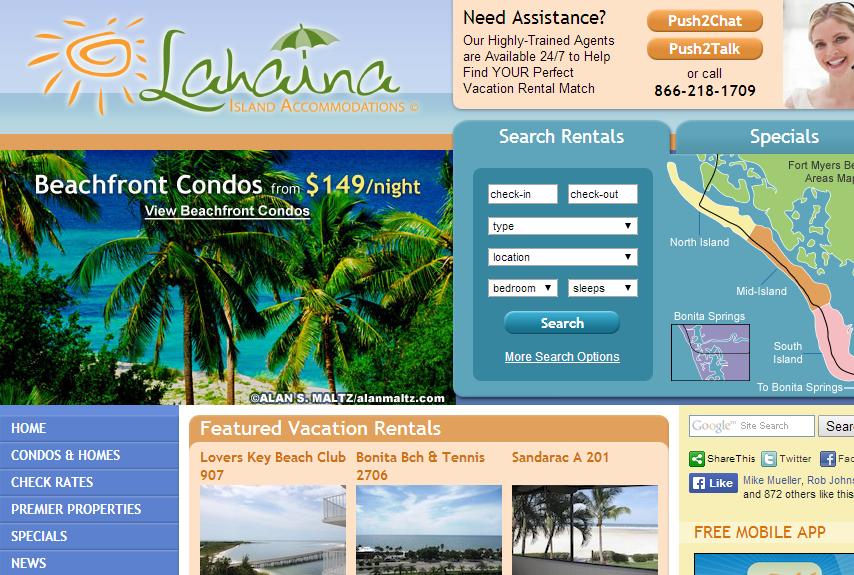
Ponte Vedra-based VacationRentalPros.com added more than 220 new properties to its portfolio through the acquisition of Lahaina Island Properties, based in Fort Myers, Florida, and by taking over the management of 40 properties from VIP Realty.

“Southwest Florida is one of the premier vacation destinations in America,” said Steve Milo, managing director and founder of VacationRentalPros.com. “Now, there are 220 more properties in the region that prospective vacationers can check out through our feature-rich website.”

All VacationRentalPros.com properties benefit from cutting-edge marketing tools, including professional photography, a rating system to help customers choose the right fit for their family, and other enhanced features.

“Our website is second to none,” Milo added. “What better way to showcase some of the best vacation rental homes in America?”

Last month, VacationRentalPros.com announced a deal to manage vacation homes at the Encore Club at Reunion, a luxury community in Orlando. Now, with this latest expansion into Fort Myers Beach and Bonita Beach, VacationRentalPros.com has over VacationRentalPros.com has over 880 properties under management and averaged 40% a year growth making it one of the fastest growing vacation rental companies in the nation.

Marketing Boot Camp Session Materials

0

Amy Hinote of VRM Intel recently conducted a half day marketing boot camp for vacation rentals at the 2014 VRMA Annual Conference in San Diego.

The DIY Marketing Plan Workshop was designed specifically for vacation rental managers to learn to create a marketing plan, identify new marketing strategies and define the budget needed to implement identified tactics.

The seminar covered:

  • The anatomy of the PM marketing plan
  • Identifying objectives
  • Analyzing the market, competition and pricing strategy.
  • SWOT analysis
  • Identifying and selecting marketing channels
  • Determining the marketing budget
  • Evaluation metrics

Below you will find the presentation slides, along with the workbook and budgeting spreadsheets.


Marketing Plan Workbook for Vacation Rental Managers

2015 Marketing Budget

Determine your marketing budget

Barefoot’s Yarbrough questions Brent Bellm about HomeAway’s closed communication initiatives

0

Claiborne Yarbrough from Barefoot Technologies sat down with HomeAway COO Brent Bellm at the VRMA Annual Conference in San Diego to discuss HomeAway’s closed loop communications policy and email policies.


Claiborne: There have been some rumors about the new email policy that HomeAway has enacted. First, can you tell me about the specific change to the policy?

Brent: In order to protect user privacy and reduce incidents of email phishing, we launched a secure messaging feature. This feature anonymizes the email addresses of in-coming inquiries and out-going responses, thereby preventing fraudsters from knowing the email identity of owners and managers.

Owners and property managers may still obtain the actual email address of inquirers by logging into their dashboard; those email addresses are only anonymized in the emails themselves. In addition, it checks for viruses and malware in attachments, and it redacts any email address present in the body of a message, to prevent users from accidentally exposing their email addresses in their signatures and templates.

It is critical to note that, while this feature handles many different business communication processes, it does not handle everyone’s special needs. For this reason, the secure messaging feature is not enabled for integrated property manager today and integrated property managers (including Barefoot customers) continue to receive and respond to inquiries as before, using their software with no email addresses anonymized.

Any property manager who uses our web-based management platform, rather than integrated software, but who requires a full email address to be present in the inquiry to power their CRM systems, may opt out of this program, with the acknowledgement that their communications are less secure. We are exploring ways to make this secure messaging feature compatible with more property manager communication models, and until we do, we will always provide the option to opt-out (by contacting HomeAway customer service).


Claiborne: What was the purpose of making this change?

Brent: Our primary objective was to combat email phishing, which this secure messaging feature accomplishes by preventing fraudsters from learning, and thereafter targeting, the email accounts of owners and property managers. Phishing attacks have grown significantly in our industry over the past two years, and property managers have been victimized every bit as much as owners. Some of the phishing attacks have resulted in significant traveler losses and negative news coverage, which ultimately hurts everyone: travelers (who lose money or shy away from the category), suppliers (who lose the trust of travelers and, therefore, business), and the HomeAway marketplace (which also loses reputational trust). We hope to eradicate phishing, and so far, this feature has made a major dent in it.

Our secondary objective with this secure messaging feature is to begin tracking and rewarding owner and property manager response behavior. Response scores were introduced to look at the speed and consistency of responding to traveler inquiries; it is the number one problem in our marketplace today, as rated by travelers. Both travelers and our internal data suggest that approximately 30% of inquiries don’t get a response at all, and when travelers experience this, their likelihood of leaving our site and the vacation rental market skyrockets. The negative impact is enormous on traveler likelihood to book, loyalty, and likelihood to recommend. Inquiry responses for customers who have the secure messaging feature go through a messaging system that allow us to measure, to the second, the elapsed time between inquiry and response (or lack thereof). For suppliers with this secure messaging feature, response time is being incorporated into their listing quality scores which help determine where properties appear in search results within their subscription level. We reward owners and property managers who respond to more than 80% of inquiries within 24 hours. Those who do not will find their listing quality scores reduced. As mentioned above, there are many property managers who cannot utilize this secure messaging feature. For them, we are developing alternate ways to measure or self-report how quickly and frequently they respond to inquiries. Until those methods are live, response scores will not be counted as a component of their listing quality scores, and therefore they will not be penalized for their inability to be measured.


Claiborne: How does this impact the vacation rental management company?

Brent: As mentioned above, some property managers are challenged to utilize this feature without changing their internal processes. We are working on solutions that make it compatible with the various property manager communication models, whether they use integrated software or HomeAway websites. Until we do, property managers should consider this feature optional. We strongly encourage using the secure messaging feature, as well as following our security best practices.


Claiborne: If you are working with a software company that has an integration to HomeAway for Professional, will the information about the prospect in those transactions be affected?

Brent: Integrated property managers, whether using HomeAway Software for Professionals or any other integrated partner software, will always have access to prospect information. Our goal is to keep this information away from the fraudsters, not from you or any of our trusted partners.


Claiborne: What are some other measures that HomeAway takes to provide security that add to your value proposition?

Brent: I could talk for days about this. On the risk-management side, we have an industry-leading fraud detection engine that scores listings and all actors accessing our site on a wide array of variables. We have dedicated models and processes that oversee the integrity of new listings, account changes, inquiries, and payments. We are actively testing two-factor authentication to secure supplier account access, and thereby eliminate (for the most part) fraudulent account takeovers.

When it comes to traveler protections, we offer a host of options that range from our basic rental guarantee (that covers all listings against fraud) to more comprehensive offerings covering customers who pay through HomeAway Payments (this includes credit card payments to integrated property managers) or who purchase the optional Carefree Rental Guarantee.

Ultimately we aspire for our marketplace to be the most trusted everywhere around the world, and earning that trust depends on a combination of fraud prevention, traveler protection, and third-party trust recognition.

VRHP Annual Conference Starts Monday

0
VHRP Annual Conference

The Vacation Rental Housekeeping Professionals has released the agenda for the 2014 National VRHP Conference in Charleston, SC, November 10-12. The conference is designed to help vacation rental managers take their housekeeping departments to the next level in 2015 and beyond.

Join other vacation rental professionals who are serious about providing superior housekeeping services for guests and owners.


2014 VRHP National Conference Agenda


Monday, November 10th

6:30 pm- 8:30 pm Opening reception


Tuesday, November 11th

7:45 am – 8:15 am:  Breakfast

8:15 am –  10:30 am  Welcome and Keynote Speaker – Steven Craig “12 Fundamentals”

10:30 am – 11:00 am Vendor Showcase

11:00 am – 12:00 pm Round Table Discussions with Vacation Rental Managers

12:00 pm – 1:30 pm Lunch/Vendor Showcase

1:30 pm – 2:15 pm Concurrent Sessions

  • Housekeeping Call Backs
  • Technology Plugins, Software and Apps for Housekeeping and Maintenance with Amy Hinote, VRM Intel

2:15 pm – 2:45 pm Vendor Showcase

2:45 pm – 3:30 pm Concurrent Sessions

  • Basic Maintenance: In-house vs. Subs, Best Practices, Maintenance Contracts with Laik LePera, Outer Banks Blue
  • Personnel Management: Interviews, Incentives, Training and More with Jackie Myers, Village Realty and Amy Helle, Hatteras Realty

3:30 pm- 4:15 pm Concurrent Sessions

  • Standard Procedures
  • Getting what you want from Property Owners

4:15 pm – 5:00 pm Certified Housekeeper and Inspector Certification Tests are $10.

6:30 pm – 8:30 pm Reception and Dinner


Wednesday, November 12th

8:30 am – 9:00 am Breakfast

9:00 am – 10:00 am Key Note Speaker—Chris McLean “Leadership” 

10:00 am – 10:15 am Vendor Showcase

10:15 am – 11:00 am Concurrent Sessions

  • Creating Partnerships with Suppliers to Help Your Business
  • Customer Service Going Above and Beyond with Durk Johnson, Vacasa

11:15 am – 12:15 pm Round Table Discussions with Vacation Rental Managers

12:15 pm – 1:30 pm Lunch and Vendor Showcase

1:30 pm – 2:15 pm Concurrent Sessions

  • Revenue Enhancements and Money Saving Tips
  • Cross Training for Inspectors: Help make On-site Visits for Technicians More Efficient

2:15 pm- 2:45 pm Vendor Showcase

2:45 pm –  3:30 pm Supplies, Product Demos, Tips and Tricks of the Trade with Jill Hatfield, Bald Head Island Limited

3:30 pm – 4:00 pm Closing

4:00 pm – 5:00 pm Certified Housekeeper and Inspector Certification Tests are $10.


VHRP Annual Conference


By Amy Hinote

PM insight from HomeAway’s Third Quarter Earnings Call

0
HomeAway Listing Quality Score

In HomeAway’s Q3 earnings call yesterday, CEO Brian Sharples made comments and answered questions that give some insight into HomeAway’s plans for 2015 and beyond. Here are some of Sharples’s comments which impact professional property managers.


Overview

“We’ve made it very clear recently that we are placing emphasizes on a multi-year marketing strategy that much of our efforts focused on driving demand and efficiencies that increased bookings and saved time for our owners and managers. We’re also equally committed to elevating the traveler experience on our sites.”


Driving Online Booking

“The most impactful change we can make to enhance traveler experience is to drive adoption of online booking. And so I want to make it very clear that we have set a goal and it is our intention to require the vast majority of our listings to be online bookable by the end of 2016.”


“What this means is that travelers will see an online booking button will listing, know the calendar and rates are correct and have the option to send a booking request and be confident that they will receive a prompt response. It’s important for you understand what this means for our owners and managers, first, the online booking system will accommodate both subscription and PPB as we believe this flexibility gives us the competitive advantage in the marketplace.”


“These changes over the next two years will require that owners and managers maintain their calendars publish rates that accurately reflect all fees and respond the booking request as quickly as possible and within 24-hours certainly to be competitive on our sites. All of these items are important elements of listing quality and in the shorter term will be faced into our sort algorithm which determines where listings appear with sort order.”


“…We have, if you look at our new online booking metric, taken online bookings from 5% 12 months ago was 5.4% of our customers to 32.6% one year later today. So our objective of getting that to a 100%, we are actually arguably on pace to do that. I think we’re going to bend the curve up, because of some policies decisions and other things we’re doing. But we’re giving the customers enough of heads up that I actually don’t believe, we’ll see a lot of churn and I think the other reason is that where they are customers going to go, I mean Trip now (TripAdvisor), Airbnb now the most is the competitors are online booking based. There really aren’t any major sites that deliver the kind of traffic we do that don’t have that kind of an experience.”


“Our owners have resisted online booking historically. And even two years ago, when we surveyed our owners, 90 plus percent said they had no interest in online booking. And that’s because, our owners make tons of money and they are doing it in a certain way and they are happy doing it that way. But I think traveler expectations are changing in part, because of competition.”


Responsiveness Scores Will Be Visible to Guests

“Starting in the fourth quarter, we will also make responsiveness scores visible to travelers and while we’re aware that there may be some owners and managers who initially are uncomfortable with these changes, lack of response outdated calendars and confusion over rates creates poor traveler experience and is not consistent with the experience that we want to deliver and that we believe we have to deliver going forward in the future.”


Integrated Pay per Booking Listings: Property Managers

“With the integrated property manager listings, that (conversion) has been a challenge, those are lower converting listings for whole bunch of reasons. Some of them have to do with the complexity integrations and the systems they have and the quality of data that we get. Some of them have to do with the fact that those listings are marketed in a lot of different places, some of them have to do with the fact that some of those listings aren’t as price competitive, as the ones that we have that come in through the platform. And that’s regardless of where they sit on the sites.”


“Now we are keeping those listings pretty low (in search rankings), because until we see a high conversion rates, we don’t want to replace our subscription listings with those listings. And so until that happens, once we get conversion up and some of things are working on, some of them are technology oriented, some of them are have to do with, specifically how they are marketed on the sites and then have to do with many of those IPMs. For example today, we haven’t reported over the reviews yet and once we get the reviews it should help with conversion. And so there will be a double whammy -Once we get to the place where the conversion is adequate for us, then we will be incented to move them higher and you will get a combination of both effects.”


Marketing to Millennials

“…We’re just looking at the next generation of travelers in the Millennials and people who grew up with technology. I mean, our kids grew up with cellphones in their hands and they are used to getting things done instantly online, not talking on the phone, not negotiating with people. And so, if you’re going to be a player in this business from an owner perspective or property manager, the word we’re putting out is you’re going to have to adapt over the next few years.


“We are thankfully in a position where we deliver so much revenue for our customers that I think we can now take a leadership role and say to them, we’re done trying to just convince you, we’re now going to say you’ve got to make this happen in the next couple of years.


“And we’re going to – we’ll develop tools and all these other of things to make it easy for you. But in the long run, our belief is that we will capture more business and get more travelers staying in vacation rentals versus hotels by creating that experience.”


Sticking with Subscriptions

“Now, competitively, there are still a number of differences that will exist as the market evolves. So, I think all the major competitors will have online bookable inventory.


“However, what will be different on HomeAway? Online bookable doesn’t mean we’ll get out of the subscription business. Our customers love subscriptions, they love it. The vast majority of customers don’t want to be paying commissions to somebody. So, we are going to keep to that as a differentiator in our business, no question about it.”


Competitive Advantage

“We are going to be free to travelers. TripAdvisor and Airbnb have chosen to charge big fees to travelers. Well, we’re going to have a pretty sizeable marketing budget in the next few years. And we’re going to be letting everybody know, when you come to our platform and you don’t pay a fee and we think that’s a big deal, because if you look historically at the travel industry, those competitors who adopted no traveler fees first are the ones that ended up being the big winners in that business.”

Pricing

“There is no doubt that we can charge higher prices, we have said that consistently. But there is a limit.


If you look at right now naturally, what’s happening in our subscription prices, I mean was up 12% year-on-year this quarter and that’s been – I mean it’s been virtually every year, been in the business it’s between 12% and 14%, compounded every single year.


So prices are going up pretty rapidly. I think they will continue to go up pretty rapidly.


Now, we have opportunities. Lot of people asks this, well, when are you going to do geographic pricing? We are not working on geographic pricing right now, that’s potentially a long-term opportunity. People ask us, well, when you’re going to raise the high-end, because the value of being a platinum subscriber in your site is really high. And the answer of that is, yep that’s a huge opportunity we have too. And we may do a little bit of that in 2015.


But as long as the pricing is going up naturally, that’s a level we can save, if we need that in the future. And we really like to be the company that continues to deliver good value. Because if we take the value away that we deliver then we’re just the same as everybody else. And so, that’s also why I say the subscription business is a huge competitive advantage for us, because once somebody is a high performing customer in one of these businesses they have a preference for that, because it’s a better value and that makes them very sticky customers for us. And I am not sure everybody quite appreciates how important that is.”

HomeAway sues San Francisco over Airbnb ordinance

0
HomeAway

HomeAway, the nation’s largest vacation-home rental site, on Monday filed suit against San Francisco saying its new law to regulate short-term rentals in private homes unfairly benefits Airbnb at the expense of HomeAway and other rivals.

The suit says the law violates the U.S. Constitution by creating a burden on interstate commerce and asks the U.S. District Court for Northern California to throw out two key provisions of the measure before it takes effect on Feb. 1, 2015.

“It is shocking the Supervisors passed a law that, in our opinion, stifles opportunity in such a discriminatory manner,” Carl Shepherd, co-founder of HomeAway, said in a statement. “In its apparently single-minded goal to ‘legalize Airbnb,’ we claim the Supervisors ignored the benefits of responsibly regulating a well-established industry, and embraced an unconstitutional and unenforceable regulation.”

Judson True, legislative aide to Supervisor David Chiu who crafted the law, responded that HomeAway “facilitates some of the most egregious abuses” of housing laws such as the Ellis Act, a state law that allows landlords to stop renting out units. “This lawsuit is proof that our law will achieve its intended goal and stop the worst abusers,” True said.

Short-term rentals have long been illegal in San Francisco, but the city only loosely enforced that law As sites like Airbnb, with almost 5,000 listings in San Francisco, and HomeAway/VRBO, with 1,200, became popular, concerns grew that the lucrative vacation rentals were siphoning off permanent housing, and changing neighborhoods. Chiu spent two years drafting a law to legalize and rein in the rentals, which the supervisors passed 7-4 and Mayor Ed Lee signed last week.

The law has already engendered plenty of controversy with California Sen. Dianne Feinstein coming out against it, and a group with backing from housing activists and landlords planning a 2015 ballot measure seeking a more-stringent law. Political observers noted that the lawsuit was filed on the eve of a bitterly fought election battle between Chiu and fellow Supervisor David Campos for a seat in the state legislature.

The new law says only permanent residents of San Francisco can rent their homes to short-term travelers. But most of the 1,200 San Francisco listings on HomeAway and its subsidiary VRBO are second homes, whose owners don’t live here year-round. HomeAway wants the permanent resident requirement tossed.

“The permanent residency requirement is the key to trying to prevent the cannibalization of our housing stock” into vacation rentals, True said.

HomeAway’s Shepherd previously told The Chronicle that it is “naive” to think that vacation-home owners would turn those second residences into permanent housing if they were barred from renting them short-term, and that he thought the new law had been crafted expressly for Airbnb’s business model.

The law also says that vacation-rental platforms have to collect and remit San Francisco’s 14 percent hotel tax, something that Airbnb started doing in October, although it’s been mum about any plans to pay an estimated $25 million in back taxes. But HomeAway and VRBO function differently than Airbnb, acting as classified-listing services rather than middlemen, which means they don’t have the ability to collect the hotel tax — or even to know when homes were rented out via their sites.

True’s response to that: “It’s offensive that any short-term rental company wouldn’t want to make sure San Francisco gets the tax revenue it deserves.”

“Our goal is to work with the city to amend the law to one that balances the needs of the community with the rights of all people to rent their properties, regardless of who they are, where they choose to live and how they choose to market those properties,” says Shepherd. “We expected any ordinance in San Francisco would be thought-leading public policy, but instead it fails on all counts resulting from a desire to anoint winners and losers, not to create policies that are fair to all.”

Vacation Rental Road Trip! One year…all vacation rentals.

0

By Amy Hinote, Editor and Founder, VRM Intel -Road trip! Starting November 1, I am taking VRM Intel on the road visiting professional vacation rental managers in the U.S., Europe and Canada.

Throughout the last two years, at VRM Intel we have been covering the latest news and events in the vacation rental management industry. The industry as a whole is rapidly changing and each destination faces its own unique challenges.

During the next year, we will be reporting from the road visiting with property managers and communicating unique intelligence along the way, including updates on standardization initiatives, government issues, competitive analysis and feature articles on property management companies.

We have also launched VRroadtrip.com, a consumer facing website documenting the road trip and promoting professionally managed vacation rentals. The website isn’t finished yet, but I would love your feedback.

vacation rental road trip


On a personal note, I have been working in Chicago for the last few years and am packing up my home, loading up my car and my camera and hitting the road for the next 12 months, starting with Deep Creek, Maryland. To date, the itinerary looks a little like this:

  • Deep Creek, Maryland, November
  • Outer Banks, NC, November
  • North Myrtle Beach, November
  • Gulf Shores, AL, December
  • Destin, FL, January
  • Panama City, FL, January
  • Orlando, FL, February
  • Dublin, Ireland, February
  • Paris, France, March
  • Barcelona, Spain, March
  • Almafi Coast, Italy, April
  • Galveston, TX, May
  • Winter Park, CO, May
  • Keystone, CO, June
  • Snowmass, CO, June
  • Moab, UT, July
  • Park City, UT, July
  • Then up to Idaho, Oregon, Washington, Whistler, Montana, North Dakota, Minnesota, Wisconsin, Michigan and back to Chicago.

I hope you will take a look at the website, and follow this great vacation rental adventure. See you soon!

Feel free to contact me with any questions or suggestions on where to stay.


Q&A: LiveRez’s Tyler Hurst Running for VRMA Board Seat

0
Tyler Hurst VRMA Board of Directors

Tyler Hurst, Director of Sales and Marketing at LiveRez, is looking to serve on the VRMA Board of Directors. Hurst is running against Matt Golis, former CEO and co-chairman at Yapstone, for the supplier seat recently vacated by Lee Hughes, CEO at CSA Travel Insurance.

We reached out to Hurst to learn more about his motivation for wanting to serve on the board and his feelings about the association and where the industry is heading.

Related: Q&A: Yapstone CEO Matt Golis Running for VRMA Board Seat


Tyler Hurst VRMA Board of DirectorsQuestion: What motivated you to want to serve as a VRMA Board member?

Hurst: My motivation is driven by my desire to help professional managers. The VRMA plays an important role in driving the direction of the industry, and I want to lend my perspective to that effort. Every day for the past six years, I’ve had the opportunity to learn the challenges faced by not only professional managers using LiveRez, but managers from all over that are looking for technology solutions. The VRMA has done a lot for the industry that I work in, and serving on the board is a way to give back.


Question: Do you feel like VRMA is currently moving in the right direction?

Hurst: To this point, I think the VRMA has served our industry very well. Right now, however, is a monumental time in the history of this industry. Having both a technology background and a good understanding of the needs of a wide variety of managers of different sizes and destinations, I feel like I can accurately represent the collective voice of these managers and help ensure that the VRMA continues to act in alignment with their best interests. Specifically, having someone with a background in technology will be extremely important as more and more of the industry moves online.


Question: Currently, the VRMA membership represents less than 5% of the total vacation rental management companies in the U.S. If elected, what do you believe can be done to increase the number of members?

Hurst: Moving forward, there’s an opportunity for the collective VRMA membership – both the vendors and the professional managers – to work together to leverage their own networks toward the goal of increasing VRMA membership.

Historically, LiveRez has played a big role in promoting the VRMA and helping drive membership, not only among the professionals that we partner with, but also the greater industry in general. As the Director of Sales and Marketing, I’ve helped spearhead many of those promotional efforts. And, if you look at the new VRMA members listed each quarter, a large percentage of them are LiveRez partners that have been exposed to those marketing efforts. That leads me to believe that our efforts are working.

If elected, I can bring the knowledge I’ve gained in those promotional efforts to the VRMA itself and hopefully work together with other vendors and professional managers to expand those efforts.


Question: Lately, Portland and San Francisco city councils chose to legalize short term rentals in primary homes, but restrict short term rentals in traditional vacation rentals? In addition, municipalities all over the country are facing challenges in regulating vacation rentals. What role do you believe the VRMA should play in government advocacy?

Hurst: The VRMA should be the collective voice of professional managers. And, right now the voice that is needed is one of education and awareness.

As an industry, we all know the important role that the vacation rental industry plays in local economies. And, we recognize that many of the issues that have driven the need for regulation spawn from a lack of best practices and originate primarily from homes that are not professional managed.

So, I see the VRMA’s efforts as a two-prong attack: Continue to promote best practices and highlight the professionalism of vacation rental managers, while also spreading the word about the positive impact that vacation rentals have on the economy. We need local officials to realize that they don’t have to throw out the baby with the bathwater.


Question: This year the AH&LA initiated a campaign to demonstrate the lack of standards in vacation rentals. What do you believe the VRMA can do to build, ensure or encourage standardization in the industry? Or do you believe the industry should not be standardized?

Hurst: It’s important to note that vacation rentals are not hotels, and don’t want to be hotels. In many ways, we don’t want to take the same path as hotels have. If the hotel industry was truly superior to vacation rentals, they wouldn’t see vacation rentals as threats and wouldn’t initiate negative campaigns against the vacation rental industry (like the one in question).

However, there are a few things we can learn from hotels in terms of standardization. While our inventory will never be as standardized as hotels, the level of service and convenience we offer guests can be. This goes back to promoting best practices among professional vacation rental managers and encouraging the adoption of technology that benefits not only guests but also professional managers and the home owners they work with.


Question: What business experience and leadership skills do you currently have which you believe will improve the VRMA?

Hurst: I have more than six years of experience working directly with professional vacation rental managers, speaking with them on a daily basis to understand their needs and find solutions that make real impacts on their businesses. In the process of doing just that, I’ve helped LiveRez grow to become the industry leader in vacation rental software (and in just a short period of time).

I also have a background in politics. I’ve worked on a variety of political campaigns, both local and national. And, I currently serve as the chairman of Idaho’s Young Republication Association and on the executive committee of the Idaho Republican Party. Nobody wants to hear from a politician, but certainly they can appreciate someone that helps build consensus.

The sum of this experience is that I know how to grow businesses, form partnerships and work with a wide variety of people to accomplish goals. I hope to lend this experience to the VRMA Board and Membership.


The election is being held Tuesday at the 2014 VRMA Annual Conference in San Diego, CA.


By Amy Hinote, VRM Intel

Interview with Doug Macnaught, Former President and Co-Founder of Instant Software

1
Webinars for vacation rentals

In 2010, Doug Macnaught and Dave Hopcroft, co-founders of Instant Software, sold their vacation rental software company -including the software platforms PropertyPlus, V12, First Resort and Entech – to HomeAway, Inc., days before the VRMA Annual Conference in San Antonio, causing an uproar in the vacation rental industry.

Now four years later, as we approach the 2014 Annual Conference in San Diego, we recently learned Doug Macnaught’s extensive four year non-compete agreement has come to an end. We wanted to know more about what Macnaught has been doing, how he views the last four years in the industry and what is next for his future.


Doug Macnaught -vacation rental technologyQuestion: It has been four years since HomeAway purchased Instant Software. What have you been up to?

Macnaught: Not a tremendous amount “work wise.” After my year’s consultancy was up, I still had 3 years left on my non-compete agreement.

After some well needed rest, we traveled and spent time with friends and family. Heather & I had the opportunity to visit many parts of the country that I had been to and she had not – would you believe she had never been to the Carolinas (and I had been there more times than I could count)? It was great to visit theses places and see what they are like as a tourist.

I have played some golf and we have a couple of art businesses in Fort Lauderdale that have proved an interesting distraction.


Question: What motivated you and Dave Hopcroft to sell Instant Software when you did?

Macnaught: I learned many years ago not to speak for Dave!

Personally speaking, there were many things that led to the decision, not the least the existence of a willing and credible buyer! HomeAways’ offer was very compelling, and personally it provided financial security for my family that was very attractive. I was also looking forward to working with them to help provide a wide range of new benefits, stability and opportunities to our clients.

Another motivator was the VRMA Switch project: It was clear to me that the Switch would put Instant Software in an untenable position with its’ VRMA Member Customers. We would be expected to cooperate with something that was effectively being developed as competition to our own proven technology. I had no stomach for that fight as many of our clients were my friends and I just did not want to jeopardize the friendships. Although the project ultimately came to nothing, I still feel that the whole Switch Initiative was not the right thing for the association to undertake.


Question: Initially, you were going to stay on with HomeAway for some time. What happened to change that plan?

Macnaught: There were a number of things that just made that not viable, so I embarked on a 4 year early retirement.


Question: In assessing the evolution of HomeAway’s handling of Instant Software, how would you rate their software development progress?

Macnaught: That is a difficult one to answer. I have a lot of experience with taking over software companies and progress is never as fast as you would like. While I have no knowledge of their development plans, I am hopeful that the users will see significant progress in the months to come.


Question: Recently RealPage purchased both Bookt/Instamanager and Kigo. Instant Software had a history of purchasing multiple software solutions. What advice would you give to companies as they roll up multiple software platforms under one umbrella?

Macnaught: I think RealPage is slightly different than Instant Software. Although they are successful in the Long Term and Commercial space, they were not familiar with the Vacation Rental market, as such they did not have well known product to build on, and they were not well known by their newly acquired customers. Notwithstanding any of that and looking at the companies they have purchased, I would start by clearly identifying what made each one successful and build on it, change very little in the early stages. Customers are looking to see what the new owners are going to “take away” from them and it is important that this doesn’t happen.

They should provide investment, support, added value and a real sense of security while they determine the right migration path, assuming consolidation is the plan.

At Instant Software we recognized that there were places where consolidation was appropriate and those where it just was not viable. We provided a central internet product line built on ISILINK and a Common Support and Admin operation, however we maintained most of the PMS Systems, their development teams and client support right up to the day we sold.


Question: As you have had the chance to step back from the industry a bit, what changes to do you see taking place that affect property management software development?

Macnaught: I think the most important change is the natural evolution of the source of the reservation. The reservation process will be taken out of the hands of reservations staff and become a predominantly guest-driven technology from the web or mobile booking sites, these could be 3rd party sites or the actual clients own site. This will mandate that online booking engines are the driver rather than in-house reservation software. The PMS Software development will have to focus more on the back of the house and integration with various tools that make the Manager more efficient and drive alternate revenue.


Question: Along those lines, what software features do you see as becoming more necessary for property managers in 2015 and beyond?

Macnaught: Mobile & web-based functionality for owners and guests that really allow them to be in control of the relationship is an absolute requirement.

Internally – I think enhancements in Maintenance & Housekeeping are big areas, they can add value and profitability to a Managers business to replace costs for marketing that will undoubtedly increase. I think that delivering Mobile technology to staff in the field is a necessity.

Revenue Management or the much touted and badly delivered “Yield Management” have real potential in the 3rd party distribution space.

Finally 3rd party distribution is no longer a luxury. It is as necessary as having a check-in report. If property managers cannot reach beyond their own website then they will be left behind –and the software company must provide the tools to make sure that does not happen.


Question: We are seeing a lot of acquisition in the vacation rental industry (Wyndham, Vacasa, Resort, Vacation Rental Pros, et al.). Do you believe a national brand is viable in the vacation rental industry? What qualities would it take to be successful?

Macnaught: I think it is perfectly possible to have national brands but they must be cautious as they acquire companies, they should learn the ResortQuest lessons. Going back to my answer about software company acquisitions, the same is true – build on what made the local company successful and try not to assimilate them like the Borg.


Question: What do you believe will be the biggest challenges facing property management companies in the next 12-18 months?

Macnaught: I believe that there are two massive challenges:

1) As the industry garners wider visibility from the growth of companies like Airbnb & HomeAway, local regulators will start looking to impose more restrictions. This will need to be dealt with quickly and forcefully to ensure that managers and their businesses are not negatively impacted.

2) Getting your distribution right. With the announcement that Expedia are adding 100,000 rentals via their partnership with HomeAway; and presenting them as a specific segment it is essential that Professional Managers are in a position to take advantage of this, they simply cannot afford to ignore the importance of this development.


Question: What is next for Doug Macnaught?

Macnaught: This year I celebrated my 50th birthday and this month saw the end of my Non Compete Agreement with HomeAway. I am too young to stay retired, plus Heather is really keen to get me out of the house!

I do not believe that it is wise to try and replicate what we did before, but I love the industry and have a passion for making software meet a clients needs. I am working on something that I can’t yet announce so watch this space…. In the meantime I am available for consultancy to managers & technology companies to help them maximize their systems.


Doug Macnaught and his wife Heather will be attending the VRMA Annual Conference in San Diego, October 26-29.

By Amy Hinote, VRM Intel

Q&A: Yapstone CEO Matt Golis Running for VRMA Board Seat

0
Tyler Hurst VRMA Board of Directors

Former Yapstone CEO and current Co-Chairman Matt Golis is looking to serve on the VRMA Board of Directors. Golis is running against Tyler Hurst, Director of Sales at LiveRez, for the supplier seat recently vacated by Lee Hughes, CEO at CSA Travel Insurance.

We reached out to Golis to learn more about his motivation for wanting to serve on the board and his feelings about the association and where the industry is heading.

Related: Q&A: LiveRez’s Tyler Hurst Running for VRMA Board Seat


Matt Golis VRMA BoardQUESTION: What motivated you to want to serve as a VRMA Board member?

Golis: After being an active member (including a VRMA sponsor) for the past 9 years and attending many VRMA meetings, I have always wanted to contribute my experiences in the industry for the betterment of VRMA. After being CEO of a fast-growing Internet payments company for the past 11+ years, I transitioned to Co-Chairman in May which is finally giving me the time to really make a difference within VRMA and several other boards. I have never run for a VRMA seat before because I simply was too busy – now I can help this organization grow and continue to prosper.


QUESTION: Do you feel like VRMA is currently moving in the right direction?

Golis: VRMA has made tremendous strides in the past year, as evidenced by increased membership and attendance at VRMA events. In addition, VRMA’s board has attracted fantastic talent to address both VRMA’s role in advocating for professionally-managed vacation rentals and anticipating threats and opportunities to the industry as a whole.

I think I can bring both technology expertise and a Silicon Valley perspective that can help VRMA keep moving in a positive direction.


QUESTION: Currently, the VRMA membership represents less than 5% of the total vacation rental management companies in the U.S. If elected, what do you believe can be done to increase the number of members?

Golis: I think there are several ways to increase membership among vacation rental managers:

1. Consider both new locations that have not hosted a VRMA event, as well as locations that are easier to access by plane and/or are a “destination” themselves. Each VRMA conference, I have been impressed with how many attendees are coming to their first event because of the proximity to them. For VRMA to grow its membership (and engagement at conferences), we need to diversify where the events are held and consider locations that maximize ease of travel and new member opportunity.

2. Offering more VRMA-certified training classes that can be taught as web-based training to work towards different levels of professional management certification for vacation rental companies. For property managers that cannot attend events, VRMA has a great opportunity to market web-based training and classes that can both increase membership and potentially provide a great revenue source to the organization. Since many vacation rental managers are in vacation destinations around the US, it is hard for many to travel to a VRMA event. Offering web-based training (with a strong Internet marketing campaign) would be the best way to connect with these property managers that represent the 95%+ that are not active VRMA members today.

3. Continuing to invest in advocacy for the industry, and establishing stronger ties with news sources that are covering many of the short-term rental debates that are affecting professional vacation rental managers. If VRMA makes this investment, the halo-effect from VRMA fighting for the best interests of vacation rental managers can lead to increased membership.


QUESTION: Lately, Portland and San Francisco city councils chose to legalize short term rentals in primary homes, but restrict short term rentals in traditional vacation rentals? In addition, municipalities all over the country are facing challenges in regulating vacation rentals. What role do you believe the VRMA should play in government advocacy?

Golis: VRMA needs to play a significant and active role in government advocacy because we can’t afford to allow large short-term rentals that operate like hotel sites define us and our industry. Many of these sites cater to an urban population (i.e. New York and San Francisco) and they are framing the debate around helping hosts generate supplemental income in a down economy. They view vacation rentals as a threat, and have the resources to frame the debate. VRMA needs to both partner and act on its own to define how vacation rentals both operate very differently from other short-term rentals and how the audience that vacation rentals cater to is fundamentally different than those companies trying to profit from urbanites renting out their apartment, home, or couch for a few nights.


QUESTION: This year the AH&LA initiated a campaign to demonstrate the lack of standards in vacation rentals. What do you believe the VRMA can do to build, ensure or encourage standardization in the industry? Or do you believe the industry should not be standardized?

Golis: I think the AH&LA knows how much both vacation rental and short-term rental sites are affecting their growth as an industry. I do think there are ways that the VRMA can encourage best practices that only helps the image of the industry, but I am not a fan of imposed regulation on the vacation rental industry. I think VRMA can demonstrate that it is both providing education to its base and training that can show the AH&LA (and hospitality industry at large) that professionally-managed vacation rentals care about maintaining a high standard of quality and service.


QUESTION: What business experience and leadership skills do you currently have which you believe will improve the VRMA?

Golis: Having served as a CEO of a company that has grown substantially, from a few to 250+ employees in the past 11 years, I have experience in both scaling teams and addressing the ever-changing needs of the industries we serve (like vacation rental managers). I would look forward to actively contributing my leadership and organizational experience, with a technology perspective that will consider new and better ways of helping VRMA thrive. I am fortunate to know many VRMA members over my past 9 years in this great industry, and want to continue to bring people together to anticipate how VRMA can expand and take on a greater role in making the industry pie even bigger.


The election is being held Tuesday at the 2014 VRMA Annual Conference in San Diego, CA.


By Amy Hinote, VRM Intel


NAVIS and HomeAway release reservation lead interface integrating HomeAway listing inquiries with the NAVIS Narrowcast sales and reservation solution

0
Dwellable's Mobile App Study for Property Managers

NAVIS and HomeAway unveiled a reservation lead interface that integrates HomeAway listing inquiries with the NAVIS Narrowcast sales and reservation solution.

The interface allows NAVIS’ new Listing Lead Management system to capture more actionable leads, drive higher conversion rates and increase revenue for vacation rental (VR) operators. NAVIS is the leading reservation sales system provider for the vacation rental, resort, and hotel markets. The HomeAway family, with more than one million live vacation rental listings in 190 countries, is the world’s #1 source for vacation rentals. Click here to learn more about how the NAVIS Listing Lead Management system increases revenue for VR operators.

Lead Management solution is free of charge to NAVIS Narrowcast clients

NAVIS logo“NAVIS worked with HomeAway to develop the most powerful booking and lead management tool for the vacation rental industry,” said Michelle Marquis, NCP, NAVIS’ vice president of marketing and strategic initiatives. “NAVIS Narrowcast clients can now manage and convert their HomeAway and VRBO.com listings at a much higher level with NAVIS’ VR lead management solutions. Best of all, the new Lead Management solution is free of charge for all NAVIS Narrowcast users. We invite everyone to come by our booth at VRMA14 and be first to see how the new NAVIS–HomeAway Lead Management solution can strengthen their operation.”

NAVIS seamlessly receives HomeAway listings in NAVIS’ Narrowcast reservation sales system. The HomeAway inquiry appears as a call on the Narrowcast dashboard screen with a summary of the listing’s information, and property of interest. The system also automatically routes the call to the most appropriate agent for handling. The NAVIS-HomeAway Listing Lead Management interface also lets clients track conversions and revenue attainment for optimized performance management.

The new NAVIS Listing Lead Management system:

  • Increases listing inquiry conversions with automatic lead data collection for more effective reservation handling and outbound re-marketing.
  • Allows automated responses through NAVIS Reach to new inquiries based on home or condo availability.
  • Enables fast follow up from Narrowcast directly to inquiries in one system.
  • Cleanses lead data; consolidates records by household, eliminates duplicates via NAVIS’ CRM.
  • Queues leads to the highest converter on your sales team – or uses other metric of your choice.
  • Shows listing details from the NAVIS Lead Form for informed inquiry management.
  • Provides campaign analysis; attributes the booking to all stages of that lead’s interactions.
  • Provides reporting summaries on bookings, conversion, outbound revenue, and more.


NAVIS Reach drives more effective retargeted lead marketing

“HomeAway and NAVIS want to help VR operators get the best value from being partners with each of us,” said Marquis. “Our powerful new Lead Marketing System enables operators to make the most from their investment with those leads.” Marquis noted that listing site leads convert at about 5%. The new NAVIS HomeAway interface captures data on the 95% of leads that typically do not convert and makes that data available to NAVIS’ Reach CRM marketing tool. The result is increased revenue for VR operators.

“Most VRBO or HomeAway leads sit in somebody’s email box. NAVIS Reach allows operators to segment and target those prospective guests into Household Personas and automatically market back to valuable leads. NAVIS Reach lets VRMs automatically retarget an email to somebody who showed interest this year or last but did not book. This takes lead retargeting to a more profitable level.

“The data are strong,” Marquis said. “Narrowcast revenue that comes from listings sites such as HomeAway and VRBO has grown from 6% just three years ago to 23%. NAVIS and HomeAway will continue to work together closely to help NAVIS Narrowcast and HomeAway clients manage their leads for more conversions that boost revenue now and in the future.”


Increase conversions with NAVIS

More to consider than the multiple when selling your vacation rental company

0
More to condsider than the muliple in your vacation rental amanagement company Exit Strategy

When you have an offer on the table for your vacation rental management company, the price tag jumps off the page. It is especially distracting if the price is higher than you had hoped. Your hard work has paid off, and you want to close the deal as quickly as possible.

However, the dollars signs can be misleading. There are many situations where the highest offer is not necessarily the best offer.

Ben Edwards Transaction Advisor“There are numerous factors involved when determining which offer is best,” said Ben Edwards, President at Weatherby Consulting . “Typically, the time value of money, if financing is involved, deal structure and future tax liabilities consistently require the most review during this process.”

If you get distracted by the offer price, the power shifts to the buyer and you can potentially lose negotiating power as you struggle to defend the original offer price. Due diligence about the buyer and the offer is extremely important before accepting an offer.

Here are five considerations to add to your pre-acceptance checklist.


1. Do the net offer proceeds meet your financial exit goals?

At first, the offer price for your vacation rental management company can appear more than sufficient to meet your retirement goals. However, you will find it useful to determine what your net proceeds will be once expenses (accounting, taxes, debts, etc.) have been paid.

“The sales price and your retirement present two interesting discussion points, said Edwards. “The sales price is generally a function of earnings, while retirement needs represent a forecast of expenses needed to sustain your quality of life. Understanding the net amount of your sale on the front end will pay dividends subsequent to closing helping you to more accurately prepare for retirement.”

Note that the initial offer you receive is generally the highest possible price that you will receive from that buyer. During due diligence, the buyer will be looking for reasons to reduce the price. Build in enough room for adjustment and consider your net revenue when assessing the price.


2. Consider the structure of the transaction.

Your transaction’s structure can materially affect the amount of taxes you will have to pay, the cash you will realize at closing and the timing of your transition from the business. If you are looking to exit the company at the closing with enough cash to retire, you may not want to enter into an earnout transaction, which would pay you over time while requiring you to work under the new owner for a period.

“I receive this question often…Preferably, cash or cash equivalents at closing are the most prudent way to structure a closing settlement from a seller’s perspective,” said Edwards. “Financing is advisable in certain circumstance where a Class A buyer is participating in the transaction. Generally speaking, any portion of the purchase price paid out of future profits in not advisable or only under specific circumstances since the risk of the purchase price is contingent on future production. If the seller is susceptible to financing risk, he or she should keep the company and pass on the offer under most, if not all, scenarios.”

Transaction structures can be complex, but do not be intimidated. A transaction advisor with vacation rental industry experience can answer your questions so you are comfortable with the proposed structure before you select a buyer.
 

3. Understand the buyer’s valuation.

“Having a transaction advisor is key to helping facilitate the diligence and answer any questions relative to confirming the company’s value,” said Edwards.

In a vacation rental transaction, the buyer will be looking to confirm that the information you provided is accurate during the due diligence phase and will articulate concerns about your company’s performance that lead to reductions in the offer.

Take time to investigate the buyer’s valuation assumptions so that you can preempt any potential adjustments. Then, if you believe there will be substantial reductions in the price during due diligence, you might view this buyer’s offer very differently.
 

4. Assess the buyer’s ability to close the transaction.

You can avoid wasting your time in due diligence by determining whether or not the buyer is able to close on the sale. In today’s marketplace, financing for business purchases isn’t easily obtained.

Edwards added, “With the interest in the vacation rental market, financing requires tremendous diligence by the seller, as well as, strong guarantees from the prospective buyer.”

Here are two ways to secure your position:
If the buyer is financing, get a commitment letter from the lending institution
Investigate the buyer’s history of acquisition both inside and outside of the vacation rental industry.
 

5. Are you ready to let go?

Before you choose a buyer and move into due diligence, look inward. Are you truly prepared to give up your business? Can you visualize your life in its next phase?

“Knowing whether you want to sell is paramount before moving forward with the sale of the company,” said Edwards

It isn’t uncommon to see sellers jump at the highest offer, and later regret the decision.

In many cases, the highest offer doesn’t lead to the best outcome, and spending large amounts of time and energy in due diligence only to walk away with a defunct sale can be disappointing. By taking a closer look at the buyer’s assumptions, motivations and history, as well as an honest look at your own, will increase the likelihood of a successful transaction.


By Amy Hinote, VRM Intel

Amy Africa -Mobile-Schmobile: 6 Sure-Fire Tips on How You Can Improve Your Mobile Strategy Today!

22
Mobile Hospitality Marketing for Short Term Rentals

When I began my internet career, my first “legitimate” email address was a CompuServe number.

Back then, if you told someone you were doing work on the web (or the WWW as it was ever-so-fondly called), they’d often look at you quizzically, wondering whether or not you made a good porn star or how much money you had from trafficking whatever illegal things you were selling.  Allegedly.

By Amy Africa, Mobile-Schmobile: 6 Sure-Fire Tips on How You Can Improve Your Mobile Strategy Today!

These days, I get thousands of emails about mobile with the same sort of questions as folks had then. People want to know what to do, what not to do, and a lot of times they just want to tell me the eleventy bazillion reasons why it doesn’t/won’t work for them.  As if mobile marketing is a choice.  Ha!  I went through exactly the same battles when people told me the internet was like the CB radio.  Ah-em Bill LaPierre.

But I digress…

Here are some of my best tips to improve YOUR mobile journey.  (These come from the questions I am most commonly asked.)


1.     Look at what kind of traffic you’re getting…

Separate your handheld traffic from your tablet traffic.  Tablets and phones are NOT the same thing.  The industry experts like to group them together because tablet conversion is 2-3x that of most traditional sites and eleventy bazillion times better than most smartphone conversion. Grouping all mobile traffic together masks phone conversion problems but they need to be separated.

Experts say “oh, you can’t do that because is a Nexus a phone or a tablet?”  Look, it’s not rocket surgery. If you’re taking your primarily phone calls on it, it’s a phone. If you’re using it to play Candy Crush and watch Netflix, it’s a flipping tablet.

Why does it matter?  Mostly because email traffic is typically “phone” traffic and if you learn how to separate it properly, you’ll also figure out how to design to it; what kind of landing pages you need; how you can best use your selling space (selling on a 2×4 is often more challenging than one might think); what things you need to ask for and what you don’t (for example, you don’t need to dedicate an entire screen to asking for the email address of someone coming from email), and so on.

Plus, phone traffic is ON A PHONE.  I realize this is like stating “water is wet” but many marketers tend to forget that if the customer is ON THEIR PHONE and you have a call center it’s much easier – and usually far more lucrative – for the user to push a CLICK TO CALL button than it is to maneuver your shopping cart.


2.     Work your transfer.

If you only listen to one tip that I have this is it – if someone puts something in their mobile cart, show it in their regular cart.  You can use email and mobile numbers to help you do this.


3.     Use spreaders.

I like to think of the whole sales process as feeding a rat to a snake – and you really want to know where the rat is stuck in the snake so you can squeeze him out the end.

When you know where your rat is stuck in your snake, use a spreader to get them to the next level.  A spreader would be a pushpage, instigated chat, v-chat, sometimes even a text message.  Whatever you need to do to smooth the gap.


4.     Don’t get sucked up in the industry buzz.

Learn what’s best for you by trying it, tweaking it, and then perfecting it.   Do more of the stuff that makes you money and less of the stuff that doesn’t.  It’s that easy.

Test out triggered text messages.  A lot of “experts” will tell you that folks hate them.  Personally, I have to be willing to bear your child for you to get my phone numbers these days.  Triggered text for a lot of companies?  Life-changing.  Granted, very few people use triggered text messages properly but they are still one of the best marketing things I’ve ever seen.  In. My. Career.

Work your internal search.  There are hundreds of articles stating mobile search is exactly the same as regular search.  It’s not.  Searches are often shorter and more specific (or way longer and completely incomprehensible) and people tend to make a lot more mistakes.  Plus, mobile search is used more frequently and there is typically much more of a priority put to it.  (Meaning that showing 1,232,832 finds on something isn’t going to be useful to anyone on a mobile device. In fact, chances are they’ll struggle with 20 and look at less than 5.)

Don’t get caught up in the tools, the programming languages or the platforms.  Figure out what your users need.  Look at what features they’re using (or what they’re not); which device(s) they are using; whether or not they are buying or browsing; etc.  If 95% of your traffic is coming from YouTube, you’ll need something entirely different than a company where the majority of the traffic is coming from their email program.

I like responsive design and it’s not a silver bullet.  You can’t just “go responsive” and have all the evils of the world go away.   In fact, for some folks it makes things worse –  not just because it can be slow and pricey – but because it can make marketers really lazy and what you do on your tablet isn’t the same as what you do on your desktop.  Nor is it the same as what you do on your phone.  (Hint: no matter what you do – you are going to need to REALLY work your navigation as if your life depended on it.)


5.     Develop new contact strategies.  (Chances are good that your mobile efforts are going to need different contact strategies than your traditional efforts.)  

Because things happen much faster mobile-wise, your contact strategies should often happen much faster too.

With mobile, you’ll also have more contact methods in your arsenal and they’ll work differently.

So what does this mean?

It means that if you’re sending out an abandoned cart program – you’re going to want to mail it faster.  You also may want to add more emails to your plan – so if you normally send out 3 emails, test 5 or 7.  Try SMS as well.  Abandoned cart text messages work really well.  Remember, there’s a big chance that your mobile cart sucks – so don’t send them back to where they abandoned/struggled in the first place – try to get them on the phone or to your traditional site (if your cart is better.)

Store locator emails are another big thing.  When someone goes to your site, and searches to find a store, there’s a pretty big chance that they want to go to that store today.  On the page with the locator, collect their email address and send them a coupon.  Collect their mobile number and send them a text.  Do both.  (If you don’t do offers, send them a “grocery list” of things they should look at – stuff you don’t want them to miss when they visit.)


6.     Figure out the importance of your referring URL’s and market to your users accordingly.

So, here’s the thing…

In most cases…

If someone comes in from Facebook, they are not at all equivalent to someone who comes in direct/no referrer.

If someone comes in from a branded PPC search, they are typically lightyears ahead in terms of qualification than someone who came in from a Twitter link.

Social media can drive a ton of mobile traffic but if you’re like most folks, very little of it will immediately convert to a sale.  Customer service nightmares?  Yes.  Sales?  Don’t count on it to pay your bills.  (Hint: If you have to put all your eggs in one basket, put them in your direct/branded keyword strategy.   That’s where you will make the most money.  Period.)

What are YOUR best tips for mobile marketing?  Send ‘em to info@amyafrica.com.  I’ll publish the best ones in a future post.


By Amy Africa, Mobile-Schmobile: 6 Sure-Fire Tips on How You Can Improve Your Mobile Strategy Today!

Winter Park, CO Vacation Rental Experience

0

March 2014 –March at Winter Park Resort was truly a Winter Wonderland! I stayed with Winter Park Lodging Company, easily one of the most fun, tight-knit teams in the vacation rental industry. Their hospitality was off-the-chart! And that is from a southern girl! (read more about them)

Winter Park on top of the world!

The resort has everything you need and is so much fun! But I have to say my favorite part of this trip was snowmobiling with Grand Adventures! I was a little scared at first but caught on after a bit, and I think this could be a new hobby for me!

My condo at the resort was perfect and it was nice to have all of the resort amenities. The ski culture is still intimidating to me, but this resort makes it less so. The condo had a fireplace and opened out to the huge hot tub, grilling area with the big outdoor fireplace and was about a 3 minute walk to all of the restaurants in the resort.

Winter Park Resort Vacation Rental review

In town, the food was surprisingly good, and the bars are super fun.

But I have to say, my favorite was the Smokehouse BBQ. Between the B.B. King poster and Auburn signs (War Eagle!), I was right at home, but the barbecue was outstanding. I’m still craving it.

This is an easy place to go if you’re single. Driving is not necessary. people are super nice, there are many areas to read and write, and even the snowmobiling was single-friendly!

I will most definitely be back!

Pics below.

Winter Park Snowmobiling with Rachel

Winter Park BBQ for Auburn Fans Winter Park condos for singles

Winter Park Snowmobiling


Northern Michigan Vacation Rental Experience

0
Northern Michigan Vacation Rental Private Lake View Sunsets

Northern Michigan Vacation Rental Private Lake View SunsetsAugust 2014 –Chicago was getting pretty stifling in the late part of the summer, so I needed to get out of the city and see some stars! That’s what I told Alan Hammond, owner of Holiday Vacation Rentals in Northern Michigan.

He delivered! I grabbed a couple of my friends and drove to Harbor Springs, Michigan to get some peaceful, siren-less R&R on Lake Michigan. We stocked up the cooler with meat and veggies for grilling out and wine for drinking, and stayed at Eagle View, a huge 3 BR private home rental on the lake.

Located along the Tunnel of Trees, this house was so quiet and serene…and clean! This was one of the cleanest vacation rentals for a house its size I’ve stayed in. The kitchen had absolutely everything we needed, including grilling utensils.

Lake Michigan Private Beach Vacation RentalWe had tons of plans to get out and do all kinds of things in the area, but we loved the house and the private beach so much that we stayed in and read, cooked out, sat by the fire, had wine and cheese, laughed, talked and watched shooting stars.


It was a huge contrast to our daily lives in Chicago, and it was so needed!

We also got a chance to go to dinner with Alan Hammond and his truly beautiful inside-and-out wife Kathie. We went to  Legs Inn, a Polish restaurant on the Tunnel of Trees, and only two miles from our house. There was a deli/country store on the way that we later used to to grab fresh bread, cheese wine, and a couple of t-shirts.

Lake Michigan Vacation Rentals Legs InnI highly recommend Legs Inn for dining. We sat on the Lakefront porch –they have a beautiful garden there–and had smoked whitefish, fried Pierogi, Kabanosy (Polish Sausage), Bigos (Hunter’s Stew), Golabki (Cabbage Roll), and grouper…and of course, wine!

Harbor Springs Michigan Vacation RentalsHarbor Springs is one of the cutest upscale towns I’ve seen. Very American with a walking vibe. Cute shops and coffee shops. I recommend the Stained Cup Coffee, which has fast wifi. Get the Torte Rustica (sausage spinach, roasted peppers and cheddar cheese on crustini crust topped with whipped eggs and more cheddar and mozzarella).

I will definitely be back and stay at this house again…without a doubt!!

Grilling out at Northern Michigan vacation rental


By Amy Hinote

Vacation Rental Pros Facebook Photo Contest Rules

0

“Pets on Vacation” PHOTO CONTEST OFFICIAL RULES

NO PURCHASE NECESSARY TO ENTER OR WIN THIS CONTEST. A PURCHASE WILL NOT IMPROVE YOUR CHANCES OF WINNING. VOID WHERE PROHIBITED BY LAW.

1. Sponsor: The “Pets on Vacation” Photo CONTEST (the “Contest“) is sponsored by Vacation Rental Pros and VRM Intel (hereafter “Sponsor“) with offices located at 1567 Ridge Avenue, Suite 707, Evanston, IL 60201.

2. Eligibility: These are the Official Rules (the “Official Rules“) for the Contest. The Contest is open only to persons who are legal residents of and are currently located in the 50 United States or the District of Columbia (excluding Puerto Rico, Guam and the U.S. Virgin Islands), who are at least eighteen (18) years of age on or before November 15, 2014. Any individuals (including but not limited to employees, officers, directors, consultants, independent contractors, and interns), who have, within the past six (6) months, performed services for the Sponsor (hereafter the “Administrator“), their parent, subsidiary, or affiliated entities, or agents acting on behalf of the above entities, including but not limited to all other promotional partners, or any organizations responsible for sponsoring, fulfilling, administering, advertising or promoting the Contest or supplying the prize(s), and/or their respective parents, affiliates, subsidiaries, licensees and distributors, and immediate family and household members of such individuals, are not eligible to enter, play or receive a prize. “Immediate family members” shall mean parents, step-parents, children, step-children, siblings, step-siblings, or spouses. “Household members” shall mean people who share the same residence at least three (3) months a year. Eligibility is subject to all federal, state, and local laws and regulations.

3. Entry Period: Consumers may enter the Contest between October 15 at 12:00 am Eastern Time (“ET”) and Novemeber 14 at 11:59 pm ET (the “Entry Period“).

4. How to Enter: NO PURCHASE NECESSARY. You may enter the Contest during the Entry Period as follows:

Enter via Facebook (WooBox): Visit http://woobox.com/

Limit one (1) entry per person/email address. If an entrant submits multiple entries, all subsequent entries (other than the initial entry) will be automatically disqualified. All entries are subject to verification by the Administrator. Entries must be uploaded in compliance with the Contest requirements. Entry entries that do not meet the specifications or otherwise do not comply with the Official Rules herein may be automatically disqualified. Incomplete, illegible or mutilated entries will be automatically disqualified. No responsibility is assumed for lost, late, misdirected, damaged, altered or illegible entries. Any attempted form of entry other than as described herein is void. Administrator and or Sponsor will determine in its sole discretion what constitutes a valid entry. All materials submitted become the property of the Sponsor and will not be returned or acknowledged. In the event of a dispute about the identity of an entrant, entries will be declared made by the Authorized Account Holder of the e-mail address submitted at the time of entry (if eligible). “Authorized Account Holder” is defined as the natural person who is assigned to an e-mail address by an Internet access provider, online service provider or other organization (e.g., business, educational institution, etc.) that is responsible for assigning e-mail addresses for the domain associated with the submitted e-mail address.

The potential winner may be required to provide Sponsor with proof that the potential winner is the Authorized Account Holder of the e-mail address associated with the winning entry. Entries must be submitted from a valid e-mail account, which may be identified by reverse domain name search.

5. Entry Requirements: Your Entry must meet the following criteria:

Specific To “Pets on Vaction” Competition

  • Photo entries only.
  • Photos must be submitted as per the instructions on the contest submission.
  • Entry indicates an agreement and understanding of the following:
    • If chosen as the prize winner, every effort will be made to fulfill the prize no later than December 15th 2015.In the event the grand prize cannot be fulfilled as advertised, VRM Intel will provide an alternate equipment prize of the grand prize winner’s choice with a retail value of up to USD$100.

General Competition Requirements

  • Must be your own original work.
  • Cannot have been submitted in any other prize promotion or featured on a public website.
  • May only contain content, for which you have, or have the power to grant, all required consents and approvals.
  • Must comply with all Terms of Use of Facebook (https://www.facebook.com/legal/terms). LINK
  • Cannot contain, as determined by Sponsor, content that is sexually explicit, violent, derogatory of any ethnic, racial, gender, religious, professional or age group, which violates any law, or which communicates a messages inconsistent with the positive good will to which we wish to associate.

Submissions must not: (a) violate any third party rights, including, but not limited to, copyrights, trademark rights, or rights of privacy and publicity; (b) contain defamatory statements; (c) include threats to any person, place, business, or group; or (d) be obscene or indecent. Any elements that appear in the submission, including, without limitation, images, text, or other materials used must be entirely original and created by the entrant, or be in the public domain. Use of any elements that are not original or in the public domain will result in disqualification of a submission, in the Sponsor’s sole discretion. If a submission depicts any third party, that third party must be of the age of majority in his/her jurisdiction of residence and you must have permission from that third party to grant the rights to the Sponsor described in the “Sponsor’s Rights to Entries” section below. By submitting an entry, you represent that (a) you are the creator of the submission, (b) you own all rights to the submission, (c) the submission does not infringe upon or violate the intellectual property, privacy, or other rights of any third party, (d) the submission has not previously been entered in any other contest, and (e) the submission has not been previously published in any medium.

The Administrator will not make available to the general public or to the Judges any entry that is obscene, pornographic, violent, offensive in any manner, or in any other way not suitable to be published (as determined solely by the Administrator). Entrants agree that the inability to publish an entry, or the obscenity, fraudulent nature or invalidity of the registration information (as determined by Sponsor or the Administrator, at their sole discretion) will render the corresponding entry void.

Associations for Vacation Rental Managers

0


OPMA: The OPMA is a professional advocacy organization that is dedicated to promoting the value of the rental experience through onsite property management companies. As an industry advocate, OPMA seeks to gain legislative influence on behalf of it’s members and the greater industry, define a common set of core values and unite its members under a common vision and banner. Read about OPMA’s latest initiative.


VRHP: The Vacation Rental Housekeeping Association is the right place for vacation rental managers who are looking to improve their housekeeping and maintenance departments and network with like-minded property managers, This year’s VRHP Conference is being help Nov 10-12 in Charleston. Take a look at the agenda and get more information on how to register.

Consulting and Transaction Advisory Services in the Vacation Rental Industry

0

Weatherby Consulting provides transaction advisory, consulting and asset management services with proven success in creating opportunities and solutions in the vacation rental industry. They deliver high-impact results, provide partner-level attention and implement tailored solutions to address each of their client’s unique goals and objectives. CEO Ben Edwards will be presenting a bootcamp workshop at the 2014 VRMA Annual Conference entitled Budgeting and Financial Management. Read more about the workshop.

Keyless Locks and Smart Home Technology for Vacation Rentals

0

KabaKaba’s Oracode keyless door locks allow for the remote management of access to vacation rental properties, through an easy-to-use and secure web-based solution. Oracode’s unique web based, keyless system uses an electronic push-button lock that grants access through time-sensitive codes. Since codes can be given days, months or years in advance there is no need to store or distribute keys or keycards to guests, staff or vendors. At the 2014 VRMA Conference, they will be promoting their new partnership with BeHome247. Read more about Kaba and their integration.


PointCentralSmart Home Control for Vacation Rental Management –PointCentral property automation is a cellular, Smart Home solution that can be accessed from any web-enabled device. With no upfront capital investment, vacation rental managers gain superior control of their entire inventory of homes – Keyless Access Control, Energy Management, Site Monitoring, and Improved Client Satisfaction. Smart home control is revolutionizing vacation rental management. But don’t just take our word for it. VRMs are leveraging the power of smart home control every day. Check out these video testimonials.