
- Advertisement -
Home Blog Page 16

VRM Intel Schedules Online Conference for Vacation Rental Managers

1

After successful VRM Intel Live! conferences in Destin and Gatlinburg, we were hoping to schedule more of these regional shows in 2020 to bring this same high-quality education and discussion to more destinations.

However, in light of current events, many industry conferences are getting postponed and property managers are tightening business travel budgets. As a result, we’ve decided to switch gears and offer property managers this conference in a virtual format instead. 


VRM Intel Live! Online

On April 16 – 17, 2020, we will be hosting VRM Intel Live! Online, a virtual conference that brings together industry thought leaders and local vacation rental managers to discuss the current landscape and provide education about top-of-mind topics for vacation rental managers. 

During these two days we will discuss recent events, performance data, demand-generation marketing, Google, OTAs, cancellations, risk management, financial management, HR, owner communications, and more.

The first day, April 16, will focus heavily on executive strategy, while the second day will focus primarily on sales and marketing. We will also be recording sessions on safety, property care, housekeeping, revenue management, technology, marketing strategies, and customer service that will be available to attendees. 

In total, attendees will have access to 35+ educational sessions and discussions. In addition, as added value, we are including the video content from the 2019 Vacation Rental Data and Revenue Management Conference.

Tickets are $199, and there are 500 seats available for the live sessions.

Live Sessions

Industry conditions are evolving quickly, so session titles may change to address the most critical challenges and opportunities for vacation rental managers, but here is a look at the tentative schedule. 

April 16: Executive Strategy

  • 2020 Vacation Rental Performance and Pacing
  • Getting Lean: Disciplined Financial Management in Times of Uncertainty
  • HR: The 2020 Moving Target 
  • Mitigating Risk in Vacation Rental Management
  • Asset Management vs Hospitality Management: Owner Focused or Guest Focused? Do You Have to Choose? 
  • Homeowner Communications and Reporting Opportunities

April 17: Sales & Marketing

  • Understanding Google’s SERP Changes
  • When Demand Drops: How to Generate New Demand When Behavior Changes
  • Identifying and Targeting Feeder Markets
  • Cancellation Policies and Communications
  • Navigating OTAs: Policies, Competition and Opportunities
  • Using What You Have at Your Fingertips to Move the Needle

Video Sessions

Marketing

  • SEO/SEM Disrupted: Google Shakes Up the Funnel
  • Could You Be Losing Guests in the Booking Process?
  • How to Leverage Marketing Tools for Business Decisions & Real Results
  • Mitigate Bad Reviews and Get More 5-Stars
  • Building the Relationship with Guests Before, During and After the Vacation
  • Strategically Working with OTAs in 2020

Strategy

  • Lessons Learned—Technology, Hiring, Owners, Guests, Laundry, Linens and More
  • Experience and Professionalism: Why it Matters in the Vacation Rental Industry
  • The Data Behind the Guest Experience Movement: A Glimpse into Why Airbnb, Booking.com, and Expedia are Investing Millions of Dollars into Experiences
  • HR 411—Critical Workplace Topics for 2020
  • The People Problem
  • Proactive Homeowner Acquisition

Technology and Revenue Management

  • The Growth of Smart Home and its Implications for Property Managers
  • Revenue Management Infrastructure
  • 2020 Technology Landscape
  • Advanced Revenue Management Strategies
  • Data-driven Business Strategy
  • Key Data Workshop

Property Care

  • Making Safety a Top Priority at Your Agency
  • Professionalizing the Housekeeping Department
  • Bed Bugs
  • Working with Contractors


If you would like to sponsor VRM Intel Live Online, you can click here or contact Connie Carlisle at connie.carlisle@vrmintel.com

Housekeeping Profitability: Making Your Housekeeping Department a Profit Center

0

By Jeremy Clayton, Managing Partner, and Christi Knoll, General Manager, Padre Escapes

First, here’s a little about our company, Padre Escapes. We are located on North Padre Island in Corpus Christi, Texas. We started Padre Escapes six years ago, and today we manage more than 270 properties, primarily townhomes and condos, due to a local ordinance that does not allow single-family homes to be rented for less than 30 days.

Housekeeping has always been a source of pride for us, but it had never been a profit center. Since we opened our doors, we have always used subcontractors for our housekeeping needs. Over the years, the quality fluctuated, but we finally reached a good place with respect to quality, consistency, and communication. After much debate and number crunching, we decided to start our own in-house housekeeping division earlier this year.

In April, we started Padre Escapes’ Housekeeping with approximately 60 properties. Right after Labor Day, we acquired an additional 65 properties due to the desire of one of our subs to downsize. This change made us larger than any of our subs at the time. Although it was intimidating for us to take on that many properties, it was also an opportunity we knew we had to pursue. It was liberating to know that we were no longer at the mercy of a subcontractor; we were in control.

Cutting out the Middleman: When we started Padre Escapes’ Housekeeping, we were simply hoping to be able to cover our costs while gaining more control over quality and operations. It was a pleasant surprise when it ended up being more profitable than we imagined. By eliminating the subs—cutting out the middleman— on approximately half of our properties, we have been able to raise our average profit margin in the department from 23 to 46 percent, making housekeeping a viable revenue source, not only in our peak season but in our off season as well.

Off-Season Income: Although profitability was not the initial driving factor in the decision to start our own in-house housekeeping company, we quickly realized it was a new way to generate income in those difficult off-season months. Being in a seasonal market, we’ve always looked for additional revenue sources in our off season. We never realized the earning potential our housekeeping department had until the numbers were right in front of us. A major part of this new off-season income revenue is our annual deep cleans. We’ve always done deep cleans and were pleased they helped support our subs through the slow season, but to be able to bring them in-house and generate additional income has been beneficial to our bottom line this time of year. Now that we are doing more than half of our deep cleans in-house, we are bringing in substantial income that is definitely needed in those off-season months. In-house deep cleans have greatly benefited us financially, but they’ve also helped us with our staffing and training.

Reduced Training Cost: One of our bigger issues over the years has been our ability to prepare and train in time for peak season. Going in-house has given us the ability to keep our core staff on year-round and focus on our training and operations during the slow season. This has also allowed our housekeepers the time to try new techniques, test new products, and sharpen their skills so they can become our trainers and cut down on the time needed by our department heads when peak season rolls around.

We know for us, like many vacation rental companies, housekeeping has been one of the hardest departments to get a grip on. But as we are finding out now, it is likely the most important department and a department capable of generating substantial revenue.


Shopping for Software? 8 Considerations When Selecting a New Property Management System

0

It’s an exhilarating time to be in the VR industry—huge technological shifts are underway, and there is a lot of consolidation among vendors and tools. While the potential of streamlined toolsets and cutting-edge tech seem positive, actually putting them into production can be tricky and cause unexpected hiccups along the way.

One recent example is HomeAway Software announcing its plan to sunset two property management systems (PMSs), V12.NET and Australia-based YesBookit, while continuing to develop its Escapia PMS. The goal is to focus on a single product to deliver the best PMS for its customers.

During this transition, vacation rental companies are considering their options for selecting a new property management system. Vacation rental managers weigh their options and decide if they would like to go with best-in-class software options or a PMS company that offers an all-in-one solution. There are a lot of considerations when selecting the right PMS for your organization. We’ve put together an eight-point checklist of things to think about.

1) Focus

There are pros and cons with both best-in-class PMSs and all-in-one solutions that happen to include a PMS. Best-in-class solutions provide the best tool for core PMS functions with deep capabilities and a proven track record. On the other hand, you’ll potentially have to work with multiple vendors to build your guest management tech stack. With all-in-one solutions, you’ll have a more simplistic tool, but these may fall short with functionality, innovation, and support.

2) Reputation

Find a company that is well regarded by the industry and by its customers. Don’t just take its word for it, though. Ask for references, particularly from former customers.

3) Service

It’s going to take a while to transition to a new PMS, and you’re going to have questions—lots of them. There are no “off ” hours in the hospitality industry, so look for a company that will support you 24/7/365. Additionally, consider the level of support you will receive. Ask if the company is adding new divisions or if they’ve scaled to support any new offerings.

4) Security

The hospitality sector is facing more cybersecurity risks than ever before. As the operations hub, if your PMS is compromised, it can have devastating and extensive consequences. Make sure your new PMS follows cybersecurity best practices and standards in all areas, including network segmentation and control and multifactor authentication.

5) Training

It’s important that new employees and seasonal staff quickly understand and utilize a new PMS, particularly because training is already such a hefty undertaking.

6) Price

Do some research to make sure you know exactly what you’re getting for your money. Inquire about additional charges and ask current customers about any hidden fees they may have encountered. As a rule of thumb, if the price sounds too good to be true, it probably is. Also, keep in mind that companies are increasingly adopting revenue-share pricing (i.e., charging users a percentage of their sales). Adopting a PMS is a long-term decision, so take a long-term view when considering your options. Don’t just think about where your company is today but consider where it will be two to five years down the road and how the pricing model could affect your business.

7) Business Requirements

Before vetting PMS solutions, make a clear list of your top five needs. Every system will have its strengths and weaknesses, and it’s important not to get distracted by the bells and whistles. Frankly, some PMS solutions will be a better fit for your company than others, so stay focused by making sure the top five needs you identified at the beginning are met.

8) User Adoption

It goes without saying that demonstrations are an essential part of the selection process. Make sure the top five needs you’ve identified are addressed in your demo. In addition to demoing the solution with one of the company’s representatives ask for a demo account where your team can interact with the tools they’ll use daily and test if it actually meets their needs.

The shakeup in PMS vendors is just one of many changes affecting the industry today. For more insights and trends from top vacation rental leaders, join us March 2–4, 2020 for the Navigate Hospitality Leaders Conference in San Antonio, Texas. Visit naviscrm.com/ navigate for more information.

Scrubbing Email Lists: Keeping Your Email Subscriber List Healthy

0

The incredible return on investment achieved through email marketing means that a vacation rental company’s email subscriber list is one of its most valuable marketing resources. Although most companies focus almost exclusively on growing their subscriber lists, it’s equally important to keep those lists healthy; sending “batch and blast” emails to unresponsive subscribers is an unnecessary expense that hurts deliverability reputation.


What can indicate that a mailing list needs a tune-up?

To determine if an email subscriber list needs attention, keep an eye on email open rates. If open rates decrease over time, it’s likely the result of a poor deliverability reputation. Internet service providers (ISPs) monitor email open rates to determine a sender’s reputation: low open rates indicate uninterested subscribers and increase the chance that future emails will be sent directly to spam. With a greater number of emails going to spam, open rates decrease even further, and deliverability reputation continues to suffer. If you take no steps to improve the situation, you’ll be spending money to send emails that have increasingly lower chances of ever arriving in an inbox.


Use segmentation to get an unhealthy email list back into shape

The simplest way to increase open rates is by providing relevant content to the right subscribers. Be strategic and send personalized emails to segments of your list most likely to respond. Using the two types of list segmentation described below to send targeted emails not only improves deliverability reputation but also keeps brand content in front of the people who truly care, improves return on investment, and increases conversions.


Segmentation based on booking behavior

The reservation data in a vacation rental company’s property management software (PMS) are a vital source of information for creating targeted email campaigns. By using an API that populates an email list with data gleaned from a PMS, it’s possible to tap into an almost unlimited array of segmentation options. “Reservation integration” provides information on new, canceled, or updated reservations and—because it happens in real time—results in a literal up-to-the-moment list.

Using a list that highlights past booking behavior, you can target guests most likely to be interested in specific properties.

Have properties still available during spring break when rates are at a premium? Send an email to past guests who’ve booked during spring break sometime in the past three years. Have a new, pet-friendly, two-bedroom property available starting in June? Send an email to past guests with pets who have booked a two-bedroom home during the summer season.

The targeting possibilities are endless, and the open rates are certain to climb.


Segmentation based on engagement

Another invaluable common denominator with which to divide an email list is subscriber engagement. Engagement segments place subscribers into categories based on the level at which they’ve interacted with your email marketing in the past. Using engagement segments to create email campaigns improves deliverability by gradually weeding out unengaged subscribers and abandoned email addresses while offering interested subscribers a chance to continue hearing from your brand.

The six engagement segments range from Active (subscriber has opened or clicked on an email within 30 days) to Ghost (in the 12 months since the first email was sent, the subscriber has never opened or clicked on an email). At the top end, Active and Engaged subscribers are already paying attention to your marketing message. At the bottom, Ghosts should be purged from the list on a quarterly basis. But what about the three remaining segments (Unengaged, Dormant, and Zombie)?

An example of an automated email designed to target Unengaged, Dormant, and Zombie subscribers might have a subject line of “Where’ve You Been?” or “We’ve Missed You” as the content theme. Any subscriber who opens the email is automatically moved to the Active segment.

If, in particular, you’re interested in either reengaging or bidding farewell to Zombies, try a more straightforward subject such as “Hey, Do You Still Want to Hear from Us?” and include an unsubscribe button in the body of the email. Be proactive; give uninterested subscribers the option to opt out before they mark unwanted messages as spam.

A healthy email subscriber list is key to any successful email marketing plan. Sending targeted emails to specifically chosen list segments keeps open rates high, deliverability reputation in good standing, subscribers engaged, and email marketing campaigns successful.

Barefoot Provides a Foundation of Trust

0

Every year around this time, we think about how to position Barefoot in the vacation rental management software market for the upcoming year. With all the changes in software ownership, new entries, and sunsetting of systems, there is a lot of tumult in the market.

Let’s cut through the noise. At the end of the day, the heart of any true vacation rental management system is delivering real trust accounting. Tested by millions of transactions, Barefoot’s trust accounting has been proven to work consistently, which as many of you know, is no small feat.

With the most feature-rich trust accounting system* in the industry, Barefoot provides flexibility in how you build out your unique business rules combined with the best practices required by the certification process and the most stringent requirements outlined by the North Carolina Real Estate Commission. We have the largest average client size in the industry for a reason.

The benefits of implementing trust accounting help you in the following ways:

Generate efficiencies and budgeting activities in all operational areas through focusing on accounting transparency.

Provide a natural barrier-to-market entry for new, less-responsible vacation rental management companies. Trust accounting requirements include a steep learning curve that is too challenging for fly-by-night operators.

If your exit strategy is to sell, our trust accounting makes you a well-prepared candidate with your accounting in order.

Position yourself as an asset manager for your owners. One significant piece of this is making sure that your owner’s money is protected, correct, and readily available. Trust accounting ensures this.

Become an experienced manager of an established, solid business with guest services that in turn benefits guests to the highest degree

When new clients come on board, we go through a rigorous documentation, testing, and implementation process to give them insight into where their money is, including understanding owner/ property accounts, advanced payments, vendor payables, and taxes. We build out a complete system that includes various payment methods and an automated clearing house. Reports in Barefoot will help you understand your liability, revenue pace, and reconciliation.

Our accounting support team audits during the implementation process, evaluates each client’s unique situation, and provides recommendations ranging from using no trust accounting, your existing customized trust accounting, or Barefoot trust accounting. Once you’re actively using the system, we provide as much guidance as you need to make sure that your trust accounting is working for you.

When considering software, remember that trust accounting is the most important aspect of your overall solution to ensure the highest level of protection for your owners, your guests, and your business.

Current Data Shows Vacation Rental Booking Activity for Spring Break and Summer in US Leisure Destinations Still Strong, In Spite of Coronavirus Concerns

1

As news circulated throughout the world about the highly contagious coronavirus, or COVID-19, the travel industry began to see increases in cancellations and decreases in future reservations. Travel concerns have spread faster than the actual virus, and business travel, group travel, and cruise travel have been the hardest hit. 

As a result, we have been receiving a large number of emails about the effect of these concerns on the short-term vacation rental industry so we reached out to Key Data to examine actual forward-looking data to see how leisure vacation rental destinations are performing in 2020. 

Summary: Compared to other travel sectors, short-term vacation rental booking activity in US leisure destinations appears to be a bright spot. 

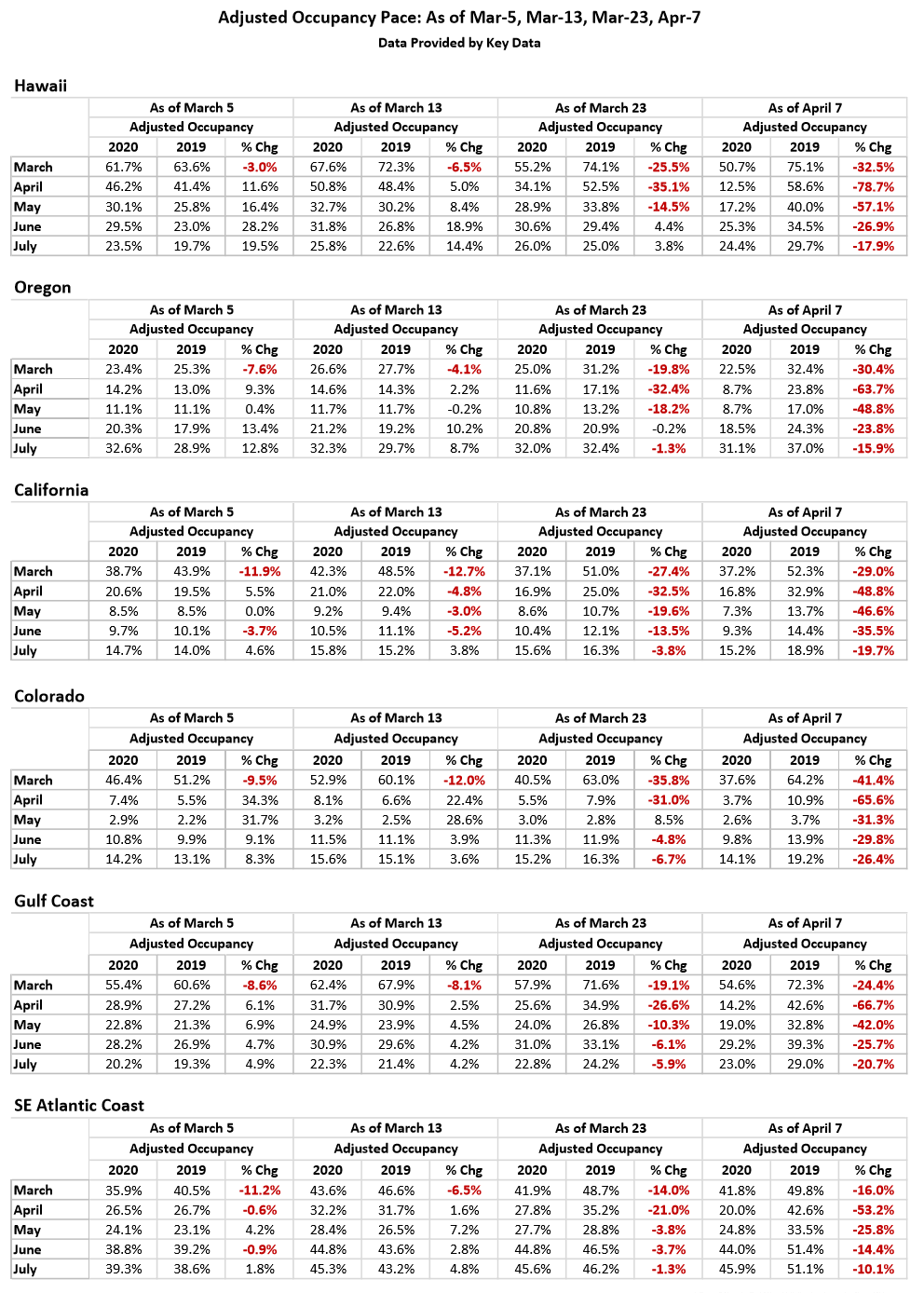
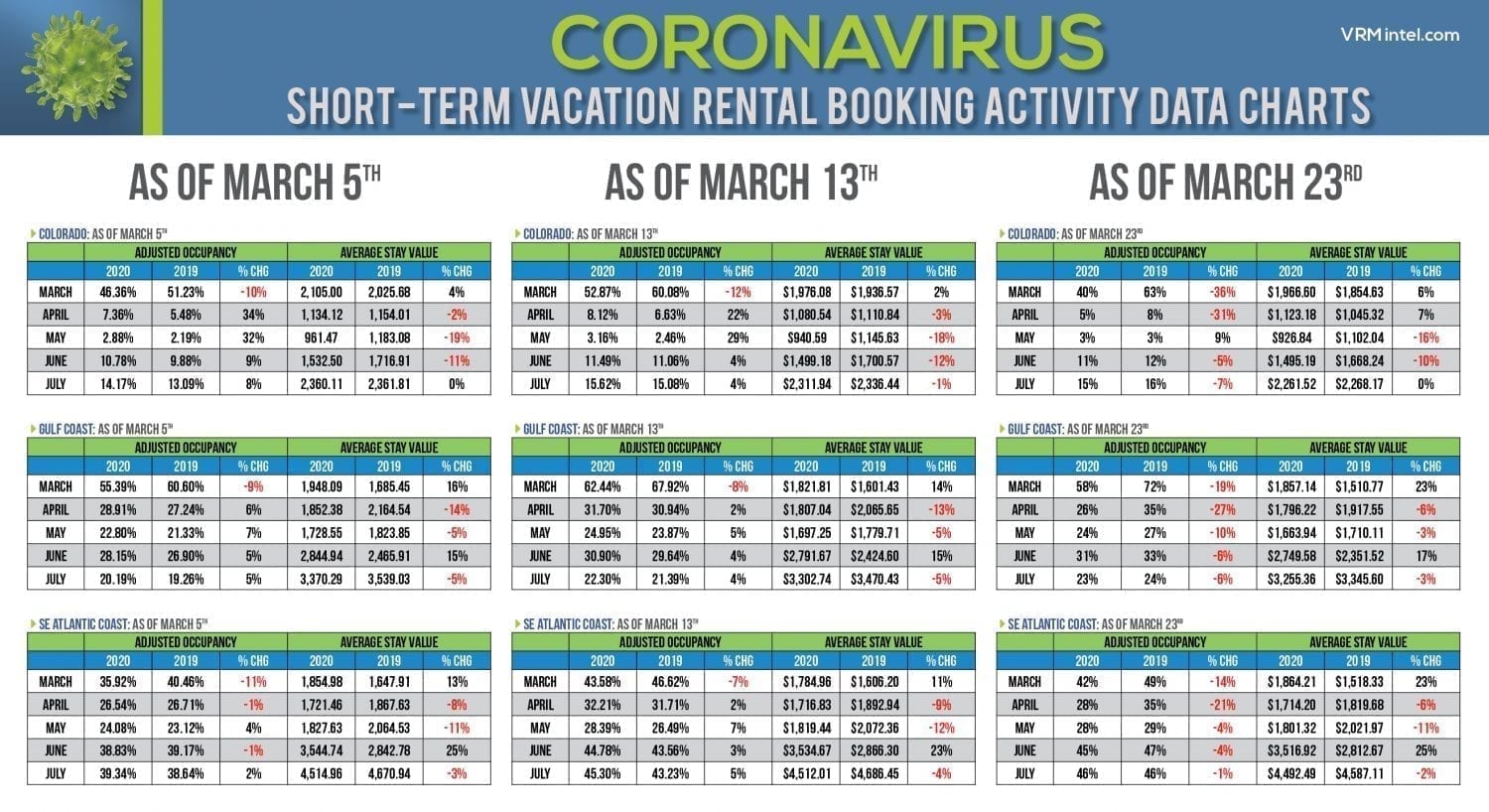
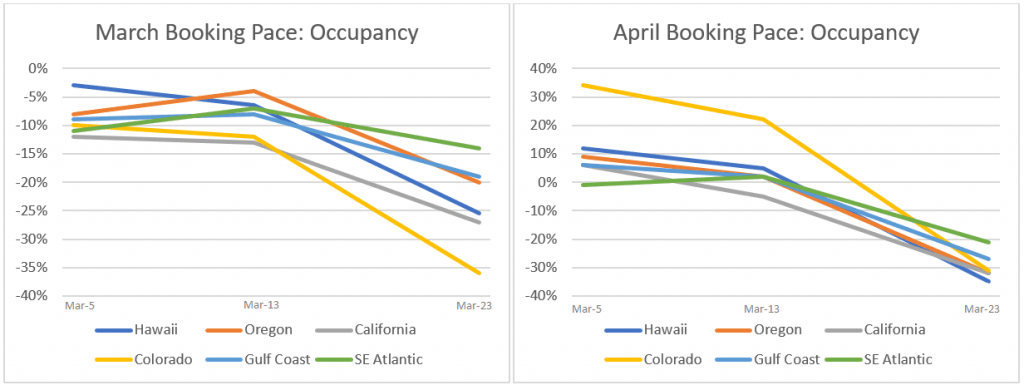
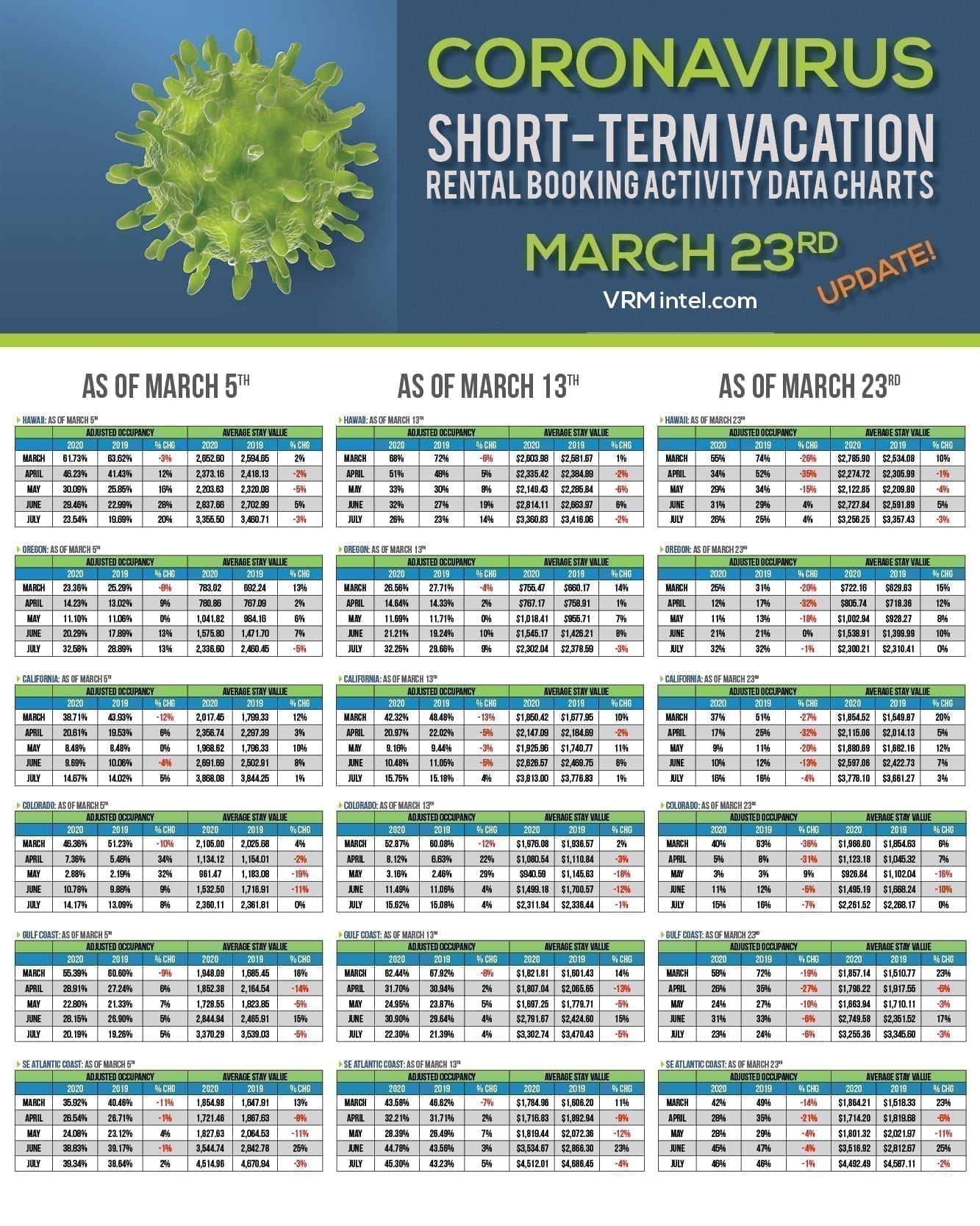
According to data sets provided by Key Data, while booking activity has slowed significantly in the last two weeks, occupancy and average stay value across key leisure-based US destinations remains strong, and the ever-so-important upcoming Spring Break appears to be holding. 

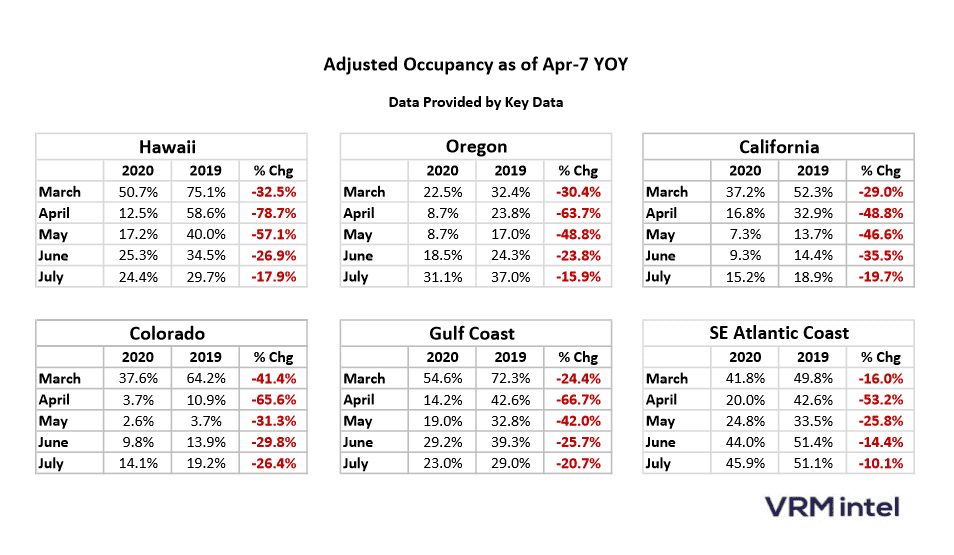
We examined Hawaii, Oregon, California, Colorado, the Gulf Coast, and the Southeast Atlantic Coast to see if there was disruption to spring and summer occupancy due to fears and concerns about COVID-19. 

The data sets compare adjusted occupancy, or paid occupancy, and average stay value for the next five months as of March 5, 2020 to the same year-over-year (YOY) time period as of March 5, 2019.

We have experienced a drop in booking activity over the last two weeks. However, because booking pace had increased over the first two months of the year, the number of reservations on the books remains healthy for both spring and summer. 

Below, Key Data provided a more detailed chart which looks at booking activity by day. 

As you can see reservation activity had increased as much as 27 percent in early January. We saw a spike right after the Book Direct messaging on Feb 5-6, and then travel concerns began to spread. Fortunately, with a head start on bookings, the number of reservations for spring and summer, as a whole, still appears to be healthy.

Friday, March 6 Webinar

View Presentation Slides


Webinar: Is the coronavirus affecting short-term vacation rental booking activity?

3

With all the questions we’ve had this week about the potential slowdown in travel, we decided to ask the experts. Is it panic or reality? Is COVID-19 having a measurable effect on short-term rentals in leisure markets?

On March 6, we held a webinar to answer your questions about the effect of coronavirus concerns on the short-term vacation rental industry. We gathered several industry leaders to discuss actual cancellations and reservation activity related to the reported slow-down in travel resulting from concerns about the coronavirus.

Friday, March 6 Webinar

Panel discussion with Cliff Johnson, CCO, Rented.com; Simon Lehmann, CEO, AJL Consulting; Steve Milo, CEO, VTrips; Jason Sprenkle, CEO, Key Data, and moderated by Amy Hinote, VRM Intel

View Presentation Slides

Sponsored by:

Red Sky Travel Insurance for Vacation Rental Managers


Strategically Working with OTAs in 2020

0

I have spent more than a decade in the hospitality industry learning and sharing how to capture more direct bookings with lower acquisition costs. Although much has changed in that time, one thing that has stayed consistent is the effectiveness of online travel agencies (OTAs). Even 12 years ago, I used OTAs to augment my business. Using these channels allowed me to sell six to eight weeks during the summer and over the Christmas holiday period. Even the days adjacent to the sold-out periods were a great time to grab new business, despite commissions of 25 percent at that time.

Many things have changed in the past decade but probably nothing more significant than the cost of running a vacation rental company. The arrival of “Big Box” companies with low transactional fees has limited what the industry can charge in commissions. If that weren’t bad enough, there’s been an explosion of property management companies emerging based on the idea that property management is an “easy” business to start. This has resulted in pay-per-click (PPC) costs skyrocketing by as much as 200 percent in some markets, making it difficult to be a profitable property manager.

With PPC costs seemingly out of control, you might wonder why I continue to support investing in OTAs.

The answer is simple. I believe the cost to acquire a new guest using PPC has reached levels that mirror the cost to capture a guest via an OTA. The recent third-quarter earnings calls with Expedia and Booking.com confirmed this. They have the same problem that property managers have, but there is a clear difference—their budget is bigger. One vacation rental manager recently told me her PPC costs had increased 190 percent over an 18-month period. I remember a time when I would barely spend $1,000 per month on PPC. Today that wouldn’t even make a small dent in the available spend for that area.

But not all OTAs are the same. Let’s get into the costs of the different OTAs.

Vacation Rental Sites

Vacation rental sites, such as Vrbo and HomeAway, have several types of fee options. With commissions varying between 8 and 12 percent, these sites are less expensive than the hotel-style OTAs.

One thing to keep in mind is Vrbo and HomeAway attract and market to guests already selecting a vacation rental accommodation. These are not new guests to the market or the category. Also, branding the property manager isn’t typically allowed. This category has a much smaller billboard effect (more on that to follow).

Hotel-style OTAs

Hotel-style OTAs typically charge commissions between 15 and 18 percent. Although quite a bit more from the outset, this investment is geared toward new guests because these channels are actually converting hotel guests into vacation rental guests. They are doing inline advertising in hotel searches to sell those travelers on vacation rentals. These are the new guests you’re looking for.

Airbnb

And then there’s Airbnb. I believe their brand has become so strong it now falls into the same category as hotel-style OTAs with regard to driving new business. And the real kicker? Airbnb guests are loyal to Airbnb. Capturing these guests once and then owning them (the harder part) is critical. However, because the cost to obtain these bookings is lower, owning the guest might not be as important as it is with hotel-style OTAs.

how does one hack these channels to get the most out of them?

1) Remember: Listings Are Ads

Pay attention to what the ad says (aka, the title/headline) and what the photos represent. A direct connect from a property management software system (PMS) can result in something like “Condo 2bedroom OF.” And believe it or not, I have seen a toilet as the lead photo in more than one advertisement on an OTA. It takes an experienced resource to build out high-converting ads.

2) Billboard Effect

64 percent of vacation rental guests start with a search on an OTA, yet only 6 percent book on that channel. Although that’s a sobering statistic, the reality is most travelers prefer to book direct. One of the real benefits of OTAs, if done properly, is using the listing for branding. There are several opportunities to brand the listing with hotel-style OTAs. I’m not going to lie, though. This takes some effort on the part of the property manager. Some channel managers brand their own company rather than the property manager. If a listing brands the channel manager, the property manager is missing the billboard effect benefit completely.

3) Effective Inventory Management

Many property managers block out availability during sold-out times. This hurts the organization more than no bookings in the high season—it also affects shoulder business. Be strategic with this channel. Make sure to utilize restrictions, such as minimum stays and closed to arrival, to fit within the overall channel strategy. Don’t just close out dates unless you want to lose potential bookings.

4) Getting the Price Right

There are so many things you can do to ensure inventory is priced right, is available, and fits sold-out periods. Companies need to understand how their rates compare to their competitors.

5) Get on the Same Page as your Guests

A lot of confusion comes from using automated emails from the channel. Property managers have the ability to customize (and brand) these communications with guests. It is important that property managers set clear expectations with guests about what they are getting with their bookings.

6) Turning Guests into Fans

The OTAs are good at owning guests. There’s an opportunity for property managers to do this, too, by building relationships with guests before they even arrive. Guest communication through hotel-style OTAs is allowed, and you should take advantage of this benefit.

7) Capitalizing on Reviews

It’s a fact that a lack of reviews can hurt bookings. Use the templates within the hotel-style OTAs to encourage guests to leave a review, and respond to reviews as quickly as possible, especially if the review is negative. This is an opportunity brand yourself and talk about what makes your property different that is not part of the listing/ad.

8) Cost Sharing

This is a scary idea, but is it possible to share any of the OTA costs with the owners? Many property managers are doing this. How can you educate the owners on how things have changed for the business and how they can benefit if they participate in an OTA channel plan? Some managers have used a branded brochure to educate and share why this channel is a valuable investment.

9) Using a Channel Manager

Yes, it costs more, but the right channel manager can help strategically plan everything mentioned above. A direct connect is perfect for those companies that want to dabble in this line of business, but if you want to be strategic and focused on growth, having the right partner can make all the difference.

OTA websites garner millions of views every day. Data tells us exactly how guests shop for vacation lodging, where they go, and how they book. Those paying attention to these channels will see more bookings and higher revenue.

Abandoned Bookings: Are PMs Losing Potential Customers during the Checkout Process?

0

Cart abandonment. Such an ominous term. No company can really and truly get in the mind of consumers during their shopping experience. Amazon isn’t completely sure why a new cooking spatula was left in a consumer’s shopping cart, nor do they know whether the consumer plans on purchasing it in the future. They also don’t know if the consumer purchased it elsewhere for a better price. All they know is that it wasn’t purchased from them at that time.

One thing is certain: they try unbelievably hard to get the consumer back to buy, no matter the reason for leaving.


Understanding the Property Management “Cart”

Let’s be clear. Our websites do not have a cart. A website visitor can’t add multiple items and check out in bulk like they can with a normal shopping cart. It’s one vacation for each transaction. A single “checkout” process.

All vacation rental websites have two key pages for booking a reservation online:

1) Property Display Page

The property display page has all the photos, availability calendars, and guest reviews as well as that giant (it better be giant if you want a good conversion rate) BOOK NOW button for each individual property.

2) Checkout Page

The checkout page is where personal info and credit card information is collected. This is also the page that gives the breakdown of rates and options for travel insurance. This page (even if it is broken down into “steps”) is the closest we get to a shopping cart.


How Do You Measure the Booking Abandonment Rate?

Let’s be blunt. You can’t. All we have is the checkout page. So really, the only metric you can measure would be the number of visitors to your website who have visited your checkout page but did not visit your booking confirmation/thank you page. You can look at this in Google Analytics by creating a custom segment with a sequence. It’s pretty technical, so get your marketing company to help you out with this.


In this example, over the course of a few months, only 309 users navigated to the checkout page and followed through to the final booking confirmation page. That’s .56 percent of all users.

However, we also want to compute the number of users who visited the checkout page but not the booking confirmation page. This number will be our cart abandonment rate. Let’s look at a few examples:

Without even worrying about the percentage math, we can immediately see that cart abandonment is indeed real. With this being the norm, however, we are stuck in the Amazon spatula situation, asking ourselves the age-old question of why.


Why They Abandon the Booking

Let the laundry list begin! Ok, it’s not all bad. However, you first have to dissect human behavior during the booking process before we can assume that they don’t like your product or website.


The facts we know as a constant:

Your property detail page never tells the full story.

Potential guests visit multiple websites (four or five) before booking, including OTAs.

Cell phone use has exceeded desktop use for total number of users (traffic, not online bookings).

Users are easily confused, especially with special deals and rates.

Shorter duration stays are becoming the norm (maybe).


Your Property Detail Page Never Tells the Full Story

Regarding our clients who have a site search bar (a box you can type keywords in to quickly search the website content), take a guess on the top keywords searched on most vacation rental websites.


“Cancellation policy”

Where is your cancellation policy posted on your website? Do you have it in your FAQs, or do you have a page dedicated to rental policies that’s easily accessible? If not, then the only place your cancellation policy resides on your website is the checkout page. Potential guests are hungry for that information.


Total Cost

Another pitfall is where you display your final rate. It’s always up to the property management company to decide where on the website they want to display their final price (including taxes, fees, travel insurance, etc.).

Some companies display the total amount with taxes and fees in the search results.

Others want to be upfront and show the full pricing breakdown on the property display page.

Some just show the base rate (before taxes/fees) on the property display page thus forcing a user to visit the checkout page to see the final price.

The latter is where abandonment metrics become diluted. This could mean that your “cart,” which is the checkout page, is abandoned at a high rate because potential guests don’t want any surprises. If your checkout page is the only page on your website that displays the final rate, then that page is no longer your checkout page. It is now your price check page—and it’s ruining your cart abandonment rate.

This is the nature of the game when someone forks out $2,500 for a week. They could be considering whether the luxuries of a well-stocked condo or home are worth a stricter cancellation policy than that of a hotel room. We may never know.

Potential guests on your website also know that by just clicking Book Now on your property detail page, they aren’t actually booking now. They know they are going to that final page to get the full picture. They are going to see if you are tacking on any additional fees or even checking the price of your travel insurance.


Guests Shop Around

Just as you could be competing with surrounding hotel-like accommodations, you could also be up against other VR inventory. Renters are looking at your site, your competitions’ sites, Airbnb, VRBO, and other sources to find the best rental at the best price that fits their needs. That’s why the average conversion rate of a website is anywhere between .3 percent and .5 percent. To keep visitors on your site, consider promoting the best-price guarantee as well as highlighting the benefits of booking directly right in your booking funnel.


Mobile Devices = Higher Abandonments

Nobody books on a cell phone. When I say nobody, I mean a small percentage. However, most of your traffic comes from mobile. According to the stats below (which are pretty normal for a vacation rental company), 54 percent of users are on their phones, but they also have the highest bounce rates (where they leave the site immediately), the lowest number of pages per visit, and the shortest time visiting your site. And finally, look at the horrible conversion rate in that last column.

Overall takeaway from this? There are plenty of lookers on cell phones, so they are important, but very few are bookers. We’re just not there yet for various reasons. But more on that later.


User Confusion

If your website is hard to follow, hard to use, slow, and doesn’t instill trust or a potential relationship in the guest, they won’t book. Transparency is key in this day and age. Everybody is on high alert for potential scams, pitfalls, loopholes, and anything else that may ruin their vacation. (Another reason they are concerned about your cancellation policy.)

Another great example would be poor use of specials and deals. If a user can’t book your special rate online or can’t see the discount at checkout, and you force them to call, you could have potentially lost that guest. They could be shopping after calling hours when your office is closed. They could be at work. They could be just browsing. They could have other things to do than sit on the phone for 15 minutes just to get a price from you when your competitor’s website gives it to them immediately. Instant gratification is the name of the game, and property managers need to provide that.

Do you know that most online bookings happen between 8 and 10 p.m.? Your office is closed. Your live chat is down. The guest leaves and finds another company that displays their special rates in an easy format.

Moreover, those special rates should be apparent while browsing too! That’s why we employ a WAS/NOW price, not only to show the guest the potential savings (since we all hate math), but also to make sure it’s upfront and easy to follow.


Shorter Stays Are Becoming the Norm

Or are they? We hear this quite a bit in the VR industry, but a study on page 58 suggests otherwise with real-life data to back up their findings. We can blame the millennials all day long, but those millennials are getting older and are quickly becoming your target demographic. Other studies have shown that people are taking more but shorter vacations each year. It’s important to know what’s popular in your market in each season.

Gone are the days where we all load up in the family station wagon, beg Dad to turn on the air conditioning, and get away for a full week. Yes, it still happens, but length of stay is completely market dependent. Property managers are reacting to the demand by modifying their minimum stay policies and offering flexible date searches to broaden the search criteria. It’s the norm now. If that’s not something you offer and your competition does, add another tick to the causes of the abandoned cart.


What Can We Do to Reduce Booking Abandonment?

Roll with the times, keep it simple, and adjust as necessary using the points above.

I’ve shown you that users don’t book on their mobile devices as much as on desktops. Even Google Analytics has a very difficult time tracking users as they navigate between devices. We also know from the stats above that mobile users aren’t as engaged as desktop or tablet users.

That doesn’t mean we should abandon them. Users will start on their phone and research you. Then, when it comes down to that final decision, they book on their desktop. The problem, though, is that there is a very large gap in synergy between the two devices. It’s just plain difficult to find that same property on your computer after you looked at it on your phone. This again hinders the checkout process.


Remind Me to Book

A simple button on your checkout page that reads “Remind Me to Book This Later” offers a quick and simple way for users on mobile devices to email themselves the property information so they can book it on their desktop.


BOOKING Abandonment Emails

Plenty of times, a user will start to fill out the checkout form and get distracted, on either their phone or desktop. Just as it does for Amazon, a follow-up email works wonders. When you capture the email address, you can easily send a quick automated email reminding the client to come back and finish booking. This tool has been invaluable for many of our clients. A couple of our clients using the cart abandonment email have earned $15,000+ and $9,400+ from guests who have returned to book from the email, and that is just from Dec. 1 to 15, 2019, during the off-season.


BOOKING Abandonment Footers

What if the guest doesn’t fill anything out on the checkout page? Maybe they leave the checkout page to look for a special. Maybe they leave the site but come back a week later. A footer notification that saves the property for them with an easy link back in a floating footer bar makes it very fast and simple to return to what they viewed and to ultimately go back to book.


The Final Word on Abandoned Bookings

It’s going to happen on any e-commerce website. Cart abandonment is normal, especially in our industry, with high-dollar transactions and when all the final information is located only on the checkout page.

However, each abandoned booking is a potential lead source— leads much more qualified than someone who visited a popular blog post on your website to let slip through the cracks.

Do everything you can to get them back. Take the time to examine your website in light of the helpful hints above and see where you can help get them off the fence and ready to book. Whether it’s the tools above, a strategically placed “Wait, don’t go” popup, or remarketing ads, there is always something more you can do to improve your online conversions.

The More You Know Expert Advice for Digital Success in 2020: A Panel Discussion with Bluetent’s Digital Marketing Team

3

By Brynn Flaherty, Andy Gaylord, Beryl Coulter, Jack Scherrer, and Alex Moshenskiy

It’s 2020, and staying up-to-date on SEO trends should be on every vacation rental manager’s to-do list. To address SEO topics that will be relevant in the coming months, we assembled a panel of Bluetent’s digital marketing experts: Brynn Flaherty, Andy Gaylord, Beryl Coulter, Jack Scherrer, and Alex Moshenskiy. They’ve compiled a comprehensive list of essential search subjects and provided their personal digital marketing recommendations as well.


HOT TOPICS IN SEARCH AND DIGITAL ADVERTISING


Google Vacation Rentals: This was a big topic in 2019, but because the feature was in beta for the entire year, there wasn’t much opportunity for vacation rental companies to take advantage of it. Because Google Vacation Rentals (GVR) is likely going to change the search landscape pretty dramatically in 2020, making sure your properties are positioned to show up there will be important.


Featured Snippets: Google is changing the way the search engine results pages (SERPs) look by adding featured snippets: interesting finds, image carousels, and more. These new types of search results take up more real estate in the SERPs, so when a vacation rental company’s web page is rewarded with a featured snippet, it can drive even more traffic and increase the company’s brand exposure. There are many ways to get a featured snippet in the SERPs—savvy digital marketers should be constantly testing content and page structure to see what works.


Competition for High-Volume Transactional Queries: Competition within the Google SERPs is increasing every day as more and more vacation rental businesses enter the space. As a result, it’s important to develop increased transactional content that ranks for relevant long-tail keywords. Long-tail keywords like “North Lake Tahoe rentals with hot tub” or “Hatteras Island homes with an elevator” are going to be easier to rank because there is less competition. And, because the keyword is more specific and targeted, it is more likely to inspire a conversion.


Quality Content: Increasingly, Google recognizes quality over quantity when it comes to content. Vacation rental companies have a huge opportunity to stand out from the OTAs by creating quality content that’s relevant to potential guests (visitors’ guides, travel tips, upcoming events, benefits of booking direct, etc.). For the most part, OTAs aren’t creating this type of content. Vacation rental companies can give the best recommendations for their areas, and they’ll be rewarded in the search results. Bonus: Guests love this type of content!


Improving Page Speed: Google continues to come out with different ways to “grade” websites and measure how fast they load. Google’s expectations for page speed are growing, and this topic is going to become even more important as we move further into 2020.


Leveraging Schema Markup: Schema markup is code that can be added to a page that gives Google more information about the page’s content and can enhance how the page is displayed in the SERPs. Schema markup is especially powerful because it can result in featured snippets (see above). For example, schema markup can be added to a vacation rental company’s FAQ page, which can help that page show up in the SERPs—complete with expandable menus showing a few questions and answers from that page. With space in the SERPs shrinking these days, schema markup can help vacation rental companies improve their presence and take up more of that valuable real estate.


Google Ads: Recently, the primary focus of Google Ads has been changing their platform to rely more heavily on automation and artificial intelligence. Through 2019, we saw significant effects of this, such as increased competition in the ad space because of this change. Automation allows for fewer barriers to entry, meaning more competitors are easily entering the space. OTAs are able to use this automation to scale their advertising rapidly and increase their online presence. Manually creating ads that more accurately target potential guests will help keep vacation rental companies competitive in the increasingly automated ads space.


TEAM RECOMMENDATIONS FOR STAYING COMPETITIVE ONLINE


Google Vacation Rentals and Google My Business

Brynn Flaherty, Director of Marketing Services

Google Vacation Rentals (GVR) is still in beta, but we think it has the potential to fundamentally change the industry’s search landscape in the coming months. We believe vacation rental companies need to list on GVR. Bluetent has taken a proactive stance: in 2019, we started working with Google to integrate directly with GVR through Boost, our channel management tool.

The Google My Business platform has many new features that can help local businesses such as vacation rental companies showing up more prominently in the SERPs. OTAs like Vrbo and Airbnb can’t show up in the local Google results, so this is a nice way for vacation rental managers to compete with the big companies. From “Posts” to “Offers” to the new “Shop” feature, we can help our clients increase their brand exposure in real time in Google.


Super Meta Descriptions

Andy Gaylord, Content Marketing Manager

As Google’s algorithm has gotten smarter, it has become better at scraping content from websites and rendering it on SERPs. This means meta descriptions have become less important and on-page content has become more important. I am encouraging our clients to focus on clear and concise summaries (super meta descriptions) within the content to give Google and other search engines more to read and render in the search results.


Local Listings and Booking Strategy

Beryl Coulter, SEO Account Manager

Many of my clients are active on local listings such as Google My Business. Local listings generally have good placements within the SERPs. When vacation rental companies provide updated local listings, they can show up multiple times in the organic results. Within a local listing, there are more opportunities to share info with guests—property photos, company updates, links to vacation rentals, and so on.

OTAs continue to rank well organically and gain recognition with travelers. Many people searching for a vacation rental still think of searching an OTA first rather than going directly to a vacation rental company’s website. Listing on OTAs is important, but so is direct booking—individual properties should be optimized to show up in search results. We recommend that our clients write property descriptions with searchability in mind.


Page Speed, Analytics, and Branding

Jack Sherrer, Analytics Manager

One of the ways our digital marketing team has been helping clients improve page speed is by migrating third-party marketing scripts (like Facebook tracking pixels, pop-up windows, call-tracking scripts, etc.) from the codebase to Google Tag Manager. That way, each script doesn’t have to load before the page loads, which can drastically improve speed and website performance.

Bluetent’s new business intelligence reporting tool utilizes Google Data Studio to expose areas of opportunity in our clients’ marketing efforts and in website functionality. We can embed this new custom analytics report directly into a Rezfusion Cloud or Pro website so that the data is always at the client’s fingertips. Vacation rental companies can develop actionable insight into website traffic origination, average size of booking windows, performance of marketing campaigns, and more—just by visiting a page on their website.

Competing with OTAs, which have infinitely more marketing reach and budget, for organic search results can be difficult for smaller vacation rental companies. Although you need visibility there, it’s more important than ever to push your brand through unique value propositions and excellent customer service. Procure and respond to reviews—the good ones and the bad ones. Be genuine. Leverage your local knowledge. Be better than you are right now.


Targeted, Personalized Digital Advertising

Alex Moshenskiy, Digital Advertising Manager

Google Ads is a pay-to-play platform, and our clients are always faced with the issue of how they can compete on far smaller advertising budgets than the OTAs. The OTAs have strong brand recognition and are able to flood the market with large advertising budgets and automation. However, automated ads are often poorly targeted and frequently don’t resonate well with living, breathing searchers. Bluetent focuses on building strong digital advertising strategies for our clients using deep-dive analysis to create personalized ads that connect with target markets. Applying a wide variety of data points allows our clients to efficiently and effectively reach potential customers, drive direct bookings, and compete against the OTAs.

Want to stay competitive online? Our digital marketing experts are here to help. Contact Bluetent at 970.510.5615.

Scott Breon steps down from Vacasa as Head of Revenue and Chief Analytics Officer

4

Scott Breon, chief analytics officer and head of revenue at Vacasa, is leaving his position at the company, according to insider sources.

Scott began with the company in 2013 as product analytics manager and, in 2014, took on the role of chief strategy officer. He was instrumental in creating and implementing Vacasa’s distribution strategy and its proprietary revenue management technology. He also worked closely with Google to become the only property management company with a direct connection to Google’s new vacation rental platform. Breon will remain as an advisor to Vacasa.

The news comes just a few weeks after the abrupt announcement that Scott’s brother and Vacasa CEO, Eric Breon, had stepped down from his role.

Industry observers speculated that Eric’s departure, along with the announcement of former OpenTable CEO Matt Roberts being named interim CEO, was designed to attract top-tier talent in the company’s search for a top executive to lead the company in its IPO. 

However, the additional departure of Scott Breon is leading to more questions about the company’s internal dynamics and trajectory. 

Experience and Professionalism: Why They Matter in the Vacation Rental Industry

1

I began my career in the vacation rental industry 20 years ago. As a kid out of college, I accepted a job with ResortQuest, preparing federal tax returns. I was immediately fascinated by the vacation rental sector. I would explain my new position to anyone who would listen, yet everyone I spoke to asked me if I was in the timeshare business. In June 2000, vacation rentals were unheard of as a lodging option for mainstream travelers. Fast-forward to today: vacation rentals are listed in the toolbar on Expedia. The entire traveling public is now aware of our former cottage industry.

I would estimate that it has taken us 50-plus years to get to this point. There is a wealth of knowledge and experience available to us as vacation rental managers (VRMs), yet we rarely use it.

VRMs continue to search far and wide for the newest, brightest, most progressive widget in an effort to streamline, standardize, and supersize their businesses. The constant quest is actually hurting the business, and it’s time to slow down. It’s time to focus and consider our return on effort, seeking ways to become more effective and produce a meaningful profit.

As we embark on a new year, it’s time to align our business with our experience and become more professional.


Review Service-Oriented Processes

One of the quickest ways to increase the “experience” level in your business is to review your processes and develop a service-oriented approach to each issue. As problems arise, they require time and energy to resolve, yet we fail to recognize that the international vacation rental industry is actually thousands of years old. Jesus was born in a stable because there was no vacancy at the inn—or was it a vacation rental?

It’s important to note that there are no new issues in the vacation rental industry.

Someone, somewhere, has dealt with the same challenge before. We continue to have recurring difficulties in the business, yet we fail to make adjustments or implement corrective action. Developing company-standard resolutions to common issues and to frequently asked questions (FAQs) will help to ensure that your team is more consistent and effective, as in a more-experienced business. Leverage your own proficiency to start, learn from problems that arise, and err on the side of service. Details matter.


Choose Experienced and Professional SS&Ps

VRMs also have access to a tremendous amount of knowledge in our vendor partners. With that said, finding the right vendor partner is not always easy. VRMs must run a gauntlet of needs/wants in the business today. Software, services, and products (SS&P) are hurled at us almost daily, and VRMs must get better at navigating this onslaught of solicitations.

Generally speaking, business revenues are not increasing at the same rate as new SS&P are being purchased and implemented within the business. Experience is paramount when it comes to vendor partners and SS&P. There is an old adage, “Hire old doctors and lawyers.” The same could be said for the vacation rental industry.

Experience matters when deciding which SS&P to purchase, yet we fail to properly weigh experience when making a decision. Time spent in the marketplace, tenure of the vendor contact, the pricing model, service, and support should all be areas of focus.

Many fee structures, such as flat fees per property or a percentage of revenue, penalize the business. If the service being sold is so great and your business is going to make so much money as a result of a purchase, why not have an agreed-upon sale threshold?

Return on investment is often overlooked, and too many businesses are not getting the product and service they bargained for during the negotiation process. Often, VRMs wind up subsidizing an underperforming vendor partner.

It’s time to hold your vendor partners accountable for the service provided and stop rewarding poor performance.


What Does It Mean to be Professional?

As you begin to alleviate recurring issues and surround your team with more-experienced partners, the business inherently becomes more competent. Unfortunately, many vacation rental management companies are not grounded in sustainability, profitability, and professionalism. The best businesses in the industry are the most professional ones.

What does it mean to be a professional? Below are three key elements:


1. Treat owners and guests the way you would want your family to be treated.

Issues are going to arise; it is how those issues are handled that is important. Not every owner and guest is out to take advantage of the business. If the home was not cleaned properly or there is an issue during the stay, resolve these problems the way you would want to be treated. It’s okay to draw the line, but most VRMs don’t get to that point. Too many VRMs are combative when issues are presented.

One easy way to ensure problems are resolved in a reasonable manner is to follow the LEARN method:

L = Listen to the owner or guest

E = Empathize with the owner or guest

A = Apologize

R = React by offering a solution

N = Notify the rest of the team about the problem so they can follow up with the customer and escalate for resolution if necessary.

How much would you reimburse/pay to avoid a negative review? Over the course of a year, I guarantee your aggregated reimbursement expense is less than what a negative review might cost your business.


2. Be a good operator/competitor.

There is entirely too much infighting in today’s environment, and too many VRMs are trying to game the system. The best businesses in the industry are not overly aggressive. Providing great service, clear communication, and quality properties is key to great business.

Service and professionalism sell.

If you have to tell an owner or guest how great your business is, it may be time to review your company. Consider the local market and competition as you conduct business. Your competence will be apparent to owners and guests, as you create a rental program that they actually want to use.


3. Being professional requires a VRM to be profitable.

Too many VRMs are not generating a meaningful profit. Certain VRMs are afraid of profits or are reluctant to charge for services provided.

Your business cannot be successful or be positioned as a professional vacation rental management company if you can’t afford to operate. Sell your service and don’t be afraid to stand behind it. Discounted fees, free services, and gimmicks will lead to a less-profitable and diminished business over time.

As you consider the business you want to build and operate, be attentive to experience and professionalism. A thoughtful, measured focus on these two areas will create a sustainable and hugely profitable business. The current bull market, robust economy, and amount of free cash flow will not last forever.

Providing exceptional service, clear communication, and well-maintained/clean properties will ensure your business has the attributes needed to navigate an ever-changing industry.

Regardless of the many changes in the sector, these things remain the same.

If you or your business are struggling to adapt to industry change, concentrate on being as professional as possible. And to make the most out of 2020 and beyond, focus on the details of your processes, leverage your experience, and enhance professionalism through service.

Condo-World Acquires North Myrtle Beach’s CondoLux

0

Condo-World Continues to Leverage Proprietary Technology and its Hybrid-OTA Model in 2020 Expansion Strategy

Late last year, Condo-World, based in in North Myrtle Beach, South Carolina, acquired one of its regional competitors, CondoLux, bringing Condo-World’s total managed inventory to just over 500 oceanfront condos.

Over the past 35 years, each company has played a significant role in growing the demand for condo vacations among visitors to the Myrtle Beach Grand Strand area. Between Condo-World and CondoLux, the two companies represent primarily luxury oceanfront condo rentals, including the management of on-site desks at several properties. Both companies have been major contributors to the golf package business as well, booking nearly 30,000 tee times per year.

“Condo-World and CondoLux have grown up side by side in North Myrtle Beach both virtually and geographically,” said Alex Husner, Condo-World’s chief marketing officer. “As across-the-street neighbors, Condo-World and CondoLux had a lot in common. For example, CondoLux also uses RPM, our proprietary software, which made this opportunity even more appealing; and Condo-World.com and CondoLux.net have been the two powerhouse websites in organic searches for anything related to condo rentals in the Myrtle Beach area for many years.”

Now under one umbrella, Condo-World will extend its marketing, revenue management, and property-care services to CondoLux homeowners. Condo-World will be the parent brand for all marketing efforts and in-market signage, but the CondoLux brand— with its large online presence—will be maintained digitally through its websites and social media profiles to provide additional exposure to all properties.


Condo-World’s Hybrid OTA Model

In addition to its expansion and aggressive in-destination marketing, Condo-World has executed a unique hybrid strategy, which includes (a) increased investment in the development of its proprietary technology to meet the specific needs of condo managers, and (b) the expansion of its national online travel agency (OTA)/ booking site for condo rentals in key resort areas across the US.

Designed to be a pure OTA, Condo-World.com provides its guests a wider range of accommodations through strategic partnerships with preferred resorts and rental companies outside its home base.

The hybrid model has been successful at deepening relationships with Condo-World’s loyal guests and with its resort partners. With a primary focus on condo travel, Condo-World has been able to target a segment of travelers in a more focused way than other online alternatives, and we expect to see innovative development of its loyalty program in 2020.


Multi-tiered Strategy

“After a summer-long exploration of what would be the next big move for Condo-World, we were at a decision intersection,” said Husner. “Our long-term goal is to grow market share locally through our managed portfolio and regionally through our exclusive resort partnerships. There are a variety of outputs that are complementary to both objectives, including the development of our custom loyalty program, building out additional API connections, and licensing our proprietary software.”

Husner continued, “When the opportunity presented itself for us to acquire CondoLux, we knew that was the direction we needed to go first. The acquisition was a natural extension of our growth because it increased our managed inventory in North Myrtle Beach from 350 to over 500 oceanfront condos and provided numerous advantages with economies of scale. Even better—the acquisition increased our ability to execute on our three core growth strategies, and now we are able to tackle all these projects as we move into 2020.”


Benefits for Resort Partners

As part of its OTA strategy, Condo-World has developed World Class Destinations by Condo-World, a collection of exclusive partnerships with resorts and rental companies with properties outside of its North Myrtle Beach home base.

“Gone are the days when guests only want to vacation in one spot—more than ever, guests want to try new destinations and take trips more frequently,” said Husner. “Through this program, our guests can ensure that the quality they have come to know staying with us in North Myrtle Beach will be upheld when they visit our partners. With the CondoLux acquisition, our audience has effectively doubled, which will allow us to reach additional guests in a noncompetitive approach that complements our partners’ marketing efforts.”

This spring, VRM Intel will join Husner to learn more about the growing segment of condo travelers and about Condo-World’s resort partnership programs at the upcoming Onsite Property Management Association Summit, at Hammock Beach Resort in Palm Coast, Florida, from May 6–8, 2020.

Expedia shifts focus to direct consumer relationships: “SEO is not the future of our business”

5

In a refreshingly clear-eyed and candid earnings call on Thursday, Expedia Group Chairman and senior executive Barry Diller and vice-chairman Peter Kern (who are running Expedia following the exits of Mark Okerstrom and Alan Pickerill) discussed Expedia’s adjusted trajectory, Google’s effect on the business, Vrbo, and its new focus on developing direct relationships with consumers.


The Google Effect

Expedia is not happy about changes at Google.

According to Barry Diller, Google should have oversight, but Expedia isn’t waiting for the government to step in: “When businesses get to this size they absolutely have to have regulation—sensible regulation . . . I do believe that will happen, but we are making our own efforts. We are driving direct relationships with consumers.”

Diller said Expedia’s app download growth is up 40 percent this year and added, “We are going to do everything we can to diversify our traffic to more direct arenas.”

Related: OTAs ask EU Commissioner to investigate Google Vacation Rentals

SEO Challenges

According to Peter Kern, “[SEO] is still a significant part of the business and a good part of the business. We’ve been belaboring this, but clearly as we move to direct relationships and direct traffic, with our customers. That is the single best way we can offset any declines that come from SEO.”

Reflecting on the previous quarter’s results, Kern said, “In terms of what happened in the third quarter, I think it was a compounding of a number of tactical things that Google did, and we did not respond well to. Again, Barry mentioned in the very beginning, we were caught up in a rather large undertaking in terms of reorganization, and that took people’s eyes off the ball, in our view. We could have done better; we should have done better; we will do better. There were also some changes in some auction dynamics in meta that we did not respond particularly well to. So there are a number of things that were going on that we were not really on top of. SEO was one of them. We expect SEO to be a continued headwinds.”

“Google—until someone stops them—is not going to stop doing what they’ve been doing,” Kern added. “We’ve seen signs as recently as last week of some changes that may have impact and hopefully they will think better of it and create a fairer marketplace. But we can only control what we can. We are working really hard to offset those headwinds in pure SEO activity, as well as do everything we can around the rest of the business to make up for whatever we give up in SEO.”

“SEO is not going to kill us,” Diller said. “And SEO is not the future of our business. These trends began seven or eight years ago. We should have been more alert obviously to the continuing consequences of this. I don’t think we are going to be saved by some bell—by a government bell. I absolutely believe there will regulation, but we are doing all the things that we intend to do to de-emphasize it. It is a part—not a huge part—but a part of our business, but it ain’t the future.”

Will Google also create competition on the supply side?

However, many are unsympathetic to Expedia’s challenges with Google, as Google is now doing to OTAs what OTAs did to its lodging suppliers: bait with traffic, create dependency, and then switch business models.

A expected problem for OTAs is that its vacation rental providers are now accustomed to paying for booking performance (thanks to these same OTAs), and are agnostic on whether they pay Google, Expedia, Booking, or Airbnb.

As more vacation rental channel managers are able to connect directly with Google’s new vacation rental OneBox search functionality. vacation rental managers and homeowners are not going to need to use an OTA to connect with consumers. Since Google is at the top of the funnel for vacation rentals, managers are likely to shift budgets from OTAs to Google. As a result, brands like Vrbo may have a supply problem resulting from Google’s new format in addition to the decline in consumer traffic. 


Views on Vrbo’s Rebrand and Performance

Expedia executives were asked, “Is Vrbo where you need it to be, in terms of operations, marketing, etc., in order to attack the alternative accommodations market?”

According to Diller, “No. Vrbo is not where it needs to be, but it is a lot different than it was a few months ago. It has a new leader whom we have confidence in, and he is also on the ground. And—look—what happened to Vrbo is it was—as I think all of you know—a collection of a bunch of disparate businesses/brands all over the world, basically, that were bought together and put under the name of—a dumb name—called HomeAway, which meant nothing to no one. We did have one business which did mean something to people called VRBO which we tried and I think are at the very beginning of branding Vrbo. And, I don’t know if we went too fast or too slow on this, but we did this absolute change—day one to day two—from everything to then one thing Vrbo. That caused it to lose a ton of SEO traffic. Given the trends in SEO anyway, it was not well executed.”

Diller continued with what we believe to be a little dig at Airbnb: “Vrbo is in a great—somewhat standalone—category. It’s not rooms in the attic that people rent you and stand next to you while you go to the bathroom. It is basically accommodations for families, whole homes, and large apartments in resort areas and other places. It’s got great product. We just need to market it better than we have, but certainly it’s got large opportunity for us.”

He added, “As far as the category, I’m very impressed with what Airbnb has done over time. I wouldn’t call it a revolution, but not only has it opened up inventory that didn’t exist, but it has also brought people into traveling that couldn’t afford it before, or didn’t want to mess with big stiff hotels, and also people who wanted a different experience, older people who were lonely and didn’t want to go to some cold place. It’s done a great job. But you put its inventory against hotel inventory, they have kind of a different audience. I’m not a big believer that they’re going to merge. I think there is a healthy standard hotel business and there’s going to be this business. We are participants in it.”

Diller also announced that almost all of Vrbo’s inventory is now on Expedia.com. 


What we can expect from Expedia

Unlike previous earnings calls, Diller and Kern were open about the direction they taking Expedia. On the consumer side, the company is looking to “ease their path to travel” and “add value” for its consumers. Internally, the company is looking to streamline and simplify the business and decrease costs that resulted from unnecessary complexity. 

“We were a bloated organization . . . over the years, chasing the tail of growth, adding people and people and complexity and all this stuff until very few people could figure out what they were supposed to do during the day,” said Diller. “Simplifying that has a great by product of cutting our costs.”

Kern added, “The industry suffered –or benefited — from a high degree of commercialization around everything they did. It was an aggressive ‘how can we turn a customer into a consumer into buying a hotel room?’ That goes for all OTAs. And I think, ironically, to tie a few of these questions together, that Google’s pressure and the pressure on performance marketing puts the pressure back on all of us to make it about the consumer experience.”

Throughout the call, Diller and Kern mentioned several initiatives they’ve added to the playbook for 2020:

  • Progressive web app (PWA) growth
  • Focus on user experience
  • Packaging: Adding value to consumer by packaging to provide lower price and better experience
  • Content: Customizing content that is served and matched to the customer
  • Call center improvement
  • Brand differentiation
  • Driving “biggest pools” of direct demand
  • Customer retention and loyalty
  • Streamlining and simplifying businesses and identifying areas for cost-savings
  • Experiences

Property Managers or Hospitality Providers?

0

With the convergence of lodging types in the minds of consumers, traditional property managers are transitioning into hospitality providers.

The role of vacation rental property managers has changed over the past decade. Responsibilities have more than doubled, particularly with respect to operations and guest services. There is a tighter booking window, and the average length of stay is shorter. Hotel and vacation rental inventories have converged on travel websites. Big travel brands are crossing segments as well: Airbnb purchased HotelTonight, Marriott launched its Homes and Villas product, and OYO pushed into vacation rentals. Customers are shopping fluidly between segments and expect the same quality experience whether they stay in a vacation home or a hotel. At this point, “property manager” is becoming a misnomer in the industry, one that fails to convey the full scope of service and value these professionals bring.

It’s official: property managers have become hospitality providers.


Why the Title “Property Manager” Isn’t Enough

Historically, vacation rental managers were hired by second homeowners to (a) market their homes, and (b) oversee maintenance and property care. Managers generated bookings and rental income, offset by maintenance expenses, and handled the accounting.

Short-term vacation rental property management, much like long-term residential property management, was transactional.

Today, managers are required to take a more proactive and purposeful approach to their work. There is a newfound focus on guest service that demands the full attention and resources of property managers. The job is now more guest-centric, and managers are responsible for facilitating a branded guest experience from the booking process through checkout.

Hospitality providers have always made the guest experience the core of their business. While these operators are similarly responsible for upkeep and maintenance, their focal point has always been servicing guests.

Guests staying in a hotel are constantly surrounded by service personnel who see to it that every request and question is promptly resolved. Hospitality providers are in the business of building relationships with guests by creating valuable touch points throughout the stay, such as daily cleaning, turndown service, or a personalized concierge. Staff are trained with clear standards of operations that fold into the hotel’s brand guidelines.

Vacation rental property managers are now tasked with all the above but in a more challenging environment with unpredictable variables and competing responsibilities. Unlike hotel proprietors, vacation rental operators are faced with managing properties in differing locations, maintaining large spaces with multiple rooms and exterior amenities, working with several owners who have distinct preferences and expectations, and coordinating various external service partners. A standard hotel room with two beds, a dresser, a TV, and a bathroom is a more predictable setting. In comparison, a vacation home requires significantly more attention to detail and permits a smaller margin for error.

And yet, professional managers of vacation rentals get this done. They turn over a seemingly impossible number of unique homes according to their specific brand standards, and at the same time offer concierge services with maintenance plans tailored to each owner. These offerings are much more than reactive property management and go a long way in shaping the guest experience.


The Role Is Evolving Along with the Industry

The modern traveler is looking for a comprehensive, Instagram-worthy experience: meaning all the amenities of a hotel plus the uniqueness and privacy of a vacation rental.

Travelers today are demanding more service than ever. These expectations don’t seem to be plateauing any time soon. Moreover, the profile of today’s traveler is younger; 82 percent of millennials traveled last year and cited experiencing new cultures as their primary reason.

These guests are accustomed to a higher level of service across every interaction. It’s much more than providing a clean accommodation—the expectation is a curated stay. The need to meet these expectations and facilitate this type of experience has forced managers to rework their offerings and branded experiences to differentiate themselves from the crowd.

Managers have responded by expanding concierge service, around the clock availability, and access to extensive local recommendations. Options such as grocery delivery, chefs for hire, drivers, affiliations with excursion providers, itinerary creation, and other personalized offerings have become common and are often influential considerations during the booking process. The sky is the limit when it comes to amenities, and managers are aware of the implications of failing to increase their service offerings.


Strategies to Embrace This New Terminology

The trend toward more service has been a catalyst for continued growth in the short-term rental category and has led to increased demand among those traditionally partial to hotels.

Vacation rental managers have met this demand, and while they might not have changed their titles (yet), many managers have already made the transition to being hospitality providers. This is evident in the ways these professional managers talk about their businesses, market their rentals, communicate with guests, and implement brand standards.

For those managers who have yet to transition and double down on “hospitality service,” expanding concierge offerings is less intimidating than it seems. Start by identifying additional amenities that you would like to offer, then work backwards to determine what services you can provide immediately. Discuss the timeline for rolling out these new initiatives with your teams and stakeholders, and track your progress accordingly. Holiday Vacation Rentals, for example, now offers a list of supplies that travelers can request to be stocked at the property ahead of their arrival. Guests can also order flowers, balloons, or gift baskets to celebrate a special occasion during the trip. This is becoming the standard and was much different in the days when guests didn’t know if they needed to bring their own sheets and towels.

To scale and sustain these guest amenity programs across your portfolio, managers need to equip themselves with the right tools to access data. When repeat guests book a trip, reviewing information from previous stays is important. Check for historical requests to see if any issues popped up during their stay. Try implementing a survey for new guests to better anticipate their needs, or even soliciting special requests in advance. Taking these proactive steps will help facilitate success for your team and ensure that guests are more satisfied.


Hospitality-Level Service Is the Next Big Opportunity

The vacation rental industry is continuing to evolve and mature, and with that comes a change in the set of responsibilities and expectations. The moniker property manager doesn’t nearly encapsulate the work that goes into the job, nor does it capture the emphasis placed on personalized guest service and property care.

Professionals who have traditionally worked with vacation rentals are at the forefront of the movement toward hospitality living, servicing both guests and owners. Those who offer creative amenities and services to curate guest experiences will embrace their new hospitality provider title and capitalize on this huge opportunity.

VRM Intel Live! is heading to Gatlinburg, Feb 26, with advanced-level education and discussion for vacation rental managers

0

Vacation rental professionals are heading to Tennessee in a few weeks for VRM Intel Live! Gatlinburg. The conference will be held on Wednesday, February 26, from 8 – 5, at the Gatlinburg Convention Center. With 26 sessions covering marketing, strategy, operations, property care, technology, and revenue management, we are bringing national-conference-level education, discussion, and speakers directly to the TN mountain markets. 

It is becoming increasingly costly to send staff to national conferences for education and training. At VRM Intel, our Live! events are designed to bring this education directly to regional markets so in-market team members have a chance to learn about industry changes, see performance data, and get access to the latest education and information. This is our largest and most comprehensive lineup of sessions we have ever offered at a Live event.

The early registration fee is $129 per attendee through Feb 15, and $199 after the 15th. Tickets include access to all 26 sessions, breakfast, lunch, all-day sodas/coffee, snack breaks, and the cocktail party at Ole Red (from 5 to 7),

Click here to register. 


General Sessions

2019 Performance and the 2020 Forecast

Key Data and VRM intel take a deep dive into actual year-over-year (YOY) performance. Which areas saw YOY growth? Are we seeing migration of guests across destinations? Did we see notable swings in ADR, Occupancy, and RevPAR? Get the answers to these questions and more as we examine 2019 activity and look at year-to-date booking activity for 2020. We will also look at the TN-SC-NC-GA regions to identify trends. 

A New Decade in Vacation Rental Management

Vacation rental management companies are witnessing a shifting landscape with an influx of new faces, business models, and customer behavior. Industry leaders will be on stage to discuss regional changes, the competitive environment, new franchise models, preserving our destinations, and the future of vacation rental management in this new decade. With Jim Olin, John Madewell, Steve Milo, and Shawn Spiezio


Marketing Sessions

SEO/SEM Disrupted: Google Shakes Up the Funnel
Changes at Google are disrupting traditional SEO and SEM strategies. How are these changes affecting marketing efforts, and how can VRMs navigate the new search format? Amber will demonstrate what has changed at Google, how channel managers and OTAs are working with Google’s new booking platform, and what strategies VRMs can implement to get in front of the coming disruption. With Amber Carpenter
 
Could You Be Losing Guests in the Booking Process?
Once a guest finally chooses one of your rentals, are you losing them in the booking process? Identify and create a user-friendly online booking process while keeping guests excited about booking their vacation as they finalize the reservations. Analyze abandoned shopping cart activity, examine rental policy formats, and ensure an easy contract signing process. With April Burns, ICND
 
How to Leverage Marketing Tools for Business Decisions & Real Results
While SEO and marketing tools provide incredible data, these tools oftentimes overwhelm non-marketing professionals. However, with a small amount of training, these tools can provide actionable data that provides a solid foundation for real-life business decisions. With David Angotti
 
Mitigate Bad Reviews and Get More 5-Stars
Most people do not leave reviews and those who do either had an amazing stay or well, you know, a really bad one. In this session, I will show you how to get more reviews so you have more data to make better decisions with as well as show you how to mitigate bad reviews so they do not get found online. You’ll also find out how to get more 5 star reviews on TripAdvisor, Google and other review sites. This is critical for social proof, conversion and even SEO. With Justin Jones, IMEG
 
Building the Relationship with Guests Before, During and After the Vacation
With more guests going straight to the property, it is increasingly difficult to build a trusting relationship with them that keeps them coming back year after year. Using email and SMS/text messaging, we’ll discuss how to connect and interact with guest with information that communicates trust and ensures that guest expectations are set and met. Alisa Justice, Bluetent
 
Strategically Working with OTAs in 2020
People talk about strategic use of OTAs, but what does it actually mean? This session covers when to use OTAs, maximizing real estate on listing pages, and pricing strategies. Plus, does the billboard effect still exist and, if so, how does a VRM plant brand info into listings? With Michelle Marquis, Lexicon


Strategy Sessions

HR 411—Critical Workplace Topics for 2020
Workplace issues that kept leaders up at night in 2019 continue to cause more anguish in 2020. To assist you with a strong start as the calendar turns, we’re looking back at the key workplace topics that trended throughout 2019 that we expect will continue to hold your attention in the months ahead. Employment updates on salaried employees, overtime, marijuana, sick leave, ban the box and other key changes will be addressed during this session. With Sue Jones, HR4VR
 
The People Problem
Of the many challenges for vacation rental managers, the most pervasive and the most constant always seem to be people. Putting the right people in the right seats is critical to the success of any business. With unemployment at an all-time low, it’s harder than ever to hire and retain great talent. This session will focus on identifying, hiring and inspiring great teams to drive results within your organization. With Steve Trover, Laveer and Co
 
Proactive Homeowner Acquisition
Competition for new homeowners has sharply increased with the influx of new and aggressive multi-destination companies. Pfautz discusses how homeowners are making decisions about choosing a VRM in 2020 and how to tell your story and set your company apart from the competition. With a focus on data and performance, VRMs can examine unique strategies and practices for targeting homeowners with the right message at the right time. With Brooke Pfautz
 
Lessons Learned—Technology, Hiring, Owners, Guests, Laundry, Linens and More
Experience is the best teacher, and some lessons are learned the hard way. Milo will candidly discuss some of these lessons he has learned over the last 15 years in vacation rental management, including implementing technology, hiring, working with homeowners, dealing with guests who want to blackmail you, battling regulations, facing new competition, and more. With Steve Milo, VTrips
 
Experience and Professionalism: Why it Matters in the Vacation Rental Industry
With new entrants in the vacation rental industry, the level of professionalism has seen a decline across the US. How is this lack of experience and diminished focus on best practices affecting the industry? Edwards will discuss the important of professionalism and how VRMs can raise the bar to create a higher expectation for homeowners, in our destinations, and in the industry. With Ben Edwards, Weatherby Consulting
 
The Data Behind the Guest Experience Movement: A Glimpse into Why AirBnB, Booking.com, and Expedia are Investing Millions of Dollars into Experiences
Join Matthew Loney, President and CEO of Xplorie, as he reveals the data and rationale behind the OTA’s growing investment in experiences for guests. We’ll take a deep dive into what it means for the vacation rental industry and how you can leverage your local tours and attractions to secure a competitive edge.
 

Technology and Revenue Management Sessions

The Growth of Smart Home and its Implications for Property Managers
Smart home technology is quickly changing our industry. Join us as we discuss the challenges and opportunities this presents to property managers and how you can leverage this technology to improve operations, safety, and guest/homeowner experience. With Stevan Henning
 
Revenue Management Infrastructure
Now that the vacation rental industry is getting destination-level performance data, we have the ability to create data-driven revenue management processes and practices. With a background in hotel revenue management, Saylor will show VRMs how hoteliers determine and implement pricing strategies by combining technology (including PMS software, pricing tools, and data sources), and how these processes compare and contrast with the vacation rental industry. With Ryan Saylor, Beyond Pricing
 
Advanced Revenue Management
Putting the “how-to” after the “why” with Anurag Verma, Pricelabs
 

2020 Technology Landscape

Vacation rental technology has seen a shakeup over the last two years with consolidation and emerging third-party solutions. How are software executives looking at building PM software and how are property managers navigating combining the use of third-party tech products with their PMS? Panel: Scott Butler (Inhabit IQ), Brett Parry (Streamline), Ryan Bailey (TRACK), Ed Ulmer (Barefoot Technologies), and Joy Ritter (LiveRez), moderated by Amy Hinote
 
Data-Driven Business Strategy
VRMs now have access to a ton of data, including destination data, performance data, website analytics, call center data, property data, and more. But how do managers combine all of this data to make business decisions about growth, staffing, pricing, and marketing? Each piece of data tells a small part of the business story, and when taken out of context, it can be misleading. But when the pieces are combined, VRMs can use these data sources to boost performance and maximize growth opportunities. With Brise Carpenter, NAVIS
 
Data Workshop
Become a performance and destination data expert and identify KPIs that are important to your business. Learn to use the Key Data Dashboard to create reports that help drive business decisions, pricing and marketing strategy. Create your own dashboard views, and learn to quickly pull individual homeowner performance. Now that we have the data, let’s learn how to use it. With Key Data Team


Property Care Sessions

Making Safety a Top Priority 
It is important to address safety in your vacation rentals to prevent harm to guests, avoid lawsuits and improve marketability. How do you go about doing that? In this session, we’ll discuss establishing the role of a safety manager(s) and establishing protocols, procedures and demonstrated best practices that will help ensure your VRMC is doing all it can do to address the safety of your guests. With Justin Ford, Breezeway
 
Independent Contractor or Employees – Rethinking Staffing Models
Effective January 1, 2020 Tennessee uses the IRS 20 factor test (versus the three-factor “ABC” test) to decide whether someone classifies as an independent contractor or employee.  This presents an opportunity to re-evaluate your staffing model for housekeepers.  During this session we will discuss pro’s and con’s of hiring IC’s or employees and the impact it has on your P&L, guest satisfaction, cleanliness scores and repeat business.   It’s not just a dollars and cents decision. With Sue Jones, HR4VR
 

Bed Bugs

Description Coming Soon with Leslie Adcock, Cabins For YOU
 
Professionalizing the Housekeeping Department
Description Coming Soon. With James Skinner, Brindley Beach Vacations
 
Breezeway Master Class
Join industry veteran, Koryn Okey, as she leads a Breezeway Master Class where she’ll provide a deep dive into key functionality to improve your scheduling process, increase visibility into the progress of your field staff, automate guest communication, and identify efficiency gains for your daily operations. As an added bonus, you will get a first look at upcoming features available this spring.
 
Operations Roundtable
Operations is a core tenant for any property manager. During this roundtable session, we’ll address key issues that impact your housekeeping, inspection and maintenance teams. Choose between 5 topics or switch among those that are most relevant to your business.

Stop Doing it Yourself: Prepare to Delegate in 2020

0

What is it that keeps you from delegating? More often than not I hear, “It is just easier to do it myself versus training someone to do the task right now,” or “There isn’t someone to delegate to who has the skills to complete the tasks as well as I can.”

In today’s workplace, employees want to be challenged, engaged, and provided with increased responsibilities and opportunities. Developing your team through delegation is a great start to keeping them challenged.

Gino Wickman1, author of Traction, states, “Be prepared to delegate and elevate yourself. You have to delegate some of your responsibilities and elevate yourself to operate at your highest and best use.” Learning to delegate effectively is the key to providing yourself with the time to focus on those things you do best, things that very few people can do as well as you to generate the most income for your company.

Delegating improves not only your job performance but that of others, providing a vehicle for mentoring and coaching. Delegating builds camaraderie, allows you and your team to get more work done, relieves job burnout, and alleviates stress. Job burnout is a workplace issue characterized by feelings of exhaustion, increased cynicism, and feeling less capable at work. Part of the responsibility for addressing burnout falls on managers to ensure they have the right people in the right roles, understanding what employees do best, and providing them with responsibilities where they can use their strengths.

When delegating work, skilled managers understand when to manage and when to coach. When you are managing the delegation of tasks, you are typically focused on directing immediate needs and specific outcomes. You take responsibility for the outcome by telling, directing, and making decisions for the employee about how the task is to be completed.

This type of delegation works well in crisis situations when decisions are made swiftly and when employees are new in their positions, have new client and customer relationships, or take on new tasks and responsibilities. You also want to direct employees when they have low-to-moderate competence with skills and lack confidence in their ability to complete the task autonomously. This type of directive delegation will get the job done; however, it will not develop your employees’ skill sets.

Coaching works best when delegating responsibilities. A good example is coaching a sports team. It is very rare that you will see a coach play an athlete who didn’t practice extensively before the game. For athletes to play on game day, they need hours of practice to develop their skills.

In the workplace, you want to delegate and coach your employees when they have some experience in their role, a track record, demonstrated competence with the task, and your confidence in their abilities. Taking time to coach, teach, develop, and guide your employees when they take on new tasks and responsibilities is the key to their ongoing development.

Providing coaching and guidance when delegating tasks to employees often results in outcomes that exceed your expectations. When delegating to an employee who has high competence and high commitment to the task, define excellence and get out of the way. One of the most difficult transitions for leaders to make is to shift from doing to leading.

One of the strategies that Jack Canfield2 speaks about often in his Success Principles is called complete delegation. It simply means that you delegate a task once and completely rather than delegating it each time the task needs to be done. There is an exercise you can find online at www.thesuccessprinciples.com that will assist you with better understanding what activities you should focus on and what activities you should delegate.

Career and business strategist Jenny Blake3 recommends conducting an audit of your tasks using the rules below to find out which tasks you should delegate. Think about tasks you want to delegate and categorize each type of task using the following list:

  1. Tiny: Tasks that are so small they seem inconsequential to tackle but add up. These tasks are never important or urgent, and, although they only take a few minutes, they end up taking you out of the flow of more strategic work (e.g., registering for conferences and booking hotels and flights).
  2. Tedious: Tasks that are relatively simple are not the best use of your time. Very straightforward tasks can (and should) be handled by anyone but you (e.g., manually inputting data into a spreadsheet or updating KPIs in reports or in your presentation deck).
  3. Time Consuming: Tasks that are time consuming do not require you to do the initial research. Others can take it on. This allows you to easily step in when the task is 80 percent complete to provide input, guidance, or direction on next steps.
  4. Teachable: Tasks that can be translated into a system or process can be passed along with you still providing quality checks and final approval (e.g., teaching others how to hold, lead, and facilitate meetings in your place).
  5. Terrible At: Tasks that are not your strength or an area where you feel unequipped. Think about the tasks that take you far too long to complete, which may produce a less-than-desired result than what a skilled person in that area could produce. A good example is creating PowerPoint presentations. If you are not a PowerPoint guru, delegate this task to someone who is more capable.
  6. Time Sensitive: Tasks that are time sensitive but compete with other priorities. When there isn’t enough time to do them all at once, delegate tasks that can be done parallel with your other time-sensitive tasks (e.g., calling an airline to change seat assignments for the following day while you are in meetings).

Once you’ve classified your tasks, you’re ready to hand them off. Think about how important the handoff is in a relay race at a track-and-field meet. If the passing runner messes up the handoff or has poor technique, the next runner could stumble, lose their position in the race, or, even worse, drop the baton. These steps provide a clear pathway to delegation and assist you to define your technique.

Six Steps for Effective Delegation

  1. Prepare beforehand (see above).
  2. Clearly define the task to be completed. Be specific. Ask the person to whom you are delegating the task to repeat the information back to you to ensure he or she fully understands.
  3. Outline the timeframe. Be specific about the timeframe in which the delegated task must be completed.
  4. Delegate authority. Defining the level of authority an individual has is key, yet it is often overlooked.   The following levels of authority and delegation grid provide examples of when it might be important to give someone the authority to recommend versus the authority to act or inform and initiate based on the importance of the task and the employee’s knowledge and expertise.

    LEVEL 1: The authority to RECOMMEND

    LEVEL 2: The authority to INFORM and INITIATE

    LEVEL 3: The authority to ACT

  5. Identify checkpoints. Plan time to meet with the individual to review his or her progress and offer guidance. Schedule these meetings frequently at first, and then taper off as you see the task being mastered.

  6. Hold a debriefing session. Don’t forget to take time to debrief. Ask process questions such as:

    What went well?

    What could have been improved?

    What has been learned?

Effective delegation requires effective communication. Research tells us that what you hear (tone of voice) is 38 percent of the message you communicate. What you see (body language) is 55 percent of the message. The actual words (what is said) are only 7 percent of the message received. When delegating, it is important to think about how you communicate the message. Delegation via email is the least effective way to communicate. Try to delegate with face-to-face communication or by video so that messages can be easily interpreted.

Over the course of the next few weeks, identify and categorize your tasks that fall under the six types of tasks defined on page 43, and make a plan to delegate the low-hanging fruit. Practice is required to become a skillful and effective delegator. Stop doing it yourself. Start directing, delegating, and developing. Keep communicating effectively.

Go forth and delegate!


1Traction: Get a Grip on Your Business, Gino Wickman, 2011

2Jack Canfield, http://www.thesuccessprinciples.com/resources/TSP-DelegationExcercise.pdf

3Jenny Blake, https://hbr.org/2017/07/how-to-decide-which-tasks-to-delegate

2020 VRM Intel Live! – Sandestin, FL

1

Presentations


General Sessions

  • A New Decade in Vacation Rental Management – With Micah Berg, Lino Maldonado, Brian Moffatt and Paul Wohlford
    Watch Video

Marketing


Strategy

  • The 2020 Vacation Rental Regulatory Environment – Panel, Tiffany Edwards, Ken Wampler, City Councilman Parker Destin
    View Presentation Slides


Technology and Revenue Management 

  • 2020 Technology Landscape – Panel: Brett Parry (Streamline), Matt Renner (TRACK), Ed Ulmer (Barefoot Technologies), and Steve Milo, (VTrips), moderated by Amy Hinote
    Watch Video
  • Property Management Software Round Table – moderated by Dawn Yeskulsky
    Watch Video


Photo Gallery

[ngg src=”galleries” ids=”6″ display=”basic_thumbnail” thumbnail_crop=”0″]

Vacasa names interim CEO as founder Eric Breon steps down

3

Vacasa announced today it  has appointed Matt Roberts, former OpenTable CEO and independent Vacasa board director, as interim chief executive officer. This appointment follows founder Eric Breon’s decision to initiate a search for a CEO to lead the company’s next phase of growth. Breon will remain on Vacasa’s board of directors and continue to guide the company’s vision and strategy. Vacasa has engaged Russell Reynolds Associates, a leading executive search firm, to assist the company with finding a long-term CEO. 

“Vacasa has grown from a small team around my dining table to North America’s largest full-service vacation rental management platform,” said Breon. “After 10 years of leading Vacasa, the time was right for me to step away from day-to-day operations and focus on the strategic vision for our business. As we look to the tremendous growth opportunity ahead, we’re seeking the best long-term CEO to lead the large and dynamic organization that Vacasa has become.”

Since founding Vacasa in 2009, Breon has grown the organization to more than 25,000 homes under management and 6,000 employees worldwide. On the heels of purchasing Wyndham Vacation Rentals, Vacasa is on track to exceed $1 billion in gross bookings and in excess of $500 million in net revenue in 2020.

“As a founder-CEO, I’ve been deeply involved with all aspects of the business, which can be a challenging scenario for a new CEO to step into,” added Breon. “To facilitate the search for a long-term leader, we’re fortunate to have someone with Matt’s strong operational experience and familiarity with Vacasa assume the role of interim CEO.”

Roberts is recognized for his tenure at restaurant booking service OpenTable where he served as CFO from 2005 to 2011 and CEO from 2011 to 2015. As CFO, Roberts successfully led OpenTable through an IPO in 2009, and as CEO he negotiated the sale of the company to the Priceline Group (now Booking Holdings) for $2.6 billion in cash. Roberts was also CFO of online consumer lending group E-LOAN (NASDAQ: EELN) and a member of the digital money transfer provider XOOM board of directors as they transitioned from the private to the public markets. In addition to Vacasa, he currently serves on the board of Quantcast, a provider of data-driven programmatic and digital advertising, and Snag an online staffing platform.

“Eric’s entrepreneurial skill to build Vacasa into North America’s largest vacation rental management platform is incredibly impressive,” said Roberts. “With the recent acquisition of Wyndham Vacation Rentals and completion of a new round of funding, this is an exciting time in Vacasa’s development and we’re well poised for continued growth into our large market opportunity. I look forward to supporting that growth while we search for the best long-term CEO to lead Vacasa into the future.”

OTAs take on Google Vacation Rentals asking EU to investigate anti-competitive platform

7

According to BloombergExpedia Group Inc., TripAdvisor Inc. and more than 30 vacation rental providers asked the European Union to investigate how Google shows vacation rentals, claiming it unfairly gets a prominent placing above other search results.

As Google continues to roll out its Google Vacation Rentals OneBox search, organic search results for consumers’ queries are being pushed further down search engine results pages (SERPs), and direct traffic to both OTAs and to vacation rental companies is dropping off significantly in affected markets, causing a notable decline in direct bookings. 

In an open letter, these OTAs and vacation rental companies assert that Google is “favoring its own service in general search results pages” by displaying ads “in a visually-rich OneBox” showing pictures, a map preview, ratings and prices. The display “secures Google’s service more user attention and clicks than any competing service may acquire.”

According to the letter, “The competition concerns arise from the fact that Google features its new product in a visually-rich OneBox at the top of its general search results pages – a ranking and display that Google reserves only for its own specialized search service. The prominent feature includes pictures, a map preview, ratings and prices – a user experience like any other vacation rentals search service. As the Commission established in its Google Search (Shopping) decision, such favourable ranking and display secures Google’s service more user attention and clicks than any competing service may acquire, even if these are more relevant for the user’s search query.

“Google Vacation Rentals is a direct competitor to our specialized services. There may be some form of cooperation but ultimately both Google Vacation Rentals and our platforms compete on all fronts for the intermediation between vacation homes and holiday seekers. We all compete for the attention of the same users. We also all compete – sometimes on different levels of this market – for either original content
providers such as property/channel managers or providers of vacation rentals such as home owners or real estate companies. But none of us Google rivals is capable of resorting to a favouring within the results pages of the standard Internet search engine to bundle these two user groups of consumers and properties. We see strong indications of a competitive strategy for Google to reduce us and our industry to mere content providers for the “one-stop-shop” of Google’s new product…”

The letter further outlines Google’s anti-competitive behavior in its Google Vacation Rentals platform, stating, “Google’s conduct will have a massive detrimental effect on the industry. Due to Google’s general search service being the first port of call for most Internet users, almost all specialized search service providers are dependent on being findable in Google Search. By pushing, at no costs, its own service above those of its rivals in general search results pages, Google can convey its service an economic advantage that none of us can compete with or outbalance through other investments or innovations. Google is increasingly providing the relevant vacation rental intermediation service directly within its results pages. This will ultimately render any click through to a competing intermediation service unnecessary. These services will be reduced to mere content providers for Google’s rival service. This disables them from gathering the data required to enhance their search and matching algorithms, to identify user needs and to improve the user experience.”

Google said in a statement that it is testing a new format for specialized searches in Europe “where people might see a carousel of links to direct sites across the top of search results.”
 
“This is designed to demonstrate the range of results available,” a spokesperson for the company said in an email to Bloomberg. “Search results are designed to provide the most relevant information for your query.”
 
Amber Carpenter will be at VRM Intel Live! Gatlinburg, February 26, to discuss the changes at Google and the threat these changes pose for vacation rental managers. 

Call Scoring: Moving the Needle with Call Scoring and Coaching

0

Listening to recorded calls for reservation sales and guest services offers invaluable insight into how company’s values are being reflected in direct phone communications. I often hear supervisors say they can hear their team members in the office, and that is all they need to know. While I am always excited to hear that supervisors are paying attention and listening to team members, there is much to be heard when company managers take the time to listen to recorded calls. Coaching employees on how to grow their soft skills and create better relationships is a wonderful way to build trust with your team members and make them feel valued.

Recently, I was working with a multi-destination vacation rental management company with a large reservations team, and an employee confided how much it meant to her that the company’s founder and CEO valued her enough as an employee to invest in her and have someone coach her. Another employee at the same company who had improved significantly after coaching told me that she had been looking for guidance about what worked (and didn’t) in her sales calls and was grateful for the effort they had put into helping her be more successful. The CEO was equally touched and grateful that team members looked at the coaching opportunity in such a positive light.

To build solid relationships with team members, it is critical to hire for values and then coach additional soft skills.

Over the years, I have updated and altered sales, guest relations, and service points based on what I’ve learned from listening and scoring thousands of calls. Following are some critical areas for creating loyal guests who want to book directly and come back year after year.


Greeting the Caller

While it sounds nice to ask for a caller’s name in the initial greeting, often such a greeting seems like a mouthful that makes employees feel more robotic than authentic. Instead, ask for the caller’s name sometime during the first minute of the call. If the caller offers his/her name right away, I suggest repeating it, just like a verbal handshake.

Using names in calls has many benefits. Research shows that, as humans, we judge people within the first seven seconds of meeting them. I’ve found, if you use the caller’s name, they will listen to the next seven seconds of information that you give.


Asking Questions

In my experience, the foundation of any call includes asking two open-ended questions. I am a fan of the following questions:

“What brings you to the area?”

“What are you looking forward to enjoying while you are visiting?”

“What is important in a home for you and your family?”

“What traditions do you enjoy this time of year?”

“What did you enjoy last time you visited?”

Let callers begin with what they are calling about; then you can transition to asking the above questions as you look up the details related to their inquiry.

If you fully understand what is important to your callers, you can eliminate many subsequent follow-up calls, emails, or texts that take place when you make incorrect assumptions. Often, just two questions will allow you to really understand someone. It is best to avoid a series of close-ended questions, which can make people feel disconnected, such as how many people are in the party, how many beds do you need, are you bringing any furry friends, or do you want to be near downtown?

DISC Assessment is another great technique that I like to use for understanding behavioral styles. By listening for answers to the who-what-why-how questions, you can narrow down callers’ behavioral styles to determine whether they are dominant, steady, compliant, or influencing. Then you can match your call techniques to what they like. For example, people with dominant styles do not want to hear about the sand between their toes and the smell of the ocean, yet they do care about facts, such as how many steps there are to the villa or how the travel insurance can benefit them. On the other hand, those with an influencing style enjoy your painting a picture of them sitting on the deck with their morning coffee, looking out at the ocean.


Building Relationships and Connecting

People want to do business with people. I have listened to many calls where a team member shared something simple like being from the same area or having children similar in age. The caller’s tone changes, and they ask how they can contact the same provider again.

We are living in a disconnected world while, as humans, we are put on this earth to connect. Even though I have never heard someone say out loud, “Hey, I want to connect today,” connecting is fulfilling. When connection happens on a call, most callers express something along the lines of, “You are the nicest person I have talked to today.”

It is essential to empathize with callers when they share something personal or call as the result of a problem. I have listened to many calls where a caller shared the loss of a family member or something tragic, and the team member didn’t acknowledge it at all. Supervisors may miss this when they hear one side of a conversation. When a caller shares something personal and it is ignored or dismissed, it breaks trust and creates disconnection. No one likes to have someone completely ignore the fact that they just took off their mask. My favorite saying is, “empathize before you educate.”


Putting Callers in the Moment

The key is to say “you” and directly relate it to information they have shared. This could be wanting an ocean view, needing time in the warmth of the desert, wanting to walk to all their activities, preferring a private pool at the home, knowing the number of steps, or cancelling the previous year due to an emergency. When describing the home, you might say, “You will be able to sit outside into the late evening with the most pleasant temperatures.”


Educating about Travel Insurance

Most companies I work with offer travel insurance and for a good reason. Recently, I had a representative tell me that he doesn’t feel that he needs to discuss travel insurance when callers are concerned with pricing. I believe the opposite. How are callers going to react if they are already financially stretched and they end up having a death in the family, can’t make their trip, and lose thousands that they didn’t have in the first place? I promise that, if they choose not to take the insurance, they won’t be nearly as upset as if they had never been told at all. I remember a call where the representative said she would drop the travel insurance to lower the price and the caller stopped her and said, “No, leave it; with the number of kids we are traveling with, we always buy the insurance.” Besides health-related concerns, the weather in our world is changing, and it is important to let people know their options.


Expressing Professionally

I am one of those people who thinks about the words I use to communicate and strives to build relationships with a compassionate tone and warm words. I often hear industry verbiage, such as units and properties. Such verbiage feels the same to me as fingernails scraping on a chalkboard. I understand that we have the word properties in company names and all over websites and technology platforms, yet we can always say house, villa, cottage, or cabin. Notice how much softer and inviting those words feel.

The same concept applies to cheaper and expensive. There isn’t anything soft about those words; instead, we can say most economical or best price point, even high-end or luxury. People often use a technique when they struggle to find the right words, filling in with ums. Write the word down, and draw a ghostbuster sign over it. Do this daily and see what happens.

It’s professional to refrain from bad-mouthing third-party booking websites about their added fees and altering of emails, which makes it hard for consumers to contact companies directly. When we talk badly about others, the bad talk does not transfer to the person we are abusing; instead, it reflects on us as people. Keep it positive, and simply state that the best price is always guaranteed when they book directly with the property management company.


Asking for Commitment

When asking whether people are ready to commit, you don’t have to be pushy. I am a fan of simply asking, “How does The Cozy Cottage sound for you and your girlfriends?” The key is to do so right after stating the price. Too often I hear an awkward pause after the price is shared, as if stating the price were a question. It isn’t a question. Take it from an industry expert; the next step is to remove the pause and ask for a commitment in a kind way. If they aren’t ready, the next best step is to offer to email them the details so they have them on hand.


Closing the Call

We are in the hospitality industry, so it is up to us to make the booking process easy on people. The best way to do this is to ask, “When are you looking at making a decision?” Then, follow up with, “Can I call you if I don’t hear from you?” This makes it easy to manage leads, and, more often than not, the caller will be grateful for the offer. Then, be sure to use the caller’s name in the closing and rebrand the company name. Rebranding the company name is important these days because multiple booking platforms can be confusing to consumers. I also see it as a form of gratitude. Consumers have options, so thanking them for their business is essential.

Smiling and answering questions make it easy to be a service provider, yet being a hospitality expert is more difficult and requires self-reflection and mindfulness about how we communicate and how to be the people we want to be. I encourage you to take the time to ensure your people are getting the personal development they need to be true relationship builders.

True Hospitality consists of giving the best of yourself to your guests.” – Eleanor Roosevelt

The Third Annual #BookDirect Guest Education Day is Scheduled for February 5, 2020

1

The third Annual #BookDirect Guest Education Day, recurring on the first Wednesday in February, is set for February 5, 2020. With a multitude of new travelers searching for vacation rentals, vacation rental managers and homeowners are yet again joining forces for one day with a singular message to let travelers know that there are many advantages to bypassing third-party channels and booking directly with management companies and homeowners.


What Is #BookDirect Guest Education Day?

The idea for the campaign originated three years ago in a webinar discussion with several large vacation rental management companies located across the United States exploring ways to educate consumers about the value of booking vacation homes directly instead of on third-party channels. The urgency for education increased with the guest/traveler fees—and the consequential confusion among guests—that were added to Vrbo and TripAdvisor.

After the conversation, we did a little research and quickly realized it only takes a few thousand tweets on a single day to create a “trend.” In addition, vacation rental travelers often have stayed in several vacation rentals in the past and would be likely to get email messages from multiple VRMs in a short amount of time if a large number of VRMs initiated email messaging at the same time. As a result, #BookDirect Guest Education Day was born.

The campaign’s goal is for vacation rental shoppers to see multiple messages across social and email channels on the same day promoting the many reasons to book their vacations directly with managers or homeowners. With frequency as a driver, we believe that guests will understand why they should #BookDirect.

#BookDirect Guest Education Day is a collective education effort, and VRMs are encouraged to leverage their own brands in communications. The idea is to use your own graphics, customer list, and benefits and to direct people directly to your company’s website and/or social pages.

“I think the timing of this campaign is impeccable,” said Tim Cafferty, president at Sandbridge Blue Realty Services and Outer Banks Blue Realty Services and cofounder of the popular podcast Sarah and T. “The message has resonated with consumers and vacation rental managers alike.”

April Salter, chair of the Association of Vacation Rental Operators and Affiliates said, “[Vacation home owners and managers] are a creative and determined group, and they’re excited about putting advocacy into action. #BookDirect Guest Education Day is a chance to shout out to the world that booking direct is better for owners and managers and for guests. This is a chance to work together to get out the message.”


Campaign Performance (2018 and 2019)

Over the past two years, VRMs delivered creative social media posts, videos, landing pages, how-to instructions, emails, and promotions from both managers and homeowners. The independent boutique hotel industry joined the effort last year, expanding the overall reach.

Last year’s #BookDirect Guest Education campaign was able to directly communicate with over seven million travelers through email messages to past guests and prospects (reported by VRMs) and resulted in over 60 million impressions on Twitter and Instagram (Keyhole.co). 

 As a non branded, grassroots effort—with a zero dollar budget—the campaign trended on Twitter in both 2018 and 2019, and we hope for an even larger reach in 2020.


How to Participate

We are asking all vacation rental managers and homeowners to do the following on Feb 5, 2020:

  • Use the hashtag #BookDirect on Twitter, Facebook, Instagram, and LinkedIn to bring attention to the many advantages of booking vacation rentals directly with managers or homeowners instead of on third-party channels.
  • Send out an email campaign to past and prospective guests with a message about the value of booking direct, booking local, and booking smart.

Other ideas:

  • Work with local and feeder-market media sources to educate consumers about the best ways to book vacation rentals.
  • Encourage local destination marketing organizations (i.e., CVBs, chambers of commerce, and state tourism organizations) to join in promoting their direct connections to lodging providers.
  • Create a landing page on your website about the value of booking direct and instructing guests how to book direct.


Using #BookDirect Guest Education Day as a Catalyst for Year-Round Education Efforts

For most vacation rental managers and owners, the #BookDirect movement is not a one-time pitch. Instead, it is a launchpad for an ongoing campaign to let travelers know the following:

  • When travelers book on large vacation rental websites like Airbnb, Vrbo.com, and TripAdvisor, they are paying substantial fees to use these sites.
  • Many of the best homes are not listed on these third-party websites.
  • Local managers and homeowners know the properties and the area better than anyone and can better match travelers to homes and help plan better vacation experiences.
  • Travelers can find out about special offers that cannot be found on the big websites.
  • Managers and owners can better help guests optimize dates and budgets to fit their needs.
  • Travelers with special needs and requests can work directly with owners and managers in a much more personalized way to guarantee an amazing vacation for their family or group.

Mike Harrington, former president of the Vacation Rental Managers Association (VRMA) and founder of Carolina Retreats in North Carolina, has been a longtime advocate of industry-wide education. “At VRMA’s educational events, finding new avenues of marketing—both direct and through listing and third-party sites—have been some of the most requested topics at any event,” Harrington said. “With our industry now squarely in the spotlight of the mainstream travel sector, continuing to market your local brand and what makes each location and company unique is becoming more and more of a challenge. Finding ways to highlight and educate travelers of the intimate knowledge that you offer of a unique property and area is something that everyone in the industry should want us to promote in order to elevate the guest experience that is so important to the long-term health of the vacation rental industry.”

Vince Perez, vacation homeowner, property manager and founder of Fetch My Guest, agreed. “Guest education is important because travelers appreciate and expect transparency when making important vacation decisions.”

Perez added, “We believe it is important that travelers get the best value for their vacation dollars. We don’t believe charging them hidden fees on vacation rentals that will drive up their cost by hundreds of dollars is the answer. This effort gives the vacation rental professional community a voice in educating the travelers on what is taking place and how it impacts the market—and their pocketbooks.”

According to Steve Milo, founder and CEO of Vtrips, “Vrbo and Airbnb will soon realize they do not have the power in the vacation rental space they think they do. Given the dynamics of far more demand than supply, the power in this relationship is with owners and property managers with exclusive inventory.”

Heather Bayer echoed Milo’s sentiment: “Demand for vacation rentals is rising as this type of accommodation becomes a mainstream choice. Supply is critical to this trend, so it’s important for travelers to know that the OTAs don’t show the entire inventory. Giving them the information on where to find the best accommodation at the best prices and with the best people—the owners and managers—is what they need to create the best vacation experience.”

As investors and analysts examine the vacation rental industry, it is worth noting that the supply is controlled by individuals and local, independent property managers who are capable of and accustomed to voting with their feet.

“It’s been exciting to see the newsletters, posts, images, and tweets that they’ve developed and are sharing across their networks,” Salter said. “I think the message to OTAs is that vacation rental owners and managers have a voice, and they intend to play a major role in shaping the future.”­

Naming Vacation Homes: 10 Advantages to Naming the Vacation Properties in Your Inventory

9

Tara. Pemberley. House of the Seven Gables. Graceland. Oak Alley. Mount Vernon.

The idea of naming homes isn’t new, but the practice seems to have lost some of its romantic appeal over the years. After a recent trip to England’s Cotswolds, passing thatched-roof cottages and High Street townhouses—each with a plaque by the door displaying one enchanting home name after another—I realized that the practice is still alive and well in some areas. And it matters.

In Europe and in the United States, owners and managers in leisure destinations have been naming homes for decades for very good reasons that still apply in 2020—perhaps more than ever, as vacation rentals are quickly becoming commoditized on OTAs.


The advantages below are not just for single-family homes. Naming condos and multifamily units has value, too.


10 Reasons to Name Your Vacation Properties


1)  Naming Homes Helps Get Through—and Around—the Google Funnel

While I hesitate to start this list by mentioning how naming properties will impact performance in search engines, things are changing at Google. For those who will only read part of this article, I want to touch on this point before you flip the page.

As you will read in Amber Carpenter’s article, “SEO/ SEM Disrupted,” Google’s search engine results page (SERP) format is changing for vacation home rental searches. As a result, your company is likely to find less organic (non-paid) real estate on SERPs as Google Travel’s mapped booking platform advances.

A memorable property name can help you optimize—and even bypass—Google (if you can etch the name in the minds of current and potential travelers). More on this later, but it’s important to keep in mind as we look at the other advantages of giving a house a name.

2)  Names Are Inviting and Engaging

According to Dale Carnegie, “Names are the sweetest and most important sound in any language.” Giving something a name demonstrates that it is special, unique, and worth knowing. Names bestow individual identity. For example, football fans can discuss the performance of college quarterbacks this past season, but when they specifically identify Joe Burrow or Jalen Hurts, they are discussing individuals and their uniqueness with more attachment and engagement.

3)  Names Communicate Uniqueness and Help Set Customer Expectations

When you name a home, travelers understand that it is a one-of-a-kind accommodation—a true vacation home rental. In contrast, for example, Summerhouse Units B804 and B602 are not distinguishable in the minds of customers.

With an individual name, guests will be more open to understanding that the home is individually owned and unlike any other. They will begin to look at renting the home how they might look at residential real estate: “Can I see myself living/vacationing in this particular home?”

New travelers coming into the vacation home rental market don’t always understand the unique nature of individually owned vacation homes. If they haven’t fully comprehended that the rental isn’t a hotel, friction can arise during their stay because their experience may not match their expectations.

Giving a property a distinctive name creates for the guest an overall—sometimes subconscious—expectation of a unique experience unlike staying at a hotel. It provides the property manager more of an opportunity to accurately set and exceed the guest’s expectations.

4)  People Look for Their Next Vacation While They Are on Vacation

While guests are vacationing in your area, they are often drawn to look for places they might want to stay when they come back. They are looking for factors such as the view, proximity to things they like to do, amenities, and home styles and sizes. Identifying properties gets much easier when their names are displayed; guests are significantly more likely to remember a property name than an address. In turn, they are more likely to gain direct access to your site by Googling a property name than an address.

5)  Travelers Connect to Home Names, Especially When Provided a Backstory

As a guest, when you’re choosing a vacation home rental, you have a different connection to the home when you know the property name and its backstory.

Suppose you decide to stay at Chesa Madrisa in Big Trees, California. Your stay becomes even more meaningful when you can share your experience with your friends, family, and coworkers and tell its backstory. According to Chesa Madrisa owner Hilary Gibson, “My grandparents built our vacation home and named it Chesa Madrisa long before we knew how helpful it would be to have a unique name.”

Gibson’s grandparents named the Sierra Nevada mountain home after being inspired by the Swiss chalets they had visited. Chesa means “home” in Romansh and Madrisa is the name of their favorite ski run in the Swiss Alps from Klosters to Davos. Her grandfather’s original wooden skis, used in the Alps, hang in the entryway.

As a guest, you now have a real connection to a unique home, and any expectations of it being a commoditized, hotel-like accommodation are quashed.

6)  Names Are Memorable, Interesting, and Shareable

Chesa Madrisa is now on my list of places to stay, and now that I know its name and backstory, I am much more likely to share a link to the home on Facebook to update my friends, on Instagram to show off my future vacation, and on my Pinterest board titled “Vacation ideas for 2020.” Thus, free network marketing.

Using another example, Low Places is the name of a beach home in Sanibel, Florida. “Low Places is the name of my personal vacation rental,” said Sharon Michie, founder of Cottages to Castles of Sanibel & Captiva, Inc. “You can ‘show up in boots for a black-tie affair’ here. ‘I’ve got friends in (and at) Low Places’—queue the Garth Brooks song!” With so many shareable lyrics from the song Friends in Low Places, the name alone gives guests an irresistible urge to share about the home on social media.

The right home name can help you write creative posts on your company’s social media pages, encourage others to share the home’s details page, and expand the property’s social reach in a very short time.

7)  Logistically, Home Names Make the Property Easier to Find Upon Arrival

As more guests bypass office check-in and go directly to the unit, having the property name displayed on the home makes it easier for them to know they are in the right spot without double-checking addresses as they navigate lock boxes or key codes—especially when arriving after dark. While different signage regulations may apply, we’ve mentioned a few options below, including custom doormats and welcome signs for multifamily developments.

8)  Home Names Make the Home Easier to Find Online—and to Book Direct

See Me Lodge was originally named for a family’s three kids (initials C, M, E). It was the perfect name for their house at the top of a ski village in Steamboat Springs. When a guest shares a family photo on Facebook with the caption “We’re on top of the world at See Me Lodge in Steamboat,” their friends can see the picture and Google “See Me Lodge in Steamboat,” which takes them directly to Moving Mountains, the property management company that manages the home.

With more competition from OTAs, multi-destination competitors, and Google Travel, the search marketing funnel is getting both crowded and pricey. When travelers search for a home name, they are significantly more likely to find your booking page directly.

9)  Naming the Home Revitalizes the Billboard Effect on OTAs

Although several OTAs work to strip vacation rental branding from photos and descriptions, they do not remove home names because properties with names convert at higher percentages. Guests who want to see if they can find a better deal—or a better experience— by booking directly can simply copy the home’s name and paste it into their search engine to find the home’s manager or owner.

For condo owners and managers, this is key. If the traveler just uses the condo name, they are back in the Google funnel, where OTAs dominate. However, if they search for the home name, they are closer to finding you. Use home names in both property descriptions and photos to help consumers find you directly.

10)  Reservation Agents Can “Put a Name to a Face”

Training reservation and sales teams to speak knowledgeably about properties is challenging, but giving a home a memorable name allows them to speak to guests in a more engaging way about the differences between properties. In addition, knowing the name helps them remember differentiating factors about the home. It isn’t only guests who relate to home names more personally; your team does, too.


How to Name a Property

Working directly with homeowners yields the best results for finding the perfect name for vacation home rentals. The advantages of naming vacation properties do not only apply to single-family homes. Condos, townhouses, and apartments also benefit from having unique names.


Make it meaningful. Consider why the property was purchased, any family history, the location, the view, amenities, and what kind of experience guests will have in the home. When homeowners connect to the name in a meaningful way, they are more likely to share it with their social networks.


Make it unique. One of the main advantages of naming a home is that it is found more easily online, so do an online check to ensure the name is unique. If you are committed to a name that isn’t unique, include the destination name in online attributes.


Consider purchasing a domain name, creating a subdomain, and/or building a landing page that homeowners can share with their social networks.


Where to Display Property Names

Once the property has a name, there are two ways to think about displaying the name to maximize the advantages, physically and online.

Exterior Signage

It only takes a quick trip up and down beach roads in coastal destinations across the U.S. to see how property names are displayed on homes. Most single-family beach houses have exterior signage on the home, by the driveway, or both. However, if this type of signage isn’t feasible, there are other options available:


Regulations and Restrictions

First, investigate municipal signage regulations and POA/HOA/ COA restrictions. Then, get creative.


Exterior Signage on the Home

In most cases, for single-family homes, there are legal—and tasteful—ways to display home names on properties using signage. In my recent UK experience in the Cotswolds (page 88), home names are posted using plaques appropriate to the historical nature of the homes.

In more rural areas with long driveways, signage is also displayed by the road or on mailboxes. Be considerate and aware of the destination’s traditions and protocols. A sign that is gaudy or inappropriate can hurt more than help. If the sign can be cobranded with your company name, it is a bonus (e.g., “One Fine Stay,” followed by “by ABC Vacation Rentals” in smaller print). Some destinations also allow additional signage for rental companies to display their company name, phone number, and website.


Window Signage

For many multifamily properties, exterior signage is not allowed. However, especially in condos and townhouses, signs can often be placed inside windows that face the hall, walkway, or path. You can see some signs in hall-facing condo windows with sayings such as “Welcome to the Beach” or “Mountain Paradise.” Placing attractive signs with the property name in path-facing windows may be an option for multi-family units.

In some cases, the property name can be displayed on the exterior, but the management company name cannot. For example, in the Cotswolds, the property name plaque is allowed, but exterior signage from rental management companies is not. Instead, property managers display signs in the window closest to the door with a message that the home is available to rent, alongside company contact and website information. (In our UK townhouse rental, the plaque by the door displayed “Sansons Cottage,” and the framed sign inside the window said, “This cottage is available for holiday stays. Contact Honeypot Cottages [logo, phone number, website].”)


Custom Doormats

Even in developments with heavy restrictions, an exterior doormat is often allowed. There are a multitude of online suppliers that print affordable custom door and floor mats. A doormat that displays the property name is a good option for multifamily units with no other display options. If done in a tasteful way, not only will guests be able to quickly identify their condo or apartment rental upon arrival, the name of the home will also be etched in their minds. In addition, other guests who pass by and think that particular location would be perfect for their next vacation will more easily remember the unique name and find you for their next trip.


Optimizing the Home’s Name Online

1)  Property Titles:

In your property management software (PMS), displaying the name in the property title makes it easier for guests to find the home through all channels, including your own website’s search function, in search engines (Google, Bing, etc.), and on OTAs. If you are using OTA channel distribution, consider how the information in your PMS is being pushed out to third-party websites and OTAs. In most cases, the name of the home is best placed in the property title, but in some instances, it may be more advantageous to include verbiage about amenities and location in the property title (e.g., 4BR w/ private screened pool, minutes to Disney).

2)  Property Description:

Regardless of what you choose for the customer-facing property title, include the home name in the property description. The description is a great place to announce the property name and tell its backstory. In addition to giving guests a clear way to search for your property directly, the name helps guests connect to the home emotionally and recognize it as a unique, individually owned vacation home instead of a commoditized hotel room.

3)  Property Photo(s):

Include at least one photo on third-party websites that displays the property name. Whether it is an exterior sign, a window sign, the doormat, or another creative idea, use the photos to help the guests find the home online if they want to search for the direct source for booking. In addition, use the property name in alt tags on your photos. Alt tags are HTML image tags that provide a text title for each image that tells search engines what the photo is showing.

4)  URL:

Use the property name in the URL. For example, the URL for See Me Lodge from Moving Mountains is www.movingmountains.com/vacation-rentals/see-me-lodge. Adding the property name to the URL makes it easier to find online and more shareable for guests and homeowners.


Consider offering owners a name package that includes a unique domain, landing page, exterior signage, custom doormat, and property-specific thank-you cards (cobranded with your company).


A property name provides a unique, distinctive identity.

In our industry, differentiating properties is becoming more challenging as OTAs and Google seek to commoditize vacation home rentals. Besides the many marketing benefits to making vacation rentals easier to find and share online, naming homes helps guests, staff, and homeowners connect with them in a more meaningful way.

Do You Have a Professional Property Care Team? Ensuring Housekeeping and Maintenance Teams are Trained in Customer Service

1

Not long ago, there was a time when housekeepers were thought of as people who showed up, did their jobs, and went home. Not much thought was put into the training they received or how they performed. Employers expected them to know what to do on their first day of work. They gave them an assignment, told them where to go, and sent them out the door.

In today’s business and hospitality environment, this is no longer good enough. I think the podcast Sarah and T said it best in episode four of season one when they said housekeepers and maintenance technicians are the face of a company. I completely agree.

Think about it for a moment: For most guests, the only face-to-face interaction they have with your company will be with your back-of-house staff, whether it be for a clogged toilet, a remote control needing new batteries, dropping off extra towels, or a mid-stay service. The memories of your company that guests will hold onto rest in the hands and attitude of the maintenance technicians and housekeepers who show up at the property. Does this thought make you giddy with glee or strike fear in your heart? If it is the latter, here are some steps you can take:


1) During the hiring process, talk about the customer service levels that are expected. Include several interview questions about their customer service philosophy and how they have handled guests who were unhappy or complained about everything. This will allow you to find those who already have a mindset geared to quality service.

2) As part of your onboarding experience, provide a document that outlines the expectations of how they, as company representatives, are to interact with guests, owners’ guests, and owners, and even competitors’ guests. This document should address items such as how to stand, how to shake hands, what to say when they see someone, and how to answer the phone.

3) Customer service principles and standards are an integral part of employee training. The training time is a chance for the trainers to reinforce knowledge and for employees to practice company standards.

4) Weekly retraining is a necessity to help keep the company standards top of mind. These weekly reminders do not need to take long; five minutes is enough to remind everyone of the training they have received.

5) When the staff arrives at the property, do they look professional? Do they have clean and tidy uniforms? Are the tools they are carrying organized and displayed in an orderly fashion? The answer to all these questions must be yes. You are a professional property manager, and you hire professionals to do their work assignments.

6) Does the staff have professional tools? It is one thing for a housekeeper to have a toothbrush to clean a tough-to-reach spot on a bathroom faucet; it is another to expect the housekeeper to use the same tool to clean a sliding glass door track. The tools the staff uses must reflect the professionalism that you expect them to provide.


You are hiring professionals to work with you. Taking the time to plan and prepare for the professionals to provide the best guest service and work will provide dividends and have a positive impact on your business that will be reflected in your guest comment cards, owner comments, and ultimately, your bottom line.