- Advertisement -
Home Blog Page 1288

Direct Booking Case Study: How a Destin VRM Reduced Dependence on the OTAs by 52 Percent in Only Eight Months

0

These Vacation Rental Managers Are Winning against the OTAs!

Nancy Fox and Larry Synder have a strong sense of their brand, their guests, and what they need to accomplish their business goals. Nancy opened Your Friend at the Beach in 2005 with a handful of condos that she owned. Over time, she and the team grew into a vacation rental management company with over 30 properties.

About Your Friend at the Beach:

  • Brand: Grounded in friendliness
  • Destination: The Gulf Coast of Florida (Destin and 30A)
  • Demographic: Caters to visitors who seek an upscale, high-end, and family-friendly condo with unparalleled customer service and attention to detail
  • Goal: Growing revenue while reducing dependence on OTAs


The result after eight months of strategic, integrated marketing?

  • Percentage of OTA bookings reduced by 52 percent
  • Direct bookings increased by 121 percent
  • Overall revenue increased by 21.44 percent


Here are the steps you can follow to do the same for yourself:


Understand Where You Are Today

It’s time to dig into your data. Determine what percentage of bookings comes from third parties. You’ll need to get those revenue dollars from other sources. Find out what your top-performing channels are and how much revenue you get from each. Typically, the top five sources of website traffic and revenue are Google organic, direct traffic, Google AdWords, email marketing, and referral traffic. After identifying the top sources of traffic, look at the conversion for each. From there, it is a matter of simple math to understand that if you assess traffic from each of those sources and multiply by conversion, you’ll see how much activity you need to do to replace the traffic from the OTAs.


Set Your Goals 

What percentage of bookings do you want to be direct? Be realistic. It’s easy to say 100 percent, but is it easy to accomplish? Most people will still rely on OTAs for some shoulder season or weekday bookings. What do you want your ratio to be? A good goal is 70 percent direct and 30 percent from OTAs. Now, what are you willing to invest to achieve that? Keep in mind that you will likely have to invest in OTAs and marketing at the same time until you turn the tide in favor of direct bookings! Look for the areas in which you can grow: More repeat guests, average daily rate (ADR), and actual numbers of bookings are a great place to start.


Fix Your Website!

Your website isn’t a business card, it’s your number one tool to drive direct bookings. Don’t let it be an afterthought. The website should tell your unique story and set you apart from your competitors. A fresh design that captures your brand is essential. Make sure you’re encouraging the desired next step. If you want them to look at properties, create a pathway. If you want them to book direct, ask for it, and support it with the necessary promotion. Bookings from mobile devices have doubled in the past year, so make sure your website is designed for mobile first.


Increase Organic Search (Google Traffic)

Remember that research you did at the start? You probably noticed that Google Traffic is a major contributor to your overall direct online bookings. So go after more of that! For Q4Launch customers, we see 40 percent of traffic and 50 percent of direct bookings originate with a Google search. Think beyond “your destination vacation rentals” in your SEO efforts. Are you located in an area with great hiking? Have content about the top 10 hiking trails in the US and make sure the trail near you is on the list! In addition, there are variables that help your quality score with Google and thereby help your rankings. One of those variables is when a person fills out a form on your website; how can you take advantage of that?


Invest in Google or Bing Ads

We have a kind of love‒hate relationship with AdWords. We love it because our customers see 10x‒20x return on ad spend. It offers predictable results, and you can turn it on/off as needed. However, it’s not long-lasting like an investment in SEO and a content strategy. So know that when you turn off the funding, you turn off the traffic. In contrast, strategic content can drive traffic to your website for years to come. Still, Google Ads is a valuable weapon in your arsenal for driving direct bookings.


Make Repeat Guests Your Favorite Guests

We hear all the time about how people don’t want to pester their past guests with emails. We don’t think you need to worry about that. If you’re emailing your database too frequently, the unsubscribe rate will let you know about it quickly. We send thousands of emails on behalf of our customers and don’t see the unsubscribe rate spike. So let’s look at this another way. Past guests already know how amazing your properties and service are, and they’re highly likely to book again. You can reward those individuals with special offers to encourage them to return. At the end of the day, email produces the highest ROI, but it’s the most underutilized. If your goal is to reduce dependency on the OTAs, email marketing will be a powerful and cost-effective tool!


Use OTAs for Guest Acquisition and Develop a Direct Rebooking Path

If you must use the OTAs, you may as well get something out of it. You can create a rebooking special offer or value-adding offer at checkout. Create an OTA rebooking life cycle email campaign. Finally, always signal the benefits of booking direct on your website and any communication with a guest who booked via an OTA.


Lead Generation

This is about turning unknown website visitors into known visitors who can be nurtured for a future booking. Consider the Five Stages of Travel:

DREAMING | PLANNING | BOOKING | EXPERIENCING | REMEMBERING

How are you engaging the folks who aren’t ready to book? Think about why they aren’t ready. Maybe they don’t know the size of their bonus or their kids’ travel schedule. For some reason, they simply can’t book yet, but they are interested in your destination (if they weren’t, why would they be on your website?). Don’t let that website visitor go away without getting their email address and a chance to stay at the forefront of their mind so that when they are ready to book, you’re at the top of their inbox! You can use valuable content that is gated (that’s how you get their email) and then create a nurture campaign of three more emails over the next 10 days that are designed to get the booking for your property and not someone else’s! If you do this right, you will start to develop trust with the prospective guest and establish a nice digital relationship where you are providing useful and helpful information. Your Friend at the Beach had 165 Vacation Guide downloads in 2018. That translated to approximately 30 bookings it might not have gotten otherwise!

In summary, if you start with data and realistic goals, there is a proven pathway toward more direct bookings and less fees to the OTAs. Contact us at Q4Launch if you want us to help you increase your direct bookings!

Rethinking Communication for Smoother Operations and a Better Guest Experience

0

With the push for quality and rising expectations of property owners and guests, vacation rental managers are working harder than ever. The job requires managing not only properties but also these elevated expectations. Managers who rethink the way they communicate with their field staff and guests will be able to take on more work, elevate their brand, and provide memorable guest experiences.

Vacation rental management requires fulfilling two main objectives:

  1. Protection and maintenance of the assets, and
  2. Generating rental income.

As we all know, generating rental income in the vacation rental industry is a multidisciplinary endeavor. Growing a rental business requires targeted marketing to attract guests and organized operations to deliver an excellent rental experience. The job of property management is a series of operational tasks to ensure the achievement of these objectives: the properties are well-maintained, guest-ready and on-brand, and the needs of guests are met.

These are not the guests of yesteryear who happily brought their own sheets and toiletries for the week. Rather, these guests view vacation rentals as interchangeable with hotels and have high expectations for what the property looks like, its level of cleanliness, and the amenities included. Similarly, guests expect concierge services and speedy resolution for any issues that occur. Success means meeting this growing operational burden and effectively communicating a high level of service to guests and owners. This is the difference between a two-star review and a glowing recommendation and repeat rentals.

Managing service expectations is a demanding task for vacation rental property managers. As noted in HomeAway’s 2019 U.S. Vacation Rental Trends Report, 33 percent of vacation rental managers feel that managing property operations to meet guest expectations is their biggest challenge. This stems from the fact that vacation properties are larger and more unique than those in other hospitality verticals which creates logistical risks and increases the chance of error.

So how can managers communicate effectively with field staff and guests for smoother operations and fewer guest issues?


Internal Workflows and Communication

First, let’s walk through the internal communication flow among staff and service partners. Then, we’ll turn our attention to in-stay guest communication.

Optimizing the workflow starts with clearly defining tasks and communicating assignments in advance. With many moving pieces and a staffing model that’s typically filled with a mix of seasonal and contracted service partners, communicating assignments is a challenge. This often means that the housekeeping schedule is not set until right before a busy weekend turnover, and in many cases, it’s communicated to the team the morning the work needs to get done. By scheduling in advance, team members can accept and confirm that they received their assignments. Your team will be prepared for their work, which is particularly important for service partners and contract cleaners. Leveraging a process for staff to accept or decline an assignment helps ensure that a cleaning doesn’t fall through the cracks and positions the manager to communicate any last-minute adjustments.

With property care assignments scheduled, the manager now needs to communicate exactly what needs to be done. Sounds simple, right? Anyone who’s managed multiple properties is keenly aware that this isn’t a walk in the park. After training personnel to the manager’s quality and brand standards, the manager needs to consider the context and urgency of the task. Is this a back-to-back departure/arrival where the unit needs to be prepped for children or an early check-in? Is an owner coming to the property that requires your team to rehang that off-brand painting that is usually kept in the basement or owner’s closet? Did staff confirm that the tricky skylight is functioning and that the remotes are placed next to the correct TVs? Although these may seem like small details, they make all the difference—particularly because vacation rental guests are more fluidly switching between rentals and hotels (these issues don’t arise in a hotel room).

Communicating exactly what needs to be done for each property becomes more complex when the requests become personalized. The uniqueness of each task exponentially increases, as does the logistical risk. Vacation rental managers can create an environment for success by ensuring that every team member knows what needs to be done with every property task. Investing in getting the work done right, and on-brand, is what differentiates the best property managers in the industry.

This is the reality of property management: the best plans will need adjusting. As work progresses through the day, new issues are reported, and new service requests are received. Active status updates are needed to make these adjustments. Take stock of your property operations workflows, and consider these status updates as part of the team communication.


Guest Communication Experience In-Property

We all know the importance of guest communication, from the reservation confirmation to pre-arrival messages and post-stay engagement. In-stay communication has typically been reactionary—leave the guest alone, and be ready to respond as needed. That is no longer the case—the expectation is now proactive engagement during the stay.

Proactive outreach to guests during their stay not only demonstrates a level of care and attention but also helps the property manager get in front of potential issues. This is particularly relevant for vacation rentals, where the guest is often surrounded by unfamiliar appliances, HVAC systems, and entertainment and smart-home devices. Even if there are no issues, chances are high that a simple question-and-answer conversation could improve the in-stay experience. Additionally, a lack of reported issues provides a good record for the property manager to use when disputing any chargebacks or end-of-the-trip refund requests.

When there is a concierge or service request, communicating resolution time or task updates back to the guest helps manage expectations. Guests are not looking for a pen pal on vacation, so communication with the guest should be focused on actionable tasks, which is why it’s important that messages are tightly tied with operational activity.

A timely message the day after check-in will be standard operating procedure across all hospitality verticals by the end of 2019. Similarly, expect new systems to communicate automatic updates of each service request, making it easier to keep the client informed of the work’s progress. Deep machine learning will drive the predominate messaging method, which will lead to faster resolution times and happier guests.


Owner Relations—More than Money, It’s about the Work

Don’t overlook the changing dynamics that are coming to owner relations. Historically, managers have handled owner relations through monthly account statements and direct outreach. Many companies, such as InvitedHome, Exclusive Stays, and Coastal Home and Villa, have put a significant premium on quality home care and asset protection services. Communicating with status reports and results from preventative maintenance adds an additional layer of professionalism and eliminates surprises. Establishing a pattern of detailed information sharing strengthens the relationship with the owner and builds trust in the manager’s ability to care for the property.

Very simply, the future of property management is one with deeper service engagement driven by deeper technology. Tying guest communications to your internal operations platform will enable managers to create automatic service requests from a guest interaction. This will create massive efficiencies for property managers, eliminate manual data entry, and close gaps in your team’s communication.


Takeaways

In an industry with rising guest expectations and heavier pressure on property operations, it’s now of utmost importance to adopt better processes to communicate with staff and guests.

What can you do today to build better processes for your vacation rental company?

Rethink the way you facilitate your team communication:

Communication goes well beyond the emails and messages you exchange with your team. Organized communication includes the flow of scheduling and assignments, each interaction of property care, and the constant stream of updates between service partners and supervisors.

Proactively engage with your guests to better meet expectations:

Guests will have a better experience at your property when you stay ahead of potential issues. Smart communication and service updates will help keep your guests happy and drastically reduce the chance of negative reviews and refunds.

How to Start a Podcast

2

Boost Your Influence with a Travel Podcast

Around 48 million Americans listen to podcasts every week. By any measure, that’s a lot of listeners. As a comparison, approximately 20 million people watch NFL Sunday Night Football, which is routinely among the highest-rated television programs. And, in 2018, 6 million more Americans listened to podcasts weekly than in 2017. If that wasn’t enough to get you thinking that this is a medium to get into, try this one: Podcast listeners are more likely to have high net worth—that is, they are your target audience.

To add to the lure of creating a podcast, travel is one of the most underrepresented genres in the field, and the opportunities are huge to be the first to create a travel show for your area. You would have the chance to showcase events, attractions, and places of historical interest and to speak to tourism reps and local people who can talk about places to go and things to see. It’s a niche that needs to be filled. 

The statistics are pretty good, and they alone could be enough to start you off on this path. But with so many other social platforms competing for your attention, why should you give your time to developing another that requires far more technical expertise and development time? Although it’s true that it will take resources to get a show set up and published regularly, the reasons to do it far outweigh the additional work required. Here are a few that might convince you:


It is Not a Competitive Platform

Travel is one of the most underserved niches in podcasting, with the field wide open to launch a location-specific podcast that promotes an area through information on local attractions, events, history, and anything else that might entice a listener to visit.  


More People are Consuming Information from Podcasts

It’s not just the general podcast consumption statistics that favor looking in this direction. When you drill down into the stats, you can see which listeners are your target audience. Affluent, educated, loyal, and regular travelers—they are the ones most likely to be researching locations online and basing their decisions on the resultant information.


You Become a Local Influencer

The opportunity to be seen as a local expert, and to broadcast that expertise to a wide listening audience, can elevate a podcast brand to an influential resource for travelers. Once you’re established, it’s tough for anyone else to capture your niche, so providing you continue to deliver quality information in an entertaining fashion, you have control over it.


Your Business Can be the Sole Sponsor

 A podcast shouldn’t be seen as an overt marketing tool for your business; it’s simply an information resource delivered by a local expert. However, you have complete control over who sponsors the show, and if you choose to have your business as the sponsor, the traffic will flow.


It’s Fun

Few podcasters will tell you it’s a chore—the frequent and consistent publishers enjoy the process and take great satisfaction in their download statistics and the relationships they make along the way. 

The success of any podcast lies in knowing your audience and talking their language.

For example, if you are targeting family travelers, you’ll want to bring them relevant information that will make their trip enjoyable, safe, and memorable, while a podcast that focuses more on urban travel might home in on specific places, restaurants, and local vibes. 

For example, Beyond Bourbon Street host Mark Bologna shares his knowledge of New Orleans to help visitors make the most of their time in the city. Recent titles include “18 Questions about New Orleans” and “Marie Laveau, a New Orleans Voudou Priestess”—an interview with the author of a book on the role Laveau played in the early 1800s in the city. (Incidentally, this is a great podcast to listen to before your trip to VRMA in October.)

Bruce Fisher is the host of the Hawaii Vacation Connection Podcast and produces short episodes that offer a wealth of tips and recommendations for anyone traveling to the islands. The show covers topical issues such as whether the government shutdown would affect Hawaiian vacations, advice for specific travelers such as family groups and honeymooners, and the best way to travel between the islands. The podcast lives on Fisher’s Hawaii Aloha Travel site, so any listener visiting the show notes can easily access the rest of the site to purchase travel products and accommodations.

The newest podcast on the local travel block is the Inside Vermont Show, launched by the owners of The Nest Chalet. Julie and Keith describe their show as “a non-Vermonter’s guide, sharing why we started coming to Vermont and what keeps us coming back.” Each episode features a lightning round with their guests asking about their favorite places to eat, drink, shop, and see.

What stands out from all these examples is the relaxed style that makes the hosts seem more like friendly guides to the locations—people who listeners might like to meet and get to know. It’s a great form of engagement, and once travelers see you as an influencer, they are much more likely to turn to your recommended resources when booking their next vacation.

If this has got your creative juices flowing, it only takes a few more steps to get a professional podcast out on the airwaves, and although they might seem overwhelming at first, once you are set up and in a pattern of recording, editing, and publishing, it becomes routine. 

You can find help online from a variety of sources, from done-for-you services to courses that give step-by-step instructions on buying the right equipment, creating artwork, uploading to hosting services, and marketing.


Podcasting Setup Checklist

Equipment and Software

There’s a lot of equipment out there, but it’s surprisingly easy to create a simple but effective system. If you want to be mobile, you’ll need portable equipment that’s easy to set up while you’re out on the road, so before you buy, be clear on how you plan on recording episodes. My tip is to always record into a digital recorder onto an SD card rather than directly onto a computer. You’ll need:

  • A good microphone—ATR2100
  • Quality headphones
  • Audio interface such as Focusrite Scarlett
  • Mid- to high-end XLR cable
  • Pop filter
  • Audio recorder
  • Recording and editing software—Audacity (free), Adobe Audition
  • Podcast hosting account—Libsyn


Intro, Outro, and Artwork

Creating a podcast is more than just talking about a topic and uploading the file. A professionally produced show will have intro and outro music and probably a voiceover that describes the show and the host. Don’t try doing this yourself—it’s inexpensive and easy to get one done, and a good one will last for years.


Recording and Editing

You have a choice of whether to record directly into your editing software on a computer or to use a digital recording device and have all your audio material safely held on an SD card until you process it. You’ll need to learn the difference between .WAV and .MP3 files and how to convert one to the other, but it’s a relatively simple process and can be done easily on iTunes. If recording interviews, Skype is probably the easiest podcastermethod.

The free editing platform Audacity is the most popular choice among podcasters. It is simple to use and has enough features to create a professional-sounding result. Other platforms include Garage Band, Adobe Audition, and Hindenburg.


Marketing Your Efforts

Creating your podcast is just the beginning. Unless you want it to hang out in an audio wasteland, you need to find ways to promote the fact you have a show about your area. Teaming up with your tourism authority would be a great place to start, as would promoting it to all your vacation rental guests; whatever you choose, you’ll need a targeted strategy to get the listeners you want and to find sponsors.

  • Creation of a separate website or adding a page to an existing site
  • Podcast plugin for WP sites—Powerpress plugin by Blubrry


Podcast Training

There can be a steep learning curve to getting a podcast show off the ground, and although you can do it yourself using free tutorials online, it may be worth the expense to get a good education in the meantime. Several excellent courses are out there that give you a solid foundation in podcasting techniques and publishing methods. Here are a few:

I know it can all seem overwhelming, but there is a mountain of online help available from forums and Facebook groups to public training and private coaching. Podcasters are passionate people and super helpful to anyone who wants to get into the medium, so there is always someone available to help. And if you really get into it, there are a wealth of conferences too, the largest of which is Podcast Movement in Orlando in November, where two thousand avid broadcasters get together and share their experiences and knowledge. Maybe I’ll see you there!

Source: https://www.podcastinsights.com/podcast-statistics/


Heather Bayer has been podcasting for four years as the host of the Vacation Rental Success Podcast, a show with more than 450K downloads and 280 episodes. 


Bedbugs, Block Parties, and Broken Bones

1

Safeguard Your Short-Term Vacation Rental Business from the Unexpected

With the growing number of vacation rental insurance options available today, it can be difficult to know which policy will provide the appropriate coverage for your property and your business. Before you purchase a policy, make sure you know these basic facts and which essential components to consider when making your coverage decision.


Comprehensive Coverage

“Comprehensive” insurance refers to vacation rental policies that cover the vacation rental home and its contents, commercial general liability, and business income. This policy is the most complete coverage available for vacation rentals. It is considered an all-risk policy, covering perils such as fire, theft, and vandalism; wind/hurricane, hail, and water damage; and many others.

Additional highlights of a comprehensive policy include personal and advertising injury (e.g., libel and slander), medical payments, and personal liability insurance (when your vacation rental is also your primary residence).

Comprehensive policies with optional coverages specifically designed for risks associated with owning a short-term vacation rental business are available. In addition to property and liability coverage, optional coverages include:

  • Bedbug Cleanup Expense: This pays for the reasonable and necessary cleanup and removal resulting from bedbug nesting or infestation at the insured premise.
  • Higher General Liability Limits: This is particularly important for higher value homes. This broad coverage protects the insured from financial loss if liable for property damage or bodily injury to a third party.
  • Additional Living Expense: Used for vacation rentals that are also primary residences, this coverage reimburses the insured for comparable standard-of-living costs following a covered loss.
  • Condominium Loss Assessment: This pays your share of an assessment charged to all unit owners by the association for physical damage to property by a covered cause of loss.
  • Building Ordinance Coverage: This provides coverage for undamaged property that must be destroyed as a result of a law or ordinance that regulates construction.

One of the least understood components of the CBIZ policy, in particular, is the limited liquor coverage. Vacation rental hosts often leave a welcome gift for their guests, which may include alcoholic beverages. The CBIZ policy allows the host to provide a bottle of wine or champagne or a six pack of beer for guests to enjoy. This coverage does not limit guest consumption of alcohol on the premises. Under this policy, guests may enjoy alcoholic beverages as they would on any other vacation; the policy simply limits the amount that a host can provide.


Commercial General Liability vs. Personal Liability

Many vacation rental business owners believe they can rely on their standard homeowners or landlord policy for protection. Although these policies provide property and personal liability coverage, they typically exclude business activities, which means liability claims arising from rental activity will most likely be denied.

Commercial general liability (CGL) is the essential liability coverage for a vacation rental business. Keep in mind that as soon as a home is advertised as a vacation rental, the home becomes a place of business, and the risk to the property and exposure to liability claims substantially change. CGL insurance protects against claims arising from your business operations as well as advertising and personal injury liability. Business income coverage provides financial relief while your property is being restored after a covered loss.

CGL also extends to guests’ use of amenities such as docks, pools, special events, hot tubs, bikes, and some types of boats; this coverage includes off-premises use.


Policies That Cover Property Managers, Too

The CGL insurance, through CBIZ for example, also covers property managers and property management companies. This means you’ll be covered if a guest is injured on the property and implicates your company for negligent property maintenance (soap scum, loose handrails, burned-out light bulbs, carpets that are not secured, tripping hazards, etc.).

This policy also features commission income protection. If there is a contractual agreement between the vacation rental owner and property manager, the policy will cover lost business income in the event of covered property damage during the time the home is not rentable.

As a property manager, it is beneficial to not rely on your professional liability for full protection. Require your clients to carry a commercial package policy. Professional liability policies aren’t designed to cover bodily injuries that occur on property owned by others; the coverage afforded by those policies ends at the doorstep of managed properties. That is why it is essential to require your clients to carry a policy that provides comprehensive coverage.


What If I Lease the Property?

Not all vacation rental properties are owned; some are leased by the business owner. Before you offer your leased property as a short-term rental, check with the property owner to secure approval and learn the owner’s insurance coverage requirements.

Next, carefully review your lease agreement. It must state that short-term rentals are acceptable. Check the lease to determine whether the building and contents coverage will be your responsibility or the owners, and how loss of income coverage applies. If coverage is your responsibility, the property owner will be added to the policy as a loss payee for property coverage and an additional insured for liability coverage.


Rates and Pricing

Savvy insurance shoppers know that rates will vary by company and product. Many factors determine insurance rates, including zip code, construction type, age of the house, number of bedrooms, amenities offered, and coverage limits.

The comprehensive vacation rental policy is not the cheapest insurance option available, but it’s the only one that will offer you the most peace of mind and the best value for your money. The adage “you get what you pay for” also applies to vacation rental insurance. Since this type of policy is intended to replace your current annual plan, it reduces the hassle and expense of having multiple policies.


Safety Checks and Risk Mitigation: Your Best Defense Against Claims

Depending on the size of your home and the amenities you offer at your vacation rental, the list of actions you can take to protect your property from damage and your guests from injury can be extensive. In addition to obtaining a written and signed rental agreement (physical or electronic) for each guest stay, here are the “must-do” recommendations to keep your property and guests safe and sound:

  • Include waivers for the use of amenities such as hot tubs, pools, bikes, and exercise equipment.
  • Install and regularly test smoke and carbon monoxide detectors.
  • Consider installing monitored alarms for fire, theft, and noise.
  • Conduct post-stay inspections after every rental period to check the general property condition. During these inspections, check for water leaks, make sure amenities are in good working order, and lock doors and windows.
  • Turn the water off when the property is unoccupied for long periods, especially during the winter. Water damage is one of the most common insurance claims. Consider installing a leak detection unit that will alert you if leaks are detected while you’re away.
  • If your property has a pool, make sure water depth markers are installed and visible, safety rules and “swim at your own risk” signs are posted, and life-saving rescue equipment is readily available in the pool area.
  • Place fire extinguishers in all cooking areas and near all fireplaces.


What We Don’t Cover

Knowing what your policy doesn’t cover is just as important as knowing what it does. The CBIZ vacation rental insurance policy, for example, offers the most comprehensive vacation rental insurance coverage available in the marketplace; nevertheless, we don’t cover the following:

  • Home-sharing or single-room rental situations: The property must have its own entrance with no shared spaces between the property owner and guests or between guests not traveling together.
  • Long-term rentals (more than six months at a time)
  • Casual workers (your neighbor’s teenager mowing your lawn, for example)
  • Old wiring, including aluminum wiring and fuse boxes
  • Zip lines and trampolines
  • Diving boards and slides


This article was written by Megan Ueland and Tony Melillo. Tony Melillo is the sales manager for the CBIZ Vacation Rental Insurance Program. He has five-plus years of experience in managing the CBIZ day-to-day sales operations. Megan Ueland has been an insurance professional with CBIZ Insurance Services, Inc., since 2012. She has helped thousands of clients secure the right coverage for their short-term vacation rental businesses. You can reach Tony, Megan, or any member of the CBIZ Vacation Rental Insurance sales team at 888-883-5696 or vacationrentalsales@cbiz.com.


Google Adds Vacation Rentals to Hotel Search

0

Google has officially jumped into the vacation rental industry, leading to both excitement and trepidation among rental providers.

To be quite candid, much is unknown. In the article, “What’s Going on with Google?”, Susan Blizzard, president of Blizzard Internet Marketing, a RedAwning company, provides some background on Google’s Hotel Ads, outlines how VRMs can expect to work with Google’s Hotel Ads to promote their properties, and explains what they should look for in the future.

Here is what Google’s Pratip Banerji, product manager, Travel, had to say on the company’s blog:

In 2018, we redesigned our mobile and desktop hotel search experience to help you find hotels by price, location and ratings and began including vacation rentals in hotel search results. Now, to give you a broader set of choices for lodging, we’re expanding the hotel search experience to include a wider assortment of vacation rental properties worldwide.

Starting with our mobile experience, you can see and book vacation rentals from a variety of partners including Expedia, HomeAway, Hotels.com, NextPax, RedAwning, Rentals United, TripAdvisor, VRBO and more. In the hotel search experience, you can surface vacation rental properties—be it a cabin in Lake Tahoe or a beach house in Sydney—by applying the vacation rentals filter or clicking on the vacation rentals tip.

You can narrow your search with price and amenity filters, plus browse photos, read reviews and see rates and availability of the vacation rental property. When you’re ready to book, click “Book” to complete your transaction on the travel partner’s page. All property information and bookings are provided and done by the travel partner. In the next month, we’ll bring the vacation rentals filter to the Google Hotels desktop experience as well. We hope this helps travelers make fast, effortless decisions—and with more choices on where to stay, your perfect vacation is just a few clicks away.

Google’s metasearch platform for vacation rental booking is the most significant, and potentially disruptive, advancement in the vacation rental market to date, and VRMs have questions, including the following:

  1. Will my company be able to afford the cost?
  2. Will Google’s booking platform cannibalize my organic search results?
  3. Will the results drive consumers away from my brand and even further to OTAs?

For professional managers, there are a few key advantages to the news, at least in the short term. First, professionally managed inventory has an advantage over owner managed inventory because property managers are more likely to already be working with channel management companies or software companies that are integrating with Google.

Second, it appears Google is working to push back on the broadened definition of the industry to include shared spaces. Instead, Google’s initial rollout focuses on whole-home vacation rentals; and as we read from Google, Airbnb is not currently on the list of partners.

“This absence might be due to Airbnb’s variety of accommodation types, which includes individual rooms, something that does not fit with Google’s vacation rentals concept,” said Skift’s Isaac Carey in Google Adds Vacation Rentals Feature to Evolving Hotel Site. “Plus, the homesharing company frequently finds itself tangled up in lawsuits over illegal listings, although HomeAway likewise isn’t immune from such litigation. However, by focusing on entire homes instead of individual apartments or rooms within an apartment, the tech giant may be trying to skirt the issue entirely.”

Third, professional property management companies know how to work with Google and have committed already-sizeable budgets to the channel through AdWords and search engine optimization strategies.

“We’re looking forward to what Google has to offer,” John Banczak, cofounder and executive chairman of TurnKey Vacation Rentals, said in a Phocuswright panel moderated by VRM Intel. “HomeAway has made it harder over the past year. If you think about how Google operates, it is very clear how to work with Google. If anyone’s ever managed any type of Google campaign, you really know how to manage it. . . . You don’t get that from the HomeAways or the Airbnbs of the world. It’s hard to manage. For us, to the degree a channel makes it hard for us to understand how to drive revenue through it, then you naturally have to look for another channel. . . . Once the Google ads launch in the way we expect them to, I expect that to be a sizable dent into what we get from HomeAway.”

During the same panel, Steve Milo, founder and CEO at VTrips, said, “Remember, there is no rate parity requirement for alternative accommodations. We can always have the lowest price on our website. Google is going to be the equalizer here. The OTAs have to start to execute or they are going to be the rearview mirror for Google.”


Excerpt from best-selling author Seth Godin’s blog post “Clearing the Table” discussing Google’s dominance among consumers (Seths.blog).

If there are 20 search engines delivering traffic to a wide variety of sites, diversity will come from that competition. But when there’s just one, then the human decisions about what gets traffic and what doesn’t (largely based on what makes Google a profit and what doesn’t) change the very nature of what we see and interact with.

This centralized control gives Google the power to absorb most of the profit of businesses that have no better option than to advertise on Google. The powerful model of their ad auction is simple: if it’s worth $100 to your organization to get a new customer, and it’s worth $100 to your competitor to get that same new customer, in an auction, you’ll eagerly bid up to $99 for that click.

Like a landlord who owns every building in town, Google can’t lose. A successful business in the online ecosystem is one that has a few dollars left over after giving the rest of it to Google or Facebook (or Apple). In the short run, the convenience and reliability of centralized control lull users into a happy compliance. It’s a miracle. It works. What’s the problem?

But in the long run, where the long tail has fewer chances to thrive and where the powerful magic of choice disappears, we stagnate. If a centralized government authority decided what news and content we saw, filtered our incoming mail and regularly bankrupted competitors it didn’t like, there’d probably be more of an outcry.


VRMs Give Back: The Power of Giving Back

1

Amilcar is a sweet, intelligent sixth grader who loves technology and math. He wants to be a dentist when he grows up and has dreams of visiting Mount Everest. He lives in San Salvador, El Salvador, in one of the deadliest neighborhoods in the country, among the MS-13 and 18th Street gangs. Amilcar’s father is a shoe repairman but doesn’t have much work. He walks Amilcar to school every day to make sure he is safe. Amilcar is one of the children that our company, Coconut Condos, sponsors in partnership with Compassion International. Our family had the opportunity to meet Amilcar this summer as part of Compassion’s custom visit program.

By sponsoring Amilcar through Compassion, he has access to his local Compassion center, which provides a safe haven from the deadly gangs. He receives after-school tutoring, a daily meal, home visits to ensure his family has enough food and resources, and workshop trainings to teach him functional skills to help him get a job. Compassion will help facilitate a path for Amilcar to higher education to help him break the cycle of poverty. This, to me, is the power of giving.

Why Give?

Giving is what we’re called to do as humans: to use what we’ve been given to help others in need. Making giving a core part of our mission at Coconut Condos has made all the difference in terms of employee motivation and job satisfaction, our reputation in our community, and, most of all, knowing that what we’re doing day in and day out has more meaning beyond our daily grind.

At Coconut Condos, our business giving plan evolved over time to include three main tenets of giving. We started giving locally to our Habitat for Humanity chapter as a percentage of proceeds. But after a couple years of just writing checks at the end of the year, I realized there was more I wanted to do and began to strategically set up our plan to include local, national, and international giving.

Local Giving

Local giving campaigns can be the easiest place to start because the needs are generally right in front of you. Look around your local community, and you’ll see needs. In Maui, we’ve found that homelessness and the cost of living go hand in hand, so we’ve chosen to focus on those issues in particular. These are some specific ways we’ve found to help our community.

  • Food Bank: We’ve partnered with the Maui Food Bank to donate food our guests leave. We leave a reusable bag and a sign with instructions on the property. Our inspectors bring nonperishable food back to the office and keep it in the Maui Food Bank bin in our warehouse, and the Maui Food Bank picks it up regularly.   
  • Homeless Shelter: Our staff serves monthly dinners at our local homeless shelter. One of our team members picks up 16 pizzas and breadsticks, which we serve to the people at the shelter. We have arranged a discounted order with our local Pizza Hut.
  • Habitat for Humanity: We donate a percentage of our profits and used furniture to our local Habitat for Humanity chapter and recently participated in a build-a-thon for a local family.
  • Linen Donations: We keep a bin of our damaged and stained linens from which we give a monthly donation to the homeless through a group called A Cup of Cold Water. The group provides us with a quarterly count of our donated linens, and we’re able to share this number with our owners.

National Giving

Once you’ve established your local giving plan, it’s time to look nationally. What are the needs in your country that you’re drawn to or passionate about?

The national organization we’ve partnered with is Dream Foundation; it’s similar to Make-A-Wish but for terminally ill adults wanting to take one last vacation with their family. It’s such an honor to be part of these Dreamers’ lives when their days on earth are numbered. We receive a request for a dream and then reach out to our owners for a condo donation. Our team then finds out what the Dreamer is interested in doing here on Maui, and we contact fellow business owners to plan the trip of a lifetime. I require one of my staff members to personally meet each of the Dreamers so he or she has a personal connection here on Maui and because of the profound impact these meetings have had on each of us. We keep the donor information in a spreadsheet for easy tracking. We hang photos of our Dreamers on canvas prints in the entrance to our office as a beautiful reminder of their lives and how they intersect with ours.

International Giving

In his book, Start Something That Matters, Blake Mycoskie, founder of Toms Shoes, challenges businesses to consider what their One for One® is, to follow his business model that helps a person in need with every product purchased. In January 2017, Coconut Condos embarked on the international tenet of our giving plan with Compassion International. We committed to supporting one child in poverty for every property we manage. We currently sponsor 60 children in 24 countries. Each employee has six children whom they write to, and we have quarterly catered letter-writing parties following our staff meetings. We provide information in each vacation rental about the sponsored child so guests know that their stay is helping support a child in need; the information is also on the Mission page on our website. We have a world map hanging in our office with all our children’s photos pinned to their home country.

In the summer of 2017, my family and I had the opportunity to go to Ecuador and meet two of our Compassion families. After that amazing experience, we committed to meeting all our sponsored children. Last summer we traveled to El Salvador and Honduras to meet six of our sponsored children, including Amilcar. This summer we’ll be visiting ten children in Thailand, the Philippines, and Indonesia. We’ve also committed to taking our staff on child visits, so this summer we’ll be taking our COO with us to Thailand.

Giving Challenge?

Wouldn’t it be amazing if we, as vacation rental managers and small business owners, could pledge to be world changers and make using our businesses as social enterprises a best practice? It is my hope and dream that this would become a growing movement in our profession and part of what we do as an industry. I encourage you to start with a commitment to one cause or organization in each of three areas: locally, nationally, and internationally. To get started, answer the following questions:

1) Where is the need in your world?
2) What are you passionate about?
3) Where do need and passion meet?
4) What will you commit to?

I’d love to hear your stories. Please contact me if you have any questions or would like additional information on any of the organizations listed here. If you’d like to follow our travels to visit our sponsored children, follow me on Instagram at @msangieleone.

The Future of Brand Marketing

0

Expanding the Radius of Your Brand with Like-Minded Brand Amplification

As we close out the first quarter of 2019, we are seeing continued changes that will shape our industry for years to come. The most recent is the flurry of acquisitions and investment of more than $150M in new and existing players in the space.

The strategies are not much different from past years: acquire weaker players, buy market share (inventory), and let property managers and travelers stand on the sidelines as they fight it out for supremacy. I imagine this is a pattern we will continue to see until investors start asking for returns. In the meantime, professional vacation rental managers and hosts must continue to make adjustments and find ways to build on the value they have created over the years.


What Is Now Clear

The economics for the “rent by owners” are untenable. They will be squeezed for every commission dollar possible. If they refuse to play…they will go to the back of the line. We are seeing trends in our local market of owners who would not have considered professional management in the past openly embracing the model as a clear alternative.

Regulatory issues continue to bog down the industry. Although some might blame politics, the housing crunch, and NIMBY, the reality is that these regulations are market forces at work. The heavily bankrolled companies are at risk equal to that of the independent operator; the scorched-earth approach of the past is no longer the answer.


Consolidation Is Opportunity

Further consolidation of property management companies and software vendors will shape our industry for the next level of growth. The traveler has had a front row seat to the rapid changes and creation of our “cohorts” for the future. I have been talking about fragmentation for the past three years in our industry, and I believe that it is now happening with the vacation rental traveler.

I recently spent time with a C-level executive from a small boutique hotel group (one of the hundreds that exist). His hotels are in highly competitive markets and have carved out a unique brand and reputation. When asked about what keeps him up at night, he answered, “To continue to stay true to who we are and what we do well and make sure we remind our guests that they are why we do what we do.”

The vacation rental industry has thousands of unique independent brands and hundreds of thousands in a unique inventory. As we see this consolidation take many forms, the running theme is that everyone wants to be an OTA. Be it the regional niche operator, mega property management company, or property management system, as the pie grows, everyone wants a bigger slice. As independent operators, you hold the golden ticket in the form of inventory control. How you position your brand in the future will dictate how that inventory will be distributed.

One of the big advantages that hotels have had with the OTAs is brand amplification, that is, linking the unique attributes of each destination to the brand for maximum reach. A traveler in California could be visiting the Hyatt site for a trip to New York in November. However, that same traveler could be looking at a trip to Los Angeles in two weeks. Brand amplification allows the traveler more options to book without conducting another search.

The same is happening in the vacation rental industry at a micro level. Although the brand amplification happens within the “radius” of the brand, it does not travel any further; distributing through multiple channels does not change that. If you are an independent with a strong micro presence, your marketing costs will only increase; it will be more expensive to compete against yourself because you will have no brand amplification on the channels. No amount of SEO spend will solve this problem.


Brand Value as Currency

Brand value in relation to vacation rentals is not what social media think it is; far from it. Brand value in our industry starts with the experiences that have been delivered over generations. The biggest brand asset value is our DNA. This DNA begins at the owner level and spreads into the organization, but it does not stop there. It forms the basis of trust, which includes our relationships with guests, owners, and vendors, that is hard to break. What is now proven is that money does not buy trust. Owners and travelers recognize the value of this DNA, to Wall Street’s consternation. It’s reassuring to hear podcasts and stories of independent vacation rental operators thriving in this market.

This success has not been without challenges; for some, it has come at a high cost and involves making strategic decisions that they would never have considered in the past. These decisions could never be made without the confidence in their brands and their ability to execute (DNA). Google places a high value on your brand—just do an organic search for your company name. OTAs do not, and for good reason. The traveler recognizes your brand and wants to #bookdirect.


Independent Brands 2.0

Let’s start with the premise that this is a human business, which is easy to forget when all you hear about is technology. For many years, the OTAs have done an incredible job of separating independent vacation companies from each other. In fact, it was a top sales tactic: “Your competitor down the street just joined us.” This may have worked in the early days of “free,” but not anymore. Independent brands are now forming robust professional marketplaces that engage the traveler at the planning (intent) stage. They are using the collective strength of their brands to bring the vacation rental traveler the best overall value while delivering something both covet—transparency between vacation rental managers and the vacation rental traveler. These regional networks consist of brands that have been in business an average of 12 years. With this type of longevity comes trust:

Trust from owners that their property will be maintained and kept to the high standards expected by our guests.

Trust from our guests, knowing that we offer the best vacation rental experience possible and that they will always receive the best rate guaranteed when they book direct.

Trust from our partners, from the local plumbers to laundry service and everything between.

Trust from our communities that we promote, protect, and provide economic benefit.

Trust from our respected network partners that refer guests to other regions and share the same values and respect for the vacation rental traveler as we hold.

These networks not only create viable alternatives for travelers who want to engage with the brands directly but also provide opportunities for these networks to explore partnerships that would never be available to them as a stand-alone vacation rental management company.


The Trust Flow

What 2.0 represents is monumental change in the way independent vacation rental managers view their path to success. They have always understood the value that their individual brands possess at a local level, and, in a significant shift in thinking, these brands now understand the power of linking these well-respected local brands at regional, national, and soon-to-be global levels. In September 2018, the Northwest Vacation Rental Professionals (NWVRP) launched NorthwestStays. The performance of the combined brands, coupled with members’ participation in promoting the brand to their respective guests, has proven a welcome alternative to the OTAs.

For vacation rental managers, the ability to amplify their brands beyond their local reach will prove to be an effective model that will support their book-direct initiatives for years to come. In January, the NWVRP extended its reach by launching CaliStays to serve the California market, further strengthening its network on the West Coast. Most recently, the announcement of NortheastStays by the Vacation Rental Professionals of Maine (VRPOMe) was made. Although on different sides of the coast, the leaderships of both organizations recognize the value of working together. These combined networks (and others coming online) form a “trust flow” that travelers deserve and expect. We find that travelers are calling the brands direct when interacting with the marketplaces. Keep in mind that they engage the site at the point of planning, not at the point of booking. The advantage is that, because the travelers have interacted with our brand before and talked to our agents, there is a greater chance of their coming back to our site to #bookdirect.

Spoiler Alert: Travelers want to book directly with our brands

In Q4 (our Q1), the NorthwestStays brands generated 70 percent of its leads directly, which represented 40 percent of its bookings. This is significant because the OTAs no longer promote their respective brands; they hide information until the booking and continue to frustrate the traveler with promises they can’t keep. Despite these challenges, the network is expected to significantly increase the direct traffic, with a knock-on effect on direct bookings. As those numbers increase, closing the gap on the bookings will be a function of training and yield management.

The network also shows a reduction of 30 percent across the board of members not renewing their inventory on HomeAway/VRBO; some have even taken the drastic step of delisting their entire inventory. This bodes well for and Booking.com in the short term. However, once guests stay with one of our network partners, service and education will provide them with alternatives because many of these properties will not be listed with any OTA. For these established businesses, the OTAs have forced innovation and a positive shift in the value of investing in themselves.


How Do I Find These Marketplace Networks?

These marketplaces are membership only. The common thread that links them is the leadership behind state and local associations that recognizes that a higher level of value must be attained to keep the membership engaged and proactive, rather than reactive. The groups below form a hub of education, business modeling, mentorship, standardization, code of ethics, and true networking that will form the future of how independent vacation rental managers can thrive in this ever-changing environment.

On the traveler side, these marketplaces provide transparency that mutually benefits both stakeholders. Our network members continue to be the face of the industry and are looked upon as the experts in vacation rental experiences. Travelers will benefit not only at a local level but also by being connected and referred to other like-minded vacation rental professionals throughout North America.


Girl, Fix Your Website

0

Like thousands of ladies across the world, I thoroughly enjoyed Rachel Hollis’s book, Girl, Wash Your Face. If you’ve never read the book, it really has nothing to do with washing your face, but it’s a catchy title. It is about the lies we tell ourselves and the actual truth we should listen to. We often get stuck hearing mixed messages or believing ideas about marketing that are biased or misinterpretations of reality. This article explains certain marketing tactics with a new approach in a way that we feel confident to change that belief or behavior. Who doesn’t need some self-help when it comes to marketing your vacation rental website?

The title “Girl, Fix Your Website” came about when these concepts were first presented at the Vacation Rental Women’s Summit. This article isn’t all about fixing your website (any more than it’s targeted toward just women). It’s a holistic view of your marketing, a summary of misconceptions you may believe about how you should mix your marketing, and a pep talk to make you feel fearless in approaching different strategies.


Misconception #1—You Can’t Compete with the 800lb Gorilla Websites

An OTA is an online travel agency or an online travel aggregator. OTAs combine all the vacation rentals, hotels, villas, and other properties into one website that travelers can use to search for their destination and dates and find available rentals all in one source, rather than going to individual websites. For the consumer, it is easy to have all the choices readily available to shop price, pictures, and amenities and to book directly through one site. A convenience fee is added to the check-out page that the consumer pays on top of the rent, taxes, and other fees. It’s a lot of work and investment to provide this service to consumers, not to mention it requires huge marketing budgets. Expedia Inc. spent $5.3 billion dollars in marketing and selling fees in 2017 according to PhocusWire and is rumored to have spent upwards of $5.7 billion in 2018. I don’t know about you, but my marketing clients don’t give me those kinds of budgets.

Many individual vacation rental companies advertise or list their properties on OTAs to get their inventory in front of the many visitors to the OTA websites. Whether you have 50 properties or 1,500, many vacation rental marketers feel like their efforts to get to the top of the search engines, both organic and paid, are inadequate compared to the big marketing budgets; however, what OTAs lack is the ability to optimize for local search. Because they don’t have a local address, local VR companies’ have a greater opportunity to get ahead in the map pack of local search. Google has given us the upper hand by keeping local search map results limited to businesses that have a physical address in the area. That means when people are searching for “Panama City Beach vacation rentals,” your company has the opportunity to beat out the OTAs. In fact, Google is now trying to be an OTA by quickly introducing their “local hotel map pack” designed for “destination + vacation rental” keyword phrases. Many hotels have to go through distribution channels to get their inventory up on Google results through the hotel map pack. Right now, though maybe only for a brief time (Google changes things before I can even get stuff published), you can get a link to your website. So, make sure you have pages built out on your website for your individual rentals (optimized property detail pages) and also any resorts/condominium complexes for Google to link to.

Another area to focus on is branded campaigns. Branded campaigns are set up in Google Ads or Bing Ads as pay-per-click (PPC). For instance, if your company name is “The Best Breckenridge Lodging Company,” you would want to set up an ad campaign to show an ad to your website every time someone searches for your company name. Yes, you should show up on top organically anyway, but if you don’t bid on it, eventually, someone else will—including the OTAs. Your cost per click will be much lower than that of your competitors because your quality score (the factors Google and Bing put into how much to charge someone on a bid) will be higher. The higher the quality score the lower the cost per click. Surprisingly, most destinations aren’t as saturated with competition as the hotel industry is at this time, but I see it coming. Lock in your placement now.


Misconception #2—Repeat Guests Are Going to Book with OTAs No Matter How Hard You Work to Get Them to Book Direct

I hear this often when working with my vacation rental clients. You may think because your company is small and fairly new that people won’t remember your company to book direct. That can be true if you don’t take the right steps to ensure your guests will return and book with you.

When guests stay with you, make sure you communicate that they can save by booking direct on your website and avoid paying the convenience fee most of the OTA sites charge. VRM Intel was awesome enough to recognize the power and best interest for guests to return and book direct, so they created #BookDirect day. But, let’s face it, this should be more than just one day a year.

Along the lines of saving money by avoiding paying fees, you can save guests even more by offering your past guests a discount to book again, especially if they book early. Every vacation destination has a period of time when people often book early (or they used to). Often, this might happen around tax time or at the beginning of the year when many families just spent the holidays together. Because accommodations pricing trends have trained the consumer to wait to get the best deal, many reservations now come in at the last minute. Offering discounts earlier in the booking season allows you to fill the books early and not have to slash pricing in a desperate move to fill dates. The best way to promote this is through guest history emails.

Use this and every email as an opportunity to put your brand and tagline in front of the guest. From confirmation, pre-arrival, during-stay, and post departure, I hope you are using branded emails with a ton of information about the destination to brand your company and show your expertise in the destination.

Same with your website—the more local area information you have that others don’t (or the bettered organized) through blogs, events, or things to do in the area to help your guests plan their vacation, the more they will use your website and your company for this vacation and the next.


Misconception #3—You Have to List Your Inventory on OTAs

I’m not saying you should yank all your listings from OTAs tomorrow, but I am saying you should work toward less dependency on them. I hear it all the time: “Vanessa, I’m a small company; I have to put all my inventory on the OTAs. They book all my inventory up.” To that, I tell the story about working with the major hotel groups in Myrtle Beach a decade ago before my time at ICND These hotel groups were the biggest, the best, and the most innovative in the area. They were among the first in the country to have websites and online booking engines to get direct bookings. But when Expedia, Priceline, and Travelocity promised to grow their shoulder season, fill their summers, and maximize “heads in beds,” these major hotel groups jumped quickly on the bandwagon. They soon realized they were giving away their loyal repeat business and now competing organically as well as through PPC with the OTAs. Their marketing costs were increasing, and their commission was decreasing because they were now sharing it with OTAs. Sound familiar? The point of telling this story is that if you are in a market where you don’t have to advertise with the OTAs, keep it up. If you are in a market where you need to, work on digital marketing.

Many OTAs do not offer discounts through their site, so make sure to on your website. Use promo codes that consumers can enter at booking, so they can get their discounts online. Make sure your specials aren’t call-in only. It can even be a “Book-Direct Special”: enter promo code BookDirect at checkout and save $25 off your first rental with us. It’s always important to give anyone the ability to book any stay from your website direct—any day, any time.

Speaking of websites, when it comes to decreasing your dependency on OTAs for bookings, you should start by creating a website that will drive conversions. If it’s just a website to have a website, you should analyze it to make sure it’s easy to book with no barriers to booking. This aspect is so important, I could break down a list of misconceptions based on your website. Bottom line? You need a website that makes it easy to search and book and from which you can quickly build out content on your own and track conversions. That’s a good place to start.

Next, I recommend PPC. Not just any keyword phrase but keyword phrases with intent. There is a funnel when it comes to consumers searching for a vacation. Intent means that the search is focused further down the booking funnel such as “oceanfront Destin vacation rental” or “Breckenridge lodging with hot tub.” Think destination + rental/lodging + a popular feature/amenity. Google Keyword Tool will help you figure out these keyword phrases and show what the volume is.

These are the same keyword phrases I suggest looking to optimize organically for, which goes hand in hand with PPC because you are going to want to have landing pages to direct your ads to. As you look at your conversion rates from your PPC, you know which searches you should also work on to rank organically and put the most effort into.

In addition to email marketing to stay in front of bookings from the OTAs, you can use social media remarketing, match up those emails, and show specific ads to follow and direct back to your website. This reinforces your brand and can lead to the next booking. Social media in general does give the social validation to help consumers choose your company. Consumers will get a chance to see your tone, how often you post, and what other consumers thought of your company through reviews.

If you were able to catch my session at the Vacation Rental Women’s Summit, I want to say thank you. There were so many wonderful sessions to attend. I’m honored to have had you listen to mine. I hope that the session and this article help empower you, as a manager and/or marketer, to work on your marketing strategy and include or improve your book-direct tactics.

Who Are We? The Consequences of the Expanded Scope of the “Private Accommodations” Industry

4

The Scope of the Vacation Rental Industry has Broadened, Forever Changing the Playing Field for Property Managers

If it seems like the vacation rental industry is getting more complex, that is because it is.

Just in the last few weeks, we’ve seen Marriott’s entrance into “homesharing,” Expedia’s brand shuffle from HomeAway to Vrbo, and a change in course for Airbnb; and in every case, the media is lost about how to adequately label this expanding sector. It is easy to get overwhelmed with an industry that appears to be in chaos. 

Analysts point to fragmentation, lack of standardization, and legacy technology as the reasons for the short-term rental category’s confusion, but there is more to it.

The playing field is changing right before the industry’s eyes, and vacation rental managers (VRMs) are finding themselves navigating a new world of private accommodations.


Increased Circumference of the Category

In the early days of the industry, consumers knew short-term rentals as vacation home accommodations in leisure destinations. These rentals were privately owned properties in which no one was a primary resident (they were second homes, aka “vacation homes”).

The category was already large, including private homes, condos, cabins, and townhouses; and vacation rental reservation agents and marketers worked hard to educate and define the differences in property types and manage guest expectations.
Airbnb

Airbnb entered the scene in 2009–2010, providing a marketplace for shared spaces and creating a platform for residents to rent out rooms in their homes as a way to make extra income. Consequently, the short-term rental category slowly grew to include shared spaces, urban apartments, and residential homes.

The mouthful term alternative accommodations began circulating as an attempt to lump all these short-term rental options into one category differentiated only from hotels. As a result, consumers—as they always do—found an easier way to define the broader category activity as simply staying in an Airbnb. In a similar way, consumers used Uber as a verb, calling ride sharing activity taking an Uber, whether or not they were using Uber, Lyft, or another service.

Phocuswright

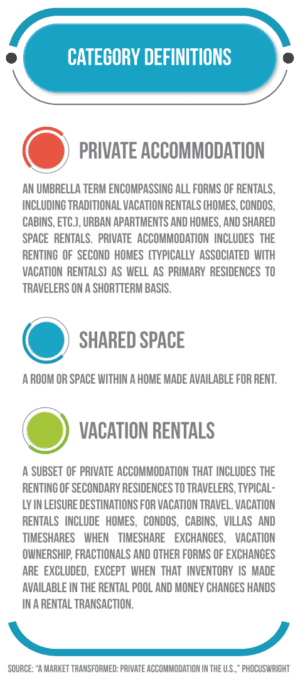
On the B2B side, Phocuswright introduced an even broader definition of the category with its 2017 study, “A Market Transformed: Private Accommodation in the U.S.,” which redefined the category private accommodations “as ‘home­like’ accommodation made available to rent on a short-term basis for travelers.”

Its follow-up European analysis, that same year, included the following lodging types under private accommodation (“Private Accommodation in Europe: 2010–2020,” Phocuswright 2017):

  • Home and flats/apartments
  • Shared space (renting a room in someone’s home)
  • Holiday park accommodation
  • Timeshares where the inventory is entered into the rental pool
  • Specialty lodging types (such as villas, chalets, and castles)

Phocuswright’s 2017 research directly compared industry performance to results from its 2013 landmark study U.S. Vacation Rentals:  2009 – 2014: A Market Reinvented which had not previously included these new rental types.

Phocuswright’s findings–which now included shared and urban “private accommodations”–expanded the category and armed startups and service providers with inflated high-growth numbers which these companies were able to use to obtain funding for new business models (more on this below). 


Consequences of Broadening the Category

The mass grouping of property types had a significant effect on the industry’s trajectory, creating further fragmentation among rental suppliers, propping up revenue projections for startups seeking investment, and creating confusion with municipalities over how to regulate this evolving sector.


Second Home Owners, Primary Residents, and Residential Landlords

It is difficult to understate the changes to the industry that have resulted from grouping second home owners and primary residents into the same category, largely because the motivations for renting differ between the two supplier segments.

Second-home owners are motivated by the following:

  1. Realizing an appreciation in the value of the home as an asset
  2. Maintaining the property as a vacation home for personal use
  3. Maximizing rental income while mitigating risk

In contrast, primary residents typically rent part of their home:

  1. For extra income
  2. For social interaction
  3. During area events, such as festivals, conventions, sporting events, or concerts.

It is important to note that many primary residents who rent their homes on Airbnb are not homeowners themselves but are long-term renters with little concern for the long-term value of their property, neighborhood, or destination. Additionally, most primary-resident renters live in residential locations—in contrast to leisure destinations in which whole-home vacation rentals are commonplace.

To add even more complexity, the income that Airbnb provided was attractive to residential landlords who quickly found they could often make more from short-term rental activity than by renting to long-term tenants. As a result, we saw mass misunderstanding between these “illegal hoteliers” and above-the-board vacation rental management companies. 


New Regulations and Confusion among City Officials

Adding these new private accommodations in residential neighborhoods, apartment complexes, and communities in which people live full-time caused disruption to the entire industry.

Full-time residents were uncomfortable with having an influx of short-term renters in and out of their neighborhoods and apartment complexes. Security concerns arose, and noise, trash, and parking complaints from full-time residents began to flood the inboxes and phone lines of city officials.

In addition, with workers migrating to city centers, affordable housing in premium neighborhoods was already an ongoing problem for municipal officials. And the hotel industry began to see travelers opt to stay in Airbnbs instead of in expensive city hotels. In 2016, the American Hotel and Lodging Association initiated a campaign to take on the short-term rental industry, saying, “We support the rights of property owners to occasionally rent out a room or their home, but commercial operators within the short-term rental industry should not be allowed to operate outside of the law.”

The convergence of voter complaints, lack of affordable housing, and a powerful hotel lobbying effort brought forward a popular and seemingly easy solution: Ban short-term rentals in cities.

Airbnb brought these short-term rentals into residential neighborhoods with its marketplace, and now it had an obligation—and need, to ensure its future viability—to work with municipalities to make them legal.

Airbnb began investing in working with city officials and found an easy way to work with them by proposing that—if a primary resident occupied the home—then rental activity should be legal.

This alternative gained steam because it eliminated “illegal hotels” (aka whole-home short-term rentals) and assured neighbors that the primary resident would be there to ensure that short-term guests acted appropriately. Adding friction in the private accommodation industry, Airbnb supported regulations that restricted rental activity in non-owner-occupied homes for stays under 30 days. Airbnb even kicked a few vacation rental managers in California off its platform to show its support for primary residents. 

At first, the traditional vacation rental industry was largely unaware of and disengaged with Airbnb’s battles in city centers. At the time, Airbnb was only beginning to catch on as a distribution channel for traditional leisure destinations, and no one believed that traditional vacation rental markets would see any regulations that would limit rental activity in destinations that relied on revenue from rental tourism.

Few saw the storm coming.

Simultaneously, as baby boomers hit retirement, many gravitated to the leisure destinations they once enjoyed for vacation to establish permanent residences. Once they were there, these retirees wanted to shut the door behind them.

As the contagion of short-term rental regulations spread, these residents discovered a trend toward banning—or limiting—short-term rental activity and became emboldened to complain to city council members, inundating these officials with calls complaining about parties, excess trash, and parking problems they believed were caused by short-term renters. There was little data from police reports to back up their complaints, but, in leisure destinations that have few full-time residents (aka voters), city officials were unaccustomed to the trouble and had little understanding about the revenue and destination value that the vacation rental industry provided.

Fast forward to 2019, now both cities and leisure destinations across the world are embattled with cumbersome—and often nonsensical—short-term rental regulations. In the United States alone, in leisure destinations from Florida to Washington to California to New England, NIMBY (not in my backyard) fever spread across the country. Vacation rental meccas such as South Lake Tahoe and Orange Beach, Alabama, were hit hard, with city councils who were incapable of understanding the issue because of the whirlwind of calls for bans and illogical regulations with which they were faced.

Currently, regulatory battles have escalated to the state level: 19 states have proposed legislation related to short-term rentals. For example, in Florida, a state that depends on tourism, vacation rental providers are fighting proposed regulations that require any owner or manager who advertises or accepts payment online to register as a “hosting platform” with the Department of Business and Professional Regulation and that require compliance with existing local vacation rental ordinances that are difficult to navigate—and sometimes impossible to satisfy—according to FVRMA executive director Denis Hanks.


Other Impacts from a Broadened Category Definition

In addition to a changed regulatory environment, the grouping together of all non-hotel lodging options created disruption across the industry.


1. Venture Capital and Private Equity Investment in the Industry

According to Phocuswright, “the private accommodation segment, long described as ‘alternative’ lodging, is now mainstream. In 2015, nearly one in three U.S. travelers used private accommodation, up from fewer than one in 10 in 2010.”

Impressive, right? 8 percent category awareness in 2010 to 32 percent in 2015. 

Almost hard to believe. But it is important to note that the 2010 number did not include shared spaces and urban short-term rental apartments, which were included in the 2015 results. 

Armed with Phocuswright’s research, startups were able to boast inflated industry growth as they looked to investors. The result was an inpouring of investment capital to fund new management and technology business models. On the management side, Vacasa and Turnkey Vacation Rentals collectively have raised $280 million to support their growth; furthermore, with its marketing model, Evolve has been able to raise almost $100 million. Among urban short-term rental managers, Sonder has received $135 million in venture capital, and Washington-based Stay Alfred has raised $62 million to expand into additional markets.

In the vacation rental software sector, Guesty has pulled in over $59 million, and Greater Sum Ventures is in the middle of a private equity rollup of multiple technology providers, including Streamline Vacation Rental Software. Channel management providers have also benefited: BookingPal has raised a reported $22 million, and RedAwning has brought in over $40 million, and Rentals United pulled in $4.5 million.

Other technology providers such as VacayStay, Transparent, Properly, HelloHere, Breezeway, and Key Data have also received millions in outside investment to build solutions to service the private accommodations industry.


2. Awareness of Private Home Accommodations and Increased Difficulty Managing Guest Expectations

OTAs and listing sites, including Airbnb, Booking, Expedia, and TripAdvisor, have done an excellent job in providing marketplaces that reach a broad consumer base.

Now, private accommodations are listed alongside hotels and bed and breakfasts in search results on OTAs; however, with a larger number of consumers who are staying in a short-term rental for the first time, there is a larger need to communicate and manage guests’ expectations as they plan for their stays.

It is unfair to assume travelers know the difference in property types and understand what they have booked.
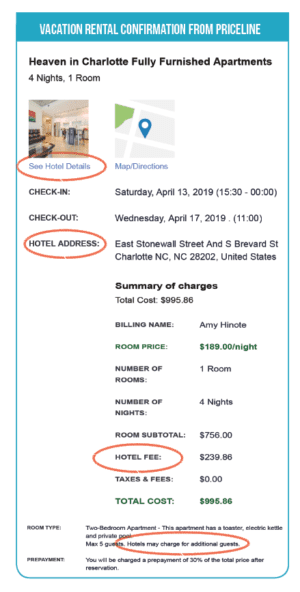
Even industry professionals have a difficult time knowing what they are booking on an OTA. Is there a front desk? Keyless entry? Room service? Coffee? An elevator?

In a March 2019 reservation for a short-tern rental booked on Booking’s Priceline.com, the term hotel was used four times in the email confirmation.

To make it even more confusing, for this same reservation, the property manager included the following information in its check-in instructions:

Important Note: “In case you have booked in “AIRBNB”—Please do not mention it to the Front Desk Staff. Just say that you have booked with **** and they will give you the keys.”

As a consumer, would this message seem sketchy to you?

The increased awareness of a broader category definition for short-term lodging has created a more critical need to educate travelers and communicate with them effectively prior to their stay.


3. Inability to Create Uniform Standards and Best Practices

Industry experts, analysts, and tech companies label the private accommodation industry as fragmented, pointing to a lack of organization of the industry as a challenge that will soon be overcome by aggregation.

But is it possible to consolidate an industry that includes dozens of property types under one category?
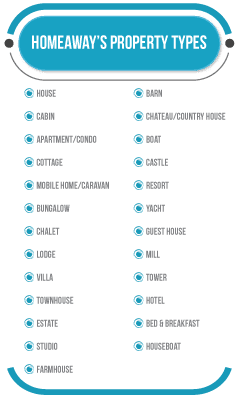
With the larger scope in regard to the types of properties—and property owners/residents—the broadened industry is struggling to establish and guarantee common standards and best practices for property appearance, included amenities, and booking policies. The rapid increase in the number of nonprofessional rental providers in residential locations is contributing to the challenge, and regulators are making it harder by encouraging rentals in private residences that are not professionally managed instead of working with property managers who can offer the security, safety, and consistency that meet owner and guest needs.

The unfortunate fact is that rental suppliers in this broadened category are offering little industry consistency to assure guests that the “private accommodation” they are booking is adequate with secure access, clean linens, HVAC, reliable Wi-Fi, and 24/7 access to service. This is especially true on aggregated sites that provide the consumer little information before booking.

It is baffling that city officials, when debating regulations, did not consider requiring professional management for short-term rentals to ensure a level of standardization, security, and round-the-clock service for issues when they arise.

Yes, the industry is fragmented, because the category is fragmented.


Can the Private Accommodations Industry Be Consolidated?

“Lodging is lodging” is the mantra among marketplaces and managers looking to further consolidate the category. Their argument is that–at any point–a traveler who may stay in a hotel for a short trip will look for a private home for a family vacation and search for an apartment rental for an extended corporate trip or medical-oriented stay.

Aggregators such as Booking.com, Expedia, and Airbnb seek to provide lodging options for any stay a consumer may be seeking. Additionally, Google, which is entering the category with its new booking platform, will add an interesting dynamic than many believe will provide additional disruption.

Segmentation of the category and education for the consumer is likely necessary.

However, there is little current industry leadership working on a consumer-facing solution to educate consumers. The Vacation Rental Management Association is still focused on traditional vacation rentals, and other emerging industry associations have yet to gain traction.


The Role of the 2019 Vacation Rental Manager in the Evolving Industry

Grouping traditional vacation rentals into a larger private accommodations sector has consequently amplified the industry’s complexity. VRMs are playing on a more challenging field and, as a result, professional VRMs are adapting. But more will need to be done to ensure long-term customer retention. 


1. Understand the market dynamics in play, including the category’s broadened scope

By understanding the industry’s evolution, VRMs can filter out the noise and focus on what makes their destination, company, and properties successful. Define the company’s competitive advantage, and ensure that employees, contractors, and stakeholders can articulate the unique sales proposition unique or selling proposition (USP).


2. Work with city officials, get to know the mayor, and communicate with candidates in the municipal and state election cycles

The entire industry will benefit from VRMs proactively working with current city and state officials and supporting candidates who support vacation rental-friendly policies. VRMs need city officials who understand the vacation rental industry and appreciate the dollars, jobs, destination appreciation, and community involvement that VRMs bring. Educating candidates while they are running for office will go a long way in protecting the industry against senseless regulations.


3. Educate guests about property types and set expectations

In the absence of any industry-wide coordinated PR/education initiative for consumers, the job of educating guests falls to each of us. VRMs can help the entire industry by focusing on their core feeder markets. Working with regional magazines and news outlets is a manageable way to begin guiding education for travelers. Tips about how to book a short-term rental, articles about choosing a property type, and articles about how to plan a stress-free vacation are popular subjects for consumer-facing publications. Plus, there is an added benefit to helping a VRM establish itself as a trusted source and thought leader.


4. Educate owners about new models and changes to the industry

As difficult as it is for VRMs to understand the industry’s changes, it is even harder for homeowners. Taking the time to provide insight and information for homeowners will help them understand the “why” behind company decisions, strengthen the trust relationship, help them to see the company as an expert and thought leader, improve retention, and help owners update properties to provide better guest experiences. Educate homeowners about regulatory issues before they arise, and solicit their help in engaging with city officials.


5. Do due diligence when selecting technology companies, channel managers, distribution channels, and service providers

VRMs need tech and service providers. These companies are partners and contractors and are extensions of the brand promise. Longevity and industry understanding matter. Does the provider recognize the broadened scope of the category? Does it have experience in the property types under management? Does the company’s service reflect your brand promise?

Note: Companies that rely on funding have split their attention between meeting client needs and meeting investor expectations. Obtaining references from like-minded VRMs is helpful in selecting providers.


6. Use OTAs and listing sites wisely

Using OTAs to find guests whom internal marketing efforts would not otherwise reach is smart—with a caveat. Bookings from guests who mistreat homes, from guests who arrive with false expectations of what they are getting, and bookings that result in senseless refunds offered by the OTA cause harm to both the VRM and the homeowner.

Moreover, channels that provide brand amplification are more beneficial than sites that hide the brand. Be proactive in working with channels and channel managers to make sure listing information and communications inform guests and promote the company brand. In addition, when travelers book directly with a VRM, they have a much higher likelihood of understanding what they are booking than when they book on a third-party site. VRMs will profit from adding a communication layer to reservations originating from an OTA to ensure that guests plan appropriately for stays.

Create a comprehensive guest retention plan for each OTA that includes gathering email information for all adults staying in the property, establishing a relationship with guests before and during the stay, and remarketing to them after. The cost of distributing properties on OTAs is rising, so increasing the lifetime value of the guest is the smartest way to maximize ROI from these channels.

Revenue Management: Who’s in Your Driver’s Seat?

3

Revenue Management has gone from an arcane subject to perhaps the most discussed topic in our industry (including an upcoming conference hosted by VRM Intel in Atlanta, August 6-7, that is dedicated to the topic). And yet, for all of the pages of print on the subject, there still seems to be much confusion, and certainly no common consensus as to what “Revenue Management” actually means and includes.

To be clear, I am not pointing any fingers. For a long time we, at Rented.com, were as misled on this subject as anyone. You see, we used to conflate “Dynamic Pricing” with Revenue Management. On the former, there are some great tech companies out there like PriceLabs and BeyondPricing who can help. On the latter, technology alone is just not a viable option today. Given where our industry is, and the ecosystem around it, far more manual work is required than many people realize or want to believe. Our own experience might be informative, and may help you avoid the mistakes we made.

Many of you know probably know Rented.com through our Fixed Rent Guarantees. This is where we partner with local managers to offer homeowners a guaranteed, fixed monthly payment on their home. We then work with managers, on a commission, to rent the home, in the process splitting the upside between Rented.com and the manager in question. With this business model, revenue optimization is obviously critical — that is where all the money is made. And so, as we partnered with more and more managers all over the world, building a portfolio of  about 1,000 properties worldwide, we became big proponents of dynamic pricing and the tech companies who support it.

And yet the longer we operated the units, and the more we added to our portfolio, the more we realized that technology alone and dynamic pricing as an activity was not the solution. For one, while each company in the space has its own merits, the quality of each varies dramatically by geography and even property type. There simply is no one-size-fits all answer.

Additionally, as so many of you know, even if you firmly know the right price for a property at the right time, this is only a small piece of the puzzle. Given our complex ecosystem of property management systems, listing sites, company sites, phone reservations, etc., getting those prices updated to every relevant spot in a timely manner is never easy, and sometimes seemingly unfeasible given other priorities on your team.

And finally, we began to see that having the right price in the right place was not even the end all be all. To truly manage revenue, and thus maximize it, means so much more than just price. It also has to do with what you are pricing (unit mix and strategy), where you are pricing it (channel strategy), how you are positioning it (listing strategy, minimum stay requirements, etc.), and so much more. All of these factors ultimately lead to the conclusion that you can only get the price that people are willing to pay for that specific unit at that specific time on the channels it is marketed on with the attributes of those listings such as reviews being paramount to whether someone will book it.

While technology could and can help with a component of this, we found more was needed. And so, given our portfolio size, we began to build it internally. We assembled a team of experts with a diverse background in revenue management from large chain hotels in major cities, as well as urban and destination vacation rentals. 

These experts began holistically performing what we now understand as revenue management. They began balancing the relevance of available data with technology to understand the market and the comp set for each property. The team then was able to dig into the nuance of individual unit pricing to account for the positive and negative attributes, and listing qualities of those properties.

With our Chief Commercial Officer, Cliff Johnson, leading the team, he is bringing his direct experience working across hundreds of markets at Vacasa to optimize revenue as their systems improved over the years. While Vacasa’s technology is impressive, their experience and team is what truly differentiates them from the dynamic pricing tools in terms of performance. Cliff brings that same balance of data and experience to Rented.com with the team he is building, and thus makes it available to local managers in a way that was never before possible.

And as we started doing the right things, and having the right people do them, a funny thing began to happen. The revenue performance on our units went up dramatically (in some cases more than two times the previous amount) and across the board 20-30%. And it wasn’t just us who noticed the difference. The managers we worked with saw the jump in performance, and started asking us to help them with revenue management on the units they managed that we did not share. As the word got out, managers we weren’t even working with via our Fixed Rent product began asking us to help with revenue management as well. And thus, Revenue Management as a Service was born.

We learned it is about much more than technology. It requires a skilled and dedicated professional. We also learned that for managers with less than 500 properties, hiring for this skill set internally did not make financial sense, and depending on location, was not necessarily even feasible. We found that by providing this service, we could give local management companies the same skills and competitive advantage that until now only the largest and most well-funded managers in our space could hope for. It allowed us to enable local managers to focus on their competitive advantage: excellent local operations and hospitality, and us to provide for them the “Scale As A Service” they would not otherwise be able to access.

At the end of the day, equating dynamic pricing to revenue management is like thinking a car’s cruise control is the same as driving. Sure, the cruise control can set the right speed, and maintain your momentum, but who is setting the direction? Who is dodging the reckless drivers around you? Who is slowing down as traffic piles up? Yes, maybe one day it will be technology used in autonomous vehicles, but for today, like with Revenue Management, it still requires a focused and dedicated driver.

In a car, your life is on the line. With revenue management, it is the life of your business. In both cases, it is far too important to not have the best answer possible in the driver’s seat.

Next Level Revenue Management from Red Awning’s Heather Richer

0

A Hotel Veteran’s Perspective            

After working in the boutique hotel world for over 15 years with a specific focus on revenue management and distribution, I was excited to make the transition to the vacation rental space as CMO at RedAwning Group last year. This is an exciting space with enormous revenue management opportunity. Vacation rental property managers have been practicing revenue management for a long time (just having seasonal rates is a form of revenue management). With more technology and resources becoming available in the space, vacation rentals are ripe for next-level revenue management.  If revenue management is done well, there is also a greater opportunity than ever before to steal market share from hotels.


The Revenue Management Cycle and Top 3 Revenue Management Principles

The Revenue Management Cycle is something I learned about a long time ago. Simple and to the point, it comprises four elements: Forecast, Optimize, Control, Monitor (F.O.C.M.). Starting with an accurate, day-by-day forecast for your portfolio and then following the steps continuously, you can make a solid revenue management strategy come to life. The next step is to understand the revenue management levers available to you: PMS capability; channel promotion capability; packaging, policy, price, or stay restriction capabilities; external market data input; or automated rate tools.


Once you’ve got the basic revenue management cycle up and running, you can start testing strategies around some core principles. These principles are applied to revenue management in many industries:  restaurants, parking garages, retirement homes, and even toll roads. Here are the Top 3 Revenue Management Principles to take your revenue management to the next level:


Understand Your Price Elasticity

The most important aspect of an accurate marketing strategy is ensuring an accurate forecast. A high-yield unit will be elastic, meaning that a small change in price has a large impact on conversion and volume of bookings. A low-yield unit will be inelastic, meaning that rate changes will have minimal impact on conversion. For example, in markets like Orlando, there are clear high-demand time periods over special events or holidays. Because this is a highly competitive market with significant supply and both business and leisure travel demand, this is a high-yield market, and the opportunities are endless. Let’s take a medical convention demand period as an example. It’s important to understand the demand length of stay, booking window, traveler type, distance of your units from the venue, and where travelers may be shopping for their accommodations. In this example, where the market has an influx of individual traveler demand, it’s the perfect opportunity for a studio or one-bedroom unit to compete with hotels. For this event, these unit types may be even more price elastic, meaning a price of $200 per night may not sell, but a price of $185 will. A small change in price can have a large impact on volume. Obviously, the goal is to sell every unit for the most nights at the highest price, and understanding all these factors will ensure you maximize your revenue per rental unit. In contrast, a few luxury units in a limited demand market may be inelastic. This means even a large price change won’t impact how many nights the units are occupied. There may be enough demand to achieve only 35 percent occupancy, whether that’s at $500 per night or $600 per night. 

The beauty of global distribution is that with additional merchandising and target marketing, there is an opportunity to generate more demand in either example. The distribution capabilities, tech functionality, and third-party data are all areas where you can add revenue management levers to your toolbox.


Apply Rate Strategies

You can apply several different strategies to price, and knowing what is appropriate for you and each of your unit types is key. Shadow, rational, and anchored and decoy pricing are several options you can consider. Additionally, you may find you need to select an approach based on day-of-week or seasonality patterns.

Shadow Pricing: When you can forecast your demand with more certainty, this strategy can work well. You are confident in in the market’s behavior, and you set your strategy to follow competitors.

Rational Pricing: When there is uncertainty in a market and you have shorter booking windows, sticking to a price vs. fluctuating too frequently can be the best approach. 

Anchored and Decoy Pricing: The human brain tends to make judgments based on contrast. I find this a fascinating strategy. Comparing the same unit with two different prices, but attaching different policies or inclusions (for example, prepaid nonrefundable vs. flex cancel) could work well here. If the customer perceives value, this can drive conversion. In restaurant revenue management, there is a concept of putting three burger options on a menu. If there is a low-, mid-, and high-priced burger, you are more likely to sell the middle option than if you offered just a low- and mid-priced burger. The third, higher-priced option is intentionally on the menu, but the chef doesn’t expect it to be a top seller. This is decoy pricing. It creates contrast and drives customers to select the mid-priced option.


Understand Unit Type Dynamics

Understanding larger trends across unit type is related to policy, price, merchandising strategy, and booking trend data. If you are a property manager with many different unit types, it’s critical to understand the demand curve by type. Your pricing strategy may need to differ by unit type. Obviously, your goal is to sell every unit every night. If a studio has a booking curve of 7 to 21 days, this is the sweet spot for maximizing price and length of stay. These types of units may do well with more flexible cancel policies, as you have opportunities to resell units closer to arrival. Homes with eight or more bedrooms may have a booking curve of 90 to 120 days, and if the property is unsold in that window, it will be harder to fill. 


What I love about vacation rental revenue management is that for every unit, you are either 0 percent or 100 percent occupied on any given night, but you can also optimize your portfolio as a collection. With rep-level inventory, even overbooking strategies can come into play! So many different strategies can apply, but no matter what the unit type mix of your portfolio, there is a next-level revenue management opportunity.


 Is Your Guest Wi-Fi 5 Stars?

3

We pretty much expect great Wi-Fi wherever we go these days. Sitting on an airplane at 30,000 feet? Better be able to watch online content! At a café working for a few hours? “What’s your Wi-Fi password?” The backbone for most smart-city initiatives is a free Wi-Fi network even while residents are waiting for a bus.

Free Wi-Fi is the bare minimum, with the new expectation being that the Wi-Fi is high quality. I recently stayed at a lovely vacation rental where the Wi-Fi speed was less than adequate. In fact, it was so inadequate that my guests and I needed to go off the Wi-Fi network and onto the LTE/4G network to use the DoorDash app to order takeout. Going back and checking the reviews of the unit online, guess what was the number-one thing that led to less-than-stellar reviews? You guessed right: poor Wi-Fi. No one seemed to notice there were four pillows on the bed because they were too busy stewing over their phone’s poor connection.


It’s All about the Hardware

While hotels are using enterprise-grade hardware (with names like Cisco and Ubiquiti), most vacation rentals are still running off of a free-with-your-plan router from cable companies or internet service providers (ISPs). It should come as no surprise that these modems are the cheapest money can buy and that their performance is greatly inferior to what your guests now expect when they are staying in a vacation rental property.

That’s not to say that you need to go out and get an enterprise- or hotel-grade Wi-Fi modem, but you’d be amazed by the improvement in Wi-Fi performance you’ll get from a roughly $100 Wi-Fi modem. You can even get your ISP to recommend something pretty amazing and include it in the monthly cost because they likely also supply hardware for businesses (technically, your rental is a business and not a residence). If you are budget conscious, you could even consider upgrading your speed and hardware plan and ditching a premium cable package. You’re not likely to get a bad review for not having premium cable, but you will if you don’t have premium Wi-Fi.

If you decide to replace the free-with-your-plan modem from your cable provider and you switch companies, they will likely want their $20 modem back. Technically, you are leasing it from them, and if you recycle it, they will charge you much more than its actual $20 value. Also, keep in mind that you don’t have to use their integrated router/switch access point bundled with the device. You can upgrade to an enterprise-level access point—but more on that later.


Welcome! Your Wi-Fi Password Is #07&OlT5@

Ever spent five minutes trying to connect to Wi-Fi because the network name and password are still the default from the provider? Is that a zero or an “O”? Changing the password isn’t just an opportunity to make your guest’s life easier but an opportunity for you to make the password some version of your company’s name.

The ability to create guest networks is built into most routers. With a little bit of technical savvy, you can allow guests Wi-Fi access with a user-friendly password (but you should always have a password). You can even do phrase-based passwords like “great-guest-vacay,” increasing your security. Guest networks don’t let users see what else is attached to the network and access other devices, which is important in a world of increasingly connected devices.

If you aren’t technically savvy enough to change the network name or password, then get your local installer to change it for you. Literally don’t let them leave until they change that terrible default password to something that is guest friendly.


We Don’t Have the Bandwidth for That Today. . .

Have you ever been on a network that slows down later in the day? Or perhaps a full coffee shop where the free Wi-Fi is basically useless? What most people don’t realize is that most modems can support no more than twenty devices being connected to them at any one time on a single service set identifier (SSID).

Although that doesn’t sound like it should be a problem for your vacation rental, think hard about what might be connected to your Wi-Fi and what your guest might connect. In a three-bedroom rental, each guest is likely to bring two connected devices each (a phone and either a laptop or tablet), which gets you to six connected guest devices. If you have internet of things (IoT) devices like Alexa, Roku TV, Wi-Fi thermostats, guest tablets, a noise sensor, Wi-Fi smart lock, Sonos speakers, and a host of other smart devices, you might be getting close to twenty. Business-level access points, on the other hand, can handle over sixty simultaneous connections.

The real value of IoT devices is that they can help you know what is going on at your property at any time (especially if you also use a smart lock), with many of them also functioning as guest amenities (like a Sonos speaker). To not only bring the guest experience you offer to the next level, but to also improve your management of the property, you’ll likely want to start thinking about your Wi-Fi not just as an amazing guest amenity but as the thing that also lets you know what is going on in the unit, with smart door analytics and noise monitoring.

However, remember too that not all devices will require the same amount of bandwidth from your network. A smart lock will require almost nothing, whereas a Sonos speaker will take much more. Also, devices on other smart home frequencies won’t count toward the twenty- or sixty-device maximum. At Operto, we recommend either adding smart devices on a frequency other than Wi-Fi or upgrading to an access point that can handle sixty devices.


IoT and Frequencies

IoT is currently a hot topic. Its proliferation with devices like Roku, Chromecast, Alexa, and Google Home mean that the big players in the world of technology are only going to be growing. Increasingly, guests expect that they can get these amenities they have at home in your home away from home.

One of the first challenges you are going to likely face is that many of these new devices will only connect to the 2.4 GHz Wi-Fi range. You may know that Wi-Fi right now can be either 5 GHz or 2.4 GHz, but most people don’t know why there are two versions. The 5 GHz band was added because it can handle more bandwidth. That means it’s great for your guests’ devices and anything else that needs a lot of bandwidth (think Netflix viewing), but it has shorter range.

The growth of home automation has come with even more frequencies than just Wi-Fi and Bluetooth. There are a range of great low-cost sensors and monitors on a range of frequencies that can control smart locks, thermostats, leak sensors, and so on. To make use of these, though, you will need a hub (or bridge) to manage all the frequencies. Samsung is the first to create a device that can manage all these frequencies while also acting as your Wi-Fi router. Samsung has two versions: one called the SmartThings Connect Home (lower bandwidth capabilities) and the SmartThings Connect Home Pro (higher bandwidth capabilities that might be more appropriate for your property). They are also user-friendly for changing the Wi-Fi password through the SmartThings app.


Conclusion

Although it may seem like a challenge to address your unit’s Wi-Fi, it’s becoming something you can’t ignore if you want to maintain outstanding guest reviews. High-quality Wi-Fi has quickly become an expectation of your guests.

It’s not just millennials who want to be connected wherever they go. Even my ninety-year-old Mennonite grandmother wants to Skype the grandkids whenever possible. She’s learned to use video conferencing to see the kids but has skipped past learning to use a smartphone.

I can’t imagine her feelings would change just because she goes on vacation. Even a nice grandmother like her isn’t going to give you a good review if her call with the grandkids is cut short because of your bad Wi-Fi connection.

HomeAway Software Trends Report Reveals What Vacation Rental Managers Need to Know in 2019

0

Over the past two years, the vacation rental industry has continued to evolve rapidly. HomeAway Software recently published its 2019 US Vacation Rental Trends Report providing new insight into the state of the market. According to Ryan Hutchings, general manager of HomeAway Software, “As vacation rentals continue to go more and more mainstream and competition increases with hotels, meeting growing traveler expectations will be the name of the game.”

The vacation rental industry is steadily growing. US revenue hit over $13 billion in 2018 with a projected annual growth rate of 7.2 percent. The latest data from HomeAway Software indicates that property managers are feeling optimistic. In fact, over 80 percent of respondents felt “extremely positive” or “very positive” about their company’s overall business outlook in 2019.

Five major themes emerged, ranging from building trust to incorporating emerging technologies. HomeAway Software talked to its partners about cost-effective ways to fulfill traveler expectations in 2019.


Instilling Trust Remains a Priority

Building traveler trust has never been more important. In the vacation rental business, that means consistency, credibility, and safe transaction processing. Overwhelmingly, property managers said that websites needed to incorporate more advanced trust signals.

Properly CEO, Alex Nigg, elaborates: “Trust is the biggest issue for the vacation rental industry right now. Travelers feel like they never know what they’re going to get when they stay in a vacation rental.” Accurate information builds trust, encourages repeat bookings, and saves costs by reducing the number of customer contacts.

In addition to the appearance and features of the property, Paul Hanak, director of digital marketing at ICND, says that your “About Us” page is a great place to use more trust signals: “Team photos, smiling faces, guest reviews, and community involvement are all great examples to instill trust in your visitors.”

Chris Carnicelli, CEO of Generali Global Assistance, shared a 2018 study revealing the top three decision-making factors for where US travelers will stay: location (63 percent), value (57 percent), and online reviews (33 percent) HomeAway also cites data from a 2018 survey showing that going from zero reviews to just one review can increase conversion by 40 percent.(1)


Share Experiences and In-Destination Solutions to Delight Guests

Vacation rentals have a real opportunity to capture experience-focused travelers, and “content is king” still rings true. According to Peter Scott, president of Bluetent, it’s a good idea to “Expand your strategy to include informational content based on search queries for activities, events, and things to do in your area.” By leveraging your local expertise, you can grow your brand and accelerate website traffic.

However, websites aren’t the only opportunity to highlight the experiential elements of your property offerings. A recent Forbes survey found that more than 40 percent of people under 33 prioritize “Instagrammability” when choosing their next holiday spot. That means property managers should remember to market the destination and surrounding areas on social media just as much as the property itself.

While pre-trip experiential marketing is paramount for drawing in new customers, delivering on quality experiences post-booking is equally important. As Scott explains, “With higher expectations to vacation like a local, the experience is just as important as the inventory, if not more important.”


Put Traveler Safety First, from Safe Stays to Safe Transactions

When asked what safety amenities were “must haves” in vacation rentals, 58 percent of US travelers selected smoke detectors, 44 percent selected fire extinguishers, and 42 percent selected carbon monoxide detectors.(1)

Travelers need reassurance that vacation rentals are properly equipped to keep guests safe, and we can expect to see these amenities become greater factors in booking decisions in 2019. It is important to make sure things like fire extinguishers are kept near where they are needed, that smoke and carbon monoxide detectors are in good working order, and that guests are clearly informed about what safety amenities are and how to use them.

Data protection remains top of mind for customers. With big players like Facebook, Google, and Amazon making headlines over privacy concerns, it’s no wonder data concerns are playing a greater role in purchasing decisions. Travelers need reassurance that data provided in the booking process and beyond will be respected and protected. In a Hubspot survey, 82 percent of respondents said they will leave a website if it is not secure.”

While many online travel agencies have already taken pains to ensure compliance, it’s up to property managers to keep their own websites up to snuff. Partner with web experts who prioritize safety and security to protect traveler data, and highlight your commitment to security with certified badges and transparent policies.


Simplifying Operations Continues to Drive Efficiency

A recent survey from Breezeway found that 33 percent of US property managers believe that managing property operations is their biggest challenge. Jeremiah Gall, founder and CEO of Breezeway, explains, “Property maintenance and care requires a level of detail that puts an immense amount of stress on property operations, and managers will need to adopt intelligent technology to maintain growth.”

Yan Zang, owner at EZ Inspections, says that housekeeping is a good example of how automation can help streamline operations. “Technology can be leveraged to auto-create cleaning and inspection jobs based on checkout schedule, auto-assign specific cleaners and inspectors based on the property location, and even notify front and back offices when cleaning and inspections are complete via mobile apps.”

Breezeway’s Jeremiah Gall highlights the development of data-driven tools like chatbots and workflows as well as the importance of building operational programs that deliver on the brand promise. That promise could be luxury, accessibility, or a multitude of brand attributes: “Brand standards—a comprehensive playbook that decides how all small details should be handled—need to be leveraged by staff and service partners to ensure consistency. Detailed property care programs will be critical as private accommodations and vacation rentals enter the next phase of maturity.”


Incorporate Emerging Technology for a Competitive Edge

According to Richard Lang, vice president of sales at Dormakaba, “As consumers increasingly rely on smart-home technology, they will seek the same comfort and convenience when they travel.” That means technology will become a bigger factor for travelers when booking.

Today’s market has plenty of solutions designed to help property managers outfit their properties with the latest and greatest in smart-home technology. Property managers who prioritize smart-home amenities should highlight these benefits in their marketing and consider increasing rates accordingly.

HomeAway Software expects mobile apps and voice-based searches to significantly accelerate in 2019 and beyond. Bluetent’s Scott notes that “Voice queries are the future of guest experience and search engine optimization strategies. With voice assistance, guests can receive instant answers about vacation rentals—everything from check-in/out instructions to FAQs and information on how to contact the property manager.”

According to Deloitte, integrating immersive technologies like virtual and augmented reality are about to become the new gold standard for shopping. In fact, a study by Google found that business listings with a virtual tour generated twice as much interest online. Plus, over half of respondents (67 percent) say they want more businesses to use this modern marketing material.

The vacation rental industry is taking note. In 2018, HomeAway announced a large investment in virtual experiences. “The barriers to entry for virtual technology have never been lower,” says Ben James, senior product manager at HomeAway. “Given that each one of our vacation rentals is unique, being able to walk through a property before booking helps travelers make informed decisions.”


Conclusion

As vacation rentals reach a wider audience, rising traveler expectations are inevitable. Forward-thinking property managers are already starting to reap the rewards. Three out of four HomeAway Software customers grew their revenue over the past 24 months, and the company expects that number to rise in 2019.

With an in-depth understanding of the industry and recommendations from some of the top software partners in the industry, HomeAway Software’s 2019 US Vacation Rental Trends Report gives new insight for the road ahead. By taking steps to establish trust, prioritize experiences, promote safety, operate efficiently, and adopt new technology, property managers have a real opportunity to both meet and exceed expectations.

Hutchings says that 2019 offers property managers a chance to provide unforgettable experiences: “At HomeAway Software, we see the proof every day that vacation rentals have the ability to deliver unique, personal travel experiences that hotels and other traditional forms of lodging just can’t match.”

 (1)“HomeAway US Traveler Amenity Collections Survey 2018”


Sea to Sky’s Heidi Stuber is Running for Seattle City Council

1

Heidi Stuber has officially thrown her hat in the ring for a position on Seattle’s City Council. Stuber is the strategic director at Sea to Sky Rentals in Seattle, Washington, where she oversees strategic planning, finance, and acquisitions. She has over 15 years’ experience in business leadership with a focus on organizational change, as well as an MBA from Seattle University.


Amy Hinote (AH): Why did you decide to run for City Council?
Heidi Stuber (HS): I’m running for City Council because I believe in the future of Seattle. Over the last several years, I’ve watched City Council lose its way and become disconnected from the needs of everyday Seattleites. We need a strong voice at City Hall to speak for regular Seattleites: families, students, small businesses, and someone who has the ability to stand up to the ideological agendas that don’t represent the majority of Seattle. What colleagues in our industry may not know is I started my career as an educator and I’ve been very involved with advocacy for education and Autism awareness, outside of my work in our industry to advocate for small business rights. So I bring a diverse background in education, advocacy, and business leadership to this campaign. As the only mom of school-aged children in the race, the only businesswoman in the race, and the only candidate with both a deep, personal understanding of social justice and advocacy combined with the working experience to know how to get things done, I am uniquely qualified to bring a balanced, action-oriented approach to City Hall.


AH: In Seattle, what is the state of the regulatory environment for short-term rentals?
HS: In 2017, Seattle passed common-sense short-term rental regulations that go into effect this year. I was very involved with the Seattle Short-Term Rental Alliance to influence this legislation to be fair and balanced for all parties. Because of our advocacy, City Council rewrote the legislation to ensure small businesses weren’t shut down, and we are proud that our work created an additional revenue stream for affordable housing which enables the short-term rental industry to be a part of the solution to affordability in Seattle. Actually, my work as a member of the Seattle Short-Term Rental Alliance was a big part of what motivated me to run for office. I saw that city government works when the needs of individuals and small businesses are taken into account and considered along with the long-term strategic plan for the city. We got to a reasonable regulation because the city listened to individuals and small businesses, was willing to rewrite the legislation based on feedback, and multiple stakeholders came together to identify shared values. It is a model for the sort of collaborative, balanced, and strategic approach I would take in office.


AH: We hear so much about owner-occupied properties versus second home/investment homes. Why are so many cities favoring owner-occupied homes over professionally managed second home rentals?

HS: I think there’s a misunderstanding both about how short-term rentals are managed and about secondary home owners. First, many cities think only owners living on property can ensure short-term rentals will be well managed. This leaves out the role of professional, local property managers who work very hard to maintain high-quality homes on behalf of owners, communicate clear expectations to guests, and do everything possible to be great neighbors in the community. Regulations need to focus on removing the occasional bad apple, rather than assume only owner-occupied homes can be well managed. Further, secondary home owners are often members of the community where they own a second house. There are many reasons to maintain a second home in a city you care about such as having children and grandchildren in the area, moving away for a job and keeping the home you plan to move back to, or purchasing a home for your future retirement. Most homeowners are neighbors too and rather than leave houses empty when they are not there, it is safer and more sustainable to fully utilize these homes in the downtime when the owner is not onsite.


AH: Outside of vacation rentals, what are the other big issues you are hoping to address if you are elected?


HS: In Seattle, our number one need right now is an action-oriented approach to reduce the homelessness crisis. That is the most pressing issue to my constituents and creating one, coordinated city organization that emphasizes transitioning people into housing will be my top priority in office. Cost of living is on the rise in Seattle, so we have to address affordability both in terms of thoughtful housing density and expanding resources like low-cost Orca cards for middle class families and individuals.

As a Mom, I care deeply about the health and education of the next generation and will focus on ways city government can support students and teachers by providing wrap-around services in schools, improving our mental health care system, and insisting our state legislature fully fund education. Finally, traffic and carbon emissions are intrinsically linked in Seattle, and I will be looking at transportation and clean energy solutions that help protect our environment and create a more livable city.


AH: For others in the industry considering running for a municipal office, what advice can you offer?
HS: If you want to run for office, get involved with your local civic organizations early, well before you plan to run. Join your local party, attend City Council meetings, volunteer on someone else’s campaign, and network with other people that care deeply about your city or town the way you do. There is no substitute for knowing the history and key players in your local political arena. Before a formal run for office, make sure you have volunteers, donors, and campaign staff ready to jump in so you can hit the ground running. It’s harder to learn on the job and takes precious time away from raising money and knocking on doors. And don’t forget to make sure you have a plan to balance your job and personal life with your campaign. When it’s all over, you may be elected or not, but your friends, your family, and your dog will all still be a part of your life—don’t neglect them along the way.


AH: How can your vacation rental family support you in this election?
HS: It’s a great act of bravery to run for office, especially in our industry, which is not always understood, and also for a working, single mom with a special needs child like me. All the hard work, dedication, and strong advocate’s voice I’ve put into this industry is exactly the tenacious, brass-tacks approach I will bring to office as an elected leader. Having a businesswoman with a common-sense approach in office in Seattle has a ripple effect on other municipalities that look to the big cities for ideas on how to lead, so my election benefits those outside Seattle as well. Running a successful campaign takes money and it takes volunteer time and our vacation rental family can support me in both ways. Online donations help me access the resources I need to run a great campaign and be successful in being the first vacation rental pioneer in office in Washington State. I would also love to hear from members of our community in Seattle: you can send me your Democracy Vouchers and introduce me to others in your community who share our values.

To be support Heidi Stuber’s campaign, sign up and donate now at electheidistuber.com.

Online ROI Rescue: Using Google Analytics for Greater Success

0

Data. Analytics. Conversions. Oh My!

If you are walking precariously along the yellow brick road of vacation rental marketing, these words are as scary as the unseen dangers hidden in the woods of Oz.

Data, analytics, and conversions require forethought, measurement, analysis, and strategy.

These concepts are probably more important to your vacation rental business than any other—except of course, the number: How much am I making?

And, just like in The Wizard of Oz, once you get to know what’s hiding in the trees, it’s much easier to navigate knowing that on the other side lie sunny skies, rainbow ponies, and a full rental calendar.    

To put it more clearly, when you start to set marketing goals based on data and make marketing decisions based on trends in your data, you’ll see an improvement in the numbers you care about—bookings and revenue.

You may already be thinking, “This is too much for me,” but it isn’t, I promise! Just a little knowledge goes a long way, and sometimes just seeing what is hidden in the numbers is enough to give you an idea of some simple changes that could make big improvements. Using data tools such as Google Analytics, you can get a snapshot of key data points today and then watch over time as you make changes to your website and marketing efforts.

If you are like most online business owners, when your website is ready, you have your website person set up your Google Analytics account. You log in once or twice. Look at it. Click a tab or two. Close it. And forget all about it. 

Or, you may find a couple of reports you feel are useful, like traffic channels, and you watch the numbers go up and down.  

However, there are a few Google Analytics reports that can give you actionable information to help you quickly and easily see problems.  

Be sure to look at these reports over a longer time frame by changing the date range in the upper-right-hand corner of your screen. Look at three or six months, or more if this is your first time viewing the data. After you start making changes, you’ll want to look at more recent time periods.


1. Audience Report —> Mobile Overview

This report shows you the number of users who used various devices to view your site and, overall, how they behaved on your site on each device. The bounce rate indicates what percentage of users left your site without any further action. A high bounce rate means a higher percentage of your users leave your site without engaging with your content.

Action items:  

If your bounce rate is higher on mobile than on desktop devices, you need to determine why and make changes to your site now to help your users consume the content more easily on mobile. Use Google’s mobile-first tool and check a few pages; check your site speed via Pingdom, and learn more about how to segment traffic by device in Google Analytics so you can dive into how specific pages are performing.


2. Acquisition Reports —> Search Console  

If you are working hard at ensuring your site is optimized for search engines or if you want to start implementing an SEO plan, you will definitely want to view this report and keep track of your performance. Note that if you do not see any data here, you need to add your Google Search Console data to the Google Analytics property.  If you already have the search console, this is easy to do. If not, you will need to sign up for it first. The data will take a while to populate.

This report shows you which pages of your website are getting the most views from Google’s organic search. You can see how many times each page was included in the search results for the terms, how many times your page was clicked on, and the average results position (rank) at which your page is located for the search term. The report also shows your bounce rate and pages per session as well as goal completions if you have conversion goals set up. 

You then can drop to the queries report, just three tabs lower in the acquisition report, to see some of the top queries through which users are finding your site. 

In the example above, you can see that the top landing page (a blog post) received 455 page views and had a very low bounce rate. An average of 4.2 pages were viewed per session.


Action items:

To rise in Google’s rankings, you need to have great content that engages your users, so bounce rate is important. Work on making the content on your top pages more engaging so that people will read it and scroll down to look at images or videos. You also want to make sure the content on the page reflects what users are searching for.  

If your property or booking pages are getting a high click-through rate but have a high bounce rate, this will directly affect revenue. Investigate to see what issues could be causing the problem. Is the page taking too long to load? Does your booking form load properly? Does your page’s meta description (Google Snippet) match the content on the page? 

If bounce rate is low and page views per session are also low, you need to look at changing your navigation on your website or creating more links to additional content on the site to encourage visitors to investigate further. In the example above, 4.2 pages per session is great. This page actually leads people to additional resources on the site, including a booking page. It is responsible for nearly half of this client’s direct bookings per year.  


3. Acquisition Reports All Traffic —> Channels & Source/Medium

The channels and source/medium reports are good overview reports on how your marketing efforts are working to bring traffic to your website. As you look at these reports over time, you need to watch how your traffic increases in relation to your bookings. If your site is working to convert bookings, as your traffic increases, your bookings should increase, too. If that is not the case, there are most likely issues on your website that need to be addressed before you start changing marketing tactics, because the point of marketing is to bring more visitors to your site.

The channels give you an overview of the sources of traffic to your site. You can create your own channels to add to this list and see them in your reports. Be sure and click on each to see a breakdown of social media and referrals. Note that there could be a bit of fake data in the referrals report unless you have set up filters, so don’t be alarmed if you see weird websites sending you a few users.

Questions to ask:  

  • What is your biggest source of traffic right now?  
  • What is the bounce rate, page view figures, and time on page for each source of traffic?  
  • From what social media sites are you getting traffic? Any surprises?
  • Are you getting referrals from the listing sites or CVB sites on which you are paying to appear?
  • If you have set up goals, how do conversion rates differ among the channels?

The source medium report breaks down the channels report and is especially useful for comparing all sources of traffic at once.

As you get more experienced at tracking your traffic and start using many different sources to get traffic to your site, you may want to use UTMs to tag your traffic from each specific ad, post, email, and so on. A UTM code is a simple code that you can attach to a custom URL in order to track a source, medium, and campaign name. This enables Google Analytics to tell you where searchers came from as well as what campaign directed them to you. I encourage you to learn more about UTMs, especially if you are using any type of external advertising.  


4. Google Analytics Behavior Reports

Another report you’ll want to look at is the behavior report. This section of Google Analytics will show you what your users are doing on your site. If you have a lot of traffic but few conversions, this is where you can break down each page of content and really dive deep into the problems your site might be having.

Check the “All Pages” report to check which pages have the highest page views, bounce rates, and exit rates.  

You can use the search bar to type in the URL extension to check individual pages or groups of pages.  

Examine conversions (bookings) on the individual property pages. If you don’t have good conversion rates now, you should be testing the site design, listing descriptions, images, and more.


Using Your Data

As you start looking at these different numbers and familiarizing yourself with the various reports and ways to filter data, you will discover many ways in which you can use the data to make changes.  

The biggest mistakes people make at this time are making the wrong changes and making too many changes at once.

  • If your traffic is high, but you have high bounce rates and low page views, you probably have a website problem. In this case, you may need to look at page speed and mobile views or get a website review, but first, try to rewrite some content or get better images.
  • If your organic search traffic is low and your site is at least a few months old, you should make sure your site is listed with Google’s Search Console and look at your meta descriptions and meta keywords.
  • If you don’t have much traffic at all from any sources, you have a marketing problem. Learn the different marketing strategies that work best for you and your audience. Social media ads, especially on Pinterest and Facebook, can work quickly to get you some traffic.
  • If you have high traffic and engaging content and still have low booking rates, look at your property-specific pages. Do you have well-placed booking forms and calls to action? Are your images professional? Do your booking forms work? Is there a way for visitors to easily find your contact info? Does your listing copy entice them to book your property?

As you can see, there are a lot of details to be found within your Google Analytics dashboard, and it should be clear that this is a tool you need to use to learn more about what is going on with your website. The keys to making money in any online business are to learn how to use different strategies and marketing tactics correctly to bring more traffic to your website and to use the data you see to make informed decisions that work for you and your business.

Asset Management vs Property Management for Second Homes

0

Are You an Asset Manager, a Property Manager, or Both?

We often think of real estate asset managers as managing commercial real estate portfolios. However, the true definition of asset management is not a profession but rather a process that refers to managing investments on behalf of others with the dual objective of appreciation of the client’s assets over time while mitigating risk.

The functions performed by real estate asset managers are looking increasingly similar to the services provided by professional second-home property managers (PMs), especially those with real estate offerings and a deep understanding of market and economic dynamics.

“In the past decade, the property management profession has made some remarkable developments,” says Michael T. Lanning, CPM, senior vice president at Cushman and Wakefield. “Property managers today do more than manage tenant relationships. They take a holistic approach to managing an asset, including the operations, financials, and tenant engagement. A number of external factors have influenced this change, and as a result there is a greater alignment of the property and asset management disciplines than ever before.”


Asset Management versus Property Management


Source: “Asset Management v Property Management,” Cushman and Wakefield

Asset management professionals do not readily admit it, but the lines that divide asset and property management are blurring, and there is an undefined, detailed description of a true real estate asset manager.

This void is creating an opportunity for real estate-oriented vacation rental managers to market the asset management services they are already providing to second-home owners.


Second-Home Investor Profile

While investor profiles differ among second-home owners, they are generally motivated by the following:

  1. Realizing an appreciation in the value of the home as an asset
  2. Maximizing short-term cash flow through rental income and cost management
  3. Managing risk
  4. Maintaining the property to enjoy as a vacation home for personal use

Professional PMs are well-versed in maximizing short-term cash flow, managing risks associated with vacation rentals, and servicing owner stays, so let’s look at several of the functions of increasing the value of the home.


Increasing the Value of a Vacation Property

When examining an asset manager’s role in increasing the value of the home, according to Sean Ross, founder of Free Lances Ltd. in his article “The Role of an Asset Manager in the Real Estate Market”: “Asset managers tend to specialize in particular types of property, regions or operations. A very large role of the asset manager consists of market research, data analysis, and revenue forecasting.”

PMs who view the vacation rental property as an investment are performing asset management analysis, forecasting, and reporting, and they are proactively working to increase the value of the home. They are able to set themselves apart from management companies that are solely focused on maximizing rental income in the home.

Looking solely at increasing the selling price of the home, there are many PMs who are already proactively working to:

  • Increase the popularity of the destination among buyers most likely to invest in area homes
  • Increase the value of the neighborhood or complex community within the destination
  • Increase the value of the home within the community


Destination Appreciation

Leisure destinations go in and out of favor with travelers. Asset-management minded PMs are proactive in finding ways to ensure real estate values and guest activity steadily grow in the destination.

Here are some examples of initiatives that engaged PMs support:

  • Improved airports and more direct flights
  • Sustainable and smart growth, development, and city planning
  • Year-round activities
  • Government policies and regulations that are pro-real estate, pro-business, pro-guest, and pro-destination
  • Traffic solutions that meet the needs of the destination at its peak visitor times
  • Public transportation, available taxis, and ride-sharing
  • Safety and security
  • Multigenerational appeal
  • Optimal mix of accommodation types and full-time versus part-time visitors
  • Shopping and dining development, acquisition, and retention
  • Events, conventions, festivals, and groups in shoulder seasons

Pro Tip: Communicate what you are doing to ensure destination appreciation to owners, and find ways to engage them in your programs and activities to promote the relationship.


Neighborhood and Complex Community Appreciation

In resort destinations, many vacation homes are located in neighborhoods and complexes which improve the value of these communities as a key factor in increasing the value of the home. Providing association management services is one way that PMs work to grow the value of neighborhoods and condominium communities. By managing the association, PMs have an increased ability to control and improve:

  • Financial management
  • On-site amenities
  • Security and safety
  • Common areas


Increasing the Value of the Individual Home

The objective in increasing the value of the home is to create a property value that is at the top of the market in a community that is also at the top of the market in a destination that is at the top of the market among competitive destinations.

Having a strong rental history is important, but implementing systems that provide professional financial reporting and property history can increase the speed of a sale. In addition, using comparative data tools and reporting that show how the property is performing in relation to the market can also help a buyer complete a quick transaction. Investing in a process to provide fast, professional, easy-to-read buyer packages, complete with reports, forecasts, and area trends, demonstrates to buyers that the PM is a savvy asset manager and is an effective tool in persuading a new buyer to allow the management company to continue to manage the property after a sale.

Moreover, property care is expected to make up a much larger part of the PM’s role in the months to come, and technology products are being developed to help facilitate proactive home care and preventative maintenance. Offering design services and uniform, upgraded kitchen packages are also ways to impress buyers (and guests). Smart home automation can help in security and managing costs, and having a process to vet and manage guests and provide 24/7 response is also a service that improves the value of the home.

An enormous opportunity exists for real estate–minded property management companies that view vacation homes as investments, are functioning as asset managers, and are concerned with both increasing the long-term value of the property and maximizing short-term income to differentiate themselves from the competition. Second-home owners/investors are seeking—and are willing to pay a premium for—these services.

Vacasa Acquires Sterling Resorts

2

Vacasa has acquired Sterling Resorts, one of the largest vacation rental management companies on the Florida Gulf Coast. Previously purchased by Pacifica Companies in 2015, Sterling Resorts now manages 450 units in destinations along the Gulf Coast of Northwest Florida down from 585 units in 2015.

With the acquisition, Vacasa now manages 13,000 exclusive vacation rentals and is the largest vacation rental management company in North America.

Vacasa has raised over $207 million in outside funding and, with this purchase, is taking another significant step in purchasing established vacation rental management companies in traditional leisure destinations, including South Carolina, Colorado, Alabama, and Florida. The company that was once considered a newcomer has quickly crossed over into mainstream, traditional vacation rentals.

Sterling’s largest area competitors include Southern Resorts (which has been expanding regionally) and Wyndham Vacation Rentals. Wyndham Destinations recently announced that it is exploring strategic alternatives for its North American vacation rentals businesses, including its locations in Northwest Florida. 

First Vacation Rental Data and Revenue Management Conference to be held in Atlanta, August 6-7

0

With the creation of comparative data and pricing tools, the science of revenue management for the vacation rental industry is quickly evolving and has become a hot-button topic for VRMs in 2019. As a result, VRM Intel is bringing together revenue management experts, vacation rental professionals, and technology providers for a two-day educational conference designed to identify best practices and professionalize the industry’s understanding of comparative data and revenue management strategies. 

VRM Intel’s Data and Revenue Management Conference will be held August 6-7 at the Atlanta Airport Marriott, and is being supported by leading sponsors, Key Data, AirDNA, Rented.com, PriceLabs, C2G Advisors, Streamline, Beyond Pricing, RedAwning, and LSI

“While vacation rental professionals are extremely interested in implementing revenue management strategies, there is little information or education offered in the marketplace specific to short-term rentals; and we are finding that hotel strategies do not necessarily apply to leisure-oriented vacation rentals,” said Amy Hinote, founder of VRM Intel. “There are new technology, data, and pricing tools available and new terms, KPIs, theories, and practices emerging. With this conference, we hope to bring the smartest people in this space together to help VRMs make sense of this new playing field.”

Quick Links:

Conference Objectives

The Data and Revenue Management Conference is an educational conference with classroom sessions, panel discussions, product demonstrations, and key data findings with the following objectives:

  1. Bring together industry experts and VRMs who are looking to understand and implement data-oriented revenue management strategies.
  2. Provide a foundation for industry understanding of market-driven data analytics and the role that revenue management plays in profitability and asset management. 
  3. Discuss fundamentals, key glossary terms, metrics, and KPIs.
  4. Identify and articulate revenue management strategies.
  5. Examine existing data tools, pricing tools, and how they work with PMSs.
  6. Compare and contrast hotel and VR revenue management. 
  7. Demonstrate how to implement pricing strategies—internally and across channels.
  8. Take a first step toward helping VRMs identify best practices and professionalizing understanding of the value of comparative data and revenue management strategies. 

Northeast Vacation Rental Professionals (NEVRP) partners with Fetch My Guest to launch NorthEastStays.com

1

NorthEastStays.com Released at Annual Conference on April 2nd.  Member companies can now advertise their properties directly to vacation rental travelers to drive more direct bookings.

NEVRP created the marketplace to address the challenges travelers face during the booking process, one of the biggest being communication issues. “The NorthEastStays marketplace will allow our customers to #bookdirect. This opens the doors of communication and builds a connection between the guests and the vacation professional manager. The guest will be free of excessive booking fees coming from OTAs, while the vacation rental professional will once again have open access to their customer’s information so that they are able to connect with them directly and share their local expertise.” said Heather Allen, President of Northeast Vacation Rental Professionals.

“We are proud to have NorthEastStays join our growing network of independent vacation rental professionals who service the needs of vacation rental travelers from coast to coast. We are actively launching other regional and global networks that will continue to provide value to the independent vacation rental professionals while giving the traveler the best overall vacation rental experience and value”  said, Vince Perez, CEO of Fetch My Guest.

Listing on the NorthEastStays marketplace costs $65 per property per year. The site, which launched on April 2, 2019, already has close to 300 properties listed and growing daily.  Vacation rental managers must be NEVRP members in order to list their properties on NorthEestStays.com to ensure that its listings are managed by companies that adhere to the NEVRP code of ethics, and standard practices. Each member company is also evaluated on its guest service and commitment to high-quality homes that are clean, well maintained, and safe.  

NEVRP welcomes vacation rental companies from Maine, New Hampshire, Massachusetts, Vermont, Connecticut, New York, New Jersey, Pennsylvania, Rhode Island, Delaware, Maryland, and Washington D.C. If you would like to learn more about NorthEastStays.com we will be offering informational webinars twice a week. We are eager to grow our marketplace, and expand to the rest of the Northeast! Membership enrollment is now open!


The Transformation of Today’s Vacation Rental Industry: What is going on out there? By Simon Lehmann

0

If you can keep track of everything that is happening in our fast-transforming vacation rental industry, then you are a genius.

Let’s face it, for all of us in the industry, staying abreast of all the changes and keeping current with innovation and technology solutions entering the ecosystem has become a huge challenge. It is a good challenge to have, but a challenge nonetheless.

The big question for us to ask ourselves is whether we even know anymore how to differentiate our product from all the other different hospitality products out there. Are we still confident about what makes vacation rentals unique and what sets our offering apart from other lodging options?

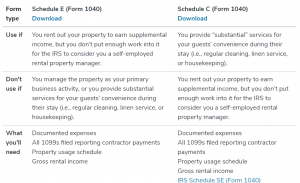
Concurrent with all the wider industry transformations, property managers still need to run property management businesses. We are challenged daily to deliver the best possible guest experience and, at the same time, to look after our hosts and owners by ensuring we deliver the best possible service and returns.

Outside of individual property management businesses, looking at the wider picture, we are being confronted with a convergence in hospitality. All products have become one. The OTAs have mastered the distribution of our products, and consumers can choose, at any time, the kind of accommodation they want, expecting to book it instantly.

Along with the challenge of convergence, the industry is facing margin compression and increased competition. For property managers, it is getting harder and harder to make a reasonable margin.

Although we are trying to find solutions and remedies for our challenges, we are increasingly exposed to more complex circumstances, requiring us to make choices and decisions that are not part of our core business.

However, to succeed, it is vital that we keep in mind what our core business is. Our core business is to deliver the best possible guest experience and to provide exceptional service for our owners. Our business rests on making sure that the guests coming into our homes have the time of their lives and enjoy their holiday or business trip with the least amount of friction.

Our business also depends on ensuring that our owners and hosts are satisfied with the services we provide, that their properties are being looked after, that occupancy is at its maximum, and that the delivered rent is the best achievable.

While not forgoing our core business, we are also challenged by increased distribution costs and have become more and more dependent on third-party channels for leads. At the same time, the brand equity we once built is diminishing. Repeat customers are slowing down; booking windows are getting shorter; and our guests are demanding more choices, greater freedom, and better value for their money. These are tough realities to accept, but accept them we must.

Being faced with operational issues on a daily basis and being pressured to deliver a superb guest experience, while also making sure your owners are happy, means vacation rental management businesses barely have the time to come up for air, let alone think strategically about what is next on the horizon or how to improve their business by making things easier for everybody involved.

Perhaps it’s time for a collective step back and some reflection on the questions around what is happening in the industry—what is now expected of us, and what can we do in the professional vacation rental property management industry to ease our worries and make improvements that are not just knee-jerk reactions?

There are, of course, many solutions out there to support the transformation of a property management business. But we do need to be incredibly smart about our choices.

Our first priority must be to create the best possible hospitality experience for our guests—making sure that everything, from searching to booking to paying and having a great time while enjoying a vacation rental, is as seamless as possible.

This we can do. We are professionals, and we know exactly what our guests want and how we can make their stay an incredible and unforgettable experience.

It’s time to stop talking about blunt knives and insufficient basic accoutrements while staying away from home. (Stay a night or two in one of your own properties, and you will quickly understand what needs improvement.)

Whether we like it or not, or whether we think this is important or not, every property manager needs to master these basics and improve at communicating our value proposition. There is still a massive pool of potential customers who have never stayed in a rental, who are used to the conveniences of hotels, and who we could potentially convert to our offering.

Besides investing in branding on the property level and making sure to have the right mix of distribution channels, today’s property manager needs to think about the future.

What is the next opportunity to make choosing a vacation rental an even better experience for the guest, as well as putting our hosts at ease, knowing everything is okay with the property?

From both an industry perspective and an individual business perspective, the next big thing to transform our offering is home automation. Being able to deliver the very best experience to our guests when they stay in our properties is the core solution of home automation.

We are all consumers; we all want choice and we all want convenience. Home automation, a seamless booking process, and, above all, free choice can deliver the right results for the guest and host of tomorrow.

Automated locks are a small start. Not everybody wants to be greeted by the host and have their ears chewed off about the latest fishing trip they went on! Many guests just want to get into their properties, relax, and make them their own. Aside from locks, home automation offers much more opportunity for transformation.

Although as an industry we are facing massive challenges to maintain our margins and are under high expectations to deliver best-in-class products to our stakeholders, we are also under the pressure of operational and distribution costs that are killing us.

It is imperative that we look for alternatives for maintenance of our operational profitability as well as make sure our guests are satisfied and our hosts are getting maximum occupancy.

Adaptation to future technologies will enable us to circumvent many of these real and present challenges. However, we need to be ready for this transformation and be open to the opportunity of being the first adopters. But if we do, home automation will be transformative both at an industry level and at an individual operational level.

Applying smart home technology will enable forward-thinking property managers to handle all processes around each property simultaneously. This will inevitably result in a better guest experience, lower operating costs, and more data to run your business even more efficiently. And this will lead to better and more profitable businesses!

Vacation Rental Tax Guide from Vacasa

0

It’s officially nine days until tax day in the U.S.; and while many might be ahead of the curve, there are millions of Americans who will wait until the last week to file or request an extension.

One of the main reasons people procrastinate is due to complexities with their taxes, and owning a vacation rental only adds to an already complicated ball of wax.

While nothing replaces the need for a knowledgeable CPA, Vacasa created a vacation rental tax guide that can be useful when advising homeowners on taxes. 


The Right Form Matters

First and foremost, there are two forms that are applicable to vacation rentals: an IRS Schedule E and an IRS Schedule C. When considering which is the correct form, it’s easiest to think about the income being generated by the property. If the property is generating supplemental income to the homeowner, Schedule E is likely the way to go. If it’s a primary business and high-grossing unit (i.e., considered more as a business), Schedule C should be used to file vacation rental taxes.

For either document, homeowners need to have a list of documented expenses, all 1099s filed reporting contractor payments, property usage schedule, and gross rental income.


The 14-Day Rule Applies

Second, the amount the homeowner uses the property will have an impact on what they can write off. In simplest terms, the 14-day rental rule means you don’t pay taxes on the income you receive from your short-term rental if BOTH of the following are true: A) you rent out the property for less than 14 days and B) you use the property for 14 days or more. However, if you rent the property out for more than 14  days and use it yourself for less than 14 days, taxes can become more complex.

Homeowners should keep a log of each day the property was in use, and include a breakdown of vacation rental days, personal use days and days used for repairs and property maintenance. This will help the IRS determine whether the property is rented for more than 14 days per year, and thus, how much the homeowner is able to write off. Another important note: tax deductions vary by state, but in all cases require a receipt for each expense deducted, so homeowners should make sure they have a file – preferably digital – to keep track.

Download the tax guide. 


Repairs vs. Improvements

A lot goes into maintaining a property and while it may seem that all upkeep is assigned to one category, there are actually two when it comes to your taxes: improvements and repairs. Repairs, like fixing loose banister or a broken window, can be written off, however, improvements to the home, like updating an old bathroom, are handled differently. Instead of being written off in the year of the expense, they are deducted over the use of their lifetime. While this may sound complicated, homeowners should still include when filing as it is indeed tax-free income.

Sharing these tips with homeowners can alleviate potential headaches and help familiarize vacation rental tax laws, especially if they are down to the wire.


Five Essential Tools for Vacation Rental Taxes

  1. Usage log: detail personal, rental and maintenance/repair days. Note: donated stays count toward personal use days.
  2. Digital folder: retain, organize and back up photos of receipts and cross-reference with accounts used for supplies (Amazon, Costco, etc.)
  3. Financial log: Track payments for property taxes and mortgage.
  4. Updates log: Document expenses and generally describe all repairs, maintenance and improvements.  
  5. Depreciable assets schedule: show reduced value of assets as it may be an expense you are able to write off.


Disclaimer:  This is designed to provide general information regarding the subject matter covered. It is not intended to serve as legal, tax, or other financial advice related to individual situations. Because each individual’s legal, tax, and financial situation is different, specific advice should be tailored to the particular circumstances. For this reason, you are advised to consult with your own attorney, CPA, and/or other advisor regarding your specific situation. The information provided here is for your use and convenience only. We have taken reasonable precautions in the preparation of this material and believe that the information presented in this material is accurate as of the date it was written. However, we will assume no responsibility for any errors or omissions. We specifically disclaim any liability resulting from the use or application of the information contained in this publication.

Content provided by Vacasa. 

VRM Intel’s Spring Issue is Heading Your Way

0


The latest issue of VRM Intel Magazine is at the printer and heading your way soon, and here is a link to the digital version of the magazine for those who are ready to dive right in. 

This Spring 2019 issue is full of articles that discuss the “why” behind industry dynamics and market changes. There is a lot of information in these pages, so I recommend taking some time on this one and sharing what you learn with your team. There are also several how-to articles that are pretty creative. As we move forward in 2019, one of the things we will look for in this second quarter will be booking pace for the summer. Last year saw mixed results with some destinations, like the Florida panhandle, which was really struggling to fill in its peak season. Will we see a rebound, or more evidence of a change in consumer behavior? It will also be interesting to watch revenue managers in action during the high season and see how their activity will affect overall ADR and stay value. And now we have comparative data sources that enable us to see a much broader picture of what is going on in the industry across destinations.

There are a lot of conferences this spring, so I look forward to seeing many of you over the next few weeks.

Thank you again for reading and hope to see you soon.

UK’s Sykes Holiday Cottages Acquires Major Stake in New Zealand’s Bachcare

0

UK holiday rental firm Sykes Holiday Cottages acquired a major stake in Bachcare, New Zealand’s largest vacation rental management company.

Since 2003, Bachcare has been helping holiday homeowners and travelers “find your happy place,” the company’s tagline and mission. Bachcare manages over 2,000 holiday homes across 150 locations and welcomes over 150,000 guests to its properties every year. The company employs 50 people at its support office near Auckland and works with approximately 100 contracted holiday managers across the North and South Islands. They hosted their one millionth guest in 2018 and have seen holiday homeowner inquiries about their full-service management grow by 25 percent in the last year.

Sykes Holiday Cottages employs more than 500 people and last year served more than 1.5 million guests from its head office in Chester. Sykes is the six-time winner of the British Travel Awards’ Best Large Cottage Company (2013 through to 2018).

Graham Donoghue, chief executive of Sykes Holiday Cottages, said, “It has always been our ambition to scale into new markets, and working together with Bachcare will enable us to take our first step toward further international growth. There is huge respect for the business Leslie has built over the past 15 years, and by learning from each other’s expertise, we are confident that Sykes Holiday Cottages can continue growing in the UK, that Bachcare will maintain its growth in New Zealand, and that together, we can enter other new markets around the world.”

“Competing with large multinational companies has helped make Bachcare what and who we are—an honest, independent business that is absolutely committed to giving our holiday homeowners and guests the best, full-service experience possible,” said Leslie Preston, the chief executive officer of Bachcare Holiday Homes, who will remain at Bachcare’s helm. “Having Sykes with their shareholding is great for our business, as it ensures our interests are aligned. They are making their 25 years of experience, people, intellectual property, processes, and technology available for Bachcare. They will be a true partner for Bachcare, something that was not accessible to us in New Zealand, and for that, we are very fortunate to have them on the team with us.”

“It will undoubtedly take our guest and holiday homeowner experience to a level never seen before here in New Zealand,” Preston added.


Preston Offers Insight into Her Decision to Partner with Sykes

Those who have attended any of the recent conferences in which Leslie Preston has presented, including the 2019 Vacation Rental Women’s Summit, are likely as surprised as we were by this move. Preston runs a successful business that is experiencing high growth. The company has a great brand, supportive shareholders, and strong projections.

“So why take on the Sykes investment and take on Sykes as a shareholder?” Preston asked, echoing our question. “There are so many reasons why it’s such an awesome idea! As the majority shareholder of a family-owned business, you make decisions with a conservative lens. While growing to managing 2,000 houses over 15 years is great, what could be possible if you took a less emotive frame of reference and a more unattached independent decision-making framework of a bigger company? Handbrakes get taken off and the rocket ship goes faster!”


The Importance of Scale

“The holiday home industry has become global and uber large scale, yet property managers have yet to follow suit,” said Preston. “This is not sustainable if you want to remain masters of your own destiny. With Expedia/HomeAway, Airbnb, and Booking.com each listing millions of properties, there is a growing imbalance with the highly fragmented nature of holiday home managers. We believe in controlling our own destiny and not being reliant on anyone. And we believe scale at the property management layer will ultimately win.”

Preston continued, “It’s crucial that you have enough scale at the local level, national level, regional level, and global level to be masters of your own future and drivers of your own ambitions and drivers of your own economic success. Bachcare has always believed in scale and has always believed in the benefits scale brings to our owners, our guests, and our teams. We absolutely have achieved our own scale, and quite successfully. But it’s no longer just about local scale or national scale to remain relevant. It’s about global scale. Partnering two best in class very strong and successful national scale organizations brings exponential possibilities and exponential outcomes.

“Great is good, but amazing is even better! Why settle for being great when you can be amazing?” Preston asked. “Having an external perspective outside of just our New Zealand lens brings new insights, new approaches, new ideas, and access to alternative perspectives. I have always strived to be the best we can be, and given our current scale and size, bringing in a larger company that operates with the same ethos and ethics with the same focus on amazing owner and guest experiences was too good an opportunity to pass up. We still remain and will remain the largest scale player in our region, and we will only go from strength to strength, getting better and delivering more value to our owners, our guests, and our teams along the way—all while still having a heap of fun.”

“We have so much opportunity in front of us, just in New Zealand. Removing the family-owned capital structure frees us up to grow even faster and bring more value to our ecosystem.”


What Changes Can We Expect to See at Bachcare?

The move gives Bachcare access to the technology, tools, people, and insights of Sykes, one of the UK’s largest independent holiday rental agencies, with almost 14,000 properties across the UK and Ireland. It also supports Sykes’s ambitions to grow internationally, with this being its first investment outside of the UK and Ireland. Bachcare will continue to target the domestic New Zealand market, operating under its existing brand.

“Nothing changes in what we are doing, and we will stay true to who we are,” said Preston. “Our brand DNA is such a part of who we are, and how we do what we do. In Sykes, we have a partner who is very culturally aligned and supports our way of being.”

Bachcare is a significant scale player in its own right, as the largest full-service management company in New Zealand, Australia, and the South Pacific.

“We are a fully integrated company, with all core functions in-house, and we don’t see any of that changing,” said Preston. “There is no need to; what we already have works really well for us. But we are thrilled that we will now have access to the resources, IP, knowledge, and decades of experience of Sykes to apply to Bachcare as we feel appropriate to enable Bachcare to deliver even more for our owners, our guests, our holiday managers, our employees, and the communities in which we operate.”

Preston added, “Sykes is best in class in our industry with respect to a number of key metrics, such as guest NPS, owner NPS, and a number of other core operating metrics. While we think Bachcare is pretty good in key metrics, it’s fantastic to have access to industry leaders to take our great performance to best in class. We look forward to learning more about their secret sauce that we can apply to our business in New Zealand.”


What’s Next for Leslie Preston?

“I remain as fully committed as ever to Bachcare, am full of passion and commitment for our next phase, and am firmly leading this business now and into the future,” said Preston. “There is no way that I would be leaving now, just as we are about to get started on this exciting journey! I remain the CEO, I remain on the board, and I remain a shareholder. My leadership team remains in place. I’m only just getting started! I am so thrilled to have this amazing opportunity to lead Bachcare to even greater heights.”

 “We all knew consolidation was happening, and we’re glad to be at the forefront paving the way! The strong align with the strong and get even better!”

Working with Housekeeping Subcontractors for Vacation Rental Property Managers

0

Setting Expectations and Ensuring Subcontractors Meet Brand Standards

Contracting out your cleaning can be a daunting task. An individual or company is essentially handing over their brand to a third party. The third party is responsible for how the property looks when the cleaning is completed. The amount of trust placed in contract cleaners is immense! They have the company brand in their hands.

To ensure the subcontractors are performing to the company’s standards, there are specific documents that must be in place for the contractors to succeed and for the business relationship to flourish. The documents are an agreement or contract articulating standard property appearance and service standards.


Agreement or Contract

The agreement or contract outlines how the two companies will interact. The agreement should include the following information:

  • When invoices are due
  • When payments can be expected
  • What happens if there is a cleaning deficiency
  • If applicable, what the workers’ compensation insurance minimums are
  • That the cleaners are responsible for providing their own equipment
  • Reference to Standard Property Appearance
  • Reference to Service Standards


Standard Property Appearance

This document shows and articulates how the property will be left when the cleaning is completed. Here is a short list of what the document includes:

  • Pictures of where the remote controls go
  • How and where the guest amenities are placed
  • How the towels are hung
  • How the beds are made

This document is all about the details. The more pictures with explanations, the better. This document sets the standards the cleaners are held to. Without accountability, they will do what they feel is best—and that is not always best.


Service Standards

This document outlines the different services performed by the contractor. There is a difference between a deep clean, mini deep clean, and a departure clean. Service Standards outlines these differences.With these documents in hand, the next step is to help the contract cleaner know and understand your standards. The best way to accomplish this is by meeting with them at a property.


Stage a Property or Properties

Stage a property or properties exactly the way you want them when the contract cleaner has finished their cleaning assignment. Include a mix of properties, such as an older property, a middle-aged property, and a brand new property.


Meeting at the Staged Properties

Meet the contract cleaner owner or designee at each staged property. Provide a copy of the Standard Property Appearance if they didn’t bring it. Then, go from room to room and talk about how the room should look. Point out trouble areas and encourage the contract cleaner to make notes on the Standard Property Appearance and to take additional pictures to train their staff.

When working with contract cleaners, it is important that the contract cleaner is never, ever, construed as an employee. This means the contract cleaner never wears the property manager’s uniform, the property manager never dictates what cleaning products to use, and the property manager never dictates how the property will be cleaned. The only thing the property manager can do is say how the property should look when the contractor finishes cleaning.

Working with contract cleaners can be the best of times and the worst of times. Following the recommendations outlined above will move you toward the best of times.