- Advertisement -
Home Blog Page 570

Special offers for Vacation Rental Managers

0
Special Offers for Vacation Rental Managers

Here are special offers from vacation rental vendors:


TruPlace Floor Plan Tours -$40 off interactive floor plan tours

Late Summer Special: Order floor plan tours before September 15, and get $40 off each tour. For the price of professional photos, you get pro photos and the tours and the technology.
 

Geronimo -Free gift certificate generator

EXTEND YOUR BOOKING SEASON!   Once you have a free Geronimo property manager account,  you’ll be able to extend your booking season by creating a certificate valid for shoulder season/ off-season travel.  Your brand and your destination will automatically be promoted at hundreds of non-profit fundraisers.  If a certificate is purchased, you’ll receive a check too!  Brand new platform from Geronimo Solutions.  Get your free account (or post certificates at your existing Geronimo property manager account).
 

Maxxton -CRM Tools included

For a limited time, select Maxxton clients receive full end-to-end Customer Relationship Management (CRM) tools. Maxxton integrates CRM across your entire organization. Increase satisfaction with Loyalty Programs, Integrated Guest Reviews, Fully Automated Email Marketing, Web Based Owner and Guest Portals, Business Intelligence, Reservations & Payment Automation including Housekeeping & Maintenance Integration.
 

Vacation Futures -Free Registration

For a limited time, vacation rental managers can get FREE registration on VacationFuturesa $1,000 value -to grow inventory with immediate access to homeowners looking to work with managers just like you.
 

VRMA- Join now for just $300

Join now for just $300! No matter how many rental units you manage. Special promotion extended: For a limited time, VRMA is waiving the $3 per unit portion of dues for any management company joining now until Aug. 31 2014.

PMT launches Click and Go Mobile Guest App for the Vacation Rental Industry

0
Mobile Apps for the Vacation Rental Industry

PMT, Property Manager Tools, the leader in automated quote responder technology, has launched their “Click and Go” Mobile Guest App for the vacation rental industry, with no download required. It works on any device, and is part of the GoVacation.mobiTM network where guests can use one URL to connect with any of the participating Property Managers.

Property Manager ToolsRobert Simmons, Co-Founder, Marketing Director, states “Our goal was to give guests what they wanted in a Guest Service App. So when we surveyed the guests, we found 80% said they preferred a Web App over an App Store app to use during their stay. And, the ‘Share My App’ feature lets all guests in the party use the app without the need to download from an App Store. Guests are eager to access their info, and are looking for a one click option.”

Instant access extends to Property Managers as well.  They can sign up, customize and deliver the content to their guests immediately.

We also designed the app to be self-service so no setup fee is required. This means that Property Managers can configure and release their app, then grow it while serving their guests. PMT does provide the option of Professional Services if needed for even more enhanced features. And since Web apps are much less costly to deliver, PMT’s solution costs the Property Manager half of what others charge for the service.

Doug Rein, Co-Founder, Technology Lead notes: “PMT’s Guest Mobile App is seamlessly upgradable.  So, guests will never be bothered with prompts to reinstall. When we add a feature, your guests see it right away.  For example, when we added the ‘Survey’ feature, Property Managers were posting surveys and getting responses within a few hours.  In the same way, the information you publish reaches your guests the moment you enter it.”

With nothing to install, there is also nothing to delete.  In downloadable Apps, the guest removes the app when they complete their stay.  PMT’s solution remains available, and you can even include the instant login link the next time you market to the guest.

PMT, Property Manager Tools, LLC launched in 2011 with the goal of using automation to make Property Managers more profitable. They offer a growing suite of solutions that work individually or together, including their innovative auto quote responder, which introduced auto-suggest to the industry.

For more information and to sign up for the Mobile Guest App, go to www.propertymanagertools.com/app

And visit them at the upcoming conferences:

RezFest 2014 Nashville, TN Sept 17-19

VRMA Conference 2014 San Diego, CA Oct 26-29

Listing pages vs property pages: What vacation rental managers do better

0
Checklist for Optimizing Short Term Vacation Rental Property Pages

The effort the big distribution players are putting into improving the conversion rates on their listing pages provides property managers with areas of opportunity. Through their research, they have identified criteria which are easier for a local provider to incorporate on their websites.

This is Part 3 of a series on Listing Pages vs. Property Pages

Part 1: Listing pages vs property pages: What do they know that you don’t?

Part 2: Listing pages vs property pages: What we can learn from listing sites.

Resource: Property page checklist for vacation rentals


Here are five things which can make your property pages better than their listing pages.


1. Floor Plans

At VRM Intel, we preach floor plans on a regular basis because they work. We looked at data from several vacation rental management companies who use floor plans on a portion of their inventory and found an indisputable connection between increased nights, reservations and revenue with properties using floor plans. In addition, properties booked faster, as there was consistent evidence that homes with floor plans booked an average of 22 days faster.


2. Appealing titles and descriptions

Elizabeth Weedon’s blog WeNeedAVacation.com has some good tips on creating titles and descriptions that sell. As vacation rental managers, it is difficult to add the “owner” touch to your rentals, but the effort pays off.

From Elizabeth:

The Title

The title is important because it appears on the brief summary list of homes pulled by vacationers in their searches. So, be sure to single out the most attractive features to “sell” your home and ensure that viewers “click through” to see your full listing. Try to make it descriptive and appealing, easily accomplished by simply adding an adjective or two. Examples: “Spacious Waterfront Home Ideal for Two Families” or “Newly Renovated Cape – Sun, Privacy, Walk to Beach”

The Property Description

Most importantly, your description should include information about all three of the following:

    • The interior of your home, particularly highlighting any special amenities such as air conditioning, internet access, outdoor shower, linens provided, etc.
    • The home’s immediate setting including the yard and neighborhood, and, of course, any desirable views
    • Your property’s location and proximity to area attractions such as restaurants, shopping, bike trails, and, of course, the closest beach


3. Comparison shopping

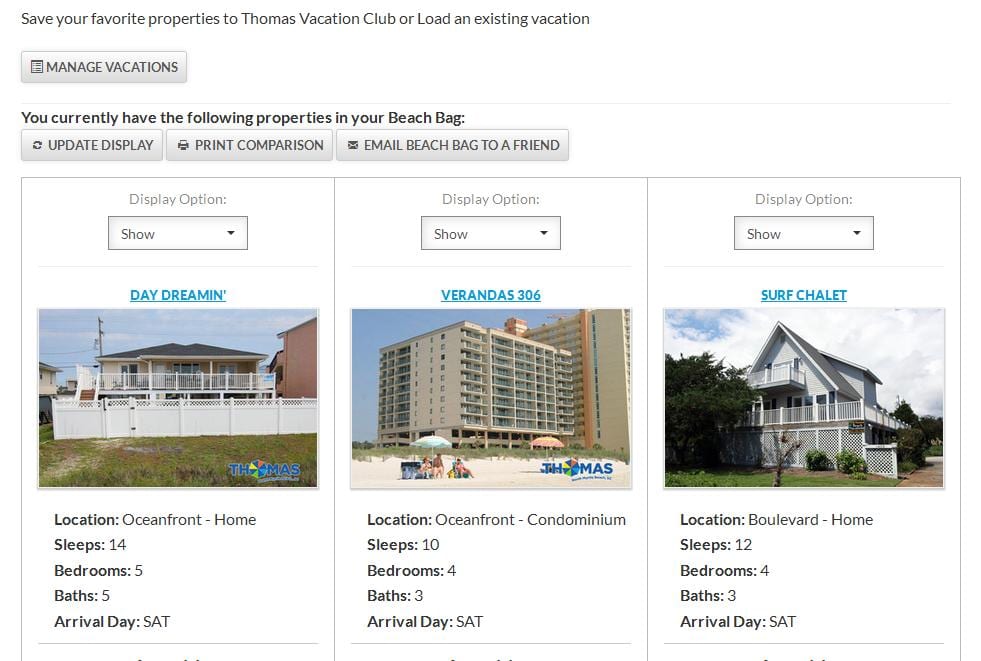
With more normalized data comes a better opportunity to provide apples-to-apples comparison shopping for your guests. “Shopping carts” can easily be shared with friends and family allowing your guests to make a faster booking decision. Here is one from Century 21 Thomas North Myrtle Beach.


 Shopping cart for vacation rentals


4. Response time

In a real-time world, guests don’t want to wait hours or days for responses to inquiries. Response time is a major problem for HomeAway, Airbnb and FlipKey. As a professional, you have the ability to immediately respond to inquiries on your property pages and gain a competitive advantage over listing sites. Many vacation rental managers have implemented click-to-chat which allows you to respond live, keyboard-to-keyboard, to your guests.


5. Area attractions and neighborhood and mapping

No one knows the area restaurants, shopping, grocery and attraction locations better than a local property manager. Including this information on your listing pages will improve your conversions. Airbnb, HomeAway and FlipKey are in the early stages of incorporating this info on their listing pages, but they have a long way to go before they are able to aggregate restaurants and attractions all over the world. Monetize your local knowledge.

Tip: Contact your CVB. They may have already done the work for you. 


6. Data capture

Ecommerce companies such as Amazon and Zappos have become religious about monitoring and collecting data for prospective customers. Through abandoned shopping carts, user surveys, subscription sign ups and special offers, the ecommerce industry prioritizes data gathering from shoppers who have not yet purchased.

These primary data points can be collected through:

  • Subscription sign up
  • Special offers
  • Comparison shopping tool
  • Customer sign in
  • Call center

Here is a data checklist for prospective guests.


Property pages checklist for vacation rental managers

Here is a quick checklist for making sure property pages are optimized for conversion:


 Checklist for Optimizing Short Term Vacation Rental Property Pages


By Amy Hinote

Listing pages vs property pages: What we can learn

0
Property Page Heat Mapping

What are vacation rental managers doing to optimize their property pages for better conversion? We reached out to several website designers in the vacation rental industry, and the response was surprisingly limited. One website design company which specializes in vacation rental websites said, “Our layouts are based on experience, but we don’t have any tracked statistics to back them up.”

This is Part 2 of a series on Listing Pages vs. Property Pages

Part 1: Listing pages vs property pages: What do they know that you don’t?

Part 3: Listing pages vs Property Pages: What vacation rental managers can do better


With limited time and resources, property managers can take some cues from what the large online competitors are doing.

Here are a few must-have features which are being incorporated by top-tier listing sites.


Updated Calendars, Quoteable Rates and Online Booking

As a vacation rental manager having updated calendars with quoteable rates and real-time online booking is mandatory in today’s ecommerce environment. Most property managers have this nailed down, but it needs to be said. If you don’t have it, get it.


Mobile friendly design

From a development perspective, it isn’t as hard as it seems, but the big listing sites have spent millions making this happen. Creating a property page design while maintain intuitive functionality is key to performance success with vacation rental property pages.


Professional Photos

One of the criteria for HomeAway in their algorithm is the number of photos. They recommend 24 professional photos per property. Intercoastal design did some heat map testing on their clients’ property pages.


Property Page Heat Mapping


According to Intercoastal Designs’s David Hutnick, “Pages with bright colorful professional photographs kept people’s attention much longer than pages without. We also saw a very high image click through rate on pages where you could click on an image that opened another page. In fact visitors seem to ignore the top navigation if there was beautiful photo of a property they could click on. When we compared the number of clicks between property listings that used professional photographs versus the properties that used their own photos, studies (via Flipkey) have shown a 159% increase in traffic for listings that used professional photographs.


Reviews

According to TripAdvisor, 80% of travelers say they are significantly more likely to book a rental if they can read reviews from past guests.

“The importance of reviews should never be underestimated,” said Matt Hoffman, founder at InstaManager and Sales and Business Development Director at Real Page. “Online reviews provide transparency into the product being evaluated, in this case, vacation rentals. The listing page or property page is the ‘storefront’ for every vacation rental. The experience you portray and the quality of data you use to market this product is further validated by reviews. It allows the consumer to do your marketing for you by giving them a voice, which in turn creates customer loyalty.”

Matt Hoffman will be presenting a session about reviews at the 2014 VRMA Annual Conference in San Diego, Oct. 26-29.


Part 3: What vacation rental managers can do better than listing sites

Resource: Vacation rental property page checklist

By Amy Hinote


Listing pages vs property pages: What do they know that you don’t?

0
HomeAway Property Page Listing Quality

Vacation rental distribution sites, such as HomeAway, FlipKey and Airbnb, spend a significant amount of time and money testing and optimizing the design of their listing pages to increase property-specific conversion rates, while vacation rental management companies spend relatively little time and effort developing their own property pages.

With all the resources online marketing sites put into creating listing pages optimized for conversion, what can property managers learn from their research?

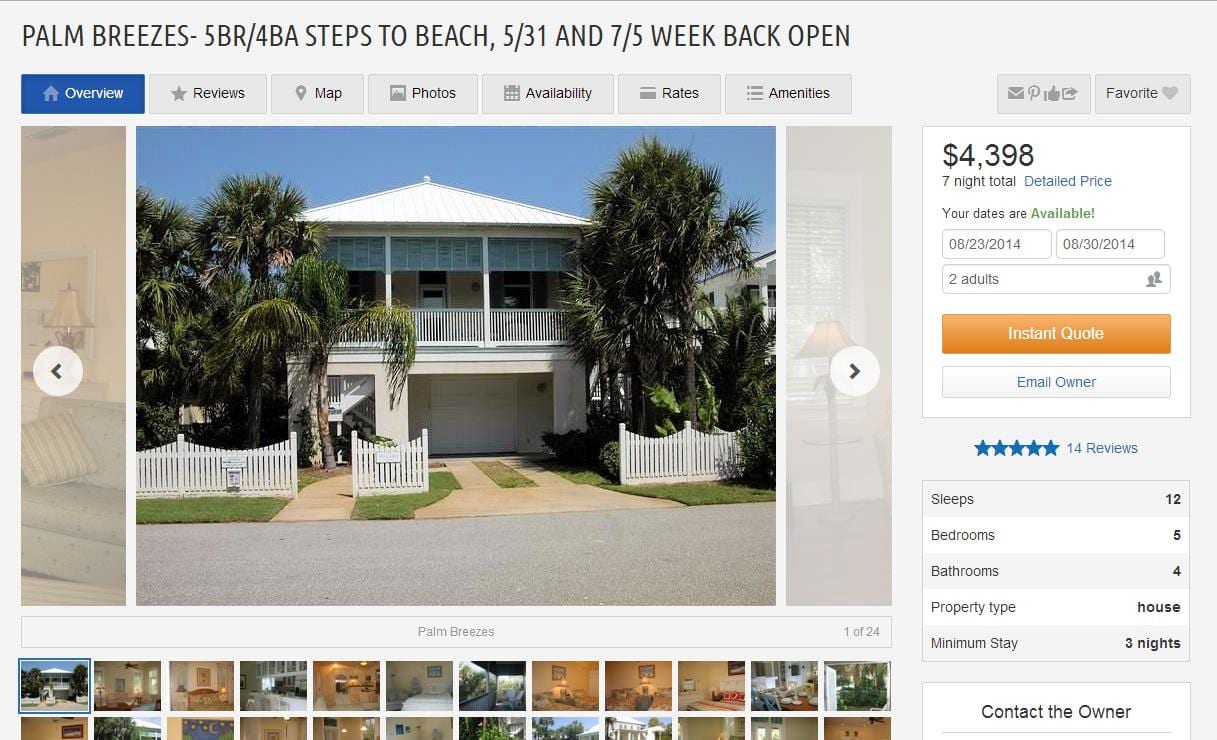
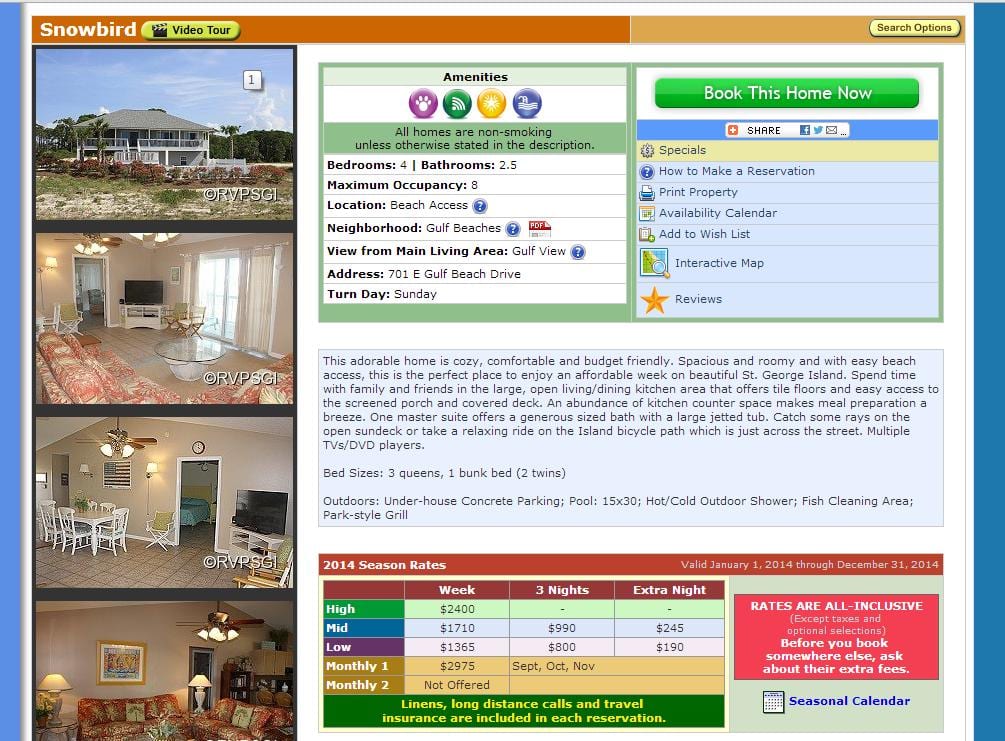
Here is a HomeAway listing page next to a Florida property manager’s property page.


HomeAway Property PageSnowbird vacation rental


What the competition is doing

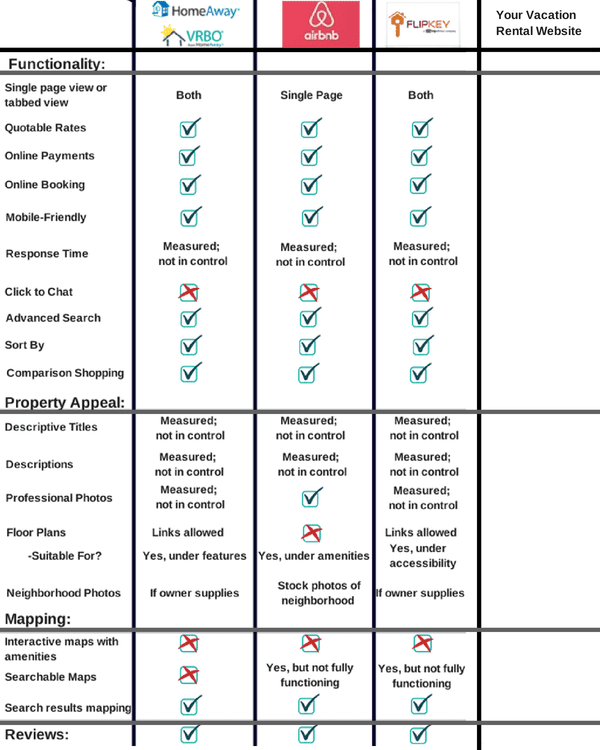
Airbnb, HomeAway and Flipkey have made major changes to their listing pages and ranking algorithms in 2014 with the single goal of getting guests to the cash register faster.

Earlier this month, Airbnb redesigned their listing pages making the following changes:

  • Made calendars easier to read
  • Replaced the multi-tab layout with a one-screen layout
  • Added a neighborhood guide with images
  • Included a map with property-specific recommendations for attractions, restaurants and shopping.


Last week, HomeAway announced it is launching a Listing Quality Scorecard for property listings this quarter. “We believe one of the factors impacting our traffic growth is the ongoing quality initiatives aimed at reducing the number of visits required to secure a booking,” said Brian Sharples, CEO at HomeAway.

TripAdvisor’s FlipKey revamped their property pages, adding the following:

  • A “what’s nearby” feature
  • Specified bathroom and bedding types
  • Numbered dining and seating capacity
  • Made more amenities searchable.
  • Added more search parameters, such as “suitable for children,” elevators and “retired” amenities.

The ranking algorithms implemented by these sites are founded on components which have been proven to lead to higher booking conversion rates.

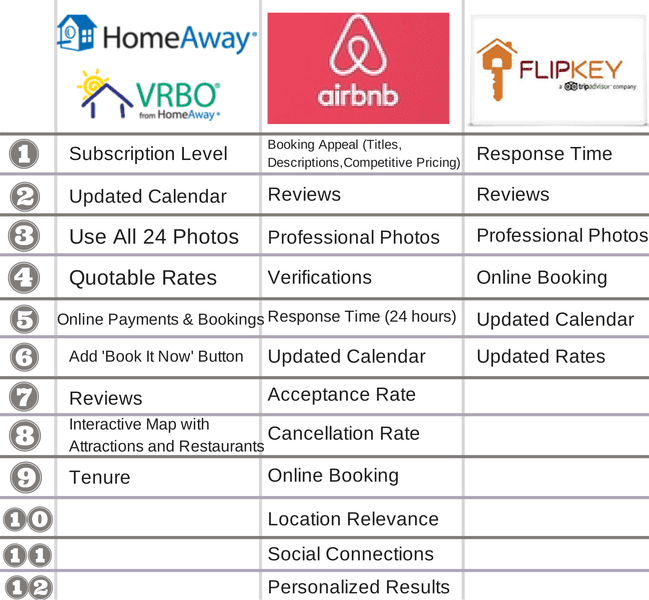
Here are some ranking factors for the distribution channels:


How to rank higher on HomeAway, Airbnb and FlipKeyy


Part 2: What can vacation rental managers learn from the testing done and changes made by HomeAway Airbnb and FlipKey?

Part 3: What vacation rental managers do better on their property pages than HomeAway, Airbnb and FlipKey?

Resource: Property webpage checklist for vacation rental managers


By Amy Hinote


Google to rank sites with encryption higher

0
Google rewards https

Earlier this week in a move to make the Internet more safe and secure for users, Google announced it is adding website encryption to its ranking algorithm.

Google said in a blog post, referring to the protocol for securing communications over digital networks,

“…we’re starting to use HTTPS as a ranking signal. For now it’s only a very lightweight signal—affecting fewer than 1% of global queries, and carrying less weight than other signals such as high-quality content—while we give webmasters time to switch to HTTPS. But over time, we may decide to strengthen it, because we’d like to encourage all website owners to switch from HTTP to HTTPS to keep everyone safe on the web.”


Google itself has been making moves to better securing its own traffic in recent months, which have included encrypting traffic between its own servers. Gmail now always uses an encrypted HTTPS connection which keeps mail from being snooped on as it moves from a consumer’s machine to Google’s data centers.
According to Google, here are some basic tips for getting started:

  • Decide the kind of certificate you need: single, multi-domain, or wildcard certificate
  • Use 2048-bit key certificates
  • Use relative URLs for resources that reside on the same secure domain
  • Use protocol relative URLs for all other domains
  • Check out our Site move article for more guidelines on how to change your website’s address
  • Don’t block your HTTPS site from crawling using robots.txt
  • Allow indexing of your pages by search engines where possible. Avoid the noindex robots meta tag


If your website is already serving on HTTPS, you can test its security level and configuration with the Qualys Lab tool.

Savannah commission delays decision on short-term vacation rental ordinance

0
Savannah delays vacation rental vote

The Metropolitan Planning Commission postponed a recommendation on whether to establish a definition for short-term residential rentals in the city’s zoning ordinance, a change necessitated by the growing popularity of online vacation rental websites such as Airbnb and VRBO.

By JULIA RITCHEY, Courtesy of SavannahNow.com

The MPC board was presented Tuesday with the final language of the amendment, including districts where the use would be permitted, conditions of use and parking requirements. Yet many members said they were unclear on what was being proposed and asked for more time to think it over.

“I think this is a very good start, I just think it needs more time,” said board member Adam Ragsdale.

The board voted 6-2 to continue the item to their next regular meeting on Aug. 26.

Presently, the rental of a house for transient guests, i.e. those staying less than 30 days, is not identified in the city’s code. The city had been regulating the use as an “inn,” but only in districts where inns were approved.

Last fall, city staff identified nearly 300 short-term rentals by searching online, some of which were operating without a business tax certificate and others of which were in residential neighborhoods. After a citywide crackdown to bring those units into compliance, the city, with the input of residents and vacation rental owners, began crafting an ordinance earlier this year.

Out of those meetings came a zoning ordinance and a separate certificate process to address issues such as life and safety, taxes and violations, though the latter portion will be addressed by City Council at a later date.

The zoning amendment proposed Tuesday included stipulations such as no more than two adults per bedroom and a requirement that the property owners maintain the residential appearance of the rental.

The parking requirements would be similar to those for residential dwellings, with the exception of rentals with four or more bedrooms — those will require additional off-street parking.

Public comment was split down the middle, with four people speaking in favor of the amendment and four people against.

Bill Durrence said nearly half the houses near his residence on Washington Square were vacation rentals and that parking had become a real problem. He said the ordinance should address the number of these units allowed in a neighborhood.

“One or two inns in a neighborhood is one thing, but every house on a block with this type of use is a very different type of impact,” said Durrence. “I’m not suggesting eliminating this type of use but putting on density requirements.”

Savannah resident Susan Trimble also warned of potential oversaturation of vacation rentals and said she would like a similar condition added.

“I think it’s a wonderful thing for Savannah to provide alternative housing to visitors,” she said. “But the danger is when there are more (vacation rentals) than there are actual residents.”

Corey Jones, owner of Lucky Savannah Vacation Rentals, spoke in favor of the amendment, stating he felt it would create a more level playing field for all involved in the industry.

“Do I think it’s perfect? No. But I do think it’s a great starting point … and addresses the concerns of some of the primary residents who live in these areas,” said Jones. “It’s something that all sides can live with if they have the best intentions of the community as a whole.”

Brett Turner, who owns multiple vacation rentals, said he, too, thinks it’s a good start, but discouraged more onerous regulations.

“I think this is a good step, but we have to be very careful not to throw the baby out with the bath water,” said Turner. “These units needs to be registered, they need to pay taxes, but we need to be very, very careful about use restrictions.”

Under the proposed ordinance, short-term rentals will be allowed wherever inns are currently allowed, as well as three additional mixed-use districts. They will still be forbidden in predominantly residential neighborhoods such as Ardsley Park.

City Manager Stephanie Cutter, a voting member on the board, encouraged members to vote on the ordinance as written, though to little effect.

“Let me remind the commission, this has been vetted by the city attorney’s office, this has gone out to the public, and I think we all realize this is a beginning and will be continually revised,” said Cutter. “It’s not a can we can continue to kick down the road, we have to address the issue.”

Determining Thread Count

0
Bedding for vacation rentals

One of the most frequently asked questions I get from vacation rental owners is how to create a hotel bed experience and for me it starts with a good mattress followed by good quality linens. Bed linens are a matter of preference and everyone has a different opinion on what they prefer. Personally, I love crispy white linens and I am also looking for affordable and durable sheets.

By Alanna Schroeder Millar, founder at The Distinguished Guest, courtesy of VRMA

The first thing you need to determine when purchasing a new set of sheets for your vacation rental is your budget. Keep in mind that the sheets you provide will need to be comfortable, durable, and should be cost effective. I recommend that you keep two sets of sheets for each bed for convenience when cleaning, for guests who want a change of sheets mid-stay or if a set goes mysteriously missing. Do not keep more than two sets of sheets to prevent over use of linens, more work for the cleaners and to limit clutter.

Be mindful of Thread count which is defined by the number of vertical (warp) and horizontal (weft) threads found within a one square inch piece of fabric. The highest thread count you can typically find in a one square inch piece of fabric is around 400 for a single-ply yarn. Over time the focus of consumers has turned to thread count (the assumption has been the higher the thread count the better the sheet) as an indicator of quality so manufactures started to inflate the thread count based on the ply of the yarn used (for example a 400 thread count sheet with a two-ply yarn can be marketed as 800 thread count). Manufactures have been able to market higher thread counts due to yarn ply as there is no oversight or standards so consumers continue to be misled on this issue and this has been recognized by the Federal Trade Commission.

When it comes to ply it is important to know the difference between a single ply and a two ply yarn. A single ply yarn is one individual thread that is used in the weaving process which results in a lighter weight fabric. A two ply yarn results in a heavier weight sheet. Note that ply is important but what is more important than ply is a good quality cotton so look for a cotton with a long staple length.

Consider your fabric options for both a cotton (long or medium staple length – Egyptian or supima) and a cotton blend (cotton/polyester) sheet when purchasing for your vacation rental. In our opinion, the blended sheet provides the best of both worlds when it comes to sheeting for vacation rentals. The cotton is added for its wicking capabilities, softness and cool qualities. The polyester is added for durability, laundering efficiency, and it’s resistant to wrinkles and shrinking.

Now choose the weave you like. A percale weave provides a light weight weave that provides a crisp feel and a smooth finish and is the most common. Depending on where your vacation rental is located you may consider a flannel, or sateen.

You will never be misled by thread count again, now it’s time to put your new found knowledge to work. I recommend that you consider a sheet set that has a thread count of 200 or more with a single ply yarn since it results in a lighter weight sheet which will be more efficient when it comes to laundering. A cotton/polyester blend (with a higher percentage of cotton) will provide a more durable sheet and will be resistant to wrinkles and shrinking. Finally choose a weave that makes sense for your location and if you are in doubt go with the percale since it is the most basic. Not every guest will appreciate a flannel or sateen.

Identifying data fields for vacation rental managers

1
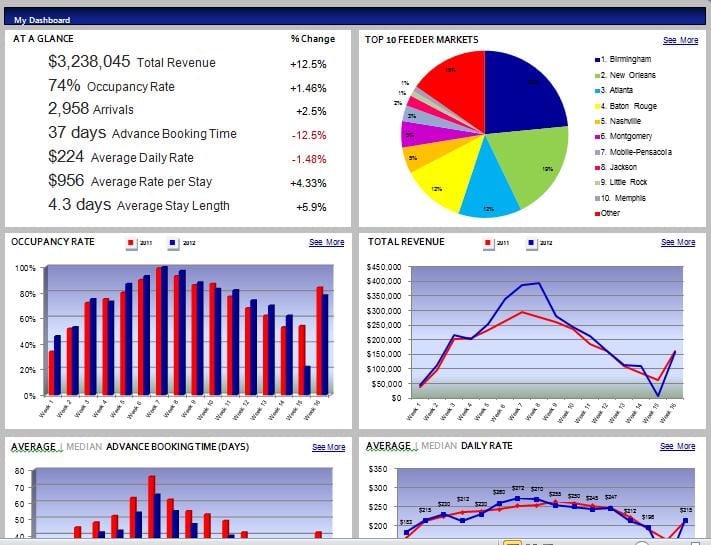
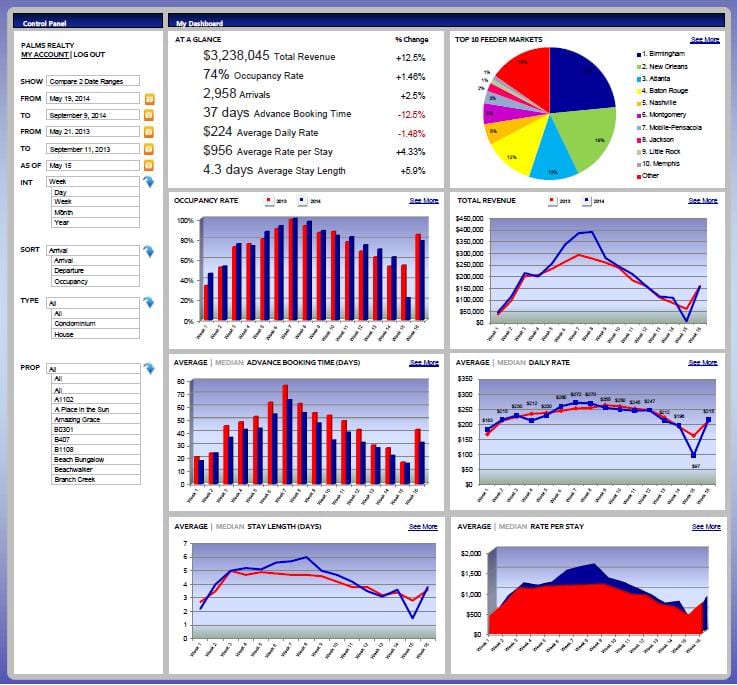
Vacation rental data mining dashboard

Vacation rental managers who collect accurate data and learn to use their data in real-time for marketing, reservations, rate management and intelligent business decisions will gain an enormous competitive advantage in the near future.

The process of collecting clean data can be overwhelming for a busy vacation rental manager. However, adding processes to collect clean data isn’t burdensome once the necessary data fields have been identified.


Data mining for vacation rental companies

What data should be collected?

There are four types of vacation rental data needed to accomplish “big data” needs:

  • Property data
  • Rate data
  • Reservation data
  • Prospect data

Here is a data collection cheat sheet  below.

Not all of the following data  is necessary for every short term rental businesses, but this provides a good starting point to assess the data currently being collected, what could be collected, and what data is not relevant to the business.

(An industry vendor/supplier will also need client data.)


1. Property Data

This is the most complicated data to secure, which is why distribution channels are putting so much time and energy into optimizing their property pages. Fortunately, once property data has been verified and added to the database, updating he information is easy.

**Tip** Design software to make as many of these items as possible displayed in drop down options to avoid errors in data entry.

Internal Property Code
Property Type 1 (House, condo, villa)
Property Type 2 (Waterfront, ski in/out, waterview)
Property Type 3 (Additional type criteria)
Property Type 4 (Additional type criteria)
Property Name
Property Address 1
Property Address 2
City
State
Country
Zip/Post Code
Destination Type
Region 1
Region 2
# Bedrooms
# of Baths
# of Half Baths
Amenity (1-30)
Sleeps
Parking allowed
Bedding Configuration
Dining capacity
Seating capacity
Company Rating
External Rating
Pets
Property specific fees (1-x)
Handicapped Accessible
Suitable for (Kids, Retirees, etc)
Attraction 1 (Beach, Disney World, Downtown)
Attraction 1 Address or Mapping Coordinates
Attraction 2
Attraction 2 Address or Mapping Coordinates
Attraction 3
Attraction 3 Address or Mapping Coordinates
Attraction 4-x
Attraction 4-x Address or Mapping Coordinates
Property Contract Start Date
Property Contract End Date


2. Rate Data

Like property data this information is likely to be added periodically, and not all data fields apply to all companies (e.g., some VRMs only allow weekly rentals, while some urban markets have one rate for all seasons).

*Season 2-x = as many seasons as are provided

Internal Property Code
Season 1 Start Date
Season 1 End Date
Season 1 Title
Season 1 Daily Rate
Season 1 Weekend Rate
Season 1 Weekly Rate
Season 1 Monthly Rate
Season 2-x Start Date
Season 2-x End Date
Season 2-x Title
Season 2-x Daily Rate
Season 2-x Weekend Rate
Season 2-x Weekly Rate
Season 2-x Monthly Rate


3. Reservation Data

Collecting clean data from reservations is critical for success in analyzing performance, setting rates and implementing successful marketing efforts.

Again, it is advisable to add preset options to as many fields as you can (e.g., state, country, source codes, discounts, reason for stay, etc.).

Reservation number
Internal Property Code
Client Code
Guest Name
Guest Name (2-x)
Gender
Email (1-x)
Address 1
Address 2
City
State
Country
Zip/Post Code
Primary Phone
Mobile Phone
Reservation Made Date
Check In Date
Check out Date
Source 1
Source 2 -x
Status
Entry Date
Rate
Revenue
Discount code
Discount applied
# Adults
# Kids
# Pets
Special Needs
Reason for Stay
Activities interest
Lease signed date
Survey sent date
Survey complete date
Survey results/rating
(For marketing purposes, some VRMs are adding names, emails and mobile numbers for all guests staying at the property)


 4. Prospect Data

Ecommerce companies such as Amazon and Zappos have become religious about monitoring and collecting data for prospective customers. Through abandoned shopping carts, user surveys, subscription sign ups and special offers, the ecommerce industry prioritizes data gathering from shoppers who have not yet purchased.

This is why, when a customer calls, the salesperson asks for a name and then asks, “If we get disconnected, is this a good number to reach you?” At that point, they have secured the customer’s name and telephone number, followed by information on what the prospect is shopping for and solicited an email address to send a special offer.

These primary data points can be collected through:

  • Subscription sign up
  • Special offers
  • Comparison shopping tool
  • Customer sign in
  • Call center

Here are data collection options for prospective guests:

Guest Name
Gender
Email (1-x)
Address 1
Address 2
City
State
Country
Zip/Post Code
Primary Phone
Mobile Phone
Dates requested
Property type interest
Property region interest
Attractions interest
Activities interest
Event interest
# Adults
# Children
Pets


Conclusion

In order to get to “big data,” a professional property management company will identify which data to collect and put in systems to collect the information in a consistent way. This checklist provides a solid starting point in assessing current data collection and determining data goals.

By Amy Hinote

Sizing the marketplace: Professionally managed vacation rentals

2

How many professional vacation rental managers are in the U.S.? This question arises often at VRM Intel. Due to varying definitions of second homes, inconsistent rental revenue reporting, and a relatively fragmented marketplace, the number of professional vacation rental managers is not easily obtained. However, there is key data available which assists in estimating the actual size of the professionally managed vacation rental industry.


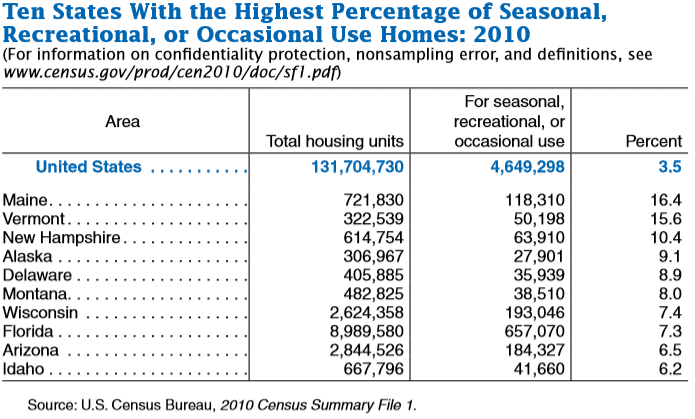
2010 US Census Highest Percentage of Season Recreational Occasional Use HomesAccording to the 2010 U.S. Census:

Total Housing Units: 131,704,730

Total Seasonal, Recreational or Occasional Use Homes: 4,649,298 (3.5%)


According to PhoCusWright:

Total annual income generated  by U.S. vacation rentals: $24 billion

Percentage of vacation rentals which are professionally managed: 44%


According to HomeAway:

Average income per vacation rental property: $27,360


According to Wyndham:

According to Wyndham’s 2013 Annual Report, “The global supply of vacation rental inventory is less organized than the lodging industry and is highly fragmented with much of it being made available by individual property owners. We believe that as of December 31, 2013, there were approximately 1.3 million and 4.2 million vacation properties available for rental in the U.S. and Europe, respectively.

Second homes by county


In addition, it is widely estimated that the average vacation rental management company has between 50 and 75 properties under contract. The average size of a VRMA member vacation rental management company in 2013 was 137 properties.

Also, according to AHS, the percentage of second homes which are vacation rentals is 25 to 35 percent.


The results

Using the data compiled above, the size of the professionally managed vacation rental industry falls in the following range:


PhoCusWright and HomeAway

Taking the PhoCusWright and HomeAway data at face value:

$24B divided by $27,360 per property = 877,192 U.S. Vacation Rentals

x 44% Pro Managed = 385,965 Professionally Managed Vacation Rentals

This would mean there are between 5,146 and 7,719 Professional Vacation Rental Managers in the U.S.


PhocusWright and Wyndham

44%  of 1.3 million vacation rentals in the U.S. =572,000 Professionally Managed Vacation Rentals

This would indicate there are between 7,626 -11,440 Professional Vacation Rental Managers in the U.S.


Using U.S. Census Data

If we add in the U.S. Census data and AHS estimates, the picture looks more like this:

Number of Professionally Managed Vacation Rentals: 511,423 -715,992

Number of Professional Vacation Rental Managers: 6,819 -14,319


Industry analysts estimate the number of vacation rental managers in the U.S. to be 8,000. The data above supports their theory, but as the industry matures and industry data becomes more readily available, we look forward to the day we don’t have to guess.

By Amy Hinote

Under the Hood with Vantage Resort Realty

0

Brad Callahan, founder and president at Travel Advantage Network (TAN), needed vacation rental inventory in Ocean City, MD, to meet membership demand. After working with various operators in Ocean City, Callahan struggled to find the level of service his customers needed. Consequently in 2007, he started Vantage Resort Realty.

Seven years later, Vantage currently manages almost 400 properties in Maryland, Delaware and New Jersey.


Stitcher Joins the Vantage team

Lance Stitcher Vantage Resort RealtyLance Stitcher joined Vantage Resort Realty in March of 2013 as General Manager after spending six years managing Virginia Eastern Shore’s Captain’s Cove Golf and Yacht Club. “When I came on board, I didn’t have much experience specifically in vacation rentals, and I told Brad (Callahan) that I would retain 90% of owners and staff,” said Stitcher. “He looked at me like I was crazy, telling me that 10% of inventory changes ownership, so it isn’t likely. That year, we retained over 93% of our owners.”


Advantages of Being Part of a Larger Company

Vantage Resort Realty is under the Travel Advantage Network umbrella, along with Elevate Cleans and Beachtree Properties. Both Vantage’s fast growth and future plans are founded on the scalability provided by its parent company’s shared services, including Human Resources, IT, Marketing, Legal, and Accounting.

“Being a part of a large company gives us economies of scale,” said Stitcher. “This is especially beneficial in what we can offer our employees (for example, health insurance), and has allowed us to build a stable operation and a strong company culture. We have an absolutely wonderful staff.”


Owner Acquisition and Retention Strategy

Owner acquisition and retention are top priorities at Vantage. On the subject of retaining owners, “Our rates are a little higher, we have high service survey scores, and we have a lot of repeat guests, which make our existing owners happy,” said Stitcher. “At the end of the year, there were a few properties we weeded out because the owners wouldn’t reinvest in the property. Now we are more selective in the properties we bring on.”

“Our business model for property acquisition is fundamentally different than what is being done in Ocean City, as we have placed a business development focus on attracting owners,” said Stitcher. “Operationally we separated our owner -focused staff from our guest-focused staff and added Owner Relations Assistants who monitor owner success after the contract is signed. We also added incentive based commissions for our business development team.”

“Our growth has been largely organic with the largest source of inventory being referrals, and our messaging to prospective owners is strong,” said Sticher. “We focus on what we do well, we demonstrate to prospects that we are more forward thinking and progressive, and we show that we are more accountable to our owners than our competitors.”


Technology

During Stitcher’s tenure, the team at Vantage Resort Realty has been laser focused on improving technology. They recently implemented Barefoot Technologies vacation rental software and launched a new, integrated website.

“One thing we do better than anyone else in our market is technology,” said Stitcher. “Our parent company’s dedicated IT team partnered with our vacation rental team to enable us to quickly and efficiently convert to new software, add the Glad mobile app, and launch a new website before the season started.“


Marketing

Vantage’s marketing team uses multiple channels to reach guests, and owners can purchase additional tiered “marketing packages” which include listings on distribution sites (e.g. VRBO, FlipKey, and other mainstream channel partners), TruPlace’s interactive floor plans and property-focused marketing initiatives.

“Our software also has a great autoresponder,” said Stitcher. “When someone comes in to our funnel through any of the marketing channels, we are able to quickly reach out to them.”

With many of the distribution channels moving to a pay per booking model, we asked Stitcher which model works best for Vantage’s inventory. “Pay per lead and pay per booking models don’t currently make sense for what we are doing,” he said. “For the VRM, the subscription model provides greater value. We need to keep a watchful eye on it to make sure the math continues to work in our favor.”

Stitcher added, “We are working to become less reliant on these sites over the next two years.”


Industry Involvement

The Vantage team sees enormous value in joining and engaging in the area Convention and Visitors Bureau (CVB) and Vacation Rental Managers Association (VRMA). “We are very involved in the VRMA,” he said. “When I came on board, I leaned heavily on the VRMA to learn as fast as I could. I networked with other members, volunteered for committees and joined the value task force. In fact, we are partnering with Vacation Future’s Andrew McConnell to teach a session about inventory acquisition at the VRMA Annual Conference in San Diego in late October.”

Vantage White Marlin OpenIn addition the Vantage Team is heavily involved with the Ocean City CVB. “The Ocean City CVB is what makes this destination work. Forty percent on the U.S. population lives within a five hour drive of Ocean City, and the CVB does a great job of creating and marketing events in the off season. We want to help in any we can, and we sponsor events such as the White Marlin Open.”


Expansion

We can safely expect to see Vantage Resort Realty grow in the coming months and years. With their service-based foundation and the scalability and resources offered by TAN, it is likely Vantage with spread its coverage both in their existing markets and in other destinations. “We started from scratch in Maryland, Delaware and New Jersey, but in other markets, we may discover that acquisition is a better strategy,” said Stitcher.

By Amy Hinote

Vacation Rental Industry Ripe for Acquisitions

0
Vacation rental business for sale

2014 has already seen key acquisitions by growing vacation rental management companies, with several big announcements on the way. Late last year, Wyndham purchased Hatteras Realty, and this year Vacasa acquired Utah Vacation Homes, Resort Realty bought the VR operations of Colony Realty, Seaside Vacations bought JoHank Rentals, Turnkey Vacation Rentals purchased Coastline Adventures, Long & Foster acquired several companies in New Jersey, and Invited Home recently purchased Maui Blue.

According to Ben Edwards, President at Weatherby Consulting which provides transaction advisory services and consulting in the vacation rental industry, the current market for vacation rental management companies is highly active. “There are companies looking to buy right now,” said Edwards. “With a lot of new entrants along with rapidly expanding existing players, and it is an optimal time to buy and sell in this category.”


Market Conditions

As Edwards points out, market conditions are ripe for acquisition in the vacation rental industry. Besides the macro conditions, such as a solid economic recovery, low interest rates, and the influence of the baby boomer demographic , there are industry related factors which add to the favorable environment.


Increased Awareness

Large distribution channels have increased awareness of vacation rentals as a mainstream lodging alternative.


Larger Second Home Market

NAR 2014 report showed that 717,000 vacation homes were purchased last year, the most since 2006 before sharp declines in the real estate market took effect, and 89% of vacation home buyers plan to rent their new property within the next 12 months.


Regulations and Restrictions

An anticipated increase in regulation is expected to prompt owner managed vacation home inventory to move under professional management.


Increased Seasonal Occupancy

According to HomeAway, the occupancy rate for owners who report the winter season as their peak rental season rose to 70% during the winter season, while the average summer occupancy rate for vacation rentals increased to 77% for vacation rental owners who consider summer their peak season.


Improved technology

Advancements in technology, notably real time online booking, multi-office systems, rate management tools, and customer relationship management (CRM), have made it feasible to manage multiple operators across destinations.


“From a buyer’s perspective, building a successful national brand is more attainable than it has ever been,” said Edwards. “From a seller’s perspective, there is a high level in interest. We are seeing deals close quickly, especially in the range of 3.5-4.5 times earnings, depending on the overall health of the company.”

“We can expect this trend to increase as we move past the busy summer season, said Edwards.

Related: Exit Strategy: Ensuring top dollar for your vacation rental management company

By Amy Hinote

About Amy Hinote

9
Amy Hinote, Founder, Editor, Consultant

Amy Hinote, Founder, Editor, ConsultantAmy Hinote is the founder and editor of VRM Intel which provides news and education for the rapidly expanding professionally managed vacation rental industry. With a background in finance and marketing and over 10 years in the vacation rental industry, Hinote has worked with property management companies, suppliers, and intermediaries and provides insider information about the growing vacation rental industry. Hinote resides just north of Chicago in Evanston, IL.

Contact Amy Hinote
amy.hinote@vrmintel.com
(251) 455-4994


STRAC management moves under Travel Tech umbrella

0
Short term rental advocacy and policy

Airbnb, HomeAway and TripAdvisor have joined Travel Tech and moved the management of the Short Term Rental Advocacy Center (STRAC) under the Travel Tech umbrella.

Formed in early 2013, STRAC was created through a coalition of Airbnb, HomeAway and TripAdvisor to provide resources to help hosts, homeowners and rental managers legalize and legitimize short term rentals in their communities.

Travel Tech for Short Term Rentals“Travel Tech is a trade association for travel intermediators, companies who connect travel suppliers with consumers,” said Philip Minardi, Director of Communications and Public Affairs at Travel Tech. “A vital part of what we will be doing with STRAC is creating a portal through which hosts and managers learn about restrictions and regulations, find resources for communicating with city and county officials, and engage with other members of the community.”

As part of its advocacy strategy, Travel Tech recently appointed Matt Kiessling as Director of Coalitions and Grass Roots, a role created to head up initiatives that connect owners and managers with community officials.

“We want policy makers to understand the short term rental marketplace,” said Minardi. “This space is not new. It is an established and important sector of the travel industry and contributes significantly to the local economy.”

One of the challenges Travel Tech faces in dealing with legislation will be helping to define the category. Terms such as “sharing economy” are being widely circulated in the media and are causing confusion about short term rentals.

“We have seen local municipalities struggle with defining short term rentals and understanding the business model, so they come up with policy and regulations which are unnecessarily burdensome,” said Minardi. “As we see short term rentals grow globally, Travel Tech and STRAC will be working with communities, local residents, property managers and providers to establish policy which advances short term rental regulations, provides a framework for compliance and safeguards travelers and residents.”

Minardi added, “Short term regulations should be easy to locate and comply with. Travel tech will provide an industry-level voice and will leverage STRAC to provide education and resources for council members, the press and the community.”

“With the formation of STRAC along with their internal initiatives, HomeAway, TripAdvisor and Airbnb have approached government advocacy in a very intentional way,” said Ben Edwards, President of the Vacation Rental Managers Association (VRMA) and Vice President of Business Development at Newman-Dailey Resort Properties. “As a vacation rental manager, I am appreciative of their efforts and what they have been able to accomplish through STRAC in a relatively short amount of time.”

“From the VRMA perspective, we are exploring ways we can work with Travel Tech and these partner companies to further help vacation rental mangers navigate the legislative landscape in their communities.”

STRAC was previously managed by the Glover Park Group in Washington D.C.

By Amy Hinote

HomeAway names new CMO

0
HomeAway

HomeAway today named Visa’s Mariano Dima as chief marketing officer (CMO). In this position, Dima will oversee all global marketing, corporate communications and brand initiatives.

As former Visa Europe CMO, Dima oversaw strategic marketing, brand communications, advertising, sponsorships, and insights and analytics. Additionally, Dima managed a product portfolio that included credit, debit, commercial and new payment developments such as e-commerce, digital wallet, mobile payments and contactless technologies.

Mariano Dima -HomeAway CMODima’s seven-year tenure with Visa Europe was punctuated by the company’s wildly popular 2012 Olympic-integrated marketing campaign, “Life flows better with Visa,” that featured a series of ads including “Running Man” with Usain Bolt and “Flow Faster.” Under Dima, the company was also recognized by BrandZ as one of the 10 most valuable brands in the world in 2013.

“Mariano has elevated some of the world’s most recognizable brands,” says Brian Sharples, chief executive officer of HomeAway. “As our industry continues to grow, he has the experience and passion to create an emotional connection between our brand and the families and groups who stay in vacation rentals.”

“HomeAway is more than the leading online marketplace for vacation rentals; it is a brand that connects families and friends to share the most memorable experiences of their lives,” says Dima. “I look forward to the opportunity to help transform the vacation rental customer experience, creating platforms for connection and enjoyment and telling the HomeAway story in a very impactful way.”

The announcement comes after institutional criticism about HomeAway’s marketing allocation. JP Morgan analyst Doug Anmuth observed in late May, “We believe increasing marketing spend is appropriate to grow the PPB business and we are also encouraged by healthy renewal rates and strong subscription pricing growth, but we believe visibility will be limited in the near-term and return on marketing spend could take some time.”


RealPage User Conference Underway

0

The RealPage (NASDAQ: RP) RealWorld 2014 user conference in Chicago is currently underway and is being met with a high level of excitement and engagement. RealPage, a widely used property management software provider in the long-term management space, recently jumped into the vacation rental industry with their $50 million acquisitions of Bookt/InstaManager and Kigo.

Some of the products/updates being launched at the conference are:

  • Slick, updated user interface
  • Big data performance dashboards with competitive data and predictive analysis
  • Social engagement platform for employees and tenants/guests
  • Maintenance management solution
  • Virtual tour creator

More to come…

By Amy Hinote

Airbnb’s rebrand: Turning company into creed

0
Airbnb Rebrand, new logo

Airbnb launched its new logo and rebranding campaign today. There are two videos below, the new logo launch and the comments by CEO Brian Chesky.

In his comments, Chesky said, “What has happened is, that over time, our community outgrew us -the brand. ‘Cause when people see Airbnb today –that are outsiders -they still see that little website that rents rooms, when what we do together is so much bigger.”


One of the guests in the video talked about his experience with Airbnb, ” No ‘Do not Disturb’ sign could create the kind of peace and serenity I experienced. In the mornings I would wake up, and I would have the sweet scent of incense burning, and I would meditate with my host…”


This isn’t a traditional vacation rental experience.


It is clear that Airbnb is not trying to replace HomeAway, FlipKey or compete directly with professional property managers. They are more interested in creating a new category than being a distribution outlet for vacation rentals as evidenced by:


1. Not engaging Professional Vacation Rental Managers

  • Airbnb does not allow any technology integration with property management software systems, which makes it difficult for property managers to maintain updated availability and manage listings.
  • Have not engaged with the professionally managed vacation rental industry which represents over half the short term rental market.

2. Prioritizing the rental of primary residences in legal battles

  • Airbnb is pushing the legalization of rentals in primary residences, not traditional second home vacation rentals. When they are working on the ground to influence policy concerning short term rentals, they are not actively trying to protect professionally managed vacation rentals.


Comments online

Here are some comments from social networks about the brand:

Wow, talk about an inflated, self important view of themselves. The tone was such that for a moment I thought they would announce they cured cancer… instead, 35 minutes to announce a logo change and a website redesign….
My symbol aka logo is the heart for my initials BV and my alter ego BLOVE a universal symbol. 🙂  As we open our heart to more sharing we become more trusting which in turn allows more light to come into our being and shine freely from our soul. xx Brandi Veil, a shared economy ambassador
I don’t really remind the completely irrelevant logo, other than it referring to the numerous number of sexual acts going on in AirBnB rooms, but I am completely appalled by the redesign of the actual listing pages.


I much preferred the old logo – the white and blue “a” seemed more upbeat and was very recognizable. Okay, this is recognizable too…but more so as the terminal end of the male genitalia as expressed in paperclip form. Perhaps steering well clear of the pink spectrum of colors would help….

Twitter comments about airbnb

Zooming in on HDR photography

0
HDR Photos for vacation rentals

HDR Photography or, what’s commonly referred to as ‘Fusion’ photography, is ranking very high on the popularity chart nowadays.

For those of you unfamiliar, HDR photography (High-Dynamic Range) represents the really cool things you can do to enhance you photos with digital imaging. It basically turns your realistic photos into graphic paintings – often, a misrepresentation of your property is the end result.

With an increase in tools and digital techniques, it is quite common to see  HDR photos in the MLS, on Trulia, Zillow, Realtor.com…the list goes on.  Not sure what we’re talking about? These HDR photos look like cartoon renderings or video game stills, with extreme saturated color and heightened textural effects.


Customer Expectations

“With all of the new technology that has been brought into real estate photography, High Dynamic Range (HDR) brings a new excitement in home sales,” says Duane Heaton, the Photography Training Manager with TruPlace. “It is important to understand the importance of the proper use of any tool, including HDR, while maintaining a realistic view of th e property. I have found that the “Fusion” services that are being offered, sometimes push the true and genuine views of the homes. The last thing that any company should do is create a false impression on where people would plan so many dreams and events within their lives.”

HDR photography was developed so photographers could escape the difficulties of traditional photography; a blown-out sky or a dark, underexposed face, varying wall colors, etc.. With HDR, these obstacles can be overcome by shooting multiple frames and ‘fusing’ them together, or using a single image and adjusting it with photo-enhancing software.

You will most likely recognize the term HDR from your iPhone’s camera, or, when you use certain filters on Instagram to completely enhance/distort your selfies 🙂

Whatever the method, the effect can be eye-popping, or can completely misrepresent the scene; for Realtors, it will most likely distort the way their listing looks in photos. HDR increases local contrast at the expense of overall contrast. Basically, when looking at fusion or HDR photographs that are ‘overdone’, there is nothing left to lead your eye around the frame.  If not done properly, all that remains is a big, scrambled omelette of exaggerated ingredients.


A Look at the Difference

Here is a photo Duane took, with normal adjustments to exposure and color. A typical example of a TruPlace photograph:

TP Photography

HDR or Fusion Photography

Now, here is the same exact photo, but, edited through an HDR-Scape filter:

HDR Photos for vacation rentals


The HDR image above certainly has “pop,” but it no longer looks like a ‘real’ front elevation of your listing in DC (or Maryland, or Virginia…or anywhere for that matter). The TruPlace photograph portrays a sunny, warm, blue-sky day. The latter image displays retina-searing contours, clouds that look like their from a scene rom ‘The Perfect Storm” and landscape that looks plastic.

“In real estate work there is an expectation of reality so the more dramatically creative looks frequently see in HDR work is not appropriate for real estate work. The photography that TruPlace does fulfills that expectation,” Heaton concludes.

Whether it’s a wide-angle landscape, or the interior of a vacant property, HDR photos are all the same and all show off the same distorted vision of otherwise gorgeous real estate. As a Realtor, you focus on giving yourself the competitive edge and providing your sellers with unique marketing and photography services. If HDR photos are distorting your listings and doing them an ‘injustice’ of sorts, are your sellers going to be happy? Some people love HDR, and there is nothing wrong with that; but keep your reputation and marketing edge in mind when considering between true, professional photography and an expensive Instagram filter named ‘Fusion’.

By Marissa Ferraraccio

LiveRez Announces User Conference in Boise, Sept. 8-10

0
New LiveRez Offices

Scheduled for Sept. 8-10, the conference will offer hands-on system training, best practices and networking opportunities to the more than 800 companies using the LiveRez software.   

EAGLE, Id. –– LiveRez.com, the industry leader in cloud-based software for professional vacation rental managers, will hold its inaugural LiveRez Partner Conference Sept. 8-10, 2014 at the newly renovated Owyhee Conference Center, a historic landmark set in the heart of downtown Boise, ID.

The conference will include hands-on training of the LiveRez software, workshops about vacation rental management and software best practices, broad networking opportunities, and a vast array of entertainment options to enjoy in the conference after hours.

Key among the topics discussed will be business strategies to help professional managers decrease their dependence on listing sites, like HomeAway, VRBO and others.

Tracy Lotz hits another milestone wth LiveRez“This conference is all about helping our partners grow their businesses, their profitability and become more financially independent,” said Tracy Lotz, CEO of LiveRez.com. “One of the biggest concerns that managers have today centers both on their dependence on their listing sites for bookings and how their guest and owner data can be used.”

“During this year’s conference we’ll unveil multiple tactics to help our property manager partners move away from listing sites, take control of their marketing efforts and become independently successful. And, our new iVacationRental.com initiative will be a big part of that effort.”

The conference is spearheaded by eLearning expert Doug Covey, a former Blueprint Education CEO who recently joined LiveRez as its Vice President of Partner Education.

“In planning this conference, our goal is to provide our property manager partners with actionable training and advice that they can immediately incorporate into their operations,” Covey said. “As a result, this conference will empower our partners to become more successful and at the same time allow us to learn more about how we can help them accomplish that.”

The three-day conference will feature a full docket of hands-on training classes, keynote speakers, networking events and the opportunity to tour the LiveRez headquarters and meet its staff. In the days before and after the conference, and during the evening hours, attendees will have the freedom to experience Idaho’s legendary outdoor recreational activities, as well as enjoy Boise’s vibrant downtown.

“As much as this conference is about business strategy, it’s also about relationships,” Lotz said. “And getting out and enjoying all that Idaho offers is a perfect opportunity for team building and strengthening relationships among our network of partners. We want attendees to know that they’re not just one-to-one business partners, but crucial members of the larger LiveRez family.”


Full conference details can be found at LiveRez.com/conference. For more information on the 2014 LiveRez Partner Conference, please call (800) 343-2891 or email Conference@LiveRez.com.


About LiveRez.com

LiveRez.com is a complete, online, vacation rental property management solution, focused on making vacation rental property managers fully operational online and thereby increasing bookings. LiveRez.com offers an all-in-one cloud-based platform, featuring best-in-class websites optimized for online bookings, a full-featured reservation and property management system, a robust CRM system, an exclusive connection to QuickBooks for trust accounting, and a unique “Pay-for-Performance” approach, which provides a mutually beneficial partnership between LiveRez.com and its vacation rental manager partners. The company’s largest competitor is HomeAway Software for Professionals.

To learn more about LiveRez.com, please call (800) 343-2891 or visit LiveRez.com. And, to receive timely updates from the company, follow LiveRez.com on Facebook, Twitter (@LiveRez) and Google+, or visit the company’s vacation rental software blog. LiveRez.com is a proud Gold Sponsor of the Vacation Rental Manager’s Association (VRMA).


Onsite Property Management Association Holds First Advisory Board Meeting in Atlanta

0

On June 25, 2014, the OPMA (Onsite Property Management Association), the new national organization focused on short-term rental property management, held its first official advisory board meeting in Altanta.


The OPMA Advisory Board currently comprises the following council representatives:

  • OPMA’s president, Paul Wohlford, Resort Collection, Panama City Beach, FL
  • Brent Howie, Provident Hotels and Resorts, Clearwater, FL
  • Matthew Brittain, Brittain Resort Management in Myrtle Beach, SC
  • Marco Manzie, Paramount Hospitality Management, Orlando
  • Jim Olin, C2G Advisors, LLC
  • Tony Santilli, CSA Travel Protection
  • Steve Zimmerman, Beach House Logos
  • Larry Hall, PARS Springer-Miller
  • Rick Fisher, executive director of OPMA
  • Keith Wilt, OPMA’s treasurer


One of the association’s first orders of business was to approve a motion to further add three representatives from the on-site manager community, bringing the total number of advisory board representatives to eleven—seven on-site property managers and four suppliers.

OPMA


The full-day business agenda generated discussions around a number of growth initiatives. One major priority was to continue increasing the on-site manager member base, which is important for a lodging segment that contributes tourism tax revenue dollars on a local and regional market basis throughout the country.

According to Rick Fisher, executive director of OPMA, “What’s ironic is that OPMA represents what could be defined as one of the largest lodging sectors and yet, until the launch of OPMA back in March of this year, this lodging segment has had no real voice or representation in the hospitality marketplace. Quite frankly, there are a number of leisure destinations where on-site managed rental properties represent the dominant lodging segment for overall rental unit inventory.”

Paul Wohlford, president of OPMA, agrees that the organization remains focused and is on the right course. “OPMA continues to gain momentum and will diligently work to ensure the success of on-site rental management companies while setting the standards for unmatched guest service. We are also pleased to report that since our official launch just four months ago, our on-site manager member base already represents approximately 25,000 rental units of inventory and $8 billion in real estate assets.”

According to their press release, “There will be more announcements forthcoming from the OPMA Advisory Board meeting that the council attendees believe will reflect groundbreaking industry news and developments and will further position OPMA as the major voice and advocate for the short-term on-site property management community.”

Smart Home Spying: Is new technology giving vacation rental owners access to spy on guests?

1
Smart home cameras for vacation rentals

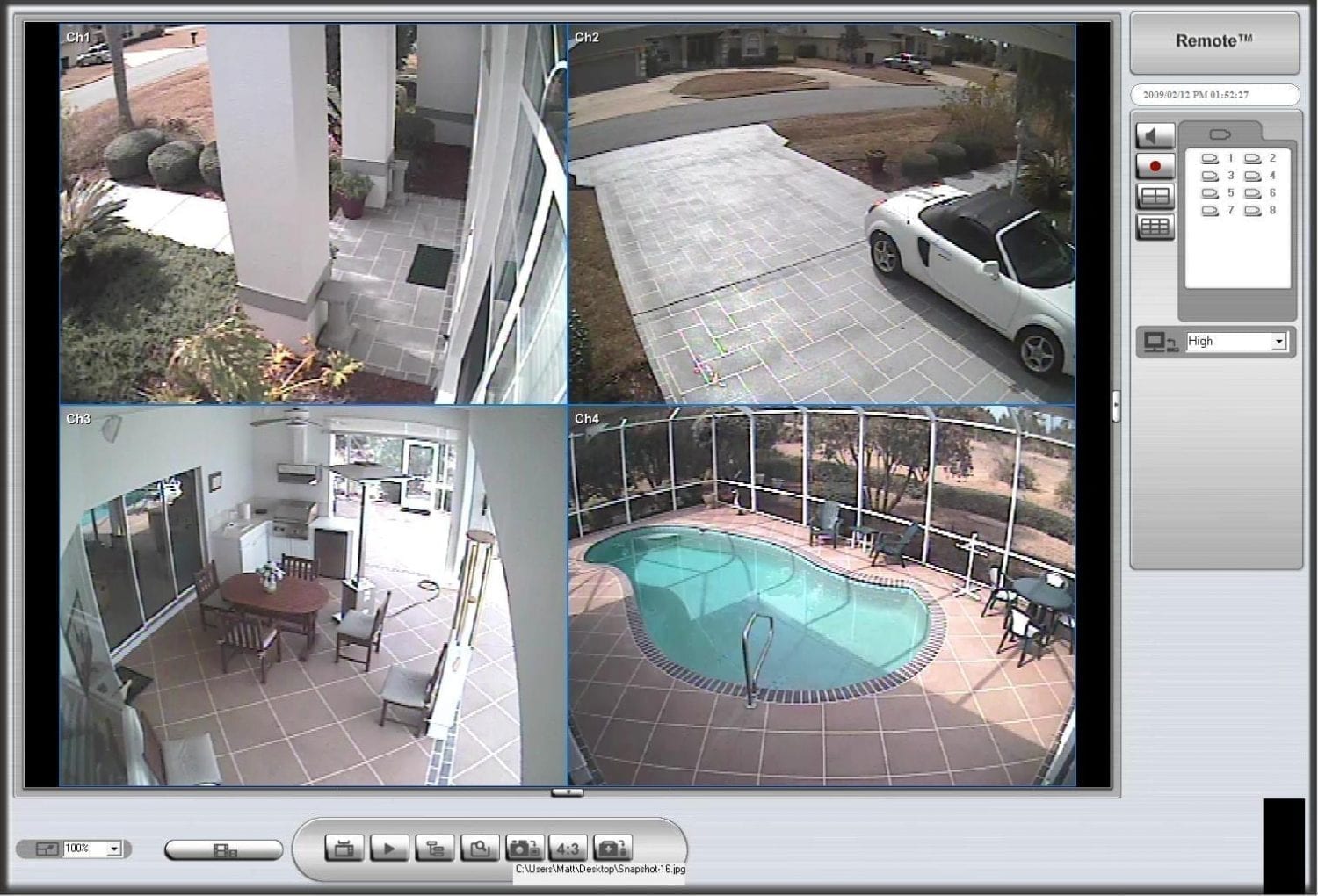
For the third time this year, in three states, vacation rental managers have discovered homeowners using smart home technology to spy on guests. With new technology, homeowners have increasing levels of access to monitoring activity in their homes, and a few are using it in ways which compromise guests’ privacy.

The property managers, who will remain unnamed, found hidden wifi-based cameras in their vacation homes and confronted the homeowner. In two cases the homes were removed from the rental program.

In Fort Meyers, FL, a man was charged after a video camera was found hidden in a clock inside a rental house. Police say the video clips they found contained over 4,000 video clips of unsuspecting renters – including video of them sleeping, showering and having sex.


The Good Part of Smart Home Technology

Smart home technology enables homeowners and managers to access, adjust and monitor various electronics and activity via cellular and wifi technology. Controlling thermostats and keyless locks are currently the top two uses by vacation rental managers, but security cameras, pool and hot tub control, energy efficiency and tv/cable control are areas of fast growth.


Hidden CamerasSmart home cameras for vacation rentals

Want to know what to look for? Most of these are cameras in clocksBlu Ray players, charging stations, clothing hooks, and power outlets. These cameras can easily be found on Amazon, but a quick Google search shows many more sites dedicated to new monitoring technology.

Your company can also purchase a hidden camera detector to make sure your short term rental homes do not have existing hidden cameras.


Owner Installed vs. VRM Installed

According to Greg Burge, president at PointCentral and past president at GE Security, America’s, vacation rental managers have an opportunity to establish primary control of installed smart home technology.

“These incidents reflect a growing trend by homeowners to independently install smart home products,” said Burge.  “Unlike ‘enterprise’ smart home solutions being implemented by leading VRM’s across the country, these owner installed ‘single property’ systems compromise guest security.”

Burge continued, “More and more VRM’s are taking a leadership role and moving in front of owners to deploy smart home solutions that improve guest, owner, and employee security; drive down owner energy costs; and provide significant VRM operational improvements and efficiencies. With the added benefit of a potential revenue source.”

New Policies

Some states currently have laws stating that video cameras can be used to protect the landlord’s property if the tenant is given fair warning, and only a few states have specific laws banning the unauthorized use of hidden cameras in private places. Of these, only a handful have classified video voyeurism as a felony. Everywhere else, it’s a misdemeanor.

In the coming months as use increases, vacation rental managers will begin to include smart home technology policies to protect their guests’ privacy.


By

PhoCusWright releases study on private residence rentals and the “New Gen” renter

0
Sharing economy and short term rentals

From PhoCusWright Within just a few short years, the remarkable growth of HomeAway and Airbnb has sparked nothing short of a global phenomenon, spawning myriad imitators, numerous legal actions and intense industry scrutiny.

Municipalities and traditional travel industry sectors are still coming to grips with the implications of private homeowners and even renters turning their abodes into part-time (or full-time) businesses.

PhoCusWright’s Share This! Private Accommodation & the Rise of the New Gen Renter, a new study surveying nearly 2,000 travelers, delves deeply into the use of private accommodation in travel and defines the new rental traveler.

Examining the attitudes, aspirations, expectations and behaviors of renters and non-renters alike, this report provides critical insights into how, when and why travelers do and do not choose rentals vs. hotels, what influences their decisions, where they shop and book, and what renters want.

“There is a new generation of renters who are a breed apart from the larger traveler population,” said Douglas Quinby, PhoCusWright’s vice president, research. “They are younger, extremely digitally engaged and have very distinct travel wants and aspirations that stand apart from hotel guests and older rental travelers. In short, it’s not your mom’s vacation rental anymore.”

Share This! Private Accommodation & the Rise of the New Gen Renter provides deep insight into the U.S. rental traveler. The study explains who they are, how they travel, what they want, and how they shop and book.

The report also delves into the competitive overlap with hotels, including the extent to which renters consider and stay in hotels, whether non-renters consider private accommodation, and the potential impact of rentals on the traditional hotel market.

Topics covered in this report include:

  • Historical context of the vacation rental and private accommodation markets
  • In-depth analysis of the rental traveler and New Gen Renter segments
  • Six key travel attitudes of the New Gen Renter
  • To rent or not to rent: traveler decision dynamics around private accommodations vs. hotels
  • How rental travelers shop and book accommodations

Understand the new rental traveler and explore emerging trends in terms of demographics, travel behavior and use of consumer technology with PhoCusWright’s Share This! Private Accommodation & the Rise of the New Gen Renter. Click HERE to read more.

PointCentral

0

Is Airbnb hurting or helping the vacation rental industry?

0
airbnb: regulations come to chicago

Airbnb is becoming a noun more than a brand name, but what does “Airbnb” mean to the average person, and is the definition they are creating helping or hurting the vacation rental industry?


Awareness

Airbnb has done a spectacular job of creating brand and category awareness. Their marketing efforts have increased both the knowledge and popularity of using residential short term rentals for lodging, especially in cities, where overall use and awareness of vacation rentals has been relatively low.

The Google Trends chart below demonstrates the volume of the following search terms since January 2012:


Grass Roots Efforts

Airbnb has effectively mobilized local “hosts” to show up at city council meetings to fight rental restrictions  The company hired spokesperson David Hantman in 2012, and Aibnb is currently in the news daily for their public stance in short term rental disputes.

Petitions have been created by Airbnb hosts in Portland, Seattle, New York, San Francisco, Los Angeles, Grand Rapids, Denver and many more cities around the world. These petitions are being generated using sites such as change. org and peers.org and are being passed around the Airbnb community using peer-to-peer social media. The Airbnb host community is active, engaged and connected, characteristics which prove beneficial when facing a city council or county commission.

“At the June 4 Portland City Council meeting, Airbnb had a brunch (before the meeting) for their Portland hosts where they coached them on their testimony and helped them write them,” said Betsy LaBarge, founder and president of Mt Hood Vacation Rentals. “We didn’t know that until we got to the Public Hearing and signed up -behind about 50+ Airbnb hosts. They also had a representative deliver testimony.”


Category Confusion

However, while these efforts have been effective in allowing primary homeowners/renters to rent out a portion of their residence, the movement has created confusion about the vacation rental industry as a whole.

According to Vacasa’s Cliff Johnson in an Oregonian Op-ed before the last Portland city council meeting, “the city is only looking at legalizing a very narrow profile of rentals – the short-term rental of rooms within a primary residence. In our experience, this represents an extreme minority in the world of vacation rentals, as it covers less than 5 percent of all vacation rentals.”

Had it not been for campaigning by LaBarge and Johnson, along with HomeAway’s Matt Curtis and Oregon vacation rental managers, the Portland City Council was ready to rule that short term rentals in primary residences would be allowed, but rentals in non-primary residences would have remained illegal until the city council could determine appropriate regulation.

And it is not just in Portland. Airbnb also was successful in pushing similar initiatives in other areas. In February, Amsterdam passed an “Airbnb-friendly law” which permits residents to rent out their primary homes to up to 4 people at a time for up to 60 day a year. Earlier this year a bill was also passed in France legalizing short term rentals of primary residences.


Primary Residence Short Term Rental vs. Second Home Vacation Rental

The concern is that these initiatives are encouraging lawmakers to decide, as long as an owner is present in a primary residence, the rental should be legal. But if an owner is not present or it is a second home, the rental should be illegal.

These rulings are harmful to professional vacation rental management. The vacation rental industry has a long history of providing safe, clean lodging to visitors, having managers available 24/7, working with existing laws (not underground), paying lodging/tourist/TOT taxes, promoting the area as a destination, and increasing revenue for local businesses.


Airbnb Going Forward

Airbnb CEO Brian Chesky told Katie Couric in a recent interview, “The core problem comes back to the idea that these cities want to view everything as a person or a business. If you have people in your home, you’re a person. The second you charge one person, one weekend you’re a business, and therefore you should be regulated like these huge institutions. We actually think there should be a third category created, and what we are doing is -city by city around the world  -we are starting to create model legislation.”

“It is a huge risk for the company it we can’t manage it, but I am incredibly confident we can,” said Chesky.

Airbnb has turned fighting municipal rental bans into a highly successful PR campaign. However, the traditional vacation rental industry should not assume that Airbnb is looking to protect their interests when facing rental restrictions. The “model legislation” they have been pushing through has not historically prioritized second home vacation rentals.

Fortunately, in Portland, LaBarge, Johnson, Curtis and others organized and showed up with solid, factual, data-driven information.

“The city council finally understands what traditional short term rentals – vacation rentals – are,” said LaBarge. “They also realize that they need to have a different permit license and regulation for them, and the mayor wants to fast track the process.  He agreed that he wanted the input of the experts in the room which included Cliff Johnson from Vacasa, Matt Curtis and myself.”


By