













- Advertisement -
Home Blog Page 33

Tybee Island amends ordinance for short-term vacation rentals and increases fees

2
Tybee Island Light House of Tybee Island, Georgia, USA.

After working closely with representatives of the short-term vacation rental industry, the Tybee City Council approved amendments to the city’s short-term vacation rental ordinance just in time to implement it for the coming year.

Amy Gaster, owner of Tybee Vacation Rentals and member of Tybee Island Association of Rental Agents (TIARA) said, “Now that the City has experienced its first year in managing STVR registrations and other matters, they have communicated openly about the need to amend the ordinance to allow for more dedicated City  resources. I believe the proposed changes are positive for the City staff, the community, and STVR homeowners. We are grateful that, unlike many cities across the country (including Savannah), there were no onerous restrictions being proposed as part of this revision. Even though the fee will increase from $25 per year to $100 per year, property owners can choose to save money due to no longer being required to pay for land-line phone service (Tybee’s 911 system can track mobile emergency calls).

The city will use the revenue to fund city staff members who will work on STVR administrative functions as well as enforcement and compliance matters. In 2017 the city received around 1,100 STVR registrations and needs further staff support to manage this process.  TIARA Managers look forward to working collaboratively with the new city staff to positively manage the specific needs of vacation rental properties, their owners, our guests, and the community.

“After two hurricanes in two years with many property damages, we are all looking forward to a smooth and successful 2018.”

The city’s new vacation rental ordinance, which takes effect on January 1, 2018, increases the annual registration fee for short-term rentals from $25 to $100 per year per home. With more than 1,100 short-term rentals on Tybee Island, this will add more than $82,000 to the city’s annual budget. The additional revenue from the increased fee will provide funding for two new city employees; a part-time administrator position to manage the registration and renewal process as well as an additional marshal to help with enforcement on nights and weekends.

The previous requirement that each property have a landline telephone on site was eliminated from the ordinance. The original intention was to provide phone service in case a guest needed to call 911. However, this proved difficult to enforce and because most travelers use mobile phones, it was difficult to know if it was a necessary requirement.

The annual registration fees are due January 1. However homeowners and managers will have a 90 day grace period to pay the increased fee if necessary.


Leisure travelers shun flying leading to opportunity for drive-to vacation rental destinations

0

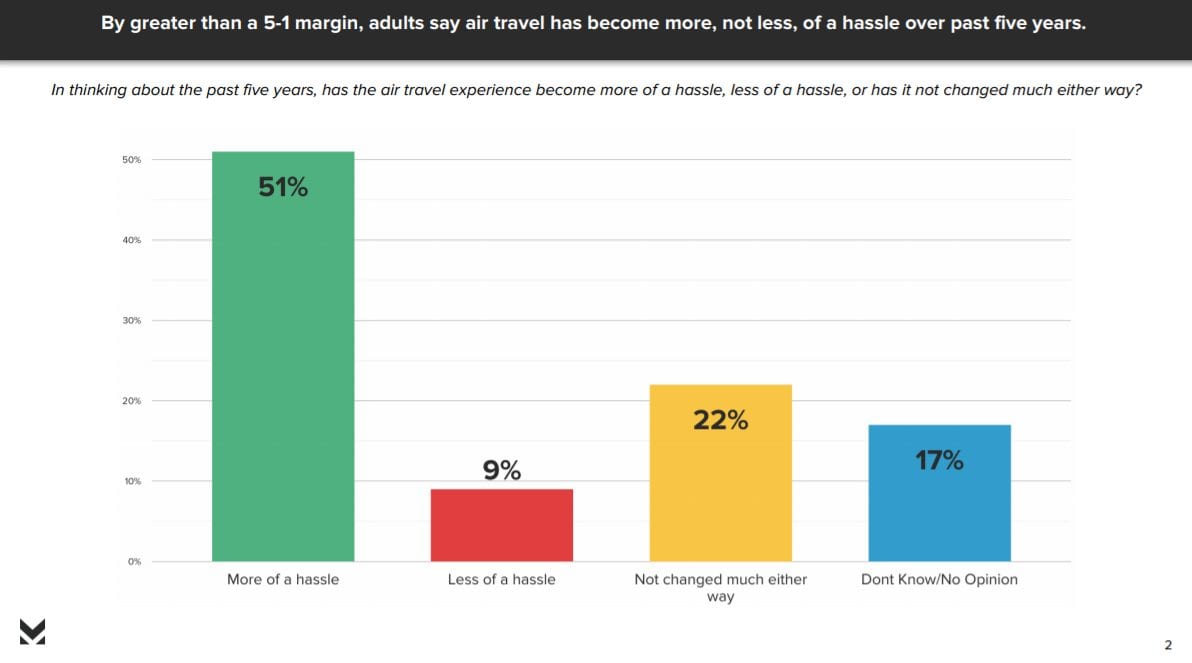
Americans believe flying is more frustrating than five years ago, according to a new Morning Consult survey released today by the U.S. Travel Association.

Travelers especially dread flying around the Christmas holiday, the time of year overwhelmingly cited as the worst for air travel. Because of such headaches, Americans avoided 32 million air trips last year, costing the U.S. economy more than $24 billion in spending.

According to the Morning Consult survey:

  • 60 percent say airline fees, such as fees for checked bags, flight changes, and seat assignments have gotten worse;
  • 51 percent say the overall cost of flying has gotten worse;
  • 47 percent say airport hassles, like long lines, crowded terminals, and moving from one part of the airport to another have gotten worse.

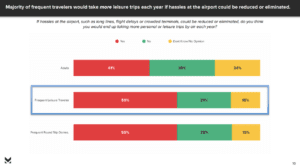
In addition, a majority (55%) of frequent leisure travelers would take more leisure trips each year if hassles at the airport could be reduced or eliminated. Drive-to vacation rental destinations stand to benefit from American’s negative views on flying. With messaging designed to appeal to the drive-to market, vacation rental marketers can demonstrate the savings and benefits of traveling to near-by destinations for leisure travel.


HomeAway raises subscription fees 25% and adds new transactional fees for vacation rental managers

25

This week Expedia-owned HomeAway announced recent changes to its revenue model for vacation rental managers. The new pricing and fee structure includes a 25 percent increase in the cost of listing subscriptions along with a new fee assessment for property management companies using “integrated software” systems.

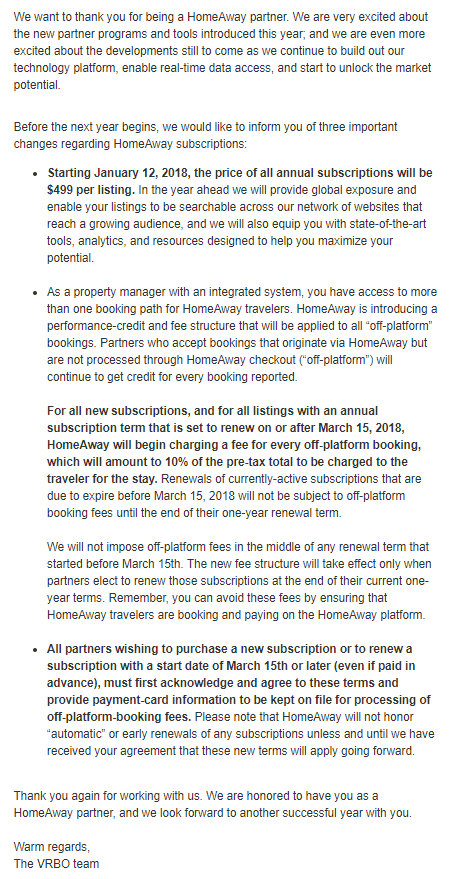
In an email to vacation rental managers, HomeAway informed suppliers it is increasing subscription fees from $399 to $499 per listing. In addition to the pricing increase, for vacation rental managers using “integrated software” platforms, HomeAway will invoice an additional 10 percent fee for direct bookings made that HomeAway can attribute back to inquiries on their websites in a process being referred to by property managers as “match-back.” Read the entire email here.

According to multiple vacation rental managers who are using software integrations, HomeAway will examine a vacation rental management company’s direct bookings, “match” email addresses and inquiries conducted on HomeAway’s sites “back” to direct bookings, and will invoice property management companies a fee which “will amount to 10% of the pre-tax total booking fee for direct reservations.”

Update: HomeAway’s Jeff Hurst discusses off-platform booking attribution

The policy is based on an assumption by HomeAway that any revenue derived from a guest who booked directly with a vacation rental company—and who had previously inquired on a HomeAway site—should be attributed to HomeAway, and HomeAway is entitled to ten percent of that revenue.

The changes will be implemented “for all new subscriptions, and for all listings with an annual subscription term that is set to renew on or after March 15, 2018…Renewals of currently-active subscriptions that are due to expire before March 15, 2018 will not be subject to off-platform booking fees until the end of their one-year renewal term.”

The news sent vacation rental managers reeling.

One vacation rental manager on the East Coast tried to get more answers from HomeAway. “When the email came out this week I asked Homeaway for a preview of the new terms,” he said. “I received a response that they weren’t available yet. Honestly, no surprise there, but it would be nice to know the rules of the game in order to determine how we fit into this new model.”

Another manager in Florida said, “Imagine if Expedia charged Hilton ten percent for all direct bookings in which a shopper also did a search on Expedia for the same dates!”

“These changes are a deal breaker for us,” wrote a California-based vacation rental manager. “We will no longer be renewing or adding any new subscriptions and will allow all current subscriptions to expire. The changes seem like a desperate attempt to ‘skin’ the sheep (operators) rather than sheer the sheep in the face of either mounting competition or a flawed business model.”


Expedia’s Money Grab Since Purchasing HomeAway

Since Expedia purchased HomeAway in late 2015, the company has been aggressive in seeking to further monetize the HomeAway family of website marketplaces for vacation rentals.

On the same day that Expedia purchased HomeAway for $3.9 billion, it introduced a new fee for travelers that, according to then CEO Brian Sharples, “is expected to add an average of roughly six percent to most transactions that run through its online shopping cart.”

Since then, the HomeAway has made significant changes, including inching up and testing guest fees, requiring online booking on the platform, eliminating the ability for owners/managers to communicate with shoppers outside the HomeAway website platform, removing vacation rental brands, phone numbers, and external links from listings, adding a comparative pricing tool and changing lodging rate policies for software users, rewarding “offer strength,” changing the owner portal with direct owner communications, taking over the branding of PM guest apps, adding a “Premier Partner” program complete with a pledge to keep bookings on the HomeAway sites, and creating a search algorithm that rewards compliance of its policies.


As a result, while HomeAway is showing double digit YOY gains that are significantly contributing to Expedia’s wellness, suppliers are questioning whether or not the company’s growth pace is sustainable and are seeking out alternatives to reduce dependence on HomeAway.

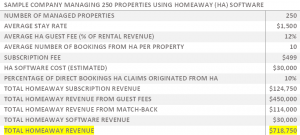
Below is a hypothetical example of how HomeAway’s pricing increase and new fees might affect a vacation rental management company with 250 homes under management and an average rental revenue per home of $38,000:

The data in the chart is based on generalized feedback from property management companies, not data provided by HomeAway.

In this example, under the new revenue model HomeAway would benefit from $718,750 in annual revenue from an mid-sized vacation rental management company using its software tools.

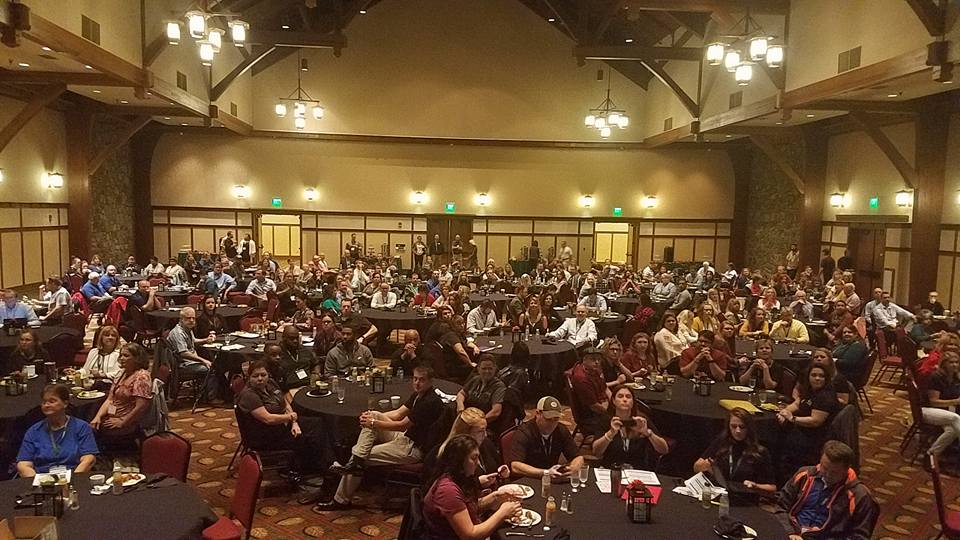
A number of property managers have recently distanced themselves from HomeAway in an attempt to regain independence from the Expedia-owned marketing channel. In a recent panel discussion at the VRM event in Wilmington, NC, leaders from several large vacation rental companies discussed their decreasing reliance on HomeAway’s websites for bookings. One CEO told the audience that he had pulled all of his listings off of HomeAway’s channels and saw a three percent increase in overall revenue. Of the twenty-two companies in attendance, only a handful still use HomeAway for bookings.

As a result of HomeAway’s changes since Expedia’s purchase of the company, several online forums have sprouted, including the Facebook group “Say No to VRBO Service Fee” with over 4,500 members who regularly discuss ways to decrease reliance on HomeAway’s family of websites.

Update: HomeAway sent the following for clarification:

“We are charging 10% for bookings that originated with a booking request or inquiry that the traveler sent through HomeAway and that then convert into a booking. We are not charging a fee on bookings that are truly direct through the PM and not tied to any prior HomeAway booking request or inquiry.”

360 Blue Acquires St. Joe Club & Resorts’ Vacation Rental Program

0
360 Blue, LLC announced it has acquired the entirety of the St. Joe Club & Resorts’ Vacation Rental program, adding over 235 homes to the company’s portfolio. Its second acquisition this year, Santa Rosa Beach-based 360 Blue now represents the largest collection of luxury vacation rental properties in the Florida panhandle.


Through the acquisition and an agreement with St. Joe Club and Resorts, all homes on the 360 Blue program will now benefit from the high-end 360 Blue service and property management model, as well as access to many of St. Joe Club & Resorts’ private amenities.


“Exceptional service is the principle foundation of our business,” says Ashley Horsley, co-owner and CEO of 360 Blue. “We started with a handful of high-end properties a decade ago and have now grown to over 560 of the most luxurious properties along the Gulf Coast. Our commitment to investing heavily in our company culture creates a working environment that makes it easy to deliver the best possible service to both our homeowners and guests alike. The addition of  St. Joe Club & Resort’s Vacation Rental program will integrate seamlessly into our current operation. Our incredible team at 360 Blue is prepared and excited for this growth.”

Top 3 Tips to Consider for a Successful 2018

1

1. Open API Property Management Systems

Whether you have 2 or 500 properties, your selection of property management systems can be a benefit or an albatross. Every year that passes the value of these open systems becomes more evident. Having an open API gives your business the flexibility to implement value add services that benefit your business. It is important to note the differences between having an API…and an open API. Be sure before signing up that your vendors are “open” and any charges that may be associated with using them. For those wondering what is an open API, here is an updated list of property management systems we can verify as API friendly.

Please let us know if we missed any open API vendors that we can share with our community.

2. Educational Networking Events

Be sure to make room in your budgets for these excellent regional events in 2018. These events are smaller in scale, but provide a powerful forum for education and peer to peer exchanges not found at larger events. What is unique about these events is they recognize and evangelize the value of the Vacation Rental Professional.

VRM Intel Live

In addition to being known as the “go to” source for all things vacation rentals online or print, Amy Hinote is responsible for VRMIntel Live, the best multi city events in our industry. If you ever get a chance to attend one of these events, you will be glad you did!

Vacation Rental Success Summit 

Heather (Cottage Blogger) and Mike Bayer host this high energy educational event. I had the pleasure of attending this event in Toronto last year and it was incredble. This years event will be held at the Westin Riverwalk in San Antonio on May 19-20. Use offer code code FETCHMYGUEST-EB150 to get $150 off the tickets!

Northwest Vacation Rental Professionals

This is a powerful association that is driven by an experienced and forwarding thinking leadership team. The event venues and educational opportunities are unique and top notch. This is reflected in their rapid growth. This years event will be held at the beautiful Semiahmoo Resort, Blaine, WA on April 23 – 25. 


3. Brand Focused Marketing Tools

2018 must include a commitment to connecting your brand to the travel community. As you know, the OTA’s are making it more difficult for the traveler to engage your brand.

Fortunately, the traveler is pushing back as they value the relationship they have built with our brands over the years. Diversifying your property distribution can take many shapes, depending the size and location of your business. Here are some tools that bring value regardless of size:

Chat: We have tried a few different chat boxes over the years. We found this tool to be an excellent way to drive quality leads to your business. For those that have been in business for more than 3 years, it will give you a good indicator on the value of your brand to the traveler. I know it has for us.

Retention Strategy: Quality leads are very important part of your sales funnel. You can no longer rely on the OTA’s to do the heavy lifting for you. No different than having a diversified property distribution strategy in place, it makes sense to have the same approach when it comes to marketing.  Unique content, social media and partnerships that are beneficial to your brand will make all the difference.

San Diego City Council Adjourns without a Final Vote on Short-Term Rental Regulations

0

After more than ten hours, which included listening to over 250 comments from the public, in addition to amendments flying back and forth between motions, the San Diego City Council adjourned without a decision on how the city will regulate short-term vacation rentals.

The San Diego City Council held a special meeting today to consider two proposed ordinances that address the permitting and regulation of short-term rentals.  After years of avoiding a decision, proponents for both sides of the issue packed Golden Hall in Downtown San Diego to show their support.

The first proposal was submitted by councilwoman Barbara Bry.  This was the more restrictive ordinance and proposes to limit permits to only one per primary residence and rental maximum of 90 days per year.

The second proposal was written by councilmen Chris Ward, Mark Kersey, Scott Sherman and David Alvarez. The proposal allows both whole home rentals, in which the owner is not on site and home-sharing, in which an owner makes a room or other space available within their primary residence. The permit does not cap the number of nights that can be rented per year but does require a three-night minimum stay. Individual homeowners would be limited to a maximum of three permits. Permit applicants would also be required to have owned the property for at least one year if they do not live in the home full time, and pay a per-night fee to fund affordable housing. There would also be new fees required for the short-term rental permits, which will fund more police and code enforcement officers.

Items council members could not agreement on included the definition of primary residence, how to enforce new regulations and how and if there should be limits on homeowners with multiple short-term rental properties.

To provide perspective on the scope of the short-term rental industry in San Diego, Host Compliance, a San Francisco-based company that provides short-term rental data and analytics to local governments reported there were approximately 11,347 short-term vacation rental units in the city. Of those, 8,855 are whole-home rentals and only 1,948 (22 percent) were rented for more than 90 days of the year. Beyond that, 5,047 (57 percent) of whole-home properties are rented out for fewer than 31 days a year.

The whole-home rentals, most of which are located within 10 specific communities across the city, make up the equivalent of less than two percent of the city’s total housing inventory, per the U.S. Census Bureau’s latest five-year housing estimates.

It is unknown at this time when the city council will revisit this issue.

To support the vacation rental industry in San Diego, visit Share San Diego www.sharesandiego.org and the Short Term Alliance of San Diego www.strasd.org. 


Seattle City Council Voting on Rental Regulations Today!

1

Today is the final city council meeting where new rental regulations for the short term rental industry in Seattle will be decided. Local vacation rental managers have spent the last two years working with and sometimes against city council on behalf of their businesses, their employees, their homeowners, the many vendors they keep employed, and the industry as a whole in Seattle. They have helped educate the Affordable Housing Committee on our industry, and have helped craft a workable legislation that will both support affordable housing, and protect homeowners right to rent their properties on a short term basis.

On September 15th, 2017 the Affordable Housing, Neighborhoods and Finance Committee passed CB119082 and CB119083.

The City Council will vote on these recommendations today. There is just one amendment that is of concern and would eliminate many properties from being able to rent on a short term basis.

Amendment 5 (which will be Amendment 1 when presented to the City Council) proposes: “Reduce the area that would be exempt from the proposed limit on the number of dwelling units a short-term rental operator can operate. As proposed, CB 119081 would exempt units being operated as a short-term rental prior to September 30, 2017, that are located within the Downtown, Uptown, or South Lake Union Urban Centers. This amendment would reduce that area to apply only within the Downtown Urban Center, south of Olive Way and north of Cherry Street.”

While local managers agree that balanced regulations are necessary, they believe this additional addendum does more harm than good.

For more information and to learn how you can support local managers visit The Seattle Short Term Rental Alliance’s website at http://sstra.org/

Toronto City Council Voted 40-3 In Favor of Short Term Rental Regulations

0

Thu., Dec. 7, 2017

Toronto city council approved regulations for short-term rentals in the city after a day-long debate on the issue. Council voted 40-3 in favor of the new regulations, and 27-17 in favor of restricting secondary suites.

The new regulations don’t ban short-term rentals, defined as less than 28 days, but instead require those who operate them to register their short-term rental, pay an annual fee of $50 and declare the property is their principle residence.

Only primary residences will be allowed to be rented on a short-term basis which can include up to three rooms for an unlimited number of days, or the entire house for no more than 180 nights per year. Secondary spaces, the most common form being a separate basement complete with a kitchen and bathroom, will not be allowed to be rented as a short-term rental.

Online Travel Agent platforms like Airbnb, VRBO, and others will also have to pay a one-time fee of $5,000 plus $1 per night booked through their site.

Airbnb estimates that 10,800 Toronto properties were rented via their site in 2016 and that over three-quarters of the rented spaces are in principal residences.

The main point of debate, which included council members yelling at each other, as well as frequent outbursts from members of the public, surrounded the permitting of secondary suites. It’s unclear what will happen with those units once the new rules take effect. However some attached secondary suites may be reconnected to the primary residence, and simply offered as a room in the home.

Regulations take effect July 1, 2018. However, the city plans to review the new rules again in 2019.

View the adopted agenda item HERE.

VRM Intel Live! Dates Announced for 2018

0

Last year, VRM Intel began hosting regional educational events for vacation rental managers. For vacation rental employees, traveling for seminars and conferences can be a challenge. As a result, VRM Intel decided to bring education and networking directly to them in their own market. Since then, VRM Intel has held six VRM Intel Live! events with over 1,000 attendees around the US.

Save the date for the VRM Intel Live! events for 2018:

  • February 5, Orange Beach
  • March 9, London
  • June 6, Breckenridge
  • August 14-15, Vacation Rental Technology and Marketing Summit (either TN or SC)
  • December 6, Maui
  • February, 2019 Inaugural Vacation Rental Women’s Summit


New Travel Show Spotlighting Vacation Rentals Gives Travelers an Inside Look at Alternative Accommodations

4
Matt Landau, center, on set in Barcelona while filming an upcoming episode of "A Sense of Place." (PRNewsfoto/aBundle.com)

Anthony Bourdain, Rick Steves and Lisa Ling have a new colleague in their midst…Matt Landau.

This month vacation rental expert, world traveler, and rising star, Matt Landau, launched a beautifully produced digital series titled “Sense of Place” which takes travelers through the unique experience of staying in vacation homes as a lodging alternative.

Travel adventurers, get ready for an insider-led tour of vacation homes around the globe.

With thirteen episodes in the first season of Sense of Place, Landau taps into local knowledge and insider insight that respectfully demonstrates both the history and the culture of a destination most tourists never get to see.

While Airbnb and HomeAway have been touting the value of vacation rentals with their mass marketplaces, Landau’s Sense of Place truly captures the vacation rental experience by interacting with home rental providers and letting these managers lead him to local secrets that even the best hotel concierges cannot offer.

Landau begins the show with his mission: “The term ‘vacation rental’ can mean a lot of things, but at the core it is a movement unlocking a whole new way to travel. For years, I have immersed myself in the community of people leading this movement. And now I would like to share their stories as we discover hospitality at a whole new level.”

As Landau was looking to produce Sense of Place, his vision originated with a desire to spotlight the uniqueness, independence and individuality that vacation rental professionals offer in their local environments. Landau was approached by several TV studios who wanted to jump on the vacation rental bandwagon and produce his travel show. However, the studios wanted full control of the content, which Landau found stifling.

“What makes the vacation rental industry different from most is our passion,” said Landau. “And while the idea of a show got me really excited, having a studio tell me what I could and couldn’t say seemed way less fun. Passing on those offers ended up being quite the blessing, though. They helped form a vision for the kind of show that I would really enjoy and that would do our industry proud.”

Sense of Place partnered with Asombro Media, LiveRez and Abundle to produce season one which includes episodes featuring Barcelona, Marbella, Rome, Le Marche, Guardea, San Diego, Kauai, Blue Ridge, Carolina Beach, Nashville, Anna Maria Island, Seattle, and Sayulita.

“Doing the project this way embodies the DIY spirit of the vacation rental industry—of using every means possible to grow, without compromising our values and our independence as small business owners.”

With all of Landau’s experience in working with vacation rental providers, it was surprising to hear what he learned along the way.

“Launching a digital show was really daunting for me, but the more I learned about the new entertainment landscape, the more I saw that you don’t need to go the conventional TV route anymore in order to reach lots of people,” said Landau. ”Today, people watch what they want when they want. And a show that is always available online creates a new kind of ongoing dialogue with viewers. Being consistently present—and being able to do things on our own terms—is almost like a new frontier. This show is both the most enjoyable and the most challenging thing I’ve ever done.”

Landau has found a true calling in producing this series, and travelers are better off as a result.

Sense of Place is already in talks for a second season.


John Dalton: Wherever the Economy Is Headed, Tourism Will Lead It There 

0

How’s that for an opener? Here we are working in an industry that always seems to be leading the economy, and hardly anyone knows it. I wonder how many politicians understand that tourism is the number one industry in the world, and that they should be supporting it every day. Here are a few worldwide facts that tell the story of how our industry is leading the way to a better economy.  

  • According to the World Travel Council, more travel dollars are spent in the United States than in any other country.  
  • China ranks second.  
  • Travel spending in the United States is almost twice as much as China. 
  • One out of every nine jobs in the world is created by tourism. 

 A few more facts  

  • Foreign visitor spending in the United States is 20.6 percent whereas domestic spending is 79.4 percent. 
  • In July, 209,000 new jobs were created in America, and leisure and hospitality contributed 62,000, or 30 percent of the total. 
  • Leisure travelers spend approximately 2.4 times more than business travelers. 
  • 13 percent of Americans plan to take three or more vacations this year. 

Transportation Taxes 

The tax rate on the average airline ticket is 21.1 percent. This year the airlines are forecasting more than 730 million people will board aircraft in the United States. The driving market has the privilege of being “double taxed.” First, the federal government taxes gasoline at the rate of 19.4 cents per gallon. Second, the states add their gasoline tax, ranging from 12.2 cents per gallon in Alaska to 58.2 cents in Pennsylvania. 

Destination Taxes

Almost every purchase travelers make is subject to a state sales tax, and the lodging tax fluctuates from state to state. 

For vacationing folks, lodging taxes far exceed transportation taxes. It’s almost impossible to calculate what the total per-person tax dollar amount is for tourists. With all that revenue, it boggles the mind why government employees are not adequately staffed to serve travelers. 

The next time you arrive at the airport, you might ask yourself why the lines are so long and the wait times are often unacceptable to clear security. Do you think politicians are allocating some of that 21.1 percent tax from your ticket to other industries? Are the elected officials in your state appropriating travel tax dollars to support their agendas? 

Millions of dollars of local and county vacation rental (VR) taxes are not being collected due to lack of personnel and technical capabilities. Many vacation destinations do not have the manpower to even identify those renting without a license. It’s unfair to the local communities for federal and state representatives not to increase the budgets. The collection of taxes is vital to enhance the infrastructure of vacation destinations. In addition, it is unfair to taxpayers for rogues to be earning rental dollars yet avoiding paying taxes. It goes beyond the occupancy tax. One also wonders if these individuals are claiming the income on their federal income tax filings. 

In January 2014, the Onsite Property Management Association (OPMA) Board of Directors voted to go on record challenging the proliferation of businesses and individuals that harm legal short-term rentals. They urged professional short-term rental partners to join them and lend their voices in support of eliminating these unprofessional and illegal activities within the hospitality industry. To date, few have joined the fight. Today, many politicians still do not understand the negative impact this has on our sector. 

Does it sound like I am about to take the politicians to task for not supporting the visitors who support our destinations and the businesses that serve them? Oh yeah! 

Decades ago, while working at AAA headquarters, I learned that the federal gasoline tax was voted into law to maintain the highways and bridges throughout the country. At that time, I was astonished to learn that only 75 percent was appropriated for that purpose, and 25 percent was earmarked for other programs. It seems today Washington is selling us a new infrastructure program to finally update the highways and bridges. The only problem is that now only 60 percent of the gasoline tax dollars are being applied for this long awaited endeavor and 40 percent is quietly being moved elsewhere by our elected officials. 


The Florida Fiasco 

We all know the story of the Florida legislation attempting to eliminate Visit Florida, the major marketing arm attracting people to the state. When it was announced, the people who have devoted their lives to our industry descended upon Tallahassee. The governor supported their cause to maintain Visit Florida and not reduce its funding. The politicians felt the pressure and introduced a revised bill leaving Visit Florida in place but cutting the budget to $25 million. The governor sent his message that he agreed that the marketing arm needed reorganization but that he would veto the bill if the funding was not reduced from the previous year. 

Despite the opposition, the House and Senate proceeded to vote. The House vote was 98–14, and the Senate voted 34–4 to reduce the funding. Collectively, the vote was 132–18.  

88 percent of the elected state officials voted against tourism. They individually knew the consequences of their vote would be devastating to the state. The tax revenues would plunge, untold residents would lose jobs, and homeowners would soon be paying higher property taxes.  

When all was said and done, the governor passed it off as “politicians just being politicians.” If that’s the case, then I have yet another reason to be sure we rid ourselves of politicians who are against tourism, wherever they are. All 132 of those voting against our industry, regardless of their reasoning, deserve to be sent back to public life on Election Day. They have no place in government. 

Do they have the ability to understand that marketing Florida without tourism is like marketing a picnic without food? Did they believe the private sector would increase its marketing dollars to replace the void left by Visit Florida? Or did they buy into the Field of Dreams movie? You know, the “Build it and they will come” theory. 

Did they believe that Florida (the field) was built and visitors would come without the state funding the marketing? Well, Kevin Costner built the field, and they came. But what everyone seems to miss is that the visitors who went to Iowa did not go to see the field. They went to be entertained by the great array of baseball talent who had passed away. 

It’s not the soil of Florida that attracts a record number of visitors each year. It’s the talent of the people who have invested their lives to help visitors create lifelong vacation memories for those willing to spend their hard-earned dollars in these communities. It is the commitment of dedicated individuals to produce innovative products and services to bring visitors back again and again. It is a combination of all the stakeholders in VR communities working together. 


It’s Time to Vote Them Out of Office 

This is true of every VR market in the United States. In recent years politicians have done little to support the success of the tourism industry. The gang of 132 anti-tourism representatives is not alone. There are thousands of them across the country, and it’s our duty to rid ourselves of the people who believe they can regulate our industry. All they can do is get in the way of our progress to continue to lead the economy to prosperity by voting against what is good for tourism. 

Nationwide, we need to identify these “political barriers to tourism’s progress” and vote them out of office. It’s time to take names. It’s time to tell your community who they are and why they should be voted out of office. A campaign against these individuals should be a high priority. They should be replaced with people who understand the value of our great industry.  

We require political leadership who will leave the local legislation in the hands of the communities and not at the state level. We need astute politicians committed to providing local communities with additional funding and manpower to create their own vacation-friendly ordinances, to enable them to identify the rogue organizations and individuals giving the VR sector a bad name and extinguish their parasitic behavior, and, of course, collect 100 percent of the taxes so they can allocate those taxes directly back into the local vacation rental infrastructure. Let’s end this diversion of funding by the states and federal government that serves their personal political agendas. 

Imagine if we had the majority of politicians at all levels of government, understanding the importance of our industry? Imagine how they could deliver their campaign messages: 

“I am running to support tourism; this industry creates more jobs than any other and is second in consumer spending only to food. Business travelers meet with customers to sell and service them face-to-face to successfully grow their businesses. Vacationers return home with memories that will last for generations. People travel to other countries to understand one another, forge friendships, and live in a more peaceful world. I need your vote to join the new breed of political leaders who understand: Wherever the economy is headed, tourism will lead it there.” 

Come Election Day, let’s vote for them and send the incumbents opposed to our way of life out of the political world. Perhaps they might even travel and begin selecting VR companies for their vacations. They might even wind up at yours, looking for a deal. Just be sure to charge them the rack rate. 

About John Dalton 

John Dalton is currently the chief marketing strategist at OPMA. He was with TWA for ten years and worked at AAA headquarters before starting his own company. He is an industry consultant and conference speaker and has worked with most of the major hotels, cruise lines, tour operators, car rental firms, and numerous travel agencies. 

Making the Most of Your PPC Ad Spend 

0

When it comes to PPC (pay-per-click) advertising, marketers are always looking for ways to improve performance. The goal is to optimize the account continuously, finding ways to save money and spend more efficiently. Anyone with PPC experience knows that there are countless ways to do this, including adjusting keyword bids, setting daily ad schedules, adding negative keywords, and so on.  

Why is it that one of the most obvious ways to spend more efficiently is often overlooked? While everyone is spending time making little tweaks to try and push the needle forward, they often lose sight of the bigger picture, which is the account’s overall budget allocation throughout the year. Using both historical data and competitor’s data and being prepared to adjust on the fly, you can ensure that you are not limited when business is booming and that you’re tightening up and maintaining discipline during slower seasons. 


Seasonal Budget Adjustments

The most common tactic employed when trying to optimize spend throughout the year is seasonal budget adjustments. This is especially true in the vacation rental industry. Many travel destinations experience busy seasons where it is important fill all vacation rental properties, meaning it is important to allocate additional ad spend to these months.  

Property managers near ski resorts need to ensure that their winter ad spend budgets can keep up with increased winter demand. If budgets are limited during these important months, it can mean leaving easy money on the table. On the opposite end of the spectrum, once the ski season ends and the snow begins to melt, these destinations tend to experience a lull in traffic. This can be a good time to reduce bids and budgets to save up for the next big push. This is also a good opportunity to shift focus toward homeowner acquisition as opposed to reservations. 

On a similar note, it is also important to understand how specific holidays affect performance. Holidays should be considered their own entities, and even during a slow month or season it may be important to jack up budgets for a brief period to ensure maximum efficiency.  

Sticking with the ski town example, April and May (a.k.a. “mud season”) tend to be very slow booking months as snow is melting, but Memorial Day can lead to a nice influx of visitors, especially if the specific town is hosting an event. Thus, it is important that spend begins to increase leading up to Memorial Day to ensure that your budget is keeping up with traffic.  


Competitive Analysis

It is also important to keep an eye on competitors and their actions, as it may be an important factor in how you spend your budget. If a competitor begins to increase their budget and bids, it is going to lead to an increase in CPC for your account. If this is during a busy period, it may mean that you need to increase the budget even further to keep up. Even though it’ll be more expensive to generate conversions, many times it is too profitable of a time period to let the competition win. 


Be Prepared for Changes

Lastly, it is important to be able to adjust strategy on the fly due to unforeseen circumstances. While a lot of the previous examples involved using historical data to formulate a plan of attack, things can change out of the blue because of unforeseen weather events, natural disasters, or other large-scale events. I imagine most businesses in Houston would have benefited from completely pausing ad spend during and in the immediate aftermath of Hurricane Harvey, as the focus of the entire city shifted squarely toward recovery. Similar things can be said for locations dealing with forest fires, mass protests, and so on. 


All in all, the moral of the story is that an easy—but often overlooked—strategy for improving account efficiency is better allocating your overall budget throughout the year. Be prepared to take full advantage of busy seasons and important holidays and to spend more efficiently during slower time periods. And most important, be ready to adapt to any unforeseen events. By being prepared you can continue to decrease the amount of wasted spend in your account and improve overall efficiency. 

Google is moving into vacation rentals…and what property managers can do to get ready

36

Google is moving into vacation rentals, and the decision is expected to significantly change the way travelers search for and book vacation homes.

At the Onsite Property Management Association (OPMA) Summit at the Reunion Resort in Orlando last Tuesday, members were updated on the progress of an ongoing beta program between Google and the OPMA membership.

Google’s vacation rental beta program with OPMA is being facilitated through technology integrations provided by BookingPal, a channel management provider in the alternative accommodations industry. The partnership was initiated by BookingPal advisor, David Baggett, co-founder of ITA Software, which was purchased by Google in 2010.

According to BookingPal founder, Alex Aydin, Google had been monitoring the vacation rental sector for some time and decided to test its US vacation rental beta program first with onsite property managers due to the on-premises services these managers provide to guests. As a result, BookingPal reached out to OPMA, which represents 60,000 rental units, to gather a group of onsite managers for the beta program.

Since the program’s launch, OPMA members have seen $1.2 million in revenue from bookings through BookingPal.


Challenges for Google in Adding Vacation Rentals

During the session, BookingPal disclosed that the vacation rental beta program has encountered challenges along the way.

“The Google platform was not set up for vacation rentals, so they’ve had to make modifications,” Aydin told members.

For example, only one URL is currently offered for each Google card making it difficult to display key-level inventory. Other challenges include the ability to index each property geographically for search and mapping, connectivity with booking engines, channel limitations, and traffic limitations during the beta period.

Despite the challenges, Aydin expects the program to be fully operational in 2018.


Google’s European Launch

As Skift first reported, “Some Google searches have been revealing an option to comparison-shop vacation rentals.”

According to the article, “The results are limited to a small subset of alternative lodging inventory similar to traditional vacation rentals. Collectively we counted about 7,000 property listings. That is a mere smattering of the potential rental listings in Europe.”

Google told the Mercury News that it considers the functionality and offering type to be a “small-scale experiment.”

“This involves a very limited amount of inventory on a trial basis,” a company spokeswoman said. “We hope to expand to more inventory, inventory types, and partners soon.”


What Vacation Rental Managers Can Do

According to Aydin, a Google card will be required for each vacation rental. Vacation rental managers can get ahead of the curve by providing business information with unique URLs for each home or unit under management. Becoming an early “owner” of the business information for each property will provide an initial competitive advantage as Google rolls out its vacation rental product.

In addition, working with channel managers who are partnering with Google will make connectivity easier in the coming months.


What will this mean for Airbnb and HomeAway?

According to Aydin, “up to 90 percent of OTA online ad budgets are spent on online search engine marketing and optimization.” As Google dives deeper into the vacation rental sector, OTA’s cost of reaching travelers likely will be impacted.

However, another potential consequence for OTAs and online marketplaces affects the rates they are able to charge to travelers.

Airbnb charges travelers a 6-12 percent “guest service fee” on top of the rental amount, while HomeAway’s “service fees” can add over 15 percent to the rental cost for travelers.

Google’s results will display comparative pricing, possibly making it more advantageous for travelers to book directly with the property manager.


Is Your Vacation Rental Company Set Up for Dynamic Pricing? 

4

Going from setting rates once a year through a handful of seasons to having rates that change daily has major implications for all levels of the vacation rental organization. Whether using some sort of rules-based system from the property management software (PMS) that changes prices based on occupancy or number of days out or using a sophisticated, third-party revenue management system that changes prices based on fluctuations in market supply and demand, one thing is true: gone are the days of having rates that change based only on the season and that are set once per year. 

While this may seem like a minor change, it affects all levels of the organization, so it is important to get the entire team on board before flipping the switch. 

In working with hundreds of managers, we have found that once you have made the decision to get more sophisticated with your pricing, there are still a few things to think about regarding how you do business. 


Retrain the Reservations Staff 

Sending out PDF quotes with rates that will be honored indefinitely is a thing of the past. You will need to retrain your reservations staff to communicate that rates (just like availability) change continually, and guests should be encouraged to book now to lock in that great rate. 

Looking at other sectors of the travel industry, this is nothing new. Even “old school” travel agents who sell packaged vacations and send out PDF quotes still state very clearly that the proposed rates are not valid until the property is booked. 

Most guests are quite used to the idea of rates not being the same if they return days later (sometimes even hours later, in the case of flights) to book, so don’t fret about a customer backlash. Prepare your agents for explaining that, just as for flights, hotels, and car rentals, prices and availability for vacation rentals are subject to change. 

This strategy will help reservationists with the pricing system conversion, as guests will now have an incentive for making a decision. It will be clear that if they wait, the rate could change (or someone else could book it), so it would be best to lock it in as soon as possible. The reality is that rates will not change drastically (unless a major event is suddenly announced and demand peaks). 

If you have repeat guests who are upset that prices might be different from last year, train your reservationists to use that as an opportunity to inspire loyalty in guests. Instruct them to offer the same rate the guest paid last year (or 5 percent more), noting that the offer is only available to repeat guests. 

The last thing reservationists need to recognize is that depending on their PMS software, how they adjust a folio if guests add or subtract a day from their stay may change the rate. Make sure to review with the staff how the system works and how you want to handle that scenario. Avoid recalculating the entire stay because rates may have gone up or demand may have peaked since the initial booking. 


 Make Sure Your Website Can Handle It 

Using just a static rate table will no longer suffice. Airlines and hotels did away with rate tables decades ago. If you really want to keep a rate table, it will either have a lot more rates or you should make sure your website provider can display a minimum and maximum price during the “season” you define. Several OTAs, such as HomeAway, support a seasonal minimum and maximum rate. However, the more dynamic your pricing, the less meaningful those rates are: if you show a wide range of prices, that in reality they might need to enter their dates just to get an accurate quote. 

If you have not already noticed, HomeAway and other channels are hiding or completely getting rid of rate tables and pushing guests to enter dates to get a quote. The data somewhat supports this strategy: conversion goes up when guests enter their dates, in part because it makes it easier to see which units are available and what the relative rates are. 

Other options for displaying  rates include the following:  

  • Calendar view (with no rates, with rates on the calendar, or with rates appearing when the cursor hovers over a date) 
  • No rates tab (guests need to enter their dates to see prices) 

We generally recommend using one of these two options. If your website provider is having a hard time making its rate table or calendar match your dynamic rates, we strongly recommend just going with no rates tab. 

One of the major issues in how your website provider displays rates relates to how it receives rates from the PMS you use. We will address how PMS systems handle dynamic rates below, but this was one of the major issues with rate feeds once dynamic pricing was implemented. 


Get Owners on Board 

Owners will no longer be able to easily know what you are charging, and they may try to micromanage things. Make sure to explain what you are doing and why. 

When starting, we recommend implementing dynamic pricing only with the owners you know will be okay with your making all the decisions when it comes to pricing. You can, either put together an FAQ and some literature on the merits of dynamic pricing and poll your owners to see who wants to opt in, or you can simply exclude those pesky owners who are always looking over your shoulder and think they know better how to manage the pricing of their properties. 

We’ve seen managers make the switch without fully considering those owners who constantly look at their rate table on VRBO and compare it with their neighbor’s rate—and then cannot understand why you are pricing higher than their neighbor on Christmas. Often, those owners are more trouble than they are worth, and it would be better to leave them out of your dynamic pricing program. 

Lastly, make sure contracts with owners allow you to fully manage rates. You would be surprised how many vacation rental management contracts look more like real estate agent listing contracts than hotel management contracts. You are the expert, and the owners have hired you to make these kinds of decisions, just as they trust you to pick the right pictures for your listings and the right way to answer the phone for guests. 


Make Sure Your Channel Manager and PMS Can Handle Dynamic Rates 

Every PMS system handles rates differently. If using a channel manager provided by your PMS or a third-party manager, make sure that their rate feed incorporates your dynamic pricing correctly. 

The main issue is that many dynamic pricing systems are based on a set of rules (e.g., when my occupancy is 80 percent, increase price 10 percent). Those rules are then applied when someone sends a request for a quote, but often they are not translated into a given price per day or price per season. 

Ask your PMS system whether their rate feed is accurate. Often it is not, and this is a huge problem in the industry. All dynamic rates should be able to be translated into a feed that has a given price for every season or day. A season is really just a range of days. It is essential that all PMS systems and channel managers standardize translating rates into a given price per day or range of days, potentially with length of stay adjustments where supported (e.g., offer discount if length of stay is greater than seven days or increase if fewer than three). 

Finally, ask your PMS system whether they can handle multiple listings that change rates daily. If they can’t, you may want to consider switching to a more rate-sophisticated PMS. 


Ease into It 

Set some boundaries (minimums and, potentially, maximums) as you get comfortable. Test things out with your most lenient owners. Also, you will want to know where you stand in the market. Whether you are setting rules or using independent third-party reporting or a revenue management system such as Beyond Pricing, you need information such as the pricing levels of your competitors and their occupancy trends. And you likely will want to know that information across as many advertising channels as possible (not just on Airbnb and HomeAway). Knowing current market trends helps you put your dynamic pricing into context so you are not flying blind. If your dynamic pricing product does not provide this kind of market intelligence, consider supplementing it with this kind of data. 

Do not be afraid to ask for help from fellow managers who have made the switch. They, better than anyone else, can guide you and help you proceed to the next level in what is probably the most exciting change toward modernizing vacation rentals since smart locks! 

Virtual Resort Manager Seminar Coming to Wilmington, Dec 12

0

Virtual Resort Manager is bringing a vacation rental industry seminar for vacation rental managers to Wilmington, NC, December 12 at the Wilmington Hilton Riverside.

Pete Wenk, founder and CEO at Virtual Resort Manager (VRM), and his team will be revealing new features and functionality in the VRM software platform. In addition, vacation rental managers and suppliers will be discussing recent developments in the vacation rental industry and predictions for 2018. VRM will be joined by VRM Intel, Red Sky Travel Insurance, Breezeway, Lynnbrook, and PointCentral.

Whether you are a VRM client, are looking for new software, or are anxious to learn more about best practices and where the vacation rental is heading in 2018, we invite you to join us.


VRM + VRM Intel Live

Wilmington Hilton Riverside

December 12, 10:00 am – 4:00 pm

Lunch Included

$59 per Attendee

Click Here to Register


Sessions:

  • VRM Software: 2017 Updates and 2018 New Features and Functionality + Demos
  • Recent Developments in the Vacation Rental Industry with Amy Hinote, VRM Intel
  • Where the Vacation Rental Industry is Heading in 2018, Panel, Isaac Baker, Mike Harrington, Miller Hawkins, Leslie Painter, Eddie Walters
  • Best Practices: Travel Insurance and Damage Waivers with Laird Sager, Red Sky Travel Insurance
  • Update: Credit Card Processing Changes and Chargebacks with Sharon Popovich, Lynbrook
  • Smart Home 2018 Developments with Adam Norko, PointCentral
  • Property Care Operations: Your Special Sauce or Biggest Liability? With Koryn Okey, Breezewway

Book your room using the following rate codes: Hilton Wilmington Riverside, Rate Code: VRM


Using Social Media to Build Your Brand 

1

We are sorry to say that if you aren’t using social media in your marketing plan, you are behind the times. And if you are using social media, we are sorry to say that you are probably doing it wrong. Although social media use is an extremely powerful tool in a marketing arsenal, it is not a cure-all and won’t be a viable source for direct bookings that you can measure. But it is vital to your brand and your online reputation. 

For some reason, over the past several years social media has morphed from a fun, interactive tool to a trendy sales tool in the eyes of page owners and businesses—this is where the danger begins. 

First, let’s think back to the birthplace of modern social media, Facebook. 

Facebook was spawned from an invention of Mark Zuckerberg called Facemash, which was originally designed to rate fellow college students on their physical attractiveness (Yes, really). Over the years, Facebook has become an extremely engaging platform, even with the ability to market to users. But let’s not forget why Facebook was made in the first place—so people could engage online with one another on a personal level. 

If you aren’t engaging your audience, you’re doing it wrong. 

Think about this for a moment. You probably have 150 to 700 “friends” on Facebook. (Don’t worry about the business side, I’m speaking merely about your personal friends.) You’re popular, right?! However, do you have friends who hardly ever post? Maybe someone you didn’t really know, but who hit that “accept” button anyway? It’s not that they aren’t posting anything. It’s that you don’t hit their like button or comment on their stuff—ever. Facebook realizes this (through its algorithm) and filters out their content from your wall because you are clearly not interested in it. 

Now apply that to your business page. If you have fans who never click “like” or comment on your posts, Facebook is going to show less and less of your content to them. It’s the algorithm!  

If you post only promotional stuff and do not understand the algorithm, you’re doing it wrong. 

People engage in social media for several reasons, and one of those is to maintain relationships. When we approach our fans with the mind-set of a relationship rather than a sale or a booking, we see more engagement, better reviews, and overall happier fans, both now and long term. 


Here Is the ROI Issue…. 

What kind of ROI can you expect from social media? That is a question that really should not exist. Yes, you can see the ROI in your social platforms; it does exist. However, asking this question means that you are expecting all your social touchpoints to result in bookings; it just doesn’t work that way. Social media bookings come from good branding, and good branding comes from patience and a well-organized plan.  


If you are wondering where to start, ask yourself the following: “What sort of content do my fans like?” You can publish various types of content and measure the results—count your likes and engagement. Facebook lays it all out for you in your admin panel. By promoting your brand in that fun, non-salesman way, you are giving your fans what they like. This leads to more engagement, which leads to much better brand recognition in the long run!  

If you post more content about your company and products than destination-related info, you’re doing it wrong. 


The Visual Experience 

A popular saying is, “A picture is worth a thousand words.” Actually, Fred R. Barnard said, “A picture is worth ten thousand words.” Either way, social media is a visual experience and visual content is at least forty times more likely to get shared on social media than other types of content (HubSpot). When you think about it, every social platform centers on visual content.  

This is your opportunity to publish the funniest, coolest visual content you can, whether that’s photos, videos, GIFs, memes, and so on. Start producing content that amuses your audience, but remember, there might be a difference between what you like and what your audience likes. Again, test and measure.  

If you don’t support your message with a nice visual, you’re doing it wrong. 


Opinions Matter 

One of the most overlooked aspects of social media is reviews. If there is one thing we know about the Internet, it’s that everyone has a loud virtual mouth. Reviews are a powerful tool and have the potential to help or hurt your brand image in a heartbeat! 

So how do we use reviews? Actually, republishing reviews could have a great impact on your audience and makes for some fantastic content. This is what we call user-generated content and is considered by some to be the holy grail of the content world because, well, it’s real and from a trusted source—a reviewer.  


There is no better way to build trust than to let your audience tell others how much they love you. A great strategy is to post reviews about a rental AND photos of that rental. You could even use this as a remarketing tactic with paid campaigns. 


Speaking of Paid Campaigns 

Yes, Facebook is a business. It enjoys collecting our money, too. But do the ads work in the vacation rental industry? Of course they do, but again, more for brand recognition than anything else. We won’t get into the differences in “like” campaigns and “audience” campaigns here, but your ads normally get many more impressions than they do clicks, which is why they’re great for promoting your brand. 

Remarketing is probably the best tactic you can use on paid Facebook. It’s simple but effective. Remarketing ads on Facebook are ads that display on their Facebook feed after they have visited your website, attempting to hook them again. Again, think of engaging information here as well, such as reviews, or bringing them back to a page they may have missed. 


Does Social Media Help with SEO? 

To make a long story short, yes. A strong social media presence with interactions from users does help with search engine optimization. Search engines use “social signals” in their algorithms—yet another reason to have a good audience following. Of course, it’s difficult and time-consuming to be present on ALL social media channels, so at least make sure you keep up with the competition. If you and a competitor are running from a bear, you don’t have to be faster than the bear, just faster than your competitor.  


What Now? 

So now you know that social media for the vacation rental industry, whether on Facebook, Pinterest, or Instagram, is about building a trusted brand, not making a sale. It’s about winning over an audience, not pushing them to book. We admit, there are a lot of moving parts when it comes to planning and executing content through your social channels. Writing all those steps down would turn this article into a book.  

And don’t get us wrong—there is a place on social media for promoting your rental units, but do it in the paid channel portions, not the regular wall posts. 

Just remember, if you use social media as a tool to build your brand as a whole instead of booking units, you’re doing it right. 


What You Should Be Doing for Social Media—The Bare Minimum 

  • Post three to four times a week to your Facebook Page. 
  • Post something fun 80 percent of the time and post something promotional 20 percent of the time to increase engagement and reach.  
  • Respond to your reviews (good and bad) and private messages on Facebook within an hour (a badge on your page displays your response time). 
  • Spend money either remarketing on Facebook or boosting posts. 


Great Ideas for Facebook Remarketing Ads 

  • Drive users to a page on your website that they may not have seen before, or one that is normally hidden, such as “New Rentals” or “Why we rock as a rental company.” 
  • Create ads that are guest reviews and rotate them to reaffirm customers’ choice in you. Link to more testimonials.  
  • Use a special Facebook-only coupon code and tease it in the ad to get visitors back to a page that has the coupon (you could also ask them to enter their email address to get the coupon code). Track the code so you know how many bookings you get. 


SkyRun Vacation Rentals Owner Barry Cox: Finding a Competitive Edge in Today’s Vacation Rental Market

4

I’ve lived in the mountains of Colorado for seventeen years now, a transplant from the East Coast by way of the Midwest. Given that winter is coming, a snow metaphor is appropriate. When you’re skiing or boarding down a mountain, in order to turn you need to be able to tip your skis or snowboard up and “get an edge.”

When you do it right, it’s called “carving.” Carving a good turn by using your edges feels fabulous and keeps you moving forward with speed and in style. In business everyone seeks an edge, and the vacation rental business is no exception. When you find an edge, you’ll be able to carve your way to business success. In this article I’m going to describe three edges that I think are becoming increasingly important as the vacation rental industry consolidates. 

First, a little background. I’d been with working IBM for fourteen years when I moved to Colorado in 1999 to take a new position within the company. About five years later, my family bought our first second home in Keystone, Colorado. To make a long story short, I started managing it and began managing other properties for friends.   

Steve Falk and I started SkyRun in 2004 alongside our day jobs. We grew SkyRun to one hundred properties, and we both left our other full-time jobs. With his legal and market development background and my technology and business consulting background, we made a good team. 


Powder Days

This was between 2004 and 2007 and property management was booming. To get back to the snow metaphor, that time frame was what we call a “powder day”: when you get a foot or more of fluffy new “white gold,” the fun and ease of being on the mountain is magnified a hundred times, and staff who are more committed to the snow than to the job take a personal day. Fresh powder is sometimes called “hero snow” because anybody can get an “edge” when turning in powder. It doesn’t matter whether you have perfect technique, how good your equipment is, or how good your physical conditioning is—you’re in for a good day on a powder day.  


Wind-blown, hard-packed, and icy days

It’s the same way in business. When conditions are good, business is good. Your weaknesses are most exposed during the bad times. From 2008 to 2011 the powder days we dreamed of turned into the “wind-blown, hard-packed, and icy days” we dread. This became an era when your weaknesses were most exposed and you hoped to merely hold an edge. In 2017, we find ourselves again in a powder day period. But powder days don’t last forever. Better sharpen those edges . . . 

As Steve and I learned more about the industry, we gradually realized that the future belonged to multi-location property managers. To be competitive, we needed to have scale. 

Our thought process was the following:  

  1. We could remain a single-location property manager and grow by adding properties that compete with the hundred we already have.
  2. We could diversify our risk by adding a location in another geography, perhaps even at a beach, but we still would have one hundred more toilets to worry about remotely.  
  3. Or we could license our brand, process, and systems to enable other local entrepreneurs to serve vacation guests and property owners the way the industry has for decades. Locally.  

We chose option number three, and SkyRun has become a rapidly growing multi-location organization with six hundred properties in twenty-five locations. As poet Robert Frost said, “And that has made all the difference.” 

I believe that choice has given SkyRun its particular edge, and that is how you too can get a similar edge. Regardless of how competitive your market is, and whether you’re a single-location manager or part of the growing number of large multi-location companies, whether you’re new in the industry or you’ve been around long enough to know what “GLA” stands for and how to send one (by fax), and whether you operate in the mountains or beaches, you can get an edge.  

We’ve developed our edge through three practices: having strength in numbers, being efficient, and operating with a local touch. Let’s take a deeper look. 


Edge 1: Go BigThere Is Strength in Numbers 

Business leaders from Henry Ford to Amazon CEO Jeff Bezos know that critical mass and repeatable processes are vital to long-term business success and ultimately vital to how well you serve your guests and owners. A company with six hundred properties will simply be able to get better pricing and service than a company with only twenty, on everything from bed sheets to credit card fees to OTA listings. Industry studies such as the VRMA annual survey show that a manager with more than five-hundred properties makes much more profit per property (27 percent more at last measure) than a manager with fewer than 100 properties. In an industry that has a 20 percent to 30 percent commission margin, 27 percent more is a big deal. 

Take hotels as an example from our hospitality industry. When I was growing up, there were still mom-and-pop hotels dotting the roads of America. The experience in each was unique, and most of them had some charm. There were no central reservations. There was no online, just a phone line. You could talk to mom or you could talk to pop. Then came hotel chains with buying power, central reservations with one number to call, a consistent experience, and lower prices. Who can blame us as consumers for flocking to the Holiday Inn or Howard Johnson or later Marriott and Hilton? We traded the local experience of dealing directly with mom or pop for what was more desirable: lower prices, consistency, and ease of booking. 

Yet we consumers made a trade-off. Most of us would still prefer local knowledge and would prefer to deal with mom or pop. Perhaps that’s one reason the direct-from-owner renting of VRBO and shared spaces of Airbnb has taken off so rapidly.  

What if we could, as an industry, have both scale and local touchThat’s a teaser; more on that later. 


Edge 2: Operate Efficiently 

We experience increasing competition from professional property management companies that offer a lower commission (if you are one of these, then kindly skip to Edge 3). Of course we traditionally priced managers will argue that they get you with other fees, and that’s true in many cases. I’m sure both mom and pop would have made this argument too, right until they put the “Closed” sign on the front door or sold out to a larger company. The point is that the manager who is built from the ground up to be able to operate at a lower commission will always be able to provide a better product in the long term. You can add more and more fees and charge more and more for light bulbs, but as long as your cost of providing the same level of service is higher than that of your competitors, your profits will eventually shrink or you will have to cut services. 

Our industry is very people-focused, so an industry benchmark that I always pay attention to as a measure for efficiency (but which is not widely measured) is how many properties you manage divided by how many full-time equivalent (FTE) employees you have.  

That gives you the number of properties you manage per FTE. If this number is less than ten, you should consider whether there are valid reasons for it to be that low. Perhaps you manage single-family homes and not condos, your properties are farther apart, or you have a higher-end clientele who require more attention (hopefully at premium prices). I find that an ideal number is about fifteen or twenty properties per FTE. 

So how do you become more efficient? 

Quality People 

A manager can get to twenty properties per FTE overnight by firing people and letting quality suffer. That is unequivocally not what I am suggesting here. I am talking about a superior product being the foundational assumption and the number of people it takes to provide that product being the measure of your efficiency.  

By this measure, a better quality staff is key. Those people we all know and have working on our teams who can do more with less. Those who show up on a powder day. This measure doesn’t factor in the cost of higher-quality staff, and that’s on purpose. Always hire the better person. 

Technology 

Quality people require quality processes, and quality processes require quality technology. Some industries are ripe for technology. That vacation rentals is one of those industries is what attracted me and is what attracts so much venture capital. 

Examples of processes that are ripe for automation abound in this industry. 

As much as they like talking to you and we like talking to them, our guests would rather self-serve in almost every phase of their stay. Most guests would prefer automated online reservations and lead tracking; a good website with detailed information that anticipates and answers all of their questions; clear and accurate pricing; online, instant, and secure booking; the ability to look and book on their mobile, tablet, or desktop; preparation and arrival instructions by email; and an app that stays with them on their device. From shopping to preparing to staying to checking out, today’s guests would rather interact with you on their devices than call. I submit that this is a good thing because it is a much more efficient way for us to interact and doesn’t require as many staff.

Being able to automate all this without dropping quality depends on several factors. First, guests and owners must be able to reach a real local person 24/7 when something inevitably goes wrong. And second, preparation and maintenance of the property and the accuracy of listings and instructions must be outstanding. These are not easy things. 

Many other examples exist of processes ripe for technology in the client/owner interaction aspect of the business. These include an owner self-serve portal for onboarding and ongoing communication; remote home care and monitoring through home automation; operational processes such as checklists, real-time call-in updates from housekeeping, good work order and property needs tracking; and marketing/remaining in contact with guests after their stay (which hopefully means prior to their next stay). 

At SkyRun, our background in technology and having several locations sharing the cost allows us to use our own proprietary software for most of our core functions. It is tailored to our needs and priorities. So if we want to add a function to meet a market demand, we just do. We buy off- the-shelf software for some functions but always do a build-versus-buy analysis to determine whether that’s the best choice.  

Interestingly, most multi-location property managers have chosen the path of developing their own proprietary software. With software development advances in open-source and standard APIs, this is becoming an option for more and more companies. It can be a competitive advantage if implemented wisely or a huge waste of time and money if not. 

Sharing/Centralization 

In addition to a quality team and technology, another way to be more efficient is to share or centralize processes or assets. You can do this in many ways. If you are a single-location property manager, you can buy off-the-shelf software to share the cost of software development. You can attend VRMA to learn from your industry peers. Additional opportunities for sharing data and resources include the VRM Intel’s Dashboard Reports with comparative market analytics and VRMA’s government advocacy resources. By sharing, you will gain efficiency. 

Efficiency is where multi-location organizations have a distinct edge. In addition to the sharing described above, they can leverage shared infrastructure, processes, and staff. Sharing can happen in technical areas such as a phone system, HR and IT resources, and a reservations or on-call service as well as in marketing. Ultimately, the biggest advantage multi-location organizations share is building their brand. 

Operating in a multi-location organization is like operating a single-location business without needing your own phone system, IT or HR department, reservation call center, or a team for marketing, search engine optimization, and social media. You have an edge by being able to concentrate on your guests and your owners and their properties. At SkyRun, we even share physical items such as two Matterport cameras and our SkyEye drone—things that one location doesn’t necessarily need completely to itself, so efficiencies are gained by sharing. 


Edge 3: Local Touch, Local Fun™ 

Being big and efficient gives you two edges but can also come at a huge cost. Our business, after all, is to provide personal vacations and local experiences for our guests. Both VRBO and Airbnb, arguably the two most successful companies in the vacation rental industry, have that direct connection to the location through the property owner as their foundation. If we get an edge on efficiency by cutting staff and therefore service level, that’s not an edge. If you get an edge by doing everything the way it’s done in headquarters somewhere far away (hypothetically in the Northwest) or by relying only on technology without a personal touch, is that an edge? The question I posed earlier was, “What if we as an industry could have both scale and a local touch?” 

Having a local touch is the area in which single-location property managers should and do have an undeniable edge. Being able to provide guests a personalized and local experience only comes from a local company or local owner. At SkyRun we refer to this as Local Touch, Local Fun™. Every location is independently owned and operated by a local owner and/or local staff who know the area and who are passionate about it. Also, all SkyRun guests receive a SkyCard with discounted or free local activities and in-room information written by our local staff that helps them enjoy the location the way a local would.  

So it’s possible to get this local edge as a multi-location organization. In fact, ironically, done right, we (speaking as a multi-location organization myself) can use our edge in efficiency and numbers and shared processes to be better at being local too. 

Examples of being both global and local are Ace Hardware and True Value Hardware and the Best Western hotel group in our industry. These owners are local businesspeople who pay local taxes, serve on the boards of local nonprofits, send their children to local schools, and are part of the community. When you go in, the owner is there to chat with, and he or she knows what product works best in the local area and what time is best to plant or paint. They stock snow sleds in Colorado and beach toys in Destin. And by being part of a larger brand, they leverage shared buying power, technology and processes, and loyalty programs to provide businesses that are tailored to be local yet are competitive with the box stores. It’s a remarkable innovation that we can emulate in the vacation rental industry. 

So if you are a single-location property manager, your edge comes from leveraging your focus and expertise and list of past visitors to your location to provide the best locally focused guest experiences. To be competitive, you must also strive to be efficient and to sign as many properties as you can to grow. 

When you are a multi-location manager, your edge comes from leveraging your inherent advantage of size and efficiency. To be competitive, we must also strive to provide the same local service that a single-location manager provides. 

Perhaps the time has come for single-location managers to consider forming or joining a group of locally owned and operated locations with multiple locations. For a single-location manager, this could be an alternative to retooling or selling your business. 

Any pursuit is more enjoyable when you have an edge. In an increasingly competitive and global industry such as vacation rentals, you need as many edges as you can get. Edges help you enjoy the powder days and survive the coming days when things inevitably become more challenging. 

*I hope this article isn’t too edgy! 


About the Author

Barry Cox is cofounder and CEO of SkyRun Vacation Rentals, a multi-location property manager with twenty-five independently owned and operated licensed locations in nine states in the United States, Mexico, and Canada. Although Barry may be able to help you get an edge in business, he admittedly is not the best “carver” on the mountains of Colorado, but he’s working on it . . . a lot . . . You can learn more about SkyRun at biz.SkyRun.com or www.SkyRun.com, or contact barry@skyrun.com. 


Powerhouse Duo Launches “Sea to Ski with Sarah and T” Podcast for Professional Vacation Rental Managers

1

Watch out, Mika and Joe! Vacation rental industry powerhouses, Sarah Bradford and Tim Cafferty, have joined forces to launch a podcast series for professional vacation rental managers titled “Sea to Ski with Sarah and T.”

Sarah Bradford is the owner of Winter Park Lodging Company and Steamboat Lodging Company in Colorado, and Tim Cafferty is the president at Sandbridge Blue Realty Services in Virginia and Outer Banks Blue Realty Services in North Carolina. The two met in Chicago for a peer group meeting and hit it off right away.

During one of their chats, Sarah told Tim about her new preoccupation with podcasts and how they help her pass the time on her drive to work. Bradford was lamenting the fact there was no podcast specifically for professional vacation rental managers. While there are a few podcasts that address vacation rentals, the industry has not seen a one developed to address the day-to-day challenges of professional property management.

For those who know Tim Cafferty, it is unwise to float an idea by him unless you’re ready to jump on it, so when Sarah suggested they team up to do a podcast for professionals, Tim’s response was, “Why not?”

A month later they were all in, and Bradford and her family traveled to Cafferty’s destination to get the ball rolling.

“We have a lot of similarities, and Sarah’s family traveled to the East Coast and stayed with us this past summer for a few days where we were able to do a deep dive about our companies, our philosophies, and what we want from this show,” said Cafferty.

They named the podcast “Sea to Ski with Sarah and T,” and the show is designed to address real issues that professional rental managers face with concrete takeaways in each episode.

“The first primary objective is to have fun,” he added. “We both agreed that when it stops being fun it is time to jump off the merry-go-round. The second primary objective is to fill a void. We both feel that we are at points of our career where we are giving more than we are getting in terms of going to conferences, and I, for one, talk to a number of newer operators in the industry asking for tips on this or that. This is a way for us to give back and perhaps be a voice for the industry in some small way.”

Cafferty continued, “So far, the response has been humbling. We have heard a lot of nice comments, and people have been very kind to us and receptive. The number of downloads and plays we’ve had on our first couple of episodes has been way beyond any expectation. We also are going to get better every time, so watch out!”

Bradford and Cafferty now have six episodes under their belt and have developed a 30 minute format designed to cover relevant bullet points and illustrations, along with a “not so hot off of the press” news topic regarding something happening in the industry. They are also open to feedback from property managers.

Since the two come from very different markets (hence the name “Sea to Ski with Sarah and T”), the diversity in destinations gives the podcast a high-level, unique view for professional rental managers.

“We think our differences are what probably will be the strength of our show with our diversity of markets and how we handle things differently,” said Cafferty. “We are very similar. We went to high school and college in North Carolina, we both have twin children, we both own two vacation rental companies, we use the same software, our business philosophy is similar, we both are awesome skiers, and the list just goes on. But we also have a lot of differences. We’ve already established that on the first couple of episodes, and it is actually the core of episode #3 (how we are handling OTAs so differently). I think that diversity will help us have more of a legitimate sound to our listeners and give them better takeaways.”

Cafferty added, “So often, you hear something from one person that you dismiss because ‘they just don’t understand my market.’ With us, chances are that one of us does indeed understand your market and can give you real life experience of what you might want to do—or what you definitely want to avoid doing.”

The Sea to Ski podcast is educational, but also highly entertaining, and vacation rental managers will “see themselves” in every episode.

“Our banter is genuine,” said Cafferty. “She has to keep me on track, and I have to remind her that she doesn’t know it all…..I do.”

Move over, Morning Joe!

The State of Vacation Rental Software 2018

0

The Tech-Enabled Vacation Rental Manager” examined the increase of technology functionality utilized by property managers (PMs) to meet and scale needs throughout the company. In this second part of the series, we take a deeper dive into the features that have been released in property management systems (PMS) in 2017, new functionality that is on the horizon, and software challenges facing PMS providers in today’s fast-evolving technology landscape. 

Executives at BarefootCiiRUSLiveRezMaxxtonRealTimeRental, Streamline, and Virtual Resort Manager (VRM) let us in on their recent developments and provided insight into what vacation rental managers can expect to see from the software industry in the coming year. We also asked these technology leaders about the future of all in one solutions vs. plug and play, and whether the industry can expect to see consolidation in the VR software sector.

HomeAway Software, Kigo, and RNS had not responded by the time this article was published. 


Features and Functionality Released over the Last Year 

It is clear that these PMS providers are not coasting on existing functionality (see chart). Over the last few months, we noticed some similarities in tech progress in the industry in advancements in API communications, lead management, housekeeping and maintenance workflows, and revenue management. 

The industry is also seeing widespread adoption of eSignatures, enhanced reporting, inventory “sharing” among users, and more user-friendly interface design. 

In addition, all the companies are completing more direct connections to OTAs and third-party channels. It will be interesting to see how this affects the channel management companies whose model relies on the present lack of this functionality in software companies. 

It is important to note that newer software companies are developing features that already exist in other systems. In the following feature list, keep in mind that some systems already offer features that have recently been created in others. 


Features and Functionality in Development for 2018 

Although the PMS executives were hesitant to give away all their development secrets for 2018, they provided us with a glimpse into new functionality that is in development for 2018 (click to enlarge).   


Where the Software Industry Is Heading in the Future 

We asked these innovators about the challenges they face, their take on the all-in-one solution versus plug-and-play models, and the future of consolidation in technology. 


What are the biggest challenges that software providers face today? 

Ed Ulmer, Barefoot: Many clients are struggling to understand technology overall—it has so many complexities that without a full-time IT person on staff, even getting a grasp on what is needed or mission critical can be a challenge. So, it is important for the software provider to bridge the gap in many instances, breaking down the technology to “bite-sized pieces” to make a complete picture.  

An additional challenge is that many consumers start with the question, “What is this going to cost me?” instead of taking the time to understand the value being provided. Price is important, but do the work to understand that by spending $1,000 you might save $50,000 in staff time or lost opportunity costs. The market comprises many players, and that causes a lot of “noise.” The noise and saturation will end as this market begins to consolidate. 

Josh Parry, CiiRUS: The industry has ever-changing needs and expectations, both in terms of legislation and technology. A big focus of our system is channel management, which requires us to work within the parameters of over thirty directly connected channels, each of which has different needs and technology with which we must make our system work. There is also the difficulty that property managers are becoming more discerning. This is fantastic because it means that managers are asking the right questions and are picky about the systems they’re going to be using, but it also keeps us on our toes. As managers become more tech enabled and more aware of essential tools and trends, we need to constantly be on the leading edge of that. It’s a very fun challenge. 

Tina Upson, LiveRez: One of the biggest challenges we face is building software that accommodates managers with a wide variety of business practices. It requires building a lot of flexibility into our software while at the same time making sure it’s is still intuitive and easy to use. Our job is made a lot easier, though, because we leverage our partners throughout the entire development process, from deciding what to build to assessing if what we built is solving the problem we set out to tackle to having real managers test the software before it’s released. Every time we build a new feature, we try to leverage the latest technology. This means our developers must not only stay in the know about the latest advancements but also quickly learn how to utilize them. Lucky for us, we have a team that totally thrives on this challenge. 

Joe Testa, RealTimeRental: [The challenge facing the industry is] the ability to monetize all the new developments we add to our platform; the fear that we are developing a platform or solution that might be a bit too sophisticated for our user base; and understanding what the PM wants, needs, and is willing to pay for. 

Carlos Corzo, Streamline: TIME. Ideally, you want to build and execute on all of your ideas. Due to the complexity of the system, there is a very long learning curve for new developers. Luckily, our developer retention rate is outstanding. We also strive to create an environment where companies can thrive and build their forward-thinking ideas. Streamline is one of the few companies that make a commitment to building custom solutions designed and engineered by our very own property managers. Regardless, we want to be at the forefront of technology. New companies with new techniques are always coming into the market. Ingenuity and staying the course, while listening to the needs of our PMs, have been the key to success. 

Pete Wenk, VRM: [The challenges facing the industry are] third-party distribution, third-party integrations (including housekeeping/maintenance, smart homes), and yield management and pricing. 


In the future, do you think we will see movement to all-in-one tech solutions or plug-and-play solutions? 

Ed Ulmer, Barefoot: We will see providers try to offer all-in-one solutions primarily as a mechanism for driving more profitability from customers. This is also a good way to make sure customers invest in the value of the entire system. However, plug-and-play solutions will still have a significant role to play as new technology and innovation tends to come from start-ups.  

Barefoot is an enterprise resource planning (ERP) system, and as a result, we straddle both options. We continue to add new functionality to provide end-to-end software. But we also develop our API, which allows new-to-market technology to be integrated rapidly. 

Josh Parry, CiiRUS: The CiiRUS model, a turnkey solution with custom development options, will become more popular. The backbone of the PMS usually fits all customers like a glove, but each may require some bespoke customization. This is a great middle ground because it allows us to implement the standard PMS immediately to begin fulfilling the client’s needs while we work on any bespoke functionality they need. 

Tina Upson, LiveRez: Managers want three things when it comes to technology: something with good functionality, something that is convenient, and something that is well supported. Early on, professional managers were forced to use third-party solutions because their own software systems didn’t offer the features they needed (or their software system’s features didn’t meet their needs). This created an ecosystem where niche, third-party software providers flourished. But, as software systems have evolved to include more features, we’ve seen property managers make the switch to all-in-one software systems such as LiveRez. The convenience of an all-in-one system is hard to beat. You log into one system, get support from one provider, and get one bill a month. The features all work together flawlessly because they’re developed and supported by a single company. 

Of course, some circumstances exist where you need your software to connect to other pieces of technology, such as channel management, credit card processing, travel insurance, or smart home automation, for example. These connections require that both your software provider and the third-party vendor maintain the connection and keep it up to date (and some providers do a better job at this than others). Sure, having hundreds of these API connections allows you to offer your customers a lot of options, but there’s also a big cost to maintaining them. The time and money spent focusing on these external connections could often be used to improve your own software instead.  

At LiveRez, our philosophy is to assess our partners’ needs in a particular area, determine if we can meet these needs internally, and if we can’t (or if it doesn’t make sense for us to do so), then we will develop strong connections to one or two vendors that we carefully vet. This allows us to establish close relationships with these vendors and ensure that we can maintain the highest levels of functionality. It’s really a tradeoff between quality and quantity, and we always strive for quality first.  

Joe Testa, RealTimeRental: [We will see movement to] plug-and-play systems. Companies are offering very specific technology, and it would be very expensive to replicate that. Plug-and-play models eliminate that. 

Carlos Corzo, Streamline: Over time, Streamline will be an all-in-one solution; we are looking to create a one-stop shop. You can look at this in different ways. We want to optimize our pricing core and its flexibility to our clients. However, I still feel that third-party vendors can be a critical piece to the success of a property manager. As I mentioned earlier, I have been privy to some ingenious solutions. We don’t believe in taking any tools to success away from our clients. Ultimately, we want to seamlessly integrate third-party vendors into our menu structure. One login, one URL, one username, one password. Streamline will always offer solutions for different types of users, whether you’re new, small, intermediate, or power users. We give you the ability to run your entire company by just using Streamline as the main engine. So, I do see an all-in-one solution. However, you always want to integrate with third-party vendors because they can be essential to your success in specific locations.  

Pete Wenk, VRM: In our opinion, both are viable solutions, depending on the needs of the individual company. The plug-and-play systems generally offer sophisticated solutions to simple problems that can, in many cases, be solved in the all-in-one (AIO) solution. Larger companies often need more than the AIO solutions can provide. 


Do you predict that we will see consolidation in the software space? 

Ed Ulmer, Barefoot: Of course, there will be winners and those who are less successful. Acquisitions will certainly be made, and many of the small players, who do not operate in a niche, will be out of business. 

Josh Parry, Ciirus: Perhaps not separate software like Streamline and CiiRUS consolidating, but it is certainly possible that major channels and companies such as HomeAway and Airbnb will acquire software. While the separate software services generally compete very respectfully, the technologies just have such different foundations, competencies, and focuses. If they were to consolidate, it would be to liquidate the purchasing systems, not to merge their systems and work together. That would just be such a huge undertaking, and I don’t think it would benefit the property managers at all. Take, for example, the acquisition of two systems that turned into Kigo. When the legacy system was retired, hundreds of property managers were given an ultimatum to leave the system or pay a huge premium to upgrade. That sort of stuff doesn’t go down so well. 

Tina Upson, LiveRez: We’re already seeing some consolidation in the space. RealPage bought both Kigo and InstaManager in 2014 and announced that it had integrated the two in 2015. HomeAway seems to be actively moving customers off its non-cloud-based platforms to its two cloud-based systems, Escapia and V12.net. And we’ve seen a number of niche software services and listing sites close their doors and/or get bought by other providers.  

We also have consolidation of the software market share as a result of large-scale managers such as Vacasa, TurnKey, and Wyndham acquiring smaller companies and moving them onto their systems.  

On the flip side, new software companies are entering the market every year. Just on the Capterra review site alone, 118 software systems are listed. Unfortunately, a number of these companies probably won’t have the longevity to remain viable for the long term, so they’ll either shut their doors or sell to other providers.  

Consolidation doesn’t necessarily make sense from a purely functional standpoint unless you can easily combine the systems into a single software platform that is far superior. I can see how it may make sense for a property management software system to acquire a niche software company that focuses on a different, more specialized subset of problems facing managers to expand its offerings. From a business perspective, it may make more sense if you hope to transition users from one system to another. But we feel that if you just focus on building the very best software on the market, managers will organically switch to your solution (no consolidation necessary).  

Another line of thought is that it’s worth acquiring another company just to gain access to data that could be used to enhance its solution. This is one of the reasons why it’s so important for property managers to really investigate the software company with which they partner. Looking beyond just software functionality, you must consider the company’s values, its financial stability, and the leadership team. 

Joe Testa, RealTimeRental: Yes. We are in acquisition mode. 

Carlos Corzo, Streamline: Definitely. I don’t know if it will be through acquisition. I am starting to see less focus on new features and development. PMs know they need an edge, and they are looking for the systems that offer that edge. In time, I only see a few systems surviving the continuing demands. Revenue management and guest/owner retention are constantly changing. We are going to be getting into the social media vacation goers, and they will have different needs and expectations. This will be a technological movement that will require new and creative strategies. Traditional methods will simply not work, and this will lead to the necessity to switch software.  

Pete Wenk, VRM: We have not seen any indication of movement in that arena. 

VRMA 2017 – The Value of the Vacation Rental Professional

3

Another well attended and successful event in Orlando! The vendor to property manager ratio was off the charts and for good reason. If there is any lingering doubt about the value of your business that was dispelled at VRMA. There was one particular keynote that caught my interest – “Is There a Future for Property Managers?”, it was a great back and forth on distribution and the realities of the vacation rental marketplace.

As I have always maintained, operational excellence is what drives the value of your vacation rentals business. A big component of that value is derived from your brand.  Understanding how to effectively manage your brands distribution, particularly for those with  “premium supply” will define your outcome down the road.  Those that do not understand this value concept will struggle in this new paradigm.  Keeping your brand front and center is the first step in refining your operational excellence.

There is No Lack of Distribution

Plenty of options are available to promote / distribute your properties.  It comes down to what is best for your region, type of inventory and your goals.  A few keys to success are:

a) Making sure you are working with an “open” property management system that allows you to           take advantages of opportunities that favor your business.
b) Understanding where your traffic (leads and bookings ) are coming from and their associated           breakdowns.
c) Making sure you are leveraging social media to maximize brand value.

Distribution is a double-edged sword.  Does it makes sense to sign with a distribution channel if their demographics do not fit your data?

Brand vs Bookings

Having control of your distribution will help you better understand where your brand fits in your overall marketing strategy (hint: it should be a priority).  Having a modular infrastructure that  gives your brand control is a good start. Incorporating social media outreach should be a core component of your overall branding strategy.   Other than local, it is one the few places where you have a competitive advantage over the big sites. Regardless of where you are in the “dependency cycle”, now is the time to have in place a brand centric strategy that touches the traveler pre, during and post booking.

The Reality of Our Marketplace

Your brand no longer exists to the traveler unless you take action.  No matter if you are new to the industry or a brand that has been in place for years, the challenges are the same.  The anecdote is also the same –  having a solid retention strategy that brings guests back and talking about your brand.   The math and the associated choices are about to become obvious.

Scared about Changing Your Property Management Software?

0

As business owners and property managers, we are all accustomed to making difficult decisions. Some may just be choosing which team member needs to work on the upcoming holiday weekend, while others fundamentally change how you manage your properties and business. Changing your property management software (PMS), of course, falls into the latter category. 

Changing your PMS is a huge undertaking that comes with built-in fears. From accounting worries to fears of losing historical data, long-term relationships, or change itself, there are many reasons why you might find it difficult to peel off that Band–Aid and finally make the switch. But as technology improves and the needs of the modern property manager grow, it becomes more and more crucial to take the leap and face any fears you may have. Fortunately, we’re here to help—so you can stop holding back and provide your company with the PMS it needs. Trust me: upgrading may not be as scary as you think. 


Accounting 

Accounting may be the biggest fear in this industry. Making sure you stay “in trust” is making sure you stay in business, and choosing a PMS that doesn’t have compatible accounting can be a death knell. After years of imports, I have seen many clients go live without attempting to replicate and match a month-end close from their previous software—you don’t want any part of that. 

Yes, this is a daunting task, but the right PMS team can help you avoid compatibility issues with your current accounting processes. In fact, Streamline includes accounting as a key process for verification prior to taking a client live. 


Historical Data 

Historically, it has been a struggle to obtain data easily from other software systems. Many property managers often find themselves arguing with PMS providers about who owns their data. To us, it is obvious that the owner is you. 

It is equally clear that you may import that data to future software. That’s why we have devised techniques that allow us to import reservations, historical disbursements, users, owners, owner statements, units, and closed work orders to create checks and balances. We work with each client to review any data available, define relationships across the data sets, and rebuild their historical data. We understand that you need to look at prior-year history, occupancy, and pricing so you can make informed decisions on how to run your business. 

Don’t ever let a vacation-rental software company hold you hostage. 


Websites 

Many software companies in the property-management industry like to control their clients’ data as well as their websites. While Streamline provides clients with free websites when they purchase our software, we provide an open API that allows them to work with any web-development company they choose. Like your data, you own your domain. We work closely with exceptional website development companies such as BizCor, ICND, Bluetent, and Blizzard. These companies are on the cutting edge of web development, and if you are already working with one of them, you won’t skip a beat. 


Long Term Relationships 

We are here to stay. Having been in the vacation rental space for over sixteen years and working with Streamline for thirteen of them, this is what I know and love. I am extremely passionate about making my clients successful. This market seems to be changing every day. We boast the best retention rate in the industry because we treat our clients like family. 


Change 

The fear of changing software is a valid fear. Many larger companies struggle with making software changes because their staffs are so accustomed to their daily routines. Throwing one monkey wrench such as a software change into the cog can bring the whole operation down, or at least slow you down for a few months while everyone gets up to speed. 

It all comes down to planning. Defining the right checkpoints throughout the go-live process is critical. These points include: 

On-site Evaluations: This allows us to tailor your training to your day-to-day operations. 

Imports: For imports to be successful, you need to introduce them at the right time during the training process. You cannot train without having the necessary information in your system. 

Accounting Audit: This is a step that is often overlooked, and it is possibly the most important in the transition from one system to another. You have to prove and justify that your accounting actually works and aligns exactly with your current software. You can accomplish this by mapping out your imports so you can simulate the close of a month in both systems. This will allow you to identify any shortcomings and fix them. Until this audit is perfect, you should never jump the gun and go live. 

Soft Launch: Tell the company you are going live and ask it to do double entry for a day or two. Use this as a way to identify problems and challenges and address any fears from your team. It is imperative that you have a trainer on-site to help everyone work through their issues. 

Go Live: For those of you who remember Love Connection, “We’ll be back in 2 and 2.” You need someone on-site a minimum of two days before and two days after you go live. Making your employees comfortable is a big part of a successful transition. 

If you already have a thriving business, a smooth transition to a new, modern system with features to help increase revenues is key. Change is not easy, but if you are well prepared, it can make a world of a difference. 


3 Ways PMS Providers Can Be Misleading 

Many PMS providers say all they can to get your business—including making impossible promises they will not be able to keep. Don’t be misled by these common “above and beyond” promises. 

1) Pretty vs. Functional 

It is easy to paint a pretty picture. It is even easier to show a pretty interface. But you must evaluate the underlying technology running your operation. While we understand that “pretty” is important, you should never make that a deciding factor when you choose your software. “Pretty” is not going to make you more bookings. Data is king in this industry. Make sure that all the critical aspects of your day-to-day operation are in place—especially your trust accounting. 


2) Access to Historical Information 

Don’t be misled by companies telling you that if you leave, you will lose all your historical information. That is just not true, and companies often use it as a tactic to get you to stay. Everyone has the ability to run reports, and these reports can be reverse engineered to rebuild the data in your system. I see this mistake a lot. Companies that have ten to twenty years of data simply leave it behind because they are told it is impossible to bring it with them. Keeping your data is imperative. 


3) Stale Technology vs. Companies Focused on Research and Development 

I have seen a major shift over the years into stale solutions. These companies scale back on resources—especially development—because they have reached comfortable client bases. As mentioned above, this industry is constantly changing. Don’t be left behind. 

Just because you’re ready to make the change to a new PMS doesn’t mean you should believe everything you hear. Do your research and understand what every PMS can and can’t do—your business will thank you for it. 

Successfully Navigating Changing Your VRM Software

0

Nothing strikes fear in the hearts of people and organizations more than the word change. While change is a natural part of any life cycle, it is often viewed from the perspective of organizational crisis instead of unlimited opportunity. Every day, in talking to people about making the change to a new vacation rental management software, I really listen. I listen for and try to anticipate the underlying stress that implementing a new technology will have on an organization. 

This article offers suggestions for mitigating the feelings of crisis when confronting change and focuses on the opportunity change presents. The key to successful change is to understand and handle your staff ’s styles for dealing with change and follow proven processes. 


The Opportunity 

Changing software is more than just a change in the technology that you use; it is a huge opportunity to affect your company’s culture, to sync your technology and processes, and to bring into sharp relief your company’s ability to evolve. 

Changes are natural in the life cycle of all organizations. In fact, the ability to change is essential to continued existence. Change in business is often the result of needing to realign people, roles, and processes with new technologies. What has served well as a business model for years may no longer be acceptable because of market forces beyond the control of your business. In the vacation rental or property management business, this has never been truer. Rapid change has required the evolution of the vacation rental landscape, including instant booking, transitions to nightly instead of weekly rates, and protecting your data and leveraging it in micro-targeted marketing campaigns. 

As a response, vacation rental companies must position themselves against or leverage new marketing initiatives in their market while continuing to keep costs down. The fastest way to do this is by applying new technology. Appropriate technology helps companies address trends in the market, puts building blocks into place that facilitate growth and develop customer loyalty, and provides operational efficiencies that limit or cut expenditures. If the technology supporting your vacation rental business hasn’t changed or offered new functionality in the past three years, there is no question that you need to revisit change to stay competitive. 


Preparing Your Staff for Change 

New technology means changes to your staff ’s everyday work reality. You should plan on positive reactions as well as fear, resistance, and discomfort. Research suggests that each person has a “change style.” Understanding people’s change types and the best way to communicate with each type is important to help prevent or minimize complaints and resistance or even sabotage. Discovery Learning, Intl, compiled the aggregate results from 150,000 change-style assessments performed using its proprietary Change Style Indicator® to support its research. The results indicated that people can be grouped into three categories based on how they deal with change: 

Conservers tend to be the most reticent of the change styles and may seem as if they are inflexible or resistant. They prefer to work in existing structures and processes. They honor tradition and highly value the way things have always been done. When faced with change, conservers want clear communication, guidelines, and processes to mitigate their internal stress. 

Pragmatists are in the middle of the continuum. They are more likely to evaluate the ability to change to solve problems. With this perspective, they will often be the ones in the organization who see both sides of the issue and function as mediators between those who are resistant to change and those who embrace it. 

Originators are agents of change. They usually have a strong streak of entrepreneurial spirit. They like change for change’s sake and will often seem too spontaneous or “willing to throw the baby out with the bathwater.” With their enthusiasm for change, they may miss details that need to be considered, as they are so caught up in their vision. 

So how can you best use knowledge of change styles Ultimately, it is It’s all about effective communication and processes to support change. Understanding the various perspectives and helping inform all change styles in a way they can relate to will make the process of change smoother for your company. 


Strategies for Successful Change 

Here are some strategies for implementing successful change: 

Ownership and Vision  

What are the goals that you are trying to achieve? They include personal goals if you are the owner of the company, especially if you are considering selling the company. With these goals in mind, you take ownership of the change process and become the visionary. Want to grow your inventory, acquire a competitor, or be acquired? You need to own the vision of the company and the changes you need to make to achieve your goal. 


Examine the Consequences  

One way to reduce fear of change is to understand its consequences. Identify three opportunities and potential pitfalls of making changes. Involve people in all levels of the organization. You may want to consider involving customers to get their perspectives on your proposed changes. 


Communication  

Your timeline should include communicating whether via a presentation to staff at the outset to present your goals or weekly check-ins against your timeline. Make sure that you build communication into all parts of the change process. Remember that pragmatists often can function as go-betweens for the conservers and originators, so make sure that all staff change styles are given equal participation in discussions and your communication planning. 


Request Feedback  

One of my former colleagues loved to say, “There are three reasons why you do what you do every day: the first is because that is how you have always done it, the second is because of the limitations of your software or other infrastructures, and the third is because of best practices.” Remember that changing software is a huge opportunity. Take the time to get feedback from all levels of the organization to uncover best practices. Use rounds of feedback to gain both business and operational efficiencies and to build consensus. 


Structure and Timelines  

Remember your conservers and pragmatists in your organization and their need for the comfort they receive from structure. Develop a logical sequence of events that everyone in the organization can agree is in manageable blocks. This will also hold everyone in the organization accountable to task-oriented goals. Often, a project management tool, such as Basecamp, can be used to provide structure and timelines. 


Create a Map of Success  

Everyone likes to be praised and to receive positive feedback; both are never more valuable or useful than during a time of change. Build a series of “quick wins” into your timeline, and then when those are met, celebrate them. Have a pizza lunch or give everyone an hour off early. Doing so will show how much everyone on the team is appreciated for his or her willingness to undertake the change that is needed to reach your goals. 


Document Your Changes  

Not one of the most interesting aspects of the change process but one that is necessary is documenting how you implemented changes: what did and didn’t work, what the stressful times were that in hindsight could have been avoided, and what went more easily than anticipated. This information will be invaluable to you as you confront another time of significant change in the organization. 


Facilitating Change 

Vacation rental managers have different goals that factor into their software selection decisions. Sometimes, they are positioning for growth. Sometimes, they are working in a system where they have had long-standing workarounds to support their process. Sometimes, they need to tailor or customize software because they are doing something innovative in their market. 

Whatever the reason, we try to offer a very different perspective about how to successfully pursue this significant change by talking about vision and consequences. We know that various stakeholders are going to need different types of strategies to manage their concerns around change. We have a strong expectation that communication is vital, and we encourage rounds of feedback that are built into our implementation process. Structure and timelines are discussed, such as how and when we do data porting and how and when our partner integrations are brought into the mix. All of this is documented before we go to contract so that we have a strong foundation for our transition process. 

Changes in technology can be successfully navigated with preparation, leadership, and communication whether you are a large or small organization. It is also an excellent opportunity to implement valuable processes and cultural change within your organization. 

The New Fall Issue of VRM Intel Magazine is Here

0

The Fall Issue of VRM Intel Magazine is here! In spite of natural disasters, OTA dominance, and increased regulation, the demand for vacation rentals is still rising. As the industry evolves, the resilience and adaptability of property managers are apparent, and new ways to leap ahead of the competition continue to present themselves as evidenced in the following pages.

This issue contains the full spectrum of online marketing for vacation rentals, including public relations, OTA independence, social media, content marketing, PPC, website conversion optimization, and strategies to increase direct bookings. These articles collectively provide a how-to guide for marketing performance in 2018.  

In addition, technology continues to drive much of the industry’s conversation. In the article, “The State of Software 2018” on page 81, we discuss our talks with software CEOs and examine recent feature additions and the challenges innovators face in meeting the needs of vacation rental managers.  

Our industry has seen a renewed discussion about data privacy and usage. In the article “Who Owns Your Data?” on page 85, technology leaders reveal their policies and paradigms surrounding the use and protection of your data.  

I hope you enjoy this issue and look forward to your feedback, as always. 

Thank you so much for your support and readership.  

What to Do When the Rules Don’t Make Any Sense 

0

Building a coalition to help governments find logical solutions 

“Fish Hooks” McCarthy was an aide to New York Governor Al Smith who was known for bending the rules in his favor. He was famous for saying the same prayer every morning at St. Patrick’s Cathedral: “O, Lord, give me health and strength. We’ll steal the rest.” 

When I was a kid, I had a best friend named Jerome. He once said to my mom after she told us we couldn’t swim in our backyard pool during the summer, “Mrs. Curtis, what good are the rules if we’re not going to follow them?” 

When it comes to regulating the New Economy, local governments are finding it challenging to create rules that compel compliance. And the New Economy—whether you call it the Sharing Economy, the On-Demand Economy, the Gig Economy, or the Peer-to-Peer Economy—has scooped up vacation rentals and vacation rental managers by including them in their rules. 

But if rules are created that can’t accomplish compliance, how can we expect people to follow them? 

That’s why I strongly urge vacation rental managers to help their local governments in crafting regulations. After all, you’re a professional manager in this long-established industry. 

Likewise, I strongly urge local policy makers to work closely with professional managers. The policy-makers will learn the industry from you, and will create effective regulations that comport with existing local regulations. 

Often, I hear people ask, “Why would a city create a rule where the issue is different for the neighboring house?” For instance, the vacation rental noise regulations may begin at 9:00 p.m., but a neighboring resident may not have to worry about the noise rules until 10:00 p.m. 

What is my response to people who pose such questions? Get involved. 

If the rules don’t make sense, it may be because local governments do not fully understand how rules can be easily broken. Policy makers have a lot on their plate, and they depend on stakeholders to help them understand what does—and doesn’t—make sense. 

Sometimes I hear vacation rental managers say, “My town wants vacation rentals to only rent a handful of days per year.” 

What do I say when I hear that? Get organized. 

An organized group of vacation rental managers who build a coalition or alliance can achieve so much more than someone acting alone. You can put together a story based on all your combined experiences and help the local government find the solutions they seek.  

Sometimes I hear vacation rental managers say, “Our town is so buried in this issue they can’t see straight.” 


What do I say to that? Get a professional. 

A professional will serve as an ombudsman for the local government and the alliance of vacation rental managers. Typically, this might be a local lawyer who works closely with the town on land use issues, or a registered lobbyist, or some other type of consultant. 

This professional can do something the vacation rental manager may not be able to do: dedicate real time to the issue, walking the halls of government and working with policy makers to find a solution to address their concerns—or to identify a solution that may already exist in current regulations. 

The community of vacation rental managers has a lot of friends in the Monterrey County area. When towns in Monterrey County, California, began to create regulations governing the vacation rental industry, some managers were quick to act. They got an organized alliance together, called the big industry stakeholders for help, and rallied supporters to various city council meetings. 

Now, it’s easy to play Monday morning quarterback and look back at things that happened five and six years ago, but I wonder: What would have happened if our initial decision for the Monterey County Vacation Rental Alliance had been to suggest they hire a professional? 

Would that professional have fully understood the political dynamics going into the discussion? Would a professional have understood best practices when discussing with a Monterey County policy maker the merits of local rules? Lastly, would a professional have known the technical aspects of creating regulations so they could use that know-how to help redirect conversations when they got bogged down in the mire of public discourse. 


My answer to all of these is, YES! 

Let’s be fair, who would have known how all these conversations were going to go? It’s easy and cheap to play Monday morning quarterback like a couple of guys at the office debating in front of a vending machine. But we also need to learn from our experiences, and I believe that our experiences have taught us that vacation rental managers need to be involved, to get organized, and—in the right circumstances—to hire professional help. 

How do you hire a professional? 

One shocking way to get started: consider asking your local council member. Oftentimes professional lobbyists, land use lawyers and consultants work regularly with city councils. Sometimes a council member may offer a short list of suggestions for the issues you face. More often they won’t offer suggestions, but it doesn’t hurt to ask. 

You can also suggest to the local policy maker that the town bring in an experienced consultant to help find a solution. 

Or, just ask other vacation rental managers who have faced these debates. 

A professional who understands the changing tides of the New Economy, the demands of traveling families, and the statistical impact of vacation rental activity on a town’s economy can help a local policy maker understand the benefits to the community. 

Professionals can help a community comprehend the variety of innovations and technologies that can help them address their concerns. This allows officials more time to focus on growing a successful regulation rather than discussing one. 

The right professional will understand what rules do and don’t work, so a community can create regulations that achieve compliance. 

At the end of the day, that’s what we’re all hoping for: the creation of local regulations that achieve compliance rather than driving the activity underground. As we all know, it is the underground activity that is more likely to create noise, parking, and trash issues. It’s the underground activity that is less likely to pay their local taxes, and it is the underground activity that is more likely to create bad experiences for travelers. 

Let’s create good rules that work rather than bad ones that don’t. 

Oh, yeah, and that summer my mom told us to not swim in the pool … we swam all the time when she was gone.