Home Blog Page 31

Maximizing Online Chat

0

When Used Correctly, Online Chat Provides a New Way to Convert Online Prospects

These days, more and more vendors are providing chat options for vacation rental companies. While this is a new medium for some companies, others have been using chat options for a decade or longer. Either way, it is important to recognize what a fantastic tool this is for reaching out and connecting with those web-surfing guests who might otherwise book with another vacation rental company or via an expensive third-party online travel agent (OTA).

When conducting reservations sales training for all types of lodging operations, I frequently get to peek behind the scenes and see firsthand the live chat exchanges taking place in real time and via chat logs.

From what I see, the majority of chats are regarding policies or procedures or are initiated by those who have questions regarding existing bookings. Examples include: “The reservation is in my name, but my sister’s family is arriving early. Can they check in before we get there?” or “I’m bringing a baby. Do you have a crib and, if so, what size sheets does it need?”

Other times I see those who are ready to book, but who still have simple questions such as, “Are there TVs in all the bedrooms?” or “Do we need to bring our own beach towels?” Occasionally the questions are a bit more complicated but are still fairly easy to answer via chat. For example, “I want to rent the Paradise Is Here home, which is just perfect. I see it doesn’t allow pets, but can you check with the owner and tell them about my dog? He never barks, he doesn’t shed, he has no fleas, and he never pees.” Of course, the response is “Unfortunately, no,” which is easy to chat back.

Yet, when I look carefully at these exchanges, what always surprises me is how many times prospective guests send over complex questions that potentially take up a great deal of time (and a lot of typing) to properly and fully respond. For example, “Which accommodation would you recommend for honeymooners?” or “What’s the difference between the standard and premium category homes?” or “Is this a good choice for families? I have a five- and fifteen-year-old and a grandma. What is there to do for all of them?”

In my training programs, I always advocate for a phone call in these situations. A few of my participants resist making the phone call at first. The most common response from participants is, “If they would have wanted to talk on the phone, they would have called us! These are ‘chat’ people, Doug!”

However, once they give my idea a try, they find out that some guests are very open to talking. It’s just that, for whatever reason, they started out via chat. Based on anecdotal evidence I garner from friends and family, either they don’t want to wait on hold; they don’t want to have to press a long sequence of numbers to navigate an auto-attendant; or they think their call will go to some distant call center agent who has no clue. I have yet to hear friends say, “It’s because I’m antisocial and don’t want to talk to a real person.”

When you think about it, we can be so much more effective in the vacation experience business when we engage an undecided guest via phone conversation than in a text-only format.

Yes, happy emoticons are nice in a chat, but we can share a real smile in our voice in old-school phone calls; we can show our enthusiasm and demonstrate empathy for their travel plans or circumstances. We can better read the guest when we can hear his or her reactions, vocalizations, and inflections. While this can also save us from spending a long time chatting back and forth, more importantly, it can have a huge impact on our ability to turn chat inquiries into bookings, which will turn web-surfing prospects into direct bookings. On top of all those reasons, we can better ensure that we are selling the right home or condo to the right guest and thus manage the guest’s expectations.

So, when you find yourself fielding complex questions that make it obvious that the sender has not yet decided to book, try clicking back a response like this: “That’s a great question! Are you, by chance, near a phone so I can give you a quick call to help you plan this vacation?” Of course, some might answer by saying, “No, I’m in a waiting room” or “No, I’m at my kid’s piano recital” or “No, I’m supposed to be working and my boss is in the next cubicle over!” However, you will also find that a good percentage of them say, “Sure! Call me!”

Chat should not be looked at as a separate medium for communicating with guests but instead as a new way to entice web-surfing prospects into an authentic and genuine conversation about their vacation plans.

Reducing Risk in the Sale of Your Vacation Rental Business

0

The sale of your vacation rental business will be the largest and, in many cases, the most important transaction in your career. It is a material transaction that requires patience, knowledge, and diligence. Having your eyes wide open is a phrase often used in business and nothing could be truer than when selling your business. If you are considering an exit, success is determined by a number of factors. Obtaining the maximum purchase price is obviously a primary consideration, but equally important is reducing your risk before closing. When the business is sold, having contingent risk, or opening yourself up to personal liability, is a strong consideration when choosing the right buyer.

Risk can manifest itself in numerous ways. The most common risk component in the vacation rental industry is having a material portion of the purchase price tied to future unit count. As you enter the transaction, careful consideration should be paid to material issues that could arise after closing, and if a large portion of your purchase price payout is tied to the number of contracts on the program six months to a year down the road, then that may be too much risk to incur.

If you are considering a reduction in future purchase price payout for properties that terminate from the rental program, understanding the buyer’s business model and transition program is crucial. The following are just a few points to understand before moving forward:

  1. Does your business model and that of the buyer align?

If your business is high touch, high service, or luxury in nature, both business models should be carefully reviewed if you’re considering a sale to a buyer who operates remotely, regionally, or nationally. Out-of-state call centers or operations and overreliance on technology, as opposed to people, are a couple of areas where the businesses may not match. If your homeowners are used to dealing with a specific person or place their trust in key staff, their allegiance may not survive the employee turnover that often times takes place subsequent to closing.

  1. Is the buyer willing to charge the same management commission?

In numerous cases, buyers will change the management commission of properties under management after closing. Many owners will have significant issues with contract changes, especially changes in management commission.

  1. Is your future purchase price payment properly secured?

Many sellers engage in some type of owner financing. Ensuring that you have a valid promissory note and guarantee is imperative. Buyers may have a clever response as to why they cannot provide a note or guarantee to ensure the purchase price is paid in full. When constructing a promissory note, special consideration should be paid to external parties who may have a first mortgage on the buyer’s business. In the event of a default, other lienholders, partners, or lenders may be legally ahead of your note position. This will reduce the seller’s eventual recourse in the event of a default. If you decide to engage in any seller financing, it is important to ensure that your promissory note is in first position in the event of default. Second, ensuring that you are receiving a guarantee from an entity with assets and an operating business is equally as important. We’ve seen buyers willing to offer a corporate guarantee only to find out that an LLC was set up weeks earlier to limit any recourse or shield liability from the buyer’s operating business.

In any case, if the risk seems too great to proceed in the sale of your business, it is best to keep the business. It’s better not to do a deal than to do a bad one. Selling a vacation rental business is a material event that should be thoughtfully considered before moving forward. Prior preparation and a focus on certain key business areas will ensure the business is poised for maximum value. If you’d like more information about selling your business, please give Ben Edwards a call at Weatherby Consulting today. We routinely provide valuations at no cost to business owners who may be interested in pursuing a business sale.

Open Discussion: Keeping Guests Safe Without Scaring Them Away

0
lifeguard station guest safety vacation rentals

The Atlantic Ocean claims several lives on the North Carolina coast where I live every year. Just last week, six visitors were swept out in a single rip current less than a quarter of a mile from where I am writing this article. One of them did not survive. Three other men died in separate back-to-back swimming fatalities a few weeks prior. In April, a four-year-old boy was swept away by a rogue wave. For these families, what was supposed to be a wonderful getaway turned into an unimaginably devastating loss.

Every season in every region brings with it tragic stories of guests getting seriously injured or dying while on vacation, and our hearts collectively break whether or not the guests or their families were our own. Each occurrence raises the questions “What if…?” and “How could this have been prevented?” Of course, what happens on beaches or mountain trails or other locations outside of vacation rental homes are out of property managers’ control, and fatal accidents can occur to even the most experienced swimmers, hikers, etc. Still, vacation rental management companies have a powerful voice that can play a critical role in guest safety in their larger communities.

The challenge in using this voice is balancing education with maintaining a positive image of the destination. How do property managers on the NC coast stress rip current awareness without discouraging guests to experience the otherwise quiet, family-friendly beaches? How do Hawaii VRMs promote island vacations while also educating guests on the widespread effects of the ongoing volcanic eruption? How do Phoenix-area companies convey both the awesome beauty and the cliffside perils of the Apache Trail?

There is no one right way to answer these questions. Safety concerns and their solutions vary by market and company, but every property manager can learn something new from another. Here are just a few examples of what some companies and destinations are doing:

  • In-home materials, such as refrigerator magnets, guidebook inserts, and handouts in check-in packets
  • In-office materials, such as signs or looping videos
  • Blog posts on general precautions, wildlife safety, or inclement weather procedures
  • Interactive learning sessions with local rescue squads or other professional groups
  • Real-time push alerts or robocalls for flash floods, dangerous surf, or other hazardous conditions

Even with tools like these, there are always opportunities to grow and improve. So, I pose this question to all VRMs for open discussion:

How do you educate your guests about staying safe in the local area without scaring them away from your destination?

Share your practices, challenges, and questions in the comments for a collaborative conversation. We’ve posted this question on social media, too, and will update this article with comments submitted there.


From Ian Patterson, president and CEO at Great Western Lodging and Retreatia, on LinkedIn:

“The key is to Protect their assets e.g. life and limb. As a former meteorologist when I was living and working in the Destin area, I educated my guest services staff and gave them tools on weather days to watch for lightning within 5nm. At this point we should shut down all outdoor activities. We would then put the lightning detection center website up so they could see the danger. Obviously this is just one example but there are many that can be had. Educate, educate, educate.”

Cool Down Your Summer Season with These Cost-Saving Smart Home Solutions

0

As the vacation rental summer season heats up, so do many of the costs paid by owners and management companies. But before you have a meltdown, know this: PointCentral’s property automation system has solutions that can reduce energy, equipment, and labor costs while at the same time increasing guest satisfaction.


Occupancy-Based Thermostat Rules (OBTR)

Guests want their vacation rental property cool and comfortable as soon as they walk in the door. Owners don’t want to pay to cool vacant properties, nor do they want guests running the HVAC system too hard (i.e., keeping the property excessively warm or cold). Property managers also don’t want owners controlling thermostats remotely and annoying guests. PointCentral’s connected thermostat brings harmony to these three groups by utilizing our OBTR rules to coordinate with your property management system and enable every one of your properties to automatically begin the cooling cycle before the guest arrives, resulting in a comfortable temperature preset by you.

Once inside the property, guests have full control. As soon as the guest departs, PointCentral will automatically return the property to an energy-saving temperature. Guests love this attention to detail, and owners love the 10 to 15 percent energy savings and system preservation.


Heating, Ventilation, and Air Conditioning (HVAC) Health Check

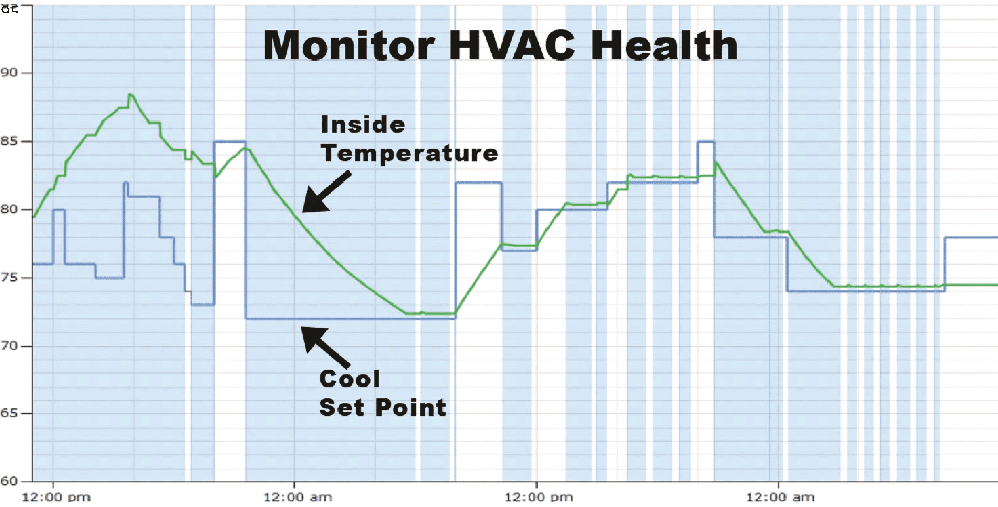
One of the major vacation rental expenses, both in terms of capital and maintenance, is HVAC. When HVAC systems fail, it’s all hands on deck to fix the problem as swiftly as possible, especially if the property is occupied by unhappy guests. But what if your HVAC could show you when it’s not performing well? PointCentral Smart Home solutions can do just that—thanks to HVAC analytics.

If a guest calls to complain that a unit is not cooling, your maintenance staff can analyze how the system is performing from any location before having to roll a truck to the property. Assuming the guest isn’t setting a ridiculous temperature compared to the outside temperature (PointCentral temperature limits can help protect HVAC units from this abuse), your staff can determine if there is a problem and get the right person out to fix it before it becomes a more costly repair.

Later this year, in addition to the analytics data, you will start to see proactive notifications from the PointCentral system when we notice that a unit is not performing well—before the guest notices the problem. These proactive notifications are generated by our powerful AI system, which analyzes over twenty billion data points collected from the five million homes on our platform from the previous year. The system will help you get ahead of maintenance needs and take care of them at optimal cost points with minimal guest disruption (e.g., by scheduling maintenance when the property is vacant).


Refrigerator Blues

What do guests typically do when they first check in at a house? They stock the fridge with a week’s supply of food that they either bring with them or that they purchase at the grocery store on the way to the property. Of course, when you fill an empty fridge with warm food, it can take some time for the refrigerator to cool everything down. In the meantime, your staff may get a call from the guest saying the refrigerator isn’t working. You end up sending maintenance staff to check it out, only to find out there isn’t anything wrong with the fridge.

With a sensor from PointCentral, you can see the refrigerator’s temperature remotely and avoid having to send maintenance staff on a wild goose chase. When a guest calls about the fridge, you can access the sensor and assure them everything is working properly—except for their patience.


Open Doors Open Up Problems

When a guest leaves a door or window open, it can really cause your energy costs to spike. Sometimes the guest just wants to listen to the ocean. Other times, housekeeping or other staff forget to close a door or window. Either way, you and your owners pay dearly, not only with higher utility bills, but also with greater wear and tear on your HVAC system.

PointCentral door and window sensors are an economical solution to this problem. When the sensors detect an “open,” the system will automatically shut off the air conditioning after a grace period (you get to set the grace period to balance the guest experience). Once the guest closes the door or window, the system will automatically restart the air conditioning. This results in significant energy and appliance wear and tear savings.


Don’t Sweat the Humidity

Another common problem of many vacation rentals, especially in the South, is humidity. Excess humidity can cause mold and mildew problems, which can affect the health of your guests and result in damage to the property.

PointCentral smart thermostats end this problem by monitoring humidity levels in unoccupied homes. When levels approach a point that would invite mold growth, the system automatically activates the air conditioning for a short while to bring humidity levels down, saving your guests and owners from health concerns.

Smart home solutions from PointCentral help make hot summers less costly for you and your property owners and will give your guests a much cooler experience. To learn more about why we are the leading provider of property automation technology, please visit us at PointCentral.com.

New Vacation Rental Stats from the National Association of Realtors

3
National Association of Realtors - Short Term Rentals Infographic header

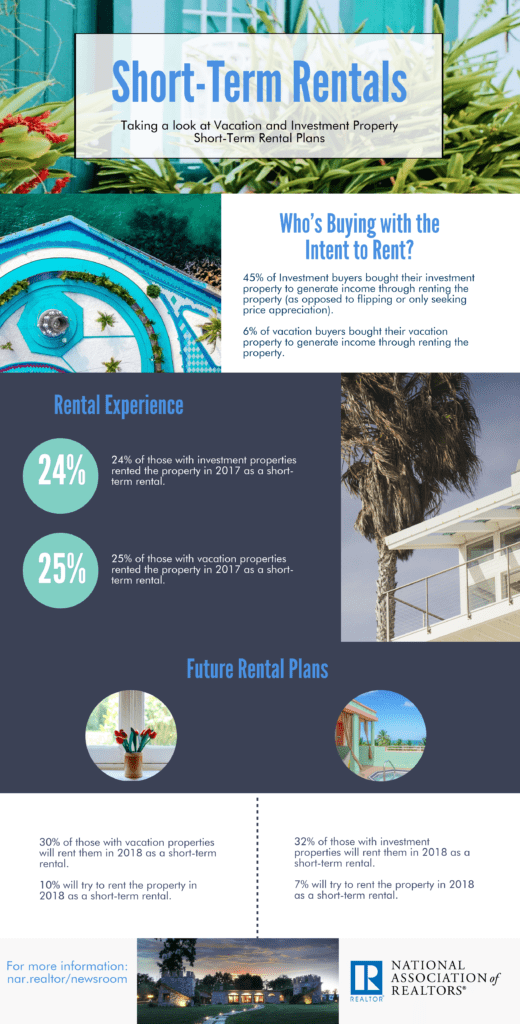
Recent National Association of Realtors® research shows noteworthy trends for the vacation rental industry.

Thirty percent of vacation property owners and 32 percent of investment property owners plan to rent their homes as short-term rentals in 2018, according to two of its recent infographics. These numbers are up from 25 percent and 24 percent in 2017, respectively. Furthermore, an additional 10 percent of vacation owners and 7 percent of investment owners will try renting their homes as short-term rentals this year.

Additional statistics include 45 percent of investment buyers and 6 percent of vacation buyers bought their properties to generate income through renting. More than 7 in 10 owners in both groups believe now is a good time to buy.

See the complete infographics below.


National Association of Realtors Infographic: Investment and Vacation Home Buyers 2018

National Association of Realtors Infographic: Short Term Rentals 2018

About this data from National Association of Realtors®: In March 2018, a sample of households that had purchased any type of residential real estate during 2017 was surveyed. The survey sample was drawn from an online panel of U.S. adults monitored and maintained by an established survey research firm. A representative sample of 2,080 qualified adults responded to the survey. The share of primary residence buyers was 78 percent, vacation buyers 7 percent, and investment buyers 15 percent.

Guesty Integrations Provide Smart Home Solutions for Short-Term Property Rentals

0
Guesty announces direct integrations with Slickspaces and VirtualKEY, enabling smart home automation including keyless entry, smart workflow and thermostat regulation – expanding the integration marketplace for professional property managers
 
June 25th 2018 – Guesty, the all-in-one property management solution for short-term property management companies worldwide, has announced direct integrations with Slickspaces Technologies and VirtualKEY to further ensure the simplification of the entire management process for property managers.
 
Benefitting both hosts and guests, Vancouver-based Slickspaces is a completely automated entry management system that spares property managers the trouble of coordinating with guests to arrange key exchanges. The system pulls up all of the property manager’s listings and generates a new and unique keypad code for each and every guest, ensuring access for only the duration of his or her stay.
 
The system’s smart lock also detects when a premise is empty and automatically initiates energy conserving measures, adjusting the thermostat and turning off any lights left on.
 
Chicago-based VirtualKEY, founded in 2016, provides remote keyless entry to properties in over 175 cities across the US, Europe and South America. Their smart lock technology is also compatible with over 200 home automation devices and offers property managers a smart workflow feature.
 
In addition to facilitating more flexible check-in and check-out times, and allowing managers and travelers to forego the hassle of coordinating key exchanges, VirtualKEY offers other valuable functions, like the pre-heating of pools prior to guest arrivals, as well as the regulation of thermostats whenever a property is vacant.

“Both Slickspaces’ technology and VirtualKEY are the perfect complement to our services,” says Guesty CEO and co-founder, Amiad Soto. “These new additions to Guesty’s expanding integration marketplace were fueled by our ongoing mission to simplify the management process for property managers as much as possible and to enable quick synchronization with external features that help save valuable time and energy.”
 
Through its ever expanding Integrations Marketplace, Guesty’s all-in-one solution provides property managers with a growing array of options to help run their business, including the likes of Booking.com, Airbnb, Agoda, Rentals United, Properly, PriceLabs, Beyond Pricing, Stripe and more.
 
About Guesty
Guesty is a cloud-based platform designed to simplify the complex operations of property management companies and allow the management of listings from multiple accounts on Airbnb, Booking.com, and other vacation rental booking channels. Guesty also provides a unified solution for critical tools, including: Property Management Software (PMS), Channel Management, Unified Inbox, Automation Tools, Payment Processing, Booking Website Creation, a Homeowner’s Portal and 24/7 Guesty Communication Services. Established in 2013 by brothers Amiad and Koby Soto, Guesty is backed by Magma Venture Partners, Buran Venture Capital, TLV Partners and AltaIR Capital and is also an alumni of prestigious startup accelerator YCombinator.
For more information on Guesty visit www.guesty.com.

Portland city council votes to collect new fees from short-term rentals

1

Last week, Portland, Oregon’s city council voted to adopt an ordinance amendment to collect two new fees on short-term rentals in the city: a 2 percent fee on hosts who use booking agents to advertise or accept reservations, and a $4-per-night fee assessed on booking agents and transient lodging intermediaries “for the privilege of facilitating a short-term rental occupancy.” It is expected that guests will have to pay both fees.

According to Travel Portland, some 8.6 million overnight person-trips generated $251.3 million in tax receipts and $5.085 million in total spending for the Portland region in 2017. Of that, $114 million came from Airbnb rentals.

Prior to the ordinance, renting entire homes on a short-term basis without the owner present was not allowed in the residential areas of Portland. Residents could only rent out single rooms or accessory dwelling units while they resided in the home, provided they had a permit. To obtain a permit, the owner had to provide proof that they had delivered a neighborhood notification letter, along with a list of all addresses notified. They also had to pay a $178.08 fee to the Bureau of Development Services for a fire and carbon monoxide alarm inspection, apply for a business license, and collect and remit transient lodging taxes of 13.3 percent.

Portland mayor Ted Wheeler and commissioner Nick Fish sponsored and submitted the ordinance to the council on June 13. City reports estimate the new per-night fee could add up to $2.5 million to the housing budget, and the host fee could produce up to $840,000 for the Tourism Improvement District.

Portland has declared a state of emergency regarding housing. “This per-night fee is one way we can provide necessary funding,” said Wheeler in the council meeting on June 13. He gave credit to the short-term rental industry and travel and tourism partners for coming together to create this solution.

At the same meeting, Commissioner Fish noted that three years ago, the council had directed all short-term rental occupancy taxes into the city’s Housing Investment Fund. He said they were “asking an industry that is taking affordable rentals out of circulation to be part of the solution again.”

More than 30 people testified during the council meeting. Several members of the local host trade association, Host2Host, criticized the short time allotted for hosts to review and respond to the proposal and requested to be part of short-term rental discussions. They also opposed each fee on different grounds, stating that the per-night fee disproportionately affected those with lower nightly rates. They also said that the host fee was unfairly charged to them but not to hotels with fewer than 50 rooms.

“The focus on affordable housing is admirable, but taxing vacation rentals at a higher rate than hotels simply doesn’t make sense,” said Eric Breon, founder and CEO of Vacasa. “Vacasa would support a measure taxing vacation rentals equally to hotels while redirecting the proceeds to affordable housing.”

Commissioner Fish requested that testimonies focus on the amount of charged fees rather than arguments against the effects of short-term rentals on housing availability. In his argument, he cited studies from various cities that demonstrated how short-term rentals took away long-term housing options for residents.

Still, some of those who offered public comments challenged Commissioner Fish’s argument. Robert Jordan, another host, shared an analysis from Martin Brown—a housing economist statistician based in Portland—of Airbnb’s 2,679 listings in the city. These rentals represented 1.1 percent of Portland’s total housing units, of which just 83 are homes that might otherwise be on the long-term housing market.

Airbnb also protested the proposed fees. They rallied hosts to write letters to the council and pointed out a 2016 study conducted by ECONorthwest. The study found that the number of entire home Airbnb listings booked full-time represented only 0.03 percent of the city’s housing units.

David Bo, an Airbnb host, spent five years trying to rent a spare room to a roommate before trying Airbnb. “College kids don’t want some 61-year-old guy as a roommate,” he said. “That’s why they left home!” Bo added that he had been laid off six times in the last eight years, and without Airbnb, he would be in need of affordable housing himself.

At the June 20 meeting, the council members voted unanimously to approve the host fee. They also extended it to hotels with fewer than 50 rooms. The per-night fee was also adopted with a 3-2 vote.

South Lake Tahoe Resident Group Submits Petition to City Council to Ban 75% City’s Vacation Rentals

4

On Tuesday, South Lake Tahoe City Council voted to order a report on the financial impact of a proposed vacation rental ban before it decides whether the initiative will be listed on the ballot in November. The Tahoe Neighborhoods Group’s petition collected enough signatures to qualify for the ballot, and if approved, it would phase out 1,400 vacation rentals outside of the tourist core district (75 percent of vacation rentals in the city).

South Lake Tahoe is a resort city on Lake Tahoe in the Sierra Nevada mountains in California. According to the Sustainable Community Alliance, a group formed to oppose the ban, vacation rentals generate nearly $3 million in tax revenue for the City of South Lake Tahoe, and their guests spend $65–80 million at local businesses annually.

South Lake Tahoe is already one of the most strictly regulated vacation rental markets in the country. After further tightening its Vacation Home Rental (VHR) Ordinance at the end of 2017 and removing warnings ahead of fines for violations, the area is earning a reputation as “the city of $1,000 parking tickets.”

Outside the tourist core district, vacation rental owners must register with the city and apply for one of 1,400 permits available in residential areas, which can cost up to $1,325 annually. Rules regarding parking, noise, hot tub use, and trash are required to be posted around the property, and violations of these rules are subject to a minimum $1,000 fine to both the guest and the owner or property manager, who often passes the fine on to the guest for a total of $2,000 per violation. If an owner receives three citations in any 24-month period, his or her permit is permanently revoked.

Stuart Roberson, partner at RnR Vacation Rentals, also said that property managers learned to work with the previous ordinance, but the latest policies have his guests “walking on eggshells.” The VHR Ordinance “has created vigilante groups against vacation rentals and turned residents into prosecutors,” he said.

“South Lake Tahoe’s ordinance has had very little positive effect other than extra revenue for the city from fines, revenue which is largely offset by the expense of identifying those violations and collecting those fines,” said Greg Holcomb, government relations manager with the Vacation Rental Management Association. “The negative effect is that South Lake Tahoe is now being seen as an unfriendly community to tourists and to the small business community.”

Though the intent of the regulations was to curb the increasing number of vacation rental homes in residential areas and keep nuisance guests at bay, a Reno Gazette Journal investigation found “The law is being used to enforce hefty parking violations: Parking accounted for 51 percent of all complaints made by callers and 60 percent of all violations cited by enforcement officers. The total fines levied for parking during the first three months of the updated VHR ordinance added up to about $90,000.” Additionally, only ten of forty-seven noise complaints were deemed valid, and of those, only three were attributed to partying.

The city council has since begun revisiting ordinance rules and fines, including discussion on Tuesday’s agenda. During public comment, Roberson requested that the three-strike rule be removed to eliminate the vigilante problem. He also took issue with the parking citations, which allow a guest to be penalized when they are otherwise following all rules and not being disruptive.

“Stu’s right – it’s the parking,” said Joshua Priou, the director of Lake Tahoe Accommodations. He said the city needs to stop the citations that could ruin someone’s VHR because of parking.

During the public comment period scheduled for discussion of the proposed ban, several property managers and vacation rental homeowners argued that the city hadn’t given enough time to see if the updated ordinance rules had time to work. Most of them also opposed the ban on the grounds of the loss of jobs that would result.

Meanwhile, the Sustainable Community Alliance, which includes the Lake Tahoe South Shore Chamber of Commerce and sponsorship by the National Association of REALTORS®, advocates for regulations instead of a ban. Its South Lake Tahoe Vacation Home Rentals Restrictions Initiative draft appears to model the Palm Springs Ordinance 1918. Its proposal includes similar noise, occupancy, trash, and good neighbor policies, along with the requirement of guests to receive a copy of these rules. The group also supports the establishment of a citizens’ oversight committee to enforce local vacation rental policies and develop “best practices for managing occupancy issues regarding vacation home rentals that protect neighborhoods and promote economic development.”

On May 21, the Sustainable Community Alliance submitted 1,827 signatures to the South Lake Tahoe City Clerk for its own petition to include its Vacation Home Rental Restrictions Measure on the November ballot.

Philip Minardi, director of policy communications with HomeAway, has a more optimistic view and said that for the most part, the majority of vacation rental owners and managers were comfortable as long as the ordinance kept the industry legal and viable in South Lake Tahoe. He now sees a “comfortable standoff” between pro- and anti-vacation rental groups.

Stuart Roberson said that while he believes the Sustainable Community Alliance’s measure is well-intentioned, he doesn’t agree with a few key parts of it, including the permit cap, the requirement that the cap on permits stays at 1,400 and cannot be changed without a vote of the people, and the non-renewal of a permit if the home generates less than $1,500 of transient occupancy taxes during the year prior to the permit’s expiration. “This doesn’t impact property managers, but it does impact local residents who want to rent their homes only occasionally,” he said.

The Sustainable Community Alliance measure has not yet been certified that it collected the minimum number of required signatures. Still, the general opinion is that both initiatives will end up on the November ballot. Speaking about the ban, Roberson closed his comments with a request: “Save our jobs, save our community,” he said, “and please, if you don’t want this to pass, let the public know.”

VRM Intel Live! Breckenridge Presentations Now Available

0

Thank you for joining us at VRM Intel Live! in Breckenridge! We sincerely appreciate the opportunity to spend the day with you, and we hope you found the insight shared by the many wonderful speakers and panels of value to you, your businesses and the greater vacation rental industry in your communities. The presentations are now available for download below:


Examining the Cost of Working with OTAs   –  Steve Milo, Founder and CEO, VTrips

Declare Your Independence: Key Website Tactics to Increase Direct Online Bookings   –  Brandon Sauls, Founder and President, ICND

Housekeeping FAQs: Standard Property Appearance, Team Cleaning, Accountability, and More  –  Durk Johnson, Executive Director, VRHP

How to Engage Employees to Make Performance Management More Meaningful   –  Sue Jones, Founder, HR4VR

How Successful Vacation Rental Managers Use Social Media as a Customer Service Tool   –  Susan Blizzard, President, Blizzard Internet Marketing and Alexa Nota, Vice President, VRM Intel

Evolve or Die: Time-Tested Keys for Success in a Rapidly Changing Industry    –  David Angotti, Founder, SmokyMountains.com

The Forgotten Art of Turning Leads into Bookings   –  Lois Mueller, COO, TripsIn  |  Audio available here

How to Sell Your Business for More Than It’s Worth   –  Ben Edwards, President, Weatherby Consulting

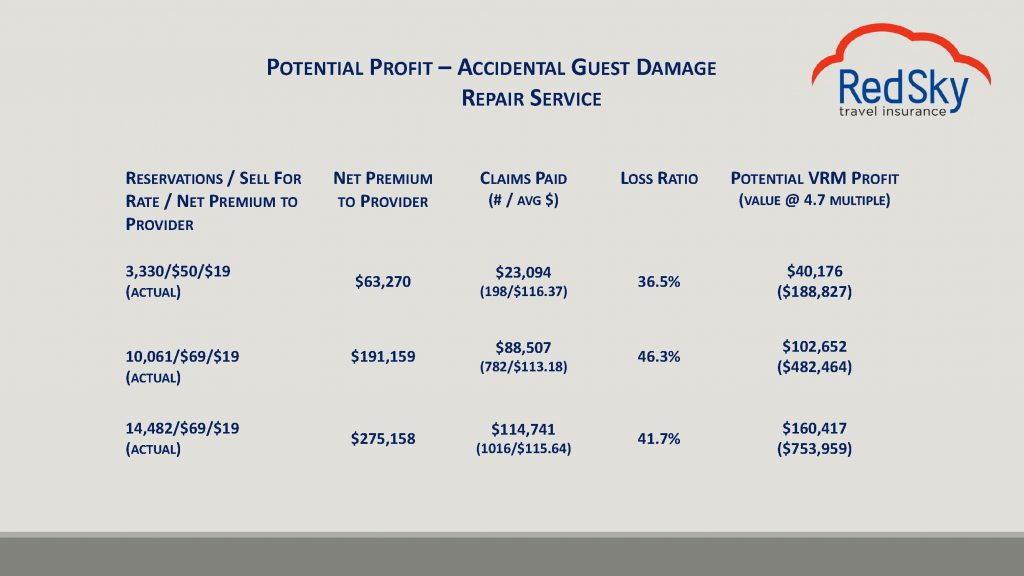
Travel Insurance and Damage Waiver Programs   –  Laird Sager, Founder and CEO, Red Sky Travel Isurance

Building Trust in an Untrusting World   –  Ali Cammelletti, Founder, Cammelletti Consulting


The Future of OTA Guest Fees for Vacation Rentals: Airbnb, Booking, Expedia/HomeAway Have Conflicting Views on a Fee for Travelers

7

Airbnb started it.

We all know the story by now. Airbnb founders Brian Chesky and Joe Gebbia couldn’t afford to pay rent in their San Francisco apartment and decided to rent air mattresses in their loft. With success, a disruptive marketplace was born, offering residents–later to be known as “hosts”–a way to make money renting extra rooms or space in their homes. The company we now know as Airbnb charged both the host and the guest a transactional fee.

Seven years later, Airbnb had raised a massive amount of awareness–and capital–and had expanded into the whole-home, established vacation rental space, colliding with the offerings of industry leaders HomeAway and TripAdvisor. The idea of a guest fee proved to be seductive for these short-term rental giants. In 2015, TripAdvisor mirrored Airbnb’s transactional model and added the guest fee, and in the same year when Expedia purchased HomeAway, it also added the fee for travelers.

The move was unprecedented in the traditional vacation rental industry and caused significant confusion for guests, homeowners, and vacation rental managers.

The fee for travelers grew from 6 percent to up to 22 percent for travelers before pushing downward to average 10 to 15 percent.

Since the mass introduction of the guest fee in late 2015, vacation rental industry and ecommerce experts have been questioning the sustainability of a fee for travelers in a world in which digital transparency is paramount.

Fast forward to present day, three companies have emerged as leaders among vacation rental marketplaces, Airbnb, Booking.com, and Expedia (HomeAway.VRBO); and these companies differ in how they are currently viewing the traveler fee.


Booking.com

Of the top three online rental marketplaces, Booking.com stands alone in never adding a traveler fee.

“We’ve never charged a booking fee to customers for our service, and this is something that we are extremely proud of,” said, Booking.com VP Olivier Grémillon in a recent interview with VRM Intel. (see the whole interview in the upcoming summer issue of VRM Intel Magazine)

“From our point of view, charging travelers is far from optimal for the customer. At Booking.com, we want to be as transparent as possible towards partners and customers so this means that what you see is what you get. We believe our approach is much clearer for both travelers and partners than others in this space who charge in different places, making for similar fees once guest and partner fees are added.”

Grémillon added, “At the end of the day, we are committed to delivering the best possible consumer experience to ultimately win more business for our partners.”


Airbnb

It appears Airbnb is rethinking the guest fee now that it is emerging as a full-scale travel company. According to Phocuswright, Airbnb is now testing a voluntary program that shifts the traveler fee to hosts/managers at a comprehensive rate of 12 percent for suppliers.

Phocuswire’s Jill Menze reported, “A source at Airbnb says the initiative is a response to feedback from professional hospitality managers looking for a different model to increase revenue. Targeting this service to professional property managers – in this case, about 100 – hints to Airbnb’s further ambitions to infiltrate the hotel and professional hospitality space.”

Menze continued, “Now it’s a question of how its service stacks up against the competition.”


Expedia/HomeAway

In Expedia’s latest earnings call, Oppenheimer’s Jed Kelly addressed the issue head on: “Airbnb’s been testing removing the traveler fee to reduce some friction. Do you ever foresee where potentially you shift more of the fees to the host versus the traveler?”

Expedia CEO Mark Okerstrom replied, “With respect to Airbnb testing the removal of the traveler fee, listen, HomeAway has been in the great position of having a combination of all monetization models for a while. We think it’s important to have that flexibility.”

Okerstrom added, “I think that all of the alternative accommodations players out there are likely to have some combination in the near term. I think that as the overlap between properties amongst the players gets larger–and I think that will happen over time–I expect that the monetization will shift a little bit more to supplier pays and away from traveler pays based on what we’ve seen in other industries, but right now that’s just an expectation. We don’t really know at this point.”


The Future of the Guest Fee

VTrips CEO Steve Milo warned an audience of vacation rental managers at VRM Intel Live Breckenridge last week the life expectancy of the guest fee is likely short, and property managers should expect to see that transactional fee shift to the supplier. Milo predicted that, as the fee for guests begins to disappear, the fee for suppliers will increase to up to 15 percent.

Milo also suggested that all OTA bookings would soon be transactional. And HomeAway’s recent earnings call supported his theory as Expedia CFO Alan Pickerill said, “The fact is that a big percentage of the listings, the online bookable listings, are on pay-per-booking on HomeAway, but there’s still a big, I call it disproportionate or out-sized percentage of the bookings happening on subscription properties.”

Pickerill added, “So for all bookings on the platform there is a traveler service fee, but for a good number of the bookings there still is not a host fee. Those are still coming through subscription and so that will continue to evolve as the business goes forward and as more and more of the business moves over to pay-per-booking.”

In summary, Booking.com never had a guest fee and will not be adding it, Airbnb is testing the removal of the fee, and HomeAway believes it can implement a “combination of all monetization models.”

Like a grade school playground, we will see who follows the leader.

Verifying the Interplay of Voice and Online Channels

0

As I often say to participants in my on-site reservations training workshops, “You are not supposed to have this job, and I am not supposed to have a job training you, because it’s 2018 and no one is supposed to be calling anymore!” I’m quite sure that if we could go back ten or even fifteen years and show lodging industry marketers the robust websites packed with information, videos, and 3D floor plans, and simultaneously showed them the nifty smartphone devices we all carry around these days, and then asked them, “Do you think anyone will still be calling for a reservation when they have all this information at their fingertips?”—100 percent of the survey responses would be “definitely not.”

Yet the phones still ring, and ringing they are! True, some VR companies have had a slight drop-off in calls; but if you take time to listen to those that are still coming in, you notice right away that most of the calls missing these days are calls we used to get regarding questions that no longer need to be answered. What’s missing is a lot of “service only” calls, such as those asking for directions (now available on GPS), local area information (now pushed out via apps), and details on what’s in the actual home (now viewable via virtual tours.)

Despite all this evidence to the contrary, some VR marketing still holds onto the concept that there exists a “voice” client and, separately, an “online” client, when the truth is they are the same client.

One reason for this diehard belief is linked to all the vague generalizations we read about the “millennials,” who supposedly want to do everything online via an app and who never want to make a call. I personally know this is not the case. I provide voice reservations training to several “lifestyle” hotel brands that specifically target the millennial demographic—and I can tell you that many of those hotels receive up to 35 percent of all bookings via good old-fashioned phone calls. Also, as the lives of those millennials (the oldest of whom are now 37 years of age) become more complex, such as when they have children and become the generation planning the annual vacation for extended family, they are indeed calling for assistance.

That being said, I’m sure many of you data-hungry marketers reading this are wanting proof. So allow me to suggest a way that you can measure the interplay of voice and online channels specific to your VR company.

First, run a report in your property management system showing the long list of bookings made directly on your own website. Chances are these are coded as a separate market segment, so this should be an easy task. Next, randomly highlight at least twenty-five bookings made on the website and the respective phone numbers, along with the date on which the reservation was made. Finally, check those phone numbers against the billing records of your provider for inbound 800-number service. This step might involve your working with accounting to log in to view this part of your phone bill online as a searchable record. Search the bill for each phone number, and when you find a match, note the date and time of the call or calls (many clients call more than once.)

Then you can tally the results to find out a) how many of those who booked online called prior to booking, b) how many called after booking, and c) how many called both before and after booking.

Of course, if you have invested in call and lead-tracking systems from VRM Intel supporters such as TrackPulse and NAVIS, and therefore you are capturing the full names from all incoming leads, you could instead just pull a list of names of leads that did not close via voice and then check those in the property management system to see if they had booked online.

If you take time to do this, you will have empirical evidence of the interplay of voice and online channels. If you would be satisfied with anecdotal evidence, just ask your reservations agents how often they hear callers say something like, “Hi, I just booked online, but I have a few questions…”

Ask those agents how often they recall talking with someone extensively, possibly even sending the caller a quote via email—and then seeing an online booking coming through with that person’s name on it.


PMS + CRM = ROI

1

Why do people settle for mediocrity? Why do people tend to take the path of least resistance? I suppose it could be a matter of “hard-coded” personalities based upon genetic dispositions and the complex balance of logic and creativity within the miraculous human brain; or maybe these are learned behaviors through sociological influences acquired from friends, family, and lifelong experiences? The truth is there is no perfect answer. Every single person is unique and driven to act by two pillars of human development, “nature” and “nurture.” The entire make-up of a human character can be so multifaceted that people may hardly know themselves. Yet, my most essential message here is that you absolutely must get to know them.

How does this relate to a CRM? That will be revealed soon, but first let’s discuss what CRM stands for—customer relationship management.

The key word to focus on here is relationship. Building and maintaining relationships with customers (guests and owners) require having the right tools and technology. Ask yourself, “Exactly what type of relationship do I want to have with my customers and/or potential customers?” Once you have that question answered, you can begin to strategize on how to achieve this initiative. Before going any further, let’s look at some of the primary technological components of an effective CRM system:

  • Guest database, profiling, and reporting
  • Owner database, profiling, and reporting
  • Guest lead management system
  • Owner lead management system
  • Reservation quoting
  • Loyalty programs
  • Reservation management
  • Promotion and coupon management
  • Email and text messaging
  • Two-way guest communications
  • Two-way owner communications
  • Automatic notifications (email, text, push)
  • Integrated phone system
  • Call recording and monitoring
  • Coaching and scoring
  • Customer notes
  • Marketing Source Tracking
  • Conversion Tracking
  • Advanced Reporting/Dashboards
  • Reservation Sales Management
  • Guest Interface/Mobile Application
  • Owner Interface/Mobile Application


The GUEST

“Hospitality is making your guests feel at home, even if you wish

they were.”  – Anonymous

Ideally, and based on how important guest loyalty and the guest experience has become in the vacation rental industry, we would have a real friendship with all our guests. We would know our guests by name, and we would greet them face to face. We would invite them to dine with us, we would know their family, and we would take them golfing or skiing, etc. If you are in a position to personally know your guests, kudos to you because your guest retention is going to be through the roof.

For the rest, for whom this is not at all practical, you have to create a different strategy. This strategy will be based on resources, time, and simply how much you care about your guests. Defining the guest experience from the first step (first exposure) to the final steps (checkout and beyond) should be a very specific, fine-tuned, calculated process.

Defining each stage of the guest experience and breaking those stages down to their micro-elements can be the difference maker between that guest remembering your company and achieving that highly sought-after guest loyalty. Many of the fundamental components of the guest experiential stages can be handled by technology. There has always been a philosophical struggle between automation or being hands-on—the person or the machine.

Should we be the boutique company or the large company lacking personalization? I believe that this is a flawed argument; property managers should be focused on finding ways to let technology save time by providing all the basic information so the property manager can go above and beyond by freeing up staff for personalization. If it takes 30 seconds to send a quote because of better technology, the property manager now has the ability to call and follow up with the quote. The new generation of travelers expects a high-tech experience. Having a quality CRM is essential when building an advanced guest relationship strategy because a CRM builds the relationship with guests and lays the groundwork for intelligent automation and future marketing campaigns.


The OWNER

“Get closer than ever to your customers. So close that you tell them what they need well before they realize it themselves.” – Steve Jobs

Good news! While you likely can’t make friends with each and every guest, you certainly can with your property owners. Optimizing your communication and your relationships with owners is paramount in owner retention. While a guest has entrusted you with a weekend stay, an owner has entrusted you with his or her property and financial future. Owners deserve a certain amount of care and sacrifice with such a commitment to your company. It is beneficial to make the time to gather, organize, and utilize data to deliver an optimal owner experience. A quality CRM, especially for larger companies, is at the forefront of optimizing long-term relationships through a committed owner strategy.

It is my opinion that a company should always build its service/relationship strategy around the best customers, not the bad apples; instead, let the bad apples learn to love you. You will be surprised how well some of your more challenging customers respond if you treat them the same way you treat your best customers, despite a natural inclination to reject them. Every owner needs to have a unique strategy because everybody responds differently to certain types of interactions, but in general, positivity, care, and patience are a recipe for success, regardless of the personality type. It is important to educate owners. Provide a professional marketing piece about why your company is the best in its class. Talk about your technology, mission, commitment, plans for guest retention, distribution, and stance on wild guests. Let them know how important keeping the property in good shape is to you. As always, the best salespeople in any organization are its customers. Get a list of testimonials. Overall, build the relationship, establish trust, and be real.


Back to the basics

To jump back to the initial paragraph in this article, the first lesson is that the human psyche is highly complex; thus, to emotionally trigger your customers into a desired buying behavior, spend the time and effort to get to know who they are. Learn what makes them tick, and collect a catalog this information to do so. The second lesson is don’t settle for mediocrity with a CRM—not now, not in this industry. Make an effort to know your customers inside and out, and this must be a company-wide commitment. Gathering and organizing data on your customers—whether its demographic, geographic, or psychographic—is essential. Do not compromise on a CRM when choosing your technology because it really is the key to your future.


Consolidate your technology

We are living in the age of connectivity. Our entire planet is networked and intertwined on levels that are nearly unimaginable. We are connected through airways, highways, railways, subways, waterways, satellites, cellular networks, the web, and the grid. We can share more information and more data in one second than our entire species has in the history of our existence prior to the 1900s.

The vacation rental industry in particular is experiencing a boom in technology and a significant shift into the world of extreme connectivity. This is most obviously seen through OTAs and online booking channels, but it goes far beyond that. Property management systems are the main technology hubs for property managers with connections to lock companies, credit card processors, home automation providers, website builders, travel insurance agencies, floor plan companies, lead management solutions, phone systems, distribution channels—the list goes on. What is this craziness? Well, it’s an attempt to have the most well-rounded, efficient, and profitable operation possible. The goal really should be to bring as much technology under one roof to minimize costs and inefficiencies while harnessing third-party platforms. There are many great external product extensions, but the first objective should always be to consolidate. After all, maximum efficiency often translates into maximum profitability.

How does putting time, money, and energy into a CRM translate into ROI for my business?

 Whether using your PMS for your CRM or an external system like Salesforce, the answer stays the same. You invest consciously into getting your customers through the door, but it is critical to understand the value of keeping that customer inside the door. It is essential to begin to evaluate the lifetime value of the guest or owner. Once a guest has stayed with you or an owner has signed up with you, he or she is your customer to lose. If you make all the right moves, there is little your competitors can do to reel in that business. When speaking of return on investment (ROI), let’s focus on the investment part. You are investing a great deal of resources to get people in the door. You are investing in employees, costs per click, SEO, branding, OTA fees, your website, etc.

A successful customer retention plan would start by tailoring a personalized experience, which is possible with a quality CRM for both guests and owners. Create an experience through technology that makes customers feel like they can trust you and that you care about them. With an automated approach, you are providing the foundational/functional necessities and using the gained staff time to cater to and personalize the relationship on whole new level.

Once you have the data, get creative. Categorize your guest as a golfer in the CRM and set up a notification that automatically goes out to all “golfers,” saying, “We remember you like to golf, so here are the courses in this area; we recommend this one.” Delivering an experience like this is entirely possible, but you have to get the data, know the customer, and find the technology and CRM to create such an experience. Think how creative you could be! You could build tailored experiences for skiers, or fishers, or VIP clients, or foodies—the list goes on. These same concepts are true for owners. Owners are really your most valuable customers, and their experience with you should be highly tailored as well. There are many ways to go above and beyond for owners. If you invest the time and resources into the right CRM and customer experience, your one-time guest can become a lifelong guest, and your success will be ensured.

Palm Springs Votes Down Short-Term Rental Ban

0
June 6, 2018 - Panel discussion at VRM Intel Live! in Breckenridge, Colorado on regulations in the vacation rental industry, including Palm Springs. From left to right: Ben Edwards of Weatherby Consulting, Philip Minardi of HomeAway, Toby Babich of Breckenridge Resort Managers and the Vacation Rental Management Association, and Ian Patterson of Great Western Lodging.

Measure C, a proposition to phase out vacation rentals in single-family neighborhoods in Palm Springs over the next two years, was struck down with 69 percent of the vote against it.

On Tuesday, June 5, 2018, Palm Springs, California voters turned down Measure C, a proposition to phase out vacation rentals in single-family neighborhoods in the city over the next two years. The measure, brought forth by the Palm Springs Neighbors for Neighborhoods group, was struck down by a wide margin, with 6,764 of the votes (69 percent) against it.

Palm Springs is a part of the greater Coachella Valley in California, where tourists spent $5.5 billion and generated $592 million in state and local tax revenue in 2017, according to the Greater Palm Springs Conventions & Visitors Bureau.

Before Measure C, Palm Springs had been (and still is) one of the most strictly regulated vacation rental markets in the country. In the most recent version of Ordinance 1918, vacation rental owners must apply for and renew a vacation rental registration certificate annually for $923, as well as submit a transient occupancy tax permit application, pool compliance statement, and HOA letter (if applicable) to the city’s Vacation Rental Compliance Department before the home can be advertised or rented. Registrations are limited to one home per owner.

Additionally, the home’s city identification number is required in all advertising, safety inspections are required, and owners must provide a list of family and friends who may stay in the home at no cost and without the owner present. Guests of vacation rental homes must sign a city regulations form in person confirming their understanding of the area’s good neighbor policies on parking, noise, trash and pets – rules several locals in the vacation rental industry have said are so strict that they are making guests want to travel elsewhere.

Despite these existing regulations, the Palm Springs Neighbors for Neighborhoods group brought Measure C to the June ballot in an effort to ban vacation rentals entirely from residential areas. Local vacation homeowner, Bruce Hoban, co-founded Vacation Rental Owners and Neighbors of Palm Springs in April of 2017 to advocate for local vacation rental owners, and then the group formed the We Love Palm Springs campaign in opposition to Measure C.

According to Hoban, the campaign succeeded due to voter education. The group led focus groups, large field survey polls and tested its messaging. Successful messaging focused on the economic impact of tourism in the area and vacation rentals’ role in it. Hoban said he counted 11,000 total beds in the city available to tourists; 46 percent of those beds were in vacation rentals. “People could understand that stat,” he said. “That had a big impact.”

“The normal day-to-day citizen in Palm Springs sees the good that we in the vacation rental industry bring to the community from job opportunities, tax revenues, as well as how much we gave back,” said Ian Patterson, previously the executive general manager of Vacation Palm Springs, now president and CEO of Retreatia in Steamboat Springs, Colorado and Great Western Lodging in Breckenridge, CO.

Hoban also attributed the campaign’s success to organizing other local groups, including business associations, hotels and more than 700 individual donors.

Greg Holcomb, government relations manager with the Vacation Rental Management Association

“The campaign organization was the true star here,” said Greg Holcomb, government relations manager with the Vacation Rental Management Association. With property owners, management companies, suppliers, employees of the various impacted companies, community groups, real estate professionals and others, “this unity is how a clear message was able to win over voters,” he said.

“What happened in Palm Springs is a bellwether for rest of California and the US,” said Philip Minardi, director of policy communications at HomeAway. [The city] recognized the value of traditional vacation rentals to the community, and every citizen heard that message loud and clear, he said. “We as an industry should be banging pots and pans around the country about this vote.”

Following the vote, the Palm Springs Neighbors for Neighborhoods group website posted a message including the following statement: “Our work here is not over. And, the experience we have gained over the past year will be shared with other communities. We have already received requests from South Lake Tahoe, Truckee, and Pacific Grove and the other tourist cities across the country. This is a movement and it is growing.”

Minardi, Holcomb and other industry professionals acknowledge the spread of regulations. “This is something that every community in America is starting to face or will face,” Minardi said.

For those communities, “Work together and keep it local,” Patterson said. “Come together as a team and ensure you speak with one voice.”

LiveRez Introduces LiveManager for Vacation Rental Managers

0

New Tool Allows VRMs to Assign and Track Cleaning, Maintenance and Inspection Tasks from Anywhere and On Any Device

Eagle, ID  LiveRez, a worldwide leader in vacation rental software, today added a next-generation property care tool to its all-in-one solution for professional vacation rental managers. 
 
The new tool, called LiveManager, replaces LiveRez’s existing housekeeping and maintenance module and allows professional property managers to more efficiently create and assign cleaning, maintenance and inspection tasks, as well as track the execution of their on-the-ground operations in real-time.
 
LiveRez CEO Tracy Lotz said that the company has spared no expense in building LiveManager into an industry-leading property care tool.
 
“Top-tier professional managers, like the ones we partner with, understand the importance of caring for homes and making sure they are in immaculate condition when the guest arrives,” Lotz said. “But doing this efficiently and consistently can be a major challenge, especially as you grow your inventory. LiveManager simplifies and automates this process, leading to higher guest and owner satisfaction.”
 
LiveManager offers a number of key advantages over other solutions available to professional managers:
· It’s 100% mobile responsive and cloud-based, so you can access it virtually anywhere on any device, allowing your operations team to view assignments and input work directly from the field.
· The system tracks and timestamps the completion of every task in real-time, so you’ll have a to-the-second picture of the status of all your open jobs.
· It’s completely integrated with LiveRez’s all-in-one vacation rental software suite, allowing VRMs to automate work order creation based on reservation events, pull information from other parts of the system, and send expenses to LiveRez’s accounting system.
· It uses modularity and automation to reduce repetitive tasks. For example, you can create unlimited groups of properties, tasks and costs, and attach them to an unlimited amount of work order templates, which then can be created automatically, in bulk or one-by-one. Existing work orders can also be updated in bulk, as well. 
· The system was built to accommodate vacation rental managers of all sizes, from those with just a few properties to those that manage 1,000+.
       
LiveRez built the tool in conjunction with its many professional manager partners. Many of their suggestions were built directly into the tool, like a drag-and-drop calendar interface for scheduling unscheduled work orders, and a property information section that allows managers to create and store unlimited custom property fields and limit access to these fields by user type. 
 
Additionally, LiveRez developed an entire training and certification program to help its partners learn LiveManager more quickly and get the most out of it. This will be the first of many training and certification programs that will include everything from the LiveRez software and industry best practices, to soft skills, like vacation rental marketing, customer service and more.
 
And, according to Lotz, his team is slotted to continue adding next-generation functionality to the tool in the future, specifically the integration of SMS notifications, auto creating work orders when reservation add-ons are selected, and integration with LiveRez’s guest app and IoT connections to allow guests to make requests mid-stay.     
 
“We built LiveManager to be the most powerful and flexible property care tool in the industry,” Lotz said. “It’s part of our larger goal to not only offer professional managers all the tools they need to run their business in one spot, but to also offer them the highest quality tools for each aspect of their operations.” 
 
To learn more about LiveManager, visit LiveRez.com/operations.
 
About LiveRez
LiveRez is the world’s most widely used software platform for marketing and managing vacation rental homes online. The LiveRez solution offers professional property managers all the tools they need to run their business in a single, cloud-based platform. And, the company’s unique “pay-as-you-book” business model creates a mutually beneficial partnership between LiveRez and its vacation rental manager partners. This partnership fuels the company’s mission of continually developing and supporting cutting-edge solutions that empower independent property managers to compete in the rapidly evolving vacation rental space.
 

Key to Exponential Growth: Fire Owners Regularly

0

I will never forget the way my coffee cup felt as I calmly ran my thumb around its rim. I sat there quietly, while two owners, who had previously been low maintenance, lambasted me and my business partner for an hour in our main office conference room.

Historically, their rental property had been a low performer; however, although it was small and below our typical quality, guests rarely complained, and the owners had been easy to work with until now.

We signed the property in our early days as a company when any inventory was good inventory. As we grew, we assumed it was still a good decision to keep the property because it was producing incremental revenue and didn’t distract us from our core business goals.

As the details unfolded, we learned that unbeknownst to us, the property owners had placed a “$500 duvet” (according to them) in the property during their last owner stay, and it had gone missing. As far as they were concerned, this was our responsibility, and we should be financially responsible for it.

As a business owner it was difficult to rationalize how it made sense to put something that nice in a property that rented for $99 a night on average. It was even more difficult to rationalize how neglecting the rest of my business, staff, high-value owners, and tasks for this conversation made sense.

It was time to let them go. Not because I was emotional, and not because I was upset, but because the time-value equation of keeping them on the program no longer made sense.


How to know when it’s time to fire an owner

When I travel and speak about my days as a property manager, one of the top questions I am repeatedly asked is, “How do I know it’s time to fire an owner?”

What’s most interesting is that this question is usually preceded with a real, emotional story about how low producing the property is, how resistant an owner is to investing in improvements, and how incredibly high (read: unrealistic) the owner’s expectations are for the property’s financial performance.

Whereas there is no perfect formula for understanding the timing of firing an owner, what I’ve learned is that there are generally four classes of property owners, and only one class of those that should always be let go.

As shown in the scatterplot, owners typically fall into one of the following categories:

  • High profit/Low effort (ideal client)

  • High profit/High effort

  • Low profit/Low effort

  • Low profit/High effort

So which one of these owner categories should always be on the chopping block? You guessed it: any owner who falls into the “Low profit/High effort” category.

Have you ever thought about your owners in this way? It would be an insightful exercise to sit down with your team, make a list of all of your owners, and then categorize each one into one of these four buckets. The insights you will gain about your company, owners, and understanding of the burden to your business of carrying certain owners as customers will be enormously helpful.


Breaking up is hard to do

I was talking with a property manager recently who we’ll call Carl. Carl explained that he had started a company 16 months previously and had already grown to thirty units under management (what an exceptional feat!), but Carl had a problem.

As many new property management companies do, Carl signed any homeowner who would come on board to achieve the critical mass he needed to have an actual company. Unfortunately, Carl felt that about 10 of these homes were now falling into the “Low profit/High effort” category, and as a result, the relationship-management side of keeping these unrealistic homeowners satisfied was already wearing Carl thin and putting the higher earning, lower effort category of homeowner at risk.

My advice to him? Cut them loose soon. “Be professional. Give them notice,” I said. “Don’t get emotional or go into too much detail about why. Thank them for being a customer, serve them notice, and get off the phone. But do it soon.”

Carl immediately had questions about how he would make up for the lost revenue these 10 properties were producing. I advised him that, in actuality, if these properties were as high stress and low profit as he was telling me, then his largest revenue losses were happening on the high profit properties that are being neglected right now that he may lose if he doesn’t redirect his focus.

How should Carl fire the owner from this program? A few thoughts:

  1. Do not do it in person. I know this is counterintuitive, but the point is to stop your losses. The last thing you have time for is a long meeting about why you can’t invest time in the owner’s property anymore. This is about rescuing time.
  2. Pick up the phone, call the owner, and calmly and professionally explain that you are no longer going to do business together. Explain that financially it does not make sense to keep managing the property for your business. Thank the owner for being a customer and get off the phone.
  3. Don’t have a change of heart. Some owners will promise to start investing in improvements or doing the things you have asked for. Don’t give in. Make your decision before you call, and stick to your guns.
  4. Send an email summarizing everything you just said on the phone to the owner with the roll-off date clearly spelled out. Schedule maintenance to decommission the property. Walk away.

Despite our hesitancy to cut properties loose, the reality is that intentionally pruning your list, on a schedule, with proper thought and strategy (not on a heated whim!), will actually set you up for success. The time you’ve rescued from poorly performing properties will free you to focus on the highest earners, sign new properties, and grow even faster with better inventory, making your bottom line stronger every year.

Said another way, it’s a common form of self-deceit that managing thirty properties is more profitable than managing twenty-five, or that managing one hundred properties is more profitable than managing eighty. Time is the only asset you can’t get more of. Put it where it’s going to be most effective at achieving growth and revenue goals not expectation management.


How to sign and keep more profitable owners

Maybe you’re already processing your list of high effort/low profit owners and know it’s time to professionally part ways. But, what if there were a way to keep the high effort/low profit owners out of the roster to begin with?

One of the biggest mistakes property managers make when signing new owners is not level setting with the owner what expectations for the management experience will look like. They’re so excited—too excited—to sign another owner that they forget to qualify the client as the type of client who will help them grow and not get sucked into constant “crisis” management.

One simple question to qualify a new owner: “Is this property an investment property or a dream vacation home?”

The response you receive will tell you everything you need to know about whether or not this is a relationship you want to be a part of. For owners who respond that it is an investment property, it is much easier to explain that investment properties take wear and tear, have things go missing, and have the ultimate goal of maximum financial production. You need to have this conversation before you sign them.

For owners who respond that the property is a dream home, family inheritance, or similar, you have a decision to make. You can either refer them to another company, or you can set different expectations for them. For example, you may indicate that if they do not want it to be treated as an investment home, then you will intentionally keep rates high to keep nights booked low and that you wouldn’t anticipate having any conversations about financial performance because that isn’t their primary goal.

It’s amazing how many owners reevaluate their own self-categorization during this conversation and decide they’re okay with more wear and tear, items going missing, and so on if it means they can make a profit. Even if they don’t have a change of heart, it gives you something to point back to if they start complaining later about performance—a strategic move you took from day one.


Closing Thoughts

The Pareto principle (also known as the 80/20 rule) would tell us that 80 percent of our managerial stress is likely coming from 20 percent of the units under management. Alternatively, 80 percent of revenue is typically coming from roughly 20 percent of clients. Wouldn’t we want to minimize the amount of time our low earners are stealing from the highest producing clients on our roster?

Even though it may be painful in the short term, firing owners who are high maintenance and low profit is always the right business decision. You will gain a new level of freedom and laser focus on your business that will make this temporary pain not only worth it, but it will pave the way for future growth and success.

Key Employment Law Changes

2

Trends to Keep on Your Radar for 2018

Keeping up with ever-changing employment laws is a struggle for all business owners. No matter the size of your business, or the number of employees you have, making sure that your company is compliant with local, state, and federal labor laws is an important yet daunting task.

If you haven’t already done so, now is the time to dust off your employee handbooks and update them to reflect changes in legislation enacted in 2017. Outdated handbooks may contain policies that could possibly violate these new statutes or regulations, exposing you to unforeseen liability.

This past year has been a busy one for legislators, especially for those at the state and local level. During the last year, there have been several laws passed that may directly affect your workplace policies and employee handbook at a more local level.

Heading into 2018, there are several trends in employment law that could potentially impact your business. Even if the following changes haven’t been enacted in your state yet, don’t breathe too easy. At the rate things are going, it probably won’t be long before one or more of the following trends are affecting your state and local regulations.

Here are some key employment law trends and policies to be aware of:

#MeToo: Sexual Harassment Policies

Sexual harassment cuts across all industries, as recently evidenced by the #MeToo social media hashtag. Matt Lauer, Harvey Weinstein, Bill O’Reilly, Roger Ailes, Kevin Spacey, and many others have become embroiled in workplace harassment allegations at a rate we have never seen before.

How you handle a sexual harassment complaint or even a whisper of one can have a considerable impact on your organization. Failing to take the appropriate action at the right time comes with a steep price. Think about the damage to your reputation, your brand, your culture, and your ability to attract and retain employees. The cost of dealing with a sexual harassment charge is far greater than just the financial impact.

If you don’t yet have a sexual harassment policy, now is a good time to formalize one. If you have a policy that hasn’t been reviewed in a while, revise it now by adding examples of what is considered unacceptable behavior and what the consequences are for individuals who violate the policy.

It is now more important than ever that you train your employees about sexual harassment and that inappropriate behavior will not be tolerated. Providing additional training for your supervisors and managers is key to ensuring that no complaints, or whispers of complaints, go undetected.

You can find more information and facts about sexual harassment at the following websites:


“Ban the BoxFair Chance Policy

Twenty-nine states, representing more than 150 cities and counties nationwide, have adopted what is widely known as “Ban the Box,” a part of the more comprehensive Fair Chance Policy. The intent behind “Ban the Box” is to provide applicants with a fair chance to be interviewed by removing conviction questions from the job application and delaying the background check until later in the hiring process. This doesn’t mean that you can’t ask about convictions, it just means you should wait until a conditional offer of employment is made and a background check has been completed.

Using conviction information fairly is the backbone of an effective Fair Chance Policy. Simply stated, you should make your assessments based on individual circumstances instead of broad categories of exclusions. For example, if you are hiring an individual who had a conviction for shoplifting eight years ago, it is important to consider the length of time since the offence and the relevance to the position, rather than disqualifying the applicant because you “don’t hire anyone with prior convictions of shoplifting.”

The following are some best practices to consider regarding “Ban the Box” and/or implementing a Fair Chance Policy:

  • Remove inquiries about convictions from your job application. If you are using an automated recruitment system, be sure to remove any questions from the online application process as well as from any paper applications.
  • Remove self-reporting questions about conviction history. The best approach is to confirm any convictions with a background check.
  • Background checks. You do not want to take into consideration any records of arrest that were not followed by a valid conviction.
  • If an applicant is rejected based on a conviction record, inform the applicant in writing. Background reports, just like credit scores, can be inaccurate. Be sure to provide time for the applicant to verify or challenge the information.


Equal Pay and Wage Discrimination: Banning Salary History Inquiries

Asking for current or prior salaries on applications, or asking applicants during an interview about their salary history, is now off-limits in several states. Over the past year, many states and cities have significantly expanded their equal pay provisions to promote wage transparency and pay equity to close the wage gap.

The Equal Pay Act requires that men and women working in the same company be given equal pay for equal work. The act refers to positions with the same scope and responsibility, not necessarily the same job title. It is a good practice to complete internal salary studies on a regular basis to determine if there are any instances of pay inequity in your organization. Pay equity includes all forms of pay, including things such as salary, bonuses, life insurance, and allowances for gas, phones, travel expenses, and other benefits.

Another law to be cognizant of is the National Labor Relations Act, which protects employees’ rights to discuss their salaries and wages with other employees. If you currently have a policy that restricts employees from talking about their wages, now is the time to remove it from your handbook or associated policies.

While none of this is “new” news, it is becoming more front and center and something to pay close attention to over the next twelve to eighteen months.


Protected Sick Leave Laws

It is important that your employee handbook policies and employment posters reflect the latest federal, state, and local leave laws. As you review your leave policies, pay attention to recent leave laws enacted for paid or protected sick leave. While federal law doesn’t require private employees to pay sick leave, there is a fast-growing trend at both the state and local levels to provide this benefit.

You can find more information and facts about paid sick leave at The National Conference of State Legislatures website.

In addition to reviewing your state leave laws, make sure your employment posters are up to date as well. Some states require you to insert certain notices with regard to leave into your employee handbooks. You can find more information on what posting requirements you should comply with at the US Department of Labor website.


Addressing Violence and Weapons in the Workplace

Workplace violence is an issue that can affect any organization, of any size, in any industry. Are you aware that the Occupational Safety and Health Administration (OSHA) requires you to provide a safe work environment for your employees? It’s true. Under the general duty clause, OSHA states that preventing and dealing with violence in the workplace is your responsibility.

Workplace violence includes much more than just the physical assaults with weapons we hear about so often in the news. Spreading rumors, swearing, verbal abuse, pranks, bullying, sabotage, theft, physical assaults, psychological trauma, and anger-related incidents are all examples of workplace violence. It is good practice for businesses to have policies in place to prevent workplace violence, addressing the actions referenced above.

Although there is no federal law that regulates weapons in a private workplace, several states have enacted laws that specifically apply to employers with regard to carrying concealed weapons that include prohibiting the possession of certain weapons on their private property. As more states move to adopt or strengthen concealed-carry laws, employers need to keep pace with changes in the law and how they might affect the workplace.

For more information on this topic, Reed & Scardino Attorneys at Law have an informative brief titled “Providing a Safe Workplace When Employees are Licensed to Carry” on their website.

Changes in employment laws are relatively frequent. It is important to keep abreast of changes in the law at the federal, state, and local levels. Being informed about what’s on the horizon with regard to changes in the law, as well as any changes in best practices, is key. While the trends listed above may not be on your radar yet, they very well may be in your employee’s line of sight.

Here are some general steps you can take now to ensure you are in compliance and proactive about upcoming changes in employment laws:

  1. Visit Your State Labor Office Website
  2. Conduct an HR Assessment. HR assessments can help identify whether your HR practices or processes are adequate, legal, and effective.
  3. Update Your Employee Handbook. The best practice for employers is to update their handbooks on an annual basis to ensure that their employee handbook is compliant with current laws.
  4. Conduct a Salary Survey for Your Positions. Start being more transparent about how pay is determined in your company. A salary survey can assist you with determining internal and external equity, ensuring that your compensation is fair and consistent across the organization.
  5. Provide Sexual Harassment Training. Be proactive. Training employees provides more awareness about the types of activities and actions that are considered unacceptable and can get them into hot water. Face-to-face training is the best approach to ensure that the message is received and understood.
  6. Update Employment Posters. Laws are constantly changing; don’t be caught off guard. Visit the Labor Law Center’s website for specific posting requirements by state.

Best Practices for Accidental Guest Damage Repair and Bed Bug Infestation Remediation

2

Insurance products are among the variety of solutions available to vacation rental management companies (VRMCs) for the remediation of accidental guest damages and bed bug infestations. Security deposit waiver and bed bug remediation insurance programs reimburse VRMC users the expenses incurred to repair accidental guest damage and personal property damage and treat for bed bug infestations.

A careful assessment of the frequency of these events and the expense of repairing such damage suggests that the use of these forms of insurance is not the best solution for VRMCs.

Rather, the best strategy for the repair of accidental guest damages and the remediation of bed bug infestations is a VRMC-provided homeowner and guest service. VRMCs offer several valuable homeowner and guest services, including deep cleaning and end-of-stay housekeeping, linens and bed-making, keyless entry and security, winterizations, pre-arrival inspections, and concierge. Accidental guest damage repair and bed bug damage remediation are best provided as another valuable homeowner and guest service.

The benefits of providing accidental guest and bed bug damage repair as a service rather than an insurance product are fourfold. It is extremely profitable, far less administratively burdensome, and exponentially more efficient; and it increases the market value of the VRM business by an average of 4.7 times every dollar added to a VRMC’s bottom line.

Insurance companies are businesses. They offer products and services that generate net profits after operating and administrative expenses and users’ claims for reimbursement are paid. If an insurance company offers a product to a VRMC, it is always because that product yields an attractive profit for the insurance company.

An analysis of the frequency and the expense of accidental guest damage repairs and bed bug damage and treatment remediation provides insight into an insurance company’s profitability from security deposit waiver and bed bug remediation insurance.

A survey of nine large VRMCs generating 82,830 reservations in 2016 identified 39 bed bug infestation incidents—an infrequent .05% of total reservations. The cost of repairing corresponding personal property damage and providing treatment was $84,820, an average of $2,175 per incident. One of the bed bug remediation insurance programs currently available to VRMCs includes a fee of $30.00 for every reservation. VRMCs retain $10.00 and forward the remaining $20.00 per reservation to the insurance provider. If the previous survey respondents had used this particular type of insurance program as their solution for the expenses of their 2016 bed bug damage repair and treatment, they would have remitted $1,656,600 in premiums and incurred only $84,820 in remediation expenses. With the frequency of personal property damage and treatment from bed bug infestations occurring at a negligible average of .05% of total reservations and the average expense of remediation being $2,175 per event, the insurance product solution is expensive and unnecessary. It is not the best practice for VRMCs.

A careful analysis of the frequency and expense of accidental guest damage and repair yields the same conclusion.

Insurance providers enable VRMCs to offer a variety of security deposit waiver insurance benefit levels ($500, $1,500, and $3,000) for a “sell-for rate” of $49.00, $59.00, and $69.00, respectively.

From the sell-for rate, VRMCs forward a net premium amount to their insurance providers. VRMCs retain the difference between their sell-for-rate and the net premium. An average offering may be a $3,000 security deposit waiver benefit with a sell-for rate of $69.00 and a net premium amount of $19.00 paid to the insurance provider. The VRMC retains the $50.00 difference between the sell-for rate and the net premium paid to the insurance provider. This is an attractive source of revenue for the VRMC, but there is more.

Insurance companies that provide security deposit waiver insurance products make a handsome profit from the $19.00 net premium amount remitted for each policy sold. This is essential because they are in business to make a profit, too! The following table summarizes actual security deposit waiver insurance product programs used by several VRMCs.

The first column describes the actual number of reservations made, the sell-for rate per reservation for the security deposit waiver insurance policy, and the net premium forwarded to the security deposit waiver insurance provider. The second column identifies the total net premium forwarded to the security deposit waiver insurance provider. The third column identifies the actual claims paid by the insurance provider, the actual number of claims, and the average cost per claim. The last column identifies the actual profit made by the insurance provider—that is, the net premium paid minus the claims paid.

Security deposit waiver insurance products are profitable for insurance providers; however, an accidental guest damage repair service provided by VRMCs for their homeowners’ and guests’ benefit is profitable as well. The highest loss ratio for any Red Sky Travel Insurance security deposit waiver user is 46.3%. Almost $0.54 of every premium dollar remitted to Red Sky Travel Insurance for security deposit waiver insurance is gross profit.

Hundreds of VRMCs have created accidental guest damage repair services for homeowners and guests, and each of these VRMCs has captured the profits previously earned by their insurance provider. It is easy to determine the potential profit of creating an accidental guest damage repair service: Simply calculate the amount of premium remitted to the security deposit waiver insurance provider in 2017 and the amount of money the insurance provider reimbursed to the VRMC for accidental guest damage repair claims in 2017. The difference between the premium paid and the amount reimbursed is the profit a VRMC can earn by creating an accidental guest damage repair service.

These same VRMCs also enjoy the ease and efficiency of managing an accidental guest damage repair service, which is like any other maintenance service, rather than struggling with the burdensome, time-consuming administrative exercise of using an insurance product. Filling out and filing claim forms and supporting documentation; taking and submitting photographs, answering follow-up questions; addressing guest complaints when insurance providers directly contact guests about damage that supposedly occurred during their stay; following up on claims payments; and receiving, accounting for, and depositing claims payments are exhausting, expensive, and unnecessary burdens. The best practice for repairing reported accidental guest damage is to simply generate a work order for repairs, have the repair work done, pay the work invoice, and move on to the next task.

The most important advantage of creating accidental guest damage repair services and bed bug damage and treatment remediation services for homeowners and guests is the market value this best practice adds to the VRMC. The average value of a professionally managed VRMC is about 4.7 times EBITDA. Every dollar that a VRMC captures and delivers to its bottom line enhances its value by 4.7 times that dollar. There is no easier, quicker way to increase the profitability of a VRMC or enhance the VRMC’s market value than to adopt these best practices. VRMCs that create and provide these valuable homeowner and guest services capture the profits formerly forwarded to the insurance provider and increase their value by 4.7 times the added profit.

10 Strategies for Finding the Right Balance in Your 2018 Marketing Plan

9

After hitting an industry event such as VRM Intel Live or taking a VRMA webinar, it’s easy for marketing professionals to leave crackling with energy about all the possibilities for their 2018 marketing plans. Who wouldn’t?! But then you sit down at your desk, look at your calendar and your budget, and the electricity begins to dwindle. How on earth can you do social media marketing well and send the right number of emails and optimize your website and manage your SEO and SEM and analyze your data and so on? It’s exhausting, and if you’ve got a small marketing department as most of us do–kudos to those of you one-person marketing teams!–it seems nearly impossible to do everything you need to do and do it well.

Instead of designing your marketing plan around all the things you “should” do, or worse, focusing too much on every new OTA change that drives a wedge further between distribution and marketing functions, tailor your marketing plan to you, your team, your company, and your market. By making your tactics meet you where you are strongest, you’ll find a balance that allows you to be more effective and more efficient. The following ten strategies are certainly not the only ones at your disposal, but they are tried and true in this industry and many others; they include some personal favorites that have produced demonstrated results time and again.

1.Track (and take a dive deep into) your data.

Data go much deeper than the surface KPIs of reservations, social media engagement, and email opens. Before redesigning your marketing plan, make sure you have the data infrastructure in place to look closely at every step of a guest’s booking journey, including the following:

  • How guests interact with your website
  • Calls to your office(s)
  • What prompts your guests to book reservations (Assign every campaign, ad, email, and other touchpoints unique URLs for tracking in Google Analytics, as well as promo codes or other identifiers for your reservations team to designate in your PMS.)
  • Social media engagement (In most cases, each network’s built-in analytics combined with Google Analytics will give you a good picture, but if social is your jam, you can go even further with third-party social analytics tools such as Hootsuite or Edgar.)

Once you have all of these metric systems in place, check in with them regularly, and make this process easier by having certain reports automatically generated and sent to you on a daily, weekly, and monthly basis.

Also take some time separately to dive deeper into your data that doesn’t necessarily change on a daily basis but can offer big insights for your campaigns. For example, this month, take a close look at your 2017 guest demographics, feeder markets, booking patterns by property size and amenities, reservation sources, and other trends, and compare this info to 2016 and 2015. This exercise not only creates a larger picture of the guest environment in which your company operates, it identifies areas where you can segment guest groups, homes, or geographical areas for targeted campaigns.

2. Analyze your ROI, both of your budget and your time.

When we talk ROI, we often leave out the time investment various activities require, but in many cases the time factor is just as important—especially when we don’t have enough of it. (Does anyone?!) For example, posting daily lunch-break social media videos may not cost anything in dollars, but maybe it takes your marketing specialist ten hours every week, which may or may not be worth the time investment, depending on your needs and goals. As you examine the ROI of all your activities, also consider the aptitudes you and your team have available. Rather than simply eliminating or scaling back activities, think too about shifting responsibilities between teammates when different talents lend themselves to better project efficiency.

“We are always looking for efficiencies as far as allocation of our time budget,” said Stacy Carlson, a twenty-year VR veteran and marketing director at Taylor-Made Deep Creek Vacations and Sales. As an example, “Quality visual content is in increasingly greater demand, so we recently brought on someone to focus on producing videos who can also fill in as a photographer. Just like our monetary budget, we hone in on what is driving reservations—vivid imagery of our area, appealing photos of our homes, well-timed email campaigns with relevant content.”

3. Weed out the activities that don’t speak to your market.

Just because certain channels work for other markets doesn’t mean they will work for yours, and it’s important to identify these so you don’t eat up resources. For example, if your target market is women from fifty-five to sixty years of age who are booking a home for a family vacation, it may not make sense to pour a lot of resources into the newest social platform popular with Gen Z. A word of caution, however: just because something isn’t working for you now doesn’t mean it won’t in the future, so use your insights from strategy one to reevaluate this issue over time.

4. Lean on what generates the most reservations and your own specialties.

Now that you know what’s working for you and what isn’t, you can allocate your talent resources accordingly. Don’t get locked into job titles, forcing square pegs into round holes, and “the way things have always been done” (the enemy of progress—and my sanity). Instead, focus your team’s time on your individual strengths to yield the best and quickest results, and make sure that you reevaluate responsibilities periodically.

Stacy Carlson echoes this advice. “In-house, we focus on the areas where we have expertise,” she said. “For example, I have a certification in email marketing, so we brought that in-house shortly after I joined the team, and we have two professional videographers/photographers on staff to produce high-quality imagery to use everywhere from our website to social media.”

5. Outsource to teams who specialize in the things you don’t.

For those remaining activities that you need but don’t have the talent or time for, outsource them to an expert. There are, of course, many familiar faces and great industry vendors featured throughout VRM Intel, but don’t overlook other sources of help who may be a better fit for your market and budget, such as freelancers and small agencies. Need more content for your blog? Consider partnering with your Convention and Visitors Bureau (or other destination marketing organization) to host a group of travel writers to provide content to your site and publications your guests read in exchange for a visit to one of your properties, or hire a local writer. Want to leverage drone photography but don’t have a drone pilot on staff? Hire a local specialist for a one-time project to create a library of beautiful images and videos you can use in all of your marketing materials.

Caleb Hofheins, marketing director and the only full-time marketing staff member at GreyBeard Realty in Asheville, NC, demonstrates this approach. “I think it’s really a matter of knowing what your marketing team is proficient in,” he said, “and then bringing in a third-party team to support the overall marketing effort as well as pinpointing specific areas of opportunity where the company would be best benefited by having a specialist focus on it.”

6. Automate everything you can.

Automation is a busy marketer’s best friend, and there’s more you can automate than you might think. You can–and should!–set up automated marketing campaigns such as emails based on lead or reservation triggers, drip campaigns to distribute blog posts, and social media posts with tools such as Edgar that will recycle your evergreen posts when your queue runs low. Going even deeper, you can automate your routine internal tasks (like your data reports from strategy 1!) with tools such as Zapier or Microsoft Office 365 Flows.

These tools provide nearly endless ways to make apps do your work for you by connecting everything from Outlook to Dropbox to Google apps to Basecamp and many more to automate workflows. For example, you can set up an automation to add new MailChimp subscribers to Google Sheets or have a Basecamp task for a new property trigger in addition to your social media schedule in your Google Calendar. The more work you can make apps and software do for you, the better. Just don’t forget to check in regularly to make sure everything is working the way you need it to.

7. Repurpose everything.

Following the same principle as automation, make your work do double and triple duty. Give every new piece of content you make at least three jobs. For example, download your latest Facebook Live video, upload it to YouTube, and embed it on your website. Create every social post to be shared on any network. (Twitter’s new 280-character limit makes this seamless!) Turn your owner newsletter into marketing pieces for your recruiter. Create travel guides from your area directory and post them on your site, email them to incoming guests, and share them with your local CVB. The opportunities here are nearly endless.

8. Capitalize on free information.

There’s another important source of valuable data that can be overlooked: your colleagues, FAQs, and guest feedback. Google Analytics and Facebook Insights won’t tell you what your guests’ nonnegotiables are, but your reservationists will. Ask them! Consult with them regularly about what guests are looking for at different points in the year and what they ask about most often. You can use this info to create content and campaigns regarding sought-after amenities and better time promotions regarding booking trends as well as help address pain points to reduce friction between browsing and booking. Also ask your reservationists about marketing campaigns, both to generate ideas for new campaigns and evaluate past ones. Not only will doing this generate ideas and insight you might not have otherwise gained, it will foster interconnection, buy-in, and excitement for your shared activities. The same practices can be applied to owner recruitment and retention, too.

Similarly, internal guest surveys and reviews on sites such as Facebook and Yelp aren’t just for your housekeeping and maintenance departments. Dig into your surveys and reviews to find areas where you can communicate programs, features, or even specific lease policies better to guests to uncover positive testimonials; you can share across all your channels to identify PR opportunities to turn unhappy guests into happy ones or to spot problem properties that could generate more reservations and returning guests with a few easy upgrades.

This sort of data analysis doesn’t necessarily need to take significant time or sophisticated reporting. One of our company’s favorite visual reports? A word cloud generated by dumping all of our Facebook, Yelp, and Google reviews into a free word cloud generator to show that what guests loved most are our homes and our staff.

9. Continue to learn, and apply new strategies as you go.

Once you have your newly refined plan and schedule in place, don’t stop there. Be sure to build in time for continuing education. You can do this any number of ways, but one of my personal favorites is to read one book or take a class or webinar every month, mixing up the subjects among marketing tactics, creative outlets, and general skills. Lynda.com, HubSpot, and Skillshare are some of my go-tos, but there are plenty of other continuing ed resources out there, such as YouTube, Udemy, Coursera, TED, and edX. Think creatively here, too! Don’t overlook resources provided by the tools and apps you already use, certifications from non-VRM-specific organizations or other areas, such as Google Analytics Academy, MailChimp’s resource center, LinkedIn professional groups, or LearnAirBNB.

As you learn new skills, use your marketing plan as a case study and apply new tactics one at a time. If you follow the one-new-thing-every-month schedule, by the end of the year you’ll have at least twelve new tools in your toolbox.

10. Leave room to experiment.

“VR marketing is all about reaching the guest in the right places at the right time,” said Caleb Hofheins. “That is accomplished through experimenting, tracking and observing performance, and then learning from those results.”

Take a page from the growth hacking mentality and embrace an environment of continuous experimentation. You don’t know what works if you don’t try it, right? Dip your toes into VR with a trial of virtual walkthroughs on a select group of properties, such as underperformers who could use a boost. Need to fight back against Facebook’s ever-changing algorithms? Try using a 360o camera for dynamic photos and videos. Having a hard time keeping up with your chat support? Venture into the world of artificial intelligence and try a simple chatbot.

If these ideas seem too out-there for you right now, experiment with what you’re already doing. For example, if you want to try a new advertising platform, negotiate a trial period before making a full commitment. This year, I negotiated six-month ad trials with a certain well-known review site and a smaller OTA during our busiest booking season. If they didn’t perform during that period, we wouldn’t renew. In both cases, they didn’t perform or actually performed worse than before we gave them money, so starting with a trial saved us six months or more of wasted expenses.

Whether you try one of these strategies, all of them, or some of your own, remember: there is no one-size-fits-all marketing plan. Each marketing professional, company, owner group, and market is unique and should be treated as such; use smart data to uncover your strengths and efficiencies and make constant improvement. How will you capitalize on your ingenuity in 2018?

The Uber-ization of Everything

0

How Local Governments View the Sharing Economy

I signed up for my first email address barely twenty-five years ago. It’s wild to imagine. The internet was young, and the ideas about what it would produce were endless. But we still did most things the old-fashioned way: we still did our own shopping, household work, and travel planning.

In those days, when we had to buy groceries we went to the store, and if we forgot something we were forced to go back. We asked friends and family for a ride to the airport and called a taxi if we couldn’t find anyone—and we hoped it didn’t come to that. And we rented homes for our vacation through a property manager (whose name we got from a friend), who said, “You’ll like this house; you can walk to everything.”

Today, the sharing economy has connected people and services around the world. People share experiences and leave ratings for the next potential user. They sell products and services, often the fruit of their own time and effort, and are able to make a little extra income or even a full salary.

We can have groceries delivered quickly and efficiently by a woman who seems to really enjoy what she’s doing. We can press a button and find a hassle-free ride to the airport from a guy who loves his Toyota Highlander and is happy to tell you about some of the new restaurants in town. And we get to cruise multiple vacation rental websites to read reviews of past users, view photos, and read lengthy commentary about all the amenities and nearby opportunities of a home to rent through vacation rental managers who take pride in providing a great experience.

Some insist that this sharing economy is better described as the new economy, app-based economy, mobile economy, or peer-to-peer economy. And a few companies are typically identified as industry leaders. Their names become ubiquitous with the activity, and their brand becomes a verb. And so the sharing economy has turned companies like Uber and Airbnb into the next Scotch Tape, ChapStick, or Kleenex, producing phrases like “I’ll just Uber to my next appointment.”

But as we Uber-ize everything, local governments are grappling with the question of how to regulate this phenomenon. And arguably, these new regulations are touching people and activities that have been occurring for decades without concern—such as vacation rentals or hiring a handyman.

Mayors and city managers are struggling with finding viable regulations or best practice models in areas like mobility innovation (Uber, drones, autonomous vehicles), short-term rentals (Airbnb), and the gig economy (TaskRabbit, Thumbtack). And these city leaders are right to be struggling; there aren’t a lot of best practice models. In fact, in 41,000 cities in the United States, both industry and government scratch their heads to point to a few small examples of what works.

Technology changes are sweeping the world, and government leaders are perplexed about how to provide levels of safety, security, and reasonable understanding for their communities. And just when they think they’ve figured out the issue, the technology changes and activity is further transformed—often making newly adopted regulations irrelevant.

What does a mayor or city manager think about how to regulate the new, Uber-ized world?

Innovative technology has companies using drones that will make deliveries to your home. How does a city address airspace and privacy concerns?

Technology also provides an immediate solution for that clogged kitchen sink: one click on an app or a webpage and a handyman will come to your house to fix it. Is he licensed? Is he paying an occupational tax? How does a mayor wrap her mind around that?

Addressing Short-Term Rentals

And what about those short-term rentals? Local policy makers often hear, “I’m happy to use a short-term rental when I go somewhere else, but I don’t want one causing loud parties next door.”

The discussion of how to regulate short-term rentals has accidentally scooped up the decades-old profession of the vacation rental manager. In some cities, vacation rental managers are the last people to know they’re now subject to significant restrictions. With little to point to as a best practice model, local policy makers are trying to grapple with the seemingly new phenomenon of the sharing economy. A flurry of questions runs through policy makers’ minds: “How do I address zoning, noise, parking, taxes, and complaints?” New practices and technologies will generate even more such questions.

Policy makers are forced to try to answer these questions while a group of angry citizens is chanting outside city hall calling for rules and enforcement. At the same time, industry leaders are moving so quickly to provide a better product that the changes they’re creating don’t get transmitted effectively to the communities where their impact is felt.

The speed of industry growth and the rapid and continuous change in technology call for rules and enforcement from the community, but the lack of best practice models leads to serious challenges for local policy makers. Their world is a confusing buzz of new information around the sharing economy.

There’s no easy answer—and there never is when it comes to creating good, effective public policy. But there is a solution. There is a path that will lead local policy makers to find answers to their questions, provide data to their constituents and their staff, and build a regulatory framework. It starts with community and stakeholder engagement: understanding the needs and concerns of the community, the demands of the users, and the constantly evolving industry.

Cities can choose to hire a professional or a team with experience in these areas—people who have been on the policy-making side, who understand the importance and the challenges of community and stakeholder engagement, and who have a long history with the industry.

To help in this process, the local stakeholders and users should be prepared to share their experiences and the experiences of those who are affected by the industry. For short-term rentals, we recommend that traditional vacation rental managers, property owners, and users prepare to submit their stories to local government. Stakeholders themselves will benefit when they inform local government about their activities to help produce the best public policy.

Governments don’t have to go it alone. With the help of engaged industry professionals, local government officials can better understand the subject they are discussing—essentially using a trained guide to help them better understand how the industry works, how to communicate to the stakeholders and the industry, and how to create regulations that will achieve compliance.

Recognizing that local governments are struggling with how to address the new sharing economy is part of the battle. Helping them understand the industry in an effort to create a best practice model is the other part of the battle.

A lot has changed since we sent our first emails. And now, as we Uber-ize everything, we can also help local government address these changes so that everyone can win.


Millennials and Technology: How VRMs Can Embrace Change and Ride Both to Success

0

Millennials, people between the ages of 18 and 34, are currently America’s largest generation, numbering 75.4 million and rising, passing baby boomers at 74.9 million and falling.

With such a large chunk of the population becoming bigger influencers, we are all curious about what makes millennials tick. The good news is that millennials love to rent! They have been key contributors to the rental market, with 36.6 percent of current US households headed by renters, the highest since 1965 when it was 37 percent. Plus, 74 percent of millennial travelers have used a vacation rental service such as Airbnb, compared to 38 percent of Gen-Y and 20 percent of baby boomers.

Technology is on a similar growth curve. There is more tech in our lives today than ever before, and it’s increasing exponentially. From desktop to mobile to “things,” technology is embedded in virtually everything we do. Consider this:

  • Of the entire world’s population, 46 percent have access to the Internet–that’s 3.4 billion people.
  • Over half of all web searches start directly on Amazon, which accounts for $4 out of every $10 spent online in the United States. Netflix, with 100 million subscribers, owns one-third of the home entertainment market in the United States.
  • Of all US households, 15 percent own at least one Internet of Things (IoT) device—a connected thermostat, a smart lock, or a light control. In millennial households, that number jumps to 24 percent.

Technology is growing at an increasing rate. It’s been ten years since Apple revolutionized the phone industry with the iPhone—the first smartphone. Now, 81 percent of US households own a smartphone. Until recently, technologies that revolutionized how we live and work took decades, if not generations, to penetrate enough of the population to change behaviors.

It took decades for the telephone to appear in more than 50 percent of households, while smartphones accomplished this in less than ten years. And with current IoT forecasts predicting 22.5 billion IoT by 2021, up from 6.6 billion in 2016, home automation is on a faster growth curve than the smartphone was.

Want proof? Voice assistants such as Amazon Echo and Google Home debuted in 2015, and 35.6 million Americans already use one at least once a month—that’s 27.5 percent of smartphone users in less than three years. Why are they catching on so fast? Voice recognition accuracy is over 95 percent, which enables better and more convenient control of lighting, temperatures, and favorite music.

By now, your brain is about ready to explode. You probably knew these trends were occurring, but you probably didn’t realize the enormity and acceleration behind the millennial and technology waves. The good news is that these changes are both disruptive and creative.

For vacation rental property managers, these changes present new questions and opportunities:

  • In the case of millennial renters, 86% are willing to pay more for a property outfitted with home automation technology. The same is true for 65 percent of baby boomers, not to mention the operational benefits of home automation technology for property managers. How are you embracing this demand to deliver a better guest experience (direct to house check-in, voice control of music, lighting, and temperature in unit, etc.) and better manage your properties (keyless work order control, HVAC savings in unoccupied properties, fraud prevention, etc.)?
  • How has the development of the mobile web and the importance of review sites changed your online strategy to attract guests?
  • Millennials and on-demand technology are driving new demand for short-term stays, but millennials aren’t driving most of the household decisions today (28m millennial HoH vs 35m Gen Xers and 43m baby boomers), so this trend is incremental to traditional vacation rental business that is already there. Depending on your occupancy and average rate, are these new opportunities right for business?
  • How are you engaging millennial or multigenerational renters with experiences (print vs. digital guidebooks, selfie location recommendations, etc.)?

The good news is that these changes are not doing away with business as usual but are instead presenting possibilities to further differentiate yourself while opening new opportunities. The responsibilities for vacation rental managers are to look at your business, identify areas you would like to improve, and then find ways to leverage these technology and demographic changes to enhance your business. Either way, it’s a win-win for the vacation rental manager.


NAVIS Welcomes New VP of Engineering to Leadership Team

0

Kishore Bhattacharjee to bring more groundbreaking solutions to hotel and vacation rental clients

NAVIS, the leader in reservation sales and marketing technology for hotels, resorts and vacation rentals, announced a new member to its executive team. Starting this month, Kishore Bhattacharjee is joining NAVIS as its new Vice President of Engineering.

In partnership with the executive team, Kishore’s mission is to lead the software engineering team and activities including innovation strategies, planning and execution, as well as implementing technology imperatives that positively impact NAVIS clients. This appointment comes at a real time of strength for the company with it’s continued emergence and growth into new and existing markets, while building on 30 years of experience.

“Kishore’s experience and his passion for technology, coupled with his commitment to building products and platforms that solve real world problems, are an exceptional fit for NAVIS,” said Kyle Buehner, the company’s CEO. “We’re very excited to welcome him to our growing engineering team to help us excel at delivering a number of exciting and industry leading projects and to meet the growing needs of our customers.”

Prior to joining NAVIS, Kishore served as Chief Technical Advisor at WelVU, and as Director of Engineering at both Cambia Health Solutions and Zoom+ Technology. Earlier in his career, he held several positions building and running transformational software products, including lead technical consultant at Aquent where he provided technical architecture and development leadership for various clients. He has broad expertise in building Software-as-a-Service platforms with microservice architecture and cloud infrastructure. He also brings years of experience in agile software development practices.

“This is an incredible opportunity and I am very happy to be starting on a new journey with NAVIS to focus on many new and innovative product initiatives,” Kishore adds. “We have several initiatives already underway that will greatly impact the industry, and many more that I’m looking forward to bringing to life.”

Kishore holds degrees in engineering (BE in Electronics and Communications) from the Institution of Engineers and an MBA in Business Administration from Arizona State University.

To learn why leading lodging providers and management companies rely on NAVIS technology and services to help them maximize direct booking revenue and improve guest service, please visit TheNavisWay.com or call 866-712-3439.

LiveRez Launches Integration with NextPax that will Enable Connections with Hundreds of Vacation Rental Listing Sites

0

The new feature will add connections to Booking.com, HomeAway, VRBO and hundreds more, in addition to LiveRez’s direct connection to Airbnb.

Eagle, ID – LiveRez, a worldwide leader in vacation rental software, today set live an integration with NextPax that will enable its many professional manager partners to connect with hundreds of vacation rental listing sites worldwide.

The integration adds connections to Booking.com, HomeAway, VRBO and hundreds of other listing sites. This comes in addition to the direct connection LiveRez pioneered to Airbnb in 2015.

The connections with these channels will allow LiveRez’s partners to advertise to millions of potential guests worldwide.

“While we’ve always put a focus on helping our partners build their own brands, we realize that advertising on listing sites can play a key role in a vacation rental manager’s marketing mix,” said Tracy Lotz, LiveRez CEO. “At our 2016 Partner Conference, we committed to adding more channel connections, but it was important to us to get it right.”

LiveRez spent a full year researching different channel management solutions, and Lotz said NextPax quickly solidified itself as their top choice.

“We wanted to offer our partners a solution that connected to multiple listing sites, that was battle tested, and whose people shared our values,” Lotz said. “And most importantly, we wanted a solution that would protect our partners’ guest data. NextPax checked all those boxes.”

The NextPax solution allows managers to pull content from their LiveRez system and quickly build property listings on vacation rental listing sites. The solution also syncs rates, availability and content, and delivers completed bookings into the LiveRez system in real time. NextPax’s interface also allows partners to further enhance listings by adding channel-specific options and amenities.

“We are excited about our partnership with LiveRez and the opportunity to provide best-in-class technology and connectivity to distribution channels around the globe,” said NextPax CEO Erik Engel. “The connectivity provides the LiveRez customers the opportunity to reach more shoppers in a highly efficient way and grow their business in a highly efficient manner.”

To learn more about LiveRez’s channel management capabilities, visit LiveRez.com/channel-manager/.

About LiveRez

LiveRez is the world’s most widely used software platform for marketing and managing vacation rental homes online. The LiveRez solution offers professional property managers all the tools they need to run their business in a single, cloud-based platform. And, the company’s unique “pay-as-you-book” business model creates a mutually beneficial partnership between LiveRez and its vacation rental manager partners. This partnership fuels the company’s mission of continually developing and supporting cutting-edge solutions that empower independent property managers to compete in the rapidly evolving vacation rental space.

About NextPax

Founded in 2006, NextPax is a leading vacation rental channel manager specialized in providing complex API-connectivity solutions that enable seamless two-way connections between property management systems and distribution channels worldwide. The extensive network of NextPax consists of 600,000+ properties and is continuously growing. The highly automated vacation rental distribution technology provided by NextPax, allows properties to be distributed via all major distribution channels and numerous niche channels. Connectivity includes availability, rates, inventory, bookings and content updates.

London Calling: VRM Intel Live!

0

This spring, VRM Intel Live! landed in the UK for the very first time. The one-day conference, held in the heart of central London at the Millennium Hotel Mayfair, brought together an interesting mix of industry insiders, property managers, vendors, owners, and even media—from Europe, North America, and, of course, the UK.

Vacation rentals, or “holiday lets,” as we Brits tend to call them, are also big business over on this side of the pond. We love our self-catering holidays (the other name for VR), and whether we’re renting a cottage in Devon, a castle in the Highlands, a gite in France, a villa in Spain, or a farmhouse in Tuscany, vacation rentals are, and have always been, a core element of the travel and tourism industry, both domestically and internationally.

London’s VRM Intel Live! attracted many noted industry speakers who covered a range of relevant topics, including the future of vacation rental marketing, issues around regulation, revenue management, automating business processes, best-practice websites, using PR strategically, improving guest communication, and using data to improve inventory acquisition and customer retention.

As is common when you fill a room with vacation rental professionals, there was a great deal of discussion about the future of the vacation rental industry and the role of OTAs, Google, and Amazon in the shaping of that future. The use of third parties to market products to consumers and guide the traveler prior to arrival is nothing new. Before the internet, you’d likely pop down the local high street and visit a travel agency to buy your flights, package holiday, tour, or rental. Today, those travel agencies are no longer friendly faces across the counter gently guiding you through your options, but rather are the faceless “book now” buttons of the Big Boys. However, like many aspects of the travel industry, the details may have changed, but the concepts have not.

VRM Intel Live! was a good day on many levels. Highlights for me personally included Steve Milo, CEO of VTrips, giving an excellent overview, drawn from his own experience, of the benefits and costs of working with each of the OTAs. Although he drew on North American experiences, the issues for European property managers navigating the world of booking platforms were unsurprisingly similar. He also touched on the impending revolution of VR marketing, once Google truly begins its journey to the center stage.

In his opening keynote, “The State of the Vacation Rental Industry: Past, Present, and Future,” Simon Lehmann posed a question: If Booking.com has the lion’s share of instant bookable properties in London, why does everyone talk about Airbnb? I have my own theory here. It’s quite simple, really. Airbnb is sexy. We all love talking about Airbnb because it has a great story and, as a community of guests and hosts, we connect with it emotionally. As a brand, it is dynamic and full of surprises. Think of the recent introduction of Airbnb Plus and the seductive promise of Airbnb Beyond. It doesn’t seem to matter that the app is seriously flawed (ever tried to change your reservation?), or that the reviews are a little suspect, or that the service fees are verging on ridiculous. The consumer “love affair” with Airbnb is still going strong, even if it is more emotional than logical.

In an afternoon keynote, Alex Nigg from Properly interviewed Javier Cedillo-Espin, the dynamic CEO of onefinestay. Nigg asked detailed questions about the luxury brand’s strategy and vision, and Cedillo-Espin was open to sharing. Founded in 2009, onefinestay caters to the 1 percent of highest earners and, since being acquired by AccorHotels in 2016, the company now offers private rentals in over two hundred destinations—a vacation rental company in a league of its own.

VrTech, the mobile “meet-up” for professional and technology companies aiming to accelerate innovation within the vacation rental industry, cohosted the event. Founder Vanessa de Souza Lage also launched the first round of the second annual “start-up battle competition,” in which six companies had three minutes each to present their pitch decks. The variety of business ideas being introduced on the market to service both guests and owners was really inspiring, and it will be exciting to watch each company develop.

Later in the day, Nigg moderated a property manager panel session that included Steve Milo of VTrips along with Air Agents Cofounder Mark Hudson. Air Agents is “London’s best loved holiday lettings and property management team” and is a rapidly growing London-based company with around 260 properties in the city. Founded just over three years ago, Air Agents has grown from within the Airbnb ecosystem, and over 90 percent of its bookings come from the app. The two management companies have different business models and operate in different spaces, but both are very successful in their own markets. There was a bit of a collective inhaling of breath when Hudson shared the company’s figures from Airbnb. However, this is the model it is working with, and Airbnb is the channel that its customer base predominantly connects with. It’s been working very well—for now, anyway. Again, remember the love affair with Airbnb.

It’s exciting to have Amy and VRM Intel develop a presence in Europe with a yearly conference planned for London and increased distribution of the magazine. The entire continent is crying out for more professionalism and more collectivism, so the more opportunities for the industry to get together and collaborate, the better.

Jessica Gillingham is the director of Abode PR, a PR and content-marketing agency specializing in working with the international vacation and short-term rental industry. Over the years, Jessica has worked with many big and small brands (some travel and some not), and she is a member of the Chartered Institute for Public Relations.

Doubling Down on the Guest Experience

0

As I listened to Simon Lehmann at the European VRMA Conference explain why he always brings a set of sharp knives when staying at a vacation rental, I turned to Jessica Gillingham of Abode PR and asked:

“Are we really still talking about poorly equipped kitchens?”

She nodded.

I was reminded of an earlier session at the same conference when a panelist said, “The number one requirement for everyone should be great content, which means photos and descriptions,” to which Simon Lehmann responded:

“Are we really still talking about photos and descriptions?”

Sadly, it seems that in-property amenities and poor content are still very real issues. (I’d also add that writing property descriptions is still the most frequently requested service we see at Guest Hook.)

Consider this finding from Google:

“Only 9 percent of travelers have a brand in mind before they start researching.” (Source: Google’s Javier Delgado Muerza at the European VRMA)

Here’s my point: sharpen your knives, communicate your value proposition clearly and quickly, and deliver on excellent service throughout the guest stay cycle. Grab the 91 percent of guests who are clearly open-minded and looking for a brand that resonates with them. And then retain them.

It’s time to double-down on the guest experience.


Pre-booking Experience

“Never has there been a time in our industry when your content needs to count more.” – Wes Melton, smokymountains.com

Consider the 91 percent of guests looking to be inspired by a vacation rental brand. If they find you on HomeAway, will they be served a headline that screams or seduces? Will they see photos that depress or energize? Have you clearly explained your value proposition?

And what about your website? PhocusWright predicts that 72 percent of online bookings will be from the OTAs by 2020. Does that mean you should abandon your website? Absolutely not.

Instead, be ultra-picky about where you invest your time and money. Focus on content that counts. Ask yourself the same question before updating anything on your website: will this photo/video/text/graphic reflect my brand as well as be helpful and/or inspiring for my guests?

We know many businesses, just like our friends at Beside the Sea Holidays, who consistently achieve more than 50 percent of bookings directly on their websites. It’s no coincidence that they have identified what they stand for, have embedded that into everything they do, and have committed to brand-relevant content that helps or inspires.


Define Your Brand and Stay Consistent

“Vacation rentals are just places to sleep.”

I’ve heard that said more than once recently. Take that stance at your peril. Booking a vacation isn’t the same as buying paper towels or ordering a quick lunch—it’s intensely personal.

In an industry that’s expected to grow to $170 billion by 2019 with millennials unleashing part of their estimated $1.4 trillion travel spend, you can no longer afford to blend into the crowd if you want to thrive.

Capture that 91 percent by standing for something. Define your true identity. What are your genuinely unique selling points? How do you communicate those through your content? What brand voice do you use in your property descriptions and website content? When there are dozens, hundreds, or even thousands of rentals in your destination, it’s not enough to be a comfortable, cared-for accommodation. Decide what sets you apart, and then embed it in all your marketing.

That includes both the OTAs and your website. A guest who finds you on VRBO should discover the same brand on your website. VRBO is simply an entry point to your brand. So when you write your property description for the listing sites, use the same brand voice—and explain the same selling points—as you do on your website.

And don’t forget the valuable opportunity that still exists to promote your business in the “Property Manager” section of your HomeAway listings. Who knows how long that brand potential will remain?

Steve Milo of VTrips makes the undeniable business case of using OTAs to your advantage:

“In 2014, only $500,000 of our revenue was generated by instant booking on OTAs. In 2018, over $36 million of our revenue will be generated by OTA Instant Booking. We spend a lot of money working directly with OTAs to bring in new guests.”

And my pet-peeve: enticing people and then failing to deliver. Take the website newsletter process. There is nothing more value-destroying than gaining an opt-in—someone who has signaled strong interest in your offer—who you then serve dreadful information to or ignore.

The same holds true for social channels that are often seen as box-ticking activities. If you offer potential guests the opportunity to interact with you and consume your content, then make the entire process a joy—inspire your guests with content that is true to your brand.


Post-booking Communications

“Leading the guest through a mapped-out process from booking to arrival ensures a win-win for both the guest and owner. The guest feels cared for, and the owner/manager frees up mental energy knowing that there is a process in play.” – Elaine Watt, holidayletsuccess.com

Booking secured. Now comes another complex task: figuring out what, how, and when to communicate with your guest.

As a guest, here’s where I consistently see things unravel. Not because the owner/manager lacks professionalism or doesn’t care, but because it’s a bloody complex process.

What’s the first communication you have with your guest post-booking? Is it an automated email from your PMS? Is it an Airbnb message? An SMS? Perhaps it’s even a phone call. Regardless of the mode of communication you use, it’s what you communicate that counts. That first impression the guest has needs to be consistent with their pre-booking experience.

Video can be a perfect complement to your written communication. It’s not simply about engaging guests who don’t read; it’s also a moment to share your brand in a typically faceless, email-driven, pre-stay experience. Try a 90-second video overview that welcomes your guests and explains what you’ll be sending them and when. No need to personalize each one—a canned video that pairs with your first written communication will do.

And in your first email, don’t merely stick to the formula of pushing information. Try a little pull as well. For example, pose a question in the first sentence: “What brings you to X?” or “What are you most looking forward to during your stay at Y?” Of course, not all guests will reply, but for those who do, you will have built a foundation to provide a great guest experience.

Finally, write that process down and make it available for any new person who joins your organization. Documenting is tedious, but it’s the basis of every excellent and consistently repeatable process. Think of the opportunity cost of your own time or a member of your team’s time that would be required to train someone new.


Pre-arrival Communications

“The ongoing provision of information/advice/insider knowledge to bring the guest as close to us and, importantly, to raise their level of anticipated gratification, is key (i.e., ‘This is going to be a brilliant holiday!’)” – Bob Garner, casaldeifichi.com

Don’t burden yourself or your guest with six attachments, twelve paragraphs of email text, and complex pre-arrival forms. Your only goal in this regard should be to ensure your guest has received—and knows how to access—the important pre-arrival information: address, access instructions, check-in time, contact details, and similar items.

Don’t forget your brand at this stage—the way you send the information, the format of that information, the tone of voice you use. Those are all absolutely necessary factors in maintaining brand consistency and keeping that guest experience on brand.

If tech is a part of your brand, then a guest welcome app is probably the right choice. We have thousands of properties using Touch Stay to manage that process, but there are many alternatives including Hostfully and YourWelcome. Alternatively, you may have a high-open-rate email series in your PMS that delivers the important information in a pre-branded way.


During Stay

Not every guest wants communication with you during their stay. And not every business has the resources, or even the desire, to open a dialogue with its guests. Nonetheless, there needs to be a way for communication to take place. What’s worse than a negative review that could have been avoided by a simple conversation during that guest’s stay?

There’s a lovely anecdote that a client recently relayed to me that illustrates that point perfectly. A guest had sent a text message to Richard of Beside the Sea Holidays at 11 p.m. on the day of check-in:

“I can’t make the sofa bed work; can you please come and help?”

Richard’s wife went around, was invited in, and went upstairs to set up the sofa bed. All was well—until Richard received another text at midnight:

“When are you coming round to fix the sofa bed?”

Two sets of guests had a nearly identical phone number, and the wrong house had been attended. What makes that anecdote so wonderful is what happened the next day. Not only was the guest with the real sofa bed issue delighted at having had things fixed within an hour so late at night, but the wrong sofa bed guest left a five-star review that follows:
How did that happen? Richard and Sophie visited them the next morning, apologized, explained the situation, and left a bottle of prosecco. But that wasn’t the reason for the five stars. Beside the Sea’s brand, aside from offering properties “beside the sea,” is rooted in personal service at every stage of the guest journey. The guest subliminally understood that the prosecco and apology were genuine rather than hastily concocted ideas. Just look at the review title: “Service.”

Richard explained to me that they don’t directly engage guests during stays. Instead, they give guests their own space but make it clear how they can be contacted—text message, email, phone, or even a knock at the door. And because the guest understands this is a personal business, they treat the offer of communicating as genuine (welcomed, in fact) rather than throwaway.

Beside the Sea manages forty-four properties. Like most PMs of such size, balancing personal connection with efficiency is a challenging task, yet they prove that being personal doesn’t have to mean physically talking to each guest at each stage of their journey. It’s about fostering the relationship through their website, their auto-emails, their sense of family, and their passion.


Post-stay

How do you maintain a relationship with the guest after they’ve left so that they book with you again or recommend you?

The first step is to ensure you have collected your guest’s email address and have the required approval to add them to your newsletter list. Don’t destroy the brand equity you’ve accumulated by letting them disappear or run afoul of anti-spam regulations. A list of emails is great, but if you’re able to tag each email with some simple additional information about the guest, it’s worth multiplies.

Jeanette Lawson of Kiawah Island Getaways illustrates that perfectly. Prior to confirming a reservation, Jeanette’s guests are required to fill out a simple online form. Names of guests staying, reason for visit, options to purchase add-ons like bike rentals, and so on. That simple form has an obvious advantage in the guests’ minds, and it ensures that Jeanette gathers some powerful data to help her create valuable content for her email list.

Perhaps a guest is celebrating a birthday or enjoying a honeymoon. Perhaps they are taking part in a local marathon or annual convention. This information allows you to communicate with guests prior to the anniversary date, tailoring emails to specific groups of guests. With the right email platform and templated messages, none of this has to be time consuming.

As Bob Garner explains, “Through social media, blogs, and email/newsletters, we ensure guests are kept aware of our ongoing interest in their lives and how we would like to once again have a chance to help them have another brilliant stay.”

It is worth noting that Bob has a repeat rate of 55 percent and a referral rate of 20 percent. In his words, “We certainly have our ‘skin in the game’ in doubling-down on the guest experience, which makes the work of finding those remaining 25 percent of new guests each year less arduous.”


Don’t Cherry-pick

Doubling-down on the guest experience isn’t about mastering the one week they are physically with you. It’s about their entire journey. Steve Milo puts it like this:

“Our goal is to pay only one time for the acquisition of the guest. After that, our goal is to communicate to them the value of booking directly with VTrips for the best information, the best selection, the best reservation staff, and the best pricing.”

That clear business goal—pay only one time for the acquisition of the guest—depends entirely on excelling at every stage of the guest journey. Reflect your brand with every guest interaction in a genuine and natural way. The prize is repeat and referral guests.

Help shift your guests away from the 9 percent crowd who don’t have a brand in mind the next time they are considering a stay in your area. And let’s not talk about blunt knives, dull photos, and flat copy ever again.