- Advertisement -
Home Blog Page 31

Technology-enabled Property Management Lodging Platforms

2

The vacation rental industry is undergoing a rapid transformation in terms of both market growth and in the operational and lodging side. With the fast-paced changes, the market is ripe for disruption and for a new breed of technology-enabled property management lodging platforms to bridge the gap between online rental marketplaces and traditional vacation rental management companies.


The real cost of working with OTAs

Vacation Rental Pros Steve Milo Raises 27 millionIn the light of the significant changes taking place, the greatest challenge for property managers has been the lack of standardization in the industry for dealing with third-party booking sites, and that challenge creates issues for when property managers attempt to distribute their inventory. The difficulties predominantly lie in the rules and configurations required to list properties, which vary from channel to channel.


In many cases, those challenges have been compounded by the employees working for OTAs who aren’t experienced in dealing with the vacation rental product or the requirements to properly deploy them on their sites.

When it comes to the real cost for property managers working with OTAs, there are two areas to consider.

First is the amount managers need to outlay for distribution, which varies depending on the OTA third-party booking site, but it is typically a percentage of the booking to the OTA, a cost that is fairly well quantified.

Second is the additional layer of outlay involved and the resources it takes to create the connection with the OTA as well as monitoring the bookings to make certain they don’t violate booking rules, length of stay, or pet fees, and that they match your approved rates. Additionally, there are channels like Airbnb that are pro-guest and whose company’s Terms of Service supersede any agreed to House Rules or Guest Contracts. Here are some examples:

  • Guests can use “extenuating” circumstances to cancel up to the last minute without penalty. That means you lose all revenue and all cancellation fees.
  • Guests can ask for a refund up to sixty days after their departure. That is long after the property manager has dispersed funds to the owner of the property.
  • Airbnb is not collecting Sales Tax and Bed Tax uniformly, and Airbnb does not support “other” fees, except cleaning.

In the case of HomeAway, additional complexity results from its obsession to “match back” offline bookings. That attempt to monetize offline leakage is flawed because it lacks the tools to properly and fairly track true leakage, and it arbitrarily creates capricious rules to match back offline revenue, even if it was your own repeat guest or the guest booked on another channel like Airbnb or Booking.com. HomeAway also created disparate treatment for its best HomeAway Software customers in the form of automated offline attribution of revenue.

Match back is neither new nor unusual in the travel industry; there are plenty of examples of it, but the percentages are typically much lower than HomeAway’s published attempt of 10 percent of the gross. In addition, there is usually a mutually agreed upon hold-out percentage with fees capped and both parties sharing in the making of the rules and qualifications. For match back to work, the first end dates are usually taken into consideration. Repeat guests are often taken out of the equation, and if a guest books on another channel, they are also excluded.

But HomeAway’s recent match back policy created terms that were unacceptable to the vast majority of professional managers. Only after a huge protest by property managers who threatened to delist their exclusive inventory over match backs did HomeAway retreat from its policy. In late January, HomeAway published a memo saying that offline match backs would be made by property managers on the honor system. It is unlikely that other OTAs will be following HomeAway in that fiasco because their roots have never been in the subscription model, and their monetization was never about offline bookings.

The other online travel booking platforms that are entering the vacation rental space such as Airbnb, Booking.com, Ctrips, Expedia, and mega sites like Tripping.com, are pure play online transactional models. That is the direction of travel that these leading OTAs excel at. It’s all about instant booking—especially with mobile—and HomeAway is still trapped in the past due to its legacy system and customer base built on a classified listing model.


The opportunity of technical disruption

In today’s vacation rental property management space we have what is considered classic disruption. We have new technology that has entered on the distribution side in the form of transactional third-party sites. That technology is a dramatically different model from the old classified listing sites such as VRBO and HomeAway of three years ago when guests could use phone numbers and email addresses to communicate with the property managers and their reservation staffs.

That technical disruption of instant bookings on the distribution side has effectively changed the paradigm of how property management companies need to market themselves and the level of expertise required within companies to succeed in the marketplace.


Bridging the gap between OTAs and traditional management companies

For many smaller property management companies, it is simply not viable to attempt to work with all the different OTA systems. From a transactional standpoint, a lack of standardization means that the property management company needs to spend a large amount of resources to configure the database and build an application program interface (API) that can port to transactional players. That simply isn’t a viable option for smaller companies with limited resources and nontechnical skill sets.

With that in mind, smaller property management companies have no choice but to work with their property management system (PMS) or with an OTA middleman. But the problem with that approach as a model is that it is inherently inefficient, expensive and, in many cases we’ve seen, causes more trouble. For example, Airbnb and HomeAway do not play well together, so it is no surprise that there is no direct API connection between HomeAway Software (HASP) and Airbnb. And several other PMS systems have severely limited their API options to third-party sites.


The importance of exclusivity of contracts—the supply and demand dilemma

It’s worth remembering when discussing OTAs and third-party booking sites that those portals are simply marketplaces; they are not boots on the ground property managers. They don’t clean properties; they don’t service properties; and they don’t provide guest check-ins or the ability to manage large numbers of owners.

The OTAs are simply third-party intermediaries between travelers and the boots on the ground management companies. Unlike the OTAs, tech-enabled property management lodging platforms like VTrips are, at their cores, still traditional property management companies in that they deliver operational services including housekeeping, maintenance, and guest services in labor-challenging resort locations as well as all the managing of owner statements, tax distribution, and income distribution. That operational competency is what creates the stickiness for companies, and that’s what creates exclusivity of contracts with owners. It’s that exclusivity of the inventory that gives the lodging property manager ultimate leverage and power. It gives us the power to leverage the OTAs and, ultimately, the power to pick and choose where the inventory is distributed as well as—to a large extent—leverage OTAs against each other.

There is still plenty of room on the property management side for consolidation, and I believe we are only in the early stages of a pendulum swing toward the lodging side in terms of financial capital and investment pouring in.

Over the past ten years we’ve seen a three-fold increase in category awareness for vacation rentals, thanks, in part, to the OTAs, but at the same time, the supply has not increased. In many cases, the supply is also managed by operators who lack the ability to distribute the inventory to the OTAs and third parties because of the challenges of standardization and API issues that result in even more issues in the supply-demand dilemma.

As a result, there is an opportunity for new players in the vacation rental industry to enter the lodging side. We already have seen that happen in the urban markets, and it will happen in the traditional core resort vacation rental market as well.


Is there a future for property managers?

There is always a future for companies that can run their businesses in a cost-efficient manner. When we talk about disruption, we also have to remember that margins—commission rates—are shrinking. When commission rates drop, it means you have less and less margin to operate effectively. For the smaller property manager who is good at controlling costs, including those related to salary, marketing, and IT, there will be a future.

Smaller vacation rental management companies also will be able to compete in a similar way that boutique hotels are competing against large brand hotels. If the smaller vacation rental management companies can embrace distinctive marketing, personalized service, and unique attributes such as luxury, pet friendly, or alternative lifestyle, then they will be able to compete and grow strong businesses. Unfortunately, the majority of the existing smaller firms in the vacation rental industry have not yet made that transformation. Instead, they tend to be offshoots of real estate companies, in house condo association rental agencies, or have principals who developed business models in previous decades. Ironically, the smaller property managers of the future may not be the smaller companies of today.


The next 10 years—a wave of new inventory

Currently, we are in the initial stages of the next wave of vacation rental inventory that will revolutionize the product as we know it and will attempt to fill the scarcity of supply.

Over the next ten years we will see a sweeping change as investment capital creates hundreds of thousands of new vacation rental properties, overhauling decades-old and worn vacation rentals with new, purpose-built inventory that will allow the category to sustain its growth.

That situation results in a win for developers, property managers, and OTAs who can partner together to create what the consumer demands. The North American market is wide open for resort development after well over a decade of supply retraction during the housing recession. An even greater opportunity may be Southeast Asia, which is untapped for purpose-built vacation rental development.

VTrips is working with a large international resort developer on new, purpose-built vacation rentals that would be surrounded by world-class amenities. We also have partnered with an international OTA to examine consumer demand data and then take that data to the design board. We will soon be the exclusive property management company for thousands of new vacation rentals—all purpose-built to meet consumer demands.

Partnering with developers for the new creation of inventory requires significant front-end business development and legal contractual resources. Those developers also will expect property managers to assist in the sales cycle and new unit set ups with potential new buyers. Those new development projects can take years before rental income is generated.

The once sleepy vacation rental industry is rapidly transforming. It is an exciting time for firms that can embrace and leverage change. Technology-enabled property management lodging platforms—including VTrips with our centralized resources, operational efficiencies, and core technical competency—are uniquely positioned to transform the supply and demand of private accommodations as we know them.


About Steve Milo

Steve Milo is the founder and CEO of VTrips, a growing and innovative property management and rental reservation platform that leverages a proprietary technology system to maximize occupancy, revenue growth, and profitability.

VTrips manages 2,000 exclusive vacation rental properties in traditional resort destinations ranging from Florida to Hawaii. Steve is a recognized thought leader regarding the evolution of the highly fragmented vacation rental industry, and he is a regular keynote speaker at leading conferences in North America and Europe.

TurnKey Raises $31 Million: Founder John Banczak Discusses Funding and Future Plans

2

Last month, TurnKey Vacation Rentals announced it had secured $31 million in Series D funding led by current investor Adams Street Partners, with participation from existing investor Altos Ventures and two new institutional investors. This financing round brings Austin-based TurnKey’s total capital raised since 2013 to $72 million.

With just under 400 employees, TurnKey, led by former executives from Hotwire and HomeAway, now manages approximately 3,500 vacation rentals in 52 markets in the United States. We had the opportunity to catch up with TurnKey cofounder and executive chairman John Banczak to gain more insight into the company’s strategy, outlook, and opportunities for growth.

Amy Hinote (AH): What are your key objectives with this injection of capital?

John Banczak (JB): The capital is going to be used for two main purposes. The first is expansion—it costs money to add markets and local teams. TurnKey hires the local team before a single property is added, and if we plan to grow at a fast pace, additional capital comes in handy. The second purpose is to improve our technology. We’ve been the most technologically advanced property manager (PM) for years now, but that doesn’t mean we can’t improve. We’ve had products built for years such as our noise monitors, in-home tablets, captive portal, housekeeping and inspection apps, our TurnKey FieldSync system and the proprietary digital locks we have developed, but there is more to come.

AH: You raised money from existing investors instead of going outside. Do you see that as a testament to the trajectory of the company or a reflection of slowed interest from outside investment in the vacation rental industry?

JB: We raised money from existing investors and two new investors this time around. That is a great testament to the trajectory of the company. Insiders know it better than anyone. It always makes sense to work with existing investors first if they have the funds available and further investment is even possible. In many cases, outside investors are needed as the size and stage of the company changes. We think we have a great mix of investors who are early-stage-growth-focused, along with some who start to look at later-stage businesses.

AH: Will TurnKey be looking to grow internationally in 2018?

JB: This is probably the most popular cocktail question I get. I think most casual observers love the idea of TurnKey having properties in exotic locations around the world. At this point, we have no plans to do so. Our organic growth in the United States has continued, and with such a large market, our priority is to stick to what we know well.

AH: In what markets are you seeing the most inventory growth opportunity?

JB: We are seeing incredibly consistent growth across most of our markets. There really isn’t much of a difference between beach, ski, or metro for us. The real difference we see is when we have a great local team. Even though we are a technology-driven company, hospitality is won or lost based on people, and we have great people. I think our folks can succeed just about anywhere.

AH: Are you investing in revenue management (RM)? With this discipline still in its infancy, has TurnKey been able to significantly move the needle for bookings using RM strategies?

JB: As you know, revenue management is near and dear to my heart. I started my career at Northwest Airlines doing RM. The team I joined at Northwest are some of the smartest people I’ve ever worked with. Countless people from that group have gone on to incredible careers. I was the junior guy there and was lucky to get that role. Not only did I learn how important RM was, but I also saw it in action from some of the brightest airline folks ever. So RM was an enormous factor at TurnKey from the start.

We don’t talk about our exact strategies, but we have a large RM and business intelligence team here that have built an array of demand forecasting and decision support tools. The head of our RM group came from Zilliant and is one of the most respected pricing and decision support consultants worldwide. We are constantly improving how we manage our data science and our pricing, and I believe we are the most advanced in the industry.

AH: Late last year, you appointed Jen Ford, former senior director of investor relations at HomeAway, to the CFO role. What kind of impact has Ford made on the company, and besides Ford, have there been any other key additions to your executive team or board?

JB: Jen has been an immediate difference-maker at TurnKey. We had been recruiting her for over a year. I don’t think there is anyone in the country who is more qualified or a better fit for the team here, and we are very fortunate it worked out for us. The board has remained the same since the addition of Jeff Diehl (managing partner at Adams Street Partners). Little known fact—Jen, Jeff, and I are all from Wisconsin, so the board meetings usually start with a serious discussion of the Packers.

AH: As you know, Wyndham agreed to sell its European vacation rental division for a reported $1.3 billion and change. Does this valuation have an impact on how TurnKey is looking at the future?

JB: Not really, other than it is a positive sign for the industry overall. I’m not sure what the underlying metrics were, so it is hard to read too far into it. I think the main impact is the awareness it has brought. Five years ago, it was tough to explain the business to the investment community. Now folks understand just how appealing the business is. There is far more money running through the PM space than there is through the consumer websites themselves. The Wyndham deal is just another sign that folks are starting to wake up to this.

AH: Are there any emerging listing channels you are using to market your properties that are starting to show promise? And do you believe Google or Amazon will disrupt the vacation rental funnel?

JB: The big players are still the big players. We’ve really only added Booking.com and Expedia in the past couple of years, and both are performing well. I think Google will have a meaningful impact on the business, particularly on the consumer websites. With vacation rentals slowly being integrated into maps, consumers will have another option to find them. I don’t believe they will have an impact on the service side of things. Amazon has the potential to have an impact on fulfillment, but we believe a positive impact. I don’t think owners who use managers are going to stop doing that because of Amazon’s new technology, but it may make it more practical to manage homes over a wider geographic range with some of the tools they are releasing.

AH: At the VRM Intel Live London event, there was a lot of talk about professionalism and standardization in the industry. How is TurnKey looking at creating standards and leveraging trust in a brand?

JB: We’d like to think that TurnKey actually created the standards. From day one, we’ve always said that homes need to be consistent—that is our brand promise—and that is what enables us to have guest NPS (Net Promoter Scores) over 50, and in some recent months in the 60s. We believe that guests must have homes with digital locks, accurate photos, floorplans and tours, fully vetted and rated housekeepers, easy payment and cancellation policies, worry-free damage, and immediate 24/7 support. We’ve created those standards and stick to them, and we are the only national player to do so.

AH: In a Skift article about your latest funding, TurnKey cofounder T. J. Clark said that he anticipates the rise of “micro-hoteliers” or homeowners who choose different “flags” or brand promises to fly just like hotel owners choose among franchises to affiliate with today. What types of brand promises is TurnKey looking to create?

JB: We are starting to see this already. As we grow, our direct and repeat bookings increase and so has our NPS. While we are not exclusively a luxury manager, we focus on the upper-half of the market. We manage units that have at least some kind of unique feature, whether it be a perfect location, incredible amenities, or a luxury finish-out, or other desirable attribute. We recognize that our guests’ travel purpose often changes, and the units that appeal to them change as well. If they are traveling with a couple of friends in a metro market like Austin, a smaller downtown location might be the most appealing. If they travel to Breckenridge with two other families, a larger home is what they have in mind.

They are going to be able to find them both with TurnKey—and what really appeals to them is that in both situations, they are going to have the same seamless experience. We truly provide unique homes in unique locations, all with the same reliable expectations and experience. This is what matters to guests—knowing that they are going to get exactly what they expect across a wide range of locations and home types.

AH: Are there new technologies that you’ve added in the past year that you believe will become standard for the industry?

JB: There are a few about to launch that I’m not going to talk about, but yes, we’ve made some progress in the past year. Recall that we were the first in the business to build noise monitors back in 2013. We followed that quickly with photo inspections in early 2014 (we’ve now reviewed and verified more than 1.9 million photos). We were the first to launch a Wi-Fi captive portal and the first to make widespread use of SMS for both vendor management and guest support. While we were not the first to develop digital locks, we certainly were the first and only company to use them nationally.

Last year, we were the first company that I know of to make an unprecedented offer to homeowners—we guarantee against fraud now, while maintaining credit card processing rates at or below HomeAway, PayPal, and Stripe. Our identity verification and fraud prevention has gotten that good. I believe that needs to become the standard for the industry. Fraudsters need to know they are not welcome—not just at TurnKey homes, but at any vacation rental.

AH: TurnKey has grown organically instead of through acquisitions. To what do you attribute your success in organic growth? With this funding, has TurnKey identified any key acquisitions?

JB: To grow organically, you need a product that can stand on its own with industry-leading merits at a fair price. TurnKey has this. We truly manage homes better than others in the industry. We drive the revenue, and we do it with a better guest experience at a lower cost. Homeowners are smart—they have a choice, and when they are making that choice, TurnKey stands out among the crowd. When they choose you, they choose your business, your processes, and your people. We think this makes the best fit.

We’ve actually done several acquisitions, though, and when the fit is right, we are very competitive. Scott Gerber, a long-time industry veteran, runs our acquisition program now. Acquisitions have worked pretty well at TurnKey when we emphasize the fit. If a PM is simply looking to get out of the business for the absolute highest dollar value without a lot of concern for who is taking over their owners, then we may not be the best fit. For PMs who are interested in becoming a part of a winning team and sticking with TurnKey, we are a great fit. We’ve kept virtually everyone who has ever worked with any PM we have acquired.

PMs who are looking to exit the business but have deep ties to owners and want them to have the best management going forward at a reasonable cost also do well with TurnKey. We just recently completed an acquisition where the owner of the business was not looking to squeeze out a couple of extra bucks from their owners because this person was going to continue to be in real estate and part of the community. They were interested in balancing the monetization of the business with the long-term impact on their clients. In situations like this, we are a great fit.

Overall, we are active in the market. If a PM is looking at exiting the business, they really need to give us a call. If nothing else, we will make it a much more competitive market for them. If you are looking to sell your home, would you rather have one buyer or three or four? TurnKey is definitely an active buyer, and we have the resources we need to compete with anyone.

AH: Where do you expect TurnKey will be by the end of 2020?

JB: Probably not international yet! We think we will easily move up from the No. 3 provider in the United States to No. 2 and, if our organic growth continues the way we have planned, possibly up to the largest in the United States. We also hope to open our platform up in ways we had never thought of before. We expect to offer services in a number of different ways than we are doing now. That is a discussion for later this year!

Google Hotels: Not The Magic Bullet

1

Are Google Hotel Ads the best way to grow your brand? Is this the answer to the ongoing issues with OTAs? This is a complex, multi-faceted question with an equally complex answer. However, for most vacation rental companies, the brief answer to both questions is no.

Why am I qualified to answer this question?

I launched my first AdWords campaign over fifteen years ago in 2003, covered this topic extensively for Search Engine Journal, grew my EdTech startup leveraging AdWords, and managed well over $30 million in annual spend across thousands of campaigns for an ecommerce conglomerate. Heck, in the day of nickel-clicks, I used Google AdWords to sell an airplane in 2004 – at a total campaign cost of $20!

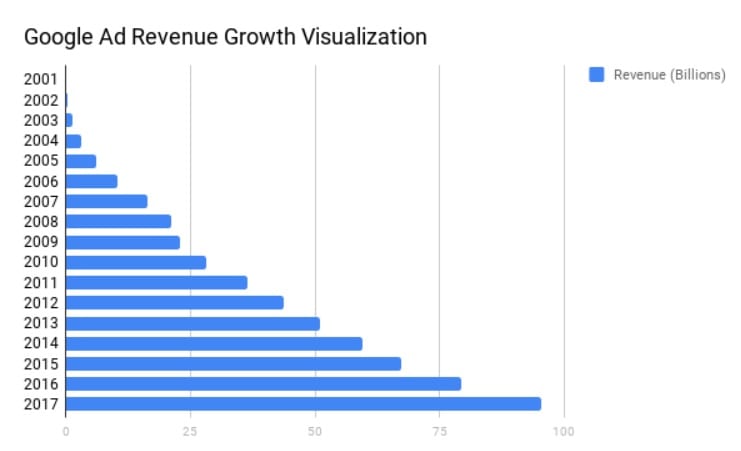
To better understand Google Hotel Ads, let’s take a walk down memory lane together. Here is a visualization of the increasing revenues that Google has experienced every single year.

Data Source: Statista

Those revenue and growth numbers are staggering for a company as mature as Google! We must understand that we are not dealing with a benevolent company that wants us to succeed. We are dealing with a company that charges a staggering $900+ for a simple intent-based click for its top keyword with zero guarantees on performance. In fact, $213.95 is the cheapest click you can find in the top 100 most expensive keywords! Remember those $0.05 clicks for money-terms? Those are now a distant memory…

What is Google’s motivation for rolling out Google Hotel Ads for vacation rentals? Clearly, we are not dealing with an altruistic brand that is looking after our best interests. Ultimately, Google’s goal is to increase the ad spend for one of their revenue machines – Google Travel.


Exclusive Inventory Advantage?

Unfortunately, 99% of property management companies that have exclusive contracts will not have exclusive marketing rights. The company may hold exclusive contracts to manage the properties, but the exclusive marketing rights have likely been forfeited when the property manager listed on Booking.com, HomeAway, and Airbnb. In essence, this will drive down both the ROI and effectiveness of Google Hotel Ads.

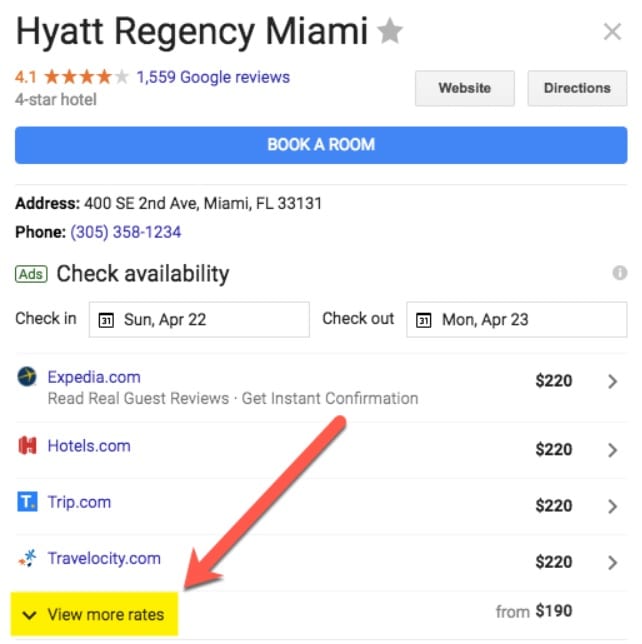
To see this in action, visit the hotel card for the Hyatt Regency in Miami and you may notice that the Official Site for the Hyatt Regency is nowhere to be found. The potential guest is only presented with OTA options!

How is this possible? The Hyatt Regency in Miami clearly has exclusive rights to the brand. However, once the exclusive marketing rights have been surrendered, consumers are then able to see all available options on the lodging card. The only way the consumer is even presented with the primary brand is by clicking the ‘View more rates’ option.


Even if your local brand overcomes the brand favoritism that Google typically defaults to, consumer confidence is inevitably higher with Booking or HomeAway as opposed to a local brand.  Complicating matters further, additional fees (including the traveler fee) are not passed into the card rates, which creates the illusion of price parity until deep in the booking process!


The New OTA?

In an effort to increase the search engine’s profits from Google Hotel transactions, Google introduced the Google Hotels Ad Commission Program (GHACP) in 2015. This relatively new program analyzes your commission bid, brand’s projected conversion rate, and reservation’s rental value with fees excluded. Now, this information is converted to a bid that can compete with other commission bids and cost-per-click (CPC) bids in the ad auction.

Since the cost-per-acquisition (CPA) should be similar with both bid types, the majority of entrepreneurs that I have spoken to prefer the predictability and guaranteed returns of the commission-based bidding.

Depending on the competition in your rental market, a bid between 10% and 15% (rent line-item only) will be the norm. In addition to Google’s commision, you can expect an additional 2%+ in technology costs that will be charged by the authorized Google Hotels Integration Partner. The aggregate commission is similar to the typical 15% Booking.com commission or the 12% Airbnb program that eliminates guest fees.

However, it is worth noting that unlike a traditional OTA, the Google Hotels transaction will take place on your website and you will own the guest record.


Next Iteration of OTA Middlemen

Even large technology brands are having problems with their GHACP feed. While Booking.com was able to produce pre-populated dates and only display available units, HomeAway had issues with nearly 50% of their Rome listings recently. In a second-price ad auction, every wasted click drives cost up and ROI down.

At the 2017 VRMA National conference, Steve Milo referred to channel managers as OTA middlemen and coined a new term. Why do property management companies need these OTA middlemen? First, the vast majority of property management firms do not or cannot employ web development talent. Secondly, there is a deficiency of features in nearly every property management software today.

To roll out Google Hotels beyond select big brands, I suspect Google will require using a third-party data solution for smooth integrations and accurate pricing. The channel managers (Integration Partners) will undoubtedly be willing to provide a Google Hotels technology solution, but will keep an additional 2-4% for the service.


Big Brand Preference

As we look at the test markets that are currently live, it is apparent that Google has a desire to work directly with traditional OTAs such as Booking.com and HomeAway instead of small, local property managers. In fact, I could not even find a local company listed in any of the test markets!

Skift estimated that Google Travel generated approximately 14 billion in revenue in 2017 and will continue to grow at 20% annually for the foreseeable future! Where is all of this revenue coming from? Primarily from big brands. Even though Google AdWords has well over one million businesses paying for ads, Expedia and Priceline alone are responsible for over 5% of Google’s total ad revenue. Now, the reason behind the big brand preference is crystal clear and we know it can’t be easily overcome.


Off-Platform Booking Fees Evolve

If you aren’t a fan of the optional HomeAway Off-Platform Booking fee, you will likely hate the GHACP cookie that track users and automatically charges a non-optional commission up to 30 days later.

Once a potential guest clicks on a link that belongs to GHACP, Google cookies the user. If the user were then to come back to your website via pay-per-click, social media, organic rankings, or any other method and converts, the commission belongs to Google.


Small Hilton Hotel Success = Failure for Vacation Rentals?

After Hilton worldwide implemented hotel ads at all 4,200 global properties in early 2011, they saw a 12% increase in ROI compared to traditional PPC ads. Since Google published this case study and regularly mentions it, we can assume this is one of the more successful customers in the program.

Although the Hilton statistic sounds great at surface-level, we must consider whether or not a modest 12% increase in PPC effectiveness makes this a great marketing channel. If your current ads performed an anemic 12% better, would this solve any critical issues for your brand? Would this allow you to be less reliant on the listing sites in a meaningful way?

Also, we must recognize that Hilton was an early adopter (began this campaign in 2011) and benefited from lower competition during this timeframe. The 12% increase in ROI is a lofty target with the increased competition. Finally, if we are wanting to achieve similar results, it is important to honestly assess whether Hilton’s agency/in-house team is similarly skilled at marketing and technology implementations when compared to the average vacation rental management firm.


Closing Thoughts

Although the excitement surrounding Google Hotels can be intoxicating and lead diversification is always great for business, resist the urge to respond emotionally to this new ad channel. Instead, commit to analyze this marketing decision (and all others!) on the basis of data and revisit profitability regularly.

Based on Google’s history and other ad products, we can be confident that the search giant will figure out a way to increase their profits and squeeze more money out of each advertiser. Google doesn’t believe in charity and doesn’t care about the vacation rental niche. On a brighter note, Google’s stock was $50 when AdWords was in its infancy and it closed at $1,035.49 last Friday.

Key Data Dashboard Raises $2.4M

0

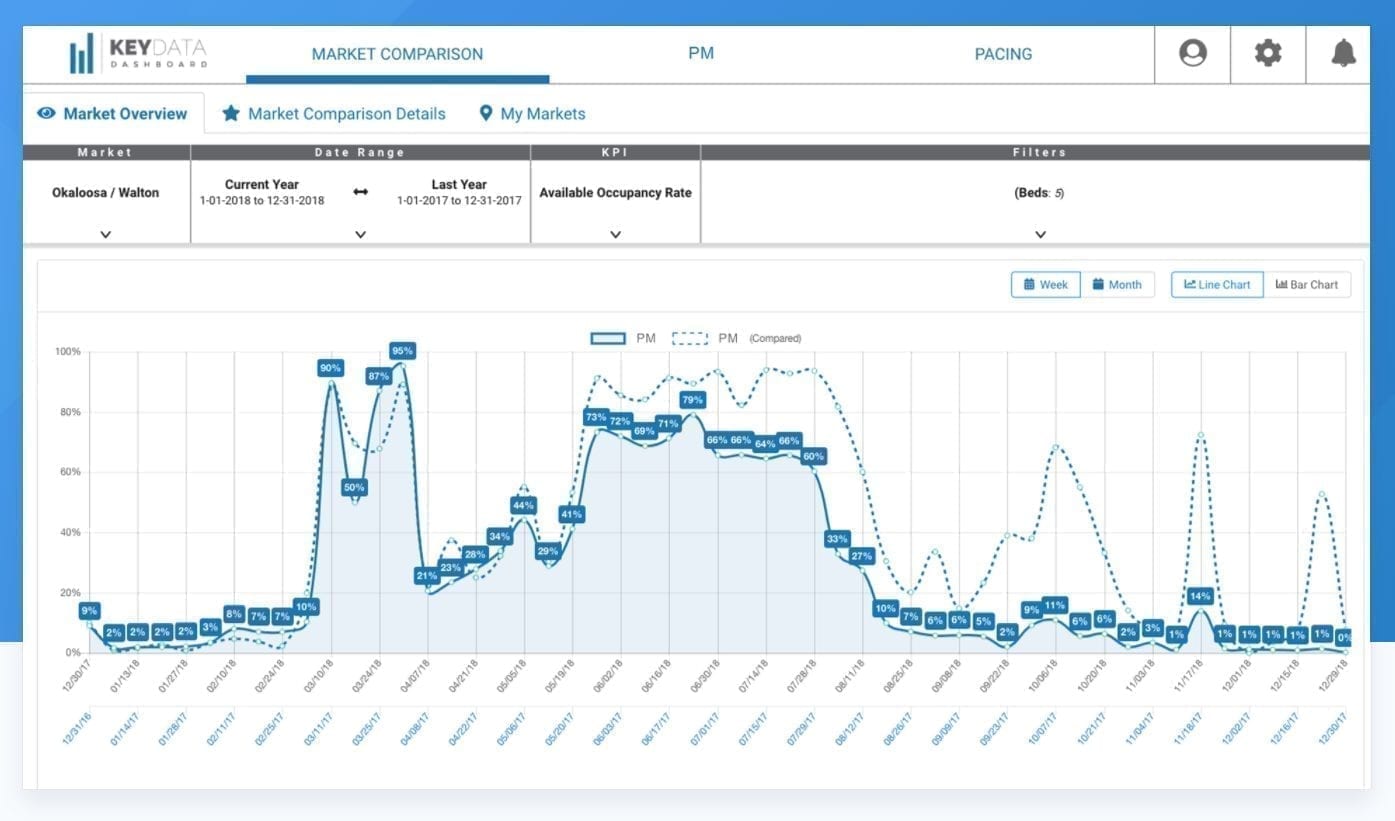
Key Data Dashboard, formerly known as VRM Dashboard, a leading developer of data visualization and comparison software for vacation rental managers, today announced a $2.4 million Series A round led by vacation rental companies and investors specializing in early stage ventures. Participating investors include many of the initial investors in Glad to Have You, including property management and vacation rental company 360 Blue.

The funding will be used to invest in significant market expansion and coincides with the release of the company’s new Dashboard interface and data visualization product for vacation rental managers.

“We are excited to partner with this group of investors to accelerate our vision of becoming the premier provider of data visualization and comparison software for the vacation rental industry,” said Jason Sprenkle, co-CEO of Key Data Dashboard. “Vacation rental managers are using our software to spend less time pulling reports and more time making informed revenue decisions.”

Concurrent with the Series A round, founder Amy Hinote is stepping down to focus on expanding VRM Intel.

Condo-World emerges as new booking marketplace for resort condominium lodging alternatives in major US destinations

0

Initially flying under the radar, Condo-World has rapidly expanded its reach and is now aggregating resort condominium vacation rentals in multiple destinations on its platform to make finding this lodging alternative easier for consumers. Its proprietary online booking site, call center, and chat service handle the search and booking processes for their partners, including resorts and rental companies.

“We’ve basically put the T-A back in OTA,” said Alex Husner, chief marketing officer at Condo-World. “For a commission lower than that of the major OTAs, this new Resort Collection program allows guests to easily call and ask questions without being burdened by the restriction of not being able to talk to a live person who is knowledgeable about the property. For our partners, it streamlines the reservation process and reduces the time spent on inquiry calls.”

Condo-World created this program in response to a growing demand from its customer base for rentals in other areas, and it realized an opportunity to create a booking platform based on its experience in property management.

“Our understanding of the industry has allowed us to develop a platform that helps our partners increase visibility and drive revenue, while not taking away from their own marketing efforts,” Husner said. “We provide immediate access to the guests’ information once the reservation is booked, and we prefer that our partners be the merchants of record.”

When the technology partnership launched three years ago, it started with nine partners. “We had a soft launch at the end of 2014 prior to having our website fully integrated, and we booked $300,000 in this time period,” Husner said. “The following year this amount grew to $3,000,000, and it has continued to grow 25 percent YOY.”

Today, the Resort Collection includes twenty-one partners in the Myrtle Beach area. “Many of the properties we work with have been able to significantly reduce their reliance on higher commission OTAs because of the bookings we generate for them at a lower cost,” Husner added.

“Condo-World has been the most mutually beneficial OTA partnership we have formed,” said Matt Raab, director of eCommerce and marketing for Sterling Resorts on the Gulf Coast of northwest Florida. “This is because being an OTA is not in its DNA; it is a rental management company that has found growth through an OTAesque partnership.”

Following the success in its own backyard and its new partnership with HomeAway Software, Condo-World is expanding the collection platform to Destin, Panama City Beach, South Walton Beaches, Orlando, Hilton Head, Pigeon Forge, Gatlinburg, and Gulf Shores, and has plans to expand into other parts of Florida, Hawaii, and West Coast ski destinations. In addition to HomeAway, Condo-World is also actively working on integrations with other software partners and channel managers and has plans to license its proprietary software in the marketplace.

“When we named the business ‘Condo-World’ thirty-three years ago, I knew we were setting ourselves up for future growth that would take us far beyond North Myrtle Beach,” said Condo-World founder and CEO, Roy Clyburn.

On its own, Condo-World manages four hundred condos, houses, and villas in North Myrtle Beach and taps the rest of the area through its Resort Collection partners, so expanding outside the area posed its challenges. “We had to make sure our expansion didn’t erode our core business in North Myrtle Beach,” Husner added. “There were difficult hurdles the first year, but we quickly adjusted to eliminate any leakage of business. We needed to be able to offer the same high level of customer service that our brand is known for.”

To be competitive in these new markets, Condo-World needs to reach the right partners and guests. It has developed a comprehensive marketing strategy that includes its more than 250,000-member email database, plus social media, PPC, content, and OTT advertising. “Condo-World has spent large amounts of time and effort to promote our region,” said Raab of Sterling Resorts. “The results have been the bookings of guests who have a very similar level of engagement and excitement as guests that book directly with us.”

Although its existing broad reach already includes a range of guests and budgets, Condo-World ultimately looks for partner resorts and property managers that “value business integrity and providing guests with an excellent experience,” Husner said.

Each new partner has brought challenges, with different booking rules and processes, so they have all played a role in the growth of the program.

“Together with its Resort Collection partners, Condo-World has created a unique way for our guests to visit these new destinations with a brand they know and trust,” Husner said. “By offering exceptional customer experience that begins during the booking process and continues with its partners at check-in, we value the importance of establishing collaborative relationships with the resorts and rental companies that entrust us to promote their properties.”

VRM Intel Magazine Spring 2018 is here!

0

Welcome to the spring issue of VRM Intel Magazine. The pace at which business conditions are changing in the vacation rental industry is staggering. As you may have read, I published an editorial, “My Jerry Maguire Moment,” so I won’t rehash those dramatic sentiments here, but the overall point remains true. The demand for vacation homes is healthy. The enormous advantages of staying in a home instead of a hotel resonate with consumers. Margin compression, consolidation, business model shifts, the wave of regulations, and plenty of investment-propped-up noise are making things seem chaotic; but ultimately, the industry is still about providing safe, welcoming, privately owned accommodations and services for travelers. 

As a result, much of this spring issue is dedicated to the core day-to-day operational and marketing challenges vacation rental managers face. From taxes to company culture to data protection to guest relations to taking responsibility for standards and inventory, the following pages contain valuable insights from industry leaders about building and sustaining a successful vacation rental management company.  

One interesting piece of news from the first quarter of 2018 was Wyndham’s announcement that it is selling its European vacation rental business for $1.3 billion, and industry experts will be combing through the details to determine how the valuation affects the industry. According to John Banczak in the article on page 66 about TurnKey’s recent $31 million funding round, “It is a positive sign for the industry overall . . . Five years ago, it was tough to explain the business to the investment community. Now folks understand just how appealing the business is. There is far more money running through the PM space than there is through the consumer websites themselves. The Wyndham deal is just another sign that folks are starting to wake up to this.” 

With increasing investor interest in the industry, new platforms and models are emerging that challenge the traditional ways of doing business. For example, the online travel agency (OTA) business models are evolving in front of our eyes. We’ve seen listing fees and pay-per-lead models shift to transactional fees, and now we’re seeing the introduction of charges for off-platform bookings. This type of charge is unparalleled in modern ecommerce marketplaces, and it will be fascinating to watch how the experiment evolves.  

On page 62, David Angotti provides a different perspective, outlining how OTAs are positively affecting the vacation rental sector. Also in this issue, Jeremiah Gall talks about how guests demand instant gratification, and Steve Milo lays out his vision for the new technology-enabled vacation rental manager. 

In addition, Sarah Bradford’s article on talking to owners about updating properties is a must-read. And if you haven’t listened to her podcast with Tim Cafferty, Sea to Ski with Sarah and T, check it out. They are unafraid to talk about the current issues facing vacation rental managers, and they provide empowering ways to leverage changes to grow your business.  

Also, mark your calendars for the inaugural Vacation Rental Women’s Summit on February 19–20, 2019, at The Ritz-Carlton in New Orleans. This is going to be a special industry event designed to celebrate the many women who have built the industry and to discuss topics of particular concern to this group.  

Thank you again for your continued support of this magazine. I hope you enjoy this issue, and as always, I look forward to your feedback and to seeing you this spring at one of the upcoming industry conferences.  

Northwest Vacation Rental Professionals Selects Fetch My Guest to Power NorthwestStays.com in Landmark #BookDirect Initiative

4

Fetch My Guest and the Northwest Vacation Rental Professionals partnership addresses the concerns of many in the vacation rental industry. Vacation rental travelers are underserved by not having access to premium listings, the ability to communicate directly with the professional hosts and charged “fees” that increase vacation costs by hundreds to thousands of  dollars. The Northwest Vacation Rental Professionals represents members in Washington State, Oregon, Nevada, Idaho, Montana, Alaska, British Columbia, California and Hawaii.

The Northwest Vacation Rental Professionals leadership team has long recognized the need to create a marketplace that would serve their rapidly growing membership outside of major listing sites who hide information from the traveler.   For years, travelers have built relationships with these well recognized vacation rental member brands who distinguish themselves on delivering service excellence to the vacation rental travel community.  

NorthwestStays.com will seamlessly and efficiently direct travelers to premium vacation rental brands in complete transparency.  No hidden fees, direct communications and a guarantee that they will always receive the best price when they #BookDirect.  NorthwestStays.com will be introduced to the membership at their annual conference at the Semiahmoo Resort in Blaine, Washington on April 23rd.

“Building a community of professional managers, advocating for our industry and promoting our member brands is the three-fold mission of the NWVRP and the new NorthwestStays marketplace, powered by Fetch My Guest, helps to meet our goal of promoting our individual vacation rental brands. It’s about trust, and professionals working together to exceed the expectations of our guests!

Creating and operating an exclusive vacation rental marketplace for our membership will give all of us the opportunity to promote our vacation rental brands and showcase our premium properties, which, in turn, will allow vacation rental travelers to #BookDirect and to be free from the excessive booking fees and controls coming from companies such as HomeAway, VRBO and Airbnb.With this effort, the independent vacation rental professional and the traveler can once again reconnect.

The NorthwestStays marketplace offers us the opportunity to regain lost ground, recapture the data that we own and become the leader in professionally managed premium homes in the Pacific Northwest,” said Daniel Eby, President of the Northwest Vacation Rental Professionals.

“Fetch My Guest is pleased to be partnering with the Northwest Vacation Rental Professionals at this exciting time in their history.  The leadership team is comprised of dedicated volunteers in creating the blueprint for how our industry groups can come together for a common cause.  The past few years, vacation rental professionals have had to withstand constant policy changes from large listing sites that have no vested interest in their success, and only a monetary interest in the travelers we proudly serve and respect.  

For years, many have talked about creating a community of vacation rental brands that would bring back transparency between the vacation rental traveler and the professional vacation rental hosts.  We are excited to take this landmark step with the NWVRP in creating the first of it’s kind marketplace that is focused on serving the members interest first. As vacation rental professionals, we share that passion and look forward to working with many more communities that face the same challenges and want to distinguish themselves from the big box listing sites” said Vince Perez, CEO of Fetch My Guest.

Converging Verticals: From Serviced Apartments to Short-term Rentals

1

For travelers, investors, and online marketplaces, the lines are blurring that divide extended stay hotels, apartment hotels (apartotels), condo hotels (condotels), corporate housing, serviced apartments, vacation rentals, and short-term rentals.

At today’s Serviced Apartment Summit in New York, executives from the serviced apartment and extended stay industries discussed their expanding and overlapping verticals with attendees from the vacation rental and corporate housing sectors.

Currently, the verticals are largely differentiated by location (metro vs. beach/mountain/lake) and reason for travel (business vs leisure).

According to Piers Brown, CEO of International Hospitality Media and founder of Serviced Apartment News, “Both [serviced apartments and vacation rentals] have leisure guests. Serviced apartments attract those looking for an urban experience and have a corporate guest to target (versus hotels), which is less prevalent in vacation rentals or holiday lets.”

While additional contrasts exist between the models (including zoning, on-site staff, hotel-like amenities, private outdoor spaces, and in-unit laundry), investors and accommodations platforms that serve non-hotel lodging options are quickly recognizing that the similarities in the booking path outweigh the differences for leisure, business, and medical travelers looking for lodging alternatives that offer more space than a hotel.

OBASA CEO, Gordon Doell, recognized convergence early in the company’s growth cycle, saying, “We started off in single-family residences and got involved in corporate housing as a mistake.”

Doell continued, “Our goal is to create healthy living environments where travelers can wake up and start their day as they would at home. We can help in that way and help them save some money.”

Two factors that are speeding up the convergence of these industries are the consolidation of online marketplace platforms and the new funding flowing into the sectors with the goal of “owning” the inventory. According to Larry Korman, president of AKA Hotel Residences, AKA is currently working with Airbnb on the new Airbnb Plus initiative designed to provide more standardized alternative lodging options to its guests and is investing heavily in the product.

In addition, the vacation rental and serviced apartment industries are both rapidly coming to the conclusion that inventory control is becoming more of a necessity in catering to guest expectations and providing a consistent experience. “People who own the inventory have the power,” said Jon Wohlfert, co-CEO, RESIDE Worldwide. “If you control the experience, then you can differentiate the product.”

As the industries continue to explore the opportunities and synergies that exist within the expanding vertical, the non-hotel accommodations sector appears to be consolidating and professionalizing rapidly.

Sea to Sky Rentals expands into Bellingham with One Suite Stay partnership

0

Sea to Sky Rentals announced an expansion of its luxury vacation rental inventory into North Puget Sound and Bellingham, Washington. adding 14 high-end vacation homes located in and around this idyllic waterfront college town and recreation hub. The expansion is the result of a partnership with Bellingham local operator Barbara Browne, founder and owner of One Suite Stay, who will be joining the Sea to Sky team as Bellingham’s owner sales and area manager.

“We are so pleased to be expanding into Bellingham,” says Sea to Sky owner and founder, Michelle Acquavella. “When researching where to expand, Bellingham was the clear choice with its natural beauty, hip culture, warm community, and access to water and the mountains. Having Barbara Browne already on the ground in Bellingham with her vast knowledge, established relationships with owners and loyal guests, and passion for Bellingham, was a huge bonus and made the decision and transition that much more attractive, and seamless, for everyone.”

Acquavella is co-founder and board member of the Northwest Vacation Rental Professionals, as well as the national Vacation Rental Managers Association, where she actively works to increase professionalism in the industry while promoting a partnership mindset within communities.

Acquavella added, “We look forward to bringing the Pacific Northwest’s finest Vacation Rentals to Bellingham and being positive, contributing members of the community.”

Strategic director, Heidi Stuber, sees significant opportunity with the expansion and said, “As Washinton’s leading homegrown vacation rental company, Sea to Sky is always looking for opportunities to expand our guests’ options for exploring our beautiful state. Bellingham is a vibrant community a stone’s throw from picturesque settings like Lake Whatcom, Chuckanut Drive and Mount Baker. Consistently named as one of the best places to live in the Pacific Northwest, Bellingham is the ideal location for our business to grow and for our guests to get away.”

Barbara Browne is equally excited about the partnership, adding, “I have long admired Sea to Sky Rentals and founder and owner, Michelle Acquavella. Sea to Sky Rentals shares the same values as One Suite Stay,  a strong commitment to the growth, a good reputation of the vacation rental industry in Washington state, and a high level of customer service to both our property owners and our guests. This exceeds my hopes for being able to offer my Owners and Guests, an even higher level of service and excellence.”

Sea to Sky Rentals was founded in Seattle, WA in 2003 as an innovative small business and has maintained a national presence as a leading vacation rental company. From humble beginnings with a single mother-in-law apartment in Phinney Ridge, Sea to Sky has grown to include a diverse inventory of over 100 vacation homes across the Greater Puget Sound and North Cascades.

Matt Landau’s Sense of Place Begins Season Two

0

Vacation rental professionals, rejoice!

Sense of Place, the quirky and avant-garde travel show that follows VRMB’s Matt Landau as he meets worldly destinations through the eyes of vacation rentals, has announced it will begin shooting a second season of the show this coming June.

The new travel show is a breath air for the vacation rental industry as it vividly demonstrates to consumers about the uniqueness of staying in privately-owned homes and reminds property managers about the importance of delivering special experiences to their guests. With a production team that should earn awards for their work on this series, Landau does a beautiful job of interacting with both the destination and the managers and giving us a glimpse into the passion behind the entrepreneurs who have chosen hospitality as a lifestyle.

See Season 1 Episodes of Sense of Place

This comes as exciting news to industry professionals who felt the first season of the show captured an essence of vacation rental hospitality that is subtle and difficult to put into words.

“Before this project began, we knew about the vacation rental movement but we had no idea about its many layers of personality and momentum and charm,” said Stuart Hooper, Principal of Asombro Media, the show’s production company. “In Season 2, we want to take a deeper dive into this X factor of hospitality and look at the world of opportunities that open…the experiences that can be unlocked, simply by choosing a vacation rental instead of a traditional hotel.”

Each of the featured hosts in Season 2 will continue to be esteemed members of VRMB’s Inner Circle (an online owner and manager community). And the season will include vacation rentals in Asia, South America, Europe, and North America as the show looks to double-down on its unique recipe of “education through entertainment.”

“Season 2 comes at the right time too,” Hooper said. “Having just launched our supplemental content campaign for Season 1 and seeing the extraordinary amount of enthusiasm that vacation rental owners and managers have to grow their businesses, I’m convinced that world is definitely ready to hear more of this story.”

Sense of Place provides a stunning, visually-captivating “sense” of how short-term rental managers work tirelessly to make vacation truly special for their guests.

Check out Landau’s “Behind the Scenes” video from Sense of Place with Nancy McAleer, founder of Anna Maria Island Home Rental which pulls back the curtain on the business-side of our industry.

HomeAway’s New Listing Agreement Leads to More Frustration Among Vacation Rental Managers

9

Expedia-owned HomeAway recently released an updated Listing Agreement for Property Managers which includes language for integrated property managers (PMs) that is causing anxiety in the vacation rental management community.

Last month, HomeAway announced that it will be further monetizing its platform by assessing fees for off-platform bookings. According to HomeAway chief commercial officer, Jeff Hurst in a previous interview with VRM Intel, the commission would be equal to 10 percent of the pre-tax booking total. The new agreement, however, gives HomeAway more flexibility stating, “. . . such rates may change upon reasonable notice to PM.”

But that is not the change that is upsetting PMs.

While HomeAway maintains that the PM’s decision to attribute bookings that originate on HomeAway’s sites is completely voluntary, the new listing agreement sent to PMs last week sheds light on the processes HomeAway intends to utilize in holding PMs accountable for paying for off-platform bookings. Included in the agreement are expanded off-platform booking definitions, a new set of reporting requirements, and a mandatory submission to internal business audits conducted by HomeAway.

Read the entire updated Listing Agreement for Property Managers

“How disappointing it is to read this, and (it) goes directly to a lack of integrity at the highest levels of decision making at HomeAway,” said Tim Cafferty, president at Sandbridge Blue Realty Services in Virginia and Outer Banks Blue Realty Services in North Carolina. “In spite of assurances verbally of their honorable intentions they continue to act in a disingenuous manner. It reminds me of the saying by Ralph Waldo Emerson, ‘Your actions speak so loudly, I can not hear what you are saying.’”


Notable Additions to the updated Listing Agreement

HomeAway’s Listing Agreement for Property Managers includes fresh language related to off-platform bookings and the tools HomeAway can use to police voluntary attribution of off-platform bookings.

First, here’s a glossary for PMs:

  • Integrated Property Manager: Any PM who is integrated through software providers.
  • HomeAway Lead: According to HomeAway, “A booking will be regarded as having originated from the HomeAway Network where PM receives through the HomeAway Network an inquiry, booking request, or other contact from or on behalf of a traveler about a Listing (each, a “HomeAway Lead”).”
  • Off-Platform Booking: “A booking will be regarded as having originated from the HomeAway Network where PM receives through the HomeAway Network an inquiry, booking request, or other contact from or on behalf of a traveler about a Listing (each, a “HomeAway Lead”), and then, as a result of and within 30 days of the HomeAway Lead, PM completes a booking for that Listing directly with the traveler or traveler’s representative, e.g., by telephone or e-mail (each, an ‘Off-Platform Booking’).”

1. Expanded Off-Platform Booking Definition

The new agreement expands the definition of off-platform bookings. The agreement states, “should PM receive a HomeAway Lead about a Listing that is or becomes unavailable for the traveler’s requested dates, and then within 30 days of that HomeAway Lead executes a booking with the traveler for another PM property that comprises the same or similar dates and destination—regardless of whether PM advertises the substitute property on the HomeAway Network—the Company will be entitled to a commission or Off-Platform Booking fee on the total amount charged for the booking of the substitute property.”

2. Reporting Requirement

Additionally, the updated agreement includes new reporting requirements. The agreement states, “It is the sole responsibility of PM to ensure proper reporting of all Off-Platform Bookings to HomeAway, and to transmit such reporting through the Integration, via the Booking Update Service (“BUS”). However, such reporting is subject to review and audit, and if the Company (HomeAway) finds that a certain booking of a Listing originated on the HomeAway Network but was not properly reported as attributable to a HomeAway Lead under the above analysis, then the Company will notify PM of such discrepancy, and will be entitled to assess a commission or Off-Platform Booking fee on the amount charged for such stay unless PM provides reasonable evidence to the contrary.

3. Consent to HomeAway Audits

According to reports from PMs, HomeAway’s auditing requirement is particularly disturbing. The agreement says, “HomeAway may conduct an audit from time to time as it reasonably deems necessary to assess PM’s performance and fulfillment of its obligations under this Agreement. PM will cooperate with the Company (HomeAway) with respect to any such audit, and will provide the Company with access to books and records of accounts, PM Software and related system information, and other information associated with the Listings and the Performance & Activity Reports, as HomeAway may reasonably request for the purpose of verifying proper reporting and payment of commissions and fees.”

A HomeAway spokesperson verified that this new listing agreement is current and clarified, “These terms and conditions are not specific to subscriptions and/or off-platform bookings. They are general for all types of listings, all scenarios. The terms are therefore inclusive of integrated property managers who list via subscription and have off-platform bookings but not exclusive to them.”

He added, “HomeAway has always had the right to audit. It is not new with this agreement.”


The Impact to the Vacation Rental Industry

“The new listing agreement released this week reveals a continuing presumption by HomeAway leaders that they ‘own’ travelers, and therefore they do not have the responsibility to compete for the loyalty of those consumers perpetually,” said Randy Hall, founder and CEO of Liquid Life Vacation Rentals in Orange Beach, Alabama. “The word entitled is used repeatedly in the agreement describing HomeAway’s perspective about charging a match-back fee to property managers. The new agreement also included significant language describing HomeAway’s ‘rights’ to ‘audit’ and ‘authorization to charge’ the property manager’s credit card on file.”

Hall added, “Travelers will eventually agree with property managers that they have a choice, and they don’t really want to be ‘owned’ by an ‘entitled’ HomeAway.”

PMs who fall under the HomeAway-defined category of “integrated property managers” argue that the new policies demonstrate inequitable treatment by the company, asserting they they are being treated unfairly in comparison to other rental home suppliers using the HomeAway network.

However, Expedia executives know that, in the United States, a significant number of integrated property managers, including the new set of fast-growing multi-destination management companies, are undeniably reliant on the bookings that come from HomeAway.

In contrast, legacy property managers who built their businesses before the emergence of HomeAway are far less reliant on HomeAway for bookings. Industry observers are watching these legacy PMs closely to see if HomeAway’s new requirements will result in a material loss of inventory for the company. If legacy PMs agree to the new terms giving HomeAway this increased control over their businesses, it will indicate a considerable shift in the vacation rental marketplace, potentially giving OTAs a blank check as they move forward with their vacation rental road maps.

NAVIS adds former WayBlazer CEO and Sabre president to its Board

0

NAVIS announced travel industry veteran Felix Laboy has joined its board. Laboy joins an elite advisory team which includes Tom Gonser, founder of DocuSign, and Sanjay Dholakia, former Chief Marketing Officer of Marketo.

Felix Laboy has three decades of experience across a wide-ranging portfolio of leadership positions in the hotel, travel and technology industry. Most recently, he was CEO of WayBlazer, the world’s first artificial intelligence company for travel. Laboy also served as the first president and general manager of Sabre Hospitality Solutions, a leading Software as a Service technology company.

“Felix is a pioneer in the industry, and we are excited to welcome him to the NAVIS advisory board,” said NAVIS CEO Kyle Buehner. “Technology creates so many opportunities for hoteliers and vacation rental professionals to drive revenue while improving guest service. We’re excited to learn from Felix and benefit from his expertise, experience and global perspective as we continue to help our clients grow their businesses.”

Before leading Sabre Hospitality Solutions, Laboy was CEO and co-founder of E-site Marketing, one of the first hospitality Internet marketing companies in the world. He has advised many travel technology start-ups, consulted for private equity firms and taught at the School of Hotel Administration at Cornell University. Laboy also held numerous executive positions at leading hotel companies including The Ritz-Carlton Hotel Company, Westin Hotels and Resorts, ANA Hotels and Four Seasons Hotels. In addition, he served as executive vice president of the Puerto Rico Convention Bureau.

“I have always admired NAVIS for its innovative products and services, and I am honored to join their board,” said Laboy. “I have tremendous respect for Kyle, his leadership team, and the other board members, and I look forward to working with them.”

Laboy also serves as an advisor to ALICE and is a member of the Cornell University Council, having graduated from the prestigious School of Hotel Administration at Cornell.

Vacation Rental Booking Path 101: 2 Exercises for Training

0

Want to examine the booking path for vacation rentals? Try these exercises:

1. Your spouse/partner’s aunt is turning 80, and the whole family wants to take a special 6 night beach vacation for the occasion for the first week of August.

  • You, your spouse/partner, your three kids (Ages 1, 4, 7)
  • Your partner’s sister, her husband and their 4 grown and teen children (16, 18, 22, 24)
  • The grandparents (82, 84)
  • The aunt 

Since you work in vacation rentals, the family has turned to you to book this once-in-a-lifetime dream vacation for your spouse’s family. 

Your family lives in Atlanta. The sister’s family is in Washington DC, and the rest of the family is in Charlotte. Everyone wants to drive instead of fly. But they are open to any beach that has a beachfront house that they can afford. You think you can spend around $6,000.

Go. 

Document the following:

  • Which sites you visited, in order
  • How many properties you viewed
  • What questions you had on each property
  • How long it took to get answers to your questions
  • Why you eliminated certain properties
  • Why you chose a property

Then answer the questions:

  • How much time did it take you?
  • How many sites did you visit?
  • How many properties did you view?
  • How confident are you that the property will be as advertised and that everything will go smoothly on your special-occasion vacation? Why?
  • Do you feel like finding a vacation rental is an easy or difficult process? Why?
  • Was there a point that you almost gave up and looked for a hotel instead?
  • What did you learn about booking a vacation rental in this process?

2. Now imagine the family wants to go to Hawaii (they’ve never been to Hawaii, so they aren’t sure where in Hawaii). Same process.

Document the following:

  • Which sites you visited, in order
  • How many properties you viewed
  • What questions you had on each property
  • How long it took to get answers to your questions
  • Why you eliminated certain properties
  • Why you chose a property

Then answer the questions:

  • How much time did it take you?
  • How many sites did you visit?
  • How many properties did you view?
  • How confident are you that the property will be as advertised and that everything will go smoothly on your special-occasion vacation? Why?
  • Do you feel like finding a vacation rental is an easy or difficult process? Why?
  • Was there a point that you almost gave up and looked for a hotel instead?
  • What did you learn about booking a vacation rental in this process?


Send answers to info@vrmintel.com.

Editorial: My Jerry McGuire Moment

11

It’s been quite a roller coaster ride since launching VRM Intel Magazine in the fall of 2015.

I love the vacation rental industry. I love the uniqueness of vacations in privately owned homes, villas, condos, cabins, chalets, cottages, and gîtes and the lifelong memories that result. Families become closer during a vacation home stay. Friendships are deepened, and solo travelers can push the reset button, as I can attest to while writing this from an English cottage in Suffolk.

Since launching the magazine, so much has changed in the vacation rental industry—the technology landscape, consolidation, margin compression, the propping up of unproven business models by outside investment, and the increasing dominance of OTAs. For many managers and homeowners, Expedia’s purchase of HomeAway sucked. I know because they write to me about it all the time. Under Expedia, HomeAway seems to change algorithms, business models, and policies with the weather. Even Comcast CSRs are saying, “At least we don’t work at HomeAway.” (It’s a joke, Expedia; don’t sue me.) Expedia CEO Mark Okerstrom excused the displeasure by saying, “The property manager and owner community are adjusting to the changes.” Perhaps the property manager and owner community would adjust . . . if the business model and rules of the game would stop changing. Hopefully, the company is getting close to solidifying its pricing model and terms, and PMs can begin to see some stabilization.

Meanwhile, industry experts are maintaining that the “top of the funnel”—which for us commoners means the widest market point where customers find vacation rentals—is closed, arguing that Airbnb, Expedia/HomeAway, Booking, and TripAdvisor (in that order, at least today) have shut innovation down with monumental barriers to entry for newcomers. And those industry experts advise property managers to stop fighting it. In fact, in the upcoming spring issue of VRM Intel Magazine, we include two articles by authors who make strong pro-OTA arguments.

In addition, greed is affecting the industry. Investors smell huge returns. The tiny margins received for vacation rental bookings are being redistributed in chaotic, irrational fashion. And true innovators and entrepreneurs who work every day to make the industry better and level the playing field are being pushed out by more avaricious investors and executives (Spoken like a bleeding-heart liberal . . . I get it).

My frustration is that these influences do not define the vacation rental industry. While I fear I am being irrationally self-indulgent with this Jerry Maguire moment, there are some observations from the past two and a half years I feel compelled to share.


Note to OTAs

Vacation rentals are more of a considered purchase than hotel rooms are. That means vacationers have more questions and take more time deciding on the right rental than they do when booking a hotel room. Trying to force vacation rental buying processes into the narrowly defined path of booking a hotel leaves ample room for disruption. If the goal of OTAs is to simplify the booking process, they might consider finding ways to answer as many shopper questions as possible. For example, forcing vacationers to firmly decide their exact location and exact dates to complete a search does not address the needs of a large segment of travelers looking to stay in a vacation home. Admittedly, the current OTA path is more effective in urban areas; but for travelers who would choose to stay in either Vail, Breckenridge, or Keystone for the right value or who would consider North Myrtle Beach, Hilton Head, or Tybee Island for their summer vacation, this booking path is anything but simple. (Try these exercises.) Even easy property FAQs would be a great addition.

And then there’s the leakage issue. Expedia, you came up with and promoted the “billboard effect” and used Cornell to defend your theory. You said that the value of listing on an OTA comes not only from the bookings that happen on your platform but suppliers stand to gain much more with off-platform bookings. Less than a year ago, you defended the billboard effect theory with a follow-up study saying, “the billboard effect still occurs, since many consumers visit an OTA prior to booking direct.” But for your vacation rental suppliers, you want to eliminate the billboard advantage that you promote to hoteliers as a core value proposition? And now you want to track down those off-platform bookings by requiring property management companies to provide reporting and submit to internal audits of their books? (See HomeAway’s new terms and conditions for property managers.) Instead of trying to monetize every visitor who clicked on one of your Google AdWords and subsequently booked off-platform, is it possible you should first improve your platform to earn the booking?

And speaking of Google, it is actively building a booking platform for vacation rentals. But before property managers jump on the Google bandwagon with both pocketbooks, our industry should be careful that it’s not escaping the frying pan only to leap into the fire. As Expedia and Booking know, Google can be more addictive and tougher to quit than opioids.

In the United States, downtowns were ruined by big box stores, which were ruined by Amazon and ecommerce. Today’s OTAs are reliant on models that are not ideal for booking a vacation rental—for the guest or the owner/manager. I respectfully disagree with many of my friends and colleagues who claim the “top of the funnel” is closed. If the current platforms do not adequately meet the needs of consumers and suppliers, opportunity exists for disruption. It may not happen overnight, but I believe it will happen.


Nonsensical Regulations

One of the reasons the industry has become so wacky is Airbnb. Yep, I know, you can’t say that, but it’s true. Airbnb provided a marketplace for homeowners and long-term tenants to rent homes, rooms, and mattresses in places where it was illegal to do so. In contrast to the centuries-old practice of renting vacation homes, those residential rentals sprung up unlawfully.

I believe Airbnb made things worse for the vacation rental industry in the following two ways:

  • Airbnb did not attempt to ensure rentals were legal before allowing them to be listed. Instead, Airbnb allowed (some might say encouraged) illegal rentals on its marketplace, upset entire neighborhoods/cities, and then lobbied municipalities after the fact. I understand the concept of asking for forgiveness instead of permission, but Airbnb took that strategy to a whole new level.
  • Airbnb has actively and successfully lobbied for the rental rights of primary home residents (owners and tenants) at the expense of second/vacation home owners, causing a wave of regulations that ban rentals in which the primary resident is not present.

The results of Airbnb’s actions have been felt in almost all traditional vacation destinations in the United States. City officials in residential markets have enacted precedents for legislation that are bleeding over into core vacation rental destinations. With spreading regulations and short-term rental bans, residents in mountain, beach-front, lake, theme-park, and golf communities have become emboldened to raise hell with small, resort-town city council members about the (undocumented, of course) late-night debauchery that is taking place in the evil dens inhabited by vacationers. Even vacation rental meccas like Orange Beach, Destin, and Tahoe are facing unnecessary regulation. And second-home owners don’t get a vote.

But even in urban areas, the excuses behind regulating rentals don’t make much sense. One of the dumbest arguments against short-term rentals is that such rentals reduce affordable housing availability. Really? Those short-term rentals exist because housing is already unaffordable. This is not a chicken-or-egg scenario: the unaffordability came first. In fact, the whole Airbnb phenomenon is the direct result of short-sighted municipal leaders failing to address the lack of affordable housing.

(Let’s be honest: the real reason for the proliferation of regulations and bans is that residents don’t like having people they don’t know next door. They say they want to “know their neighbors,” yet they barely wave to each other when their cars pass on the way to Bunko.)


The Vacation Rental Industry Was Not Built by Stupid People

The terms “fragmented” and “mom-and-pop” are not synonymous with dumb.

Many of these mom-and-pop operators left cushy jobs in major cities to move to places they love, and they used their wide range of skills to build highly successful businesses. And the homeowners? They own multi-million dollar investment homes. This is not a stupid bunch.

In contrast, those descriptors are more indicative of a fierce, independent nature. And that proclivity to independence is what makes our industry unique. That’s also why vacation rental managers are less likely than hoteliers to continue to do business with companies they don’t trust.

For the tech entrepreneurs from the hotel industry who believe your highly advanced hotel experiences will transform the vacation rental industry and the fragmented mom-and-pop operators will bow in appreciation for your enlightenment, call me. I can provide a long, colorful list of industry disruptors from the hotel world who believed the same thing only to end up disrupting their own careers, families, and investor friends.

And to potential investors, don’t simply focus on the successes in the industry; study the failures. Don’t simply accept the broadly brushed research; look at segments. For example, while urban rentals are on the rise, traditional rentals have flat-lined in many US destinations. Because of cumbersome regulations, inventory and availability are declining in some cases. Consolidation means there are fewer companies to sell to, and many of those large companies are building their own technology. Advancements in APIs are making it easier to connect directly with industry providers, and middle men are starting to feel the heat and are adjusting their business models. Commissions paid to property managers (PMs) are decreasing, the amount of fees PMs can charge are declining (or are not supported by OTAs), and OTA-built revenue management tools are pushing pricing downward. That means less money can be spent on tech products. Industry economics are changing quickly, so dive deeply into analyzing a company’s future prospects before jumping in.


Common Sense Standards

For both PMs and homeowners, customer expectations are shifting and ushering in a logical, increasing demand for standards in cleanliness and property appearance. Sheets that were purchased pre-2010 should be thrown away. (Think about how many couples have enjoyed those sheets.) Nonstick pans that have no more nonstick left should be thrown away too. The same goes for moldy shower curtain linings, sand-caked bathroom rugs, pans with food stuck on them, dull knives, foggy drinking glasses, garage-sale china, and twentieth-century mattresses. And if you have a question about whether something is too old, invite your mother, wife or—better yet—a gay guy friend to the property for a critique and ask these questions: Would you sleep on this, cook with this, sit on this, or dry yourself with this? And if you want to go super crazy and elevate your standards even more, mandate that floors and carpets be professionally cleaned annually, or join our European friends and convert those worn out bedspreads to professionally laundered duvets.


Discrimination

For too many vacation home owners, “vetting guests” is code for keeping people of color out. If age is a problem, don’t rent to people under twenty-five, but using vetting as an excuse to discriminate based on race must stop. And if homeowners don’t stop that practice, the entire industry is going to face the consequences with new sets of regulations aimed at preventing discrimination.


A New Hope (Pardon the Star Wars reference . . . I have one for every occasion)

A new generation of travelers is emerging—one that should bring us all hope—in the millions of post-millennials/Generation Z’ers who marched yesterday to end gun violence. They appear to have unmatched and refreshing bullshit detectors.

I believe this generation is not going to pay an extra 10 to 15 percent simply because they like Expedia or Airbnb. They are certainly resourceful enough and internet savvy enough to bypass bullshit fees.

And the members of this new generation don’t appear to be lazy. They are willing to put in the time to find authenticity and transparency.

Like it or not, Gordon Gekko’s “greed is good” world is shrinking (and even Brian Chesky knows it…see his “infinity memo”), and that’s giving PMs a new chance to relate to consumers with messaging, policies, and practices that promote the unique world of vacation rentals. Vacation rentals offer this generation the authenticity and connection they want, so the industry has a very real opportunity to capture a huge market share of leisure travels. But remember—they don’t like bullshit.


The Future of the Vacation Rental Industry

It’s bright, in spite of all the noise.

The demand for vacation homes is healthy. The enormous advantages of staying in a home instead of a hotel for vacations resonate with consumers. Margin compression, consolidation, business model shifts, the wave of regulations, and plenty of investment-propped-up noise are making things seem chaotic, but ultimately, the industry is still about providing safe, welcoming, privately owned accommodations and services for travelers.

Here are some observations and lessons from successful vacation rental management companies around the industry that could help:

Good neighbor policies

Don’t be an ass in the destination. Keep an eye out for nuisance guests. Educate guests about noise ordinances, trash, parking, and how not to be obnoxious on their vacation. Let the city and neighbors know about 24/7 response lines. Work to elect city and state officials who understand the value and revenue that vacation rentals bring to the area. For multi-destination companies, empower in-market managers to engage in the community.

OTA management and diversification

Analyze OTA performance in relation to the cost of listing on these channels. Include time, anxiety, resources, commissions, subscriptions, and anything else that is a cost to your company. And please do not rely on one channel for over 35 percent of bookings. Industry conditions are changing so rapidly that such a reliance puts the company and its homeowners at risk. Diversification provides freedom and the perk of not being held hostage by poor business practices.

Cooperation with like-minded business models

Invest in like-minded business models, partners, and vendors. In the world of OTAs and listing sites, supply is everything. If PMs find a website or marketplace that does business in a way that fits their needs and ideals, they should work with it. Same goes for tech companies. Working with companies that value the PM’s business, team, and guests makes life easier.

Destination-oriented marketing and expertise

Leverage destination expertise and local marketing channels to the fullest. PMs can compete fiercely with OTAs locally. It may not be realistic to be the best in the world, but you can be known as the most trusted, knowledgeable, professional vacation rental provider in your market.

Proactive inventory acquisition

New companies are gaining inventory not because they are great but because they have implemented goal-oriented, performance-based sales plans. An intentional inventory acquisition strategy is necessary for growth and is not too difficult to implement. Becoming the vacation rental thought leader in the market, participating in city meetings with facts and figures, or writing about market performance will yield significant benefits in acquisition efforts. Brag about successes such as conversion rates, retention rates, occupancy rates, revenue performance, and property value increases.

Fun Fact: In most cases, when a PM company is acquired, 10–20 percent of owners leave for other management companies.

Property care and standards

The industry is quickly improving in this area, and property managers who aren’t on top of this trend will likely fall behind quickly. PMs will begin to notice it by closely monitoring reviews in the market and by watching retention performance, and they will make healthy use of owners’ closets to hide the home’s dirty secrets.

Nurturing leads and past guests

Prospective and past guests may have found a rental on another website, but the savvy PM will make sure they don’t go back to that site.

Consumer education

Both managers and homeowners will gain by educating the consumer market about the advantages of booking direct. The hotel industry is spending millions in that effort for a reason.


To Wrap up My Rant

The market will eventually work itself out. Consumers will ultimately decide if they want to pay hundreds more just to book on an OTA. The optimal booking path will emerge. Funding for unprofitable business models will dry up. Margins will eventually be distributed logically.

What will always remain is professionally caring for homes and matching travelers with the best accommodations and service for their much-needed vacations.

The service you provide, my vacation rental friends, matters. The experiences and memories for the families, groups, and nomads who stay in your rentals last forever. Travel defines us and changes the way we perceive the world around us, and you are significant part of that.

So VRM Intel is back online and, after experiencing a little bullying myself, I’m less afraid of reporting the truth. Rant over. Fact-based reporting to recommence.

Vacation rental technology startup competition set for March 9 in London at Millennium Hotel Mayfair

0

The vacation rental industry is innovating quickly to accommodate the growing demand for private homes as accommodations alternatives and to apply newly available technology to vacation home management and customer service.

On March 9, VR Tech is hosting a competition at the Millennium Hotel London Mayfair for young technology startups in the vacation rental industry. In its second consecutive year, the competition aims to give the most innovative young startups the limelight they need to successfully launch into the space. The VR Tech competition celebrates the creativity and bright minds that the short term rental sector has been attracting in recent years.

“Simon Lehman, Steve Milo, Jeremiah Gall, Alex Nigg, Amy Hinote, and many influencers, property managers, and investors in the vacation rental industry will be gathering in central London for a special VRM Intel Live conference on the 9th of March 2018,” said VR Tech founder, Vanessa de Souza Lage. “Throughout the day, startup founders will have the opportunity to give a five minute pitch to the audience.”

The innovation competition is open to startups founded after January 1, 2015. The winner at VRM Intel will advance to the finals at the Vacation Rental World Summit in Como, Italy, October 6-7, 2018.

In addition, the winner in London will receive:

  • A full page ad in VRM Intel Magazine
  • A featured article on vrmintel.com
  • Invitation to speak at the Vacation Rental Data and Marketing Summit on August 14-15 in Nashville.

“If you are one of the chosen finalists, we will get you in front of your potential clients… literally!” Vanessa added.

More information

VR Tech Innovation Competition
Hosted by VR Tech and VRM Intel
9 March, 2018
Millennium Hotel London Mayfair
Register for the Competition
Join the Conference
View the agenda


Conference Speakers

  • Simon Lehmann, founder AJL Consulting, former president, Phocuswright and CEO, Interhome
  • Steve Milo, founder and CEO, VTrips
  • Vanessa de Souza Lage, founder, VR Tech, CMO, Rentals United
  • Kameron Bain, vice president, Beyond Pricing
  • Eric Bordier, ​owner, RENTeGO, founder, VR Booster
  • Antonio Bortolotti, founder Vacation Rental World Summit and Vacation Rental Secrets
  • Alan Egan, founder and head chef, Vacation Soup
  • Jeremiah Gall, founder Breezeway, co-founder, FlipKey
  • Jessica Gillingham, founder, Abode PR
  • Brian Hamaoui, founder GuestBook, general manager, Bluetent
  • Amy Hinote, founder, VRM Intel
  • Merilee Karr, founder, Under The Doormat, and chairperson, UK Short Term Accommodation Association
  • George Meshkov, vice president, Generali: Europ Assistance and CSA Travel Protection
  • Alex Nigg, founder, Properly
  • Tara Scott, founder TS Holiday Lets
  • Tina Upson, vice president, LiveRez
  • Richard Vaughton, founder, Rentivo
  • Anurag Verma, founder, PriceLabs
  • Elaine Watt, founder, Holiday Let Success and Stayable Properties

Wyndham sells its European Vacation Rental Division to Private Equity Firm

0

PARSIPPANY, N.J.Feb. 15, 2018 /PRNewswire/ — Wyndham Worldwide Corporation (NYSE: WYN) today announced that it has entered into a definitive agreement for the sale of its European vacation rental business to Platinum Equity for approximately $1.3 billion.

In conjunction with the sale, the European vacation rental business has entered into a 20-year agreement under which it will pay a royalty fee of 1% of net revenue to Wyndham’s hotel business for the right to use the by Wyndham Vacation Rentals® endorser brand.  The European vacation rentals operations will also participate as a redemption partner in the award-winning Wyndham Rewards® loyalty program.

Wyndham’s industry-leading European vacation rental business is the largest manager of holiday rentals in Europe, with more than 110,000 units in over 600 destinations in more than 25 countries.  The business operates more than two dozen local brands, including cottages.com, James Villa Holidays, Landal GreenParks, Novasol and Hoseasons.  It generates approximately $750 million in annual revenue and approximately $130 million of EBITDA (earnings before interest, taxes, depreciation and amortization), including allocated costs.

Wyndham Worldwide originally announced its intent to explore strategic alternatives for its European rental brands in August 2017, in conjunction with the Company’s announcement of the planned separation of its hotel business from its vacation ownership and timeshare exchange businesses.  The transaction is expected to close in the second quarter of 2018, subject to customary closing conditions including works council consultation.

“Along with our planned separation and recently announced acquisition of La Quinta’s franchising and management businesses, this is another important step in the evolution of our Company,” said Stephen P. Holmes, Chairman and Chief Executive Officer of Wyndham Worldwide.  “Our European vacation rental brands deliver a great consumer experience, have high brand recognition in their markets and have delivered strong, consistent results.  Our goal has always been to position them for continued long-term growth.   We conducted a rigorous strategic review process that generated strong interest from multiple parties, and we were pleased to find the right buyer. We are confident that as part of Platinum Equity’s portfolio, these businesses will have a bright future and will provide significant opportunities for their associates and business partners.”

Platinum Equity is a leading global private equity firm with a highly specialized focus on business operations and more than 20 years’ experience acquiring and operating businesses that have been part of large corporate entities.

“We have worked closely with Wyndham Worldwide to craft a divestiture solution that creates value for all sides and puts the European vacation rental business on a path for long-term success as a standalone business,” said Platinum Equity Partner Louis Samson.  “We are excited to partner with the management team to ensure a seamless transition while preparing our plans to drive additional growth, both organically and through prospective add-on acquisitions.”

Platinum Equity has been very active in the European M&A market and the firm’s current portfolio companies employ more than 16,000 people in the region. The proposed acquisition of Wyndham’s European vacation rental business represents Platinum Equity’s second European investment since the fourth quarter 2017 when the firm acquired Pattonair.

Wyndham Worldwide estimates that the tax obligations associated with the sale of the European Rental brands will be less than 15% of the proceeds.  The Company expects to use the net proceeds from the sale for general corporate purposes, which may include debt repayment and/or funding of its recently announced acquisition of La Quinta Holdings’ hotel franchising and management businesses.  Wyndham Worldwide’s planned spin-off of Wyndham Hotel Group remains on track for an expected distribution in the second quarter of 2018.

Deutsche Bank and Goldman Sachs are serving as financial advisors, and Kirkland & Ellis International LLP and Dechert LLP are serving as legal advisors to Wyndham Worldwide.  Financing for the acquisition will be led by Bank of America Merrill Lynch. Latham & Watkins is acting as legal counsel to Platinum Equity.

About Platinum Equity
Founded in 1995 by Tom GoresPlatinum Equity is a global investment firm with $13 billion of assets under management and a portfolio of more than 30 operating companies that serve customers around the world. The firm is currently investing from Platinum Equity Capital Partners IV, a $6.5 billion global buyout fund. Platinum Equity specializes in mergers, acquisitions and operations – a trademarked strategy it calls M&A&O® – acquiring and operating companies in a broad range of business markets, including manufacturing, distribution, transportation and logistics, equipment rental, metals services, media and entertainment, technology, telecommunications, and other industries. Over the past 22 years Platinum Equity has completed more than 200 acquisitions.

About Wyndham Worldwide
Wyndham Worldwide (NYSE: WYN) is one of the largest global hospitality companies, providing travelers with access to a collection of trusted hospitality brands in hotels, vacation ownership and unique accommodations including vacation exchange, holiday parks and managed home rentals. With a collective inventory of nearly 130,000 places to stay across more than 110 countries on six continents, Wyndham Worldwide and its 38,000 associates welcome people to experience travel the way they want. This is enhanced by Wyndham Rewards®, the Company’s re-imagined guest loyalty program across its businesses, which is making it simpler for members to earn more rewards and redeem their points faster. For more information, please visit www.wyndhamworldwide.com.

Attn: Vacation Rental Family–Help Riley Furlong Find Bone Marrow Donors

2

HomeAway VP Bill Furlong is a known and popular face among vacation rental managers. Furlong has worked in the vacation rental industry for more than twelve years, first as CEO of Escapia and later at HomeAway. Bill’s daughter Riley was diagnosed with Acute Lymphoblastic Leukemia (ALL), and she is asking for your spit!

Riley is in need of a bone marrow transplant, and she is challenging herself to recruit 1,000 of you to register at BeTheMatch in hopes of offering a bone marrow match for Riley or another recipient who needs your help.

The amazing thing about the vacation rental community is that it consistently pulls together when it matters, so join us in trying to find a match for Riley.

Here’s what you can do:

  1. Watch the video (and watch it to the end for the cutest outtakes ever!)
  2. Go to https://join.bethematch.org/SpitForRiley to register to receive a Spit Kit
  3. When you get your kit, take a picture or post a video with the hashtag #SpitForRiley to show Riley your support
  4. Share Riley’s video with your friends, employees and network.

Someone somewhere can help Riley… we just need to find her match.

#SpitForRiley and spread the word! 

VRM Intel Magazine Winter Issue

0

The winter issue of VRM Intel Magazine is here. This issue contains 27 articles designed to help you grow your business in 2018. Matt Curtis shares his experience about how local governments are addressing regulations, and Sue Jones writes about important changes in employment laws. In addition, Laird Sager discusses best practices for addressing accidental damage repair, Tyann Marcink provides us with a humorous look at how to handle guests suffering from “vacation brain,” and Wes Melton lets us know that sometimes purging properties is the right thing to do.

On the marketing side, Outer Beaches Realty’s Alexa Nota talks about managing an in-house marketing plan, along with articles about PR, managing distribution, branding, email marketing, and catering to the tech needs of millennial guests.


As you will read in the three feature articles, What’s in Store for 2018, Unbundling the Property Manager, and our insider interview with thought leader Simon Lehmann, while the industry has seen many changes—and I know it is a cliché—the more things change, the more they stay the same. While a lot of learning remains to be done in 2018 (and you will find all the upcoming educational events on page 94), the keys to success lie in a renewed focus on the basics: providing guests with amazing vacations, delivering clean and safe accommodations, and creating a work environment in which your employees can thrive.

My hope in 2018 is that—despite the noise—vacation rental professionals do not lose sight of how much the vacations you provide mean to those lucky enough to take them.

It is a privilege to be able to research and write about the vacation rental industry.

Properly Announces First Amazon Echo Remote Management Support in Vacation Rental Tech

0

Properly today announced support for remote management of Amazon’s line of Echo devices, the first of its kind in the vacation rental industry. The integration allows vacation rental managers to efficiently and safely incorporate the voice-activated services of the fastest selling new consumer product into their operations, improving guest experience and reducing costs.

“Properly’s property managers, owners and hosts are eager for a solution that can create a great guest experience, build a direct connection with guests, and drive operational best practices,” said Alex Nigg, Properly CEO and Founder. “With our Echo integration, Properly now supports this cutting edge product that delights travelers and gives property managers greater control over their operations.”

“As intermediaries play a bigger role in distribution and constrain property managers’ ability to communicate with travelers, tools to build direct relationships are ever more important,” said Simon Lehmann, an industry advisor to Properly and former CEO of Interhome and Phocuswright and HomeAway board member. “Amazon’s Echo is a perfect way for property managers to interact with guests, and Properly’s support for its use in a large enterprise makes a ton of sense.”

The Amazon Echo line of products is a versatile and powerful amenity offering guests the ability to set a wake up call or kitchen timer, receive practical information such as news, traffic and local weather, and enhance the guest experience by providing local restaurant recommendations or allowing guests to listen to their home radio station while staying in a holiday house. In many US markets, Amazon’s Echo devices allow guests to order groceries, or a restaurant meal. Similarly, housekeeping can order supplies on site, for same or next day delivery to the property.

“Voice Assistants like Amazon’s Alexa as a centerpiece of the guest experience have become a big topic in the vacation rental industry. Alex and Properly have been at the cutting edge and first proposed that vision at VRM Intel Live in Denver almost a year ago.” adds Amy Hinote, founder and editor-in-chief at VRM Intel.  

Echo also serves as a powerful controller for smart home functionality and supports many major smart home systems, such as locks, thermostats, and lights.  Smart home technology can reduce energy consumption and enable smart lock systems in lieu of manual key exchange.

“We like companies with a vision” said Steve Milo, CEO of VTrips, a leading US-based property manager. “I have long argued the importance of smart home technology, and this development marks another milestone in applying home automation to the vacation rental industry.”

Properly’s Amazon Echo integration supports automated remote management of Echo devices for property managers with portfolios of any size. Every guest checkout can be configured to trigger an automatic clearing and resetting of all Amazon Echo devices at the property, thereby protecting guests’ privacy.

VRM Intel is joining with VR Tech for London seminar on March 9

0

Two conferences, VR Tech and VRM Intel Live, are joining together in London on March 9 to discuss the latest issues facing the fast-evolving vacation rental industry. With a star-studded lineup of the vacation rental industry’s most recognized speakers, the seminar is designed to provide vacation rental managers and homeowners with insight, discussion, and education addressing the sector’s most recent changes, challenges, and opportunities.

The conference will be headlined by Simon Lehmann, CEO and co-founder AJL Consulting, former president at Phocuswright and CEO at Interhome–along with VTrips founder Steve Milo and Vacasa COO and former president of Wyndham Vacation Rentals Bob Milne, plus:

Register Here


Conference Information


VR Tech is also hosting their VR Tech Startup Competition at this London conference. Click here for more information. 


Fetch My Guest Welcomes Beachcombers NW to the Fetch Distribution Network, Saving Hundreds on Vacation Rentals in Oregon and Washington State #Bookdirect

0

Fetch My Guest, the only autonomous marketing automation platform that gives the professional vacation rental host complete control of their brand, marketing and guest life cycle, announce the addition of Beachcombers NW to the Fetch Distribution Network. The network is comprised of transparent vacation rental listing sites that give the vacation rental traveler the peace of mind that they will receive the best price, service and exceptional value when they#BookDirect.

Expedia CEO discusses HomeAway’s 2017 performance, match back, and relationship with suppliers

2

In after-hours trading, Expedia, Inc. shares fell 17 percent as the company missed analysts’ quarterly profit estimate on higher marketing expenses. While there is much to unpack in Expedia’s overall fourth quarter performance, CEO Mark Okerstrom and CFO Alan Pickerill shed light on many of the questions vacation rental managers have been asking about Expedia’s direction for HomeAway’s and its views on working with property managers and homeowners.


HomeAway: Key Points

  • Expedia’s HomeAway vacation rental business, reported a 16 percent jump in revenue (compared to a 45 percent increase in Q3 2017) to $193 million in the fourth quarter, compared with analysts’ average estimate of $225.4 million.
  • HomeAway room nights stayed up 30 percent year-over-year for the same period.
  • HomeAway adjusted EBITDA decreased 28 percent to $31 million in the fourth quarter, reflecting “the confluence of revenue deceleration and increased investments in the business.”
  • In 2017, HomeAway advanced on its transition to an e-commerce business, with on-platform gross bookings hitting $8.7 billion for the year, up 46%. According to Pickerill, “Adjusted EBITDA of $202 million compares quite favorably to the $125 million of adjusted EBITDA back in 2015, the year of the acquisition.”
  • Expedia now has 150,000 instantly bookable HomeAway listings integrated on Expedia (up from 95,000 in Q3 2017)
  • Based on SEC Filings: http://ir.expediainc.com (Note: In Q3 2016, the number of listings was not disclosed.)

    HomeAway launched its Premier Partner program, highlighting property owners and managers who meet marketplace requirements designed to provide great traveler experiences. Read the Premier Partner Pledge.

  • The reported number of listings on HomeAway’s vacation rental sites has remained flat since the second quarter of 2017. Expedia executives discussed monetizing current inventory, but did not address the lack of growth in supply.

In yesterday’s earning call, Okerstrom and Pickerill discussed HomeAway’s booking acceleration, match back, the relationship between HomeAway and property managers, spending, Airbnb, and more.


HomeAway Bookings Acceleration

Alan Pickerill: HomeAway gross bookings grew 47 percent, while revenue grew 16 percent. The sequential deceleration in revenue growth primarily reflects HomeAway’s hyper-seasonal trends, difficult comps, and ongoing impacts of their transition to a transaction-based business.

Mark Okerstrom: The gross bookings acceleration is really a combination of a lot of great stuff that HomeAway is doing. As you recall, there are a bunch of pieces to the transition. One of them was around monetization, and we introduced the traveler fee. Now, we’ve lapped over that. We introduced that in 2016. It was really creating that conversion engine, improving travel experiences, and owner and property manager experiences. And they’ve been executing really well against that. And then, of course, solving this problem of people taking bookings off platform. And so, what you’re seeing is a combination of all of these things working. And when they work, it allows HomeAway to start stepping on the gas in sales and marketing. And that’s what they’ve been doing.

They’re now in a position where–having worked with a lot of our core OTA businesses and actually having a leader in their online marketing function who used to be the leader for hotels.com–they’ve really got the technology stack in place, and they’re executing on the online marketing playbook. And that is driving some very nice growth. The flipside of that, of course, is that it can put pressure on near-term profitability. And Alan spoke about that in terms of Q1. And what we’re finding interestingly is that unlike our core OTA business, a lot of times for these big whole homes, we’re seeing bookings not only booked into the busy summer months like Q3, which is a high, high peak quarter for them, we’re actually seeing things start to slip into future years as well. So we’re starting to get a better handle on how to forecast these things. But it is really a combination of a lot of great work.


Match Back, a.k.a. off-platform booking attribution

Okerstrom and Pickerill were asked: “On Match Back, the recent interview, Jeff Hurst from HomeAway, I quoted him as saying that HomeAway had originally expected some of the offline leakage would close on its own, but it hasn’t. So, I guess, just wondering if you can give us your latest thinking on whether you can migrate that $15 billion of total bookings at HomeAway online. And why do you use something like Match Back that’s so upsetting the suppliers, given the market still seems fairly nascent?”

Mark Okerstrom: On Match Back, I think–as it is often the case when you make some of these platform changes–people find ways around them. And we had a situation with a very small group who was able to essentially get credit for bookings as if they were on platform but actually go around the platform. And so, what this program is meant to do is actually, through the honor system, self-report and actually get credit.

There will be a vocal minority of people, who are against it. But unfortunately, we’ve got to do these things to drive the health of the overall marketplace. And this particular program doesn’t at all change our view on migrating the bookings online. They’re making exceptional progress there. It’s not just one thing. It’s one thing after another thing. And then of course, you find situations like this where people try to find a loophole and exploit it. You close them down.

Mark Okerstrom: In terms of off-platform bookings how to get attribution. I mean, the biggest thing with the HomeAway team is focused on, right now. Is just creating reasons for people to book on platform, they’ve developed some incredible technology around their marketplace feeds, the revenue management platform that they’ve rolled out–lots of great reasons for property owners and managers to actually use the platform, engage with the platform–when they do get bookings on the platform, they get credit in short order. And then, on the traveler side again just the book with confidence guarantee, the insurance, the making sure that ultimately you’re protected from fraud. I mean, they’re all great reasons to be on the platform and that’s the primary focus for them, right now. And in addition, they’re looking for areas where there is abuse going on and trying to close those loopholes, where they can.


Relationship with Property Managers

Okerstrom was asked: “There’s been a couple recent vacation rental property manager conferences that sort of spoke to some of the displeasure around some of the recent HomeAway changes, especially around the attribution. How would you assess your relationship with some of the large property managers right now?”

Mark Okerstrom: With respect to the property managers’ displeasure and how those are going, listen, I would say that broadly speaking, the property manager and owner community are adjusting to the changes. They’re finding ways to use the platform to benefit them. And generally, things are moving in a very, very constructive direction. But, of course, because HomeAway is making so much change and implementing change to this platform, they’re always trying to find ways to incent the right behaviors or correct problems that are resulting in leakage or poor behaviors.

And you can see some of the things they’ve done in terms of charging fees for off-platform bookings, some of the movements they made in terms of taking subscription pricing up just a little bit, all really intended to create the right marketplace activity, so that HomeAway can continue on the path it’s on, which is thriving and growing, and ultimately, continue to drive great bookings and great revenue for all of their property managers and owners. So we think the relationship continues to be good and constructive. And we’re very happy with the progress there.

Related: Property managers and owners join forces to reach over 18 million consumers with #BookDirect messaging.


Increased Expenses at HomeAway

Alan Pickerill: Technology and content grew slightly faster than revenue during the quarter, primarily due to headcount added at HomeAway to drive innovation on supplier and traveler-facing products and technology.

Alan Pickerill: We expect cost of revenue to grow slightly faster than revenue due to expanding owner and property manager support and new payment options at HomeAway, customer operations for our partner solutions business, and the increase in the investment in cloud.

Alan Pickerill: Additionally, for HomeAway, we continue to ramp investment in performance-based and brand marketing on the back of better overall capabilities and improved transaction-based monetization.


HomeAway Inventory Conversion on Expedia Platform

Mark Okerstrom: In terms of HomeAway inventory on the Expedia platform, yeah, we generally, what we see is, when we are able to expand inventory, the overall conversion rates for the destinations generally go up. And that’s what we see with alternative accommodations generally. It can have a higher impact in some markets that have a higher mix of that type of inventory. But we have not yet cracked the code on getting to the degree of proficiency that we want to get to in terms of just matching the perfect property with the perfect shopper yet, but that’s exactly the work that we’re doing. So it is conversion accretive. We think it can be a lot more, and we are actively working on product features and sort algorithms to actually optimize the opportunity ahead of us.


Performance-Based Marketing vs Brand Marketing

Mark Okerstrom: So in terms of branded performance, I don’t want to get into specific mix, I would say that HomeAway has been brand advertising for a while. Performance marketing, though, is one of those things that’s relatively new. So in terms of growth rates, I would expect performance marketing to be a bigger part of the story.


Year-over-Year Comparisons

Mark Okerstrom: [Last year] the HomeAway subscription revenue peeling off was one of the largest factors for domestic. So it hit that disproportionately hard, if you remember last Q4, we were in the spot…that we were essentially double earning. We were in the spot that we were still recognizing the revenue from the subscription business, including tiers–and we had added the traveler fee and we were comping over that for HomeAway so that was a bit of a drag.


On Airbnb

Question: “With the recent management shakeup of Airbnb and the delay of its IPO until at least 2019, do you see opportunity to lean in even more aggressively to the alternative accommodation sphere, to drive faster supply and demand growth?”

Mark Okerstrom: It doesn’t really change our overall philosophy. I think, as we’ve said a number of times, this is just a massive market, and we think ourselves and other competitors in the marketplace can grow very well for a long period of time. I think these management changes happen, and you never know exactly why they happen. We’ve got a ton of respect for the Airbnb team. I think I’ve met Lawrence a number of times. I think he is a very sharp guy. I think people went their own ways, and who knows the reasons, but I’m not reading a lot into it.


Expedia to Put the “A” back in OTA

Mark Okerstrom: On becoming more customer-centric–or putting the “A” back into OTA–one of our key goals in 2018 is to put ourselves in our customer shoes. We want to go beyond just making it easier for customers to shop and book on our sites. Our objective is to provide customers with increased confidence that–if things go wrong on the trip, which does happen in this messy travel industry of ours–or plans change, we will do what we can to help.

Vacation rental managers and homeowners join together to reach over 18 million consumers with #BookDirect education

11

On February 7—for the first time in the history of the vacation rental industry—property managers and homeowners came together in a grass roots effort to promote the advantages of booking vacation rentals direct.

The idea for the campaign originated through a discussion between several large vacation rental management companies located across the US exploring ways to educate consumers. By joining with vacation homeowner groups, the #BookDirect campaign was able to directly communicate with approximately 3 million travelers and had an overall reach of over 18.4 million consumers through email and social channels.

“I think the timing of this campaign is impeccable,” said Tim Cafferty, president at Sandbridge Blue Realty Services and Outer Banks Blue Realty Services and co-founder of the popular podcast Sea to Ski with Sarah and T. “The message has resonated with consumers and vacation rental managers alike.”

April Salter, chair of the Association of Vacation Rental Operators and Affiliates (AVROA) and founder of the Facebook forum Say No to VRBO Fees said, “[Vacation home owners and managers] are a creative and determined group, and they’re excited about putting advocacy into action.”

“For the past several years, there has been mounting frustration that they’ve expressed to each other,” Salter added. “Yesterday was a chance to shout out to the world that booking direct is better for owners and managers and for guests. This was a chance to work together to get out the message.”

For vacation rental managers and owners, the #BookDirect movement is not a one-time pitch. Instead, it is a launchpad for an ongoing campaign to let travelers know:

  • When travelers book on large vacation rental websites like Airbnb, VRBO.com, and TripAdvisor, they are paying substantial fees to use these sites.
  • Many of the best homes are not listed on these websites.
  • Managers and homeowners know the properties and the area better than anyone and can better match travelers to homes and help plan a better vacation experience.
  • Travelers can find out about special offers that can’t be found on the big websites.
  • Managers and owners can better help guests optimize dates and budgets to fit their needs.

Mike Harrington, president of the Vacation Rental Managers Association (VRMA), owner and president at Topsail Realty Vacations, and founder at Carolina Retreats, has been a longtime advocate of industry-wide education. “At VRMA educational events, finding new avenues of marketing—both direct and through listing and third-party sites—have been some of the most requested topics at any event,” Harrington said. “With our industry now squarely in the spotlight of the mainstream travel sector, continuing to market your local brand and what makes each location and company unique is becoming more and more of a challenge. Finding ways to highlight and educate travelers of the intimate knowledge that you offer of a unique property and area is something that everyone in the industry should want us to promote in order to elevate the guest experience that is so important to the long-term health of the vacation rental industry.”

Vince Perez, vacation homeowner, manager and founder of Fetch My Guest agreed. “Guest education is important because travelers appreciate and expect transparency when making important vacation decisions.”

Related: Expedia CEO discusses HomeAway’s 2017 performance, match back, and relationship with suppliers

Perez added, “We believe it is important that travelers get the best value for their vacation dollars. We don’t believe charging them hidden fees on vacation rentals that will drive up their cost by hundreds of dollars is the answer. This effort gives the vacation rental professional community a voice in educating the travelers on what is taking place and how it impacts the market….and their pocket book.”


Takeaways from the #BookDirect campaign


1. Travelers are largely unaware that the large vacation rental websites charge them fees to use their sites.

Unlike the hotel industry in which booking fees are paid by hotels, these large listing sites are charging guests for the use of their online catalogs. And the charges are not insignificant with an additional 6 to 18 percent surcharge added to the rental rate, which translates to consumers paying hundreds of dollars more just to use these big websites.

“For months we have had customers calling us confused and frustrated by not being able to communicate directly with us.” Perez said. “To add insult to injury, we have to explain the ‘extra charges’ are being paid to the OTAs. Travelers are smart. They know value and what part of the value chain we play in it. We just need to educate them before they book.”


2. The frustration vacation rental providers are experiencing in working with OTAs and listing sites is real.

Vacation rental owners and managers are increasingly disheartened in trying to work with OTAs and listing sites. The frustration stems from the increasing and ever-changing revenue models and the elimination of their ability to communicate directly with travelers in the booking process. In contrast to hotels, vacation rentals are a more considered purchase for travelers which neccessiatates more Q&A between vacation rental providers and rental shoppers.

According to Heather Bayer, vacation homeowner and manager, founder of Cottage Blogger, and founder of the Vacation Rental Success Summit, “We are a movement they cannot ignore. Disruption can occur at any time, and it often starts with a rumbling of dissent. When this grows into a roar, we’ll be heard, not only by the OTAs, but in the heart of our market—our travelers and guests.”

Bayer added, “Today is only the start. What may be a rumble now will become a crescendo before too long.”


3. Vacation rental owners and managers are able to join together and act.

In less than 4 weeks—and with a $0.00 budget—vacation rental owners and managers were able to quickly and effectively mobilize in a grass roots effort to reach over 18 million consumers with a cohesive #BookDirect message using only social media and email.

According to Steve Milo, founder and CEO of VTRips, “HomeAway and Airbnb will soon realize they do not have the power in the vacation rental space that they think they do. Given the dynamics of far more demand than supply, the power in this relationship is with owners and property managers with exclusive inventory.”

Heather Bayer echoed Milo’s sentiment, “Demand for vacation rentals is rising as this type of accommodation becomes a mainstream choice. Supply is critical to this trend so it’s important for travelers to know that the OTAs don’t show all the inventory. Giving them the information on where to find the best accommodation at the best prices…and with the best people—the owners and managers—is what they need to create the best vacation experience.”


As investors and analysts examine the vacation rental industry, it is worth noting that the “supply” is controlled by individuals and local, independent property managers who are capable and accustomed to voting with their feet.

“It’s been exciting to see the newsletters, posts, images, and tweets that they’ve developed and are sharing across their networks,” April Salter said. “I think the message to OTAs is that vacation rental owners and managers have a voice, and they intend to play a major role in shaping the future.”

Presentations from VRM Intel Live! Orange Beach

0

If you missed VRM Intel Live in Orange Beach, you missed quite a show! Check out VTrips founder, Steve Milo and his unfiltered look at OTAs.

We will post the other presentations shortly.