













Today Bluetent, the vacation rental industry’s largest provider of website development and online marketing services, announced it has acquired Visual Data Systems (VDS) for an undisclosed amount. With the purchase, Bluetent now provides website building and marketing services for 250 clients representing 45,000 vacation rental properties.
Bluetent has made some extraordinary growth-oriented plays recently, including partnering with HomeAway Software’sYesBookIt and Escapia to provide websites to software clients, expanding services to Europe and Australia, creating a channel management partnership agreement with Airbnb and Booking.com, connecting with revenue management system Beyond Pricing, partnering with Matt Landau’s VRMB, purchasing Florida-based GuestBook, and now this acquisition of one of the largest web development houses in the United States.
VDS: An Industry Pioneer
The vacation rental industry owes a debt of gratitude to VDS. Founded by Paul Herman in 1995, the company pioneered website development and online booking in the late 1990s by first converting printed vacation rental catalogs to online marketplaces and then facilitating online bookings.
An early member of the Vacation Rental Management Association, VDS signed North Carolina’s Hatteras Realty—then led by Stewart Couch and later purchased by Wyndham—as its first vacation rental client, and as far as we can track, helped Hatteras complete the industry’s first online credit card transaction for a reservation from a vacation rental website.
“We were able to flip the industry on its head in 1995 with the first VR catalog-based website with real-time availability,” said Herman. “Then in the late 90s we added reservations and truly transformed business online.”
“What an exciting time in the Vacation Rental industry,” added Herman. “We are super excited to join forces with Bluetent. The experience, technology, and our collective vision are unparalleled and frankly astounding…Bluetent has put together an impressive direct-booking website platform, channel management, marketing services, and most importantly a talented team. Like VDS, Bluetent focuses keenly on their clients’ success. We look forward to continuing our trailblazing efforts with the combined teams.”
Peter Scott, President of Bluetent, said, “I genuinely believe that bringing our exceptional organizations together will benefit professional managers. Now they have access to industry-leading technology, as well as a talented collaborative team, who understand this complex industry, seek opportunities for growth, and are passionate to help clients succeed.”
Over the last fifteen years, four companies emerged to lead website development in the rapidly-changing professionally managed vacation rental sector: VDS, Bluetent, Blizzard Internet Marketing, and Intercoastal Net Designs (ICND). This news comes on the heels of Red Awning’s May announcement that it had purchased Blizzard Internet Marketing. While recent consolidation indicates a maturing ability to scale website development operations and services in the industry, the acquisitions may also point to an escalated challenge of staying both innovative and profitable in a fast-moving technology space.
With the acquisition, Bluetent is gaining 70-75 clients representing 15,000 properties. Herman and his employees at VDS will join the Bluetent team, and VDS customers will transition without any changes to their current contracts.
Vacation rentals and real estate are two massive industries worth billions that have long existed parallel to one another. The juxtaposition of the two reminds me of my aloof neighbors whom I see only in passing going to and coming home from work. I don’t know their names, and they most likely don’t know mine either. We don’t converse or know anything about each other beyond the fact that we live on the same street. Every now and then we throw in a friendly wave to acknowledge each other’s existence. That is how I see the relationship between vacation rentals and real estate. I often wonder how two industries this huge, with so many similarities, have existed side by side without overlapping on a mainstream level.
As a real estate agent and marketer who has exclusively dedicated the past eleven years of my career to working in the vacation rental niche, I’ve had more than my fair share of opportunities to feel like the black sheep of the industry. My babbling to other agents and brokers at real estate events about the vacation rental niche being the next huge trend—maybe even bigger than the REO boom of 2011–2013—results in a lot of head bobbing, but their responses are always the same . . . an immediate need to place the transaction in a box in better hopes of understanding it. Unfortunately, there isn’t a box available to fit such a complex yet fascinating opportunity that is part of not just a single one billion dollar industry but two.
So those two industries have continued to exist in parallel universes—until recently. In only the past two years, the crossover between the vacation rental world and the real estate world has been impossible to ignore, even on a mainstream level.
Like most everything else in life, once something catches on, it spreads like wildfire.
That seems to be the case now in the real estate investor world. Vacation rentals have quickly become the shiny new toy that almost all investors want to add to their portfolios. It’s a sexy investment; it’s not the same old boring tenants-and-toilets long-term rental that investors have been throwing their money at for years. The vacation rental not only offers investors a way to double their income, it also adds an emotional component and humanizes what was, for the longest time, a stoic business model.
Because of the massive disconnect between the two industries, today’s vacation rental investors still have their work cut out for them. These investors are dedicated buyers, and they spend months doing their homework to try to sort out everything from regulations, locations, and management to transferable income, permits, listing sites, and expenses.
These people are not yesterday’s investors who would call an agent, receive a few MLS listings, and choose to buy a property based on cap rates. If only it were that easy. Those investors have to consolidate all that information on their own, and then they typically utilize the listing agents to make offers on properties they’ve identified as being good investments. But they don’t want to be doing that; they want the agents to handle it for them.
Here’s the kicker—nine out of ten real estate agents don’t know how to do it or how to structure those investments. So who should investors call?
The big push that has to happen right now is for education on the real estate agent/broker side and a simplification of the investment process on the investor side. For that push to happen, both worlds must form a more intimate relationship. There can no longer be such a huge disconnect and burying of heads in the sand. We need to see more real estate agents stepping up and learning this niche market, going through the educational models available to them, and putting themselves out there.
We need more property managers engaged on the sale side instead of running from it in fear of losing the home in their programs. I’ve experienced that disconnect on a microlevel, not having had any qualified real estate agents to refer my clients to who wanted to purchase this type of investment outside my own market.
Currently, there are more than 660,000 US homes listed on Airbnb, and about 400,000 are listed on HomeAway. If we take out the yurts, treehouse-type listings, and duplicate listings, we’re probably left with somewhere around 700,000 homes (and growing) that need to exchange hands at some point. All of those homes have rental histories, reviews, and transferable incomes that are gold to an investor.
Who and how many are going to be the ones pioneering these transactions is yet to be determined, but one thing is certain—the vacation rental industry just keeps growing. People aren’t going to stop traveling, and the demand for private rentals isn’t going to fizzle. Given that reality, a whole new pool of investors—lifestyle investors—isn’t going to shrink.
The question then becomes whether the two worlds can afford to ignore each other any longer. I predict that compartmentalizing both industries into boxes is going to prevent innovation on both sides. I also don’t see the overlapping of these industries as a bad thing because it paves the way for start-ups with unique perspectives to jump into the scene.
Great experiences are the cornerstone to driving new and repeat guests. Creating memories are what a vacation is all about. Because not all guests are the same, property managers must find ways to curate a wide selection of activities to fulfill their expectations. To help you provide the best experiences possible, and get the credit you deserve, here are some recommended tips for connecting modern vacationers with the best local activities.
Technology has transformed vacations. With just a smartphone, guests can now plan a vacation in seconds. Quality customer service no longer begins when guests check in. It starts when they dream of sitting on a golden beach or skiing from the top of a mountain, and that dream is sustained throughout every experience along the way. It’s important to use modern tools and maintain your voice. Every email you send and every photo you post on social media gives potential guests an impression of what it’s like to stay with you.
As big players continue to enter the travel industry, brand recognition is more challenging than ever. Online travel agencies (OTAs), such as Expedia and Airbnb, are targeting every vacation aspect, paying special attention to experiences. Separating your company from the crowd requires being visible throughout the vacation cycle and providing real value to your guests. To see how you can strengthen these connections, let’s take a close look at the different phases of the vacation cycle.
Dreaming
During the dreaming phase, guests may not even know where they want to go yet. While they are sitting on a cold bus, they imagine someplace warm, and they look at their phone. To connect with guests during the dreaming phase, try the following:
Be inspiring.
Reach out with messaging that highlights the current weather at your destination.
Encourage past guests to share their experiences and tag your brand on social media.
Post photos of people having fun together.
Create content about top activities in your area.
Don’t be sales driven; help your guests imagine all the experiences they might have.
Planning
Planning is different from dreaming. When people plan, they search for useful information. This is where you want to begin to get credit for their experiences. By connecting guests with the top activity providers in each area, PMs can:
Differentiate themselves from the crowd.
Demonstrate all that their areas have to offer.
Highlight new and exciting experiences.
If your company is the resource for activities, you—not or Airbnb—will be associated with the amazing memories. Be sure reservationists are familiar with the area and can provide expert advice.
Booking
Booking is the most difficult, yet most important phase of the vacation cycle. To secure bookings, you must be relevant and professional. While guests are searching for properties, they expect the highest level of technology, including the following:
Floor plans using tools like TruPlace, an interactive floor plan tool that allows guests to see the properties on a deeper level and gain confidence in their decision to book
“Free to guest” activities that drive value. It’s not all about price. Make sure guests understand your value proposition
Pre-Arrival
Your guests have booked. They are excited about their upcoming vacation. Now is the time to get everything right. During the pre-arrival phase, it’s important to ensure the following:
Be both inspirational and informative.
Encourage guests to begin planning their activities and view your past guests’ posts on social media.
Set up fun photo opportunities at check-in to ensure guests are posting to social media about your brand.
Present information with a personal voice.
Be sure guests are aware of important details, in addition to making your pre-arrival emails fun and exciting.
The Stay
After all the planning and anticipation, this is the ultimate moment, the actual vacation. First impressions matter. Think about how small treats and welcome baskets at check-in can make a big difference.
Add a memorable touch, like personal notes and area guides.
Check that the property is equipped with paper towels and other vacation essentials.
Ensure the activities program is easily accessible for guests.
Monitor guests’ feedback and ensure you are sending them to the best experiences in the area.
For example, at Xplorie we are always searching for new and exciting activities in our markets. When the family theme park Anakeesta opened in Gatlinburg, Tennessee, featuring the first “chondola” in the United States (imagine a gondola combined with a chairlift), we created a partnership right away. Connecting your guests with the newest local activities shows that you’re engaged with your destination and excited to share your expertise.
Unexpected Issues
On occasion, things go wrong. The air conditioning may break or you may not be able to honor an early check-in. These are the keys to solving these issues:
Have a system in place, rather than searching for a manger to solve every problem.
Make the system simple, allowing any level employee to resolve the issue in minutes,
Present solutions that let guests know you care.
Design the system to protect earned rent for you and the property owner.
Guest issues are an opportunity to turn a negative into a positive and create a loyal guest. The key to resolving such issues is to exceed guests’ expectations. For example, offer guests a high dollar value experience, such as a round of golf or a family dolphin tour. A positive experience usually outweighs the negative and leaves a long-lasting positive impression.
Post-Vacation
When your guests leave, the first thing they will think is, “How can I go back?” To embrace this phase of the vacation, ensure you do the following:
Follow up right away.
Ask your guests for feedback.
Use personalized data, such as the activities they enjoyed, to send them special, targeted offers.
Send emails with messaging that reminds them of anniversaries, such as “Last year you were deep sea fishing in Florida.”
Add photo contests to encourage guests to share their memories on social media.
Allow the vacation to come full circle.
About Xplorie
To ensure guests have a great experience, Xplorie works with property managers and local activity providers to connect travelers with top experiences across the United States. We understand that genuine connections are essential for long-lasting success. We believe there’s no substitute for the real thing, so reservationists at Xplorie partners are encouraged to experience their area’s activities for free (provided by Xplorie).
and our Xplorie Extras program helps to resolve customer service issues right away, leaving guests happy and your earned rent intact.
Xplorie has helped property managers provide free activities for over twenty-five years, and we’re still finding new ways to engage with guests. In the past two years, we’ve expanded to over fifty of the nation’s hottest vacation rental markets. Even as technology transforms vacations, one thing remains the same: the importance of genuine connections.
In its blog post, “10 Eye-Opening Email Marketing Stats You Need to Know,” Constant Contact estimates that for every $1 spent on email marketing, companies can expect an average return of $38. Furthermore, the company reports that 80 percent of professionals said email marketing drives customer acquisition and retention.
For vacation rental managers, the implications of this data are huge. Email marketing affords a can’t-miss opportunity to maximize limited budgets for big returns, and industry discussions on guest bookings solidly reinforce this.
But what about marketing to owners? If a property manager isn’t acquiring and retaining owners, this highly competitive industry will swallow it whole.
Enter: the email newsletter. Done well, newsletters to owners can perform a key function in owner recruitment and retention marketing plans. The countless tech and software options available today make creating a successful newsletter program more accessible than ever. There’s no time like the present to add one to your toolbox or refresh your newsletter if it’s been around for a while.
For content planning, inbound marketing leader HubSpot recommends 90 percent educational and 10 percent promotional content, but I think this leaves out an important category for property managers: emotional content. Owning a vacation rental home is in many ways a highly personal and emotional experience, and newsletters can be a meaningful link between owners, their homes, and the destination they love. As such, a content balance I like to aim for is around 80 percent educational, 10 percent emotional, and 10 percent promotional.
Go-to sources for ideas across these categories include owner needs, the local market, and relevant industry news. Infuse your unique property management expertise into articles that answer owner questions and help them make the best decisions for their homes, and you’ll create a newsletter that will keep them coming back for more. Consider including the following sections in each issue:
Internal and External Policy Updates
Owners need to be kept in the loop on internal changes such as new lease terms or changing program requirements, and newsletters provide a quick and easy way to communicate these things en masse. They’re also a great tool for delivering consistent messaging around external policy information from local regulations to HomeAway rule updates to GDPR. Leading educational discussions about heavy and complex subjects like these can position a company as the go-to source in its market.
New Program or Product Announcements
When rolling out a new product to owners, a newsletter announcement supports the overall product launch campaign without being too hard of a sell. Use this touchpoint as a sneak peek or an invitation to get more information and ultimately take the desired action of signing up or making a purchase.
Market Snapshots
Owners appreciate transparent discussions about their company’s booking patterns and take interest in larger trends. This is a good opportunity for a property manager to highlight where it’s beating the competition and where performance could be improved. Owners understand that a company may not always be ahead of the game every month or quarter, so directness and honesty with what’s being done to adjust course inspires owners’ trust.
Checklists
For the things owners should or must do throughout the year, draw attention to reminders in the form of a checklist. For example:
Time to schedule your 2018 deck inspection! Contact us for recommended inspectors.
Internet service documents are now due. Please sign and return yours within fifteen days.
Please RSVP to the Summer Brunch Bonanza by May 31 to reserve your spot. We’d love to see you!
A brief to-do list simplifies the message and visually reinforces the idea actions required.
Upgrade Advice
Homes need smart upgrades over time to stay competitive with their neighbors. Newsletters let property managers provide bite-size tips at regular intervals to keep these updates top of mind without becoming overwhelming. They can include product suggestions, décor dos and don’ts, project ideas for when to DIY and when to hire a pro, recommended contractor contact lists, and other helpful guidance.
Staff Picks
Readers love inside scoops, so invite owners to live like a local when they’re in town and include area favorites handpicked by staff. Share things like must-try activities, best regional specialty cuisine, or secret spots they may not yet have discovered.
Company Events, Profiles, and Behind-the-Scenes Looks
With so much owner–manager interaction now happening over phone, email, and text, property managers can quickly lose the human element. Remind owners about all the hard work that goes into caring for their homes. Snapshot company events, profile staff, or go behind the scenes to showcase the work that the public doesn’t usually see, like laundry production.
Celebrations Inside and Outside the Office
Taking time to express pride in a team member’s accomplishments invites owners to share in that company pride. Share accolades for staff earning a job-related certification, reaching a significant milestone, getting married, having a baby, or achieving a big personal goal like running a first marathon. Property managers can celebrate owners here, too! Consider short blurbs welcoming new owners to the program or shout-outs to owners who recently closed on another vacation home.
Pro Tip: Consider investing in a printed newsletter. At VRM Intel, we have found that printed materials are stickier than you might think.
Once you’ve found the right content balance, keep the overall topic areas relatively consistent and make sure each newsletter is delivered punctually on a set schedule so owners know what to expect and when they’ll get it. Mix up how information is formatted to keep it fresh and engaging. Not every article has to be a several-paragraph write-up; try lists, Q&A-style interviews, guides, photo feature stories, and charts or graphs. For more ideas on crafting your VR newsletter, check out the helpful resources from the email marketing pros at HubSpot, MailChimp, and Constant Contact.
Columbus city council voted 6 – 0 last week to approve an ordinance regulating short-term rentals in the city. Starting January 1, 2019, short-term rental owners must apply for a permit to operate and collect the city’s 5.1 percent hotel/motel tax. Permitting fees have yet to be determined, but a portion of fees collected will go toward affordable housing and homeownership programs.
Owners must also display permit numbers in all advertising, follow strict safety policies, and carry a minimum of $300,000 liability insurance. Short-term rental platforms may not advertise a property without a valid permit, and they must maintain records of all listings, hosts, guests, and reservations.
Such necessities are not uncommon in recent short-term rental regulations, but a more unique requirement in Columbus is adherence to non-discrimination policies. Hosts and operators may not decline or impose any different terms and conditions on guests based on race, sex, sexual orientation, gender identity or expression, color, religion, ancestry, national origin, age, disability, familial status, or military status.
Another uncommon ordinance specification is the ability of the city to deny or not renew a permit if the property shows any patterns of felony drug-related activity, prostitution, human trafficking, gang activity, other conduct that endangers neighborhood safety, or calls for service that result in police or fire visits.
According to AlltheRooms.com, there are around 700 short-term rentals in the Columbus area. The ordinance appears to align with policy recommendations put forth by Columbus Hosts Alliance, a local short-term rental advocacy coalition. The group supports licensing with equitable fees, minimum safety standards, transient guest taxes, and complaint-driven enforcement.
The ordinance was sponsored by council president pro tem Michael Stinziano. The background section of the ordinance states, “The City’s goal with the legislation is to balance the well-being and interests of City residents and visitors while allowing short-term rentals to operate and become a piece of the economic and tourism fabric in Columbus. Research and a nationwide scan of policies in other cities informed the legislation, as well as numerous meetings with impacted stakeholders such as residents and community members, the hosting platforms, short-term rental hosts, hotel/motel representatives, the tourism industry, and realtors.” Two public hearings were held in which 50 constituents testified.
According to Experience Columbus, visitors make more than 39.9 million trips to Greater Columbus annually, spending $6.4 billion and supporting nearly 75,000 jobs.
Lino Maldonado, VP of Wyndham Vacation Rentals, 2018-2019 chair of VISIT FLORIDA board of directors
Lino Maldonado, vice president of operations, growth, and innovation for Wyndham Vacation Rentals North America, has been named the new chair of the 2018-2019 VISIT FLORIDA board of directors. It is the first time a leader from the vacation rental management industry has taken the helm.
“It is an absolute honor to serve as the 2018 chair of VISIT FLORIDA,” Maldonado said. “Every associate at every level should not only understand their individual role in hospitality, but also how important their role is to delivering a great experience to more than 115 million visitors that come to Florida each year.” Tourism is the backbone of Florida’s economy employing 1.4 million people, he said, “Let our passion be contagious, so everyone on the spectrum understands why VISIT FLORIDA exists, feels connected, enthused and is excited about being a part of an industry that is bigger than any one of us.”
VISIT FLORIDA is the state’s official tourism marketing arm, a not-for-profit corporation created as a public-private partnership.
“As we move into a new year, I cannot think of a better chair than Lino Maldonado, who brings years of experience and extensive travel industry knowledge to his new leadership position with VISIT FLORIDA,” said Ken Lawson, the company’s president and CEO. “Thanks to the leadership of Governor Rick Scott, the Florida Legislature and the VISIT FLORIDA Board of Directors, we are better positioned than ever to make Florida the number one global destination.”
Maldonado intends to focus on attracting more visitors to the state. Under Maldonado’s direction, VISIT FLORIDA has restructured committees and introduced work groups. This reorganization aims to cultivate further collaboration between the company and industry sectors and harness collective knowledge to advance tourism in the state.
In his current Wyndham role, Maldonado leads business development and ownership strategy across North America. He has led a staff of more than 1,200 associates and budgets in excess of $500 million. He has worked for the company for 22 years, moving through several positions in operations, sales, and marketing.
Wyndham Vacation Rentals has more than more than 10,000 properties across North America. The company’s gulf region presence includes ResortQuest by Wyndham Vacation Rentals, which spans from Panama City Beach to Perdido Key. Orlando Wyndham Vacation Rentals manages properties located in Davenport and Kissimmee.
In addition to his role with VISIT FLORIDA, Maldonado is the 2016 past chair for the Florida Restaurant and Lodging Association and is one of six appointees to serve on the Gulf Consortium, tasked with helping to structure Florida’s expenditure plan for settlement funds from the 2010 BP gulf oil spill.
Locally, Maldonado has served on numerous boards, and he was a founding member of Coastal Vision 3000 (“The Beach”), which helped bring the first low-cost air carrier (Southwest Airlines) into the Northwest Florida market. Maldonado has been recognized at the state and local levels for his accomplishments in the industry.
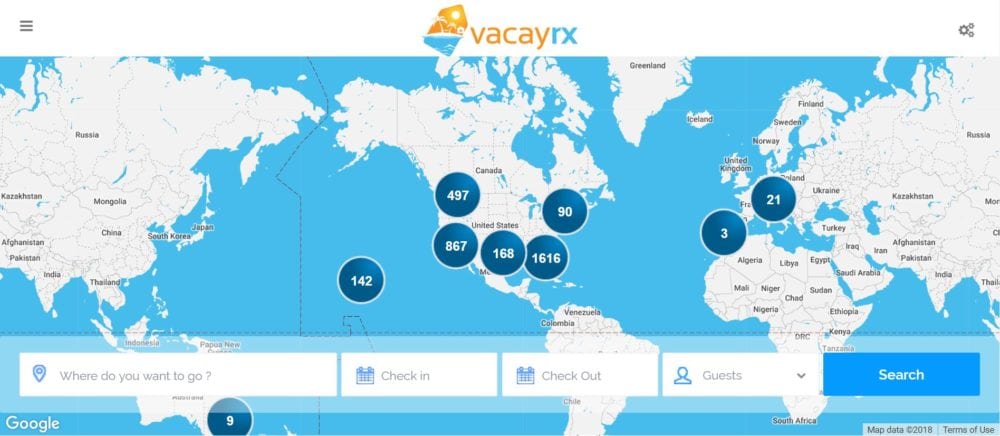
This week vacation rental listing site Vacayrx launched a crowdfunding campaign and plans to use the funds to promote an initial coin offering (ICO) later this year to build a blockchain-based platform.
Jesse Martinek founded the Jackson, Wyoming-based company about a year and a half ago after working in business development positions at Turnkey Vacation Rentals and Vacasa. There he saw changes coming to OTAs that would hurt property managers, such as the removal of guest phone numbers, instant bookings, and increased fees. He built Vacayrx as a different option for property managers.
Vacayrx charges a $25 flat booking fee to guests in addition to a subscription fee starting at $50 per month per property. The site now has 3,400 active listings throughout the US, Canada, Europe, and Australia, and Martinek is eyeing future growth through blockchain.
According to Martinek, “[The ICO] will allow us to build a blockchain-based platform which will offer the best of both worlds (pre-booking communication and instant booking potential).”
In an ICO, a company creates digital tokens, or coins, on a platform like Ethereum, then sells those tokens to investors. Investors purchase the coins with a digital currency like bitcoin or ether. Unlike a public offering, investors do not own part of the company itself but rather fund a future product for which the coins can be traded. In this case, the funds will be used to build a platform on which the coins could be traded for vacation rental reservations.
“We have elected to go the crowdfunding/ICO route rather than VC due to shifting regulations which make ICOs more accessible, and because VCs have continued to struggle with the nuances of our industry,” Martinek said.
Blockchain is a digital ledger of transactions that is stored across a peer-to-peer network of computers. The technology allows users to trade directly with each other with the transaction verified and executed by the network, rather than through a bank, hosting platform, or other intermediary.
“By introducing the blockchain to the industry, we can eliminate service fees from both sides of the transaction which effectively breaks the business model of the large OTAs,” Martinek added.
The crowdfunding campaign is running on TheLocalCrowd.com and ends September 1.
Recently, my team and I attended the United States Conference of Mayors meeting in Boston where we heard time and time again that mayors want help from local groups to make sound decisions that can be viewed as best practices.
We also heard that regions need to work together to recognize the positive impact of cooperation and avoid the negative impact that can harm a region when local governments don’t work together.
One other thing became clear when speaking to mayors: existing, locally active organizations have the presence, the understanding, and the relationships to navigate city hall more effectively. They provide a uniform voice to a problem and a collaborative approach to a solution.
These existing, locally active organizations can help mayors—and city council members—make sound decisions based on data. And they help elected officials understand the greater impact of their decisions on the larger region.
While big-city governments are grappling with emerging technologies and the growth of online, short-term rentals, long-time property managers in vacation destination regions are feeling the reverberating impacts of new restrictions as small destination towns begin to copy those rules.
Why should this matter to a vacation rental property manager? Because your business, and your local visitors’ industry, can be negatively affected without much warning, leaving you stunned and wondering what happened.
Your business could collapse.
In the summer of 1984 Mary Decker was an Olympic superstar headed for greatness. But in a bizarre instant, barefoot South African runner Zola Budd caused Decker to fall in a heap and lose a race she was expected to win.
That same summer my family visited a few vacation destinations that included the Shenandoah Mountains, the Texas coast, and the Poconos. I wore my Mary Decker digital watch throughout the summer, and now I feel ridiculous that I did. But the other thoughts I have from those trips are just as clear, and I will have those memories for the rest of my life.
That’s what vacation rentals give to families: great memories and tremendous experiences.
Vacation rentals also offer great opportunities to every community. The overall economic impact of vacation rental activity includes the traveler’s daily spending, the taxes rentals generate, and the support of local businesses. And those rentals also provide a greater impact: the tremendous word-of-mouth promotion of each destination for the great memories they inspired: “If you visit this beautiful community and travel as we did, you will have a memorable time too.”
But there is a growing problem for vacation rentals and vacation destination communities—the growing “local economic dampening effect” based on a bizarre array of local restrictions.
And there is a growing problem for vacation destination regions—the “negative regional echo” of one community’s restrictions that affect travel behavior and spending across an entire region.
If one prominent mountain town is known for making it bizarrely difficult for a traveling family to rent a vacation home, that means retailers, restaurants, outfitters, and more across the region lose the potential for a positive economic impact.
And think deeper: if that mountain town creates a polarizing effect for travelers visiting the greater area, then vacation homes in neighboring towns also lose their opportunities to rent effectively.
And just like that, the local tourism economy faces an unexpected decline that costs them the chance to win the race. They are tripped up like Mary Decker was.
No mayor or town manager wants to impose negative regulations, but they often do not have all of the information—or engagement—to understand the impacts of their new rules.
But what can one vacation rental property manager do about it? Join an existing, locally active association and educate its members on the importance of your business.
Local associations, such as the chamber of commerce, board of realtors, destination marketing association, or visitors bureau, have existing relationships with regional government. Those existing associations know how to work collaboratively and cooperatively with decision makers; they know how to access and organize needed data, and they know how to position an argument based on community concerns.
Our group has been working with a variety of cities around the world on vacation rental regulations, and time and time again we see that the active participation by local associations can help a vacation rental manager’s effort.
Today, in the areas where my family traveled in the Mary Decker summer of 1984, vacation rental property managers are finding success by working with locally active associations.
In the shadow of the Shenandoah Mountains, one vacation rental manager has found success through early, active participation with the chamber of commerce. The Luray-Page Chamber has studied and discussed the economic impact brought to the area by travelers using vacation rentals. While some travelers will stay in one of the area’s many hotels, traveling families and groups staying for longer periods have expressed a strong desire to rent homes.
Travelers to the Luray and Page County area take advantage of many of the area’s terrific amenities, most notably Luray Caverns, Arrowhead Lake, and the many art and music festivals.
The chamber of commerce can serve as a conduit between the area vacation rental property managers and the town and county staff. The resources the chamber can bring will help the local decision makers choose a wise path and create best practices. And the chamber also can help the property manager learn how local government works so the manager will know what to say, how to say it, and to whom.
Along the coast of Texas, property managers have found immense success in working with their local convention and visitors bureau. The Galveston Island Convention and Visitors Bureau reviewed vacation rentals long ago and found that home rentals contributed a significant amount to the hotel occupancy tax. The state and local taxes help pay for visitors’ amenities in the area and help keep Galveston’s economy thriving.
Through early and active involvement with the visitors bureau, local property managers were able to count on its support during discussions of vacation rental regulations. The bureau was able to serve as a third-party voice and help the city council understand the importance of vacation rentals to the area economy while serving as a leader for the property managers by helping them understand how to speak effectively and persuasively.
In the corner of northeastern Pennsylvania, along the beautiful Pocono Mountains, property managers have stayed actively engaged with the Pocono Association of Realtors. That group recently held a short-term rental summit for township managers and code enforcement and elected officials to discuss the value vacation rentals bring to the community and the best and worst practices for writing regulations.
The property managers in the Pocono Mountains work closely with the association of realtors to show the positive impact of home investment, construction, and sales of vacation rentals. The collaborative effort has worked to discuss how tourism dollars positively affect area businesses and the overall economy. The group also has worked to dispel the myth that vacation rentals could become workforce or affordable housing options if severe restrictions were adopted.
How Can You Get Started?
Do your research: Find associations that are active and have a desire to further the vacation rental industry. Three great groups to investigate are the chamber of commerce, the visitors bureau, and the association of realtors.
Start now: Local governments can act on passing regulations of vacation rentals within days of initial discussion. To check the pulse of your community, get engaged today and tell your association about the value vacation rentals offer and your role in the local economy.
When you become an active member in an existing local association you can help that group educate and inform mayors and city managers on how best to view your business. In addition, you can help your fellow association members understand the local economic dampening effect that can occur if bad policies are enacted and the potential negative regional echo that could collapse part of the visitors’ industry and negatively affect area businesses.
Do your research on area associations, join one quickly, and help promote your community as a great place to create fond memories while helping to grow your local and regional economies.
Honolulu Mayor Kirk Caldwell submitted a bill last week to regulate short-term rentals on Oahu. The proposal would allow owner-occupied bed-and-breakfasts (B&Bs) to operate in all residential, apartment, business, and resort zoning districts and rent out a maximum of two bedrooms for up to a total of 4 guests at a time. The proposal continues the ban of non-owner occupied transient vacation units (TVUs) outside of resort, business, and apartment zones.
The bill also requires all short-term rentals to register with the city and list registration numbers in advertising. Hosting platforms would be required to submit listing data to the city monthly that includes properties, owners, and rentals booked on their sites.
Applicants would be allowed only one conditional use permit at a cost of $2,000 every other year. No corporations would be allowed to apply. Permit holders would be required to maintain standards for parking, quiet hours and house rules, advertising, signage, and insurance. TVU owners who do not live on Oahu must appoint and list a local contact to receive notices and complaints.
If approved as is, the bill would also impose steep fines for violations. In a news conference on Friday, Caldwell said B&Bs operating without a license would be fined at a rate of $10,000 to $50,000 per day, and TVUs operating without a license would be fined from $25,000 to $100,000 per day. The city could also collect profits on illegal rentals, place liens on the property, take execution actions, and confiscate the property, he said. He called these penalties “heavy, draconian type of fines to send the clear message to folks that you need to comply with the law.”
Violations for more minor infractions such as noise complaints or not listing the property’s registration number in advertisements incur penalties varying from $500 to $10,000 daily and increase with the number of infractions.
Though tax rates are not included as a part of this bill itself, the draft specifies that the B&Bs and TVU distinctions will allow the city to tax each group appropriately, but tax rates will be proposed separately. The draft reads “Based on the Department of Budget and Fiscal Services’ (BFS) current analysis, the estimated tax rate for B&Bs could be approximately $6.45 and the tax rate for TVUs could be $12.90. An ordinance associated with new, higher taxes for STRs will be introduced by BFS in fiscal year 2020.”
The bill would also cap the number of all short-term rentals outside of the resort areas to no more than 1 percent of the total dwelling units in areas with development or sustainable community plans. The city estimates this would total around 4,000 approved short-term rental units on Oahu.
In a letter to city council attached to the bill, Kathy Sokugawa, acting director of the department of planning and permitting, writes “We would be the first to admit that this package will not completely solve the problems associated with short-term rentals in our communities. However, we believe that it will make a significant difference in reclaiming residential neighborhoods for residents, and still allow homeowners an opportunity to supplement incomes with short-term tenants.”
Short-term rentals have been banned outside of resort districts and limited nearby areas since 1989. Owners of short-term rentals in operation before the ban could be grandfathered in through nonconforming use certificates (NUCs), for which the city stopped accepting new applications in 1990. Today, approximately 816 legal short-term rentals remain, but the city estimates there as many as 10,000 illegal short-term rentals operating on Oahu.
The mayor said the city recognizes the demand for short-term rentals from guests and homeowners, the importance of tourism to Oahu, and the complaints from residents about issues caused by short-term rentals, and the bill is an effort to strike a compromise among all stakeholders.
“At the end of the day, it’s about creating a level playing field,” said Caldwell. Of the almost 10 million annual visitors to Hawaii and 6 million to Oahu, they are all coming for different reasons and want different choices in accommodations, he said. He wants all parts of the industry treated fairly while minimizing adverse impacts on neighborhoods.
The mayor said the bill was drafted with considerations from an information group of hotel industry representatives, neighborhood coalitions, union representatives, real estate agents, short-term rental platform representatives, and other stakeholders who met over the course of seven meetings to develop the bill’s core pieces.
The draft has been submitted to the planning committee and then will move to the city council. The next planning committee meeting is scheduled for 10:30 a.m. on August 28, the agenda for which has not yet been posted. A public hearing date of September 5 is written on the bill’s memo from the department of planning and permitting, but the hearing is not yet listed on the city council’s official calendar.
If approved by the council, the bill will go into effect on May 1, 2019.
Rest and sleep are one of the indispensable activities in people’s lives. As such, having a nice and comfortable place to wind down and get cozy after an event-filled day is a must for guests on vacation and for business travelers alike.
This is why for vacation rentals, part of creating an inviting ambiance in bedrooms is making sure that all the amenities and fixtures are in tip-top condition—especially the beds. Aside from housekeeping, which involves change of bedding and routine cleaning, beds and vacation rental mattresses must also be given special attention when it comes to room maintenance.
More than vacuuming your guests’ beds to ensure that deep-seated dust and dirt are eliminated, your mattresses also need to undergo a certain form of upkeep that prolongs life span and ensures utmost guest comfort. Here are a few things you should know about vacation rental mattress rotation:
It is necessary. A huge of part of ensuring satisfaction among your customers is knowing that their needs are well-catered to and anticipated. Knowing that the beds they will be sleeping in play a crucial part in their day, having well-maintained beds and mattresses is a given. Because most types of mattresses have a tendency to sag or have body weight impressions over time, rotating them is a means to prevent these dent occurrences and keeps them in a better and more comfortable form for a longer period of time.
It needs to be scheduled. Depending on your needs and your staff availability, rotating bed mattresses works well with a set schedule. Some prefer to do this maintenance activity at least every three months, while others do it as often as every other month. No matter what timing you prefer, it is always a good idea to keep it a habit and a part of your general upkeep routine.
It is fairly easy. Assuming you have enough staff who can lift mattresses, rotating these big cushions is a relatively easy task. All it takes is turning the mattress sideways, flipping it over (so that the bottom part of the mattress is now on top), and turning it clockwise so that the head of the mattress is newly located at the foot of the bed, and vice versa.
Chicago city council voted unanimously last week to increase the surcharge on short-term rental transactions from 4 percent to 6 percent. Proposed by Mayor Rahm Emanuel, the increased fee is expected to generate $1.3 million in additional annual revenues, which will go toward expanding housing and support services for victims of domestic violence in the city. The new fee will go into effect on November 1.
The city’s department of family and support services operates 140 shelter beds and funds approximately 30 support programs for domestic violence survivors. The new surcharge is expected to add around 70 beds. “Finding a place to sleep at night can become a real challenge for domestic violence survivors, and by increasing the City’s bed capacity we are providing more supportive services to this vulnerable population,” said Mayor Emanuel in a press release.
The newly increased surcharge is imposed on top of the city’s 4.5 percent base hotel accommodations tax, bringing the new total to 10.5 percent. Revenues from the original 4 percent surcharge support services for homeless families and the chronic homeless, totaling $2.7 million between July 2017 and April 2018, the city reports.
In addition to paying taxes and surcharges, vacation rental owners must apply for a business license with the city for $250 every two years, and they must register their properties with the city through the hosting platform on which they advertise the home for rent.
Hosting platforms and intermediaries, including property management companies, must also hold a license to operate in the city. Intermediary licenses cost $10,000 per year plus a $60 per year fee per property. Hosting platforms are charged $10,000 per year for 1,000 or more properties listed ($5,000 per year for fewer than 1,000 properties.)
According to data from AllTheRooms, the Chicago market saw a mid-year decline in short-term rental inventory in 2017 after registration regulations went into effect in the spring. A January 2018 analysis by the same company shows that the market rebounded and added more than 1,500 new units by the end of the year. In the report, AlltheRooms CEO and co-founder Joseph DiTomaso wrote “The Chicago short-term vacation rental market generated over $92.2 million in gross sales from 2016 to 2017 with June 2017 reaching an all-time high of $12.8 million.”
Chicago has received a record number of visitors the last three years in a row. According to a January press release from the mayor’s office, 55.2 million tourists visited the city last year, breaking the annual record for a third year in a row. Chicago’s tourism industry accounted for an estimated 146,500 jobs.
The reactive maintenance approach, or “If it ain’t broke, don’t fix it,” is expensive and inefficient. Vacation rental property managers wind up spending more time and energy repairing items than they do inspecting and maintaining them. Some managers are even forced to shut down properties mid-season due to heating, ventilation, and air conditioning (HVAC) system malfunctions, losing thousands of dollars in rental revenue.
Vacation rental managers who invest in maintenance programs can reap huge dividends down the road and save their owners significant operating costs. Simple tasks like cleaning condenser coils and gaskets in a refrigerator help appliances run efficiently and extend their lives. In fact, studies have shown that preventive maintenance can reduce repair costs by 20 percent. But cost savings aren’t the only benefits here. Properties that function as advertised result in happy renters and owners, leading to repeat business and a trusted brand.
Still aren’t convinced? Let’s look at an example: On average, heating and cooling accounts for 54 percent of a residential structure’s annual energy cost (about $1,200). A well-maintained HVAC system can increase cost-efficiency by 30–50 percent, saving $360–$500 per year.
Define Your Maintenance Plan
The first step in creating an effective preventive maintenance plan is to define your goals. Ask yourself the right questions: Is your primary goal to reduce the risk of emergency repairs or to save money on recurring costs? What are the most important aspects of your property?
These parameters might depend on your geographic region. For example, homes in colder climates often sit unoccupied through winter months and will need to be winterized. On the other hand, coastal homes will need thorough exterior cleaning to remove corrosive sea salt from fixtures and amenities. This includes exterior light fixtures, power outlets, furniture, and grills.
HVAC filters are very important in most plans. The frequency with which you need to replace your filters will depend on numerous factors like filter type, air quality, pets, and occupancy rates. But regardless of your environment, every maintenance plan should include electric appliances.
Smoke and carbon monoxide detectors should be cleaned and have their batteries replaced every six months. Detectors can randomly fail, so it’s a good policy to replace detectors every ten years. Replacing light bulbs and inspecting fixtures for loose sockets or damage are also a must. Modems and routers should be cleaned and reset monthly, and batteries in wall clocks, alarm clocks, TVs, and remotes should be changed yearly.
Set Standard Operating Procedures (SOPs)
The standard operating procedures you create will keep your team organized. These guidelines will dictate how and when each item on your list is maintained. Meet with maintenance techs and discuss these requirements as well as the maintenance frequency (e.g., weekly, monthly, quarterly) and the estimated amount of maintenance time for each item.
Lastly, make a list of the supplies, parts, and tools needed to complete your program. This list will allow you to order parts in advance and save money with bulk discounts.
Understand Your Inventory
The next step in setting up a preventive maintenance program is compiling deep property data. Begin by recording the make, model, serial numbers, and condition of all electronics, appliances, and equipment within your properties as well as your office and work spaces. (This includes relevant information on company vehicles, such as oil change dates, tire replacements, battery replacements, and repairs.) Consider organizing your HVAC appliances and equipment in different zones and include where each zone is located. Be sure to record special notes on any unique items that include several parts, as these may require extra effort to maintain. A comprehensive list of these items will be invaluable to your company and to your homeowners.
Know Your Staffing Requirements
This is key to executing your preventive maintenance program. If your program is running properly, then your maintenance staff should be spending only 25 percent of its time on reactive maintenance. Instill a proactive mind-set in your staff.
Some companies find it useful to hire third-party vendors to meet their preventive maintenance needs. Outsourcing things like HVAC care and pest control can give you the expertise you need while saving you the time and money it would cost to train your staff. Having a list of vendors and contractors on call is a must, giving you peace of mind when issues arise.
Train the Team
Every member of your staff should be familiar with the SOPs for each maintenance item. If necessary, train staff on maintenance procedures prior to starting your program. The most important component of this training is data capture, as accurate reporting is necessary for owner billing, inventory control, and future process improvement. Thorough notes should include tasks completed, time spent on each task, location, room, item maintained, and parts used.
Schedule Your Plan
First, use the data from your inventory to establish your maintenance priorities. Doing so will help avoid overloading staff with busywork and will ensure that the important items are taken care of first. The highest-priority items are traditionally those involving safety or those that cost more money and time to maintain.
Next, establish what items are maintained at certain times of the year and define your maintenance windows (e.g., your off-season for annual/semiannual maintenance and the time between checkout and arrival for weekly maintenance). Only then should you schedule your priority items, as well as maintenance for your company vehicles—knowing your degree of access to certain vehicles can help prevent logistical delays.
Your lower-priority items can fill the gaps in your schedule. Be mindful about giving your maintenance techs lower-priority items in locations near their important tasks; this will reduce unnecessary travel time.
Analyze, Adjust, and Improve
Ditch the “set it and forget it” mind-set and look to improve your plan every step of the way. It takes time to develop a rock-solid program, so don’t hesitate to consult your maintenance staff on what’s working and what’s not. You can use the feedback you get to adjust your maintenance scheduling. Make note of the properties that are costing the most time and attention, and consider describing to the owners of these properties the upgrades and renovations that must be completed for their homes to remain in your rental program.
Get Homeowners on Board
Developing a preventive maintenance program works best when your homeowners participate. The best way to do this is to fully communicate the work that’s being done and what is necessary to maintain the property. Provide a full list of all services included in the program and explain why these services are cost-effective. Timing is everything—promote the program when it’s time to renew your agreement or when you’re taking on new clients. This transparent communication increases confidence in your property management services and improves owner relations.
In a competitive vacation rental market where managers are expected to provide service to their guests and owners, the efficiency gains of a preventive maintenance program are necessary to keep up with the workload—particularly in high season, when staff is stretched thin and there isn’t an hour to waste on a Saturday.
Today, Airbnb is taking yet another step to make it easier for professional vacation rental managers to add their entire inventory of supply to the company’s marketplace.
As part of its commitment to add more professionally managed vacation rentals to its marketplace, the company has built an Airbnb API (Application Programming Interface) to connect with vacation rental software companies around the globe. Using the API, vacation rental managers are able to add their entire inventory of vacation homes to Airbnb immediately instead of adding and servicing one property at a time.
Today, Airbnb will begin to further facilitate and expedite these integrations with communications that proactively provide vacation rental software developers with additional resources, including its inaugural API newsletter that highlights improvements to the Airbnb API, new tools, and overall improvements (see below).
According to Airbnb technology and B2B communications executive Tim Rathschmidt, “As part of that [commitment], we’ve been expanding our work with third-party software partners that professional hosts use to connect to Airbnb’s API.”
“We already have more than 100 integrations complete, with many more in the works,” said Rathschmidt.
Rathschmidt added, “The professional host API is free to access. It’s not open, per se, as we work with each software provider requesting access to ensure they meet our API requirements, i.e. security standards, etc.”
Airbnb’s new communications tool for software providers includes:
New Tools
Events dashboard to help monitor Airbnb integrations in real time: “Our new Events Dashboard provides visibility into your integration’s health so you can proactively address connectivity issues.”
Test sandbox: “A test application that closely mimics your live production app and allows you to safely test new code before deploying to production.”
Overall API Improvements
Faster publishing for professional hosts who aren’t already managing listings directly on Airbnb: “New listings added through your software are now automatically published without the need to visit the Sync page.”
Merging and syncing: A new API features allows users to merge existing listings and select sync settings directly in the software system. No more navigating to Airbnb to publish, even when connecting to an existing account.
Simplifying listing registrations: “We’re enabling a seamless transfer of listing registration info to Airbnb in markets that require it. Add registration details directly in your system and automatically sync this data to Airbnb listings.” This feature is live now for Japan and support for other markets will be released shortly.
If you’re starting a company, one of the first things you’ll hear is that you need a strong brand. People need to know who you are. They need to know what they can expect from you. They need to be able to distinguish what you offer from all your competitors in the marketplace.
Yet, there are few if any national or global brands in our industry. There are of course quite a few well-recognized US vacation rental brands—Meyer Vacation Rentals in Gulf Shores, Sun Realty in the Outer Banks, Southern Resorts in the Florida panhandle, or Taylor-Made Deep Creek Vacations come to mind—but they are typically local and mostly apply in drive-to markets.
Hotel brands are entering the market.
At the national or global level, 99 percent of vacation rentals are completely unbranded compared with 40 percent of hotels. The private accommodation sector has no equivalents to Marriott, Hilton, or Hyatt. Expedia, HomeAway, VRBO, or Booking.com are distribution channels.
Airbnb is a hybrid: while it clearly has built a powerful global brand, with its recent expansion in scope it is arguably becoming more of a distribution channel than a brand. The company is clearly trying to address this with the introduction of Airbnb Plus: Airbnb is qualifying and inspecting a subsection of its inventory and is thus now leveraging its brand at the listing level.
Then there are a few nascent brand contenders in the property management sector: Sonder advertises “deconstructed hotels” that are “modern and exciting.” Stay Alfred is offering “upscale” and “high-end” vacation rentals specifically in downtown locations of major cities. TheGuild, Lyric, and Domio are in on the act, too, and all these new companies are building a business model on the theory that an industry that lacks branding needs new brands.
What’s a brand?
Before I argue why creating sleek new brands isn’t necessarily the vacation rental industry’s next move, let’s take a look at what we mean by a brand. We’re talking about what distinguishes one type of product from another.
Strong brands are easy to identify on sight, and their offerings are differentiated: an Apple product is distinguishable not only because it looks like an Apple product, but because it operates like an Apple product and is backed by the service you expect from the Apple company. Because strong brands consistently deliver the experience their customers expect, their customers tend to be extremely loyal and to choose that brand over others.
Sounds desirable so far, and you can see why so many companies are striving to create the strong brand that guarantees such loyalty.
The problem is that vacation rentals, by their very nature, don’t brand.
Vacation rentals resist uniformity, but need consistency.
You can’t offer uniformity with vacation rentals because they are inherently unique. Uniqueness is the selling point—it’s why guests choose vacation rentals over hotels in the first place. They want to stay someplace that feels like a home, and every home is different.
Of course, identical vacation rentals sold in blocks like hotel rooms have existed for ages. They’re stocked with identical furniture, kitchen supplies, and decor. But those aren’t what people think of when they think “vacation rental.” Those are just hotel rooms that happen to have kitchens.
You will never be able to create a vacation rental brand that guarantees uniform spaces across all its properties, because vacation rentals are not uniform. There’s the ski chalet, the urban mid-century modern, the contemporary beach house, the quirky cabin, the treehouse, the houseboat, the family-friendly place for family reunions, the romantic spot for a weekend getaway, or the hyper-urban loft for the millennial on a business trip—their uniqueness is what makes them what we call alternative or private accommodation, cottages, holiday houses, baches, sleepouts, serviced apartments, aparthotels, or vacation rentals.
That’s the bad news about branding uniformity. But while our customers don’t seek uniformity, they do seek consistency. Consistency doesn’t mean that units necessarily need to look the same, but it does mean that they should all meet a set of expectations consistently.
Consistency of expectation is not uniformity of place.
Because of my work, I stay in vacation rentals and other private accommodation up to 30 times per year. I very much enjoy the variety of accommodations, which have ranged from a VW bus in San Francisco booked on Airbnb to an upscale, impeccably appointed Edwardian from Oasis Collections in London. I’m rarely, if ever, disappointed by the place; however, too often the experience doesn’t quite measure up to expectations.
When industry observers talk about convergence between traditional lodging and our industry—and the growth that can drive it—lack of consistency is often cited as a main obstacle holding our industry back.
Great expectations
Here’s a set of consistent standards that should be expected (and delivered) for every vacation rental:
Accuracy
Each listing is accurately described in detail, with a professional, standard set of photographs. What you see is what you get, every time. Great photography is available for each main room in the listing, the photography is up-to-date, and expectations are managed all the way from listing platform through to housekeeping. This means that the housekeeper stages the room each time exactly the way the guest saw it in the listing photos from your website, HomeAway, or Airbnb.
Health and Safety
Every home has both the attributes and the processes to ensure guests’ health and safety. This includes ensuring that smoke detectors, fire extinguishers, exit information, and first aid kits are available to guests, and processes are in place to ensure proper sanitation during cleanings, as well as regular checks that all health and safety attributes and processes function accurately and reliably.
Access
Guests can count on 24/7 access with backup access methods in place.
Amenities
Quality sheets, linens, and amenities are available to guests during their stay. Kitchens are stocked with key necessities and process fail-safes are in place to manage quality over time.
Utilities
Wi-Fi that always works, hot water, heat, air conditioning, TV, remote controls (batteries!).
Communications
Standard processes with confirmation, key code, welcome, post-arrival check-in, mid-stay check-in, post departure, etc.
Inspection processes
Inspection processes are in place for every stay—these inspections can be integrated with housekeeping or stand-alone processes.
Standard Operating Procedures
Standard Operating Procedures are in place for staff to follow to deal with everything that will go wrong.
Learning from hotels: soft brands
For a while now, hotels have somewhat unbundled distribution from the actual brand via soft brands. If a hotel is strongly established in an area and wants to maintain its diversity or uniqueness or has its own recognizable brand, the operator may choose a soft brand, such as Marriott’s “Tribute Portfolio Collection” or Hyatt’s “Unbound Collection.”
Hotels choosing soft brands get the same distribution, and guests choosing a hotel with a soft brand can expect very similar services as those offered by the main flag, if in a unique place. Interestingly, franchise fees for soft brands seem to be only marginally lower than for the main brand, indicating that much of the “brand” value doesn’t stem from the brand itself but from the distribution that comes with it and from the general expectation that such soft brands are curated and vetted collections that deliver a unique service experience, if each in a unique and diverse place.
The anatomy of a private accommodation brand promise
The brand promise can start with distribution: at one end of the spectrum is largely unbranded distribution (e.g. Expedia or Booking.com), where the key value proposition is around comprehensiveness and best price; at the other end of the distribution spectrum are more branded channels such as HomeAway or Airbnb, with stronger brands and exclusive inventory. Arguably, however, the branding power of distribution platforms is weakening as they add more diverse inventory. For example, in Airbnb’s case the “Live there” campaign theme strongly reflects its core inventory, but much less so for newly added boutique hotel rooms.
Next are curated collections: castles, family friendly, tree-houses, romantic getaways, and business-friendly are all examples of curated “light” collections, likely self-reported or with minimum inspection, that intend to give an additional layer of consistency.
Airbnb Plus is currently only using one-time inspections; this provides an additional layer of a brand promise by ensuring that a place has met certain requirements at least at one point in time. However, without control of management or at least of processes or brand standards, that’s still quite different from a hotel soft brand.
Next are property managers like Vacasa, which have comprehensive and consistent, fully integrated processes. Airbnb’s luxury brand “Beyond by Airbnb,” Oasis Collections, or AccorHotels’ Onefinestay also exercise granular control over most processes, even if a third party might deliver the latter.
Last is a new breed of VR brands, like Domio, Sonder, Lyric, or Stay Alfred, which fully control not just curation and processes, but also design. Here we have come full circle with traditional hotels—these brands can deliver both a consistent service experience and a standard space.
Why does it matter, and what does it mean for VR managers?
Private accommodation and vacation rentals are different from hotels—uniqueness of inventory is a very valuable attribute in our category. However, delivering consistent services and accurately describing listings against standard criteria are critical in meeting guest expectations, supporting convergence with mainstream lodging, and driving industry growth.
The hotel chains’ early experiments in introducing brands into the category are illuminating. Soft brands focus on distribution and a set of brand standards but don’t put much value on the brand itself. This might be perfectly sufficient for our industry. It is unclear that we need new brands; there are plenty of well-established brands out there.
Arguably, the real opportunity is in expanding distribution. The three main listing platforms are continuing to drive more bookings for many VRMs. As hotel chains get acquainted with this category, and as convergence continues, it would only be natural for them to source inventory from the VRMs just as Marriott did in its experiment with HostMaker in London.
This should provide welcome additional distribution channels to our industry. The entrance of the hotel brands should also further accelerate convergence, as it will drive further professionalization. One key question will be how the hotel chains will source inventory at scale.
Likely, those VRMs with the best standard operating procedures, delivered across the most interoperable platforms, will be the winners. They’ll have access to broader distribution channels and should capture brand premiums across multiple brand portfolios, whether Airbnb Plus or hotel and other travel brands. And the more we standardize and certify processes and inspections as an industry, the more we’ll be able to cater to broader audience segments and drive industry growth.
Booking Holdings-owned Booking.com has been fascinating to watch as it has emerged as a leader in vacation rentals over the last four years. The company launched Villas.com in May 2014 as a testing ground for what the company calls alternative accommodations, which includes homes, apartments, villas, and other unique places to stay.
In late 2016, the company shut down Villas.com and transitioned its alternative accommodations inventory onto the Booking.com platform. According to Tnooz, “the Priceline Group-owned [now Booking Holdings, Inc.] accommodations giant said there is no change in its strategy for alternative accommodations such as homes, apartments, and villas, but concedes that data has shown its consumers prefer having all their options under one brand.”
Since moving all its alternative accommodations inventory to Booking.com, inventory growth has exploded. With no traveler fee and with accommodations that are entirely instantly bookable, Booking.com has surpassed both Airbnb and HomeAway in reported supply.
We reached out to Booking.com’s vice president of the home division, Olivier Grémillon, to find out more about the company’s growth, business model, and industry outlook. Although Grémillon only joined the Booking.com team in January, he spent the previous five years at Airbnb, where he helped its transition from a short-term rental company to a more comprehensive hospitality company. Now he is helping Booking.com grow the company’s business across the homes and apartments sector and working with owners and managers in 220 countries around the world.
Industry Growth
AH: To what do you attribute recent vacation rental growth, and what do you see as your differentiators when compared to your competitors in this space?
Olivier Grémillon (OG): At Booking.com we have a relentless focus on our partners as well as the customers who book with us all over the world listening, learning, and driving continuous, rapid innovation that leverages technology to consistently ensure our product is the best in the space. Homes and apartments are a very big and important space for us, and we’ve been investing in both partner and customer acquisition for some time, which includes technology investments, to ensure we can remove as much friction from the sign-up, management, and booking processes as possible. Not only do we listen and respond to meet travelers’ needs—an effort that ultimately brings our property partners more guests through their doors—but we build easy, effective tools that allow our partners to simply list and manage their businesses with us, including a new process to sign up a property in less than fifteen minutes. With more than 5.4 million listings in homes, apartments, and other unique places to stay, we offer the largest potential source of inventory in this sector worldwide. This is a competitive industry, so building a product and experience that differentiates us from others in the space and that enables us to deliver the choice and diversity travelers crave is critical to maintaining a leadership position.
AH: In which markets do you see the most inventory growth now and in the future?
OG: We’re an incredibly global business with operations in more than 200 countries and territories. As such, we’re growing inventory in multiple markets that include Europe, the USA, China, and Japan as well as emerging markets across Latin America and Asia. We’ve been actively building our supply and business in the vacation rental segment for years, growing supply globally by 27 percent over the last year by recognizing the consumer demand for all types of accommodation, and we will continue to do so.
AH: Booking.com has a huge advantage in international markets. Do you see a path to leveraging your success outside of the United States to grow inside the United States? Or is there a reason that less of your attention is on US markets?
OG: We are a European company, and our long-term efforts across Europe have certainly led to strong brand awareness and growth internationally. However, the United States is and will continue to be a very important market for our business. We have twenty-seven offices and over 2,300 employees in the United States who are dedicated to empowering customers and supporting our partners with the commercial tools, technology, insights, and advice to grow their businesses via our platform. We’re also investing in additional and enhanced payment methods through partners such as Stripe to enable an even wider range of customers to book via our platform.
The opportunity is immense, and the more we collaborate, the faster we can have impact and further accelerate that growth. Property owners and managers can rely on companies like ours even more to invest in the technology, marketing, and infrastructure resources because that’s our expertise, and we can build the products and tools that will fuel more people through our platform that, in turn, drives more business for our property partners. We are better positioned than anyone in the space to bring significant incremental international travelers into the US market, given our global reach, and we absolutely intend to push that opportunity to make Booking a more scaled player in this market.
AH: Do you believe Google and/or Amazon will disrupt the vacation rental funnel?
OG: Google has long been a good partner of ours, and Amazon continues to build an impressively diverse ecommerce business. With the constant and transformative effect technology innovation and evolving consumer expectations are having on the way we travel, I’d say that any business in this space needs to be open to continuous learning and reinvention of its approach in order to keep pace.
At Booking we focus on what we do best and what we know customers want. For us, that means constantly testing, experimenting with, and optimizing the customer experience on our platform to solve the challenges travelers face and strip friction out of the process.
AH: With the global scope of your inventory, as the industry develops, how do you see the terminology relating to vacation rentals (holiday lets, self-catering, cottage rentals, holiday rentals, holiday homes, urban rentals, etc.) changing, and which of the terms will evolve to become the dominant one?
OG: That might be for the customer to decide. In recent research we conducted with more than 57,000 travelers across thirty markets, 30 percent said they want to stay in an apartment, aparthotel, or condo in 2018—further evidence that consumer demand for accommodation beyond the hotel remains strong. In fact, in other research conducted with 19,000 travelers in twenty-six countries, one in five (21 percent) said they would consider listing their own home on a travel accommodation site over the coming year. In that light, how exactly the industry defines itself is not that important. What matters most is what’s useful for customers. We currently have thirty property types on our platform, and we keep experimenting to ensure customers can easily find what they’re looking for. Defining those properties is one example of how we’re continuously testing and listening to what gives customers the clearest and best experience.
Booking.com Business Model and Technology
AH: Some of your competitors have gotten pushback from their core suppliers as they attempt to expand into other verticals or further monetize their platform. Why do you think your suppliers do not have those same struggles in working with Booking?
OG: We try to make it as easy as possible for all and welcome all types of property to our platform. We foster great relationships and ensure transparency to all our customers, partners, or suppliers so they know they can rely on companies like ours to invest even more in the technology, marketing, and infrastructure resources to bring them more business because that’s our expertise.
AH: Airbnb, HomeAway, and TripAdvisor do not appear to be backing off the traveler fee. Is Booking.com considering adding a traveler fee?
OG: We’ve never charged a booking fee to customers for our service, and this is something that we are extremely proud of. From our point of view, charging travelers is far from optimal for the customer. At Booking.com, we want to be as transparent as possible towards partners and customers, so that means that what you see is what you get. We believe our approach is much clearer for both travelers and partners than others in this space who charge in different places, making for similar fees once guest and partner fees are added. At the end of the day, we are committed to delivering the best possible consumer experience to ultimately win more business for our partners.
AH: In your US contracts, you require rate parity, but to date there doesn’t seem to be a way to enforce it. Are you looking for ways to enforce rate parity, or do you believe rate parity is a thing of the past?
OG: We believe our model guarantees a transparent and consistent price comparison experience for consumers, but at the end of the day, we will always look at what the right model is to ensure Booking.com customers can have the best possible prices. That will ensure we can deliver the customers and demand our partners expect from us as one of their most critical marketing channels.
AH: Where do you see your revenue management services going over the next year? In setting prices for alternative accommodations, is there a conflict of interest as you also look to promote your large hotel clients?
OG: To clarify, we don’t set prices; our accommodation partners do. We also see demand for all types of accommodation on our platform, which is why we look to offer the widest choices all in one place with millions of hotel listings on our website alongside millions of other unique types of property listings. When it comes to revenue management, we provide tooling to all kinds of property partners to support them in their individual pricing strategy and execution as well as data around seasonal or high demand dates (think increased interest for a beach bungalow during the summer months) and special events such as major sports competitions or concerts.
AH: Is there a difference in how you sell to and support professionally managed inventory versus owner-managed inventory?
OG: We have historically come from the more professionally managed side, but today we support the needs of both professionally and owner-managed. Each has its own unique needs. For example, professionally managed properties face particular challenges in managing a portfolio of several vacation homes with different owners, but evolving payment solutions and chat-bot-assisted messaging can help. We also know professionally managed inventory is often connected via software or channel managers, so we are actively building our products in a way that can integrate solutions seamlessly with the systems our partners use.
Individual homeowners listing for the first time may have more questions and need a different type of support and guidance, but we’ve worked on introducing simplified cancellation policies, different workflows, a fifteen-minute sign-up, and a specific online onboarding module to help support and empower owners here. Overall, we want to make it as easy as possible for any property manager or individual to sign up and manage one or more listings with us, so we work hard to provide the tools, flexibility, and insights that will help them grow their businesses.
AH: In terms of ranking, are there any changes to your algorithm that can help property managers improve their performances?
OG: We believe that every property that offers our customers a great experience deserves to be discovered. That’s why our default ranking is based on an algorithm built on customer feedback. It takes into account a variety of factors and data points to present initial search results in the most meaningful way for consumers. Beyond that, we have created a number of filters to help customers search for exactly what they’re looking for. That can help them quickly spot the properties that have what they are looking for, especially in destinations that have thousands of listings. The search behavior and preferences of travelers change constantly depending on the context of a specific trip.
So for property managers, it is key to ensure that properties stand out from the crowd. The attractiveness of the offer plays a vital role in making a property stand out in the search results as well as ensuring you understand your market and what drives the customer experience. Everything from high-quality photos to providing great rates, responding to customer reviews, and ensuring strong availability can help here.
AH: Regarding channel managers, how vital are third-party channel managers to the core OTA business? As you integrate with more and more software systems, do you believe the need for a “channel manager” as we know it today will disappear?
OG: Our goal is to make booking any type of accommodation anywhere in the world digitally as seamless and as easy as possible, and we work with a vast number of partners throughout the world. The travel industry is growing at great speed, and the opportunity is immense. We want to make it as easy as possible for all our partners to work with us, supporting their connectivity choices by working to ensure all our innovations are equally available for connected partners while also fostering our relationship with connectivity providers, including channel managers, to impact and accelerate growth in the travel ecosystem.
AH: Do you see blockchain technology as the next game changer?
OG: There is a lot of talk about the potential of blockchain technology at the moment and the many applications it might have for the wider travel industry. It’s still early, but there are definitely some potential opportunities, interesting ideas, and business models beginning to be debated and developed further. As with all emerging technologies, including cryptocurrencies like bitcoin, it’s something we keep an eye on. Right now, among several potential game changers, we think the bigger opportunity is in AI and machine learning, so we’re investing more on that front, but we have very smart people looking at if and when something like blockchain can solve customer friction in travel.
AH: Are there any new technologies you are adding or technology acquisitions you are considering to better serve your suppliers?
OG: Absolutely. We’re constantly experimenting with new technologies to take even more of the friction out of the overall travel experience and help deliver more customers to our property partners. For us, any application of technology must serve and enhance our partners’ and travelers’ experiences in some way. We don’t experiment with technology for its own sake—it must actively solve a customer problem, remove friction, and make our customers’ lives easier.
Right now we’re actively exploring various applications of artificial intelligence and machine learning to enhance the customer experience on our website and mobile apps, including everything from how we interpret search queries to providing recommendations on where to stay and where to go as well as automatically tagging photos uploaded by travelers. With our Booking Assistant bot, we’re currently using machine learning models and natural language processing technology that has all been built in-house to identify and respond to more than 50 percent of our customers’ most common enquiries automatically. Think simple questions like “Is there parking available?” or “Can I check in late?” That is immensely helpful for our partners because we can essentially handle their customer service for them. This not only saves time for our property partners, allowing them to focus on delivering incredible experiences to their guests, but it empowers travelers with seamless support. As these technologies and their applications advance, whole new levels of personalization at all stages of a customer’s travel journey will become possible as will decision-making, listing management, and optimization by property managers and hosts.
In September 2016, LeisureLink, a widely used channel management company, announced that it was ceasing operations and discontinuing use of its platform, leaving dozens of property managers unpaid for completed reservations.
According to a letter the company sent to clients, “While LeisureLink attracted considerable interest from many strategic buyers and investors, management has determined that none of these parties are likely to complete a transaction before late Q4 of 2016. This timing and the continuing cash needs of the Company has created a liquidity deficit which prevents the Company from continuing its daily operations.” The letter continued, “As a result, we have no choice but to stop operations and not process any new bookings as of September 27, 2016. At this time, all employees of LeisureLink are being terminated and the platform turned off.”
For property management companies using LeisureLink’s channel management services, the fallout from its demise was tremendous, leaving in its wake hundreds of unpaid reservations.
But the story did not end there.
LeisureLink’s chief product officer Joel Inman and vice president of business development Hal Widlansky had working knowledge of the strength and breadth of the failed company’s technology and did not want to see the baby thrown out with the bathwater, and they set out to salvage the working assets of the company to build a new kind of connectivity for property managers.
As a result, Inman and Widlansky raised capital, purchased LeisureLink’s technology, and founded Lexicon Travel Technologies. We reached out to Joel Inman to find out more about the lessons learned at LeisureLink and the duo’s vision for the new company.
Amy Hinote (AH): What did your team learn in your roles at LeisureLink that changed the way you look at the channel management business?
Joel Inman (JI): Our team has a lot of collective knowledge—and scar tissue. We know what works and what doesn’t in the vacation rental market. We have the privilege of not repeating the mistakes of our predecessors, and we are laser focused on doing what is right for the property manager.
Probably the two biggest lessons we learned at LeisureLink are these: 1) don’t try to be all things to all people—you can’t please everyone; and 2) do not oversell what you can and cannot do. Our customer philosophy is one of transparency and collaboration. If we can’t do something in an expert and professional way, we will tell our partners exactly that—immediately. In fact, we sometimes will recommend our competitors if we feel we are not a good fit. In this way, we can get past all of the gamesmanship and doublespeak that sometimes happens in a selling environment and forge a true partnership from the beginning.
AH: Are you the merchant of record (MOR)? Why is that important?
JI: No, never. Being the merchant of record as a channel manager is not advisable for a number of reasons:
Financial and fiduciary risk are issues. LeisureLink was the MOR (as are some of our current competitors), which means that the channel manager is directly charging the guest and taking responsibility for 100 percent of the booking dollars. In this model, the channel management company has possession and is able to use (or misuse) those funds for working capital. If we were ever to explore the MOR option, it would necessitate trust accounting to ensure that for every booking, the funded amount goes directly to the property manager’s bank account from the OTA. This is essentially what we already do but without taking possession of the total booking amount.
Being the MOR is actually a significant disadvantage in some channels because it can complicate access to affiliate networks and airfare bundling—two huge sources of potential bookings that are otherwise not available.
As MOR, collecting cash that does not belong to you can be an unnecessary and unhealthy temptation, which we don’t need, to fund other areas of the business. It’s always fun to imagine being a bank and charging interest on forward payments. LeisureLink did that, and it was tremendously popular. The problem comes, however, when one must also take on the responsibilities of cash management as if one were actually a bank. This is not our core competitive advantage, and we know it.
Collecting cash means staffing up in accounting. LeisureLink had a large team of AR/AP professionals to manage a large balance sheet (as do all channel managers who act as MOR). Again, this is not a core competency of a channel manager, nor should it be. Every property manager is able to collect cash for bookings—by definition—they already have the infrastructure required to support it and should take ownership over their own collections anyway.
AH: What sets Lexicon apart from other channel management services?
JI: Lexicon is not a channel manager; channel management is a phrase that has come to mean simply connectivity—that is, connecting rates and availability from a PMS to points of distribution channels. Connecting these information points is not enough to create a decent listing that anyone actually wants to book. Lexicon takes full responsibility for merchandising conversion on a channel—that means curating content, clustering inventory where appropriate, professionally organizing every listing, and actively collaborating with our partners on price and promotions to make sure the pricing is where it needs to be—every time. When you partner with Lexicon, room nights booked tend to increase substantially, and staffing costs tend to go down. In many cases, our customers have reduced their own time spent managing channels from weeks to hours while at the same time doubling or tripling their previous booking volume.
AH: There is a lot of speculation that channel management is getting more obsolete as software companies are building direct connections to OTAs. Do you think channel management has a future?
JI: The practice of channel management, as defined above, is already dead. When you think about the implications of posting a listing without curation or merchandizing, they are basically that no guests find the listing appealing, if they are able to find the listing at all buried on page fifteen of the search results. We see this happening in the marketplace all the time. When we ask customers how many bookings their channel manager got them over the last three months, the answer is often in the single digits. Ultimately, these are zombie listings that may book a handful of times a year but are certainly not effectively converting or driving higher occupancy in shoulder seasons—and they cause more work than they save.
However, as long as channels are relevant and continue to own the consumer eyeball, there will be a need for efficient and effective use of those channels. I think anyone with a connection (PMS software or other) will have to demonstrate the ability to convert listings to bookings and also save the PMC’s time and money on efforts to manage to effectively commercialize the OTAs. It’s not about whether you can build a connection—that’s the easy part. The challenge comes in making it work well for the property.
AH: Besides the technology connection to OTAs, what other services do you provide?
JI: Our software provides competitive intelligence and revenue management tools, and our account management team provides decades of revenue and channel management expertise and relationships. We act as an extension of the property’s revenue management team.
AH: Looking forward, do you think we will continue to see a traveler fee? And what is the future for rate parity?
JI: I can’t speak for the OTAs’ future plans regarding traveler fees. I think each one will choose his or her own path. But strictly speaking as a consumer, I find it hard to stomach when my final booking price is significantly higher than the daily rate. It feels a little bit like a bait and switch. Rate parity is an interesting concept. It is in many cases considered illegal or anticompetitive for companies to try to enforce rate parity, yet I believe it is a good business practice for property managers to adopt. Varying the price among different OTAs tends to confuse the market and is somewhat analogous to competing against oneself. The real enemy of the property is vacancy, and the biggest cost you can have is not going to come from a channel commission but rather from a room that passes the night with no guest in it.
It wasn’t his story that shook me. It was the way he fought back the tears.
On any given night, the US government and public affairs team at Expedia Group—made up of vacation rental policy and communications staff based in Washington, DC, Austin, and Seattle—host happy hour events in communities facing new vacation rental laws. They collaborate with property managers on the minutia of policy discussions and assist in building local alliances of managers and owners to push back against poorly crafted, and sometimes nefariously intended, policies.
On June 14, the team was in Crescent City for a happy hour discussion with over 110 HomeAway partners and members of the Alliance for Neighborhood Prosperity (ANP), a well-organized advocacy group for vacation rental stakeholders in New Orleans. Over cocktails and finger food, a lively dialogue took place covering the city’s new moratorium on vacation rental permits, the release of a new economic impact report from the University of New Orleans, and the ANP’s new video series entitled We Are the Faces of NOLA Vacation Rentals.
Once formal presentations were done, the fun started. We huddled with local managers and owners over pints of NOLA-brewed IPA and heard their stories of how they came to the vacation rental industry—some from real estate, others seeking a change from the cubicle farms of corporate America. One of those managers was East Coast Dave. Dave owns a management company that oversees properties across the city. Emigrating from the East Coast fifteen years ago and having a dangerous obsession with the city’s noodle food scene, David has come to call NOLA home. When he started telling me about his business and the impact a ban on vacation rentals would have on not only himself but also the individuals who work for him and the homeowners who rely upon him, the jovial conversation changed. Quickly, he began to get emotional when talking about all that was at stake. It wasn’t his story that shook me. It was the way he fought back the tears.
David’s story is not unique, is it? Over the last few years, the vacation rental industry has seen an explosion in the number of cities trying to implement misguided laws or harmful bans, and the toll it takes on members of our industry is real. This year alone, we have seen similar anti-vacation rental efforts pop up in cities from Los Angeles to Charleston to Washington, DC. To be clear, most of the vacation rental industry does not oppose regulations. Across the country, managers support reasonable regulations that protect property rights while addressing community concerns, but in too many of these cities, reasonable regulations have never been the goal.
Rather, opposition groups, sometimes well-meaning but misinformed and other times incentivized by special interests, are pushing for onerous restrictions or blanket bans on vacation rental activity. In Charleston, traditional nonowner-occupied vacation rentals have been outlawed. In Austin, they’re set to be phased out by 2020. In Boston, our nearly one-hundred-year-old industry is set to be banned. Oftentimes, the negative consequences of lost local revenue, loss of income to managers and homeowners, and the hindrance to the travel and tourism community are not adequately examined before local policymakers push through odious regulations. At the end of the day, it’s the vacation rental industry—more specifically its manager and owner community—that bear the brunt of these dangerous new laws. Whether through lost supply, increased costs, hard-to-follow regulations and registration schemes, or outright illegalization of traditional vacation rentals, rules made at city hall or the statehouse could have a dangerous impact on small and large rental management firms, platforms, and homeowners alike.
“Do what you can, where you are, with what you have.”—Theodore Roosevelt
As an industry, we know the intrinsic value that vacation rentals bring to communities and economies; it’s a part of our daily lives. But all too often we let the anti-short-term rental crowd define us. Newspapers across the nation are strewn with stories regarding “illegal hotels” and a perceived wave of fraternity men and bachelorette ladies coming into their communities. All too rarely do they hear from Dave or the millions of responsible managers who work tirelessly to welcome traveling families to their little slice of heaven. In an age of mass communication, instant digital updates, and constant social media conversation, it is critical that we take ahold of the narrative for our industry. It is up to us to take action and organize and set the record straight regarding the benefits that vacation rentals bring to our families and communities. Your simple engagement can help protect your business from an uncertain policy landscape.
Can we prevent negative policies from being proposed in your community? Maybe not. But we can take simple steps to be prepared when they do. As local vacation rental leaders, you can heed the advice of President Teddy Roosevelt by doing “What you can, where you are, with what you have.”
Every time I engage with policymakers at the local level, I hear a similar sentiment: local officials want to hear real experiences from their constituents. They care about your opinions on this issue, your personal story managing and operating vacation rentals. You are the one who elects them, and, consequently, your voice is the voice that matters most.
It was a small band of managers who helped shape a national best practice in Breckenridge, Colorado. It was emails from over 600 managers and owners in twenty-four hours in Nashville, Tennessee, that slowed the march toward poor regulations. It was the voice and collaboration of local managers in Palm Springs, California, who fought off a ban at the ballot box, securing 70 percent of the vote! An industry united can stand up to burdensome legislation and unite behind sensible policies.
There are many ways to get involved in local, state, and federal advocacy efforts today, and Expedia Group’s Government and Public Affairs team is here to help every step of the way. Here are simple ways to start getting engaged today:
Sign up to be an industry advocate: Simply sign up at https://actnow.io/VRMIntel to let us know you want to get involved, read more about your local regulations, and learn how you can start engaging.
Join or start a local advocacy alliance: There are over 200 active vacation rental alliances, groups, and associations in communities coast-to-coast. Reach out to fellow managers in your city, the Expedia Group policy team, or the Vacation Rental Management Association to explore what groups may already exist. If you are interested in starting a new group, Expedia Group can help you connect with fellow managers and owners in your community, develop a platform for communicating among members, and effectively leverage your collective voice with policymakers using digital engagement platforms.
Share your voice: We must stand up and bear witness to the incredible value we bring to our communities. The conversations around short-term rental policy are happening in local chamber of commerce and Realtor Association meetings, on community-based online forums like com, on Facebook and Twitter, at city council meetings, or just in the aisles of your grocery store. Making the effort to share your story in some or all of these forums not only sets the record straight but inspires others to do the same.
If Dave’s passion resonates with you, you think your vacation rentals are a travel industry asset worth protecting, and you want to be an active defender of your business from onerous regulations, now is the time to get involved. The threats to the vacation rental industry and the broader travel and tourism economy are real. By coming together and using our collective voice to define our industry and the value we bring to communities, we can change the narrative and help craft fair, effective, and enforceable policies. Now is the time to be a leader in your vacation rental community and protect it for future generations of owners, managers, and travelers to enjoy.
Please don’t hesitate to reach out; Expedia Group’s policy team is here to help.
The Baltimore City Council is considering a bill to impose the hotel tax of 9.5 percent on short-term rentals and require hosts to license their properties with the city. Under the current draft, each owner would be granted no more than two licenses, one for his or her primary residence and one for a secondary residence. Whole-home rentals in which the owner or host is not present during the guest stay would be limited to 60 rental days per year, among other rules.
Licenses would cost $100 each and must be renewed annually, and license numbers must be listed in all advertisements. The bill also lists requirements of hosting platforms, stating that they must verify that a host has a valid license with the city before listing the property, make and keep records of all short-term rentals listed on their sites, and make those records available to the city upon request.
The bill was introduced in February by Councilman Eric Costello and Council President Bernard C. “Jack” Young after a previous version was proposed and then pulled back last year. The council’s Taxation, Finance and Economic Development Committee held a public meeting yesterday to consider amendments.
Nearly 100 members of Baltimore Hosts, a more than 800-member nonprofit short-term rental advocacy group, attended the meeting in matching orange shirts to voice their concerns during more than four hours of public testimony. The coalition is in favor of paying taxes as long as it short-term rentals are represented on Visit Baltimore, the city’s tourism bureau which would receive 40 percent of any additional hotel tax revenues. The group is asking city council to remove the license cap and the 60-day limit on non-hosted stays.
“There is room in the market for all of us: home sharing, whole-house rentals, hotels, traditional B-and-Bs,” said Rachel Indek, testifying on behalf of Baltimore Hosts. “We should be afforded the same opportunity to operate and grow our legitimate businesses, particularly at a time when the city needs more business and investment, not less.” Indek helped start Baltimore Hosts when regulatory measures were first brought forth last year. She owns Bmore At Home Properties, through which she co-hosts guests at 11 properties with her brother, David Indek.
Earlier this week, the city’s Bureau of the Budget and Management Research recommended removing the 60-day rental and license caps. Doing so could generate between $1.6 million and $2.2 million in additional hotel tax revenues annually, compared to $587,000 to $1 million with the caps.
Visit Baltimore, the Baltimore Development Corporation, and the local hospitality industry support the measure. Proponents argue that short-term rentals should be taxed and regulated on the same level as hotels and bed-and-breakfasts.
A work session meeting to revisit the bill is slated for August but is not yet on the city’s official schedule.
All-in-one short-term rental software Guesty welcomes Vered Raviv Schwarz as its new chief operating officer to oversee the company’s global operations from its Tel Aviv headquarters. Raviv Schwarz brings more than 20 years of experience in leadership positions in both early-stage, mid-sized, private and public companies. In her role, she will support the company’s plans for growth and global expansion across North America, Europe, and Asia.
Established in 2013 by twin brothers Amiad and Koby Soto, Guesty is a cloud-based platform that simplifies property management operations and allows the management of listings from multiple accounts on Airbnb, Booking.com, and other channels. Guesty also provides a unified solution for tools, including: property management software, channel management, guest inbox, mobile app, automation tools, payment processing, booking website creation, a homeowner’s portal, and 24/7 Guesty communication services.
“The vacation rentals market is undergoing a transformation, and through the combination of cutting-edge technology and a customer-centric approach, Guesty is at the forefront of the shakeup,” said Raviv Schwarz. “In my role as COO I have always focused on the customer voice and journey, so I’m looking forward to bringing this passion for customer success through technology to Guesty and assisting the company in scaling its global operation and allowing our clients to grow and scale with us.”
“With Vered’s extensive experience in growth and customer success, Guesty’s users can expect even more attention to detail and attentiveness to their needs,” said Guesty CEO Amiad Soto. “We are committed to providing property managers with the best possible experience on our platform and I’m certain that with Vered as our COO, we’ll do just that. Turning a startup into a global enterprise is no small task and it’s easy to lose sight of certain details, but this appointment will ensure we stay focused on what really matters – our users.”
Prior to joining Guesty, Raviv Schwarz spent nearly six years as the COO of FiverrⓇ, the world’s largest marketplace for creative and digital services. During her tenure, Fiverr grew from less than 40 employees to approximately 400 and expanded its sales, offering, and brand reach. During her career, Raviv Schwarz has held leadership positions in several other technology companies such as Kenshoo, Radware, and MediaMind, and led financing rounds, M&As, and IPO amounting to hundreds of millions of dollars.
Earlier this year, Guesty obtained close to $20 million in Series B funding led by TLV Partners. The alumni of startup accelerator YCombinator is also backed by Magma Venture Partners and Buran Venture Capital. The company now has 150 full time employees, operating globally with most customers currently in North America and Europe.
I feel compelled to respond to David Angotti’s post on Matt Landau’s VRMB blog about the Guest Education Day held in February to educate consumers on the value of booking vacation homes directly with owners and managers.
Note: The Guest Education Day effort used a singular hashtag to promote the value of booking directly with vacation rental managers and owners. We have chosen not to use the hashtag here to avoid distracting from online traffic and diminishing the message for travelers.
David Angotti, founder and owner of the vacation rental marketplace SmokyMountains.com, presented two overarching themes in his post analyzing the Guest Education Day effort:
The message about price was flawed in that the OTA guest fee is likely going away, and vacation rental managers and homeowners/hosts should not attempt to compete in price with online marketplaces because it is a “race to the bottom” in pricing.
The Guest Education Day effort needs certain elements to be sustainable, including a centralized website, standardized graphics, a consolidated PR/media effort, and a uniform offering by participants.
At VRM Intel, we disagree on both points.
We believe that offering a “best-rate guarantee” for guests who book directly with you is the right thing to do—and promote. We also believe that the Guest Education Day belongs to the owners and managers, and creating yet another third-party website, developing a graphics package, and standardizing branded messaging was a confusing and unnecessary distraction that gets between owners/managers and their guests (which was counter to the whole message).
First, I want to personally say to readers that David Angotti and I are friends and colleagues, and he is a brilliant marketer and a valuable member of the vacation rental industry ecosystem. We are both passionate and seek to grow the industry. Although we disagree about some components in this effort, my respect for him is immense, and I look forward to working together and debating issues like these for years to come.
The Guest Education Day Objective
February’s Guest Education Day was designed to educate consumers about the fee that online marketplaces (e.g., Airbnb, VRBO, HomeAway, TripAdvisor, etc.) are charging to guests—and to give owners and managers a chance to inform travelers about the many advantages of booking a vacation rental directly.
We initiated a one-day event that sought to unify the supplier side of the industry and encourage both owners and managers to send emails to their databases and use a singular hashtag on social media with the goal of reaching vacation rental users with a cohesive message, using multiple touch points in a compressed time period for effectiveness.
Timing was everything on February 7. First, there was no mass education about a guest fee, and guests were confused. Second, Airbnb and HomeAway were in the process of making some bold business moves that had the potential to harm suppliers—without any cohesive pushback from owners/managers. Demonstrating to Airbnb and HomeAway that this industry could come together in a very short amount of time in a pure, meaningful, grassroots effort was critical. And it made a difference. (For example, check out Expedia’s Q4 2017 earnings call Q&A which took place the following day.)
As you can read in the initial call for action for the campaign, we asked owners and managers to communicate with their contacts and social media followers with core messaging: (1) book direct and save with best-rate guarantees; (2) when guests book direct, they have direct contact with the manager or owner: peace of mind is important; (3) the best price isn’t on the OTAs; (4) many of the best vacation rentals aren’t even listed on the major sites; (5) managers and owners have intimate knowledge about the destination; (6) if guests have special needs, a manager or homeowner can help; and (7) during nonpeak travel times, managers and owners may have special offers available.
Promoting a Best-Rate Guarantee Is Not a “Race to the Bottom” in Pricing
Using the Guest Education Day to promote a guarantee to travelers that they will get the best price by booking directly with the owner/host/manager is not, as Angotti described, a “race to the bottom.”
In fact, it is a tool used by the biggest brands we know. Hilton, Marriott, and Choice Hotels all currently offer best-rate guarantees. Even Best Buy and Walmart will match any competitor’s price. And there are countless examples other than these.
Angotti’s argument is that the traveler fee is expected to disappear, and that if the campaign is about avoiding the traveler fee, it is not sustainable. He said onstage at our VRM Intel Live event in Breckenridge that we might as well have called the campaign #booking.comdirect since Booking.com doesn’t charge a traveler fee. While he is right that the traveler fee is expected to go away (we wrote about this on VRM Intel), fees are not disappearing. If the traveler fee goes away, it will be passed on as an increased fee to the supplier (the owner/host/manager).
Regardless of who pays the fee, the cost of customer acquisition is higher for owners/hosts/managers when guests book on third-party marketplaces. Encouraging guests to book directly to save money is good for guests and good for you.
The traveler fee is not the only reason that managers and owners should offer the best rates to guests who book directly. When guests book directly, owners and managers have an increased ability to cater to guests’ needs and set expectations; and they don’t have to pay a commission to a third-party marketplace.
Angotti speculates that rate parity requirements are coming, but—in reality—our industry is a long way from being able to enforce rate parity agreements. In addition, because of the current sliding scale and testing of the traveler fee percentage, the fee is not consistent. Owners and managers do not know what guests are being charged and couldn’t offer rate parity if they wanted to.
Angotti proposes, instead, an if-you-can’t-beat-them-join-them solution: “Charge the same fee that the listing sites are charging and use it to do incredible things.” Basically, Angotti is suggesting that you should add the equivalent of OTA fees to your own bookings as an additional fee for guests. It is worth mentioning that Angotti’s vacation rental marketplace, SmokyMountains.com, adds a traveler fee. His business naturally benefits if you do not have a lower price than is displayed on his site(s).
Guests deserve to know that they can get a better rate by booking directly with an owner/host/manager, and we believe owners and managers can and should provide a better rate to encourage guests to engage and buy from them directly.
The Sustainability of a Guest Education Campaign
The second part of his advice for the campaign was that more was needed to create a sustainable campaign, including a centralized website, consistency of messaging, standardized graphics, and a consolidated media/PR effort. He also proposed that all participants should provide a standardized offering, saying that “every Book Direct guest should receive branded material through the mail when they book, a welcome amenity, a food experience (i.e., brunch one day of their stay), destination benefit (free paddleboards), and negotiated benefits.”
Sounds great, right?
The problem is that the vacation rental industry is not a standardized industry. To be fair, we strongly considered many of these ideas, but these actions require a level of industry consolidation that does not currently exist.
Also, who is going to pay for a centralized website, graphics, branded materials, and a PR campaign? Managers? Owners? In fact, when the hashtag was formed, we had to overcome a considerable dispute between the manager and owner community about what booking directly really meant.
Even if we had been able to get mass buy-in among the owner and managed communities, create a budget, identify resources and stakeholders, and raise funding for the campaign, owners and managers would passionately disagree about the content on a website. Furthermore, can any owner or manager even imagine what an agreed-upon, standardized offering among participants would be? Mailed branded materials? A welcome amenity? A food experience? A destination benefit?
If we had waited to launch the Guest Education Day until we had industry buy-in among owner-managed and professionally-managed providers that included funding for a website, graphics, collateral, and media blitz—along with a standardized benefit—we would still be in committee meetings several hours a week, with nothing to show for it.
Instead, knowing that the timing was critical, we found basic common ground for a simplified one-day campaign.
Although the effort was grassroots and centered on education, participants sent a reported 3.5 million direct emails and reached 24 million consumers on Twitter alone.
We also eliminated the middleman by not distracting from the message with yet another centralized website. Each participating vacation rental owner and manager was able to leverage the effort to drive guests directly to their home(s).
Value-Added Activities over Price?
In his blog post, Angotti included fantastic ideas to add value instead of discounting. As someone who has spent over a decade directly marketing vacation rentals, I believe in creating a value-driven vacation rental experience. Matt Landau has developed a Limited Edition Theory about how to make each and every home rental a limited edition experience that I 100 percent agree with.
Angotti proposed offering guided hikes, professional photography, walking tours, designated drivers, wine tastings, beach services, and more. While we absolutely agree that wow-offerings are important for vacation rental providers, when a guest is scrolling through dozens of websites and hundreds of listings, communicating a value-added “guided hike” to reward direct booking is unlikely to move the needle in the booking decision.
As a complex and nonuniform industry, differentiation is a significant challenge. While Kabino offers guided fishing trips, Sunset Vacations offers beach chair rentals. In crafting a simplified Guest Education Day message, we had to create a uniform, simple, relevant, timely way to communicate to travelers why they should book directly.
Stated a different way: In an unstandardized industry, communicating varied added-value offerings within a single campaign was simply not doable.
To Wrap Up…
I agree that there is more to do and that we must work together to find ways to make a Guest Education Day campaign sustainable, but creating more friction and more middleman marketplaces in the process is—in my opinion—distracting. (However, if owners/hosts/managers want to contribute to funding a Guest Education Day website, collateral, and media blitz as a resource for owners, managers and the media, we are happy to produce it.)
Regarding price—offering your guests a best-rate guarantee is not a race to the bottom. It’s a promise to your customers that you will reward them for booking directly with you, and when they do, you have a proven ability to offer them a better vacation experience.
HomeAway remains the undeniable leader in delivering third-party revenue for core vacation markets in the United States. Expedia’s purchase of the company in late 2015 resulted significant changes to the business model which caused friction among suppliers, but the company has recently shifted its philosophy to cater more to managers and owners and to preserve its leading position in whole home vacation rentals.
We reached out to HomeAway’s chief commercial officer Jeff Hurst to take a deeper dive into HomeAway’s trajectory, business model, and technology outlook. Hurst joined HomeAway in 2010 as the global director of strategy and planning and assisted the company in completing its IPO in 2011. In 2012 he transitioned to lead HomeAway’s commerce initiatives as the global VP of e-commerce where he was responsible for enabling easy and secure payments across the HomeAway sites as well as implementing online booking for travelers and commission-based pricing for owners. Hurst currently oversees strategy and growth businesses, including business development, global revenue, e-commerce initiatives and HomeAway’s activities in Asia Pacific.
Industry Growth and Competition
Amy Hinote (AH): HomeAway has a huge advantage in traditional US vacation rentals. Do you plan to put more focus on expanding internationally and where does HomeAway see the most inventory growth now and in the future?
JH: Growing in markets outside the United States has been our priority for several years, and we have made significant progress, especially in Europe. The transition to a transactional business model and consolidation of our European brands has allowed us to invest more in performance marketing, which has increased bookings in Europe.
To grow the HomeAway market, we are focused on not only expanding our inventory but also improving the experience for travelers as they are introduced to the idea of renting a vacation home. We see most growth opportunities in urban destinations around the world and in destinations outside the United States including emerging markets in Asia and South America. Our distribution partnership with Expedia makes both growth areas particularly compelling.
AH: Are there any key industry trends that HomeAway feels will dramatically affect the vacation rental industry?
JH: Although vacation rentals are growing in popularity, there is still a tremendous opportunity for meaningful growth: in the United States, private accommodations represent less than 20 percent of total lodging. Consistency in the vacation rental booking experience helps travelers who have been easily booking hotel rooms to become regular customers of HomeAway, and we will reach new potential travelers who may book on many different devices (mobile, desktop, tablet, phone). As vacation rentals become even more mainstream, we expect to see convergence on payment and cancellation policies. Technology and digital assistants will help vacation home rentals close the gap on concierge services and other amenities travelers enjoy at hotels.
AH: In looking at the growth of the vacation rental industry in traditional markets, as opposed to urban markets, do you believe the traditional vacation rental market is growing, maturing, or contracting?
JH: We believe there are still many growth opportunities in the traditional vacation rental industry. Just last quarter, HomeAway had $3.9 billion in gross bookings, an increase of 46 percent year-over-year. We have grown strongly and steadily for more than ten years. We expect that to continue as awareness grows about HomeAway.
AH: Is HomeAway planning to add shared housing inventory to compete with Airbnb?
JH: Travelers who choose vacation homes over hotels tend to do so because they want more space, more privacy, and more value for their money. These features are especially important to families and groups, our core customer base. For that reason, we do not allow shared spaces at HomeAway.
AH: Do you believe Google and/or Amazon will disrupt the vacation rental funnel?
JH: Our $130 billion industry has been in a constant state of disruption since HomeAway was founded. The vacation rental market has evolved, and we have seen all sizes of competitors come and go. We are confident we can grow substantially because of our ten years of success.
HomeAway’s Business Model
AH: Some of HomeAway’s recent policies have caused anxiety among your supplier base. Expedia CEO Mark Okerstrom said, “With respect to the property managers’ displeasure and how those are going… I would say that broadly speaking, the property manager and owner community are adjusting to the changes.” Do you believe that property managers will eventually adjust?
JH: As we invest more in marketing, these changes will give property managers more distribution, more data and insights, and ultimately, more bookings. Admittedly, we have made missteps, but we will continue using customer feedback to improve our service and increase its value for property managers who use our sites and products.
AH: There is a lot of speculation that the subscription model is going away in favor of a pay-per-booking (PPB) model? Is there any truth to this?
JH: The subscription model remains popular among our most loyal customers, and we will offer it as long as it continues to help us achieve our customers’ and our overall business goals. New customers seem to opt for pay-per-booking: owners and managers choose pay-per-booking when they list with HomeAway.
AH: Regarding the new off-platform attribution policy, under your terms of service, property managers are required to submit to HomeAway audits including access to their books, account records. Is there internal concern about the potential loss of supply based on the new policies?
JH: The only intent of the off-platform attribution policy is to ensure HomeAway is compensated for the value we provide property managers so they can receive bookings. We are always eager to hear feedback from managers that could improve our programs, products, and policies. In the case of audit rights, we listened to the feedback of property managers and have removed audit rights from our terms and conditions.
AH: In your Premier Partner Pledge, you require that managers and owners “keep their rates equal to or lower than rates listed on other advertising websites for the same property.” How can a manager or owner do this if he/she doesn’t know what traveler fee HomeAway is charging to guests?
JH: We ask Premier Partners to post the same nightly rate across all advertising channels so travelers can book the same property at the same affordable rate. This is consistent with the expectation that Premier Partners will provide the best booking experience for travelers.
AH: What percentage of bookable inventory on HomeAway do you expect to add to the Expedia platform by the end of 2018? What have been your biggest challenges in this integration?
JH: While we do not update the percentage of HomeAway inventory available on Expedia sites outside of earnings, we continue to test and learn from listing HomeAway properties on sites such as Expedia, Orbitz, and Travelocity. As anticipated, rate structures, calendar accuracy, manager response times, and pricing consistency have been challenges to adding additional listings to Expedia sites. But with the adoption of our new rates-editor tool, instant booking and other factors have accelerated, and we expect the availability of HomeAway inventory will also.
AH: In terms of ranking, are recent changes to your algorithm helping property managers and owners improve their performance?
JH: We continually give feedback in the Marketplace Feed to help managers and owners improve performance, and we plan to add even more tools and resources. We also regularly share educational content and have a team standing by to address any questions or concerns owners and managers have.
Software and Technology
AH: How does HomeAway see its software division? Are you looking to acquire more software companies or thinking about spinning off the division?
JH: HomeAway Software remains an important part of our business. Property managers provide an invaluable service to owners and a great experience for travelers. We will continue investing in HomeAway Software as part of our ongoing commitment to serving professional managers with world-class tools and services.
AH: Regarding channel managers, how vital are third-party channel managers to the core OTA business? As you integrate with more and more software systems, will channel managers disappear? JH: Third-party channel managers provide a valuable service to property managers; they ease the technical burden of working across multiple distribution channels. We support them and expect they will continue to help many customers access new travelers.
AH: The discipline of revenue management is still in its infancy. Do you see HomeAway educating property managers and homeowners about revenue management?
JH: We empower owners and property managers with data and insights so they can make the best decisions possible to accomplish their unique goals. Pricing is important for decision-making, and our tools help these professionals understand the dynamics of traveler demand.
AH: Are there any new technologies you plan to acquire that may better serve your suppliers and guests?
JH: We are interested in any technology that helps us deliver a world-class experience to travelers, owners, and managers, especially innovations that can make it easier to rent or manage a home and listings. For example, we are rolling out secure text messaging so managers and owners can quickly and easily communicate with guests, and we are introducing virtual reality tours of homes.
AH: Is blockchain technology the next game changer?
JH: Blockchain is an interesting technology with several potential applications that could improve how consumers transact in an online marketplace. We are evaluating it and other technologies to see how we can leverage blockchain to create better products and experiences for our users.
In a 6-3 vote Monday night, the San Diego city council adopted short-term rental regulations allowing a host to be issued one short-term residential occupancy license for the host’s primary residence and one additional license for an accessory dwelling unit on the same lot as the primary residence, effectively banning the traditional second-home vacation rental in which the owner does not live on site.
“HomeAway is extremely disappointed in the city council’s decision to ignore the mayor’s compromise and effectively ban short-term rentals in the city of San Diego,” said Philip Minardi, director of policy communications with HomeAway. “This outcome will not only negatively impact the local economy but will deny many San Diegans of their private property rights. We plan to evaluate next steps in the coming days to determine an appropriate path forward.”
Along with securing licenses, which must be renewed annually and cost $950, all hosts are now required to:
Secure a transient occupancy tax certificate
Collect and remit the city’s 10.5 percent transient occupancy tax
Comply with the Good Neighbor policy and include a local contact to immediately manage any problems
Display their license numbers in all advertisements
Collect and maintain detailed records on each short-term rental transaction for a period of three years
Pay new Affordable Housing Impact Fees of $2.73 per night rented for home shares and $3.96 per night rented for whole home rentals
Homes with four or more bedrooms must additionally obtain a neighborhood use permit.
New rules also apply to rental platforms such as Airbnb and HomeAway. As listed on SanDiego.gov, they must:
Provide notice of the STRO and TOT requirements to each host prior to their listing
Collect TOT and Affordable Housing Impact fees at the same time rent is collected
Ensure only licensed or registered hosts are using the booking service on the hosting platform
Collect and maintain detailed records on each STRO transaction for a period of three years
The new regulations will go into effect next July, along with a new enforcement structure outlined with the new ordinance. The city will create a new team of police and code enforcement officers specifically to handle short-term rental violations, a license and registration system, and a complaint hotline or app. If a host receives complaints, the first is considered a warning, the second may result in a citation, and the third in a 12-month period could result in their license being revoked.
Although the debate around short-term rentals in the city has been going on for years, Faulconer’s proposal released in June stirred new intensity leading up to the vote, including more than five hours of public testimony during yesterday’s city council meeting. Arguments ranged the full spectrum from no regulations of short-term rentals to entire bans, and advocates from several camps campaigned fiercely with ads, sharp op-eds, and passionate testimonies to the council.
Share San Diego led a major campaign in favor of regulations over a ban, showing up en masse in lime green shirts for yesterday’s vote. According to its website, the group advocates responsible property management and good neighbor policies for renters of any kind and residents themselves. “We do not support policies that will trample property owners’ rights and negatively impact the tourism that San Diego depends upon as a major part of its economy.”
The California Hotel and Lodging Association sponsored the campaign It’s Time San Diego to oppose short-term rentals, arguing that they are a danger to the city. “Between the revolving door of strangers, the drunken parties, and the skyrocketing housing costs caused by short-term rentals, San Diego neighborhoods are becoming increasingly unsafe and unlivable for families,” its website states.
Amending Mayor Faulconer’s Proposal
The new regulations amended Mayor Kevin Faulconer’s proposal in which a host could be issued no more than two whole-home short-term rental licenses, one for his or her primary residence and one for a secondary residence, excluding the Mission Beach community where there would be no license cap. His proposal also included a minimum three-night stay requirement in San Diego’s coastal and downtown neighborhoods including Pacific Beach and La Jolla.
In addition to banning of secondary residence rentals, the council removed the Mission Beach exclusion and minimum stay requirements in the adopted ordinance. Much of the rest of his proposal was left unchanged.
Booking.com has partnered with vacation rental influencer Matt Landau to produce of A Sense of Placeas the series enters its second season.
A show that vividly demonstrates the uniqueness of vacation rentals as an accommodations option, A Sense of Place combines the feel of premium television with the immediacy and versatility offered by modern digital distribution. Hosted by Landau and produced by his longtime production team at The TFP Company, the second season follows Landau to various corners of the world providing a visually-captivating “sense” of how short-term rental managers work tirelessly to make vacation truly special for their guests.
“Vacation rentals are starting to enter the mainstream of travel, and the show aims to get out in front of the wave and be the first voice that introduces our movement to the world,” said Landau. “Booking.com brings a direct line of communication to these travelers with their loyal fans and technology. With what we learned in Season 1, and with the strengths that Booking presents, we have a chance to change the way people travel. That’s a thrilling challenge!”
In its second season, A Sense of Place aims to add actionable tips for travelers looking to stay in vacation rentals. “Season 1 was really about depicting our amazing colleagues properly and showing what a vacation rental experience is capable of,” said Landau. “This season we want to introduce that formula to the mainstream traveler in a focused and actionable way. To do this, each episode will revolve around one specific style of vacation that can be enhanced with the choice of the right rental. We’ll also be using call-outs or tips that travelers can use to write their own stories, which in turn become the blueprints for best practices on behalf of hosts.”
According to Booking.com vice president Olivier Grémillon, “One of the most powerful aspects of the series is its ability to inspire both travelers and partners alike with the possibilities and opportunities connected to the burgeoning vacation rental movement. One of the most impactful aspects of the program is seeing how these home and apartment owners share so much of their first-hand knowledge of a destination with their guests. That special personal touch and the tailored travel experiences it drives are central to how we approach the overall trip experience at Booking.com, both for our customers and partners. We believe that hero-ing these exemplary hosts will help spark even more travelers to seek out a vacation rental option for their next trip, but also motivate even more home and apartment owners to consider renting out their properties, as well.”
Stuart Hooper, the show’s producer, believes that advancements in film making and distribution technology would allow a small crew to travel around the world and bring a truly cinematic experience to a large audience on the internet. “Season 1 proved that this idea could be a reality,” said Hooper. “The vacation rental professionals that we met on the road further reinforced the idea that a small independent shop could compete on a big-time level when it comes to quality and reach. Now, with Season 2 in full motion, we want to really push the boundaries of our style of filmmaking. We want everyone who travels to know about the magic of vacation rentals.”
Landau added, “There’s not a better company [than Booking.com] we could have chosen to do this with, and their respect and support of our vision feels like the ultimate dream-come-true relationship with a sponsor.”
Production of the second season of A Sense of Place begins today and will premiere across digital platforms in November.
Anytime NBC’s Jeff Rossen does a news report on vacation rentals, rental managers around the country shudder at the effect his report could have on their business. However, this past spring, the most recent, big story on protecting vacation homes from carbon monoxide poisoning and fire shouldn’t have been a wake-up call but a call for the vacation rental industry to unite worldwide to ensure basic safety codes are addressed in vacation rental homes. Now is the time for managers to offer safe rental homes, and it’s time to use that as an advantage and promote their business using safety as a selling point.
At the end of Rossen’s report following the death of the family in Mexico, NBC’s Carson Daly muttered aloud that the solution to the problem was to stay in a hotel instead. Rossen suggested that vacation renters travel with their own carbon monoxide detectors. Neither of these solutions address the problem.
All around the United States, vacation managers have slowly worked to address safety for their vacation rental homes over the past couple of years. Unfortunately, this has been mostly reactive to all of the deck collapses, fires, and drownings in pools that have caused renter injuries and deaths. However, these incidents should serve as wake-up calls to vacation managers that they need to protect their guests and do all that is necessary to ensure they have a safe stay. Some credit is due to managers who are making a great effort to care more. In Big Sky, Montana, Kirsten King, owner of Book Big Sky, joined in when the Kidde Fire Extinguisher recall came out last November and has been leading her agency through the difficult process of swapping out recalled fire extinguishers in all of its rental homes. Lori Smith, general manager at Seaside Vacation Rentals in the Outer Banks, North Carolina, has led her team in creating safety inspections to ensure all their rental homes meet basic safety standards. Others are following their example after attending safety presentations at VRMA and VRM Intel Conferences.
All three had been sleeping upstairs when the fire started in the vacation rental. Gilbert’s niece and nephew, then eight and four, were sleeping downstairs and woke up before the rest of the family. They discovered some matches and started playing with them. Investigators later determined that the couch caught on fire while one of the children was playing with the matches. The kids didn’t have access to matches in their own home, and family members had never really reviewed the dangers of matches with the kids. This is why matches or real, flame-burning candles should never be permitted in any vacation rental.
After starting the fire, the eight-year-old niece ran upstairs to Gilbert’s room, pounded on the doors, and said, “Everybody get out! There’s a fire! Get out! Bart, Lucas, Julie, get out!”
When Gilbert got up from the bed, the room was full of black smoke. Her niece ran back downstairs. The three of them reached the top of the stairs to follow her niece, but the stairs were already engulfed in flames.
Gilbert was able to escape out of a second-floor window, but her son and boyfriend were overcome with smoke and didn’t make it. Their bodies were discovered inches from the window.
Gilbert estimates that only fifteen to twenty seconds passed from the moment she woke up to the moment she jumped out of the window. “Twenty seconds and they died,” she said.
What Gilbert said next is something every vacation manager should read slowly and absorb. “There was no way to get through the smoke and the fire,” she said. “It comes at you like a black, crawling monster. It makes noise. It’s hot, and you feel it, but your adrenaline is going so much that I believe they did not really feel the pain.”
Gilbert was in a home she had only spent one night in and her surroundings were unfamiliar. This is how it is for all vacationers in a rented vacation home. Everything worked against her and her family to get out of the house quickly in an emergency. In addition, recently published studies show that newer homes, with more modern contents, burn faster and with more toxicity than ever before.
If you’ve ever attended one of my safety presentations, you know I begin by asking attendees to close their eyes and envision arriving at a rental home at 11:00 p.m., in the dark, after a full day of travel, with kids fighting, traffic, and wrong directions. Then imagine climbing into bed exhausted. Suddenly, you wake to smoke in your bedroom at 2:00 a.m. Open your eyes. Did you as a vacation manager do everything in your power to ensure that these guests, who trusted you to alert them to danger and guide them on what to do to get out alive? This is the most powerful message a vacation manager must absorb when deciding to offer a vacation rental to generate income. Ultimately, the vacation manager is responsible for ensuring guests have a safe vacation rental experience.
While investigators from the Maine Department of Public Safety said there had been three functioning smoke detectors in the house, Julie remembered hearing only one from a distance in the kitchen or somewhere downstairs. Why weren’t all the smoke detectors interconnected so they would all go off, regardless of the source? While laws don’t yet require this functionality, managers should make sure all of their homes have interconnected alarms. Shouldn’t your guests have the best?
The last thing Gilbert expressed when she discussed the events of the fire, which was also published in news stories across the northeast, is frustration. Gilbert said she “isn’t likely to rent another home through [name of website removed] or similar websites due to the rentals’ relative lack of regulations and safety features, like fire alarms and sprinkler systems, in comparison to hotels.”
Address the Problem. Make Them Feel Safe.
OTAs are improving their vacation rental safety outreach, but they have a long way to go. Unfortunately, professional managers have even further to go. RBO properties on Airbnb, VRBO, and FlipKey still show safety flaws, such as deck railings that are not up to code, pools without lockable gates, and bedrooms and hallways with no visible smoke detectors in marketing photos. Anyone can list a home on an OTA site without providing proof that the home is safe (there is no excuse for a professional rental agency to list homes that don’t meet national building code standards). Still, many of the big OTAs have web pages dedicated to safety. This is one area where the OTAs and RBOs are leading the professionally managed industry—they are starting to embrace safety and promote it. The deaths in Maine and the recent deaths in Mexico should be a call to action for universal safety standards in all vacation rentals, regardless of location or management.
As the vacation rental industry continues to grow, it’s inevitable that regulations will be passed requiring managers to have safety features similar to a hotel’s in rental homes. In fact, it’s already happening. Many localities around the United States already require vacation rentals to have smoke and carbon monoxide detectors, emergency exit lighting, and fire extinguishers in place. One popular vacation rental destination in Maine, the town of Cape Elizabeth, requires posted exit plans in the bedrooms of vacation rentals, much like a hotel.
So why not embrace safety? Instead of offering a 10 percent discount on a week at a rental property, why not sell the fact that your rental homes are inspected and will provide a much safer vacation experience for a family than one offered through an OTA or by a competitor? Volvo has been selling safety for years, and it works!
How about this slogan on your website homepage instead of announcing specials: “Our homes are thoroughly inspected for safety annually and prior to each arrival.”
Maybe have this conversation with a guest who wants a discount.
Potential renter:“I see the property is being offered for $2,000 a week. Is there any way you could rent it for $1,800?”
Reservationist:“That’s a great question, and I appreciate your asking it. We thoroughly inspect the homes annually to ensure our homes meet the highest quality and safety standards. Additionally, we provide some incentive to our cleaning and maintenance teams to make sure nothing is overlooked safety-wise prior to your arrival. Ensuring you and your family are safe in a home that you aren’t used to living in is our top priority. Now, let’s make sure you and your family are in a safe place on vacation and not let a few dollars keep us from doing business together.”
How about the following notes in picture captions?
Stairs with handrails lead up to the second floor, includes a washer and gas dryer, a gas and carbon monoxide detector are located in the laundry room, gorgeous king master bedroom with incredible views, a combination smoke/carbon monoxide detector is located in this room, and also includes a well-equipped kitchen with quality appliances and smoke detectors.
Highlighting safety items in property descriptions should be something that managers consider doing. HomeAway and Airbnb have sections in each web listing where RBOs can post safety features. Yet, a scan of most professional manager websites shows none are doing this yet. If it’s not easy to add a table to your property descriptions for safety, then find ways to include safety features in the property advertising and description. Here is an example.
“Surf’s Up” Rental House Description
Impeccable Interior Design, Safe Home within Walking Distance of the Beach
Exceptional style, spacious bedrooms, and a convenient location just steps away from both the beach and an array of local restaurants and attractions makes “Surf’s Up” a fabulous and safe choice for your family’s next vacation. This home is inspected annually for safety and features the top, Consumer Reports rated dual ionization/photoelectric interconnected smoke detectors throughout the home. Digital readout carbon monoxide detectors are located near all sleeping spaces.
Boasting three large bedrooms, each with its own deck and emergency escape ladders, this oceanside vacation rental home in Kitty Hawk offers something for everyone to enjoy. The large open-concept kitchen with ample dining space features a loud protective smoke detector, sharp cooking knives, and a fire extinguisher.
Access to the main deck is just off the kitchen. Inspected annually, the pressure-treated deck boards and support beams are all fastened using the best screw fasteners, and the deck is strong enough to support more than twice the occupancy of the home. Views over the railings, which are up to code and will ensure none of the little ones in your party can slip through, are of the distant lighthouses in the area.
The main level features sliding glass doors with alarms that will let you know if anyone too young to access the pool has entered the pool deck area. Just outside, the pool has a fence around it with a secure pool gate. Additionally, the pool has a floating alarm. The nearby hot tub faces the ocean and features locking snaps to keep the cover on.
Finally, the lower level features a bunk bedroom. There are two points of egress for your basement guests, and although the laundry and utility systems are located on the lower level, both have alarm systems in place to monitor for smoke and carbon monoxide.
While this description may seem a bit overboard, some of it can be used as an example to get started.
So, why aren’t professional managers focusing on safety? Vacation managers can do some things, like create a page that links off the main menu and list the safety items in each rental. Promote the inspections! Make and post a short, one-minute YouTube video for the page, and show the agency owner walking through a vacation home in its inventory and pointing out their dedication to safety. Here are some things a vacation rental agency should promote about safety.
Ocean Waves Vacation Rental Safety Commitment
Here at Ocean Waves Vacation Rental Agency, we are committed to ensuring you and your family have a safe and satisfying stay in our rental homes. If at any time during your stay you see something that isn’t safe in one of our homes, please call us immediately at 800-555-5555, so we can address the issue.
As part of our commitment to the safety of our vacationing guests, we ensure that each home in our rental inventory receives an inspection by a professional building inspector to ensure it meets national building code standards. After that, our maintenance team inspects each home annually. We require all of our homes to follow the recommendations of the National Fire Protection Association and only use smoke detectors that are less than ten years old and carbon monoxide detectors that are less than seven years old. In most cases, we go above and beyond to install more detectors than required by law. Finally, our cleaners are educated on how to identify new safety issues that need to be addressed before each stay. Here are some of the many things we check for in each home:
The decks and deck railings are securely fastened and designed to stand up to maximum weight loads.
Two options for egress are available from every bedroom in the home. The rooms preferred for use by children have easier egress options established.
Barbecue grills are located a safe distance from dwelling structures with proper instructions on their use.
Outside lighting is properly aimed to ensure access around the property is properly lit at night.
Property accessories, such as exterior chairs, hammocks, kayaks, hot tubs, pools, swings, and more, are checked for quality and to ensure they are safe for use. We place an emphasis on making sure pools are properly gated and hot tub covers are secure.
Appliances are all inspected to ensure they are clean and safe to operate, and this includes laundry dryer vents.
Electrical systems, including ground fault interrupters, are checked for proper operation.
Get the Guest Involved.
On the Water in Maine Inc. Vacation Rentals has posted preprinted post-it notes on mirrors in all of the bathrooms in its rental properties for several years now. This simple and inexpensive way to grab the guest’s attention prompts them to think about safety just for a moment and may save lives. These custom post-it notes can be made online and ordered from companies like Vistaprint for less than a hundred dollars to cover the whole season for any agency.
It Isn’t Just the Rental Home.
The summer of 2018 immediately started off with the death of a vacation home renter in Michigan, but the death didn’t happen at the property. This highlights an opportunity for vacation managers to share safety guidelines that guests should practice—even when guests are not in residence.
According to a Michigan Department of Natural Resources press release, “At about 3:30 p.m. Monday, June 5, 2018, regional dispatchers received a call from a man who said his son and a friend had taken kayaks from their vacation rental property out into Lake Michigan.”
The temperature of the water was fifty degrees and the wind was blowing hard, but the renters chose not to wear life jackets. The son’s deceased body was found near the kayak, in eight to ten feet of water.
Could a sign near the kayak or a message in the listing description have prevented this tragedy? What about a note from the rental agency stating that, although kayaks were provided, caution was needed regarding their use until lake temperatures warmed?
Give guests information on how to be safe. Should young children be allowed to use a kayak? Should they use a life jacket?
Caption on the listing photo: Two kayaks are included with the rental along with life jackets. Guests are required to wear life jackets when using the watercraft.
Sign by the kayaks: The provided life jackets must be worn when using the kayaks. Children, sixteen years and younger, should not go out unsupervised in the kayaks. All guests should review safety procedures and proper kayak operation.
Other items to address include advising guests against renting scooters from a local business, a source of injury for many tourists; informing them of dangerous rip currents in the ocean; and sharing which ski trails are best to begin skiing and avoid injury.
Finally…Befriend the Local Fire Chief.
As you begin the journey to ensure your vacation rental agency embraces safety and uses it as a tool to help your guests have a good rental experience, get your local fire department involved. Around the country, the fire chief is always at the table when it comes to creating local regulations for vacation rentals. Get your fire chief involved and take him or her on tours of your vacation homes. Show your fire chief that you are committed to good business with a strong commitment toward safety, it will benefit you. Later, when your local government tries to create regulations that may adversely affect your business, you’ll have an ally at the table who will hopefully speak up and point out that the professional managers in your town are already working to exceed any regulations that may be proposed.