- Advertisement -
Home Blog Page 53

Airbnb and AH&LA Find Unfortunate Common Ground at FTC Workshop

1

In June, the Federal Trade Commission held a workshop to explore issues relating to the “sharing” economy, including economic activity, competition, and benefits and risks to consumers.

Following the workshop, the FTC continued to accept public comments through August 4, 2015.

During this time over 2,000 comments were submitted from state and national associations representing hoteliers and Bed and Breakfasts, the National Limousine Association, Professional Association of Innkeepers International, several universities, Lyft, Uber, Airbnb, the AH&LA, Airbnb hosts, Uber drivers, and many more. Read the comments submitted to the FTC by Airbnb.

In addition, Matt Curtis, Director of Government Affairs for HomeAway and board member for Vacation Rental Managers Association (VRMA) also submitted comments on behalf of the VRMA saying “The VRMA is working productively with local governments across the country to address tax collection and land use uses by educating property managers and owners on local laws, and government.”

Read VRMA’s Comments

Read STRAC’s Comments

During the FTC workshop, the afternoon panel provided a robust debate between David Hantman, Head of Public Policy at Airbnb, and Vanessa Sinders, Senior Vice President and Head of Government Affairs and the American Hotel and Lodging Association (AH&LA).


In his opening remarks, Airbnb’s David Hantman said (1:01 in video), “There is a balance to be struck here to differentiate between businesses and individuals. People doing something once in while with their own property to make ends meet is something very different than someone doing it full-time as a business, in multiple locations, or multiple cars, and I think it’s important to get into those differences here today.”

AH&LA’s Vanessa Sinders fired back:

This is a clear indication that Airbnb is making a substantial amount of its revenue off of illegal hotels and those that are doing this as a business. These are not mom-and-pops.

These are individuals and companies operating multiple properties as a business. These are not students making ends meet. They are rogue commercial interests. They are simply illegal hotels, and they should have to meet the regulatory obligations of the jurisdictions in which they operate as hotels do, to protect the health, safety, and well-being of their guests, as well as the safety, and security, and character of the neighborhoods in which they operate.

Simply put, we believe that if you look like a hotel and if you act like a hotel, then you should be treated like a hotel.


Hantman (Airbnb) responded:

If you look like a hotel, and you act like a hotel, maybe you should be treated like a hotel. But more than 90% of our people in New York, for instance, have only their own home that they list …the fact that there are a small number of people who go across these sites with multiple listings, many of whom we’ve already taken off, the vast majority of people doing this are in the sharing economy, earning a few thousand a year, and we should be figuring out what to do with those people. And so our tools are designed to help them develop this trust between each other.


Within the first few moments of the discussion at the FTC Workshop, Airbnb and AH&LA were able to agree to differentiate between individuals renting their primary residence for extra income and “rogue commercial interests” –“many of whom we’ve (Airbnb) already taken off (of the site).”

Later in the discussion (1:44 in the video), when the moderator asked about zoning and restrictions, Airbnb’s Hantman again distinguished between the two saying, “So again, I think we get right into that difference between people doing this once in a while in their own home, and people who do this for a living, whether it’s multiple listings in a building, multiple listings throughout a city, or just doing it around-the-clock, even in one listing. I think if you look at what’s really happening out there, most of these people do it once in while. We feel pretty strongly that that’s not a business, and so, if it’s a residential zoned area and someone is renting out their apartment when they’re away on vacation for a week a year, that shouldn’t change and doesn’t change the nature of that listing.”

Hantman continued, “We’ve advocated pretty consistently around the world for a few years now, just to exempt people in their primary, and maybe, in some circumstances, secondary homes. We don’t argue that people should be able to have 50 listings.”

Sinders responded, “I don’t think we’re talking about the individual who rents out his or her home a few times a year…What we’re talking about is large commercial interests basically creating rogue hotels and skirting the commonsense rules, regulations, and privacy rights.”

Hantman followed up saying, “If you listen carefully, it sounds to me like we’re agreeing, right? I mean, we are also not talking about rogue hotels, or defending rogue hotels, or a law passed to do anything other than punish rogue hotels.”

While most vacation rental providers do not consider themselves illegal hotels, as many envision an illegal hotel as a commercial group who has purchased several urban apartments in a single building and are operating them as short term rentals.

However, by the definition of “people who do this for a living” provided by AH&LA and Airbnb to the FTC and to the League of Cities, professional vacation rental managers were characterized as illegal hotel operators at the workshop.

Related: The Important Role of Owner Service Providers in the Sharing Economy

Hantman added, “I do think we (Airbnb and AH&LA), in general, agree. Most people agree that homesharing should be legal. Most people understand that there’s a difference between people doing this once-in-a-while in their own home and doing it as a business. Government, after government, after government are making those distinctions, and will continue to do so.”

By Amy Hinote

NAVIS Introduces Certified Partner Program Focused on Driving Higher Levels of Success for Mutual Clients

1

Trusted partner ecosystem of industry leaders collaborate to integrate products and services that increase profit for hotels, resorts, and vacation rentals

BEND, OR – August 17, 2015 – NAVIS, the leading reservation sales and marketing system provider for the vacation rental management and independent hotel resort markets, today announced the official launch of their NAVIS Certified Partner program. The new program is designed to offer clients a secure, stable and trusted partner network to drive brand reach, increase market share, and improve profitability.

The goal of the NAVIS Certified Partner program is to establish significant relationships with other innovators and service providers who use NAVIS products in their businesses related to marketing, consulting, technology and other complementary business solutions to help mutual clients increase return on investment. These partnerships unite NAVIS technology with complimentary strategies, processes, exclusive referral networks, and training that support more bookings, guest engagement, loyalty, and operational efficiencies.

Michelle Marquis, Navis vice president for marketing and strategic initiatives, explains, “NAVIS is committed to partnerships that are steeped in ‘thought leadership’ and focused on demonstrated mutual client success. NAVIS designed this partner program as a win-win. Clients have easier access to resources that generate a bigger return on investment  while partners can offer a broader toolbox of leading solutions to grow their business.”

The company has already successfully certified two partners including MP&A Digital & Advertising, an award-winning agency led by industry veteran Madigan Pratt and leading hospitality digital marketing firm GCommerce.

“Achieving NAVIS partner certification is an important milestone for us as we explore new and innovative ways to serve our hotel clients,” said GCommerce’s VP of business development, Mark Oliver. “Partnerships and integrations with best-in-class companies like NAVIS, which align with our customer focus provide GCommerce with an increasingly powerful and seamless ecosystem of solutions.”

NAVIS is the only company that leverages the lead capture and revenue potential of direct bookings from both online and voice channels. The holistic sales and marketing solution has been proven to increase sales for hotels and professionally managed vacation rental companies up to 100% with their 24/7 reservation call center services and real-time CRM data.

“We have experience with all the key hotel CRM solutions providers and have found NAVIS offers our hotels and resorts the best combination of product and price,” said Madigan Pratt, president of MP&A Digital & Advertising. “Just as importantly to us, NAVIS has shown a commitment to customer service and support unmatched in the industry.”

Partners are carefully vetted by NAVIS and meet rigorous qualification standards. Companies interested in partnering with NAVIS are invited to contact Shelby Cunningham or apply at http://www.navisresorts.com/about/partners/certified-partner-form.


About NAVIS

NAVIS is an award-winning reservation sales system company that increases leisure voice booking conversions and bottom-line leisure revenue for resort, hotel, and vacation rental companies. NAVIS provides a proven system that enables clients to build reservation sales and marketing decisions on accurate, real-time data. The NAVIS system uncovers previously hidden revenue sources. It provides operators with 100% of the revenue source picture, not just online and social media bookings. It implements powerful outbound leisure sales strategies and measures true marketing ROI for each online and offline campaign. NAVIS captures guest and prospect data, tracks key revenue metrics, and provides 24/7 reservation call center services to help operators increase occupancy, ADR, and close more leisure business. To learn more visit www.TheNavisWay.com.

About GCommerce
Headquartered in Park City, Utah, GCommerce is a hospitality-focused digital marketing company that offers integrated marketing solutions as unique as the hotels they serve. GCommerce’s comprehensive strategies draw their strength from the synergy of multiple disciplines working in concert to drive industry leading revenues via increased market share capture. For more information, please visit www.GCommerceSolutions.com.

About MP&A Digital & Advertising
MP&A Digital & Advertising helps independent luxury hotels drive more profitable, direct (non-commissionable) revenue. Using its unique integrated Customer Relationship Marketing (iCRM) approach the agency employs sophisticated database marketing disciplines designed to attract, retain and create more loyal customers. Principals with more than 60 years of collective experience at some of the world’s largest advertising and direct marketing companies lead the agency’s team of marketing, creative, public relations, website, SEO and social media professionals. Celebrating its 25th anniversary in 2015, the agency relocated from New York to Williamsburg in 2006. For more information, visit www.MadiganPratt.com.

Profiles in Success: Resort Collection Making Waves with Shores of Panama and LeisureLink

0
Events, conferences, and seminars

Salt Lake City, UT, August 17, 2015 – For a small player, Shores of Panama is making a big name for itself as one of the highly successful properties managed by the Resort Collection®. Resort Collection manages ten properties, ranging from 30 to 400 rooms. With 60 different unit types, Resort Collection was hitting a snag. They needed a distribution solution that enabled them to control their inventory without hassle –  while also being highly flexible.

With 23 stories of new, luxury, gulf-front condominiums, the Shores of Panama in Panama City Beach, Florida, rises above and beyond as the ultimate beach destination, with amenities that capture the spirit of the Emerald Coast. Faced with the challenges of numerous management companies in the same building, Shores of Panama became embattled in an extremely competitive space. As such, it became imperative to find not only an effective revenue management system, but also an experienced team of expert services. LeisureLink, the leading full-service travel technology solution for the vacation rental industry was the answer.

Eve Phillips, Resort Collection’s Director of Revenue Management explains, “LeisureLink is the most efficient, most user-friendly technology available.” In particular, she points out the advantages include auto-generated and reliable inventory alerts; the ability to look at larger spans of inventory which can be loaded up to a year in advance—at one time; and the convenience of mobile notifications. She notes that as demand increases, she closes off other channels and uses LeisureLink as a strong final sales point for the last available inventory a day or so out.

LeisureLink operates with a team of dedicated account managers who understand the unique needs of a the vacation rental market beyond what an algorithm can provide. Without that personalized attention, the resort’s rental rates could have easily plummeted with all the competition. Instead, an experienced account manager was able to capitalize on the rates and availability to maximize bookings, ADR, and revenue.

“Our LeisureLink account manager is the most responsive market manager,” Eve adds. “Earlier this year, when we brought a 300-room resort online overnight she said, ‘I’m on it!’ and she was. There’s service within the service that I haven’t found elsewhere.”

Using LeisureLink proved to be highly beneficial for Shores of Panama in the past year. When looking at the gross bookings, they saw a growth of 115 percent from 2013-2014. This comes out to an increase of nearly $120,000. In addition, the ADR jumped by $22, and there was a 76 percent lift in occupancy. It’s clear that trusting LeisureLink in this highly competitive market was a tremendous success story for Shores of Panama and Resort Collection on many levels.

To learn more or request a live demo of the LeisureLink solution, please visit http://content.leisurelink.com/demo-land-page or call 1-855-840-2249.

About Resort Collection®
Resort Collection invites sun worshippers to visit America’s favorite beach destination, Panama City Beach, and stay at one of its many properties, which include the family-friendly Edgewater Beach & Golf Resort, the magnificent Majestic Beach Resort, the fun-filled Laketown Wharf Resort, the luxuriously appointed Emerald Beach Resort, the relaxing Long Beach Resort, the dazzling Shores of Panama Resort, the contemporary Grandview East Resort, the exciting Summit Beach Resort, the beautiful Sunbird Beach Resort and the exclusive En Soleil—all located on the “World’s Most Beautiful Beaches.”

Resort Collection boasts over 1,200 full-service Gulf-front suites and golf villas, 100,000 square feet of indoor and outdoor meeting space, the world’s most beautiful beaches, award-winning fine dining at Firefly, six Plexicushion tennis courts, an outdoor basketball court and 21 luxurious pools, and offers an executive nine-hole golf course and 27 holes of championship golf at Hombre Golf Club on Northwest Florida’s Gulf Coast. Visit www.ResortCollection.com

About LeisureLink
Salt Lake City-based LeisureLink helps vacation property suppliers optimize the value of distribution. Suppliers can easily distribute their inventory to top online travel agencies like Expedia, Booking.com, VacationRoost, and Orbitz; all major global distribution system players; and the top travel tour operators. Suppliers can manage their distribution from one platform – optimizing rates, availability, specials, and even content changes. Suppliers are provided with specialty distribution consulting and expertise from Account Managers who understand travel distribution, and can maximize exposure. Finally, LeisureLink consolidates all accounting, payables and receivables with a single, reliable source of payment, providing order and clarity to the often complex accounting issues in the world of travel distribution. For more information, visit LeisureLink.com

Part 4: TripAdvisor Issues: TripAdvisor Responds to Issues While Vacation Rental Managers Rally to Address Concerns

5

This series “TripAdvisor Issues” has been examining the problems vacation rental managers are facing with their listings on TripAdvisor Vacation Rentals/FlipKey (TAVR), rate parity, policy issues, and questions relating to TripAdvisor’s direction regarding professionally managed vacation rentals.


TripAdvisor Responds to Complaints from Vacation Rental Managers


Today, in response to recent articles spotlighting the issues property managers are experiencing, TripAdvisor Vacation Rentals GM Tracey Zhen sent the following:

At TripAdvisor Vacation Rentals, we’re constantly working to improve our business and provide the best possible marketplace for property managers, homeowners and travellers. This year has been a very important period of transition for our business, with significant changes aimed at providing a better experience for all of our customers, of which property managers are a vitally important group.

The most important of these changes was our move to a single platform. This shift in our technology – the biggest we’ve ever made – didn’t come without challenges. Our teams worked tirelessly to meet these challenges and help our customers who were impacted by them. We know it was rocky and we’re sorry about the issues the migration caused some of our customers. We completed the transition several months ago and we’re happy to be back to business as usual.

While property managers always have and will remain a fundamental part of what we do, another key change this year and last has been our increased focus on homeowners as demand to list independent properties continues to rise sharply in the vacation rental market. Property managers – which have sometimes thousands of properties and require account managers, custom technical integrations and more – have different requirements to independent homeowners. We’ve set our rates to match these requirements, and these rates are very much in line with industry standards.

Our business has seen tremendous change and growth over the last year, and with that came an increased workload for our account management teams.  We’re continuing to make hires to align to our growth rates and service levels.

In our extensive growth over the last year, we’ve continued to enjoy positive and fruitful relationships with the industry. We strive to give our property managers great experiences, but like any business, we don’t always get it right. When we make mistakes, we do everything we can to fix them quickly. We’re aware of the isolated incidents mentioned in your post, but these are a small proportion of our client base. We also receive feedback from satisfied clients on a regular basis, for instance:

“FlipKey consistently produces quality guest leads and referrals for us. FlipKey’s technology is cutting edge, the Owner login and functionality is helpful and easy to use and the live support team extremely professional and responsive. Flipkey’s online presence augments our own marketing efforts and our businesses work together symbiotically and effectively. FlipKey is and will remain our number one vacation rental marketing partner!” – Coastal Vacation Resorts at Oak Island


However, what Zhen refers to as “isolated incidents” have turned into a widespread initiative among vacation rental providers.


Vacation Rental Managers Unite to Address Concerns with TripAdvisor CEO


In the past week, over 90 vacation rental managers representing approximately 15,000 vacation properties in the U.S. and in Europe have united to bring their issues to the attention of TripAdvisor executives. And they are reaching out to other property managers to join in their efforts.

(To be included in this initiative, click here.)


The newly formed group has drafted a letter addressed TripAdvisor CEO Stephen Kaufer which states (in part):

We are writing on behalf of professional vacation rental managers (undersigned below) to express our concerns with issues we have experienced with Flip Key/TripAdvisor Vacation Rentals Division. You may not be aware of some of these items so we feel it is important to bring them to your attention since TAVR is an important division of TripAdvisor.

Many of us have been satisfied TAVR customers for years and have received acceptable service and functionality within the system. Over the last 18 months the service, support, communication and functionality have deteriorated dramatically due in part to significant staff turnover, while the technical issues have created inaccurate pricing, inaccurate calendars, outdated photos, incorrect location details, inaccurate content that cause consumers to believe we are deceiving them…

We hope this feedback will be useful and productive to you and your senior leadership, and that this feedback will lead to necessary changes in focus, communication, and transparency regarding senior management within TAVR, specifically Mr. Dermot Halpin the President of the Vacation Rental Division, and Ms. Tracey Zhen the General Manager of the Vacation Rental Division.

We all value TripAdvisor as being one of the world’s leading travel websites. We appreciate the quality guest traffic, the leads the site brings from our listings and the opportunity the site provides for our guests to leave independent third party reviews of their experiences in our properties.


>>Read the Letter from Property Managers to TripAdvisor CEO Outlining the Issues with Vacation Rentals 

The letter outlines issues experienced by the group or vacation rental professionals, including:

  • Inaccurate listings and inability to correct issues
  • API feeds is not functioning
  • Expired listings and deactivated listings appear live on the site
  • Listings not being removed after the TAVR advertising contract expires
  • Guest reviews are not all showing up within the TAVR Admin but are showing up live, making it impossible for a manager to respond to a review when this is the case.
  • Inability to manually suppress reviews on our own websites,
  • Technical support issues
  • Poor customer account management and communications
  • Lack of commission parity for professionally managed properties vs. owner managed properties
  • The TripAdvisor Philosophy is Inconsistent with its policies for vacation rental listings.


According to the group, “Our intention is to offer feedback on the VR division of TripAdvisor with hopes to make TripAdvisor executives aware that there is a serious problem that many managers are talking about with the hope that ‘mismanagement and technical issues’ will be addressed and customer communications and response time can improve.

The draft of the letter closes:

We realize TripAdvisor is a large company with many areas of focus and the vacation rental segment may not be high on the priority list. We, on the other hand, are in the business of managing and marketing our homeowners’ properties to ensure success to our clients and the best guest experience possible. There are many other distribution options to choose from, which many of us utilize with great success. However it would be unfortunate for the vacation rental industry as a whole if TripAdvisor fails to recognize and resolve these issues for the good of TripAdvisor, the consumers, and the advertisers.

Part 1: TripAdvisor Issues: What’s going on with TripAdvisor?

Part 2: TripAdvisor Issues: More support issues, rate parity, discriminatory policies, and the negative impact for vacation rental managers

Part 3: Where is TripAdvisor heading with vacation rentals, and how do they stack up against the competition?

Part 4: Response from TripAdvisor to issues and vacation rental managers unite to address concerns

Click here to get a pdf of the combined series of TripAdvisor Issues articles


By Amy Hinote

Part 3: TripAdvisor Issues: Where is TripAdvisor Heading With Vacation Rentals?

0

For industry participants and analysts, it is difficult to understand why TripAdvisor is not leading the fast-growing vacation rental sector.

When TripAdvisor entered the vacation rental industry with their acquisition of FlipKey in 2008, TripAdvisor had everything they needed to control the vacation rental space, including brand recognition, funding, technology expertise, control of reviews, and built-in relationships.

As one insider said, “It was ours to lose.”

For an interesting historical perspective, Tnooz published an article in 2009, in which TripAdvisor and HomeAway CEOs traded barbs about the direction of their marketplaces.

But even with all of their advantages, TripAdvisor has struggled to stand out as the leader in vacation rentals.


Part 1: TripAdvisor Issues: What’s going on with TripAdvisor?

Part 2: TripAdvisor Issues: More support issues, rate parity, discriminatory policies, and the negative impact for vacation rental managers

Part 4: Response from TripAdvisor to issues and vacation rental managers unite to address concerns

Click here to get a pdf of the combined series of TripAdvisor Issues articles


Comparing TripAdvisor, HomeAway and Airbnb


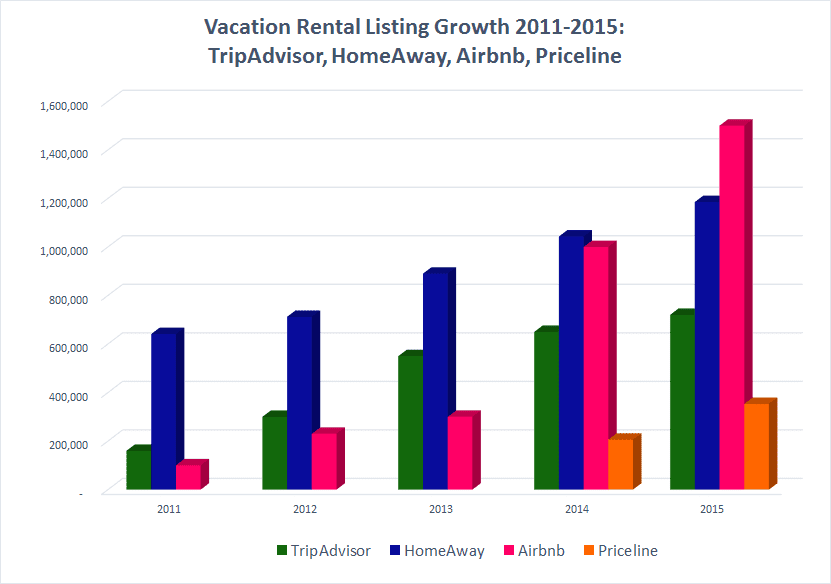
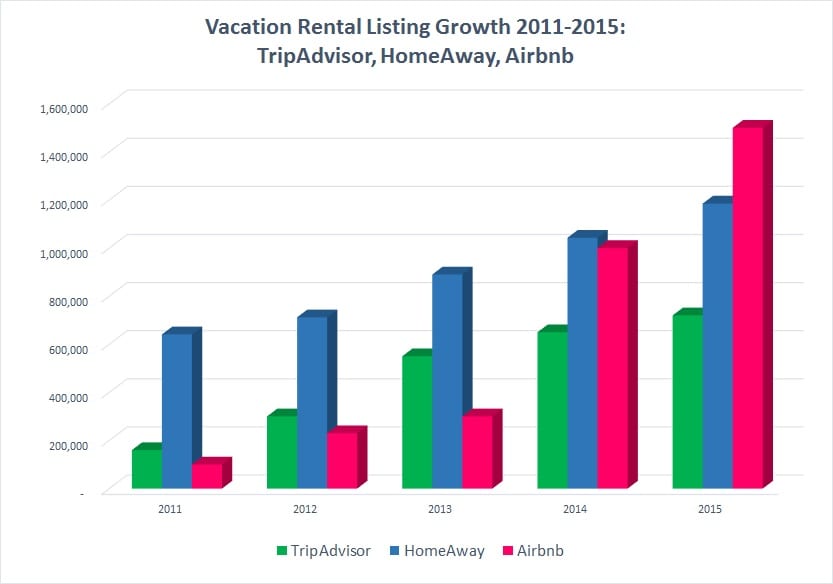
Over the last few years, TripAdvisor Vacation Rentals (TAVR) has grown from 160,000 listings to 720,000 listings since 2011.

The chart below compares vacation rental listing growth with HomeAway and Airbnb.

Vacation Rental Listing Growith for Airbnb, HomeAway and TripAdvisor -VRM Intel


In 2015, while HomeAway remains on focused private whole home vacation rentals, both Airbnb and TripAdvisor are attempting to address both whole home vacation rentals and shared space short term rentals.

There are key differences between Airbnb and TripAdvisor Vacation Rentals.

1. Airbnb offers a single, uniform transactional pricing model for vacation rental managers, individual homeowners and hosts offering shared accommodations.

TAVR offers different pricing models:

  • For professionally managed vacation rental homes:
  • Subscription (negotiated between TAVR and PMs)
  • Pay Per Lead (a model HomeAway phased out this year)
  • 7% transactional model
  • For individually managed homes and hosts offering shared space accommodations, TAVR implemented the same transactional pricing that Airbnb offers (3% + a Guest Fee).

2. Airbnb first solidified its core market of hosts offering shared private residence accommodations before adding resources to work through technology initiatives to attract professionally managed homes. In contrast, TripAdvisor is simultaneously overhauling its technology platform, moving into Airbnb’s shared space, and trying to manage support and service issues for owners and managers with a bootstrapped team.

3. Airbnb’s competitive advantage in the shared accommodations market is that hosts do not have many alternatives for listing shared accommodations. In contrast, professional vacation rental managers have several other viable options, including HomeAway, Airbnb and others.


TripAdvisor’s Corporate Direction with Vacation Rentals


Even with the fast growth in the vacation rental industry, TripAdvisor CEO Stephen Kaufer sees building its attractions business as a more appealing sector (outside of hotels).

In TripAdvisor’s Q2 2015 Earnings Call, Kaufer said, “Our three-to-five year growth initiative is to further improve the user experience by helping more consumers around the globe find and book attractions, restaurants and vacation rentals and to reinforce our leadership position in these categories. Perhaps, our biggest opportunity to do this is in attractions.”

Kaufer also said:

In vacation rentals, our ongoing shift to a transaction-based model continues to progress nicely. Users can choose from more than 720,000 properties and we continue to focus on adding more high-quality inventory. We’re also in the process of refreshing our owner center, creating a simpler, more engaging and unified experience.

The financial benefits continue to shape up nicely as transaction revenue accounted for more than 50% of our Q2 vacation rentals revenue. We like where we are in our shift to the transaction model as it is beneficial for travelers and homeowners alike.

So we expect the hotel space to migrate towards transaction, but where I see vacation rentals being in the future, I would expect it to be almost all transaction oriented. I think hotels will remain split for the foreseeable future.


Competing with Airbnb in Shared Accommodations


TripAdvisor is now shifting to courting the lower-end shared home space in an attempt to compete with Airbnb, as reported last week by Skift.

According to Dennis Schaal at Skift, TripAdvisor’s “Flipkey unit has been quietly adding Airbnb-style room rentals to its existing portfolio of vacation rentals.”

Commenting on the initiative, TripAdvisor spokesperson Laurel Greatrix told Skift: “This is a very recent addition and it means that any homeowner, anywhere in the world, can now list their spare room for free through TripAdvisor Vacation Rentals (just as they can an entire property). Travelers will see spare rooms listed in their search results alongside other properties (houses, apartments, villas, condos, etc.) available in the area they’re looking at.”

According to HomeAway CEO Brian Sharples last week in their earnings call, “It seems like TripAdvisor has changed their strategy several times in the past few years. They appeared to be trying to move much more towards an Airbnb-type model.”

While TripAdvisor is chasing Airbnb’s shared space accommodations model, Airbnb is working to establish relationships with professional vacation rental managers via integrations with LiveRez, BookingPal, LeisureLink, Barefoot and others.

What industry observers find baffling is that TripAdvisor already had a solid base with the professional suppliers that Airbnb is seeking. Yet TAVR is dismissing this competitive advantage with attempts to chase after Airbnb’s clientele.


Part 1: TripAdvisor Issues: What’s going on with TripAdvisor?

Part 2: TripAdvisor Issues: More support issues, rate parity, discriminatory policies, and the negative impact for vacation rental managers

Part 4: Response from TripAdvisor to issues and vacation rental managers unite to address concerns

Click here to get a pdf of the combined series of TripAdvisor Issues articles


>>Letter from Property Managers to TripAdvisor CEO Outlining the Issues with Vacation Rentals


By Amy Hinote

Providing excellent customer service by Ali Cameletti

0
Concierge Services for Vacation Rentals

By Ali Cameletti,  –Some people may feel excellent customer service is smiling often and asking them how their day is going. Others may feel it is going above and beyond, such as sharing insider knowledge about secret beaches in the area or a home that includes beach passes that usually cost $20 a day per car.

What we are really talking about is managing customers expectations so the service they receive is perceived as excellent. The question is: How do you, as a company, ensure that customers walk away saying, “Wow, that was excellent service!” so much so that the customer decides to write a review or make a post on social media?

My recommendation is to implement “Surprising and Delighting” as described in Dave Kerpen’s book, Likeable Business. Surprising and Delighting is another level of service that requires a very active listener who strives to under promise and over deliver. Following are some examples of what this could look like for a vacation rental management company:


First Scenario

The potential customer is looking for a vacation rental, yet has not made a decision and needs to go back and talk with the rest of the group. Instead of just waiting for the potential customer to shop your competition, ask to set up a time to follow up with them by phone and answer any additional questions the group might have.

It is very surprising how many customers embrace this type of follow up. After hanging up, take the time to send them an email with details of the conversation and suggested rentals as well as what is going on in the area while they are visiting. This sets the tone for how their vacation experience will be, showing that it will be easy and seamless to make the reservation and then will be the same once they arrive. It always starts off with the first impression.


Second Scenario

The caller shares that they are flying from the East Coast to the West Coast and arriving late at the vacation rental. The reservation sales agent is then able to offer from their concierge service a delivery of food already in the refrigerator, for some late night snacks when they get in or even a few breakfast items, until they have time to go grocery shopping. Even if the customer is not interested, a simple gesture of some coconut water for dehydration from traveling and a few Emergency packets so they get their morning off to a healthy start.


Third Scenario

The caller shares that their group coming to stay will be driving back and forth to a nearby city and is concerned about traffic. Of course on the phone, there are helpful tips given. Then as a surprise and delight, the company leaves in the home a map of the area with the city they will be driving back and forth to, with highlighted routes to use to avoid traffic and the best times to travel those routes.


Fourth Scenario

The caller shares that they are coming to do some fishing in the area. When they arrive they are greeted by a few fliers on great fishing holes, along with a hand written note on some secret fishing spots and then some secret fishing bait in the refrigerator.


A fun activity for companies is to have a meeting where the staff gathers to discuss different customer profiles and how to surprise and delight each customer profile with a simple touch to make their experience pleasurable.

My favorite story of excellent customer service was about a customer who frequented a hotel and was a serious Coca-Cola drinker. The next time he checked in to his hotel, there was a six pack of Coca-Cola waiting for him in the room with a note that they appreciated his business.

A true leader always keeps an element of surprise up his sleeve, which others cannot grasp but which keeps his public excited and breathless. Charles de Gaulle

I encourage you to find ways to surprise and delight your customers!


Increase your Revenue with Lifecycle Marketing

0
Predicitve Purchase or Booking Path

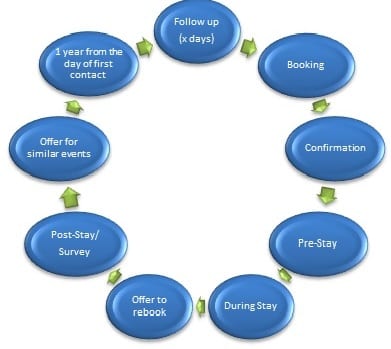
Lifecycle Marketing is the practice of communicating relevant information with prospects and customers according to their behavior or interaction with your business with the objective of delivering the right message to the right audience at the right time.

The most valuable and cost-effective tool in lifecycle marketing is the use of automated or triggered email messaging, a.k.a. Lifecycle Messaging.


lifecycle messaging for Vacation rental managers

By setting up triggered/automated lifecycle email messaging, you can segment and communicate timely, relevant information to leads and guests according to:


  • Customer status
  • Purchasing habits
  • The amount of time guests/leads have been engaged with your company
  • The amount of time guests have been staying in your properties
  • And much more!


Build deeper, more substantial relationships and encourage future stays by sending relevant, useful and timely information based on customer behavior.

How Lifecycle Messaging works

Lifecycle Messaging assumes certain segments of your guests follow a somewhat predictive booking path at your properties.

Predicitve Purchase or Booking Path


Different customer segments have varying purchase behavior (i.e. large groups require more planning time, and couples within 150 miles are more capable of making last minute trips.)


5 Steps to Setting up your Lifecycle Messaging Strategy


1. Identify customer segments

2. Use your data to analyze common purchase paths

3. Create an email communications strategy

4. Automate email messaging

5. Test and track


Let’s look at these steps more closely.


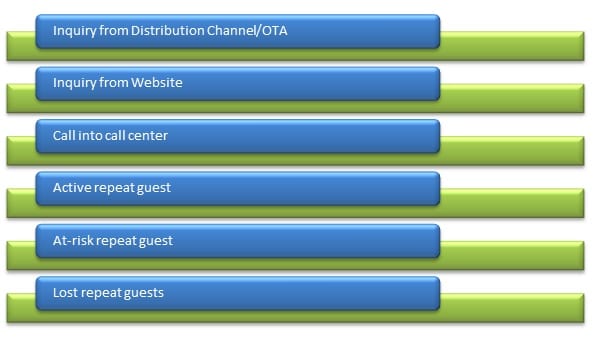
1. Identify customer segments. For leads, identify the marketing channel.

Segments for Triggered Messaging for Vacations


2. Analyze the common purchase path for that group.

Booking Path

3. Create an email communications strategy with meaningful messages which reaches the customer at critical points in their booking and re-booking path (i.e. research, planning, decision, reservation, stay, rebooking, re-engagement).


4. Automate email messaging with timing based on behavior.


Lifecycle Cycle


5. Test and track.

There are several variables in email marketing that can always be tested and optimized, and you never want to make a mistake like having a broken link in one of your best performing campaigns. Make sure you are revisiting your automated lifecycle campaigns on a regular basis.

Here are a few tips that will allow you to continue to optimize these automated lifecycle campaigns and have them perform even better for you:


  • Test Subject Lines
  • Update Creative
  • Update Content
  • Test Timing


Once you start setting up your Lifecycle Messaging, you will have capacity to get more creative with other Lifecycle campaigns, such as a birthday triggers, events, anniversary triggers, customer status triggers, etc., to foster higher engagement, not to mention brand and customer loyalty because the content is relevant and timing is based on a subscribers’ action or inaction.

By Amy Hinote

Coldwell Banker Vacation Rentals Proposes Alternative to Ocean City’s Planned Short Term Rental Restrictions in R-1 District

0

OCEAN CITY – MD Coast Dispatch –The Mayor and City Council agreed Tuesday to explore further an alternative suggested to the proposed R-1A district that has the backing of the local real estate industry.

Chris Mitchell of Coldwell Banker Vacation Rentals came before the council to present alternative concepts to help control rentals in R-1 Single-Family Residential District as opposed to the proposed R-1A district that would ban rentals shorter than one year from the neighborhoods.

If an R-1A district is added to the code, a neighborhood can apply to be rezoned and a public hearing would be held before the Planning and Zoning Commission to consider the request. The commission would then forward a favorable or non-favorable recommendation to the council for the final decision.

The council discussed the proposed R-1A district last month and agreed for the concept to be included in the upcoming update of the Comprehensive Plan but wanted other solutions to come forward in the meantime.

In response, Mitchell met with Mayor Rick Meehan, Zoning Administrator Blaine Smith and License Inspector Mike Sherman to discuss alternative measures.

“It came to light the best thing we can do as an industry and as a town is to focus more on occupancy levels,” Mitchell said.

Currently, R-1 zoned properties are restricted to be rented to no more than four unrelated people, Mitchell stated. It is difficult to enforce this rule as there is no easy way to obtain information on the familial status of occupants at the property. Therefore, it is more important to ensure that the property is being properly marketed by the owner and/or rental company and that the property’s maximum guest occupancy is within the limits of Ocean City.

Mitchell suggested creating a separate Rental License Application for properties located within R-1 zoned areas that wish to do short-term vacation rentals. Current R-1 zoned properties renting for 12-month periods would not be subject to the revision.

In doing so, require the property owner to list the total number of occupants for which they will advertise the property and have the property inspected to ensure that the desired occupancy complies with the Standard Housing Code International Property Maintenance Code, as detailed on the current Rental License Application. If the inspection reveals that the occupancy exceeds the established guideline, the property owner will be informed the occupancy limit must be changed or the license application will be denied.
Also, Mitchell’s proposal suggested increasing the Rental License Application fee for R-1 zoned properties from the current $141 to $191 and use the additional $50 as an inspection fee to control the costs of the onsite inspection by the town. He suggested a master list of all R-1 zoned rental licenses be maintained as a public record and available on the town government’s website, allowing other owners in the community to know which properties are being marketed, what the assigned occupancy limits are and who the contacts for the property are in case of an issue.

Mitchell furthered another change could be requiring from the property owner information how they market their property, either the rental company they use or if they market their own, and what form of marketing, including rent-by-owner websites, they use. This will allow the town to verify that the property owner is in compliance with the approved occupancy limit and that it states clearly that no more than four unrelated persons can occupy the property during the rental period. Property owners would need to disclose that the property is located in an R-1 zoned area to their rental company and to potential renters on both their marketing materials and rental agreements.

Additionally, this will provide the town with additional contact for who is representing the property if problems arise. The “emergency contact” section of the current Rental License Application may not give the rental company used, if the owner chooses someone else as their emergency contact.

The final suggestion is to implement a system of warnings and/or fines to the property owner in the event there is a failure to comply with the required occupancy limits.

If the property is found to be marketed for more than the agreed upon occupancy as issued with the license, the Town of Ocean City could send a warning notice for the owner to cease and desist in their marketing within a specific time period or face fines and/or revocation of their rental license. A lack of response or complaint would result in the fining system and revocation until such time as the fines are paid and the marketing is corrected. If an actual rental at the property is found to be exceeding the agreed upon occupancy, and the owner takes immediate action to the correct the problem, the incident can be recorded as a warning. If no action is taken and the property is over occupied, the town could suspend the rental license and require the renters to vacate due to code violation.

Mitchell proposed the property owner could be fined to cover the town’s expenses associated with in-season actions and fines could be escalated based on how many complaints are received. For example, first offense could be $200, second offense $500, third offense $1,000 and the revocation of the rental license for the remainder of the year. The town will promptly notify owner, owner’s emergency contact and/or rental company if any violations are reported and/or rental company if any violations are reported and/or confirmed at the property.

In researching the matter, Council Secretary Mary Knight found that neighboring resorts of Virginia Beach and Rehoboth Beach are struggling with the same issue and are considering legislation similar to the proposed R-1A district.

“We are at a point to decide whether or not Ocean City wants to be a tourist destination or remain a family-residential community. I think you need buy-in from those people who have signed the petition and other organizations. My major concern is there has been no communication between the rental agencies,” said Knight.

If the recommendations were to be implemented, the town’s application process and database would have to be reformatted with an unknown cost at that time.

As a member of Coastal Association of REALTORS® (CAR), Meehan vented his frustration that after the public hearing over a year ago the organization didn’t come forward with a solution.

“In my opinion, they let it go by thinking it would fix itself, and it didn’t,” the mayor said. “There are some things here that could be very helpful … This is a difficult issue and a balance to be upheld here. We want to ensure we protect the sanctity of R-1 areas, and we hold them in very high regard, but there are also a lot of people in the R-1 areas that buy properties to use on a part-time basis until they move down here to retire. The situation as it exists today is not working, and if we had this in place now we would be in a better situation today then we are in the moment. It deserves consideration, and I would hope the council would try to develop it not as an alternative but as part of the solution. There is a lot at stake here.”

Councilman Wayne Hartman agreed the suggestions are a good first step but not as an alternative.

“I don’t think people in the R-1 should have to go through three offenses. You are being disturbed and that is not what you expect when being in a R-1 neighborhood,” he said.

Councilman Dennis Dare made a motion the license inspector review the suggestions, and work with the zoning administrator, city solicitor and city manager to bring a proposal back to the council as soon as possible for consideration. The council voted unanimously to approve.
Following Tuesday’s discussion, CAR released an official statement supporting Mitchell’s suggestions.

“The concept was approved for endorsement by the CAR Board of Directors as a means to address short-term rental concerns voiced by some homeowners in Ocean City’s R-1 Single Family Home Zoning Districts,” the statement read. “A majority of Ocean City’s rental agents are not members of CAR, therefore it was prudent the association find a rental industry partner prior to suggesting an alternative R-1A concept.”

CAR Board member Joe Wilson added, “CAR’s interest in this matter lies with the ability for consumers to buy and sell investment properties in those neighborhoods. We are so fortunate to find a strong partner in Chris Mitchell of Coldwell Banker Vacations who can tell us what the rental industry is willing to do in order to address the concerns of those who support restrictions. We hope this concept is a first step toward the eventual resolution of this matter.”

NYT: Airbnb Horror Story Points to Need for Precautions

0

Early in the evening of July 4, Micaela Giles’s mobile phone started sounding alerts, and a series of messages straight out of a horror movie began scrolling down her screen.
Her 19-year-old son told her that his Airbnb host in Madrid had locked him in the fourth-floor apartment where he was supposed to be staying and removed the key. The host was still there, he said, rattling knives around in the kitchen drawer and pressing him to submit to a sexual act. He begged his mother for help.

When she called Airbnb, its employees would not give her the address and would not call the police. Instead, they gave her a number for the Madrid police and told her to ask the police to call the company for the address. But the number led to a recording in Spanish that kept disconnecting her, she said, and when she repeatedly called back her Airbnb contact, the calls went straight to voice mail.

According to her son, Jacob Lopez, he was sexually assaulted that night. Eventually, he persuaded his host to free him. He returned home to Massachusetts and is in trauma therapy.

Credit Gretchen Ertl for The New York Times

His host, who was born male but is living as a woman, denied Mr. Lopez’s accusations. She denied threatening him and said that the sex act was consensual and that he is transphobic. If she is right, filing a false police report and telling the story publicly would be an unlikely way to bury a regrettable experience.

But the central question here is for Airbnb: Just how much responsibility is it willing to assume for the safety of its customers? It refers to them as guests and promotes its security measures and hospitality. But its employees made a choice here that a hotel might not make in similar circumstances. Rather than sending someone to check on Mr. Lopez, Airbnb put the onus on his mother to make that happen.

Airbnb, Uber and their ilk have managed to get people to refer to them as pioneers of something called the sharing economy, a neat trick given that they are in the business of renting out rooms and charging for rides.

What they do share, however, is risk. As I’ve pointed out in previous columns, insurance companies aren’t always fond of everyday individuals running inns out of their apartments and driving people around for money. And an Airbnb listing may not mention the dog that will try to chew off your arm if you get too close, as I chronicled in April.

Still, logic and decency would suggest that when you’re in danger, as Mr. Lopez claimed to be, Airbnb would come to your rescue. And in the wake of this episode, Airbnb said on Friday that it was clarifying its policies to make sure that its employees know to always call the police when someone reports an emergency in progress.

Mr. Lopez found himself in Madrid in the first place because he had such a great experience with Brazilian Airbnb hosts in 2014. His Madrid host told him to meet her at a subway exit near her residence.

When they arrived at her apartment and she locked them in, he said, she repeatedly tried to kiss him. He rebuffed her, and then she ordered him to take off his pants unless he wanted to sleep in the streets without his belongings, he said. As these events unfolded, he began messaging his mother, though by the time his mother realized that Airbnb would not give her his address and that she had to get it from him, he said, his host had cut off Internet access.

His host, meanwhile, began rattling around in the kitchen drawers, and Mr. Lopez said he feared that she had a weapon and concluded that the choice to leave was not a real one. After the sexual assault, it was not clear whether she would let him go, he said, and he began looking around for something that he could use to hurt her so that he could escape.

“I was telling myself that I was going to have to kill her or she was going to kill me,” he said. “Thoughts that should never have to go through anyone’s mind started to come into mine. How are you going to live with yourself the rest of your life knowing that you killed someone? But if you don’t, then you won’t have a life.”

He chose not to try to fight his way out and eventually concocted a story about plans he’d made to meet friends nearby. Those friends knew where he was staying, he told his host, and they would come for him or call the police if he did not meet them. This scared her enough that she let him leave with his belongings.

Mr. Lopez’s description of the episode, which he gave to me in a three-hour interview at his family’s home, matches the one he gave in his police report. The Madrid police would not comment on the investigation, though his host said that they had already visited her and that she expected to be exonerated.

According to Airbnb, this was a unique situation on a weekend when 800,000 people were staying worldwide with an Airbnb host. A number of the company’s safety procedures came into conflict. On one hand, Airbnb wants sexual assault victims to be able to decide for themselves when, how or if to report a crime. On the other, the company wants to report crimes in progress when customers are in danger and will turn over information quickly if the police request it.

In this instance, Airbnb’s employees believed that the assault had already taken place, according to Nick Papas, a company spokesman. Ms. Giles said she warned of an imminent assault when she first called but later, after hearing from her son, told the company that it had already happened.

“We realize we can learn a lot from this incident and we can do better,” Mr. Papas said by email. “We are clarifying our policies so that our team will always contact law enforcement if we are made aware of an emergency situation in progress. Safety is our No. 1 priority, and we want to get our hosts and guests as much help as possible.”

This brings their policies closer to what a hotel might do in a similar situation. At Starwood hotels, which include the Westin and Sheraton brands, hotel operators often get requests from third parties to look in on a guest. According to a company spokeswoman, K.C. Kavanagh, the hotel does not tell the caller whether a guest is staying there but does immediately send security or other staff to investigate. “If we reach the person, we let them know they should contact the concerned loved one,” she said.

A spokesman for HomeAway, another short-term rental company, declined to comment about its policies in such situations.

Mr. Lopez’s family had a few suggestions for other Airbnb travelers. The guest and a family member or friend should always have the host’s address easily accessible. Make sure your phone has international service and that you know how to call the local emergency number; Mr. Lopez did not realize his phone would allow him to call and said he would have been scared to speak out loud into the phone in any event. Also, a few details on his host’s profile did not match her Facebook page. In retrospect, he wishes he had been more suspicious, even though he said that she had good reviews on Airbnb. The listing has been removed.

Cindy Southworth, an executive vice president of the National Network to End Domestic Violence, who serves on an advisory board for Airbnb, suggested a question that travelers should ask. “Is there a deadbolt that only I can turn,” like the locks and latches in hotel rooms. It’s probably also worth asking — or at least looking — to see if a host or someone else could lock you in.

The company’s clarification of its policy, meanwhile, should help, too. “I’m so proud of Jacob’s courage,” his mother said. “And as a family we’re thrilled about the change.”

Vacation Rental Pros Expanding and Hiring

0

VacationRentalPros.com, one of Florida’s largest and fastest growing vacation rental companies, today announced record breaking revenue, a new, larger headquarters, and creation of seven new positions within the company.

“After record revenue growth over last year, and some exciting announcements yet to come, we’re taking several steps to position the company for even more rapid growth,” said Steve Milo, founder, owner and president of Vacation Rental Pros.

After several acquisitions allowed the company to expand into Southwest Florida and Orlando last fall, revenues are up by 54% over the first six months of 2014.

To address the current growth and prepare for additional expansions in the near future, Milo’s company purchased and moved into a new 10,000 square-foot office space in Ponte Vedra, and announced the creation of seven new positions, including several manager and assistant manager positions, a social media marketing position, and more. The complete job listings are posted at https://www.vacationrentalpros.com/jobs.

“Vacation rental owners want a management company that can deliver world-class customer service while maximizing their rental revenue, ” Milo said. “The steps we’re taking now will help us continue to deliver both for years to come.”

Vacation Rental Pros Property Management LLC is a residential rental property management company founded and led by Steve Milo. The company, which started with just 10 residential properties, has since grown to over 900 properties under management and manages locations across the state of Florida.

Vacation Rental Pros offers an easy-to-use booking website with property descriptions, thousands of guests reviews and photos, and 100% secure checkout. The company offers a knowledgeable customer service staff who are available by phone and email, even on weekends.

Part 2 -TripAdvisor Issues: “Reviewing TripAdvisor Vacation Rentals”

0

In “What’s Going on With TripAdvisor: Part 1” we discussed a sampling of the complaints vacation rental managers are reporting about TripAdvisor Vacation Rentals (formerly known as FlipKey).

In Part 2, we examine additional problems experienced by vacation rental managers in recent months, along with the reported lack of rate parity between professional managers and individual homeowners and the ways TripAdvisor handles vacation rental reviews differently than hotels, restaurants and attractions -along with the negative impact of these issues on vacation rental management companies.

Part 1: TripAdvisor Issues: What’s going on with TripAdvisor?

Part 3: Where is TripAdvisor heading with vacation rentals, and how do they stack up against the competition?

Part 4: Response from TripAdvisor to issues and vacation rental managers unite to address concerns

Click here to get a pdf of the combined series of TripAdvisor Issues articles


More customer support and technology issues


Like Justin Ford, Amy Gaster, co-founder of Tybee Vacation Rentals in Tybee Island, GA, recently decided not to renew their contract for over 200 property listings with TripAdvisor.

“We are taking a risk by not having a presence on one of the largest travel websites in the world,” said Gaster. “It was a difficult business decision. We have been spending over five hours per week just trying to get our issues resolved with TripAdvisor. But with no response from support, no way to talk to someone, and no resolution to our laundry list of issues, we were forced to pull our listings.”

Tybee Vacation Rentals sent the following email outlining their complaints to TripAdvisor -before making the decision not to renew their contract -in a final effort to get a response from anyone on their team who might be able to help resolve their list of issues.

To whom it may concern:

I have yet to have been able to make contact with anyone regarding the potential of renewing our advertising agreement. Despite being long time customers and having always had an individual account manager who would personally call to negotiate our renewal, we have been without one since Connor Gavigan’s departure in February. As you can see from the generic email sent to us on May 10th it seems as if your company doesn’t even realize he is no longer there given he is who is listed as the contact.

At this time our company is not planning on renewing our advertising agreement due to the persistent communication issues and functionality problems with the API. These include issues with activating and deactivating listings, managing reviews, rates, calendar updates, etc.

Despite being assured that with our switch to V12 that we would have a fully functioning API feed we have had nothing but continual issues. I would assume that your company would take seriously issues of this magnitude – as I can assure you having our staff continually being berated due to incorrect listing data is not our goal in advertising with FlipKey/TripAdvisor.

Unless we can resolve all distribution issues as well as increase communications, as mentioned previously, we will be forced to seek out other listing distribution options. Please provide me with an updated account manager so that we can discuss in detail.


Another large vacation rental management company owner in Florida, who wished to remain anonymous, said, “While I respect and admire the ambitious vision of Stephen Kaufer and TripAdvisor to create a transactional marketplace for the vacation rental consumer, the actual execution from the Vacation Rental division is one of utter incompetence and chaos.”

He continued, “The problems with that division start with Dermot Halpin, President of the Vacation Rental division and extend to Tracey Zhen the General Manager – both of whom are masters at the lack of truthfulness to its clients in terms of technical problems, content integrity and pricing issues. The chaotic culture and abusive culture towards clients has led to a revolving door of experienced employee departures which has further exasperated the issues. Until the issues with senior management at Trip Advisor are addressed, the vacation rental division will continue at a rapid pace to ruin its previous good will among large property management companies in the industry.”

With the reported ongoing issues, a group of professional vacation rental management companies have united to write a formal complaint about the poor service and support at the Vacation Rentals Division to TripAdvisor CEO Steve Kaufer.

(If you would like to be included, contact us, and we will send your name to the organizer.)


Rate differences for professionally managed and owner managed vacation rentals


Like most online vacation rental marketplaces, TripAdvisor is moving to a transactional business model, charging homeowners and managers a percentage of the transaction (and in some cases, an additional fee to guests).

According to TripAdvisor CEO Stephen Kaufer in last week’s Q2 2015 earnings call:

In vacation rentals, our ongoing shift to a transaction-based model continues to progress nicely. Users can choose from more than 720,000 properties and we continue to focus on adding more high quality inventory. We’re also in the process of refreshing our owner center, creating a simpler, more engaging and unified experience.

The financial benefits continue to shape up nicely as transaction revenue accounted for more than 50% of our Q2 vacation rentals revenue. We like where we are in our shift to the transaction model as it is beneficial for travelers and homeowners alike…Where I see vacation rentals being in the future, I would expect it to be almost all transaction oriented.


However, TAVR is charging a 7% transaction fee for professionally managed listings while they are charging homeowners only 3% -with an additional percentage to the guests (mirroring Airbnb’s model for individual homeowners).

While TripAdvisor Vacation Rentals currently offers subscription pricing and Pay Per Lead pricing (a model that HomeAway phased out this year) to property managers, the difference between transactional rates for vacation rental managers and vacation rental homeowners has angered some property managers.

As part of a response sent to VRM Intel from TripAdvisor Vacation Rentals GM Tracey Zhen, said:

While property managers always have and will remain a fundamental part of what we do, another key change this year and last has been our increased focus on homeowners as demand to list independent properties continues to rise sharply in the vacation rental market. Property managers – which have sometimes thousands of properties and require account managers, custom technical integrations and more – have different requirements to independent homeowners. We’ve set our rates to match these requirements, and these rates are very much in line with industry standards.


See Tracey Zhen’s full email.


Difference in treatment of vacation rentals vs hotels, attractions, and restaurants

On TripAdvisor, vacation rental reviews are only seen if that vacation rental owner or manager pays to list the property on the site, while reviews of hotels, restaurants and attractions are visible regardless of a monetized relationship with the supplier.

“If you are a hotel, your hotel gets listed on TripAdvisor regardless of whether or not the hotel pays for advertising,” said Gaster. “However, if you want your rental home listed for reviews, you have to pay. Vacation rentals are treated very differently by TripAdvisor. As soon as I stop paying for my homes on TripAdvisor, my 3,000 reviews go away too. Our vacation rental travelers have lost their voice.”


Negative impact for vacation rental managers

With the recent high turnover, TAVR’s new employees may not fully understand the impact their technology shortcomings and lack of response has on a vacation rental management company. While the frustration levels are high and PMs are forced to divert time and resources to address issues with TripAdvisor listings, property managers are experiencing more critical consequences from the problems at TAVR.


Impact on the PM business and their relationships with homeowners

First, vacation rental managers are service providers for homeowners, and providing listings on marketing channels (such as TripAdvisor) is part of that service. When the home listings are inaccurate, property managers receive complaints in the form of angry emails and phone calls from the homeowners they represent. The relationship with TripAdvisor directly affects the relationship the manager has with the homeowners. The issues are causing a reported loss of business, revenue and good will for vacation rental management companies.


Legal issues with the misrepresentation of vacation homes

Second, there are legal concerns with misrepresenting a home or advertising a home not under management, and in several U.S. states, it is illegal to advertise a rental home without a contract with a homeowner.

One vacation rental manager ended a contract with a homeowner and removed the property from his software system, but the home remained on TripAdvisor. “We couldn’t get them (TAVR) to take it down,” said the manager. “After many heated discussions with the homeowner, they eventually sent us a letter from an attorney threatening to sue us. It wasn’t until we sent the attorney’s letter to TAVR that we were able to get any response.”


As TAVR service and support issues escalate, vacation rental managers are being forced to remove their listings from the TripAdvisor platform to avoid negatively impacting their own business performance and relationships with their homeowners. The cost is that thousands of reviews disappear along with the listings, as vacation rental reviews only appear on TripAdvisor for paid listings.


Series:

Part 1: TripAdvisor Issues: What’s going on with TripAdvisor?

Part 3: Where is TripAdvisor heading with vacation rentals, and how do they stack up against the competition?

Part 4: Response from TripAdvisor to issues and vacation rental managers unite to address concerns

Click here to get a pdf of the combined series of TripAdvisor Issues articles


>>Letter from Property Managers to TripAdvisor CEO Outlining the Issues with Vacation Rentals


By Amy Hinote

TurnKey Vacation Rentals Raises $5 Million

0

TurnKey Vacation Rentals, one of the most talked-about new business models in the vacation rental industry, received another $5 million in funding last December, bringing their total capital raise to $10 million. This round of funding was not announced in the media, as TurnKey has a history of not disclosing details about their model to the media, avoiding industry panels, and turning down speaking engagements over the last two years. However, when recently asked specifically about their funding, TurnKey confirmed they had completed the $5 million funding round in late December of last year.

According to John Banczak, Co-founder, “Yes, we did complete an additional funding round. The business has really taken hold with HomeAway and Airbnb owners, and we’ve used the money to expand from three markets a year ago, to over twenty this summer. It wasn’t meant to be a big secret, but at the same time, announcing funding isn’t something that matters a whole lot to our customers, so we didn’t feel the need to make a big deal of the last round in the press.”

TurnKey’s funding comes mainly from Silverton Partners, based in Austin, TX, and from some of the biggest names in travel and the internet – Rich Barton (Founder of Zillow, Expedia, Glassdoor), Barney Harford (CEO of Orbitz), Gregg Brockway (Hotwire, Tripit founder), Karl Peterson (Hotwire founder, TPG), Spencer Rascoff (CEO of Zillow) among others.

The largest funding by far in the category has gone to OneFineStay ($80 million), a company similar to TurnKey in a lot of ways, that is focused on the ultra-luxury segment currently operating in four cities. TurnKey has emerged as the most heavily-funded of the remainder of the companies providing management services to vacation homeowners. TurnKey refers to themselves as both a branded guest experience, and an “owner service provider.”

Banczak said, “TurnKey focuses on the upper half of the market, not just the top 1% that OneFineStay does.” Other upstarts include companies like Pillow Homes that just received $2.65 million funding in January, and Guesty that received $1.5 million a year ago – although both focus more on the Airbnb partial-availability homes. Vacasa, once a traditional property manager focused on the Oregon area, has also expanded significantly around the country and remains self-funded.

By Amy Hinote

Are vacation rental companies overvaluing themselves?

0

As Airbnb siphons $1 billion from the investment community with a fresh $25 billion post-money valuation, companies in the high-profile vacation rental industry are planning to cash in their chips.

But as Kenny Rogers says, “You never count your money when you’re sitting at the table…”

HomeAway has built its empire through acquisition, but in the last year the company has slowed in purchases of new companies. In HomeAway’s Q2 2015 Earnings Call, CEO and Chairman Brian Sharples was asked about this shift.

His response was, “I think it’s safe to say that the reported valuations of Airbnb have gone to the heads of every small entrepreneur in the world that has something that looks like a vacation rental site.”

Sharples added, “So when we go and look at new growth businesses that seem to be exciting in our category, it used to be very easy for us, because we’re essentially the only buyer, and we could buy on the basis of a multiple of cash flow. Most of the young companies in new geographies, A) don’t have positive cash flow, and B) have very high valuation expectations.”

As a leading transaction advisor for vacation rental management companies, Ben Edwards, President of Weatherby Consulting, echoes the HomeAway leader’s sentiment. “Relative to vacation rental companies, an incorrect valuation, not only sets the wrong expectations, it may identify probable issues associated with the sale of a vacation rentals business.”

Ben Edwards explains:

As vacation rental managers position their company for sale, many valuations are not credible, depicting unrealistic earnings or elevated multiples of EBITDA.

As with the sale of any business, company owners want to maximize value. In the vacation rental industry, that is done through a clear and calculated valuation that depicts a market-rate value for the business…a value that is competitive compared to other vacation rental transactions -and not faux earnings or a lofty, unsubstantiated multiple of earnings.

Companies that shoot high, often have other areas of the business that may not reasonably represented, highlighting probable issues associated with a further transaction. The goal for the seller in selling their company should be to set clear expectations and avoid concerns associated with an incorrect valuation. Getting a market-rate assessment of the business from an expert is advisable. Most professionals charge either a nominal fee or will perform a complimentary assessment of the business.

Extend Your Booking Season!

0

Looking for a great way to fill slow periods, promote your brand, save time, increase revenue (and help some great causes)?

Consider posting off-season vacation certificates that are promoted at black tie fundraising events. Setup takes 10 minutes (no software integration required!).   Geronimo’s automated solution handles everything and you simply provide your typical great service on the back end. Post a few photos, valid off-season dates and your max retail rate and voila!.. you’re all set.

There are over 600,000 black tie fundraising events in the US each year and vacations are by far the most popular items offered. These events have proven to create demand for off-season vacations, so why not leverage that demand to your advantage. Every day, Geronimo receives many requests for off-season vacations at properties like yours.

Geronimo has launched its TravelPledge brand for non-profits and already over 3,300 non-profits have private label TravelPledge sites that will promote your company. They recently met with all (1500) Habitat for Humanity affiliates.

If you already an account, sign in to your account. If not, get started and create a new property manager account (free).


Geronimo Extend your Vacation Rental Booking Season
Need help posting your certs? Call Amy at 877.265.4273 x700.

Attn: VRMA Members -Vote on Bylaws Change

0
VRMA Seminars

The VRMA Bylaws Committee has proposed changes to VRMA‘s Bylaws to better reflect the association’s core value of inclusiveness while making improvements to VRMA‘s governance structure by bringing our practices more in line with those of other successful national and international associations.

After thoughtful consideration by the Bylaws Committee and the Board of Directors, as well as a thorough review by an our attorney specializing in association law, the proposed changes are now presented to the general membership for review and approval. Specifically, these amendments will accomplish the following:

  • Increased participation by all members in the election process. All qualified candidates who meet the application deadline will be listed on the ballot, with those recommended by the Leadership Development Committee so noted. Elections will then be held in advance of the Annual Conference by way of electronic ballot to ensure that all members have an opportunity to vote on those who will serve on the Board of Directors, rather than only those in attendance at the Conference.
  • Improved focus on education and networking at the Annual Conference. Because elections will be conducted in advance of the Annual Conference, attendees at the Conference will be better able to focus fully on the educational content and networking opportunities provided rather than being distracted by the potential of onsite political campaigning.
  • Improved board leadership planning and continuity. These amendments provide for the introduction of a President-Elect office for the Board of Directors. Doing so not only encourages the Board to consider future leadership proactively, but it provides the president of VRMA the opportunity to better plan for his/her year in office and receive adequate advanced orientation to ensure improved continuity. Furthermore, these amendments provide for the addition of the office of Immediate Past President.  Also promoting improved continuity among Board leadership, this position is limited to the individual who has completed his/her term as president in the immediately preceding year, and his/her time in this office would be limited to one term.


Click here to review the VRMA Bylaws with proposed changes redlined.

As the primary contact for your company’s membership in the Vacation Rental Managers Association (VRMA) you are designated as the single voting representative.

If you haven’t already done so, this is a reminder to cast your vote on the proposed changes click here. Note that the email address to which this notice was sent must be used for your electronic ballot. You will need this email address along with the passwordVRMA” to log into and submit your ballot. Your email address may only be used once, and any other email address will be invalid.

Voting will be open for 30 days, closing at 11:59 pm Eastern on August 22, 2015. A quorum of 25% of our current total company membership is required (currently 170 ballots) to validate the vote and an affirmative majority of the ballots received is required to approve the action in order to pass the Bylaws changes.

VRMA is working with Association Voting to manage electronic balloting. Please add announcement@associationvoting.com to your Safe Senders list to ensure important email communications are not blocked.


If you have questions, feel free to contact me at 317-454-8315 ext. 130 or email Mark@vrma.com.

Part 1: TripAdvisor Issues – “What’s going on with FlipKey/TripAdvisor?” (Pt 1 of 4)

4

Throughout the second half of 2014 and into 2015, vacation rental managers have been reporting a multitude of issues with their listings on FlipKey/TripAdvisor.

From customer service to technology integration flaws and pricing complaints, property managers have been struggling with listing their properties and are questioning TripAdvisor’s dedication and direction regarding professionally managed vacation rentals.

After having all of their listings disappear from the FlipKey/TripAdvisor sites, one property manager sent the following email to their account manager:

An additional 13 days later……… ALL but the one new listing are still missing from TripAdvisor in [confidential location] ALL missing, [confidential location] ALL missing, [confidential location] ALL missing, [confidential location] ALL missing, This now means that [XX] listings have been MISSING FROM THE TRIPADVISOR LIVE SITES FOR OVER A MONTH DURING THE BUSIEST AND MOST PROFITABLE TIME OF THE YEAR.


And this particular issue, along with a dozen others, has been reported for the last 18 months to VRM Intel, so we wanted to know…What is going on with TripAdvisor/FlipKey?


This series of articles covers the following:

  • History of TripAdvisor/FlipKey
  • TripAdvisor’s decline in customer service and technology support
  • Rate parity for professionally managed and owner managed vacation rentals
  • Difference in treatment of vacation rentals vs hotels, attractions, and restaurants
  • Negative impact of issues for property managers
  • Airbnb, HomeAway and TripAdvisor comparison
  • TripAdvisor’s corporate direction regarding the vacation rental industry
  • Competing with Airbnb by offering free listings to shared space hosts
  • Response from Tracy Zhen, General Manager, TripAdvisor Vacation Rentals
  • United effort among vacation rental managers to address concerns with TripAdvisor CEO


Series:

Part 2: TripAdvisor Issues: More support issues, rate parity, discriminatory policies, and the negative impact for vacation rental managers

Part 3: Where is TripAdvisor heading with vacation rentals, and how do they stack up against the competition?

Part 4: Response from TripAdvisor to issues and vacation rental managers unite to address concerns

Click here to get a pdf of the combined series of TripAdvisor Issues articles


History of TripAdvisor/FlipKey


TripAdvisor was founded in February 2000 by Stephen Kaufer, Langley Steinert, and several others. Stephen Kaufer says the original idea wasn’t a user generated social media site to swap reviews. “We started a site where we were focused more on those official words from guidebooks or newspapers or magazines. We also had a button in the very beginning that said visitors add your own review and boy did that just as take off.”

In 2004, TripAdvisor was purchased by IAC/InterActiveCorp. IAC spun off its travel businesses under the Expedia, Inc. name in August 2005.

In August of 2008, Expedia-owned TripAdvisor announced it had taken a majority stake in vacation rental marketplace FlipKey which had 50,000 U.S. vacation rental listings. In perspective – in 2008 -HomeAway had over 250,000 listings.

“Vacation rentals is the hot emerging category in travel and FlipKey has a great foundation and a smart business approach,” said Steve Kaufer, founder and CEO of TripAdvisor about the acquisition. “We believe we can help FlipKey become the leader in the space and, in turn, FlipKey content will satisfy a growing need for TripAdvisor users.”

In December 2011, TripAdvisor was spun off from Expedia in a public offering. FlipKey remained under the TripAdvisor umbrella.

TripAdvisor announced in February 2015 that they are moving away with the FlipKey brand and naming their vacation rental initiatives as TripAdvisor Vacation Rentals (TAVR).


TripAdvisor’s Decline in Customer Service and Technology Support


As most property managers who work with TripAdvisor know, many of the familiar faces in TripAdvisor Vacation Rentals (TAVR), formerly known as FlipKey, have left the company, leaving an apparent hole in knowledge of the industry.

The customer service issues reported by property managers are:

  • Inaccurate listings and inability to correct issues
  • Issues with technology and integration with software providers
  • Expired listings and deactivated listings appearing as active
  • Listings not being removed after the TAVR advertising contract expires
  • Inability to respond to reviews
  • Inability to suppress reviews on manager-owned websites
  • Lack of technical support
  • Poor customer account management and communications

One property manager said, “I’ve talked to several other managers around the country and they all agree FlipKey’s service to property managers is absolutely horrible. When you call their office their voicemails are always full and they’re always traveling around the country. Somebody needs to bring attention to them so they can get their act together.”


Disappearing Listings

Sanctuary Vacation Rentals, located in California’s Monterey Peninsula, saw all of their listings disappear from the TripAdvisor sites in July 2015. The email to TripAdvisor stated, “Last Wednesday (7/15) ALL our listings went offline on our FK Admin site and ALL the live FlipKey and TripAdvisor marketing sites.”

According to an insider, TripAdvisor recently made significant changes to their technology. It is possible that missing or incomplete data fields in integration with software interfaces caused problems, but the lack of experience and industry knowledge in the new TripAdvsior team has made it difficult to identify or address the issues.


Rate Display

A vacation rental manager in Oregon reported, “I have gone down to listing only a few homes. Because their model is to list the absolute lowest nightly rate we have, we get lots of people inquiring who are looking for a cheap deal.  For some reason, they do not understand that rates are higher in the summer season and that the posted nightly rate does not include taxes, fees, etc.”


Erroneous Reviews

In Maine, Justin Ford, owner of On the Water in Maine Vacation Rentals, said, “The biggest issue we had with FlipKey and TripAdvisor (that they both blamed on each other and never fixed) was that a property that had previously been managed by another rental company switched to us for management.  We, of course, listed it on FlipKey as we have a relationship with them. FlipKey ‘identified’ that the property was the same one listed with the previous agency and not only re-attached previous negative reviews for that property to our new listing of it, but they also copied over the horrible responses to those reviews from the previous agency, and attached our logo to those responses making it out that we responded to the negative reviews.”


Ford added, “We spent 6 hours on the phone with FlipKey and TripAdvisor trying to fix it, but neither would. We finally had to change the marketing name of the property and the address slightly to get the negative reviews to disappear.”

Ford received the following response from TripAdvisor:

With our big site migration, that I’m sure you noticed in January, we had a ton of issues and each account manager got quite behind. After February, the team then had two account managers leave and had to start maintaining all their accounts as well. This is by no means an excuse, but I want to make sure you’re aware that, unfortunately, everyone was behind as far as response time goes. Since then we’ve hired two new account managers and have mostly gotten back up to speed. I understand this doesn’t fix the situation you had with slow response rates, but it was definitely an adjustment period here.


Annee Martin, founder of Sanctuary Vacation Rentals in Pacific Grove, CA, also received unsatisfactory responses, and as the summer comes to a close, Sanctuary has still not seen all of their listings return to the sites.

Martin said, “We have been thoroughly disappointed in the fundamental lack of stability in their service and technology. Uptime is something that we have come to expect from marketplaces, and we do not have these issues with any other providers. The folks at FlipKey have developed a business model that is counter to the goals and practices of professional managers. Their current model may be better for RBOs.”

As for Justin Ford…”We were extremely frustrated that no one at TripAdvisor or Flipkey would take any ownership to fix (the issues). We recently ended our relationship with FlipKey.”


Part 2: TripAdvisor Issues: More support issues, rate parity, discriminatory policies, and the negative impact for vacation rental managers

Part 3: Where is TripAdvisor heading with vacation rentals, and how do they stack up against the competition?

Part 4: Response from TripAdvisor to issues and vacation rental managers unite to address concerns

Click here to get a pdf of the combined series of TripAdvisor Issues articles


By Amy Hinote

John DiJulius, Author of The Customer Service Revolution, Interviewed in Vacation Rental Success Podcast

0

Heather Bayer interviewed John DiJulius of The DiJulius Group on the Vacation Rental Success Podcast.

DiJulius talks about his brand new book ‘The Customer Service Revolution’ and how his unique view on customer service applies to the Vacation Rental Business.

Bayer first met DiJulius at the VRMA Annual Conference in San Diego last year and was so impressed by his keynote presentation the she knew he would be a perfect guest for the podcast.

Some of the things John talks about:

  • Why the traditional notions of customer service as ‘defense’ and marketing as ‘offense’ are outdated
  • Why 60% of the words we use with clients don’t need to be said
  • How an ‘angry’ rental agreement can lead to buyer’s remorse
  • If you want to be a world class customer service expert, don’t use policies
  • How getting into the day in the life of a guest will change your perceptions of them
  • How Secret Service works and what the acronym ‘FORD’ means *****(warning – this could increase your bookings)*****
  • Why we need to attract the kids, they are the decision makers
  • Anticipating customer needs and focusing on individual touch points


Here is a slideshare from one of John’s recent webinars.


9 Key Takeaways from HomeAway’s Q2 Earnings Call

0

Today HomeAway reported on second quarter earnings:

  • Second quarter revenue of $125.8 million -up 19.5% versus a year ago
  • Second quarter listing revenue of $99.8 million – up 16% versus a year ago
  • Total listings of 1,185,000 -up 14% versus a year ago
  • Completely transitioned out of the pay-per-lead product
  • 50% of all listings were online bookable at quarter end


9 key takeaways from today’s earnings call with CEO and Chairman Brian Sharples:


1. Focus on Increasing Revenue from Listings

Sharples: In our core subscription business, monetization of our listings continues to improve with average subscription revenue per listing increasing 15% year-over-year FX neutral, and as more of these listings become online bookable, we’ll have opportunities for further monetization growth from ancillary products provided to travelers.


2. Moving From a Classified Model to a Transactional Model

Sharples: Our company, as you know, is transitioning from a classified model to a transactional e-commerce marketplace, and therefore we’re focusing on initiatives to improve both the owner and traveler experience with a goal of obviously increasing bookings. At the same time, we seek to improve overall monetization of transactions from both performance-based commissions on the supply side and revenue from travelers in the sale of ancillary products and services.


3. Ranking Higher in Sort

Sharples: For our platform suppliers more generally, improvements in response rate and adoption of online booking both now factored into sort order are big wins to traveler experience and net promoter score and we feel confident that these will pay off our shareholders long term.

Sharples: Every quarter we get a little bit more aggressive about taking those PPB listings and moving them up in sort. But they are still overall very under exposed, I mean our subscription listings get five times to 10 times the exposure that our PPB listing do.


4. Comparisons with Airbnb

Sharples: Airbnb certainly had a busy quarter. They launched a new campaign, which we actually liked quite a bit, because I think it very much helped the positioning that we’re trying to drive in the marketplace of us being the vacation rental company for families and groups. They obviously completed the big financing, whatever that means, and they started in the U.S. with some efforts with property managers. Although, we don’t really have any indications that’s been successful yet.

Sharples: “We’ve been doing some research in the U.S. and looking at property overlap for Airbnb, and we are surprised that how low it was. We actually did a very thorough job of looking at that and found (the overlap) in the 10% range in the U.S. We’re doing a similar study in Europe, and we do have an expectation the overlap will be higher in Europe -probably not substantially -so maybe 20%.

Sharples: In terms of traffic mix we’re still very heavily skewed towards vacation destinations. We’ve started doing some testing in cities. We have good traffic in cities. We can use a lot more supply in cities in general, but it’s still –relative to Airbnb –I think it’s a 90/10 both ways. They’re going to get 90% of their traffic in cities, and we’re going to get 90% of our traffic outside of cities. We’re competing for a very different kind of traveler. When we did the study on the overlap in U.S. business one of the things that was interesting to me is we found, I think it was about 75% -76% of Airbnb inventory is a one bedroom or less, meaning one bedroom or studio or room of some type. We’re obviously in the family and group business so we target very different kinds of people with our marketing.


5. Mobile on the Rise

Sharples: We saw a record level of visits this quarter on smartphone and so we are increasing our investment to improve the mobile experience for our travelers and suppliers. We’ve seen very positive early results from these efforts with booking conversion on our mobile devices up a 150% year-over-year in Q2 and we still think there is a lot of run way ahead to improve this further.

Sharples: We’re at about 48% of total traffic is mobile that includes pads as well as smartphones. Pads convert pretty close to desktop, so that’s not a big issue, but 31% of our traffic in Q2 is smartphone traffic and that’s the highest level that we’ve certainly seen. So we do have a lot of effort going on, on the conversion front with respect to mobile, and as I said it’s been paying big dividends for us.


6. On Acquisitions and Investments

Sharples: If you look at we’ve been doing for the last year and a half most of them have been investments in partnerships. So I think it’s safe to say that the reported valuations of Airbnb have gone to the heads of every small entrepreneur in the world that has something that looks like a vacation rental site. So when we go and look at new growth businesses that seem to be exciting in our category, it used to be very easy for us, because we’re essentially the only buyer, and we could buy on the basis of a multiple of cash flow. Most of the young companies in new geographies, A) don’t have positive cash flow, and B) have very high valuation expectations. So I think -for the foreseeable future unless something changes -you will be finding us doing more of the same, future investments in partnerships where it make sense.


7. Consolidation of Technology

Sharples: We now have 91% of our global listings on a common backend platform


8. Partnerships with Expedia and Kayak

Sharples: The partnership continues to go well with Expedia, and we’re working together well as companies. Probably the biggest news there is that we just went live with Expedia in Europe…They continue to be very much in a test mode, and it’s not having a big impact on our revenue today.

Sharples: With respect to Kayak, we had talked last quarter about the Kayak deal and the fact that we expected that to land sometime around the end of the year. I think we will be ahead of schedule on that, so the teams are hard at work at Kayak trying to get those listings up as soon as they can. We don’t have an actual date yet, but I do think it would be slightly ahead of what we have expected.


9. Guest Fees and the Future Monetization Model

Sharples: It’s (charging guest fees) certainly something we’re looking at. I talked about last quarter that we still believe that we’re under monetized as a business. So I just talked about an estimate this year of $14 billion to $16 billion in bookings. And if you look at our revenue estimates, you can calculate monetization is still relatively low versus our competitors and a lot of competitors do make up for that difference on the travelers’ side. We do have a number of options that we’re looking at. Traveler fees would be one, traveler products would be another, different kinds of pricing paradigms for owners were another. We are not prepared to discuss the answer on it yet, because we don’t have it, and we’re certainly going to let people know as soon as we do, but something we’re looking at very closely.


By Amy Hinote

Discounting Considerations for Vacation Rental Managers

0

As most vacation rental managers enter their early fall off-season, the industry is seeing an avalanche of discounts and special offers for vacation rentals.

However, the decision to discount isn’t as simple as changing a page on the website.

In the vacation rental industry, there are only two reasons to offer discounts:

1. If it results in more revenue.
2. If it is necessary to provide your homeowners with additional occupancy for one reason or another (i.e. contractual obligations or to fulfill occupancy expectations).


3 considerations when creating discounts for vacation rentals


1. How does this special/discount affect your reservations team and front line employees?

Often a discount of special offer is created, and your reservations agents and front desk team are the last to know, which creates these pain points:

  • Little or no information has been provided to enable your team to respond to inquiries
  • No chance to double check open and close dates
  • No chance to check rate or promo codes
  • No chance to review and implement sales strategies
  • Impossible to ensure a high-quality guest experience -“if you tell me at 3pm that a deal launched at 9am that day, I could have avoided giving a ‘sorry, I don’t know’ response to everyone!”


2. How does this special/discount affect your loyal customers?

A vacation rental manager’s loyal customers are by far their biggest asset, their most lucrative leads, and their biggest ambassadors and referral sources.

Loyal customers have historically been content to pay the rack rate as long as there is nothing blatantly better priced for them out there. If, for example, they receive an email from an un-checked and un-filtered mailing which promotes a discount significantly less than their previous rate, there can be consequences.

According to one manager, “Your loyalty has just been blown out of the water and chances are the next time they will call to book and find out if a cheaper rate is available. Or they will question rates and start shopping your competitors for a better deal.”


3. How are you promoting your vacation rental offer?

In most cases property management companies advertise their special or offer via their website and in email campaigns. But a big part of the goal of creating an offer is to get new customers.

Therefore, using additional channels to promote a discount can help you reach your goals more effectively.


  • Use PPC/Adwords and Create Landing Pages 

Discounts


  • Use distribution channels.

VRBO Discounts and Special Offers for Vacation Rentals


  • Segment your email campaigns to avoid sending to certain segments of past guests.


Tips for creating special offers

  • Articulate why a discount is being offered.
  • Set a goal for performance.
  • Think through how staff is affected.
  • Consider how loyal guests will react.
  • Determine which channels will be used to promote the offer.
  • Decide how the email list will be segmented (i.e. Leads and Guests who haven’t booked in 18 months).


By Amy Hinote

2015 Vacation Rental Housekeeping Professionals National Conference Agenda

0
Housekeeping Boot Camp for Vacation Rentals

The 2015 Vacation Rental Housekeeping Professionals National Conference Agenda has been finalized and posted for your review.

The topics discussed at this years conference include: Sustainable Chemicals, Improving Housekeeping Process, What Laundry Equipment Do I Need?, How to Have a Better a Conversation with my Employees or Boss, just to name a few.

The agenda can be found here: 2015 VRHP National Agenda and Registration.


Looking forward to seeing you there!


2015 Executive Housekeeper of the Year Award


Each year, as part of the National Conference the best of the best executive housekeepers are nominated for the VRHP Executive Housekeeper of the Year award. This award is the only one of it’s kind in the Vacation Rental Industry. The award is given at a formal dinner on TuesdayNight.
The deadline for applications is September 16, 2015. The requirements and process for the application can be found here: 2015 Executive Housekeeper of the Year Award.


2015 Stewart Couch Memorial Award


VRHP lost a dear friend and colleague Stewart Couch in the spring of 2012.

After learning of the loss of this admired and respected person, the Outer Banks Association of Realtors established the Stewart Couch Memorial Scholarship fund for Hatteras Island seniors seeking higher education.

In recognition of Stewart’s standards, commitment, and contribution to the professionalism of vacation rental housekeeping the VRHP board of directors voted to create the Stewart Couch Memorial Award.

This award will donate $1,000 to the Outer Banks Association of Realtors Stewart Couch Scholarship fund every three years in the name of a member company who holds the professionalism of housekeeping in the highest regard, supports continuing education, and fosters innovation to “raise the bar” for professional housekeeping in the vacation rental industry.

To nominate someone for this award please go the: 2015 Stewart Couch Award. The Deadline for Nominations is September 16, 2015.

Austin Report: Short-term rentals not a neighborhood problem

0

Short-term rental regulation has been a hot topic as sites like Airbnb gain popularity in non-traditional vacation rental markets.  As everyone in the VR industry has heard by now, several cities have either passed new ordinances regulating and in some cases banning STR’s.  Austin, TX is a great example of a city that studied the problem and crafted intelligent legislation to regulate short-term rentals a couple years ago.  There is a thorough set of rules around rentals, and a study done a couple years back by the city that looked to see whether short-term rentals were any more bothersome than regular homes.  You can see that study here: https://austintexas.gov/sites/default/files/files/Auditor/au12114.pdf.


Bottom line – the study didn’t find a problem.  If we use the number of 311/911 calls about any given home to figure out if that home is a “problem,” then STR’s look pretty darn good.  Comparing the number of 311/911 calls to the total number of STR’s and regular homes – non-STR homes had almost 3X as many problems as STRs – there was a higher incidence of 311 and 911 calls for regular homes than for STR’s.  Of particular note was how many fewer 911 calls there were.  And if we use the number of code compliance citations – STR’s were also far less likely to have a problem.


Now that the new city council is in place, the news from Austin is that there has been some activity around checking into whether the STRs are still the model citizens they were a couple years ago.  The local FOX affiliate reported that a crackdown on STRs was happening through the month of July.  You can see the story here: http://www.myfoxaustin.com/story/29447520/crackdown-on-short-term-rentals-begins-this-weekend.


From the newsletter sent out about the crackdown – In the first weekend (4th of July weekend), out of over a thousand licensed short-term rentals in Austin city-wide, there was only one verbal warning given about noise.  There were also three homes that appeared to be over occupancy, although it is unclear whether those homes received code violations – they were listed as having scheduled enforcement meetings.


Inspecting Doors for Vacation Rentals

0

Warped wood. Broken locks. Leaking air. These are just some of the signs that homeowners should consider a front door replacement.

Evaluating main entry doors at least once a year to determine the status of the door’s operational capabilities and energy efficiency features.

Inspecting doors is also a great way for vacation rental managers to implement keyless locks for a homeowner.

“Every component of a home needs to be replaced at some point over time,” says Donna Contat, director of brand management at Therma-Tru Corp. “Most homeowners can get years of service out of their front door, but there will come a time when a door needs to be replaced. That’s why it’s important to annually evaluate and maintain your main entryway.”

According to Contat, there are several easy ways homeowners can determine when it’s time to consider a front door replacement.


1. Open and close your doors on both dry and wet, humid days.

Make sure all the components operate smoothly. If your door doesn’t close securely, or fits tightly on humid days, then it’s most likely leaking air on dry days, causing the home to lose energy.


2. Inspect the weather stripping around all sides of the front door.

On a bright day, stand inside near your door and look for daylight flowing through the door perimeter. If light is coming in, then so most likely, is external air and possibly moisture. That means it’s time to determine if your foam-filled weatherstripping may have lost some of its compression, cracked or simply worn out.


3. Examine your locks to make sure they operate smoothly and are strong enough to help protect your home.

Multi-point locking systems, like those that can be requested on Therma-Tru®doors, offer exceptional peace-of-mind and security for the home. Determine if keyless locks can improve efficiency and security.


4. Reach out and touch your door on both hot and cold days.

If you feel the exterior temperatures on the inside surface, then your door may not have adequate insulation. In this situation, consider upgrading the door with a replacement that is more energy efficient and has an ENERGY STAR® qualified rating for your geographic area. Order a multi-point locking system on your next door for a tighter fit against the weatherstripping, which can help provide even greater energy savings.


5. Look at the appearance of your door.

If you have a wood door, it may be warping or rotting after years of service. A steel door can get dinged and rust over time. And, it’s possible that the style of the door simply doesn’t match up with the design of your home. These are all red flags that it’s time to replace your front door.


6. What to Look for in a New Door

“If it becomes apparent that you’re in the market for a new door, consider one made of fiberglass,” says Contat. “A solid fiberglass door can be up to four times more energy efficient than a solid wood door, plus you get the benefits that fiberglass has to offer, including resistance to rot, rust, dings and weather.”

Another factor to consider is what’s on the inside of your door. The dense polyurethane foam used in the core of Therma-Tru® fiberglass doors helps the doors achieve a high Measure of Thermal Resistance (R-Value). R-Values are important because doors with higher R-Values have a great ability to insulate more heat than those with lower values.


According to Contat, homeowners choosing to add decorative glass to their Therma-Tru fiberglass doors can also count on energy-efficient features. The company’s triple-pane construction of most doorlites and sidelites creates both a strong thermal and acoustical barrier. And, factory-coated Low-E glass, available as an option for clear glass, also delivers exceptional energy efficiency. In cold weather, the Low-E glass helps reduce the loss of heat by reflecting the heat back inside the home. In warm weather, Low-E glass reflects the sun’s rays off of the glass, helping keep the interior of the home cool.


Which conference(s) should you attend this fall?

0
Priceline Brett Keller talks vacation rentals

With a half dozen conferences being held this fall, vacation rental managers are deciding which conferences to attend. With the education being provided at each conference, determining which ones to attend isn’t an either/or decision.

Here is a guide to help you decide which conferences are the right investment for your team.


First, let’s differentiate between association conferences and user conferences. Then we will look at what each conference has to offer:


Association Conferences

Benefits of Attending an Association Conference:

  • Industry news and trends
  • Sponsors and vendors you may not have met before who can help you address your biggest challenges
  • Unbiased educational sessions
  • Industry knowledge and training for new employees (especially upper level and marketing executives)
  • The ability to network with other vacation rental managers
  • Information on regulatory changes and issues

Upcoming Association Conferences:

  • Florida VRM Xtravaganza, Orlando, Sep 9-11 (for Florida property managers)
  • 2015 Vacation Rental Managers Association (VRMA) Annual Conference, New Orleans, Oct 25-28
  • 2015 Vacation Rental Housekeeping Professionals (VRHP) Annual Conference, Orlando, Nov 9-11


Software User Conferences

The software user conferences are great for 2 groups: 1) active software users and 2) companies considering purchasing software.

Benefits of attending a User Conference:

  • Maximizing the use of your software
  • Software knowledge and training for new employees
  • New and upcoming functionality
  • Fixes or work-arounds for your technology challenges
  • Network with other software users
  • The ability to find out the strategic objectives of the company and personally ask hard-hitting questions to the software executives
  • Meet other suppliers and vendors who have existing relationships with your software
  • If you are looking to buy a software platform, attending their user conference will give you all of the info and insight you need. The majority of the attendees are active users of that software so you can find out very quickly the challenges they face and get a feel for what your experience will be like. If you are deciding between software platforms, consider attending more than one.
  • Be wined and dined

Upcoming User Conferences

  • Streamline Summit, Scottsdale, Sep 27-30
  • HomeAway’s RezFest, Las Vegas, Oct 6-8
  • LiveRez Partner Conference, Sun Valley, Oct 19-23


Tips for maximizing conference attendance:

  • Look at the agendas and sessions now and think about who in your company would benefit from the sessions.
  • If you have new employees who need to understand the vacation rental industry better, consider which conference will give them the best education to excel in their positions.
  • Use the opportunity to connect with vendors and suppliers and schedule face-to-face time.
  • Plan to engage in networking sessions and round tables.
  • Challenge each of your team members who attend the conference(s) to create a list of at least 3-5 action items from what he/she learned.
  • Schedule a post-conference internal meeting to share with stakeholders in your company what each team member learned at the conference and what their take-aways were.


Conference Summaries and Highlights: Coming Soon


There is no faster way to learn about the industry and improve your company’s performance than to actively attend these conferences. We hope to see you there!


By Amy Hinote


28 Outdoor Projects To Inspire You

0

A superb slideshow that leads to another 28 slideshows covering all sorts of outdoor projects from lighting to grills, porches to planting and decking to decorating.

[houzz=http://www.houzz.com/ideabooks/31524419/list/28-outdoor-projects-everyone-should-know-about w=480]

Outdoor living spaces really do boost conversions so think about upping your game, creating a killer outdoor feature and filling that bookings calendar.