- Advertisement -
Home Blog Page 52

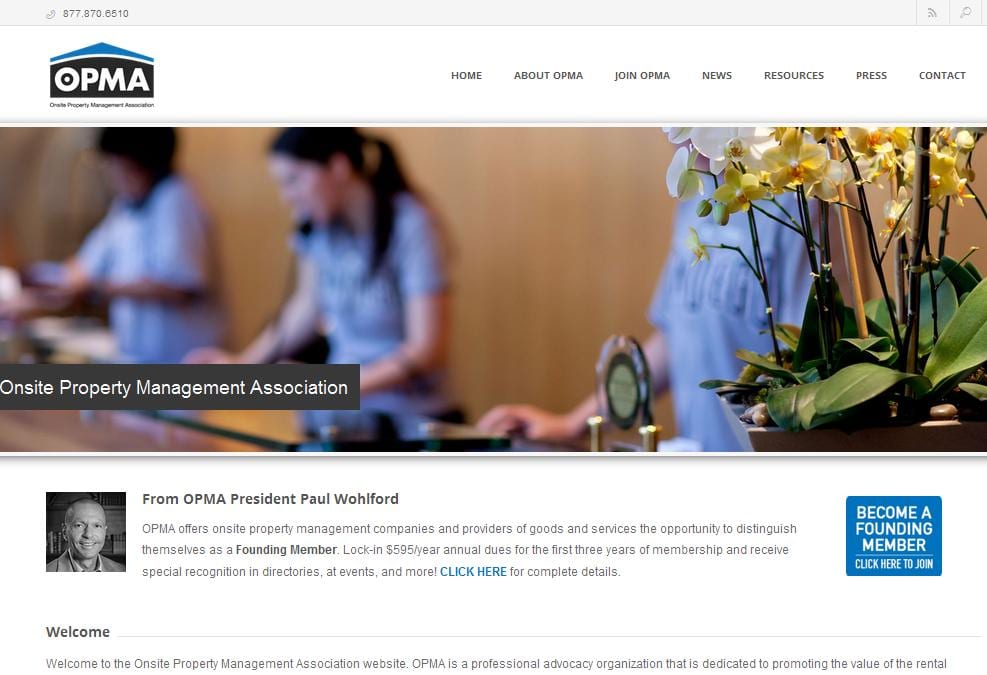
Onsite Property Management Association (OPMA) Announces Fall Executive Summit

0

The Onsite Property Management Association (OPMA), which is focused on and advocates on behalf of onsite rental property management and the growing condo hotel sector, today announced the official launch of it’s Fall Executive Summit scheduled for November 17 – 18, 2015 at the Innisbrook Golf and Spa Resort in Palm Harbor, Florida.

The Fall event follows the extremely successful inaugural OPMA Executive Summit held in May of this year, which brought key industry speakers and senior level executives from OPMA’s membership base together, providing an open dialogue and free flowing exchange of ideas and solutions between attendees.

According to OPMA President Paul Wohlford, “The combination of bringing industry executives together in a unique venue that stimulates thought-provoking ideas and solutions, represents the ideal formula for growth and success. Our Summit theme is “Welcome to the Future” and at OPMA we believe the future is now. We will be introducing ground breaking initiatives designed to position OPMA members, at a local grassroots level, to stay ahead of industry trends and to meet and exceed the expectations of their rental guests, owners, and their destination stakeholders of residents and the business community.”


The topics and speakers scheduled for the Executive Summit include:


“Panama City Beach’s Local Economic Impact of the Condo Hotel Lodging   Sector…A Model Program for All OPMA Members”

—          Dr. Steve Morse, Director and Economist, Hospitality and Tourism Program, College of Business, Western Carolina University

“What Can Local OPMA Members Do to Help Stop Illegal Vacation Rentals”

—          James S. “Jim ” Olin ,  Chief Executive Officer,  LevelField Technology, LLC

“Why Major Hospitality Companies are Joining the Vacation Rental Sector”

—          Mary Lynn Clark, President, Wyndham Vacation Rentals North America

“A 3-D Approach to Increase Your Direct Bookings by Showing Your Guests How Much You Care”

            —          John Dalton, Chief Marketing Strategist, OPMA


OPMA was officially launched a year and a half ago and the national association currently represents one of the fastest growing organizations within the lodging industry. Rick Fisher, Executive Director for OPMA notes, “The real strength of OPMA emanates from the collective contributions our onsite manager members bestow on their respective destinations. Beyond servicing rental guests and unit owners, even greater success comes to those onsite managers who most effectively measure and are thus able to present to their communities the positive economic impact of their contributions, such as new jobs created and revenue generated that further grow their local economies. At our Executive Summit we will be sharing and discussing specific initiatives that are positioning OPMA members as industry leaders, not followers, in their respective markets.”

For more information about the OPMA Executive Summit go to http://theopma.org/opma-summit/ or contact Rick Fisher, Executive Director of OPMA at (877) 870-6510 or rfisher@theopma.org.


About OPMA

Founded in March 2014 as a 501(c)(6) nonprofit organization, the Onsite Property Management Association (OPMA) is spearheading an effort to support the advancement of on-site rental property management companies. By providing education and advocacy, OPMA will promote the value of the short-term rental experience through on-site property management companies. By leveraging the collective experience of industry veterans, this network of mutual support will elevate industry standards to ensure superior guest and owner experiences. The association is committed to providing a clear and cooperative message and to championing the growth and success of the industry. To learn more about the Onsite Property Management Association, visit www.theopma.org or call (877) 870-6510.


# # #


Contacts:

Rick Fisher

Executive Director

Onsite Property Management Association, Inc.

rfisher@theopma.org

(877) 870-6510


 Or

Mary Jane Kolassa

AboveWater Public Relations and Marketing, LLC

mjkolassa@abovewater.com

(407) 463-0040

BookingSync

0

BookingSync

Colorado vacation rentals pit neighbor against neighbor

0

By Nick Coltrain, Coloradoan –Mountain guide Kurt Johnson picked his home in Estes Park for its sweeping views and quiet wilderness.

His home is attractive for the same reason as the short-term rental across the street — where vacationers frequently begin their revelry as he readies for bed and a 5 a.m. wake-up call.

“Whenever a new group shows up, we’re on edge,” Johnson said. “Are we going to be able to get to sleep when we want?”

Cheryl Anderson relies on the short-term rental of her Estes Park cottage, across the Estes valley from Johnson, for financial security. The professional caregiver poured all the equity from her Fort Collins home into the investment property 14 years ago, only to see her future shaken when a Larimer County regulation threatened to shut it down.

“I invested everything I had,” Anderson said from her rental home’s patio, shortly after prepping it for a new round of guests Thursday. “I got a loan on my house in Fort Collins and spent it all. So when (Larimer County) said they’d shut me down, it was devastating.”

A short-term vacation rental — for renters and those living nearby — boil down to two things: quality of life and making a living.

Larimer County, which has jurisdiction over Anderson’s property, recently stopped three properties from being rented out for less than a month at a time. County commissioner Steve Johnson described it at the hearing as a clear-cut violation of county land use code, which prohibits renting residential properties for fewer than 30 days.

Anderson says she is grandfathered because the ban went into effect after the county had recognized her short-term rental — though a disgruntled neighbor did try to cite the ordinance in an effort to get her to discontinue rental practices. Read More at The Coloradoan

New distribution channel launches for pro managed vacation rentals

0

In today’s rapidly changing world of vacation rentals, there has been a trend where larger OTA’s have been bypassing local rental companies, and more importantly service to travelers. While dealing directly with homeowners and saving money is fantastic for travelers, they are often left out in the cold if something goes wrong in their vacation rental.

Stuff happens on vacation – that’s a given. Appliances can malfunction. Rain may ruin pool time for the family and travelers may need suggestions where to have some fun at the best price. Keys may break and not work. Guests will need service and answers, however owners may be half a world away. Travelers with problems need them taken care of as soon as possible or there can be negative reviews about their vacation rental.

Vacation rental companies provide fantastic local service while making the check in and out process painless. They are also a tremendous resource for travelers who are unfamiliar with local attractions, activities, and geography. These local rental companies are often fixtures in popular vacation locales and are a major boon to the area’s economy.  In the past few years, more and more of these local rental companies have been bypassed due to pricing and advertising budgets by independent vacation rental owners and OTA’s.

There is a niche that has needed to be filled in the travel industry where everyone wins – where travelers get the best deals and trusted service, rental owners get bookings and revenue, and local rental companies get their piece of the pie and opportunity to gain new business. There is a new website called VacationFinder.com that can definitely fill this niche.

VacationFinder.com is truly a unique RBO site – in that 100% of all listings are supported with service from local rental companies. Travelers can rest assured that their needs will be met, should they need anything. Homeowners can take advantage of phenomenal listing prices and can directly deal with their guests to ensure repeat business. Local rental companies are able to take advantage of referrals to properties that they service, while gaining valuable opportunities to build relationships with future renters. Through VacationFinder.com, everyone wins.

VacationFinder will be attending the annual VRMA conference in New Orleans, October 25th – 28th. Visit Vacationfinder.com today and take advantage of a limited time offer where owners and rental companies can get 1 free Silver yearly listing when they sign up. Also, check out VacationFinder® on Facebook, Twitter, and on their blog at www.vacationfinder.com/vacation-blog.

Online Travel Sites Battle For Short-Term Rental Market Share

0
HomeAway and Priceline Lead the Market

By  –When  Expedia (EXPE) bought Travelocity in November, the big-four U.S.-based global online travel companies became three. If Expedia’s pending $1.3 billion merger with Orbitz (OWW) gets the green light from the Justice Department, the three will then be two — Expedia and Priceline (PCLN). Expedia expects the merger to close by year-end, though it’s being challenged by hotel and airline trade groups as anti-competitive.

Combined, Expedia and Orbitz generated $8.59 billion in revenue last year — slightly above Priceline’s $8.44 billion. More critically, the combination would take 74% of the U.S. online travel agency share in terms of gross travel bookings to Priceline’s 21%, according to estimates from travel researcher Phocuswright.

But that’s not the whole story in a an industry that is changing as rapidly as any that is based on the shift from old-school to new-school technology in the digital age. That shift has also been complicated by the increasing popularity of shared accommodations, such as spare rooms available on the website Airbnb.

With the rise of mobile phones and tablets for conducting all sorts of business, consumers increasingly turn to online travel sites to search for hotels, flights and other travel needs instead of going first to individual suppliers or brick-and-mortar travel agencies, the latter having long since shifted most of their focus from leisure to corporate travel.

And yet online travel agencies, or OTAs as they are called, accounted for only 16% of travel gross bookings in the U.S. last year, according to Phocuswright. That’s still well below the 28% share at each of the other channels — supplier websites, travel management companies and phone or walk-ins at suppliers, such as hotels and airlines.

That lower share suggests leisure travelers may do research on OTA sites, but don’t necessarily book trips there.

“There are many ways to book travel,” said Douglas Quinby, VP of research at Phocuswright. “The total (travel booking) market is much bigger than just three or four online travel agencies.”

In addition,Google (GOOGL) has been experimenting with hotel bookings since rolling out its Hotel Finder in 2011, “though that is still in very early development,” Quinby says.

Expedia and Priceline, the two dominant OTAs, have different strategies and goals. Expedia wants to be the biggest global full-service online travel company for bookings of flights, hotels, packages and corporate travel, Quinby says.

Priceline, on the other hand, is “laser-focused” on international growth, especially in hotels through its prized site Booking.com.


Profitability Vs. Gross Bookings

With Orbitz under its wing, Expedia would be “significantly larger on a gross booking basis than Priceline,” he said. “But from the perspective of investors, who look also at the bottom line and market cap, Priceline has outperformed” with bottom-line performance that continues to lead the market.

Priceline’s $63 billion market cap tops Expedia’s $13 billion by a wide margin. Shares of both stocks notched all-time highs on Aug. 5 after second-quarter results beat views. But Expedia shares have gained 66% over the past 18 months, vs. an 8% gain for Priceline.

Both reacted well to the market’s recent sell-off. Expedia dropped back 18% and quickly regained support at its 10-week moving average.

Priceline fell 17% for a quick test of its 40-week line, rebounding in the past week to retake its 10-week line as well.

Priceline’s earnings over the last three years have grown at a compounded annual rate of 28% vs. Expedia’s 11% over the same time.

Barclays, according to analyst Paul Vogel, views Priceline as “the gold standard of online travel.” The company “will likely continue to execute well,” he says, but could see slowing revenue growth and pressure on margins, which were evident this year at both companies.

Priceline’s earnings this year are seen growing at the slowest pace in years, 7%, according to a poll of analysts by Thomson Reuters. Expedia’s are seen growing only 1%.

Both charge fees to suppliers for listings on their sites and take a cut on bookings they facilitate.

A July 30 report from Morgan Stanley pointed to increased ad spending at Priceline and lower gross profit per room at Expedia. Morgan Stanley analysts noted that industry economics would likely improve in 2016 (though that forecast was before the stock-market swoon) and that incremental ad spending would slow.

Expedia’s margins got some relief in May when it sold its 62.4% stake in Chinese online travel site eLong for $671 million. ELong was expected to lose $100 million this year and drag down Expedia’s earnings by around 20%.

Priceline, measured by IBD’s Composite Rating metric, is the second-highest-ranked stock in IBD’s Leisure-Travel Booking industry group after Sabre (SABR)), a travel technology company spun out of American Airlines in 2000 (Sabre also launched Travelocity). Expedia (which bought Travelocity from Sabre in January for $280 million) is No. 3. The overall group on Friday ranked 58 out of 197 industry groups tracked by IBD, up from No. 119 eight weeks ago. Over those eight weeks, the group posted the fourth-largest gain among industries.

Also in the group is travel-review websiteTripAdvisor (TRIP) and Austin, Texas-basedHomeAway (AWAY), the largest online vacation rental marketplace. Overseas online travel sites, including China travel siteCtrip.com (CTRP) (which now owns a stake in eLong), U.K.-basedTravelport Worldwide (TVPT) and India’sMakeMyTrip (MMYT), are also a growing part of the picture.

TripAdvisor, which labels itself a travel deals and information aggregator, fell short of analysts’ second-quarter views and cut its full-year earnings and revenue forecast in late July, sending shares into a five-week slide. The company recently began offering consumers the ability to book hotel rooms directly on its site.


New Ideas Of Accommodation

One of the biggest changes in the online travel industry is the rise of a new category of accommodations known as “shared space” within a private home or apartment, spurred by the popularity of Airbnb and other short-term vacation and rental sites.

Phocuswright says the shared-space category “popped” in 2014. It estimates that 9% of U.S. travelers rented a room or space in a private home last year, up from less than 3% in 2012, when it first tracked the trend as Airbnb was starting to gain significant momentum and buzz.

The travel industry is seeing “a real broadening of the idea of accommodation,” said Quinby, who pointed also to vacation rentals, small bed-and-breakfasts and even “upmarket designer hostels.”

HomeAway focuses on rentals of entire homes and apartments, though its Asia subsidiary, Travelmob, offers shared spaces.

Expedia recently started listing some of HomeAway’s offerings on its website, but directs interested customers directly to HomeAway for completing the transaction. HomeAway is also making available its listings on Priceline-owned metasearch site Kayak this year.

OTAs have multiple in-house brands working to fill different travel needs, such as metasearches and online restaurant reservations. In 2013, Priceline acquired metasearch system Kayak Software and Expedia bought a majority stake in the German hotel metasearch site Trivago.

Priceline last year acquired online restaurant reservation system OpenTable for $2.6 billion.

Most OTAs shy away from shared accommodations. But Priceline’s Booking.com, which has been aggressively building a vacation-rental business, began offering shared-space listings on its site in the second quarter of this year.

Of Booking.com’s 707,000 hotels and other accommodations available worldwide in the second quarter, up 35% from a year ago, some 313,000 were “instantly bookable vacation rental properties,” according to Priceline. Vacation-rental properties grew 62% and accounted for 1.7 million rentable units.

It is unclear how many of those were rooms in private homes and apartments, but likely not many. As Priceline CEO Darren Huston said in a conference call earlier this month, the company just began “experimenting with self-onboarding of individually-owned vacation rental properties.”

The rentals, he added, were “subject of course to a set of quality checks” and their ability to be “instantly bookable.”

“We already have an encouraging pipeline of vacation rental properties to activate via this channel,” he said.


The Brindley Beach Fire – Insights and Observations

0

By Tom K –At 7 PM on Friday, June 12th, Brindley Beach’s headquarters burned to the ground. Doug Brindley and I will present a detailed session at the VRMA Annual Conference in New Orleans to walk you through how everyone worked together to check in over 500 houses on Saturday and Sunday with no resources, and how we restored the entire business in 16 days.

In this article, I highlight key insights and observations that left deep impressions while I was working with the Brindley Beach Family to overcome this disaster. It is a quick, but valuable, read.


Overview

It really is all about the People. Leadership, loyalty, tears, determination, compassion, relationships, finding that extra bit of energy when the tank has long been emptied… Everyone involved provided immense and essential contributions to both the immediate recovery and the rebuilding effort.


The Brindley Beach Family

It’s all about the People!

It was amazing to watch management and staff come together Saturday morning, to watch the faces shift through the day from shock and despair to determination to accomplishment. “Loyalty” is a frightful understatement. “Team” doesn’t nearly describe it. The leadership team, who had just lost EVERYTHING, shook it off, and managed, motivated, and mobilized all available resources to excellence. The staff dug in and got it done with what they had (not much), and found ways to get what they had to have.

At the end of Saturday, the assembled group was dirty, sweaty, exhausted, and elated at their accomplishment… almost 400 check-ins without packets, keys, computers, PM software, or their main office. Amazing!

EVERYONE did a stellar job. End of day cocktails were offered, but everyone declined. They were completely spent, and they had to do it all over again on Sunday.


The Community

It’s still all about the People!

The VRM industry in the Outer Banks is tremendously competitive, much more so than anywhere else I’ve operated. But it is an interesting competitiveness, with little underhandedness, and lots of mutual respect. On Saturday morning, Brindley didn’t get a bunch of “if you need anything” calls from the community, they got offers of equipment, computers, and vans… from competitors. One of the more debilitating issues was locks on homes, or actually no keys for the locks. VRM companies up and down the beach dropped off their existing stock of lock sets so Brindley’s maintenance staff could refit locks to the houses they had to break into to admit guests.

We worked very hard, but we ate very well! The deliveries of food, water, tea, juice, and even beers were donated by the community and our competitors throughout this most difficult of times. I do hope we adequately expressed just how deeply their kindness was appreciated by all!


Our Partners

It is all about the People… and Relationships!

That (Friday) night I started calling our technology partners to advise them of the disaster and to start planning emergency operations and a structured recovery. Everyone stepped up and worked all weekend to get Brindley’s core infrastructure running by Sunday morning (albeit in emergency mode using lots of duct tape and chicken wire 🙂 More systems and services were up by Sunday night. This couldn’t have happened without the long hours and super talents of my friends and long time associates at PropertyPlus support (HomeAway Software) and LSI (Local Social).

My forever Dell team was also fantastic. They worked above and beyond to expedite our needs. The 30+ new computers, monitors, switches, and printers started arriving on Wed. They were able to get us new servers in just under 2 weeks. Everything shipped next day or second day courtesy of my Dell team.

With the help of many, we had the complete environment restored in 16 days. This involved not only rebuilding the whole server infrastructure, configuring switches and firewalls, and rolling out 30+ PCs across 5 offices, but also re-fitting the Duck facility to become the new Headquarters, establishing a new data center in the Duck office, setting up a new remote office for Maintenance & Accounting, and re-locating lots of staff across the other remote offices. Whew!


The Backups

Well, maybe it’s not completely all about the People…

Simply put, without the excellent backup systems we had in place, Brindley Beach might not have been able to recover. Certainly not to the degree that we recovered, nor within the timeframe.

The fire started around 7 PM on Friday. Because we had a good multi-layered backup process in place, we were able to get the critical data from the cloud backups to bring our Property Management System live Sunday morning. Then we were able to use our system backups to restore EVERYTHING to Friday’s start of business once we had the new servers on line.

If you don’t have a proven backup strategy in place, you really need to consider resolving this immediately. If you are not sure how to start, call me. I can help!


Company Stuff

Again, maybe it’s not completely All about the People…

I never really appreciated the phrase “burned to the ground” until I saw it. We’ll have a few pictures at the VRMA session. NOTHING was left, except a lonely chimney standing tall.

The phrase “Its only stuff… no one was hurt” kept being bantered about. While all that we lost was “just” stuff, much of it was “important stuff”.

Take a walk through your offices. Observe all your company stuff. What could you not do without? What would be painful to lose? Determine how you can archive that stuff, or prepare to replace the stuff you can’t archive. Is any of that paper stuff in those filing cabinets important? Hire a clerk to scan it so it gets electronically backed up. Do you have records (not in those filing cabinets) of all the stuff you’ll want your insurance to replace? Do you have replacement insurance? Do you have documented inventories and receipts? Hmmmm…


Personal Stuff

Everybody has some personal stuff in their office. If it is important to you, or if it has value, you need to replicate it or document it. Make a copy of that signed photo of you and John Lennon and document that signed Terry Bradshaw jersey.

If you’ll be at VRMA in New Orleans, come join Doug and me for our session. We’ll get in-depth on the specifics of how the Brindley Beach Family was able to populate 400 properties the day after losing EVERYTHING (the amazing part), and how we restructured, relocated, and rebuilt the company in 16 days. It’s an intriguing tale.

If you have any questions or thoughts concerning this article, or need help ensuring you are prepared for a similar company-crushing disaster, please contact me at TomK@TomKConsulting.com, or via my cell 443.310.5110.


About Tom K

Tom K has spent the last 28 years working with company leaders to develop their technology strategies and create IT environments that will best serve their business goals, optimize the use of their computing resources, maximize their systems up-time, and get the most out of their IT investment.

Tom K’s experience was developed as a Director and lead consultant with three respected technology firms, one servicing Vacation Rental Management companies across the country, and two servicing NYC Clients in the banking, finance, and manufacturing industries. Tom also served as CTO for an e-Commerce Web Consultation firm and as IT Director for an international consumer testing company. He holds senior technical certifications from Cisco, Microsoft, Citrix, HP, and Intel.

Tom K brought his expertise from Wall St. to the Vacation Rental and Real Estate industry in 2003. Through his technical skills and business acumen, Tom has helped numerous companies effectively utilize technology to realize their business goals, increase productivity, and improve their bottom line.

Tom K’s extensive experience as both consultant and IT Director provides him with an in-depth understanding of the needs and expectations of his Clients, from both the business and the technical prospective. This knowledge allows Tom to consistently provide the solutions and exceptional levels of service required to exceed those expectations.


Tom K technology consulting for vacation rental managers

Barefoot, Airbnb and BookingPal Talk to NC Property Managers

0
Resort Realty Luxury Rentals in Outer Banks

Barefoot recently announced that their customers can list their inventory on Airbnb through either of their two partners, Leisurelink or BookingPal. In a seminar earlier this month in North Carolina Barefoot Technologies, BookingPal and Airbnb met with property managers and discussed this integration.

According to Barefoot’s Claiborne Yarbrough, “There are several of interesting things that I have taken away from these discussions.”

Yarbrough observed the following:

  • At a meeting with vacation rental managers in North Carolina, the booking process as currently laid out by Airbnb will not meet the requirements of the North Carolina Real Estate Commission (NERC). As one attendee put it “You (meaning Airbnb) are coming from a consumer perspective, whereas we are coming from a real estate transaction perspective… this is more than just technology, this is a mindset”. This is a great point and one that Airbnb will have to work out.
  • There is a team at Airbnb that is focused on Vacation Rentals. They are in charge of being a liaison between not only the five current channels but also with the vacation rental management companies and their market needs. This team will work with NREC to figure out how Airbnb needs to function in the North Carolina markets. As their representative put it “we work with governments all over the world to work these things out and we have the resources to do it.” Alright then!
  • One attendee noted that there was no doubt about the popularity of Airbnb. There was an interesting discussion about the idea that technology had created the sharing economy to help create actual connections for travelers with locals. Airbnb is successful because of our genuine desire to get to know other people.  If you think about the typical vacation rental management company, this is also likely the basis of why an owner would start a rental company. I live here, I love it here and I want to share this place with other people. This is a tough industry, full of hard work that is fueled by, again, a genuine desire to meet and provide hospitality to visitors. The sentiment between Airbnb and this industry is the same.


What if your Head of Housekeeping quit today?

0

I asked our Owner Advisory panel “If you lost your head of housekeeping today, do you automatically know who would take their place?”

First, Doug Brindley, owner at Brindley Beach Vacations, joked, “If James left, he better be dead.”

Anyway, Doug makes a great point saying, “You have to place an authority figure up front immediately.” Brindley added, “Yes, I know who that person is.”

Joe Refosco, co-owner at Taylor-Made Deep Creek Vacations and President of the Vacation Rental Housekeeping Professionals, says “We cross-train multiple people to be able to do every job expected of our head of housekeeping. 8 of our 10 managers have been with us over 5 years.”

Jodi Refosco, Joe’s wife and co-owner at Taylor-Made Deep Creek Vacations, chipped in saying “Joe himself could easily jump in and help. The owner of the company needs to know how to be able to run each department.”

Robert Bennington, CEO at Bennington Properties, is quite adamant when he says “Hell no! That is too important of a position to be able to replace in an instant. But you had better have members of your team (at least the owner or GM) cross-trained to be able to cover for at least 3 months while a replacement is sought.”

Charles Hale, owner at Atlantic Beach Realty, says he or his wife could run housekeeping but that they do have an assistant manager in place who would take over.

Chuck Steeg, owner of LuxuryGulfRentals.com, says “It is always best to be prepared with back-up plans for many things. That is why cross-training is so critical.”

So, we basically have three shared opinion here:

 1. Have cross-training done so any of several people could help until a replacement is found

2. Have the owner (s) of the company step in until a replacement is found.

3. Have a well-trained assistant already in place to step in immediately


Each of us as managers, in my opinion, need to identify and train our own replacement. That helps with our own promote ability as well!

Take a minute to ponder: What would happen to us? Are we ready in case this were to happen?

If your vacation rental company places a significant focus on providing high level housekeeping services for guests, join Steve Craig, VRM Intel and the industry’s best vacation rental managers at the Annual VRHP Conference in Orlando, Nov 9-11. 


To enroll in VR View or VR Maintenance newsletter go to www.proresort.net.

To inquire about consulting services, simple write Steve at proresort@aol.com

Steve Craig started Pro Resort Housekeeping in 1986 and his next clients will be his 216th. Steve started Vacation Rental Housekeeping Professionals in 1999 and was the Director until 2013. He is an exciting speaker and has presented at VRMA many times and numerous state associations as well as all VRHP seminars and his personal seminars. He is famous for his “Follow the Wall” cleaning and inspection techniques practiced by many companies across the country and for sharing his product tests.


Ex-Clinton advisor joins Airbnb to run global policy

0

Chris Lehane, a lawyer and political consultant who previously worked for Bill Clinton’s 1992 Presidential campaign and as Vice President Al Gore‘s press secretary, has joined Airbnb as head of global policy and government affairs.

Lehane also spent many years in private practice, representing clients ranging from AT&T (NYSE: T) and Microsoft (NASDAQ: MSFT) CEO Steve Ballmer. In a blog post, Airbnb touted Lehane’s work with tech companies, energy companies, the San Francisco Giants, labor unions and the climate change advocacy group NextGen Climate working in policy and advocacy roles.

Airbnb is not the only private tech company to hire from the political world. Last year, Uber hired David Plouffe, who managed Barack Obama’s successful run for the presidency, to run policy and strategy at the frequently embattled company. Plouffe has since moved to a strategic advisory role at Uber. In February, Amazon hired Jay Carney, who previously served as President Obama’s press secretary, to manage its global affairs.

Airbnb, which operates in 34,000 cities across 190 countries, has faced crackdowns from many local governments. In New York City, its largest market with 25,000 listings per night, officials have said that the majority of listings constitute “illegal hotels”. The city of Santa Monica recently announced a strict set of regulations on Airbnb hosts, who must register for a business license, abide by the city’s occupancy tax and live on-site.

Airbnb is estimated to be worth $24 billion. Airbnb says Lehane will direct efforts to organize hosts and advocate for “the right to home share”.


  Annie Gaus
  Reporter
  San Francisco Business Times —Email

5 Questions to Answer Before You Self-Manage Your Vacation Rental

0
Market research for vacation rentals

In last week’s article I talked about being real estate entrepreneurs, not investors. This is a HUGE difference in mindset and also in practice. One result of having the mindset of entrepreneur is that you should not do all of the work yourself, but instead surround yourself with an awesome team and delegate. In particular: Don’t be a PROPERTY manager; be an ASSET manager instead.

What’s the difference? If you’re the property manager, you are the manager. If you’re an asset manager, you manage the manager.

You could manage your property(s) yourself, perhaps in order to learn how it works so that you can outsource it to a property manager later. Or perhaps you want to create your own property management company.

Before you attempt to manage your own property, ask yourself these 5 questions.


5 Questions to Answer Before You Self-Manage Your Short Term Rental Property


Question #1: How valuable is your time?

Is it really the best use of your time to answer the phone at 10 o’clock at night when a tenant calls you that there is water coming through the roof and you have to rush to the property? Or to process applications, do background checks, show the property or collect the rent?

Couldn’t you delegate these activities to other professionals charging $15-$30 per hour?

Wouldn’t your time be better spent looking for more deals and raising money? What is an hour of THAT kind of activity worth? Fifty dollars, $100, $500 per hour?

Related: The Big List of Roles Property Management Companies Need to Fill Expertly

Spend your time on HIGH VALUE activities and delegate everything else.


Question #2: What are your strengths and passions?

Are you good at repairing stuff? Do you love dealing with tenants and their problems? Do you love the property management business?

If you answered “yes” to these, you might want to consider starting your own property management business, which would complement the real estate business.

However, chances are you answered “no” to these questions, so why do them? Why not focus on what you’re good at and love: being a real estate entrepreneur, making deals happen, putting it all together?


Question #3: Are you relying only on yourself, or are you leveraging the strength of your team?

Do you have experience managing a property like this? If you don’t, do you really want to learn? If you have investors in the deal, how would they feel about you managing the property that you bought with THEIR money? Chances are, you don’t have property management experience, and therefore the risk of the project just skyrocketed. What should you do?

Leverage the experience of a professional property manager.

Use your manager’s resume to complement your own. This “partnership” makes you look stronger to banks and investors because instead of having no experience at all, you bring a track record to the table. You can say, “Here’s my team, look at our experience.” You’re mitigating the risk of the project by leveraging the strength of others.


Question #4: Is it consistent with your goals?

Didn’t you get into this buy and hold real estate thing because you were looking for passive income and to grow the business? Then why would you want to work IN the business versus ON the business? Why would you do something (property management) that doesn’t bring you closer to your goal of passive income and growing your portfolio?

Also, with regard to goals, you want to make money as quickly as possible, right? Why try to learn on the job and make a bunch of mistakes when you can hire a professional who will do a better job than you will?

Just saying.

Related: How to Choose the Right Rental Property Manager


Question #5: Are you running it like a business?

You should approach your real estate career from the perspective of an entrepreneur who wants to create and grow a business. As the CEO of this business, you’ll want to delegate those lower-value activities that you’re not good at or don’t like to do and focus on the high-value activities that actually grow the business.

Plus, real estate like apartment buildings (what I focus on) already has property management built in to its business model! It just makes sense.

Unless property management is strategic to you, it should be one of those lower-value activities that you delegate. If you do, it will free you up to do the things you’re good at and that will grow the business: looking for more deals and raising money.


Website

Michael Blank’s passion is being an entrepreneur and helping others become (better) entrepreneurs. His focus is buying apartment buildings by raising money from private individuals. He’s been investing in residential and multifamily real estate since 2005. He is the creator of the Syndicated Deal Analyzer and the eBook “The Secret to Raising Money to Buy Your First Apartment Building”.

Inside Airbnb’s Algorithm

1

By Dan Hill, Product Lead, Airbnb — How much should you charge someone to live in your house? Or how much would you pay to live in someone else’s house? Would you pay more or less for a planned vacation or for a spur-of-the-moment getaway?

Answering these questions isn’t easy. And the struggle to do so, my colleagues and I discovered, was preventing potential rentals from getting listed on our site—Airbnb, the company that matches available rooms, apartments, and houses with people who want to book them.

In focus groups, we watched people go through the process of listing their properties on our site—and get stumped when they came to the price field. Many would take a look at what their neighbors were charging and pick a comparable price; this involved opening a lot of tabs in their browsers and figuring out which listings were similar to theirs. Some people had a goal in mind before they signed up, maybe to make a little extra money to help pay the mortgage or defray the costs of a vacation. So they set a price that would help them meet that goal without considering the real market value of their listing. And some people, unfortunately, just gave up.

Clearly, Airbnb needed to offer people a better way—an automated source of pricing information to help hosts come to a decision. That’s why we started building pricing tools in 2012 and have been working to make them better ever since. This June, we released our latest improvements. We started doing dynamic pricing—that is, offering new price tips daily based on changing market conditions. We tweaked our general pricing algorithms to consider some unusual, even surprising characteristics of listings. And we’ve added what we think is a unique approach to machine learning that lets our system not only learn from its own experience but also take advantage of a little human intuition when necessary.


In the online world, a number of companies use algorithms to set or suggest prices. eBay, for example, tells you what similar products have sold for and lets you choose a price based on that information. eBay’s pricing problem was relatively simple to solve: It didn’t matter where the sellers and buyers were or whether you’re selling the product today or next week. Meanwhile, over at Uber and Lyft, the ride-sharing companies, geography and time do matter—but these two companies simply set prices by decree; there is no user choice or need for transparency in how the prices are determined.

At Airbnb, we faced an unusually complex problem. Every one of the million-plus listings on our site is unique, having its own address, size, and decor. Our hosts also vary in their willingness to play concierge, cook, or tour guide. And events—some regular, like seasonal weather changes; others unusual, like large local events—muddy the waters even further.

Three years ago we started building a tool to provide price tips to potential hosts based on the most important characteristics about a listing, like the number of rooms and beds, the neighboring properties, and certain amenities, like a parking space or even a pool. We rolled it out in 2013, and it did well, for the most part. But it had limitations. For one, the way its price-setting algorithms worked didn’t change. If we set them to consider that the Pearl District in Portland, Ore., say, had a certain boundary, or that rooms on a river were always worth a certain amount more than rooms a block from that river, the algorithm would apply those metrics forever, unless we went in manually to change them. And our pricing tools weren’t dynamic—price tips didn’t adjust based on when you were booking a room or how many other people seemed to be booking rooms at the same time.

/img/09OLAirbnb8154749f_original-1439834665778.jpg

Since mid-2014, we’ve been trying to change that. We wanted to build a tool that learns from its mistakes and improves by interacting with users. We also wanted the tool to adjust to demand and, when necessary, drop price tips to fill rooms that would otherwise stay empty or raise them in response to demand. We’ve started to figure that out, and we began to let our hosts use this new tool in June. We’ll tell you about how these tools evolved and how they work today. We’ll also tell you why we think our latest tool, Aerosolve, will eventually do a lot more than just price home rentals. That’s why we’re releasing it into the open-source community.


To get an idea of the problem we faced, consider three different situations.

Imagine you had lived in Brazil during the last football (soccer) World Cup. Your hometown will see a huge influx of travelers from all over the world, all united by the greatest football tournament on the planet. You have a spare room in your house, and you want to meet other football lovers and make some extra cash.

/img/09OLAirbnbacca0acf_original-1439834700517.jpgFor our tool to help you figure out a price, there were a few factors to consider. First, this was a once-in-a-generation event in that country, so we at Airbnb have absolutely no historical data to look at. Second, every hotel was sold out, so clearly there was a massive imbalance between supply and demand. Third, the people coming to visit already had paid immense sums for their tickets and international travel, so they’d probably be prepared to pay a lot for a room. All of that had to be considered in addition to the obvious parameters of size, number of rooms, and location.

Or imagine you’ve inherited a castle in the Highlands of Scotland and, in order to pay the costs of cleaning the moats, operating the distillery, and feeding the falcons, you decide to turn the turret into a bed-and-breakfast. Unlike the World Cup situation, you’d have some comparative data, based on nearby castles. Some of that data would likely span many years, providing information about the seasonality of tourism and travel. And you’d know, because there are a number of other accommodation options in the area, that the supply and demand for tourist rooms is pretty balanced right now. Yet this particular castle is the only one in Scotland with a uniquely designed double moat. How can a system calculate what this rare and unique feature would be worth?

img

As a final example, imagine you own a typical two-bedroom apartment in Paris. You’re taking a few weeks of your August vacation and heading south to Montpellier. There are lots of comparative properties, so it’s relatively easy to price. But say, after you receive a wave of interest based on the first listing, you decide to start increasing the price gradually to try to maximize the amount earned. That’s a tricky proposition—what happens if you go too high, or cut it too close to the booking date and lose the chance to make any money? Or perhaps the opposite occurs: You take the first inquiry at a lower price and spend the next few month

s wishing you’d been brave enough to take a little more risk. How do we help hosts get better information to prevent this kind of uncertainty and regret?

These are the kinds of questions we faced. We wanted to build an easy-to-use tool to feed hosts information that is helpful as they decide what to charge for their spaces, while making the reasons for its pricing tips clear.


The overall architecture of our tool was surprisingly simple to figure out: When a new host begins adding a space to our site, our system extracts what we call the key attributes of that listing, looks at other listings with the same or similar attributes in the area, finds those that are being successfully booked, factors in demand and seasonality, and bases a price tip from the median there.

The tricky part began when we tried to figure out what, exactly, the key attributes of a listing are. No two listings are the same in design or layout, there are listings in every corner of a city, and many aren’t just apartments or houses but castles and igloos. We decided that our tool would use three major types of data in setting prices: similarity, recency, and location.

For data on similarity, we started with all the quantifiable attributes we know about a listing and then looked to see which were most highly correlated with the price a guest would pay for that listing. We arrived at how many people the space sleeps, whether it’s an entire property or a private room, the type of property (apartment, castle, yurt), and the number of reviews.

Perhaps the most surprising attribute here is the number of reviews. It turns out that people are willing to pay a premium for places with many reviews. While Amazon, eBay, and others do rely on reviews to help users make selections about what to buy or whom to buy it from, it’s not clear that the number of reviews makes a big difference in price. For us, having even a single review rather than no reviews makes a huge difference to a listing.

We considered recency, because markets change frequently, especially in travel. On top of that, travel is a highly seasonal business, so it’s important to look for the market rate either as it is today, or as it was this time last year; last month may not be relevant.

In highly developed markets like London or Paris, obtaining this market data is easy enough—there are thousands of listings being booked on our site to compare with. For new and emerging markets, we classified them into groups of similar size, level of tourism, and stage of growth for Airbnb. This way, we are able to compare listings not only in the actual city a space is in but also in other markets with similar characteristics. So if a Japanese host is one of the first Airbnb users to list an apartment in Kyoto, we might look at data from Tokyo or Okayama, back when Airbnb was similarly new in those cities, or from Amsterdam, a more mature market for Airbnb but one with a similar size and level of tourism.

Finally, we needed to consider location, a rather different problem for us than for hotels. Hotels are typically grouped in just a few main locations; we have listings in almost every corner of a city.

Early versions of our pricing algorithms plotted an expanding circle around a listing, considering similar properties at varying radii from the listing location. This seemed to work well for a while, but we eventually discovered a crucial flaw. Imagine our apartment in Paris for a minute. If the listing is centrally located, say, right by the Pont Neuf just down from the Louvre and Jardin des Tuileries, then our expanding circle quickly begins to encompass very different neighborhoods on opposite sides of the river. In Paris, though both sides of the Seine are safe, people will pay quite different amounts to stay in locations just a hundred meters apart. In other cities there’s an even sharper divide. In London, for instance, prices in the desirable Greenwich area can be more than twice as much as those near the London docks right across the Thames.

img
Source: Airbnb
Ups and Downs: Seasonal demand and local events can cause prices to differ dramatically. In Austin, Texas, as shown here, prices jump during the South by Southwest (SXSW) and Austin City Limits festivals.


We therefore got a cartographer to map the boundaries of every neighborhood in our top cities all over the world. This information created extremely accurate and relevant geospatial definitions we could use to accurately cluster listings around major geographical and structural features like rivers, highways, and transportation connections.

So now, for example, for the first weekend of October, the price tip for a basic private room for two in London on the Greenwich side of the Thames comes up at US $130 a night; a room with similar attributes across the river comes up at $60 a night.

We were pretty happy with our algorithms—that is, after we fixed a bug that had caused our system to give a price tip of $99 on a large number of new listings, no matter what their particular characteristics. It didn’t happen for long, and not in every region, but we recognize that when this happens it may cause people to question whether our pricing tools are working.

We improved our algorithms over time until they were able to consider thousands of different factors and understand geographic location on a very detailed level. But the tool still had two weaknesses. The tips it gave were static—it understood local events and peak tourist seasons, and so would suggest different prices for the same property for different dates of the year. It didn’t, however, change those prices as the date approached, as airlines do, dropping prices when bookings were slow and raising them when the market heated up.

And the tool itself was static. Its tips did improve somewhat as it tapped into ever more historical data, but the algorithms themselves didn’t get better.


Last summer, we started a project to address both of these problems. On the dynamic pricing side, our goal was to give each host a new pricing tip every day for each date in the future the property is available for booking. Dynamic pricing isn’t new. Airlines began applying it several decades ago, adjusting prices—often in real time—to try and ensure maximum occupancy and maximum revenue per seat. Hotels followed suit as consolidation made the large chains larger, bringing them an ever-increasing amount of data about their business, and hotel marketing moved online, allowing the chains to change prices multiple times a day.

So investing in dynamic pricing—once we had several years of historical data about a large number of properties to tap—made a lot of sense for us despite the fact that it requires more computing resources.

Making the algorithms improve themselves over time was harder, particularly because we wanted our system to allow humans to easily interpret, and in some cases influence, the computer’s “thought process” as it did so. Machine-learning systems of the size and complexity required to handle our needs often work in mysterious ways. The Google Brain that learned to find cat videos on the Web, for example, has layers upon layers of algorithms that classify data, and the way it gets to its conclusions—cat video or not—is virtually impossible for a human to replicate.

We selected a machine-learning model called a classifier. It uses all of the attributes of a listing and prevailing market demand and then attempts to classify whether it will get booked or not. Our system calculates price tips based on hundreds of attributes, such as whether breakfast is included and whether the guest gets a private bath. Then we began training the system by having it check price tips against outcomes. Considering whether or not a listing gets booked at a particular price helps the system hone its price tips and estimate the probability of a price being accepted. Our hosts, of course, can choose to go higher or lower than the price tip, and then our system adjusts its estimate of likelihood accordingly. It later checks back on the fate of the listing and uses this information to adjust future tips.

/img/09OLAirBnBlondonMapSM-1439840227078.jpg 
Illustration: Airbnb
Won’t You Be My Neighbor? Algorithms use historical pricing data to group properties into detailed microneighborhoods, as shown on this map of London.


Here’s where the learning comes in. With knowledge about the success of its tips, our system began adjusting the weights it gives to the different characteristics about a listing—the “signals” it is getting about a particular property. We started out with some assumptions, such as that geographic location is hugely important but that usually the presence of a hot tub is less so. We’ve retained certain attributes of a listing considered by our previous pricing system, but we’ve added new ones. Some of the new signals, like “number of lead days before booking day,” are related to our dynamic pricing capability. We added other signals simply because our analysis of historical data indicated that they matter.

For instance, certain photos are more likely to lead to bookings. The general trend might surprise you—the photos of stylish, brightly lit living rooms that tend to be preferred by professional photographers don’t attract nearly as many potential guests as photos of cozy bedrooms decorated in warm colors.

As time goes on, we expect constant automatic refinements of the weights of these signals to improve our price tips.

We can also go in and influence the weighting if we believe we know something that the model has yet to figure out. Our system can produce a list of factors and weights considered for each price tip, which we have our people looking at. If we think something isn’t well represented, we will add another signal manually to the model.

For example, we know that a listing in Seattle without Wi-Fi access to a broadband Internet connection is extremely unlikely to get booked at any price, so we don’t have to wait for our system to figure it out. We can adjust that metric ourselves.

Our system also constantly adjusts our maps to reflect changes in neighborhood boundaries. So instead of relying on local maps to tell us, say, where Portland’s Sunnyside neighborhood ends and Richmond begins, we are relying on the data on bookings and price differentials within a city to draw those kinds of lines. This approach also lets us spot microneighborhoods that we were not previously aware of. Such areas may have a large number of popular listings that don’t necessarily map to standard neighborhood boundaries, or there may be some local feature that makes a small section of a larger traditional neighborhood more desirable.

These tools are generating price tips for Airbnb properties globally today. But we think it can do a lot more than just better inform potential hosts as they choose prices for their online rentals. That’s why we’ve released the machine-learning platform on which it’s based, Aerosolve, as an open-source tool. It will give people in industries that have yet to embrace machine learning an easy entry point. By clarifying what the system is doing, it will remove the fear factor and increase the adoption of these kinds of tools. So far, we’ve used it to build a system that produces paintings in a pointillist style. We’re eager to see what happens with this tool as creative engineers outside of our industry start using it.


This article originally appeared in print as “How Much Is Your Spare Room Worth?.”

About the Author

Dan Hill, product lead at Airbnb, wrote the lodging-rental website’s pricing algorithm. He also cofounded Crashpadder, a home-sharing company acquired by Airbnb in 2012. Hill first did Web development to support his career as a violinist. “I sort of woke up one day and realized I hadn’t really been focused too much on [the violin],” he said in a recent interview. His next thought? “I really want to spend my life working on technology and products.”

How to Create Facebook Ads -Step-by-step checklist

0

Written by Carly Stec, HubSpot –When setting up a paid Facebook ad, there are a lot of boxes to be checked.

Are you targeting the right people? Are your image dimensions to scale? Are you running the right type of ad? If we’re being honest, it can get a little confusing.

With more than 1.4 billion people using Facebook and over 900 million visits every day, Facebook offers up a unique opportunity for marketers to augment their organic efforts. Trouble is, with both an investment of time and money on the line, there’s not much room for oversight.

To help, we’ve put together a checklist to help you keep all of your campaign details straight. It will help ensure that you’re tapping into the right audience with the right ad at the right time.

What are you waiting for? Get to checkin’.


The Ultimate Checklist for Creating & Optimizing Facebook Ads

Facebook offers a wide variety of paid ad options and placements, but all ads can be broken down into three elements:

  • Campaigns. The campaign houses all of your assets.
  • Ad sets. If you’re targeting separate audiences with different characteristics, you’ll need an individual ad set for each.
  • Ads. Your actual ads live within your ad sets. Each ad set can hold a variety of ads that vary in color, copy, images, etc.

With that terminology out of the way, let’s dive in to creating an ad.


 Determine the most appropriate editor.

Facebook offers users two different tools for creating a paid ad: the Ads Manager and the Power Editor. When deciding which one is the best fit for you, you’ll want to consider both your company size and the number of ads you plan to run at once.

While the Ads Manager best suits most companies, the Power Editor serves as a tool for larger advertisers who are looking for more precise control over a variety of campaigns. For the sake of this article, we’re going to detail how to create an ad using the Ads Manager. (For more on how to create an ad using the Power Editor, check out this step-by-step article from Kissmetrics.)


 Choose an objective.

Facebook’s Ads Manager, like many social media advertising networks, is designed with your campaign objective in mind. Before getting started, Ads Manager will prompt you to choose an objective for your campaign:


There are 10 different objectives to choose from. The list includes everything from sending people to your website to getting installs of your app to raising attendance at your event.

By choosing one of these objectives, you’re giving Facebook a better idea of what you’d like to do so they can present you with the best-suited ad options. Facebook’s ad options include:

  • Page Post Engagements
  • Page Likes
  • Click to Website
  • Website Conversions
  • App Installs
  • App Engagement
  • Event Responses
  • Offer Claims
  • Video Views
  • Local Awareness

Let’s say, for sake of this post, that you’re looking to drive more traffic to your website. When you select this option, Facebook will prompt you to enter the URL you’re looking to promote. If you’re using marketing automation software, be sure to create a unique tracking URL with UTM parameters for this to ensure that you’ll be able to keep track of traffic and conversions from this ad. For HubSpot customers, this can be done using the Tracking URL Builder.

Once selected, Facebook will then display the ad option that makes the most sense in terms of achieving this objective.


 Choose your audience.

If you’re just starting out with paid advertising on Facebook, it’s likely that you’ll have to experiment with several different targeting options until you reach an audience that fits just right.

To help you narrow your focus, Facebook’s targeting criteria are accompanied by an audience definition gauge. This tool — located to the right of the audience targeting fields — takes all of your selected properties into consideration in order to come up with a potential reach number.

If you’re wavering between choosing a specific audience over a broad one, consider your objective. If you’re looking to drive traffic, you’ll probably want to focus on the type of people you know will be interested in your offering. However, if you’re looking to build brand awareness or promote a widely appealing offer, feel free to focus on a more general audience.


Facebook’s built-in targeting is vast, including options such as:

  • Location
  • Age
  • Gender
  • Languages
  • Relationship
  • Education
  • Work
  • Financial
  • Home
  • Ethnic Affinity
  • Generation
  • Parents
  • Politics (U.S. only)
  • Life Events
  • Interests
  • Behaviors
  • Connections

You also have the option to select a Custom Audience — this allows you to target people on Facebook who are in your company’s contact database, visited a page on your website that has a tracking pixel, or use your app or game. To learn more about how to set up an Custom Audience on Facebook, check out these instructions. (And for more on the specifics of these criteria, visit this Facebook targeting resource.)

Once you find a group that responds well to your ads, Facebook allows you to save these audiences to be used again later — so you may not need to dive into this step once you’ve been running Facebook ads for a while.


 Set your budget.

Facebook offers advertisers the option to set either a daily budget or a lifetime budget. Here’s how they differ from one another:

  • Daily budget. If you want your ad set to run continuously throughout the day, this is the option you’ll want to go for. Using a daily budget means that Facebook will pace your spending per day. Keep in mind that the minimum daily budget for an ad set is $1.00 USD and must be at least 2X your CPC.
  • Lifetime budget. If you’re looking to run your ad for a specified length of time, select lifetime budget. This means that Facebook will pace your spend over the time period you set for the ad to run.

To further specify your budgeting, turn to the advanced options. This section allows you to specify a few things:

Schedule

Choose whether or not your want your campaign to run immediately and continuously or if you want to customize the start and end dates. You can also set parameters so that your ads only run during specific hours and days of the week.

Optimization & Pricing

Choose whether or not you want to bid for your objective, clicks, or impressions. (This will alter how your ad is displayed and paid for.) By doing so, you’ll pay for your ad to be shown to people within your target audience that are more likely to complete your desired action, but Facebook will control what your maximum bid is.

If you don’t want Facebook to set optimal bids for you, you’ll want to opt for manual bidding. This option awards you full control over how much you’re willing to pay per action completed. However, Facebook will provide a suggested bid based on other advertisers’ behavior to give you a sense of what you should shoot for.

Delivery

Delivery type falls under two categories: standard and accelerated. Standard delivery will show your ads throughout the day, while accelerated delivery helps you reach an audience quickly for time-sensitive ads (Note: this option requires manual bid pricing).


 Create your ad.

What do you want your ad to look like? It all depends on your original objective.

If you’re looking to increase the number of clicks to your website, Facebook’s Ad Manager will suggest the Click to Website ad options. Makes sense, right?

This ad option is broken down into two formats: Links and Carousels. Essentially, this means that you can either display a single image ad (Links) or a multi-image ad (Carousel) with three to five scrolling images at no additional cost.

A Links ad will be displayed like this:

A Carousel ad will be displayed like this:

Once you decide between the two, you’ll need to upload your creative assets. It’s important to note that for each type of ad, Facebook requires users to adhere to certain design criteria.

For single image ads, they ask that users adhere to the following considerations:

  • Text: 90 characters
  • Link Title: 25 characters
  • Image ratio: 1.91:1
  • Image size: 1200 pixels x 627 pixels. (Use a minimum image width of 600 pixels for ads appearing in News Feed.)

For multi-image ads — also known as Carousel Ads — Facebook provides the following design recommendations:

  • Recommended image size: 600 x 600 pixels
  • Image ratio: 1:1
  • Text: 90 characters
  • Headline: 40 characters
  • Link description: 20 characters
  • Your image may not include more than 20% text. See how much text is on your image.


Keep in mind that these are the ad options for the “send people to your website” objective.

If you selected “boost your posts,” you’d be presented with different ad options like the Page Post Engagement: Photo ad. This ad has a unique set of design recommendations. To explore all of the ad options and their design specifics, refer to this resource.

Once you select an ad type, the Ads Manager will prompt you to identify how you’d like to display your ad. The options they provide are as follows: Desktop News Feed, Mobile News Feed, and Desktop Right Column.

Here’s how each ad would appear:

Desktop News Feed

Mobile News Feed

Desktop Right Column

Be aware if your ad isn’t associated with a Facebook page, you’ll only be able to run Desktop Right Column ads. To leverage all three display locations, you can learn how to create a Facebook Page here.


 Report on the performance.

Once your ads are running, you’ll want to keep an eye on how they’re doing. To see their results, you’ll want to look in two places: the Facebook Ad Manager and your marketing software.

Facebook’s Ad Manager

Facebook’s Ad Manager is a sophisticated dashboard that provides users with an overview of all their campaigns.

Upfront, the dashboard highlights an estimate of how much you’re spending each day. The dashboard is organized by columns, which makes it easy to filter through your ads so you can create a custom view of your results. Key numbers like reach, frequency, and cost are readily available, making reporting on performance a no brainer.

According to Facebook, here are some of the key metrics to look for (and their definitions):

  • Performance. Can be customized further to include metrics like results, reach, frequency and impressions
  • Engagement. Can be customized further to include metrics like Page likes, Page engagement and post engagement
  • Videos. Can be customized further to include metrics like video views and avg. % of video viewed
  • Website. Can be customized further to include metrics like website actions (all), checkouts, payment details, purchases and adds to cart
  • Apps. Can be further customized to include metrics like app installs, app engagement, credit spends, mobile app actions and cost per app engagement
  • Events. Can be further customized to include metrics like event responses and cost per event response
  • Clicks. Can be further customized to include metrics like clicks, unique clicks, CTR (click-through rate) and CPC (cost per click)
  • Settings. Can be further customized to include metrics like start date, end date, ad set name, ad ID, delivery, bid and objective

Bonny Chacko: History of Vacation Rentals

0

Here’s how the story began, from a hunting lodge to the 85 billion dollar industry. The 400-year journey of the vacation rental industry was astonishing. Find the infographic on the vacation rental industry history as you scroll down.

It was shocking to seek out that the dawn of the vacation rentals began a thumping 400 years before, with a not-so-humble launch at one amongst France’s multi-storied homes. The voyage wasn’t that easy. Assume life in the 1800s, when passing a query took weeks on a horse-driven carriage, to know about the availability of a condo. Even after the acknowledgment of vacancy, it again took weeks for the guests to respond back. The scene has changed drastically in the 21st century. It has reached a state where a user selects his destination and period of stay to get his available list of homes. Subsequently, he browses the property photos, looks into amenities, chats with the homeowner, pays online, and books the home all within the comfort of your home at your leisure.


Here’s how the story began.


Timeline

1600 – King Louis XIII builds a hunting lodge, which turns into the first vacation home in 1624.

1700  The Apostolic Palace of Castel Gandolfo is constructed, serving for centuries as a vacation home for the pope.

1800 – Europeans continue to stay in vacation rentals. Letters were exchanged to find availability.

1850 – Communication becomes quicker with the invention of telegraphy.

1950 – Vacation rentals make their way across the Atlantic to the U.S.

1995 –  Vacation Rentals by Owner (VRBO) comes into existence with just one property, a Breckenridge condo.

2000 – Renters start using local websites, classifieds, and real estate agents.

2003  Couchsurfing founded.

2005 – HomeAway becomes the first mammoth vacation rental site with 60,000 listings.

2008  Airbnb founded.

2013 – Sharing Economy boom. 14% of travelers book a private home, condo, or apartment rental – 6% increase.

2014 – The popularity of the “sharing economy” becomes undeniable, hotels begin to copycat the model.

2015 – The vacation rental industry is now worth $85 billion. HomeAway has more rooms than the 4th largest hotel in the world. Uber and Gogobot supports.

2020 & beyond – Rental search will become a more personalized experience. Smart homes will flourish. Stays will become customized to personal preferences like preferred temperature, favorite playlist, etc.

Beyond Pricing

0

Beyond Pricing for Vacation Rentals

Priceline CEO: “Moving into Vacation Rentals”

1

In this month’s earnings call, Priceline CEO Darren Huston let investors know Priceline is actively making a strong push into vacation rentals in the coming months.

“In the last 12 months, about 50 million room nights for vacation rental properties were booked on Booking.com and Villas.com, up 39% year-over-year,” said Huston. “This quarter, we began experimenting with self-onboarding of individually owned vacation rental properties, subject of course to a set of quality checks on our side and the ability of the property to be instantly bookable. We already have an encouraging pipeline of vacation rental properties to activate via this channel. We’re hopeful this functionality will help us scale our property acquisition even further.”

Priceline grew its vacation rental inventory on Booking.com and Villas.com from 206,000 homes to 353,000 homes in the last year.


Vacation Rental Distribution Channels Comparison


When asked about their strategy for vacation rentals and how their partnership with HomeAway fits into that, Huston said:

We’re building it out in an instantly bookable verifiable way, which is very different than what say a HomeAway or an Airbnb is doing. We’ve also focused a lot on making sure the customer experience didn’t have all the friction. If you can think of booking a vacation home and having to put down a deposit and having multiple email exchanges and not really knowing you’ve got the property, not really having the trust. We’re doing it in much more of a kind of a pure ecommerce way, just trying to create it ultimately like booking a hotel.

And through that strategy, we’ve had to obviously take a lot of friction out of the industry and change the way that players think about that. And it’s a lot of work, because for a vacation rental owner, you’ve got to maintain a digital calendar. You can’t overbook people. When you say the place is available at a certain price, it has to sell at that price. But slowly we’re seeing the ice start to crack a little bit, and starting to see real momentum. And this is great news for vacation rental owners, because this market has a lot of demand.

And a lot of people really think of vacation rentals as an upgrade. Like if you’ve got a family or your group and you’re say going to Barcelona, instead of getting like four hotel rooms, you can get a vacation home on the beach, and you can make your own meals instead of going out to restaurants every night. So this is a very important addition to our business, but there’s a lot more work to do. We do have some cooperation with HomeAway, but it’s not near to the extent that maybe some of our competitors, and we’re still talking there. We have a fairly high bar. We don’t do on-request bookings.

And for us, it has to be truly instant. It can’t be, okay, I’ll let you know in 24 hours. That doesn’t count as instant. And that’s been part of the issues just keeping a very high bar and keeping our product very pure so that it fits with our traditional booker base. And so far so good, and I – and we’re only going to do more of it. It wasn’t really a jump into a segment, it was more of an evolution down the accommodation pyramid into the sort of the bottom of the pyramid. There’s literally millions and millions of single owner property around the world, both in cities, on beaches, at ski resorts, et cetera. So that’s the story there.


Huston was also asked about Priceline’s marketing to vacation rental customers and if their increased push into vacation rentals was expected to cannibalize their hotel business.

Huston said:

In terms of the vacation rentals incremental or not, our general belief is, first of all, it’s one customer. And either a customer is just a consumer or they’re a business person and a consumer. And they take a number of trips every year, and every trip has a different rationale. And if somebody is a hotel booker on three of their trips, they may be on a trip with their family and become a vacation rental booker. We want to be able to provide all of those instances and all of those scenarios through Booking.com, so they become comfortable with that, rather than in the past, they feel if I need a hotel, I go to booking, and if I need a vacation rental, I go to company X, Y or Z.

The markets have traditionally been very different because the nature of the markets were very different. But more and more over time, and I think we’re partly shaping that, and I believe that’s ultimately going to be the outcome, the markets get a little bit mixed because a person says, hey, I’m going to Barcelona or I’m going to Rio de Janeiro and I need to find a place to stay. It’s a very common question asked, where am I going to stay. And relative to that scenario, we want to provide them an option.

And by having more optionality in that, you can drive incrementality because the person may not find quite the right thing on a site that has a more narrow set of options. But on a broad set of options, maybe they have a certain price range and a certain thing they’re looking for we’ll be able to satisfy that. Or in a market like San Francisco or New York, if ADRs in hotels are really high, maybe a business person ends up in an apartment. Or if you’ve got a big event on like the World Cup or the Olympics where everything gets sold out, having all of this incremental supply offers more beds that people can sleep in.

So I think about it if today the market is very different between the vacation rental buyer and a hotel buyer, over time that’ll only coalesce to become a more similar market, because all it is human beings looking for a place to stay. And I think that’s generally the case that we’re seeing on our site.


In contrast, competitor TripAdvisor’s CEO said in their earnings call they felt like attractions were a more lucrative opportunity than the hot vacation rentals sector, “Our three- to five-year growth initiative is to further improve the user experience by helping more consumers around the globe find and book attractions, restaurants and vacation rentals and to reinforce our leadership position in these categories. Perhaps, our biggest opportunity to do this is in attractions.”

Priceline’s increased focus on vacation rentals is important to Vacation Rental Managers for the following reasons:

  • Priceline’s sites need inventory available for instantly verifiable bookings which is more easily offered by professional property managers who already have real-time booking technology
  • This push into vacation rentals makes HomeAway a more attractive acquisition target for Priceline in that HomeAway now has levers in place through HomeAway Software and through their “Book it Now” functionality to make instant bookings a real possibility.
  • Priceline’s Booking.com and Villas.com introduces to vacation rental suppliers a new market opportunity with their enormous reach for guests who are not as familiar or comfortable with booking on owner-driven sites like VRBO.com or Airbnb.com.


By Amy Hinote

Letter to TripAdvisor: 100 Vacation Rental Managers Send Letter to TripAdvisor CEO Asking for Help

1

In response to the service and support issues vacation rental managers have been experiencing with TripAdvisor Vacation Rentals, 100 property managers representing 15,000 properties united to send a formal letter of complaint to TripAdvisor CEO Stephen Kaufer.

(Read the letter in its entirety below.)

While Priceline moves to expand its vacation rental business and Airbnb initiates technology integration with property management software systems utilized by professional managers, TripAdvisor has reportedly been struggling with overhauling and supporting their vacation rental technology platform.

Last week Tracey Zhen, GM at TripAdvisor Vacation Rentals addressed concerns saying, “While property managers always have and will remain a fundamental part of what we do, another key change this year and last has been our increased focus on homeowners as demand to list independent properties continues to rise sharply in the vacation rental market.”

Zhen added, “We’re aware of the isolated incidents mentioned in your post, but these are a small proportion of our client base.”

Zhen’s comments prompted an expedited effort to make CEO Stephen Kaufer aware of the challenges.


Open Letter to CEO Kaufer about Service, Support and Unfair Policy Issues at TripAdvisor Vacation Rentals


Dear Mr. Kaufer:

We are writing on behalf of professional vacation rental managers (undersigned below) to express our concerns with issues we have experienced with Flip Key /TripAdvisor Vacation Rentals Division.  You may not be aware of some of these items so we feel it is important to bring them to your attention since TAVR is an important division of TripAdvisor.

Many of us have been satisfied TAVR customers for years and have received acceptable service and functionality within the system.  Over the last 18 months the service, support, communication and functionality have deteriorated dramatically due in part to significant staff turnover, while the technical issues have created inaccurate pricing, inaccurate calendars, outdated photos, incorrect location details, inaccurate content that cause consumers to believe we are deceiving them.

Several property managers we have communicated with have decided not to renew their TAVR listings due to these issues.  Some are still contemplating whether to remain a FK/TAVR customer or not in the future. Others have agreed to discuss an industry wide protest of TAVR in October at Vacation Rental Managers trade conference in New Orleans in 2015.

We hope this feedback will be useful and productive to you and your senior leadership, and that this feedback will lead to necessary changes in focus, communication, and transparency regarding senior management within TAVR, specifically Mr. Dermot Halpin the President of the Vacation Rental Division, and Ms. Tracy Zhen the General Manager of the Vacation Rental Division.

We all value TripAdvisor as being one of the world’s leading travel websites.   We appreciate the quality guest traffic, the leads the site brings from our listings and the opportunity the site provides for our guests to leave independent third party reviews of their experiences in our properties.

The following is an outline of the issues we have experienced (all of which have been reported by our companies independently to TAVR support or customer representatives):


Technical Issues (Inaccurate listings & customer inability to correct issues or respond to reviews) 

  • API feeds are not functioning – Causing inaccurate calendars, inaccurate pricing, inaccurate availability, outdated photos, and incorrect location details. We all know consumers demand truth in advertising and the challenges presented to our employees to mitigate these discrepancies are overwhelming.  Many of us have been told that the technical issues are a “system wide issue” and they cannot be corrected, or there is no timeline presented for follow-up and resolution.  If Managers are to self-load, monitor, and edit all this information, the cost and time to manage this process devalues the ROI on purchasing TAVR advertising, and many companies do not have the marketing staff to handle this function especially when there are hundreds of listings involved.  Other distribution channels are more user-friendly and accurate, and have a structured, transparent ticket system for reporting issues, assigning follow-up and communicating resolution.


  • Expired listings, or worse, deactivated listings appear live on TAVR (these are properties that have been sold, moved to another management company or under a maintenance hold) – sometimes causing managers to receive threats from our clients (the property owner) to have them removed, or else. In some states Real Estate laws consider it a violation for an agent to advertise a property that is not operating under a valid management contract.  There have been cases where we have been threatened by our clients and their attorneys due to TAVR’s lack of response when we request a listing be removed for this reason.  Managers should be able to remove their listings on the back end, or get immediate response when this action is requested of support.


  • Listings not being removed after the TAVR advertising contract expires. One manager communicated the request for removal for nearly a month after the expiration until they finally were removed.   As we contemplate an industry wide protest of TAVR, we want to make it clear that TAVR must agree to deactivate listings of any property manager who requests this.


  • Guest reviews are not all showing up within the TAVR Admin but are showing up live on FlipKey and/or TripAdvisor – thus making it impossible for a manager to respond to a review when this is the case. To counter this and to allow a legitimate Management Response to a Guest Review, Manager Responses have to be sent to TAVR via email due to the lack of them showing up in the backend admin.  These legitimate manager responses in some cases take months to be updated on TAVR and worse, some property manager responses to Guest Reviews are not added by TAVR.


  • Managers no longer have the ability to manually suppress reviews on our own websites, and getting support to do so is slow and difficult. While as customers we appreciate the functionality of being able to feed these reviews to our websites, we must have the ability to manage which ones are visible in our own marketing.  The former Flip Key back end offered this option which easily allowed us to self-manage the display function.  An example of this need would be if a property is sold, renovated and the listing is updated, sometimes there can be five year old not applicable negative review that should not be included in the current marketing.  We understand these reviews will not disappear from FK or TA, however, we should be able to control what reviews appear within our own websites.  When removing functionality such as this from property managers it should be communicated in advance and offer an alternative method which accomplishes the same goal quickly.  Lacking this internal control damages our relationships with our property owners


Technical Support

There appears to be a complete lack of a process for handling Property Manager technical issues.  TAVR does not offer reliable or consistent technical support or updates on system issues or resolutions leading Property Managers to attempt to call or email multiple contacts to address issues.   Property Managers are asked to send issues to a generic support email account, yet there is no way to prioritize urgent issues from more routine technical issues.  Worse, there is no attempt by technical support to provide anything but a generic response back to a request.

Request: We recommend a transparent support ticketing system and response system be implemented to track the technical issues like the ones reported above.  This system should be transparent in regards to providing the client with an email and a case number that estimates turn-around time on their specific support issues.


Customer Account Management and Communications

  • One company received a generic renewal letter from an account manager who had not been at the company for over 4 months. The manager requested a new contact and a conversation and received no response.  Very unprofessional.  The manager chose not to renew their 215 listings.
  • Lack of timely response and service: Requests for support are often ignored for weeks, requiring persistent follow up from the customer.  Many of us have email logs of repeated reporting of issues without response or resolution for weeks.
  • When Managers reach out to TAVR for help on urgent technical issues (like inactive units no longer under contract that appear on TA), it is virtually impossible to reach a person. Many of the TAVR staff leave their phones filled with voice messages and some avoid answering the phone – so you can no longer leave a message.   Even when you do reach a TAVR representative our communications are directed to support, and response time there is also very slow (weeks).  Most items require multiple follow up with multiple employees to get resolution.
  • There is no consistent TAVR account manager to report deficiencies to. When one TAVR account rep leaves the company customers are not notified who their contact is.  The communication circle begins again to see who is left at TAVR to pick up the dropped balls.  TAVR staff turnover has created many communication issues and most managers do not have a point of contact.  Many of us have spent months requesting a new account contact only to have those requests ignored.  One manager has had over 5 account reps at TAVR in a little over a year and several have vacated without notification or identification of a replacement.  There are also examples of companies who stopped receiving their “Flip Key Front Desk Report” from their reps because they no longer had one and no one assumed that responsibility.  How are advertisers to measure their success and ROI?
  • A culture among TAVR senior management of both denial and “take it or leave it” regarding resolving technical issues. Several managers who have persistently attempted to escalate technical issues have been told that if they keep complaining TAVR will decline to renew their listings.  One larger manager insisted on speaking to Mr. Dermot Halpin on a phone call regarding the significant technical issues on TAVR, and during this call Mr. Halpin advised him 3 times to just remove his listings if he was not satisfied with TAVR.


Request: We recommend a review of required staffing levels and training programs for new hires in light of merged responsibilities and turn-over. Senior management at TAVR should also be trained to respond to clients in a manner that is consistent with values that align with the hospitality industry and retention.


Lack of commission parity for Professional Managers vs Rent by Owners on “Pay on TripAdvisor”


Properties that are professionally managed are being charged a significantly higher commission (10%) than those that are owner managed (3%).  This practice makes no sense and, if anything, managers should get a discounted rate since they list in bulk and are business partners.  At minimum it should be equal.  The flat rate listing price should also remain equal or discounted for managers if the company is considering changing its advertising structure.


However, we may be under the mistaken belief that TAVR actually wants Professional Managers to list their inventory on TAVR.  The impression that we gather from this policy is that the goal of TAVR is to encourage participation by Rent by Owners by providing discounted services and discourage Professional Managers by creating a dramatically skewed commission structure that represents a 70% difference.

Request:  Please let us know if TripAdvisor is willing to offer Property Managers the same 3% pricing model on the “Pay on TripAdvisor” as TripAdvisor offers rent by owners with 5 properties or less.


The TripAdvisor Philosophy is Inconsistent with its Policies for Vacation Rental Listings.


From the TripAdvisor website: “We believe in “the right to write.”

The TripAdvisor community has a wealth of valuable experience, and every one of our 315 million monthly users should feel confident sharing their opinions. When you stay in a hotel or eat in a restaurant, you have a fundamental right to talk about that experience with others. We are immensely proud of the community we’ve built which helps customers do just that.

We believe every experience counts, not just the ones where you paid the bill. If you have a party of 12 at a restaurant, we believe that all of them should have a voice. That’s what TripAdvisor stands for. Because we believe in promoting personal experiences, we do not take lightly the decision to remove a review from our site. It might be easier to give-in to censorship and remove reviews that a business owner disagrees with. But it goes against what we stand for, which is the right for genuine consumers to share their experiences. In keeping with this philosophy, our policy regarding review submission is self-directed. While we do require reviewers to certify that they are reviewing their own experiences before they can submit their review to TripAdvisor, we don’t seek third-party verification.


So what does this statement say about the “right to write” if Vacation Rental companies remove their properties?  We have thousands of guests whose “rights” will be removed if we allow our listings to expire.  It does appear hotels and all other accommodations list for free, VRBO can list at 3% and Managers have to contact TAVR if they have more than 5 listings.  So if a traveler is looking for guest feedback on a property, they will only be able to see those written on properties that are paying to be displayed.


By contrast, if travelers want to read reviews of a hotel, restaurant or attraction, they can find almost every business listed on TripAdvisor, regardless of whether the business owner maintains a listing or not.  How is this offering accurate information to the traveling public and the “right to write?” to those who have stayed in hundreds of thousands of vacation rentals worldwide?  If one company alone were to remove their listings, this could also mean the removal of thousands of verified guest reviews.  How is that consistent with TripAdvisor’s philosophy?

Request:  We request that a mechanism for allowing guest reviews to remain on the site be adopted, and we would like an explanation of why vacation rentals have to pay to be listed in contrast to other types of listings that appear for free. We would also like an explanation of what happens to the thousands of guest reviews that disappear when a manager removes their properties.
In summary, our intention is to offer feedback on the VR division of TripAdvisor with hope to make you aware that there is a serious problem that many managers are talking about.  We will be meeting in New Orleans October 25-28 to discuss the common issues we have experienced with Flip Key and TripAdvisor and a potential industry wide protest of TAVR.


Our hope is that you can address the mismanagement and technical issues, and improve customer communications when issues arise.  We realize TripAdvisor is a large company with many areas of focus and the vacation rental segment may not be high on the priority list.


We on the other hand are in the business of managing and marketing our properties to ensure success to our clients and the best guest experience possible.  There are many other distribution options to choose from, which many of us utilize with great success.  However it would be unfortunate for the vacation rental industry as a whole if TripAdvisor fails to recognize and resolve these issues for the good of TripAdvisor, the consumers, and the advertisers.


Request:  As far as additional solutions to improve communication, we are open to your suggestions.  Many of us will be in attendance at the VRMA National Conference in New Orleans on October 25-28, 2015.   We would very much like to invite at a minimum Mr. Dermot Halpin and Ms. Tracey Zhen to a meeting of property managers to discuss this letter and these issues.  We are happy to arrange an in person meeting during that time should you wish to have a discussion or receive further feedback.


Thank you for your time and consideration on this matter.  We look forward to your response.


Signed,

The undersigned professional vacation rental managers have already agreed to be part of this letter to Mr. Kaufer and TripAdvisor


To see the active Linked Discussion, go to this web site:
https://www.linkedin.com/grp/home?gid=8360994


Tybee Vacation Rentals, Tybee Island, GA

Amy Gaster, President

215 Properties, Flip Key advertiser since 2000

3000 guest reviews, Rated excellent property manager 5 years, cancelled listings in July 2015


Finger Lakes Premier Properties, Penn Yan, New York

Dr. Lynn Thurston, President

250 Professionally Managed properties

Quit TAVR in 2013 & on hold with contract renewal pending resolution of issues


Sanctuary Vacation Rentals, Pacific Grove CA

Annee Martin, Owner
70 Professionally Managed properties – Dropped from the TA site for over a month.


Vacasa, National

Scott Breon, Chief Revenue Officer

Over 2,500 Professionally Managed properties
“We actually cancelled our contract with them ($250k) over the issues February-April… tremendously terrible customer experience. Even the basics of returning calls and emails. We’re back online partially with them, but it’s been a train wreck of broken feeds and promises. It took weeks over the holidays to get them to change our office addresses from Afghanistan…”


Maui Rental Group, LLC, Wailea, Maui, HI

Paul Dobson, President and Principal Broker

Over 80 Professionally Managed properties


Vacation Rental Pros, Various locations in Florida

Steve Milo, Founder, Owner, Managing Director

Over 950 Professionally Managed Properties, TAVR Advertiser since 2008 – 4333 guest reviews


Bluewater Vacation Homes

Paul Becker, President

70 Professional Managed Properties


Acme House Company – Palm Springs, CA

Ken Hudnall – Reservations Manager

75 Professional Managed Properties


Ali’i Resorts LLC

Billy J. Dirksen, Director of Operations

160 rentals on Maui.


McLean Company Rentals

Michael McLean, CEO/Owner

200 Professionally Managed properties

“Our account rep seems never to be available, away from her desk and will eventually call back days later. It’s been a nightmare not being able to manage our inventory in real time, but having to rely on FlipKey instead! They have made live, in active or sold properties, and have deactivated live properties. We normally have 200+ properties listed, but have requested many of our properties be deactivated until they can demonstrate that they have things fixed. There is complete chaos and confusion in their support department!!”


Dave Stubbs Real Estate, Inc.

Joyce Thomas, Solana Beach, CA

75 Professional Managed Properties

“Our account manager, Kathryn, made me feel like I was the problem. I have gotten to the point where I just want to remove our properties and find other marketing venues. I wish the public knew how poorly Trip Advisor/Flip Key managed their business. Please add us to the distribution list. We are having terrible problems and it’s been going on far too long with no resolution…I think the first part of solving a problem is acknowledging that there is one. Trip Advisor and Flip Key maintain that they don t have problems and that all is well. I have never seen such disorganization, lack of customer care, lack of technical expertise to address problems, and an arrogance by the account managers and executive management that seems not to give a clear message that our problems are not a concern for them. Because we are in the midst of our busy summer season, I’ve put this on a back burner. But, Flip Key will have to address our issues or we are going to pull off our properties. We are not going to support a company who is not willing to reciprocate. I think they need someone at the top to do a major shift in this company and it may require some pretty drastic changes to fix the gaping hole in this sinking ship.”


Blue Ribbon Management

Brenda Sali, Owner

Manage 90 vacation rental homes


Nancy’s Vacation Rentals

Nancy Kramer, President, CEO

55 professionally managed properties


Solterra Luxury Rentals, by Solterra Realty

Kimber S. Leefers, Designated Broker, Owner

31 rental properties


AE Hospitality, Los Angeles, CA

Justin Hales, Sales Manager

70 Properties


Commendable Rentals LLC

Susan Doull

60 professionally managed properties

“I have not been able to reach my account manager, and he does not return calls, requests for phone meetings, or answer questions in emails. I wonder if he is even still there! I had planned to ask for new account manager.”


Allstar Lodging, Inc., Luray, Va.

Carlos Ruiz, President and Owner

Over 80 Professionally Managed properties


Island Vacation Properties, LLC

Ann Caron, Broker
225 professionally managed properties

“I agree with all of the complaints. We manage 225 rental properties and have nothing but problems for the past year.


Auntie Belham’s Cabin Rentals, Inc.

John Madewell-President/Owner

140 professionally Managed Properties, With TA-FK Since 2013


Norris Lake Cabin Rentals

Kathy Nixon President/CEO

19 Properties


MT HOOD VACATION RENTALS

Betsy LaBarge, President & CEO,

30 professionally managed properties


Russian River Vacation Homes

Ellen DeProto, General Manager

“Our specific problems have been – inaccuracy in listings, including amenities, property location and rates (the last resulting in a negative yelp review about us) – non-working technology, so when we update our listings they only stay updated for a brief period. – Malfunction with the online booking function – for instance automatically accepting a reservation for already booked dates.  – This is exacerbated by horrible customer support, as sited below –constantly changing account managers, extremely poor communication, and denial of responsibility.”


Tahoe Moon Properties

Jill Schott – Owner

75 managed properties


Southern Comfort Cabin Rentals

CJ Stam GM / partner

70 units

“We have experienced several of the issues outlined. Especially the wrong location and staff turnover making it difficult to resolve the technical and billing issues.”


Key West Vacations

Jaime Caballero, Broker

75 properties


Teeming Vacation Rentals

Jeff Paglialonga, owner

Over 200 Properties in 3 Locations


On the Water in Maine

Justin Ford – Business owner

225 professionally managed properties


Vail Resort Rentals, Inc.

Dale Bugby, President

70 properties


GetAway Vacations, Inc., Killington, VT

Fred Cercena, Owner and Manager

25 Professionally Managed properties


Lux Accommodations

Lynn Fleck

237 corporate housing properties nationally


Sunsplash Vacation Homes

J and M Management Services Inc.

Michael Eckersley

“We definitely agree and have chosen last month to not renew our listing.”

Manage 50 homes.


Mid-Florida Home Management Inc.

Martin Walker, President

35 homes listed on TA and FlipKey.

“We are becoming desperate for help.”


Catalina Island Vacation Rentals

Amy Tran, Director of Marketing

Manage 185 properties

“We’ve experienced many of the issues outlined here too.”


La Jolla Vacation Rentals

Michelle Aarons

30 professionally managed properties

“FlipKey is awful now – NO customer service and they are always messing up our properties – taking some offline for up to 3 months with no refund.


Holiday Isle Properties, Inc.

Patricia Denny, CEO

300 professionally managed properties

“I have had a horrible time with them this year to the point that I discontinued all marketing – I have a terrible account rep and no follow up for any issues.  She seems to think that I need her more than she needs me.  If this is the new platform for FlipKey/TripAdvisor I am not interested.  I have always been a strong advocate for FlipKey and until this year I would have recommended them over HomeAway in a heartbeat – instead because of the issues and lack of concern regarding them I ended doing all my marketing with HomeAway for almost 300 units.  My monthly budget was somewhere between 5-6k a month but that must be pennies to their company for all the concern they had for my company.  I don’t believe they have it right and unless my customer support changes I will not be back with FlipKey.”


Shore Dreams Vacation Rentals

Renata Circeo-Loundon, Owner

57 professionally managed properties


Morton & Furbish Vacation Rentals

Beth Eastlack, Owner

175 properties managed

“I have experienced all of the issues below and have practically given up on contacting my customer representative at this point”


Perfectly Paris

Gail Boisclair

22 apartments in Paris


Greybeard Realty and Rentals, Asheville

80 professionally managed properties

Chip Craig, Owner/Broker

“Here is a list of some of the issues we have had.

  • Skewed rates shown (averaged weekday and weekend)
  • Properties placed in wrong geographic nodes
  • Support is difficult to reach – typically don’t hear back for a week or more
  • Very difficult to get property location accurate if FlipKey flags it as the wrong address.
  • Inconsistent imports of new properties
  • Sometimes photos, rates, geographic location missing; have to manually update
  • Had reviews from wrong properties show up on different properties listings after big FlipKey update completely lost FlipKey reviews that were tied to impacted property listings.  Inconsistent integration between Escapia (we were told we could be integrated with Escapia, and then the connection just dropped with no notice…this is supposedly back up but full listing info is rarely pulled over).  Had a turnover of 2 different account reps within a month with no communication of either or who our new account rep was.
  • Without an account rep for longer than a month.  During FlipKey software updates our phone number defaulted to a wrong number that wasn’t our number with no notice – at the same time we had a turnover of an account rep and it took 2 weeks to get the problem fixed.   Reviews have to be collected manually – at one time we gained automated review request capability, the connection has been dropped again so that we have to collect manually.”


Blue Sun Properties

Jeff Phillips, Owner

82 properties


RENTeGO –

Eric Bordier, CEO and Founder,

30 properties, Apartment-Hotels in the Heart of Prague


Vacation Rentals of North Myrtle Beach

Marcia Hanscome, General Manager/Co-Owner

97 Professionally managed properties

FlipKey/TripAdvisor customer since 2010


Savannah Getaways

Ron Purser Co-Owner

75 vacation rental properties

“The predatory folks at TA/FK are horrendously dysfunctional, have no business attempting to conduct business in the hospitality industry within our collective property management segment that first helped put them on the map, and not at all what we signed up for back in 2008 when we heard then president of Flip Key, TJ Mahoney, make his pitch for us to sign up for free on the same day I was pulled into the HomeAway Booth who had a booth also at the same show.”


Done Right Vacation Rentals

Kelly Hill, President

75 Professionally Managed Properties


Mountain Home – Montana Vacation Rentals

Suzy Hall, Owner

90 properties


BizFlats

Jaume Barberena

Managing Director

Managing over 50 properties in Barcelona


Coasting Home, Inc.

Cathleen Crosby

30 properties

“We recently pulled the plug with FK after having been with them from the very early days. Service has become adversarial, automated emails from them are rude at best. All the reasons already stated were affecting us as well. Have had many conversations and emails with so-called account reps, all with no good outcomes. We had double bookings due to inaccurate calendars. Owners are frustrated. Guests are beyond confused. We do NOT have time to manage all this when we are much better off using other very welcoming service models all courting VRMs right now. I am glad I do not own FK stock.”


Seabrook Cottage Rentals

Cindy Murdoch – Property Manager

Currently managing 163 properties and growing


At Home In Key West, Inc.

Sybille Halford, Owner

95 Properties

Seriously considering non-renewing in September 2015.


Padre Escapes LLC.

Jeremy Clayton, Managing Partner,

We currently manage 115 properties.


Lowery’s Vacation Homes, Inc.

James Gockman / General Manager

Manage: 110 short term rental homes


Mountain Memories Cabins Ellijay, Georgia

Chris Jaswa

27 Properties


Retreatia.com

Michael Stoyanov,

150 properties in Steamboat Springs, CO

“I actually cancelled my account with them 2 weeks ago due to the very poor customer service and inability to handle the requests we have. I see no reason why as a paying customer would have to wait 2 months to receive a call back from my property manager – Charles Pino . It puzzles me how is it that they are still in business.”


Flip Flop Vacations, LLC

Keith Morris, Owner/Broker

25 properties


Beachside Vacation Rentals, Inc.

Bradley G. den Dulk

34 professionally managed properties

“We have had significant challenges with FlipKey”


Carolina Mornings, Inc.

Over 100 professionally managed properties.

Gay Weber, Chief Marketing Officer

We just formally severed our ties with FlipKey last month due to many of this issues below. Additionally, a few of our issues:

  • Last year we attempted the API integration. It brought our account down for months, with no support from our account manager or support team.
  • Once we were finally up and running, the rates were all incorrect and we would still receive leads for dates that were not available on the calendar.
  • At the beginning of this year they raised their rates ~25% for the pay-per-lead model. That made their leads no longer efficient, but just a “break even” for us.
  • To switch to a subscription model they require 75% of our properties to be listed at once to on-board, which is over $20,000 in investment.
  • They failed to notify us of a billing issue for 9 months, then surprised us with a very high bill that was “Over 90 Days Past Due” with no warning.
  • In resolving item 5, they offered us payment terms. When we notified them we could not renew our listings with them but would pay the past due amount, they tried sending us to collections instead of accepting payment.
  • Over the years we have had false reviews posted (which we could dispute with documented proof) and they would not address them.

I have all of the above documented in emails with various account managers, support managers, Koryn Okey, and Ben Drew.  We would love to continue a relationship with FlipKey if they could work out some of these issues. Glad to hear we aren’t the only ones experiencing issues!”


VIP Vacation Rentals

David Schuldenfrei, General Manager –

150 professionally managed properties

“We are definitely having major issue with Flip Key since January.  They do not seem to care and it is causing serious issues with our owners”


Utah Lodging

Leigh Ann Fincher Co-Owner

80 Properties

“We recently received an invoice from Flip Key $2187 with no explanation of the charges. When asked to explain she said that she’d get back to us. We never heard back and now we have a collections attorney after us that has no access to our history. Only thing we’ve been told is that we have 2 accounts and that they’ve forgotten to bill us. We simply asked for more detail with zero follow-up and now we have an attorney after us.  I’m quite upset that there’s no one to talk to. I’m Ok to pay if it’s legit but have not been able to determine that thus far. Customer Service is lacking to say the least.  I just said last week that we were going to cancel our accounts but have not done so yet.”


Universal Vacations

Gary C Young, President

180 Properties


WESTPORT BEACH ESCAPES

Elizabeth Coverdale Owner

We currently manage 36 properties

20 active listings on FLIPKEY


710 Beach Rentals, San Diego, CA

Blaine Smith, Owner

Over 70 properties

“They are horrible as of late”


Breckenridge Resort Managers

Toby Babich

41 properties


Stewart Mountain Lodging

Brad Stewart

30 properties

If there is any value in adding Stewart Mountain Lodging to this initiative we are highly motivated to participate, including sharing a history of our horrible experiences with the FlipKey organization.   I have an archive of emails to and from our account manager(s) that we are certainly willing to share for reference purposes if needed.


Vista Cay Resort by Millennium

Millennium Management Corporation

Maurice Arbelaez, CPCS, CHSP

“My experiences with Trip Advisor have always been and continue to be more than disappointing. It has always occurred to me that there is never a sense of urgency to address any issues and they are always quick to blame the OTA’s for any problems. Right now our biggest problems is that the rates and information displayed does not maintain a rate integrity, by displaying rates that are all over the board and to make things worse, the information displayed on Room Types, Policies and other information is being fed from channels that don’t even have a contract with me  This is creating a huge issue with those partners that we do work with, but it is also creating mistrust from the customers because they noticed rates in many instances higher from my property compared to the other channels “


Passepartout Homes Ltd.

Paola Fiocchi Van den Brande, Director

We market 150 properties world-wide.


Hodnett Cooper Vacation Rentals St Simons Island GA 31522

Kris Maichle, General Manager

350 professionally managed properties.


Portugal Holiday Villas

George Jeffray, Proprietor

50 properties


StayAmelia Vacation Rentals

12 rentals


Chase ‘N Rainbows

Jill Huschke, Reservations Manager

We professional manage 262 Vacation Condos in West Maui


Captain Cook Resorts

Bob Cook, President

We manage 105 properties in Waikiki.


Cannon Beach Vacation Rentals

Linda Beck-Sweeney, Proprietor

60 homes formerly with FlipKey


Island Park Lodging – Yellowstone Cabins

17 vacation rentals


Great Western Lodging

Peyton Rogers, Director of Sales

180 units


San Diego BeachNBay Rentals

Nate – CEO
7 Properties

“It has been a mess dealing with them the past year and glad to join in on this list in hopes to support change.  Since switching to the managers platform early this year it has been a constant battle to update properties locations, descriptions, and calendars.  Support has been as helpful as a ‘pet rock’ as a previous manager described it.  Please listen to us and install changes to keep your company from folding!”


Lucky Savannah

Corey Jones

40 properties, Savannah


Taylor-Made Deep Creek Vacations & Sales, Owner

Jodi Taylor Refosco

230 properties, TAVR advertiser since 2009


Paris Rental Connections

Michele Vannoni

I have 26 properties in London and Paris

I support this request to the FlipKey management as it is obvious that since the merger things have been very lax.


Kendall & Potter Property Mgt, Inc.


Rita Law, Owner/Broker

40 Properties


Island Real Estate of Anna Maria Island Inc.

Hector Ferran, Vacation Rentals Marketing

280+ Properties


Intracoastal Realty

Charles Mehner, Marketing Coordinator

195 Properties


San Andres Condominiums

April Stewart, owner

6 properties


Village Realty

Jenny Myatt, Vice President of Marketing

596 properties managed


Carolina Cabin Rentals, Inc.

John White, Owner,

130 properties managed


Newman-Dailey Resort Properties, Inc.

Jeanne Dailey, Founder and CEO

Over 250 professionally managed properties


Five Star Beach Properties

Louisa Baldock, Marketing Director

82 professional managed properties

“I’m constantly complaining about them to my coworkers. They are TERRIBLE. I just got a new rep and I was thrilled, but once again… no email back. I’m about ready to cancel as well. Their customer service is absolutely ridiculous. I had Connor Gavigan as my rep as well and was great! Then things went downhill VERY quickly after his departure…Just wanted you to know I agree and very much enjoyed the article. It is nice to know I’m not alone!”


Beach Front Esterillos Este, Costa Rica

Mikey & Diana Benner, Co=Owners/ Managers

“Inaccurate / outdated listings of non-hotels are effecting our rankings.”


Beach-N-Bay Getaways Reservations

Maggie Juren

32 Homes/condos


Hilton Head Vacations and Golf

Hilton Head, SC

Jason Ridgway, Director of Marketing

230 properties


Sunset Properties Gulf Shores

Karen Jernigan-Bobe

100 properties


RnR Vacation Rentals, South Lake Tahoe

Stu Roberson, Partner


20 Vacation Rental Properties


KEYS HOLIDAY RENTALS

Andi Saylor, President

52 properties managed


Loyalty Inc.

Megan Schutz

68 Professionally Managed Vacation Rentals

“Loyalty Vacation Homes in Kissimmee, FL has had numerous issues with FlipKey/TripAdvisor as well: -Reviews for our properties completely disappeared, leaving some of our most popular vacation homes that had been reviewed dozens of times absolutely reviewless. -Our account manager, Morgan Farrell, claims that she responds within 48 hours to all emails, yet weeks have passed without response until I start “psycho” emailing her & copying her supervisor on all the emails that she has yet to respond to. -Morgan also failed to do her job when it came to syncing our properties with our PM system, and rather than looking on her end for WEEKS, she repeatedly asked if I was sure we had done things correctly on our end. Of course, it ended up that it was her not doing her job correctly.-We had listings & reviews disappear when we switched from a pay per lead account over to a pay per booking account. -Calendars & rates weren’t updating, allowing guests to book homes that were already booked -Duplicate listings that couldn’t be deactivated/deleted -When calling the toll free help number listed on their site, the customer service help was about as useful as a pet rock.”


Italy Perfect, Paris Perfect, London Perfect

Lisa Byrne, Pat Byrne, Madelyn Byrne Willems

Over 200 Professionally Managed properties

“The examples from other property managers of a company in disarray totally mirror our own. It is discouraging to see a company destroy what was once a solid, viable channel for vacation rentals. We have an investment ourselves in its success through our hard work to collect reviews that are, in some ways, keeping us from making a clean break.

We have been in business since the late 1990’s, representing over 300 properties in Italy, Paris and London. We have been longtime FlipKey advertisers, more than 6 years. We used to advertise about 30 of our properties on FlipKey. Since the changes to their platform last December, we have wasted endless hours trying to work within their system to the point where we let most of our listings go dormant and have trimmed back our listings to a couple dozen.

One positive aspect is that we are fortunate to have a responsive and professional account manager, Charlie Pino. If not for Charlie we would have walked away months ago.

Here’s a stranger-then-fiction example of their fumbling. In late March we found that our headlines had been randomly changed to either numbers or strange headlines.  For example, one listing (for which we have 131 Excellent reviews) with the headline “15% Discount. Perfect Historic Center Apartment” was changed to “ “Perfect Apartment in History Center for Cheap”.  That is not even grammatical and the headline invites the type of clients we do not want to attract, i.e. “cheap apartment for cheap people”. Our account manager was away and out of touch, no answer at Support as always, and it took a week to get it all straightened out. The explanation was bizarre: They had come up special program to increase inquiry conversion and had hired a bunch of contractors to change around the headlines. They did so without notification and without intelligence.

August 17, 2015

In my email from last week I mentioned that the only positive aspect about our relationship with TA was our account manager, Charlie Pino. Ironically, we received notice from him today that he has resigned and is leaving the company at the end of the week.    Regards, Lisa Byrne


The Red House Company

Marco Malafante

3 Vacation Rental Properties

“I am joining as Manager and owner of The Red House Company. Issues have raised as well as prices, the account manager, is not able to support me as she has no power or visibility on the issues. We have lost hours and days on trying to put back on pictures, location, description, features, and then we discovered that there was a problem that was not ours. We manage 36 properties in Venice, Italy and growing. I will not renew next year until issues are not sorted. I want the review widget back, I want all the features of my adverts back, I want an account manager that has the power to resolve and not patiently listen and do nothing. And mostly I want my money back as this year has been the best business wise but the worst with TripAdvisor/FlipKey in 5 years!”


AYP Rentals

Alfonso Vergara, Owner

60 professionally managed properties

“We have experienced many of the issues mentioned on this email over the past year.  Including inaccuracies on the listings (location), calendars as well as problems with the book it online feature.  In addition, we have lost more than 100 reviews (without deactivating listings) and I’m sure we have lost hundreds of reviews that guests left and were never available for approval on our end. We currently manage 60 properties and have 260 reviews (12 listings). We have been rated excellent consecutively since 2012 and were informed that there are not awards for 2015.

Sales generated by this lead source (TAVR & FK) have dropped more than 50% compared in the past year and we are truly concerned with the performance of this channel.”

Fortunately, competitor channels such as Airbnb and HomeAway have increase their sales by more than 30% this year compensating the lack of performance by FK / TA. Once again thank you for taking a stand on this very important matter that affects all professional vacation rental managers.


Sisters Vacation Rentals

Julie Kelleher

16 professionally managed properties


Sea Breeze Vacation Rentals

Jonah Mechanic – Founder

145 professionally managed properties

“They have been an absolute nightmare to deal with and I see no signs of improvement.”


Resort Vacation Properties

Candace M. Varnes, Director of Marketing

Over 300 professionally managed properties

“Even with over 3500 reviews, we ended our relationship several months ago primarily because our listings were in many cases, grossly inaccurate.  Our reservationists were constantly being pressed by consumers to explain why their rent was different than what was represented on FlipKey.  We decided we were at risk of being sued for false advertising.  The decision to shield our business was obviously an easy one to make, but it was disappointing.  The revenue generated from the leads we received from FlipKey was exceptional.”


Vacation Palm Springs By Wyndham Vacation Rentals

Davis Meyer, General Manager

460 properties

“I thought we were the only ones experiencing increasingly poor service in the past year… I hope this is a catalyst for a return to a good working relationship with them.”


PMs aren’t the only ones having problems with Airbnb

0
NT Vacation Rentals and Airbnb Peers

By Kevin May –In true sharing economy style, angry former hosts are turning to the web to share their grievances with Airbnb.

In a Medium post by Kelly Kampen, a Bangkok, Thailand-based software developer and business owner who lets out a room in his property, Airbnb has been taken to task for de-listing his profile and cancelling all future bookings.

The post (“Airbnb why did you terminate my account? — An Open Letter to Airbnb“) details how Kampen has been an unofficial brand ambassador for the company, has hosted events for other property owners and has even been invited to speak at an Airbnb event in Paris, France.

He also called himself a “super-host,” having welcomed more than 700 people from more than 70 countries and making himself nearly $42,000 in two years.

But then, over the course of several days, Kampen was informed that his account was to be deactivated by Airbnb, with no explanation offered.

airbnb kampen


Kampen then spent a few days trying to get to the bottom of the issue, including apparently meeting with sympathetic Airbnb staffers in Bangkok.

In desperation, he even wrote to CEO Brian Chesky and the other co-founders of the company to elicit some kind of response, he says.

Despite getting a one-line response from chief technology officer Nate Blecharczyk (“Hi Kelly, sorry to hear this – I will ask the team to look into it. Sorry for the delay!”), a week on and with no reply, Kampen decided to post the article about the saga on Medium.

Given the length of time since the initial queries and cancellation of the account, Kampen says he feels “this is a horrible mistake, total misunderstanding or misinterpreted policy”.

In an emailed statement to Tnooz, an Airbnb official says the company does not “generally discuss confidential information regarding individual hosts and guest profiles”.

But it adds:

“There may be many reasons why people are removed from the platform including quality or safety concerns.

“Dedicated members of our team continually review host and guest profiles. While these decisions are difficult, ultimately there is nothing more important to us than the safety of the people who use Airbnb.”

Kampen admits he was creating a “small SaaS app to help hosts” and that his account showed unusual activity from an iPhone logging in from the US for two months (he has lived in Asia for years).

In a message to Tnooz via email, Kampen says he had not started actual development of the app and therefore it has nothing to do with the log-ins.

He also claims the app would not violate the Airbnb terms of service.

– See more

Kevin May

About the Writer :: Kevin May

Kevin May is a senior editor and was one of the co-founders at Tnooz in 2009. He was previously editor of UK-based magazine Travolution and web editor of Media Week UK from 2003 to 2005.

He has worked in regional newspapers (Essex Enquirer) and started his career in journalism at the Police Gazette at New Scotland Yard in London. He has a degree in criminology, a postgraduate diploma in magazine journalism and publishes his first book – a biography about electronic band, Depeche Mode – in 2015.

HomeAway voices opposition to proposed Austin short-term rental rules

0
HomeAway

By Michael Theis –As the Austin City Council is set to consider a series of changes to the city’s short-term rental ordinance, representatives from Austin-based vacation rental company HomeAway have raised concerns that the proposed regulations could drive short-term rental activity underground.

Earlier this week, the city’s Planning and Neighborhoods Committee forwarded six proposed changes backed by Austin City Councilwoman Sheri Gallo. Those changes are scheduled to be considered by City Council at its Thursday meeting. Gallo’s office has said the rules are meant to crack down on operators whose rental activity has caused neighborhood disruptions.

The rules up for consideration include:

  • Requirements that rental owners maintain a guest registry
  • A cap on rental occupancy to six adults
  • Adding a method to revoke the licenses of repeat offenders of the city’s short-term rental rules
  • A requirement that short-term rentals abide by the city’s noise requirements
  • A requirement that short-term rental managers list their rental license number when marketing the property
  • Giving more power to city code enforcement to revoke licenses when false information has been provided on a short-term rental license application

Matt Curtis, HomeAway’s director of government relations, balks at many of the rules. He argues that the number of problem operators in the Austin area are very small, perhaps no more than a dozen, and that the city could effectively use existing regulations to deal with them rather than institute a sweeping overhaul of thee regulations governing a local industry that the Austin Rental Alliance estimates generated $234.1 million in economic activity and that employs 2,500 workers.

“HomeAway supports policies that are fair and effective and allow the activity of short-term rental to operate above the radar rather than go underground,” Curtis told Austin Business Journal. “What we are hearing from property managers and owners is that the extra burden will be difficult for people to comply with, hard to understand, and could drive the activity underground.”

Curtis points out that Austin’s short-term rental community, unlike in other peer cities, has one of the highest levels of compliance with local short-term rental ordinances in the nation, with an estimated 72 percent of short-term rental owners and managers in the city operating above board. In Portland, only 10 percent of short-term rental owners are in compliance with relevant local laws, numbers echoed in a recent study from the Alliance.

Curtis also objects to the requirements that short-term rental owners and managers maintain a list of their guests.

“Some of the property owners and managers have said it feels pretty creepy to maintain a list of the people they are renting to and to have to potentially be able to hand that list over to the government,” Curtis objected.

By 

New Resources for Housekeeping and Maintenance Departments in the Vacation Rental Industry

0
Housekeeping for vacation rentals

This month, ProResort CEO Steve Craig launched educational resources for maintenance and housekeeping in the vacation rental industry.

VR Maintenance

A subscription is only $50 a year and you can cancel at any time. This newsletter is a critical resource to help make a vacation rental maintenance department more successful and more profitable.

  • “I can’t imagine why every company is not a subscriber to both.” Doug Brindley, Owner, Brindley Beach
  • “This newsletter is simply fantastic!!” Claire Reiswerg, Owner, Sand n’ Sea
  • “The value of the maintenance tips in the first issue alone more than paid for the entire subscription.” Larry Chatt, Owner, Island Realty


VR View

VR View covers the full range of topics concerning vacation rental housekeeping, maintenance, and laundry/linens. There are already over 500 articles available and 4 more are added each and every week.

This service is only $10 per month and can be canceled at any time. Two Advisory Panels aid in providing new ideas and successful practices and procedures, and there is no better resource library for your staff.

If you join the Vacation Rental Housekeeping Professionals, VR View is provided every VRHP member as a part of their membership fee.

  • “Had I had VR View available to me earlier in my career I would have made many fewer mistakes. What I have learned has been invaluable” Mark Fields, Folly Island Rentals
  • “VR View has been helpful to so many of my employees. We use parts of it in our owner newsletters, especially the humor.” Maria Gregory, Owner, Mammoth Vacations
  • “This is flat out the best resource a vacation rental head of housekeeping could ever want.” Tim Persons, GM, San Diego Luxury Rentals


To enroll in VR View or VR Maintenance newsletter go to www.proresort.net.

To inquire about consulting services, simple write Steve at proresort@aol.com

Steve Craig started Pro Resort Housekeeping in 1986 and his next clients will be his 216th. Steve started Vacation Rental Housekeeping Professionals in 1999 and was the Director until 2013. He is an exciting speaker and has presented at VRMA many times and numerous state associations as well as all VRHP seminars and his personal seminars. He is famous for his “Follow the Wall” cleaning and inspection techniques practiced by many companies across the country and for sharing his product tests.

Xotelia

0

Vacation Rental Channel Manager

Sponsor PhocusWright’s Study, Private Accommodation in the U.S.: A Market Transformation

0

Vacation rentals have long been part of the leisure travel lodging landscape – but now the structure of the category is being completely transformed with the marketplace of renters right alongside it. Traveler awareness and use of private accommodations is exploding as emerging and established players constantly change and challenge the status quo. Travelers renting these accommodations are younger, traveling more, spending more on their trips, and are more likely to travel abroad. This demographic of younger, tech-savvy adults represents more than three in 10 rental travelers. However it is not just millennial travelers that are staying in private accommodations. A recent Phocuswright study indicates that travelers over 35 represent 45% of the U.S. shared space rental market and nearly 50% of the total rental market.

In order to understand this unique traveler set and the private accommodations marketplace, it’s important to base your strategy on consumer preference and patterns, and supply-side trends. The upcoming Phocuswright Special Project, Private Accommodation in the U.S.: A Market Transformation, provides research and analysis on what drives these travelers, key trends and developments in online booking and distribution, as well as homeowner and host trends and preferences for management.


Sponsor this Special Project and gain insight into this rapidly growing segment.

Sponsors will learn:

  • The size of the U.S. private accommodations market, including forecasts through 2018, in terms of supply, demand, point of sale and revenue
  • The present and future structure of the private accommodation industry landscape
  • Traveler attitudes, satisfaction and intention across the search-shop-buy-experience process, including how and why travelers choose private accommodation
  • Key homeowner and host trends for various management methods and size the potential supply opportunity


Choose The Sponsorship That Supports Your Organization’s Objectives

Select the sponsorship that best suits your organization’s goals. Deliverables can include (depending on sponsorship level):

  • Input into the project
  • Findings, analysis and recommendations delivered as an in-depth PowerPoint presentation
  • Segmentation analysis
  • Custom questions
  • Analyst presentation via private Webinar
  • Branding and publicity acknowledgement and rights
  • PDF copy of the summary report

Design Your Own Sponsorship Package

Let us create the sponsorship package that’s right for your company.
Contact PhocusWright today: +1 860 350-4084 x501 • Email

If you are interested in co-sponsoring with VRM Intel, email amy.hinote@gmail.com

New Website for Jobs in the Vacation Rental Industry

0

Today VRM Intel Launched ProVRM, a new website for jobs in the fast-growing vacation rental industry.

With all of the growth in the industry, we wanted to create a place where job candidates with vacation rental experience can connect with managers and recruiters.


Jobs for the Vacation Rental Industry


Airbnb and AH&LA Find Unfortunate Common Ground at FTC Workshop

1

In June, the Federal Trade Commission held a workshop to explore issues relating to the “sharing” economy, including economic activity, competition, and benefits and risks to consumers.

Following the workshop, the FTC continued to accept public comments through August 4, 2015.

During this time over 2,000 comments were submitted from state and national associations representing hoteliers and Bed and Breakfasts, the National Limousine Association, Professional Association of Innkeepers International, several universities, Lyft, Uber, Airbnb, the AH&LA, Airbnb hosts, Uber drivers, and many more. Read the comments submitted to the FTC by Airbnb.

In addition, Matt Curtis, Director of Government Affairs for HomeAway and board member for Vacation Rental Managers Association (VRMA) also submitted comments on behalf of the VRMA saying “The VRMA is working productively with local governments across the country to address tax collection and land use uses by educating property managers and owners on local laws, and government.”

Read VRMA’s Comments

Read STRAC’s Comments

During the FTC workshop, the afternoon panel provided a robust debate between David Hantman, Head of Public Policy at Airbnb, and Vanessa Sinders, Senior Vice President and Head of Government Affairs and the American Hotel and Lodging Association (AH&LA).


In his opening remarks, Airbnb’s David Hantman said (1:01 in video), “There is a balance to be struck here to differentiate between businesses and individuals. People doing something once in while with their own property to make ends meet is something very different than someone doing it full-time as a business, in multiple locations, or multiple cars, and I think it’s important to get into those differences here today.”

AH&LA’s Vanessa Sinders fired back:

This is a clear indication that Airbnb is making a substantial amount of its revenue off of illegal hotels and those that are doing this as a business. These are not mom-and-pops.

These are individuals and companies operating multiple properties as a business. These are not students making ends meet. They are rogue commercial interests. They are simply illegal hotels, and they should have to meet the regulatory obligations of the jurisdictions in which they operate as hotels do, to protect the health, safety, and well-being of their guests, as well as the safety, and security, and character of the neighborhoods in which they operate.

Simply put, we believe that if you look like a hotel and if you act like a hotel, then you should be treated like a hotel.


Hantman (Airbnb) responded:

If you look like a hotel, and you act like a hotel, maybe you should be treated like a hotel. But more than 90% of our people in New York, for instance, have only their own home that they list …the fact that there are a small number of people who go across these sites with multiple listings, many of whom we’ve already taken off, the vast majority of people doing this are in the sharing economy, earning a few thousand a year, and we should be figuring out what to do with those people. And so our tools are designed to help them develop this trust between each other.


Within the first few moments of the discussion at the FTC Workshop, Airbnb and AH&LA were able to agree to differentiate between individuals renting their primary residence for extra income and “rogue commercial interests” –“many of whom we’ve (Airbnb) already taken off (of the site).”

Later in the discussion (1:44 in the video), when the moderator asked about zoning and restrictions, Airbnb’s Hantman again distinguished between the two saying, “So again, I think we get right into that difference between people doing this once in a while in their own home, and people who do this for a living, whether it’s multiple listings in a building, multiple listings throughout a city, or just doing it around-the-clock, even in one listing. I think if you look at what’s really happening out there, most of these people do it once in while. We feel pretty strongly that that’s not a business, and so, if it’s a residential zoned area and someone is renting out their apartment when they’re away on vacation for a week a year, that shouldn’t change and doesn’t change the nature of that listing.”

Hantman continued, “We’ve advocated pretty consistently around the world for a few years now, just to exempt people in their primary, and maybe, in some circumstances, secondary homes. We don’t argue that people should be able to have 50 listings.”

Sinders responded, “I don’t think we’re talking about the individual who rents out his or her home a few times a year…What we’re talking about is large commercial interests basically creating rogue hotels and skirting the commonsense rules, regulations, and privacy rights.”

Hantman followed up saying, “If you listen carefully, it sounds to me like we’re agreeing, right? I mean, we are also not talking about rogue hotels, or defending rogue hotels, or a law passed to do anything other than punish rogue hotels.”

While most vacation rental providers do not consider themselves illegal hotels, as many envision an illegal hotel as a commercial group who has purchased several urban apartments in a single building and are operating them as short term rentals.

However, by the definition of “people who do this for a living” provided by AH&LA and Airbnb to the FTC and to the League of Cities, professional vacation rental managers were characterized as illegal hotel operators at the workshop.

Related: The Important Role of Owner Service Providers in the Sharing Economy

Hantman added, “I do think we (Airbnb and AH&LA), in general, agree. Most people agree that homesharing should be legal. Most people understand that there’s a difference between people doing this once-in-a-while in their own home and doing it as a business. Government, after government, after government are making those distinctions, and will continue to do so.”

By Amy Hinote