- Advertisement -
Home Blog Page 49

VRM Revenue Optimization

0

By Amber Mayer, Vacation Rental Consultant

Revenue Optimization is the art of selling the right product to the right person at the right price.   I did not misuse the word “art” in the previous sentence even though Wikipedia and other articles will tell you that it is a science.  Vacation Rentals are much different from retail or even hotel rate management where pleasing the master is a much more “black and white” experience.   Professional Vacation Rental Managers live in a grey area – caught between homeowners with expectations and consumers with instantaneous access to competitive inventory and pricing – not to mention that every single vacation rental is unique.

For years, vacation rental managers have been yielding rates based on booking patterns.  That is a great start but it means that you are making decisions with only half the data.  In any revenue optimization decision, you need to have both your conversion data (booking trends) and demand data (consumer search trends) to know which levers to pull.

Demand Data

There are many tools available to vacation rental managers that help you harvest your demand data and you are likely already using some of them.   I’ll review two of my favorites – Google Analytics and Navis.  You need more than one tool to report your demand data because you have consumer behaviors that occur both online and offline (over the phone).  If you have not invested in an offline analytics tool/telephony analytics tool like Navis – then you can use your online analytics to project your offline consumer behaviors.

Google Analytics

Instead of just tracking your number of sessions and traffic sources, you need to start tracking the search behavior of your consumers using custom dimensions.  The good news is that you can use the free version of Google Analytics and capture your search data.   The potentially bad news is that you need a really talented web agency with an advanced web analytics team to help with setup.

The free version of Google Analytics gives you 20 indices of custom dimensions and that is more than enough for most vacation rental managers.  Below is a list of the custom dimensions that I would recommend, however each setup will be unique based on that parameters that you already have setup on your website quick search, refine search and advanced search.

  • Location
  • Check-In
  • Number of Nights
  • Bedrooms
  • Bathrooms
  • Sleeps/Occupancy

Once you have the custom dimensions setup and collecting data on your website, you can easily view your consumer demand trends.   Which dates are being searched today versus booked today?   What length of stay are consumers looking for in a specific week?  Make sure your web company utilizes custom dimensions and not just events.

Navis

If you are already a Navis customer, you do not need any special programming to access your offline consumer behavior – just run an ELM report and you can export the phone inquiry data including requested check-in date and number of nights for every reservation status.

360 View of Demand Data

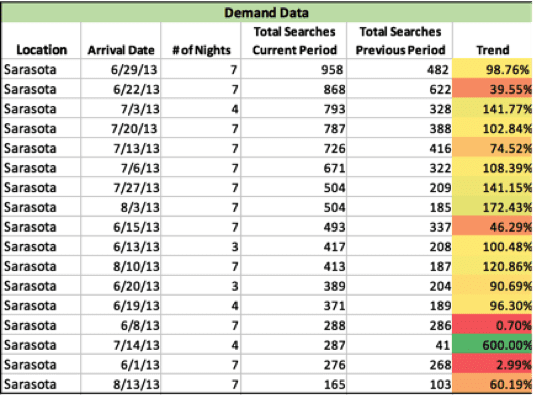
Once you collate the online and offline data, you can see a clear picture of your consumer search behavior and create reports similar to the one below.

demand data

Conversion Data

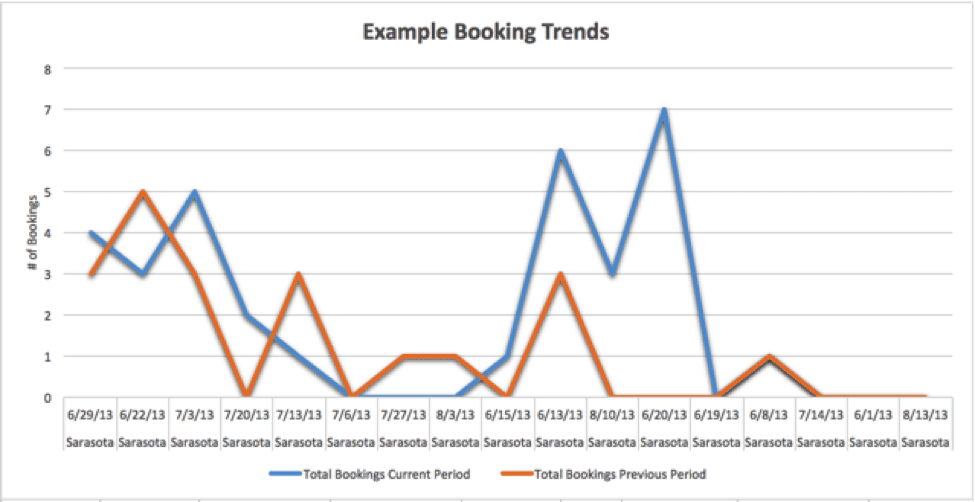
This is simply your booking data- what check-in dates and number of nights were booked in which type of units.   The majority of the vacation rental software in the market today makes obtaining this data simple to access and export to Excel.

example booking trends

Using the Data for Rate Optimization

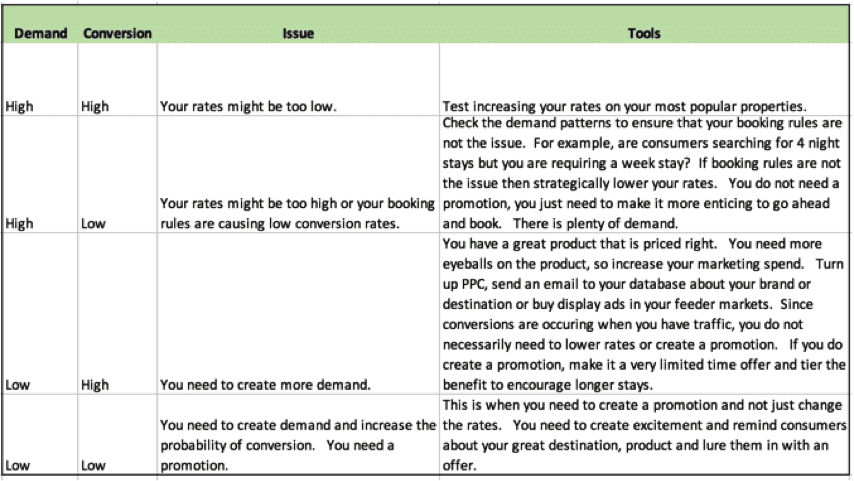
The reason it is so important to have your demand and conversion data before you make decisions is that once you have the data, it paints a clear picture of which strategies you need to activate in your rate and marketing tool kit to have the highest probability of meeting your goals.   Too often, there is a cry for every need period to have a promotion or an email blast, when in reality, different issues are at play and need very specific strategic reactions to ensure the expected outcome.

data for rate optimization

The Domino Effect

This data is not just for your revenue managers.  An effective rate optimization strategy also allows your marketing and eCommerce teams to create more effective campaigns and use their limited time and budgets most efficiently.

Business development can build an acquisitions strategy to target inventory where you have more demand than you have availability or demand for product types that you regularly show no search results. This will minimize your inventory churn and ensure that you add inventory that your consumers will want to book.

Rental managers will have real information to share with homeowners who want to know what is going on with the market and how your company is going to drive revenue aside from a shiny marketing PowerPoint.

Knowledge is power and harnessing your data to create a true culture of Revenue Optimization across your organization will help you stand out from your competitors.

LeisureLink Opening an Untapped Market for Vacation Rentals

0

Airbnb’s recent expansion into the vacation rental market heralded a strategic shift to move beyond the peer-to-peer model on which it was founded. This is making big waves in the hospitality industry. While there is much speculation about the impact this will have on the industry, there is little doubt the magnitude of the opportunity this affords property management companies – including access to their 32 million monthly visitors in more than 190 countries. LeisureLink is the first technology partner to integrate on the Airbnb vacation rental API, an exclusive channel through which Airbnb can rapidly scale in the vacation rental market.

The integration between LeisureLink and Airbnb was seamless, and now LeisureLink suppliers (property managers) have easy access to Airbnb’s vast network of travelers. Airbnb, a household name for some time now, represents a rapidly growing niche of the accommodations market. According to a report by GlobalWebIndex, 8% of internet users in North America and 14% worldwide rented rooms or apartments through a home and lodging rentals service in Q1 2014. Already, hundreds of LeisureLink’s clients are benefiting from exposure to the highly engaged Airbnb audience. Skift reports that at 9 to 11 minutes on average, Airbnb’s users spend more time on the site than any other travel site’s users, and they view over 7 million pages of the site per day.

Airbnb exposure affords vacation rental suppliers the unique opportunity for dual exposure – on traditional OTAs (the hotel side) and within the sharing economy (the owner-supplied side). Not only does this expand the volume of eyes on LeisureLink’s partners but it puts vacation rentals in front of a different kind of traveler, one who is looking for a local experience,often searching of a larger space, and desiring rates that are more affordable than the standard hotel. Property management companies are already skilled at delivering on these requirements. The fit is natural – and it is lucrative.

Airbnb is, unsurprisingly, popular among millennial travelers, however, there are also unexpected audiences such as extended stays (which Airbnb says are about 10% of its business), family travel, and over 250 corporate travel programs, including Google and Salesforce according to reports by Bloomberg and Condé Nast Traveller.

For vacation rental suppliers already working with LeisureLink, Airbnb distribution is just a mouse click away. It’s as simple as the flip of a switch since LeisureLink connects with most property management systems. It has never been easier to manage online distribution from one platform-automating and optimizing rates, availability, specials, and content changes.

Why is this so important? Because this year is poised to be the tipping point for the vacation rental market. According to a recent study commissioned by Choice Hotels International, Americans are planning to spend 8% more on leisure travel, and 5% more per trip than they did in 2014. Millennial leisure travel spending will increase by 6%, spending for families traveling with children will increase by 5%, and senior spending will increase by a whopping 33%.

However, leisure travelers are still searching for the best deals – 62% said the most influential factor when selecting a travel destination was budget. Vacation rental companies are primed to supply the spacious accommodations, the “sense of belonging” that Airbnb travelers desire, and, perhaps most importantly, the ideal rates that will influence travelers to stay.

With the expanded partnership of Airbnb and the support of experienced LeisureLink Account Managers, LeisureLink clients can be confident they are reaching all the right channels with the right inventory to optimize their online revenue potential.

Learn more about how simple it is to connect to Airbnb via LeisureLink at http://www.leisurelink.com/Airbnb

LeisureLink Raises $17M to Fuel Explosive Growth

0

Vacation Rental Industry Evolution Creates Urgent Need for LeisureLink Distribution Management Services 

SALT LAKE CITY, UT – January 19, 2016  LeisureLink, the world’s leader in distribution and booking solutions for vacation rentals, announced today that it has closed a $17M round of growth funding.  The capital, provided by Clearstone Ventures, Kinderhook Industries, and Escalate Capital Partners, will be used to scale company operations to meet the rapidly expanding demand for LeisureLink’s services.

A travel technology innovator since 2007, LeisureLink helps thousands of vacation rental lodging providers grow their bookings through three distinct offerings:  Distribution, Reservations and Technology services.  Vacation Rentals are one of the fastest growing categories in travel, and the industry has seen significant changes recently as consumer awareness grows and the world’s leading travel brands make major investments in the category.

“While the growth of the category is great news for vacation rental management companies, the task of distributing, merchandising and managing their inventory across the dynamic landscape of third-party distribution is growing increasingly complex,” explained LeisureLink CEO, Julian Castelli.  “Vacation rental suppliers need connectivity, tools, and expert services to benefit from this market opportunity.  LeisureLink is the leading provider of these services, and as a result, we are seeing explosive demand for our services.”

“I love finding a desperately needed business that can capture market leadership without too much attention,” said Jim Armstrong, Managing Director at Clearstone Venture Partners.  “We believe LeisureLink is a better way to invest in the fast-growing online vacation rental marketplace than Airbnb, HomeAway or any of the customer facing sites.  We represent the suppliers, don’t have to reacquire our customers, and have a terrific performance-based revenue model.”

LeisureLink has delivered over $1B in bookings to vacation rental management companies and is growing rapidly.  The company plans to utilize the additional capital to expand its operations and enhance its industry-leading technology platform.  “We are grateful for the trust that our customers have put in us by adopting the LeisureLink distribution platform,” said LeisureLink COO, Jim Barsch.  “We are excited about the capabilities that we are building internally and the expanding partnerships that we are creating with third-party distributors, as these will allow us to deliver even greater booking volume to our customers while enhancing our customer service.”

About LeisureLink  

Salt Lake City-based LeisureLink’s distribution services offer vacation rental properties the opportunity to distribute to top online travel agencies like Expedia, Booking.com, Airbnb and HomeAway, all the major GDS players and top travel sites. Suppliers can manage their online distribution from one platform – optimizing rates, availability, specials, and content changes. Leisurelink’s specialty consulting services leverage industry experts who understand travel distribution and maximize revenues. LeisureLink consolidates all accounting, payables and receivables with a single source of payment, providing clarity to the often-complex world of distribution.  This comprehensive service helps LeisureLink clients generate more money and save more time.  For more information, visit LeisureLink.com.

Guest Communications: Is Your Brand at Risk?

0

brand a·ware·ness
noun

  1. the extent to which consumers are familiar with the distinctive qualities or image of a particular brand of goods or services.

Customer engagement is the lifeblood of any successful business relationship. This cannot be more evident than in the vacation rental business. Before all the advertising, listing sites, and everyone telling you what you need to do there was just you and your guests. A decade later we find it is those same relationships that have fueled the growth of this industry. It is the stories created by families enjoying their vacations and forming bonds with communities outside of their own. These bonds with your guests begin and end with your Brand.

In order to become a successful “professional host” one must develop that intimate relationship with the guests – before, during, and after the stay. In each phase of the relationship your Brand should be front and center. These days it is becoming more of a challenge due to outside influences interfering with these very important relationships. What can we do to stay front and center and continue to nurture these all important relationships?

Always communicate through your Brand.

Every Brand is unique, from your website, to your location, to your services. Be sure that each and every communication with your future guests highlights your Brand. Hotels have been doing this successfully for many years. Every vacation rental management company is its own unique Brand – make sure your guests never forget this.

Brand awareness drives intimacy.

Vacation rental and hotel travelers have different expectations. The level of communication needed to transact a vacation rental is much higher than that of a hotel. This provides multiple touch points from pre-booking to asking for that highly coveted review upon checkout.

Communicating through your Brand + intimacy = Repeat Guests

One of the key value metrics for any vacation rental business is repeat guests. The valuable metric allows you to look at other opportunities to expand your existing business. It is much more cost effective to manage a repeat guest than it is to acquire a new one. Invest in activities that will bring your Brand closer to your guests. It will be the best investment you will ever make!

Understanding the relationship between guests and your brand will open up opportunities to expand your existing business – from making yield management decisions to taking on new owners. This will also give you a greater perspective when selecting how your Brand is distributed in the future.

by: Vince Perez
Co Founder / Fetch My Guest

Vince Perez

Stay Alfred Offers Free Vacation Rentals to Cancer Patients

0

Stay Alfred Vacation Rentals Offers Complimentary Lodging to Cancer Patients in 11 US Cities

Stay Alfred is pleased to announce an agreement with the American Cancer Society donating complimentary stays in their spacious  two- and three-bedroom vacation rentals to cancer patients receiving treatments.

If you are a cancer patient and your doctor says, “Your best hope for a cure is in another city,” one of your first thoughts is, “Where am I going to stay and how am I going to pay for it?”

The American Cancer Society (ACS) partners with lodging partners to remove that barrier so that cancer patients can focus on getting well.

“We pride ourselves on the comfort of our downtown vacation rentals,” said Jordan Allen, president of Stay Alfred. “Every guest can appreciate our amenities and locations, but our properties are also much larger more comfortable than a hotel. Hopefully Stay Alfred can offer a little comfort to someone who really needs it.”

If you or someone you know will be receiving cancer treatment in any of the following cities, please call 1-800-227-2345. Stay Alfred currently offers complimentary one-, two-, and three-bedroom downtown vacation rental properties in Boston, Mass., Denver, Colo., Memphis, Tenn., Nashville, Tenn., New Orleans, La., Philadelphia, Penn., Portland, Ore., San Antonio, Tex., San Diego, Calif., Seattle, Wash., and Washington, D.C.

About Stay Alfred Vacation Rentals Stay Alfred was the first nationwide urban vacation rental company to offer the space, privacy and value of vacation rentals with the convenience of secure online booking and self-catered check-in. Stay Alfred has received 98% positive feedback on TripAdvisor and 83% of their reviews are a perfect 5 Stars. Stay Alfred has been featured on National Public Radio and in multiple business and trade publications.

Stay Alfred accepts guest reservations 24 hours a day by phone or online. Guests will find prices similar to those of an upscale hotel, despite three times the square-footage, multiple bedrooms and bathrooms, and fully-equipped kitchens and laundry. They can take virtual tours of the properties and book online at www.StayAlfred.com or call (866) 988-5518 to speak with a reservationist.

WSJ: HomeAway Mocks Airbnb Sharing Economy in New Ad

0

By Suzanne Vranica, WSJ –HomeAway Inc. wants to remind you of all about the funny and uncomfortable ways that sharing someone’s home on vacation can go awry: Finding a stranger’s hair on a bar of soap. Being watched in your sleep. Witnessing someone else’s personal hygiene routine.

The new marketing push is designed to help HomeAway grab a larger share of the vacation rental market and distance itself from home-sharing companies like Airbnb Inc.

HomeAway’s ad campaign, which begins today, features TV, digital and social media ads that mock the so-called sharing economy—the peer-to-peer sharing of goods and services, a trend Airbnb helped pioneer.
 

The ads, which will also run in countries such as France, the U.K. and Germany, demonstrate, in a humorous way, the weird situations people face when they share accommodations with strangers.
 
HomeAway’s listings tend to be managed properties and second homes that people rent out for most of the year, while Airbnb allows people to rent out rooms for brief stints.Airbnb also has expanded into the professional vacation rental businesses, making it more of a competitor to companies such as HomeAway.

“We are trying to educate people about the difference between what we do” and what hotels and companies such as Airbnb offer, said Brian Sharples, chief executive officer of HomeAway, which was bought by Expedia Inc. last year for $3.9 billion.

HomeAway, which typically rents out entire homes, said there is a 10% to 15% overlap in HomeAway’s and Airbnb’s listings.

Publicis Groupe’s Saatchi & Saatchi London crafted the new ads for HomeAway, which feature the voice of actor Nick Offerman, who played Ron Swanson on NBC’s “Parks and Recreation,” pointing out the uncomfortable situations people end up in when they stay at a hotel or an Airbnb-like rental.

“Sharing is caring, at least that is what they told us, but now people will share anything,” chimes Mr. Offerman. He lists all the things that people nowadays are freely sharing like their information, their personal space and “even our vacations,” he adds, as different vacationing scenarios flash on the screen.

One scene shows a horrified couple sitting on a sofa watching an unkempt man in a bathrobe clip his toenails. Another shot shows a couple waking up to find a strange-looking man watching them sleep. A particularly cringe-worthy moment: A woman is seen gagging as she reaches for a bar of soap that is covered with hair.

“There is an ugly side to the sharing-economy and something for people to think about…that is something we want to distance ourselves from,” said Mr. Sharples at HomeAway. “That is really not the business we are in.”

The ads also knock traditional hotels and include images of hotel guests struggling to relax at an overcrowd hotel pool. The ads carry the tagline: “It’s Your Vacation, Why Share It?”

The marketing doesn’t specifically name Airbnb, but HomeAway says it thinks the message is pretty clear. It decided to avoid mentioning Airbnb directly because the ads will run in countries where there are other Airbnb-like competitors. HomeAway also doesn’t think it’s “good” to drive more awareness of a competitor.

The Austin, Texas-based company wouldn’t disclose how much it is spending on the ad effort, but said it is increasing its ad spending significantly this year. Last year, the company said it spent $60 million on ads—digital and traditional—that ran around the world.

Ad-tracker Kantar Media estimates HomeAway shelled out about $7 million on ads in the U.S. during the first nine months of 2015. (That figure doesn’t include online video or search ads.)

During that period, Airbnb spent $24 million in the U.S., more than three times what HomeAway spent, showing how crucial the new marketing may be to helping HomeAway improve its brand recognition among consumers.

http://www.wsj.com/articles/homeaway-mocks-airbnb-sharing-economy-in-new-ad-1453093262?mg=id-wsj


Is Your Website Mobile Friendly?

0

The Importance of Responsive Design

In April 2015 Google introduced the mobile-friendly update to their algorithm. This update meant that a website’s mobile friendliness would be included as a ranking factor in search engine results on mobile devices. In the reaction that followed, some feared this change would disrupt years of effort and hard work in harnessing the power of search engine marketing. While this “mobile-pocalypse” did not pan out as some had predicted, it has had considerable effect in the Vacation Rental Management (VRM) industry, and prompted many businesses to reevaluate their website and how they engage with their largest emerging user interface: mobile.

According to Google, 94% of American smartphone users search for local information on their phones. Further, 77% of mobile searches occur at home or at work, suggesting that even when traditional desktops computers are available, many people prefer to use their smart phones to access the web. These figures show that rather than slowing down, mobile traffic is speeding up and with it the opportunity for Vacation Rental Managers to claim market share across a new medium.

As the web continues to expand and reach new users, mobile devices have quickly become the tool through which many access websites, engage with businesses, make reservations, and purchase products. This development, in accordance with Google’s endorsement of mobile as the future of web traffic, has made responsive design crucial to website development and digital marketing. This most recent change to the Google algorithm shows that Google is all in on putting mobile users first.

The key ingredient in this transition is the use of responsive design in website development. As mobile friendliness becomes one of the most important factors in search engine rankings, it is key to make sure your site is optimized as such. Not having a responsive site means users will face a difficult and frustrating experience when accessing your site from a mobile device. The practice of pinching on the screen to zoom in again and again will make a user very reluctant to continue exploring a site and severely decrease the chances for conversion or online booking.

Users who experience a non-mobile friendly site will likely see text that is too small to read or navigation buttons that are too small to click on and freely move throughout the site. Furthermore, important content can be relegated to non-strategic positions on the site. Responsive design works hand in hand with content in providing the user the best interface and experience which will drive conversions and bookings. According to Google’s guide for mobile friendliness, a responsive site that can be used across mobile devices should aim to highlight and prioritize the most important and common tasks on your site.

Property managers are able to quickly find out if their sites are mobile friendly with a test offered by Google. The rest will analyze your site and generate a report telling the owner if the site and its pages have a mobile friendly design. According to Google’s standards, your site earns a “mobile-friendly” badge if it meets the following requirements:

  • Must avoid the use of software that is not common on mobile devices, such as Flash.
  • Uses text that can be seen easily without zooming.
  • Content is sized to the mobile screen so that users don’t have to scroll horizontally or zoom in.
  • Links are placed far enough apart so that the correct one can be easily clicked.

What does this mean for next steps? It is important that Vacation Rental Managers find out immediately if your site is responsive, and you can easily do so with the Google Test tool. But that alone is not enough; it is recommended that companies develop website engagement strategies that include mobile devices. This trend will continue to grow as consumers demand ease of purchase for, not only rentals, but experiences as well. When it comes to your vacation rental website, be sure your site is responsive and mobile friendly so that users can book their vacation from start to finish on a mobile device.

Not sure if your site meets the mobile-friendly requirements? Realtech Webmasters offers no-obligation website reviews.  Visit our website at realtechwebmasters.com.

 
Real Tech Webmasters


9040 Town Center Parkway
Lakewood Ranch FL 34202
941 870 5707

RealTechWebmasters.com

Blue Tents Tips to Better Booking in 2016

0

By Blue Tent Marketing

As 2016 quickly approaches, we are encouraged to revisit marketing strategies and discover ways to increase overall revenue throughout the upcoming year, to create plans designed for long-term, sustainable growth. While driving more qualified traffic to your website is essential, refining your current presence to convert more travelers to guests is equally important. By doing so, you will effectively leverage your marketing channels and generate the highest return on investment.

The five tips listed below are just a starting point to help you improve your existing web presence. In order to successfully optimize, you must understand your audience and what motivates travelers to book. Then, use this information to hypothesize, test, analyze, and make data-driven decisions to better improve the user experience and increase online bookings. You will notice some of the tips require small changes while others require a bit more planning and budgeting. Often, major improvements happen when you implement minor enhancements to your digital presence.

  1. Enable Guests to Share the Love: We see about 3x more conversions on properties that have been shared or marked as a favorite. Since trip planning is highly emotional and often very social, provide your guests the tools they need to create favorites as well as share and plan trips collectively.
  2. Be Flexible: Create a search that always has an answer. Often, trips don’t need to fit into a perfect box, so allow guests to be flexible with their travel dates when searching for a property. Additionally, improve their experience by providing alternatives based on price, location, or amenities. If their original request is unavailable, be sure to differentiate results that are outside their actual selections.
  3. Embrace Mobile & Multiple Devices: Don’t lose your brand as you shrink screen sizes. Vacation planning occurs across a myriad of devices. That said, provide consistent, yet device optimized planning and booking.
  4. Create Compelling Calls to Action: Truly know and understand your audience. Be sure to empathize with your guest’s booking experience with calls to action that change as these travelers dive deeper into the booking process.  
  5. Introduce Urgency Marketing: Honest and valuable urgency marketing is welcomed by your guest. Provide helpful insight, inform your guests exactly how many people are searching, and establish custom rules for when availability is tight.

With an optimized booking experience and website the traffic you drive through search, email, advertising, and social will convert at a much higher level, thereby exponentially increasing your overall revenue. Always remember that your website is living and breathing; it requires continuous refinement to make sure it is performing at its best.

They’re Sexy and They Know It: Don’t Marry the Wrong One

0

What to Look Out For When Choosing a Channel Manager for Vacation Rentals

“But why do I even need a channel manager?” you ask.

Welcome to 2015. The year big vacation rental websites got serious about accurate availability, the year they are ranking properties with real-time booking higher in their searches, and the year they realized channel managers can deliver that flawless availability they are seeking. Without a doubt, this is the year channel management became sexy.

Now, if you work “on request” and cannot maintain accurate calendars then you are right, marketing automation is not for you, “you definitely don’t need one!”

The promise is this: A channel manager will get you more visibility and therefore more bookings. Although this is a big deal, getting more bookings is not the only reason to automate your marketing. You won’t need to log into 10 websites every day to update your calendars and prices. You’ll lower the risk of over-booking and be able to change your rates more easily. In short, you’ll increase sales, save time, reduce errors, and save effort.

While your existing Property Management System (PMS) may offer a “channel management feature,” the field is actually a real specialization. It takes time and skill to connect to sales channels, sign contracts, implement APIs, to test and maintain relationships. For this reason, if you don’t yet use a PMS, it is highly advisable to go straight to a channel manager. If you do use a PMS, enquire what channel manager they are working with.

Here’s a quick guide on what to consider:

1. Barriers to entry

Firstly and most importantly does the channel manager take 1 property or do you have to have 10 minimum?

2. Niche Marketplaces

While you surely have your eyes on the big travel agents, remember that niche marketplaces can be very lucrative. Maybe you have niche properties such as luxury villas, golf-course properties, or ski chalets. Promote your properties on marketing channels that cater specifically to you! A good channel manager can connect you not just to the big-names that they all should but also the lesser-known niche marketplaces.

3. Customer service

It can be difficult for a vacation rental owner to connect all the dots between a channel manager, an online marketplace, and a PMS. How does each channel work? How much do they charge? Should you publish net or rack rates? How much work is involved for you to connect? A good channel manager will have excellent documentation and also a good customer service team that can help customers get set-up and support their success moving forward.

4. Fees and commissions

You probably experience a low and high season. To even out your cash flow, choose a channel manager that doesn’t charge you a monthly fee but rather a commission per booking. If you have a very large number of properties a fixed price may be better for you. Ask about any hidden fees or fluctuations in the commissions according to sales channels. Find out if you will be charged in case of a cancellation.

5. Push & Pull

A good channel manager needs to be able to both push (publish) inventory to and pull (gather) inventory from online marketplaces. This is the only way a vacation rental owner can use a channel manager to prevent over-bookings.

6. Other Integrations

Vacation rental managers and owners use a wide variety of Property Management Systems (PMSs) these days. They don’t want to have to change the way they do business in order to use a new channel manager. This is why it’s important for channel managers to not only connect to many different sales channels but to have flexible integrations with a variety of PMSs. Remember that one day you may want to change your PMS and you won’t want to lose all your relationships with the sales channels.

7. Property Segment

If you are running a hotel you will want to work with a specialized hotel channel manager that works with rooms. For vacation rentals, you’ll need a different beast which works with individual property units. It might sound trivial, but working with the wrong format will make you tear your hair out.

8. Reputation

Check what other people are saying about the channel managers you are considering. Consider looking at LinkedIn groups, specialized forums, and industry blogs. Remember, unhappy people shout the loudest. No news is not necessarily good news.

9. Ease of use

Once you are up and running channel management can be a dream come true, but it can be a chore to get set up. Generally speaking, the more flexible the system is the harder it will be to set up in the first place. Try to find out what is involved and decide whether you prefer a simple system with fewer options or not. A simple system may lead to less accuracy in your prices on partner sites, for example, if it cannot handle your discounts or fees for extras. A simple system may not be able to work easily with many identical properties, it may limit the number of images you can upload, or it may not handle the amenities you provide.

10. Business model

Do you have to sign a contract with each sales channel or can you sign a single contract with the channel manager? Both options have their advantages. It’s probably cheaper to make a contract with each sales channel, but if there is an option to sign only one contract it means any sales channel can sell your properties without you ever having to talk to them. Ideally, you will have a choice to do both so you can make a contract with your favorite sales channels but allow the others to sell you too.

Hopefully, we’ve given you a taste of both the benefits and pitfalls of channel management. As always in life what seems easiest at first is usually not the best. A little work today to spread your risk with more sales partners will ease your troubles and earn more profits in the long run.


Author: Vanessa de Souza Lage
Title: CMO
Company Name: Rentals United
Bio: Vanessa de Souza Lage is the owner of holiday rentals in Barcelona, the founder of the holiday rental agency “Holiday Velvet” and the CMO of Rentals United, a channel manager for vacation rentals. She has a passion for new tech and looks forward taking the conversation further with VRMA members at the event in New Orleans on the 26th of October 2015.

Ojai, CA Bans Vacation Rentals and Votes to Subpoena Airbnb and VRBO

1

There will be no vacation rentals allowed in Ojai.

After a year of debate, public hearings, policy proposals by a focus group, and suspension of existing rules, Ojai City Council voted 5-0 Tuesday night to make rentals of less than 30 days illegal in all parts of the city.

By Claudia Boyd-Barrett

The ban means the city’s existing zoning code, which effectively prohibits short-term rentals in residential zones but had not been enforced, remains in place. In its ruling Tuesday, the City Council clarified that the prohibition extends to all areas of the city, including village mixed-use zones and commercial areas. Enforcement is expected to begin Feb. 1.

The council’s decision primarily targets informal rentals advertised online through sites such as Airbnb and VRBO, which have proliferated in Ojai and across the country in recent years.

“This online business model circumvents and undermines community zoning laws. It is also an assault on legitimate licensed businesses playing by the rules,” said Councilwoman Betsy Clapp. “These seemingly harmless home-based hotels … impact school enrollment, housing stock, volunteerism and community cohesion. I’ve seen how they have turned neighbor against neighbor. They are not good for our town.”

The council’s decision follows a year of public debate during which several alternatives to an outright ban were discussed. Proposals included limiting the number of rentals allowed, only permitting them during specific times of year and in certain areas, requiring landlords to obtain licenses and pay taxes, and restricting short-term rentals to properties where the host lives on site.

Some vacation rental owners argued that the properties provide needed accommodation for tourists in the city. Others said they relied on vacation rentals to support themselves.

On Tuesday, however, the vast majority of residents speaking to council cited negative impacts from the rentals, particularly disruption to residential neighborhoods and a decline in affordable housing for workers, seniors and families.

“We have a huge deficit in terms of affordable housing. If we allow this precious, precious housing for our citizens to be used for tourism instead of for our residents, we are doing a vast disservice to our population,” said Anita Hendricks. “Please, do not let these places go to tourism.”

Previously, landlords had an option to apply for a conditional-use permit for a short-term rental through the Planning Commission. The council’s decision Tuesday effectively removes that possibility, City Manager Rob Clark said. Only one property in the city has a conditional-use permit and that will remain in place, he said.

Mayor Paul Blatz suggested allowing vacation rentals in village mixed-use zones. However, council members Severo Lara and Clapp said they were concerned that allowing rentals in those zones would still impact city housing stock.

Clapp said vacation rental owners who need extra income can still rent out their properties long-term.

Councilman Randy Haney expressed concern about how an outright ban might affect property owners, but ultimately went along with the majority despite “deep reservations.”

The council also voted 4-1 to subpoena Airbnb, VRBO, and other online rental sites for information on existing vacation rentals in Ojai. Haney voted against the motion, citing concerns about enforcement costs.

Onsite Property Management Association (OPMA) Reaches Major Membership Milestone

0

Membership Rental Inventory Exceeds over 50,000 Rental Units in Less than Two Years

Panama City Beach, FLA.  (January 12, 2016) – The Onsite Property Management Association (OPMA), which is focused on and advocates on behalf of onsite rental property management and the growing condo hotel sector, recently attained a major milestone goal for the association. The OPMA membership base now represents over 50,000 rental units of aggregated inventory. OPMA is currently one of the fastest growing national lodging associations in the country and comprises many of the most recognized brand name onsite property management companies and condo hotel properties in the lodging sector.

According to OPMA President and Founder, Paul Wohlford of Resort Collection in Panama City Beach, Florida, he is not surprised by the tremendous, rapid growth of the association in such a short period of time.

“There are recognized brand name onsite management companies and condo hotel properties, like ours, located throughout North America,” says Wohlford. “However, they have all been operating as islands unto themselves all this time and it’s taken the creation of a national association like OPMA to act as that critical bridge to bring everyone in our lodging sector together with a collective mission and purpose.”

Since the initial launch of the association in March 2014, the OPMA Board of Directors established a short-term priority objective of realizing 50,000 rental units of onsite managed inventory system-wide before the close of 2015. An additional goal of OPMA has been to aggregate the largest condo hotel rental inventory in the most popular vacation destinations.

Rick Fisher, Executive Director for OPMA, briefly outlined how this important strategy of collective inventory aggregation in select markets ties directly to a major OPMA initiative.

“We have been assisting our members in measuring and determining their collective economic impact in the local markets they serve. Their impact contributions can now be quantified and shown as to how they directly benefit OPMA guests, owners, members, and area stakeholders,” Fisher explains. “As a result of the continued growth of OPMA member rental inventory, we believe it’s conceivable in select targeted destinations that our collective economic impact contributions, including bed taxes, real estate taxes, employment, and other direct and indirect revenue indicators, could represent the primary financial resource supporting the local market area.”

To interview a member of the OPMA leadership team, please contact:

Rick Fisher

rfisher@theopma.org

(877) 870-6510


About OPMA

Founded in March 2014 as a 501(c)(6) nonprofit organization, the Onsite Property Management Association (OPMA) is spearheading an effort to support the advancement of on-site rental property management companies. By providing education and advocacy, OPMA will promote the value of the short-term rental experience through on-site property management companies. By leveraging the collective experience of industry veterans, this network of mutual support will elevate industry standards to ensure superior guest and owner experiences. The association is committed to providing a clear and cooperative message and to championing the growth and success of the industry. To learn more about the Onsite Property Management Association, visitwww.theopma.org or call (877) 870-6510.


For more information, contact:

Rick Fisher

Executive Director

Onsite Property Management Association, Inc.

rfisher@theopma.org

(877) 870-6510


or


Mary Jane Kolassa

Paradise

mjkolassa@paradiseadv.com

(407) 463-0040

Oranj Palm Vacation Homes acquires Catalina Island Vacation Rentals

0

Oranj Palm Vacation Homes and Catalina Island Vacation Rentals, the leading vacation rental companies in the Coachella Valley and Catalina Island respectively, announced their merger, becoming the largest portfolio of vacation rentals in California. The combined companies offer professional vacation rental property management, marketing, and property maintenance in Avalon, Hamilton Cove and Two Harbors on Catalina Island and in the desert cities of Palm Desert, La Quinta, Indian Wells, Rancho Mirage and Palm Springs.

“This is a powerful merger as the markets of the two companies continue to experience great growth. We are much stronger together. The combined companies enjoy varied seasonality and economies of scale associated with a portfolio of this size,” said Thomas Salinas, President and co-owner of both companies. This merger is the latest milestone for a journey that started in 1972 in Palm Springs and has been delivering expert service for vacation rental owners and vacation travelers in the desert. “The partnership has been long in the making and all parties know that this is a great result for both communities,” says Salinas.

Catalina Island Vacation Rentals offers nearly 200 Catalina lodging properties ideal for every traveler, including Avalon condos, homes and cottages, Hamilton Cove villas and Two Harbors casas. CIVR has developed a great reputation of respect, integrity and the best property management on Catalina Island. CIVR takes pride in the trust homeowners place in the company and in providing the highest level of customer service that homeowners and guests deserve.

With close to 300 vacation properties from Palm Springs to La Quinta, Oranj Palm Vacation Homes offers a wider selection than any other rental agency in the Coachella Valley and the most trusted booking service with state of the art software. Oranj Palm, formerly known as Palm Springs Rental Agency, was inspired by a new visual identity to serve clients the best-in-industry property management service and hotel-alternative experience, all while creating a distinction between their product and that of their ‘rent by owner’ and management company competitors in the space.

$2.2B Capital Injected into Vacation Rental Industry in 2015

0

$2.2 billion in disclosed angel and institutional funding has been raised by startups in the vacation rental industry in 2015, and 99% of that investment is being used to build up online marketplaces including Airbnb whose 2015 funding  totaled $1.6 billion and catapulted Airbnb’s valuation to $25.5 billion.

According to Fortune Magazine, over the past year Venture Capitalists have increased their funding of tech startups in virtually every corner of the economy by 92% compared to two years ago. In contrast, the vacation rental industry has seen a 750% increase in funding compared to two years ago.

The market is enticing. In the U.S. alone, the percentage of people over 18 who have stayed in a vacation rental has quadrupled from 8% to 32%, and it is now estimated that there are approximately 1.3 million vacation rental properties in the U.S. and 4.3 million vacation rental properties in Europe. With the size and opportunity of the market along with the fragmentation within the industry, VCs are finding attractive investment opportunities with companies innovating in the vacation rental space.


Vacation Rental Industry Funding 2011-2011
Funding Raised in Vacation Rental Industry by Company Type 2011-2015
Funding in Vacation Rental Industry by Company 2015
Funding Raised in Vacation Rental Industry by Company 2015
VC Funding in Vacation Rental Industry by Company 2014
VC Funding in Vacation Rental Industry by Company Jul-Dec 2014


2015 End of Year Security Summary By Tom K

0
Cyber Security for Vacation Rental Managers

By Tom K –The bad guys are still out there, and their attacks keep getting better!

They’re well funded, very focused, and unrelenting. If your company is not well protected, they WILL cause you pain.

As ever, my Holiday gift to you is my annual Security Summary. Do your company a favor… Review it and ensure you’ve implemented the Seven Security basics. Then move on to the advanced security topics. If you do, the bad guys will pass on your company and move on to easier, unprotected pickings.
 

This Year’s Topics:

• CryptoLocker continues to do serious damage
See CryptoLocker: Worse than EVER

• How to prevent your Staff inviting Malware onto your PCs
See Protect Your Company From Your Staff

• Your Vendors may be punching holes into your Carefully Crafted Security
See Who Is Talking To Your Systems… and Who Are Your Systems Talking To???


The Seven Commandments of Network Security:

• Centrally managed Corporate Anti Virus Protection
See Protect Your Company from Viruses and Malware with Enterprise Anti Virus Systems

• Centrally managed Windows Updates
See Centrally Manage Microsoft Updates Across Your Enterprise For Free!

• Centrally managed Corporate Spam Protection
See Got Spam? Eradicate Spam and Email Viruses BEFORE they get to Your Environment!

• Use Secure Passwords – don’t make it easy for the bad guys to get in
See Secure Passwords – You need to get this right!

• Have staff lock their PCs when they leave their desks – most attacks come from inside!
See Protect your Company’s Data and Reputation… Lock Your PC!

• If you provide public WiFi, isolate it from your business network
See Securely Implement Public WiFi, version 2015

• Deploy a Firewall at every point where your networks connect to the Internet


The Advanced Topics:

• You’re Being Filmed… Watch Your Back
See Eyes Everywhere

• You’re NOT Safe Just Because Some of Your Stuff Is In The Cloud
See Security When In the Cloud

• Protect Your Mobile Identity and Your Mobile Devices
See Protect Your Mobile Identity & Secure Your Mobil Devices

• The Dangers of Remote Access
See Hacked via Remote Access!

• If You MUST Provide Wireless Access to Your Business Network
See Provide Wireless Access to Business Systems???

• Unauthorized Devices Accessing Your Network
See An Anti-Virus Gotcha – It could happen to You!

• The departing Employee – turn a security nightmare into a simple inconvenience
See Departing Employee? How to Process them Gracefully and Securely

• Lock down access to your Corporate Bank Accounts – they’re not insured!
See Protect Your Company Bank Accounts

• Educate your staff to Phishing threats – how to spot them, what not to do…
See Don’t Be the Big Phish

If you’d like help ensuring your network security is up to snuff, or you have any questions concerning any aspect of Corporate Security, I’d be happy to discuss this with you at your convenience. Feel free to contact me at TomK@TomKConsulting.com, or via my cell 443.310.5110.


About Tom K

Tom K, has been a senior level Business and IT Consultant providing exceptional solutions to business leaders for more than 30 years. His last thirteen years have been focused on the Vacation Rental and Real Estate industry. He has built strong relationships with all the major systems and services providers in our industry, regularly working with their principals and most senior personnel.

ProResort Housekeeping “Live-In” Seminar Feb 20-27

0
Ocean front housekeeping services

Steve Craig and ProResort have done many “Live-in” Housekeeping Seminars that property managers have come to call a vacation rental housekeeping “college.” Craig says, “It is actually more like a “boot camp. What is learned and how it is learned are important, of course, but the intense networking with others is what makes the week so special.”

This year’s ProResort Housekeeping Live-In Seminar will be held February 20 -27, 2016 on St. George Island, FL. about 70 miles southwest of Tallahassee, and there are still a few slots left.


The major topics to be covered include the following:

  • Effective cleaning routines and how to teach them, including video training.
  • Proper inspection routines and how to teach them.
  • Effective recruiting, motivating, and incentive pay plans.
  • Carpet care that keeps units looking nice through busy season. You will learn bonnet buffing, carpet repair, and many spotting techniques.
  • Team-building and management “games.”
  • The 12 fundamentals of vacation rental housekeeping
  • How to effectively recruit housekeepers.
  • And much more!!!! (linen controls, dealing with nasty owners, unit evaluations, and on and on and on!) There will be a laundry visitation and many discussions about linen distribution systems


Additional information

  • All meals are taken as a group, in the “host” unit. Meals are used as work sessions. You will be sent, once selected, some food preferences/choices. The cost of all meals is included in the seminar cost. Alcohol, sodas, personal snacks: these are at the expense of the attendee.
  • There are 8 attendees only. They all live in the same house. The entire cost of this housing is included in the seminar fee. You can see the property at http://www.resortvacationproperties.com/rvp/vacation-rentals/property-details/index.php?propid=7392&SRCH=tr
  • Classes start at 8:30am each day, dinner ends by 7pm, then there is homework each evening, including group projects. On Friday evening we will go out to dinner and drinks (Included in the fee) for an “awards dinner” function.
  • The items not included in the fee are your transportation to the property (all transportation during the classes themselves is provided) and any incidentals, snack items, liquor, etc. Long distance calls from the host unit are FREE for all attendees!
  • Once you save a spot, we send travel info regarding airports, traveling directions, etc.


Tips from previous seminars

  • It has never worked out when husbands and wives attend together. One or the other, not both. We will take your money but don’t suggest this be done.
  • This is a vacation rental housekeeping seminar, not a hotel or timeshare seminar.
  • We are often asked, by those who live close to the seminar site, if they can attend and not have to stay overnight in a unit. The answer is yes (and a housing credit is given on the fee), but we recommend against it because the networking and cooperative homework are absent from their experience, and those who have done it have felt their experience was diminished.
  • The seminar will be hosted by Resort Vacation Properties of SGI. Checkin is any time after 10am on Saturday February 20 but you must be there by 5pm for the Welcome Reception and your first homework assignment. and checkout is after cleaning and inspection tests on February 27.
  • The cost is $2650 per person inclusive of housing and meals and all seminar materials and sample products. For the two that share a bedroom, the fee will be reduced to $2500.


How to save your company’s spot at the seminar

  • You can call, fax, or email to save a spot (s) officially for someone in your company.
  • You don’t need to have a name of the attendee at this time.
  • By mid-January, if you select a slot, you will be sent a detailed packet with travel info, a detailed agenda, etc.
  • You will then have until January 31, 2016 to notify us of the actual person to be attending if you have not done so already.
  • Payment in full will also be due by January 31, 2016 or your slot will be forfeited.
  • Contact info: Stephen R. Craig, 850-303-1358, proresort@aol.com


Comments from Previous Attendees

Gwen Polk of Meyer Real Estate says: “After the live-in seminar I was so filled with excitement and enthusiasm that I could hardy wait until I got back to Gulf Shores to start utilizing what I had learned. We sent another of our staff last year and she came back so pumped up and excited and she has been able to perform her job better than either of us had ever hoped.”

Kathy Manning of Emerald Isle Realty says “This was the single best experience of my professional housekeeping career. We have since sent two others to this seminar”

Diania Whitehead of Ocean Resorts says “I learned more in one week than I had ever dreamed was possible.”

Nancy Dusault of Pahio Resorts says “Thank, you, thank you, thank you for giving me this opportunity to learn so much with such neat people. I am sure we will be fast and firm friends forever!”

Holly Montorio of Dunes Beach Home Rentals says “I can honestly say that this class laid the solid foundation of knowledge that will enable me to be successful for many years.”

Nancy Boyle (retired owner of a vacation rental company) said “Yes, I paid to attend. All I had ever heard about housekeeping was that it couldn’t be done successfully. So my head housekeeper and I attended together, and what we learned together changed the way we did housekeeping forever.”

RGI hands VRMA management reins over to SmithBucklin

0

On December 1, the management of the Vacation Rental Managers Association (VRMA) shifted from Raybourn Group International (RGI) in Indianapolis to SmithBucklin in Washington D.C.

In an announcement to the VRMA’s membership, VRMA President Ben Edwards said, “We are excited about this opportunity to partner with SmithBucklin, the association management and services company more organizations turn to than any other. SmithBucklin has extensive experience in managing and growing professional trade associations such as VRMA. In particular, its experience in government affairs and advocacy efforts will assuredly help us navigate the ever-changing regulatory landscape and help fight anti-vacation rental legislation.”

As the association moves under new management, several VRMA members expressed their appreciation for RGI’s performance over the last six years.

“RGI is a class act, with great people who I will personally miss,” said Kyle Buehner, CEO at NAVIS. “They did a tremendous job helping our organization (VRMA) transition during a very difficult period. Further, during my five years on the board, I found them to be an exceptional management organization.”

Alex Risser, President at Outer Beaches Realty agreed. “RGI was a main reason for the success of VRMA over the past number of years,” said Risser. “Our Association has increased revenues, exceeded our goal of over 1,000 attendees at annual conferences, taken corporate sponsorships to levels exceeding initial expectations, and provided extremely competent and efficient staff to undertake the routine and many projects assigned by the Boards.”

The following tweet from outgoing Executive Director Mark McSweeney demonstrates the growth in key performance metrics during RGI’s leadership.


Risser added, “They were extremely professional, provided extensive in-house education for their own staff, and were very active in their own professional association. Several years ago, a consultant was hired to assess the performance of RGI for VRMA. Their report was very favorable that RGI was serving the VRMA well. What’s happened since to have made this decision is beyond me, but we have to trust that the current Board has sound reasons for having done so.”

Alan Hammond, Managing Director at Holiday Vacation Rentals, also conveyed appreciation for RGI”s performance saying, “During my time as a board member I felt that RGI served the Association well, particularly in planning VRMA conferences which are extremely important to membership growth, education and professionalism. RGI not only guided the VRMA through tumultuous times, but was instrumental in helping the Association in reaching sound financial health. I trust the new board made its decision wisely and in the best interest of professional managers and the Association.”

“Having served on several committees and as a Director for VRMA, I had the opportunity to work closely with each team member at RGI,” said Betsy LaBarge. President and CEO at Mt Hood Vacation Rentals. “To a person, everyone was always very professional and very friendly. The RGI team cared about the vacation rental industry and it showed in their work; they represented the best interests of the vacation rental industry and the association in everything they did. It will be a tough act to follow and I hope the new management team will be able to ramp up quickly to meet and exceed RGI’s accomplishments.”

“The VRMA is not your typical association,” said Heather Weiermann, Systems Consultant at NAVIS. “Therefore the individuals RGI assembled to work for VRMA could not be typical either. They were hand selected for our organization. As a result, they lived and breathed VRMA. Their collective knowledge, passion and dedication made them a very effective team that will be hard to replace.”

“I wish the staff at RGI the best, they will be missed,” said Hammond.

Recap of the New England Vacation Rental Managers Association’s Annual Meeting (NEVRMA) by Atlantic Vacation Homes

0

By Michelle Fonvielle Williams, Atlantic Vacation Homes — On Monday, December 7, 2015 vacation rental managers from all over the Northeast came together for the New England Vacation Rental Managers Association (NEVRMA) regional meeting. Representatives from twenty vacation rental companies (including Atlantic Vacation Homes) and nine supplier companies met to share ideas, best practices and stories as well as to discuss top issues & trends in the industry.

The infographic below gives some of the day’s highlights.


NEVRMA Recap by Atlantic Vacation Homes


Coaching Housekeeping Staff: A Lesson from Vince Lombardi

0

By Durk Johnson — One of the greatest NFL football coaches is Vince Lombardi. At the beginning of each season he would take grown men, some of whom had played football for decades, and hold up a football and say “Gentlemen, this is a football.” He would then explain the basics of the game. After a while they would move to the football field and the explanation of how the game is played and the objective of the game would be explained.*

As leaders and managers we need to do the same thing with returning seasonal staff and fulltime year round staff. We need to cover the basics of what we do and why we do them.

Here are a few housekeeping basics to cover:


1. Housekeeping Kit

Discuss how and why each chemical or tool is to be used. Take the time to do demonstrations of proper ways and improper ways, so they can see how it is to be used. The basic housekeeping kit should have:

  • rags (microfiber are the best ones to use)
  • bathroom disinfectant cleaner
  • all purpose disinfectant cleaner
  • a room deodorizer
  • a mild wood floor cleaner
  • razor blades for smooth top cook stoves
  • oven cleaner
  • pumice stone
  • magic eraser
  • gloves
  • trash bags
  • doodle bug
  • a large lint roller


2. Inspection Kit

Talk about the necessity of the inspection kit and how it can help them be effective at doing their inspections. What is inside the kit is going to vary on what guest amenities are provided and what expectations you have for your inspectors? Some of what should be included would be:

  • toilet paper
  • paper towels
  • guest amenities (if provided)
  • batteries
  • multi tool
  • laundry soap
  • dishwasher soap
  • any guest specific items that your company provides


3. Specialty Cleaning Products

I call them specialty cleaning products because only certain people have access to them and are trained to use them. There are two types of products I would like to highlight today:

  • an enzyme product that eats proteins, such as urine, blood, vomit, and beer just to name a few
  • a product to address mold and mildew that includes Australian Tea Tree Oil


4. Piece Rate

All housekeepers should be paid piece rate. This motivates the housekeeper to clean with speed and quality.


5. Inspections

Every arrival must be inspected for housekeeping quality and guest readiness. This inspection allows the inspector to make sure all is in order in the home. Some items include:

  • pillows are staged right
  • blinds are set appropriately
  • thermostats are double checked and temperature is set correctly for the time of year
  • doors and windows locked
  • kitchen pots/pans, plates, cups, utensils, and all other items placed neatly in the cabinets
  • correct number of hangers in closets and placed in the correct location on rod
  • appropriate number of towels in each bathroom


6. Standard Property Appearance (SPA)

Every company should have a document that illustrates and explains how the property is to be left when the housekeeper and inspector have completed their work. This document is not easy to create. It takes a lot of thought and work, with many people and departments collaborating for the final product. Once complete, everyone knows how the property is to look when the housekeeping staff have completed their work. Follow the wall – this procedure is a foundational housekeeping principle and every housekeeper and inspector should use it every time they clean, inspect, or check a property.

Some of the items this document addresses are:

  • how the towels are hung and where
  • how many rolls of toilet paper are left and where
  • how many paper towels are left and where
  • how the blinds are set for an arrival or departure

One last item for you to consider, every housekeeper is a memory maker. Every time a housekeeper or inspector does work in a property they are a part of memories made in the property. We need to remind our staff of this.

If you have any questions you can visit www.VRHP.org or reach out to me for more information.

* Vince Lombardi, in Donald T. Phillips, Run to Win: Vince Lombardi on Coaching and Leadership (2001), 92.

2015 Acquisitions of Vacation Rental Management Companies

0

In 2015 the vacation rental industry has seen a staggering $2.5 billion of disclosed venture capital injected. Expedia announced it will purchase HomeAway for $3.2 billion. Airbnb boasts a $25.5 billion valuation. The vacation rental industry is also seeing investment, consolidation and acquisitions among vacation rental managers.

Related: It may be one of the best times to sell, but are you ready?


2015 Acquisitions of Vacation Rental Management Companies

As 2015 comes to a close, let’s look back at this year’s acquisitions of vacation rental management companies.


Purchaser
Acquired
Units
Month
Year
Vacation Rental Pros
Hilton Head Rentals and Golf
230
Dec
2015
Natural Retreats
American Mountain Rentals
55
Nov
2015
Vacasa
Seaside Services
73
Nov
2015
Vacation Rental Pros
Five Star Vacation Rentals
60
Sep
2015
Vacasa
Chelan Vacation Properties
175
Aug
2015
Natural Retreats
Mammoth Front Desk
70
Jul
2015
Wyndham Vacation Rentals
ResortQuest Whistler
600
Jul
2015
Mike Harrington
Topsail Realty
170
Jun
2015
Wyndham Vacation Rentals
Vacation Palm Springs
450
Jun
2015
Wyndham Vacation Rentals
Corolla Classic Vacations
200
Apr
2015
Vacasa
Blowin in the Wind
51
Apr
2015
Vacasa
Mixon Properties
21
Apr
2015
Resort Collection
Laketown Wharf Resort
300
Mar
2015
Pacifica Companies
Sterling Resorts
1000
Jan
2015


By Amy Hinote

Tansler Raises $1.3M for Vacation Rental “Reverse-Auction” Site

0

Tansler announces $1.3 million in additional funding and wins General Catalyst Award for Travel Innovation and The Most Innovative Emerging Company at the Phocuswright Innovation Summit.

“Save time. Save money. Haggle free.” That’s the promise of vacation rental marketplace Tansler which today launches after two years of beta testing with a mission to shake up the $135 billion share economy and vacation rental industries. Tansler, an anagram of Rentals,  introduces a patent-pending process that enables consumers to set their price, choose multiple homes and submit one binding offer. Owners/Managers compete for the booking through a 24-hour ‘reverse auction’ and the first one to accept the offer ends the auction and confirms the reservation. This new approach saves consumers 10 to 50 percent on more than 500,000 rentals in 150+ countries worldwide.

“While it takes minutes to book a flight or hotel, it takes hours and sometimes days of emailing, haggling, and waiting to book a vacation rental, and that’s unacceptable,” said Jeremy Bernard, CEO and Founder of Tansler. “At Tansler, we set out to improve the process for both sides of the transaction. The result is that owners/managers are delighted to receive the entire, non-refundable payment at the time of booking, while the consumer enjoys big savings and quick booking.”


Tansler name your own price for vacation rentals
 
Patent-Pending 24-hour Reverse Auction

From the beginning, Tansler shakes up the vacation rental search by asking users to name their own price. Travelers can provide preferences for location, dates and number of guests. Those looking for destination inspiration, can search the world of Tansler by date and price only.

Tansler searches its database of 500,000 properties in 150+ countries worldwide and provides a set of search results that meet the user’s criteria. Tansler displays the listed rate of each property alongside the renter’s offer and discount off the listed price.

Next, users select as many properties they like, provide a credit card to guarantee the booking and Tansler does the rest. Instantly, selected properties receive the offer with a 24-hour timeline to accept. The reverse auction ends when the first owner/manager accepts the offer, or after 24 hours.

All transactions on Tansler are binding for both renters and owners/managers, and there is no cost for hosts to list their properties or for renters to bid on properties. Once a booking is complete, renters are charged a six percent service fee and owners/managers are charged a three percent service fee. The service fees are at or lower than other vacation rental and share economy websites. Listings on Tansler are also non-exclusive, so owners can list properties on other websites and with real estate brokers.


Winner of Two Awards at Travel Technology’s Biggest Conference

Tansler won two awards at the annual Phocuswright Travel Innovation Summit, held on Nov. 17 and 18, 2015 during The Phocuswright Conference. Each year, innovative companies are selected to demonstrate groundbreaking applications and solutions that are set to change the travel industry. The winners represent the best of this elite group. Tansler was awarded:

  • The General Catalyst Award for Travel Innovation, which comes with a $100,000 convertible note
  • The Most Innovative Emerging Company


Tansler Milestones Since Beta Launch

$1.3 million in additional funding including Karlani Capital and a number of angel investors including Ken Hamlet, Former CEO of Holiday Inn® Hotels; and B Anthony (Tony) Isaac, extended stay pioneer and co-founder of Lodgeworks. Tansler has raised $2.1 million to date.

500,000 vacation rentals in 150+ countries worldwide. Inventory comes directly from global Property Managers, Property Management Software companies and partnerships with leading vacation rental websites.


New hires to executive team:

  • Walter Buschta (COO) – a vacation rental veteran and e-commerce entrepreneur who is the former CMO of Interhome, the world’s largest vacation rental property management company
  • Daniel Ortiz (CTO), PhD in Material Science and Engineering; former CTO of Makr, sold to Staples earlier this year

TripAdvisor lowers manager fees and adds traveler fee

0

Today TripAdvisor implements a new fee structure for vacation rental managers bringing parity to their pricing model for vacation rental listings.

Yesterday, TripAdvisor sent an email to property managers that their fee would be lowered to 3% with an additional traveler fee for guests booking vacation rentals through their websites.

This move is welcome news to property managers who complained in an open letter to TripAdvisor CEO Stephen Kaufer that said, “Properties that are professionally managed are being charged a significantly higher commission (10%) than those that are owner managed (3%).  This practice makes no sense and, if anything, managers should get a discounted rate since they list in bulk and are business partners…Please let us know if TripAdvisor is willing to offer Property Managers the same 3% pricing model on the ‘Pay on TripAdvisor’ as TripAdvisor offers rent by owners with 5 properties or less.”


TripAdvisor Commission Announcement
Dec. 8 TripAdvisor Email to Vacation Rental Managers

TripAdvisor initiated a traveler fee for owner-managed properties earlier this year imitating Airbnb’s pricing model which proved that travelers are willing to pay an additional fee for bookings. Last month HomeAway announced they would be also adding a traveler fee for reservations. Priceline’s Booking.com has not implemented a fee for travelers for vacation rental bookings.

According to a Skift article written by Dennis Schaal, “TripAdvisor’s introduction of a traveler fee on vacation rentals by property managers will not necessarily be material to TripAdvisor’s financials in the short term because vacation rental transactions are not material to TripAdvisor at this juncture. But those traveler booking fees could be material to TripAdvisor in the future.”

Schaal continued, “TripAdvisor’s decision to begin charging travelers’ a fee for vacation rentals from property managers will please Wall Street and could put pressure on Booking.com, which adamantly eschews such fees for all of its vacation rentals, to do likewise. On the other hand, much as HomeAway saw a competitive advantage for years in not charging a traveler fee while Airbnb and others did, Booking.com management could stick with its beliefs and continue to avoid turning off consumers with booking fees.”


By Amy Hinote

A Tribute to Milton Buehner: One Who Epitomized Innovation, Integrity, Passion, and Servant Leadership

0

“I can do things you cannot, you can do things I cannot; together we can do great things.” –Mother Teresa

This quote was often used by Milton Buehner and summarizes the paradigm he used to create Buehner-Fry in 1987, the company we know today as NAVIS.

“You can’t have walked through the history of vacation rentals without acknowledging Milton Buehner,” said industry veteran and revenue management consultant George Volsky.

Milton Tobias Buehner was born August 31, 1938 in Mitchell, South Dakota. After graduating from St. Johns High School in Winfield, Kansas, he served in the Navy from 1956 to 1959. He then built and ran several businesses, but during the recession in the 1980’s, Milton’s entrepreneurial life took a downward turn.

In his own words, Milton Buehner, whom his friends simply refer to as Milt, said in a 2012 interview with the ministry Generous Giving, “At the time we were living in a 21 foot camp trailer after having lost three different businesses, and I looked around in my camp trailer and out the window in the junk yard that we had to park that in, and I realized that whatever plan He had for me had to be somewhat better than the one I was living in. God provided everything. He provided the idea for a business that had to do with telecommunications.”


Milton Buehner – His Plan Had to be Better Than This from Generous Giving on Vimeo.


And what a business it became.


The Foundation

According to Larry Browning, President at Discover Sunriver Vacation Rentals, “Our company was Milt’s first ‘client’ way back when. Milt always referred to us as clients because clients -as opposed to customers -were folks that you cared for, helped and nurtured. The business started by providing an Amway phone – that oughta give folks my age a chuckle – that would allow long distance calls to be made from the vacation home and transfer those charges to the guest as opposed to having them show up on the owner’s bill. Believe it or not, this was a big deal in the 80’s. Buehner-Fry would take some profit, and their plan allowed for the property management firm to take some profit.”

Al Williams, Owner of Cabin Fever Vacations in Gatlinburg and previous President at ResortQuest SW Florida, added, “Prior to Milt introducing the phones, property managers had to hold a guest’s damage deposit for up to two months in order to receive the phone bill from the owner and deduct the charges from the guests deposit before returning the balance. His introduction of the phone to our industry helped solve a major problem for all vacation rental managers.”

Steve Fine, who joined Buehner-Fry in the early stages while the company was operating out of a garage, said, “We spent a lot of years trying to figure out how best to help the hospitality business. In hindsight, at the company we were simply living Milton’s core values with a little technology thrown in. We lived them so much they merely became who we were.”


Growth

In describing the company’s growth, Browning explained, “The use of the phones grew, and services expanded. Buehner-Fry developed a housekeeping monitoring system allowing us to track the comings and goings of our housekeeping teams and also help with the scheduling. They developed speed dial buttons that local vendors such as the pizza delivery and bike rental companies could buy into. Soon after, the service morphed into “free” long distance calling for the guests which was a really big deal! You need to remember at that time we were all still tied to land lines. Around this time they introduced temperature sensing devices that enabled us to monitor temperatures from our desktop…another big deal.”

“In the early years of my time at Buehner-Fry there were no core values written on the walls and taught to new employees, no strategic planning and barely any meetings of note,” said Mike Hollibaugh, Chief Innovation Officer at NAVIS, who joined the company in 1998. “There was just a way that we all conducted ourselves that mirrored the way Milton Buehner conducted himself. We were expected to act a certain way and treat our clients a certain way, and it was never even really spoken to or about. That’s just how we did it at this little company in Bend, Oregon that provided long distance service to Vacation Rental Companies.”

Steve Fine added, “Following the Golden Rule, always having integrity in anything we did or said, being innovative – it is so much fun, having a passion to help others succeed, and an attitude of being able to do what is necessary for success is who we had become.  By helping others, we always help ourselves in the long run.”


Change

With the introduction and widespread use of cell phones and web-based technology, many of the products were in danger of becoming obsolete. While several companies shut down with the introduction of new technology, Milton Buehner worked directly with his clients and his team to innovate and find better technology to improve the operations of vacation rental managers.

According to George Volsky, “As cell phones threatened the business, Milt began an exhaustive and relentless search for new products and services. He explored new ideas and spoke to everyone. Milt leveraged his company’s expertise in phone systems to accomplish what I believe to be the industry’s most remarkable transformation from one business to another. He laid the foundation for NAVIS’s current suite of products and services which today extends well beyond vacation rentals to hotels and resorts.”

Larry Browning said, “Milt surrounded himself with really good people and built a culture that I and tons of others trusted. They gained our trust by asking us about our businesses and applying what they learned to provide products that would help and nurture our businesses. I have fond memories of lunch with Milt and seeing his eyes sparkle when he talked out about his visions of what could be.”

Browning continued, “Then the big changes came. These guys figured out a way to provide us information about our guests that before, was only available to large corporations with huge budgets for market research. All of a sudden we were able to monitor calls coming into our offices, track those calls, get a profile of the caller, create a data base of the caller and break that data base down into finite groups allowing us to spend our marketing dollars more efficiently. Narrowcast! I remember when Milt was explaining the Narrowcast concept to me and that sparkle in his eye appeared bigger than ever. He used several analogies from broadcast, as in radio or TV, to fishing, to mining to explain the concept to me. ‘What if we can take the information we have and find that pocket, that sweet spot, that vein of gold that had been overlooked before? What if we can coach our employees to fine tune their skills to enhance even more, our ability to capture more business?’”


Handing Over the Reins

In 2006, Milton Buehner turned over the reins of the company to his son Kyle Buehner. George Volsky said, “Milt knew when it was time to hand the reins over to others. He exited to focus on other interests, enabling his son to build upon the original foundation of expertise and capital.”

In the 2012 interview, in his own words Milton said, “He (Kyle) is carrying it on partly because his values are similar to mine. And he watches me like a hawk so it isn’t so much by what I say, but what I do. And I believe he understands who is the Provider for our ideas. What that is doing is meeting mine and Donna’s fondest expectations, which are that we have the opportunity to find a home for what God gave us.”

Mike Hollibaugh said, “After we had moved away from long distance and became a software company and the company was rebranded as NAVIS, we began to start doing things like strategic planning, exploring our purpose and deciding on our core values. Although Milton wasn’t at the helm when we did these things, it is astonishing in retrospect how he shaped each of our values that are now posted on our walls, including the Golden Rule, integrity, innovation, passion and attitude.”

Browning added, “I think it’s important for folks to understand the transformation that Buehner-Fry/NAVIS went through. It’s nothing short of amazing. Think about it, the business was built around a piece of hardware and technology that is obsolete today. It would have been so easy to say ‘we had a good run’ and that would have been the end of it. What NAVIS did was totally transform from what they started out as to something that is totally different today. The cool thing is every step they’ve taken is relevant to all of us in the Vacation Rental business.”


Impact

John V. Kjellman, President, and Victorex, Inc. and founder of the Vacation Rental Managers Association (VRMA) said, “Milt’s big impact on the vacation rental business was in the products and services he made available to vacation rental managers, and the way in which he evolved his business over the years as technology and business practices changed. His impact on the vacation rental industry was huge.”

According to Browning, “NAVIS and others such as First Resort Software (FRS) really helped build the VRMA. While the idea thankfully stemmed from another visionary, John Kjellman and a handful of his clients, NAVIS and FRS saw the importance of our industry getting together as well, and they aggressively encouraged us to join this new group. Every new client they gained was encouraged to join the VRMA. NAVIS has been a supporter of the VRMA ever since I have been involved, providing financial support, hosting seminars and classes, acting as cheerleaders for the organization and gathering and providing data about the industry as a whole.”

Kjellman added, “I can’t think of a single person who more influenced the ‘industry,’ over a span of many years than Milt. I’m happy to take credit as the VRMA founder, but I was simply the spark that got things rolling, it was the folks like Milt who developed the industry into what it is today, and while there were many significant contributors along the way, I can’t think of anyone who tops Milt on the list.”


Legacy

Michelle Marquis, VP of Sales and Marketing at NAVIS, said, “At NAVIS, we get a piece of Milton every day. His vision for our company permeates how we interact with our clients and with each other. People that never met Milton Buehner won’t even know that we got that from him, but in the way we grow as a company, Milton’s mission, his values and his passion live on in everything we do as an organization. He’s still here.”

Larry Browning attended Milton Buehner’s memorial service. “Milt had an impact on folks from all walks of life. Neighbors who met ‘this smiling man who always waved as he walked by their home on his morning walk’.  NAVIS employees ‘who sincerely and honestly knew that a piece of Milt would always be with them.’ Former NAVIS employees who appreciated the fact that he was a part of their lives and remembered his office did not have a door, recovering alcoholics that ‘couldn’t have made it’ without Milt. Missionaries from Uganda and Mexico that have been able to help hundreds upon hundreds of orphans and widows because of Milt and Donna’s support, a Naval honor guard, business associates who Milt helped succeed, church members, restaurant staff from places Milt used to get breakfast and of course the family and close friends. I think one man put it best when he said, ‘I thought I knew Milt, but after being here and listening to all of you today I know I only knew a small part of the man.’”


In his own words Milton Buehner said, “I believe that you can be a generous giver without having a lot to give. If you have a heart that follows God’s direction for you, you are a winner if you obey his commandments. I don’t believe God is at all impressed with the numbers. I believe with all of my heart that God is impressed with obedience and blesses obedience.”

Speaking for the employees at NAVIS, Hollibaugh said, “The one thing Milt taught us all was servant leadership. Our employees and our clients are under our care and protection, and our job is to serve them both with grace.”


by Amy Hinote

Is it Time to Change that Property Management System? Changing Technology Providers: What You Need to Know 

0
VRM Technology Survey

By Doug Macnaught, The VRM Consultants & TomK, The VRM Consultants –Companies have a variety of reasons why they decide to change Property Management Software (PMS). If you can’t think of at least three, then maybe now isn’t the time to change. In the majority of circumstances your existing system will be like a pair of nicely worn-in shoes. You know you might not be able to sprint after a bus, but they are pretty good for wearing all day long.

You see and hear about all the shiny new things that are out there and available and think that you cannot compete unless you have them as well. Whether it is cloud based systems, dynamic pricing, mobile housekeeping, or just the next evolution to integrated accounting and tighter security, knowing that now is the correct time is the most important thing to decide before you embark on the process.

  • Do you have the staff resources to select and change software?
  • Are you prepared for the pain involved to change/migrate systems?
  • Do you have the budget?
  • Will you need a new website or new productivity tools, and can you afford these?

These are just a few of the questions that you should ask yourself before even considering to move forward with the selection and implementation of a new PMS system.

Few decisions you’ll ever make will have as much impact on the operation, profitability, and overall success of your business as what PMS you’ll use for the future. You need to do everything in your power to ensure you select and implement correctly.


The Four Pillars of a Successful Software Change


Consider the four pillars as equal contributors to the success of your project. Each represents a corner, and if any is weaker than the other the whole will probably fail.

1. Understanding

2. Analysis     

3. Selection               

4. Implementation


1. Understanding Your Business

The first part of the process is to completely understand your business and the people that make it a success. It is essential to listen to all the people that make up the company and not just those that can get their point across in the most vociferous manner.

Using a non-partisan, data gathering approach to the process is the best methodology in establishing your business needs. You should look deeply inside every aspect of your company to determine how you do business and produce a document (spreadsheets are best) that concisely describes what each part of your operation needs or wants from new software.

  • Start with each department head and have them monitor the existing system uses during a regular day, week, or month. You must understand what the system does or doesn’t do for you at all points of your business.
  • Log every Feature/Activity/Process and be sure to note whether this is a Must Have feature or a Would Like feature as far as the department is concerned.
  • Prepare a spreadsheet with the Feature/Activity/Process details from each department and consolidate the data in a logical flow by Department/Business Area. This becomes your Needs Document.

This should be a lengthy iterative process. The more data points that you collect, the less you will be surprised later on down the road. Include each person that is a stakeholder in the process. You will need their input and assistance to get through the process and have a successful transition.


2. Analyzing Your Needs

Once you understand how your business interacts and falls short with your existing systems, then it is time to analyze the results and determine the importance of each aspect.

  • Establish the stakeholders. They may be your C Team, your department heads, or just the people you respect that should assist in the decision making process.
  • Make sure everyone knows that this is not a democracy and that they are not going to get everything they want.
  • Send a copy of your Needs Document to all your stakeholders and have them rank the importance of each item in the document (irrespective of whether they operate in that area of the business or not).
  • Make sure there is a place to mark the Must Haves. If your business depends on this feature, then it is crucial to keep this to the fore.
  • Once complete, collect the information from each person and overlay the responses into the columns of your spreadsheet. It is essential to know how highly each stakeholder ranks each aspect.
  • Develop the Final Company Ranking of each aspect. Using a scientific weighting system is preferable, but no matter how you arrive at your final ranking, it is crucial that it reflects the true level of importance of each aspect to your company.

Meet with the stakeholders to review, explain, and adjust your final Needs Document. This should be a spirited meeting – the last chance for the shareholders to lobby for their priorities! This meeting is also where you get complete “buy-in” from all your stakeholders. Once the priorities are decided upon, they all need to commit to them as a team. It is now or never for you to get the correct level of commitment for the next two additional phases of the project. If you need to review and revisit, do so now.


3. Selecting Your Next Partner

The selection process is the most difficult phase to navigate because the information that you need to make your decision is not in your control. The vendors will not want to expose their weaknesses and will try as much as possible to paint a positive slant on features. (That’s not a bug, it’s a Feature!)

It is crucial that you approach this process with your eyes wide open and firmly fixed on the task at hand.

Separate this process into four stages: Search, Review, Negotiate, and Decide

3.1 Search —Return to your Needs Document and create a smaller initial Request for Information (RFI) that deals with the most critical requirements that you have. Review the software companies to see which ones meet your core criteria. As there are at least 25 different software vendors in our space this will require significant effort, but it is a worthwhile and necessary effort.  In many instances the initial review process will narrow down the list of potential vendors quite quickly, for example:

  • If you need real estate commission approval.
  • If you must have distribution links to a particular channel or partner.
  • If you require access to your native data.
  • If you want to have your system in the cloud.

You must be dispassionate about the search. At this point in the process you are not selecting your system, you are preparing a shortlist. Focus on how your business operates. Do not be swayed by the things that do not matter:

  • It is not important how shiny their booth was at the tradeshow.
  • You wouldn’t buy a house based on the restaurant your realtor took you to, so don’t buy software that way either.
  • Don’t assume! Things change very quickly in this business and what was true last month is not necessarily the case today. Reach out to see what they offer today.


3.2 Review —Ideally you should be able to narrow the field of prospective products to no more than three. This is a good number and you should expect to invest a minimum of a day on the initial review of each system.

Send out a much larger RFI to the three that you select, and make sure you include as many of the details as you can. This will help the vendor decide how best to demonstrate their systems and give them a good idea of how serious you are in the process.

Decide who your demo participants are, they could be all the stakeholders, or just a subset. No matter what you decide make sure every one of them sees at least their focus portion of the system from each vendor.

It is very important that each person get the same information from each demonstration. You don’t want to give an incomplete picture to anyone. Do not go ahead with a demo unless all the demo participants can be present for all demos.

The vendors will want to use the demo to highlight the features of their product that pop, those that help to sell their product. You need to focus the vendors on showing you how their product addresses the core functionality or Must Haves that your team has identified.

Rate the vendors on their responses and demos of the items that you identified in the initial phase. You have to be dispassionate and even-handed in your review, so don’t think badly of the vendor if you don’t like their tie or perfume. And don’t think more of them because they took you somewhere nice for lunch. At this stage it is all about their product. (You might think this is obvious, but you’d be surprised…)

Nominate at least one person to be involved in all the demos and collate the scores from the participants. This will be crucial when you come to the final review.


3.3 Negotiate — You should already know the business model each vendor is offering from the RFI they responded to. This will enable you to get a rough idea of what the costs will be.

Be sure to gather all the costs involved in the process. It may not be enough to simply get a good deal on the system. Don’t neglect the other costs involved:

  • What is involved in changing my website? This can often be the largest additional cost and one that is often overlooked.
  • How much is the cost of Training and Implementation? What’s included and what is additional?
  • What are the ongoing costs of Support and Services?
  • Are there any hosting costs?
  • What about your existing IT infrastructure? Even if the system is hosted in the cloud, what are the costs likely to be to upgrade your infrastructure?
  • Will your data be converted? What will the vendor convert? What will you need to manually convert? How much time and resources will you need to devote to review and double entry?

Knowing all this information will allow you to make the most informed decision and know the true cost of the process.

Cheapest isn’t always the best and neither is the most expensive. This is where you should negotiate the best price you can. Note that price should be a consideration, but you also need to consider the overall reduction in operating costs and increase in productivity that the new system may bring.


3.4 Decide — Once you have all the pieces in place, decide which vendor you are going to move forward with. The following should act as a guide to help with that decision:

  • You will not find a vendor that gives you everything you want. Be prepared to compromise, but do not lose sight of your Must Haves. 
  • If you can’t see it, you can’t use it. If you have a feature that you need and the software company promises to provide it in the future, make it part of the contract now or you may never see it.
  • Review all aspects of the vendor from best match on your features to price and your confidence in their company.
  • Get references, talk to your peers, talk to their clients.
  • Make sure all the stakeholders are on board. If you set the expectations correctly at the beginning, each may not be getting their favorite system, but it must be good enough to justify the change.
  • Expect to spend at least 20% of the system cost on Training and Implementation.


4. Implementing for Success

The final part of the process is as critical to the success of the project as any of the other three. Do not minimize the investment in training; a poorly trained staff will destroy a successful software change quicker than anything.

  • Nominate a project manager from your staff to manage the project for your company.
  • Require the software vendor to give you a single point of contact and set up regularly scheduled meetings and calls to monitor progress both weekly and after key milestones.
  • Ensure there is a written implementation plan. This can come from the vendor or from you, but it should include all aspects of the process from setup to data conversion to training and go live dates.
  • Make sure dates are assigned to all milestones, and track those dates. Consider attaching penalties to missed targets.
  • Don’t forget to include your external critical systems if they integrate to your PMS. What is the lead-time for them to change to your new platform?
  • Expect to pay overtime to your staff during the process. In most cases, you are not adding to your staff, but they will be required to do their existing jobs as well as attend training and do data entry or double entry during a parallel switch over.
  • Practice, Practice, Practice – make sure that your staff know your new systems and run mock sessions so that they can handle the system under pressure.
  • Do not convert financial data! Expect to enter and verify it manually.
  • Open a new bank account. This is essential in certain states and advisable in all installations. Balance the money between both systems and transfer that amount into the new account. What is left over is what you have to reconcile to your old system but will not impede the successful balancing of the new one.
  • Review and measure regularly. Get help from your software vendor if you start to fall behind. They do not want you to fail! It is not in anyone’s interest for that to happen.
  • Communicate, Communicate, Communicate! It is impossible to over-state the value of regular communication:
    • Internally with your whole team to quickly see where the project is succeeding and failing.
    • Externally with your software vendors and other people involved in the process.
    • Finally with your homeowners, vendors, and incoming guests. Let them know you are changing; they may cut you some slack.


As can be seen, each of the four pillars is an intricate, complex, time consuming process. The level of success of any pillar is dependent upon the successful completion of the previous pillars. You should seek as much assistance as possible to ensure this success.

When selecting your team, consider working with someone who has extended experience in PMS selection and migration projects and has intimate knowledge of the numerous PMS products available. Between the complexity, scope, and impact of these projects, having people on your team who have “been there and done that” is invaluable.