












The new VRM Intel Magazine Spring Issue for vacation rental managers is here!
Subscribe below to get your free subscription to VRM Intel delivered to your mailbox.
4
The new VRM Intel Magazine Spring Issue for vacation rental managers is here!
Subscribe below to get your free subscription to VRM Intel delivered to your mailbox.
4
Fixed-Rent Contracts, Leasebacks, Net Commission Arrangements, Guaranteed Payments, Fixed Leases…
These are all terms used in the vacation rental industry to describe an arrangement between the property owner and the property management company in which the management company pays the homeowner a predetermined, “fixed” or “guaranteed” monthly payment for rental rights to the property. In this arrangement, the manager is able to keep all revenue he makes from the rental over the amount paid in monthly payments to the homeowner.
Vacation rental managers have been hearing a great deal about the benefits of “Fixed-Rent Contracts” over the last two years. Every VRMA conference has at least one session promoting this type of business arrangement with homeowners, and in the most recent VRMA Review, the cover story was entitled, “Fixed-Rent Contracts: Good for Managers, Good for Owners.” (VRMA Review, Winter 2016, Volume 28, No. 1)
But are Fixed-Rent Contracts really good for managers and good for owners, like the article says?
At VRM Intel, we receive emails, calls and comments from vacation rental professionals, homeowners and employees on a range of issues. After hearing multiple reports about several companies across the country who utilize Fixed-Rent Contracts experiencing business difficulties, we reached out to industry experts to find out more about these “net arrangements” or “Fixed-Rent Contracts.”
According to Tim Cafferty, President at Outer Banks Blue in North Carolina, “Net arrangements are not legal in this state and are not looking out for your client’s best interest in the eyes of the Real Estate Commission.”
“In a client relationship you owe the fiduciary loyalty, duty and obedience,” Cafferty explained. “The NC Real Estate Commission has been strong on this. They feel you are not fulfilling your ‘duty’ to the client.”
And the North Carolina Real Estate Commission has a point. These contracts encourage VRMs to favor one property over another for reservations. Let’s look a little deeper into this model that – for simplicity – we will refer to going forward as “Fixed-Rent Contracts.”
The major advantage for the homeowner in signing a Fixed-Rent Contract is securing a steady, guaranteed income stream for the home. Jeff Paglialonga, owner of TeemingVR, said, “For older retirees looking to eliminate fluctuations in income, these contracts work well.”
Steve Milo, founder and managing director at Vacation Rental Pros added, “We are starting to see builders of vacation rental homes in Orlando discuss leaseback options with potential buyers. It is most attractive for foreign buyers, particularly if they are looking for bank financing as leaseback contracts offer guaranteed cash flow to show the bank.”
With Fixed-Rent Contracts, homeowners are also able to eliminate market risk. In a bad market, the homeowner covers his expenses.
However, in a good market, the owner is leaving money on the table. There are several additional key disadvantages for the property owner:
For the vacation rental manager, the decision to pursue Fixed-Rent Contracts is more complicated. While the utilization of Fixed-Rent Contracts can help a company quickly obtain – or buy – market share, there are other considerations. These arrangements are not new. In Orlando in the mid 1990’s, many property managers utilized these contracts, and some went out of business as a result. Fixed-Rent Contracts require discipline, deep market knowledge, strategic construction and flawless execution.
Why are Fixed-Rent Contracts complicated for VRMs?
1. Trust Accounts vs. Fixed-Rents
For vacation rental managers who responsibly operate under trust accounting rules, there are specific ways in which rental payments are protected for the homeowner. In contrast, the Fixed-Rent payments to the owner are allocated as an expense. Therefore, the money due to the homeowner is not protected, and there is a temptation for the VRM to use monies collected from rental payments for homes under Fixed-Rent Contracts to expand the business or to pay expenses. Even the best VRMs can easily find themselves upside down paying fixed payments to owners if rental payments are not set aside.
2. Fiduciary Responsibility to All of Your Property Owners
To revisit Tim Cafferty’s comment, according to the North Carolina Real Estate Commission, “In a client relationship you owe the fiduciary loyalty, duty and obedience.”
The VRM is more likely to push reservations for the home for which they get to keep the revenue over a commission-based home where they only get to keep a small percentage. Consequently, demand is not evenly distributed across the VRM’s inventory, resulting in favoring the Fixed-Rent home and harming the commission-based property owners.
3. Revenue Requirements for the Property Owner
In the vacation rental industry, a large percentage of homeowners are using short-term rental income to supplement the cost of owning a vacation home instead of requiring a profit-driven income stream from the rental of their home. In contrast, once a VRM is paying for a Fixed-Rent Contract, he now is required to make money on the property.
We reached out to George Volsky to help explain this principle:
A key difference between vacation rentals and hotels lies in the goals of investors. A hotel is often owned by a real estate investment trust (“REIT”), which assigns operations to a management company. The REIT expects the manager to generate enough rent to both pay the mortgage and generate a return on investment.
A vacation rental home, however, is usually owned by an individual who expects to lose money for five to eight years until he can sell the property at an appreciated price (enjoying lifestyle benefits in the meantime).
Take a poll of all the vacation rental companies you know. Find out how many of these companies (or these companies’ owners) actually own homes in their own rental program. Of those that do, find out how many generate positive cash flow. There is a reason why VRMs – our nation‘s experts on vacation rentals – tend not to own the properties they rent.
4. Risk vs. Reward
According to Volsky, “Under traditional contracts, VRMs charge whatever renters will pay. The homeowner assumes the market risk. However, when a VRM executes a Fixed-Rent contract, the VRM effectively ‘buys and owns’ the weeks, assuming all risks.”
The vacation rental industry is built on the premise that the homeowner is able to absorb the risk associated with rental income since the owner prioritizes the value of the home over the rental income. Fixed-Rent Contracts shift all of the risk to the VRM, while the homeowner is quite willing to accept the risk of less rental income as they still maintain value and appreciation of the actual home. Unlike the owner, when the VRM takes on the risk, he cannot afford to lose money.
TurnKey Vacation Rentals Chairman John Banczak explained, “Anyone who takes on more risk needs to see more reward, and vice versa. If you are a business getting 35% from a property, when moving to Fixed Payments, you are going to want to see more reward. That means the Fixed Rents to owners have to be so low that it likely will not be appealing.”
5. Reservation-Based Model vs. a Property-Based Model
What is the difference between a reservation-based model and a property-based model? In a reservation-based model, the VRM makes money by increasing reservations, largely based on fees to the guests. In a property-based model, the VRM primarily makes money from the owner through higher commissions or service fees for managing the home.
If a VRM’s revenue model is reservation-based instead of property-based, more inventory doesn’t lead to more reservations. It just leads to more capacity. The demand has to be there to fill it. Knowing how your VRM generates income helps you to make an informed decision regarding Fixed-Rent Contracts.
Most experts agree that there are instances where Fixed Contracts can be beneficial when used intentionally, strategically and skillfully, but managing Fixed-Rent Contracts requires the VRM to be disciplined with the money, outperform the market in rentals without taking away from the commission-based inventory, and manage the risks associated with market and destination conditions.
“There is a place for Fixed-Rent contracts, but that place is defined in terms of strategic goals,” said Volsky. “Fixed home contracts will not generate profits for a majority of homes in a typical rental company. They will not earn long-term profits for even half of the units in a typical rental company. Fixed-rent contracts must be used in special situations by VRMs with sophisticated growth expectations.”
By Amy Hinote
Coming Soon!
The Denver City Council is entertaining an ordinance to allow short-term rentals with restrictions. The proposal will limit short-term rentals to primary residences. This directly affects the professional vacation management industry and could influence communities regionally and even nationally. We urge you to contact the Denver City Council. Take action today to help inform the Denver City Council on the importance of our industry and our opposition to these types of rules.
Ask your staff, suppliers and property owners to also send an email by visiting http://www.vrma.com/denver.
By Rohit Chhatwal, Growth, tech, large-cap, research analyst via Seeking Alpha
Hotel chains have always felt that OTAs like Priceline Group (NASDAQ:PCLN) and Expedia (NASDAQ:EXPE) have charged them unreasonable commissions for bookings made through their platform. These commissions can easily be as high as 15 to 20%. On the other hand the marketing costs for other channels like bookings on the hotels’ website or other offline channels rarely go above 4-5%. In the earlier stages of the evolution of the OTA platform, these higher costs were justified due to a higher cost of building the technology and platform. Also, the hotel chains were quite slow in adopting new technology which forced them to rely on OTAs.
However, for the past few quarters, more and more hotel chains, especially the bigger chains like Hilton (NYSE: HLT) and Marriott (NASDAQ:MAR), have started building their platforms much more aggressively. Both of them have pushed their direct booking platforms through heavy advertisement. Marriott started with “it pays to be direct” campaign in August 2015 and received close to 7 million views on YouTube. Similarly, Hilton Worldwide has launched its campaign of “Stop Clicking Around” a few weeks back and has garnered over 3 million views on YouTube. It also had 49 spots from February 15 to 17 in US, with an estimated budget of $1.3 million according to iSpot.tv.
These campaigns are launched on the back of two important factors. First is the easing of “rate parity” and “most favored clause.” Rate parity clause requires the hotels to match the lowest rate they are offering across all channels on OTAs platform where similar rooms are available. Most favored clause requires the hotels to give the best terms to OTAs, of all other partners. Both these clauses came under increasing reviews from different investigators in Britain, France, Germany, Italy, Sweden, and more last year.
The second factor lies at the core of the technological evolution of these platforms. It was quite expensive for a single hotel chain to spend heavily on its digital platform when the technology was in its infancy, back in the late 90s. Now it has become much simpler for a big hotel chain to have a digital footprint and also pays a better return over the long term.
Starting from April 11, Marriott will be launching new hotel rates for Marriott Rewards loyalty members. One can see the future plans for the chain by the breadth of this program. It is going to be available for 4,200 hotels across the world. Furthermore, if a guest finds a lower rate on any other platform than the one available on Marriott site within 24 hours of booking, Marriott will match that rate and provide an additional 25% discount. Its CMO has gone on record to say that the reason for this aggressive marketing is that they wanted to remove the myth that one can get the lowest rates only through other travel websites (OTAs like PCLN and EXPE).
Hilton’s CEO Chris Nassetta mentioned in the last quarterly results that they have secured three main concessions from OTAs in their negotiations. They are: getting rid of last room availability for OTAs, lowering margins to reasonable levels and having the ability to offer preferential treatment to Hilton’s loyal customers. Hilton Honors deals now offer 10% off the published rate and additional points which can be used for free wifi, complimentary nights and digital room keys as well as concerts and weekend getaways.
The efforts by major hotel chains to increase their direct bookings and customer loyalty programs will only increase. It has already rattled both PCLN and EXPE management. Dara Khosrowshahi, Expedia’s CEO mentioned in a recent investor day discussion on March 16th that if Marriott and Hilton do not provide their best prices and availability to Expedia then they will lose share on the platform. Priceline Group CEO Darren Huston also remarked at the ITB Berlin Convention in early March that he’s annoyed by efforts made by bigger hotel chains to push direct bookings. Similar sentiments were shown by the CEO during the fourth quarter earnings call on February 17th when he remarked that he doesn’t like some of the actions taken on chain levels.
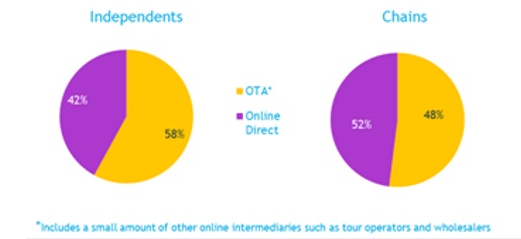
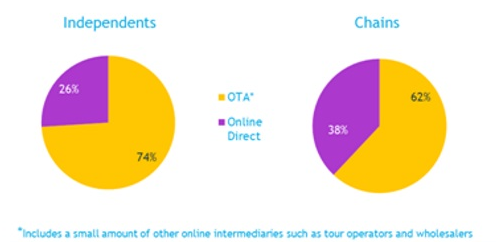
There’s a marked difference between independent and chain hotels in terms of online booking share done on OTA for both the US and European market. Major chains already have a higher percentage of online bookings through non-OTA channels and should be able to increase this share considerably.

Fig: Difference in OTA and online direct share among independent and chain hotels in US for 2015. Source: Phocuswright

Fig: Difference in OTA and online direct share among independent and chain hotels in Europe for 2015. Source: Phocuswright
In the highly competitive lodging industry a major direct online booking push by big players like Hilton and Marriott will force other players to relook their marketing channels. Instead of considering only RevPAR metric, hotel chains would put a greater focus on NRevPAR which is RevPAR minus the cost of commissions. When this metric is looked, the direct booking model is more profitable. This might not be a death knell for OTAs but it would put downward pressure on their gross bookings and commission rate. In the end this will affect their topline and bottom line and eventually their stock levels.
Disclosure: I/we have no positions in any stocks mentioned, and no plans to initiate any positions within the next 72 hours.
I wrote this article myself, and it expresses my own opinions. I am not receiving compensation for it (other than from Seeking Alpha). I have no business relationship with any company whose stock is mentioned in this article.
Austin-based TurnKey Vacation Rentals Raises Series B Funding in Spite of Austin’s Recent Anti-Vacation-Rental Legislation
In March, TurnKey Vacation Rentals disclosed that it has raised an additional $10 million in Series B funding from Silicon Valley-based Altos Ventures and Silverton Partners of Austin to expand its vacation rental management service. This round of funding brings the company’s total raise to $20 million. TurnKey vacation Rentals currently manages 1,000 properties over 24 markets and is home to 140 employees.
The announcement of the investment comes on the heels of what has been a volatile year, so far, for short term rentals in Austin. Last month, the Austin City Council voted to ban short-term rentals, even though an estimated 250 employees from Austin-based HomeAway marched on City Hall in support of short-term rentals. The new legislation phases out short-term rental permits over the next six years.
We reached out to TurnKey’s Chairman John Banczak to find out more about the regulatory environment in Austin and about TurnKey’s future plans.
Q: Just last week, Mike Maples of Floodgate, a prominent venture capitalist, tweeted about stopping investment in Austin-area sharing economy startups. Do you think the recent decisions will affect how Austin startups will grow?
JB: Mike’s got a great point. Anyone who has met him or seen him speak knows that he is a visionary in the tech space. His impression that these decisions from Austin’s city council will put a dampener on innovation and creativity is right. If you are considering locations for a startup, these actions with Uber, Airbnb, and even worse HomeAway – a company that employs over a thousand people in Austin – are going to give you pause.
Q: Has TurnKey’s vacation rental business been affected by these decisions made by the Austin city council?
JB: No, not really yet. The majority of our business comes from outside of Austin. In the short-term, if anything, it constrains supply of short-term rentals which helps our owners who are already licensed and renting. It has the potential to have an impact on us several years down the road. We believe at some point folks will look more closely at the recent decisions and realize they are not based on facts. We also believe new programs being offered by HomeAway and other creative solutions will enable a fair balance to once again be brought to the Austin market.
Q: We recently heard Flatbook, another sharing economy company, is relocating to Silicon Valley. Do you think the Austin Council had anything to do with them relocating there, versus say Austin?
JB: I don’t know the folks at Flatbook, and I’m guessing they made their decision for a number of reasons, but it wouldn’t surprise me if this was on their radar. They decided to move to a state with much higher taxes and much more expensive housing and labor, over a place like Austin. On the one hand we have large businesses like Google, Apple, Facebook, Oracle all increasing their presence in the area. The question is do you have small, new, innovating companies relocating here as well. Of course not everyone is going to move to Austin, but no doubt a city council that appears hostile to innovative businesses can’t help.
Q: Shifting to the TurnKey business model, how do you guys measure success internally at TurnKey?
JB: For us, it starts with guest satisfaction. If we can’t deliver a quality home that is exceptionally clean, and that a guest is thrilled about, we are not going to be around long. We measure our guests’ satisfaction in several ways. Almost half of all guests engage us and with ratings or reviews which we think is an industry best. 96 to 98 percent of our feedback results in 4 to 5 star ratings. We are pretty confident we are delivering a great product to guests and we have the tracking to monitor it. This results in more bookings, and more revenue for owners, which results in happy owners.
TurnKey competes with traditional property management firms, charging an 18 percent commission on bookings. With the funding, TurnKey is looking hire an additional 100 employees over the next year and expand to 100 new U.S. markets over the next few years.
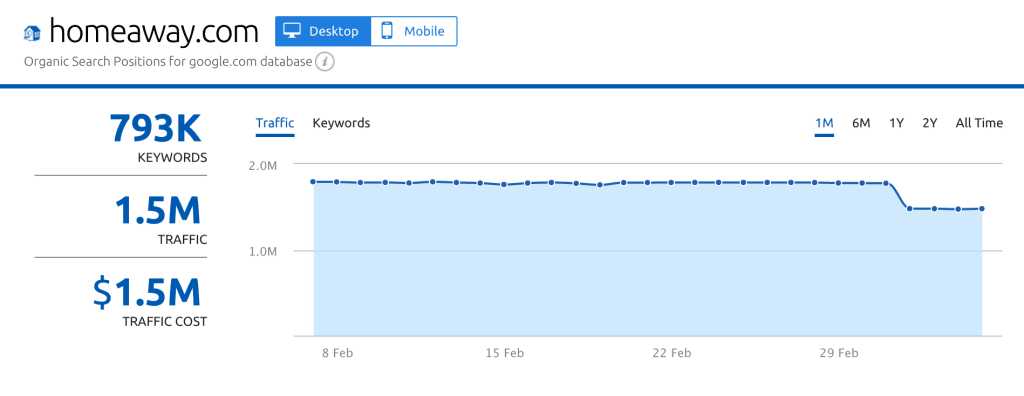
BY Chatter recently came my way both from a few clients and on Twitter from Matt Landau that a big listing site may be facing a Google penalty. Is it possible that a HomeAway Google penalty is happening?
Searches in many of my clients’ main areas indicate that HomeAway has dropped out of the search results in lots of popular areas. This is a classic sign of the quality updates from Google called Penguin or Panda. Typically, these search engine algorithms from Google can remove a website from organic search results due to bad backlinks (Penguin) or thin and poor-quality content (Panda).
For many vacation rental owners, marketers and managers, HomeAway dropping out of the Google search results would make a huge difference to their website traffic. After all, HomeAway ranks on the first page for tens of thousands of keywords and many of those overlap with lots of other websites that are run and owned by managers.
After doing some digging, I am pretty confident I have the answer: HomeAway.com was not penalized by Google. Instead, the reason for the drop in many search results was something much more simple (and completely self-inflicted): HomeAway told Google to not crawl certain pages.
Below is a link to HomeAway’s robots.txt file. A robots.txt file tells search engine crawlers like Googlebot, Bingbot and more what pages they can and cannot crawl. HomeAway’s recent drop is the result of one thing: Google trying to crawl pages that HomeAway did not want to crawl. As a result, the robots are not crawling pages (and thus, removing these pages from the index), leading to the drop in search results pages.
https://www.homeaway.com/robots.txt

Fixing the dropped pages from Google search should be fairly straightforward: remove the needless query strings from their internal links to various landing pages.
In the example above, the following query is appended to the URL of the normal Deep Creek Lake landing page.
?icid=IL_homemerch_linkpile_cabins
This query string allows for the analytics manager to view how many times this particular link was clicked. However, it also let Google crawl the wrong version of the page and then try to index it. Based on my sleuthing, HomeAway was using these links on tons of various internal linking structures throughout their website. As a result, their most popular pages (like to Deep Creek Lake, North Myrtle Beach and tons of others) are getting noindexed and blocked by Googlebot. It appears that HomeAway has since removed their robots.txt rules, but the recovery may be slow as search engine crawlers take awhile to reindex results.
My expectation is that Google will recover and reindex all of the dropped HomeAway pages within two to three weeks.
If you do SEO for a large vacation rental website, cut out tagging internal links: it’s a disaster for SEOand leads to issues just like this. Internal linking for SEO is great, especially on large websites, but it needs to be done carefully and thoughtfully. Make sure that you are aware of modifying a robots.txt file and the impact of how it can seriously impact how Google indexes and crawls your entire website. One small change caused HomeAway to lose tens of thousands of dollars in bookings over the past few weeks: don’t make the same mistake.
In yesterday’s meeting with investors, Expedia took time to provide an update on activities related to their recent purchase of HomeAway. Expedia CFO Mark Okerstrom described the growth opportunities for HomeAway in two pieces, secondary homes and primary homes in urban markets.
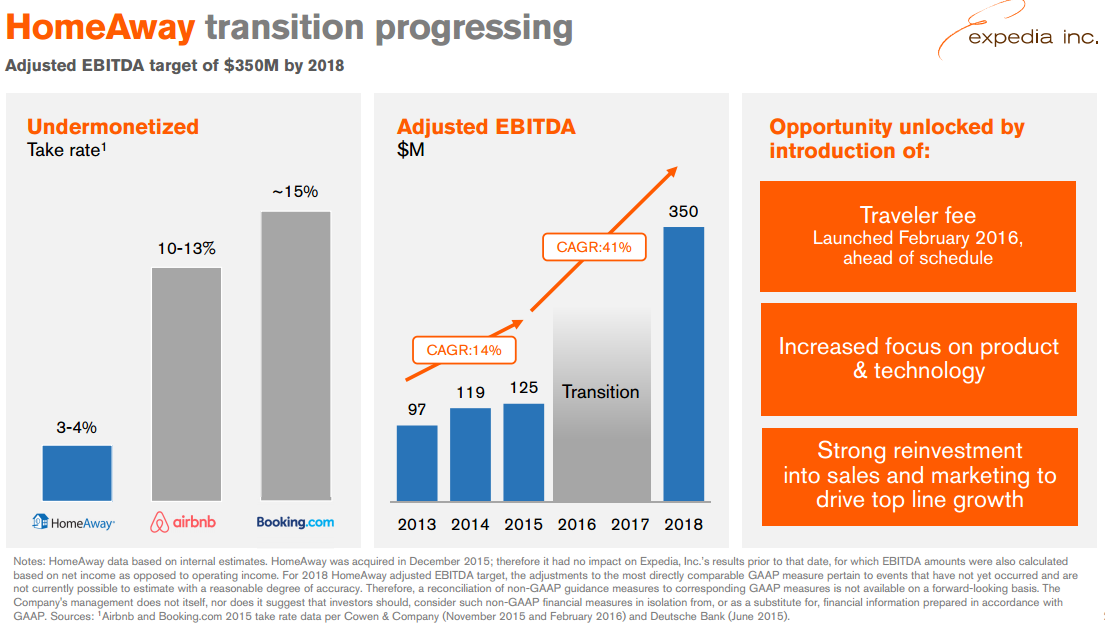
Okerstrom also laid out a two phase plan to increase revenue for HomeAway which included 1) take what HomeAway already has, turn it to be 100% online, and better monetize transactions, and 2) leverage opportunities in the urban market.
“The traveler fee has been launched in the US, early. Encouraging signs. We like what we see,” said Okerstrom.
“We have really tilted the focus of this business from being a very supplier-focused business focusing on one side of the platform, focusing on getting subscription renewals – the right thing to do at the time – to really a two-sided platform, taking this formula (that Dara described to you) of bringing online marketing, world-leading conversion platforms, utilizing test-and-learn technology and supplier facing technology and turning it into a real online business”
Okerstrom added, “We’ve taken some of the money that we’ve seen incremental from the traveler fee, and we’ve started to put that back into the business. The introduction of a ‘Book with Confidence Guarantee’ essentially says, ‘Traveler, if you book on the HomeAway platform, and you don’t like the property or you have a dispute with the owners about the damage deposit, we will take care of it for you.”
“This is a difficult transition that we are pulling off, but we are opportunistic about what we’ve seen so far.”
During the Q&A, Expedia admitted that they had seen a “tick down in conversion rates” on HomeAway.
“It is so early, and the teams are still testing various combinations of subscription rates and traveler fees, so it is too early to give a take rate. We have seen a tick down in conversion rates as you actually might expect, nothing out of the ordinary, entirely expected.”
“We feel good about what we see,” he restated.
Expedia Inc. CEO Khosrowshahi reiterated that Expedia believes it can build HomeAway into a business with $350 million in earnings before interest, taxes, depreciation and amortization (EBITDA) by 2018, up from about $120 million last year.


Short-term rental technology companies have created a vibrant marketplace for peer-to-peer accommodations so it comes as no surprise that the popularity of short-term rentals has exploded in recent years. Now a new R Street Institute policy study and corresponding website: Roomscore.org, seek to quantify the friendliness of the regulations in a broad cross-section of municipalities. Collectively, the study paints a picture of a chaotic regulatory environment in which a few municipalities have taken the time to get it right while significantly more have rushed to regulate an industry they may not fully comprehend.
There are bright spots in the study, as cities like Galveston and Savannah earned top marks for their short-term rental ordinances. Both cities were proactive in addressing short-term rental regulation by working with industry participants and homeowners and developed and passed reasonable ordinances that recognize the new economy, ensuring that the cities benefit from the economic activity, while also protecting the community. But of the 59 municipalities examined in the study, 25 of them received grades in the range of D or F according to R Street’s scoring system.
“The rapid growth of short-term rentals clearly caught many municipalities off guard,” said Matthew Kiessling, who specializes in short-term rental policy for the Travel Technology Association. “But the patchwork of local regulations highlighted throughout the country in this study, from very sound to very poor, suggests a clear need to begin approaching the challenge of short-term rental regulation much differently.”
As more and more Americans seek to engage in short-term renting, both in offering and utilizing, the need for simplified statewide standards is clear. This is especially true as communities continue to adopt confusing, oppressive or limiting regulations. Too often they are unenforceable, directly impact travelers and providers, and only serve to drive this pro-growth industry underground.
“Consumers have spoken, and the demand for short-term rentals growing exponentially. But when you see a study like this it suggests that cities would much rather create the impression that they’ve addressed the short-term rental issue, than actually addressing the issue,” continued Kiessling. “The time has come for legislatures to adopt statewide standards that recognize short-term rentals and help establish a framework to guide municipalities in embracing the future of this important accommodations option.”
BY TODD BISHOP –Expedia’s longtime chief product officer, John Kim, a key player in the resurgence of the travel giant’s flagship site, has moved to a new role as the chief e-commerce officer for HomeAway, the vacation rentals company acquired by Expedia for $3.9 billion last year.
In addition, the Bellevue, Wash.-based company plans to start incorporating HomeAway listings on its Expedia.com and Hotels.com sites, using those flagship sites to compete more aggressively against AirBnB in major cities, in what’s known as the “alternative accommodations market.”

The moves were disclosed by Expedia’s chief financial officer, Mark Okerstrom, in a briefing with investors this morning, as the company outlined plans to expand the HomeAway business.
Okerstrom, who spoke on the call with Expedia CEO Dara Khosrowshahi, credited Kim with helping to bring the company’s flagship Expedia experience back to “technology greatness.” An Expedia spokeswoman confirmed that Kim has moved to HomeAway headquarters in Austin to join the team there.
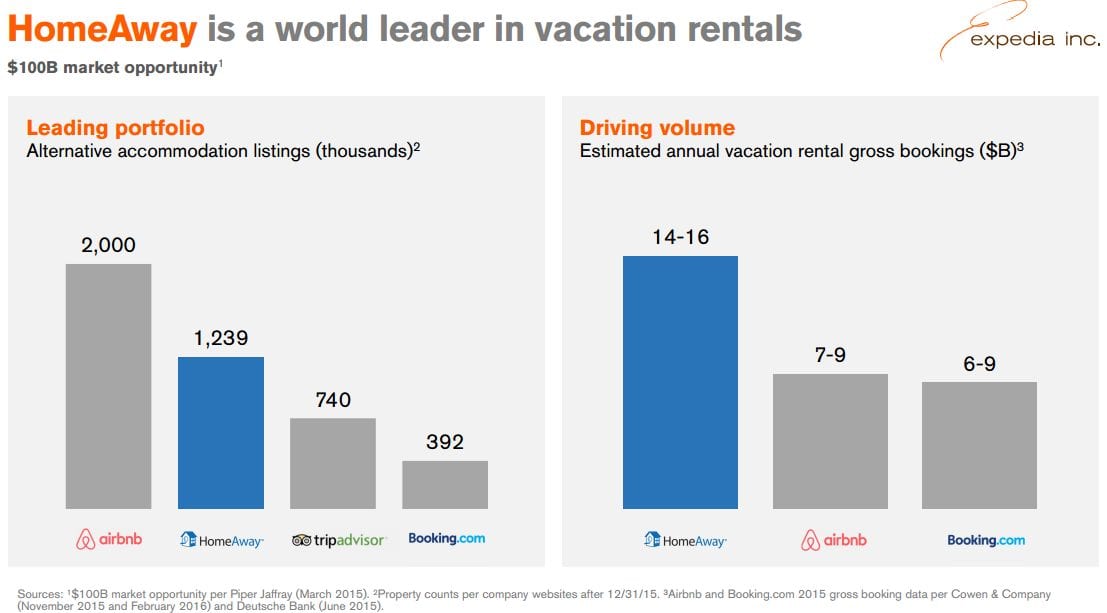
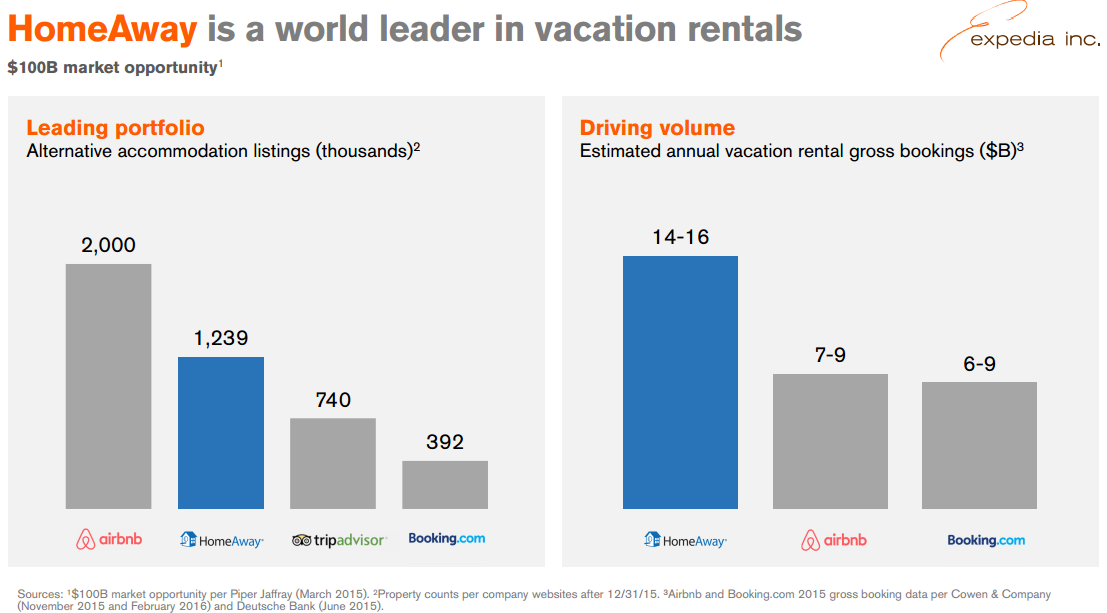
The CFO described the HomeAway strategy in two phases. First, the company is seeking to improve HomeAway’s financials by boosting the share of overall vacation rental bookings that it realizes as revenue. Okerstrom showed the following charts to illustrate how HomeAway’s “take rate” is traditionally not on par with other competitors in the industry, despite strong bookings.


HomeAway introduced a new “traveler fee” in the U.S. last month to start to address that situation, in line with AirBnB’s existing practice. HomeAway’s new traveler fee is a floating fee, but it’s expected to average about 6 percent for travelers, according to an earlier report by travel news site Skift.

To help break into the urban markets, Expedia plans to include HomeAway listings among the options available to travelers on its flagship sites at some point in the future.
“The traffic to get into these markets is incredibly expensive. Buying keywords for New York accommodations is some of the most expensive traffic you can buy,” Okerstrom said. “The great news is that we’ve already got that traffic on Expedia and Hotels.com.”
Expedia Inc. CEO Khosrowshahi noted that the company will also be able to leverage its e-commerce architecture and optimizations from the Expedia platform to further boost HomeAway’s effectiveness. He reiterated that Expedia believes it can build HomeAway into a business with $350 million in earnings before interest, taxes, depreciation and amortization (EBITDA) by 2018, up from about $120 million last year.
“We like the trends that we’re seeing,” Khosrowshahi said, “but we are in the first or second inning of probably an extra-inning game here.”
Today the Onsite Property Management Association (OPMA) is launching a new sales training program for its members. This five-hour video training seminar (sponsored by LeisureLink) is presented by John Dalton, OPMA Chief Marketing Strategist.
Dalton has decades of sales training experience in the travel industry and has worked with AAA, TWA, Loews, Marriott, Hyatt, Hilton and Choice, and is credited with transforming sales training in the Cruise industry. While presiding over 710 reservation agents, Dalton saw conversion rates increase from 19 percent to 78 percent in 18 months.
The OPMA’s sales training program focuses on differentiation, target marketing and value added services.
OPMA Sales Training Elements:
The sales training program is being offered at no cost to OPMA members, Contact Rick Fisher at theopma.org for more information.
SALT LAKE CITY, UT (March 16, 2016) –LeisureLink has just announced the release of a new white paper titled “Boosting Summer Mountain Sales” examines the opportunities that the off-peak season offers property management companies (PMCs) to tap into a fresh guest base and increase revenue. The highly anticipated document is the result of an elite panel collaboration that included HomeAway Vice President Bill Furlong, Expedia Director of Market Management Josh Saunders, President & CEO of Ski.com Harry Peisach, Inntopia CEO Trevor Crist, and LeisureLink CEO Julian Castelli.
The timely report focuses on that fact that summer and shoulder season growth at ski destinations is expected to continue, especially with low gas prices encouraging road-tripping explorers to record levels. Some are even dubbing what was once considered the shoulder season, the high season. An article titled as much, “Summer: Colorado’s Other High Season”, from Denver Magazine, attributes the rise in summer tourism to festivals, concert series, and season specific activities like tubing hills and zip lines. With that kind of potential, the expert panel agrees that key to success is an optimal distribution strategy.

Key topics covered in the white paper include:
“Not that long ago it may have sufficed to push inventory just when it seemed necessary, as a last resort perhaps,” explains Castelli. “In today’s competitive environment, year-round success requires a distribution partnership—think of it as a two-way street—to optimize your presence. With more lodging categories than ever before and more retail options where travelers can find them, it pays to understand how distribution has changed, adjust strategies, and work with as many outlets as possible. This white paper is the first of its kind to explore the benefits of creating partnerships and best practices for increasing business in the off-peak season.”
This white paper is a must-read for vacation rental suppliers and owners seeking to better understand and expand their off-season business, to fend off competitive threats and increase their market share. A complimentary download is available at leisurelink.com/boosting-
About LeisureLink
Salt Lake City-based LeisureLink’s distribution services offer vacation rental properties the opportunity to distribute to top online travel agencies like Expedia,Booking.com, Airbnb and HomeAway, all the major GDS players and top travel sites. Suppliers can manage their online distribution from one platform – optimizing rates, availability, specials, and content changes. Leisurelink’s specialty consulting services leverage industry experts who understand travel distribution and maximize revenues. LeisureLink consolidates all accounting, payables, and receivables with a single source of payment, providing clarity to the often-complex world of distribution. This comprehensive service helps LeisureLink clients generate more money and save more time. For more information, visit LeisureLink.com.
Buyout rumors making the rounds with traders have helped TripAdvisor log major gains over the last few days (+10%).
Priceline has been mentioned as a potential suitor.
1.6M shares have already been traded; the 3-month daily average is 2.2M. TripAdvisor jumped last month after delivering a healthy Q4 beat, but remains 28% below a 52-week high of $94.00 (set in July).

NAVIS’ Leaders Conference has become synonymous with generating value and opportunities for clients on many levels. Attendees engaged with industry thought leaders as they weighed-in on current trends, gained new ideas and strategies in hands-on workshops, got an inside look at future NAVIS projects and enjoyed one-on-one networking time. The overwhelming sentiment from attendees, most of whom have already attended the summit four or five times, is that it is by far the best conference they go to each year, primarily highlighted by the engaging content and excellent networking experiences with industry peers.
This year’s lineup of high-profile speakers featured Peter Yesawich, Vice Chairman of MMGY Global, and hospitality marketing guru Larry Mogelonsky, Founder of LMA Communications Inc. A select group of NAVIS partners were also on hand to meet with clients and included industry leaders like Flip.To, GCommerce, HeBS Digital, InterCoastal Net Designs, Miles Marketing, MP&A Digital and Advertising, and Perceptions by Mayer.
Kyle Buehner, CEO of NAVIS said, “Year after year at our Leaders Conference, we bring together the greatest minds in the business to explore best practices for increasing performance, and exciting innovations that will shape the future of the industry. We are so thrilled with the overwhelmingly positive response and we all look forward to hosting the next one in 2017.”
To learn more about NAVIS solutions and schedule a demo, visit theNAVISway.comor call 1.866.712.3439. We’d be happy to let you speak with one of our clients about the power of NAVIS – and you can read the success stories atthenavisway.com/client-
About NAVIS
NAVIS is an award-winning hospitality technology company trusted by leading independent resorts, hotels, and vacation rental brands to create and convert more demand across all channels, resulting in dramatic growth in revenue and profit. NAVIS clients make better sales and marketing decisions based on accurate, real-time data and uncover previously hidden profit sources. With a full suite of integrated solutions that capture guest and prospect data, track key revenue and performance metrics, and provide 24/7 reservation call center services, NAVIS helps operators increase occupancy and maximize rates while lowering costs. The company has recently been named Top Workplaces in Oregon for the fourth consecutive year. To learn more visit www.theNAVISway.com.
Arizona state senators voted to block local governments from restricting property owners from renting out their homes for short-term or vacation rentals.
By Howard Fischer Capitol Media Services
The last-minute provision was added to legislation designed to eliminate the requirement for homeowners to collect local taxes every time they rent a room or a house through online “sharing” services like Airbnb.
Instead, it would be the responsibility of the online firms to collect the applicable taxes and forward them to the Department of Revenue, which would send them to the affected jurisdictions.
Sen. Debbie Lesko, R-Peoria, tacked language onto SB 1350 that says cities, towns and counties cannot prohibit or restrict these rentals simply because the property is not classified as a hotel.
The move is in line with efforts by Gov. Doug Ducey to “modernize” the state’s economy.
Ken Strobeck, executive director of the League of Arizona Cities and Towns, said his organization generally opposes measures that limit local control. But he said Lesko agreed to build in some protections to preserve the ability of communities to protect public health and safety.
David Drennon, executive vice president of the Arizona Lodging and Tourism Association, said there may need to be changes in the legislation to ensure it is fair. He said the legislation fails to address abuses of the system.
“There are people who are buying multi-unit apartment housing and basically trying to operate them as a hotel,” he said. “They’re skirting the law.”
Drennon said his organization will look for changes when the measure goes to the state House following a Senate roll-call vote.
North Carolina Alliance for Neighborhood Prosperity is holding a public input meeting on short-term rental regulations facing Wilmington homeowners. The meeting will be held Thursday, March 17, 6-7:30 pm at Forest Hills Elementary School, 602 Colonial Drive, Wilmington, NC.
Attendees at this meeting will be given an overview of the existing regulations related to short-term rentals in the city, have the opportunity to interact with city staff who are knowledgeable about the issues, and provide input, via breakout discussion stations, on how potential regulations could be shaped.
A new website has been established for this issue where information and updates to this topic will be posted www.wilmingtonnc.gov/rentals.
Homeowners who would like to voice their opinion directly to members of city council are welcome to speak at the public information session at any city council meeting, but they should sign up by noon the Friday prior to the city council meeting with the city clerk, (910) 341-7816.
Dallas, TX — Mar. 9, 2016 — Maxxton®, a leading enterprise SaaS solutions provider for the vacation rental industry, is pleased to announce it has been selected by Choice Hotels International, Inc. to power the new Vacation Rentals by Choice Hotels core reservations platform. The new vacation rental program will be integrated with the Choice Privileges® loyalty program and offer distinctive benefits for management companies, homeowners and consumers.
Management companies that join Vacation Rentals by Choice Hotels will benefit from a world-class distribution and delivery platform based on technology provided by Maxxton. The distribution platform was built from the ground up through collaboration between both organizations to meet the unique needs of the vacation rental market. Through the partnership, Maxxton and Choice expect vacation rental management companies to benefit through increased bookings, homeowner engagement and acquisition, cost savings from Choice’s supplier community, and exclusive access to world-class training and business services.
Additionally, management companies that choose to utilize the Maxxton property management system will also benefit from an unmatched level of customization and a comprehensive suite of tools including dynamically driven guest portals, a unique homeowner management application, and innovative automated processing that enhances interactions with owners and guests. Maxxton provides integrated business intelligence tools allowing companies the ability to report and forecast not only on bookings, but also operational efficiency tracking for departments such as housekeeping and maintenance.
“Maxxton’s technology platform combined with Vacation Rentals by Choice Hotels positions property managers to gain a competitive edge and help drive higher revenues,” said Jean Pierre Mampaey, CEO of the Maxxton group. “Our fully integrated suite of enterprise hospitality solutions significantly reduces manual burden by automating critical aspects of the vacation rental organization,” adds Chris Connar, Vice President Maxxton Americas.
“We conducted an extensive software evaluation exercise and concluded that Maxxton’s solution was the only technology solution able to achieve our technology goals on a large scale. We are excited to be working with them to bring Vacation Rentals by Choice Hotels to reality,” said Leslie Adler, Director, Operations and Strategy at Vacation Rentals by Choice.
Vacation Rentals by Choice Hotels is launching in eight U.S. locations, including Orlando, Aspen, Destin, FL, Panama City Beach, FL, Williamsburg, VA, Shenandoah, VA, Phoenix, AZ, and Big Bear Lake, CA. Given strong industry interest, Choice expects to add locations and management company members in 2016.
About Maxxton
Specifically designed for the Vacation Rental sector, Maxxton offers an unmatched software-as-a- service-based solution to manage complex businesses with varied inventories, activities, accommodation types, amenities, extras and fragmented ownership. For over 18 years, Maxxton has provided Enterprise software for the lodging and vacation rental industry solutions for many of the largest companies in the vacation industry and added recently international clients like Contempo in Orlando, Marlin Apartments in London and Corporate Housing Factory in Amsterdam. Maxxton has offices in The Netherlands, United States, Great Britain and India, and serves over 90,000 accommodations in ten countries. For more information, please visit www.maxxton.com.
About Choice Hotels
Choice Hotels International, Inc. (NYSE: CHH) is one of the world’s largest lodging companies. With more than 6,400 hotels franchised in more than 35 countries and territories, Choice Hotels International® represents more than 500,000 rooms around the globe. As of December 31, 2015, 720 hotels were in our development pipeline. Our company’s Ascend Hotel Collection®, Cambria® hotels & suites, Comfort Inn®, Comfort Suites®, Sleep Inn®, Quality®, Clarion®, MainStay Suites®, Suburban Extended Stay Hotel®, Econo Lodge®, Rodeway Inn®, and Vacation Rentals by Choice HotelsTM brands provide a spectrum of lodging choices to meet guests’ needs. With more than 25 million members and counting, our Choice Privileges® rewards program enhances every trip a guest takes, with benefits ranging from instant, every day rewards to exceptional experiences, starting right when they join. All hotels and vacation rentals are independently owned and operated. Visit us at www.choicehotels.com for more information.
LiveRez.com today announced that it will hold its annual LiveRez Partner Conference October 10 through October 13 at the Lost Pines Resort and Spa in Austin, TX.
The conference, open to all professional managers using LiveRez’s software, marks the third-annual conference hosted by the world leader in vacation rental software. Already a favorite in the industry, this year’s conference will now include two separate training tracks to offer more targeted instruction to LiveRez partners and their team members.
“For years CEO Tracy Lotz would describe what it would look like for our LiveRez partners to all come together and learn from one another and grow together,” said LiveRez VP of Operations Tina Upson. “We couldn’t have imagined that our LiveRez family would be this receptive and this incredible. The Partner Conference is a key part of the community here at LiveRez.”
This year the conference moves to Austin, Texas, after being held in Idaho the past two years. Upson said the location was chosen because it is beautiful and has the right energy. Another motivator in moving to Texas was its central location and easy access for LiveRez partners.
“What we see throughout the year – with our advisory boards, community forums, and onsite visits that partners initiate themselves – are some of the fruits of the relationships that partners develop at the conference,” Upson said. “Austin is going to be the perfect venue for this year’s conference, and we are thrilled to be bringing the LiveRez team to the Lone Star State.”
In addition to two separate training tracks, the conference will also include a bonus Bootcamp on the company’s soon-to-be-released vacation rental trust accounting system. As with past years, the conference will include a big reveal of new technology, as well as a stacked lineup of keynote speakers, which the company will announce in the coming months.
To learn more about the 2016 LiveRez Partner Conference, visit LiveRez.com/2016Conference.
About LiveRez.com
LiveRez.com is a complete, online, vacation rental property management solution, focused on making vacation rental property managers fully operational online and thereby increasing bookings. LiveRez.com offers an all-in-one cloud-based platform, featuring best-in-class websites optimized for online bookings, a full-featured reservation and property management system, a robust CRM system, an exclusive connection to QuickBooks for trust accounting, and a unique “Pay-for-Performance” approach, which provides a mutually beneficial partnership between LiveRez.com and its vacation rental manager partners. The company’s largest competitor is HomeAway Software for Professionals.
To learn more about LiveRez.com, please call 800-343-2891 or visit LiveRez.com. And, to receive timely updates from the company, follow LiveRez.com on Facebook, Twitter (@LiveRez) and Google+, or visit the company’s vacation rental software blog. LiveRez.com is a proud Gold Sponsor of the Vacation Rental Manager’s Association (VRMA).
GERMANTOWN, Md. – February 16, 2016 – TruPlace, the largest provider of interactive floor plans and professional photos for the vacation rental management industry, today announced the hiring of Tony Maganzini, past president of Floor Plan Marketing, a company competing with TruPlace in the vacation rental market.
“Ever since meeting the TruPlace team at a trade show event, I was really impressed with what I saw,” said Mr. Maganzini. “Their organization, their technology, everything I saw explained why their client base for interactive floor plans and photographs is the largest in the vacation rental market. When they offered me a position, why wouldn’t I want to join the #1 player? I’m thrilled to be a part of the TruPlace team.”
Prior to joining TruPlace, Tony Maganzini was the president of Floor Plan Marketing, Miramar Beach, Fla. Before that, Mr. Maganzini was director of international sales at The Placencia Group, Belize, where he spearheaded international relationships with key investors. Mr. Maganzini has received numerous sales and achievement awards and is a graduate of the University of Alabama, Tuscaloosa, Ala.
“We feel very fortunate to have Tony on our team,” said Bob Cusack, president of TruPlace. “He brings a wealth of market knowledge and network connections that will go a long way towards maintaining our #1 position in the vacation rental market.”
Interactive Floor Plans and Photographs Visitors to websites that incorporate TruPlace interactive floor plans and photos simply roll their mouse over an area or touch their finger on any portion of a floor plan and a high-resolution photo of that location instantly appears. TruPlace uses a proprietary method for instantly displaying photographs so that visitors don’t have to wait for the image to load. This provides a much more enjoyable and informative tour experience for the guest and a faster booking process for vacation rental reservation agents. Research shows that vacation rental management companies using TruPlace interactive floor plans gain 17% more reservations than those not using TruPlace.
About TruPlace
TruPlace, headquartered in Germantown, Md., develops Interactive Floor Plans for the vacation rental management industry in the U.S. and the real estate sales market in the Washington DC/Baltimore area. TruPlace provides clients with professional, high-resolution photographs of the inside, outside and amenities of properties that are digitally linked to a detailed floor plan of the property. This combination provides a prospective guest with a quick and easy way to tour a property and get the most accurate view of what that property actually looks like. Website – TruPlace.com.
The first ever Vacation Rental Success Summit is to be held in Toronto this year and is generating quite a buzz for the vacation rental industry. Canada Stays, Vacation Rental Formula and several other sponsors have geared up to create what is said to be one of the most incredible vacation rental conferences in the industry. Throughout the two day conference, guests from every walk of the industry are invited to listen and learn from some of the best including keynote speakers from HomeAway, Inc., Leadpages and Vacation Rental Formula.
Be prepared to learn a variety of skills and tactics to not only survive the vacation rental industry, but to be extremely successful in doing so. The Vacation Rental Success Summit will hold workshops and seminars that will teach the best way to market your vacation rental, creating images that sell, applying home sharing to the vacation rental world, getting the most out of social media and several other educational classes. The Vacation Rental Success Summit will be held at the BMO Institute for Learning in Toronto from April 30-May 1. Visit vacationrentalsuccesssummit.com for more information.
With advancements in the areas of communications, GPS, smart home systems and database integration, housekeeping departments are beginning to see relevant technological improvements hit the market.
By Amy Hinote
For housekeeping professionals in the vacation rental industry, innovation in technology designed to increase operational efficiency for housekeeping and maintenance departments has been relatively slow compared to advancements in other areas of technology, including revenue management, channel management and marketing tools.
However, over the last year, new functionality in vacation rental housekeeping technology is hitting the market and will help lower costs, save time, enable housekeeping and maintenance staff to be more productive, and in some cases, provide additional revenue streams.
Five Areas of Development in Housekeeping Technology
The vacation rental industry has seen the development of technology systems and apps designed to provide real-time communications between staff, management, housekeepers, maintenance personnel, guests and property owners. LSI, Status Tracker and several of the property management software systems have launched tools that free housekeepers from relying on legacy technology so they can work smarter and faster. These new systems help housekeeping teams coordinate their tasks with real-time property assignment information to work more efficiently, and mobile housekeeping apps aim to put clipboards and in-unit telephone reporting in the rearview mirror. They are easy to install and rely on the property’s wireless network without an internet connection.
With advancements in reliable GPS mapping and tracking, Route Optimization is an area of technology that has rapidly developed in the last two years. Florists, housekeeping companies, fleet managers, moving companies and delivery drivers in a multitude of businesses have transformed their operations using route optimization software. In the vacation rental industry, we can expect to see several technology providers white label these solutions into their products. But you don’t have to wait. Ask your housekeeping technology provider about route optimization systems, and volunteer to work with them to beta test and integrate the functionality into your software.
The introduction of smart home control has made a huge impact on the vacation rental industry by reducing the time and expense associated with key management, providing guests with safer stays, lowering property owner utility bills and providing real-time notification of maintenance issues in the home. For housekeeping departments, the benefits of using smart home control also help to lower costs and increase guest and owner satisfaction. Using smart home codes, managers can track when housekeeping and maintenance staff members enter and leave a property without having to manage keys among cleaners and contractors.
For vacation rental opponents, the complaints most often raised at city council meetings are noise, trash and parking, which when left unaddressed can result in tightening regulations and restrictions. As a result, professional vacation rental managers are always looking for ways to be better neighbors and to encourage guests to be better neighbors. Here are a few ideas of how technology may be able to help.
VRMs work around the clock to improve guest satisfaction, so when they get a call from a guest who left his iPhone, grandmother’s ring, GoPro or child’s special pillow, team members jump to respond. However, keeping up with the many items left behind and matching these items with their owner can be overwhelming… especially during peak seasons. Technology has been created to help streamline and automate the lost and found process. One system being used by a handful of savvy property managers is called ChargerBack. This free tool has the following functionality:
At the Vacation Rental Housekeeping Professionals (VRHP) Annual Conference in November, as managers investigated improvements in technology and explored the gaps in their current systems, we asked them to write on notecards what functionality they wish existed in their software system and what they want their software to do.
Below is a wish list of housekeeping technology functionality from attendees at the 2015 VRHP Annual Conference.
20 Features Vacation Rental Managers Would Like to See Developed for :
March 2, 2016 • By tambo
Ten years ago, who would have predicted that one of your guests would ever opt to stay in the home of a complete stranger instead of your hotel?
Well, it’s happening. Right here, right now, to your hotel, as we speak.
An Unexpected New Threat
Since its meager beginnings in 2007, AirBnb has disrupted the way your guests travel. People are booking stays in spare rooms, private homes, (even Airstream Trailers and tree houses!) located all across the globe.
Bookings are made on the AirBnb website every two seconds. They have outpaced our industry giants as the world’s largest hotel chain with more than 300,000 rooms. And now, a recent Goldman Sachs study has revealed another unsettling fact. After travelers try AirBnb, or one of its peers like HomeAway or FlipKey, half of them decide not to go back to hotels.
We’ll say that again: half don’t go back to hotels.
Hoteliers aren’t the only ones affected by this shift in lodging choices. Our OTA “frenemies,” like Priceline and Expedia, are feeling the burn since they receive a bulk of their revenue from our hotel bookings.
Is It All Bad?
While AirBnb bookings are expected to balloon and skyrocket to 80 million this year, the news isn’t all dismal. Throughout the country, hotel occupancy has been hitting all time highs for several years, and further growth is expected from major brands and hotel management companies.
Plus, there will always be the traveler who will never give up the creature comforts and luxury of staying in a hotel. Those guests will always want to rely on impeccable cleanliness, a staff eager to serve, and a carefully crafted experience no matter how awesome their AirBnb experience is.
Local governments are starting to crack down and in some cases, charge homeowners thousands of dollars for renting out rooms and homes on AirBnb. And, in an ironic twist, the ones who are allowed to profit from being AirBnb hosts now have more income to travel with and potentially stay in hotels elsewhere.
Still, the journey for AirBnb is just beginning. As they continue to grow, hotels may have to work and adjust to win back their guests. We’ll keep a close eye on the developments and lend a hand in helping you drive more direct bookings to overcome the unexpected challenges AirBnb brings.
About Tambourine
Tambourine uses technology and creativity to increase revenue for hotels and destinations worldwide. The firm, now in its 30th year, is located in New York City and Fort Lauderdale. Please visit: www.Tambourine.com
By: Amy Hinote
As customer retention plays a larger role in the long-term success of a vacation rental management company, property managers look to create a foundation for customer relationship management (CRM) strategies.
It has been fifteen years since Bain & Company reported that increasing your customer retention rate by 5 percent increases profits by 25 to 95 percent. Yet most vacation rental marketers are still more focused on guest acquisition rather than retention.
With rising customer acquisition costs related to third-party distribution sites, implementing a full-scale customer retention strategy is quickly becoming essential for marketers tasked with growing the bottom line.
If your acquisition strategy is largely built on the use of third-party distribution sites, such as VRBO, FlipKey, Booking.com and Airbnb, then – as a vacation rental marketer – you will need an effective customer retention strategy in order to justify the escalating marketing dollars spent on these channels. Creating a process to collect and utilize customer data will necessarily be part of your customer retention strategy.
Technology platforms have been slow to help VRMs accomplish this objective. In the vacation rental industry, technology centers on the reservation transaction, not on the guest(s). In addition, vacation rentals, on average, have more than four guests per reservation who are partially responsible for the travel decision. Most of the current PMS systems and processes only track the payer, leaving out large amounts of guest data that marketers need to implement a comprehensive customer retention strategy.
New CRM solutions and technology tools are being introduced to help marketers gain access to the data they need to collect in order to establish a successful customer retention strategy. Guestbook, for example, is a web-based tool for VRMs being launched in the market in March that provides a CRM tool for capturing data from all of your guests along with the ability to offer and book area activities. Other technology providers have created apps like HomeAway’s Glad to Have You that can serve to capture data. NAVIS has also built its Reach CRM which integrates lead data into the database. Some vacation rental managers are reaching out to non-industry platforms, i.e. Salesforce and Marketo.
CRM is a powerful tool that empowers vacation rental marketers to better engage with their guests, but CRM technology requires being led by company strategy. CRM technology is not a standalone solution. It requires a strong, well-conceived plan to guide its use.
Developing a CRM Strategy
What is a CRM strategy? It is easy to confuse a CRM strategy with a CRM implementation plan. The CRM strategy is the blueprint for how to turn new guests into repeat guests. The goal is to move your guest from a “folio” to an emotional relationship which recognizes that your guest is your guest through any channel. CRM is not solely a marketing function. Your CRM strategy will include every department that has interactions with customers including reservations, front desk, service and marketing.
When formulating a customer retention strategy, involve people from all customer-facing departments. The CRM strategy articulates a plan to put your guest at the heart of your business and to develop an ongoing “relationship” with each guest. It is up to you to find out what’s important to guests who choose your homes.
Determine the Data You Want to Collect
In order to get the most out of a CRM, after settling on your objectives, determine which data you want to collect. Collecting data in the vacation rental industry is different from any other. In most destinations, the average party size is over four people per reservation. This creates a unique challenge because a vacation rental CRM strategy must find ways to collect data on all of the guests, not just the one who made the reservation.
Because of the complex challenges facing the vacation rental industry, we suggest starting very small. Eventually, you will find ways to expand customer profiles by capturing more data (for example, do they have children or pets, what are their ages, when are special occasions, etc.) It is much easier to implement tactics to get more data once you have your guests’ basic data.
The following fields are all you need to get started:
Using the CRM platform of your choice along with your PMS, connect this data to the property the guest booked, the folio number and the date they booked. In the future, you will find ways to expand this data, but this combination of data will allow you to create a solid foundation for a CRM strategy.
How to Collect Data on All of Your Guests
As a result of the challenges unique to the vacation rental industry, property managers have to get a little creative with how they are going to collect data from all of the guests (not just the name on the folio). Here are some ideas of ways to collect data from guests not on the reservation.
Decide on a policy/process to capture this data at the time of the reservation. For example, you could say you need it for security or to email important information or key codes — the fastest and easiest way to capture the data is at the time of reservation.
After the booking, many tools provide other ways to capture additional guest data for smart home access.
Another tool for obtaining guest data is to add a landing page to the guest’s access point for Wi-Fi. Similar to a hotel, you can use this type of landing page to collect the data. Silicon Travel is one company that provides a solution for internet access landing pages.
Like the Guestbook platform, providing guests access to activities and area information offers an alternative way to collect data.
As you reach out to guests for surveys and reviews, find tactics and incentives to reach out to all the guests who stayed at the property.
Many condominiums and communities require passes of some type for shared amenities and parking. One idea is to require a record of guests’ name, email, city and home state in order to receive passes/access.
While not the easiest process to implement, guest loyalty programs are both an incredible way to collect customer data and a great tool for your overall CRM strategy.
Decide What You Want a CRM Platform to Do
Like determining which data to collect, when deciding what you want your CRM technology to do, keep it extraordinarily simple. The technology you use for CRM will be your number one source of customer data.
Choose Which Technology You Will Use as a CRM
Ideally, if your PMS has the ability to tie multiple guests to a reservation, then in most cases you can simply use your PMS and/or third-party tools that are integrated with your PMS. Customer relationship management is about people rather than technology – and your CRM software is simply the supporting act.
The main objectives in laying the foundation for a guest retention strategy are (1) to get multiple departments working together to implement a CRM plan and (2) to start ongoing, targeted communications to your past guests.
Once you’ve built a simple CRM foundation, you’ll be able to craft creative messages designed to build customer trust, loyalty and repeat business.
When it comes to planning a family vacation, every parent’s objective is to find a place where EVERYONE can relax and have fun, a home away from home. If the family has small children, planning a trip can be a chore.
Three Reasons to Market to Families with Small Children
For vacation rental shoppers, finding family-friendly accommodations – where both kids and parents can enjoy the vacation – is difficult and time-consuming. Any vacation rental can list itself as kid-friendly on most sites. No standards exist, so parents are left to sift through hundreds or even thousands of rentals looking for a place to fit their needs. (I know! I have done this! It’s insanity!)
What do parents need and how do you attract families with small children to your vacation rental?
Think, Safety
No parents can relax — ever — if they feel their children are not safe. There are simple steps that you can take to ensure the safety of children and provide an enormous comfort to parents.
They are portable, lightweight and easily stored out of sight when not needed. Mom and dad will be forever grateful not to have to spend their entire vacation chasing a toddler who wants to climb a set of stairs over and over again.
Simply having them available in case parents want to use them is enough. Babies remain safe and the covers can easily be stored away for the next guest’s stay.
Every private pool should be protected so that children cannot wander outside and easily access the water. This can be accomplished with a gated area, a pool cover, a pool alarm or alarmed doors accessing the pool area. Multiple barriers are best. Even without children as guests, for liability reasons, pool areas should be thoughtfully planned out.
Add Gear
Parents don’t want to travel with “everything but the kitchen sink.” Provide gear that families need and you will have happy guests! These items are an inexpensive investment and increase the probability that your rental is chosen over others that do not provide such items. Adding amenities is a great way to make your home stand out from the crowd. If you have a lot of family bookings, focusing on their needs can not only increase bookings but increase guest satisfaction. Here are some things to think about adding to attract families with small children:
Cute, comfortable kids’ beds or bunk rooms make for a fun environment for the kids.
Happy mommy and baby! And much less mess than feeding baby on dad’s knee at your beautiful breakfast table. Invest in a fold-away highchair if you are short on storage space.
Baby can actually sleep and parents can relax. Who can have fun on vacation if they aren’t getting a good night’s sleep?
Another great, inexpensive item that is easily stored away if not needed. Parents often worry about toddlers falling out of bed at night — did we mention how important sleep is?
An item that often gets overlooked. Simple, inexpensive additions to your home’s amenities can make a big impact.
Fun games for a rainy day or toys for outdoor fun are much appreciated by families.
If you have a large house or a nice outdoor space, a baby monitor can help parents relax while children are sleeping, knowing they can hear them if they are needed.
Pump Up Your Marketing
Once you’ve made your home safe and added family-friendly amenities, you’ll need to reach your target market. First, you can update your vacation rental website or listings. Here are three tips to help you do that:
Also, if your home is particularly family-friendly, you might think about listing on niche websites that focus on family travel. Clanventure.com is the first vacation rental site that specializes in U.S. family travel. If your home is in Europe, Tots to Travel is a top family-friendly vacation rental agency. By listing on these sites, you market your home directly to your target niche.

Nikki Woodson Blair is a family travel guru and admitted perfectionist. When planning trips for her family, she sifts through hundreds of homes, looking for just the right place for her family’s holidays. Realizing that most parents don’t have the time or patience for such insanity, she created Clanventure, aiming to amass the best and safest family-friendly properties available. Currently, Nikki lives with her husband, three kids, two dogs, two cats, a bunny and two hermit crabs near Austin, Texas. When not working, she can usually be found on a trail somewhere or planning the next family adventure.