- Advertisement -
Home Blog Page 1292

Topsail Realty acquired by Mike Harrington

0

Last week Mike Harrington, former CEO at Resort Realty of the Outer Banks, resigned from Resort Realty and acquired Topsail Realty in Topsail, North Carolina.

Topsail Realty currently manages approximately 170 rental properties and was previously owned and operated by Randy Leesburg. The 40 year old company was founded by Leesburg’s father, and Randy Leesburg took over in 1985.

Mike HarringtonMike Harrington worked with Stewart Couch at Hatteras Realty before joining Resort Realty of the Outer Banks in 2007.  At Resort Realty he oversaw over 600 vacation rental homes and led daily operations and strategic growth initiatives for the company.  Harrington currently serves as the President of the North Carolina Vacation Rental Managers Association (NCVRMA), sits on the Board of Directors as Treasurer for the national Vacation Rental Managers Association (VRMA), and is a member of East Carolina’s University’s School of Hospitality’s Advisory Board.

Leesburg will continue to assist in operations and will begin transitioning towards retirement.

Related:

By Amy Hinote

Inbox Avalanche? 3 Ways to Turn VR Inquiries into Gold

0
OTA's for Vacation Rentals

Shifts in the hospitality market have put vacation rentals on the map like never before. The Sharing Economy has more travelers looking to vacation rentals as a viable option for their stay. That includes both business and leisure markets. As the popularity of listing sites like HomeAway and VRBO skyrocket, they send a flood of inquiries to Vacation Rental Managers’ inboxes.

That’s more potential revenue–a very good thing, right? Yes, if you can promptly and effectively follow up on those leads. Which brings us to…


3 Solutions that Turn Inbox Inquiries into Gold


Challenge #1: Listing sites flood you with leads, leads, leads

Here are some statistics from the 130 VRs that use our NAVIS Narrowcast listing lead management technology:

  • Three years ago, 6% of our VR clients’ business came from lead generating inquiries from online listing sites such as HomeAway, VRBO, and FlipKey
  • Today, the proportion of business from these listing sites averages 25%
  • Despite this significant jump, VRs across the country report that they only convert 5% of listing site inquiries.
  • That means 95% of potential revenue gets left on the table!

A major reason: listing sites deliver a separate email for each property inquiry. A potential guest may inquire about 4 properties on one site and 2 of the same properties on a second. Your inbox gets hit with six leads from two different sites–all from the same potential guest. No wonder inquiries build to avalanche proportions!

Solution: The new NAVIS Listing Lead Management (LLM) system consolidates all lead data from email (and telephone) inquiries from the same household into one record. You can access that data with the NAVIS Narrowcast Dashboard and follow up on that business quicker and easier.


Challenge #2: You must open every email to determine which leads are most valuable

Solution: NAVIS LLM lets you rank inquiries according to the metrics of your choice (daily rate, length of stay, requested booking dates, etc.). The system automatically queues up leads according to the value to your business at the time of the inquiry and routes them to the highest converter on your sales team–or according to any other skill metric you choose.


Challenge #3: You need more resources to follow up quickly on valuable leads.

The VR market is competitive. Even with leads organized and ranked, you may not have enough sales agents to ensure that the most valuable leads get immediate attention.

Solution: NAVIS Auto-Agent automatically responds to inquiries based on attributes such as availability, property recommendations, and repeat guest recognition. Plus, the NAVIS Narrowcast Dashboard tracks whether the potential guest opened or forwarded the auto response email.
Here are three more ways NAVIS helps you zero in on your most valuable guests:

  • It manages all email and telephone leads in one system with features controlled by a single dashboard
  • It’s free of charge to all NAVIS Narrowcast clients
  • You can leverage your collected CRM lead data with NAVIS Reach to create personalized marketing campaigns that reach each potential guest at just the right time in their travel planning cycle

Michelle Marquis, NAVIS VP Marketing and Strategic Initiatives

LiveRez Donates $5,000 to Fight Vacation Rental Regulations in San Diego

0

LiveRez is all in with its partners, fighting for fair vacation rental regulations in San Diego. The company recently donated $5,000 to the San Diego Vacation Rental Managers Alliance to help protect its partners against proposed regulations.

Additionally, LiveRez’s own Brittany Funk has been active in the fight locally, attending all of the civic meetings where regulations have been discussed. LiveRez is committed to winning this fight and will continue to stand by its partners until these proposed regulations are struck down!

Short-term rentals have come under fire recently across the United States, but the battles in San Diego have been especially fierce. One such proposal would essentially outlaw short-term rental by limiting rental stays to more than 30 days. Another proposal being pitched would only allow home sharing, meaning that owners could only rent out homes that are their primary residences, many times just an extra bedroom. Either one of these proposals could put many professional management companies out of business.

You can learn more about these issues — and how you can help — at SDVRMA.org.

LiveRez's Brittany Funk (center - front row) sits alongside LiveRez partner Maurice Maio of King of the Beach, at a Pacific Beach  Planning Group meeting in March.  Many of LiveRez's partners in San Diego have been working tirelessly to oppose unfair rental regulations in the city.


Learn More About LiveRez
LiveRez is the most widely used software platform for professional vacation rental managers. The company’s cloud-based, end-to-end platform offers fully integrated solutions for reservation and property management, websites with online bookings, trust accounting, CRM, housekeeping and maintenance, reporting, reviews and more. LiveRez is a proud Gold Sponsor of the Vacation Rental Manager’s Association (VRMA).

Visit LiveRez.com to learn more

Twiddy & Company and Their Kaba Integration

0

About Twiddy & Company: In 1978, Doug and Sharon Twiddy moved to the tiny village of Duck, North Carolina where Doug embarked on selling real estate and renting vacation properties. Not unlike most start-up companies, the business began out of an office located in the family home, and over time, expanded its operations. Four years after landing in Duck, Doug Twiddy opened the first, formal,Twiddy & Company office in the nearby town of Corolla, and Twiddy & Company was on its way to not only being the area’s premier rental management company but one of the most well respected local businesses.

Twiddy Owner RelationsSince its inception, the business has grown to 100 full-time employees who serve and represent nearly 1,000 Outer Banks vacation rental properties and their owners in Duck, Corolla, and the four-wheel drive beaches. Properties range from expansive 23-bedroom oceanfront estates to cozy rental cottages tucked away on unpaved roads.’


Petrina Guthrie, Owner Services Manager

According to Petrina Guthrie, Owner Services Manager at Twiddy & Company, “I have been in the hospitality business for over 30 years, so I understand what it takes to provide an incredible vacation experience. When I first arrived in the Outer Banks (OBX), I surveyed several companies to see who was doing it right. Twiddy & Company was at the top of the list.”

The company’s mission is straightforward—provide vacation homeowners superior management services and guests an extraordinary vacation. And Doug Twiddy believes that this mission is only achieved with a team that, not only is competent, experienced, and motivated, but mirrors his drive for integrity and passion for personal service.

“Twiddy is extremely successful because it typifies what it means to be a good corporate citizen—whether to the staff, community, property owners, or guests,” adds Guthrie.


Starting with Kaba’s Keyless Locks

“About eight years ago, I was introduced to Kaba Oracode locks when I was working at another rental management company,” notes Guthrie. “We always had a good experience using the keyless access control system, so when I joined Twiddy I presented the locks as a replacement to the existing lock solution.”

Oracode is an intelligent, electronic access control system that provides keyless access for temporary users, such as vacation renters, timeshare owners, and corporate housing tenants. Using a time- and date-specific code, Oracode eliminates keys and cards as well as time-consuming access control management.

“With the Oracode system, we can generate and distribute lock codes in advance or in a moment’s notice and from anywhere in the world,” states Guthrie. When a guest enters a predetermined code into the lock, the lock uses its stored match “digital key” to decrypt the code. If the lock ID matches and the lock’s real-time clock indicates that the current time is between the designated parameters, then the lock will open—otherwise, the lock remains locked and secure. Oracode locks use three AA alkaline batteries, which typically last three years before needing replacement.

“Because our properties are located on or near the beach, they endure more wear and tear than homes located inland,” notes Guthrie. “One of most important selling points of Oracode locks is their oceanfront construction and finish options.”

Oracode locks are totally sealed to withstand climate extremes and meet ANSI A156.25 requirements for dust, humidity, and salt.


Upgrading to Kaba’s Oracode Live

Kaba Keyless Locks“When Harry Schneider, the Kaba representative, told me that there was a new, next level of Oracode (Oracode Live), I was extremely interested to know how it could benefit not only our company, but homeowners,” says Guthrie. Oracode Live provides all the features of the stand-alone system but now adds real-time notifications and alerts, such as Guest First Arrival and Internet Down.

According to Guthrie, “Oracode Live is definitely more convenient because of its ability to “talk to” the lock remotely. We have homes on the four-wheel drive section of OBX, which means it is very remote, and sometimes you have to drive 15 minutes on the beach to reach certain properties. Oracode Live lets us communicate with a lock without standing in front of it. Also, our maintenance staff has sent lock codes to preferred vendors directly from their smartphones, allowing vendors unattended access inside a property.”

Twiddy & Company has migrated 125 properties from the stand-alone Oracode system to Oracode Live.

Oracode Live also integrates into the BeHome247 energy management system. This unique combination further enhances a guest’s experience by creating a welcoming and comfortable environment as well as streamlines property management operations. With the BeHome247 Enterprise Property Control™ system, managers can: → Monitor and control a property’s temperature and lights → Adjust pool and spa settings, lights, and pumps → Receive notifications when the HVAC system or appliance is out of service

“An additional benefit of the Oracode Live system is the integration capability to the BeHome247 package,” says Guthrie. “We are really interested in its status management segment. Our house cleaners travel a great distance to OBX properties so knowing which home is vacant—because the guest checked out early—is really important to us. With status management, a guest enters a code into a lock and BeHome247 captures it, alerting us that a house can be cleaned early. Whether it’s allowing a guest simple, easy entry into a property or helping provide that WOW factor once inside a property, a satisfied guest means we’ve done our job. And in turn, we’ve served the homeowner well.”


Read More: http://www.kabalodging.com/


PMT Launches RateChaser™

0

Property Manager Tools (PMT) – the originator, and still the leader, in automated quote response technology with SmartResponse™ – has launched the next generation of advanced rate intelligence.  Named RateChaser™, it enables PMs, VRMs and owners to maximize their revenues.

A comprehensive overview of your market’s rate and occupancy levels is vital to the success of your vacation rental revenue strategy. RateChaser™ has one of the most advanced rate shopping systems, offering reliable rate intelligence technology for any market in the world.

Revenue Management for Vacation RentalsRobert Simmons, Co-Founder, Marketing Director, states “RateChaser™ takes Yield Management to another level. Everyone shops competitive rates – and they do that manually. And now that booking engines use dynamic pricing, rates are consistently changing.  You can’t afford to set your listing rates once and walk away. As experts in automating manual processes, PMT’s developers have created a service that automates rate shopping. And we’ve added competitive occupancy level reporting to the service as well. With the emergence of ‘Book Now’ buttons and ‘low to high’ sorting options on the major listing sites, your property will only get one shot to offer a competitive rate or lose the prospect to another listing.  This service will be essential for vacation rental managers and owners alike.”

According to Doug Rein, Co-Founder and Technology Lead, “There is a limit to how much data you can analyze by hand.  It’s risky to make pricing decisions based on limited data. Our servers capture the whole market at once.  The single report option lets you choose just those areas you want in your report – often down to specific resorts. Then, on your own timeline, you can purchase a fresh report for the latest data. We also offer a Professional version on a monthly subscription, providing continually updated data, rate change notifications and the ability to target specific units. ”

This robust tool will be the preferred choice of revenue managers, general managers and individual rent by owners worldwide because it can be used as a standalone service. There is no need to use a specific booking engine or PMS to receive the benefits of the service.

For more information and to sign up for a $19.95 competitive rate and occupancy level report for your market using RateChaser™, click this link to learn more RateChaser™

Selling a VRMC: 6 Reasons 2015 Might Be the Best Year to Sell Your Vacation Rental Management Company

0

With increased attention on the vacation rental sector in the media and in the market, investors are sprinting into the industry and looking to acquire vacation rental market share at a premium.

For veteran vacation rental company owners, this seller-friendly environment provides an especially enticing opportunity to explore a potential sale of the business.


Here are six reasons 2015 might be the best year to find a buyer for your vacation rental management company.


1. Buyer interest is at an all-time high.

Ben Edwards Transaction AdvisorInvestor interest in the vacation rental space has been on the rise since 2010, but 2015 is showing the largest gains to date.

“Vacation rental managers are in a bull market,” said Ben Edwards, President at Weatherby Consulting and founding member at the VRM Consultants. “Buyer interest in vacation rental management companies is the highest it has ever been.”

Edwards has closed 20 transactions in 18 months from six to eight figures –in competitive bidding environments -with additional interest from multiple buyers in both traditional and non-traditional vacation rental markets.

“The key is to sell to a class A qualified buyer without giving away the farm or making a bad deal,” said Edwards. “Not all buyers are alike. There are good deals and bad deals.”


2. The competitive environment is heating up.

Doug Macnaught on software selection for vacation rental managersNew interest in the vacation rental marketplace has resulted in the emergence of new business models moving across the country, i.e. Vacasa, TurnKey, InvitedHome, et al. With the injection of outside funding, lower commissions, and offers of revenue guarantees, rate-pressure in affected markets is surging.

In addition, homeowners are becoming increasingly savvy at self-management. Consequently, tools to help in self-management are sprouting in major vacation rental markets.

“This is the first time in a decade that well-funded corporations have started to re-enter the local VRM Market,” said Doug Macnaught, founding member of the VRM Consultants and owner of Macnaught Consulting LLC. “If a manager doesn’t have the appetite to either confront these new disruptors, or adapt their business model to the changing times, it may be the perfect time to attempt a sale and get out while the ‘going is good’, so to speak.”


3. The cost of using 3rd party channels is escalating.

The acquisition cost per customer is quickly rising. Behind the scenes, there is a general consensus among the third party channels that vacation rental managers can -and should -absorb a 10 to 15 percent cost of distribution. Furthermore, many channel providers believe the cost will push closer to 20 -25 percent in the next two years.

In HomeAway’s last earnings call, CEO Brian Sharples said, ““Probably the one disadvantage we have versus competitors who are pure bookings base is take rate because there is a segment of our listings -and it happens to be the biggest segment of our other listings -that has a lower take rate than 10% or 15% that other people drive through that. So it is still very much the strategic objective of this team to get that take rate up.”

In addition to the percentages and subscription fees charged, the cost of managing these channels and paying technology providers to integrate with the channels is also increasing with each technology provider wanting a piece of the revenue pie.


4. Marketing costs are mounting.

Amy Hinote Marketing for Vacation RentalsIn order to keep up with increasing competition, marketing expectations for 2015 and beyond are astonishingly high.

“Marketing managers for vacation rental companies today are being charged with being web developers, SEO/SEM experts, copywriters, marketing technology and automation specialists, graphic designers, media buyers, social media professionals and email strategists,” said Amy Hinote, founder of VRM Intel and founding member of the VRM Consultants. “The demands on in-house marketing talent are extraordinary, and the cost of outsourcing is rising. Maintaining a strong online presence, nurturing leads and retaining past guests are getting much more difficult and much more expensive.”

In addition to the rising costs of existing marketing tools and services, new marketing technology has been added -including customer relationship management, automated marketing, auto responders, and revenue management tools.

      >>Related: The Plight of the In-House Marketing Manager


5. Most VRMs are facing an imminent need to upgrade software and security systems.

The majority of property managers are operating with outdated property management software (or are under-utilizing the systems they have purchased) and security systems.

“For a significant number of large property managers software is like a comfortable pair of shoes, they know that there are many new shiny styles available, but they are worried about the pain of switching to a new pair,” said Macnaught. “It is difficult to truly quantify the pain and anguish involved in a software change for a large company with many departments and diverse practices.”

Macnaught added: “The amount of work involved in simply determining what your needs are –added to the treacherous process of selection and implementation –may well be too much for some company owners. It is one of the most important elements of the company, and often companies do not invest in the correct assistance throughout the whole process. You wouldn’t use your accountant to paint one of your houses, yet they often put them in charge of the selection and installation of a hugely complex piece of technology.”

Tom K on updated security systems for vacation rentalsIn addition, security breaches affecting businesses with an online presence or actively involved in ecommerce have become commonplace and well publicized.

“Since most successful Property Management companies do conduct business online, this potential liability has to considered,” said Tom K, Managing Partner of TomK Consulting Group and founding member of the VRM Consultants. “Without proper systems, policies and safeguards in place, a PM company could be hacked and financially affected beyond the point of recovery. Fortunately, there are professionals available who can help these companies deploy solutions to mitigate the threats, so security IS an issue, but one that should garner serious attention rather than create panic.”


6. Operational costs and an expanding regulatory environment are making growth difficult.

A vacation rental manager would be hard-pressed to find any operational costs that are going down,” said Edwards. “The cost of living has gone up, employees want to make more, software costs are rising, and fuel is up. Vacation rental managers are being charged to find more efficient ways to operate the business, which includes implementing operating models that may feel foreign.”

Many markets are also facing increasing levels of regulations and restrictions which add to the burden faced by established property managers. While new entrants are flying under the radar, established companies are bearing the brunt of additional licensing, taxation requirements, reporting, trash and parking compliance and guest communications.

“Most Property Managers have spent their entire time being compliant with local taxes and regulations and have never truly been rewarded or even appreciated for doing it,” said Macnaught. “As the new disruptors make it harder to do business, many home owners will see their property manager as failing to adapt and protect them, rather than having kept them legal. This falls under the category of ‘No Good Deed Goes Unpunished’ and could well tip the scales in favor of an exit.”


Conclusion

With rising costs, the need to adapt business models and the changing skill set required to remain competitive in the evolving vacation rental marketplace –added to an influx of buyers and investors looking to acquire market share at a premium – the vacation rental landscape is likely to reshape in the coming months.

Macnaught added, “If vacation rental company owners sell to one of the companies that have the new technology systems with Revenue Management Tools, responsive websites, and all the other shiny new things, they could be seen as bringing new life to the company for the benefit of the staff and homeowners as opposed to ‘selling up’ and leaving them ‘high and dry.’”

As the year progresses and the seasons unfold, business owners will find 2015 to be a tempting year to look at opportunities to execute their exit strategies.

Bringing out the best in your guests

0

By Doug Kennedy –As we have explored in previous articles, many of those who staff our front desks and other operational positions tend to view travel as being fun, exciting and glamourous.

Yet, the travel experience can bring out the worst side of even the nicest guests’ personalities, and on top of that the very reason for travel is not always pleasant. For every guest in town for a wedding there is another visiting for a funeral; for every business traveler in town to hire staff for an expanding company, there is another there to terminate a colleague, settle a lawsuit or close a branch.

Doug Kennedy and Pedro MandokiIn addition to helping our staff better empathize and understand the real-life experiences being played out daily on the other side of the front desk, it is also important to make it a daily mission to bring out the best in others we encounter.

Whereas in it should be a service provider’s job to bring out the best in the guest or customer, most that I encounter seem to read my mood and react accordingly. Most often I try to be the upbeat, gregarious customer, and I usually receive great customer service from everyone I encounter. But sometimes I find myself distracted, disconnected and otherwise out of sync; in these cases I find that I am processed by the service provider like a widget on the assembly line in a factory.

Instead, we need to make it the mission of our service providers to bring out the best in everyone they encounter; to turn things around for even the detached and seemingly cranky individuals.

Truth be told, there is a certain percentage of people in the world who always come across as polite, always friendly and understanding, even when encountering problems. Even when something really bad happens, such as inadvertently checking them into an occupied room, they come back to the front desk and say “Hello again, really sorry to have to bother you, but when we got to the room there were already guests in there. Hate to be such trouble but do you mind switching us?”

I estimate these to be about 5% of the general population; it seems nothing can shatter their happiness and wellbeing. I call these the “VNPs” meaning the Very Nice People.

As many a wise man has said, there is a great balance in the universe. For sunrise there is sunset, for spring there is fall, and for every VNP there is also the complete opposite set of personalities; I simply refer to these as the “NVNP’s” meaning the Not Very Nice People.

These are the individuals whom we can never seem to satisfy; no matter what we do they will never be happy. You offer to comp a breakfast and they want a comp room; you offer to comp their room and they want you to comp all charges. Now wouldn’t it be nice if our caller ID systems identified these people when they phone in to book? Then our agents could see “NVNP calling on line 1” and answer “Hello? Hellooo? Sorry, can’t hear you!” Or we could put a cookie on their computers that would cause them to find us sold out when they go to book online.

There is just one problem with these fantasies though; we would then lose 5% of our revenues. As most finance managers know, this might represent the difference between actually making a small profit at the end of the tax cycle versus breaking even. In other words, we need their business, too.


The solution

What we really need to be doing is training our staff to be thankful for the VNPs out there and celebrate them every day, and at the same time to be accepting of our share of the NVNPs. After all, without the latter we would not appreciate the former.

Most importantly, we need to train them that it is their job to focus on bringing out the best side of the personalities of the 90% of us who fall somewhere in between. Catch us on the right day, say the right things to start guest interactions, and you can bring out the best of our personalities. Alternatively, make the wrong remark on the wrong day and you just might trigger a negative reaction that makes us upset, frustrated and angry.

If we are honest with ourselves, most of us will admit we fall into the 90% in the middle; I know I do.

A perfect example happened to me recently when I had a problem with my Mastercard debit card. I was out to lunch with my teenage son Adam at our favorite Mexican restaurant that we go to nearly every Sunday; as part of our routine we go to the same place and order the same items, then we take time to talk about the past week and I catch up on his Instagram postings. The entire staff knows us by name and even memorizes our order. Can you imagine how embarrassing it was when my card declined?

Now this has happened to me fairly regularly, especially after an intense period of travel when I often find myself in as many as eight cities in 10 days; I’m sure they cannot imagine a real person travels that much. Being admittedly upset, I called my bank and I’m sure I sounded a little gruff and frustrated when I barked out, “Why did my card decline?”

Yet, my service provider stayed on point. He maintained his pleasant attitude and tone of voice. He proceeded to calmly ask if I had taken out $500 at the ATM each day for the least three days, which I had not. My card had been skimmed! All of the sudden I transformed back into the “VNP” mode and began thanking him profusely for looking out for me.

As in this example, when we train our staff to stay on point, to rise above the negativity and to always make it their job to turn things around, our guests will have a better day that sets the tone for a better overall stay. They will be more likely to give us positive guest reviews and to make social media postings about us.

Yet, this is also self-serving; when we bring out the best in others it also brings out the best in our own personalities. Come into work with a positive attitude, greet everyone you encounter warmly and sincerely, express empathy for and an understanding of what guests go through, and you will spend the vast majority of your day meeting nice, wonderful human beings we call guests.


Doug Kennedy is President of the Kennedy Training Network, Inc. a leading provider of customized training programs and telephone mystery shopping services for the lodging and hospitality industry. Doug continues to be a fixture on the industry’s conference circuit for hotel companies, brands and associations, as he been for over two decades. Since 1996, Doug’s monthly hotel industry training articles have been published worldwide, making him one of the most widely read hotel industry training writers. Visit KTN at www.kennedytrainingnetwork.com or email him directly. doug@kennedytrainingnetwork.com

Wyndham acquires Vacation Palm Springs

0

Today Wyndham Worldwide (NYSE: WYN) acquired Vacation Palm Springs in Palm Springs, California, adding approximately 450 vacation rental properties to its inventory.

Vacation Palm Springs was founded in 2001 by Rick Hutchenson and Rob Kincaid and is the largest vacation rental management company in the Palm Springs area.

Wyndham’s purchase of Vacation Palm Springs marks the company’s entry into vacation rental home management in California.  According to Wyndham’s 2014 Annual Report, “Wyndham Vacation Rentals N.A. offers over 9,000 rental properties, in beach, ski, mountain, theme park, golf and tennis resort destinations such as Florida, South Carolina, Colorado, Delaware, North Carolina, Alabama, Tennessee and Utah”

Last month, Wyndham purchased Corolla Classic Vacations in North Carolina’s Outer Banks. The two acquisitions add approximately 700 homes to the Wyndham program.

Vacation Palm Springs co-founder Rick Hutchenson also serves on the Palm Springs City Council and as Palm Springs Mayor pro tem. In this role, Hutchenson successfully worked with vacation rental opponents to put in place a set of regulations that legalize short term rentals while protecting long-term residents. Hutchenson’s work was widely praised in the industry, in contrast to other California cities which have been short-sighted in their approach to legislation regarding vacation rentals.

You can review the ordinance in Chapter 5.25 of the Palm Springs Municipal Code.

Kayak to display HomeAway listings

0

Today HomeAway and Priceline-owned Kayak announced an agreement to display HomeAway’s vacation rentals on Kayak’s metaseach platform.

According to the press release, “Integration is expected to be live by the end of the year with nearly 200,000 property listings worldwide — giving KAYAK a more diverse set of lodging options for users to search.”

“Kayak has built a business model that clearly depicts value among its many offerings, and I can’t think of a better offering than a vacation rental to sell through Kayak,: said Ben Edwards, President of the Vacation Rental Managers Association (VRMA),  I think this a fantastic distribution opportunity for HomeAway.”


How does this affect PMs?

“It has been Vacation Rental Pros’ experience that HomeAway is by the far the best OTA at integrating vacation rentals and their very complex rate rules,” said Steve Milo, founder and Managing Director at Vacation Rental Pros.  “I believe larger OTA players underestimated the complexity of the rate rules in the vacation rental space in resort areas that include varied minimum stays, varied arrival days and departure dates based on seasonality, weekly rate pricing, monthly rate pricing and displaying additional fees.”

Milo added, “OTAs clearly have the choice to spend significant internal resources and time trying to solve the complexity of vacation rentals, or simply partner with HomeAway which already has the technical expertise in this space.”


This is not the first attempt by HomeAway to partner with a large distribution platform.

In October 2013, HomeAway announced a partnership with Expedia “to expand online travel accommodation options by surfacing HomeAway vacation rental properties on Expedia.com.”

At the time, Sharples said, “As one of the most visited online travel agencies, each month Expedia.com will give millions of travelers the opportunity to discover the benefits of booking a vacation rental, and we look forward to also helping our customers increase the visibility of their properties.”

However, HomeAway’s partnership and integration was slow to get off the ground. In mid 2014, Expedia CEO Dara Khosrowshahi said the company has just started to experiment with HomeAway’s vacation rentals, but won’t gather enough data about it until the second half of 2014.


Fast forward another 12 months…

Last month in their Q1 2015 earnings call, Sharples addressed the stagnant Expedia integration, ““There is not a lot of new news since last quarter. It’s fairly still status quo. We’re not exposed on the majority of the searches on Expedia still…Relative to others we call EEN  -or electronic distribution network -deals we don’t have anything announce-able today on this call. But we continue to work on that.”

Today’s announcement potentially signifies a move away from Expedia and reignites rumors of a potential purchase of HomeAway by Priceline.

HomeAway’s stock price rose over 8% on the news.


HomeAway is not new to metasearch.

While the shift (or expansion) in HomeAway’s partnership strategy is interesting, industry insiders observe that metasearch distribution isn’t new to HomeAway. Metasearch platform Tripping.com has been offering HomeAway’s listings for over a year, along with listings from TripAdvisor, Wimdu, 9flats, HouseTrip and…Priceline’s Booking.com.

A potential acquisition of HomeAway by Priceline is still the speculation of the hour, but the relationship between Priceline and Tripping.com warrants a closer look.


More to come…

Meanwhile, read Dennis Schaal’s article on Skift: Kayak Partners With Booking.com Competitor Homeaway on Vacation Rentals


By Amy Hinote

Stuart Pack named CEO at Resort Realty

0

Resort Realty has named Stuart Pack the company’s new Chief Exectutive Officer, replacing Mike Harrington, who recently stepped down.

“Stuart has been one of the main driving forces for Resort Realty’s growth and success these past 4 years,” said Harrington. “I have the utmost confidence in him and the entire Resort Realty team that they will continue to provide excellent service and performance for their owners, clients, and guests.”

Stuart Pack CEO Resort RealtyPack has more than 13 years in the Outer Banks property management and real estate sales industry.

He has been responsible for the day to day operations at Resort Realty and has served as both the General Manager and most recently, Chief Operating Officer since 2011.

“I am delighted to move into this new role and am very appreciative of the opportunity to manage Resort Realty’s vacation rentals and real estate sale divisions,” Pack said. “With the support of more than 100 Resort Realty team members and sales brokers we strive for excellence, professionalism and top performance.”

With five offices from Corolla to Hatteras Island and directors at the helm of every department, Resort Realty will continue to operate as a leading Outer Banks vacation rental and real estate sales company.


Related:

Resort Realty acquires the vacation rental operations of Colony Realty, adding approximately 70 vacation properties to its inventory.

Under the Hood with Resort Realty


The Plight of the In-House Marketer in the Vacation Rental Industry

1

In order to keep up with increasing competition, marketing expectations for 2015 and beyond are astonishingly high in the vacation rental management industry.

Today’s marketing managers for vacation rental companies are charged with being web developers, SEO/SEM experts, copywriters, marketing technology and automation specialists, graphic designers, media buyers, social media professionals, email strategists, and marketing analysts.


Maintaining a strong online presence, nurturing leads and retaining past guests are getting much more difficult and much more expensive.

Here are just a few of the basic marketing challenges facing a vacation rental management company in order to be competitive:


In-house marketing for a vacation rental maangement company1. Building and maintaining a responsive company website with an updated UI/UX, an easy eCommerce booking path for customers, and a solid response strategy which nurtures inquiries

2. Staying up-to-date with search engine algorithms and remaining ahead of new and existing competition in search results

3. Keeping up with increasing PPC and remarketing costs and new processes

4. Developing and sustaining a strong social media presence

5. Managing a positive online reputation

6. Implementing expert-level email strategies

7. Utilizing marketing automation in a smart, personalized, effective and error-free way

8. Providing unique, relevant and engaging content

9. Optimizing and managing rankings, content, responses and remarketing associated with the use of third party channels

10. Learning to identify and use key performance metrics to adapt marketing strategy


The demands on in-house marketing talent are extraordinary, but the costs of outsourcing are even more shocking. In the vacation rental marketplace, industry experts charge exorbitant and often prohibitive service fees. Website creation is often triple the cost of building an eCommerce website in another industry, and even crafting a simple email is running over $125 per hour in contrast to under $50 per hour in other industries.

An average vacation rental marketing plan and budget include the following line items:

  • Website (building and maintenance)
  • Email Marketing
  • Third Party Channels
  • Direct Mail
  • SEO
  • PPC and Remarketing
  • Graphic Design
  • Social Media
  • PR
  • Sponsorships/In-market events
  • Content Creation
  • Print Advertising
  • Marketing Technology (Automation, CRM, Autoresponders, Apps)
  • Photography, descriptions, floor plans


With an available marketing budget of 5-12% of rental revenue, accomplishing these tasks is an enormous challenge in the vacation rental industry.

Now add the element that each of these tasks and tools are constantly changing at a breakneck speed.

Have you hugged your marketing manager today?


By Amy Hinote

FTC schedules workshop on sharing economy issues

0

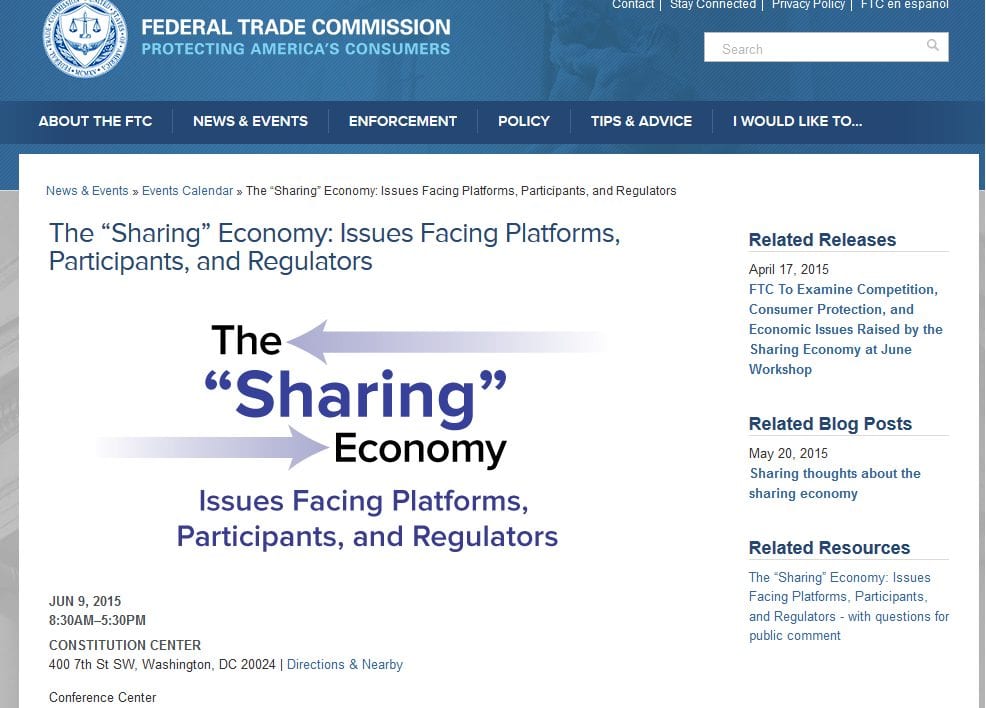
The Federal Trade Commission will hold a workshop on June 9 to explore issues relating to emerging internet peer-to-peer platforms— the “sharing” economy—and the economic activity these platforms facilitate. The workshop will examine competition, consumer protection, and economic issues arising in the sharing economy to promote more informed analysis of its competitive dynamics as well as benefits and risks to consumers. The workshop will consider if, and the extent to which, existing regulatory frameworks can be responsive to sharing economy business models while maintaining appropriate consumer protections. It also will examine how various regulatory choices may affect competition and consumers.

Information about the plans for the sharing economy workshop, including a list of questions for public comment, is available in the workshop announcement.


Dates

The workshop will be held on June 9, 2015 in the Conference Center of the FTC office building at 400 7th St. SW, Washington, DC 20024. Any interested person may submit written comments in response to this announcement and workshop discussions until August 4, 2015.
 

Watching the Workshop

The workshop will be webcast. A link to the webcast will be added to this page on the day of the workshop.


Attending the Workshop

The workshop will be free and open to the public. To pre-register, please email sharingeconomy@ftc.gov (link sends e-mail) and include your name and organization.

Pre-registration is not required to attend this event, but is strongly encouraged. To ensure you get a seat, and to have time to pass through security, it is recommended that guests arrive 30 minutes prior to the event. Seating is available on a first-come, first-served basis. Pre-registration will not guarantee you a seat if the workshop reaches capacity. Please bring a valid government issued photo ID (government badge, license, passport, etc.). The security processing will include a metal detector and X-ray screening of all hand carried items.
 

Public Comment Period

The FTC will be accepting public comments through August 4, 2015. For more information see the “Public Commments” tab below.


Questions?

If you have a question about the workshop, please email sharingeconomy@ftc.gov (link sends e-mail).


FTC Privacy Policy

Under the Freedom of Information Act (“FOIA”) or other laws, we may be required to disclose to outside organizations the information you provide when you pre-register. The Commission will consider all timely and responsive public comments, whether filed in paper or electronic form, and as a matter of discretion, we make every effort to remove home contact information for individuals from the public comments before posting them on the FTC website.

The FTC Act and other laws we administer permit the collection of your pre-registration contact information and the comments you file to consider and use in this proceeding as appropriate. For additional information, including routine uses permitted by the Privacy Act, see the Commission’s comprehensive Privacy Policy.

Hyatt deepens vacation rentals footprint with investment in onefinestay.com

0

The hotel industry has fought short-term rental companies like Airbnb tooth and nail. But, in a rare move, Hyatt Hotels has aligned itself with what some might perceive as a rival.

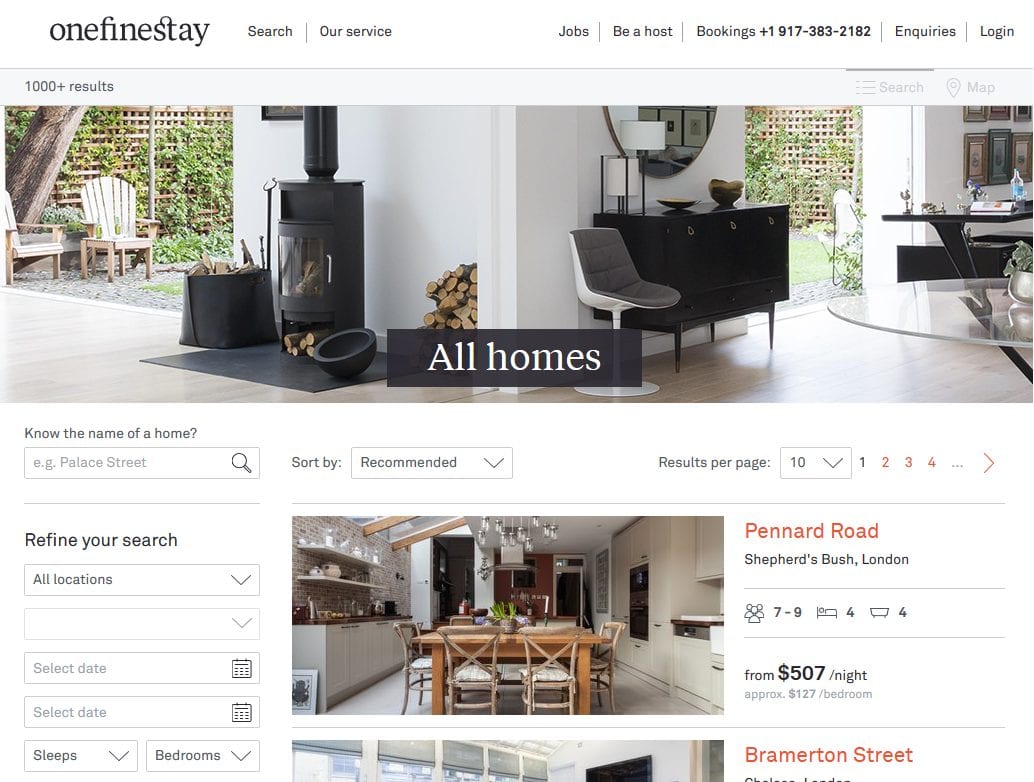
Hyatt has invested in onefinestay, a vacation rental marketplace that matches travelers with luxury homes. While it is unclear preciecly how much Hyatt invested, a source told the Wall Street Journal that the investment “was part of a nearly $40 million round of funding that was completed at the end of last year.”

Onefinestay works with upscale homeowners in London, New York, Los Angeles and Paris. It manages a portfolio of more than 2,500 homes with a combined value of more than $5 billion, according to the Journal.

Onefinestay CEO Greg Marsh declined to comment on his relationship with Hyatt.

A Hyatt spokesperson said in a prepared statement that it is “collaborating with onefinestay” and that it will “continue to test a variety of offerings, work with a number of companies and make investments to continue innovating the guest experience.” [WSJ]Christopher Cameron

– See more at: http://therealdeal.com/blog/2015/05/25/a-hotel-giant-is-getting-behind-the-short-term-rental-movement/#sthash.I8q8WsvH.dpuf

OPMA Executive Summit in Atlanta a resounding success

0

In what was referred by many as a ground breaking industry event. The Onsite Property Management Association (OPMA) hosted it’s Executive Summit May 11 – 12 in Atlanta promoting a unique and informative program agenda and format. The inaugural Summit brought together top industry speakers and OPMA members in an intimate meeting environment that resulted in an open dialogue and positive interexchange between the speakers and attendees.

The meeting format had the attendees, represented by senior executives of OPMA’s onsite manager and supplier membership base, positioned classroom style in a semi circle around each speaker. After each speaker presentation John Dalton, Chief Marketing Strategist for OPMA, moderated the lively interexchange dialogue amongst the Summit participants.

” I just returned from the OPMA conference in Atlanta and want to take a moment to thank the association for making it such a worthwhile experience. The 30 minute speaking formats and then 30 minutes of discussion were perfect for maximum information flow and they were relevant to what our industry is facing. I especially liked the selection of speakers and industry topics.”   —Matthew Brittain, Managing Director, Brittain Resorts, Myrtle Beach, SC


As a relatively new national lodging association OPMA understands the importance of focusing on a few extremely important goals. The speaker presentations, while different and unique, all tied back to the three major initiatives that OPMA has determined to be  immediate priorities and long term objectives for the association:


1) To define our lodging category and maximize awareness and recognition of the ” condo hotel” lodging experience with consumers, the travel and mainstream media, and a wide range of lodging industry stakeholders  including DMOs, the OTAs,  and the state and national lodging associations. The OPMA Board of Directors voted unanimously to join AH&LA as an allied member which would provide OPMA with a voice on a local, state, and national level and a broad based venue to promote our program platform and initiatives.


2) To continue our national campaign against illegal short term rentals  in our quest to not only level the  playing field but to tilt it in our favor.


3) To further expand our membership base whereby we can dominate the available condo hotel rental inventory in any one market and to identify and subsequently leverage the financial impact our collective efforts are having towards tax revenue generation and job creation with the destination Economic Development Councils.


” What an outstanding group of professionals you had organized for the first OPMA Summit. I have attended and even spoken at many conferences and meetings but never have I seen this intent or focus from a group on it’s initial gathering of members. Well done and looking forward to our nextSummit event. ” —Dennis DiTinno, CEO, Liberte Management, Treasure Island, FL


The four featured speakers at the Summit were:

1. Troy Flanagan, Vice President – State and Local Government Affairs, AH&LA –“Industry trends related to short term rentals and the future impact on local and state governments”

2. Mindy Rehse, Senior Director – Global Partner Group for Expedia, Inc  –“Our vision and strategy for supporting and further enhancing the relationships with our hospitality partners”

3. Dr. Steve Morse,  Economist and Hospitality Director  -Western Carolina University –-“Claiming your industry contributions and identifying local economic impacts of your destination’s condo hotel lodging sector”

4. Ron Cacciatore, Director Standards and Compliance -Broward County Appraisers Office–“Identifying and exploring solutions to collecting taxes tied to illegal  short term rentals”


” The OPMA Executive Summit provided me and my supplier colleagues a tremendous opportunity to meet and interface directly with C-level executive members of the association. I cannot think of a similar lodging  event that provides in one venue unprecedented  one on one access and quality time with the top decision makers within the condo hotel sector and overall lodging industry”   —Jim Olin, President, C2G Advisors, LLC, Franklin, TN

In addition to the general session presentations there was a significant amount of networking and side bar meetings between the speakers, the OPMA onsite managers, and the OPMA providers of goods and services …all key decision makers with their respective companies. The following represents a link to photos of the attendees finding the time to combine business and pleasure:

https://www.flickr.com/gp/133381734@N04/yk2o2y

” The first annual OPMA Executive Summit brought a productive focus to several of the most critical issues facing our industry. Each topic addressed was presented by a highly qualified speaker as a ” state of the union” , and then carefully analyzed with the attendees to identify practical ways that we as onsite property managers can counter threats and maximize opportunities. The Summit was truly unique, tactical, and forward looking.”  —Mia Vlaar  Director of Sales and Marketing   East West Resorts   Avon, CO

The Executive Summit represents an important first step in our growth plans as OPMA has defined and articulated it’s goals . Our efforts will now be directed to collectively implementing targeted strategies and initiatives that will help us achieve those objectives. Based on the tremendous positive feedback that we have already received from the attendees we are already looking ahead to our next Executive Summit and other OPMA events.


For more information and questions about the  Executive Summit you may contact Rick Fisher, Executive Director for OPMA, at rfisher@theopma.orgor ( 877) 870 6510.

California cities miss the boat on vacation home sales by imposing rental restrictions

1

While the fourth major California city voted to ban traditional vacation rentals under 30 days and pushed to legalize Airbnb’s homesharing, the National Association of Realtors (NAR) published its 2015 Investment and Vacation Home Buyers Survey, which reported that 2014 vacation home sales were up 57.4 percent over 2013 –rising to a record level.

But as vacation home sales soared in the U.S., according to the LA Times, California witnessed a contrasting trend, with the percentage of vacation home sales falling to 5% last year from 6% in 2013, according to a tally by the California Association of Realtors.

Not so coincidentally, municipalities in California have led the charge to ban traditional vacation home rentals for less than 30 days in several cities -including San Francisco, Los Angeles, and Santa Monica -while many other cities are in the process of determining legislation regarding short term rentals.

In the rush to jump on the Airbnb band wagon, West Coast municipalities have made a series of uninformed decisions regarding traditional vacation home rentals and will likely reap long-term consequences.

Besides the massive income for the city generated from high-end vacation rental travelers, city council members do not seem to understand that people who rent vacation homes also buy vacation homes.

Money published 7 Tips For Buying a Vacation Home advises vacation home shoppers to rent a vacation home before they buy. “Before you lock yourself in, rent a place (more than once is best) in the area you’re considering to be certain you’ll actually enjoy it. Stay for at least two weeks to make sure you don’t grow bored on extended stays.”

In the Forbes article 8 Things To Know Before Buying A Vacation Home, “Don’t even think of buying a vacation home until you’ve visited the area a few times. It sounds basic, but you better be sure you simply adore and can’t get enough of that beach town, ski village, or country ranch before you commit to buying there, since you’ll be spending a great deal of your free time there in the future.”

In addition, buyers look to city regulations to find out if a city has a vacation-home-friendly environment. According the Heather Bayer in the Inman article Shift Your Mindset When Selling to Vacation Rental Buyers, vacation home buyers want to know, “What zoning and bylaws are currently in place? Is there any news pending or brewing in the media? What might impact a buyer’s potential to rent a property in the future?”

Bayer said, “The legislative impact on vacation rentals is significant, and in-depth knowledge of what a specific location allows or restricts is essential.”

Even Airbnb, who initially lobbied for laws in California which would restrict non-owner-occupied vacation rentals in these municipalities, is now looking for ways to work with and profit from traditional vacation home rentals. Behind the scenes, Airbnb has been actively implementing technology integration with software providers in the traditional vacation rental space to allow real-time booking and content updates for non-owner occupied vacation homes. In addition, Airbnb has joined the Vacation Rental Managers Association (VRMA) and is currently listing a significant number of professionally managed vacation homes on its site.

With vacation home sales dropping in California and with lobbyists from Airbnb shifting their position, city council members in California are likely to find themselves standing alone holding the bag when the numbers come in and the vacation rental debate matures.

By Amy Hinote


Airbnb Buddies up to North Carolina Cities

0

North Carolina guests renting rooms and apartments through Airbnb soon will begin paying sales and hotel occupancy taxes.

The online vacation rental service announced Monday that it will begin collecting and remitting sales taxes on behalf of its North Carolina home hosts starting June 1 and will collect hotel occupancy taxes in Wake, Durham, Mecklenburg and Buncombe counties. The tax rates vary from county to county.

Those in the hospitality industry say it is unfair that homeowners can rent rooms or whole dwellings to short-term guests for lower prices without charging taxes through Airbnb. The last traditional bed-and-breakfast in Raleigh, The Oakwood Inn, will close its doors for good in June and blames competition from the less-regulated online rental services.

The only other state where Airbnb collects taxes from guests statewide is Oregon. In the past year, it also began collecting taxes in San Francisco, Portland, Chicago, Malibu, San Jose, Washington, D.C., and Amsterdam.

In Raleigh, regulation of Airbnb rental homes has been discussed since December when one homeowner was served a citation because his Airbnb rental is in a residential neighborhood and violates city zoning rules.

Raleigh City Council deferred the citation until the issue of short-term rentals could be sorted out. The council’s Law and Public Safety Committee is discussing how best to bring Airbnb, and similar businesses, into the market.

Raleigh Councilwoman Mary Ann Baldwin, chair of the committee, said she has been negotiating short-term rental laws with Airbnb and is pleased it agreed to collect and pay sales and room taxes.

“Airbnb is a popular piece of the new sharing economy that tourists and prospective residents expect to see in modern cities, so we are glad that we have taken the first step in welcoming Airbnb to Raleigh,” Baldwin said in a statement Monday.

Airbnb’s public policy manager Max Pomeranc said the company would continue to work with North Carolina officials to create clear, fair rules.

“We are confident that we can work together on some simple policies that embrace home sharing and make North Carolina communities stronger,” Pomeranc said in a statement.

Sales and hotel occupancy tax rates vary between counties in North Carolina. The statewide sales tax is currently 4.75 percent, but local taxes push the rate higher. In Wake County, for example, it is 6.75 percent.

The hotel occupancy tax also varies. Wake County receives a 6 percent hotel occupancy tax, according to the county Revenue Director Marcus Kinrade.

Kinrade said that Airbnb has given host homeowners an unfair advantage by avoiding taxation and code compliance. Although these new Airbnb taxes are a step in the right direction in Wake County, Kinrade said he would prefer that host homeowners register with the county so that taxes can be verified.

Gregg Stebben, the Airbnb host homeowner cited in Raleigh, said he agrees it is unfair that his guests did not have to pay the same taxes as those who stay in a hotel or traditional bed-and-breakfast, which pay for the tourist maps and brochures he would hand out to them.

“I am completely supportive of what happened today,” Stebben said. “It doesn’t impact me or any other host. I’m never going to touch that money, and it’s no extra work to me. It puts us in a fair position with other businesses in the area.”

Like at a hotel, the sales and room taxes will be added to the bill when a guest makes a reservation with Airbnb online using a credit card.

Stebben added that he is also happy with the signal sent by the negotiations between the city and Airbnb.

“It’s all about businesses,” he said. “The city working constructively with Airbnb sends a message to other businesses to come to Raleigh and they will work with you.”

Knopf: 919-829-8955

HomeAway Survey: Strong Influence of Kids on Family Travel Plans

0

Findings show what “kidfluencers” – and their parents – really want in a whole vacation: adventure, family bonding and a pool.

HomeAway, the world’s leading online vacation rental marketplace, has found that kids, or “kidfluencers,” wield a growing influence on vacation planning. In partnership with independent market research firm YouGov, HomeAway surveyed more than 2,800 kids (ages six to 18) and parents in the U.S. and Europe and found that when it comes to family vacation planning, children have significant decision-making power and a strong point of view on where to go, what to do and who to bring.

According to the HomeAway Kidfluencer Survey, kids are speaking up, and parents are listening – millennial* parents even let the kids get the last word:

  • The vast majority of parents (85 percent U.S., 76 percent U.K., 86 percent France, 95 percent Germany, 94 percent Spain) give their children some say in deciding where they want to go on vacation.
  • Millennial parents in the U.S. are most likely to give kids full control of where they want to go on vacation (19 percent versus two percent of parents over the age of 55).
  • One in three millennial parents in the U.S. (34 percent) allow children to make the final decision on where to go on vacation; this compares with eight percent of parents aged 55 and over in the U.S.
  • The majority (60 percent) of parents in the U.S. view kids’ input as a way to ensure the kids get more out of the vacation. More than half (53 percent) involve their kids in the planning process to get them excited about the trip, 42 percent say they involve their kids so they can learn about new things and nearly one-quarter (24 percent) use vacation planning as an educational opportunity.

The survey finds that a majority of parents in the U.S. say they let their kids make decisions on the vacation activities (77 percent), the itinerary (53 percent) and even the type of destination itself (49 percent).

“We are surprised the survey shows kids have such an extreme influence on family travel decisions,” said Brian Sharples, HomeAway co-founder and CEO. “The whole family is now invested in the experience, with kids bringing their own travel preferences to the table.”

Who’s invited: grandparents, friends, and pets among top picks in the U.S.

  • 41 percent of parents identify the most important part of a family vacation as spending quality time together over creating lasting memories (27 percent), exploring new places and cultures (15 percent), relaxing (10 percent) and disconnecting (six percent).
  • Togetherness is also important to kids, with 50 percent citing it as a top priority for vacation travel.
  • Parents and kids agree they want extended family and friends on their ideal vacation, with parents wishing to include relatives like their children’s grandparents (38 percent) and kids wanting to invite their friends along (55 percent).
  • 30 percent of parents would choose only to include immediate family, pointing to their desire to spend quality time on vacation.
  • Nearly one-third of kids would like to bring their pet (32 percent) on their ideal vacation while 22 percent say that leaving their family pet at home during vacation has annoyed them.

U.S. kids want adventure and an exciting place to stay

  • In identifying what they want most on vacation, kids enjoy experiencing new adventures (60 percent) and doing things they wouldn’t be able to do at home (63 percent) while on vacation.
  • Children want to stay in unique accommodations, with a castle (37 percent) or tree house (29 percent) rising to the top, among other choices such as an airplane, boat and train.
  • The most important accommodation feature is a pool (37 percent of kids, 75 percent of parents in the U.S.), and 21 percent of kids want more than just a pool – they want a water slide.

Among younger kids in the U.S., theme parks reign supreme, but older kids are more likely to choose international travel for their next family vacation

  • Double the number of children ages six to 12 (54 percent) versus teens ages 13 to 18 (27 percent) would choose a theme park whereas teens are almost three times as likely to choose another country as their destination preference.
  • After theme parks, a trip to the beach was the second choice among kids, with nearly one-fifth (19 percent) of kids wanting to head for the coast.
  • Among other destination choices, twice as many teens ages 13 to 18 (10 percent) versus children six to 12 (5 percent) would choose big city travel.

“Since HomeAway’s inception, Orlando, Florida with easy access to Disney and Universal Studios has been the top market for U.S. bookings, so the popularity of theme park focused trips is not surprising,” says Sharples. “However, we weren’t expecting to see such a high enthusiasm from kids for traveling internationally. Fortunately, due to the strength of the U.S. dollar, now is a great time to pack-up the family for a European vacation that won’t break the bank.”

While both U.S. kids and parents want to be together, they also want their space

  • 72 percent of parents reported the size of the room/home on vacation was an important feature when deciding where to stay.
  • 59 percent of parents say an important factor is having plenty of beds, so the family doesn’t have to share.
  • Popular accommodation choices for kids seemed to rank in order of space for the family, with a vacation rental as first choice (36 percent) among kids, followed by a hotel (29 percent) and a cruise ship (23 percent).
  • Kids say the best part of staying in a whole house is getting their own room or their own bed (39 percent).
  • Maybe this desire for space has emerged because kids frequently find themselves sleeping in uncomfortable situations when on vacation:
  • 44 percent spent the night on a couch; 43 percent have slept on an air mattress and 22 percent have slept on the floor during their stay.
  • 19 percent of parents report that their child(ren) have slept crowded in a hotel room with too many people.
  • No surface is off limits: four percent of parents have reported that their children have slept in a bathtub, and three percent have reported that their kids have slept in a closet.

U.S. kids notice their parents seem happier on vacation and aren’t spending too much time on their devices, but everyone wants the option to stay connected

  • 54 percent of kids report that their parents seem happier on family vacations.
  • 70 percent of kids say their parents don’t spend too much time on their gadgets while on vacation.

The state of the treasured summer family vacation continues to bring families together. Fortunately, 66 percent of kids report that their parents don’t wear any embarrassing things on vacation. But some parents need to leave the swimsuit at home. Parents’ bathing suits rank tops as the clothing item kids are most embarrassed by, as 12 percent of U.S. kids over age 12 report, followed by fanny packs (nine percent) and T-shirts from where they are visiting, like “I LOVE NEW YORK” (nine percent).


*Millennials are those respondents aged 18-34 (with Gen Xers making up the 35-54 group, and Baby Boomers those 55+).


Win a $5,000 Stay with the HomeAway Kidfluencers Contest

This summer, HomeAway is empowering kidfluencers by giving them even more control over their family’s travel plans with a chance to win a $5,000 vacation rental stay to anywhere in the United States in 2015. To enter, travelers just need to create a 15 to 60-second video of their kids describing why their family should win a vacation from HomeAway. Upload the video to Instagram, YouTube or Vimeo, using the hashtag #HomeAwayVacation and complete the entry form at http://a.pgtb.me/TxF29N, before May 29, 2015. HomeAway will select 10 finalists that will be voted on by the public from June 8 to 12 to determine the winner. For more details on the contest, visithttp://a.pgtb.me/TxF29N.


Survey Methodology 

YouGov, on behalf of HomeAway, conducted an online survey of 2,813 kids (ages six to 18) and parents based in the U.S., U.K., France, Germany, and Spain. All figures, unless otherwise stated, are from YouGov Plc. Fieldwork was undertaken between April 20-30, 2015.

All figures refer to results from the U.S., unless otherwise stated.


About HomeAway

HomeAway, Inc. based in Austin, Texas, is the world’s leading online marketplace for the vacation rental industry, with sites representing over one million paid listings of vacation rental homes in 190 countries. Through HomeAway, owners and property managers offer an extensive selection of vacation homes that provide travelers with memorable experiences and benefits, including more room to relax and added privacy, for less than the cost of traditional hotel accommodations. The company also makes it easy for vacation rental owners and property managers to advertise their properties and manage bookings online. The HomeAway portfolio includes the leading vacation rental websites HomeAway.com, VRBO.com and VacationRentals.com in the United States; HomeAway.co.uk and OwnersDirect.co.uk in the United Kingdom; HomeAway.de in Germany; Abritel.fr and Homelidays.com in France; HomeAway.es and Toprural.es in Spain; AlugueTemporada.com.br in Brazil; HomeAway.com.au and Stayz.com.au in Australia; and Bookabach.co.nz in New Zealand. Asia Pacific short-term rental site, travelmob.com, is also owned by HomeAway.

LiveRez wins 2015 Travel Industry Excellence Award in Boise

0

LiveRez won the Boise Metro Chamber of Commerce‘s 2015 Travel Industry Excellence Award.

This is the second year in a row the company has been a finalist for the award, which is given to a chamber member company that “has made significant contributions in enhancing Idaho’s travel industry through recreational opportunities, transportation, lodging options, tourism, or other means.”

Other finalists this year were AAA of Idaho and Enterprise Holdings (the parent of Enterprise and National rental car companies).

LiveRez CEO Tracy Lotz accepted the award and gave a rousing speech, explaining how the company has grown over the years and at one point calling LiveRez the “honey badger” of the vacation rental industry. You can watch his speech below.


Urban Vacation Rentals on the Rise: Data from Beyond Pricing

0
VRMA Marketing Plan and Budget Workshop

By Nick Wallace –Since it began operating in 2008, Airbnb has shaken up the hospitality industry, and reports are that it could soon be valued at over $20 billion. That’s nearly as much as Marriot International. With that much capital behind the Airbnb platform, it stands to reason that Airbnb hosts are cashing in as well. On the other hand, many of the most popular Airbnb destinations are also among the least affordable cities in the U.S.So how much money is it possible to make by listing a room or full home on Airbnb?


Find out now: Is it better to rent or buy?

Using data provided by Beyond Pricing, a service that optimizes pricing for short-term rental owners and Airbnb hosts, SmartAsset analyzed the profit potential of rentals in 15 of the largest Airbnb markets in the U.S.

First, we calculated expected revenue of private-room Airbnb rentals in each city.We wanted to know if it’s possible to pay the rent on a two bedroom home by listing one of the rooms on Airbnb. Then, we calculated expected net profits (after average rent, utilities and internet) for full-home rentals in each city. You can read more about our methodology below.
 

Key Findings

  • $20,619. That’s the average expected annual profit of Airbnb hosts renting out a full two bedroom apartment or house in the 15 cities SmartAsset examined. While it’s not chump change, it also isn’t enough to live off of—which is why many “professional” Airbnb hosts rent multiple properties.
  • 81% of your rent. On average, that’s what you could expect to pay by listing one room in a two-bedroom home on Airbnb. That’s a lot more than a roommate would chip in, but it also requires a lot more work. (Well, depending on your roommate.)
  • Miami and San Diego are the most profitable cities for Airbnb hosts. The combination of warm weather and (relatively) affordable housing make these two cities a better bet for full-apartment listings than popular but expensive destinations like New York and San Francisco. By the same token, private-room listings fare best in low-rent cities like Houston and Philadelphia.

airbnb 1 1 Where Do Airbnb Hosts Make the Most Money?


Takeaways: Airbnb Private-Room Listings

Renting out a single bedroom in a two bedroom apartment can serve as a good source of supplemental income in most of the cities SmartAsset examined. In half of the cities in our analysis, an “Airbnb roommate” would, on average, pay at least 80% of an apartment’s total rent. In Miami, San Diego, Chicago and Philadelphia, it would pay over 90%. In Houston, an Airbnb private-room listing would be enough to pay the entire rent on a two bedroom at the average occupancy rate of 64%.

In many cities, it may be possible to pay the entire rent on a two-bedroom apartment with around 20 days of bookings per month. In Miami and Philadelphia, for example, an Airbnb host could pay the full rent on a two bedroom apartment by filling one of the rooms for 21 days a month. In San Diego, 24 days of bookings a month would pay the rent. Achieving those numbers, however, would require beating the average occupancy rates listed above.

So, before you kick out your roommate and list the spare room on Airbnb, keep in mind the time commitment involved. Earning money on Airbnb requires careful management and active involvement. In general, “hands-off” Airbnb hosts can expect occupancy rates (and revenue) at least 15% lower than those listed.

airbnb 2 Where Do Airbnb Hosts Make the Most Money?


Takeaways: Airbnb Full-Apartment Listings

For Airbnb hosts looking to make a living on the hospitality platform, full apartment rentals are the way to go. Rates for full apartments are significantly higher than those for single rooms and income after expenses ranged from $15,000 to $31,000 in our analysis. The top cities were both beach towns: San Diego and Miami.

On the other hand, while San Francisco and New York capture the highest average Airbnb nightly prices, at $247 and $233 respectively, the exorbitant rents in those cities wipe out the additional income. That means there is an opportunity for renters or homeowners in those cities who have annual rent (or mortgage payments) lower than the amounts listed above.


Austin Keeps it Weird

The Texas capital is one of the hottest Airbnb markets around. It has a nationally-renowned music and art scene, terrific food and four seasons of warm weather. On top of all that, festivals like SXSW and Austin City Limits periodically draw massive crowds from across the country.

In fact, a significant number of Airbnb hosts in Austin only rent their rooms and apartments during festivals and rates during festivals can be several times what is normally charged. Some residents collect over $1,000 a night during SXSW, which attracts over 130,000 attendees in a city with just 30,000 hotel rooms (and only 7,000 in the downtown area).

That’s a big money-making opportunity. However, it also skews the data. Because of Airbnb accounts that are specifically set up for Austin’s festivals, the Texas state capital has the highest average rental rate in the U.S. ($277 per night for a two bedroom) and the lowest occupancy rate (around 60%, and far lower than that in festival-free months, when accounts targeted toward festival-goers are dormant). Active hosts can expect a much better occupancy rate than that, but a lower price for most of the year.


Legal Issues

In some of the cities SmartAsset examined, hosting guests through Airbnb may be illegal, and in many apartment buildings it could constitute a breach of contract. In New York City, for example, the Department of Buildings has hit at least one Airbnb host with thousands of dollars for renting out his place while he was out for the weekend. Likewise, after an investigation by the New York Attorney General, Airbnb revoked thousands of New York hosts’ accounts for misuse.

This is something to keep in mind wherever you are. How will your landlord feel about your Airbnb use? Will it bother your neighbors? Are there business or hotel taxes you may be required to pay once you start earning money? In some cities, including Portland and San Francisco, Airbnb has already started collecting these taxes. The same treatment may be on the way in other places.


Methodology

To calculate the monthly rent percentage, SmartAsset used average Airbnb private-room price, average Airbnb occupancy rates and average monthly rent for each city. We first calculated expected monthly revenue by multiplying the average Airbnb occupancy rate by the number of days per month, for an expected number of bookings per month. We then multiplied the expected bookings by the nightly price to arrive at expected revenue.

Lastly, to arrive at the monthly rent percentage, we divided each city’s expected monthly revenue by the average monthly rent. The percentage yielded is an average across all 12 months. Note however, that it will be higher in long months, like January and lower in short months, like February. Those extra days are extra opportunities for revenue!

SmartAsset used a similar formula to calculate expected profits from full-home rentals, but we added expenses into our analysis in order to capture the full costs of maintaining the home. First, we multiplied each city’s Airbnb occupancy rate by 365 to arrive at bookings per year.

We then multiplied bookings per year by nightly Airbnb full-home price to reach expected annual revenue. From that we subtracted total annual expenses, which was equal to twelve times the sum of each city’s average monthly rent, utilities cost and internet rate.

The key point for both of these methodologies is that they give expected revenue and profits based on averages. Individual apartments and individual Airbnb hosts can (and do) over- or under-perform these numbers. Hosts who actively manage their listing on a daily basis by keeping their property in good shape, adjusting prices to market conditions and being friendly and helpful to guests (which often leads to more and higher reviews) could earn more.


Sources

Data on average Airbnb prices and occupancy rates came from Beyond Pricing, which tracks thousands of listings in each of the cities we analyzed. Data on average rental rates came from MyApartmentMap.com. Data on average utilities rates came from the Council for Community and Economic Research. Data on average monthly internet came from Numbeo.com.

 Photo credit: ©iStock.com/Christian Wheatley


1. We excluded Portland, Oregon from this portion of the analysis because of a lack of reliable data for the private room market in that city.

Myrtle Beach: 37% decrease in Spring weekly vacation rentals

0

Study shows 37% decrease in weekly Myrtle Beach vacation rentals in Spring 2015.

A new study shows weekly vacation rentals on the Grand Strand are down compared to the same time last year. The Coastal Carolina University Clay Brittain Jr. Center for Resort and Tourism analyzed occupancy rates over a six week period.

According to Brittain Center Director Dr. Taylor Damonte, the group took a voluntary sample of hotels, condos and campgrounds along the Grand Strand and found the nightly occupancy rate was down 3.6%, but up during 10.9% during the weekend.

Results also show the number weekly vacation rentals are 37% less than last year. Damonte said Tropical storm Ana could be the reason why.

“Named storms do tend to have an impact on occupancy,” he said.

Dunes Realty General Manager Ryan Swaim blames timing. Last year, Easter fell on April 20. This year, the holiday fell on April 5.

“When Easter is earlier in Myrtle Beach, it tends to be less crowded,” stated Swaim.

Vacation homes also primarily rent to families, according to Swaim.

“We’re busy when kids are out of school,” he said.

Damonte said the numbers indicate a trend in tourism. Instead of staying a full week, he said visitors will stay a few days or over the weekend. Swaim said hotels and condos often have an advantage over rentals in the off season.

“Hotels have a lot more flexibility as far as offering two and three night stays on a weekend,” said Swaim.

He expects the Summer to look a lot different. Swaim told News 13, June looks fantastic.

By Brennan McDavid

Airbnb annihilates vacation rentals…again…in Santa Monica

0

Led by Airbnb, Santa Monica banned vacation rentals for less than 30 days, but legalized “home-sharing” — in which the occupant rents a couch, spare bedroom or backyard unit.

The Santa Monica City Council has passed some of the region’s toughest regulations on the booming short-term rental industry.

In a unanimous vote Tuesday, the council approved rules that will ban most short-term rentals in the city by prohibiting the rental of an entire unit for less than 30 days, the Los Angeles Times reported. The rules legalize “home-sharing” — in which the occupant rents a couch, spare bedroom or backyard unit — but require hosts to obtain a business license and pay Santa Monica’s 14 percent hotel tax.

The vote was taken over moments and with no debate despite a protest held outside Santa Monica City Hall Tuesday afternoon by more than 100 short- term rental hosts and supporters. Several people there said they worried that other Southern California cities might adopt similar rules on short-term rentals.

Thoughts?

Why Attracting Millennials and Generation C Will Mean Big Business for Vacation Rental Industry

0

By Julian Castelli, CEO LeisureLink

Millennials are a powerful segment of today’s travelers, and their preferences and habits will help shape the future of travel preferences going forward. They are proving to be always connected, cost-conscious travelers that expect better access to online content, pricing information, along with quick response times to booking requests. In 2014 mobile and tablet devices generated nearly 40 percent of page views, and approximately 20 percent of bookings and room nights. This means vacation rental and resort property managers are faced with the new challenge of integrating a brand story across desktop, mobile, and tablet platforms – all while guiding mobile-savvy millennial users seamlessly through the booking funnel. Here are three tips for vacation rental suppliers to maximize engagement with these users, and translating that engagement into increased revenue.


Optimize the online experience

Studies reveal that millennials are a tech savvy group who place a premium on convenience. If your rental property’s online strategy doesn’t support dynamic content personalization, merchandising, and reservation abandonment prevention, you’re losing ground with this profitable market segment. It’s no longer a viable option for most property managers or owners to manage everything manually or with fragmented systems. Upgrading to an integrated, full-service distribution solution will enable you to manage and maximize all your distribution, as well as to optimize rates, availability, specials, and even content changes to increase exposure in less time, with less effort. What’s more, a system like this will give you full control not only over content, but also over the ways in which elements like rates, images, and merchandising options adapt dynamically to each user’s preferences and interests. Adaptive rate offerings, for example, can help maximize RevPAR; while adaptive brand storytelling can boost user engagement, and a solid reservation abandonment prevention system can make sure bookings don’t slip away.


Integrate an authentic social media story

Millennials and today’s tech-savvy travelers can be aptly dubbed as a demographic called “Generation C” – consumers who are “always connected” to online resources via their mobile and tablet devices. Social media represents a full 28 percent of time spent online for Generation C, which means that a multi-channel campaign integrating social media is a powerful tool for driving conversions across multiple platforms. Rich imagery can introduce users to your rental property’s story – and concrete offers during the planning and booking stages can reinforce that story throughout the booking funnel. Millennial users are known for sharing interesting vacation experiences and deals when they find them – which means that competitive rates and rate parity are both crucial for generating leads from this demographic. With a system that tracks the pricing changes in your market, aligns your pricing accordingly across your full range of online channels, and allocates your rental inventory as needed, you’ll be able to close each deal at a price point that maximizes your ROI.


Be responsive in every way

Millennials’ multi-device browsing habits make it necessary to track their behavior across multiple platforms and channels, and adapt each component of the campaign in order meet traveler expectations for convenience and speed of communication. Since members of Generation C handle almost all their business online, it’s essential to be visible on as many channels as possible, and also to be available 24/7 to close the deal. That means making sure you’re telling your property’s story on every online distribution channel you can, from websites of OTAs and tour operators to niche vacation review sites to all-purpose social media channels – across desktop, mobile, and tablet platforms. If millennial users get hit with that story across every platform they’re using – and can confirm bookings at any time, any place, from any device – that’s a major step toward increasing direct bookings, and maximizing the number of engaged users you can convert into sales.


Conclusion

Millennials’ booking habits have disrupted vacation rental industry in all three of these ways – in the ways users search and shop online, in the ways they share content on social media, and in the ways they move between sites and platforms as they plan their bookings. In order to maximize occupancy and RevPAR for your vacation rental property, it’s necessary to develop adaptive content, and to distribute that content on the fly in response to the emerging demands and trends. With the right technology and tools to implement a dynamic distribution and marketing strategy, though, it’s possible to attract this profitable generation of users and guide them smoothly to a finalized booking, no matter which screen – or screens – that process takes place on.

Vacation rental suppliers interested in learning more about expanding their distribution reach are encouraged to schedule a demo of LeisureLink suite of solutions at http://content.leisurelink.com/demo-land-page.

Travel Trends Position Vacation Rental Operators to Increase Revenue with a Personalized Guest Experience

0
Turnkey acquires Coastline in Port Aransas

May 5, 2015 – Today’s travel trends put vacation rental (VR) professionals in an enviable position–they are in the right place at the right time. Guest demands, expectations and market trends are bringing many opportunities for revenue gains. What can VR operators do to leverage the trends? This:

  • Focus on the personalized travel experience that guests are demanding in increasing numbers.
  • Take the opportunity to turn OTA-caused “distribution disruption” on its head. As online travel agencies (OTAs) compete for booking dominance, vacation rental operators can leverage technology to capture OTA-sourced bookings and transform them into loyal guests for life.


As savvy vacation rental managers know, it takes more than good luck to succeed. The right place/right time advantage only translates into increased revenue with the right strategy executed. In the words of a leading vacation rental manager, “We have to make our brand stand out on all levels if we want to compete.”

Technology and best practices help VR operators do that. For example, NAVIS gives VRs effective customer relationship management (CRM) tools that:


  • Collect and centralize guest data across all distribution channels (including OTAs) for fast, simplified responses that increase conversion.
  • Identify the hottest leads among multi-channel inquiries for single-point replies.
  • Create relevant, personalized one-to-one messaging for each point of guest contact.


With the right tools, vacation rental operators of all sizes can personalize interactions with their prospects from the very first inquiry. Operators can launch effective 1-to-1 email messages to guests based on when they prefer to travel, where they like to stay, and their preferred activities.


It’s all about them, not you!

Led by Millennials, the vast majority of today’s travelers (66%) are between 18-48, according to Hudson Crossing. Baby Boomers make up another 29%. Their stated preferences make them prime VR prospects:


  • They seek to explore their destination and soak up local ambience.
  • They often combine business and pleasure, commonly referred to as bleisure.
  • They frequently travel with multigenerational friends and family, often called framily travel.
  • Most of all, they want a personalized experience that caters to their individual tastes and interests.


VRs are perfectly positioned to deliver an experience that reflects trending tastes, such as homes and condos nestled in neighborhoods; properties that encourage exploration of local venues; and a warmer, more personal ambiance than a transient hotel stay.


Mt Hood Vacation Rental converts increased OTA competition to repeat business using NAVIS lead management

“OTA reservation growth has been scary in our markets,” admits Betsy LaBarge, president and CEO of Mt. Hood Vacation Rentals (MHVR). “Many vacation rental operators in our area feel they do not have the brand awareness necessary to compete, so they rely completely on OTAs.”


LaBarge oversees 30 units at Mt. Hood, located 50 miles southeast of Portland, Oregon. Her company has been a NAVIS customer for 15 years. Mt. Hood Vacation Rentals is in growth mode and competition has heated up in the past year. The local market’s vacation rental supply has tripled due to growing popularity and the past economic downturn that prompted more owners to rent out their vacation homes.


Like many VR operators, LaBarge works with a few specific OTAs to meet the competitive challenge, although many OTAs compete in her market. “One online site targets budget traveler. This is not a fit for our $500/night units, so we list a handful of our most popular, lower priced rental homes here. We hand pick individual units to list on our OTA sites, then convert the guests to Mt. Hood Vacation Rental clients for repeat business. We do this during their stay by delivering a personalized local experience they value. They remember us, not the OTA.”


Vacation rental industry leader Alan Hammond recently confirmed the market trend. “In the race for a competitive edge, control of the marketplace, and profit from vacation rentals, OTAs, rather than promoting management brands, often seem to undervalue or ignore…guest services.” In place of personal service, they offer volume business to vacation rental operators. But once they are established in an industry like vacation rental, OTAs often increase subscription fees, add transaction charges, and consolidate their power as large companies swallow up competitors.


Vacation rental operators are countering OTA competitors with tools that help them automate and strengthen what they do best – create a personalized experience from the first inquiry contact.


Intracoastal Rentals is known for its attractive units along North Carolina’s beaches. Luke A. Waddell, Operations Manager for Intracoastal said, “We list units online with VRBO and several other channels. We use NAVIS’ Listing Lead Management solution to consolidate incoming leads from the various web sources. The online leads come directly into our NAVIS reservation system, which indicates the unit, date, and other details important to the booking. This helps us respond to leads much more quickly. Our faster lead response increases our conversions. With NAVIS’ technology and coaching, our inbound call conversions increased from 20 percent to 43 percent.”


Automated email response boosts conversion rate – ‘We do not miss leads’

Mt. Hood’s LaBarge implemented NAVIS personalized lead response solutions to take back control of Mt. Hood Vacation Rentals’ guest data and respond to inquiries faster for a higher conversion rate:


  • NAVIS’ Listing Lead Management (LLM) system captures information from OTA inquiries in NAVIS’ Narrowcast reservation sales system. Inquiries are color-coded to identify the source of the lead for fast, single point response to increase conversions.
  • LLM consolidates data from multiple inquiries into one “household persona” to identify preferences for personalized communications.
  • LLM alerts reservation staff to new inquiries on the NAVIS Narrowcast Dashboard with a real-time summary of the prospect’s information and inquiry details.
  • When staff are unavailable, NAVIS’ Auto Agent auto response system generates an attractive, personalized email based on the requested date, unit, and property detail. NAVIS Narrowcast tracks whether the prospect opened or forwarded the email.
  • Unlike responses generated by OTA sites, “Auto Agent responds with an email bearing our logo, our branding, and our units only,” explains LaBarge. “If the requested property is not available, Auto Agent sends a response with photos and descriptions of similar units. If we’re sold out, the email offers an apology and alternate dates.”


“We do not miss leads with LLM,” continues LaBarge. “The consolidated information allows us to understand the prospect’s style and needs. OTAs can’t match this. We respond faster and that equates to more business.” Numbers tell the story. OTAs generally log a 6% conversion rate. LaBarge reports a 10% conversion rate with her Auto Agent responder.


Personalized service = loyalty: ‘People want to be recognized and valued’

NAVIS Reach real-time CRM tracks and responds to specific guest preferences. Effective Reach CRM data collection from multiple third-party sources–whether online or over the phone—builds a close relationship based on guest history so that communications from LaBarge and her team always reflect 1-to-1 messaging based on each person’s preferences.


Tracking guest preferences is especially important when a VR’s “season” is scattered throughout the year. That’s the challenge for Joyce Warwick, reservation manager for Georgia Mountain Rentals, north of Atlanta. She handles 90 privately held homes and has been a NAVIS customer since August 2014.


“Summer is high season,” Warwick says. “We’re also busy in October and early November during the local Oktoberfest. Our larger homes fill during winter holidays and the 1-2 bedroom units are popular for Valentine’s Day. Although some units are good year round, we have a very slow winter period.” Under those circumstances, guest preferences and loyalty are crucial. “We have lots of repeat business,” she says. “Creating a personal, local guest experience sets us apart. Even if guests find us through an OTA, they enjoy their stay and often book directly with us for the following year while they are here.”


Mt. Hood’s LaBarge says that “NAVIS Reach helps us gather guest data so we can track why they came to us. When a guest calls, we can see that person’s lead form with information about past stays. We understand a guest’s needs based on what they did their last time with us. This strengthens the relationship. People want to be recognized and valued.”


Waddell at Intracoastal Rentals agrees, “We rely on NAVIS’ systems to help us recognize our repeat guests the moment they call in to ask about availability. Our inventory is unique, each unit is different. The NAVIS system communicates with our phone system to recognize a caller’s phone number and instantly display their stay history, preferences, and units.  Our agents are well trained and coached by NAVIS, but having caller information in front of our staff establishes instant recognition and makes their contact with us more personal. NAVIS is important to our high conversion rate.”


NAVIS Reach boosts VR’s conversion rate to 25-60%

NAVIS’ Reach CRM also supercharges Mt. Hood Vacation Rentals’ marketing operations. “We used to use Excel and crunch the past stay data and numbers ourselves,” says LaBarge. “Now we store guest attributes in our NAVIS Reach database. We know what our guests like.” She and her team fine-tune email marketing to touch each guest based on factors such as special events, leisure activities, or favorite season.


“We have 150 campaigns, each with a unique toll-free number generated by Narrowcast to track reservations and the revenue they generate,” explains LaBarge. “That includes specific numbers on Facebook to track social media promotions. Imagine knowing how much a Facebook posting is worth. These leads are recorded in NAVIS Reach to measure each campaign’s success, and for future marketing.” NAVIS Reach makes small, targeted campaigns an efficient marketing option. “I may have emails going to only 100 people,” she says, “but my campaign makes them think of us and they do come back.”


This type of revenue measurement is key to guest-centric email marketing, according to Jason Ring, NAVIS Data Marketing System Consultant. “Old email functionality does not trace money,” he explains. “Today we measure each campaign’s revenue, open rates, and click-throughs. Operators can invest their marketing budget in the most profitable channels.”


Mt. Hood Vacation Rentals also learned from NAVIS, and internally trains new hires and coaches its reservation team on best practices to book prospects. Again, conversion numbers tell the story. “Most team members start out with a 25-30% conversion rate,” according to LaBarge.  “But since March 2015, April inbound conversion for the team through today is 47.9%.   I can tell you our average is 46.7%. One team member converted at 70% and paid her entire rent with her bonus. The NAVIS system absolutely works for us.”


With an effective strategy and the tools to implement it, vacation rental operators are making the most of their right place/right time advantage in the evolving travel market. They prove the adage that the difference between challenge and opportunity is a shift in perception.

7 takeaways from the NAR Vacation Home and Investment Property Report

0
What we can confidently say about second-home buyers

With the release of the National Association of Realtors’ annual report on vacation home and investment property activity comes confirmation that the second-home market is booming while the rate of investment property purchase is declining.

The report touches on many areas that show a drive toward investment in short-term rental by three specific groups — affluent families, pre-retiree baby boomers, and investors who traditionally bought into residential rental properties.

This development is exciting for real estate agents who are looking for a new niche. Demand for short-term rentals is on the rise, as growth of the major players continues to reach new heights, and the strength of this market shows no evidence of a slowdown.


1. Second-home investment is on the rise.

According to the report, vacation-home sales accounted for 21 percent of all real estate transactions in 2014 — the highest since the survey began in 2003.

Despite arguments that the running costs of a vacation home cannot be fully met by short-term rental, many buyers are now factoring the potential of this income in their decision-making process

Takeaway: The growth in these sales coupled with the rise in demand for vacation rentals as evidenced by the runaway success of companies such as Airbnb and HomeAway creates the potential for a highly profitable niche business.


2. Interest in investment properties is slowing.

The NAR report shows a decline in the sale of residential properties purchased primarily to produce rental income, or for potential price appreciation, for the fourth straight year.

NAR Chief Economist Lawrence Yun attributed this to the decrease in distressed properties coming onto the market thereby reducing the number of bargains available to turn into profitable rentals.

Takeaway: Whereas traditional investors had a wide knowledge of their market with substantial online content available to them, the short-term rental model is vastly different and creates opportunities for real estate agents to become the go-to expert. Those who master the niche are likely to have buyers (who need the specialist information that is not as easy to obtain from online resources) seek them out.


3. Vacation-home owners live 200 miles away.

Vacation-home owners typically live over 100 miles from the property, which means if they plan to rent it out, they will need property management options in place before they buy. Property management companies differ widely, so it’s important to research what is available for a range of scenarios.

Takeaway: Referring your buyers to a list of suppliers will boost their confidence in you, particularly if you can explain the different property management options to them. Many new owners will be foreign investors who need more support than typical residential buyers, and they will find your expertise helpful.


4. Boomers are buying for later retirement.

Of vacation-home buyers, 19 percent plan to convert the property into their primary residence in the future. To fund those plans, buyers will be looking for properties that will meet their retirement needs, but they will also look for features that will create an income from rental in the interim period.

Takeaway: Beyond understanding the specific needs of the retirement market, a good knowledge of short-term rental demand, an understanding of occupancy rates and seasonality might make the difference between boomers choosing you as their buyer’s agent or choosing your competition.


5. There are more affluent families.

The typical vacation-home buyer in 2014 had a median household income of $94,380, and 54 percent of them bought a single-family home with a third of all buyers using the property for vacations or as a family retreat.

This stat shows that second-home purchase for the purpose of a family holiday is not slowing down. Typically they bought in the South and beach locations, so if that is where you are, these buyers could be your new market.

Takeaway: Become familiar with the inbound tourism demographics for your location. Collect information on how many people come for vacations in the area and for what type of accommodation they are searching. Prepare a fact sheet that you can share on your website. The prospect of being able to rent instead of leaving the property empty might encourage buyers to look at higher-value properties.


6. City locations list bolsters credibility.

Vacation homes are not all located in the traditional beach/mountain/lake regions, and those buyers who might have bought investment properties in cities purely for residential rental are now turning to the short-term market as a more lucrative model.

Airbnb has changed the landscape for city dwellers, particularly those who travel frequently. The option to rent their space while away, thereby creating an income flow, is attractive. In addition, the advent of Airbnb add-ons that coordinate cleaning and maintenance, bookings and other peripheral services, such as key management, concierge and even dining experiences, has made purchase of a city apartment or condo an option to strongly consider.

Takeaway: Creating a list of city locations where short-term rentals are popular such as theater districts, convention centers and sports arenas, will help to bolster your credibility when dealing with millennial buyers and first-time investors.


7. Regulations could trip you up.

The final takeaway is not so much from the NAR report, but rather it comes from an increasing movement in many areas to regulate the short-term rental industry. From outright bans to licensing systems and the collection of transient hotel taxes, the range of legislation at every level is becoming more complicated.

Takeaway: If you plan on diving into this niche and increasing your knowledge base, make sure you understand the current regulations and any pending legislation in your location. Selling a property to a buyer who intends to create income from short-term rental, only to come up against a wall of restrictions, does not contribute to a good relationship. And considering that most vacation-home investors plan to buy again in the next two years, this is a relationship you want to nurture.

In closing, the NAR Vacation Home and Property Investment Report gives a very clear indication that the second-home market is flourishing. With it comes great potential to share your knowledge of the vacation rental market, and help buyers make great decisions.


Heather Bayer is a vacation-home investor and the co-founder of REALforVR. You can reach her on Twitter at @realforvr.

Email Heather Bayer.