- Advertisement -
Home Blog Page 534

Smart Home Technology Proven Invaluable for Vantage Resort Realty Growth Strategy

0

Vantage Resort Realty has developed a strong appreciation for Smart Home technology. This advanced technology not only helps our operations, homeowners, and guests but also aligns with our strategic growth plans for the Vantage Resort Realty brand.

Established in 2007, Vantage Resort Realty is best known for high-end luxury vacation rental properties in Ocean City, Maryland. Thanks to our investment in Smart Home, we have extended “the Vantage experience” to New Jersey and Myrtle Beach.

Smart Home Value to Owners and Guests

Everyone is finding value in our Smart Home investment. Both of our customer groups, homeowners and guests, are benefiting from this home-automation technology.

PointCentral gives us the ability to continue to drive toward the goal of providing revenue for our owners while protecting their properties. We are up front with our owner benefits, displaying a forward-thinking approach and saying, “Here are all the things we’re doing for you—we’re keeping your utility bills low and your systems in check, and you’re going to be able to monitor your property in the off season.”

This approach translates to the guests, who always, at a minimum, expect the property to have what they have at home. With Smart Home, we are able to take that guest experience to the next level. For example, if a guest has an issue with a door lock, we can unlock it remotely. Instant gratification and speedy solutions make for positive guest experiences.

Operational Control

PointCentral has made a tremendous difference in our 24/7 Client Services department. For example, when we get a plumbing call and need to send a contractor to the property, we use our PointCentral online system to generate a unique user code for the contractor (which is only valid for a specified period of time). The minute that code is used, we receive an alert informing us that the contractor is at the property. This has helped strengthen our partnerships with our vendors. It’s a win–win situation because contractors don’t have to go to the office to pick up or drop off keys, and we don’t have to worry about access issues. Operationally, the visibility that we’ve gotten from our PointCentral Smart Home system has been outstanding.

Using the PointCentral dashboard, we can see when a property was most recently cleaned and inspected. We can even use one of the codes to find out when we changed the air filters; which, again, pushes value back to the owner.

Thermostats are most valuable when we transition between seasons. When it started getting warmer in Ocean City, we found that the air conditioning systems were set either on “auto” or on “heat.” Thus, we were inundated with calls to the effect that the air conditioning wasn’t coming on. With our PointCentral Smart Home system, our team was able to get into the system for the property in question, click on the thermostat, and change its setting to “cool”—easily and efficiently solving the problem. The guest feedback we receive when we handle something on the first call has been positive, which is our ultimate goal from a customer-service standpoint.

Why Did I Choose PointCentral?

It started with the people. Adam and I jumped off to a fantastic start. Stan and Laura have been awesome. When I have questions, Adam is there. We text at random times and bounce ideas off each other all the time. It’s a great relationship.

With the way we’re pushing forward, we are on a path to success that continues to increase our excitement and positive client feedback each and every day.

Vacation Rental Pros expands in US and finalizes $27 million in bank capital

0
Vacation Rental Pros Steve Milo Raises 27 million

Vacation Rental Pros Property Management, LLC, one of the vacation rental industry’s fastest growing management companies, reached an agreement to acquire three additional vacation rental companies in New Mexico and Tennessee.

The move adds an additional 500 vacation rental properties to the management portfolio of Vacation Rental Pros, giving the company over 2,100 total properties under exclusive management contract.

Vacation Rental Pros enters the New Mexico market with the acquisition of Condotel in Ruidoso New Mexico, and Kokopelli with locations in Angel Fire, Taos and Sante Fe New Mexico. The company also announced the purchase of the post-wildfire owner contracts of SmokyMountains.com in Gatlinburg.

To support its future growth, Vacation Rental Pros announced the completion of $27 million in bank debt. On December 28, 2016, Fifth Third Bank approved $20 million in commercial bank debt to Vacation Rental Pros Property Management, LLC (“VRP”).

On December 28, 2016, Gladstone Capital invested $7.0 million in VRP through secured second lien debt to support the company’s continued growth and expansion into new markets.

According to Steve Milo, the owner, founder and managing member of Vacation Rental Pros, the ability of the company to raise a large debt round shows the strength of Vacation Rental Pros business model. “While several of our high profile competitors continue to raise equity, Vacation Rental Pros is able to raise market rate commercial debt based on the strength of our financial statements. The strength of our business model is what separates us in the industry. We are able to achieve both growth and profitability at the same time. As a result, we have been able to avoid equity partners and warrants and have all the options open to us for future growth.”

Vacation Rental Pros AcquisitionsVacation Rental Pros is a growing and innovative property management and rental reservation system which leverages a proprietary technology platform to maximize occupancy and revenue. As a result of the Company’s integration platform and marketing expertise, the company is successfully expanding through both acquisition and organic growth into its new markets. The acquisition of Kokopelli, Condotel, and Smoky Mountains are the sixth major acquisition in 12 months for Milo’s company which forecast’s growth of 70% in 2017.

According to Steve Milo, there will be additional acquisitions in 2017 with several more to be announced in the early 1st quarter which is the off season for some property management companies in North America.

“Vacation Rental Pros is getting approached by more and more sellers as the vacation rental market gets more and more complex due to technology and the significant changing business models with online travel sites,” said Milo. “Vacation Rental Pros has built the best technology platform model in the industry to expand in both a scaleable and sustainable manner. We have built this platform through a focus on technical and operational efficiency which translates nicely to expanding incremental profitability. We have a powerful mix of robust growth, profit and no dilution of equity.”

Hiring in the Vacation Rental Industry? New Resource Can Help.

0

As human resource managers know, finding experienced candidates in the vacation rental industry is challenging. Currently, hospitality degrees focused on vacation rental accommodations do not exist, and there are no accreditation or training programs being offered to prepare individuals seeking a career in private accommodations.

As a result, VRM Intel has created ProVRM.com, a job board and career planning resource for job seekers and hiring managers in the fast growing vacation rental industry.

“At VRM Intel, you will hear us say often in 2017, ‘We can’t get there tomorrow if we don’t start today,'” said founder Amy Hinote. “As the industry continues to grow, we anticipate an even greater need to have a hub for vacation rental career opportunities and training. We built ProVRM as a first step in establishing a place for candidates and hiring managers to meet and for job seekers to find training resources.”

ProVRM.com provides a job search tool through which hiring managers and companies in the vacation rental industry can post jobs and job seekers can search for opportunities. Candidates can also post resumes and reach out to recruiters.

“Our hope is to connect experienced, trained candidates with growing companies in the vacation rental industry so that our space is able to leverage its existing knowledge base to help build future products, services and opportunities,” said Hinote.


The Economics of Really Knowing Your Vacation Rental Guests

0

We put many price tags on guests. How much is a guest worth? How much did that guest cost? When guests become names with a dollar sign attached, we lose sight of hospitality—and of human nature—but, ironically, it is by understanding human nature that we’re able to increase the value of the dollar sign.

The human brain is bigger than other animals with similar body sizes because we are social creatures. We exist to have relationships of all different kinds—from a nod and a smile to a very best friend. Scientists know that humans with more social connections are happier. In fact, economists have put a price tag on relationships to demonstrate this, and the act of volunteering weekly is equivalent to increasing your annual income from $20,000 to $75,000. Having a friend you see most days is like earning $100,000 per year.[1]

This is how important connection is. And it’s important to guests, too. Of course, most guests don’t want to hang out and chat all afternoon, but they do want to feel welcome. Like they belong. They will do business with people they like—because, again, we are fundamentally social creatures.

When asked about their guest database, many vacation rental managers (VRMs) will reply with a number (e.g., our database has 45,000 names). This means very little because it doesn’t matter how many guest names are in a database. What matters is the depth of the relationship with those guests. How much information is there about those 45,000 guests? The more information about the guest that’s included signifies that a connection was made. An agent or a front desk manager was listening and engaging, and walked away with knowledge of a person, a guest.

So how does understanding the guest increase guest value? Creating relationships increases conversions for all the reasons above, but it also offers the opportunity to truly personalize guest outreach. To better understand your guests, find out their interests—whether they have children or are traveling with friends, whether they prefer a big kitchen for gatherings or intimate cabins, when and how they like to travel—this is where personalization happens.

For instance, if the agent documents the inquiry fully and knows that a guest who didn’t book on the first call is traveling with two daughters, wants to attend the sandcastle-building event the weekend before school starts, and is coming from a town 125 miles away, this information can be used to personalize an outbound call. During such a call, an agent could offer the family’s ideal-sized property on the appropriate weekend with access to the beach so the family can walk to the event rather than hassle with parking. A call of this kind creates trust that your staff understands what the guest is looking for, and this trust is where a lifetime guest can begin.

Let’s look at the economics. If a property has 6,750 unbooked leads and begins a personalized outbound sales program with a 2 percent conversion rate, this equates to 135 new outbound bookings. With an average stay value of $2,800, an outbound sales program would yield $378,000.

6,750 unbooked leads

x          2% conversion rate   

=          135 new bookings

x          $2,800 average stay value

=          $378,000 in untapped revenues

Further, the level of guest information that was collected above allows for true segmentation, which opens the door to automated, personalized marketing. With NAVIS Reach LifeCycle, VRMs can segment based on a depth of information to create email marketing programs that actually speak to what the guest cares about. Knowing that a return guest tends to start shopping in November but books a summer vacation for their family of twelve in January—after the holidays—and they always want a big outdoor space with room and enough seating for large family dinners, an email can be crafted that will speak to that guest’s interests and needs, going much further than name personalization and instead becoming truly effective marketing.

While the point is that we have to go beyond dollar signs when we think about and engage with guests in order to grow real relationships, the benefit is that, when we do this, we substantially increase the opportunity for revenue. The trick is to not only be aware of the economics but also care about more than just the bottom line, to genuinely care about serving the guest, and to connect and create an experience that is just right for their needs. To explore the value of going deeper with guest personalization and find out how much money is waiting in your pipeline, try out NAVIS’s Competitive Edge Calculator. https://www.thenavisway.com/calculator


[1] Emily Esfahani Smith, “Social Connection Makes a Better Brain,” Atlantic. October 2013.

Vacation Rental Marketing Success: You Can’t Measure What You Can’t See

0

A decade ago, vacation rental owners and managers paid “listing sites” such as VRBO and Homeaway to accept their property information and use this information in the form of advertising to attract travelers (both new and returning customers).

It began as a helpful and inexpensive advertising service. However, once a listing site achieved a critical mass of inventory, the game changed to the detriment of everyone but the big sites.

As vacation rental managers (VRMs) and homeowners, we were in a rush to save money but had no sense of the long-term, bigger picture. We did not ask the tough questions, like “Where do we think this will leave the traveler and the vacation rental industry five years from now?”

As a result, the traveler is ultimately paying more, and the owner/manager is beginning to see margins shrink. As with any disruption in our industry, we must evolve in order to prosper.

Understand Your Distribution

Now more than ever, it is critical to have a solid understanding of how and where your property data are distributed. Having a diverse split of booking channel revenue ensures that, if one channel goes down, you still have other channels you can rely on.

Complacency tends to blind us when everything is going well, and in the first quarter of this year, many owners and managers paid the price for their dependency on one channel. The keys to long-term success are diversity and focus. Those who planned ahead are benefiting from the other options available to them. In today’s market it is important to understand how your data are performing at local and regional levels. By rationalizing the data, you can get a clear view of how your Brand (intentionally capitalized) is performing in the marketplace versus the noise coming from outside. Using hard data also uncovers opportunities to “get local” that will keep your Brand strong and relevant to the traveler. This is something big sites can never achieve.

Pillars of Success

We can all agree that there are many levers to pull in operating a successful professional vacation rental management company. The most critical pillars to success in this business are marketing, operations, and finance.

Marketing is the foundation of our business, as it allows us the opportunity to build up the other pillars. It is important to have a monetization strategy in place for every traveler who comes in contact with your Brand. Having this strategy in place will allow you to navigate industry changes, leverage opportunities that benefit your business, and be better able to predict future success in your business. Building a stronger marketing foundation will do wonders for your asset value.

Learning from Hotels

Admittedly, hotels and vacation rental accommodations are not the same. That said, there is much to learn from the hotel industry in how they approach marketing and managing their Brands.

Part of brand management involves managing your inventory (rooms or properties). Hotels are very proactive in managing their Brands’ positioning in the marketplace. They can exert control of their Brand by controlling inventory (assets) with online travel agencies (OTAs). Hotels also keep their data separate from the OTAs and proactively market to every traveler who comes in contact with their Brand. One of the most difficult lessons we have learned in the past few years is what happens when you put all your eggs in one basket.

An all-in-one property management system (PMS) can manage your OTA channels for you, but is that always the best decision? We recently worked with a VRM who had been using the same PMS for ten years. When the VRM decided to make a technology change to his business that improved his outlook for the future, the PMS pulled out . . . along with their data for the past decade! This serves as a cautionary tale of what happens when all your eggs are in one basket. Partner with a PMS provider that offers an API, giving you the flexibility to make the best decisions to add value to your business. Partner for your success . . . not theirs. Having this mindset insures that all parties involved are invested in a positive outcome.

Engage Travelers Intelligently

Who would have ever thought that the change from the “Inquire” and “Contact Us” buttons to the “Book Now” button would have such a critical impact on our business?

Communicating directly with the traveler provides an opportunity for unique engagement with the traveler and gives the traveler an opportunity to build a relationship with your Brand. It also insures a higher degree of success in delivering the perfect vacation rental experience.

In the “Book Now” world, if you have not set up a marketing strategy for conversion and retention, now is the time. It makes no difference if you are new to the business or well-established, if you have one property or hundreds, how you present your Brand to the traveler will make a measurable difference going forward. Implementing an engagement and retention strategy will allow you to intelligently monetize every traveler contact, make better channel and technology selections, and understand the true impact of your Brand’s performance.

Know What Success Looks Like

  • Lead with your Brand first in every interaction you have with the traveler, and carry your Brand’s message through the entire lifecycle of the guest experience. Travelers have expressed a direct intent to stay with you. Make sure they keep your Brand at the forefront of their minds.
  • Establish a strategy for conversion and retention based on previous guest experiences, event-driven motivations, and traveler intent. Social media is an excellent tool for communicating positive messages and driving traffic back to your site.
  • Monetize every traveler lead. Regardless of where the lead originates, capture the data and have a plan in case the lead does not book.
  • For those who do book, keep them coming back and sharing their experiences. Repeat guests are a direct reflection of your ability to deliver on your Brand’s promise. At every opportunity, highlight your guests’ experiences and ask them to share these with your audience.
  • Look for ways to work with your professional community. The power of combining powerful local Brands increases traffic; increased traffic builds positive traveler awareness, and positive traveler awareness strengthens Brands.

Having a solid understanding of how your Brand is performing will net higher conversion rates, increase repeat guests, and build a funnel of intent that will secure your Brand’s foundation for years to come.

Grow Inventory and Attract Ideal Owners

0

As we settle into 2017, now is an excellent opportunity to reflect on your inventory and determine whether to grow in the upcoming year. Why now? Property owners just wrapped up a busy summer season and may be ready to look for a new property manager. In addition, real estate sales across the United States were favorable, bringing new vacation home owners to the marketplace. As a result, if you have the resources and infrastructure to facilitate increasing your inventory, then this is an ideal time to create a robust acquisition strategy designed to build lasting relationships and sustainable long-term growth.


The Strategy: Attract New Owners

The partnership between owners and professional vacation rental managers is incredibly unique. Owners are asked to trust their most valuable assets with your team, and in return, owners request that your team make a healthy return on their investment. Sean Kelly, a senior strategic account manager at Bluetent, often says, “We choose beaches and mountains over Wall Street, but we are all still asset managers.”

Your messaging and communication should reflect your deep understanding and respect of this partnership. The first step in appealing to new owners is to consider your brand and unique sales proposition during the following four key moments in the owner experience:

  1. Upset Moments: When an owner has a negative experience with his or her current vacation rental manager
  2. Buy or Sell Moments: When owners purchase vacation properties and begin to explore working with a professional vacation rental manager
  3. Need to Know Moments: When an owner is interested in learning more about the benefits of short-term rentals, how to rent his or her home, or how to choose a property manager
  4. Overwhelmed Moments: When owners are trying to manage and rent their properties on their own, but are entirely inundated

Your unique sales proposition must focus on what makes your company unmatched in the rental market as well as the benefits of professional management over rental by owner platforms. Once you identify your unique sales proposition for each moment, you’ll be able to establish consistent messaging for a saturation of media channels so you may attract owners at the right time, in the right place, and with the right message.

6 Marketing Strategies to Implement

1. Create Compelling Sales Collateral

In only a few moments, you must explain how you will generate revenue for owners. Be clear, consistent, and powerful in your sales collateral. You’ll want to have a captivating brochure that speaks to all the aspects that make your company unique. You’ll also want to provide a revenue prospectus to reveal proven performance.

2. Develop Engaging On-Site Assets

Focus resources on developing areas of your digital presence that are designed to convert owners. This should include a unique landing page, educational blog posts that appeal to owners, and compelling owner testimonials. Your current owners are likely your fiercest advocates, so solicit testimonials and let them tell your story.

3. Design a Direct Mail that Inspires and Connects

Create a compelling campaign that speaks to your brand and unique sales proposition. Your county assessor typically has a list you can buy to obtain addresses. However, it’s critical within this step to understand the laws and regulations of your market. For instance, in some locations it’s illegal to send postcards to only oceanfront properties, so you must send them to the whole neighborhood. Know your area and tailor your messaging and timing accordingly.

4. Stay Front of Mind with Digital Advertising and Retargeting

Paid search, retargeting, and social retargeting are all exceptional opportunities to stay ahead of the competition and to be there when owners are searching. Even though paid advertising for owner acquisition campaigns typically has a low volume of traffic and difficult-to-track conversion rates, it’s great for brand recognition, owner loyalty, and competitive edge.

5. Capture and Nurture with Email Marketing and Automation

Throughout each step of your acquisition strategy, you must gather the contact information of potential owners. As you do, enter these contacts into a nurturing campaign that will connect at each level of the engagement funnel. By providing the right message at the right time in the right place, you’ll be able to stay in front of owners and connect through simple, streamlined, and educational messaging.

6. Get Creative and Network

Building personal relationships is one of the most important steps in acquiring new properties, so have fun and get out in the community. Participate in local chamber events, sponsor community fundraisers, use the local MLS to get in front of realtors, and create a referral program for current owners.


Engaged Employees Lead to More Profitable Business Outcomes

2

What is it that keeps your employees coming back to work each day? Is it their paycheck or an opportunity for advancement? Is it having challenging assignments or a personal connection to your organization’s mission? Research shows that engaged employees result in a more profitable business.

When employees are engaged in the business and believe your mission, they work harder, are more productive and, most importantly, they feel successful. The Corporate Leadership Council[i] conducted a worldwide engagement study and found that the most important driver of employee engagement is a connection between an employee’s job and organizational strategy.

Almost anything that happens at work has a direct impact on your employees’ engagement. How your employees are coached and evaluated; the work environment, tools, and resources they use; their relationships with management and peers; and their opportunities for growth and professional development are all important to how connected and engaged your employees are.

So how do you know if you have an engaged workforce?  You can see it on your employees’ faces. Engaged employees are more focused. They are driven to work more creatively and efficiently. They openly communicate about their work, results and challenges, both verbally and nonverbally. Engaged employees are emotionally connected and committed to their organization. They care about the work they do, and they care about their company. They don’t simply work for a paycheck; they focus their efforts on your organization’s goals and priorities. Engaged employees put forth their discretionary effort willingly.

In contrast, disengaged employees show it in their attitudes. It might be making caustic or toxic comments, rolling their eyes, or silently glaring in your direction. They complain and make excuses. They lack enthusiasm and initiative. Disengaged workers not only have a negative impact on employee morale, they don’t care about your company, and they have no intention of helping it grow. Research by McLean & Company[ii] found that disengaged employees cost an organization approximately $3,400 for every $10,000 in annual salary. That is a significant amount of money to spend on employees who aren’t connected to your business.

You know that employee engagement is important, but are you aware of the significance it can have on your bottom line and productivity?  Several studies correlate increased engagement to more profitable business outcomes, which provides strong evidence that higher levels of employee engagement will drive better results for your organization. Employee engagement is all about having a more enthusiastic and more committed workforce caring about the work they do.

According to Gallup,[iii] employee engagement consistently affects key performance outcomes, regardless of the industry or company. Gallup’s results showed that companies with highly engaged employees experience:

  • An increase of 10 percent in customer loyalty/engagement
  • An increase of 21 percent in profitability
  • An increase of 20 percent in productivity
  • A 40 percent reduction in turnover

Studies from the Society of Human Resources Management[iv] indicate that it can cost between six and nine months’ salary (on average) to replace a position. If you lose a position paying $40,000 a year, you can expect to incur $20,000 to $30,000 in replacement costs, not including the loss of productivity and team morale. Imagine what a 40 percent reduction in turnover would add to your bottom line.

Employee engagement is about to become even more interesting as millennials grow into the largest share of the workforce. At a recent SHRM conference, Gallup Chairman and CEO Jim Clifton described how workers’ perspectives are shifting from “my paycheck” to “my purpose” and from “my boss” to “my coach.” With four generations in the workplace, employees are showing up each day with at least four different sets of expectations of work. Motivating employees is no longer a one-size-fits-all task. Creativity and flexibility are essential to keep employees motivated and engaged.

Listed below are seven key strategies you can utilize to increase your employees’ efficiency and productivity, your business profitability, and your employee retention:

  1. Share your organization’s vision and goals. Employees are more engaged when they believe their efforts contribute toward a vision they can believe in and can contribute to. Business objectives and strategies need to be clearly communicated using multiple channels, and they must be continuously reinforced by line managers.
  2. Empower employees. Employees want a stake in the success of the team and company; let them take responsibility for their work and their decisions. Allow them to exercise independent judgment in doing their jobs. Be clear about their performance expectations and levels of decision-making.
  3. Measure employee engagement. What gets measured gets done. Find out how engaged your employees truly are by using simple tools such as Gallup’s[v] twelve questions or an employee net promoter score to quickly determine where your workforce stands. Follow up on your measurement by openly communicating with your employees about the findings and actions you plan to take.
  4. Manage performance one day at a time. Managers are directly responsible for this critical element of employee engagement. Employees like to know where they stand and how they are performing on a real time basis. Find ways to provide meaningful feedback in a timely manner.
  5. Use “stay” interviews. Forget about conducting exit interviews. Start implementing “stay” interviews with your employees to find out why they are staying, what they like and don’t like about their current position, and what is important to them. Wouldn’t you rather know what keeps your employees vs. waiting until they leave to find out why they are leaving?
  6. Evaluate your managers. Most employees leave managers, not companies. Providing more manager training on soft skills such as how to give effective feedback, setting SMART goals, and dealing with conflict will go a long way toward improving your employee engagement and retention.
  7. Design and implement programs that target disengaged workers. This goes back to getting the basics right: getting the right people into the right seats, setting clear expectations, and providing the tools your employees need to do their jobs. Focus on dealing with disengaged workers on a one-on-one basis vs. with a one-size-fits-all approach to drive higher levels of engagement.


Employee engagement can be difficult to quantify. A great place to start is to create a baseline using a net promoter score along with tracking key human resource metrics. A combination of the following metrics will provide you with a well-rounded assessment of your employees’ engagement:

  • Employee Net Promoter Score (NPS)

This measures how willing your employees are to recommend their workplace to friends and acquaintances. You ask one simple question such as, “How likely is it that you would recommend your employer to a friend or acquaintance?”  The key to calculating an employee’s NPS is to use a scale of 0–10 with the responses divided into three categories:

  • 0–6 = Detractors
  • 7–8 = Passives
  • 9–10 = Promoters

Calculating your employee NPS is done by finding the percentage of promoters (9–10 ratings) minus the percentage of detractors (0–6 ratings).

  • Revenue Per Employee

This is a simple calculation that divides annual company revenue by the average number of employees or FTE’s (full-time equivalents).

  • Profit Per FTE

This metric calculates the amount of profit generated per FTE. You can calculate this by dividing the difference between your annual revenue and your operating costs by your total number of FTEs.

  • Turnover Rate

This metric tracks employees who leave your organization, either voluntarily or involuntarily, as a percentage of your headcount. You can calculate your turnover by taking the total number of terminations (involuntary and voluntary) and dividing it by your total number of employees (headcount).

Making employee engagement a priority will improve your employee morale, create a more positive culture, and significantly improve your bottom line.

As former Campbell’s Soup CEO Doug Conant said, “To win in the marketplace, you must first win in the workplace.”

[i] https://www.usc.edu/programs/cwfl/assets/pdf/Employee%20engagement.pdf

[ii] http://www.kenan-flagler.unc.edu/~/media/Files/documents/executive-development/powering-your-bottom-line.pdf

[iii] http://www.gallup.com/services/191489/q12-meta-analysis-report-2016.aspx

[iv] https://www.shrm.org/about/foundation/research/documents/retaining%20talent-%20final.pdf

[v] http://www.goalbusters.net/uploads/2/2/0/4/22040464/gallup_q12.pdf

Working With Policymakers To Help Create Effective, Commonsense Regulations

0

My wife and I had a recent dilemma: What do we do in a hotel room when our six-month-old daughter has fallen asleep? The solution: Next time, stay in a vacation rental.

Like many parents, we got to the point when we needed to have our daughter on a sleep schedule. This hit us especially hard when we found ourselves in a small hotel room at 7:30 p.m. after we had finally gotten the baby to fall asleep. That’s when we realized we had no idea what to do! With extremely limited options, we sat on the floor on the opposite side of the room from the baby and watched TV shows on our iPads. In truth, we were staying for only one night, but when Christie turned to me and said, “If we were here for more than three nights we would have to rent a house or I would probably kill you,” I knew exactly what she meant.

As parents of one six-month-old I can’t begin to fathom this same scenario for families with more than one child.

As city policymakers discuss regulations, they might want to consider trading places with parents like us first to understand the demand for private home accommodations, otherwise they may also be hiding in the dark as they create onerous vacation rental regulations that drive family travelers away.

Property managers and owners can help policymakers cast the right vote; they can join the conversation, serve on decision-making boards, and give their time to organize the industry.

People have used vacation rentals for years when traveling, for all kinds of reasons. Typically, it’s a family staying for a longer than normal length of time. In fact, recent surveys show the average stay in a vacation rental is just over seven nights, which is a huge shift from the average stay in a hotel of just over one night. And the average size of the group is significantly different—four people in a vacation rental versus just over one person in a hotel.

The research group Longwood International recently outlined some of the reasons families travel. These travelers bring heaps of economic impact to communities, and the research found that this type of travel is often part of a decision to make a new life in the place being visited. The Longwood International study found that some families research towns based on whether they are a good place to live or a good place to start a business or career.

The research also showed that some families decide to visit communities when seeking to determine whether they are good places to attend college, retire, or purchase a vacation home.

Of course, when families are making travel choices, we know they may need the option to rent a home for their visit, and as cities decide on regulations around home rentals, they may want to remember the needs of family travelers.

And why not? The need is clear, especially for families, and the economics are clear, too.

In the United States the travel industry has created 972,000 jobs and expanded employment 18 percent faster than the rest of the economy. Travel industry salaries have risen 10 percent faster than overall private sector salaries, and since 2010 the industry has created more jobs than the entire manufacturing sector.

In Nashville the community benefited from $5.4 billion in visitor spending, and the visitors helped to support over 58,000 jobs. Now, that wasn’t all due to the traditional short-term rentals of visiting families, but an economic impact study of Nashville’s peer city, Austin, Texas, shows that the vacation rental industry helped bring $234.1 million in economic impact to that city and helped support 2,500 jobs.

In little St. Joseph, Michigan, the vacation rental industry brings $24.4 million dollars per year to the community and supports more than 300 jobs. In larger Galveston, Texas, the vacation rental industry helps bring $283 million to the community and support over 3,100 jobs.

At the recent U.S. Travel Association annual conference, ESTO, the attendees spoke at length about some incredible statistics on vacations, including the following: 55 percent of Americans don’t use all their vacation time, 222 million vacation days went unused in 2015, and only 36 percent of Americans go into a new year with confidence they’ll take a vacation.

In addition, the attendees discussed some other fascinating statistics. Traveling families are spending more on their vacations. In fact, families are spending on average 11 percent more, and families staying in vacation rentals in some destinations have been found to be spending two times the amount daily spent by the average traveler.

These conversations led to a common theme from tourism leaders: They want vacation rental managers and owners to get involved.

Time and again at recent tourism conferences we have heard heads of convention centers and visitors bureaus, tourism boards, and destination marketing organizations say that the demand for vacation rentals by family travelers is too great and the economic impact is too massive for property managers and owners to be left out of the discussion. One solution has been all too commonly discussed: Join your Convention and Visitors Bureau. Be a part of the conversation.

Property managers and owners who want to help frame discussions occurring at the local or state level should join their tourism industry stakeholders. Strong consideration should also be given to joining local and state real estate and home-builders associations. These organizations should be part of discussions on how vacation rentals bring many jobs and have a massive impact on the economy and also meet the huge demand of family travelers.

Managers and owners seeking to help advocate for effective, commonsense regulations should sign up to serve on local planning commissions, zoning boards, or building committees. These local advisory groups give policy direction to city councils and can benefit from sound voices of individuals who understand the industry.

To prepare for the growing discussions of how vacation rentals are becoming a more important aspect of the visitor industry and to prepare for the increasing conversations about regulations for vacation home rentals, managers and owners should also give their time and resources to form local and state alliances. Only when you are part of an organized group will policymakers fully hear your suggestions on how regulations should be created that are realistic to the needs of family travelers and property owners.

Join, serve, and give. It’s that easy.

The economic impact of the visitor industry is gargantuan. City policymakers prepare to capture visitor dollars by investing in public spaces, parking, wayfinding, and cultural events. They analyze and decide how best to fund public art and bike and pedestrian infrastructure, and they encourage and invest in concerts and art festivals. Policymakers do all this while working to preserve heritage structures and the environment and provide walkable, transit-friendly town centers. And they know that visitors help fund all these efforts.

These city policymakers need to understand why some people travel, why some families choose longer stays, and why for visiting families a vacation rental or traditional short-term rental is the best option.

One great mayor once said, “The visitors industry is the ultimate green industry. Visitors leave their money in our local economy, and take up very little footprint.” That is true, and policymakers need to hear from industry stakeholders on how to best understand the demand, the family traveler, and your business.

Although my wife and I found a way to get through the night in our tiny hotel room, cowering on the other side of the bed and watching iPads while our baby slept, I know that we will need the option to rent a home when we are staying for longer periods of time—there is no way we can go through life hiding in a dark room. I’d rather take a few extra minutes next time to research and find a great vacation rental.

The demands of traveling families are great, and the economic impact they have is even greater. Cities will continue to benefit from visitors who choose to rent homes when they travel with their families or friends. And to help policymakers create effective, commonsense regulations, property managers and owners should join their local tourism bureaus, serve on planning commissions, and give their time and resources to organize local and state vacation rental alliances.

Working with Communities and HOAs: Galveston Island Homeowner addresses HOA

0

On Galveston Island’s west end, there are approximately 41 different resort subdivisions, each with its own set of deed restrictions. Only two neighborhoods ban short term-rentals via their deed restrictions.

In 2004, six property management companies organized the Galveston Association of Rental Managers (GARM), to proactively prevent additional deed restriction changes.

We worked closely with all the West End neighborhoods to create our strategy: good neighbor policies, universal registration, guest “code of conduct” forms, and most important, patrolling off-duty police who are available 24/7.

In 2010, a homeowner sought to amend the deed restrictions in her subdivision and ban vacation rentals. There were numerous meetings, and neighbors debated the idea among themselves. GARM also participated in the discussions.

Recently, I stumbled across this letter which was written anonymously by a homeowner in the subdivision in response to the proposed ban. Even though it was written several years ago, the positions presented in the letter are valid and relevant today. I have adapted and updated the letter in hopes that it serves as a template and provides positioning assistance to other companies, neighborhoods, and homeowners facing the same challenges in their communities. 

A Letter to Our Friends And Neighbors Regarding Changing The Deed Restrictions In Our Subdivision:

 A survey has been sent to everyone in our neighborhood proposing to change our subdivision deed restrictions to exclude short-term rentals. As you contemplate this proposal, there are various factors that should be considered.

Life can change, so maintain all your options.

It is risky to unnecessarily restrict property ownership rights. Storms come, finances change, or family dynamics shift. When these life events occur, property owners should not be restricted from adjusting their investments—including real estate investments—to meet their needs.

In our resort subdivision, for example, many large beach homes were built by the rich and famous of Houston. Those vacation houses were well used and enjoyed for many decades; however, the owners aged, as did the homes, and circumstances changed. Some of the homes became vacation rentals, which enabled the homeowners or their heirs to defray expenses while continuing to utilize the homes on occasion. The fact that these homes became rentals did not diminish the value of the subdivision.

Vacation rentals and renters drive the real estate sales market.

Vacation rentals are the driving force behind the real estate market on the West End of the island. Countless buyers start out as renters of vacation homes, learn to love the island and then purchase a home. Local Realtors® report that most clients won’t even look at beach properties in areas where vacation rentals are restricted. Even buyers who have no intention of renting do not want their options limited. It is frightening to think of trying to sell a home in Pirates Beach West if rentals were restricted. The number of buyers will be limited, and real estate values will go down.

Vacation rentals are not a problem in our subdivision.

If rentals were to become a problem, negotiations with the property management companies for more stringent policies would be a better solution than a drastic change in deed restrictions.

The Galveston Association of Rental Managers (GARM) is an established organization made up of seven property management companies which are dedicated to good-neighbor policies. GARM carefully monitors renter activities via carefully crafted, universal registrations, on-site check-in procedures, and year-round, off-duty police officers who patrol our area and monitor renters’ activities 24 hours per day. GARM companies manage several vacation homes in our subdivision. When there is a problem, we have one number to call for assistance, 24/7.

In addition, several homes are managed individually by their owners—Rent-By-Owners. Report directly to these homeowners, your neighbors, if you feel their renters are breaking subdivision rules or are out of bounds. Most people are reasonable and we are all dedicated to maintaining a peaceful neighborhood.

The Reality

There are ten summer weeks and a couple of festival weekends a year when rentals are at a peak. During the other 42 weeks there are approximately ten families in residence in our area. To change the deed restrictions for those ten weeks and those ten families seems extreme. In reality, we are a community of absentee owners.

Are you certain of the legality of the proposed deed changes?

These changes propose grandfathering current owners.  Will you be ready to defend yourself in a lawsuit if you fail to disclose to a new owner that their deed restrictions are different than those of their neighbors and different than what you enjoyed?

A change in restrictions that does not restrict everyone equally will be confusing and risky. If the new deed restrictions do not comply with fair housing rules, would individual homeowners be liable? What if one section decided to change and another section didn’t?  Does that help the marketability of the neighborhood to have a plethora of different deed restrictions?

Most important, who is going to police this restriction and how? Will our property owners association be responsible? Will we have to increase our dues to make it work?

Let the market determine the rules. Why put your fate in the hands of someone else? 

Our current deed restrictions are moderate, just enough to ensure the beauty of our community. The initial platting with the wide concrete streets, the curving roads, the separation from the highway and the set back requirements are the real reasons for the success of the subdivision, not the deed restrictions.

Many neighbors go far above and beyond deed restrictions with beautiful landscaping, clean wetland areas, stunning architecture, and year-round property maintenance. Our beautiful entrances and cul de sac landscaping are mainly the result of homeowner donations. Cooperation among neighbors has been key to the success of our neighborhood. 

We will always be friends.

Thank you for your consideration of these points. Many of us in the neighborhood are against the change in the deed restrictions. We want to remain anonymous as we care more than anything about the sanctity of the subdivision as a collegial environment. No other neighborhood in the area has what we have—our monthly parties, our Christmas celebration, and the July fourth festival. Let’s all decide this issue privately, vote anonymously, and stay friends.


UPDATE:

GARM celebrated its twelfth anniversary this year and now has eight members companies. Over the years, we have become a known entity at City Hall and the go-to organization when any questions come up about vacation rentals. Over the past two years, we participated in the formulation of a city-wide short-term rental ordinance along with representatives of the Rent-By-Owner community.

Our ordinance requires that:

  1. All vacation rentals register with the city.
  2. All vacation rentals pay lodging tax.
  3. All registrations list a 24/7 contact who will respond to problems at the property.

We remain proponents of the “good neighbor policy” and strongly believe that our work—started over 12 years ago—has contributed to our community having (mostly!) positive attitudes toward vacation rentals.

What was the outcome of the neighborhood debate discussed in the letter? The homeowners voted overwhelmingly to maintain the original deed restrictions and allow short-term rentals.


Demand-itis: 3 Ways to Cure the Problem of Missed Leads

0

The hospitality industry is suffering from a serious condition. Few recognize it, and therefore even fewer know how to treat it. The condition is one in which vacation rental managers (VRMs) devote more and more of their marketing budget to generating leads while paying exorbitant amounts for every inquiry, but at the end of the day, a huge percentage of these are going unbooked.

Demand-itis: when demand is plentiful, but not enough of it is being captured.

It seems natural to diversify—going after variety and volume—however, learning to turn existing demand into business is far more efficient and profitable. In hospitality, marketing budgets devour a huge percentage of overall revenue.

Consider a VRM with a $100,000 marketing budget. This company receives 9,000 inquiries as a result of its marketing efforts. This means that every inquiry costs $11.11. (We have seen this number climb as high as $30 or $40 per inquiry.) If reservations agents are converting only 30 percent, this means that there are 6,300 leads that have gone unbooked—that’s almost $70,000 in leads.

The cure for this condition is to increase conversions for existing leads by improving performance on the ground level. The three factors to consider are:


Training

Traditionally, reservations agents have been treated as order takers: self-focused, following a script, filling out a form, and booking a home. To capitalize on existing demand, reservations agents should be thought of as sales professionals who are guest-focused and devoted to earning trust and loyalty, as well as listeners instead of talkers and creators of an experience. Reservations agents should be hired as salespeople and trained with the aim of creating an exceptional guest experience from the get-go. Successful training and coaching can increase conversions incrementally over time, so a 5 percent initial increase may become much higher in the long run.


Lead Management Improvements

Proper lead management is essential for VRMs. A typical scenario for VRMs: Three different home inquiries from one guest all become different leads. Multiple agents may end up reaching out to the same guest, in which case the guest experience is muddled and the guest story can get lost. Alternatively, agents may spend valuable time merging leads when they could be generating revenue through outbound calls or recording vital guest details. With true lead management software, the guest is the lead, and the lead is integrated with a CRM so that the whole story is captured.


Outbound Sales Programs

What’s happening with the calls that go unbooked? What about that other 70 percent? If you’re not following up, they are booking with your competition. Of course, in some cases, your properties just aren’t the right fit. In many cases, the guest is just in the middle of the decision-making process, and a thoughtful follow-up call that says “Hey, we know you’re considering a Valentine’s Day visit to ski with your fiancé, and we have the perfect romantic home with a hot tub available during that time” goes a long way toward showing guests that you are invested in their experience.

A portion of outbound sales can also be automated. For instance, an East Coast VRM with 200 units created an email program that triggered an email to be sent to “hot leads” four days after the last touch point with an agent. The email reminder—“Let’s finalize your vacation”—created 727 bookings with revenue of over $877,000 in just five months.


Conclusion

The rising cost of guest acquisition is a hot-button topic. Yes, the cost is rising. The solution is not to spin your wheels faster to drive more demand—it is to fine-tune essential operations in order to capitalize on the leads that already exist. Have a serious look at how many leads are coming in versus conversion rates, and then consider what happens when you increase conversions by 5 percent through agents or add on an outbound program that captures an additional 2 percent.

Then there’s the possibility we haven’t even discussed yet: implementing a marketing tracking program that shifts money from programs that don’t work to programs that do—this can add on another 2 percent. This can look like hundreds of thousands of dollars that can go into enhancing the guest experience in myriad ways. The alternative is to keep sending that money out the door to other marketing programs to drive more leads, many of which will go unbooked without focusing on the foundation: curing the Demand-itis.

Increasing Revenue Through Reservations

0

Many independent properties are focused on increasing online bookings—an essential part of running your business for many reasons. Benefits of online bookings include less human resources required for processing, easily measurable attribution tracking, and lower associated costs. However, many people are not booking online until they speak with someone first, especially when reserving a vacation rental.

Why? Vacation rentals are not standardized like hotel rooms. Because the average booking is often two to three times the cost of a typical hotel booking, people want to speak with someone prior to booking to verify that they are getting exactly what they are looking for.


3 Ways to Increase Bookings:

  1. Track all incoming calls to understand how many inbound leads your reservations team is receiving.

 How does this help? Without knowing how many calls for availability your team is receiving, you have no way of determining your closing rate. Here is an example of how to determine a closing rate for a 150-unit vacation rental company:

  • A 150-unit vacation rental company could take as many as 10,000 calls in a year.
  • A 20 percent closing rate would equal 2,000 bookings.
  • With a three-night average length of stay and a $200 average nightly rate, the company would have $1,200,000 in direct bookings.
  • If the company increases its closing rate by 5 percent (five bookings for every 100 calls), then 500 additional bookings times three nights times $200 per night equals $300,000 in incremental bookings.

This would be a big increase in top- and bottom-line revenues if you had the necessary tools to track and generate this revenue. Benchmark studies show that up to 79 percent of all inbound leads are lost in the first ten minutes. Who has your 79 percent?


  1. Provide incentive opportunities that track agent performance to allow top agents to increase performance.

In many years of managing and directing sales professionals, one thing has always been true: showing agents (salespeople) how they are performing allows the cream to rise to the top. Simply put, top performers want to perform at a high level. Without measuring and showing them this data, there is no way for top performers to gauge themselves against the rest of the team.

Top sales performers will often be responsible for the majority share of revenues. Incentivizing employees to perform by showing them how they rank against their counterparts creates a positive, competitive atmosphere within your reservations team.

There are many positive side effects of this type of sales culture, and this data can be easily measured by call/reservation software offering “dashboards.” Dashboards are great tools that can show individual or team sales data and how the team’s hard work is affecting your property’s business.


  1. Increase reservations and recover lost opportunities by using outbound call blitzes to follow up with inbound calls.

If a property receives 10,000 calls and books 2,000 reservations, then there are 8,000 calls from travelers interested in booking who did not confirm on the first inbound call. If your team follows up on these 8,000 calls and 3 percent of them turn into reservations, then you are looking at 240 incremental reservations and, potentially, a revenue increase of upwards of $240,000 (at an average of $1,000 per booking).

Even incentivizing your staff with 10 percent commission would still deliver a net gain of $216,000 in new bookings. If you haven’t considered an outbound call blitz campaign to increase bookings on inbound calls, it’s time to do so.

So why follow up with these leads? Because the Internet is the dominant way people plan, research, discover, and book their lodgings, it is vital to follow up with leads that do not convert on the first call or user session. If you don’t, then there is a good chance that the traveler will simply find another property management company with a similar rental at a similar price and book with it instead of you.


Consistently Closing the Sale

A solid outbound calling and lead follow-up strategy allows your independent property to consistently close more business than your competition. We are dedicated to leveling the playing field for the independent property, and our customers are having great success using an outbound strategy that works for them.

Happy booking!

Shopping for Smart Locks? 5 Considerations When Selecting a Smart Lock Provider

0

The professionally managed vacation rental industry has seen rapid adoption of smart lock technology over the last two years. The increased security that keyless entry offers to managers, owners, and guests is reason enough to invest in smart locks for rental properties.

However, smart locks provide much more than the ability to lock and unlock a door without a key. Today’s smart locks also track who is entering and leaving the property, provide real-time alerts and notifications, email digital codes to guests, ensure an increased level of security for both owners and guests, and offer networked home automation products that control and monitor thermostats, refrigeration, pool heat, and more.

“Smart Home benefits all of the key stakeholders in vacation rental management,” said Greg Burge, president at PointCentral. “It provides a secure and convenient guest experience, cuts owner energy expense and maintenance, and delivers revolutionary operational benefits to Vacation Rental Managers (VRMs). Our customers have told us that no other investment has delivered as broad a set of benefits as their Smart Home investment.”


Key Advantages to Using Smart Locks

  • Improves security for owners and guests
  • Tracks activity in the property
  • Provides protection for VRMs
  • Eliminates the need for on-site check-in
  • Decreases or eliminates staff time addressing late-night key delivery to guests who are locked out of the property
  • Provides connectivity for Smart Home automation systems that control thermostats, refrigeration, and pool temperature

Because new smart home products and technologies are being introduced at warp speed, it can be challenging for VRMs to know the right questions to ask when selecting a smart lock provider.

We reached out to PointCentral, LockState, and dorma+kaba (Dorma and Kaba recently merged) to find out more about differentiating between smart lock options and the key factors in selecting a smart lock provider.

From installation to networking, software integration and guest communications, there are multiple factors to consider. Consequently, at VRM Intel, we compiled a cheat sheet of questions to ask when shopping for smart locks for your vacation rental management company.


 5 Considerations When Selecting a Smart Lock Provider

  1. Hardware Architecture

A primary consideration when choosing a smart lock provider is whether the lock system connects with the internet via broadband, Wi-Fi, or cellular-based technology. In some cases, providers offer a variety of options, but VRMs will want to dive deeper by asking additional questions about networking and gateways.

  • What is the average life cycle for the lock? Three years? Five years? Ten years?
  • Does the lock system operate via broadband, cellular, Wi-Fi connectivity, or a combination?
  • Does the lock require a “gateway” or additional hardware?
  • If a gateway is required, what communication protocol does it use to communicate with the lock?
  • Do I need to set up a new radio frequency (RF) network on-site?
  • If a Wi-Fi connection is required, how friendly is the “environment” to the new network? For example, are there concrete walls that would limit the range of acceptable locations for the gateway?
  • Does an RF technician need to be available for installation and support? If so, what will that installation and support entail?
  • How often will the lock batteries need to be changed?
  • Does the lock have a manual override option?
  • What happens if connectivity is dropped? If power is lost to my gateway, will I receive a notification or alert? Will the lock still operate normally? Will I still be able to generate codes for my lock?
  • Will the lock location be exposed to extreme weather conditions? If so, does the provider have locks that perform well when exposed to the elements?
  • If I am located in a high windstorm area, is the smart lock approved or certified for these conditions? According to Rich Lang, vice president of sales at Oracode, “When deciding on hardware, one consideration is whether the smart lock is certified for installation in a high windstorm area. This feature could be essential for those properties located in hurricane-prone areas such as Florida.”
  • Will the lock be purchased directly from the manufacturer or from a third party distributor?


  1. Enterprise Software Functionality and Integration

The functionality offered by smart lock providers differs from company to company. In addition, most vacation rental managers require integration with their preexisting software systems. As a result, managers will want to understand the parameters of that integration, the additional functionality provided by the smart lock company, and the performance of the dashboard monitoring system.

  • Will the system integrate into my current property management software?
  • Is the software accessible from any mobile device without downloading apps?
  • Can the software be embedded into my current property management software, providing seamless status management workflow?
  • Can the lock company’s platform expand into other services that I need (e.g., booking calendar synching, cleaning crew management, maintenance management, HomeAway/Airbnb, etc.)?
  • Is there an enterprise-wide operations dashboard? If so, does it allow me to make one change and update the entire enterprise? What information is provided on the dashboard? Am I able to see the real-time status of all of the properties that I manage?
  • How are automated alerts and notifications created and sent to guests and the manager? How easy is it to customize the notification business rules and messaging?
  • Does the provider offer occupancy-based (reservation) control of other devices such as thermostats, plugs, cameras, etc.?
  • Are there multiple user levels and related data privacy and security restrictions?
  • For large homes and Home Owner Associations, can the lock company’s platform control all locks and access points in the platform rather than just individual unit doors—that is, sliding glass doors, elevator floor access, parking garage gates, and garage doors?


  1. Installation

Installation can be a major factor for VRMs to consider when deciding between smart lock companies. Additionally, there may be internal resources needed for installation. You will want to have a comprehensive understanding of the installation process.

  • How easy is it to install the lock and the connecting system?
  • Is any network setup required (i.e., gateways)?
  • Who will do the installation?
  • How long will it take to install smart locks at the property?
  • Do I need to allot any additional resources for installation?


  1. Company Performance and Track Record

According to Nolan Mondrow, CEO of LockState, “For property managers, connected locks are more than just hardware. They are new tools to help you better manage your business. The lock company you buy from should understand your business, not just the lock they sell you.”

It is critical to select a smart lock provider that has a comprehensive, specialized knowledge of the professionally managed vacation rental industry. Taking the time to research companies and check references from other VRMs who utilize these products and services will give invaluable insight into how these companies operate within the industry.

  • What is the provider’s depth of knowledge about the vacation rental industry?
  • Will I have dedicated project management of my account and installation?
  • Will the company provide relevant references whom I can contact?
  • Does the company invest in the ongoing development of smart home technology in the vacation rental industry?


  1. Support

As with any technology used by VRMs, requests for assistance and support will need to be handled with speed and efficiency. For this reason, a company’s customer support infrastructure should be a significant consideration when you are selecting a provider.

  • Is training provided to my staff?
  • Does the company offer direct support for end users?
  • How quickly are requests for support answered?
  • Do I need to have a local resource for ongoing support and maintenance?
  • How robust is the lock company’s platform on which the lock is controlled? Can it handle thousands of locks in one user account?
  • Is there a warranty?
  • Is there an additional cost for ongoing support?

Free Pizza? Using Creative Thinking to Convert Leads and Improve Guest Retention

0

Our industry is rapidly changing. With changes to Google’s algorithm, which gives established brands more credit, competition via online searches is becoming a losing battle. As a result, OTAs are becoming more prominent than ever before. They simply have the budget and the presence to dominate certain markets. How often have you searched “New York vacation rentals” only to find that the large vacation rental portals dominate paid and organic searches?

In the past, this may have been a good thing. As a property manager, I can remember the days when we could not keep up with incoming leads from VRBO and HomeAway. Every year the number of leads seemed to grow exponentially.

Yet, in recent years, I have come to the realization that leads from these large rental sites have been drying up. Property managers everywhere are justifiably concerned about the current shift and feel as if they are scrambling for solutions, creating a situation that is forcing property managers to get extremely creative with their marketing. Fortunately, creative marketing isn’t as impossible as it may seem at times.

Sometimes, all it takes is a guest/visitor mobile app with a visitor’s guide and some free pizza.


A Different Approach

Why pizza? Like it or love it, pizza is truly one of those quintessential “vacation meals” and one that guests almost certainly will seek out at least once during their stay. Now, what if you were to make that pizza absolutely free, no strings attached, for any guest who stayed at one of your rentals? As you might expect, this small kindness, though imposing no huge cost on your behalf, gives renters just one more reason to love the vacation they booked with your rental. Not only does this make your product more memorable, it puts your services in an even better light than ever before and can leave a lasting impression, something that is absolutely necessary for guest retention.

Obviously, there are many questions that need to be answered before putting this plan into action. After all, that free pizza is only free to your guests, not to you. Fortunately, it’s quite easy to perform a cost-benefit analysis to make absolutely sure it is worth the time, effort, and money.

Just ask yourself the following questions:

  • How much does each lead/inquiry cost you today?
  • How well does each lead convert?
  • How likely would it be for someone to get a free pizza during a vacation?
  • How likely would it be to work out a great deal on free pizza with a local vendor?
  • How much money are you putting into other marketing efforts and organic search engine optimization?

Let’s take these answers and keep them in our back pocket.


The Guest/Visitor App

Of course, simply offering pizza won’t be enough to improve profit and rental rates; you need a creative and interesting way to offer the deal in a manner that promotes the entire area, as well as your free pizza coupon. This is where the guest/visitor app comes into play.

Oftentimes used to improve guest experience in a chosen area, guest and visitor apps give renters the ability to learn more about their vacation destination, find out what’s nearby, and even get some choice coupons for their stay. But, before we utilize this app in conjunction with free pizza, it’s important to ensure that your app is actually worth using. In many cases, there can be hundreds of travel apps for any given destination, so how could you make yours unique and profitable for your company?

Let’s take a look at a few things that can make you stand out from the competition:

  • Personalize the App

Did you just throw in every local restaurant or take the time to provide your honest feedback? Who is your favorite server in town? In other words, are you putting in the effort to educate your guests?

  • Make Sure Your Logo Implies Vacation Guide

Your app’s logo is much more important than you might think. You need people to see the logo in the app store and understand immediately what its use is. This will help draw clicks and ensure high download rates. It also helps avoid confusion.

  • Make Your App Easy to Find

The surest way to get low download rates on your app is by making it difficult to find on the app stores where it’s available. Refer to your app by its proper name in all your promotional materials and make sure it’s available on all major app stores, not just the Apple store.

  • Keep Your App Small and Useful

Some people want to save space on their phones, so you want to make your app as small as possible. Still, make sure you are providing all the information you need. Just make sure it’s optimized nicely and is not bogging down anyone’s limited memory.

Once you have all this in place, it’s time to market your app on your website, in your local visitor guide magazine, and everywhere else you can, all with the promise of (you guessed it) a free pizza with download!

At this point, if we are extremely successful, we have negotiated 100 free pizzas per month from our local pizza parlor, our guest/visitor mobile app is in app stores, and we have created a creative and compelling reason in the local visitor guide magazine to download the app for a free pizza. (This is the most critical component to being successful.)

Hopefully, by this point, hundreds of people are downloading the app with the hope of a delicious free pizza and more information about their vacation destination of choice. Finally, this is where the marketing spin comes in.


Marketing With Push Notifications

When people download your guest/visitor app offered by Streamline, they will be asked if they would like to receive mobile notifications on their phones. Once this is approved, the property manager has the ability to send push notifications to each phone. If you don’t abuse this and use this marketing avenue to send specials for future vacations, then you are now exposing your property management company to guests who visited that destination in the past.

This, obviously, has a myriad of marketing uses. Let’s say you promote a last-minute 40 percent discount to fill up rooms via the app’s push notification system. The people who see this discount are almost always going to be past renters in the area who would probably come back for a visit if the price was right. Best of all, because most of us have our phones attached at the hip and rarely ignore notifications that we receive, push notifications have a much higher chance of being noticed, especially when compared to something as innocuous (and annoying) as a spam email. Because of that, the number of people in this marketing list who will see your special will be astronomically higher than any email campaign that you send out. Add that visitors to the area who downloaded your guest app are the most likely to take the offer and it’s easy to see why this could become your most valuable marketing strategy.


Using Your Creative Side to Increase Conversion Rates

As mentioned at the beginning, we have to get creative with our marketing strategies to survive in the cut-throat world of vacation rental management. But, that doesn’t always mean marketing to outside parties. Targeting past renters that have already had a great time at your rentals with the strategies outlined above is the ticket to increasing conversion rates, filling your rentals, and improving your reputation in the vacation rental community. This is precisely why guest retention should always be your number one priority.

Just remember, if the pizza is good, your vacation specials are the best in town and you utilize your guest/visitor app to the best of its potential, you may find a loyal guest—or ten—for years to come. This is an asset that will always be more valuable than attracting a new guest via conventional means. Be creative and see where that takes you; you’ll certainly be happy you did!

Managing Financial Performance: 4 Critical Financial Figures or Reports Every Vacation Rental Manager Should Know

0

As a vacation rental manager (VRM), your day is filled with responsibilities, most of which, if not all, are operational in nature. Most VRMs do not spend the day reviewing income statements, performing financial analyses, or calculating metrics; rather, we build the relational components and marketing aspects of the business. Frankly, if we all functioned like accountants, we would not have any properties to manage! Although we may all agree that managing the financial results of your vacation rental operation is not the most glamorous part of the business, it is imperative to understand critical numbers to ensure your business remains successful and profitable.

Without tracking and managing certain critical financial components, you cannot make informed decisions about revenue, expenses, or profit. There are always opportunities to increase profit in vacation rental operations, which we’ve confirmed in every business we review.

To help ensure your business is operating progressively and generating a meaningful profit, take time to review and manage these results:


Cash

So many VRMs do not have a handle on their trust accounts or overall cash. It’s like flying blind; you’re probably not going to hit anything, but it is generally not a good way to do business. More often than not, VRMs struggle to maintain accurate and reconciled trust accounts. Certain states do not regulate short-term trust accounts, which makes maintaining them properly less of a priority for VRMs. Having a handle on cash allows VRMs to have the confidence and comfort in knowing that they can meet the company’s obligations at any point in time. Cash flow forecasts and monthly reconciliations of the company’s trust account are a cornerstone of vacation rental operation best practices. Performing these functions consistently and accurately is a sign that your business is in the black, grounded in solid financial management, and ready for the unexpected. In short, the business is poised for success.


Net Operating Income (NOI)

NOI is also a good indicator that your business is healthy. Closely tied to cash, a vacation rental business can be profitable on an NOI basis and still go out of business due to a lack of cash. NOI and cash work in tandem, and you should review them regularly to ensure the business has a sound financial footing.


Income Statement

This is also referred to as the profit and loss statement (P&L). Most vacation rental companies operate with a P&L that could use some work. Often, it does not clearly present actionable data or provide accurate results. Understanding your company’s revenue and expenses is paramount to operating a sustainable and successful business. Two of the largest issues with P&Ls in the vacation rental industry are timeliness and consistency. The data is often inconsistent and cluttered among a number of unnecessary or unorganized financial accounts. Again, the key component is actionable financial data. If your P&L does not provide you with the information necessary to make critical business decisions, then it is time for a review.


Gross Rental Revenue (GRR)

Most VRMs track commission income as opposed to GRR. The genesis of that format originates in the real estate industry; commission income is paramount in that field’s revenue process. However, with this model, the lack of visibility into GRR and the relationship between GRR and certain direct operating expenses create inconsistencies throughout the financial management process. This can prevent you from discerning certain drivers of key expense accounts or generating opportunities for further efficiency in operations. Reviewing management commissions as a percentage of gross is an excellent way to maintain the integrity of your commissions. Management commissions as a percentage of gross tend to diminish over time if not properly managed.

 Each of these reports individually will present opportunities to create efficiencies. However, managing each of these items in conjunction with each other will greatly propel the business.

If your business is lacking in one or more of these areas, it is important to act quickly to minimize exposure to adverse financial results. In the event your business lacks the resources to properly manage this process, please know that Weatherby Accounting Services handles accounting and financial management for more than twenty-five companies. By outsourcing certain components, or all financial accounting processes, VRMs can get back to more desirable areas of the business and focus on generating needed revenue for the company.

Start Using the Sink: Upgrading to a Cloud-Based Property Management System

0

Here at HomeAway Software, we’ve upgraded hundreds of property managers from a server-based property management system (PMS) to one of our two cloud-based PMS products, V12.NET and Escapia. Most property managers are nervous to change such a fundamental business tool, and that’s understandable: changing your property management software often means changing your reservations systems, marketing tools, and distribution capabilities.

But, the property managers we speak to know that their business has outgrown their current PMS. Despite the anxiety and stress, their thoughts after the process are almost always the same: “I’m so glad we upgraded. It’s worth it.

Why is upgrading to a cloud-based PMS worth the stress?


Cloud-based software is more efficient than server-based software.

When was the last time you dug a well and pumped groundwater into a bucket to wash your hands? I doubt most of us ever have. Instead, we walk to the sink, turn on the tap, and water flows into our hands from the city’s water system. Easy access to the city system saves us the time and energy required to dig and pump so that we can quickly wash our hands and move on.

The same principle applies to property management systems. Gone are the days when property managers had to buy expensive servers, set them up in a utility closet, and call a technician to repair them when they crashed. Cloud-based property management systems allow PMs to simply “turn on the tap” to access their data and delegate setup and maintenance to cloud-computing providers.

Drawing water from the city system also saves us from having to dig a new well when the first one runs dry. The PC hardware required to run server-based property management software will inevitably become outdated or even be discontinued, forcing you to chase down old hardware on eBay or at garage sales, find a new PMS, or continue using unsecured, unsupported hardware.

Cloud-based systems, on the other hand, can be accessed from any device with an Internet connection and are designed to seamlessly integrate with the latest technology. Product updates, including new features and security updates, are delivered automatically. There’s no need to dig a new well if the first one doesn’t dry up!


Cloud-based software protects your business.

Cloud-based property management systems protect your data better than server-based systems in two key ways.

Physical Security

Unlike server-based systems where your data is stored on a server in a utility closet at the back of your office, cloud-based systems store it on enterprise-grade servers in remote locations.

This is a tremendous advantage to all property managers, especially those in areas that sometimes experience natural disasters or inclement weather. If the servers in your utility closet are damaged, your operations come to a halt. With cloud-based systems, your data and business remain safe, secure, and operational in the face of flooding, wildfires, or even just a lightning strike or power outage.

Digital Security

The remote servers on which your data is stored are maintained by professional cloud-computing providers who implement some of the highest security standards.

These protections typically include the following:

  • Advanced encryption and 24-hour monitoring to protect against cyber attacks
  • Redundant backups so you always have access to your data, even if one server fails
  • Redundant Internet connections to safeguard against unexpected downtime


Cloud-based systems work anywhere.

The most immediate benefit of a cloud-based property management system is that you can run your business anytime, anywhere, on any device connected to the Internet.

In the office? Hop on your computer to check availability and complete a reservation. Meeting a maintenance team at a property so they can install a new appliance? Open your laptop and pull reports for your accounting teams while you wait for them to arrive. Need to know if a room is ready for check-in? Your housekeeping staff can use a mobile device to mark that they’ve cleaned a unit that is now ready for the next guest.

When your team can share or find information it needs at any time, your business can keep running smoothly all the time.

As technology advances, so do the tools property managers use every day. It’s time to quit pumping, start using the sink, and enjoy the efficiency, security, and flexibility that cloud-based property management systems offer.

Measure, Convert, Retain, Optimize: A Quick Guide to Listing Site Independence for VRMs

0

The number one request for information from vacation rental managers (VRMs) we receive at VRM Intel is about listing site independence. VRMs are looking for new ways to increase direct bookings, but it is getting more difficult with HomeAway, Airbnb, Booking.com, and TripAdvisor competing for vacation rental market share.

In an interview with VRM Intel, Phocuswright Vice President of Research Douglas Quinby predicted that rental listing sites and online travel agencies (OTAs) will account for 78 percent of bookings of private accommodations by 2018. Over the next few years, the cost of booking through these channels is forecast to increase while the amount of customer data you receive is expected to decrease.

Continuing to find innovative ways to increase bookings outside of OTAs will become more important as costs increase and the amount of data received from those channels decreases. However, laying the groundwork for a profitable customer lifecycle is essential for survival in an OTA-led marketplace. Once the foundation has been laid, your marketing team can create and test new ideas knowing that a sound strategy is in place to convert leads to bookings and bookings to repeat stays.


Steps to Listing Site Independence

  1. Measure Performance on Listing Sites

Knowing your performance on the channels you use is half the battle. Having the following metrics on hand will help you make the best decisions for your VRM and will help you compare the performance of each distribution channel:

  • Number of leads
  • Number of inquiries
  • Average and median booking window
  • Number of bookings
  • Number of repeat stays from bookings

Pro Tip: Tracking additional information about leads obtained from channels can help you make marketing decisions and optimize your listings, conversion strategy, and retention plan. The following are examples of additional information that may be beneficial:

  • Party size and type
  • Feeder market
  • Special needs (e.g., pets, accessibility)
  • Reason for stay

If you don’t currently have a plan to track these metrics, you are not alone. But if listing site independence is a long-term goal, now is a great time to work with your reservations and marketing teams to implement a strategy that lets you start fresh in 2017.


  1. Create and Implement a Plan to Convert Leads to Bookings

It is difficult to justify spending money to acquire leads from OTAs if you don’t have a strategic plan to convert those leads into bookings. An effective plan includes collecting and managing lead information, selling to leads, and remarketing to leads.


Collect Lead Information

Leads and inquiries are not the same thing. As Heather Weiermann points out in her article “Demand-itis” on page 58, the prospective guest is the lead. Often, a single lead will send several inquiries across multiple channels for information on your properties. The most effective and efficient way to manage leads is by using a lead management system that is part of or integrated with your property management software.

Without a lead management system, your reservation agents will need an internal system to manage leads and merge inquiries manually. Depending on the size of your company, that task can be overwhelming. Track the time it takes to manage leads internally and conduct a cost-benefit analysis to determine if you are better off purchasing a lead management tool.


Implement a True Sales Strategy

Like any other business, a proven, measurable sales strategy that follows through the customer lifecycle is a necessity.

listing-site-independence-graphic

The articles “Increasing Revenue through Reservations” on page 46 and “Demand-itis” on page 58 provide beneficial sales tactics. Keep in mind that, as a VRM, you are competing with homeowners in the sales process, and the response and follow-up from homeowners is highly personalized. Respond with your strengths. If you are using an autoresponder, use language that communicates trust and professionalism (i.e., 24/7 service, professional housekeeping, keyless entry, additional amenities, and offerings). In addition, some autoresponders have artificial intelligence tools that can help personalize responses.


Create a Remarketing Plan

If you missed the sale this time, chances are the lead will return to your destination. By creating a marketing plan to retarget leads, you increase your chances of reaching guests on their next trips. Besides general email blasts, consider special automated marketing based on the following factors:

  • Stay date
  • Date of inquiry
  • Reason for stay


  1. Create and Implement a Plan for Guest Retention

Repeat guest bookings are the lifeblood of VRM revenue. According to a recent study by Phocuswright (page 60), four of ten vacation rental bookings in 2015 were made online, and that number is expected to increase to 55 percent by 2018. As a result, direct interaction with your guests is decreasing. In order to have a business model that is sustainably independent of OTAs, it is critical that you develop an effective guest retention plan.


Personalize Your Relationship with Guests

According to Phocuswright’s Douglas Quinby, travelers who stayed in owner-managed rentals reported higher levels of guest satisfaction that was driven by increased interaction with the host or owner. With the increased adoption of keyless entry, VRMs are challenged to create a meaningful connection with their guests. Talk to your team and brainstorm ways to play to your strengths to personalize the guest stay.


Collect emails from all of your guests, not just the one who made the reservation.

Unlike hotels, the average stay for vacation rentals includes three to five people—depending on the destination—and it is not uncommon to have eight or more adults staying in a property. In many cases, the person who made the reservation was not the decision maker in the booking process. Consequently, you will find it beneficial to discover methods to collect contact data on all guests staying in your properties. Here are a few ideas:


  • Guest Apps: After the booking, guest apps provide tools to capture data from guests not listed on the reservation (i.e., emailing key codes).
  • Internet Access: Use branded landing pages on the guest’s access point for Wi-Fi that collects names and emails. Silicon Travel is one company that provides a solution for Internet access landing pages.
  • Activities Promotion: When you book activities for guests, capture emails from all adult guests who will be participating.
  • Surveys and Reviews: As you reach out to guests with surveys and reviews, find tactics and incentives to reach all the guests who stayed at the property.
  • Pool Passes, Parking Passes, and Amenity Access: Many condominiums and communities require passes for shared amenities and parking. One idea is to require a record of the guest’s name, email, city, and home state in order to receive passes/access.


Target repeat guests with special offers and reasons to return.

Phocuswright’s recent study also showed that travelers who stay in vacation rentals take more trips per year than those who stay in hotels. Target those guests with special offers, event information, and reasons to return. Make an effort to communicate differently to guests who live in drive-to markets vs. fly-to markets. In addition, like your remarketing efforts to leads, automate marketing messages based on stay date, date of inquiry, and reason for stay.


  1. Optimize Channels

Once you have implemented plans to measure your performance, convert leads, and retain the guests you have, then it is time to optimize your listings on OTA channels. Here are eight tips to update and enhance your OTA listings:

  1. Monitor changes to OTA’s search algorithms and listing component recommendations. OTAs are constantly revising their sort criteria (e.g., HomeAway’s Best Match). Each quarter, take time to review the changes and adapt accordingly.
  2. Take new professional photos. The size recommendations for photos on OTAs are changing, so make sure your photographer understands your photo size requirements.
  3. Add an office photo to your listings to promote your brand and communicate professionalism. Just don’t add language to the caption that violates the channel’s terms by encouraging guests to book directly with you.
  4. Add floor plan images (or links if allowed).
  5. Use language in your listings that is professional, descriptive, and authentic. ProofreadingPal.com is a great tool to ensure that your descriptions are grammatically correct. Promote your strengths and professionalism (see Housekeeping Marketing on page 88 for more tips).
  6. If a property meets special needs, make sure to include that fact in both descriptions and photos (e.g., pet-friendly, kid-friendly, easy access to activities, accessibility for older and disabled guests).
  7. Don’t forget to write great headlines. Like search results in Google, merely appearing in the top results isn’t enough. Your headlines need to appeal to travelers searching for the right vacation rental.
  8. Review amenities. Check your listings to make sure all the amenities associated with a property are displaying properly.


Pro Tip: Keep in mind that your company’s website is your most important channel. While you are optimizing your listing channels, make sure your website is providing a professional impression, updated photos and descriptions, compelling headlines, and an easy booking path.

OTAs provide an effective way to attract guests to your company. With increasing costs, it is essential that you accompany your OTA strategy with an effective plan for conversion and retention. 2017 is the right year to lay the foundation that takes advantage of OTAs but that is not reliant on them.

Safety and Vacation Rentals – Change is Needed  

0

By Justin Ford, On the Water in Maine Vacation Rentals — As vacation managers across the country know, states and towns have been taking a closer look at vacation rental regulations over the past couple of years. It’s in all the newspapers that they are. One of the areas that regulators keep looking at is safety in vacation rentals homes – even though many regulators aren’t even aware of the problems. The problem is that nationwide, there are no centralized guidelines for vacation managers to follow. Many vacation managers are forced to piece together laws and regulations from town ordinances, state laws and even federal guidelines on their own. This is something that vacation managers need to get out ahead of – and fast. Vacation Managers need to be the experts on home safety – they need to set the standard.

Other sectors of the travel industry have had their disasters over the past century. In 1912, the Titanic set sail from Liverpool and hit an iceberg. Everyone knows that over 1,500 people died. What some people don’t know is that as a result of that tragedy, in 1914, SOLAS (The International Convention for the Safety of Life at Sea) was created. Today, everyone sees lifeboats for all the passengers when they cruise because of SOLAS.

The fire on Air Canada Flight 797 in 1983 lead to smoke detectors being installed in all airplane lavatories. Today, every time you listen through the safety speech on a plane, you hear them mention that tampering with smoke detectors in the airplane lavatory is a federal crime – again, all a result of that one incident in 1983.

So has the vacation rental industry had its big disastrous moment?

Some could say so. While more people have died in homes than on all ships and planes combined – one particular incident in Colorado in 2008 has had the greatest effect on safety in vacation rentals. Around Thanksgiving in that year, the Lofgren family, Parker 39, Caroline 42, Owen 10 and Sophie 8, checked into a $8.9 MM, recently built vacation rental property in Aspen, Colorado to celebrate Thanksgiving. When their friends arrived to join them, they discovered all four were dead. A team of four gas and heating technicians determined that a malfunction of the hot water and snowmelt system for the driveway caused extreme levels of carbon monoxide in the home. There was not one carbon monoxide detector in the vacation property, despite that it was recently built and had several carbon monoxide producing appliances in it. Had there been even one carbon monoxide detector in the property it is possible the Lofgren’s would have been alerted to the issue and awoken to evacuate the home.

What’s interesting in this case is that despite that contractors were obviously sued for improperly installing the heating system that resulted – the lawsuits didn’t make any mention of the homeowners or the rental agency responsible for the home. State law in Colorado at the time didn’t require CO detectors to be located in residential homes in that state. That all changed on July 1, 2009 when the “Lofgren and Johnson Families Carbon Monoxide Safety Act” when into effect. Other states around the country quickly followed. It is now law in almost all 50 states, similar to Colorado, that “if it is your personal residence or if it is used as a rental, it must have an operational carbon monoxide detector.”

So did the Lofgren incident change the vacation rental industry for the better? Possibly. However, there have still been cases of CO poisoning and deaths in vacation rentals since the Lofgren incident. So why aren’t more vacation rentals better equipped with CO detectors? Unfortunately, although most states have enacted laws, according to the National Conference of State Legislatures, many don’t carry penalties and most states don’t have any inspection programs in place to enforce that the laws are being adhered to.

Skip forward a few years to April 2014. A family of 22 people checked in to a vacation rental cabin in Seviler County, Tennessee. This 5-bedroom, 3-story home was recently built, but only had one entry/exit point other than windows. Late at night, when alerted to a fire by smoke detectors going off, many of the family members started to evacuate the house. Unable to get to the front door because of all the smoke, many of the vacationers jumped out windows. A 56-year-old grandfather ended up dying of blood loss after lacerations from jumping through a window on the 2nd floor. State forensic anthropologists were called in to search the rubble of the home for 5-year-old Tyveon. His body was never found, and to this day, his family holds out search through a Facebook page that maybe he somehow made it out alive.

While no regulations or laws have been enacted to address what happened at the Seviler County fire, there are many lessons that vacation managers can take away from this tragic event. First, it can come as no surprise that the rental agency that rented this home to the family was not only sued, it is now completely out of business. They closed without notice and left behind devastating financial issues for the property owners and renters that were already working with them. Although the home was protected by smoke detectors and they did work to alert the renters of the fire – the real questions that came into play were why were 22 people sleeping in a 5-bedroom home and why was there only one exit out of the home?

Setting occupancy limits for vacation rentals varies inconsistently around the country, in states and even in towns. Some vacation managers and vacation homeowners have limited occupancy by the number of beds, bedrooms or even by what the septic system rating is on the dwelling. Its rare, however, that vacation managers take a serious look at a rental home and ask, how many people can safely stay in this home? Would it be easy for people to get out of the home in the event of a fire? Are there enough exits for people to escape the home quickly? As the vacation rental industry grows, vacation managers need to take a closer look at how occupancy is evaluated for a property and ensure they set strict limits that their renters must follow.

Several incidents at vacation rentals in North Carolina and other parts of the country this past year have shown that some vacation managers are recognizing the need to be more proactive when it comes to safety. After a 24×12 deck with over 25 people on it collapsed last 4th of July in Emerald Isle, NC at a vacation rental, seven area vacation managers came together to start a mandatory deck inspection program. While deck inspections are important – several of the collapses bring up the same issue as the Seveiler County fire – what were over 25 people doing on a residential deck not made for it?

Other areas of the vacation rental industry can be scrutinized for safety and well being of renters:


Hammocks – Thousands of vacationers are injured each year in hammocks, either by falling out of them, the hammock breaking or hooks falling out of trees or hammocks stands.


Inexpensive Deck Chairs – Resin plastic chairs, commonly used in many vacation homes because of their inexpensive cost, constantly break at rental homes leading to many injuries, some requiring hospitalization.


Grill Fires – Each year over 6,500 grill fires result in $27 MM in property losses, many to vacation rental homeowners.


Kitchen knives – Not many people know a sharp kitchen knife is sharper than a dull one. Most accidents in the kitchen are a result of a knife, especially a dull one. The vacation rental industry is known for providing inexpensive and often dull knives in rental homes.


Burns – Over 3,800 injuries and 34 deaths occur in U.S. homes each year due to scalding from excessively hot tap water. In most vacation rental homes, any renter with a screwdriver and internet access can quickly adjust a hot water heater to the temperature desired. But what if it isn’t lowered back down for the following renters (who have a small child) when they arrive?


Amenity Items – Vacation renters crash on poorly maintained bikes provided by vacation homeowners at rentals across the country each summer. In the state of Florida, drowning is the leading cause of death in children under the age of four. Many of the children who drown in Florida vacation home pools are the children and grandchildren of tourists on vacation. People go on vacation to relax; they let their guard down. They become preoccupied with socializing with one another, or just enjoying much needed down time. Children, exuberant with vacation excitement and sometimes unaccustomed to beaches and pools, make bad choices. They wind up getting in over their heads – literally.


There is an endless supply of safety issues to take into account when renting out vacation homes — the list goes on and on. What about stair safety? According to the AARP, falls with elderly people is one of the number one injuries. How do they fall? Absence of handrails account for a large percentage of falls on stairs that result in injuries. Unexpected locations of stairs leads to many falls. For example, stairs of just one or two steps in a hallway or doorway can be especially hazardous.

When a person wants to get certified to direct and flag traffic, they go to classes put on by OSHA to get certified. In the vacation rental industry, the assumption has always been that because someone grew up in and now probably still lives in a house – that they are experts on safety in homes and they don’t need additional education. As the vacation rental industry grows bigger and hotels, which are heavily regulated to provide safe lodging options, vacation managers are going to need to put together a plan to establish safety standards in the industry. While that is a monumental challenge, what is going to be even more challenging is getting the rental by owner, of which more properties are offered by RBOs than VMs, to also stick to strict safety guidelines.

Take this situation I encountered in Maine recently. I was contacted by a woman that has been offering a 16-bedroom, 22-room home for rent on VRBO on her own for the past eight years. As many RBOs do, this woman had tired of cleaning the home and fielding inquiries all winter and now was seeking professional help. When I walked into the home to consider adding it to our rental pool, the first thing I noticed were several porches that didn’t have railings up to code. As I walked through the house and didn’t see smoke or CO detectors in any bedrooms, the kitchen, halls – anywhere in the home, I tried to imagine how anyone could possibly find their way out of this home in the dark. If the house were to be filled with smoke – especially when renters would be waking to fire, not a smoke detector, and have little time to escape – how would they get out? By the time I finished the tour of the home – I was terrified to learn that vacationers had been renting this home for the past eight years with none of these safety items in place. When I asked the woman why there were no smoke detectors in the home, she replied, “actually I think there is one, but it kept beeping so we removed it.”  Its these types of homeowners in our industry that are going to ruin it for all of us and cause so many safety mandates to come into our industry that no one will be able to afford to rent out their homes anymore. That is where change is needed.

What can vacation managers do to address safety in our industry? First, recognize that safety is the most important aspect of renting out a vacation home. It is more important than the advertised rate, the marketing plan, the furnishings, all of it. Vacation managers need to understand that the “buck stops with them.” When a vacationing family arrives in a vacation home at 9pm on Saturday night, after traveling all day with kids screaming in the car, after airline delays, after getting groceries, after unpacking the car – they are doing one critical thing that not enough vacation managers take the weight for – these vacationers are completely trusting the vacation manager and homeowner. When they climb into bed exhausted, ready to begin their vacation, they trust the smoke detectors are all the best that money can buy and have fresh batteries in them, that the railing down the stairs to the bathroom isn’t loose and ready to fall off the wall, that there is a CO detector near the boiler in the basement that will alert them to an issue, that the pool gate is locked so that their early bird riser 3-year-old son can’t sneak out into the pool before them in the morning…the list goes on and on.

Everyone at your rental agency needs to be an expert on vacation rental safety. Your reservationists should be helping you by promoting that your vacation homes are safe. Yes, like Volvo has done for decades – promoting safety in your product is good for business.

When visiting homes to decide if they make the cut to be in your rental pool, managers and agents should be evaluating homes for safety as well. Are there smoke detectors in each living space as required by law? Is that dead branch over the deck a hazard that may result in someone getting hurt? Is the uneven walkway up to the front door a tripping hazard? Is the deck attached to the property attached by nails instead of screws (a big no-no)?

One of the best ways for managers to get familiar with what they are looking for is to require that all new rental properties they list be inspected by a professional building inspector prior to entering the rental pool. Be sure to have a member of your staff join the inspectors on the property tour to not only gain knowledge of items to look for, but to be able to talk to property owners with confidence about safety items that need to be addressed.

Housekeepers are one of the most important staff members when it comes to addressing safety. Your cleaning staff should be encouraged to speak up when they see something that doesn’t look right. Managers need to take action and show the housekeeping staff that their concerns are important – so they continue to speak up. Cleaners should be carrying batteries to replace missing ones in smoke and CO detectors. Renters are notorious for taking batteries out of detectors when they burn food or set them off by letting too much hot steam out of unventilated bathrooms. Every smoke detector in every rental property should be tested after each rental by the cleaning staff. Incent your housekeeping staff to do that.

Property owners themselves need to be a part of any safety program you put in place at your agency. Homeowners are going to rely on the agency to guide them in the right direction. Many don’t know what vacation managers should know – that smoke detectors older than ten years since manufacturer date should be replaced (they don’t make off-white smoke detectors – when they age to a color other than white – replace them). They don’t know that CO detectors wear out after five to seven years. Many homeowners like to place smoke detectors in an aesthetically pleasing location in their vacation homes rather than where they should go to operate properly. The vacation manager needs to be there to guide them.

Vacation Managers need to reach out to the RBOs in their communities and ensure they are aware of safety protocols. Every incident in every vacation home affects everyone in the industry. Just like the CO deaths of the Lofgren family in Colorado lead to laws in other states – the next disaster in a vacation rental say, in California, is just as sure to effect change in Georgia.

Every industry has its disasters to learn from. The most important thing that the vacation rental industry needs to do now is come together and learn from past mistakes and find a way forward to promote its industry as a safe industry. Vacation rental agencies can help this by supporting a working culture where safety is a top priority. By creating industry safety standards that exceed any standards that government regulations will create, vacation managers will stay one step ahead of the curve. In the end, all will benefit.


Justin Ford is the owner of On the Water in Maine vacation rentals in Maine. He has a background in safety that goes back to a four-year tour in the US Coast Guard where he participated in fishing vessel safety enforcement in Alaska. Later, he joined his local fire department where he is the training officer. Justin is also the Vice President of the Vacation Rental Professionals of Maine and presents regularly on safety for the VRMA. Justin also produces a Facebook community page on Vacation Rental Safety at facebook.com.

Airbnb vs. HomeAway: Who is Winning the Race to the Top of the Vacation Rental Industry?

1

There’s an ongoing debate about Airbnb and HomeAway and which company is going to win out as the leading marketplace for of private accommodations. In August, Airbnb reportedly raised $850 million, bringing its total equity funding to approximately $3.2 billion, according to Equidate. With a $30 billion valuation and the best public relations strategy in the twenty-first century, Airbnb was no surprise as the media’s choice. However, there is compelling evidence that HomeAway is leading in the race for performance.


What HomeAway and Airbnb Have Done for the Vacation Rental Industry

By aggregating supply, increasing awareness, and mainstreaming online booking, both HomeAway and Airbnb have played disruptive roles in the travel industry by increasing the number of visitors choosing private accommodations for leisure travel stays. According to Phocuswright’s A Market Transformed: Private Accommodations in the U.S., published this fall, the number of travelers staying in vacation rentals grew from one in ten in 2011 to one in three last year.

In 2006, HomeAway purchased VRBO.com, the industry-leading online marketplace that was the first to give vacation rental owners an avenue to bypass property managers and reach consumers directly. HomeAway continued to aggregate supply by acquiring dozens of regional online vacation rental marketplaces, and in so doing, it gave travelers a one-stop shop for whole home vacation rentals in leisure travel markets.

Airbnb approached the industry from an entirely different perspective with a focus on hosted urban supply. In 2009, after its highly documented humble beginnings, Airbnb raised enough investment capital to mass-introduce online-bookable, resident-managed lodging in urban markets to travelers seeking either a “local” experience or value-oriented accommodations.

By 2013, as both companies promoted private home lodging, the two business models began to experience marketplace overlap in inventory between Airbnb’s urban accommodation alternatives and HomeAway’s whole home vacation rentals in resort markets, drawing daily—and often unfair—comparisons from the media and the investment community.


Airbnb and HomeAway: The Raw Numbers

According to Beyond Pricing, Airbnb currently has approximately 2.8 million private accommodations listed on its site as of September of 2016, up from 2.2 million in March. In contrast, according to its latest reporting, HomeAway has approximately 1.2 million listings.

However, comparing the two channels based solely on the number of listings does not tell the whole story.

Last year, HomeAway had an estimated $14–$16 billion in vacation rental bookings. By comparison, according to a Tnooz article by Sean O’Neill, “A new estimate by US investment bank Cowen & Company predicts that the [Airbnb] bookings site will process $12.3 billion in reservations this year, up from an estimated $7.2 billion in 2015.”

Based on calculations of a generalized average annualized booking trend, the numbers suggest that each listing on Airbnb generates an average of $4,000 in bookings per year versus $11,650–$13,330 per year on HomeAway.


All Inventory Is Not Created Equal

What the investment community has not yet realized when comparing the two companies is something that vacation rental managers have long known—all inventory is not created equal. When examining Airbnb’s and HomeAway’s overall performances in the vacation rental industry, it is important to examine each channel’s inventory makeup.
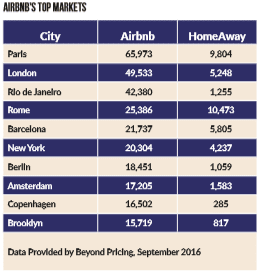
chart-2-airbnb

According to data from Beyond Pricing, only 16 percent of Airbnb’s listings, as compared to 33 percent of HomeAway’s listings, are in the United States.

HomeAway’s inventory is primarily made up of whole home vacation rentals, and their top US markets are resort areas such as Kissimmee/Davenport (Disney World area), Panama City Beach, Myrtle Beach, the Upper Gulf Coast, Hilton Head, and Breckenridge.

Airbnb’s top US markets for shared and whole home rentals are in urban markets such as New York, Los Angeles, Miami, and San Francisco.
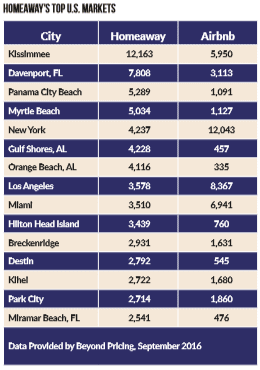
chart-3-airbnb

The total number of listings is a titillating metric for investors, but the number is not indicative of revenue performance. The average nightly rate for the shared accommodations and urban apartments prevalent on Airbnb is substantially below the average nightly rate for the whole home vacation rentals comprising the bulk of HomeAway’s supply. In addition, the average length of stay and average number of available nights are significantly higher for the listings found on HomeAway.

In addition, according to Beyond Pricing CEO Ian McHenry, “Approximately 44 percent of Airbnb’s 2.8 million listings have not received a review.”

With Airbnb’s heavy focus on reciprocal reviews, this number reveals that a substantial portion of Airbnb’s listings have never had a booking completed through the site.


Performance among US Vacation Rental Managers

Although Airbnb draws the bulk of media interest, the majority of US vacation rental managers report that they receive more bookings from HomeAway than from Airbnb.

According to Phocuswright’s Douglas Quinby, “In terms of sites used, HomeAway.com and the HomeAway family of sites are far and away the most important for property managers.”

“HomeAway’s performance decimates Airbnb’s,” said an executive (who wished to remain anonymous) at one of the country’s largest vacation rental management companies. He reported that HomeAway accounted for over 85 percent of his company’s total number of bookings from third-party channels, while Airbnb brought in less than 2 percent.

John Banczak, co-founder at Turnkey Vacation Rentals, which manages 1,500 vacation rentals in 32 U.S. markets, agreed. “HomeAway does significantly more volume than Airbnb, although we still prefer the Airbnb pricing model,” said Banczak.

Since its purchase of VRBO.com, HomeAway has dominated resort markets, but now that Airbnb is focusing on growth within these nonurban markets, the tide may be turning.


HomeAway’s Connectivity Advantage

HomeAway also has a significant advantage with its broad connectivity to the property management systems being utilized by vacation rental managers. In 2010, HomeAway purchased Instant Software, the largest software provider for vacation rental managers—a move that allowed HomeAway to secure direct connectivity to professionally managed, online-bookable inventory across the United States. In addition, HomeAway now offers almost all of the software platforms in the vacation rental market a direct connection to its listing sites.

In contrast, Airbnb experienced a steep learning curve in building working integrations and has been slow to provide the same level of connectivity to property management software systems. In addition, Airbnb does not have direct connectivity to the HomeAway’s software systems.

“HomeAway Software is never going to give Airbnb access to its API,” said our unnamed source. “And the third-party intermediaries can’t make Airbnb work because of the way it is structured. They can’t handle multiple booking rules. Why? Because Airbnb’s senior leadership wasn’t committed to professional property managers. They didn’t think that property managers provided the level of service that individual hosts provide. Airbnb absolutely blew it.”

Scott Breon, chief revenue officer for Vacasa, which manages 3,800 vacation rentals, has also experienced difficulty in connecting to Airbnb, but he is more optimistic about Airbnb’s future. “Airbnb’s API and closed-communication interface continue to be a challenge to integrate with,” said Breon. “But once they invest in the next generation of API integration, I see them quickly achieving 20 to 30 percent overall market share and the potential for upwards of 70 percent market share in West Coast urban and west coast ‘last minute romance’ markets.”

In August, Shaun Stewart, global head of vacation rentals at Airbnb and the company’s face to the professionally managed community, left Airbnb to join Google X’s Self-Driving Car Project.


Is HomeAway in Danger of Losing its Stronghold in Vacation Rentals in Resort Markets?

Breon is now seeing mixed results with listing Vacasa’s properties on Airbnb and HomeAway.

“HomeAway and Airbnb booking trends fall along some distinct but blurring lines,” said Breon. “I look at customers based on geo-seasonal-demographic-intent segments, and within each of those buckets there are definitive ‘winners.’”

Breon continued, “HomeAway wins in the trend toward traditional second home markets, older demographics, larger party size, longer booking windows, and East Coast markets. Airbnb skews toward urban markets, international markets (beating out Booking.com), younger demographics, smaller party size, smaller booking windows, and in proximity to San Francisco.”

More and more vacation rental managers are beginning to list on Airbnb. In the most recent Phocuswright study, research showed that the percentage of property managers listing on Airbnb increased from 7 percent in 2012 to 47 percent in 2016.

Although HomeAway has dominated the US vacation rental industry for the past decade, there are questions surrounding its ability to sustain the leading market position because of increasing transactional costs for travelers and suppliers, along with changes to its criteria for search results.

Turnkey’s John Banczak prefers Airbnb’s pricing model to HomeAway’s. “Owners see almost 11 percent commission and credit card fees from HomeAway compared to 3 percent from Airbnb, and it never sits well with them,” said Banczak.

Banczak also noted that HomeAway’s changes to “Best Match,” the search algorithm that determines the order in which listings appear for travelers, have caused friction. “Owners really want to see more transparency in the HomeAway search results,” he said. “We spend an unbelievable amount of time trying explain to owners why their fully bookable, highly reviewed homes are showing up below homes without the book-it-now button and with no reviews. HomeAway has become the site of frustration for owners, which leads to frustration for us.”

Professional property managers in core vacation rental markets are seeing a much higher number of bookings from HomeAway than from Airbnb. But the race is far from over. Over the next year, overlap between the two companies will grow as Airbnb pushes quickly into resort markets, and HomeAway increases urban supply. However, while they rush to capture market share, both companies could benefit from making some internal improvements. The winner in the industry will be the company that provides the best booking experience for both the supplier and the traveler.

Trying to reach vacation rental management professionals with your marketing message?

0

The vacation rental industry has exploded into a $29 billion marketplace with 1.4 million private accommodations in the U.S. alone (Phocuswright A Market Transformed: Private Accommodation in the U.S.).

VRM Intel offers a wide variety of ways to reach the professionally managed vacation rental industry.

VRM Intel Magazine is being distributed to over 8,000 subscribers and to an additional 7,000 at industry conferences and seminars, and traffic on vrmintel.com has increased 72% over last year.

And we have big plans for 2017!

For vacation rental managers, we will be launching a new look for vrmintel.com in a few short weeks and are in the process of building a competitive data reporting tool. These VI Reports are designed to give vacation rental managers the ability to compare their performance to the overall market performance.

For advertisers, we are also adding events, webinars, dedicated email campaigns, news distribution and retargeting campaigns in 2017 to connect you in a more meaningful way with vacation rental managers.

Here are our 2017 VRM Intel Ad Rates. We would love to have you on board!

For more information about advertising with VRM Intel, email amy.hinote@vrmintel.com or call 251-455-4994.

RealTimeRental Spins Off RentalRetreat.com

0

RealTimeRental vacation rental software announced today that it intends to spin-off RentalRetreat.com as an independent company. The distribution channel has been highly successful, and RealTimeRental is confident that the spin-off will allow Rental Retreat to grow and remain competitive in the vacation rental industry.

“We believe the best way to realize the full potential of Rental Retreat is to allow it to operate independently. The transition will allow professional property management companies who do not use RealTimeRental software to host their rental inventory on the distribution channel” said Joe Testa, co-founder of RealTimeRental.

RentalRetreat.com currently hosts 50,000+ professionally managed rental properties, has a lead conversion rate of 28% which is well above industry standard, and has generated over 2.4 million dollars on behalf of its clients. RealTimeRental and Rental Retreat have been working closely with developers and SEO professionals to ensure the transition period is seamless.

“Despite becoming an independent company, Rental Retreat’s mission remains unchanged: to help travelers easily find professionally managed rental properties around the country” said Testa.

Rental Retreat is now open to all professional property management companies and real estate offices who want to increase their rental properties’ online visibility.

Editorial: Time to stop false reporting about the vacation rental industry

0

Since we are talking more and more about “fake news,” this is a good time to discuss and begin to address the abundance of false reporting in the vacation rental industry.

This week at least two articles appeared on trusted “news” sites — one on Forbes.com and one on nasdaq.com — by two different authors using the same talking points saying that TripAdvisor is the “most formidable and sophisticated” channel in the industry that will overtake HomeAway and Airbnb. There is not a vacation rental industry professional who does not know that nothing could be further from the truth.

We wrote a rebuttal to one of the articles, “Forbes article misses by a mile on TripAdvisor Vacation Rentals prediction,” but even after sending the corrected information to Forbes, they retweeted the fake news article yet again this morning. And then others retweeted their retweet, and — just like that — the false Forbes article is now a reliable source of news about our industry, even though it is completely inaccurate.

And there are many more, including one in USA Today that said, “Don’t look now, but vacation rental companies are piling on the fees, many of them pure junk.”

And one article in the Wall Street Journal said VRMs arose as a result of Airbnb and HomeAway and, “These rental-management companies maintain the online listings, with some masquerading as the homeowner to answer questions from potential guests.”

And there are many more that misinterpret the state of the industry and the challenges and opportunities facing the vacation rental sector.

Besides misleading the public, one problem with false reporting in the vacation rental industry is that investors, venture capitalists, analysts and startups are hungry for information about the industry and use these articles to make investment and development decisions. As a result, startup pitch decks are littered with bad information, and poor investment decisions are made.

Currently, in the vacation rental sector there are dozens of new companies, propped up by fiction-induced funding, that have not yet — nor will ever — produce a profit. These companies get even more media attention that leads to more vaporware psuedo-solutions being created in the space…and on and on.

As an industry, we need to push back on this type of misinformation being distributed in the industry. If you see an article that has false reporting about the industry, take the time to comment on the article, email the author, or send it over to us.

By calling out the authors that publish bad information, hopefully we can provide a level of accountability that discourages false reporting about the vacation rental industry in the future.

By Amy Hinote, Founder and Editor-in-Chief, VRM Intel

Forbes article misses by a mile on TripAdvisor Vacation Rentals prediction

6

Forbes published an article this week written by contributor Peter Lane Taylor entitled “Watch Out, HomeAway and Airbnb: Here’s Why TripAdvisor May Be Your Biggest Competition,” which vastly misrepresented the state of online distribution in an industry characterized too frequently by vast misrepresentation.

At first glance, readers might conclude that this article was a paid advertorial for TripAdvisor, but one vacation rental manager reached out to the author and received a reply saying, “We are never paid by anyone to write anything and get nothing in return.”

Taylor claimed, “Yet, while HomeAway and Airbnb have been veering ever closer to each other in terms of their platforms, marketing, and target demographics, their most formidable and sophisticated competitor (TripAdvisor) has been quietly gaining on both of them, and may just be on the verge of becoming the vacation rental business’s next 800-pound gorilla, especially when it comes to the luxury market.”

Taylor added, “If this exclusive interview with Ben Drew doesn’t put a shiver in HomeAway’s growth plans and Airbnb’s high-flying bluster, they might just need to go rent a ‘bubble house’ from TripAdvisor in Costa Rica.”

As any industry participant or observer will testify, nothing could be further from the truth. Read the Forbes article.


A closer look at the numbers

The actual numbers tell a very different story than the Forbes article. TripAdvisor purchased FlipKey in 2008 at a time that FlipKey possessed the largest market share of the professionally managed vacation rental inventory, but HomeAway quickly gained ground. By 2011, as a result of key acquisitions, HomeAway had grown to 641,000 listings compared to TripAdvisor’s 160,000 listings.

tripadvisor-homeaway-airbnb-booking-com-vacation-rental-market-share


In addition, the author claims, “There are an estimated 10 million additional vacation homes sitting vacant for most of the year in the U.S. alone.” In contrast, a recent research study by Phocuswright determined there are 1,393,000 U.S. vacation rental accommodations available.

Over the last two years, as a result of a lack of executive-level understanding of the industry, poor technology integration and an internal loss of key talent, TripAdvisor’s performance has fallen short for its suppliers in revenue, service and support.


It was theirs to lose.

TripAdvisor’s FlipKey was the preferred channel for professional vacation rental managers up until 2014. For suppliers, the exposure, ROI and service at TripAdvisor’s FlipKey was the best in the sector, but things changed quickly.

With TripAdvisor’s attempts to integrate FlipKey inventory onto the TripAdvisor platform, the internal team faced more challenges than expected, and it did not have a process in place to support the subsequent issues with vacation rental managers and homeowners.

Last year, at VRM Intel, we wrote a series of articles driven by complaints from vacation rental professionals who were hoping to trigger a change in TripAdvisor’s trajectory. The goal of the articles, followed up by an open letter to TripAdvisor CEO Stephen Kaufer signed by over 100 leading vacation rental managers, was to jolt the responsible parties to take a closer look at the inner workings of its vacation rental operations.

However, their calls for change were dismissed by the company, and dozens of vacation rental managers and owners reported to VRM Intel that they had ended their relationship with TripAdvisor.

One vacation rental manager responded to Taylor’s article in Forbes saying, “They do not answer the question of how they are going to get VRM (Vacation Rental Manager) trust and buy in after all of their technical and support failures. Also, not to mention what happens to our reviews – like the over 3000 of our company’s reviews that no longer exist since we ended our contract due to performance and technical issues.”


HomeAway does not consider TripAdvisor to be a threat.

The author is correct that Expedia-owned HomeAway does not consider TripAdvisor a threat.

In its most recent earnings call, Expedia CEO Dara Khosrowshahi addressed its perceived competition – with no mention of TripAdvisor – saying, “I just want to make sure that our investors understand the perspective that there are two big players (HomeAway and Airbnb) in this space, and arguably a third coming with Booking.com and their activity.”

There are solid reasons that HomeAway and Airbnb do not consider TripAdvisor as the “most dangerous under-the-radar threat,” as the author claims.

First, TripAdvisor has much bigger issues that its vacation rental division’s below-market performance. Its stock value has decreased almost 50 percent and is currently trading at approximately $48 per share.

tripadvisor-vacation-rentals-takes-a-dive-in-2016

The vacation rental division was barely mentioned in its last four earnings calls with investors and is a small part of their overall turnaround plan.

Second, TripAdvisor’s growth rate in the vacation rental sector is well below that of key industry players, including Priceline’s Booking.com, which last year saw a 30 percent growth in inventory compared to TripAdvisor’s 8 percent.

To be fair, Ben Drew, Head of Business Development for TripAdvisor Vacation Rentals, was in no way dishonest in his representation of TripAdvisor. Through no apparent fault of Drew, Taylor’s interpretation of the interview and TripAdvisor’s performance is not found in Drew’s responses to the author’s questions.


Yes. HomeAway and Airbnb should be looking over their shoulder….but not at TripAdvisor.

The real threat to Airbnb and HomeAway is the next player  – yet unknown – that provides a supplier-friendly marketplace for vacation rentals.

HomeAway, Airbnb, Booking.com and TripAdvisor are all moving forward by working off of market assumptions that have yet to be proven, including (but not limited to):

  • Extra Fees: Travelers will pay a premium to book through their websites. (HomeAway, Airbnb and TripAdvisor have added “traveler fees” that increase the price of booking on their channels by up to 12 percent, while Boooking.com charges a 15 -20 percent commisssion to suppliers.)
  • Cancellation Policies: Vacation rental suppliers can often not withstand the 24 hour cancellation policy that channels are pushing toward.
  • Lack of Communications: All of these channels (HomeAway, Airbnb, Booking.com, and TripAdvisor) are operating under the assumption that travelers book vacation homes in the same way that they book hotels. In actuality, data shows that vacation rental travelers have questions when booking a large vacation home with up to 12 bedrooms that necessitate a vehicle for communications between the homeowner/manager that these platforms are trying to eliminate.

The Forbes author contends, “HomeAway and Airbnb would be wise to keep one eye looking over their shoulders.”

This is true. But the real threat is the one they don’t know yet

By Amy Hinote, Founder and Editor-in-Chief, VRM Intel

Wyndham acquires Wimdu & 9Flats

0

By Kevin May, Tnooz — Something in the coffee over at Wyndham Worldwide, with its rental brand Novasol buying Wimdu and 9Flats – a pair that merged together just eight weeks ago.

The deal comes the same day as Wyndham Vacation Rentals invested in UK-based luxury home rental brand Veeve.

Terms of the Wimdu-9Flats acquisition – confirmed by CEO of the combined company, Roman Bach – have not been disclosed.

The good news for Wyndham’s Denmark-based brand Novasol (a 48-year-old rental service from Denmark, formerly known as Noridsk Ferie) is that it will get its hands on what is claimed to be a combined portfolio of around 500,00 short-term rental properties in 140 countries.

Novasol has a modest figure of 40,000 properties in 29 European countries.

The company will have a reasonably difficult task on its hands if it wants to try and resurrect the ambitions of 9Flats and Wimdu.

Both positioned themselves in their early days as viable competitors to their well-funded and media-adored counterpart in the US, Airbnb.

The pair were founded over five years ago.

Wimdu started well, receiving a €90 million investment round that was co-led by Rocket Internet, the Berlin incubator, and Kinnevik of Sweden.

9flats has received about $10 million from sources such as PROfounders Capital and Redpoint Ventures, but its last raise was a Series B in 2012.

Read more at Tnooz.com

Devastating Fires Rip Through Gatlinburg

0

While little is known at this point, devastating wildfires are still having an impact in the Gatlinburg area as local officials ordered evacuations for downtown Gatlinburg, Pigeon Forge, and other parts of the county.

Fire crews are still battling blazes in Sevier County as a heavy layer of smoke settles in many areas of the county.

At this point, approximately 30 structures have been impacted in Gatlinburg, including a 16-story hotel on Regan Drive and the Driftwood Apartments reported fully-involved near the Park Vista Hotel.

State Hwy. 441 heading into Gatlinburg is closed, except for emergency traffic. State Hwy. 441 leaving Gatlinburg is open to evacuating traffic.

More updates to follow.

gatlinburg-fire


gatlinburg-fire-5


gatlinburg-fire-4 gatlinburg-fire-3