















- Advertisement -
Home Blog Page 521

Short-Term Rental Industry Giants Grapple with Building Brand Loyalty, Democratization, Regulations, and More at Skift’s 2020 STR Summit

0

Skift launched its two-day Short-term Rental and Outdoor Summit today. After an introduction by Skift editor-in-chief Tom Lowry, 11 discussion panels followed.

Here are just some of the things we learned and heard from some of the industry’s established and emerging experts.

Vacation Rentals Outperform in 2020

During the first panel moderated by VRM Intel founder Amy Hinote, Jeff Hurst (Vrbo president) and Matt Roberts (Vacasa CEO) discussed How Family Travel Saved the Industry in 2020. With such a broad umbrella encompassing so many product types in the Short-Term Rental (STR) industry, Hurst pointed out that “the whole home was the winner this year.”

Though STRs performed better than hotels overall, understandably, people kept their 2020 adventures close to home. “Whether 20 miles or 200 miles, travelers want to be safe, experience diversity, have a yard, be outdoors. It’s important for our mental health,” Hurst said.

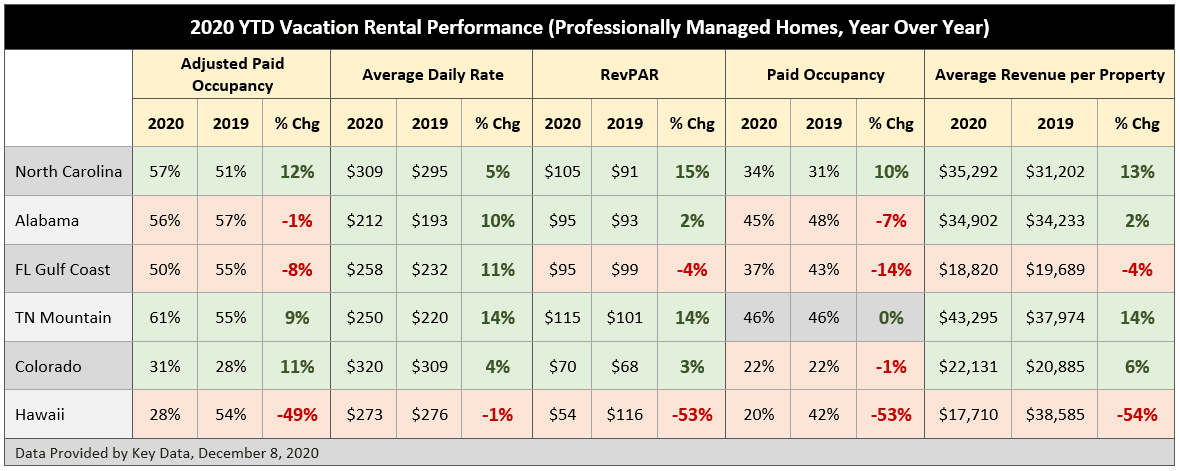
Hinote said the numbers recently released by Key Data bear out that 2020 was a story of “have and have nots.” Markets that were locked down early during the pandemic, or for long durations had a harder time bouncing back. For example, Hawaii’s adjusted paid occupancy is down 49% year to date compared to the same period last year.

That said, Roberts contends a silver lining of the pandemic is family travel. A Vacasa survey of 1,000 guests revealed 43% opted for “drive to” stays, family flexcation stays increased 15%, and guests traveling with pets rose 50%.

Looking ahead to 2022, Roberts sees more blue sky for STRs.

“(Vacation rentals) offer unique value and attractiveness as an alternative option. There was much already in place, but the pandemic accelerated things . . . I expect to see overall adoption that will support us not just in 2022, but into the future,” he said.


Cities more open to working with Short-Term Rentals

Former Seattle mayor Tim Burgess, Clarence Anthony (CEO, National League of Cities) and Amanda Pedigo, VP of government and corporate affairs for Expedia Group, gathered to tackle Regulating the Short-Term Rental Economy: What’s Working and What’s Not.

For a relatively young industry in urban markets, the panel agrees there is much work to be done. With Seattle as a case study example of a city with regulations now in place, it serves to look at how they navigated their path and juggled the agenda of both the municipality and the industry. Burgess has one word for how it worked: compromise.

But don’t look to Seattle for a roadmap without some bumps along the way.

As Pedigo has experienced over the last decade in various markets on behalf of Expedia, “developing the rules of the road” is imperative, but cities are not “one size fits all.”

“Every community is different and each has different needs,” she said.

Clarence Anthony (NLC) agreed and underscored the need for perspective. “The industry needs to have a strategy in place as you try to develop a welcome mat,” he said. “Industry came in and we weren’t ready, but now we’re ready . . . and excited. It’s about public-private partnerships.”

The wheels in the STR industry may turn slowly, but they do turn. Seattle adopted regulations. Pedigo assures San Diego has a Memorandum of Understanding in the works, and statewide pre-emptive laws are being introduced in upcoming legislative sessions in multiple states.


Other topics discussed

In addition to the previously mentioned Vrbo, Vacasa and Expedia, leaders from Sonder, Beyond Pricing, Evolve, Futurestay, Casai, Marriott International, OYO, Oasis and Rented, Inc. and other key industry players tackled topics such as Building Trust and Brand Loyalty Around the Rental Experience, A View on Europe’s Complex Vacation Rental Market, Bringing the Short-Term Rental Ecosystem into the Mainstream, Democratizing Tech to Reach the Single Owner, Why Cities and Business Travel Are Still Viable Markets.

The conference continues tomorrow at 10am EST with a focus on Outdoor Travel, as RV travel and camping have also seen increased popularity in 2020. We are seeing a number of parallels between the short-term rental and outdoor travel industries. 


Quotable Predictions and Lessons Learned

It was a fast-moving day, and VRM Intel will be taking a deeper dive into all we learned at Skift’s summit once we get the videos. But here are some stand-out quotes we were able to capture from today’s jam-packed discussions. 


Chip Conley, Airbnb Strategic Advisor/Modern Elder Academy Founder

“What I appreciated about Brian [Chesky, CEO and cofounder of Airbnb] is that he didn’t act like he knew it all.”

“To call Airbnb just an OTA is like calling Apple a computer company in 2007. They were just . . . Apple.”


Wouter Geerts, Senior Research Analyst, Skift

“A paradox of Airbnb is how they will scale their uniqueness. To use an analogy, are they a Mac or a PC?”


Jeff Hurst, President Vrbo/Expedia Group

“One, vacation rentals are about connection, they allow moments when people can reconnect; two, it’s about dynamics, about vacation rental owners acting quickly as entrepreneurs.”


Jennifer Hsieh, VP Homes & Villas, Marriott International

“Airbnb is a tech company . . . Marriott is a hospitality company.”

“Post-pandemic home rentals will continue to have demand. Travelers will continue to look for homes nearby. I’m very bullish about this business for the foreseeable future.”


Philip Kennard, Co-founder/CEO Futurestay

“We don’t like to be called traditional anything . . . we really celebrate entrepreneurs at Futurestay.”

“I challenge the concept that individuals cannot be professionalized. With smaller numbers, come higher reviews.”


Brian Egan, Founder/CEO Evolve

“It never feels that tech is developing as fast as it should, but if you pull back and look at the last 10 years, Airbnb was not relevant, Booking.com was within 10 feet of a vacation rental, Expedia was not in the game and HomeAway owned Vrbo . . . today, we [Evolve] redistribute pricing for 14,000 [owners in 500 markets] every day. We’ve come a long way, but we have a way to go.”


Clarence Anthony, CEO, National League of Cities

“The industry came in, and we weren’t ready as municipalities. Now we’re ready for those conversations, and I’m excited about them,”

“I want to see more people get jobs out of the industry. Covid has unveiled that people of color are struggling, and I want the industry to reach out and be good neighbors in that way as well. We need to wake up and say we have a role in the industry to play as well.”

“When we talk about affordable housing and building wealth, for people of color, specifically, this could be a major opportunity to create business opportunities from all kinds of services […]. I don’t think that was the conversation initially.”


Amanda Pedigo, VP, Government Affairs, Expedia Group

The industry now has a unique opportunity to “set the rules of the road for the sector, and I think those rules of the road can only be accomplished via collaborative partnership between the industry, elected officials, and people from throughout the sector.”


You can still sign up for access to the videos from today, which Skift says will be posted by EOD Friday, December 11, 2020. Use Promo code VRM Intel to save. 

Fast-Paced Revenue Management: The 10-Minute, $10,000 Mistake

0
VRMIntel_Fall2020_Fast Paced Revenue Management

“Life moves pretty fast. If you don’t stop and look around once in a while, you could miss it.” – Ferris Bueller


Classic movie. Basic concept. When it comes to short-term and vacation rentals, one of the most basic and important concepts is the price. Of course, elements of operational excellence, like cleanliness and safety, are a necessity, and having good content and images is a fundamental best practice. But pricing accuracy is what can take rental income from good to great.

Why is pricing accuracy so hard? We live in a fast-paced, on-demand, instant-gratification consumer world. As additional demand floods the short-term rental segment and shifts away from hotels, the revenue risk and reward is high, and we have to keep up. But how do we do it?

I was so intrigued by why vacation rental revenue management was so behind compared to the maturity of this discipline for the hotel, airline, cruise, and car rental industries, and I did some research to connect the dots. By looking at the history of pricing technology and capabilities between vacation rentals and hotels, we can learn a lot about why revenue management is evolving as a new discipline and is still in its infancy.

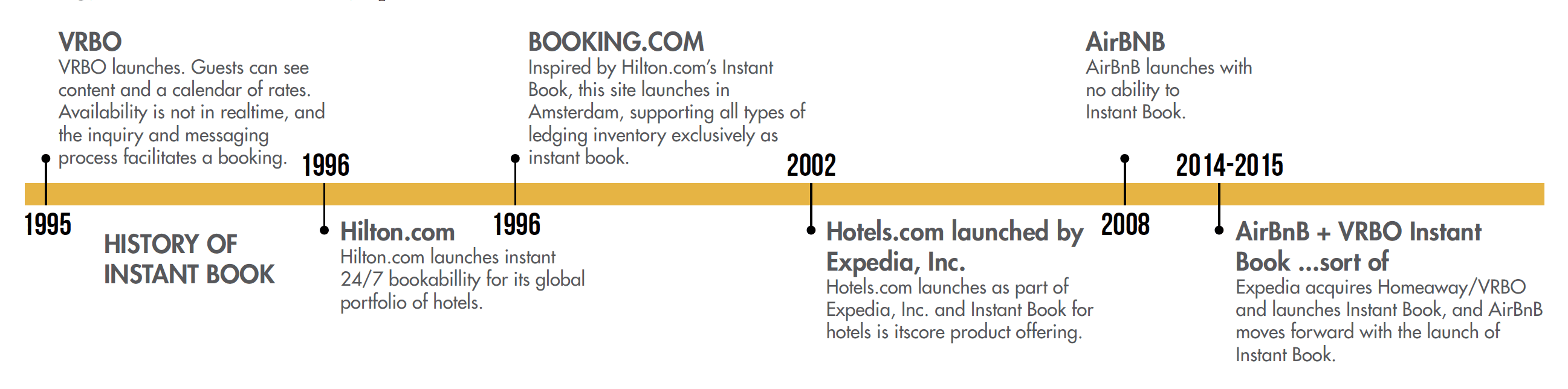
This timeline is a brief review of the lodging industry booking technology evolution. (HINT: Pay special attention to Instant Book.)


What we do know is that Instant Book has been the only way to book a hotel for over 20 years, and similar to airlines, hotel rates can change from minute to minute. Instant Book powers faster results, speeds up the guests’ expectations, and powers more dynamic market pricing power. It can move so fast that it becomes impossible for a human to keep up with all optimal rate changes for the next 365 days. As you look at your market, is most of the inventory Instant Book? If your market is mostly operating at instant booking speed, you may be more likely to leave money on the table if you are not practicing dynamic, daily rate updates. The 10-minute, $10,000 mistake is no joke.

Whether you choose to update rates manually or use a revenue management pricing system to help you, the daily review of rates for the next 365 days can be a critical best practice to achieving your optimum revenue potential.

To expand on this further, we can share some real-life examples.

A Quick Case Study with Coachella: Though many concerts have been canceled, rescheduled, and canceled again throughout 2020, the demand impact of Coachella on the Palm Springs market has proven an exceptional story. In March, the original show dates in April were rescheduled to October. Most tantalizing about the announcement is that it wasn’t initially even posted on the official Coachella website!

The day that the announcement was leaked on social, the market saw a massive booking volume spike for the new October dates. Because it wasn’t even official, and there was no warning, these dates were not priced correctly for any home in the market. Within 24 hours, there was a backlash of complaints and a desire to reject these bookings. There was A LOT of money left on the table, and nobody saw it coming.

Not every revenue management system is created equal, but a solid revenue management system could detect a burst of demand into a market and immediately trigger a price update or even a stop sell if it were better simply to hit the pause button for 24 hours. With many hotel reservation management software providers, these types of immediate optimizations are possible. Though we may have to wait for an overnight update to the current short-term rental PMS providers—I’m not aware of any that have developed a configuration for automated optimization based on real-time demand shifts—it’s still better than having days go by before reacting.

There are so many more examples of a 10-minute, $10,000 mistake, but you can easily see how Instant Book is a game-changer, and our revenue management savvy and technology need to evolve to achieve optimal performance. Rates move pretty fast. If you don’t stop and review your rates daily, you could miss an opportunity to make some big bucks.

The Bright Spot in 2020 Travel: U.S. Vacation Rentals See Higher ADRs, Revenue, and Adj. Pd. Occupancy

0
All Star and SoCal Vacation Homes

If there was a bright spot for travel in 2020, it was found in the vacation rental industry.

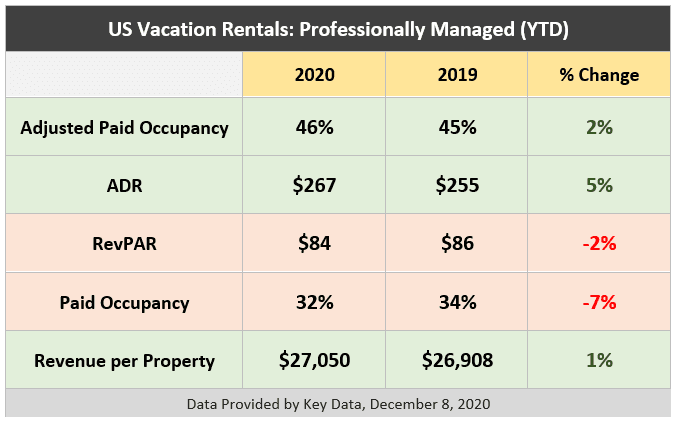
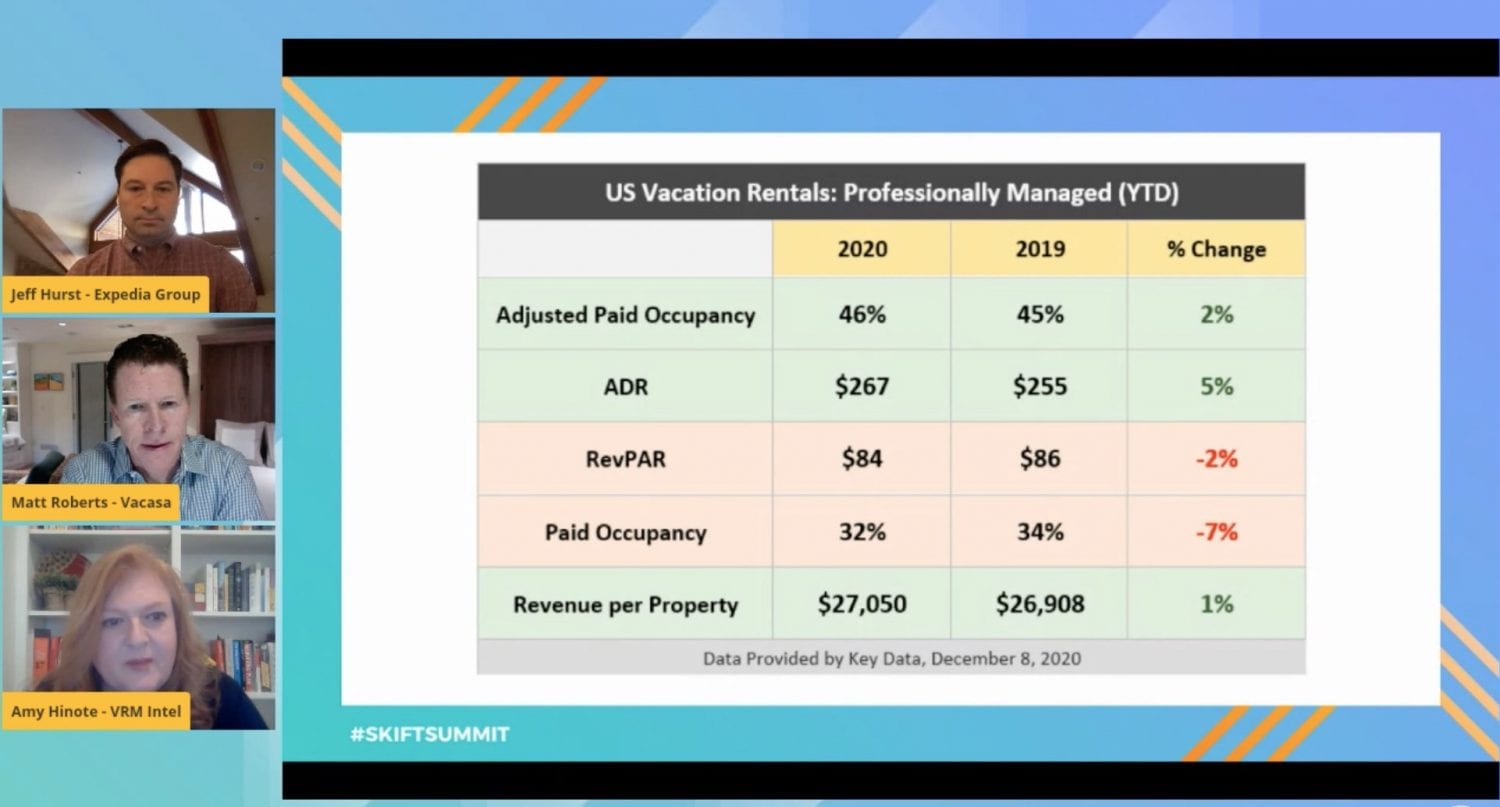
US performance data provided today by Key Data shows that professionally managed vacation rentals are having a better year than was expected when COVID-19 transformed our way of life, but the narrative has been a story of haves and have nots.

In the United States, overall average daily rates (ADRs), revenue per property, and adjusted paid occupancy improved in 2020, year to date (YTD), over 2019.

Consumers continued to travel in 2020, but they opted for drive-to locations, leisure destinations, and whole-home vacation rentals. However, these were not the only factors that contributed to success; government mandates and travel restrictions also drove their decisions.

Destinations that prohibited or restricted travel in home rentals for long periods of time (Hawaii), or even for shorter periods (Florida through Memorial Day), were not able to fully recover from COVID-19’s initial hit. Further, hurricanes and wildfires in 2020 negatively impacted performance in key leisure markets. 

Note: Paid Occupancy is calculated by dividing the number of paid guest nights by total nights (365 per property). In contrast, Adjusted Paid Occupancy is calculated by dividing the number of paid guest nights by the total nights available to rent. In the vacation rental industry, Adjusted Paid Occupancy is more often used than Paid Occupancy since homeowners often “block” nights from being available for rent for personal use or home improvement projects. With the pandemic, for example, many homeowners used their second homes as retreats to get away from the cities in which they have primary residences, taking their second homes out of the rental pool.

The resilience of vacation home rentals as accommodation alternatives during difficult times has been proven over multiple crisis events, including recession periods and after 9/11.

In addition, the percentage of direct bookings with local rental management companies increased as guests in drive-to feeder markets are more familiar with local brands and do not need aggregators, like Airbnb and Vrbo, to find rentals. However, Airbnb and Vrbo benefitted from new vacation rental travelers who are were more likely to stay in hotels under normal circumstances.

As Clark Twiddy, president at North Carolina’s Twiddy & Co., wrote in a recent article about forecasting, “2021 will most likely be another strong year for many vacation domestic home rental operators as traveling confidence will be slow to return. It’s 2022 that is the big question mark.”

To hear discussion about vacation rental performance, join Skift’s Short-Term Rental Summit on December 9th. Use promo code VRMINTEL for VRM Intel’s discount to save $36. Click here. 

6 Takeaways from Vrbo’s 2021 Consumer Travel Trend Report

0

Vrbo has released its annual Trend Report using travel demand data to identify trends shaping travel for the upcoming year.

Said Vrbo president Jeff Hurst, “In my 10 years in the vacation rental industry, I’ve never experienced a year quite like 2020. The COVID-19 pandemic had a profound impact on our family lives, social lives, home lives and, of course, travel plans.”
In addition to analyzing data from its own global vacation rental marketplace, Vrbo invited family travelers around the world to participate in a first-of-its-kind consumer survey to help uncover what to expect for family travel in 2021. Vrbo’s report is based on U.S. survey results from 8,000-plus people from eight countries, as well as Vrbo travel demand for the 12-month period ending August 31, 2020.

1.    Travel slowed, but travel planning didn’t

Even though most families had to cancel a trip due to COVID-19 this year, Vrbo reports travel is still top of mind for 82% of families who already making plans for 2021. 

2.    Pandemic travel habits may be hard to break

Some pandemic-era travel habits show no signs of slowing down. Of families surveyed, 59% say they are more likely to drive instead of fly on their next trip, 61% are more likely to visit an “outdoorsy” destination rather than an urban one and 67% of travelers who took a Flexcation—booking trips in the off-season and staying longer to mix work and play—said they would do it again.

3.    Just add water . . . interest in U.S. destinations near lakes and rivers rise

Rural vacation destinations near lakes and rivers saw an uptick in popularity, especially in areas across the south, Midwest and eastern regions of the U.S., where families can fish, camp and hike. An example is Emory, Texas, located about an hour’s drive from Dallas. Other small towns topping Vrbo’s emerging destination list are Smithville, Missouri; Slade, Kentucky; Mannford, Oklahoma and The Outer Banks in North Carolina.

4.    Cue the cabin fever

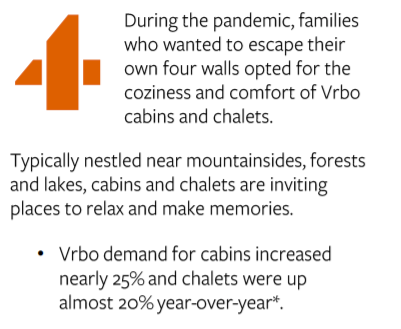
Somewhat ironic that quarantined travelers with “cabin fever” are yearning for stays in cabins and chalets. Vrbo reports demand for cabins increased nearly 25%, while chalets were up almost 20% year-over-year. Perhaps these cozy accommodations are the “comfort food” of the accommodations. That said, with the increased interest in destinations near lakes and rivers, it does make sense.



5.    Bring on the “Bucket List” trips

Canceled 2020 vacations has created pent up demand. Vrbo predicts that once travel returns to pre-COVID levels, travelers plan to go all out. Survey responders indicate that 65% plan on traveling more frequently than they did pre-COVID, and 54% say they are more likely to finally taking that “bucket list” trip, and 33% are willing to spend more than they usually would.

6.    Everyone wants a vacation do-over and more family time

Travel FOMO (fear of missing out) was at an all-time high in 2020. Rather than scrapping a canceled trip completely, families want to make up for lost time. According to Vrbo, 54% want to redo their canceled vacation plans. Of those who had a trip canceled due to COVID-19, 44% are rescheduling, and 31% say the main reason they want to travel is to spend quality time with family.

View the entire Vrbo Trend Report

Are You Ready to Ride the Wave to Becoming a 2021 Social Media Game Changer?

0
2021 Social Media Game Changer

In the world of fast-paced social media and slow-going fact-checking, posts that best drive customers may not be the ones that feature the best print ads or those with the greatest budget. Instead, the most effective posts, just might be those by Instagram or Snapchat “legends” who give us full view of the ups and downs of their everyday lives. Like reality TV shows fans, we watch with bated breath for even a minimal post such as:

‘We’ve got something BIG to share.’

And even when the “big news” is yet another new spin on recycled information, we nearly rearrange our lives to be one of the firsts in the know.

With such power comes a way to draw in new renters, new owners and new vendors. I have had circular conversations with homeowners about rugs, rental rates, bar stools, pillows, real estate, renter amenity trends, fabrics and so on for hours and despite information overload, I remain invigorated. Similar conversations happen in the office and with vendors because there’s so much good information and so many good products to check out.  

In years past, I relied heavily on the proverbial post card with phrases like ‘Introducing’ and ‘Act Now While Quantities Last’ eager to promote a great product or a new vendor. Now, it’s so easy to get samples, but the choices seem endless. We inevitably see not one, not two, but potentially 20 options for that perfect antibacterial, commercial grade, washable, soil-resistant fabric. Facebook, and many other social media sites, continue to target ads individualized to each of us based on the small things we search for … and we grab on.  

Admittedly, these new ways of finding products, restaurants, great vacation spots — and a new favorite peanut butter — is fantastic. By simply posting reviews on our platforms, we show our friends, family and perfect strangers that we are everyday people not paid to star in commercials who love and/or hate that product, restaurant, vacation rental, city or food. 

How amazing it is to be such powerful marketing managers. We are now so smart that we market for free, we share to be helpful, and we ask total strangers what they think. We truly open ourselves to being a global game changers 2021 style.  

Where do you think this will lead us? Do we put on the brakes because someone may know too much? Or just like those social “legends” with large followings and fan bases, do we embrace this new way of marketing and keep the wheels rolling into the future? 

As we step into 2021, watch the trends, watch the styles. Predictions and new social platforms are bound to rise.  


Three ways to stay positive:

  1. Focus on being a part of the changers, enjoy the game and share information.
  2. Respect the opinions of others and determine how you feel for yourself.
  3. Thank those who share and express appreciation.

When focusing on being a part of the change we embrace some form of ownership or pride is helping out our fellow man. Showing respect creates a wave of positivity that leads others to respect and accept opinions even if they are not shared. Providing thanks and gratitude keeps the world’s vibrations high and we all grow.  

Self-Care During a Pandemic

0

I absolutely love the hospitality industry and everything about it. Yet, it took me 30 years to learn how to love it and still thrive in it without burning out every two years.

As entrepreneurs, we know how draining building a business can be, especially being people-pleasers with perfectionist tendencies. When the pandemic hit in March, my business came to a screaming stop. Clients who had existing agreements with me and already paid asked to pause.

I was six years into my company, where I had worked second jobs for the first couple of years until I could do consulting full-time. Then my daughter came through adoption, with a phone call on a Tuesday afternoon. I had a full plate of business that I needed desperately to cover the Neonatal Intensive Care Unit (NICU) bills and final adoption payments. I lived with friends three hours from my home in Bend, Oregon. I woke up at 5:00 a.m. doing coaching sessions for an east coast client five days a week and then went to the NICU to be with Chela for another 10–12 hours a day. My husband came for two days a week, when I then met with my other clients on the west coast. I did this for two weeks, feeling the adrenaline that came from the excitement of finally being the mom I had dreamt of while waiting in the adoption pool for four years. The year she was born was my highest revenue-producing year to this day. I called her my Irish lucky charm and did not say “no” to anyone who asked for my services. The next couple of years were still very busy, but I was getting tired and ready for a break.

Then the pandemic hit.

I embraced this time and knew business would resume at some point. I decided I would make the best of this time and see it as the maternity leave I never took. I leaned into self-care like I never had before, and it has been amazing and transformational!

At the beginning of the pandemic, I met with Matt Landau for a podcast. He asked me, “Who is Ali Cammelletti?” I literally could not answer his question. I knew who I had been, yet I did not know who I was about to become. I felt like a caterpillar who was spinning a silky cocoon. I had goals of working on my book (that I still want to make happen), spending time with my daughter, and really being present with her.

Little did I know that I would lean into my resilience and take self-care to another level.

Like with any change, I struggled at first. Being home 24/7 with my daughter sounded fabulous, yet she is a strong-willed toddler, and there were days where we watched TV all day. Nothing like the 45 minutes a day of screen time that I strive for. Fortunately, I had a good foundation of self-care already that included the following:


1) Exercise: I know that if I increase my heart rate with a two-mile jog each morning, I feel amazing. It improves my energy and mood like nothing else does. I sprinkle in walks with girlfriends throughout the week, where I get to connect and talk.

2) Food allergies: Over the last eight years, I have cut out cow dairy and gluten. I found cow dairy was making my brain foggy, and my stomach nauseous. A few years ago, I had headaches every morning along with nausea, and I could not get the extra weight off that I had built up. It was gluten, darn it!

3) Vitamins: I do a half-shot of apple cider vinegar every morning with some B12 and then vitamin packets of fish oil, calcium, magnesium, and zinc, along with oregano oil.

4) Essential oils: Lavender and peppermint on the back of my neck are my favorites when anxiety is building up. I have others, though, for muscle pain and digestion that are always on hand.

5) Massage: I get a massage once a month because my body needs it! It is not always relaxing since I go to a sports massage therapist. He works out different areas that come up for me, such as my neck from a past car accident and my back from lifting and twisting due to being active with a toddler.

6) Gratitude journaling: I do 30 days of gratitude twice a year when I am starting to feel negative. I write down one thing I am grateful for every day for 30 days. Research shows it is searching for something new to be thankful for that changes the brain and is like taking an antidepressant. In the end, I love everything I see and feel so much gratitude.

7) Therapy twice a month: I see a therapist who does EMDR therapy to assist when past traumas come up. She helps me with everything, though, from raising a child to processing a childhood that didn’t resemble Beaver Cleaver’s family.

8) Woman’s Al-Anon writing group: I have been doing this for a year now, and it has been a game-changer for me. My family has addiction issues, and I have learned about controlling behaviors, perfectionism, boundaries, emotional triggers, and so much more. I pushed back on Al-Anon all my life, even though I was a perfect candidate. I have recently just completed a year. I attend almost every week and love this group of women like no other. I still enjoy a nice glass of wine. Yet, I know when I am numbing with emotional eating, alcohol, or Netflix binging. Having everything in balance is my goal.


The steps above have been an excellent base for me as I have navigated being a new mother, business owner, and friend. When on Sarah and T’s podcast recently, they asked what a day of self-care looked like for me, and I said, “A six-mile hike, a float down the river, and closing with my women’s writing group.” During the last six months, I added in more self-care to navigate the loss of my marriage. I have camped in nature six times so far, floated fifteen hours on water, and added the following:

• Being present with my daughter. This looks like dance parties, playdough, coloring, reading books, building fairy houses, doing puzzles, and anything else she is craving.

• Guided meditation. I enrolled in a guided meditation via Zoom that meets twice a month. Meditation has been something I always wanted to do yet struggled with significantly. I am the woman in Eat, Pray, Love! I think about what I need to get at the grocery store, how I will build this tiny library, and what I promised to do—and forgot. You name it, my mind spins on it. I have been attending twice a month since May, and it has been amazing. I usually fall asleep, yet the instructor says deeper healing happens that way. I am hoping I will be healed in a year! Wouldn’t that be nice?

This pandemic has had different effects for everyone. For me, it has been a time of transformation like no other. I have chosen to not numb through this time. But lean in, feel, and heal so I can emerge from my silky cocoon like a beautiful butterfly who will show her daughter how to love herself, her career, and love her life to the fullest.

Skift Short-Term Rental Summit, Dec 9 with Vrbo, Vacasa, Marriott, Expedia, Sonder, and more

0

Skift is hosting its Short-term Rental and Outdoor Summit this week, December 9 – 10. The cost to attend is $145, and the short-term rental sessions will be held on Wednesday, Dec 9. 

Use promo code VRMINTEL for VRM Intel’s discount to save $36. Click here. 

Interviews include:

VRM Intel‘s Amy Hinote will be moderating two sessions at the Summit:

  • Wed, 10:20 ET – How Family Travel Saved the Industry in 2020 with Jeff Hurst (Vrbo) and Matt Roberts (Vacasa)
  • Wed, 1:20 ET – Regulating the Short-Term Rental Economy: What’s Working and What’s Not with Clarence Anthony (NLC), Tim Burgess (Seattle), and Amanda Pedigo (Expedia).

Use promo code VRMINTEL for VRM Intel’s discount to save $36. Click here. 

Managing Profit, Not Just Revenue

0

The Second Annual Data and Revenue Management (DARM) Master Class may be the quintessential illustration of the vacation rental industry in 2020.

After DARM’s incredibly successful debut in 2019, the vacation rental industry—if not the entire hospitality industry—eagerly awaited the second installment of what was certain to become an industry staple for the foreseeable future.

And then, you know, 2020.

The conference, planned for Denver in August, moved to a digital platform in September. No big deal. Then the team that put so much work into planning and organizing the conference got hammered by Hurricane Sally, which knocked out their power and even their ability to participate in the second day of the conference.

But just like 2020 itself—with its roller coaster from “things are great” in February to “worst-ever” in March to “more-than-rebounded” in May—our industry responded. Conference planners and attendees did not sit idly by and wring their hands. Volunteers across the country stepped in to facilitate things for Amy Hinote and the team, and from where I sat, the results were extraordinary. Kudos across the board.


The Big Picture of Revenue Management

Just as the conference team adapted to changing conditions in 2020, we have had to reexamine how we’ve used historic data to forecast booking patterns, predict ADR, and drive Revenue Management with a heavy reliance on pricing. Fortunately, many experts, including Dr. Kelly McGuire, went out of their way to point out that setting prices is just one of many tools at your disposal—and at times not even the most useful or powerful one.

As the conference’s name implies, it is Revenue Management (with a capital “RM”) that is actually the critical discipline. Having the right data—and correctly using it—is essential to performing this function successfully.

This naturally raises the questions: What data should you be looking at? And what should you do as a result of what you see?


Start Within

The first place to start is your own business. Before you can understand the market, or the competing players, or other factors, you need to understand yourself. Specifically, you need to understand your costs and your cost structure.

Start with your fixed costs. These are the costs you will incur whether you bring in revenue or not. Fixed costs typically are mostly employee costs and rent for your office(s) but will also include items like insurance premiums, property taxes, and more. Understand not only what these costs totaled in the past, but what they are right now and how they might change for the upcoming month and year.

Knowing fixed costs is crucial because it sets your baseline for how much revenue you must bring in to keep the lights on. For example, if your fixed costs total $500,000 for the year, then you must bring in at least $500,000 in operating profit to stay in business. This is your break-even number.

Once you understand your business’s fixed costs, you can start digging into your variable costs. These are the costs you only incur when you are generating revenue. The biggest buckets are usually owner payments and cleaning costs, but your variable costs probably also include third-party booking fees, marketing expenses, laundry, and more.

Calculating these numbers helps you determine how much each new rental costs—and thus how much you actually make. Your revenue, minus these costs, will give you your operating profit.

Let’s say that, on average, each of your properties brings in $40,000 in revenue over the course of the year—and, on average, you have $35,000 in variable costs to service those rentals. This leaves $5,000 in operating profit for each property (again, on average). Referring to the example above, if your fixed costs total $500,000, you would need to manage 100 such homes ($5,000 x 100 = $500,000) just to break even and doing so would earn you $0 in profit.

If you only have 50 homes, or even 80, you are running a charity— not a business. Having a business serving only 50 homes, but with fixed costs scaled for 100 homes, will end in a financial disaster, no matter how happy you are making your owners and guests.

Understanding these numbers tells you whether or how much you need to cut costs—or how aggressively you need to grow.


Get Granular

Once you have done the work above and you understand what your business needs to succeed overall, it’s time to dig a level deeper— because averages can hide wide variations.

For example, if you have 100 homes that average $5,000 in operating profit, it could mean that every home brings in just around $5,000. Or, it could mean that 50 homes each bring in $15,000 in operating profit, while the other half of your portfolio is losing $5,000 for you every single year. Or it could mean something else entirely.

The average alone doesn’t tell you what you need to know to manage your revenue effectively. You have to do the more difficult work of property-by-property analysis. This means treating each home as if it were its own business, with its own profit and loss (P&L).


You want to understand what your operating profit looks like:

1) Which homes are your most profitable?
2) Which are your least profitable?
3) Are any of the homes actually losing money?


Now you can begin the real detective work of figuring out why your operating profit looks that way and how to improve it:

Why are your most profitable properties so profitable?

How can you find more homes like them?

How can you make your other homes more like them?

How can you turn around homes that lose money?

Is it worth the time and effort, or is it wiser to say goodbye?

Again, remember that you are running a business, not a nonprofit. (You hope.)


Then Go More Macro

Once you better understand your business and your P&L at a per-property level, zoom back out for a macro-level view of how your business fits in the context of your market, your competitors, and the industry as a whole. In doing this, however, be careful to not “boil the ocean,” as consultants often say when a project’s scope starts to balloon.

Here’s the thing about using data to drive your business: You don’t need scraped data on 10 million homes to understand your market. What you need is real and accurate data on the homes that are actually relevant to your business and your properties.

You may only need to analyze data for two to seven comparable properties for each of the homes you manage, and many of these properties probably overlap across your portfolio. As you dig in to understand your market, you should focus on quality over quantity. Filter the meaningful signal out of all the noise.

Revenue management is not about having more data. It’s about having the right data.


Pulling It Together

Compiling all this data—your business revenue, your operating profit, your per-property P&L, and your comparable market data— is just the start. You still have to decide what to do with the information you’ve gathered, based on your business goals, your industry experience, and your best judgment.

There will be times when it makes sense to quickly change course and adjust based on what the data is telling you (e.g., a big event moved its date by two weeks—so you drop prices dramatically for the original dates and raise them immediately on the new dates, before anyone books an unintentionally great deal). There will also be times when the data is informative, but you choose not to change your course (e.g., when others in your market are competing in a race to the bottom on nightly rent).

This is why Revenue Management is ultimately a blend of art and science. The data—how you collect it, how you cut it, and how you analyze it—is the science. The choices you make as a result of that data? Those are subjective, based on your own experience and judgement. They are, in a manner of speaking, art.

This principle rings truer than ever as we adapt our goals, contextualize our data, and deploy our best judgement to navigate the shifting landscape of this year.

Balancing the science and art of revenue management will help us not only survive but thrive as our industry moves forward, through 2020 and beyond.

Secure More Direct Bookings through Personalized Sales and Marketing

3

As most of my readers and clients in the vacation rental (VR) niche of lodging know, I have also been providing training in the hotel and resort space for even longer. In the late 1990s, my company, known at the time as HSA International, trained hotels on how to use this then-new concept we called “cybermarketing.”

Back then, Expedia was still owned by Microsoft, and Travelocity had just partnered with AOL. With the internet still in the dial-up era and computers chained to a phone cord, cybermarketing represented a “fenced” distribution channel that had yet to be discovered by mainstream travelers. After 9/11, the hotels we trained discovered that OTAs were a wonderful tool to sell distressed inventory, and deal-seeking guests soon spread the word. By the mid-2010s, hotel brands realized they had become overreliant and launched “book direct with the brand” campaigns, but it was already too late. Guest loyalties were rapidly shifting to the OTA brands vs. the hotel flag flying out front. The brands essentially conceded and simply proceeded to negotiate lower commission structures, which is perhaps the single most important benefit of being part of a hotel brand these days.

In 2014, I was asked to return as a guest speaker to the VRMA conferences, in which I had been a speaker every year from 1996 to 2009, and I was shocked to see how far the OTA concept had already penetrated into the VR space. Part of me wanted so badly to grab a microphone and warn the industry of the perils of overreliance on OTAs; unless they were used correctly, OTAs would siphon away top-line profits. Yet the owners of some of the fastest-growing VR companies were singing the praises of this model.

So here we are in 2020, and an ever-increasing number of VR management companies are waking up and realizing that OTAs may represent the proverbial “wolf in sheep’s clothing.”

Now, I’m not saying that OTAs are the enemy, nor that VRMs should immediately pull all inventory. When managed correctly, OTAs are and will continue to be an integral part of a comprehensive marketing and distribution plan.

OTAs are especially important, perhaps irreplaceable, for certain classifications of VR companies, such as those whose inventory consists mostly of condos, those who host shorter stays, and those in markets wherein guests return infrequently. For example, most visitors to Central Florida’s theme parks might return every five years and are therefore harder to convert into regulars than guests who want to rent the same beach house or ski chalet every season.

The smartest strategy for all VR companies is to use OTAs to find new guests but then do all they can to convert those OTA guests into booking directly next time.

Not all of the following suggestions and tips will be feasible for your company, depending on your market demographics, but hopefully this list will spur the kind of creative thinking that will enable the VR industry to take back its power. Remember, VRMs, you control the inventory that powers the business model of all OTAs. They need you more than you need them.


1)  Work for more direct website traffic. There are so many self-study resources to help VRMs learn the latest about organic searches, pay-per-click, and especially the retargeting of website visitors on social media. Even if you rely on an in-house leader or an outside agency, every VR owner and director should stay abreast of the latest so they can at least ask challenging questions.

2)  Seek out listing and referral sites that have a critical mass to compete with OTAs for organic and paid SEO but also drive traffic to your website. A few that are well known to VR operators are vacationfinder.com, condo-world.com, resortsandlodges.com, rentabeach.com, findrentals.com, and northweststays.com.

3)  Post your phone number prominently on your website on both desktop and mobile versions with a line of text saying something like, “Call in-house reservations now.” Update your after-hours voicemail greeting to reiterate that callers have reached in-house reservations and promise a timely callback.

4)  When communicating on apps, make it personal. Explain that you are a local, small business. Ask guests to stop by the rental office. Entice them with free, local giveaway items, such as jams, honey, regional wine, branded picture frames, or kids’ welcome gifts.

5)  Encourage everyone who interacts with guests to ask questions to uncover the stories behind guests’ travel plans, and then recognize birthdays, anniversaries, military furloughs, and memorial services. Stop by the local dollar store or stock up from Oriental Trading to keep low-cost decorations handy.

6)  Make your service staff aware that those shopping on OTAs who click the “manager” link might then contact your company directly by phone, email, or chat. When that happens, train everyone how to use a personalized, engaging hospitality style. If guests have not yet booked, work to channel-convert them. If they have booked, ensure they know who your local brand is and get a jump start on channel conversion for their next visit.

7)  Embrace in-home messaging. Post pictures of the entire staff of your small business. Have a small poster that tells the stories of your company’s owners. Likewise, post your company’s emergency phone number with pictures of the people who answer, such as maintenance or housekeeping, in uniform.

8)  Consider moving to a Wi-Fi provider that requires guests to give their email addresses to access it, presents a branded landing page upon accessing the network, and allows guests to opt-in to future email marketing.

9)  When you get guests’ email addresses, send personalized video email messages to reiterate the welcome and send a fond farewell. This is especially important if your company uses remote registration and self-check-in. Yes, it takes about 60 seconds per guest, but a personal video welcome message is a wonderful way to rehumanize what has evolved into just another electronic transaction.

10)  Organize a drip campaign of emails, targeting guests by dates relevant to their anticipated rebooking cycle, and make them as personalized to specific guests as your CRM and PMS integration allows. Consider old-school postcards too, especially if your CRM allows you to personalize them with guest-specific details.

11)  Create a “selfie station” at your office or welcome center, labeled as such. Include your company name but, more importantly, the destination name with a cute, locally-themed background.

Barron’s: Airbnb Set to Price December 9 and Trade December 10

0

According to Barron’s, “Airbnb is scheduled to price its initial public offering on Dec. 9 and trade Dec. 10, three people familiar with the situation said. The start-up is expected to trade on the Nasdaq Stock Market under the ticker ABNB. Morgan Stanley and Goldman Sachs are lead underwriters on the deal, according to Airbnb’s prospectus.”

“Getting a jump on the competition, Atlantic Equities analyst James Cordwell picked up coverage of Airbnb with an Overweight rating and $75 price target, a week before the stock even begins trading.”

“Earlier this week, Airbnb set a projected target range of $44 to $50 a share for its initial public offering. The company plans to sell 50 million shares, while existing shareholders are selling another 1.9 million.”

Read more about Airbnb’s IPO filing. 


Strategic Forecasting Beyond 2021: Are Vacation Rental Managers Changing Fast Enough?

0

“Plans are nothing. Planning is everything.” — D. D. Eisenhower

In a year where just about every forecasting model fell flat on its face, as an industry we could be forgiven for placing less of an emphasis on future planning just to pause for a time and reflect on where we are as the pandemic continues to impact each and every one of our organizational stakeholders. Self-reflection is a great thing, and for many professional managers, a toast this holiday season to simply being in business at all will be deeply enjoyed.

We’d better make that toast a quick one though: we’ve discovered that our strategic forecasting models have a long way to go, and we’ve got work to do.

In an ironic sense, it may be that for the professional managers in drive-to markets that have seen a surprisingly strong season this year, the sense of urgency to evolve will take a back seat simply to maintaining day-to-day operations. In other words, even with the disruption of the pandemic strong market players may not be changing fast enough.

That makes sense. If it’s not broke and there is a line at the door, focusing on today isn’t a bad thing at all, but strong organizations are doing two things at once; they are relentless on today’s guest and owner experience while at the same time driving strategies toward different future success as well. One focus or the other is necessary but won’t be sufficient for long-term sustainability in a rapidly changing market.

It’s that changing market that is the focus of our strategic forecasting models. 2021 will most likely be another strong year for many vacation domestic home rental operators as travelling confidence will be slow to return.

It’s 2022 that is the big question mark.

As more traditional vacation options once again become available, it also makes sense that we’ll see a flat or even down year in the vacation rental business as families unleash some pent-up demand for a Disney trip, a cruise, a Bahamas vacation, all-inclusive resorts, or the European stay. Our forecasts, then, should include a range of revenue outcomes for 2022: green, yellow, and red demand, for example, should drive corresponding investment decisions today.

It may well be that with such strong current demand in many places that professional operators won’t be forced to evolve until a slackening of that demand appears and yet when that time comes we’ll also see the strongest future differentiation among these companies; a return on strategy will unfold in 2022 that will leave, as the tide recedes, our swim clothes bare for all to see.  

To really begin to link sound strategic forecasts to operational decision-making, strong operators will invest in distinct efficiencies in 2021 (in a good year) and see a distinct return most likely in 2022 (conceivably a down year) and beyond.  To use an analogy, if we like the shade of financial security across market cycles, the time to plant the tree is today and not when we feel the heat of a down-year sun.  

Even more broadly, it’s also sensible to think that 2022 will be a watershed year for our facilitation friends at Airbnb as well. As professional managers seek to offset revenue reductions in 2022, it will be tempting for those operators to seek greater distribution channels as their current demand dries up and excess capacity becomes available—look for Airbnb to have a breakout year with professional operators in 2022.  Those who were slow to invest in professional sustainability in 2021 will be the first, in turn, to seek fast channel offsets should 2022 reveal a weakened demand stream.

This is all to say that while we make our hay, it’s also wise to think about how much we’ll need for the future. 

If our own crops suffer a drought in 2022, we’ll need to really understand—through sound forecasting—how much we have on hand, where else we can find it, and how long until it may rain again. Otherwise, we’ll find 2022 carrying with it a reliance on other channels for our own sustained success. 

Related:

The COVID Reset with Worry Free Vacations

0

When unique vacation home rentals from all over the world were added to sites such as Expedia and Booking.com, vacation properties became a recognized accommodations alternative, stealing market share from hotels. As demand for these homes increased, all indicators pointed to smooth sailing for the vacation rental industry. But then the COVID Reset happened, and the sector had to launch itself into the future at breakneck speed.

Prior to the pandemic, everyone had their vacations planned for the summer. Families had already worked around school calendars, youth sporting events and summer camps to fit their vacation in their schedules. They also had arranged their annual family reunions, company gatherings, destination weddings, and engagement parties on the calendar.

New Year’s Eve 2019 symbolized the start of a new and better year. The new year would keep those annual traditions going; it would be a time to bring in more marketing power and grow businesses. Already year-over-year bookings were up, and 2020 held so much promise!

Do you recall all these predictable events that everyone was looking forward to? They were part of our normal everyday life, and then it hit. It was something we have seen in many thriller movies—an outbreak of a virus with no vaccine that affects the whole world and changes the norm. But it wasn’t a movie. Hello to COVID-19.

I remember the days in March 2020 when news of COVID-19 started to spread. I remember our concern for faraway nations affected as the virus spread across the world. I remember the spotlights on grocery store workers who were stocking shelves with what some believed to be the last stock for a while. The fear and anxiety seemed to level off as the months went by, but in the vacation rental industry, travel bans and talks of new hot spots continued to hit the industry hard. Though travel might not be essential for sustaining life, we all know that traveling and gathering with friends and family make up a big part of our happiest times and memories. Suddenly, however, we were stuck at home. Houses became schools and offices and, to some, a prison all at once.

As we approach the end of 2020, we have adopted a new normal never previously imagined. The vacation and hospitality industries have had to get creative to join the COVID Reset movement.

This reset has resulted in an explosion of innovation. The vacation rental industry has once again proven that nothing can disrupt travel and vacation rentals for long. The vacation rental teams are always able to find their way around a problem. They worked together despite furloughs and job cuts, and companies worked diligently to keep as many employees as possible even though they were in uncharted territory.

This COVID Reset is what makes vacation rentals not just an industry but a family that spans the world. Lots of industries suffered changes in volume, but the vacation rental industry pooled their knowledge and teams to save the industry as a whole. They maintained a firm belief that the vacation rental world would be back in action for another season.

The industry revamped customer service protocols to provide contactless check-ins, implemented CDC cleaning standards, and created a new virtual workforce.

How does this all look in October 2020? Well, even with all the COVID-19 rules in place, beaches and coastal destinations saw large numbers of visitors making the best of the new normal. Vacation rental companies set up ways for guests to arrive and depart without having to make contact with anyone, and they did so without sacrificing hospitality and service.

For cleaning, standards were overhauled, and cleaning teams were taught safety measures that would keep the cleaning teams and guests as safe as possible. The CDC provided guidelines on what to do, and everyone in the vacation rental cleaning world embraced the new rules. Though cleaning costs have increased, the vacation rental industry has been able to offset the expense by sending staff to work from virtual offices at home.

Where will the COVID Reset take us? Into the future.

The vacation rental industry is resilient and remarkably capable of adapting to changing conditions. The industry’s technology is constantly being revamped and upgraded to maintain top-notch abilities and meet the standard of excellence.

When vacation rentals started to become popular, nobody could have expected that they would move to the forefront of travel, but the COVID Reset has shown that there is virtually no part of the economy that cannot quarantine, work, or study in a vacation rental. Many are choosing vacation rentals for a change of scenery from their homes and prefer this to staying at resorts or hotels.


“What is now proved was once only imagined.” —William Blake

NDAs & Confidentiality Agreements: What to Include and When to Enforce

0

Every business has intellectual property, be it a process, strategy, road map, trade secret, or any other idea providing a competitive edge. Protecting intellectual property can be critical to a business’s future. Many businesses use nondisclosure agreements (NDAs) or confidentiality agreements to prevent employees and associates from divulging privileged information.

But simply having an NDA or confidentiality agreement does not ensure protection: their effectiveness depends on their enforcement language.

NDAs and confidentiality agreements are best used for partners, vendors, contractors, employees, or any working relationships that require sharing confidential information. Your industry and the type of relationship should influence the language and protections specified in the agreement.

Employees will often sign broad restrictions that include noncompete terms, non-solicitation terms, and clear language dictating ownership of intellectual property in addition to the standard confidentiality language. The enforceability of an agreement significantly depends on the legal jurisdiction of the employment and how narrowly the restrictions are crafted. In a noncompete agreement, for example, a restriction on future employment lasting one year and applying to one city is more likely to be enforced than a four-year term with a wider geographical scope.

For nonemployee relationships, your business is best served by an NDA or confidentiality agreement that mutually protects the entities involved, clearly designates ownership of intellectual property, and restricts solicitation of clients, vendors, and suppliers. Make sure that shared information is appropriately designated as confidential and solicitation is clearly defined.

None of the restrictions in an NDA or confidentiality agreement will mean anything without strong enforcement language. This includes specifying the remedies available and using a shifting attorney’s fee provision or prevailing party provision allowing for recovery of fees upon a judgment.

Once you have the right agreement drafted and signed, you need to decide when to enforce the applicable terms.

The simplest policy is that agreements should be enforced when significant value is at stake. For example, a key sales representative who departs with your company’s confidential client list and joins your largest competitor presents a substantial risk to your business that would warrant litigation. Similarly, a prospective partner who steals your business plan may also present a strong case for enforcing an agreement.

Conversely, if the material stolen by a prospective partner is generic or unlikely to generate significant financial gain, you may not want to invest your time, money, and energy in a dispute.

Keep in mind that a sternly worded cease and desist letter might best achieve the goals of an agreement by avoiding litigation altogether.

The key is to be strategic by knowing when and how to leverage an agreement to protect your intellectual property.

VRM Intel Taps Zandra Wolfgram as Managing Editor

0
VRM Intel Magazine_Zandra Wolfgram_Managing Editor
Zandra Wolfgram lives in Fort Walton Beach on the Northwest Florida Gulf Coast.

Founded by Amy Hinote in 2012, VRM Intel was created as a tool for the fast-growing and rapidly-evolving vacation rental industry. 

“Our mission is to provide relevant industry-specific news, information, and resources to help professionals build their businesses, to address the challenges and opportunities facing the industry, and to positively contribute to the vacation rental ecosystem,” VRM Intel founder Amy Hinote says.

VRM Intel magazine, which launched in 2015, has become the industry’s trusted news, information and data source for the vacation rental industry’s property management professional.

As part of the company’s synergistic growth plan, VRM Intel welcomes aboard Zandra Wolfgram as managing editor.

“Zandra’s unique combination of hands-on vacation rental experience, industry insight and journalism expertise make her a perfect fit for this role,” says Hinote. “Her contributions will allow VRM Intel to continue to develop even more valuable, data-driven tools, platforms and forums designed to help engage and evolve vacation rental industry professionals.”

After earning a BA in journalism from Ohio Wesleyan University, Wolfgram has worked in some form of storytelling for more than 30 years.

“I’m excited for the opportunity to work with a true trailblazing powerhouse like Amy Hinote,” Wolfgram says. “It’s an honor to help share the news and stories of such a dynamic industry full of passionate players.”

Wolfgram’s communications career began in the arts in Cleveland’s famed Playhouse Square and segued into cultural tourism in New Orleans. The partnerships she forged led to her first full foray into the hospitality industry beginning with the Sheraton New Orleans, where she led the marketing efforts for their 15th anniversary rebranding campaign.

Since, Wolfgram has held executive leadership roles with several major resorts on the Northwest Florida Gulf Coast including Sandestin Golf and Beach Resort, for which she launched The Sandestin Globe newspaper, the Sandestin TV channel and Sandestin magazine—a multi award-winning publication and forerunner to in-room hotel and resort magazines in the Northwest Florida area.

She also led the marketing communication efforts for the town of Seaside, Florida, including serving as editor of The Seaside Times; and held the same role for Premier Island Management Group, which included a complete image rebrand for Portofino Island in Pensacola, Florida. For Salamander Resorts, she served on the grand opening team for The Henderson, the first luxury hotel in Destin, Florida.

Part of her contribution as an executive leader for Wyndham Vacation Rentals’ Gulf region, included the revamp of the company’s four primary brand publications: Beach Dreams, Tops’l Life, Destin Pointe and Gulf Shores & Orange Beach.

Most recently, Wolfgram served as editor of Emerald Coast magazine and the custom publishing division for hospitality magazines for the same publishing house. She also was a senior contributing writer to 850 Business and Tallahassee magazines.

Wolfgram has written travel stories for Visit Florida and Forbes Travel, and served as the Emerald Coast Insider for VisitSouth.com. Her work has appeared in a host of vacation rental resort publications such as Sandestin Living magazine (Sandestin Golf and Beach Resort), Experience (St. Joe Clubs/St. Joe Company), Treasures (The Resort Collection), Footprints (Hilton Sandestin Beach Golf Resort & Spa), Be (Newman-Dailey) as well as the Panama City Beach Official Vacation Guide; and in niche publications such Florida Cancer Specialists magazine.

Since her days in cultural tourism, Wolfgram has remained a champion for sustainable tourism. “I wholeheartedly believe that for a destination to have true quality of life and sense of place, it must have a vibrant cultural arts scene,” she says.

An avid arts advocate, Wolfgram supports national art causes such as Musical Theatre Project, Costume Industry Coalition and Americans for the Arts. She plies her passion within her own community as an active member of the Cultural Arts Alliance of Walton County and the Arts & Design Society of Fort Walton Beach, and by serving on the board Emerald Coast Theatre Company, an emerging professional theater serving Northwest Florida. For her efforts, she was named 2020 Board Member of the Year.

In addition to developing cultural arts marketing strategies for hospitality organizations, she has helped strengthen the cultural tourism health of Northwest Florida by using her communication skills to promote numerous art organizations and marquis events in her community including Sinfonia Gulf Coast, the Mattie Kelly Arts Foundation, South Walton Beaches Art & Wine Festival and Digital Graffiti—the world’s first projection art festival in Alys Beach.

 “Finding a spark of something artful in the people, places and things around us inspires me … that is the essence of storytelling to me,” she says.

Wolfgram lives with her husband of 20 years and their two children on a 3-mile barrier island on the Northwest Florida Gulf Coast, where she enjoys “shabby chic-ing” vintage furniture, frequenting festivals, and kicking back with her bulldog, Hapi.

Have some new vacation rental industry news or a story idea to share? Feel free to reach out to Zandra at Zandra.Wolfgram@VRMIntel.com


The Google Trifecta: Three Ways to Leverage the World’s Most Popular Search Engine

0

Ned Lucks, chief technology officer at Bluetent, likes to say, “If you’re not on the first page of the internet, you’re not on the internet.”

He’s right. With modern travelers becoming increasingly internet savvy and accustomed to finding accurate information quickly and easily, ensuring that your brand appears on the first page of Google’s search results is more important than ever.

Fortunately for vacation rental companies, they now have three distinct opportunities to get their brand on that first page.

“With a thoughtful, diverse marketing plan including digital advertising, SEO, and a connection to Google Vacation Rentals, it’s entirely possible for a vacation rental brand to appear three times on the first page of Google search results,” says Bluetent’s Marketing Services Director, Brynn Flaherty, “and that’s The Google Trifecta.”

Why is this a big deal? Because Google is a big deal. According to recent statistics, it is estimated that more than 90 percent of internet searchers across the globe, whatever the device, choose Google.

Google’s commitment to providing quality search results has not only won a stunning market share, but it’s also influenced traveler behavior. If a traveler types “Hilton Head vacation rentals” into Google’s search bar, they trust that they will immediately receive the most relevant, accurate results possible. On their search results page, our example traveler will see three categories of results. First, they’ll see advertisements placed by vacation rental companies (known as paid results); second, a four-pack of local rental properties offered through the new Google Vacation Rentals feature; and third, links to vacation rental websites deemed most relevant by Google’s powerful algorithms (dubbed organic results).

Senior Sales Executive Sam Campise states, “The Google Trifecta is just another great example of how leveraging the entire digital ecosystem is key to success.” Campise, who has worked at Bluetent for more than 14 years, has helped countless vacation rental companies with his team’s expertise, products, and services. “It all works together. You need a direct-booking website with a strong SEO strategy and great content so that you show up in Google’s organic results. You need a streamlined, deliberate digital advertising plan that targets your distinct markets and specific long-tail keywords so that you show up in Google’s paid results. And you need to put your listings where the majority of travelers are searching, which means listing with online travel agencies and, now, Google Vacation Rentals,” he says.


GOOGLE VACATION RENTALS

Bluetent’s development team worked side by side with Google to develop a connection to Google Vacation Rentals via Bluetent’s channel management tool, Rezfusion Boost™. This pioneering partnership enables vacation rental companies to place their listings on Google Vacation Rentals through Boost™.

“It’s an exciting time,” Flaherty states. “Right now, your competitor down the street can’t just connect their properties to Google Vacation Rentals. There are really only a select few companies that offer a direct connection, and Bluetent is honored to be one.”

As the newest component of the Trifecta, Google Vacation Rentals is still relatively untested. Even so, it’s poised to challenge the dominance of online marketplaces such as Airbnb and Booking.com. “The events of the last six months have shown vacation rental companies the value of retaining merchant of record status—keeping policies and rules within their control—and Google Vacation Rentals lets companies retain that authority,” says Product Sales Executive Matthew Pauls.

Campise adds, “It’s not just another channel. When you access Google Vacation Rentals using Boost™, you take control of the booking much further upstream, and you own your guest’s information. It’s your terms and conditions and your dedicated secure payment page.”

Although property managers signing on as early adopters of Google Vacation Rentals are taking a risk, it’s a calculated one. If the success of Google Flights is any indicator, travelers will change their behavior and adopt Google Vacation Rentals. “Many of our clients see more than 50 or 60 percent of their website traffic coming in through Google organic results—which shows there’s a large captive audience in Google. Travelers just need to become accustomed to seeing results in this form, as they did with Google Flights,” Flaherty says.

One thing is certain: Google will continue refining its ability to deliver the best search results to its users. Flaherty sums up Bluetent’s philosophy by saying, “Our team believes it’s in a client’s best interest to employ a diversified marketing strategy and keep adapting to ever-changing trends. Currently, utilizing all three components of The Google Trifecta—having visibility in the organic and paid Google search results in addition to listing on Google Vacation Rentals through Boost™—positions vacation rental companies where travelers are searching and has the potential to drive maximum traffic to their websites.”

Are you ready to put the Google Trifecta to work for your business? Our experts are here to help. Contact Bluetent at 970-704-3240.

Mid-Term Stays: Adjusting Rates to Accommodate Longer Stays

0

Some History

While extended stays or mid-term stays (these go by many names) have been a hot topic recently, they have a rich history of helping vacation rental managers through leaner times. The most common examples are destinations that rely heavily on snowbirds in Arizona, the Gulf Coast, South Carolina, and Florida.

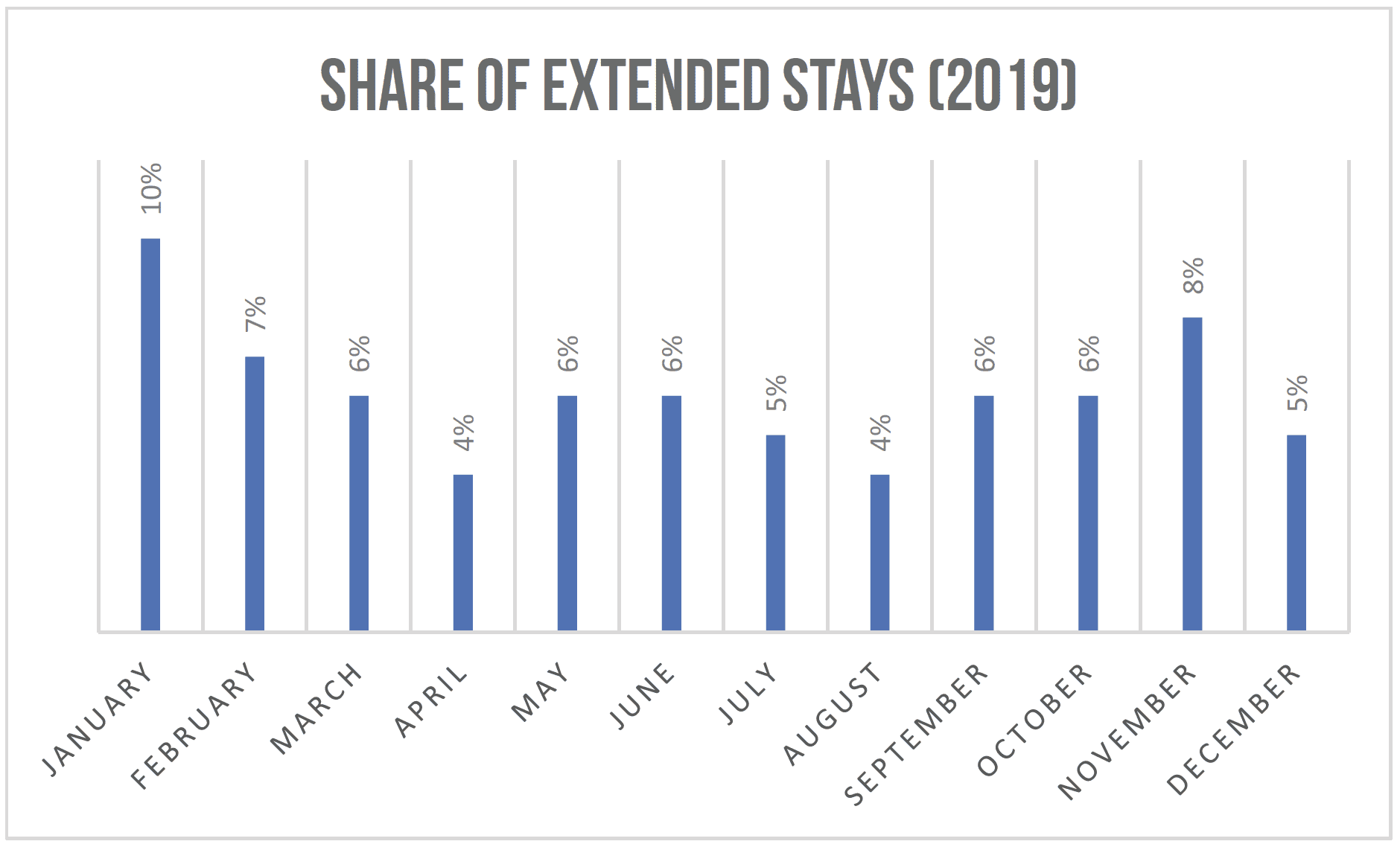
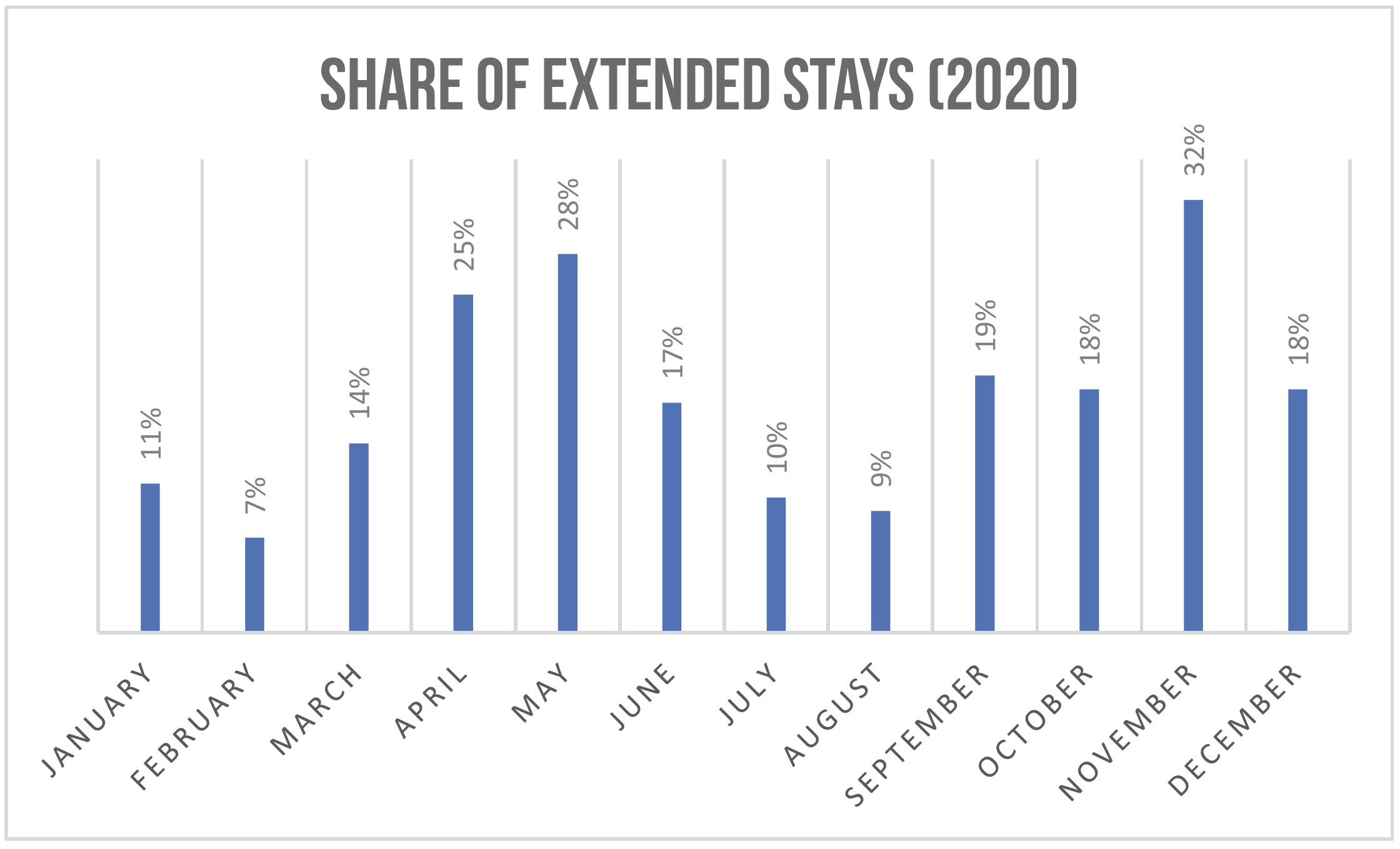
Data from a mix of different markets around the world (including beaches, ski resorts, and cities) indicate that last year, depending on the month, extended stays had 5–10 percent of the share of occupied nights. Look closer, and you’ll find that the share of extended stays tends to increase quite a bit during lean times! This is in part a supply-and-demand dynamic:

• During low seasons (or low-demand periods), managers are more willing to heavily discount the prices to get something on the books.
• Guests notice this, and the ones who have the flexibility to do so book extended stays during the low season.

We should also note that extended stays are less common in high-demand periods partly because the prices are higher, but also because with shorter bookings already in the calendar, not many facilities have consecutive available dates to take even one.


Coming Back to This Year

Coming back to present times and the buzz around extended stays, it’s not news that many destinations around the world are experiencing a low-demand period like never before. At the same time, more and more folks now have the flexibility to stay wherever they wish and work remotely. There are also other segments of demand in which the behavior has shifted toward needing longer stays, sometimes immediately. The needs might be different, but the outcome is the same, in terms of increased demand for extended stays. The data speaks for itself—the market share for extended stays in January and February (pre-pandemic) was about the same as in 2019, but since then it has increased considerably.


Regardless of whether the demand is from traditional snowbirds, families with remote work and school, or essential workers needing a place to stay, it’s hard to deny that extended stays play the steadying hand during low-demand periods. If you’re not already including extended stays in your revenue strategy, that might be something useful to look into. But before you do that, it’s important to understand some revenue fundamentals as well as some operational trade-offs.


Trade-Offs When Considering Extended Stays

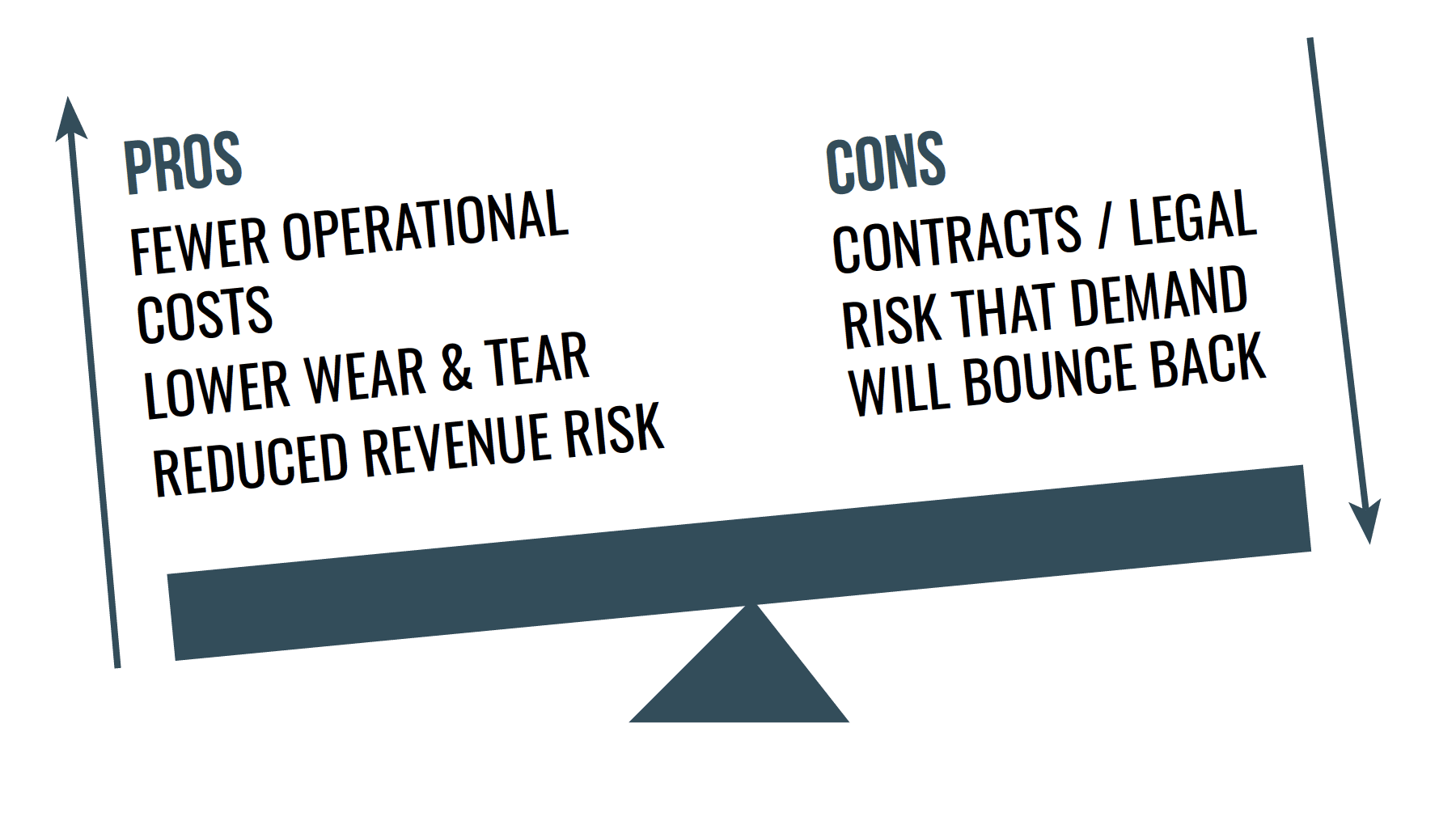
The most important reason to consider extended stays as a revenue strategy is to reduce your revenue risk: getting an extended stay for the coming months might mean a steady revenue stream—especially if you’re in a market with weaker-than-usual demand. The revenue might not end up being as high as previous years when there was strong demand, but if it can improve what you expect to make with lower short-term demand, then that’s a win! Equally important, extended stays come with lower risk of cancellations, due to the ever-changing dynamics of the ongoing pandemic.

That said, if you’re in one of the markets where short-term booking activity is strong enough to meet occupancy goals without discounting rates heavily, extended stays might not be the right way to go. Like so many other things, this is something each manager should evaluate for themselves.

An important thing to consider: though the revenue from extended stays might be lower, the profitability might not be, because these stays have fewer operational costs than shorter stays. The wear and tear on the property also tends to be lower; guests who stay longer have some incentive to treat the property with care.
But more than anything else, it is very important to be aware of the local regulations in your market; many markets have different tenant laws for longer stays than they do for short-term stays. This can take many forms. For example, if tenant laws apply, you might need a separate permit/license for those or a different contract with the guests. Please look into this; the answer will be different, depending on the location.


Market Analysis and Distribution

If you have not been taking extended stays till now, it might be worthwhile to do some market research to find out a) if extended stays are common in your area and b) what booking channels they come through.

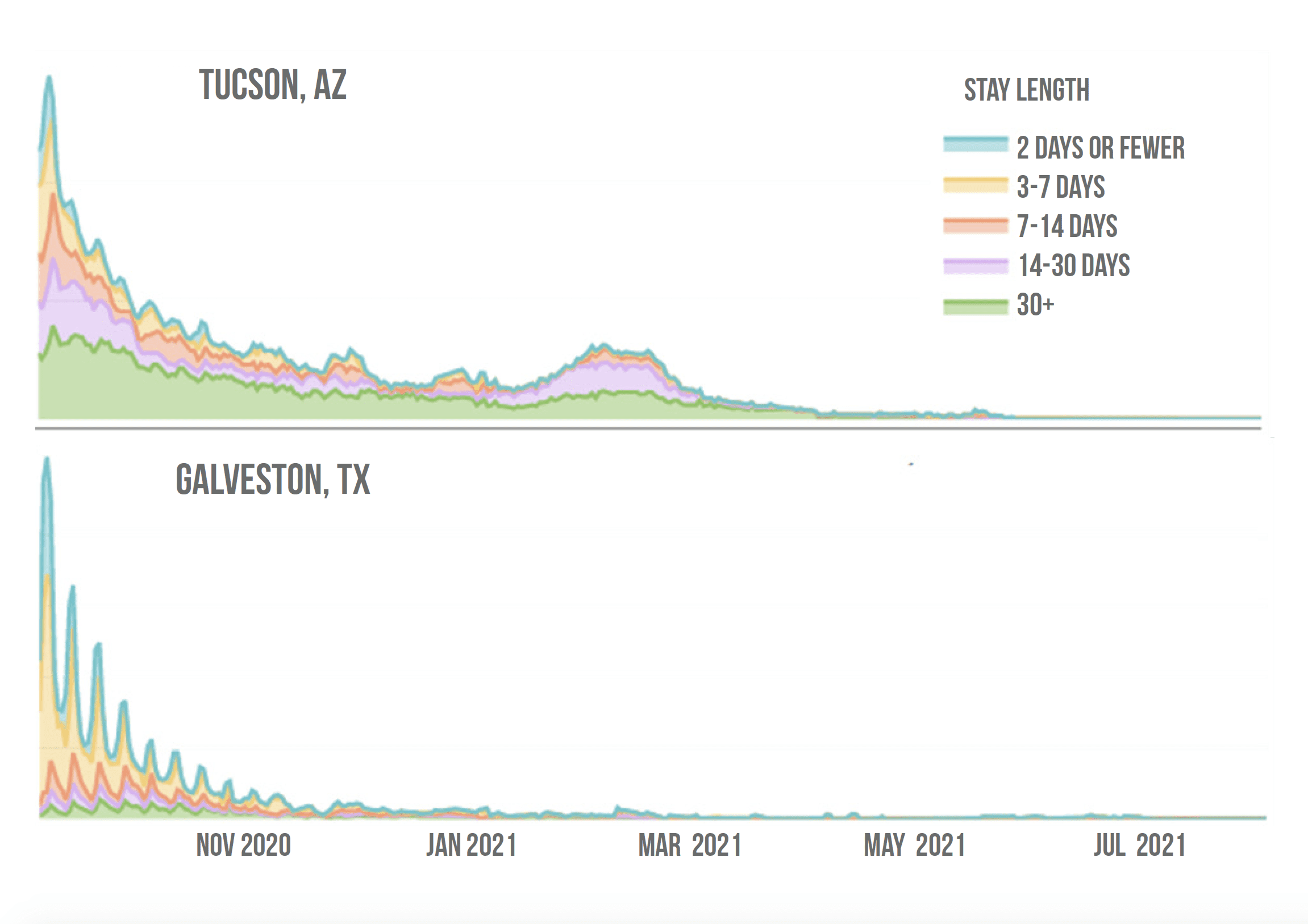
For example, Tucson, Arizona, is a popular destination for snowbirds and shows fairly strong demand for longer stays during winter months. Galveston, Texas, conversely, is a popular weekend destination a short drive from Houston. Looking at the mix of bookings in forward-looking market data, it’s clear that a lot of snowbirds have already been booking extended stays through spring of 2021 in Tucson. On the other hand, in Galveston there is hardly any demand for extended stays right now; most bookings come for shorter stays over the weekend.

It’s not just important to know if your market has a demand for extended stays; you will also want to know how and where those bookings are made. Major OTAs like VRBO, Airbnb, and Booking.com have added focus on extended stays recently. Many markets get demand from boutique channels like Furnished Finder or Traveling Nurse Housing, and these might be worth exploring.

Marketing to repeat guests is always a great way to test the waters with guests you trust. It might also be a way to see if you can generate that demand even if market data sources fail to show strong indicators for it in your broader market just yet.


Revenue Risk and Profitability: Discounting Extended Stays

Let’s say you’ve thought through the above, and the idea of extended stays checks out on multiple fronts. Before diving in, it makes sense to do some back-of-the-napkin math.

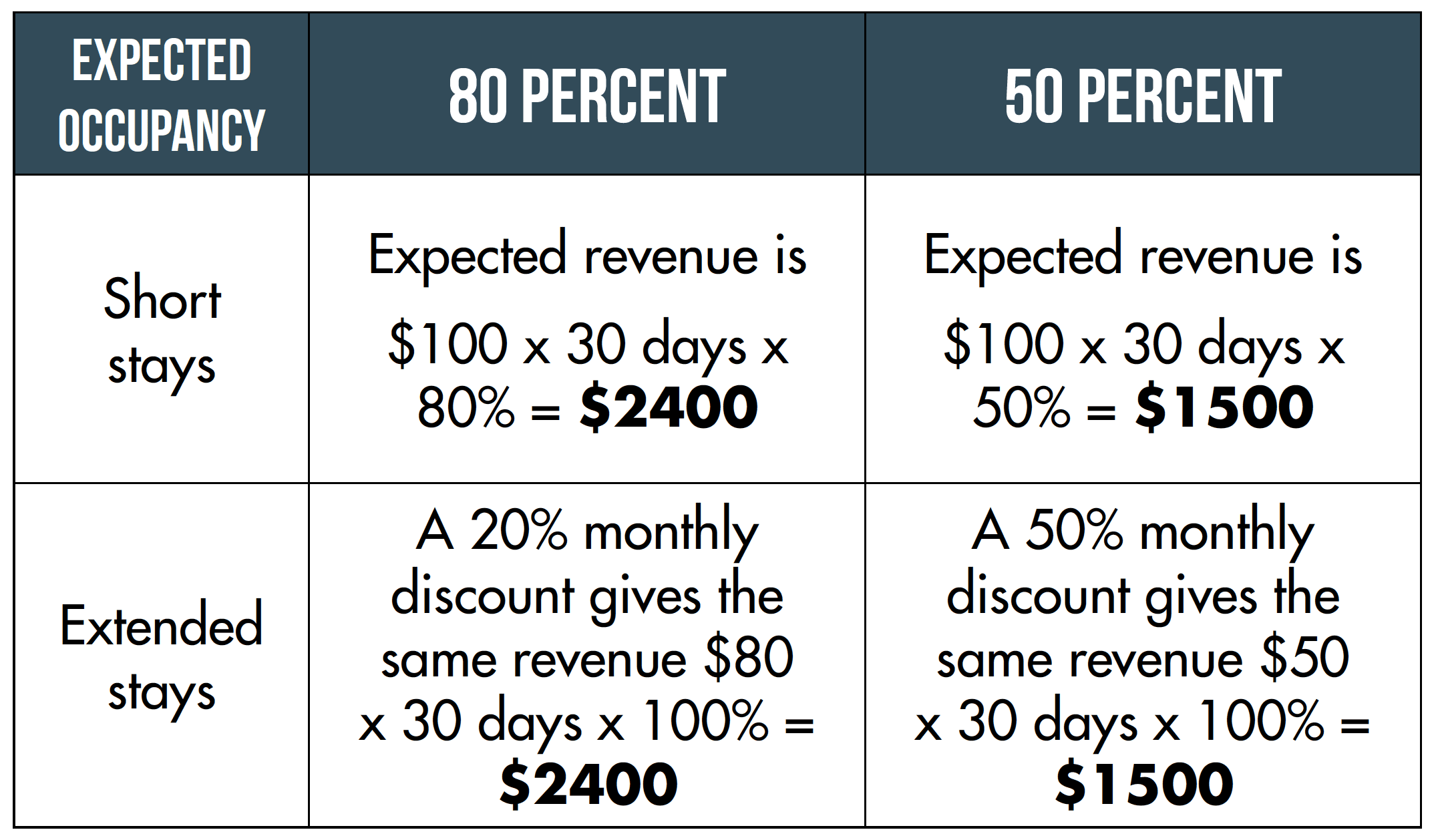
Let’s run through a couple of hypothetical scenarios to help understand this better. For easier math, let’s say you have a property that, on average, sells for $100/night during the upcoming season (some nights might be higher, some lower—we’re looking at the average here). It’s tough to forecast anything right now, but based on recent history, let’s say you have some sense of how booked you expect to be in the coming months from short-term rentals.

Expect to be 80 percent booked in the coming months: If you try and attract monthly stays with a 20 percent monthly discount, you’ll achieve about the same revenue.

Expect to be 50 percent booked in the coming months: You can discount much higher (up to 50 percent) and still make the same revenue!

A few important caveats here:

1) Though a large discount means you might make the same revenue, it doesn’t mean you should discount all the way up. The amount you discount longer stays should depend on what kind of demand exists for those extended stays and what you’re comfortable with. You might get better revenue with a smaller discount that still makes your property attractive for longer stays.

2) Giving monthly discounts doesn’t mean that you will get a monthly booking—it just means that it increases your chances of getting one.

3) If you decide to increase or decrease your nightly rates to respond to demand, this might mean the expected occupancy will also change. You might have to revisit your monthly discounts in such a case.

4) Many platforms and distribution channels don’t allow for different monthly discounts each month. If you’re in a seasonal market, you might need to find ways not to have heavy monthly discounts apply for the high season next year (there are a few possibilities, such as using a maximum LOS for high-demand periods or setting monthly discounts to only apply to certain months, if possible).


Finally, in this example we tried to find the highest monthly discount you should apply purely from a revenue perspective. If there are other considerations (peace of mind, fewer operations, reduced risk), you’ll have to think about how you value them. With an extended stay, you’re also losing the chance of getting those higher-value bookings when demand picks up again.


Segmenting with Minimum-Stay Restrictions

One of the more advanced techniques used by managers who know their market and portfolio really well is to actively ensure that they don’t get short bookings when there’s a better chance of getting longer bookings and better overall revenue.

As an example, consider a slow month (say February) that gets two kinds of bookings:

• Shorter bookings around Valentine’s Day
• Extended stays from snowbirds

The catch? If you get one of those to book, you can’t get the other. And while the shorter booking comes at a good nightly rate, the extended stay fetches more revenue, given how low February occupancy gets in this hypothetical market.

What if you could find a way to get that extended stay to book, while also having the option to fall back on the shorter Valentine’s Day booking if it doesn’t come through? This would require you to find some way to segment these guests; one of the most common ways is using the booking window.

Many folks who book the shorter stays tend to book them last-minute with a short booking window, but some might plan ahead. If you get that rare far-out booking around Valentine’s Day, there’s no opportunity left to take a longer booking around it.


Some managers use the following strategy instead:

1) Study when most of the bookings for Valentine’s Day start coming in. Say 90 percent of those come after January 1 (you can use your own data from past years or forward-looking market data).

2) Till January 1, keep the minimum stay for February higher— you’re effectively hoping for an extended stay and “rejecting” 10 percent of the Valentine’s Day demand that books early.

3) If you’re still not booked with the extended stay when the new year rolls over, drop the minimum stay requirement to cater to the remaining 90 percent of the Valentine’s Day demand.


The booking windows and risk tolerance in this strategy will vary by location and manager, but the overall strategy works well. This is also something you can experiment with if you manage multiple properties.

Do remember not to do this during high season or during periods when the booking window is long, or you’ll be “rejecting” a larger portion of the demand for the shorter bookings, which might not be beneficial.


Balancing Short-Term Rentals vs. Extended Stays: Adjacent and Orphan Nights

Suppose you get a few extended stays on your calendar. Depending on the season, and whether or not those extended stays resulted in awkward gaps in your calendar, filling those gaps could be challenging. There are a few reasons for this:

• Days right next to an existing booking are usually harder to fill: someone should want to book a stay starting or ending right about where the existing reservations are.
• Days between two bookings get even harder: anyone who wants to book longer stays won’t even find your property in a search.

Effectively, the demand for those dates is lower. In such cases, it becomes even more important to be nimble with your prices and min-stays.

The minimum-stay (min-stay) requirement pose a “hard” constraint: if you have a six- or two-night gap and a seven-night min-stay for those dates, there’s no way you’ll get booked (or even show up on a search in OTAs and your direct booking website). You (and property owners) might be okay filling longer gaps of three to six nights but don’t really want one- or two-night bookings, so for contractual reasons, min-stay will ensure those single-night guests don’t book, even when there’s a gap.

If there’s no contractual reason to avoid shorter stays, managers often use one of these two pricing strategies for a more desired outcome on orphan/adjacent nights:

• Increase the price: this one is for operational efficiency. Sometimes you don’t want to fill short gaps unless the price you get is much higher than normal, to make it worth it, or on adjacent days, you might want to avoid back-to-back reservations unless the rate for those nights is very high. In either case, increasing the price will help.

• Decrease the price: this is usually done for improved revenue. Gaps and adjacent days can be harder to fill during low-demand periods, so incentivizing bookings on those days can help. They will increase operational load (which should be low to start with during low season) but can improve revenue and profitability.


Conclusion

Revenue management is a complicated process—there are so many variables that come into play: what the market is doing, what your operations can support, and what the owners prefer. Throwing extended stays into the mix might seem daunting, but when incentivized well, so as to not cannibalize revenue from short-term stays, this strategy can result in a win-win situation for both you and the owners. The strategies mentioned here might seem cumbersome but can be managed with a hands-on approach, automation, or a mix of both. If you manage many properties, these activities might be worth considering in some part of your portfolio.

You Are Your Best Revenue Manager

0

If there is one thing to take away from VRM Intel’s 2020 Vacation Rental Data and Revenue Management conference, it is that there is a desire to understand and employ revenue management strategies and tactics across the vacation rental industry. Although it can seem difficult to assign responsibilities, find the right tools, and organize an entire strategy around the practice, becoming your own revenue manager does not have to be overwhelming.

Most property managers are already fully prepared to own their revenue management strategy—in-house—even if they don’t have the resources to hire a full-time revenue manager. Follow these steps and considerations to become your own best revenue manager.

The first step in developing a revenue management strategy is to make it someone’s responsibility—even if it is not your employee’s full-time job. Consider the employee who already works directly with owners and has experience in your markets as the right person to execute your vacation rental revenue management strategy. Most property managers already have the tools to build and maintain an advanced strategy in an efficient manner. Knowing how revenue management can fit into your property management business does not have to be overwhelming, and you likely already have the tools and know-how to get started.


You Know Your Owners

Although managing the guest experience from start to finish may seem like the only major task of vacation rental property managers, managing owners can sometimes be even more work. Owners can have a wide range of expectations regarding the management of their property, and each property owner has plenty of quirks and things that they look for when determining the success of their investment or home. Managing these expectations and keeping owners happy is a huge undertaking that is often passed to those who are responsible for revenue management and pricing strategies due to the fact that owners are frequently concerned about the financial performance of their unit. The ability to communicate current strategies, market insights, and unit performance is best done by someone within the property management organization because owner communication is so critical to the core of a property management business.

Starting with the owner acquisition process, it is important for the revenue manager or revenue management team to be involved from the beginning. Most owner onboarding processes typically cover property forecasting and performance expectations, something that is important for revenue managers to be aware of when implementing certain strategies. Some aspects of new owner onboarding, such as minimum rate and revenue requirements, directly affect revenue management and need to be communicated properly. The easiest way to ensure that revenue management stays involved throughout the owner onboarding process is to have someone on your team responsible for revenue management tasks. Although having a third-party revenue manager may seem more efficient and cost-effective, those inefficiencies can become invalidated with miscommunication and lag time between both parties.


You Know Your Listings/Market

Similar to being familiar with property owners, it is important for vacation rental revenue managers to know the ins and outs of each listing and specific market. Due to the nature of selling unique property listings, there are characteristics and details about properties that someone controlling the revenue management strategy needs to be aware of. Most of that type of knowledge, especially for larger portfolios, isn’t easy to communicate quickly to new or outsourced employees. This is an added benefit to managing revenue in-house because most of a property management team is already in the know regarding unique listings, historical context, owners, and more. There are also added benefits to having a revenue manager who is familiar with, and may even live in, the same market where properties are being managed. Local market knowledge is priceless when it comes to revenue management, and knowing a portfolio backward and forward can add a lot of value to overall revenue management strategies.


You Already Have the Tools

Although the idea of revenue management may seem overwhelming at first, most property managers are already implementing revenue management strategies without even knowing it. There are many vacation rental software tools that are used as a part of property management operations that also have fantastic revenue management applications. Everyone in vacation rental management is familiar with property management systems, and there are common tools and capabilities in many of those systems that can be used as a part of a revenue management strategy. Inventory and pricing controls within a property management system (PMS) can help define a revenue management strategy alongside other distribution features that may be unique to specific systems. Any use of a channel manager is also directly related to revenue management because the distribution of inventory can sometimes be more important than something like pricing.

Dynamic pricing software has also become popular in the vacation rental industry over the past few years as managers look to gain competitive pricing advantages in their market. Dynamic pricing tools are the closest thing that the vacation rental industry currently has to a revenue management system, something that hotels and airlines use alongside a PMS to manage all the strategic levers available to revenue managers. These systems take a lot of the manual work out of pricing and reacting to market shifts in supply and demand, allowing property managers more time to focus elsewhere. Most property managers using a dynamic pricing tool are also able to use custom pricing settings and features to maintain a more advanced strategy in a more efficient manner.


 

It’s Not That Hard

Revenue management can be difficult, but the benefits of having the owner, market, and tooling knowledge discussed above centralized in-house is what will make this challenge much more attainable. Data insights into market trends can prove or disprove owner expectations. Owner pricing demands can be effortlessly and quickly implemented in PMS and pricing tools. Data and comparison tools can reveal market and listing performance. The synergy of having this knowledge together makes a successful revenue manager for tens to hundreds of listings.

Focus on what matters most and where your time is most valuable. Our industry tends to think that unless a revenue manager has a wildly complex minimum stay schema or uses every customization available on all listings, then they are not doing their job, when in reality they should be focused on the bottom 20 percent of their listings that are going unbooked. Limiting yourself to a few basic metrics can simplify this whole process, so focus on the ones that are actionable! Consider forward-looking occupancy because it is wonderfully simple. The past is history. Comparing YTD revenue performance may be important to owners, but it doesn’t help you make more revenue; it just quantifies what has already happened. Quickly scan the 30- and 90-day occupancy of each listing on your program to make sure none are at the extremes, and if so, act. Comparing future rates to historical rates does not matter if the property goes unbooked.

Besides simplifying the metrics, look at simplifying your workload by offloading it to the software you have in front of you. Not having time for revenue management because of repetitive tasks should not be an excuse for not driving your revenue management strategy. If you sit down to do rates for next year, then stop, and start using rolling calendars.

If you manually reduce minimum stays as time gets closer, utilize automatic gap filling. Searching and replacing rates on orphan days is not a good use of your time — automate it. And if you are constantly changing your last-minute discounts by hand, you are not prioritizing your time. Software and pricing tools can do the repetitive stuff for you and can also be set up in bulk so there is even no upfront time cost.

Although tools will save you time, as a busy PM you will never have enough, and that is okay.

First, be proactive, reviewing September performance in October will tell you what mistakes you made (or hopefully didn’t make), but it won’t stop them from happening. Second, small, smart, and targeted pricing changes are effective when done regularly. Once a week, log into your data provider, see what listings are underperforming, and use the tools to take quick action to lower their rates 5 percent and then review next week. Later in the week, log back in again, review forward portfolio occupancy, and tweak up or down the dates that are passing too fast or too slow. If done regularly, that’s all you have to do to have a stellar year.


Conclusion

Although everything that encompasses revenue management may seem daunting to tackle, there is a high likelihood that you or a capable member of your team is already doing part of revenue management even if they don’t have the title. Assign clear roles and be deliberate about leveraging that person’s knowledge of owners and markets.

No one outside your company will know your owners and how to manage and serve them better than you. Next, take the time to review your software toolkit to see how much time and effort you can save, as well as prioritizing revenue-generating revenue management tasks, not just reporting for reporting sakes. Revenue management in the vacation rental industry has come a long way to make you your best revenue manager.

Building Your Vacation Rental Industry Brand

0

Building your brand can be a challenge in uncertain times, particularly when every week seems different, making it difficult to stand confidently by your experience, convictions, and foresight. Add that to the relative youth of the vacation rental industry that does not have decades upon decades of well-established standards, and it may at times feel like a free-for-all.

A foundation of consistently communicating your distinct value creates a well-designed brand promise. To compel people to think of you as an expert, you must be able to communicate not only the problems you solve but also the way you solve them uniquely.

The formula is simple: your brand name + solves this specific problem + uniquely this way + for these specific people.

However, filling in the formula with your details is not so easy. In fact, most people get stuck on “uniquely this way” and “for these specific people.”

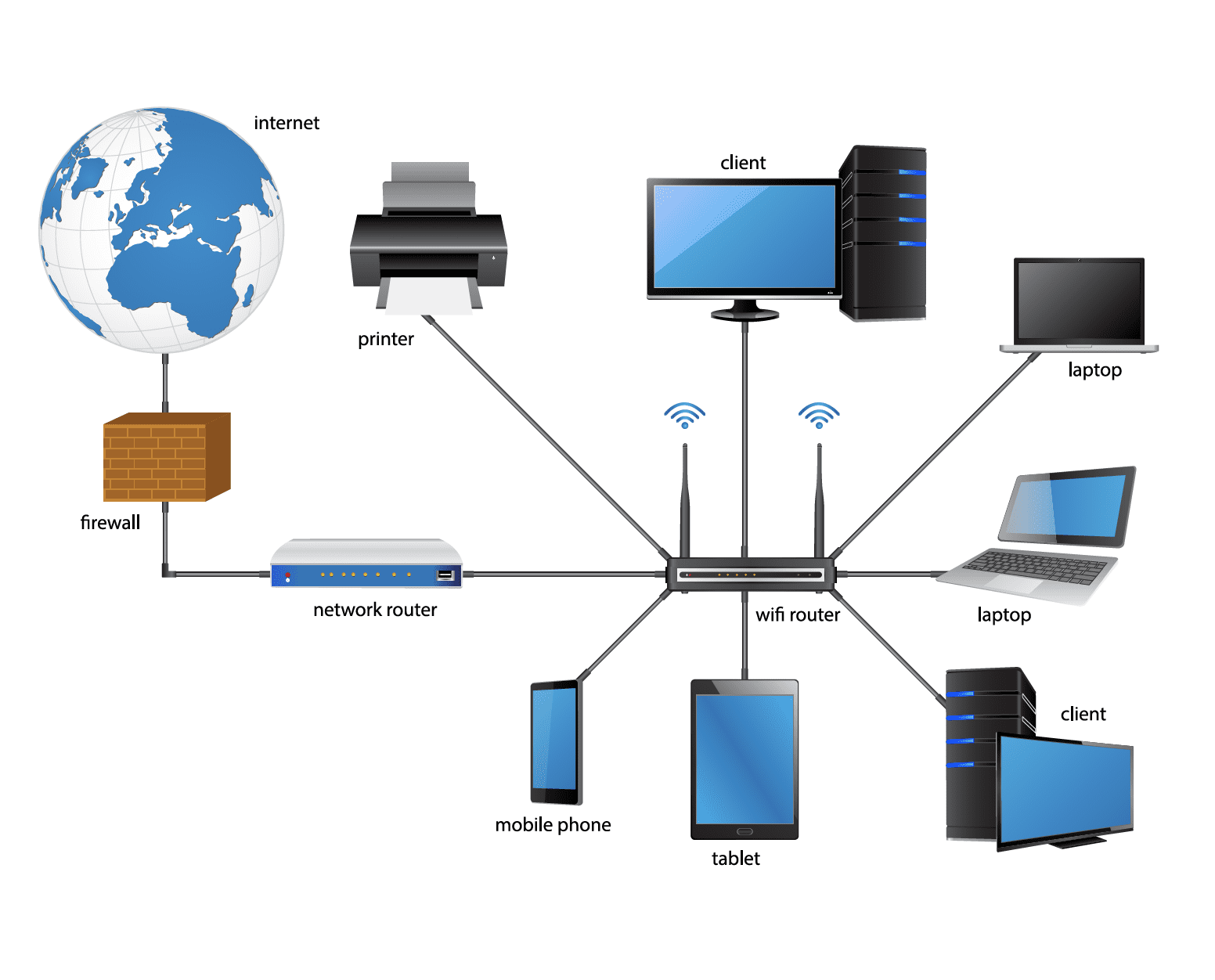
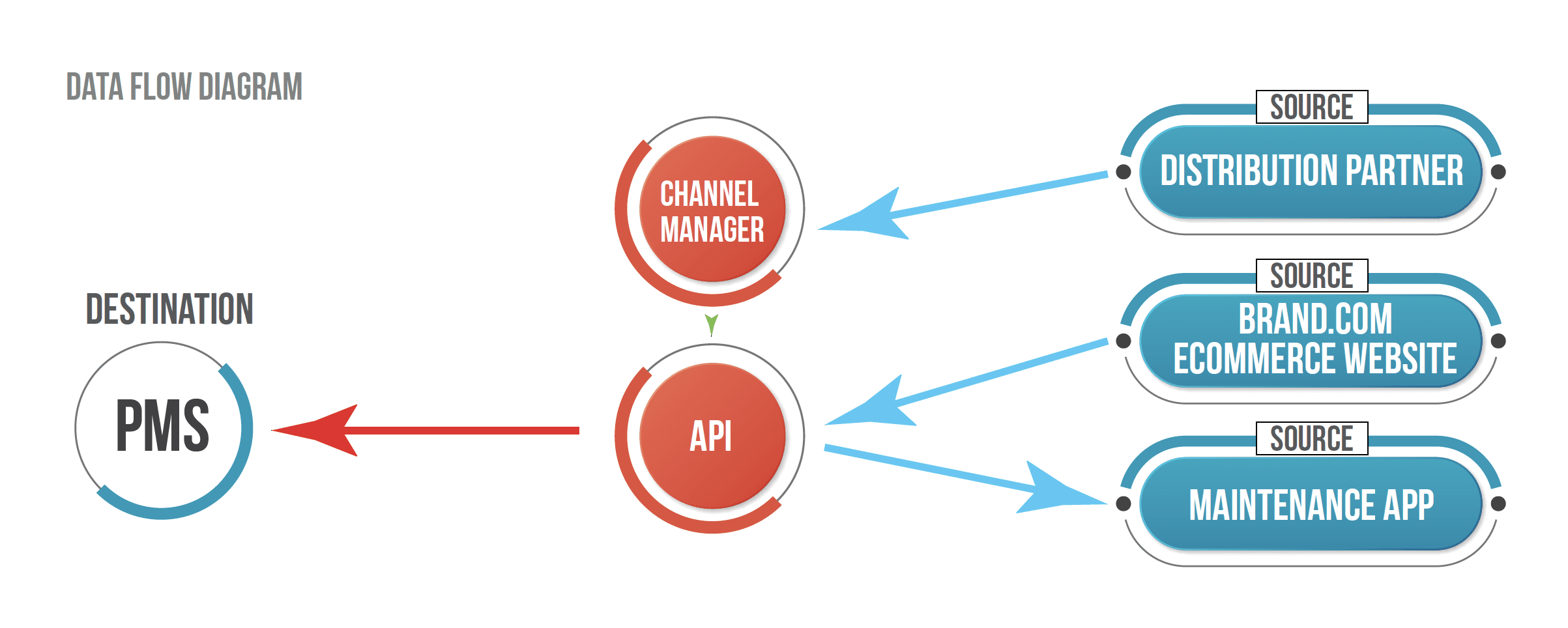
Some of the vanilla answers business professionals provide in an attempt to differentiate themselves include claiming to have “exceptional customer service” or to be “very experienced” as their unique way of solving problems and identifying “anyone who wants a vacation rental experience” as their ideal customer.

The reality is that countless professionals in your market—let alone the country—could likely claim those same things. So they’re neither unique nor specific. It is essential that you dig deeper, evaluating who your best customers are and what they all have in common.

When you find that sweet spot—your most profitable customers with whom you also enjoy working—it is time for you to study those people and seek more like them through your branding and marketing efforts.


A Tale of Two Brands

To illustrate how a clear brand promise can increase your reach and revenue, consider the power of two high-end brands that consistently gain market share, despite their substantial price tags and limited audiences: Rolex and Louis Vuitton.

You will never see them market nor advertise in the same places as Walmart or Dollar General. Spending time and money advertising to those who are only interested in budget-friendly retail is not in their best interest. They clearly define who their ideal customers are so that they can accomplish the following:

Share their brand promises through compelling storytelling to emotionally trigger their ideal customers

Visually uphold their brand promises in a way that delights their ideal customers

Deliver on their brand promises in a way that meets the high expectations of their ideal customers


How to Share Your Brand Promise Through Compelling Storytelling

The personal stories of you or your founders hold all the clues you need to differentiate yourself from other brands. By following the breadcrumbs you have left behind in life, patterns will emerge that combine your personal satisfaction and your ability to effectively contribute to people and situations. Consider your professional and personal experiences when reflecting on what makes you unique.

For example, if you have served in the military, it communicates that you possess a special kind of discipline and dedication. You are likely to attract others who have or currently serve in the military as well as those who particularly respect those who have military service. Does serving your country have anything to do with selling vacation rentals? Not exactly, but it’s a piece of your story that can create an emotional connection between you and your ideal customer.

Perhaps you have political experience, empowering you to navigate the law and key stakeholders involved in a deal. Or perhaps you are the third or fourth generation in your family to work in the hospitality industry. How do you think that stacks up against a rookie when you can reference a lifetime of multigenerational hospitality conversations at the dinner table?

Be intentional about telling such stories while networking; participating in media opportunities; or speaking through your blog posts, videos, social media, website copy, or any other marketing activity you pursue.


How to Visually Uphold Your Brand Promise

Rolex and Louis Vuitton both have visually compelling brands that invite prospects and customers into their story of luxury, prominence, and success. They share a glimpse of what it feels like to sport their products. Their visual branding is designed to evoke an emotional response to trigger a purchase of their products.

Of course, another reason it is important to understand your target market is to gain insight into what other brands they enjoy and thus give you a road map of how to visually stimulate your ideal customer. You can simply ask your previous and current guests what their favorite brands are via a survey, or you can simply observe along the way. For example, if your ideal customer wears an Apple Watch, has an iPhone, and is concerned about how close the nearest Whole Foods is to the property, you can do a quick scroll through those websites and social media profiles—of Apple and Whole Foods—for inspiration. Whether it’s the font style or color selections, the amount of white space, or the style of images, you can easily use those visual cues to help you craft your own visual brand.

Remember, you cannot illustrate a book until you write the story, so ensure that the visuals for your unique visual brand represent your unique brand story.

The visual side of your brand is merely an aid for telling your brand story. Importantly, your branding should always be consistent, so be sure whichever path you choose is the one you remain on day in and day out through all marketing channels.


How to Deliver on Your Brand Promise

If a Rolex watch or Louis Vuitton purse had any issues, undoubtedly its owner would know that the respective company would fix it in short order. These companies are trusted to deliver on their brand promises of quality, excellence, prominence, and more. In the same way, you must make it clear that you will always deliver on your brand promise.

First, you must do good work. While that seems obvious to the experienced vacation rental professional, it is unfortunately not the norm. Simply doing what you say you will do will go far for your brand reputation. Furthermore, be sure to obtain secure testimonials as soon as you delight your guests. Allow your customers to toot your horn for you and then reap the powerful benefits of consumer reviews. Note any awards, certifications, education, or media coverage you have received, as appropriate, which are also forms of social proof that you are great at what you do. While you may feel like you’re bragging, any such announcement is a small blip on the radar of the average person who consumes an incredible amount of content each day. If you do not share your successes, how do you expect anyone to choose you instead of a less worthy company who may not look out for its customers’ best interest? Save your potential guests from a lazy or less reputable VRM company by simply sharing the proof that you will have their best interest at the forefront of all you do.


Clear Branding Equals Clear Marketing

When you are clear about your brand, you become clear about how to strategically market your brand for results. Understanding who you serve, what problems you solve, and how you solve them uniquely empowers you to position yourself through targeted campaigns and strategic networking. You can’t be everywhere, all the time. Not every social media channel is for you, nor is every magazine, conference, or website somewhere you should invest time and money, as your ideal customers are not everywhere, either.

Furthermore, when you are clear on your brand, you can be clear on your internal processes and train your team to uphold your brand promise as well.

Remember, no one wants to be sold to, but your ideal customer does want to buy from someone who attracts their business. If you effectively share your brand story and its results, you will become the only option in your ideal customer’s mind, eliminating competition altogether.

Strong brands are led by strong leaders! Enroll in Velvet Machete Leadership Academy, an eight-week, virtual leadership certification course, to become a driving force of influence and fortify against underperformance, turnover, inconsistent guest experiences, and more! Registration is October 23–28, 2020, and the experience begins November 2. VRM Intel secured a $500 discount for its community with the code VRMINTEL. Visit https://amberhurdle.com/velvetmacheteleadershipacademy for more information.

Selling Your Business? Know Your Tech Stuff!

0

For any vacation rental company considering selling, there are many areas of preparation needed to realize a successful sales process. This article will discuss what types of technology-related data an owner should be prepared to provide based on the type of sale.

Technology in vacation rental companies ranges from simple to very complex, depending on the tools and solutions that are in use and the extent of digital transformation that has been completed.

For example, some VRMs have housekeepers using printed reports while others have a mobile application on their personal phones. A larger, geographically distributed company may have a wide area network connecting its systems while a smaller company may only provide wireless Internet access and leverage a software-as-a-service (SaaS) solution.

These examples can extend to all areas of operations in a VRM’s technology ecosystem. No two acquisitions are exactly the same, but there are common technology data requests depending on the sale type: contract buy (owner contracts/units), asset buy (stuff), or a stock purchase (company). One of the sticking points in a VR sale is the seller’s understanding of the technology systems involved. Frequently, VR owners do not have comprehensive documentation of the systems and assets that run the business.

The diligence an acquirer pursues will greatly impact his or her success in ongoing operations. In my experience, one deal included acquiring a proprietary system but not the add-on connector for distribution because it was not discovered or divulged in the diligence process.

Another purchase exposed the buyer to active network penetration and a resulting data breach because of a lack of focus on the current security in place. Failure to reveal a prior data breach resulted in fines that the buyer then had to recover from the seller in another deal. One website went dark for two days because it was not listed in the diligence data and lost connectivity to the PMS during system changes. Omissions can result in a financial loss to the seller, so it is important to provide all of the information available or requested.

Typical data requests in a diligence process are provided below. Depending on the size of the acquisition target and purchaser, the detail can be increased or flattened. Taking the time to develop this collection will prepare the target for a successful and productive engagement.

When an acquirer requests data from a target, the promptness and depth of the response signals a professional, well-run operation and provides confidence in the deal. While acquirers typically have a data request template, your prepared information can be easily pasted in or linked by reference. If there are questions that aren’t clear or understood, it is important to ask for clarification or help to ensure full transparency and data validity. It is important to note that this type of information should never be provided until a nondisclosure agreement has been executed. Deal brokers and consultants are available to help with this work, including data extraction and documentation if the seller wants assistance or needs to focus on other areas.


Contract Purchase Implications

In a contract purchase, the buyer typically does not need the current systems or technology services. The main focus is on the contracts and related data to be provided. Be ready to export data from your systems in a format the buyer can consume. The use of spreadsheets is common. Be sure to understand the scope of data the buyer will need and the date range. Two years of historical data is a common request.

Prepare a summary of all existing technology contracts to be used to terminate services no longer needed post sale. Plan to pay any early termination fees that may be required. Plan to maintain any systems or data needed to support any legal or financial reporting in the future, typically for three to seven years depending on the data type.


Asset Purchase Implications

For an asset purchase, the buyer purchases some or all of your assets, such as computers, websites, data circuits, and technology vendor contracts and services. In addition to these contract details, additional data related to the assets to be conveyed is needed. Compile accurate data for any assets or services to be transferred. Verify that existing agreements allow a transfer, and clearly detail any that have unique requirements for transferability.


Stock Purchase Implications

In a stock purchase, the buyer needs as much data as possible to sustain current operations and to support the staff, owners, and guests post sale. More detailed information about your technology ecosystem is needed to support the value and operations of the business. Collect all of your active technology-related contracts. These will include software systems (on-premise or SaaS); hardware support agreements; telecommunication products including voice, data, and cellular services; and any vendor support agreements.

The types of data needed are detailed below (but may not be fully comprehensive).


Tech Hardware

Computers, servers, network equipment, telephone systems, company cell phones with full detail of models, purchase date or age, and contract or warranty status. An inventory or all phone lines and data circuits should be included. A spreadsheet schedule is an easy way to track and share this information if no other asset inventory is available.


Software Systems

Include desktop software (Windows, Office, etc.), financial, HR systems, CRM, call center, PMS, housekeeping, maintenance, association management, collaboration tools, time tracking, payroll, point of sale, project management, website analytics tools, and source code of any proprietary systems. Be prepared to provide copies of all related contracts or proof of licenses, and verify the transferability of any that are needed.


Security Systems

These could include IT operating tools, antivirus software, firewalls, VPN, SFTP, application patching, and intrusion protection systems.


IT Support Structure

Provide current resource roles and reporting lines. If support is outsourced, supply the current agreement including the types of support it includes.


Network Diagram

Have a diagram that details your network, including all sites, major hardware, and IP addresses. This will visually represent how your systems connect and which data elements are passed between the systems.

Payment Systems

Provide details about your merchant identification, gateways, processors, and payment systems in use. This is an area many companies find complex to transfer. Leverage the vendors to support documenting this information.


Disaster Recovery and Business Continuity Plans

Document the processes used to maintain business operations in the event of a disaster or outage. In the event of a fire or hurricane, for example, detail how you communicate with owners, guests, and staff, potentially without access to all of your systems or data. If there was an Internet or network outage, provide your operating processes for maintaining standard services for all guest and owner interactions.


Prior Breaches

Provide full transparency on any data breaches that have occurred. This should include the scope of the breach, any notifications provided, and all corrective or preventative actions taken after the event occurred.


User Data

Export a list of all application users from significant systems. Provide detail on any super users and/or system administrators. Additionally, any shared accounts or service accounts should be highlighted.


Social Media

List all tools and accounts in use across your digital marketing tools. Include users and passwords.


Websites

Include a list of all owned domains, the domain registrars, and current status (active versus parked or redirected). Include relevant performance metrics that represent the level of engagement with the platform. If the platform is proprietary, provide full technology stack details along with support resources.


Channel Data

For all your sales channels (direct, web, OTA, etc.), provide the percent of revenue per channel. A full listing off all OTAs in use should be included.


Compliance Status

For PCI Compliance, present the prior four quarters of the required vulnerability scans, most recent Attestation of PCI Compliance, and inventory of all vendors with access to sensitive data, including credit card or personally identifiable information (PII).


Technology Projects

Any projects in progress, critically needed, or future planned projects should be supplied with details on the effort, the rationale, and the impact. Provide available budgetary data and timelines for these efforts.


Technology Spend

Present the total operating expense for all technology services in use, including systems, personnel, and vendors. Include the data as a percent of gross revenue. Provide historical and budgeted capital spending totals or percentages of gross revenue.

This is meant to be a guide to help VRs when selling their business. Each situation is unique and varies in complexity. There are consultants and deal brokers who are willing to help with this type of data development for those who would need that type of assistance.


Please Don’t Go: Vacation Rental Companies Surviving during the Pandemic

0

“Successful men and women keep moving. They make mistakes, but they don’t quit.” -Conrad Hilton


The vacation rental (VR) market is a powerful driving force in the tourism industry and is growing fast. Sadly, COVID-19 has impacted many VR businesses and professionals, and this controversial, global pandemic has been a game-changer in the vacation rental industry. It’s been a long, hard journey for many, but if you’re a VRM thinking of throwing in the towel, please don’t go!

Although the dynamics of the travel industry are changing, we’re seeing a huge shift and demand toward vacation rentals as the preferred lodging option, globally. Being able to offer a homestay at a time when many are concerned with self-isolation is a huge bonus—for both the homeowner and the guest. Trending predictions show short-term rentals (STRs) could be the fastest-growing sector in the hospitality industry and could finally have the upper hand and attention they deserve.

COVID-19 and the subsequent border closures and travel restrictions have wreaked havoc on the travel and hospitality industry, bringing it to a grinding halt and changing the face of travel forever. With the tremendous strain the economic fallout has put on the industry, it’s not easy to say “please don’t go,” when for many it may seem the only logical option.

As VRMs you’ve survived hurricanes, floods, fires, and so much more. With passion and purpose, the vacation rental industry rises stronger every time. There is good news and inspiring signs of healthy recovery for our industry. The following statistics show that the impact of COVID-19 has ultimately fallen in favor of the vacation rental and STR industry.


Technavio’s latest market research report, “Global Vacation Rental Market 2020–2024,” forecasts that the vacation rental market will accelerate at a CAGR of almost 7 percent through 2020–2024, with predicted growth of USD 62.97 billion.

Booking trends show that travel is up 127 percent from early April, with the number of bookings on Airbnb and VRBO booming from 916,000 to 2.08 million in only two weeks (AirDNA).

Since the COVID-19 low, global vacation rental occupancy has increased 60 percent, and the average daily rate (ADR) has increased by 23.2 percent.

North America is seeing the fastest rebound in the STR industry worldwide, with leisure destinations seeing a rebound in rates of 322 percent.


So, please don’t go!

While initial predictions were bleak, our industry is resilient and adaptable. With a change in consumer behavior and travel trends, and a “new normal” evolving, the recovery rate is faster in the vacation rental space than in the hotel industry, which is encouraging. There has been a surge in demand as travelers, work-from-home executives; and a new generation of digital nomads opts for destinations with more privacy and less risk, choosing staycations and drive-to destinations, avoiding crowded hotel lobbies, and opting to socially distance from the comfort of a vacation rental home.

STR Global and AirDNA compared the impact of the coronavirus crisis on hotels and short-term rentals from January 2019 through June 27, 2020, concluding that short-term rentals weathered the pandemic better than hotels, and ADRs were higher in July 2020 than in July 2019.


Are you prepared for change?

In an industry based on relationships, hospitality, and creating lifelong memories, it’s imperative to keep up with the shifting market, stay innovative and anticipate higher guest expectations. Smart technology, promotional strategies, and staffing play a huge role in these positive industry predictions. As a successful property manager, it’s important to keep your finger on the pulse, which right now is beating fast.

Now is a time of great opportunity for VRMs: a time to determine a game plan, monitor your data with solid data-driven decision-making, and plan for the future through strategic forecasting.

This is a time to build your brand, grow your inventory, add new homeowners, and find the right talent to build a strong team.

In this time of uncertainty, with industry rollups, small businesses shutting their doors, and staff layoffs, the need for experienced and passionate VR professionals is now greater than ever, and the available talent pool is overflowing. In the vacation rental industry, the best teams win, and it’s vital you’re all rowing in the right direction.

Although things may never be the same again, our well-loved industry will make a strong return, and a strong band of vacation rental managers will have weathered another storm successfully and triumphantly.

Although there will no doubt be a return to the office for some, the work-from-anywhere trend has been accelerated by this pandemic. Vacation rentals make for the perfect remote work environment. The extension of the summer season into the fall that we are seeing across the industry may not be a one-year anomaly. This could in fact be an inflection point for the industry we know and love.

If you are in leadership in the vacation rental industry, this is the time to acquire the talent to take advantage of perhaps the greatest growth period in our history. Take this opportunity to see who is available in the talent pool. It’s the deepest it’s ever been.

Alternatively, if you have been laid off or furloughed, or you’re just considering an industry change . . . we kindly ask you to reconsider, as a time of unprecedented growth is just around the corner.

Please don’t go!

Professionalizing Rental Operations in Travel’s New Landscape

0

Roughly six months ago, I wrote for VRM Intel from quarantine in Pawleys Island, South Carolina. The article offered predictions on how the pandemic would change the way in which travelers interact with physical space, and how their behavior would impact the approach to vacation rental property preparation and client communication. We also discussed the opportunity these changes presented and how rental managers who prioritize professional and responsible operations will separate themselves from the occasional, “on-the-side” operator and grow along with the market.

Over the course of this most unusual and challenging year—which still has over two months and untold surprises in store—many within the vacation rental industry have navigated waves of cancelations, furloughs, executive orders, reopenings, and zero-to-sixty demand swings. While Airbnb passed the million booked-nights mark on July 8th for the first time in over 120 days, the predictability of future bookings is unclear; we aren’t out of the woods just yet with this global pandemic.

What is becoming clear, though, is an acceleration of the shifting focus on quality within the vacation rental market and the lasting operational changes that come with it.

We surveyed hundreds of vacation rental managers to take the pulse of how professionals plan to strengthen processes across guest and owner communication, housekeeping workflows, compliance with cleanliness and safety standards, and internal tracking and reporting. This article analyzes the results from our survey and discusses how 2020 has solidified the trend towards quality in vacation rentals and the resulting need for controlled property operations and client services.


Cleanliness Beyond Reproach

While professional vacation rental operators have always been focused on ensuring high cleaning standards for their units, cleanliness has taken center stage since March. This isn’t a surprise, and 97 percent of managers we surveyed think that COVID-19 has increased guest sensitivity regarding vacation rental cleanliness.

In fact, 66 percent think this sensitivity will change booking behaviors, and that cleanliness and safety will be more important considerations than location and price.

Guest hypervigilance as to property preparation and cleanliness start well before check-in, pulling travelers towards professionally managed rentals with predictable and trustworthy brands; we see this trend across hospitality, as well, by the way companies are promoting and branding cleaning standards.

The new traveler persona has compelled nearly all (99 percent) of vacation rental managers to make changes to their property care programs concerning housekeeping protocols, internal communication, time allotted for cleans, items cleaned, and products used. Strictly adhering to comprehensive cleaning protocols between each stay has become an even more critical component of property care, given the health implications.

Customizing checklists for each property is a popular way to help housekeepers cover the unique elements in the home and follow brand standards. Prior to COVID-19, 49 percent of vacation rental managers were using customized checklists and protocols, and an additional 30 percent of managers plan on doing so going forward, allowing them to add more control over how properties are prepared.

Better yet, 75 percent of managers are augmenting the items on their checklists to include guidance from health authorities.


For those who smartly assign cleaning jobs to in-house and contracted housekeepers (even with prescriptive instructions for each property), having confidence in the quality of work is still not a given.

The managers we surveyed agree. Over 83 percent are strengthening their quality assurance programs, with the majority of operators independently inspecting every unit before the guest arrives. Using digital checklists for quality control not only ensures property preparation complies with brand standards but also makes it easier to store data on historical issues, conditions, appliance attributes, access codes, and Wi-Fi passwords. Rental managers have this granular property information at their fingertips on mobile phones to drive more predictive asset management and quickly diagnose issues, reduce repair time and costs, and prevent emergency maintenance issues.


COMMUNICATING Property and Guest Safety

Safety was already a trending topic in the industry before this year, with managers paying more attention to physical safety features such as smoke alarms, carbon monoxide detectors, and trip-and-fall hazards. Now safety—in terms of both cleanliness and property condition—is front and center for rental managers, guests, property owners, municipalities, and internal staff.

Over 84 percent of managers we surveyed are taking steps to improve safety and maintenance procedures; these changes include increasing the frequency of safety inspections and routine preventative maintenance.

Safety inspections are a growing trend that we expect to continue into 2021, and 13 percent of managers are taking additional steps to protect the safety of their owners’ assets by leveraging independent programs to certify rentals for safety and regulatory compliance.

The current environment has also stretched the meaning of “vacation rental safety” to include the hygiene and well-being of guests.

The most direct strategy for protecting the safety of guests is adding a buffer period between stays. Implementing waiting periods has been a hotly debated topic in the industry in 2020, and 42 percent of operators surveyed in June planned to implement a buffer to comply with guidance from leading regulators and authorities.

Vacasa, for example, automatically blocks time between reservations to prevent last-minute bookings for locations where “rest periods” are required. The company has added waiting periods to their standard protocol and suspended early check-ins and late checkouts to afford housekeepers adequate time to complete enhanced cleaning programs.

Performing work to safeguard your properties and guests is just half the battle, though. Communicating all the precautions you’ve taken is necessary to put guests at ease and sets the stage for a great in-stay experience.

Nearly three-quarters (74 percent) of the managers we surveyed plan to adjust their communication strategies before arrival and throughout the stay. This includes promoting enhanced programs on company marketing websites, sending details about contactless check-in procedures before arrival, communicating changes to in-stay concierge and maintenance services, sharing restrictions and closures in the area, and detailing safety and cleaning items provided for guest use (e.g., cleaning products, hand sanitizer, gloves, masks).


Popularity of Service Technology is on the Rise

We’ve spilled ink in other articles on the rise in guest expectations and its impact on the service demands placed on vacation rental managers. Vacation rental operators are well aware that the days of guests bringing their own bedsheets and toilet paper) are behind us.

But service is much more than the baseline essentials; as guests gravitate to more full-service rentals, managers are increasingly focused on how to optimize their service operations. Hotel operators, who have been forced to meet the ad hoc demands of room service and concierge, have long since adopted service optimization software separate from front desk, booking, and reservation management software.

Now, as this same service is needed at vacation rentals, devoting detailed care and service across unique properties is a major challenge with many moving pieces and increased demands.

In fact, more than 42 percent of professional managers we surveyed are manually plugging gaps in property care by scheduling tasks from reservation reports, using paper checklists to perform quality assurance, and communicating internally through ad hoc systems, phone calls, and text threads. Another 40 percent are using a combination of tools which include their PMS systems, and workarounds that increase the likelihood that work will fall through the cracks.


For many of these managers, though, COVID-19 has marked a shift in their technology priorities, driving the need for purpose-built property care tools to the front. In fact, the majority of managers feel that cleaning and operations are the most important areas of focus for their business over the next year, and 49 percent feel that property operations software will be the most helpful technology moving forward. The data show that the demand for service optimization is on the rise and demonstrates the continued evolution from “property manager” to “hospitality provider.”

Once again, the market for vacation rentals is going through a shift, one partially accelerated by the demands placed on travel and hospitality by a global pandemic. Facilitating the booking process has taken a backseat to servicing and preparing the property and building more confidence in safe and high-quality properties has become the focal point of travelers, property managers, and regulators. Our survey results from this summer illustrate this trend and outline the enhanced approach that rental managers are taking to crafting predictable and service-first experiences as true hospitality providers.

And once again, the push for professionalism presents an opportunity for managers to meet the changing demands of their clients. Using smart programs and internal workflows eases the complexities that vacation rental managers navigate—high tough, rigorous compliance, fast turnover, and unique space—and can create scalable property operations for growth and a stronger brand within their market.

Employee Retention Ideas for 2021 and Beyond

3

Since the emergence of COVID-19, we have seen a massive shift in the way business is conducted. Each day brings a different situation to navigate, without much clarity. What is clear is the coronavirus pandemic will have a lasting impact on the future of work and how it gets done. Just think about how your business processes and policies have changed over the past 10 months:

• Businesses were put to the test when they closed their offices and employees began to work from home. Figuring out who does what, how it gets done, and what gets measured is complex, to say the least.
• Seasonal staffing has plagued everyone. For some property managers, federal unemployment and stimulus packages seemed to deplete the workforce during times when several markets had record reservations.
• The CARES Act and FFRCA Leaves remain in place through December 31, 2020. Coordinating the leaves is challenging and further complicates staffing for operations.
• Property managers across the United States have been affected by floods, fires, hurricanes, mudslides, and tornadoes. These disasters, along with the pandemic, have expanded managers’ roles to include supporting their employees’ financial, physical, and mental well-being.
• Business owners have become human resource managers, creating new policies, processes, and procedures to protect employees, guests, and homeowners to contain the spread of COVID-19. This has been no easy feat.

The events of 2020 have taught us how important it is for businesses to be flexible and agile to adapt and thrive. The events have also taught us how valuable our employees are and the importance of employee engagement and retention. Retaining talent today means three things:

1) Creating flexible ways to manage performance
2) Investing in training and development opportunities
3) Increasing remote-work capabilities


Creating Flexible Ways to Manage Performance

Managers and supervisors in all industries have become more agile managing performance. They are finding that managing performance is not one-size-fits-all and are placing a greater focus on the overall well-being of their employees. Conversations are no longer limited to key performance indicators, performance metrics, and goals; they now include dialogue about employee experiences.

Managers are having real conversations with their employees, keeping lines of communication open, and building trust through real-time feedback. Whether working in the office or remotely, employees want to know when something is off or when they do something well.

Throughout 2020, successful managers have learned that managing performance expectations with more flexibility, empathy, and leniency is key to keeping up employee morale, engagement, and productivity. Every day, they have been finding ways to recognize and show appreciation for their employees.

Today’s work environment is nothing like anything we have experienced. Quarantines, lockdowns, office closures, and working from home all require different performance measures. Today, managing performance requires redefining performance measures and their purpose.


Ideas to Positively Influence Employee Morale and Engagement:

Simplify your performance process

Keep responsibilities realistic

Encourage frequent conversations between managers and employees

Provide ongoing informal coaching and feedback

Adjust goals and objectives during “significant” business interruptions

Focus on continuous improvement

Develop future skill sets and competencies

Describe how you will invest in your employees


Investing in Training and Development

Focusing on continuous improvement and staff development is key. By 2022, no less than 54 percent of all employees will require significant retraining or reskilling. (Future of Jobs Survey, 2018 World Economic Forum) Of these, 35 percent will require upskilling and training for up to six months. Finding ways to engage employees who know your systems and internal processes and also understand your brand is critical for employee retention.

The cost of reskilling employees is considerably less than the cost to replace them. For example, it may cost $6,000 to hire an employee or $3,000 to provide additional training and education for an engaged employee who will bring more relevant skills to your business.

Companies are starting to identify new skills their employees might be interested in and providing them with the educational assistance and time to obtain those skills. Additionally, they are creating internal programs to develop the talent they cannot find.

1) Continuously focus on the talent you currently have in your workplace, and create opportunities to grow their careers and develop their knowledge and skills.
2) Keep employees engaged with varied, flexible responsibilities so they acquire cross-functional knowledge and on-the-job training.
3) Find ways to encourage more diverse thinking among employees.

With learning and professional development, investing in your employees is a win-win proposition.


Increasing Remote-work Capabilities

This year has provided firsthand experience for many on the responsibilities and effectiveness of a remote workforce. While some tasks require someone to be onsite at your properties, laundry facilities, or offices, there are several other responsibilities that can be completed remotely before, during, or after standard work hours. Businesses now have greater insight into the responsibilities and effectiveness of a remote workforce.

A recent Gartner poll shows that 48 percent of employees will likely work remotely, at least part of the time, even after the COVID-19 crisis is over. (Nine Future-of-Work Trends Post-COVID-19, Gartner, June 8, 2020)

Think about what percentage of your workforce is currently working remotely, and ask yourself what percentage of your workforce will work remotely on a more permanent basis. While some employees want to return to the office, a significant number of employees are finding it beneficial to work from home.

When COVID first hit, many employees began to work from home (for the most part), but with the same responsibilities as in the office. Now, businesses have learned to be more intentional about the work that can be done remotely in new ways:

Identify which responsibilities and tasks can be completed remotely and which need to be completed on-site in person, regardless of department, position, or individual.

Focus less on roles and more on skills. Group similar responsibilities and tasks together by critical skills (e.g., problem solving, collaboration, and agility).

Assign responsibilities around outcomes to increase agility and flexibility and to keep pace with changing processes and procedures.

Maximize remote-work capabilities to provide greater access.

Head into 2021 with employee retention top of mind. Implementing flexible performance measures, investing in training, and increasing remote-work capabilities will go a long way toward retaining your workforce.

Dynamic Pricing: To Adjust Rates or Not to Adjust Rates

0

We just had an excellent and lively discussion at the Data and Revenue Management (DARM) conference hosted by VRM Intel last week about what strategy works best for pricing vacation rentals. The answer was decidedly equivocal: It depends.

Like many decisions, determining whether to handle vacation rental pricing in-house or to outsource depends largely on three factors: time, passion, and skill. If you have the time, passion, and talent to do it yourself, you should. Suppose you don’t have all three of those things. In that case, you should be supplementing your work at a minimum with additional support, whether that involves hiring someone to do it in-house or using external tools or consultants to support your efforts.


Time

The cruel reality is that there is no substitute for time when it comes to pricing vacation rentals. The data in this industry is highly fragmented. There are some major holes in data quality and relevant comp sets that make it impossible to automate optimized pricing for a single property fully. Unlike our friends in the airline and hotel industries, our vacation rental properties are snowflakes, and each one carries its own unique qualities. These qualities include attributes like reviews that change over time—to move this snowflake analogy even further. Even the snowflake itself is constantly changing shape. Can you imagine if each room in a Four Seasons had its own unique reviews? The pacing of each property, as well as bookings, changes daily.

Our estimate based on managing pricing for thousands of properties is that optimizing pricing tends to take an average of 30 minutes per property per week. The more commoditized the property, the more time savings you can get through automation. Even in highly commoditized property types, there is always incremental value to add through manual intervention.

Most managers deprioritize this relative to guest issues and owner communications. With good reason—if you don’t have happy owners and happy guests, you are unlikely to have properties to price! All too often, we see pricing treated as one of many tasks assigned to a team member who doesn’t always give it the attention, and indeed time, that it requires. Are you dedicating 30 minutes a week per property of a team member’s time to pricing? If not, you should consider outsourcing or hiring someone with dedicated time focused on this activity.


Passion

Do you enjoy geeking out over analytics and data and using those insights to make pricing adjustments? If the answer is no, you shouldn’t be doing it. You should either hire someone who enjoys that or outsource to a company or consultant focused on that. Like many endeavors, people tend to perform much better on pricing when they get excited about getting the right rate at the right time to capture that perfect booking. Most managers get excited when they see that booking, but fewer tend to get excited about the work it takes to get the price right to enable that booking to happen.

Remember why you got into this business, and remember that it is yours. If you find yourself doing things you do not enjoy, change the things you are doing! This does not mean your company should or can stop that work entirely. It just means that you need to fill your days with the things you are passionate about, not ones you dread doing, and find others to take care of the work that is still necessary but that you no longer want or need to perform.

Depending on the market you are in, you may have a more challenging time finding someone passionate about pricing. If you have the passion yourself and the time and patience to train someone, that can be a viable option.

When we launched Vacasa, Eric and I were obsessive over rates and spent a bunch of time every week, really every day, focused on this critical task. As we grew, and the company’s demands changed, so too did the demands made on our time. At that juncture, it was important for each of us to focus on those things only we could do and to hire and train people to take on things, including pricing, that required the time and attention we could no longer give it. Depending on your own size and stage of your business and your personal passions, such a transition may be overdue.


Skill

This may be a slightly more sensitive topic in that it requires you to take a clear-eyed and objective look at your own skill sets. The reality is there are things that we may have and make time for, and which we are passionate about, that we just are not that good at. The proliferation of amateur bakers during COVID-19, and the dry and misshapen creations they post on social media with such pride, is a perfect illustration of this. You may love it, you may have the time for it, but in truth, you may not be very good at it.

This is not to say anything bad about you as a person. In fact, recognizing and accepting your limitations are essential to building, scaling, and maintaining a successful business. The fortunate thing is that each of us has our own skills. Building a successful management company is less about you possessing all the requisite skills than your company delivering on all the requisite skills for your owners and your guests.

Depending on the skill itself, and your location, it may be more or less difficult to find and efficiently hire for the skill set internally. The truth is there are only so many data scientists, revenue analysts, data analysts, and so on in many vacation rental markets. Simultaneously, hiring full-time employees for each of these functions rarely makes sense for anyone managing fewer than 1,000 homes. This is not the end of the world. Fortunately, many companies, such as Rented, can outsource business-critical, but not in-house critical, work.


This gives you the best of all worlds:

1. The time to do the work you need and want to do

2. The ability to fill your time with what you are passionate about

3. The ability to efficiently access talent and skillsets you would not otherwise be able to tap into


As a vacation rental manager, you always have a lot on your plate. As more travelers choose vacation rentals in preference to hotels, and the competition increases, these demands are likely to do anything but decrease. Understanding that your business must do more, and do it better, is not the same as defaulting to you having to do more and more. Following a structured approach to focusing on your own trifecta of time, passion, and skill sets you and your company up for long-term health and success. Good luck!

Data-Driven Customer Segmentation

0

Customer segmentation is the foundation for hotel revenue management, but it’s not talked about as much in the vacation rental industry. Although most vacation rental guests fall into the “leisure” category, hotels now segment far past the traditional transient/corporate/group categories we’ve seen before—and we should, too. Below are a few ways to segment your customer base to better target pricing and marketing:

• Booking window
• Booking channel
• Feeder markets
• Length of stay (LOS)
• Seasonality

Using 2019 data for a variety of destinations, let’s take a look at each of these segments, how they interact, and what they mean for your revenue management decisions. You may not find clear distinctions for each category in your market or company. For example, some destinations only have one primary season, while others see visitors coming mostly from one large city. Regardless, this should give you some ideas for how to segment your company’s customer base.


Booking Window

How far before their stay is a guest booking their vacation? The answer to this question likely influences a number of other factors, such as rate and stay length.

In Breckenridge, a popular ski area in Colorado, 39 percent of 2019 stays were booked within 30 days of arrival. For those stays, the average daily rate was $217, and the average stay length was 3.5 days. Compare that to stays booked more than 60 days in advance, whose average daily rate was $370 and stay length was 5.1 days. Many of those more last-minute trips were weekend ski trips with smaller groups looking for smaller units, rather than long getaways with extended family or friends.

Understanding which potential customers are searching for rentals at which time allows you to target marketing campaigns more effectively.

Pro Question: Looking at your data, does it make sense to advertise a small rental for a weekend stay 30 days in advance and a large rental for a week-long stay at least two months before arrival?


Booking Channel

Not only are different customer segments booking at different times, they are also booking on different platforms.

The Alabama Gulf Coast vacation rental market in 2019 demonstrated the importance of understanding differences in consumer behavior on different booking channels.

Guests who booked through Booking.com did so, on average, 16 days before their arrival date in 2019. In contrast, guests who booked directly through the property management company booked almost eight weeks earlier at 71 days before arrival.

The average stay length for reservations made through Booking.com was two days (mostly weekends), compared to almost a week for direct reservations.

As a result of rate and stay length differences, the average stay value more than doubled with direct bookings versus Booking.com.

Pro Question: Do your value proposition and your unit descriptions on different channels reflect the different consumer segments?


Feeder Markets

Where your guests are arriving from is also important. For example, out-of-state guests may stay longer and spend more than in-state guests.

This is the case for Telluride and Mountain Village, a ski destination in Colorado. In 2019, 32 percent of guests for this market came from within Colorado.

However, these in-state stays contributed only 16 percent of total rent because the guests stayed only for a long weekend and booked at a lower rate.

On the other hand, guests from Texas formed 12 percent of arrivals but contributed 18 percent of total rent because their stay length was almost two days longer, and their average daily rate was more than twice as high.

Pro Question: Are you marketing to close-drive-to feeder markets differently than to guests traveling longer distances?


Seasonality

In many markets, your guest profile may vary by season.

For example, beach markets in the Southeast may see large numbers of families arriving for a week-long stay for Spring Break but may rely on snowbirds staying for three or more weeks during the winter.

Marco Island, Florida, shows the seasonality of guests.

For vacation rentals in the area, 28 percent of guests arrived during the winter. They booked their trips an average of 158 days before the arrival date, and they stayed for an average of 20 days.

In contrast, during the summer, 26 percent of guests arrived after booking an average of 78 days before arrival, and they stayed for an average of eight days.
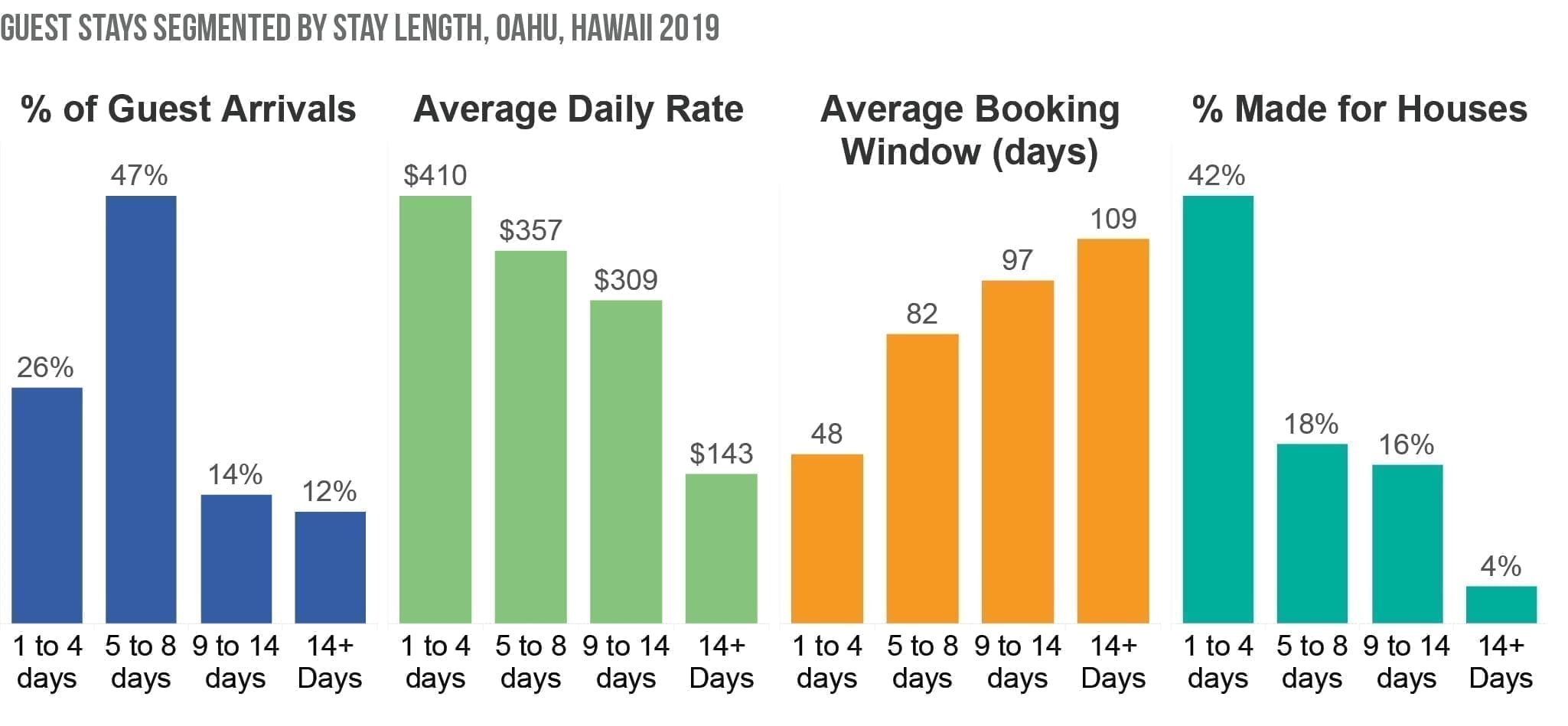
In 2019, summer guests traveling to Marco Island were more likely to stay in a house than in a condo: 62 percent of summer stays were in houses compared to only 41 percent of winter stays. Though winter and summer guests contributed to a similar number of reservations, winter guests stayed for 2.5x as long and booked 2.5 months earlier.

Pro Question: Are you paying attention to seasonal booking windows and adjusting your messaging to target the correct audience? In the case of Marco Island, marketing for the winter season should begin the previous July.


Length of stay (LOS)

As we’ve seen, LOS is one reason it’s helpful to segment by booking source, booking window, or season. However, as a metric for customer segmentation, it also stands on its own.

On the Hawaiian island of Oahu, 47 percent of 2019 stays were between five and eight days long—unsurprisingly, as it’s a long trip for many. That renter segment booked an average of 82 days in advance.

In contrast, stays between one and four days formed a substantial segment of reservations, 26 percent, but were booked much closer to arrival at 48 days away on average.

The biggest bombshell here is that 42 percent of stays between one and four days long were made for houses, compared to 18 percent of five-to-eight-day stays. At other destinations, you may see couples booking weekends relatively close to their trip dates, while extended families book a full week six months out. The rates, type of units, cancellation policies, and amenities they’re interested in are all influenced by these factors.

We’ve covered segmenting your guests by when they’re booking (booking window), how they’re booking (booking channel), where they’re arriving from (feeder markets), when they’re arriving (seasonality), and how long they’re staying (LOS).

There are market-specific relationships between these variables that will guide your marketing and pricing strategies. Dive into your historical data and compare it to what is currently going on in 2020 to determine which way works best for you. A good rule of thumb is that a group should form 8–15 percent of your guests before it is segmented on its own. Once you understand your customer segments, you will be able to more effectively market, price, and drive more bookings for your company and for your homeowners.