- Advertisement -
Home Blog Page 32

Co-founder Cliff Johnson resigns from Vacasa

7

Vacasa co-founder Cliff Johnson has resigned from his role as head of the company’s international division to join Rented.com as vice president of sales.

“Cliff’s contributions to Vacasa over the past nine years have been immense,” said Vacasa CEO Eric Breon. “He works harder — and has more integrity — than anyone else I’ve ever known. He’s had the Midas touch here at Vacasa, and I expect the same to continue moving forward.”

“It has been an honor to build Vacasa with Eric, Kimberly and the team over the past eight plus years,” Johnson said. “I’m really excited about the possibilities ahead for me and my family, but I will always have a special place in my heart for Vacasa and the team.”

Johnson and Breon started Vacasa in 2009. Based in Portland, Oregon, Vacasa was initially launched as a booking service. The pair quickly realized that the booking service model, without exclusivity over the management of the properties, would not be able to deliver the quality experience that their guests were seeking. Even though they had scaled up very quickly on the booking service model, in 2010 they made the decision to pivot and scale back down to focus on a full-service property management model

Since then, Breon and Johnson grew the company into the second largest vacation rental management company behind Wyndham, with 1,800 employees and 7,000 vacation homes under contract. The duo also raised over $143 million to capitalize on the fast-growing short-term rental industry.

Johnson added, “I especially want to recognize all of our tremendous housekeepers who make this industry great including Rogene McIntyre, Chris Brown, Jules Huber, Donna Rudd and so many more that have had the opportunity to further their careers with Vacasa as we’ve grown.”

Johnson will be based in Atlanta.

Read Johnson’s heartfelt letter to the Vacasa family. 


Vacation Rental Shopping 101: How to Book a Vacation Home Directly with the Manager or Owner

16

The word is out. Airbnb, VRBO.com, HomeAway, and TripAdvisor charge fees to consumers.

Unlike in the hotel industry, where the booking fees are passed on to the hotels, these sites are charging guests for the use of their online catalogs. And the charges are not insignificant with an additional 6 to 20 percent surcharge added to the rental rate, which translates to consumers paying hundreds of dollars more just to use these big websites.

But there is hope. With a little extra sleuthing, travelers can avoid fees and guarantee a better experience for their next vacation rental.


5 Ways to Bypass Fees and Book Directly with the Vacation Rental Manager or Owner

1. Search Google Local

When searching for a vacation rental, scroll past the paid listings (that say Ad in small letters underneath them) down to the Google Local listings next to the map. Click on the map find a treasure trove of local listings for vacation rentals.


2. Use Convention and Visitors Bureaus and Destination Marketing Organizations (DMOs)

Convention and Visitors Bureaus and DMOs are tax-funded and provide listings of vacation rental management companies and homeowners. Plus there is an added benefit. Since these sites are funded by tax dollars, guests can rest assured that the listings, management companies, and owners are licensed and providing legitimate vacation experiences.


3. Try Google Image Search

Using Google image search, travelers can search photos instead of marketplace sites to find the right rental for their family. Additionally, if you find a home you love on Airbnb or VRBO, try copying the picture into Google image search to find the original source of the photo.


4. Look for Clues in Descriptions

If you do find the perfect home on one of the big sites, look for clues in the description, in photo captions, or in reviews leading directly to the owner or manager. If that fails, copy the description into the Google browser to find the direct source of the booking.


5. Check out Facebook

Don’t neglect Facebook in the search for a perfect vacation home. Almost all homeowners and managers have Facebook pages. A Facebook search may take as long as a search on Airbnb, but at least you are communicating directly with the owner or manager and saving a ton of money in the process. Plus, there are a ton of great reviews on Facebook.


Many of the best home and deals are not even listed on the big websites because of the costs and headaches of working with these channels. In addition, vacation rental managers and owners have intimate knowledge of the area and their homes and can provide local, insider information that makes the stay exponentially better. Plus, they often have deals and tips on how to optimize your dates and budget.

Besides saving money, booking directly with the vacation home manager or owner provides travelers with an all-around better experience.

Vacation rental managers and owners share #bookdirect messages

3

With #BookDirect, a.k.a. Guest Education Day, fast approaching on February 7, vacation rental managers and owners are sharing their #bookdirect messages for travelers. Here are some examples:


National

Wyndham Vacation Rentals: 3 Reasons to Book Directly with Wyndham Vacation Rentals

Contact: Lino Maldonado, VP, Vacation Rentals

“You could be paying up to 12% in additional booking fees if you reserve your stay on a third-party booking site. Think about it. If your reservation is $1,000, you could be needlessly spending an extra $120…And our local teams are better equipped to answer specific and unique questions about your vacation rental that are important to your experience because they tour the homes & condos.”


Alabama

Anchor Vacations: Book Direct and Save

Contact: Donna Willis, Anchor Vacations

“We at Anchor Vacations live and work in this beautiful area of the Alabama Gulf Coast and we love to share information about what’s happening. Book direct and save with us.”


Meyer Vacation Rentals: Here is Why Local is Better

Contact: Michelle Hodges, CEO

“Say you have questions about a property or properties you are interested in. The OTAs are booking engines powered only to serve up listed properties that fit a defined set of filters. When you call the OTA, you’ll be speaking with an out-of-town call center worker who has no idea about Meyer’s rental policies or properties. When you call Meyer, you’ll reach one of our local vacation planners who has visited your property and can describe in detail the finer points of enjoying a vacation on the Alabama/Florida Gulf Coast.”


California

Abalone Bay Vacation Homes: How to Save Money on your Next Vacation

Contact: Donna Martinez, Owner

“The online travel agencies (OTAs) and  booking sites would have you believe that you get added security with 24/7 support…These fees serve to simply make a profit for HomeAway’s online booking websites, pay back shareholders and increase brand dominance and increase bookings, so increasing the cycle of profitability and growth…Mind you this fee does not assure the home you have booked is functioning well, nor will it help you deal with the raccoon that has entered the yard, or work with you to set up a special surprise for your anniversary. According to Airbnb’s help site in 2011, “This service fee is what actually goes to the site’s operation.”


Colorado

Great Western Lodging: Why Book Direct with Great Western Lodging?

Contact: Jeff Cospolich, Vice President & General Manager, Great Western Lodging

“Not only does our entire staff live in Breckenridge, our reservationists are situated at our Main Street office location, and we can see Breckenridge Ski Resort from our windows. We know the area, we know our properties and we can work with you to provide the very best accommodations for your stay in Breckenridge. When booking with third party sites, you run the risk of talking to a reservationist that does not know Breckenridge,…”


Florida

Cottage Rental Agency: Book direct in Seaside, Florida

Contact: Sarah Hanley, Marketing Director

“Most online booking sites charge a large fee when you book with them.  That’s why booking your vacation rental home directly with Cottage Rental Agency saves you a considerable amount of money, not to mention time.”


Destin Getaways: Save on your Destin Getaways Vacation by Booking Directly With Us

Contact: John Clausen, Owner and Broker, Crye-Leike Coastal

“Did you know that many of the big online travel agencies charge additional fees or inflate existing fees? We know your vacation is a special time for you and your family. We want to be sure you get the most our of your vacation dollar and make planning that stay as easy as posible!”


Dune Vacation Rentals: Book Dune Direct and Save

Contact: Bob Dickhaus, Owner, Broker

“VRBO now requires all property managers to remove their telephone numbers and web-links for their property listings. Phone inquiries are now being directed to outsourced call center operators with no local or property knowledge.”


Gulf Coast Property Management: The Benefits of Booking Direct VS OTA Sites

Contact: Vanessa Torres, Marketing Director

“It is crazy how far the vacation rental industry has come. 10-15 years ago, most people didn’t even know vacation rentals were an option aside from hotels. Now travelers have the choice of booking on multiple different platforms. But did you know booking a vacation rental on a travel agent site is costing you 10-15% more?”


Pristine Properties Vacation Rentals: Book Direct with Us, and You Do Not Pay the Extra Fees Charged by the Directory Sites

Contact: Justin Gerlack, Owner, Pristine Properties

“Booking directly with a professionally managed vacation rental company ensures you have a positive experience from booking, to arrival and throughout your stay. We work closely with our guests and our owners to provide you a wonderful rental experience in Cape San Blas, Indian Pass, Port St. Joe or Mexico Beach Florida.”


Georgia

Tybee Vacation Rentals: #BookDirect with Tybee Vacation Rentals

Contact: Amy Gaster, President, Tybee Vacation Rentals

“Why will you save? Because these websites add additional service fees on top of the normal rental charges from the property manager. In addition, you could be missing out on special offers or payment arrangements that the property manager is offering.”


Hawaii

Ali’i Resorts: Watch Out for Hidden Fees on the Most Popular Maui Vacation Rental Sites

Contact: Marci C. Cortisse, Billy Dirksen, Vern Andrews, Owners, Ali’I Resorts

“We are a group of locals that are passionate about island vacations and are excited to serve you during your stay. VRBO/Homeaway charge a 4 -9% booking fee on reservations for using their website. We would love to have you back again as an Ali’i Resorts guest and in addition to saving this fee by re-booking direct with Ali’i Resorts, we’re offering you a returnee discount. On an average stay of $3000, that’s a savings of $420! Call us today and see what you’ll save!”


North Carolina

Buffalo Creek Vacation Rentals: Why Book Direct?

Contact: Cheryl Hillis, Owner

“On top of the normal cleaning or pet fees, all major listing sites are now charging booking or service fees between 6% to 17% to the travelers/guests. If you are not aware, in any multi-day rental you may end up paying a hefty additional sum for no added benefit. These major listing sites are using scare tactics…If it was me, instead of paying these “booking fees” I would use the money to take my family or my friends to dinner!”


Carolina Mornings: Reasons to Book Directly with Carolina Mornings

Contact:  Shari Goldstein, Chief Executive Officer & NC Real Estate Broker

“We often offer specials on our website that aren’t available anywhere else. When booking through a third-party listing site, you’re not only paying more in fees, but you’re losing out on the potential for discounted rates… Not only do we include a healthy helping of Southern hospitality with every reservation, but we know our properties better than anyone else.”


Hatteras Realty by Wyndham: Book Direct and Save with Hatteras Realty

Contact: Edas Zemaitis, GM, Hatteras Realty by Wyndham

“These third-party booking sites can add an extra costs of 4-15% to your reservation with booking fees. We want you to save money on your vacation. Booking direct will help you do just that.


New Jersey

Beach Haven: Why Book Directly with Us

Contact: Tim Krug, owner, Beach Haven, Long Island

“There used to be a time when vacation rental owners could simply advertise their homes for rent and field calls and emails from travelers. We like to call this ‘2015.’ VRBO was a fantastic venue for owners and renters to find each other. Owners paid a flat fee to advertise…”


Oregon

Mt Hood Vacation Rentals: #BookDirect with Mt Hood Vacation Rentals and Save Money!

Contact: Betsy La Barge, Owner and CEO, Mt Hood Vacation Rentals

“Because of the cost of using the listing sites, the best and most popular vacation homes cannot be found on these travel websites. As a matter of fact only 10% of Mt Hood Vacation Rentals are listed on OTAs.”


Oregon Beach Vacations: Book through Us and Save Big on your Oregon Beach Vacation!

Contact: David McElveen, President, Oregon Beach Vacations

“These fees are disguised as booking fees, which Oregon Beach Vacations doesn’t charge when you book directly through us. These fees often go unnoticed by guests, but can lead to annoyance and frustration when they are noticed.”


South Carolina

Akers Ellis: Book Direct Kiawah Island

Contact: Steven Ellis, Founding Partner

“These extra fees can add up to be anywhere from 4-15% higher than booking a vacation rental directly!…Skip the middleman, avoid unnecessary third party fees,..


TripTease: Are you ready for #BookDirect day?

Contact: Lily McIlwain, TripTease

“Two online travel giants (Priceline and Expedia) dominate the marketplace with an estimated combined market share of 95%…Facing the same uphill struggle against rising online travel agent (OTA) commission fees, hoteliers and vacation rental companies (who are often pitted against each other in the competition for guests) will be finding their common ground and embarking on a campaign of guest education to highlight the benefits of booking direct.”

TripsIn.com joins in the February 7 #BookDirect movement

1

Built to be a true lead generation site, TripsIn.com offers a new option for property managers and owners. TripsIn.com abolishes consumer booking fees and gives homeowners back their properties to manage as they see fit. The consumer is in direct contact with the manager of the home, whether it’s the owner, or the property manager. This advantage gives the renter access to someone with a local’s touch, not some call center far away that has little to no idea of the property’s location, amenities, and special touches.

“In a way, we are bucking the trend—I joke with people in the technology world that we are going backwards 15 years; back to the old days of a simple lead generation website and putting the customer in direct contact with the property manager or owner,” said Jay Gould, CEO of TripsIn.

Gould added, “Our industry has been taken over by the giant booking sites. Their model is to charge both the owner of the property to advertise on their website, and NOW the consumer to book their vacation.  We feel that the end consumer shouldn’t have to pay these outrageous booking fees.”

TripsIn.com initially rolled out in Colorado, and quickly expanded into South Carolina. They will soon launch in other vacation spots around the world including Southern California, Florida, Utah and Maryland. TripsIn.com offers an international presence with vacation rentals in Mexico. With a true love affair for the sandy beaches of Mexico and partners in Isla Mujeres and Los Cabos it was a perfect match.

TripsIn.com looks forward to returning control of the booking experience back to the consumer.

Contact sales@tripsin.com to have your property listed and enjoy 3 months free. TripsIn.com invites you to “Join Us… Join the Cause. #BookDirect with TripsIn.com.”

Tripz.com is supporting #BookDirect day on February 7th, 2018

1

The first ever Guest Education Day is coming up on February 7th, 2018, and there is a new social media campaign to help reach and educate guests in search of vacation home rentals. This campaign is an incredibly important and simple way to communicate to travelers on how the vacation home rental market has changed in recent years, especially regarding communication and the booking process. Tripz.com will gladly participate in the #BookDirect campaign.


BUT FIRST…WHAT IS #BOOKDIRECT?

Direct booking is exactly what it sounds like: Travelers who find a vacation rental home they would like to stay in contact the property owner or manager directly. Many travelers that book vacation rentals on major sites like VRBO, HomeAway, Airbnb and TripAdvisor are unaware it’s not truly direct. Those sites play as a middleman, stifling direct communication and add hundreds of extra dollars to the transaction. Hence the movement of the #BookDirect campaign, it’s about educating travelers of truly booking direct.

The #BookDirect campaign is pretty straightforward: on Wednesday, February 7th, post the hashtag “#BookDirect” on Twitter, Facebook, Instagram and LinkedIn to help drive attention online. In addition, send an email to past and prospective guests to further push the campaign directly to travelers and educate them on the perks of booking directly with the vacation home rental owner or manager.

In the announcement made by VRMintel, they provide key points of the campaign for you to send out to potential travelers and guests, including:

Many of the best vacation rentals aren’t event listed on the major sites.

Because of the cost of using the big sites, the best vacation homes with the highest demand cannot be found on the big websites. Along North Carolina’s beaches, alone, only 30 percent of the homes for rent can be found on the big websites. By limiting your search to the aggregating websites, you might be missing out on the best vacation home for your family or group.

If you have special needs, a manager or homeowner can help.

Looking for help with your family’s special needs or help with pets? A manager or owner can work with you directly to help with any of your individual needs and give you these assurances before you commit to a booking.

During non-peak travel times, managers and owners have special offers available.

From events and activities to special rates to onsite services, with direct communication with managers and owners, you get insider knowledge and the best offers.


WHERE CAN A TRAVELER #BOOKDIRECT?

There are several ways a traveler can book direct. One is to research and find the owners and managers direct. Most have direct websites where you can reach out and book with them directly. The other option is use sites like Tripz.com that is designed to help travelers browse thousands of vacation rentals all on one place all with the owners direct info on the listing allowing travelers to #BookDirect and save. Its sites like Tripz.com that are helping vacation rental owners and managers help build their brand and create awareness among travelers that the best bookings for vacation rentals are direct ones.


DIRECT BOOKING & OPEN COMMUNICATION

Tripz.com is supporting #BookDirect day on February 7th, 2018, as it is passionate about saving travelers unnecessary service fees many travelers are being forced into paying. The Tripz.com platform utilizes organic searches so you, as a traveler, can find the best vacation rental for your needs.

When travelers book on Tripz, they communicate directly with the owner of the property they want to stay in, without a website interfering. Direct booking on Tripz.com saves money for the traveler and allows the vacation rental property owner to price the property based on the true market value and not one accounting for service fees or commissions. Tripz.com does not charge service fee to travelers or commission to vacation rental owners, meaning when you book directly with Tripz.com your money goes further.

Open communication is a primary value to Tripz.com because without open communication between vacation rental owners and the traveler, direct booking can’t exist. That is why Tripz is excited for this new social media campaign, because we believe direct booking and open communication practices are the way business is intended to be.

Tripz.com is looking forward to the positive impact the #BookDirect campaign is going to have in the vacation rental industry. Follow us on Twitter and Instagram, and please like our Facebook page to see our Guest Education Day posts on February 7th.

Hospitality is key to success for vacation rental management companies

0

What is hospitality? The dictionary defines it as “the friendly and generous reception and entertainment of guests, visitors, or strangers.” The Bible points to hospitality as a spiritual gift, with instructions such as, “Treat the stranger who sojourns with you as the native among you”; “Show hospitality to one another without grumbling”; and “Do not neglect to show hospitality to strangers, for thereby some have entertained angels unawares.” Buddhists hold a similar view of hospitality, a.k.a. sakkàra, which is described as the act of being welcoming and helpful to guests, strangers, and travelers. 

In the travel industry, service and hospitality are often interchangeable, but, according to hotel marketing consultant Brenda Fields, the two are different concepts. “Service can be defined as the ‘act’ of providing a service, whereas ‘hospitality’ is the ‘cordial attitude’ of the person providing the service.”  

Being hospitable is easier for some people than it is for others.

In the vacation rental industry, property management companies that have one or more hospitality-minded executives among their top leadership have a higher chance of success as the industry continues to shift.

With a hospitality-minded leader, the company is laser-focused on its core mission of providing great accommodations and experiences for guests. These leaders operate with a clear vision of why they are in business, what service they provide, and how they want to provide this service. With this clarity of vision, the team can eliminate much of the industry noise and focus on making guests comfortable and providing them with clean and safe vacation accommodations. This also allows the team to focus on maintaining the properties in the program. 

Hospitality is a gift and—for many—a passion. If a company lacks hospitality-minded leadership, its mission tends to focus on getting guests in and out the door. The properties are not matched to guests, and the guests’ experience suffers.  

For RBOs and hosts, hospitality is a key differentiator. Hospitality-minded RBOs and hosts who genuinely enjoy sharing their homes generally have different goals and motivations from RBOs and hosts who are only renting for the income. Income-driven homeowners who would not rent otherwise are sensitive to who is staying in their homes and tend to be more critical of cleaning and management. Any business that is working with or trying to attract RBOs or hosts will benefit from segmenting its prospects by their primary motivation.   

The more closely a company can align its hospitality-oriented goals with its owner base, the more successful the company will be in the face of marketplace shifts like the ones expected to emerge in the vacation rental industry.

Simon Lehmann: “This game is, by far, not over yet.” 

0

Simon Lehmann discusses the future of the vacation rental industry, Airbnb, HomeAway, and upcoming challenges and opportunities 

When researching the vacation rental sector, it doesn’t take long to encounter the name Simon Lehmann. Over the years, Lehmann has made a name for himself as an expert in the online travel and vacation rental industries. He has worked closely with companies in all sectors of travel and has held several key positions including CEO of Interhome from 2005 until 2014, president of Phocuswright until late 2017, CEO of Biketec, deputy CEO of the Hotelplan-Gruppe, and various high-level management appointments at Swissport International, a worldwide leading company in airport ground handling and a former Swissair Group company. 

Additionally, Lehmann has been involved in strategic planning with many of the leading and up-and-coming players in the vacation rental sector, has served as a board member for Inntopia, and has held a position as a nonexecutive board member for HomeAway prior to its purchase by Expedia. Lehmann is passionate about identifying new talent and mentoring founders of industry startups, and has invested in many of them. He currently serves as a board member for Vacasa Europe and as an advisor to Rented.com, Transparent, ProperlyHelloHere, and Travelnews.ch. 

He is frequently invited to speak at online travel events worldwide. In October of 2017, Lehmann stole the show at the Vacation Rental Management Association (VRMA) National Conference in Orlando, where he discussed the direction of the market and led an animated panel discussion with industry leaders Ben Edwards, Steve Milo, and Jodi Refosco. He will be headlining the VRMA European Conference in Paris and VRM Intel Live in London this March. 

Lehmann lives in Switzerland with his wife and five children and recently celebrated the holidays in Spain with extended family, which is where we caught up with him to discuss the industry’s trajectory, Airbnb, HomeAway, Wyndham, and the challenges facing the vacation rental sector in 2018. 


Amy Hinote (AH): What overarching trends do you see impacting the way the vacation rental industry is shaping up today?  

Simon Lehmann (SL): A massive convergence is taking place and the entire hospitality vertical is becoming one. As always, the consumer is shaping the industry, driven by a changing behavior and available technology. Customers have diverse needs that must be fulfilled. At the end of the day, consumers are looking for accommodations based on their immediate needs. One minute they’re looking for a hotel and the next a private room in an urban location or simply a vacation rental to holiday with friends and family. This means that the shopping funnel will change dramatically, and we will see the supply side melting into each other and consumers will be harder to catch. 


AH: In your career, you’ve led Interhome as CEO and Phocuswright as president and served on many high-profile boards including HomeAway, Vacasa, Rented.com, Inntopia, and more. You’ve had an up-close look at the industry’s many iterations. What are the biggest challenges this industry has faced over the years? 

SL: First of all, the industry had to be lifted out of its “Tupperware” phase. Vacation rental was perceived as a secondary industry with bad inventory, and it had a reputation of being unprofessional. It has never been recognized as a huge industry on its own, which by the way has been around for decades. It needed organized supply, online distribution with bookable inventory, and a clarification of the value proposition for consumers.

Then Airbnb showed up, and all of a sudden, a ton of money went in to startups that basically verticalized the industry again, similar to what happened in travel. Everybody wanted a piece of the value chain from the consumer side to the owner side. Therefore, the immediate and largest challenge has been to be recognized as a professional, vertical industry that offers a great proposition to consumers as well as owners. Secondly, it will have to overcome its fragmentation globally. The challenge that remains is to standardize the business. The ultimate owner of the product is in most cases still an individual home owner. So, the business needs to become more professionalized overall, and the owner needs to recognize what drives value for consumers in order to maximize occupancy. 


AH: While you were at Phocuswright, the vacation rental industry got wrapped up in a broader sector labeled “private accommodations.” Do you think traditional vacation rental managers, hosts, and urban operators will come together in a more cohesive way? 

SL: As mentioned in one of the earlier questions, inventory will become more cohesive to satisfy consumers’ needs. This is no longer private accommodation—it’s all hospitality now, in a broad sense. The guest experience as a whole is key and not simply the accommodation. Let’s not forget that consumers spend only 40 percent of their travel budget on accommodations. People expect an experience regardless of whether they book a hotel, an apartment, or a vacation rental. Therefore, the industry will have to come closer together and think about it in overarching fashion. Let’s remember what happened in the hotel industry and how they are trying to accommodate consumers’ needs and behaviors. They have not yet figured that out yet, and yes, we have seen some movements by Hyatt and Accor, but I think that is only the start. One thing we should not forget is that the consumer is looking for value, location, and experience regardless of the type of accommodation. 


AH: Airbnb has been moving in many directions with acquisitions, property management, and movement into multiple sectors of travel and hospitality. What do you think are their larger aspirations? Do you think they will move forward on their IPO in 2018? 

SL: I guess the investors of Airbnb are getting nervous to justify valuation. What is Airbnb now and what is Airbnb going to be in the future will not be the same also in relation to vacation rental. The value proposition as a marketplace for primary or secondary home is not enough anymore. The brand has already huge consumer value and it is tempting for them to reach out in to all different directions. I guess Airbnb needs to find its place, but the company has the opportunity to become an OTA for the next-gen traveler in addition to being a valuable channel for the vacation rental industry. Offering local activities and the opportunity to live like a local will not move the needle—that’s not what the traveler is looking for—but leveraging its brand value across other verticals will be far more compelling. But let’s not forget the regulatory issues that are looming out there and need to be tackled in cooperative fashion. Airbnb is in a great position for an IPO but needs to become clear on its strategy going forward. 


AH: HomeAway has made some substantial changes regarding fee increases and policies, and we hear there are more changes to come. Looking at the OTA landscape, do you think HomeAway’s moves will prove to be successful for them long-term while competing with Airbnb and Booking.com? 

SL: Looking at the distribution landscape today, we can say that it has narrowed down to four large platforms in the vacation rental space. Once you build a brand and generate a great amount of traffic and demand, you are tempted to maximize revenue streams. But as we have seen in the hotel space before, this will start to backfire midterm. We have not even spoken about Google yet and what role they are going to play. They have made some announcements to build a platform like Hotel Finder for the vacation rental industry. So, increasing fees will not help the long-term game. Investors are applying pressure on OTAs right now, trying to leverage their consumer reach and massive inventory to squeeze the lemon a lot more until it’s dry. Playing at the top of the funnel is an expensive game, but VRMCs will look for alternatives to find their guests at lower costs. This game is, by far, not over yet. 


AH: Do you see any room for or evidence of an upcoming disruption in the OTA landscape? 

SL: As mentioned above, alternatives exist such as metasearch, content aggregators, and other intermediaries. We have seen many different startups in various places that are trying to get a piece of the pie, but I’m skeptical about how successful they are going to be. But yes, there will be disruption in distribution, and perhaps even the large hotel companies might play a game in that going forward. Focusing on building loyalty and repeat customers might be a game-changer too for companies that have enough inventory to cater guests’ requirements. VRMCs are not well equipped with CRM technology and therefore are not very strong in building loyalty and repeat customers. We will see a lot more disruption in this game especially as Google moves closer to the product for distribution. 


AH: Why do you think Wyndham is selling now? Do you think they will sell their North America business, too? 

SL: I can’t comment on this question, except to say that it makes sense that during a strategic pivot you would review your portfolio and think about what makes sense and what doesn’t. With their spinoff of the hotel business, it makes perfect sense for them to divest their European VR asset to focus on the timeshare and hotel industries. What they will do with their North American VR asset remains to be seen. 


AH: We are seeing a lot of consolidation in the industry. What is driving this trend, and do you think it will continue? 

SL: You need to control the product and therefore the inventory. If you want to be a serious player who can invest in distribution, product, and guest experience you need to have scale because you need to reach your guests in an economical fashion. If we compare this to the hotel industry, it is clear that you need scale to be successful. In Europe, hotels are under massive threat by the large OTAs because hotels have become too dependent. Therefore, the industry will continue to be consolidated to build serious inventory; only then can you leverage operation costs and build a business at scale.  


AH: What are your predictions for the vacation rental industry? 

SL: Consolidation, standardization, and commoditization, and therefore professionalization. This business is here to stay, and it will make a lot bigger impact in hospitality than everyone thinks. 

HomeAway’s Jeff Hurst discusses “off-platform booking” attribution

21

When HomeAway sent an email to vacation rental managers on December 14 introducing a pricing increase for subscriptions—along with a new fee for off-platform bookings—the vacation rental community sat up straight.

The email said, “HomeAway will begin charging a fee for every off-platform booking, which will amount to 10% of the pre-tax total to be charged to the traveler for the stay.”

“Off-platform bookings” were defined in the email as “bookings that originate via HomeAway but are not processed through HomeAway checkout.”

The email also said, “All partners wishing to purchase a new subscription or to renew a subscription with a start date of March 15th or later (even if paid in advance), must first acknowledge and agree to these terms and provide payment-card information to be kept on file for processing of off-platform-booking fees.”

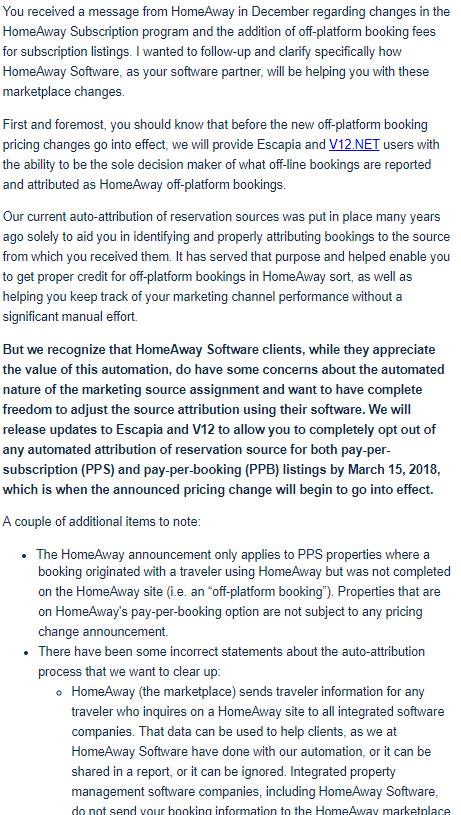
The news resulted in numerous reported communications between property managers (PMs) and HomeAway representatives seeking clarification about how this announcement was going to be implemented. PMs reported and shared email communications indicating that HomeAway would be comparing traveler activity on HomeAway’s websites with booking activity within integrated software to determine which internal direct bookings should be attributed to HomeAway.

However, HomeAway chief commercial officer, Jeff Hurst said that was never going to be the case.


In an interview with VRM Intel on Monday, Hurst said that this (off-platform activity) was a known loophole at HomeAway that “we didn’t have the enthusiasm to close.”

“We thought it would naturally go away, and it didn’t,” said Hurst.

Hurst used the example of an executive colleague who found a vacation rental on HomeAway that was managed by a large property manager. Through the inquiry process the colleague was overtly encouraged to complete the booking directly with the manager.

“Our intent [is] if a guest finds a PM through our sites, and the PM believes we created value, we get credit,” said Hurst. “If you believe we created value, pay us, and we will go about our merry way to add more value for you.”

He added, “We think 10 percent is a reasonable price.”

In the interview, Hurst maintained that the original policy was to allow property managers to choose for themselves which off-platform bookings they would like to attribute to HomeAway. “[The idea that] we were going to unilaterally go in and charge 10 percent was not the case,” said Hurst.

According to Hurst, PMs will have the freedom to indicate which reservations they think should be attributed to HomeAway and for which they will pay the 10 percent fee the company. He also said that rankings on HomeAway’s sites would be positively or negatively impacted by the number of these reservations that a PM decides to attribute.

Hurst clarified that bookings done on the phone would not be expected to be attributed to HomeAway as contact phone numbers have been removed from HomeAway’s listings. “If the PM’s phone rings, they found the PM through another source,” said Hurst.

Hurst disputed reports from PMs that HomeAway representatives reached into the property management software to provide projections on off-platform booking activity saying that these projections were likely “based on the number of bookings the PM attributed to HomeAway last year.”

In a separate email to the VRMA and FVRMA boards, Hurst said, “HomeAway does not have a policy to search property managers data for bookings that should be attributed to HomeAway.”

One Florida-based property manager questioned the effectiveness of the new policy. “What would possess you to pay 10 percent of a booking to get a small bump in ranking? It is just a joke.”

On Thursday, Cliff Vars, general manager at HomeAway Software sent a follow-up email to PM clients saying, “We will enable you to be the sole decision maker for identifying which bookings are attributed as HomeAway off-platform bookings, and we will release those changes along with information on how they will work before the 3/15 marketplace changes go into effect.”

“We want to get paid when we create value,” said Hurst.

FVRMA President Discusses Owners’ Right to Rent Vacation Properties

2

I recently traveled to Tallahassee to represent the Florida Vacation Rental Management Association and an industry which has become a vital part of Florida’s tourism economy, at Tourism Day at the Capitol.

I had the opportunity to listen to an encouraging speech given by Florida Restaurant and Lodging Association (FRLA) President and CEO Carol Dover. One that we would like to hold her to.

Having seen her previous comments deriding vacation rentals in our state, I sat back prepared to hear more of the same. However, I was pleasantly surprised when she began with a question I, too, have been asking: Why would the FRLA not embrace vacation rentals?

Vacation rentals create extra capacity for the ever-increasing number of travelers coming to our beautiful state. These same visitors help support local businesses and restaurants, some of which are members of the FRLA.

As vacation rentals, fueled by easy-to-use online platforms such as Airbnb and HomeAway, have increased in popularity, some have suggested that the Florida hotel industry must be suffering. The data shows the opposite. The Florida hotel industry is growing as well.

Many middle-class individuals rely on their ability to use their homes as vacation rentals for extra cash to pay the bills, buy new school clothes for their kids, or save for a new car. This extra income pumps millions of dollars into local economies and benefits all businesses.

As the saying goes: “A rising tide lifts all boats.”

Reputable vacation rental owners and managers, like myself, want to do what is right and pay our fair share of taxes back to our local and state government. We are not looking for a “free ride.”

As Dover continued her remarks, I found myself nodding along. FRLA, she stated, is trying to accomplish just three main things when it comes to vacation rentals:

  • First, make sure all vacation rentals are registered and licensed through the Florida Department of Business and Professional Regulation. We agree.
  • Second, require that a license number to be included on all advertisements. We agree.
  • Third, ensure vacation rental owners are paying the same taxes that everyone else pays. Again, we agree.

I was only disappointed when she stopped short of expressing support for Sen. Greg Steube’s and Rep. La Rosa’s bills. As they are currently drafted, the bills protect the private property rights of all homeowners and ensure that regulations are applied uniformly. I remain hopeful that one day soon our organizations will be standing side by side in support of this legislation.

It should not matter whether a homeowner chooses to rent their home on a short-term or long-term basis, or not at all. Local ordinances should be applied equally. Noise is noise and trash is trash, regardless of who is inhabiting the home.

And that is why statewide standards are so important and must be a part of the conversation.

Dover acknowledged that uniform regulations at the state level were essential to Florida’s restaurant and lodging industry that, prior to the late-1980s, struggled with how to deal with regulations that varied vastly across 67 counties and 457 municipalities.

Property owners should be afforded the same advantage.

Jennifer Frankenstein-Harris is president of the Florida Vacation Rental Management Association.

Unbundling the Property Manager 

0

Property managers (PMs) traditionally provide a wide range of activities, including design and listing preparation, competitive benchmarking, pricing advice, marketing, distribution, guest screening and communications, reservation services, payment management, operations management, property care, emergency support, and owner services (e.g., tax and compliance and trust accounting). 

The dominant model in the US is the full-service property management company in which all of the above services are delivered as one all-you-can-eat package and is typically priced between 15 percent and over 50 percent of rental income. There have been departures from this model in the US: most notably, Evolve Vacation Rental, which charges a 10 percent fee for marketing, distribution, and some listing preparation services, but does not provide on-the-ground property care services or operations.  

Is the full-service, all-you-can-eat manager the only viable model or are there attractive, unbundled models? Is the idea of unbundling a threat or an opportunity for a PM? Will the listing platforms that drive unbundling change how the pie is divided? How should each of the components be priced? Is unbundling a “gateway drug” that can help ease DIY homeowners into using a PM or a margin killer that will relentlessly drive PMs’ margins down? 


All-you-can-eat vs a la carte 

One common economic argument for bundling is to package a key service with several services of lower value, and hence drive a higher take rate than what could otherwise be obtained. Arrangements like this typically do not last very long, as competitors are likely to unbundle in an effort to gain market share. From this perspective, Evolve’s progress will surely be closely watched because its entire strategy is centered on an unbundled, low-cost product. Much will depend on whether Evolve correctly identified the key value driver.  

David Angotti, a former PM and co-founder of SmokyMountains.com, who first explained his vision of an unbundled PM to me, is on the other side of this debate. In his view, selling a homeowner exactly what he or she wants—unbundled guest management, distribution, property care, or revenue management—should have two positive effects: one, it should increase the addressable market by offering something for everybody (e.g., the Gen X empty-nester with the million-dollar second home may not want to relinquish screening guests, but he or she may not want to deal with the daily operational hassle of managing cleaning staff or revenue management). Second, as long as the “sum of the parts” is priced significantly higher than the bundle, the initial unbundled service might just be the prelude to an evolving, full-service relationship. 


The European example 

The European market is quite different from the US market, and its much larger traditional PMs—Novasol, Interhome, Interchalet, and Belvilla—are mostly master-distributors: a significant majority of their inventory has on-the-ground services either managed by the owner or by a local third party. In other words, they look much more like Evolve than Vacasa. 

This likely explains why European enterprise PMs are larger than their US counterparts: offering listing, distribution, guest support, and owner services without directly providing on-the-ground services allows them to focus on source markets—which is important in Europe, where a different language is spoken every few hundred kilometers—while covering much of Europe for destinations.  

So, this unbundling was likely driven by necessity due to relatively small source markets and distributed destination markets, but it seems to have had the side effect of increasing some European PMs’ scale. Simon Lehmann, former GM of Interhome and president of Phocuswright, argues that the different dynamics of the European market are also due to the greater maturity of this market. Whichever the reason, the European example demonstrates that unbundling is viable at a significant scale. 


Pricing each component 

So, if one was to unbundle a PM’s services, how much would each component be worth? This is a difficult question to answer, but here is an attempt. Let’s assume a full-service manager charges an effective commission of 50 percent including guest fees. A good proxy for a PM focused on listing management and distribution only is Evolve in the US, and Novasol, Belvilla, Interhome, and Interchalet in Europe. Commissions for this group cover a wide range: from Evolve’s 10 percent to the European’s commissions in the low- to mid-thirties. 

What explains the discrepancy? The fact that European PMs control a significantly larger share of direct bookings through more complex distribution arrangements likely explains this discrepancy. A typical European “master distributor” likely captures a much higher share of its bookings from direct channels: direct mail, catalogs, CPC, its house list, and its own website. Even master distributors’ third-party distribution is likely more complex because thousands of travel agencies still play some role in Europe. Conversely, Evolve’s bookings are likely more concentrated across the three large listing platforms. This likely caps the opportunity to increase master distributers’ commission rate in the short term until direct distribution is significant. 

One additional distribution component that can be priced separately is the channel manager; there are several available, and charges typically hover around the 1 percent commission mark. 

How attractive are the margins for a master distributor? As reliance on listing platforms is increasing, these margins are likely shrinking. This is first because the listing platforms are bidding up the price of advertising, especially online. Second, the effective low rates charged by most listing platforms are probably not going to last; a master distributor like Evolve can’t distribute on a platform like Booking.com because a 10 percent commission can’t cover a 15 percent booking fee. The other platforms are still viable because they simply pass the cost onto the guests via the guest fee. However, the listing platforms’ effective booking fees (combining guest and booking fee) are already well above 10 percent; this begs the question of whether guest fees will last. The success of vacation rental metasearch engines—Tripping and others—might make charging guest fees more difficult. 


The urban PM and Airbnb’s cohost 

The urban PM presents an interesting case study: many urban PMs focus on on-the-ground services much more than on distribution; and as such, they are a good proxy for an unbundled PM focused solely on operations and property care. This is particularly the case for Airbnb-only PMs and Airbnb’s cohost program. Many urban PMs and Airbnb’s cohost program charge between 15–20 percent commission (typically without guest fees other than a pass-through cleaning fee). This implies that a 15–20 percent range is a good guess for the stand-alone value of setting up the listing, managing guest communication, and most importantly, coordinating local services. 

Guest communication is an item that can be further isolated; as a technology component, (unified inboxes, auto responders, and templates), this is typically priced at 1 percent or below. Companies like Guesty have long operated stand-alone services. Similarly, there are several outsourced call center services available, which are also typically priced at 1–2 percent. Interestingly, the listing platforms are encroaching on this domain both by offering tech solutions and services (such as guest call center support). 

This implies that a 10–14 percent commission is a reasonable proxy price for the component of a PM’s job that relates to managing—but not providing—local services. The services themselves are typically either charged to the guest (e.g., cleaning) or to the owner (e.g., maintenance).  


The techenabled PM 

Revenue management is another feature of the service stack offered by a PM that can be priced out separately: stand-alone charges for these services typically hover around the 1 percent mark or lower by wholesale providers. This, together with guest service apps, is often a feature of the so-called tech-enabled PM.  

The “tech-enabled PM” label is often used in conjunction with a small group of typically US-based PMs who hope to derive efficiency, better distribution, or more accurate pricing through technology. More likely, we will find the tech-enabled PM elsewhere: with the listing platforms that are truly offering more and more sophisticated technology to both owners and PMs. These platforms include HomeAway’s MarketMaker, Airbnb’s unified mailbox or check-in help, and Airbnb’s increasingly extensive integrations with local government to account for and collect taxes; there is no doubt who has the required scale in a technology race between PMs and platforms. 

So even the aforementioned owner services, when unbundled, may be under pressure from parallel offerings from the listing platforms. 


Gateway drug or margin compression? 

So, is an unbundling of property management services a smart strategy to bring in a wave of new clients, or is it a necessary evil as the listing platforms start chipping away at the services traditionally offered by a PM? 

Several PMs have pointed out that some segment of owners may only want to give up control of certain aspects of managing their property: for instance, Gen Xers who do not currently rent their second home may want to maintain control over screening who gets to stay at their home but may not want to get involved with the day-to-day hassle of organizing turnovers.  

Similarly, an RBO may not want to take on a full-time manager just yet, but it might be willing to pay a fee for after-hours maintenance support. Viewed this way, unbundling services may act like a “gateway drug”: once owners start realizing that it is advantageous to give up control over some aspects of managing their property, they may ultimately gravitate towards adding on other services.  

Based on the calculations above, not all components of a PM services bundle have the same margin. Viewed like this, it could actually be beneficial for a PM to let go of certain services. Also, David Angotti makes the argument that owners rarely understand just how many services their PM provides to them. Once services are unbundled, the sum of the parts may quite well cost more than the bundle—and this alone guides owners back to service bundles. 


The local service conundrum 

Tobias Wann of Europe’s @Leisure maintains that a linchpin in the relationship between PM and owner is still the local relationship—the on-the-ground-services. This idea makes sense because ultimately, the asset value of the property dwarfs the annual revenue stream; thus, good stewardship of the asset is likely to feature prominently in an owner’s priorities.  

From the back-of-the-envelope calculations above, it also seems that local services are a meaningful revenue component inside a PM services bundle; because the actual cost of the service is typically passed on to the guest (or owner for maintenance), management of these services should carry healthy margins. Lastly, PMs should not expect margin pressure over local services from the listing platforms because this is not an area of strength for them. Indeed, a country manager for a leading listing platform told me recently that, from his perspective, control of the relationship with local service providers was the leading reason why owners chose PMs vs rent-by-owner. 

Of course, this critical local component has traditionally also limited PMs’ ability to scale beyond their original service area. Combining technology that helps manage and deliver local services more efficiently with building an advantage in sourcing high-quality, local service providers is an attractive path toward building a sustainable competitive advantage for PMs. 


Conclusion 

The full-service PM has long been the dominant model in the US. With the emergence of the urban, Airbnb-only PM, there is now an emerging case study of a set of US PMs focused mostly on local services. This group of PMs sets a benchmark for how operations, listing management, and guest management, unbundled from distribution, would be priced; a prevailing price point is around a 15–20 percent commission.

Conversely, Evolve has unbundled a package of services focused on distribution and including listing management and guest management. Large European PMs offer similar hybrid models. These bundles are typically priced between 10 percent and 30–40 percent, depending on how much distribution clout the PM has. As the listing platforms continue to drive more traffic to PMs, distribution-focused bundles will see margin pressure; the more a PM’s distribution is proprietary, the stronger the position of that PM (but margin pressure will continue because the significant spending of the listing platforms are bound to drive traffic acquisition costs up). 

In most markets, a significant number of homeowners still choose a rent-by-owner model over a PM, and millions of second homes have not entered the rental market yet. Offering property management services a-la-carte, versus only bundled full-service packages, can provide an introduction to property management services for both RBOs and latent supply. Starting from local services may be more defensible in the long run and likely carries higher margins. 

#BookDirect: Guest Education Day, February 7 — Let your guests know it pays to book direct, book smart, and book local.

33

With a multitude of new travelers searching for vacation rentals, vacation rental managers and homeowners are joining forces for one day with a singular message to let travelers know that there are many advantages to bypassing third-party channels to book directly with management companies and homeowners.

On February 7, on this inaugural non-branded Guest Education Day, managers and owners are encouraged to:

  • Ask employees to use the hashtag #bookdirect on Twitter, Facebook, Instagram, and LinkedIn to bring attention to the many advantages of booking  vacation rentals directly with the manager or homeowner instead of on third party channels.
  • Send out an email campaign to their past and prospective guests with a message about the value of booking direct, booking local, and booking smart.

It only take a about 1,200 #bookdirect tweets and retweets to trend, which will draw attention from the media about the value of booking direct and educate consumers about the hundreds of dollars they are unnecessarily paying in fees to third party channels.

Industry influencers will be supplementing the message with national media press releases and story lines.

Related: Vacation Rental Managers Share #BookDirect Messages

Here are some ideas for messaging:

  • Book direct and save: Did you know that Airbnb, VRBO, HomeAway and TripAdvisor add hundreds of dollars of fees to your booking total?
  • When you book direct, you have direct contact with the manager or owner: When booking a vacation rental, peace of mind is important. Want to know if there is a grill, a kayak, 24/7 service, a grocery store close by? When you book direct, you can find out many of these important questions and more before you commit to booking.
  • The best price isn’t on the OTAs: Unlike hotels, OTAs and aggregators (like Airbnb, Expedia, Booking.com, VRBO.com, HomeAway, TripAdvisor, and FlipKey) don’t have the best price for travelers. In fact, you can save hundreds by booking direct and booking local.
  • Many of the best vacation rentals aren’t event listed on the major sites: Because of the cost of using the big sites, the best vacation homes with the highest demand cannot be found on the big websites. Along North Carolina’s beaches, alone, only 30 percent of the homes for rent can be found on the big websites. By limiting your search to the aggregating websites, you might be missing out on the best vacation home for your family or group.
  • Mangers and owners have intimate knowledge about the destination: They can direct you the best rental for your needs and send you to the best activities, restaurants, and area service providers.
  • If you have special needs, a manager or homeowner can help: Looking for help with your family’s special needs or help with pets? A manager or owner can work with you directly to help with any of your individual needs and give you these assurances before you commit to a booking.
  • During non-peak travel times, managers and owners have special offers available: From events and activities to special rates to onsite services, with direct communication with managers and owners, you get insider knowledge and the best offers.

While the vacation rental industry often pits managers and owners against each other, the fact is that there are both management companies and owners who strive every single day to provide amazing vacation rental experiences for guests. OTAs and third party sites have made recent changes to their business models that have been detrimental to both guests and vacation rental providers (including managers, owners, and hosts).

Coming together as an industry in this small way on this one day provides the industry with a valuable cooperative effort to push back on OTA changes and provide guests and media with much needed education about the industry.

Join vacation rental providers on February 7th using the hashtag #bookdirect to help educate guests on the advantages of booking directly with you.

Comment below with any suggestions about messaging and ideas.

VRM Intel Live! is coming to Orange Beach, Alabama, February 5, 2018

0

In light of recent changes in the regulatory environment, at HomeAway, and across the industry, VRM Intel is hosting an informational and educational event for vacation rental professionals on February 5th at the Perdido Beach Resort in Orange Beach, Alabama.

With 13 sessions between 8:00 am and 5:00 pm, 22 speakers will discuss industry shifts, marketing, profitability and the acquisition environment.

The cost is $129 per attendee. (Note: This event is sold out, but we are meeting with the venue to try to increase capacity. Email amy.hinote@vrmintel.com if you would like to attend but have not yet registered.)

Sessions include:

  • Vacation Rental Industry Changes and What’s in Store for 2018 with Ben Edwards, Newman Dailey; Lino Maldonado, Wyndham Vacation Rentals; Jason Sprenkle, 360 Blue; Paul Wohlford, Resort Collection
  • Unfiltered: The Real Cost of Working with OTAs and 3rd Party Channels in Light of Recent Changes at HomeAway and Other Listing Sites
    Steve Milo, CEO and founder, VTrips & Vacation Rental Pros
  • Converting Online Shoppers: Website Design & Usability Tactics with Brandon Sauls, CEO, ICND Using In-house Damage Waiver Programs to Grow the Bottom Line
  • Balancing Direct and 3rd Party Bookings: How to Leverage Changes at Channels to Grow Direct Bookings with Peter Scott, President, Bluetent
  • 2018 Acquisition Environment on the Gulf Coast with Ben Edwards, VP, Newman Dailey, founder Weatherby Consulting, former president, VRMA
  • 2018 Rental Regulatory Environment with the Baldwin County Association of Realtors and Panel
  • Building Revenue with In-House Accidental Damage and Bed Bug Remediation Programs with Laird Sager, CEO, Red Sky
  • Getting the Most out of Property Management Software and New Technology with Doug Macnaught, Managing Partner, VRM Consultants & co-founder, Instant Software
  • Staffing Challenges: Finding, Training and Retaining your Workforce with Sue Jones, CEO and founder, HR4VR and KLS Group
  • Communicating with Owners for Inventory Acquisition and Retention: Using Your Internal Data and Performance to Communicate with Owners with Jeremiah Gall, founder Breezeway and co-founder, FlipKey
  • 2018 Industry Partner Updates: Credit Card Processing, Smart Home and Channel Management with Ascent, Lynnbrook, Kaba, PointCentral, Lexicon Travel and RedAwning
  • 2018 Revenue Management Strategies and Comparative Data with Kameron Bain, Director of Operations, Beyond Pricing and Jason Sprenkle, 360 Blue
  • Profit-Driven Housekeeping and Maintenance with Steve Craig, CEO, Pro Resort Housekeeping and founder, Vacation Rental Housekeeping Professionals

In addition, vacation rental technology companies and service providers are coming to town, including: Xplorie, Red Sky Travel Insurance, Ascent Procession, Beyond Pricing, Bluetent, Breezway, Ciirus, CSA Travel Insurance, Dormakaba, ICND, Lexicon Travel, LiveRez, Lynnbrook, NAVIS, PointCentral, RealTech, RedAwning, Streamline Vacation Rental Software, and Virtual Resort Manager.

Vacation Rental Pros rebrands as VTrips

3

Vacation Rental Pros, one of the largest multi-destination, technology-enabled property management companies in the US has rebranded as VTrips. The announcement marks the latest in a series of growth-oriented moves by the fast-growing company.

Founded in 2006, Florida-based VTrips manages 2,000 vacation properties in 19 markets with 150 employees across the United States, including Florida, South Carolina, Tennessee, New Mexico, and Hawaii.

“The new VTrips brand demonstrates our commitment to a national and—soon to be—international brand,” said founder and CEO Steve Milo.”

The company aims to further consolidate its position with scalable technology while aggregating a differentiated supply of exclusive contracts through market-leading operational services and smart acquisitions.

“Our strategy has always been to maintain the local brands of the companies we acquired,” Milo said. “The new brand VTrips serves as the umbrella brand over the original sub-brand, Vacation Rental Pros, along with the 17 other vacation rental brands owned and operated by the company, with further acquisitions in the pipeline.

Milo added, “We also wanted to design a brand that is broad enough to allow us flexibility to expand our platform as we grow.”

By 2021. the global vacation rental market is predicted to be worth $194 billion, and demand for rentals is set to exceed supply by 10 to 20 percent.

According to CMO Amy Africa, “VTrips is changing the traditional paradigm of property-centric marketing in our industry. Because VTrips owns the exclusive contracts to the properties we manage—through our sub-branded micro-sites, the VTrips site and online travel marketplaces—we are able to bring together the exposure provided by the OTA’s along with the services offered by vacation property managers to be fully guest-centric in both our operational and marketing approach.”

Throughout 2018, VTrips plans to continue to scale and further penetrate the vacation rental market through strategic acquisitions, increased focus on brand awareness, and operational efficiencies.

Examining the Traveler’s Decision Process: Who, What, When, Where, Why, How Much? 

4

I keep six honest serving-men
(They taught me all I knew);
Their names are What and Why and When
And How and Where and Who. 

—Rudyard Kipling 

In grade school, we learned that who, what, when, where, why, and how need to be answered to fully understand a subject. Our reports, research papers, and essays were evaluated by how effectively we addressed these important questions.  

It is not so different in the vacation rental industry. For guests making vacation decisions, finding answers to these core questions is critical in choosing the right lodging alternative.  

  • Who? Who is going to go on the vacation? A couple? Family? Friends? Solo?
  • What? What type of lodging do I want? A hotel? House? Condo or apartment? B&B? Hostel? Cabin? Shared space? Ship? Tent?
  • When? When do I want to go? Do I have set dates? Do I have a date range?
  • Where? Where do I want to go? Do I have a specific location? A region?
  • Why? Why am I going on vacation? Do I want to sit on a beach? Do I want to ski, fish, golf, tour a city, or go on a road trip?
  • How much? How much do I want to spend on accommodations? Do I have a set budget?

Every advanced marketer in online traveler is seeking to reach the guest earlier in the booking process. Determining which of these questions the lodging guest is asking first in the leisure travel decision path allows online marketers to insert themselves sooner resulting in a significant competitive advantage.

However, in creating an online booking path today, the vacation rental industry—and the lodging sector as a whole—has made key assumptions that may not be accurate. This assumption is that guests know whenwhere, and what before they know anything else.  

Websites have been designed to allow guests to search by date, location, and accommodation type; and marketers pay big bucks for Google AdWords phrases such as “Corolla vacation homes,” “Chicago hotels,” or “Destin condo rentals.”  

For travelers who know exactly where they want to go, when they want to travel, and what type of lodging they want before setting off online to find a vacation, the current online booking path is becoming increasingly efficient.   


What if travelers take a different path?

However, the reality is that many vacationers don’t know those three W’s when they begin their online research. 

Instead, travelers more often than not, know why, who, and/or how much before they know anything else.  

For example, a family may know they want a holiday ski vacation but don’t know which destination is best. A group looking for a “girlfriend getaway” might be considering Sedona, Napa, New Orleans, or New York. A summer beach trip could be taken anywhere within a seven-hour drive of a family’s home in Atlanta. Golf trip alternatives might include South Carolina, California, or Alabama. This is true for fishing expeditions, leaf season outings, lakeside cottage getaways, whitewater rafting, or any number of potential trips.  

For these travelers, online research becomes much more challenging. 

If travelers know how much they want to spend but are flexible on location, the decision is even more difficult. For the family who knows they have $1,500 for a week at the beach but doesn’t know which beach destination gives them the biggest bang for their buck, searching online is almost impossible.  


OTA Booking Path Assumptions 

Currently, most vacation rental websites offer guests the option of searching by where, followed by when and what. On an OTA, travelers are expected to go to  the site and select flights, hotels, vacation rentals, or cruises. From there, travelers are steered to select dates and a location. 

However, if travelers would prefer to search by why (fishing, beach, ski, golf, etc.) or how much, there is no easy option. 

For example, if a traveler wants to find a cabin rental within driving distance of home for four nights for under $500, where does that traveler start? 

Herein lies the next opportunity in online travel search. 


Why IGiving Travelers the Option to Search by WhoWhy, and How Much So Critical? 

The reality is that by the time travelers know wherewhen, and what, they have already decided whowhy, and how much. 

In other words, for guests to have selected a location, dates, and what type of lodging they want, they will have already determined why they are going on a trip, who they are going with, and how much they want to spend. 

For marketers look for ways to affect a traveler’s decision earlier in the decision-making process, the current booking path on OTAs is not sufficient.

The online travel sector will experience significant disruption when travelers are given a platform that efficiently allows them to search by who, what, when, where, why, and how much—or any combination of these considerations. 


Taking the Travel Agent out of the Online Travel Agency (OTA)

Those of us over 45 years of age likely remember the role travel agents once played for vacationers. They had offices with bright destination posters on the walls and racks of brochures for adventures around the globe. The traveler would set an appointment to meet with an agent who would take careful inventory of all the things the traveler wanted to do on vacation, asking who is going on the trip, what kind of accommodations do they want, where do they want to go, why is the trip being taken, and how much the traveler wants to spend.

The agent then would research and provide options tailored to fit all these ideas and desires, creating a full vacation. These recommendations included accommodations, transportation, guided tours, and tickets for attractions and activities. In many cases, the travel agent also made restaurant reservations and included some special thank-you to be provided along the way (e.g., flowers in a hotel room). 

The idea that today’s online travel agency (OTA) provides the guest with the kind of service that travel agents of yesteryear offered is laughable.

Today’s OTAs are merely lengthy catalogs of travel providers that begrudgingly pay for placement. If the traveler has not already determined specific dates and a narrow location, these sites are difficult to use for research. There is no travel agent to help you at an OTA. 

The downside of using today’s OTAs is that travelers get boxed in to answering the wrong questions first, are fed results driven by OTA profits, and consequently end up with a travel experience that is not all that it could be.  

Tomorrow’s OTA will provide this service.


Ideas for a Head Start 

Vacation rental managers can get a head start and create a little disruption themselves by creating trustworthy, relevant, indexable content that helps their target market guests to conduct online research.  

  • A vacation rental operator in Sedona might contact other companies in Sonoma wine country, Destin, and Key West to create an online “Guide to Girlfriend Getaways.”  
  • A property manager in a value beach market might collaborate with like-type beach destinations to create “Family Beach Vacations for under $1,000.” 

Whatever niche a company is in—family, luxury, attractions, parks, fishing, battlefields, etc.—marketers could find it useful to combine forces with other companies in similarly focused destinations to target guests who know whowhat, why, or how much behind their vacations before they know when or where. 

In the coming months, we can expect online travel technology and marketing to move toward targeting the traveler earlier in the decision-making process.

As the focus shifts from addressing the location and dates of a trip to addressing the intent or motivation for the trip, the game will change for all vacation providers. Vacation rental providers who are able to create innovative strategies to get ahead of this trend will be rewarded for their efforts. 

OTAs have been learning from working with hotels and are applying these lessons to vacation rentals

3

At industry events, including VRM Intel Live, industry experts often talk about what hotels learned from working with OTAs and how vacation rental owners and managers can leverage this hindsight to gain an advantage and not repeat mistakes. They explain that hoteliers gave up needless percentage points, began paying and offering deeper discounts for higher placement, and became unnecessarily reliant on OTAs for bookings.

What is not often examined, however, is what lessons OTAs learned from working with hoteliers.

With short-term rentals, OTAs are getting somewhat of a “do-over.” These online giants have had a chance to reexamine how they aggregated, distributed, and monetized hotel inventory, and they are applying the lessons learned to short-term rental inventory.


Five Lessons OTAs Learned from Working with Hoteliers


1. The agency model is preferable to the merchant model…in all ways but one.

First, let’s look at the difference between a merchant model and an agency model.

With the merchant model, hotels give OTAs a net rate, to which a mark-up is applied to determine the sell rate to consumers. Consumers pay the OTA, and the OTA pays the hotel the net rate after check-in. With the agency model, the OTA charges the hotel a percentage “commission,” the guest pays the hotel, and the hotel pays the OTA their commission after check-in.

The hotel industry, especially in international markets, reacted better to the agency model, giving Priceline Group Inc (NASDAQ:PCLN) a competitive advantage over Expedia Inc (NASDAQ:EXPE).

However, OTAs preferred carrying the money between the booking date and the arrival date.

When Airbnb came along, it decided to take the best of both worlds, adding an agency-style commission—split between the guest and the supplier. It also became the merchant of record, taking payments, carrying the money, and remitting net payment to the supplier 24 hours after check-in. TripAdvisor (NASDAQ:TRIP) followed suit in 2015 for its performance-based listings, and Expedia-owned HomeAway (which also owns VRBO.com) now uses this model for its PPB listings.


2. Once suppliers are reliant on an OTA, the OTA can make changes to monetize supply.

OTAs learned that once hoteliers were reliant on the channel, the OTA could adapt policies to further monetize the platform. As a result, Airbnb, HomeAway, and Booking.com have found ways with their core supplier base to facilitate reliance with massive online ad spends, delivering a number of bookings to the vacation rental supplier without which they cannot operate.

This strategy has been even more effective in the vacation rental industry because a significant number of homeowners and managers got into the rental game as a result of the exposure provided by OTAs (including VRBO.com, HomeAway, Airbnb, Booking.com, and FlipKey). For these managers and owners, their primary—if not only—booking activity comes from one or more of these channels, with little to no direct bookings. In these cases, the OTA is not merely delivering supplemental revenue, but it is actually generating the majority of revenue.

This dependency enables the OTA to make drastic changes to its terms and conditions to further monetize supply without losing inventory.


3. Consumers will go where they can find the largest selection at the best price.

One way OTAs captured market share from hoteliers was by aggregating supply on a mass scale at a lower rate for travelers. Using net rates and rate-parity agreements, OTAs were able to undercut pricing, which proved to be key in gaining a following among consumers.

OTAs learned that establishing pricing levers is paramount to establishing a market-leading position, and it is even more important when creating barriers to entry for newcomers.

As a result, Airbnb, Booking.com and HomeAway have launched and are further developing revenue-management systems. In addition, OTAs are adding “offer strength” into their ranking algorithm, which rewards discounting with higher rankings. HomeAway even implemented a “pledge” a supplier must sign to become a Preferred Partner. This pledge says the supplier will “keep their rates equal to or lower than rates listed on other advertising websites for the same property.”

By maneuvering pricing, OTAs can swiftly gain market share and a substantial competitive advantage


4. Own the guest.

Over time, OTAs learned that hoarding guest contact information from the hotelier led to less communication between the hotel and the customer and reduced the hotel’s ability to make direct marketing offers and run loyalty promotions. OTA contracts often stipulate that hotels can’t market to customers who booked directly with the OTA. Last year, Booking.com stated that they will no longer provide hotels with customer emails. Neither Airbnb nor HomeAway share customer information until after the booking has been confirmed.

In addition, HomeAway recently announced a “match-back” policy for vacation rental managers using integrated software solutions that charge the management company 10 percent for any booking done with a guest who previously searched for a rental with similar dates on HomeAway’s family of sites.

From working with hoteliers, OTAs learned that if they can control the ownership of and communication with guest, the guest is less likely to move away from the OTA platform.


5. Don’t just aggregate brands; become the brand.

OTAs found out the hard way that a strong brand name is hard to replace. In the last two years, Hilton, Marriott, Hyatt, and the AHLA have worked to educate consumers about the benefits of booking directly with the property. In turn, OTAs began offering their own loyalty programs, rewarding guests who make repeat bookings regardless of the hotel—competing directly with hotel loyalty programs.

When it came time to look at how to display vacation rental brands, OTAs decided they have a unique opportunity to eliminate the supplier brand altogether and actually become the brand. Brand names, external links, videos, and any mention of the owner or manager contact information are being eliminated from the platforms.

Note: OTAs now know if they can keep the supplier market fragmented, their ability to grow is unlimited. Repressing the potential growth of big brand names in the vacation rental industry is in their best interest. While we’ve seen no direct evidence of OTA activity that seeks to squelch the growth of big brands, it will be an interesting area to watch for movement in the coming months.


And more…

OTAs have learned other lessons, as well. They have learned to leverage their high ad spends on Google to create extensive barriers to entry, and they’ve learned that smart acquisitions can move the needle to gain market share. They’ve realized that Instant Booking that is integrated across channels is necessary, and that gaining global market share is key to sustainable growth. They’ve also been testing revenue models and have found that there is a 15–30 percent take rate on the table—even if they have to split their cut between suppliers and the guests.

Most importantly, OTAs have the freedom to act—and act quickly—on the lessons they have learned to further advance and monetize their platforms.

Vacation rental managers and owners must do more than study the mistakes hoteliers made using OTAs along the way. They will also need to find a way to come together as an industry to collectively push back on changes that harm their businesses.

Is Orange Beach, AL ground zero for vacation rental bans?

43

On Thursday, the city council of Orange Beach, Alabama heard comments related to a proposed ban on all new licenses for vacation rentals (under 14 days) east of the Gulf State Park and north of Perdido Beach Blvd with the limited exception of a handful of TBD PUD-zoned areas.

What’s new, right?

Municipalities all over the globe are discussing similar restrictions. Why does a small town in Alabama matter?

For readers who do not know that Alabama has a beach, it does—a 32 mile stretch of sugary-white sand beaches on the northern Gulf Coast, bordering Florida, that attracts over 5.5 million visitors a year.

The city of Orange Beach lies directly on this strip of unlikely paradise and has over 10,000 accommodations, only 14 percent of which are hotel rooms. The remaining 86 percent are vacation rentals.

Orange Beach is a city whose economy is driven by revenues from vacation rentals. Over 5.5 million travelers spent $5.4 billion dollars visiting the Alabama Gulf Coast in 2016, making up over 40 percent of state’s travel-related expenditures.

In addition, tourism in Baldwin County, in which Orange Beach is located, accounts for over 49,000 travel-related jobs (up 3 percent) and generated over $22.2 million in lodging tax revenue (up 6.5 percent)

Orange Beach has just under 6,000 full-time residents.

The city’s proposed ban on new vacation rental licenses north of the beach road is a result of complaints about a small fraction of a percentage of the millions of people who visit the area.

One would reasonably expect a city whose entire sustainability is based on tourism and revenue from vacation rentals to be proactively friendly to the practice of renting on a short-term basis. Instead, this ordinance is a bleak indication of how municipalities are increasingly willing to “bite the hand that feeds them.”


Personal, anecdotal stories and no data

At Thursday’s meeting, city council members were united in their defense of this excessively restrictive ordinance, providing no data and several anecdotal examples in justification of the proposed ban of new vacation rental licenses for non-beachfront accommodations.

Orange Beach mayor Tony Kennon said, “I lived next door to a short-term rental, and it was a nightmare.”

He continued, “Jeffrey Dahmer was a nice guy, but I don’t want him living next door to me. I want to know who my neighbors are.”

Later in the discussion, Kennon also said, “For those of us that live here, we don’t want short-term rentals next to us.”

Councilman and former Alabama Power employee Jerry Johnson spoke at length about his personal experience in his own neighborhood and the nuisance of short-term renters.

One homeowner of a vacation rental respectfully spoke about his positive experiences as a rental provider and about his guests. Council member and social worker Joni Blalock countered, “You are one percent of what is going on out there. [Short-term guests] are renting homes and stealing from the neighbors.”

One percent.

One percent of what? One percent of all homeowners? Out of the 9,000 vacation rental owners, only 90 are operating responsibly? Doubtful. Blalock offered no data support her assertion.

Councilman and infectious control specialist Jeff Boyd echoed Blalock’s comments to the speaker, “You are an anomaly. You are one of a kind.”

Again, no data was offered to support the councilman’s conclusion.


Alternatives to a ban?

Councilwoman Blalock repeatedly claimed that the council had been looking at alternatives for the last two years, had explored all alternatives, and had no choice but to implement a ban on new non-beachfront licenses for vacation rentals.

Did they really?

  • Did they investigate noise monitoring products such as NoiseAware?
  • Did they consider requiring a local, 24/7 point of contact for each rental?
  • Did they discuss additional rental fees earmarked for trash and parking monitoring?
  • Did they debate occupancy requirements?
  • Did they discuss implementing “Good Neighbor” programs?
  • Did they explore the use of background-checking software?
  • Did they conduct a 12-month study and/or document the number of police responses resulting from vacation rentals vs residents and long-term rentals?
  • Did they look for ways to work hand-in-hand with HOAs and POAs –in conjunction with documented police reports—to limit rentals on an association-by-association basis?

If they did, not one piece of quantifiable data was introduced in the hearing.


Opponents of the ban outnumbered those in favor

At the meeting in Orange Beach, there were no “ban short-term rentals” signs or t-shirts or angry protesters. In contrast to other city council meetings across the country filled with angry residents, only three speakers were in favor of the ban while multiple residents whose incomes are tied to vacation rentals spoke against the ban, seeking understanding of the urgency and clarification of the ordinance’s exclusions.

Leonard Kaiser, founder of Kaiser Realty and Kaiser Sotheby’s asked the council to “slow down” and figure out how to achieve preserving neighborhoods while not limiting growth. Mayor Kennon shot down his comments and emphatically reiterated that he would vote “no” on any proposed PUD exemptions.

After the head of the Baldwin Country Board of Realtors and several real estate and vacation rental executives spoke and their comments were met with adamant and condescending responses by the council, opponents began filtering out of city hall with a collective realization that voicing their concerns would have no impact.


What is at risk?

The consequences of a ban are significant.

First, property values in a town with 9,000 short-term rentals, millions of visitors, and less than 6,000 full-time residents are, more often than not, based on projected revenue from rental income. Buyers and investors who sense increased regulations and restrictions tend to back away.

Donald Trump has built his presidency around deregulation, maintaining that eliminating government interference and needless regulations creates growth, innovation, development, and optimism within markets.

Second, tourism has the potential of stagnating or declining. With limited accommodations supply, beachfront rental rates increase, and the base customer—for Orange Beach, middle-class families—will find alternative destinations for their vacations. Once a destination has gone out of favor among its core customers, it is difficult to lure them back without extensive discounting, which leads to a debilitating business cycle in the both the real estate and the vacation rental industries.

Third, limiting supply in vacation rentals leads to a decrease in lodging revenue and ancillary spend. Already in Orange Beach, several restaurants have shut their doors. Even a small percentage drop in tourism dollars negatively impacts restaurants, attractions, retail, and service providers.


“Where is this ordinance off-base?”

Mayor Kennon asked, “Where is this ordinance off-base?”

This ordinance is “off-base” in the following ways:

  1. Data: City officials—especially those leading influential destinations reliant on vacation rental revenue—have an obligation to collect, objectively analyze, and present data before banning rental activity for generations to come. Creating regulatory legislation without due diligence is irresponsible.
  2. Solutions: Before legislating a ban, look at alternatives. Understand the financial impact of short-term rentals on the economy and talk to constituents from a proactive point of strength instead of a reactive place of weakness. Alternatively, the response could be: “I hear your concerns, and I agree, but we need to collect and analyze actual data to see how banning vacation rentals affects our overall economy before implementing a blanket ban. But we will implement new rules that include 24/7 points of contact, good neighbor policies, a new noise ordinance, and punitive citations.”
  3. Targeting: Single family homes and condos across the street from the beach and along waterfronts are as popular for renters as beachfront property, especially for guests traveling with pets and visiting for fishing, boating, and sports events. This ordinance unnecessarily punishes buyers, homeowners looking to sell, future development, and overall growth.


State preemption bills

Several states, including Florida and Arizona, have created legislation limiting the ability for municipalities to restrict short-term rentals and protecting a homeowner’s right to rent.

Opponents of umbrella legislation point to states exerting themselves into city business as a reason to push back on a state short-term rental preemption bills. However—facing a case like Orange Beach, in which a municipality refuses and fails to collect, objectively analyze, and share data, and instead, arbitrarily acts on anecdotal evidence generated by a small percentage of angry neighbors—it is likely time for the state to look at the revenues and jobs created and make a decision to limit a municipality’s ability to restrict vacation rentals.


Elections matter

It is time for vacation rental managers and stakeholders to proactively look for candidates who are growth-minded and recognize the value of tourism, especially for municipalities that are reliant on its sustainability for the economies. Yes, residents are going to complain, and many of their complaints are valid. But growth-minded leaders will keep the big picture in mind, rely of data, and look for solutions instead of looking for blanket bans as an easy way to limit the angry phone calls.

As an option, stakeholders can reach out to the Vacation Rental Managers Association (VRMA), National Association of Realtors (NAR), Destination Marketing Association International (DMAI), and state tourism departments to bring heavier hands to the discussion and deliver much-needed data into the hands of city officials to help in their decision-making. And when state preemption bills are necessary, stakeholders will find it beneficial to work hand-in-hand at the state level.

Takeaways:

South Lake Tahoe Adds More Restrictions and Larger Fines to VHR Ordinance

2

The City Council of South Lake Tahoe implemented new restrictions and fines to their Vacation Home Rental Ordinance that took effect on December 22, 2017. Two of the most significant changes to the ordinance include the elimination of warnings to owners and guests and a minimum $1,000 fine per violation for both the property owner and the guest (fines were previously $250).

In addition to the new regulations, the City Council approved six new VHR code enforcement officer positions and hired Host Compliance, to assist with enforcement.

During the first weekend the ordinance was in place, eight violations were issued.  Noise violations were expected to dominate the list of violations, but of the eight violations issued, only 1 included a noise violation. The others were for cars parked illegally or too many cars parked on the property, over-occupancy, and one for not having a VHR permit.

Updates to the VHR Ordinance include;

  • There will no longer be warnings.  All code violations to the VHR Ordinance will result in a minimum $1,000 fine to both the owner or the property and the renter of the home.
  • If a VHR receives three fines within a 24 month period, they will lose their VHR permit. The cap on VHRs outside of the Tourist Core area will be 1,400 homes.
  • Parking at VHRs is limited to the garage and the paved driveway. Vehicles are not allowed to park on the streets of VHRs.
  • No excessive noise is allowed between the hours of 10 pm and 8 am.  (Hot tub use is not allowed during these hours.)
  • Bear boxes must be installed in all VHRs by July 31st, 2018.
  • Camping is prohibited on VHR properties.
  • The owner of the VHR is required to inform their guest renters of the requirement to comply with all aspects of the City’s VHR Ordinance.

If the homeowner or management company makes the initial call on renters not abiding by the rules, they will not be held responsible or receive a fine.

“The new ordinance will make our jobs easier. By changing the culture of the guests’ behavior it will benefit the families next door, property managers and property owners.” said Carl Fair, Partner of Buckingham Luxury Vacation Rentals. “This is the first New Year’s Eve that I have not gotten a call in the middle of the night.”

RVShare names former HomeAway Executive Jon Gray as CEO

1

RVshare, which was founded in 2013 and is the world’s largest RV rental marketplace, today announced that former HomeAway Chief Revenue Officer Jon Gray has joined the company as CEO. RVshare also recently announced that in addition to its 50-person-office in Akron, Ohio, it is opening an office in Austin to build out its executive suite and product and marketing capabilities. As CEO, Gray plans on splitting his time between the two offices.

Gray was the third HomeAway employee and held many leadership roles during his 12-year tenure with the Austin-based vacation rental giant. He led its Americas business, performance marketing, business intelligence and sales, growing the marketplace to a multi-billion dollar market leader. As Chief Revenue Officer, he helped guide the company’s sale to Expedia in 2015 and remained with HomeAway until early 2017.

After considering CEO positions at numerous consumer internet companies, Gray decided to take the top spot at RVshare because of its striking parallels to HomeAway, including being first to market, a large target market and a robust technology platform connecting owners to renters.

“The RVshare team has already built a great company, but we have only scratched the surface of where this business, and category, can go. Together with the team, I plan on introducing a whole new audience to the amazing experience of renting an RV, be it visiting a national park, making additional space for family over the holidays or tailgating at the big game,” says Gray.

RVshare co-founder Joel Clark, who served as CEO, will transition to the role of President, where he will continue to lead several key functions.

“Jon’s track record of building and scaling a marketplace business is remarkable. He was a superstar at HomeAway, rising quickly through the company’s ranks while managing large teams and delivering revenue well into the hundreds of millions. He is exactly the type of executive to take our business to the next level,” Clark says.

About RVshare (www.RVshare.com): Founded in 2013, RVshare is the world’s first and largest peer-to-peer RV rental marketplace, serving more than 60,000 RV owners across the US.  With thousands of satisfied customers and a broad inventory ranging from travel trailers to luxury motorhomes, RVshare has the perfect RV for your vacation, tailgate, or temporary lodging needs.

Airbnb Amends Lawsuit Against Santa Monica to Focus on California Coastal Act and Federal Law

4

AirBnb did not waste any time in taking action to incorporate last week’s California Coastal Commission 9-2 vote to reject Laguna Beach’s ordinance, which bans short-term vacation rentals in residential neighborhoods, into its lawsuit against the city of Santa Monica. Airbnb has amended their legal complaint against the city to focus more on the California Coastal Act in addition to Federal law.

AirBnb’s attorneys say Santa Monica’s ordinance, which allows rentals for less than 30 days when the host is present, limits the supply of lower-cost vacation accommodations, making it harder for low and moderate-income Californians to access the coast.

The complaint states “All the things that make Santa Monica unique and attractive also can cause some of those lucky enough to call it home to be proprietary, exclusive, and protectionist, with the City’s policies historically reflecting an antigrowth mindset.”

“The 1,100 miles of California coastline is an invaluable public resource, and state law mandates that access to that publicly-owned land be expansive and available for all of California’s residents, not just those with sufficient resources to live near the ocean.”

The Commission has not commented on Santa Monica’s ordinance.  However, city leaders have said they believe the current ordinance expands access to affordable lodging.

“The Power of a Vacation” now available on Amazon

0

Through travel, we are able to see the world with new eyes and realize that, no matter many miles we roam, how many mountains we climb, or how many oceans we cross, our similarities are greater than our differences.” –Amy Hinote 

Amy Hinote, founder and editor-in-chief of VRM Intel Magazine, the vacation rental industry’s leading news source, has published The Power of a Vacation, a book of daily travel inspiration aimed at encouraging travelers through the joy of wanderlust to open themselves to new adventures and to experience the world in a different way.

The book is a yearlong calendar compilation of quotes, fascinating facts, excerpts from studies, song lyrics, and more about the importance of taking a vacation. From Confucius to Rick Steves to Maya Angelou to Ernest Hemingway, The Power of a Vacation takes the reader on a yearlong journey, reminding him or her each step of the way how much the journey itself adds to one’s life and enhances the joy of discovery.

On her motivation for compiling the book, Hinote said, “I initially decided to write this book to show vacation rental providers how much what they do matters. But the more I got into it, the more I realized that there are centuries of observations about the importance of travel. It was a fun project that helped me realize how much traveling has meant in my own life.”

Readers are in for a treat as each day includes a meaningful reminder on how, through leisure travel, we are able to see the world with fresh eyes and how our mind, body, and spirit lift through new adventures.

For April 21, we are asked by Victor Hugo in Les Misérables, “What is most melancholy and more profound than to see a thousand objects for the first and the last time? To travel is to be born and to die in every instant. . . .” On October 12, we are advised by Tennessee Williams, “Make voyages. Attempt them. There’s nothing else.”

Liberally sprinkled with up-to-date facts about the mental and medical benefits of travel, The Power of a Vacation serves as a reminder that, from time to time, we all need a vacation.

The Power of a Vacation is now available for purchase through Amazon.


Savannah Sues Vacation Rental Operator Now That Short-Term Rentals Are Defined By City Ordinance

2

In September 2017 Savannah City officials adopted an amended ordinance to define and create more structure for the growing number of short-term vacation rentals within the city. Now, just three months later, in December 2017, the City of Savannah filed a lawsuit against Mark Dewitt and his company Ardsley Park Savannah Properties, LLC. for operating vacation rentals in a district where they are prohibited by the city’s zoning ordinance. The lawsuit requests temporary and permanent injunctions halting what it claims to be illegal commercial use in residential neighborhoods, in addition to fines and attorney’s fees.

The lawsuit, filed on December 12, 2017 claims Dewitt advertises at least 26 unlicensed units, some located in districts such as Ardsley Park, that do not allow short-term rentals.

At this time, DeWitt has indicated he plans to fight the lawsuit.  His attorney, Don Dyches, claims the city’s ordinance does not comply with state law, which protects a homeowner’s property rights. He also referenced the 2016 Georgia Court of Appeals previous ruling in DeWitt’s favor when the city filed a similar lawsuit.

In the June 2016 ruling, the Georgia Court of Appeals found that a previous ruling in 2013 against DeWittt, was based on existing laws that regulate “inns” but did not clearly define an “inn” and therefore could not be assumed to apply to DeWitt’s business practices. This was before the city adopted the current ordinance that defines short-term vacation rentals.

City Attorney Brooks Stillwell stated he believes the Court of Appeals ruling has no bearing on the current case.

Earlier this year, Georgia State Rep. Matt Dollar introduced legislation via HB 579 that would keep local governments from banning the short-term vacation rental businesses. If passed, this legislation would repeal the laws Savannah and other cities currently have in place.

Dollar indicated he is accepting feedback from interested parties on the proposed bill through the end of 2017.

Orange Beach, Alabama votes in moratorium on new vacation rental licenses

2

Orange Beach, Alabama, located on the Gulf Coast, is a city reliant on a tourism economy led by lodging revenue from vacation rentals. It is difficult to find a working resident whose income is not tied in some way to the booming rental business along Alabama’s Gulf Coast.

However, last week, in a specially-called council meeting on Dec. 15, a six-month moratorium on new vacation rental licenses passed with a 5-0 vote, and went into effect on Dec. 20 at 5 p.m.

Read the entire ordinance here.

According to OBA, “Orange Beach leaders say they will use the moratorium period to draft a new ordinance to further restrict using individual homes for vacation rentals.”

It is the same story in municipalities throughout the US:

  1. A traveler stays in a vacation rental in a beautiful tourist area.
  2. The traveler likes the area so much, he/she decides to move there.
  3. Once the traveler becomes a full-time resident, he/she no longer wants any other travelers there because it is a nuisance to have a new family next door each week.
  4. He/she complains to the HOA and gets nowhere.
  5. He/she then complains to the city council members about the “extreme” hardships of noise, trash, and parking.
  6. City council members listen because the now-full-time resident votes, while non-resident property owners who invested in and support the community don’t get a vote.
  7. The city council pushes some type of self-punishing regulations to appease a handful of agitated full-time residents.
  8. Vacation rentals get a whole new set of regulations and restrictions.
  9. Property rights are infringed upon, and real estate gets harder to sell.
  10. Revenues to the city suffer, and growth slows.

Rinse and repeat.

Vacation rental industry advocates fight the same battle at the city level time and time again—so often that the Vacation Rental Management Association (VRMA) restructured its management to focus on government relations.

The reality is that the reported issues—noise, trash, parking, and tax remittance—can easily be addressed without restricting the property rights of homeowners to rent their homes on a short-term basis, and there are numerous examples of how these complaints have been addressed in other popular destinations.

The underlying issue, however, that some voting full-time residents don’t like having short-term renters in their neighborhood, is harder to combat.

City council members, officials, and property management companies must find a way to engage full-time residents to let them be heard, address legitimate complaints, understand the underlying reason for the protest, and implement good-neighbor policies.

In Orange Beach, new zoning ordinance proposals will be discussed at the next city council meeting on January 4 at 5:00 p.m. There will be the opportunity for public comment.

“Any changes to the short-term rental ordinance have long reaching effects for the real estate profession,” stated an email from the Baldwin County Association of Realtors. “This has the potential to impact property values, pending and future sales, and the rights of property owners.”

The email also said:

“This is a property rights issue that others believe can better be resolved by increased enforcement through police powers, citations to property owners, or revoking licenses of those rental properties with chronic complaints. Many HOA’s already have restrictions on short term rentals. Better enforcement by HOA’s could be an alternative to government restrictions. There was also a suggestion to deny any future licenses if they are in violation of an established HOA restriction. Currently there are only two types of licenses for rentals; more than 6 months, or less than 6 months. It is contemplated that the council may create a third category that takes into account the increased popularity of AirB&B type rentals. It is yet to be determined what geographical boundaries would be included in a new ordinance. Most of the city council agreed that beach properties south of Hwy 182 would not be treated the same as other areas of the city. But, others argued that some locations on the beach have a more residential nature and should be included.”

“This something that we’ve been working on for over a year, maybe even longer,” Councilwoman Joni Blalock said. “We’ve had multiple citizens come to our chamber as far back as two or three years ago complaining about short-term rentals in residential neighborhoods. Our planning department has had something written for a while trying to truly vet it completely out so we are doing this in the best possible way.”

Realtors and property managers are encouraged to be present at the meeting to voice comments and concerns.

California Coastal Commission Rejects Laguna Beach’s Short-Term Rental Ban

1
Laguna Beach, California

On Thursday, Dec. 14, the California Coastal Commission met in Dana Point, CA to review and vote on the city of Laguna Beach’s proposed short-term rental ordinance that effectively banned short-term vacation rentals in residential areas.  The Coastal Commission, which oversees all coastal development and land use changes in the state and protects public access to the shoreline, rejected the ordinance with a 9-2 vote, arguing that it violates the state Coastal Act, which guarantees access to public beaches and parks.

The city’s ordinance halted new permits for short-term rentals from being issued in the city’s residential areas, which constitute 90 percent of the city, but expanded permits in the commercial and industrial areas.

Commissioner Steve Padilla went so far as to say “This is a loss, this is a net loss, and there is nothing in the record that suggests anything other than that. It’s discriminatory, economically. There is absolutely no doubt about that.”

“It’s not that we’re rejecting your intentions,” commissioner Mark Vargas said. “But there are other ways to reach the outcome without a general blanket ban in residential areas.”

Commissioner Ryan Sundberg expressed support of the city’s intentions but not the regulations, saying “There is no doubt many vacation units changes community character, but a total ban is not the right thing.”

In a second 7-4 vote, the commission approved 14 conditions in Laguna’s ordinance that will be required for all new short-term rental permits.  These conditions include providing the city with emergency contact information for someone who can reach the rental home within an hour, limiting overnight guests to two per bedroom,  providing a minimum of 2 designated parking spaces, and requiring permits be renewed every two years. Home exchanges, where property owners from different cities can swap homes at the same time are allowed but limited to one week, no more than two times a year.

The new rules will not go into effect until the City Council votes to accept the commission’s ruling.  No date has been set yet but is expected to happen in early 2017.  Greg Pfost, the city’s Development Director, would like to have Laguna resubmit a revision to its regulations for future approval.

In the meantime, the city’s regulations have not changed, and short-term rentals are allowed in residential areas with a permit.
The issue has been a controversial one in the city since May 2015, when the council stopped issuing new permits on short-term rental applications.

In August 2015, the City Council extended its moratorium on new permits while it weighed the issue. The council then approved a $90,000 code enforcement position to pursue illegal units by enforcing strict, daily fines of up to $500.

In October 2016, after 11 public hearings on the issue, the moratorium on issuing new short-term rental permits was lifted, and elected officials agreed to the ordinance that banned short-term rentals in residential zones. That ordinance has been awaiting the Coastal Commissions approval before going into effect. In the meantime, seven permits have been approved and four have been denied since the October 2016 moratorium removal.

Denver Having Issues Managing and Enforcing Short-Term Rental Regulations

0
Denver, Colorado
The City of Denver is struggling with its processes for tracking and enforcing its new short-term vacation rental regulations. City auditors issued a report on Thursday, revealing inconsistencies that could put the city at risk for a lawsuit.

After more than two years of meetings and community input on the issue, Denver City Council passed regulations for short-term rentals in 2016 to create a fair operating environment, assess the impact and ensure safety requirements. The regulations allow the rental of a primary residence for 30 days or less and require the collection of a 10.75% lodger’s tax from guests. While nearly $2 million in tax has been collected so far, some applicants who should not have been issued permits have them and many more who should, have not yet registered.

Between Jan 1. and Aug. 21, the Department of Excise and Licenses issued almost 2,000 short-term rental business licenses — but that is only 68% of the number of homes advertised online during that same time period. While this is a better adoption rate than other cities such as Portland and San Francisco, there is clearly still a ways to go.

The auditor’s report said the “city cannot fully assess the effectiveness of its short-term rental processes and procedures for licensing and enforcement.”

The audit found that a majority of lodger’s tax license and identification numbers on licenses were invalid. People were found sharing the same number, multiple licenses were issued to one person, or in some cases more than one address was registered to the same license.

A more systemic approach to collecting and analyzing data could give the city a better idea of how the “sharing economy” lodging affects neighborhoods and housing affordability, according to Denver auditor Timothy O’Brien.

“If the Department of Excise and Licenses does not track and analyze the data, officials should work with City Council to determine who is responsible,” Auditor O’Brien said. “A central goal in the ordinance is to determine the impact on neighborhoods and affordable housing, and some agency needs to be working on it throughout the process.”

“These discrepancies between the law and enforcement could lead to public confusion on how to stay in compliance, as well as the risk of perceived inequity,” Auditor O’Brien said. “This could put Denver at risk of legal action.”

The Department of Excise and Licenses responded that it “appreciates the auditor recognizing that we are in the early stages of implementing a new program and that we have made several steps forward.” It said it was in the processing of evaluating its strategies and will continue to review and adjust its practices.

For more information about Denver’s Short-Term Rental Certification process, www.denvergov.org/str, explains it step-by-step.