- Advertisement -
Home Blog Page 1289

Las Vegas Planning Commission Sends Short-Term Rental Ban to City Council

2
las vegas nevada skyline

The Las Vegas city planning commission voted 4-3 Tuesday night to approve a ban of short-term rentals. The proposal will now head to the city council, which meets next on October 17 at 9 a.m. Discussion of the ban is not currently listed on the agenda.

More than 100 people testified at the planning commission’s meeting. Those in support of the ban cited party houses as a primary issue. Most attendees opposed the ban, including members of the Vegas Vacation Rental Association, which advocates for better homeowner education and enforcement.

Several sources estimate the number of short-term rentals in Las Vegas to be around 1,500, but according to AlltheRooms.com, more than 4,000 short-term rentals are listed for rent across the city.

Only 160 of these rentals are currently licensed. Under the proposed ban, these properties would be grandfathered in and allowed to continue operating with a nonconforming use permit until the property is sold.

So few short-term rentals are licensed due in large part to the arduous licensing process. Prior to the commission meeting, a second proposal was on the agenda to revise the ordinance and help address this but was removed at the last minute. This proposal sought to remove some of the burdens of acquiring a license, reduce license costs, require applicants to take a short-term rental best practices certification class, and add mechanics for better monitoring and response to potential problem guests, among other changes.

Despite the proposal’s removal from the agenda, David Krauss, co-founder of NoiseAware who consulted with the city council about the proposal, said, “There is still hope for an innovative ordinance that looks different from the carbon copies of other cities.”

Ahead of the commission’s vote, short-term rental supporters sent at least 2,516 protests to commissioners, most of which were emails templated from Airbnb that read:

I am writing today to express my opposition to the proposed ban on short-term rentals. Short-term rentals and platforms like Airbnb are good for Las Vegas residents, travelers and our local economy. Hosting helps Las Vegas families by allowing us to earn extra, important income to help make ends meet. Airbnb provides an affordable way for families and business travelers to visit Las Vegas and is often used for family trips, medical visits and other events like college commencement ceremonies. Bans are just not effective. Please vote no on the proposed ban on short-term rentals in residential areas.

During the commission meeting, commissioners criticized Airbnb for the email campaign and for not having representation present at the meeting.

Nathaniel Taylor, president of Taylor Consulting Group, Inc., wrote his own opposition to the ban. “I believe that the current ordinance has worked in the manner it was intended to,” he wrote. “I also believe that the city has the ability to regulate them in a way that benefits the community as a whole. Is it perfect? No, but that’s why I would support amending it in some manner but not an outright ban.” Taylor represents dozens of short-term rental clients navigating the permitting and licensing process, including 10 pending applications for which more than $10,000 in fees has already been paid to the city.

“We are working with local managers to advocate alternative solutions to an outright ban,” said Greg Holcombe, government relations manager for the Vacation Rental Management Association. “Bans do not work. Reasonable and enforceable solutions exist to address many of the council members’ concerns.”

“Last night’s planning commission vote was a dangerous step in the wrong direction for a city so dependent upon travel and tourism,” said Philip Minardi, director of policy communications for Expedia Group. “For over a year, HomeAway and the vacation rental community in Las Vegas have responsibly worked towards fair and effective rules that address community concerns and protect the right to rent. And while the proposed ban passed at the commission level, the debate is far from over.”

Las Vegas has passed six previous ordinances regulating short-term rentals. (They are banned in the rest of Clark County.) In the most recent ordinance that went into effect in July 2017, short-term rentals in residential areas are required to get either a conditional use verification (CUV) if the owner remains on site during the guest stay and the home has no more than three bedrooms, or a special use permit (SUP) from the planning department if the owner does not remain on site or the home has more than three bedrooms. Obtaining an SUP requires a two-part hearing process before the planning commission and city council, and applications cost $1,030.

Once an owner obtains a CUV or SUP, the city will inspect the property for safety features and other specifications. Then the owner must apply for a business license. Licensing requirements include the following:

  • No accessory structures are to be used for dwelling, lodging or sleeping purposes.
  • The business license number must be included in all advertisements.
  • The licensee must provide proof of liability insurance coverage with a $500,000 minimum.
  • When rented, the residence must display a placard listing the maximum occupancy and a 24-hour contact number for complaints.
  • Properties with six or more bedrooms must employ a licensed security company available 24/7 to respond to complaints.
  • All short-term residential rentals except owner-occupied properties with three or fewer bedrooms must have an SUP.
  • A 660-foot separation between short-term residential rentals is required.
  • The property owner must be the license holder.
  • The license application must list the hosting platforms on which the units will be advertised.

Owners must also collect and remit between 10.5 percent and 13.38 percent transient lodging tax.

Licenses cost $500 per year, which does not include inspection, CUV, or SUP fees. Weddings and other special events are not permitted in short-term rentals, and guests must follow good neighbor rules regarding parking, noise, and trash. The city has a 24-hour hotline to respond to complaints.

According to the Las Vegas Convention and Visitors Authority, 42.2 million travelers visited Las Vegas last year, generating $2.2 billion in public revenues. The city had an average 88.7 percent occupancy of its 146,993 available hotel rooms.

DC Second-Home Rental Ban Passes First Vote Unanimously

0
washington dc wilson building city hall council

Update 10/16/18 at 2:20 p.m.: The bill’s second reading and final vote were deferred to the legislative meeting on November 13 at 11 a.m.

All 13 DC councilmembers voted last week to approve short-term rental regulations that include a ban of second-home rentals and a 90-day limit on non-owner-occupied rentals of primary residences.

Bill B22-0092: Short-term Rental Regulation and Affordable Housing Protection Act of 2017, originally introduced by councilmember Kenyan McDuffie, includes the following key requirements, among others:

  • Only primary residences are permitted to be used as short-term rentals.
  • Rentals of an entire home in which the owner is not present during the stay are limited to a maximum of 90 nights per year.
  • Home-sharing, during which the owner is present during the stay, is not limited.
  • Owners must be permanent residents.
  • Owners must register their homes with the District and obtain license numbers.
  • License numbers must be displayed in all advertising.
  • OTA platforms may not list a property without a license number.
  • Owners and OTA platforms must maintain transaction records and make them available to the city upon request.

A financial impact statement provided to the council from chief financial officer Jeffrey DeWitt on October 1 concluded “Funds are not sufficient in the fiscal year 2019 through fiscal year 2022 budget and financial plan to implement the bill. The bill is subject to appropriations in an approved budget and financial plan. The bill will cost at least $20 million in fiscal year 2019 and $96 million over the four-year financial plan.”

The estimated cost is based solely on lost revenue the city currently receives from short-term rentals. It does not account for the administrative costs that will be required for enforcement and registration. “The exact size and scope of this administrative cost [has] not yet been determined, but it is expected to be large,” the report states.

Prior to the bill’s vote, councilmember Charles Allen proposed an amendment extending the 90-day limit on non-owner-occupied rentals to 120 days for flexibility for residents deployed away from home for months at a time, like service members and diplomatic personnel.

Councilmember McDuffie, whose original draft of the bill capped non-owner-occupied nights at 15 per year, urged his colleagues not to support Allen’s amendment. “What we’re doing today, the underlying bill, is consistent with what I think is evolving into a best practice of jurisdictions across the country,” he said.

Council Chairman Phil Mendelson argued that the 90-day limit is common in other cities imposing short-term rental regulations, particularly those with affordable housing shortages, such as San Francisco.

Councilmember Mary Cheh supported Allen’s amendment and believed the bill was too restrictive. She also supported an earlier part of the amendment (which had since been removed) that would allow homeowners to rent out a second property in addition to their primary residence, or a “plus one.” “I hope between now and second reading we can revisit that,” she said.

Councilmember Brandon Todd agreed with Cheh and added that many of his constituents were concerned about their property rights. The two voted in support of Allen’s amendment, along with councilmembers David Grosso and Robert White, but they were outvoted by the remaining eight councilmembers.

Further discussion on the non-owner-occupied night cap and “plus one” rentals is expected, but a news post on the council website states that all pending legislation is on a tight timeline. “Legislation introduced in 2017 or 2018 that is not passed by January 2 of 2019 must begin the entire legislative process all over again in 2019,” the post states. This is the second time a short-term rental bill has been considered by the DC council. A similar bill proposed in September of 2015 lapsed at the end of the 2015–2016 council period.


Related article: D.C. Council to Vote on Second-Home Rental Ban

Expedia CEO on HomeAway: “We bought the Craigslist of vacation rentals.” #SkiftForum

7

At the recent Skift Global Forum, Expedia CEO Mark Okerstrom fielded on-stage questions from Skift founding editor, Dennis Schaal, about the progress the company is seeing from HomeAway.

“Just to clarify, we bought the Craigslist of vacation rentals at the end of 2015, and today, trailing 12 months of last quarter, this thing has $11 billion of bookings online,” said Okerstrom. “Revenue has basically already doubled. Last quarter EBITDA had doubled—and customers and hosts love it. We’ve done all of that in the last two years, we’ve got an incredible team there, they are a rocket ship. But we are also invested for long term, and we are just in phase one. Phase one was about taking Craigslist and turning it into e-commerce . . .”

Schaal interjected, “Yeah, but they didn’t think of themselves as Craigslist.”

Online Booking and Urban Markets

Okerstrom responded, “Well, it was a listings business. I still use Craigslist, I like Craigslist a lot. I’m not disparaging it, okay? But it was about taking an offline thing and making it online. Phase two, then, is about going into the urban markets where HomeAway and VRBO have not been traditionally and really stepping on the gas.”

Take Rate and Guest Fees

Schaal asked, “One thing I’m interested in is with HomeAway, with alternative accommodations, the take rate you have, the amount that you collect from both the host and the consumer is less than the hotel business. So you’re ramping up alternative accommodations for the long term. Booking.com does not charge traveler’s fee, you do. Airbnb charges much less commissions to the host of the hotel than you do. How does this become a sustainable business for you if there’s all this demand there but you’re earning less per booking?”

“I think first of all, a new booking, an incremental booking, is a great thing,” Okerstrom said. “Right now, if you have a family of five who wants to go to—I don’t know—Myrtle Beach, we don’t have a lot of great alternatives for them on Expedia right now because it’s hard. You’ve got to find two rooms or you’ve got to pony up for the suite, and that’s really expensive. Enter HomeAway/VRBO inventory—and then you’ve got the perfect place for that. Whether the commission is X or Y, doesn’t matter, it’s incremental, it’s new, and our customers absolutely love it.”

Okerstrom added, “There are consumer fees, there are supplier fees. Our solution to it is we’ve got both. We’re able to monetize whatever way the customer is willing to pay or the supplier’s willing to pay . . . Our approach has been, let’s have a flexible model, and we can adapt it how the market place needs.”

“I think the models are just going to evolve over time, and remember, the only thing that’s happening here is you take a customer who says, ‘I’ll pay $200 a night.’ and they’re choosing this place versus that place versus that place. At the end of the day, if they’re willing to pay [$200], the supplier is going to say, ‘Listen, I want at least $175.’ Now you’ve got that $25 Whether the supplier pays you or the consumer pays you, in the end, it doesn’t matter.”

Cannibalizing Hotel Bookings    

Schaal asked, “Do you worry that incremental booking, as alternative accommodations go mainstream, that it hurts the hotel business?”

Okerstrom responded, “We’re very focused on making sure that we continue to drive good results for our hotel partners, absolutely. But, at the end of the day, we’re a travel agent . . . We’re just essentially automating all of the things that travel agents used to do. Just like a travel agent would say, ‘Where do you want to go?,’ ‘What kind of place are you looking for?’ If you tell me, ‘I want to stay in a big house,’ we’ve got to have that, so that’s our approach. In the end we want a big marketplace, and we’ve automated the traditional role of a travel agent.”

Google

Earlier in the conference, Google execs spoke about their intention to provide a vacation rental offering. Schaal asked if there were actions being taken by Google that keep him up at night.”

“So much keeps me up at night. That’s my job—paranoia,” Okerstrom said. “Yes, absolutely, the big tech players who have tremendous capabilities, I think about them a lot. As you mentioned, right from the start we’ve been at this for 20 years. We have 6,000 of the brightest product and technical engineers in the industry that work for us. We’ve got some of the brightest AI talent and data scientists certainly in this industry, working at Media Group. And we are stepping on the gas. If we were standing still, saying, ‘Gee, I’ve got to protect what I’ve got,’ I’d be a lot more worried. But the answer for us is to move faster, be more focused, focus on the customer—because in the end, if you deliver an incredible product to the customer, if you have a platform that your partners get real value from, and if you move fast, everything is possible.”

Tours and Activities

Tours and activities were a big topic of conversation at the conference, and Schaal asked: “Last year you said tours and activities needed to be a higher priority for Expedia, and now Airbnb is doing experiences, TripAdvisor is really growing with Expedia in experiences and Steve Kaufer at TripAdvisor thinks it can be a really gigantic business. What kind of priority does it have for Expedia?”

“It’s up there. Definitely—definitely, top ten,” Okerstrom said.

“This industry is competitive, and the reality is there’s just so much activities business that is out there. It’s a well over $100-billion segment, a fraction of it is online, and there’s a huge amount of opportunity. We’re focused on doing what we have structural advantages on. One of the structural advantages we have is that because we’re a full travel agent—we’re not just a hotel-only player—we have the ability to know where people are, they’ve got our apps installed, and we have a lot of advantages . . . I think there is room for two, there’s room for three. I think in the U.S., particularly, people talk about, ‘oh, it’s saturated, it’s mature.’ Nothing is saturated, nothing’s mature.”

Millennials

Skift’s Schaal also asked the Expedia CEO, “Why should a cost-conscious millennial use HomeAway instead of Airbnb?”

“That is the question that HomeAway/VRBO is driving more now. There are a few big reasons, I think. One, that there’s a significant difference in the inventory set, There is some overlap, absolutely. But there’s a difference in the inventory set, generally, in the way it skews. HomeAway and VRBO are generally for larger resorts and big groups, and Airbnb’s skews to smaller shared units. Over time, we’re going to be moving into that shared unit urban space; and if you’re a millennial, heck, why not try something new? The experience is saying you’re open-minded—you’re a millennial—try something new. At the same time, maybe you had an amazing trip you booked on Expedia and you got your Expedia rewards [points] . . . And now you see that same property that’s on Airbnb on Expedia, why would you not book that, you’re cost-conscious. It’s the same thing, and you get points; and by the way, it’s on the app—you can fly there, it’s all there, and when you arrive, we have an incredible activity you can do. That’s awesome, millennials love it.”

Related article: HomeAway CCO Jeff Hurst: “We do not allow shared spaces at HomeAway.”

TurnKey Adds InvitedHome Co-founders to Management Team

0

InvitedHome co-founders, Michael Joseph and Tom Feldhusen, left the company to join the TurnKey Vacation Rentals team.

According to TJ Clark, CEO at Austin-based TurnKey, the duo will join the operations team, as Michael Joseph has been named Vice President of Owner Success, and Tom Feldhusen has been named Director of Onboarding.

“We hired the two co-founders from InvitedHome,” said Clark. “They were interested in getting to the scale that we have, and we really liked what they could do to help our owner care services. These guys nailed it on how to take care of and communicate with owners, and we are excited about taking their luxury-market know how and injecting it into our larger vision of growing our up-market supply base.”

TurnKey expects to manage 4,200 vacation rentals by the end of 2018 and projects growth to approximately 6,500 over the next 12 months. In contrast to other multi-destination rental management companies, TurnKey has an organic growth model instead of an acquisition model in adding inventory to its supply.

“With organic growth, we are able to add owners to our program who want to be with us,” Clark said. “Starting the relationship with a homeowner on the right foot leads to a successful multi-year relationship. Some of the real selling and solidifying of the relationship with the owner happens during the onboarding stage, and we believe Michael and Tom can help us communicate more personally with owners to walk them through every step of the rental program.”

InvitedHome started strong when it launched in 2010, a year after Vacasa and two years before TurnKey began their businesses. In 2014, after raising $5.2 million for growth, InvitedHome was considered to be a premier short-term rental provider and was predicted to be major player among the new multi-destination vacation rental management companies, especially with its focus on luxury homes. In May 2017, Michael Joseph, then CEO at Invited Home, said, “We are aiming this year to just about double our inventory and launch several new destinations over the next 12 months. We’ve had significant growth and we’re continuing that pace.” However, the company was not able to grow inventory as quickly as its counterparts, and when Joseph and Feldhusen left the company last month, InvitedHome had approximately 300 homes in 12 markets under management.

TurnKey is actively pursuing the luxury vacation home rental market, and the addition of Joseph and Feldhusen to its team shows a commitment to the high end of the short-term rental market. “We like to to go for the higher end of the market,” Clark said. “If we could take this even further toward the top 20 to 30 percent—and up—of the market, and do an even better job of taking care of owners, that is exciting for us.”

Joseph and Feldhusen will relocate to Austin to work out of the TurnKey headquarters.

Are Hotels Obsessed with Direct Bookings?

1
direct booking summit hotels
Hoteliers at Triptease's Direct Booking Summit 2018 in Dallas discussing competitive strategies for independent hotels. From left to right: Marissa Brady of The Leading Hotels of the World (moderator), Trey Yost of SiteMinder, Gary Hawkins of Sydell Group, and Carlos Aquino of Tafer Hotels and Resorts.
direct booking summit hotels
From left to right: Marissa Brady of The Leading Hotels of the World (moderator), Trey Yost of SiteMinder, Gary Hawkins of Sydell Group, and Carlos Aquino of Tafer Hotels and Resorts.

Hoteliers are debating the amount of focus that should be given to direct bookings. Recent PhocusWire articles, written by reporter Lisa Fox and Duetto’s Patrick Bosworth, presented opposing views about whether hotels should be “obsessed with direct bookings” in light of the increasing proliferation of OTAs in the customer acquisition funnel.

But discussions at Triptease’s Direct Booking Summit last week demonstrated that hoteliers are not obsessed with direct bookings.

Or at least not with the same fervor as the vacation rental industry.

For two days in Dallas, speakers and panels discussed high-level hotel industry topics for an audience primarily made up of independent hoteliers. Surprisingly, much of the discussion was around OTAs—not whether hoteliers should use them, as many VRMs are asking themselves, but how they should maximize their relationships with them.

Third parties are here to stay.

The clear statement was that OTAs and other third parties are here to stay, and hoteliers generally accept them as a standard and necessary part of their marketing mix. Many described using them as “being on the shelf.” In fact, when I asked hoteliers about their take on OTAs, every single one shrugged and described them as a necessary evil. Despite the sentiment, my (albeit limited) peek into the hotel world revealed a more collaborative approach to the OTA relationship.

During a panel discussion on unlocking the potential of every acquisition channel, Sanovnik Destang, executive director of Bay Gardens Resort in Saint Lucia, shared that his properties currently get around 40 to 45 percent of their bookings directly, and his goal is to increase that to 60 percent. Both Destang and fellow panelist Dan Towvim, senior director of e-commerce at Sonesta, said they don’t want to reach 100 percent direct bookings because the OTAs deliver new customers they couldn’t otherwise reach.

Discussions around OTAs focused largely on four recurring themes:

  • The challenges hotels face in achieving rate parity
  • The need for hoteliers to negotiate everything they can in their contracts with OTAs
  • The opportunity hoteliers have in leveraging relationships with their market managers and the data those managers have available
  • The importance of converting OTA-booked guests into repeat, direct bookers (when it makes financial sense to do so)

Direct bookings may not always be the best bookings.

Several hoteliers mentioned their willingness to let some OTA guests continue to book through third-party sites. They weigh the costs of OTA commissions against the primary and secondary costs of direct bookings, including website and booking engine maintenance, marketing and revenue management staff salaries, loyalty program sales efforts, the cost of points used by loyalty program members, and others.

Jay Hubbs, senior vice president of e-commerce for Remington Hotels, also cited hotels’ limited budgets and staff bandwidth. Kelsey Miller, corporate director of digital marketing at Woodside Hotel Group, noted cancellation rates as another factor to consider in evaluating acquisition model costs. Considering all these layers, it may make more financial sense for a hotel to not be so obsessed with direct bookings.

Metasearch is holding its own in lodging.

Metasearch was often lumped in with OTAs, but several sessions explored metasearch on its own. Where the function may still have shaky legs in the vacation rental industry, sites such as TripAdvisor and Google are more of a given on the hotel side. Flights-first metasearch Skyscanner recently added hotels, hostels, and apartments from OTAs like Expedia and Booking.com.

During the metasearch in 2018 panel, moderator Nicholas Ward shared data showing a sharp rise in hotel competition on metasearch platforms over the past three months. Ward is the president and co-founder of Koddi, a metasearch and digital ad bid automation platform. He anticipates metasearch acquisition costs to increase with rising competition.

Discussing Google in particular, Hubbs noted how the company is becoming more ubiquitous throughout the booking process. “Being on that shelf is arguably more important than being on other shelves right now,” he said.

Hotels are welcoming Airbnb and finding early success on the platform.

Also of note was the mention of Airbnb, and an informal audience poll showed that several hoteliers are using Airbnb successfully. “Airbnb is becoming a stealth OTA,” said Destang of Bay Gardens.

Ryan MacDonald, director of revenue management and e-commerce for Palm Holdings, served with Destang on the panel on unlocking the potential of every acquisition channel. He echoed Destang and Towvim’s goal of using OTAs but then converting those guests to direct bookers. He reported that in Palm Holdings’ test of some properties on Airbnb, 70 percent of the guests booked from the site ultimately convert to direct bookings, including business travelers.

In a later panel on how independent hotels can compete against large chains, all three panelists viewed Airbnb favorably. Carlos Aquino, vice president of sales and business development for Tafer Hotels and Resorts, said, “How Airbnb has positioned itself is how independents should position themselves—look at it as inspiration, rather than a threat.” Trey Yost, vice president for the Americas with SiteMinder, said his clients are embracing it as another tool and are finding it successful. Gary Hawkins, vice president of revenue strategy for Sydell Group, agreed that they had seen revenue from the site. “We welcome it,” said Hawkins.

… but direct bookings still matter.

All of this is not to say that the summit didn’t explore how to get more direct bookings or that hoteliers don’t want to do so. Presentations more specifically tied to generating direct bookings followed four overall themes:

  • Data: Data is the lifeblood of hotels, from costs to revenue to response time, and hotels dig into it incredibly deep. However, multiple speakers and panelists encouraged looking at data in different segmentations and with better visualization, suggesting that current analysis practices may not be keeping up.
  • Silos: Operational silos appear to be an issue plaguing the industry, particularly with the lack of data sharing between marketing, sales, digital, and revenue management departments.
  • Content: The “content is king” trope echoed on this side of the travel accommodations world, and just as in the vacation rental space, attendees were encouraged to leverage their strength in local, expert content on their properties and destinations.
  • Guest experience and customer service: In another similarity to the vacation rental industry, guest experience and customer service are increasingly paramount in competing with third-party channels and winning repeat guests. This extends into survey and review responses, too.

Related Articles:

Hotels Are Right to Be Obsessed with Direct Bookings by Patrick Bosworth, Duetto

Why Hotels Should Take Cues From Home-Sharing, Stop “Obsession With Direct Booking” by Linda Fox

Former Airbnb Exec Shaun Stewart Discusses the State of the Vacation Rental Industry at LiveRez User Conference

3

Last week at the LiveRez Partner Conference in Boise, Shaun Stewart, chief business development officer of Waymo and former global head of vacation rentals at Airbnb, gave attendees a follow-up to the predictions he presented three years ago and discussed the state of the vacation rental industry.


Airbnb’s Increased Focus on Professional Property Managers

In 2015, there was a lot of hype about Airbnb shifting its focus to meet the needs of professional property managers (PMs), but managers were skeptical about whether Airbnb would be able to adapt to their needs. Stewart demonstrated that over the last three years, with over 100 software integrations, Airbnb has indeed increased its focus on management companies. In 2018, 55 percent of Airbnb’s hosts offer multiple listings, compared to 45 percent of hosts who only list one home. In contrast, he showed 67 percent of HomeAway’s suppliers offer multiple listings and 33 percent list only one property.

Stewart discussed the difference in the number of monthly reviews on Airbnb vs HomeAway (below), and the steps Expedia has taken since purchasing HomeAway, including the introduction of guest fees, a 25 percent increase in listing fees, the focus on instant booking, the new 10 percent attribution fee, communication restrictions between suppliers and guests, taking over the branding in company apps, the Premier Partner program, and changes to search algorithms.

Increased Demand for Short-term Rentals

Stewart also discussed the increasing demand for short-term rentals as a lodging alternative. Demand for short-term rentals as a lodging alternative has increased 81 percent between 2012 and 2017, and is predicted to increase 59 percent between 2017 and 2022.


Multi-destination Models

Three years ago, Stewart predicted that we would see new multi-destination models come to the forefront. While the prediction was correct, the industry has found that the vacation rental business is more complex and harder to scale than initially thought.

Instant Book

His prediction that the industry will move toward instant online booking requirements is coming true, and he showed that the online share of private accommodation revenue grew from 24 percent in 2015 to 52 percent in 2017. All of Booking.com’s listings are now instantly bookable, and HomeAway and Airbnb both have significant initiatives to push managers and hosts to instant booking. But he also pointed out that there are valid reasons that hosts are moving slowly to instant booking, and that luxury markets are moving more slowly than the market as the need to vet guests, set expectations, and provide specialized service is higher for these homes.

Technology Consolidation

In the vacation rental industry, we are hearing a ton of buzz about consolidation among property management software and technology companies. Stewart explained that this kind of consolidation is inevitable as private equity enters the space to help tech companies scale. When asked about it in a follow-up question, he said for software companies, it is “eat or get eaten.” He also predicted that new technology offerings will continue to emerge to service managers and hosts. Examples are technology designed for safety and security, data and analytics, goods and services, and check-in solutions.


Real Estate Investment in Short-term Rentals

As many in the industry are observing, real estate investors are interested in the appreciation and income-producing opportunities in short-term rentals, and they are looking for data to make buying decisions. Stewart discussed the art and science behind property selection, including factors such as:

  • Real estate prices
  • Local vacation rental rates
  • Insurance, taxes and maintenance costs
  • Overall popularity of tourism destinations

As PMs and investors get more savvy in analyzing rental performance as a driver for real estate acquisition, data will play an increasing role.


OTA Take Rates

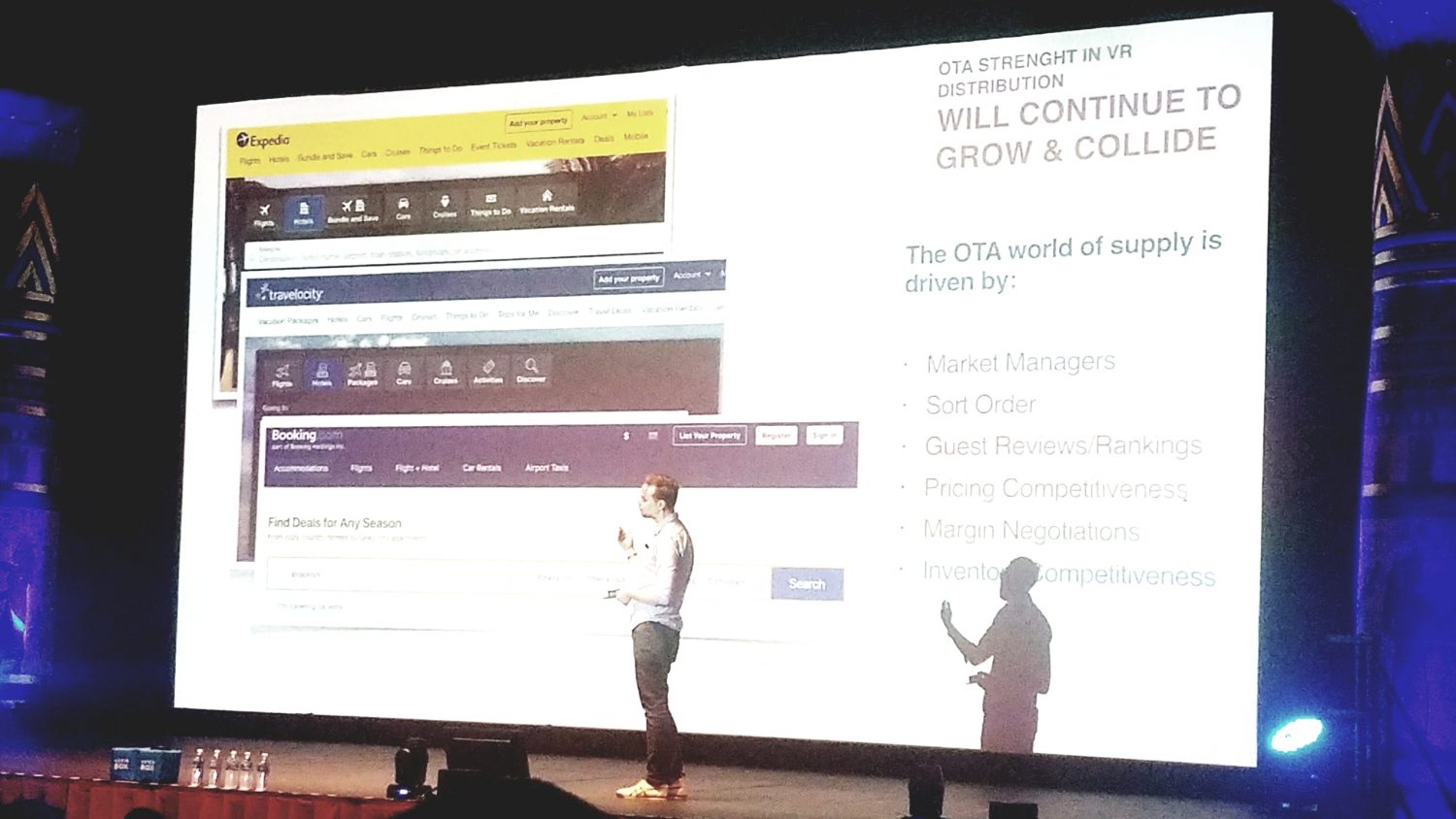
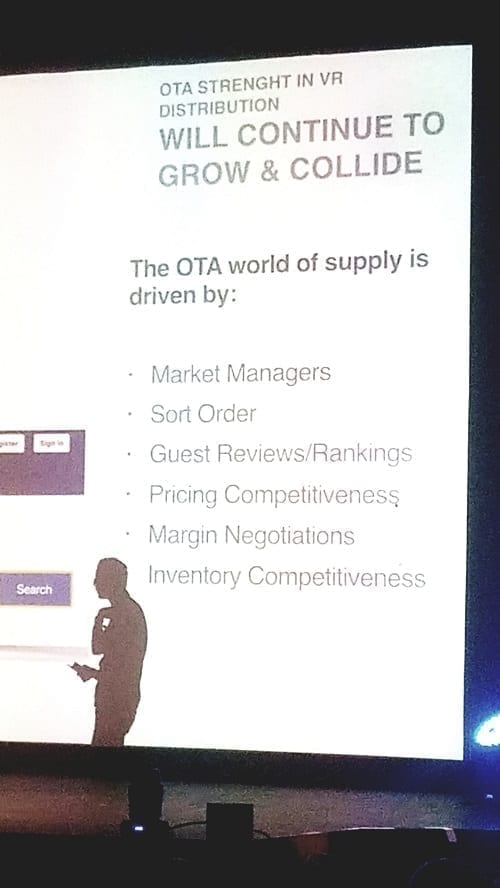
Stewart also talked high-level about the challenges OTAs face when looking at short-term rentals. While OTAs are pushing to provide all lodging types to customers, the take rate for short-term rentals is currently much lower than hotels. Stewart explained how OTA market managers are incentivized, the importance of sort order and reviews, margin negotiations, and inventory competitiveness. As the race for supply settles and the industry matures, OTAs will inevitably compare take rates and push the short-term rental industry to match hotels in commissions.


IHG Reports Strong Hotel Industry Numbers and Outlook

0
direct booking summit triptease the statler dallas ihg
Isaac Collazo, vice president of competitive intelligence at IHG, presenting hotel industry trends at Triptease's Direct Booking Summit in Dallas
October 4, 2018 – Isaac Collazo, vice president of competitive intelligence at IHG, presenting hotel industry trends at Triptease’s Direct Booking Summit in Dallas

“We are in the best demand market of our lifetimes,” said Isaac Collazo, vice president of competitive intelligence at IHG. Collazo presented hotel industry trends, economic drivers, and outlook for hotel professionals at Triptease’s Direct Booking Summit at The Statler Hotel in Dallas.

Among the key statistics Collazo reported is that US hotels have set occupancy records the past three years in a row, reaching nearly 66 percent average in 2017. The previous peak was just shy of 65 percent in the mid-1990s, and there has been a 40 percent increase in hotel room supply since then.

Sixty-one percent of markets are reporting occupancy gains, including Houston, Phoenix, New Orleans, Chicago, San Diego, New York, and Miami, all with one or more percentage point increases. Other markets have lost one to two occupancy percentage points: DC, Los Angeles, San Francisco, Dallas, and Seattle.

Through August, US year-to-date demand is at its highest growth rate of the past four years as well, with the strongest demand growth in Houston, Phoenix, New Orleans, Boston, Denver, New York, Chicago, Dallas, Atlanta, Los Angeles, Orlando, San Diego, Seattle, San Francisco, Miami, and DC. (Collazo said September’s demand numbers will drop compared to 2017 with the spike in displacement demand after last year’s Hurricane Harvey and Hurricane Irma.)

Global lodging demand is also at a record high and is increasing at a slightly faster pace than that of the US. Seasonally adjusted January numbers going back to 2010 show US demand at about 16 percent over its previous peak, while global demand is up almost 30 percent.

In the past 10 years alone, 591,000 net rooms have been added to hotel inventory, primarily in the upscale and upper-midscale markets.

Despite occupancy and supply growth, average daily rate (ADR) growth remains below pre-recession levels. Some major markets have seen a somewhat significant increase in demand January through August of this year compared to the same time period last year, including Miami (over 8 percent), Orlando (almost 6 percent), and San Francisco (around 5 percent), while Boston and DC have seen an overall ADR decrease.

Taking inflation into account, real ADR growth is hovering around 0 percent (ADR and inflation are increasing at the same rate). With that, the faster pace of wage gains is adding to increased cost pressures.

Over the past two years, revenue-per-available-room (RevPAR) growth has remained elevated with the increases in occupancy.

Collazo noted several high-level economic drivers influencing these trends. The steady and improving economy supports a healthy travel and lodging industry, including corporate profits that remain conducive for labor and travel growth. Low unemployment is also a positive indicator for leisure travel.

Looking ahead, Collazo anticipates that the economy will cool off in the coming year as the benefits of last year’s tax reform begin to wane and economic growth slows. He and his team are also closely watching tariffs as a full-blown trade war would likely lower economic growth worldwide.

IHG expects corporate profits to continue to increase in 2019, a positive indicator for business and meetings travel, but this could change as trade slows. Arrivals to the US are also expected to increase through 2020 along with a still-growing desire to travel.

Collazo and his team predict supply growth pace to slow amid construction labor shortages and rising costs. Still, more than 168,000 hotel rooms are currently in the construction pipeline, 63 percent of which are in the upscale or upper-midscale categories.

With supply growth beginning to plateau in the next one to two years, Collazo and his team expect occupancy to remain at record levels (predicting 66.3 percent in 2018 and 2019), followed by a drop to 65.9 percent in 2020. They expect ADR growth to slow further.

Stay Alfred Raises $47M, Bringing Total Funding to $62M

0

Today, Stay Alfred announced it has raised $47 million in a Series B round led by Nine Four Ventures, bringing the total funding to $62 million.

Founded in 2012, Spokane-based Stay Alfred manages just under 2,000 short-term rentals in 28 markets, with 230 employees. The full-service management company leases individual units and entire buildings in cities and then rents them out on a short-term basis to travelers, handling the furnishing, cleaning, booking, and customer service for each rental.

Urban short-term rentals are getting a lot of interest from VCs, OTAs, hoteliers, private equity, and VRMs; and the more control over the inventory, the more attractive the investment. Just weeks ago, leading competitor Sonder announced it had added $85 million in Series C funding led by Greenoaks Capital, bringing its total to $135 million. Sonder manages 2,200 units in 11 cities in four countries.

With nearly $200 million raised by these two companies, the numbers may appear inflated, but looking at recent acquisitions and in light of recent discussions with hotel CEOs at Skift Global Forum, both Stay Alfred and Sonder founders are on track for healthy exits.

Recent Acquisitions

  • Luxury Retreats by Airbnb, $200 million
  • Onefinestay by AccorHotels, $170 million
  • Oasis Collections by Vacasa, undisclosed

Get the fall issue of VRM Intel Magazine to read more information on how these recent acquisitions are performing and how hoteliers are looking at the space. Subscribe here. 

“The round will primarily fund our ongoing rapid expansion,” said Stay Alfred CEO, Jordan Allen. “Currently, we’re in 28 major US cities with a primary focus in 2019 on expanding within our current cities, plus plans to expand into a handful of Tier-1 travel destinations, all domestic. We expect to continue on our current trajectory of doubling our unit count each year, with a target unit count of 4,000 by the end of 2019. We’ll also continue to build our brand presence, improve our tech-enabled customer experience, and deepen our strategic relationships with multi-family developers.”

“Stay Alfred is leading the emerging wave of companies driving the evolution of the real estate industry and defining a new hospitality segment. Combine that with a tenacious, always-do-better culture and we believe they’re building something special,” said Nine Four General Partner Kurt Ramirez.

Stay Alfred projects a $110 million run rate for 2018.

Vacasa Acquires/Saves Oasis Collections

0

Vacasa announced it has purchased Oasis Collections, a short-term rental company with listings in U.S. and international cities including Barcelona, Chicago, London, Milan, Paris, and Santiago. With the exclusive listings added from this acquisition, Vacasa moves into the No. 1 spot as the largest vacation rental management company in North America with 10,600 properties in its inventory.

Although Oasis raised $35 million in funding, the company had been struggling over the year.

In 2016, AccorHotels invested in Oasis, and the company took on an additional $2.5 million in funding from an undisclosed investor in early 2017, as Oasis grew to more than 2,000 properties in 22 cities worldwide and developed a strong B2B element, marketing its urban properties to business travelers.

In August 2017, Hyatt injected a “significant investment” into the company, and AccorHotels took the opportunity to exit. With Hyatt’s investment, according to Skift, “[Oasis founder and CEO] Stanberry said he hopes the new partnership with Hyatt will help Oasis reach its goal of being in 50 markets by 2019 and expanding into the Asia-Pacific market, as well as increasing brand awareness for Oasis and accessing an even larger customer base.”

However, after working with Hyatt, Oasis actually lost inventory.

By the time Oasis sold to Vacasa, the company displayed only 826 listings—mostly nonexclusive—in 17 markets, a 59 percent decline in inventory in 18 months.

Last week at Skift Global Forum, Hyatt CEO Mark Hoplamazian discussed Hyatt’s investment in Oasis and what the company has learned about vacation rentals from these businesses. “We are high on companies that have control over the inventory,” he said.

“I believe we will see consolidation of platforms that don’t have control over inventory” Hoplamazian added. “But you have to have control over the inventory.” He acknowledged that these businesses are harder to scale and more expensive to operate . . . We’ve learned a lot from the B2B and B2C sides of this business, and we see more opportunity in B2C; and we are going to continue to look at this business on the home front.”

Vacasa will look to convert Oasis’s nonexclusive listings into exclusive contracts.

“For us, it’s crucial that in every market we manage homes, we offer our guests the same, high-quality experience that they have grown accustomed to across the world with Vacasa,” said Eric Breon, founder and CEO of Vacasa, in its press release. “Our acquisition of Oasis enables us to enter new and popular urban markets in international destinations, while bringing on employees in those areas that know the local communities.”

Vacasa plans to maintain Oasis’ footprint and retain all of the company’s employees, including founder Parker Stanberry, who will be joining the team with a focus on growing the corporate and international business. Financial details of the transaction were not disclosed.

D.C. Council to Vote on Second-Home Rental Ban

0
washington dc travel tourism

On October 2, the Washington, DC council will conduct a first reading and vote on a revised short-term rental bill that eases some restrictions from the first draft but keeps the ban on second-home rentals in the ordinance. This draft increases the limit on non-owner-occupied rentals of primary residences to 90 nights per calendar year and reduces the penalty fee for first-time violations.

Other stipulations from Bill B22-0092: Short-term Rental Regulation and Affordable Housing Protection Act of 2017, originally introduced by councilmember Kenyan McDuffie, are expected to remain the same, including the following:

  • Owners must be permanent residents and must register their homes with the District and obtain license numbers
  • License numbers must be displayed in all advertising
  • OTA platforms may not list a property without a license number
  • Owners and OTA platforms must maintain transaction records and make them available to the city upon request

The council will debate the bill in its Committee of the Whole meeting at 10 a.m. prior to the legislative meeting at 11 a.m. Both meetings will be held in room 500 of the Wilson Building at 1350 Pennsylvania Avenue. Council chairman Phil Mendelson said in his media briefing today that he expects healthy debate, and that the bill will pass.

The DC Short-Term Rental Alliance (DCSTRA) opposes the ordinance. “If the intent of the bill was to help with the rising cost of living in DC, these steps are misguided,” said Karl Scarlett, co-chair of DCSTRA and founder of DC property management company Great Dwellings. “Short-term rentals make up such a small percentage of the homes in Washington, DC, and this bill only negatively impacts those homeowners who choose to use their homes as short-term rentals.”

According to a Morning Consult poll conducted and published last November, the DCSTRA found that 80 percent of DC residents agree that short-term rentals help DC homeowners afford their homes, and more than 60 percent of residents believe vacation rentals help the local economy and have a positive impact on local businesses that rely on income from vacation rental guests. The poll was sponsored by Chamber Technology Engagement Center, the tech policy hub of the U.S. Chamber of Commerce.

“We have reached out to the council and a few media outlets to request that more time be taken to derive a solution that works better for everybody,” Scarlett said. “We’ve added a petition option to our website but would ask any and everyone call and email their council members asking that more time be taken to draft a proper bill.” The DCSTRA’s official response can be read here.

The draft’s introduction comes after a $500,000 ad campaign opposing short-term rentals in DC began airing on September 19. The campaign is backed by the anti-short-term rental organization It’s Time D.C. with the support of AirbnbWATCH, a project of American Family Voices.

The organizations assert that commercial investors are taking away permanent housing options from residents by buying residential homes and converting them into “illegal hotels.” They are not opposed to homeowners renting a room or a whole primary residence.

It’s Time D.C. is also supported by the D.C. Federation of Civic Associations and Unite Here Local 25, a union of hotel workers in DC, Maryland, and Virginia. AirbnbWATCH is supported by the American Hotel and Lodging Association and local anti-short-term rental organizations around the country.

The new bill draft also follows a September 25 report by AirbnbWATCH. The associated blog post states, “The report illustrates that under the current growth trend, approximately 8,750 of current short-term vacation rentals in Washington, DC would rise to more than 13,370 rentals by July 2020. This would remove another 4,600 or more residential homes from the city’s housing stock. However, if the Washington, DC ordinance is enacted, the number of short-term vacation rentals would decline to under 6,500 rentals.”

According to AlltheRooms.com, there are generally more than 6,000 homes or apartments available in the District, and as many as 8,000 or more available around peak travel periods, such as Christmas.

According to Destination D.C., the city hosted a record 22.8 million visitors last year. Travelers spent $7.5 billion in the city, generating $814 million in tax revenue and supporting 75,048 jobs.

HomeAway and Expedia Group Presidents Predict Next 10 Years of Travel and Tech

5
homeaway rezfest john kim jill menze news editor phocuswire aman bhutani president expedia group
HomeAway president John Kim, PhocusWire news editor Jill Menze, and Expedia Group brand president Aman Bhutani discuss the future of travel at HomeAway's Rezfest
homeaway rezfest john kim jill menze news editor phocuswire aman bhutani president expedia group
HomeAway president John Kim, PhocusWire news editor Jill Menze, and Expedia Group brand president Aman Bhutani discuss the future of travel at HomeAway’s Rezfest

In a fireside chat at HomeAway’s Rezfest yesterday, HomeAway president John Kim and Expedia Group brand president Aman Bhutani discussed what they see coming in the next 10 years of travel. Jill Menze, news editor at PhocusWire, moderated the discussion.

Dominant themes included the proliferation of voice technologies in booking and in-home experiences, virtual and augmented reality (VR and AR), the power of data, and an overarching ability to better match travelers with their wants and needs through technology.

Voice Assistants

“I am a huge fan of voice,” Bhutani said. The problem with computers is that they demand your visual attention, but voice doesn’t … That doesn’t mean everything will be voice,” he said. Travelers will still need screens for pictures.

“One of the things we’re learning is that it’s not just the web on voice,” Kim said. Travelers will have to have a way of evoking commands and ask voice assistants questions, rather than directing them to search.

Expedia Group has leveraged Amazon’s assistant Alexa with its own Expedia skill since November 2016. The feature currently allows travelers to check the status of their trips purchased on Expedia, such as flight statuses.

The technology still has a way to go before it can be used regularly for research and booking, something Expedia is working on. Bhutani shared a demo video of an Expedia staff member asking Alexa for recommendations on destinations and things to do, flight times and costs, and lodging price averages, all of which the voice assistant was able to understand and respond to.

Live use wasn’t as smooth. When Bhutani led a live demo and asked about the cost of flights from Seattle to Fort Myers, Alexa didn’t understand the first two attempts then responded with flight length on the third. But when he asked Alexa to tell him about Marco Island, Florida (where Rezfest was held), the assistant quickly spit out facts about the area.

“We have to use an approach that’s an AI first approach,” said Kim. “[HomeAway and Expedia Group] have to combine all data from travelers so we can build useful products in all of these environments and change quickly for interactions we haven’t even yet seen.”

Virtual and Augmented Reality

VR and AR are other areas in which both presidents can see a future in vacation rentals.

“One thing we should be prepared for is that a lot of thinking today is that we’re going to be able to project images everywhere … Anything can become a display device,” Kim said. “There’s no reason to believe we’d bring [VR] goggles to a destination … The thing we’re all thinking about is that we’re not all clicking anymore. We have to start thinking about what things do [travelers] touch, what do they stare at, how long do they stare at it, what questions do they ask.” HomeAway can then create recommendations and algorithms around all of that data.

VR and smart home technology is an avenue Kim sees as one where property managers can scale. In homes, there are more questions and more things to understand [than in a hotel], he said. “The power I see in that is that it allows our PMs to scale.” What used to be asked by phone or email, there is now programmable technology in homes to help consumers and travelers meet their needs.

Bhutani agreed. In thinking about common challenges he faces in his own vacation rental experiences, such as how locks and taps work, he said “What I really want to do is point my phone at it, the phone recognizes it and tells me how to use it.”

Data

Kim and Bhutani also discussed data as it relates to “matching” travelers to the things they want and need. “People will willingly give you their information if you earn the right to have it and give them value back,” Bhutani said. With more traveler information, recommendations will be relevant like never before. “Tech can help us meet that expectation,” he said.

Travel feels harder now with tech, Kim said, because we have more choices and options. “Part of that is this room providing those options,” he said to the property managers in the audience. We are bringing more joy and value to the world, and at the same time making it more complicated, he said. “Data will make this easier.”

Data security is an ongoing challenge, particularly with voice assistants as the concern of logging in with personal data to a device in a shared home remains a barrier to their widespread use. “We have to have a way to log in and out seamlessly,” Kim said. “We’re pressing Google quite hard about this.”

“This is an area where being Expedia helps us because when we go meet Google and Amazon, they listen to us,” Bhutani said. He predicts voice technology will see significant investments in this area in the coming years.

Other Predictions

As Kim noted, cameras will only keep getting better, so the importance of photography is paramount. “Now more than any time in history we have to focus on the quality of digital images.”

They also predict chatbots will become more prevalent. Kim pointed to the trend toward the preference to type, rather than talk, especially for millennials. He also said that HomeAway and Expedia reach a global audience, and the comfort level in communicating across countries is in text. It allows users to check spelling and make sure they are communicating what they want, so chat opens up more channels and a “big unlocking” in terms of a potential audience.

Bhutani discussed the removal of language barriers through the recent rapid improvement of tools like Google Translate and the real-time translation tools being tested at MIT.

Bhutani and Kim also see transportation technology removing travel barriers and removing geographical boundaries. Kim noted how mass transportation options remove congestion from roads, and with shorter drive times, the travel area can grow. Bhutani added that self-driving cars can help make more destinations accessible. “If they figure out that part of travel and make it easier, that’s table stakes.”

Bhutani closed the chat with his top takeaway: travel is one of the biggest industries in the world and it has the most opportunity in terms of making it easier for consumers. Kim closed with HomeAway’s investment in tools and data to help property managers scale. “What we have to do is enable you to focus on hospitality.”


Skift’s Rafat Ali and Hyatt CEO Mark Hoplamazian Discuss Alternative Accommodations

0

Earlier today at Skift Global Forum in New York, Skift founder Rafat Ali and Hyatt CEO Mark Hoplamazian discussed the company’s trajectory and the opportunities in the industry.

Ali introduced the subject of alternative accommodations, and mentioned Hyatt’s $15 million investment in luxury rental company Onefinestay, which sold to Accor in April 2016.

“We got our money back,” Hoplamazian inserted.

“What do you think is missing [in alternative accommodations]?” Ali continued.

“What isn’t missing is demand,” Hoplamazian said. “We see a real demand for the home option and alternative accommodation types. However, the regulatory environment changed really quickly.”

“It hasn’t hurt Airbnb,” Ali replied.

“I’m not sure that is true,” Hoplamazian said. “There is documented decline in Airbnb’s inventory in markets affected by regulations.” Hoplamazian added that many of the hardest regulations haven’t happened yet as in New York’s new restrictions are set to begin in 2019.

The hotel CEO also discussed Hyatt’s investment in Oasis and what the company has learned about vacation rentals from these businesses. “We are high on companies that have control over the inventory,” he said.

“I believe we will see consolidation of platforms that don’t have control over inventory” Hoplamazian added. “But you have to have control over the inventory.” He acknowledged that these businesses are harder to scale and more expensive to operate.

“We’ve learned a lot from the B2B and B2C sides of this business, and we see more opportunity in B2C; and we are going to continue to look at this business on the home front.”

Hoplamazian and Ali also discussed the increase in short-term rental regulations. “Reality is coming to roost in the regulatory environment,” Hoplamazian said.

Google Product and Marketing Execs Confirm the Company is Adding Vacation Rentals

2

Google’s Richard Holden, vice president of product management, and Rob Torres, managing director of advertising and marketing for the travel sector spoke with Sean O’Neill at Skift Global Forum in New York today, bringing the company’s travel product and marketing heads on the same stage for the first time.

Torres said, “We work closely together. I am there pushing a lot [and asking], ‘are you thinking about this from an advertising perspective what this means.'”

Google expanded Google Hotel ads to more than 150 countries on Google.com and Google Maps, helping travelers browse hotels on mobile devices and find hotel deals. In the first six months of 2018, the number of leads to partners grew 65 percent year over year. Holden and Torres discussed that later this year, Hotel ads management will move into the Google Ads platform. 

In comparing Google Ads and Google Hotel ads, the group discussed the higher cost for Hotel Ads and where in the funnel hotels are finding customers, as Google Ads (blue links) reach the consumer at the “bottom of the funnel.”

Torres added, “Companies should only be looking at ad platforms that are profitable for them. Is this a profitable channel for you? It depends on where you are and what kind of leads are you looking for.”

For vacation rental managers the discussion of Google Hotel ads versus Google Ads is important because the company confirmed its intentions to add vacation rentals in the same way they display hotels, but Holden indicated that adding alternative accommodations has not been easy and admitted it had been spending more time on hotel-like inventory than single homes.

“We’ve struggled with what is the right way to integrate those offerings,” said Holden. “We’ve added it as a filter in Europe . . . We will be–in the near future–moving into offering [alternative accommodations] as well. We feel it’s huge.”

The Google executives also discussed growth in consumer demand for tours and activities. “One travel trend [we see] is the growth and interest in the activities space. We all know the activities space has grown, but it is the acceleration and speed [of customer demand for activities] that is surprising to us,” said Holden.

Other topics that were addressed included machine learning and the future of “match scores” that match travel products and restaurants based on customer behavior, and they shared two goals for Google Travel. First, as has been their core objective, Google is focused on comprehensiveness and trust, trying to find and aggregate all the information, all the room rates, etc.

Holden described a second objective of “stitching together” the entire process of travel planning, from inspiration to post-travel reviews (a model that sounded very similar to the recently announced “All-new TripAdvisor” powered by Trip Feeds).

Holden explained that the team is beginning to stitch together all parts of planning a trip, from inspiration to transportation, accommodations, weather, restaurants, tours, activities, sharing, and reviews. And Google will track behavior to help users pick up where they left off.

“We will have all that research [users] have already done, so again, [they] can pick up where [they] left off,” Holden said. “The Trips concept will be initially available on Trips on the US mobile app.”

“If we get more people coming and searching, I’m going to be able to send you more leads,” added Torres.

Steve Trover Discusses Closing All Star Vacation Homes and the Hard Lessons He Learned Along the Way

16

We live in an inauthentic world of PR spin, and the vacation rental industry is no exception. We brag about successes and hide failures. And with considerable media attention and millions of dollars flowing into our sector from venture capitalists and private equity firms, it has been exceptionally easy to focus on our industry’s high points, high valuations, and reported exponential trajectory. In contrast, we don’t often take the time to examine the many difficulties experienced by founders in the sector.

Over the past two years, we watched channel management company LeisureLink shut down operations with significant debt after it raised $42 million, read recent reports of metasearch platform Tripping.com’s demise after it raised $52 million, and heard about market-leading vacation rental management company All Star Vacation Homes closing its doors. And these companies are joined by approximately 30 other reports of companies in the industry who have had to throw in the towel on their vacation rental businesses over the past two years. In addition, we’ve seen dozens of others sell their companies in less than optimal conditions in an effort to exit somewhat gracefully.

The story of All Star Vacation Homes (ASVH) has been particularly interesting to vacation rental industry professionals because of its market-leading position and because its cofounder, Steve Trover, served in highly visible industry leadership roles as he built a vacation rental management company many admired. When ASVH permanently closed its doors in 2017—and talk of owners who were not paid began to spread—the vacation rental industry buzzed as one of its most recognizable faces fell from grace.

I sat down with Trover to talk about what happened. As with any tale of difficulty, there are distinct lessons to be learned. And for those who truly know Trover and his undisputed love for the industry, it is not surprising that he is willing to tell his story in hopes of helping other property managers avoid the mistakes he made.


The Beginning

In 1997, Steve Trover and his mother, Sue, founded ASVH as a vacation rental marketing company that worked with Florida property managers to obtain net rates and market Florida vacation rentals to a broader audience.

“We worked with other managers to promote their properties,” Trover said. “We had a strong web presence and it was very profitable. This was in the time before online reviews, and our challenge was a lack of quality control. So we decided to dive headfirst into full-service property management.”

They began focusing on property management and by 2000, the business was growing rapidly. “We began feeling like the business was going to be successful very early on as we started with essentially no start-up capital,” Trover said. “Once we hit 150 properties and about 35 employees, it was really taking off.”

“I can’t say I ever had a love for operations, but I was laser-focused on providing the very best product and service, which I believe we did for many years,” he continued.

Despite travel challenges related to 9/11, flooding in 2003, several hurricanes in 2004, and the Great Recession, ASVH continued to expand and soon became known as one of the premier vacation rental businesses in the highly competitive Orlando area.

ASVR had a strong real estate arm and spun off a side business named Beyond Furnishings, an interior design company, only adding properties to the company’s inventory they had sold and furnished. “Until the recession, our model was to sell the house, furnish it, and rent it,” Trover said. “Our interior design company, Beyond Furnishing, furnished 500 homes in the Orlando area. Our secret sauce was to have more control over the physical product, and we think we did that better than most for a lot of years.”

The industry took notice, and Trover became a respected leader and passionate promoter of professional management. Trover joined the board of directors for the Central Florida Vacation Rental Management Association (CFVRMA), the Florida Vacation Rental Management Association (FVRMA), and the Vacation Rental Management Association (VRMA) in 2008, serving as its president from 2011 to 2013. “At one time, I was on 14 boards and committees,” Trover recalled.

While on the VRMA board of directors, Trover publicly advocated for several initiatives including the PBS television series Getting Away Together, a hefty public relations campaign and online marketing initiative to promote professional rental management, and the ill-fated Switch, a connectivity platform and distribution channel designed to aggregate professionally managed rental inventory and leverage the collective buying power of suppliers to work with OTAs for manager-friendly branding, access to customer data, and reasonable commissions and fees.

In addition, Trover consulted with a property management software company and rental management companies and hosted and visited hundreds of property managers to share information. During this time, Trover remained as the hands-on CEO at ASVH.

Over time, Trover became increasingly less passionate about the operations side of the business. He found the dual-mission business model to be especially challenging. “This is a business where you serve multiple masters, the primary being the guests and the owners,” Trover said. “As a servant leader I also counted the team members as a constituency—and then there was our dedication to the industry. That said, there was a long period when I enjoyed that challenge.”


Expansion to Other Destinations and Purpose-Built Development

In 2012, ASVH expanded into Captiva, Florida, and purchased a company in San Diego in late 2013, which grew to the company’s inventory to 350 homes under management.

“Like others, I thought because we were highly successful in one destination, we could easily replicate that success in another,” Trover said. “It wasn’t that simple.”

While expanding into new destinations, directing new initiatives as VRMA president, and consulting with vacation rental companies, Trover ventured into a new area: purpose-built homes.

Trover recognized the need for standards in the industry and studied the hotel model in which there are builders/developers, management companies, and marketing arms.

Trover believed it was possible to mirror models used by Hilton and Marriott, who often design, develop, and build properties; hire management companies for operations; and handle the sales and marketing services for properties. He worked on precursor developments and made the decision to take on outside investment to create Fullhouse, a purpose-built development company that would design and build inventory specifically for short-term rental use.

“We had been working with builders and developers for years with a ton of success, but they wouldn’t listen to all of our advice,” Trover said. “When we built our very first truly ‘Purpose-Built Vacation Home,’ leveraging data and what we called ‘Guest-Influenced Design’ (both were ASVH trademarks), I knew we were onto something huge. We built 25 of them, ranging between 7 and 14 bedrooms, and they were revolutionary. They made the owners money, made the company money, and the guests were raving fans.”

With its new, stronger vision, ASVH added some highly paid executives to the team with the goal of proving the purpose-built model and expanding into additional markets. “This business is all about great people, and we added an amazing team,” Trover said.


ASVH’s Cash Flow Challenges and the Sale of the Business

By late 2014, ASVH was stretched thin with multiple business extensions, expansion into new markets, and large investments into Fullhouse. The diversification diverted focus from the core Orlando business, and with large resources committed to Fullhouse, cash flow became more of a challenge.

Some of the challenges stemmed from prior difficulties during the recession. “The Great Recession took its toll on us like everyone else,” said Trover. “And in 2014, [cash flow] started to become a significant issue when deals we had in the works at Fullhouse fell through. We attempted to power out of it and were able to do so to some extent, but it certainly reduced our resources. That’s why we looked at options to sell the business.”

“There is the old business axiom that ‘cash is king.’ When you run out, the music stops,” said Trover.

With mounting debts, several layoffs, and decreasing funds, while looking for a buyer, Trover still believed the business could be saved. “We had an exceptional team, and I truly believed we could still turn it around,” added Trover.

“Like many entrepreneurs before me, I was willing to pay them before I paid myself because I felt they were worth it.”

Trover was guest-centric in his approach to the cash flow challenges. “It was my number one priority that guests did not arrive without a place to stay. In some cases, as things got bad, we rented homes from other management companies to accommodate guests. Our guests worked all year for their Orlando vacation, and I could not have families bring their children down and not have place to stay.”

Trover eventually found a buyer in 2015, an ASVH homeowner of several large vacation homes who agreed to purchase the business with a commitment to a line of credit that would offer enough runway to put ASVH back on track.

The situation had personal consequences. “At the time we sold the business, I had several family members in the business including my parents, my sisters and my brother,” Trover said. “My wife and mother of my four children, who had been running our vacation home interior design company, was diagnosed with an aggressive form of breast cancer the year prior and was forced to stop working.”

“To say it was a difficult time would be an understatement,” Trover added.

Within a year, the new owner wanted out. He contacted Trover and gave him and his mother an ultimatum, they could either take the business back or he was closing the doors—which meant employees would not have jobs, guests would arrive with nowhere to stay, and owners would have no chance to receive funds.

“We were given an ultimatum by the new owners: Buy it back or it would be immediately closed,” Trover said. “They had purchased it to leverage it for a large project that was not coming into fruition. It was an exceptionally difficult decision. If we did not buy it back, all employees would immediately lose their jobs. Owners and vendors would receive nothing, and guests would have shown up to find they had no property to stay in.”

Trover felt like his back was against the wall, and in a gut-wrenching move, he decided to take the business back.

“I have seen this play out several times and even though it was no longer our liability we couldn’t let it happen,” Trover said. “The company had been cut down to a fraction of its former self. We knew it was a long shot, but we had to try and make it work.”

Ultimately, a come-from-behind success story was not in the cards for ASVH. In 2017, the company permanently shut down operations and began the painful process of dealing with the aftermath.


Lessons Learned

Having to close the business, especially with extensive debt, was a hard blow for Trover and his family as he had built what once was a respected business, industry relationships that had evolved into close friendships, a public role as an industry advocate, and a reputation for being successful. But with four children to set an example for, Trover is not sitting still. His love for his family and the industry drives him forward, and he wants to use his experiences, with all their ups and downs, to help other vacation rental professionals.

Ideas and Innovation versus Focus

The vacation rental industry is full of shiny opportunities, with new markets and models. Trover admittedly saw opportunities in many areas and identified solutions to challenges facing the industry. And to his detriment, he often saw them too early. However, the truth he found is that chasing one idea meant diverting focus from another, and the scarcest resource that vacation rental industry innovators have is time.

“This business [property management] requires 100 percent of our focus,” Trover said. “While there are a lot of innovative and exciting things to do, property managers have to decide if these things are the right thing to do for their business. Then they have to decide if they have the resources to succeed.”

“This was also true for us at VRMA while I was president,” he added. “If we had picked one or two of our initiatives to focus on instead of trying to solve the problems of the entire industry, we would have found greater success during that time.”

Risks in Expansion

With a growing number of multi-destination vacation rental managers reliant on external funding, it is tempting to jump into expanding new markets.

Upon hearing the ASVH story, I had to ask: “If you could go back in time, would you have expanded to Captiva and San Diego?”

“No, I would not, and I advise colleagues and clients on that regularly,” Trover said. “So many of us want to be that big brand with dozens of destinations. Like others, I thought because we were highly successful in one destination, we could easily replicate that success in another. It wasn’t that simple. Just because you are a rock star in one destination, it doesn’t mean you can easily replicate that success in a tight market. Whether you use an organic growth approach or an acquisition model, it’s harder than you think to expand. I am sure a multi-destination company will eventually figure out the formula, but for all the attempts there have not yet been significant successes.”

When Trover talks to other managers considering expansion, he asks two questions: Have you maxed out your destination from a market share perspective or is there more you can do to gain inventory in your own market? And do you have the resources for this to fail in the new market for five years?

Trust Accounting: An Industry-Wide Best Practice

Only a few states legislate a business practice called trust accounting that requires vacation rental managers to hold rental payments received from guests in escrow accounts to be distributed to homeowners after guest check-in or departure (depending on the state). The practice of trust accounting protects the funds owed to homeowners by prohibiting managers from using guest payments as operating cash.

Even though most states do not require this process, Trover regrets that he did not implement trust accounting and believes that while it cannot be legislated overnight, it should be a best practice for vacation rental managers. “When I consult with clients today, it’s one of the first questions I ask. I think there is a need for a federal mandate or at minimum, state laws similar to those in North Carolina in this regard,” Trover said.

Besides providing accountability, trust accounting—when utilized by a state or market—builds a barrier to entry for new, less responsible businesses. As Trover pointed out, in North Carolina’s Outer Banks where trust accounting is required, the reason there are several large management companies instead of dozens of small companies is that the trust accounting requirements are burdensome for fly-by-night operators. And the greatest benefit is for guests who then work with experienced managers who have established, solid businesses and guest services. In addition, markets that require trust accounting are far less reliant on OTAs for bookings.

“From my experience, being able to ‘sleep at night’ is what shapes markets….and it is why there are so many big companies and not a ton of smaller ones in North Carolina. The barrier to entry in North Carolina is more difficult. I think the quality of properties and services where there are more requirements is higher—the companies and bigger, and there are fewer small fish who lack experience.”

“While I am not a proponent of heavy legislation, I believe Florida should work toward requiring trust accounting by vacation rental management companies,” added Trover. How do we get to that? It’s a bad math problem…it is very difficult for a 100-unit FL management company to get there, especially if they are upside down, and too many are. To be fair, we would need a three-year runway.”

Purpose-Built Inventory

Trover believes that developing homes purposely built for vacation rentals still has a future.

“What went wrong [with Fullhouse] was we never scaled this into communities as we had planned to,” Trover added. “We came very close multiple times, including the purchase of a land parcel from Disney. I still feel very strongly that this concept will survive and thrive, and we will see vacation rentals designed and developed that achieve the highest returns and the happiest customers.”

In the vacation rental industry, we are now seeing signs of development and funding for purpose-built vacation rental communities.

Changing Industry

The vacation rental industry is rapidly evolving and margin compression is becoming more of a challenge for managers. According to Trover, when managers take their eyes off the core business for expansion, new models, or personal reasons, it is easy to fall behind.

“For 17 years, ASVH was a leading company in Orlando and respected around the U.S. It was only in the last few years that things got challenging.” Trover said. “As many seasoned managers know, it is easy to have a great business for a short time and much harder to maintain success over the long term. When you are successful, it is easy to think it is going to just keep going, but this industry changes.”

Know Your Strengths and Ask for Help Sooner Than Later

As Trover explained in our discussion, not everyone who starts a vacation rental management company—or any business—has a financial background.

“Get help quickly,” he said. “As entrepreneurs, we think we can fix the problem we caused. However, it is unreasonable to believe that the thinking that caused the problem can solve the problem or, in some cases, even identify it.”

According to Trover, one of the challenges is that when a company doesn’t have strong financial controls, they don’t even see problems when they start to have them.

“When you see your balance sheet going down, and the cash flows depleting, you have a problem,” said Trover. “But when you start having difficulty paying owners or making payroll, it is a catastrophic problem. My advice is don’t wait until you get to that point. You must have backup funds in this industry. There are too many variables—weather, the economy, etc. You can’t control everything. Strong financial controls are rare in our category, and so many of us don’t have that background. If you don’t have a finance background, you better go find it.”

Be Smart When Looking for a Buyer

When it is time to sell, finding the right buyer may be more challenging than expected. Trover shared, “Unless you are willing to walk away and not care about the business moving forward you need to view the search for a buyer like you search for a partner. They are going to take what you built and make changes. Try to find  a buyer that has similar values to yours.”

Personal Effects

As Trover mentioned earlier, many members of his family were involved in the business and the effects of the company’s closure were widespread. However, they have held together in the hard times and stayed true to their love of the industry.

“My family is resilient, and they don’t stay down,” Trover said. “My brother is in operations at another VRM. My sisters started their own company leveraging their experience in the space and my parents are semi-retired. I’m proud to say that my wife is now a four-year cancer survivor and doing great as a third-grade teacher. I’ve gone from running multiple companies to focusing on consulting. With two decades of experience, both good and bad, I know I can make an impact.”


To Wrap Up

It is easy to tell a success story, but much more difficult to talk about the hard times. However, as many of us who follow the vacation rental industry closely know, there are more management companies struggling with changes to the business than we are able to discuss.

In closing, I asked, “If you could go back to 2012 and have a talk with your former self, what would you tell that guy?”

Trover replied, “I would remind me what a wise businessperson had already said years prior: ‘Son, you may think you are superman, but you don’t have the cape. Pick one thing you can be world class at and focus on it.’”

Look for more on this story in the upcoming fall issue of VRM Intel Magazine.

NOLA Short-Term Rental Study Proposes Severe Restrictions

2
new orleans downtown

Following a New Orleans short-term rental study requested by the city council, the city planning commission published the preliminary report and policy recommendations on September 18. The study recommends a ban of non-owner-occupied short-term rentals (STRs) in all non-commercial districts.

The study was requested in May, after previous regulations had been implemented in April 2017. At the same time, the city council passed a measure to block the issuing of new short-term rental permits to most non-owner-occupied properties in an “Interim Zoning District” for nine months.

Under the current ordinance, short-term rentals with approved permits can operate in certain city zones based on rental type. Accessory short-term rentals in which the owner remains in the property during guests’ stays can operate in every zone (except the French Quarter) with no limit on the number of nights available to rent. Temporary short-term rentals in which the owner is not present may be rented for a total of ninety nights per year and must have an in-town property manager available at all times; these rentals are permitted in most city zones. Commercial short-term rentals are allowed in nonresidential zones even if their owners are not present, and there is no limit to the number of nights that can be rented.

The study suggests getting rid of these distinctions and proposes two main permit types: residential and commercial. Under the residential permit, the owner or resident would be allowed to rent out either up to three bedrooms in a shared home or up to three units in a multi-family dwelling. In both cases, the owner or resident must live on site and be present during the guests’ stays. The authors of the study suggest residential permits be allowed in any district where dwellings are permitted by the comprehensive zoning ordinance, including the French Quarter.

Under the commercial permit, a dwelling of up to five bedrooms may be available for rent without the owner present. These permits would be limited to nonresidential districts with permit caps and/or ground floor restrictions.

The report also suggests a third permit type for whole-home rentals during special events only, which would be limited to two permits and a total of fourteen days per year. However, the commission acknowledges this type of permit would be difficult to manage and enforce.

Along with other registration, enforcement, and tax rules for both owners and rental platforms, the study suggests increasing the city’s nightly rental fee to $8 for whole-unit residential and commercial STRs. The revenue from this fee would go toward the Neighborhood Housing Improvement Fund.

The current ordinance has faced public criticism around its enforcement and the loss of affordable housing being attributed to STRs. The study states that “there is no conclusive evidence demonstrating that STRs are the cause of housing unaffordability in New Orleans. There are a number of broader factors which have affected the housing market over the last decade which have led to increased housing costs. That being said, there is sufficient anecdotal evidence that STRs have exacerbated an already difficult market especially in the Historic Core, Historic Urban, and Central Business District neighborhoods where concentrations of STRs have been greatest.”

“What’s clear in this study is that the staffers and city planning commission are still very much in the dark as to what the vacation rental industry is all about,” said Eric Bay, president of the short-term rental advocacy group Alliance for Neighborhood Prosperity (ANP). He sees this as a silver lining in that city planners and city council members can still be educated about the people and the economics of the industry with facts and data, he said.

Bay said the group will have a presence at the next city planning and city council meetings to educate officials. “Movements start with people coming out and sharing stories.” Proponents need to come out and show city council and the press that they are real people, real locals, employing real local workers, making real financial contributions to the local economy, he said.

On Friday, the ANP released the results of a poll of New Orleans short-term rental permit holders. According to the poll, eighty-two percent of them live within the New Orleans metropolitan area and employ between one and ten people to manage their rentals. “Additionally, almost every respondent knows who their city council member is and intends to vote in the November elections,” the release states.

“This poll data portrays the real New Orleans short-term rental community,” Bay said.

The STR study will be presented to the city planning commission in its meeting on September 25 at 1:30 p.m. in the city council chambers. Prior to considering the study, the commission must hold a public hearing, which is set to start no later than 3 p.m. The commission will then decide whether to send the study with or without changes to the city council. The deadline for submission is October 5.

Streamline Summit 2018 Recap

0
Streamline Vacation Rental Software COO Sagri Corzo-Obregon at the 2018 Streamline Summit

Last week, Streamline Vacation Rental Software hosted 525 property management professionals and forty-one vendors at its fifth annual Streamline Summit at the Westin Kierland Resort in Scottsdale, Arizona. The event’s “rise up” theme and hot air balloon imagery symbolized the company’s view of the vacation rental industry’s upward trajectory.

Twelve blocks of breakout sessions occurred along eight topic tracks, five of which were dedicated to Streamline Software and its tools: revenue, efficiency, knowledge, brand, and accounting expertise. The other three tracks included panels and roundtables as well as two tracks on partners and industry trends. Sessions ranged from WordPress basics to work order management to an open discussion called “What’s on Your Mind?” led by Vacation Rental Marketing Blog founder Matt Landau.

Streamline COO Sagri Corzo-Obregon said some of the most in-demand sessions included StreamTrust Accounting, revenue management services, StreamShare, housekeeping, round tables, and panel discussions. One of those panels was led by VRM Intel’s Amy Hinote about vacation rental regulations. She was joined by Chuck Steeg, owner of Luxury Gulf Rentals in Orange Beach, Alabama; Theo Kracke, owner of Paradise Retreats in Santa Barbara, California; and Lee Zeller, owner of Accommodations in Telluride in Telluride, Colorado. Together they answered questions and discussed common reasons regulations are proposed, as well as what works or doesn’t work in fighting them, including petitions, the use of data, and other strategies.

streamline summit amy hinote vrm intel theo kracke paradise rentals lee zeller accommodations in telluride chuck steeg luxury gulf rentals
Amy Hinote, Theo Kracke, Lee Zeller, and Chuck Steeg in a panel discussion about regulations at the 2018 Streamline Summit

Of the event as a whole, Zeller said “My biggest takeaway was that the community of vacation rental managers comes together to effect major changes for our industry.” She has attended every Streamline Summit. Her team doesn’t have a specific agenda when they go, she said, but they come away with “so many things to change, like documents, customer outreach, making sure we represent our true authentic selves as Telluride locals to stand out.”

Landau led his roundtable discussion in rapid-fire style, giving property managers twenty seconds to ask a question and the group a collective four total minutes to respond with concise answers. Questions raised included how to differentiate guest damage versus wear and tear to owners, how to stand out as a small company in a large and competitive market, and how to engage owners in improving their properties.

This session was a favorite for Brian Harris, president and CEO of Harris Properties Management in Gulf Shores, Alabama. This year’s summit was his third. “It’s always good to put faces with names,” he said. “We talk to Streamline people all year, so it was good to be able to sit around a table and talk with them about things over breakfast.”

Harris Properties has used Streamline software since 2012. Harris said his company uses around 30 to 40 percent of the tools available with the software to manage its one hundred properties. He and his team attended the summit to learn what additional tools they could use and how to better utilize the tools they have currently.

Keynotes and general sessions kicked off with Jeff Evans, a twenty-five-year expert mountain guide, adventurer, rescue medic, physician’s assistant, and author of Mountain Vision: Lessons Beyond the Summit. He shared stories of guiding the first blind man to climb Mount Everest, Erik Weihenmayer; serving with a medical team embedded behind forces in Mosul, Iraq as they drove out ISIS; and other impressive feats to inspire servant leadership, teamwork, communication, and handling adversity.

Later, Landau helped audience members develop their brands’ “deep story,” referring to the things that make each company unique beyond inventory and guest experiences. He used lessons learned from data on viewers of Sense of Place, a web video series in which he travels to different destinations and shares the stories of vacation rentals and their hosts. The data showed that users were most engaged during three recurring storylines: underdogs, hope, and the passage of time.

VRMB Founder and Sense of Place Host Matt Landau at the 2018 Streamline Summit

Streamline CMO Brett Parry shared the company’s belief in the “power of ‘I,’” outlining eleven trends taking shape in the industry, including: building an infrastructure to fight regulations, finding and maintaining independence from the OTAs, the collision of international markets along with their technology and practices, integration of tools to ensure real-time responses and instant guest gratification, the significant investment in industry players through funding and acquisitions, and the inflation of the vacation rental market balloon as it rises up. VRM Intel Magazine subscribers can read Parry’s advertorial on this topic in the fall 2018 issue.

Following Vacation Rental Management Association president-elect Jodi Refosco’s organization update, Hinote led a keynote presentation on the dual-mission model, a growing trend of VRMs to divide their businesses into distinct business-to-consumer and business-to-owner sides. She also covered the state of OTAs and interesting booking trends from this year’s summer season in vacation rental destinations. Her presentation led to a lively roundtable discussion around recruiting and retaining owners, increasing revenues and home sale values, and addressing ongoing OTA challenges.

The last main session was a Game of Thrones-themed Game of Homes, a game show in which contestants were asked Jeopardy-style trivia questions about Streamline and the vacation rental industry. “It was a fun event to break the rhythm,” Corzo-Obregon said.

Looking ahead, Corzo-Obregon said she doesn’t know yet what they will do differently at next year’s summit, “but we received great feedback so far on all the sessions and events.”

Industry Professionals Launch Utah Vacation Rental Managers Association

0
utah arches national park

Utah vacation rental managers association UVRMA logoUtah property managers can now join the recently launched Utah Vacation Rental Managers Association (UVRMA). Founded by vacation rental and real estate professional Brad Winget, the state’s first industry association will host inaugural trade conferences on October 24 in Salt Lake City and October 26 in St. George.

Tyler Hurst of Utah’s Best Vacation Rentals will serve as UVRMA’s VP of operations, and Lyndel Strong will serve as executive director. She was previously the executive director of the Idaho Republican Party and an implementation manager for LiveRez. “For me, being the association’s first director is a big responsibility and exciting,” she said. “I have the opportunity to call and work with every professional VRM in Utah and hear the things that are happening in the industry and how they are impacting each business individually.”

The association’s primary objective in its first year is to help fight local short-term regulations. “One of the biggest challenges that VRMs face that I hear over and over again on the calls I have been having is fighting all the regulations and fees,” Strong said.

Moab, St. George, Provo, Salt Lake City, and Park City are among several Utah municipalities with short-term rental restrictions or bans in place. Meanwhile, the town of Sandy recently lifted its ban on vacation rentals, and, in a rare twist, Emery County is encouraging its residents to rent out their homes to help boost lodging and tourism around its popular rock climbing and outdoor adventure destinations.

Winget decided to start the organization after successfully fighting regulations in areas where his vacation rental company, Utah’s Best Vacation Rentals, has properties. “I’ve seen firsthand how big of a difference you can make if you take a proactive but respectful approach to fighting back and educating representatives,” he said.

UVRMA has hired two lobbyists Winget has worked with in the past to help in its effort: Michael Ostermiller and Christopher Kyler, both partners at Kyler, Kohler, Ostermiller & Sorensen, LLP (KKOS) and registered lobbyists. Ostermiller focuses on legislative advocacy, lobbying, and local government affairs for clients in real estate, construction, health care, and other sectors.

Kyler manages the partnership’s legislative advocacy efforts, including legislative drafting, campaigning, fundraising, PAC money disbursement, and lobbying for KKOS. He is also the CEO of the Utah Association of Realtors.

In addition to fighting regulations, Winget said some of the association’s other objectives include improving the industry’s image, educating the public about VRMs, educating property managers, improving their businesses and best practices, and networking with and learning from like-minded people and companies.

UVRMA will name its committees and boards of directors at its first semiannual meeting in early 2019.

UVRMA is now recruiting new members. Current members include Utah’s Best Vacation Rentals, Vacation Resort Solutions, and Family Time Vacation Rentals. Tiered membership costs based on inventory size start at $250 per year for 5–20 properties.

Registration for the trade conferences is also open. Both events will feature a networking event the night before, breakfast at 8:30 a.m., and conference presentations and an exhibitor tradeshow from 9 a.m. to 12:00 p.m.

The show is free for UVRMA members and $20 per person for nonmembers. Sponsorship packages start at $500 and include both events.

According to the Utah Office of Tourism, about 19 million travelers visited the state annually the last two years. In 2016, travelers spent $8.4 billion, generated $1.23 billion in state and local tax revenue, and supported 144,200 jobs in the state.

Ocean Reef Vacation Rentals Acquires Rivard of South Walton Rentals

0

Ocean Reef Vacation Rentals & Real Estate acquired majority ownership stake in Rivard of South Walton Rentals, which manages 100 homes in Grayton Beach and along Scenic Highway 30A. Ocean Reef now represents more than 550 vacation rentals in northwest Florida, from Destin to Panama City Beach.

“This partnership enables us to meet the increased demand of our guests for homes and condominiums throughout South Walton,” said Timothy Taylor, president of Ocean Reef.

The acquisition includes Rivard’s office and two adjoining commercial parcels, located on the sole entrance to Grayton Beach.

“Going forward, Ocean Reef will benefit as Grayton Beach becomes our centralized ancillary point of operation,” said Todd Kleppinger, Ocean Reef’s lodging manager. “Rivard will benefit from increased resources, inspectors, housekeepers, higher quality amenities, and full access to the largest privately held laundry operation in northwest Florida.”

Ocean Reef retained Rivard’s entire staff; its former owner, Richard Veldman, will stay on as a partner to facilitate the transition. “My desire has always been to align Rivard with a local management company rather than an unknown corporate entity,” he said.

He was certain Ocean Reef is the right fit for the partnership as the synergy of the two companies will elevate the standard for vacation rentals and real estate in Grayton Beach and the surrounding areas, he said. “It also means a lot that Rivard, the company we hold so dear, will continue to be in good hands and that its values and integrity will remain at its foundation.”

Ocean Reef will also keep Rivard’s brand name. “The Rivard brand itself is an integral piece of the acquisition,” said Richard Olivarez, Ocean Reef’s director of marketing. “For 32 years, this rental management company has been a pillar of the community and the most respected provider of vacation rentals in and around Grayton Beach.”

Founded in 1982, Ocean Reef is headquartered in Miramar Beach, in Walton County’s popular tourist region of South Walton. According to Visit South Walton, 4.01 million travelers visited the region in 2017, spending $2.98 billion and generating $4.4 billion in economic benefit to the area.

The Inaugural Vacation Rental Women’s Summit Heading to New Orleans February 19-20, 2019

0

Hundreds of executives will gather for more than 50 sessions and events to celebrate, educate, and empower women in the vacation rental industry.

The inaugural Vacation Rental Women’s Summit will be held at The Ritz-Carlton hotel in New Orleans February 19 – 20, 2019. Presented by VRM Intel Magazine and the Vacation Rental Management Association (VRMA), the summit will host 500 professionals for two days and more than 50 educational sessions, keynote presentations, and networking events for women in the vacation rental industry.

Registration is open at VacationRentalWomen.com until February 10 or until tickets run out. Early registration costs $749 per person until November 30.

“From beach to mountain destinations, women dominate all areas of the on-the-ground vacation rental industry and face a unique set of challenges,” said Amy Hinote, CEO of VRM Intel. “Our objective is to bring the smartest and most influential women in the industry together to inspire and empower attendees and discuss high-level topics facing the vacation rental sector.”

Keynote speakers will include Elizabeth Gilbert, author of Eat, Pray, Love and Big Magic; Lady Carnarvon, the Eighth Countess of Carnarvon and guardian of Highclere Castle – the real life setting for Masterpiece’s Downton Abbey; and Tina Weyand, chief product officer at HomeAway.

“Elizabeth has been inspiring women to be bold and creative for decades and is a true voice of our generation, and Lady Carnarvon exemplifies true hospitality in the most authentic way I have ever witnessed,” said Hinote. “Weyand is making a rare public appearance and is one of the most highly accomplished and influential leaders in our industry. They exemplify the power and success of women not only in vacation rentals but in all sectors, and it’s an honor to have them joining us at the summit.”

Sessions and presentations will cover the art of delegating, exit strategies, funding, change management, climate change, diversity, interviews with successful CEOs and entrepreneurs, building an influential executive presence, disruptive versus traditional models, navigating risk and competition, mentoring and coaching a winning team, hospitality and customer service, technology, balancing data with intuition, work–life balance, conflict management, and more.

The event will also feature two dozen hands-on workshops, peer group discussions, and focus groups, as well as an awards series to honor the pioneering women who helped build the vacation rental industry.

Themed networking events will celebrate New Orleans culture and the keynote speakers, including a lively Mardi Gras Cocktail Party sponsored by Red Sky Travel Insurance, French Quarter Brunch sponsored by RealPage’s Kigo, Downton Abbey High Tea sponsored by HomeAway Software, and the Eat, Pray, Love Lunch sponsored by CBIZ. Blizzard Internet Marketing, Bluetent, and TruPlace are also sponsoring the summit.

About VRM Intel Magazine

Founded by Amy Hinote in 2012, VRM Intel was created as a tool for the fast-growing and rapidly-evolving vacation rental industry. Its mission is to provide relevant industry-specific news, information, and resources to help professionals build their businesses, to address the challenges and opportunities facing the industry, and to positively contribute to the vacation rental ecosystem.

In October of 2016, it launched VRM Intel Magazine, a quarterly publication mailed to thousands of vacation rental professionals. The magazine contains articles written by industry experts addressing property care, marketing, technology, human resources, revenue management, owner relations, guest services, and regulations. Later that year, the company launched VRM Intel Live!, a series of regional events that brings together industry thought leaders and local vacation rental providers. VRM Intel Live! has visited Wilmington, Destin, Outer Banks, Portland, Denver, Gatlinburg, Orange Beach, London, and Breckenridge.

About VRMA

Founded in 1985, the Vacation Rental Management Association (VRMA) provides best-in-class education, networking, and professional development opportunities to make a difference for vacation rental management companies. VRMA works worldwide on behalf of our manager and supplier members to advance the vacation rental industry through education, information, networking, research, and advocacy.

RemoteLock Updates Logo and Combines All Brands Into One

0

RemoteLock, provider of the leading cloud platform for smart locks, announced August 15 that it has updated its logo and combined all its brands into one. After operating the past decade under the name LockState with different products, including, ResortLock and LockState Connect, the company is solidifying its brand under RemoteLock. It has also updated its logo to make things simpler.

“Starting today, we will be merging our LockState, ResortLock, and LockState Connect brands into the RemoteLock brand,” said Nolan Mondrow, Founder and CEO of RemoteLock. “Don’t worry – all your products will be working as usual and your apps will be supported. It’s just time for some housekeeping.”

RemoteLock is the leading cloud-based smart lock platform enabling users to manage any type of internet-enabled lock from a single centralized dashboard. The platform offers a suite of products for remote access control, including apps used by managers of vacation rental properties, retail stores, commercial space, and apartments to simplify access and strengthen security. Through integrations with Airbnb, HomeAway and other listing partners, RemoteLock apps automate guest access when bookings are confirmed, allowing consumers to manage access control more efficiently across different types of connected locks for main entryways, internal units, elevators, parking garages, and pool gates. Additionally, RemoteLock offers an open API, enabling integrators to quickly and easily incorporate monitoring and control of smart locks into any application.

About RemoteLock 

RemoteLock has been at the forefront of internet-connected devices and cloud access control solutions for rental properties and businesses for over seven years, servicing tens of thousands of customers worldwide. Through partnerships with Airbnb, HomeAway, and other listing partners, RemoteLock provides the ability for property owners to centrally and remotely manage property access from anywhere in the world. RemoteLock is headquartered in Denver, CO, and backed by KKE, Iron Gate Capital, Nelnet, and Service Provider Capital. Visit RemoteLock at http://www.remotelock.com and follow them on Twitter at @RemoteLock_News.

HomeAway Launches Pet-Friendly Vacation Rental Collection

4
homeaway pet friendly travel vacation rental collection emancipet

HomeAway announced Monday it has launched a new collection of pet-friendly homes on HomeAway.com. For bookings made on hmwy.co/pet-travel between now and December 31, the company will donate up to $10,000 to Emancipet, a nonprofit organization that provides accessible and affordable spay/neuter and veterinary care.

The pet-friendly travel collection page aggregates all 350,000 pet-friendly properties listed on the site worldwide. It highlights 17 of its most popular destinations for travelers with pets, including Miramar Beach, Hilton Head Island, San Diego, Galveston, Charleston, and Gatlinburg.

“HomeAway commissioned research that showed more than 19 million American families have traveled with or will travel with their dog this year,” said Melanie Fish, a public relations representative with HomeAway. “We know that pet-friendly vacation rentals can fill accommodations needs for a lot of people who may not realize it yet.”

HomeAway will donate $100 per booking made through the pet-friendly travel collection to Emancipet, capped at $10,000, or 100 reservations.

Both headquartered in Austin, Texas, HomeAway chose to support Emancipet after watching the nonprofit build a network of high-quality, low-cost clinics and advocate to improve the lives of pets in underserved communities. “Since we’ve seen so much of their work in action, including the great work they’re doing to help the 300,000 pets in Puerto Rico left homeless following Hurricane Maria, it was an easy choice to work with them,” said Fish.

Emancipet also provides training and consulting programs to animal welfare organizations nationwide.

The announcement of the collection and the donation campaign coincide with #NationalDogDay on August 26. To mark the occasion, both companies shared tips for traveling with pets:

  • If you’re driving, secure your pet in a carrier or safety harness. Stop regularly for potty, water, and snack breaks.
  • Make sure your pet is wearing ID tags and is microchipped and registered with updated, accurate contact information.
  • Homeowners who list their homes on HomeAway.com don’t all interpret “pet-friendly” the same way. Some charge a pet fee, some don’t have fenced-in yards, and some may provide everything you need for a fantasy pet vacation from food and treats to a pet-welcoming pool. Read the property details, look at the photos, and ask questions if anything isn’t clear.
  • Pack smart. Bring more than enough food, treats, and medication, and don’t forget your pet’s bed and favorite toys. If you’re flying, pack enough supplies for a couple of days in your carry-on in case your luggage is lost.
  • Locate a veterinary emergency clinic in your destination city — just in case. Travel with vaccination records.

HomeAway is owned by Expedia Group and lists more than 2 million homes across 190 countries.

Florida Gulf Coast Red Tide Stifles Tourism and Vacation Rentals

0
red no swimming flags beach florida red tide
dead fish on englewood florida beach in red tide fish kill
Dead fish on Englewood, Florida beach on August 14, 2018

Red tides are not uncommon in the Gulf of Mexico, but the tide that started last October is one to be reckoned with. Red tides are blooms of algae that sometimes turn large flows of water a rusty color, giving them their name. They normally drift far offshore, but winds have pushed this particular bloom against the southwest Florida Golf Coast in recent months. With it has come the carcasses of thousands of fish, manatees, dolphins, crabs, eels, sea turtles, sharks, and other species, along with a rotting stench and burning toxic air causing counties to close popular beaches.

The culprit in this case is a plant-like alga named Karenia brevis, or K. brevis. This species produces brevetoxins, a neurotoxin that causes coughing, stinging, and teary eyes in humans. “You can really feel it in your nostrils, in your sinuses, back of your throat,” said Bill Weir in a CNN video report. “It’s like a mild pepper spray.”

But as irritating as the symptoms are to humans, the effects are often fatal for marine life. This particularly devastating red tide has been described by many locals as the worst they’ve ever seen. The Florida Fish and Wildlife Conservation Commission (FWC) reported levels of 1 million or more cells per liter, one thousand times as many as a normal, nontoxic level, in samples collected for weeks along the coast from Manatee to Collier counties.

fwc red tide k brevis map
Florida FWC red tide status map for August 22, 2018

The Red Tide Rises on the Tourism Industry

While marine biologists, municipal crews, and volunteers work to clear the dead wildlife from beaches and canals, guests are canceling reservations and questioning whether they should book months from now. “We have seen a significant dip in rentals, approaching a 30% reduction on last year,” said Andy Moore, CEO of Gulf Coast Vacation Rentals and Gulf Coast Property Management in Bradenton, Florida. “Last minute bookings are non-existent.”

Judith Lee-Hemstreet, president of Sun Palace Vacations in Fort Myers, has had a similar experience. The red tide hit her area on July 25th, she said. “In a period of 24 hours, the beaches went from pristine to piles of algae and dead fish.” That week, Sun Palace refunded an estimated $20,000. The week after, refunds increased to around $40,000. “That’s college tuition,” Lee-Hemstreet said. Sun Palace’s normal summer occupancy is between 80 and 85 percent.

She said she even heard reports from the Publix nearby that guests who checked in the weekend after the red tide appeared returned the groceries they had just purchased for their stay and went home.

“This is as bad as I’ve seen it, said Rob Domke, luxury vacation rental manager for Gasparilla Vacations in Boca Grande. Usually red tides reach the coast over the last couple of weeks of summer, last for only a few days, and bring in a few dead fish, he said. “This has been a couple months of uninhabitable beaches.”

Normally this time of year is the slow season, Domke said. “The good thing is we’re used to not having as many folks down here,” he said. Still, he estimated around 50 percent of the reservations they did have this time of year had been canceled or rescheduled, and they had received no new bookings for August.

While it may be a silver lining that this time of year is not peak season, there is no way to predict when the red tide will end, fueling guests’ anxiety and property managers’ stress. Guests continue to call daily asking about what the conditions will be months from now. They have also called to ask why property managers didn’t tell their guests about the red tide if they knew about it last October, Lee-Hemstreet said.

Travel insurance does not cover red tide events.

“We haven’t seen an uptick in cancellations but the requests for refunds and compensation have been flowing thick and fast,” said Moore. “This has been challenging for my staff.”

“With hurricanes, we know the next steps, and we can see an end in sight,” Lee-Hemstreet said. With this, they can’t. “We feel helpless — we can’t fix it.”

Property managers aren’t the only businesses affected by the red tide. Water sports, fishing charters, restaurants, and other businesses have all taken a hit. Domke reported at least one charter fisherman he knows hasn’t booked a single trip in a month, even from locals who are the usual customers this time of year.

“Everything having to do with water is a huge impact on business,” said Lee-Hemstreet. “If you can’t use the water, people will go somewhere else.”

She and other property managers compared this event to the BP oil spill in 2010. “I think this is worse because it is not a one-off accident,” Moore said.

According to a CNN report, local CVBs and other agencies have reported business losses totaling $8.1 million so far, much of which only accounts for July.

red tide sign florida beach naples
Red tide sign posted on a Naples beach on April 29, 2018

Lake Okeechobee Sends “Green Slime” Blooms Down Caloosahatchee River

Meanwhile, canal communities just off the coastline are facing another algae issue: the “green slime” cyanobacteria blooms caused by agricultural runoff being drained out of Lake Okeechobee. Those waters are drained down the St. Lucie River to the east and the Caloosahatchee River to the west — right into the middle of the red tide zone. Green mats of algae are clogging the canals, which can suffocate plants and animals underneath when they can’t get enough sunlight. The dead algae and other organic matter flowing out of the Caloosahatchee, into Charlotte Harbor, and ultimately into the gulf may be feeding the K. brevis.

Mote Marine Laboratory is studying both issues. According to its red tide FAQs:

When Florida red tide blooms are carried closer to shore, they are capable of using nutrients from a variety of sources, including those carried from freshwater bodies out to sea. It is logical to expect that excess nutrient inflow to Charlotte Harbor — including nutrients carried by storm water runoff from land, as well as nutrients carried from land to sea by multiple means including total riverine input — could influence an existing red tide near shore by serving as additional “food” for growth of these algae.

More research is needed to determine if the current cyanobacteria bloom is affecting the current red tide. Mote is also testing ways to mitigate and control red tides, including a test in Boca Grande of the ozonation process it uses to remove red tide in its aquarium and sea turtle hospital waters, while also trying to keep up with recovering animals sickened or killed by the red tide.

Hurricanes can also play a role in exacerbating red tides by creating more storm run-off that flows into coastal waters. Last year’s Hurricane Irma may be one of many culprits in the current bloom.

lake okeechobee florida blue green algae cyanobacteria bloom
Aerial view of a blue-green algae bloom in Lake Okeechobee

Florida State and County Agencies Respond

In another attempt to address the problems, Governor Rick Scott issued a state of emergency declaration on August 13. The declaration makes additional resources available for clean-up efforts and directs funds to local municipalities and CVBs. Mote Marine Laboratory will receive $100,000 to support the rescue and recovery of affected wildlife. Lee County, where Fort Myers and Charlotte Harbor are located, will receive more than $1.3 million in grant funding. VISIT FLORIDA will receive $500,000 to provide grants to local tourism boards for marketing and PR efforts.

According to a VISIT FLORIDA press release on August 17, the organization launched two programs following the governor’s emergency order, one of which is the grant program for local CVBs. The other is a red tide recovery marketing program giving affected southwest Florida businesses six months of complimentary access to marketing opportunities with VISIT FLORIDA, including “enhanced web listings,” content distribution across its social and web platforms, brochure distribution in Florida welcome centers, and other activities. It will also develop a marketing campaign for the area to run after the red tide subsides.

For the property managers we spoke with, the state of emergency declaration is a short-term fix, not a solution to the bigger problems.

Domke had mixed thoughts. It brings awareness to the problem, he said. “If there’s a solution for it, great. If not, we just told the world there’s a massive problem here and it’s gross. […] How do you promote tourism when you can’t go to the beaches in Florida?”

“I do not see any leadership from the state level,” said Moore. “Florida’s number one industry is tourism. It’s not a political statement to comment that if we stay on the same track we are endangering our future, both environmentally and economically.”

Prior to the additional funding, Lee County departments were working to address cleanup efforts and marketing. According to the Lee County CVB’s August 10 email to its stakeholders,

Lee County Parks & Recreation staff has been cleaning county beaches, parks, and boat ramps affected by the red tide fish kill. The County has hired a debris removal contractor to assist in cleaning the beaches and shoreline. The City of Sanibel, Town of Fort Myers Beach, and Captiva Erosion Prevention District continue clean-up efforts in their areas. To date, more than 1,220 tons of material has been removed from our beaches and shorelines.

The email also states that the county’s tourist development council recommended that the county approve up to $1 million in spending on a marketing campaign after conditions improve.

“In the short term, in addition to an enhanced social media [effort], the VCB is providing customized responses to individual social media posts,” said Tim Engstrom, Lee County government communications specialist. “After the water clears, the advertising and marketing strategy with spending of up to $1 million will be implemented.” The details of the marketing campaign are still being worked out, he said.

crews cleaning dead fish fort myers beach florida red tide
Crews removing dead fish from Fort Myers Beach on August 3, 2018

Moving Forward

Some relief to the tourism economy may come in September with baseball and fishing tournaments currently set to move forward as scheduled. Still, mass media coverage focused on tragic images and footage of dead wildlife has compounded the lingering problem. In reality, the dead wildlife, ruddy water, and irritating air shift with the wind and water flows. Some days, many beaches look and feel as if the red tide never existed. Even so, that does not mean that the K. brevis algae is back to normal levels in the area. Updates on specific beach conditions can be found on Mote’s VisitBeaches.org interactive map.

Local businesses are also focusing on all there is to do on land in their destinations. “Basically, we’re still a beautiful southwest Florida beach with blue skies and palm trees,” said Lee-Hemstreet. The promotion isn’t just for visitors. “One of the things we’ve instituted on the island is to shop, eat, and drink locally,” she said. They are encouraging locals to spend money on the island because they are all hurting.

Domke is encouraging guests to do their research and be aware of the issue.

All everyone in the tourism economy in southwest Florida can do, however, is wait – not just for an end to this red tide as the area’s winter peak season approaches, but also for solutions to the bigger problems and the slow recovery of Gulf marine life.

MyVR’s Series A Funding Brings Randy Sparks Back to the Vacation Rental Industry

0
myvr vacation rental management software platform
randy sparks head of growth and customer success myvr vacation rental management software
Randy Sparks, head of growth and customer success at MyVR

MyVR’s $6.1 million Series A funding last December is being deployed in part to grow its first sales department, and its first hire brought Randy Sparks, a long-time vacation rental professional, back to the industry. Sparks started in the company’s San Francisco office on August 6 as its new head of growth and customer success. The appointment was a long time coming. “For me, it’s like coming back home,” he said.

MyVR is a vacation rental management platform that provides operational software to individual homeowners and managers with generally around 20 or fewer properties, though some of its clients have thousands of homes in their inventories. Most of its clients are in North America and the Caribbean. The software connects openly with applications like Airbnb, MailChimp, and others, as well as a new services marketplace for resources like its live consultations to learn more about SEO strategy.

Co-founders Jonathan Murray, Michael Stachowiak, and Markus Nordvik created the software in 2010 after struggling to find tech solutions that fit their own personal vacation rental management needs. At the time, legacy software was too clunky for individual homeowners or small property managers. They set out to build a solution to meet this hole in the market and fluidly integrate with outside developers. The result was MyVR, which graduated from Y Combinator later that year.

Seven years later, the team closed a $6.1 million Series A round led by True Ventures with participation from SV Angel, Clem Bason, and Chris Dixon. In its seed round in 2012, MyVR received investments from Zillionize Angel, SV Angel, Y Combinator, and nine individual investors, including the co-founders.

Sparks followed the company’s progress since he brought it on as a property management software partner at HomeAway, where he had served as head of North American sales (and later account director of emerging channels) since 2008. He left HomeAway in 2014 to take a break from the industry, working as a senior manager and then head of commercial customer success for content software company Box.

Despite his hiatus from the vacation rental world, he followed MyVR in a pseudo-advisory role. What drew him to the company, he said, “was the fact that they spent so much time trying to get the product right.” So when the company closed the Series A round, the stars aligned for Sparks to satisfy his “itch to get back into the space.”

One primary use of the cash infusion was for MyVR to build up its channel technical support team to free up resources to focus on new features. As its 2017 year-in-review blog post explains:

After launching Airbnb and [Booking.com], we found that maintaining and advancing these channels, along with our HomeAway and TripAdvisor integrations, required a lot more technical support than we hoped, which takes away bandwidth for other things (like new features). The channels make regular changes and enhancements that we must support, and many of you have also requested additional functionality around the channels. Since our new funding closed, we have already doubled the size of our channel management team, which has helped address resourcing needs there and is bringing added stability and improved functionality to these channels.

A second priority for the new capital is to accelerate sales. Enter: Sparks. Prior to the new funding, MyVR acquired new customers through word of mouth alone. Demand had pushed the company to a point that they were having to ask customers to delay onboarding while they refined some aspects of the software.

A big part of Sparks’s role is to remove that roadblock. “The money is to light a fire to the growth effort,” he said. [Insert obligatory spark pun here.] “More customers means more voices to be heard to get the product right.” His immediate objective is to build the company’s first sales team, and his first move before officially signing on was to bring on Amanda Flores as head of sales. Flores was a sales manager that he worked with at HomeAway. “I wouldn’t come without her,” Sparks said.

Prior to the Series A round, MyVR had six employees. It now has four times as many across Sparks’s department and others.

In the larger picture, Sparks is responsible for all revenue that comes through the door — subscriptions, booking fees, channel distribution fees — as well as post-sale account management and customer success. “We’re building a team hyper-focused on channel management,” stated Sparks.

Looking ahead, Sparks said MyVR wants to double down its efforts around proper, complete, and seamless integration with channel partners. Not a lot of good communication from marketplaces comes back to software companies, he said. “We want to make sure we are proactively working with distribution channels in a more communicative way.”

That means building out additional channels and complete integrations “with everyone who matters,” said Sparks. The focus is on delivering meaningful impact back to customers — to make their lives easier and build a core open platform that enables them to make good decisions. This includes the larger short-term rental market, not just vacations, he said, pointing to business and urban travel in places not known as vacation destinations. “I’m insanely focused on making each and every customer as successful as they can be.”

10 Strategies for Finding the Right Balance in Your 2018 Marketing Plan

0

After hitting an industry event such as VRM Intel Live or taking a VRMA webinar, it’s easy for marketing professionals to leave crackling with energy about all the possibilities for their 2018 marketing plans. Who wouldn’t?! But then you sit down at your desk, look at your calendar and your budget, and the electricity begins to dwindle. How on earth can you do social media marketing well and send the right number of emails and optimize your website and manage your SEO and SEM and analyze your data and so on? It’s exhausting, and if you’ve got a small marketing department as most of us do–kudos to those of you one-person marketing teams!–it seems nearly impossible to do everything you need to do and do it well.

Instead of designing your marketing plan around all the things you “should” do, or worse, focusing too much on every new OTA change that drives a wedge further between distribution and marketing functions, tailor your marketing plan to you, your team, your company, and your market. By making your tactics meet you where you are strongest, you’ll find a balance that allows you to be more effective and more efficient. The following ten strategies are certainly not the only ones at your disposal, but they are tried and true in this industry and many others; they include some personal favorites that have produced demonstrated results time and again.


Track (and take a dive deep into) your data.

Data go much deeper than the surface KPIs of reservations, social media engagement, and email opens. Before redesigning your marketing plan, make sure you have the data infrastructure in place to look closely at every step of a guest’s booking journey, including the following:

  • How guests interact with your website
  • Calls to your office(s)
  • What prompts your guests to book reservations (Assign every campaign, ad, email, and other touchpoints unique URLs for tracking in Google Analytics, as well as promo codes or other identifiers for your reservations team to designate in your PMS.)
  • Social media engagement (In most cases, each network’s built-in analytics combined with Google Analytics will give you a good picture, but if social is your jam, you can go even further with third-party social analytics tools such as Hootsuite or Edgar.)

Once you have all of these metric systems in place, check in with them regularly, and make this process easier by having certain reports automatically generated and sent to you on a daily, weekly, and monthly basis.

Also take some time separately to dive deeper into your data that doesn’t necessarily change on a daily basis but can offer big insights for your campaigns. For example, this month, take a close look at your 2017 guest demographics, feeder markets, booking patterns by property size and amenities, reservation sources, and other trends, and compare this info to 2016 and 2015. This exercise not only creates a larger picture of the guest environment in which your company operates, it identifies areas where you can segment guest groups, homes, or geographical areas for targeted campaigns.


Analyze your ROI, both of your budget and your time.

When we talk ROI, we often leave out the time investment various activities require, but in many cases the time factor is just as important—especially when we don’t have enough of it. (Does anyone?!) For example, posting daily lunch-break social media videos may not cost anything in dollars, but maybe it takes your marketing specialist ten hours every week, which may or may not be worth the time investment, depending on your needs and goals. As you examine the ROI of all your activities, also consider the aptitudes you and your team have available. Rather than simply eliminating or scaling back activities, think too about shifting responsibilities between teammates when different talents lend themselves to better project efficiency.

“We are always looking for efficiencies as far as allocation of our time budget,” said Stacy Carlson, a twenty-year VR veteran and marketing director at Taylor-Made Deep Creek Vacations and Sales. As an example, “Quality visual content is in increasingly greater demand, so we recently brought on someone to focus on producing videos who can also fill in as a photographer. Just like our monetary budget, we hone in on what is driving reservations—vivid imagery of our area, appealing photos of our homes, well-timed email campaigns with relevant content.”


Weed out the activities that don’t speak to your market.

Just because certain channels work for other markets doesn’t mean they will work for yours, and it’s important to identify these so you don’t eat up resources. For example, if your target market is women from fifty-five to sixty years of age who are booking a home for a family vacation, it may not make sense to pour a lot of resources into the newest social platform popular with Gen Z. A word of caution, however: just because something isn’t working for you now doesn’t mean it won’t in the future, so use your insights from strategy one to reevaluate this issue over time.


Lean on what generates the most reservations and your own specialties.

Now that you know what’s working for you and what isn’t, you can allocate your talent resources accordingly. Don’t get locked into job titles, forcing square pegs into round holes, and “the way things have always been done” (the enemy of progress—and my sanity). Instead, focus your team’s time on your individual strengths to yield the best and quickest results, and make sure that you reevaluate responsibilities periodically.

Stacy Carlson echoes this advice. “In-house, we focus on the areas where we have expertise,” she said. “For example, I have a certification in email marketing, so we brought that in-house shortly after I joined the team, and we have two professional videographers/photographers on staff to produce high-quality imagery to use everywhere from our website to social media.”


Outsource to teams who specialize in the things you don’t.

For those remaining activities that you need but don’t have the talent or time for, outsource them to an expert. There are, of course, many familiar faces and great industry vendors featured throughout VRM Intel, but don’t overlook other sources of help who may be a better fit for your market and budget, such as freelancers and small agencies. Need more content for your blog? Consider partnering with your Convention and Visitors Bureau (or other destination marketing organization) to host a group of travel writers to provide content to your site and publications your guests read in exchange for a visit to one of your properties, or hire a local writer. Want to leverage drone photography but don’t have a drone pilot on staff? Hire a local specialist for a one-time project to create a library of beautiful images and videos you can use in all of your marketing materials.

Caleb Hofheins, marketing director and the only full-time marketing staff member at GreyBeard Realty in Asheville, NC, demonstrates this approach. “I think it’s really a matter of knowing what your marketing team is proficient in,” he said, “and then bringing in a third-party team to support the overall marketing effort as well as pinpointing specific areas of opportunity where the company would be best benefited by having a specialist focus on it.”


Automate everything you can.

Automation is a busy marketer’s best friend, and there’s more you can automate than you might think. You can–and should!–set up automated marketing campaigns such as emails based on lead or reservation triggers, drip campaigns to distribute blog posts, and social media posts with tools such as Edgar that will recycle your evergreen posts when your queue runs low. Going even deeper, you can automate your routine internal tasks (like your data reports from strategy 1!) with tools such as Zapier or Microsoft Office 365 Flows. These tools provide nearly endless ways to make apps do your work for you by connecting everything from Outlook to Dropbox to Google apps to Basecamp and many more to automate workflows. For example, you can set up an automation to add new MailChimp subscribers to Google Sheets or have a Basecamp task for a new property trigger in addition to your social media schedule in your Google Calendar. The more work you can make apps and software do for you, the better. Just don’t forget to check in regularly to make sure everything is working the way you need it to.


Repurpose everything.

Following the same principle as automation, make your work do double and triple duty. Give every new piece of content you make at least three jobs. For example, download your latest Facebook Live video, upload it to YouTube, and embed it on your website. Create every social post to be shared on any network. (Twitter’s new 280-character limit makes this seamless!) Turn your owner newsletter into marketing pieces for your recruiter. Create travel guides from your area directory and post them on your site, email them to incoming guests, and share them with your local CVB. The opportunities here are nearly endless.


Capitalize on free information.

There’s another important source of valuable data that can be overlooked: your colleagues, FAQs, and guest feedback. Google Analytics and Facebook Insights won’t tell you what your guests’ nonnegotiables are, but your reservationists will. Ask them! Consult with them regularly about what guests are looking for at different points in the year and what they ask about most often. You can use this info to create content and campaigns regarding sought-after amenities and better time promotions regarding booking trends as well as help address pain points to reduce friction between browsing and booking. Also ask your reservationists about marketing campaigns, both to generate ideas for new campaigns and evaluate past ones. Not only will doing this generate ideas and insight you might not have otherwise gained, it will foster interconnection, buy-in, and excitement for your shared activities. The same practices can be applied to owner recruitment and retention, too.

Similarly, internal guest surveys and reviews on sites such as Facebook and Yelp aren’t just for your housekeeping and maintenance departments. Dig into your surveys and reviews to find areas where you can communicate programs, features, or even specific lease policies better to guests to uncover positive testimonials; you can share across all your channels to identify PR opportunities to turn unhappy guests into happy ones or to spot problem properties that could generate more reservations and returning guests with a few easy upgrades.

This sort of data analysis doesn’t necessarily need to take significant time or sophisticated reporting. One of our company’s favorite visual reports? A word cloud generated by dumping all of our Facebook, Yelp, and Google reviews into a free word cloud generator to show that what guests loved most are our homes and our staff.


Continue to learn, and apply new strategies as you go.

Once you have your newly refined plan and schedule in place, don’t stop there. Be sure to build in time for continuing education. You can do this any number of ways, but one of my personal favorites is to read one book or take a class or webinar every month, mixing up the subjects among marketing tactics, creative outlets, and general skills. Lynda.com, HubSpot, and Skillshare are some of my go-tos, but there are plenty of other continuing ed resources out there, such as YouTube, Udemy, Coursera, TED, and edX. Think creatively here, too! Don’t overlook resources provided by the tools and apps you already use, certifications from non-VRM-specific organizations or other areas, such as Google Analytics Academy, MailChimp’s resource center, LinkedIn professional groups, or LearnAirBNB.

As you learn new skills, use your marketing plan as a case study and apply new tactics one at a time. If you follow the one-new-thing-every-month schedule, by the end of the year you’ll have at least twelve new tools in your toolbox.


Leave room to experiment.

“VR marketing is all about reaching the guest in the right places at the right time,” said Caleb Hofheins. “That is accomplished through experimenting, tracking and observing performance, and then learning from those results.”

Take a page from the growth hacking mentality and embrace an environment of continuous experimentation. You don’t know what works if you don’t try it, right? Dip your toes into VR with a trial of virtual walkthroughs on a select group of properties, such as underperformers who could use a boost. Need to fight back against Facebook’s ever-changing algorithms? Try using a 360o camera for dynamic photos and videos. Having a hard time keeping up with your chat support? Venture into the world of artificial intelligence and try a simple chatbot.

If these ideas seem too out-there for you right now, experiment with what you’re already doing. For example, if you want to try a new advertising platform, negotiate a trial period before making a full commitment. This year, I negotiated six-month ad trials with a certain well-known review site and a smaller OTA during our busiest booking season. If they didn’t perform during that period, we wouldn’t renew. In both cases, they didn’t perform or actually performed worse than before we gave them money, so starting with a trial saved us six months or more of wasted expenses.

Whether you try one of these strategies, all of them, or some of your own, remember: there is no one-size-fits-all marketing plan. Each marketing professional, company, owner group, and market is unique and should be treated as such; use smart data to uncover your strengths and efficiencies and make constant improvement. How will you capitalize on your ingenuity in 2018?