HomeAway announced Monday it has launched a new collection of pet-friendly homes on HomeAway.com. For bookings made on hmwy.co/pet-travel between now and December 31, the company will donate up to $10,000 to Emancipet, a nonprofit organization that provides accessible and affordable spay/neuter and veterinary care.
The pet-friendly travel collection page aggregates all 350,000 pet-friendly properties listed on the site worldwide. It highlights 17 of its most popular destinations for travelers with pets, including Miramar Beach, Hilton Head Island, San Diego, Galveston, Charleston, and Gatlinburg.
“HomeAway commissioned research that showed more than 19 million American families have traveled with or will travel with their dog this year,” said Melanie Fish, a public relations representative with HomeAway. “We know that pet-friendly vacation rentals can fill accommodations needs for a lot of people who may not realize it yet.”
HomeAway will donate $100 per booking made through the pet-friendly travel collection to Emancipet, capped at $10,000, or 100 reservations.
Both headquartered in Austin, Texas, HomeAway chose to support Emancipet after watching the nonprofit build a network of high-quality, low-cost clinics and advocate to improve the lives of pets in underserved communities. “Since we’ve seen so much of their work in action, including the great work they’re doing to help the 300,000 pets in Puerto Rico left homeless following Hurricane Maria, it was an easy choice to work with them,” said Fish.
Emancipet also provides training and consulting programs to animal welfare organizations nationwide.
The announcement of the collection and the donation campaign coincide with #NationalDogDay on August 26. To mark the occasion, both companies shared tips for traveling with pets:
If you’re driving, secure your pet in a carrier or safety harness. Stop regularly for potty, water, and snack breaks.
Make sure your pet is wearing ID tags and is microchipped and registered with updated, accurate contact information.
Homeowners who list their homes on HomeAway.com don’t all interpret “pet-friendly” the same way. Some charge a pet fee, some don’t have fenced-in yards, and some may provide everything you need for a fantasy pet vacation from food and treats to a pet-welcoming pool. Read the property details, look at the photos, and ask questions if anything isn’t clear.
Pack smart. Bring more than enough food, treats, and medication, and don’t forget your pet’s bed and favorite toys. If you’re flying, pack enough supplies for a couple of days in your carry-on in case your luggage is lost.
Locate a veterinary emergency clinic in your destination city — just in case. Travel with vaccination records.
HomeAway is owned by Expedia Group and lists more than 2 million homes across 190 countries.
Dead fish on Englewood, Florida beach on August 14, 2018
Red tides are not uncommon in the Gulf of Mexico, but the tide that started last October is one to be reckoned with. Red tides are blooms of algae that sometimes turn large flows of water a rusty color, giving them their name. They normally drift far offshore, but winds have pushed this particular bloom against the southwest Florida Golf Coast in recent months. With it has come the carcasses of thousands of fish, manatees, dolphins, crabs, eels, sea turtles, sharks, and other species, along with a rotting stench and burning toxic air causing counties to close popular beaches.
The culprit in this case is a plant-like alga named Karenia brevis, or K. brevis. This species produces brevetoxins, a neurotoxin that causes coughing, stinging, and teary eyes in humans. “You can really feel it in your nostrils, in your sinuses, back of your throat,” said Bill Weir in a CNN video report. “It’s like a mild pepper spray.”
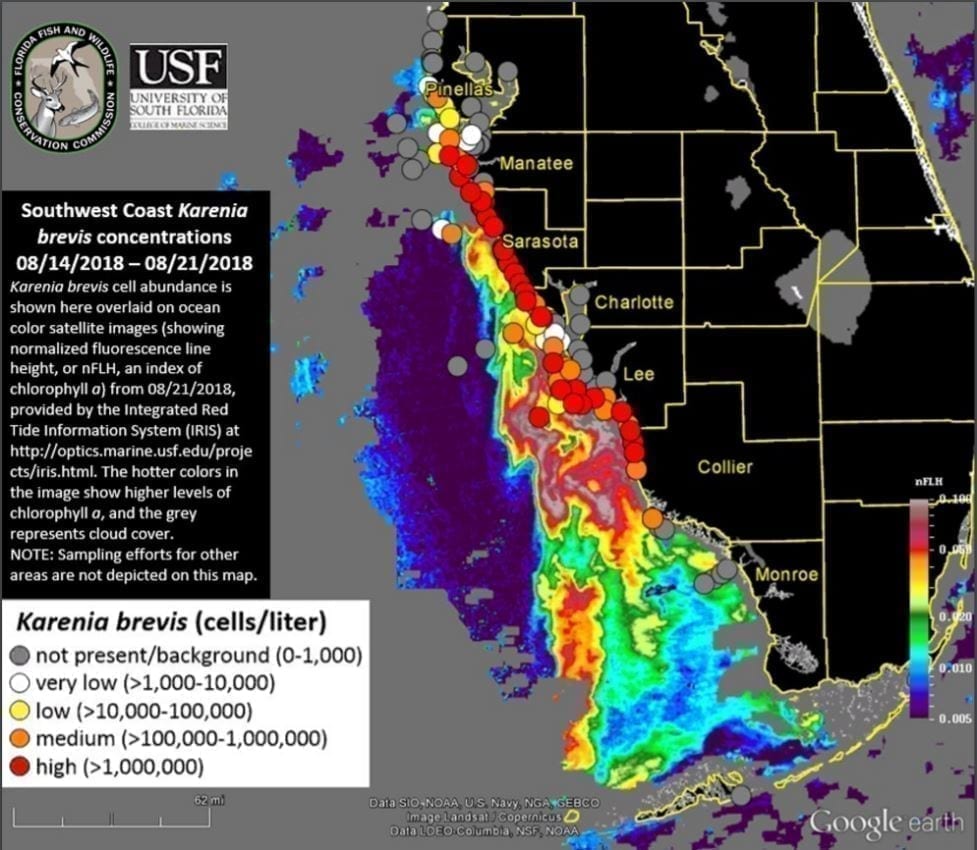
But as irritating as the symptoms are to humans, the effects are often fatal for marine life. This particularly devastating red tide has been described by many locals as the worst they’ve ever seen. The Florida Fish and Wildlife Conservation Commission (FWC) reported levels of 1 million or more cells per liter, one thousand times as many as a normal, nontoxic level, in samples collected for weeks along the coast from Manatee to Collier counties.
Florida FWC red tide status map for August 22, 2018
The Red Tide Rises on the Tourism Industry
While marine biologists, municipal crews, and volunteers work to clear the dead wildlife from beaches and canals, guests are canceling reservations and questioning whether they should book months from now. “We have seen a significant dip in rentals, approaching a 30% reduction on last year,” said Andy Moore, CEO of Gulf Coast Vacation Rentals and Gulf Coast Property Management in Bradenton, Florida. “Last minute bookings are non-existent.”
Judith Lee-Hemstreet, president of Sun Palace Vacations in Fort Myers, has had a similar experience. The red tide hit her area on July 25th, she said. “In a period of 24 hours, the beaches went from pristine to piles of algae and dead fish.” That week, Sun Palace refunded an estimated $20,000. The week after, refunds increased to around $40,000. “That’s college tuition,” Lee-Hemstreet said. Sun Palace’s normal summer occupancy is between 80 and 85 percent.
She said she even heard reports from the Publix nearby that guests who checked in the weekend after the red tide appeared returned the groceries they had just purchased for their stay and went home.
“This is as bad as I’ve seen it, said Rob Domke, luxury vacation rental manager for Gasparilla Vacations in Boca Grande. Usually red tides reach the coast over the last couple of weeks of summer, last for only a few days, and bring in a few dead fish, he said. “This has been a couple months of uninhabitable beaches.”
Normally this time of year is the slow season, Domke said. “The good thing is we’re used to not having as many folks down here,” he said. Still, he estimated around 50 percent of the reservations they did have this time of year had been canceled or rescheduled, and they had received no new bookings for August.
While it may be a silver lining that this time of year is not peak season, there is no way to predict when the red tide will end, fueling guests’ anxiety and property managers’ stress. Guests continue to call daily asking about what the conditions will be months from now. They have also called to ask why property managers didn’t tell their guests about the red tide if they knew about it last October, Lee-Hemstreet said.
Travel insurance does not cover red tide events.
“We haven’t seen an uptick in cancellations but the requests for refunds and compensation have been flowing thick and fast,” said Moore. “This has been challenging for my staff.”
“With hurricanes, we know the next steps, and we can see an end in sight,” Lee-Hemstreet said. With this, they can’t. “We feel helpless — we can’t fix it.”
Property managers aren’t the only businesses affected by the red tide. Water sports, fishing charters, restaurants, and other businesses have all taken a hit. Domke reported at least one charter fisherman he knows hasn’t booked a single trip in a month, even from locals who are the usual customers this time of year.
“Everything having to do with water is a huge impact on business,” said Lee-Hemstreet. “If you can’t use the water, people will go somewhere else.”
She and other property managers compared this event to the BP oil spill in 2010. “I think this is worse because it is not a one-off accident,” Moore said.
According to a CNN report, local CVBs and other agencies have reported business losses totaling $8.1 million so far, much of which only accounts for July.
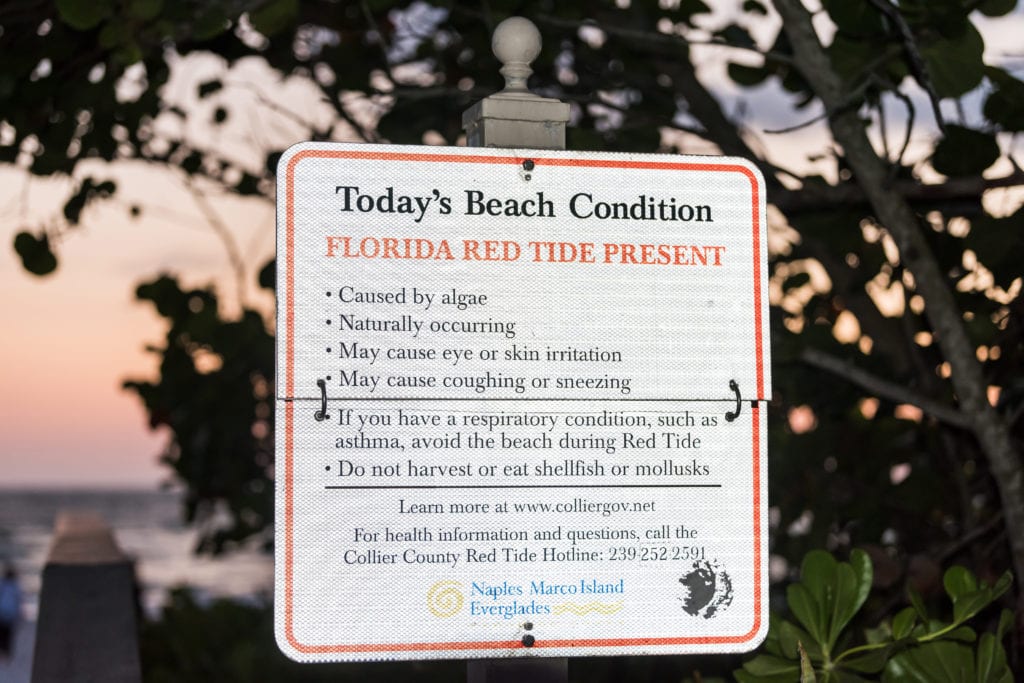
Red tide sign posted on a Naples beach on April 29, 2018
Lake Okeechobee Sends “Green Slime” Blooms Down Caloosahatchee River
Meanwhile, canal communities just off the coastline are facing another algae issue: the “green slime” cyanobacteria blooms caused by agricultural runoff being drained out of Lake Okeechobee. Those waters are drained down the St. Lucie River to the east and the Caloosahatchee River to the west — right into the middle of the red tide zone. Green mats of algae are clogging the canals, which can suffocate plants and animals underneath when they can’t get enough sunlight. The dead algae and other organic matter flowing out of the Caloosahatchee, into Charlotte Harbor, and ultimately into the gulf may be feeding the K. brevis.
When Florida red tide blooms are carried closer to shore, they are capable of using nutrients from a variety of sources, including those carried from freshwater bodies out to sea. It is logical to expect that excess nutrient inflow to Charlotte Harbor — including nutrients carried by storm water runoff from land, as well as nutrients carried from land to sea by multiple means including total riverine input — could influence an existing red tide near shore by serving as additional “food” for growth of these algae.
More research is needed to determine if the current cyanobacteria bloom is affecting the current red tide. Mote is also testing ways to mitigate and control red tides, including a test in Boca Grande of the ozonation process it uses to remove red tide in its aquarium and sea turtle hospital waters, while also trying to keep up with recovering animals sickened or killed by the red tide.
Hurricanes can also play a role in exacerbating red tides by creating more storm run-off that flows into coastal waters. Last year’s Hurricane Irma may be one of many culprits in the current bloom.
Aerial view of a blue-green algae bloom in Lake Okeechobee
Florida State and County Agencies Respond
In another attempt to address the problems, Governor Rick Scott issued a state of emergency declaration on August 13. The declaration makes additional resources available for clean-up efforts and directs funds to local municipalities and CVBs. Mote Marine Laboratory will receive $100,000 to support the rescue and recovery of affected wildlife. Lee County, where Fort Myers and Charlotte Harbor are located, will receive more than $1.3 million in grant funding. VISIT FLORIDA will receive $500,000 to provide grants to local tourism boards for marketing and PR efforts.
According to a VISIT FLORIDA press release on August 17, the organization launched two programs following the governor’s emergency order, one of which is the grant program for local CVBs. The other is a red tide recovery marketing program giving affected southwest Florida businesses six months of complimentary access to marketing opportunities with VISIT FLORIDA, including “enhanced web listings,” content distribution across its social and web platforms, brochure distribution in Florida welcome centers, and other activities. It will also develop a marketing campaign for the area to run after the red tide subsides.
For the property managers we spoke with, the state of emergency declaration is a short-term fix, not a solution to the bigger problems.
Domke had mixed thoughts. It brings awareness to the problem, he said. “If there’s a solution for it, great. If not, we just told the world there’s a massive problem here and it’s gross. […] How do you promote tourism when you can’t go to the beaches in Florida?”
“I do not see any leadership from the state level,” said Moore. “Florida’s number one industry is tourism. It’s not a political statement to comment that if we stay on the same track we are endangering our future, both environmentally and economically.”
Prior to the additional funding, Lee County departments were working to address cleanup efforts and marketing. According to the Lee County CVB’s August 10 email to its stakeholders,
Lee County Parks & Recreation staff has been cleaning county beaches, parks, and boat ramps affected by the red tide fish kill. The County has hired a debris removal contractor to assist in cleaning the beaches and shoreline. The City of Sanibel, Town of Fort Myers Beach, and Captiva Erosion Prevention District continue clean-up efforts in their areas. To date, more than 1,220 tons of material has been removed from our beaches and shorelines.
The email also states that the county’s tourist development council recommended that the county approve up to $1 million in spending on a marketing campaign after conditions improve.
“In the short term, in addition to an enhanced social media [effort], the VCB is providing customized responses to individual social media posts,” said Tim Engstrom, Lee County government communications specialist. “After the water clears, the advertising and marketing strategy with spending of up to $1 million will be implemented.” The details of the marketing campaign are still being worked out, he said.
Crews removing dead fish from Fort Myers Beach on August 3, 2018
Moving Forward
Some relief to the tourism economy may come in September with baseball and fishing tournaments currently set to move forward as scheduled. Still, mass media coverage focused on tragic images and footage of dead wildlife has compounded the lingering problem. In reality, the dead wildlife, ruddy water, and irritating air shift with the wind and water flows. Some days, many beaches look and feel as if the red tide never existed. Even so, that does not mean that the K. brevis algae is back to normal levels in the area. Updates on specific beach conditions can be found on Mote’s VisitBeaches.org interactive map.
Local businesses are also focusing on all there is to do on land in their destinations. “Basically, we’re still a beautiful southwest Florida beach with blue skies and palm trees,” said Lee-Hemstreet. The promotion isn’t just for visitors. “One of the things we’ve instituted on the island is to shop, eat, and drink locally,” she said. They are encouraging locals to spend money on the island because they are all hurting.
Domke is encouraging guests to do their research and be aware of the issue.
All everyone in the tourism economy in southwest Florida can do, however, is wait – not just for an end to this red tide as the area’s winter peak season approaches, but also for solutions to the bigger problems and the slow recovery of Gulf marine life.
Randy Sparks, head of growth and customer success at MyVR
MyVR’s $6.1 million Series A funding last December is being deployed in part to grow its first sales department, and its first hire brought Randy Sparks, a long-time vacation rental professional, back to the industry. Sparks started in the company’s San Francisco office on August 6 as its new head of growth and customer success. The appointment was a long time coming. “For me, it’s like coming back home,” he said.
MyVR is a vacation rental management platform that provides operational software to individual homeowners and managers with generally around 20 or fewer properties, though some of its clients have thousands of homes in their inventories. Most of its clients are in North America and the Caribbean. The software connects openly with applications like Airbnb, MailChimp, and others, as well as a new services marketplace for resources like its live consultations to learn more about SEO strategy.
Co-founders Jonathan Murray, Michael Stachowiak, and Markus Nordvik created the software in 2010 after struggling to find tech solutions that fit their own personal vacation rental management needs. At the time, legacy software was too clunky for individual homeowners or small property managers. They set out to build a solution to meet this hole in the market and fluidly integrate with outside developers. The result was MyVR, which graduated from Y Combinator later that year.
Seven years later, the team closed a $6.1 million Series A round led by True Ventures with participation from SV Angel, Clem Bason, and Chris Dixon. In its seed round in 2012, MyVR received investments from Zillionize Angel, SV Angel, Y Combinator, and nine individual investors, including the co-founders.
Sparks followed the company’s progress since he brought it on as a property management software partner at HomeAway, where he had served as head of North American sales (and later account director of emerging channels) since 2008. He left HomeAway in 2014 to take a break from the industry, working as a senior manager and then head of commercial customer success for content software company Box.
Despite his hiatus from the vacation rental world, he followed MyVR in a pseudo-advisory role. What drew him to the company, he said, “was the fact that they spent so much time trying to get the product right.” So when the company closed the Series A round, the stars aligned for Sparks to satisfy his “itch to get back into the space.”
One primary use of the cash infusion was for MyVR to build up its channel technical support team to free up resources to focus on new features. As its 2017 year-in-review blog post explains:
After launching Airbnb and [Booking.com], we found that maintaining and advancing these channels, along with our HomeAway and TripAdvisor integrations, required a lot more technical support than we hoped, which takes away bandwidth for other things (like new features). The channels make regular changes and enhancements that we must support, and many of you have also requested additional functionality around the channels. Since our new funding closed, we have already doubled the size of our channel management team, which has helped address resourcing needs there and is bringing added stability and improved functionality to these channels.
A second priority for the new capital is to accelerate sales. Enter: Sparks. Prior to the new funding, MyVR acquired new customers through word of mouth alone. Demand had pushed the company to a point that they were having to ask customers to delay onboarding while they refined some aspects of the software.
A big part of Sparks’s role is to remove that roadblock. “The money is to light a fire to the growth effort,” he said. [Insert obligatory spark pun here.] “More customers means more voices to be heard to get the product right.” His immediate objective is to build the company’s first sales team, and his first move before officially signing on was to bring on Amanda Flores as head of sales. Flores was a sales manager that he worked with at HomeAway. “I wouldn’t come without her,” Sparks said.
Prior to the Series A round, MyVR had six employees. It now has four times as many across Sparks’s department and others.
In the larger picture, Sparks is responsible for all revenue that comes through the door — subscriptions, booking fees, channel distribution fees — as well as post-sale account management and customer success. “We’re building a team hyper-focused on channel management,” stated Sparks.
Looking ahead, Sparks said MyVR wants to double down its efforts around proper, complete, and seamless integration with channel partners. Not a lot of good communication from marketplaces comes back to software companies, he said. “We want to make sure we are proactively working with distribution channels in a more communicative way.”
That means building out additional channels and complete integrations “with everyone who matters,” said Sparks. The focus is on delivering meaningful impact back to customers — to make their lives easier and build a core open platform that enables them to make good decisions. This includes the larger short-term rental market, not just vacations, he said, pointing to business and urban travel in places not known as vacation destinations. “I’m insanely focused on making each and every customer as successful as they can be.”
After hitting an industry event such as VRM Intel Live or taking a VRMA webinar, it’s easy for marketing professionals to leave crackling with energy about all the possibilities for their 2018 marketing plans. Who wouldn’t?! But then you sit down at your desk, look at your calendar and your budget, and the electricity begins to dwindle. How on earth can you do social media marketing well and send the right number of emails and optimize your website and manage your SEO and SEM and analyze your data and so on? It’s exhausting, and if you’ve got a small marketing department as most of us do–kudos to those of you one-person marketing teams!–it seems nearly impossible to do everything you need to do and do it well.
Instead of designing your marketing plan around all the things you “should” do, or worse, focusing too much on every new OTA change that drives a wedge further between distribution and marketing functions, tailor your marketing plan to you, your team, your company, and your market. By making your tactics meet you where you are strongest, you’ll find a balance that allows you to be more effective and more efficient. The following ten strategies are certainly not the only ones at your disposal, but they are tried and true in this industry and many others; they include some personal favorites that have produced demonstrated results time and again.
Track (and take a dive deep into) your data.
Data go much deeper than the surface KPIs of reservations, social media engagement, and email opens. Before redesigning your marketing plan, make sure you have the data infrastructure in place to look closely at every step of a guest’s booking journey, including the following:
How guests interact with your website
Calls to your office(s)
What prompts your guests to book reservations (Assign every campaign, ad, email, and other touchpoints unique URLs for tracking in Google Analytics, as well as promo codes or other identifiers for your reservations team to designate in your PMS.)
Social media engagement (In most cases, each network’s built-in analytics combined with Google Analytics will give you a good picture, but if social is your jam, you can go even further with third-party social analytics tools such as Hootsuite or Edgar.)
Once you have all of these metric systems in place, check in with them regularly, and make this process easier by having certain reports automatically generated and sent to you on a daily, weekly, and monthly basis.
Also take some time separately to dive deeper into your data that doesn’t necessarily change on a daily basis but can offer big insights for your campaigns. For example, this month, take a close look at your 2017 guest demographics, feeder markets, booking patterns by property size and amenities, reservation sources, and other trends, and compare this info to 2016 and 2015. This exercise not only creates a larger picture of the guest environment in which your company operates, it identifies areas where you can segment guest groups, homes, or geographical areas for targeted campaigns.
Analyze your ROI, both of your budget and your time.
When we talk ROI, we often leave out the time investment various activities require, but in many cases the time factor is just as important—especially when we don’t have enough of it. (Does anyone?!) For example, posting daily lunch-break social media videos may not cost anything in dollars, but maybe it takes your marketing specialist ten hours every week, which may or may not be worth the time investment, depending on your needs and goals. As you examine the ROI of all your activities, also consider the aptitudes you and your team have available. Rather than simply eliminating or scaling back activities, think too about shifting responsibilities between teammates when different talents lend themselves to better project efficiency.
“We are always looking for efficiencies as far as allocation of our time budget,” said Stacy Carlson, a twenty-year VR veteran and marketing director at Taylor-Made Deep Creek Vacations and Sales. As an example, “Quality visual content is in increasingly greater demand, so we recently brought on someone to focus on producing videos who can also fill in as a photographer. Just like our monetary budget, we hone in on what is driving reservations—vivid imagery of our area, appealing photos of our homes, well-timed email campaigns with relevant content.”
Weed out the activities that don’t speak to your market.
Just because certain channels work for other markets doesn’t mean they will work for yours, and it’s important to identify these so you don’t eat up resources. For example, if your target market is women from fifty-five to sixty years of age who are booking a home for a family vacation, it may not make sense to pour a lot of resources into the newest social platform popular with Gen Z. A word of caution, however: just because something isn’t working for you now doesn’t mean it won’t in the future, so use your insights from strategy one to reevaluate this issue over time.
Lean on what generates the most reservations and your own specialties.
Now that you know what’s working for you and what isn’t, you can allocate your talent resources accordingly. Don’t get locked into job titles, forcing square pegs into round holes, and “the way things have always been done” (the enemy of progress—and my sanity). Instead, focus your team’s time on your individual strengths to yield the best and quickest results, and make sure that you reevaluate responsibilities periodically.
Stacy Carlson echoes this advice. “In-house, we focus on the areas where we have expertise,” she said. “For example, I have a certification in email marketing, so we brought that in-house shortly after I joined the team, and we have two professional videographers/photographers on staff to produce high-quality imagery to use everywhere from our website to social media.”
Outsource to teams who specialize in the things you don’t.
For those remaining activities that you need but don’t have the talent or time for, outsource them to an expert. There are, of course, many familiar faces and great industry vendors featured throughout VRM Intel, but don’t overlook other sources of help who may be a better fit for your market and budget, such as freelancers and small agencies. Need more content for your blog? Consider partnering with your Convention and Visitors Bureau (or other destination marketing organization) to host a group of travel writers to provide content to your site and publications your guests read in exchange for a visit to one of your properties, or hire a local writer. Want to leverage drone photography but don’t have a drone pilot on staff? Hire a local specialist for a one-time project to create a library of beautiful images and videos you can use in all of your marketing materials.
Caleb Hofheins, marketing director and the only full-time marketing staff member at GreyBeard Realty in Asheville, NC, demonstrates this approach. “I think it’s really a matter of knowing what your marketing team is proficient in,” he said, “and then bringing in a third-party team to support the overall marketing effort as well as pinpointing specific areas of opportunity where the company would be best benefited by having a specialist focus on it.”
Automate everything you can.
Automation is a busy marketer’s best friend, and there’s more you can automate than you might think. You can–and should!–set up automated marketing campaigns such as emails based on lead or reservation triggers, drip campaigns to distribute blog posts, and social media posts with tools such as Edgar that will recycle your evergreen posts when your queue runs low. Going even deeper, you can automate your routine internal tasks (like your data reports from strategy 1!) with tools such as Zapier or Microsoft Office 365 Flows. These tools provide nearly endless ways to make apps do your work for you by connecting everything from Outlook to Dropbox to Google apps to Basecamp and many more to automate workflows. For example, you can set up an automation to add new MailChimp subscribers to Google Sheets or have a Basecamp task for a new property trigger in addition to your social media schedule in your Google Calendar. The more work you can make apps and software do for you, the better. Just don’t forget to check in regularly to make sure everything is working the way you need it to.
Repurpose everything.
Following the same principle as automation, make your work do double and triple duty. Give every new piece of content you make at least three jobs. For example, download your latest Facebook Live video, upload it to YouTube, and embed it on your website. Create every social post to be shared on any network. (Twitter’s new 280-character limit makes this seamless!) Turn your owner newsletter into marketing pieces for your recruiter. Create travel guides from your area directory and post them on your site, email them to incoming guests, and share them with your local CVB. The opportunities here are nearly endless.
Capitalize on free information.
There’s another important source of valuable data that can be overlooked: your colleagues, FAQs, and guest feedback. Google Analytics and Facebook Insights won’t tell you what your guests’ nonnegotiables are, but your reservationists will. Ask them! Consult with them regularly about what guests are looking for at different points in the year and what they ask about most often. You can use this info to create content and campaigns regarding sought-after amenities and better time promotions regarding booking trends as well as help address pain points to reduce friction between browsing and booking. Also ask your reservationists about marketing campaigns, both to generate ideas for new campaigns and evaluate past ones. Not only will doing this generate ideas and insight you might not have otherwise gained, it will foster interconnection, buy-in, and excitement for your shared activities. The same practices can be applied to owner recruitment and retention, too.
Similarly, internal guest surveys and reviews on sites such as Facebook and Yelp aren’t just for your housekeeping and maintenance departments. Dig into your surveys and reviews to find areas where you can communicate programs, features, or even specific lease policies better to guests to uncover positive testimonials; you can share across all your channels to identify PR opportunities to turn unhappy guests into happy ones or to spot problem properties that could generate more reservations and returning guests with a few easy upgrades.
This sort of data analysis doesn’t necessarily need to take significant time or sophisticated reporting. One of our company’s favorite visual reports? A word cloud generated by dumping all of our Facebook, Yelp, and Google reviews into a free word cloud generator to show that what guests loved most are our homes and our staff.
Continue to learn, and apply new strategies as you go.
Once you have your newly refined plan and schedule in place, don’t stop there. Be sure to build in time for continuing education. You can do this any number of ways, but one of my personal favorites is to read one book or take a class or webinar every month, mixing up the subjects among marketing tactics, creative outlets, and general skills. Lynda.com, HubSpot, and Skillshare are some of my go-tos, but there are plenty of other continuing ed resources out there, such as YouTube, Udemy, Coursera, TED, and edX. Think creatively here, too! Don’t overlook resources provided by the tools and apps you already use, certifications from non-VRM-specific organizations or other areas, such as Google Analytics Academy, MailChimp’s resource center, LinkedIn professional groups, or LearnAirBNB.
As you learn new skills, use your marketing plan as a case study and apply new tactics one at a time. If you follow the one-new-thing-every-month schedule, by the end of the year you’ll have at least twelve new tools in your toolbox.
Leave room to experiment.
“VR marketing is all about reaching the guest in the right places at the right time,” said Caleb Hofheins. “That is accomplished through experimenting, tracking and observing performance, and then learning from those results.”
Take a page from the growth hacking mentality and embrace an environment of continuous experimentation. You don’t know what works if you don’t try it, right? Dip your toes into VR with a trial of virtual walkthroughs on a select group of properties, such as underperformers who could use a boost. Need to fight back against Facebook’s ever-changing algorithms? Try using a 360o camera for dynamic photos and videos. Having a hard time keeping up with your chat support? Venture into the world of artificial intelligence and try a simple chatbot.
If these ideas seem too out-there for you right now, experiment with what you’re already doing. For example, if you want to try a new advertising platform, negotiate a trial period before making a full commitment. This year, I negotiated six-month ad trials with a certain well-known review site and a smaller OTA during our busiest booking season. If they didn’t perform during that period, we wouldn’t renew. In both cases, they didn’t perform or actually performed worse than before we gave them money, so starting with a trial saved us six months or more of wasted expenses.
Whether you try one of these strategies, all of them, or some of your own, remember: there is no one-size-fits-all marketing plan. Each marketing professional, company, owner group, and market is unique and should be treated as such; use smart data to uncover your strengths and efficiencies and make constant improvement. How will you capitalize on your ingenuity in 2018?
The Netflix original series “Stay Here” debuts today, shining a new spotlight on the vacation rental industry. The show features well-known interior designer and TV personality Genevieve Gorder and real estate expert Peter Lorimer showing short-term rental owners how to update their properties and increase their profits.
Gorder is a two-time Emmy nominee known for her role on TLC’s “Trading Spaces” and several other home design shows. “I look for the diamonds that need a lot of polishing,” she says in an episode.
Lorimer is the CEO and broker behind PLG Estates, a firm in Beverly Hills, California with a self-described “punk rock” approach to real estate and a specialty in short-term rentals. The agency lists 12 high-end properties available for rent around the Los Angeles area from $550 to $5,625 per night.
In the eight-episode season, the pair travel to unique properties around the country, from a Seattle houseboat in episode one to a vineyard cottage in episode five and a DC firehouse in episode eight. They help “vacation rental owners transform their one-star disappointment to a five-star stay,” Gorder says in the show’s introduction.
“We’ll create moneymakers for homeowners and a memorable experience for their guests,” Lorimer narrates. The hosts introduce each city with a brief history of its rental market or tourism landscape and vacation rental data from AllTheRooms, including total rental units, average nightly rates, and annual revenues. This sets up how the hosts can make each property more competitive in its market.
They do so through total renovation of both the property and the owners’ marketing strategy. While Gorder revamps the property’s design and adds features designed for guest appeal, Lorimer teaches the owners about branding and pricing. The show’s format is similar to that of many popular home renovations shows: homeowner has a drab property that’s not netting them the value it could, then a design-real estate duo enters the picture to save the day.
Along the way, homeowners learn how to add amenities, local experiences, and marketing tactics to make their guests happy and earn more money. At the end of the episode, the homeowners are surprised with a magazine-worthy home reveal and rental rate suggestions that meet their financial and occupancy goals. What the Netflix series leaves out are the challenges to home renovations and short-term rental management, either real or contrived for cameras.
Gorder, or “Gen” as Lorimer calls her in the show, kicks the homeowners out to revamp the property with contemporary design, stocking it full of both Instagram-worthy features and amenities that guests are looking for. Think Pinterest-popular chunky knit blankets, market lights, vintage pieces from local antique shops, and fire pits in front of a sweeping vista.
Meanwhile, Lorimer arranges curated local experiences and uses them to teach the homeowners introductory marketing strategies. In the houseboat episode, he explains SEO and pay-per-click advertising. With the vineyard cottage owners, he explains hashtags (to their endearing bewilderment) and later brings them to happy tears showing them how blogging showcases all there is for guests to love about their home.
Throughout the episodes, both hosts always bring their concepts back to the equally important goals of increasing revenue and delivering special guest experiences. They marry their individual areas of expertise through strategies like spending 10 percent of a guest’s first night’s rental on a welcome perk and owning a niche in the market through design and quality – “nichin’ out,” as Gorder says.
For seasoned property management professionals, the show won’t provide much in the way of new strategies or insider tips, but it does provide a feel-good outside view of what the vacation rental industry is all about: the excitement, romance, and business of travel hospitality.
It costs, on average, seven times more to sign a new customer than it does to retain one, and this stat rings true for vacation rental managers. But in today’s market, homeowner retention is far more than a huge cost saving – it’s survival. Just as it is essential to have a plan to recruit new owners, property managers need strategies to keep them in the rental program.
“The relationship with the homeowner has both business and personal elements, so a healthy owner acquisition strategy combines business-to-business (B2B) and business-to-consumer (B2C) sales and marketing tactics to create a business-to-owner (B2O) plan… The B2B purchase process tends to be rationally and logically driven, while consumer choices are typically emotionally triggered…Design the messaging to highlight the advantages of your program and appeal to the homeowner in both a professional and personal way.”
Owners do not shed these needs once their contract is signed, so neither should a property manager’s internal marketing. Recruitment never really ends; it simply becomes owner retention, which is always “re-recruiting” ahead of the next contract renewal. Here are some easy-to-implement strategies to ponder when creating a retention marketing plan.
Show owners what you do—don’t just tell them.
While traditionally used to help writers improve their storytelling, this advice is just as relevant in retention. As Jimmy Maymann writes, “the age of talking at consumers is over.”
Owners can only hear a property manager vaguely say what they’re doing so often before the words start to lose meaning.
But what if an inspector texts a photo of a housekeeper elbow deep in dust behind a fridge? Or what if the company posts a video on social media of the maintenance crew tying down deck furniture before a hurricane? Or what if a guest service team member emails an owner a group photo with a family reunion wearing matching shirts with their home’s name on them?
That personal, visual engagement has staying power, which inspires warmth and confidence. Implementing show-don’t-tell practices like these across communications is a relatively simple and often enjoyable way to maximize owner retention activities.
Pay attention and communicate with specificity.
“What are you doing for my home?” Every property management staff member gets this question regularly. Of course, much of what a company does for one home is the same as what it does for all, and owners understand this. Still, owners deserve to feel like someone is paying attention specifically to their home, which will go a long way in keeping them in a program.
Communicating with specificity can convey just that—that they’re being paid attention to.
Consider the following messages:
Company A: “We market your home online.”
Company B: “In addition to our standard digital marketing activities, we’ve been pushing Beach House’s two open summer weeks in two email campaigns on 4/16 and 5/6 and in a social media feature on 5/11. We’ve also begun actively promoting your fall openings in some pet-friendly and fall events campaigns.”
Company A: “We completed all deep cleans in early spring.”
Company B: “Molly and a housekeeping team completed Mountain Lodge #43’s deep clean on March 5. We noticed quite a bit of dust buildup, so we recommend replacing filters more often this year; but your floors, bedding, and appliances are all in great condition.”
Company A: “Pool pump inspections are done before pools open for the start of the season.”
Company B: “James is scheduled to inspect your pool pump on April 3. He will be checking all mechanical equipment as well as the filters and chemical levels while he is there, and we anticipate having his full report to you by April 5.”
While both companies may be doing the exact same things, which one would an owner likely prefer to do business with? With owners in your program, you have a huge upper hand in being able to communicate with each of them at this personal level of detail. Your competitors don’t, so utilize this gift at every opportunity. In an owner retention marketing plan, build in systems to keep detailed notes on each property so relaying information to individual owners is quick and thorough.
Be proactive and demonstrate integrity in identifying and solving problems.
Letting a problem occur is excellent marketing—for competitors. One huge advantage a vacation rental company has over its competition is intimate knowledge of its homes and the opportunity to be proactive. Staff can spot a potential problem, solve the root cause before it becomes a crisis, and then tell the owner specifically what they did. Not only does this demonstrate that they’re paying attention (see above), it minimizes any temptation for that owner to respond to competitors’ marketing.
Proactivity is an opportunity for everyone to participate in owner retention. Basic departmental cross-training and an easy reporting process will help teams work together better and faster, which will go a long way toward maintaining owners’ trust in the care of their home. Training for proactive communications can include empowering housekeepers to catch leaks and report them to maintenance on the spot, developing data reports that help management uncover weakening booking patterns before it is too late, and implementing thorough inspection protocols in the off-season to prevent major issues down the road.
Be willing to customize management (within reason) for high-profit homes.
In his article “Key to Exponential Growth: Fire Your Owners Regularly” in the VRM Intel Winter 2018 issue, Wes Melton talks about categorizing owners on two scales, low-effort/high-effort and low-profit/high-profit, when deciding which owners to let go. The same concepts can be applied when deciding what owners a company most needs to retain.
The high-profit, high-effort category is where managers may find themselves devoting most of their retention marketing energy, and this can likely mean personalization for members of this group. I don’t mean completely overhauling operations to cater to a single property, but rather being open-minded and not being limited to a standard PMA at the risk of losing a valuable client.
Perhaps your portfolio includes the only event-capacity home in the market, complete with a caterer’s kitchen and carriage house, and the homeowner wants to hire a live-in estate manager. If the home has the potential to generate a healthy profit and provide a huge competitive advantage in rentals, why not find ways to customize services (within reason) to accommodate the owner’s requests? Openness and flexibility could make the difference in retaining owners as well as reveal creative solutions that can be implemented in future recruiting negotiations.
Provide exclusive tools and resources to help homeowners grow their own vacation rental business.
Owners are running their own vacation rental businesses, and when they do better, property managers do better. As their business partner, you can be the key to their businesses’ growth. Go above and beyond for them in this area by delivering quality resources that their businesses can’t live without or get anywhere else. In other words, be their dedicated Expertise-as-a-Service (ExaaS) provider.
To uncover all the possibilities this affords, first ask owners what their biggest vacation home challenges are. They may reply with a lot of FAQs, but they may also reveal some hidden sore points, such as Mr. Smith struggling to find a good contractor or that some owners want to be more informed about what’s happening around town when they’re away.
Property managers can easily provide solutions, but only if they know what owners need. It’s likely that others are facing the same challenges or they will at some point in the future, so thoughtful ExaaS can offer immense value.
My favorite question to ask in this area is for staff: “What do you wish owners knew?” This, too, is a goldmine of information. In his article, Melton shares an example of one putting a $500 duvet in her rental home. A housekeeping team may share that this is a common issue and slows laundry processes. With information like this, the PM can create easy guides that benefit its entire portfolio and make the staff’s jobs easier. Who wouldn’t love this information?
Developing informational tools like these does not need to cost significant time or money. Quick video tutorials, monthly newsletters, quarterly town-hall style webinars around FAQs, or download-and-print checklists can be easy, affordable, and even fun ways to share information.
Integrate owners into company growth.
Just as vacation rental managers can invest in owners’ business success, owners can be invested in theirs. This is especially effective in retention of high-profit, high-effort owners. Invite them to focus groups, give them exclusive early access to test new products and programs, send them surveys, or simply ask for their feedback from time to time. Giving owners an opportunity to be heard and offer their own ExaaS will further strengthen the owner-manager relationship. As a bonus, the company could also find a deep well of valuable ideas it may not otherwise have tapped.
Completing the acquisition-retention loop, property managers can also use this integration by way of referrals. Owners talk with others in competitors’ programs, and they have the power to be more influential than any other recruitment marketing campaign. Consider making evangelizing your company an extra sweet proposition by offering a referral fee in return for every lead or signed contract they provide.
The VR Mastered Boot Camp returns this fall to bring the educational series to vacation rental owners and property managers. This year’s event will be held October 4-8 at the Paradox Hotel in Santa Cruz, California.
Founders Tyann Marcink and Alanna Schroeder will host up to 20 attendees for five days of networking and hands-on courses. Conrad O’Connell, SEO specialist and founder of BuildUp Bookings, and Jessica Vozel, writer and co-founder of Guest Hook, will join them as guest teachers. Classes will focus heavily on social media, but email marketing, SEO and copywriting, websites, listing sites, photography and video, hospitality, and operations will be covered as well. Registration costs $1,697 per person with discounts available for teams and alumni.
Marcink is a vacation rental photographer who leads workshops, writes ebooks, and speaks at conferences about photography. She also runs five short-term rentals of her own and manages a sixth in Branson, Marthasville, and Union, Missouri.
Schroeder turned her family’s Lake Tahoe home into a vacation rental. The experience led her to create The Distinguished Guest, a site that curates affordable luxuries for vacation rental properties.
After attending several conferences together, Marcink and Schroeder noticed attendees leaving feeling overwhelmed. They set out to create education in a format that brought many topics back to basics and delivered them in a way that many people learn better. This resulted in the VR Mastered Boot Camp, an annual immersive series with mini-camps throughout the year. Previous camps have been held in Mexico, San Antonio, and Nashville.
The boot camp caters to those who need help with foundational skills, whether they are new to the industry or have been in it for a while but haven’t stayed current with recent advancements.
“We love to teach and watch people succeed,” said Marcink. The 20-person limit and multi-day agenda let the teachers walk through several initial steps, such as setting up Instagram and using hashtags. “The teacher-to-student ratio is small so we can sit next to you and help you work through problems,” said Marcink.
The agenda has a strong social media focus because “much of our clientele is more mature and a group that hasn’t grown up with social media” said Schroeder. “Many are fearful of putting themselves out there and getting started.” Schroeder, Marcink, and their guest teachers help attendees set up accounts, give them ideas on what to post, teach them how to tag others, and build a community, among other tasks.
“Social media is something that is always evolving and changing so we’re always trying to stay ahead of it,” said Marcink. “Sometimes [our attendees] don’t want to ask their kids or grandkids for help.”
Creating a safe environment to ask questions is important at the boot camp, both founders said. (This environment continues after the event when alumni are granted access to a private Facebook group to continue asking questions and network with other attendees.)
While many topics are covered at an introductory level, that does not mean the information is limited. “We open up a firehose on you,” Marcink said. They also incorporate some sessions where groups can split off by experience level to learn more advanced skills or focus on an area where they need extra help, Schroeder said. At the end of the camp, attendees get “the key to success,” a key-shaped USB drive with exclusive tools like email templates.
A big part of their mission is to use what they’ve learned over their combined 20 years in the vacation rental industry to help others “level up.” “We’ve been through several presidential cycles, we’ve had the double bookings, bad cleanings,” said Marcink, “Everything’s not always peachy keen.” Still, they have also seen all of the positives of the industry, and they use their knowledge to help others learn how to avoid or walk through the bad experiences, Marcink said.
“Another thing this conference does is give them more confidence,” said Schroeder. “It’s fun to see these people grow.” They have also seen attendees make lasting connections. Some even go on vacation together now, they said.
Most people are familiar with the concept of trust when it comes to personal relationships, but what about professional relationships?
I have been working with more and more companies that struggle with trust. A lack of trust in the company culture will lead to internal and external challenges. When I think of companies that struggle with trust, it’s apparent that it’s never about a single major situation; it’s about many issues that happen over time.
Ron Zemke, author of Delivering Knock Your Socks Off Service, said that when working with customers, you should practice the following techniques to build trust:
Communicate frequently
Develop openness
Show warmth
Stick to the truth
Show confidence
Keep these techniques at the forefront of your mind when working with internal and external customers. I have surveyed different employees over time, and when I ask them which of the techniques are present in their companies, I often hear, “Show confidence?” They usually say it like a question. This clues me in that there are trust challenges in the company culture.
A breakdown in communication is one of the most common issues that leads to a lack of trust. When employees and guests feel like they know what is going on, it builds trust. When they are told the company operates on a “need-to-know” basis, it compromises transparency and makes them feel like things are being hidden from them. A severe lack of communication can even create a fear-based environment. When employees are not proactive communicators, it can upset customers as well, such as when guests are not told that the home they rented is still under construction.
The best thing we can do is to be transparent and act out of love by ensuring that guests feel informed and empowered to make decisions for themselves. When we don’t share information, we are acting out of fear—fear that the guest won’t rent the home and revenue will be lost.
When developing openness, it’s important to get vulnerable. Vulnerability can look different to everyone. For reservation sales calls, sharing something personal that makes a connection with the caller is key. Examples include connecting with a guest about his or her hometown if you grew up in the same community or sharing some of your favorite local trails if you are an avid hiker. But keep in mind that you don’t want to make a caller regret getting vulnerable by sharing something personal that overshadows the situation. In an extreme example, this could happen if a caller shared that he or she is coming because a family member is in the last phases of life due to cancer and the employee shared that he has had family members pass from cancer in the last two years.
For leaders, the act of becoming vulnerable might be the underlying issue that has made them unapproachable or unhappy over the last year, leading to stress in the company. When we actually get vulnerable, it builds trust. Yet we are in a world that doesn’t always embrace vulnerability, and sometimes makes people feel like it makes them appear weak instead of confident. If you fear vulnerability, I encourage you to watch Brené Brown’s Ted Talk on vulnerability. It changed my life!
We are living in a world where people crave connection—and vulnerability builds this connection. Showing warmth includes empathy and compassion. If a potential guest calls and shares that he and his family are bringing his mother for her last trip back to the community where they grew up, acknowledge how hard that must be. Make sure you don’t simply say nothing at all. Instead say, “I can’t even imagine how hard this must be for you and your family.” But don’t try to put a silver lining on it by saying, “At least she will get to see her hometown for the last time.”
Leaders can also show compassion when employees are experiencing something terrible in their personal lives by acknowledging that they need personal time.
Another example is sharing an employee’s situation with another employee. Brown references keeping information that is personal to others in the “vault.” Some people think that talking about others and their issues builds connections, but actually, it creates distrust. I always wonder, if you are talking about others to me, what are you saying to others about me?
Always stick with the truth. It sounds pretty simple, right? But “avoiding information” can also translate to not telling the truth. If a house has dated furniture and décor, don’t sell it like it has just been remodeled. Use words such as “rustic” or “comfortable” instead. As a leader, don’t encourage your employees to lie about homes or local construction projects that are underway. It always comes back around: “What we allow, we encourage.” When situations are not communicated truthfully, it will affect how employees communicate with guests.
Confidence comes through in words, tone, and body language. Using a good amount of “ums” when communicating may express a lack of confidence (similar to dead air). I remember a past manager who used to say, “Bad on me,” when he would try new things and they didn’t work out. Instead, be confident and willing to try new things. Learn from them, and be okay with failure. Brainstorm with your team on how a bad situation could have been handled differently, and use it as a trust- and team-building experience. There is a difference between being humble and lacking confidence.
Lewicki and Tomlinson believe that trust is a function of character and competence. I have found that some employees aren’t able to live up to some of these techniques because they are held back by the desire to over-give. When they can’t or won’t honor their commitments, they are bogged down with shame, holding them back from communicating transparently. I have also found that some employees have high expectations for themselves, translating to high expectations of others that often hinder their ability to be compassionate.
Simon Sinek believes that a team is not a group of people working together. A team is a group of people who trust each other. I encourage everyone to think about the different concepts of trust. Dig deep to see where you can improve your trust techniques as an employee or a leader, and build reliability by keeping your word.
“Trust is the glue of life. It is the most essential ingredient in effective communication. It’s the foundational principle that holds all relationships.” —Stephen R. Covey
Skift Global Forum will have 20+ C-level speakers from the travel industry on the stage. Skift’s fast-paced and provocative deep-dive conversations with will hit every industry sector, including addressing the vacation rental sector with each executive. The mix of sessions features in-depth CEO fireside chats and signature Skift Talks, which are TED-style presentations by disruptive innovators.
Skift’s Senior Hospitality Editor, Deanna Ting (who will also moderate at the inaugural Vacation Rental Women’s Summit in New Orleans) will discuss the state of hospitality and rentals with industry leaders.
Standout sessions include:
“Can Airbnb Disrupt Accommodations for a Second Time?” with Greg Greeley, Airbnb President of Homes
“Creating a Global Platform When Change Is the Only Constant” with Mark Okerstrom, Expedia President and CEO
“Beyond the Blue Links: Google’s Next Steps in Travel” a panel discussion with Google’s VP of Product Management, Richard Holden and Managing Director of Advertising & Marketing, Travel Sector, Rob Torres
“Big Bets on the Future of Global Travel” with Glenn Fogel, Booking Holdings President & CEO
“What’s Next for the World’s Largest Hotel Company?” with Arne Sorenson, Marriott International President & CEO
“What’s Hyatt’s Next Move?” with Mark Hoplamazian, Hyatt Hotels Corporation President & CEO
“Going Beyond Experience” with Chip Conley, Airbnb’s Strategic Advisor for Hospitality and Leadership
Tickets include extensive networking opportunities, access to all conference sessions, and more! Don’t forget to use code VACATION for 20% off your ticket when you register.
Targeting Facebook users can seem daunting if you’re unaware of their travel interests. Vacation rental companies once targeted potential customers based on audience demographics, with little insight on their intent to travel in the near future. With the introduction of Facebook’s Trip Consideration, ad delivery is now prioritized for a travel audience. A beginner campaign for Facebook advertising can be relatively low in cost compared to other avenues. The new feature will allow vacation rental managers to achieve results at a better price and, hopefully, at a much higher conversion rate.
According to a study released by Project: Time Off, more than half of Americans don’t use all of their vacation days. While work cultures are changing to emphasize taking time off, this statistic reveals the $225 billion potential economic impact of America’s unused vacation days. Now more than ever, Americans need a nudge toward planning their dream vacations. Facebook’s Trip Consideration tool is the perfect way to remind potential customers to travel.
What Is Trip Consideration?
Trip Consideration gives advertisers the power to target an audience that has demonstrated a general intent to travel without intent toward a specific destination. Such an audience has most likely visited many travel websites but not browsed a site in-depth. Additionally, the feature utilizes both Facebook and Instagram to identify users whose browsing activity signifies they’re interested in planning a trip. Facebook reports that nearly 68 percent of millennials utilized Facebook to choose their most recent travel destination. This feature allows advertisers to get in front of potential customers in the earliest stages of travel planning.
Benefits of Trip Consideration
Trip Consideration offers creative freedom to advertisers, uniquely allowing them to define the specific “creative” they want to use. The setup for utilizing the product has also been simplified. Not only can the feature be marketed to customers with an intent to travel, but it can also be combined to target an existing audience or a custom audience.
Overall, the most significant benefit of Facebook Trip Consideration is the novel advertising opportunity it presents to vacation rental managers. The feature allows advertisers to reach trip planners at the earliest stage possible and utilize their own content to persuade them to act.
How Do I Implement Trip Consideration?
To begin, you must create a Facebook Pixel. This is code that can be easily created via Facebook and added to your website.
From there, the process is simple. Within Ad Manager, select the objective Conversions and choose your audience, budgets, and schedule as usual, zeroing in on your target demographic (including people who show interest in your area). The most important action when creating the ad is to turn on “prioritize delivery to people who plan to travel” under Optimization for Ad Delivery. Additionally, Facebook recommends selecting a broad audience of at least 7 million people. A large audience allows Facebook to use their algorithm and define the right audience with travel intent.
Because the creative freedoms allowed with this feature are unique, we strongly suggest using content that showcases a promotion, your specific destination, or your brand. This is the perfect chance to capture your audience while they’re deciding on their next vacation destination.
Tips to Improve Overall Brand Presence
The content doesn’t stop with your Facebook advertising. While Facebook Trip Consideration targets an audience with intent to travel, it is important to keep your business’ overall brand message engaging on all platforms. If clients find your website lackluster after clicking on a Facebook ad, chances are they won’t be enticed to book with your company.
We’ve gathered four quick tips to build your overall brand presence:
Website
Visitors want to see an aesthetically pleasing, user friendly website. Beautiful Facebook ads that lead to an outdated website can leave your visitors weary. Getting users to the website is half the battle; you want them converting once there.
Incentive
Give your users a reason to book with your company. Competition is tough, especially if the audience hasn’t yet decided where to vacation. Specials are an effective way to incentivize visitors to book and can be advertised within your Facebook ad, on your website, or both. Another tactic is to offer visitors a free travel guide for your area. Information is key when targeting users who are casually browsing for their next vacation destination.
Remarketing
After users visit your website from a Trip Consideration ad, you can remarket to them via Google or an additional Facebook campaign. This tactic will keep your brand name top-of-mind. Remarketing is similar to billboard advertising; your ad will be present as the customer browses the internet.
Consistency
Ensure that your brand design and message remain consistent throughout every phase of your marketing, starting with the Facebook advertising and continuing through your website and remarketing campaigns. Seamless design and messaging will assist with brand recognition as you work to convert travel browsers into customers.
If you are seriously considering selling your vacation rental business and you want to garner maximum value, there are several steps you should take before moving forward.
More time spent preparing the business for sale is certainly better than less, but there are a number of steps you can take within the months prior to posting your business for sale. The following information provides key points to consider to make the sales process a success:
The purchase and sale process should be a formal business transaction.
Negotiations do not always result in the successful sale of the business. Always begin with a well-constructed nondisclosure agreement (NDA) to include a non-solicitation provision. Do not consider parties unwilling to execute an NDA, no matter the relationship. A transaction advisor can help navigate this process, ensure the business sells for maximum value, and provide access to market rate terms/deal points.
When preparing your business for sale, it is important to smooth out any rough spots prior to marketing the business for sale.
The key is to tackle those areas that diminish the value or could hamper the sale prior to going to market. In certain cases, vacation rental managers (VRMs) may be missing contracts, have poor assignment language, or have underfunded trust accounts. It is rare that a transaction advisor cannot help a seller work through a best-practice approach to remediate these issues. Disclosure is also important—prospective buyers will appreciate open and honest communication about these issues. No matter the issue, problems will surface, and it is always better to attack those issues versus sweeping them under the rug.
Vacation rental purchase and sale transactions are grounded in finance.
Those companies with consistent and increasing financial performance fair better in the sales process than those that are unorganized and underreported. When creating and preparing financial statements, consistency and accuracy are paramount. The majority of vacation rental company owners generally prepare their financial statements with an eye toward reducing net income in an effort to improve the company’s tax position. This presentation, however, is at odds with what a business owner wants to depict in the successful sale of a business. The goal when selling the business is to maximize the net income of the operation, as vacation rental businesses are generally sold on a multiple of earnings. Therefore, it is imperative to normalize the income statement and add back those expenses that are germane to the business. This is one of the many areas where a transaction advisor can help in the sale of the business and ensure that everything is positioned for maximum value.
Would you want to buy your business?
Are there qualitative issues surrounding your business? Is your business too dependent on one distribution channel, one employee, or just a few homeowners? Although there is plenty of technology to help create efficiency, there is no substitute for hard work in day-to-day operations. Ensuring that your business puts forth a quality product is the center point in any operation. Conversely, being overly dependent on certain revenue sources or allowing a single employee to yield absolute control or leverage over the business or a potential transaction is problematic. Creating a well-rounded marketing plan and reviewing your organizational structure will ensure that your business is not painted into a corner when it comes time to sell.
Selling a vacation rental business is a material event that you should thoughtfully consider before moving forward. Prior preparation, along with a focus on certain key areas in the business, will help ensure the business is poised for maximum value.
Mike and Julie Magliocchetti tell the story about the recent sale of their business, Key to the Rockies, to Vacasa.
Mike: It all started when we converted the tiny hot-tub room in our Keystone, Colorado, townhouse into an office using a piece of plywood. We worked six days a week for the next twenty-eight years building a successful property management business on the wave of the Colorado ski industry. We loved every minute. This year, we sold that business and went to work for the buyer. To the surprise of friends and family, we couldn’t be happier. This is our story:
Julie: Mike and I met on a blind date at Keystone Ranch. That was back in the 1980s, when I used to Scotchgard my jeans. I’d spent spring breaks skiing with family in Colorado, and the mountains never stopped calling. After graduating from Michigan State University, I packed up my golden retriever and headed west to the Rockies where I fell in love with Keystone’s
Soda Creek Valley—and also with Mike.
Mike: I followed my brother from the Philadelphia area to Colorado in pursuit of powder. It was 1977: the golden age of skiing. I moved to Keystone where Keystone Resort was developing condominium lodging throughout the valley. I landed a job as a night auditor for their condominium operation, moved to manager of employee housing, then found myself in rental operations, running commercial laundry for the resort (we did 12,000 lbs. of linens every day). Ultimately, I was promoted to director of property management for the resort, where I helped manage convention business during the off-season. That’s how I met Julie.
Julie: After getting married, Mike and I decided to start our own property management corporation in Keystone; we’d named the business Magliocchetti Rentals. But on a business trip to Chicago, we had some potential clients tell us the name sounded like a pizzeria. They suggested we call it Key to the Rockies instead. We trademarked the name and began growing our portfolio. For families with second homes in Keystone, having a local contact was a much-desired service. We just needed to get the word out.
Mike: The scope of our marketing was classified ads and romancing the travel agents. Whenever the industry took a little evolutionary step forward, it was easy to keep up. Travel agents turned into travel wholesalers who packaged bulk lodging and bulk air. As a small company, we didn’t have marketing capital, so we relied on these third parties and sweat equity to keep heads in beds.
Julie: Back in the 1980s, I used to drive from Colorado to places like Nebraska and Iowa to visit travel agencies. I’d show up with donuts and say, “this is our company and these are our properties; let’s do this thing.” It’s hard to even imagine now. I just drove around visiting travel agents, youth groups, churches, and anywhere else I could think of throughout the Midwest to make presentations. I didn’t care; we just wanted guests.
Mike: The vacation rental industry wasn’t for everybody back when Julie and I got started. It was a specialty market catering to a certain type of guest at primarily beach or ski resort destinations. It wasn’t always glamorous work, but, as a property manager, if you were willing to put in the elbow grease, you could run a profitable business in a beautiful location that you loved.
Julie: I would say the early 90s–during the dotcom boom—was when things started to get harder. Everybody was starting to develop websites—that was a big change for the industry and for us. We jumped on board as much as we could. I think Key to the Rockies went through half a dozen websites during that time, each bringing new complications to connecting things like our booking engine, back-office accounting system, and property management software.
Mike: As the years progressed, it became possible to wrap those business elements into one fully integrated system, so we did. Then everything went cloud-based. Changes in technology kept coming at us, and they kept coming fast. We’d put our eggs in one basket only to see they were already hatching in another.
Julie: One day, we realized that we needed an employee fully dedicated to business development and another to marketing just to keep up. We didn’t have the capital to bring on new staff, so we added to our staff’s steadily increasing workload. For the first time, we began talking about what it might look like to one day sell our business.
Mike: Over the years, we’d had a number of companies offer to buy Key to the Rockies, but either the timing wasn’t right, the numbers were wrong, or they were too pushy. Then one day I received a fantastic email from Sandra Brahn at Vacasa, and it changed everything.
Julie: Mike didn’t show me that email for two weeks. Then one day he pulled me aside and said, “Julie, I think you should take a look at this.” Sandra had attached a video of herself. She greeted us my name and proposed a partnership-style acquisition that would enable us to continue working under Vacasa’s banner. There was a comfort level with that partnership approach that appealed to us.
Mike: Plus, Vacasa’s 35% commission, which is the same as our commission, was attractive. Likewise, the terms of Vacasa’s service were similar to ours. What was most appealing to us was Sandra’s interest in creating continuity with the two of us. In addition to working for Vacasa, she told us we could carve out our real estate business and operate with a mutual referral relationship with Vacasa: if we referred our clients to Vacasa, she said, Vacasa would refer their homeowners to us. We thought, what’s not to like about that?
Julie: We met Sandra at a time when it felt like the walls were beginning to close in around us. Every month we hesitated seemed to bring a new reminder that we needed help. That winter in Colorado, we didn’t get a lot of snow. Looking at our competitor’s rates, I thought, holy smokes, we have to do some discounting, but it was like pulling teeth to change rates on our website. Realizing that we weren’t providing our homeowners the service they deserved was a huge eye-opener for us.
Mike: We weren’t performing in yield management because I didn’t have the marketing talent to really understand how to optimize it across the reservation grid. I knew the concept. I was exposed to it at Keystone Resort, where we had an entire marketing team at our disposal, but I wasn’t in a position to put it in place in our small business. We were faced with very real limitations in our ability to measurably improve performance for our homeowners, and there were other stakeholders to consider.
Julie: With Vacasa, our team (and Mike and I) would have continued employment—with benefits. And that’s a big deal because Summit County, where we live, has the highest insurance premiums of any county in Colorado (which has the highest premiums in the United States). The idea of securing 100% free health insurance—including dental and vision—and paid vacations for the team was pretty awesome.
Mike: Key to the Rockies needed a shot of capital in the arm. We knew from Sandra that Vacasa had recently made an acquisition in Key West, Florida. We called up the former owner and principal broker (who now also works for Vacasa) and asked about his experience. He warned us that selling our business would be an emotional rollercoaster. He also told us that just after he’d sold to Vacasa, Hurricane Irma hit. “Vacasa came through for us with full support,” he said. “They booked our homes and helped house our team. They’re a good company.”
After four months of researching and getting to know Vacasa and how they do business, we called Sandra and said, yeah, this is a good fit. She flew out with the transition team and a road map. They walked us through what would happen, when, and told us what we needed to do to prepare.
I think I wrote six or seven drafts of the announcement letter before I sent an announcement to our homeowners. I explained who Vacasa was and told the truth: we didn’t have our company on the market. We’d talked with Vacasa in-depth about the mutual benefits of partnering with them. The more we talked, the more Julie and I learned that there were huge advantages for all our stakeholders.
Julie: In his letter, Mike told our homeowners that, based on Vacasa’s historical performance, we thought it was in their best interest to take advantage of the opportunity. Furthermore, he told them, it was a great financial opportunity for us and an opportunity to give something more to our team.
Mike: The reaction from our homeowner base was overwhelmingly positive. Over a dozen of them called to congratulate us. I attribute that to the integrity and trust that we’d built up with our clientele. Plus, it was a good story to tell: they get the same care plus a bigger opportunity for marketing with a global company.
Julie: Our professional colleagues reacted with a mix of congratulations and envy. There was the feeling that we ran a successful business; it was perceived to be valuable, and we just took the next step in its growth. People know that Mike and I went to work six days per week and were hands-on.
Mike: Given my experience managing HOAs here in Keystone, Vacasa asked me to further develop its HOA business across the Co
lorado market. It’s a good fit for me, and I’m happy to say that all our HOAs agreed to the assignment of their contract with Vacasa.
Julie: Now I’m a community manager spreading the good word wherever I can: community events, chamber events, and I’m here for our homeowners. My job is really to put a local face behind Vacasa. I know the community, and I know the benefits of Vacasa. It’s fun.
Mike: Probably the biggest change for us has been the speed at which things move. It’s a big change in our lives. We’ve been chugging along for twenty-eight years doing the same thing. Now we’re part of a big corporation, learning new things every day.
At the end of July, Massachusetts lawmakers approved short-term rental regulations that include registration, tax collection, and a state-wide public registry of licensed rentals. The senate approved the bill in a 30 – 8 vote, and the house approved the bill in a 119 – 30 vote.
Governor Charlie Baker returned the bill to the legislature on August 1 with two proposed amendments. One amendment is to exempt homeowners who rent their units for fewer than 14 days a year. “This change would exempt those who participate in this new industry only occasionally, while allowing the extension of fair tax treatment to the growing short-term rental sector as it competes with hotel and motel businesses,” he wrote in his letter to the legislature.
He also requested limiting the information available in the new registry to only the street name and the city or town where the property is located to protect residents’ personally identifiable information.
Paul Sacco, president and CEO of the Massachusetts Lodging Association, wrote in a letter to the editor on NorthEndWaterfront.com on August 10 that “members of the Massachusetts Lodging Association were disappointed that Governor Baker chose not to sign a reasonable and thoughtful bill passed by the legislature that would have brought some sanity to the short-term rental industry,” and they hope the differences could be resolved.
Baker returned his amendments after the formal session had ended. Now, the legislature can either call a formal session to vote on the proposed amendments, let the bill die, or hold an informal session. In informal sessions, a single objection can stop the bill from advancing.
Senator Michael Rodrigues and Representative Aaron Michlewitz, the bill’s committee chairs in each chamber, did not respond to VRM Intel at the time of publication. NorthEndWaterfront.com reported that in the North End/Waterfront Residents Association meeting last Thursday, Michlewitz said he said he thinks negotiation with the governor on the amendments is the most likely next step.
With or without the governor’s amendments, if the bill is approved, short-term rental operators will be required to register with the state and pay state excise tax in addition to local taxes and fees. Addresses of licensed properties will be listed in a public, searchable online registry. Owner information and tax records will be kept confidential.
Municipal legislatures will be allowed to vote on the following in their jurisdictions:
Require additional local licenses or permits and cap the number of licenses allowed
Ban or limit the type of short-term rentals allowed
Limit the number of days an owner can rent his or her property in a year
Require building or zoning codes
Maintain health and safety standards
Issue penalties for violations
Charge a 3 percent community impact fee on professionally managed units, defined in the bill as “1 of 2 or more short-term rental units that are located in the same city or town, operated by the same operator and are not located within a single-family, two-family, or three-family dwelling that includes the operator’s primary residence.”
The bill includes a 5 percent state excise tax on all short-term rentals and allows municipalities to impose a local excise tax of up to 6 percent (Boston may impose up to 6.5 percent). Cities that impose the optional local excise tax must direct at least 35 percent of revenues from the tax toward affordable housing or local infrastructure projects.
The bill also establishes the Cape Cod and Islands Water Protection Fund to support water pollution abatement projects in Barnstable, Dukes, and Nantucket counties, home to popular Massachusetts tourist destinations including Martha’s Vineyard, Cape Cod, and Nantucket. Other cities and towns can vote to join the fund. Municipalities in the water protection fund will impose an additional excise tax of 2.75 percent on short-term rentals, from which all revenues will be directed to the fund.
In Boston and some surrounding towns, there is already a 2.75 percent tax on all hotel rooms to fund the Boston Convention and Exhibition Center. Under the new regulations, this tax would also be applied to short-term rentals. According to a recently passed ordinance in Boston, starting January 1, 2019, the city will limit short-term rentals to a private bedroom in a primary residence in which the owner or operator is present during the rental, a whole-home rental in which the owner or operator resides for at least nine months out of a 12-month period, and a single unit in an owner-occupied two- or three-family building. Registration and other regulations will also apply.
If Boston joined the water protection fund and opted to impose the maximum 6.5 percent local tax, total taxes on short-term rentals in the state could reach up to 17 percent. The legislature estimates that the taxes could generate $25 million in revenue for the state and $25 million in local revenue.
The bill allows the commissioner to require hosting platforms, including Airbnb and HomeAway, and intermediaries including property managers to supply reports on revenues and taxes collected.
Short-term rental operators must also carry a minimum $1 million in liability insurance on each rental unless the hosting platform through which the rental was facilitated offers the same or better insurance.
If the governor had signed the bill as is, the regulations would have gone into effect on January 1, 2019, with rental contracts entered into starting November 1, 2018. It is unclear if this schedule will be followed if the amended bill is approved by the legislature.
Last week, Albuquerque city council sent a bill to the finance and government operations committee to create a task force to explore options for regulating short-term rentals in the city. Bill R-49, sponsored by councilor Diane Gibson, calls for a 12-person team of city staff and members of the public to investigate the benefits and challenges short-term rentals bring to the city and ways to register and tax them. The task force is to propose their recommendations to the council by March 2019.
Gibson said she initially became aware of the industry’s growth in size and scope from constituents who had complaints. “I have strong reason to believe that most all short-term rentals are run quite well,” she said. “It is the ‘bad apples’ that create problems, and where there has been high growth in the very recent past, it is attractive for new, inexperienced managers to get into the business.”
She said she would prefer to base any future legislation on a good understanding of how short-term rentals are managed, advertised, booked, and taxed. The bill requests one staff member each from the city’s planning department, city code enforcement division, legal department, city council services department and mayor’s office, and treasury department. It also designates task force spots for one representative from Visit Albuquerque, one from the local real estate industry, two community members appointed by the council, and two from the lodging industry, one of which must be involved with short-term rentals. Each task force member must have experience in short-term rentals or have specialized knowledge in related areas within their departments.
The next meeting of the finance and government operations committee is August 13 at 5 p.m. The task force bill is on the agenda.
According to Visit Albuquerque, 6.2 million people visit the city each year, generating $2 billion in spending and $69 million in local taxes. Tourism supports 40,000 jobs in Bernalillo County.
The city of Albuquerque collects a 5 percent lodgers’ tax and a 1 percent hospitality tax, revenues from which support tourism promotion and the construction of tourism or recreation facilities. Airbnb reached an agreement with the city last year to voluntarily collect and pay these taxes on reservations made through its platform, which it had already been doing in Taos, Santa Fe, and other areas. (Hosts are also responsible for the gross receipts tax that ranges from 5.125 percent to 8.6875 percent throughout the state.)
New Mexico Hospitality Association is pushing for short-term rentals to pay these taxes in every municipality across the state. Two bills introduced in the state legislature last year to remove the exemption of short-term rentals from collecting the tax were vetoed by the governor.
In January of 2017, the association commissioned a state-wide study of short-term rentals. It reports the study found there were 4,076 short-term rental properties in New Mexico at the time, which it estimated could generate $2.6 million from the lodgers’ tax based on Airbnb national occupancy and compliance averages provided by Smith Travel Research. According to AllTheRooms, around 600 short-term rentals currently operate in the Albuquerque area.
The city council’s consideration of regulations follows those passed in other New Mexico cities recently. Earlier this year, Taos city council passed an ordinance to tax and regulate short-term rentals as one solution to the city’s housing crisis. Owners must obtain a $300 short-term rental permit and a $35 business permit prior to operating, display their permit numbers in all advertising, and collect the 5 percent lodgers’ tax. The city collects an additional $100 affordable housing fee on whole-home rentals. All owners must also enforce rules regarding noise, trash, other disturbances with their guests, and have a local contact available at all times to handle any issues.
In 2016, Santa Fe approved similar regulations. The city requires owners to get a permit, which are capped at 1,000 and cost $100 to $325 annually each plus a $100 one-time application fee. Owners must also collect and pay 7 percent lodging and 7.625 percent gross receipts taxes; adhere to local ordinances regarding noise, water conservation, parking, safety, and other codes; and list a local contact person. Additionally, the city limits rentals to no more than one in a 7-day period.
Property managers (PMs) traditionally provide a wide range of activities, including design and listing preparation, competitive benchmarking, pricing advice, marketing, distribution, guest screening and communications, reservation services, payment management, operations management, property care, emergency support, and owner services (e.g., tax and compliance and trust accounting).
The dominant model in the US is the full-service property management company in which all of the above services are delivered as one all-you-can-eat package and is typically priced between 15 percent and over 50 percent of rental income. There have been departures from this model in the US: most notably, Evolve Vacation Rental, which charges a 10 percent fee for marketing, distribution, and some listing preparation services, but does not provide on-the-ground property care services or operations.
Is the full-service, all-you-can-eat manager the only viable model or are there attractive, unbundled models? Is the idea of unbundling a threat or an opportunity for a PM? Will the listing platforms that drive unbundling change how the pie is divided? How should each of the components be priced? Is unbundling a “gateway drug” that can help ease DIY homeowners into using a PM or a margin killer that will relentlessly drive PMs’ margins down?
All-you-can-eat vs a la carte
One common economic argument for bundling is to package a key service with several services of lower value, and hence drive a higher take rate than what could otherwise be obtained. Arrangements like this typically do not last very long, as competitors are likely to unbundle in an effort to gain market share. From this perspective, Evolve’s progress will surely be closely watched because its entire strategy is centered on an unbundled, low-cost product. Much will depend on whether Evolve correctly identified the key value driver.
David Angotti, a former PM and cofounder of SmokyMountains.com, who first explained his vision of an unbundled PM to me, is on the other side of this debate. In his view, selling a home owner exactly what he or she wants—unbundled guest management, distribution, property care, or revenue management—should have two positive effects: one, it should increase the addressable market by offering something for everybody (e.g., the Gen X empty nester with the million-dollar second home may not want to relinquish screening guests, but he or she may not want to deal with the daily operational hassle of managing cleaning staff or revenue management). Second, as long as the “sum of the parts” is priced significantly higher than the bundle, the initial unbundled service might just be the prelude to an evolving, full-service relationship.
The European example
The European market is quite different from the US market, and its much larger traditional PMs—Novasol, Interhome, Interchalet, and Belvilla—are mostly master-distributors: a significant majority of their inventory has on-the-ground services either managed by the owner or by a local third party. In other words, they look much more like Evolve than Vacasa.
This likely explains why European enterprise PMs are larger than their US counterparts: offering listing, distribution, guest support, and owner services without directly providing on-the-ground services allows them to focus on source markets—which is important in Europe, where a different language is spoken every few hundred kilometers—while covering much of Europe for destinations.
So, this unbundling was likely driven by necessity due to relatively small source markets and distributed destination markets, but it seems to have had the side effect of increasing some European PMs’ scale. Simon Lehmann, former GM of Interhome and president of Phocuswright, argues that the different dynamics of the European market are also due to the greater maturity of this market. Whichever the reason, the European example demonstrates that unbundling is viable at a significant scale.
Pricing each component
So, if one was to unbundle a PM’s services, how much would each component be worth? This is a difficult question to answer, but here is an attempt. Let’s assume a full-service manager charges an effective commission of 50 percent including guest fees. A good proxy for a PM focused on listing management and distribution only is Evolve in the US, and Novasol, Belvilla, Interhome, and Interchalet in Europe. Commissions for this group cover a wide range: from Evolve’s 10 percent to the European’s commissions in the low- to mid-thirties.
What explains the discrepancy? The fact that European PMs control a significantly larger share of direct bookings through more complex distribution arrangements likely explains this discrepancy. A typical European “master distributor” likely captures a much higher share of its bookings from direct channels: direct mail, catalogs, CPC, its house list, and its own website. Even master distributors’ third-party distribution is likely more complex because thousands of travel agencies still play some role in Europe. Conversely, Evolve’s bookings are likely more concentrated across the three large listing platforms. This likely caps the opportunity to increase master distributers’ commission rate in the short term until direct distribution is significant.
One additional distribution component that can be priced separately is the channel manager; there are several available, and charges typically hover around the 1 percent commission mark.
How attractive are the margins for a master-distributor? As reliance on listing platforms is increasing, these margins are likely shrinking. This is first because the listing platforms are bidding up the price of advertising, especially online. Second, the effective low rates charged by most listing platforms are probably not going to last; a master distributor like Evolve can’t distribute on a platform like Booking.com because a 10 percent commission can’t cover a 15 percent booking fee. The other platforms are still viable because they simply pass the cost onto the guests via the guest fee. However, the listing platforms’ effective booking fees (combining guest and booking fee) are already well above 10 percent; this begs the question of whether guest fees will last. The success of vacation rental meta search engines—Tripping and others—might make charging guest fees more difficult.
The urban PM and Airbnb’s cohost
The urban PM presents an interesting case study: many urban PMs focus on on-the-ground services much more than on distribution; and as such, they are a good proxy for an unbundled PM focused solely on operations and property care. This is particularly the case for Airbnb-only PMs and Airbnb’s cohost program. Many urban PMs and Airbnb’s cohost program charge between 15–20 percent commission (typically without guest fees other than a pass-through cleaning fee). This implies that a 15–20 percent range is a good guess for the stand-alone value of setting up the listing, managing guest communication, and most importantly, coordinating local services.
Guest communication is an item that can be further isolated; as a technology component, (unified inboxes, auto responders, and templates), this is typically priced at 1 percent or below. Companies like Guesty have long operated stand-alone services. Similarly, there are several outsourced call center services available, which are also typically priced at 1–2 percent. Interestingly, the listing platforms are encroaching on this domain both by offering tech solutions and services (such as guest call center support).
This implies that a 10–14 percent commission is a reasonable proxy price for the component of a PM’s job that relates to managing—but not providing—local services. The services themselves are typically either charged to the guest (e.g., cleaning) or to the owner (e.g., maintenance).
The tech-enabled PM
Revenue management is another feature of the service stack offered by a PM that can be priced out separately: stand-alone charges for these services typically hover around the 1 percent mark or lower by wholesale providers. This, together with guest service apps, is often a feature of the so-called tech-enabled PM.
The “tech-enabled PM” label is often used in conjunction with a small group of typically US-based PMs who hope to derive efficiency, better distribution, or more accurate pricing through technology. More likely, we will find the tech-enabled PM elsewhere: with the listing platforms that are truly offering more and more sophisticated technology to both owners and PMs. These platforms include HomeAway’s MarketMaker, Airbnb’s unified mailbox or check-in help, and Airbnb’s increasingly extensive integrations with local government to account for and collect taxes; there is no doubt who has the required scale in a technology race between PMs and platforms.
So even the aforementioned owner services, when unbundled, may be under pressure from parallel offerings from the listing platforms.
Gateway drug or margin compression?
So, is an unbundling of property management services a smart strategy to bring in a wave of new clients, or is it a necessary evil as the listing platforms start chipping away at the services traditionally offered by a PM?
Several PMs have pointed out that some segment of owners may only want to give up control of certain aspects of managing their property: for instance, Gen Xers who do not currently rent their second home may want to maintain control over screening who gets to stay at their home but may not want to get involved with the day-to-day hassle of organizing turnovers.
Similarly, an RBO may not want to take on a full-time manager just yet, but it might be willing to pay a fee for after-hours maintenance support. Viewed this way, unbundling services may act like a “gateway drug”: once owners start realizing that it is advantageous to give up control over some aspects of managing their property, they may ultimately gravitate towards adding on other services.
Based on the calculations above, not all components of a PM services bundle have the same margin. Viewed like this, it could actually be beneficial for a PM to let go of certain services. Also, David Angotti makes the argument that owners rarely understand just how many services their PM provides to them. Once services are unbundled, the sum of the parts may quite well cost more than the bundle—and this alone guides owners back to service bundles.
The local service conundrum
Tobias Wann of Europe’s @Leisure maintains that a linchpin in the relationship between PM and owner is still the local relationship—the on-the-ground-services. This idea makes sense because ultimately, the asset value of the property dwarfs the annual revenue stream; thus, good stewardship of the asset is likely to feature prominently in an owner’s priorities.
From the back-of-the-envelope calculations above, it also seems that local services are a meaningful revenue component inside a PM services bundle; because the actual cost of the service is typically passed on to the guest (or owner for maintenance), management of these services should carry healthy margins. Lastly, PMs should not expect margin pressure over local services from the listing platforms because this is not an area of strength for them. Indeed, a country manager for a leading listing platform told me recently that, from his perspective, control of the relationship with local service providers was the leading reason why owners chose PMs vs rent-by-owner.
Of course, this critical local component has traditionally also limited PMs’ ability to scale beyond their original service area. Combining technology that helps manage and deliver local services more efficiently with building an advantage in sourcing high-quality, local service providers is an attractive path toward building a sustainable competitive advantage for PMs.
Conclusion
The full-service PM has long been the dominant model in the US. With the emergence of the urban, Airbnb-only PM, there is now an emerging case study of a set of US PMs focused mostly on local services. This group of PMs sets a benchmark for how operations, listing management, and guest management, unbundled from distribution, would be priced; a prevailing price point is around a 15–20 percent commission.
Conversely, Evolve has unbundled a package of services focused on distribution and including listing management and guest management. Large European PMs offer similar hybrid models. These bundles are typically priced between 10 percent and 30–40 percent, depending on how much distribution clout the PM has. As the listing platforms continue to drive more traffic to PMs, distribution-focused bundles will see margin pressure; the more a PM’s distribution is proprietary, the stronger the position of that PM (but margin pressure will continue because the significant spending of the listing platforms are bound to drive traffic acquisition costs up).
In most markets, a significant number of homeowners still choose a rent-by-owner model over a PM, and millions of second homes have not entered the rental market yet. Offering property management services a-la-carte, versus only bundled full-service packages, can provide an introduction to property management services for both RBOs and latent supply. Starting from local services may be more defensible in the long run and likely carries higher margins.
How VRMs Can Embrace Change and Ride Both to Success
Millennials, people between the ages of 18 and 34, are currently America’s largest generation, numbering 75.4 million and rising, passing baby boomers at 74.9 million and falling.
With such a large chunk of the population becoming bigger influencers, we are all curious about what makes millennials tick. The good news is that millennials love to rent! They have been key contributors to the rental market, with 36.6 percent of current US households headed by renters, the highest since 1965 when it was 37 percent. Plus, 74 percent of millennial travelers have used a vacation rental service such as Airbnb, compared to 38 percent of Gen-Y and 20 percent of baby boomers.
Technology is on a similar growth curve. There is more tech in our lives today than ever before, and it’s increasing exponentially. From desktop to mobile to “things,” technology is embedded in virtually everything we do. Consider this:
Of the entire world’s population, 46 percent have access to the Internet–that’s 3.4 billion people.
Over half of all web searches start directly on Amazon, which accounts for $4 out of every $10 spent online in the United States. Netflix, with 100 million subscribers, owns one-third of the home entertainment market in the United States.
Of all US households, 15 percent own at least one Internet of Things (IoT) device—a connected thermostat, a smart lock, or a light control. In millennial households, that number jumps to 24 percent.
Technology is growing at an increasing rate. It’s been ten years since Apple revolutionized the phone industry with the iPhone—the first smartphone. Now, 81 percent of US households own a smartphone. Until recently, technologies that revolutionized how we live and work took decades, if not generations, to penetrate enough of the population to change behaviors.
It took decades for the telephone to appear in more than 50 percent of households, while smartphones accomplished this in less than ten years. And with current IoT forecasts predicting 22.5 billion IoT by 2021, up from 6.6 billion in 2016, home automation is on a faster growth curve than the smartphone was.
Want proof? Voice assistants such as Amazon Echo and Google Home debuted in 2015, and 35.6 million Americans already use one at least once a month—that’s 27.5 percent of smartphone users in less than three years. Why are they catching on so fast? Voice recognition accuracy is over 95 percent, which enables better and more convenient control of lighting, temperatures, and favorite music.
By now, your brain is about ready to explode. You probably knew these trends were occurring, but you probably didn’t realize the enormity and acceleration behind the millennial and technology waves. The good news is that these changes are both disruptive and creative.
For vacation rental property managers, these changes present new questions and opportunities:
In the case of millennial renters, 86% are willing to pay more for a property outfitted with home automation technology. The same is true for 65 percent of baby boomers, not to mention the operational benefits of home automation technology for property managers. How are you embracing this demand to deliver a better guest experience (direct to house check-in, voice control of music, lighting, and temperature in unit, etc.) and better manage your properties (keyless work order control, HVAC savings in unoccupied properties, fraud prevention, etc.)?
How has the development of the mobile web and the importance of review sites changed your online strategy to attract guests?
Millennials and on-demand technology are driving new demand for short-term stays, but millennials aren’t driving most of the household decisions today (28m millennial HoH vs 35m Gen Xers and 43m baby boomers), so this trend is incremental to traditional vacation rental business that is already there. Depending on your occupancy and average rate, are these new opportunities right for business?
How are you engaging millennial or multigenerational renters with experiences (print vs. digital guidebooks, selfie location recommendations, etc.)?
The good news is that these changes are not doing away with business as usual but are instead presenting possibilities to further differentiate yourself while opening new opportunities. The responsibilities for vacation rental managers are to look at your business, identify areas you would like to improve, and then find ways to leverage these technology and demographic changes to enhance your business. Either way, it’s a win-win for the vacation rental manager.
Is there any end in sight to the booking battle between hotels and OTAs? Can we at least expect a change in terminology so that the situation shifts from a war to a treaty, even if the two don’t always see eye to eye? The short answer is not likely. Although many major hotel brands have launched pricey and fairly effective direct booking campaigns, OTAs gained about a percentage point while hotels lost about a percentage point of bookings in the past year (Skift). The difference is negligible, but this is the point: chipping away at the power of OTAs is a formidable task. Even major hotel chains struggle to negotiate better commission deals (see Hyatt and Expedia this summer).
If we assume vacation rentals can learn something from the direct-booking wars, and we do assume this, then we can also assume that many hotels could have done things differently. So where did hotels go wrong?
When hotels initially began using OTAs, they did so as a way to put heads in beds, selling leftover inventory at lower margins. Perhaps this was before the industry acknowledged that filling a room with cheap business isn’t a sustainable strategy. And what did OTAs do? They built technology. They paid attention to how to use the internet, and they invested in understanding how travelers wanted to engage with them. They made this their business, and hotels focused on staffing the front desk and being hospitable. OTAs made the user experience better. First takeaway:
#1Let your technology work for you. As much as possible, invest in technology that will not only capture guests but also serve them while they are staying on site. This is more challenging for vacation rental companies because they’re generally smaller than the average hotel brand. That’s why we advocate not just for individual VR companies but also for the entire industry to harness resources toward this effort.
Because OTAs invested in the guest experience and spent money on branding and marketing, they naturally wanted to own the guests. This is where hotels began to concede. Some of the problems were related to technology, and some were simply issues of training. Had front-desk agents been able to properly gather details from guests upon check-in, this situation may have looked different in the long run. Second takeaway:
#2Own the guest data. Just because guests stay at your property doesn’t mean they are “your” customers. Not anymore. Third-party listing sites have a stake in making sure that the traveler is their customer and in the last several months have made their strongest push ever to make sure it stays this way. What you can do is ensure that you capture as much guest data as possible at every single touch point. For instance, NAVIS has technology that can track guests’ pathways and capture their data— despite the fact that third-party sites are making it more difficult for owners to connect those dots by withholding owner details from prospective guests until much later in the booking process.
Above all, what OTAs have done well is branding. They went all-in, and it has worked. Third takeaway:
#3Go all-in. Grab the branding torch and run with it. If you rely on third parties to keep your vacation rental in the spotlight, when the fervor over rentals starts to die down, you will end up in the same battle over your business. OTAs have invested in getting guests to choose them because they offer choices, provide guests with the ability to compare properties, and thrive on reviews. Travelers have responded by choosing OTAs, and those customers won’t easily be persuaded to jump ship, at least not without the deep discounts that hotels are currently losing money on to get guests to join loyalty programs.
And OTA marketing continues to work even as hotels finally go all-in. See a trend? Late with technology, late to invest in marketing to compete, and late to develop competitive programs, many of which are coming at a significant cost to hotels. What if, instead of spending billions of dollars on advertising in an attempt to recover these guests, hotels had kept pace? Our final takeaway:
#4Don’t wait. Keep pace! When third parties make a move, rally your industry or company or property to keep pace. It may take an industry-wide movement in some cases, but it is better to do it now while you still have your own guests instead of later when you’re trying to recover them.
Sure, you can try to make the case that hotels aren’t responsible for what has happened. Hotels sometimes feel like they’ve been beaten up by a bully, but this is how the market works. Vacation rentals have an opportunity to be innovative, keep pace, and stay on top of technology. If you take and maintain control, then you have a shot at a different, perhaps better, outcome.
Brand loyalty rarely exists in today’s culture. In the vacation rental industry, we see people changing where they stay based on price, convenience, website ease-of-use, and when it comes down to it, the level of trust they have in the company.
Millennials are more prone to look for new adventures, new companies, and new places to stay, and with the world of rentals at their fingertips, it is more difficult to twist their arms toward a repeat stay.
Be that as it may, a common misconception in the marketing world is the line between trust and loyalty. Many mistake trust for loyalty, or vice versa. Loyalty is choosing something—a product or service—even though it may be a little more expensive or not perfectly in line with what you are after. However, because you are loyal to that brand, some would even say they feel “in debt” to the brand, so the scales are tipped in that brand’s favor.
Trust is when you choose a brand based on complementary factors it exhibits in the marketplace. If it is enhanced by an easy-to-use website, allows people to make bookings without hassle, and provides them with the right information at the right time, that will build consumer trust. “Social proof” is also a huge trust favor. “If it’s good enough for them, it’s good enough for me.” Another prime reason for trust is the brand’s ability to get as many reviews as possible everywhere it can.
So, why should we know the difference between trust and loyalty? There is a saying that goes, “Don’t mistake kindness for weakness,” and that is relevant in this case.
Many marketers think they have loyal consumers when, in actuality, the consumers just trust the brand.
It is a sad fact that many of us see consumers opting toward cheaper, easier companies for their vacation needs when they feel like it suits them a little better.
So, how do we build and manage trust in the marketplace? A great place to start is by identifying your advantages in the industry. Ask yourself what the strong points are about your brand. Do you offer perks that others do not (i.e., keyless entry, bundled incentives like show tickets or free Wi-Fi, or maybe amazing concierge services)?
Being unique builds trust in a consumer’s eyes. Furthermore, think about what you do not offer that a consumer would like to see. Remember that we live in a digital age where the consumer has the control. They can choose your competitor over you with a simple Google search—that’s power.
Take away steps: Ask yourself:
What does our company do really well for our consumers?
What do we not do really well?
What makes us unique?
One of the largest factors changing the way consumers interact with brands is the digital era. The dawn of the digital age has given the consumer the power to compare brands side by side to see which one suits them the best. What used to be private for brands is now public for everyone to see (reviews, social media, offers, etc.) The list goes on and on. So, why should we stay loyal to company A when company B is offering the same thing at a better price? This is why loyalty, for the most part, is dead.
So, what steps should you take to build consumer trust?
Step 1
Start responding to reviews. Good or bad, you should be responding to reviews on all platforms. We know it is painful to see a bad review (and it is easier to ignore), but a consumer is more likely to forgive a bad review if the company has an apology or explanation rather than if they have nothing at all. And if someone leaves a good review for your company, thank them. This shows everyone who sees the review that real humans work behind the brand, and that speaks volumes.
Step 2
Have a functioning website. It is incredible that some companies still think they can get by with just a Facebook page. People want to see websites, and honestly, it is easy to create one if you have a little determination and guidance. A website allows you to track your audience, it displays your brand image properly, and it acts as a standalone location. If you don’t have a website—especially a mobile-friendly one—then you might want to start wearing parachute pants and listening to the Backstreet Boys because you are stuck in the 90s.
Step 3
Develop your “why.” Many companies can tell you what they do and how they do it, but most companies cannot tell you why they started or why they are better. Developing the why shows the passion behind your company and the values it stands on. Start selling the passion and show people that behind the brand are humans just like them who care about their vacation and their family.
Step 4
The little things. Empower your reservation agents to make decisions and get things done without the need for management to step in. If an issue gets addressed in a timely manner, that speaks volumes for your brand and your company. If a guest’s coffee maker is broken, and this goes more than 24 hours without being addressed, that leaves a bad taste in their mouth. The more cooks you have in the kitchen, the more that gets lost in translation. Have them follow up with the guests as well to make sure any issue is resolved.
Many things can add to consumer trust, and the first step to building that trust is admitting that you must. Do not mistake trust for loyalty because, in the end, if someone can find it easier, faster, and cheaper elsewhere, they probably will! Treat your consumers like humans, engage with them, and start building those relationships.
Nearly 70 percent of all reservations are driven by online channels, an incredible statistic from Phocuswright. From what we’ve seen, this change in user behavior provides endless opportunities for vacation rental managers, particularly with OTAs. To take advantage of the changing landscape, you’ll need a comprehensive distribution strategy. Here are a few quick tips to help grow sales, increase repeat business, and protect your margins:
Understand Your Cost of Acquisition
Identify the costs required to acquire new guests from distribution channels and how this compares to other marketing initiatives such as SEO, email, digital advertising, and social media. Once recognized, you’ll have a solid foundation to make further strategy decisions, including which channels to use and how to adjust your rates accordingly.
Get to Know Your Market and Which Channels Are Most Prevalent
It’s easy to make assumptions about the industry and which OTAs are the most popular. However, time and again we notice how different every market truly is. Understanding which channels with similar inventory are common in your area, as well as where your competitors are appearing, is critical. Investigating which channels aren’t as prevalent in your market can also be useful for your strategy. These channels yield low supply, which is where you can fill the demand.
Learn the Costs, Engage Market Managers, and Understand Terms and Conditions
Before starting on any distribution channel, understand the costs and how they will affect your overall booking strategy. Then engage with market managers. For each platform, there are strategists assigned to your region; get to know these market managers. They will share insights that are invaluable to growing your distribution strategy, and they will also save you time and energy navigating nuances of your region. Additionally, investigate the terms and conditions of each channel to avoid any complications down the road.
Understand Dynamic Pricing and Opportunities to Optimize
You may discover benefits to your business by adjusting rates from your standard published numbers. Dynamic pricing tools are excellent for adjusting your pricing based on real-time industry supply and demand. For channels that allow it, you may wish to consider channel-specific pricing. For example, if you’re just starting on a new platform, you may want to set your rates low to stay competitive, generate traction, and thereby drive positive reviews. Once your reputation is established, you can increase pricing, even above your previous rack rates. It’s important to note that if your prices are too high, you risk making your inventory uncompetitive.
Communicate with Your Owners about New Opportunities
We understand the importance of owner relationships and that communication is key to creating a thriving environment. That said, it is vital to communicate consistently the benefits of diverse distribution, insurance policies, factual guest data, potential revenue, and quality-assurance plans to protect owner assets. Owners may push back on commission fees, so be prepared to justify them with an understanding of your cost of acquisition and use tools to help you offset those commissions.
Optimize Content for Each Channel
High-quality content is essential to success for every OTA. Understand which content you can control and update, including the recommended length of property titles and descriptions, featured amenities, host landing pages, and the ideal file size for photography, videography, and floor plans.
Update Your Website Assets
If you’re distributing across multiple channels with different rates, you’ll want to have a nimble online strategy. Examples of updates include eliminating seasonal pricing (as you’ve hopefully adopted a dynamic pricing strategy), creating a landing page that communicates the value of direct booking, and running specials for repeat guests or direct reservations.
Fill Last-Minute Availability and Shoulder Seasons
OTAs provide excellent chances to fill specific periods of the year that historically produced lower occupancy. By using diverse distribution partners, you can increase reservations during the offseason, refill cancellations, or appeal to last-minute travelers.
Create a Seamless Strategy to Stay in Front of Your Guests
You have the local experience, on-site or nearby support staff, concierge services, and the innate ability to turn one-time vacationers into lifelong guests. To stay in front of guests throughout every stage of their lifecycles, develop a thoughtful strategy with automated email, social media messaging, and personalized communications both online and in-person.
Stay Flexible
The industry is constantly in flux. This dynamic environment yields opportunities for vacation rental managers, but the key is to adapt your business strategy to shifts in the industry. A diverse distribution strategy will provide the resources and processes to handle the fluctuations.
It may seem daunting to administer a robust distribution strategy; that is why our team is here to help. Bluetent’s implementation specialists have developed Rezfusion Boost, a distribution solution that automatically integrates professional vacation rental managers’ data with Airbnb and Booking.com. Our team provides free access to optimization experts, unparalleled support, flexible pricing, content automation tools, and full API connection with leading property management software, as well as accurate rates, rules, and tax collections. If you would like help with your distribution strategy, please don’t hesitate to contact us: sales@bluetent.com | 970.704.3240 | www.bluetent.com/rezfusion-boost.
“The goal of this referendum is to remove the ban and start from the beginning either with crafting a new, fair, balanced ordinance or possibly taking this to the ballot,” Jonah Mechanic of SeaBreeze Vacation Rentals and Share San Diego told NBC7.
In a 6-3 vote in July confirmed in the bill’s second reading on August 1, the San Diego city council approved short-term rental regulations allowing a host to be issued one short-term residential occupancy license for the host’s primary residence and one additional license for an accessory dwelling unit on the same lot as the primary residence. Second-home vacation rentals are effectively banned.
The referendum must collect valid signatures from 35,823 (5 percent) of the city’s registered voters within the next 30 days in order for the city council to withdraw the regulations and/or put the issue on the 2020 ballot. (The ballot deadline for the November 2018 election is this Friday.)
Short-term rental owners, managers, and travelers “have helped build and sustain San Diego’s robust travel and tourism economy—accounting for $482 million in economic activity for the city each year and supporting tens of thousands of local jobs,” said Philip Minardi, director of policy communications with HomeAway, in a conference call with the press yesterday. “We believe that’s worth protecting. We believe that is worth fighting for.”
“While clearly disappointed by the San Diego City Council’s actions to ban traditional vacation homes, VRMA is encouraged that our members and other community stakeholders are engaging in the referendum effort,” said Greg Holcomb, government relations manager for the Vacation Rental Management Association. “VRMA is hopeful that a referendum will allow voters to choose a path that understands the vacation rental industry and the incredibly valuable role it plays in supporting San Diego’s economy.” VRMA does not directly engage in activities like referendums.
Airbnb is backing the referendum effort with a $100,000 contribution through its Committee to Expand the Middle Class political action committee.
Maurice Maio, the owner of San Diego Beach King Vacation Rentals and several of his own vacation rental homes in Mission Beach, was on board with many of the good neighbor policies, licensing and tax requirements in the bill draft. He was shocked when the exclusion of Mission Beach from the license cap was suddenly removed and the bill passed by the city council in July. He was outraged, he said. “Ninety-five percent of homes in Mission Beach will not qualify.”
Maio also pointed to a cascade of other negative effects that could result if the regulations remained as is. Comic-Con International: San Diego (commonly called San Diego Comic-Con), the city’s largest conference, could leave after its contract ends in 2021 because of a lack of hotel rooms and affordable room rates in the area. Held in the city since it was founded in 1970, the three-day event drew more than 130,000 attendees and generated $140 million in economic impact in 2017 alone.
Maio also noted recent reports from real estate agents and homeowners about pending sales coming to a halt after the regulations were approved. “This is starting to destroy the fabric of real estate in San Diego,” he said, “and could result in an all-out fire sale.”
Maio is confident the referendum will achieve its goals of overturning the regulations and San Diego voters would support short-term rentals on the 2020 ballot. Still, he stressed the long fight ahead and urged short-term rental supporters to participate in the effort by joining and donating to Share San Diego. “Right now, it’s all about money,” he said. “The hotel lobby will be fighting with everything they got,” he said. “This has to be an attack on all fronts.”
Summit Mountain Rentals (SMR) recently hit a $50,000 fundraising milestone through a creative philanthropic tool: a program in which homeowners can contribute a percentage of rental revenue to the SMR Foundation, which SMR will match up to 3 percent. The foundation reached the milestone shortly after its two-year anniversary in May.
Mark and Mary Waldman acquired SMR in 2006. (They have also owned and managed Hotel Frisco since 2002.) SMR now employs 33 people and manages more than 200 properties in Breckenridge and Frisco. As of last week, 32 of its 200 owners had signed on to the matching program. “My primary goal is to get enough owners that I am uncomfortable with how much money I have to match,” said Mark.
Founded in May of 2016, the SMR Foundation is a donor advised fund managed by the Summit Foundation, a local 501(c)(3) non-profit, which administers and distributes funds to SMR-specified local charities. The Waldmans chose this structure for the benefit and control it affords to SMR and for the specialization in the legal and operational area of philanthropy that the Summit Foundation has.
The foundation gives homeowners the immediate tax benefit when the money is contributed to the SMR Foundation, rather than waiting for the funds to be committed to a charity or cause, Mark said. It also makes it easier and even more fun to donate from an operational and emotional standpoint, he added, when the money is in a separate account and designated specifically for giving.
The foundation is dedicated to supporting outdoor maintenance, adult education, animal well-being, and workforce housing. “We chose those four pillars to give back directly to the people who are providing benefit for the company,” Mark said.
So far, the foundation has committed $23,000 to local initiatives focused on the first three pillars. Financial support for workforce housing is another two years away, Mark said. He wants to have enough money to contribute in that area to have an impact, so for now, SMR is participating in local political discussions around the need for more affordable housing.
Cindy Ebbert, wilderness and trails manager for the USDA Forest Service Dillon Ranger District, said that with the generous donation from the SMR Foundation, the youth corps worked to clear over 200 trees that were across the Gore Range Trail in an area heavily impacted by the mountain pine beetle epidemic. “This section of the Gore Range Trail is the main access for people who are going to Slate Lakes, which has become a popular backpacking destination.”
There are a lot of organizations in the area focused on expanding outdoor areas, Mark said, but not a lot of people maintaining what the community already has. “We’re excited to serve in this area.”
More important to the Waldmans than the on-paper benefits of the foundation is that it’s a personal endeavor. “The foundation represents a personal need and desire to give back to the people and community that has given to me and my homeowners such success and affection,” said Mark.
On other vacation rental managers starting their own foundations or matching programs, “I wish everyone would do this,” Mark said. “Wouldn’t it be great? If every owner gave 1 percent and every property manager matched it, we could solve a lot of issues.”
“Did you turn the deadbolt after entering your code?”
“No…I have to turn the deadbolt?”
<Head slap>
And another documented case of vacation brain is on the books.
Although the Urban Dictionary states that vacation brain is “the one to two days before vacation when you can’t get much work done because your brain is already on vacation,” vacation rental managers may observe this behavior for an extended period of time because it also manifests itself during travelers’ vacations.
Cases of vacation brain are not officially documented, yet you may see the evidence noted in a cleaner’s job report or scribbled as a note to call the maintenance guy.
Here are a few more examples of vacation brain (yes, these actually happened):
The guest used the window curtain rod instead of the closet to hang up coats and bent the curtain rod.
Cleaners arrived at a property for a turnover and the guests thought their departure wasn’t until the following day.
Checkout instructions are to lock the door and place keys in the lockbox, but guests departed, leaving the keys on the table and the door unlocked.
Guest went out for the day without closing the patio door to the oceanfront balcony and left the air-conditioning running.
Guest checked out and left all the lights on, the front door wide open, and the shower running.
Guest parked a golf cart on the grass, fully aware of the “no parking on the grass” rule—but thought the golf cart was exempt because it “was expensive to rent.”
Guest built a ring of rocks in the front yard that looked like preparation to build a fire. Guest claimed it was for a turtle he found, not a bonfire.
Guest overly scrutinized the rules and called for clarification. “Do milk caps get put in the recycling?” “Can tea bags be composted?” “You said to throw the food scraps in the compost bin at the end of our stay—can I throw them into the compost bin BEFORE then?”
Guest brought a portable fire pit and had an open fire on a wooden deck.
Checkout instructions remind guests to unplug all the small appliances when they depart, and they also unplugged the refrigerator.
Guests called to say that the entry code didn’t work. They were at the wrong house.
There are several actions managers can take to help their guests survive vacation brain and replace any negative experiences with pleasant memories.
1. Clearly communicate how the entry door locks and unlocks with several methods of communication, including texts, photos, videos demonstrating how the lock works, and personal demonstrations when possible.
Each person absorbs information differently; don’t assume that all guests will read the lock instructions before arriving at the property.
If you have self-check-in and you are not able to personally demonstrate how to use the lock, you may find that a demonstration video will be your best method of communication. Simply include a link to the video along with your written instructions.
Even the simplest locks apparently need explanation when a traveler is battling vacation brain. Guests will inevitably regress to the entry unlocking method of their daily routines, which may simply be pressing a button to open the garage door. Make your entry instructions clear enough that even the guests’ small children can understand them. They are likely the ones who will help their parents unlock the door.
2. Clearly indicate both the arrival date and the departure date in several communications and in both day and date form.
For example, “Arrival is Saturday, June 2, 2018, and departure is Saturday, June 9, 2018.” The following are good places to repeat the schedule:
Beginning of the confirmation email
End of the confirmation email
Access information message
Checkout reminder
Some people remember dates better than days, and others remember days better than dates. By repeating both the day and date of arrival and departure, you cover both types of people.
3. Clearly communicate your expectations of how your property is to be treated during a stay.
Obviously, this is easier said than done when a guest has vacation brain. Repeated instructions in key communications will help alleviate the effects of vacation brain during a stay; however, there is still the possibility of property damage with severe cases of vacation brain.
Key spots for communicating your House Rules, as the listing sites refer to them, include the following:
House Rules section of the property listing
Rental agreement/booking form
Arrival information
Welcome book or property guidebook
Posted list on the refrigerator
Some managers and hosts have resorted to Post-it notes or laminated signs placed strategically throughout a property. This method may work against you as the guests with vacation brain have a history of their eyes glazing over, which effectively prevents them from seeing these multiple reminders.
4. Keep the checkout instructions as simple as possible and clearly communicate them.
If guests are suffering from vacation brain, a long checkout to-do list will be the last thing they want to deal with and will possibly cause them to end their stay with not-so-good overall feelings.
A less-than-warm-and-fuzzy feeling at checkout can result in a less-than-5-star review, even when it is clearly a case of vacation brain and not any fault of the property.
The most important checkout item for a guest to complete is to secure the property. You may or may not require anything else.
It is not uncommon to also ask the guest to perform tasks such as adjusting the heating/cooling, placing used towels in the bathtub, starting the dishwasher, and taking out the trash. The number and type of tasks required will depend on the location and type of property as well as the turnover method the cleaners use.
Adding checkout requirements to the House Rules section of a property listing will help set the expectations from the very beginning. Do note that guests with vacation brain begin their symptoms early, which is clearly demonstrated by those who fail to read the House Rules provided in a property listing before they make a reservation.
The most effective deterrent for vacation brain is simply clear and repeated communication. This will not prevent your guests from having vacation brain during their stay at your property, but it will help minimize the effects on both your property and your sanity.
Do note that vacation brain is exacerbated by small children, family members, and the use of alcohol.
Last week HomeAway submitted a short-term rental policy proposal to the city of New Orleans. Its Whole-Home, Whole-Community Policy Solutions proposal follows a measure passed by the city council in May to block new short-term rental permits of most non owner-occupied properties in an “Interim Zoning District” for nine months.
The interim district includes the historic core, historic urban residential and nonresidential zones, and the central business district. The measure was passed in the May 24 city council meeting along with another measure for the city planning commission to conduct a study on the effects of short-term rental regulations. The council will use the results of the study to guide additional or amended legislation. Both measures passed by a vote of 7–0.
After hours of public testimony on both sides of the issue at the May meeting, council president Jason Williams said “A pause button has to be pushed,” noting the problems caused by short-term rental concentration in residential areas but also the opportunities such rentals can be for languishing properties. “We asked to do this study so we can figure out how to get it right.” The study must be completed by September 21.
The council votes followed a study by Jane Place Neighborhood Sustainability Initiative (JPNSI), a community land trust (CLT) and housing rights organization, of short-term rental impacts on housing over the first year of the city’s new regulations. According to its executive summary, the study “exposes the ways in which short-term rentals (STRs) exacerbate New Orleans’ housing crisis and provides recommendations to elected officials, leaders in the cultural sector, and individual residents to mitigate the negative impacts of STRs.”
The study collected data by scraping Airbnb listings and examining the city’s short-term rental permit database. It reports that 82 percent of Airbnb listings are for whole-home rentals, making them unavailable to residents; 18 percent of operators control nearly half of all permitted short-term rentals; short-term rentals are concentrating in and oversaturating residential areas; and short-term rentals have increased rent and overall housing costs.
“Jane Place does not think that short-term rentals are the entire cause of the housing crisis,” said Breonne DeDecker, the organization’s program manager of housing and policy, in her presentation of the study to city council in the May meeting. “But we think what is happening now is short-term rentals are driving a housing market that is already in crisis further and deeper into crisis, particularly in residential neighborhoods where a lot of public money has gone into improving the quality of life for our residents, and now people are being pushed out due to high property taxes, high costs of living, and high rents.”
Also in its study, JPNSI called for several policy changes:
Require permits for short-term rental platforms that include terms for removing unlicensed properties, displaying license numbers in listings, sharing operator and property data with the city, sharing discrimination-related complaint data with the city, and facing fines for non-compliance
Streamline the data-sharing process across platforms
Limit permit eligibility to New Orleans residents and only one property per host
Increase the fee that supports affordable housing to 15 percent
JPNSI is funded in part by the New Orleans City Council/Harrah’s New Orleans Casino Community Support Grant Program, federal HOME funds through City of New Orleans Office of Community Development and through Louisiana Housing Corporation, Crescent City CLTs Futures Fund, and other organizations and programs.
HomeAway’s responding proposal was developed with dozens of stakeholders over recent months, including a June 14 event in which the company hosted 110 community members.
“Over the last several months in New Orleans, the HomeAway Government & Public Affairs team has met with over 200 local property managers, housing advocates, owners, small business leaders and neighbors to gain a better understanding of what fair and effective short-term rental policies could look like for the Crescent City,” Philip Minardi, head of public affairs at HomeAway’s parent company, Expedia Group, wrote in an email announcing the proposal. “The regulatory roadmap pulls from lessons learned in communities across the nation to lay the foundation for a comprehensive and enforceable policy that works for all.”
Limiting the density of short-term rentals to two per block and 3 percent per zip code
Lifting the ban on short-term rentals in the French Quarter to relieve demand on adjacent neighborhoods
Capping permits at 6,000 total, no more than 3 percent of housing units citywide
Increasing the per-night fee to 2 percent, extending the fee to all lodging options, and making it easier to remit fees to the city through an online payment portal
Dedicating 100% of short-term rental fee revenues to the Neighborhood Housing Improvement Fund (NHIF) to support affordable housing
Exempting blighted properties from limitations for five years to incentivize investment
Minardi said the policy is supported by the Alliance for Neighborhood Prosperity (ANP), a non-profit organization of property owners, property managers, and others who support private home rentals in the city. According to its website, its mission is “to provide visitors with a variety of housing choices and the opportunity to experience diverse New Orleans neighborhoods; to preserve, repair, and restore residential housing stock; and to promote economic opportunities for local neighborhoods while preserving or improving the overall quality of life.”
Reevaluation of the regulations was anticipated by the city council after their first year in effect. Approved in October 2016 and put into effect on April 1, 2017, the ordinance allows short-term rentals with approved permits to operate in certain city zones based on type. Accessory short-term rentals in which the owner remains in the property during guests’ stays can operate in every zone (except the French Quarter) with no limits on the number of nights available to rent. Temporary short-term rentals in which the owner is not present may be rented for a total of 90 nights per year and must have an in-town property manager available at all times. These rentals are permitted in most city zones. Commercial short-term rentals in which the owner is not present and there is no limit to the number of nights that can be rented are allowed in non-residential zones. Permits cost between $50 and $200.
According to the city’s public registry as of August 6, there are 3,846 active permits and 500 pending applications. Of active listings, 1,088 are accessory rentals, 1,014 are commercial, and 1,744 are temporary. The nine-month block of select permits in the interim zone does not affect previously-approved permits.
Short-term rentals of all types (and new hotels) are banned in the French Quarter, and they cannot be used for social or commercial events. All short-term rentals must also follow maximum occupancy rules, display a license placard on the front of the home, and collect and remit taxes and fees, among other rules and requirements listed on NOLA.gov/short-term-rentals. Taxes and fees include the 4 percent hotel/motel sales tax, the hotel occupancy privilege tax of $0.50 per rental night, and a $1 per rental night fee that benefits the NHIF.
HomeAway estimates that increasing the nightly fee to 2 percent could generate $20.6 million annually, using averages from a University of New Orleans Hospitality Research Center study prepared for the ANP. Researchers conducted 319 surveys of short-term rental guests and studied other survey data from the hospitality research center and division of business and economic research at the university, data purchased from market research company TNS, and other sources. The study found that approximately 595,000 visitors to the city stayed in short-term rentals last year, generating a total economic impact of $899.2 million. This spending is expected to create or support nearly 10,200 jobs and a total of $263.1 million in additional earnings for New Orleans residents, the study reports.
According to New Orleans & Company, the city’s destination marketing organization, 17.74 million total visitors traveled to New Orleans last year and contributed $8.7 billion to the local economy.
The next scheduled city council meetings after the planning commission study deadline of September 21 are currently on the calendar for October 2 for the community development committee and October 4 for a regular city council meeting. The agendas for both meetings have not yet been posted.
When Henry Ford’s Model T rolled off the assembly line in 1908, the existing rules of the road were instantly rendered inadequate. In the following decade, pedestrian and passenger fatalities caused by driver misconduct, such as speeding and drunk driving, compelled regulators to respond. Were all drivers culpable for the negative outcomes that drove the legislation? Certainly not. Was it necessary to create regulations to promote public safety? Of course. An obvious parallel exists today as the tidal wave of legislation rises to address the (perceived) negative outcomes of the burgeoning short-term vacation rental industry.
In this article, I endeavor to look at the “noise issue” using data from two NoiseAware exploratory studies. The first study compared average noise levels in short-term rentals with noise levels in long-term occupied homes. This eight-week study took place in Charleston across thirty-four short-term rentals and long-term occupied homes. Long-term occupied homes included both tenants with twelve-month leases and owner-occupied properties. This study was conducted in partnership with HomeAway.
The second study evaluated noise monitoring technology’s ability to resolve noise disturbances more efficiently than relying on code enforcement. This study compared the City of Palm Springs’ published vacation rental hotline data with the data produced by 181 Palm Springs vacation rental homes equipped with noise monitoring systems. This study was conducted in partnership with the Palm Springs Vacation Rental Tourism Association.
What were the results?
Charleston Study:
The Charleston study sampled over 2.9 million minutes and did not find evidence that the average short-term rental was louder than the average long-term occupied home. In fact, the short-term rental properties were quieter than long-term occupied homes four out of seven days of the week—Sunday through Wednesday. As for which units appeared to have the highest average volume, sleeping capacity most distinctly correlated positively with loudness, not whether a property was used for short-term or long-term occupancy.
Palm Springs Study:
During the six-month study period from September 4, 2017, to March 11, 2018, an analysis of the Palm Springs Vacation Rental Department data shows that the average response time for the 348 calls was thirty-seven minutes. During the same period, in the vacation rental homes equipped with noise monitoring systems, the average time from noise alert to resolution was twenty-two minutes. Noise monitoring reduced the resolution time 41 percent from thirty-seven minutes to twenty-two minutes.
What do these results mean?
The results of the Charleston study indicate the following:
Living next to a short-term rental does not necessarily mean you will have a louder neighbor than living next to a long-term occupant.
The positive correlation of maximum capacity with loudness indicates that the higher the number of occupants at a property—whether short-term or long-term—the greater the chance of potential noise issues.
The results of the Palm Springs study indicate the following:
Noise nuisance issues are more efficiently resolved using technology than relying on neighbor complaints and code enforcement.
Resolution of noise issues can be achieved using noise monitoring systems without relying on neighbors to take any action.
Why are these results important?
Vacation rental managers know that the narrative of loud party houses is overblown. Never before has there been data like this available that supports the counter-narrative: that vacation rental properties can be great neighbors. In the regulatory arena, these first-of-their-kind exploratory studies can be powerful tools in the toolbox.
Bringing data to the table is critical in legislative debates. With cities, counties, and more recently, states considering regulatory actions, having data like this should lead to more balanced consideration. We’ve all heard of the neighbors who show up at City Hall with tales of unruly, loud behavior at the vacation rental next door. Those stories have often driven the narrative that short-term rentals are incompatible with neighborliness. However, the antidote to sensational anecdotes is context and relevant additional information.
These studies help shift the regulatory conversation from punishment and enforcement to an orientation around proactive, self-sufficient solutions. Cities do not want to police low-priority noise nuisance issues—at short-term rentals or long-term residences. So, educating legislators about the existence and effectiveness of noise monitoring technology tempers the inclination to overregulate. The ability to self-police noise issues using technology is a powerful concept, and one that both regulators and neighbors can support.
Just as the Model T ushered the automobile onto Main Street, short-term rentals are now squarely in the mainstream. Because history tends to repeat itself, we are smack in the middle of the reactionary regulatory period. Driver misconduct led to the first wave of automobile regulations, so it should be no surprise that the collateral impacts of short-term rentals on neighbors and neighborhoods are being hyper-scrutinized.
With noise nuisance issues high on the list of neighbor concerns, it is critical that we have information at our disposal to make these two critical points: short-term rentals do not inherently make for bad neighbors, and when noise issues do arise, there are solutions available to bring efficient resolution without relying on neighbors to lift a finger.