LiveRez announced decorated Navy SEAL and New York Times Best Selling author Marcus Luttrell as a keynote speaker at the 2015 LiveRez Partner Conference, Oct. 19-23 at the iconic Sun Valley Resort.
Marcus Luttrell is a retired United States Navy SEAL and author of New York Times Best Seller Lone Survivor. He received the Navy Cross for his actions in 2005 facing Taliban fighters during Operation Red Wing. Luttrell always knew that he was born to serve his country and do everything with discipline and commitment. Luttrell’s Lone Survivor is his story of the bravery, perseverance, and dedication of four Navy SEALS who fought dozens of Taliban fighters in the mountains of Afghanistan.
According to his website, Luttrell joined the United States Navy in March 1999. He began Basic Underwater Demolition/SEAL (BUD/S) training with Class 226 in Coronado, California. He graduated with Class 228 after suffering a fractured femur early in his training. Marcus graduated 18 Delta in 2001, making him a team Medic.
Operation Red Wing
On June 28, 2005, Luttrell and SEAL Team 10 were assigned to a mission to kill or capture Ahmad Shah (nom de guerre Mohammad Ismail), a high-ranking Taliban leader responsible for killings in eastern Afghanistan and the Hindu-Kush mountains.The SEAL team was made up of Luttrell, Michael P. Murphy, Danny Dietz and Matthew Axelson. Luttrell and Axelson were the team’s snipers; Dietz was in charge of communications and Murphy the team leader. A group of goat herders stumbled upon the SEALs, the four SEALs immediately took control of the situation and discussed what to do with the herders. After taking a vote and basing their decision on ROE, Michael Murphy made the final decision to let them go. The herders were subsequently released and disappeared over the mountain ridge. Luttrell believed they immediately betrayed the team’s location to local Taliban forces and within an hour, the SEALs were engaged in an intense gun battle. In the ensuing battle, the rest of the SEAL team members were killed. Team leader Michael P. Murphy was awarded the Medal of Honor for his actions in the battle. Danny Dietz, Matthew Axelson, and Marcus were awarded the Navy Cross. An MH-47 Chinook helicopter was dispatched with a force consisting of SEALs and 160th Special Operations Aviation Regiment “Nightstalkers” to rescue the team, but the helicopter was shot down by an RPG. All 16 men on the Chinook were killed.
Luttrell was the only survivor. Badly wounded, he managed to walk and crawl seven miles to evade capture. He was given shelter by an Afghan tribe, who alerted the Americans of his presence, and American forces finally rescued him six days after the gun battle.
Following his physical recovery from Operation Redwing, Marcus went back and completed one more tour before being medically retired. He then wrote the book, Lone Survivor, to share the amazing story of his brothers who paid the ultimate sacrifice.
In 2010 Marcus started the Lone Survivor Foundation and is fully involved with The Boot Campaign.
In 2012 Luttrell released a second book, Service, that follows up with unanswered questions from Lone Survivor and gives honor and praise to other members of the military.
In the summer of 2013 Marcus went on his first public speaking tour along with Capt. Chad Fleming which included special appearances by Debbie Lee and Taya Kyle.
In early 2014, a major motion picture was released depicting the story of Lone Survivor starring Mark Wahlberg.
“I will never quit. My nation expects me to be physically harder and mentally stronger than my enemies.”
Here is the explanation/statement from Steve Davis, HomeAway chief information officer:
“Yapstone, one of HomeAway’s payment providers, notified us that a private URL containing vacation rental owner’s and manager’s personal information was made publicly accessible, resulting in an information disclosure that occurred on Yapstone’s systems. The issue was immediately corrected and potentially impacted customers were notified. No exposure of credit card information or passwords occurred, nor were HomeAway systems compromised in any way.
We continue to support YapStone through this process and work closely with their team to ensure they continue to meet HomeAway’s high standards for security and data protection.
HomeAway and YapStone sincerely regret any inconvenience this has caused our customers. For additional information, people may contact YapStone at (877) 238-3816.”
Orlando, FL, September 20, 2015 – Vacation Rental Pros, LLC, one of the fastest growing vacation rental management companies in Florida, reached an agreement to acquire Five Star Vacation Rentals, based in Orlando, Florida.
The move adds an additional 60 Orlando-area vacation rental properties to the management portfolio of Vacation Rental Pros, giving the company over 1,000 total properties under management.
“We are thrilled to expand our existing presence in the Orlando market, which plays host to more than 65 million travelers per year,” said Steve Milo, founder and president of Vacation Rental Pros. “In addition to Five Stars’ existing client base, their top-notch management team brings a wealth of experience in new and growing markets, and puts us in an excellent position for even more growth in the near future.”
Prior to the acquisition, Five Star Vacation Homes had doubled its size year after year under that company’s CEO, Juan Delgado, who will join Vacation Rental Pros and focus on new business development under Milo. Five Star’s occupancy rates, superb customer service strategy and owner retention programs made the company an ideal platform for Vacation Rental Pros’ continued expansion.
“Florida’s rapidly growing Spanish and Portuguese-speaking markets gives Vacation Rental Pros a competitive advantage,” said Delgado. “I couldn’t be more excited at the prospect of joining forces with Steve and his team.”
The deal is the second major announcement this year for Milo’s company, which in August announced revenue growth up over 54% year over year, the completion of a move into the company’s new, 7,000 square foot headquarters building in Ponte Vedra, and the creation of seven new positions to help manage the rapidly growing client and customer base.
Over the last two days, there have been several reports that home owners listing on HomeAway’s sites received a letter from Yapstone (VacationRentPayment) informing them that personal information from HomeAway payments application may have been accessed by unauthorized persons between July 15, 2014 and August 5, 2015.
According to the letter, if you did not get a letter, your information was not exposed. You can contact Yapstone at 877-238-3816, Monday through Friday 9 AM to 7 PM EDT.
One customer wrote, “Just received my letter. Possible unauthorized access to email address, date of birth, bank account info, and in some cases names, physical address, and social security numbers.”
The kitchen is the most important room in the house. We’re constantly calling it our main hub, where we cook fresh meals, entertain guests, do homework, post messages and, yes, every now and then watch TV.
But with the increased focus on function comes a lot of stuff that needs fixing, replacing, tweaking, cleaning and organizing. For that you’ll need to arm yourself with some kitchen knowledge so you can stay on top of what’s most important. Here are 19 projects good for every home dweller to know about.
By Matt Juarez, VP Operations, NAVIS — One of my employees recently asked me, “As you continue to move up in the company, how do you stay on top of everything?” As I processed the question I quickly reflected on how much my role has changed over the years. My focus now as a leader is to help others get their job done; not try to get everything done myself as in my early years. I’ve had to make this shift in my career otherwise the business would’ve run right over me. My answer then came almost immediately. I don’t stay on top of everything – but the team I lead does.
As leaders, sometimes we make the mistake of thinking we will always be the resident expert and need to know all that goes on in our organization. I know I have. In reality, this isn’t humanly possible. When we try, we not only disempower those around us, but we also impede our ability to scale ourselves as leaders, ultimately keeping us from moving to the next level.
3 Things that Make Us Un-Scalable:
1. Insecurity
Insecurity feeds the need to control – control outcomes, control people’s behavior, and control results. We often think controlling situations is “leading”, but we are fooling ourselves when we do so. “Nothing gets done unless it’s run past me first” or “Have them come to me directly from now on” are all dangerous statements that will stunt our growth as a leader and ultimately as a company. People like to be led, not controlled or micro-managed. Leadership, in its purest form, is influencing someone to do something without controlling or imposing your will. It’s like the old saying, “You can lead a horse to water but you can’t force it to drink.” This is true – unless you make them thirsty. This is how real influence works.
2. Ego
More than likely we became leaders because we are good at what we do. I’ve never seen a strong leader without quality skills and experience. The problem with this is we sometimes think we are so good, that no one else can do it better. This may be true in some cases, but we need to let others step up and more importantly, we need to get out of the way. If others cannot do what we do, we will always be “doing” instead of “leading”. We need to let go of our ego and empower others to use their skills. If we don’t, we create our own cap on any upward movement.
3. Greed
Over our careers we’ve gained loads of knowledge. Attaining this wealth of information is partly what has gotten us to where we are today and frankly, we’ve worked hard to get here, right? If we’re not careful, we have a tendency to be overly protective of our spot on the ladder – forget about telling someone else how to get here. We make the mistake in saying, “I can’t impart this to them, it could mean I am no longer needed” or “This will take me way too long to teach them, I’ll just do it myself.” If we are stingy with our knowledge we limit our capacity to lead because our knowledge transfer stops and in turn, so does our influence. Our knowledge needs to flow to others like a fresh stream; otherwise, it will turn into a stagnant pond that doesn’t have the ability to expand.
“The best leader is the one who has sense enough to pick good people to do what he wants done, and self-restraint enough to keep from meddling with them while they do it.”
Theodore Roosevelt
5 Ways to Scale Yourself as a Leader:
Surround yourself with people smarter than you.
This can initially feel counter intuitive and even threatening. Back to our insecurity, we tend to hire people below our skill level – which I’ve learned is a big mistake. In order for us to move up, it’s essential for the people around us to have the potential to be better than we are. You say, “But what if they replace me?” I say, “PERFECT”. If our people are so good that they can replace us – beautiful. This means our current areas can be tended to nicely and allows us to take on other, higher impact areas within the organization. How will your boss ever consider you for a greater opportunity if they see that only you can cover your current area?
Listen to these people.
Ask a lot of questions. Be curious. Often times these people are closer to the client than you are so give them your full attention when they share their perspectives. When they present ideas, hear them out as opposed to saying things like, “We’ve tried that before, that will never work”. Who knows, maybe it will this time since business is always evolving. Then again, maybe it won’t, but at least you heard them. People don’t necessarily need to get their way all the time, but they do need to feel heard. This doesn’t mean that everything they say is the gospel, but you can always use what they are telling you as one of your key data points.
Expect them to fail.
The difference between expectations and reality always equals the level of disappointment you will feel in any situation. If your people are taking risks and trying new strategies, they will inevitability fail so keep your expectations realistic. If they aren’t failing, they probably aren’t taking enough risks and/or pushing themselves beyond their limits. When this happens, instead of telling them what went wrong, ask them what they learned or, what should we do differently next time? Let them identify what went wrong. If they are good, they will be their own worst critic and be quick to fix the issue on their own so it doesn’t happen again.
Establish KPI’s and Dashboards.
These are our safety nets. As much as we want to empower those around us to make their own decisions and think strategically, the buck still stops with us. Having key performance indicators (KPI’s) and Dashboards in place allow us to be separate from the day-to-day, but still gives us a good pulse on what’s going on in the business. These dashboards should monitor areas that have high impact and give us early indications when things are going in the wrong direction. Also, keep air in your scuba tank. What I mean by this is be prepared to “dive deep” if need be. If KPI’s are going south and/or you are hearing “noise”, move quickly. Go to your people and ask questions to find out what is affecting performance. Keep probing deeper until you identify the root cause of the problem. A problem solved is a problem clearly identified.
Lean on more than your gut.
As you continue to move up in the organization, you will still need to make key decisions even though you are no longer close to the front lines. Instead of reacting purely on your gut, go gather the data. Once you’ve collected all your data points, connect them with your first-hand knowledge of the situation and compare it against the wisdom you’ve gained in your career. Then, listen to your gut. And, for good measure, compare the decision against your core values to ensure there is alignment. Following this process should provide the best course of action when you are far away from the day to day.
As an operations person, I see un-scalable processes and technologies getting replaced all the time as businesses grow. The sad reality is this can also apply to people, including us as leaders. However, if we follow the above guidelines we will ensure our chances of success and continued growth in our careers; thus, making us all scalable as leaders.
Elliott interviewed VacationFutures CEO Andrew McConnell who explained to him: “Rental managers only get a commission on the rental part of the transaction, but most negotiate that they get to keep 100% of fees. In this way they can make owners think they are getting a great deal with a lower commission, but actually take more of the all-in revenue by shifting more of the revenue to other fees.”
Elliott advises: “Some fees, like the ‘convenience’ fee and the ‘hot tub’ fee, are so absurd that a company may have some trouble justifying them. If you’re confronted by a surprise fee, even after doing your homework, challenge it. You may be able to negotiate your way out of paying it.”
First, there was a $25 “check-in” fee when she arrived, which, though disclosed in the fine print of her contract, was unexpected. And then there was a mandatory $200 “cleaning” fee for her unit after she checked out. Neither was part of the original price.Rhonda Moret’s vacation rental in Park City, Utah, came with a few surprises.
To add insult to injury, a construction crew in a nearby unit woke her at 7 a.m., on her first morning at the mountain resort.
“So much for relaxing with the mountain breeze,” says Moret, a healthcare marketing consultant who lives in Del Mar, Calif.
Don’t look now, but vacation rental companies are piling on the fees, many of them pure junk. Among the most common: booking fees, change fees, cleaning fees, hot tub fees, parking fees, reservation fees and — everyone’s favorite — amorphous “convenience” fees.
Simply put, rental fees are exploding. And there’s a reason why.
“Rental managers only get a commission on the rental part of the transaction,” explains Andrew McConnell, the chief executive of VacationFutures, an online vacation rental marketplace. “But most negotiate that they get to keep 100% of fees. In this way they can make owners think they are getting a great deal with a lower commission, but actually take more of the all-in revenue by shifting more of the revenue to other fees.”
It’s a model that closely follows the one used by airlines, which quote a low base fare but then add fees for everything from carry-on luggage to seat assignments — items that had traditionally been included in the price of a ticket.
These fees seem to be getting worse, although no one formally keeps track of them. Reputable vacation rental companies are resisting the surcharges, but eventually, the lure of easy money may prove too difficult to turn down.
The Onsite Property Management Association (OPMA), which is focused on and advocates on behalf of onsite rental property management and the growing condo hotel sector, today announced the official launch of it’s Fall Executive Summit scheduled for November 17 – 18, 2015 at the Innisbrook Golf and Spa Resort in Palm Harbor, Florida.
The Fall event follows the extremely successful inaugural OPMA Executive Summit held in May of this year, which brought key industry speakers and senior level executives from OPMA’s membership base together, providing an open dialogue and free flowing exchange of ideas and solutions between attendees.
According to OPMA President Paul Wohlford, “The combination of bringing industry executives together in a unique venue that stimulates thought-provoking ideas and solutions, represents the ideal formula for growth and success. Our Summit theme is “Welcome to the Future” and at OPMA we believe the future is now. We will be introducing ground breaking initiatives designed to position OPMA members, at a local grassroots level, to stay ahead of industry trends and to meet and exceed the expectations of their rental guests, owners, and their destination stakeholders of residents and the business community.”
The topics and speakers scheduled for the Executive Summit include:
“Panama City Beach’s Local Economic Impact of the Condo Hotel Lodging Sector…A Model Program for All OPMA Members”
— Dr. Steve Morse, Director and Economist, Hospitality and Tourism Program, College of Business, Western Carolina University
“What Can Local OPMA Members Do to Help Stop Illegal Vacation Rentals”
— James S. “Jim ” Olin , Chief Executive Officer, LevelField Technology, LLC
“Why Major Hospitality Companies are Joining the Vacation Rental Sector”
— Mary Lynn Clark, President, Wyndham Vacation Rentals North America
“A 3-D Approach to Increase Your Direct Bookings by Showing Your Guests How Much You Care”
— John Dalton, Chief Marketing Strategist, OPMA
OPMA was officially launched a year and a half ago and the national association currently represents one of the fastest growing organizations within the lodging industry. Rick Fisher, Executive Director for OPMA notes, “The real strength of OPMA emanates from the collective contributions our onsite manager members bestow on their respective destinations. Beyond servicing rental guests and unit owners, even greater success comes to those onsite managers who most effectively measure and are thus able to present to their communities the positive economic impact of their contributions, such as new jobs created and revenue generated that further grow their local economies. At our Executive Summit we will be sharing and discussing specific initiatives that are positioning OPMA members as industry leaders, not followers, in their respective markets.”
For more information about the OPMA Executive Summit go to http://theopma.org/opma-summit/ or contact Rick Fisher, Executive Director of OPMA at (877) 870-6510 or rfisher@theopma.org.
About OPMA
Founded in March 2014 as a 501(c)(6) nonprofit organization, the Onsite Property Management Association (OPMA) is spearheading an effort to support the advancement of on-site rental property management companies. By providing education and advocacy, OPMA will promote the value of the short-term rental experience through on-site property management companies. By leveraging the collective experience of industry veterans, this network of mutual support will elevate industry standards to ensure superior guest and owner experiences. The association is committed to providing a clear and cooperative message and to championing the growth and success of the industry. To learn more about the Onsite Property Management Association, visit www.theopma.org or call (877) 870-6510.
By Nick Coltrain, Coloradoan –Mountain guide Kurt Johnson picked his home in Estes Park for its sweeping views and quiet wilderness.
His home is attractive for the same reason as the short-term rental across the street — where vacationers frequently begin their revelry as he readies for bed and a 5 a.m. wake-up call.
“Whenever a new group shows up, we’re on edge,” Johnson said. “Are we going to be able to get to sleep when we want?”
Cheryl Anderson relies on the short-term rental of her Estes Park cottage, across the Estes valley from Johnson, for financial security. The professional caregiver poured all the equity from her Fort Collins home into the investment property 14 years ago, only to see her future shaken when a Larimer County regulation threatened to shut it down.
“I invested everything I had,” Anderson said from her rental home’s patio, shortly after prepping it for a new round of guests Thursday. “I got a loan on my house in Fort Collins and spent it all. So when (Larimer County) said they’d shut me down, it was devastating.”
A short-term vacation rental — for renters and those living nearby — boil down to two things: quality of life and making a living.
Larimer County, which has jurisdiction over Anderson’s property, recently stopped three properties from being rented out for less than a month at a time. County commissioner Steve Johnson described it at the hearing as a clear-cut violation of county land use code, which prohibits renting residential properties for fewer than 30 days.
Anderson says she is grandfathered because the ban went into effect after the county had recognized her short-term rental — though a disgruntled neighbor did try to cite the ordinance in an effort to get her to discontinue rental practices. Read More at The Coloradoan
In today’s rapidly changing world of vacation rentals, there has been a trend where larger OTA’s have been bypassing local rental companies, and more importantly service to travelers. While dealing directly with homeowners and saving money is fantastic for travelers, they are often left out in the cold if something goes wrong in their vacation rental.
Stuff happens on vacation – that’s a given. Appliances can malfunction. Rain may ruin pool time for the family and travelers may need suggestions where to have some fun at the best price. Keys may break and not work. Guests will need service and answers, however owners may be half a world away. Travelers with problems need them taken care of as soon as possible or there can be negative reviews about their vacation rental.
Vacation rental companies provide fantastic local service while making the check in and out process painless. They are also a tremendous resource for travelers who are unfamiliar with local attractions, activities, and geography. These local rental companies are often fixtures in popular vacation locales and are a major boon to the area’s economy. In the past few years, more and more of these local rental companies have been bypassed due to pricing and advertising budgets by independent vacation rental owners and OTA’s.
There is a niche that has needed to be filled in the travel industry where everyone wins – where travelers get the best deals and trusted service, rental owners get bookings and revenue, and local rental companies get their piece of the pie and opportunity to gain new business. There is a new website called VacationFinder.com that can definitely fill this niche.
VacationFinder.com is truly a unique RBO site – in that 100% of all listings are supported with service from local rental companies. Travelers can rest assured that their needs will be met, should they need anything. Homeowners can take advantage of phenomenal listing prices and can directly deal with their guests to ensure repeat business. Local rental companies are able to take advantage of referrals to properties that they service, while gaining valuable opportunities to build relationships with future renters. Through VacationFinder.com, everyone wins.
VacationFinder will be attending the annual VRMA conference in New Orleans, October 25th – 28th. Visit Vacationfinder.com today and take advantage of a limited time offer where owners and rental companies can get 1 free Silver yearly listing when they sign up. Also, check out VacationFinder® on Facebook, Twitter, and on their blog at www.vacationfinder.com/vacation-blog.
By Investor’s Business Daily –When Expedia (EXPE) bought Travelocity in November, the big-four U.S.-based global online travel companies became three. If Expedia’s pending $1.3 billion merger with Orbitz (OWW) gets the green light from the Justice Department, the three will then be two — Expedia and Priceline (PCLN). Expedia expects the merger to close by year-end, though it’s being challenged by hotel and airline trade groups as anti-competitive.
Combined, Expedia and Orbitz generated $8.59 billion in revenue last year — slightly above Priceline’s $8.44 billion. More critically, the combination would take 74% of the U.S. online travel agency share in terms of gross travel bookings to Priceline’s 21%, according to estimates from travel researcher Phocuswright.
But that’s not the whole story in a an industry that is changing as rapidly as any that is based on the shift from old-school to new-school technology in the digital age. That shift has also been complicated by the increasing popularity of shared accommodations, such as spare rooms available on the website Airbnb.
With the rise of mobile phones and tablets for conducting all sorts of business, consumers increasingly turn to online travel sites to search for hotels, flights and other travel needs instead of going first to individual suppliers or brick-and-mortar travel agencies, the latter having long since shifted most of their focus from leisure to corporate travel.
And yet online travel agencies, or OTAs as they are called, accounted for only 16% of travel gross bookings in the U.S. last year, according to Phocuswright. That’s still well below the 28% share at each of the other channels — supplier websites, travel management companies and phone or walk-ins at suppliers, such as hotels and airlines.
That lower share suggests leisure travelers may do research on OTA sites, but don’t necessarily book trips there.
“There are many ways to book travel,” said Douglas Quinby, VP of research at Phocuswright. “The total (travel booking) market is much bigger than just three or four online travel agencies.”
In addition,Google (GOOGL) has been experimenting with hotel bookings since rolling out its Hotel Finder in 2011, “though that is still in very early development,” Quinby says.
Expedia and Priceline, the two dominant OTAs, have different strategies and goals. Expedia wants to be the biggest global full-service online travel company for bookings of flights, hotels, packages and corporate travel, Quinby says.
Priceline, on the other hand, is “laser-focused” on international growth, especially in hotels through its prized site Booking.com.
Profitability Vs. Gross Bookings
With Orbitz under its wing, Expedia would be “significantly larger on a gross booking basis than Priceline,” he said. “But from the perspective of investors, who look also at the bottom line and market cap, Priceline has outperformed” with bottom-line performance that continues to lead the market.
Priceline’s $63 billion market cap tops Expedia’s $13 billion by a wide margin. Shares of both stocks notched all-time highs on Aug. 5 after second-quarter results beat views. But Expedia shares have gained 66% over the past 18 months, vs. an 8% gain for Priceline.
Both reacted well to the market’s recent sell-off. Expedia dropped back 18% and quickly regained support at its 10-week moving average.
Priceline fell 17% for a quick test of its 40-week line, rebounding in the past week to retake its 10-week line as well.
Priceline’s earnings over the last three years have grown at a compounded annual rate of 28% vs. Expedia’s 11% over the same time.
Barclays, according to analyst Paul Vogel, views Priceline as “the gold standard of online travel.” The company “will likely continue to execute well,” he says, but could see slowing revenue growth and pressure on margins, which were evident this year at both companies.
Priceline’s earnings this year are seen growing at the slowest pace in years, 7%, according to a poll of analysts by Thomson Reuters. Expedia’s are seen growing only 1%.
Both charge fees to suppliers for listings on their sites and take a cut on bookings they facilitate.
A July 30 report from Morgan Stanley pointed to increased ad spending at Priceline and lower gross profit per room at Expedia. Morgan Stanley analysts noted that industry economics would likely improve in 2016 (though that forecast was before the stock-market swoon) and that incremental ad spending would slow.
Expedia’s margins got some relief in May when it sold its 62.4% stake in Chinese online travel site eLong for $671 million. ELong was expected to lose $100 million this year and drag down Expedia’s earnings by around 20%.
Priceline, measured by IBD’s Composite Rating metric, is the second-highest-ranked stock in IBD’s Leisure-Travel Booking industry group after Sabre (SABR)), a travel technology company spun out of American Airlines in 2000 (Sabre also launched Travelocity). Expedia (which bought Travelocity from Sabre in January for $280 million) is No. 3. The overall group on Friday ranked 58 out of 197 industry groups tracked by IBD, up from No. 119 eight weeks ago. Over those eight weeks, the group posted the fourth-largest gain among industries.
Also in the group is travel-review websiteTripAdvisor (TRIP) and Austin, Texas-basedHomeAway (AWAY), the largest online vacation rental marketplace. Overseas online travel sites, including China travel siteCtrip.com (CTRP) (which now owns a stake in eLong), U.K.-basedTravelport Worldwide (TVPT) and India’sMakeMyTrip (MMYT), are also a growing part of the picture.
TripAdvisor, which labels itself a travel deals and information aggregator, fell short of analysts’ second-quarter views and cut its full-year earnings and revenue forecast in late July, sending shares into a five-week slide. The company recently began offering consumers the ability to book hotel rooms directly on its site.
New Ideas Of Accommodation
One of the biggest changes in the online travel industry is the rise of a new category of accommodations known as “shared space” within a private home or apartment, spurred by the popularity of Airbnb and other short-term vacation and rental sites.
Phocuswright says the shared-space category “popped” in 2014. It estimates that 9% of U.S. travelers rented a room or space in a private home last year, up from less than 3% in 2012, when it first tracked the trend as Airbnb was starting to gain significant momentum and buzz.
The travel industry is seeing “a real broadening of the idea of accommodation,” said Quinby, who pointed also to vacation rentals, small bed-and-breakfasts and even “upmarket designer hostels.”
HomeAway focuses on rentals of entire homes and apartments, though its Asia subsidiary, Travelmob, offers shared spaces.
Expedia recently started listing some of HomeAway’s offerings on its website, but directs interested customers directly to HomeAway for completing the transaction. HomeAway is also making available its listings on Priceline-owned metasearch site Kayak this year.
OTAs have multiple in-house brands working to fill different travel needs, such as metasearches and online restaurant reservations. In 2013, Priceline acquired metasearch system Kayak Software and Expedia bought a majority stake in the German hotel metasearch site Trivago.
Priceline last year acquired online restaurant reservation system OpenTable for $2.6 billion.
Most OTAs shy away from shared accommodations. But Priceline’s Booking.com, which has been aggressively building a vacation-rental business, began offering shared-space listings on its site in the second quarter of this year.
Of Booking.com’s 707,000 hotels and other accommodations available worldwide in the second quarter, up 35% from a year ago, some 313,000 were “instantly bookable vacation rental properties,” according to Priceline. Vacation-rental properties grew 62% and accounted for 1.7 million rentable units.
It is unclear how many of those were rooms in private homes and apartments, but likely not many. As Priceline CEO Darren Huston said in a conference call earlier this month, the company just began “experimenting with self-onboarding of individually-owned vacation rental properties.”
The rentals, he added, were “subject of course to a set of quality checks” and their ability to be “instantly bookable.”
“We already have an encouraging pipeline of vacation rental properties to activate via this channel,” he said.
By Tom K –At 7 PM on Friday, June 12th, Brindley Beach’s headquarters burned to the ground. Doug Brindley and I will present a detailed session at the VRMA Annual Conference in New Orleans to walk you through how everyone worked together to check in over 500 houses on Saturday and Sunday with no resources, and how we restored the entire business in 16 days.
In this article, I highlight key insights and observations that left deep impressions while I was working with the Brindley Beach Family to overcome this disaster. It is a quick, but valuable, read.
Overview
It really is all about the People. Leadership, loyalty, tears, determination, compassion, relationships, finding that extra bit of energy when the tank has long been emptied… Everyone involved provided immense and essential contributions to both the immediate recovery and the rebuilding effort.
The Brindley Beach Family
It’s all about the People!
It was amazing to watch management and staff come together Saturday morning, to watch the faces shift through the day from shock and despair to determination to accomplishment. “Loyalty” is a frightful understatement. “Team” doesn’t nearly describe it. The leadership team, who had just lost EVERYTHING, shook it off, and managed, motivated, and mobilized all available resources to excellence. The staff dug in and got it done with what they had (not much), and found ways to get what they had to have.
At the end of Saturday, the assembled group was dirty, sweaty, exhausted, and elated at their accomplishment… almost 400 check-ins without packets, keys, computers, PM software, or their main office. Amazing!
EVERYONE did a stellar job. End of day cocktails were offered, but everyone declined. They were completely spent, and they had to do it all over again on Sunday.
The Community
It’s still all about the People!
The VRM industry in the Outer Banks is tremendously competitive, much more so than anywhere else I’ve operated. But it is an interesting competitiveness, with little underhandedness, and lots of mutual respect. On Saturday morning, Brindley didn’t get a bunch of “if you need anything” calls from the community, they got offers of equipment, computers, and vans… from competitors. One of the more debilitating issues was locks on homes, or actually no keys for the locks. VRM companies up and down the beach dropped off their existing stock of lock sets so Brindley’s maintenance staff could refit locks to the houses they had to break into to admit guests.
We worked very hard, but we ate very well! The deliveries of food, water, tea, juice, and even beers were donated by the community and our competitors throughout this most difficult of times. I do hope we adequately expressed just how deeply their kindness was appreciated by all!
Our Partners
It is all about the People… and Relationships!
That (Friday) night I started calling our technology partners to advise them of the disaster and to start planning emergency operations and a structured recovery. Everyone stepped up and worked all weekend to get Brindley’s core infrastructure running by Sunday morning (albeit in emergency mode using lots of duct tape and chicken wire 🙂 More systems and services were up by Sunday night. This couldn’t have happened without the long hours and super talents of my friends and long time associates at PropertyPlus support (HomeAway Software) and LSI (Local Social).
My forever Dell team was also fantastic. They worked above and beyond to expedite our needs. The 30+ new computers, monitors, switches, and printers started arriving on Wed. They were able to get us new servers in just under 2 weeks. Everything shipped next day or second day courtesy of my Dell team.
With the help of many, we had the complete environment restored in 16 days. This involved not only rebuilding the whole server infrastructure, configuring switches and firewalls, and rolling out 30+ PCs across 5 offices, but also re-fitting the Duck facility to become the new Headquarters, establishing a new data center in the Duck office, setting up a new remote office for Maintenance & Accounting, and re-locating lots of staff across the other remote offices. Whew!
The Backups
Well, maybe it’s not completely all about the People…
Simply put, without the excellent backup systems we had in place, Brindley Beach might not have been able to recover. Certainly not to the degree that we recovered, nor within the timeframe.
The fire started around 7 PM on Friday. Because we had a good multi-layered backup process in place, we were able to get the critical data from the cloud backups to bring our Property Management System live Sunday morning. Then we were able to use our system backups to restore EVERYTHING to Friday’s start of business once we had the new servers on line.
If you don’t have a proven backup strategy in place, you really need to consider resolving this immediately. If you are not sure how to start, call me. I can help!
Company Stuff
Again, maybe it’s not completely All about the People…
I never really appreciated the phrase “burned to the ground” until I saw it. We’ll have a few pictures at the VRMA session. NOTHING was left, except a lonely chimney standing tall.
The phrase “Its only stuff… no one was hurt” kept being bantered about. While all that we lost was “just” stuff, much of it was “important stuff”.
Take a walk through your offices. Observe all your company stuff. What could you not do without? What would be painful to lose? Determine how you can archive that stuff, or prepare to replace the stuff you can’t archive. Is any of that paper stuff in those filing cabinets important? Hire a clerk to scan it so it gets electronically backed up. Do you have records (not in those filing cabinets) of all the stuff you’ll want your insurance to replace? Do you have replacement insurance? Do you have documented inventories and receipts? Hmmmm…
Personal Stuff
Everybody has some personal stuff in their office. If it is important to you, or if it has value, you need to replicate it or document it. Make a copy of that signed photo of you and John Lennon and document that signed Terry Bradshaw jersey.
If you’ll be at VRMA in New Orleans, come join Doug and me for our session. We’ll get in-depth on the specifics of how the Brindley Beach Family was able to populate 400 properties the day after losing EVERYTHING (the amazing part), and how we restructured, relocated, and rebuilt the company in 16 days. It’s an intriguing tale.
If you have any questions or thoughts concerning this article, or need help ensuring you are prepared for a similar company-crushing disaster, please contact me at TomK@TomKConsulting.com, or via my cell 443.310.5110.
About Tom K
Tom K has spent the last 28 years working with company leaders to develop their technology strategies and create IT environments that will best serve their business goals, optimize the use of their computing resources, maximize their systems up-time, and get the most out of their IT investment.
Tom K’s experience was developed as a Director and lead consultant with three respected technology firms, one servicing Vacation Rental Management companies across the country, and two servicing NYC Clients in the banking, finance, and manufacturing industries. Tom also served as CTO for an e-Commerce Web Consultation firm and as IT Director for an international consumer testing company. He holds senior technical certifications from Cisco, Microsoft, Citrix, HP, and Intel.
Tom K brought his expertise from Wall St. to the Vacation Rental and Real Estate industry in 2003. Through his technical skills and business acumen, Tom has helped numerous companies effectively utilize technology to realize their business goals, increase productivity, and improve their bottom line.
Tom K’s extensive experience as both consultant and IT Director provides him with an in-depth understanding of the needs and expectations of his Clients, from both the business and the technical prospective. This knowledge allows Tom to consistently provide the solutions and exceptional levels of service required to exceed those expectations.
Barefoot recently announced that their customers can list their inventory on Airbnb through either of their two partners, Leisurelink or BookingPal. In a seminar earlier this month in North Carolina Barefoot Technologies, BookingPal and Airbnb met with property managers and discussed this integration.
According to Barefoot’s Claiborne Yarbrough, “There are several of interesting things that I have taken away from these discussions.”
At a meeting with vacation rental managers in North Carolina, the booking process as currently laid out by Airbnb will not meet the requirements of the North Carolina Real Estate Commission (NERC). As one attendee put it “You (meaning Airbnb) are coming from a consumer perspective, whereas we are coming from a real estate transaction perspective… this is more than just technology, this is a mindset”. This is a great point and one that Airbnb will have to work out.
There is a team at Airbnb that is focused on Vacation Rentals. They are in charge of being a liaison between not only the five current channels but also with the vacation rental management companies and their market needs. This team will work with NREC to figure out how Airbnb needs to function in the North Carolina markets. As their representative put it “we work with governments all over the world to work these things out and we have the resources to do it.” Alright then!
One attendee noted that there was no doubt about the popularity of Airbnb. There was an interesting discussion about the idea that technology had created the sharing economy to help create actual connections for travelers with locals. Airbnb is successful because of our genuine desire to get to know other people. If you think about the typical vacation rental management company, this is also likely the basis of why an owner would start a rental company. I live here, I love it here and I want to share this place with other people. This is a tough industry, full of hard work that is fueled by, again, a genuine desire to meet and provide hospitality to visitors. The sentiment between Airbnb and this industry is the same.
I asked our Owner Advisory panel “If you lost your head of housekeeping today, do you automatically know who would take their place?”
First, Doug Brindley, owner at Brindley Beach Vacations, joked, “If James left, he better be dead.”
Anyway, Doug makes a great point saying, “You have to place an authority figure up front immediately.” Brindley added, “Yes, I know who that person is.”
Jodi Refosco, Joe’s wife and co-owner at Taylor-Made Deep Creek Vacations, chipped in saying “Joe himself could easily jump in and help. The owner of the company needs to know how to be able to run each department.”
Robert Bennington, CEO at Bennington Properties, is quite adamant when he says “Hell no! That is too important of a position to be able to replace in an instant. But you had better have members of your team (at least the owner or GM) cross-trained to be able to cover for at least 3 months while a replacement is sought.”
Charles Hale, owner at Atlantic Beach Realty, says he or his wife could run housekeeping but that they do have an assistant manager in place who would take over.
Chuck Steeg, owner of LuxuryGulfRentals.com, says “It is always best to be prepared with back-up plans for many things. That is why cross-training is so critical.”
So, we basically have three shared opinion here:
1. Have cross-training done so any of several people could help until a replacement is found
2. Have the owner (s) of the company step in until a replacement is found.
3. Have a well-trained assistant already in place to step in immediately
Each of us as managers, in my opinion, need to identify and train our own replacement. That helps with our own promote ability as well!
Take a minute to ponder: What would happen to us? Are we ready in case this were to happen?
To enroll in VR View or VR Maintenance newsletter go to www.proresort.net.
To inquire about consulting services, simple write Steve at proresort@aol.com
Steve Craig started Pro Resort Housekeeping in 1986 and his next clients will be his 216th. Steve started Vacation Rental Housekeeping Professionals in 1999 and was the Director until 2013. He is an exciting speaker and has presented at VRMA many times and numerous state associations as well as all VRHP seminars and his personal seminars. He is famous for his “Follow the Wall” cleaning and inspection techniques practiced by many companies across the country and for sharing his product tests.
Chris Lehane, a lawyer and political consultant who previously worked for Bill Clinton’s 1992 Presidential campaign and as Vice President Al Gore‘s press secretary, has joined Airbnb as head of global policy and government affairs.
Lehane also spent many years in private practice, representing clients ranging from AT&T (NYSE: T) and Microsoft (NASDAQ: MSFT) CEO Steve Ballmer. In a blog post, Airbnb touted Lehane’s work with tech companies, energy companies, the San Francisco Giants, labor unions and the climate change advocacy group NextGen Climate working in policy and advocacy roles.
Airbnb is not the only private tech company to hire from the political world. Last year, Uber hired David Plouffe, who managed Barack Obama’s successful run for the presidency, to run policy and strategy at the frequently embattled company. Plouffe has since moved to a strategic advisory role at Uber. In February, Amazon hired Jay Carney, who previously served as President Obama’s press secretary, to manage its global affairs.
Airbnb, which operates in 34,000 cities across 190 countries, has faced crackdowns from many local governments. In New York City, its largest market with 25,000 listings per night, officials have said that the majority of listings constitute “illegal hotels”. The city of Santa Monica recently announced a strict set of regulations on Airbnb hosts, who must register for a business license, abide by the city’s occupancy tax and live on-site.
Airbnb is estimated to be worth $24 billion. Airbnb says Lehane will direct efforts to organize hosts and advocate for “the right to home share”.
In last week’s article I talked about being real estate entrepreneurs, not investors. This is a HUGE difference in mindset and also in practice. One result of having the mindset of entrepreneur is that you should not do all of the work yourself, but instead surround yourself with an awesome team and delegate. In particular: Don’t be a PROPERTY manager; be an ASSET manager instead.
What’s the difference? If you’re the property manager, you are the manager. If you’re an asset manager, you manage the manager.
You could manage your property(s) yourself, perhaps in order to learn how it works so that you can outsource it to a property manager later. Or perhaps you want to create your own property management company.
Before you attempt to manage your own property, ask yourself these 5 questions.
5 Questions to Answer Before You Self-Manage Your Short Term Rental Property
Question #1: How valuable is your time?
Is it really the best use of your time to answer the phone at 10 o’clock at night when a tenant calls you that there is water coming through the roof and you have to rush to the property? Or to process applications, do background checks, show the property or collect the rent?
Couldn’t you delegate these activities to other professionals charging $15-$30 per hour?
Wouldn’t your time be better spent looking for more deals and raising money? What is an hour of THAT kind of activity worth? Fifty dollars, $100, $500 per hour?
Spend your time on HIGH VALUE activities and delegate everything else.
Question #2: What are your strengths and passions?
Are you good at repairing stuff? Do you love dealing with tenants and their problems? Do you love the property management business?
If you answered “yes” to these, you might want to consider starting your own property management business, which would complement the real estate business.
However, chances are you answered “no” to these questions, so why do them? Why not focus on what you’re good at and love: being a real estate entrepreneur, making deals happen, putting it all together?
Question #3: Are you relying only on yourself, or are you leveraging the strength of your team?
Do you have experience managing a property like this? If you don’t, do you really want to learn? If you have investors in the deal, how would they feel about you managing the property that you bought with THEIR money? Chances are, you don’t have property management experience, and therefore the risk of the project just skyrocketed. What should you do?
Leverage the experience of a professional property manager.
Use your manager’s resume to complement your own. This “partnership” makes you look stronger to banks and investors because instead of having no experience at all, you bring a track record to the table. You can say, “Here’s my team, look at our experience.” You’re mitigating the risk of the project by leveraging the strength of others.
Question #4: Is it consistent with your goals?
Didn’t you get into this buy and hold real estate thing because you were looking for passive income and to grow the business? Then why would you want to work IN the business versus ON the business? Why would you do something (property management) that doesn’t bring you closer to your goal of passive income and growing your portfolio?
Also, with regard to goals, you want to make money as quickly as possible, right? Why try to learn on the job and make a bunch of mistakes when you can hire a professional who will do a better job than you will?
You should approach your real estate career from the perspective of an entrepreneur who wants to create and grow a business. As the CEO of this business, you’ll want to delegate those lower-value activities that you’re not good at or don’t like to do and focus on the high-value activities that actually grow the business.
Plus, real estate like apartment buildings (what I focus on) already has property management built in to its business model! It just makes sense.
Unless property management is strategic to you, it should be one of those lower-value activities that you delegate. If you do, it will free you up to do the things you’re good at and that will grow the business: looking for more deals and raising money.
Michael Blank’s passion is being an entrepreneur and helping others become (better) entrepreneurs. His focus is buying apartment buildings by raising money from private individuals. He’s been investing in residential and multifamily real estate since 2005. He is the creator of the Syndicated Deal Analyzer and the eBook “The Secret to Raising Money to Buy Your First Apartment Building”.
By Dan Hill, Product Lead, Airbnb — How much should you charge someone to live in your house? Or how much would you pay to live in someone else’s house? Would you pay more or less for a planned vacation or for a spur-of-the-moment getaway?
Answering these questions isn’t easy. And the struggle to do so, my colleagues and I discovered, was preventing potential rentals from getting listed on our site—Airbnb, the company that matches available rooms, apartments, and houses with people who want to book them.
In focus groups, we watched people go through the process of listing their properties on our site—and get stumped when they came to the price field. Many would take a look at what their neighbors were charging and pick a comparable price; this involved opening a lot of tabs in their browsers and figuring out which listings were similar to theirs. Some people had a goal in mind before they signed up, maybe to make a little extra money to help pay the mortgage or defray the costs of a vacation. So they set a price that would help them meet that goal without considering the real market value of their listing. And some people, unfortunately, just gave up.
Clearly, Airbnb needed to offer people a better way—an automated source of pricing information to help hosts come to a decision. That’s why we started building pricing tools in 2012 and have been working to make them better ever since. This June, we released our latest improvements. We started doing dynamic pricing—that is, offering new price tips daily based on changing market conditions. We tweaked our general pricing algorithms to consider some unusual, even surprising characteristics of listings. And we’ve added what we think is a unique approach to machine learning that lets our system not only learn from its own experience but also take advantage of a little human intuition when necessary.
In the online world, a number of companies use algorithms to set or suggest prices. eBay, for example, tells you what similar products have sold for and lets you choose a price based on that information. eBay’s pricing problem was relatively simple to solve: It didn’t matter where the sellers and buyers were or whether you’re selling the product today or next week. Meanwhile, over at Uber and Lyft, the ride-sharing companies, geography and time do matter—but these two companies simply set prices by decree; there is no user choice or need for transparency in how the prices are determined.
At Airbnb, we faced an unusually complex problem. Every one of the million-plus listings on our site is unique, having its own address, size, and decor. Our hosts also vary in their willingness to play concierge, cook, or tour guide. And events—some regular, like seasonal weather changes; others unusual, like large local events—muddy the waters even further.
Three years ago we started building a tool to provide price tips to potential hosts based on the most important characteristics about a listing, like the number of rooms and beds, the neighboring properties, and certain amenities, like a parking space or even a pool. We rolled it out in 2013, and it did well, for the most part. But it had limitations. For one, the way its price-setting algorithms worked didn’t change. If we set them to consider that the Pearl District in Portland, Ore., say, had a certain boundary, or that rooms on a river were always worth a certain amount more than rooms a block from that river, the algorithm would apply those metrics forever, unless we went in manually to change them. And our pricing tools weren’t dynamic—price tips didn’t adjust based on when you were booking a room or how many other people seemed to be booking rooms at the same time.
Since mid-2014, we’ve been trying to change that. We wanted to build a tool that learns from its mistakes and improves by interacting with users. We also wanted the tool to adjust to demand and, when necessary, drop price tips to fill rooms that would otherwise stay empty or raise them in response to demand. We’ve started to figure that out, and we began to let our hosts use this new tool in June. We’ll tell you about how these tools evolved and how they work today. We’ll also tell you why we think our latest tool, Aerosolve, will eventually do a lot more than just price home rentals. That’s why we’re releasing it into the open-source community.
To get an idea of the problem we faced, consider three different situations.
Imagine you had lived in Brazil during the last football (soccer) World Cup. Your hometown will see a huge influx of travelers from all over the world, all united by the greatest football tournament on the planet. You have a spare room in your house, and you want to meet other football lovers and make some extra cash.
For our tool to help you figure out a price, there were a few factors to consider. First, this was a once-in-a-generation event in that country, so we at Airbnb have absolutely no historical data to look at. Second, every hotel was sold out, so clearly there was a massive imbalance between supply and demand. Third, the people coming to visit already had paid immense sums for their tickets and international travel, so they’d probably be prepared to pay a lot for a room. All of that had to be considered in addition to the obvious parameters of size, number of rooms, and location.
Or imagine you’ve inherited a castle in the Highlands of Scotland and, in order to pay the costs of cleaning the moats, operating the distillery, and feeding the falcons, you decide to turn the turret into a bed-and-breakfast. Unlike the World Cup situation, you’d have some comparative data, based on nearby castles. Some of that data would likely span many years, providing information about the seasonality of tourism and travel. And you’d know, because there are a number of other accommodation options in the area, that the supply and demand for tourist rooms is pretty balanced right now. Yet this particular castle is the only one in Scotland with a uniquely designed double moat. How can a system calculate what this rare and unique feature would be worth?
As a final example, imagine you own a typical two-bedroom apartment in Paris. You’re taking a few weeks of your August vacation and heading south to Montpellier. There are lots of comparative properties, so it’s relatively easy to price. But say, after you receive a wave of interest based on the first listing, you decide to start increasing the price gradually to try to maximize the amount earned. That’s a tricky proposition—what happens if you go too high, or cut it too close to the booking date and lose the chance to make any money? Or perhaps the opposite occurs: You take the first inquiry at a lower price and spend the next few month
s wishing you’d been brave enough to take a little more risk. How do we help hosts get better information to prevent this kind of uncertainty and regret?
These are the kinds of questions we faced. We wanted to build an easy-to-use tool to feed hosts information that is helpful as they decide what to charge for their spaces, while making the reasons for its pricing tips clear.
The overall architecture of our tool was surprisingly simple to figure out: When a new host begins adding a space to our site, our system extracts what we call the key attributes of that listing, looks at other listings with the same or similar attributes in the area, finds those that are being successfully booked, factors in demand and seasonality, and bases a price tip from the median there.
The tricky part began when we tried to figure out what, exactly, the key attributes of a listing are. No two listings are the same in design or layout, there are listings in every corner of a city, and many aren’t just apartments or houses but castles and igloos. We decided that our tool would use three major types of data in setting prices: similarity, recency, and location.
For data on similarity, we started with all the quantifiable attributes we know about a listing and then looked to see which were most highly correlated with the price a guest would pay for that listing. We arrived at how many people the space sleeps, whether it’s an entire property or a private room, the type of property (apartment, castle, yurt), and the number of reviews.
Perhaps the most surprising attribute here is the number of reviews. It turns out that people are willing to pay a premium for places with many reviews. While Amazon, eBay, and others do rely on reviews to help users make selections about what to buy or whom to buy it from, it’s not clear that the number of reviews makes a big difference in price. For us, having even a single review rather than no reviews makes a huge difference to a listing.
We considered recency, because markets change frequently, especially in travel. On top of that, travel is a highly seasonal business, so it’s important to look for the market rate either as it is today, or as it was this time last year; last month may not be relevant.
In highly developed markets like London or Paris, obtaining this market data is easy enough—there are thousands of listings being booked on our site to compare with. For new and emerging markets, we classified them into groups of similar size, level of tourism, and stage of growth for Airbnb. This way, we are able to compare listings not only in the actual city a space is in but also in other markets with similar characteristics. So if a Japanese host is one of the first Airbnb users to list an apartment in Kyoto, we might look at data from Tokyo or Okayama, back when Airbnb was similarly new in those cities, or from Amsterdam, a more mature market for Airbnb but one with a similar size and level of tourism.
Finally, we needed to consider location, a rather different problem for us than for hotels. Hotels are typically grouped in just a few main locations; we have listings in almost every corner of a city.
Early versions of our pricing algorithms plotted an expanding circle around a listing, considering similar properties at varying radii from the listing location. This seemed to work well for a while, but we eventually discovered a crucial flaw. Imagine our apartment in Paris for a minute. If the listing is centrally located, say, right by the Pont Neuf just down from the Louvre and Jardin des Tuileries, then our expanding circle quickly begins to encompass very different neighborhoods on opposite sides of the river. In Paris, though both sides of the Seine are safe, people will pay quite different amounts to stay in locations just a hundred meters apart. In other cities there’s an even sharper divide. In London, for instance, prices in the desirable Greenwich area can be more than twice as much as those near the London docks right across the Thames.
Source: AirbnbUps and Downs: Seasonal demand and local events can cause prices to differ dramatically. In Austin, Texas, as shown here, prices jump during the South by Southwest (SXSW) and Austin City Limits festivals.
We therefore got a cartographer to map the boundaries of every neighborhood in our top cities all over the world. This information created extremely accurate and relevant geospatial definitions we could use to accurately cluster listings around major geographical and structural features like rivers, highways, and transportation connections.
So now, for example, for the first weekend of October, the price tip for a basic private room for two in London on the Greenwich side of the Thames comes up at US $130 a night; a room with similar attributes across the river comes up at $60 a night.
We were pretty happy with our algorithms—that is, after we fixed a bug that had caused our system to give a price tip of $99 on a large number of new listings, no matter what their particular characteristics. It didn’t happen for long, and not in every region, but we recognize that when this happens it may cause people to question whether our pricing tools are working.
We improved our algorithms over time until they were able to consider thousands of different factors and understand geographic location on a very detailed level. But the tool still had two weaknesses. The tips it gave were static—it understood local events and peak tourist seasons, and so would suggest different prices for the same property for different dates of the year. It didn’t, however, change those prices as the date approached, as airlines do, dropping prices when bookings were slow and raising them when the market heated up.
And the tool itself was static. Its tips did improve somewhat as it tapped into ever more historical data, but the algorithms themselves didn’t get better.
Last summer, we started a project to address both of these problems. On the dynamic pricing side, our goal was to give each host a new pricing tip every day for each date in the future the property is available for booking. Dynamic pricing isn’t new. Airlines began applying it several decades ago, adjusting prices—often in real time—to try and ensure maximum occupancy and maximum revenue per seat. Hotels followed suit as consolidation made the large chains larger, bringing them an ever-increasing amount of data about their business, and hotel marketing moved online, allowing the chains to change prices multiple times a day.
So investing in dynamic pricing—once we had several years of historical data about a large number of properties to tap—made a lot of sense for us despite the fact that it requires more computing resources.
Making the algorithms improve themselves over time was harder, particularly because we wanted our system to allow humans to easily interpret, and in some cases influence, the computer’s “thought process” as it did so. Machine-learning systems of the size and complexity required to handle our needs often work in mysterious ways. The Google Brain that learned to find cat videos on the Web, for example, has layers upon layers of algorithms that classify data, and the way it gets to its conclusions—cat video or not—is virtually impossible for a human to replicate.
We selected a machine-learning model called a classifier. It uses all of the attributes of a listing and prevailing market demand and then attempts to classify whether it will get booked or not. Our system calculates price tips based on hundreds of attributes, such as whether breakfast is included and whether the guest gets a private bath. Then we began training the system by having it check price tips against outcomes. Considering whether or not a listing gets booked at a particular price helps the system hone its price tips and estimate the probability of a price being accepted. Our hosts, of course, can choose to go higher or lower than the price tip, and then our system adjusts its estimate of likelihood accordingly. It later checks back on the fate of the listing and uses this information to adjust future tips.
Illustration: AirbnbWon’t You Be My Neighbor? Algorithms use historical pricing data to group properties into detailed microneighborhoods, as shown on this map of London.
Here’s where the learning comes in. With knowledge about the success of its tips, our system began adjusting the weights it gives to the different characteristics about a listing—the “signals” it is getting about a particular property. We started out with some assumptions, such as that geographic location is hugely important but that usually the presence of a hot tub is less so. We’ve retained certain attributes of a listing considered by our previous pricing system, but we’ve added new ones. Some of the new signals, like “number of lead days before booking day,” are related to our dynamic pricing capability. We added other signals simply because our analysis of historical data indicated that they matter.
For instance, certain photos are more likely to lead to bookings. The general trend might surprise you—the photos of stylish, brightly lit living rooms that tend to be preferred by professional photographers don’t attract nearly as many potential guests as photos of cozy bedrooms decorated in warm colors.
As time goes on, we expect constant automatic refinements of the weights of these signals to improve our price tips.
We can also go in and influence the weighting if we believe we know something that the model has yet to figure out. Our system can produce a list of factors and weights considered for each price tip, which we have our people looking at. If we think something isn’t well represented, we will add another signal manually to the model.
For example, we know that a listing in Seattle without Wi-Fi access to a broadband Internet connection is extremely unlikely to get booked at any price, so we don’t have to wait for our system to figure it out. We can adjust that metric ourselves.
Our system also constantly adjusts our maps to reflect changes in neighborhood boundaries. So instead of relying on local maps to tell us, say, where Portland’s Sunnyside neighborhood ends and Richmond begins, we are relying on the data on bookings and price differentials within a city to draw those kinds of lines. This approach also lets us spot microneighborhoods that we were not previously aware of. Such areas may have a large number of popular listings that don’t necessarily map to standard neighborhood boundaries, or there may be some local feature that makes a small section of a larger traditional neighborhood more desirable.
These tools are generating price tips for Airbnb properties globally today. But we think it can do a lot more than just better inform potential hosts as they choose prices for their online rentals. That’s why we’ve released the machine-learning platform on which it’s based, Aerosolve, as an open-source tool. It will give people in industries that have yet to embrace machine learning an easy entry point. By clarifying what the system is doing, it will remove the fear factor and increase the adoption of these kinds of tools. So far, we’ve used it to build a system that produces paintings in a pointillist style. We’re eager to see what happens with this tool as creative engineers outside of our industry start using it.
This article originally appeared in print as “How Much Is Your Spare Room Worth?.”
About the Author
Dan Hill, product lead at Airbnb, wrote the lodging-rental website’s pricing algorithm. He also cofounded Crashpadder, a home-sharing company acquired by Airbnb in 2012. Hill first did Web development to support his career as a violinist. “I sort of woke up one day and realized I hadn’t really been focused too much on [the violin],” he said in a recent interview. His next thought? “I really want to spend my life working on technology and products.”
Written byCarly Stec, HubSpot –When setting up a paid Facebook ad, there are a lot of boxes to be checked.
Are you targeting the right people? Are your image dimensions to scale? Are you running the right type of ad? If we’re being honest, it can get a little confusing.
With more than1.4 billion people using Facebook and over 900 million visits every day, Facebook offers up a unique opportunity for marketers to augment their organic efforts. Trouble is, with both an investment of time and money on the line, there’s not much room for oversight.
The Ultimate Checklist for Creating & Optimizing Facebook Ads
Facebook offers a wide variety of paid ad options and placements, but all ads can be broken down into three elements:
Campaigns.The campaign houses all of your assets.
Ad sets.If you’re targeting separate audiences with different characteristics, you’ll need an individual ad set for each.
Ads.Your actual ads live within your ad sets. Each ad set can hold a variety of ads that vary in color, copy, images, etc.
With that terminology out of the way, let’s dive in to creating an ad.
Determine the most appropriate editor.
Facebook offers users two different tools for creating a paid ad: theAds Manager and the Power Editor. When deciding which one is the best fit for you, you’ll want to consider both your company size and the number of ads you plan to run at once.
While the Ads Manager best suits most companies, the Power Editor serves as a tool for larger advertisers who are looking for more precise control over a variety of campaigns. For the sake of this article, we’re going to detail how to create an ad using the Ads Manager. (For more on how to create an ad using the Power Editor, check out thisstep-by-step article from Kissmetrics.)
Choose an objective.
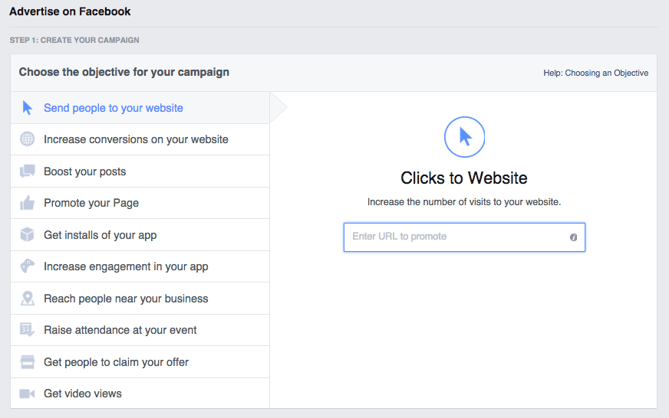
Facebook’s Ads Manager, like many social media advertising networks, is designed with your campaign objective in mind. Before getting started, Ads Manager will prompt you to choose an objective for your campaign:
There are 10 different objectives to choose from. The list includes everything from sending people to your website to getting installs of your app to raising attendance at your event.
By choosing one of these objectives, you’re giving Facebook a better idea of what you’d like to do so they can present you with the best-suited ad options.Facebook’s ad optionsinclude:
Page Post Engagements
Page Likes
Click to Website
Website Conversions
App Installs
App Engagement
Event Responses
Offer Claims
Video Views
Local Awareness
Let’s say, for sake of this post, that you’re looking to drive more traffic to your website. When you select this option, Facebook will prompt you to enter the URL you’re looking to promote. If you’re using marketing automation software, be sure to createa unique tracking URL with UTM parametersfor this to ensure that you’ll be able to keep track of traffic and conversions from this ad. For HubSpot customers, this can be done using the Tracking URL Builder.
Once selected, Facebook will then display the ad option that makes the most sense in terms of achieving this objective.
Choose your audience.
If you’re just starting out with paid advertising on Facebook, it’s likely that you’ll have to experiment withseveral different targeting optionsuntil you reach an audience that fits just right.
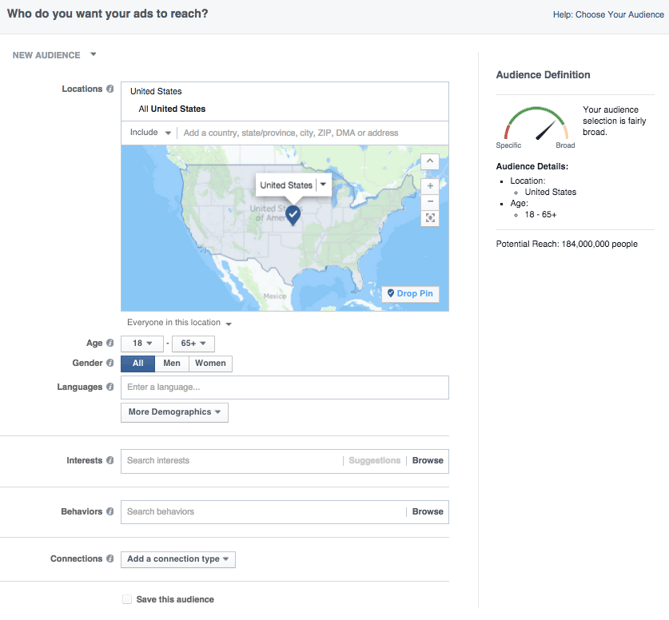
To help you narrow your focus, Facebook’s targeting criteria are accompanied by an audience definition gauge. This tool — located to the right of the audience targeting fields — takes all of your selected properties into consideration in order to come up with a potential reach number.
If you’re wavering between choosing a specific audience over a broad one, consider your objective. If you’re looking to drive traffic, you’ll probably want to focus on the type of people you know will be interested in your offering. However, if you’re looking to build brand awareness or promote a widely appealing offer, feel free to focus on a more general audience.
Facebook’s built-in targeting is vast, including options such as:
Location
Age
Gender
Languages
Relationship
Education
Work
Financial
Home
Ethnic Affinity
Generation
Parents
Politics (U.S. only)
Life Events
Interests
Behaviors
Connections
You also have the option to select a Custom Audience — this allows you to target people on Facebook who are in your company’s contact database, visited a page on your website that has a tracking pixel, or use your app or game. To learn more about how to set up an Custom Audience on Facebook,check out these instructions. (And for more on the specifics of these criteria, visit this Facebook targeting resource.)
Once you find a group that responds well to your ads, Facebook allows you to save these audiences to be used again later — so you may not need to dive into this step once you’ve been running Facebook ads for a while.
Set your budget.
Facebook offers advertisers the option to set either a daily budget or a lifetime budget. Here’s how they differ from one another:
Daily budget. If you want your ad set to run continuously throughout the day, this is the option you’ll want to go for. Using a daily budget means that Facebook will pace your spending per day. Keep in mind that the minimum daily budget for an ad set is $1.00 USD and must be at least 2X your CPC.
Lifetime budget. If you’re looking to run your ad for a specified length of time, select lifetime budget. This means that Facebook will pace your spend over the time period you set for the ad to run.
To further specify your budgeting, turn to the advanced options. This section allows you to specify a few things:
Schedule
Choose whether or not your want your campaign to run immediately and continuously or if you want to customize the start and end dates. You can also set parameters so that your ads only run during specific hours and days of the week.
Optimization & Pricing
Choose whether or not you want to bid for your objective, clicks, or impressions. (This will alter how your ad is displayed and paid for.) By doing so, you’ll pay for your ad to be shown to people within your target audience that are more likely to complete your desired action, but Facebook will control what your maximum bid is.
If you don’t want Facebook to set optimal bids for you, you’ll want to opt for manual bidding. This option awards you full control over how much you’re willing to pay per action completed. However, Facebook will provide a suggested bid based on other advertisers’ behavior to give you a sense of what you should shoot for.
Delivery
Delivery type falls under two categories: standard and accelerated. Standard delivery will show your ads throughout the day, while accelerated delivery helps you reach an audience quickly for time-sensitive ads (Note: this option requires manual bid pricing).
Create your ad.
What do you want your ad to look like? It all depends on your original objective.
If you’re looking to increase the number of clicks to your website, Facebook’s Ad Manager will suggest the Click to Website ad options. Makes sense, right?
This ad option is broken down into two formats: Links and Carousels. Essentially, this means that you can either display a single image ad (Links) or a multi-image ad (Carousel) with three to five scrolling images at no additional cost.
A Links ad will be displayed like this:
A Carousel ad will be displayed like this:
Once you decide between the two, you’ll need to upload your creative assets. It’s important to note that for each type of ad, Facebook requires users to adhere to certain design criteria.
Your image may not include more than 20% text.See how much textis on your image.
Keep in mind that these are the ad options for the “send people to your website” objective.
If you selected “boost your posts,” you’d be presented with different ad options like thePage Post Engagement: Photo ad. This ad has a unique set of design recommendations. To explore all of the ad options and their design specifics,refer to this resource.
Once you select an ad type, the Ads Manager will prompt you to identify how you’d like to display your ad. The options they provide are as follows: Desktop News Feed, Mobile News Feed, and Desktop Right Column.
Here’s how each ad would appear:
Desktop News Feed
Mobile News Feed
Desktop Right Column
Be aware if your ad isn’t associated with a Facebook page, you’ll only be able to run Desktop Right Column ads. To leverage all three display locations, you canlearn how to create a Facebook Page here.
Report on the performance.
Once your ads are running, you’ll want to keep an eye on how they’re doing. To see their results, you’ll want to look in two places: the Facebook Ad Manager and your marketing software.
Facebook’s Ad Manager
Facebook’s Ad Manageris a sophisticated dashboard that provides users with an overview of all their campaigns.
Upfront, the dashboard highlights an estimate of how much you’re spending each day. The dashboard is organized by columns, which makes it easy to filter through your ads so you can create a custom view of your results. Key numbers like reach, frequency, and cost are readily available, making reporting on performance a no brainer.
According to Facebook, here are some of the key metrics to look for (and their definitions):
Performance. Can be customized further to include metrics like results, reach, frequency and impressions
Engagement. Can be customized further to include metrics like Page likes, Page engagement and post engagement
Videos. Can be customized further to include metrics like video views and avg. % of video viewed
Website. Can be customized further to include metrics like website actions (all), checkouts, payment details, purchases and adds to cart
Apps. Can be further customized to include metrics like app installs, app engagement, credit spends, mobile app actions and cost per app engagement
Events. Can be further customized to include metrics like event responses and cost per event response
Clicks. Can be further customized to include metrics like clicks, unique clicks, CTR (click-through rate) and CPC (cost per click)
Settings. Can be further customized to include metrics like start date, end date, ad set name, ad ID, delivery, bid and objective
Here’s how the story began, from a hunting lodge to the 85 billion dollar industry. The 400-year journey of the vacation rental industry was astonishing. Find the infographic on thevacation rentalindustry history as you scroll down.
It was shocking to seek out that the dawn of the vacation rentals began a thumping 400 years before, with a not-so-humble launch at one amongst France’s multi-storied homes. The voyage wasn’t that easy. Assume life in the 1800s, when passing a query took weeks on a horse-driven carriage, to know about the availability of acondo. Even after the acknowledgment of vacancy, it again took weeks for the guests to respond back. The scene has changed drastically in the 21st century. It has reached a state where a user selects his destination and period of stay to get his available list of homes. Subsequently, he browses the property photos, looks into amenities, chats with the homeowner, pays online, and books the home all within the comfort of your home at your leisure.
Here’s how the story began.
Timeline
1600– King Louis XIIIbuilds a hunting lodge, which turns into the first vacation home in 1624.
2013– Sharing Economyboom. 14% of travelers book a private home, condo, or apartment rental – 6% increase.
2014 – The popularity of the “sharing economy” becomes undeniable, hotels begin to copycat the model.
2015– The vacation rental industry is now worth $85 billion. HomeAway has more rooms than the 4th largest hotel in the world.UberandGogobotsupports.
2020 & beyond– Rental search will become a more personalized experience. Smart homeswill flourish. Stays will become customized to personal preferences like preferred temperature, favorite playlist, etc.
In this month’s earnings call, Priceline CEO Darren Huston let investors know Priceline is actively making a strong push into vacation rentals in the coming months.
“In the last 12 months, about 50 million room nights for vacation rental properties were booked on Booking.com and Villas.com, up 39% year-over-year,” said Huston. “This quarter, we began experimenting with self-onboarding of individually owned vacation rental properties, subject of course to a set of quality checks on our side and the ability of the property to be instantly bookable. We already have an encouraging pipeline of vacation rental properties to activate via this channel. We’re hopeful this functionality will help us scale our property acquisition even further.”
Priceline grew its vacation rental inventory on Booking.com and Villas.com from 206,000 homes to 353,000 homes in the last year.
When asked about their strategy for vacation rentals and how their partnership with HomeAway fits into that, Huston said:
We’re building it out in an instantly bookable verifiable way, which is very different than what say a HomeAway or an Airbnb is doing. We’ve also focused a lot on making sure the customer experience didn’t have all the friction. If you can think of booking a vacation home and having to put down a deposit and having multiple email exchanges and not really knowing you’ve got the property, not really having the trust. We’re doing it in much more of a kind of a pure ecommerce way, just trying to create it ultimately like booking a hotel.
And through that strategy, we’ve had to obviously take a lot of friction out of the industry and change the way that players think about that. And it’s a lot of work, because for a vacation rental owner, you’ve got to maintain a digital calendar. You can’t overbook people. When you say the place is available at a certain price, it has to sell at that price. But slowly we’re seeing the ice start to crack a little bit, and starting to see real momentum. And this is great news for vacation rental owners, because this market has a lot of demand.
And a lot of people really think of vacation rentals as an upgrade. Like if you’ve got a family or your group and you’re say going to Barcelona, instead of getting like four hotel rooms, you can get a vacation home on the beach, and you can make your own meals instead of going out to restaurants every night. So this is a very important addition to our business, but there’s a lot more work to do. We do have some cooperation with HomeAway, but it’s not near to the extent that maybe some of our competitors, and we’re still talking there. We have a fairly high bar. We don’t do on-request bookings.
And for us, it has to be truly instant. It can’t be, okay, I’ll let you know in 24 hours. That doesn’t count as instant. And that’s been part of the issues just keeping a very high bar and keeping our product very pure so that it fits with our traditional booker base. And so far so good, and I – and we’re only going to do more of it. It wasn’t really a jump into a segment, it was more of an evolution down the accommodation pyramid into the sort of the bottom of the pyramid. There’s literally millions and millions of single owner property around the world, both in cities, on beaches, at ski resorts, et cetera. So that’s the story there.
Huston was also asked about Priceline’s marketing to vacation rental customers and if their increased push into vacation rentals was expected to cannibalize their hotel business.
Huston said:
In terms of the vacation rentals incremental or not, our general belief is, first of all, it’s one customer. And either a customer is just a consumer or they’re a business person and a consumer. And they take a number of trips every year, and every trip has a different rationale. And if somebody is a hotel booker on three of their trips, they may be on a trip with their family and become a vacation rental booker. We want to be able to provide all of those instances and all of those scenarios through Booking.com, so they become comfortable with that, rather than in the past, they feel if I need a hotel, I go to booking, and if I need a vacation rental, I go to company X, Y or Z.
The markets have traditionally been very different because the nature of the markets were very different. But more and more over time, and I think we’re partly shaping that, and I believe that’s ultimately going to be the outcome, the markets get a little bit mixed because a person says, hey, I’m going to Barcelona or I’m going to Rio de Janeiro and I need to find a place to stay. It’s a very common question asked, where am I going to stay. And relative to that scenario, we want to provide them an option.
And by having more optionality in that, you can drive incrementality because the person may not find quite the right thing on a site that has a more narrow set of options. But on a broad set of options, maybe they have a certain price range and a certain thing they’re looking for we’ll be able to satisfy that. Or in a market like San Francisco or New York, if ADRs in hotels are really high, maybe a business person ends up in an apartment. Or if you’ve got a big event on like the World Cup or the Olympics where everything gets sold out, having all of this incremental supply offers more beds that people can sleep in.
So I think about it if today the market is very different between the vacation rental buyer and a hotel buyer, over time that’ll only coalesce to become a more similar market, because all it is human beings looking for a place to stay. And I think that’s generally the case that we’re seeing on our site.
In contrast, competitor TripAdvisor’s CEO said in their earnings call they felt like attractions were a more lucrative opportunity than the hot vacation rentals sector, “Our three- to five-year growth initiative is to further improve the user experience by helping more consumers around the globe find and book attractions, restaurants and vacation rentals and to reinforce our leadership position in these categories. Perhaps, our biggest opportunity to do this is in attractions.”
Priceline’s increased focus on vacation rentals is important to Vacation Rental Managers for the following reasons:
Priceline’s sites need inventory available for instantly verifiable bookings which is more easily offered by professional property managers who already have real-time booking technology
This push into vacation rentals makes HomeAway a more attractive acquisition target for Priceline in that HomeAway now has levers in place through HomeAway Software and through their “Book it Now” functionality to make instant bookings a real possibility.
Priceline’s Booking.com and Villas.com introduces to vacation rental suppliers a new market opportunity with their enormous reach for guests who are not as familiar or comfortable with booking on owner-driven sites like VRBO.com or Airbnb.com.























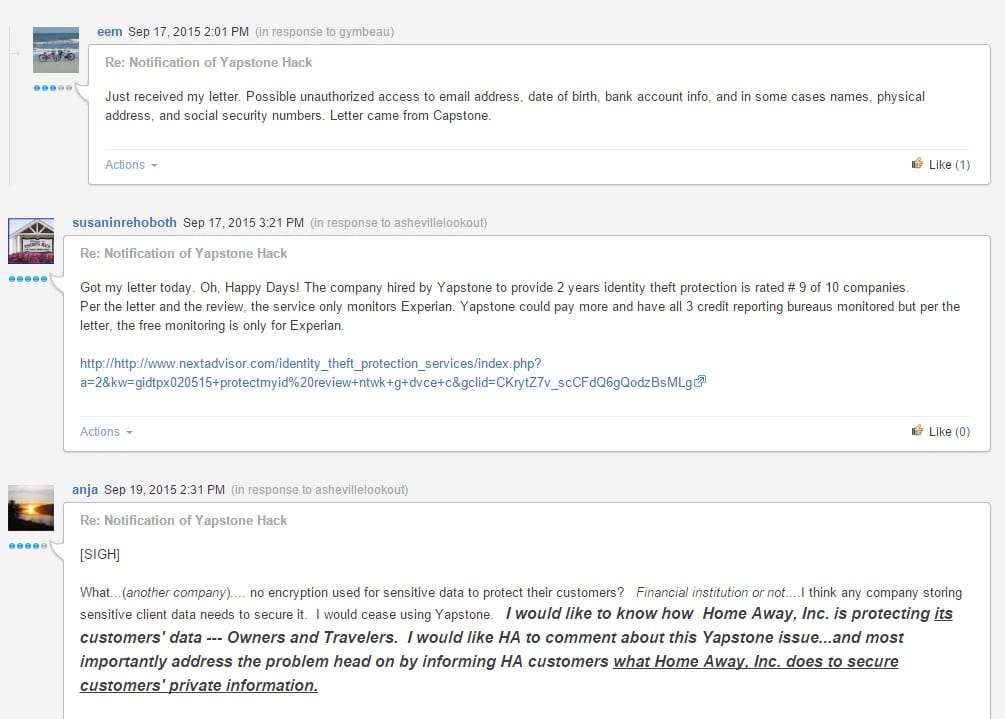
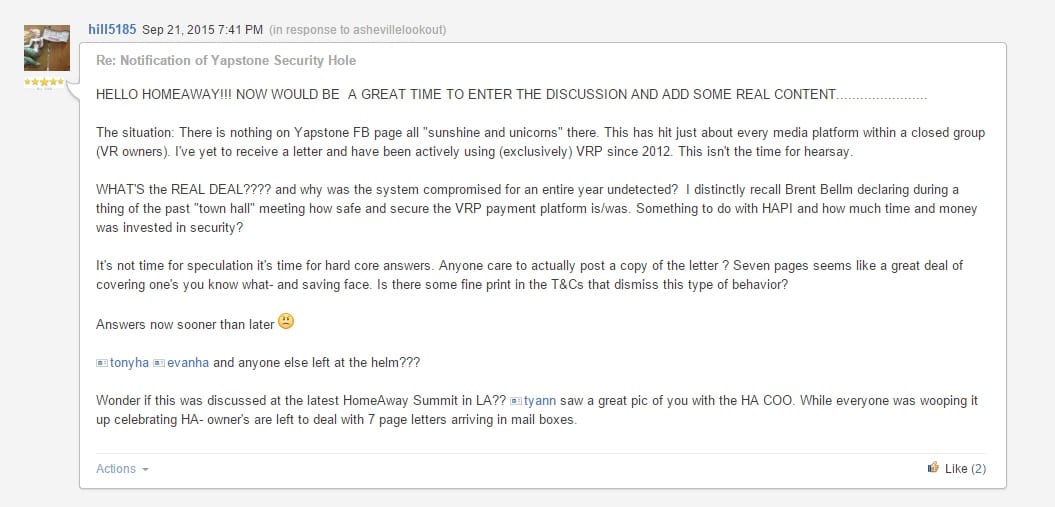





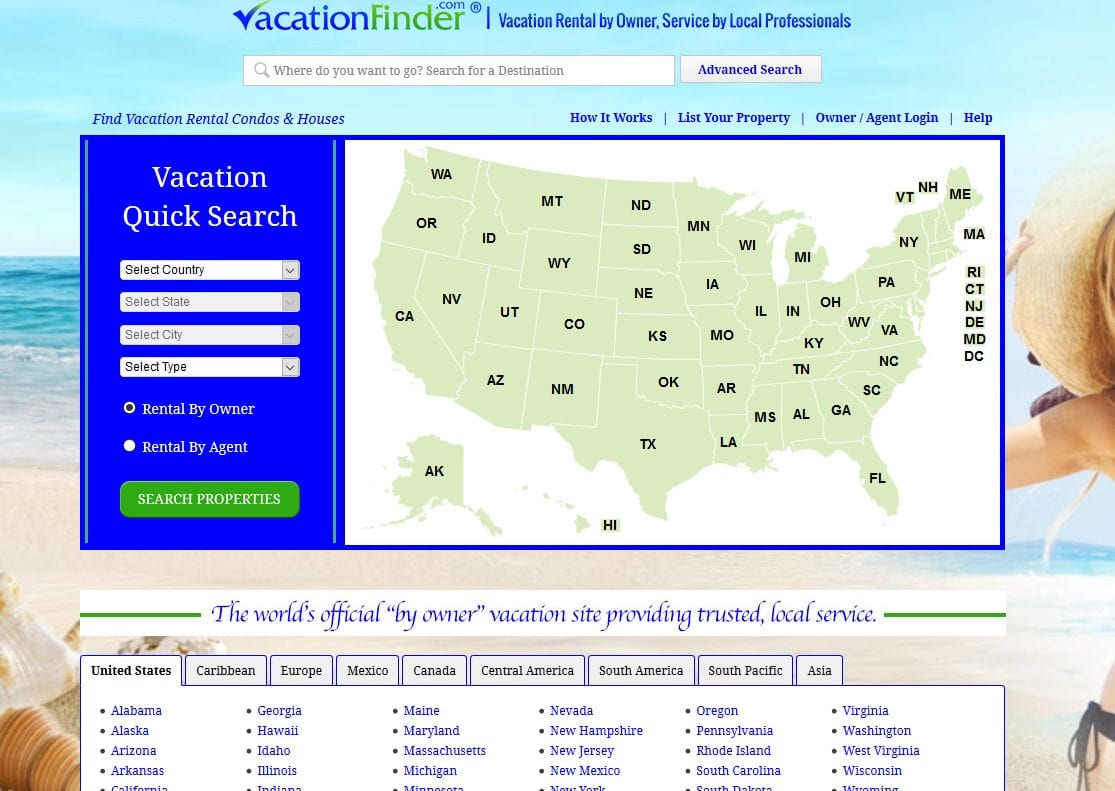









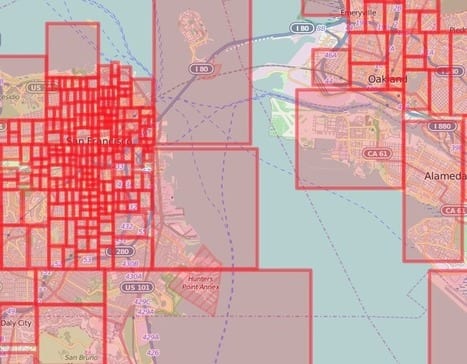

 For our tool to help you figure out a price, there were a few factors to consider. First, this was a once-in-a-generation event in that country, so we at Airbnb have absolutely no historical data to look at. Second, every hotel was sold out, so clearly there was a massive imbalance between supply and demand. Third, the people coming to visit already had paid immense sums for their tickets and international travel, so they’d probably be prepared to pay a lot for a room. All of that had to be considered in addition to the obvious parameters of size, number of rooms, and location.