


Across the vacation rental industry, companies, associations, governments, and destination marketing organizations are proactively assessing new standards and augmented cleaning protocols to ensure guest safety and build consumer confidence in short-term rentals. Some of these changes include new safety procedures and personal protective equipment (PPE) for cleaners and inspectors, disinfecting products, new kitchen packages, professionally laundered linens, the elimination of bedspreads in favor of hospitality blankets/duvets/top covers, and new messaging for guests.
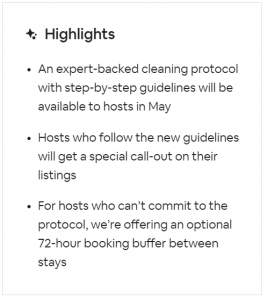
More controversially, the industry is discussing the addition of a 24- to 72- hour “buffer” or “safe time” between stays.
Last week, Airbnb introduced its Enhanced Cleaning Initiative. As part of this opt-in program, “hosts will commit to a 24-hour window between bookings,” and Airbnb is expected to add acceptance of this new program to its ranking algorithm, rewarding compliant managers and homeowners with higher placement in search. For hosts who do not want to adhere to the new cleaning protocol, Airbnb has created a tool that automatically blocks three days after each booking. According the website, “Simply opt in to the tool and we’ll automatically create a 72-hour booking buffer between each stay.”
In addition, Florida’s Reopen Florida Task Force is recommending in Phase 2 that vacation rental operators should “Maintain 72 hours between guest check-ins to allow for effective cleaning and disinfecting of the rental unit.” And the Vacation Rental Management Association said that “24 hours between the last exit and next entry is reasonable.”
Potential Cost of a 24- to 72-hour “buffer” between stays
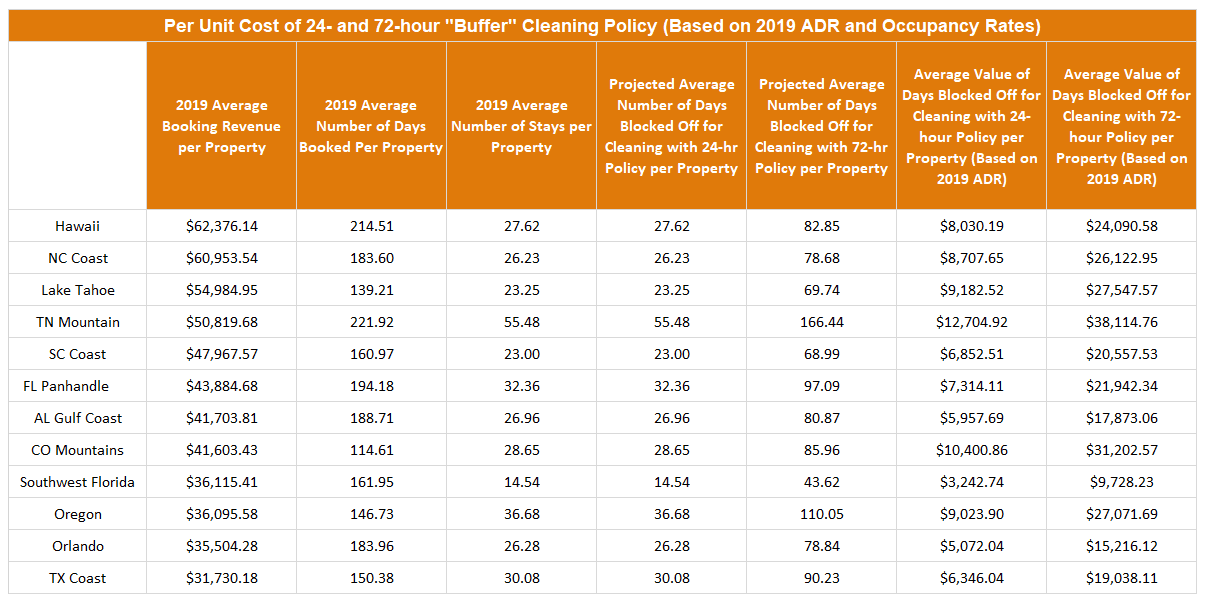
What could the mass adoption of a 24- to 72-hour window between reservations cost vacation rental managers and homeowners? Using 2019 data provided by Key Data and published in January’s VRM Intel Magazine, we calculated the potential impact on revenue.
The following chart demonstrates the average value of days lost per property with a 24- and 72-hour “buffer” between stays.
When we apply the Adjusted Paid Occupancy rate for each destination to the total number days that would be blocked off in the recommended buffer periods, the chart below demonstrates the projected loss in revenue for a company managing 100, 250, and 500 units.
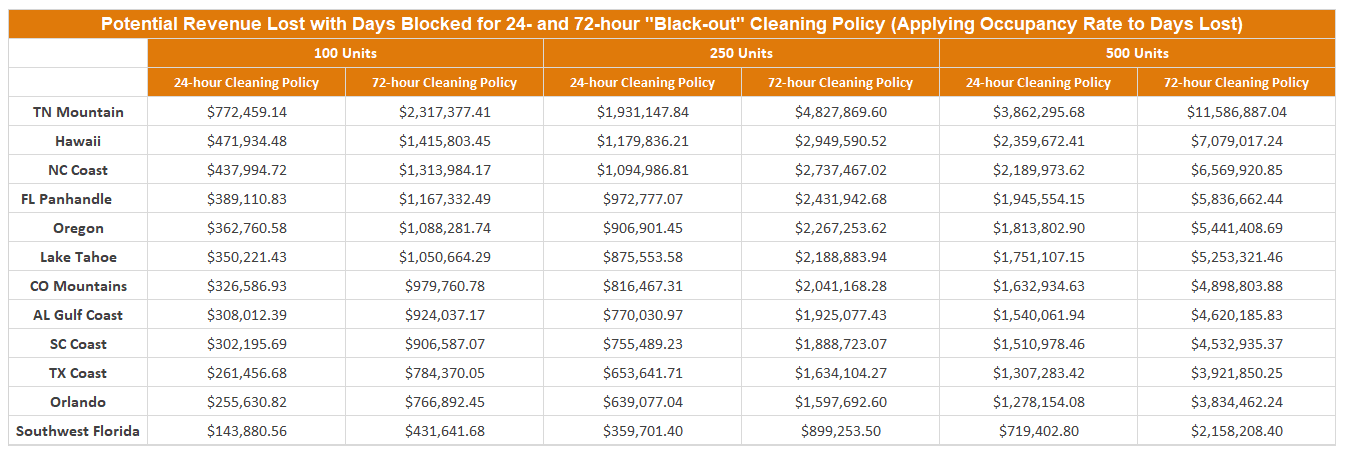
The potential loss of revenue for a vacation rental management company is significant, and explaining this adjustment in income to homeowners could prove to be difficult if expectations are not properly set.
Regulatory Consequences
Besides the potential loss in revenue, there are serious concerns that future regulations will mandate a buffer between bookings. On April 28, as Airbnb announced the Enhanced Cleaning Initiative, CEO Brian Chesky said, “Government officials and policy makers are also focused on our cleaning practices, and we anticipate more regulation in different parts of the world.”
Airbnb has considerable power to influence local policy—as witnessed in many destinations where Airbnb worked with city officials to legalize rentals in primary residences while banning rentals in second homes.
If Airbnb decides that a 24- to 72-hour buffer between stays helps meet its IPO-driven objectives in municipalities, vacation rental management companies and homeowners may be negatively impacted. With additional support from associations (VRMA and FVRMA)—and adoption from large companies (TurnKey, Acme, Carolina Mornings, Moving Mountains, etc.)—this recommendation gain momentum and turn into a requirement very quickly as local and state governments seek ways to show they are “doing something” to make guests safer. In this reactive time we are in, this 24- to 72-hour buffer time has the potential to become a self-inflicted wound for the vacation rental sector—one that comes at a high cost.
Additional considerations in leaving a home unchecked for 24 to 72 hours
There are additional considerations for vacation rental managers and homeowners when waiting 24+ hours before entering the property after a departure. Did the guest leave any entry points to the home unlocked? Was a grill, oven, or appliance left on? Were heating or cooling thermostats set to non-optimal temperatures? Did the guest leave a kitchen full of unwashed pots, pans, and dishes attracting ants or animals? Or as many on the coast have experienced, was a pile of seafood left on the counter leaving a stench that is difficult to remove? Was garbage left in the property or on porches/patios? If the guest knows that no one is entering the property for one to three days, do they really need to leave at checkout time? Is this waiting period going to be upheld after owner stays, as well?
Smart home technology can help address many of these issues, and further investment in these systems will become even more critical with the adoption of Airbnb’s Enhanced Cleaning Protocol or similar recommendations.
Are these 24- and 72-hour recommended “buffer” days necessary?
The real question is: Will a waiting period between stays make guests safer?
According to World Health Organization (WHO), “The virus that causes COVID-19 is mainly transmitted through droplets generated when an infected person coughs, sneezes, or speaks. These droplets are too heavy to hang in the air. They quickly fall on floors or surfaces.”
There is still substantial uncertainty about how long COVID-19 remains on surfaces. WHO’s website states, “The most important thing to know about coronavirus on surfaces is that they can easily be cleaned with common household disinfectants that will kill the virus.”
The American Hotel and Lodging Association (AHLA) is expected to launch its guidelines this week.
To date, the 24- to 72-hour recommendations are not requirements for any government or platform, and we currently do not have any evidence that shows guests need this buffer to be in place in order to feel comfortable booking.
However, as Airbnb and other companies implement these recommendations and advertise the practice, guests and municipalities may be prompted to consider it. The cost for vacation rental providers is high, so we expect to see managers invest in products and processes that eliminate the need for the “buffer” time.


Its time for all the owners to lawyer up and squash this Brian Chesky loser ,who promised to give us 25 percent back of all the cancellations he decided to do with our money, which I still have not received and he also promised to have a grants money program for superhosts, which I have not seen a penny, now hes extorting us to complie or get automaticly blocked, how is that a choice. I beg all host’s to lawyer up and send that billionaire packing….. what a total loser
Buffer times are not a long-term solution. But, in times when all travel is being questioned, extreme measures are going to be needed to reassure our guests that it is safe to travel again. Buffer times make sense when your potential guests are still paranoid about infection and have fear of going somewhere new where they don’t have as much control over their environment. Occupancy optimization by reducing the length or even the use of buffer times can only matter when the demand has returned. IMHO this is just one of many new norms that we will have to try to restart travel.