About the Writer :: Sean O’Neill
Sean O’Neill is a New Jersey-based reporter for Tnooz. He’s also a regular contributor to BBC Travel.
Follow him on Twitter, Google+, and his personal site
Ponte Vedra, FL – – – – – Fighting to protect the property rights of vacation rental owners in Flagler County and the privacy rights of vacationing guests, Flagler property owner and vacation rental businessman Steve Milo today filed a lawsuit against Flagler County officials alleging that commissioners violated Florida law and the constitutional rights of all citizens when they passed a discriminatory anti-property rights and anti-privacy ordinance last month.
“The Commissioners passed a vindictive ordinance that will effectively prohibit certain types of vacation rentals in Flagler County,” said Milo. “We will vigorously fight for equal protection of all property owners and the privacy rights of the people we represent, and for all property owners who may want to rent their home at some point in the future.”
The lawsuit alleges that commissioners not only violated the right to equal protection provided under the Florida Constitution, but also violates a citizen’s right to privacy by requiring the government to collect the names and ages of anyone staying in certain types of vacation homes in the county, whether they are the renter or just a dependent child.
“Not only does the ordinance trample property rights, but now the commissioners want to trample personal privacy rights too, by forcing vacation rental owners to collect personal data on renters’ family members and hand that information over to the government,” said Peter Heebner, attorney for the plaintiff.
Heebner’s law firm recently won a $30 million judgement against the city of Ponce Inlet, Florida. A jury there found that city leaders stopped citizens from completing a development project after they had already invested substantial sums of money.
Flagler County’s legal exposure in this case is substantially higher.
The lawsuit lists eight counts against Flagler County, including allegations that commissioners violated state laws that specifically protect property owners from local politician who pass laws that restrict or impinge their existing, legal vacation rental homes.
“This is a ham-handed attempt by Flagler politicians to please a small but vocal minority of constituents who don’t care if other people’s jobs are destroyed,” said Milo. “This community depends on tourism and the jobs it creates, and this ordinance will crush the livelihoods of those that depend on a thriving rental industry in Flagler County.”
The lawsuit, filed today in the Seventh Judicial Circuit Court in Flagler County, seeks declaratory judgement and injunctive relief.
Vacation rental giant HomeAway has been sending its executive team around the US this month to talk to rooms full of investors, to get the word out about its stock.
This week, chief executive Brian Sharples and chief financial officer Lynn Atchison spoke at conferences organized by investment banks Raymond James and Morgan Stanley. More talks at Piper Jaffray and Deutsche Bank are due next week.
We listened in, so you don’t have to. Here are the trade industry highlights about the Texas-based company:
Getting more instantly bookable listings
Conversion on HomeAway relative to monthly unique visitors is in the 2% to 3% range, lower than what some analysts assume.
Sharples hopes to get to 100% of inventory being online bookable by the end of 2016. Today it’s at 36% of inventory, up from only 6% online bookable in the third quarter of 2013.
It will soon enable customers who want to use online booking to opt for offline payment, such as a check-in-the-mail or via PayPal — a move first pioneered by European apartment site 9Flats. Says Sharples:
“It’s kind of analogous to what Booking.com does. When you make a reservation on Booking.com, you don’t pay for the hotel then. You pay it on check-in or check-out.”
Homeowner supplier acquisition
HomeAway has built its business primarily on a subscription model. Property owners pay a fixed fee in advance, generally for a year, to advertise on the platform, regardless of how many bookings the owner collects.
HomeAway has claimed a high return-on-investment per customer, of about 30 times for every dollar spent by homeowners to post listings.
Yet as it increases its pricing and pushes out performance-based listings, the company will see downward pressure on that number.
There are suppliers out there in the industry willing to accept a return-on-investment as low as 7 times every dollar they spend to market their listings.
The company’s “take rate” is currently 4%, which it claims is the lowest in the industry.
It’s been trying to get the take rate up, as well as boost its average revenue per subscription at a high rate, by creating new upsell opportunities, such as a fee for being featured on websites in foreign markets.
The executives say this can also happen via subscription tiers, up-selling customers on the opportunity to have their listings appear higher in search result rankings — where the return on investment can be as high as 50 times.
He says when they raised the price on platinum, or the option for premier positioning in the search rankings, from $999 to $1,249, it saw no degradation on renewal rates.
The tiered pricing is still being rolled out globally.
Improving quality of listings
Not all homeowners offer a seamless experience to guests, and HomeAway is looking for ways to promote the ones who do the best.
In the past year, it began updating its algorithm to push up higher in search results properties that have up-to-date inventory calendars, have solicited the most reviews, are accepting of electronic payments, and are consistently responding to inquiries within 24 hours.
Sharples says listing quality scores have been risen about 12 points, on average, on a 100-point scale, in about a year.
Competition
HomeAway’s Atchison said that about 12% of its listings overlap with rival platform Airbnb’s listings. But she said she still saw the two companies as building different types of businesses.
“When we survey our owners, they say they get more bookings from us than from FlipKey or Airbnb. But there is no doubt that there is overlap among all of them…. We need to do a better job of differentiating ourselves against them.”
For traditional vacation rentals, HomeAway’s brands rank one, two, and three, followed by TripAdvisor’s FlipKey. Sharples believes a greater volume of bookings is flowing through its sites on an aggregate and on a per-listing basis than through FlipKey.
Airbnb’s success has inspired HomeAway to bring onto its platforms types of properties it hadn’t focused on before, such as timeshares, apartment condos, and investment properties being rented short-term. Says Atchison:
“We haven’t historically gone after them, but they represent an opportunity for us.”
Marketing challenges
HomeAway has surveyed consumers about their awareness of holiday homes as an alternative to hotels. In the US, 32% of consumers know about vacation rentals without being prompted. In Europe’s five largest countries, the un-aided awareness ranges from 53% to 68%.
Outside of those markets, only Australia and New Zealand have more established markets. Concludes Sharples:
“We’re far below our potential in the US in top-of-mind awareness about staying in a house on vacation.”
The company is launching an integrated brand marketing campaign. The company hopes that will boost brand affinity and brand loyalty.
The campaign costs money. The company will spend more on advertising, beyond the approximately 25% of revenue that it spent on marketing last year.
Marketing spend
HomeAway claims it doesn’t face much margin pressure around the cost of spending money on marketing to drive traffic to its platforms.
While Sharples wouldn’t reveal exact figures, he says it’s not “radically off” to say that only 9% of its traffic is driven from search engine marketing.
About a third is direct-to-website, or organic. The rest is mostly free or non-marketed, such as through search engine optimization, or re-marketing to existing customers through email.
Europe versus America
When HomeAway launched a pay-per-booking service in Europe, it saw “enormous pent up demand,” especially from large property managers who control thousands of units.
The new pay-per-booking model made it easier for those property managers– causing a ballooning of supply.
The largest property managers in Europe had already been relying predominantly on third-party distribution on a commission or pay-per-booking model at rates of about 15%. So it was easy for them to sign up once HomeAway offered the same tool.
In the US, the story is different. As a rule, American property managers still haven’t signed on to third-party distribution. So they’re typically buying individual subscriptions.
Overall, property managers now contribute more than 40% of the inventory on the site.
Still, the company is agnostic on pay-per-booking and is not trying to make that a standard model, says Atchison.

Acquisitions
Atchison says the company expects it will continue to growth through acquisition. That said, she adds:
“Private company valuations are quite high right now. So we’re disciplined about acquisitions. We’re mainly looking at geographic expansion.”
Sean O’Neill is a New Jersey-based reporter for Tnooz. He’s also a regular contributor to BBC Travel.
Follow him on Twitter, Google+, and his personal site
Looking to distribute inventory on third party channels? At the 2015 VRMA European Conference in Ireland, Steve Milo, Managing Director and founder of Vacation Rental Pros Property Management LLC, presented a session which walked through various options when setting up bookable inventory.
Milo listed pros and cons of several different options to set up third party booking channels, as well as provided tips for getting live calendars to sync on these sites and allow inventory to come up higher in the search filters.
The vacation-rentals firm’s CEO says he’s running a real business, and the “sharing economy” has nothing to do with it.
Brian Sharples, CEO and founder of the vacation-home rentals site HomeAway, made it through 20 minutes or so of our conversation this week without mentioning his sort-of rival Airbnb.
He was visiting San Francisco to talk about HomeAway’s 10th anniversary and its plans for the future. He recounted how shortly after starting the company he began buying up as many leading sites as possible in markets around the world that offered second-home listings. Two of the earliest were HomeAway and VRBO, short for “vacation rental by owner.”
Sharples explained that his Austin, Texas-based company had raised a total of $405 million in venture-capital money before going public in mid-2011. The money came from big-money backers including Austin Ventures, TCV, IVP, Redpoint Ventures, and Google Ventures. On the day the stock market plummeted in 2008 HomeAway closed a $225-million funding round—all to continue its rollup strategy of buying more 20 like-minded listings sites.
The company spent its money well, building a profitable business whose revenues are approaching $500 million. (HomeAway reports earnings next week.) Its valuation is nearly $3 billion, and Sharples said the company has been preoccupied for its first decade with consolidating its many acquisitions on a single technology platform.


With all that rationalizing and tinkering, there are things HomeAway has neglected. “We haven’t spent on an extraordinary user experience and marketing,” said Sharples. “On day one we had 60,000 listings. Today we have 1.05 million listings. Yet there are still 10 million vacation homes available throughout the world. We still have a big opportunity in front of us.”
Sharples is proud of his company’s heft. “We’ll do $12 billion in transactions this year as a company,” he said. “We have two to three times the traffic worldwide of Airbnb.”
Oops. There it was. The dreaded “A” word. And then later the “S” word, for sharing.
You see, HomeAway isn’t Airbnb. Its valuation isn’t theoretical, for one thing, like the reported $10 billion private-market valuation of that other company. “If you track our stock, you can pretty much track it to our EBITDA guidance,” said Sharples, unsubtly implying that HomeAway is valued on its performance, not hype.
HomeAway also makes the majority of its revenue from subscriptions paid by homeowners, rather than commissions paid by renters, Airbnb’s main method. “The sharing economy,” said Sharples, “which I don’t consider ourselves part of, survives not because people want to save the environment, but because it’s cheap. When things are sold in an economy very cheaply, the company that is selling that for a percentage, gets a very small piece of that. Airbnb is rumored to have a $300 to $400 average ticket. Ten percent of that is $30. Now the question is: What’s the cost of acquiring that customer? In our experience it costs north of $40 to find that customer. Our average customer stays for a week and spends $2,000. (HomeAway collects in the neighborhood of $500 to $600 per year from homeowners.)
To hear Sharples explain it, HomeAway and Airbnb couldn’t be more different. His company caters to people wealthy enough to own a second home. The other guys are catering to scrappers who are so hard up they offer a room in their home to strangers.
In truth, the two companies are beginning to go after each other’s business. As such, Sharples is ready to narrow the gap in awareness between the high-flying Airbnb and the lower-profile HomeAway. “We will increase marketing spend 50% this year,” he said. “Last year we spent 60 million on marketing.”
One thing could trip up the plans Sharples is making. The three monoliths of travel sites—Priceline, Expedia, and TripAdvisor—each have shown an interest in the second-home listings market of late. Priceline PCLN -0.71% has been rumored to covet HomeAway, which, along with its earnings guidance, drives the smaller company’s stock price from time to time.
Sharples professes no interest in selling, but he’s done it before. In the 1990s he sold the research company he headed, IntelliQuest, to advertising giant WPP. For now he has a business to run—and a competitor he’s trying his level best to ignore.
Professional vacation rental management companies are important to the growth of the industry and need to be careful that they don’t become minimalized to property service providers. Unfortunately, some of the large online travel agencies (OTAs) may be contributing to a perception that can undermine the value of the vacation rental manager to the industry.
By Alan Hammond, Holiday Vacation Rentals
The renting of vacation homes is a hospitality and guest services business that, among other things, is not and should not be confused with a cleaning service or depository for keys. In the race for competitive edge, control of the marketplace, and profit from vacation rentals, OTAs, rather than promoting management brands, often seem to undervalue or ignore altogether the importance of the professional rental management company’s role.
The primary objective of the OTAs is to increase returns to their shareholders. Their revenue strategies include increasing subscription fees, premium ad-placement fees, and transactional fees as a percentage of the rental rate.
While the future impact of OTAs in vacation rental distribution is uncertain, it is likely they will attempt to have rate parity, best rate guarantees, and no block-out dates to increase their profits as they grow in dominance. Currently, consolidation of OTAs is occurring as larger companies seek to maintain dominance and grow revenues, most recently evidenced with Expedia’s acquisition of Travelosity. Interestingly, Airbnb, a new entrant to the industry, has broken from the traditional OTA model by charging the consumer directly for the service provided, which has been met with high acceptance among users. Consumers appear to be willing to pay the transparent OTA fee for the convenience of using Airbnb as a one-stop service.
While some OTA distribution channels continue to sell listing ads, others are aggressively pushing transactional “Book It Now” integration to vacation rental managers as a necessity for better conversions. Professional managers that do not rely on OTAs know better.
A recent article by Tnooz reported that according to a SaleCycle survey, “conversion rates for those making a travel booking are generally low—often in the single digit percentage range”. The conversion rates specifically for vacation rentals are likely even lower since customers generally know what to expect when it comes to hotel rooms, while vacation rental homes are all unique and travelers have more questions they’d like answered before booking.
One of the most commonly cited reasons for the low online booking conversion is that travelers (in our case, renters) are still not ready to complete their travel booking. Price is a major factor in the decision as they feel a cheaper deal may be found elsewhere and continue shopping. OTAs may be finding themselves in a competitive struggle for consumer loyalty and to convert shoppers, which will drive more consolidation in the distribution industry.
Counterintuitively, OTAs may be conditioning users to look for a better deal elsewhere. Professional managers who do not give up control of their inventory to OTAs can benefit from higher conversion rates resulting from a better shopping experience and the ability to provide best rate guarantees when booking direct from a rental management company not encumbered by OTA agreements.
Another significant consideration is that shoppers will pay more for products and services they know. This is a compelling reason for vacation rental companies to commit resources to building a strong brand! Unfortunately, some OTAs are stripping the value of a vacation rental company’s brand from their ads.
While OTAs may bring parties together, after the initial introduction, these intermediary or “middlemen” have little to do with the actual sale and vacation experience. Large and increasingly predatory OTAs are neither the only source of rental inquiry nor the deciding factor in the purchase and guest experience.
OTA middlemen sometimes appear not to understand that the property manager doesn’t just take accept a booking in exchange for a key and clean the property on departure. Vacation Rentals are not a commodity sale. This misperception minimalizes the services that are regularly performed by professional vacation rental companies to a function of caretaking, rather than recognizing them as managers of guest services and experiences that are essential to the vacation rental industry and which will become increasingly important if vacation rentals are to be recognized as a preferred accommodation type by travelers.
Not only are OTAs overrated as “necessary” for booking conversions, but according to the American Hotel & Lodging Association’s (AHLA) comprehensive study on distribution channels, OTAs do not create demand or raise overall occupancy. Rather, OTAs shift demand from one market or property to another, capturing a middleman fee in the process. This raises costs to the rental property managers. These costs are then passed to the property owner and, ultimately, to the consumer in the form of higher rental rates.
The practices of the OTA should be understood, and companies that choose to use them need to carefully manage how they do so. As OTAs grow in dominance in online search, they can bring a significant additional cost the rental guests that use them.
In time, market forces will impact the role and value of OTAs similarly to the changes that occurred in the hotel industry as hotelbrand.coms better managed their use of distribution channels and avoided high OTA fees by improving their online marketing and using customer loyalty programs.
Currently in Europe, OTA rate parity is being challenged under antitrust regulations. Some hotel brands have begun providing a comparison of intermediary and direct rates on their websites, dispelling consumer perceptions that shopping via OTAs will result in a better price and increasing brand direct conversion rates.
While OTAs change pricing models and strategies, vacation rental management companies need to remember that guest services are critical to successful management in the hospitality business.
Professional rental companies are in the customer relationship and care business. A booking is just one part of the multidisciplinary management skills necessary to be in the hospitality business.
Travelers are seeking rest and relaxation, new experiences, rejuvenation, and the creation of fond memories. While a well-cared-for property is important, professional rental managers need to understand and exceed guest expectations, which requires a high level of personalized services for success.
Booking a property for a vacation is more than a real estate transaction or booking. If the vacation rental industry becomes reduced to the process of booking a property for an accommodation through a third-party OTA, professional vacation rental management companies will be providing a disservice to guests, property owners, our businesses, and the future of the industry.
Alan R. Hammond is the founder and Managing Director of Holiday Vacation Rentals. He has served as a Director and is the immediate past Treasurer of the Vacation Rental Managers Association (VRMA) and holds the Certificated Vacation Rental Manager (CVRM) designation. A recognized industry leader, Alan is quoted in the book The Rental Game: Winning with a Professional Vacation Rental Team by Maureen Regan.
For a vacation rental manager, the competitive landscape is rapidly changing. Acquiring new home inventory into a vacation rental program requires strategic and proactive planning.
This presentation -given at the 2015 NAVIS Leaders Conference in Orlando -provides a guideline to create a successful homeowner acquisition plan for your vacation rental program.
It is a two-horse race now in the online travel booking world: Expedia is buying Orbitz for about $1.6 billion in cash. This comes after Expedia announced that it was buying Travelocity last month for a paltry $280 million.
Article by Dennis Schaal. Originally posted on Skift
Shares in Expedia rose nearly 10% in pre-market trading, while Orbitz rose over 21%.
“We are attracted to the Orbitz Worldwide business because of its strong brands and impressive team. This acquisition will allow us to deliver best-in-class experiences to an even wider set of travelers all over the world,” said Dara Khosrowshahi, President and Chief Executive Officer, Expedia, Inc.
“From the flagship Orbitz.com brand, to other well-known consumer brands such as CheapTickets, ebookers and HotelClub and the business-to-business brands Orbitz Partner Network and Orbitz for Business, the Orbitz Worldwide team has built a devoted customer base and we look forward to welcoming them to the Expedia, Inc. family.”
“Our mission at Orbitz Worldwide has been to build our brands to be the world’s most rewarding places to plan and purchase travel,” said Barney Harford, Chief Executive Officer, Orbitz Worldwide. “We’re excited for Orbitz Worldwide to join the Expedia, Inc. family and for our teams to work together to further enhance the offerings we provide to our customers and partners.”
An official at a competitor to Orbitz told Skift in early January that it was an open secret that Orbitz has been engaged in a process to be acquired for some time, although the activity now appears to have entered a more formal stage. Market conditions might made this a relatively attractive time to sell. Travelocity’s 2013 decision to outsource its operations to Expedia Inc., and then Expedia’s purchase of it last month gave it even more clout with hoteliers, and put increasing pressure on Orbitz to find an exit.
Expedia was not the only bidder for Orbitz, but the rivals have not yet been determined.
Related Stories:
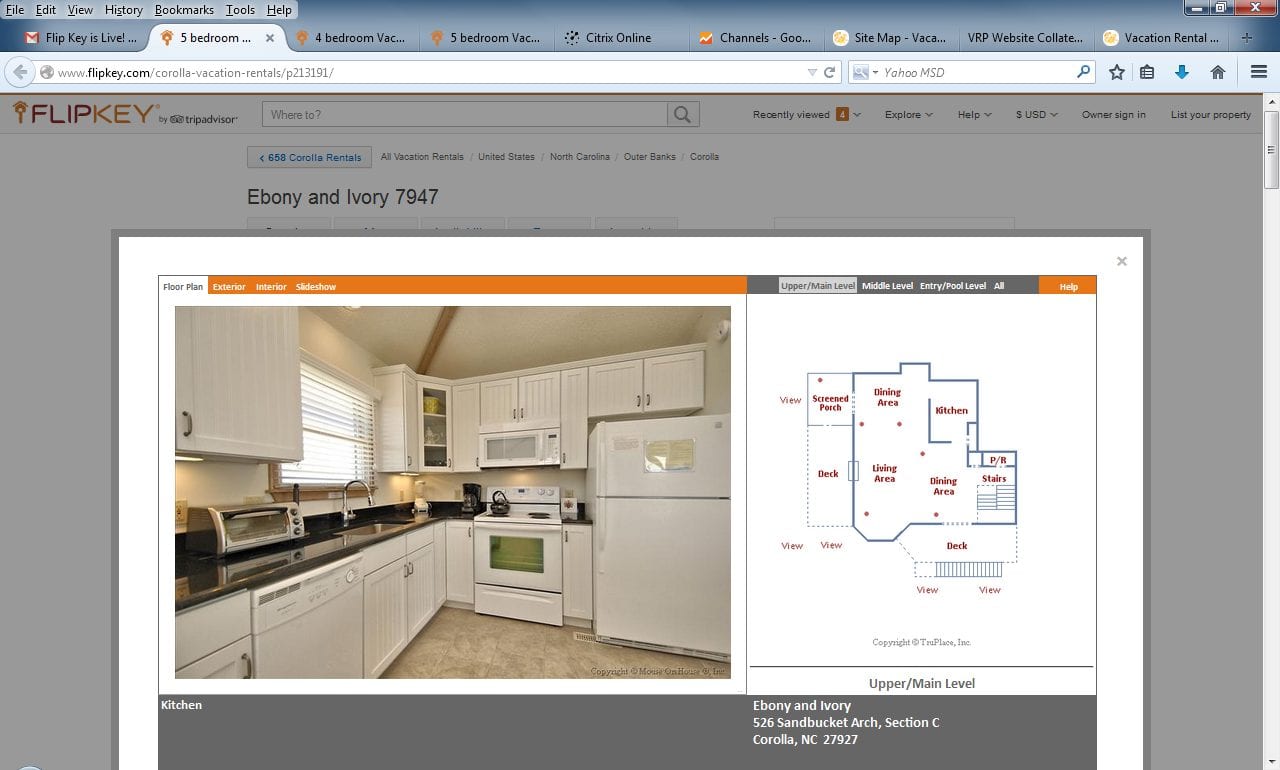
TruPlace, Inc., the number one provider of interactive floor plans in the vacation rental industry, is partnering with Barefoot Technologies, a pioneer in enterprise level vacation rental property management software, to provide Barefoot’s customers with fully integrated access to TruPlace’s interactive floor plans and Central Image Management System (CIMS).
With the combination of professional photography and a detailed floor plan in one intuitive technology platform, vacation rental managers who use TruPlace interactive floor plans instantly provide guests with a visual perspective of the vacation home. The floor plans improve listing quality, help reservation agents and give travelers the information they need to make faster decisions about choosing a vacation rental.
In addition, TruPlace’s CIMS provides vacation rental managers with a single location to store and manage all of their photos for their software, their website, their distribution needs and their sales materials. The CIMS stores all of their images in multiple sizes and in print and web resolution.
“We’ve been working hand in hand with Barefoot’s technology team to fully integrate the TruPlace Interactive Floor Plans and centralized image management system into Barefoot’s vacation rental software,” said Bob Cusack, CEO at TruPlace. “Our customers have seen a significant increase in online conversions by adding floor plans, so we expect our partnership with Barefoot to enable vacation rentals to see more bookings and more revenue by adding interactive floor plans to their properties.”
“TruPlace offers a significant advantage to our clients and those that take pictures seriously and we should all take pictures in this industry seriously,” said Barefoot CEO Ed Ulmer. “We are excited to be the first property management system to integrate with TruPlace including their floor plans.”
A recent independent study measured the impact of using TruPlace’s floor plan tours on reservations for vacation rentals and found that rental properties using interactive floor plans saw an 18 percent average increase in reservations and booked 22 days faster than properties without floor plans.
TruPlace’s floor plan services are being utilized for over 35,000 properties in North America.
SAN FRANCISCO (CN) – A federal judge Friday raised concerns about vacation rental marketplace HomeAway’s challenge to a San Francisco ordinance regulating short-term rentals in the city.
HomeAway sued the city in November over the so-called “Airbnb law,” which legalizes and places restrictions on rentals in private homes.
HomeAway claimed that the law, crafted with the help of its competitor Airbnb, discriminates against nonresidents who want to rent homes they own.
The law requires hosts to be permanent San Francisco residents, but many of HomeAway’s users list second homes and do not live in the city year-round. HomeAway’s websites include VacationRentals.com and VRBO.com.
HomeAway claims the law will create a local monopoly for Airbnb, because the regulations are tailored to its competitor’s business model.
In a dismissal hearing on Friday, U.S. District Judge Joseph Spero expressed doubts about whether the company has standing to sue.
HomeAway provides only “ancillary services” for people who want to rent out properties, the judge said.
“The ordinance itself doesn’t restrict the delivery of those ancillary services, it rather regulates a transaction that is entered into by the customers of HomeAway with others, not with HomeAway itself,” Spero said. Those people could file their own lawsuit, he said.
Spero also questioned HomeAway’s argument on hotel taxes, known as transient occupancy taxes.
HomeAway said in its complaint that the ordinance imposes a new obligation for companies like it to collect taxes.
But attorneys for San Francisco argued in a dismissal motion that HomeAway “misread” the ordinance, and that the law does not create any new rules – it just requires companies to comply with what’s already in the city tax code.
“It seems to me that one way or another the complaint would be dismissed as to the occupancy tax, as there’s no injury as a result of the ordinance,” Spero said. “The ordinance doesn’t actually do anything … in terms of increasing or decreasing the obligation of the plaintiff to collect the occupancy tax.”
HomeAway was represented by Rex Heinke of Akin Gump Strauss Hauer & Feld.
San Francisco may not be the last fighting ground for the vacation rental company. HomeAway co-founder Carl Shepherd recently threatened legal action against New York, if the city pursues a law similar to the San Francisco law.
Contact Arvin Temkar at sanfran@courthousenews.com
As rumored, Expedia (NASDAQ: EXPE) announced it has acquired Travelocity from Sabre Corporation (NASDAQ: SABR) for $280 million in cash.
The acquisition follows the 2013 strategic marketing agreement between Expedia, Inc. and Travelocity under which Expedia has powered the technology platforms for Travelocity’s US and Canadian websites along with providing Travelocity access to Expedia, Inc.’s supply and customer service program.
“Travelocity is one of the most recognized travel brands in North America, offering thousands of travel destinations to more than 20 million travelers per month,” said Dara Khosrowshahi, Expedia, Inc. President and Chief Executive Officer. “The strategic marketing agreement we’ve had in place has been a marriage of Travelocity’s strong brand with our best-in-class booking platform, supply base, and customer service. Evolving this relationship strengthens the Expedia Inc. family’s ability to continue to innovate and deliver the very best travel experiences to the widest set of travelers, all over the world.”
“Our primary focus at Sabre is to provide mission-critical software solutions to our global airline, hospitality, and travel agency customers – and to help them support their customers every day,” said Tom Klein, Sabre President and Chief Executive Officer. “We have had a long and fruitful partnership with Expedia, most recently by partnering to strengthen the Travelocity business, so our decision to divest Travelocity is a logical next step for us both.”
OPMA Board approves efforts to battle unlawful business practices within the self-managed rental sector.
In a major industry development the Onsite Property Management Association (OPMA), which represents over 32,000 professionally managed lodging properties, recently announced its full backing and support of industry initiatives to both highlight and address the unfair and often illegal business practices of those rental-by-owners who are not contributing their share of taxes to their state, county, and local communities.
OPMA is the only national organization dedicated to the growing condo hotel sector. The association is committed to providing state attorney generals and taxation departments the support they require to increase staffing and resources in their efforts to collect untold millions of dollars for their budgets. The loss of significant revenue is not just restricted to major markets like New York City, which estimates that up to 72 percent of rental listings are illegal and these owners are not paying sales, occupancy, and other taxes. As an example: in Sonoma County, California, with a population of less than 500,000, estimates they are losing ” conservatively, $500,000 to $1.3M annually.
Paul Wohlford, President of OPMA and a senior executive for Resort Collection on Panama City Beach, Fla., reiterated the organization’s commitment to further maximize awareness around this critically important tax compliance debate.
“Our OPMA members strongly oppose the continued proliferation of these types of businesses and we urge local and state governments across the country to continue to enact and enforce legislation that creates a level playing field for all short term rental providers. We also urge our professional lodging partners in the hotel, timeshare, and vacation rental industries to also lend their voices and strong support for the elimination of these unprofessional and illegal activities within the hospitality industry,” said Wohlford.
In an economic environment where every municipality is looking to maximize incremental revenue opportunities, OPMA sees a role in assisting state Attorney Generals as well as state and county tax commissioners in those efforts. Rick Fisher, Executive Director of OPMA, believes the benefits in addressing the tax compliance issue extends beyond the professional rental management community to include tax enforcement officials and representatives.
“It’s not surprising that a number of states, counties and cities are struggling with their budgets,” said Fisher “OPMA and its members are committed to not only contributing their fair share of taxes but to also continue the campaign to raise awareness of the need to support state government officials in their efforts to ensure tax enforcement compliance by all rental by owners. This initiative will help states, counties and cities around the country foster continued economic growth and reduce the overall tax burden of their constituents.”
Recently, OPMA also launched its national marketing campaign to help create greater consumer and media awareness of the rapidly growing hybrid condo hotel lodging sector — spacious condo accommodations and hotel amenities and services. During the campaign OPMA will continually reinforce the association’s support against the current practices of non-tax contributing rental by owners.
Founded in March 2014 as a 501(c)(6) nonprofit organization, the Onsite Property Management Association (OPMA) is spearheading an effort to support the advancement of on-site rental property management companies. By providing education and advocacy, OPMA will promote the value of the short-term rental experience through on-site property management companies. By leveraging the collective experience of industry veterans, this network of mutual support will elevate industry standards to ensure superior guest and owner experiences. The association is committed to providing a clear and cooperative message and to championing the growth and success of the industry. To learn more about the Onsite Property Management Association, visit www.theopma.org or call (877) 870-6510.
TruPlace, Inc., the largest provider of interactive floor plans in the vacation rental industry, today announced it is launching its national sales rollout strategy with the addition of industry veterans Brian Buck and Rob Johnson to spearhead coast-to-coast sales initiatives in the fast growing vacation rental market.
Buck and Johnson have worked together in the vacation rental industry for more than 26 years successfully bringing technology products to market, including NAVIS Narrowcast and Escapia Software. In their most recent enterprise, Buck and Johnson joined startup Glad to Have You™ and rapidly established a significant market share for the product through their sales leadership. Glad to Have You™ sold to HomeAway, Inc. in 2014.
“Rob Johnson and Brian Buck have a proven track record of promoting technology solutions for vacation rental managers,” said President and CEO Bob Cusack. “Their combined expertise will be beneficial for us as we expand to move TruPlace forward and increase the use of floor plan technology in the vacation rental industry.”
“We love the fact that we can represent another technology platform in TruPlace that helps vacation rental managers increase conversions, improve guest satisfaction and boost revenues,” said Johnson. “For us, nothing is more exciting than that.”
Recently, TruPlace announced a partnership with TripAdvisor’s FlipKey to offer interactive floor plans for vacation listings and completed an advanced integration with Barefoot Technologies. In addition, TruPlace presented the technology to HomeAway customers at their software user conference in Nashville and to property managers at the Vacation Rental Managers Association Annual Conference in San Diego, and will be traveling to Dublin for the VRMA European Conference in February.
Founded in 2003, TruPlace’s (formerly Mouse on House) floor plan technology is being utilized for over 35,000 properties in North America. With the combination of professional photography and detailed floor plans in one intuitive, mobile-friendly technology platform, vacation rental managers who use TruPlace interactive floor plans instantly provide guests with a visual perspective of the vacation home. The floor plan technology improves listing quality and gives travelers the information they need to make faster decisions about choosing a vacation rental.
With over twenty years in the vacation rental management industry, Barefoot Technologies CEO Ed Ulmer has a breadth of knowledge and expertise that keep him not only manning the helm at Barefoot Technologies, but often providing thought leadership in the industry.
Here are some of his predictions for what will be relevant or of interest in the vacation rental management industry in 2015:
1. Vacation rental managers who also do real estate will see an opportunity with Zillow and Trulia rental platforms this next year.
We are already in the process of integrating. In the next few years these companies will come out of nowhere and take a serious part of the rental game and compete well against HomeAway, FlipKey, and Airbnb.
2. Airbnb will get serious about managed properties.
They have to, because it is stable inventory and to continue to grow, like all the portals, they need every available unit.
3. In hospitality and real estate there is a trend towards larger is better.
Hotels buying Vacation Rentals, Vacation Rentals buying other Vacation Rentals companies, portals buying other portals, real estate companies buy other real estate companies, and real estate boards having to merge because of new NAR rules. You will continue to see the maturing of our industry with continued strategic buying of companies that will significantly change the landscape of many markets and there is huge opportunity for those that are nimble enough to keep their eyes open and have a long range or bigger picture perspective.
4. Traditional OTA’s will continue to try and figure out how to get more rental inventory, but until they realize Vacation Rentals are not like hotels, they will struggle.
They need to address a better commission structure that allows Vacation Rental and Property Management companies to participate, to be able to handle diverse cancellation policies and to take into consideration our additional fees in a flexible manner.
5. TripAdvisor will go more transactional moving forward and they will tighten up the review process to counter government issues
TripAdvisor (FlipKey) just got fined for bad reviews in Italy. They will go more transactional moving forward and they will tighten up the review process to counter government issues. Reviews will continue to grow, but hopefully will become more proactive (such as being requested during the vacationer’s stay) instead of after the stay. There are a number of companies that already do this.
6. Use of enterprise level software for vacation rentals will continue to grow.
With both new clients coming on board, and adding new tools for our existing clients, we are finding that those who use our systems realize how much more functionality we offer than our competition and how those tools can help them better meet their business goals. Our industry is becoming more competitive with RBO’s managing multiple properties, real estate companies seeing the value in managing vacation rental properties, as well as OTA’s taking a large share of renters who have no loyalty to a market or an agency. We continue to refine our value proposition to show our value as providing more than just software. Barefoot provides a consultative and forward thinking mindset that sets us apart, and provides our clients with experience and technology just not found in other competitive software companies.
7. Concierge and packaging will become more important in vacation rentals.
This is because it is not where you stay, but what you do, that makes a memorable vacation. Those that embrace it early) will benefit significantly. And using the technology offered by Barefoot will provide efficiency and automation that will make these issues not only profitable, but provide a competitive advantage to all those that take advantage of these tools. But it will be a slow transition as activities are typically run locally.
8. RBO (rentals by owner) will continue to grow, but many owners will come back to property management companies as they experience painful experiences, bad clients, destruction of property, tax issues, and government ordinances.
Smarter property management companies that leverage their value proposition by pointing out the many systems that they have in place to support concierge, true market analysis, niche marketing, social media, property and marketing that focuses on owner retention not just clients will continue to see growth and revenue opportunities. Barefoot clients are already starting to see this.
A recent infographic posted by Hubspot shows some interesting data about how people and companies tend to buy from (see it here) indicates that the top reason is “92% of B2B purchasers would engage with a sales rep who was known as a thought leader in their industry, and 86% would follow up with someone who was able to provide insights about their business.”
From changing business models and technology to evolving consumer behavior, vacation rental marketers are challenged with keeping up, learning new skills and monitoring shifting trends in the industry to understand what’s important about what’s next.
The 2014 VRMA Annual Conference provided meaningful insight into new developments in marketing strategies for professional vacation rental managers. Attendees saw the advancement and launch of several marketing products designed to increase bookings and revenue.
Here is a look at five of the marketing tools and tactics that generated buzz at this year’s conference.
With advancement in software integration, the idea of automating dynamic pricing for vacation rentals has gained recent traction. As a result, a number of revenue management software tools have popped up in the vacation rental industry with several others in development.
According to George Volsky, “Pricing has two components. First, it requires us to determine the highest rent that can be charged each season without losing an interested renter. Second, rents must be adjusted for changes in supply and demand.”
These revenue management technology solutions are designed to automate the setting of rates based on supply and incorporate occupancy rates, ADR, and booking lead time based on property types. In 2015, vacation rental managers can expect to see these platforms allow for more complex algorithms, include competitive analysis and provide evaluation metrics.
Using smart home technology to improve guest services, create operational efficiencies and market vacation rentals was a significant part of the conversation at the 2014 VRMA Annual Conference. The use of keyless locks which are integrated with property management software provides security and enables guests to bypass check in and go directly to the property. In addition, energy savings by controlling thermostats, pool heat and refrigeration improve customer service response time and are attractive to homeowners and enhance inventory acquisition initiatives.
Steve Trover, CEO at All Star Vacation Homes, implemented smart home technology for all of their vacation homes. “At All Star, we’ve been very focused on hospitality for 16 years. Using smart home technology, we can ensure security and provide a superior guest experience,” said Trover. “For example, we can more quickly respond to guests being locked out and generate a code to get them in within seconds. In addition, we now know when the HVAC has problems before the guest does, and we know when the pool heater is not heating the pool properly so we can deal with things in a more rapid fashion, providing a better guest experience and increasing repeat business.”
Another popular tool being promoted at the VRMA Annual Conference for 2015 was autoresponder technology which allows vacation rental mangers to instantly respond to inquiries from distribution channels with branded emails, online booking options, and next-best property suggestions. In addition, autoresponders tackle repetitive inquiries, and some providers are utilizing artificial intelligence to generate automated responses which address common questions that guests ask in their inquiry comments.
Matt Landau, founder of the Vacation Rental Marketing Blog, gives tips on getting the best results from autoresponder technology, “Always address guests by their name (using the name fields). There’s no worse turnoff than inquiring to a vacation rental and getting back an email that starts with ‘Dear guest.’”
Landau also added, “Ask questions. You can’t expect guests to book room nights talking to a robot so a great way to engage them is to ask questions. Emails starting with questions statistically elicit higher response rates, so always make sure to include questions like ‘where will you be visiting us from?’ or ‘have you been to our town prior?’”
According to Priceline CMO Brett Keller, at Priceline and Booking.com they spend considerable time and effort testing their listing pages for better conversion rates. “With as quickly as the environment changes, sometimes aggressive testing is necessary just to maintain current conversion rates,” said Keller. “And if you can’t afford to test, copy.”
He explained that distribution channels are spending a ton of money testing and optimizing pages for conversion. Booking.com, FlipKey, HomeAway and Airbnb have all made recent and significant changes to their listing pages to improve conversion rates, e.g. interactive floor plans, improved calendars, mobile-friendly multi-tab and one-screen layouts, advanced amenity search functionality and neighborhood guides with images, mapping and a “what’s nearby” feature.
By monitoring and emulating the changes distribution channels make on property listing pages and in the booking path, vacation rental managers can implement these strategies on their own websites without breaking the bank.
Check out the listing page checklist.
Lifecycle messaging tools are being offered by several VRMA supplier members, and property managers have been working to test and refine the process in 2014.
Lifecycle email marketing helps vacation rental managers build deeper relationships with guests and encourages future stays by sending relevant, useful and timely information based on customer behavior. By utilizing technology and creating an integrated email communications strategy with meaningful messages vacation rental marketers can reach the customer at critical points in their booking and re-booking path (i.e. research, planning, decision, reservation, stay, rebooking, and re-engagement).
The technology tools for generating lifecycle emails work with or within property management software to automate this process, allowing vacation rental managers to pursue leads and generate more repeat bookings based on timing and behavior.
As vacation rental marketing evolves at breakneck speed with changes in distribution, technology and consumer behavior, the 2014 VRMA Annual Conference provided a terrific place to get a bird’s eye view of innovative developments designed to increase bookings and provide a competitive advantage in 2015. Vacation rental managers can expect to see further advancement in these tools as well as new marketing products at the VRMA regional conferences in Portland and Norfolk this spring. We hope to see you there.
By Amy Hinote
Vacation rental listing app Dwellable is celebrating the beta release of their new online booking engine by giving away up to $1,000 towards a VRMA conference or 2015 membership dues to one lucky property manager.
In the last six months Dwellable has raised $2 million, tripled the size of its team, become the 8th most downloaded Hotel/Lodging App in the US*, and moved into the race with Booking.com and HomeAway by adding a booking engine.
The initial response from early adopters in the industry has been incredibly positive. Dwellable remain free of charge to property managers – even with the addition of the booking engine – making it a clear winner in value among listing sites and OTA’s who are increasing their rates aggressively.
The time is right for a hard look at the mobile app consumer market for vacation rentals. Property managers who attended the national VRMA conference in San Diego this last October heard that bookings via smart phones has doubled, and industry experts expect this trend to continue.
As the leading mobile app, Dwellable serves a unique audience not otherwise captured by the mega listing sites. Dwellable’s users are younger, tech-savvy travelers who almost exclusively use apps to navigate the web and make purchases both small and large. As this generation matures it will become increasingly important that property managers have a presence and ability to be booked via mobile app. Those property managers who understand the importance of listing sites who are mobile focused will be poised to serve the next generation of purchasers.
Here’s Dwellable’s current promotion: Sign up by December 31, 2014, and get your bookable listings live by March 15, 2015 to be entered to win up to $1,000 towards a VRMA conference or 2015 membership dues. Details and sign up form can be found at: www.dwellable.com/vrma
*AppAnnie, June 2014
In a recent article, Matt Landau, founder of the Vacation Rental Marketing Blog, interviewed vacation rental industry leaders about their predictions for 2015. Landau’s article provides excellent insight into where these organizations are anticipating growth and change in the industry.
By Matt Landau
2014 was an amazing year the vacation rental industry: plenty of growth…lots of good drama…of course some wonderful and unexpected surprises!
But as we move into 2015, I’ve asked some of the industry’s sharpest specialists to use all this in predicting what is to come. Most of these amazing folks need no introduction:

Booking.com or Expedia acquire HomeAway in 2015. Booking.com is strong in vacation rentals in Europe, and HomeAway, while global, is strongest in the U.S.
The challenge is that HomeAway has to make a much greater percentage of its properties online bookable to please the OTAs, and HomeAway is scurrying to do this.
– Dennis Schaal, News Editor at Skift

Anyone can be a vacation rental manager, but not everyone can be a professional vacation rental manager. With increased regulation on the horizon, it is important for the future of the industry that vacation rentals are run professionally, including superb customer service, being good neighbors, involvement in local government, paying all applicable fees and taxes, contributing to the local economy, etc. VRMA can help managers do that, including with the new online education series starting in 2015.
– Ben Edwards, President of VRMA

As the vacation rental industry continues to grow exponentially and cut into the traditional hotel market share, we’ve seen a rise in new companies that offer tailored services for VR businesses and travelers. For example: companies that provide online marketing assistance for owners, travel agencies solely dedicated to vacation rentals, or even general liability insurance specifically designed for VR owners. We expect to see more specialty brands pop up in 2015 to help the VR space continue to grow.
– Eric Horndahl, VP of Marketing for FlipKey

Vacation rental sites will continue their evolution towards offering instant bookings. Spurred by Airbnb’s growth and HomeAway’s announcement that 100% of their listings will be instantly bookable by 2016, competing rental sites are upgrading their technology to support real time bookings. This is a good thing for travelers and hosts alike, as it brings additional transparency and convenience to the market.
– Jen O’Neal, Founder & CEO of Tripping.com

In 2015, Airbnb will be taking more active steps to give its growing customer base more alternatives in vacation rental markets around the world and to provide a collection of services that satisfy the traveler from the time they leave home to the time they arrive back at home. Along with many other companies, Airbnb believes that the company’s role isn’t just to introduce guests to the “facility” but it’s also to “facilitate” a memorable travel experience. So, whether it’s introducing a guest to the hidden treasures of an idiosyncratic beach town or helping the guest stock their refrigerator with the kind of goodies they personally crave, Airbnb and other sites will become more of a lifestyle concierge in 2015 as opposed to just a transactional booking site.
– Chip Conley, Head of Global Hospitality & Strategy at Airbnb

Vacation rentals in 2015 will be a co-created hybrid mechanism of a personalized user experience and seamless, instant bookings. Roomorama endeavours to give every user a quality-controlled experience with our 24/7 call center and chat support during the booking process and the stay. In this category of travel, it is important that users communicate with an actual human being when they have questions or require support. On top of a personalized user booking experience, Roomorama offers the user a fluid and seamless booking process with instant confirmations available for a large majority of vacation rentals on our site. The dramatic rise in this trend of travel demands an efficient platform that guarantees the user instant availability and immediate booking confirmation.
– Jia En Teo, Chief Operating Officer and Co-

As technology continues to improve the ability for travelers to connect with and, more importantly, evaluate an ever-expanding array of accommodation options, price considerations will continue to take more of a back seat to value considerations for lodging decisions. The top three reasons why guests pick homestays recently published in our Homestay Index puts staying in a home environment ahead of location and value for money. Even though we’re finding that homestay prices in many cities are coming out below not only hotels and Airbnb rentals, but also hostels.
– Yvonne Finlay, VP of Operations at Homestay.com

These guys have taken over the industry (in my humble opinion) thanks to what is clearly a superior product and an impressive user experience, and will continue to do so next year and in years to come. I’ve yet to see another product in the VR space that delivers on the hype like they do.
– Joshua Dorkin, Founder & CEO of Bigger Pockets

In 2015, the main pressure points for vacation rentals will be (1) local government concerns about zoning law compliance (e.g., running a weekly vacation rental from a single family residential zoned area); (2) loss of and inability to enforce short term rental tax laws (e.g., if STR are permitted, are STR operators reporting and collecting short term rental taxes?); (3) the negative impact on hotel occupancy and/or average daily rates (ADR) resulting from the competition posed by the growing short term rentals market…how will hoteliers respond to compete for this consumer spend? In 2015, I see vacation rentals facing significant headwinds on all three fronts.
– Mike Sullivan, Co-Chair, Hospitality Practice Group at Greenberg Traurig, LLP

Business intelligence software and data mining tools are becoming more affordable for small to medium size companies. Vacation rental managers are smart and savvy and have been waiting to harness their data to make more proactive and precise decisions.
– Amber Mayer, Chief Marketing Officer of The St. Joe Company
After those amazing 10 experts, now for the prediction you’ve all been waiting for…
I believe that for the first time, 2015 will start to see individual owners and managers of vacation rental properties truly differentiating themselves from one another. Right now, the industry is a big glob. So to be more highly valued by travelers and to take advantage of untapped niches, 2015 will the year when true differentiation takes place in the industry and shards of specialty rentals splinter off and form their own unique selling propositions.
In 2014, VRM Intel has published over 300 articles for the professionally managed vacation rental industry. From company profiles to breaking news and from regulatory issues to how to increase revenue, VRM Intel has focused on providing professional property managers with up-to-date, current stories which affect your businesses today.
With over 100,000 views, here is the list of the top 20 most popular articles in 2014.
1. Hotel industry plans attack on vacation rentals
“…the American Hotel and Lodging Association (AH&LA) announced Tuesday plans to attack the current practices of the U.S. vacation rental industry with a campaign to: highlight the bad, unfair and in some cases unlawful business practices employed by short-term online rental companies and the lack of parity between safety, security, tax, and other requirements for hotels and short-term online rentals.”
2. Startup Success: What Glad to Have You Did Right
“Glad to Have You made several specific, intentional, strategic decisions in their short history which accelerated their success story.”
3. LiveRez Conference Wraps Up in Boise
“The conference kicked off with a special keynote session by Priceline’s CMO Brett Keller addressing vacation rental managers about branding, increasing online conversion rates, and the direction of Villas.com.”
4. Surpassing the competition, LiveRez’s Tracy Lotz remains committed to independence
“And at 53, Tracy Lotz isn’t looking towards retirement or an exit strategy any time soon.”
5. Travel insurance: VRMs told “opt-out” not an option
“…recently notified clients -including HomeAway and Wyndham Vacation Rentals -they would no longer be allowed to use an opt-out model on their websites.”
6. Under the Hood with Taylor-Made Deep Creek Vacations and Sales
“It is hard to talk about Taylor-Made Deep Creek Vacations and Sales without reflecting on how they got started. First, the story is just too good not to tell –and second, the secret ingredients that make Taylor-Made so successful are rooted in the foundation of the owners’ growth in the vacation rental industry.”
7. Kigo acquired by RealPage…joins InstaManager in recent RealPage purchases
“A $32+ million spend for Kigo following a $14 million purchase of Bookt’s InstaManager depicts an increased stand-alone valuation of software utilization in the global vacation rental marketplace.”
8. Interview with Doug Macnaught, Former President and Co-Founder of Instant Software
“…we recently learned Doug Macnaught’s extensive four year non-compete agreement has come to an end. We wanted to know more about what Macnaught has been doing, how he views the last four years in the industry and what is next for his future.”
9. Milne resigns from Wyndham, Marriott exec named President Vacation Rentals North America
“Wyndham Worldwide (NYSE: WYN) named Marriott’s Mary Lynn Clark as President, Wyndham Vacation Rentals North America following the resignation of current president Bob Milne.”
10. Industry Leaders Weigh In On Recent Acquisitions
“We asked the question, ‘What is the significance of these transactions and how the acquisitions affect professional vacation rental managers?'”
11. Carl Shepherd weighs in on HomeAway suit against San Francisco’s Airbnb law
“We reached out to Carl Shepherd, Co Founder and Chief Strategy Officer at HomeAway, to find out what prompted HomeAway to take legal action against the city of San Francisco and what impact this legislation has on the vacation rental industry.”
12. History of ResortQuest and Building a National Brand for Vacation Rentals
“All predictors pointed to success in building a national brand for the fast growing vacation rental segment, so what happened at ResortQuest? And is the idea of building a national brand still achievable in the vacation rental industry?”
13. 2014 PMS Software Report Released
“VRM Intel today released the 2014 Vacation Rental Industry Property Management Software Report which provides a snapshot of vacation rental software market share based on systems utilized by vacation rental managers attending the VRMA Annual Conference”
14. Exit strategy: Ensuring top dollar for your vacation rental management company
“…While a few transactions involve distressed companies, according to Ben Edwards, the most common reason vacation rental managers explore selling their company in today’s environment is a desire to monetize their business at the peak of the market.”
15. 4 Easy, Inexpensive Marketing Tactics to Help Gain a Competitive Advantage
“Here are 4 inexpensive (or free), not-so-widely-adopted tactics which can help vacation rental managers increase revenue, jump the competition and stay within their budget.”
“NAVIS has made recent changes which are designed to both allow for rapid expansion and provide more specialized and personalized service to clients in the vacation rental, hotel and resort industries.”
17. High-Energy Property Management: A Look Under the Hood at Vacation Rental Pros
“Only seven years later, Milo’s company now manages over 635 properties in Northeast Florida and along the Southwest Gulf Coast.” …updated -After four acquisition in 2014, Vacation Rental Pros now manages just under 1,000 homes.
18. Vacasa makes Inc.’s 10 Fastest Private Growing Companies in the U.S.
“Portland-based Vacasa landed in the No. 9 spot in the U.S., in the coveted 2014 Inc. Magazine 10 Fastest Growing Private Companies in America.”
19. Under the Hood with Resort Realty
“With its recent expansion into Hatteras Island, Resort Realty currently operates five offices and manages more than 500 properties in Corolla, Duck, Kitty Hawk, Nags Head and Hatteras.”
20. Smart Home Spying: Is new technology giving vacation rental owners access to spy on guests?
“For the third time this year, in three states, vacation rental managers have discovered homeowners using smart home technology to spy on guests. With new technology, homeowners have increasing levels of access to monitoring activity in their homes, and a few are using it in ways which compromise guests’ privacy.”
Thank you for reading, and we look forward to reporting on the professionally managed vacation rental industry in 2015.
By Amy Hinote
Last week Vacation Rental Pros, headquartered in Northwest Florida, purchased Beach Properties of St Augustine, adding 93 homes to its inventory.
With just under 1,000 vacation rental properties under management, Vacation Rental Pros has increased its inventory 50 percent since the beginning of 2014.
Owners with Beach Properties of St Augustine now have access to ACH deposits, full time inspectors, damage protection, an in house laundry and linen program, online booking, automated distribution channels, and 24/7 access to reservations and maintenance.
Vacation Rental Pros also acquired Lahaina Island Accommodations on Fort Myers Beach from Paul and Barb Garfold last summer, and on Oct. 31 purchased the rental division of VIP Realty, Fort Myers Beach. In addition, the company was selected to manage the Encore Club at Reunion, adjacent to Reunion Resort.
By George Volsky -Revenue management is what we do to maximize profits.
It is more complex for our industry than for hotels. Most managers manage revenue within varying but sustainable parameters. But few understand how/when to modify revenue management components for competitive advantage.
Revenue management can include pricing, product selection, expense reduction, marketing, and fees. But some elements are more important than others.
This article focuses on how and why the core concepts integrate so that managers can adapt to the changing market and better set priorities.
To manage revenue, it is necessary to have revenue. Revenue requires a sale.
Sales involve a supplier (a homeowner), a buyer (renter) and a market place (the manager’s website or brochure, reservation staff and software).
Sales occur through a market place when a homeowner provides a rental home to an interested renter at a price the renter is both willing and able to pay.
Revenue management challenges arise from truths such as these:
Thus we illustrate, in revenue management, that inventory is king. A home that is in demand books well and is more immune to price competition from lower-tier inventory.
The way to grow revenue is to grow inventory.
The best way to grow inventory is to get more bookings for your best homes.
We can also illustrate, in revenue management, why pricing is queen. Occupancy rates in vacation rentals average just 37%. There are more rental homes than renters. Price is the primary influence as to which comparable homes book or stay vacant. Competitors who get more bookings get more homes.
Rate setting is an interactive sport. Set rents too high and you will lose rentals. Set them too low and you will generate less revenue for homeowner. Either way, homeowners will defect to competitors.
Every home is a good value to someone one at some price, but not at all times. Pricing has two components. First, it requires us to determine the highest rent that can be charged each season without losing an interested renter. Secondly, rents must be adjusted for changes in supply and demand.
If you were your market’s first vacation rental manager, you started by setting rates by feel. You priced your best home during the best season by any method you could think of. Then you priced less appealing homes at lower rent levels and watched to see what happened.
Eventually, you fine tuned rents after many conversations with renters who were offered different homes. You looked at booking results over several years to observe how similar homes booked based on different prices set by different homeowners.
If you were your market’s second vacation rental manager, you started by using the first manager’s homes as comps. You might have adjusted rents up or down depending on a home amenities or your pricing strategy (you might price 10% lower in an effort to divert the competitor’s renters).
As years went by, you and possibly your competitors would fine tune pricing by developing information systems to help you set and adjust pricing based on trends. Information systems must tell you:
At their most sophisticated levels, information systems can help you determine why booking pace is behind. They identify problems before homeowners or competitors see them, and help you take proactive steps to generate more bookings than competitors, answering such questions as:
These information systems are seldom present in the reservation software systems. They usually require managers to extract data from the reservation system and from a competitor’s website. But some kind of system can be developed for every manager, no matter what his size, time, or budget.
Just beware of statistics pulled from other markets—each market is different. And don’t base rents on averages for bedroom sizes without the ability to differentiate locations and amenities. Broad-brush metrics are most often misleading because each home, neighborhood and market is unique.
Rate setting is just the first step. The real key to revenue management is in dividing money between the company and homeowner through a combination of commissions and fees. Good commission structure involves elements of pricing psychology and revenue forecasting, and generates more money from fees.
Psychology plays a role because homeowners are influenced by a manager’s nominal commission rate. There are definite advantages to having a lower commission rate and higher fees.
Psychology is also important because managers have to sell stakeholders on every new fee. Stakeholders respond differently depending on whether the fee is a visible line item or buried in the advertised rent, imposed on the renter or on the homeowner, and optional or mandatory.
It takes experience and a good understanding of industry profit drivers to strike a balance between commission and fee revenue. For every fee, a manager must decide whether to impose it on a per-reservation or per-night basis, and whether to charge a different fee for different home categories.
Fees are an ever growing staple of revenue management because the Internet has made it possible for renters to compare rents and know when managers have many vacancies. This gives renters bargaining power and forces managers to adjust rates constantly. Fees insulate managers from discounting.
It is important for a manager to set a proper foundation while there is opportunity to do so. Where one competitor has a superior fee structure, this can affect survival when market growth slows and otherwise make enormous differences in profitability.
While this article cannot address the complexities of each component, it hopefully identifies the important components of revenue management. It is important to know that each of them is critical.
For a helpful self-check, underline each of the key concepts and mentally review whether/ how your own systems deal with each one. If you are missing one, you are missing an important revenue opportunity.
For more information, read articles, talk to other managers, or feel free to ask us.
Click for info on Private Revenue, Yield Management, and Profit Optimization Training & Coaching for the Vacation Rental Industry
A recent video about how to stock a vacation rental kitchen for holiday guests prompted us to reach out to Housekeeping expert Steve Craig about equipping a vacation rental kitchen professionally. Allana Schroeder-Millar, founder of The Distinguished Guest (one of our favorite blogs for exceeding guest expectations in vacation rentals), posted the video below about how to stock a vacation rental kitchen for holiday travelers.
We sent the video to ProResort Housekeeping CEO Steve Craig asking if this was normal in the professional vacation rental management industry.
“A well-stocked vacation rental should have most of this, but very few will have the potato ricer, meat thermometer, and turkey baster,” said Craig. “And most of all almost none will have a roasting pan. There are companies like Brindley Beach that put a free aluminum pan in each unit over both Thanksgiving and Christmas holidays.”
–Note: When I worked at Kaiser Realty, we also included roasting pans with with the Kaiser’s favorite holiday recipe for holiday rentals.
Steve Craig sent the following list of minimum standard kitchen inventory for vacation rentals.
“The way I use it is to pass out a copy to all with input (Head of Housekeeping, property managers, owner of the company), and they add or delete. We then get together and debate and come up with a final plan,” said Craig.
Dinnerware: 1.5 per occupant: dinner plate, salad plate, coffee mug, soup bowl
Flatware:
Utensils (1 each):
General:
Cookware:
Other:
Prohibited: Toaster ovens
Here is the entire house inventory list: Minimum Standard Inventory Vacation Rentals
By Amy Hinote
Founded in 2008, Taylor-Made Deep Creek Vacations and Sales is one of the top vacation rental management companies in the Deep Creek Lake area in Western Maryland. Owned and operated by Jodi and Joe Refosco and Chad Taylor, Taylor-Made manages over 225 vacation homes in a destination known for having four seasons of traffic and high-touch property management.
It is hard to talk about Taylor-Made Deep Creek Vacations and Sales without reflecting on how they got started. First, the story is just too good not to tell –and second, the secret ingredients that make Taylor-Made so successful are rooted in the foundation of the owners’ growth in the vacation rental industry.
For years Railey Mountain Lake Vacations was the largest vacation rental company in the Deep Creek Lake region in Western Maryland. The company was owned and operated through a partnership between Nancy Railey and Zack and Linda Taylor. The Taylors had a passion for the vacation rental industry which was evidenced by their relationships in the community and with their homeowners, Zack’s volunteer time serving as vice president of the Vacation Rental Managers Association (VRMA), and their children’s participation in the family business.
Zack and Linda’s children, Chad, Karie and Jodi along with Jodi’s husband Joe all worked for Railey.
Jodi Taylor Refosco acted as GM of Property Services, and her husband Joe Refosco served as head of laundry, linens, hot tubs and pools. Their son Chad Taylor worked with Railey as their network administration and IT guru, and their daughter Karie worked as Director of Marketing. Zack, Linda, Karie, Chad, Jodi and Joe were using their individual talents in the best way they could to grow the business and grow the industry.
However, like many business arrangements, the partnership between Nancy Railey and Zack and Linda Taylor dissolved, leaving Jodi (eight and a half months pregnant), Joe, Chad and Karie with the difficult decision of how to move forward with their lives and careers.
Jodi, Chad and Karie had essentially grown up in the vacation rental industry. How could they not love it with enthusiastic industry veterans Zack and Linda Taylor as parents? And hospitality guru Joe Refosco, whose father was the popular high school principal and who had owned and managed several local restaurants before jumping into the family business, was deeply rooted in the community.
Karie, with her marketing acumen –a skill which was in high demand –started her own direct mail and promotional company while Jodi, Joe and Chad considered the possibilities.
They all wanted to continue to work in the vacation rental industry and stay in the area so an obvious viable alternative was to start a company of their own.
“I was 8 1/2 months pregnant and had been in the vacation rental industry since I was 18. I loved the area and my stepson lived here,” said Jodi Refosco, co-owner of Taylor-Made. “It was a no-brainer. I wanted to stay and do something I loved in an area I loved with both my brother and husband.”
The more they thought about it, the more feasible the idea seemed.
However, parents Zack and Linda would no longer be able to help in their venture in any way due to stringent non-compete agreements resulting from the dissolution of the partnership with Railey. This would mean that Mom and Dad would have to watch their children’s triumphs and challenges without weighing in and without helping financially.
While opening the new business without a parental safety net was scary, Joe, Chad and Jodi knew they had the skills, relationships and work ethic to succeed. “Between the three of us, in addition to knowing we could rely on Karie’s marketing talent, we had every skill set and expertise needed to start and run a vacation rental company,” said Jodi.
They also relied on advice from mentors like Doug Brindley of Brindley Beach Vacations. “I sat in Doug’s house in the Outer Banks with Joe and Chad – 8 1/2 months pregnant -and decided that not only will we start a company, we were going to name it after the family, do a play on words, and roll with it like we owned it!” said Jodi.
They launched their vacation rental company from their basement in 2008, naming it Taylor-Made Deep Creek Vacations to honor their family’s investment in the community and in the vacation rental business.
“Holy cow! We were jumping blind and hoping to God we landed with both feet!” said Jodi. “Not only did we land with both feet, we started off with rocket fire. And it has not slowed down since.”
In the first couple of years, Jodi, Joe and Chad all worked two jobs to support their families and get the business off the ground. With a new baby, fast growth and not enough time in the day, the first months were challenging, but the three owners never wavered in their belief that they would be successful.
“Starting a business isn’t the same as running a business,” said Jodi. “Developing the contracts was the toughest for me, along with having to wear so many hats to cover all of the bases. We started by identifying how we wanted to do business –that we wanted to focus on the owner relationship by decreasing maintenance costs and increasing the number of bookings.”
“When we started our company, through our relationships in the VRMA, we had a big help from other companies in the industry that helped us since our parents could not help, nor advise, nor consult. So others stepped up in their place, including Doug Brindley, Alex Risser of Outer Beaches Realty and Linda Thurston of Finger Lakes Premier,” said Jodi. “Doug told us, ‘Walk like you’ve got a lot of money. Show people that you are confident and know this business.’ He showed us that even though we were new at owning a vacation rental business, we weren’t new to the vacation rental business.”
The combination of the three owners’ skill sets complemented perfectly to contribute to Taylor-Made’s fast growth. “I’m the spender, Chad is the budgeter and Joe provides the service component and brings out the local aspect of the company,” said Jodi.
With years of in-market experience, Jodi, Joe and Chad had a competitive advantage in that they already knew who they wanted to recruit and hire in different stages of their growth, and they even had a “wish list” of employees they wanted to add to their team.
“In a small community, it is all about relationships,” said Jodi. “We didn’t want employees who were only going to be there a year. For us, it is not worth it to train. We don’t mass hire, and we work hard to provide year-round work to keep our people employed and decrease turnover. ”
Taylor-Made moved into their first offices in May of 2008 and in a few years found that they were outgrowing their facilities. A developer they knew had built a gorgeous spec house in a prime location on the main highway which also included a design showroom in the back, and he was looking to lease the property.
“We were not planning to move into such a prime location until we were a little bigger, but it was something we couldn’t refuse,” said Joe. “The rent on this location was less than what we were currently paying, so it was a no-brainer for us. The only problem was that we had five days to get in, repurpose it for our needs and get open for Memorial Day weekend. It was tough, but we did it.”
Taylor-Made converted part of the showroom facilities into an in-house laundry facility.
“Joe had been the one to set up Railey’s laundry facility, so he knew what to expect,” said Jodi. “We knew it would be beneficial at about 150 homes, and we talked with a few other companies to come up with that number. When we moved into the new building we had 125 homes in our inventory. It was a little early, but we had the facilities so we brought it in-house and would never turn back.”
Jodi added, “Two things we learned from our past experience: 1) Do not buy used equipment, and 2) Always plan on growing.”
What sets Taylor-Made apart is their focus on the homeowner, and Jodi handles all of the homeowner recruiting, sales and negotiations personally.
“Homeowners want to be able to talk to the owner of the company personally,” said Jodi. “When we started we knew we were going to run an owner-focused vacation rental company. We decided to prioritize personalization and communication and decided not to nickel and dime our owners. We train our staff to care about the homes as if they were their own, be detailed with their inspections and communicate with the homeowners promptly on issues and frequently.”
Jodi added, “The other piece I can toss in is myself, my brother, and my husband. Our owners know they can always speak with the owner of the company and none of our competitors have that.”
The Taylor-Made team also provides unique marketing tools for homeowners. “This business is all about relationships, and that includes personalized relationships with guests,” said Jodi.
Taylor-made created business cards “taylored” to the homeowners with a photo of the home, the owner’s name and Taylor-Made’s contact information. They also offered personalized Christmas cards mailed to the property’s past guests thanking them for staying in their home.
While working closely with family can have its challenges, the Taylor/Refosco clan does a remarkably good job at staying focused. “I love working with my brother and husband,” said Jodi. “The biggest thing is that we respect one another. We do argue, which makes our company great. We come at things from different angles, and then we come down to a mutually agreed upon solution. With three of us, there is always a deciding vote.”
Jodi added, “I was also very lucky to marry a man who had the same work ethic that my family does.”
“Technology is a tool that helps make you successful, but it isn’t the reason you are successful,” said Jodi. “Our keyless locks, for example, are great for security, automatic check-ins and for decreasing costs due to lock-outs. Before, we were responding to at least two lock-outs per week.”
“The growth that Taylor-Made Deep Creek Vacations & Sales has achieved in our market and industry is attributed to our incredible staff,” said Chad Taylor. “Our jobs as owners, is to give all the tools available to help them succeed. To succeed, Taylor-Made Deep Creek Vacations & Sales encourages change and aggressively seeks out new technology.”
With marketing initiatives, Taylor-Made is diversifying their efforts in 2014/2015. “When we started the company we did all distribution, but now we are scaling back and looking at what is working, focusing our money there and diversifying our marketing efforts,” said Jodi.
Chad and Jodi’s sister Karie Taylor is still very hands-on in the marketing arena and heads up all of their print and promotional marketing efforts.
“The ‘A-team’ – that is exactly how I would describe our team,” said Jodi. “We all know and understand the different spokes of the wheel, we respect one another, and we even cross train in other departments to help out when needed.”
“We do soup cook-offs, wiffle ball and corn hole tournaments, throw a nice Christmas party, and more. We also believe in investing in our staff and taking them to conferences and having them involved in webinars so they can understand the whole industry and vacation rental trends.”
“We don’t ask our employees to do anything we don’t do or haven’t done ourselves,” said Joe. “As owners we help out with making beds, cleaning houses, inspecting homes, making reservations, whatever is needed to help keep our processes to flow smoothly and our staff knows no job is too big or too small for even the owners to take on.”
Joe and Jodi both volunteer their time in the vacation rental industry. Joe serves as President of the Vacation Rental Housekeeping Professionals and Jodi –like her dad did before her –serves on the Board of Directors for the VRMA.
“Since I received endless help from industry leaders when I needed it the most, I want to give back to others and help them,” said Jodi. “I have worked every job imaginable from top to bottom, and I know the sweat and understand the sacrifice. I can at least give my knowledge and experience to others. I have helped numerous companies with ideas, policies, procedures, and so on. I believe in giving back and helping the next one that follows. I also believe no matter how long you are in this industry you will always learn something new as long as you listen. I want to listen, I want to learn, I want to be better – no, I want to be the best!”
We asked Jodi and Joe about what they see coming for Taylor-Made in the next few years. “Taylor-Made Deep Creek Vacations sees a 25% growth annually as they fine tune the rental properties they manage. We see for this to increase in the next few years due to strong marketing campaigns and the use of cutting edge technology,” said Jodi. “Trends change frequently – and we expect to see a huge change in the distribution sites and how we market on Google and other search engines. We have to be smart and knowledgeable and stay on top of the ever changing tides with these items, and we need to align ourselves with technology products that will help us get there.”
Jodi added, “Deep Creek is only getting bigger, and Taylor-Made is growing not only as a rental company but as a real estate company. We want to strengthen our inventory with high revenue properties balanced with economical valued homes to be able to hit all niches, and we also want to streamline processes and make us more efficient. But in the end we want to be able to say we can service your home at whatever number just like we did when we had 25 homes.”
At the recent VRHP conference in Charleston, Zack Taylor –who now owns and operates WhipSmart with his other daughter Karie providing promotional materials for vacation rental companies – talked about how proud he was of his children’s success and how difficult it was to remain hands-off.
“It was tough. Because of our agreements, we couldn’t help in any way,” said Zack. “We were determined to act with integrity and honor the papers we had signed.”
Zack laughed, “However, it may have been a good thing! There were several times I thought they were making a decision that I wouldn’t have made, but it turned out to be the right one! They were probably better off!”
By Amy Hinote
Related: Read about the road trip to Deep Creek.
More Under the Hood articles:
By Doug Kennedy -As sales trainer for lodging companies of all types, my career allows me to peek behind the scenes at virtually all types of lodging facilities. I have trained the world’s largest hotel at 7,000+ rooms along with upscale inns of less than 20. I’ve trained all-inclusive resorts, theme park hotels, National Park lodges, airport hotels and convention center properties; branded properties and independents ranging from five star luxury to economy lodging.
I’ve also provided training for vacation rental companies in all types of destinations, from the beach to the mountains, ranging in size from 20 to 2,000+, some renting only condos and some renting only luxury homes.
Interestingly, when it comes to sales and guest service excellence, most of the same training concepts apply regardless.
For example, sales always requires listening interactively, asking the right investigative questions to discover “the story behind the call,” and providing descriptions that allure and entice versus listing and informing. Providing excellent service always comes down to making emotional connections, anticipating needs, and bringing out the best in the guest’s personality.
As I often say in my workshops, the Motel 6 is someone’s Ritz-Carlton; creating loyalty always comes down to exceeding expectations.
Yet there is one lodging business process that is significantly different when it comes to the vacation rental space versus the traditional hotel industry; the process of revenue and yield management. There are some fundamental reasons why managing revenue and maximizing yield is very different and much more challenging in the vacation rental space:
These above factors combine to make it more challenging for VR managers to practice revenue and yield management.
Yet there are even greater challenges for those who want to practice the profession of revenue and yield management in the VR space; a lack of data, and a lack of technology systems to process the data into actionable information.
For example, the biggest single factors that enabled the hotel industry to evolve to the next level, starting in the early 1990’s, was a) the debut of the STR Report and b) the introduction of technology-based systems for tracking booking pace.
In 1988 a guy named Randy Smith, who had recently founded a small business called Smith Travel Research, started a report called the STAR report. Having previously worked at a top-tier hospitality industry financial consulting company, Randy had enough credibility and contacts to convince most of the major hotel brands to report on a monthly basis their ADR (Average Daily Rate) and Occupancy. He then blended the results from a self-selected list of competing hotels in an area or region and reported back to each subscriber the performance data as a blended number.
Put simply, if you were a Holiday Inn and your main competitors were the Sheraton, Hilton, Marriott, Hyatt, and Radisson, you would receive back a report showing how your hotel performed in these metrics against the combined numbers of all five of the “comp set,” with STR maintaining the confidentiality of the performance of any single competitor.
There were other reports that debuted about that time, such as the Phaser, Hotelligence and TIMS reports that provided hotels with a snapshot of how the booking pace of their competitors was doing in the GDS (Global Distribution Systems that travel agents use), in the CRS (central reservations systems), and other insights on historical performance and future pricing trends.
Simultaneously another guy named Eric Orkin was among the first to create the formulas needed to program technology systems to help hotels turn all this new data into usable information.
Yet the vacation rental industry has been held back because of a few missing links. Although some have tried, there is yet to be any company I am aware of to offer a report similar to STR on a large enough scale for the majority of VR companies of all sizes to know comp-set performance in the recent past, and since few VR accommodations are booked in the GDS’s, no reports available for purchase about the comp-set bookings looking forward.
Further, until recently, the majority of PM systems were not set-up to allow VR managers to easily change rates up or down by a set percentage with one key stroke; instead the rates for each had to be changed manually. The PM systems also have a limited ability to export the data on booking pace to peripheral systems that could potentially support revenue and yield management automation.
Thankfully, it appears that the vacation rental industry is starting to have options for overcoming these many unique challenges so that its revenue and yield management practices can evolve to the efficiency of what the hotel industry has in place.
As an outside observer, when I see how things are evolving in the VR space it is like watching the rerun of the movie I saw in the hotel industry.
So the future looks bright for the VR industry to get to the next level of proficiency. In the meantime, some companies have figured out their own ways to use the information and systems at hand to better yield inventory and to optimize revenues. Here are some suggestions:
Of course all of this requires additional human resources. When doing your annual budget, consider shifting some of the money you are investing in marketing to try to find new customers to instead establishing optimal pricing and then managing the yield as demand shifts up and down.
The VR industry is certainly populated with intelligent marketing personnel and from what I observe, often ahead of the hotel industry when it comes to being early adopters of marketing technology and systems. Now that the missing resources are becoming available, I am certain that I will see this industry embrace revenue and yield management and actualize its full potential to impact profits.