- Advertisement -
Home Blog Page 10

12 Steps To Reclaiming Your Spirit of Hospitality From The Grasp Of Cynicism

1

As I sit in my office on New Year’s Eve, writing this article for the first VRM Intel Magazine issue of 2021, I am looking back at what has been the most challenging year in the history of the vacation rental (VR) business. 

I have just had yet another conversation with a VR management company owner who, like so many others lately, spoke about how beat down her staff has been feeling after dealing with what feels like more disgruntled, unreasonable, or unkind guests than ever before. 

These conversations seem to all include a few components. First is how hard things have been for staff, having first endured cancellations and furloughs and then a tidal wave of demand, which fueled an expectedly strong summer season that extended well into the fall. Second, they admit that lately they find themselves becoming more cynical toward guests. And finally, I heard a specific story about one particularly unreasonable guest who had gotten into their psyche. 

I am also hearing the same from our clients at traditional resorts. The traveling public seems to be more unreasonable than ever, and it is increasingly difficult not to become cynical. 

When I let my clients talk uninterrupted, they seem to self-diagnose their “disease” of cynicism. They end by saying something like, “Doug, I know I need to lead by example, but it is hard; I feel like I need your hospitality training right now!” Besides warming my heart, comments like these let me know that the client company has already begun the healing process. 

As they say in virtually all 12-step programs, admitting you have a problem is the first step toward overcoming it. If you are still reading this article, perhaps you have reached the same conclusion, so here are your 12 steps to reclaiming your spirit of hospitality. 


Step 1 

It’s Okay to Vent 

As an owner or top-level leader, it is important that you have a shoulder to cry on, ideally someone outside of your company. Speaking as a married person, I suggest this also be someone other than your life partner—perhaps a trusted friend or another VR business owner. At work, let your staff fully vent and express their anger and frustration when they encounter unreasonable guests. I know some forward-thinking companies have created a “quiet room” in which staff can enter for a short break of silence and solitude; perhaps on top of that we should create “primal scream therapy closets.” 


Step 2 

It’s Okay to Laugh at Situations, Not at People 

Allow your staff to laugh at guests’ situations, but encourage them to do so in a way that does not disrespect the actual guests. This is a thin line to cross, but if you lead by example and speak up, most employees will be able to identify the difference. Speak generally of guest issues, without identifying specific guests, and absolutely ban name-calling. 

For example, in my trainings I often mimic a guest who calls to say, “I have tried everything, but this remote control won’t turn on my TV,” and then I mimic the staff member, asking, “Which remote are you using?” The guest replies, “The white one with a large blue button in the center. It says Cabana Bay on it.” 


Step 3 

It’s Not Okay to Start Venting Sessions by Throwing All Guests under the Bus 

A major red flag goes up when I hear venting statements from staff, such as, “Guests these days are all _____” or “They are only complaining in order to get a refund.” 


Step 4 

Accept That the Ratio of Guest Complaints Is a “Numbers Game” 

How many properties does your company manage? How long do guests stay? How many guests per accommodation? Let’s say you have 100 properties in your rental pool, with four guests per home, for a total of 400 guests. Let’s say the average stay is four nights; that’s 1,600 guests-per-day complaint opportunities. Unlike resorts, which might rent a 300-square-foot room for 1.75 guests for 2.5 nights, VR lodgings tend to be larger and are rented to more people at a time (thus, with much more that can go wrong) for a much longer time. Of course you are going to get a lot of complaints. 


Step 5 

Recognize That Pandemics Bring out Both the Best and the Worst in People 

As I’ve been saying since March 2020, the “meanies have gotten meaner, while the nice people have gotten nicer.” For every guest that turns the presence of a single hair hidden behind the top of the shower curtain into an all-caps text message that reads, “THIS WHOLE PLACE IS DISGUSTINGLY FILTHY!,” there is another guest who calls at 9:01 a.m. on a Monday, while staying in a mountaintop cabin in the middle of winter, to say, “We are SO sorry to bother you, but last night the heating went out. We didn’t want to disturb anyone then, but when you have time, is there any way you could please get someone to check it for us?” 


Step 6 

Admit That the Vast Majority of People Could Go Either Way 

I estimate that a certain percentage of the world’s population, let’s say 5 percent, were born as “negative sorters,” who will constantly find fault. These are the ones who complain every day of their stay, present a long list of issues at checkout, and then rebook for the next year! There are another 5 percent that are super kind and understanding no matter what happens to them. In the middle are the rest of us: emotional creatures in a physical world. 


Step 7 

Make It Your Job to Bring out the Best in Guests 

This step is actually self-serving because when we bring out the best in our guests, we bring out the best in ourselves. In other words, by bringing out the best in our guests we meet a lot kinder, more wonderful people and have a lot more fun at work. 


Step 8 

Bring the Spirit of Hospitality as a Leader 

As a young college student, I had the privilege of working for Marriott Hotels when it was run directly by the Marriott family. Their mantra was, “We will take great care of our employees, so that our employees will take great care of our guests.” The moment you enter your property and greet your first staff member, you set the tone for the day. 


Step 9 

Empathize Before You Apologize 

The key to placating an upset guest, staff member, or vendor-partner is to empathize before you apologize. In doing so, you provide them with a sense of validation. Start by saying, “I understand how you feel” and then put it in the context of their situation, for example by saying, “I imagine I might feel the same way too if it had rained every day of my vacation.” 


Step 10 

Apologize 

An apology is not an admission of guilt. It simply shows that your intentions were good. When you pair this with empathy, guests often respond, “Well I know it’s not your fault, and you are being so nice, but it has been a frustrating day.” 


Step 11 

Use Your Power of Release over Negativity 

Of the 5 percent of the world’s population who are “negative sorters,” about 1 percent are downright bullies. As a company owner, you may in fact choose to actually release (as in fire) a guest or homeowner now and then for the greater good, but what I’m talking about here is learning to detach from personal insults. When you go home for the day, remember that out of the 400 guests currently staying at your 100 properties, 380 people at 95 of the properties were happy and never reported any problems. Of the five complaints from those five properties, three of the complaints were legit and were resolved by your excellent customer service team. Do not take the one or two rude, nasty “guest bullies” home with you. Visit that “primal scream therapy room” before you go home or call a trusted friend on the way home. It is often said that you should leave your problems at home before you come to work, but remember to also leave your problems at work before you head home. 


Step 12 

Start Your Day with Gratitude 

Of all the valuable lessons I’ve learned from this pandemic, the biggest one is to start every day by pausing to be grateful. Upon waking up, before you grab your phone from the nightstand and scroll through Facebook or emails, pause to be grateful for all that you have: for your health, family, job, coworkers, and guests—even those who present as difficult ones—because the universe has placed them in exactly their intended spot on this day as it has placed you. 


Getaway Society Founders Are a Dynamic Duo

0

As with constructing their first six-bedroom, three-bath custom home in the Pennsylvania Poconos, entrepreneurs Carrington Carter and Calvin Butts, Jr. leveraged every tool in their belt to build Getaway Society from the ground up. 

Carter, 37, grew up in Dayton, Ohio. His mother was an educator who earned her master’s degree; his father was a manufacturing manager in the automotive industry. Both attended Hampton University (HU), a historically black colleges and universities (HBCU), in Virginia. Carter followed suit and subsequently earned an MBA at the Katz Graduate School of Business at the University of Pittsburgh. He aptly applied his chemistry and marketing know-how as a brand manager for big pharma and then moved on to real estate. 

A proud son of the South, Butts, 37, was born in Savannah, Georgia. His physician father inspired him to excel. Like Carter, Butts received his undergraduate degree from HU. Shortly after, he earned his executive MBA in marketing from the Fox School of Business at Temple University and forged a successful career as a health care media strategist. 

These entrepreneurial-minded men first met in 2013 at an HU alumni event and soon realized their shared passions for travel, real estate, and building wealth-harnessed business potential. Carter, measured and analytical, is the finance whiz, whereas Butts, gregarious and loquacious, is the relationship bridge builder. A year later, on the Saturday of a homecoming weekend, Carter presented Butts with a solid business plan, Butts cut an investor check, and Getaway Society was born. 

Today, their $11 million boutique luxury vacation rental home collection boasts 10 custom homes in Martha’s Vineyard, Hilton Head, the Poconos, Gatlinburg, and Orlando. The dynamic duo is eyeing locations in Virginia Beach, the Hamptons, the Outer Banks, Cinnamon Shores in Port Aransas, Texas, and along the 30A scenic corridor on the Florida Gulf Coast. 

Their partnership includes McKinley Carter Enterprises, LLC, a real estate investment and property management company, and East Chop Capital, a largely African American-funded private equity firm focused on growing businesses and building wealth. The first fund of the latter was established to accelerate and scale the growth of Getaway Society. 

How did two black millennial entrepreneurs parlay their passions into a multimillion-dollar real estate portfolio? We caught up with Carter in Columbus, Ohio, and Butts in Allentown, New Jersey, via Zoom before the holidays to hear their story. 


Zandra Wolfgram (ZW): WHEN DID THE SPARK HAPPEN? 

Carrington Carter (CC): I told Calvin about getting in the vacation rental home space after planning an annual ski trip in the Poconos over President’s Day weekend. I found the house. I worked with the owner. I collected everyone’s money. When I ran the numbers, I started understanding the business aspect of the vacation rental space and decided, Hey, I think I want to make a run at this and expand my real estate experience into another area. And that’s how we got into the vacation rental home space. 


ZW: YOU ARE PASSIONATE ABOUT BUILDING WEALTH. HOW DID YOU GET THERE? 

CC: Between reading, firsthand experience building wealth, and this general wealth conversation being top of mind in our community—that’s the trifecta that has us on this track of not only building wealth for ourselves but bringing investors and others into the journey to building wealth and to learn as well. 

Paradise Point, a 5-br. home in Orlando, features a Harry Potter-themed game room.


ZW: CALVIN, YOU HAVE SAID YOU LOVE BEING A “DOER.” PLEASE EXPLAIN. 

Calvin Butts, Jr. (CB): Being a doer is finding a way to push forward, move forward, march forward, and get it done. When something comes up, my immediate mindset is: I’m going to figure it out. I’m not going to cancel it. I’m not going to push it. I’m not going to work around it. I’m going to get it done. It is trying to create as much value for yourself and all your actions that you have going on during the day by keeping things moving and knowing that the momentum track is there. 


ZW: HOW DO YOU DEFINE LUXURY? 

CC: First and foremost, I would say new or significantly renovated such that it creates a feeling of newness. When people get the chance to go on vacation and get away from home and their natural environment, we want them to feel special; we want them to feel good, and we feel that having a luxurious environment contributes to that. Whether it’s new or renovated, it’s flat-screen TVs hanging on the walls, hot tubs, fire pits, private pools, heated pools, smart home technology, Nest thermostat, Brilliant light switches, top-of-the-line Weber grills, and wood pellet smokers. We even have Peloton bikes in two of our homes. It’s the things that they have always wanted at home or that they’ve thought about trying. 

Located in Reunion, Paradise Point features both a private pool and a water view.


ZW: HOW DO YOU DIFFERENTIATE GETAWAY SOCIETY? 

CB: I think we were one of the first to use technology in an immediate way. We jumped into smart locks; we jumped into DocuSign for leasing agreements as fast as we could. . . . We are eager to be engaged in those technologies and platforms to make our lives easier and create a better experience for our customers. 


ZW: WHAT DOES IT TAKE TO BE A SUCCESSFUL BLACK BUSINESSPERSON? 

CC: Access to capital and other resources. I don’t have any rich friends and uncles who are bank executives that I can call to get financing. I don’t have those close relationships to get doors opened for me. With our fund (East Chop Capital), our goal was to raise $4 million. We have experience in the space; we have education and strong execution. The industry is on fire right now. If we were two white males trying to raise money, I think we would have raised money in three or six months, but because we’re two black males, it’s taken us two and a half years to raise $4 million. 

CB: We went with the door-to-door approach. We’ll grow into having conversations with wealthier individuals who can move faster and who can support us in larger ways, and we’ll certainly be excited and open to that. Still, we chose our path, and we’re committed to it, and we’ll get it done. Talking about perseverance, moving forward, being a doer, and keeping things moving, we succeeded despite banking barriers. But we want to make it easier for those who come behind us so the next Calvin and Carrington can call us, and instead of getting $25K or $50K, they can get a million from us. 

Getaway Society’s first home was Deer View Lodge, a six-bedroom home on Lake Harmony in the Poconos Mountains.


ZW: BLACK LIVES MATTER HAS IGNITED THE RACE CONVERSATION. THE VICE PRESIDENT IS A WOMAN OF COLOR, AND A PERSON OF COLOR IS TAPPED FOR THE HEAD OF THE EPA. HOW DO YOU FEEL ABOUT WHERE WE ARE NOW? 

CC: That is a big question. I always remain optimistic. To your point, there are a lot of tailwinds right now. For minorities, for people of color, and for the first time in my 37 years, black people specifically are being called out in the conversation because of recent events that have happened. I think, globally, it’s been brought to light that the gap is wide and in a lot of different ways, whether it’s representation in corporate America, whether it’s access opportunities, whether it’s the wealth gap, or whether it’s funding for entrepreneurs. We have a way to go, but I’m optimistic. 


ZW: HOW DO YOU FEEL ABOUT THE STATE OF RACE EQUALITY IN THE VACATION RENTAL INDUSTRY? 

CC: From an owner/operator and management perspective, it’s rare. Where race comes up more often is with guest relations. It’s discrimination. It’s the ugly stories you hear like, “You didn’t rent to me because I was black” or “I sent them a message and I didn’t hear anything and then my white friend contacted the owner and they got the booking.”

Some of the big operators—Vrbo, Airbnb, or OTAs—have put in anti-discrimination policies, which are good. It would be wise if other large operators added an anti-discrimination policy or a statement on their websites. A company should have a position on anti-discrimination among guests in their space. It would be great to see more representation among suppliers, management companies, and certainly among their staff. 


ZW: WHAT CAN WE DO TO LEVEL THE PLAYING FIELD? ARE YOU LEADING THE WAY? 

CC: As we grow and scale, we’re excited to take more of an active role and make sure we’re involved in this space. We’ve been talking about doing a black hospitality conference or a black travelers’ conference for owners and operators in the vacation rental home space, especially for the large owner/operators. . . . There is an HBCU with Florida A&M University in Tallahassee, so there might be opportunities for career fairs, sessions, or workshops to expose more African Americans to careers in the hospitality space and specifically in the vacation rental space. In 2021, we’re going to take a step back and figure out not just how to scale our business but how we can make the voices among minorities in the industry a bit louder. 

CB: My goal is inspiring a new generation who are at Hampton right now. . . . We need to continue to promote more diversity and inclusion across the industry. Stories like ours aren’t widely known. But this story could, in 10 to 15 years, become the new normal. And folks could go to college thinking, “I want to be an Airbnb host or own a vacation rental portfolio” the same way they talk about being an engineer, doctor, or lawyer. I think inspiring and motivating folks and giving them the blueprint and guidance is our opportunity. There’s success here in this space, and I hope many follow. 

Paradise Point’s open floor plan allows for large family gatherings.


ZW: WHAT ADVICE DO YOU HAVE FOR THOSE WANTING TO BECOME A VACATION RENTAL OPERATOR? 

CC: It comes back to being a doer and taking calculated risks. For the owner who wants to buy their first house, don’t let fear and analysis paralysis prevent you from doing something. Often people want to wait until they have 100 percent of the information before they act, and usually by then it’s too late. Basic blocking and tackling. 

If you decide to borrow or get a mortgage to purchase a property, make sure that your credit and your debt-to-income ratio and all that is in line. If you want to be more passive and you don’t want to do any of the work, there are tons of property management companies out there that can manage the property for you, but that will come with a cost. 

For owner management, because of technology, it’s not that difficult to manage, even remotely, as long as you have a good on-the-ground team. An added benefit of these properties is being able to enjoy them as well. But owners also need to know that if you use it, especially in the peak season, that will cut into your revenue and profitability, so you need to understand that expectation. One of the things we like about the ownership, plus the management aspect, is that it appreciates over time because you own the asset. So, it’s a double way to win. You’re winning the rental income, your debt is being paid down, your mortgage is getting paid down, and an asset appreciates over time. Critical is your core on-the-ground team—your caretaker, HVAC, plumber, handyman, housekeeping—don’t take shortcuts on housekeeping! 

An animated game room is a luxury amenity for all ages.


ZW: WHAT ARE YOUR ENDGAME GOALS? 

CC: We’ll likely have 15 properties by next summer, and in one to three years, I say we’ll have a boutique portfolio of 25 to 50 domestic and international properties. We’ll continue to educate and inform others about this space and get more minorities and African Americans involved. Some of our investors have asked us when we are expanding out west or internationally. So, we foresee a larger vacation rental home fund, maybe $10-$50 million. 

CB: We would like to be known as a nice ecosystem of luxury travelers in the United States. We want to be a brand known for select boutique homes that are well managed, well cared for, and offer an outstanding five-star experience. For Getaway Society, the next step is to extend the brand to yacht charters in locations where we already have homes. This would be huge. 

Pirate’s Oak in Palmetto Dunes Resort on Hilton Head Island is a 5,268 square-foot
home with a private pool that sleeps 18.


ZW: WHAT TRENDS DO YOU predict FOR THE INDUSTRY? 

CC: They say the only constant is change. There’s so much change in this industry, in the world, and even more changes this year with COVID-19. Because people have the flexibility to work in many different places, people are using houses in different ways. . . . I did a podcast called “The 12-month Lease Is Dead.” I think there will be many fewer people who are renting apartments for 12 months out of the year. I think they’re going to choose to travel a month here, three months there, and they’re going to use this new flexibility to rediscover different parts of America or even internationally. I think the vacation rental industry is going to see a new resurgence. You’ve got to stay on your toes, and there’s been so much change in the industry. I think that’s going to continue. 


Marketers: Too Soon to Plan for 2022?

0

In the vacation rental industry, 2020 was a story of haves and have-nots. For leisure vacation destinations with strong drive-to markets, short periods of travel restrictions, and few weather-related setbacks, 2020 ended up being one of the highest performing years on record. In contrast, for urban rental destinations, markets that had lengthy travel restrictions, and locations that experienced natural disasters, the story was starkly different. 

As we look toward the future, let’s look at the good news and the bad news, starting with the good. 


The Good News for Vacation Rental Travel in 2021 

In 2020 and looking to 2021, consumer demand for home rentals as a lodging option is at an all-time high. The circumstances that negatively affected booking activity were largely external, including COVID-19-related travel restrictions, flight-related uncertainty, and weather-related events. Despite external factors, demand skyrocketed as travelers opted for vacation rentals over hotels in record numbers. 

Although the reasons for this increased demand for home rentals are obvious, they are worth articulating.

  1. Vacation rentals provided a much-needed escape—a home away from home with more space to spread out and a controlled environment in which travelers can avoid crowds.
  2. Vacation home rentals have full kitchens which allowed families to avoid dine-in restaurants (helping them both stay safe and save money).
  3. Keyless locks and smart-home technology gave guests the ability to bypass busy lobbies and check-in processes and go straight to the home in a safe and secure way.
  4. Private homes with outdoor spaces and amenities—such as private pools, hot tubs, game rooms, and theater rooms—were exceptionally sought after because they provided socially distanced vacation retreats.
  5. Travelers opted for drive-to vacation rental destinations to circumvent the crowds, costs, and uncertainties of flying.
  6. With remote working and virtual learning, travelers found themselves able to work and study from anywhere, resulting in longer stays and more bookings during off-peak periods. 

Travel experts predict that the same dynamics that increased home rental travel demand in 2020 will continue through 2021. Although vaccines are being distributed, and the broader travel industry is hopeful that travel will return to normal quickly, families will be slow to roam too far outside of their comfort zones. Throughout 2021, travelers are expected to frequent familiar destinations, opt for driving over flying, travel during off-season periods, and choose home rentals over hotels. 


The Bad News for 2022 

For vacation rental marketers looking ahead to 2022, the bad news is that the rest of the travel industry wants their guests back. 

After almost two years of being sidelined, hotels, cruises, all-inclusive resorts, theme parks, cities, and international destinations will be aggressive about incentivizing travelers. The competitive environment in 2022 is likely to be ruthless, and the vacation rental industry’s marketers are preparing.

Let’s look at what needs to be done to get ready for the big game. 


1) Protect 2021 by “owning” drive-to feeder markets 

Building a brand that is known nationwide is near impossible for a local operator. However, developing a recognizable brand within core drive-to feeder markets is doable. Identify top-performing zip codes, and make sure the people who live in these areas know your company. Here are some ideas. 

Content targeted to feeder markets 

Geo-targeted Google Adwords (Don’t forget to write geo-targeted ad copy.) 

Feeder market promotions, strategically-placed donations/contests/giveaways, and articles in local news outlets (capitalize on top-performing zip codes) 

Strategic social engagement in feeder markets with specials, events, featured homes, and last-minute property availability 


2) Get aggressive about rebooking for 2022 

The best way to get ready for 2022 is to get as many reservations on the books as possible before the year even starts.

In 2021, rebooking is vital. Strategize incentives and messaging—like locking in rates or creating reward programs—and create a foolproof plan to ensure guests who booked on third-party sites book directly with you in the future. Set a goal to increase rebooking by X percent, and track progress weekly. 


3) Take a deep-data dive into individual homes in your inventory 

One of the advantages that you, as a local company, have over a national company is that you know your homes. Take the time to look at the marketability and competitive advantage of each home. Who is staying in each home? Rank the homes in your inventory by the number of nights booked, and look at who is staying in each home by guest zip code, party size, booking window, and length of stay. Are there patterns? Note: Key Data Dashboard makes this really easy. 

Create guest personas for each home by season, and as you look at one home, identify “like” homes that are similar and group them. Using these groupings, work with your website developer and reservations team to suggest similar homes to shoppers. Further, use groupings to create persona-targeted blog posts, social posts, and email campaigns (e.g., Top 10 Homes for Family Reunions, 10 Beachfront Homes for Multigenerational Family Vacations, Best Cabins for Fall Leaf Peeping, Best Condo Pools for Kids, or Homes Located Minutes from 15 Nature Trails).


4) Don’t look back: Start collecting guest data today 

It can be daunting to look back at old data, so put the past in the rearview mirror, and start thinking about 2022. What data would you like to collect about shoppers and guests in 2021 that would help you in 2022? Software systems have come a long way with CRM functionality, and third-party CRM tools have become more affordable. 

Related: The Power of Lead Management and CRM for Vacation Rental Managers by Carlos Corzo

In addition, start collecting guest data on all the guests at a stay and not just from the person who made the reservation. Use Wi- Fi landing pages in properties to get names, emails, and zip codes from all guests (Silicon Travel and StayFi can help); collect names and emails for pool or gym passes; or find a creative reason to email or text all guests at the home. 

Related: Customer Relationship Management and the Vacation Rental Industry


5) Put each home’s best face forward 

As marketing get excessively competitive in 2022, time and resources will be limited. Use 2021 to optimize each home’s web presence: 

Incentivize owners to upgrade home décor 

Take new staged photos 

Spotlight outdoor spaces 

Add floor plans 

Write new descriptions 

Make sure amenities are labeled properly and uniformly 

Spotlight high-speed internet where you have it 

Map properties correctly 


6) Get your house in order 

Use 2021 to perfect your sales channels, including your website and call center, and put people in the right seats on your team bus. 

Website: Gather focus groups to test your website. Streamline the booking process, make mobile functionality seamless, ensure amenities are labeled correctly and filterable, and get rid of any dead links or errors on the site. Designate the best property photo as the lead photo and the one that is displayed in search results. In addition, make sure that “no results found” is never the message shoppers see when searching. 

Call center: Look at sales and marketing as a team. Equip reservation agents with as much information about homes and the destination as possible, and give them CRM tools to collect the data you need to help with marketing. Let the marketing department weigh in on call scripts, and discuss ways that the reservations team can help marketing—and ways that marketers can help the reservations team. 

Team: We learned a lot about one another and about our strengths and weaknesses in 2020, so this is a great time to list marketing tasks and reevaluate who on your team is best suited to each one, including data and analytics, writing, graphic design, social engagement, SEO/SEM, and distribution management. Schedule regular meetings between revenue managers and marketing because marketing coordination is fundamental to revenue management success. 


7) Optimize distribution channels 

If you are reliant on third-party sites (e.g., Vrbo, Airbnb, and Booking.com), this is the year to take a deep dive into how to optimize these channels. Make sure you understand the algorithms that dictate sort order. Review how your homes are displayed on each channel, and double-check that the best photo is displayed first and that your amenities are properly assigned and filterable. Use “bread crumbs” to lead shoppers to find and book with you directly. If you have special offers, learn how to change titles and promote specials in your listings. 

Google Vacation Rentals: If you are using third-party channels, you will likely grow your presence in Google Vacation Rentals. Longevity matters, so getting on top of this sooner than later will be advantageous. There are currently many challenges with this channel, so look for VRM Intel’s Marketing Lab as we are working on an online seminar to bring you the latest information from Google. 


8) Measure and track marketing performance 

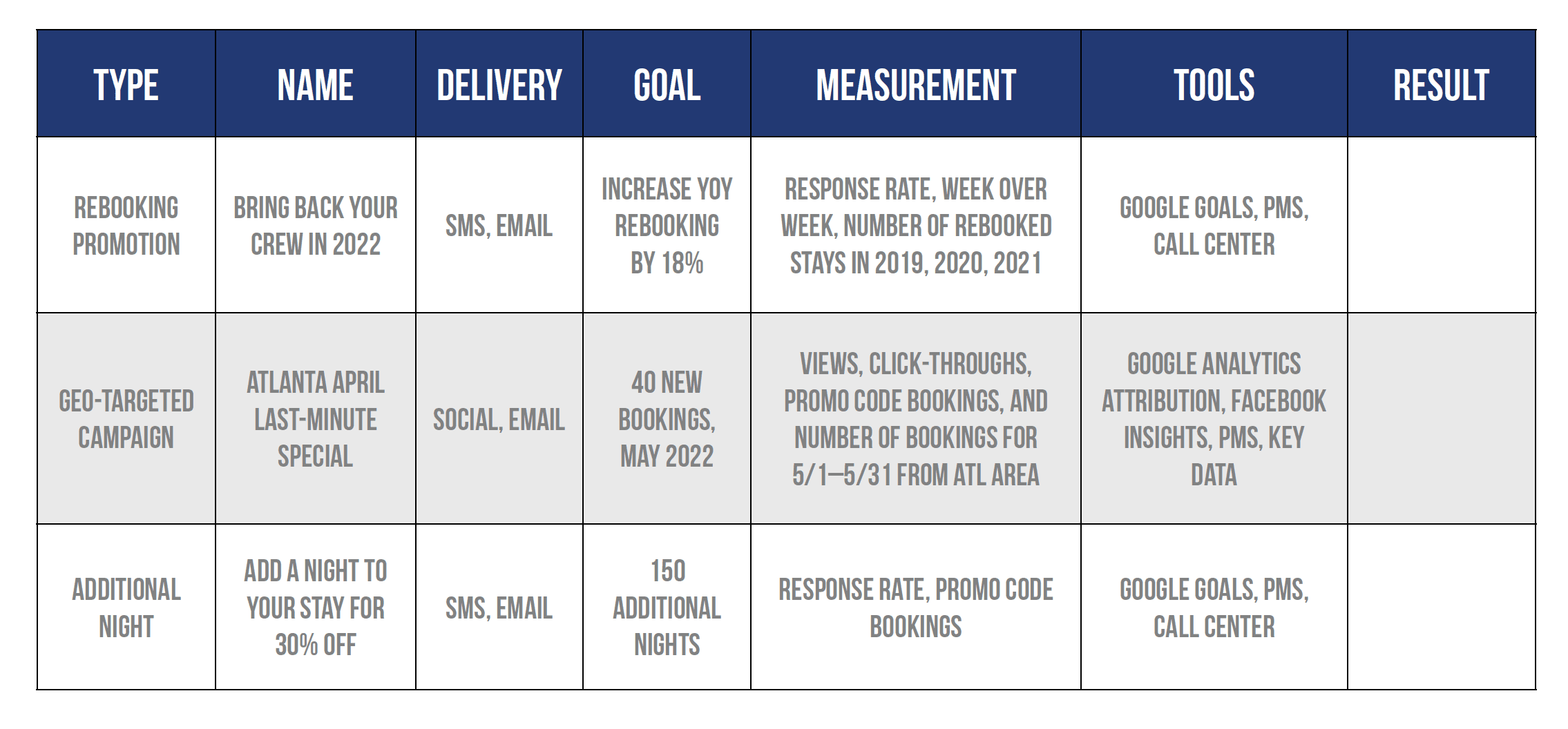
Everything you do—every campaign, channel, web page, promotion, and social post—should have a defined goal, performance tracking plan, and evaluation. This will allow you to quickly identify which efforts are working and which ones need improvement or reworking. Top measurement tools include Google Analytics Goals and Attribution, Key Data, AirDNA, call center tracking, and your software system (see example table below). 

Assign tracking to the team member who best understands the “why” behind the data, and schedule weekly meetings to evaluate performance, brainstorm about improvements and new campaigns, and celebrate successes.


9) Think outside the box 

Marketers have been drinking through a firehose for several years. However, in 2021, it’s time to move from being reactive to being proactive. Once you know each home’s competitive advantage, are collecting the data needed, have cleaned up your site, and have an evaluation system in place—you can go back to doing what you do best: thinking outside the box and implementing creative marketing strategies.

Look to other industries and other sectors of travel for inspiration. When geo-targeting, think about campaigns that appeal to that specific audience. And have fun with it! You sell vacations. You sell periods of time that have true meaning and purpose and that people remember for the rest of their lives. 

In 2020, families sought to escape, and they found respite in vacation homes. But they also found rejuvenation from the beaches, lakes, mountains, and countryside that you gave them. They found new adventures, natural beauty, and memories they will treasure. For marketers, I’m not sure there are many things more meaningful to promote.

Yes, 2022 will be fantastically competitive, but if we prepare today, we’ll be ready. 


Fact or Fiction? Mythbusting Hot Vacation Rental Trends

0

Last year was disruptive to our sense of normalcy in so many ways, and the typical trends and patterns we’ve come to count on for vacation rentals were thrown out of whack. Market performance shifts from one destination to another and are regularly affected by fires, hurricanes, and national events. If any industry is accustomed to handling surprise disasters, it is the vacation rental profession. But no markets were immune to the impact of COVID-19; standard metrics were turned on their head. 

As we sort through it, while the virus continues to affect us, it’s been more difficult than ever to forecast for the future. Can we count on the “trends” we’re seeing online and hearing from our friends in other markets, or are they unique to their market? 

Let’s turn to the data to try to set the record straight on what’s been happening and, more importantly, what we should expect for the coming seasons. 


About the Data 

Through Key Data, our industry has joined in what is effectively a collective co-op of data sharing. For 2020, the data set represents more than $2.5 billion in US bookings from more than 200,000 properties. Our markets are undoubtedly unique in many ways, but our collective data can now shine some light on our industry and clarify the real patterns as they are happening, many of which may not be what you expect. 

Here’s a look at the ones we found most interesting and helpful: 


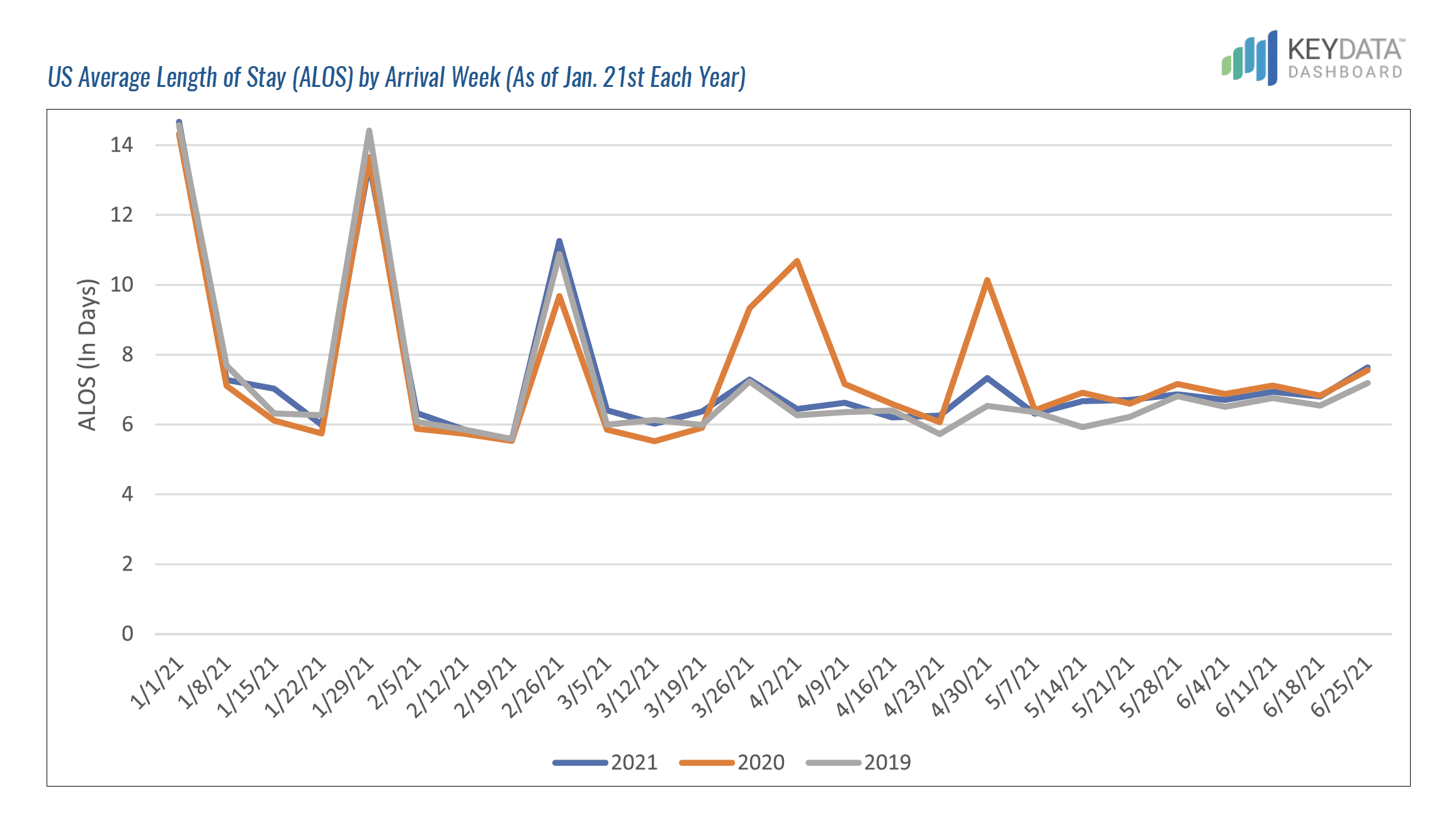
Fact or Fiction? The Average Length of Stay (ALOS) Has Increased. 

Mostly fiction, but it depends on the market. 

There is much talk about how ALOS is increasing significantly. But is it for our professionally managed vacation rentals? It would seem to make sense with COVID-19. People working from anywhere can stay longer. Many kids are doing school online. Here’s what the data shows. 

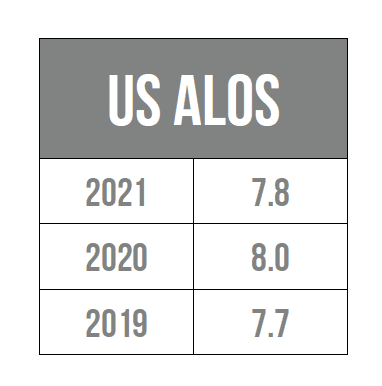
For the entire US, ALOS on the books for the first six months of 2021 is pacing almost exactly in line with 2019, showing an average of 7.8 days versus 7.7 days in 2019. For 2020, four weeks in late March and April saw spikes raising the average for the period to 8.0 days, but this came when most markets were shut down, and there were only a handful of guests essentially holding in place. Absent this anomaly, the US professional market is not seeing an overall increase in ALOS. 

So where is the chatter about ALOS increases coming from? Two places we believe. 

First, scraped data providers cannot distinguish between guest stays and owner stays or holds. Also, they have do not have visibility into cancellation data. They rely instead on algorithms or estimates to adjust for what they can see on the OTA websites. COVID-19 dramatically changed the expected percentages of holds and owner stays, making the data appear as if guests might be staying much longer when, in fact, much of what they were seeing were holds and owner stays. 

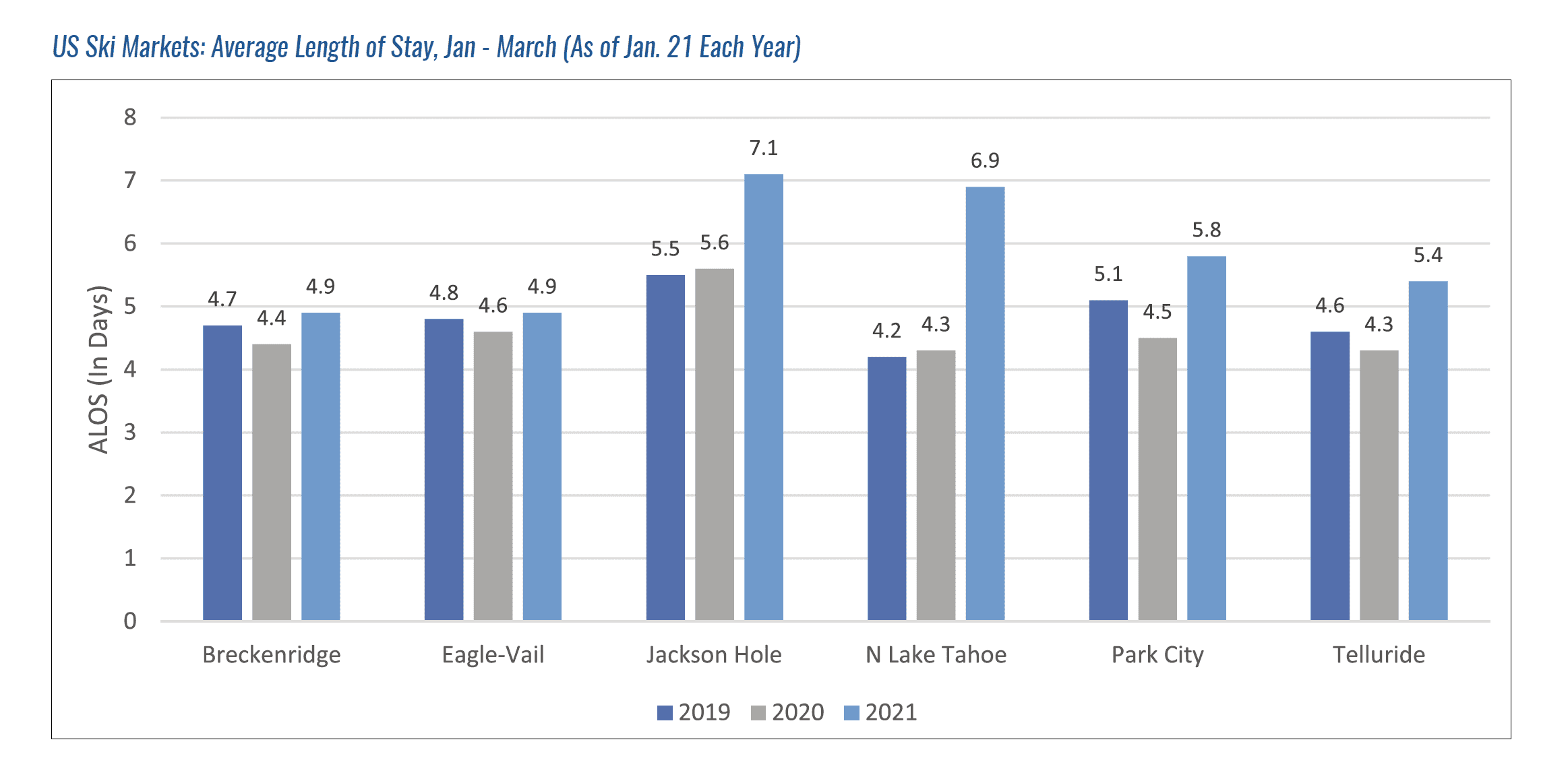
Second, several of the ski markets are seeing a bump in ALOS pacing for arrivals between January and March 2021 compared to last year. Although it doesn’t apply to all the markets, or even all the ski markets, it is enough to get folks talking. 


Fact or Fiction? The Average Booking Window Has Shortened. 

Answer: Mostly fact, but it varies by arrival time period. 

Are guests still booking closer to their arrival date? The answer here is yes and no, depending on the month. Let’s take a more in-depth look. 

For January through July arrivals, the 2020 booking windows were skewed heavily by COVID-19, reflecting a greater than 13 percent drop on average, down from 153 days to 137. 

So let’s throw out 2020 and look at how 2021 is pacing versus 2019 and 2018. For the period as a whole, 2018 and 2019 were identical, both with an average of 158 days. This year is pacing 3 percent down at 153 days. 

But the story here is in the details. 

January and February bookings were made much closer to the day of arrival—67 average days in advance in 2021 versus 97/96 in 2019/2018, respectively. 

Conversely, March–July bookings are being made much earlier this year—212 average days in advance in 2021 versus 190/188 in 2019/2018, respectively. 

This makes sense. The struggle for the vaccine to catch up with rising cases is holding back early bookings, whereas pent-up demand for what hopefully will be a great summer is causing people who haven’t been able to travel to get their trips for summer on the books earlier. 


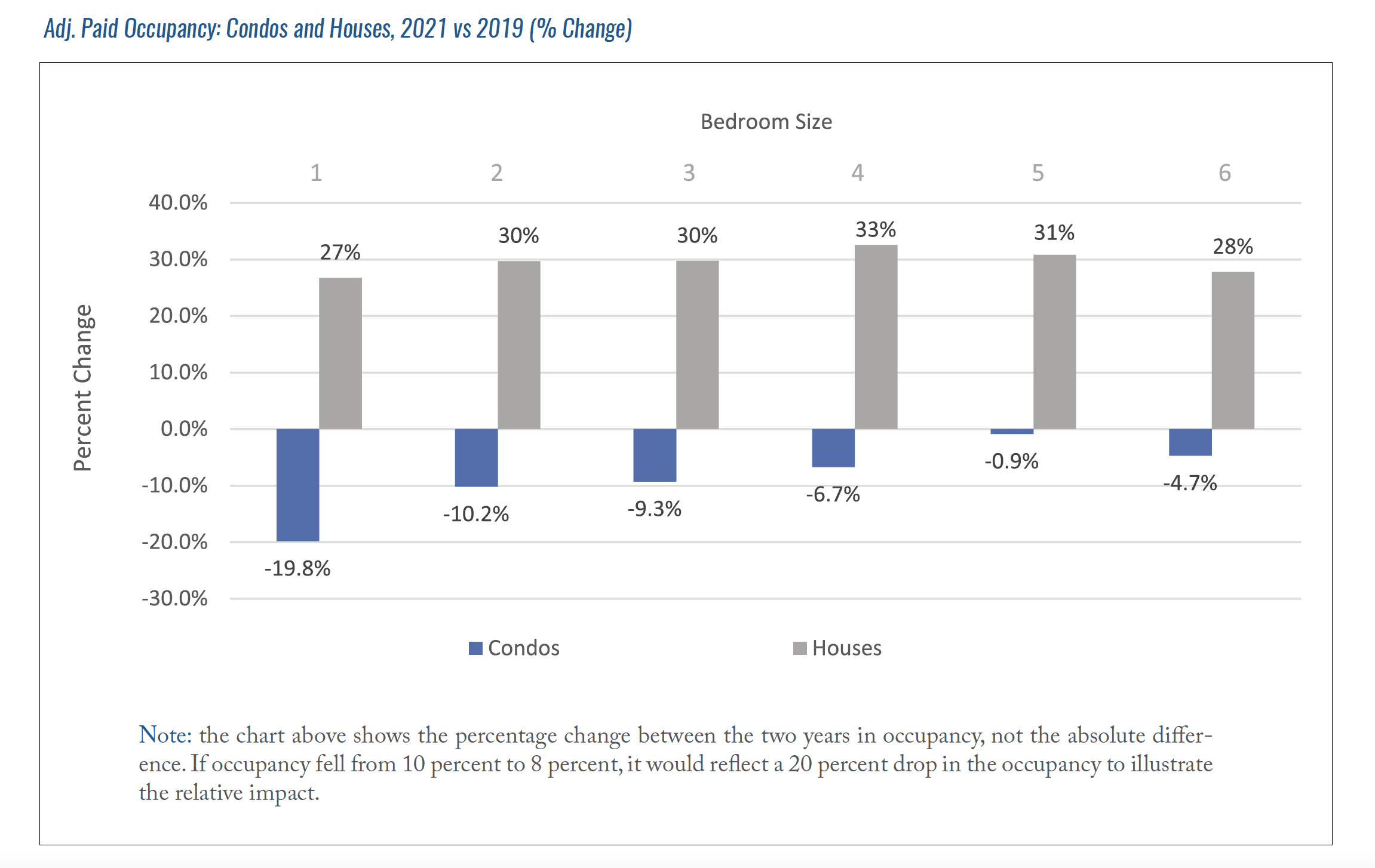
Fact or Fiction? Houses Are Performing Better Than Condos. 

Answer: Fact 

Condos, and small condos in particular, are not yet faring well in 2021. When looking at adjusted paid occupancy pacing for 2021 compared to 2019, houses are booking much better, whereas condos are booking much worse. It’s a sizable gap that shows a clear and strong trend across the US. In a COVID-19 period when private space matters and vacation rentals are vastly outperforming hotels, condos fall in between the two, as you might expect. Within our sector alone, they are profoundly underperforming and should be high on your list when considering marketing and rate adjustments. 


Fact or Fiction? Large Houses Are Booking Better Than Smaller Houses. 

Answer: Fiction 

Are large houses booking better this year, as some suggest? The data says no. We looked at pacing for adjusted paid occupancy, comparing 2021 to 2019. Although 2021 occupancy pacing is higher, the pattern is the same each month. 

Smaller houses booked better in January and as you look further out into the season.


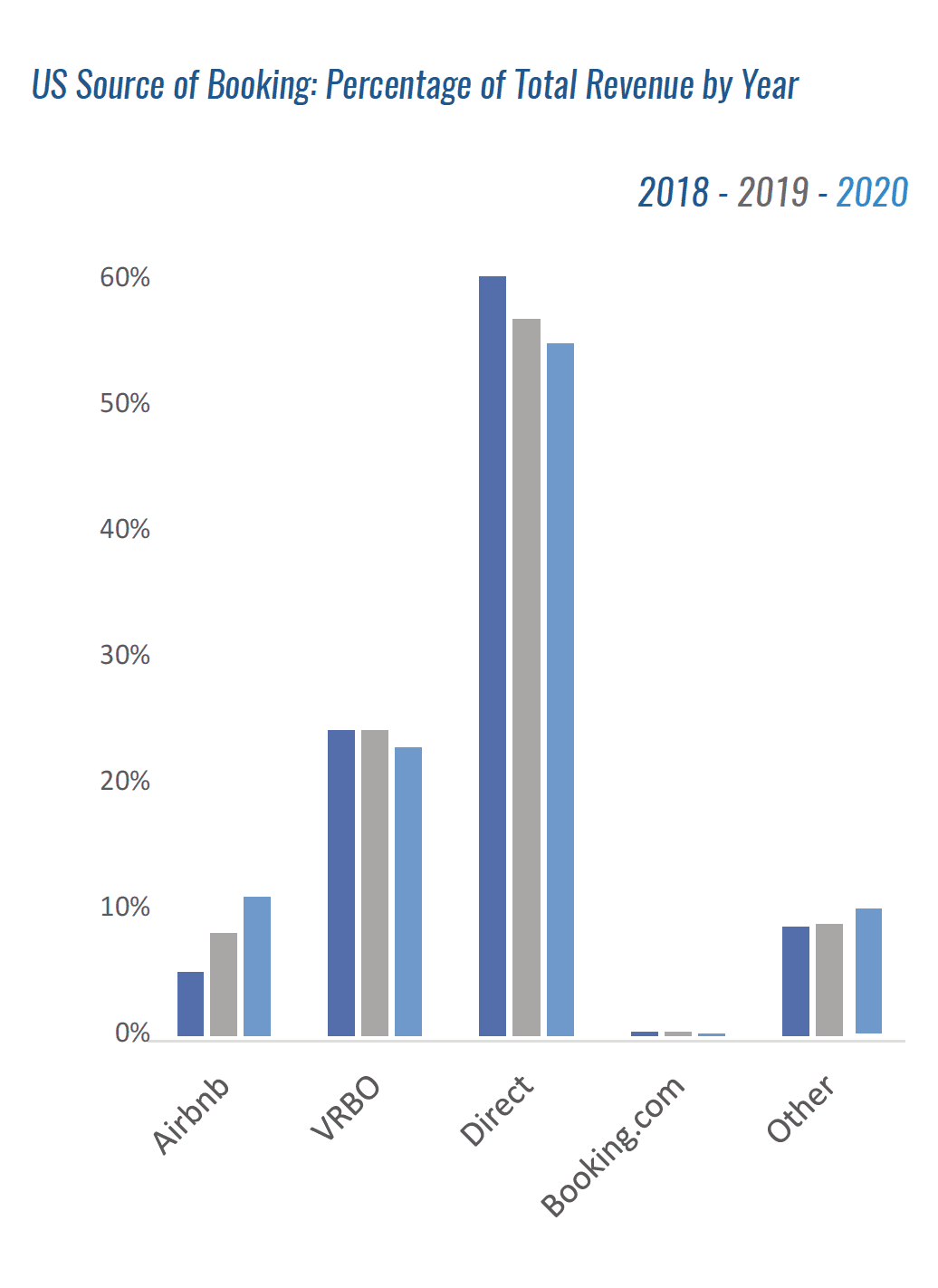
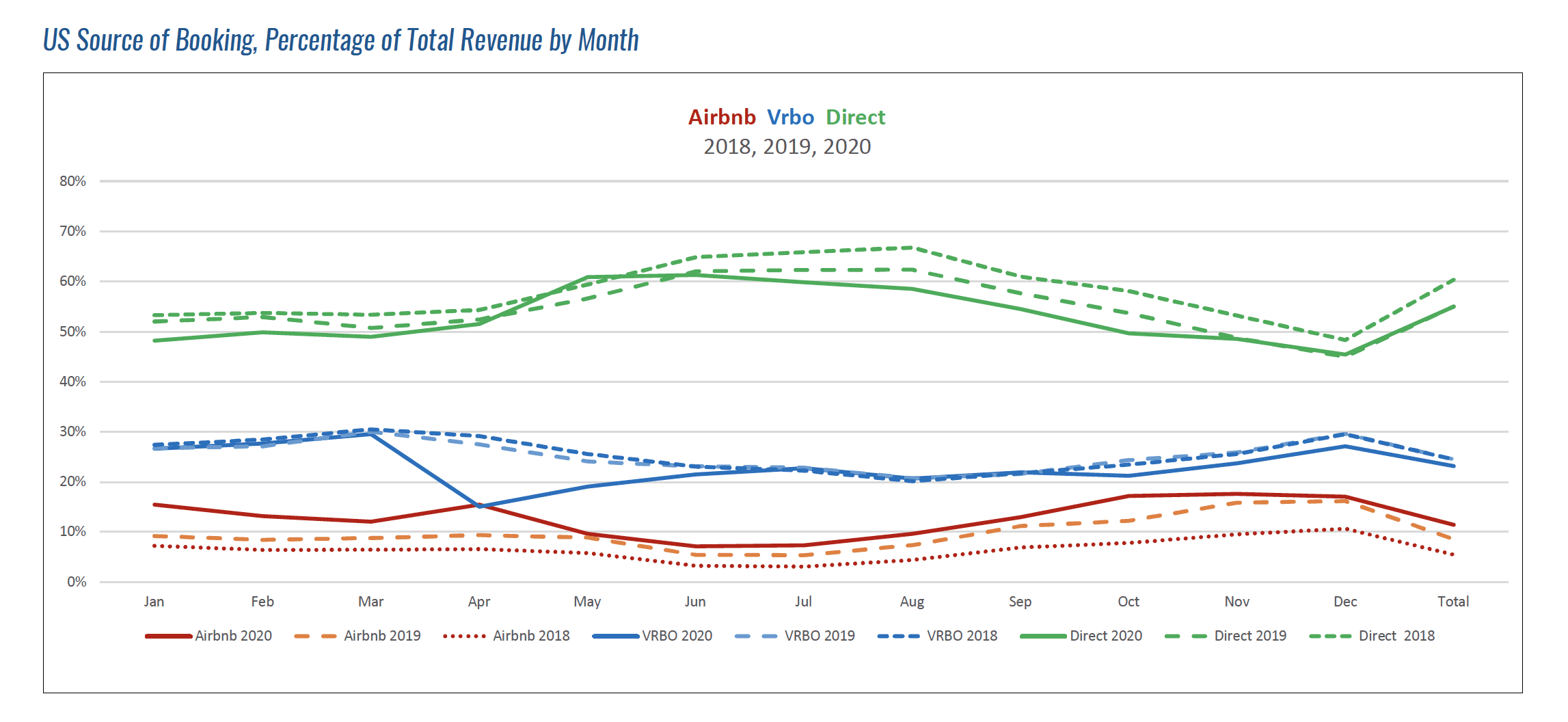
Fact or Fiction? More Bookings Are Happening on Airbnb than Vrbo or Direct. 

Answer: Fiction 

There is much speculation on how the OTAs are affecting each other and how professionals are keeping up with their push for direct bookings. Below we look for the first time at this data from the perspective of professional property managers on Key Data, which reflects significantly more of the leisure markets than the urban. 

A few observations are clear for professional US managers in leisure markets: 

Direct bookings continue to account for more than 50 percent of bookings. 

Direct bookings vastly outperform any OTA.

Airbnb is slowly gaining some ground despite its lack of effort to work better with professionals, and the gain is coming off direct bookings. 

VRBO is holding steady. 

Note that Booking.com was less than 1 percent for this data set for all three years. 

When we look at the data by month over this same three-year period, we see some additional seasonal trends: 

VRBO is steady throughout the year. 

Airbnb performs poorly in the summer months and stronger in the winter months. 

Direct bookings capture the largest share in peak summer months. 

The absence of bookings in April of 2020 skews the data that month. Otherwise, the trends are consistent. 

As professionals know, each market is different, and understanding how these trends are playing out in your specific market(s) is more important than ever after a year that reset much of what we’ve all come to expect. 


Fast Growth at Homes & Villas by Marriott International

0

Senior Director Travis Riner Shares Insight into Objectives, Growth, and Future Plans

Marriott International jumped headfirst into the vacation rental industry in May 2019 with its launch of Homes & Villas by Marriott International, a vacation home booking platform that curates luxury home rentals. After a successful pilot program that included London-based Hostmaker and Austin-based TurnKey Vacation Rentals, Homes & Villas by Marriott International went to market with 2,000 homes in 100 destinations. By the end of 2019, the platform had expanded its listings to over 12,000 professionally managed whole-home vacation rentals, and that proved to be only the beginning. 

In spite of the COVID-19 pandemic, Homes & Villas by Marriott International grew its inventory 160 percent in 2020, and it currently lists more than 20,000 homes in 240 destinations throughout North America, Latin America, the Caribbean, Europe, the Middle East, and Africa. Of those destinations, 40 percent are new to Marriott, meaning the company did not have bookable accommodation options in those markets before. 

Homes & Villas by Marriott International operates as its own business unit within the company, with a “small but mighty” dedicated team that isn’t slowing down. They have a road map to enter new regions, including Asia, and to add more premium and luxury inventory in popular destinations throughout Florida, California, Italy, Mexico, and beyond.

The key is “premium and luxury.” During a November webinar provided by Morgan Stanley, Marriott CEO Arne Sorenson said, “It was clear to us the homesharing space included a business that was attractive to us and a business that was not attractive to us.” 

“Sorenson saw upside in launching a Marriott-branded product, as it would be a way to cater to larger groups needing multiple bedrooms and who would be difficult to accommodate in a traditional hotel,” Skift’s Cameron Sperance wrote. “But if Marriott was going to get into the space, it would be with a product that could live up to company standards.”

To meet these standards, Homes & Villas by Marriott International lists only professionally managed vacation rentals, and property managers must meet a stringent list of criteria for a home before it can be listed on the site. In addition, property managers must agree to deliver on a well-articulated service level, including 24/7 on-call staff. 

For vacation rental managers, the primary benefit of listing homes on Homes & Villas by Marriott International includes the ability to reach Marriott’s 145 million members of its Marriott Bonvoy travel partners. Plus, Bonvoy members can use loyalty points to book. Joining the platform has also proved to be appealing to homeowners, and property managers report a higher quality of guests booking through the site than through the other third-party channels they use. 

We sat down with Senior Director Travis Riner to learn more about Homes & Villas by Marriott International.


Amy Hinote (AH): When Marriott decided to add Homes & Villas by Marriott International, what were its goals for this new offering? 

Travis Riner (Riner): Our goal as a company was to innovate with the customer in mind. Before we launched Homes & Villas by Marriott International, we conducted a survey of our guests and found 27 percent of our loyalty members used home rentals in the previous 12 months. For those times when they needed a home, these guests were leaving our portfolio to book on other sites. This created an opportunity. 

At the same time, we also saw that the short-term residential rental industry faced two challenges: (1) too much inventory without quality filters or brand assurances, and (2) inconsistency across guest experiences, leading to consumer frustration and disappointment. By exclusively working with top-notch property management companies and curating the best-of-the-best inventory for our guests, Homes & Villas by Marriott International solves those pain points. 

Additionally, Homes & Villas by Marriott International participates in our travel program Marriott Bonvoy. That means that our nearly 150 million members around the world now have alternative, extended-stay accommodation options beyond our traditional hotels. Additionally, because we are focusing our inventory on popular vacation destinations that may not be able to sustain a full-time hotel, our members have many more locations to choose from when staying with us. 


AH: Is Homes & Villas by Marriott International meeting your initial objectives for the platform? 

Riner: We are encouraged by the growth of both our available inventory and overall bookings. Some of the property management companies we work with are reporting that we are a top-three distribution channel for their homes less than two years after the launch. However, it’s important to keep in mind that Homes & Villas by Marriott International is still a relatively small—but growing—part of the company’s overall business. From May through December 2020, bookings were up more than 500 percent versus the same time period in 2019. This tells me we must continue growing in markets that matter most to members of Marriott Bonvoy, which account for more than 90 percent of our bookings. 


AH: How does your team ensure that a rental home meets Marriott’s standards for quality and service? 

Riner: Quality and service are two of the most important attributes our guests come to Marriott for. Much of the credit for maintaining the high design, cleanliness, and safety standards our guests value us for results from our collaboration with the property management companies with which we work. They are just as dedicated as we are in ensuring the homes are in tip-top shape; we have updated the imagery for our site, and each home listed is professionally cleaned to the exacting standards we created in collaboration with Ecolab. 


AH: Travelers have a set of expectations when staying in a hotel (i.e., a front desk, coffee and breakfast access, and 24/7 access to a live person). In addition, Marriott’s guests expect a certain level of quality in mattresses and linens. How are you managing the guests’ expectations for stays in homes? 

Riner: Just as when any new hotel brand launches, customers need to experience it firsthand to determine whether it meets their needs. Renting a vacation home is the same.

Together with the property managers for each listing, we are very clear with our guests that Homes & Villas by Marriott International is considered an extended stay accommodation, meaning many high-touch services and amenities that they might get in full-service hotels are limited unless specifically mentioned or requested. Additionally, because we work with professional property managers exclusively, our guests receive many critical amenities they wouldn’t get through vacation rental competitors, including 24/7 service should something need fixing and access to procurement of hotel-quality linens and amenities with preferred pricing. 


AH: In looking at the feedback and reviews you have received, how are Marriott Bonvoy members responding? 

Riner: Our guests, especially members of our travel program Marriott Bonvoy, are thrilled to have home rental options that are assured by Marriott. We hear a lot of positive feedback about homes with space and amenities that enable the whole family to be together comfortably. This is largely the result of the close relationships we have with the property managers with which we work. 

We choose to work only with those who have the shared value of putting the customer first. We read every comment and react to each customer’s feedback in an appropriate manner. Through this, we have learned quite a bit about our customer’s needs and wants over the past two years and have adapted, including by enhancing the customer’s digital experience by adding a “Near Me” search functionality, by highlighting our stringent cleanliness standards to help customers feel comfortable during this global pandemic, and by enabling our guests to cancel closer to the stay. 


AH: Since you’re carefully reading each review, do you have any advice for property managers about how to better meet (and exceed) expectations from frequent hotel travelers who have not previously stayed in a vacation rental? 

Riner: Providing clean and well-maintained homes is table-stakes for our guests. Our customers are hyper-focused on these elements, something that has been heightened during the COVID-19 pandemic. Even the biggest and most elegantly designed and furnished homes have the potential to disappoint if they are not thoroughly cleaned before check-in, or if basic items including cabinetry, appliances, and technology are broken or don’t work. 

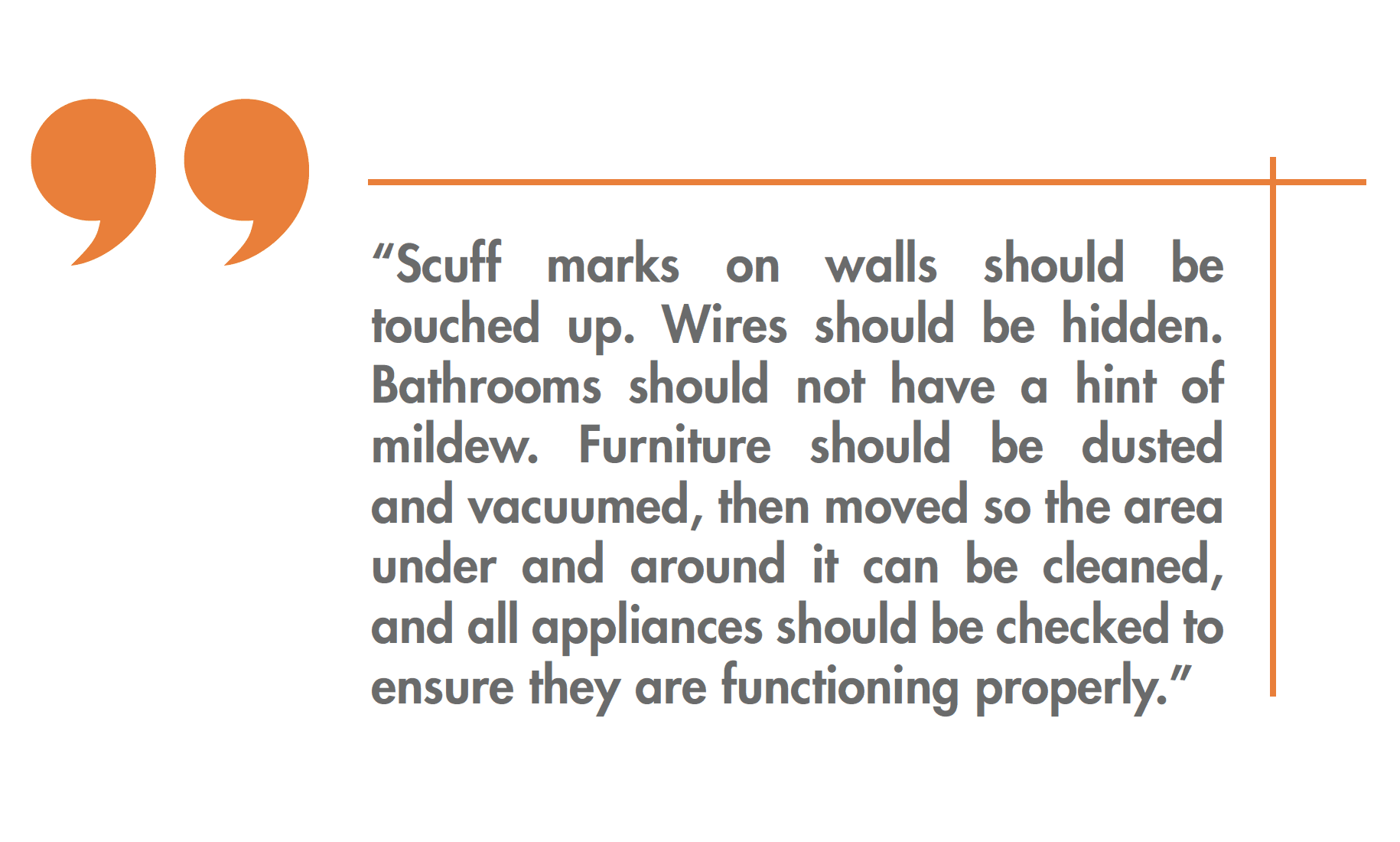
We encourage property managers to continue staying on top of cleaning and maintaining their homes. Scuff marks on walls should be touched up. Wires should be hidden. Bathrooms should not have a hint of mildew. Furniture should be dusted and vacuumed, then moved so the area under and around it can be cleaned, and all appliances should be checked to ensure they are functioning properly. 


AH: What have you learned about vacation home rentals in the last year that you did not expect? Were there any surprises? 

Riner: It’s no surprise that vacation home rentals are popular and have become even more popular as a result of the COVID-19 pandemic. We’ve seen especially strong demand for premium homes— homes that range from $100–$500 a night, in drive-to and ocean or mountain destinations. That’s one of the reasons we launched the “Near Me” search functionality on our site that curates homes within up to 600 miles of the person searching. 

We also saw the booking window shrink throughout 2020 as the global pandemic persisted. While most people still book 55 days out, we saw the number of people booking 6–30 days out increase to 40 percent of bookings. That is why we introduced a 10-day flexible cancellation for most homes, giving our guests the confidence to book without fear of losing money if they need to cancel. This is so popular we have extended the promotion through June 2021. 

Members of Marriott Bonvoy have shown support for this offering since launch. Members are redeeming millions of points for stays and earning millions of points for bookings. In fact, one member redeemed nearly 11 million points for a three-week stay at an amazing property in Lake Tahoe. 

Finally, we have discovered the need for more inventory in highly sought-after markets. It’s critical that we continue to curate the best homes, so our customers are not weeding through substandard listings, but we need to offer enough choice so that they can both find exactly what they need and know it’s available when they want to travel. This is one of the main reasons we continue to work with existing property managers and are looking for more who can help us add inventory to the hottest vacation rental markets throughout the world. 


AH: Is Homes & Villas by Marriott International looking to provide services such as revenue management, marketing, and distribution to vacation rental operators? 

Riner: The professional property management companies we work with are the backbone of our vacation rental offerings. Our marketing power and engaged audience are the two main reasons property management companies should work with us. We constantly market our listings to the 145 million members of our travel program Marriott Bonvoy. We are also constantly looking to make it easier and faster for property management companies to list homes on HomesandVillasbyMarriott.com—and will be rolling out several initiatives to this effect over the next few months. 


AH: Can we expect to see a “flag” styled offering for vacation rental operators? 

Riner: While we offer some branded hotel residences—whole home vacation rentals including the Ritz-Carlton, Westin Hotels & Resorts, St. Regis, and others—we don’t have any plans in the short run to introduce additional flags from brands that are outside our hotel offerings. 


Expedia CEO Talks Vrbo: We ‘Removed Vrbo from Google’s Vacation Rental Meta Product’

1

During today’s Expedia Group earnings call, CEO Peter Kern and CFO Eric Hart told its investors that Vrbo provided a bright spot for the company during COVID-19 as the whole-home vacation rental market has been attractive, family travel has been attractive, and North American travel has been stronger than in other geographies.

In contrast to past earnings calls, the bulk of today’s conversation focused on Vrbo and the alternative accommodations sector. Here are some takeaways for vacation rental professionals. 


Vrbo’s Marketing Strategy

With the strength of the alternative accommodations sector over the last year, Kern shared that Expedia had bumped up performance marketing spend for Vrbo in Q4, but that it had pulled Vrbo’s inventory from Google’s Vacation Rental meta platform.

“In the fourth quarter, we were investing more heavily in marketing,” Kern said. “This was intended to get ahead of what we thought would be the coming demand from the vaccine rollouts, but it was largely focused on the upper-funnel brand marketing side of Vrbo where we knew there was a lot of momentum.”

Kern continued, “We are using this moment to try to drive as much brand recognition and long-term value into the brand over time. So we pushed into Vrbo on the performance marketing side, which we view as more of a quick-torch muscle. We continue to be relatively conservative.”

Vrbo No longer listing on Google’s Vacation Rental meta Platform

However, Kern noted that performance marketing has a downside during volatile periods.

“Again, we saw lots of closures happen across the globe. Those closures drive massive cancellation spikes, and they can make performance marketing very unattractive very quickly when it goes the wrong way. So we’ve been relatively conservative,” Kern explained. “In that vein, we’ve actually removed Vrbo from Google’s Vacation Rental meta product.”

“Again our focus is, as much as possible, on driving direct traffic, driving incremental profitability from all our performance marketing, and as we see opportunity to remove unprofitable activities, we do that. And as we right back into a more normal market we think we’ll be able to drive more into the upper funnel, more direct traffic, and be much more calculated in performance marketing.”

About performance marketing, Kern provided more insight into its strategy: “We’re very sharp minded about it in the sense that we’re happy to invest in anything that drives incremental profitability, good revenue, and good profit; and we’re not keen to continue on a path of just continuing where investment is not productive. So we didn’t find investment in the Google VR (vacation rental) product to be particularly incremental, we didn’t think the customer experience was particularly valuable, and we are in a period where we are seeing great direct traffic for Vrbo so we found more profitable ways to drive traffic.”

Airbnb pulled its listings from Google Vacation Rentals in August. Booking.com is back after delisting for a period of time. It makes sense for the top home-rental providers to shun Google to keep consumers from finding large supply listed on its meta platform. The consumer experience still has a long way to go with rate display, location pins, and nonsensical filtering options related to features and amenities. 

When asked to provide a little more insight into the decision to remove listings from, Kern said, “Google VR was not particularly significant, and we concluded that it was not additive, which is why we made the move that we made.”


Vrbo Starting to See Longer Booking Windows for Summer Stays

Expedia attributes January’s uptick in performance to domestic North American travel and to longer booking windows at Vrbo. 

“The summer is a strong opportunity for the Vrbo use case, and we’re seeing people lean into that as the year opens up,” Kern said. “I don’t think we’ll breakout exactly how good it was, but Vrbo has been strong.”

CFO Eric Hart expounded on the trend they are seeing with longer booking windows.

“Historically, during COVID, we saw a shortening of booking windows, and we continue to see that on the conventional lodging or on the hotel side of the business,” Hart said. “But what we’ve seen is Vrbo [booking window] elongate again and look much more like we would have expected to see in any other year—which goes back to the summer bookings that Peter is mentioning.

Hart added, “We know there is pent-up demand, and people wanting to travel, and people have confidence that they are going to be able to travel—at least domestically, using the US as an example—so they are starting to book for the summer months now.”


Expedia Group will not break out Vrbo Separately

With Airbnb’s recent IPO, analysts were hoping Expedia would decide to break out Vrbo’s financial performance to provide more insight into how the businesses compare. It’s not going to happen.

“No we don’t intent to break it out . . . because we believe it’s one business. We view this as just another product that the traveler will want,” Kern said. “Obviously, it’s having a great moment, and we’re glad that we own it, and we believe we can ride some of the success of travelers being exposed to the product type. But we view it collectively. We view it as one business that we’re driving, whatever the best outcome for the consumer is, and driving that outcome across all lines of business. We think the separation has been artificial, and we’re not planning to report on it that way in the future.”


Getting Alternative Accommodations Inventory on Brand Expedia

Since Expedia acquired Vrbo/HomeAway, we’ve heard several CEOs talk about integrating whole-home rentals onto the OTA sites, and it’s a little surprising that it still hasn’t happened.

“We’ve been saying that for a long time, but we are now highly focused on doing it,” Kern said. “It’s not ready to roll yet. We do do it, but the consumer experience is not yet where we want it, but we are highly focused on driving that in the future and that will be the way we attack markets where we don’t have an exisiting Vrbo or other alternative accommodations brand.”

Kern also discussed how to present whole-home inventory alongside hotel inventory in an attractive way and so that the consumer understands the difference. 

“We still have work to do to make sure it’s a good experience.”

It sounds like 2021 will be the year during which intent becomes actual strategy. 


We continue to expect a bumpy ride

“We continue to hope and expect the vaccine rollout to drive consumer confidence and drive things forward, but we certainly are not trying to predict what consumer sentiment will be as the virus changes over the ensuing months,” Peter Kern added.

“We continue to expect a bumpy ride.”

Identifying, Hiring, and Inspiring Your Team in a Post-Pandemic World

0
Team Teamwork Togetherness Collaboration Concept

If you’ve been in this game for any time at all, you’ve likely been asked the question, “So how did you end up in the vacation rental industry?” 

Because I can’t help but use a little sarcasm in my humor, my standing start to the answer is always, “Well, right after I graduated with my degree in vacation rental management . . .” 

The reality is that there is no obtainable degree. It’s an industry and a career path that most have fallen into by chance. While there are many ways to get here, there’s a common thread among those who stay. This vacation rental thing gets in your blood. 

That’s why this year has been one of the biggest challenges for so many in our space. The ups and downs of 2020, and the apparent extension of said challenges into 2021, have made keeping one’s passion for this industry challenging for many. 

On a macro level, the global shutdown and economic problems that the COVID-19 pandemic caused have led to vast unemployment across the US. By early April, more than 310 million Americans were on lockdown at home, over 30 million had filed initial unemployment claims, and the unemployment rate had risen to a record high of 14.7 percent. Businesses worldwide faced a sudden onset of significant challenges and changes that required a strategic plan for survival during and after the pandemic. 

Nearly nine months into the pandemic, we see many glimpses of hope on the horizon. Air travel in the US reached its post-March peak the day before Christmas, with over 1.1 million Americans passing through checkpoints. Millions of people took long-anticipated road trips to nearby destinations to celebrate the festive season with friends and family. Americans are traveling, and the shift in their market and travel behavior is placing them in your vacation rental homes rather than public hotels. While this shift is ideal for our industry, there is more pressure to perform than ever before. 


A Talent Paradigm Shift 

COVID-19 changed the way we work overnight, and we need to change our thinking and keep up with the ever-evolving market. The vacation rental industry has not only shifted because of the pandemic but also matured and reached a new level. Property managers have used this time to adapt, reassess their work models, create a strategic survival plan, and find innovative ways to keep their heads above water. 

Work trends changed considerably and have been reset for the foreseeable future. In many cases, companies are replacing full-time employees with contingent workers and freelancers for flexibility. 

Remote workers, telecommuting, digital nomads, online roles, and automation are on the rise, and Zoom meetings are the preferred form of office communication. The pandemic has also brought a shift in employee expectations with a focus on flexibility and a healthy work–life balance. 

As a general rule, vacation rental managers have been historically hesitant to allow for remote workers. Now that many are forced to work in this manner, managers are starting to see the benefits. Offering remote roles significantly increases the level of talent available for a specific function. 

While many hands-on positions such as housekeeping and maintenance are impossible to do remotely, positions in reservations, marketing, accounting, and even business development can all be done via the internet and the now ubiquitous Zoom meetings. 

As with remote workers, many managers had been hesitant to hire individuals who worked at other vacation rental firms because they were concerned the workers had “bad” experiences or were not trained professionally. 

There has been a significant shift in this thinking as the industry evolves and ages. There are tens of thousands of experienced professionals who bring years of experience along with their passion for the industry. 

No, there is no obtainable degree for our industry, and finding the right talent is challenging. Still, there is a silver lining to the COVID-19 layoffs and cutbacks: a labor pool of talented, experienced, and resilient professionals with a new set of skills and a fresh approach. 


The Best Teams Win 

Finding and building the right team can be time-consuming, challenging, and often overwhelming. The competition for talent is fierce, and connecting the right candidates with specific roles within your company is no easy task. 

Whether you tap into the existing vacation rental talent pool or reach out to the extended hospitality industry, there has never been a greater time to build a team. It is essential to have a well-designed talent strategy that aligns with the business’s objectives and goals. 

Throughout all the challenges and changes of recent times, one truth still holds—the very best vacation rental companies have the very best teams. Whether your company is already the market leader or is striving to be one, the best investment of time and resources you can make in 2021 is to identify, hire, and inspire the very best. 


Technology in 2021 and Beyond: Vacation Rental Tech Leaders Predict the Future

4

The vacation rental industry has witnessed a significant evolution in technology over the last five years. With every property management system that goes to the graveyard, five more arise in its place, all promising to be the all-in-one answer to all the industry’s problems. To further complicate things, we’ve seen specialized plugin software platforms emerge providing functionality to meet the needs of every imaginable business need from hiring and housekeeping to distribution and revenue management. We use terms like integration and APIs as often as we use check-in and checkout. Even entry-level staff members are now expected to be adept in multiple systems. 

The current state is overwhelming, even for tech-savvy millennials and Gen Zers; and often professionals who excel in hospitality are driven out of the vacation rental industry because of the demands related to the revolving training required with an ever-changing tech stack. Vacation rental management company founders didn’t sign up to be SaaS project managers. 

Where is the industry heading in 2021 and beyond? Is there any light appearing at the end of the tech tunnel? We reached out to the industry’s technology leaders to find out what they are predicting and what vacation rental managers can expect as the industry continues to evolve. 


Eric Broughton, Chief Strategy Officer, InhabitIQ 

While the pandemic touched every aspect of the vacation industry, we were impressed by the resiliency and tenacity of our brands, clients, and partners. Beyond delivering technology solutions, we are encouraged by the way our industry is coming together to educate local, state, and national leaders on how travel can be done safely and by the positive impact of professional managers on the economy. 

For the first half of 2021 and likely beyond, length of stay (LOS) is a major trend as travelers are choosing to stay at their destination longer because of online school and/or work. The ability to optimize yield for our property managers through enhanced LOS solutions that seamlessly integrate within their websites and the major OTAs will deliver value. In collaboration with LOS, revenue management solutions that optimize pricing will deliver significant returns. We continue to be impressed by the consistent uplift in yield experienced by property managers utilizing either a managed or algorithm-based solution. We’ve seen groups that have previously managed their pricing find a 14 percent increase in year-over-year revenue with our service while those that hadn’t managed pricing in the past experienced an average revenue increase of 58 percent year-over-year. 

Because of tighter budgets, we see a focus on stretching website and agency dollars further through improved marketing spend and more organic traffic. We are investing in these segments of our business to support new and returning travelers organically. 

Toward the end of 2021, we predict the return of urban core markets, which had been taking off prior to the pandemic. Pent-up demand for travel combined with purpose-built, short-term rental properties that began with shovels in the ground during the heyday will come online at the perfect time. 

We’re inspired by property managers’ resourcefulness and resolve, and we’re enthused by the positive trends that are pointing to a better year in 2021. 

 

Ben Edwards, Founder and President, Weatherby Consulting 

From what I’m seeing in the marketplace, technology is definitely a challenge—specifically, the lack of financial visibility in the business. Most companies do not have accurate or timely financial statements that allow them the opportunity to make good business decisions.

Financial visibility and fundamental management is sorely lacking. We’ve been offering a free business assessment to anyone concerned about their business. Having reviewed hundreds of businesses over the years, we’ve helped highlight systemic business issues and provide changes to generate a more meaningful profit. Financial visibility is paramount to having a perpetually sustainable business. 


Jeremy Gall, Founder and CEO, Breezeway 

Over the past year, vacation rentals have proven their resiliency and appeal as a travel category, attracting new travelers and carving out more market share. We often beat the drum about increasing expectations of owners and guests and the push for quality in the industry. Professional managers have continued to elevate their businesses to meet these demands. Now, it’s important that operators don’t take their foot off the gas. We can expect increased competition from hotels edging into the vacation rental market with products that are designed to provide the authenticity of a vacation rental with full hospitality services. Technology that helps professional vacation rental operators deliver “hotel-like” guest experiences and services will continue to be a critical piece of successful management. 

Technology solutions for vacation rentals will become smarter and smarter over the next few years. Today’s technology creates value for clients, whether through marketing, operations, accounting, or revenue management software. But there is so much more value that can be delivered in the space. The market is demanding deeper customization with various levers to further unlock automation across business functions. This trend for more customization and automation is really exciting and will enable a leap forward in property management service. With more efficiency and the ability to take on more work, this opens up new revenue opportunities for vacation rental managers to monetize the guest and owner experience. 


Andrew Kitchell, Founder and CEO, Wheelhouse 

2021 is going to be the year that professional-grade software comes to the STR space. 

Why? Because the scale of the opportunity to transform travel and housing is massive. And, the evidence that the broader market recognizes this has already been demonstrated by (a) the stunning success of the Airbnb IPO, (b) the broader shift in travel spend from hotels to STRs, and (c) the increasing scale and sophistication of investors in and around PropTech and STRs in general. 

This scale is going to encourage strong technology teams to enter the category and to create elegant solutions to empower both small- and large-scale operations. 

As an operator, 2021 needs to be the year you lean into software— should you not already be there. As a technology company, 2021 needs to be the year we lean into customers—to make sure they are empowered as never before. 

At Wheelhouse, we’re making sure that 2021 is the year that transparency truly comes to the dynamic pricing space, and we look forward to sharing our deep investments in revenue generation with customers everywhere. 


Amber Knight, GM, LiveRez 

The biggest changes we’ll see are shifts in consumer behavior. Like everyone else, vacation rental managers have radically adjusted priorities and reevaluated what’s important. This applies to software they’ve opted into in the past, how much they’re willing to pay, and the lightning-fast (for the industry) adoption of new products that deliver results. 

Software that enables managers to take advantage of booking direct, retaining repeat guests, and optimizing revenue without building a bloated organization will see the biggest increase in market share. The most adaptable software companies will be able to objectively aid managers in wading through the process of choosing the right software stack and deciding how to clearly measure success. Managers are going to stop expecting one-size-fits-all on a global scale from their software, and software companies that succeed will have to both find their niche and help professional managers grow. Companies that simply provide another flavor milkshake won’t make it. 


Simon Lehmann, Founder and CEO, AJL Atelier 

Nothing will be the same! 

For a couple of years now we have focused heavily on technology adaption in our industry. Many surveys have been made to find out how property managers are increasingly using software and technology to run daily business. Their use has increased substantially, but at the same time, it has been identified as one of the biggest pain points for the operators. No big surprise. Vacation rental has been the only travel vertical in the start-up scene that has received more investment, and technology start-ups popped up on a monthly basis even during 2020. So what has happened? And what is the consequence? 

We have started to micro-verticalize our value chain with technology providers between guests and hosts. On average, a property manager is working with eight different software products to run his business. But this is not sustainable. While the OTAs are taking 50 percent of the gross margin, technology has not become cheaper, and the net margin for property managers has become smaller. Most of the tech companies are venture-funded and are not profitable either, which does not help the situation. Today, we can source software for any process that the PMS does not offer. It is obvious now that each technology provider is trying to expand its value proposition and increase its take rate—no matter if it is an operations and cleaning software, revenue management system, channel manager, or a traditional PMS. Channels are being integrated, and add-on features are being developed to offer a one-stop shop to the property manager. 

Keeping sane looking at the jungle of technology providers has become a challenge not only for property managers but also for us as thought leaders and any other industry intermediary. Therefore, the consequence of the current market environment is going to be consolidation. We will see many tech companies shutting doors and not surviving. Others will try to merge with one another or expand their customer base and value proposition, and yet others will raise more funds and buy up technology companies. So watch out when making decisions to source new technology. Get external advice to help you with the specifications that you need and with the selection process! The landscape is changing very rapidly; and we will see fewer, but much larger, technology companies in the future. Remember the last VRMA in New Orleans, when you went to the exhibition hall? I never saw so many exhibitors before. If there is going to be a VRMA this year in San Antonio, then my prediction is that there will be less than half the exhibitors there. 


Matt Loney, President and CEO, Xplorie 

The pandemic has shifted our industry in ways that are hard to comprehend just yet. But it’s important to take a moment and appreciate how technology helped propel the vacation rental industry to be one of the few travel success stories of 2020. Without virtual/keyless check-in and cleaning protocols systematized by new operating applications, managing the pandemic in a way that reinforced vacation rentals as a safe alternative to traditional lodging would have been far more difficult. 

Our industry’s “technology stack” was there when we needed it most. And unlike any time in our industry’s history, operators are now embracing technology across the entire guest journey and collecting guest data across multiple touchpoints. Moving forward, managing this growing technology ecosystem is not only the most significant tech challenge for the vacation rental industry but also the greatest opportunity. 

Over the next few years, consolidation of guest data will allow property managers to personalize the guest experience along the entire guest journey. The logical source for the consolidation and organization of data is our property management systems, which owe a duty to our industry to begin to normalize our data and API connections in a way that allows ancillary technology companies to consume it and leverage it for the benefit of all stakeholders. Additionally, guest personalization at scale will require an effective means of delivery and control by the guest. 

Our industry has explored mobile apps, mobile web pages, tablets, televisions, and voice assistants—all with varying degrees of success. Ultimately, how best to interact with the guest needs to be based on what technology drives the most significant guest interaction. By reducing the barriers to adoption, we will promote the exchange of preference data between our technology systems and the guests. 

As for Xplorie, we are focused on consolidating guest preferences for in-market experiences to better understand guest motivations. Right now, we’re working to provide a more personalized guest service via our Xplorie Enabled Voice Assistant (XEVA) powered by Amazon’s Alexa. Answering common guest questions—such as “What’s the Wi-Fi password?” “Where can we get the best burger?” or even “What should we do today?”—is a perfect example of using big tech in a small way to customize a guest’s stay. And we’ll be seeing much more of this type of guest-centered tech in the near future. 

Vacation rentals continue to benefit from the hard lessons learned by the hotel industry. Whether it’s channel distribution, yield management, or operations, hotels paved way for vacation rentals. And personalization of the guest experience is no different. By the time hotels discovered the importance of guest personalization, their technology ecosystem had become so bloated that getting their systems to talk, let alone work together, was nearly impossible. Even today, most hotels don’t even consolidate data from the minifridge to identify loyalty members’ favorite drinks or snacks. 

Failure to aggregate and leverage acquired guest data is clearly a missed opportunity in the hotel industry. But for the vacation rental industry, it’s still early enough in our technology growth curve to learn from their mistakes—and make the appropriate corrections as we move forward. 


Lino Maldonado, President, BeHome247 

This is a resilient industry, no doubt in my mind. But as I think about how this pandemic differs from hurricanes, oil spills, low snow years, and economic pressures, it may be that for the first time, perhaps ever, technology is ready to play a significant role in the recovery if we let it. 

We’ve learned (or been told) over the past year what is absolutely essential, how to stretch everything from our time to toilet paper, and which facets of our businesses can function remotely and which cannot, but have we invested any time in evaluating processes in our business to determine where some automation in the workflow could generate greater efficiency, improve guest and/or owner experience, and add margin to our bottom lines? 

I’ve been through a number of software migrations over the years, the most painful thing your business may ever self-inflict. So why is it that when we decide to make a switch, the first thing we do is try and make our new tools map to an old process? It’s human nature to fall back into what we are most comfortable with or to find a new work-around to overcome a perceived shortfall in the new system, and my teams and I were really good at it, but that rarely led us to innovation. What we typically ended up with was a new system, or another bolt on, that every office would try and make act like what they had prior. 

There are more great tech products on the market today than ever before, and we will certainly see new point solutions introduced over the next few years. Whether these new tools are focused on a single issue or a full PMS, they will only be as impactful to your business as your teams are comfortable in using them, so pick a partner who is as good at support as they are in sales. 

 

Sean Miller, President, PointCentral 

As we adopt to how the world looks post the arrival of COVID in early 2020, I think we will see the following technology shifts become part of our lives in 2021: 

Guest data privacy: As VRMs look to create and maintain relationships with guests in current stays and to plan future stays, they are looking to know more about their guests and how to get ahold of them. I think how data are collected, used, and managed will become a growing concern to guests and a risk mitigation vector for vacation rental managers. The key will be how all of those activities respect consumers’ growing awareness of data privacy as well as developing regulations around it, such as CCPA. I have seen several tools, including smart lock providers, deploy tools to collect guest information, but I expect the growing consumer expectations and regulations to drive this to be more of a core function of PMS and/ or CRM tools. 

Reassuring guests: Tools like property care software have helped to augment our process to meet changing guest demands, but I expect more advances around how we market safety and cleaning protocols to help. (Investments in things like better Wi-Fi will also support changing guest needs—like in workcations.) 

Shift from property management to asset management: Interest and attention in the vacation rental space will continue to grow in 2021 because I think private accommodations will continue to better meet travelers needs, especially as we work to get to the other side of a COVID vaccine. With this interest will come more business but also outside investment, disruption, and consolidation. VRMs who want to come out of this evolutionary stage stronger and larger will have to think about not only how they fill vacant homes but also how they help owners take better care of their homes and grow the overall value of that asset. Technology that enables proactive protection and maintenance, such as monitoring security and intelligently preventing water damage or HVAC damage, will help VRMs simultaneously remain competitive in their core focus but also grow their business with value-added services that homeowners appreciate. 

 

Matt Renner VP, TravelNet Solutions (TRACK) 

Much like the vacation rental industry itself, VR tech has been a fragmented space with niche providers. In many other vertical industries, there are clear enterprise leaders with $1B+ valuations (e.g., Procore and Veeva). Although there has been some consolidation over the last few years, it is more of a roll-up private equity strategy, where companies operate independently, still fragmented, and with the primary objective to generate short-term shareholder returns. Although there is nothing wrong with this strategy, I believe that over the next three years we will see a company separate from the rest. There will be niche product consolidation under a cohesive long-term vision, and an enterprise software company will be on the path to being a clear, global market leader. This will contribute to the maturation of our industry and will be a positive development.

 

Jason Sprenkle, CEO, Key Data Dashboard 

For starters, I think the stream of companies converting to another PMS will continue, with a handful of brands seeing the vast majority of the growth. This shuffling will add a lot of work for vendors, but it should result in an updated and increasingly robust platform from which to improve the technology in our space in the next few years. In the short run, tons of money continues to pour into pricing, revenue, and data tools, which should see significant growth this year. VR companies continue to be split into those focused on channel distribution and those focused on their brand. The prior saw consolidation over the last few years. I believe the roll-up of the larger regional brands will begin in earnest this year and continue through next year, with the creation of increasingly large companies in the US. The ones that get it right will focus on the people, the culture, and the service. The ones that focus on growth for growth’s sake will relearn the lessons our industry has previously taught. In the end, I think the next few years will see the full-scale arrival of the private equity firms, the flags, and the money. I believe that this will provide huge opportunities for those ready to grow, improve, and run fast—both in the VR company and on the vendor side. Up or out, as they say. Last, I’d look for the hotels to hit back once they’re on their feet. Any way you look at it, it should be an interesting ride for sure. 

 

Ed Ulmer, President and CEO, Barefoot Technologies 

COVID has changed a lot of things. With change comes opportunity, and this feeds into what Barefoot has been promoting the last few years. Portals’ branding to guests continues to be strong, but their focus on owners the past few years has been even stronger. Like all platforms (Uber, Zillow, Amazon), their goal is to remove the middleman. Vacation rental companies are the middleman. Barefoot’s goal is to build your value proposition for guests and owners. 

Barefoot continues to drive functionality and knowledge that allow vacation rental companies to compete against portals with a significantly stronger owner value proposition. This is with the understanding that you cannot compete with portals on rental commission. Where you compete is based on services and the understanding that owners buy their properties as an investment, and renting the property is just one piece of the pie. During the height of COVID, portals’ marketing disappeared. During the height of hurricanes, portals cannot assist. When an owner buys a home, portals cannot add value to that investment; provide the best property management services; sell the home; or make the owner feel special and that someone is in their corner and acting as a trusted partner, overseeing one of their biggest assets. If you brand to your lodging niche and promote a remarkable local expert, vacation guests like your owners will find you. This creates a life cycle because owners were once guests. 

In 2021, our technology and consultative approach continues with added accounting functionality, concierge, social media, asset management, and communication tools. It is why we have a 96 percent retention rate and deal with resorts, real estate companies that focus on creating clients for life, and agencies looking to dominate their market. Finally, we continue to grow our portal program because they are a guest and owner feeder for our clients. Collectively, there is a lot to be learned from competition. There is even more to learn if you take that knowledge and apply it to yourself and your niche. 

 

Kasa and Minut partner to protect properties all over the U.S.

0

February 8, 2021 – Flexible accommodations operator Kasa has partnered with Minut, the preferred STR monitoring solution among hosts and property managers worldwide. Minut will provide award-winning protection to Kasa’s rapidly expanding portfolio of properties. Reliability at scale is key, as Kasa is planning to install Minut sensors in all of its 30+ U.S. markets, not only to protect their properties but also to protect the safety and privacy of their guests, neighbors, and community.

Minut provides a 100% privacy-safe solution that monitors sound levels in the property and notifies hosts and property managers whenever the noise rises above a customizable threshold for a prolonged period of time. This way, they can act quickly when there is a concerning amount of noise, but won’t get alerted every time a door slams. Minut strongly believes that peace of mind shouldn’t come at the cost of privacy. That’s why the Minut home sensor never listens in nor records any sound – it simply tracks the decibel level inside the property.

Noise, unauthorized parties, and property damage are some of the biggest challenges that the STR industry needs to overcome to become more sustainable. Minut was created to help property managers tackle them effectively.

“Through this partnership, we aim to establish a new industry standard for safe and responsible hosting. We’re extremely excited for this opportunity to create a more sustainable STR landscape together with Kasa,” said Nils Mattisson, CEO of Minut

In order to be able to address any potential issues quickly, Kasa needs to have constant insight into what is happening at their properties. Full insight goes beyond just noise monitoring, and Minut is the only solution on the market that can provide it.

In addition to noise, Minut sensors also track temperature and humidity, alerting hosts to sudden changes. It has a motion detection feature, which can be used to see when guests arrive and leave, and a home alarm to protect homes between stays. Minut’s sound recognition capability can notify hosts when other alarms (such as smoke or carbon monoxide) are going off.

“Minut noise sensors are essential for us providing a safe short-term rental experience for property partners, neighbors, and guests,” said Yvette Romero, Director of Strategic Product Initiatives at Kasa. “They give us reliable ‘eyes on the ground’ in every one of our units. Additionally, by integrating Kasa into Minut’s cloud platform, we have access to event data that we can use to improve operations.”

With customers in over 120 countries, Minut is the only truly global solution for the short-term rental industry. Self-installed in minutes, with 6-month battery life, Minut can be installed in any room, in any property, anywhere in the world.

Learn more about the partnership at minut.com

 
About Minut

Protect your home, your neighbors’ peace and quiet, and your guests’ privacy with Minut. Get real-time analytics and notifications on noise, motion, temperature, and humidity in your property, from anywhere in the world. Prevent parties, look after your home and build trust with neighbors. All without compromising on privacy.


About Kasa

Kasa is a national accommodation brand with roots in real estate and technology. The company partners with property owners to transform multifamily and boutique hospitality properties into professionally managed units that offer trustworthy and comfortable accommodations to business and leisure travelers alike. Kasa was founded in 2016 in San Francisco by a team that includes technology, hospitality, and real estate professionals. For more information, visit http://www.kasa.com.

The Pace Report Is Dead

1

I think it was 2010 when I read a blog post titled, “SEO Is Dead,” written by a then-active vacation rental marketing leader. The post gave everyone a massive headache, and ever since, I’ve been looking for my own “XYZ Is Dead” topic. It took a decade, but I am finally declaring the death of something; and therefore, this article is destined to go viral, give people headaches, and force me to wear ugly-colored tennis shoes for my next speaking engagement (an inside joke for VRMs who were around in 2010). 

All kidding aside, COVID-19 has changed the travel industry. For vacation rental marketers, this means that the way people have been traveling for the past several years (or decades) is not the way they are going to be traveling in the future. This shift affects many things, but it also brings up an important topic: What is travel demand? And why have we been pretending for the last 20 years that past booking performance is an accurate measuring stick for future demand? 

Demand, by definition, is customer willingness to purchase a product or service at a given price. In other words, if I am a customer, it means I want something, I have a budget in mind, and I’ve heard that you might be selling it. 

For the last 20 years we have read articles and listened to videos, podcasts, and industry experts on panels talk about demand being up or demand being down for various reasons—but do you know what they were really talking about? Their booking trends, not their demand. 

When you convert a consumer’s willingness and intention to book into an actual reservation, you have converted demand into revenue. 

We have been pretending our booking data is “demand” data because these are the only numbers we could get our hands on to make decisions. And for a long time, that was okay because consumers were creatures of habit. 

But nothing about 2020—or the coming months—will resemble the past, so we have to rethink everything about our business. 


1) SEASONS 

We need to break our seasons down differently for the rest of 2021—no matter how much of a pain it is to set them up in our PMS. With virtual schooling, events being canceled, and people stuck in their home for a year, let’s consider how we can maximize revenue on a week-by-week basis instead of season-by-season. 


2) BOOKING RULES 

It does not matter if we have always required a Saturday arrival or a seven-night minimum stay. Consumers’ willingness has likely changed, and we will need to change with it if we want to make every dollar we can right now. 


3) RATES 

The anxiety of being stuck in the house and behind a mask is motivating people to travel for long weekends. Optimize rates, not only by increasing Saturday or Sunday night rates, but analyze data to see what a “long weekend” looks like in the destination. It probably resembles Thursday through Sunday or Monday. 


4) FEES 

This is controversial and differs by destination. However, now more than ever, consumers are willing to pay a premium for five-star cleaning services that meet COVID-19 safety standards. Pay attention to invoices from vendors. If we’re seeing increases in expenditures, we should feel confident in increasing cleaning fees for consumers. Make sure marketing teams are doing a good job explaining what consumers get for their cleaning fee, and it will be fine. 


5) AUTOMATION 

As an industry, we’ve been learning a lot about rate automation. If you are using set-it-and-forget-it automation for rates or email marketing, make sure your settings are still relevant. Automated pricing algorithms rely heavily on historical booking data (along with real-time booking data) to make recommendations. Designate someone to review the recommendations and the impact on conversion. 

This is not the time for “George Foreman” revenue management or for marketing messaging; it is probably time for a complete refresh. Shoppers are browsing our websites or opening our emails because they want something positive on their minds, not more stress. Even if operations are limited or shut down due to COVID-19-related restrictions in the area, we can help people dream about their next vacation with a photo contest, virtual scavenger hunt, webinars, or the like. 

As vacation rental marketers, we can more accurately measure real-time demand by looking at this activity on our own websites. 

We can see when consumers are shopping and searching availability on our sites—and we know when they pick up the phone to book with one of our reservation agents. Even consumers who book on third-party OTA websites have often done a search on brand.com before making their final choice (a dynamic that justifies its own article in the future). 

Today’s web analytics provide us with metrics like number of visits, time on site, pageviews, event data, and e-commerce transactions/ conversions. This data is invaluable, but it is often hard to translate into actionable marketing insights beyond making design improvements to the website. 

For years, I’ve been thinking about how to get more demand data by quantifying how consumers navigate vacation rental websites. Specifically, I wanted to find a way to measure the following critical information. 


Arrival Dates and Length of Stay Shoppers Are Searching For 

Capture every query entered on the website—whether it happens on the home page, in the search results, or directly on a property page. Queries and quotes reflect our true demand data! They show how many consumers are willing to find our product. 


Amenity Filters 

We’ve spent years gaining inherent knowledge of what kind of amenities guests like to book. But what kind of amenities were they searching for during a given period of time for a future arrival date? 


Number of Search Results Displayed 

We haven’t had visibility into how many properties guests are seeing for any given search query on our websites. Whether you have 10 properties or thousands of properties, once someone puts in the arrival date, length of stay, and a few filters, would you be surprised to find out that your site is only showing them a fraction of the results that are actually available? 

Wouldn’t you want to know when your site is showing “0 results” when you have plenty of availability? 

Plus, how powerful would it be to talk to a stubborn homeowner about how many times their property was quoted at a certain rate and it never booked? 

As an industry, we need to evolve from talking about demand based on what we’ve booked. There is a world of opportunity and higher revenue that emerges when we see the full picture of what consumers were looking for, what results they saw, and what they ultimately chose. 

After years of thinking about how to help bridge the gap and solve this problem, I had the opportunity to spend the last 12 months— along with countless sleepless nights—completing my master’s degree in technology leadership from Brown University. Combining what I learned at Brown with decades of vacation rental experience, working through COVID-19 as Acme Vacation Rentals’ CMO, and aided by a brilliant team (it takes a village), I cracked the demand-analytics code. 

The result is the DemandIQ plug-in, my capstone project. Using this plug-in, we can now quantify demand with customized analytics that track what guests are searching for along with what they are being shown. 

How 2020 Played Out: Analyzing Performance in 10 Key Vacation Rental Destinations

0

COVID-19’s impact on the travel industry will be analyzed, studied, and debated for years to come. Several sectors, like cruise travel, business travel, and experiences, were almost decimated. In contrast, the leisure-based, whole-home, short-term rental (aka, vacation rental) sector quickly rebounded in areas that were able to reopen. 

Vacation rentals performed better, year over year, than other accommodation types as a whole. However, success varied greatly from one destination to another. There is nothing average about our national average statistics. 

Throughout last year, we heard much anecdotal analysis about how vacation rental destinations were reacting, but how did the year turn out? Now that the book on 2020 has closed, we’re able to examine how the year actually played out. 

Below, we examine 2020 performance by month for eight destinations that Key Data’s Melanie Brown and I have been tracking since 2018 and first reported on in the Fall 2019 article, “18-Months in Review.” In particular, we’ve been monitoring occupancy, average length of stay (ALOS), average daily rate (ADR), and average booking window (ABW) for each of these regions. 


A Tale of Two Leisure Cities: Charleston and Orlando Areas, 2020 vs 2019 

Urban markets such as New York and Chicago suffered greatly as travelers fled crowded areas; however, leisure-oriented city markets were difficult to predict. Charleston, for example, quickly rebounded and began exceeding 2019’s occupancy in May, while Orlando is only beginning to see occupancy rates normalize. 

Click on the graphs below to enlarge.


A Stark Comparison: NC’s Outer Banks and Hawaiian Islands, 2020 vs 2019 

In comparing vacation rental markets, perhaps the starkest contrast is found when looking at the Outer Banks and the Hawaiian Islands. Hawaii made the decision to protect its population by enforcing strict travel restrictions throughout 2020. In contrast, after a short period of denying access to nonresidents, the Outer Banks—with its large inventory of spacious luxury homes—became the beach escape of choice for city dwellers from several large urban markets and began outperforming 2019 in June. 

Click on the graphs below to enlarge.


Southeast Beaches: Hilton Head and AL-FL Panhandle, 2020 vs 2019 

As we discovered in a VRM Intel study, consumers in the southeastern United States were more likely to travel than those from other areas of the country, benefiting well-known southern beach destinations. With few travel restrictions and short periods of travel restrictions, these destinations ended up following similar trend patterns as 2019. 

Click on the graphs below to enlarge.


Ski Destinations Began to Bounce Back in August: Park City and Telluride, 2020 vs 2019 

Even though ski markets were able to complete a successful January and February, 2020’s Spring Break was essentially destroyed. Although it took some time, these markets began to exceed 2019 performance by the latter part of 2020, but the jury is still out on how the ski season will conclude. 

Click on the graphs below to enlarge.


Year-Round Mountain Markets Pulled Ahead in May: Lake Tahoe Area and TN Mountains, 2020 vs 2019 

With reliable drive-to feeder markets and strong fall traffic, year-round mountain markets realized some of the travel industry’s biggest gains in occupancy, ADR, and RevPAR. As you will see, by July, these markets were soaring. 

For vacation rental executives and marketers, we suggest looking at these same metrics in your own market and identifying like-markets, or markets that perform similarly to your own. Looking forward, monitoring like-markets will help determine whether a trend is market-specific or indicates potential change in consumer behavior. 

Click on the graphs below to enlarge.


Florida House and Senate ‘Vacation Rentals’ Bills Critical to Compliance Hit the Floor

1
Florida-State-Capitol Building

Florida vacation rentals professionals are hitting the proverbial “dance floor” this week, and the first song just may be “Twist and Shout.”

Florida House Bill 219 co-sponsored by Representative Jason Fischer (FL-R/16th District) and Representative Anthony Sabatini (FL-R/32nd District) and Senate Bill 522 from Senator Manny Diaz, Jr. (FL-R/36th District) are companion bills in the Florida House and Senate.

House Bill 219 is in committee this week, and the Senate version (522) is going before the Regulated Industries committee on February 16.

The bills will likely face six committees before the floor of each chamber.

The current bills are almost identical to last year’s bills, which made it to the last hearing before they were temporarily postponed due to COVID-19 and other natural disasters that disrupted the 2020 session. 

Known as the “Vacation Rentals” bills, they “preempt regulation of vacation rentals to state; prohibits local law, ordinance, or regulation from allowing or requiring inspections or licensing of public lodging establishments, including vacation rentals, or public food service establishments; requires licenses issued by Division of Hotels & Restaurants of Department of Business and Professional Regulation (DBPR) to be displayed conspicuously to the public inside the licensed establishment.”

Simply put, they help regulate and professionalize vacation rental management companies fairly.

Why do we need them?

According to Denis Hanks, executive director of Florida Vacation Rentals Management Association (FVRMA) since 2014, “This legislation is extremely important to Florida’s vacation rental industry because it standardizes compliance on many different levels.”

Why would the vacation rental industry want to put more regulations upon itself?

For Hanks, it’s simple: “To be the most outstanding professional vacation rental industry in the USA and lead by example since Florida has 26 percent of the US market.”

FVRMA supports these bills though they “realize some areas within the bills still need tweaking to make them better.” Hanks is confident this will happen while the bill is going through committees and sessions. 

Hanks defends FVRMA’s position with these points:  

  1. When we talk about competition for today’s professional owner/manager? Imagine that in any part of the Florida market the greatest competitor of any professional operator is actually the vacation rental operator that does not obtain a license or pay its required taxes. They undercut their competitors pricing, operate less professionally and many times lack the experience and knowledge to provide the utmost in guest experiences. With this bill, every listing statewide must list a verified license number and tax ID number or risk being removed from a platform. 
  1. Under this bill, all OTAs and advertising platforms will be regulated by the state. This includes platforms that have emerged with yet more vacation rental listings, such as Facebook Marketplace and Craigslist. It is estimated that Florida has more than 20,000 listings on those two sites alone and listings have almost no oversight or protections for guest bookings. Our members, as well as the Florida DBPR and law enforcement agencies, have expressed concerns about listings being cloned and other related scams on the less regulated platforms. 
  1. This bill also allows for one inspection and license scheme controlled by the state and not at three levels as we see in many local jurisdictions. In some cases, operators have city, county, and state hoops of license and registration to go through with fees at each level. 
  1. It also allows local governments to make current ordinances less restrictive if they choose. 
  1. It protects the private property rights of vacation rental owners while also regulating the industry to protect the neighbors and their private property rights. 

The bills do have some well-funded opposition.

Namely, the hotel industry, which Hanks says, “continues to push more and more poison language into the bills to stifle their competition and push more regulations on vacation rentals that they themselves don’t even have to deal with.”

And local government officials and their lobbyists at the Florida League of Cities and Counties.

The claim?

The bills remove all of their ability to regulate vacation rentals.

Hanks pushes back on this notion arguing that “big three” complaints of every city: noise parking and trash are issues irrespective of the vacation rental industry.

“Each city and county already have noise, parking, and trash ordinances established, yet they want to create a new level of regulations just for vacation rentals,” he says.

Bill 519 says that you can create new ordinances to regulate these nuisances, but vacation rental homes can’t be singled out. They must apply these regulations to all residential homes in a community. In addition, the bill removes all local ordinances that have overreached with regulations and those that have singled out vacation rentals since 2011.

Hanks says some cities have imposed multiple layers of inspections with enormous fees and stringent requirements and timelines to get homes approved to operate under new local rules.

lino Maldonado Wyndham Vacation Rentals Chair VISIT FLORIDA Board of Directors
 

“Many rules are implemented to curb the vacation rental activity and prohibit the use of homes for vacation rentals, which violates state statutes,” he says.

What can vacation rental property managers do?

Like Lino Maldonado, president of BeHome247 and former chair of VISIT FLORIDA (2018-2019), they can share their voice. He is traveling to Tallahassee today to address the Florida House Regulatory Reform Subcommittee officials.

“I am speaking in support of FL-HB 219 on behalf of the short-term rental industry as a previous operator and now a supplier to the industry,” he says. “We want to accomplish a few things. One is to preempt any further restrictions on the industry to the state level so that operators in multiple counties don’t have to manage to a different and ever-changing set of rules to run their businesses.

“Secondly, we believe that a certification program in some form would be a good way to delineate professional operators from the ‘fly by night managers’ that do not typically follow city/county or even state regulations involving collecting and/or paying sales and bed taxes and other negative impacts to communities such as ‘party houses.'”

Maldonado describes FL-HB 219 as “a good start” and, like Hanks, agrees that it “doesn’t circumvent local rule as current “legal” rules are grandfathered in and local governments still have full control over nuisances such as noise, parking, trash, etc.”

Hanks encourages others to follow Maldonado’s lead.

“We need managers and owners to start getting involved in the process. Sign our petition, email the elected officials and also call when needed. Testimony is difficult with COVID-19 protocols, but it is happening. Property managers should engage their homeowners and tell them to help support these bills. A larger voice is needed,” says Hanks.

Sarah and T Podcast: PMs Should Be Prepared to Answer These Questions from Prospective Homeowners

0
sarah and t record podcast vrma recap episode sarah walker luxury vacation rentals

Entertainer Steve Allen said, “Radio is the theater of the mind.” If that’s true, then Sarah Bradford and Tim Cafferty have a Broadway hit on their hands with their vacation rental podcast, Sarah and T.

Seasoned vacation rental professionals—Sarah Bradford owns Winter Park Lodging Company and Steamboat Lodging Company in Colorado and Tim Cafferty owns Outer Banks Blue in North Carolina and Sandbridge Blue in Virginia—deftly leverage and lace their industry expertise into each show. Now in their fifth season, this dynamic duo has recorded 89 episodes ranging from trending topics such as COVID-19 concerns to providing industry insight into a range of issues from OTA independence to vacation rental décor.

Each episode is filled with friendly banter and packed with what Sarah and T call “pull over moments”—industry insights so meaningful a listener will pull the car over to take it all in and jot it down. 

Highlights from Sarah and T’s podcast episode: “A Baker’s Dozen of Questions A Potential Owner Should Ask You.”

In this episode, Sarah and Tim provide property managers a glimpse into the decision-making process of property owners with a role reversal. They tee up and talk through 13 potential questions an owner will likely ask when “shopping” for a property management company.

Sarah and T encourage property managers to use these Q&As to market and position their businesses. But before they launch into a baker’s dozen questions, Sarah urges one caveat: “If you use these questions, be sure to have a good answer!”

Listen to Sarah and T – The Professional Vacation Rental Manager’s Podcast


13 questions an owner might ask a prospective vacation rental management company:


1. What will you do differently than others when it comes to marketing my property?

This is a chance to show owners how you differentiate your company. 


2. I see your commission is X%. What are the other fees I’ll incur, if any? What does your average owner end up paying per month when fees are added? How much are you going to get me for my property in a year?

If you (as on owner) ask for a commission rate and they (property management company) go lower, that’s a red flag! Giving a commission rate without seeing the property is another red flag.


3. Tell me how you handle (fill in the blank). Example, billing for changing a lightbulb, plumbing issue, shoveling snow.

Detailed questions are a way to understand what is important to owners. Their questions are how they learn about your company. Layout your baggage, and don’t sugar coat it.


4. Tell me about your employees. Are they located here in town? What are your hours?

Whom you deal with daily to manage your property does matter. Turn it into a strength and put it out there.


5. What do you take care of in-house, and what do you contract out?

Be prepared to explain how you handle housekeeping, maintenance, landscaping, and whether you use employees or contractors.


6. Do you inspect my home after every clean? What is done during the inspection?

This may be a question to answer with a question to understand their expectations like: Why is this important to you? What kinds of things are you thinking about regarding an inspection? Housekeeping is one thing, but a full-blown home inspection is another.


7. Why would a guest book with you versus another company or a private owner? What do you do that they don’t?

 This is where property managers can explain how they’re different. They should have a spark when they answer this one.


8. Do you know what your return guest percentage is and what would your goal be for my house in the first year and up to five years, and why it should matter to me as a property owner?

The answer is you care because those are return guests. That allows the management company to push rates up for your house, because there is less they have to fill.


9. How do you set rates and change rates based on market conditions?

When you ask this question, there should be a strategy revealed. If a company acts defensive, they are acting like they may not be flexible.  


10. What is your involvement in the local community?

It is important to be super involved, to be a leader, to know the regulators, and the town officials, and to understand how much influence you can have and how much you can change the course of your company and brand by being involved.


11. How do you get guests to book again?

When asked how I compare to a large company across many destinations and many states, I explain that a guest may book your house today, but the next time they book, that company may not care if they rebook, whereas a local company is trying to get them to come back at least to the destination again if not that same house.


12. What is your growth strategy? If so, what type of properties? If not, why not?

Are you associating with a large firm that wants to dominate the market? Or a smaller company with a personal touch? As for the type of properties, see if they can explain their brand, or are they taking all that comes?


13. How do you handle light night emergencies?

Do they leave a message? Is someone on call? Think about the guest experience. You want the guest to have an incredible time and come back to your house and back to this company, so that’s why you need to ask about the culture of the company and how it handles services.


Property managers beware: Once they have a management company in mind, Sarah encourages property owners listening to continue their vetting process by acting like a guest.

“Search them on Google. Do they come up on the first page? Go to their website and pretend you are a guest. Do they seem professional? Do they present properties beautifully? I think you should secretly call them, too. It doesn’t hurt to secret shop them a little bit,” she says.

Stays Group Vacation Rental Network Opens SoutheastStays

0

The member driven marketplace is part of the largest cooperative network of independent vacation rental brands working together to drive the book direct initiatives that lead to more direct bookings and eliminating traveler fees.  The SoutheastStays marketplace will cover Florida, Alabama, Tennessee, Georgia, South Carolina and North Carolina. 

“With the rapid changes in the OTA world, now is the time to lay the foundation for becoming less dependent on those platforms. The Stays Group marketplace allows me to drive more direct bookings by leveraging the connections with trusted operators like ourselves.” said  Michael James, Owner of Paradise Beach Rentals in Florida.

The Stays Group network of independent brands understand the value of partnering with quality operators that have demonstrated service excellence in their respective communities. The membership operates in complete transparency and meets on a weekly basis to strengthen their respective markets, learn from their colleagues on what works and to form partnerships that extend the value of their respective brands.

“What a great way for our members to celebrate the 4th anniversary of #BookDirect Guest Education Day!  What started as a vision to connect members of the Northwest Vacation Rental Professionals (NWVRP) to vacation rental travelers based on quality, transparency and trust has grown into a nationwide effort of independent brands realizing strength in numbers.  We welcome Michael and Debbie at Paradise Beach Rentals to our network and look forward to the continued growth of these well respected independent brands” said Vince Perez, CEO of Fetch My Guest, Partner, Beach House Rentals and NWVRP Member.

The Stays Group Marketplace membership is comprised of independent vacation rental operators who recognize value and how partnerships with peers strengthens their respective brands. Schedule a call to learn more about our exclusive membership!

Founder of Newly Launched Kaiser Vacation Rentals Says, “Things Will Be Different … This Time”

4

In an exclusive interview with VRM Intel Magazine, Glen Kaiser announced today that he and his brother, Leonard Kaiser, are founding partners of Kaiser Vacation Rentals, Inc. in Gulf Shores, Alabama.

Glen remains CEO and COO realtor of Kaiser Sotheby’s International Realty and will serve as the qualifying broker for Kaiser Vacation Rentals.

Though a CEO has not yet been named, Marcy Kichler joins Kaiser Vacation Rentals as COO. 

“This has come about after decades of involvement in the industry, and because of relationships we have with owners, buyers, and sellers in Kaiser Sotheby’s International Realty,” says Glen Kaiser. “When we handle transactions for those owners, sellers, and, in some cases, new developments, they ask for recommendations for vacation rentals. It is a natural progression for us to go back into the business to recommend an alternative—and that is us.”

The Kaiser family legacy dates back to 1980 when Leonard, one of eight children, formed Kaiser Realty Inc. In 1999, after a 15-year career in business development with United Parcel Service, Glen joined the family business in real estate sales. Three years later, he shifted to the vacation rentals serving as assistant general manager for the Orange Beach operation. When Wyndham Vacation Rentals acquired Kaiser in 2013, Glen was promoted to executive general manager over Gulf Shores and Orange Beach, a role he held for six years. He left Kaiser by Wyndham Vacation Rentals before Vacasa closed on its acquisition of the company in October 2019.

Kaiser Vacation Rentals, Inc. will focus primarily on high-end beach houses and provide referrals for condo owners seeking vacation rental management.

“We have relationships we’re marketing through [Kaiser] Sotheby’s. We’re managing a development with 60-plus prime vacation rental properties, we’re marketing another development with 15 homes, and through existing clients who already own properties, our hope is they’ll be interested in our services when their properties are available,” Glen says.

While at Kaiser, Glen operated 494 properties. In his new venture, he says he’ll take a different approach.

“Our strategy is more about revenue than it is numbers or properties, which will allow us to be more focused on the owner and guest and not dealing with numbers….It’s more about the revenue portfolio than it is about the number of properties. That’s the major shift in strategy. It’s about quality and not quantity,” he says.

But first, the company must be established.

“We are building this from scratch—banking, phone systems, email—all of it has to be developed,” Glen says. “The intention is to be as much of a virtual company as possible while maintaining and providing personal relationship service.”

Glen suspects his tech stack may be new to many in the industry.

The PMS system will be by LMPM (Lightmaker Property Manager), founded by Adrian Barrett and co-chaired by Park Brady. 

For workflow status management, guest communications, home automation, and linen inventory control, he’ll use BeHome247, a property care company founded by Joseph Morris and operated by Lino Maldonado, who currently serves as president (Maldonado also served as vice president at Wyndham Vacation Rentals until Vacasa’s acquisition).

“These systems will allow us to be much more efficient in providing information they want when they want it in a format that is convenient for them—that goes for owners, guests and staff,” he says.

Having a “brick and mortar” building is essential to Kaiser Vacation Rentals’ mission to deliver “personal relationship service.”

“The heart of our company will be about relationships. Hopefully, we’ll cultivate these relationships through these systems, but we’ll also be here, present, for owners and guests should they wish to talk with us in person,” he says.

Though he will office in the same Kaiser Realty building he has been going to for the past 22 years, this time, Glen says things will be different.

“We will not be going after numbers,” he says. “We’ll go after properties that offer revenue potential. You can then give more personal, individual service. That’s where all of the benefits come from . . . quality of life for me and anyone in our organization, as well as our owners and the guests that choose to stay in our vacation rentals. Sotheby’s has this phrase: “Luxury is not about price, it’s about the experience.” We’ll follow this same philosophy at Kaiser Vacation Rentals.”

As for service standards, a Kaiser clean program tops the list. “One advantage of starting new is not having to convert anything. So, we intend to start right off the bat with the clean bed program,” he says. “We will have triple sheeting replaced with clean bedding after every stay.”

Glen’s priority list includes providing management services without additional fees and being flexible with owner payments.

Central to Kaiser’s company culture are two pillars: people and community.

“We want to create a company that offers opportunities for people now, and into the future, Glen says. “Leonard and I have long been engaged in community activities and will continue with Kaiser Vacation Rentals. We feel it’s necessary to be good corporate citizens, and we plan to be an asset to our community.”

Specifically, Glen envisions partnering with the hospitality program at Coastal Alabama Community College to develop scholarships and internships. He also hopes to collaborate with the Gulf State Park Learning Center on education programs, saying, “It could potentially be a wildlife version of Space Camp [in Huntsville, Alabama].”

As a former Wyndham veteran, Glen may be one of the latest to open a business, but he isn’t the first. Pedro Mandoki (Mandoki Hospitality, Inc. in Gulf Shores, Alabama) and Doug Brindley (Brindley Beach Vacations & Sales in the Outer Banks, North Carolina) are other operators who sold to ResortQuest (then Gaylord, then Wyndham, and now Vacasa), but then restarted their businesses.

And Glen Kaiser won’t be the last.

He points to two Northwest Florida companies as examples. Scenic Stays 30A, LLC [managed by former Vacasa executive general manager Ron Whitfield], and Wendy Glover, formerly of Vacasa, now the principal consultant for 30A Vacation Rental Consulting.

“First and foremost, people gravitate towards these startups by former colleagues because of relationships that they enjoyed when they were with the same company. The second thing is how those colleagues approached the business versus where they are now, and they hunger for going back to when there was still the proper kind of relationships. So, will you see more people take opportunities? Yes, absolutely,” he says.

Rented joins Vacation Rental Women’s Summit as Presenting Sponsor

0

With gratitude, we’re excited to announce that our friends at Rented are joining VRM Intel as presenting sponsors for the upcoming 2021 Vacation Rental Women’s Summit, Dec 1 – 2, at the Ritz-Carlton New Orleans.

Occurring every other year, the Vacation Rental Women’s Summit is designed to celebrate the accomplishments of women in the vacation rental industry, provide targeted motivational and educational sessions, and to build and encourage participants to grow as thought leaders in the fastest-growing and most exciting sector in travel. 

Rae Sloane Cox, one of three inaugural Women’s Summit Pioneer Award recipients, with her family

“I know firsthand the kind of assumptions that can be made about the positions women are expected to hold in our field,” said Rented CFO Karen Fleck. “It can sometimes feel like an uphill climb for our talented female leaders to stake their claim as trusted authorities in this industry. And, as is almost always the case, doubly so for women of color. It can be frustrating, because we have so many amazing women in our industry, with so much wisdom to share. That’s precisely why I’m thrilled that Rented has partnered with VRM Intel to sponsor this year’s Vacation Rental Women’s Summit!”

In addition to presenting sponsors, Rented and VRM Intel, Red Sky Travel Insurance, IMEG, Breezeway, Generali-CSA, ICND, and TravelNet Solutions (TRACK) have also generously joined as top-tier sponsors.

It’s hard to put into words how incredibly grateful we are for the HUGE support and resources these companies are committing to help bring this very special event back, said VRM Intel founder, Amy Hinote, who launched this event in 2019. For both women and men in our industry, you don’t want to miss this epic holiday celebration of the women in our industry. It’s going to be something we’ll remember and talk about for decades.

Eat, Pray, Love and Big Magic author and speaker Elizabeth Gilbert

Hinote added, “To the men in our industry, I also want to extend an invitation to you. This event is designed to celebrate and promote the women in our industry, but it is not exclusively for women. We’re encouraging our industry’s men to join us in New Orleans to build these women up and share in celebrating their accomplishments and contributions to the industry. Last year, Tim Cafferty, Steve Milo, Matt Landau, Ben Edwards, Laird Sager, Brett Parry, Joel Inman, Colin Morrison, Vincent Rosan, the CiiRUS executive team, Sascha Hausmann, and Cliff Johnson, among others, joined us to support this effort—and I think I can speak for them that they are glad they did. So please come. I promise it will be worth it!”

Tickets are $849 (with early rates still available through February) and include a welcome meet-and-greet party the night before the conference, our French Quarter brunch, a special Holiday High Tea, Red Sky’s Mardi Gras Party at the famous Red Fish Grill, the Canal Street Breakfast Extravaganza, the Pioneer Award Luncheon sponsored by IMEG, the keynote awards reception sponsored by TRACK, and our champagne closing . . . plus live music, special keynote speakers that we cannot yet announce, and many holiday surprises throughout the event. 

Survey Shows 31% of Those Who Traveled after COVID-19 Stayed in a Short-term/Vacation Rental

0

Last week, VRM Intel conducted a consumer survey through Google to get an idea about how many people traveled in 2020 after March (After COVID-19 hit) and where they stayed. 

With 1,860 respondents, the survey showed that 21.5 percent said they had traveled since March 2020. In contrast, 78.5 percent said they had not taken a vacation or business trip since March 2020. 

Of those that did travel, 31.2 percent stayed in a short-term or vacation rental. 53.3 percent stayed in a hotel, while 9.9 percent camped out (followed by 6.1 percent traveling in an RV). 

Key Findings

The 35 – 44 age group traveled the most (24.5 percent), and consumers 65+ traveled the least (17.7 percent).

When analyzing accommodation type by age group, we were surprised to find that:

  • Travelers 65+ chose short-term/vacation rentals least often, with only 21.1 percent staying in a rental (compared with 57 percent staying in a hotel and 8.8 percent choosing a B&B).
  • The age group that most often chose short-term/vacation rentals in 2020 was the 25 – 34 range (39.4 percent)
  • The only age group that took a cruise after March 2020 was 18 – 24. 
  • The 35 – 44 age group was the most likely to stay in a hotel (over 59 percent). This same 35 – 44 age group was also the group that traveled the most. 
  • The 45 – 54 age group was the most likely to choose an RV (11 Percent).


Rented Launches New Automated Rate Tool for Vacation Rental Professionals

2

Rented, a widely-used revenue management partner for vacation rental professionals, today announced the launch of Art, an Automated Rate Tool that helps property managers set competitive nightly rates for every property. 

Art provides market-driven pricing recommendations along with a simple interface so vacation rental managers can make adjustments based on their expert insights. Rates are then synced directly to reservation software and marketing channels. 

Initially conceived as an internal product, Art was intended to support the work of Rented’s team of revenue managers who, since 2019, have provided hundreds of vacation rental firms with end-to-end revenue management as a service.

“We’ve always believed that vacation rental pricing requires a blend of art and science,” said Rented founder and CEO Andrew McConnell. “Our full-service clients have hired us because set-it-and-forget-it pricing tools don’t typically work for destination markets, where most properties are unique and relevant pricing data is hard to surface.”

McConnell continued, “As we built out Art to increase our own revenue managers’ efficiency and performance, we quickly realized there was an opportunity to deliver that same capability to a much wider audience.”

PMI Summit Colorado signed on as an early customer, using Art to set rates for 20+ properties. “Thus far, it has been one of the best pricing tools I have used, and I’ve played with a lot of them,” said Shana Lewis, PMI Summit Colorado’s vice president. “The product data being produced and used to generate pricing is more realistic—it doesn’t just bottom-out at the lowest dollar.” 

Art uses pricing models built around demand and availability, not just historical reservation data, which has proven unexpectedly essential after the global pandemic brought leisure travel to a halt in the spring of 2019—making pricing based on historic data more challenging going forward.

“The last year has been a rough one for our industry, but the silver lining is that more travelers are turning to private, professionally managed vacation rentals than ever before,” said McConnell. “It’s our great hope that Art empowers more vacation rental managers to optimize their pricing, deliver the best possible return to their homeowners, and see their business flourish in 2021 and beyond.”

Note: Click on the images below to enlarge.


About Rented

Rented provides technology, tools, and services to help vacation rental pros optimize their portfolio of properties. 

Art, the Automated Rate Tool, is the only dynamic pricing software built for and by professional short-term rental revenue managers. With Art, in-house specialists are empowered to set the right price for every property, with intelligent rate recommendations and easy custom adjustments. For companies that need hands-on support, Rented’s Revenue Management Service provides a dedicated revenue manager that specializes in handling every detail: setting prices, monitoring performance, and making custom adjustments. 

Learn more at Rented.com or follow us on LinkedIn.

Vrbo Is Performing Better Than Airbnb for Vacation Rental Managers, But Direct Booking Still Number One Revenue Source . . . By A Lot

33

Is Airbnb the top booking source for vacation rental managers? Not by a long shot.

Looking at $2.4 billion in 2020 rental revenue received by US vacation rental management companies, Vrbo outperformed Airbnb as a booking source by more than double (Key Data, 2021).

What might surprise Airbnb’s pundits is that 55 percent of rental revenue is coming directly though managers’ own websites and call centers.


Rental Revenue per Booking

The research also shows that the rental revenue per booking differed significantly across channels for vacation rental managers. In 2020, the average booking coming from Vrbo was $1,505, while the average booking coming from Airbnb was $941. Booking.com was even lower at $695. 

Direct bookings were more valuable than those coming from channels with $1,813 in average rental revenue per direct reservation.

In an upcoming article in VRM Intel Magazine’s winter issue, Key Data CEO Jason Sprenkle writes, “VRBO is steady throughout the year. Airbnb performs poorly in the summer months and stronger in the winter months, and direct bookings capture the largest share in peak summer months.”


Why are Direct Bookings So Strong for Vacation Rental Management Companies?

In spite of billions in marketing spend from OTAs, there are several reasons that direct bookings still account for over 55 percent of rental revenue for management companies:

  • Repeat guests
  • Higher conversion rates with better, more personalized customer service 
  • Travelers who are familiar with the destination and coming from drive-to feeder markets 

Building a brand that is known nationwide is near impossible for local vacation rental management companies. However, developing a recognizable brand within their main drive-to feeder markets and with their core demographic is doable. Guests who are familiar with the destination know the area in which they want to stay; often they know the exact community, street, or condo building they want. Local companies not only have developed strong in-market and feeder-market branding, they also better optimize for specific areas and communities in search engines. 


Warning: The Percentage of Direct Bookings is Slowly Decreasing

Although direct revenue activity is strong, Key Data’s research shows the percentage is decreasing. 

For vacation rental marketers, this is not good news. Rental revenue per direct booking almost doubles that of bookings from Airbnb.

However, when we look at the number of reservations, Airbnb gained ground in 2020, while the percentage of direct reservations decreased. 

To be fair to Airbnb, the company was clear in its pre-IPO S-1 filing that it is not looking to grow its business from professional vacation rental managers. Instead, the company says it is focused on the individual host. Moreover, Airbnb’s S-1 did not use the term vacation rental at all, labeling the decades-old sector as rural rentals.

When considering expanding presence on Airbnb, vacation rental companies have additional considerations. Dozens of managers are reporting more problems with Airbnb guests than those coming through Vrbo or direct channels. Further, Airbnb holds the power to override providers’ cancellation policies, causing headaches for managers. As you will read in Sprenkle’s article in VRM Intel Magazine Winter 2021, the average booking window for professional vacation rentals in the US is 212 days for stays between March and July. In 2020, Airbnb made several unilateral decisions to cancel reservations with short notice, and most properties were unable to rebook in that time frame without significant rate reductions.

Over the past several years, we’ve seen vacation rental management companies evolve into two general camps in their marketing paradigms:

  1. Those who mainly rely on OTAs for bookings (Large national companies that master distribution optimization and small local companies that don’t wish to compete with larger local brands for awareness)
  2. Those building a recognizable consumer brand (Primarily local management companies with strong destination awareness, drive-to feeder markets, repeat guests, and high levels of participation in the community.)

It is worth noting that the first group is dependent on—and rides the coattails of—the second group which works within the community to build and maintain a viable, sustainable tourism destination for everyone else . . . but that’s a story for another day. 

Related: Vacation Rental Managers and Homeowners Join Forces on Feb 3 for #BookDirect Guest Education Day

4th Annual #BookDirect Guest Education Day Is February 3, 2021

2

The Fourth Annual #BookDirect Guest Education Day, recurring on the first Wednesday in February, is coming soon. On February 3, 2021, short-term and vacation rental providers and independent hotels will join forces with a singular message: There are many advantages to bypassing third-party channels/OTAs (i.e. Airbnb, Vrbo, Booking.com, and Expedia) and booking directly.

2020 brought with it a multitude of new travelers searching for vacation rentals, but many of these guests don’t yet know that the best prices, the best properties, and the best experiences aren’t found on the OTAs; they are found by booking direct and booking local. 


WHAT IS #BOOKDIRECT GUEST EDUCATION DAY?

The idea for the campaign originated four years ago in a discussion with several large vacation rental management companies exploring ways to educate consumers about the value of booking vacation homes directly instead of on third-party channels. The urgency for education increased as guest/traveler fees increased—along with the consequential confusion among guests—on Vrbo, Airbnb, and TripAdvisor.

We wondered:

What if hundreds of vacation rental providers sent out the same message on the same day about the benefits of booking direct?

As a result, #BookDirect Guest Education Day was born.

The campaign’s goal is for vacation rental shoppers to see multiple messages across social and email channels on the same day promoting the many reasons to book their vacations directly with managers or homeowners.

With frequency as a driver, providers can educate guests about why they should #BookDirect. On social channels, it only takes a few thousand mentions on a single day to create a “trend.” In email, vacation rental travelers often have stayed in several vacation rentals in the past and would likely receive similar email messages from multiple VRMs in a short amount of time when a large number of VRMs send #BookDirect email messaging on the same day

HOW TO PARTICIPATE

This only works if we all participate, and all you have to do on Feb. 3, 2021, is: 

  • Use the hashtag #BookDirect on Facebook, Twitter, Instagram, and/or LinkedIn to bring attention to the many advantages of booking vacation rentals directly with managers or homeowners instead of on third-party channels. (Bonus points for TikTok videos!)
  • Send out an email campaign to past and prospective guests with a message about the value of booking direct, booking local, and booking smart.

#BookDirect Guest Education Day is a collective education effort, and VRMs are encouraged to leverage their own brands in communications. This day is for you. The idea is to use your own graphics, customer list, and benefits and to direct people directly to your company’s website and/or social pages.

“I think the timing of this campaign is impeccable,” said Tim Cafferty, president at Sandbridge Blue Realty Services and Outer Banks Blue Realty Services and cofounder of the popular podcast Sarah and T. “The message has resonated with consumers and vacation rental managers alike.”

April Salter, chair of the Association of Vacation Rental Operators and Affiliates said, “[Vacation home owners and managers] are a creative and determined group, and they’re excited about putting advocacy into action. #BookDirect Guest Education Day is a chance to shout out to the world that booking direct is better for owners and managers and for guests. This is a chance to work together to get out the message.”

Other ideas to Leverage #BookDirect Day

  • Create a #BookDirect special or promotion.
  • Create a landing page on your website about the value of booking direct and instructing guests how to book direct.
  • Work with local and feeder-market media sources to educate consumers about the best ways to book vacation rentals.
  • Encourage local destination marketing organizations (i.e., CVBs, chambers of commerce, and state tourism organizations) to join in promoting their direct connections to lodging providers.
  • Share your campaign with us at VRM Intel, and we’ll help spread the word. 
  • Use this initiative as a launchpad internally to brainstorm about ways 1) to convert guests that come to you from an OTA into direct bookers in the future, and 2) add breadcrumbs to your OTA listings to help guests find you directly. 

Does is work?

Using Keyhole for tracking, last year’s performance was strong with 78,532 posts and over 166 million impressions on Twitter and Instagram alone. Besides educating guests about the value of booking direct, the campaign has the additional benefit of reaching millions of consumers to get them to start thinking about booking their next vacation. With visual images and spotlighted properties, guests start dreaming about their 2021 travels. 


Messaging Ideas

For most vacation rental managers and owners, the #BookDirect movement is not a one-time pitch. Instead, it is a launchpad for an ongoing campaign to let travelers know the following:

  • When travelers book on large vacation rental websites (like Airbnb, Vrbo.com, and TripAdvisor), they are paying substantial fees to use these sites.
  • Many of the best homes are not listed on these third-party websites.
  • Local managers and homeowners know the properties and the area better than anyone and can better match travelers to homes and help plan better vacation experiences.
  • Travelers can find out about special offers that cannot be found on the big websites.
  • Managers and owners can better help guests optimize dates and budgets to fit their needs.
  • Travelers with special needs and requests can work directly with owners and managers in a much more personalized way to guarantee an amazing vacation for their family or group.

According to Vince Perez, vacation homeowner, property manager and founder of Fetch My Guest, “Guest education is important because travelers appreciate and expect transparency when making important vacation decisions.”

Perez added, “We believe it is important that travelers get the best value for their vacation dollars. We don’t believe charging them hidden fees on vacation rentals that will drive up their cost by hundreds of dollars is the answer. This effort gives the vacation rental professional community a voice in educating the travelers on what is taking place and how it impacts the market—and their pocketbooks.”

Heather Bayer added, “Demand for vacation rentals is rising as this type of accommodation becomes a mainstream choice. Supply is critical to this trend, so it’s important for travelers to know that the OTAs don’t show the entire inventory. Giving them the information on where to find the best accommodation at the best prices and with the best people—the owners and managers—is what they need to create the best vacation experience.”

As investors and analysts examine the vacation rental industry, it is worth noting that the supply is controlled by individuals and local, independent property managers who are capable of and accustomed to voting with their feet.

“It’s been exciting to see the newsletters, posts, images, and tweets that they’ve developed and are sharing across their networks,” Salter said. “I think the message to OTAs is that vacation rental owners and managers have a voice, and they intend to play a major role in shaping the future.”­

Latest Round of Paycheck Protection Program Includes Up to $2 Million Loans for Some Vacation Rental Business Owners

2
Paycheck-Protection-Program-for-VR-industry

The reopening of the federal government’s Payroll Protection Program (PPP) is great news for the vacation rental industry. Although vacation rentals have fared better in some cases than might have been expected last spring, many vacation rental managers and their employees are still hurting after months of uncertain business. The PPP offers financial assistance that in may cases does not need to be repaid.

The PPP was part of the Coronavirus Aid, Relief, and Economic Security (CARES) Act passed last spring. In December, Congress renewed the program, which is run by the Small Business Administration.

The program offers up to $659 billion in federally guaranteed loans that can be forgiven if the borrower meets certain criteria, including maintaining employee and compensation levels and spending loan proceeds on payroll costs and other eligible expenses.

PPP loans are available for businesses with 500 or fewer employees that were operating as of February 15, 2020. Borrowers are required to certify that they need the loan to support business operations and will use the funds only for eligible expenses. Vacation rental managers can apply for the latest round of loans until March 31, 2021.

Higher loan limits for second-time accommodations industry borrowers

Recognizing that travel and hospitality businesses have been especially hard hit during the pandemic, the government is allowing second-time PPP borrowers in food services or accommodations to borrow 3.5 months’ worth of payroll costs. Second-draw borrowers in other industries may only borrow an amount equal to 2.5 months of payroll. All loans are capped at $2 million.

Second-draw PPP borrowers must have:

  • Fewer than 300 employees.
  • Experienced a reduction of at least 25% in gross receipts during a quarter of 2020 compared with the same quarter in 2019.

More highlights

While many aspects of the PPP remain the same as the original incarnation, some elements have been updated. Here are a few worth noting:

  • Borrowers can choose a loan length between eight weeks and 24 weeks.
  • Borrowers who receive PPP loans under the original or renewed program may take tax deductions for expenses paid for with PPP loan funds.
  • The latest rules expand the list of expenses eligible for forgiveness. These include mortgage interest, rent, utilities, costs related to COVID-19 safety and compliance, property damage caused by looting or vandalism during 2020 that is not covered by insurance, and certain supplier costs and expenses for operations.
  • Existing PPP borrowers whose loans were not forgiven by December 27, 2020, may reapply for a first draw PPP loan if they previously returned some or all of their first draw PPP loan funds.
  • Existing PPP borrowers whose loans were not forgiven by December 27, 2020, may in some cases apply for more funds if they did not previously accept the full amount for which they are eligible.

How to apply

As in the first round of the PPP, loans are available through SBA 7(a) certified lenders, including banks, credit unions, and other financial institutions.

With the rollout of COVID-19 vaccines, there is light at the end of the tunnel of this time that has been so tumultuous for the vacation rental industry. PPP loans have the potential to help many vacation rental managers make it through.

This is what is available currently, but we do expect to see an additional package.

Timing is Everything: The Impact of Seasonality on COVID Recovery for Southeast Destinations

0

It’s easy to make blanket statements about vacation rental performance. Throughout this year, we’ve heard many of them:

  • “Vacation rentals are doing well.”
  • “Beach markets are thriving.”
  • “No one wants to stay in condos.”

These statements have been widespread as the industry has scrambled to react to the COVID-19 pandemic, Understandably so, but not always rightfully so.

The wide-ranging performance of markets in the Southeastern United States is an excellent example of why overarching statements can be misleading. On the extreme ends, the average vacation rental in Nashville, TN, saw a 60% decline in revenue per available rental (RevPAR) this year, while Galveston Island, TX, saw a 31% increase.


There are many potential explanations for this variation. For example, travelers do seem to be favoring houses over condos. This helps explain the decline in Myrtle Beach, where 94% of units are condos, but it doesn’t explain the increase in South Padre Island, TX, where 84% of units are condos.

While disparities such as condos vs. houses, urban vs. leisure, and luxury vs. budget contribute to the annual performance of southeast destinations, growth or decline in revenue for the spring and fall had a much larger and more reliable impact on destinations’ 2020 performance compared to 2019.


The sweeping shutdowns that went into effect during the early stages of the pandemic were in place from mid-March to late-May or June in most states. This left markets that depend heavily on spring break revenue in a precarious situation. As the graph above shows, markets with a larger reliance on March and April revenue were less likely to fully recover by the end of the year. Florida’s St. Augustine Beaches were a notable exception, as rentals there received 23% of their 2019 revenue during March and April, but 2020 RevPAR exceeded 2019.


Strong revenue growth during the fall was instrumental to full recovery from the pandemic. The St. Augustine Beaches were able to exceed 2019 RevPAR despite a heavy reliance on spring travelers because their revenue during September and October was 157% higher than last year.

The relationship between fall performance and annual revenue was the most significant and strongest we explored.

Travelers seemed to take advantage of remote working/learning to take an extra fall getaway. This led to significant year-over-year growth for the fall seasons in many destinations, which—in turn—contributed to annual revenue growth.

The year-over-year (YOY) change in year-to-date (YTD) RevPAR by month, as seen in the graph below, further shows the importance of fall revenue to annual vacation rental destination performance.

Markets such as Orlando, Panama City Beach, and Myrtle Beach, where annual RevPAR never returned to last year’s value, plateaued during the fall. Increases in September and October revenue provided the boost that areas in Florida such as St. Pete-Clearwater and 30A (South Walton) needed to make up for lost spring revenue to nearly break even.

The middle category of destinations, including the Outer Banks of North Carolina, several mountain regions, and other beach destinations, had a strong enough summer to catch up to last year’s revenue by August despite declines during the spring. However, many of these destinations plateaued close to last year after July, and the real year-over-year growth occurred during September.

For the final category, which includes Boone, N.C., Charleston, S.C., Gulf Shores, AL, and the St. Augustine, FL area beaches, the fall months were the boost they needed to fully catch up to 2019 revenue numbers. After October, their annual values slightly exceeded last year.

The importance of shoulder seasons for annual performance was proven during 2020.

Reliance on spring revenue was a vulnerability, while being able to capitalize on fall travel was a major strength. Property managers and destinations should no longer overlook the fall season—off-peak travel is crucial to strong annual performance and may even prove to be a more enjoyable experience for travelers.

The Principles That Have Guided Meredith Lodging through the Global Pandemic, Raging Forest Fires and Personal Family Challenges

2
Meredith Oskenholt-Meredith Lodging-Bend Oregon
Meredith Oskenholt and her son, E.J., at their property X on the Oregon shore.

Meredith Oksenholt and son, EJ, keeping an eye out for passing whales in the Bella Beach community of Depoe Bay.

As with many vacation rental business owners, 40-somethings Jon and Meredith Oksenholt didn’t set out to build one of Oregon’s fastest growing, full-service, 700-unit vacation rental businesses operated by upwards of 200 staff members. It started with one thoughtful decision, marshalling the talents of good people and … some chutzpa.

After graduating from Walla Walla University in Washington with a degree in business management, Jon headed to the University of Washington School of Law. But instead of taking the bar exam, he opted for the Oregon Construction Contractor’s Board (CCB) exam.

“Everybody thought I was crazy,” he said.

Maybe crazy as a red fox, because this go-getter has been successfully investing in real estate ever since. Yet, this entrepreneur’s success in vacation rental management, goes back even further to his hands-on housekeeping days as an office janitor.

“I was 18 years-old when I was able to purchase my first piece of property and I did that with income from being a janitor and moving my way up to running a crew of janitors who were older than I was,” he explains.

Jon has come a long way since that time.

While he was still in law school, he became a partner in the development of seaside resort community Bella Beach. After school, he returned to Lincoln City, where he was born and raised and began applying his management and leadership skills to local real estate development opportunities.

Not long after, he met Meredith while she was on a vacation with her family who owned a beach home in the Salishan Resort development near Gleneden Beach. When they met, Meredith, who earned a degree in early childhood education from Oregon State University, was gaining hands-on managerial experience successfully running her own business—a day school for toddlers in Portland.

After developing and building some projects together, Jon and Meredith saw and seized on business opportunities and through their partnership, the business began to grow. In 2012, the owners of homes they had developed and built approached them and asked them to manage them as vacation rentals, and the business that became Meredith Lodging was born. Currently, Jon is CEO and Meredith is president and chief branding officer.

Today, despite a year of enduring the global pandemic, raging forest fires and personal family challenges, by operating under the same enduring guiding principles, like a phoenix, Meredith Lodging has literally risen from the ashes (at least a lot of smoke) to see the light of brighter days ahead.

With Meredith tending to their 13-year-old son, E.J., who is recovering from an autoimmune illness, we caught up with Jon on a sunny winter afternoon after he just returned from the mountain community of Bend, Oregon (Meredith Lodging has regional headquarters offices in both Bend and Lincoln City). Here are highlights from our conversation.


Meredith and Jon Oskenholt, Co-founders Meredith Lodging
Meredith and Jon Oksenholt, co-founders, Meredith Lodging

VRMI: How did Meredith Lodging begin?

Oksenholt: I recognized that many folks in the secondary home markets want to be able to afford to at least offset a portion of their mortgage, use the home on occasion, and rent it out. After selling a number of homes, homeowners would call Meredith and me and say they wish they had a different management company, because their home wasn’t properly cared for, and they weren’t getting the income they wanted. We had a group of homeowners within a neighborhood that came to us and asked us to manage their homes, and that’s how we started.


VRMI: How does being born and raised in the area play into your company?

Oksenholt: Certainly, the fact that we’re known where we started really helped get things started. And we’re still a family-owned, locally-based company to this day. To their credit, a lot of the owners in our program care about the roots of the businesses they trust to manage their home, where that business is headquartered, whether the business is a national operator with remote personnel working out of the region or out of the state. We keep physical offices in the locations we serve and that is a big deal to the homeowners in our program. It matters to our homeowners that we are local, that we have deep, family roots along the coast and in Central Oregon and that a lot of our employees do, too. We are less corporate, more of a family business, and our owners like that; they relate. And many of our employees who have been with us since the beginning—including our first employee ever—are still with us to this day. They too have become a part of the Meredith Lodging brand, because our homeowners know them and relate to them.


Meredith Lodging-Bend-Oregon-Coast-Mountains
Meredith Lodging guests enjoy both mountain and oceanfront stays like these Bella Beach homes in Depoe Bay, Oregon.

VRMI: Is it possible to define your customer or does it depend on if you are speaking of the coast or the mountains?

Oksenholt: Actually, in Oregon, there’s a big crossover of owners that own in both markets, but certainly on the on the guest side, sometimes they want to go to the mountains, and they want to go to the beach. And the great thing about Oregon is that our beach and mountain markets are not that far apart. So, you can spend time in both easily.

We predominantly attract families, and when kids are out of school, occupancy is always higher. Currently, with the pandemic and other recent events, it’s predominantly families looking to vacation in a way that feels safe, families who are taking their daily routine of work-from-home/online school on the road—or remote workers looking for a change of scenery.


VRMI: What is your secret to such successful employee retention?

Oksenholt: I think when you assemble a good group of people that have the qualities that I always look for, which are adaptability and loyalty, they attract additional folks that are likeminded. And over time, it comes to what Meredith talks about all the time, which is to say it becomes a work family. You form these bonds and relationships, and you try to build off that.

On the employee side, it really does matter how you pay and how you treat your employees. My philosophy has always been, pay the best, and you get the best. A number of years ago, I set everything at a minimum of $15 an hour and other companies followed suit. Since then, we have always paid the highest rates for seasonal workers in the industry in Oregon. Last summer, when everyone was laying folks off and things were bad, I said, ‘Look, we’re going to take a high season rate and instead of reducing wages during a pandemic we’re going to make our minimum wage $19.19 per hour.’

Beyond pay and benefits, the work environment and our headquarters offices matter. We have places where people can bring their dogs and their kids. We have a whole game room set up at the Oregon coast as well as one in Bend. People like all those things. It’s a different world today right now because of the coronavirus, but those little things can sometimes make big differences.

Also, on the heels of my son’s illness, and understanding firsthand what it’s like when an employee is sick or has a sick family member, we have formed an employee giving fund. We gave our first grant to help an employee who is going through an autoimmune condition. So, we’re constantly trying to get better and grow and adapt ourselves.


VRMI: Share an example of where Meredith Lodging excels.

Oksenholt: We are flexible in our thinking and we are constantly finding better ways to do things in terms of our service to owners and guests. Because we are a local, family-owned business, we are able to move more quickly and nimbly than the national businesses we compete with. If we have something that we’ve done for a long time, and all of a sudden, somebody says, ‘Hey, I think this is a better way to do it,’ whether it’s an internal innovation or something that we hear from another company, we’re very good at implementing it and trying it right away without a lot of red tape. We’re good at adapting quickly, experimenting and testing.


River Ridge-Meredith Lodging-Oregon Mountains
Mt. Bachelor Village Resort in Bend, Oregon.

VRMI: Has it been a challenge to keep your culture sound as you grow?

Oksenholt: It is challenging. That’s exactly why we’ve intentionally grown. Everyone asks, ‘How’d you grow so fast? You were the 29th fastest in Oregon, again [on The Portland Business Journal’s list of Top 100 Fastest-Growing Private Companies in Oregon].’ But actually, we could grow much more quickly. But we don’t want to lose who we are, and so for us, growing intentionally is key.


VRMI: I understand your governor shut down the state for six weeks. How did COVID impact Meredith Lodging?

Oksenholt: I like to think I’m pretty good at forecasting things, but no one saw that coming. So, when it happened, just out of the blue, and very quickly, it was an immediate and huge challenge. We saw a competitor, the largest hospitality employer in the state of Oregon, laying off 2,000 of their employees and we braced ourselves for a similar blow. But we were very slow to lay off what was a small fraction of our workforce. It’s the toughest thing, but actually, by the time we implemented layoffs, they passed the CARES Act and…we started rehiring and returned to our pre-pandemic employment numbers as quickly as possible.


VRMI: Did you have to pivot and, if so, how?

Oksenholt: I would say we were very quick in adapting—to give one small example, buying extra toilet paper, because there were toilet paper shortages and we needed to be able to supply it in all of our rentals—and the team was very good at complying with everything that came down in terms of market-specific travel policies and buying the best of technology. But we certainly did bleed. We lost a lot of money in a four-week period.

No doubt, economically and morale-wise it’s a challenging time, no question. And on the personal side, despite my son’s illness, I had to get a little more involved and we had to swiftly make certain decisions. What we didn’t do is we didn’t have knee-jerk reactions. We really discussed, we huddled together as a team. Over the phone, we got everyone involved. The most important thing was the communication piece because everyone’s scared, no one knows what’s happening or what to do next with certainty. What I made sure of is we had real honest communication, so that everyone’s hearing the same thing at the same time, and then sharing that with their teams.

We rolled up our sleeves, we needed to do things like try to keep our employees busy, even as cancellations increased and reservations dwindled. We kept our folks busy doing deep cleans and even offering it for free in some cases, if necessary. The one thing I knew is that it would not last forever. I think our homeowners appreciated that we stayed in touch communicating with them also, checking on their homes. And then on the heels of the shut-downs, we had the fires.


VRMI: Yes, the fires started in mid-August. How did that impact you?

Oksenholt: Actually, one of the pictures that was going around the internet was a piece of land I own burning. No one could get anywhere. There was a lot of smoke. Close to half of our portfolio was impacted. We had several employees who had to flee their homes with nothing more than the clothes on their backs, and many more who couldn’t return to their homes for days after. Along with our owners, we switched gears quickly to focus on humanitarian efforts. We reached out to our amazing, generous, and kind homeowners and, thanks to them offering up their homes, we were able to offer housing and a warm, safe place to go to many who had had been displaced. We were able to provide transitional housing in available vacation rentals at no charge to those impacted.

In terms of the impact of the fires on our day-today, we were in the middle of one of our busiest times of year when the fires hit…and we went from fully booked to emergency evacuations to zero in many markets. In terms of dollars lost to the business, the number was astronomical, I’d say seven digits.


Meredith Lodging-Sand Dollar Property-Oregon Coast
Oceanfront homes like Sand Dollar on Roads End Beach in Lincoln City, Oregon, afford stunning seaside views.

VRMI: What did you learn?

Oksenholt: The pandemic and the Oregon wildfires taught us a lot. More than anything, I think those events taught us to follow our instincts. We kept more people on than we were advised to, first and foremost because these employees feel like family—and our gut feeling was that once people are able to travel, our homes are going to be a highly desirable option.

You could argue that we could have hurt less financially, because we could have laid everyone off. But, when you have a massive payroll, and you keep a high percentage of that, and factor in loss of revenue, it is what it is. Now that it’s been done, I will say any loss or struggle has been well worth it, because of the way we were able to scale back up so quickly and be fully operational, we have seen, on the positive side, demand like we’ve never seen it. People want to travel closer to home, they want to be in wide open and beautiful spaces, and they are looking to travel. There was a pivot to this and a clear demand for this.


VRMI: What was the biggest challenge?

Oksenholt: Every market has different regulations, and they are dynamic, which is a lot to track when you’re in so many markets, so the learning curve this year has been constant as there were spikes up and spikes down. On the positive side, the season was longer and has continued beyond the time when folks go back to school. Instead, demand increased into October and people were working remotely on Flexcations … that was a positive for us.


VRMI: Do you think that’s a trend that will continue?

Oksenholt: I know a lot of people are going to want to continue to work remotely and companies like it. I do believe that there will be some continued increase in demand for this product from folks that normally would be looking at hotels. And with flex scheduling, online school and working remotely, I do expect there will be some uplift in demand for vacation rentals coming out of this. It has increased the appetite for vacation rentals more than I’ve ever seen.

Photo credits: Emily Castleberry and Kim Holloway Kripalani


That’s the Ticket! Register Now to Enjoy Big Savings and Convenient Payment Plans for the 2021 Vacation Rental Women’s Summit in New Orleans

1
VRM Intel_Christmas-in-New-Orleans

We hope that you are saving the dates December 1-2, 2021 on your calendar for the 2021 Vacation Rental Women’s Summit.

Beyond the powerful professional development and non-stop networking, New Orleans during the holiday season is truly special, and the Ritz-Carlton goes above and beyond with their decorations. Plus, there are so many festive things we can do with food, fun, music and education in December.

Can you tell we’re already in the spirit?

This 2021 Vacation Rental Women’s Summit will be the premier VIP event for women in the hospitality industry. We must limit it to 350 people, so do not delay your registration, because this event will sell out.

Full registration is $849 per person. If you already have made your fully paid, refundable ticket, great! If not, no worries, there is still time to purchase a Non-refundable Installment-Payment Ticket.

Because you were so good in 2020, we are extending a limited time special. Now through Feb. 1, 2021, we are offering a Refundable Prepaid Ticket for just $749 per person. That is a $100 savings!

What’s more, with our convenient Payment Installment plan, you can save your seat and pay later. That’s right. Simply pay the discounted registration over nine monthly automated installments of $74.90 after your initial deposit of $84.89. It’s so easy, you can just set it and forget it. As long as you are paid in full 30 business days prior to the event start date, December 1, 2021, you are good to go.

And … wait for it … if you purchase three or more tickets, you receive a 20 percent discount. That is at least a $500 savings off the full registration price! So, gather your industry friends and colleagues (gents welcome, too), get registered for the 2021 Vacation Rental Women’s Summit, and share the joy of saving.

For more details, visit vacationrentalwomen.com/registration.