Reviews are everywhere in hospitality, yet most operators still misunderstand what they actually represent.
In this episode of STR Global Unlocked, Simon Lehmann sits down with Ben Jost, CEO of TrustYou, to unpack why guest feedback analytics, reputation management, trust, and experience intelligence are emerging as critical drivers of decision-making and long-term performance in hospitality and short-term rentals.
Ben brings more than 15 years of experience working at the intersection of reputation management, data, and guest intelligence across global hospitality brands. While TrustYou’s roots are firmly in traditional hotels, the conversation repeatedly highlights how the same feedback dynamics apply to short-term rentals as the sector professionalizes and guest expectations increasingly mirror hotel standards.
This discussion reframes reviews as strategic infrastructure rather than surface-level scores and shows how review data directly influences pricing strategy, revenue management, and conversion performance.
The episode explores why operators who understand and act on feedback build stronger trust, clearer positioning, and more resilient businesses over time.
In this conversation, we discuss:
Why guest feedback functions as the quality management layer of modern experience intelligence.
How small improvements in perceived quality directly influence pricing power, conversion, and long-term revenue performance.
The disconnect between collecting reviews and acting on them, and how inaction weakens trust with guests over time.
Why trust is created when expectations align with reality, not through brand alone, and how reviews shape that expectation.
How consistency challenges in short-term rentals mirror hotel dynamics, and why operating without quality benchmarks creates structural risk.
How AI will turn fragmented guest touchpoints into a continuous conversation, making feedback more timely, natural, and actionable across the guest journey.
AJL Atelier – Global STR Consulting [https://www.ajlatelier.com/]. Led by our host Simon Lehmann, AJL Atelier is a boutique advisory firm helping professional hosts, property managers, and investors succeed in the short-term rental industry.
The conversation covers a wide range of topics, including predictions, market trends, real estate sales, international markets, guest behavior, pricing strategies, winter trends, winners vs. losers, best places to invest, AI usage, and a fun ‘Quick Draw’ segment. The speakers discuss the impact of regulations on guest behavior and highlight the concept of predictions as opinions.
Takeaways
Predictions as opinions
Impact of regulations on guest behavior
Chapters
00:00 Introduction and Predictions
06:58 Real Estate Sales and Market Trends
16:06 Guest Behavior and Pricing Strategies
24:09 Winter Trends and Winners vs. Losers
30:50 Best Places to Invest and AI Usage
Transcript
0:10
Introduction and Predictions
You’re listening to the Vacation Rental Key with T&T, the podcast for vacation rental managers by vacation rental managers.
I’m Tim Cafferty and I manage two companies, one in Virginia and one in North Carolina, and I’m one of the two TS.
0:26
Speaker 2
And I’m the other team, Tiffany Edwards, born and raised in the vacation rental business.
I help manage our family businesses from Key West all the way to Kauai.
0:36
Speaker 1
In the next 30 minutes, we’re going to give you our keys to success in the vacation rental business and we’re back.
I’m Tim.
0:47
Speaker 2
I’m Tiffany.
0:48
Speaker 1
And I am excited.
You know, I learned something every time we get together.
Tiffany.
Last time we talked about regulations, I wrote down a bunch of notes and we had some good engagement from our audience.
We appreciate the feedback we got, including some who said you’re very opinionated, Tiffany.
1:04
Speaker 2
Well, you know Tim, what I like to say is predictions, our opinions.
So care take a back seat because we got more predictions today.
1:12
Speaker 1
Yes, well, we have an expert who give us some predictions today, which is why I’m excited we have Jamie Lane with us, the chief economist for Air DNA.
Welcome, Jamie.
1:21
Speaker 3
Hey, excited to be here.
It’s my job to make predictions every day.
I’d say if you remember what I’ve predicted in the past, you’re in the minority.
And since most people don’t remember what I predicted, I’ll say my my track records pretty good.
Well.
1:36
Speaker 1
We could be like Ted Lasso here, Jamie, think like a goldfish. 3 seconds.
That’s it, right?
So if you didn’t like what I predict today, come back tomorrow.
There we go.
1:45
Speaker 3
Absolutely.
1:46
Speaker 1
All right, so Tiffany, you’ve outlined some things we want to cover here and we have a short amount of time, so let’s get to it.
1:51
Speaker 2
Yeah.
So Paul, in line with our last couple podcasts of predicting 20 twenties also predictions in general for regulations, I thought it was really good for us to discuss where we’ve been and kind of where we’re going.
So as Jamie had mentioned, he is wonderful of researching all over the country, all over the world making predictions pretty regularly.
2:14
I will say I remember the ones that I’m either directly on and agree with or the ones that are wildly off and I remember those.
But in 2025, y’all produced your predictions and we’re right on target.
And three of those predictions were first one being the US short term rental supply growth would slow down, which it did.
2:38
And that it was going to be creating a stronger pricing power for existing hosts and property managers.
You also predicted #2 that climate change and evolving regulations would push investment toward emerging markets.
And then #3 that larger vacation rentals would drive market growth.
2:56
So those multi bedroom properties would command higher occupancy rates.
And so I wanted to give you a minute to kind of talk about those because you get all three of them, Three for three and 2025.
3:08
Speaker 3
Yeah.
That’s why I love coming on here because you guys are making me look good.
So it was one of our main predictions in 2025 was around supply growth is what’s interesting about short term rental vacation rentals is supply is so dynamic.
3:24
During the pandemic, we saw a lot of supply leave the industry in the years post pandemic, we saw a lot of supply come in really a surge of supply.
And then we’ve been seeing supply decelerate from 2023 to 2024 to 2025.
3:41
And in 2025, we saw a lot of markets go negative.
More than 1/3 of markets in the US saw supply decline in 2025 versus 2024, which is not that’s something in a growth industry like what we’re in that we’re used to seeing.
3:56
So really key to the supply decline forecast was what was happening in terms of earnings.
We have seen overall revenue earned by most short term rental operators and and the money that owners take home has been declining from the highs of 2021 and 2022 down through to 2024.
4:21
We saw home value use reach astronomical highs sort of post pandemic and it’s really maintained at those levels.
And 2023 and 2024 was really tough in terms of interest rates and we thought that those high interest rates were going to continue into 2025 and that was going to make new investment in short term rentals very difficult and that’s exactly what we saw.
4:47
Supply growth overall in the US this summer was only 2% and 2% growth for like if we would have been talking in 2022 and 2023, we were talking about 20% growth.
Like this is just entirely different environment that we’ve seen.
5:05
And then on the climate side, this has been really a global trend that we’ve seen especially during and we saw it during the summers in Europe this past year.
We’re just extreme heat push people to the Nordics.
We’re seeing that this the winter ski season has been one of the worst ski seasons in 30 years in terms of amount of participation in snow.
5:27
So it has been moving investments into new and interesting markets and my parents own a bunch of vacation rentals up in Maine.
The main market during the summer might be the new Outer Banks.
When we think about 10 years from now in terms of where people are wanting to go for their summer vacation, if our summers keep getting warmer and warmer.
5:52
And then one of my favorite trends over the past two to three years has been sort of the larger vacation rentals driving market growth.
It’s been a real consumer trend.
And to me, it sort of goes back to the competition with hotels because Prior to joining Air DNAI spent 10 years in the hotel industry doing hotel research.
6:13
And we were navigating from the hotel industry this emerging sort of vacation short term rental market, how they were sort of coming and competing head to head.
And now we’ve seen a divergence of those properties that compete most with hotels.
Hotels have actually been doing really well where the hotel to product has been differentiated and has seen a lot of growth.
6:35
But where those properties that really differentiate provide unique experiences that only vacation rentals can do, that’s where we’ve seen growth continue to expand.
So those properties that really differentiate themselves provide amenities.
They’re on the coast, they’re on the mountain, they really are in locations that hotels that can’t and won’t go to.
6:55
That’s where we’ve seen the best performance for traditional vacation rentals.
6:58
Real Estate Sales and Market Trends
I know Tiffany wants to unpack some of that, but most of us that have a real estate sale side, I know it’s not your primary focus, but you brought it up there and I want to just pursue A philosophy.
The sales were down last year, no question, particularly in our market.
But I think there is maybe a hidden market or a phantom market out there of people who maybe bought properties during the pandemic anticipating those income levels that were there at that time and they’re not realizing the income they had.
7:26
So I feel like there’s going to be a real surge of vacation rental properties coming on the market for sale as soon as things start to turn.
You have any thoughts on that?
7:34
Speaker 3
Yeah.
And we’ve actually been seeing it in quite a few markets where revenues have really turned.
Like one of the biggest examples of that for me is Broken Bow a market in Oklahoma.
They have seen a real surge in properties available for sale.
7:52
We’ve seen now home values down about 20% and which is a pretty big reversion on price.
And now we’re seeing a lot of owners sort of turn out, We’re seeing new homeowners come in with maybe more realistic revenue expectations.
8:08
They’re at a much more realistic cost basis I what they bought that home at.
And then the revenue expectations associated with it make those, I would say better owners to work with than someone that maybe bought at the peak in terms of home values at revenue expectations that weren’t sustainable.
8:25
So that we’re seeing a bit of a reset in that market.
And I think ultimately it’s painful for those owners that bought, but it does create a much healthier market to have some of those resets.
8:36
Speaker 2
I’ll add on to that too, because in the last six months, we increased in one of our long term businesses in North Florida by 15%.
Because those vacation homes or those owners who bought at the peak of the market who are not receiving that return on investment are moving those homes to long term because they can’t sell it for what they put into it.
8:56
So they need to have a consistent amount of money that they know and that is coming in.
So we had to transfer those and that’s been a huge market.
So if you have the ability to do long term or in the 30 day market, maybe that’s a possibility for you for some of these.
9:12
But I do want to touch on one of those really quick before we get to our 2026.
As Tim mentioned, I was ready to dive in.
But for me, I think that it becomes so much of A narrative because everyone thinks that every community is just so full of short term or vacation rentals.
9:29
And really what you’re saying in those facts of the decrease of supply, and I think that’s going to continue, is that really it’s a narrative of the vacation rental market has emerged as a type of accommodation and most people know about it now, whereas before it didn’t have the same type of context.
9:46
And so I think that we’ve done a really great job of marketing it, but it doesn’t necessarily mean that that’s your overall inventory for accommodations for your area and take over.
So I think that that’s really important for people to note.
And I like the experience side and that the vacation rentals having something different than the hotels offer, which is probably a good note for people to take home of what’s something that your properties can offer that hotels don’t.
10:09
And are you marketing it right?
So we’ll get in then before I dive any deeper to 2025, do you have?
10:15
Speaker 1
Any more opinions on that?
Do you have any more opinions you want to share on that, Miss Edwards?
10:20
Speaker 2
I don’t know, Karen in the back is listening and saying slowed it down, Tiffany.
10:24
Speaker 1
Yes, let me roll here.
10:26
Speaker 2
Come on.
All right.
So my question then is because you’ve hit, you know, you hit 100% for your 3 predictions in 2025.
What are you thinking are US trends for 2026?
Are they the same?
Are we seeing different emerging trends?
Yeah.
10:42
Speaker 3
I’m going to go out of the limb and say that 2025 is going to be the low point for supply growth.
I do think we’re going up from here and it does piggyback on to some of the trends we talked about in terms of home values on interest rates, on revenues.
10:58
So you look at overall revenues and 2025 was a growth year.
So we did see some pricing power come back.
We’re seeing a bit better overall performance, especially in some of the core of vacation rental markets.
11:15
We’re also seeing interest rates come down.
We did dip briefly below 6% to the in early January.
We expect to be around that 6%.
But when you go back and look a year ago, we were over 7, like this is a much better interest rate environment, which is I think going to help begin to thaw the real estate market.
11:36
I talked to a ton of real estate agents, investors and and we are still in a real estate recession.
It has been two years of record lows in terms of home value sales and I think most housing economists are expecting 2026 to be a year of growth.
11:53
It’s not going to be back to sort of the boom times, but we are going to start unlocking some sales volume as interest rates come down and marrying that with we are seeing sellers that are getting much more realistic about the price that they can get from their home and without sellers, you don’t have buyers as this sort of unlocks.
12:14
We think this is going to be a positive, especially in some of our core and mountain coastal markets.
That supply could begin to grow again in 2020.
12:23
Speaker 1
Six, I teased this episode last time by saying that you are an international expert on this.
And so for our listeners in Bora Bora, are you seeing trends worldwide that are similar to what you’re talking about?
12:39
Speaker 3
I would say it’s been very humbling joining Air DNA and getting access to a global data set where we’re tracking every single vacation rental around the world.
I’m getting to go to Rome this past summer and speak on European short term rental trends.
12:54
I was up in Canada and Banff the year before to talk about Canadian short term rental trends going down to Mexico.
I would say every market is local, every market is different.
Just like I’m talking about the Outer Banks is totally different than what’s going on in San Diego or Phoenix.
13:11
Like all of these trends are very local.
So what I’m saying about national US, it’s, it’s very broad.
What we’re seeing in Europe can vary dramatically by country and there’s some major legislation impacting certain countries in Europe.
13:28
Spain supplies down 10% right now because of some new listing legislation that went into enforcement in August of this past summer.
So that market is hurting, but we’re seeing similar.
And Italy, Croatia, where we’re seeing listings decline, there’s still big growth areas.
13:46
I mentioned the Nordics and the sort of the climate tourism there.
We’re still seeing massive growth of supply and demand in Norway, Sweden, Finland.
Those are areas I’m super excited about.
The Middle East is the fastest growth for the short term rental market bar none.
14:02
When you look at what’s going on in Saudi Arabia, Oman, Bahrain, like there is massive growth happening in that area that is really exciting to see and how those markets are evolving and really pushing for more short term rentals to come in, more investors to bring in inventory into those markets because they’re really trying to transition their markets to tourism.
14:25
And they see short term rentals as being that accommodation platform that can sort of term on the dime that can grow really quick where you don’t need to wait 2345 years for a hotel to get permitted developed and.
14:40
Speaker 2
Built So would you say that some of those guests would also be looking at those accommodations as something that is a different experience than hotel?
Are they similar to those US consumers, especially because we, you know, a lot of us travel all over the country, but in some of those emerging markets, what are the expectations they are what’s driving some of that that that experience?
15:03
Is it similar to?
15:04
Speaker 3
Yeah, a lot of the inventory growth looks much more similar to what we saw in the US in 2018-2019 when like the rental arbitrage was growing, saw in the massive growth of the likes of Sonder, Romeo K Alfred Zurich, like all these companies now are defunct, they’re no longer around, but they were the driving force of US short term rentals during that period.
15:28
They were seeing massive amounts of venture funding and that’s much more the variety of what we’re seeing driving growth in these areas.
It’s they’re needing just core lodging demand that they’ve got a lot of multifamily buildings that have been developed that can be used for lodging and and that’s where we’re seeing a lot of the growth.
15:47
So they’ve just got so much demand for tourism there, they just need more accommodation in those markets and there’s investors lining up to be able to help accommodate that.
15:59
Speaker 1
In our last episode, we covered regulatory issues mostly in the United States.
There’s a lot.
So if you folks didn’t hear that episode, go back, it was really good.
16:08
Guest Behavior and Pricing Strategies
She’s very opinionated.
So at any rate, I’m going to steal her question.
As these regulations continue to limit that supply in certain areas, how do you think it’s affected guests behavior?
Are you seeing anything that can help us there?
16:19
Speaker 3
Yeah.
So on the guest behavior side, what and I’ve seen is that guests if the listings don’t exist, they’re going to go elsewhere.
So like you go back and look, and my favorite example now is what happened in Telluride of like there became legislation that came in limited supply and what happened, tourism dropped like tax Rex revenues all the way dropped.
16:42
Like they saw meaningful impact to the local economy because they didn’t have the accommodation for all these guests that wanted to come to this market.
And what happened?
People didn’t come.
So I yes, you see guest trends react to what happens in regulation.
17:01
Every city thinks they’re unique, but every city is also competing against every other city that has this.
And I think of cities in like competitive sets too.
Like if you’re on Telluride, you’re competing with Park City, you’re competing with Afspin, with Breckenridge as a destination that someone can go on vacation to.
17:20
And if you all of a sudden make your location even seem less accommodating to someone that wants to go there, people are going to choose to go elsewhere.
We’re seeing that in a lot of European markets.
But and what’s interesting about what a lot a lot of the European markets is maybe they’re willing to have that decrease in economic output, they’re willing to see fewer tourists come to their market because it’s become too much.
17:45
So that’s where I’ve seen a bit of a difference, but the guest trends are are definitely clear there.
17:50
Speaker 2
I want to clip.
I’m going to clip this time.
This is going to go on social media once a week because I think it’s from an economist now.
You think that when you lower supply, it’s going to already increase demand and that’s not necessarily the case because there are other options out there.
18:06
We saw the same thing in COVID when we shut down for Florida.
Everyone moved over to Alabama and Gulf Shores because it was open and it was the same travel time frame for them and in similar feeder markets.
So in areas that were vacation rental dominant or that geographically everything is built out and they don’t have the hotel options like New York, where you’re going to see a dramatic increase in pricing.
18:29
This will affect your tourism numbers and your local economy.
I love this answer, Jamie.
Thank you.
And.
18:36
Speaker 3
You mentioned New York.
For two consecutive years, the fastest growing market for overall short term rental demand has been Jersey City and Newark.
Like we have seen the demand.
If they cannot stay in the city and if they can not stay in New York, they’re going to go across the river.
18:53
They’re still going to take that trip.
But now the local businesses in New York that maybe we’re getting that extra spend from tourism tourists that were staying nearby are now not realizing that and it’s having a negative effect on the New York economy.
Yep, that makes.
19:08
Speaker 2
Sense.
So I’m going to shift over to another part of your expertise, which we, you know, we’ve talked in the past on a couple of our other podcasts of pricing dynamic changes in 2026 with your areas of expertise and research on competitive pricing.
19:26
Based on what you think the trends are for 2026, what pricing strategy should we be considering or starting to implement as we look ahead?
19:34
Speaker 3
Yeah.
So, and I feel like and darn, this was a theme that both us and Key Data sort of touched on was sort of the changing booking patterns of our lead times getting shorter and shorter that the sort of changing mentality of guests on when they’re going to book for those vacations.
19:56
As occupancy has come down and it has got become less and less imperative that you book six months in advance as you go and look two months in advance and you’re still going to be able to find a great listing that you can book for that trip that you want to take.
So unfortunately, guests have been moving more later and later in, in terms of the booking process.
20:16
And that’s something if you’re not paying attention to in your market like you still have in this.
In your mind this like ideal booking window that’s six months in advance and now your markets move to its booking three months in advance and you’re discounting because you didn’t get fully booked when you thought.
20:33
And then your competitors are, you know what, like the consumer has shifted just because you’re still in that old mentality like I’m holding out rate longer to that new sort of booking window that people are looking at.
And so one of the biggest suggestions I suggest to someone is taking a realistic view of how guest behavior has changed in your market and then how you need to react to your pricing trends.
21:00
Are your pricing settings.
Like if your market is still 7 day bookings and you’re keeping on to those 7 bookings day booking trends, great, like that works.
But if your market is now moved to and half the guests are now booking four day trips, they’re doing long weekends, they’re not booking that seven day, and you’re sort of holding on to this romantic exercise view of how your market used to be, that could really impact your ability to drive demand in this sort of changing environment.
21:28
For better or worse, the OTAs have really unchanged a lot of guest booking behavior.
What’s an interesting one for me is Airbnb’s recent rollout of buy Now, pay Later has actually started bushing booking lead times out in some markets because someone can make that reservation, they don’t have to put any money down and then they can wait a month or two before they actually have to put their first payment down.
21:52
So it’s actually been expanding the booking window and some of these markets, which has been a reversal.
21:58
Speaker 1
I’m going to clip that segment and I’m going to play it for some of my property owners.
And you are on fire today, Mr. Lane.
So we’re in, we’re in the February, believe it or not.
So for 2026.
Are you seeing some trends now that are coming clear to you about winners?
And maybe you mentioned ski resorts.
22:14
They’re probably the losers right now.
We’ve got all their snow at the beach.
So what are you seeing?
22:19
Speaker 3
Yeah, I’m, I’m, we’re just looking at December, January trends internally and coastal market bookings have started off really strong for spring break summer for 2026.
It goes back into a broader theme of 2025 that we saw is the sort of mix between bookings that were domestic versus international. 2025 was a weak year for inbound international 25 that was pretty strong for domestic demand.
22:52
So if you are on the higher end and accommodating domestic travellers you saw and pretty good trends.
If you were maybe accommodating lower end travellers or international travellers be 25 was maybe a weaker year for you.
Then when we look at this winter in terms of bookings for in the month, for the month stays.
23:12
So a lot of ski trips are planned like this.
This has been a very tough winter for the Western ski resorts in terms of snowpack down like 50% compared to normal that has and those markets down anywhere from four, 510% in terms of overall occupancy during peak season like that is that is rough and and we see bookings down in mountain markets in December or January.
23:39
That is definitely a trend we’re watching.
And then Canadian travel to the US in terms of overall booking trends is down now about 40% a year over year.
And there’s quite a few markets that are really dependent on Canadian travelers, especially during these winter months.
23:58
So you think about South Florida, the snowbirds, Southern California, Arizona, anywhere from 5 to 10% of their bookings are coming from Canadian travelers.
And if those bookings are down 40% like that can have a real meaningful impact on your ability to maintain occupancy levels and have any pricing power.
24:17
Winter Trends and Winners vs. Losers
What about you mentioned Dharms to the Data and Revenue management conference, one of the themes was also the K shaped economy that we saw a lot throughout last year, but also Q4 of you know the wealthy continuing to to increase.
And so those luxury homes doing very well because a very dominant part of the one to 10% of fluency in the US specifically are spending and quite a bit of their money on travel.
24:44
Are you seeing that still?
And if you are, what about the people who have maybe the two to three star accommodations?
How can they compete in AK shape economy?
24:55
Speaker 3
Yeah.
So we’re still seeing that trend play out is an apparent any way you cut the data, any market you look at, even at more budget markets and you see the K shape playing out where the higher priced homes are doing well, the lower priced ones are not.
25:10
So you see it play out across the board when you look at the lower priced homes and the ones that are doing better or worse, it is the ones that are doubling down on guest satisfaction.
I’m making sure that if you get someone into your property, you’re going to get us five star review.
25:31
I’m you’re going to over communicate.
You’re going to make sure that they had the best day because I’m most of these markets are super competitive.
There’s 2030 thousand listings in there.
So if you can be and the best of the lower performing properties, you’re still going to be able to outperform.
25:50
But what it also means is those property managers that don’t have as much of A in their hands on their stealing wheel driving really good guest satisfaction.
They’re dropping in the OTA rankings.
They’re having a tough time getting repeat bookings.
26:06
It’s almost like the K shaped economy from the consumer is causing K shape performance for property managers where the best are getting better and the worst are actually seeing weaker performance.
And and the biggest spot where I’ve seen that is in owner turn.
26:24
So that’s something that we track.
So like average property managers score on Airbnb is like a four seven and those property managers that have above a four seven overall review score have pretty typical owner turn of about 10%.
26:40
Those property managers that have a review score of less than 47 have seen their owner turn increase on average to over 20%.
And where if you go back to five years ago, there was not nearly that differential in terms of turn.
26:57
So owners see it, guests see it and it and it’s playing out in terms of vacation home manager performance.
27:05
Speaker 2
Talking about the ones of the winners and are getting better, the losers are not doing so well.
Where are the locations that you would pick as winners and losers specifically?
Because I know Air DNA annually I believe picks out kind of the best places and locations to invest should you want to have an asset of a property and rented out short term.
27:27
Where are you picking winners and losers right now?
27:30
Speaker 3
Yeah, so we did just release our best places to invest report between us.
It’s my least favorite report that I do at Air DNA because it’s and it’s yeah, it’s ranking every city against each other.
Like I love all these cities to invest in.
But what we what we did do though is broke broke out the list by price points and by location type.
27:49
So best beach markets, best ski markets, I’ll highlight one of my favorite or if I was investing, maybe where I would be looking.
So with a budget between like K to 1,000,000, so you’re maybe putting 20% down, you’ve got 150K cash to invest #1 market at that price point is Santa Rosa Beach, Rosemary Beach, Florida, which I thought was fun.
28:14
Speaker 2
Oh, I don’t know that place.
Just born and raised there.
It’s OK.
Thank you, Jamie.
I didn’t mean.
28:21
Speaker 3
To say that and that price point was the Ozark Mountains.
So 2 differentiated markets, both now in 2026 showing a decent investment opportunity where you go back a year or two and those markets were not anywhere close to some of the best.
28:40
So we have seen some mixing up of top markets.
28:43
Speaker 2
And I want to say this really quick too, because from a regulatory perspective, it sounds like, oh, we’re all investors, you know, corporate greed.
But keep in mind, any property that you own is an asset and you want to be able to have some type of return, whether you’re living in that home or you’re having that homework for you.
29:00
Same way as if you stock money in a, in a stock market, right?
So you have to make measured decisions with the finances that you’re expending.
So these that you put this report out, I think is really valuable for people to go in and research.
So thank you for that.
29:16
Speaker 3
Yeah.
And I’ll say the reason why we still do it is we try to like give investors the framework to think about what markets they should be investing in.
Shouldn’t be just a I used to vacation in this market.
29:32
It’d be great to own a home there.
It is going to be an investment.
You should think about it not just from your feelings, but like, how much is this going to earn?
Was it going to cost me?
Is this going to cash flow and help owners, help investors go into it with at least.
29:49
Yeah, you can have your preference.
Yeah, you probably want to go use the home some like you wanted to be in maybe a place you’re going to enjoy.
But here’s the framework to think about making sure it’s it’s not You’re going to be losing your money if you want it to be a cash flowing asset, a good investment.
30:04
Speaker 1
For you fantastic gold baby.
We like the people keys.
You give us a lot of keys.
And so one of the things about keys is it unlocks doors.
And we want to unlock a little more about Jamie Lane here in our infamous segment called Quickdraw.
30:20
This is where we ask you these off the wall and name questions and you can answer just a few words or more wordy if you like.
So somebody start a clock.
All right, Jamie, I know you are a proud graduate of the University of Georgia.
If you had a meal to eat in Athens, are you headed to Mama boys for biscuits or the grill for feta fries at 2:00 AM?
30:40
I’ve spent.
30:42
Speaker 3
Way too many nights at the grill at 2.
AMI will definitely say that though.
It would always be a a tough choice between the grill or just a chili cheese dog from the hot dog cart on Broad.
30:57
Best Places to Invest and AI Usage
I went to Georgia as well.
Mine would be Little Italy.
That was always my stop.
And the cheese would burn your leg as it fell to the ground.
But yes, well done.
All right, I’m going to use one of Tim’s.
You’re scrolling through TV.
What is a show or a movie that you always stop to watch even though you’ve seen it 1000 times?
31:15
Speaker 3
I’ll say one that I just watched with my kids for the first time this past weekend.
We watched Cool Runnings and we’ve got the Olympics.
It brought back such good.
I’ve probably watched that movie 100 times.
It was my kids first time and they’re already quoting it.
It was great.
31:31
Speaker 1
Fantastic.
How about a skill or talent that you don’t currently possess that you wish you had apparently?
31:37
Speaker 3
I work with software engineers every day.
I pretend to know something about code, like with our data science team, but I would love to like and now like everyone’s doing this vibe coding stuff like I’d love to know how to do basic software engineering.
31:52
Speaker 2
Well, that brings me to the question I ask everyone.
Which is which?
What is one way you use AI every day that you could not live without?
31:59
Speaker 3
My wife will laugh if she listens to this, but I use AI right now to drive my workout schedule.
So I upload every workout I do into the AII, describe the workout, it analyzes the data, we make a plan for the next day given my goals.
32:16
Like I love it.
It’s all personal, but it’s such a good, like if you tell me what to do, I’m going to do it and it does a great job of telling me what to do.
And then such great positive feedback.
I was like, Jamie did such a great job.
You’re right on track.
32:31
It’s amazing.
Fantastic.
OK, so.
32:34
Speaker 1
You are obviously a a a tech guy.
Are you in box with 10,000 or do you have a net zero in box philosophy?
32:43
Speaker 3
I see the little indicator on my inbox right there and it’s at 17,000 right now so.
32:52
Speaker 2
I appreciate that you emailed.
32:53
Speaker 3
Me in the past year and I haven’t responded to you.
Please feel free to send it again.
32:58
Speaker 2
Text instead.
All right, where is your favorite vacation spot?
33:02
Speaker 3
Since I’ve been born we’ve been going up to Maine, the coast on Mount Desert Island.
My parents lived there during the summer, so we go up there every year for a week too.
I think this year we might be up there for 3 is the best spot.
33:14
Speaker 1
You sure you’re not on retainer for the main tourism board?
That sounds like a bitch.
All right.
Last one for me is what is on your bucket list.
33:24
Speaker 3
Bucket List I’m crossing something off my bucket list this summer.
I’m speaking about climate tourism.
I’m taking the kids, my wife.
We’re all going to Iceland for two weeks and I’ve always wanted to go there, so we’re going to cross that one out in July.
33:41
Speaker 2
All right, if you weren’t in your current position, what would be your dream job?
33:45
Speaker 3
I’ve I wouldn’t say this is my dream job.
I say it’s my backup job, though I really want to do it.
Maybe it is my dream job.
I really want to be economics professor.
Go teach like high school economics I think would be so much fun.
34:00
Speaker 1
He would be a great teacher, though.
The energy enthusiasm was fantastic.
So we thank you for playing our little name game.
And as usual, you win nothing but our great undying appreciation for exposing yourself to the few listeners in the 90 some countries that we reach.
34:15
So it’s our little secret.
All these things you talked about.
So all right, Jamie, you referenced a lot of data.
We love data on this podcast.
Where can a listener find info that you put out?
34:25
Speaker 3
We do have a free blog at Air DNA, but we probably put out 1020 reports a month and I would highly suggest following that.
I put out a podcast, the SCR Data Lab.
It’s a weekly podcast where we talk about data, all data, all the time.
34:41
So if you’re interested in data, take a listen.
And then I post on LinkedIn constantly, so give me a follow there.
34:47
Speaker 1
He’s got a long resume, folks.
He was a keynote speaker at Dharm for the last three years.
He’s also spoken some other minor events like the Skiff Short Term Rental Summit, VRMA conferences, the STR Wealth Conference, Hotel and Data Conference, Focusrite, IMN, and probably about 25 others.
35:06
But now your resume is complete because you have been a guest on the Vacation Rental Key with TNT.
There you go.
35:13
Speaker 3
This is the best.
Thank you guys.
35:15
Speaker 1
He’s the chief economist at Air DNA and he just dropped a load on you today, so you may want to go and rewind and listen to it again and take some good notes.
So we appreciate, Jamie.
We appreciate HHG for listening.
Please like us on their various apps that were out there.
35:30
You’re listening to us.
Give us a good review.
We appreciate the exposure so we can reach 91 countries next time.
The present study analyzes the performance of Airbnb listings in terms of occupancy rate, number of bookings, and revenue, employing data mining methodologies. The research objective is twofold: to highlight the strongest determinants that influence customer’s purchase intentions and to propose reliable models capable of predicting the listings’ performance. The data set refers to the Airbnb market of Thessaloniki, Greece and contains explanatory variables about the hosts, lodgings, rules and quests’ ratings. Elaborated inducers derived from Artificial Intelligence are used as analytical tools. The interpretable models, sensitivity analysis and a proposed complex wrapper estimator provide evidence about the significance of specific explanatory variables and highlight the central role of the host. Random Forest outperforms its competitors and is proposed as the suitable classifier for the specific domain. The results and conclusions can be useful to individual hosts, professional listings’ managers, as well as legislative and taxation authorities.
In a panel discussion titled “Speak to Owners About Sensitive Revenue Management Opportunities,” Bunce and industry leaders Conrad O’Connell, Stephanie Huml, Kevin Vozar, and Matt Loney tackled a reality most operators quietly wrestle with: revenue friction rarely starts with algorithms. It starts with expectations.
And expectations, once misaligned, compound quickly.
The Real Question Behind “My Rate Is Too Low”
One of the recurring owner objections discussed was familiar:
“The rate for my unit is too low. I’m losing money.”
The panel’s consensus was not to defend the rate immediately. Instead, ask a deeper question: Compared to what?
Owners often anchor pricing expectations to:
Peak pandemic performance
Real estate projections
Neighbor anecdotes
Gross revenue figures that ignore expenses
As Vozar noted, “Gross is vanity. Net is sanity.”¹
The real estate market surge during COVID created an inflated baseline for many owners. Demand was historically high, supply was constrained, and pricing power surged. As supply expanded and demand normalized, expectations lagged behind reality.
The correction is not purely mathematical. It is educational.
Supply Shock and the Hard Conversation
Several panelists emphasized the structural shift occurring in many markets: rapid supply growth paired with flat or softening demand.
In some regions, inventory has grown from 12,000 units to nearly 20,000 in a few years.¹ When supply rises faster than demand, pricing pressure follows. Owners who purchased at elevated valuations may now find revenue insufficient to cover high carry costs.
The panel was clear: it is not a manager’s job to cover a mortgage.
The manager’s job is to outperform the market.
Loney framed it succinctly: property managers should judge themselves against comp sets and market performance, not against an owner’s debt service.¹
This distinction, while uncomfortable, is critical.
Quiet Quitting vs. Complaining
Interestingly, the panel suggested that complaints are often healthy.
Silence is not.
Awayday’s internal data reportedly shows that reduced engagement — fewer email opens, fewer calls — can be a stronger churn predictor than active complaints.¹ Owners who stop engaging may already be halfway out the door.
The implication for managers: lean into dialogue. Do not fear it.
The “Neighbor’s Cabin” Problem
Another recurring tension: comparison.
“My neighbor is always booked. Why isn’t mine?”
The panel encouraged shifting the frame from anecdotal comparison to comp-set analysis:
Bedroom count
Interior upgrades
Length-of-stay restrictions
Pricing strategy
Actual booked rate vs. perceived occupancy
A car in a driveway is not a data point. RevPAR across comparable units is.
The responsibility falls on managers to educate owners on how comp sets work — and to revisit those explanations regularly.
Length of Stay and Demand Throttling
Length-of-stay restrictions also surfaced as a common point of friction.
As Bunce has often said, “Length of stay throttles demand.”¹
Long minimum stays can increase revenue during peak periods, but during shoulder or soft demand windows, they suppress occupancy.
Flexibility is not a concession. It is a strategy.
Owners must understand that minimums are not fixed principles; they are levers.
Retention in a Competitive Sales Environment
The panel also explored property retention when ownership changes hands.
Suggestions included:
Providing detailed performance packets for buyer agents
Offering financial incentives (spiffs) to realtors
Maintaining one-to-many communication with investor networks
Highlighting future reservation value already on the books
The underlying theme: retention begins before the property sells.
Relationships with agents and proactive communication matter.
The Meta-Lesson: Revenue Management Is Owner Management
Throughout the session, one idea resurfaced repeatedly:
Most sensitive revenue discussions are not about pricing.
They are about expectation setting — at onboarding, during forecasting, and throughout the year.
Bunce summarized it well: feedback is a gift. If owners are complaining, they are still in dialogue.¹
Revenue leaders who proactively communicate projected performance 3–4 times before peak season reduce surprise and preserve trust.¹
Revenue strategy without owner education is incomplete.
Markets shift, supply expands, demand normalizes, and algorithms evolve, yet the constant in revenue management remains human alignment. Data may inform strategy, but communication sustains the relationship. For operators navigating 2026 and beyond, the challenge is no longer simply how to price—it is how to lead.
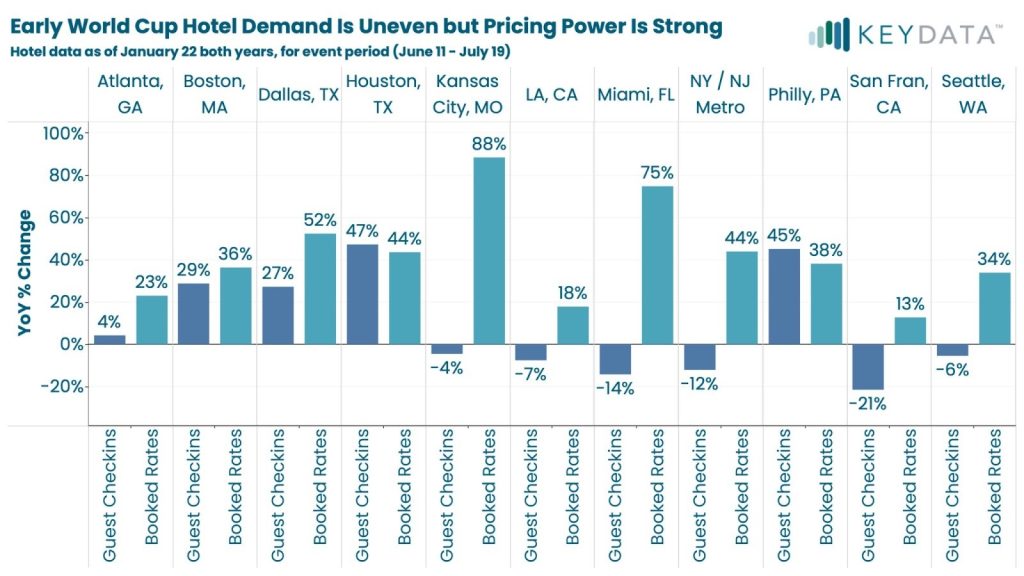
Year-over-year growth in check-ins varies widely. Houston leads with a 47 percent increase, while Boston approaches 29 percent and Dallas–Fort Worth posts roughly 27 percent growth. However, not all markets are pacing ahead. Kansas City, Los Angeles, Miami, New York/New Jersey, San Francisco, and Seattle show either minimal gains or negative early check-in comparisons.
Pricing, by contrast, tells a different story.
Booked rates across markets are up materially year over year. Dallas–Fort Worth leads with ADR growth exceeding 52 percent, followed by Miami at approximately 75 percent, Boston at 36 percent, and multiple additional markets posting increases between 30 and 45 percent. Even cities with softer early check-in growth are demonstrating rate strength.
The takeaway is clear: compression has not yet materialized, but operators are exercising pricing discipline early.
Demand Is Uneven — Compression Is Still Ahead
Occupancy for the event window remains below 7 percent across most markets, underscoring how far out bookings still are. The early pricing signals suggest confidence, but not yet volume.
Average lengths of stay between 2.5 and 3.2 nights align with match-driven travel patterns, reinforcing expectations of compressed, event-specific demand rather than extended stays.
This environment creates a delicate balance.
Early pricing momentum can tempt operators to either push rates aggressively or prematurely discount inventory to stimulate pickup. Yet the World Cup will likely unfold as a series of demand spikes tied to specific match clusters, not a single sustained surge.
Broader Implications for the Lodging Ecosystem
While the report centers on hotels, the uneven pacing highlights potential opportunity for adjacent accommodation types. Markets showing slower early pickup may see substitution effects later as match proximity increases and availability tightens.
For operators in host and drive markets, flexibility may prove more valuable than early aggression:
Preserve inventory flexibility.
Phase rate increases strategically.
Monitor pickup patterns rather than headline ADR alone.
Prepare for short, high-turnover stays rather than extended bookings.
Early pricing strength is encouraging, but the competitive landscape remains fluid.
The World Cup is not won in January pacing reports. It will be won in execution as compression builds.
In a recent guide published by AirDNA, the company outlines the mechanics and strategic implications of rental property depreciation for both long- and short-term rental owners.¹ While depreciation has long been considered a routine tax deduction, its role in today’s short-term rental environment is increasingly strategic.
At its core, depreciation allows property owners to recover the cost of a building over time—typically 39 years for short-term rentals and 27.5 years for residential long-term rentals—by deducting a portion of that cost annually. Though the property itself may appreciate, the IRS permits owners to account for wear, aging systems, and improvements as declining value on paper.
AirDNA’s analysis highlights several key considerations:
Depreciation is not optional. The IRS treats it as claimed, even if an owner fails to take the deduction.
Bonus depreciation and cost segregation can accelerate deductions on qualifying components such as appliances, furniture, HVAC systems, and interior improvements.
Depreciation recapture applies at sale, with previously claimed deductions taxed at up to 25 percent under federal rules.
Short-term rentals that are actively managed may unlock additional advantages, including eligibility for bonus depreciation and business-level treatment.
The most notable legislative update involves the reinstatement of 100 percent bonus depreciation for qualifying assets placed in service after January 19, 2025. For operators furnishing or renovating STR inventory, this change may materially impact early-year cash flow.
Depreciation, in practice, functions less as a passive accounting exercise and more as a timing strategy—deferring tax liability while strengthening near-term liquidity. For professional managers advising owners, understanding this distinction is increasingly essential.
What happens when one of the largest centralized property managers in short-term rentals meets a deeply local, franchise-driven model? In this episode of The STR Data Lab, AirDNA’s Chief Economist Jamie Lane sits down with Steve Schwab, CEO of Casago, to unpack one of the most consequential industry shifts of the past decade: the Vacasa–Casago merger.
Steve shares an honest, behind-the-scenes look at how the integration is unfolding — from transitioning thousands of homes and teammates to rethinking how scale, culture, and accountability actually work in hospitality. The conversation goes beyond headlines to explore why local ownership, empowered teams, and owner-centric decision-making may be the antidote to the operational strain that has challenged large STR operators in recent years.
Along the way, Jamie and Steve dive into franchise economics, technology complexity, churn as a health metric, and the often-underestimated skill that separates top-tier operators from the rest. Whether you’re an independent host, a growing property manager, or an industry professional watching STR evolve in real time, this episode offers a rare perspective on where the business is headed — and what it takes to build something that lasts.
This is one conversation that will change how you think about scale, leadership, and success in short-term rentals — you don’t want to miss it.
Key Takeaways You Can Apply Today
Local ownership matters more than ever: Empowered, in-market operators create stronger relationships with homeowners, guests, and communities — and reduce churn.
Scale isn’t just about size: Breaking operations into locally accountable units can avoid the “dis-economies” that plague centralized models.
Technology complexity is the silent killer: From PMS integrations to revenue management and accounting, STR operations are far deeper than they appear — especially in year one.
Churn is a health check, not just a metric: Monitoring churn at both the market and portfolio level reveals operational and cultural issues early.
The best operators know when to say no: Curating the right inventory, homeowners, and guests is often what separates top-performing property managers from underperformers.
Jamie Lane Welcomes Steve Schwab to the STR Data Lab
Welcome.
0:06
Speaker 2
To the STR Data Lab.
Hello and welcome to the STR Data Lab.
I’m Jamie Lane, Chief Economist at Air DNA.
I’m joined today by a very, very special guest.
0:21
We’ve got Steve Schwab, the CEO of Casa Go and Vicasa, joining us today.
Steve, thank you so much for joining and welcome to the show.
0:32
Speaker 1
Jamie, thanks so much for having me.
I’m a big listener and I’m glad to finally get to be on your your podcast and get to.
0:39
Speaker 2
Talk to you.
Yeah.
So we’ve known each other for a while now and have met in in a variety of different sort of conference settings.
I think most recently we were what destined down at Dharm and we were had some great, great dinner out in Rome for DRWS.
1:00
So it’s really great to be able to talk to you now at the beginning of 2026.
1:05
Speaker 1
It’s always great to catch up with you.
I, I think people have seen me on on social media talking about how you’re the secret weapon of the vacation rental industry.
So when Jamie Lane speaks, we all need to shut up and listen.
1:19
Speaker 2
No.
And I, I, I really appreciate all the times you’ve coded me in the past as well.
So but now I, I, I know my listeners, our listeners really want to learn from you and you’ve been one of the major movers in terms of driving industry change in 2025.
1:42
Steve Schwab’s Reflections on the Vacasa-Casago Merger
We’re now eight months past the and close the merger with the Casa and Casa go.
And my initial question for you is, and one, have you had some time yet to sort of reflect on the merger and and if So, what are those reflections and like have you seen it change the day-to-day of in your business that you’ve you’ve built over multiple decades now?
2:09
Speaker 1
Yeah.
Well, you know, like you said, Casa Goza, 25 year old company started when I was 28 years old in just a small little sleepy fishing village down in Mexico and has I’ve been able to build it up to a point where we were ready for something like this major changes.
2:25
You know, merging the two different companies has been a lot has been a challenge.
The complexities that have come with the merger and the transition of pivot of the Casa to a Casa Go model comes with a lot of hard work.
2:41
We’ve got a great team.
The good news is we’re well ahead of schedule for the sales.
We’re about 85% sold out already of the Picasa markets.
I tend to believe that we will be completely sold out by the end of the first quarter with all markets.
2:58
And then the the heavy lift of the transitions, you know, getting everything out of the Vicasa, what they called admin, which was their home built PMS into the two different PMSS that we’ve chosen Streamline, which I was a Co founder of or guesty into those systems operating well and properly.
3:16
And then getting all the existing franchisees up to speed or getting all the new franchisees through Costco University trained up operational, get them getting their feet from underneath them, getting their legs underneath them and getting, you know, getting on with businesses is a big part of what we’re doing for the past eight months.
3:34
So I guess to answer your question, no, I haven’t had time to think about anything except making sure that we’re doing a good job for our our partners, our homeowners, our, you know, our investors and the communities themselves.
3:46
How the Merger Benefited Casago’s Legacy Franchisees
Yeah.
3:46
Speaker 2
And and I absolutely want to ask about some of the integrations with the new franchise owners that have come with these sales.
But I first want to start with like how the integrations landed with the legacy Casa Go partners and franchisees cause soon and you guys were already huge and one of the largest companies in the short term rental space prior to merging with the Casa.
4:14
But this is absolutely and I’m sure had a major impact on them and not only all these new opportunities and just sort of integrate properties into their existing platform, but also unchanged with Casa Go, new software opportunities, new and scale opportunities that have come with and growing this much.
4:35
So how has it landed?
4:37
Speaker 1
You know, it’s landed well, there was a lot of trepidation when it first came out.
Of course, I couldn’t say anything before the deal was done.
So it came as a surprise to a lot of our, our partners.
You know, we had, we had a lot of paperwork that made sure that nobody said anything before the deal was done.
4:54
So you know, some of our of our partners were certainly worried about it.
Would it change cost ago?
Would it change the culture?
Others were incredibly excited about the opportunity to be able to acquire Vicasa inventory and really kind of have a once in a lifetime opportunity to take, you know, their locally owned and operated business and grow it into, you know, all in, in one suite, be able to grow into something that was a large operation.
5:24
So it’s landed well with a lot of them and you know, some of them that were worried and we’re working through that.
But I think the big excitement around it, which was something I was hoping for was the amount of resources that I could bring to our partners, your franchise partners to make them more successful.
5:42
As I was growing Casago with, you know, just out of my own funds, we were privately held, you know, being able to build a fantastic demand engine or to be able to negotiate, have the leverage negotiate really great rates for our partners.
5:59
It was coming, but it wasn’t quite there yet.
And now with the opportunity of resources and training a sophistication of, of you know, of, of our, of our tech team and you know, vicasa.com as a demand engine, I think it’s really exciting to have all of that in our war chest to make our franchise partners more successful than they could be on their own.
6:23
Transitioning to an Owner-Centric Model and Integrating Cultures
Yeah.
What about from the homeowners perspective and clearly things were unchallenged and for a lot of homeowners that were part of the Vicasa program, Costco famously has a very owner centric model that and has led to the great growth that you guys have seen over the years.
6:42
So and our Vicasa line legacy Vicasa owners, do you think they’re seeing the benefit of this owner centric model yet?
Yeah, I think.
6:51
Speaker 1
In those markets where they’ve been able to go meet somebody who’s directly responsible for them, right, Somebody who is the owner of Costco in their market changes the conversation between the homeowner and, you know, and the company that’s has a stewardship over the property.
7:11
You know, we, we have a a franchise partner who always says, if you want to talk to the owner of Costco, you call me, right, because he is the owner of Costco in his market and the buck stops with him.
That’s a very different conversation than what what was being had at Vicasa, right?
7:28
There was layers of, you know, of management.
There was a a customer service team that was in market.
They didn’t necessarily know the marketer been in, in, you know, in that house.
So having somebody they can call have conversations with and and the bus stops with them changes that pretty significantly.
7:49
We’re seeing at once the partners get settled in and the transition is done and they get to know the homeowners.
It’s really beneficial to not only the homeowners themselves, but also the communities that they’re operating in, because those franchise owners live there too, right?
8:08
So that’s their community as well.
So there’s a social responsibility to make sure that they’re good neighbors in that community as we operate.
So I think there’s going to be massive changes for guest owners and the communities themselves.
8:22
Speaker 2
Yeah.
What about the like operating cultures because and I assume 2 entirely different cultures with the Casa in Casa Go, there’s been and a lot of people that and with this change in operating model that aren’t part of the new company.
8:39
That’s others that are.
And what’s been the hardest part about keeping morale high when you’re transitioning this and centralized model to the franchise model?
8:51
Speaker 1
Yeah, you know, there’s a there was a lot of fear with the Picasa teammates because they’re like, OK, wait, what’s going to happen?
You’re going to, we’ve already been through several transitions.
You’re going to do what now?
You’re going to take this company and break into pieces and sell it off to people who locally own and operate it.
9:10
And what happens to me, Right.
And that’s a fair question.
And there’s a, you know, of course those they’re going to have feelings about that they should.
It’s, it’s, it’s, it’s scary.
The good news is 90% of the people who are in trans transition to markets are staying with Costco.
9:29
They’ve been hired with Costco, they come on, they get trained and they’re operating in those markets.
So that’s a fantastic, you know, retention rate for our, our, our employees.
And I was really committed from the beginning to make sure to save as many jobs as we could.
9:46
And I’ve told our partners the problem at Picasso wasn’t with the teammates on the ground.
It was configured as a software business instead of a hospitality business.
And that’s really tying the hands of a lot of good people to be able to do the jobs they need to do and make the decisions they wanted to make and empowering them the way they needed to be empowered and be able to have conversations they needed to have.
10:08
And so giving a lot of our of our teammates at the cost of the chance to come over and prove themselves has been proven to be a good move and really grateful for them and the job they’re doing.
And the truth is they had to have a lot of faith in us because we told them half faith is going to work out.
10:28
And for the whole it really, you know, for the, the entirety of this, for 90% of them, it really has.
But they had to have faith that doing their job was going to get them somewhere.
And I’m really grateful that they’ve they’ve stuck with us through those times.
This has been scary for them.
10:42
The Advantages of Joining the Casago Franchise Model
Yeah.
So I want to hear you pitch me, Steve.
So the franchise model is something that the industry is seeing really evolve over the past few years and you guys have been at the forefront of it.
But there’s also been this, I’m really pushed towards local brands and creating strong local brands.
11:04
So if I, Jamie Lane, were starting a property management company today, why would I choose to franchise with Costco versus building my own local brand, getting to pick my own tech stack, being able to choose any sort of revenue management, any I’m really build my company and then really own the 100% equity in my brand verse I’m going with Costco, taking your system and building off of that.
11:35
Speaker 1
Look, there’s no one way to get to success in this in this industry.
But I’ll tell you this that a lot of our property managers who are coming in, you know, have to worry about what property management software they’re on, what to how to choose the softwares, how to negotiate the rates.
11:52
How do you do revenue management?
What revenue management system should I use?
Who’s been vetted?
Am I working with somebody who you know, I can trust?
What kind of resources do I need?
How do I go out and do homeowner marketing?
Is there any place that helped me go out and build my inventory?
How do I drive demand for the inventory I have?
12:09
Is there anybody who can have a conversation with about, you know, about how to do this business and what my financial should look like and compare my, my numbers to make sure that I’m actually hitting, you know, good metrics on that?
Is there something I can call in the middle of the night when suddenly I can’t figure out why this button doesn’t work on, on my PMS?
12:28
Wait, what happened is I’m disconnected from my I’m disconnected from Airbnb and I can’t get my reservations and there’s a problem going on and I can’t get anybody to, to, to help me out if they call and I can go online and look at what other people saying, but I can’t figure it out.
All of those things come into play when it thinks, when you think about what this franchise model offers, You know, we, we, we, we bring you in, we set you up, we make sure that you’re in a protected territory.
12:53
We’re making sure that we help you with Costco University.
You know, we have two different locations and a team of 16 right now do nothing but training for our franchisees.
We have our partners assess managers who are meeting with you weekly, making sure that your, your systems are working right, that you’re following best practices, having conversations with you about, you know, driving forward and making sure that you’re, that you’re, you’re healthy and in your business and in and the way you’re, you’re, you’re operating the resources that we have from, you know, from being able just to negotiate better rates to get discounts to make sure that those the pricing
13:31
you’re getting is correct.
And, and the vendors that we vet along with the, the demand engine of, you know, picasa.com, which will stay as an internally owned OTA, which drives really hundreds of millions of dollars worth of reservations for our, our, our partners.
13:46
So at the end of the day, you do get choices like you don’t necessarily like for instance, breezeway, you can choose breezeway and breezeway is a fantastic option for you.
But if you decide you don’t want to use breezeway, you don’t have to.
If you like Gusty or streamlined, you get to choose which one you you want.
14:04
Would you like to use rumour or not?
That’s fine.
Would you like to use wheelhouse or would you like to use you know, or would you like to use, you know, pacer?
It’s up to you within that.
And the truth is you don’t even necessarily have to use the ones we’ve vetted.
But if you’re within our ecosystem and suddenly you’re having a struggle with something, you can’t figure out something worse.
14:23
We’re trained in that.
We know how to keep you operating not by yourself.
And I’ll tell you this, that when I first started as a property manager in Mexico, I was 28 years old and I didn’t know anybody and I didn’t know how this worked.
And I had nobody to call in a, you know, and I had to learn through getting beat around the head and neck by homeowners and guests until I figured it out.
14:45
The advantages you get with Casago really change that environment.
You know, there’s going to be people who will have a propensity to go and do it on their own, you know, Jamie’s Vacation Rentals and that’s great, you know, and then there’s people who are like, you know, want to be part of a brand, want to be part of Casago, just like some people have, you know, have brands in real estate.
15:07
You know, there’s re/max, there’s Caldwell banker, there’s people who really enjoy being part of a family, being part of a community.
And those are there’s some of those who that doesn’t work for them.
So I would tell you, you have to decide for yourself.
But the advantages of being part of our community is is massive.
15:22
Unpacking the Underestimated Complexity of STR Technology
You’ve mentioned so many things, but what do you think is like one of the number one things that independent founders of property management companies sort of underestimate the complexity of that being part of Costco really solves as part of that of being a franchise?
15:40
Speaker 1
Yeah, you don’t.
I think a lot of people come into property management and don’t understand that the complexities with the tech, the technology now, which we wasn’t there when I got started, but you know, to walk in and be able to run a property management software from day one with inventory Wallace running live with, you know, however many properties you have, it’s it’s a lot.
16:03
Speaker 2
It’s a lot, yeah.
It’s.
16:04
Speaker 1
A lot.
And then remember, you got to integrate it with Airbnb, BRBO, book.com, and then you have to make sure that your accounting is correct.
Then you have to make sure that you’re reconciling all the different OTAs and then revenue management’s plugging in, which is another complexity.
16:21
Making sure your pricing is correct.
You know, going out and doing the research on on air DNA to make sure that you’re, that you’re, you’re, you’re looking at the competitive data properly.
There’s so much that first year or two to try to get up to speed with, to be operationally proficient.
16:37
I think a lot of people see this as a simple business.
I’m going to manage this property.
I’m going to put it on an OTA.
I’m going to clean it.
I’m going to make sure it’s it’s not damaged.
I’m going to rent to the next person.
I’m going to send the owner some money.
And you know what?
16:53
That’s how the world thinks about the short term rental industry.
But the complexities are, you know, a mile deep to actually make that all happen.
17:03
Speaker 2
Yeah, No, I love that in watching this whole transition go down with and Vicasa and you guys selling off all these markets, I largely agree with and and see the theory around everything that you guys are doing.
17:19
Casago’s Franchise Model: Scaling Beyond Dis-economies of Scale
I, I’ve got 1 skeptic question to ask you though.
So the selling off in markets where you guys already have an owner operator, franchisees in those markets seems great.
17:35
Like you’re going to absorb those employees, absorb those listings into a model that already works.
What do you see as the chance of success?
And, and really what are you guys doing to ensure the operators of more like the Thrive Capitals, the Avery’s, the roof stocks that are coming in and they’re operating massive companies now like what Avery and one of the new brands that and has launched as a Costco franchise.
18:02
They’ve got, what, 6000 units.
Do you see them running into the same problem that the Casa saw of sort of centralized management or are they going to be able to pull in this local flavor that your franchisees have really shown as succeeds?
18:21
Speaker 1
Yeah.
So Avari and Team Avari, yeah, they’re, they’re a large company certainly taking on a good bikes.
But you know, there’s a, we’ve brought in a lot of resources for them and they brought a lot of resources in for themselves.
18:36
And I would tell you that, you know, when you’re managing 6000 units, it’s a lot different than managing 30,000 or 40,000 or 50,000.
Yeah, well, yeah, we’ve seen, we’ve made sure to think about what does this look like on the high end of the number of counts, if it can be successful or not.
18:55
And, you know, just like a lot of several property management companies out there at that size, they’re able to, they’re able to be successful at that size.
You know, even even Picasso was successful at that size.
You know, I think when you really start to get into the, into the bigger numbers, you start to struggle with, you start to struggle with operations, with, with support.
19:17
So, yeah, I, I think that we’ve been able to break this down even at our largest partners to a place that with sophistication, you know, with the right capital backing that they’re going to do well.
And I think that they have, you know, Casio University behind them.
19:34
They have the support systems behind them, they have a brand behind them.
And I honestly have thought a lot about how the cross pollination of our smaller mom and pop style property managers who are local, who are, you know, operating, you know, 20 or 30 units.
19:53
And then those who are medium sized, you know, 100 to 500.
And then we have those who are operating, you know, some enterprise.
Business units, I think the cross pollination between all of those in the same community, we’re already starting to see that there’s a lot of conversations have happening amongst them those those who are in smaller or medium are getting conversations with sophisticated operators.
20:15
Those who are sophisticated operators are getting conversations around the community about what does it mean to be local?
What does it mean to have a brand?
What does it mean to be owner centric?
What does it mean to to provide quality over quantity?
How are we thinking about how we decide what our future portfolios look like and why does that matter now?
20:33
So it’s I’m actually really excited about having those conversations across the community that that brings everybody you know up in their in their operational value and knowledge.
20:46
Speaker 2
Yeah.
And have you guys thought about like at what point do you think a franchise system starts to strain under its own weight?
Like is there a point where cost to go could and do you think there’s a point where it plateaus or it gets too big?
21:03
Or do you think it’s and the franchise model can scale?
I’m much bigger or and then I’m what we’ve seen more traditional PM companies been able to do.
21:16
Speaker 1
I think with the franchise model, we’re really getting rid of of a lot of the dis economies of scale.
Service is hard to scale has a certain point because human labor actually cost more to operate the bigger you get, right.
So breaking that down into into, you know, bite sized elements in which it still works underneath, you know, the economics of of our industry is important, but I think when you look at at cost to go as a franchise business, I don’t think we’re anywhere near where our eventual scale will be.
21:55
What’s important to remember is long as we are, they’re providing value for our franchise partners, providing a fair deal in which it’s better to do business with us than without us.
And we’re making sure that our brand is, is, is a brand that they’re proud of and they’re probably part of and that we’re driving the demands of how do they’re going to be able to get more homeowners because they’re well known, right?
22:25
They’re going to be able to bring more guests because of your demand drivers.
They’re going to be able to get better pricing.
I think these are the sort of things at scale for a franchise.
And especially, you know, when we think about international or, you know, being able to have people who are local, understanding the, the culture, understanding the laws, understanding, you know, the, the labor laws of all this, that becomes the key to our success.
22:53
Casago’s Vision for National Brand Recognition and Growth
So you, you mentioned vicasa.com and being one of the largest booking platforms out there and the the growing scale of Costco.
Do you imagine or have hopes that Costco or Vicasa will become like household consumer friendly names or do you see that that and can’t or shouldn’t happen and with the investment needed to be able to build something large enough where we and have name recognition on the consumer side?
23:28
Speaker 1
I would love for Costco to be a, a, a forward facing brand that’s well known throughout, you know, throughout not only the industry, but you know, with the public themselves.
I think that’s a, a, a long road to go down.
I think we’ve got, you know, years before we get there, but, you know, building the internal reality.
23:44
So it becomes the external perception over time with a good brand being something like re/max.
You know, when you look at re/max, you pull into it any town in the USUSA, you see a red, white, blue balloon.
You, you don’t have to ask what re/max is because those say the name.
24:01
You just know that that’s a real estate place, right?
So being on par with that type of brand name recognition Casago would be, you know, would, is, is a goal to, to hit.
I think that’s the way that we’ve structured the franchise model where the local partners are putting money into marketing and at the local level where our marketing fund is there to build brands across, you know, across the nation.
24:29
And that’s part of our charter.
And the way we think about our FDD and, and, and restrictions around how we spend that money to make sure that that’s always going out there.
It’s not, it’s no longer an option to go out and build brand.
It’s part of the DNA.
And so with time, I do think we get there.
24:45
Speaker 2
Yeah.
24:46
Essential KPIs for Measuring Casago’s Business Health
It can’t be the STR Data Lab if I don’t talk about some metrics.
So I’m interested in what are the metrics as CEO of Costco that you’re looking at on a regular basis and day-to-day, weekly, monthly to understand the health of your business?
25:04
And then maybe separately, what are two to three key PKPIS that you’re tracking to sort of judge that the integration of the Casas is, is healthy and, and, and progressing in the right way?
25:19
Speaker 1
Yeah.
Well, both at the franchise level and at the, you know, global level, turn speaks a lot, you know, and I think that was the struggle that the Casa had that their turn was just eating them up.
So it’s speaks to the health of our franchisees and making sure that they’re best in class within their market, you know, that will decide their turn.
25:43
So you know #1 how are we doing a turn?
How are we doing at each market level and how are we doing at the global level?
I think that’s a big part, part of it.
How much demand are we driving for our our franchise partners through, you know, our, our websites, you know, vicasa.com and casago.com?
26:01
You know, what’s our occupancy levels comparatively to the rest of the market?
You know, it’s going to be important and, and that has to be at the local level.
I mean, as you know, segmentation is everything here, right.
You know, we’re thinking about adoption rate, the different vendors.
26:16
We’re really watching that closely.
We want to make sure that we’re, we’re working with the, the best in class vendors who’s going with which vendors and then how, how are they performing comparatively to those who are I’ll work with other vendors, right.
So, yeah, there might be, there might be 4 different revenue managers that we’re working with.
26:36
And then, you know, over time, is there a trend of one that’s maybe either outperforming or underperforming comparatively to those who are who are out there?
Making sure that we’re, we’re following what each franchise market share is, because what we want to do is make sure that what it was appalling behind.
26:56
And we have a, a, a problem.
Making sure that we know as soon as they know or even before they know where, where the struggles are, are happening in, in growth and health of their organization is, is incredibly important to us.
You know, these are a lot of the things that we’re thinking about as we, as we build an organization that’s really forward facing in we’re really forward facing with the health of our franchise partners, making sure that they’re going to be successful because their success is our success, right?
27:27
So if we can continue to do that, not only will we have great partners, but we’ll also have a great reputation of and, and our partners will be the ones who tell people why they should join.
It won’t be me pitching you, it’ll be four or five of my franchise partners who were gathered around you at a conference telling you you should join and all the good things that are happening.
27:47
And that’s the real sales point.
And that’s how traditionally how Casago was built.
We had a lot of referrals.
I think over half of our sales were through referrals of other franchise partners.
27:59
Speaker 2
Well, you’ve just added a new KPI to my dashboard where I’m going to be tracking the cost to go franchisees that are working with their DNA and those that are, aren’t making sure the growth rates turn, revenue metrics are all better for those that are partners versus those that aren’t.
28:16
Speaker 1
I predict those who are work with their DNA will do significantly better.
28:20
Speaker 2
I hope so.
Me too.
28:22
Speaker 1
I do believe that.
28:24
Why Top Property Managers Master the Art of Saying No
So and it’s a great sort of Segway question on and you have seen hundreds of property managers in your 25 years and running cost to go.
So I’m interested like what are two to three attributes and that sort of consistently separate sort of top A tier property managers from those that aren’t A tier or maybe underperforming property managers and using air DNA can’t be the answer, though it’s probably a good one.
28:54
Speaker 1
All right, then I’ll go to #2 It’s just, it’s really just one metric that comes to the top of mind or one thing that that changes, you know, the success is the ability to say no.
A lot of property managers will say yes to almost any property.
29:14
You know, it’s some property manager will say yes to anything that even some things are even dangerous and then try to get people to fix it up, right.
The top tier property managers say no to inventory that doesn’t fit their portfolio, you know, and, and making sure that you curate properties that that guests want so that you’re not having properties that just eat you alive.
29:36
You’re managing but not making money yet, which I’ve made that mistake before.
Making sure that you can say no to a homeowner when they want to do something that’s unsafe or doesn’t, doesn’t fit your values or, you know, or making sure that you can say no to a homeowner or a home that treats your, your staff poorly because they’ll, you’ll, you’ll, you’ll turn your staff out.
30:01
And that’s the most important people in the in your ecosystem and making sure to be able to say no to guests who want to abuse the property because you think you need the occupancy, but you’re just going to end up beating that that property to death.
30:17
So the number one differentiator is the operators who can say no.
30:23
Speaker 2
And how much and are you guys able to help those franchise operators?
I know and how and when to say no because it’s you guys have visibility and you probably know when someone’s onboarding a property that probably isn’t a good fit when you see and they’re doing things that probably are leading them astray.
30:46
Is that something that you guys are proactively and helping franchisees like understand or is that something you really leave them?
They’re independently owned up and operated and companies that and they’ve got to learn and make those mistakes themselves.
31:03
Speaker 1
Well, at the end of the day, it is their business.
You know, what’s important to understand and what a lot of people ask when they’re thinking about signing up as part of Casago, is this still my own business?
Do I get the choices to make my own decisions?
And yes, you do, you know, as long as it’s a safe property, these sort of things we can’t tell you not to.
31:21
But having, you know, we have weekly meetings with our our franchise partners.
We’re closely reviewing properties with them.
We’re having discussions with them around business development, curation of their portfolio.
There’s a, if you haven’t spoken to us at least two or three times this week, then you’re not picking up the phone or showing up to your meetings.
31:40
This isn’t something where, you know, we only contact you when it’s time to pay the, you know, the royalties.
We’re constantly working with our our partners to make sure that they’re finding success within that.
So yes, we do help them curate that, but we also understand that this is their business.
31:57
And I think that through discussions, you know, with the partners, the orange meetings that we have, you know, the materials at Costco University, the constant, the constant support they’re having with all the different parts of Costco, It it, it certainly helps them understand that in a way that I don’t think they would without it.
32:18
Yeah.
32:19
Principle-Based Leadership and the Orange Values Culture
And and I I’ve heard you mention now the sort of your orange values, the orange meetings multiple times.
For those that don’t know what that is, can you explain what it is and and how it’s and helpful how you found it?
32:36
Elf over your business?
Sure.
32:39
Speaker 1
When the first time I took over a larger company than myself, I started hiring faster than I could actually have conversations with the team and we had ran a solid little business up to about 60 units and suddenly I took on 300 units in one day.
32:55
They, the, the company had left town in the middle of the night to everybody’s money, taking all the payroll.
They’re just gone.
This is down in Mexico.
And so we were hired.
We couldn’t, we didn’t even have enough people to run all the front desks.
So we were hiring faster that we could train.
33:11
And I started watching a lot of problems happen.
And I sat down and started thinking about why is this different than other organizations I’ve belonged to?
And how do I catch back up to getting my voice, you know, to be able to speak into what we’re trying to do here?
33:27
And I went back to some thoughts about being the special operations with the range of Italian different different organs that belong to and they all had to creed.
So I sat down, I started writing out a set of principles.
And these principles are really just guidelines on, on how we should make decisions that honor our values.
33:47
You know, like thinking about like I am the owner’s advocate.
I’ll make all decisions based on the owner’s best interest.
Well, if you can make a decision around that honors that, you’re always going to make a good decision.
And that’s part of the vision.
So I put together in a little booklet called the orange booklet.
34:03
You know, there’s each letter of orange stands for something we talk about every single day.
But you know, if you, if you understand your values, you build guidelines around those values to help people make decisions, you start to, you start to, to, to let people make decisions on those, on those principles.
34:27
Over time, that becomes a social norm in which the organization starts to make decisions around those principles outside the oversight of leadership.
When good decisions are being made, you end up building trust.
34:43
And when you have teammates that you can trust that you get autonomy and you get scale.
And so at the foundation of this is a principle based leadership in which people are making decisions outside the oversight of leaders and that builds the brand becomes that because that becomes the internal reality of good decision making that grows a business.
35:05
And I think that’s been a lot of the success of Casago.
35:08
Speaker 2
How long has that and sort of stayed and lasted in terms in in the test of time?
Like, is this something that you’ve had for 10 years, five years?
Like how long have you been working with this?
35:23
Speaker 1
It’s coming up on the company’s been around for 25 years.
It’s been around for about 20 years or so.
It had to go back exactly.
But yeah, it’s been about 20 years.
I actually made myself like nauseous a few times trying to think about what should be in this and, and really thinking about it.
35:42
In fact, actually my a funny story is my general manager of Mexico who’s been with me for, you know, the whole nearly the entire 25 years when I bought her this little book.
I’m like, hey, yeah, I want you to give this out to all the, you know, everybody, all the teammates and I want to talk about it every single day.
35:58
Just a quick conversation and then whatever it is business and, you know, and our stand up meetings to get on with it.
She’s like, this is the stupidest idea I’ve ever seen in my entire life.
And she’s like, this is this is also what kind of ego manic are you?
There’s a picture of you in here.
You’re going to make us all carry around a little booklet with your picture in it.
I was like, just give it a try.
36:15
And it took about 6 or 8 months and you know, we had people quit.
People said this is a cult.
I quit.
They threw it in the garbage and they quit, which is actually a good thing.
And then one day she had a couple different experiences where she was watching people on their own take out the book or quote the book or teach other people about the book about how they’re making decisions.
36:37
And she came to me, she’s like, it’s working.
She said, I hate to tell you this, but it’s working.
And she became, she went from, she went from compliance to conviction that day.
And she’s been a big, you know, she’s been a big leader culturally ever since.
And so making sure people have conversations around the principles so they could to own the principles themselves builds a community, builds a language.
36:59
And you know, and I think that’s, I think that’s how you build cohesion.
If you go to when Matt Landau travelled all of the different markets in Mexico, he’s like, it’s so strange.
Everywhere I go, they’ve never met each other, but they’re speaking the same language.
You can hear this, the same conversations happening in multiple markets and there might be a little difference in the way they explain it, sort of think about it, but they’re of the conversations that builds a brand.
37:25
And I think that’s what the Orange Keto does.
And by the way, if anybody’s listening, we’d like a copy of it.
Just, you know, direct mail me on or DM me on LinkedIn.
I’ll, I’ll send you a, I’ll send you a copy and give it to everybody.
37:39
Steve Schwab’s Guide to Revenue Management for Everyone
Yeah.
And Speaking of another language I’ve heard you or seen you explain is the language of revenue management.
You, you were nice enough to share your book with me, revenue management for the rest of us.
And it really felt like a guide of like understanding the language of revenue management and how to think about it, how revenue managers are going to think about it, explain it, and then how as a owner and you should be thinking about it within the and confines of your business.
38:11
And, and we’ve been working a lot and with an air DNA on revenue management and some future products.
But I actually bought it for my entire team a copy.
And it’s really helped them sort of think about how property manager should and, and probably do think about revenue management, how it’s and a piece of how they’re running the business and how they’re bringing in metrics on a day-to-day basis.
38:38
So it’s you.
You’ve got a good knack for explaining languages in that way.
38:44
Speaker 1
Thank you.
Yeah, I really enjoyed doing that.
You know, that came from we had a a revenue manager we were all dependent upon and he got sick and one day he was just gone.
And we were all like, what do we do now?
And so that book came from the idea that the rest of us really don’t understand revenue management at the deep levels, that we should hire revenue manager.
39:04
What’s their role?
What question should we be asking?
How often should you be getting a report?
What should be in those reports and what do all the works mean?
And it’s been helpful.
Thank you for thank you for doing that.
And I’m really glad you enjoyed it.
When I heard that you that you enjoyed it, it it was validation that I pulled it off.
39:23
Speaker 2
I still don’t understand how you find time for things like that.
I’m sure that’s it.
Took a few years.
A labor of love, right?
Yeah, it is.
39:33
Speaker 1
As a matter of fact, but it’s it’s something I think it’s important for our industry to be able to have a conversation about it.
I knew it was important for me when I didn’t understand.
39:41
Speaker 2
It yeah.
39:42
Final Reflections on the Merger and Casago’s Future
So we’re coming up on time and I, I want to be respectful of your time.
So and sort of and some closing questions.
I’m, I’m thinking through the conversation today.
39:58
A lot of it was on the merger with Casa Go and Vicasa.
I’m it was definitely the big news, I would say positive news of the industry.
There was a lot of negative negativity out there.
There was a lot of changes the industry saw, the broader economy saw.
40:17
But I think the integration that it looks like you’ve pulled off is going to be one of the big success stories of 2025 when we look back a few years from now.
And maybe I want to ask you this question again a few years from now.
40:33
But sitting here today, would you make the same decision to to do this merger or would you have done something differently now sitting back on what these last 12 months have sort of brought you?
40:47
Speaker 1
Yeah.
No, of course I would make the decision again.
I think that it’s a positive move for the industry, like you said, and I think it’s awesome move for my franchise partners and for those homeowners.
And it really helps me fulfill the dream of bringing the right kind of resources to property managers to be successful and have a community around them.
41:11
So it’s been my life’s work and I’m really grateful to have this opportunity to help influence, you know, this part of the industry with this specific transaction to to create something new and dynamic and to help out.
41:28
But Casa find new foot footing on a different path.
41:31
Speaker 2
That’s great.
So, and if people want to reach out to you, if they want to find more about being part of the Costco system, what’s the best way to do that?
41:39
Speaker 1
Yeah, feel free to always reach out to me at steve@costco.com or on LinkedIn.
Just Steve Schwab, always happy to to have a conversation with anybody who’s interested.
Already in 2026, we’re seeing C-suite changes at several private equity (PE) funded companies in the short-term vacation rental industry. Among these enterprises is Casago Holdings where founder Steve Schwab reportedly will be transitioning out of the CEO role according to inside sources. Joseph Riley, who joined as president in September 2024, is expected to become the new CEO.
When Casago, a decentralized franchise company led by Steve Schwab and Joe Riley, completed its $130 million acquisition of Vacasa in the spring of 2025, the industry witnessed one of the most ambitious reverse takeovers in vacation rental history. The deal followed a period of financial distress for Vacasa, which saw its market valuation fall 97 percent from its SPAC-fueled $4.4 billion IPO in 2021. Strategic support and equity commitments for the transaction were provided by Roofstock, with Vacasa’s existing institutional investors Silver Lake, Riverwood Capital, and Level Equity rolling their stakes into the company and claiming seats on the board of directors.
Casago’s model relies on a decentralized franchise system where franchisees have demonstrated loyalty to Steve Schwab’s vision. This loyalty stems from his owner-centric philosophy and the “ORANGE” credo, which emphasizes local accountability and stewardship. Many franchisees joined because of Schwab’s leadership style, viewing the company as a “people-first” alternative to investor-driven growth stories.
Challenges Selling Vacasa’s Inventory
The goal of the acquisition was to convert Vacasa’s 35,000+ properties into Casago franchises. Execution has proven difficult. In some markets, Casago has sold inventory to the highest bidder, including operators who are not franchisees. Other markets that have not been sold remain under the Vacasa brand, using a skeletal crew of local employees and contractors to maintain operations as the industry moves toward its peak season.
Potential Culture Clash
The transition from a founder-led organization to one influenced by institutional investors has resulted in some friction among leadership, according to inside sources. The new board isn’t just a collection of property managers; it’s a roster of private equity powerhouses. With seats held by Silver Lake (Joerg Adams), Riverwood Capital (Jeff Parks), Level Equity, and Roofstock, the pressure to stabilize the combined entity’s bottom line is immense. This institutional influence often prioritizes standardized revenue growth over “cult of personality” leadership, which might explain the transition from Schwab’s RV-tour style of management to Riley’s operational oversight.
In addition, franchisees and homeowners are expressing frustration regarding new corporate fees introduced over the last 60 days. Internal sentiment indicates these charges resemble the centralized corporate model Schwab previously criticized. Loyalists who “signed up for Steve” are questioning their future with the brand as he moves into the background and institutional pressure for revenue increases.
Vacasa.com Branding and Ad Blitz
Casago Holdings recently initiated a seven-figure ad spend including TV commercials, to drive traffic specifically to Vacasa.com. This spend raises questions about the company’s long-term branding strategy. It remains unclear if this is a pivot to keep Vacasa as the consumer-facing brand or an attempt to transform Vacasa.com into an Airbnb-like OTA asset.
The leadership change and operational shifts mark a transition for Casago Holdings. As we wait to hear if Joe Riley is stepping into the CEO role, the company faces the challenge of managing legacy Vacasa assets and institutional board expectations while attempting to preserve the franchisee loyalty that fueled its original growth. The industry continues to monitor whether the “Owner-Centric” philosophy can survive this institutional phase.
VRM Intel reached out to Casago leadership for comment but has not yet heard back.
What if the biggest opportunity in your STR business isn’t higher ADR or better occupancy — but who actually owns your guest relationship?
In this episode of The STR Data Lab, Jamie Lane sits down with Arthur Colker, CEO of StayFi, to unpack one of the most under-discussed levers in short-term rentals: guest acquisition costs and repeat demand. As OTAs continue tightening control over guest data and shifting fee structures, hosts and property managers are left asking an important question — are we building a business, or renting one?
Arthur breaks down why tracking guest acquisition costs, collecting first-party data, and building a direct booking channel isn’t just about avoiding platform fees. It’s about increasing total occupancy, improving booking windows, and creating long-term resilience. From practical strategies for smaller operators to how advanced hosts are reaching 60%+ direct bookings, this conversation reframes direct booking as a growth strategy — not just a defensive move.
If you’ve ever wondered whether investing in your brand, email marketing, or direct booking site is worth it — this episode delivers clarity.
You don’t want to miss this episode.
Practical Takeaways You Can Apply Now
Think beyond the booker. Every guest in the reservation is a potential future customer. Expanding your marketing mindset beyond the primary booker unlocks new repeat and referral opportunities.
Consistency beats perfection. A simple monthly email — even plain-text and personalized — can outperform polished newsletters. The goal is to stay top of mind when guests are ready to book again.
Direct bookings increase total occupancy — not just margins. The real ROI isn’t only saving OTA fees. It’s filling nights that would otherwise sit empty.
Build a brand, even if you’re small. Whether you have one property or ten, guests need an identity to remember. For smaller operators, your personal story and hospitality voice are the brand.
Control your pricing strategy. Advanced operators often price higher on OTAs and reward direct bookings with better value — flipping the script from dependence to leverage.
Midterm rentals are moving from a side option to a real strategy. In this episode, Alex & Annie sit down with Jeff Hurst, CEO of Furnished Finder and former HomeAway and Expedia Group leader, to explain why 30+ day stays are gaining traction as many STR markets move into a more mature phase.
Jeff breaks down what makes midterm rentals different from short-term rentals, what demand is actually driven by, and why midterm can be a strong fit for operators looking for stability, fewer turnovers, and a guest profile rooted in real-life transitions.
Episode Chapters: 01:04 – Jeff’s background and how he views category shifts in rentals 06:16 – What Furnished Finder is, and what “midterm” means in practice 07:24 – Why the category is still early, and what professionalization looks like 08:35 – Who midterm guests are and what they need from a stay 12:01 – How midterm works operationally: screening, leases, deposits, and payments 22:48 – “Return on furniture” and the investment logic behind midterm 26:58 – Regulation, market maturity, and why more operators are taking midterm seriously 32:15 – Why midterm is gaining ground in saturated (mature) STR markets 33:21 – What types of properties fit midterm demand, and what does not
A newly announced partnership between Key Data and BookingsCloud aims to address one of the vacation rental industry’s most persistent challenges: scalable, measurable direct booking growth.
In a February 6 release, Key Data introduced its integration with BookingsCloud, describing the collaboration as a bridge between market intelligence and automated performance marketing.¹ Early shared-client data suggests reported returns between eight and eighteen times return on ad spend (ROAS), with some portfolios outperforming those benchmarks.
The premise is straightforward: combine normalized market data with automated, property-level digital advertising to drive incremental direct bookings while reducing reliance on online travel agencies (OTAs).
Why This Matters Now
Direct revenue has shifted from aspirational talking point to operational mandate. As property managers face tightening margins, rising acquisition costs, and increased performance scrutiny, the ability to deploy marketing capital with precision has become central to portfolio strategy.
According to the announcement, the integration allows managers to:
Pair Key Data’s market insights with automated ad delivery at the unit level
Identify and fill occupancy gaps more strategically
Track channel performance through unified reporting
Deploy enterprise-level marketing automation without building in-house teams
The broader implication is structural. Smaller and mid-sized managers have historically lacked access to an always-on performance infrastructure common in hotel groups and larger brands. If effective at scale, this type of automation could narrow that gap.
What Differentiates BookingsCloud
BookingsCloud positions itself as the industry’s first fully automated performance marketing platform built exclusively for vacation rental managers. The platform integrates PMS data, Google Analytics, and Key Data inputs to dynamically allocate advertising spend toward properties showing the greatest opportunity.
The model emphasizes:
Property-specific advertising rather than generalized brand traffic
Transparent performance measurement
Short-term pilot options without long-term contractual commitments
Backed by Advance, the global media company behind Condé Nast, Reddit, and Discovery, the platform signals institutional support and long-term capital backing.
Strategic Context
This partnership reflects a larger industry trend: the merging of operational analytics with revenue-driving automation. Historically, data platforms have identified opportunity, while marketing platforms have attempted to capture it. Integration between the two suggests a maturing ecosystem where insight and execution operate in tandem.
For managers evaluating direct booking strategy in 2026, the development underscores a broader shift toward performance accountability. ROAS-focused infrastructure is becoming table stakes rather than a competitive edge.
The full press release is available via Key Data’s blog.¹ Managers interested in exploring the platform can request a demonstration through BookingsCloud.
The conversation delves into the impact of the regulatory shift on revenue strategy, the legislative trends for 2026, corporate interest and investor sales, the response and caution for vacation rental managers, and the role of litigation and the importance of compromise in navigating regulatory challenges. The discussion also highlights the concern for housing affordability in local communities and the need for proactive engagement with elected officials. The conversation covers the topics of litigation and legal resources, the impact of high impact validation, and the competition with hotels and commercial legislation. It provides insights into the challenges and opportunities in the vacation rental industry, highlighting the need for legal preparedness, compliance with high impact regulations, and the impact of increased competition with hotels.
Takeaways
Regulatory shift impacts revenue strategy
Local governments are seeking new revenue sources
Housing affordability is a key concern for local communities Litigation and Legal Resources
Impact of High Impact Validation
Competition with Hotels and Commercial Legislation
Chapters
00:00 The Regulatory Shift
05:10 Corporate Interest and Investor Sales
10:25 Response and Caution
18:27 Litigation and Compromise
29:12 High Impact Validation
35:21 Competition with Hotels and Commercial Legislation
Transcript
0:15The Regulatory Shift
You’re listening to the Vacation Rental Key with T&T, the podcast for vacation rental managers by vacation rental managers.
I’m Tim Cafferty and I manage two companies, one in Virginia and one in North Carolina, and I’m one of the two T’s.
0:31Speaker 2
And I’m the other team, Tiffany Edwards, born and raised in the vacation rental business.
I help manage our family businesses from Key West all the way to Kawaii.
0:41Speaker 1
In the next 30 minutes, we’re going to give you our keys to success in the vacation rental business.
Welcome back to the Vacation Rental key with TNT.
I’m Tim, and today we’re cutting through the noise on the single biggest threat to your portfolio in 2026, the regulatory shift.
1:05
If you think the rules from last year still apply, you’re already behind.
We aren’t just talking about simple bands anymore, folks.
We are talking about the bedroom tax.
Just this week, San Diego made national headlines as a controversial proposal for an $8000 annual flat tax on vacation homes was narrowly defeated at City Hall.
1:27
But don’t breathe too easy.
It’s a signal of what’s coming to a market near you.
From Norfolk’s new bedroom per night fees to Virginia beaches new per night fees, to California’s automated enforcement that’s using AI to catch unpermitted units in real time, the honor system is dead.
1:50
Today, we’re breaking down why your revenue strategy and your regulatory compliance are now the same thing.
We are fortunate to have an expert on the subject.
She’s a lobbyist.
She’s a political marketing strategist, she’s a fundraising specialist, development council treasurer and the executive director of the Florida Professional Vacation Rental Coalition.
2:13
And she happens to be my Co host.
Please welcome Tiffany Edwards.
2:19
Speaker 2
You know, Tim, I love that introduction.
It’s been a long y’all.
We’ve started this podcast a year and every week I’m like, maybe we could talk about regulations.
So if you don’t know me outside of this podcast, regulations, legislation, I love it.
2:37
And so I am so excited today, the beginning of a new year, to really talk because, Tim, as you mentioned, the game has changed in terms of legislation after Covad.
We saw this huge proliferation of vacation rentals, and we saw local communities try to ban or cap those days.
2:57
They’re not completely over, but municipalities, states, local governments are all trying to find other ways to regulate, and a lot of us are not paying attention to things that could be massive risk.
So today, we’re going to outline 5 of what I believe are the top five legislative or ordinance trends for 2027.
3:21
Speaker 1
You have put this beautifully and we’re going to get into this one by one.
The first one really goes back to what I was setting up.
Local municipalities are looking for for financial resources.
3:36
They don’t have the money they need.
And what a great opportunity.
Let’s tax some people who aren’t voters.
3:44
Speaker 2
Yeah.
And that’s one thing that I think a lot of people forget is that elected officials are responsible to their constituents.
They’re also the individuals that hear from the most, right?
When they’re angry and they look at visitors as not constituents, they look at homeowners or second homeowners as not constituents.
4:06
And so it’s much easier to utilize that as a revenue pool because they’re not directly taxing those constituents.
And one thing that’s really important is that last year we saw in most of the states, Colorado being one, Idaho being 1, California suggested to be at a $17 billion budget deficit this year.
4:31
All of these communities and all these states are going to have to try to find funds.
And how do they do that, right?
So they’re going to do that through several different revenue sources.
One, we’re going to start seeing increased permit fees, all right.
4:47
So what you had before, expect it to double, potentially triple and what those fees are going to be.
The other thing we’re going to start to see are fines increase dramatically.
And some of these you really need to understand that they’ll add on additional costs.
5:07
So you may have a fine, but now they’ll add on an administrative cost associated with that fine to review and a magistrate cost.
5:16
Corporate Interest and Investor Sales
So you’re going to start to see more and more of that.
You’re also going to see from a state level if your tourism tax is specifically regulated.
So, Tim, in North Carolina, your tourism taxes is regulated.
It has to be spent or a significant amount has to be spent on actual tourism and marketing.
5:35
Same for Florida.
We’re going to see some legislation that tries to broaden that spend for general budget.
We’re going to see general increases in taxes and a couple years back we saw in Colorado where there was a proposal being discussed for commercial taxation on residential properties that were being used, utilized as short term rentals.
5:59
So some, a lot of those are going to be coming down the pipeline pretty aggressively.
Most states revenues do not support their increased expenses and that’s not unique.
Even in Florida where we have a balanced budget, they are unable to keep up with the aging population as well as the Medicaid cost.
6:20
And so they’re going to be looking for ways to help cover that balanced budget.
6:24
Speaker 1
So when you look at those financial deficits you’re talking about, it’s the growth, right?
Not only the spending growth, but the base of their communities that’s growing.
And the economy is really stagnant if you look at the numbers closely.
6:40
So they have to look for new sources of income.
And this seems like low hanging fruit.
Is that about the crux of it?
6:48
Speaker 2
Absolutely.
And I think it’ll be the number one trend for 2026.
The other thing that we’ve seen is that tourism really hasn’t slowed down and autism taxes are still coming in.
There are still significant amount of or there’s still a significant amount of interest for vacation rentals as an accommodation option.
7:08
And so this amount of money is pretty stable from a state or local jurisdiction perspective.
So it is something that they can rely on as a revenue source.
Now, one thing that you should be doing is 1, you need to know if your state has experienced some type of financial deficit, right?
7:30
Have they started borrowing?
Are they showing lower revenue numbers for their sales tax at the state level?
Are you a balanced budget area?
And then 2, has that trickled down to your local jurisdiction where your vacation rental or your short term rental is regulated?
7:47
That is going to be an indicator of what is to come for you.
The other thing you need to look at is that if you have a permitting or licensing, is that done in a resolution or fee?
So a resolution at a local jurisdiction is done usually once a year.
8:04
It’s done in a very like all the fees for your licensing.
Licensing has done it one time, so it can be hidden and it’s not something that you necessarily pay attention to until your annual license is up for renewal.
8:18
Speaker 1
One of the things I like to try to do is understand where the other side, if you will, is coming from.
And I understand that some of the least of these revenue sources are going to things that are hard to argue with, like workforce housing and homelessness.
8:35
I think Washington state and and San Diego are suggesting that their per bedroom taxes are going to be completely dedicated to housing.
Difficult to be against that, particularly when some blame the vacation rental industry on creating a housing issue.
8:54
How do you see that?
8:56
Speaker 2
That is a direct high conversation that most opposition to vacation rentals have.
I think it’s important to remember that vacation rentals, short term rentals are not the causation of housing affordability.
9:12
We have had a decrease of construction coming into the market.
In fact, at this point in time, from my studies and research, at about 7 years, it would take about 7 years for construction to meet the actual demand.
9:27
So especially in places that are heavy tourism driven, you are limited in your geographic.
So there’s going and it’s highly sought after.
So there’s going to be a housing affordability issue because there are a lot of people who want to have a home in those areas.
9:43
However, it is always important to carry a narrative of compromise.
So if there is an opportunity for some of this money to go to help in the Community Housing affordability, I totally agree with.
But you need to make sure that that money is accounted for and that there’s some type of reporting structure so that it doesn’t become a black hole into the general fund when no workforce housing or affordable housing accommodations are made from this revenue stream.
10:11
Speaker 1
Yeah, Here on the Outer Banks, we’ve been trying to grapple with this housing shortage.
And we had a task force, housing task force.
We will.
It was created that has now been moved into a Housing Authority and it’s a 5O13C.
10:28
Response and Caution
So I can see this happening just like it’s already being constructed.
So you’re, you’re on point there.
But what about our response as vacation rental managers?
What should we be thinking about as we move into this area?
10:42
Speaker 2
Should definitely be getting involved in having these conversations with elected officials.
This is an election year.
This is going to be something that they continue to talk about.
It will be a major talking point because a lot of constituents are feeling the burden, especially again, in these tourism driven markets that are unable to enter into affordable housing because they’re such a limited amount.
11:08
So you need to be having these these conversations, you need to understand is there any type of incentive program for workforce housing?
Is there any capability for workforce housing?
And then talk through what some potential solutions would be.
If there’s already an Housing Authority, having someone from your company or having yourself represented there is really important.
11:31
But again, I also try to reference as much as possible.
And VRMA with Oxford Economics did a study on this that we we helped to do about two years ago, a really understanding the causation of what housing affordably affordability is.
And so your involvement in housing affordability is as a community partner and not, again, as the causation of housing affordability.
11:55
But that’s a helpful solution.
11:58
Speaker 1
Excellent.
So we’ve established the financial deficits and they exist and we hear what’s happening with the municipalities.
It makes some sense if you think it through and we now have a response.
So I think it covers bullet point #1 #2 is interesting as we look at this investors and the corporate interest as it relates to this regulation thing.
12:23
Speaker 2
Yeah.
So this even ties into that housing affordability conversation.
So we’ve been painted over the last several years as corporate greed, right, Because people don’t necessarily understand the industry.
They think of this huge corporation coming in and buying up all this inventory and making all kinds of money on the backs of of the local community.
12:49
And so it’s really important to to make sure that the narrative is that you are local within the community and that you believe in that character of community.
And that’s why you’ve invested in the community and you take advantage of your property and you want to be able to take advantage of your property.
13:11
That’s why you’re renting it short term and not long term.
And it’s really also important to understand, and I’ve referenced this many times before, but Tavern research for the Searchlight Institute actually came out with a study last year.
13:27
And landlords with 1 to 50 properties control 95% of all inventory and entrepreneurial activities is not a corporate one.
And so really identifying because you’ll see a lot of your owners of your property manager are under LLCS.
13:44
So explaining that that is due to liability and not corporate takeover is very important to discuss with elected officials, but also make sure that the community understands and drawing in that personal connection.
13:58
Speaker 1
For his part, President Trump weighed in on this just a few weeks ago and saying that we should have a national ban on these big companies coming in.
A little bit of a confusion there on that.
Nobody’s against that, right?
But he’s really doing a broad brush stroke.
14:15
That’s unfair to these folks.
You have some amazing statistics on who’s actually buying and what’s happening.
14:21
Speaker 2
Yeah, 6 In 2025, the second quarter, 60% of investor sales went to traditional home buyers, 33% of all home purchases investors were because traditional buyers said, I’m sorry, 33% of all home purchases of investors were because traditional buyers had pulled back during due to mortgage rates.
14:44
And so that’s something that, you know, is all over the country.
And Tim, we’re seeing legislation at a state level, probably more in Hawaii than in any other state about trying to ban these quote UN quote investors and limitations on how many second homes or non homestead homes you can have.
15:10
And I do think that that will we’ll see that legislation throughout the country.
I don’t necessarily see it passing to many places, but that conversation continues to create a narrative that we are the problem and we’re this unknown entity that does not care about the community.
15:30
Speaker 1
So again, we’ve identified the issue.
What should the response be, particularly for those listening and maybe seeing this podcast?
15:40
Speaker 2
Yeah.
So again, you need to communicate that lead with the local mindset, even if you’re not there all the time, you believe and preserving the character of the community and being a good steward of the community and you appreciate the local characteristic of that community.
16:00
You need to know if your property manager when to to engage the owners or your owners.
So I like to think of being as proactive as possible of communicating what’s going on with your homeowners, but not having them engage until very end.
16:15
And part of that is because a lot of these elected officials don’t consider them constituents, and it’s very difficult to tie their narrative to someone who is hurting.
From a housing perspective, Again, communicate that LLC and making sure that you define that.
16:35
If it is an LLC, that is an individual named for that LLC.
So it’s not this massive corporation.
And then you also need to discourage language in any ordinance that has a permitting requirements that includes language that says additional requirements by department for that permitting process.
16:57
Because that gives the opportunity for any administrator of your land planning of your code compliance, wherever your permits are held, your revenue to add in any additional requirements that you will be unaware of.
So that’s something that’s really important.
17:12
And then the other thing I would tell you to do is go ahead right now and go to your local jurisdiction and sign up or register for agendas and read through or have someone from your group read through those agendas to make sure you’re on the agenda at any given time.
17:31
Speaker 1
I love that pro tip there that you gave right in the middle about looking for the term of additional requirements by department.
That sounds just like a a carte blanche, as they used to say, to do what they wish in the future.
17:45
Speaker 2
Yeah.
And it happens more often than not, Tim.
So I would say that most people don’t realize that that’s actually already a part of your ordinance.
So be aware.
17:56
Speaker 1
We have a podcast here for vacation rental managers.
I wonder sometimes if there’s a legislative podcast somewhere that they’re getting this stuff because it’s spreading like wildfire.
They definitely have their sources and they share that information.
So I think you’re going to caution us in this next section.
18:13
Item number 3 in that litigation may not be the right course, although we have seen a lot of litigation, Airbnb particularly comes to mind and some others.
But talk to us about the litigation outcomes that you’ve seen.
18:27
Litigation and Compromise
Yeah.
So litigation is in the last year and and will grow I believe even more so this year.
And it’s really driven by two different things.
One, that local elected officials are so tired from this conversation and being beaten up from both sides because this is one of the most contentious issues for a lot of these elected officials that at some point, and I’ve told, I’ve talked to several elected officials through different ordinance writing, that they just rather go to court to deal with it.
19:02
And so we’re at a point, and we started at a point.
You’ve seen it in Dallas, you saw it in Austin, you saw it in South Lake Tahoe, you saw it in New Orleans where they just kind of throw things up and they wait for litigation to work it all out.
19:14
Speaker 1
They must feel like they’re dealing from a position of strength if they have that attitude right?
19:19
Speaker 2
You would you would think, but I think it sometimes they are so far removed from the actual consequences of what’s in in place in terms of damages or the cost for attorneys to drag this on.
19:37
I was once given the advice a long, long time ago that your goal should always be to compromise when you first go in on an ordinance or even at a state legislature.
Figure out what your non negotiables are and be willing to compromise with some concessions because litigation does not mean you’re necessarily going to win.
19:58
And it is hundreds of thousands of dollars.
Yeah, and in most.
20:04
Speaker 1
Sounds like a day in the life of a vacation rental manager dealing with a disgruntled guest, right?
20:09
Speaker 2
Yeah, chargebacks, yes.
20:11
Speaker 1
Indeed, boy.
20:12
Speaker 2
Yeah.
So we’re going to see a lot of that.
The other thing is that you had mentioned Airbnb has been pretty involved.
We’ve out they’ve.
We’ve also seen that a lot of local alliances have had no other choice but to litigate because most of the policies shut down all operations.
20:32
Speaker 1
Wow.
So again, a vacation rental manager who may be involved in this.
Maybe they are involved in going to the Housing Authority meetings and talking to their local folks and whatever.
What other kinds of things should they be using as resources if and when litigation seems apparent?
20:55
Speaker 2
Yeah.
So one thing you need to do is try to research any former court cases in your state.
Every state has former Kate courses cases.
The other thing you need to be able to understand is to what degree your local jurisdiction can actually legislate your industry.
21:16
So for Florida, we have preemption.
We’re one of the states where it all regulations of those vacation rentals or short term rentals are regulated to the state and local municipalities cannot ban or regulate frequency or duration.
21:35
But we passed a couple years ago legislation which is a little unique.
And I would suggest for any state to to look at this.
But what it does is that if a local jurisdiction and if an ordinance is placed, it creates harm to a local business.
21:54
That local business, it has the ability to sue the government.
And what it does is it creates a freeze on that ordinance.
So essentially almost an injunction.
And then it quote, UN quote rocket dockets, meaning that a judge has to hear the court has to hear that case and make a decision.
22:16
So what it does is that it doesn’t create that loophole where you have years of litigation and meanwhile all the businesses go under.
And so there are states that you need to research to see is this something that they are actually able to do and meaning they local jurisdictions.
22:36
The other thing you need to understand too is that any litigation response, good, bad or indifferent, really becomes a permanent ordinance because no one wants to go through it again.
It’s very expensive.
And then the courts have spoken.
22:51
So it really holds your ordinance into place.
And then I would also say to look at other States and see what their case studies have been.
So even if you don’t have the same type of state authority over vacation rentals or short term rentals, you still could have court cases and look at those and try to mirror language that would be beneficial for your community.
23:19
Speaker 1
Wow, I I wonder about I, I get the good legislation, the bad legislation.
I don’t know about the indifferent.
So I just was just thinking there.
Well.
23:30
Speaker 2
Indifferent means that there’s losers, so you’ve lost and the other side has lost.
So it’s a complete balance.
No one’s happy.
I get it right?
That’s what every elected official tries to say.
But I’m I don’t believe in, no one’s happy.
I like to be content.
23:46
I don’t want to be, you know?
I know I’m never going to be truly over thrilled, but I’ll be.
I’ll settle for content.
23:53
Speaker 1
Good The 4th on your five top trends here talks about one of your favorite sayings, bad actors.
The days of flying under the radar are officially over.
There are new laws like California’s SB346.
24:10
It takes effect this month where the state mandates data sharing.
So facilitators like Airbnb, they’re now legally compelled in many states to share physical addresses, URL’s, booking frequency with local tax agencies quarterly.
24:26
And so these bad actors, you need to be strong against that I think is where you’re going with this.
24:35
Speaker 2
Yeah, Bad actor accountability, we’re going to see for this year more than ever so before.
And part of that is because almost every local jurisdiction has some type of monitoring software.
They also have built in some type of regulatory department or someone in code compliance that starts to review most of these listings.
24:59
And so they’ve gotten a lot smarter on how they catch some of these quote UN quote bad actors.
Now, what I think is so important, and I’ve personally just this week had to deal with a code compliance issue, but it’s so important that you make sure that you differentiate yourself from what a quote UN quote bad actor is.
25:21
And even if you make a mistake based on what is required by an ordinance, you need to make sure that you overemphasize how much you are trying to stay in compliance, that some of these are clear miracle issues.
One of the things that is really lost in translation on a localized level, especially for property managers, is that code compliance.
25:44
And these departments don’t realize that we actually channel our listings out through our software.
So our property management software, we we have several different stops before those changes go into place because we integrate everything.
A lot of local officials or people within land planning just think that you have one individual who goes in and just makes those changes right away and that’s not necessarily the case.
26:09
So there are some type of clerical.
You also need to make sure, and I suggest again that you go and read your ordinance, but that there’s some type of magistrate process, right?
So if you are at some point in time not compliant with something that’s in an ordinance, then you need to make sure that you have an opportunity to cure that instead of it automatically being fined.
26:35
That is really, really important.
So it gives you some opportunity to differentiate yourself from that bad actor.
26:42
Speaker 1
So ensure you’re compliant if you have permit numbers, make sure they’re clearly displayed and just understand it’s no longer a manual check on the city staffer.
It’s an algorithm.
But you know, to expand on that, I don’t think you have this on your dialogue, but I’m seeing this on homeowner associations as well.
27:01
Making sure you’re a good citizen there.
I have a subdivision literally behind this window.
Those looking on YouTube, it’s a subdivision that they have a new management company and they’ve decided that the signs that we’re putting up aren’t compliant.
27:19
We’re taking them down today.
I’m not going to argue.
I’m going to do what I can do to be a good citizen.
So being proactive on that helps the overall I think as well.
27:29
Speaker 2
Yeah.
And in most states, homeowners associations and those covenants overseed what a state or local jurisdiction, so they can be a lot more restrictive and those are additional fines there.
So you really need to make sure that you’re in the good graces with the homeowners association.
27:48
And you also need to understand is it a majority or super majority where they can ban short term or vacation rentals in your area.
And one of the things, Tim, that I also need to mention is that a lot of people don’t realize that if you are not just on an OTA, an online travel agent and if you’re a property manager, a lot of times by definition, you are also a listing site because your website actually markets and is a travel agent.
28:18
And while we don’t think of it that way, by definition, most local ordinances or states do identify it that way.
So there may be additional things that you’re required to do.
28:30
Speaker 1
Good tip.
Fantastic.
OK.
I think we’re down to the end here and we have this highlighted high impact validation.
Talk to us about that.
What does that mean?
28:41
Speaker 2
So this is again my crystal ball, what I think of 2026 with my 20 plus years of lobbying and vacation rental experience.
This is the first time that we’re seeing a growing connection between high impact, so environmental and tourism being a causation narrative.
29:06
Now I’m not saying that that is causation that is related, but what I’m saying is that we’re seeing validation of that being an issue.
29:15
High Impact Validation
So California, the Coastal Commission now is tying it together.
We’ve seen in Hawaii that last year the green fee, which was an increase in their tourism tax to help offset the environmental impacts of of tourism being added from a state perspective.
29:34
So there’s more conversation over the hype of sustainable tourism and especially impacts to national parks resources.
We’re looking at North Carolina and Florida beach erosion being a massive concern and issue.
29:50
So there are going to be more conversations and the way that we’ll see some of this is through again, additional taxes, occupancy limitations, more aggressive occupancy limitations.
30:05
We’re going to see limitations on duration.
So how often someone can come rent and for how long?
30:14
Speaker 1
I’m seeing that as well on the homeowner association side.
When you have parking issues, noise violations, over occupancy, I’m seeing homeowners association actually immediately suspending access to amenities.
So just pools and things like that.
30:31
So people are taking this very seriously.
What’s the thing?
Occupancy, parking and noise and maybe garbage as well.
Maybe 4.
But those are the hot points for pretty much across the board on this stuff.
So that is very, very interesting.
30:48
Speaker 2
Yeah, and we’re even seeing in Panama, So for an example, in Panama City Beach, we’re having major safety issues during really high season.
So 4th of July, Memorial Day weekend, spring break, they were seeing some gun violence issues.
31:05
They were seeing a lot of issues with teens and overcrowding and loitering.
And so they went and ahead and passed very swiftly a high impact ordinance where it requires for minors limitation on minors during that time who are not relatives of the main renter or the responsible adult of the party.
31:27
There are also the requirements from a property management that has to keep the records so that they police jurisdictions have access to those records.
And then there’s curfews associated.
So all of those things fall in line to a property manager or a host to disseminate that information to your renters.
31:45
But during those specific times or 24 hours after the local jurisdiction, Panama City Beach has announced it as a high impact time.
So there’s additional responsibilities there as well.
31:59
Speaker 1
Wow.
It makes sense.
I actually rented a property in that jurisdiction you’re talking about.
And when I rented, the company got back to me and said I need to know the name of every person and if you would please provide an identification for each one.
So it’s coming back to the professional property manager to enforce that.
32:18
So wow, OK, high impact validation.
So what else are you watching?
So that we kind of covered the five areas that we outlined here, but what else are you watching as we look at 2026?
32:31
Speaker 2
So I’m continuing to watch those active court cases.
There’s one in Monterey County which I’m particularly interested in, but I think overall for California is interesting because they have a California Coastal Commission that was set up to allow for affordable accommodations and access to the coast for the first time In their decision with Monterey County, they decided that short term rentals were not an affordable accommodation and they didn’t allow an all right outright ban, but they did allow bands in certain areas and limitations which we
33:05
hadn’t particularly seen before.
I’m also really interested to see what the multi family construction to condo conversion looks like.
In the last two years.
There was a massive build across the country of multi family complexes, very close to tourism destinations and we’re seeing that a lot of those have not been able to fill.
33:31
A lot of people are not moving into those multi family and those mortgages are still there for the developers.
So I’m interested to see what the condo conversions going to be.
That will be a major issue for us because it will be overpopulated for the area and not what the intent is for those high impact time frames.
33:52
I am also really monitoring alternative legislation.
So last year in Florida we had a bill that came up that we watched.
It did not say vacation rental, it did not say short term rental.
What it did is say hybrid housing, and it was housing that acted like a rental and it allowed local governments to zone those out.
34:16
So at no point in time did it reference vacation rentals, but it would have gotten rid of our preemption had that gone in place.
34:23
Speaker 1
Wow.
How about the interest that we’re seeing from the big guys, OTAs?
I think about Expedia and the fact that they’re embracing vacation rentals more on their platform.
Is that a good thing or could that be a problem for us?
34:39
Speaker 2
So the reason why I think that personally, I think it’s great for our businesses because there’s so much more, it will grow so much more demand out there and it opens us up to another traveler that maybe hasn’t had the same type of understanding of our industry or feel safe to go stay in a home.
34:59
However, what it does is it puts us more in direct competition with hotels in specific areas.
And because it is another alternative accommodation, some people may choose to do that as opposed to take a hotel trip at a resort in some of these these destinations.
35:15
So what I will say is that as that grows, we’ll start to see more commercial legislation, meaning legislation at a state level which identifies short term or vacation rentals as commercial property.
35:31
Competition with Hotels and Commercial Legislation
What that looks like sneaky wise is fire sprinklers, fire safety systems, evacuation requirements, inspection requirements that are more on the commercial side as opposed to a residential side.
But that’ll happen more at a state level because the hotel associations are more organized and have better lobbying at the state level.
35:53
Speaker 1
It could also impact things like your electric rates, your insurance and just a multitude of things.
How they look at commercial versus residential is completely different animal.
Wow, that’s fantastic.
You tell she’s excited about this folks, welcome to February.
36:10
You think it’s cold out there, but she’s hot today.
Boy, we are on this good stuff.
36:15
Speaker 2
If you’re watching, I got my glasses on, I’m ready, I’m ready, you know, and the other thing I always try to tell people because it always sounds so Debbie Downer as a, you know, advocacy.
But there are several necessary checkpoints for an ordinance or state legislation to go through.
36:37
So you have to go through hearings usually two different times for most of our vacation or short term rentals on a local jurisdiction, you’re in land planning.
So that’s two separate meetings and land planning that usually goes to two separate public hearings into a county or municipality jurisdiction restriction and then still has to be signed and implemented.
37:00
So there are plenty of opportunities for you to get your input in that process.
And then the other thing is too is we haven’t had an election yet.
Go start meeting your candidates.
If there’s someone you think that would be really great to fill that position, go encourage them to to run.
37:21
We have the opportunity to put more candidates in office that are friendlier to our industry and it starts now.
37:31
Speaker 1
All right.
So we covered our top five trends, if you will, towards this regulation and regulatory compliance.
We talked about financial deficits of the municipalities and even the states investor and corporate interest.
We talked about litigation and those outcomes.
37:49
We talked about bad actor accountability and the new term for me, high impact validation.
And I made particular note on that.
Maybe you can do like me, those of you on video saw that I was, I was sipping on something when I was listening to Tiffany and taking notes.
38:04
Maybe you should go back, listen to this again and sip on something and take notes about what you heard today.
So fantastic.
Anything else we missed?
38:14
Speaker 2
Let us know.
38:15
Speaker 1
Yes, it that, hey, give us a good rating as well.
Look at that little icon in the corner.
Give us a thumbs up or a five star review, if you will.
It helps us know that we’re doing a good job and may get to more people out there as well.
So don’t forget that part of it.
38:30
Hey, next time I am really excited.
We have AI will say worldwide expert on booking patterns and trends and we’ll be hearing about what’s happening so you can plan accordingly.
38:46
So that’s coming up in less than two weeks.
I’m looking forward to it.
I know you are as well, another keynote worthy speaker by the way.
So we’ll keep you on the edge of your seat until that time.
39:00
Speaker 2
Yeah, can’t wait.
Thank you for listening to All Advocacy.
If you’ve made it through, share this episode with other people within the industry because we can’t make change or prevent any of these negative regulations if we’re not all talking from the same talking points.
39:17
Speaker 1
I think your predictions here are going to be better than our predictions episode.
New partnership broadens platform’s reach into attractive Hilton Head market with opportunity for growth on the Island and in the surrounding areas
NEW YORK–(BUSINESS WIRE)–StayTerra, a platform comprised of premier vacation rental brands in top destinations across America, today announced its investment in Vacation Homes of Hilton Head (“VHHH”), a leading luxury property management brand on Hilton Head Island, South Carolina.
Founded in 2008 by Hilton Head natives Chris and Jacquelyn Sankowski, VHHH blends exclusivity and elegance across its portfolio of luxury vacation rental homes on the Island to elevate properties to their fullest potential and create unforgettable stays. VHHH has established a reputation for meticulous property care and superior revenue generation through its carefully maintained staff-to-property ratio, round-the-clock local team and tech-enabled pricing and management tools. For guests, VHHH offers a best-in-class, family-friendly vacation experience with exceptional customer care, complete concierge services and free, curated local activities through VHHH’s exclusive Southern Hospitality Pass.
“Hilton Head is a significant vacation rental market and a top 10 beach destination for families in the U.S., with a high summer season and strong shoulder seasons,” said Mary Lynn Clark, Chief Executive Officer of StayTerra. “As one of the top luxury property management companies on the Island, VHHH’s emphasis on providing memorable experiences for guests and unmatched care for properties fits well within our portfolio of brands that deliver exceptional hospitality. We are excited to expand into the southeastern Atlantic coast and look forward to growing VHHH to new heights, while preserving its ‘comfort meets coastal charm’ brand identity.”
Previously ranked as the #1 Island in the Continental U.S. by Travel + Leisure, Hilton Head boasts more than three million vacation visitors each year, increasing consistently since 2021. By expanding into this high-growth region, StayTerra is building on its established portfolio of brands in premier destinations across the country and creating more opportunities for travelers to enjoy its world-class vacation experiences. For VHHH, joining the StayTerra collection further positions the brand for outsized growth, supported by the platform’s advanced technological and customer service capabilities, highly experienced leadership team and growth capital.
“Over the past nearly two decades, we have worked closely with the residents of Hilton Head to establish a leading property management brand that prioritizes community engagement and highlights the beautiful local experiences our island has to offer,” Chris and Jacquelyn added. “This partnership is the next phase in our evolution and will further support the Hilton Head community by generating more value for our loyal base of property owners and guests that return to the Lowcountry year after year. We are confident that VHHH is in great hands as part of the StayTerra collection, and we look forward to continuing to work together to promote the brand for years to come.”
In addition to VHHH, the StayTerra platform includes Cape & Coast and Prime Vacations, luxury vacation rental management companies providing exceptional beach vacations along Florida’s gulf coastline and surrounding islands, and Moving Mountains, a luxury property management and vacation home rentals company in the Colorado Rockies. StayTerra is backed by Garnett Station Partners, a leading principal investment firm that partners with experienced and entrepreneurial management teams to build valuable growth companies, and Bessemer Venture Partners, a prominent technology investor with AI and industry expertise.
About StayTerra
StayTerra is a premier vacation rental management platform committed to providing best-in-class property management for owners and seamless, elevated experiences for guests in top destinations across America. StayTerra is made up of a collection of premier vacation rental brands that are focused on delivering outstanding customer service, guided by professional teams acting with integrity, thoughtfulness and an unparalleled passion for hospitality. StayTerra is trusted by property owners to care for their homes and by guests to create exceptional vacation experiences. For more information, please visit stayterravaca.com.
About Garnett Station Partners
Garnett Station Partners is a principal investment firm founded in 2013 by Matt Perelman and Alex Sloane that manages approximately $4 billion of assets. Garnett Station partners with experienced and entrepreneurial management teams and strategic investors to build value for its portfolio of growth platforms. The firm draws on its global relationships, operational experience and rigorous diligence process to source, underwrite and manage investments. Core sectors include consumer and business services, health and wellness, automotive, and food and beverage. Garnett Station’s culture is based on the principles of entrepreneurship, collaboration, analytical rigor and accountability. For more information, please visit garnettstation.com.
About Bessemer Venture Partners
Bessemer Venture Partners helps entrepreneurs lay strong foundations to build and forge long-standing companies. With more than 150 IPOs and 420 portfolio companies in the enterprise, consumer and healthcare spaces, Bessemer supports founders and CEOs from their earliest days through every stage of growth. Bessemer’s global portfolio has included Pinterest, Shopify, Twilio, Yelp, LinkedIn, PagerDuty, RocketLab, Wix, Fiverr, Toast and ServiceTitan, and the firm has $19 billion of assets under management. Bessemer has investment teams located in San Francisco, Silicon Valley, New York, Boston, London, Bangalore, and Tel Aviv. Born from innovations in steel more than a century ago, Bessemer’s storied history has afforded its partners the opportunity to celebrate and scrutinize its best investment decisions (see Memos) and also learn from its mistakes (see Anti-Portfolio).
This episode features Tim Rosolio, Vice President of Partner Success at Expedia Group/VRBO. Tim joins T and T to discuss the wildly successful VRBO Fiesta Bowl. This episode covers topics related to Vacation Rental Partner Success, Marketing and Branding, and Sports Sponsorship. It also includes a segment of Rapid Fire Q&A with Tim which is hilarious.
Takeaways
Vacation Rental Partner Success
Marketing and Branding
Sports Sponsorship
Chapters
00:00 Introduction and Predictions
14:27 Sports Sponsorship
31:42 Rapid Fire Q&A
Transcript
0:10
Welcoming Tim Rosolio and Reflecting on Fiesta Bowl Predictions
You’re listening to the Vacation Rental Key with T&T, the podcast for vacation rental managers by vacation rental managers.
I’m Tim Cafferty and I manage two companies, one in Virginia and one in North Carolina, and I’m one of the two TS.
0:26
Speaker 2
And I’m the other team, Tiffany Edwards, born and raised in the vacation rental business.
I help manage our family businesses from Key West all the way to Kawaii.
0:36
Speaker 1
In the next 30 minutes, we’re going to give you our keys to success in the vacation rental business.
0:53
I’m Tim.
0:54
Speaker 2
And I’m Tiffany, and we’ve got a really exciting recording session for you today.
1:00
Speaker 1
We do.
We are well into 26 now and want to give a special shout out to one of our special listeners, the Kennedy, who reached out to us and had some comments about the predictions episode for 2026.
She wanted to make sure she wrote them all down so she can be sure to be on top of things.
1:18
And let’s just say, don’t hold us responsible for our predictions revolving the Fiesta Bowl.
We didn’t do so well there, Tiffany.
1:26
Speaker 2
So, well, there it was a big surprise.
I’m glad that Tim, who’s joining us today, did not take any of our suggestions or my suggestion on who would win the Fiesta Bowl.
But y’all, there’s still time.
I feel very confident in some of our other predictions.
1:41
I feel like Taylor Swift is definitely going to have a baby this year.
Like let’s just, let’s just hold out to see what else I’ve got coming down the pipeline.
1:50
Speaker 1
We welcome Tim Rosolio to our podcast today.
Speaking of the Verbo Fiesta Bowl, he’s Mr. Verbo to us, the vice president of vacation rental partner Success.
Welcome, Tim.
2:03
Speaker 3
Always great to be here.
Good to see you again after just a few weeks and you know, for what it’s worth, 1 of you did have a pretty good prediction about the Fiesta Bowl.
You know, we’re in Arizona when in Rome, get the Bet MGM app open.
And you know, Cafferty’s Cafferty knows his sport.
2:21
So I sort of said like, who who we going to place a wager on?
And he’s like probably Miami.
And, you know, Tiffany Tiffany’s husband, Ben, is an Ole Miss alum.
So, you know, the beautiful thing is Ben’s going to find out that I bet on Miami when he listens to this podcast.
2:40
So I left a little bit richer.
Tim was right, Ben was wrong.
But we still love you, Ben.
2:45
Speaker 2
I might clip out that Ben is wrong and save that for myself for future, but my team is Georgia and so I had picked Georgia to win over all, but they didn’t quite make it out of New Orleans.
So the the Edwards household were big losers this year.
3:03
Speaker 1
It was exciting game to watch with the 28 points scored in the fourth quarter.
So I missed the under on the bat, but Miami did cover.
So they’re playing tonight.
As a matter of fact, we’ve dropped this podcast on the day of the national championship.
So we’ll see how that comes out.
3:18
But glad to have you here, Tim.
3:20
Tim Rosolio’s Role in Empowering Vacation Rental Managers
Talk to us about what the vice president of vacation rental partner Success does.
3:26
Speaker 3
Yeah.
So the way I think of it is if Verbo or Expedia or our B to B network our stores, I stock the shelves with amazing vacation rental homes.
And that means trying to build a better product offering and better marketing offering for our individual owners and professional property managers.
3:42
And you know, probably the part of my job that I am most proud of is I have a team of about 250 global account managers whose whole job is to help professional property managers be successful.
That’s a team that I think you guys have had an opportunity to work with and we’re hopefully have seeing some of the insights and seeing some of the results of those insights.
4:03
We we know it’s really valuable.
4:06
Speaker 2
Brianne, I know that you’re on the road a lot, but one of the things that has been most helpful from a client or partner perspective is that not only do you attend a lot of these conferences where most of us are trying to learn more, educate and continue to professionalize our industry.
4:22
But I feel like you are very strong about asking the right questions and continuing to go back to your team.
And we’ve talked in previous podcasts about the evolution of Verbo and some of the changes that have been made in the last couple of years.
But I do think that you are very strong in asking some of the property managers throughout throughout the world and bringing that feedback back to your team for a better product.
4:47
So I appreciate the time that you spend there.
Yeah.
4:49
Speaker 3
I mean, we, we recognize that, listen, the travelers are our customers, but the partners are our customers too.
Because what we recognize is there’s only so many houses on the beach, there’s only so many houses on the ski mountain.
And then within that, this is the really important part.
5:04
There’s only so many people that actually know how to deliver the goods in terms of hospitality.
And it’s my view that the next wave of this vacation rental category, it’s all about quality, which is perfect for a professional acting partner.
Sometimes that’s a professional property manager, other times it is an individual owner, but the professional property managers definitely have the playbooks to deliver the goods.
5:27
Speaker 1
So I like to play a game with my wife called Where in the World is Tim Rosolio?
I happen to have a line to you and I’ll text where are you today?
As I think the first thing I say wherever it is.
How much do you travel?
5:41
Speaker 3
It’s probably about 1/3 of the time, but during the fall, it’s sort of all the time because I see you guys at Verma.
But then you have to remember there’s the Verma of Australia and a couple of the Vermas of Europe, and we have business there.
5:57
We aspire to have an even growing business there.
And there’s the property managers there that, you know, I want to get the same feedback from and I want to support my team, right?
I want to make sure that I’m hearing from my team and make sure I understand the nuances of what’s going on in that market because globally, vacationals, it’s not the same everywhere.
6:15
There’s the certainly different nuances.
6:17
Speaker 2
No, I absolutely agree with that.
And I think the only commonality for a lot of us is guest expectations and delivering on those guest expectations.
But in terms of how you produce those and regulations and even the different markets are extremely varied.
6:34
And you know, I know you are on the road a lot, but one of the best times and I think one of the ways that Tim and I have gotten to know you is through these Fiesta balls.
And we have had such, I will say a blessing to be invited year after year.
And this year being one of the greatest, not because my team was there, but because, you know, having a playoff game and it was just such a great game.
6:56
But you know, we also have really great memories from that as well.
7:02
Why VRBO Invests in College Football and the Fiesta Bowl
But talk to us a little bit because I think a lot of us as property managers rely a lot on, and I don’t even say property managers, but hosts as well rely a lot on the OTAs to carry the load as a marketing perspective.
Talk to us a little bit about Verbos utilizing, utilizing the Fiesta Bowl and spending money there for a marketing perspective, how they came to that decision and impact there.
7:29
Speaker 3
Yeah.
So I think before you talk specifically about Fiesta, it talks about our affiliation with college football.
And the affiliation with college football I would say came together through a very convenient demographic and geographic issue.
And then it also came together with a good timing.
7:46
So the demographic and geographic issue is think of where is sort of the hotbed of vacation rentals in America and like maybe globally is the Southeast of the United States.
It’s where it’s where all the great beach and mountain houses are.
And it’s where a lot of the travelers that like to go to them are.
8:04
And there is a clear synergy between those travelers and people that love college football with with sort of the all of the SEC pride that comes from that region of the country.
That was the first thing that really fit well.
8:20
And the second thing was timing.
So if we are marketing heavily throughout the fall, that works really well for people that are trying to book holiday travel and people that right after they get home from the holidays, everybody knows that January is the hot month where people are booking spring break and their summer vacations.
8:38
So the timing and the demographic made a lot of sense for us.
Now the Fiesta, one thing that was great about the Fiesta is Phoenix and Scottsdale is also a major market for us.
So that also tied together really well.
8:53
And what I’m gets me excited.
I think we talked a little bit about the game is you actually, if you if you sustain these partnerships, you can really do a good job of sticking your brand with that bowl game that people watch every year.
I mean, growing up, it was the Tostitos Fiesta Bowl, and I still remember that.
9:12
And as long as we sustain it, I think people will think about the game and our brand together.
And hopefully they’ll come home and book a vacation rental.
And, you know, hey, listen, we’re a public company.
I can’t give you numbers, but I can assure you that ever since that game things have looked really good.
9:35
Speaker 1
Fantastic.
9:36
Evolving VRBO Messaging and the Impact of Nick Saban Commercials
So Speaking of the game, I believe the agreement was over a five year period and I remember at the beginning maybe the goals were a little different.
Talk through the changes that you’ve seen and like the themes and how the audience has progressed over that time and what you’re looking to get out of it and has it met those expectations.
9:57
Speaker 3
Yeah, I think there’s a few ways I’d look at it.
So first of all, in terms of eyeballs and audience, there are 17 million people that watch the game this year, very captive, probably a lot of people in the Southeast.
That’s a good thing for us, good thing for all of us.
10:12
And as much as maybe for Ben Edwards, my heart was saying I hope Ole Miss wins and my wallet was saying I hope Miami wins.
What I really want is a competitive game for four quarters so that those 17 million people continue to watch and start seeing our brand.
10:33
I mean, I was so excited that this year was such a competitive game.
It’s actually the most competitive Fiesta that we’ve had since we’ve been part of it.
It was one of the best college football games of the year.
Then in terms of messaging, I mean there’s all sorts of branding and commercials and I believe, you know, even messaging from our CEO Ariaan throughout the game and what we say has evolved over time with whatever our strategic priorities are for the first few, that was when we were rolling out our loyalty program across Expedia verboandhotels.com and a lot of the messaging was around one key, the loyalty program.
11:10
And then we were going through this phase where we were really trying to push the notion of whole home.
And I think, I think we’ve evolved with that because we recognize as much as I’d like to position some of our competitors as not whole home or an air mattress in a room, we recognize that they perhaps have whole homes too.
11:33
And as such, I think that’s where we’re starting to see the continued evolution towards.
It’s not, yes, it’s a whole home, of course, it’s a whole home.
But it’s actually more about quality and consistency because all the research that we’ve done over the past year indicates that that’s the thing that vacation rental travelers are nervous about.
11:53
Is it going to look like the pictures or am I going to get cancelled on?
Is anything goes wrong in the house, There’s someone around to take care of me.
And I think if you look at the latest Verbo marketing, which will come out quite soon, everything’s going to focus on quality.
12:09
Because I think what we all recognize is there’s tons of supply on the market and quality is going to be what wins this.
12:16
Speaker 2
We have a previous episode with Larry where we dove a little bit more into what quality is from a Verbo perspective and how you guys are quantifying that and how you’re making changes.
But I will say that the evolution of a whole home, really appreciate it for the branding because it’s 17 million people who are watching that.
12:37
But it’s the Verbo Fiesta Bowl constantly talked about leading up to the playoffs.
So many touch points leading off to the leading off to the playoffs, whether people watch that game or not.
But the evolution of a whole home, I think it continues to to confirm to consumers that you’re getting a a quality, but also a professional service where someone does answer, it’s not someone’s hobby.
13:03
And in our last video, Tim was Tim Cafferty was wearing a hat said this isn’t just a hobby.
I do feel very strongly that that’s what you’re continuing to message.
And that’s one thing that our marketing budgets can’t.
We can’t reach those audience, but you’re continuing to push that out there for us, which is really great.
13:19
But I do want to touch on the Nick Saban commercials and how successful those are.
So if you could kind of for anyone who may be listening to this, who doesn’t watch TV at all, because it’s the only way, you wouldn’t have seen this commercial, if you could explain a little bit about what that commercial is.
And and Nick Saban, the former coach of of the College of Alabama’s football program.
13:40
Speaker 3
Yeah, so Nick Saban is, you know, one of the greatest college football coaches of all time.
And he’s sort of known for his very direct and gruff attitude.
Probably wouldn’t be the best guy in the hospitality business, let’s put it that way.
And the idea is we positioned him as the host from hell.
13:56
So family comes up to beautiful 10 out of 10 vacation home on the Outer Banks, Oregon in Savannah, GA.
And the travelers say the travelers are there and Nick Saban’s on the porch and says check insurance at 3:00.
14:14
And they the guests are like, oh, well, 55.
And Nick Saban says I know.
And those sorts of things continue.
He’s going through the, you know, the book and saying you got to take out the trash and you’re not allowed to have fun.
You’re not only allowed to shower for 10 minutes.
14:30
I mean, it’s all it’s all the stuff that we are trying to get ourselves away from in the positioning of the category and some of the fears that exist about the category.
So again, good time with college football, good time with the coach that had lots of popularity and affinity with the Southeast and well positioned for our messaging at the time.
14:51
And it was funny, right?
And funny is funny is good then because the reality is we were going through re platforming and we weren’t building a lot of new features.
And funny was a good, funny was a good way to do marketing, still position ourselves as a brand during that period of time.
15:07
But I think what you’re going to see coming up next is more about some of the new things that are available now that we’re building product at a pace that we never have before.
15:17
Speaker 1
I know from my point, when the commercials come on, there’s silence in the house.
Deb seen the commercial 85 times, but she still laughs out loud every time she sees it.
And in fact, she accompanied me to the Fiesta Bowl, and the first question she asked was, do you think we’ll get to meet Nick Saban?
15:37
Speaker 3
So thank everybody.
I think we’ve investigated that concept and I think that Nick Saban has an understanding of what is the price point that it would take for him to show up to set event.
Yeah.
15:50
Speaker 2
It’s it’s funny and it’s memorable, but I think that you guys, you know, and we’ve had offline conversations just from even a regulatory perspective, you collect so much data, but your marketing team is so strong to find those points of what are the guest fears and how do we showcase that in a whole home?
16:09
And then to have someone like Nick Saban.
So we’re connecting it to a college football because whether you’re your SEC or you’re all over, you know, the country, people know who he is within the college football realm.
So I think it’s a really great job of keeping it memorable and on point.
16:23
Expanding VRBO’s Reach Through International Sports Sponsorships
You, I mean, Fiesta Bowl and college football is 1.
But you as Verbo also are sponsors of many other sporting or other events.
And if you could share on some of those because obviously it’s it’s a global initiative.
16:38
Speaker 3
Yeah.
I mean, I think one thing that’s great about college football that we’ve sort of who created this affinity with is the fact that it’s something that you like to do with family or groups.
Like I, I watch college football with my dad.
16:56
I watch college football with all of my friends that I went to University of Texas with and used to watch games with.
Those are also the people that perhaps I would travel and stay in vacation rentals with.
So there’s, there’s a nice fit there.
There’s a, there’s a tribal nature of college football now, you know, honestly, when I go to Europe and I explained the concept of college football and they’re like, excuse me.
17:18
So the university as a team, it’s actually a very, it’s a weird conversation.
But their equivalent of the tribal thing is soccer or what they call football.
So that is what led to some of our Liverpool sponsorship that we have for Expedia group.
17:36
There’s, there’s.
We know that people like to travel together.
17:43
Speaker 1
So as we look forward to successful future with Verbo, what does it look like?
Are we still going to do bowl games?
Can you, can you let us in on any future?
17:56
Speaker 3
You know, I, I, I, the answer is I don’t know because it’s my understanding that it is still under discussion and we don’t need to give anybody any leverage in a negotiation.
But we are proud of the results that we’ve seen with this and I think we’ll see, OK.
18:12
Speaker 1
We have a Invitational golf tournament here called the Cafferty Cup that we’re looking for a sponsor if Expedia Group wants to expand to that realm.
18:22
Speaker 3
You know, you know what, Tim, I don’t know if the sponsorships in the cards, but if you’re inviting some of the guys in the industry that were there last year, Tim might pay for dinner.
There might be a dinner on Vervo.
18:34
Speaker 2
I’d also like to note that I don’t really play golf well, I’ve never been invited to this Cafferty Cup, but I’m I’m glad to hear about this on a full on a recording now that it’s it’s out there and I’m learning with everyone else.
So thank you.
Oh.
18:48
Speaker 3
Yeah.
Oh, Tim.
Tim’s brother’s there.
It’s a, it’s a good hodgepodge of good guys.
It’s definitely a no jerks, no jerks allowed type crowd.
Yeah.
19:01
Speaker 2
As he rolls the, I do want to move away a little bit from, from a higher level of putting money in, you know, and, and doing a large event sponsorship, which, you know, we all benefit from.
19:13
Actionable Marketing Tips for Vacation Rental Property Managers
But in terms of what we can do as managers in our marketing, are there specific themes that we should be piggybacking on, you know, to help us that Verbo has seen through their data?
I think last year I had heard leaning into the Jomo joy of missing out.
19:32
So that was a really big theme.
Are you seeing anything else that we should be leaning into, into our marketing?
19:39
Speaker 3
Yeah, I think there’s a variety of different opportunities for property managers.
The joy of missing out, truly trying to.
I think there’s a lot of trends surrounding people that like to go on vacation and maybe just read a book like that.
19:54
The idea of people that are really trying to disconnect and get away.
You know what I would say in terms of Shameless plug for how you’re going to drive more bookings as we build features, there’s more stuff for you to take advantage of.
20:09
Launch the promotion suite.
And what we’re finding is that people that are participating in those promotions are converting 40% better than those that do not.
And then later this year we will be coming out with sponsored listings.
And that will be a lever for you to actually get additional visibility.
20:26
And there’s a, you know, there’s a variety of use cases that you could think about it for how you would want to do that.
Maybe you would do it for offseason.
Maybe you would do that for some of your new properties in your program to make sure they get off to a fast start.
Maybe if there was someone that you had that you were concerned was going to churn, perhaps you could use it there.
20:42
Like they’re always ask me not only do I produce, how do I produce, but they’re like, how do I make sure that there’s more eyeballs on my property?
And I’ve often been left with saying an answer of like algorithm, algorithm, algorithm.
20:58
But now we’re getting back to the opportunity of paid for play.
And for those of you that have worked with us for a long time, you may recall that even like that it used to be that’s how the website worked.
There were gold subscriptions and platinum subscriptions and other ways that you could very clearly buy visibility.
21:18
And that should be coming later this year.
21:21
Speaker 2
And I’ll say for us, we have three companies with the promos.
It’s been extremely successful.
So if anyone is listening that and they’re not doing some of these promos, we are on Escapia personally for our software.
And so it’s been a seamless integration, but those have been extremely successful.
You should look into those.
21:38
Speaker 3
My account management team can help you navigate what to do and when.
I think that right now it’s going to be all about the early booking promotions.
As you approach summer, it’s going to be about the last minute promotions.
And then it’s also worth noting that they’re not required to be Evergreen.
Like, you know, some of you are probably thinking like, I don’t want to discount 4th of July.
21:56
Well, you don’t have to do it.
Do it for when you think that you need more incrementality in terms of bookings from OTAs.
22:08
Tim Rosolio Answers Quick Questions on Golf, AI, and Travel
OK, good info as always, Tim.
And I see as you are getting prepared for the next segment here, it is time for rapid fire and you have a special item that you’re wearing there.
22:23
Speaker 3
You know, I got to support the program, what can I say?
22:27
Speaker 2
We love it.
We know you rarely ever take it off, so we appreciate you putting it.
22:33
Speaker 3
I typically sleep.
I sleep with it.
And I took it off for the podcast.
Yeah.
22:38
Speaker 2
So those of you who are listening in, you need to go to our YouTube channel to see the merch that Tim is wearing right now.
Tim Rosolio, not Tim Cafferty.
22:47
Speaker 1
I don’t and.
22:48
Speaker 2
You can definitely reach back into us that we have, we have a few more of those available.
But I think it it’s, yeah, it’s definitely time for our rapid fire.
22:58
Speaker 1
OK, start the clock.
All right, Tim, I know you are a avid golfer.
I have witnessed one of your five holes in one.
I’m interested just what you aspire to next in your golfing life.
23:13
Speaker 3
You know what, Tim?
I mean.
Here’s the deal.
You’re a lot better golfer than me.
You haven’t had one since you were 13.
What I aspire for you is I aspire for you to get another.
23:24
Speaker 1
Please listen, what a giver.
23:28
Speaker 2
Say Mine actually goes into What is your favorite Fiesta Bowl moment that you are allowed to say broadcasting?
23:38
Speaker 3
Yeah, that’s, that’s something you know, on the allowed to say note, I guess we’re not allowed to bring up Miller Hawkins at any point, right?
23:45
Speaker 1
Yeah, correct.
SO.
23:46
Speaker 3
So I mean honestly, it was so and I can even send the picture to you guys so you can post it.
This group here, Tim, Tiffany, me and a number of other partners were on the field close to the end zone where the incomplete pass and or pass interference occurred on the last play of the game of this year’s Fiesta.
24:08
And we were we were right there like you can, there’s picture if you zoom out from the telecast, you can see us, which is really pretty cool.
So that that that’s probably up there.
And then, you know, there’s clearly Miller Hawkins things that that are not cannot be shared on this podcast.
24:26
Speaker 2
He for anyone who may not know him, he is the actual, he is the party of our industry to say it lightly and, and bring so much joy for, for everyone who’s around him.
And I, you know, I have shared the video to so many people because I wore red pants.
24:43
And so you can, you can see my red pants over in the corner in that end zone.
And I remember when that happened, I was so upset I didn’t have my phone out to video it so that we could have full access of that past interference because that’s that’s helpful.
What I believe transpired you should have.
24:59
Speaker 3
Brought me a flag.
You should have thrown the flag well.
25:02
Speaker 2
The security, The flag.
25:04
Speaker 3
On the field, well, security made me.
25:05
Speaker 2
Go back several times.
So I was, I was pushing my luck already just being over there.
25:11
Speaker 3
Not going to.
25:11
Speaker 1
Attest to that.
OK, Tim, you are a season ticket holder for the Texas Longhorns and for the Baltimore Ravens, Yes.
25:21
Speaker 3
If you.
25:21
Speaker 1
If you had only one to choose, which season tickets would you keep?
25:28
Speaker 3
Boy, that’s tough.
I mean, probably just logistically, the Longhorn ones would be pretty.
That would be an easier one to use.
But you know, I go to most of the Ravens games.
I’ve lived in Texas for a long time, but I’m from Baltimore.
I happen to live in Austin, but I’m from Baltimore.
25:44
So it’s a tough one to say, but I don’t know.
We’ll see, we’ll see.
We’ll still hear the Ravens hire so.
25:51
Speaker 2
One thing that I ask everyone, what is one way that you use AI every day that you could never replace?
Or your favorite way of using it?
26:01
Speaker 3
Yeah, I think that I actually do a lot of AI to review basically traveler perspectives on what’s happening on Verbo.
What are travelers saying?
Because going through like going through Reddit like sometimes would make my head want to explode.
26:18
I want a summarized view of what are the travelers saying because that helps us give us insights on how we coach partners.
That’s great.
26:26
Speaker 2
Advice for any of us listening in?
26:28
Speaker 3
Yeah.
And it may, it might be interesting to understand for your direct traffic that also comes from your key corridors and origins, right?
Like they’re pretty known, I mean the Outer Banks traveler or the Savannah traveler or the Monterey traveler, if you have a pretty good idea where they’re coming from, try to get a flavor of what you know, what’s, what are they into?
26:50
What’s What’s going to what are they going to find attractive?
26:53
Speaker 1
OK, last one from me.
A skill or talent that you do not currently possess that you wish you had.
27:02
Speaker 3
Oh, that’s a good one.
Can’t dance, can’t dance.
And that would can you.
27:10
Speaker 2
Dance drunk, though, that’s really what matters.
27:13
Speaker 3
I try try my best because I’m really.
27:15
Speaker 2
I’m a really good drinking and dancer.
27:19
Speaker 3
I’ve seen it, yeah.
27:21
Speaker 2
Yeah.
All right.
What’s your favorite by last one?
What’s your favorite vacation spot?
27:27
Speaker 1
That’s not fair.
27:29
Speaker 2
One of our locations, is that what you’re trying to say outer?
27:32
Speaker 3
Banks Savannah or Monterey or wherever else, whether it be consulting is yeah, you know I what I really enjoy is I like going on golf trips with my friends and family.
I love Kohler, Wisconsin.
27:48
I love Kiawah Island.
I love Pinehurst.
I love all of those, and there’s a whole laundry list of other ones that I really want to do.
Never done Band and Dunes?
That’s up near the top, you know.
28:00
Speaker 2
And I think that goes back to everything with our guests.
There’s a component that is about the place, but it’s really it ultimately goes back to the experience and who you’re with.
And so that’s that’s a great one to end on.
28:13
Final Thoughts and Farewell from T and T
Fantastic.
That’s Tim Rosolio.
He’s the Vice President of the vacation rental partner success at Expedia Group or as we love to reference Verbo and home of the we’re both Fiesta Bowl for at least one more year.
28:29
We looking forward to that game again next year.
Thanks, Tim.
As always, appreciate you buddy.
28:34
Speaker 3
Thanks for having me on as friends we’ll be in touch and as as my partners, you know where to find me if you need anything we’ll.
28:44
Speaker 1
Be back in less than two weeks with another riveting episode.
At DARM 2025, Jeff Sauer, Co-founder, Measure U, delivered a timely message to revenue and marketing leaders: ad tracking, as many teams still understand it, is broken.¹
The shift did not happen overnight. It unfolded quietly across browser updates, privacy laws, operating system changes, and the steady erosion of third-party tracking. What worked reliably just three years ago now produces partial truth — incomplete attribution, inconsistent reporting, and underfed ad algorithms.
The result is not just data confusion. It is budget hesitation.
As Sauer explained, when marketing teams cannot confidently attribute bookings, they pull back on spend. And when platforms receive weaker conversion signals, smart bidding systems optimize against flawed inputs.
The feedback loop deteriorates.
The Core Problem: Client-Side Tracking Loss
Traditional “sprinkle pixels everywhere” tracking relies on client-side execution — meaning scripts fire within the user’s browser. Today, between 25–50 percent of that signal can be lost due to:
Ad blockers (now used by roughly one-third of internet users)
Expanding state-level privacy regulations
When ad platforms only see a fraction of actual conversions, performance appears weaker than reality. Sauer illustrated a simple example: if 100 bookings originate from Google Ads but only 60 are attributed correctly, the platform optimizes around 60 signals, not 100.
Less signal means weaker optimization.
Weaker optimization means rising cost per acquisition.
The Upgrade: Server-Side Tracking
Sauer’s recommended structural fix is server-side tracking.
Instead of relying on browser-executed scripts, server-side tracking routes conversion data through controlled server infrastructure before passing it to ad platforms via APIs (such as Meta’s Conversions API).
The implications are significant:
Higher data resilience against browser blocking
Improved conversion recovery
Stronger bidding signal to advertising platforms
Greater control over what data is shared and retained
In practice, this restores confidence. Cleaner data strengthens attribution. Stronger attribution supports smarter allocation decisions.
For teams spending more than $5,000 per month on advertising, Sauer argues that server-side infrastructure is no longer optional — it is foundational.¹
Clean Data as a Framework
Sauer also introduced a five-part clean data model:
Collect meaningful data
Label it clearly
Enhance it through system integration
Assemble dashboards that align with business goals
Narrate insights for action
While most teams focus heavily on collection, fewer prioritize enhancement and narration. Yet those final steps are what transform data from reporting into decision-making.
AI-Powered Reporting: The Emerging Layer
Perhaps the most forward-looking portion of the session centered on AI integration.
Through Model Context Protocol (MCP), AI assistants can now securely access marketing tools such as Google Analytics and Google Ads, allowing users to query live data conversationally rather than navigating traditional dashboards.
Instead of logging into multiple systems, teams can ask:
Which campaigns delivered the highest revenue per booking last week?
Is there a drop-off in the booking funnel?
Which channels are underperforming relative to spend?
The technology is new — introduced in early 2025 — but Sauer demonstrated how AI-assisted reporting dramatically reduces friction in analysis.
The critical caveat: AI is only as effective as the data it accesses. Without clean, server-side reinforced data, AI simply analyzes flawed inputs faster.
The Takeaway for Revenue Leaders
The conversation around AI often overshadows the more pressing infrastructure issue.
Before dashboards become intelligent, the signal must be trustworthy.
AI accelerates insight once the foundation is stable.
The competitive edge will not belong to those who adopt AI first. It will belong to those who combine clean first-party data with AI-assisted decision-making.
C2G Advisors is thrilled to announce the successful acquisition of Hoste, a Colorado Springs–based vacation rental management company, by Premier Pads, a fast-growing short-term rental management brand headquartered in Phoenix, AZ.
Philip and Evan Wilburn grew Hoste into the largest short-term rental management company in Colorado Springs. With their focus on technology and systems, they quickly established themselves as the premier operator. After a competitive process that generated multiple offers, Philip and Evan ultimately chose Premier Pads to be the steward of the future of their business.
“Our goal from day one was to redefine what short-term rental management could be through systems, technology, and genuine hospitality. Premier Pads is the right partner to take that mission even further. Their operational depth and growth strategy give us full confidence that Hoste’s owners, guests, and team members are stepping into an exciting next chapter.” – Philip Wilburn
This 150-unit acquisition expands Premier Pads’ portfolio into multiple states. The deal adds Hoste’s impressive network of vacation homes across Arizona’s top vacation destinations, while also extending into Colorado with their Colorado Springs portfolio. Together, these additions strengthen Premier Pads’ position as a leading full-service vacation rental management company across Arizona and Colorado.
Premier Pads now manages hundreds of short-term rentals across Arizona and Colorado, offering homeowners and guests a best-in-class experience marked by high occupancy rates, consistent returns, and exceptional service standards.
“Hoste developed a refined, high-performing operation that allowed Premier Pads to integrate quickly and continue the thoughtful vision the founders set. We appreciate C2G’s expertise in brokering the deal and ensuring a streamlined transition.” – Macario Hing-Glover
With this acquisition, Premier Pads plans to continue its strategic growth through both organic expansion and additional acquisitions in key regional markets. Owners considering the sale of their vacation rental management business are encouraged to connect with Premier Pads to explore partnership opportunities. The company remains focused on maintaining high standards for both guests and homeowners while expanding its network of premium vacation properties.
C2G Advisors represented Hoste in the transaction.
Cliff Johnson is the former Co-Founder of Vacasa, one of the largest short-term rental management companies in the United States, and now serves as President of PadSplit, a fast-growing affordable housing marketplace. His journey from startup founder to industry veteran gives him a rare perspective on how far the STR sector has come (and what still holds it back).
In this episode, Simon Lehmann sits down with Cliff to trace Vacasa’s early days, the decisions that shaped its rise, and the lessons learned from scaling too fast. Cliff also shares how his mission-driven approach now guides his work at PadSplit, tackling housing accessibility through a completely different model.
This is an inside look at the human side of growth, leadership, and what the industry can learn from both its successes and its missteps.
In this conversation, we discuss:
How Cliff Johnson and Eric Breon founded Vacasa during the 2008 recession and built it into a national brand.
Why Vacasa’s focus shifted from mission and quality to growth at all costs—and what that change revealed about the industry.
The challenges of raising capital and why positioning as a “tech company” mattered to investors.
Lessons from Vacasa’s global expansion and what went wrong in scaling internationally.
Why operational quality and human capital still define long-term success in short-term rentals.
How today’s property managers can balance owner expectations, guest experience, and sustainable profitability.
AJL Atelier – Global STR Consulting [https://www.ajlatelier.com/]. Led by our host Simon Lehmann, AJL Atelier is a boutique advisory firm helping professional hosts, property managers, and investors succeed in the short-term rental industry.
Regards to Vicasa, you guys in a way invented this term called technology driven property management company.
0:07Speaker 2
So our mantra was vacation rentals made easy, and I think had we stuck with that, it probably would have ended a lot better.
0:14Speaker 1
And then all of a sudden there comes a news that Cliff Johnson is leaving Vicasa.
Why did that happen?
0:20Speaker 2
If that doesn’t exist, I’m not driven.
And for me, Vicasa became.
0:28Speaker 1
And I can imagine that decision was definitely very challenging.
0:32Speaker 2
If you treat them like idiots, then they’re probably not going to keep staying with you, or they’re at least not going to enjoy it that much.
0:40Speaker 1
You are listening to STR Global Unlock, brought to you by AGL of TA to show where I speak with the leaders shaping short term rentals worldwide.
I am Simon Lehman and after two decades buying, selling, advising and investing, I’ve built a network that spans continents and categories.
1:01
This podcast brings that network to you.
Real conversations, Global Insight, no PR fluff.
Let’s get started.
Hi everyone, and welcome back to STR Global Unlocked.
1:17
I’m Simon Lehman, and today I’m joined by someone whose name is synonymous with the modern short term rental industry.
My guest is Cliff Johnson, former Co founder of ACASA.
Cliff helped take an idea managing just a handful of vacation homes and turn it into what became one of the largest short term rental companies in the United States.
1:39
In this conversation, we’ll explore his founder journey, what he learned along the way, and his kind of perspective on how the industry has evolved since those early days.
Cliff, it’s a real pleasure to have you on SCR Global Unlocked and a warm welcome.
1:56
Tell us what is happening on in Your Neck of the woods.
2:00
Cliff Johnson’s New Mission: Affordable Housing with PadSplit
Thanks Simon and it’s great to be here and, and great to see you again.
I have a lot of great times with you over the years and so a lot of great memories and I’m I’m living a great life right now.
I’m very happy.
I’m living up in Woodstock, Vt.
It’s a small town, about 3000 people, sandwich between Killington, which is a major tourist destination, and Dartmouth College, which is an Ivy League college, you know, just in the east of us.
2:26
So it’s a beautiful place.
We’ve got 2 little kids, 9:00 and 7:00.
So spending a lot of time raising them and having fun out in the wilderness.
And then my day job now it’s because I, you know, I always want to work.
So I’ve got, I’m a president of company called Pad Split, basically functioning as COO role there.
2:46
And So what we do is take large homes and convert them into room rentals and we’re effectively the marketplace for that.
So for people in the vacation rental industry, you would think of us as similar to Evolve.
So we’re Airbnb Plus.
So we also do provide service on both the host and member side, the tenant side, but we don’t do cleaning, maintenance on the ground repairs.
3:10
So not a full service property manager.
But while we’re scaling like crazy, which is probably not a surprise to growing over 60% year over year.
And it’s a great team, a really worthy mission.
And so it’s been really exciting.
Wow.
3:24Speaker 1
Who is your classical customer who rents these properties?
3:29Speaker 2
Yeah.
I mean, we really are focused on affordable housing, workforce housing.
And so the median incomes about 27,000 US per year.
And so they typically don’t qualify for a standard one bedroom or studio apartment for a variety of reasons.
3:45
A lot of these places require a deposit plus last month’s rent.
And most of the people that we’re serving don’t have that much in savings.
So as you’re probably well aware of, the US state, US real estate market has gone crazy over the past, you know, 10 years.
4:00
And so especially post COVID and which has made things even less affordable, makes it hard for people to buy a first home as well.
So we really have a spectrum in terms of like what industries people work in.
But for the most part there are people that are working for lower end salaries and wages.
4:16
Wow.
4:17Speaker 1
That’s incredible.
4:19
From Craigslist to Co-Founder: The Birth of Vacasa
I’d love to learn more about it, but let’s start diving into some of the past history as well.
So Cliff and I, we’ve met each other in Los Angeles, many, many, many, many moons back together with Eric Briones, Co founder at Picasa.
4:34
Take us back to the beginning, Cliff.
I would love to hear sort of the story about how the idea of a Casa came about and what the market looked like at the time when you started this.
4:44Speaker 2
Yeah, it was a very different time, that’s for sure.
So it’s I was working as a tax attorney at the time in San Francisco and we I had lived in Portland, OR previously.
I did an internship there and loved it up there.
And so I was looking at, I was working, you know, with a lot of small mid sized businesses and this was during the recession, 2008, 2009.
5:07
And so I was seeing that there’s a lot more opportunity to launch a business, especially being in the Bay Area where there was a lot of tech startups growing there.
And so, you know, I’d made a commitment essentially to to pivot from law into entrepreneurship.
5:24
And so I was looking for the right opportunity to move from that.
And that’s where I met Eric.
And of all places on Craigslist, because at the time Craigslist is amazingly still around and still largely unchanged.
But at the time it was somewhat of a legitimate place to find a job, not really a law job.
5:44
You know, So if I wanted to find an attorney job, I wouldn’t be looking there, but looking for interesting opportunities of things that were going on.
And so Long story short is that, you know, he had a company in Portland that was doing environmental rehabilitation for homes, weatherization and duck sealing, that kind of thing.
6:03
And he had a concept for a vacation roll company, but at the time it was called Vacation Rental Directory, Inc.
And the idea that it would be like essentially a listing site, you know, So when I met him up in Portland to discuss like what it, the what was going on and what the possibility was to work together, we ended up having like a three hour discussion in his living room that just veered all over the place from philosophy and politics and like just all these things, you know, the state of the world.
6:34
But found that we had a pretty natural ability to, to basically debate without taking it personally in the first meeting that we had and like to push each other.
And, and that was something that was really encouraging to me coming from law, which was quite rigid.
6:54
I was like, I was doing one of five things every day for for many hours, you know, so I was ready for change and something that was more intellectually challenging.
And I found that with Eric.
And so that was the origin.
I took a huge pay cut and moved to Portland, actually moved into a room with a couple other guys, you know, in a rental with a couple other guys in an attic in an old Portland house.
7:16
So it was kind of like a Harry Potter lifestyle, you know, but I didn’t really spend a lot of time at home anyway.
So those the first years of ACASA, I was working a tremendous amount and enjoying it.
So it’s good.
7:27Speaker 1
Wow, that’s an incredible story and many things have happened ever since as well, the evolution of, of, of a Casa as well.
Tell us a little bit more about your role and, and from the early days and how that evolved over time and, and what were some of the unique or big challenges you had to tackle in the time with a Casa?
7:51Speaker 2
Oh, certainly, yeah.
I mean, with the benefit of hindsight, I think, you know, looking back, Eric and I had very complimentary skills, like in the sense that my time as an attorney and like probably just growing up as a farmer and all these other things that I did, I’ve I learned to work with all different types of people.
8:08
And so I think more than anything that was like where I became a strength for the business was going out, meeting homeowners, meeting housekeepers, no matter what role someone is in, I could generally relate to them or identify with them.
And so I spent that gave us kind of a natural division of work where I spent a lot of time like customer facing, working on adding properties, setting them up for success, putting operational processes in place, managing the team, those types of things.
8:39
So essentially ACO role we we used to escape you for the first year for for the old timers.
I mean, it’s still around miraculously.
I’m not sure how, but it, it wasn’t serving our needs then and remains pretty similar to what it was, you know, And so essentially, once we’ve, once we dug into the business and saw that we needed some major improvements on the tech side, that’s where Eric really devoted a lot of his time in the early days.
9:07
And he actually had his first son the summer after we launched a business.
So we got together November of O9, launched the business March of 2010.
Eric had his first baby in July.
And then he was like heads down writing code and building the first version of Acosta system while I was out adding properties and managing everything.
9:27
So it worked pretty well.
9:28
Vacasa’s Pivot: Building a Tech-Enabled Full-Service Model
So the initial idea was it for for you just to build like what was the, the, the North Star for you guys to say we want to build the US largest property management company or, or because obviously you and I could talk a lot about proprietary technology versus versus not having proprietary technology and always made a bit of fun of or being the devil’s avocado.
9:51
Also in regards to Vicasa, it was probably the you guys in a way invented this term called, you know, technology driven property management company, which has never been there before because he invested heavily into proprietary technology.
But from the original plan, that was definitely not the plan, yeah.
10:11Speaker 2
No, that’s definitely true.
I mean when we first started out, the idea was to use Escapia and build on top of that basically.
And so and the idea wasn’t even to be a a full service management company, it was to be well like I said, it started as a listing site.
10:27
But after Eric and I got together, we very quickly identified that the amount of capital it would take to be competitive in that space slash like what value are we adding?
There were already channels established that are pretty strong at getting exposure to listings.
10:42
What didn’t exist was to really reduce the friction between the guest and the owner.
And so at that time and still there’s a lot of friction between the guests and the owner, like they had competing interests in many ways.
Most obvious is the pricing.
10:58
So owners always overvalue their homes relative to what a guest is willing to pay.
And so that was an area that later on we developed and, and really improved.
But early on we, we saw ourselves being useful either as a booking service, which is more similar to what Evolve is doing now, or full service manager.
11:17
Now obviously, like getting someone to hand you full control of their calendar, a full exclusivity hand over the keys and ownership of their property essentially is a lot harder than saying, hey, can I send you bookings?
You know, so we were able to add, I want to say it was like 60 properties in our first month on the Evolved model, on the booking service model.
11:39
But, and you know, just a handful, probably four or five on the full service model.
But what I’ve quickly found is that managing owners on the booking service was nearly impossible at that time because their expectations were super high in terms of pricing.
11:57
But then it’s also they, they just felt like they could cancel reservations at will.
And so the lack of control of the property was a real problem with that booking service model.
So one of the best decisions we made as a business was abandoning that and just focusing on the full service 100%.
12:13
And so I would say we definitely did not have the vision from the beginning of like being the world’s largest vacation rental manager.
The the beginning was really all about solving friction between guests and owners.
And it came from both of our experiences, more Eric’s than mine.
He had more money than I did, so he’s doing more vacations, but it was about how hard it was to rent a vacation rental at that time.
12:36
So our mantra was vacation rentals made easy.
And I think had we stuck with that, it probably would have ended a lot better.
But but it’s funny now you don’t kind of in retrospect that that simple mantra like really helped us quite a bit just making decisions on how we’re going to operate.
12:53
Yeah.
12:53Speaker 1
Tremendous.
Solving friction is definitely what we get up every day in the short term rental industry as well, right then because we have this unique relationship between our own staff and the guests and the owners.
And we’re trying to work in this triangle and, and solve friction on a daily basis.
13:09
Being the operation with cleaners, being with homeowners and being solving challenges from the guests and providing a good guest experience.
Super interesting.
13:19
How Vacasa Attracted Investors as a ‘Tech Company’
So you raise an enormous amount of capital.
So when, when what was your secret sauce behind raising this amount of capital and, and what it became very hard to scale.
So I assume you decided to to see if you can get capital to make, to make an inorganic growth and just acquire property management companies.
13:39
Yeah, I might.
13:40Speaker 2
Even like turn out on his head a bit.
We, we bootstrapped for seven years.
So we took our first round in April of 2016 and I would say bootstrapping forced us to be extremely disciplined financially.
So down to forecasting when cash would be available.
13:58
As we all know this business is incredibly seasonal.
So if you spend all the money you make in the summer, you’re you’re out of money pretty quickly in the winter.
The fact that later on we would identify that as acquisition opportunities, like you know, when we would see this activity happening.
But what made us attractive I think was also that the fact that we got so far along without taking outside capital.
14:20
So at the point that we raised the Series A, we didn’t need it.
And so when you raise when you don’t need it is the best time to raise.
So we had many suitors for the Series A and I think we chose the right one.
I think level was great.
They were good to work with, really just let us continue running the business.
14:40
But I do think it set us a path on growth ahead of everything else, growth at all costs.
And I think that was ultimately the thing that made it dangerous.
And it worked for a while, right?
The other big thing was that there was access to capital at that time.
So timing is huge when you go to raise, like what are people investing in and has there been a major failure in your category?
15:03
Ours was fairly nascent.
So we were educating investors about the category as opposed to the other way around.
If you like it, like right now there’s a lot of companies getting money that are in AI of some sort or another.
There’s a lot of vaporware out there, you know, And so it’s like, OK, the companies are also more educated on what AI is or should be.
15:26
VC, private equity firms.
Not all will, you know, And one of the things that was really astonishing to me as I went out and met with all these investors is just sometimes you would have someone in that room that did a very deep level of, of research about you.
15:42
In many cases we were answering over and over what the difference between US and Airbnb was.
And it’s like, OK, well, clearly let’s let’s go back and start over because he’s not.
You don’t need a four to one employee to home ratio of your Airbnb, but it’s operations are pretty heavy.
15:57
So that was that was a piece that was always hard for us was like differentiating between the operational side of the business and the tech side of the business.
And I think that Eric’s background, like he came from venture capital initially, like that’s what he did out of college.
And I think he knew how to speak the language pretty well, which I think is a blessing and a curse.
16:17
Like going out and and raising.
I think the best advice I could give anybody was raise what you need, not more than that.
And that evaluation that’s defensible because that’s what’s going to build sustainability.
And I think at the time you know it was very hard to put evaluation on something that was a tech enabled business.
16:39
Yes, we had a tech company, but we were mostly an operation company.
So in.
16:42Speaker 1
Terms of the fundraising and that’s what the industry talks about in, in Vacosa’s case that you guys position yourself as a tech business and that was a one.
Also one of the reasons why you’ve been able to to raise quite significant amount of capital because at the end of the day, I’ve seen many fundraisers around the world as well.
17:01
And then now while the OTAs are taking more control of distribution and and we’re having more dependencies, they look at our industry like we’re the glorified cleaners of the short term rental industry, right, While we depended on channels.
So differentiation is very challenging when you’re raising capital.
17:19
Was that a part of the strategy?
Yeah, Well, I.
17:23Speaker 2
Would say, if I don’t know, I think I feel like we were always destined to be somewhat of a tech company, just with Eric’s background and even my own.
The reason I left Law was I was just seeing it so slow to adopt technology.
17:39
And so if you have a faster way to solve a problem, so initially it started as problem solving, but then it definitely became part of the pitch where we saw like where’s venture and private equity money going, it’s going in attack and that remains the case today is just going to a different sector of tech, you know.
17:58
And so I think that once we saw that was part of the story, I would also say it probably forced our hand a little bit more to build out our tech further.
And but we, we did go, we had ebbs and flows like early on, we built everything.
And that was both by I I think there is some necessity to that there are fewer open AP is that you could build to and integrate easily into your own stack at that time.
18:23
I’m so we built our own payroll software.
We built our own tax system.
Yeah, we built stuff that like long term we knew, well, I don’t know that we knew at the time, but it was going to have very little value and a lot of additional work to maintain and keep that going.
18:38
You know, so eventually we got rid of that stuff.
But I think you know where we it’s for every like dog, you know, you find a gem and it’s like the pricing algorithm turned out to be the major differentiator for us, like having something that we could actually use as a differentiator.
18:54
Dr. more revenue, which made owners sticky as well.
That that was one that made a ton of sense.
And so I think it was our use of data that might have differentiated us even more on the tech front and allowed us to continue raising money as Silicon Valley came to that conclusion as well.
19:12
That it’s, it’s just as much about data as it is about software, you know, that’s.
19:17
Vacasa’s International Expansion: Successes and Challenges
Super interesting.
There’s another aspect of it which obviously SCR Global unlocked with my podcast, we’re looking at in many our conversations is to look at the international aspect of the business.
And that’s something you also did as a company.
Very unusual to say, hey, which I guess brought us together essentially 2014 to look at the internationalization strategy.
19:40
What was that something that was driven also by the investors to say we can internationalize this business or or what?
What were the ideas and thoughts behind that?
Yeah, I would say.
19:50Speaker 2
If anything, the investors would probably wanted us to wait longer to go internationally and like just seeing that the Tam in the US, you know, they’re well, why don’t you just expand here for us, we saw it as more of an opportunity in the sense that some of the best markets.
20:08
On the, to counterbalance our, you know, winter lows, essentially we’re actually going to be in the Caribbean and South America, Central America.
And so the first market we launched was Belize.
And I, I think it was a relatively easy market to launch in the sense that it was U.S. dollar, English speaking.
20:28
And so we didn’t realize to change anything in our tech stack to do it, but it was a great lesson in terms of the the nuance and differences of how culture influences like how people operate in a given place.
Also, most of Belize, I mean, more than 50% are coming from the US.
20:46
So all the travelers.
So that was really helpful too.
So we and we kind of realized that we tapped into something that worked really well which is we had at that point we had a growing audience of that we could remarket to and these destinations were really interesting and attracted to them.
21:05
Whereas you know actually and actually lower barriers to entry than some of U.S. markets.
Like the way the US operates is like you have some states that require a broker’s license to operate in that state with different trust accounting requirements, everything else and then Belize had none of that.
21:21
So it was really interesting and that was actually easier to launch in Belize than it was, let’s say, South Dakota.
And it’s like the opportunity was much greater as well, you know?
So a lot of it came down to like we learned a ton.
And I will say this is 1 area.
I think Eric and I work pretty well together, which was identify a market archetype and then how that would be additive to the business and then test and learn from it.
21:45
Because every time we go into a new market, there would be something weird and different about that market that we would take learnings from.
And we had some failures.
Give an example, like we went to Sun Valley ID, which was like the hottest spot in the world and the 70s.
And then, but so Eric, like I think had some personal attachment to, oh, this is a great place, everybody loves it.
22:08
The problem is that the typical owner there had a very inflated view of their property.
So even though we added a lot of homes there, we couldn’t rent them and and make the revenue because owners set really high minimum rates.
So there was like an artificial part of that market that we didn’t anticipate going in, learn from.
22:26
And then that’s something I’ve repeated in other places, you know, and Sun Valley remains popular to this day.
It’s just it’s always a matter of like, are the expectations aligned with what demand is?
And I would say markets like Aspen and Bill also kind of fit that mold where the average owner there doesn’t need to make that much money and they care more about the status of having their property booked for a minimum amount.
22:48
You know, so we didn’t perform that well in markets where the owners weren’t flexible and that’s something we figured out too.
22:54Speaker 1
What about Europe?
I mean, you, you didn’t have the system to support the growth in Europe.
I guess that was a massive challenge as well.
Yeah, it really.
23:02Speaker 2
Was and I think like looking back on that there, I think you know, we did well with what we had.
I think that you know, the way I operate now, I would have changed what we did in Europe and just said we’re dedicating X amount of dollars to building out the international system instead of trying to bootstrap it similar to what we did early on.
23:28
And so, and it’s because Europe is more of a mature market.
It was harder to get away with missing components than it was say in like Chile where we had quite a bit of success because what we were offering owners was better than the alternative.
23:44
In Europe, the market was more mature.
We still had some success, but it was, it was hard because like, well, you know, the biggest things were just optimizing for international currency and language and we hadn’t built the initial system to do all that.
So we had a build all these shortcuts or workarounds to enable what owners and guests wanted.
24:06
And so that was something which you’re well aware of that looking back on from my perspective, I would have done it right and just built out the tech 1st and then then gone, you know, excellent.
24:16
Mission vs. Money: The Breaking Point at Vacasa
So let’s move on.
And, and, and then all of a sudden there comes the sudden news that Clive Johnson is leaving the Casa.
Why did that happen and what was sort of the breaking point there?
Yeah.
24:30Speaker 2
There’s probably a, yeah, a miniseries available on this.
The short of it is like I’m I’m mission driven and people driven.
That’s what drives me.
So if I feel like what I’m building is useful to society and a positive thing, I’ll put all my effort into that thing.
24:51
If I feel like we’re treating people fairly and everybody’s benefiting from something, same thing.
So that’s like for me, and I figured that out even more since I’ve left Picasso.
It’s just like, that’s what drives me.
If that doesn’t exist, I’m not driven.
And for me, Picasso became less about the mission and less about the people and more about the money and growth at all costs.
25:13
And I think if you look like where it went off the rails, like I, I look back at it and I say all that could have been prevented if they just focused on taking care of the people that were making it possible to begin with and focusing on operational quality.
25:29
And so, and I mean, this is an area that was always a tension between Eric and I.
And I would say it’s not, it wasn’t black and white where it’s like, I cared about operational quality and people and he didn’t.
It was just that we didn’t, we could never meet on what that meant.
25:44
And so a classic example of that is we had a phantom option plan, which in the end, if you look at the results for the employees did not help like the, the very few people made money off of Picasa making money.
And so mostly Eric and, and investors, some investors, not all.
26:01
So I think there’s, you know, for me personally, that was always something that had to be along with a ride is that we’re taking care of everybody and not just the select few.
And, and so that was an inflection point.
We raised the Series B.
In my view, we should have converted to AC Corp and had a real option plan at that point.
26:18
That didn’t happen.
So I felt by staying that I was enabling it.
And so I had to make that hard call.
There’s definitely one of the hardest decisions in my life.
It’s not like because of the people though, not because I, I don’t attach to a company.
26:33
A company is, is not a living thing.
No, it’s made-up of the living people that make it reality.
So.
26:41Speaker 1
Yeah, absolutely.
That’s obviously speaks for itself and speaks for you as well.
I mean, one thing we agree and will remain that way is that the, the, the human capital still remains the most important capital within the short term rental industry and the story.
26:56
And yeah, and, and I guess that speaks for you.
And I can imagine that decision was definitely very challenging.
But if you want to be true to yourself and honest to yourself and look into the mirror and say, hey, that’s what I’m standing for, then sometimes you need to take very tough calls.
27:12
And, and it resonates very strongly with with some of my own experience that I’ve made as well.
27:18
Observing Vacasa’s Evolution from the Sidelines
How was it afterwards sort of to watch this whole thing on the sidelines as well?
And then obviously, it went into a, into a completely different direction that ultimately everybody expected.
Yeah.
27:31Speaker 2
Well, I mean, I guess for me it was unfortunately it went the direction I, I’ve pretty much expected in the absence of a major change, I was hopeful there would be a major pivot.
And I and I keep a good relationship with Eric to this day.
27:48
It’s actually think looking, it’s, it’s not like it’s the Hall of Fame of CE OS.
But if you look at of the CE OS that ran Picasa, I think it was best under Eric because he actually did the work on the ground and understood the business really well.
28:03
And that’s not really a knock on Matt and Rob as much as it is like, I don’t think you can run a vacation rental management business without having done everything within the company.
And so, and, and so Eric’s got an extremely hard work, I think and did that, you know, and so I, I think, you know, he left in 2020, like right before COVID, February 2020, I had left in February of 2018.
28:27
And so I think, you know, obviously the timing of his departure was, was not optimal.
However, vacation rentals had a huge artificial surge and Vicasa was not positioned to take advantage of it because they, they were not set up to actually deliver on operations during that surge, especially with the complicating factors that came from COVID.
28:51
And so I think once you have the something that’s that big that’s not ready, like you got to be ready at that point, like any failure is just going to compound.
So you start to see the churn happening, you start to see the degradation or reviews, which leads to degradation and revenue.
And so from the outside, like, I mean, it’s sad to see from the perspective of like we worked really hard to build the business and you would have liked it to just see become a best version of itself probably like, but it’s like to my point earlier, it’s not a living thing.
29:18
If it was a child, I would be much better, but it’s ultimately the people are making the decisions, you know, drove it to where it is.
29:28Speaker 1
Absolutely.
And I also believe that the Bakasa case has a lot of positive aspects about it, but also some very challenging and and I think the entire industry can learn from that.
And I probably haven’t spoken about a case more often than I have a cost of my own views in terms of, you know, how you build, how do you scale unit densities, all the challenges you alluded to already.
29:49
And hey, we can also learn from that.
And that’s what we should do.
So we should not, we should make sure we understand what works really well and what hasn’t.
And that was interesting for you to share that with us here as well.
And and then look at, hey, how can we do it better in the future?
Because, you know, one thing I’ve always spoken to and people said to me, yeah, but how can how come that they can’t make money in this industry that doesn’t work, which didn’t help the investment universe either.
30:14
But at the end in Europe, all the Super large property management companies with 20,000 properties and more, they’ve always been profitable all their lives, right?
So you can scale, you can grow and and there’s nothing that can’t work.
But there were so many other, you know, circumstances coming into the case that eventually, you know, it’s everybody would have wanted for the Casa to be a success story right to the end, obviously.
30:41
And, and now it ended up differently.
And, and I think the point that you made about the CE OS I, I, I have to agree as well that that’s definitely a challenge if you have never run a business like that.
And obviously I’ve spoken to Rob and Matt in the past as well.
And yeah, and then you have a lot of pressure by the investors and, and obviously by the expectation after the SPAC was tremendous and and the and the stock price only went into One Direction.
31:07
And then the the pressure just raises even more.
31:10
How the Short-Term Rental Industry Has Evolved
But let’s talk about what is happening now.
So seven years Fast forward, how do you see the short term rental industry evolving since you have left and you know, since those were casted days, what is how you see the STR industry in today’s lens?
31:27
Yeah.
31:27Speaker 2
I mean, it honestly hasn’t changed as much as I would have expected it to.
And and part of that might be to your point that the companies that did go public, the Saunders and Picasa, you know, by a SPAC, which is another asterisk that it had its own challenges, you know, but I think that might have, you know, hurt some investment to your point into the industry that would have changed it faster.
31:55
Yet there’s been these pivots to investing a lot in the property management systems, you know, guess the host away, which you know, I’ve, we can talk a bit more about this, but I’ve launched another vacation company, vacation rental company, but it’s also like a hotel and vacation, all hybrid and we’re using host away.
32:14
It’s working well.
It’s a has the open API, which is a big difference than what the old tech systems are.
It’s not perfect.
I don’t expect, I’ve, I’ve come into the industry knowing that I don’t expect perfection out of the property management system and I know the margins are tight.
So I think there’s always going to be a compression like on that side where I expect more bills to come in the future.
32:36
You know, so it’s, it’s a tricky industry in the sense that like the best businesses to your point, I, I don’t think have take rates of 50%.
You know, I look at these companies that have 300, you know, 500 homes, but make 2 to $3,000,000 a year in profit.
32:55
Look at that as a pretty good life for those owners, for those companies, you know, so there is money there, but it’s not 50%, you know.
And so if you try to get to try to push evaluation that’s unrealistic, then that then you start doing all these other things that shortcut your customers essentially, and you’re starting to charge more than the value you’re bringing.
33:16
And that that hurts everything across the board.
And so, yeah, I think it’s the industry’s changed, but it hasn’t.
And I would kind of love that it hasn’t because I love that all these small businesses still exist.
But I do feel like, you know, there’s maybe some resistance to adopting technology even when it’s helpful because they’ve been burned so much.
33:37
And so now you have like kind of this interesting dynamic between homeowners who I think have a distrust of property managers because there’s been so much churn there.
And then you have the property managers that have a distrust of their tech stacks because they feel like they’re getting charged a lot and they’re not sure why, you know, and it’s not doing what they wanted to do still.
34:00
So it’s like, do you have these trust barriers across everything?
And on the guest side, I think, you know, they’re there remains the trust of operational quality and for all Airbnb flaws.
And I think like even the review system itself is flawed because of the the nature of dual sided help.
34:19
Hey, you give me a good review if I do.
But overall I think it’s been better than what existed before and that I think guests have an easier time discerning on Airbnb between a good listing and a bad listing.
Like it has 4.6 or below on Airbnb.
34:35
I’m not staying in it.
I’m probably not staying in less than a 48, you know, So it’s like, and I think there is more transparency coming which helps even the playing field and gets more people to move from vacation and rentals or from hotels and vacation rentals.
34:51
So that’s a positive for the industry.
You still see a growing as a category, but I think we’re not capitalizing on it.
We’re not.
34:57Speaker 1
Capitalizing on it, I totally agree and we could talk a lot longer I have about this topic.
I have another question first to to think about, you know, you see a lot of businesses out there scaling as well.
You’ve had different roles and found the different businesses.
35:12
Avoiding Pitfalls: Control Dynamics in Scaling STR Businesses
What do you think?
And we can talk about tech companies, but we also can talk about operators like PMCS, what is still being made as the biggest mistakes when you look at scaling some of these businesses by the founders.
Yeah.
35:27Speaker 2
I would say it’s something that like, so Billy O’Sullivan is my Co founder at the Ohana Vacations business and we have Jason Slosher running it.
He is the CEO of the business, but he was he ran a large division for Mikasa.
35:44
But what we see typically is that managers over and over get the control dynamics wrong.
Either they let owners control things they shouldn’t or they take more control than they should from guests.
35:59
And, and what I mean by that is like owners get in the way of a good experience a lot if you let them.
So the more you tighten up your contracts and then actually execute in that way where say, hey owner, if you want me to run your home the best way possible, you need to let me run it as if it is a hospitality property, not as a, as a dollar store discount property.
36:23
Because I, I think you probably encounter this more than enough times.
Owners never want to fix anything.
They want to put cheaper proper furniture and cheaper appliances like cheaper pots and pans.
And people don’t want to go to a vacation rental that is worse than their regular home.
36:38
And so like time and time again, like I put up with that and then the cost, it is more than I should have.
And now we don’t.
Now we’re just like, know what delivers a five star experience?
And it’s not that you have to have the most expensive of everything, but you need to have things that don’t feel worn out and tired.
36:56
So I think that part like it’s hard for most people because owners are often in a position of power.
So I, I see a lot of managers that take properties that probably are better off being long term rentals unless the owner is actually willing to run it like a hospitality property.
37:12
So that’s that one side on the guest side, I feel like managers like there’s a mixture, but there’s definitely some out there who feel like all guests are the devil.
And I was like, well, come on, like who’s paying your bills?
That’s the guests, you know?
So I was like, and are the, are most guests going to try to have a miserable time in your vacation?
37:31
I don’t know.
They’d rather not talk to you.
They’d rather just have everything function and be able to spend time with their family and leave and write you a good review and be done.
So it’s like, but I do think like there is this jaded thing that happens after you spend enough time in the industry where you take whatever the worst guest profile is and assume everybody’s that person, you know.
37:50
And so then you put all these stupid rules in place that all guests have to follow.
Like, Oh no, no pets, no pets is like the, from my view, one of the dumbest things people can do in the US because like you make so much more money and it generally cost you nothing.
And it’s just like, and the other part is like you add the fees and everything like that.
38:07
And hotels get this wrong too.
Like I travel with my dog a lot and like some hotels will charge you $100 to have your dog with you.
It’s like, I know you’re spending 15 minutes cleaning this room after I’m time.
Why are you charging me $100 for my dog that didn’t do any damage, you know?
38:24
So I just think like guests aren’t idiots.
And it’s like if you treat them like idiots, then they’re probably not going to keep staying with you or they’re at least not going to enjoy it that much, you know?
So I think that, and this is another area I say Airbnb has kind of pushed some policies in the right direction from my view, like cancellation policies forever in the vacation industry made no sense.
38:45
And like often times what I’ve seen still in the wild is that Airbnb will have a better cancellation policy for the same property than the manager on their own site, which is makes absolutely no sense.
You should at least have a policy that aligns with what you’re willing to take in an OTA, you know?
39:02
So sorry, that’s my little rant, but I just see a lot of stuff that’s just not.
It’s just like you’re trying to control things that are not actually going to help you, you know?
Yeah.
39:11Speaker 1
That’s an interesting and very valid point you’re making there.
39:16
The Impact of Airbnb’s Evolving Commission Structure
And while you’re talking about Airbnb, I just wanted to quickly ask you also about your opinion about the recent changes within the, the Commission model of at, at Airbnb.
And what is your, there has been endless conversations and LinkedIn about that and people have been very opinionated about it as well, which direction this is going to go?
39:33
What is your take on that, on that Commission structure change and and how will it impact the industry and the guest and the host?
39:44Speaker 2
Yeah, honestly, they, I’d like, I like it being consistent across the board, even though I’ve used like absorbing it as an advantage as a as a operator.
I think this comes back to that control thing is like you’ve got to have net rates with your owner.
40:00
If you do, it really makes no difference at all.
You’re just, you’re deducting that from the gross rent that’s happening there.
And the owners need to understand that, that you’re not going to absorb a 15% fee as part of your 25% Commission if that’s what you charge, you know, but they should want to be everywhere as well.
40:17
And that’s like that’s one thing that we did early on at Picasa that I think made a ton of sense.
It’s like.
There’s no company like within the vacation rental industry that has great brand recognition management.
You know, so like pretending like people are going to find your site, you’re kidding yourself.
40:34
Like you just have to be everywhere that your potential guests are looking and then figure out how to make that financial model fit within your contract with the owner.
And then, you know, once you’ve done that, you can optimize for whatever channel you want to optimize for by encouraging your guests to go there.
40:53
But you still are.
Yeah.
I mean, ultimately you want to maximize revenue just being out in every channel.
So with that said, it’s like I, I think it’s nice that a streamline and puts everybody on the the same page.
It’s easier for guests to understand so they’re not confused.
Like why does this have a fee and this doesn’t have a fee and creates more transparency on that front.
41:13
With that said, it’s like, I mean, I think it’s a more motivator for, for you to go do a better job of marketing your properties if you can, you know, because like if you could save that 15%, it’s.
41:24Speaker 1
Worth it.
Fair enough.
It would that imply that it’s that’s the end of the Airbnb community and they just become a simple OTA?
41:31Speaker 2
I think they’ll, as long as Chesky’s there, I think they’ll always try to be something more than that, you know, I think.
Have they been able to yet?
No.
I mean, I’ve had some great experiences.
I like some of the stuff they’re doing.
Like it’s, they’ve actually made it easier in certain places to find.
Oh, I want to do like I want to do.
41:48
I did a jungle tour in Costa Rica at night, like with somebody that they had.
It was nice to know so like 70 other people had done it and no one died, you know, so it’s kind of like I think there’s an opportunity for some of the stuff they’re doing to hit, but it’s like none of it is going to be a close second to the amount of revenue they’re driving as an OTA, you know.
42:09
And so I think it would be nice to see them continue to focus on approving that side you and.
42:14Speaker 1
I could speak for hours, be be mindful of time and look into the into the future how you’ve, you’ve made so many experiences, you’ve seen so many different situations growing a business, watching it from the sideline after it became a $4.3 billion business and you’ve started new businesses, you have a low background as well.
42:36
The Future of STR: Regulations, AI, and Final Thoughts
And and you’ve seen deep into the human capital of STR.
What is your outlook of this industry in the next couple of years or three years maybe on a more holistic no?
42:49Speaker 2
I think I think it has a bright future.
I don’t I don’t expect a tremendous amount of change in the next two to three years.
And largely I think it’s it’s hard.
You know, I was just looking back at like some of the like I did an interview with Amy high note like right, right before I left because, and I was like, it was interesting to read back on that because I think like getting it right locally is so hard.
43:13
And so I think this business is so tied to these local destinations for the most part.
You talk about urban versus destination.
It’s a different world because in the urban markets, like I feel like you’re always going to have a compression on there’s a lot of properties on Airbnb today that should be housing.
43:32
And so I think that that’s something that’s maybe an existential threat to our business is if we keep allowing like, well, it’s not even like it’s not us individually.
It’s like, it’s just why, why do these properties even book, you know, and they don’t really, but like the more the urban dynamic, I feel like companies could get regulated out of existence in urban markets, destination markets.
43:57
It’s it’s there’s the same dynamic where there’s, you know, a housing crisis, but the vacation rentals typically are not going to turn into the workforce housing anyway.
So it’s a little bit of a different dynamic there.
So I, I see regulatory continuing to be a challenge for the industry and more on a local level.
44:16
Like I don’t see like the US banning all vacation rentals, for example, or even on a state level, but I do see there being potential for strong local changes on that.
But on the tech side, I don’t see there being despite like, you know, all the money Host Away got changes hard with the property management system.
44:35
And so I think Host Away and Guesty will keep adding more clients, but I think they’re still going to be, you know, fairly diversified mix of managers on different platforms because even no matter how difficult it is, they’re, they’re happy to deal with a little pain not to have to change, you know.
44:54Speaker 1
Yeah, I I would tend to agree.
While consolidation is definitely happening, but there was still choice out there.
Definitely.
Also on the PMS front, we’ve managed exceptionally well to nearly talk 40 minutes without even talking about AI.
45:09
That’s quite unusual in today’s conversations that and maybe you want to give us a closing note in how you see AI and its technology influencing the short term rental industry in the next near future I.
45:25Speaker 2
Do think there’s a huge opportunity to use it to help surface companies on localized search.
So I just see, I mean, I’m sure you see this as well.
Like people use it differently generation by generation and like younger generations are just asking chat, PGT, ChatGPT everything.
45:48
And so it’s like they will say, find me the best rental and Matt’s Anita like a town of Oregon coast and you’re far more likely to rank there if you’re paying attention to it.
That and get like, you know, basically get that booking ahead of Airbnb if someone wants something more specific.
46:06
So I do think as like AI will improve the way we search and the way we get results that are more tailored to what we’re looking for specifically.
And I think there is a huge opportunity for people to like make sure their content reflects that, like just do a better job in terms of what you’re, how you’re explaining what your inventory is, what your company is.
46:30
I mean, in my perfect world, people would care about the ethics of businesses.
But as we see which ones scale, like, unfortunately, they generally don’t, you know, they could have the cheapest price of the thing they want.
And so maybe that will change someday, but I don’t think AI will change that.
46:46
But I think it will help just kind of level the playing field when it comes to search over time.
In the next two to three years, probably not.
But I mean, positioning yourself to take advantage of that is key.
I think internally it’s even more useful today.
Like, I mean, we use it a ton.
47:01
Like just in terms of like what are the road tasks no one wants to do?
It’s wonderful for that.
It’s so much better than human beings, you know, So that’s like start using it there and get comfortable with it there.
And then you can start to think more creatively on how to use it and, and be wary of all the BS because there’s a lot of it out there.
47:20
Like there’s a lot of AI that’s like not really AI.
It’s absolutely.
It’s just a, it says it on the right side, but it’s not how it’s driven, you know?
47:29Speaker 1
Excellent.
Well, thank you so much.
I appreciate that input.
Totally agree.
Search is definitely on the chair has a significant impact into our industry.
I have children that in the younger generation, they don’t use Google anymore as well at home.
47:45
So it’s interesting to see how they’re looking for their for their results and what what they’re searching for.
And, and I’ve had a similar conversation very recently with the CEO of a very large PMS who gave that away at the closing to say, you know, distribution is going to change and you need to be part of that game.
48:02
One thing that I’ve taken with me, Cliff, many things in our conversation today, but one thing that stuck with me as a, as a sort of closing quote from you is raise capital only what you need and make sure your valuation is defendable.
48:21
Ladies and gentlemen, this was STR Global unlocked with Cliff Johnson.
It was great to have you.
Wishing you a wonderful time and good luck with your with your new startup as well.
48:33Speaker 2
Thank you so much.
Great to see you again, Simon.
48:36Speaker 1
That was STR Global Unlock, where we say what others want.
If you got value from today’s episode, send it to someone who is still playing it safe.
48:47Speaker 2
Follow the.
48:47Speaker 1
Show and get more global.insight@ajla.com, the globally recognized STR consultancy I founded, and that probably brings to you this show.
More bold conversations are on the way, so stay tuned.
Five years ago, “revenue management” in short-term rentals was barely a phrase. Today, it’s one of the most dynamic, fast-moving functions in hospitality — and the road that got us here shows why we can never stop evolving.
Five years ago, there was no roadmap. The idea of “community” in the revenue management world did not exist for our industry in the same way it does today. Just curiosity, piecemealed systems and a lot of trial and error.
I remember sitting at my desk in the early days, staring at a color-coded Excel sheet that passed for a booking system, trying to explain to the leadership why we should stop charging a flat seasonal rate. Not even weekly rate, seasonal. At that time, we took every booking over the phone, had no OTA connections, and relied on instinct. I was alone in the role, a lone ranger running experiments that few people around me understood. However, one of the things that I have been most fortunate with in my career is working with companies willing to take a chance to try new things, even before it felt like anything was “broken”. Because if you are not seeking innovation, rest assured, your competitors will be.
Screenshot of a post I made 5 years ago attempting to find others in the industry, with zero responses
That’s why I often think back with gratitude to my time at Casiola. Dennis Goedheid, the company’s CEO, believed in revenue management before most of the industry did. His willingness to invest in the concept opened the door for me to build something entirely new. We didn’t always have all the answers, and when COVID hit everything we thought we knew went out the window anyway. But we had ideas and the determination to test them. Dennis never was fearful of innovation- a quality I believe that has made Casiola the success it is today.
Looking back now, it’s almost surreal. In half a decade, the majority of the industry has moved from spreadsheets and static rates to sophisticated RMS platforms and distribution strategies that rival hotels. That didn’t happen by accident. It happened because a handful of people kept asking “what’s next?”
During COVID, that question got louder. Isolation forced connection in new ways, and one day I stumbled across someone who seemed to be speaking my language- spreadsheets, strategy, and all. Her name was Sarah Franzen. We talked for hours about the same problems, the same hopes for professional education, and the same frustration of feeling like an island inside the industry. That conversation was the spark for what would later become RevProf. What started as two people sharing ideas, turned into four people co-founding the industry’s first professional organization for the craft and evolved into an entire movement to connect hundreds of revenue professionals. People who wanted more- more collaboration, more education, and more respect for a discipline that was quietly driving company profits.
The industry matured alongside us. Suddenly, “revenue manager” wasn’t a novelty; it was a necessity. Tools evolved, strategies deepened, and operators started to realize that data-driven decision-making was the difference between growth and stagnation.
But with advancement comes complexity. We now swim in data from dozens of platforms. The challenge isn’t access; it’s alignment. Information means nothing if systems and people don’t speak the same language. The next stage of evolution won’t be defined by new technology alone, but by how we orchestrate what we already have, turning fragmented tools into unified strategies. Balancing personal touches as the heartbeat of hospitality with automation and AI adoption.
One of the most pivotal catalysts for that evolution has been the Data and Revenue Management (DARM) Conference. The first time I attended, it felt like finding my tribe. People were comparing pacing curves, arguing over comp-set accuracy, swapping tech hacks over coffee. It was the first time many of us realized we weren’t alone anymore. Each year since, DARM has grown, not just in attendance but in sophistication. It’s where ideas collide and innovation accelerates. The sessions are valuable, but the real gold is in the conversations between them. That’s where partnerships form, strategies get refined, and problems get solved in real time.
I recently had an issue with a PMS integration that affected our pricing. As a revenue leader these are the things that nightmares are made of – portfolio wide pricing pushing out incorrectly. After I discovered it was happening to me, I immediately texted all of my revenue management tribe to have them check their portfolios. Multiple other portfolios were affected but we were able to share what worked for us, the fix for it and even come up with a better solution than I had thought of on my own. This is the power of a tribe. So as we look ahead to this year’s event, ask yourself: What question are you bringing to the table? Someone there probably has the answer, or is looking for it too.
If the past five years have taught us anything, it’s that stability is temporary. One year it’s a pandemic. The next, AI reshapes how we optimize listings, forecast, and communicate with guests. Our success depends on how quickly we adapt. Attending conferences, joining peer networks, and engaging in shared learning isn’t extra credit; it’s survival strategy (and let’s be honest- a bit of a sanity check at times). The moment we stop pushing forward, someone else will. The mindset that got us here- curiosity, experimentation, and collaboration- is the same one that will keep us relevant in the years ahead.
To anyone who still feels like that lone ranger, know this: you’re not alone anymore. Your people are out there, in DARM sessions, in RevProf, in late-night Slack chats asking “are you seeing the same thing I am seeing?” Imagine if we’d clung to the old mentality of “if it isn’t broken, don’t fix it.” We’d still be running manual reports, missing opportunities, and wondering why growth stalled. Instead, we chose to evolve.
A workshop put on by RevProf with over 50 attendees last month
The future of this industry belongs to those who stay curious enough to question it, bold enough to change it, and connected enough to build it together. See you at DARM, and bring your questions, your data, and your curiosity. The best way to predict what’s next is to help create it.
The Vacation Rental Management Association (VRMA), in partnership with VRM Intel, presented the annual Excellence Awards during the 2025 VRMA International Conference at Caesars Forum in Las Vegas. The awards recognize individuals and organizations whose leadership, creativity, and community engagement continue to elevate the vacation rental industry.
The ceremony, hosted by VRM Intel’s Amy Hinote and Rebecca Chapman, celebrated a diverse group of honorees across multiple categories—from marketing and operations to diversity, inclusion, and advocacy—showcasing the enduring collaboration between VRMA and VRM Intel in highlighting excellence throughout the global short-term rental community.
Honoring Marketing Innovation
The Excellence Award for Best Property Management Marketing Campaign was presented to Seaside Vacations and Sales, whose 2025 campaign celebrated Chincoteague Island’s heritage through heartfelt storytelling and community-centered content. With a three-person in-house team producing a documentary and more than 350 original content pieces, Seaside demonstrated that property management marketing can be both emotionally resonant and commercially effective.
In the supplier category, Vacation Rental Formula Business School received the Excellence Award for Best Supplier Marketing Campaign for its SSTIR Crazy 2025 initiative. The gamified, five-week educational campaign turned professional development into a dynamic and interactive experience, blending storytelling, expertise, and real-world engagement. The campaign’s success underscored the organization’s commitment to innovation and education within the vacation rental sector.
Recognizing Community and Inclusion
The Community Impact Award went to Salty Dog Vacations, recognized for its purpose-driven approach to management and its lasting contributions to Daytona Beach. Under visionary leadership, the company has expanded to more than 100 properties while prioritizing responsible tourism, civic engagement, and economic revitalization. Through local partnerships and legislative advocacy, Salty Dog continues to model what it means to lead with purpose.
Casiola was named the recipient of the DEI Impact Award for its measurable commitment to diversity, equity, and inclusion. Through inclusive travel content, ongoing LGBTQ+ advocacy, and intentional representation in hiring and leadership, Casiola demonstrates that hospitality can be both transformative and empowering. The company’s consistent engagement—from Pride guides to Juneteenth celebrations—embodies a culture of belonging.
Operational Excellence and Emerging Leadership
The VRHP Housekeeping Team of the Year award was presented to Myrtle Beach Destinations for its extraordinary operational achievement in establishing a fully in-house housekeeping division. Within just 14 weeks, the team scaled to serve over 140 properties, maintaining a 95-percent or higher five-star cleanliness rating and earning the company a top national ranking on Comparent.com.
The Rising Star Award recognized Becca Madigan of PriceLabs for her contributions to revenue management education and her dedication to empowering operators through data-driven strategy. As leader of the company’s U.S. Solutions Consultants team, Madigan also lends her expertise through board leadership at Rev Prof and as co-host of RevLabs, inspiring others with her approachable, confidence-building style.
Championing Industry Advocacy
The evening concluded with the Advocate of the Year Award, presented to Scott Leggat, Director of Government Affairs and Advocacy at Inhabit IQ. Leggat was recognized for his tireless work in protecting and advancing the vacation rental industry nationwide. Spending nearly 70 percent of his year on the road, he has played a pivotal role in building local coalitions, uniting property managers, and helping communities resist restrictive legislation. His efforts have made a measurable impact, from preserving Oregon’s coastal short-term rentals to strengthening advocacy networks across the country.
A Continued Tradition of Excellence
Through the annual Excellence Awards, VRMA and VRM Intel reaffirm their shared commitment to honoring innovation, collaboration, and leadership within the global short-term rental community. Each recipient embodies the principles of creativity, service, and integrity that define the industry at its best.
As VRMA and VRM Intel continue this partnership, the Excellence Awards remain a hallmark of achievement—recognizing those who move the industry forward and inspire others to do the same.
CHICAGO, 9 October 2025 — PriceLabs, the revenue management software solution for short-term rentals (STR), will unveil two groundbreaking new products at this year’s VRMA Las Vegas conference: the AI-powered Listing Optimizer and Dynamic Minimum Stays —marking a strategic shift from dynamic pricing to a holistic approach to revenue management.
In an increasingly competitive STR market, revenue management is no longer just about pricing. Operators must optimize every element, from booking rules to listing quality. Even perfectly priced properties can lose bookings due to weak descriptions, poor photos, or rigid stay rules that prevent listings from appearing in searches.
PriceLabs’ latest tools are designed to help property managers increase visibility, convert guests, and unlock hidden revenue opportunities across their portfolios.
Listing Optimizer: Turning browsers into bookers
The new Listing Optimizer uses AI to turn underperforming listings into high-visibility, high-converting assets. It analyzes headlines, descriptions, and photos against top competitors, then delivers data-backed recommendations. It might flag listings with too few photos, vague titles, or missing amenities that affect OTA ranking, giving managers a clear checklist for improvement. With thousands of listings competing for attention, the tool helps operators boost visibility and conversion through scalable, data-driven insights.
Even well-priced properties can underperform with thousands of listings competing for attention on booking platforms. Listing Optimizer helps operators boost their visibility by combining data-driven insights with scalable recommendations for professional hosts and multi-property managers alike.
Dynamic Minimum Stays: Automating an untapped revenue lever
PriceLabs is also launching the industry’s first Dynamic Minimum Stays, transforming static stay rules into a real-time revenue lever. Rigid minimum stay policies fail to adapt to shifting demand, leaving orphan nights and missed revenue opportunities.
PriceLabs solves this by recommending and implementing monthly minimum-stay settings for each listing, continuously adjusting rules based on live demand signals and future occupancy trends, while respecting operator-set boundaries. This might include:
Shortening restrictions to fill orphan nights between bookings.
Lowering minimums for last-minute bookings to boost occupancy.
Extending stays for far-out periods to protect yield.
This ensures that managers can balance shorter stays that fill gaps and longer stays that maximize yield — automatically, property by property.
A Free Revenue Management Course
In time for VRMA, PriceLabs has launched “Fundamentals of Revenue Management,” a free course that helps property managers think strategically about pricing, understand demand, manage occupancy, and maximize profitability with practical, tool-agnostic frameworks.
Richie Khandelwal, President and Co-Founder of PriceLabs, commented:
“Dynamic pricing was the first step, but the future of revenue management is much broader. The perfect rate is no longer enough. We need to ensure that properties are getting seen, rules fit traveler demand, and listings inspire confidence to book. What we’re seeing now is a shift toward a more holistic approach, where every lever works together in real time to drive results. That’s where the industry is heading, and that’s where property managers will find the biggest gains in the years ahead.”
MIRAMAR BEACH, FL — October 20, 2025 — Alex Husner and Annie Holcombe, co-hosts of Alex & Annie: The Podcast, have announced Stacy Wesson, Director of Owner Services and Business Development at Casago Sunriver & Arrived, as the 2025 recipient of the annual “Pay It Forward” registration award. Wesson will attend the 7th Annual Vacation Rental Data and Revenue Management (DARM) Conference, scheduled for December 1–3 at the Sandestin Golf and Beach Resort in Miramar Beach, Florida.
The Pay It Forward initiative began in 2023 when Husner and Holcombe sponsored Natasha Osborn to attend the Vacation Rental Women’s Summit. In 2024, Osborn continued the gesture by sponsoring Eve Anderson, CRME, to attend the DARM Conference. This year, Anderson has selected Wesson as the next recipient, extending the tradition into its third consecutive year.
The Pay It Forward campaign provides complimentary conference registration to a deserving industry professional, with the goal of supporting peer-to-peer mentorship, access, and inclusion. Although the award does not include travel or lodging, the intent is to make meaningful educational and networking opportunities more accessible within the vacation rental sector.
Wesson was presented with the ceremonial certificate during the 2025 VRMA International Conference in Las Vegas, Nevada. She will join hundreds of attendees at the DARM Conference, which is organized by VRM Intel and focuses on the use of data, analytics, and revenue management strategies in the short-term rental industry.
The Pay It Forward initiative will continue in 2026, with Wesson selecting the next recipient to be announced at VRMA International in October 2026.
A quote from musician and composer Terence Blanchard,
“The only way to pay it back is to pay it forward,”
appears on the certificate — a reflection of the values that underpin this community-led movement.
For more information on the Pay It Forward campaign or to nominate a future recipient, follow Alex & Annie: The Podcast at alexandanniepodcast.com or on LinkedIn.
(And why the ones that work are chemically engineered, not cleverly worded.)
Let’s start with the uncomfortable truth: Tourists don’t care about your slogan because the human brain doesn’t process slogans; it processes signals.
Every piece of marketing your DMO or STR creates enters a neurological obstacle course called the Limbic Loop, where emotion decides everything long before logic ever arrives.
Here’s how it works:
The amygdala scans for emotional relevance.
The ventral striatum lights up if something promises reward or novelty.
The prefrontal cortex (the rational part) only joins the chat after emotion gives permission.
So when your campaign says, “Discover what makes us unique,” the amygdala yawns. There’s no emotional stimulus. No spark. No risk.
Your audience isn’t rejecting your destination; their neurochemistry is.
What Happens in Vegas, Stays in Vegas
(Yes, I was on that ad team.)
That line bypassed rational thought entirely. It activated the brain’s mesolimbic dopamine pathway, the same system triggered by risk, secrecy, and reward.
It didn’t describe a trip. It licensed transgression.
People didn’t travel to Vegas. They traveled as Vegas, a temporary version of themselves unburdened by consequence.
That’s not a campaign. That’s limbic engineering ruined by smartphones.
Virginia Is for Lovers
This slogan works because it triggers identity congruence, a cognitive bias where humans prefer messages that align with their self-concept.
It doesn’t define what kind of “lover.” That ambiguity invites projection. The mirror neuron system fires up, allowing each audience segment to fill in their own definition of love: food, outdoors, heritage, people.
That’s why it lasted over 50 years. It’s cognitive elasticity.
I ❤️ NY
The genius here is tribal signaling. This line hit the medial prefrontal cortex, the part responsible for social identity and in-group recognition.
It wasn’t about tourism; it was about belonging to a story bigger than yourself. To wear that logo was to declare loyalty. To buy it was to buy meaning.
That’s what marketers mean when they say “cultural imprinting.” It literally rewired the city’s reputation at a neurological level.
Meanwhile… in 90% of DMO current Taglines
We get:
“Explore More.” “Experience the Difference.” “Your Adventure Awaits.”
These are linguistic nulls; grammatically fine, chemically inert. They activate neither the nucleus accumbens (anticipation) nor the insula (emotional empathy). They just slide through the brain like tofu in a rainstorm.
No wonder no one remembers them.
What DMOs & STRs Keep Getting Wrong
DMOs: You build destination identity, but too often through institutional language designed to appease boards, not brains.
STRs: You inherit that identity, but most of you just slap it on your Airbnb listing and call it alignment.
Both sides forget the fundamental rule of neurobranding:
People don’t buy where you are. They buy how it feels to imagine being there.
A slogan only works if every sensory cue — copy, imagery, tone, on-site experience — delivers the same emotional payload. That’s neural coherence, and it’s rare as hell in tourism.
Three Ways to Test Your Tagline (Scientifically)
1. The Dopamine Test: Read it aloud. Does it create anticipation or possibility? Dopamine spikes when people imagine themselves rewarded. If it sounds like work, it’s dead on arrival.
2. The Mirror Test: Ask, “Who does this let the traveler become?” The mirror neurons respond to self-recognition — they literally light up when people see themselves reflected in the message. If they can’t see themselves, they won’t see your ad.
3. The Tattoo Test: Would someone wear it? Post it? Repeat it without attribution? That’s semantic anchoring when a phrase becomes shorthand for identity. If it can’t live beyond your campaign, it’s not branding; it’s busywork.
When you understand the psychology, not just the politics, of place marketing, everything changes. DMOs stop chasing cleverness. STRs stop echoing slogans. And together, they start crafting emotional architecture that holds.
Because the slogans that survive don’t just describe destinations. They reprogram behavior.
If you’re new here, I’m Jenn Barbee: tourism strategist, speaker, and industry heretic. I translate neuroscience into marketing that actually works (and occasionally burns a few bridges).
Call me when you want to make something that matters.
You’ve nailed the aesthetic. Your photos look great. Your linens are crisp. You’ve got a charming local coffee setup that says, “I care.”
But here’s the uncomfortable truth: everyone else does too.
Somewhere between the ring light and the rate optimizer, the short-term rental industry forgot something essential. Vibe isn’t brand.
You can have a property that looks like the cover of a lifestyle magazine and still be invisible in your own market.
Lesson One: Your Property Isn’t the Product. Your Promise Is.
A beautiful stay is the baseline now. Guests expect clean, stylish, and convenient. That’s not differentiation; that’s hygiene.
The real opportunity is in what you promise and deliver beyond the stay.
Do guests leave feeling restored, connected, or inspired? Do they believe you stand for something more than a booking?
Every truly memorable STR has a clear emotional idea at its core. Maybe it’s “slow down.” Maybe it’s “live like a local.” Maybe it’s “finally breathe.” Whatever it is, that idea becomes the heartbeat of your brand.
Lesson Two: You’re Not Competing with Other Hosts. You’re Competing with Forgettable.
The market is crowded with sameness. Everyone is chasing the same templates, the same captions, and the same algorithms.
But algorithms don’t create loyalty. People do.
Guests don’t remember your nightly rate; they remember how you made them feel. They don’t rebook because of your amenities list; they rebook because your space reflected who they wanted to be for a weekend.
The short-term rentals winning right now aren’t the cheapest. They’re the ones that mean something.
Lesson Three: Think Like a Destination
At Destination Innovate, we call it The Destination Effect. It happens when your listing stops being a commodity and starts being a story.
It’s when your property, your copy, your photos, and your guest experience all align around one emotional promise.
When that happens, your guests don’t just visit. They belong. They talk about you. They post about you. And they return because it felt like more than a transaction.
That’s the difference between running a property and building a brand.
Lesson Four: How to Start Building It
Before you buy another plant or throw pillow, try this:
1. Define your promise. Why does your stay matter?
2. Identify your emotion. What should every guest feel when they leave?
3. Align your message. Make every photo, caption, and email reflect that feeling.
When every piece of your guest experience points to one clear emotional outcome, you’re no longer selling nights. You’re building belonging.
Lesson Five: The Hosts Who Will Win
The hosts who win the next chapter of this industry will be the ones who blend hospitality with meaning.
They will measure success not just in revenue, but in resonance. Not just in occupancy, but in advocacy.
Because the future of hosting belongs to those who understand that people don’t buy lodging. They buy identity, connection, and story.
As hospitality companies race to scale, many face a difficult trade-off: grow fast or stay personal.
But Zzzing, a leading hospitality brand based in Malta, is proving you can do both.
In this episode, we’re joined by Sab Mulligan, Head of Teams at Zzzing, to explore how they’ve scaled rapidly by using AI not to replace the human touch, but to protect and enhance it.
Through a thoughtful blend of technology, team culture, and brand consistency, Zzzing is setting a new benchmark for what modern hospitality can look like.
We cover:
How Zzzing scaled from 40 to nearly 500 properties without compromising guest experience
How Boom allows their team to grow fast without worrying about the tech stack
Why they embraced AI as a teammate (not a replacement) for human hospitality
How they use AI to automate routine tasks and free up teams for more meaningful guest interactions
How they maintain consistency across properties while delivering personalized, local experiences
How they balance rapid operational growth with a deep commitment to guest care
Whether you manage a small portfolio or lead a growing hospitality brand, this episode offers actionable insights into scaling with intention and staying human in an AI-driven world.
Alex Husner Welcome to Alex & Annie: the real women of vacation rentals. I’m Alex and I’m Annie, and we’re joined today with sab Mulligan, who is the head of team for Zzzing. Sab, it’s so great to have you on today.
Sab Mulligan So cool to be here with both of you. I love your podcast. I follow. I’ve learned so much because of you, too. So thank you.
Annie Holcombe That’s very refreshing, because sometimes we question whether we know a lot. We appreciate, we appreciate that you learned something from us, but we were talking off camera, and you are coming to us from the beautiful island of Malta in the Mediterranean, and so I can’t wait to learn more about it, and now we’ve added it to our bucket list for another girls trip. But before we get started, why don’t you tell us a little bit about your journey into vacation rentals.
Sab Mulligan Okay, so this is quite new for me. I’ve been at zinc for the last three years. I spent a decade working in TV, then I jumped on board ice campus, which is a Tech Academy in the Mediterranean. I mean, one of the most industry celebrated. So I got to work with brands like Cisco, Microsoft, Adobe, Digital Marketing Institute. So that was really great, and it was also a really great space for me to grow professionally and personally in the world of tech. And then I joined the hospitality world. So I think what I loved most about my journey so far is one my beginner’s mind. I remember the first time walking into a conference and what I felt. And two, I love traveling, so I am like a true guest. So my goal, why I joined hospitality, was because I thought, hey, cool. I get to delight guests. I get to help make memories for guests. So that’s what attracted me to hospitality and, of course, vacation rentals with hours in collection, that’s
Alex Husner great. So what are your high level thoughts of this industry since, since you’ve been in it? I mean, the hospitality, for sure. I think some people, they really they have that in their genes and the shows and the excitement that you exude, that you love that part of it. But how has it been? I mean, I’m sure there’s a bit of, not only a learning curve, but also this is a crazy industry, and I’m sure you probably saw some things you had no idea were part of all the things related to short term
Sab Mulligan rentals. Well, I kind of, I remember for my first event, which was vacation rental Summit, and that was like, just two years ago, right? So I came in with a tech mindset, because that was my background, and so I was very shocked when back then, even though it’s not a long time ago, yes, it was like the world of PMS, PMS, PMS, but still, there was such a well, my observation, at least, was such a culture of burnout and busyness and everyone is like, my badge of honor is, don’t sleep. Work 20 hours answering calls at like, three in the morning. Need to deliver a key. And for me again, honestly, I was like, shocked that tech hadn’t made a bigger impact back then. So that was like, point number one too. I was like, listen, people in the hospitality industry, they’re here delighting guests, so I imagine them to be like king and queen of the party, right? You’re a host. So I never expected everyone to be working so many hours, putting their lifestyle and their lives like second I remember I had met a very dear friend of mine, property manager. Well, she’s a dear friend of mine now, and she told me, Oh, you have a child. This is in the industry for you. Because I don’t even remember my daughter’s seventh birthday, for example. So that is kind of was my first impression back then. Then fast forward to my next event, and that was the time where I had met, boom. And I said, Oh, cool. Look, these guys are like, real deal, real tech people, basically, who are in it to really be like a growth engine for a lot of partners and kind of that’s where it got really interesting for us, because I started feeling that we can really scale. Yeah, because without Tech, I couldn’t really, I couldn’t really imagine us growing as fast as we wanted to.
Alex Husner And how many properties do you have now, I know you’ve seen incredible growth, yeah.
Sab Mulligan So we went to back then, like about 4050, properties. And now we’re at 365 we’ll be hitting 500 keys by the end of the year. Portfolio is diverse. So we have vacation rents, holiday homes. We have boutique houses, and now hotels as well. So we could only grow this fast because of tech, right? Because before, I think it was either you really want to be a really good host, this was the choice. You’re either going to be a host or you’re going to scale. Lots of people couldn’t imagine being an exceptional host and still scaling. And we wanted
Annie Holcombe both. Wow. Now all of your properties, are they all located in Malta or Island?
Sab Mulligan Goes, Oh, yeah. So so far, yeah, yeah, we’re all in Malta.
Speaker 1 Yeah, and how big is the team? Oh, so everything
Sab Mulligan is in house. Everyone is in house. So we’re about, I would say 70 people now. So a team of 70 people across all divisions. So revenue, management, operations, of course, guest experience, because Tech has not replaced AI hasn’t replaced guest experience. We still have quite a strong team there, and basically all functions across the vacation rental arena, basically, so we have a bit of representation of every function there. Wow.
Alex Husner And where have all these properties come from? We talk a lot on the show about owner acquisition, and I think it is different, for sure, and in some ways how that comes about in the US. But where are you getting most of those properties from?
Sab Mulligan What is a small island? So word of mouth can work well, either beautifully or horribly.
Annie Holcombe Yeah, imagine
Sab Mulligan so definitely word of mouth. We’ve also seen great growth in the last 12 months, because a lot of our property partners continue to invest in other properties as well because they liked our model. So that is also one of our, I think, highlights what we’re proud of the most. So that, and, of course, with hotels and boutique guest houses and multi units, especially multi units, I have like, a love for multi units, because, you know, you have control over a whole block, and the whole mood and energy of the place is vacation rentals, so you are not disrupting residents. And it’s like, you know, one intention for the property. And so I love that. I think it’s a big advantage.
Annie Holcombe So, yeah, it’s interesting. You said that you had some some small hotels, and I’ve been talking to a lot of property managers that are buying in the US. They’re buying basically old, rundown motels like these little, you know, the one story has 1520, units out of the road, side of the road, things that you know, we would out when, I know, when I was growing up, it was always like a stopover if you had a really long drive that you had to stay stay in. But that, you know, so vacation rentals are getting into hotels, and obviously we’re seeing the hotel companies that are getting into vacation rentals. So was that something that you purposely sought out, or was it something that sort of happened organically within your business to get the hotels?
Sab Mulligan Happens organic, organically. However, we really have a love for the Word boutique, right? So we call our guest houses boutique guest houses. And when we say boutique, it’s because it’s not just because it’s small, but because of the personalization, because of the influence and the promotion of what to do in the area, and the locals and the live like a local, and that you can really fully immerse in Malta’s culture if you stay in a boutique property. So I think that is one of the highlights of part of our growth as well. We’re kind of redefining boutique to mean not just size related, not just small, but also very big in personality.
Alex Husner I love that. Yeah. I mean, sometimes it isn’t necessarily just dialed into the size, but it’s more about the style and the experience. It’s really cool. And for those properties, do you have control over, you know, the furnishings, the interiors, or are they still all individually decorated by the owner?
Sab Mulligan 100% now, so we also have an onboarding team. We have a stylist as well. So now we’re well. For the last year and a half, we started to introduce our style, basically, and our what we like to call gold standards in our property, where you get a completely different experience, but the same standards, no matter where you stay, you know what to expect. Because I think that’s really important, of course, in the building of our brand as well. Because ultimately, that’s what we’re doing, right? It’s growing the zing name as well. In this space.
Annie Holcombe I loved, I love the name. I actually, I looked at it and I was like, is it zing, or is it ZZ, zing? So I’m glad you said it, because I wasn’t sure exactly how to say it. Can you tell me a little bit about the brand, like, what is the ethos of it? What is, you know, if somebody looks at the zing brand, what, what does it mean to you and like to your your your guests. So
Sab Mulligan firstly, delighting guests, and I think there’s so much conversation about guest experience, and we’re guest centric and all this, but ultimately, it’s about how you make people feel right, and also about knowing what a guest’s intentions are and why they are traveling. So I always like to tell our new team members joining when I get to do my brand talk about zing and why we exist and what our core values are. It’s like, imagine five of our previous guests, and there were the couple on a baby moon. Then there is the couple guys telling us he’s going to propose while they’re in Malta, and then a 40 year old cancer free, and he is celebrating that because he’s coming to Malta. And then maybe you’ll have, yeah, solo adults traveling with three kids for the first time, and the father and the son visiting Malta yet again, because it was their mother’s his mother’s favorite place. Eyes, and she passed away, and they’re coming here to celebrate her. So you’ll see the shock in the eyes or the pause in the eyes of a lot of people joining the team. Wow. These are real people, real stories. There’s our responsibility to really make this not just decent for them, but help make them, make it special for them. And I think as soon as we start to realize the impact that we can have when we understand the power of the good feelings, right, the delight, the excitement, the anticipation, the disappointment because they don’t want to leave, that gives a lot of people the their feeling that, hey, we’re scaling. But these are not clients. They’re our guests, a host mentality. Basically, this is a numbers game when it comes to the amount of properties, for sure, yeah, we’re growing. Amount of keys are growing really fast, but it’s still about how we are making an impact on each and every person visiting our islands and choosing our brand because, because it’s it’s early days for us. A lot of times it’s like they get to know about the brand after they stay with us, not before. So of course, there’s a bit of that fear of, what are they going to walk into? Yeah.
Alex Husner Yeah. It’s so funny. Whenever I talk to you, I think about the book by Horst Schulz, who he was the CEO of, former CEO of the Ritz Carlton, and the book’s called excellent wins. Excellence wins. I’m not sure if you’ve read it before, but whenever I talk to you, it reminds me of that book, and just the way that you talk about guest experience, and like, with like, such true excitement of understanding you know that they are your guests. And that was his phrase to the entire company. Was it was ladies and gentlemen serving ladies and gentlemen. And it was all about the experience. I think you guys have done such a great job in doing that, and not only in doing that, but also in being able to maintain that level of consistency that you spoke about, because that’s hard for a lot of companies, in particular when you’ve got different types of accommodations that you know, the experience is going to be slightly different checking into the hotel versus one of the traditional vacation rentals. But like, what are some of the things that you do to streamline that, like, how does somebody feel? Very much the same experience when they check in, no matter what property they’re at with
Sab Mulligan zing and to be very honest and very clear, we are not perfect, and scaling has not even scaling has been very hard. And when a guest is disappointed either because we are at fault or because it just didn’t meet their standards in for any particular reason. That hurts, right? So we, I’m not, by no means, saying that the brand is perfect. We’re growing, but what I can say is that we can have this type of mentality because of tech and because the power of blend, basically the beautiful dance between humans, the talented team, and, of course, the technology. And I think especially in the last six, seven months, when we embarked on our journey, flirting our head off with AI, I think that just continued to give us confidence that, hey, we can start to get to know guests better and start to understand what their expectations are, and we can make recommendations which are very much aligned to why they are coming to Malta. And it sort of became a bit more playful for us again. So it kind of opened a new door for us as traditional property managers trying to position themselves as a hospitality brand. So when it comes to what we do with guests, yes, first of all, either, I would say, from our automated messages to our conversations with guests before and during their stay, we try as much as possible to one not invade their space, but when they do speak to us, we give them the feedback that they want instantly when they want it to be instantly, right? So how does this work? They don’t need to speak to a person, because they just want the answer there. But when they’re asking for how to curate my three days in Malta, or I’m here on a business trip and I just have like, four hours of free time, what should I do now our guest experience team, the humans, have time to actually deliver this type of content, these type of recommendations, to guests. And I think that is really powerful, because the reality is, it’s a really busy world, and sometimes people expect either not to get an answer, or they expect it to be cold or exactly the opposite. They want to engage because they’re excited, because you’re from the island and they’re not. So they want as much information from you as possible. So it’s a bit of a balance. I think that is the best part of this business, finding the. Rhythm with the guests to see what they want and how you can really make their time better than they ever dreamt it would be.
Annie Holcombe Yeah, it’s kind of like, like a choreographing a dance. You know, sometimes it’s a disco and sometimes it’s a slow dance, but you got to find the right, right rhythm along the way. I was actually going to ask you, and you kind of, like, got into it, but you you’re on boom, and that’s one of the things that’s, you know, really cool about boom is they have this AI that’s kind of embedded in it. You can train it to be, you know, the benefit of your company, in your voice and kind of your, you know, your style of talk, and the information that you can put into it. You’re training it along the way. So maybe, you know, there’s been a lot of conversation in the industry about AI and about how, you know, is it taking away too much of the human component? Is it? Is it getting too dependent on the technology piece of it and not having the human part of it? But it sounds like you’ve done a really good job training yours and setting yours up. So why don’t you give us, like, some insight on how you’ve done that? So I would imagine you know one you need to make sure your team feels at ease to use it, but also that the guests feel at ease that they’re not talking to an actual person, or maybe they don’t even know it at this point. But why don’t you talk us through that? Okay,
Sab Mulligan so cards on the table. I remember when I sent the first message to the boom guys that we wanted to jump in our AI journey. It was because I was very scared of how, one, how fast we are scaling, and two, because summer was about to hit Malta, and this was just last March. Okay, basically, so just a few months ago, and I was like, What are we going to do, employ a ton of people, and this is going to turn into a call center, or just not answer a lot of guests, or just send loads of information before, sort of, what’s our game plan? So I remember I had messaged them. I told them, Listen, let’s jump in. But then they hit me back with, sure, sub, like, just upload your policies and like, off we go. We’ll start training the AI. I’m like, oh, policies. So again, one of our big learnings this year, especially was policies and practices and protocols, write them down. We never had taken the time to do that, and because of AI, this was a great opportunity to lock ourselves up for a couple of days and really write down what our policies are. And not just about check in time and check out time, but of course, of policies related to specific properties, related to frequently asked questions about properties, and put that all down in a kind of brand Bible, basically. And we did that for the AI. And at one point, the AI knew more information than our guest experience team, because we had become very comfortable in a setting where different guest experience executives all ask the same questions over and over again, basically,
Alex Husner and the guest gets different answers depending on who they talk to. It’s pretty common, I would say,
Sab Mulligan yeah. But so thanks to AI, we really kind of framed our journey and created the policies. Then it was well for me, the fun part, because we get we got to experiment with empathy, friendliness, creating policies related to local insights and recommendations and teaming up with certain stakeholders and authorities to obviously promote properties in the area, All triggered by AI. So what can a guest possibly ask? Let’s come up with all these answers and speak in our brand tone, right? We’re Island people, so when people are coming to Malta, they’re expecting a bit of like an island vibe, not something too city or too cosmopolitan, even though it’s a large island. So this was part of how we started to test and mold and create our AI. You asked me about our team. There was resistance from our team because, of course, so much talk about AI. It’s like everyone kind of forgets that we are in control and not it is in control. And so I had asked, boom, if I can give Zoe, if I can humanize their AI, so if I can call her Zoe, and so Zoe, we’re training Zoe. Zoe makes mistakes, and we actually highlight her mistakes to the team. So Zoe is just like a kid, and we are monitoring and following and celebrating when she scores like a great answer, and tweaking when she doesn’t. And very quickly, the team started to understand that Zoe is taking over the shifts which they don’t want. She’s working on public holidays, national holidays. Should be working on Christmas Day. No one wants to work on Christmas Day, right? So, so she brings a certain consistency in how we reply, and this gave a lot of freedom and flexibility to our guest experience team to work on more content, to engage with bigger groups who want to book our properties, to really focus more on the. HOST part of it. Should we have a welcome basket? Should it be a personalized basket? Should it be custom? Should we integrate the shop basically, which we have now into our guest port and into the mix? What should we be selling? How can we upsell? What should we upsell? So it wasn’t about anymore? Of course, they started to understand better that it’s not about AI taking over. They’re not going to have any job anymore, and it’s about one giving them the space to do the fun part of hospitality, and then personally, being able, for me, what I love most is being able to attract creatives and individuals who are really hungry to host, rather than people who just want to sit and answer the same type of questions over and over again. Zoe takes care of the boring, the mediocre, the constant, the humans take care of everything else. And I think that is the beautiful balance between humans and AI, so I don’t see it as a threat at all. I still think that our guest experience is very personal. 100% it is personal. We just use the power of tech to take care of the areas which are run of the mill. Always the same. Yeah, it’s as simple as that.
Alex Husner Yeah, and you had a great line in one of the conversations that we’ve shared about how when, when good tech is working properly, you shouldn’t even know it’s there, you know, I mean, like, you shouldn’t have to be worried about the tech because it’s doing its job and it’s it’s supplemental to what you’re working on. But I mean, the tech is never the forefront of any of our businesses. I mean, it’s there to power them, but the people are still the forefront. And that’s what I’ve heard from most of boom partners that have signed on, is that, you know, this isn’t replacing people, it’s allowing them to work on more, higher level type of things. So that’s that’s really good to hear. And I did want to mention, too on your note about you didn’t have policies written down. I think that is so common across the industry. And I think, you know, most companies have maybe, like, five to 10 FAQs that are, you know, the generic ones, check in, check out, stuff like that. But there’s so there’s always been, you know, a hesitation of, we don’t want to have things, some things in writing, because, you know, I mean, there’s always different situations when it’s never exactly black and white, but what ends up happening is, you know, you’ve got a team of reservationists, and you know, even for some of the things that are more black and white, but they are answering them in the same kind of question in different ways. And it’s like that, really, that does erode the guest experience, because it’s like, if you’ve stayed with the company for three years, on the fourth year, you asked for the same thing and there, and that person you know, doesn’t answer the way that they’re supposed to there. It’s like, now you’re thinking something changed with the company, but it was just that that employee doesn’t know the right way to answer it. And the cool thing with the AI is you’re you still you have it on autopilot, or you did at one point, right? So you were able to see what Zoe was saying, and if she said something that you needed to correct. You correct it, and then she always remembers at that point. She doesn’t ever get it wrong again. I mean, there’s no gray area at that point. So, I mean, all of us are forgetful. I know I certainly am, but with the AI, I mean, it’s like, once it’s stored, you’ve got it there, which is huge,
Sab Mulligan sure. And then we jumped into AI for sales, which is brilliant, AI for reviews, something which is we’re building at the moment and now AI for our owners dashboards. And that’s like next level game changer now, because owners also want or deserve whatever you think answers instantly as well, and they’re always all asking the same questions.
Annie Holcombe Yeah. Or
Sab Mulligan performance, it’s always the same questions or bookings and and the fact that AI can handle all that well, I just see it to be very positive and beautiful. At this point,
Annie Holcombe I agree. I love that. I love that attitude, though, too, you just You’re so positive about it, so it was probably hard for your team to do anything but be positive in return. And I know that I see it as in, you know, relative to the channels for a large property manager, it’s really hard to get back to the reviews and go through those processes like quickly and timely, like a host can a host can respond much quicker because they only have a few properties. When you’re talking 300 plus properties, that’s a lot of reviews and a lot of things that you need to go through. So being able to have that tool, I think it now levels that playing field against a individual host where the channels are concerned, because I see all this, you know, for the years, it was always Airbnb would show, well, a host that has less than 10 units has a higher review score or higher guest score, and it’s because they can get the reviews and they can respond to them, and a larger one just doesn’t have the bandwidth to be able to do it. But now with AI, you can do it, and so you’re going to be, if not, better than, you know, that individual host, which is going to, you know, again, I think it just levels the playing. The field where the review scores are concerned. And I really, really like that, because I feel property managers who scale, they are concerned, they have been concerned about that piece, and feeling a little unfairly judged by the channels because they just can’t get to it in a timely manner.
Alex Husner You know what’s so funny, too, we were on the Thanks for visiting podcast with Sarah and Annette. I think this was, like, probably about three years ago, this time of year. And, I mean, that feels like forever ago, because at that point, nobody had any idea what was coming, as far as AI responding reviews. And we talked about that exact, exact topic, because at the time, the company I worked with, I mean, we had almost 500 properties, and we were talking about reviews, and they’ve got a small portfolio. And I said that exact same thing, that it’s like, you know, we’re doing our best, but, you know, we would have to have teams of people responding to, you know, on this in summertime, we’ve got 500 checkouts every Saturday. So if you get 70% of those to write a review, that’s, that’s a lot of reviews to not only respond to, but to sift through and figure out, like, where are, where do we need to, you know, improve the property what’s going on that we don’t know about? But yeah, I totally agree with Annie that. I mean, like, this is now it’s leveling the playing field for those enterprise ones to be able to compete, you know, with the small host. I’m sure the smallest probably don’t like that, but it is a reality now.
Sab Mulligan I think great tech should be seen like it’s a growth engine. That’s what it felt like for us. Because at one point, even though you guys and thank you are saying I’m all positive and doing that, but at one point, it felt like I need to choose between what I love the most. I’m either going to be a really good host or I really want to go on a scaling journey. And so I think with strong tech partners, you can actually have the best of both worlds. Basically, I think that is what a lot of property managers, especially the ones who are very hungry to grow you need to understand that there is this moment of surrender that they have to experience when they say, Hey, Tech is a friend.
Annie Holcombe Absolutely, absolutely absolutely so with when you, when you selected boom was aI the chief reason that you selected their platform, or what was it that you went, you know, what was the choice, the selection choice like for you?
Sab Mulligan Okay, so Well, first story, first time I met boom ed on actually, we were roundtable at vacation rental Summit. And I think there, our selection was based on energy and attitude.
Annie Holcombe They’ve got all of that. Yeah, they
Sab Mulligan really had that. Oh yes. And again, the fact that they were the ones there, like Dev, the dev team was there as well. So rather than just sales executives or sales people at a stand, but you’re actually speaking to the people who are building I think that gives you a lot of confidence, and obviously, because of their their background in property management as well. So that was yes, for sure, conversation started, kind of started. There was a spark there, when there was the same kind of energy. But then when they had showed us how they are building this AI that again, what for us we launched today, the sending of videos, the how tos, how to get to the property, how to use the hot tub, whatever, anything that you can think of, how to catch a bus and monitor but everything is now visual content, 32nd video clip. Ooh, there. I think that is where our attraction really, really grew. Then we started talking about other things, like the owners dashboard and so really and truly, I mean the fact that it is a an AI powered PMS, which brings together all aspects of what a property manager needs, from A to Z, whether it’s communication with guests between teams, which is something that we use. I mean, it’s like in our day to day, with the scheduling of operational tasks, the opening of tickets, so for guests, for teams, and now also with owners. It kind of made us feel that, like Alex mentioned, we don’t need to talk about we don’t need to talk or think about tech. The tech is there, and we can focus on what we think we’re good at doing, creating relationships, delivering great guest experience, and growing our portfolio. And the tech figures it all out for us, and that is liberating and very freeing, because there’s a certain heaviness when you are constantly scared of the how and the what and and when we stopped worrying about that, then it was all about growth.
Alex Husner Yeah, yeah. I love that. Tell us a little bit about BAM after
Sab Mulligan that. Yeah, oh, bam, bam, bam, bam. Okay, so I’ve been playing around with BAM now for a couple of months, I would say now at this point, and I absolutely love it. So. It brings together everything related to our company, whether it’s our processes, our reservations, everything that one would see on different OTA channels. You just with one prompt, can get the information that you need, and now even better, you can even ask it to I’m saying it because I don’t know Bam is male or female, not like Zoe. I know Zoe is a lady.
Alex Husner We’re in mascot design phase right now.
Sab Mulligan It can also complete actions. For example, today I was with a property partner who very unexpectedly asked me Listen, how many repeat guests do we have in my property, right? So it was like one prompt, and I pulled
Alex Husner up on the spot. Yeah, my gosh, exactly so.
Sab Mulligan So not just like the boring questions of okay, revenue and nightly rates, boring, but very obviously important as well, but also information related to guests, like where they are from, how long are they staying for? What did they ask us for? What were their reviews about? So one quick question, and again, our property partners are always in awe. It’s like, oh, wow, all the information is there. And so that’s one. But then we’re also using, for example, from like a listing perspective, where we can ask, bam, listen, which properties require either better photography or more photos. And whereas before our listing manager, this is unbelievable, would literally have to go through listing by listing on the PMs right one command, and there goes your report. And now what I’m excited about is asking BAM to put up our Christmas photography across all our listings, and bam will do it. And last year that took us, like, I think, a good six days. Yeah, no joke.
Annie Holcombe Wow. I love that. That’s a cool that’s a cool use for technology right there.
Alex Husner And just to clarify for anybody listening, so bam, is within boom. It’s one of our most latest announcements that the official announcement is is coming soon, but we’re going to be showing it at vrma next week and doing demos of it. But I was just on a call with one of my property management clients the other day, and they said they had seen a huge, a huge surge for 2026 like, more so than that, way more than what they were seeing this time last year. And we were talking about what’s going on right now with government shutdown, and asking, you know, could have anything to do with that. I mean, like, are people from those areas? Are they just, like, had enough, and they’re just writing a book? They’re vacationing? Vacation. And I said, Well, can you see, I mean, like, where are these bookings coming from? And they said, Yeah, well, I mean, we can go look into it, but, you know, it’s like, it’s those conversations happen on a daily basis, that it’s like, the information, you can find it in most systems, but it just takes forever. I mean, it’s you’ve got to go and find this report and that report, in that report, and normally the data is not exactly what you’re looking for. So I think, you know, the power of the future is being able to have that information at the tip of your fingers, when you’re talking to owners, when you’re talking to guests, when you’re talking to your internal team. I mean, it’s, I wish I could have that about my you know, I guess it’s chat GPT. But, like, about anything in my own business. You know, it’s like, there’s so many things across platforms that we have to use in any type of industry right now, but that’s, that’s going to be the fun one to watch. And you’ve, you’ve shown me quite a bit of what you’ve done with the playbooks and things too. So really, really cool stuff.
Sab Mulligan 100% like today. Another way we use this is a particular guest who always books our property. So I think this is her seventh time booking, and she always asks us for the same thing. So you could tell me, yes, of course, you can keep a spreadsheet. You can keep you could have any sort of place where you are storing this information, but the fact that you can just put in her name, and it gives you the history in 30 seconds of this guest, what she asks for, what she wants, what reviews she’s given us, and why, you know, and you can really drill down into focusing, okay, how are we going to make this special for her? How are we going to remember that she loves green tea because she’s mentioned and it’s there i and what I really excited about is, in a few months time, we’re gonna look back and say, oh my goodness, this looked like this felt like just a couple of months ago. It felt like it was like 3040, years back, you know? So it’s like we’re living through such an important era for this industry. Yeah, that’s, for me,
Annie Holcombe good stuff. And I think that when the boom bust becomes a reality, Sahara ever does that, we get the boom bust and we bring you to the US and take you on tour. Yeah, I think you would be, you would be a great you’ve been great advocate for AI and obviously for boom. But I was curious like, do you have. Plans. You said that you have the properties on Malta and then your sister Island. Are there plans to grow outside of the island and on mainland Europe?
Sab Mulligan So last week, our new GM Malta started. So this was a very big, bold move for us. For us, Ludwig joined the team just last week. He wasn’t planned for this year. We were thinking of roping someone in at this leadership role for next year, but he came along. Conversations were great. It kind of there was a really nice sink and energy. And just like what happened with boom, it happened again to us. And so this gives me a lot of space and freedom to really focus on what I love most, which is great, definitely, growth, internationalization, brand building, and, of course, my continuous flirting with AI and how that can help us optimize our processes as well. So definitely, long story short, for sure, we would like to see little portfolios sprouting in different Mediterranean countries, especially where we know the culture, where we know the people, and where we know what the standards are, because that will obviously give us a bit more confidence in the type of guest experience that we are promising.
Alex Husner Yeah, no, that’s great. And where do most your guests come from? Oh,
Sab Mulligan so Scandinavian countries have become real popular. Obviously, other Mediterranean countries, Italy, Spain, lots of British people still come here. So especially over 40s, especially a lot of British still come to the Maltese islands. They’re regular, so they’re regular visitor visitors again Asia, the Asian market has been growing now with our delta partnership. Yeah,
Annie Holcombe very excited about that.
Sab Mulligan We’re gonna see more Americans flying to Malta as well. So that should be great fun, especially if they’re travelers, and not just bookers. I say they really want to make holiday memories on an island rather than just come for a few days. For sure,
Alex Husner about the in the on the US, in the US, there’s, you know, the Chamber of Commerce’s the DMOS, the, you know, tourism bureaus, that’s that’s a big part of a lot of these destinations. Do you have that over in Malta, like, is there an organization that, you know, fosters tourism, that you work with? Same
Sab Mulligan for sure, we’re an island, right? So tourism is a pillar of our economy. It always has, it always will be. So there are a number of stakeholders, including the Malta Tourism Authority as well. So whether it comes to legislations for vacation rentals, boutiques, houses and hotels, they cover it all as well. But we are obviously all very fiercely passionate about promoting the Maltese culture as well, and really letting people experience island life, and not just, you know, what is distinct to Malta. So not necessarily the big, long, never ending sandy beaches, but the rocky coves, the secret spaces, the secrets, I think, that only locals can tell you about, right? What you don’t find on Google, I like to say, Yeah,
Alex Husner we want to come over.
Annie Holcombe Yeah, no, I’m there. And if you need help to go, like, acquire properties, let us know. I think Alex and I’d be really great to go tour, tour the Mediterranean and find some properties for you. We’d love to do that. I did want to ask you just totally more about, like the market itself. Regulatory problems are popping up, kind of like a whack a mole for everybody everywhere. Obviously, don’t know a lot about Malta, but is that something that you guys are dealing with, or have dealt with, or anticipate dealing with?
Sab Mulligan Yeah, there were quite a lots of conversations last year basically about this, especially when it comes to apartment blocks, multi units. And to be very honest, I really understand residents, right? Because when people are in holiday mode and you just want to go home in a quiet space, and the holiday maker might sit in the terrace, smoke, put on music because they’re on holiday, right? It can get very irritating for certain residents, and this is why I’m a fan of either full properties or multi units. So Yes, last year there were a number of conversations, however, especially thanks to our association of property managers here, we also managed well. We had the opportunity to talk about tech that can really help, whether it is noise monitoring, for example, whether it is security. I had a really great conversation just a few days ago, thanks to Alex with Ella from auto host
Alex Husner as well. Yeah. We love Ella,
Sab Mulligan yes, training. So there is so much as well that maybe here in Malta we haven’t been exposed to yet, but it’s already out there, and can give residents a lot of peace of mind as well. So I think it’s all, ultimately, it’s all about respect, and respecting neighbors is definitely, definitely has to feature. So yeah, lots of talk about regulations. Nothing really has been finalized and no big scares yet. Of course, our portfolio is diverse, so if anything had to happen, obviously the impact for us would be less than other property managers who only focus on vacation rentals?
Alex Husner Yeah, yes. We were just in New Orleans probably about a month ago for an SDR meetup, and that’s also a unique area, as far as regulations, that they’ve got a lot of them and a lot of issues down there, but a lot of the managers they have, like boutique hotels that were vacation rentals. And, I mean, they’re working on different rezoning, you know, ways to still be able to stay in business right now. But I mean, the diversification in your market is smart. I mean, should anything like that happen? And you know, the hard part is, even if there’s not anything going on right now, you know, that doesn’t mean in the in the future, that there won’t be something, that there’s a new person on your, you know, Council, however, that’s made up that, you know, it can people get together and they start coming up with crazy ideas, and then, you know, next thing you know, life has changed forever for your business. And we just saw that recently in Hilton Head, South Carolina, which that’s, you know, very much, a long, long standing tourism destination. The market completely relies on tourism. And there’s some city council folks that were trying to pass these different ordinances that would basically shut down vacation rentals. And the company that I work with was able to put together a group, and they basically, they shut them down, and at least got them at bay for now. But it’s it just goes to show you know, a lot of these decisions are being made behind closed doors and conversations, and you just, you have to keep those open lines of communication with those stakeholders, and then, at least you’re aware, and then can get your other, you know, competitors or companies in the area together to kind of form a coalition there, which I’m
Sab Mulligan not sure of, and maybe it’s because I’m new to the scene, right? Or a bit naive, I don’t know, is maybe, if listings are very clear, right? And and you’re really explaining where the property is and what the expectations are and the type of traveler, you’re really narrowing it down, and you’re really stating what your niche traveler type is, if that could help in any way. Because sometimes I see a lot of listings that just like, look like whatever, whoever you are, whatever you’re coming to the island, for anybody
Annie Holcombe trying to be all things to everybody. And you can’t be everyone. When you
Alex Husner say a hotel, I mean, the hoops you have to go in to get into a vacation rental or stay a vacation in a lot of cases, are significantly deeper than at a hotel that. I mean, you’ve got to, depending on the country and where you’re at, you’ve got to provide a lot of information, background checks, and you don’t have to do that at a hotel. And, you know, bad apples in a hotel is also not a good thing. So, you know, vacation rentals, for the most part, the good players and markets have adopted that type of technology. But I think you’re right. I think a lot of what’s happening, there’s still a lot of stakeholders across the country that don’t realize all the tech and the things that have come about in order to protect not only the destination but the residents. I mean, they’re trying to maintain the quality of life for residents, so it’s not overrun with tourism. And, you know, being good neighbors, and there’s, there’s plenty of tech out there right now that speaks to that. And unfortunately, it’s the bad apples that we’ve talked about for years, and they’re, you know, they’ll never completely go away, but we’ve just got to sing the the good apple song.
Annie Holcombe Well, sab, it was wonderful to get to talk to you, and I cannot wait. Like, I definitely Malta is on my list. I mean, I like, what’s on the list? We’re going to figure a way to come see you. But in the meantime, if somebody wants to get in touch with you, what’s the best way for them to reach out to you?
Sab Mulligan LinkedIn, 100% so LinkedIn would be the best way. I’m really interested in meeting like, like minded property managers, or individuals who are also diving deep into AI. I think in general, if I had to take a step back vacation rentals and str, we’re really doing a really good job with embracing tech, especially when you see how this journey has played out in hotels. And so I really think that that deserves a bit of a moment to celebrate as well, because there’s a lot happening. And sometimes you just kind of need to cut through the noise and say, Listen, we’re really moving forward fast as well. So, and it’s, again, very much of a big subject. Everyone’s talking about it, and when you get right. To it. It’s just about how AI can make you get your life back.
Alex Husner Yeah, exactly, exactly. We’ve got some good T shirts coming along the along those lines. Well, thank you so much sav pleasure to see you as always. If anyone wants to reach out to Annie and I you can go to Alex and Annie podcast.com and until next time, thanks for tuning in, everybody.