

Every major player in short-term rentals has chased the idea of building a truly global operator. None have cracked it.
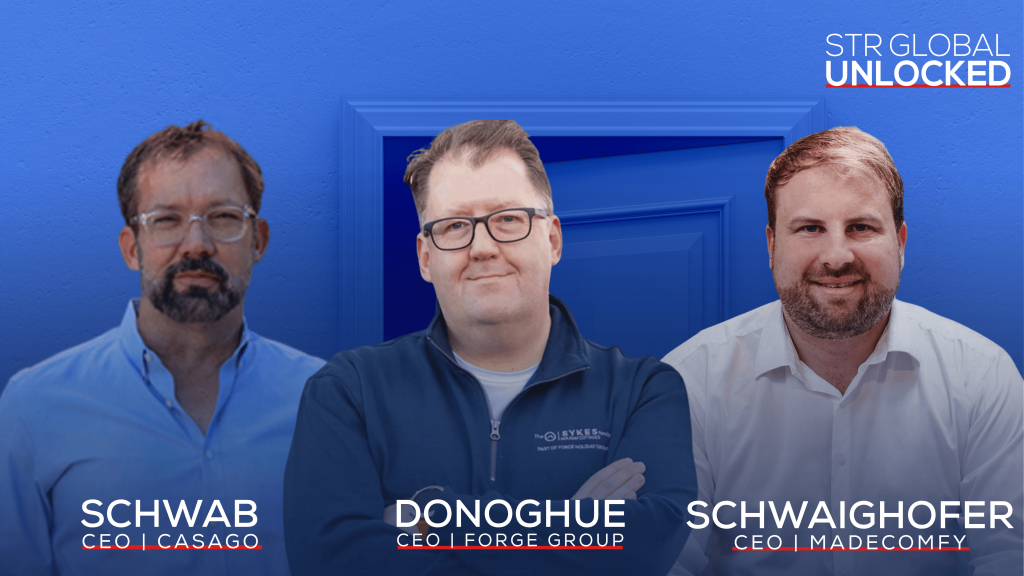
In this panel, Simon Lehmann brings together three leaders shaping the next phase of professionalization: Graham Donoghue (Forge Group, UK), Steve Schwab (Casago, US), and Quirin Schwaighofer (MadeComfy, Australia). Together, they break down what it really takes to scale across borders and why local expertise still defines success.
This episode goes beyond theory. You’ll hear how operators balance growth with cultural nuance, how investors think about scale, and why the future of short-term rentals depends on blending technology with human judgment.
In this conversation, we discuss:
- Why no operator has cracked the code for a global STR brand, and what makes each market uniquely difficult?
- How Casago’s decentralized franchise model builds community-level trust while scaling across the Americas.
- The MadeComfy playbook for partnering with real estate agents to grow fast and stay capital-light.
- How Forge Group uses technology, AI, and long-term planning to drive operational excellence through 2030.
- What private equity and strategic investors really measure when defining “value creation” in the STR sector.
- Why the next generation of operators will need both AI-driven systems and human talent to stay competitive.
Learn more about our guests:
- Connect with Graham Donoghue on LinkedIn [https://linkedin.com/in/grahamdonoghue] to learn more about Forge Holiday Group [https://forgeholidays.com].
- Connect with Steve Schwab on LinkedIn [https://linkedin.com/in/sschwab] to learn more about Casago [https://casago.com].
- Connect with Quirin Schwaighofer on LinkedIn [https://linkedin.com/in/quirin-schwaighofer] to learn more about MadeComfy [https://madecomfy.com.au].
Resources
- AJL Atelier – Global STR Consulting helping professional hosts, property managers, and investors succeed in the short-term rental industry [https://www.ajlatelier.com/].
- Connect with Simon Lehmann on LinkedIn [https://www.linkedin.com/in/simon-lehmann-8375753b/]
Stay connected:
- Apple Podcasts: https://podcasts.apple.com/us/podcast/str-global-unlocked-with-simon-lehmann-unfiltered/id1842946960
- Spotify: https://open.spotify.com/show/3kke4wOx0tNv0duq9MMWtO
- YouTube: https://www.youtube.com/playlist?list=PLWVkmUOkmhSHcFjzi28AhaQNR98vaG65O
- Website: https://www.ajlatelier.com/podcasts
- Newsletter: https://str-global-unlocked.beehiiv.com/
Transcript
Introduction: [00:00:00] We have different ownership structures now within the three of you.
Introduction: [00:00:02] This maybe isn’t quite as good a deal as it used to be. The rules are changing.
Introduction: [00:00:07] The very first thing I did was get punched in the nose and realized that I wasn’t a local.
Introduction: [00:00:11] I was looked at the capital of Sunda, and I literally went in the cellar and cried.
Introduction: [00:00:17] I don’t want it to sound crude.
Introduction: [00:00:19] And ugly, but, um, as blunt as it sounds, it’s.
Introduction: [00:00:26] You’ve just given your secret sauce away that probably a lot of people around the world weren’t even aware of.
Introduction: [00:00:31] They think it’s just twice as hard. But I always say it’s quadratically more difficult.
Introduction: [00:00:34] I love thinking five years ahead. And then again, you get this call that puts you back into reality.
Introduction: [00:00:41] Box clever into this market. And in order to sort of survive, you know, bluntly.
Simon Lehmann: [00:00:46] Things are going fast and uh, and definitely more to come. You are listening to STR Global Unlocked, brought to you by AGL artillery, the show where I speak with the leaders shaping short term rentals worldwide. I am Simon Lehman, and after two decades buying, selling, advising and investing, I’ve built a network that spans continents and categories. This podcast brings that network to you. Real conversations, global insight. No PR fluff. Let’s get started. Today we’re recording a very special panel discussion. We brought together three incredible leaders from across the world of short term rentals, each of whom has built scale in very different but also difficult markets. Graham Donaghue, CEO of forge Group in the United Kingdom. Scotland at the moment, Steve Schwab, CEO of Kasargod in the US, which recently took over inventory from Vacasa United States. And last but not least, Quirin Schweighofer, co-founder and CEO of my Comfy in Australia, which have just recently been sold to Oyo. The big question will tackle today is why has nobody built a truly global SDR operator, and what the next five years might look like will cover a lot of ground today. So let’s get this started straight away. It’s fantastic to have you gentlemen, and I want to thank Steve for getting up very, very early in the morning.
Simon Lehmann: [00:02:25] And I want to thank Quirin for still being awake on a Friday night. And this shows to build an SDR global podcast has also its challenges with the different time zones. But these gentlemen made it happen. And I’m very thankful for that. And the kick off topic I want to bring up today is the elusive global brand forge. Sykes has become one of the largest operators in the UK, has been around for decades, and you’ve dipped into international expansion with an acquisition in New Zealand of a company called Bachcare. But apart from that, you sort of stay very true to the UK market and the roots of Sykes originally and have really focused your expansion, your market share, your professionalism, your brand and everything like that. In the UK market, you have a very strong direct distribution brand, and it’s interesting that you haven’t dipped your toes into other markets, and I would love to hear from you. Graham, what are your thoughts behind building a truly global property management company? Is that really necessary and what are the challenges behind that?
Graham Donoghue: [00:03:32] Well, what a question to start with. I mean, um, I think what I step back, I look at the facts, um, it’s deeply frustrating for me as someone running, you know, running our business, that we haven’t been able to expand internationally because you know what is true? It’s a big market. It’s global. There’s 20 odd million properties. It’s super fragmented. And ultimately what we’re all doing is taking people on holiday and making sure they have a really good time. You know, as you know, as I’ve looked at this many times and you’ve helped me, Simon, look at this many times. And every time I look at it, every time I look at it, I realize that on the surface, we all, all these markets look the same. But when you get under the skin of them, they’re all very, very different in terms of how to behave, how they operate, the consumer behaviors and the distribution, consumer acquisition, etc., etc.. Um, and I think one of the challenges I found is every time I’ve looked and I’ve tried to understand, can I create value and can I take all the lessons that I know about the business I run, which is pretty successful in the UK, and deploy that into other markets and create value. And the answer comes back, I’m not really sure. And we’ve tried it. As you mentioned on Bachcare, um, the idea of Bachcare was to deploy our technology and our capability to understand how could we add value? And we found it really hard. You know, we underestimated the difference in consumer behaviors. We underestimated the difference in the way that consumers look at distribution. You know, because the UK is predominantly a lot of them are direct distribution, you know, very reliant on sort of, you know, direct rebuke, whereas it’s much more fragmented and there’s much more choices in sort of in New Zealand.
Simon Lehmann: [00:05:17] Can I jump in here for a second? Because it’s an interesting one, because if you look at it from an outside, you can say there’s a lot of similarities with the exception of Time Zone, right? Same language. It’s an island. A lot of domestic demand, a lot of domestic supply, uh, sort of a lot of things that, for Sykes, are absolutely key. You know, all your customers come from the UK. Most of them your suppliers in the UK. You have one language and you build a lot of knowledge and marketing, um, experience and expertise. Is it really coming down to different consumer behaviour?
Graham Donoghue: [00:05:50] Yeah I think different consumer behaviour. You’re different, uh, desires, different needs. Different way that the owners use the properties. Um, you know, it’s much more ingrained in the culture, the idea of a batch. And in southern New Zealand, the the distribution was a big one for me. You know, the OTAs in particular were much more powerful, much more dominant in the way they behave and operate, um, which we really underestimated our ability to build a direct brand and to get high, rebook and invest in that digital marketing and that consumer brand to think, you know, requires a deeper purse than we really appreciate and realized. And just the way that the technology needs to behave as well. There’s ever so slightly different, you know, we couldn’t just easily lift and shift our technology and deploy it into one country. There was so many nuances that were market specific that we didn’t really appreciate and recognize at the time. So yeah, we found it pretty tough. And every time I’ve looked at other geographies, be that in Europe or be that in the US and in the US in particular. Obviously, I’ve looked at many times. Um, I thought, God, this is hard. Uh, there’s probably a good reason why it’s successful. But at the end of the month that that has then retrenched me back into the UK to say, um, can I get more headroom in the UK and can I go more, uh, horizontal in the way that I look at our product and move into more controlled distribution, other acquisitions and, and so far it’s sort of a, you know, there’s been enough headroom, but I do think someone will crack it. I do think generally someone will. But maybe it’s Steve, maybe it’s I don’t know. Um, it’s not high on our agenda at the moment, I have to say. Uh. Pretty hard.
Simon Lehmann: [00:07:35] Well, thank you for sharing that. It’s super interesting. It gives us a massive, massive segue. Um, also, you know, when we consult customers, they always want to expand in more destinations. And the first question I’m always asking them, how big is your Tam? And then stay where you are and get that to 10% market share or more. And then and then you can think about getting into new markets. If there’s no not enough supply of the quality that you’re looking for. So Steve, um, obviously categories international because you also are in Latin America joining the United States as well. But I want to focus a little bit more on Vacasa in this particular instance, because Vacasa has, uh, tried very hard to internationalize its business. So it’s risen and fallen its strategy, and now you’re trying to take over as much inventory as you possibly can into franchises and whatever. I think everybody is very familiar. What what you’re what you’re trying to do. What is your view on the internationalization and and what your next focus is and strategy with these combined inventories?
Steve Schwab: [00:08:35] Yeah. You know, when it comes to, uh, you know, going international and going to different markets that have completely different laws, labor laws, uh, you would have different, uh, you know, uh, property laws, Cause, uh, it seems a pretty big challenge to be able to run it from a central ops. And one of the, uh, you know, one of the solves that we have with the business model with Chicago is finding people who are, you know, on the ground and understand, you know, the culture of the local community, understand the labor laws, understands, you know, the regulatory issues that are going on and just being able to operate, uh, even just within the culture of, of the labor force. And we saw that a lot in, in, you know, vacasa where just not understanding the, the local business, especially internationally, was, uh, one of the biggest challenges there. And I think when we look at Casa and what we’re trying to do, um, you know, breaking this down into a decentralized franchise model, um, you know, we’re trying to solve for it by finding those people who are hyper local and can deal with the local issues, Use, uh, you know, block by block. Um, and I think that’s really where the, the differences between the two different business models.
Simon Lehmann: [00:09:54] So would you would that imply that, uh, Steve, that your main strategy is definitely domestic market us and and joining Latin American market for now.
Steve Schwab: [00:10:04] For now. Yeah. For now, you know, we’re we’re in the, uh, you know, us, Canada, the Caribbean and Latin America, uh, focusing on what we have right now is, uh, importance. You know, we’re going through this entire transformation of taking a very centralized model and decentralizing it, you know, and breaking it down to where we’re finding people who truly love their communities, aren’t using the communities and, uh, building the reputation, you know, you know, one community at a time and that’s, that’s that’s going to be our that’s going to be our focus for a while.
Simon Lehmann: [00:10:39] Well, definitely a topic we could fill an entire panel decentralizing versus decentralization. We’ve seen plenty of trials and errors out there as well to to make that happen. Also with European players, how much power they give to the local PMCs versus centralizing. And I want to with that move on to a query out of Australia. I, I’m obviously being fortunate enough to serve as a chairman for a while for made comfy, uh, because some distinct reasons, one of which I’m a huge Australia fan, but everybody can see that anyway. And and second and second, I found the business model very interesting. And I think it’s no big secret. Uh, when you started as a, as a, as a startup in United in Australia, starting with building your business and then thinking about expansion, uh, and then also truly being international. I think that was one of the challenges as well, when raising capital where the Australian market or local investment market is more challenging, to raise capital if it’s not truly international. So it was a chicken and egg for you guys as well. But let’s allude a little bit on, on my comfy and, and then obviously, uh, where were you thought, uh, before the transaction happened with, uh, in terms of internationalization and what you can do with your business?
Quirin Schwaighofer: [00:11:56] I think for, for us, Australia is a country where it’s a continent. So there are so many different different markets and pockets. So when we started in Sydney about ten, ten years ago, we had this big vision. We built a global, um, short term rental brand, uh, B2C. And the markets will be very similar to, to Sydney. We thought that about Melbourne. We thought about Brisbane and uh, sort of Central Coast. But we quickly realized that even in Australia, if you, for example, you come from New South Wales and you, you launch in Queensland, it’s pretty much like a different country. Um, a bit what, what Graham. So I’ve talked about before, um, so when we were managing property owners directly, we, we, we realized that it is tricky. Um, so how do you acquire, how do you keep, how do you build local operations and all of this? And how do you replicate that in every sort of location where you really can’t drive? You could fly everywhere and different time zones and sort of during Covid, um, the whole thing we were thinking about, how do we scale with little capital, um, and how do we get access to, to properties? We played a little bit with, with the franchise idea. Um, but what is a bit unique, maybe in Australia is that 76% of properties are in general managed by, um, real estate agents, property managers, um, Australians love to invest in property.
Quirin Schwaighofer: [00:13:24] Um, investment properties turn around every 7 to 10 years. So, um, if you write a little bit, um, you get in front of every single property if you are an agent. Um, and what we were wondering is like, why are they not doing short term rentals? Vacation rentals? Some do, but really, um, not many. And we were competing with some. We were trying to partner with a few. But what we identified is that opportunity to have that hyperlocal approach by enabling and partnering with real estate agents powered by McAfee, and they have a local community. They’re there, they’re in the footy club, and they’re selling those properties, and they are appraising long term rentals or. Yeah. Now also short term rentals. And that’s what we changed. That’s when I think also we met Simon. And I remember when I think we were driving to a meeting somewhere in Switzerland, and I sort of shared this idea with you, and it was a bit of a moment like, oh, that works out. That would be, uh, interesting. Um, and yeah, four years later, now you have 70% of our inventory is managed by real estate agents, and we mainly grow with that. So we’re solving the problems of our real estate agents. They acquire the properties. And with that we’re able to launch quite capital light. And in markets like Australia and New Zealand.
Simon Lehmann: [00:14:46] You’ve just given your secret sauce away that probably a lot of people around the world weren’t even aware of, but it had to happen at one stage. And obviously internationalisation is becoming pretty obvious that any Anglo-Saxon market where the real estate markets have similar dynamics, like the US and UK and Ireland and New Zealand, and you already have an office in New Zealand. So that’s going to be interesting. And we’ll talk about scale in a minute as well. But I guess we can allude that for Oyo this was also an internationalisation acquisition right.
Quirin Schwaighofer: [00:15:18] Yeah I mean I’ve given the secret sauce away. The secret sauce is not that. The secret sauce is how do you actually connect with agents and enable them to be successful. So it’s super complex. You’re adding another layer of stakeholders in an already very complex value chain between OTAs, guests, OTAs, property manager, property owner and now you’re adding an agent that needs to know everything about the property because they are managing the property owner. So yeah, I’m highly complex, but I think it’s sort of for Oyo, it’s Oyo, Oyo sort of. Um, I remember when I read that they acquired um, uh, Villa, uh, in, in Europe and then in 2019, I was like, oh, wow, they’re entering the short term rental space now. And I’ve been following them since and, and yeah, I think for, for you, um, of course, I wanted to enter Australia and New Zealand, but um, our business model being unique and applicable, um, within Oyo’s network was definitely also one reason that we were talking, uh, started talking last year.
Simon Lehmann: [00:16:22] Excellent. Interesting news all the way today. We heard that Interhome has now been finally fully taken over by Hometogo. So interesting times. Management changes have already been announced. Uh, things are going fast and, uh, and definitely more to come back to, Steve. I want to move on to scale an investment appetite. Right. So, you know, from a US perspective, what level of scale do you think you really need in order to go to the next level in terms of investment and growing the business forward? And what is scale for you and what you’re focusing on in creating value?
Steve Schwab: [00:17:01] Yeah. You know, I think that’s we’re sort of doing the the opposite of a normal scale where, you know, we’re going global, but local, local, if you want to call it that. The local, um, the, the investment appetite is certainly out there. We’re seeing it. There’s a lot of interest at a, at a pretty large levels of, you know, trying to come in and see what we’re doing. You’re seeing that across the entire United States right now. There’s a ton of activity happening. Um, you know, for us, uh, you know, seeing that, uh, that institutional money coming in and looking to play um, is certainly a big part of of the dynamics going forward. Uh, it’s just important to remember that, you know, as you look at what’s different between, uh, vacation rentals and hotels and airlines is unlike the hotels or airlines where you have a homogenized, you know, seat or, or room, um, in which the company, you know, actually owns it. We don’t own the market, and we have a lot of, uh, a very local culture that happens with the homeowners. I always talk about when I first got started here in Puerto Penasco and went to my first city, I thought I was pretty smart.
Steve Schwab: [00:18:14] I was just going to rubber stamp this thing. The very first thing I did was get punched in the nose and realized that I wasn’t a local, you know, in San Carlos as opposed to Porto Penasco, and learned pretty quickly. I wasn’t as smart as I thought I was because the homeowners there, it’s not just the travelers, it’s not just the the behaviors of those who are booking. It’s also, uh, homeowners who have a very different expectation in one city compared to another, and even having the same owner in multiple markets, they’ll have an expectation of how you operate their properties in different cities. So, um, really looking to mix that, uh, when you go when you think about going to scale, how are you going to take that scale and keep it local? Uh, because at the end of the day, every property is so unique and every market is so hyper localized. Uh, until you’re on the ground operating it, it’s just really difficult to bring that investment level to local markets.
Simon Lehmann: [00:19:12] Yeah, that’s super interesting. Uh, scaling while trying to be local, uh, is definitely a massive challenge. And, and definitely going to be interesting as you onboard more properties at from a casa as well within your within your system. We’ll talk about the business model. Uh, in a short while moving that to Graham. Graham uh, Forge Forge Group, Sykes is owned by a large cap private equity company. So you could probably talk to us about KPIs and scale for the next half hour. But still, I’d be super interested. I mean, we have different ownership structures now within the three of you. Uh, one owned by strategic, uh, another also by an investment group, a new, uh, by a really traditional large cap, private equity. Uh, you probably get grilled most in relation to scale and KPIs. What can you share in terms of your, you know, what is measured or what counts? Also from an investment perspective, it’s you know, we talk a lot on, on uh, on the day to day conversations about units, revenue, ADR, occupancy, RevPAR, this type of stuff. But I think you have taken this, uh, totally to the next level.
Graham Donoghue: [00:20:23] Yeah. I mean, we have a lot of data, we have a lot of KPIs, etc., that we we tend to think more around value creation, you know, and I think being owned obviously private equity owned, as you mentioned. You know, I think you spend a lot of time thinking about where’s the value going to come from knowing that you’re on a journey and could be five years time, could be ten years time, but eventually there’ll be a transaction that happens. And so you have to try and work your way back from that. So we spent a lot of time. So at the moment we’re 2025. Most of my thinking is in 2030. And so when I’m talking to, you know, my executive team and I’m talking to the.
Simon Lehmann: [00:21:01] 2030, did you say.
Graham Donoghue: [00:21:03] Yeah yeah, yeah. So most of my thinking is like what does the business look like in 2030? You know, whether I’m there or not in 2030 is irrelevant because it’s more around, like, you know, we need to create a legacy for this business. We need to understand what the value creation looks like. And, and there’ll be a set of numbers that drive that, and there’ll be there’ll be things that fuel that likely to be stock count, but also maybe around, you know, your revenue, your income, your customer acquisition. At the moment, we’re obsessing quite a lot around, um, operational efficiency, operational gearing and actually leveraging AI in particular. As you know, I’m a sort of a fan of AI in terms of how we use it in the business and trying to crystal ball gaze. How do I believe owners and consumers and our employees will be using tools and technology in the future, in 2030, and how do we sort of lean into that and think about a more authentic way of designing and developing our business? So I have to have people in my business that are, you know, I think in these three horizons, horizon one, two and three, I’ve got, you know, day to day operational people looking at horizon one, which is like the next 12 months trading, and then have a group of people looking at horizon two, which is like, you know, maybe in two years time, you know, beyond that. And then I have to have enough people looking at horizon three, which is 2030 and working our way back. And then we started thinking about like, how do we scale? What’s the The technology was the investment. What do you think that will do to revenue? What do you think will do to EBITDA? What’s the story we want to tell which is critically important? Um, and then how do we execute against it? And that’s a you know, that’s how we play into it.
Simon Lehmann: [00:22:46] Super interesting. So when I asked you about, you know, in relation to scale your, your core, the answer was we want to create value. And how do you break that down and how do you measure that with where you want to go with the business?
Graham Donoghue: [00:23:03] Well, I don’t want it to sound crude and ugly. Um, but but um, as blunt as it sounds, it’s around the, uh, equity value we think we’ll create in the business. And now you can create equity value in a business multiple different ways. You can, um, um, have a very high multiple of your earnings, or you can have high earnings with a lower sort of multiple and then everything in between. Um, and who knows because the markets ebb and flow. We’re probably in a bit of a depressed there are at the moment where, you know, values are not as high as they were and debt is difficult, it’s expensive, etc., etc. but we tend to work on, um, you know, what do we need to look like in the future? How do we think that equity value will be derived? What are the levers we’re going to pull to create that? And then we work our way back. And generally you need things like supply. You need things like margin expansion. You need to know how you’re going to convert. You need to know how many customers you’re going to have, how many property owners you’re going to have, how your revenue is going to flow.
Graham Donoghue: [00:24:13] You know, your occupancy, your ADR, all that sort of stuff. And we model all of that. Um, and we get it wrong all the time. And, but we have to start with a model and work our way back, um, and then say, okay, then how do we get there? And then that it normally comes to a point where you say what investment do we require to get there as well. And then that requires another conversation around do we have to refi the business or do we have to go and find additional investors. You know, do we need to, you know, are we planning to make a big acquisition because we can’t get there? So that’s generally how we we model that, how we sort of begin with the end in mind and we work our way back. But we make we make sure we have enough people looking at those three horizons to understand what the story, what the story sort of look like and, and how it plays into value.
Simon Lehmann: [00:25:04] Fantastic. Well, I’m glad I did a little bit more digging there. And, uh, you know, at the end of the day, we need to think about our markets and our ownerships and maximizing value has, uh, different, different, uh, different levels as well. Um, bringing that back to querying and probably get a little bit more concrete in terms of your recent transaction with selling a business to a strategic buyer, you know, and, and and talk a little bit about this process, what what was sort of what was the key drivers in relation to scaling your business? For any strategic investor looking at your business in relation to unit economics, growth and things like that, and specifically your, your, um, your buyer that has acquired you. But what I mean, make comfy was always a company that was already extremely well call it documented. Your management information system was well above average. From what I have seen in many property management companies of your size. But what was the key that they were looking at in terms of scale and driving value for the acquisition?
Quirin Schwaighofer: [00:26:12] I think we we both started the business with um, um, setting it up for, for, for scale. And we always talked about, um, 2030. I think we for a long time. And that was the main thing. Um, where do we head to? And let’s build the business according to that? Um, we’ve been audited after a year three, and we’ve been, um, we’ve been we’ve run a board, um, also after year three already. So we, we, um, got involved and first to advise us and then being, um, as I would say on our board. So we, we always had this kind of vision to, to set the business up and to be run professionally. Um, on the other side, uh, our big business model being B to B to C is all about serving customers, making short term rentals, professional, um, helping housekeeping partners who are in a professional business, helping our traders to be, um, more structured and more organized. Um, our real estate partners. Um, um, what I didn’t really think at the beginning, but there’s a lot we can help them. So there’s a lot of, um, there’s professionalism and structure that we require and has been something we always had. Now we were not looking at and we were not looking at selling the business.
Quirin Schwaighofer: [00:27:31] We had our plan to keep growing in Australia, and we were preparing for some international markets and did quite an analysis there where we think that our business model could work as well. Our platform is already international. We do multiple time zones, multiple currencies. We operate in New Zealand as well. So that was our plan and we have been approached by three US three strategic buyers last year, which was interesting. And the first two, it was a very easy now, very easy now. And we were really not and like, you know me, we were not looking to be to be bought. Um, it was only really when, um, when I met Shirish and then Ritesh that I for the first time thought They think very similar to to me. Super quick, super sharp. Down to the detail. Passion for the supply side, but also for the operational side and significantly bigger. Like like executional excellence than. And we got to in a very similar time frame. Um, and yeah, it um on our side we were we, we, I’d say in a much smaller scale, but we were able to answer questions really quickly around certain metrics and like of course, down to, um, sellable home nights and, and, uh, by market by, um, uh, sort of the evolution of RFP by year.
Quirin Schwaighofer: [00:29:07] Does your stock go down or go up in the RFP over years? So all of that, we were able to provide, um, overnight, pretty much. And I think that was quite impressive. Um, and then going to the to those, those sort of business model, and the flask, because we really did not have much access to capital. When I looked at the capital raises of Sonda and Vacasa, I literally went in the cellar and cried for like just a 10th of that. We could do so much with this. Um. And we yeah, we raised we still raised close to 20 million over a year, but we really didn’t have this one lump where we said, okay, now let’s focus, do something with that. And so we were we had to look after every dollar all the time. So the business model that we developed was pretty much, um, a evolution of our strategic thinking, growing big and being structured. And then, yeah, looking after every penny and, uh, ensuring that we’re not spending this on supply acquisition especially or demand acquisition.
Simon Lehmann: [00:30:06] Super interesting. Um, and you gave me a beautiful segue to talk about business model. I’ve had a lot of recent conversations with different executives in this industry and seeing some moves, uh, where, you know, we somebody tried to build a large United States company as a SaaS business, but we didn’t know what the abbreviation meant. Is it software as a service or service as a software? Right. And and a lot of things have been learned along the way in terms of and we had super interesting conversations this year with Ashley Graham and Steve, uh, to talk about, you know, proprietary technology, helping you to, um, to differentiate yourself or you going with off the shelf software. And we see a lot of movements in this space. But I want to talk about more the core business model right now. And I want to start with Graham on that. I mean, obviously Sykes is definitely more an exclusive distribution business than it is an operating business. And but that’s also come historically where homeowners in the UK live closer to the properties. They manage it themselves. But you do the distribution. But I would love to hear your general view you and how you viewed, or how you’re viewing all the different business models that are out there from an end to end, full service property management service that more like a Query and Steve are providing to their owners and their guests. And you are clearly differentiated, and maybe New Zealand is maybe more a full service business as well. But what is sort of your view, Graham, on the different business models out there and how you foresee the future and how is that going to be evolving?
Graham Donoghue: [00:31:49] Well, it’s been interesting the last 12 months because, um, so I’ve been doing this job for almost ten years and for at least maybe eight of those years, the thing that used to worry about constantly was supply. And I used to always say, I have more demand than I need now it’s about about supply, supply, supply, supply. That’s what I need. But in the last 24 months, I’m not 100% sure why, which is scary. It seems to have flipped a little bit. Demand actually has become more of a challenge and supply seems to be, like, rolling in. Uh, weirdly. Um, I have a hypothesis, um, which again, I don’t have a huge amount of data. I’ve got some data, and I can only really speak about the UK market in particular. But when we look at the market, we think of the market in sort of a three core segments, like property managers and professionally run, um, you know, there’s three big ones in the UK and then there’s a lost trail, to be honest with you. You know, those three big ones have acquired most of them. Um, you know, and we’ve read a lot of that over the years. You then obviously have um, uh, homes in the UK that haven’t been rented out but are second homes. And there’s, you know, a lot of them, hundreds of thousands of them, maybe 150,000 of them. Wow. And then you have homes in the UK that we call the RBL market oriented by Owner Direct, which, which, you know.
Simon Lehmann: [00:33:14] Which is that about half of the supply.
Graham Donoghue: [00:33:16] Okay, well, we think it’s about another 100, 130,000 roughly. So, you know, you know, so market size in the UK, half a million properties. And what have we got on the agency business. 2024 25,000 properties. So you step back and you think well supply shouldn’t be an issue. But I think what I’m seeing is as regulation has increased in the UK and the cost of living, of operating and running a second home has gone up significantly in the UK. And now seeing more of those second homes that are not rented out, those owners are now choosing to say, well, maybe we should rent it out, maybe we should try to generate some income and that and that’s bringing in, you know, more supply into our into our sort of a market. And then more recently, I would say in the last maybe ten months, I’m seeing the Rbo market. And so people who used to rent, particularly with Airbnb less so Booking.com particularly Airbnb. Um, moving to saying, well, do you know what? This maybe isn’t quite as good a deal as it used to be. The rules are changing. They’re changing the way that they’re treating hosts. Um, and actually, for not a lot more commission. I can have someone who just takes away all the pain and, you know, does everything that you know, that that that I’m sort of spending all my waking hours to do. Now, there is a segment of people that clearly love that interaction, but there’s a segment of people who don’t.
Graham Donoghue: [00:34:46] And so is that a different business model? I don’t entirely know. Um, but, you know, we’re now sitting here saying, actually supply is, is, is is doing incredibly well and demand is becoming more of the challenge. And that has then forced us as an organization to say, I can’t really sit on a business that’s 80% direct anymore. Um, because it’s getting too hard to find. What I need to then do is to utilize some of the other distribution channels that exist, particularly for OTAs, and recognize there’s just a different cohort of customers out there, of course, utilizing those channels and lean into them, particularly for international guests, which they can do a lot better. But more recently, what I’m seeing is for guests that want like real last minute and minimum stay of, say, one night, which is something we would never have considered of doing 12 months ago. But now, you know, by opening up our portfolio. So I think the world is getting really confusing, you know, in terms of what the business models is. And I’m not speaking about franchise here or various different things. I’m talking more just around how we look at them and how we have to trade our way and box clever into this market and in order to sort of survive, you know, bluntly super interesting.
Simon Lehmann: [00:36:05] So I find that very interesting. And there’s so many Segways here. Uh, also about, you know, the one night and now, especially since Airbnb announced the rate hike and the split with that’s going to have a massive impact. I’ve just written a newspaper article in Switzerland about that today. Actually, I was asked to comment. And what does that really mean for the consumer? And and I’ve just came back from a consulting mandate this week, three days in the mountains. And, you know, they deal with the one day stay with fortnight price in the high season. And it and it works. It works fantastically. So it’s interesting how we are forced in a way to operate smarter because we need to always question to tradition to be better and, and and be ahead of the game. And but I hear from you, Graham, you’re not hiring an armada of cleaners and get into the service business.
Graham Donoghue: [00:36:58] No, sorry. And yes, I mean, we’re still we’re still of of the you know, we do a million bookings a year roughly in the UK and of those million bookings a year, but 150,000 of those bookings. We facilitate the cleaning and management. Everything else is done either by a third party or by the owner themselves. However, every single one of them we monitor and we facilitate and through our software. So there’s quite a high degree of rigor around the feedback, the net promoter score. Sure, the the cleaning score and all that sort of stuff. So, you know, although we don’t have direct control, we monitor because ultimately it’s about delivering a good guest experience and helping owners, um, you know, improve their service because they just, you know, they don’t always know. Of course.
Simon Lehmann: [00:37:50] Excellent. So we have a bit of a different case, uh, across the pond. Uh, Steve. Well, I mean, looking at how you build and where you came from, what you thought, what sort of a hybrid, if we call it. But you can explain that a little bit better. And then going after a hard core, full service PMC that has had challenge to have good enough unit densities to operate profitably across all the different markets and other things. What does that mean and how you look at the business model going forward? Are you are you looking at entirely franchising it? How do you look at the service business?
Steve Schwab: [00:38:27] Yeah. So we’re uh, yeah, we’re we’re selling off every bit of it. We’re going completely to the franchise model, uh, a big believer in it. You know, when you think of, uh, uh, the different business models, I’m not sure there’s necessarily one. Right. Business model. I think what Graham is doing is working there. And if I tried to take my business model and transpose it where he’s at, you know, there’s a there’s a high probability of failure, uh, you know, making sure that you understand exactly, uh, what’s happening at the at, you know, at the part of the world that you’re working at is going to be the key to success here. Uh, we’re seeing this as the truth is, you can’t make large decisions for the entire country of 40,000, 50,000 units, uh, in 1 in 1 decision. I think it’s going to work in all places. You know, uh, making these macro decisions for a company, uh, that’s operating in different markets with different seasonality, with different expectations, with different unit size, unit type, um, you know, uh, even business model on the local level, you know, ski lease compared to, you know, short term compared to midterm, uh, making decisions across a large portfolio just doesn’t work in this business the way that I see it. So breaking this back down to there’s somebody who’s hyper local, there is somebody on the ground who can take care of those homeowners, uh, you know, the decisions that are being made when they’re closer to that front door of that property, uh, the better the outcomes are for all the stakeholders, you know.
Steve Schwab: [00:40:07] For the homeowner, for the guest, for the community itself, you know. Even for the teammates and employees that are there with them. So, you know, we see it over and over again when people try to scale, uh, from one market to another, they think it’s just twice as hard. But I always say it’s quadratically, more difficult. You know, it’s not just twice as hard. It’s four times as hard to go from one market to another. Um, and uh, you start adding on more and more markets, especially on a full service model. It becomes, uh, incredibly painful. So I think there’s a lot of different ways to get to success. I am not I’m not a I’m not a believer that, uh, the one that the model of consolidating it and trying to run it from a central operations is, uh, the probably the one way I would say is definitely not the right way to do it. Um, looking at, at it from a local level is going to have to be how you end up building this global brand.
Graham Donoghue: [00:41:04] Can I, And can I just suggest because maybe something I should clarify, which I don’t know. I don’t know if you’re aware, Steve, um, that we a little Sykes is like the parent company have had to forge the parent company. Sykes is the the power brand. We put a lot of marketing behind. We run 24 different brands in the UK with 40 offices all over the UK, and every single one of them has regional staff, employees that represent the local brand. So it’s not franchised because we own them. But the reason why we haven’t closed and consolidated them and turned them into like just just one power brand under Sykes is because we know the value of local relationships, the value of a local office, the value of being a good corporate citizen locally as well, you know, sponsoring the football team outside and stuff. And for us, it’s like a great way to maintain that, but also to hold on to the supply If I close them and get rid of them, I know deep down I would lose a big proportion of my supply because a lot of the owners we have, they don’t do it because they’re running it as a financially, you know, like lucrative business. It’s about relationships. So it’s not the same model, but actually it’s it has got similarities.
Steve Schwab: [00:42:22] Yeah, I totally see that. And the truth is, how many of your homeowners stay with you because of the local team, right? I mean, I can tell you that even in even in this, you know, a lot of the homeowners in Picasso said, I’m sticking with you guys because I love my local team. Right. So the fact that you’re empowering the locals, you know, and letting them make their own decisions and, uh, be close to the communities is a big part of what makes a property management company sticky.
Graham Donoghue: [00:42:47] Yeah. And it’s and it’s hospitality. Yeah. Because that’s that’s what, you know, they’re delivering hospitality to the owners, the hospitality to guests as well. So I apologize for interjecting there.
Simon Lehmann: [00:42:58] No, not at all. That’s a great, great input. So if I hear you, Steve, you know, I mean, you need to stay flexible. Um, you need to look at market by market. There is not one size fits all, uh, specifically. Also, you know, the type of homeowners and everything else. And at the same time, you could be devil’s advocate and say, hey, evolve has now 35,000 units on their platform exclusively as well. And, and run a, let’s say, a grand Donohue a business model in in the UK, in the US, which is quite interesting as well. So there’s room for a lot. But you know, the value creation. And I think one of the things I want to ask you, Steve, before we move to Corinne, uh, is in relation to that business model that a lot more operators are now trying to get rid of the service aspect, subcontract that, not doing the cleaning anymore, and more focus on the distribution and the brand. It’s it’s easier. It’s it’s it’s less of a headache and and and everything else. How do you deal with in your group or your organization with that aspect?
Steve Schwab: [00:44:08] You know, part of our vision talks about, uh, that we’re here to be invaluable to the homeowner when they’re away and a big part of our business model. And it’s not everybody’s business model, but our business model is to, uh, build a relationship that transcends business with the homeowners and to be their advocate on the ground when, uh, when they’re somewhere else, focused on something else. And, uh, we find that that’s our highest and best value, uh, and that’s how we build relationships and trust through competence, through intention, you know, through through being on the ground for them. Um, that’s how Casa is building our brand around it. And that’s not the only way to do it. Uh, going even more asset light than the franchise model to a a real, uh, you know, booking play, you know, is, is is certainly a valid business model. I don’t know if that’s going to ever be Chicago’s business model. I think we have components to that. But, you know, for us, uh, being the homeowners advocate on the ground and full services where we’re trying to put our values and build our brand from.
Simon Lehmann: [00:45:21] Chlorine before it gets too late. Um, in terms of your business model as well, uh, you’re not going to conquer the world and and scaling through real estate agents. Uh, what are your thoughts of your own? Um, because one thing that obviously the audience needs to know that that May Humphrey has Sydney and Melbourne running your own property management business, and the rest is run through real estate agents. What are your thoughts about now the business model you’re seeing scale through powering real estate agents with with a comfy pro versus running your own business. Well, how does how did that affect your or your how does that affect your strategic thinking in terms of your business model?
Quirin Schwaighofer: [00:46:02] Yeah.
Quirin Schwaighofer: [00:46:03] I think the advantage we have, we can do both. So we are definitely thinking about, um, like Sydney, Melbourne, we’ve been thinking a lot. We also sort of, uh, um, turn this into an Asian focused market. But in the end, we’re already here. We have a lot of relationships and, um, where our business model, like, really helps us with those relationships where it takes a long time. Um, if, if we launch a new market and with a new brand, um, to sort of build those, um, and for us, what we sort of have seen now and we then can be proud of, we call it a stealth for the first 2 to 3 years. And it’s only like 18 months ago that we announced it and we were growing, um, through purely through referrals. Um, it is something that, sort of enables the real estate agents that are losing properties to short term rental managers and of course, fast. Everyone that is missing out a little bit. Um, we, uh, we held them to create more value that gets us into those kind of communities. Um, they also sponsor the footy club of footy club. They also talk to the local developers. So yeah, for us, um, the core focus is on helping more real estate agents, um, helping them to be also like supply engines, um, giving them away a little bit from the hospitality side.
Quirin Schwaighofer: [00:47:33] So something that we’ve seen, um, real estate, especially the sales side, um, and the property management side is not really, uh, very close to what, what we do in regards to time, response time and, uh, on especially guest communication and things like that. So, so keeping those two things apart, um, really important part. But yeah we will and continue to focus in certain urban markets to run direct. We are part of oil now. Oil does not just do short term rentals. Um, but oil is not only operating in, in, uh, uh, in Australia. So, um, the, the idea is definitely to, to enable locations where all your operates, uh, to benefit from, from our business model. And that’s the exciting part as well. Like, for me, I’m a, um, entrepreneur throughout. Um, I love thinking, uh, five years ahead and then again, uh, you you get this call that puts you back into reality building. You don’t know what’s happening. If I know what’s happening in a year, I think that would be the end for me. Uh, just. I can’t add value anymore. But that’s the exciting part. Keep building, but also executing, um, writing things efficiently. Um, the whole AI time, um, that we’re currently in an incredible opportunity for everyone to, um, yeah, become especially more efficient as a person, um, and as a company. So. Yeah.
Simon Lehmann: [00:49:00] Fantastic. Thank you. And yeah, we managed exceptionally well for already 48 minutes without talking about AI. Graham brought it up after 20 minutes, which I thought was pretty pretty impressive.
Quirin Schwaighofer: [00:49:11] Typically begin.
Simon Lehmann: [00:49:13] And I.
Simon Lehmann: [00:49:14] Will do this.
Simon Lehmann: [00:49:15] We will definitely do a separate panel. There’s so many use cases out there. We really want to dig deep into AI. And we’ll definitely come back to that topic. Uh, when I see the use cases out there, uh, in today’s SDR world, already with all the agents, different languages, different, I mean, whatever it is, it’s just incredible. But at the end of the day, thank God we’re still the human capital. It still remains extremely important in the SDR space, and we’ll continue to do so being mindful of time. I want to wrap this up. And for the ones who sort of missed, uh, our investor panel in London in, uh, in, in May at the star, I want to bring that sort of last question to to my panelists in relation to what role plays technology, um, within, within our industry and um, and and then last and I include that what is sort of the global outlook for you, uh, in the next couple of years when we look at the short term rental industry. Are there going to be significant changes or not? But we talk about technology. How does that impact our business, and what do we need to be mindful about and what is the global outlook. Graham do you want to take that first?
Graham Donoghue: [00:50:23] Yeah. Well, I think as I’ve always said, technology for us is an enabler. Um, you know, we are a hospitality business, um, the blend of human capital to deliver exceptional or even unreasonable hospitality, if you want to gather with technology is what we think is our superpower. And again, I don’t we don’t really talk about AI, but for the moment, you know, I see this wave happening in terms of how AI can really help and unlock, um, you know, extreme sort of a competitive advantages for people who will lead into it. So technology is really important. Um, but I think the people who will win with the company, who can blend technology and the human capital sort of together because that acts as a moat around your business and, well, you know, unless you’re a pure play technology company, um, I think the outlook generally, this industry has been around for a hell of a long time. You know, I have brands in my portfolio that are 60 years old. Um, you know, it’s it’s very resilient. Um, you know, I think it’s been really tough the last 3 or 4 years. It’s been really tough. I do think there is some light at the end of the tunnel. I think we are coming out the other side, but I do think there will be more consolidation. I do think we will probably see some people sort of falling away, whether we’re going to see the level of investment in the sector that we’ve seen historically. I think the jury is still out, you know, on that one. Maybe we’ll wait the next 12 months. We’ll see what’s happening. Um, but I’m pretty optimistic about, you know, about the future. And I think I’m pretty confident that, um, you know, there’s going to be some great businesses that continue to evolve and do some incredible things, um, and, you know, and deliver exceptional experience.
Simon Lehmann: [00:52:11] Awesome. Thank you. Graham. Great summary, Steve.
Steve Schwab: [00:52:15] Yeah. So I think that over you know, we looked at the next five years, we’re going to see a lot more consolidation of tech and operators. Uh, you know, here in the US, uh, tech is going to evolve and accelerate. I think, uh, to Graham’s point, making sure that we’re using it to enable our people and, uh, you know, our interactions is going to be important, making this, you know, bionic so that we have more time to spend in the human element as opposed to robotic, where people are just getting to interface with chatbots. That doesn’t feel like there’s a true hospitality partner involved with them is, uh, is going to be important. Um, I think that we’re going to see a lot of resistance towards OTAs coming up. We’re already seeing, uh, you know, some, um, some certainly some people who feel like, you know, that they’ve, that the OTAs aren’t, uh, are being fair. Um, a lot more focus on book direct strategies and, uh, you know, and then hopefully we’re going to find some, uh, institutional capital backing brands with both, uh, scale and soul to them. And so, you know, over the next five years, I think that that’s going to be important as we take technology, mixed it into the human portion of our business, and then trying to just preserve jobs for our teammates to make sure that our, um, our face to face brand is there. It’s not a phase two, uh, AI brand. Uh, it’s going to be.
Simon Lehmann: [00:53:40] Important.
Steve Schwab: [00:53:40] As we go forward.
Simon Lehmann: [00:53:41] Thank you Steve. Amazing. I love the OTA input as well. Uh, had a recent conversation about that understanding where the demand is coming from in the future, something we need to spend a lot of time on. I’ve seen an article yesterday how Booking.com is utilizing TikTok for distribution, uh, while the channels are shifting. So it’s going to be super interesting to see that too. Corinne.
Quirin Schwaighofer: [00:54:04] Yeah. To sort of be the the last one here to add a few things, I think, uh, to be the last. Yeah. No, I think to summarize all of this, um, um, what will be key? Whoever builds trust at scale, um, will be able to reach this target of, uh, of what we talked about being really global. I do believe AI will help us to focus more on those moments of truth and which I personally interactions. That’s from the moment you meet a property owner for the first time, that’s when you, um, have to help a guest. That’s when you when you work with your, uh, cleaning teams, with your with your tradies. This will remain remain all hands on activities. Uh, I think until we see robots do that. That is maybe not in my lifetime or maybe not in my working lifetime. So yeah, technology will help us to to focus on those moments of truth. And I think business models are also sharpening further. And yeah, I think really exciting time to be to be in um, at the moment in our industry and in, in general with, uh, all the tools we have these days and in access to information, um, and those global panels.
Simon Lehmann: [00:55:14] Awesome, fantastic. Gentlemen, I really, truly want to thank you. I hope that Graham will find Loch Ness with his binoculars behind him. Um, and thank you.
Quirin Schwaighofer: [00:55:26] Is that what it’s for? It’s like.
Simon Lehmann: [00:55:28] Must be.
Quirin Schwaighofer: [00:55:29] It’s it’s for.
Graham Donoghue: [00:55:31] It’s 14 miles long. This loch. It’s big.
Quirin Schwaighofer: [00:55:35] Yeah.
Simon Lehmann: [00:55:35] So, uh, thank you for joining us today. This has been super intriguing. Some great takeaway. Trust at scale blend technology and human capital, is there more investment to come? Is a question more consolidation? We all see that too. Hey, and think about where OTAs are heading and where your booking is coming from in the future. Ladies and gentlemen, thank you so much. Steve Schwab. Have a wonderful day. You’re up early, so you have still a fright ahead of you. Graham, you’re close to a drink in the afternoon. And. Quirin. Good night. Thank you so much for joining us. Our global Unlocked and wishing you a wonderful evening and a great weekend ahead. That was STR Global Unlocked, where we say what others won’t. If you got value from today’s episode, send it to someone who is still playing it safe. Follow the show and get more global insight at Angel of Telecom, the globally recognized STR consultancy I founded, and that proudly brings to you this show. More bold conversations are on the way, so stay tuned.

