- Advertisement -
Home Blog Page 5

Sustainability and Quality: The New Barriers to Entry in Vacation Rental Management

0

The vacation rental (VR) industry is undergoing a renaissance as the COVID-19 pandemic transitions out of its position of global dominance. Our industry has received an enormous amount of press in the past few years—some good and some bad—all of it culminating in increased awareness of what our industry offers. 

The term “renaissance” is used deliberately here. Some refer to our industry as “new” or “young,” but the reality is that this industry has been well-established for decades in resort communities around the world. Perhaps this perspective of our industry results from the new tools and technology available that have breathed new life into VR companies. The studious application of research and technology to our industry has given rise to possibilities that did not seem likely even 10 years ago, creating a situation reminiscent of the scientific and creative awakening that we associate with the Renaissance in Europe roughly 500 years ago. Now, as then, the question is this: how will these advances change the landscape, and how will our companies need to adapt to survive and remain relevant? 

Recall the attention that was brought to the VR industry during the coronavirus pandemic; the new awareness brought new customers who carried their travel dollars with them. As with any boom, it didn’t take long before enterprising individuals showed up to facilitate the spending of those dollars. 

Now, with this influx of traveler dollars into the vacation rental market, new opportunities are popping up. Industry visionaries have been spotting trends in the changing landscape for several years, including the following: 

  1. Technology is enabling smaller companies to perform at higher levels. Subsequently, pressure and competition are increasing in every market—because smaller companies now have the same access to category-defining technology that was previously reserved for the companies with enough funds for enterprise infrastructure. 
  2. A new wave of vacation rental managers is emerging who have only ever known the tech-enabled landscape; they will not be hindered by the “this is how we’ve always done it” mentality. 

With new companies trying to become established–and established companies trying to adapt and stay in the game–there is a common thread that will likely prove to be the distinction between evolving through today’s renaissance and being exterminated by it. 

Perhaps surprisingly, it is not likely to be the adoption of flashy new technology that proves to be the distinguishing factor in who makes it to the next plane of sustainability in the vacation rental industry. No doubt, moving forward without a solid tech stack to support organizational operations will become more and more difficult as demands and expectations from guests and owners increase. Instead, the solid organization and fundamental soundness of the business is even more foundational in determining long-term sustainability. 

Technology can be rapidly developed, deployed, iterated, and then phased out. This swift cycle should make business owners wary rather than confident. It also means that for technology to improve the quality or efficiency of an aspect of a business, it must have a solid foundation upon which to stand. Companies that comprise an amalgamation of different tech tools may grow quickly, but without a solid plan underneath, they will either collapse under their own weight or become grievously wounded by unanticipated changes to one of their tech tools. 

Similarly, a company that has strong tribal knowledge without a solid foundation will always be at risk of experiencing major setbacks if that tribal knowledge (e.g., a key employee) departs from the company for one reason or another. 

The solution to both growing a solid startup and to ensuring a long legacy of an existing company are the same: establish and maintain stable business fundamentals. 


Case in Point: Startup 

Statistics hold that most startups fail within the first several years of operation. There is a lot of risk involved in startups. It is not difficult to imagine the endless obstacles that new companies may face, from insufficient funding to barriers to entry to scaling in a healthy way. 

Knowing that the odds are against a startup reaching the five-year mark, the best way to increase the likelihood of success would be to form a plan focused on creating foundations that will support the business throughout its various stages. At every turn, a business that has already worked through the scenario at hand and has planned for managing similar challenges will have a better chance of overcoming that obstacle. 

Eventually, the practice of scanning the horizon for possible hazards and preparing itself for the unexpected will be baked into the DNA of the new company, allowing it to become more nimble in its ability to combat issues as they arise. 


Case in Point: Established Company

Established companies in the VR industry likely evolved and achieved success prior to the current influx of technology and attention. As a result, they had more solutions to figure out on their own, because best practice guides weren’t always available. Many of these companies developed cultures of continuous improvement and shored up the weak spots in their foundations, always progressing toward the next plane of growth, profitability, and sustainability. Other companies in this cohort were always able to just “work it out” with temporary fixes and were never forced to improve.

The latter type are the companies that are at the greatest risk now. Without shoring up their foundations and business fundamentals, they are critically vulnerable to being taken out by future shifts in the industry. The shift that tips the scales may come in the form of legislation that they can’t pivot to get in compliance with. Perhaps technology will pass them by, and they’ll miss a critical wave in changing guest or homeowner expectations. Or maybe the components of a “we’ve always done it this way” attitude will form a recipe for disaster.

By making a deliberate choice to leverage past successes and areas of excellence, these companies can take advantage of a prime opportunity to become healthier, leaner, and more profitable than ever, likely bringing a higher level of quality to guests, owners, and employees alike.


Anecdote: A Small, Tech-Based Company 

There is a married couple in a mountain state who, in the times before COVID-19, made a great start toward becoming a successful and sustainable company by listing their properties on Airbnb. They were able to grow from individuals with no experience to a power team that managed over 30 curated properties in just a few years. 

Unfortunately, the Airbnb app was so comfortable and easy to use that it lulled them into believing a great falsehood: that the single platform, acting as a payment management system, guest communication portal, and their sole source of lead generation would be all that they would ever need to succeed. After all, they were superhosts, so what could go wrong, right? 

Enter the global COVID-19 pandemic—and Airbnb’s subsequent heavy-handed extenuating circumstances policies. As a VRM Intel Magazine reader, you know the story. Airbnb’s policies voided cancellation policies for millions of properties across the world, including the entire 30+ unit fleet managed by this couple. Almost overnight, their profitable business was transformed into a money-losing venture. 

Worse, because they were locked into management contracts, our couple was chained to their cement blocks as the floodwaters rose. To salvage their livelihood, they approached several players in the VR community and asked for referrals for anyone who might be interested in buying their company—and relieving their suffering. Because the entire business was built on only one OTA platform, they weren’t even able to get a single potential buyer referral because there was essentially no foundation to their company. Sure, the scaffolding was there—it looked from the outside like the business was built to last—but when the winds started blowing, the sheet metal came off, and the lack of foundation was laid bare for all to see. This couple was ultimately left without options or an exit plan. 


Anecdote: An Established Company 

A company grew up on one of the Hawaiian Islands in the mid- 1990s with a strong local presence. Many locals worked for the company, which had been started by a husband-and-wife team as a second career for each. They did things the old-fashioned way: property listings were contained in a three-ring binder, their office space was located in the busy downtown tourist district, and most of their practices and processes were stored in their minds and in the memories of their staff with their repeat guest lists in an address book. Because most of the business was orchestrated and run through the two owners, with only so many hours in a day, the company grew until it hit a point of stagnation when the couple could not manage any additional properties without things spinning out of control. 

Over the following years, they made short-lived efforts to grow, by stretching either their staff or themselves too thin; one way or another, each attempt resulted in the loss of properties until they were back at their sweet spot. Because most day-to-day tasks were performed manually and without solidified processes, the company’s capacity for providing value grew weaker and weaker. Eventually, as the long nights and frequent guest complaints took their toll, the couple started to burn out. 

Determined to develop an exit plan, they engaged in several discussions with other companies about selling their business. A combination of not having enough organization to prove the worth of the company and an unwillingness to cede control resulted in the fizzling of each deal; they decided to hold on to the company. Over time, property owners sold their homes and left the program, and the odd property was moved to a different management company. In the end, this couple only managed a handful of properties, and their exit plan evolved into turning the lights off after the last person walked out of the last building. 

What could have been a profitable venture stagnated and then slowly burned out, like a single candle in a cold and dark night. 

The two stories above tell very different tales—one company burned bright and hot before becoming a supernova, and the other got off to a good start but slowly faded away when it became starved of fuel. 

Neither company ever took the time to develop a plan for starting, building, and sustaining quality. Planning is not flashy; it can be quite boring and is usually unglamorous. However, when the proper plan is forged and executed, sustainability can be built into the DNA of a new company or can reinvigorate a mature company. 


A Road Map to Sustainability 

The basic principles to implement when building a sustainable business foundation are a series of iterative steps rather than stops along a path. Although entire volumes have been written around these processes, to simplify, the formula for success is known as the “Plan-Do-Check-Adjust” (PDCA) process. 

The PDCA model has been well-documented in business circles as a reliable methodology for continuous improvement that can be applied to nearly any characteristic or process that requires improvement. The genius of this routine is that it promotes objective and quantifiable observations, rational planning, and execution, and it then carves out a period of review. Let’s walk through a breakdown of each part of the cycle. 

 

Plan 

This phase involves checking for gaps in a company’s current assumptions and business plan that may expose the company to unnecessary risk. After the gaps have been uncovered, a plan is created to address them. 

Do 

This step calls for the execution of the plans made in the preceding step. Sometimes these plans are simple and straightforward, but it is not unusual for them to be complex and highly involved. More intricate plans may require the use of advanced management methods to keep initiatives on track. Tools that have been custom-tailored for this purpose are readily available and easy to use. 

Check 

Once the plan has been implemented, this step encompasses the collection and evaluation of the results of the company’s efforts. Although there is a small possibility that the plans implemented in the “Do” stage will completely solve the problems at hand, it is much more likely that there will be aspects of the execution that need significant improvement. In fact, every company has areas with room for improvement. 

Adjust 

The last step of the cycle is when the original plan is adjusted using the benefit of hindsight, or insight, gleaned from the attempts made throughout the cycle. With available data and information about what worked and what didn’t, a more advanced plan can be implemented during the next iteration of the cycle—likely yielding more favorable results. 


A Conclusion on Continuous Improvement 

Because the PDCA process is utilized throughout an organization, eventually the boundary of diminishing returns will be reached. A boundary of diminishing returns is the point at which a process has been iterated enough times that all of the easy solutions have been implemented and each successive improvement will cost more than the value it provides. This is the point at which the next iteration or improvement plan will not be worth the time, effort, or money required. This is a time when it makes sense to find another solution, which creates another process. 

Ultimately, time and evolution will likely lead back to the original starting point, which has likely not been reevaluated in quite some time and is again ripe with the need for a fresh approach. And so the cycle goes, on and on. 

To ascend to the next plane of sustainability and profitability in the vacation rental space, all companies—big and established or small and hungry—will need to take action to ensure that their foundations are properly established to achieve their specific goals and capabilities. These foundations require continuous monitoring as competition applies pressure and exposes foundational cracks. The competitive pressure can be leveraged to highlight the need for quality improvements, in which case the company will continue to become stronger and more balanced. 

In contrast, the company can choose to cover the exposed cracks and sweep them under the rug or hide them with glossy paint and ignore them, resulting in a foundation ready to implode at any time, with or without warning. 

When determining whether to shore up your foundations, ask yourself this: do you want your company to be around in five years, or not? 


Improving User Experience: Utilizing Custom Search Results Pages on Vacation Rental Property Management Websites

0

For any vacation rental company trying to gain online exposure, there are a couple of digital marketing essentials your site should incorporate. One notable element vacation rental companies fail to take advantage of is building custom search results pages. These pages can be used in almost every aspect of online marketing for rental sites but are especially helpful in search engine optimization (SEO) and pay-per-click (PPC) advertising. Let’s break down how to start utilizing custom search results pages to maximize your site traffic and online revenue. 

First, what exactly is a “custom search results page”? 

Most vacation rental sites have a main results page that shows all of their listings, but in many cases, that’s the only page where listings are shown. By contrast, custom search results pages are essentially subgroupings of property listings shown on pages separate from the main results page. For example, a pet-friendly rentals search results page would display all of the pet-friendly rentals, a condo rentals search results page would include all of the properties labeled as condos, and so forth. 

Now you might wonder why these pages are necessary if users can filter the property listings on your main results page. You’ll be surprised at how beneficial—and easy—it is to add these custom search pages. 


SEO Value of Custom Search Results Pages

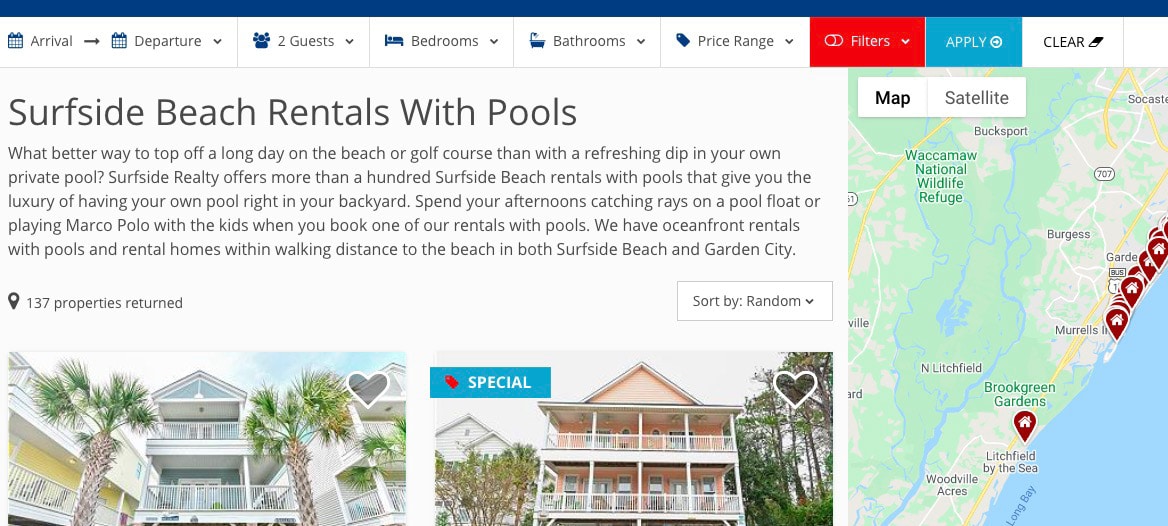
You can’t optimize your main results page for every long-tail (specific 3-5 word) rental keyword phrase you want to target. Yes, you can slip terms like “pet-friendly rentals” and “oceanfront rentals” into some places on the main page, but it won’t have the same search engine ranking benefit as a page built specifically for those terms.

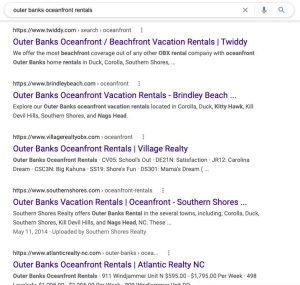
This is where the custom search results pages come in. Let’s say a vacation rental company in the Outer Banks (OBX) wants to target the search phrase “outer banks oceanfront rentals.” If the company wants a legitimate shot at ranking for such a competitive keyword, it will need to use “oceanfront” in the slug, H1, title tag, and a couple of times in the on-page text. Unless all properties are oceanfront, the company will need a separate oceanfront rentals page to accomplish this objective without being misleading.

This screenshot of the “outer banks oceanfront rentals” search results demonstrates how Google prefers custom search results pages over main results pages or homepages when it’s choosing what to rank for that term. Only two out of the top 20 results are not an oceanfront search results page.


We recommend trying to rank your main results page for your highest volume and most general terms (such as “outer banks rentals”) and then creating custom search results pages to target each of your long-tail keywords.

In addition to setting up custom search results pages for specific property types or amenities— like condos or rentals with pools—you can also create them for different resorts or condo complexes or to target specific locations within your main target area.

Using the example of the Outer Banks again, if you have properties across the OBX, you can set up pages for Corolla, Nags Head, Kitty Hawk, etc. to target terms for those areas while still targeting “outer banks rentals” with your main results page.

If you want to go a step further, break down the smaller areas with even more specific search results pages with property groupings such as Corolla oceanfront rentals, Corolla pet-friendly rentals, Corolla vacation home rentals with pools, etc.

Here are less common examples of custom results pages to trigger some ideas:

Luxury rentals

Large group rentals

Two (or any number) bedroom rentals

Handicap accessible rentals

Rentals with Wi-Fi

Rentals with boat slip

Oceanview rentals

Rentals with a hot tub

Rentals close to [a popular attraction in your area]


How Custom Search Results Pages Improve Conversion Rates and PPC Campaigns 

In addition to improving organic presence, custom search results pages also help the overall conversion rate of the site and improve the performance of your PPC campaigns. 

If you route people directly to the properties they’re searching for, they are likely to convert at a higher rate than people who have to take additional steps to get there. By bringing people directly to custom search results pages (through organic search results through PPC ads) instead of the homepage or main results page, you eliminate the need for guests to figure out your search filters or be forced to scroll through every one of your properties. 

If someone looking for Outer Banks oceanfront rentals clicks your search ad that has “OBX Oceanfront Rentals” in the title but gets directed to your main results page where non-oceanfront properties are mixed in, then you’re requiring them to put in extra and unnecessary effort to find the oceanfront rentals. Some users will take the time to figure out your search filters, but others will say, “Wait, most of these aren’t even oceanfront . . . ” and tab back to Google to click on a different result. 

In addition, PPC campaigns will earn a quality-score boost by using custom results pages. By having an Oceanfront Rentals campaign pointing directly to an oceanfront rentals page, you will improve the relevancy of your ads. This higher quality score will result in lower PPC costs and higher ad placement. If you are running search or display ad campaigns, these incentives should be reason enough to set up custom results pages. 


Setting Up Custom Search Results Pages and Linking to Them 

All websites are developed differently, and programming custom search results pages will be more challenging on some sites than others. It’s important, however, to create actual pages instead of creating queries off your main results page. 

Each of your custom results pages should have its own editable H1 tag, meta title, meta description, and slug. If your web development company sets them up as results page queries instead of distinct pages, it’s going to cost you a lot of the SEO and PPC value. 

Once you’ve built your custom search results pages, we highly suggest interlinking to them on your site. You can go to town setting up pages for every subgroup of properties you can think of, but if they’re not linked to anywhere on the site, Google won’t crawl them and they won’t rank well (and may not even get indexed). 


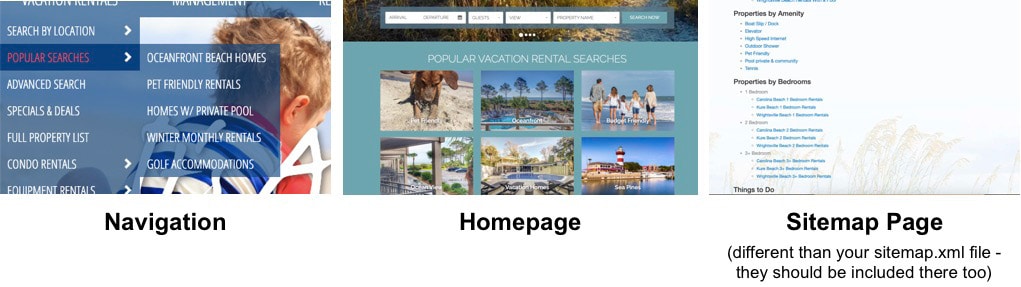
Common ways to effectively link your custom search results pages are from your navigation menu, from your home page, or from your site map.

You can also interlink within text content on your pages and blog posts. Linking to the custom search results pages will help their SEO performance and will make it easier for your users to find the properties they’re looking for.


Final Thoughts 

If you’re already using custom search results pages on your site, chances are there are some other property groupings you could use to target additional keywords you’re missing out on. Do some keyword research to find long-tail, rental-related terms that apply to your inventory and decide if building custom search results pages for those terms could benefit your rankings or user experience. 

If you have not already incorporated custom search results pages into your website, it is certainly worth considering the benefits they will have for your online marketing strategy as well as for your customers. 


Finding Better Property Management Software Solutions in the Vacation Rental Business with LMPM

0

When I first got started with the vacation rental industry in the mid-1980s, the landscape was fundamentally different. There was no internet or software to help us carry out our daily business. As an industry, we have moved a long way from tape boards, direct mail, paper brochures, and the telephone as our primary tools for handling reservations, marketing, and unit information. I remember what a huge deal it was to make the decision to go with First Resort Software (FRS, the precursor to V12) in the early ‘90s. Now we have multiple options for software, and the decision-making process is more complicated. Once you’ve made the decision, implementing new software is probably the most challenging thing you will ever do in business. It is safe to say that if you are not afraid of this process, you should be. 

Now OTAs have entered the business. At first, they basically replaced travel agents, who were a very small part of our business. However, they are now getting between us and our new and even existing customers. Nevertheless, great software can give vacation rental companies a critical advantage, one I wish we’d had back in the ‘80s. Not only do these innovative technologies increase efficiency and maximize revenue, but they also insulate your business against change. 

LMPM is the most modern PMS on the market today and is by far the best choice for vacation rental software that I’ve ever seen. In fact, I’ve tried most property management systems at some point, and I have years of experience with the vacation rental software industry. On this basis, let me give you some of the reasons why I joined LMPM as a board member and use it to run my business at a 350-unit rental company on the Gulf Coast of Florida. By the way, we operate with no main office, and most of our staff work from home. 


It’s critical to use technology to process-drive your business 

The most important part of our business is our employees. Your software should make their work as easy as possible. This is a complicated business, and anyone who tells you differently is a fool. Add to this the difficulty we all have with hiring and retaining good employees. Furthermore, we are in a business that in most cases is seasonal, which leads to higher turnover and a greater reliance on temporary employees than in other industries. 

Making your business process-driven is critical for efficiency and employee retention, and making complex tasks process-driven and easily repeatable makes work more fun. You can automate sending booking confirmations and check-in emails, task creation, work orders for cleaners and maintenance personnel, and much more. 

With LMPM, you can even automate the key components of your bookkeeping so that it takes place in real-time. 


You want a software company that is always looking for ways for technology to boost operating efficiencies 

Let’s go back to the early days of software. Back then, we were only looking for a way to handle reservations. Soon afterward, we wanted software that dealt with accounting as well, which is probably the most complicated matter for vacation rental software to deal with. Next came housekeeping, then maintenance integration, and then API connectivity to our own and third-party websites. 

No software is ever going to be perfect because change is inherent to the business. Don’t we all wish we had thought of HomeAway, Vrbo, or Airbnb first? Who knows what the next game-changer will be? I am not going to try to explain the details of LMPM’s software here, but I will tell you that it is the latest and greatest and can do all the things that I mentioned above. If you want a piece of software that can easily adapt to change, this is it. 


Future-proof your company with a modern platform 

Legacy software is a lot like an old house—it’s expensive to maintain, and things break frequently, but tearing it down and starting from scratch can be prohibitively expensive. 

Your technology partners can either be key allies adapting to change on your behalf or problematic associates holding you back. The question is this: Is your PMS company actively adding exciting new features, or are they primarily releasing bug fixes? Recent patch notes will tell the story here. 

You want a provider that regularly provides substantial updates to their product. In this way, your existing system continues to improve and adapt to change, enabling your vacation rental company to take advantage of new features. This is a much better way of adapting to change than the reverse, where your technology partners fall behind, years go by, and you suddenly realize that other providers have developed a wealth of desirable new features, forcing you to make a huge shift to a new platform. It is far better to be ahead of the curve. 

Given a choice between decades-old software and a modern platform with a very robust feature set, the modern platform is the way to go. 

Change is the only constant, but adapting to it doesn’t have to be a struggle. If you’d like to talk about technology and see a modern property management solution, please visit lmpm.com. 


Don’t Press Pause on Homeowner Marketing This Season— It’s Time to Hit the Gas!

1

If you had 10 more properties, could you book them? Spoiler alert: The answer is yes.

Demand for vacation rental properties is at an all-time high. Interest in safe and private properties for a getaway skyrocketed this summer, and the same will hold true for the winter season. Holidaymakers don’t want to be in crowded hotels; they want to minimize contact with others while still enjoying a relaxing escape.


“Our weekends sell out quickly, and the weeknight demand is higher than we have ever seen. We’ve been fortunate to add homes to our inventory, and as soon as they go live, they book up.”
– Jen Richards, Chattanooga Vacation Rentals


Now Is the Best Time to Add New Properties to Your Vacation Rental Program 

The more units you manage, the more potential revenue you can bring in. It’s as simple as that. However, with so much demand for short-term rentals, managing bookings and day-to-day operations can make it seem impossible to find the time to also attack inventory acquisition—but you need to. 

With bookings on the upswing and economic forecasts predicting that the market will reach $13.9 billion by 2027, acquiring inventory is essential for your business’s long-term growth plan. There has never been a better time to sign more homeowner contracts, so now the question is, how do you add 10 more properties to your program? 


How to Scale and Profit from Your Vacation Rental Business 

If you find growing your inventory is a difficult and time-consuming task, you’re not alone. Most vacation rental managers feel the same way. In fact, we secret-shopped over 100 vacation rental management companies in the United States and found that only 50 percent of our calls were answered. Let that sink in! 

We know you’re busy, so here are our top three tips and technology hacks to scale your business smarter, faster, and bigger. 


1. Save Time and Grow Faster with Technology and Tools 

Most vacation rental managers use a CRM on the guest side, but are you using one for your homeowners? Reduce the time and cost of adding a new property to your program with Vintory—the number one property acquisition platform designed exclusively for vacation rental managers to grow their inventories. Vintory is your simple-to-set-up, easy-to-use solution to consistently add new properties to your program. Get built-in lead nurturing automation, personalized AI, and centralized dashboards at your fingertips through the Vintory app. Capture more leads, close more deals, and spend less time worrying about when the next lead will arrive at your doorstep. 


2. Boost Your Marketing Conversions and Investment 

Masterful marketing is essential to growing any business. You need to understand your potential new owners’ problems and demonstrate how you will address them. Having a marketing whiz on your team who understands short-term rentals will help you quickly expand your portfolio. Vintory, in addition to offering its CRM services, has a team of 40+ industry-specialized growth experts who help property managers with all aspects of owner marketing, including building targeted campaigns, running paid ads, and retargeting. 


3. Work Smarter, Not Harder with Data-Driven Actions 

A successful acquisition strategy should be fueled by data. Data-informed inventory decisions can include which homeowners to target, how to market to these targets, how much to invest in your marketing campaign, and how many more properties will deliver both operational efficiencies and increase the value of your business. Using Vintory’s platform, you can quickly view all of your campaigns and focus your efforts on prospects who are most likely to convert, making the most of every marketing dollar you spend. These insights not only help you in the moment but also lead you to take data-informed actions for your long-term growth strategy. 


Don’t Press Pause on Homeowner Marketing This Season— It’s Time to Hit the Gas! 

Pressing pause on your homeowner marketing campaigns during the low season is the best way to invite your competitors to get in front of your properties and potential prospects. By the time your owners are waving goodbye, it will be too late to start marketing to get them back. This season, the vacation rental industry has been filled with more opportunities and competition than ever before. Now is the time to hit the gas on your inventory acquisition strategy, and the best way to do that with half the time, effort, and stress is to use Vintory. Go to vintory.com and book a demo to see exactly how we’ll help you add 10 more properties to your program. 


Dream Kitchens Sell: How Kitchens Define the Character of Vacation Rentals

4

Travelers are approaching staying in a vacation home in a whole new way. Years ago, vacation rental travelers prioritized the destination and cared little about the home’s décor. They viewed their vacation rental as a home base from which they could ski, fish, hike, go boating, or go to the beach. 

Now vacation homes have become the destination in themselves. And in this new world, kitchens define the character of the home, enabling vacationers to live in a fantasy—if only for a week. 

Click on the images below to expand.

[lvca_gallery_carousel enable_lightbox=”true” image_size=”full” display_item_title=”true” arrows=”true” dots=”true” autoplay=”true” autoplay_speed=”3000″ animation_speed=”300″ pause_on_hover=”true” display_columns=”3″ scroll_columns=”3″ gutter=”10″ tablet_display_columns=”2″ tablet_scroll_columns=”2″ tablet_gutter=”10″ tablet_width=”800″ mobile_display_columns=”1″ mobile_scroll_columns=”1″ mobile_gutter=”10″ mobile_width=”480″][lvca_gallery_carousel_item image=”525914″ href=”//www.cabovillas.com/“” target=”“_blank“” name=”Villa Turquesa by CaboVillas, Cabo San Lucas, Mexico” description=”Villa Turquesa by CaboVillas, Cabo San Lucas, Mexico”][lvca_gallery_carousel_item image=”525906″ href=”//www.akersellis.com/“” target=”“_blank“” name=”418 Amaranth Road by Akers Ellis, Kiawah Island, South Carolina” description=”418 Amaranth Road by Akers Ellis, Kiawah Island, South Carolina”][lvca_gallery_carousel_item href=”//iuriniccolai.it/“” target=”“_blank“” image=”525909″ name=”Dimora Bellosguardo Florence by The Villa Italy” description=”Dimora Bellosguardo Florence by The Villa Italy – Brand strategy and art direction: Paola Gheis Luxury Rental Consulting – Photography: Iuri Niccolaii – Styling: Silvia Garancini”][lvca_gallery_carousel_item href=”//www.akersellis.com/“” target=”“_blank“” image=”525907″ name=”542 Bufflehead Drive by Akers Ellis, Kiawah Island, South Carolina” description=”542 Bufflehead Drive by Akers Ellis, Kiawah Island, South Carolina”][/lvca_gallery_carousel]
[vc_custom_heading text=”” font_container=”tag:p|font_size:20|text_align:left|color:%23ffffff|line_height:1.5″ use_theme_fonts=”yes”]
[vc_custom_heading text=”“Kitchens define the character of the vacation home for luxury travelers.”” font_container=”tag:h4|font_size:28|text_align:right|color:%23ffffff|line_height:1.25″ use_theme_fonts=”yes” css=”.vc_custom_1634227745093{margin-right: 20px !important;padding-right: 50px !important;padding-bottom: 30px !important;padding-left: 10px !important;}”]

Above Photo: Villa Turquesa by CaboVillas, Cabo San Lucas, Mexico

Creating a clean and safe kitchen is an important step in providing a professional experience for guests, and a great place to start is with a bright, clean kitchen design.

Left & Below Photo: Dimora Bellosguardo Florence by The Villa Italy  – Brand strategy and art direction: Paola Gheis Luxury Rental Consulting  – Photography: Iuri NiccolaiiStyling: Silvia Garancini

[vc_custom_heading text=”Sleek & Modern” font_container=”tag:h1|font_size:40|text_align:center|color:%23ffffff|line_height:1″ use_theme_fonts=”yes” el_class=”kitchen-shadow”]


Below Photo:  542 Bufflehead Drive by Akers Ellis, Kiawah Island, South Carolina

[vc_custom_heading text=”Bright & Clean” font_container=”tag:h1|font_size:40|text_align:center|color:%23ffffff|line_height:1″ use_theme_fonts=”yes” el_class=”kitchen-shadow”]


[lvca_spacer desktop_spacing=”15″ tablet_width=”960″ tablet_spacing=”10″ mobile_width=”480″ mobile_spacing=”10″]
[vc_custom_heading text=”Entertaining…” font_container=”tag:h1|font_size:40|text_align:center|color:%23ffffff|line_height:1″ use_theme_fonts=”yes” el_class=”kitchen-shadow”]

Html code here! Replace this with any non empty text and that's it.

Above Photo: Riverscape by Blue Sky Vacation Rentals, Ellijay, Georgia

“Imagine, on your next vacation, whipping up meals in a killer kitchen. In the last five years, the number of Americans skipping the hotel and going the home-rental route has tripled, and for food lovers, that means being able to stay in a ‘4-bedroom with a lake view’— and well-seasoned skillets, an arsenal of Japanese knives and a six-burner range.”
Rachel Ray Magazine

Left & Below Photo: Iron Mountain Chalet by Natural Retreats in Park City, Utah

[vc_custom_heading text=”With A View” font_container=”tag:h1|font_size:40|text_align:center|color:%23ffffff|line_height:1″ use_theme_fonts=”yes” el_class=”kitchen-shadow”]

Html code here! Replace this with any non empty text and that's it.

Click on the images below to expand.

[lvca_gallery_carousel enable_lightbox=”true” image_size=”full” display_item_title=”true” arrows=”true” dots=”true” autoplay=”true” autoplay_speed=”3000″ animation_speed=”300″ pause_on_hover=”true” display_columns=”3″ scroll_columns=”3″ gutter=”10″ tablet_display_columns=”2″ tablet_scroll_columns=”2″ tablet_gutter=”10″ tablet_width=”800″ mobile_display_columns=”1″ mobile_scroll_columns=”1″ mobile_gutter=”10″ mobile_width=”480″][lvca_gallery_carousel_item image=”525912″ name=”Riverscape by Blue Sky Vacation Rentals, Ellijay, Georgia” description=”Riverscape by Blue Sky Vacation Rentals, Ellijay, Georgia”][lvca_gallery_carousel_item image=”525911″ href=”//www.naturalretreats.com/“” target=”“_blank“” description=”Iron Mountain Chalet by Natural Retreats in Park City, Utah” name=”Iron Mountain Chalet by Natural Retreats in Park City, Utah”][lvca_gallery_carousel_item href=”//www.naturalretreats.com/“” target=”“_blank“” image=”525908″ description=”Arendelle by Natural Retreats, Breckenridge, Colorado” name=”Arendelle by Natural Retreats, Breckenridge, Colorado”][/lvca_gallery_carousel]
[lvca_spacer desktop_spacing=”15″ tablet_width=”960″ tablet_spacing=”10″ mobile_width=”480″ mobile_spacing=”10″]
[vc_custom_heading text=”Small Kitchens” font_container=”tag:h1|font_size:40|text_align:center|color:%23ffffff|line_height:1″ use_theme_fonts=”yes” el_class=”kitchen-shadow”]

Html code here! Replace this with any non empty text and that's it.

Above Photo: Sona Tra by Starfish Luxury Rentals, Arch Cape, Oregon

“To create a welcoming atmosphere, clients are looking for ‘unshackled whimsy’ in kitchen décor this year, said New York interior designer Nancy Mayerfield, who has been fielding clients’ requests for colored appliances” – Wall Street Journal

Right Photo: Villa Turquesa by CaboVillas, Cabo San Lucas, Mexico
Below Photo: Heaven’s Hideaway by Shenandoah Rentals, Luray, Virginia

[vc_custom_heading text=”With Character” font_container=”tag:h1|font_size:40|text_align:center|color:%23ffffff|line_height:1″ use_theme_fonts=”yes” el_class=”kitchen-shadow”]

Html code here! Replace this with any non empty text and that's it.

Click on the images below to expand.

[lvca_gallery_carousel enable_lightbox=”true” image_size=”full” display_item_title=”true” arrows=”true” dots=”true” autoplay=”true” autoplay_speed=”3000″ animation_speed=”300″ pause_on_hover=”true” display_columns=”3″ scroll_columns=”3″ gutter=”10″ tablet_display_columns=”2″ tablet_scroll_columns=”2″ tablet_gutter=”10″ tablet_width=”800″ mobile_display_columns=”1″ mobile_scroll_columns=”1″ mobile_gutter=”10″ mobile_width=”480″][lvca_gallery_carousel_item image=”525913″ name=”Sona Tra by Starfish Luxury Rentals, Arch Cape, Oregon” description=”Sona Tra by Starfish Luxury Rentals, Arch Cape, Oregon”][lvca_gallery_carousel_item image=”525910″ name=”Heaven’s Hideaway by Shenandoah Rentals, Luray, Virginia” description=”Heaven’s Hideaway by Shenandoah Rentals, Luray, Virginia”][lvca_gallery_carousel_item name=”Villa Turquesa by CaboVillas, Cabo San Lucas, Mexico” image=”526114″ description=”Villa Turquesa by CaboVillas, Cabo San Lucas, Mexico”][lvca_gallery_carousel_item name=”Arendelle by Natural Retreats, Breckenridge, Colorado” image=”525935″ description=”Arendelle by Natural Retreats, Breckenridge, Colorado”][lvca_gallery_carousel_item name=”Westcott House by Shenandoah Rentals, Luray, Virginia” image=”525938″ description=”Westcott House by Shenandoah Rentals, Luray, Virginia”][lvca_gallery_carousel_item name=”Arendelle by Natural Retreats, Breckenridge, Colorado” image=”525936″ description=”Arendelle by Natural Retreats, Breckenridge, Colorado”][lvca_gallery_carousel_item name=”Arendelle by Natural Retreats, Breckenridge, Colorado” image=”525937″ description=”Arendelle by Natural Retreats, Breckenridge, Colorado”][/lvca_gallery_carousel]

Limited Edition 

VRMB founder Matt Landau talks about what makes a vacation rental “limited edition” in the minds of consumers. When people go on vacation, they are looking to escape their everyday lives to rejuvenate, recharge, and get inspired. The kitchen is the heart of the home and sets the tone for their vacation experience. So, get creative while considering what would inspire your guests. 

Whether it is a showstopping backdrop, memorable breakfast nook with a view, luxury appliances, eye-catching hardware or a well-placed natural feature, the kitchen is the perfect room in the vacation home to build the character that defines the home, sets it apart from the competition, and makes the vacation memorable. 

According to designer Tara Mastroeni, “The chance to decorate a vacation home is a rare and exciting opportunity. While it follows the same fundamental process of primary home designs, there’s something special about knowing you have the chance to decorate your own great escape.”


Additional Photo Credits:
Arendelle by Natural Retreats, Breckenridge, Colorado

Westcott House by Shenandoah Rentals, Luray, Virginia

Staying Focused in the Off-Season: Digital Marketing Strategies that Will Bring More Bookings for Less Spend

1

The vacation rental industry’s record-setting summer has come to a close, and 2021’s fall “off-season” promises to be just as unprecedented–and likely more unpredictable–as the months preceding. How do you market your business during an offseason . . . that isn’t? How do you address ongoing health concerns and the potential reemergence of difficult restrictions? These are daunting tasks. To help, we’ve asked Bluetent’s ace digital marketing team to provide their tips for 2021’s coming months. 


ADDRESSING UNCERTAINTY 

“When I talk to vacation rental managers about their digital marketing strategy, a key point right now is staying nimble,” says digital marketing sales executive Jessie Hjorth. “Be ready and able to address changes as they happen, and use the opportunity to make your brand a trusted resource for travelers. Create purposeful content on your website—whether it’s blog posts, updated event pages, or COVID-19 resource pages—that addresses concerns travelers might have about your destination’s safety or current restrictions. You can build a lot of trust by answering their questions before they have a chance to ask. And an added bonus: Google rewards this type of content.” 

Hjorth also urges vacation rental managers to remember the lessons we learned in 2020. “During last year’s downturn and closures, the brands that chose to continue even a scaled-down version of their digital marketing efforts were able to preserve their rankings in organic search results,” she states. “In fact, because their competitors dropped out, many brands even improved their presence on search pages—and for a smaller Google Ad spend.” 


DITCHING DISCOUNTS and CHANGING FOCUS 

This year’s vacation rental bookings have gone through the roof, making it necessary to adjust the standard focus of digital marketing efforts. Two distinct marketing trends are important to note: increasing revenue per reservation and acquiring new inventory. 

Senior strategic account manager Kara Kacmarcik gives this advice: “With the wild successes in our industry this year, your brand’s digital marketing strategy is not necessarily going to be about deep discounts. It’s more about adding value to whatever you’re already offering your guests. Be in touch with your reservation staff to learn what guests are seeking, and use your data to really hone in on what kind of value-added packages and content you can offer.” 

Marketing your brand’s add-ons and packages isn’t the only way to increase revenue this year, however. “There’s never been a better economic climate for expanding your property portfolio,” states strategic account manager Eliana Miteva. “Right now, there are fabulous opportunities for small- to mid-size vacation rental brands to build inventory. Now is your time to shine: show prospective owners your superior value and service.” 


MAKING THE MOST OF YOUR ONLINE ASSETS 

Your digital marketing efforts, at their core, are meant to bring travelers to your website to book the perfect vacation rental. “It’s easy to get caught up in only one aspect of a website’s functionality: direct booking. But there’s so much more to a modern vacation rental website! It’s all about the experience a traveler has while they’re searching your site,” says Hjorth. “A website that is built not only to mesh with, but enhance, your digital marketing strategy can really position your brand ahead of the competition.” 

To prove the value of pairing the right digital marketing plan with the right website, Bluetent data analysts put their Rezfusion Cloud web platform to the test. “Search engine visibility was front of mind when we originally built Cloud. As we’ve upgraded and released new features on the platform, the results have only gotten better,” says vice president of product Tom Kenyon. 

The data confirmed Kenyon’s sentiment. Bluetent clients who added digital marketing services onto their existing Cloud web subscription have seen stellar results. “In one case, the client saw a 670 percent increase in online revenue, and it was common for clients to see numbers like a 175 percent increase in online transactions or a 115 percent increase in e-commerce conversion rates,” Kenyon reports. 


ASSEMBLING THE BEST TEAM 

There’s no shortage of online advice regarding the perfect digital marketing plan. Finding experts who have their eyes on the overall economic climate, know what works best for our industry, and understand the unique nature of your specific business, market, and competition is essential to the success of your strategy. 

Are you interested in tapping into Team Bluetent’s wealth of digital marketing knowledge? Reach out at bluetent.com/connect-with-us. 


Using Triggered Automations to Provide a Superior Guest Experience

0

Technology can’t replace good people, but it can help you stay on top of routine tasks that affect the guest journey. 

Right now, you’re probably seeing awesome occupancy and record revenue. But, chances are, you’re also finding it difficult to hire and keep good employees. We can’t know how long the current hiring environment will persist, but we do know that it has exposed operational inefficiencies and workflow issues across the board. A full and competent staff can overcome or at least hide these challenges, but trying to do more with less has a way of showing the cracks in your operational foundation. 

Better technology may be the answer. When you’re already stretched thin, the thought of changing things up might give you hives, but sometimes it’s the only way to give yourself a break while continually improving. 

Welcome to the wonderful world of triggers and automations. 


What Triggers and Automations Are (and Are Not) 

In 2021 and beyond, the key to making sure routine tasks are done accurately and on time is through automation. 

Basically, automations use triggers to set one or more actions into motion, sometimes called “if this, then that.” Both direct and third-party bookings run through your property management system (PMS), and anything that happens in your PMS could be a trigger that instantly generates an email, a work order, a calendar item, and so on. Taken together, these individual steps form an automated workflow. 

Many common triggers are related to email marketing, such as a sequence of emails that go out once a user completes a form. But more sophisticated workflows that depend on data from your PMS can be tricky and often require yet another third-party tool like Zapier or ITTT to work. 

Our Track PMS platform enables at least 1.2 million different triggered automations (we’ve done the math). Practically anything that occurs (or could occur) in a connected digital space can be automated. 


Extra Hands and Timely Touches 

When it comes to repetitive tasks and time-consuming processes, automations can be like having an extra set of hands. 

Let’s say you review your bookings at the end of the day and add them to a Google Sheet shared with your housekeeping and maintenance staff. The purpose is to keep them updated on arrivals and departures so they can plan ahead. But think of the steps involved. You need to run a report and either manually enter the data or copy and paste. Your housekeeping staff then needs to go to the document, review it, and assign the work accordingly. When they’re finished, they call in or complete a report so you can note that the property is ready. 

You can automate all that! Once your booking engine is integrated with Track PMS, it will update your calendar and notify housekeeping via text or email about new bookings or changes, all in real-time. Meanwhile, your staff can use a smartphone to quickly note when cleaning begins and ends, which updates your master calendar automatically. 

All you did was set up the workflow; the rest happens without your direct involvement but is still accurate, organized, and current. 

That makes your life easier, but what about your guests? 


Automations Dazzle and Delight at Every Step in the Guest Journey 

This is especially true when it comes to communications. Timely, relevant messages make guests feel valued and that their needs are understood. Emails with time-based, pre-arrival triggers, for example, can steer them toward helpful information ranging from road closures to area attractions. Mobile triggers, such as smartphone check-in, can let you know they’ve arrived and are happy with everything while simultaneously changing the property’s status in Track PMS. 

Once you set up and test an automation, it runs all day, every day without complaint. Would an employee do that? Would you ever expect them to? Of course not. Automations work while you sleep to help make life easier and deliver a superior guest experience. Everything from communications to lead follow-up to accounting and billing to work orders can be automated, even with complex dependencies and multiple steps. 

If you wish you had an extra set of hands, talk to us. Our Keystone Award-winning Track PMS was just dubbed “Software of the Future” by VRMB and has all the integrations and automations you need to close the gaps between where you are and where you’d like to be. 

For more information on Track automations, visit trackhs.com/automation. 


Higher Multiples & Lucrative Structure: Key Ingredients that will Allow Your Company to Sell

1

In the first two articles of this series, we explored the best strategies to prepare your short-term vacation rental company to sell. Now that you have grown your revenue and inventory, hired the appropriate staff, and updated your management contracts, your company is ready to receive an offer. 

In this final article, we will examine multiples and structures of common deals in the current market. Although higher multiples increase the overall purchase price, the structure and terms of pay-out can be the most crucial part of the offer. 


MULTIPLES 

Of course, every seller wants the highest offer for their company, and a multiple of your financial position is where your buyer will start. 

Adjusted EBITDA 

EBITDA represents your earnings before interest, taxes, depreciation, and amortization. In our “Back of Napkin Analysis,” we discussed common add-backs and deductions to help you find your adjusted EBITDA (AE). 


Up to $1 Million Adjusted EBITDA 

For companies with up to $1 million AE, the current market multiples are three to five times LTM (last twelve months) AE or a weighted average of the previous 36 months, with heavier weight on the more recent periods. If your company did $750K AE, you can expect somewhere between $2.25M and $3.75M on the initial offer. 

What multiple will you get? We also dove into the subjective aspect of higher multiples in the “Back of the Napkin Analysis” article, but below are some of the major factors that are important to buyers: 

Unit growth and revenue growth per unit 

How “hot” the market is (i.e., longer and more frequent peak seasons, higher management commissions, available inventory) 

Staff and management contracts 

The terms you are willing to accept (We’ll get into this below) 


Over $1 Million Adjusted EBITDA 

Most short-term vacation rental companies do not fall into this category, so we will not dive in too deep. If your company is doing over $1 million in AE, has unit count growth, revenue growth, and has a strong staff, you can likely command a premium multiple higher than the three-to-five range. 


Net Revenue “Take” 

Net revenue or “take” represents your management commissions and ancillary fees. Ancillary fees are all the extra fees a guest pays, such as damage waivers, booking fees, or housekeeping fees. 

Other than looking at multiples of adjusted EBITDA, we are also seeing buyers make offers of approximately one times the net revenue. 

For example, if your company takes $750k in rental commissions and $500k in fees, you could be looking at an offer of $1.25 million. 


STRUCTURE AND TERMS 

As mentioned above, a high purchase price may look appealing, but the devil is truly in the details. 

How “clean” is your company? Do you have consistent growth? Can your staff operate efficiently without you? Are all your management contracts assignable and auto-renewable? How clean your company is will determine the terms of the deal. 

In today’s market, we typically see 50–75 percent cash at closing and 25–50 percent in notes from one to five years. The buyer note may or may not be contingent on certain factors, which can be negotiated. These contingencies are normally based on consistent revenue, unit declination, or the owner staying on for an agreed amount of time. 

While you may be cautious of a buyer note full of contingencies, there can be substantial earn-outs for sellers. We’ve seen buyers offer an extra $10,000–20,000 per additional unit onboarded for one year after the sale. That could be an extra several hundred thousand dollars if you’re a rapidly growing company. 

Remember, better positioning your company to sell directly correlates to higher multiples and more lucrative terms. 


Safety First: Evaluating and Addressing Safety Risks at Your Vacation Rentals

4

On an early January morning in 2021, a devastating fire broke out in a vacation rental home in Malibu where smoke alarms had not been installed. Just 111 days earlier, the Malibu City Council had enacted an ordinance that, among other things, mandated smoke alarms be installed in all short-term rentals. This ordinance was overdue because the state had accepted the International Building Code’s guidance that smoke alarms be installed in all transient rentals in the state years ago. 

The tragedy in Malibu exposes that without precautions, occupying a dwelling—whether a hotel, condo, vacation rental, or house— poses many risks. 

To address the potential hazards of staying in a hotel or motel and acknowledge the evolving need for fire safety in the hospitality industry, the U.S. government adopted the Hotel and Motel Fire Safety Act of 1990. The act recognizes that correctly installed and maintained smoke detectors and safety markers provide the most effective safeguards against fire incidents at hotel properties. Sprinkler heads, smoke detectors, maps of fire exits, and fire extinguishers in the hallway are some of the many features that hotel guests commonly encounter as a result of this act. 

Contrast this with occupying a vacation rental or someone else’s home; sadly, similar government precautions have not been put in place. The number of fire-related tragedies and other accidents at rental homes are on the rise, and because mandatory safety elements such as hallway lighting, exit markers, and clear indicators of where fire extinguishers are located have not been established, many renters who are unfamiliar with a property could be in danger. 


Understanding Fire Safety 

So how do you keep your guests safe in your vacation rentals and keep your team safe when doing the same? Smoke alarms are simple but vital home safety features and can make all the difference when properly installed. The National Fire Protection Association says that three out of five home fire deaths result from fires in properties without working smoke alarms, and 38 percent of home fire deaths result from fires in which no smoke alarms are present at all. When looking to install or update a smoke alarm, there are several ways to ensure you are meeting this safety standard. 


1. Choose the best smoke alarm on the market. Consumer Reports ranked smoke alarms in 2019 and revealed that dual detectors (which use ionization and photoelectric sensors) rank the highest. 

2. Make sure your smoke alarms are less than ten years old. Statistics show that each year a smoke alarm ages, it becomes less reliable. There is a 30 percent failure rate for smoke alarms older than ten years. Because of this, many models now come with a ten-year sealed battery. 

3. Interconnect your smoke alarms. Today’s technology allows smoke alarms to “talk” to each other through wired or wireless communications. A warning for a fire in one area of the home alerts the alarm in another area and will provide more time to notify occupants and let them escape. 


Further Instrumental Rental Home Safety Precautions 

Although fire and smoke accidents are some of the more publicized misfortunes that can occur in a vacation rental, there are many other risks guests encounter that need to be addressed. 


Slips, Trips, and Falls 

In 2019, 83 percent of all insurance claims submitted to Proper Insurance—a leading vacation rental insurance company—were from slips, trips, or falls. Preventing these hazards and injuries in your rentals is actually extremely easy. Making sure handrails are installed on all stairs that meet International Building Code Standards and that the rental walkways, inside and out, are well lit and easy to navigate are simple solutions to a potentially dangerous situation. Ensuring carpets and other trip hazards are secured from sliding and do not have turned up corners is another easy protectant against trip and fall accidents. 


Pool and Hot Tub Safety 

Unfortunately, pool and hot tub accidents are a leading cause of fatality for people under the age of ten at vacation rentals. Guests— many of whom do not have pools at home—often do not have the knowledge or experience to understand the details that constitute lifesaving precautions at a pool. Property managers should have necessary items such as locking covers, pool rescue poles, life rings, and easily accessible ladders at their properties and should clearly communicate to guests where they are located and how to operate them. Properly installed fences and safety gates with childproof locks are also a smart installation to provide further protection from unwanted access to water amenities. 


Other Amenities 

Many property owners are surprised to learn that the amenities they offer such as fire pits, grills, bikes, baby gear, or other “bonus” items are actually sources leading to an increasing number of accidents.

Although they are a great addition and favorite feature of many vacation homes, grills and fire pits require specific placement and clear operating instructions to prevent accidents. Grills should be placed at least three feet from combustible walls, fences, or other structures and should have a minimum of nine feet of overhead clearance from the grill surface. Fire pits should be placed at least 20 feet from the home and not have trip hazards around them. Additionally, the inspection of gas line connections and tank o-rings will ensure that grill and gas firepit fuel sources don’t leak. 

Property managers and homeowners should consider the risks of offering bikes, golf carts, watercraft, or other transportation options with their rental. Although having these amenities at your home(s) can be great for guests, the risk associated with them is high. Unless a thorough inspection program is in place to inspect all these items before each renter uses them, and unless proper safety equipment such as helmets and life jackets are available for their use, these items should not be offered or available. 

With many families traveling and looking to spend quality time together, it may seem like a generous offer to let renters use old cribs, highchairs, and portable playpens. Unless each of these items is personally inspected before each use, they pose the potential for tremendous risk to your business and, more important, they may cause harm to a child. 


Professionalism requires Safety Awareness 

Reducing risk in your vacation rental(s) protects you and the homeowner, helps ensure the safest and best experience for guests, and establishes your position as a professional. Across the United States, groups are coming together at a local level to address safety issues and regulations. Many of these groups are coordinated or supported by Rent Responsibly, a community-building and educational platform for local short-term rental alliances. Insurance companies such as Proper Insurance are leading the way to help make rentals safe to reduce insurance claims and prevent renter injuries. At Breezeway, we have developed safety checklists and inspection programs to help ensure property owners get their rentals up to current safety standards. 

The subject of safety is important and can provide common ground for homeowners, insurers, and local regulators to work together to improve their communities and industry. Responsible managers who address safety items in their rental properties are more likely to address other concerns—such as parking, trash, and parties— which may ease community tensions over vacation rentals. By putting in time, effort, research, and the correct safety precautions, vacation rental managers can have a positive relationship with the community and provide the best experience for their guests. 


Implementing Change in Your Organization by Creating a Culture of Inclusion

0

Have you ever implemented a new technology or process in your company and wondered why it took so long or felt so difficult? Maybe it looked more like the spaghetti method—you throw it on the cabinet and see if it sticks. However, with the right focus and outline, the process can be much easier for you and your team. 

According to research, three skills provide the necessary connection between the process part of change and the people part of change. The three Cs are communication, collaboration, and commitment. The words are easy to say, but how do we implement these three Cs? 

Following is a two-part, step-by-step process to set you and your team up for success. If you have already done personality assessments with your team or the TIGERS (trust, interdependence, genuineness, empathy, risk, and success) team wheel game, this knowledge about your staff will assist you with the process. 


Focus on the Emotional Target 

The first part involves focusing on the emotional target, which includes getting the team to a place of being accountable and committed to achieving the plan’s objectives. Some might also consider that it engages the right side of the brain before shifting to the left side. Often this part will take teams up to three hours to complete using the following four steps: 


Step 1: Outline the plan 

I will use a technology changeover and implementation as an example. You will review with the team why the change is happening, the desired ground rules for implementing the plan, and the steps that are important for effective planning. Many vacation rental management companies have encountered problems with new technology as a result of some platforms not integrating well together or some platforms choosing not to grow or expand. It is important for the team to understand in detail why the change is happening. 


Step 2: Consider what success looks like 

Discuss what success looks like for everyone. This might mean reducing double entry as much as possible, having enough staff to help with the process so it doesn’t feel too overwhelming, and eliminating redundant steps in daily processes. It is important to bring in personal satisfaction as much as task success. 

Recently, a business owner implemented a new technology platform in her business, and I asked her what she would have done differently, knowing what she knows now on the other side of the change. She said, “I would have staffed up and accepted the decrease in net revenue during the transition.” 


Step 3: Admit reality 

Review what team members bring to the table as positives and how others will struggle. In most companies, some team members are more “techy” than others. That is okay, but it’s important to acknowledge that and place people based on their strengths for a successful implementation process. For example, some members are better at looking at the process at a high level while others are great at digging into the details or testing and troubleshooting. You need all kinds of strengths to have a well-oiled machine when undertaking change. Discuss what will work best and address areas that could lead to problems during the process. If a leader is constantly going to an employee who isn’t strong in the area for which they‘ve been assigned, it will create frustration for the leader and can make the employee feel undervalued or incapable. 


Step 4: Outline an agreement with the team for commitment 

It is recommended this agreement contains wanted behaviors, ground rules, communication techniques, and decision processes. The agreement will support everyone in being accountable for their part in the change. 


Focus on the Goal Target 

The second part involves focusing on the goal target. This part is where you delve into the action planning of the process. This four-step process can take anywhere from four to six hours of focused time with the team. 


Step 1: Document the tasks at hand 

Review and document the actions that will occur during the process. Gather the actions and divide the members into subteams to finalize the actions. Sometimes, technology platform companies will give you this information; in that case, the head implementation team member can still undergo this process with the team and then add in areas the technology company may not have considered. What information needs to be saved from the previous platform to move to the new one? How do you transfer information to reduce duplication and ensure clean data? 


Step 2: Create the timeline 

As we know, timelines are great to have, and they will be flexible based on business flow and running into glitches. Ensure this timeline is somewhere everyone can always access it, and reference it throughout the process to keep on task. 


Step 3: Coordinate the final details 

The team will discuss leadership roles in specific areas such as decision-making, task reporting, communication, and specific tasks which must be completed before other tasks can begin. 


Step 4: Resolve and pull it all together 

This is where you will have the team meet and agree that everything is covered. Some teams like to create a theme for the implementation with a title and slogan to create focus and team spirit. This is a great time to bring the creatives into the mix so they feel like they are adding value to the change. 

This process can be enhanced by a leadership facilitator who is in the company or an outside consultant. If you are looking to be certified in this area, Dianne Crampton of corevalues.com offers such certification to company leaders. I have found the certification to be extremely helpful, and it has allowed me to offer teams support during change and implementation in their companies without the 65 percent failure rate so many change initiatives face. 

Change is always happening in companies. It can involve hiring a new team member, implementing a new position as the company grows, or even adding company values and a mission statement. It is all about how we as leaders implement the change with the teams to create a culture of inclusion and honor the three Cs. 

“A leader’s job is not to do the work for others; it’s to help others figure out how to do it themselves and to succeed beyond what they thought possible.” —Simon Sinek 


Stays Group Announces Guest Loyalty App for Vacation Rental Travelers

1
vacation rentals at the best price

The first guest loyalty app that supports independent vacation rental professionals

The beta release will take advantage of the rapid growth of the Stays Group network of independent vacation rental operators in key leisure destination markets in Hawaii, California, Pacific Northwest, Southwest, Northeast and Southeast. 

The Stays Group app will play an essential role in recognizing and rewarding loyal vacation rental travelers who recognize the value of #BookDirect and appreciate the importance of having flexible cancellation policies, local experts who support their local communities, real time local information and of course, the industry’s only best price guarantee. 

“Four years ago, a group of independent vacation rental professionals chartered a course to lessen their dependence on the OTA’s and provide a marketing platform that can protect their respective brands into the future.  The return on investment from the marketplace and the Stays Connect program has proven to be a game changer in how trusted independent brands work together to drive more direct bookings and brand visibility. 

As a result, our loyal guests have embraced our ability to extend our inventory beyond our local destinations.  The Stays Group loyalty app is a natural extension of the value add we have created for our guests and our NWVRP stakeholder members. ”said, Vince Perez, CEO of Fetch My Guest, Partner – Beach House Rentals and NWVRP Member.

“As a board member of the NWVRP since 2017 and as current President, our core values and mission continues. We work together as a group of independently owned and operated property management companies in a collaborative fashion to provide solutions for our members to reduce dependencies on the OTA’s while simultaneously strengthening our book direct philosophy.

In 2017, we partnered with the Stays Group and launched NorthwestStays, our first marketplace. To date, we currently have five regional marketplaces that serve our exclusive member community. The recently introduced Stays Connect program links our companies together to provide members and their loyal guests with an extensive inventory throughout the United States and Canada.  Now, after many months and one pandemic later, we are proud to announce at the 2021 NWVRP conference, the newest member service benefit, the Stays Group Guest Loyalty App. We are excited to be able to provide this new service for our members and are looking forward to 2022. ” said John Pickart, President of the Northwest Vacation Rental Professionals.

To learn more about our exclusive membership: https://calendly.com/staysgroup/60min


The Value of Direct Bookings vs. the Airbnb & Vrbo Demand

4

KPIs Show the Value of Direct Bookings, but Airbnb is Quickly Gaining Ground as a Percentage of Total Revenue 

The following data sets were provided by Key Data and represent 2020 and 2021 booking data for professionally managed US vacation rentals year to date (TYD) as of September 8 for both years. 


The barrier to entry for starting a vacation rental management company is currently low. New companies form easily and often, and they’re able to secure bookings and revenue simply by listing rental homes on Airbnb and Vrbo. This is possible because the industry is experiencing high consumer demand and constrained supply. Although demand for vacation rentals has been steadily increasing for over a decade, it catapulted during the pandemic as leisure travelers flocked to home rentals instead of hotels and cruise lines, and the existing supply of available vacation rentals has not kept up with demand. 

However, solely listing homes on Airbnb and Vrbo is not a sustainable marketing strategy. Travel behavior is cyclical when demand compresses and supply catches up, simply listing homes on Airbnb and Vrbo will not bring in enough revenue to support current business models. Building direct business is critical for long-term success. 


All Bookings Are Not Equal 

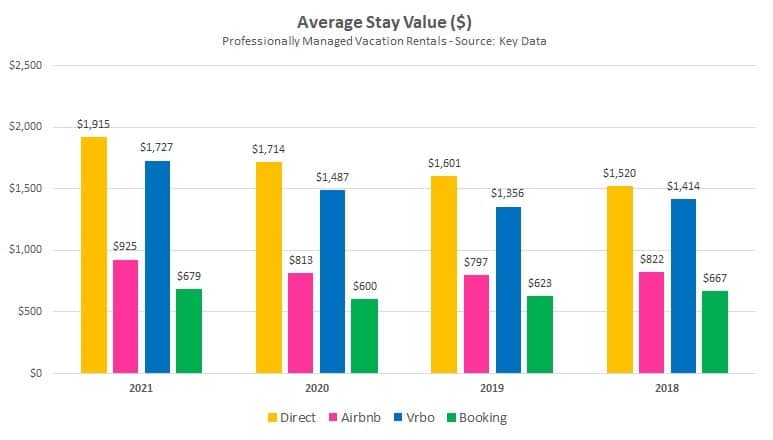
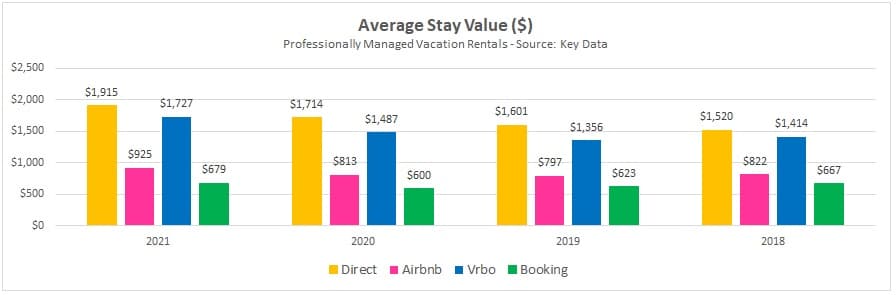
All bookings are valuable, but all are not equally valuable. The chart below shows average stay values (ASV) for US bookings across channels. 

In 2021, the ASV for direct bookings year-to-date (YTD) as of September 8 was $1,935, up 13 percent from 2020. In contrast, the ASV on Vrbo was 9 percent lower at $1,764. 

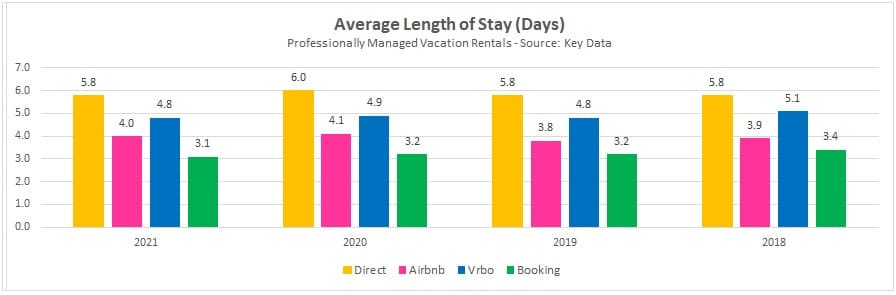
But take a look at Airbnb, which had an ASV of $906, more than 53 percent lower than direct. You’ll see as you continue reading, the difference in ASVs is the result of a combination of higher average daily rates (ADRs) and longer stays for direct bookings. 

Another way to look at it is that it takes 2+ bookings on Airbnb to equal one direct reservation. 

Although revenue is important, there are other reasons direct bookings are more valuable: 

Lower costs of acquisition over time 
Longer lengths of stays 
Longer booking windows 
Increased ability to communicate and manage guest expectations 
More opportunities to vet guests and spot potential problems early 
More repeat stays 
Less wear and tear on properties 
Less burden on housekeeping and operations 
Increased homeowner satisfaction


How Understanding Performance Data Affects Revenue Management Strategy 

At the recent Vacation Rental Data and Revenue Management (DARM) Conference, attendees discussed how and why revenue management strategies should differ across channels, as consumers behave differently depending on which channel they are using. For example, Airbnb’s guests are more likely to book shorter stays and more last-minute stays.

We also learned that the main levers revenue managers pull to affect performance are rate, minimum stay requirements, and booking window (days between the reservation date and booking date). Revenue management success requires:

a strong grasp of property and benchmark performance data
an understanding of how channels perform for different regions and property types
skill and optimizing listings on each channel

Let’s take a broad look at US performance across channels, dive deeper into regional performance, and then drill down even further into rental performance by bedroom size.


US Vacation Rental Performance KPIs 
by Booking Source 

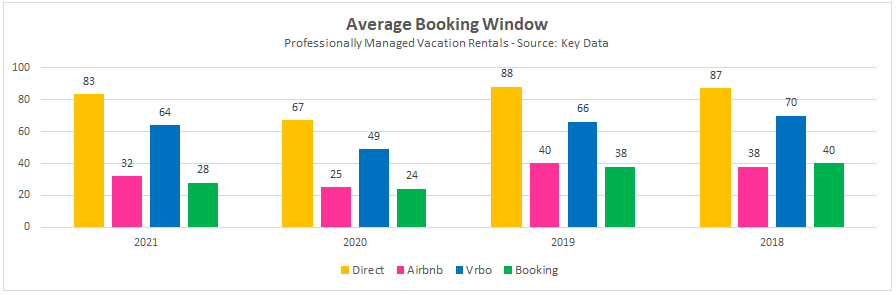
The four charts below examine ADR, average length of stay, average booking window, and percentage of total revenue by channel. 

Increased demand allowed property managers to increase rates resulting in higher ADRs, which we saw in most US leisure markets. The shorter average length of stay and longer average booking window in 2021 over 2020 represent a slow return to 2019 numbers (read more on page 76). 

Notably, all three of these KPIs were significantly lower on Airbnb compared to other channels. Comparing direct bookings to Airbnb, ADR was 34 percent lower, the average length of stay was 31 percent smaller, and the average booking window was a whopping 63 percent shorter for bookings on Airbnb. 

The most concerning number is found in the Percentage of Total Revenue by Booking Source chart, which shows that direct bookings as a percentage of total revenue decreased 20 percent in 2021 (47 percent in 2020 vs 38 percent in 2021). 


avg-daily-rate

avg-length-of-stay

total-us-bookings


Regional Key Performance Indicators (KPIs) for Professionally Managed Vacation Rentals
(YTD as of September 8)

Although it is important to monitor national trend benchmarking, the real value comes by tracking the market(s) in which properties are located. In the regional tables below, a few KPIs stand out. For example, in each of these regions, the percentage of total revenue for direct bookings dropped by double digits.

The Gulf Coast saw the biggest hikes in ADRs. In the Southern Appalachian region (which includes mountain regions in Tennessee, Georgia, and North Carolina), the average length of stay dropped on all third-party channels but increased for direct bookings. Colorado is the only region we examined with over 16 percent of revenue coming from Airbnb, and the Southeast Atlantic Coast is the only region with less than 20 percent of revenue coming from Vrbo. Additionally, the Southeast Atlantic Coast and Oregon are the only regions with an overall decline in the length of stay in 2021 across all channels. Hawaii’s KPIs are skewed because of hefty travel restrictions in 2020. As property managers assess their own market(s), they are also able to compare their companies’ performance to regional performance.


KPIs by Property Size 

Analyzing data by property size helps challenge assumptions. The charts below reveal channel performance by bedroom size for direct bookings and for Airbnb and Vrbo. The ASV is considerably lower on Airbnb, regardless of bedroom size, although the canyon increases with the size of the home. 

Looking at average length of stay for one-bedroom properties, bookings on Airbnb are just .6 days shorter than direct bookings and .2 days shorter than Vrbo. However, for properties with more than one bedroom, stays are consistently two days shorter on Airbnb than for direct bookings. 

It is also true that more Airbnb guests book at the last minute than guests booking on Vrbo or directly with property managers, and the gap becomes more pronounced as the number of bedrooms increases. For example, for homes with seven to eight bedrooms, the booking window is 66–69 percent shorter on Airbnb than on direct channels and over 50 percent shorter than on Vrbo. 


Protecting Your Right to Rent with Advocacy Efforts by Inhabit IQ & VRMA

0

All industries need help with protecting their interests, especially in times of unprecedented crisis. Following the first hurdles of the pandemic, destinations across the country looked to gradually reopen in May 2020 to engage their workforces and stimulate economies. But vacation rentals were left off the list. In areas such as Florida, hotels and bed and breakfasts were permitted to accept visitors, while vacation rental properties were hindered and restricted by state and local regulatory agencies. 

Historically, the vacation rental industry has been outmatched in lobbying efforts funded by the hotel sector, leaving the industry crippled with overreaching local policies, outright bans, and unfair taxation. 

According to Smart City Policy Group, from April 1 to May 1, 2021, there were 297 regulations targeting short-term or vacation rentals across the nation. Every week an average of 81 new regulations are announced. With a multitude of restrictions and regulations being proposed and passed each year, often with little notice, the vacation rental industry must stay vigilant. 

Enter Inhabit IQ and the Vacation Rental Management Association (VRMA). 

In an effort to fairly represent the vacation rental industry and ensure the continued choice of homeowners and property managers to rent their properties as vacation rentals, Inhabit IQ and VRMA initiated the Right to Rent program. 

Right to Rent is an effort to establish a steady, predictable, and sustainable source of revenue for advocacy work in the vacation rental space. 

“We understand and value the importance of protecting vacation rental businesses through pivotal advocacy initiatives,” said Eric Broughton, Inhabit IQ’s chief strategy officer. “With Right to Rent, we can facilitate a program that develops sustainable funding for these critical efforts. Our goal is to expand the program beyond the Inhabit IQ portfolio so that all vacation managers can contribute.” 

Through Inhabit IQ’s portfolio of property management software, donations are collected from vacation rental companies that choose to participate through a guest booking add-on fee. The fee, typically $1–$3 per booking, is included as an administrative or program charge within the reservation. The collected donation flows seamlessly to the VRMA Right to Rent fund. The property management software being used will provide real-time reporting and tracking of all funds collected. 

Here’s a bonus: by signing up for the Right to Rent program, property managers new to VRMA will receive a one-year VRMA membership. 

One hundred percent of contributions collected directly fund the Right to Rent program. Right to Rent donations support VRMA’s efforts to build a stronger advocacy program for the vacation rental community and will include the following benefits: 

Professional Support: Defending businesses against onerous regulations 
Issue Tracking: Tracking state and local regulations that affect the vacation rental industry 
Response: Driving greater efficiency in responding to legislative concerns when they arise 
Lobbying: Reaching out to state and local policymakers 
Communication: Building awareness of the local economic value of vacation rental properties 
National Focus: Strengthening national VRMA government affairs’ efforts 

Currently, the Right to Rent program is available to Streamline Vacation Rental Software users. The program will be released across Inhabit IQ software brands, with the intention to share the technology with any property management platforms interested in participating.

The need for advocacy within the vacation rental space is nothing new. VRMA Advocacy has been instrumental in lobbying efforts, marketing tactics, data collection, and tracking of negative legislation. But it doesn’t end there. VRMA is funding projects and studies related to the economic impact of vacation rentals, housing affordability, cost of compliance studies, and educational materials that define industry professionalism. 

“I firmly believe each of us needs to invest in our industry in order to keep it healthy and growing, and to fight against hurtful regulations on short-term rentals,” said Doug Brindley, owner of Brindley Beach Vacation Rentals. “I think it is extremely important for vacation rental managers to get involved, not only with advocacy programs like Right to Rent, but also organizations like the Realtors Political Action Committee.” 

With programs such as Right to Rent, vacation rental managers can gain an extra vote of confidence, knowing a team of experts and advocates is in their corner. 


Hunting for Talent in Today’s Challenging Market

0

Over the last 18 months, the traditional workplace has undergone one of the largest remote work experiments in history with close to 7 in 10 employees working from home. The pandemic—responsible for a significant shift in the way we live and work—created a workforce that is reassessing what they want in their professional and personal lives. 

Remote work during the pandemic created opportunities for people to consider what they want to do for a living, where they want to live, and who they want to work for. Employers who previously had little trouble finding and hiring employees are now dealing with high turnover rates and struggling to find the right employees. 


Employers today are finding success in hiring by:

Understand who the best recruits could be
Be creative with compensation and benefit offerings
Actively engage with onsite and remote employees 


The Hunt for Talent 

Start your hunt for talent by taking a fresh look at your recruiting models to make sure you are not stuck in old patterns that don’t reflect new trends. Acknowledging that you won’t solve your current hiring challenges by applying past solutions is the first step to breaking out of traditional and market norms, and it is key to finding talent. In today’s employment market, it’s important to understand who your best recruits could be and find creative ways to attract them. 

In this year’s summer issue of VRM Intel Magazine, I wrote an article about competing for talent that offers many thoughts on how to attract and retain a seasonal workforce. I recommended you start by identifying one employee to take responsibility for managing the recruitment process to ensure timely communication with applicants and prospects. 

The second recommendation I have for you now is to start hunting for talent where others are not. Like fishing, if you want to land the big one, you can’t always fish in the same pond as everyone else. 


1.
Focus your efforts on benefits that are attractive to female employees because women were the hardest-hit demographic during the pandemic. 

Studies show that nearly 60 percent of the jobs lost in the United States as a result of COVID-19 were held by women because these workers became less available due to childcare needs. Consider the following to attract more women by implementing creative benefits for this demographic: 

Offer staggered shifts with earlier or later start times to allow for childcare before and after school. 

Partner with local daycare providers and offer to childcare services for employees. 

Provide transportation services for children before and/or after school. 


2. Shift your focus to recruiting a more diverse workforce. 

Many organizations are overcoming the talent shortage by speeding up their recruitment processes and focusing on a more diverse pool of applicants. 

Change hiring practices to remove barriers to entry such as education and experience requirements. 

Remove pre-employment drug screening or consider the trend of removing cannabis from the panel of drugs tested. To date, 48 of 50 states allow for some form of medical marijuana (18 states have legalized recreational marijuana, and 37 have legalized medical marijuana), providing a majority of applicants with legal access to cannabis. 

Conduct on-the-spot interviews by texting and video conferencing with applicants. Consider changing your availability to coincide with your applicant’s availability. The key is making it easy for the applicants to speak with someone in your business. 

Work with local high schools and guidance counselors to educate students about career paths and opportunities in hospitality and the vacation rental industry. Companies are no longer waiting to recruit college students; they are now recruiting high school students for internships and on-the-job training opportunities to build a pipeline of talent. 

Tap into diverse recruitment pools. Looking for talent outside your normal channels and pipelines is a great approach to successfully hiring talent in today’s post-pandemic world. Reach out to veterans and their spouses, partner with local businesses supporting disadvantaged workers, or seek out family members reentering the workforce and retirees. These untapped demographics make up a significant portion of the workforce. 

Widen your searches to consider individuals with criminal records. Today one in three adults (70 million Americans) has a criminal record. Many employers are willing to consider candidates with criminal histories if they have relevant skills, good references, and a solid performance record. A recent survey conducted by Second Chance Hiring from the Consumer Standpoint stated that 79 percent of employees would feel comfortable working for an employer if a few of their coworkers had a nonviolent criminal record. The survey also stated that 82 percent of respondents would be comfortable patronizing a business that hires people with criminal records. 


3. Embrace remote workforces. 

Another trend to capitalize on is talent relocation. In 2019, less than 10 percent of the population moved, whereas recent studies show that 35 percent of the population moved during 2020, and 56 percent of the population has moved or plans to move during 2021. It’s time to be intentional about the work that can be done remotely as part of your talent strategy for attracting, engaging, and retaining your workforce. 

Identify which responsibilities and tasks can be completed remotely, even if it means reassigning responsibilities or redefining roles. 

Focus less on experience and more on capabilities by grouping similar responsibilities and tasks together (e.g., problem-solving, collaboration, agility, and adaptability). 

Explore off-shoring and near-shoring resources through PEO (professional employer organizations) and international workforces. 

Accepting that remote work must be a large part of your ongoing talent strategy. 


Show Me the Money 

Struggling to find talent is not new. However, the pandemic’s widespread effect on entry-level, hourly employees has resulted in companies paying higher starting wages. Companies are recognizing that there is no way around paying more in areas where the demand is greater than the supply. 

Compensating employees today requires focusing on groups of jobs mostly filled by hourly workers and key professionals, including: 


1. Jobs that are difficult to fill or jobs that have high turnovers such as housekeeping, maintenance, dispatching, and guest services 

The hospitality industry has seen an average increase of $1.00– $3.00 per hour for entry-level and hard-to-fill positions. In addition to raising wages, companies are starting to provide pay increases at specific intervals based on the length of time in position, known as skill-based pay. Creating more transparency for workers with pay increases every three or six months during their first two years demonstrates opportunities for wage and skill growth. This practice is key to attracting talent to your business. 


2. Jobs that are key to achieving business results 

Think about revenue management, business development, property services, and sales. Working remotely during the pandemic created options for higher-skilled professional employees looking for new career opportunities. To retain these key employees, employers are bringing back retention bonuses, mid-year salary adjustments, and increased paid time off. To offset increasing fixed costs, some employers are using one-time payouts for special bonus awards or equity payments. 


3. Jobs for which wages have experienced considerable inflation 

Review your compensation and think about how much the position is worth to your business, then adapt that to local market factors. Your compensation strategy requires a new focus on internal equity to ensure that your entry-level wages are not bumping against your current “engaged” workforce. Transparency with pay rates is key to attracting and retaining your team. Pay close attention to local market factors for your direct workforce because employees are less prone to move or commute long distances for a new job. 


Keep Me Challenged 

Providing employees with the skills they need to grow and develop is fundamental for keeping employees engaged, focused, and happy. It’s about creating a culture of learning and development, so you can train for the skills you need today and in the future. 

One year ago, I wrote an article, “Employee Retention Ideas for 2021 and Beyond,” for VRM Intel Magazine that spoke to creating flexible ways to manage your employees’ performance, the value of investing in training and development opportunities, and increasing remote-work capabilities as a way to engage and retain talent. The article addresses several ideas that are still relevant in today’s marketplace. When it comes to engaging and retaining talent, it’s important to consider the following actions: 


1. Create career pathways to inform your employees what is required for them to move from one position to another. 

What skills do they need to develop that will equate to additional pay and responsibilities? Utilize career paths to connect the dots for employees so they can easily see what they need to learn, how much experience they need, and what the salary ranges are for the new skills. 


2. Develop the talent you can’t find by reskilling your workforce. 

The best employees are made not found. Start by identifying the skills you need, and find employees interested in learning them. Provide employees with education assistance and time to obtain the skills. 

Understanding your costs of hire and termination is key to developing your talent. The cost of reskilling is considerably lower than the cost of hiring and terminating employees. For example, if it costs you $5,000 to hire an employee and $2,500 to provide additional training and education to a current, engaged employee, it’s a win-win. You retain your employees’ institutional and subject matter expertise, and they bring more relevant skills to your business. The COVID-19 pandemic has shown us that the workplace is not limited to physical workspaces and has opened up broader environments for workers to contribute from. A significant percentage of the workforce is working from their home environment, car, or coffee shop while juggling personal and family responsibilities. Employees are looking for personal well-being, a sense of belonging, and a culture in which they can contribute their full potential—in a physical or remote workspace. 

The war for talent is being won by companies that are proactive. Business leaders who define how the “new normal” might affect their work, workplace, and workforce are adapting, flexing, and adjusting their resources to create resilience and thrive-not just survive-during times of uncertainty and instability. 


Know Before You Grow: Measuring Homeowner Satisfaction before Growing Inventory

0

As competition heats up for supply, vacation rental managers are investing heavily in homeowner acquisition. Throughout the industry, our mantra is “This industry is all about relationships.” However, when building strategies to add new homes to their inventory, property managers often target the home instead of the homeowner. For example, companies might set goals to acquire homes with private pools, homes in certain subdivisions, or condos in specific complexes or buildings. 

Yet a successful business relationship between the homeowner and management company is determined by much more than property specifications or location. When crafting an inventory acquisition strategy, a better place to start might be evaluating relationships with existing clients. 

The logic behind examining current relationships before executing a costly homeowner acquisition plan is simple: the best predictor of future success is relevant past success. 

Each company has something it does better than its competitors. It could be its high-touch service, powerful marketing, in-market brand recognition, property care, financial management, transparent communications, revenue optimization, flexible contracts, personable relationships with staff, or some combination of these. 

The truth is that property managers may not know why homeowners choose to contract with them. By measuring satisfaction among homeowners already in their rental program, managers can better identify and articulate their unique selling proposition (USP) and target the homeowners who are most likely to be successful in their specific property management program. 


Owner Objectives 

Why did homeowners in the rental program decide to rent out their vacation home in the first place? And then, why did they choose one management company over another? The obvious reason for renting is money. However, revenue expectations vary widely among homeowners, so grouping these homeowners by their primary objectives is a good starting point. 


Example: Second-Home Owners 

Many homeowners purchased their vacation property as a second home or a place to retire later in life. They chose to rent out the home to make money while not using it, but the preservation and enjoyment of the home are their primary motivations. For these homeowners, making sure every vacant night is filled using aggressive revenue management techniques doesn’t align with their objective of having a nice, well-maintained home their family can enjoy because a continuous stream of back-to-back reservations causes damage and increases wear and tear on the home. In addition, selling at low rates to book every vacant night brings in a different type of guest who is less likely to care for the home. 

For second-home owners, having repeat guests who treat the home as their own is valuable, and they place a premium on property care, maintenance, and guest management. 


Example: Investors 

Investors purchase vacation homes with the objectives of short-term revenue optimization from rentals and long-term appreciation from the property as a real estate asset. For these owners, annual rental income and market appreciation are the drivers, and they’re attracted to companies that provide professional marketing, revenue management, and financial management. 

In contrast to second-home owners, investors would like to see every night on the calendar generating income, and they put a premium on professional marketing and revenue management. For investors, a professional asset-management approach, which includes financial projections, cost-benefit analyses, and detailed reporting, is appealing. In addition, investors are attracted to property managers who provide standardized kitchen packages and linens and have operations and technology that lower the cost of maintaining the investment property. 


Changing Objectives 

A homeowner’s priorities often change during their time in a rental program. A death in the family, health issues, loss of job, or any change in their financial position will shift their objectives. 

For example, an owner who purchased a vacation home with the primary goal of optimizing revenue may find—with the increase of damage and wear and tear on the property—that they are now interested in a company that more closely manages guest activity. Or the homeowner who puts the property on a rental program to cover a few costs may find themselves in a different financial position and now needs to maximize revenue. 

The important thing is to not make assumptions. An annual assessment of each homeowner’s objectives provides insight into why that homeowner is choosing to remain in the rental program and gives the company an opportunity to manage a new set of expectations. 


Finding Common Attributes 

Beyond defining homeowner objectives, property managers should understand why homeowners chose them in the first place, what homeowners value about the rental program, and what they would like to see improve. 

By evaluating homeowner satisfaction, property managers can go beyond homeowners’ objectives and find out what aspects of the rental program are most valuable to its clients. Although revenue matters to homeowners, other factors do as well, including property care, guest management, communications, and service. 

During the process of assessing objectives and discussing how satisfied clients are with elements of the rental program, it doesn’t take long before managers begin to identify common attributes among their most satisfied homeowners. They can then articulate what a “good” client looks like. 

In addition, they will discover commonalities in what sets their company apart in the eyes of their most valuable clients, giving them the information they need to clearly identify their competitive differentiators and build their USP. 

Now, instead of targeting homes, the company can target the homeowners who are most likely to be successful in their rental program with messaging and marketing strategies that appeal directly to their priorities and personas. 


Local Advantage 

In the competition for supply, large, multi-destination vacation rental companies are pouring money into aggressive marketing to homeowners. However, they make broad assumptions about owners’ objectives and values, and we see the same messaging from these companies being sent to homeowners around the country, whether the properties are in the mountains of Colorado or on the beaches of the Carolinas. They target the masses and are not interested in homeowners’ individual values and goals. 

However, when measuring homeowner satisfaction, independent, local vacation rental management companies have an advantage over these large multi-destination companies because a local company has a more direct relationship with the homeowner client. A large company must rely on static survey-oriented metrics like Net Promoter Score (NPS) to gauge satisfaction. They simply don’t have the ability to process and communicate subjective information to decision-makers. 

Although NPS is important, local management companies are able to dive deeper and gain more meaningful insight through annual satisfaction reviews with each homeowner, giving them a better idea of what drives the homeowners in their market and in their program. They are able to pull this information together and communicate it to the company’s leadership and marketing team. 

Besides creating a foundation for inventory acquisition, taking a deep dive into homeowner satisfaction spotlights company and team strengths, reveals areas for improvement, and helps in client retention. 

Relationship-based growth builds a stronger—and happier—company for years to come. Before embarking on costly inventory acquisition initiatives, property managers will find it beneficial to remember once again that “in our industry, it’s all about relationships.” By identifying common attributes among its current homeowners—in their objectives and what they value about the company—managers can identify their USP and create a marketing plan that attracts homeowners that are most likely to be successful in their rental program. 


The Importance of the Guest Experience within Vacation Rental Operations: From the Back of the House to the Front

2

The concept of vacation rental property operations has evolved tremendously over the past few decades, developing from a collection of loosely defined tasks into a complex system of programs used to coordinate, communicate, and verify detailed work. When orchestrating these operations correctly, vacation rental managers can positively influence many aspects of short-term rental management, thereby enhancing their brand’s reputation.


Defining property operations in 2021 

So, what exactly does the term “property operations” mean? 

Let’s examine the events that generally occur when a guest checks out of a property at 10 a.m. and a new traveler checks in at 3 p.m. the same day. There are many operational tasks that need to be performed:

ensuring that the guest checks out of the property on time
scheduling internal housekeepers and possibly inspectors (or outsourced teams) to perform work at the property
giving instructions to staff, so they perform work that complies with internal service standards
triaging any issues that arise during the cleaning and inspection and alerting the appropriate department
getting notified by your teams that work has been successfully completed
and announcing the property’s readiness and communicating check-in instructions to the incoming guest. 

Of course, the work doesn’t stop when the next guest checks in because the sequence of operational tasks also include the following:

communicating to ensure the guest has everything they need for a great stay
coordinating the delivery of in-stay offerings and concierge services, and
consistently showcasing value to homeowners.

Furthermore, managers must perform all of these tasks across multiple locations with a portfolio of unique properties. 

These challenges put a lot of pressure on vacation rental managers, and the ability to automate property care at scale is a distinguishing feature of successful hospitality operators (in fact, Breezeway’s 2021 operations survey found that 43 percent of managers are now using purpose-built operations technology tools). 

According to Ben Edwards, president of Weatherby Consulting, “The organization of property operations and workflows is critical. Tracking how your team spends their time and how your resources are allocated ensures you work efficiently and purposefully, and helps minimize the complexities of property management.” 


Operations was once far removed from the front of house 

Decades ago, a traveler’s experience was disconnected from property operations. Whether staying in a property rented directly from the homeowner or through a professional manager, guests weren’t aware of what went on behind the scenes to prepare the property for their arrival. 

At the time, the vacation rental “experience” amounted to a simple transaction between the property manager and the renter. Guests did not expect a true home-away-from-home feel, and their accommodations didn’t come with amenities, personalization, or concierge services. Beyond the obvious expectation that the property would be clean(ish) upon arrival and supplied with beds and a roof, the consumer was largely on their own after booking. 

With such low guest expectations, it’s no surprise that property preparation wasn’t nearly as comprehensive as it is today. Properties were simple, and the norm was a quick clean between reservations, as guests did much of the cleaning before checking out. Independent inspections to verify the property’s readiness were unheard of. Personalization was also out of the question for clients, and in-stay experiences were considered the business of the traveler. Believe it or not, in many markets, guests actually brought their own sheets, blankets, towels, and toilet paper. 

Exchanges between vacation rental providers and guests were minimal and old-fashioned. Communication channels traditionally were limited to mail and phone calls (and later email), used almost exclusively prior to check-in. Guests only brought up issues to the manager when urgent. For example, managers would have never gotten a phone call asking for more toilet paper or towels. 

A similarly hands-off approach was taken with homeowners. With far fewer companies for owners to choose from (as well as a void of technologies or marketing channels to pursue the self-management route), property managers had a lot of power in the manager–owner relationship. As long as the homeowner’s property was generating adequate rental income, owners were rarely inclined to question the value that managers were driving. The frequency and depth of communication between owners and managers was minimal, and the idea of capturing data to share with owners in asset management reports was not an expectation. 


The nexus of property care and guest interactions 

Today, purposeful guest communication is one of the hottest trends in vacation rental management. Building and maintaining a strong brand is a top priority for professional vacation rental managers, and consistently delivering and communicating about service is key to the guest experience. What leading managers have realized is that the most effective way to accomplish these goals is by integrating operations data and notifications into their communication programs. 

The possibility of leveraging operational data for proactive communication is shaping how managers communicate with guests, a process that now lasts from the time they book their stay to the time they arrive at the home. 

Let’s look at a few examples:

attending to signals from completed tasks to programmatically send property-readiness messages
using property-specific details to send instructions with check-in codes and information about amenity access
receiving maintenance and concierge requests & updating guests on the status of each job

Guest texting represents one of the biggest opportunities for short-term rental businesses, and it’s no surprise that our survey found that two out of every three managers are actively improving their guest texting services. Amber Carpenter, CMO of ACME House Company, is one such example. “We use guest texting to drive higher satisfaction, and it’s made a huge difference,” Carpenter said. “We used to do in-person meet-and-greets, but we’ve found that our guests prefer to text us on a whim if they need something. They really value the texting, and we try to use it to drive a five-star hospitality service throughout the rental experience.” 

In addition to guest texting, contactless check-in has increased the likelihood that your field staff will be interacting with guests. “Especially now, your housekeepers might be the only people whom the guests encounter face to face, and you can’t expect your housekeeping staff to know what to do when a guest wants to check in early before they’re done with the clean,” said Cliff Johnson, vice president of new homes at Realtor.com. “Preparing your staff for customer service interactions is very important, and managers should eliminate stress by helping them understand the resources available to them when a guest asks them a direct question.” 


The role of PROPERTY operations in marketing and revenue 

Ten years ago, you would have been hard-pressed to argue that vacation rental operations could be a profit center. Now, it’s hard to argue that it can’t be. For starters, leading managers are using operations-led texting to upsell offerings to guests. This takes the form of

monetizing early check-in when properties are prepared well in advance
coordinating grocery delivery and other concierge services
offering stay extensions when there are vacancies between reservations
soliciting reviews to boost search visibility
capturing repeat stays.

“It’s much easier to get people to rebook when they’re currently in the vacation home,” Carpenter said. “We use guest texting tools to capture these repeat stays well in advance.” 

Furthermore, it’s becoming more common to showcase cleaning and safety operations (and the value they provide guests) within property listings. According to ICND, managers are highlighting the rigorous preparation procedures they conduct by detailing areas of the property that were inspected and the date of the most recent inspection. Marketing such dedication to property care boosts search engine optimization, attracts eyeballs from prospective guests who prioritize quality experiences, builds trust between the brand and the consumer, and drives more reservations. 


Conclusion 

High-quality experiences are central to the growth of vacation rentals. The industry has shifted from a transactional give-and-take to a service-based and experience-oriented relationship. The push for more customization and personalization has forced managers to adopt a smarter approach to maintaining properties and delivering service. 

And for many, that smarter approach means leaning on technology to do the heavy lifting. “In the wake of the pandemic, there are clear winners in each market,” said VRMB founder Matt Landau. “The ones who are winning are those who are embracing technology to thrive.” 


YOUR Memory Factory: Creating Lifetime Memories for Guests with those They Cherish Most

0
photo collage happy parents with children on holiday

Instead of manufacturing a physical product, your factories create something more important to most humans—lifetime memories with those they cherish most.

[vc_video link=”https://youtu.be/z2-UC17KzBc” el_width=”80″ align=”center”]

Recently, while presenting hospitality training for a cabin rental company in the mountains of North Georgia, I had a participant in my class whose job it was to take the after-hours calls from in-house guests. Knowing that these calls are usually from distressed people who have encountered a problem or quandary, I remarked something like, “Wow, now that must be a hard job.” She immediately replied, “Actually, not at all, Mr. Kennedy. Before this, I spent 30 years as a supervisor on the assembly line in a broom factory. That was a hard job!” 

At that moment, it occurred to me that every professional in the vacation rental industry still works in a factory. But rather than making a physical product, our factories create something that is much more important to most humans than just about any product we could possibly buy—vacation memories that will surely last a lifetime. 

Since that day I have often used the “memory factory” analogy during our workshops and webcam events, and people seem to relate to it. 

I think back on my own heritage and remember that my father grew up in Braddock, Pennsylvania in the 1920s and 30s, when it was the steel capital of the world. Nearly everyone there had a family member responding when Carnegie’s steam whistle blew to signal a shift change. My own father escaped the factory-worker track only because he turned 18 in 1942, six months after Pearl Harbor; he enlisted in the US Navy and became an electrical engineer, designing electrical panels at the Square D factory. 

When you stop to think about it, many vacation rental companies are located in what were once manufacturing locales, from the heavy equipment manufacturing belt of the Pocono Mountains of Pennsylvania, through the rolling hills and textile factories of North Carolina, to Cannery Row in Monterey, California. 

Although most of the traditional factories have long since gone, manufacturing continues every day at vacation rental companies. The final product is now an intangible experience, but the “assembly line” works in largely the same way as it does in a factory. 

Just as on a traditional assembly line, every staff member plays an important role in manufacturing our guests’ memories. 

It starts with maintenance to ensure that all the components of the complex homes most of us rent are in good working order. So many others on the “line” touch the experience too, from the IT and website team members who ensure that bookings come through accurately to the reservations and guest service staff who correspond with each individual guest. Let us not forget laundry and housekeeping, because cleanliness is almost always number one on any survey in which guests are asked to rank important qualities. Depending on your inventory and location, there may be many other workers on the assembly line including pool and hot tub staff, concierges, transportation workers, and accounting personnel who send the owner statements and collect guests’ payments accurately and on a timely basis. 

When I took a bit of time to research manufacturing for this article, I learned even more terms that apply, such as “delayed differentiation,” also called “last-mile manufacturing,” which refers to the final steps to customize a product near the end of the assembly line. 

For automobiles, this step refers to the choice of upholstery or sound system, and for clothing, it means that the apparel may be dyed at the last stop before distribution to the stores and warehouses based on what is selling the most. In our vacation memory factories, the final customization is likewise conducted at the end of the line. 

[vc_custom_heading text=”Your Memory Factory” font_container=”tag:h1|text_align:left” use_theme_fonts=”yes” css=”.vc_custom_1634817228923{padding-top: 50px !important;padding-right: 35px !important;padding-left: 35px !important;}”]

Just as on a traditional assembly line, every staff member plays an important role in manufacturing our guests’ memories. 

Although the accommodation experiences themselves are the same, the delivery can and should be based on each individual guest’s vacation vision and customized for the specific life experiences playing out. Examples of customization might be personalized, handwritten welcome notes (at least for those booking high-value stays) and authentic local welcome amenities specific to the region or personalized to the guest’s reason for travel (e.g., birthdays, anniversaries, and reunions). 

In the hotel industry, Four Seasons is one of the finest hotel chains in the world, and it uses another word originating from a different type of manufacturing—tailor-made clothing such as men’s dress suits. The word is “bespoke,” for which Google offers a modern definition: “Made for a particular user or customer.” 

Granted, there are currently plenty of high-volume, low-touch, well-funded vacation rental companies that are trying to “manufacture” vacation rental experiences in the same way that Henry Ford’s assembly line pushed out Model A’s. Time will tell how well they will do over the long run. 

I have my concerns, mainly because of their seeming obsession with forcing guests and homeowners to use technology to communicate with their rental companies, making it more difficult to reach a live, dedicated, local-area staff member when you really need one. 

Likewise, these companies seem to have a similar obsession with automating relationships with the homeowners, which I hear is already causing inventory slippage when they acquire new companies. 

So, unless these companies also buy up most of the vacation home inventory, I think this presents an opportunity for those who recognize that many, if not most, homeowners are also emotionally invested in their vacation homes. 

Over the long term, I predict that guests will stay loyal to the locally owned and branded vacation rental companies that truly understand that the vacation home rental industry has little to do with vacation homes and a lot to do with manufacturing vacation memories. Those who take a bespoke approach at the last mile will manufacture memories that will cause guests to do the three things we want most: come back next time, book directly, and tell others good things about us. 

I hope you will share this analogy of a memory factory with your team and get their feedback. Besides initiating a relevant dialogue and brainstorming session, I find that it gives new meaning to the hard work we do and the long hours we endure. 

The memories your vacation rental company manufactures will be shared by your guests around dinner tables, captured in pictures and videos, and cherished during difficult times. And these memories will live on as a part of family and friendship folklore for generations to come. 

2021 Summer Review: Leisure Vacation Rentals Surpass Expectations

0

For many US vacation rental homeowners and managers, the 2021 summer season was likely the most profitable they have ever experienced. Although 2020’s summer performance varied greatly between destinations—luxury, drive-to leisure markets prospered while urban areas continued to struggle—Summer 2021 brought growth to almost every US destination. 

In 2021, pricing power grew as demand surged, and rates increased accordingly. In the most popular leisure-based destinations, every canceled reservation was soon replaced by a new one. 

As is always the case, the extent of growth varied by region and city. Whereas some key performance indicators (KPIs) —like occupancy and average daily rate (ADR)—followed similar trends across most of the country, other KPIs—like the average booking window—differed. 

Let’s recap 2021’s summer season using data from professional property managers around the country. The following data sets represent approximately 391,000 properties managed by 2,360 vacation rental management companies. 


Adjusted Paid Occupancy: June 1 – August 31 

The adjusted paid occupancy rate (occupancy) measures the number of guest nights out of the nights not taken up by owners or holds. 

In the US, the national average increased by 22 percent between 2019 and 2021, and 2021’s summer’s occupancy rate was 72 percent. 

Of the regions featured here, California experienced the largest increase at 43 percent. Even more exciting is the recovery and growth of rentals in Hawaii, where occupancy was extremely low last summer (2020). 

Mountain destinations like those in Colorado (+27 percent) and the Southern Appalachian Mountains (+26 percent), a region that includes North Georgia, Western North Carolina, and the Tennessee Smokies, also performed well. 

The Gulf and South Atlantic coastal markets saw slightly less year-over-year growth, but that is most likely a factor of summer occupancy usually being quite high in those regions. 

The growth in the overall occupancy rate reflects the increase in demand for vacation rentals that has occurred in the last year and a half. 


Average Daily Rate (ADR): June 1 – August 31 

The increase of the average daily rate (ADR), which is the average rental revenue generated per guest night, has been one of the most astounding trends of the summer. 

A variation of +/-5 percent in nationwide ADR can be considered normal. For example, between 2018 and 2019, the summer ADR increased by 2 percent. Amid the COVID recovery, the summer ADR fell by 2 percent from 2019 to 2020. But from summer 2019-which we use as our last “normal” year-to summer 2021, the nationwide ADR increased by 16 percent. 

Although rates were almost uniformly higher than in 2019, the extent to which they increased varied. 

The Southern Appalachian Mountains saw the largest year-over-year increase of 36 percent over 2019. 

Their beach counterparts on the South Atlantic Coast, which stretches from the Florida Keys through North Carolina’s Outer Banks, experienced a more moderate increase of 13 percent. 

In much of the country, vacation rental managers and hosts were able to capitalize on increased demand and raise their rates dramatically. 


Adjusted RevPAR: June 1 – August 31 

Due to the increases in both occupancy and rates, the average rental in the United States earned 41 percent more revenue this summer than in 2019. Adjusted revenue per available rental (RevPAR) combines occupancy and ADR to measure the average revenue earned per night not taken up by owners or holds. 

California was the region with the highest growth in occupancy, whereas the Southern Appalachian Mountains had the largest increase in ADR; both ended the summer with an adjusted RevPAR 71 percent higher than in 2019. 

The South Atlantic Coast was the lowest performer, despite having an impressive 35 percent increase. Increases in RevPAR should signal a positive future for markets like Hawaii and cities, where the recovery has been delayed. 


Average Booking Window: June 1 – August 31 

Although the rental performance indicators for most destinations around the country trended in similar directions, booking behavior has been less uniform.

The average booking window, or the time between a guest making a reservation and arriving, decreased from 86 days in 2019 to 77 days in 2021. However, this is much closer to normal than the 56-day average booking window in 2020. 

California and Oregon experienced the largest decreases in the average booking window, at -21 percent and -17 percent, respectively. 

Interestingly, the Gulf Coast and Southern Appalachians had longer average booking windows in 2021, despite sharp decreases in 2020. 

The shorter booking window has allowed revenue managers to keep prices set high until the travel date, but the average booking window is slowly returning to normal for most markets. Vacation rental managers will need to continue to stay on top of demand and booking data and adjust strategies accordingly. 


Average Length of Stay: June 1 – August 31 

Nationwide, the average length of stay dropped from 5.1 days in 2019 to 5.0 in 2020. 

With the exception of Hawaii, where the stay length almost doubled in 2020 due to travel restrictions, most markets have not seen significant changes in the average length of stay over the past two summers. 

Colorado saw the largest change from 2019 at +21 percent, but this was still only a 0.7-day increase. These numbers imply that the average guest is taking the same length of trip they always have, although the average could smooth over the outliers. 


41% Increase in US Rental Revenue 

Taken together, these trends highlight just how remarkable the 2021 summer season was for rentals around the country. Hosts, homeowners, and property managers likely made it through very uncertain times last year by dreaming about the light at the end of the tunnel. The national 41 percent increase in revenue was an even brighter light than most of us expected. 

However, the market is still in flux. As the pandemic drags on, regulatory battles heat up, and other lodging sectors recover, staying on top of the trends continues to be crucial for all involved in the vacation rental industry. 


Simon Lehmann and Nicolas Galantini: Harnessing Industry Recovery

0

After 19 months of an unprecedented global pandemic, the travel industry—as a whole—has deeply suffered. However, recoveries across the travel industry have not all been equal; and as we now know, leisure vacation rentals with drive-to feeder markets significantly outpaced all other travel verticals—a trend we expect to continue in the near term.

According to the recent Vacation Rental Barometer survey by Generali Global Assistance, 71 percent of US and European travelers are planning to book a vacation rental by the end of 2022. Compared to previous research shared by Phocuswright in 2019, showing that 34 percent of travelers booked a vacation rental, this is a huge shift. Sustaining this booming interest in vacation rentals once travel resumes to pre-pandemic levels would more than double the accessible market for vacation rental managers.

In other words, if you thought that the rise of Airbnb in the previous decade had a massive impact on the vacation rental industry, buckle up for the years to come.

As we consider this significant shift in consumer behavior, here are some questions we should collectively ask ourselves:

  • How can we retain these first timers once staying in a hotel is not deemed as risky as it is right now?
  • How can we implement a regulatory framework that will enable vacation rental businesses to thrive and to be considered as a legitimate hospitality vertical and not simply as a hobby for those with second homes to make an extra buck?
  • How can vacation rental managers capitalize on this upward trend, become more profitable, and build sustainable businesses both financially and operationally?

Of course, none of this will happen overnight, especially when everyone is overwhelmed servicing the increased demand. However, these questions are necessary to raise the bar in the vacation rental industry.


1. A Scream for Revenue Management

Revenue management—the process of establishing the right price for the right property at the right time—is still in its infancy in the vacation rental industry when compared to hotels or airlines.

We have already been quite vocal about this topic and have developed our own algorithm to tackle this problem with the AJL Profitability Solution. Nevertheless, if you are not doing any type of proactive revenue management or using any of the tools on the market, you are simply missing out on a lot of revenue.

COVID-19 has created a tremendous change in the demand for vacation rentals. First, the volume of guests interested in vacation rentals as a lodging option has increased. Historical data sets are almost irrelevant now, and every vacation rental management company must make the best decisions they can with the pricing and performance data they have access to.

Additionally, pent-up demand must be considered because the booking pace will change dramatically as any restriction is lifted in a region. For example, Awaze—the largest property management company in the world—saw one booking being made each second in its UK cottage portfolio right after the announcement of easing restrictions by the UK government. If you do not have a solid strategy in place with automated rules and some capacity to anticipate activity as restrictions ease, you will miss out on a lot of potential revenue when such a booking frenzy emerges.

Another factor to consider is the origin of the guests. With international travel partially halted and some important source markets still restricted, it is crucial to consider this aspect when determining rates, the minimum stay requirement, and distribution and marketing. In Europe, for example, property managers who decided not to fall back on their domestic market are and will still be negatively affected by the consequences of the pandemic. Companies that shifted their strategy to target domestic drive-to markets still have a business and are even growing as their strong performance is bringing new homeowners into their property management programs.

Another important consideration―even if it is now normalizing in some markets because of higher consumer confidence―is the booking window (i.e., the time between the reservation date and the arrival date). Indeed, the booking window has shortened for most markets compared to pre-COVID-19 levels, and we can expect continued variation because we are still far from returning to normal.

Finally, market seasonality may have changed. Not because of global warming (although this is a growing concern in several destinations), but simply because the guests who were coming from farther away simply might not be able to come. At the same time, guests coming from regions closer to the destination might not follow the same booking patterns, avoiding what is still perceived as high season in tourist hot spots.

Because of the lack of international travel and the increased appeal of outdoors after months of being locked inside, some winter destinations are offering activities during the summer and are experiencing a highly lucrative summer season for the first time ever. This leads to operational challenges but is also a fantastic case study in adapting your revenue management strategy to capitalize on emerging trends.

Last but not least, remote work and remote learning are enabling families to book outside of the typical holiday weeks and allowing them to stay longer. This dynamic should influence the revenue management strategy as well.


2. Standardized Uniqueness

Unlike hotels or serviced apartments, most vacation rentals are unique. Hotels have long- and well-established standardized operating procedures and standardized inventory, whereas vacation rental managers have built their businesses with few best practices and often with little hospitality experience.

Operationally, these challenges might be daunting because of the nature of the inventory and because of unit density, which is lower for vacation rentals. Property managers who have not yet started to implement well-defined procedures and quality control processes in their operational management workflows should consider this—we all must cope with escalating guest expectations and an emphasis on cleanliness and safety.

A common viewpoint from pre-COVID-19 “hotel-only” travelers booking a vacation rental for the first time is the expectation to find lodging standards resembling their previous experiences at hotels. A Marriott Bonvoy member booking on Homes & Villas by Marriott International expects some continuity in the experience. Larger spaces are not an excuse for lower cleaning standards, especially when—unlike hotels—there is a substantial cleaning fee charged on top of the rental price.

As with many pain points in the industry, technology will play an important role in making standardization a reality and streamlining processes in an era of staff shortage. For example, companies like Breezeway are supporting property managers in this endeavor to improve their efficiency and standards in property care operations and communications

Let alone the effects of the pandemic on people’s definition of clean, the expectation is very real. According to Booking.com, use of the words “hygiene” and “clean” when it comes to a question related to a property has increased by 60 percent.

For those who want to raise the bar and get closer to hotels in the way they address cleaning and maintenance, there are several different options to achieve this.

First—although this might sound cliché—knowledge is power. Educating oneself about hospitality operations is a great way to understand where the benchmark should be. Then build procedures and teams to get closer to that standard.

After all, the barrier of entry in vacation rentals is quite low, and everyone with access to one property can start building a business. There is no diploma or degree offered in vacation rentals yet; however, the vacation rental community has attempted several times to build this knowledge base. Associations like VRMA are building certification programs, tech companies like Breezeway are offering both templated property checklists in their software as well as a certification on safety, and AJL Atelier has recently collaborated with Hotel.school to build a vacation rental curriculum with experts in the vacation rental field (hotel.school/vacationrental).

Those who proactively go the extra mile to reach a new level of standards and professionalism will not only create efficiencies in their business but also reap the rewards of a larger pool of customers looking to book a vacation rental for their next holiday.


3. Direct Booking Growth

As everyone is talking about direct booking, the chance to convert these first timers into repeat customers is also something not to be forgotten. It is the best way to reduce your distribution cost, achieve more freedom from OTAs, and increase the profitability of your business.

At the end of the day, a relevant question to be asked is this: Am I willing to give half of my gross margin to an OTA forever, or shall I invest into my business with the goal of building a sustainable repeat business?

Everyone who read Airbnb’s S-1 filing should understand the importance of repeat customers and brand building in the vacation rental space. The latter goes way beyond a logo stamped onto a towel or placed in the header of an email—it is embedded within the standards upheld and the experience provided to guests.

Compared to the online giants, the main advantage property managers have is their direct interaction with the customers who will spend time in their property. This creates many touch points from which you can position your vacation rental brand and build direct dialogue with your customers.

Providing a great experience to customers is the first step in building this relationship; however, we are seeing companies of all sizes succeed at building a strong repeat or direct channel. It takes time, focus, and resources, but the reward is worth it. Some companies we work with, even with an inventory of just 50 properties, were able to build a direct channel providing 50 percent of their bookings in only a few years. This is a timeline that all managers should set for their business.


It’s Not Time to Throw in the Towel

Looking at the different trends we are experiencing industry wide, vacation rental managers can now tackle many new opportunities in their respective markets. The vacation rental product has gained a tremendous amount of traction and visibility with a mainstream audience, and the perception of the entire industry has shifted quickly in just a few months.

It is by far not the time to throw in the towel. After so much uncertainty, the light at the end of the tunnel is extremely bright. Although some might not know what to do with this—like a deer in headlights—others have a very clear understanding of what is ahead.

Asking the right questions and having a candid assessment of your business can help you make the right strategic decisions and execute a clearly defined road map to improve business performance and to become more sustainable.

The entire travel industry is looking at vacation rentals with a mix of envy and surprise, and it is up to all of us to ensure that what took place during COVID-19 was a stepping-stone and not a glass ceiling.

Being part of this journey is our mission, and if you ask us, vacation rentals are only getting started on this road to the top.


About Nicolas Galantini

Nicolas is an expert in vacation rental online distribution and has helped property management companies adopt channel management technology and maximize the potential of their inventory. A forward thinker with an in-depth understanding of the tech ecosystem, his focus is to help short-stay businesses expand by automating and sophisticating their operations and distribution.

About Simon Lehmann

Simon Lehmann is one of the world’s foremost experts in the short-term rental and vacation rental industries. He founded and leads  AJL Atelier, a specialized vacation rental and business consultancy while also advising multiple companies as board member and executive chairman. A sought-after speaker, panelist and moderator, Simon loves to broach high-level and technical topics alike, from future trends to the specifics of online distribution in the top five OTAs. Notable among his many achievements, Lehmann was the cofounder and chairman of Vacasa Europe, former president of Phocuswright, and former board member of HomeAway.

STR Investor Sascha Hausmann Sentenced to 10 Months for Domestic Assault

0

Sascha Hausmann, partner at Howzat Partners, has been sentenced to ten months in prison for assaulting his ex-partner. According to the release from Barcelona’s Criminal Court Number 28, the assault took place on April 23 of this year. Photos of the abuse and the emergency call recording were released to the public. 

Through Howzat Partners, Hausmann has invested in multiple companies in the vacation and short-term rental industries including Rentals United, Lodgify, Hello Here, Stasher, and SuitePad. Howzat is also an large investor in ByHours, the platform built to book hotel rooms by the hour. 

Hausmann was removed from the Rentals United board of directors immediately the day after the attack. 

The day before the trial began, Hausmann was also removed from his board position at Donkey Republic, the Danish bike-sharing company recently listed on the Nasdaq First North Growth Market in Copenhagen. 

Key Data Raises $5M Series B from Ballast Point Ventures

0

Ballast Point Ventures announced a $5 million Series B investment in Key Data Dashboard (“Key Data”), which provides benchmark and comparative market performance data for the vacation and short-term rental industries. Key Data’s platform integrates directly with property management systems to collect real-time reservation and booking data from 400,000 properties around the globe.

“As a former property manager, I understood firsthand the difficulty of obtaining accurate and real-time pricing data across a varied property portfolio,” said Key Data Chief Executive Officer, Jason Sprenkle. “We were determined to solve this problem for property managers with comprehensive and accurate real-time data.”

Sprenkle continued, “We are excited to bring an institutional investor into our company and are eager to get to work with Ballast Point Ventures. We look forward to this next leg of the journey and to continue to deliver a comprehensive solution to our many customers.”

According to a press release, “[Key Data’s] benchmarking and business intelligence dashboards aggregate proprietary, directly sourced data, providing historical, real-time, and forward-looking market data for customers seeking to understand hospitality trends for any given global market. Key Data will use the investment to accelerate development of its technology and product platform, add to its sales and marketing efforts, and for general corporate purposes.”

Related: Key Data Raises $2.4 million in Series A

“As BPV has gotten to know Jason over the last several years, we’ve been very impressed with the growth and success that Key Data has been able to achieve with minimal outside investment,” said Ballast Point Ventures partner Robert Faber who will join Key Data’s board of directors. “Given our focus on partnering with rapidly growing private companies with great management teams in the Southeast and Florida, in particular, Key Data is a great fit for us.” 

“We are excited to partner with Jason, Scott McLeod, Dan Haligas, and the entire Key Data team to drive continued growth and solidify the platform’s position as the leading provider of accurate, real-time vacation rental data,” Faber added. “Given some of the dynamics brought on by the pandemic, we believe that the work-from-anywhere trend is likely to make short-term rental data an even more important part of the picture for travel and hospitality markets.”

Key Data has raised $7.4 million to date and recently won the 2021 Technology Innovation Award sponsored by Expedia Group at the 3rd Annual Data and Revenue Management (DARM) Conference.

VRMA partners with Vrbo to expand membership to include individual hosts and homeowners

4

Today the Vacation Rental Management Association announced to its membership that it is partnering with Vrbo and “expanding its membership to include rental property owners, many of whom self-manage bookings through platforms such as Vrbo, part of Expedia Group.”

The entire announcement is below:

WASHINGTON, D.C. (September 27, 2021)—The Vacation Rental Management Association (VRMA), the leading voice of the professional vacation rental community, announced today that it is expanding its membership to include rental property owners, many of whom self-manage bookings through platforms such as Vrbo, part of Expedia Group.

The move is part of a strategic decision to open doors to thousands of individuals who both directly own and manage less than six properties made available to guests and travelers for short-term stays. By connecting this growing market with VRMA’s community of property management and supplier members, the association will lead the way toward enhancing professionalism, expertise and the consumer experience across all facets of the vacation rental industry.

“We’re working toward the ultimate goal of driving industry growth and professionalism,” said VRMA President Toby Babich, and owner, Breckenridge Resort Managers. “By welcoming owners into our expanding community of management companies and suppliers, we can accelerate the exchange of ideas, information, knowledge and expertise to benefit the guests and communities we serve.”

Kevin Locraft, VP Partner Success, Vrbo, Expedia Group, adds, “We are excited to work with VRMA on this important initiative. For our platform partners who manage five or fewer properties, VRMA membership will provide them access to industry-leading resources to help solve everyday challenges with renting their vacation properties, and the added know-how to provide safe, clean, professional guest service.”

In addition to gaining resources, education, networking and data intelligence, owners also will benefit from VRMA’s advocacy efforts that work to protect vacation rentals and the industry. Together, owners and property management companies play a critical role in localized advocacy discussions that directly impact them and the communities in which they operate.

VRMA represents the full industry spectrum—from large management companies with properties throughout the world to individual owners, and also includes supplier companies that provide products and professional services.

About the Vacation Rental Management Association

Founded in 1985, the Vacation Rental Management Association (VRMA) advances and advocates for the vacation and holiday rental property management and hospitality industries.

Headquartered in the United States, membership includes professional vacation rental managers, owners and suppliers in countries throughout the world—in addition to housekeeping professionals through our partnership with the Vacation Rental Housekeeping Professionals (VRHP).

VRMA provides news and research, education and networking opportunities, certification and accreditation, promotes the value of the vacation rental experience and drives industry growth and professionalism. To learn more, visit www.vrma.org.

About Vrbo

In 1995, Vrbo introduced a new way for people to travel together, pairing homeowners with families and friends looking for places to stay. We were grounded in one purpose: To give people the space they need to drop the distractions of everyday life and simply be together. Since then, we’ve grown into a global community of homeowners and travelers, with unique properties around the world. Vrbo makes it easy and fun to book cabins, condos, beach houses and every kind of space in between.

Vrbo is part of Expedia Group and offers homeowners and property managers exposure to over 750 million visits to Expedia Group sites each month. To learn more, visit www.vrbo.com.

FVRMA is now the Florida Alliance for Vacation Rentals (FAVR): Executive Director Denis Hanks discusses FVRMA’s rebrand

1

The Florida Vacation Rental Management Association (FVRMA) announced last week during its annual meeting at the Xtravaganza conference that it is rebranding and changing its name to the Florida Alliance for Vacation Rentals (FAVR). We caught up with Denis Hanks, the association’s executive director to learn more about the rebrand and what it means for the association. 

What brought about the name change and rebrand to FAVR?

Denis Hanks: The change for our association and for the industry was imminent. The Florida vacation rental market continues to grow and evolve (especially post-pandemic), and the association is adapting to these changes and market conditions. Our Florida market is unique, setting records and trending with the latest industry standards and advancements consistently. Vacation rentals are taking their rightful place as the premier hospitality sector in the Sunshine State.

Over the last 12 months, over 70,000 new listings have emerged on the major platforms in Florida alone. Inventory is growing, and the industry is diversifying with mergers, buyouts, and entrepreneurship. FAVR (Florida Alliance for Vacation Rentals), under its new branding, will take its 27 years of experience in the Florida vacation rental market to new heights.

One change will be growing our current base to unforeseen levels as a professional alliance of owners, managers and vendor partners that are working together for the advancement of the vacation rental industry throughout Florida. FAVR is also well positioned to advance our goals as we usher in our new association president, Nykkie Rizley from Royal Shell Vacations who will lead the association during its FAVR launch. Nykkie is a seasoned veteran in the vacation rental space and serves as director of operations at Royal Shell Vacations based in Ft Myers.

Does this help to distance FAVR from VRMA?

Denis Hanks: Over the years, FVRMA has been confused with being a chapter or subset of the Vacation Rental Management Association (VRMA). The fact is that the two organizations are separate and distinct operators and not connected at all. Crossover membership in both organizations is very small. Florida VRMA, now FAVR, has always been a stand-alone 501-C6 non-profit corporation, solely dedicated to the Florida vacation rental industry.

Florida VRMA is actually larger (1,400 members) than VRMA in both membership size and programming due to the sheer size of the Florida market and its inventory. Confusion has always existed with the two organizations having similar names. With the FAVR rebranding, our organization looks to clarify that we are the premier vacation rental association representing just the Sunshine State.

Are there new objectives or goals for FAVR that come with the rebrand?

Denis Hanks: FAVR will pick up where Florida VRMA left off, but with an all-inclusive focus and by forging partnerships and building relationships with travel and tourism partners, as well as with non-traditional partners. This has been the key to our growth and success as a leading Florida hospitality sector over the past 5 – 7 years.

While we will continue to seek growth in the membership and in sponsorship support, we are also hyper-focused on vacation rentals gaining the respect they deserve in Florida’s hospitality industry as a major contributor to the economy and as a supplier of superior lodging. This only happens with engagement, relationship building, and industry education. Our partnerships with tax collectors, elected officials, and destination marketing partners statewide is the most unique nationally. This is all in addition to attracting major suppliers, like Publix for example, the largest grocery store chain in Florida, which now provides vacation rental food-delivery services across the state. Our technology partners are also adapting programs specifically for the Florida market as we speak, and these will roll out in 2022. FAVR and our alliance partners will continue to break new ground in Florida and lead the way as the US market leader in vacation rentals with 26 percent of the inventory in the entire US.

What challenges in the industry are you working to address?

Denis Hanks: Without a doubt, our most time-consuming and important initiative is our local government affairs activity. This, in and of itself, accounts for one-third of all that we do. No other organization like FAVR has the depth of engagement and participation in legislation and government affairs in Florida.

Every dollar that Florida VRMA has raised for advocacy—and every dollar that FAVR will raise—stays in Florida. it is never used for out-of-state consultants or distributed to efforts outside of Florida. FAVR has just established its eighth regional chapter, and this continues to attract participation from our local members and partners to address issues on the ground locally. The end game is to establish one set of fair and comprehensive rules implemented statewide, just like all other lodging sectors enjoy throughout Florida.

One thing that has always set us apart is our education and certification. Florida’s vacation rental market has over 1,500 vacation rental management companies, but this also includes 70 percent of Florida’s inventory that is is managed by owner/managers with less than five homes in their portfolios. This segment of our vacation rental industry is a targeted audience for us and is in dire need of operational standards and education. FAVR will continue to expand programming and benefits with an all-inclusive focus on every operator, regardless of size and hospitality product being offered. We have expanded our educational curriculum and will continue to advance our MBA certification program under FAVR.

Do you have dates set yet for the next Xtravangaza conference?

Denis Hanks: Currently, we are anticipating a September 2022 Xtravaganza and Annual Meeting. Coming off the heels of a successful 2021 Xtravaganza with over 500 attendees, we look forward to celebrating our next Xtravaganza as FAVR and rolling out many virtual and in-person regional events leading up to next year’s conference.