


Today will mark the moment that we all realized that we were living in a world of complacency. We have become so enamored with the OTAs driving revenue and bookings for us that we forgot that they really don’t understand this business and they have little to no regard for their suppliers.
To be fair, this quixotic moment is brought to you by Airbnb as it announced this morning that it is utilizing the Extenuating Circumstances Policy to allow guests in the United States—as well as a handful of other countries—to cancel their stays between now and April 1st without penalty.
In other words, if you have a confirmed guest set to arrive between March 13 and March 31, 2020, Airbnb is going to give them a full refund whether you agree or not. It is highly likely that this arrival window will include additional future dates as this situation progresses.
Oh, and if you feel like canceling your arrivals between now and April 1, 2020, you can do that too without the public shaming and penalties that Airbnb usually enacts on hosts who do not honor confirmed bookings. Whew! No automated review on your profile saying that you canceled a stay outside of Airbnb policies.
The specific COVID-19 Airbnb Extenuating Circumstances Policy announcement is confusing at best:
“This extenuating circumstances policy covers our hosts and guests with eligible reservations who are impacted by the coronavirus (COVID-19) pandemic. If your trip is covered by this policy, you’ll have the option to cancel your reservation without penalties if you’re a host, and you’ll get a full refund if you’re a guest.”
The problem with this is that as recently as February 25, 2020—the Airbnb Extenuating Circumstance policy and page had very different verbiage and read like this:
“In rare instances, if Airbnb determines that a Guest’s reason for cancellation falls within Airbnb’s Extenuating Circumstances Policy, Airbnb may override the Host’s cancellation policy (ex: flexible, moderate, strict) and make refund decisions.”
It states that an “Endemic disease declared by a credible national or international authority (such as the US Center for Disease Control or the World Health Organization)” might be covered.
I have not been living under a rock.
I know that the COVID-19 pandemic is not “fake news,” and we are in unprecedented times. People are panicking. Taking those calls is hard. We know. We have been doing this for a very long time. We have been doing this through 9/11, hurricanes, oil spills, recessions, and more.
I cannot find evidence that this policy has ever been used in such a broad and sweeping manner.
However, I also know that many property managers have enacted their own COVID-19 policies that are striking a much better balance between the needs of the guests who are afraid to travel and the homeowners who are relying on their spring and summer rental income to pay mortgages. For example, many property managers are successfully allowing guests to rebook their vacation for later in the year without losing any revenue—similar to the airlines.
So why doesn’t Airbnb know how to do this? And why would Airbnb think it can handle this better than the actual property managers and hosts that live and breathe this business every day?
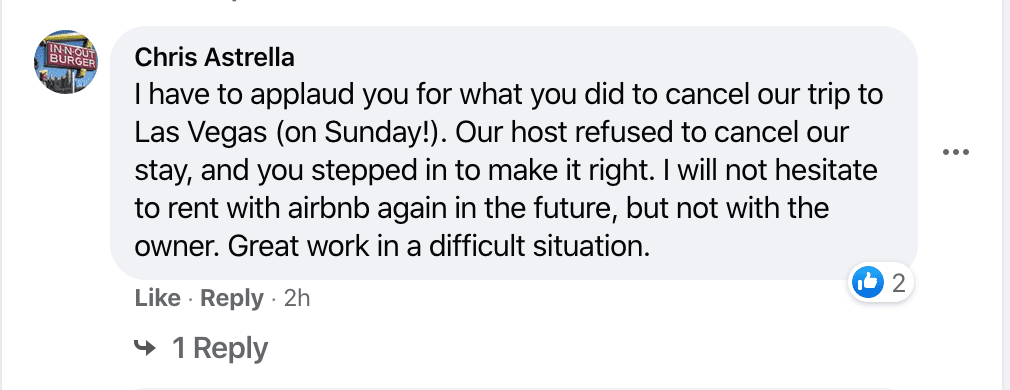
Worse, Airbnb is making us all look bad. Guests whom we have worked hard to convince to rebook now look to Airbnb like a hero.
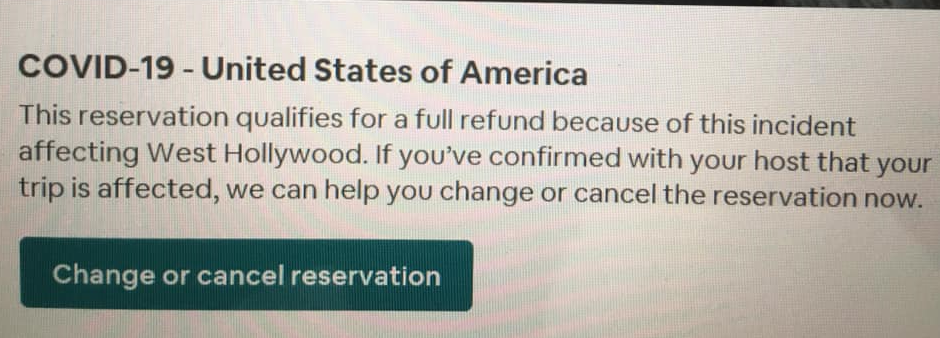
In fact, Airbnb has automated the process for guests to cancel their stay to make it even easier. Your guests will see messaging that looks like this when they login to check on their reservation:
Tomorrow or sometime soon, we will wake up and find out that other OTAs have followed suit. This has likely become a game of winning market share—or protecting market share.
Also, if you dig even deeper you will figure out that Airbnb is hard at work to update its search results algorithms and consumer-facing search filters to promote properties with the most flexible cancellation policies, which is great for guests but really hard for homeowners and property managers who cannot replace the lost revenue with 24 hours notice like an urban hotel.
This is our wake up call.
The OTAs have a place in your portfolio, but it is not a replacement for your own marketing and brand. Those sales pitches that are out there trying to convince you that you shouldn’t mark up your rates on third-party channels are part of the problem. The cost of a third-party booking is not cheaper, it is not more efficient. You are trading operational control and your brand for instant gratification.
After almost 20 years of doing this, I assure you that the majority of us will lean in and not only survive this challenging time but we will thrive.
Build a marketing strategy for the long game. Have the best website you can afford. Update it often. Implement a PPC, CRM, and marketing strategy that cultivates loyalty, word of mouth, and resiliency in tough times.


We have gone down a path along with some other great property managers to invest in a non-profit program linking property managers together through listing sites that assist us in booking direct. Then we are in control of our own businesses. Please checkout the start of this amazing efforts GreatHawaiiStays, CaliStays, NorthwestStays
The March 15th AirBnB extenuating circumstances policy says that they will refund service fees along with the full refund for all check-ins between March 14 and April 14.
There is no question that AirBnB, as usual, is essentially protecting its own reputation. AirBnB would, no doubt, argue that it is protecting every host’s reputation at the same time. That is obviously the
view that Alex Hunter takes and that is fair enough. Alex Hunter has been proactive and got in before AirBnB to make their position on cancellations clear which is the best way to enhance their reputation.
The disappointed AirBS Host (I am guessing that the BS is a deliberate typo) may be upset at AirBnB’s unilateral decision and feel (quite understandably) that both guest and host should share the burden but it really boils down to whatever rules that AirBnB has in place. As pointed out in Amber’s post, the rules are a bit vague but she did not include two of the valid extenuating circumstances:
Significant natural disasters or severe weather incidents impacting the location of destination or location of departure
Urgent travel restrictions or severe security advisories issued after the time of booking, by an appropriate national or international authority (such as a government office or department)
These would appear to cover AirBnB’s action.
Of course, any host has the option of not listing with AirBnB if the rules do not suit that host’s business. That, fundamentally, is what the majority of host’s who list with AirBnB or any other major listing website never consider – that they are giving up any independence to be on a website along with a million others because they expect to get more bookings by listing on such sites. These gigantic transnational listing sites expend billions in advertising costs every year to grab market share to such an extent that the network effect comes into play. Everything seems to be subservient to that.
My own business is a niche regional listing site (running for 15 years) and our booking rate over the last 4 years has declined considerably as all of my owners chose to list on the giant sites as well as our own one.
All I can say is that if you have a regional listing site then use it and support it as an alternative to the large sites. You are far more likely to be able to come to an agreement on such things as cancellation policy if you are using a niche regional site which would, for example, fully understand local seasonal constraints that would influence the type of cancellation policy you would want to employ. Any region is almost certainly going to have an appropriate cancellation policy that would be very different to that which suits a metropolitan listing. When you join a major listing site, your particular needs are rarely catered for. Giant sites have huge advertising costs but try to reduce costs in other areas of administration by reducing variation through the use of a “one size fits all” policy.
There really is no point in complaining about it, it is the nature of the beast.