- Advertisement -
Home Blog Page 8

Airbnb CEO Acknowledges Vacation Rentals in Last Week’s Earnings Call: “We welcome all hospitality providers on Airbnb.”

0

Over the last two weeks, investors heard from CEOs at both Airbnb and Expedia/Vrbo about their first quarter performance. According to Airbnb’s CEO Brian Chesky, “2020 was a year that none of us will ever forget. It was also a year when travel fundamentally changed forever. Airbnb changed as well. We sharpened our focus on our core business of hosting. And we got back to our roots, back to what is truly special by Airbnb: the everyday people who host their homes and offer experiences. And we emerged as a stronger and more efficient company. Our business rebounded faster than anyone expected, and it showed that as the world changes, we are able to adapt.”

Related: Expedia CEO Discusses Vrbo’s Q1 2021 Performance

Airbnb’s business plan in a nutshell “includes educating the world about hosting, recruiting more hosts, simplifying the guest experience, and delivering a world-class service.”

Airbnb’s Performance

Airbnb reported that its first-quarter loss more than tripled, to $1.17 billion, as travel remained depressed by the pandemic and the company was weighed down by costs from past borrowing. However, revenue in Q1 was $887 million, a 5 percent year-over-year increase. “Our adjusted EBITDA loss was $59 million,” Chesky said. “This was approximately $190 million better than the same period in 2019, and it was $275 million better than a year ago on essentially the same revenue.”

Listing Growth and Vacation Rental Managers: 30% Increase in non-urban and vacation rental

Airbnb has 4 million hosts listing 5.6 million properties. During the call with investors, Chesky acknowledged “vacation rentals” for the first time since before announcing its IPO. Airbnb’s S-1 only mentioned the term “vacation rentals” once in reference to the Google Vacation Rentals platform. Words matter, and Chesky’s recognition of this sector of the short-term rental industry is notable.

CEO Brian Chesky (Chesky): But what we have today are hosts that offer 5.6 million listing. And these 5.6 million listings more about 1 million more than we had this time in 2019 and what we’ve actually seen is a large growth in non-urban listing. So we actually have a 30% growth in non-urban and vacation rental listings as well.

Vacation Rental Managers, aka Professional Hosts

Chesky: Let’s talk about pro hosts and hotels. Obviously, Airbnb created a new category in travel because we created tools that allowed everyday people and individuals become hosts. And yes, out of 4 million hosts, 3.5 million are individuals. That being said, we welcome all hospitality providers on Airbnb. And we have hundreds of thousands of professional hosts and professional hospitality providers.

The way we think about it is when a guest comes to Airbnb, they’re looking for a place to stay. And so we don’t want them to leave without having found something they want. Typically, they come to look for individual hosts, that’s what we’re known for. But we want to make sure that we have professional hosts and hotels to serve those customers and to fill in our network gaps.

So we’re continuing to develop new tools and services over the coming years to continue to welcome these providers onto our platform. And I think they’re going to obviously benefit from all the demand that we have.

Airbnb Says Travel Has Transformed and Urban, Cross-Border Travel Is Coming Back

Chesky: We expect this rebound to be unlike anything that we have ever seen before, and we expect travel to be very different than before. People are discovering that they don’t have to be tethered to one location to live and work. . . . And when people do travel, they’re staying longer. 24 percent of our nights booked in Q1 were for stays of 28 nights or longer. People are not just traveling in Airbnb, they’re now living on Airbnb. . . . The world is never going back to the way it was, and that means that travel is never going back to the way it was either.

But the other thing that we’re seeing is that travel is going to be very different than before. Probably the biggest changes are the following: number one, I don’t think business travel is ever coming back the way it was before the pandemic. It’s at least not going to look like it did. I do think a new kind of business travel may emerge. Many employees are working remotely. They’re going to need to go back to headquarters occasionally. You’re going to see longer stays going in cities. And so we’re seeing elevated bookings in urban markets for stays of longer than 28 days.

The two trends I do think are going to inverse are we are going to see a recovery of urban travel and the recovery of cross-border. This has been our bread and butter before the pandemic, and I think those are significant tailwinds for us.

Airbnb Is Looking for More Supply

Chesky: We are recruiting more hosts, and we are setting them up for success. To build on the momentum of our marketing campaign, we launched an accompanying digital campaign that’s focused on recruiting new hosts. And we’ve completely redesigned the end-to-end experience of being a host on Airbnb. We’re making it easier for anyone to start hosting.

We’re making it even easier to become a host by reducing number of steps to become a host. And as we reduce the number of steps, conversion rate for hosts gets even easier.

Because Airbnb, we started actually after the Great Recession in 2008. And at that time, there were many hosts, many people that were looking at Airbnb as a financial lifeline. I think if you think about the number of hosts on Airbnb, the top occupations of our hosts are health care workers, educators and people in food and hospitality. These are industries that have been hit really, really hard. So our job is to tell the story of hosting, the fact that on Airbnb you can make $8,000 on average if you have one listing, which is 5x you can make what an average American got in the stimulus check.

CFO David Stephenson Discussed Supply and Demand

Stephenson: On supply and demand, really, what we’re seeing, because cross-border and urban travel has not yet fully rebounded, the places that we’re seeing surpluses or deficits in demand or a surplus of supply would be more urban markets. And where we can see some tightening of it, especially U.S. non-urban for the peak in the summer is clearly going to be the most constrained of our markets.

So we’re actively working against each of those areas. But on each side, on the supply side, making sure that we are doing our best to recruit hosts and bring on as more supply as possible for peak periods in constrained markets. And then we’re also using — go back to our marketing expenses before, where we use search engine marketing is in targeted approach, especially in markets where we have maybe surplus supply and not maybe enough demand, and so being kind of pointed at that. So we look at every individual market as different, and we will use different levers to try to manage that balance over time.

Increasing Take Rate

Chesky: We absolutely see lots of opportunities to increase our monetization and take rate for both guests and hosts. For example, one of the things we’ve said is that many of these tools and services we’ve offered in the last five years, they’re incremental, we haven’t charged for. For example, unlike our competitors, we offer free protection of $1 million against theft, property damage and personal liability in countries all over the world. And as we added these services, we do not charge incrementally for these. Our general principle is we always want to give away more value than we’re taking, but we do think there’s opportunities for us to do―to offer some more tools and services to increase take rate.

Now that being said, focus is critical. . . . But make no mistake, we have many opportunities in the years ahead.

Airbnb is Seeing More Whole-Home Stays

Chesky: Now what we’re seeing is a pretty big expansion of people booking entire homes, typically even more bedrooms, the number of guests per reservation has increased considerably. And so correspondingly, people are spending more money. I think that trend, of course, will get normalized over some period of time when other geographies recover and urban recovers. But I do think that we are going to see sustained confidence, there’s no question.

Booking Window Increasing

Stephenson: Regarding the booking window, we’re seeing the booking window, obviously, in 2020 shrank dramatically, right? People were hesitant to travel. They only started booking when they had high confidence that they were going to travel. What we’ve seen here early in Q1 of ’21 is the booking windows have expanded. And in March, we actually saw booking windows consistent with those from March of 2019. And so the windows are expanding. I think that what you’re seeing is still even more confidence in the U.S. So that the willingness of travel and the booking window in the U.S. has expanded further than it has in Europe.

But we’re starting to see some greater acceleration of our European business. We’re seeing the European nights increasing the rate of year-over-year growth every month of the year since the beginning of the year, including through April and May. And we’re seeing that as things like the lockdowns in France are removed. And after the UK Prime Minister announced plans to exit lockdown in February, we started seeing more acceleration in Europe.

So the booking window trends are positive and give us encouragement for what we’re going to see in the back half of the year. But we’ll just have to see what the lockdowns and other kind of travel restrictions look like for Europe for the back half.

Airbnb’s Forecast for Remainder of 2021

Stephenson: We’re highly confident in the rebound that it’s going to be coming. All the early indications are that it’s there. But it’s hard to kind of precisely pin down what Q3 and Q4 are going to do. So what we did do is give some perspective on what we expect out of Q2. And that is that our gross booking value in Q2 of this year will be higher than in Q2 of 2019, and that our revenue rate in Q2 will be similar to that of 2019, and that our EBITDA will be― our adjusted EBITDA will be―breakeven to slightly positive in Q2 of this year. So I think those are kind of the key things. Because as you said, as rebound comes back, the pace at which it comes back in the geographies that come back will affect the mix on those ADRs. And we do expect the ADRs to moderate, but it’s hard to perfectly pinpoint down the specific of that mix.

Look for an Announcement from Airbnb on May 24

Chesky: Now I want to wrap by highlighting a major announcement that we have coming up in less than two weeks. On May 24, we will announce the most comprehensive update to the Airbnb service in 12 years. As part of this special announcement, we’re going to share insights on how travel is fundamentally changing, along with updates we’ve made to prepare for what’s ahead. We’re going to unveil a simpler and more inspiring guest experience. And we are going to show you upgrades that make it even easier to be a host on Airbnb. So watch the announcement with the airbnb.com on Monday, May 24.

Expedia CEO Peter Kern Discusses Vrbo Performance: Vrbo hosts make more than Airbnb hosts on average.

2

During the last two weeks, investors heard from CEOs at both Airbnb and Expedia/Vrbo about 2021’s first quarter performance. For those who smartly opted to watch paint dry rather than listening to Expedia’s earnings call, here are some of the highlights and takeaways about Vrbo and the vacation rental industry. According to CEO Peter Kern, “We have benefited greatly in our vacation rental business and our domestic US business, but other parts of the business still remain challenged.”

Related: Airbnb CEO Brian Chesky Discusses Q1 2021 Performance

Expedia does not share Vrbo’s independent performance; Kern and CFO Eric Hart told investors repeatedly during the call that it is not going to break Vrbo out separately. “I would say Vrbo is doing great,” said Kern. “The US is particularly strong; but as I said, in all our strongest markets, we are showing share gains. And Vrbo is clearly―and vacation rentals in general―in very positive territory, and that is helping bring up all our numbers, no doubt. But, we don’t break them out separately.”

During the first quarter, Expedia’s gross bookings were down 48 percent compared to the same period in 2019. Room nights were 54 percent below 2019, and lodging revenue was down 46 percent. According to Cleveland Research, the US represented 80 percent of total revenue in the first quarter of 2021 compared to 57 percent in the first quarter of 2019.

Travel Trends

Expedia CEO Peter Kern (Kern): Travel remains a study in contrasts. As for different geographies, some are still shut down, some like the US are quite open now. And equally, it is a study in differences between vacation rentals, domestic travel versus international travel; business travel is more challenged; and conventional lodging, particularly in big cities, is more challenged. So, it’s really a study in contrasts. . . . The summer looks strong, particularly in the US and in other markets where vaccinations are well along the way. We are already seeing booking trends well above 2019 levels for leisure destinations, beach, mountains, etc.

Trepidation from Expedia about travel

Kern: I would just keep in mind, while summer looks great and we are ambitious and feeling good about the overall recovery, that calendar is still a question mark. We don’t know what seasonality will look like, as long as COVID is here. And the usual trends that might come in the fall and winter are still unknown. So, while we’re extremely excited about summer, it’s a little too early to predict how those trends with work-from-home, whether school is in session, et cetera, will change travel behavior going into the following quarters.

Vrbo is looking for more supply

Like Airbnb, Vrbo is looking for more supply in the markets in which demand is high (beach, lake, mountain). Expedia also is addressing this consumer demand by pushing travelers to hotels.

“But the reality is that Vrbo hosts on balance make more than Airbnb hosts on average.”

Kern: We are seeing some compression in summer. People ask about that frequently. And I’ll just say so far, we have seen replacement as a pretty good solution. Most people look for something they can’t find it, they’ll find something nearby. And increasingly, as more people are vaccinated, they are willing and happy to stay in resorts and in conventional lodging. And I would say some portion of them would actually prefer it that way. And we’re seeing in those leisure destinations for the summer, very strong conventional lodging numbers.

Campaign to Increase Supply with “Fast Start Program”

Vrbo initiated an aggressive campaign to increase supply from homeowners, which it is now calling “hosts,” emulating Airbnb.

Kern: So, we’ve amped up our investment in marketing and attracting Vrbo hosts, if you will, or owners. It has been successful. We are driving it as fast as we can. There is a lot of demand, and we’re focused, as you would imagine, in the most high-traffic areas where we need and can sell as much new inventories we can get. We introduced a new product, which we called the Fast Start Program, where we essentially take successful hosts that are highly rated from other platforms, and we launch them quickly into our platform; and instead of having to rebuild their stature as a highly reviewed host, we sort of take as a proxy, their experience elsewhere. And we put them, if you will, very high in the sort and allow them to start up their business with us.

But the reality is that Vrbo hosts on balance make more than Airbnb hosts on average. And it’s a great opportunity for people to monetize their assets. We think it’s better than any other similarly situated one. And we think owners of properties are increasingly becoming aware of that as our brand becomes more ubiquitous and as people become more used to the products. So, all our stats make for a great sales story. We just have to get it out there, and we’re spending more to get that story out there.

Bigger Push for Brand and Direct Marketing

Expedia is investing heavily in branding and direct marketing and is still not listing its vacation rentals with meta products including Google. Kern’s comments about branding are interesting for VRMs as they think about their own direct marketing efforts.

“Can you get them in the door? Can you make them love you? Is the experience great? Does it help them find what they want?”

Kern: We believe we can do better and do more on the brand building side and to create that direct customer relationship. Then, that bleeds all the way down through, of course, the importance of doing the product right, getting the engagement right, improving the apps, improving the technology, using AI to improve the customer experience. So, all of those things are the classic sort of virtuous cycle of: Can you get them in the door? Can you make them love you? Is the experience great? Does it help them find what they want?

Brand marketing is somewhat art not just all science, and it does take time to pay its rewards. We do believe though that by being more a funnel―by being more efficient in performance and allowing us to put more money upfront―we can drive greater long-term returns. Now, it’s not a quick twitch muscle. As I said, brand marketing is not like you run a great ad and tomorrow everybody books. It takes repeat. It takes sinking in of that brand proposition and getting everybody focused on your name, and then it starts to pay rewards in performance. It starts to pay rewards in direct. It starts to pay rewards across a lot of things.

So, we believe in that opportunity. We will invest in that opportunity, and it will take some time to pay out. It’s not like performance [marketing]. It’s not like you’re buying the transaction every time you do it.

We have a great new summer ad campaign coming for Vrbo that we think will be really impactful. . . . We’ve talked before about going up funnel, creating that brand love, pushing for direct interactions, direct consumption. But keep in mind, it’s not a quick twitch tool, like performance marketing. So, we have to invest over time to build that.

We mentioned last time on our last call that we went off the Google meta products for vacation rentals. And actually, over this last quarter, we have we have pulled back from other vacation rental meta players. And so far, the results have been excellent, and as good or better than we could have hoped for in terms of the returns we have seen in getting more direct traffic and traffic other ways, more efficiently. So, that has been a great move. And we will continue to focus on that. But again, we will be upfront more, we will be focused and leaning into the wave ahead. But, it could be bumpy and we may be a little early, but we believe now is the time to lean in and we will be leaning in, accordingly.

Revenue per Room Night Is Up

CFO Eric Hart: Revenue per room night was up 10 percent. That is due to two primary factors, mix to Vrbo and then mix to the US as well, where there’s typically higher ADRs. . . . Vrbo is obviously seeing some nice ADR improvements, just given the demand in that sector.

On the “Revenge Travel” Trend

Kern: I’m rooting for revenge travel, whatever that is. Whatever kind of travel people want to do, we’re happy to accommodate it, revenge or otherwise. . . . And I would say that revenge or otherwise, places like Miami demonstrate that there is huge pent-up demand to go to places where people can experience a relatively normal travel experience. And I don’t know if you’ve been to Miami recently, but it is packed. The hotels are full. People are out everywhere. Restaurants are full. . . . So, if you just think about that in a macro way, you say, okay, where people can travel, where they can have a normal experience, where they feel like they’re comfortable free, whatever your words are, there is a huge amount of demand for that.

In Closing

Kern: Finally, I’d just say we are clearly benefiting from our relative strength in some of the best markets, VR, the US, etc. But it’s a bumpy ride, and we’re hoping for reopenings. . . . We still don’t know what’s happening in many markets. Anything could happen. Things could get worse before they get better, but we are optimistic. We are seeing a lot of improvement across the globe. And we are feeling good about the work we’re doing at the company.

How Property Managers Can Capitalize on New ‘Revenge Travel’ Trends

1

The rebound of the travel industry in the United States is underway with guests around the country booking out vacation rentals for the summer as the vaccine rollout surges ahead. The biggest trend to come out of this resurgence? The concept of “Revenge Travel” – the idea that guests are going to be making up for the trips they couldn’t take over the past year by spending more and traveling longer. 

Based on the results of a new white paper we developed at HomeToGo, combining exclusive insights from surveyed guests, property managers, and internal data from both HomeToGo and AirDNA, we take a closer look at “Revenge Travel” and the trends and tips property managers should keep top of mind as travel makes a comeback.


Longer Stays and Spending are On the Rise

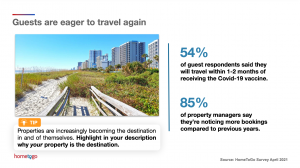
To start on a high: 85% of property managers are noticing more bookings compared to previous years – not just 2020. With the vaccine rollout gaining speed, more than half (54%) of guests recently surveyed said they will travel within one or two months after receiving the vaccine, working out well for property managers eager to take advantage of summer travel.

Plus, guests are booking longer trips and spending more: 46% of HomeToGo’s U.S. summer bookings currently last seven days or longer – an 8% increase from 2020 – and 54% of property managers reported that guests are spending more on average per booking. We see this surge clearly playing out in our data with both an 18% increase in group size and an average booking value that’s currently 70% higher than in 2020 and 65% more than in 2019. We do expect this number to change as more last-minute bookings come in.


Guests Want Flexibility and Cleanliness

With the uptick in summer bookouts, we also anticipate an influx of last-minute, short trips as the year progresses. 85% of property managers are noticing last-minute bookings, and in our own data, the average booking window is down 16% and 46% compared to 2019 and 2020 respectively. There is still uncertainty as travel regulations constantly change, and guests are frequently still searching with flexible dates and opting for spur-of-the-moment getaways.

To maximize bookings potential, one pro-tip for property managers is to establish flexible booking and cancellation policies to put guests at ease during these unpredictable times. 45% percent of U.S. travelers rank rentals that have “Free Cancellation” among their top two booking considerations, even before price, yet 54% of property managers surveyed are not offering free cancellation under any circumstances. We encourage property managers to consider flexible policies to secure risk-averse guests and make their property more appealing to cautious travelers.

Another clear trend after a pandemic year: Hygiene was also listed as the most important booking factor, with 55% of travelers surveyed ranking “Extended Clean and Disinfection” as the top consideration when booking a rental, prioritized over other amenities such as beach access, stable internet, and a pool, hot tub, or sauna. We know there’s been some frustration among property managers over so-called “hygiene theater,” but the numbers are clear––guests expect to see extra cleaning measures mentioned in a listing. We found that 85% of property managers now highlight extra cleaning measures in listings, and we recommend doing the same in order to offer guests the assurance that they’re looking for.


Remote Workers are Prioritizing Amenities

With so many now doing their jobs on Zoom and “work from anywhere” policies becoming more of the norm, remote workers are a big factor in the increase we’ve seen in terms of longer bookings. In our survey, 71% of guests responded that they will work remotely at least once in 2021 and 39% of property managers are noticing more remote workers than usual. That means you need to showcase the comfortable workspaces at your property and talk up that high-speed WiFi in the description. Also, remote workers don’t want to leave their furry companions behind, so property managers should clearly highlight their pet policies in place and any special features such as a fully fenced backyard or nearby dog park. Pools are also a hot-ticket amenity, which along with pets, accounted for more than 50% of our amenity searches in 2020 and that trend is continuing so far in 2021.

How to reach these new types of remote work travelers, who may be different than your typical guest persona? Diversify your distribution strategy. We found that 42% of property managers in our survey are listed on more than 5 booking channels and 37% say they’re noticing more bookings from different booking channels. To keep up with the competition, we recommend that you consider listing on more booking channels to attract more eyeballs to your properties.


Rural, Domestic Destinations are the Clear Winners

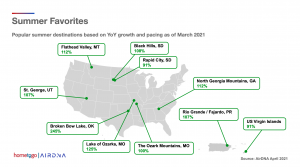
9 in 10 U.S. travelers are searching for domestic destinations this year, with the same amount seeking rural getaways overcrowded, urban hot spots. In addition, 63% of guests surveyed ranked a “quiet getaway” as most preferred for their next vacation. This is reflected in the amount of rural destinations hitting our most popular list for summer:


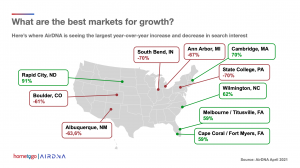
For property managers interested in the best markets for growth, here’s where AirDNA sees the largest year-over-year increase and decrease in search interest. College football fans might recognize a few destinations here. South Bend, Ann Arbor and State College are all university towns with teams in the Big 10, which got off to a late start in the last football season because of COVID-19 and likely impacted search interest:


Travel is coming back. That’s not up for debate. What’s left to be determined is how property managers will respond to and take advantage of this new normal. For full insights, download HomeToGo’s Revenge Travel White Paper.


About Rachel Tabellion, Head of Sales at HomeToGo

Rachel Tabellion is the Head of Sales at HomeToGo and has been leading partnerships with property managers worldwide for six years. Under her leadership, her team has successfully onboarded over 2,000 property managers onto the group’s 40+ international distribution websites, cementing HomeToGo’s place as the world’s fastest-growing booking channel. Rachel also regularly hosts and co-hosts educational webinars for property managers using HomeToGo’s data of more than 18 million listings together with leading industry players such as Streamline, Ciirus, Transparent, and AirDNA.


About HomeToGo

HomeToGo, the world’s largest vacation rental search engine, compares over 18 million offers from more than 40,000 trusted partners. From apartments, cabins, boats, castles, hotels, hostels, and everything in between, HomeToGo combines price, destination, dates and amenities to find the perfect accommodation for any trip worldwide.

Founded in 2014, HomeToGo employs more than 250 people. HomeToGo operates 43 websites, including brands such as Tripping.com and Wimdu, across Europe, North America, South America, Australia and Asia-Pacific. To learn more, visit www.hometogo.com or download the HomeToGo app.

VRM Execs and GMs: The Industry Needs Your Feedback in this 2021 Short-Term Rental Industry Survey by Phocuswright

1

By Pete Comeau, Managing Director, Phocuswright

Short-term rentals in the US have been on a steady growth trajectory over the past decade. Since 2013, Phocuswright, a leading travel industry research firm, has conducted several pioneering research studies to size the market, analyze consumer and industry trends, and explore the rise of digitalization in this segment.

Quick Link to Complete the Survey

Phocuswright’s most recent study, “Here to Stay: U.S. Short-Term Rentals Move Mainstream,” showed that gross bookings increased at a CAGR of nearly 6 percent from $31B in 2017 to $34B in 2019. Furthermore, online bookings grew at nearly double the pace of the total industry.

COVID-19 upended nearly all travel in 2020, and short-term rentals also felt the impact. Some companies operating in the sector shut down, while others downsized. Homeowners and hosts pivoted to serving long-term renters, taking short-term inventory off the market.

But as the year wore on and travelers sought to get out and about while avoiding high-traffic areas to stay safe, they turned to vacation rental properties with social distancing baked-in. Short-term rental demand recovered as summer travel skewed toward rural, less-crowded destinations and drive trips.

With vaccines on the way and an expected recovery in travel to follow, will short-term rentals continue to prosper and outpace the greater lodging market? Will short-term rentals benefit from the behavioral changes the pandemic has wrought? Which trends are holding up? What new trends are emerging?

Phocuswright is conducting a 15-minute survey of US-based short-term rental property managers to understand the marketplace and study key trends among PMs who offer their properties to travelers.

The study will answer key questions, including the following:

  • What was the impact of the COVID-19 pandemic on revenues, and how is the short-term rental industry projected to recover through 2025?
  • How satisfied were travelers with how brands handled the COVID-19 pandemic?
  • How have travelers shifted their preferences in a post-pandemic world?
  • How are homeowners and property managers evolving in a post-pandemic world?
  • Which trends will be short-lived and which will be here to stay?
  • Which technologies will be most important as the market matures?
  • What impact will short-term rentals have on the future of lodging?

What’s in it for you? If you qualify for and complete the survey, Phocuswright will share the results of the study with you.

Survey Link

All responses will be kept strictly confidential and will be used only to determine trends.


IMPORTANT EDITOR’S NOTE ABOUT WHY YOU SHOULD TAKE THE TIME TO ACCURATELY COMPLETE THIS SURVEY

From Amy Hinote to VRM/PMC owners and GMs:

It is incredibly important for you to complete this survey, as many significant investment decisions in our industry are based on this particular research presented by Phocuswright.

Our professionally managed vacation rental sector has been lumped under the broader short-term rental umbrella, and your participation is critical to ensure that Phocuswright is not hearing from other sectors disproportionally, (e.g., urban rentals, individual hosts, marketing platforms, and shared accommodations). If our sector is not accurately represented, then subsequent investment decisions will be flawed, bringing a continued and substantial influx of capital injected into bad business models.

When investors continue to pour money into bad business models, it makes it harder for all of us—VRMs, tech companies, and service providers—to compete as we are unfairly competing head to head with under-performing companies propped up by outside investment. And we’re not the only ones who suffer; guests and homeowners suffer from these poor business models as well.

The professionally managed vacation rental sector needs to be heard, recognized, and represented in this study.  

I implore you to have someone in your company accurately complete this survey.

Your participation is critical and will directly help the entire industry.

2021’s Latest Issue of VRM Intel Magazine is Here

0

The 2021 Spring-Summer VRM Intel Magazine is here, and this issue is packed with articles for vacation rental professionals about staffing, marketing, business, technology, reservations, and more. 


Table of Contents          

Letter from editor below. 

People                      

22           Careerists: From Entry Level to Executive by Paul Caballero             

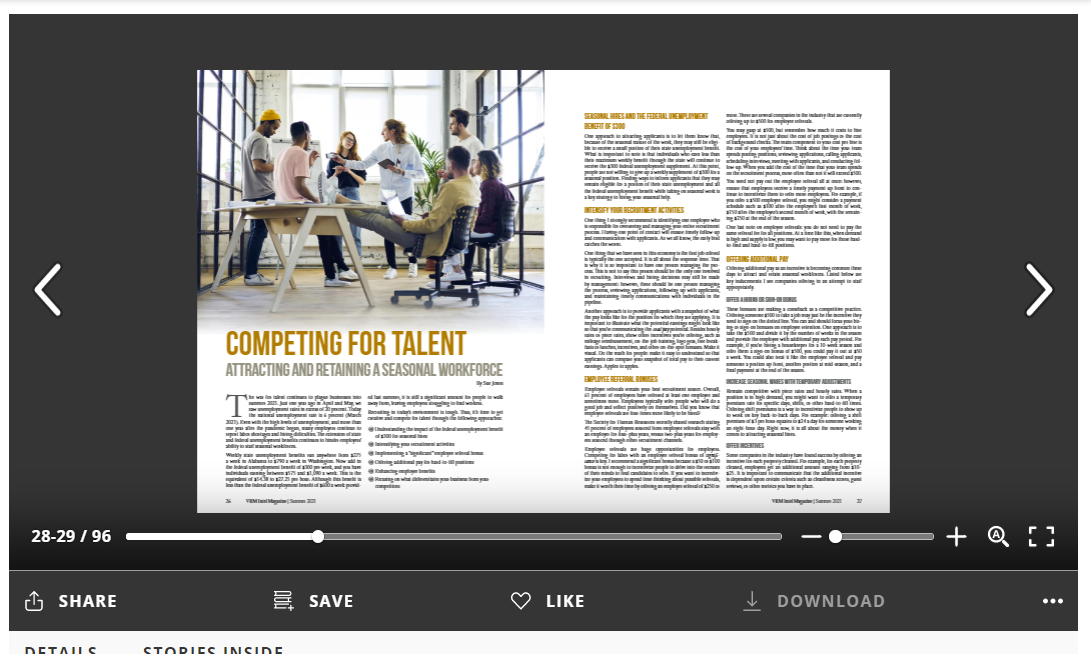
26           Competing for Talent by Sue Jones     

30           The Front Line is Broken by Steve Trover             

Reservations                      

32           The Battle for Direct Bookings Is Hand-to-Hand Combat by Doug Kennedy

34           The Value of Asking Questions by Ali Cammelletti

Marketing

69           Email Marketing for Today’s Economic Climate by Jennifer Perez

70           Using Social Influencers by Jodi Bourne

72           The Truth About Vacation Rental SEO by Jill Highsmith McGee

76           Shift-Sharing in Distribution Channels by Michelle Marquis     

82           Vrbo’s Quizzing for Travel Preferences Provides Zero-Party Data by Wendell Lansford

84           Create Great Memories to Match Guests’ Great Experiences by Chris Taylor

Technology             

21           Time to Tech Up Your Properties by Sean Miller

63           Technology and the COVID Silver Lining by Lino Maldonado

65           New Vacation Rental Data Standards by Melanie Brown

67           Adding IT to the Executive Team by Wendy Glover

78           Using Tech to Execute Revenue Management Strategies by Emily Pattillo

88           Remote Control Exasperation by Paula Caballero

Business                   

37           Preparing to Sell: Staff and Management Contracts by Jacobie Olin          

39           Avoid Costly Mistakes When Selling Your Business by Ben Edwards           

40           An Inside Look at Casiola by Amy Hinote             

47           Important Survey: The Industry Needs Your Feedback with Phocuswright + Letter from Editor about the Survey    

49           Where is Vacation Rental Management Heading? by Jeremy Gall

52           Help Cut Your Homeowner’s Taxes by Jon Cunningham          

56           The End of Property Management as We Know It? by Alex Nigg           

59           Connecting Your Business and Personal Goals with a Plan by Bill Whichard and John Woolard             

60           Canadian Groundhog Day: COVID Shutdowns Continue by Heather Bayer  

Education                

54           3rd Annual Data and Revenue Management Conference, Aug 17 -18, Charleston, SC              

90           2021 Calendar of Events              

92           Vacation Rental Women’s Summit, December 1 – 2, 2021            


Dear Readers,

The year is shaping up to be record-setting for most US vacation rental destinations, but our industry’s narrative is still a story of haves and have-nots as several markets (such as Hawaii) have been slow to recover. The vacation rental industry has taken quite a hit outside the US with continued restrictions and a resurgence of COVID-19 cases and variants. In Canada, for example, property managers are experiencing yet another shutdown period (Heather Bayer tells us more on page 56).

As disruptive as the past year was, the vacation rental industry saw an enormous boost in interest from travelers. According to the inaugural consumer study, “Vacation Rental Barometer,” released in May from Generali, “71 percent of travelers indicated they would book a vacation rental in the next 18 months.”

This is a shocking number for those of us who have been in the industry for over a decade. We remember when that number moved from 10 percent to 30 percent, and we thought we had arrived! I still remember working on the first issue of VRM Intel Magazine in September 2015 when Doug Macnaught asked me if there would be enough new information about the vacation rental industry to fill the pages of a quarterly magazine. Now, I’m throwing myself a nightly pity party because I can’t keep up with each day’s news barrage.

However, I realize I’m not alone in feeling unable to keep up. Staffing has become the most significant challenge in our industry. VRMs are working locally to execute strategies to source regional employees, but as an industry, we must come together to find ways to educate potential workers about the many career opportunities in this sector. In the previous issue, we started a series (continued on page 22) featuring people who started in entry-level positions and rose to high-level positions, building lucrative careers in the vacation rental industry. Imagine a national campaign highlighting career opportunities, starting with high school students. If you are interested in working on this, are already developing programs, or have ideas, please let me know.

A more positive challenge we face right now is revenue management. In the past, revenue management strategies largely revolved around discounting, but with the tsunami of demand this year, we’re looking at this discipline differently. Although it’s great that many companies are fully booked for months ahead, many have been able to raise rates, bringing in more revenue for homeowners. There is a great deal to talk about at the upcoming Data and Revenue Management (DARM) Conference in Charleston, August 17 and 18 (page 54). For VRM execs, marketers, and revenue managers, this is an event that will include more strategy sharing than any we’ve had in a long time. While on the subject of DARM, I cannot tell you how much I’m looking forward to seeing you in person again! It’s been way too long.

In other news, we’re seeing another influx of outside investment in the industry, and we will be discussing Vacasa’s next move, new SPACs, consolidation, and roll-ups over the coming months. I’ll continue to try not to opine about Sonder’s recent public offering—but no promises.

For those of you who have worked for decades to build this industry in consumers’ eyes, I want to offer you heaps of gratitude and hearty pats on your broken backs. Your tireless work has paid off, and the vacation rental industry is finally reaping a harvest from the seeds you have planted and nurtured. We no longer have to fight for recognition. Now, we just have to be smart about how we mature.

Many thanks to you for reading, and don’t hesitate to let me know what VRM Intel can do to support your efforts.

Sincerely,

Amy Hinote, founder and editor, VRM Intel Magazine 

71% of Travelers in the US & Europe to Book a Vacation Rental in the Next 18 Months

0

Key Takeaways

• Vacation rentals are among the top choice above all other forms of accommodation for 78% of travelers, continuing even beyond the pandemic with 86% indicating they would book one in the next 18 months.
• Consumers are excited to travel again with 80% of those surveyed planning to travel in the next 18 months and approximately half of the travelers surveyed (49%) planning to travel domestically.
• Respondents indicated travel is a good motivator to take a COVID-19 vaccine with 21% of Europeans who were undecided about taking one indicating that it being a mandatory part of travel would push them to get vaccinated.
• Vacation rentals are largely booked for leisure, but there is an interest from 22% of travelers who indicated they would book for work-related reasons (9% for business travel and 13% for an extended stay (for work, digital nomad, flexcation).
• Travel insurance uptake is expected to increase with 70% of Europeans and 54% of Americans indicating they would be more likely to purchase travel insurance in the wake of the pandemic as health risks that can impact their trip, like cancellation in the event of COVID Infection or confinement, become a top of coverage for 43% of travelers surveyed.

Europ Assistance (“EA”) today announced the international findings of its first Vacation Rental Barometer. The complete set of US findings will be released by EA subsidiary Generali Global Assistance (GGA) in the coming weeks. EA surveyed 8,700 travelers across eight countries in the US & Europe from February 28th to April 1st, 2021. These survey respondents, who indicated they would be traveling in the next 18 months and planned to book a vacation rental, were surveyed on their booking preferences, travel habits, and changing adoption and utilization of vacation rentals.

Francine Abgrall, Group Head of Travel at Europ Assistance: “Throughout the pandemic, vacation rental has been one travel sector that has been less negatively impacted than others. As the overall travel industry prepares for travel to pick up, we wanted to know the sentiments of travellers about their upcoming travel plans and in particular whether the favourable trend towards vacation rental would persist. We felt it was important to gauge the sentiment of the average traveler to provide ourselves and our partners, leaders in the Vacation Rental booking industry, with valuable insights. Overall the travelers we surveyed are excited to travel again, while Europeans indicated they would prefer to travel abroad Americans opted to stay closer to home. When deciding what type of accommodation they would like on their next trip, 71 percent indicated they would book a vacation rental.”

Chris Carnicelli, CEO of Generali Global Assistance: “Given the pent-up demand for travel it’s not surprising that approximately 80 percent of respondents indicated that they planned to travel in the next 18 months. Based on the findings of our Vacation Rental Barometer and current industry trends, we anticipate that travelers will flock to vacation rentals as they look to have a relaxing socially distanced getaway.”


Upcoming Travel Plans

  • 71% of travelers indicated they would book a vacation rental in the next 18 months
  • 47% of Europeans are planning a summer trip (from July – September) compared to 35% of Americans with summer being the most popular travel season among all respondents (45%).
  • 23% of Americans indicated they planned to travel this spring (from April – June) compared to 13% of Europeans.
  • 21% of American travelers indicated they planned to travel this fall, while Europeans were more likely to wait until 2022 & beyond to plan their trip when compared to Americans (20% vs 17%).


Destination Preferences

  • 49% of all travelers surveyed indicated they planned to take their next trip domestically with Americans (71%) the most likely to travel close to home.
  • 55% of European travelers on the other hand indicated that they plan to travel abroad.
  • Travelers in Spain (57%), Italy (54%) and Portugal (51%) opted to take their next trip domestically while more travelers in Belgium (29%), Germany (39%), the UK (40%) and France (45%) had plans to travel abroad.


Accommodation Preferences

  • 78% of travelers are more likely to book a vacation rental above all other types of accommodations in the next 18 months and 86% said they would be more likely to continue booking them after the pandemic.
  • While it’s not surprising that 77% of travelers indicated they would choose a Vacation Rental for leisure instead of business (9%), there was a significant minority (13%) of Digital Nomads who indicated they would be extended stays while working remotely.
  • Top Three Motivations for choosing a Vacation Rental:
    • 1) Comfort
    • 2) Tranquility
    • 3) Privacy


New Travel Habits

  • Top Three Criteria when picking a destination as a result of COVID:
    • 1) Destination has clear cleaning protocols
    • 2) How crowded the location gets
    • 3) Who they travel with
  • Vaccine availability was most likely to impact travel plans for both Europeans (83%) and Americans (82%).
  • 66% of Europeans and 64% of Americans indicated that making COVID vaccinations mandatory to board a flight wouldn’t impact them as they already planned to take the vaccine.
  • 21% of European travelers who were undecided about taking the vaccine indicated they would consider it if it was mandatory to take a flight.


Travel Insurance Preferences

  • 70% of Europeans and 64% of Americans indicated they would be more likely to purchase travel insurance as a result of the pandemic.
  • 44% of Europeans compared to 33% had purchased travel insurance when booking a vacation rental in the past.
  • The top three coverages that reassured travelers looking to book vacation rentals are:
    • 1) cancellation in the event of COVID Infection or confinement (43%)
    • 2) Medical Assistance & Repatriation (22%)
    • 3) Reimbursement of unused travel days in case their stay is interrupted (20%)
  • 23% of Americans favored coverage for reimbursement for unused days compared to 20% of Europeans
  • While Europeans (23%) found more peace of mind from Medical Assistance & Repatriation coverage compared to Americans (17%).


Survey Methodology

From February 28th to April 1st, 2021 through survey provider Phonic, Europ Assistance surveyed 8,700 online respondents who are planning to take a trip and are planning on booking a vacation rental in the next 18 months. The study consisted of fifteen questions and was sampled within the United States, Spain, France, Portugal, Belgium, Germany, Italy, and the United Kingdom.


ABOUT EUROP ASSISTANCE GROUP

Founded in 1963, Europ Assistance, the inventor of assistance, supports customers in over 200 countries and territories thanks to our network of 750,000 approved providers and 41 assistance centres. Our mission is to bring people or corporates from distress to relief – anytime, anywhere. We provide roadside assistance, travel assistance and insurance, as well as personal assistance services such as the protection of the elderly, the protection of digital identity, telemedicine and the Conciergerie. The vision of our 8,000 employees is to be the most reliable care company in the world. Europ Assistance is part of the Generali Group, one of the world’s leading insurers.

ABOUT GENERALI GLOBAL ASSISTANCE

Generali Global Assistance (GGA) is a leading brand comprised of Travel Insurance & Assistance, Medical Risk & Home Care Management, Identity & Cyber Protection, as well as other care services. GGA is part of the Generali Group, which for over 190 years has provided peace of mind to its clients and their customers and is now supported by more than 72,000 employees worldwide. Our success has been built on establishing trust by putting the customer at the core of everything we do, offering assistance and protection during our customer’s most difficult and stressful situations.

Passing the Torch: Meyer Vacation Rentals Transfers Ownership To The Next Generation

0

Sheila Hodges, owner of SH Enterprises Inc. and Meyer Vacation Rentals, announced today that she is transferring ownership of the company to her daughter and company president Michelle Hodges, and CEO Les Williams. SH Enterprises is the holding company not only for Meyer Vacation Rentals but also Meyer Services, with operations in Alabama and Florida; Starr Textile Services, a commercial laundry operation with facilities in Alabama and Louisiana; and CENTURY 21® Meyer Real Estate, with operations in Alabama and Florida.

Sheila Hodges began her real estate career at Meyer in the summer of 1978 as one of six sales agents. She progressed to managing partner and then sole owner in 1984, when she purchased the company from the original founders. Since that time, she has worked to grow the organization on the business principle of balancing service, relationships and profitability. 


Sheila Hodges, Inaugural Vacation Rental Women Pioneer Award Recipient from VRM Intel Live on Vimeo.

 
Today, Meyer Vacation Rentals manages and provides a range of services to more than 1,000 vacation rental houses and condominiums on the Alabama and Florida Gulf Coast. Based on the number of people employed across all its companies, SH Enterprises is ranked among the largest employers operating in Baldwin County, Alabama.

“The SH Enterprises family of companies has always been committed to providing superior customer service and an unwavering dedication to the satisfaction of our customers,” said Sheila Hodges. “Proactively seeking to improve quality, value and service are hallmarks of these companies. We are dedicated to providing personalized service, continuing innovation and overall expertise so we may continue serving as a pacesetter in the hospitality industry.”

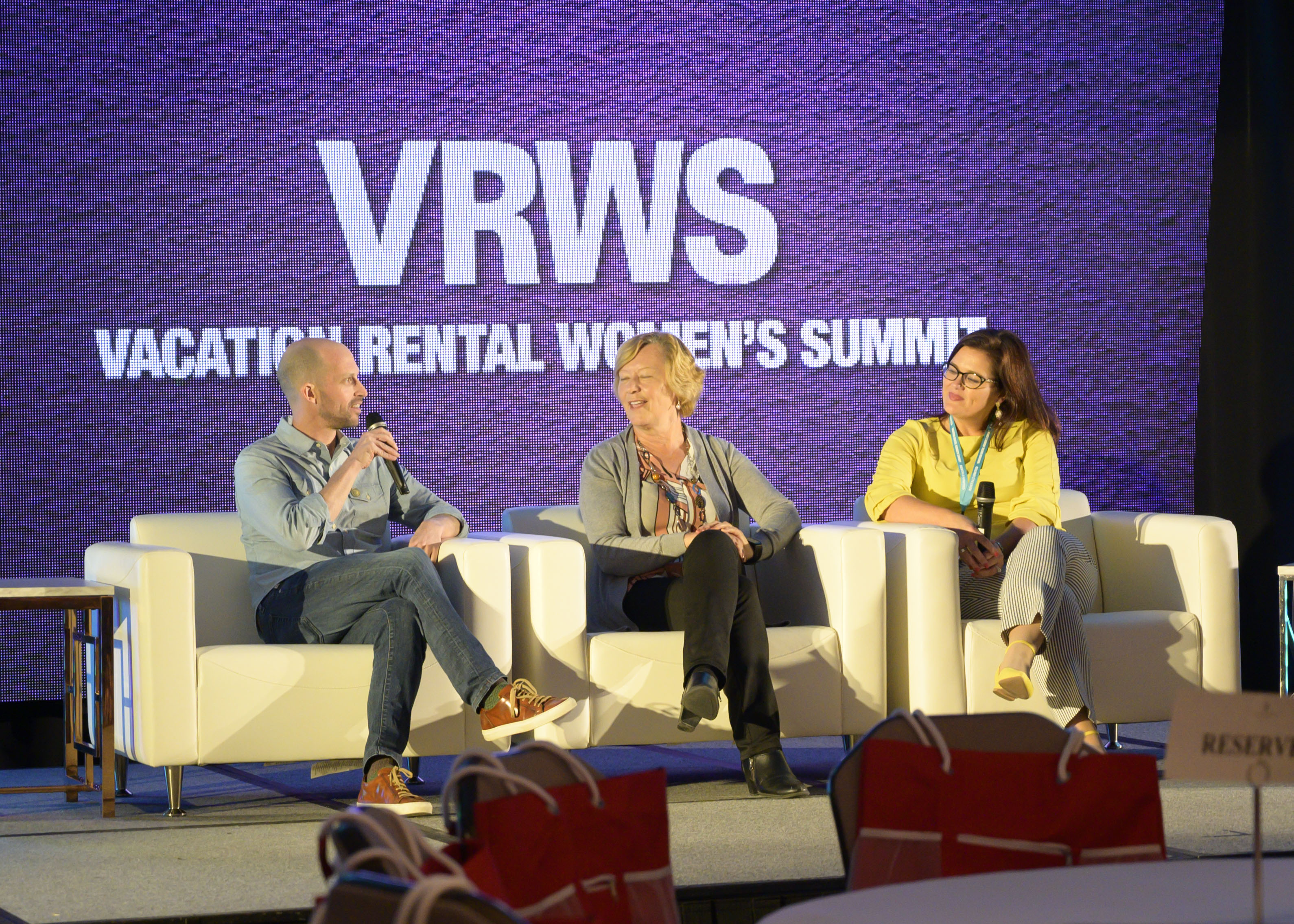
Michelle Hodges with Matt Landau and Heather Bayer at the Vacation Rental Women’s Summit.

Michelle Hodges grew up in the hospitality business beginning as an intern during high school and college summers. After graduating, Michelle returned home to begin her career with the company. Her hospitality experience and degree, fueled by her passion for travel and tourism, provided her with a thorough understanding of guests’ needs and changing expectations through the years. Rising through the ranks at SH Enterprises, Michelle also learned the ins and outs of the business, taking on leadership roles such as corporate trainer, director of operations, and president. Widely recognized as a vacation rental industry thought leader, Michelle has also been a speaker at multiple international conferences, including Skift’s Short-Term Rental Summit, the VRMA International Conference, and the Vacation Rental Women’s Summit

“I couldn’t be any prouder of Michelle, watching her through the years grow in the business with a can-do attitude at every level,” said Sheila Hodges. “Her extraordinary leadership skills became even more apparent after the BP oil spill in 2010. We witnessed her eagerness and devotion to lead several community initiatives, all while championing a positive attitude and commitment to all of our SH Enterprises families.”

As CEO, Les Williams has been responsible for the overall strategic direction and operation of the SH Enterprises family of companies as well as the day-to-day oversight of STARR Textile Services. Williams has worked for SH Enterprises for since 2005, including as chief operating officer for Meyer Services, vice president of administration and finance for Meyer Real Estate, and a variety of other leadership roles.



Prior to joining SH Enterprises, Williams served as vice president of multi-family operations for a publicly traded real estate investment trust headquartered in New Orleans whose primary focus was investment and management of multi-family and retail properties. There, he oversaw a real estate portfolio of 4,100 properties stretching from South Florida to Texas.

“Michelle and Les made my decision to transfer ownership an easy one,” said Sheila Hodges. “They have been vested in the company for nearly two decades, and I can say with 100 percent certainty they will continue the work that has been done for more than 50 years to maintain our core values, continue on our mission of providing outstanding service, and play a leading role in shaping the local, regional and national hospitality business. I am fully confident in their ability to take the SH Enterprises family of companies to the next level and beyond.”

How to Educate & Improve your Team’s Performance

0

Operational efficiency is difficult to measure, but imperative to your business’ success. 

Ben Edwards of Weatherby Consulting offered a virtual session in March as part of Breezeway’s Elevate Operations Summit where he offered advice and key points that owners can consider to improve their business, keep their teams educated, and provide a glimpse into how your team’s effectiveness and productivity impacts your businesses bottom line.

“Once you get to a certain level in this industry, profitability becomes a game of inches,” Edwards said.

Things to Consider:

What is the ratio of your business model: More toward growth or toward quality?

Become an expert in housekeeping. Too many operators today are cutting corners.

Focus on relationships.

Focus on due diligence.

Communicate with your owners about them investing in their properties. Too many operators are doing it on a dime.

Take on the “right” owner clients. Edwards shared: “I was going to work with an owner in South Florida and he didn’t want to buy new outdoor furniture. You need that. If they aren’t willing to do what’s needed, cut them loose.”

Educate your owners on clear processes.

Train your staff on a quarterly basis. Keep trying to get better. “As an industry, I see us getting better at doing this,” Edwards said.

Be a player-coach with your owner. Communicate to them when it’s important that they become more involved in their business’s operations.

Focus on the right things: Don’t always do what you like to do, do what you have to do.

Cater to the little things that will improve guest experience.

Measure performance. If it’s not working, make changes. Don’t let some ‘crazy uncle’ be part of your decision process.

Aspire to regimented measurement: Use a dashboard that can be seen in your office. On it, state your goals, note where you are in the process and document what you are going to do to achieve them.

Chart completion rates for tasks. Figure out who on staff takes longer to finish a job and try to improve on their times. If you can’t, route those tasks to others.

Use geo-management – tracking where you workers are on the property. Keep them focused on their jobs at hand.

Calculate revenue per employee and try to improve on that.

Stays Group Announces Release of SouthwestStays

3

The member driven marketplace is part of the largest cooperative network of independent vacation rental brands working together to drive book direct initiatives that save travelers hundreds in traveler fees.  The SouthwestStays marketplace will cover Utah, Nevada, Colorado, Arizona, New Mexico and Texas. 

 “With all the craziness of 2020, the bright side is there has been a resurgence with property management companies realizing it’s time to take control of our future when it comes to where our customers come from.  We’ve seen the weakness in the OTAs and now is the time to come together and take back control.  The Stays Group marketplace has demonstrated the ability to deliver on premium traffic that gains strength as we grow. That value points back to us. It is time we band together!” said, Matt Tesdall, Family Time Vacations and Sisters Vacation Rentals

The Stays Group network of independent brands understand the value of partnering with quality operators that have demonstrated service excellence in their respective communities. The membership operates in complete transparency and meets on a weekly basis to strengthen their respective markets, learn from their colleagues on what works and to form partnerships that extend the value of their respective brands.

“Matt is a great example of independent vacation rental professionals ability to think outside the traditional modes of distribution to better serve his guests, strengthen his brand and extending the value proposition through the Stays Group member network destinations.  Independent brands have experienced more direct bookings these past few months.  Rather than celebrate, many independent brand operators are taking this opportunity to fix the long term problem of OTA dependence.  Lost in the headlines of “M&A” and “airbnb IPO”, are the stories of our members continuing  to execute on service excellence.  Our unified message of quality, transparency and trust matters to the vacation rental traveler. Our platform is a testament to what happens when you let quality brands serve the traveling public with no interference.” said Vince Perez, CEO of Fetch My Guest, Partner, Beach House Rentals and NWVRP Member.

To learn more about the Stays Group cooperative marketplace for independent vacation rental operators schedule a call today

How to Boost Owner Acquisition & Retention in Vacation Rentals

1

With more competition in the market, acquiring and retaining owners is a large determinant of running a successful management business. It’s always a challenge for managers to find and nurture those relationships. By making property care a pivotal part of their value proposition, managers are in a much stronger position when it comes to meeting and exceeding their owners’ expectations.”

  – Jeremy Gall, Founder & CEO of Breezeway 


Spiking demand and the recovery from the pandemic have vacation home rental management companies primed to grow their companies and profits. Owner relations is often one of the most overlooked areas of short-term rental management and it plays a key role in retaining owners and recruiting new ones. 

A Breezeway Elevate Operations Summit virtual panel in March welcomed leading management companies and invited them to speak about how to succeed through strong business relationships.

The panel covered best practices for delivering (and maintaining) hospitality-like owner services and how they’ll foster more trustworthy owner relationships, increase client retention and boost referrals. It featured Jon Eskin of BHHS Colorado Properties and Brittany Blackman of Breathe Easy Rentals with moderator Wil Slickers of Slick Talk.

Blackman said management companies must first decide what type of business they want to operate.

“Are you a small company that provides one-on-one service or a larger one that you are trying to streamline,” she said. “Knowing this will help you to make the right decisions and stay on course.”

Once established, organization and consistency with day-to-day operations is crucial. “The last thing you want is for your owner-clients to see that you don’t know the answer to something or are disorganized,” she said.

Eskin said management companies can shine their reputations by demonstrating to new or prospective owners that they are current and have put technologies in place to work more effectively.

Letting them in on the company’s history also helps, Eskin said. “Describe to them how you conduct property inspections,” Eskin said. “Show them past photos of your properties and the notes you’ve taken. Demonstrate your company’s growth.”

Every owner and vacation rental property are different, Blackman said. “I have guidebooks for how I maintain my properties, but all properties are unique,” she said. “You have to show that you are flexible in the ways you take care of them, and cater to each.”

How a management company communicates with owners can “make or break” relationships. It’s best to use methods that are on the owners’ terms, the panelists said.

“Every owner is different when it comes to engagement,” Blackman said. “You need to get to know their personalities to determine how much you should ‘bug’ them about things. What are their expectations about how often they hear from you? Some prefer to be shown visuals, some want to talk to you for hours. We all know that property managers wear a lot of hats, and one of them is psychologist.”

Once the management company determines the ideal communications method, Blackman said they must maintain consistency with it. “If you don’t, it will upset them,” she said.

Eskin said one way he gets onto the right side of his owners is by asking them to name four or five idiosyncrasies about their property that he should really focus on.

“For example: they might like to have the blinds down when the property is vacant,” Eskin said. “This is something you might not always remember to do, but if it’s on your checklist, it will get done and it will make them happy that you’ve honed in on those details.”


Trust Me

Blackman said owners need to recognize that she is a professional, “so they have to trust me. If they don’t, it will be difficult for me to work for them. With owners who are new to the industry, they might have no idea what they are doing. So in that case, I tell them that I’m going to do everything for them and then basically just ‘run with it.’ ”

Owners want to know that their properties are being cared for, “so show them, by calling out safety issues or letting them know you found something during inspections,” Blackman said. “Go through a checklist of what you’ve done for them and put things on their radar. Do this, and you’ll get responses like, ‘Wow, you are really on top of things.’ ”

Using a transparent and detailed owner portal that shows current and forecasted numbers about each properties’ operations also goes a long way in building trust, Eskin said.

“This gives them a good perspective on their property without them having to contact you,” he said. “A portal’s note-taking function lets them see how you are dealing with things in real-time.”

Eskin said that there are times when he visits a property and does a FaceTime call with them while there. “Just seeing things as you talk through them makes them feel comfortable about the job I’m doing,” he said. “Another way to approach it is to let owners know that you are available and let them come to you.”

Eskin sends them his owners a quarterly newsletter with articles that apply to the industry and also puts together an annual “State of the State” report and outlook. 

Implications of Safety on Guests, Insurance, and Regulation

0

Property and guest safety are foundational to delivering five-star guest experiences. The pandemic has made this clearer than ever for operators and their guests. 

In a session of Breezeway’s Elevate Operations Conference, hosted virtually March 10-11, Justin Ford, Director of Safety and Certification Programs, Breezeway; Darren Pettyjohn, Co-Founder, Proper Insurance Services; and Mike Bayer, Vacation Rental Formula, discussed the growing emphasis on “quality” and how safety is a major driving factor in the guest experience, insurance and the regulatory landscape.

“We’re seeing claims on things such as handrails, bunkbeds and lighting,” Pettyjohn said. “Vacation rentals are experiencing unprecedented growth – it’s not just Airbnb and beach towns. Commercial liability is now being required in regulations for some jurisdictions.”

Bayer said that “Unlike most hotels that provide consistent spaces, vacation rental homes are unique with their floor plans, ability to meet fire safety codes, etc. Our industry needs to be part of the conversation when it comes to setting safety regulations. 

“Hobbyist homeowners who are renting their properties need to take a closer look at their properties. Some did their own construction and maintenance, and work on things like decks and staircases, but was it done to code?

“They need to get ahead of the curve and not be stuck with playing catch-up when it comes to compliance.”

Ford said only some consumers understand where they fit-in on liability.

“Renters are not aware of what they get in terms of coverage once they set foot on your property,” Ford said. “The short-term rental industry has grown so fast that we’re not quite caught up with it yet. Operators need to show and promote to guests how safe their rental homes are. Include it in your marketing. Express to customers: We’re all about this!”

He approximated that 5 percent of jurisdictions are requiring inspections, a number that should increase.

Pettyjohn says he’s seen 114 regulations for the vacation rental industry at the local, state and federal level. 

“You need to build coalitions and get to the forefront on the issues,” he said. 

“Operators need to meet with public officials to show them what they are and can do to meet safety standards,” Bayer said. “Show them that this is not a ‘cowboy’ industry.”

Ford: Having a working smoke alarm is so important. Consider employing a safety manager for your properties – someone who has dealt with OSHA and who follows product recalls. Recalls are coming out all of the time that people aren’t aware of, such as related to cribs, kayaks, chemicals. Thompson Water Seal was just cited for chemicals that could explode – and a can of it might be sitting in your basement. Too many of my clients have a “it will never happen to me” attitude. 

Petty recommended creating checklists for the property and including things like checking that trees, decks and swing-sets are not a hazard.

Stays Group Announces Release of SoutheastStays Marketplace

0

Stays Group, powered by Fetch My Guest announces the release of the SoutheastStays marketplace.  The member driven marketplace is part of the largest cooperative network of independent vacation rental brands working together to drive the book direct initiatives that lead to more direct bookings.  The SoutheastStay marketplace will cover Florida, Alabama, Georgia, South Carolina and North Carolina. 

“With the rapid changes in the OTA world, now is the time to lay the foundation for becoming less dependent on those platforms. The Stays Group marketplace allows me to drive more direct bookings by leveraging the connections with trusted operators like ourselves.” said  Michael James, Owner of Paradise Beach Rentals in Florida.

“What a great way for our members to celebrate the 4th anniversary of #BookDirect Guest Education Day!  What started as a vision to connect members of the Northwest Vacation Rental Professionals (NWVRP) to vacation rental travelers based on quality, transparency and trust has grown into a nationwide effort of independent brands realizing strength in numbers.  We welcome Michael and Debbie at Paradise Beach to our network and look forward to the continued growth of these well respected independent brands” said Vince Perez, CEO of Fetch My Guest and NWVRP Member.

The Importance of Housekeepers to Your Vacation Rental Brand

0

“Housekeepers really are the frontline workers and the unsung heroes of the vacation rental industry. The company’s brand reputation and the guest’s experience rest on how they perform their jobs. In fact, housekeeper is one of the most critical roles within property management,  and ensuring that they are fully equipped to do their jobs safely and well should be a priority.”

– Jeremy Gall, Founder & CEO of Breezeway 


With increased focus on contactless check-in, field staff are often the only representatives from a vacation rental company to interact with guests one-on-one. 

In a session of Breezeway’s Elevate Operations Conference, hosted virtually March 10-11, Cliff Johnson of Rented and Durk Johnson of Housekeeping Solutions discussed the impact that housekeepers have in delivering on a company’s brand promise and why it’s imperative that they are recognized and ensured they feel valued within an organization during.

For starters, “Make sure your team understands what you are asking of them,” Cliff Johnson said. “Cleaning best practices vary based on whether it’s a hotel, a vacation home, a domestic home or commercial real estate. 

“And prepare them for unexpected encounters of customer engagement – such as the time when a team member came into a home and found a guest who had pit bulls still sleeping.”

Durk Johnson said it’s best to train housekeepers in the property “so that they can understand the standards that are set and see the impact that the cleaning makes and the implications of it toward the success of the operations. Teach them about the business so they can understand why cleaning is so important. Teach them about using the right amount of cleaning product and how to use their time efficiently.”


Speaking the Language

Durk Johnson says the communication gap can create challenges with some workers.

“Where appropriate, have your workers carry an ESL card so that if they struggle to communicate with the guests so they can provide a phone number where the guest can get their questions answered,” he said.

Cliff Johnson recognized the respect and stress that these workers command.

“With some housekeepers, they are the core of their families,” he said. “They are proud. They won’t ask for help. They won’t tell you when they are injured or are suffering mental anxieties. They won’t complain.”

Cliff Johnson said it’s important for managers to remind housekeepers that their jobs are not easy, and that they are professionals who are really good at what they do. Show others on the management team how difficult housekeeping can be, he recommends, to create greater appreciation.

Durk Johnson also acknowledged the high stress levels these workers face every day.

“They come to work and have to be worried about MERS, COVID-19, wearing masks and getting the job done right,” he said. “It’s important to emphasize teamwork and give morale support. They know that when anything goes wrong, it’s likely housekeeping that is blamed, so always bring up the good things that are happening. Share a lot more positives than negatives.”


Training: Do a Pie in the Face

Cliff Johnson says that training should be incremental and ongoing. 

“Don’t hold any 8-hour training sessions because you’ll lose their attention,” he said. “Have your best housekeepers train the others and teach them tricks on how to do a better job. Relate the training to guest reviews and what needs to be worked on. And put your staff in positions where they are comfortable. If they are good at a certain task, have them do that.”

Durk Johnson said training should be what he called, “edu-tainment.”

“Have fun with it,” he said. “Make sure it’s interactive. It should be quirky and fun so it’s memorable. Each lesson should be 3 to 5 minutes. If you are showing them the difference between goggles and glasses, prove it by taking a pie in the face, for example.

“When retraining, focus on the basics. Look at comment cards from guests to see what types of things need correcting or more effort. If guests are commenting about water marks on silverware, learn how to clean utensils better.

Durk Johnson: Housekeepers are good candidates to move to the front of the house because they have great institutional knowledge about the property based on what they know from cleaning it.”

Cliff Johnson added, “Look to see if any are interested in more work opportunities.”

The pair also debated whether cleaning fees be a profit center. In an informal poll of session attendees, by 57 percent to 43 percent the group said they should.

“It should not be a tack-on fee, because that can cause inefficiencies in the job done, which can lead to burnout,” Cliff Johnson said. “And housekeeping staff should not see that the guest paid $300 for cleaning, but the housekeeper was only paid $100.”

Durk Johnson said operators must balance effectiveness with efficiency. Housekeeping is part of your brand, so they need to be compensated well for what they do.

Staffing: Internal vs. External Field Teams

3

Few would argue against the statement that a vacation rental operator’s most critical function is handled by the cleaning and maintenance teams. What can be debated is whether it makes more sense to have these duties handled in-house or through contracted services.

Joe Refosco of Taylor-Made Deep Creek Vacations in the western tip of Maryland and Jesse Karp of national operator kasa discussed their companies’ approaches to maintaining their properties during Breezeway’s Elevate Operations Conference hosted virtually March 10-11.

Karp’s ratio of maintenance staff and housekeepers varies. A community that has 20 to 100 units will employ a hybrid of the two; while one that has just five or 10 units would get one person who does both.

“We leverage the leasing teams to help with some services,” Karp said. “Our operations and maintenance staff members are aligned with casa’s overall experience and culture. For something like cleaning, that might be a full-day’s work for several people. We contract it out because we wouldn’t want that many staff doing just that over the course of a day.”

Karp says that because he operates in 35 markets, he has to look for service partners that can grow with his company. He’s also looking into trying to redeploy some of his staff to his properties in other markets. 

Refosco leans for most everything to be done in-house.

“We’re a long-standing family operated business with 13 managers and 230 employees,” he said. “We’ll contract out for some specialty things such as installing an HVAC system or to build decks, but our staff will service HVACs and repair decks. There’s a community college nearby and our team goes there for training and retraining.”

His employees wear logoed shirts and an ID so that guests know who they are. This avoids any sense that a stranger is working on their vacation rental. 

“Our cleaning staff is trained in customer service,” Refosco said. “They probably talk to more of our renters than I do.”

Refosco says it can be challenging to find good workers in his area.

“Most live 20 or 30 or more miles from our property,” Refosco said. “We pay them in piece rates, so we make sure we have plenty of work for them to do to make it worth their trip.”

Taylor-Made Deep Creek is an “away from it all” kind of location, so he’s been doing brisk business throughout the pandemic.

“We are extremely busy and have been for a while,” he said. “We have 450 homes and we’re 98 percent booked. We could have 500 to 800 service orders over a weekend. We’re hiring more staff. We’ve had no layoffs. Our housekeeping staff is getting a bit burned out. We give incentives.”

There are some regulatory fine lines when it comes to how you can manage outsourced firms versus employees.

“With contractors, it’s easier to get rid of them if they are not performing well than it is to fire an employee,” Karp said. “For our contractors, we describe the outcomes we are seeking from our service partners to try to establish standards. Everything is data-driven and based on reviews and scores. We share scores and guest feedback such as subjective comments with our teams and incentivize them based on scores. For training and coaching we use checklists on work to be done.”

The Importance of Guest Communication to Vacation Rental Management

0

“Vacation rental managers have historically taken a reactionary approach to in-stay communication: leave the guest alone and be ready to respond when needed. Today, this is no longer the case, and 68% of managers are differentiating their business by strengthening their guest communication programs. SMS messaging tools are increasingly popular, and empower professionals to resolve in-house issues and deliver deeper client service.” 

– Jeremy Gall, Founder & CEO of Breezeway 


It’s not often that one solution can combine cost and time savings with ease and convenience for staff and guests. The onset of text communications has been a joy for all concerned during vacation home rental stays.

Tyler Adams of Benchmark Management, Santa Rosa Beach, Fla., and Ashley Kubiszyn of River Ridge Rentals, Breckenridge, Colo., discussed what it’s been like for their teams during Breezeway’s Elevate Operations Conference hosted virtually March 10-11.

“Too often our staff either couldn’t take a call or had trouble reaching the guest by phone,” Kubiszyn said. “Texting is much easier and more practical. People are used to it. We don’t have to spend time doing anymore phone logs. Guests love it, they tell, ‘It’s great that you are so available.’ ”

Kubiszyn said text messages are more personal and are customizable, compared to push emails.

“You can use emojis, images and engage in funny conversations,” she said. “I can be texting with four guests separately at once. The volume of communication is way up compared to email and phone, but it’s so much more efficient. I don’t have to take notes; and the text history can be used to prove certain communications such as things related to charge-backs.”

She said her properties don’t always send response-required texts, “but we still get ‘Got it’ and ‘Thanks’ among the responses, so that’s nice.”

Adams said the response rates to his emails might be 25 percent; and text response rates are much higher. 

“We can text entrance codes to guests to make it easier for them, and so their first impression of the property goes that much better,” Adams said. “The texting system can be automated, where we might only need to push a few buttons to segment which group will receive it, based on things like check-in, check-out or service order updates. Guests are more likely to respond; they don’t have to wait on hold to speak to a staff member for a simple piece of information. 

He also uses a text task tab that helps his team track the progress of service orders.

“This is particularly good when the guest is outside of the home,” he said. “It lets them know when someone is coming, and when the task has been completed. Pre-pandemic, it really wasn’t as big a deal that service orders were done when guests were not home, but now, it provides peace of mind and can avoid a 15-minute call needed to explain and set it all up. And, all the information about the service call is in the workflow (sort of a paper trail) about the visit.”

Adams said there is no ideal number of texts such as X times per day or X times per visit.

“What’s important is that the content includes valuable information for the guest to keep them in the know,” he said.


Driving Feedback

Texting also has led to more feedback being received by the management staff.

“With our automated text outreach, the guests have at least three opportunities to share any concerns or complaints with us,” Adams said. “Before we started using texting, about 10 percent of guests might tell us about a problem they had after they’ve checked out. Now, it’s down to about 1 percent.”

Kubiszyn said texting enables her company to solicit for Google reviews more easily.

“We’ve been in business for 15 years and maybe had seven or eight reviews,” she said. “Getting reviews is difficult. Now we have more than 100. This helps our SEO and is driving more business for us by guests and other owners who want to work with us.”

Operational Trends in Vacation Rentals: How to Cope with More Work & Less Time

0

“Without a doubt, the pandemic has made the job of property managers harder. There’s an increased emphasis, quite rightly, on standards and cleanliness, and many managers have felt the brunt of a heavier workload. Efficient task management and work coordination have become essential, and help operators best manage time, save money, and ensure quality.”

– Jeremy Gall, Founder & CEO of Breezeway 


The pandemic led some vacation rental companies to take their cleaning and maintenance game to a higher level – even more so that some would have thought. Simply installing sanitation stations at the entryways was not enough.

Eddie Gray of Newman-Dailey Resort Properties, Miramar Beach, Fla., and Jessie Sharp of Park City Rental Properties in Utah discussed what it’s been like for their teams during Breezeway’s Elevate Operations Conference hosted held March 10-11.

Health-conscious guests looked at everything with a closer eye and weren’t bashful about speaking up. Gray estimated that resident service-request demand increased by about three-fold. 

“Most requests were related to the kitchen and towels,” Gray said. “The pots and pans in the cabinets were used far less than usual. [Based on their sanitation concerns], if there was a scratch on a ceramic pan, the guest would call to have it replaced. If there were watermarks on the silverware, they were concerned and things would need to be rewashed. If there was a small spill mark on the floor, they would ask us to clean the entire floor.”

He said requests for air fryers like Insta-Pot also were popular.

For service calls, Gray’s team went out of its way to arrive within 30 or 40 minutes for every call, whereas pre-Covid, those trips would usually be handled within a few hours (unless it was an emergency).

Sharp’s team, during vacancies, focused on general repairs and upgrades to things such as furniture. “Everything had to be kept in perfect condition,” Sharp said. “By making sure we achieved this, we didn’t have to return to the vacation home later to fix anything, that way, we limited our time at the properties, and the guests appreciated that [given social distancing considerations].

“If we did have to visit the home, we made sure the guests knew we were coming. Guests asked a lot of questions about when we’d arrive, what we were doing and how long it would take. In a way, this helped us to be more transparent about their entire experience.”


Coming and Going

Sharp said, generally, her properties had longer stays and shorter notices for bookings. Planning for arrival and departure was another keen focus.

“We’d check with guests about when their flights into Salt Lake City were arriving, and that gave us better timing on choosing which homes to turn first, based on arrivals,” she said.

Gray moved his checkout time from 10 a.m. to 9 a.m. to give his staff more time to do laundry and turns. By using a smart access system, it helped his team know when guests checked out. So, if they left early, at 6:30 or so, they could get started on that home right away and not have to wait until 9 a.m.

He said the properties’ bookings generally were shortened from 7-day stays to 3- or 4-day stays. “This created more maintenance and cleaning upkeep work for us, but it made the owners more money,” Gray said. “We had to add an evening crew for laundry so that we’d be able to maintain our turns on time the next morning.”

The heightened emphasis on cleanliness potentially led to employee stress and burnout. Gray said to help boost morale and peace of mind, he emphasized teamwork. “Keeping things to that high of a cleaning standard can be stressful, so we didn’t send just one employee to do the job and feel all that stress on their shoulders, we worked in pairs or more.”

Sharp said she helped maintain positive attitudes among its staff regularly sharing all the positive feedback about service that her company received in guest or online reviews, also posting them in its weekly newsletters.


Wash, Rinse, Repeat

For laundry services, bedding was the primary focus. In the past, owners might have used unique bedding in rooms as a nice touch, but a shift was made to standardized bedding property-wide.

“We washed bedspreads and all sheets daily as an indication that we cared about cleanliness,” Gray said. “As for unifying the bedspreads, we looked into what other operators were doing in our area and it seemed that about 90 percent were doing the same thing.”

Gray said his company intends to keep all of its 2020 cleaning policy changes in 2021, post-Covid, because it benefitted from them in 2020.

Exploring the Regulatory Landscape

0

As the industry pushes for higher-quality service, guest expectations aren’t the only driving force for operational excellence — state and local regulators are closely examining the impact short-term rentals are having on their communities.

Breezeway’s Elevate Operations Summit virtual session in March welcomed a panel that explored the heightened scrutiny of vacation rental operations in 2021 and beyond. It featured moderator David Krauss of Rent Responsibly with Philip Minardi of Expedia Group and Daniel Watts of LodgingRevs.

“If you assume someone else is engaged in this discussion, that is a problem,” Krauss said.

Minardi highlighted the opportunity for industrywide engagement and progress coming out of the pandemic.

“Cities, just like our industry, have been put in a very difficult spot,” he said. “Both from a tourism perspective, from a revenue perspective, just from a general health perspective, cities are in a tight spot because of COVID-19. And I think those two factors taken together put us in a unique environment where today we have an opportunity as an industry, as a community, as cities, as states, as a country, to start to leverage this moment to further the conversation around fair and effective policies.

“Those two factors taken together put us in a unique environment where today we have an opportunity as an industry, as a community, as cities, as states, as a country, to start to leverage this moment to further the conversation around fair and effective policies. We’re at a point where we’re starting to see cities open to the idea of discussing fair and effective policies as opposed to banning the industry. You have consumer demand that is driving that discussion forward, and you have an industry now that I think is at the point where we even recognize the importance of putting our best foot forward, being proactive, and engaging in these discussions before they get to a point where they’re vitriolic.

“I think a lot of that is because interests are already aligned to a large extent, or more than they have been historically in cities in the industry. I think a lot of that is centered around the concept of recovery. As I mentioned before, and as we’ve all read a lot by now, cities are looking not just at how they wade through the pandemic, but how they are going to recover after it. I think the vacation rental industry is looking at the same thing. We’ve weathered this storm, we’re on the other side. Vaccines are being deployed in the marketplace. So, I think the interests between cities and the vacation rental industry are more aligned than they ever have been before. I think we need to take advantage of that and leverage that moment.”

“And to [Watts’] point, I think the first step in that process is education. Cities have a lot to learn about the value that the vacation rental industry brings to their communities and has brought to their communities for generations. A lot of that starts with direct one-on-one engagement. So, it’s critically important for cities, city council members, mayors, and their staff to hear directly from individual owners, property managers, and the vendors that you employ – and hear their stories and the value that they’re bringing to the community.

“Conversely, our industry needs to be hearing from elected officials that they’re open to collaboration and engagement. I think when you do that, you start to see more examples of cities like Seattle, cities like San Diego, cities like Louisville, Kentucky, and cities like San Antonio that are starting to get this right.

“Conversely, our industry needs to be hearing from elected officials that they’re open to collaboration and engagement. I think when you do that, you start to see more examples of cities like Seattle, cities like San Diego, cities like Louisville, Kentucky, and cities like San Antonio that are starting to get this right.”

Watts encouraged the industry to build alliances and create messages that demonstrate to city officials that the vacation home rental industry must be taken seriously.

“This goes a long way toward creating fair and effective regulations,” he said. “When a city gets it right, it will see what it has to gain.”

“When you bring up a city’s coffers, is anyone in City Hall really happy?” Watts asked. “They are looking under every couch cushion for revenue. Our industry has good apples and bad apples. The first step for our industry is to educate public officials about the value of vacation rentals and point to the good apples. It’s best to have one-on-one conversations with them, explaining who you are, how the business works and let them know how many you employ.”

Krauss suggested using the data available to drive the message.

“We give cities a revenue boost,” Krauss said. “It used to be that there were 10 to 15 people (non-experts) sitting around and discussing regulations. We belong there because we are the experts.”

Minardi said, “I would imagine most folks [who have joined this webinar today] are the responsible actors in this marketplace. I think, again, it goes back to what are elected officials thinking today. Maybe not too long ago in the past, using your phraseology a lot of elected officials thought the entire industry was just a basket of bad apples. Through our education, through engagement, we’ve helped cities, we’ve elected officials understand that we’re not all bad actors – the majority of folks in our community are the responsible folks that you want operating in your neck of the woods.

“But also getting that direct engagement. Maybe you’re new to a community or you’re a property manager just launching in a new market. I think it’s critical not only to understand the competitive analysis in that community, but to understand the rules and regulations that apply to vacation rentals in that market so you’re not inadvertently obfuscating the law. I think it’s a two-sided paradigm. We need to communicate with elected officials what we’re doing to be responsible, and we also need to understand what the legal requirements in that market are to ensure we’re being good stewards of our industry.”

Breezeway’s Jeremy Gall added, “When you operate to standards, everyone wins: Guests, owners, hosts, property managers, travel platforms. We need to be on the same page and rally around this. We need to be non-controversial and show that we are serious about it.”

How to Accelerate Growth in Vacation Rentals through Owner Acquisition

0

“It’s clear that there is still so much room for growth in the vacation rental industry. Demand isn’t the issue, and guests are increasingly looking for what we offer. One challenge for property managers is to acquire more owners, and using repeatable systems to ensure their properties are well maintained goes a long way with acquisition and retention.”

– Jeremy Gall, Founder & CEO of Breezeway 


Vacation rentals have been the preferred lodging for those looking to spend time away from home over the past several months. They provide more space, boast fewer crowds and offer access to private amenities.

In this Breezeway Elevate Operations Summit virtual session, ways in which vacation rentals can position themselves against hotels and other property segments – and continue to exceed guest expectations and capture market share – are discussed by Laik LePera of Village Realty, Robin Craigen of Moving Mountains, and Luca Zambello of Jurny as led by moderator Amy Hinote of VRM Intel.

“We all went over the cliff from this pandemic,” Craigen said. “It hit us all at once with not a lot of notice. For us, at Steamboat Springs, we had just checked in 60 groups to go skiing, and then we had to tell them that they couldn’t hit the slopes. You might think of skiing as an individual sport, but really, it brings people together.”

Craigen said that Covid-19 reinforced a lot of things that vacation operators have been providing for a long time. “People want privacy and exclusivity in the places they stay – and don’t want to be surrounded by a bunch of people all the time,” he said. 

Zambello said that hotels have been slow to adjust to the pandemic and new conditions. The vacation rental industry is upping its game with more services as it competes with more independent and peer-to-peer platforms such as Airbnb.

“What travelers are looking for is changing,” he said. “They want independent living conditions. They don’t always want to pay for all the service add-ons that hotels might offer. It’s time to prove ourselves and build brand trust. We don’t want to become hotels.”

Hinote said the industry has a lot of momentum going now and it needs to find ways to maintain it in 2021. “This year is going great so far, but for 2022, it could be even harder, because you’ll see the full return of cruise lines and other luxury accommodations,” she said. “Operators have to deliver and win over travelers in 2021.”

Craigen said his company’s operations motto is that it must look at every challenge as an opportunity. “The pandemic has provided one of the greatest opportunities ever,” he said.


Get What You Pay For

Zambello said guests are embracing having more flexibility in what they pay for – and don’t pay for. That’s a business model not aligned with most hotel operations, panelists said, where the room rate includes everything amenity-wise, whether the guest wants it.

“Room service is great, but now there’s Uber restaurant and grocery delivery,” he said. Guests might not want to pay the high prices hotels charge for in-room dining.

“We see that 90 percent of guests don’t want to pay for daily cleaning,” Zambello said. “They’d rather take that money and rent a larger place or stay longer.”

Another part of vacation rental operators’ strategy involves enhanced room cleaning during turns and bringing on more guest services.

“If there’s anything that, in the past, you wondered if you should provide it – even things like extra clean, color-matching pillows – now you should get it,” Craigen said. “It adds to a better guest experience. Our industry has to raise the bar when it comes to accommodations.”

LePere said that “time” is the greatest value-add he can offer guests. “More and more travelers want early check-in times, for example,” he said. “We’ve got to figure out how to get that time back by having homes cleaned so guests can check-in.”

And all panelists expect guests to continue to emphasize cleanliness.

“Our rooms have been cleaner than ever,” Craigen said. “Now, you really have to up your game about what you’ve been doing to deal with the pandemic. Guests didn’t care about this before, but now they are very receptive to it. This is a chance to build trust in owners than ever before.”

LePere said operators should be providing sheets and bedspreads and stylish pictures on the walls, whereby many didn’t in the past.

“It shows that the owner truly cares about the house,” he said. “People complain that bedspreads are always dirty, so we took the step of folding and placing the bedspread at the foot of the bed and people can decide if they want to use it.”

Craigen said, since the pandemic, he’s seen an avalanche in demand for grocery delivery.

“It used to be a sideline business for us, now it’s a business of its own,” he said. “People want to begin their vacations when they arrive. They don’t want the first thing they do to be walking the aisles of a grocery store. They just went through enough to fly to their destination. 


Early Season is Busy Season

LePera said the operational standards he has for his properties helped him overcome re-opening challenges last summer because he didn’t have to train or retrain everyone.

“We went from having the two bridges to the Outer Banks shut down to suddenly having them opened just prior to the summer season,” he said. “Instantly, we needed to have about 300 or 400 employees, when at that time, we only had 10. It’s an all-hands-on-deck approach. To my staff, I’d say, “If you can take a call, pick up the phone.” “If you can clean a home, clean a home.”

This year, he said, reservations are showing that Easter (not Memorial Day) will kick off his vacation season. “We’re looking at 16 weeks of solid bookings instead of the usual 12,” he said.

Using Purpose-Built Tools to Better Serve Your Vacation Rental Business

0

“The ecosystem of ancillary technology enables vacation rental managers to work more efficiently. Short-term rental managers have gravitated away from one-size-fits-all technology and rely on purpose-built point solutions for discrete business functions. This fragmentation enables operators to benefit from deeper functionality, easier internal adoption, and more client value.”

– Jeremy Gall, Founder & CEO of Breezeway 


Vacation rental home operators are busy enough. Most wear as many as 10 hats. That might be preferable during the companies’ early stages, but ultimately, the owner’s goal is to get rid of as many hats as possible and hand them off to specialists to take care of those things.

Such were among the thoughts of panelists during Breezeway’s virtual event Elevate Operations Summit held in March. It featured Sean Miller of PointCentral, Mike Goldin of NoiseAware, and Jason Sprenkle of Key Data, and was moderated by VRMB’s Matt Landau.

“In vacation rentals, it’s about solving a problem,” Sprenkle said. “Ideally, you want tech to disappear and be something you don’t have to worry about. Guests and operators expect things to be easy. Operators have enough difficult things they have to deal with when managing their homes. For example, we realize that accounting in our industry is hard. There are older solutions out there, but aren’t always the answer.”

Sprenkle offered the example that vacation rental operators are wanting to calculate something similar to REVPAR in the hotel industry, but it’s tough and time-consuming. “There are solutions out there that can make it easier for them to do so,” he said.

Short-term rental managers have quickly gravitated away from one-size-fits-all technology and rely on purpose-built solutions for discrete business functions. 

“It’s hard to implement a tech stack,” Landau said. “There’s no ‘one system’ that will accomplish all of what vacation property managers need to do. So, we look to specialists to provide those services we need.”

Goldin said, “A one-size-fits-all system sounds sexy, but once you get one, what you find are the things that the system won’t provide for you. It’s not always having to get the new, shiny tech object out there. You need to determine why you need new tech. Does it help you to reduce your expenses, and perhaps, your head count?”

Sprenkle said, “You can have a core system, but lean on partners to help you get the job done. Let others do what they do best.”

He added another example that while operators use revenue reporting tools and benchmarking and act on those data, they aren’t necessarily focused on how to get those data.

Miller pointed out that technology solutions are available to help management succeed when it comes to key-cutting and temperature control, for example.

“There are not a lot of ‘smart’ home management systems available in this industry, “but if your guests arrive and can’t get in the door, their experience with you starts off as a bad one,” he said. “Smart technology helps with that.”

Asked what software products have the most upside in the next few years, Goldin said to look for artificial intelligence (AI) to help with guest messaging and communications. Sprenkle said improvements in back-end operations has a lot of room to grow and Miller sees a brighter future for revenue management systems.

Focus on Revenue Growth When Selling Your Vacation Rental Business

0

With increased acquisition activity, at C2G Advisors, we regularly are asked, “What steps can I take to prepare my company to sell?” We’ll unpack this question in a three-part series. Buckle up! 

For this first section, let’s focus on revenue growth. Although ancillary revenue streams are extremely important, we will not broach them in this article. 

Note: Let me pause and say that it is never too early or late to begin preparing your company for its eventual sale. Although having 36 months of your financials all pointing “up and to the right” is the Holy Grail, that is just not feasible for many companies . . . and that is OK. 

Revenue growth is achieved in two ways: inventory growth and revenue growth per inventory. Simple, right? Unfortunately, these are two of the toughest things to achieve if you haven’t yet raised several hundred million dollars. 


Inventory Growth 

Adding inventory to your portfolio is the best way to achieve revenue growth. This is achieved both organically and inorganically. For most companies, however, organic growth is the only feasible route. This is easier said than done as you and your top five competitors are all vying for the same houses or condos. Fortunately, there are companies whose sole purpose is to assist with organic growth. Vintory is one of those companies. 

Pro Tip: Vintory CEO, Brooke Pfautz, said the number-one action a property manager can immediately take to see results is to update their homeowner landing page. 

Let’s look at an example: 

You add a home that brings in $50,000 per year in gross rents to your company. On average, you will bring 10 percent of that to your bottom line . . . $5,000 per year in profit. The average company sells for a four multiple, so that home not only brings you $5,000 profit every year but also brings you $20,000 when you sell. 

Let’s continue: With the assistance of Vintory, you have now grown your company to 100 homes that each do $50,000 per year. That is $5 million in total gross rents. Your profit is 10 percent of that, or $500,000. Now you are ready to retire to the Caribbean, and you sell for $2,000,000. Bravo! 


Revenue Growth per Inventory 

So you’ve sold your company and retired so that you can sip on Mai Tais and relax on a beach. 

What if I told you that you could have sold for more? 

While inventory growth is the most important lever, extracting the highest possible revenues from each unit is the next step. This can be achieved by using various yield management strategies to optimize your rates. 

If that sounds foreign and confusing, you are not alone. Fortunately, there are fantastic dynamic pricing companies like PriceLabs that work behind the scenes to auto-update your rates, leading to improved revenues. What’s better is that this process is mostly automated, so for all you know, you’d be spending less time adjusting rates and making more money. 

Richie Khandewal, cofounder of PriceLabs, said the number-one action a property manager can take to increase RevPAR is to have dynamic minimum-stay requirements. If your minimum-stay restrictions are too high, you could lose out on last-minute demand. 

Conversely, if you fill your far-out calendar with short stays, you could lose on longer bookings. Dynamically adjusting your minimum stay length is money. 

Let’s take the example from above: 

You have grown your company to 100 units, but in this scenario, you are using a company like PriceLabs to help you with your yield management. With its dynamic pricing, your homes now perform 30 percent higher in revenues! So your 100 units are now averaging $65,000/year. Your total gross rents are now at $6,500,000. Ten percent of that, and your profit is $650,000. You sell for a four multiple, and you get $2,600,000. That is an additional $600,000 straight into your pocket. Those Mai Tais are now tasting significantly better! 

In the next issue, we will dive into the expense side of the sell-preparation equation. 


Meredith Lodging Sues Vacasa in US District Court Alleging Vacasa is Contacting its Homeowners with False and Misleading Info

2

Oregon-based vacation rental management company, Meredith Lodging, has filed a false advertising and defamation complaint against Vacasa alleging that Vacasa is contacting Meredith’s homeowners with false and misleading information and statements about the company.

The action was filed against Vacasa in US District Court and alleges false advertising under the Lanham Act and “common law defamation per se and trade libel under Oregon state common law.”

According to the complaint, “Frustrated by healthy and fair competition in its home-state from Meredith Lodging’s much smaller, local, and family-owned business, Defendant Vacasa LLC, has embarked on a smear campaign surgically targeted at Meredith Lodging’s homeowner customers, designed to unfairly snuff out that competition.”

Read the entire Meredith Lodging,LLC vs Vacasa,LLC complaint.

David vs Goliath

The action has a David-vs-Goliath narrative. Meredith Lodging, founded by Jon and Meredith Oksenholt, is a family-owned and locally operated vacation rental management company with 700 units under contract and 200 staff members. By comparison, Vacasa has raised $634 million in funding and is, by far, the largest vacation rental (VR) management company in North America. The company recently announced that it is purchasing another large VR competitor, Turnkey Vacation Rentals ($120 million in funding and 6,000 units). With this acquisition, Vacasa reports that it will manage approximately 30,000 units with over 6,000 employees. With hundreds of millions in funding and over 150 acquisitions under its belt, Vacasa is looking ahead to an IPO, according to multiple sources. 


Vacasa’s Alleged Harmful False and Misleading Statements

The lawsuit alleges that the problems started in January of this year. Before that, Meredith Lodging acknowledges that Vacasa has targeted its homeowners with consistent, but not defamatory, marketing campaigns.

However, “Starting in January 2021, Vacasa began a campaign to systematically contact and try to poach business from Homeowners under exclusive contract with Meredith Lodging. In many instances, Vacasa’s representatives have made false or misleading statements about Meredith Lodging to these Homeowners.”

The complaint details specific examples of Vacasa’s employees contacting homeowners in Meredith’s program making false or misleading statements, including:

  • “Vacasa ‘had heard a lot of complaints about Meredith Lodging and its housekeeping teams.’”
  • “There were ‘reviews on VRBO for Meredith Lodging stating that there is a lack of cleanliness’ and Meredith Lodging ‘had no manager review for negative reviews,’ all while claiming Vacasa ‘could manage the property better.’”
  • “Vacasa has had homeowners switch over from Meredith Lodging because of what she called ‘lack of cleanliness.’”
  • “Vacasa ‘had been talking to a lot of unhappy Meredith Lodging customers.’”

In several cases, Meredith’s homeowners were contacted via unpublished and undisclosed cell phone numbers to which only Meredith employees had access.

“The statements by Vacasa’s representatives that Meredith Lodging suffers from ‘lack of cleanliness’ and has ‘problems with its housekeeping crews’ when considered in conjunction with statements that ‘Vacasa could manage the property better,’ ‘Vacasa had heard a lot of complaints about Meredith Lodging and its housekeeping teams,’ and that ‘a lot of homeowners had switched over to Vacasa because of housekeeping problems’ are all literally false, false by necessary implication, or, at the very least, likely to mislead, confuse, or deceive consumers,” the complaint states.

According to Annie Robertson, Chief Legal Officer for Meredith Lodging, “An orchestrated campaign made using false and misleading statements as part of an advertising effort is unlawful under the federal Lanham Act.”

“We embrace competition and believe it’s important that consumers have choices and options between different companies,” said Robertson. “So it’s not about the competition for us. It’s about cold calling, disturbing people, and intentionally trying to disrupt a business relationship where everyone is satisfied, by falsely planting seeds of doubt. The proof is in the pudding with our homeowners staying loyal to us throughout this ordeal and all of the organic growth that’s recently occurred with homeowners deciding to join us from other companies.” 

Deceptive Commercial Speech

The lawsuit points out that the language used during phone solicitations is “commercial speech,” and “based on the similarity of the statements made by Vacasa’s representatives in such a short period of time to the same target audience (homeowners currently under contract with Meredith Lodging), Vacasa’s management directed its sales representatives to contact homeowners who are managed by Meredith Lodging and disseminate false and misleading statements about Meredith Lodging as part of an organized campaign to penetrate the relevant market.”

The complaint added, “Because many, if not all, of Vacasa’s false statements were literally false or false by necessary implication, consumer deception is presumed.”


Relief and Damages

Meredith is asking the court to put a stop to Vacasa representatives soliciting homeowners by using false statements about the company’s performance. “Unless enjoined by this Court, Vacasa will continue to make misrepresentations and false misleading statements of fact that disparage Meredith Lodging in connection with Vacasa’s marketing and promotion of its own services, that will, in turn, likely confuse, mislead, or deceive homeowners and improperly draw homeowners to Vacasa, causing irreparable injury to the business, goodwill, and reputation of Meredith Lodging. This threat of future injury to Meredith Lodging’s business, goodwill, and reputation requires preliminary and permanent injunctive relief.”

Further, “Vacasa’s statements to homeowners . . . are defamatory because they are false, harm Meredith Lodging’s reputation, lower its estimation in the community, deter homeowners from associating or dealing with the company, and ascribe conduct and characteristics incompatible with the proper conduct of a lawful or quality business in the hospitality industry.”

The action further states, “Vacasa published these false allegations with actual malice because its primary purpose was to injure Meredith Lodging’s business.”

Meredith is seeking the following:

  • Vacasa and its employees, contractors, agents, servants, offices, and/or members, and all other persons in active concert with Vacasa be enjoined and restrained from falsely advertising about Meredith Lodging.
  • Vacasa be required to pay Meredith Lodging all damages Meredith Lodging has suffered as a result of Vacasa’s misrepresentations and false and defamatory statements, including, but not limited to, lost revenue, damages to goodwill, any and all other actual damages, and presumptive damages for defamation per se, in an amount to be proven at trial.
  • Vacasa be required to pay Meredith Lodging’s reasonable attorneys’ fees, costs, and expenses.
  • Meredith Lodging be granted such other relief as the Court deems just and equitable.

According to Robertson, “Despite these efforts, which we believe to be both unlawful and unethical, our homeowners continue to express loyalty to our program and refer us new homeowners.  In fact, our homeowners went so far as to give us the courtesy of bringing this to our attention.  Numerous homeowners in our program reached out after reading the news stories to offer words of solidarity and support.  We are incredibly grateful for their loyalty and will continue to focus on putting our homeowners first.”

Interestingly, Vacasa has approached Meredith Lodging multiple times to purchase the company, demonstrating that Vacasa doesn’t view Meredith as a bad company that performs as poorly as its representatives are claiming to Meredith’s homeowner customers.

“Vacasa has asked on several prior occasions whether Meredith Lodging would be interested in selling the business to Vacasa,” Robertson said.

However, Meredith Lodging believes in its mission. “All of these vacation rental property management companies have access to similar technologies, but Meredith Lodging prefers to differentiate itself from its competitors by providing high quality services to its guests and homeowners, physical presence in the areas it operates, maximizing homeowner return on their property, and professionalism,” Robertson said.

“I’ve seen plenty of lawsuits, and this seems to be well put together,” said one vacation rental industry M&A expert. “I wonder what would [happen] if 50 managers filled the same lawsuit?”

Property Managers as Hospitality Providers and the Future of Service

0

There’s a push-pull situation emerging in vacation home rentals where operators must determine the right balance between how much touch-free service they can or should provide guests versus providing personal attentiveness and frequent, detailed communication.

As supply and demand of hotel and vacation rental inventory continue to co-mingle, service expectations at short-term rental properties have accelerated. Operators are tasked with more work to maintain higher-quality property and provide personalized concierge.

A Breezeway Elevate Operations Summit virtual event panel in March discussed the identity shift from property manager to hospitality provider, and its implications on the future of the industry. It featured Jessica Gillingham of Abode PR, J.D. Wagner of Luxury Properties Jackson Hole, Amber Carpenter of ACME House Company based in Palm Springs, Calif., and Anthony Lee of UK-based ALTIDO.

“It’s about taking better care of guests from the time they research your properties to when they checkout of them,” Carpenter said. “Call handles are longer. More white-glove service required. Before they book, they want to understand what you are doing for cleaning time. Over-communication is wanted.”

Carpenter said she has seen that 65 percent of owners want to be able to differentiate themselves from the competition through their customer service. One step she’s taking is to communicate with them more and more through texting.

“If we text guests, there’s a 90 percent chance they will respond,” Carpenter said. “If we call them, you never know if they’ll pick-up the phone or return the call. Guests will text us on a whim. Enabling contact through texting used to be considered a VIP perk, but now it’s more commonplace, and they will pay more to have that ability. They are not price-sensitive to receiving this level of service.”

Going further, Carpenter said she tries to provide guests with everything but the groceries.

“Guests’ time is important to them,” she said. “Guests want to know that everything they need will be taken care of for them. Providing PPEs (personal protective equipment) and other needed items such as sunscreen and extra towels as a convenience is now viewed as a value-add. If they want mid-week cleaning, we give it to them.”

Lee said his guests are wanting innovative services such as touch-free check-in.

“But you still need to have in-person check in for those who want to speak to a person,” he said. “Customers’ expectations are as high as ever. We will do grocery shopping for them. We offer to help carry their luggage from the top floor at checkout.”

Lee’s properties began offering virtual tours of the home and common areas in December, a marketing trend that is accelerating in nearly all forms of commercial real estate and housing.

Wagner said his guests used to visit Jackson Hole mostly to enjoy the western lifestyle. Now, they are coming and staying in rentals so they can check on the progress in the construction of their new homes there.

“We call this new breed of traveler a flexcationer,” Wagner said. “People are booking longer stays on shorter notice. It once was common for bookings to happen 60 days out, now it’s 30 days out. There’s a sense of ‘rootedness,’ where they want to feel like they are part of the community. They want to relax there and work there. We need to cater to giving them the best of both worlds.”

Wagner said his guests are communicating with the properties leading up to their stay even more.

“We look to find ways to insulate our staff from guest contact (for privacy and social distancing reasons),” he said. “Text-messaging helps us to do that. We are using You’re Welcome tablets. (The tablet is set up in the home for the guest and offers a communication channel to management as well as opportunities to up-sell the guest on available property features). We partnered with concierge services so our guests can get precise service on their questions and not have to rely on us. It’s all about not overpromising and under-delivering.”

Carpenter said guests who are treated well “don’t want to leave” and will re-book while they are in the rental home. When they do, she said, “the last experience they have with you will be the most important and will make the biggest impression. A smooth checkout process means a lot. Having them arrive to a welcome basket is fine, but what about a road-trip basket? That will leave an impression.”

Carpenter tracks her staff’s performance with “simple” KPIs, she said. “We measure ourselves through net promoter scores and by keeping track of how many times we have to repeat things before the guest understands it.”

Carpenter believes that the future of vacation rental management (three years down the road) will be hyper-competitive. “I hope at that time we have standards in place so that we can gain more trust from the public,” she said.

Lee said the future will have more innovation in products and services.

“There will be more options on where to vacation that are outside of cities,” he said. “And, we’ll be more prepared for another emergency event like a pandemic.”

What Investors Don’t Understand about the Short-Term Rental Industry

6

Outside investment has been pouring into the short-term rental industry for the last seven years with increasing intensity, but on the heels of Airbnb’s IPO success story, the funding frenzy is now in full swing.

“This year, the investor funding level for startups is tracking at a pace of about 40 percent above the most recent investing peak in 2018, according to data tracker PitchBook,” Skift reported. “The vacation rental sector has drawn attention in light of the success of Airbnb’s initial public offering.”

According to C2G Advisors CEO Jim Olin, “The Airbnb IPO and the pandemic have made our industry ‘sexy,’ so now the investment community looking at us for the first time wants to brand us something that makes it even sexier.”

The news story du jour is Vacasa’s purchase of TurnKey Vacation Rentals for an undisclosed sum. Since 2013, TurnKey raised $120 million through seven funding rounds. By comparison, Vacasa raised $634 million over the same period.

However, hundreds of millions of dollars of investment into short-term rental (STR) companies were wiped away in 2020 via business closures, including $179 million at Lyric, $62 million at Stay Alfred, and $116 million at Domio. Even before the pandemic, Tripping closed after raising $60 million, and LeisureLink shut its doors after bringing in $42 million.

Yet, the money keeps coming. Cosi announced just last week that it had raised $23.7 million, and a few months ago Casai raised $48 million.

With so many companies folding under the weight of inflated investment and so few funded companies reaching sustainable profitability, we’re left to wonder―what is it that the investment community doesn’t understand about the STR industry?

The “Investment Community”

First, who are these investors?

“The ‘investment community’ is a broad term that encompasses venture capital (VC), private equity (PE), family offices, and other various funds and firms,” explained Jacobie Olin, president at C2G Advisors. “They all have different objectives when focusing on the short-term vacation rental industry. Some want to disrupt the startup ecosystem by attempting to solve pain points through technology. Others are trying to ‘roll up’ different verticals, while others are trying to do a real estate play. Airbnb’s recent IPO brought a new wave of exposure on our industry.”

“From our various conversations [with investors], the high-level points that the investment community does not fully grasp are 1) the niches within the STR industry―urban vs leisure, single-family vs multi-family, various business models, and asset ownership―and 2) complexities within the industry―how localized each market is, customer segments (homeowners and guests) that are at many times diametrically opposed to each other, and how operational intensive the business actually is.”

Rented CEO Andrew McConnell added that it’s not just investors who lack understanding. “There are many things people outside of the day-to-day, and hand-to-hand, of this industry do not understand,” McConnell said.


Fragmented Doesn’t Equal Stupid

The vacation rental industry is often described as fragmented and mom-and-pop. These descriptors seem to lead investors to believe that the sector is unsophisticated and antiquated.

“Many investors that I have spoken with in the last year still view the short-term rental industry as a fragmented cottage industry of mainly individual homeowners with rogue businesses and Airbnb listings,” said Amber Carpenter, CMO at Acme House and founder at DemandIQ.

“One of the big things people miss is that the reason there is not ‘yet’ the same kind of consolidation in this industry as we see in hotels is not simply because ‘smart’ people haven’t tried it yet,” Andrew McConnell said. “Many times, over many decades, smart people have come in thinking everyone in the industry had it wrong, and they will fix it (with technology, etc.). Then they face the harsh realities of the incredibly manual, and fickle ground game that this industry requires. Code integrates well and efficiently; super manual on-the-ground operations, less so.”

McConnell continued, “Investors see the large top-line revenue and the quick bursts of growth you can get from M&A and think the margins will come later with scale. The reality ends up often being that scale decreases those margins as the increased complexity grows geometrically, not linearly, as you add nodes (markets, owners, etc.). More money will be spent―and lost―chasing this mirage, that’s for sure.”

Jeff Paglialonga, founder and CEO at Teeming Vacation Rentals agreed, “Wall Street and big money look at this sector as ‘beneath their so-called smartness.’ Little does big money know we (independent operators) are killing it.”


Metrics, Management, and Money

According to Simon Lehmann, founder and CEO, AJL Atelier, “[Investors] don’t understand the fact that we deal with privately owned assets, the challenges that this brings to our industry, and the impact it has on the unit economics.”

Unit Count Doesn’t Correlate with Success

“First of all, when it comes to inventory you are not signing a ten- to twenty-year lease on a building with 200 rooms as with a hotel. You are talking to each individual homeowner every single year, and they change,” said McConnell. 

“Unit count alone is not a measure of success,” said Robin Craigen, cofounder and CEO at Colorado-based Moving Mountains. “Guest review scores, owner satisfaction and retention, a stable, experienced and passionate employee pool backed by a strong company culture for delivering exceptional hospitality, and―wait for it―profitability, are the metrics that investors should be considering.”

“It’s not easy to scale and achieve all of these,  and without all of them, the business is not sustainable,” Craigen added. “All that glitters is not gold.”

Experienced Management is Critical

“The VR industry is extremely complex, and an industry-experienced leadership team, especially a competent CEO or Managing Member, is essential to financial success,” said Steve Milo, founder and CEO at VTrips. “Conversely, incompetent leadership in this sector, especially at the CEO level, can drive a good company into the ground. Pretty pitch decks and cute cookie cutter business models may raise money from VCs, but they have never proven to work in the property management sector. If that was the case Domio, Lyric, Stay Alfred and other urban players would still be around instead of going out of business the first time they faced adversity.”

“There are no shortcuts to building a profitable business.” Milo said. “Profitability is a mindset and a culture that starts at the top of the business with leadership. It is very difficult to make a business that had a culture of zero financial discipline profitable. It is not about who raises the most money. At the end of day, it is about increasing shareholder value not PE-preferred shareholder value that is the #1 score board.”

“Investors and analysts should consider how a company fared during adversity like a natural disaster or COVID-19. If a company had to lay off 90 percent of their staff and get emergency funding of $100 million at a massive down round to allow them not to go out of business, that company is not a market leader unless it is opposite day,” Milo added.

The Language of Profitability 

“The best perspective on the vacation rental community right now as an asset class is to think about a vacation home not as a commodity but as an operating company doing what all operating companies do―seeking to maximize revenue and minimize costs,” said Clark Twiddy of North Carolina’s Twiddy & Co. “As the investment community assesses vacation rentals, I think the primary barrier―if any―is one only of language. For example, if we reframe annual booking revenue into something more akin to a more conventional equity measure―earnings-per-share, for example, I think we’re bridging language. As an additional example, if we describe a sales price to a vacation home as in many ways a reflection of a price-to-earnings ratio, we’re bridging language.”

“The more we’re able as a vacation rental community to bridge those language barriers, the more genuine interest I believe we will find from the investment community,” Twiddy added. 


Localized Operations Hinder Scalability

“Vacation rentals are deeply connected to the specific place they are located,” said Margot Schmorak, cofounder and CEO at Hostfully. “Management of each requires a local-centric approach. This goes for revenue optimization, handling policies and regulations, and maximizing auxiliary revenue from in-destination tourism spend. The one-size-fits-all ‘let’s standardize and save money’ approach will not work at scale like it can for hotels. It requires a more flexible approach so unique local factors of a rental can be part of the value proposition. Otherwise, lost revenue will continue to be left on the table.”

In Texas, Sand ‘N Sea owner and manager, Claire Reiswerg, pointed out that funded multinational VR companies can actually cause harm to destinations. “Vacation rentals located in traditional destinations are local businesses,” said Reiswerg. “We live and work here. We support local causes and are connected to the community. We are also well-versed in local ordinances and neighborhood rules, and we respect them all. National companies and investor-modeled VR companies come in to our markets and ignore―or don’t bother to learn―the specifics about a community. It wreaks havoc and creates tension with our community. The result? Complaints abound as do threats of rental bans.”

“In January, we were banned from a longtime bayside neighborhood thanks to the less-than-desirable operations of an investor-model company, and now the neighbors and HOA are mired in lawsuits,” Reiswerg added. “We are also now battling two other proposed bans on the island.”

Christina Thoreson, cofounder and CFO at Chattanooga Vacation Rentals has also experienced the impact of funded companies lacking local knowledge, “Like real estate brokerage, vacation rental management is hyperlocal. You have to know laws and regulations, who to go to for plumbing and electrical, and what events and circumstances might disrupt a guest’s experience, to name a few. For example, we had a direct experience with Mint House ($33 million in funding) wanting us to manage one of their properties in Chattanooga. They said they had master leased several apartments in a newly renovated downtown building. We asked about their permit, They said it’s all fine, and real estate handles that. Six months later, they had two furnished units that were still not approved, and lots of supplies in our office, which they loaded up and moved back out. It seemed to me that investors put in a lot of money, and there was limited concern about how it was spent.”

Paglialonga provided another example of how a lack of market understanding severely limits scalability. “Vacasa has done a decent job of becoming local but are still way behind in local pricing and market knowledge,” said Paglialonga. “For example, Florida is mainly a condo market, and probably the largest rental market in the world. Once you get into having to do applications for guests and deal with all the condo restrictions, scalability goes away quickly. That is why the Vacasa’s and the TurnKey’s have not succeeded in the ‘restricted’ Florida condo market. Panama City Beach is the primary ‘nonrestricted’ condo market in Florida, and about everyone is there which has led to a race to the bottom for commission structure. Hence, it is not a place venture capitalists would find success. Nothing is proprietary there.”

Alex Nigg, founder and CEO at Properly, added, “I seriously wonder whether anybody has shown national or international economies of scale beyond the unbundled managers the listing platforms. What we’ve been seeing so far has basically been stringing a series of local markets together, and then pretending that this amounts to economies of scale beyond the local market.”


Vacation Rental Management isn’t a Tech Play

Nigg added, “If the business had national or international scale you’d expect it to spend more on the scalable bits (technology, brand) over time, and less on the non-scalable ones (operations, sales, asset acquisition, etc.).”

Yet, investors are applying technology multiples to a non-tech sector. 

For example Milo says he’s learned that hosted systems provide tremendous opportunities and economies and can be “far more efficient to building a profitable and scalable business than trying to manage internal software IP.”

“They think we are a ‘tech play,’ which we are not, and that we should be valued off revenues and not worry about profit, which is so wrong. Wall Street vs real businesses sometimes are complete opposites,” said Jim Olin. “We are managers, plain and simple, and the best of us throw off large amounts of cash when run correctly.”

Join us for a live discussion, Monday, March 15 at 3:00 ET, to discuss recent industry investment and consolidation.

According to Audrey Leeds Miller, cofounder and managing director at Cottage Connection of Maine, “It is the wild-wild-west in the VR industry right now. Ethical, eco-centric, consumer safety policies, and sensible regulation are going to become more prevalent. Demand is currently high because of COVID. This will slow down when travel restrictions are lifted and Americans can go to other parts of the world.”

“The feeling on the street is that these national companies are building up their inventories so that they can sell their ‘book’ to a bigger conglomerate,” Miller said. “Just as in the .com era the .com companies didn’t have to prove to investors they were profitable. There will be winners and losers this time too. To build up their ‘book’ they are challenging the small local businesses that have to show a profit to stay in business.” 

Miller advised, “Investors should review what happened during the .com bubble, remember that the vacation rental industry is based on relationships, and plan accordingly,” 

Elevating Standards, Quality & Guest Experience in Vacation Rentals

0

“The issue of raising quality in short-term rentals is a fundamental one for our industry. It is so closely tied with raising standards, trust, guest experiences and professionalism. It’s an issue that each individual manager or host can’t ignore – nor us collectively as an industry. Many managers are already excelling in this area, but for some, there is still a long way to go.”

– Jeremy Gall, Founder & CEO of Breezeway 


Wait. Some of the most desirable vacation rental home destinations’ lure is their unique qualities. From accommodations to appointments to service, what one brand or property does often is what sets it apart from the competition.

However, with increasing traveler demand, vacation rental operators – from boutique styled properties to larger global chains – are exploring the value that could come with setting standardization for pricing, marketing, operations and cleanliness.

Merilee Karr of UnderTheDoormat and Travis Riner of Homes & Villas by Marriott International offered their views on management standards during a conversation with AJL Atelier’s Simon Lehmann at Breezeway’s Elevate Operations Summit virtual event March 10-11.

“Our rental industry has been around for several decades, much longer than the past 10 years, when Airbnb first came on the scene,” Karr said. “Professionally managed vacation rentals have existed since the 1950s, but it was after the global financial crisis that the sharing economy and peer-to-peer homes managed by individuals really began to grow.”

Karr said the beauty of the industry is that it provides authentic stays. Keeping choice for consumers is very important. “I am really encouraged by companies such as Marriott entering the market and promoting standards in our industry, because it is something that I am passionate about. It’s part of what we have sought to deliver at UnderTheDoormat since we began our business in 2014,” she said.

“Back then, having standards wasn’t something the industry had really identified or understood, but I knew eventually everyone in the industry would embrace this as the industry grows and consumers demand the highest quality.”

Homes & Villas by Marriott International began in spring 2019 as a high-quality alternative to rental homes in markets that might not be ideal for hotel placements.

“Some markets just don’t support hotels,” Riner said. “They are too seasonal, or the homes there are too established, so it doesn’t make sense to put a hotel there. When guests are using their [Marriott rewards program] Bonvoy points, they expect a Marriott-level experience. This is an opportunity for us to provide that kind of service in a vacation rental.”

Related: Fast Growth at Marriott Homes & Villas with Travis Riner

Riner said the unique brands within Marriott are not intended to squash any of the authenticity that comes with the homes or the neighborhoods in great destination vacation venue areas. For instance, its Autograph Collection does not include any items that are Marriott-branded.

Karr says the industry would thrive with standards rather than standardization.

Finding More Time for Service

For Karr, her company’s software Hospiria is a solution for smaller independent property managers and operators of five to 50 properties.

“Many property managers want to (and should) focus on the guest experience, but they find themselves wrapped up in the administration of maintaining properties on the platforms, managing inquiries or pricing,” she said. “It takes all the marketing, distribution and technology hassle away from property managers so they can focus on the hospitality experience.”

Some of that could be lost if larger companies buy up smaller ones and standardize operational practices.

“There are occasions when larger companies buy up the smaller companies as they just aren’t able to compete,” Karr said. “I want to avoid that, because I believe that authenticity is something the travelers want and the local companies who have local knowledge are best able to deliver. We have to avoid becoming standardized and guests getting basically the same experience in London as in Paris as in San Francisco.”

Cleaning House

Given the impression the pandemic has made and continues to make on cleanliness, housekeeping has become a hot-button for any type of hospitality. Here, standards could be more embraced.

“For us, our cleaning standards are more about the outcome of what we want our rooms to be – get it cleaned,” Riner said. “And not about you must use these steps at this regularity, etc. Cleanliness and safety have moved to the forefront and customers expect the same level they would get when staying at hotels. The goal is to create the illusion to the guest that they are the only one to sleep and shower there.”

In hotels, rooms typically are sized between 700 and 900 square feet of space, they generally include consistent fixtures and have been maintained by the same housekeeper for years, Riner said. Establishing and maintaining standards, therefore, would be simpler than applying them to the varied floorplans and appointments of vacation rentals.

“Vacation homes have so many more touchpoints for the guest, Riner said. “It’s a more challenging job to maintain them, and often the place is cleaned by a contracting company where different people service it each time, unlike hotels that might have the same housekeeper cleaning the same floor of the same hotel for years.”

Sustaining Industry Growth

Ideally, growth comes from a mixture of institutional companies and heart-and-soul owners, Karr said.

“Short-term rentals are now commanding similar prices to what 4- or 5-star hotel rooms get,” she said. “Many customers see short-term rentals as a safer option than hotels, and provide a great experience for families and longer stays so there’s opportunity for our industry to grow as the sector recovers.”

She said a study by STR showed that there is an 11 percent increase in consumer preference by travelers for short-term or vacation homes since the pandemic.

Karr said that when one thinks about how corporations are now using vacation and short-term rentals as an option for their business travelers, having standards is even more important. And this week, UK-based TrustedStays became the first such company to win a government RFP.