

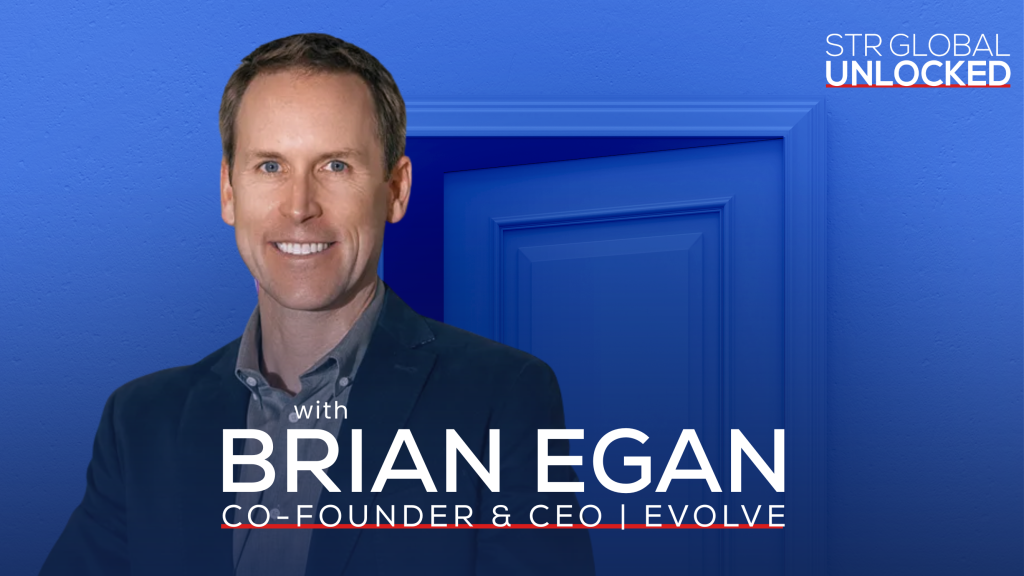
Brian Egan is the Co-Founder and CEO of Evolve, a Denver-based hospitality company with a mission to become the most trusted brand in vacation rentals. Since launching Evolve in 2011 alongside Adam Sherry, Brian has grown the company to support over 35,000 properties and more than $5 billion in rental revenue.
If you’re navigating the complexities of short-term rentals, this episode offers insights you won’t find in a press release. Brian shares what it takes to build trust at scale, how to grow without losing your identity, and why consistency still beats tech when it comes to guest experience.
In this conversation, we discuss:
- What inspired Brian Egan to leave a career in law and launch a brand focused on rebuilding trust between guests, owners, and property managers
- How Evolve’s approach challenges the traditional property management model and redefines what it means to scale in a low-trust category
- The early struggles of building Evolve and why Brian believes trust, not inventory, is the key to winning in vacation rental
- How the short-term rental industry lost its identity and what it takes to build a brand in a fragmented, tech-dominated space
- What most founders miss about balancing owner expectations, guest satisfaction, and profitability at scale
- Why consistency, experience, and human connection, not just tech, are shaping the future of vacation rentals
Connect with Brian Egan on LinkedIn [https://www.linkedin.com/in/brianwegan/] to learn more about Evolve Vacation Rentals [https://evolve.com/].
Resources
- AJL Atelier – Global STR Consulting helping professional hosts, property managers, and investors succeed in the short-term rental industry [https://www.ajlatelier.com/].
- Connect with Simon Lehmann on LinkedIn [https://www.linkedin.com/in/simon-lehmann-8375753b/]
Stay connected:
- Apple Podcasts: https://podcasts.apple.com/us/podcast/str-global-unlocked-with-simon-lehmann-unfiltered/id1842946960
- Spotify: https://open.spotify.com/show/3kke4wOx0tNv0duq9MMWtO
- YouTube: https://www.youtube.com/playlist?list=PLWVkmUOkmhSHcFjzi28AhaQNR98vaG65O
- Website: https://www.ajlatelier.com/podcasts
- Newsletter: https://str-global-unlocked.beehiiv.com/
Transcript
Introduction: [00:00:00] You don’t have to do it all on your own, and there’s no extra credit points for making it harder on yourself than it needs to be. And we saw that as a really important way to his internationalization.
Introduction: [00:00:10] Is that a topic for your investors, for yourself?
Introduction: [00:00:12] They’re looking at this as something that they want as a combination of an investment and a lifestyle asset. Right. And that blend. So it’s not for everyone.
Introduction: [00:00:20] You’ve opened probably about ten cans of worms to say the least.
Introduction: [00:00:24] At the end of the day, it’s a team that matters. And that’s why no matter what AI does, anyone doing it on their own is never the right answer.
Simon Lehmann: [00:00:34] You are listening to STR Global Unlocked, brought to you by AGL artillery, the show where I speak with the leaders shaping short term rentals worldwide. I am Simon Lehman and after two decades buying, selling, advising and investing, I’ve built a network that spans continents and categories. This podcast brings that network to you. Real conversations, global insight, no PR fluff. Let’s get started. Hi everyone! Today I’m joined by someone who has been right at the corner of our industry’s evolution. My guest is Brian Egan, a seasoned entrepreneur, an investor and advisor in the travel and hospitality space. Brian has spent his career building and scaling businesses that challenge traditional models, and he’s become one of the most respected voices in the short term rental industry. He brings a rare mix of founder experience, strategic perspective, a global insight, having navigated everything from startup grind to cross-border expansion, capital raising and scaling in a highly fragmented industry. Brian, I don’t want to spend the entire time of introducing you. Great to have you.
Brian Egan: [00:01:50] Good. We have much more interesting and important things to discuss, but it’s great to be here. Simon. Thanks for having me.
Simon Lehmann: [00:01:55] I really enjoyed, uh, our times we spent together over the last few years as, uh, industry thought leaders. And I have, uh, an utmost enormous respect for you and what you have built with evolve. And, uh, would love to hear a little bit about your personal story as a founder and operator, to start with.
Brian Egan: [00:02:16] Sure. Yeah. Um, you know, for me, I was not one of these kids who was nine years old, uh, you know, selling things on the school play yard and knowing what I wanted to be an entrepreneur. It actually, uh, struck me much later. Uh, I started my career, actually, in Silicon Valley, working in the tech and startup and venture capital industry as a lawyer. Uh, realized after a couple of years that wasn’t the path. I was at the right table, but in the wrong chair. Uh, switched over to go to my first hospitality business, Exclusive Resorts, based here in Denver, a luxury destination club. It was one of the first ten employees there, spent seven years helping to build that company and then really saw the opportunity, uh, along with my co-founder, Adam, uh, that the short term rental industry represented. You know, at that point, this was, uh, you know, 2010, early 2011 when we kind of made the decision to take the leap. We ended up beta launching evolve It by the end of 2011 with a whopping 21 homes on our platform. Uh, and you know, what we saw at that time was a mainstreaming industry, one that was still quite nascent with myriad unsolved problems. And we felt like there was a solution out there to be found between the idea of a DIY owner operating on their own and the traditional full service local property management model. So that’s what we set out to build. And here we are today.
Simon Lehmann: [00:03:36] Well that’s incredible. But let’s go a little bit deeper there. In terms of what was the the the initial idea, I mean, doing a DIY, uh, within a market where it was still clearly dominated by a lot of professional property management companies. I mean, Airbnb just started to ruffle feathers. Homeaway was around the corner trying to digitize Craigslist as well. Like what was sort of the starting thought points of you to build evolve to start with?
Brian Egan: [00:04:09] Yeah, so I’d say the core thesis was one this industry will mainstream. And that sounds obvious today. But let’s remember this is 2011 and it was anything but mainstream. I mean, as you just pointed out, Airbnb at that point I think had was a series a business still largely in the metro apartment sharing type of beachhead. We all knew where they were trying to go, but they hadn’t done it yet. Um, and at the time, you know what we now call Vrbo but at the time was HomeAway was a classified ad site. You couldn’t even book a property on the site. All you could do was request a book and you might hear back from an owner. I think at that time, if I recall correctly, you know, a rate table for a listing on HomeAway had six rows. So you could have like a spring rate and a summer rate and a holiday rate. Uh, and that was about it. So it was a it was a super nascent industry. Um, so thesis number one, this is going to mainstream ten years from now. It’ll be way more common and popular for either an owner to rent out their home or for a guest to choose vacation rental, uh, as their format for travel. Second thesis was with that, the market will become increasingly complex and competitive, and that that is going to mean that the bar is going to have to go up.
Brian Egan: [00:05:16] We’re going to reach that mainstream consumer, that mainstream guest. They are going to come into this category and expect to shop and buy and enjoy this wonderful business that we’re in the same way they do air, hotel and car, and they’re not going to be willing to put up with things like, oh, the rates were inaccurate, the calendar wasn’t updated, the listing wasn’t as advertised. The owner never got back to me. I mean, myriad things that were going on. So it is going to become more complex and competitive. And with that, it’s going to become more challenging for both DIY owners do it yourselfers or for rent by owners, as we call them, or the local property managers who had been operating in their world for 20 or 30 years. We thought that all created this kind of ground for disruption. And then the third point would be what does that disruption look like? We believed it needed to look like a management platform. So a vacation rental manager that could partner with these owners on an exclusive basis. So we become that calendar and system of record for them. We could do all the things you need to do to drive that booking, to take care of that guest, to take that work off of the owner’s plate and remove that fear and uncertainty and doubt that so many owners have.
Brian Egan: [00:06:21] They need that help, but also offer them some flexibility and some control and choice in the things they care about most, whether that be selecting the on site vendor that they want to use for housekeeping, or things like snow removal, whether that be elements of revenue management, you know, minimum rates and things that they may want to say that they really care about. Hey, if I’m not going to be in the home during Christmas, I want at least this much money. So we believe there was an opportunity to create something that was a bit lighter weight, faster moving and offered owners really a unique value proposition. And in exchange for all that, of course, also a lower management fee that we felt like was going to be very attractive in the market. That was the basic hypothesis. Um, and by the way, I mean, all these years later, I would say good news. We were right. We were probably early. Uh, we also convinced ourselves we were wrong at different points along the way and messed some stuff up. But if you go back and look at what we actually believed in the basement when we were just two people there, uh, a lot of it actually is pointing straight at what we’re still building today.
Simon Lehmann: [00:07:23] So what did you mess up? I mean, you just took one of my next questions, obviously. Fast forward 14 years to see, you know, in terms of your thesis. What what did you underestimate or overestimate in terms of challenges? And what did you mess up on the way?
Brian Egan: [00:07:35] Yeah. Well, I would say the first thing we messed up was, uh, we we sort of heard from everyone, right? That. Oh, this is going to be really hard. It’s going to be really hard to find these owners. And and that was right. I mean, it was harder than I think we expected to identify these individual owners out there in the market and partner directly with them. That was you know, it’s it’s not a consumer brand where 80% of the folks on the internet are actually the right clientele for you. So figuring out how to get there was difficult. We’re also trying to convince people to do something that no one’s ever offered them, so they don’t have a mental model for it, right? So all of that took a lot longer than we thought. That’s actually not the mess up, though. That’s just I think part of like trying to build a sort of model and come at an industry from a new angle. That’s part of the game and we were up for it. The part we messed up was actually losing our conviction. So we actually were about a year, year and a half into the business and we started to say, gosh, this just is not growing as fast. We’re going to figure this out.
Brian Egan: [00:08:34] But we can’t be 80 year olds, 80 year olds by the time we do. Right. And as we got to that point, we also had some property managers calling us and saying, we see what you’re doing. We’d love to partner with you. It won’t be exclusive, but we’d bring, you know, 20, 30, 50, 70 units onto your platform and have you serve as one of our distribution channels. And we tested it. It looked pretty good. We doubled down on it. It was a huge mistake. And once we got to the place where we were no longer in an exclusive partnership with the person who actually controlled that asset, the owner who paid that mortgage, you know, that was that left us kind of in a in a zone of being yet another layer and a middleman that could be disintermediated. And what we realized was it was a fast way to build a much bigger business, but not a good way to build a durable business. And so we actually spent another 6 or 12 months unwinding that and kind of going back to the original thesis and just bearing down on we’re going to figure this thing out one owner at a time and brick by brick, build this business up.
Simon Lehmann: [00:09:34] So all your owners are exclusive on the platform, correct? Yes. And you only do single channel distribution, which is evolve itself, right? So you don’t redistribute the content to other platforms?
Brian Egan: [00:09:45] No, no, we actually we distribute all over the place. So we distribute to Airbnb, Booking.com, Expedia, Vrbo, uh, and a longer tail from there. We’re a big partner of Marriott Homes and Villas uh, by Bonvoy. Uh, so yeah, no, we part of, part of our model is to handle all the distribution on behalf of that owner, in addition to having evolved as a direct channel.
Simon Lehmann: [00:10:06] Is that something you started right from the beginning that you said, hey, we’re so so that must have been very hard. I mean, even today to think about that, people still and even property managers, especially in the US, but also in other, uh, animal Saxton markets still do single channel distribution or like very few. That must have been very challenging to to offer a multi-channel distribution approach. If you see now all the companies that go after the long tail like small Bu and rentals and toolkit and and home to go with their brands and it’s unbelievable. So you started so early with that approach. And to see now that everybody is going after the long tail, uh, is quite interesting.
Brian Egan: [00:10:50] Yeah. You know, for us, the thesis was this OTAs, if you think about vacation rental or short term rental versus hotels, hotels have been in business for, you know, 2000, 3000 years before the OTAs came along. But especially in the US. And by the way, I mean, uh, I know you have a global audience for your podcast, which is wonderful. I want to make sure that I’m caveating my answers to your questions are our operation is, you know, vast majority domestic in the US. So, uh, in the US, the short term rental industry is actually quite nascent. And it was very unorganized. And, you know, the OTAs, so to speak, if you call the earliest version of Vrbo or HomeAway sure to they actually came of age on the internet at the same time as the short term rental industry came onto the internet right in the mid to late 90s. And so for us it was, hey, these marketplaces are actually a very helpful organizing function for an industry that needs to go through a massive mainstreaming curve. And we’re way better off getting on that wave and writing it and letting the then home away’s now vrbos, letting the Airbnbs, letting the ultimately Expedia’s and Booking.com, you know, letting them create some of that wave that we can ride. I mean, look, I’m, I’m an entrepreneur and I love building and being disruptive and taking new angles. But you don’t have to do it all on your own. And there’s no extra credit points for making it harder on yourself than it needs to be. And we saw that as a really important way to drive value for our owners.
Simon Lehmann: [00:12:17] Excellent. Yeah, I will definitely go back to your entrepreneurship a little bit later in our conversation and hear some of your learnings also with the team and to human capital you’re engaging with. I have, uh, the $100 billion question, uh, when we talk about market structure and, and supply structure as well. Um, we talked about supply structure for such a long time. And we differentiate between long tail, which is basically the DII, the RPO rent by owner, do it yourself, uh, owner. And uh, and let’s make the demarcation line 20 properties, uh, always said, you know, up to 20 properties. You can still keep your day job. And then after that it gets tricky. Um, call it, uh, the professional market 20 plus. I don’t want to ruffle anybody’s feather, but let’s, uh, settle on on 20 properties. One thing that I found very interesting over time to sort of follow these, the data of all the big data providers who, when you look at the long tail versus the manage tail, that this has not really shifted at all over, over all these periods of time. And I was always the one wearing the PMC and the professional hat and said, you know, that line that the professional supply is going to grow and the RPO, rbo are part of the business in terms of supply is going to shrink over time. And interestingly enough, if you consume data over the last even a decade or five years, seven years, half a decade, it hasn’t really shifted. And and why is that? And I would love to hear your opinion on that.
Brian Egan: [00:13:52] Yeah, it’s a fascinating question I agree. It is the $100 billion question. Um, here’s here’s my take for today. It’s a dynamic industry. And ask me again tomorrow. I think that you saw this immediate surge of DIY owners, and this is back when everything was hard and Vrbo was a kind of a crappy classified ad site, if we’re being honest. Right? They would say that.
Simon Lehmann: [00:14:16] College will be on the podcast as well.
Brian Egan: [00:14:18] I’m perfect. Nobody knows it better. Nobody knows it better. So, you know, that was like the minute that that was an offer. You saw a huge part of the market say, I’m ready to go right around this managed layer, because when you have a lack of competition, right. The managers in a lot of these markets before that was an option. There wasn’t a lot of competition. They could kind of price at the level they needed. They didn’t have to like, you know, fight it out for that business. We all know that competition is going to make markets improve. So immediately you kind of by the time we got into the market, it was already about a 5050 balance. Now, why hasn’t DIY taken over and owned 80% of the market? I think it’s because it’s hard. I mean, you’re taking on I think you really have to do this well as a craft. It is becoming a micro hotelier, and you can see the hosts and the, you know, DIYers who are so good at this, you know, it takes real energy, passion, time, skill. You know, you have to be willing to have your phone on on your bedside table. You got to be really excited about it. Now, good news. Millions of people are right. And I think that’ll be a part of our industry forevermore. And I think it’s a really important part of our industry.
Brian Egan: [00:15:27] But I’ll also say it’s not for everyone. And when you look at, for example, our owners, most of them have double income. You know, husband and wife are working. They’ve got kids in school or just out of school. I mean, they’ve got very busy lives and they are not looking at this as something they want to do as another job. They’re looking at this as something that they want as a combination of an investment and a lifestyle asset. Right. And that blend. So it’s not for everyone. But on the other side, you’ve got the professional management layer, what I’ll call like local full service management. Why hasn’t that grown. Well, because one it’s expensive. I mean, in order to do that business right, you have to be boots on the ground, local. You have to have installed teams. You have to have a pretty heavy infrastructure. There’s real opex involved, right? You got a lot of pieces that are moving around there. And at the end of the day, if you load up all the fees and look through the whole thing, you’re going to end up paying at least 35 and more likely 40 to 45% 5% for that service. Now, for many owners, that’s a great deal. It’s I don’t want to worry about it. I want to, you know, I want to be able to text the person taking care of the home.
Brian Egan: [00:16:35] Wonderful. So our whole point was, hey, why don’t we come into the middle of this and say, we can do a lot of the things that you need as a partner? We can allow you some of that flexibility. Um, so I think that’s why we’ve seen this relative stasis, uh, and I think as the business as the industry moves forward, you know, my view is that, uh, a disruptive offering is going to be increasingly attractive. I mean, I don’t think we’ve seen, for example, we’ve seen seven, eight, nine, ten years of better and better DIY tools come to market. You know, whether that was originally with the pricing apps, most recently with AI tools. I’m not sure any of it has actually changed the market share, you know, and we’ve also seen a lot of consolidation and movement on the full service local property management side. Again, not sure we’ve actually seen any shift in market share. So from our point of view, we look at activating new owners that evolve every month. We have hundreds and hundreds of people who are joining evolve and bringing their home on the platform. Uh, most of them are new to the market and have never rented that home out before. So we really view the expansion of the market and growing the pie as a big opportunity. Wow.
Simon Lehmann: [00:17:46] Very comprehensive answer. You’ve opened probably about ten cans of worms, to say the least. Uh, so let’s try to close my skills. Let’s try to close some of the Brian and, uh, you know, you used words like consolidation. And so if I understood you correctly, uh, you would argue that the market split in terms of professional versus long tail is going to remain about the same. Um, you know, people switch and whatever. But let’s talk about your business. Let’s let’s talk about Long Tail for a second. Um, obviously you’re you’re in North America. We’re having visibility across Southeast Asia, uh, um, Australia and also Europe and Latin America. And the market is slightly different. Um, but in a way, the split between between professional versus long tail is about the same. Depending on market. Certain markets are a lot lower and certain markets are higher. But in general, on average, it’s about the same. But what we’re seeing is that we’ve seen a lot of, um, technology transaction recently, a lot of, uh, capital flows into the industry, a lot of private equity capital flows into the industry. And we’ve seen a number of very interesting, uh, let’s say business plans and, and value creation plans in their pitch decks, uh, to private equity.
Simon Lehmann: [00:19:06] And interestingly enough, a lot of these, uh, technology platforms that are out there raising significant amount of capital or exiting as well, they put their growth strategy into the long tail. So so that means it’s going to get tough out there for you. Uh, because everybody says, you know, the professional managed market is is so competitive and it’s so hard to to gain more market share. You spend a lot on marketing. You go to conferences, you’re moving teams around the world to to grab more professional property managers. And and the acquisition on the long tail is obviously more online marketing and online acquisition, um, through communities, etc.. So I, I would argue that you are going to see a lot of competition of technology platforms who have built multi-channel distribution, channel management, revenue management, content management, PMS functionalities, and that stuff is there. And then it’s obvious that some of these companies can say, like, now with what we have built, we go after a long tail with a with a light solution and we can offer the same.
Brian Egan: [00:20:15] Right. So I would say a couple of things there. One, I totally agree with you that that is what’s happening out there too. It’s not new. I mean, I remember sitting in, uh, the basement and looking at there’s an accelerator, a seed accelerator program here in the US called Techstars. And we saw right as we were getting started, we saw somebody building a set of DIY tools that were going to be software based and become the big disruptor in the industry. And, you know, I guess I’ve just seen it come and go. Now, that said, I think these are the best tool sets out there to date. Um, and I think that’s great for owners, but if you’re not somebody who wants to do it yourself, who has the skill, the ability, the willingness and readiness to do that, it’s not going to matter. I mean, I can buy you a better and better power saw, but if you’re not somebody who’s actually a do it yourselfer, it doesn’t really help you. Right. A lot of people are going to need a partner in order to navigate a market that, by the way, what you’re what you’re saying there is that market is becoming increasingly complex and competitive. And for a lot of owners, that’s going to mean that they need to or want to have a partner to help them navigate that space.
Brian Egan: [00:21:25] Now, that all said, I think it’s also important to say, you know, we we view that as good. We view all the advancement. I mean, there is going to be ten, 15, 20 years from now. There are going to be DIY owners on the best tool sets we’ve ever seen. There’s going to be full service local management at a premium price, and I believe there’s going to be robust scaled hybrid solutions in which I believe evolve will be the winner. That’s how I see the world unfolding, and this isn’t going to be a winner take all. But I do believe that within those categories, there are winners take most. And that’s what I really see evolve as. My last thought is, you know, Simon, look, if if that’s what owners want, there’s no saying we can’t deliver it as well. Right? Because what we’re doing today is standing in the shoes of the owner. Right? We’re marketing and booking all of their properties under the evolve brand. We’re talking to their guests. We’re handling a lot of their revenue management, etc. if owners are really keen to to do it on their own, we have the toolsets, we’ve built them for ourselves and there’s no saying that we couldn’t offer them as well.
Simon Lehmann: [00:22:27] So where would you say robust? Where would be the biggest differentiators to these DIY tools, DIY tools that are out there in relation to evolve, with the exception of the brand that you have built?
Brian Egan: [00:22:40] Well, yeah, I mean, number one would be the end to end us taking the property from, hey, I’m thinking about entering this category to a high performing online listing that’s being distributed with high fidelity to every channel out there that’s being priced to its optimization point. That’s, uh, and revenue managed to that point where all the guest inquiries are being handled by us, where we’re coordinating with your on site provider of choice, in many cases, a, a partner that we’ve introduced you to, uh, through our vetted embedded network. Right? So yeah, it’s the I mean, this is basically a new format of management where the owners are able if they want, they’re able to sit back and more or less get, you know, booking notifications in their app and dollars in their bank account. Um, but on the other hand, we also have the ability for owners who want to lean in a bit and act a little bit more like that DIY, for example, we have revenue management, uh, levers that are available to our owners. They can actually use these tools to say, hey, this is the minimum price I want for that specific week. Great. No problem. You can do that. And you can do that really easily through our owner app.
Simon Lehmann: [00:23:50] So why so obviously now would be the great opportunity to move your business, uh, across borders and, and internationalize that business model because it’s obviously there’s clear differentiation. You have a lot more stickiness from a technology standpoint, from a branding standpoint and what you offer, uh, also to the to the owners. And this is not about, the marketing show of evolve, but it’s about talking. How do you navigate within that landscape? And and obviously you have raised a significant amount of capital as well for your for your business and growth. And, and is internationalization, is that a topic for your investors and for yourself?
Brian Egan: [00:24:30] Well, absolutely. I mean, let’s start. First of all, I remember you asking me this question the first time we met, uh, many, many moons ago at a conference, uh, which was a funny story unto itself, but, uh, it was one of the first three questions you asked me. And I think my answer is going to remain the same, which is from a vision perspective. It’s absolutely global. I don’t think there’s any reason why our innovation into building this hybrid management model, uh, a bit of a best of both worlds can’t be successful anywhere in the world. The answer to when is, uh, uh, by the way, the other thing would be, let’s also talk about whether that would be go to Europe, where that’s, you know, a much more mature market, many more established incumbents. Sure. Decades. Decades older than the US. Or whether that’s more like a Latam or APAC. Type of market where it’s much more nascent. So you can have all those debates. I can tell you the when answer, which is, as soon as we believe that it won’t distract us from becoming the market winner in the US. Right. As soon as we believe that we are at a point where that is the next best and heaviest lever to pull in order to grow. And right now we look at the US and it’s still the largest greenfield opportunity out there. I mean, you still have, uh, hundreds, thousands of owners every day, every week who are coming into this category. You still have a lot of people moving around between models trying different things out. You know, we believe this remains our biggest opportunity. And importantly, because of our model, we were always able to operate across the entire US, right. So we never went market by market. Yeah. And we didn’t take inventory from primary markets, secondary and tertiary markets. So for us, there’s just so much opportunity here in the US that we still want to make sure that we’re, you know, we’ll never be perfect, but we we see an opportunity to keep raising our bar here. And then eventually yeah, the vision is to be global. Certainly.
Simon Lehmann: [00:26:23] We have uh, we have seen a lot of pitch decks and fundraising decks that have put out international strategies to their investors, uh, raising an enormous amount of capital. And nobody in our industry has managed to become truly international. And we could we could, uh, talk a lot about different brands. I think Picasso is one that, uh, speaks for itself. They’ve tried an internationalization strategy. At the end of the day, synergies were not there. Wyndham sold their business in 2018, Wyndham Vacation Rental as well, uh, which is now away. So we’ve seen we’ve seen it. I’ve done it myself with Interhome. We looked at the US market. We couldn’t do any significant intercontinental cross-border business. It’s just there’s just no synergies. There’s nothing there. You’re not getting more guests from one place to another because of it. Um, in the traditional PMC business model and it just totally failed. Um, and it’s going to be extremely difficult. And we hear it all the time. Now we see franchise models. Um, so which model do you think? And what would be the advantages in terms of building internationalization? I think one of the biggest issues that we have in our industry, that we have not been capable of building a significant consumer facing brand to drive demand, right.
Brian Egan: [00:27:40] Yeah. So, I mean, I think the reason that it hasn’t worked with the traditional full service model is the same reason that it hasn’t worked to actually scale that model and centralize it nationally, even just in the US. Right. Because it’s a big country, uh, with a with a lot of different nuances and nooks and crannies to it. And so what I think happens in those businesses is two things. One, it’s inherently quite local. It’s inherently, uh, you know, there’s nuance to each market. And then two, as you point out, the synergies break down because there aren’t any, um, there are no economies of scale to performing that kind of manual labor. Right? That kind of fixing this, shoveling that, you know, pushing a vacuum cleaner that actually, in many cases has diseconomies of scale. Once the homes get further and further apart. Right, you got to put people back in a van and drive them down the road, the whole deal. So we’ve seen in the US, it’s interesting to note we’re now seeing the largest players that are full service are all pushing to highly localized models, whether that be through a franchise type of arrangement or whether that be through a roll up in which you let the underlying asset continue to operate locally. Yeah, that that seems to be, you know, what the market consensus has landed on in terms of that full service model. And I think that is also why it hasn’t really worked on these international. Expansion fronts. In terms of the model that can work.
Brian Egan: [00:29:09] I would say one, that’s where the software tools have an advantage, right? Certainly you’ve seen more of them make that leap, more of them operating in. I don’t know if anyone’s really built a big business doing it yet, but I think it could happen. Um, and then two, if you’re going to do it, I think our model is the right one where you’re partnering locally for local services, where we don’t have thousands of housekeepers and maintenance people and bus drivers on our payroll. We partner for all those services locally, and in some cases, the owner is the one actually securing that partnership because they have a preferred vendor. So for me, I think that is the model that could do it. The last thought I have on this topic too is, is, you know, look, we there’s no saying that we have to go do it on our own. I said earlier, no extra credit points for a degree of difficulty here. Right. Uh, so, you know, there is always an option of saying, hey, it may make sense at some point to look at establishing a foothold through inorganic growth. I mean, to date, we have nearly 35,000 properties on our platform. We have grown completely, 100% organically, brick by brick. We’ve won every single one of those owners individually. And so, uh, you know, that said, we’re not dogmatic about it. And if there was an acquisition opportunity that made sense as a way to, you know, look, cross border, we certainly would take a close look at that.
Simon Lehmann: [00:30:27] Yeah, maybe I would have some ideas here, but let’s, uh, take that offline. Uh, there’s always opportunities out there.
Brian Egan: [00:30:33] I didn’t mean to trigger your deal brain there.
Simon Lehmann: [00:30:37] Yeah, but, I mean, that’s what we do, right? We’re connecting dots and, uh, and and getting the right people together to, uh, to professionalize and grow this industry. That’s what makes us excited. Um, let’s talk about technology a little bit. Uh, overall and the way you look at, uh, the short term rental industry, you know, and I sort of feel, um, I’ve seen Brian, uh, more in the past than I’m seeing him now. Which, uh, tells me he’s not so much into the conferences anymore because of where you’re at, right? And it makes a ton of sense. I mean, you’re focusing on a different business. I mean, you’re not gonna you’re not adding property managers on your platform to do distribution that that you have done. That’s probably when we saw you more often at property management conferences. But now you’re running after your brand and your deal and you’re growing your business. So you’ve in a way created also some some of the distance with the learnings that you’ve had on the platform, uh, to have integrated the PMCs. I remember the days when we were the first property manager in the world, uh, with so many properties in Europe to integrate with HomeAway. It was a nightmare, right? But anyway, how how do you look at the traditional property management industry, like predominantly in the United States right now?
Brian Egan: [00:31:53] Yeah. And specifically, you know, from through a technology lens. Um, you know, I would say for us, we have a model that is unique. And therefore, while we did actually start and operated for maybe 18 months on a third party system that we were trying to customize the heck out of, ultimately what we concluded is we need to build our own operating system because there isn’t, uh, you know, there isn’t a market for a big software company to build something for us because we’d be the only ones using it. Uh, so, so, you know, uh, and by the way, I certainly, uh, I don’t mean to be under the radar screen. You’re right. The bigger conferences, I mean, we don’t really have anything to buy or sell at those conferences. Uh, but we do have, uh, you know, our teammates are there, uh, talking to our biggest partners, especially the OTAs and such. Uh, and just so everyone in the industry knows, I’m always available. Anyone can reach out. Uh, don’t mean to be, uh, don’t mean to be off the radar, uh, but, you know, from our from a technology perspective and a bit of, you know, to your point on focusing on the business, you know, we have just gone through an overhaul. So we had built a system in year two of our life or so. Uh, and that reached the end of its useful life and was ready to be replaced. And we have gone in the last 12 to 18 months, we have been systematically overhauling our entire tech stack.
Brian Egan: [00:33:10] Uh, and actually, that work will largely come to completion. You’re never done. But, uh, the, the sort of big migration will be complete by the end of this year, which I’m really excited about. It puts us on a much more modern, much more flexible tech stack and, uh, and allows us to unlock a lot of velocity of product development, a better owner and guest experiences. It certainly unlocks the future, uh, for our business in terms of leveraging AI. Uh, so we’re super excited about it. In terms of what I see out there, it’s interesting. I mean, I think there were a number of people that were trying to do more of their own platform development, uh, and ultimately concluded that that wasn’t the right path. And I see why. I mean, if you’re running a model that everyone else is, you know, that is largely the same model as other people. Well, then there’s going to be a market for people to build great software for it. And again, no extra credit points, like why would you go build your own PMS if yours isn’t going to be as good as whoever guessed streamline? Pick your pick your partner. Right. Uh, so to me that does make sense. But it’s interesting to see, you know, for example, I think Costco has recently, you know, in the wake of the acquisition of Picasa, has said we’re going to use, uh, I believe it’s, uh, streamlined. I can’t remember exactly which one.
Simon Lehmann: [00:34:24] Going from streamline and using GST as well.
Brian Egan: [00:34:26] Oh, to GST. Yeah. And then you know that they were partnering with uh, wheelhouse for revenue management. Right? I mean, that’s an interesting move for one of the largest companies in the space to make, you know, our version is that we’ve built those tools in-house. We’re perfecting those tools in-house. I’m not declaring right and wrong here. I’m just saying it’s a it’s interesting to see. And I think from a tech perspective, it seems like the legacy full service industry is more moving to the scaled third party tools, and that that motion is going to sort of settle there. And then again, people will continue to try to innovate on better DIY tools that’ll that’ll last forever. Um, and, you know, we’ll see where that goes. And as they make it easier and easier, it should be more attractive. But on the other hand, that’s been happening for ten years. And as we just discussed, it doesn’t mean that every owner is opting into that into that format.
Simon Lehmann: [00:35:15] Yeah, I would totally agree. I mean, the discussion of proprietary software versus what’s coming off the shelf, that has definitely shifted significantly also in Europe and and also in the in Australia and other markets where people, you know, in the early days, people had to build proprietary software because there was nothing there. But the evolution of technology within the SDR space has been huge for the last few years. And one of the pitches that Eric and Cliff has done to raise capital for Kosovo was obviously building a, you know, a technology company, but at the end of the day was a full service PMC and you’re still dealing with unit density, manpower, operation, opex and everything else. And I guess for, you know, being the devil’s advocate, it’s easier for you to say, because you’re looking at it from the SaaS lens. And and at the end of the day, you know, a lot of people try to combine that. And we had interesting conversations at at the conference last December in, in Florida about this and, and this proprietary tech play that’s gone, that’s history. Now, even, you know, Steve Schwab and others clearly said, you know, this this positioning also from from an investment standpoint, you know, we’re a we’re a SaaS driven service business. It’s sort of a service as a software instead of software as a service. It’s it’s it’s quite interesting.
Brian Egan: [00:36:39] Um, yeah. You know, and look, I, I mean, these are smart people and they’re making, you know, really, I think thoughtful, data driven, analytical decisions. I think it’s the right thing for their model. I can tell you it’s not the right path for our model, but again, that just sort of proves the point that what we’re doing is, is different. Um, and then, you know, I would say, you know, for us, a big part of this is setting the stage for where we can go with AI, which is just, I mean, the most exciting thing. What a gift. I mean, I, uh, I can’t believe that I am one of the few people who’s lucky enough to one be in the industry for a long time, you know, to get to take a journey like this. Um, and then to be at this stage of it and have, you know, the, you know, at least a generational and arguably the biggest technology shift in platform shift ever, uh, happen while we’re in a position to really take advantage of it. I mean, again, surfing that big wave, you know, for us, we look at AI and say, this is the it’s the perfect technology to do the things that we do. It’s not the perfect technology to vacuum homes. It’s not the perfect technology to shovel snow and, you know, fix toilets. But I’ll tell you what, it’s really going to be helpful when it comes to pricing, distribution. You know, uh, guest and owner support, uh, and all the things that are really at the core of our business, uh, in terms of providing incredible performance, incredible service and amazing experiences for guests.
Simon Lehmann: [00:38:10] Yeah, we manage 37 minutes and 20s not to talk about AI. That’s pretty impressive. I didn’t mean to do that, but.
Brian Egan: [00:38:17] He gets the best.
Simon Lehmann: [00:38:18] Of me because I wanted to ask you about it because your whiteboard behind you is is white. So that means you’re, uh, you’re introducing AI in your business.
Brian Egan: [00:38:27] I was furiously wiping this off, uh, before you hit record.
Simon Lehmann: [00:38:32] And I’m sure you have some other big buddies. And obviously Graham Donahue from Sykes is also a huge fan and has developed his business significantly into that direction as well. And I could not agree. I mean, it’s definitely going to be a game changer significantly for for good and worse in all different use cases. We need to see how this evolves. But we also have understood that we need to stay on top of that as good as we can, because it is revolutionizing. I’ve seen some incredible use cases within this industry already on AI and and it’s it’s happening. Um, absolutely. So let’s move on.
Brian Egan: [00:39:06] And look back back to the point that you made though, right? This isn’t just about narratives. I mean, you can get look, you can get by if you’re a clever, uh, you know, salesperson and everything else. And entrepreneurs are known for their, uh, their charm at times. Right? But ultimately, there’s a scoreboard. Ultimately, there’s the initial performance of the business. And at the end of the day, every business is ultimately worth their future cash flows. Right. And so I think it’s really important that, you know, my excitement about AI is not about a narrative. It is not about something flashy. You don’t see it written all over our website today. You don’t see me on stage at the conference shouting about it, because I think that we’re still at the very beginning, and I don’t think that we have the, you know, end results. And this isn’t just evolve. I would argue this is the industry. I would argue this is enterprises more broadly. We’re just now in 2025, I think, starting to see really interesting enterprise level use cases for what’s happening. And it’s only going to continue and compound. And I’m terribly excited about it. But not not for the glitz, not for the headline and the narrative. I’m incredibly excited about it because I think what it can do is elevate the experiences of our owners, our guests, our teammates, and ultimately improve the financial performance of our business. Free up more capital to invest in the growth of the business and the elevation of those experiences, rather than fundamental operations. That technology is going to ultimately be in a better position to perform for us. So so that’s that’s the why behind it for me?
Simon Lehmann: [00:40:39] Does that mean that Brian Egan is going to run away on his own? No, no.
Brian Egan: [00:40:44] First of all, that would be that would be a terrible decision for the business. Uh, I am wrong way too often for that to be. That would be a disaster. Uh, I need a smart team around me to keep me in check and keep me between the lines. Uh, no, not at all. And actually, I don’t view this as, um. You know, I think a lot of people start to talk about this as, like, technology just replacing people. I, I’m sure in some businesses that may be the case. It’s not how we think about it. How we think about it is how can this incredible technology change what that role is? You know, how how do you go and where do you go, by the.
Simon Lehmann: [00:41:21] Way, to human capital? Yeah.
Brian Egan: [00:41:22] You know, and and change what it means to be. So you’ve got somebody who’s in owner support, right. This is a critical function in our business providing incredible service to our owners. Well, we don’t really need I mean, our teammates aren’t dying to take a call that says I’m locked out of the website. Right. Our teammates aren’t dying to take a call to ask a question that they’ve been asked 14,000 times, and will be asked another 14,000 times. If owner and owners aren’t dying to log a case or place a phone call in order to get something done that they could get done with a push of a button in an app and an agent could take action on their behalf. So that is literally just making the owner experience better, and it’s making our teammate experience better. And of course, yeah, it’s also freeing up opex for us. But it’s not really about oh, that way we get rid of that teammate. What it’s really about is how can we take that talented person and then have them in a better position? Because guess what, there’s going to be another scenario because, as you know, short term rental, like, look it’s a great industry, but these are homes and things happen right. You can have somebody clean the home on Friday for a Saturday check in. And the person gets there on Saturday. And the tree fell on the back porch. Right. I mean, this is the stuff that happens. That’s when owners need incredible humans who are passionate and well trained and well versed in the industry. And I don’t think that that’s what AI is going to take over. Like, I think that’s where it’s human to human, and you’ve got to be really good, and we’ve got to have relationships with on site partners and all the rest. But hey, let’s take all the the stuff that our team would tell you is the least favorite part of the job. Let’s take that off the table and redirect our energy into the stuff where we can really make a difference.
Simon Lehmann: [00:42:56] Let’s move on. I totally agree with you. And, uh, you know, this is going to be definitely interesting how this evolves. Not everybody has the same opinion about it and how you do create efficiencies. And also what does it do to the human capital, but especially in the short term rental industry, the humans are real, are today and will in the future remain the most important capital, uh, within the industry being, um, on the SaaS side, uh, but also being on the operational side, you know, so that’s definitely what’s going to happen. So let’s talk about it.
Brian Egan: [00:43:29] It’s a team that matters. And that’s why, by the way, no matter what AI does, anyone doing it on their own is never the right answer.
Simon Lehmann: [00:43:36] Yeah, that’s why we love the short term rental industry. Let’s face it. Right? So, um, let’s, uh, as a closing topic, I would want to sort of talk about, uh, investment landscape and uh, especially once again, we’re talking to a global audience. Um, and, uh, you know, we’ve raised capital in Australia. We’ve seen the markets in Southeast Asia, Europe. It’s like raising capital has become significantly challenging. Uh, the narrative in relation to property managers has become more a service business than a software business is going to be interesting to see. But we’ve still seen for for large business a significant amount of capital flowing into this industry. We still see pretty big, uh, transactions. It’s going to be interesting to see if more and more is going to come in, uh, because it’s a service business that they’re financing. We’ve seen, uh, large transactions with thousands of units that have attracted capital. There’s a group out there right now who is trying it again to do a roll up, uh, private equity backed. So that’s going to be interesting. But I want to focus with you more on the technology front. And how do you view the landscape, uh, in relation to capital? We’ve seen some significant valuations in the PMS side with guests and Hostway and others who have raised significant amounts of capital, uh, from, uh, piece. We didn’t have that in the past because the growth and the size was just not there. And now, finally, these companies get to a level where it’s becoming interesting for mid and large cap private equities to invest into the into the business. So my question to you, how do you view the investment landscape in general. Also for smaller businesses fragmentation is not going to go away so quickly. Even though we felt the tax space is going to be consolidated very quickly. I say on the channel management a few other fronts, we have clearly seen it already. Also in the PMS side, I. I think markets will consolidate. Now. All these AI tools are popping up like mushrooms. They all need capital. So what’s happening there?
Brian Egan: [00:45:37] Yeah, well, my first answer is you probably know more than I do in the sense that I’m I’m proud to say that evolve is now a self-sustaining, profitable business. And so I haven’t personally been out in the capital markets in quite some time. Uh, that said, of course I keep my eyes open and my ear to the ground and, uh, you know what? I’m what I’m noticing is, is, is a couple of things that you touched on. First of all, I would say overall, I’m just tremendously excited to see capital flowing into the category. And you could define the category broadly as everything from the core tech tools to even the what I would say is kind of adjacent short term rental kind of hotel replacement. I saw, um, Casa, uh, raised around I saw that announced a couple days ago. So anywhere in that whole spectrum, I think any capital coming in is a great sign, because what it tells you is that the capital market is very smart. Investors who have been watching and watching and watching and analyzing have gotten to the place where they said, yep, it’s ready to grow again, right? Because we went through a period of time where everybody the bloom was kind of off the rose. Uh, you know, there was, uh, some, some big public offerings. And there was, you know, obviously significant decreases in stock prices thereafter. The whole growth company world went through a correction in pricing, interest rates went up, all the things that we all know.
Brian Egan: [00:46:59] And so I think for a minute there, the category just sort of became, uh, less attractive. Now I’ve been, you know, I’m 25 years into my career and I can tell you that, you know, those markets are the best ones to invest in, that when everyone’s talking about it, that, you know, the opportunity has already passed you. And so I think you’re starting to see the early signs that some investors believe this is a growth category. The second thing I would say is, yeah, to your point and to your global audience. The the PMS companies seem to be the ones attracting certainly healthy valuations, which is great to see, and I suspect that it’s the Tam. I suspect that it’s the idea that, hey, this is, you know, this is a big market that you can scale into, um, which is which is exciting. It’s also very interesting to see that, yes, capital and a significant amount of it is flowing into some of these more operational, more like traditional PE businesses, really, at the end of the day. Um, obviously at very different multiples, obviously, you know, with a different view of, of, of what’s happening. But I do think that there seems to be I mean, you know, what’s old is new and, uh, you know, the rollup I’ve been watching the rollup play since Resort Quest, uh, since Wyndham bought Resort Quest.
Brian Egan: [00:48:10] Since Picasso bought Wyndham. I mean, you know, we’ve been we’ve been watching it for a while. I do think there’s some new approaches. Uh, today, again, like a franchise model, you know, letting these companies operate more Independently in local markets, and I suspect they will be more successful with those approaches. But it’s really interesting to see that that’s you know, the consolidation piece seems to be the other thing that’s attracting capital. Now, that said, step back as a market. What does that mean? It doesn’t mean a lot right. The number of properties in the market didn’t change. The you know, it’s moving some chess pieces around on the board. Yeah. That’s true. The number of properties in the market didn’t change. And the market share of local full service management for a premium price also didn’t change. So from our perspective, it’s. Yeah. Well, I mean, are they bigger competitors? Sure. Um, but does that actually change the value proposition or anything that’s, you know, the dynamics of the market over the last ten years? Not really. Um, and I wish them all the success. I mean, I think for us, the better they perform, the more attractive the category, the more likely that new owners get interested in the category. And we’re going to win our fair share. Well.
Simon Lehmann: [00:49:20] First of all, congratulations on the performance. And that’s great. Uh, so obviously great not to have to go out and raise more capital. And, but you still have a very strong opinion on how the market looks like. And, and I’m sure you get plenty of phone calls instead. So you’re on the receiving end as well. And that’s part of the game, right? I mean, people investors are looking for opportunities and, and uh, and, and as you, as you said and I totally agree, that’s great for the category. Uh, you know, we’ve seen also some failures, uh, also the PMC side, which for sure didn’t help the industry at all because it didn’t work out, because I always made the argument that the largest for property management companies in Europe, with 50,000 properties, they’ve been around for 60 or 70 years. They’ve never lost money. Right. So, uh, it can be done. Uh, it just depends how you do it. So let’s wrap this up, Brian. You and I could talk for hours, and there’s still a lot of other things we could chat about. I’m sure we’ll see you around again. Very soon. Um, what is the outlook for you? Like, how is this industry going to look like? Uh, we’ve seen some recent announcements by Airbnb raising fees and getting rid of the guest fees. So obviously evolve is going to raise their fees as well. Just kidding. Um, but, you know, it’s a free pass for OTAs now to think how much dependency we have. And I guess your model remains naive and more attractive as well. But we don’t need to want to talk about it. For me, I want to general outlook for you. We talked about how’s supply going to evolve. We both agreed it’s going to probably stay about the same in terms of split. Uh, from from long tail versus, uh, manage inventory. What other significant changes, uh, and your outlook in the next couple of years, we’re going to see within the STR space.
Brian Egan: [00:51:09] Yeah. So let’s pick a time frame and call it three years. Right. Um, I am incredibly bullish on the industry. And I know that that could sound cliched, and I’m certainly not unbiased. Um, but I wouldn’t have said that three years ago. Uh, you know, and I didn’t I was on the record then, too. So here’s why I’m bullish. One, I think you’re seeing a market. And again, I, I spend 100% of my time on the US right now. So I don’t claim to have the dynamics of, of the, of other global markets down. So take this, uh, as the US analysis, I think we are seeing every sign of stabilization. We went through a massive supply and demand dislocation from Covid and then a massive spike post Covid, as you had, you know, think about everywhere, was everyone was locked up in their houses. Everyone wanted to get out and travel, but they didn’t want to go cross border. They didn’t want to get on an airplane. They didn’t want to go to a city. They didn’t want to be in a hotel with shared amenities. They wanted to drive to a home. Well, that was really good for our business, you know. But on the other hand, it was unsustainable because you were getting, you know, more than our fair share. Multiple years consolidated into one. All the rest. Right. So think about this. If you look at, you know, uh, in the hotel world, RevPAR revenue per available room in the in our world, we usually call it rev per available night. That number is down 38% from its peak in 2021. Wow. That’s hard when you’re selling the widgets you sell as a business every day for 38% less.
Brian Egan: [00:52:45] That’s hard. That’s hard to generate the kind of growth that attracts investment and all the other things we were just talking about. But let’s also step back and say this. That number is up double digits over 19 over the pre-pandemic baseline still. So this is a really healthy market. I mean, if you had if you and I the first time we met, I think that was probably 2013 or 14 or something like that. Right. If the first time we had met, you had handed me a snapshot and said, this is what the market’s going to look like in 2025. You didn’t tell me how we were going to get there. You just said this one’s going to look like. I would say, oh, my God, let me in. That’s that looks like a healthy, exciting, thriving market where we can really go step on the gas and do some damage. Right. And that’s like exactly my view now. It’s hard to get that perspective, because the last 2 to 3 years have been so volatile and so many ups and downs. But I think that stabilization point is here. I think that you’ve seen a lot of shakeout of different models. I think it’s very clear that, you know, for us at least, it’s clear that we’ve got a lane that we own. We know how to innovate in it. We’re proving that we can do that. We’ve launched new products in the last year. You know, we had one model for this whole time, and we went and said, you know what? We’re going to create a plus management plan where owners get that much more support, that much more performance, uh, a suite of different offerings that enhance the value proposition in exchange for a slightly higher management fee.
Brian Egan: [00:54:08] That’s been a wild success. We’re seeing 4,045% attach rates on on the plus product in an activation pipeline. So I just think the world is ready for more. I think we’re ready to regrow. And I’m incredibly bullish. And then you go back to oh, and we’re writing the macro wave of AI. We’re writing what I think this would be the big one. Simon I don’t know when this is going to happen, but the real estate market has been locked up. I mean, we have been in a standoff. We are seeing it in all the data. You know, you have a record low number of transactions. You’ve got a reasonable number of listings on the market, but they’re aged out longer than they ever have been. Uh, the number of homes getting pulled off the market is high. You’re just in a standoff between the seller and the buyer. That’s got to break eventually. I mean, again, 25 years of doing anything will teach you that markets go up and down. Right. And so I think that once that real estate market loosens, I think you’re going to see a wave of new owners coming into this category. Um, and yeah, I just I couldn’t be more excited. I excited. I think this is actually, in many ways, a market that we’ve been working really, really hard to get to ever since kind of 2018, 2019. It’s just been quite a rollercoaster ride in order to get there.
Simon Lehmann: [00:55:24] Thank you Brian. And I think the word stabilization is a good wrap up, but I couldn’t agree with you more. And also through a global lens, certain markets are more volatile than others obviously as well. But I would also support that very strongly. Ai still has an unknown impact also on the side of distribution, uh, which I think is something that everybody should focus on how this is going to impact your distribution, how people search for travel and search for accommodation. I think that’s fundamentally going to change. It’s going to be interesting how Google and and the large OTAs deal with that. Uh, my children, they don’t even search on Google anymore. Um, which is quite interesting as well. So that’s definitely going to be uh, having some impact as well. But hey Brian, I really want to thank you for being part of SDR Global Unlocked. Uh, today on this episode, you’ve given some great nuggets away. And, uh, I wish you a fantastic, uh, season and, uh, and continue growth. And hopefully we will see your business, uh, sometime more internationally. Uh, more than happy to.
Brian Egan: [00:56:32] Simon, thanks so much for having me. It was great to reconnect with you.
Simon Lehmann: [00:56:36] Thank you. That was SDR Global Unlocked, where we say what others want. If you got value from today’s episode, send it to someone who is still playing it safe. Follow the show and get more global insight at Angel Telecom, the globally recognized SDR consultancy I founded, and that proudly brings to you this show. More bold conversations are on the way, so stay tuned.

